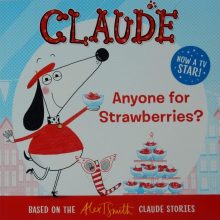
Claude: Anyone for Strawberries? / Claude:Ever-So-Summery Sticker Book

Claude: Anyone for Strawberries?
Alex T.Smith
Hodder Children’s Books

This is another is the delectably funny Claude stories spawned by the Claude TV Show and it’s perfect summer reading.

It’s a Tuesday in Pawhaven, but one that starts badly for our friends Claude and Sir Bobblysock who have been eagerly anticipating “Strawberries-for-Breakfast day”.

Off they dash to Denzel’s fruit-and-veg van, but disaster! When they arrive Denzel informs them that on account to the Pawhaven Tennis Championships, all the strawberries are already sold.

The friends head to the park, and as they arrive a tennis ball hurtles out of the sky directly towards Sir Bobblysock.

In a flash Claude leaps skyward, catching the ball in his beret, mightily impressing his pal.

Meanwhile the semi-final has ground to a halt. Movie star, Errol Heart-Throb, is refusing to continue without his lucky ball.
Needless to say he’s thrilled to have it handed back by Claude. Before you can say “strawberries’ Claude has landed himself a job as official match ball boy.

You can guess where Sir B. heads off to, hardly able to contain his excitement at the prospect. However, once again his anticipated strawberry feast is thwarted.

In the meantime, Errol has been declared the winner of the semi-final but it appears that vanity will stop the now ruffled-looking victor from playing in the final.

Claude is to take his place and is more than willing when he learns what the prize is …

There’s a slight snag though – the other finalist is Kimberley and she has a somewhat over-sized racket.

It’s a tense match, but who will be the winner? I wonder …

As with all the Claude stories, this is a smasher.

Game, set and match to Alex T.Smith and the TV series for another winning episode served up with bowls full of summery deliciousness. Hard luck if you happen like this reviewer, to be allergic to those small fruity berries Claude and Sir Bobblysock love so much. In which case, just get the book and pass on the strawberries.

If that’s not enough for your young Claude enthusiasts then also based on the Sixteen South TV show is:

Claude: Ever-So-Summery Sticker Book
Hodder Children’s Books

Set on Pawhaven beach it’s full of seasonal silliness, Claude and Sir Bobblysock style.
There are lots of activities to test your little ones’ visual skills, pages to adorn with sandcastles (and some of the 250 stickers that make up the centre pages); a maze to navigate; a picnic to share with the two favourite characters and more.
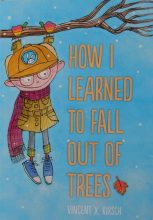
How I Learned to Fall Out of Trees

How I Learned to Fall Out of Trees
Vincent X. Kirsch
Abrams Books for Young Readers

Saying goodbye to a close friend is always hard especially when they’re moving away as Adelia is in this story.

She however, has planned a special farewell gift for Roger, which she delivers before she departs. It’s a lesson in how to climb a tree and, since Roger is a worrier, how to fall out safely.

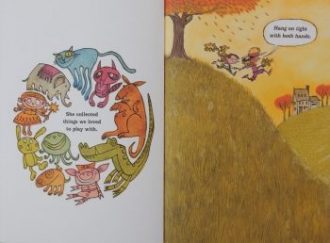
She starts by collecting all kinds of memorabilia: leaves, feathers, abandoned nests,

rugs and cushions, favourite toys,

boxes and clothing.

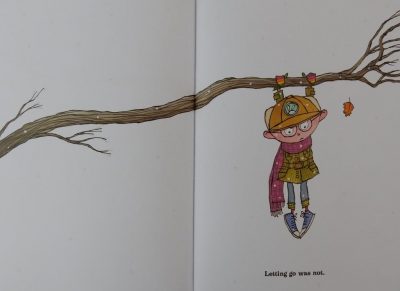
All these memory-laden articles are shown on the verso of the spreads while on each recto, we see the two sharing their remaining time together with Amelia instructing her friend and demonstrating how to get up into the tree’s branches: “Shimmy up the trunk and don’t turn back” … “Hang on tight with both hands” … “take it one branch at a time” and as we’d expect, finally, “Letting go will be the hardest part!’

When the time comes for Roger to make that solo climb just after his friend’s departure, he scales up easily

but then inevitably … falls.

Thanks to Amelia’s carefully and lovingly compiled construction though, he does so beaming from ear to ear.

Kirsh’s story is as carefully constructed as Amelia’s landing pile while the expressive illustrations are nicely detailed: and the girl’s instructions to her friend could equally well be what she needs to tell herself too.

Quill Soup

Quill Soup
Alan Durant and Dale Blankenaar
Tiny Owl

This droll tale, the third in Tiny owl’s ‘One Story, Many Voices’ enterprise is a wonderful retelling of an African variant of folk tale classic Stone Soup.

Here the protagonist, Noko is a tired, very hungry porcupine that dupes a whole village of selfish, well-sated animals into contributing to a wonderful meal even though they’ve asserted one by one that they have absolutely nothing to spare for the stranger.

Noko’s initial request in the seemingly empty village he arrives at is to the resident of the first house. But his “Do you have anything I can eat?” request is met with Warthog’s response, “I’m sorry, I ate a big lunch and all my food is gone.” Really?

Further excuses come from Rabbit, Monkey, Aardvark,

Meerkat and Pangolin, and all the while Noko is convinced the animals are lying.

Though his body may be tired, the porcupine’s brain most certainly isn’t – it’s as sharp as his own quills and he comes up with a plan to get some of that food stashed away in the villagers’ homes.

The animals feel obliged to his requested large pot of water and some fire, and learn that the visitor is to make his own quill soup using three quills from his own back – a flavourful soup fit for a king.

Mightily impressed that Noko has met the king, one by one the villagers provide the ingredients he mentions as he samples the contents of the pot until eventually the porcupine declares the soup “Perfect’ and then it’s time for a shared feast under the stars.

And by the time Noko requests a hole to bed down in, the other animals have realised that he deserves a much comfier place than that to sleep – after the communal singing, dancing and storytelling, that is.

Dale Blankenaar’s kaleidoscopic illustrations have a zestiness about them that is just right for Alan Durant’s version of the story. Their combination serves up the full-flavoured message that we  should all offer a welcome to strangers in need, sharing our resources to help them, wherever, whenever we can.

Duck & Penguin Are Not Friends

Duck & Penguin Are Not Friends
Julia Woolf
Andersen Press

Betty and Maud are best friends; they love to play together. Each has a soft toy: Betty’s is Duck, Maud’s is Penguin. The girls are convinced their soft toys are equally friendly, sharing a love of their favourite human activities, swinging, sand play,

baking, painting and playing with ‘Itty-bitty babies’.

So involved are the girls in their own activities however, that they fail to notice what’s going on between Duck and Penguin.

Then the girls leave their toys alone while they go and fetch their baby bottles.

Left to their own devices Duck and Penguin indulge themselves in all the activities they’d previously tolerated with extreme reluctance and waywardness. This time however, because they’ve chosen so to do, swinging, sandcastle construction, baking and painting are fun for the two toys.

After all, who wants to have activities thrust upon them?

I love how the toys look even more ‘loved’ or shall we say, the worse for wear, by the end of the day; I love too the playful onomatopoeia, that relating to the toys contrasting nicely with the girls’ at times; and Julia Woolf’s energetic, wonderfully expressive illustrations will surely make little humans giggle, especially at the toys’ antics.

If You Had Your Birthday Party on the Moon / The Race to Space

If You Had Your Birthday Party on the Moon
Joyce Lapin and Simona Ceccarelli
Sterling

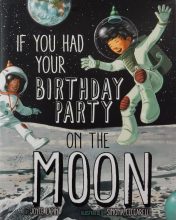
Hold on to your helmets, it’s blast off time, destination a birthday party in a place you never expected it to be. Moreover, there’d be a lot more celebration time on your lunar destination for it has a 709-hour day.

On the way to the moon you’ll discover what it feels like to be weightless and your party paraphernalia and pals will also float around inside your spaceship.

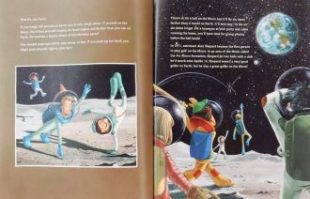
Once on the moon’s surface you’ll feel a lot lighter than on Earth and the Moon’s low gravity will keep you safe.
You won’t be able to fly any party balloons on account of the Moon being airless but you can have enormous fun doing one-handed push-ups,

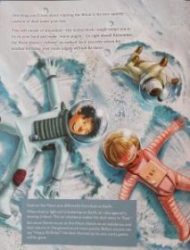
exploring the lunar craters, trying a game of freeze tag and making moondust angels.

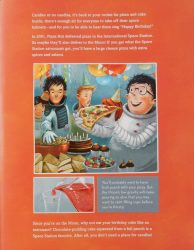
Perhaps you will have to eat your birthday cake astronaut style squeezed out of a foil pouch. Don’t think I’d be so keen on that idea.

Then on the return journey and there’ll be bags of time to open your presents, a whole three days in fact during which you could also open those party bags and sample some of the Moon pies therein.

Woven into all this partying is a great deal of STEM information on exciting topics both astronomical and cosmonautical. Why for instance is the sky black rather than blue; why your birthday will last almost 30 days, and why there wouldn’t be any point in playing musical statues on the moon.

With Simona Ceccarelli’s lively, playful digital illustrations and Joyce Lapin’s enormously engaging narrative that speaks straight to the reader, this is a sure fire winner for younger readers/listeners.

(Included at the back are a glossary, bibliography and suggestions for further reading).

For somewhat older readers is:

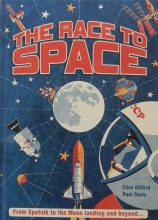
The Race to Space
Clive Gifford and Paul Daviz
Words & Pictures

With the 50th anniversary of mankind’s first moon landing fast approaching, here’s a book that traces the history of the space race between two super powers, the U.S. and the Soviet Union, from the launch of Russia’s Sputnik to Neil Armstrong’s planting of a U.S. flag on the moon’s surface and those oft quoted words, “That’s one small step for a man, one giant leap for mankind.” That must be etched into the brains of all who saw that landing broadcast live.

From then on the relationship between the U.S. and the Soviet Union became more one of co-operation and collaboration than competition and the book documents the ‘handshake across space’ in the 1975 joint Apollo-Soyuz mission.

It concludes with more on the co-operation including the establishment of the International Space Station.

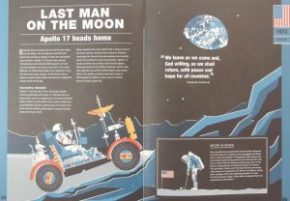
Illustrated, retro style by Paul Cadiz, in shades of red, yellow, blue plus black and white,

the book has clear explanations together with a liberal scattering of quotes from significant participants in the whole endeavour.

Recommended for individual reading at home and for KS2 class collections.

When Grandma Gives You A Lemon Tree

When Grandma Gives You A Lemon Tree
Jamie L.B. Deenihan and Lorraine Rocha
Sterling

Most of us receive the occasional present from a relative that isn’t quite what we’d been hoping for and so it is with the little girl in this story from debut author Jamie L.B.Deenihan.

In the run up to her birthday, the little girl makes a list of electronic items she wants – a robot dog, a phone and a computer number among them. But, her Grandma gives her a lemon tree.

There are all manner of things you might do with such a gift but the girl entertains such possibilities – dropping it from a bridge, sending it skywards attached to balloons, or dumping it on someone else’s doorstep – in her imagination only, and proceeds to tell readers how to care for the tree

until almost a whole year later …

All that lemon juice has its uses though, especially if you’re a bit of an entrepreneur like our young protagonist who has ideas for raising some cash to spend on … something from her birthday list perhaps?

Love the Pear brand electronics in this illustrations

That would be telling, but her purchase certainly makes for a great finale.

With its gentle humour, gardening tips, adorable characters, recipe for making lemonade, and Lorraine Rocha’s vibrant, funny illustrations, there’s not a hint of sourness in this story. Rather it’s tangy, overwhelmingly positive and an entire delight as well as an incentive to get outside and grow something that everyone can enjoy. And ‘enjoy’ is what children and adults alike will do when they share this story.

Don’t Go There!

Don’t Go There!
Jeanne Willis and Hrefna Bragadottir
Andersen Press

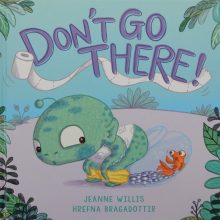
A small human is tasked with toilet training a small green alien when she discovers him in her home one day.

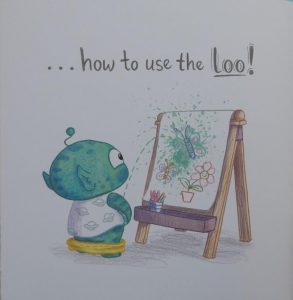
The little fellow has no idea that it’s totally inappropriate to direct his wee towards the narrator’s painting easel …

or leave deposits of poo in the bird bath.

So the little girl takes her new friend into the bathroom and shows him the toilet.

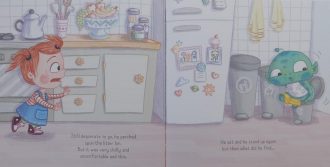
The little Martian is resistant to using such a cold, deep object and runs off in search of a more likely receptacle.

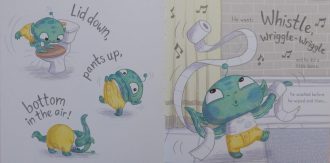
Several tries later, it’s time to march the little guy back to the bathroom and start toilet training in earnest. “Lid up,/ pants down, / bottom on the seat. Sit still, / just chill, / until the job’s complete. / Whistle if you want to. / Singing can be fun. / Wipe, flush, wash hands, / then you’re done!” goes the Toilet Song the narrator sings.

The Martian’s effort doesn’t quite sound (or look) quite the same however but he does his very best,

even though his pants do end up being flushed down the loo.

Eventually of course, with lots of practice, he does get it right.

In the reassuring penultimate spread the narrator uses the success of her alien friend to assure little humans they too can learn the ropes; and then, once he’s back on his own planet, the little chap has a job to do …

Little ones and their adults will assuredly giggle at all the mistakes and mishaps that befall teacher and learner in this enchanting, light-hearted alien twist on toilet training.

Jeanne’s bouncy rhyming text is great fun and reassuring too, while Hrefna Bragadottir’s slightly muted, comical illustrations ensure that there will be plenty of shared laughs during this nicely flowing learning journey.

Lula and the Sea Monster

Lula and the Sea Monster
Alex Latimer
Oxford University Press

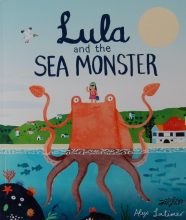
A new highway is due to be constructed and as a result, despite their protestations, Lula and her family are soon to be forced out of their family home, an old house on the beach.
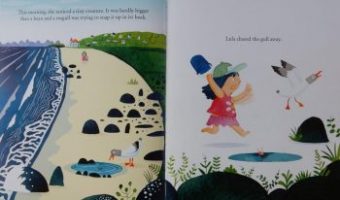
One morning just before their move out date, Lula takes a walk along the beach armed with sandwiches and her bucket and spade. Suddenly she comes upon a tiny creature that looks as though it’s about to become a seagull’s tasty breakfast snack.

Lula however sees off the seagull, scoops up the little creature in her bucket and decides – on account of its size – to name it Bean.

She takes him to a suitable sized rock pool and frees him there, feeding him a sandwich, which the creature soon demolishes.
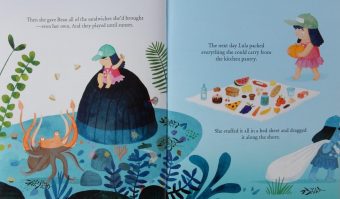
Promising to return next day, she goes home and in the morning makes extra sandwiches for her new friend, Bean.

Overnight however, Bean has grown considerably and now won’t fit in the rock pool. Lula takes him to a larger one, feeds him generous amounts of sandwiches and they spend some time playing together.

The following day she returns with a veritable Bean feast.

Bean meanwhile has grown enormously and using the food as bait, she lures him to a very large pool where he gobbles up everything.

By now Lula’s attachment to Bean is considerable, so much so that she cannot bear to visit him next morning. Come lunchtime though, she’s feeling braver and off she goes again but there’s no sign of Bean in the rock pool.

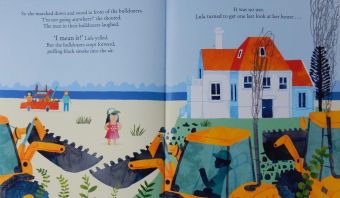
All too soon it’s moving day and as the bulldozers arrive, Lula stages one final protest. Can she possibly prevent the demolition squad from getting to work?

Perhaps not single handed, or even with the help of her human friends; but what about Bean? …

I could see little Luna becoming a member of the young guardians of the environment movement that has been so much in the news recently with their protests and marches. Good on her and on them. In Alex’s magical, heart-warming story, as in life, it’s down to children to make a difference and his portrayal of little Lula as a determined, don’t mess with me character is terrific.

With its seaside setting, this is a great book to share and discuss with youngsters especially during the summer time, but its message is an important one no matter the season.

Tooth Fairy in Training

Tooth Fairy in Training
Michelle Robinson and Briony May Smith
Walker Books

If you’ve ever wondered how tooth fairies hone their skills, then this magical tale will perhaps enlighten you.
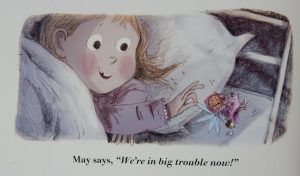
Let’s meet the trainee Tate and her trainer, sister May who has much to teach her younger sibling.

First task is to perfect the ‘switcheroo’ – a doddle of course … unless that is, you happen to be performing it on a baby hippo.

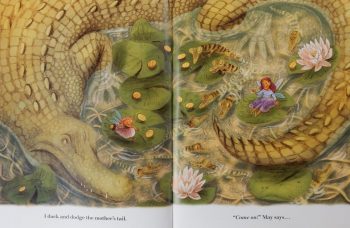
Visit two is also pretty demanding and perhaps a tad alarming, especially when you’re being watched by the infant’s mother whose tail you have to avoid with some nimble footwork.

And so it continues over ground and under sea, on the shore and then having traversed almost the whole planet, the penultimate stop is in the jungle with the possibility of being swallowed by an anaconda – yikes! But snake teeth are a rarity so it has to be done.

Surely the final stop will be simplicity itself – it’s to a mere human girl. How could anything go wrong, and even if on the off-chance, it does, you can always resort to a touch of the old magic …

Does our novice pass the test though? That is after all, the purpose of the whole exercise: I’m not telling …

Briony’s illustrations are spirited delight, every one of them. Tate is totally adorable and her expressions and body language say even more than the lively rhyming narrative she (and Michelle) provides during the learning journey throughout which her big sister looks on benevolently and comments encouragingly.

I fell in love with this utterly blissful book.

Hair Love

Hair Love
Matthew A.Cherry and Vashti Harrison
Puffin Books

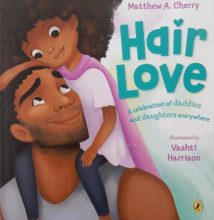
‘A celebration of daddies and daughters everywhere’ says a line on the cover of this book but it’s much more than that. It’s also a celebration of individuality, perseverance, collaboration, and a loving family.

Young Zuri’s hair is a mass of curls; her dad calls it beautiful and this makes the little girl proud. It lets her be herself as it ‘kinks, coils and curls every which way’, no matter if she feels like being a princess or a superhero.

On this particular day though, Zuri needs a very special hairstyle but she knows her Daddy is particularly tired after having undertaken the whole responsibility for her care. Deciding he needs a break, the child allows him some extra sleep while she investigates styles on a tablet. Her good intentions however are thwarted;

he’s woken up and ready and willing to assist.

Dad tackles the job confidently but comes up with a series of hairstyles that just don’t work for Zuri, as we see in Vashti Harrison’s splendidly expressive digital illustrations and hear through debut author Matthew Cherry’s apt narrative,

until the dutiful dad pulls a bobble hat down over her eyes.

Zuri’s “We can do better than that” response however sees the two working together, she providing encouragement and an on-screen lesson, he collecting the tools and developing his artistry until finally … Success! ‘Funky puff buns’ that satisfy everyone …

Our little girl is ready just in the nick of time for a very important ‘welcome home’ celebration.

Just right for an early years storytime and for family sharing, this is a smashing book that knocks gender stereotypes out of the window as well as reinforcing the ‘be proud of who you are’ message.

Christopher Pumpkin

Christopher Pumpkin
Sue Hendra, Paul Linnet and Nick East
Hodder Children’s Books

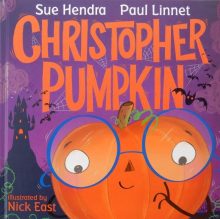
Who or what would you ask for assistance if you were wanting to throw the scariest ever, totally unforgettable party? Perhaps not a pile of almost forgotten cooking ingredients that just happen to be lying on your kitchen floor; but then you are not a witch with a magic wand like the one in Sue and Paul’s crazy magical rhyming tale.

This witch decides to spell a heap of pumpkins into life, name them – Gnarly, Grizzly, Grunty, Roar, Snaggletooth, Stink Face and err – well she never gets to give a name to the last one for he cheerily informs her that he’s called Christopher Pumpkin and invites his fellow pumpkins to a group hug.

Can this thoroughly ill-fitting, non-scary animated member of the pumpkin fraternity possibly fit in with the witch’s scarifying plans? She decides to give him the benefit of the doubt, albeit while keeping her beady eyes upon him.

Task one is to create decorations that will bring dread and fear into all who so much as glance at them.
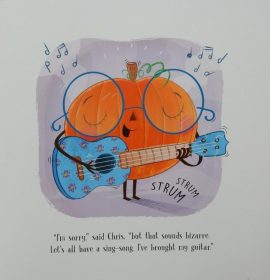
Easy peasy thinks Chris but the witch and other veggies are let’s say, underwhelmed. They’re equally unimpressed with Chris’s musical proposition …

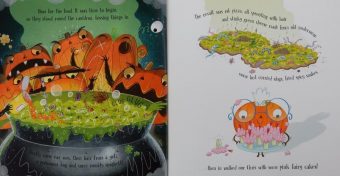
So what about the party fare? Of course it’s cooked up in the cauldron and seems suitably disgusting until in walks our pal Chris proffering err, some pretty pink confections.

The witch gives the guy one more chance – be scary or be soup.

Can Chris come up with a scary solution before the following morning: he has just the hours of darkness to work something out or he’s in the pot.

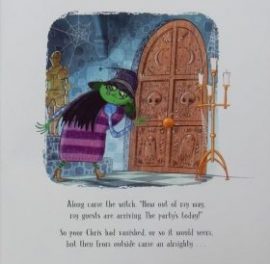
Oddly enough, come morning, there’s an empty bed where Chris had been and the witch is ready to throw open the door to let her guests in …

Terrifically silly but terrific fun, this tale is perfect for showing little ones the importance of being themselves and not letting anyone push them around or make them into something they’re not.

It’s a smashing read aloud that slides and slithers over and off the tongue like yummy pumpkin soup. And as for Nick’s scenes of magic, mischief mayhem and the occasional menace, they’re a totally tasty treat to feast your eyes upon.

What’s not to love? Perhaps though, that rather depends on whether or not you have a penchant for things puffy, pretty and pink.

Secret Agent Elephant

Secret Agent Elephant
Eoin McLaughlin and Ross Collins
Orchard Books

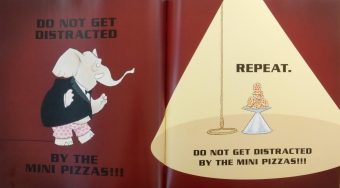
Ever thought about becoming a secret agent? That’s what the large pachyderm in this story has set his sights on; but can he get through the required training course? There’s a pretty rigorous selection process.

The first rule is secrecy about the role: that’s something Elephant definitely needs to do some work on. Hiding is a vital skill but if that’s not possible, perhaps a disguise might do instead …

Our elephant candidate surely does look pretty dapper in that tuxedo: seemingly the tailor can after all, perform the odd miracle.

So, it’s ‘Agent 00-Elephant’ welcome to the Secret Service and now on to your very first mission in double quick time before the dastardly feline Vincent Le Morte, notorious international supervillain presses that big red button of his and wipes out the entire world.

No pressure then Agent Elephant.

It’s time to take that enormous leap.

Hurrah! Vincent’s super-secret hideout located.

All that’s left to do now is discover the whereabouts of Vincent himself without letting your purpose be discovered.

Agent Elephant gets a sighting so he begins tracking his prey who just happens to be heading for that red button.

There’s the occasional hazard en route – sharks for instance as well as the odd distraction of the edible kind.

Oh my goodness, it seems as though someone is expecting a visitor but hang on a minute. Could it be that the latest recruit to the spy fraternity might just be about to save the world …

A pizza-fuelled piece of comedy theatre of the tastiest kind is this picture book collaboration between Eoin McLaughlin and Ross Collins.

Every spread is sure to induce giggles and the way the text works in tandem with the visuals is masterful.

Adults will have great fun sharing this with young audiences; I certainly did.

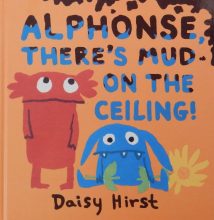
Alphonse, There’s Mud On The Ceiling

Alphonse, There’s Mud On The Ceiling!
Daisy Hurst
Walker Books

The cast from Alphonse, That Is Not OK To Do and I Do Not Like Books Any More! are back in another smashing story.

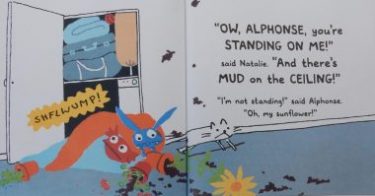
Natalie, Alphonse and family reside in a flat, on the seventh floor. The child monsters love driving their double-decker bed, playing around their large green chair, tending their sunflowers and performing somersaults down the hall and generally junglifying their surroundings until Natalie cries out “OW, ALPHONSE, you’re STANDING ON ME… and there’s MUD on the CEILING!

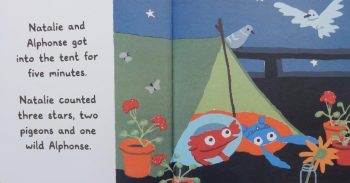
At this point Dad intervenes pointing out that their shenanigans are unsuitable indoor play. Natalie (who has an answer for everything) counters this with complaints about their lack of a wild jungle garden with a tent for sleeping in.

Eventually Natalie decides the park is where she want to be – alone.

Off she goes and there her explorations lead her to a bush with a hole wherein she finds …

Then, guess who arrives on the scene. A truce is called and a deal struck involving sausages and blackberries, and at Natalie’s insistence, a bundle of sticks.

Turns out there’s more than one place where you can be wild in the jungle, camping and tucking in to tea. Perhaps even sleeping too.

Another acutely observed, vibrantly illustrated tale from Daisy Hurst; these stories go from strength to strength. Everything about this book is quite simply brilliant.

I suspect adult sharers will adore it as much as the youngsters they read it with; this reviewer surely did.

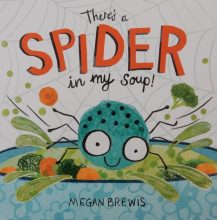
There’s a Spider in My Soup

There’s s Spider in My Soup!
Megan Brewis
Oxford University Press

I was expecting it to be a picture book version of the nursery song of the same name but how wrong was I. Megan Brewis has dished up a playful tale of a little spider that gets a high five from me for her risk taking.
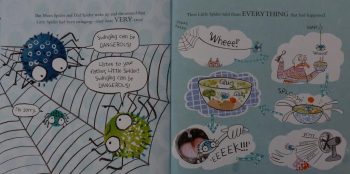
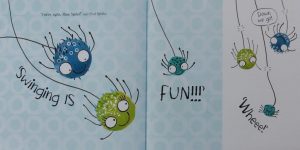
Little Spider resides with Mum Spider and Dad Spider on their web from which, despite parental warnings, she loves to swing.

One afternoon while her parents are having some shut-eye, our intrepid Little Spider decides to take advantage of their lack of watchfulness to work on her swinging skills, arcing high and low and having great fun until …

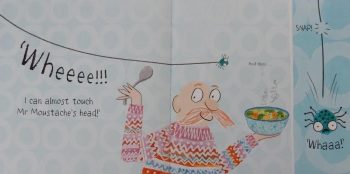
Is she about to become part of Mr Moustache’s veggie soup lunch?

Fortunately she manages to alert her would-be accidental consumer by some loud assertions concerning her identity.
Happily Mr M. is a kindly soul and after administering some TLC, puts Little Spider safely back onto her web.

When aroused from their slumbers, her Mum and Dad give their little one a good telling off but then they learn what had taken place while they snoozed.

Maybe being adventurous isn’t such a bad idea after all, is their verdict before setting off to meet Little Spider’s saviour.

With an abundance of onomatopoeic sounds, speech bubbles and spirited, mixed media illustrations, this is a smashing story to read aloud with little ones. It could, one hopes, deter them from squashing spiders and instead releasing them into the great outdoors, should they encounter them inside; and let’s hope too that risk averse parents and others might be persuaded to give young children a little more freedom to take risks and perhaps learn from their mistakes too.

Bug

Bug
Robyn Koontz and Amy Proud
Sterling

Bug, so named because of her passion for bugs – spotting them and drawing them – finds it hard to concentrate in her maths lessons. Instead, her teacher often catches her doodling and staring outside thinking about her favourite creatures.

When Mrs Muskie tells the class that they can plan a trip to the science museum, so long as everyone does well in the maths test the following day, encouraged by her friend Jasper on their way home, Bug determines to do her best.

Sitting in the field near her school, the little girl tries hard to concentrate on maths but finds herself distracted by buzzy bees, tickly gnats, dragonflies and butterflies, which of course, she cannot resist drawing in her sketchbook.

When she notices crickets on a log in two groups, these too become objects for sketching.

But then, Bug realises that instead of a distraction, her minibeast drawings can help her understand her maths – good on you Bug – and she proceeds to use her pictures of butterflies, ants and crickets as visual aids.

I absolutely love the way that back in her classroom next day, during the test, Bug comes to the aid of her teacher when her lucky crickets become a bit too lively, escaping from her lunch box and landing in Mrs Muskie’s hair,

calmly leading her outside, collecting up the offending creatures from the field and proceeding to prove to her teacher that she was doing as she’d been told ‘showing her thinking’ on her paper, which she hands over for checking.

Congratulations are the order of the day and Mrs Muskie is as good as her word …

There’s plenty of gentle humour both in Robin Koontz’s text and Amy Proud’s enchanting illustrations executed in pencil and acrylics that are likely to make budding entomologists out of all young children (although I’ve yet to come across one who isn’t fascinated by minibeasts).

A smashing book.

Astro Girl / Where’s Mr Astronaut?

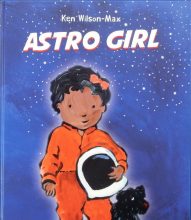
Astro Girl
Ken Wilson-Max
Otter-Barry Books

Space and stars enthusiast Astrid wants to become an astronaut, so she tells Jake her best pal as they lie stargazing.

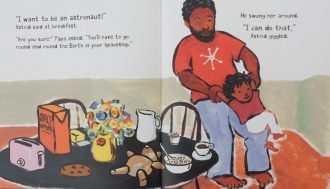
She goes on to tell the same to her papa over breakfast.

He challenges her assertion with comments about orbiting the Earth in a spaceship, dining on food from tubes and packets, becoming used to zero gravity, conducting scientific experiments …

and sleeping alone among the stars: he seems pretty knowledgeable about life in space. Astrid assures her Papa that she can manage all those things even the solo sleeping.

The day comes for the two of them to go and collect Mama in the car.

It’s then that we discover the possible reason for Astrid’s enthusiasm about space and her Papa’s knowledge.

A joyful reunion takes place and thereafter the little girl starts reading avidly to learn as much as she can about how to achieve her ambition, and about some of those trailblazing astronauts who went before, several of whom were women.

Simply and beautifully told, Ken keeps readers interested in the theme by showing us space related items such as Astrid’s t-shirt, her breakfast cereal, Papa’s T-shirts, the cookie shapes they bake together, pictures, a toy – all of which help in the build-up to the grand finale.

A smashing book for young space enthusiasts and perhaps to share on Father’s Day.

For a younger audience is:


Where’s Mr Astronaut?
Ingela P.Arrhenius
Nosy Crow

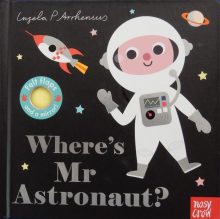
Vibrant, immediately appealing illustrations characterise Ingela P.Arrhenius’ latest title for the ‘flaps and mirror’ series in an amusing introduction to space exploration for the very youngest.

The space travellers hidden herein are a delightful mix of human, canine and alien. There’s Mrs Engineer, Mr Space Dog, Mrs Alien,

Mr Astronaut and finally, whoever happens to be looking in the mirror tucked beneath the felt moon flap.

This one’s sure to add to the deserved popularity of the hide-and-seek series.

The Same But Different Too / Goodnight World

The Same But Different Too
Karl Newson and Kate Hindley
Nosy Crow

Similarities and differences are highlighted and celebrated in this joyful and engaging rhyming book that uses both human and animal characters to demonstrate examples throughout a busy, fun-filled day from breakfast time to bedtime.

In between come a look at differing heights, climbing skills,

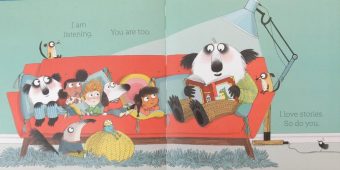
play activity preferences, age, dentition, position, speed and much more; and it’s particularly heartening to find that everyone shares the love of a story session.

Karl’s upbeat words in combination with Kate’s vibrant, zany artwork create a great picture book that’s perfect for family sharing and for foundation stage settings.

With the emphasis on embracing differences it’s a super book to open up discussions about such issues as inclusivity and acceptance. Every spread offers much to talk about and enjoy, helping to highlight how our differences make each and every one of us special and unique.

Goodnight World
Nicola Edwards and Hannah Tolson
Caterpillar Books

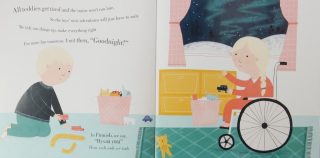
Ideal for bedtime sharing is this presentation of the ways of saying “Goodnight” in a dozen languages as well as in English.
Nicola Edwards rhyming narrative takes us through the bedtime rituals of different families as the little ones are hugged, have a bath, brush their teeth, tidy up toys,

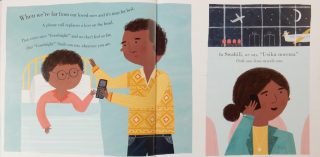
perhaps listen to a phone message from a loved one far away,

and share a bedtime story …

Some tinies are just so tired they need carrying up to bed already fast asleep, while others bid each other “Goodnight’ or in German “Gute nacht”.

Others will have trouble falling asleep and need to count sheep before dreams come.

No matter what though, come nightfall, little ones everywhere go to bed having said “Goodnight” or perhaps used the Mandarin “Wān an”, the Russian “Spokoynoy nochi”; the Italian “Buona note”; the Finnish “Hyvää yötä”; or maybe they said “Usiku mwema” (Shahili); “Buenas noches” (Spanish), the Arabic “Tisbah ala khair”; the Hindi “Shubh raatri” or the French “Bonne nuit”.

Safe in their beds under shared moon and stars, everyone finally falls asleep.

In her bold naïve style, inclusive illustrations Hannah Tolson shows all these different bedtime scenarios as they unfold in various places.

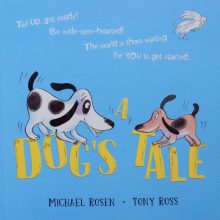
A Dog’s Tale

A Dog’s Tale
Michael Rosen and Tony Ross
Scholastic

Full of worldly wisdom, is this rhyming discourse from an old dog to a concerned pup as the two take a walk together.

Reassuring from the outset, ‘an epic life story that YOU get to write. … Be wide-open hearted … Fill up on hope, throw away fears’ comes the advice.

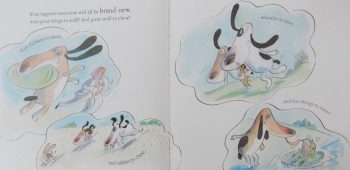
Life promises plenty of action …

no matter where your journey takes you … and opportunities – ‘you can make a mark! Make yourself heard –‘ although it’s important to be prepared for life’s downsides too – those waiting in the wings to do you down; or you might suffer the loss of a loved one.

However nobody need feel completely alone; there’ll be a friend to help you through times of sadness.

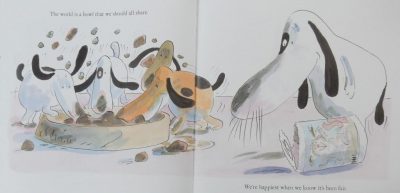
Perhaps a time will come when others will require your help; give and take is the best scenario. What we all need be we young, old or in-between, is a world where everyone is willing to share, a world where life is fair.

So says the sage old canine after which he retires for a well-earned snooze.

If only: we still have an awful long way to go but this book from two pillars of children’s books and reading, writer Michael and artist Tony, is a great reminder of what we should all be striving for. I’m no lover of dogs but I certainly fell for Michael’s canine characters as portrayed by Tony Ross in his superbly expressive scenes.

Share, discuss and act upon the advice herein wherever, whenever possible.

The Big Stink

The Big Stink
Lucy Freegard
Pavilion Books

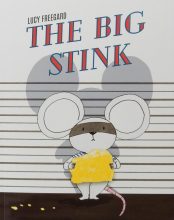
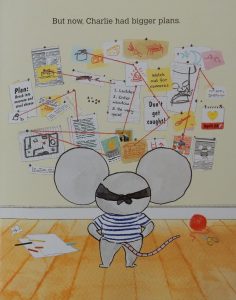
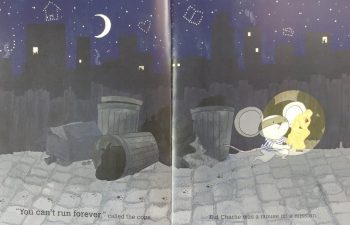
Despite his beguiling appearance, cheese-obsessive Charlie Mouse is a mouse with a mission for he’ll do anything to satisfy his lust for the stinky stuff: even perhaps following his dream of breaking into the Museum of Cheese and procuring for himself one of its famous exhibits, The Stinker.

One night his avarice overwhelms him and he decides to act.

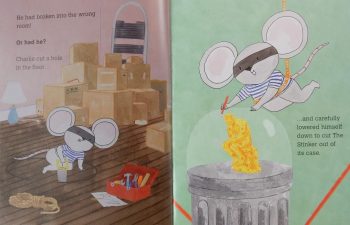
Once inside he finds that the security is excellent; so too though is his avoiding skill. Perhaps his location expertise is less so, but Charlie is forearmed with the appropriate tools to get his paws on the sculpture.

Suddenly disaster strikes in the form of a web of laser beams and the game is up. Alarms sound, security is alerted and the chase is on. Officer Rita is hot on his trail.

With her hyper-developed olfactory sense, she succeeds in tracking down the thief but by that time Charlie has seen the error of his ways. The priceless exhibit is still intact and Charlie must do his community service; but while so doing a wonderful idea strikes him …

With its twist in the tale, little ones will relish this cat-and-mouse drama; but it has plenty to offer adult readers too, not least the art and film references scattered throughout Lucy’s delicious offering.

This Way To Treasure Island

This Way to Treasure Island
Lizzy Stewart
Frances Lincoln Children’s Books

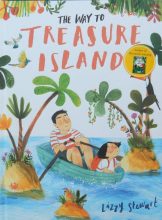
Award winning author-illustrator Lizzy Stewart introduces us to two completely contrasting characters, young Matilda and her dad; he tends to be slow, messy and noisy whereas she is fast, tidy and quiet. No matter how different they are though, they almost always have fun together.

One day at the beach Matilda, in possession of a map, announces that she’s off to find treasure. Her dad, she tells him, can accompany her so long as he agrees to follow the map.

Off they go in an old wooden boat with Dad rowing and Matilda giving directions.

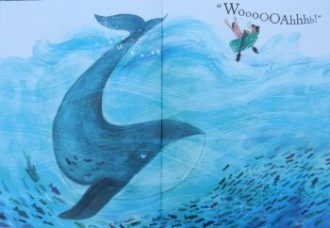
Sometimes, Dad becomes distracted and as a result the two drift far out to sea. Dad’s all for taking short cuts but Matilda isn’t sure. She’s even less sure when the nice big rock they’re circling does this …

Fortunately however, the turbulence takes the boat right close to the shore of their treasure island destination. Thereon more map reading is required and almost immediately the two agree to part company; “We’ll see who finds the treasure first!’ says Dad.

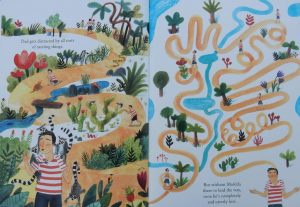
Inevitably without his daughter as guide, Dad is soon totally lost.

Matilda meanwhile, although she finds things a tad on the boring side, continues following the map. Eventually she finds the place where according to the map, she should find the treasure but despite looking under, over and inside things, she can’t find it. Time to return to the boat she thinks.

Dad however is still looking and wondering until …

In case you’re wondering, yes they do discover treasure although perhaps it’s not what they were expecting. And then it’s time to go home, maybe without taking any short-cuts however.

Yet again, Lizzy has created a winner with this. Her characters are convincingly portrayed and their treasure island with its rainbow hued flora and fauna, totally gorgeous.

Rich in classroom potential, this smashing book will be requested over and over.

How To Be On The Moon

How To Be On The Moon
Viviane Schwarz
Walker Books

This sequel to How to Find Gold again stars intrepid Anna and careful Crocodile.

Anna is eager to visit the moon but Crocodile is less than enthusiastic telling her it’s “out in space … really very far away … almost impossible.”

This appeals to Anna but first they have to acquire some special skills, counters Crocodile; but Anna can count backwards from five.
In fact he raises a snag at every opportunity: a great deal of patience is necessary: Crocodile has sufficient for them both, he’s told eventually.

Crocodile is then allocated the task of sandwich making while Anna builds the rocket.
Tasks complete, they count down and … blast off …

While on board they play the only game gravity allows – it involves sandwich catching and consumption (once you’ve caught all the constituents) and then as it’s still some distance to go, take a patience-extending snooze.

Finally though they land on the moon, finish their sandwiches, don space helmets and go out exploring the deserted moonscape.

Before long, as they gaze up Anna decides that “Poor Earth” is missing them and they decide to head off back home.

Once more on Earth, they bask briefly in mission-accomplished glory before deciding the rest of the world needs checking on, and off they set …

A smashing story – one expects no less from Viviane – but it’s the wonderful, wondrous textured illustrations that steal the show – just!  The dialogue’s absolutely priceless too. And I absolutely love how the two contrasting yet complementary characters rub along together so beautifully.

Sheer delight through and through.

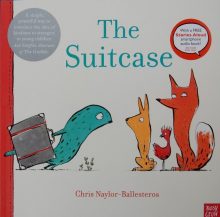
The Suitcase


The Suitcase

Chris Naylor-Ballesteros
Nosy Crow

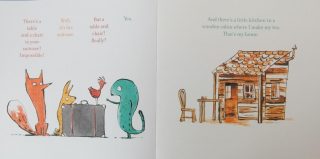
One day there comes a weary, wan and dusty looking stranger dragging behind him a large suitcase. Challenged by a watching bird as to the contents of his suitcase, the creature answers, ’Well, there’s a teacup.’

Another animal arrives on the scene expressing surprise at the size of the case in relation to a teacup and is told that it also contains a table for the cup and a wooden chair for the stranger to sit on. Up rocks a fox and on hearing what’s being said, implies the stranger is lying.

This prompts him to fill in further details about a wooden cabin with a kitchen or making tea and to describe its surrounding landscape too.

By now the creature is so exhausted he begs to be left alone to rest and falls asleep right away.

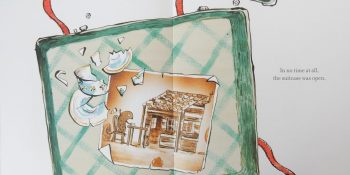
The other three creatures discuss things and fox is determined to discover the veracity or not of the information the stranger has given. His friends are less sure that breaking into the case is acceptable but fox goes ahead and the contents of the suitcase is revealed …

The damage is done: still fox insists the stranger lied to them whereas the other two are showing concern.

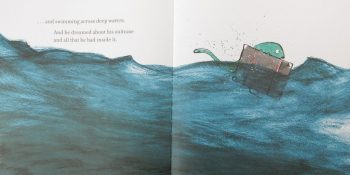
Meanwhile the slumberer dreams …

And when he wakes up he’s totally surprised at what the others have done …

Audiences will go through the whole gamut of emotions when this heart-rending story is shared, as did this reviewer.

It’s a totally brilliant, brilliantly simple and compelling way of opening up and discussing with little ones the idea of kindness and how we should treat those in need. I love the way the animals and what they say are colour matched and Chris’s portrayal of the characters is superb.

What better book could there be to share with a nursery or foundation stage class during refugee week than this one, offering as it does, hope and the possibility of new friendship.

Sea Glass Summer

Sea Glass Summer
Michelle Houts and Bagram Ibatoulline
Walker Books

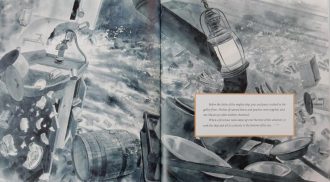
‘Some years ago a boy named Thomas spent the summer at his grandmother’s island cottage.’ So begins a beautiful story set in Maine some time in the last century.

Early in his stay his grandmother gives the boy a magnifying glass that had belonged to his grandfather and Thomas uses this as he explores the rocky beach one morning.

When he shows Grandmother a piece of glass he’s discovered she tells him that “ … your grandfather used to say that each piece of sea glass has a story all of its own.”

That night Thomas places the sea glass beside his bed and dreams of a shipyard long ago. The routine continues with the boy discovering bits and pieces of glass each morning and dreaming each night. (The dream stories are depicted in greyscale serving both to separate them from the present events and to bring history alive again).

In contrast, Bagram Ibatoulline’s superbly moving, equally realistic, watercolour scenes show the sometimes glowing, sometimes shadowy shore whereon Thomas, aided by the magnifying glass, makes his discoveries of mysterious magical ocean gifts and lets his imagination soar.

All too soon the holiday ends: Thomas gathers together his treasures and boards a boat back to the mainland. However, a sudden lurch causes him to drop his magnifying glass and some of the pieces fall overboard.

The story then moves to recent times: a girl named Annie walks on the beach collecting treasures and comes upon a piece of sea glass. She shows it to her Papa Tom; you can anticipate what she’s told … The tale concludes having come full circle …

Michelle Houts’ lovely story of journeys, connections, possibilities and the power of the imagination has much to appeal to older picture book readers and is full of possibilities for exploring in a KS2 classroom.

(A final author’s note explains why there is much less sea glass nowadays: a big plus for the environment but children will have to find other treasures on the seashore to fuel their imaginations.)

Paper Planes

Paper Planes
Jim Helmore and Richard Jones
Simon & Schuster

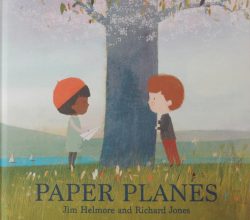
Following his The Snow Lion, Jim Helmore has written another  beautifully observed, enormously moving story.
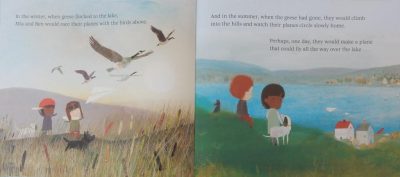
Mia and Ben are best friends; they do everything together, their favourite activity being making paper planes. In winter, they race them against the geese and hope one day to make a plane that will fly right across the lake.

Then comes some devastating news: Ben and his family are moving to a new home in the city. How will they sustain their friendship when they’re so far apart?

The two exchange planes and vow never to forget one another.

Winter comes; the days are hard for both of them and in her frustration and anger, Mia smashes the plane Ben’s given her.

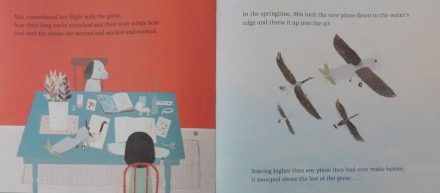
That night something stirs Mia during her slumbers. The plane in the garden, appears whole once more; and then she’s flying with the geese, high in the sky. Suddenly she spies another plane: could it possibly be?

The next morning she receives a parcel from Ben. Inside is a model plane but it isn’t complete: Ben knows of only one person who can add the wings …

The friendship isn’t broken after all; the connection is still there, and the hope.

Richard Jones’ captures the changing emotions to perfection in his richly textured illustrations. They contain plenty of details, and like the words, a powerful poignancy that is impossible to forget. I love the subtlety of the STEM element especially the way Mia uses both her knowledge from her observations and her creativity to complete her task.

Readers and listeners too will need to use their observational skills to read Richard’s pictures carefully to get the most from this quietly powerful picture book.

Leyla

Leyla
Galia Bernstein
Abrams Books for Young Readers

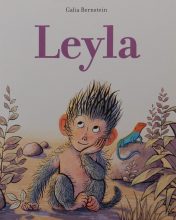
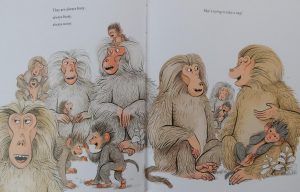
Young hamadryas baboon Leyla finds her large family overwhelming with their constant noise, grooming and snuggling.

She just wants some peace so decides to run away in search of a quiet space of her own.

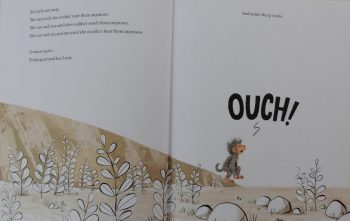
Having run sufficiently far, so she thinks, for there to be nothing around, she stubs her foot on a sharp rock

and then comes upon a lizard; a very still, quiet creature “very busy doing nothing” so he says.

At her request, the lizard teaches Layla to do the same: they sit peacefully in meditative mode feeling the warmth of the sun and listening to the rustling of the leaves, the buzzing of insects.

Some time later, Layla opens her eyes and realises that she now misses her family and is ready to go back to them. She does so however, safe in the knowledge that she can always return to doing nothing with her new friend for “I’m always around,” he assures her.
As a result she finds herself better able to cope with all the attention she receives from her welcoming family, partly because true to his word, that lizard was ‘always there.’ And she certainly enjoys talking about her adventure.

As someone who practises meditation (and yoga) daily, I can attest to the benefits of what that lizard offered Layla.

The author’s warm story, we learn was inspired by watching hamadryas baboons, in particular a very young one, in a Brooklyn zoo. Her expressive illustrations created digitally with the addition of hand-painted textures, say plenty about Layla’s feelings be they overwhelmed, angry, in pain, scared, peaceful, happy or excited.

In our ever busy, pressurised lives, we all, young and not so young, need to become more mindful; this book is a fun demonstration of the importance of mindfulness.

Party for Dads / Molly’s Magic Wardrobe: The Mermaid Mission

Party for Dads
Adam & Charlotte Guillain and Ada Grey
Egmont

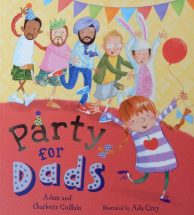
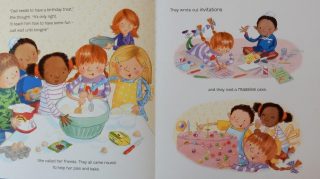
For this follow-up to their School for Dads, the Guillians have created another joyful picture book and it’s just right for celebrating Father’s Day as well as a Dad’s birthday.

The particular dad in this rhyming tale has no time in the morning for birthdays, barely paying heed to his daughter’s “Come on – it’s time to play! … You should be having fun.”

Instead he dashes out leaving young Anna and the friends she summons to plan and bake for a special surprise evening celebration.

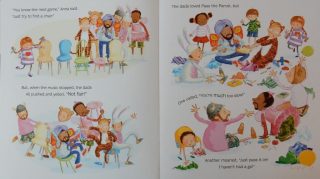
Later in the day, Dads of all kinds arrive and are instructed to cast aside their phones and don fancy gear ready for some fun party celebrations and games both inside …

and outdoors.

Enthusiasm for partying duly fired up, they then start bopping and before long their less than skilful moves are being scored in ‘Strictly’ style.

After that it’s time for Anna’s Dad to embrace the true party spirit, which he does by becoming a stand-in magic bunny when his daughter performs a spot of prestidigitation.

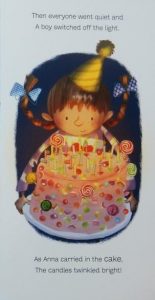
Over indulgence is inevitable after all the playful party-poppering papas tuck in to the feast on the table that culminates in the appearance of …

Then candles extinguished, it’s award presentation time: but will Anna’s dad be a prizewinner?

Fun and a certain amount of silliness prevail in this exuberant book, made all the more effervescent by Ada Grey’s funky illustrations

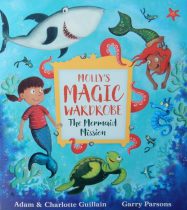
Molly’s Magic Wardrobe: The Mermaid Mission
Adam & Charlotte Guillain and Garry Parsons
Egmont

The second story starring Molly and the enchanted wardrobe she discovered at her Granny’s house sees the little girl’s attention being drawn to a mermaid costume.

Having stepped inside and counted to three, she’s off whizzing down into the depths of the ocean for a new adventure.

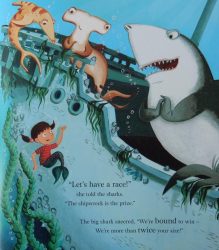
Her frolics with mermaids are soon interrupted by snarling sharks claiming ownership of a wreck and swooshing the girl and her new friends down to where more friendly creatures – a turtle and octopus are taking tea.

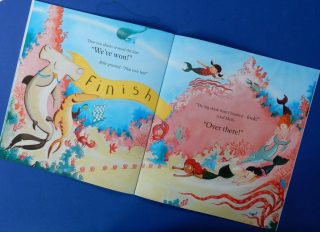
The mermaids relate what’s just happened and suddenly Molly has an idea. She challenges the sharks to a race, the prize being the shipwreck.

The sharks are confident they’ll be victorious but will they?

Lessons are learned, apologies given and accepted; and after a game of hide-and-seek, it’s time for Molly to bid her new friends farewell.

The Guillains’ magical rhyming tale is complemented by Garry Parsons’ bright, expressive, eye-popping scenes of the sub-aquatic frolics.


The Really, Really, Really Big Dinosaur

The Really, Really, Really Big Dinosaur
Richard Byrne
Oxford University Press

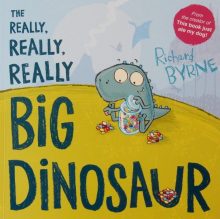
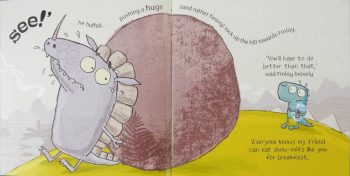
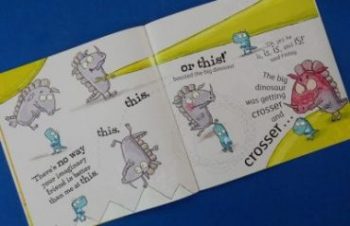
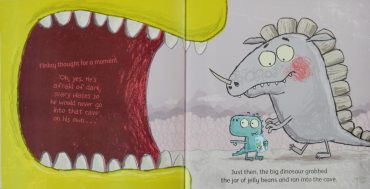
Finlay sits counting out jelly beans from a jar, ‘one for him, one for me’ when suddenly a huge dinosaur approaches – an extremely greedy dinosaur who demands all the jelly beans for himself. Now the sweet treats happen to belong to Finlay’s friend and the little dino. claims said friend is rather large but this deters the huge beast not one jot. Instead he brags even more about his size and strength and goes on the heave an enormous rock in Finlay’s direction.

Teasing follows with the huge stroppy dinosaur accusing Finlay of making up a story and further bragging about his own skills. And so it continues with the bully becoming ever more angry …

until the sleeping giant is finally awoken by his shouts of “I want the jelly beans.”

Now it’s time for the supposed make-believe creature to show that big bullying dinosaur a thing or two.

That’s not quite the end but who wants to be a story spoiler?

Splendidly witty, this tale is much more about showing than telling with the deadpan words and hilarious pictures working wonderfully in tandem.

It’s great to see a paperback version of the story that’s certainly going to appeal to the vast numbers of young dinosaur lovers out there; and it’s a perfect one for starting a discussion on bullying.

If you missed the original hardback (or it’s worn out from use), then now’s the time to get hold of a paperback replacement.

Sophie Johnson: Detective Genius

Sophie Johnson: Detective Genius
Morag Hood and Ella Okstad
Simon & Schuster

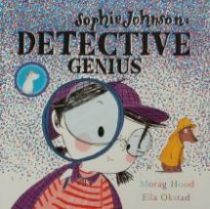
Unicorn expert Sophie Johnson now extends her skills to detecting; she’s a self-confessed expert, ably assisted though she won’t admit it, by fussy eater, anti-outdoors pooch, Bella.

Sophie knows of a ‘terrible crime’ that needs solving and fuelled by the thought of the reward, she’s on the case, determined to discover the perpetrator.

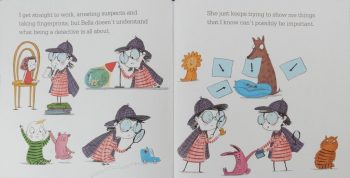
Suspects are arrested and finger-printed while Bella constantly tries in vain to draw something to Sophie’s attention; but so absorbed in her own detecting is Sophie that she’s unable to see what’s right under her nose.

Detecting is tough work but some are more adept at it than others – it’s just a matter of deciding who …

I won’t be a story-spoiler; however observant readers and listeners will likely be making their own predictions well before the final denouement of Morag’s clever, dead pan telling.

Ella’s hilarious scenes of Sophie and her assistant on the case provide the perfect foil for the droll text; and do look carefully at the back cover whereon Sophie’s library is shown.

What will Sophie turn her attention to next? No matter what, bring it on. Meanwhile, for sure, the adorable Sophie will win a lot of new fans with this latest book.

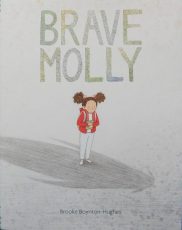
Brave Molly

Brave Molly
Brooke Boynton-Hughes
Chronicle Books

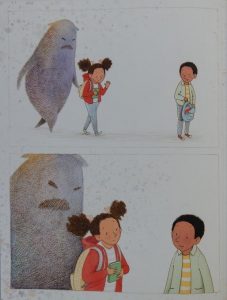
This virtually wordless picture book follows young Molly from her window seat where she sits reading and observing three young passers by, out from her house and down the street. But what is constantly lurking close by, sometimes waiting, sometimes following, sometimes stopping to watch?

It’s the monster that bears a strong resemblance to her own drawing tossed into the rubbish bin before she left home. Said monster, so we assume, is a representation of Molly’s own fear of interacting with others.

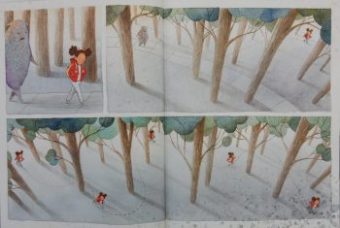
The three children leave behind a book on the seat they’d stopped on; Molly puts it in her backpack and sets off after them, with the monster not far behind.

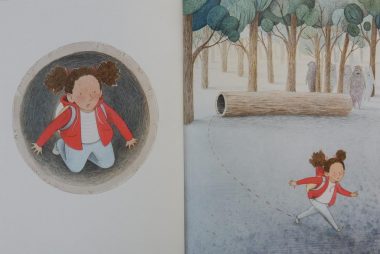
Her shyness escalates and with it the number of monsters as she runs, crawls through a tunnel

and climbs trees until she feels almost completely overwhelmed. Somehow though, she summons up the courage to confront the terrors and seemingly they vanish, or almost.

One returns as she attempts to overcome her shyness and return the book: can she manage to get the better of it?

Could a simple word perhaps be all that’s required?

Make sure to check out the endpapers – this moving, empowering story starts and concludes thereon. It’s a great book to open up discussions with youngsters, about overcoming shyness or other fears.

Wordless books leave room for readers’ own interpretations – to ask and answer their own questions, and perhaps draw their own conclusions. Brooke Boynton-Hughes’ softly coloured pencil, ink and watercolour illustrations leave plenty of space for them to do just that, not least just how much inner courage Molly had to summon up to step outside and make that journey into the anxiety-inducing world beyond the safety of her home.

Flat Stanley / The Flat Stanley Collection

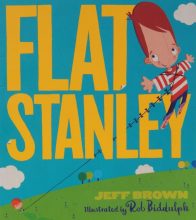
Flat Stanley
Jeff Brown and Rob Biddulph
Egmont

I was over the moon to learn that Flat Stanley was to appear in picture book form, especially with Rob Biddulph as illustrator. I could think of no better person for the task and Rob has most certainly pulled it off with aplomb.

Just in case you’ve never come across Stanley Lambchop and his family before, let me introduce them: there’s young Stanley, his younger brother Arthur and their parents Mr and Mrs Lambchop who can be a tad fussy when it comes to matters of politeness and talking properly.

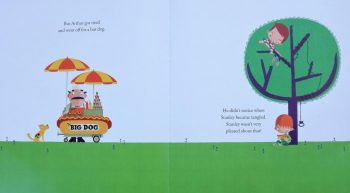
So when a huge pin board hurtles from the wall totally flattening Stanley, they’re more concerned about Arthur’s manner of delivering the news about his brother than the contents of same. Indeed they defer a doctor’s visit until after breakfast.

Happily it’s good news: Dr Dan is reassuring and so the now half inch thick boy can start to take advantage of his lack of girth, though there are snags too.

Next day news of another art theft reaches the ears of Stanley and his dad as they’re out for a stroll.

Stanley has a bright idea that just might help apprehend the thieves and that night it’s put into action: will he pull it off?

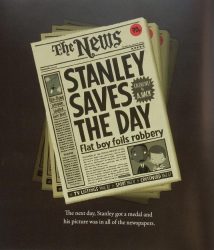
Yes Stanley does save the day – or rather the object of the thieves’ desire.

But perhaps being a hero of the extra-skinny kind isn’t all fun and flattery …

I can’t remember how many years ago I first shared the original Flat Stanley book with a class of children but it was certainly a long time back and it’s remained a favourite with me, and many more classes since. Now with this smashing picture book version of the first story, a younger audience can savour the delights of the flat but inflatable, Stanley in the new Rob Biddulph incarnation.

Rob has also illustrated a bumper collection of Stanley Stories:

The Flat Stanley Collection
Jeff Brown and Rob Biddulph
Egmont

This chunky volume contains six Stanley books – the first, together with Stanley and the Magic Lamp, Invisible Stanley, Stanley’s Christmas Adventure, Stanley in Space and Stanley, Flat Again!

Guaranteed hours of delicious Stanleyness with plenty of “Hay is for horses, not people” thrown in for extra enjoyment.

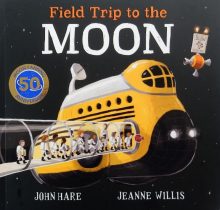
Field Trip to the Moon

Field Trip to the Moon
John Hare and Jeanne Willis
Macmillan Children’s Books

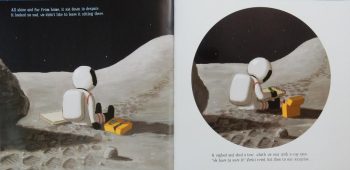
A class goes on a field trip to the moon and almost all the visitors follow their teacher, one particularly curious member of the group lags behind. This student is carrying drawing materials and decides to sit down and make use of them, watched by the residents, one of which narrates the rhyming story.

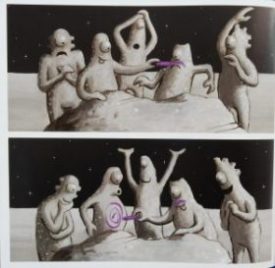
The student ‘Earthling’ drops off to sleep and wakes up to discover that the spaceship on which the party came has departed. I don’t know what the irresponsible person in charge was thinking of, not doing a head count first. The now sad-looking Earthling starts drawing again as the lunar inhabitants cautiously approach.

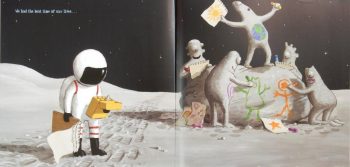
The initial surprise of a face-to-face encounter rapidly gives way to a creative session with human and lunar dwellers brightening up each other,

sheets of paper and the moonscape with colourful designs.


Meanwhile back comes the spaceship prompting the lunarians to hide themselves away though they re-emerge to wave a fond farewell to the departing young earthling who has been rather unfairly chastised, I think, by the group leader.
An experience neither side will forget, for sure.

The child’s body language, and that of the host populace in Jeanne Willis’ lunar scenes speak as loud as Hare’s verbal narrative of this expedition. Were the illustrations created using 3d models one wonders; they’re highly effective and likely to inspire children’s own creative efforts – perhaps to create their own group lunar landscape. There’s much potential for classroom activities, as well as for individuals after a sharing of this unusual book.

If you missed it the first time around, coming in June from Macmillan, is a special 50th Anniversary Moon Landing paperback edition of a book previously reviewed on this blog:

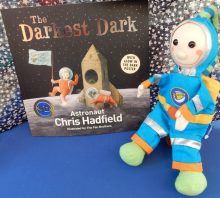
The Darkest Dark
Chris Hadfield and The Fan Brothers

When Sue Found Sue

When Sue Found Sue
Toni Buzzeo and Diana Sudyka
Abrams Books for Young Readers

“Never lose your curiosity about everything in the universe – it can take you to places you never thought possible!” so said Sue Hendrickson the palaeontologist subject herein, her quote being the starting point for this fascinating book that tells the story of the discovery of the largest and most complete Tyrannosaurus rex skeleton ever unearthed.

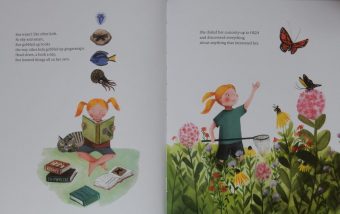
Living in Indiana, Sue was a shy child with a heuristic drive, particularly for anything in the natural world; she also had a passion for finding lost items, was often found with her head in a book

and loved to visit the Field Museum of Natural History in Chicago.

Her interests led in her teens to her joining first a team of underwater treasure hunters looking for tropical fish, lost boats, planes and cars; and then teams searching mines for prehistoric butterflies, deserts for prehistoric whale fossils and finally, the hills of western South Dakota for dinosaur fossils.

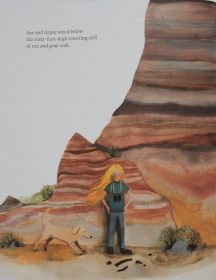
In her fourth summer of digging Sue was drawn towards a sandstone cliff and after four hours of hiking in the heat,

looking up, she spied three enormous pieces of what look like back bones protruding from the cliff. Almost unbelievably Sue and her dog, Gypsy had come upon fossils of a Tyrannosaurus rex.

Then began the arduous task of removing the 300 bones in the intense heat, a piece-by-piece task that took several days.

After an ownership dispute we see the dinosaur reconstruction duly named after Sue on permanent display at Chicago’s Field Museum.

Both Buzzeo’s narrative and Diana Sudyka’s detailed gouache and watercolour illustrations will surely inspire young readers to be mindful of the book’s opening words, to make sure they look closely at the world around them and to hold onto their own spirit of adventure and pursue their passion whatever that may be.

An author’s note about Sue Hendrickson’s contribution to the scientific community, and two resource lists end the book.

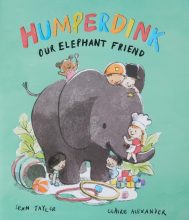
Humperdink Our Elephant Friend

Humperdink Our Elephant Friend
Sean Taylor and Claire Alexander
Words & Pictures

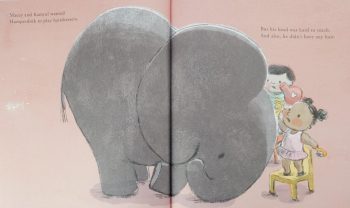
Storyteller Sean gives the impression he’s spent time standing behind the heads of young children, observing carefully, so he knows what they’d do should a playful pachyderm burst through the door of their playgroup.
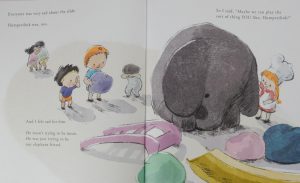
That is just what happens in this book and straightaway the children attempt to accommodate him in their play, be it dressing up, hairstylists …

hide and seek or something more energetic. No matter how hard they try though, things keep ending in disaster.

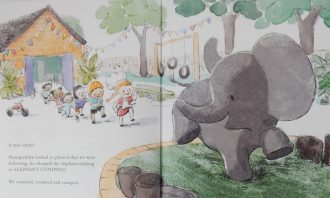
The children then change tack asking Humperdink what he likes to play and before you can say, ‘come outside’ he’s led the little ones outside for some exceedingly satisfying elephant-stomping, stamping and stumping,

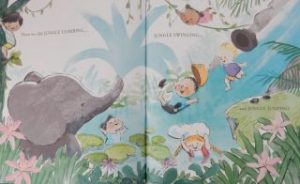
followed by elephant riding right into a jungly place that’s perfect for …

After all that romping Humbert is ready to settle down into something equally creative but rather less energetic; though of course, he and his new friends are always up for a jungle foray.

The joyful exuberance inherent in Sean’s telling is wonderfully echoed in Claire Alexander’s scenes of the characters’ imaginative play. Clearly she too spends time observing little ones – their joie de vivre, their intense concentration on whatever they’re engaged in, and the way their open hearts are sensitive to the feelings of one another, empathetic and full of love.

Perfect for story time in a playgroup or nursery and at home with little ones, this is a book that’s bound to be requested over and over.

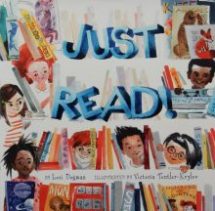
Just Read!

Just Read!
Lori Degman and Victoria Tentler-Krylov
Sterling

This is a picture book that really does fly the flag for the pleasures that reading has to offer and the multitude of ways and places it can be enjoyed.

We begin in a library with a group of children, one of whom declares, “Hooray! I know how to read on my own!” going on to say, “But sometimes I don’t want to do it alone. So …”

We then learn that this reader (who isn’t identified) shares the bibliographic propensity with an astronaut, pirate or farmer … a clown or knight wearing armour.

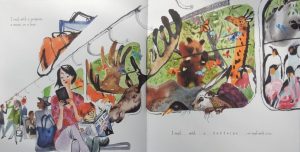
An animal can also act as reading companion be it a penguin, moose, bear, tortoise or hare.

Choosing what to read can on occasion be tricky – there’s so much choice – I definitely empathise with that – and the text need not be a book; there are codes, road signs, maps, sheet music, menus, recipes, comics, on screens and much more besides.

Moreover, some people read with their ‘fingers across bumpy lines’,

others using voice, or hand signs (inclusive though slightly inaccurate the latter two which are essentially, ways of communicating what has been read)

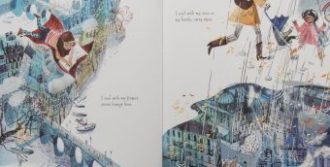
As for where to read – again there’s a multitude of possibilities both inside (in a bus, train, plane, cave perhaps) and out.

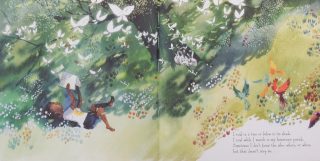
The book concludes with an idyllic book club setting – in a tree where many children have gathered to enjoy their chosen books.

Imagination knows no bounds, no matter what kind of book you choose, is Lori Degman’s rhyming message; and Victoria Tentler-Krylov’s stylish watercolour illustrations affirm this: all in all a great way to encourage reading and readers everywhere.

Counting On Katherine

Counting on Katherine
Helaine Becker and Dow Phumiruk
Macmillan Children’s Books

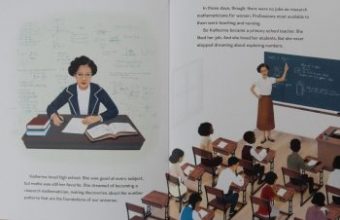
There is so much to like about this splendid picture-book biography of Katherine Johnson, a NASA mathematician.

We first meet the young Katherine as a lover of numbers and everything to do with counting, and an insatiable curiosity– about the universe in particular.

An excellent student, she jumped three school years but her US hometown high school was racially segregated and barred Katherine from attending. As a consequence, her family moved to a town that had a black high school and there the girl flourished, excelling at all subjects although still liking maths the best.

Despite there being no jobs for women research mathematicians at the time, Katherine was tenacious, holding fast to her dream while becoming a primary school teacher.

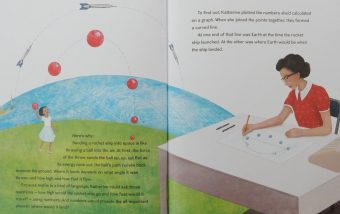
In the 1950s she finally secured a post with NACA, which was later subsumed into NASA although the job she and other women did was one the men deemed unimportant. Undaunted, Katherine knew that her role was crucial: she was able to determine the trajectory of a spaceship.

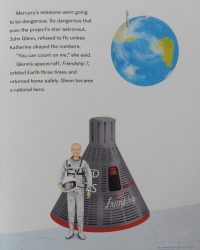
Eventually her skills in mathematical accuracy, leadership as well as her creativity and intellectual curiosity led to a promotion to Project Mercury a programme designed to send the first US astronauts into space. She won the trust of the project’s lead astronaut and promised him, “You can count on me,”.

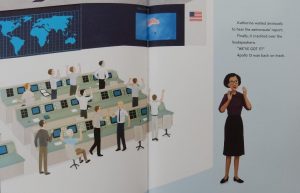
Again it was “You can count on me” when she calculated the flight path for Apollo 11, Apollo 12 and when she ensured the safe return of Apollo 13.

Having overcome much in the way of racism and sexism, on the way, Katherine had earned her place among the stars.
Helaine Becker’s direct telling is highly readable and she makes clever use of the word ‘count’ along the way; while Dow Phumirik’s excellent uncluttered illustrations, some with background computations subtly underline Katherine’s passion for things numerical.

What a splendid partnership this is; and the resulting book will surely inspire and empower youngsters, especially girls to pursue what they love.

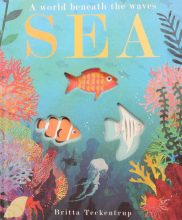
Sea: A World Beneath the Waves / Dolphins

Sea: A World Beneath the Waves
Britta Teckentrup and Patricia Hegarty
Little Tiger

In her latest non-fiction, die-cut peep-through picture book, in a series of wondrous scenes Britta Teckentrup plunges us beneath the ocean waves, way, way down to view the wonders of the deep.

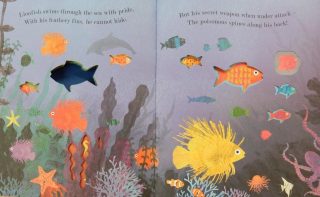
Amid the corals and seaweed fronds we see small fish, sponges, tiny graceful sea horses; a baby dolphin and its mother chirping and clicking in communication, a Lionfish with its poison spines ready to use should it be attacked.

Suddenly there’s a feeling of fear: the fish sense danger as a great white shark casts its shadow. The other sea creatures though, employ their defence mechanisms while the tropical fish swim in formation and all is well.

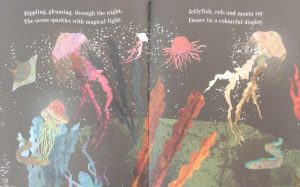
Night comes and the ocean is a-glow with light;

his song echoing far the humpback whale sings for all to hear, the manatee glides through sea grasses and the corals provide safe spaces for small ocean creatures.

Patricia Hegarty’s lyrical text ends with a plea to protect ocean life by keeping the oceans clean and free from rubbish.

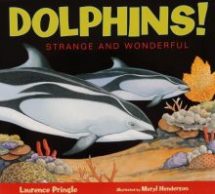
Dolphins!
Laurence Pringle and Meryl Henderson
Boyds Mills Press

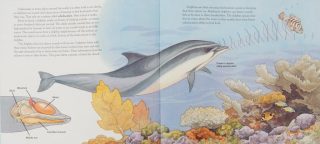
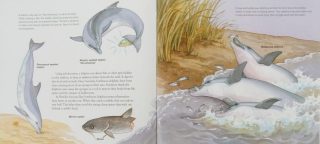
Pringle immediately grabs readers’ attention with his introductory ‘If you were a young dolphin, your mother would keep you close, feed you milk and teach you’ that could almost be referring to a human mother. The remainder of the paragraph however negates that with its ‘Soon you would learn to swim fast and catch fish to eat. And sometimes you would leap from the water, high into the air!’ while his final statement on the first page “People would be very curious about the secrets of your life beneath the surface’ sets the scene for the remainder of this fascinating book.

It covers many aspects of the thirty or so dolphin species including classification, morphology and physiology. There’s a fascinating account of dolphins’ use of echolocation;

another of feeding – dolphins are predators, consuming huge amounts of food daily –

and communication. I learned that in addition to sounds, dolphins send messages with their bodies, sometimes by rubbing skins, at others, by touching flippers.

All this and more is related in the author’s highly readable prose that is superbly illustrated by Meryl Hendersen in watercolour and pencil.

Although it’s likely that this will be read by individuals, this book also works really well if read aloud – a testament to the quality of the author’s writing.

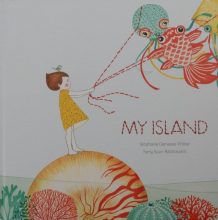
My Island

My Island
Stephanie Demasse-Pottier and Seng Soun Ratanavanh
Princeton Architectural Press

“To dream and to invent allows you to discover yourself,” So said Stephanie Demasse-Pottier, the author of this book that she wrote as a tribute to the inventiveness of her two young daughters. Hurrah for her flagging up the link between the imagination and the power to be inventive – in whatever field.
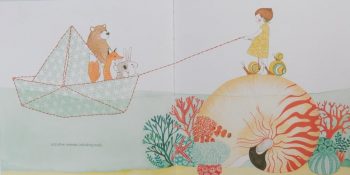
The little girl narrator of the story conjures up an imaginary island world filled with flying fish, birds, constantly blooming flowers, and animals aplenty.

In this place she has tea parties for the animals, she reads, makes coffee, interacts with snails, arranges flowers – all in her own little house.

We too can share in the riches of this place, so long as we know ‘how to sing’, ‘how to share’

and ‘how to dream’.


What adult wouldn’t want their child/ren to gain access to such a place – this extraordinary and wonderful world created by the imagination of the intense, creative little girl. A place where they too can wander, or pause awhile, letting their imaginations soar, further fuelled by the vivid scenes conjured by Seng Soun Ratanavanh in her watercolours, coloured pencils, and red thread stitched illustrations (which serve both to link together what the narrator imagines and to leave gaps for readers’ imaginations to enter).

Not only is this a tribute to two little girls, it’s a tribute to the power of the imagination itself.
Remove all technology and let youngsters take that leap and linger long. Who knows what might happen …

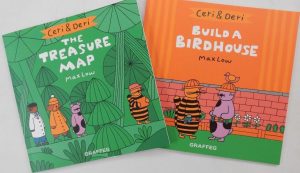
Ceri & Deri: The Treasure Map / Ceri & Deri: Build a Birdhouse

Ceri & Deri: The Treasure Map
Ceri & Deri: Build a Birdhouse

Max Low
Graffeg

These are the latest titles featuring best friends Deri the Dog and Ceri the cat that introduce young children to specific concepts/skills through fun stories. (Here it’s orientation and design.)

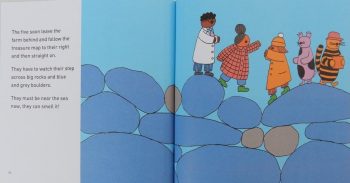
The Treasure Map in the former is an old one that once belonged to Ceri’s nan, an erstwhile pirate, so the stripy feline claims. Ceri’s story of said nan sailing the high seas inspires Deri and the two set off excitedly, map in paws, to find treasure.

En route they are joined by the equally enthusiastic Gardener Glesni, Owain the Optician and Farmer Ffion who are more than willing to leave their respective allotment, spectacle selling, and vegetables to join the search.

Eventually the map leads them within smelling distance of the sea.

But is that treasure buried on the sandy beach as they’d been led to believe by the X, and if so just what will they discover when they dig?

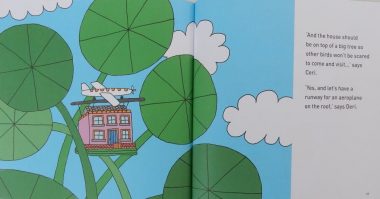
The Bird House tells how the friends come upon a curious little bird while out walking together in town. Clearly it cannot remain on Deri’s head so the two decide to build it a house.

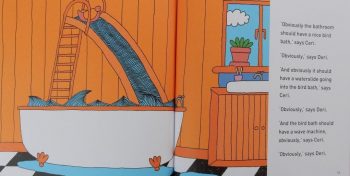
They think carefully about the design – a hallway with telephone for making ‘bird calls’ and ‘a place for all its shoes,” they decide; a kitchen with a plethora of bird seed, flowers, a sink; a balloon-filled dining room , amazing tree-patterned wallpaper, a record player (for listening to bird songs) a bathroom complete with bird bath entered by waterslide

and (obviously) a wave machine. The friends get even more carried away with their elaborate plans; but, tools and materials assembled, can they actually put them into action: I wonder?

This one made me laugh out loud a couple of times, it’s so sweetly silly and I’m happy to report that despite Ceri’s feline-ness, the bird has found two new friends.

If you’re yet to meet Ceri and Deri, I suggest you start here. The friends are a delight and Max Low’s stories are full of charm and engagingly illustrated.

Migrations Open Hearts Open Borders

Migrations Open Hearts Open Borders
Introduction by Shaun Tan
Otter-Barry Books

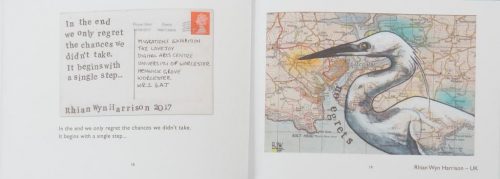
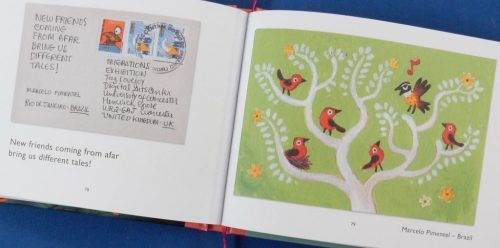
llustrators from all over the world responded to the request by The International Centre for the Picture Book in Society (based at the University of Worcester) to create an original postcard for the 2017 Migrations exhibition to be displayed at Bibiana, Bratislava. The exhibition’s creators felt that the installation should reach a wider audience and this wonderful book is the outcome, although the fifty or so images representing 32 countries reproduced in their actual size herein, are only a selection of the hundreds of postcards they received.

Each of the postcards in its unique way focuses on the positive impact of the migration of peoples the world over, showing how the flow of ideas and cultures transcends borders, barriers and even bans.

The book is divided into four themes: Departures, Long Journeys, Arrivals and Hope for the Future.

I would love to show every single one of the awesome, enormously moving postcards but can only make a very small selection for this review, so have included representatives for each of the themes, which spoke to me on my very first reading.

Departures: In the end we only regret the chances we didn’t take./ It begins with a single step …                 Rhian Wyn Harrison – UK.

Long Journeys: The skies have no borders.      Christopher Corr – UK

Arrivals: New friends coming from afar / bring us different tales!                        Marcelo Pimentel – Brazil

Hope for the Future: Share the world in peace and freedom. / The Earth and its people have no owners.           Isol – Argentina

On another day I may well have picked completely different ones, such is the power of each contribution, some of which use quotes from writers including John Clare, WB Yeats, Anita Desai and Robert Macfarlane.

If ever there was a time in our increasingly fractured world when we need this treasure of a book, it’s now. Let’s hope that those of us with open hearts who want open borders continue working to make a difference for, as Shaun Tan writes at the start of this book ‘All migration is an act of imagination, a flight of imagination. A hope that frequently exercises a previously unknown human potential. … What can be done? … That’s for us, the living, the thinking and feeling: descendants through millennia of successful migration – whose ancestors dreamed of something better … It’s left for us to imagine what to do, to pass on the dividends of hope that have been invested in us.’

Re-reading his message in its entirety in a week when our UK politicians continue wrangling about how – the universe forbid it happens – we should leave the European Union, brought tears to my eyes. Everyone needs a copy of Migrations; it reaches out to us all, offering another beacon on the uphill climb towards the creation of a better world for everyone, young, old and in-between.
(All royalties are donated to Amnesty International and IBBY)

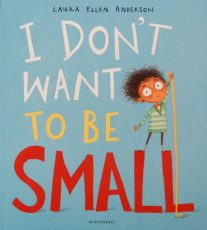
I Don’t Want To Be Small

I Don’t Want To Be Small
Laura Ellen Anderson
Bloomsbury Children’s Books

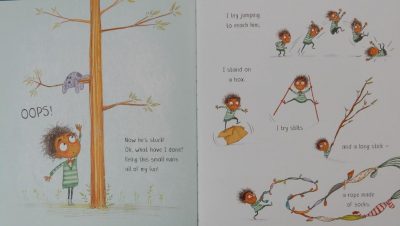
The little boy narrator of this rhyming tale rues his lack of stature; “It’s not fair,” he says. Frequently overlooked, he’s the smallest among his friends and big bro’s castoffs are way too large.

In a fit of pique the lad tosses his Teddy Bear skywards only to get it stuck in a tree out of reach.
Nothing he tries succeeds in getting Ted down;

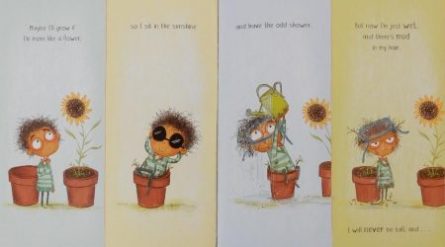
superfast consumption of green veggies merely serve to give him wind and attempting to become flower-like is let’s say, a damp squib.

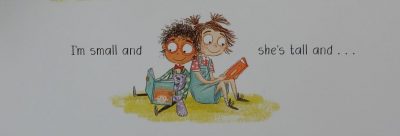
His “I JUST WANT MY BEAR” shout causes a tall girl to come and offer her assistance; but not even she can reach Teddy.

Light bulb moment: teamwork might just do it suggests our narrator, and … hurrah! Success; but much more important, is what  ensues.

Laura’s spirited illustrations abound with humour and pathos, and her seemingly simple, funny story with its powerful messages about self-acceptance and the importance of co-operation, will resonate with all those who feel inferior for whatever reason.

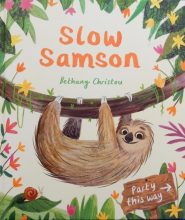
Slow Samson

Slow Samson
Bethany Christou
Templar Books

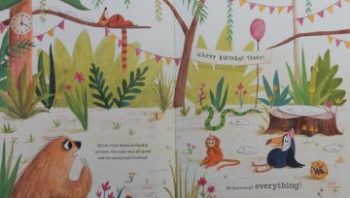
Samson’s favourite activity is spreading happiness as a consequence of which he has lots of friends and many party invitations.

However this is problematic as he frequently stops on route to a venue to help a fellow animal or merely for a friendly chat.

This tardiness causes him to miss out on all the fun, not to mention the cake at Terry’s birthday bash.

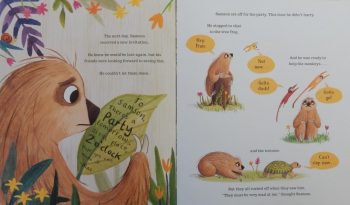
Samson resolves to do better and hurry to the next party. True to his word, he dashes past all those in need but still when he arrives, the party is over; worse though without his help, others had suffered. Poor Samson sobs, despairing he’ll ever be on time on account of his slowness.

Unbeknown to the sloth, Samson’s friends are concerned and after considerable thought, come up with a plan. An invitation is sent and Samson decides that despite his lack of speed, he just cannot disappoint his pals.

Next day, off he sets but he doesn’t rush – his friends do however, causing him to feel bad; but on he goes – slowly, slowly, convinced he’ll be very late. But is he?

For fear of being a party pooper, I’ll leave the little creature dangling and you deciding for yourself.

What I will say is that with its rainforest setting, debut picture book creator Bethany Christou’s warm-hearted tale of altruism, friendship, determination, kindness (and the odd piece of cake – oops!) is a great read aloud and a perfect starting point for discussions with young listeners.

I love the expressively portrayed animals especially Samson, and there’s plenty of gently humorous detail to enjoy in every scene as well as in the playful endpapers.

Tony T-Rex’s Family Album

Tony T-Rex’s Family Album
Mike Benton and Rob Hodgson
Thames & Hudson

The stream of dinosaur books is never ending and it’s tricky to find new angles but who better than vertebrate palaeontology professor Mike Benton to come up with a novel way of presenting one of children’s favourite topics.

Using Tony-T-Rex as dinosaur family album writer, readers are provided with rip-roaring authentic information about dinosaurs from the tyrannosaurus’ mouth. And Tony really does grab the readers’ interest and grips them between those 20cm long ridged gnashers of his throughout.

First of all he digs deep, unearthing for us just how a dead dinosaur becomes fossilised and how scientists such as the prof. differentiate between a dinosaur and a ginormous lizard. We’re then plunged back 201 million years to the Jurassic Period when dinosaurs rose to power.

Next it’s time to introduce the creatures themselves, starting in the UK with Megalosaurus Big Liz, one of the first dinosaurs and the first to be discovered, surprisingly by one, William Buckland who had no idea of the existence of dinosaurs, mistaking his find for a massive lizard. Happily though scientists soon identified differences between dinos. and lizards.

Thereafter, we travel the world meeting a host of awesome, mind-blowing relations of Tony’s, each of which has a funky name and an extraordinary body.

There’s Tony’s distant ancestor pigeon sized Crash-Test Dex (aka) Epidexipteryx with its long claws and sharp buck teeth. Dex had to perfect tree scrambling for it was a favourite nibble for young dinos with near ground level noses.

We meet the familiar Diplodocus (Dippy herein), Cowboy Spike (Stegosaurus) and then it’s Cruella the Flesh-Eater hailing from Portugal, with 70 dagger-like teeth just right for attacking unsuspecting stegosaurs and diplodocuses – EEEK!

Big Bellied Bill – Tony’s great-great-great-grandpa is memorable for his insatiable appetite for leaves that made him one of the heaviest ever land animals; unsurprisingly he suffered from horrendous wind – PHOOOAH!

It’s impossible to mention all Tony’s Cretaceous relatives here but the fossil of winged Flighty Aunt Nyx is extinct proof of a dinosaur with the ability to fly.

Moving forward to the Cretaceous Period (between 145 and 66 million years ago) we meet another creature with the ability to propel itself through the air: part lizard, part bird, Sinornithosaurus or Crouching Glider, with its alarmingly long teeth and upper jaw pocket was, reputedly, a terror.

I had a good giggle at Dead-Weight Diana (Titanosaurus), Tony’s Argentinian cousin, the heaviest dinosaur in the world, scoffer of the trees’ topmost, juciest leaves. Roamers these, for fossils have been found on every one of Earth’s continents.

You simply must meet the most elegant of all the dinosaurs, Siegfried the Swan (Olorotitan), which I have to admit is new to me. I was fascinated to learn that it had a penchant for dancing and despite its 8m length and 5 tonne weight, this crested beauty loved to demonstrate its ground-shaking prowess to all around.

Two T’s bring the family album to a close, Triceratops and finally our presenter, Tony T-Rex Tyrannosauarus. He’s excited to inform us that his poo might weigh as much as a 6-month old human baby.

The final spreads are devoted to how the dinosaurs died out; a visit to the Great Hall of Fossils; a world map showing where fossil evidence has been unearthed (and might still be); how to go about a fossil hunt and some useful dinosaur lingo for those who want to impress their friends.

This splendiferous tome is a must for family bookshelves and classrooms; all the more so as Rob Hodgson has provided the funky illustrations with the delicious wry humour of his that I loved so much in The Cave.

Kind

Kind
Alison Green & 38 illustrators
Alison Green Books

With a foreword by Axel Scheffler, this book about kindness has been illustrated by 38 ‘kind’ artists (including Axel) all of whom donated their work for free in aid of the Three Peas charity.

‘Imagine a world where everyone is kind. How can we make that come true?’ are the opening lines and what follows are a host of suggestions for fulfilling that dream which almost every single human being would love to come true.

Most of what’s suggested are easy, everyday acts such as smiling at somebody, listening to people especially when they’re feeling sad, hugging a lonely person; offering a hand to hold to someone who is frightened or worried, or helping someone in trouble.

by Pippa Curnick;                    by Barbara Nascimbeni

Stories can help make others more cheerful be they listener or teller and it’s vital to ensure nobody feels left out or uncared for.

top LHS by Moni Port, bottom LHS by Anke Kuhl: top RHS by Philip Waechter, bottom RHS by Jörg Mühle

I’ve had a kindness jar like the one suggested in some of my classrooms and I know how fast it can get filled up; and acts of kindness can be directed towards animals as well as humans.

Everyone needs to be given the opportunity to shine – after all we’re all good at something.

by Sarah McIntyre:               by Benjamin Chaud

There are occasions however, when extra kindness is required – maybe towards a newcomer, or somebody who is trying to learn our language whatever that may be and it’s always good to learn some important words in their language too. Then there are those who have overcome tremendous odds in leaving their own country which is no longer safe and travelling to find a safe haven elsewhere – let’s listen to their stories but only when they’re ready to share them. Meanwhile toys and creative acts can be shared; and people might need accommodating so it’s wonderful to invite them in …

by David Barrow:             by Marianna Cop

An open mind and an open heart are what’s required similarities and differences notwithstanding. Who knows, if everyone tried just that little bit harder, something extraordinary might happen; now is the time to start. What will you do – today? And tomorrow? And …

We all need constant reminders in the current climate, no matter what part of the world we live in.

I’d absolutely love to be able to show every single one of the awesome illustrations in this celebration of kindness but I’ve only been able to include a few as examples in a book that’s bursting with inspiring suggestions and positivity.

The final spread is devoted to the work of Three Peas a charity that gives crucial practical help to those who have had to flee their war-torn countries and seek a safe haven elsewhere. (£1 of every copy sold goes to the charity).

What a terrific book to share over time with a class, perhaps using a spread or illustration as the starting point for the day and should you exhaust the ideas herein, children could suggest their own perhaps together making a follow-up book or picture gallery spreading throughout an entire school.

Meanwhile I’d like to see a copy of this in every home and classroom, after all children are the future.

The Anzac Billy

The Anzac Billy
Claire Saxby, Mark Jackson & Heather Potter
Walker Books

I totally fell for the little boy character in The Anzac Billywhen I saw him on the front cover. Based on true events, it’s set during World War 1 in a week when Christmas is approaching and the boy (and his family) are packing carefully chosen items into a billy in the hope it will reach his dad in time for Christmas. From Monday to Friday, one thing per day, the small boy puts in butterscotch (his own favourite), yucky fish (Dad’s favourite), walnuts from their tree, a bar of chocolate, and a pair of ‘just-knit’ socks.

On Saturday it’s Mum’s turn and she adds a razor, safety pins and soap (‘to wash his undies’) and Nan fills the remaining space on Sunday with a couple of handkerchiefs and paper and pencil for writing home.

Now all this so lovingly packed cannot be posted, nor sent by road or rail; it has to be shipped along with boxes of other billies; and naturally the boy is concerned that it might not reach his own dad for as his Mum tells him, ‘there’s a Christmas billy for every warfield soldier, filled by families, filled by friends’.

To make sure though, Billy puts in a note requesting that if another soldier receives his offering, then ‘please send my letter on.’ – this letter that he so carefully penned during that week from which we see how much he misses his Dad.

Claire Saxby’s telling feels authentic and is full of tenderness and poignant moments; all this is echoed in Mark Jackson and Heather Potter’s soft sepia scenes of Australia in a bygone era when light was not electric and life was much harder for everyone.

An ideal book for young readers, and KS1/ lower KS2 pupils studying the period; it would also make an unusual, but highly pertinent, Christmas time story.


Nell & the Circus of Dreams

Nell & the Circus of Dreams
Nell Gifford and Briony May Smith
Oxford University Press

Circuses hold a tremendous fascination for many children and so it is with young Nell although she doesn’t know it when the story begins. What she does know though is that she feels sad on account of her mother being ill and then, when she discovers a tiny chick in the farmyard, very happy.

Nell and the lost chick – she names it Rosebud – become almost inseparable.

One night Rosebud disappears from the end of her bed and when Nell wakes next morning her feathered friend is nowhere to be seen. Dashing outside she leaves the farmyard and heads through the still dewy meadows till she finds herself surrounded by enormous wooden wheels.

There’s an intoxicating aroma of coffee, toast and hedgerow flora, and she hears hammers striking metal. Lo and behold, she’s walked right into a circus.

Up goes the huge tent and Nell sees girls busy adding adornments inside and out. She helps and is invited into one of the wheeled homes where she joins a large family meal. She endeavours to communicate that she’s searching for her lost chick but suddenly the music starts and everyone rushes out and into the big tent.

Nell is mesmerised by the performances she sees …

but even better a wonderful surprise awaits her in the ring: there’s something feathery standing in a circle of light.
From then on, although sadly the circus has to depart, remembering doesn’t;

Nell carries the memories always in her heart and relives them in her own way.

Beautifully and movingly told by Nell, founder of Giffords Circus that has its home on the outskirts of Stroud, near to where I currently live much of the time, her words really capture the magic of all things wonderful about a circus community such as theirs.

I can think of nobody better than Briony to illustrate the story. Her jewel-like scenes are out-of-this-world wonderful, be they of Nell’s farmhouse home and yard, the temporary homes of the circus community or of the performance.

A must have picture book, this.

Will You Help Me Fall Asleep? / I’m Not Grumpy!

Will You Help Me Fall Asleep?
Anna Kang & Christpoher Weyant
Hodder Children’s Books

Little Frog is anxious to fall asleep and asks readers to help him for if he doesn’t get sufficient sleep his mother won’t allow him to participate in the Frogatta boat races the following day; in other words he’ll be in BIG, big trouble and there’s no fooling his observant mum.

He tries our (supposed) suggested counting sheep, a bedtime book – definitely not the best idea – and a chat with last year’s prize caterpillar toy all of which fail and then he recalls his teacher, Miss Chon’s advice to breathe long and deep then mind travel to his ‘happy place …

and joy of joys, zzzzzzzz.

Whether the final wordless spread is Monty’s blissful dream or the young frog’s elated presence (along with his parents) at the next day’s Frogatta is left open to readers to decide: no matter which, one cannot help but root for little amphibious Monty in this frog-a-licious bedtime tale.

With Christpher Weyant’s super, lively, cartoonish scenes of Anna Kang’s dramatic telling, the book is enormous fun for pre-sleep sharing, especially for little ones with a touch of insomnia.

I’m Not Grumpy!
Steve Smallman and Caroline Pedler
Little Tiger

Waking up to discover a huge furry bottom blocking your door might put most of us in a bad mood; it certainly does Mouse whose mood further deteriorates when he’s splatted on the nose by – so he thinks – a splashy raindrop.

In fact it’s a tear shed by a distraught little badger just outside his window wailing, “Where’s my Mummy?”

Together the two animals set off in search of the Mummy Badger only to find themselves lost.

Encounters with Squirrel and Owl both of which recognise Mouse as ‘that grumpy mouse”, (hotly denied by said Mouse), are willing to help in the search and off they all go deep into the forest.

There they come upon a large bear. On learning that Mouse is in fact helping Little Badger get home, the bear changes his grumpy accusation to “a kind friend”; a first for Mouse.

They travel deeper into the forest until Mouse becomes overwrought

which results in Owl giving him a cheer-up hug – another unusual event for the little creature. Suddenly out of the bushes emerges a very scary, very hungry predator.

Does that mean Squirrel, Badger, Owl and Mouse become a lupine’s evening meal?

Happily not. I won’t divulge the ending, but what ensues will certainly bring a happy smile to the faces of young listeners.

With opportunities for audience participation, Steve’s warm-hearted story with Caroline Pedler’s expressively portrayed woodland animals provides a good starting point for circle time discussion with early years children on themes of friendship, kindness, and on how their moods might affect other people.

Helping Hedgehog Home / Grotwig the Goblin

Helping Hedgehog Home
Karin Celestine
Graffeg

This is the ninth adventure of Karin Celestine’s Celestine and the Hare series in which friendship, fun and kindness are the essence. The characters are little felt animals, particularly the Water Vole family comprising Bertram who likes sewing, his gardening lover dad Bert, Grandpa Burdock a nature expert who makes others laugh with his silliness, Granny Dandelion, fixer extraordinaire and Bertram’s mum Beatrice, explorer and inventor.

When a hedgehog in a hot air balloon crashes into the pond while Grandpa Burdock is investigating it for possible newcomers, he learns that the prickly creature has been shut out of her log pile home in the garden next door on account of a new fence. Now her balloon has burst and Hedgehog has no way of getting back.

While she refreshes herself with tea and bramble biscuits, Grandpa’s head buzzes with ideas for getting their visitor home. As his drawings of possible contraptions get ever more dangerous-looking,

Granny has been otherwise occupied, but when she appears on the scene and learns of Hedgehog’s plight, she too gets busy to find a solution.
Her workshop resounds with sawing and hammering and before long Granny reveals something that sends Hedgehog’s heart soaring with happiness …

This super-sweet altruistic tale bubbles over with kind thoughts and deeds; with a papier-mâché hot air balloon making activity and information about hedgehogs and how to help them at the end, it’s a delightfully playful, warm-hearted book for sharing with little humans.

Grotwig the Goblin
John Swannell
John Swannell Studios

‘Where’s Wally?’ and ‘a needle in a haystack’ sprung to mind on opening this photographic book, even though there’s not a haystack in sight.

Narrated in rather creaky corny rhyme by goblin, Grotwig, we share in his ramblings through the countryside: ramblings that, at different times of the year take him, as we see in Swannell’s photographs of topiary, pine and mixed deciduous woods, dry stone walls and hedgerows, ancient Yews and Oaks,

moorland hills and byways, and tranquil lakes, through all kinds of terrain.

There are times when the goblin asks readers to find him (with the aid of a magnifier housed in a pocket on the inside front cover) in the photos, This makes us slow right down and look closely at each of the rural landscapes. In itself, that is a good thing: the photographs are lovely and the peaceful scenes well worth paying attention to,

reminding this reviewer of some of the walks taken around the Gloucestershire countryside.

Children are increasingly pressurised and tend to seek escape on screens rather than going outdoors. A book like this might help to tempt them to do the latter and although they won’t encounter any goblins, there’s nature’s magic aplenty to discover in the great outdoors.

The Colour of Happy / Some Days / A Thank You Walk

The Colour of Happy
Laura Baker and Angie Rozelaar
Hodder Children’s Books

This sweet, simple rhyming story of a boy finding a dandelion seed head and what happens thereafter is the means for an exploration of feelings for young children around the age of the child narrator, using a rainbow of emotions and the fluffy seed head.

The child, out walking with a pup, spies a dandelion clock: ’Yellow is for happy when I spot a special thing,’ he tells us and having picked it, hops and skips along. But when a gust of wind whisks his treasure away, the boy is engulfed in dark blue sadness.

His emotions then run through the colour spectrum: red for anger as he watches it sail away;

green for feelings of envy when he sees a girl with the seed head; grey when he cannot believe things will be okay; gold for the kindly response from a little girl, and the return of hope as they play together chasing the dandelion clock while it sails off again;

purple for the proud feeling when the boy again holds his treasure safe and bids his friend farewell; orange for the mounting excitement as he heads home and finally, pink as he reaches the front door with his somewhat depleted, love-filled offering …

Little ones will certainly relate to Laura Baker’s lovely story, which offers a great starting point for becoming mindful about their own responses to situations. With a foundation stage class, I envisage children talking about the book, their own feelings with regard to a particular happening; and then perhaps responding with paints or whatever medium they feel right, in music or a dance with coloured scarves perhaps.

Some Days
Karen Kaufman Orloff and Ziyue Chen
Sterling Children’s Books

We all experience different feelings at different times and so it is with young children and this book, with Karen Kaufman’s lively rhyming text and Ziyue Chen’s warmly hued illustrations, conveys that huge gamut of emotions through the course of a year.

Through two young children, we share in their everyday highlights such as ‘chocolate pudding pie day’s’, ‘Kites up in the sky days. Jumping super high days’; the joys of swimming and sunbathing;

as well as the downs – a nasty cut knee for instance.

Some days are extra special like that for ‘picking out a pup’ or winning a cup. Then come fussy mum days

and days when raincoats just won’t do, and there are  too wet to play football days with glum stay indoors faces; better though are snow angel making days and watching a warm fire days.

The author acknowledges those bad days when everything feels wrong

and those when it’s best to be alone.

Finally comes ‘Learning to be me days’ which is really the essence of the whole, a book that celebrates the positive but doesn’t gloss over the negative feelings. It’s a good starting point for discussion in an early years setting, or after a one-to-one sharing at home, perhaps about how best to respond to and deal with negative emotions. After all, being mindful of, and being able to talk about, our emotions and feelings helps us best deal with them.

Helping to develop mindfulness in even younger children is:

A Thank You Walk
Nancy Loewen and Hazel Quintanilla
Words & Pictures

Nancy Loewen’s brief story of a mother and little girl walking their dog, Duke, is one of the Bright Start series aimed at developing emotional intelligence in the very young.

Simply expressed it tells how as they stroll hand in hand mother and child interact with the animals they encounter. The barking sounds of Duke, the chirping of birds eating seeds, a neighing pony fed carrots, an overturned beetle that they rescue, which flies off with a buzz-buzz,

are, the child is told, the creatures’ ways of saying thank you.

Cutely and expressively illustrated in black and white with orange pops, by Hazel Quintanilla the book demonstrates the importance of showing appreciation and thankfulness. It’s never too soon to start saying thank you and as an introduction to being mindful about expressing gratitude it offers a useful starter for a circle time session with a nursery group, or for individual sharing at home.

The Prince and the Witch and the Thief and the Bears

The Prince and the Witch and the Thief and the Bears
Alastair Chisholm and Jez Tuya
Walker Books

This is essentially a bedtime story treasure trove – a fairy story with a very clever twist or two, or even more.

It begins with Dad asking son Jamie what kind of bedtime story he’d like. Jamie requests “A made-up one!” to include the titular characters and so Dad does as he’s bid and begins to tell his tale within a tale and a right rambling yarn it is into which Jamie insists breaking with questions and interjections. Dad then weaves these into his telling, no matter how far off piste they might be or how irritating. “Why couldn’t the Princess rescue the Prince? … Mum says Princesses in stories are rubbish.” Dad eventually concedes only for Jamie to decide, “No actually I want the Prince.” …

The Princess has been incarcerated in a tower by “her wicked aunt, a Witch with an Evil Eye, ” Dad continues and so it goes on.

We discover that the castle is made (to Jamie’s disgust) entirely out of broccoli and the Witch is really a Ninja. Uh-ha! And if that’s not enough topsy-turvyness, then I’ll have you know that as they approach Castle Broccoli the Prince is actually carrying the horse

and the Princess isn’t all she seems.

Nonetheless all ends happily – twice over- in this splendid romp of a bedtime tale telling experience that will delight both receivers and deliverers. It well and truly flips the traditional fairy story right on its head and not only is it a smashing bedtime offering (albeit not a brief one); it’s absolutely bursting with classroom potential too; and not simply because Dad promises a continuation involving the Bears on the following night.

Yes, Alistair Chisholm’s telling is terrific, but Jez Tuya’s illustrations are pretty cool too – or should that be hot – certainly so here …

and full of hilarious, chortle worthy details.

Dogs in Space: The Amazing True Story of Belka and Strelka

Dogs in Space: The Amazing True Story of Belka and Strelka
Vix Southgate and Iris Deppe
Wren & Rook

We’ve already had picture books about Laika (notably Owen Davey’s Laika the Astronaut) but now this, author Vix Southgate’s debut, celebrates two canine heroes from Moscow, Belka and Strelka, the first living creatures to actually survive being hurtled into space to orbit several times before being brought safely back to earth.

That though is getting ahead of ourselves so let’s go back to earlier in their amazing lives when the two stray dogs were roaming the streets of Moscow. From there they were picked up and taken to Moscow’s Space Centre for training to become part of the Russian Space Programme. The two little dogs were, so a space centre scientist Oleg decided, just right as they were clever, brave, calm and obedient; perfect characteristics for Space Dogs.
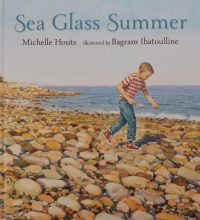
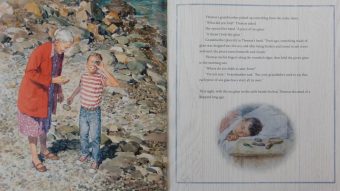
They were then subjected to all kinds of scientific experiments and a training regime before being blasted off in a rocket in August 1960. As Belka and Strelka orbited in space there were anxious times on earth; so still were they, that it was feared they’d not survived the launch. All was well however

and after circling Earth many times, the two dogs started their descent – a dangerous operation – but finally …

History had been made.

The book doesn’t end there though: we learn that Strelka gave birth to six healthy puppies, both dogs lived long happy lives and that their incredible adventure acted as a trailblazer for Yuri Gagarin, Valentina Tereshkova and other astronauts. All this and other key events are presented, timeline style, in the final pages.

A real life story, engagingly and dramatically presented both in words and Iris Deppe’s pictures. It’s a fascinating and exciting way to introduce young children to the history of human space exploration.