Marvellous Margot / Nila’s Perfect Coat

Marvellous Margot
Lou Peacock and Ingela P Arrhenius
Nosy Crow

Margot has a big heart and is always ready to lend a helping paw to her friends; she’s also aware that cake and kindness are the ideal combination. With that in mind, one sunny morning she bakes a special cake for her pal Oscar, places it in her little wagon and sets out through the city to Oscar’s home. 

On the way though she encounters several other friends each of which is either upset, cross or frustrated. Now Margot has a fix-it attitude and stops to assist each one, also offering them a slice of Oscar’s cake once their problems are solved. 

You’ve probably guessed what has happened to the cake by the time she arrives at Oscar’s but he greets her with a big hug, kind words and a surprise.

Lou Peacock’s wonderfully warm story with themes of friendship and kindness and the repeat refrains for joining in with, is charmingly illustrated by Ingela P Arrhenius with sufficient detail and bright colours to keep youngsters engaged.
Share with little ones at home or in a foundation stage setting. Teachers, there’s lots of potential if you read it in the classroom.

Also with themes of kindness and friendship is
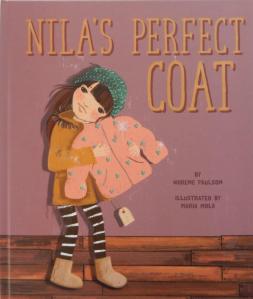
Nila’s Perfect Coat
Norene Paulson and Maria Mola
Beaming Books

Nila enjoys ‘treasure hunting’ in charity shops and one day when out shopping with her Mum, a coat catches her eye. It’s warm and a perfect fit but her mum tells her that she doesn’t need another one. However she is willing to let her buy it using birthday money given to her by her Dad, if he agrees. Meanwhile it must go back on the stand. Dashing out to catch the bus the following morning, Nila forgets her coat, only to find there’s another girl, Lily also sans coat. This means both girls have to stay inside at playtime as it’s cold. Nila’s invitation to Lily to join her in a game is turned down: in fact Lily seems distant and the mention of a coat by their teacher at hometime upsets her.

Having spent the weekend with her Dad and getting the go ahead for the purchase of the coat, they go back to the charity shop and Nila makes the purchase. As they walk past Lily’s home, she notices a For Sale sign outside and Dad says “Her family is going through a hard time,”.

Back with her Mum, Nila contemplates her new coat 

and says that there is somebody who needs it much more than she does. Her decision about what she should do means that nobody has to stay inside during playtime on Monday.

This gentle lesson showing the difference between needing and wanting something, and the role of charity shops in reducing waste, is told in a non-preachy, sensitive way, and equally warm are Maria Mola’s illustrations

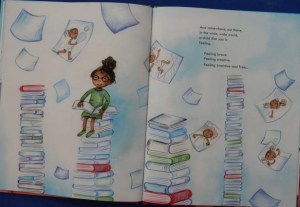
A Child Like You / People Power: Peaceful Protests that Changed the World

A Child Like You
Na’ima B. Robert and Nadine Kaadan
Otter-Barry Books

Beautifully illustrated and presented, speaking directly in a sensitive, heartfelt manner to young readers, author Na’ima and illustrator Nadine celebrate the four children featured, whose actions will surely act as a rallying cry for all children, showing that no matter what, there is always hope.

Inspired by young campaigners and activists, Greta Thunberg, Yusra Maardini, Marley Dias 

and Iqbal Masih, the book highlights the issues of climate change, the refugee crisis, the under representation of black girls in children’s stories, child labour and enforced slavery. 

These four youngsters show the way that other children too – children like them – can also be the change, make the change happen and inspire others to make changes, to speak out strongly on behalf of the dispossessed and the oppressed – to stand up for human rights and make our world a better place for everyone.

A book for all KS1 classrooms.

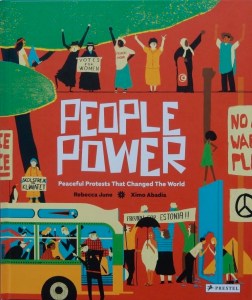
People Power: Peaceful Protests that Changed the World
Rebecca June, illustrated by Ximo Abadia
Prestel

Rebecca June and Ximo Abadia provide readers with a close up look at thirteen revolutionary movements that protested peacefully in various parts of the world, allocating two spreads to each one.

It’s amazing to think that in the UK women have had the vote for less than a century; ‘Votes for Women’ was the battle cry of the women’s suffrage movement on a march through the streets of London one rainy, wintry day in 1907 in what became known as the Mud March; but it took more than twenty years of protesting to achieve their goal.

It was women too, who campaigned peacefully by surrounding the US airbase in the English countryside where nuclear cruise missiles were stored. Their actions were an inspiration to anti-nuclear movements throughout the world.

There are examples of people power from other continents such as the Montgomery Bus Boycott where in 1955, Rosa Parks refused to give up her seat to a white woman and the boycott, which lasted a year, forced the city to change its rules on racial segregation on its buses. Sadly racial discrimination is still with us, both in the USA and throughout the world; hence the necessity for the Black Lives Matter demonstrations prompted by the unlawful killing of the African American, George Floyd by a police officer.

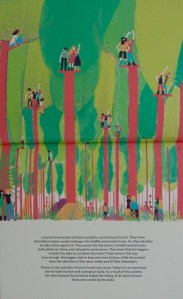
Environmental activists too have a place in this book with Greta Thunberg and her Fridays For Future movement involving young people; but new to me are the ‘Defenders of Pureora Forest’ whose protests against deforestation of this New Zealand tropical rainforest, an important site in Maori culture, saved the forest and led to the ending of felling by the New Zealand Government of all native forests owned by the state.

These and the other movements featured are described in Rebecca June’s straightforward, engaging but never preachy text, and Ximo Abadia’s stylised, often arresting illustrations, both of which convey the message that peaceful protest can effect change, every single voice matters and nobody is too young to start getting involved to make the future better for all of us; what’s needed is optimism, determination and a strong sense of hope.

An important book for primary classrooms everywhere.

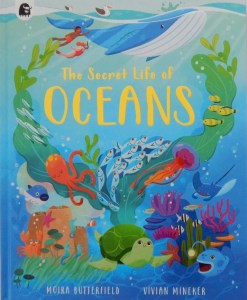
The Secret Life of Oceans

The Secret Life of Oceans
Moira Butterfield and Vivian Lineker
Happy Yak

In this book, which is a mix of science and traditional stories from various parts of the world, we’re in the company of Tia the green turtle, famous for her swimming prowess and beautiful shell. Having introduced herself and told the story of how she was born, Tia takes readers on an exploration of some of the secrets of marine flora and fauna starting with those relating to sea turtles like herself and other turtles that live in the world’s various oceans (there’s a map showing these).

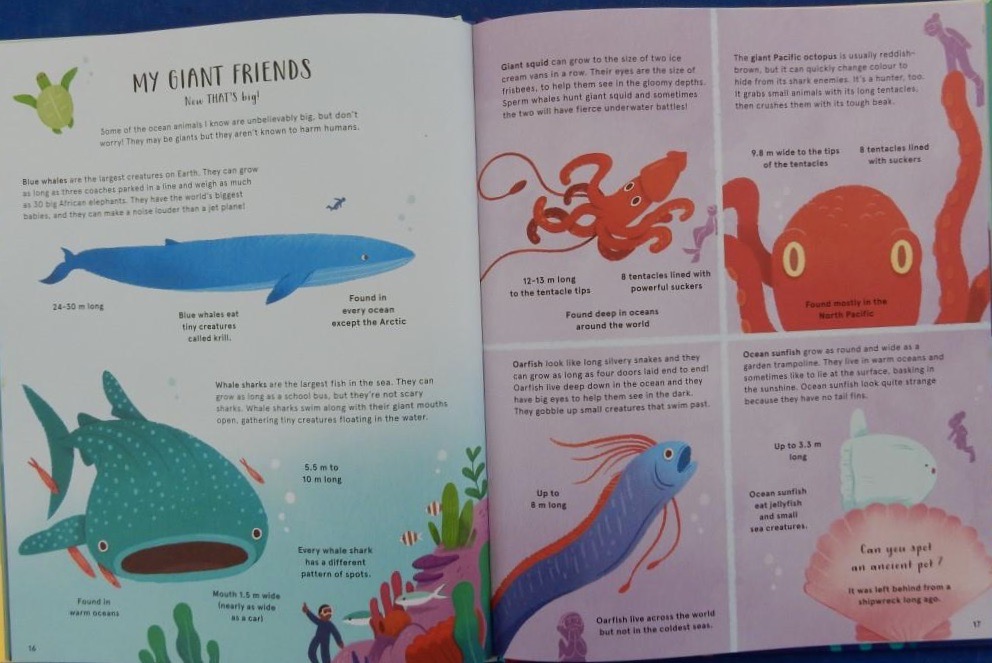
Diving down through the zones of the ocean all the way to the abyss, we encounter marine inhabitants large and small from giant squids and blue whales

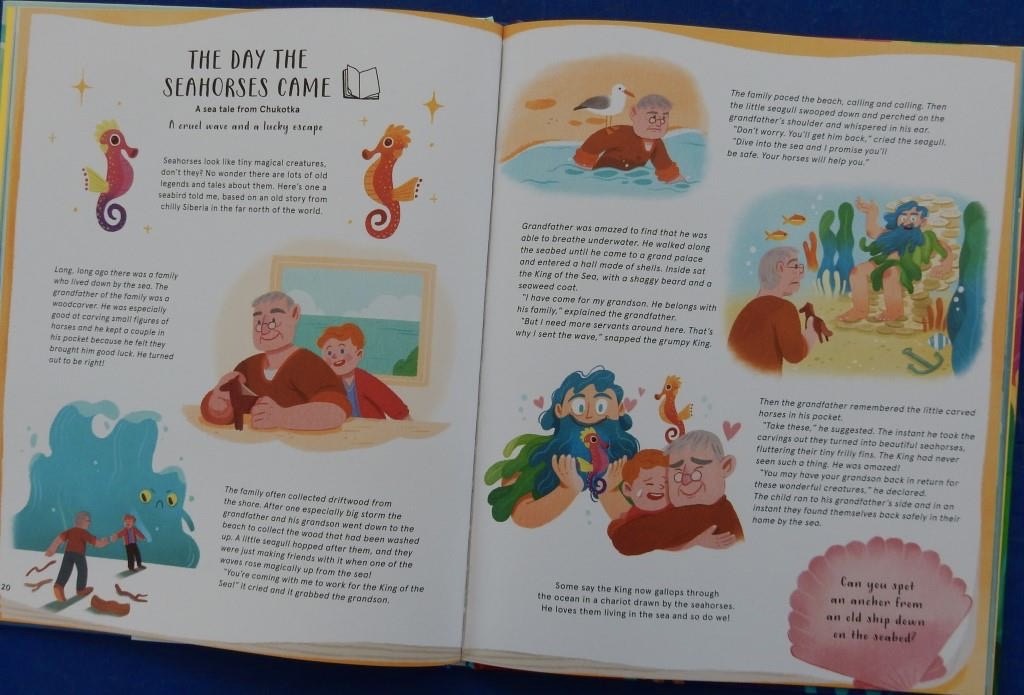
to microscopic zooplankton and phytoplankton and sea-horses, to mention just a few.

Other topics are included such as ways of communicating – did you know that bottlenose dolphins each have their own unique whistle sound or that blue whales make low rumbling sounds that can travel as far as 3200 km through the water? There’s a look at the ocean’s gardens, the chilly, slippery stormy spots formed of ice and snow, an encounter with fearsome creatures with ferocious-looking teeth. And, we find out something about ocean currents, some special coastal features, what it’s like living and working by, and with, the sea.

Many of the spreads have a ‘can you spot’ feature to encourage younger readers to use their powers of observation. The two final spreads are devoted to the endangerment of turtles and what we humans can do to help them. There are also five traditional stories from various parts of the world.

With bright, bold illustrations infused with humour, and a thoughtfully presented, engaging text, this is enjoyable learning for primary children.

The Dog That Nino Didn’t Have

The Dog That Nino Didn’t Have
Edward van de Vendel and Anton Van Hertbruggen
Eerdmans Books for Young Readers

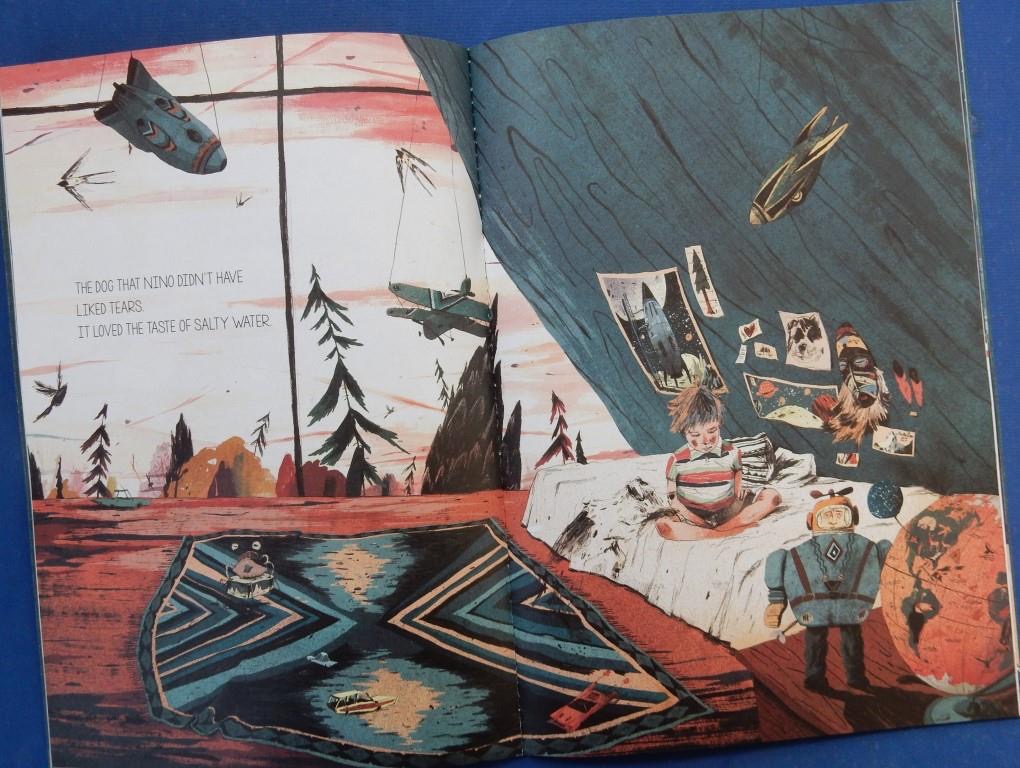
In a woodland landscape, lives a boy named Nino. Nino has a dog – but he doesn’t – or only in his imagination. His mum can’t see the creature, nonetheless the boy, whose dad, – a pilot – is away much of the time – knows said dog listens to his dad’s long distance calls. When Nino goes into the woods, the dog copies the actions of the squirrels, it jumps on to great-gran’s lap when they go to visit her, likes the taste of salty tears

and dives into the lake when the boy goes boating.

Then one day that dog disappears and a different one with other interests takes its place; a soft, sweet pooch everybody can see.

Things feel rather different for Nino now, but nonetheless the presence of a real dog doesn’t stop him imagining a whole host of other animals and even several additional dogs.

Nino is highly imaginative – using his imagination to fill the void his father leaves during his absences and to navigate change; he’s also resilient and loves the outdoors.

This unusual, contemplative story is strange and gently powerful; the detailed illustrations predominantly in green and brown hues, brilliantly evoke a time in the recent past when children were able to play safely in the countryside without adult supervision.

A thought-provoking demonstration of the power of the imagination to help and perhaps heal in difficult times.

Pause, Breathe, Be

Pause, Breathe, Be
Megan Borgert-Spaniol and Lauren Kukla, illustrated by Aruna Rangarajan
Beaming Books

Subtitled ‘A kid’s 30-day guide to peace and presence’, this handbook comprises thirty challenges divided into three sections – first Pause, then Breathe and third, Be. The authors intend readers to take the challenges one per day, in an order that most suits each individual.
The Pause section has reflective activities to help personal reconnection including sitting sans phone for ten minutes looking through a window with a good view, staying alert and silent to let deeper thoughts become conscious ones.

One Breathe challenge is to try and spend an entire day without using a screen of any kind. I really like the idea (in part two) of spending a day trying to ‘see beauty and humanity in the ordinary and imperfect.’ as well as the ‘Today choose generosity over judgement’ in the final section; it’s all too easy to slip into that ‘he’s so weird’ , ‘how stupid is she’ way of thinking.

Each section has quotes from famous people; the Dalai Lama speaks in the final one,

and several authors in the previous two.

I’ve seen what happens when primary schools put enormous pressure on year six children to achieve good SATS scores, seeming to be much more interested in their statistics than the mental well-being of their pupils: children in a constant state of anxiety unable to relax and enjoy themselves. This mindfulness book could make a lot of difference for those undergoing that enormous stress; better still if they got a copy at the start of Y6. it should assuredly help users build their self-esteem

Mabel’s Topsy-Turvy Homes / Simon the Hugger

These are recent publications from Beaming Books – thanks to Suzy Senior and the publisher for sending them for review.

Mabel’s Topsy-Turvy Homes
Candy Wellins and Jess Rose

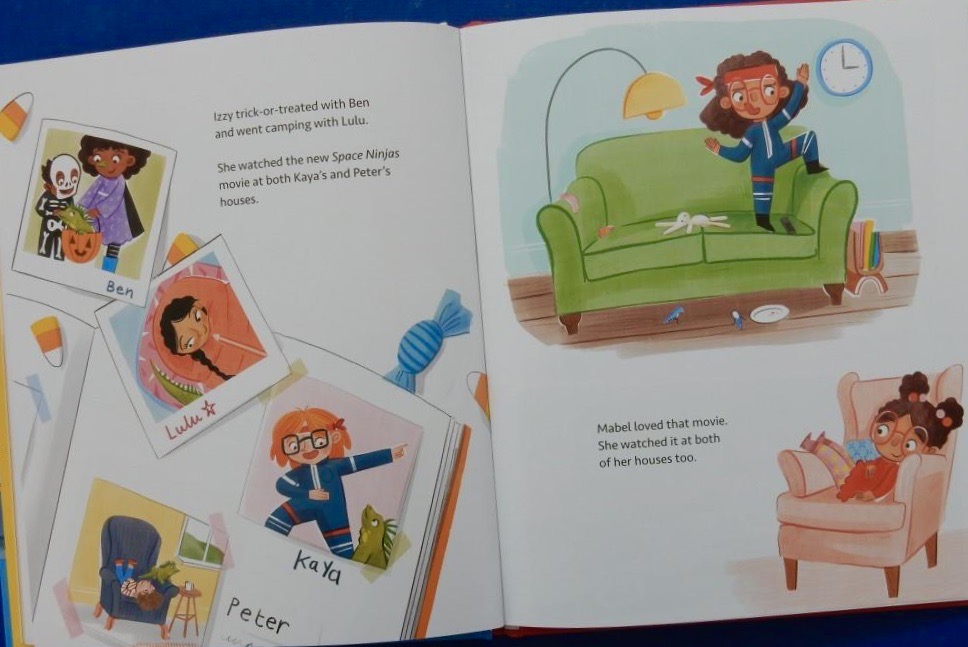
Many children find themselves facing a situation similar to that of Mabel the protagonist in this story. Her parents are separated and as a consequence she has to move back and forth between her mother’s and her father’s homes. With different layouts and different routines she finds this rather difficult to cope with.
When it’s Mabel’s turn to care for the class pet iguana for the weekend, having read the accompanying diary, she cannot help but compare her existence with that of a creature that is passed between many different homes and also has lots of fun adventures. In so doing she realises just how much fun she’s had and how having two homes has its advantages as well as downsides.

The book ends on an upbeat note, ‘… two houses means double the fun.’

With the diverse cast of characters shown in Jess Rose’s vibrant, expressive illustrations, the story provides children with a safe space within which to think about some of the unsettling feelings – positives and negatives – their own parents’ separation causes.

A useful book to have among class resources for a topic on families or homes.

Simon the Hugger
Stacy B. Davids and Ana Sebastián

Simon the sloth loves to hug: he hugs pretty much anything and anyone from his friends and family to flowers and rocks, he even hugs himself.

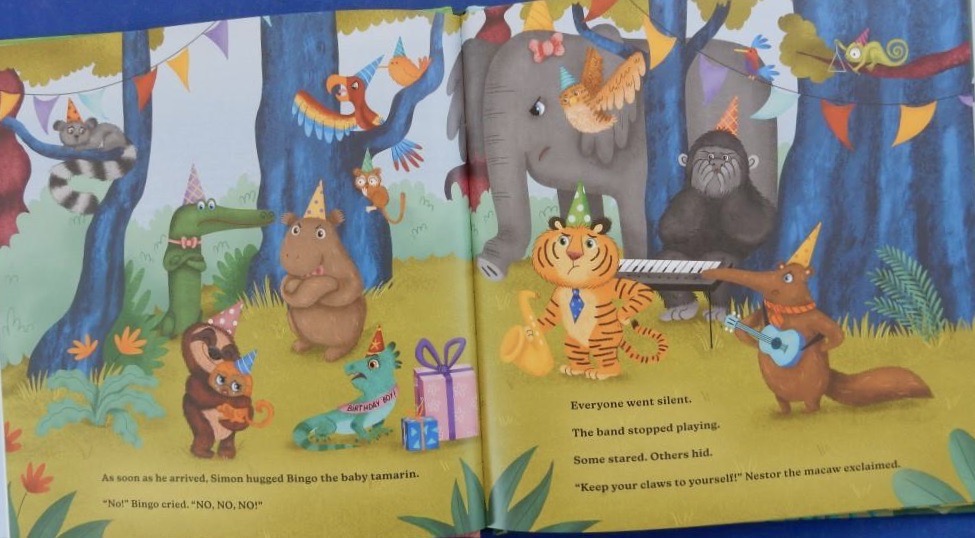
But then one day his friend Elsa the jaguar doesn’t want his farewell hug at the end of their game, Trixy the owl turns down his congratulatory hug for her art prowess and when he tries hugging the baby Tamarin, Bingo, she too says “NO!”

Confused and upset, Simon makes himself a sign asking others to hug him. Along comes Ricky porcupine to do just that but as he advances, Simon realises that for the very first time he doesn’t want to be hugged. Ricky however is happy to offer an alternative way of showing friendship. That, and a cry of hurt from Elsa, help Simon realise that not everyone is in hugging mood at exactly the same time and the other person must always give their consent prior to a hug.

Cartoon style illustrations and a simple, straightforward text convey the important message about invading another’s personal space without their permission.

In the back matter, the author offers a guided discussion and questions that teachers and caregivers could use to discuss the topic with young children.

Ning and the Night Spirits

Ning and the Night Spirits
Adriena Fong
Flying Eye Books

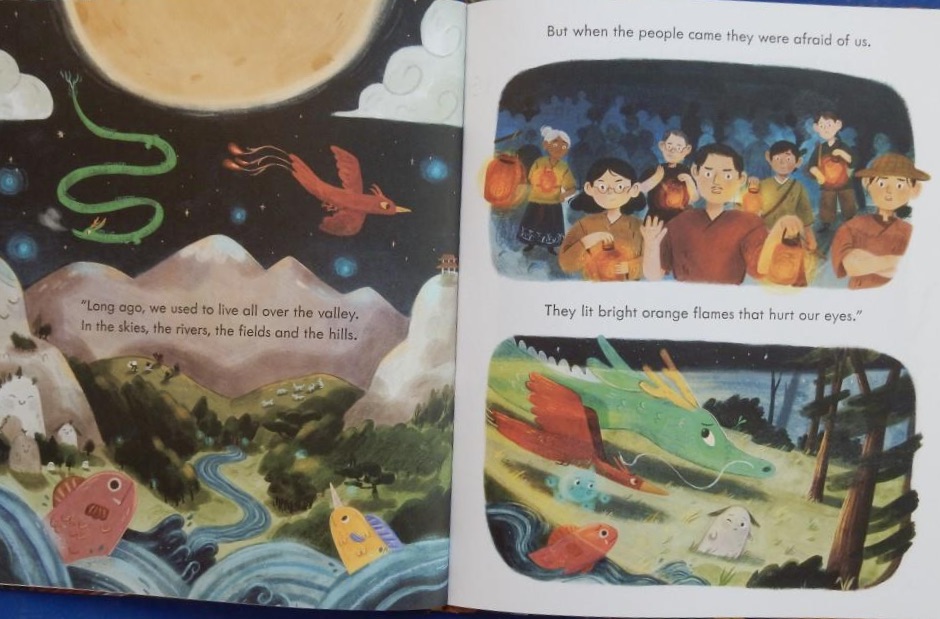
Ning, a quiet boy, lives in a little town in a lush valley at the edge of a forest. Each evening he helps his parents light lanterns to ward off the night spirits. Ning wants to know if the spirits really are scary but he’s unable to ask the other children as he finds making friends as scary, or more so, than any spirit he could imagine.

Bothered by his parents’ reaction to his lack of friends, Ning creeps out of the back door one night and into the forest 

where he finds himself face to face with a night spirit, a creature that looks anything but scary. Indeed Ning realises it’s the creature that is scared of him. The two quickly become friends and the cute little creature shows him the wonderful forest animals and the secret world of the night spirits. Ning discovers that rather than being scary, the spirits are scared, scared of the bright flames of the townsfolks’ lanterns that hurt their eyes, causing them to take refuge in the forest.

The boy knows that he must try and help his new spirit friends, but to do so he needs to find the courage to speak to the other children and enlist their help. Can he do that? Back home he works on a plan …

Adrian Fong has created a magical world in a far eastern setting for her debut picture book that tells a story about friendship, gaining the confidence to confront your fears and not making prejudgements about others. When you share the book with young children at home or in school, take time to look closely at the illustrations of the inside of Ning’s home and the parade through the town, they’re rich in cultural detail.

Unicorn Not Wanted

Unicorn Not Wanted
Fred Blunt
Happy Yak

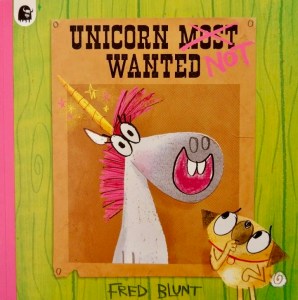
Acknowledging that there is already a plethora of unicorn picture books on the market, Fred Blunt offers something rather different: a cowboy story set of course, in the Wild West – or does he?

Unfortunately, despite the author having declared this book a unicorn-free zone, a one horned ungulate – a female one – and a pug in disguise have managed to sneak themselves in and once there make it their mission to find acceptance in the narrative, no matter what.

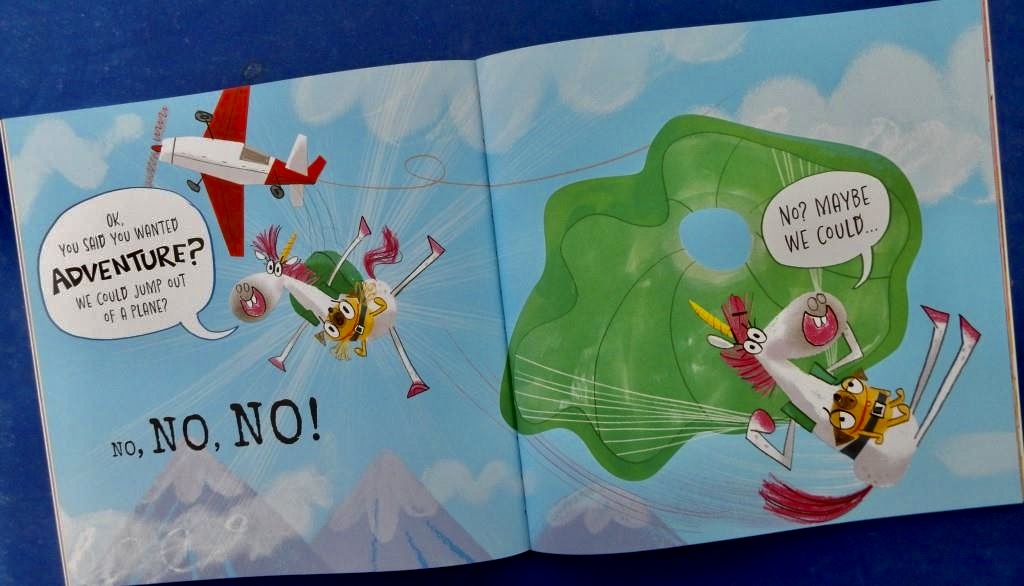
Little by little they wheedle themselves more and more into the limelight with stunts involving aerobatics,

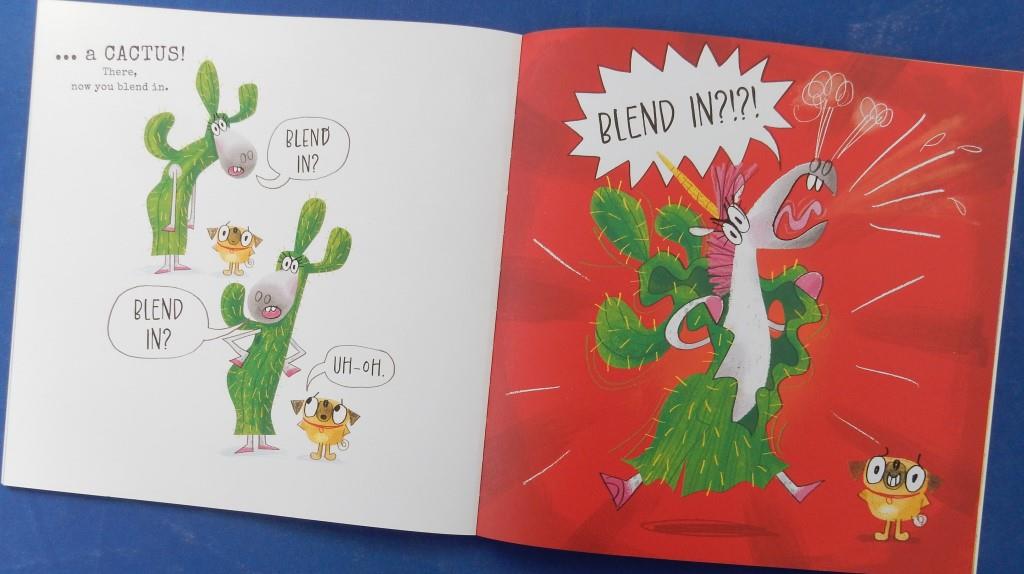
wrestling and superhero-ing until the storyteller resorts to a costume cover-up.

But is it a success? Umm …

The main characters are an absolute hoot, their body language and facial expressions are superbly silly and brilliantly done, while the banter between the two and the narrator is highly entertaining.

All in all so much better that a run-of-the-mill unicorn story that will be enjoyed by young unicorn lovers, NOT unicorn lovers, and adult sharers, who can have enormous fun reading this aloud. This one certainly did. YEE HAW!

A Damsel Not in Distress

A Damsel Not in Distress
Bethan Stevens
Frances Lincoln Children’s Books First Editions

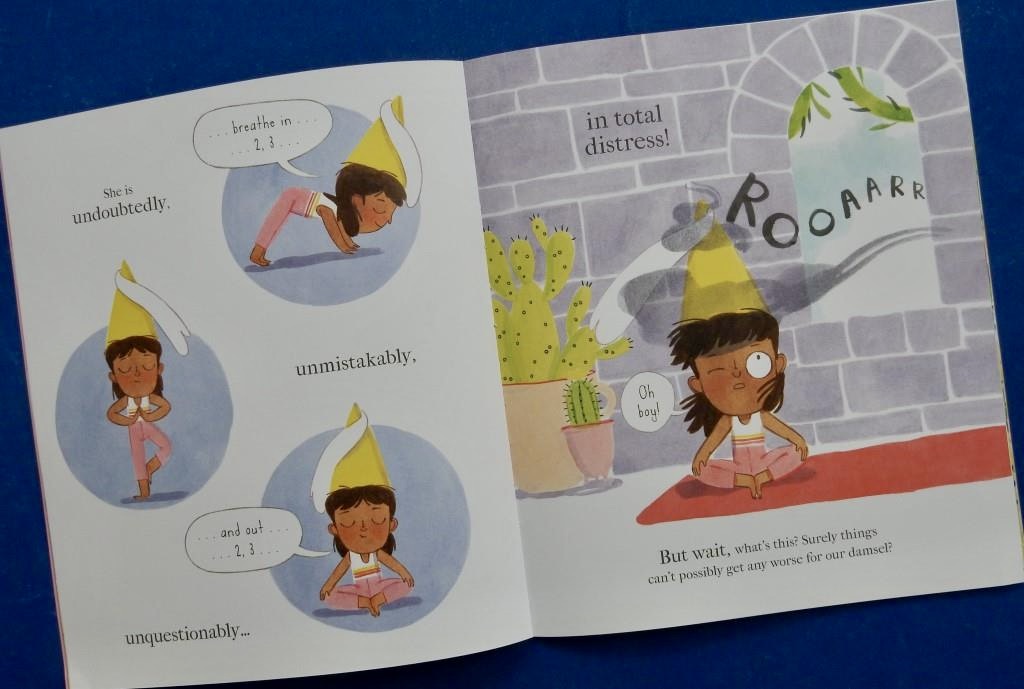
Regular readers of this blog may already know that I’m a fractured fairytales enthusiast and Bethan Stevens has chosen to turn the traditional Rapunzel story inside out, throwing the stereotypical helpless princess trope right out of the window. Our damsel states from the outset – or tries to – that she certainly is not distressed, nor is she trapped in her tower by a curse. Indeed she lives with her grandma and the castle moat is full not of horrific monsters, but ducks and frogs. In fact she seems pretty satisfied with her lot, except for the fact that her story is being spoiled at every turn of the page.

When her peaceful yoga session is interrupted, 

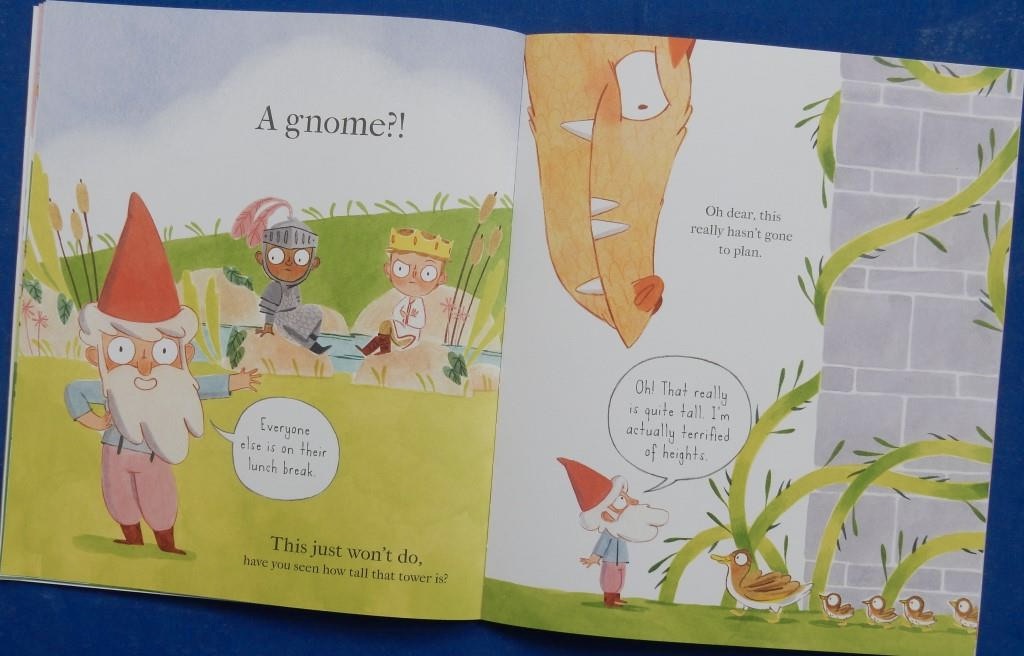
she cleverly predicts the fate of the first gallant knight that comes to rescue her from the massive dragon that has appeared. The brave Prince Charming is equally unhelpful but who’s this? A gnome with acrophobia supposed to scramble up the brambles to the top of a tall tower – really?

Our protagonist has had enough and is determined to turn the story around so its finale is to her liking? Can she do so and how? Hot chocolate anyone?

This is huge fun with Bethan’s text and illustrations working really well together, and the expressions on the faces of the characters are hilarious be they human or animal.

Small Stanley’s Big List of Scary Stuff

Small Stanley’s Big List of Scary Stuff
Angie Morgan
Otter-Barry Books

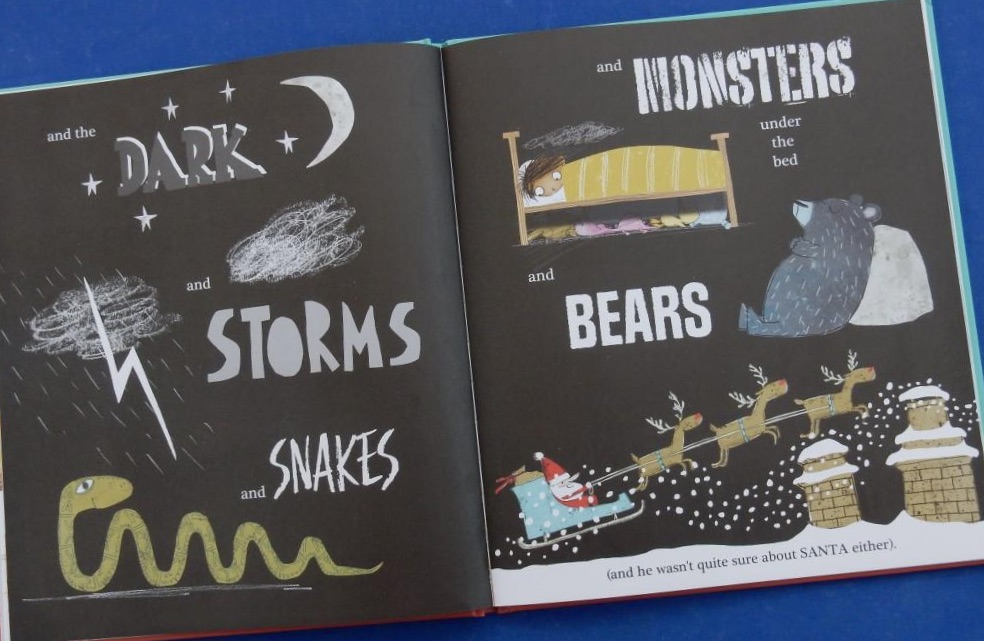
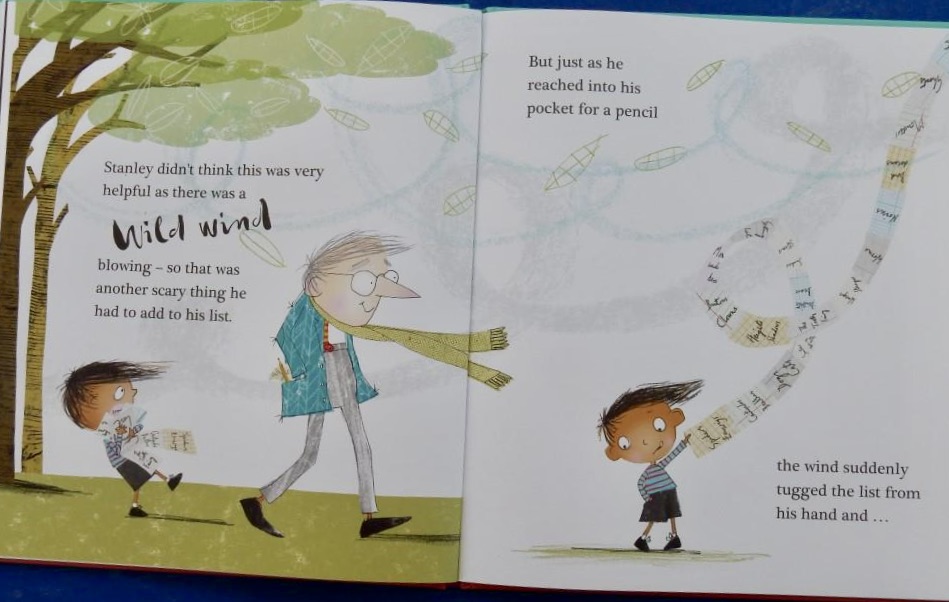
We all worry from time to time but I doubt many people have lists of worrying things as long as Stanley’s. Though this small boy’s world feels bursting with horrors, he longs to be brave like the superheroes he reads of. Instead however, he compiles a ginormous list that never stops growing, for wherever he goes, whatever he does, Stanley thinks of another item to add to his list

– even not having his list with him. It’s no surprise then that he stops playing with his pals – it’s just too difficult; but eventually things get totally out of hand.

Off goes Stanley to consult his Grandad who suggests a walk in the fresh air. In itself this is a good remedy for worries; but no sooner had they ventured out than a wind gets up. Another scary thing and one that snatches the list right out of Stanley’s hand, up and away.

Needless to say the wind pays no heed to the boy’s cries but as they walk back home, he feels strangely lighter and decidedly playful. He even goes so far as to accept his friend’s invitation to play. Hurrah! And now playing with friends has replaced list making, though very occasionally Stanley does wonder what happened to that tally of terrifying items.

The book concludes with Stanley’s short list of helpful hints about feeling scared, for those who read his story.

Angie Morgan’s mixed media illustrations are full of amusing details that both children and adults will appreciate though the former may need help reading the tiny writing on some of Stanley’s lists. Her vibrant artwork really brings to life Stanley’s emotions; and the interconnectedness of the words and pictures works splendidly.

The Unbelievable Top Secret Diary of Pig

The Unbelievable Top Secret Diary of Pig
Emer Stamp
Scholastic

If you didn’t read the original black and white edition of this crazy story when it was published some ten years back, then you need to know that Pig’s assertion, ‘I is 465 sunsets old’ definitely needs updating although the creature does supply a kind of get out clause in his introduction. This version has colour on every spread : I’m not sure if that makes it even sillier but it certainly makes it a whole lot brighter. Pig’s grammar hasn’t improved however.

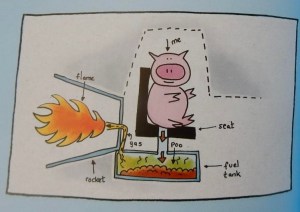
Essentially it’s a hugely funny book written in diary form by a farmyard pig called Pig who has a best friend called Duck, another so he thinks friend, Farmer, and some dastardly enemies, the Evil Chickens. They, Duck reports, are secretly building a space rocket from a broken tractor. A trocket, so the Super Evil Chicken informs Pig and proceeds to ask the porcine diarist to fly the thing to Pluto. 

At first Pig refuses but then, having learned something horrifying about Farmer’s intentions, decides to reverse his decision and grab the chance to escape the terrible fate that otherwise awaits.

Now this machine is poo powered so rest assured there will be a fair bit of poo involved in the story, farts too, so if that bothers you and you choose not to read the book, you are missing a treat. It’s exuberant and so well imagined, Yes, the mission goes somewhat awry but all ends satisfactorily for Pig and Duck, more or less, anyhow.

Animal FACTopia!

Animal FACTopia!
Julie Beer, illustrated by Andy Smith
Britannica Books

You never quite know where your inquisitiveness might take you in this engaging and informative book. And you’ll assuredly find yourself laughing at some of the zaniest zoological facts you encounter, every one of which is verified by Encyclopaedia Britannica and every fact is linked to the next. Herein you will encounter – one way or another – creatures scaly, feathery, furry, silky smooth, from the microscopic to the massive, some friendly and others downright dangerous.

You will discover something about skin shedding spiny mice of the African kind, whistling walruses, purple-blooded peanut worms, blue-tonged skinks and lots more – weird and wonderful animals assuredly.

Coincidentally I came upon examples of bioluminescence three times in a single day: the first in this book:’ microscopic male crustaceans called ostracods vomit glowing mucus’ to attract partners.

Then the topic was mentioned in a David Attenborough programme I watched in the evening as well as in the novel I am currently enjoying.

Were you aware that certain monkeys floss their teeth with bird feathers? I wasn’t; nor did I know that ghost crabs have teeth in their stomachs to facilitate digestion or that Western painted turtles are able to hold their breath for four months. Amazing!
With a mix of photographs and Andy Smith’s cartoonish illustrations this will surely satisfy curious KS2 readers and entertain a great many adults too I suspect.

The Great Fox Heist

The Great Fox Heist
Justyn Edwards
Walker Books

Justyn Edwards really ups the stakes and the tension in this sequel to The Great Fox Illusion. Desperate for answers as to her father’s whereabouts following his disappearance, Flick Lions has little choice but to go to the town of Linth in Switzerland and there with her best friend Charlie, take part in another TV competition, The Battle of the Magicians, for the Great Fox, whom she already distrusts but has promised to help. All the Fox (forever in his mask) is interested in is being elected the new chancellor of the Global Order of Magic and winning the competition would enable him to secure that position. That and having the right to know the workings of any trick in the world. But does he have another agenda?

We follow the friends as they find themselves tasked with something that seems an impossibility: stealing some twenty-five million euros worth of diamonds from one of the most secure bank vaults in the world. 

If you’ve read the first story though, you will already know that despite her prosthetic leg, Flick is a character with a steely resolve; she’s astute, highly observant and loyal.
It’s clear that as the plot thickens, the author expects readers to keep their wits about them just as much as Flick and Charlie. What is the significance of the Bell System that appears everybody wants to get their hands on?

Without divulging too much I’ll just say that with danger lurking everywhere, loyalties are tested and the final twist will make you gasp. A fascinating and enthralling read.

Fairytale Ninjas: The Glass Slipper Academy / Slugs Invade the Jam Factory

Fairytale Ninjas: The Glass Slipper Academy
Paula Harrison, illustrated by Mónica de Rivas
Harper Collins Children’s Books

You’ll meet some favourite fairytale characters in this, the first of a new series, starring friends Red, Snow and Goldie who are pupils at the Glass Slipper Academy; Red rather reluctantly as she considers there are plenty of more exciting things to do than learning how to pirouette – things such as fighting trolls and riding dragons.

It quickly becomes evident that Red is a headstrong character who doesn’t always think before she acts; so when she grabs Snow’s penny and throws it into a supposedly broken wishing well, it might just be a case of be very mindful of what you wish for.

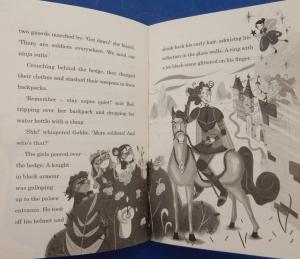
Once inside the academy, Red continues with her thoughtless behaviour and one of her wild acts results in her discovering a secret door in the studio behind which is a small storeroom full of clothes, silver armour, swords and a rolled up carpet. Just the kind of things for an adventure, thinks Red.

Madame Hart catches them red-handed and as a result agrees to give them sword-fighting lessons, telling the girls that the moves are very similar to dance moves. She also tells them that the most important thing she can teach them is self-belief.

Some weeks later during a lesson, Madame Hart is arrested for supposedly kidnapping little Prince Inigo and a group of soldiers take her away. Before you can say Diamond Palace, the three girls have stashed what they think they’ll need in their backpacks, ninja suits included, and along with wolf pup, Tufty, are off to find the real villain responsible for the young prince’s abduction.

Highly enjoyable either as a read aloud or as a chapter book for emergent readers, especially fairy tale fans, who will delight in discovering some of their favourite characters in different situations. Black and white illustrations by Monica de Rivas add to the fun.

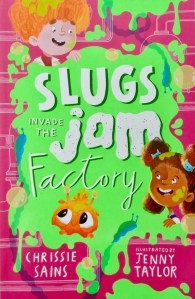
Slugs Invade the Jam Factory
Chrissie Sains, illustrated by Jenny Taylor
Walker Books

This is the third adventure for inventor, Scooter McLay, his little alien chum, Fizzbee and his human friend Cat Pincher. Between them they have transformed McLay’s jam factory into a tropical jam glasshouse wonderland.

Now they have a problem: an attempted take over of the sluggy kind. In fact the slimy creatures have found several ways to infiltrate and moreover appear to be well-organised. How on earth is this possible?

Equally seemingly impossible is that Scooter’s mind has gone blank: he doesn’t have one single idea that might help the situation. With slugs leaving their slimy trails everywhere, feasting on the fabulous fruits and most likely causing the factory to fail its imminent hygiene inspection, on account of slug infestation, the situation is pretty desperate.
Daffy diagnoses Scooter with having creative block but has no knowledge of how this might be fixed; but could some of Fizzbee’s Cocoa Bean Creativity Jam help?

Something needs to be done and fast to thwart chief slug, Mucus’s plan to turn their factory into the first ever slug cafe and wellness spa. He seems to be taking the place over completely so the jam clan must pull out all the stops to halt his dastardly scheme and save their beloved establishment..

Did anyone say Brussels Sprouts? And be prepared for a surprise announcement before the end.

Hugely funny and equally silly, with Jenny Taylor’s illustrations adding to the enjoyment, this tasty offering concludes with a spread giving information about cerebral palsy, the condition that Scooter has.
Grandpa and the Kingfisher

Grandpa and the Kingfisher
Anna Wilson and Sarah Massini
Nosy Crow

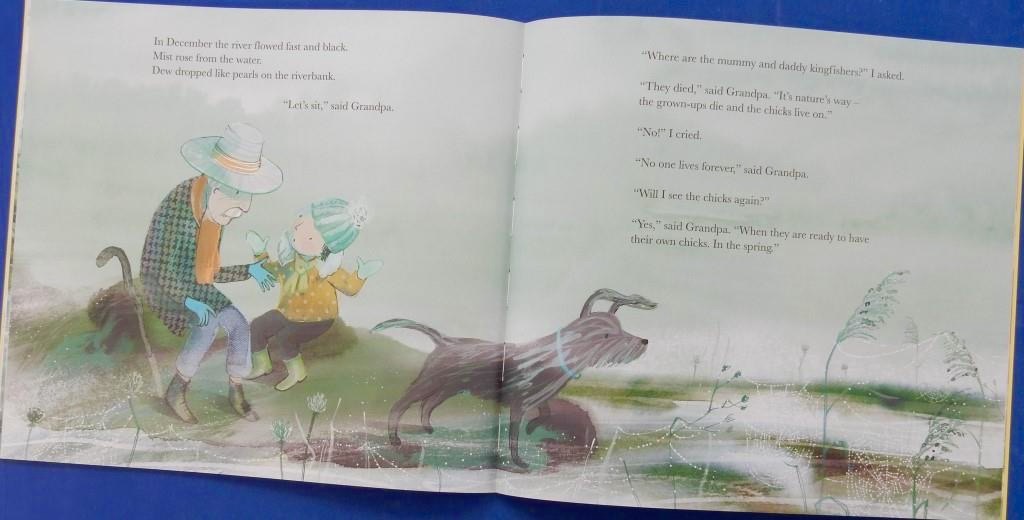
This is such a gorgeous book, lyrically and lovingly written by Anna Wilson in memory of her father whose favourite bird was the kingfisher.

It begins one spring with a young child, Grandpa and their dog sitting together beside the river when suddenly there’s a flash of blue and a kingfisher darts past: ‘Its beak long and sharp. / Its wings shining like jewels. / It’s breast golden-red, like a sunset.’ Arrowlike it dives down beneath the water and when it surfaces, there’s a fish in its beak.

As spring gives way to summer the child narrator tells how on another visit to the river, they notice there are now two kingfishers – the original male and a female.

They watch the birds create a nest and eventually have a brood of chicks.

All the while, Grandpa has become more and more tired and frail looking. He tells the child, “No one lives forever … There wouldn’t be enough room for us all! …. Only nature goes on forever.” Adult readers can sense what is coming. even as the child says, “I’ll look after you, Grandpa.”

By December the adult birds have died and Grandpa reminds the child, “No one lives forever.”

Next spring Grandpa too has died and the child narrator tells us how much he is missed. In this gentle way one young child has experienced some of the wonders of nature and learned about the cycle of all life.

Now on my walks beside a stream near to where I live, not only will I be watching out for the kingfishers I know to inhabit its banks, I will be thinking about this story with Sarah Cassini’s beautiful, superbly well-observed illustrations of the natural world and Anna’s touching text.

A must for family and classroom sharing.

We Are in a Book! / Can I Play Too?

We Are in a Book!
Can I Play Too?

Mo Willems
Walker Books

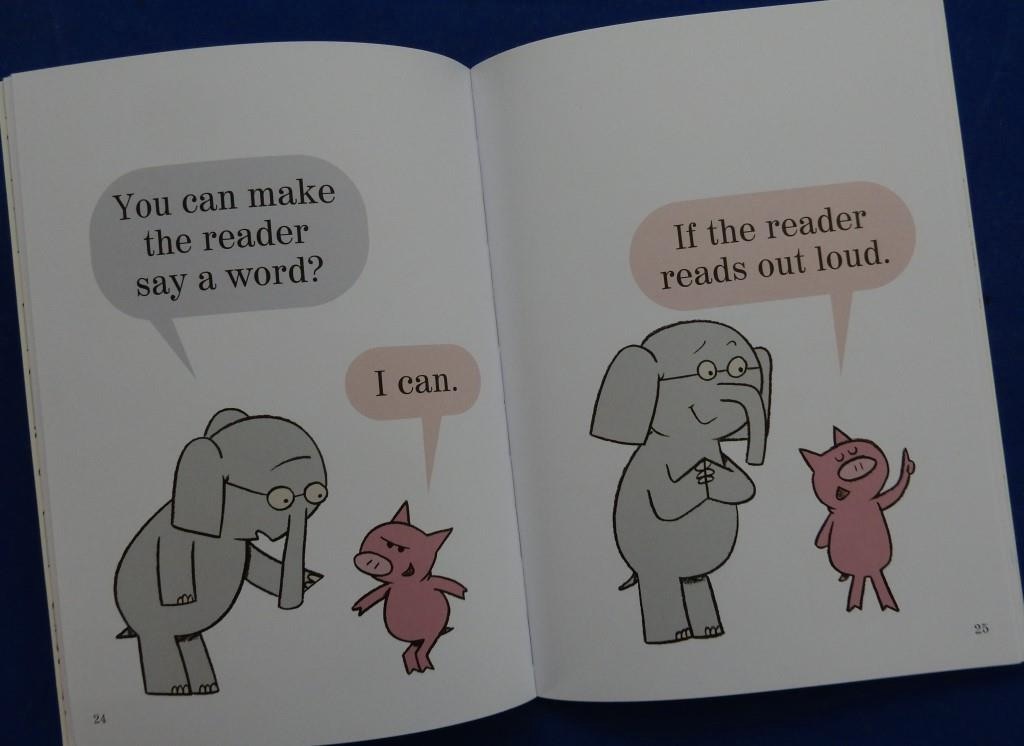
If you’re looking for a book for new solo readers then these two are spot on. I have to admit to being a big Elephant and Piggie enthusiast already however.

We Are in a Book! plays the metafictive card from the moment Elephant suggests to his best pal, ‘I think someone is looking at us.’ Gerald’s concern that it might be a monster is quickly set aside by Piggie’s. “No. It is… / a reader! / A reader is reading us!” Going on to respond to Elephant’s immediate question, by dangling over a speech bubble to demonstrate. Their exuberant enthusiasm is soon followed by a practical joke as Piggie works out how to manipulate the reader

not just once but twice, which the two find utterly hilarious. However Piggie’s mention of the book’s ending sends Elephant into a tizzy and a little bit more reader manipulation occurs – over to you, reader …

Brilliant, cleverly paced and absolutely bananas.

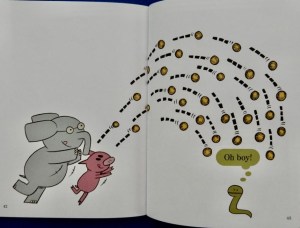
Also hysterical is Can I Play Too? Herein, no sooner have Gerald and Piggie decided to play catch, when Snake slithers up asking to play too. The two are a tad doubtful wondering how an armless reptile can possibly play this game. Snake however is determined to give it a go and the game becomes let’s say, a bit bonkers. They keep trying, adding a lot more balls

but this idea doesn’t work. Surely there must be a way to make this game work for all three of them. Then comes a lightbulb moment for Piggie …

Perfect pacing as always, wonderfully wry humour – ditto, full of heart – tick! and a gentle lesson on inclusivity thrown in.

There’s No Such Thing As Dragons

There’s No Such Thing As Dragons
Lucy Rowland and Katy Halford
Scholastic

Prompted by the titular remark of his grandfather during a story-sharing session, a young child embarks on a mission: to find out whether or not dragons exist. Before leaving he packs the items he needs in his backpack and asks the readers to assist in the search. 

Then having checked his own abode the lad heads off up the hills, climbs a mountain, 

and then enters a forest, takes flight in a hot air balloon, tries the museum and several other places but with no success. He does find the occasional knight in the castle though, before heading to the final location on his list of possibilities: the rocky seashore below the castle.

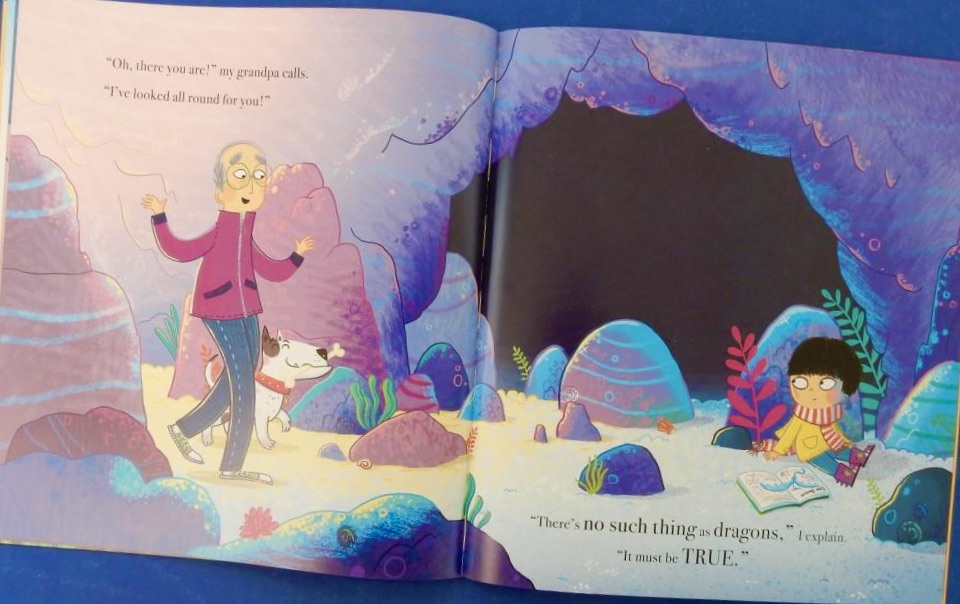
As he sits checking his dragon book beside the entrance to a cave who should appear but his grandpa who has been searching for him all the time. Reluctantly the boy concedes “There’s no such thing as dragons” 

as the two watch the shadows dancing in the moonlight. Suddenly as they are about to depart, they hear a sound and there’s a distinct rise in the temperature … Then comes a surprise revelation: what could it be?

Lucy’s spirited rhyming text scans well, so it’s a good one to read aloud to a class or group; and individuals will enjoy scanning Katy Halford’s illustrations that underscore the whimsical humour of the story as they too search for the dragon hiding in plain sight.
Clutch / Dragon Storm: Connor and Lightspirit

These are additions to two exciting series:thanks to Walker Books and Nosy Crow for sending them for review

Clutch
M.G. Leonard
Walker Books

This is the third story of the Twitchers and for me it’s even better than the previous two.

Twitch and Jack are alarmed to hear that somebody has been stealing eggs from the nest of a peregrine falcon in Aves Wood. As the Easter holidays start, all the Twitchers come together for the first time in a while and are determined to solve the mystery of the missing eggs before the thief strikes again.

In the knowledge that the thief’s actions are both against the law and immoral, the gang set off to find clues and learn what they can about any possible suspects. With the police involved Passerine Pike is now a crime scene, but is the criminal a local or somebody from outside come to participate in the Canal Masters fishing competition? With the competition only lasting a few days and a pair of Spoonbills nesting on the edge of the pond in the locality, time is of the essence in catching the thief.

However, suddenly Twitch receives a visit from the police and learns that he fits the suspect profile and evidence places him at the crime scene. Now it’s not only the nesting birds but Twitch in need of saving and the evidence against him seems to be mounting.
With several red herrings and wrong turns, the friends finally succeed in their mission: all ends well for Twitch, the real crooks are unmasked and there’s a new member of the Twitchers too.

With its superb mix of mystery, crime and environmental issues, this is another cracker for established fans of the series but others new to the Twitchers will quickly find themselves engrossed too. Whither next for these conservationists? I can’t wait to find out.

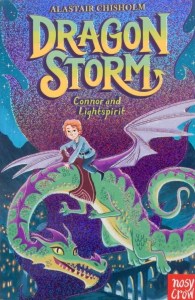
Dragon Storm: Connor and Lightspirit
Alastair Chisholm, illustrated by Eric Deschamps
Nosy Crow

This is the seventh of the author’s Dragon Storm series for younger readers and what a gripping tale it is. Relatively new to life in the Dragonseer’s Guild, Connor and the other children are told by vice-chancellor Creedy of a code that needs solving. But how trustworthy is Creedy? Connor thinks he’s OK but not all the others agree. The boy sets about cracking the code, which he does, helped by a clue about some of the symbols from Cara.

However the more involved he gets with Creedy, the more troubled Connor is by doubts that he’s doing the right thing by helping him, especially when under cover of darkness Creedy leads him to the Royal Palace. Moreover, Lightspirit is far from happy about what is happening: the truth is what matters to this dragon. Is King Godfic up to no good, or is it his son, or somebody else?
The Dragon Storm grows ever closer but can trust and truth save Draconis from a horrific war?

The story, with its atmospheric black and white illustrations by Eric Deschamps, ends on a real-cliffhanger leaving readers eager to discover what it is that Connor knows.

Monsters in Trucks / Tiny T.Rex and the Grand Ta-Da!

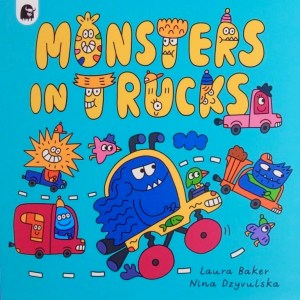
Monsters in Trucks
Laura Baker and Nina Dzyvulska
Happy Yak

Put together two subjects popular with young children – monsters and trucks – and you’re surely on to a winner.

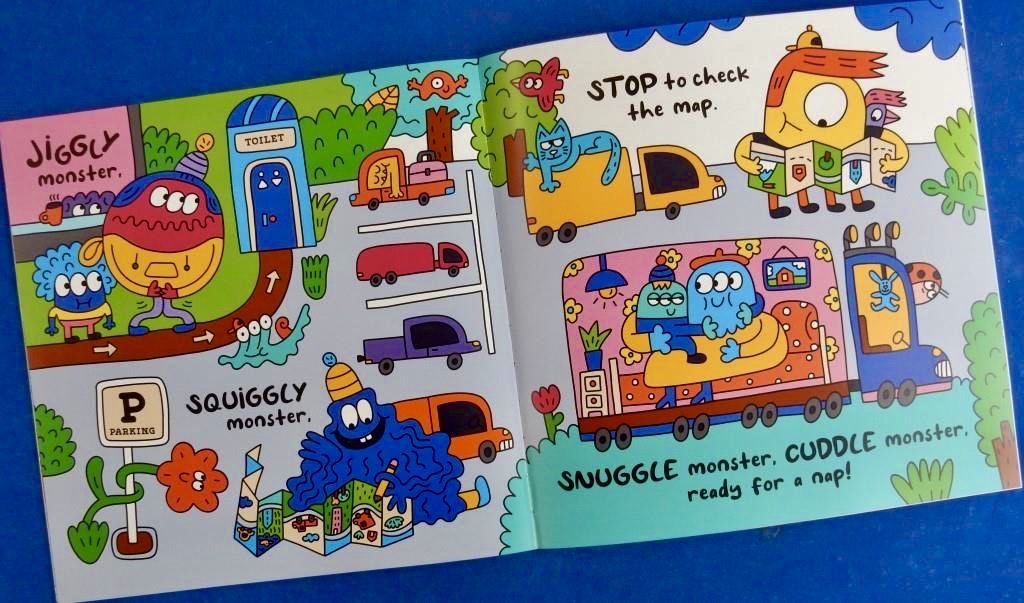
That’s what we have in this picture book that takes us to a world populated by truck-driving monsters. They come in all shapes and sizes, some happy, others downright grumpy; there are more than forty kinds in all, many in one way or another engaged in the construction of a monster city. Some however, appear to have other things in mind such as partying and there’s one among their number that’s a thief on the loose; he needs to be apprehended and fast.

Can little humans pick a favourite: it might be grump monster (so busy being grumpy that he drives right into a big hole), roar monster, prickly monster, tickle monster, or perhaps jiggly monster who is in the queue for the loo.

I loved the snuggle and cuddle monsters.

Laura Baker’s rhyming romp of a text and Nina Dzyvulska’s vividly coloured scenes work well together, the fun details of the latter offer plenty to talk about. Further fun comes in the form of a ladybird that lurks in every scene.

A sharing of this book in an early years setting may well result in an outbreak of monster creativity.

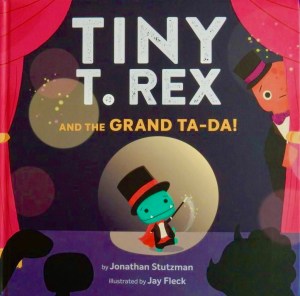
Tiny T.Rex and the Grand Ta-Da!
Jonathan Stutzman and Jay Fleck
Chronicle Books

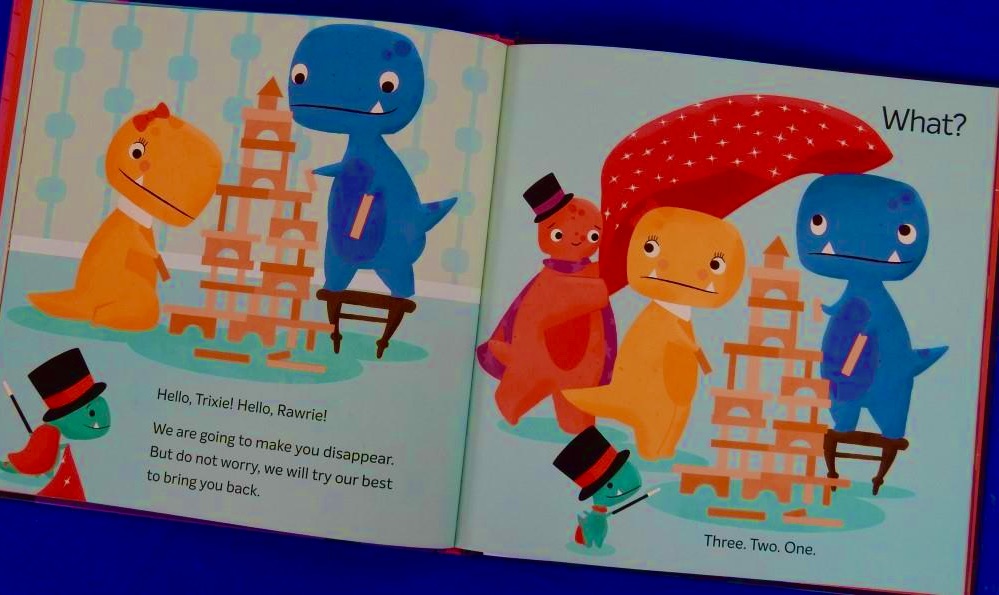
Tiny R.Rex and Pointy, the delightful dinos. are back and having seen a poster for the school talent show, have decided to enter. Tiny is fairly confident but Pointy is more than a tad apprehensive. Then inspiration comes in the form of their hero the Amazing Presto whose book they turn to. ‘Magic is meant to be shared’ they read: that means their joint skills could carry them through.

First though they need to train, so they don top hats, wield wands, appoint an assistant – Bob the teddybear – and choose their special magic word.

Magic though, especially a disappearing trick, doesn’t just happen; mistakes are part of the learning process

and their confidence starts to wane. Time to go back to the drawing board. Then after some very careful planning and a creative boost, the two are ready to step forward and face the audience – well almost. Suddenly Pointy is overwhelmed by nerves: can he summon his inner courage and make an appearance after all?

Patience, perseverance and supporting one another are key in this latest outing for Tiny and Pointy, with the former taking centre stage in terms of the narration. There’s food for thought at the show’s finale.

As always this dino. duo are charmers and are likely to win new human friends after a sharing of the vibrantly illustrated story.

Captain Looroll

Captain Looroll
Matt Carr
Farshore

She’s ready for anything, so Captain Looroll declares on the day of her birth but she probably hadn’t anticipated a mundane existence such as the one she finds herself faced with, stuck on a holder hanging on the wall in the toilet under the stairs, of all boring places.

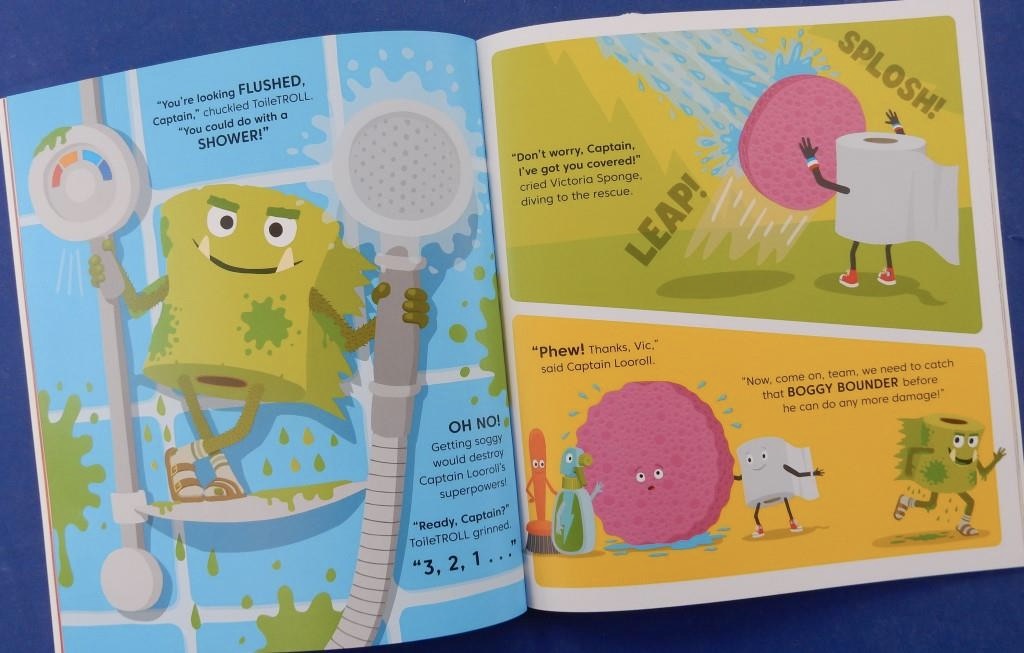
Equally bored are her close chums Ray the spray and Barbara Bogbrush. Victoria Sponge however remains more upbeat, frequently stating that ‘something’s bound to happen.’ and happen it does in the form of ToiletTROLL from the upstairs bathroom.

Word of a mission comes from above via the downpipe and after something of a struggle the downstairs buddies make it up to the scene of the chaotic bathroom where something green and cylindrical, aka TT, is creating complete havoc. Indeed he’s fast turning the entire house into a powerfully pooey, gooey viridescent residence.

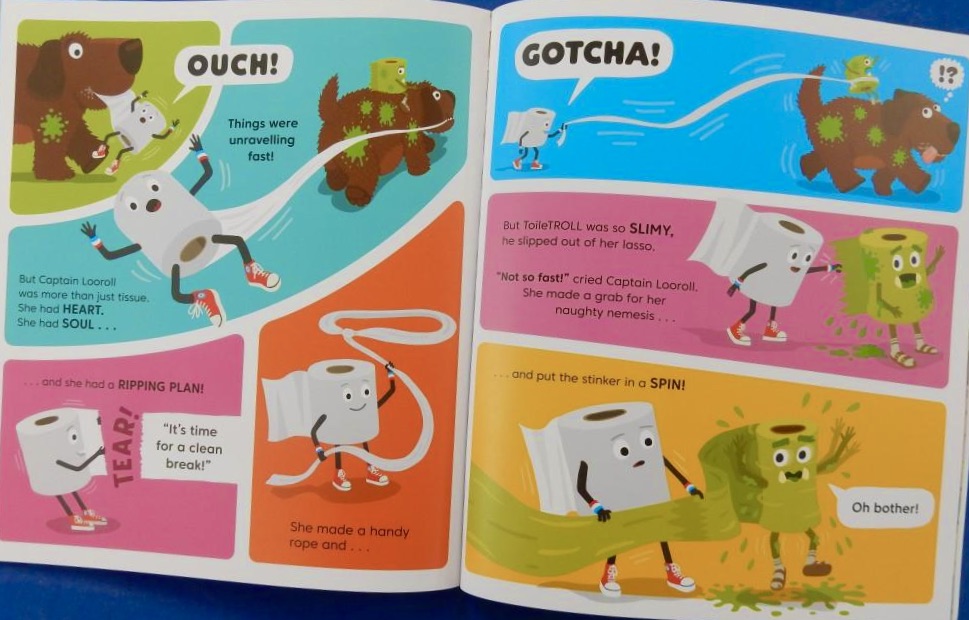
As things unroll at a rapid rate, it’s evident that one of the two rolls is so much more than mere tissue; as well as heart and soul, she’s quick-thinking and super-resourceful.

Can she and her crew see off that dastardly supervillain once and for all: you bet! However there’s still a considerable amount of wiping that requires doing.

Replete with bum-clenchingly excruciating puns this is a hilarious read aloud that will have children wriggling on their bottoms in delight as they cheer for the hero and her gang and giggle at Matt Carr’s vibrant, action-packed scenes. Bathroom visits will never seem the same once you’ve met the cast of this crazy book: this is toilet humour of the first order. Roll on the next adventure.

The Fastest Tortoise in Town

The Fastest Tortoise in Town
Howard Calvert and Karen Obuhanych
Walker Books

Barbara Hendricks, narrator of this story and describing herself as ‘just a regular leopard tortoise’, is troubled. The reason is that in just a week she is to participate in a running race. Now although the entrant has no self confidence at all, her owner and best friend, Lorraine, is optimistic about the outcome of the fun run and sets up a daily training schedule for her pet. However this only serves to make the shelled creature all the more downcast at her prospects. They’re overtaken by, in turn, an absentminded worm a newly toddling human, a great-granda’, a remote controlled toy and an out-of-control vacuum cleaner – enough to dampen any contestant’s spirits.

Not so Lorraine’s who encourages her pet saying, “Just run your own race.” Nevertheless come race day the tortoise is a bundle of nerves. Surely all that training isn’t going to be for nothing: Barbara will never find out if she stays in her shell so off they go to the stadium.

Children (and adults) will have a good giggle at the sight of the other contestants at the starting line – ‘the fastest animals I’ve ever seen’, the narrator tells us.

Off they all go with Barbara employing her ‘put one foot in front of the other’ strategy over and over again until … And the winner is? Who do you think?

Then, with a nod to a certain Aesop’s fable, Calvert delivers a wonderful surprise ending.

Full of pathos, Karen Obuhanych’s mixed media illustrations are a hoot and will surely have youngsters rooting for Barbara from the outset.
Certainly a winner in my book, this.

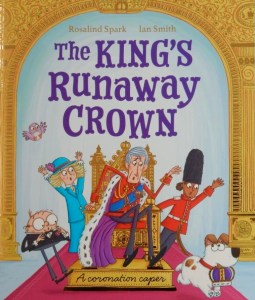
The King’s Runaway Crown

The King’s Runaway Crown
Rosalind Spark and Ian Smith
Oxford Children’s Books

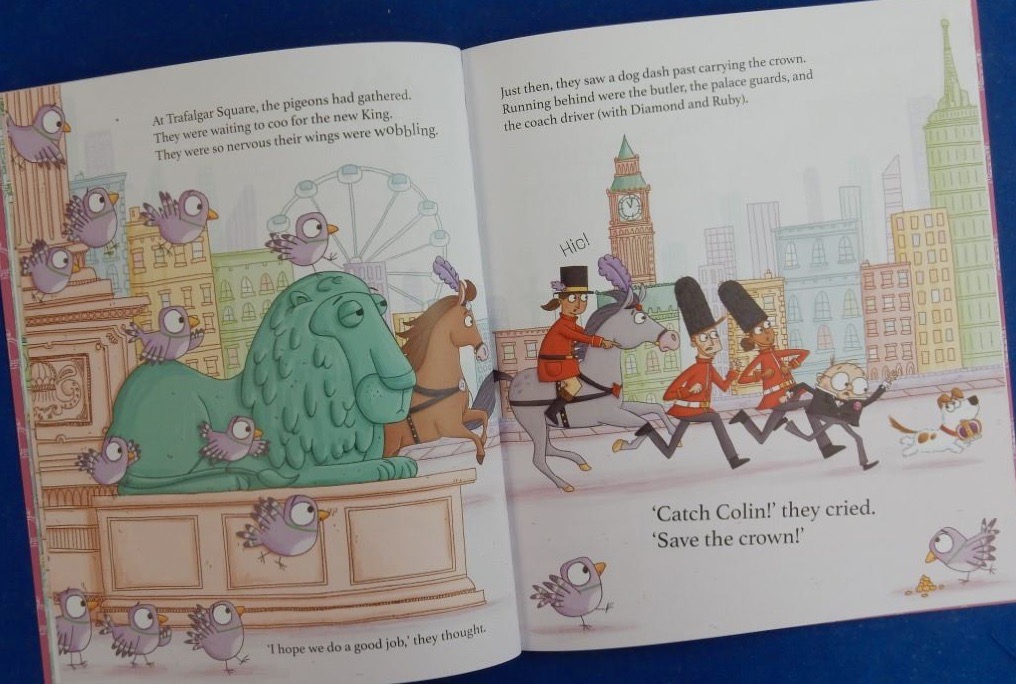
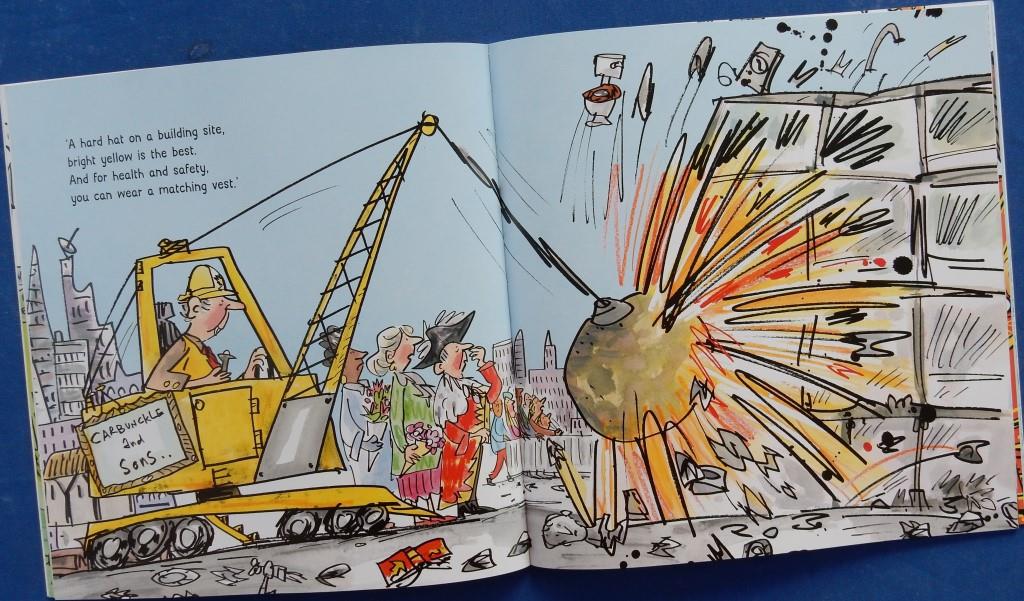
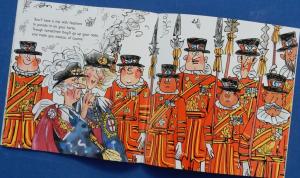
It’s the morning of the new King’s coronation and preparations are well underway until suddenly Colin, the King’s dog snatches the crown from right under the nose of the royal butler who is busily polishing the ceremonial symbols. Off dashes the pooch hotly pursued by said butler, the palace guards, the coach driver (plus horses Ruby and Diamond), a proliferation of pigeons and a fast growing crowd that had gathered to watch the big event, through the streets of London

and along the riverside.

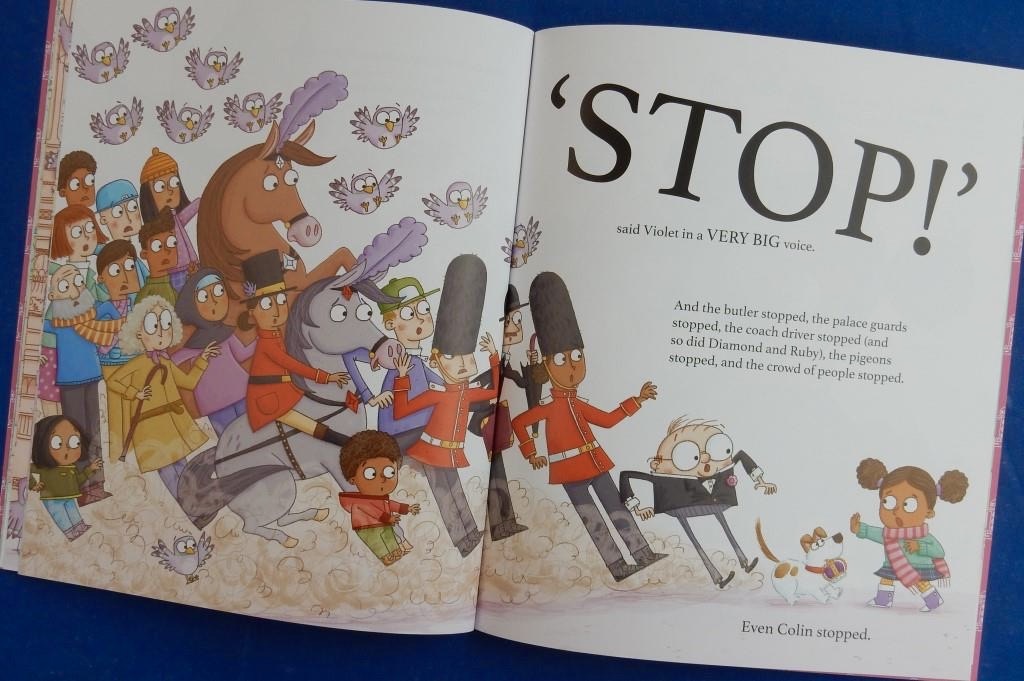
At Tower Bridge stands little Violet and her parents. She sees what is happening and steps forward commanding in a loud voice, “STOP!” The pursuers and the pursued halt right then and there.

Violet picks up Colin, cuddles him and a communication takes place between them. She passes Colin’s fearful feelings on to the crowd.

Meanwhile back at the palace, a royal someone is feeling equally beset by nerves when he notices a particularly peculiar parade passing through the gates. Out runs the King, Violet hands over the crown and they all listen to his highness before he takes his place on the throne for the crowning ceremony.

This right royal romp, with its wealth of alliteration and its crying out to be joined in with, repeat refrain, “Catch Colin! Save the crown!’ is told with aplomb by Rosalind Spark and energetically illustrated by Ian Smith whose scenes of the chaos one little dog causes, are comic delights.

Little People, Big Dreams: Vanessa Nakate / The Flying Man

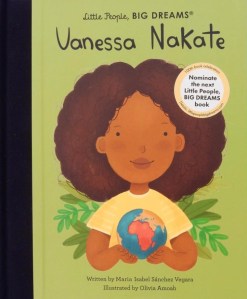
Little People, Big Dreams: Vanessa Nakate
Maria Isabel Sánchez Vegara, illustrated by Olivia Amos
Frances Lincoln Children’s Books

In this addition to the excellent series we meet a young and outstanding activist. As a child growing up, Vanessa lived with her parents in Uganda’s capital city, Kampala. Her parents always encouraged her to speak out for what she thought was right, but in the countryside where she attended school, climate change seemed a world away.

At university however she began noticing how, despite being the least responsible, Africans were suffering most by climate change. Thus she became an activist and persuaded her friends and relations to do likewise. She spoke out against the destruction of the Congolian rainforests and its consequences and one day she, one of few from the African continent, was invited to join other young climate activists in New York where they hoped to make world leaders take action against global warming.

When she returned home Vanessa continued her fight and after a setback at a protest in Switzerland, her work has been recognised
and now she is an inspiration to fellow young Africans and indeed the entire world. A vital topic and with its focus on Africa, this is an excellent book to inspire KS1 readers to use their own voices and indeed actions, to support the on-going fight to save the planet.

The Flying Man
Mike Downs and David Hohn
Astra Young Readers

In this picture book biography Mike Downs pays tribute to a relatively unknown German aviator, Otto Lilienthal, whose pioneering spirit led him to create the first flying machine.

Perseverance was key as despite considerable skepticism from others around, he and his younger brother, Gustav worked away observing, experimenting, testing and improving their designs until in 1891 Otto was successful in making a hang glider that travelled through the air . Eventually in 1896 in a more sophisticated (albeit still flimsy) glider he soared above admiring crowds with, so the illustrator shows, a euphoric expression on his face.

Following this a photograph dubbed him ‘The Flying Man’ but sadly a week later, Otto died from injuries that were the result of a crash. (This information the author places in an afterword) Nonetheless his work inspired many other fliers, including the Wright brothers who cited Otto as their greatest inspiration.

It’s evident from his writing that author of this book Mike Downs, found Otto Lithenthal inspirational too.

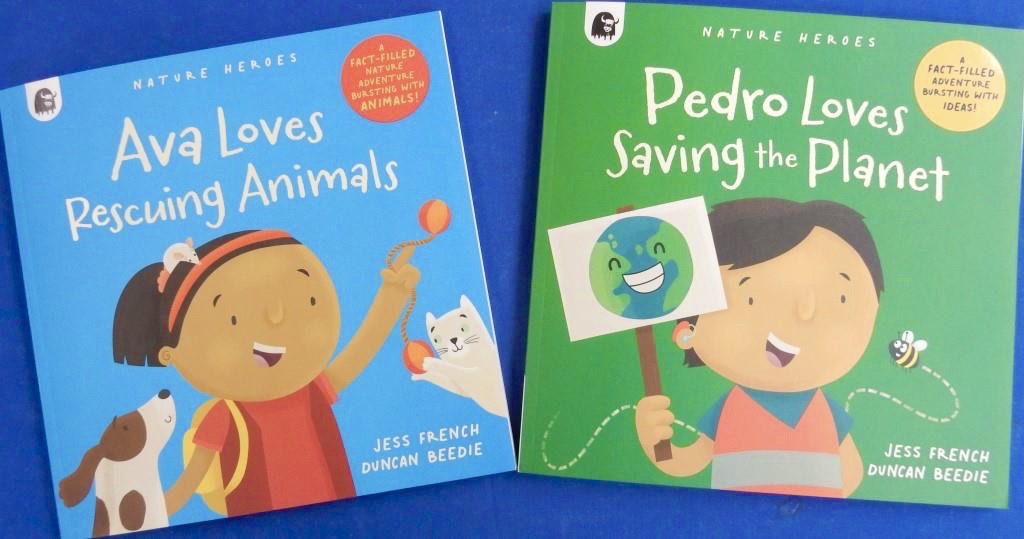
Ava Loves Rescuing Animals / Pedro Loves Saving the Planet

Ava Loves Rescuing Animals
Pedro Loves Saving the Planet

Jess French and Duncan Beedie
Happy Yak

These are additions to the Nature Heroes series where the focus is on a group of friends who love nature and being outdoors: essentially each one is a fact-filled picture book story.

In the first we meet Ava who lives with her grandparents They run an animal rescue centre that provides a temporary home for all kinds of animals, be they pets or wild creatures, large or small.
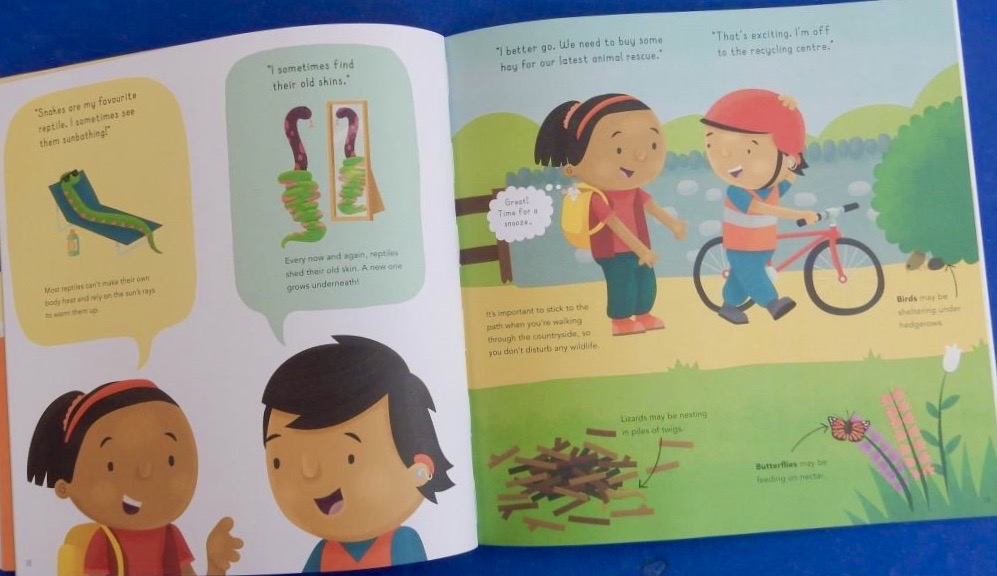
Accompanied by a tiny white mouse, Ava takes a walk around the centre and its environs as they head to the pet shop to buy hay for the animals soon to be cared for by her grandparents. On the way Ava stops at a pond containing frogs and lots of frogspawn and gives readers information on a frog’s life cycle and introduces some other amphibians.
We follow Ava on her ‘adventure’ during which she meets Pedro, the narrator of the next book,

and a lizard that narrowly escapes being run over by his cycle wheels. The entire walk turns into a fascinating learning journey for readers as they are introduced to various mammals – some of them record breakers, and find out about basic animal groups, ecosystems, habitats and more. Ava also meets another friend, Billy, who narrated Billy Loves Birds. Finally we discover the identity of the creatures that have just arrived at the rescue centre during their absence.

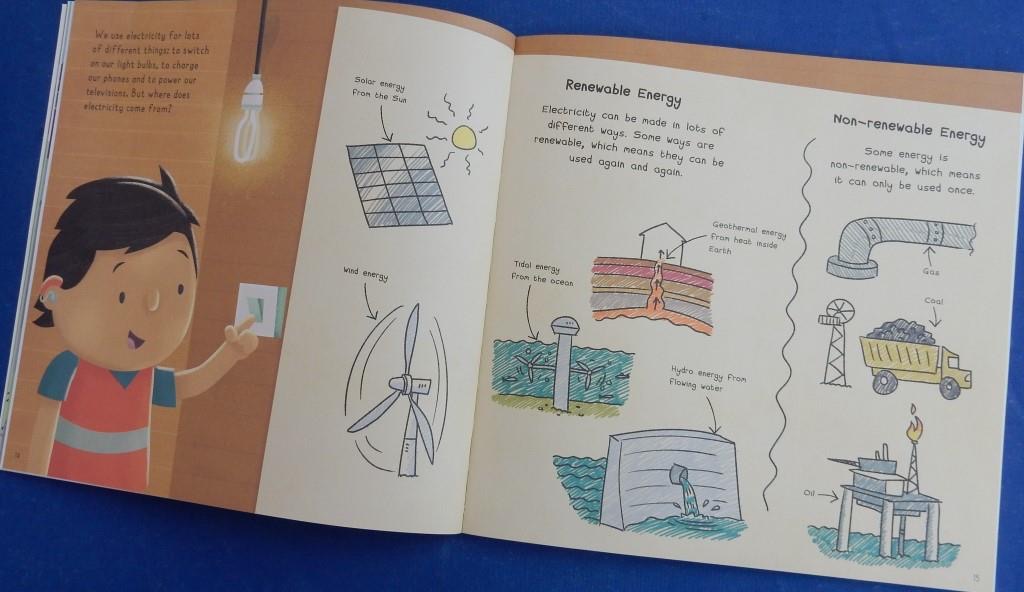
Pedro is an eco-warrior and in Pedro Loves Saving the Planet he and his older brother spend a day in the eco club’s new cabin. They choose to walk to their destination and encounter others who are using planet-friendly means of transport. Then once inside the cabin Pedro talks about renewable and non-renewable energy,

ways of saving water, points out that the cabin is built from sustainable materials, which leads on to a presentation of the 7 Rs (things that everyone should always keep in mind)) and other vital topics such as how to grow your own food, composting, the importance of trees, how to save energy at home, and the joys of being outside in green places.

Both books are illustrated by Duncan Beedie whose amusing art work underscores naturalist/vet Jess French’s informative, enjoyable texts. It’s never too early for young children to start learning about the importance of environmental care and the impact their actions have, both now and for the future. These books are spot on for foundation stage and KS1 class collections.

Scotty Plants a Seed

A big thank you to Little Door Books for inviting me to participate in this blog tour.

Scotty Plants a Seed
Conn Iggulden and Lizzy Duncan
Little Door Books

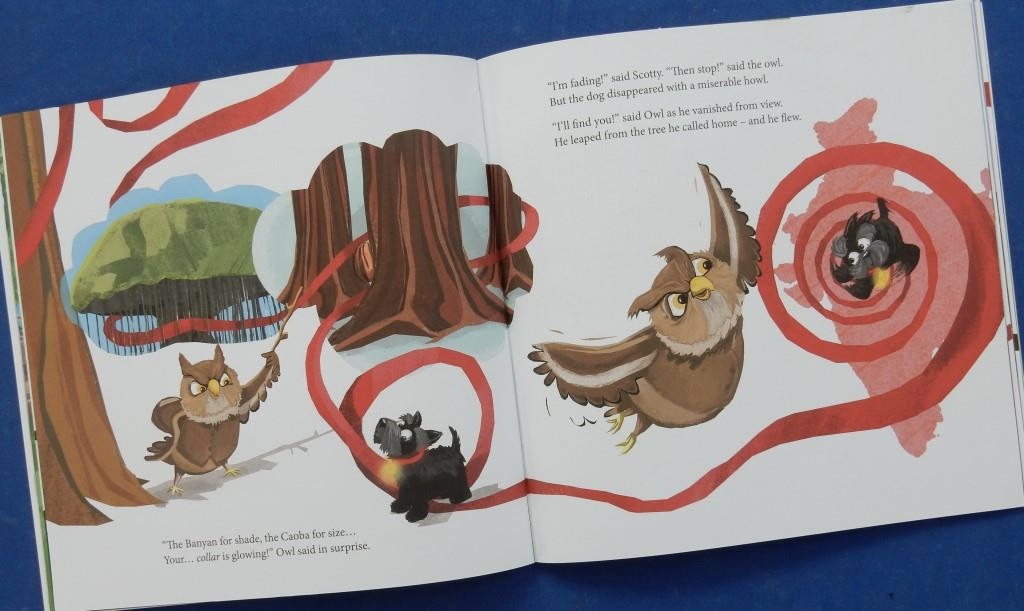
Scotty is a small black dog living on the island of Mull with a fisherman, having been blown in by a storm. One day, deciding the pup needs a collar, the fisherman takes down the one that had once belonged to Scotty’s mother and places it around the pup’s neck. Hanging from it is a tag that neither of them can read but it certainly has an effect on Scotty. Off he races to see his friend Owl and show off his brand new collar.

Owl declares that the writing on the tag is old, which impresses Scotty but he then pees against Owl’s tree displeasing his friend who is further upset at Scotty calling his home ‘a sort of a stick, but well, bigger instead.’

As Owl proceeds to talk of the wonderful trees he has seen – the shady banyan and the enormous Caoba – he notices Scotty’s collar begin to glow

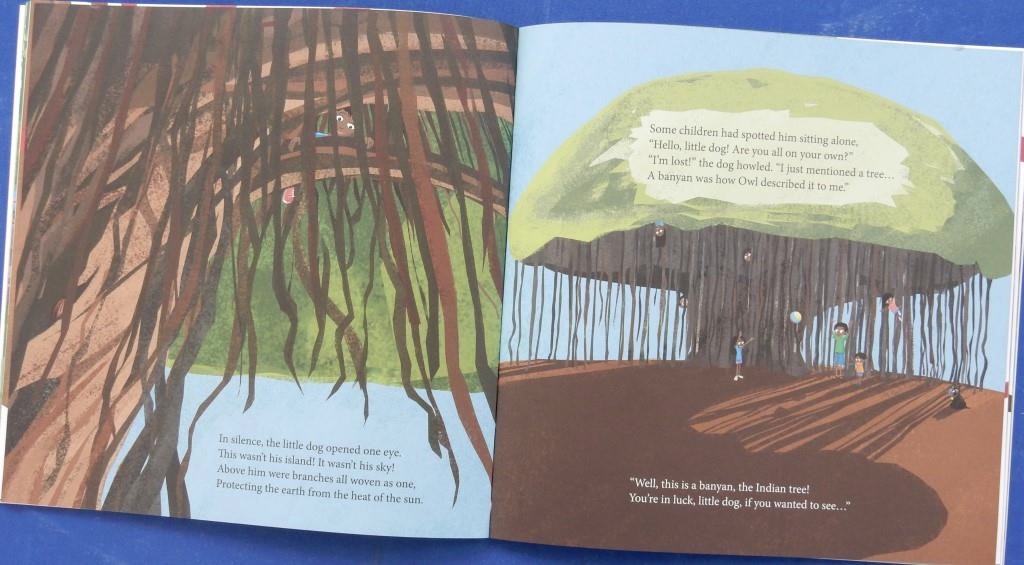
and suddenly the pup disappears. Seemingly his collar fob acts as some kind of transportation device taking him first to India

and then to Brazil. There Scotty sees the two trees Owl spoke of, but manages to displease first a group of children and then a monkey by peeing.

When Owl catches up he’s both exhausted and without much of his plumage:Scotty though is eager to visit the plains of Africa. There a ranger points out an area of reforestation. ‘Just one little voice – just one seed in the ground, / One voice that can wake the whole world with its sound!’ he says to Scotty.

Eventually the two friends return to Owl’s tree, Owl almost completely sans feathers and guess what Scotty does. You can probably guess too what they both do the following morning …

Told through a rhyming narrative and bold, dramatic illustrations that capture the grandeur of the trees and contrasting desolation of a felled forest, this environmental adventure is an unusual way of presenting the alarming fact that trees all over the world are in danger. However it’s also one of hope, encouraging the vital importance of planting trees and caring for those we already have. Nobody is too small to make a difference.
Don’t forget to search for the hidden seed on every spread.

Migrants / What Is War?

Migrants
What Is War?

Eduard Altarriba
Button Books

Both of these books are, sadly, hugely topical right now.

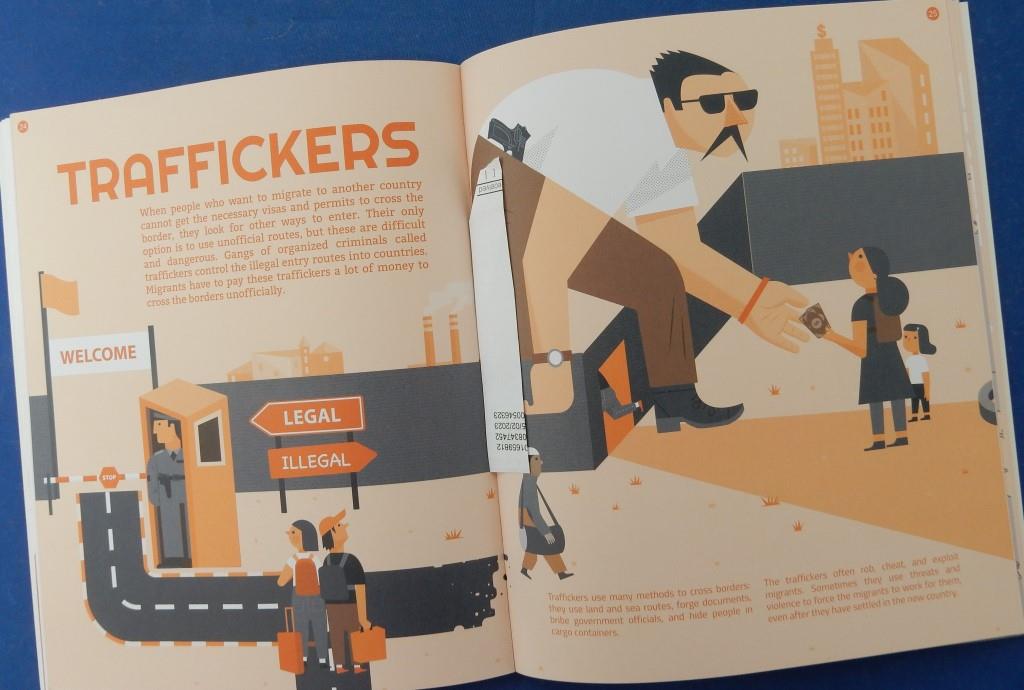
In Migrants, this sometimes emotive subject is explored in a matter of fact and dispassionate way. Eduard Altarriba explains that people have always been on the move since early humans migrated out of Africa to Europe and Asia more than a million years ago. He looks at borders between countries and why they exist, passports and visas that are required to cross them, how some countries colonised and created others, and discusses the reasons why migration might take place.

There is an excellent map showing the main migrant routes used in the last thirty five years. For some people it proves impossible to obtain the documents needed to cross borders so they have no option but to use often dangerous, unofficial routes and this leaves them open to exploitation by criminal gangs of traffickers.

The author covers the topic thoroughly yet succinctly, posing questions and answering them, progressing logically from one explanation to the next, with just the right amount of detail for older KS2 readers,

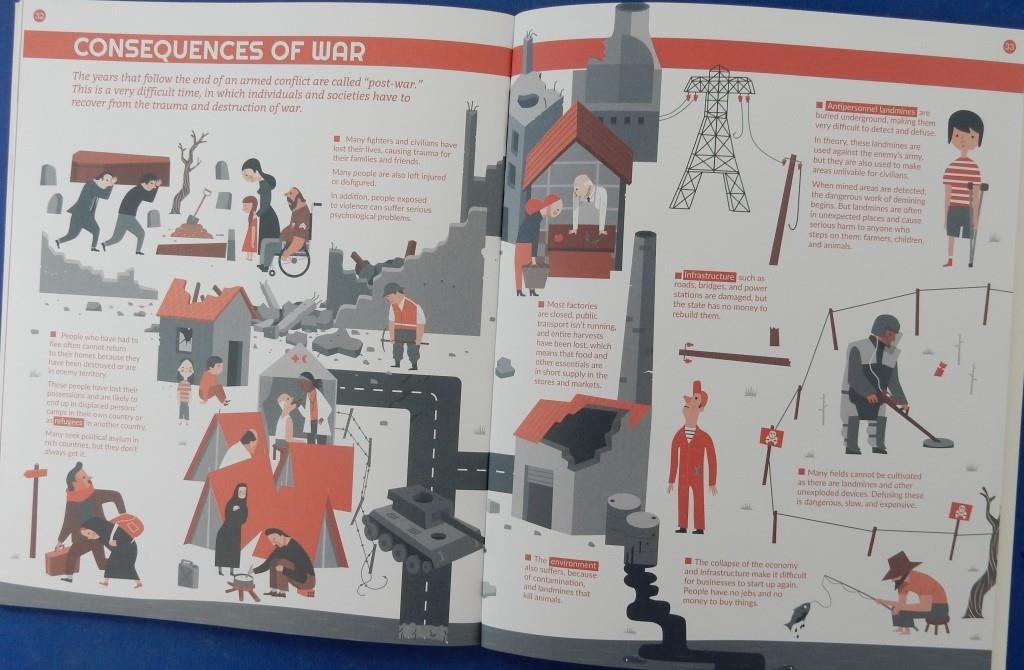
The same is true of What Is War? which is equally well-designed and illustrated. Altarriba’s approach is non-partisan and he explains that conflict between two clashing viewpoints, if unresolved through diplomacy or politics, may lead to violence and war. Disputes might be about borders or between different ethnicities, social or political groups within a country, in defence of national interests or historical grievances.

There are spreads about the principal actors involved, both national and international, the power brokers, the weapons and technology deployed. There’s a timeline stretching from ‘warring’ Neolithic hunters to the 20th century, a look at the types of war and the concept of a ‘just war’, a spread explores how a war might end and peace and mediation. This is followed by a brief look at the consequences of war both on individuals and societies.

The book concludes with three case studies: North Korea, the war in Syria and the war in Ukraine. War is a topic that, from questions they ask, worries many primary children, some of whom currently have Syrian and Ukrainian classmates.

I would strongly recommend adding both titles to upper primary class collections.

Love, The Earth

Love, The Earth
Frances Stickley and Tim Hopgood
Walker Books

Barely a day goes by when there isn’t something in the media about the climate crisis or the numerous ways in which people are still damaging our precious environment; but time is running out so it’s never too early to issue the rallying cry to young children.

This cleverly titled collaboration between author Frances Stickley and artist Tom Hopgood does just that in a truly captivating way.

It’s from Earth’s point of view that the rhyming narrative comes; the voice is gentle and friendly while also expressing a plea to be shown the kindness and fairness it needs for all its wonders to survive. With that plea comes a promise, given to the tiny newborn child we see at the start and follow through the book.

Earth’s riches are shown in Tim’s glorious mixed media illustrations as he transports us to wonderful woodlands,

gorgeous gardens, shows star-filled skies and sunny days, icy landscapes and the marvels of the deep.

Pitch perfect for little ones in every way and what a truly exquisite gift it would make to a recently born little one like the child shown at the start of the book.

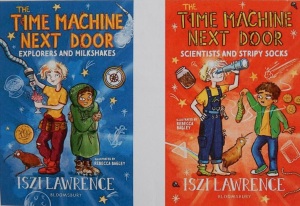
The Time Machine Next Door: Explorers and Milkshakes and The Time Machine Next Door: Scientists and Stripy Socks

The Time Machine Next Door: Explorers and Milkshakes
The Time Machine Next Door: Scientists and Stripy Socks

Iszi Lawrence, illustrated by Rebecca Bagley
Bloomsbury Education

These are the first of a new series of historical adventures for younger primary readers.
Explorers and Milkshakes begins with the announcement that Sunil is in BIG trouble. We soon find out that while at home alone he’s accidentally broken a prized gramophone record of his grandfather’s and needs to fix it at top speed before his parents discover what has happened.

It just so happens that next door lives the eccentric Alex, owner and inventor of a time machine: could this Boring Machine or BM as she calls it, provide a highly unusual solution to the boy’s problem?

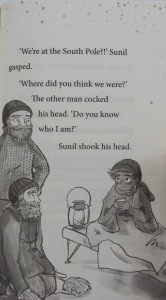
Before you can say ‘belly button’ Sunil finds himself on a hair-raising trip during which he encounters the likes of famous astronaut Neil Armstrong, and then visiting Antarctica and meeting Ernest Shackleton and some of his fellow explorers (plus a cat) stranded as they head for the South Pole. BRRR!

All of this happens while Sunil is trying his utmost to steer clear of the strange Mr Shaykes and kiwi companion.

In Scientists and Stripy Socks, Mr Shaykes announces that his Interesting Machine is in need of repair and if Alex doesn’t fix it for him, the milkshake cafe will ‘go bust’. But then his mention of Charles Darwin arouses Sunil’s interest and off he sets on another time-travelling caper. He learns a considerable amount about earthworms thanks to Charles, as he asks Sunil to call him when they take tea together.

He also temporarily loses his toe when he meets physicist Isaac Newton; in fact he briefly loses several body parts in this adventure. The final part of this book includes a discussion with astronomer Caroline Herschel; but with Alex’s time machine increasingly unpredictable, will our intrepid adventurer get back before Sunil’s mum and dad come home?

Giggles aplenty await when you read these two wacky stories as well as a considerable amount of information. Iszi Lawrence offers an unusual and very entertaining way to introduce readers to famous people from history. Adding to the fun are Rebecca Bagley’s black and white illustrations.

The Crown

The Crown
Emily Kapff
Walker Books

Wearing a crown and speaking from the future, a girl addresses readers. She explains that she is no princess, her crown is made from rubbish that has been left behind by previous generations. So too is the hill upon which she stands; that is made of landfill. 

In this landfill however the child discovers a book; a book full of pictures showing what is the past for her, but is our world as it now is. She becomes filled with joy as, beside her equine companion, she peruses the pages showing the wonderful seas, infinite sky, the land all with a wealth of wonderful flora and fauna.

In contrast to her world, this one is beautiful to behold; this earth that belongs to all of us. It’s within our power to pass down those wonders so that the girl can wear a different crown, one not made of rubbish but alive with the flora and fauna we are fortunate still to see around us.

The message that comes through loud and clear is a positive one: it’s within the power of us all to pass down a different kind of crown.

Yes we still have the power – just – but do we have the will? Surely it’s incumbent upon us all to do our bit to help and the final page has some starting points for everyone.

Powerful too with her lyrical text and show-stopping illustrations is Emily Kapff’s debut picture book. The contrast between the ugliness of the grubby world of our throwaway society and the beauty of nature’s wonders really drives the message home to readers. Let’s hope it’s shared widely and acted upon before it’s too late.
The Who, What, Why of Zoology

The Who, What, Why of Zoology
Jules Howard and Lucy Letherland
Wide Eyed Editions

For youngsters with a budding interest in the study of animals ie zoology – this is for you, whether or not you have aspirations to become a zoologist.

The author starts by defining zoology and explaining what zoologists do and then takes a quick look back over the past hundred or so years at how the work of zoologists has changed with the help of ever-developing technology.

Readers then join the scientists working in the field and visit different biomes around the world and this is where the book differs from the many others about environmental regions in that it provides an insight into the role played by zoologists in the world today.

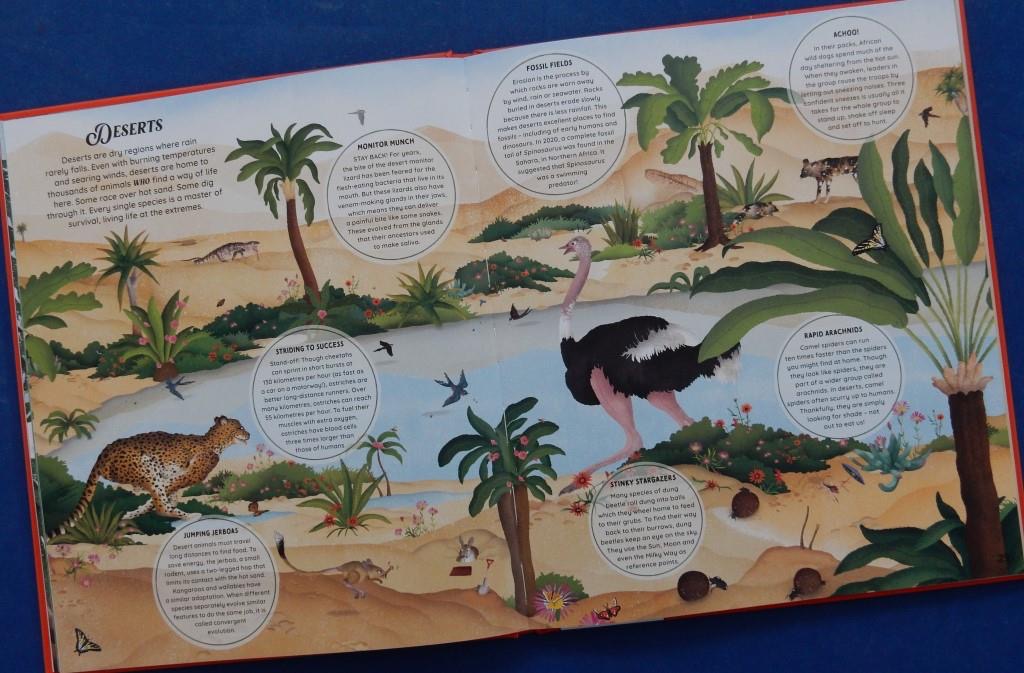
We start with temperate forests, then take a we look at tropical rainforests, deserts,

grasslands including savannahs, the tundra, and then dive down to underwater reefs and beyond, to the ocean floor.

For each region, the book explores the kind of terrain, introduces some of the animals who live there, provides some interesting facts related to those animals, and looks at the work zoologists do in that region, and how they go about it.

After all the exploring we return to the laboratories to see zoologists working not in the field but using high-tech equipment to further their research.

We also find out about the role museums, zoos and aquariums play in the area of zoology. Throughout Lucy Netherland’s illustrations illuminate the text and also offer gentle humorous touches in each spread.

The book ends with a reminder that zoology is for everyone and, with quotes from some of today’s great zoologists, offers pointers in how young readers can start out on their own zoological adventures.

Fascinating, informative and pitched just right for older primary readers and above.

Too Much

Too Much
Anne Booth and Maria Christania
Tiny Owl

It’s spring so why won’t Bear come out of his cave and play with the friends that are waiting for him? Rabbit wants him to enjoy some hill rolling, Squirrel wants him to climb trees but what is keeping their ursine friend rolled up in his blanket?

Off go Squirrel and Rabbit to consult Fox. Fox has been busily packing a picnic basket and has an idea that just might be the way to treat Bear’s “too much of everything” fears about the world beyond his cave.

First they gather some sweet smelling flowers and arrange them around the cave entrance; then they sit down close by making comments they hope might entice their friend from his extended hibernation to partake of both the delights of spring and the tasty treats that await.

Bear’s friends are an empathetic trio understanding that no matter how much they miss him, after a long period away from company and the open air, he is perhaps going to feel overwhelmed at the prospect of re-emerging, so they allow him to do so in his own time, when he feels ready.

Anne Booth’s gentle tale contains an important message for us all: however much you might want a person to do something, put yourself in their shoes and see things from their perspective, encourage but don’t force them. I know this is true of several friends and a fair number of children who have found coming out of lockdown hugely challenging. I love Maria Christania’s portrayal of the characters and the sheer exuberance spring brings upon them (and most of us) in her mixed media illustrations.

Wendington Jones and the Missing Tree

Wendington Jones and the Missing Tree
Daniel Dockery
uclan publishing

The story opens with Wendington Jones learning that her adventuring, anthropologist mother has died in a car crash. A mother who had always been Wendington’s inspiration and idol; indeed she’d always dreamed of following in her mother’s footsteps one day. Feeling that her world has been turned on its head, Wendington is left to grieve in the care of her Grandmamma and the valet Rohan but then a small light appears in her dark. Delivered at midnight to the family home is a parcel containing her mother’s last and incomplete manuscript revealing the discovery of the mythical Tree of Life – an ancient curiosity said to bring the dead back to life. Could it perhaps bring, her mother, Pennington, back to life?


So, bag packed, her mother’s ticket for the SS Pembroke in hand and her trusted friend Perceval the newt safely tucked away, she heads off in the dead of night, destination Freemantle, Australia.

Irresistible as the thought of bringing her mother back to life may be, Wendington is not the only person searching for the legendary tree and not all those so doing can be trusted. However, this young lass is nothing like your stereotypical 1920s girl: she’s a risk-taker, brave, quick-witted, caring and thoughtful of others and hugely determined.

Readers will immediately find themselves rooting for Wendington as she pursues her quest, a quest that is truly gripping and sometimes surreal. The plot twists and turns, as more is revealed about some of the other characters, especially Rohan, till it reaches its unexpected ending.

A brilliant book : absolutely unputdownable – older KS2 readers and beyond will love exercising their detective skills as they read this.

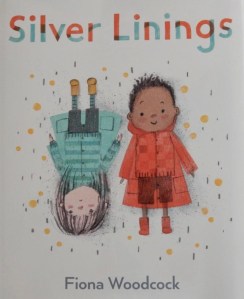
Silver Linings

Silver Linings
Fiona Woodcock
Harper 360

Close neighbours Pip and Parker are best friends, so in tune with one another that sometimes they don’t need to speak.
However, when Pip feels down Parker always manages to find just the right words, like the time when her crayon broke: “It’s okay, Pip … Now we can both use yellow,” he says.

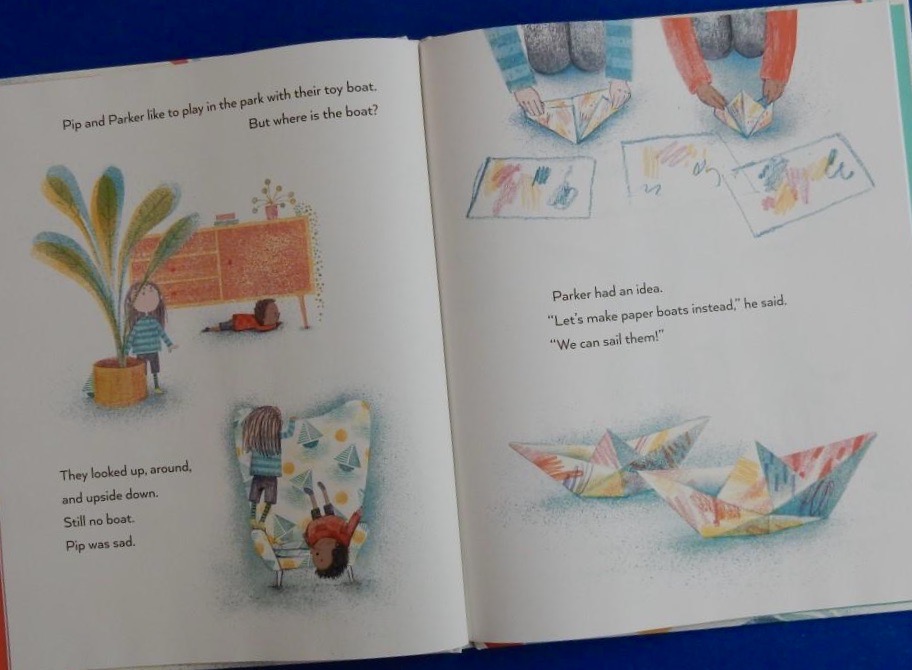
When they can’t find their toy boat to sail in the park, Parker suggests making paper ones instead.

Then when Parker’s boat is swept away by the wind, he suggests playing with kites and when an approaching storm makes the sky cloudy upsetting Pip, Parker sees it as a chance to look for shapes in the clouds. Parker has a gift for seeing the bright side—the silver lining – in any situation. How better to deal with rain than to splash in the puddles.

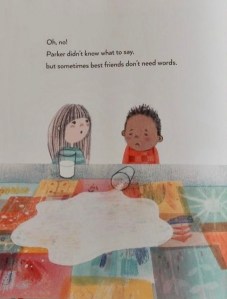
Then their need for a snack sends them back inside. Now it’s Parker who is responsible for a mishap – a very messy one that spoils their work of art.

What will Pip do? With such a good role model, she knows to make the most of the situation – to find that silver lining – and not a single word is necessary.

The story ends on such a sweet note that it’s bound to bring a big smile to the faces of readers, young and not so young.

Softly coloured, Fiona’s patterned, mixed media illustrations are full of charming details and her portrayal of the best friends is a delight; in fact the entire book from cover to cover is delightful.

This lovely lesson about the rewards of optimism and having a good friend is one to add to foundation stage and KS1 class collections and to family bookshelves.

All Change! / Colour Gallery

Here are two new board books from Little Tiger – thanks to the publisher for sending them for review.

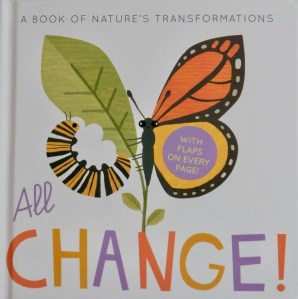
All Change!
Harriet Evans and Linda Tordoff

Transformations in the natural world is the theme of this board book with its clever, enticing cover picture.
By means of the flaps integral to each of Linda Tordoff’s illustrations, we see changes brought about by the seasons, through life-cycles of insects and frogs, the weather, danger, the lunar cycle, the need to catch food, for safety and more. Executed in soft, soothing colours, each scene is pleasing to the eye and the simple text offers a starting point for discussion with very young children.

Colour Gallery
Sophie Ledesma and Isabel Otter

Ready and waiting to take the animal visitors, and readers, on a learning tour around the art gallery is Gigi the giraffe. First stop is the Red Mosaic Hall, followed by the Blue Portrait Gallery, the Green Sculpture Park and the Yellow Landscape Room. This art establishment certainly makes effective use of all its space for there’s a corridor devoted to still life paintings

and the cafe displays abstract art on its walls.
As well as reinforcing the concept of colour in an unusual manner, Isabel Otter’s interactive text, the book’s design with its shaped pages and gatefolds and Sophie Ledesma’s bright illustrations (with a tiny mouse lurking on every spread), provide a fun introduction to the world of art for the very youngest children.

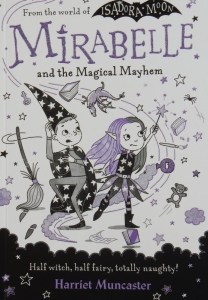
Mirabelle and the Magical Mayhem / Magic Keepers: Spirit Surprise

Mirabelle and the Magical Mayhem
Harriet Muncaster
Oxford Children’s Books

Cousin of Isadora Moon, Mirabelle, has a witch mother and her dad is a fairy. What anybody who has encountered Mirabelle in her previous stories will know and others quickly discover, is that she seems to create mischief wherever she goes. Here she and her brother Wilbur visit their fairy grandparents for a sleepover. With Mirabelle goes her little pet dragon, Violet. No magic without the supervision of the grandparents is the promise the children make to their parents.

After just one night at Granny and Grandpa’s both Mirabelle and Wilbur have broken that promise and the result is messy and mucky. 

Surprisingly Granny, who inevitably finds out about the disasters they’ve created, isn’t furious. Instead she is thoroughly understanding and helps her grandchildren put things back in order before Grandpa wakes from his nap. ‘Mirabelle you must never try and hide who you are just to fit in with who you think other people might want you to be,’ she tells her granddaughter. Wise words indeed. Moreover she doesn’t let on what has happened when Mum and Dad come to pick up their offspring.

Another sparkling story that Mirabelle fans will absolutely love and newcomers to the series will enjoy too and likely want to go back and read all her other books.

Magic Keepers: Spirit Surprise
Linda Chapman, illustrated by Hoang Giang
Little Tiger

Life has changed since Ava and her mother moved into Curio House, the large Victorian villa left to them by Great Aunt Eva, Ava and her friends Sarah and Lily have discovered a magical world that surrounds the curios left in the house and are determined to keep it secret from the world at large. At the start of this story the three friends are exploring the magical energy of the crystals – the first magical things Ava found in her new home.

Outside the house and in the surrounding town, strange things start to happen. Despite it being late autumn, pollen has become so prolific that Ava’s mum is suffering badly from unseasonal hay-fever and plants are growing amazingly fast with vines shooting up everywhere.

Could the girls have accidentally unleashed some kind of nature spirit during their crystal investigations that is causing all this? 

If so, with Sarah’s mum far from happy about the influence the other two girls are having on her daughter, can they set things to rights before any of their parents or the townsfolk discover the cause of the out of control flora?

A second engaging episode for new solo readers with just the right amount of suspense.

Wanna See A Penguin? / The Lost Leopard

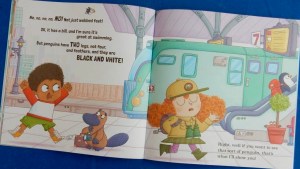
Wanna See A Penguin?
Simon Philip and Ian Smith
Oxford Children’s Books

A self-declared penguin expert and friend search the city for penguins; they see all kinds of black and white creatures striped ones, furry ones,

animals with fins, horned ones, ones with hooves, four-legged animals and others but none of the eight fit all the penguin criteria. Is there actually a penguin anywhere around?

Yes indeed and that is what makes this book such fun. Hiding in plain sight in every scene is the animal the friends seek. Young listeners will love searching the pages to find its whereabouts as well as guessing the identity of the partially shown animal on each spread and laughing at the misidentifications of the so called penguin pundit.
The author’s manner of telling is gently humorous – the ending a hoot – and Ian Smith’s delightfully droll illustrations include lots of amusing details.
There’s a fact file after the story presenting a paragraph each on the zebra, puffin, duck-billed platypus, monkey, orca, goat and dog that appear in the story.,

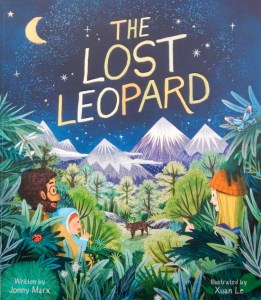
The Lost Leopard
Jonny Marx and Xuan Le
Little Tiger

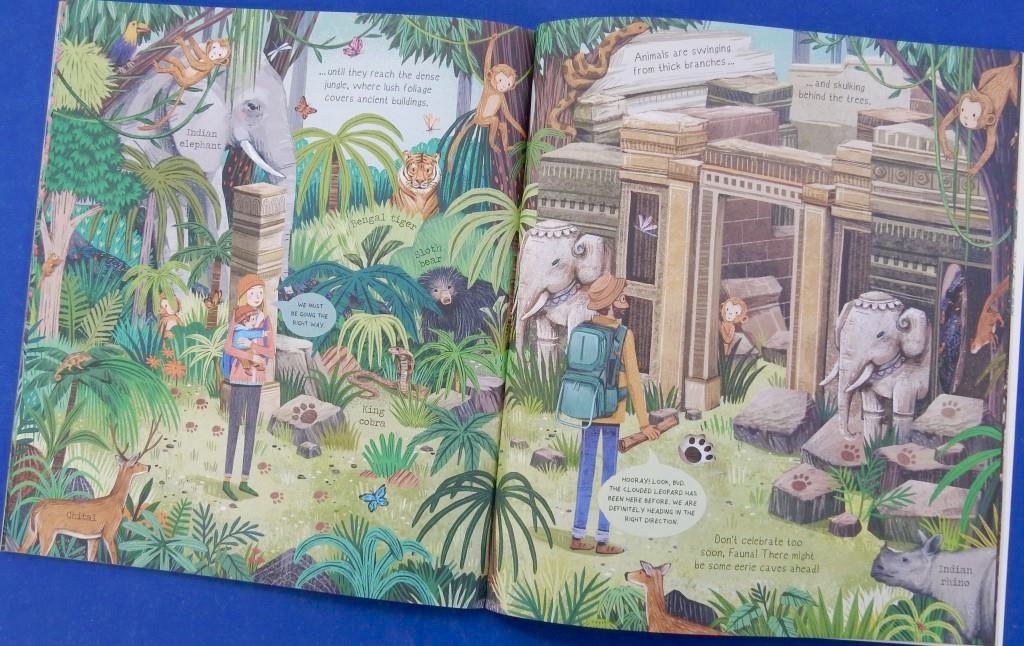
We join Flora and Fauna (dubbed the ‘world’s greatest explorers) and their baby, Bud, on their search for the elusive clouded leopard.

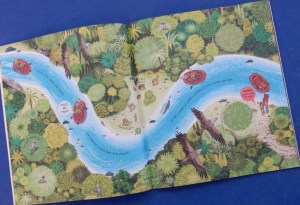
Their journey takes them to various habitats along a river,

over foothills and up the Himalayan mountains, through forests and jungles and a rainforest; even down into caves. Needless to say there’s an awful lot of mud and not everywhere is accessible by road so their quest involves a lot of walking; walking through rain and snow, strong swirly winds and scorching heat until they finally arrive at a tropical forest location.

During their travels they encounter a wealth of amazing wildlife including yaks, langur monkeys, Bengal tigers,Indian elephants,

a King cobra, all labelled. Truly an epic journey but do they find what they have been searching for? Baby Bud has certainly learned a lot and so will youngsters who explore this exciting book.

Xuan Le’s vibrant detailed illustrations, which include lift the flap sections, cutaway pages, die cut surprises and a gate fold, extend Jonny Marx’s engaging, informative text making this a book that is probably best shared with an individual child or small group as there is so much to explore on every spread. Individual, more confident young solo readers will also love embarking on the adventure with Flora, Fauna and little Bud.

Olly Brown, God of Hamsters / The Big Breakout

Olly Brown, God of Hamsters
Bethany Walker , illustrated by Jack Noel
Scholastic

Olly Brown is obsessed with hamsters, so much so that when told to write down three targets for the final weeks in his year 6 class, his first is ‘Look after the class hamster at home for one weekend.’ He’s absolutely determined to do so and then by means of a spot of subterfuge he succeeds in smuggling home Tibbles; that is despite the fact that his dad is supposedly allergic to the creatures, not to mention his hang-ups about health and safety.

Surely though it was just the one hamster he took, so what are all those others doing creating havoc (and a great deal of poo) in his home.

He can’t tell his dad but he must share this news with somebody: that somebody is his best friend Stan. The trouble is Stan then starts calling him such names as ‘Master of the Hamsterverse’. It’s certainly pretty amazing that the furry beings can communicate with Olly, certainly Tibbles can.

In addition to the hamster invasion, with the end of term drawing ever closer there’s the class outing, leavers’ party and more to contend with so it’s no surprise Olly feels as though things are spiralling out of control.

How on earth and in the Hamsterverse is Olly going to extricate himself from all this? To find out you’ll need to get yourself a copy of this hilarious book. Also funny are the drawings by Jack Noel who appears to like hamsters too, if the number he’s drawn for Bethany’s story is anything to go by.

Add to KS2 class collections: what fun it would be to share this with a Y6 class in their final term.

The Big Breakout
Burhana Islam, illustrated by Farah Khandaker
Knights Of

This laugh-out-loud story concludes the trilogy featuring Yusuf and his crazy escapades.
Yusuf’s elder sister, Affa, is about to have a baby and Yusuf – who has now gained a fair bit of street-cred. – is determined to become the best ever uncle to the soon to be born addition to his extended family. Not only that but he’s currently ‘man of the house’ in charge of his amma (mum) and Nanu (gran) who needs to pay a visit to the opticians.

At school, as form captain, he’s charged with showing the ‘very special visitors’ ie Ofsted inspectors aka MI5, around his school while keeping Chompy the school chameleon out of their way. What could possibly go wrong? Errm …

I laughed my way through this wishing I’d met this British Muslim family in the previous two books and will certainly seek them out. Not only are they ideal for bringing more diversity to KS2 class collections, Yusuf, his family and friends are enormous fun to read about and Farah Khnadaker’s black and white illustrations bring out much of the madness and mayhem for which the well-intentioned Yusuf is responsible one way or another.
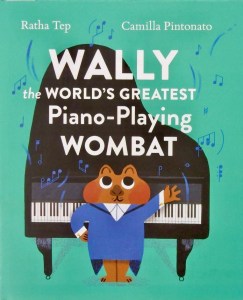
Wally the World’s Greatest Piano-Playing Wombat

Wally the World’s Greatest Piano-Playing Wombat
Ratha Tep and Camilla Pintonato
Princeton Architectural Press

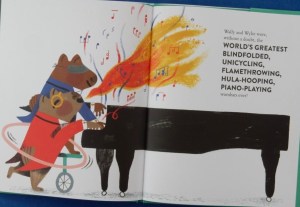
Making music at every opportunity, Wally is, so he thinks, the world’s greatest piano-playing wombat; but then he encounters Wylie Wombat and then he isn’t. So he adds another element to his musical performance and so begins an intense rivalry: the two musical wombats, become increasingly competitive as they vie to be best musical wombat in the world. Tap dancing – while playing the piano – tick! Twirling a ball on snout—while tap dancing and playing the piano – tick! With that Wally loses it crying “ENOUGH!” He covers his piano and takes refuge in his burrow. No more piano playing for him; instead his life becomes a quiet one of reading, knitting and pet keeping. But does he find that satisfying? No. Wally greatly misses his music making, the thing he most loves.
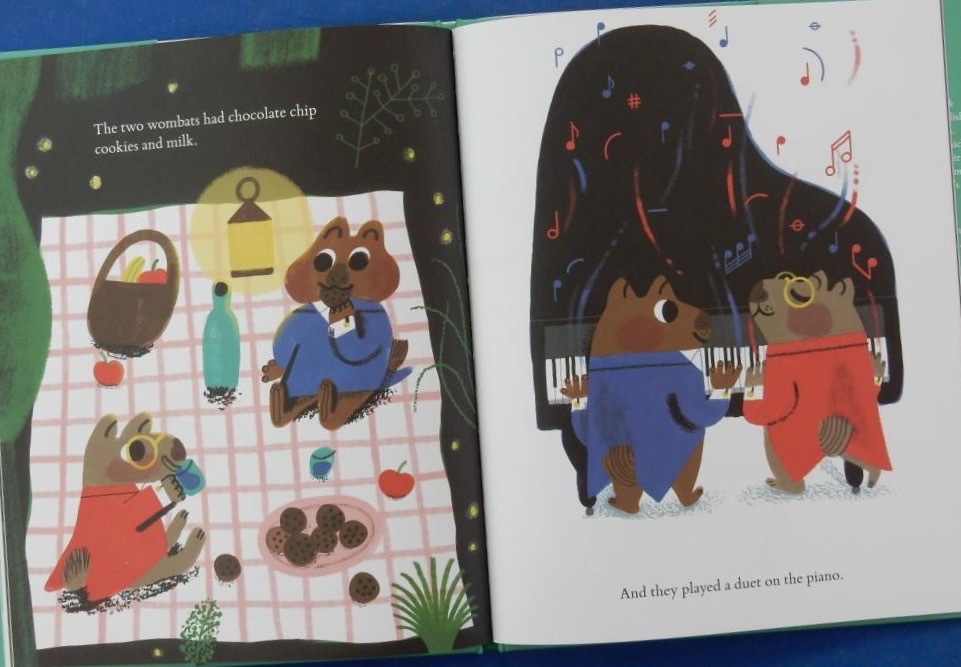
One night, Wally hears a noise outside his burrow. What is his rival doing there? What Wylie is in fact doing in offering an olive branch in the form of chocolate chip cookies carefully laid out on a blanket.

Playing solo, he tells Wally, is far less enjoyable.

Picnic over, the two move to Wally’s piano and play a duet. Wow! This is such fun; so fuelled by chocolate chip cookies, they practise and practise until together they become the world’s best piano-playing wombats ever.

But then, they aren’t.

So which is preferable: being best at something or doing it because it brings you joy? That’s the question Ratha Tep poses for young audiences, who will be entranced by watching Wally’s emotion-filled learning journey in Camilla Pintonato’s scenes, which are in turn passionate and pricelessly silly.

A fun fable that takes a look at the world of competition, wombat style.

Our Beach / Walter the Wonder Snail

Our Beach
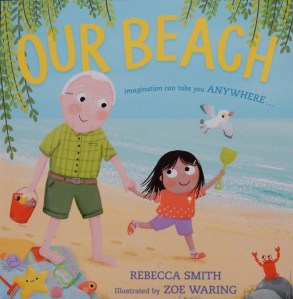
Rebecca Smith and Zoe Waring
Harper Collins Children’s Books

It’s wonderful what a collection of bits and pieces can lead to and that’s what we discover in this story of a little girl and her granddad who spend the day together.

As the book opens we see the two hand in hand, grandad carrying a large bag, making their way towards the sea shore.

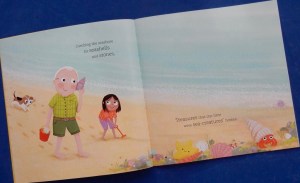
They enjoy exploring rock pools, collecting seashells and pebbles and most important each other’s company.

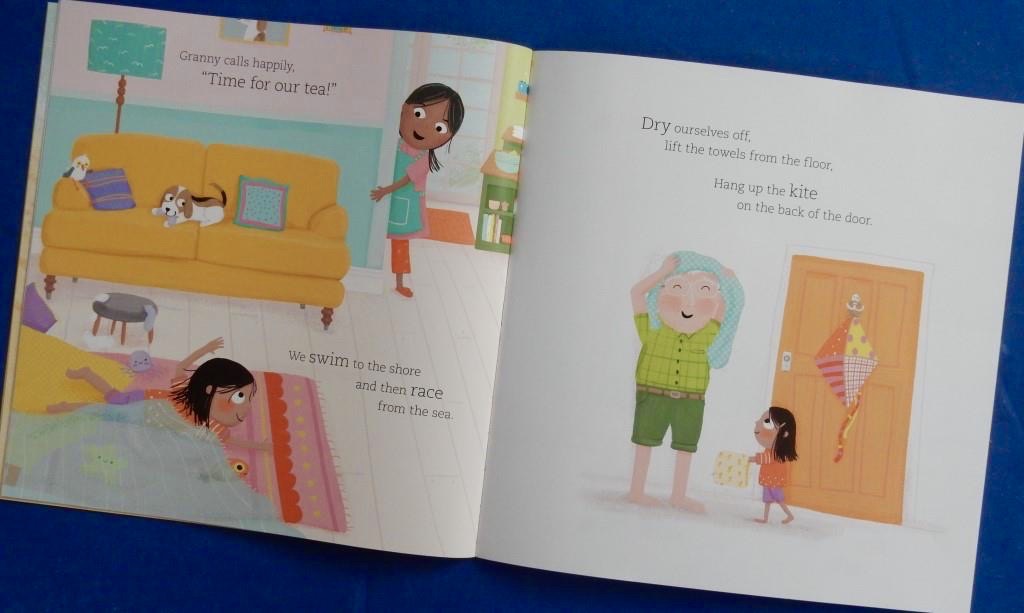
Then comes a sudden change and a spread shows what is really happening before the flights of fancy recommence, and with them, the resurfacing of precious memories. It’s Gran’s “Time for our tea!” announcement that brings the two back to reality,

somewhat reluctantly perhaps as they eek out their imaginative experience for as long as they can before sitting down to share the tasty meal set out on the table.
A delightful celebration of the power of the imagination and a special intergenerational bond.

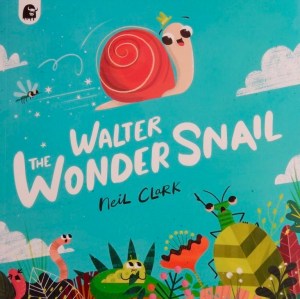
Walter the Wonder Snail
Neil Clark
Happy Yak

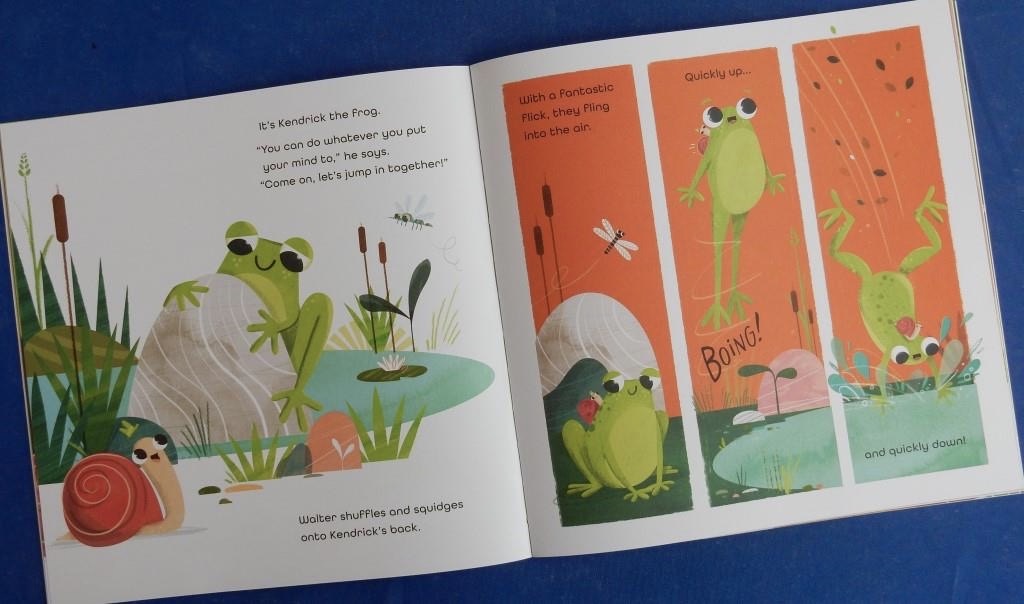
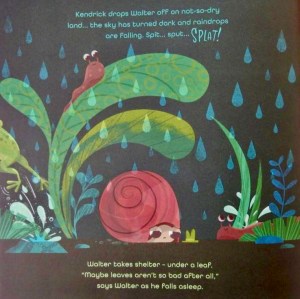
Tired of the tedium of leaves, Walter the Snail believes there must be more to life; he longs to escape the confines of his leafy existence and discover what the wider world offers. With hat atop his horns and shell packed, off he slides into the great unknown.

Our intrepid traveller faces challenges aplenty on his journey, but there are plenty of other creatures ready and willing to offer encouragement and help.

Nonetheless Walter is also able to adapt to a variety of terrains and weather conditions,

and to think outside the box, especially when it comes to making his way back home.

On his return Walter imparts some wise words to his fellow snails: “I know that anyone can do anything they put their mind to.You’ve just got to think big!” That’s a vital life lesson for young humans too and one they’ll learn subconsciously through Neil Clark’s wise words and his diverting, richly coloured, scenes of Walter’s travels. I love the variety of viewpoints and page layouts.

Rich in classroom potential but above all, a thoroughly enjoyable story.

The King’s Hats

The King’s Hats
Sheila May Bird and Mark Beech
Zebeck Flame

The royal crown is weighing heavy on the head of Charles 111, the new King, Not only that, but hot and tight too. So he acts on the advice of his wife and heads out to his ‘Happy Place’, there to work out what to do.

In his beloved garden he finds his old friend, Tom, the gardener who wants to know the cause of the king’s pained expression. Having heard the crown is the problem, Tom wisely speaks at length reminding the monarch that in the course of his duties, he will be required to wear all kinds of hats including protective helmets, hard hats,

surgical hats, parade hats of the feathery kind,

paper party hats, a hairnet even. However, as Tom also points out, “sometimes you must wear your crown/And you will smile and wave/ Your crown is very heavy/ But remember…kings are brave”.

Mark Beech captures Charles’ royal nose, ears and facial expressions splendidly in his scribbly, cartoon style illustrations and the final page depicting a statue of Queen Victoria looking extremely displeased on account of the pigeon on her head, is a hoot.
Hats off to both the new king and his gardener who offers not just wise advice but the loan of his sunhat for when Charles is out weeding the path.

Playful pictures combined with a jaunty rhyming text make this book both funny but also with more serious undertones of the monarch’s fears of perhaps not living up to expectations and being brave in his new role.

Who Owns the Woods? / Above and Below: Sea and Shore

Here are two recent picture books about the natural world from Little Tiger – thanks to the publishers for sending them for review.

Who Owns the Woods?
Emily Hibbs and Jess Mason

A boy and his grandma go exploring in the woods and as they walk, the child asks ‘who owns’ various natural things. Could it be one of the tiny animals they stop to observe – the spiders spinning their webs perhaps, or the butterflies with their beautifully patterned wings. 

Perhaps the woods belong to the magnificent stag, a fox or … maybe the boy himself is the owner of all those magnificent trees.

Not so, says his wise grandma; nobody can claim ownership of this particular area of woodland forest with its wealth of awe-inspiring flora and fauna; it is there for the enjoyment of every single person and moreover, as the boy himself confirms, it needs to be shown respect and treated with care.

What is needed is stewardship not ownership; that is the key message in this book beautifully illustrated by Jess Mason. Her scenes truly evoke the magic and tranquility of these special places. I really like the way the branches of the trees speak to readers serving to re-inforce the all important theme of Emily’s Hibb’s text.

Above and Below: Sea and Shore
Harriet Evans and Hannah Bailey

Now published in paperback, this is one of an excellent spilt page, lift-the-flap natural history series; it explores ocean habitats below and above the waves taking readers to such locations as the coastline, a sub-aquatic kelp forest, polar oceans and an estuary. There’s a visit to a tropical shore, a coral reef, a mangrove swamp and more.

The information comes in bite-sized portions making it accessible to EYFS and KS1 audiences. Children will be fascinated to discover that for instance, a lobster tastes with its legs and has teeth in its stomach and that in the forests of a mangrove swamp is a grey-headed flying fox with a wingspan of 1.5 metres, making it one of the world’s largest bat species.

The spilt pages work well providing as the title indicates, above and below views of the locations featured, each being beautifully illustrated with lots of detail: there’s so much to see.

This is a book that celebrates the natural world and gives a real sense of the sheer diversity of life in our oceans and rivers and on our shores.

Molly, Olive & Dexter / The Brambly Hedge Pop-Up Book

Molly, Olive & Dexter
Catherine Rayner
Walker Books

Meet Molly the hare, Olive the owl and Dexter the fox whose home is a garden oak tree. The three friends love to play together and Molly’s favourite game is hide and seek. “I’ll count and you two hide,” she tells her pals as she begins to count down, “5,4,3,2 … 1!’ but on opening her eyes after the ‘here I come’ Olive and Dexter have clearly misunderstood what effective hiding is and Molly finds them right away. Somewhat frustratedly she instructs them twice more to try again, properly.

Their third attempt proves too good, for now Molly cannot find Olive and Dexter anywhere. Where can they be? Suppose they’ve got lost and even worse, she never sees them again.

Happily for all this isn’t the case.

As always Catherine Rayner’s watercolour illustrations are superb: her three characters are winsome winners that capture the essence of the animals portrayed and the flora a delicately detailed delight.
I look forward to further stories in this new series by the wonderful watercolourist; so too, I have no doubt, will young listeners.

The Brambly Hedge Pop-Up Book
Jill Barklem
Harper Collins Books

There’s wonderful rich detail too, in Jill Barklem’s illustrations and it’s testimony to the world she created that it lives on and will continue to entice new audiences with this publication. However it’s not so much a pop-up as a multi-layered book. There are six 3D scenes to delve into: prepare to be enraptured as you visit the Toadflax family’s cottage on Wilfred’s birthday, call on their neighbours Mr and Mrs Apple from where you can almost smell those delicious baking aromas of Mrs Apple as she works in her kitchen; join the wedding celebrations of Poppy and Dusty. and find out what happened when Primrose went exploring. All this and more thanks to Mrs Apple’s diary wherein she chronicles hedgerow life through the seasons.
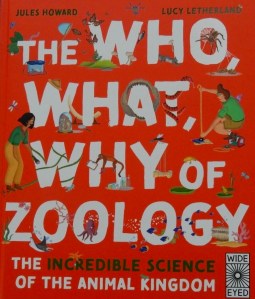
For adult reviewers like myself this is all a trip down memory lane; for younger readers, it’s an opportunity to get to know Jill Barklem’s characters and something about their lives.

Super Small / The Versatile Reptile

Super Small
Tiffany Stone and Ashley Spires
Greystone Kids

You may be surprised to learn that some of the world’s smallest creatures have awesome superpowers.

The minute oribatid mite can lift more than 1,000 times its own weight. The pygmy seahorses are so good at camouflage that scientists only discovered them accidentally when they brought some coral into a lab to study; then there’s the bee hummingbird that’s able to fly backwards and upside-down – clever stuff!

Did you know that wood frogs are able to survive harsh winter conditions as ‘frogsicles’ – they stop breathing, their hearts stop beating and their bodies make a kind of protective antifreeze and as for those teeny tiny tardigrades, here’s what author Tiffany Stone has to say about them: ‘The tardigrade, or water bear, / is so small that its barely there. / … And bear in mind, although it’s wee, / it’s tougher that you’ll ever be. / Freezing cold or boiling hot— / too much to bear? This bear thinks not.’

Ashley Spires uses her artistic superpower to illustrate each featured creature, making every miniature marvel appear super-confident; and to accompany her poetic descriptions Tiffany Stone provides some side-notes in the form of animal monologues (or dialogue) presented in comic strip style side panels. This is a book that will appeal to animal enthusiasts especially.

So will:

The Versatile Reptile
Nicola Davies and Abbie Cameron
Graffeg

In this addition to the rhyming series in which Nicola Davies presents a look at various animal types, we meet some reptiles.

Reptiles are found in many different parts of the world as the young adventurer in this book discovers in her search. These scaly creatures might be jungle dwellers, live in desert places or swim in the seas among the seaweed, and can vary in size from massive to minute and from endearing to downright grim and ghastly. 

One thing the entire reptile group can claim though, is versatility. 

Abbie Cameron’s accurately detailed, close-up illustrations really drive that point home to readers who will one hopes enjoy coming face to face with such fascinating creatures. This reviewer certainly did.
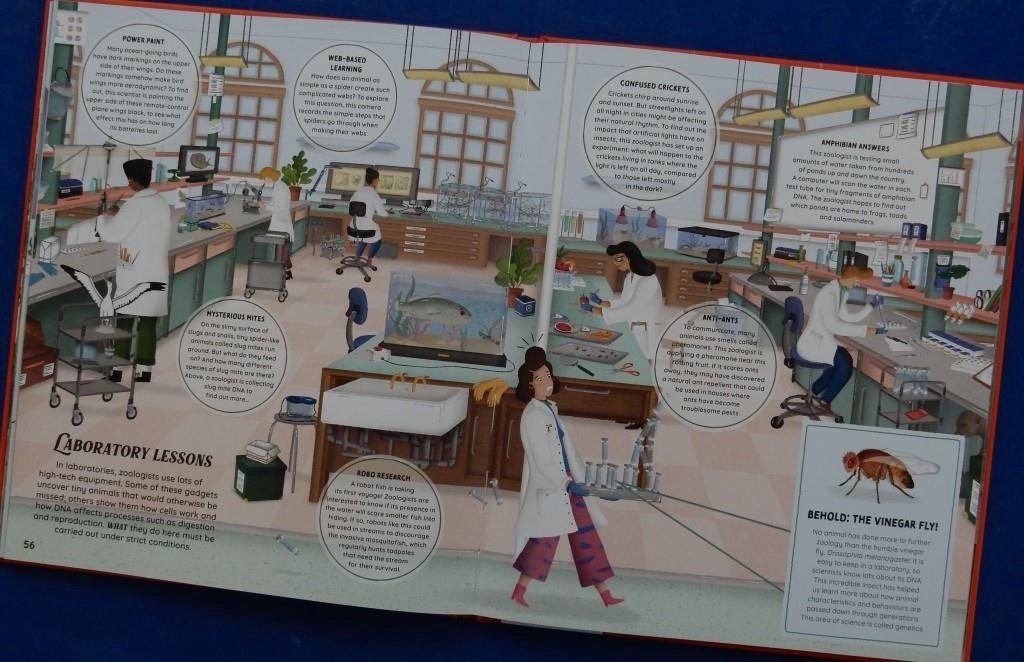
Perfectly pitched for KS1 readers.

A Little Dose of Nature / Look What I Found: On the Farm

A Little Dose of Nature
Dr. Alison Greenwood and Anneli Bray
Ivy Kids

Written by psychologist, Dr Alison Greenwood who has set up a charity called Dose of Nature, this book as the cover says, suggests ‘outdoor fun to help happiness bloom’. To improve mental health and wellbeing, twenty five activities are suggested for children (and adults), all to be done outside in the natural world, well away from the distractions of social media, computer games etc.

First though the author states that nature has five active ingredients that are of benefit to humans; these will give us more energy, improve concentration and sleep, help us to relax, and to be in a better mood. These include fractal patterns, nature’s sounds, phytoncides (natural chemicals), soil bacteria and sunlight. I expect some of these science terms will be unfamiliar to younger children and Alison pitches her explanations at just the right level. The book has five main sections, entitled Nature’s Fractals, The Science of Sounds, Fresh Air, Soil

and Soak Up the Sunshine!

Who could fail to connect with nature as they collect and arrange natural objects to create a mandala – in my experience children love to do this.

The same is true of getting messy by sculpting animals using sludgy mud or running around barefoot in a muddy patch and then comparing the experience with walking barefoot on grass.

Brilliant for forest school and outdoor science. I love that Alison’s final words include paragraphs on awe and what she calls ‘wow moments’.
Anneli Bray’s detailed illustrations are an inclusive delight and certainly make this particular book stand out from others on the theme of appreciating the great outdoors..
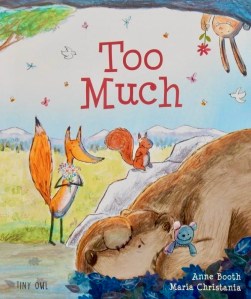
Look What I Found: On the Farm
Moira Butterfield and Jesús Verona
Nosy Crow

Bursting with information, this is the third title in a series published in collaboration with the National Trust.
Readers join the three young adventurers on a new expedition one spring day as they investigate their surroundings while following the path through the fields. Each in turn exclaims in the rhyming narrative, “Look what I found!”

excitedly showing the others and readers the discovery, be it animal related, such as a tuft of sheep’s wool or a feather, or plant-related like the fluffy head of dandelion seeds.


Another engaging mix of story, non-fiction and search-and-find, illustrated by Jesús Verona whose scenes of the natural world, both the close-ups and landscapes are immersive.

Recommended for family bookshelves and KS1 class collections, especially if you want to encourage children to get outside and explore their surroundings.

When I Became Your Brother / Some Do, Some Don’t

When I Became Your Brother
Susannah Shane and Britta Tekentrup
Nosy Crow

Written in rhyme that shows tenderness and devotion, and illustrated with gorgeously warm scenes by Britta Teckentrup, this book told from the viewpoint of the older one, celebrates the bond between a brother and his new sibling.
From sunrise to sunset two fox cubs love to spend time exploring their woodland surroundings and playing together. They dash through the fields, play with pinecones

and laugh and leap together beneath the setting sun before snuggling up under the stars. Being an older sibling brings companionship, responsibility for guidance and above all, love.

With its comforting text and sparkling art, this is a book to give a young child when a new sibling arrives in the family.

Some Do, Some Don’t
Dipacho
Mineditions

Dipacho uses jabiru storks in this presentation of individuality. By means of a simple, straightforward text and elegant images of these storks he depicts them in various sizes and in a range of situations starting thus: ‘Some of us have no family’ accompanied by an image of a solitary bird. Turn the page and we see two jabirus flapping, almost dancing and the words ‘Others do.’
Some take off alone to explore what the world has to offer, others stay behind. Some like to be in the company of others, in family groups or more of a crowd; some want solitude. Some live together reluctantly; some are distanced but want to be near another.
Some have families with differences, indeed many do

and sometimes new family members arrive; some in contrast have left for ever. Some jabirus prefer to ‘stick to our own kind,’ whereas others are interested in a variety of types of birds. The author concludes, ‘Some of us fly off and follow our own path. …Actually we all do.’
In eighteen double spreads Dipacho covers almost each and every experience a child may have.
The final page provides three factual paragraphs about jabirus including that they are the second largest birds in the world. I didn’t know that; thanks to this book now I do.

I Heard a Bird

I Heard a Bird
Rob Ramsden
Scallywag Press

I’m a big fan of Rob’s In the Garden books so I guess I was predisposed to like this one, which sadly, is the final title of the series.

The narrator is a little girl who greets us with a cheery wave and the words of the title. She goes on to tell readers of other sounds she’s heard in the garden – cats wailing, which results in the bird flying off in fright, the rustling of the leaves in the breeze, her feet tapping on the ground, bees buzzing among the flowers.

This child doesn’t only use her ears though, she observes with all her senses: crouching down she notices a wealth of minibeasts on the move

and keeping close to the ground, she follows a mouse into the undergrowth where she has a surprise encounter with a hopping toad.

Next comes a few minutes of mindfulness as our narrator enjoys the opportunity to listen:

following a few moments of silence she hears her own breath, her heart beating and when she opens her eyes once more there comes a pip pip pipping sound: now what could that be?

Just right for sharing with young children, Rob’s simple rhythmic text lets his beautifully patterned, screen printed illustrations carry most of the story. This book is a must for anyone who wants to encourage little ones to engage with the natural world and enjoy what it has to offer.

My Life on Fire

My Life on Fire
Cath Howe
Nosy Crow

Ren, her mum, dad and younger brother Petie arrive home after spending an evening with friends and discover their house ablaze. The fire-brigade tell them it can’t be saved; “we’re so lucky” say her parents, “we’re all OK. That’s all that matters.” But what about all those toys, books, photographs and other things that make a house a home; they’ve all gone up in flames.

Having spent the first night in a B&B, the family moves in with Gran but she only has one spare room. This the children use but their parents occupy a caravan in the driveway. Nothing feels right: Mum and Dad are busy trying to keep their business going while also making an insurance claim and Gran (an ex headteacher) has lots of rules she expects the children to keep.
All of this makes Ren feel very stressed, even more so when she overhears snippets of conversations between her parents. Then Petie starts getting upset at night over the fact that Mr Softie is missing and wanting big sister to tell him stories about his beloved teddy. 

This adds to the pressure on Ren and realising she really doesn’t have a life any longer, sad and angry, she starts stealing again, mostly small items from people at school.

Enter Caspar, the second of the book’s narrators. He is in Ren’s class and is enthusiastically involved in the class project ‘My Life in a Box’ that is underway when Ren returns to school. He also lives not far from Ren’s gran and so when she and Caspar’s dad decide to share getting the children to and from school, they find themselves spending much more time together. Almost inevitably he discovers what his friend is up to and is shocked that she can be thieving. He is determined to help Ren return all the items she has taken and stashed away. What will be the outcome of his endeavours?

The way Cath Howe tells the story from two viewpoints is superbly done; one cannot help but feel for both characters, each of whom feels things deeply. Engrossing and thought-provoking, with themes of sharing problems, friendship, taking responsibility for one’s actions and the importance of family, this is another powerful piece of writing from an author who gets better and better.

Farah Loves Mangos

Farah Loves Mangos
Sarthak Sinha
Flying Eye Books

Having just returned from a visit to India during which my mango loving partner announced that he wants to establish a mango orchard in the grounds of our friend’s Rajasthan country hotel, I was immediately attracted to this book that features a mango-loving little girl.

Farah’s Grandpa has a mango tree in his large backyard and every year she enjoys collecting the fruits, aided by Mali the dog. Then comes a summer when the tree doesn’t produce a single mango and unsurprisingly Farah wants to know why. Dismayed, she asks Grandpa but he’s too busy with a piece of wood to respond so Farah’s questions so she takes matters into her own hands, trying out all manner of remedies to make the tree produce fruit. She sings to it, gives it milk,

adds manure, ties a red scarf around its trunk and waters it with her profuse tears, all to no avail. The tree is useless, decides an angry Farah.

Along comes Grandpa hand outstretched, puts his granddaughter on the swing he’s been making all the while and gives the swing a push.

As Farah swings up into the tree’s canopy she discovers a world of wonder far beyond anything she might have imagined. This new way of seeing brings a vital realisation: a tree is SO much more than its fruit bearing function.

Sinha’s richly hued illustrations are bursting with humour, emotion and movement extending his story far beyond the words. A fun book to share with an important lesson about ways of seeing and appreciating natural things in their entirety.

The Laugh

The Laugh
Fay Evans and Ayse Klinge
Flying Eye Books

‘There was once a lady who had the loveliest laugh in the world.’ This lady laughed both loudly and quietly, sometimes with others, sometimes to herself; her laugh was contagious

and always full of love, no matter how it sounded. But then one day, that lovely lady becomes ill and dies, and with her dies the laughter.

The lady has left a great big hole in the world.

Her little girl can’t find the laughter, no matter where she searches. Then unexpectedly, something funny happens and the girl laughs again.

This moving look at a child navigating loss is such a beautiful tribute to a mother whose presence in her child’s life is enormous. The author of the third person narrative acknowledges that after a loved one’s death the family affected are unable to ‘move on’ – and indeed don’t want to but ends on a positive suggestion that the possibility of laughter returning is in fact, welcome. Ayse Klinge’s warm, comforting mixed-media illustrations convey strong emotions throughout as the book moves from joyful laughter, to sadness and then to laughter once more.
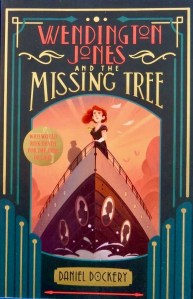
This book would be an invaluable resource for any young child who is grieving for a loved one.

Fireborn: Phoenix and the Frost Palace

Fireborn: Phoenix and the Frost Palace
Aisling Fowler
Harper Collins Children’s Books
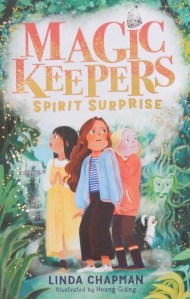
The saga continues with Twelve, (she of fiery powers) now adopting her aptly chosen name, Phoenix. With these powers though, comes responsibility so when Nara, a representative of the long-lost witch clan arrives from the frost palace of Icegaard, begging for Phoenix’s help, she realises that her fire power is their only hope: Icegaard and the whole world of Ember are in grave danger from a dark force called the Shadowseam. So, together with fellow Hunters Five and Six and the not fully-fledged Seven. she travels north to the frost palace.

Bound for Icegaard too, only taking a separate path, is Dog. Other characters from the first book are also here, for on the trail of the Hunters are Morgren and Victory.

It’s crucial for the mission that Phoenix learns to gain absolute control over her magic; this is a huge challenge. She has Nara’s guidance and support but that dark force grows stronger with each passing day. Is this a battle that she just cannot win?

Once again Aisling Fowler snares our attention from the start, immersing readers in a wondrous world of magic, monstrous creatures new and old, witches and dreadful dangers. There’s tension throughout, plenty of action and downright scary moments that will set your heart thudding, and poignant ones too; and what a cliff-hanger of an ending – phew! I read this on a long haul flight and never have I known the hours pass so fast: I just couldn’t put it down. I wish the time would pass that quickly till the third book comes.