The Last Tiger

The Last Tiger
Becky Davies and Jennie Poh
Little Tiger

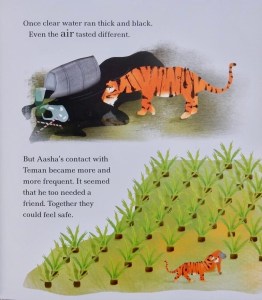
Climate change and destructive human actions are at the heart of this tale of Asha the tiger.

As the story opens, she and her family are living happily in a lush forest along with boars and other creatures. but little by little their environment changes. Sunny days become hotter and hotter and rainy ones, much wetter, so wet that the land is flooded, forcing the boars to leave the forest in search of other places to live. Tigers too disappear, and without the boars, food for the remaining tigers becomes extremely scarce.

Eventually Asha finds herself completely alone, save for the scent of humans. Yes, humans had come into the forest, bringing with them huge destructive machines that cut down all the trees.

As Asha creeps through the devastation the humans have left in their wake, she sees a flash of bright orange. Another tiger perhaps? But no, it’s an orangutan, but company at least. Can the two of them possibly find a new home somewhere else …

Tragic and poignant, this timely story looks at the plight of just one of the animal species endangered, due for the most part to human actions such as the deforestation we saw in Asha’s natural habitat.
Saving tigers from extinction means saving forests and there’s relevant information in the final pages of this book including the alarming fact that there are now less than 4,000 tigers left in the wild.

Frank and Bert

Frank and Bert
Chris Naylor-Ballesteros
Nosy Crow

What is more important to you: is it being a winner or being a really good friend? That question is explored in Chris Naylor-Ballesteros’s new story starring bear Bert and Frank, a fox who acts as narrator.

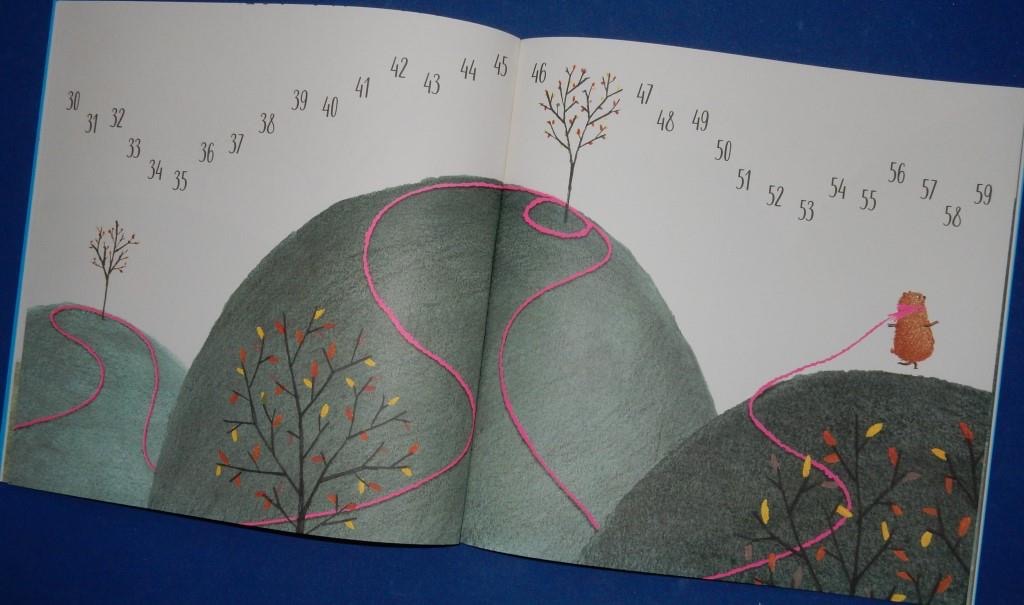
Their favourite game is hide-and-seek in which Bert is sure he’s an ace hider and loves to do so. The trouble is the bulky bear is far from an expert and inevitably Frank finds him easily every time, which Bert puts down to not being given sufficient time to stow himself away.

So, instead of the usual count of ten, Frank decides to give Bert a hundred before he starts to search.

Can he now find the perfect place to hide?

The crazy comic capers of the adorable duo are brilliantly highlighted by their day-glo bright garments be they in their appropriate places or gradually becoming unravelled across the lumpy, bumpy landscape.

Hugely entertaining yes, but with a moral dilemma at its heart. It’s great for sharing with a class, group or individual, though equally, the simplicity of the language makes it a rewarding story for learner readers too. An absolute gem of a book in every way.

Dogs in Disguise

Dogs in Disguise
Peter Bently and John Bond
Harper Collins Children’s Books

In a hilarious, bouncy rhyming text, Peter Bently introduces a veritable virtuoso performance by ingenious canines. Each successfully infiltrates some kind of humans’ place disguised in garments garish, gaudy, smart, stylish, sporty, trendy, minimal, or sometimes just plain silly and even, if unpractised in the art of deception, terrible. Clad in gear ‘borrowed’ from their places of residence, they wander the streets, strutting their stuff, then stroll into shops – we see them – that ‘pair of OLD SCHNAUZERS’ ‘there, in PINK TROUSERS …’ ; while others gain admittance to seriously cool cafes like this one

Others with a sporty inclination cleverly compete in jujitsu – that’s CHARLENE the SHIH-TZU, or splash around in the swimming pool. We view one trying its paws at a tonsorial establishment, whereas that Frenchie family might simultaneously be gorging themselves on goodies at the theatre.

Now all of this requires training from an early age; but if like Barney one tries to be just a tad too clever, there’s the danger of embarrassing moments down at the park.

With their bright blocks of colour and superbly expressive eyes, John Bond’s illustrations are the perfect match for Peter’s wacky words.

Perfect for pooch lovers, fashionistas and anybody who likes a good giggle.

Stop the Clock! / A Walk Through Nature

Stop the Clock!
Pippa Goodhart and Maria Christania
Tiny Owl

I do so appreciate young Joe’s frustration when everything he does has to be rushed. First it’s mum with a myriad of things on her mind, telling him to hurry up before they set off for school; then the walk itself is done at a run in case they’re late. Worse still, when he gets thoroughly immersed in the art topic Mr Khan has set the class, he’s told to stop and he’s nowhere near finished.

“STOP THE CLOCK!” he cries in sheer frustration. By now everybody else has complied with the instructions, but Joe – and who can blame him – adds his crying sister to his picture, picks it up and walks out. Now this is where readers, especially adults, will have to adopt that willing suspension of disbelief mode, for Joe leaves the school premises and heads to the street where he kneels down and continues drawing.

There is so much to see from ground level: so much to interpret about what’s going on and so many wonderful details to add to that picture of his. He even finds something that his sister must have dropped in the rush to reach school on time. Finally with picture complete to his satisfaction, Joe goes back to the classroom, leaves his picture with the others and gives instructions to the clock to restart.
Come home-time, after a slight pause, four happy people walk home together.

A heartfelt look at the busy lives that most of us live, often trying to do more than one thing at a time and in danger of missing out on those quality, slow moments we all need. In the past two years, the majority of adults at least, have come to appreciate the importance of time to stop and stare. With more and more people now back working full time as well as juggling child care and more, it’s crucial that everyone, young and not so young, has time to appreciate the world around without feeling guilty about doing so.
Author Pippa Goodhart and debut illustrator Maria Christania capture this need so beautifully in this picture book – it’s a wonderful example of how some good things have come from the lockdowns we’ve been subjected to.

Also showing the importance of taking time to appreciate the wonders of the natural world is:

A Walk Through Nature
Libby Walden and Clover Robin
Little Tiger (Caterpillar Books)

Through twelve, two verse poems and beautiful collage style illustrations with some facts tucked away behind flaps and die-cuts that allow readers to glimpse (or sometimes guess) what lies beneath, author Libby Walden and artist Clover Robin take us through the countryside presenting the numerous transformations that take place throughout the year.

No matter where one looks there’s much to wonder at. We visit a field in springtime as the flowers are starting to bloom in their myriad colours; look up high where birds fly seeking nesting places in the trees; stand at the edge of a peaceful pond wherein tadpoles are hatching and baby duckling are learning to swim.

Other habitats we visit are a woodland and a beach in summertime; a forest area and a mountainside through which a river flows in autumn, and, as winter arrives, swallows taking flight to warmer climes and foxes heading to their earths and as day turns to night, the emergence of nocturnal creatures ‘neath the silvery stars.

Containing a wealth of nature-related vocabulary, both gently educative and awe inspiring, this immersive book, now in paperback is a lovely introduction to nature poetry and nature itself.

The Midnight Fair

The Midnight Fair
Gideon Sterer and Mariachiara Di Giorgio
Walker Books

Oh WOW! This is such a superb wordess book ( wordless save for the occasional fairground signs) – definitely one of the very best I’ve seen and way too good to restrict to a particular audience.

As the book opens, forest creatures – bears, squirrels, deer, a stoat, racoons, a badger, a fox, rabbits, mice, a wolf – watch from beyond the fence as the fair unloads. From the edge of the woodlands they see the fairground filling up with humans large and small who spend the entire day enjoying the thrills, leaving only as night descends. The keeper switches off the lights.

From the shadows the animals emerge – it’s their turn now for some of that fun. In they come eyes aglow, through a gap in the fence, two racoons reactivate the power and the place becomes theirs. We also feel it’s ours, so immersive are the illustrations. As well as revelling in the rides and other attractions the animals take on the roles of the stall holders using various natural objects – acorns, pinecones, shells, leaves, fungi and wild flowers – as payment and we can almost inhale the scents of popcorn and candy floss.

At daybreak, the keeper wakes; it’s time for the animals to leave. Tired but very happy and a tad messy, they clear up the entire place and hurry away in the nick of time,

leaving only some of their currency on the ticket counter. But, their business is not quite done yet: as the others bed down, wolf carrying the goldfish won at the hoop-la stall, heads down to the lake and releases it into the water.

With clever use of both dark and light, and the natural world and the human one, Mariachiara Di Giorgio’s mixed media spreads, both detailed frames and expansive double page scenes, are a satisfying mix of the whimsical and the wondrous. This is one of those books that the more you read it, the more emerges.

A Hero Called Wolf

A Hero Called Wolf
Lucy Rowland and Ben Mantle
Macmillan Children’s Books

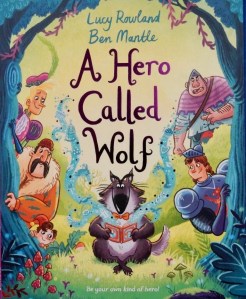
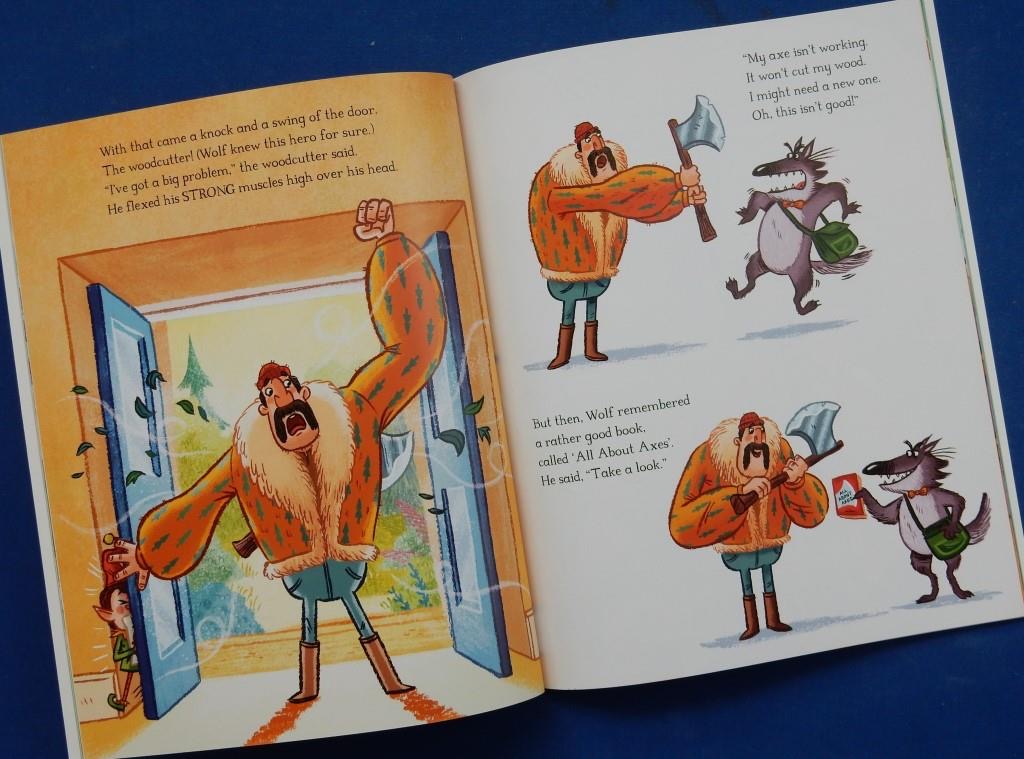
There are all kinds of heroes in storybooks – big ones, small ones, male and female, but wolves? No, never. That is certainly the experience of the one in author Lucy Rowland and illustrator Ben Mantle’s new book. It’s a wonderful take on the world of fairy tales starring a reformed wolf who now, thanks to the library, has become an avid reader who loves to share that book love with his new friends.

One day however, he pays a visit to the library looking very downcast. He’s come to the realisation that no matter what kind of heroes he meets in the books he reads there’s never, ever one of the lupine variety: wolves are always portrayed as the baddies. The librarian makes a suggestion: write the kind of story you want to read. Do I have what it takes, he wonders, far from sure. Then into the library storms a woodcutter with a blunt axe.

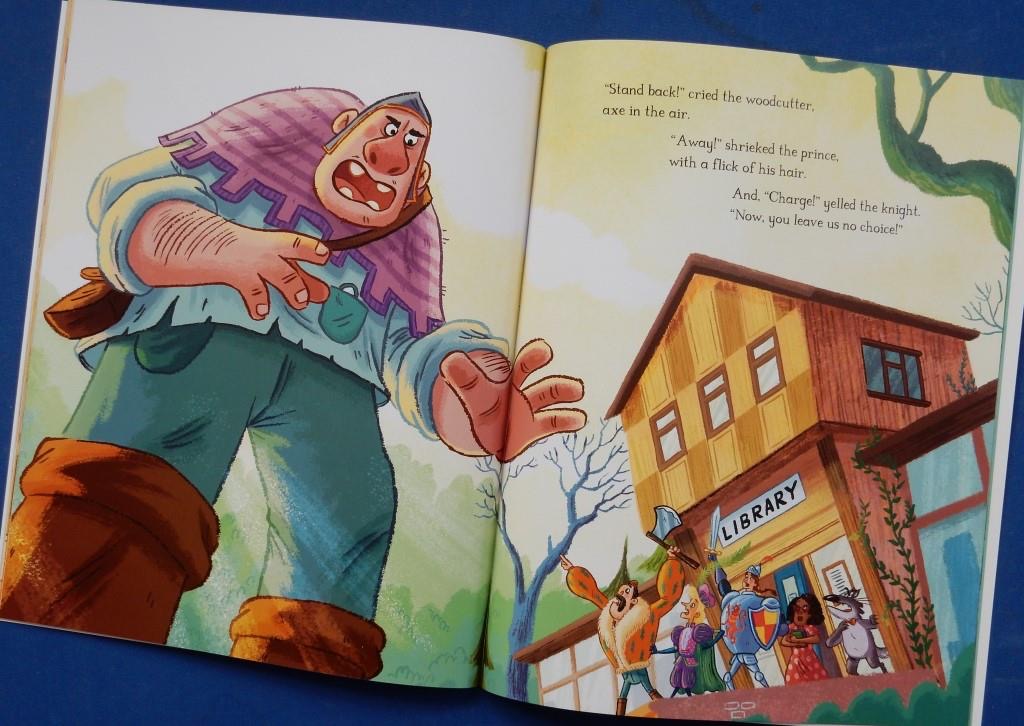
Shortly after a troubled knight appears, followed by a handsome prince, all of whom wolf helps with the aid of books, the prince actually calling him “My hero!”

Suddenly there comes a shelf-shaking stomp heralding the arrival of a giant. The others want to send him packing.

Can Wolf summon up his courage to act … ‘For heroes are BRAVE and they’re CLEVER and KIND.’ Could that now be Wolf? …

The combination of Lucy Rowland’s rhyming text, which is a joy to read aloud, and Ben Mantle’s playful, often arresting illustrations make for a stereotype-challenging tale. As well as being huge fun to share, it demonstrates that everybody can be a hero, no matter who or what they are. That, and giving a real plug to the importance of libraries and the power of reading.

Owls Are Cool

Owls Are Cool
Timothy Knapman and Jason Cockroft
Walker Books

Meet Oscar, a burrowing owl and narrator of this story; he’s a cool creature he tells us, because of his inability to fly. He has no desire to emulate the flying owl species that soar and swoop in the sky. Instead he much prefers to spend his time burrowing and running and ZOOOOOOOOMing around the grassy terrain.

One day he issues a challenge to a watching snowy owl that comes swooping down to watch him strut his stuff. As expected the challenge is accepted and Oscar watches unimpressed at what he calls “showing off”. 

But then disaster: the snowy owl smashes right into a tree and crash lands nearby, injuring both wings. The creature introduces himself as Reggie and Oscar then has a change of heart. Offering his burrow as a temporary haven to Reggie, he discovers that the need for friendship is what really matters.

This is a sweet story showing how friendship can transcend differences and being different is ‘cool’.
I’ve never come across a burrowing owl in the wild; I don’t think they are resident in the UK and it was good to meet this one in Timothy’s tale. Jason Cockcroft captures both the long-legged strigine and the snowy one beautifully in his gently humorous scenes of the countryside shown from a variety of viewpoints.

I Am Hungry

I Am Hungry
Michael Rosen and Robert Starling
Walker Books

Following the smashing I Am Angry collaboration between Michael Rosen and Robert Starling is another offering from the poetry book A Great Big Cuddle, which again results in a terrific read aloud picture book for foundation stage children especially.

Expanding on the ideas in Michael’s poem, Robert Starling’s illustrations are executed in bright, bold hues and his characterisation of Squirrel (and the bit part players) in his dramatic scenes is superbly done.

In an introductory note, Michael writes that when he feels hunger pangs he sometimes daydreams about things he could eat, some real and some weird, going on to suggest that this might become a game. Seemingly Squirrel has read those words for that is what the ravenous creature does: starting from normal hunger sating fare like bread rolls and popcorn, cheese and peas, things become decidedly outlandish – a funny joke,

a very bad dream, a frying pan,

a nasty fright for example.

Youngsters will relish this absurdity and delight in thinking up their own lists of possibilities. What a wonderful starting point for flights of fancy – verbal or written – this would make after a class sharing of this super book.

Catastrophe! / Noni the Pony Counts to a Million

These two picture books offer fun ways to introduce mathematical ideas to young children:

Catastrophe!
Anne Marie Stephens and Jenn Harney
Boyds Mills Press

This is a clever book about a crew of cats sporting either green or orange lifejackets that embark on a dinner-catching fishing trip. They begin well enough as they line up beside the lake with all their gear intact but then some of their lines become entangled and they’ve paid no regard for the colour of their jackets. ‘This is a CATastrophe!’ declares their leader, ‘We need a pattern.’ With the core pattern duly discovered the cats reorganise themselves ‘green, orange, green, orange and so on and climb aboard the canoe.
Captain Cat now calls the rowing pattern ’Row, row, meow’ to synchronise their paddle strokes but the kitties make a mistake which sends them into a spin. And so it goes on till the bait is dropped, but the fish have a trick under their fins and that leads to another CATastrophe …

Will this crew end up going hungry perhaps?

Author Anne Marie Stephens and illustrator Jenn Harney have created a simple, fun learning tale: youngsters will love to join with chanting the patterns, while also enjoying the playful scenes of the comedic crew.

Noni the Pony Counts to a Million
Alison Lester
Allen & Unwin Children’s Books

If you are looking for a number/ counting book that goes beyond ten, then join the lovable Noni for a whole day of counting fun that begins when she stops one morning beside one tree to watch her two friends Dave the dog and Coco the cat as they dance beside the sea.

From there Noni gives a ride to a trio of speckled hens, races with cows, then come encounters with some wallabies, the watching of swooping swallows (six), a game of puppy hide-and-seek (seven), followed by fluttering butterflies (eight) and nine spotty fish swimming through the reeds.
That takes us through to ten.


Unlike many counting books though, this one doesn’t stop there; rather it introduces ‘dozens’, ‘hundreds’, ‘thousands’ and finally, we see the three friends fast asleep beneath ‘millions of stars’.

Not only is this a delightful book about numbers, but with an interesting, short rhyming text well matched to Alison Lester’s playful scenes, it’s also great for beginning readers.

This Tree Is Just For Me! / The Longest Storm

This Tree Is Just For Me!
Lucy Rowland and Laura Hughes
Bloomsbury Children’s Books

It’s impossible for Jack to find a quiet place in which to settle down with his brand new book in the garden so he decides to search for a tree of his very own. Having discovered the perfect one and made the titular declaration, up the boy climbs and begins to read. Before long though the branches start to shake heralding the arrival of tiger wanting a chat. Jack politely explains and sends the big cat on its way.
However said tiger is only the first of a series of visitors to the tree: an alligator, a snake, a couple of monkeys, a sloth and others follow in quick succession until one wonders how Jack’s chosen tree can possibly stand all that weight.

Enough is enough decides the boy now shouting the title sentence and discombobulating the visitors, all of which hastily descend. Peace at last.
Jack finishes his book

but then a realisation dawns …

I love this story that celebrates the joy of reading, be it solo or with others. Far-fetched as it is, Lucy’s rhyming text is a terrific read aloud that really works and Laura’s scenes of that idyllic reading location and its visitors – human and otherwise – are hugely expressive and highly amusing.

The Longest Storm
Dan Yaccarino
minedition

‘A storm came to our town. It was unlike any storm we’d ever seen. No one knew how long it would last. We would have to stay inside maybe for a long while.’ So begins this story wherein three children, a Dad and a dog find themselves stuck inside with not enough to do and too much time to fill. Inevitably things start to deteriorate: frustration , boredom and anger become the norm and eventually Dad loses his temper completely.

Everyone goes their own way until one night comes a huge flash of lightning that shakes the house. This causes them to come back together. Apologies ensue and come the morning something has changed. The storm still rages outside but little by little things within improve and eventually the storm abates, the sun appears

and the task of rebuilding begins.

They’ve all undergone an emotional upheaval like no other and one suspects that Yaccarino’s story is a metaphor of the pandemic lockdowns we’ve all endured in the past couple of years. It will definitely resonate with families and offers a useful starting point to open discussions either at home or in the classroom as we start to emerge from our restricted lifestyles once more.

The Window

The Window
Laura Gehl and Udayana Lugo
Studio Press

Written from the child’s viewpoint this is a beautiful, sensitively written (Laura Gehl) and illustrated ( Udayana Lugo) heartfelt story about a little girl and her relationship with her beloved grandfather in the last weeks and days of his life.

Visiting Grandpa alongside the child during his long-term illness, readers share the love that exists between the two as they look at the view from the window of her grandpa’s hospital room and talk about the things they’ll do together on the beach they see below, when as the little girl says, the old man is better.

That’s not what happens though for Grandpa gets progressively worse and eventually dies. It’s a very sad time as we see, but at the end there’s an unexpected, yet very powerful, heartening twist to this poignant tale. It’s one that serves as a reminder that although no longer physically with us, loved ones are always present.

At the end of the book are some helpful, supportive words of advice from psychotherapist Dr Sharie Coombes about how to talk with a child about the death of a much loved family member.

Rabbit’s Pancake Picnic / Little Owl’s New Friend

Rabbit’s Pancake Picnic
Tegen Evans and Paula Bowles
Nosy Crow

Rabbit is a determined, independent character and insists she’s going to make pancakes for her picnic all by herself. That’s the plan but then she discovers her recipe book is missing from the basket she’s packed. Botheration! She’ll have to wing it she decides as she starts adding ingredients to her mixing bowl.

In go first, strawberries (10) then syrup (9 spoonsful), followed in decreasing numbers by apples , lemons, bananas, cheese chunks, tomatoes, blobs of cream, spoonsful of sugar and finally a single pinch of salt. All the while she firmly resists her friends’s suggestions, but the end result is a ghastly-looking mess. Poor Rabbit; she dashes off to the woods to hide herself away.

But then along comes Bear and he has something that might just save the day …

A sweet, but unlike Rabbit’s mixture – far from sickly tale of teamwork, listening to the advice of one’s friends and the delights of working together. There’s so much for young listeners to enjoy including the adorable characters, the repeat refrains to join in with, the counting opportunities and then there’s the bonus of Rabbit’s Perfect Pancake recipe at the end. MMM!

Little Owl’s New Friend
Debi Gliori and Alison Brown
Bloomsbury Children’s Books

In this new Little Owl story, the chief protagonist is far from happy when his mum interrupts his play with his toy hedgehog, Hedge, announcing that “Small Squirrel has come to play.” A flat refusal comes from Little Owl: no way is a new friend joining in their Hungry Lion game.

Now Mum needs to use some clever tactics,. Can cinnamon buns (now I’d certainly weaken at the mention of those), change her offspring’s mind?

Small Squirrel seems to like them. If not perhaps a bear hunt, picnic-marauding Snaffleworms, or even a ‘Hush-Hush’ might save the day?

There’s SO much to talk about here. Both author Debi and illustrator Alison beautifully capture the feelings of youngsters who are apprehensive about making new friends. Young children will delight in Mummy Owl’s clever ploys while also empathising with both Little Owl and Small Squirrel.
Add to early years collections and home bookshelves if you have little humans of the preschool kind.

The Little Things / Maisy’s Chinese New Year

The Little Things
Emma Dodd
Templar Publishing

Snuggled up with her little cub, a mother panda explains the importance of the little things in life and how they are what really matter: ‘It’s the little things that matter./ It’s the little things that count. / It’s not the biggest or the best / or the largest amount.’
She goes on to give examples of the things she’s referring to: morning kisses, time spent together perhaps watching passing clouds, apologising, saying “well done”, hugging a friend or smiling at a stranger; acts of kindness and more.
Through a simple rhyming text and adorable scenes of the actions she writes of (many with copper foil embellishment), Emma Dodd conveys parental devotion and love showing how the ‘little things’ add up to something really big: a contented, happy life with a caregiver.
A small, heartwarming book for adults and their little ones to cuddle up with and enjoy together at any time of day.

Maisy’s Chinese New Year
Lucy Cousins
Walker Books

We join Maisy and her friends as they prepare for the Chinese New Year. The day before the festival Maisy prepares by sweeping her house; we see her visiting the market to buy food, decorations and something red to wear, and generally getting ready for the festivities.
On the day itself, she’s joined by first Tiger, (bringing presents and decorations to wish everybody luck and happiness), shortly followed by Tallulah, Charley and Cyril. After they’ve finished feasting who should come a-visiting bearing lucky red money envelopes but Ostrich and Penguin. They all gather around Tiger to listen to the story of the Chinese Zodiac

and then come midnight they welcome in the new year by watching a firework display.
Next morning everybody participates in a colourful parade and then Maisy leads all her friends in a good luck dragon dance.
The story is followed by a ‘can you find?’ page.
With Lucy Cousins’ bold, bright illustrations containing lots of Chinese touches such as paper lanterns, a blossom branch and a blue and white vase, this is a lovely way to introduce very young children to the traditions associated with the Chinese New Year.

Under the Sea 1,2,3 / Jelly-Boy

These are two picture books with an undersea setting: thanks to the publisher Walker Books for sending them for review

Under the Sea 1,2,3
Frané Lessac

Vibrant illustrations, a counting element, fun fascinating facts and an environmental message are combined in this picture book that takes readers beneath the ocean to meet some of the animal inhabitants living in and around the coral reef.

First we encounter one giant whale shark and discover that some of their kind can grow as long as a bus. Then, in a double spread each, come two dugongs, three playful clownfish … parrotfish (7) which young children will love to discover, use their sharp teeth to ‘crunch up coral’ and later ‘poop out the chomped-up coral as sand.’

After twelve tired seahorses, comes a final scene showing the reef along with a gentle message about their important role in keeping the sea and ultimately the planet, healthy. There’s also a visual summary of all the creatures we’ve met alongside the relevant numerals that may well send little ones back to the beginning to start over again.
A gentle way to learn some marine biology facts relating to habitat and habits of the creatures selected.

Jelly-Boy
Nicole Godwin and Christoper Nielsen

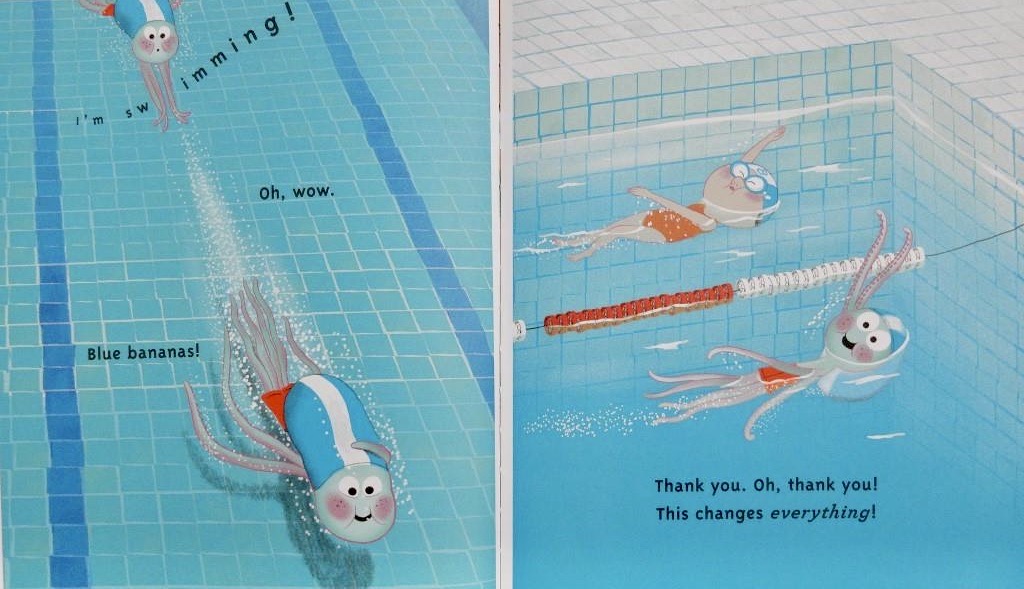
A highly important topical issue lies at the heart of this seemingly simple eco-themed love story.
Assuming that the object of her affections is another jellyfish, Nicole Godwin’s jelly-girl narrator – against the advice of other family members – falls in love with a plastic bag. ‘ “We’ve seen his type before.” “He’s highly dangerous.” ‘ they warn. Nonetheless, the attraction is so strong that she follows the object of her affections into wild and dangerous waters as little by little the dreadful realisation dawns …

You can almost feel the pull both of the narrator’s love and the ocean waters as the narrative moves across the spreads taking readers to the final farewell.

Mixed media illustrations and an unusual telling combine to deliver the crucial message about the pollution of our oceans and its devastating effects in a picture book that will make a different starting point for primary classroom discussions about, and more important action concerning, single use plastics and caring for the environment in general.

Monster! Hungry! Phone!

Monster! Hungry! Phone!
Sean Taylor and Fred Benaglia
Bloomsbury Children’s Books

To say that Monster is hungry is something of an understatement, he’s starving. The fridge is empty. He reaches for his mobile – TAP TAP TIP TAP TAP … BLING-BRING BLING-BRING … It won’t be long before his hunger is sated – so he thinks.

However things don’t quite go to plan. Thanks to a series of wrong numbers he calls up a jaguar, a panda,

a salamander, a sleepy sloth and an alien none of which are purveyors of pizza.

Finally – hurray! A delivery of mouth-watering cheesy pizza is on its way. Monster is drooling as he opens the front door. However even then, poor Monster is in for yet another surprise. Now what? He’s ravenous …

Stupendously silly and anarchically brilliant both verbally and visually this is a terrific treat for both listeners and readers aloud. The former will relish chiming in with the tapping and tipping, blinging and bringing, and yelling out MONSTER! HUNGRY! as the drama unfolds in Fred Benglia’s sequence of hilarious spreads and Sean’s relatively few words,carefully selected for maximum impact. Adults will appreciate the chance to deliver a monstrous performance.

A delicious offering through and through and one that’s likely to become a much requested favourite in classrooms.

Colour and Me!

Colour and Me!
Michaela Dias-Hayes
Owlet Press

I’ll never forget, back in the day when I was doing my very first teaching practice in a primary school in south London coming upon a six year old West Indian boy, Errol, during an art session with white paint all over his hands – backs and fronts – trying to paint his face white too. ‘I hate by brown skin’ he said. That memory has stayed with me ever since and it saddens me that in the twenty first century, Michaela’s young son should have said something similar to her, prompting her to create this celebration of brown skin.

Michaela’s narrator is an adorable little girl who like many children of her age, loves finger painting. She shares with readers, her pet turtle Myrtle and her grandmother her experiments in colour mixing using the three primary colours.

First she makes orange by mixing red and yellow, then mixes yellow and blue, which results in

the same colour as her turtle and so on. Putting all three primary colours together gives her brown, which she recognises as her own colour. “This is ME. This colour suits me … PERFECTLY!” she announces and then goes on to create a glorious rainbow shaped design on the wall …

The positivity of both the rhyme and the glorious illustrations in this, the first of Michaela Dias-Hayes’ books as both author and illustrator, shine through on every spread of this, the first of a new series.

Isabelle and the Crooks

Isabelle and the Crooks
Michelle Robinson and Chris Mould
Walker Books

Young Isabelle Crook is something of a misfit in her family of ‘ordinary crooks’. Unlike her sneaky dad, stealthy mum, cunning grandparents or little brother, Isabelle is a law-abiding citizen. In one week she turns down opportunities to participate in a bank robbery, a toy shop burglary, a spot of breaking and entering with her Grandpa and Grandma; she eschews the chance of some super exciting stealing with her parents and on Friday when the entire family set out to the tower to steal the crown jewels, she firmly refuses to accompany them.

On Saturday it’s a rest day and an early night at the Crooks’ residence but Isabelle lies awake worrying about how the Queen might be feeling. So, she embarks on a mission to return those crown jewels to their rightful owner. However, despite using her innate skills to enter the tower, as she’s in the process of replacing the stolen loot Isabelle is apprehended.

Rather than have her entire family imprisoned, the girl spends a night in jail

giving the rest of a family quite a shock next morning when they wake and find her (and much more) missing.

Perhaps now Isabelle might consider breaking her own good behaviour rules just once and if so, even persuade them to emulate the Ahlberg’s Burglar Bill and put it all back.

Michelle’s cleverly constructed narrative coupled with Chris Mould’s outrageously brilliant gothic style illustrations make this a delectably droll, altogether unmissable picture book.

The Think-Ups!

The Think-Ups!
Claire Alexander
Walker Books

When Anna and Kiki are stuck inside on a rainy day they soon become bored with their usual indoor activities. After a short period of staring gloomily through the window at the rain teeming down Kiki has a brainwave. “We could play the Think-Ups!” she suggests. With the only rule being to think up a Think-Up and it will appear, off they go despite Anna’s initial misgivings.

Before long the girls have called into being a whole lot of bouncing bunnies, a very lively moose,

an octet of octopuses have emerged from the loo and a host of hungry koalas are attempting to sate their appetites.

It’s huge fun for a while but then mayhem ensues as the menagerie storms into the kitchen

where the friends start to lose it with one another. However in the nick of time, just as the rain stops, Kiki comes up with a solution Think-Up

– her best so far, decides Anna. Then, the girls head outdoors into the sun, order duly restored. Or is it?

With its animated language and pastel hued scenes showing superbly the descent into chaos, coupled with the author’s portrayal of girls’ irrepressible energy and rapidly changing moods that is so typical of preschoolers, this is a terrific read aloud, made all the more fun by the use of half pages and the wealth of delightful details at every page turn. Long live the power of the imagination, especially when it’s captured as adeptly as in this story.

Nursery? Not Today!

Nursery? Not Today!
Rebecca Patterson and Nikki Dyson
Farshore

Rosa starts nursery, so she tells us, on a Monday. Everything goes wonderfully well: she paints an ace picture, sings without any shouting, enjoys lunch and plays without any rough stuff.
At the end of the day, her teacher Miss Lewis deems her ‘an absolute star!” Seemingly Miss Lewis wasn’t quite as observant as she could have been.

Assuredly the newbie enjoyed the plentiful action the nursery offered and she’s even prepared to share her new song with her younger sibling on the way home.

However, come Tuesday, Ruby has other plans that keep her more than a tad busy. Daddy is not impressed, especially when the young narrator suggests sending little brother Alby in her place and even less so when she suggests if he won’t do, perhaps Bernard (the pet gerbil) might stand in.

Is there anything that might persuade Rosa to don her coat and shoes and set out? I wonder …

Well observed, Rebecca Patterson’s funny story with Nikki Dyson’s bold, splendidly expressive, illustrations will appeal both to preschoolers and adult sharers though for different reasons. Youngsters will love exploring the wealth of detail in the illustrations as well as Rosa’s antics whereas adults will particularly appreciate the child/father interactions.

A smashing story to share with those about to start nursery and those already happily settled in a preschool setting.

Dinosaurs on Kitten Island

Dinosaurs on Kitten Island
Michael Slack
Farshore

Despite there apparently being plenty to amuse them on their own island, the dinosaurs are bored with sandcastle construction, skeleton reassembling and the other possibilities at home, and so they decide to pay a visit to Kitten Island. After all those kittens look like friendly creatures so despite what the narrator says about them, the prehistoric creatures are having none of it and potential catastrophes notwithstanding, off they go.

Game 1 is Launch the Lizards (courtesy of a geyser) but was that sudden flight and soaking really what the visitors came for? Lesson learned: surely that’s enough. It doesn’t appear so and nor does the second game ‘Deflate the airship’.

However apparently undaunted, the dinos are daft enough to participate in some ‘hairball floaty’ racing. Hmm! this could be their worst experience to date … Or not?

Seemingly these three friends revel in a high level of risk taking or else they’ve left their dino-brains at home for even after another unsettling outcome they precede to game 4, Fall-o meow that begins with them plunging into a dark chasm.

However it ends with them all in Tiny Baby Kitty Playroom, which is absolutely full of even tinier kittens. Now this looks a pretty safe place where both kittens and dinosaurs can play happily together.

Um …

With its brightly hued scenes, this is huge fun and hugely silly. It’s sure to go down well with the countless young dinosaur story enthusiasts out there who will definitely relish joining the prehistoric creatures in some loud RAWR, RAW-ing at each opportunity.

Baby, Sleepy Baby

Baby, Sleepy Baby
Atinuke and Angela Brooksbank
Walker Books

Exuding warmth and tenderness from every one of Angela Brooksbank’s illustrations is this lullaby.

Author Atinuke introduces the entire family on the title page and thereafter we see mother, father, a girl sibling and a grandmother, each of whom is shown cuddling the baby in the sequence of stunningly beautiful spreads that follow.

Although the narrative doesn’t rhyme it is lyrical: ‘Baby, sweet baby, / I’ll call on the winds // and you’ll sail like a ship / through the sky.’ it begins with infant on mother’s lap and big sister sharing the adult’s embrace.

The babe is then passed to Grandmother who bestows a kiss

then cuddles the little one with a fondness that is palpable.

We assume but it’s not certain who speaks on each spread,

although this reviewer suspects it is the person holding the little one: other readers might think differently but picture books can always open to more than one interpretation.

Once each family member has wrapped the baby in love

as well as allowing in turn, the wind, clouds, stars and moon to do likewise, everybody feels so calm and peaceful that sleep comes easily and they drift off to slumberland, with the little one between its mother and father.

Gentle, soothing and utterly gorgeous: what better book than this to give a family with a new baby.

I Love You More Than All the Stars / I Love You Forever and a Day

These are two picture books from Little Tiger both written in rhyme and both celebrating love: thanks to the publisher for sending them for review:

I Love You More Than All the Stars
Becky Davies and Dana Brown

The joys of a loving friendship between two small children is celebrated against an inky sky and Dana Brown’s unusual colour palette is what helps to makes this book that bit different from many of its kind.

We hear how the young friends share an unbreakable bond that is ‘deeper than the sea’, ‘stronger than a storm’ and ‘softer than a snowflake dance’, a bond that so the speaker says, will last for ever.

Much of what we see the two enjoying together takes place at night under the moon in scenes

illuminated by silver stars and the only additional colour is provided by the pops of salmon pink on the friends’ clothing and some of the natural images, a bird in flight and dancing leaves for instance.

I Love You Forever and a Day
Amelia Hepworth and Tim Warnes

In the sequel to I Love You to the Moon and Back the focus is on parental love as an adult bear takes its cub through an idyllic day of togetherness. We meet them at sunrise and join them walking through the countryside, jumping paw-in-paw to cross the water, pausing to observe a mother bird and her young, basking in the meadow, picking wild flowers, splashing in the river

and finally, heading homewards under the stars ready to snuggle up close and fall fast asleep,

The characters’ shared joy shines out from Tim Warnes’ scenes of ursine activity: his bears are hugely appealing to young children who will delight in snuggling up close to their own mum or dad (or perhaps grandparent) for some pre bedtime togetherness with this story.

Home Is Where The Heart Is

Home Is Where The Heart Is
Jonny Lambert
Little Tiger

What does it mean to really belong somewhere: that is what is explored in Jonny Lambert’s new picture book.

When Bear wanders into the old wild wood, he decides it’s where he wants to build himself a new home and so he does. There’s plenty of room inside and he adorns it with lovely things (those familiar with Jonny’s books will likely recognise Saffi’s portrait on the shelf); but something is missing. Feeling lonely Bear decides to pay his neighbour a visit and is immediately welcomed into Hare’s small, cramped home.

Despite being complete opposites in many ways the two absolutely love spending their days together outdoors. Spring, summer

and autumn pass in happy companionship, but come the winter, Hare takes to his bed with a nasty chill. Bear takes good care of him till his friend is back on his feet.

When a fierce storm comes crashing through the woods, Bear’s home is completely destroyed. Where can he go? He feels devastated but not for long thanks to Hare who welcomes his friend in with open paws. “From now until forever, my home is your home,” he says.

Now however, their friendship is really put to the test … Will it survive Bear’s clumsiness and Hare’s constant messiness?

The title says it all …

Jonny Lambert portrays so well the emotions of Bear and Hare: the warm glow of friendship illuminates almost every one of the elegant, textured scenes; his capturing of the storms, both meteorological and emotional are equally powerful too. And as always, the balance between text and illustrations is as harmonious as ever.

Aaron Slater, Illustrator

Aaron Slater, Illustrator
Andrea Beaty and David Roberts
Abrams Books for Young Readers

It’s such a joy to see a child whose neurodiversity is celebrated in the latest of the Questioneers series.

The titular Aaron D. Slater, of this rhyming picture book, is based on Aaron Douglas, the African American painter, muralist, and graphic artist, who was a key figure in the Harlem Renaissance movement.

As a very young child there’s nothing Aaron loves more than to sit in the old garden swing and listen to others reading to him, and he aspires to be a writer of stories in the future.

First though he has to learn to read and to write, both of which on account of his dyslexia,
he finds challenging. ‘the words are just squiggles, and try as he might, even with help Aaron can’t get it right.’

Once he starts school, Aaron who also loves to draw, decides that rather than show his feelings, the best thing to do is to try to blend in with his classmates.

In his second year at school Aaron has a new teacher and she sets the class a story writing assignment. That night the boy spends all night attempting to write “a story. Write something true.” as his teacher has said.

Filled with fear the following morning, at Miss Greer’s behest he stands before his classmates and suddenly Aaron finds his voice: ‘beauty and kindness and loving and art / lend courage to all with a welcoming heart.’

So it is that he begins to find his own way of using visual images to create stories: ‘His art makes the difference. His art leads the way and helps him discover what he wants to say.’

This superb tale of creativity, acceptance and finding your own way to transcend insecurities and challenges, will be an inspiration to all youngsters, in particular those who like Aaron, struggle with reading and spelling. (The book is set in Dyslexie, a dyslexia-friendly typeface and David Roberts, creator of the stylish illustrations, tells in a final note how he himself has struggled with reading and spelling, making those superb spreads wherein Aaron’s images literally take flight, all the more powerful.)

The Katha Chest

The Katha Chest
Radhiah Chowdhury and Lavanya Naidu
Allen & Unwin Children’s Books

Despite all that has happened since 2018, the UK retains its rich cultural tapestry, one that we all should celebrate.

I have never before seen a picture book that celebrates Bangladeshi culture so I was thrilled to be sent this one by an author and illustrator who draw on their own Indian Hindu and Bangladeshi Muslim heritage respectively.

Together they have crafted a fascinating story of young Asiya’s visits to her Nanu’s house which is full of treasures, Asiya’s favourite being the large katha chest containing quilts Nanu has made over the years from old saris. The little girl loves to immerse herself among these soft warm quilts and imagine the stories they hold just waiting to be whispered; stories both sad and happy, told to her by family members.

To begin with she shows readers a purple and blue quilt and we learn of Bora Khala’s medal from the war represented by the circular patterns on the fabrics. These help recall a sad time when he had to leave his wife alone with the children, to return after many years.

Then follows the first of Lavanya Naidu’s beautiful wordless double spreads of framed illustrations showing that time of the family’s life.

This and the five other four panel strips are in the style of Pattachitra – Bengali folk art cloth paintings, with simple colours, bold lines and intricate details, each one conveying a story within the main narrative. So it is that through these heirloom quilts, family history – the story of each aunt, mother and grandmother that wore the fabric – is passed on from generation to generation.

Each of the quilts holds a special memory and they’re also taken out when Asiya’s mother and aunts come together for sessions of tea drinking, story telling and reminiscing.

Both author and illustrator’s presentations of family history are imbued with so much tenderness and love that this a book for everyone regardless of their ethnic background.

Winter Lullaby / Wonky Donkey’s Big Surprise

Winter Lullaby
Dianne White and Ramona Kaulitzki
Walker Books

At the approach of winter when the air is crisp and cold, Mama Bear tells her little one that it’s time for bed but Small Bear notices Mouse and Chipmunk are still wide awake and busy; so too are Skunk and Hare.

Patiently acknowledging her offspring’s “But why must I?”, Mama explains that each one is preparing for a long winter sleep: Mouse is rushing to rest in her soft grassy nest and Chipmunk is storing nuts then he too will hibernate; Skunk will soon slumber underground and Hare will spend winter in a hollow log.

However Small Bear also spots Badger and Old Racoon, both still awake too, so he holds firm to his “But I don’t want to go inside … Why must we hide?”

Mama then promises that come the spring, they’ll both wake up and find their world green again, just waiting for them to play together once more. Finally Small Bear accepts that it is time to snuggle up warm with his mother and let the night sing them lullabies until they both fall fast asleep and slumber all winter long.

Told in rhyming couplets and through Ramona Kaulizki’s scenes of the final autumnal days giving way to winter’s bluish-silvery landscapes, this is both a lovely reassuring pre-bedtime tale and a simple explanation of hibernation for adults and little ones to share, snuggled together just like Mama Bear and her cub.

Wonky Donkey’s Big Surprise
Craig Smith and Katz Cowley
Scholastic

One morning wee Dinky Donkey is hugely excited and that’s because her pa Wonky has promised her a very big surprise. Rather than tell his little one what to expect, Wonky turns the whole surprise thing into a guessing game explaining that behind the big green door is where she’ll find her surprise. The guessing begins – “Is it warm?, “Is it washable?” … “is it witty? …

By the time Wonky has acknowledged “Sometimes it’s even whiffier than your dad!” Dinky cannot contain herself any longer. She leaps up and dashes to the door: now what could possibly be wonderful, wrinkly, wiggly, witty, weird, whiskery, washable, warm, whiffy and wise? WOW! What a lot of w’s to describe just one thing. Now what could it possibly be? It’s certainly something that will make Dinky and young listeners feel warm all over.

The story is delivered in Craig Smith’s characteristic playful, spirited rhyming narrative and Katz Cowley’s strokeable illustrations wherein the focus is on, not Wonky, but his endearing offspring.

Walrus Song

Walrus Song
Janet Lawler and Timothy Basil Ering
Walker Books

In this narrative non-fiction picture book with its lyrical rhyming text and brilliant paintings, author Janet Lawler and illustrator Timothy Basil Ering present a superb portrait of a walrus in his icy environment, taking readers right up close to the creature .

He plays on an ice floe, flopping and plopping into the chilly water where he twirls and whirls with swirling flippers, kept warm by the layer of fat beneath his coat. Then, having found some clams on which to feast, he slurps until he’s full when it’s time to tease that playful puffin before, using his powerful tusks, he heaves himself out of the water and onto the ice. 

‘Waddle. Walk. Slap! Slap!’ he lumbers, till he meets up with a pack of fellow walruses, snuggling up among them.

Sometimes however he get involved in a crashing, tusk-bashing fight with another walrus till fight over, he emits a variety of exciting sounding calls and songs that echo across the frozen landscape. 

I imagine young listeners will love to copy these sounds as you read.

Come the spring, baby walruses are born. Noting is said in the main narrative about mating but the author includes information about this in a final double spread of additional walrus facts.
Thanks to his chosen colour palette, you almost feel the chill as Ering’s paintings zoom in on the action documenting every move the creature makes and its every change of mood, holding readers totally captivated throughout.

Nen and the Lonely Fisherman / Love Grows Everywhere

Nen and the Lonely Fisherman
Ian Eagleton and James Mayhew
Owlet Press

Far out to sea lives Nen; he’s a merman who loves exploring but nonetheless has an empty feeling in his heart. Every night he sits beneath a starry sky singing to the sea whose waves carry his words of hope but Nen remains alone when he returns to the seabed.

Despite his father Pelagios’s warnings, Nen’s explorations of the world beyond his own lead him to discover fishing boats beyond which lives Ernest, a lonely fisherman who also feels something is lacking in his life.

One night Ernest hears Nen’s song and feeling something in his heart, he sets off in his boat to find the owner of this magical voice. So it is that a bond develops between Nen and Ernest. However Pelagios urges his son to stay away from the humans who are harming the oceans. Nen pays no heed however for he feels that the gentle, kind Ernest is special and their nightly meetings continue.

As Pelagios’ anger and sadness increase they unleash a terrible storm that puts Ernest’s life in danger as he’s thrown from his rickety boat into the foaming deep. Can Nen possibly come to his rescue

and if so, might it just change the mind of his father?

Washed through with an important conservation message, Ian Eagleton’s soft-spoken, lyrical tale of acceptance and love is compelling and perfectly paced, helped in no small part by James Mayhew’s powerfully atmospheric illustrations that include a wonderful full-length vertical scene of Nen searching the depths for Ernest, as well as small vignettes and double page spreads.

There’s love too in:

Love Grows Everywhere
Barry Timms and Tisha Lee
Frances Lincoln Children’s Books

‘Love grows everywhere…
From country farm to city square
From desert village, hot and dry,
to mountain home where eagles fly
.’
Through Barry Timms’ gentle rhyming text and Tisha Lee’s vibrant illustrations we share a family’s love, not only for one another but also for the plants they grow, nurture, sell, and give to members of their local community, newcomers especially. When reading this It’s impossible not to feel the various ways love is shown and shared

be it within the family, the richly diverse community or anywhere else: for love is a gift that helps to make the world a brighter, happier place; it keeps on growing and there’s sufficient for everyone, everywhere. It might just take some time for its magic to happen.

How wonderful it would be if this heartfelt book could show the way to everyone, in every place where such love is yet to manifest itself.

Classic Inspirations: Once There Was a Bear / The Little Prince

Once There Was a Bear
Jane Riordan, illustrated by Mark Burgess
Farshore

To celebrate the 95th anniversary of A.A. Milne’s Winnie-the-Pooh and The House at Pooh Corner, having previously written two standalone Pooh books, Jane Riordan has created a prequel collection of ten stories, again in the style of Milne. It takes readers back to where it all began, when Pooh was bought in Harrods as a gift for baby Christopher Robin. Using a similar style to that of E.H. Shepard, Mark Burgess illustrates each episode with panache depicting Pooh and his friends Eeyore, Rabbit, Piglet, Kanga, Roo, Owl and Tigger.
The original Pooh books have an enduring appeal for those who met them first as children; however this one has a charm of its own with many of the adventures taking place outside of Hundred Acre Wood. I loved the museum outing wherein dinosaur skeletons with their ‘bothersome long words’ for names prove unusual ladders for a bear to climb upon.

This is definitely worth getting hold of if, like this reviewer, you’re a fan of Pooh et al.

The Little Prince
Louise Greig and Sara Massini
Farshore

Award-winning author and poet Louise Greig has adapted Antoine de Saint- Exupéry’s classic as a picture book for a younger audience than the original novella: it’s illustrated by Sara Massini who has also won many awards. The result is a thing of beauty, mysterious and poetic both verbally and visually.

I’m not sure whether the stranded pilot’s encounter with a little prince who visits neighbouring planets will appeal to children; its enigmatic nature will certainly provoke much thought and lots of questions for, as the author says, ‘What is hidden is beautiful.’ That in itself is well worth exploring.

Are You Feeling Cold, Yuki?

Are You Feeling Cold, Yuki?
K.I. Al-Ghani and Haitham Al-Ghani
Jessica Kingsley Publishers

This picture book is about a family of snow monkeys that live in Japan, and one young monkey, Yuki, in particular. He gets so absorbed in what he’s doing that he frequently fails to realise when his body is signalling to him that, for instance, he is cold or hungry, needs to wee or to poo. This is of great concern to his parents and sister. Things come to a head when the family go off to bathe in the hot springs in the valley, for instead of joining the others in the warm water, Yuki continues playing in the snow. His mother calls upon his grandfather to help and the following morning Yuki pays him a visit.

Step by step, over the next days, weeks and months,

Grandfather helps Yuki to understand how his brain picks up sensations and sends ‘funny feelings’ to the relevant part of his body. For instance when he’s too cold, the skin on his feet and fingers get a tingly sensation and he starts to shiver so his brain tells his body to do something to warm up. Thus, he learns to recognise as well, the meaning of “a rumbly tummy” and the sensations he feels when he needs to get rid of excess liquid or the remains of food after all the goodness has been extracted.

The problems Yuki was having were on account of his being unaware of his bodily sensations and what his Grandfather taught him was something called ‘interoception’, which scientists call the eighth sense: the perception of sensations from inside the body including the perception of physical sensations related to internal organ function such as respiration, heartbeat and fullness.

By providing a place from which to become aware, story is a great way to help neurodiverse youngsters to learn. This one written by specialist advisory teacher Kay Al-Ghani with its mixed media illustrations by her son Haitham, subtly teaches about interoception and is accessible, empathetic and gently humorous. It would make a useful resource for parents, teachers and support staff.

Albert Upside Down

Albert Upside Down
Ian Brown and Eoin Clarke
Graffeg

The latest episode in the life of my favourite tortoise Albert is full of action; not however that of the protagonist – he finds himself belly up after an unfortunate rock climbing episode undertaken in an attempt to reach a tasty treat. During his efforts to right himself the creature gives a big sigh that attracts the attention of a passing worm. Said worm stops to enquire about its cause and is soon joined not only by a second worm but also several ants. Both parties claim to be best at moving large objects and Albert suggests they work together to flip him over.

Before long it seems that the entire minibeast population has come together in the cause of operation Albert. They give it their all as they push and shove, lift and pull but the tortoise remains stuck, legs skywards. Maybe a food luring tactic might do it, but no, though it does serve to attract further attention in the form of a butterfly that offers to assist only to be given the push by a snooty snail on account of being too delicate.

Further shoving, pushing and lifting ensue to no avail so the workers pause for some silent thinking. That silence is broken by the voice of a young worm with a clever suggestion. Under the direction of the chief worm some concentrated team work begins and there’s some movement as Albert rolls slightly but not enough. More weight is required states another worm when suddenly what should return and land gently upon that snooty snail but the butterfly. Now she might just be the one to make all the difference …

And so she does but with Albert now back on his four feet, why are all those who came to his rescue making a hasty dash to put some distance between saved and savers. Hmmm! Seemingly it’s because Albert is his normal self once more and we know what that means …

Ian Brown’s story of struggles and strife, rivalry and ultimately, creative teamwork becomes a truly comic episode thanks in no small part to Eoin Clarke’s hilarious, detailed illustrations. In the style of Tolstoy’s Great Big Enormous Turnip tale that has become a classic, we see how just a tiny bit of additional assistance can make a huge difference.

This is sure to be a winner with young listeners either in the classroom or at home. Don’t miss the final facts page about the real Albert (inspirer of the tale) and his cousins.

Goodnight Toucan

Goodnight Toucan
Joanne Partis
Little Tiger

Joanna Partis’s Toucan protagonist plans a jungle sleepover inviting his friends Tiger, Sloth, Frog, and Monkey; but he’s a perfectionist so at the last minute he has a crisis of confidence. The food he thinks, is insufficiently tasty and the bedding not snuggly enough,

so off he goes in search of items to make his party go swingingly: “the best sleepover ever!’ as his pals have declared it will be.

He fills his beak with fabulous flower decorations, then finds fluffy ferns for bedding and bananas for a yummy feast – hmm! As he flies back he spies fireflies that he decides will provide must-have, mood creating fairy lights. Swooping to collect them proves disastrous and Toucan dives headlong into the river below so it’s a distraught host that finally returns to the sleepover venue to own up to his failure. Fortunately though, the reactions of his friends reassure him that everything is, after all, just as it should be: friendship reigns supreme.

Assuredly this is a book that will resonate with youngsters who struggle with the impossible task of being perfect at all times. Joanne’s vibrant illustrations speak volumes about feelings providing a starting point for discussions about the importance of friends and of making mistakes.

Shine, Star, Shine!

Shine, Star, Shine!
Dom Conlon and Anastasia Izlesou
Graffeg

This is the latest in the excellent Wild Wanderers series about various aspects of the natural world and it’s another wonderful book.

Deep in space from the heart of a nebula many stars are born: big stars and small stars each shining forth from millions of miles away across the universe, reaching out to us with their rays of colour. And so it is with our star, the Sun, enabler of life on planet Earth that shines down from 93 million miles away. She keeps us warm, causing changes in the weather; she makes the crops grow all over the world from Idaho to the Punjab, as well as all other planet life;

she pumps air from floating green ocean gardens giving rise to wind and creating clouds and sometimes, rainbows.
Beware though, sometimes the strength of her rays can cause damage for our star can also be a ‘world-burner’ but the world she reveals is mostly one of rich life and potential.

I love the way in which both poet author Conlon’s lyrical language and illustrator Izlesou’s atmospheric art both focus on this single star of ours, turning the otherwise ordinary into the truly extraordinary: truly a painting of words and pictures. Or rather a series of paintings that remind us of how our Earth moves around our Star and what that means for different environments; or shows the gradual change from day to night,

from season to season, through countless lives and trillions of years. It’s not until the final spreads that we are shown the night sky with its ‘trillions of stars with planets of their own whose stories are yet to be heard’. That too is something to ponder upon and perhaps dream about along with the small boy and the cat that we see throughout this powerfully beautiful book. It’s one that’s sure to provoke awe and wonder in young listeners.

Shifty McGifty and Slippery Sam: Santa’s Stolen Sleigh

Shifty McGifty and Slippery Sam: Santa’s Stolen Sleigh
Tracey Corderoy and Steven Lenton
Nosy Crow

What a super seasonal addition to the cracking series is this latest rhyming story of everybody’s favourite bakers.

Now it’s a chilly Christmas Eve and the duo have driven through snow and ice to Lapland to rustle up some culinary treats for a very special person. However on arrival they discover Santa is in big trouble: his elves have been hit by a mysterious disease and taken to their beds.

Suddenly, up zooms a stranger offering assistance with gift wrapping; but armed with her gadgets, is Flo Frost all that she seems or is there some kind of sneaky subterfuge at work?

If so, with the aid of their own kind of gadgets, it could be down to Shifty and Sam to pull off a rescue, save the day yet again and ensure that all those presents get to their destinations in time.


With plenty of mayhem and mix-ups, this splendid festive treat for reading aloud will delight both children and adult sharers. Steven’s illustrations too are a treat: every single spread has lots of delicious details and don’t miss that little arachnid that sneaks into each scene.

The Mouse Before Christmas / Can’t Catch Santa!

Here are two festive books from Sunbird Books -thanks to the publisher for sending them for review

The Mouse Before Christmas
Tracey Turner and Jenny Lovlie
Sunbird Books

‘ ‘’Twas the night before Christmas, / when all through the house / Not a creature was stirring / … except for one mouse.’ So begins Tracey Turner’s mouse-themed tribute to Clement Clarke Moore wherein a tiny white mouse clad in a red fur-trimmed suit opens the action by giving a wink to readers and holds up a ‘ssh’-ing paw to his mouth before introducing his fellow mice all fast asleep. He then departs on his Christmas Eve delivery round in a small-scale sleigh, pulled by stag beetles portrayed in festive hues.

“On, Stiggy! On Twiggy! On, Scatter and Skitter! / Come, Snipper! Come, Skipper! Come Patter and Pitter!” he urges, guiding them down through the trees to a smooth landing in the snow instead of on a rooftop.
Then taking one of the sacks containing gifts for all, he heads for a house, leaving snowy mouse tracks (no boots for this Santa figure), entering via a crack in the wall and thence to a convenient mouse hole. Stockings are duly filled with Mouse toys and of course, lots of cheese as well as crackers. Then it’s back to the waiting sleigh, and with a flick of the reins, a squeak and a “Merry Christmas to all, / and to all a good night!” off he flies into the moonlit sky.

If you’re looking for an alternative to the original classic poem, this one with Jenny Lovlie’s mouse-centric setting complete with a cotton reel table, holding a candle, a thimble pot containing a decorated branch, mouse paperchains and a larger branch to which tiny stockings are affixed, is a delight. Cute and cosy but not overly so thanks to the wealth of humorous details, especially those Christmassy beetles.

Can’t Catch Santa!
Emily Cunningham and Steph Lew
Sunbird Books

It’s Christmas Eve, just the time to try and catch Santa: so says the canine narrator of this lift-the-flap board book. Santa however seems somewhat elusive as each seeming sighting of the jolly fellow turns out to be something altogether different – a bobble hat worn by a carol singer glimpsed through the window of the front door, it’s a snowman wearing the black wellies and so on. It’s not until several more spreads have been explored that Santa actually does make an appearance but when he does eventually do so, his would-be catcher isn’t quick enough to apprehend the jolly fellow. Still there’s always next year …

Slightly silly, but that’s all part of the fun that toddlers will enjoy, along with the festive spirit and the build-up.

Jingle Smells

Jingle Smells
Mark Sperring and Sophie Corrigan
Bloomsbury Children’s Books

Mark Sperring’s rhyming story introduces readers to Jingle the stinky little skunk.

It’s Christmas Eve and the stripey-tailed creature is on his way into town to see the shiny lights. En route however, in true skunk style, he emits a particularly pungent aroma and as he passes it, the tree in the old town square is so overcome by the whiffy odour that the thing topples right over, sending baubles and lights flying every which way. Poor skunk is devastated that he’s spoiled Christmas for everyone and is just about to turn back home when he hears a cry for help.

Now Jingle has a chance to do something for the good of all the town’s residents, for up on the roof he discovers that robbers are at work and Santa is in big trouble.

What better way to get rid of the villains than for the little skunk to emit a a mega-stinky blast. It certainly has the desired effect 

and Jingle realises that perhaps after all, he has saved Christmas. But the night is long and Santa still has all those presents to deliver – with a little bit of help for one time only, from one small stinky skunk.

Jingle is such an endearing character and Sophie Corrigan brings this out in her fun festive illustrations that are a perfect accompaniment to Mark Sperrings’s deliciously different tale, which is a delight to read aloud.

The Twelve Green Days of Christmas

The Twelve Green Days of Christmas
Barry Timms and Siân Roberts
Farshore

The sentiments are great but I did find when reading this timely rhyming story aloud that it didn’t always quite scan; though if you sing the words using the popular seasonal tune, it works fine, beginning on the first day of Christmas with Santa coming upon ‘A star that had broken in three.’

On the next four days, as we see in Siân Roberts’ humorous, wintry illustrations, he comes upon worn-out wings (five), four party hats,/ three crushed cups, / two tattered gloves ‘ and that shattered star. What a careless lot those forest creatures are.

On the sixth day an unhappy Santa decides something has to be done. He puts up a sign urging the forest dwellers to start recycling.


Day seven brings a snowstorm which results in his sign getting blown away and Santa catching such a bad chill that he has to take to his bed, the result being the rubbish continues to spread and accumulate in piles.

Will Santa ever get his wish for a green Christmas before the big day arrives?

Happily yes, for Owl catches the flying sign, spreads the word spurring the animals to take action and on the eleventh day Santa receives something in the mail that lifts his spirits.

Next day he ventures forth and finds …

as well as five new recycling bins and lots of the animals busily restoring the broken star and putting it where it should be – right at the top of the tree. A Merry Green Christmas at last!

Who’s Got A Normal Family?

Who’s Got A Normal Family?
Belinda Nowell and Miša Alexander
Little Steps Publishing

A family is a family be it or be it not conventional – and anyway what in this day and age is a conventional family? That is what is explored in this picture book.

On ‘News Day’ young Alex is happy to share with his classmates the news of the arrival of his new baby sister, Emma. She , like Alex is a foster child. But then one boy in the class, Jimmy who seemingly doesn’t like others to feel happy, says ‘She’s not your real sister. You don’t have a normal family.’ Unsurprisingly this makes Alex feel anything but his usual happy self.

Back home that evening, Alex asks his mum, “Are we normal?” Her response in addition to a big hug, is to say “Absolutely NOT … but why don’t we find out who is?” Thus begins and exploration of Alex’s class photo as they look at the families of his classmates one by one.

We meet Katie whose grandmother is her carer; Alir who lives with his extended family that comprises grand aunty, two uncles and some cousins, having moved to this country because it was no longer safe for them in their homeland.

Then there’s Eva who lives just with her dad; underwater expert Tim who has been adopted, Henry and his two dads; and Samantha. She has recently gained five new brothers because her mum has married Nathan’s dad. Soon there’s just Jimmy; Alex and readers find out that he has cause to be feeling sad.

When Alex goes to bed his mum whispers something to him. The following morning a now happy Alex shares with Jimmy what his mum has said and shows him something too …

A celebration of familial differences showing that the most normal thing of all is that all families are different.

Definitely a book to share and discuss in any family and with primary classes.

The Smart Cookie

The Smart Cookie
Jory John and Pete Oswald
Harper 360

The narrator of this picture book is one of the residents of the bakery on the corner of Sweet Street; she now calls herself Smart and is sufficiently self-assured to share with readers her transformative journey from a cookie completely lacking in confidence to the present day.

As a pupil of Ms Biscotti, teacher at the school in a gingerbread house, said cookie didn’t think fast enough to put up her hand to answer any questions and finished last in most tests. Sometimes a lesson was so much of a challenge, our narrator felt completely at sea, totally beset by worries and would lie awake all night in the cookie jar.

Then one day Ms Biscotti announced a homework assignment asking everyone to ‘create something completely original’ and bring it to class next day.

Back home our cookie starts work right away but her initial attempts result in disasters of one kind or another, and then suddenly an idea comes – a poem! Having named the creation “My Crumby Days”, the words just keep coming to our poet in the making, so much so that it’s excitement, not worry that keeps her awake this time.

Next morning at school cookie shares the poem. Fellow pupils relate to the words, Ms Biscotti is delighted by its originality

and as for our narrator, she realises that everyone is smart in their own ways, it just takes time to discover what those ways are; our differences are something to be embraced and celebrated.


With puns aplenty and its important message, Jory John’s text together with Pete Oswald’s playful scenes of cookie’s school and home, offer a tasty confidence booster for youngsters and a great starting point for discussion in the primary classroom.

An Odd Dog Christmas

An Odd Dog Christmas
Rob Biddulph
Harper Collins Children’s Books

What joy! – a festive foray into the world of the wonderful divergent dachshund Odd Dog.
It’s Christmas Eve and said mutt is on a mission to find the perfect present for a special friend but after a day of shopping, time has almost run out. What on earth can I do, thinks Odd Dog wandering through the silent streets, when there in front of her eyes is a sign that calls.

In she walks to a true winter wonderland complete with gingerbread, candy canes and jolly elves; but there’s one creature that looks far from festive. It’s a very poorly reindeer admitting reluctantly, “I’m far too ill to pull the sleigh.”
There’s just one thing Odd Dog can do and before you can say ‘presents’ there before her is Santa. Of course, there’s the perfect solution.


With the night flight duly done, Odd Dog is still left without a present for her friend: Santa offers some words of advice. and then light bulb moment …

On Christmas morning our favourite pooch offers her pal something that reveals the true meaning of Christmas …

Wonderfully illustrated in gloriously rich hues and oodles of gentle cosy seasonal humour, this is one of those Christmas books that sends a warm tingle all through you.

Rita Wants a Robot / The Toys’ Christmas

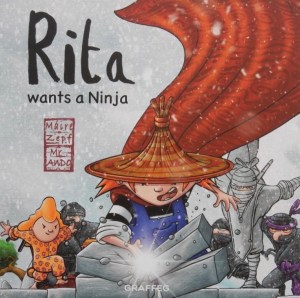
Rita Wants a Robot
Màire Zeph and Mr Ando
Graffeg

Rita is a small girl with a big imagination and a head full of ideas. Her latest is a ‘super-sorting’ robot: something that would tidy up the ginormous messes she creates in her bedroom thus putting paid to mum’s repeated chastisements. There is a stipulation however; said robot mustn’t spoil Rita’s fun by creating hyper tidiness, so he’d need to know when enough was enough or risk her wrath. Of course, said robot would need to be an appreciator of wildlife, as well as never overstepping the mark, for doing so would land Rita in big trouble.

Then there are special considerations at the approach of the festive season: who would want a Christmas saboteur robot, albeit a well-intentioned one? Definitely not Rita: maybe time to have another think about the whole robot-sorting idea …

This is another fun episode in the imagined life of Rita conjured by author Màire Zeph and illustrator Andrew Whitson (Mr Ando) that will be enjoyed by youngsters around the age of the protagonist. This adult reviewer wouldn’t mind a brief visit from Rita’s super-sorting robot to work on my partner’s super messes, although it would need to be kept a close eye on, I suspect.

The Toys’ Christmas
Claire Clément and Geneviève Godbout
Frances Lincoln Children’s Books

It’s Christmas Eve but rather than feeling excited, little Noah is very worried and upset: his favourite cuddlesome toy elephant Fanfan is nowhere to be found. Despite his mum’s reassurances that his absence is only temporary, Noah isn’t convinced.

Meanwhile, outside in the snow Fanfan is on his way to an important meeting when he hears a voice asking for help. It’s toy rabbit Mr Long Ears with a bad foot, upset at the possibility of not getting to the meeting on time and of course the kindly elephant offers him a lift and they reach the clearing where the other toys have gathered just in time for the long journey.

Why are they, along with toys from all over the world, out on this chilly night when they could be snuggled up with their children? 

They’re on a special mission to see Santa to tell him what their owners want for Christmas, but they also need to make sure they get back home in time for the big day.. What will Noah discover when he wakes on Christmas morning?

An unusual story illustrated in soft focus pastel by Geneviève Godbout whose art here has an olde-worlde charm.

Little Santa

Little Santa
Jon Agee
Scallywag Press

As the story opens Little Santa lives with his parents Mr and Mrs Claus and six siblings in the North Pole. Santa loves life there; not so the rest of the family. who eke out a miserable existence.

Their intention is to move to Florida., but their plan is thwarted. At first that is, by an overnight blizzard that traps their house and everyone inside, beneath an enormous snowdrift.

Up steps brave Santa who with some food in a sack and a pair of snow shoes, is sent out via the chimney to seek help.

When he emerges he starts walking, and having trudged a considerable distance comes upon what he thinks at first is the top of a tree protruding through the snow.

What follows is an account of how the little fellow comes as tradition says, to acquire a flying reindeer and a troop of elves whose talents include shovel making and sledge building.

Yes he does of course enlist their help to look for the Claus’s North Pole house and they fly back to the relief and delight of his family. But has this whole episode put paid to their plans to move to Florida? Certainly not and even with the improvements made by the elves,

a year later off go the Clauses minus Santa to start their new life. And Santa: well we know what he does.…
Crisp like the snow, Jon Agee’s folkish narrative, and quirky, comical illustrations in which Santa stands out in his bright red attire offer a kind of seasonal pourquoi tale that’s fun to share during the Christmas season.

Super Duper Penguin Slide

Super Duper Penguin Slide
Leonie Lord
Walker Books

There’s a pleasing kind of circularity about this tale of a penguin family’s epic journey, big ones at the front, small ones behind.

From the start it’s evident that this lot are well-organised and polite too, with their tickets at the ready to board the bus when it finally arrives at the stop, and the readiness to let those in great haste get past on the escalator. Such deeds still enable the penguin brigade – mum, dad and five little ones – to board their train in the nick of time as it begins to ‘Chugga chug, choo choo’ its way across the varying terrain until – disaster!. The train pulls to an untimely halt and an announcement is made.

Looks like it’s time to draw on another of those penguin propensities – persistence.

A phone call to a goat soon gets them out of trouble and finally they reach their destination. Now at last, it’s time for some fun and it’s downhill all the way … almost.

Full of fun characters – silent bit part players as well as the main cast and supporting nesting guinea pigs – Leonie Lord’s scenes both large and small contain a wealth of amusing details to giggle at as readers follow the flippered family on their journey with its highs and lows.

Off Limits

Off Limits
Helen Yoon
Walker Books

A father leaves his home-office unattended and who should decide to explore within, despite the ‘OFF-LIMITS sign on the door (shown on the title page) but his small daughter.

Disregarding her own “Hello, I’m just looking’, the first thing she makes use of in this thoroughly neat and tidy room is the sticky tape convincing herself that nobody would miss just ‘one teeny-tiny piece’.

However, it’s not difficult, especially for adults, used to young children making creative use of anything and everything, to understand so well that before long our protagonist has adorned the angle-poise lamp, the stapler and herself, not merely with tape but also with paperclips, bulldog clips and sticky notes: joy oh joy!

Before you can say “La laaa lala da la” the child is totally engulfed in an eddying pastel coloured whirlwind.
Suddenly though a realisation dawns upon our playful young lady. “Uh-oh. I’m in so much trouble” she tells readers as she tiptoes back to the haven of her own bedroom wherein an unexpected surprise awaits …

Simply told with perfect pacing and illustrated with superbly droll mixed media scenes of the escalating chaos unfolding behind closed doors, this book pays tribute to the power of play and the endless possibilities it offers to us all. Young children will absolutely delight in the forbidden deed with its escalating chaos, as well as both the pleasure and the possibility of being caught as the mischief mounts. Most of all though, I suspect they’ll love the final grand reveal and it’s contrast between that and the first wordless spread.

Frindleswylde

Frindleswylde
Natalia and Lauren O’Hara
Walker Books

This is the third book by the O’Hara sisters, Natalia who writes and Lauren who illustrates and what utter delight it is.

When Frindleswylde an eerie shapeshifter gains entry to the home of Cora and her Granny he steals the light and thus the house is plunged into darkness.

Cora sets off to try and get back the light so that her Granny is able to find her way home. She journeys beneath the pond to Frindleswylde’s frozen kingdom where she is at his mercy and is made Queen of Winter.

However he agrees to return the light so long as she can complete three Impossible Tasks, either that or remain forever captive in his realm.

Cora is determined to complete the three increasingly difficult tasks but can she succeed? Assuredly the thought of her Granny lost in the woods spurs her on try her utmost to outwit the deceitful captor.

This compelling, multi-layered tale has echoes of classic folk and fairy tales – Rumplestiltskin, The Snow Queen, The Six Servants for instance. Present too are those timeless fairytale themes of good versus evil, the all conquering power of love, a quest, and the loss of innocence.

Both the telling and the illustrations are magical: the former with its rich rhythmic flow of words and the latter, things of exquisite beauty in their own right: together they make for a wondrous read aloud fable that will utterly enchant younger listeners; and its themes will speak to older readers and adults showing that, among other things, we should continue to strive for what is right in today’s troubled world.

Books For Giving That Keep On Giving

William Bee’s Wonderful World of Things That Go!
Pavilion Books

This book brings together three of William Bee’s much-loved titles – Trucks, Trains and Boats and Planes, and Tractors and Farm Machines, in one bumper volume. I’ve already reviewed each of them on this blog so I won’t repeat myself; rather I’ll suggest that if you have a young child with an interest in things mechanical (or perhaps even yummy sounding breakfast cereals such as those sold down on William’s farm), then unless they already own the individual books, a copy of this totally immersive publication narrated in William Bee’s chatty style with his detailed, gently humorous illustrations, would make a smashing present.

Pippi Longstocking
Astrid Lindgren, illustrated by Lauren Child
Oxford Children’s Books

This large format, beautifully produced new edition of a classic has been brought up-to-date with terrific contemporary illustrations from Lauren Child and a new translation by Susan Beard.

We follow Pippi Longstocking on her amazing adventures as she moves, sans parents, into Villa Villekulla with a horse, a monkey, and a big suitcase of gold coins. Despite well-meaning adult villagers’ attempts to guide Pippi, she’d far rather be a wild spirit. She meets Tommy and Annika who very soon become her best friends. These new friends join her on her amusing escapades – leading the police a merry dance, going to school – briefly, joining the circus taking on a strong man and wowing the crowd, dancing a polka with thieves and celebrating her birthday.

Young readers and listeners will delight in their encounters with this intrepid, sometimes outrageous heroine while older ones and adults will rekindle their love of her with this bumper book that would make a super Christmas present.

Alice’s Adventures in Wonderland
Lewis Carroll & Grahame Baker-Smith
Templar Books

It’s always interesting to see new visual interpretations of Lewis Carroll’s classic tale and although for me none can outdo those of Tenniel, assuredly Grahame Baker-Smith’s distinctive illustrations, breathe a different kind of life into Carroll’s story.

Every chapter has full page, richly coloured detailed spreads as well as several smaller pictures executed either in blues or sepia. 

One I lingered long over was the double page colour spread of the Mad Tea-Party and an amazing spread it assuredly is. There’s a large iced cake, the upper surface of which is crammed full of liquorice all sorts and what look to be those flying saucer sweets that contain sherbet. I couldn’t help but laugh at the sight of an egg cup containing an egg and peeking through the crack in its shell is the face of a chick. It’s details such as those that the new generation of readers who go down the rabbit hole , as well as those familiar with the story taking the descent again, will remember.

With illustrations full of mystery and magic and a superb design, this is a terrific gift book.

The Provensen Book of Fairy Tales
edited & illustrated by Alice and Martin Provensen
NYR Children’s Collection

This anthology contains a dozen ‘literary’ fairytales selected by the husband and wife team to illustrate with their own whimsical touches.

Among those included are Hans Christian Andersen’s The Nightingale, Oscar Wilde’s literary The Happy Prince, The Three Wishes told by Barbara Leonie Picard, Arthur Rackham’s classic version of Beauty and the Beast, Elinor Mordaunt’s The Prince and the Goose Girl, a reworking of Grimm’s Goose Girl, Parker Fillmore’s retelling of the Finnish story The Forest Bride, and a tale new to me, A.A. Milne’s Prince Rabbit. With an unexpected final twist, this is an amusing story of a childless king who is urged to name an heir. To that end the king arranges a series of contests for would-be heirs who meet certain criteria; one of which is a rabbit.

I found it fascinating to have such a variety of storytellers side by side in one volume, with the Provensens’ humorous, sometimes dark illustrations and I suspect this is a book that will appeal more to book collectors and older readers with a particular interest in fairy tales, than to child readers.

The Worst Sleepover in the World

The Worst Sleepover in the World
Sophie Dahl and Luciano Lozano
Walker Books

Seven year old Ramona eagerly anticipates her first ever sleepover when her friend Gracie is coming to stay the night. The plan is Ramona, Gracie and Ramona’s younger sister Ruby would all sleep in the one bedroom and they’d feast at midnight on such goodies as ice-cream sundaes, chocolate buttons, pizza, doughnuts and more. But when Mum gets to hear what the sisters intend, she steps in stipulating crisps, sandwiches and popcorn. Nonetheless the sisters are super-excited and sure they’re about to host ‘the best sleepover in history’.

However when Gracie arrives announcing that she’s ‘quite fussy’, it seems things are not going to go according to plan. Gracie hates all the food she’s offered at tea time, bath time is a damp squib and then when it’s time to pack the lunchboxes for that feast, Gracie again dislikes all the food and turns her nose up at the replacements.

The sleeping arrangements are not to her liking either, and nor is the family’s stinky dog. Is there any possibility that Ramona’s mum can step in, draw on her inner resources and save the day or rather night? Moreover can she do it without upsetting her own elder daughter? And will the girls still be friends in the morning?

Definitely this is a story – a longish one for a picture book – that youngsters can relate to. Sophie Dahl’s first person telling provides lots of details about Ramona and her life, all of which we see through the young narrator’s own eyes while Luciano Lozano’s vibrant illustrations speak volumes too as they show the different events of the evening, night and following morning and both the children’s and Mum’s reactions to them. Indeed there’s lots to explore at every turn of the page.

Vive la difference! is the message that emerges strongly from this fun book.

Croc O’Clock

Croc O’Clock
Huw Lewis Jones and Ben Sanders
Happy Yak

It’s feeding time for the crocodile with a seemingly insatiable appetite and goodness me does he love to boast about it as he keeps the zoo keepers busy all around the clock. “At one on the zoo clock, / the keepers give to me… / A MOUNTAIN OF MACARONI!” But that merely fills a small space in his tummy and the greedy beastie needs feeding on the dot of every hour. Moreover he has a cumulative song to tell readers what he eats.

At 2:00 there are two cups of tea and another mountain of macaroni; at 3:00 there are three french fries—and two cups of tea, and yet another mountain .…
And at 4:00? “4 pumpkin pies / 3 french fries / 2 cups of tea / And a mountain of macaroni!”
Five o’clock is time for some sweet stuff: 5 doughnut rings etc. More sweets at six in the form of 6 tasty toffees and as the clock strikes 7, 8, 9, 10, and 11 our every growing creature consumes 7 creamy coffees,

8 mighty milkshakes, 9 cherry cheesecakes, 10 jumbo jellies and 11 lemon lollies. Does he never get tummy ache one wonders?
Twelve o’clock brings 12 syrup sundaes

but hello- no mountain of macaroni? Now those keepers have finally decided that the crocodile’s diet is sadly lacking in veggies. What will the narrator’s reaction be to the next offering? …

Youngsters will delight in singing to the tune of ‘The 12 Days of Christmas, Huw Lewis Jones’ satirical take on the popular seasonal song, as they watch the croc’s continuing overconsumption overseen by the zookeepers with the assistance of some visitors, shown in Ben Sanders bright, bold stylised illustrations.

George the Wombat

George the Wombat
Eva Papoušková and Galina Miklínová
Graffeg

Did you know that like all his fellow wombats, George produces cube-shaped poos? That’s when he manages to poo at all, and even more importantly do so in his potty.

Pooing in his potty is what his mum has told the little creature he must do before he can go into the forest and dig a burrow. Being an obedient marsupial, George goes and sits on his potty but sitting on your lonesome upon your potty (or otherwise) is more than a little boring.

Fortunately though it’s not long before George’s pal Fred the kangaroo hops up and invites George to join him in some grass gobbling. George explains his problem and so Fred suggests something to help shift things along within. Still nothing happens, so Fred hops off leaving the wombat to keep trying.

Next to arrive is Annie goose and she too has a suggestion, but this doesn’t do the job either.

Lizzie mouse’s tip proves equally unsuccessful

only serving to make George’s eyes almost pop out, which puzzles Daddy Wombat as he walks by.

Now Daddy wombat knows a thing or two so maybe, just maybe he can solve the poo problem once and for all so that his offspring is free to remove his botty from his potty and embark on some tunnelling.
Translated by Alexandra Büchler, this tale of friendship, helpfulness and of course, poo, is great fun to share whether or not you have a little one at the potty training stage. With its repeat refrains and gentle humour throughout the telling, a humour that is superbly underscored in Galina Miklínová’s cross-hatched illustrations showing the cuddlesome creature endeavouring to follow instructions and produce the goods, this book will delight both youngsters and adults, all of whom will relish the potty-sitting sequences.

There’s a Dodo on the Wedding Cake

There’s a Dodo on the Wedding Cake
Wade Bradford and Kevin Hawkes
Walker Books

Hired to play his violin at a wedding, Mr Snore who starred in There’s a Dinosaur on the 13th Floor makes a return visit to the Sharemore Hotel.

His early arrival allows him to take advantage of the wedding planner’s offer of some hot chocolate while he waits. Before he is given said hot drink sans marshmallows as he’s stipulated, the violinist spots a dessert trolley whereon stands a rose-decorated, iced cake close to which is a dodo with its eye on the main chance. But Mr Snore is not quick enough to prevent the creature from sampling a rose; it gobbles one and dashes off.
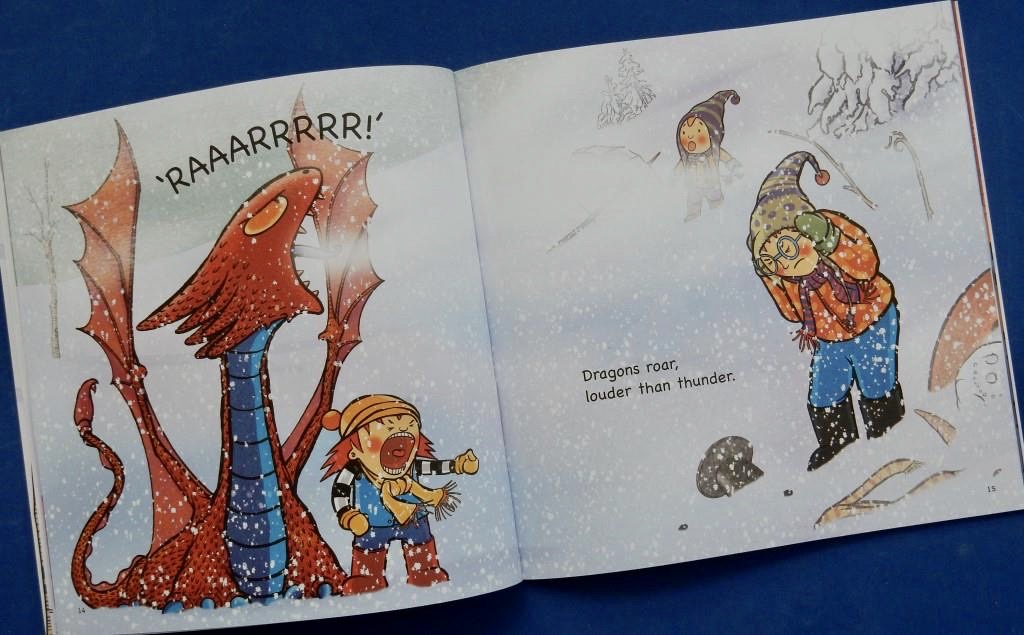
Having seen the dramatic incident, the wedding planner hastens away to find somebody to fix the icing, leaving Mr Snore standing guard using his violin bow to ward off a couple of beavers and a boa constrictor.

Then, deciding to move to safety – so he thinks, Mr S. pushes the cake into what he assumes is an empty cupboard only to discover it’s anything but …

However, it seems that there’s a never ending array of creatures all trying to get close to the confection.

Eventually the wedding planner has to intervene and it’s revealed that Mr Snore has misjudged all those whom he suspected of being marauders, all but one, that is.

With everything finally ready, the celebration gets under way and all is going beautifully until the bride and groom hand Mr Snore the very first slice of cake, but on account of the icing, there are explosive results …

Full of drama, this crazy romp with its messy finale has plenty to entertain young audiences – Mr Snore’s bow-wielding heroism, his continuing error-making and the denouement, to name just some of the daft constituents. All of which Kevin Hawkes captures brilliantly in his sequence of full page scenes, the occasional double page spread and zoomed -in views of bits of the action, presented in circles or ovals of various sizes. Weirdest of all though, is his portrayal of the protagonist.