Through the Forest

Through the Forest
Yijing Li
Lantana Publishing

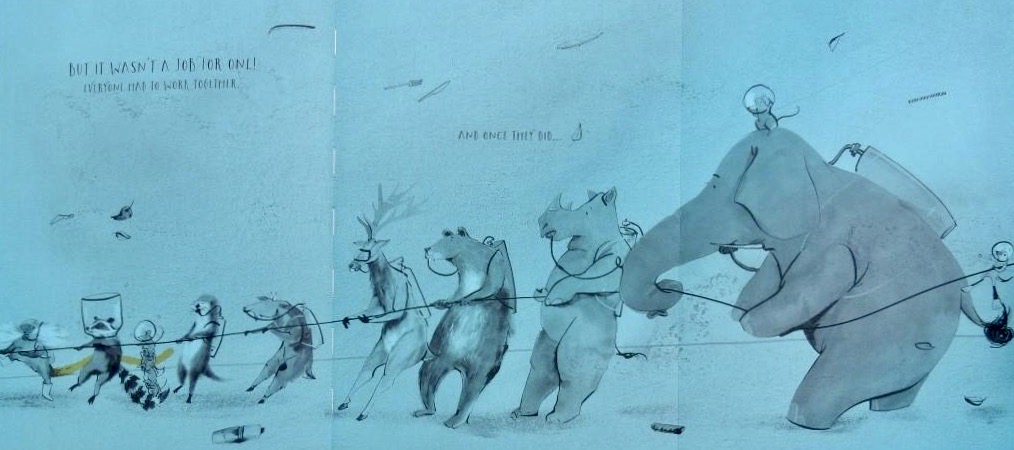
‘I was lost in a deep, dark forest. I couldn’t find my way back so I keep on walking.
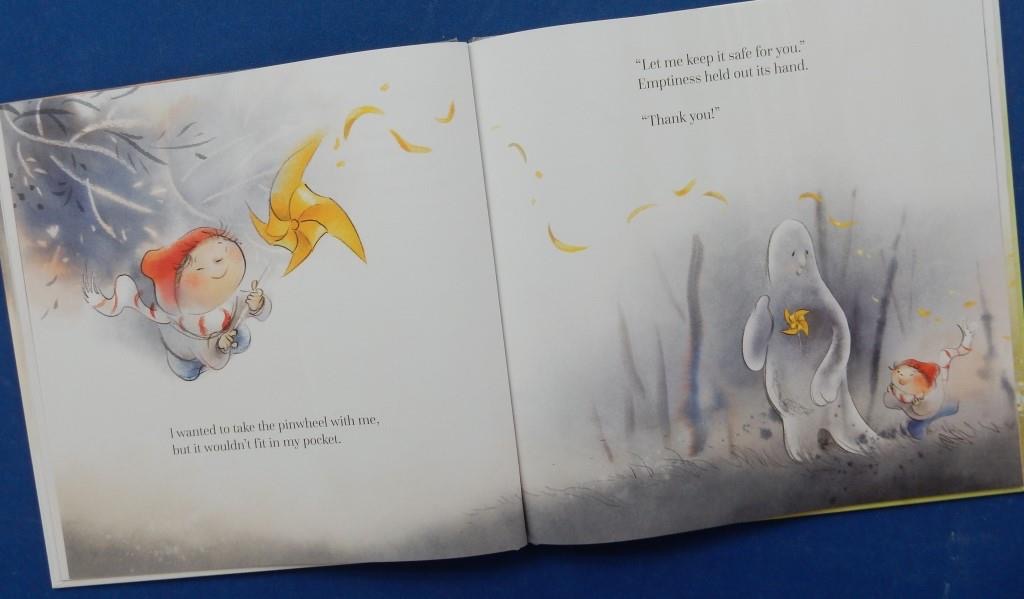
I was searching for something but did not know what.’; so begins this first person narrative by a small boy. He meets a ghostly giant figure who introduces itself as Emptiness and the boy suggests they might continue their search together, a suggestion to which the empathetic being responds positively.

Continuing on side by side they come across objects in the snow the first being a pinwheel. It puzzles Emptiness but sparks memories for the boy who recounts them to his companion. Then because he’s unable to fit it into his pocket, Emptiness takes the pinwheel for safekeeping.

The next object is a kite and again it triggers memories in the boy and his companion takes it to carry.
The vase they find calls forth sadness in the child, “This is a piece of Dad’s special vase. It was smashed the morning Mama left.” But in a clearing their discoveries – a book, a harmonica, a first drawing and a tie all evoke happy times.

Eventually the two arrive at a wildflower meadow littered with memories

but now Emptiness stops walking. Full of the memories they’ve found together, he explains that now they’re out of the forest, he’s remaining behind for the memories will always be available to guide the child as he ventures forth, should he need them. The boy looks around him and is finally able to see a path both behind and in front of him. Thus, we realise that forest has served as a metaphor for the child’s state of mind, which thanks to Emptiness, has now cleared.

Yijing Li’s digitally worked watercolour and ink scenes of the journey are contemplative and reassuring, and there’s a misty, occasionally brooding, dream-like quality to the entire book. .

One Boy’s Choice

One Boy’s Choice
Sueli Menezes (translated by Kathryn Bishop) and Annika Siems
minedition

Set in the Amazon jungle, this is a story about a boy who goes out in a canoe to spend a day fishing with his grandad. The boy is eager to catch a really big fish to take home and show his friends. Grandad navigates the boat around the huge water-lilies while the boy peers into the water, watching and waiting for that fish. They wait and wait and wait, then move on and cast the net instead of a line. Still nothing, and while they wait Grandad tells stories about the various fish that live beneath the water-lilies.

Hours later lo and behold to the boy’s delight, there’s a water-lily fish – an Arowana – in the net. However, his delight quickly disappears when Grandad says they must release the fish – and then he shows the lad this male Arowana, has a mouth full of tiny fish and explains that for a month that’s where the little fish live safely, as well as telling him of the Arowana’s importance in eating mosquitos that can make humans ill. Grandad puts the choice in his grandson’s hands: keep the huge fish and impress his friends or let it go free so male and children can continue living safely in the river. The decision the boy makes pleases his Grandad who remarks, “I am very proud of you. Today you have become a really grown-up boy.”

Showing how our actions affect wildlife, Sueli Menezes’ thought-provoking story becomes even more so in tandem with Annika Siems’ richly hued portrayals of the beautiful Amazon forest in which it’s set.

The Young Designers

The Young Designers
Paul Smith and Sam Usher
Pavilion Children’s Books

Fashion designer Paul Smith and Sam Usher present a second story about Mr Brown (famous fashion designer) and his assistant, Moose.

Could the two be taking on a big challenge when Rainbow Class come to visit his studio for their school trip. Mr Brown’s confident assertion, “I’m sure they’ll be no trouble at all,” might prove erroneous when the lively crowd pours in, especially as almost immediately his phone rings and he disappears leaving Moose in charge.

It’s not long before things start going wrong and Moose decides the best thing to do is to take the visitors out on an observational walk to give them some inspiration for the T-shirt designs they are to do – once they’ve sorted out their correct sizes. A quick foray into the art gallery proves anything but a good idea, so maybe the park could furnish some ideas of a nature-related kind.

The mention of biscuits and drinks for sensible behaviour seem to do the trick and after an eventful park visit

Rainbow Class actually settle down to their designs. Moose takes advantage of this period of calm to investigate what’s happened to the article of clothing that had been given a wash after an earlier elephant accident. To his horror it’s undergone some modifications: what on earth will Mr Brown say on his return?

Full of fun and an abundance of exuberant young animals brilliantly portrayed in Sam Usher’s watercolour scenes, this hilarious story celebrates creativity and demonstrates how it’s possible to transform mistakes into exciting works of art.

The Boy with Flowers in his Hair

The Boy with Flowers in his Hair
Jarvis
Walker Books

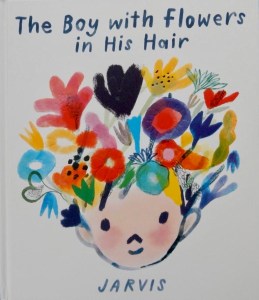
Whimsical, wonderful and full of heart is this latest offering from Jarvis. The narrator is a little boy who is best friends with David the boy with flowers adorning his hair. Both boys are members of a happy class with a caring teacher, Mrs Jones, and nobody show the least concern about David’s unusual hairdo, not even Mrs Jones who gets hay fever; and not even when it attracts bees or a family of birds settles there for a while. 

‘But one day something happened.’ We know not what except that a petal comes off into his friend’s hand as he waters David’s hair. David becomes quiet and uninterested in playing.

The following morning David comes to school wearing for the first time ever, a hat and he’s uncharacteristically quiet. Having removed outdoor garments as Mrs Jones’ instructs, David reveals a ‘twiggy, spiky and brittle’ head sans the remaining petals that fall once his hat is taken off.

Initially David’s classmates are somewhat unnerved and steer clear of the boy, not so his best pal however who remains close not concerned by occasional scratches. He has an idea – a very creative one

– and before long everyone else in the class is involved in project restore David’s colour.

Little by little David regains his joie de vivre and eventually his original flowers too, although his best friend keeps his box of bits and pieces just in case they’re needed ‘Because he’s my best friend, and I am his.’

In Jarvis’s painterly illustrations he shows so beautifully the changing emotions of David and his best friend as well as other members of the class. With themes of acceptance and the power of friendship, his story is a touching demonstration of kindness and supportiveness just when it’s needed. Full of messages adults will want to pass on to youngsters, this book is perfect for sharing and discussing with foundation stage classes, and with young children at home too.

Piano Fingers

Piano Fingers
Caroline Magerl
Walker Books

Adorably quirky and absolutely magical is this latest Caroline Magerl picture book.

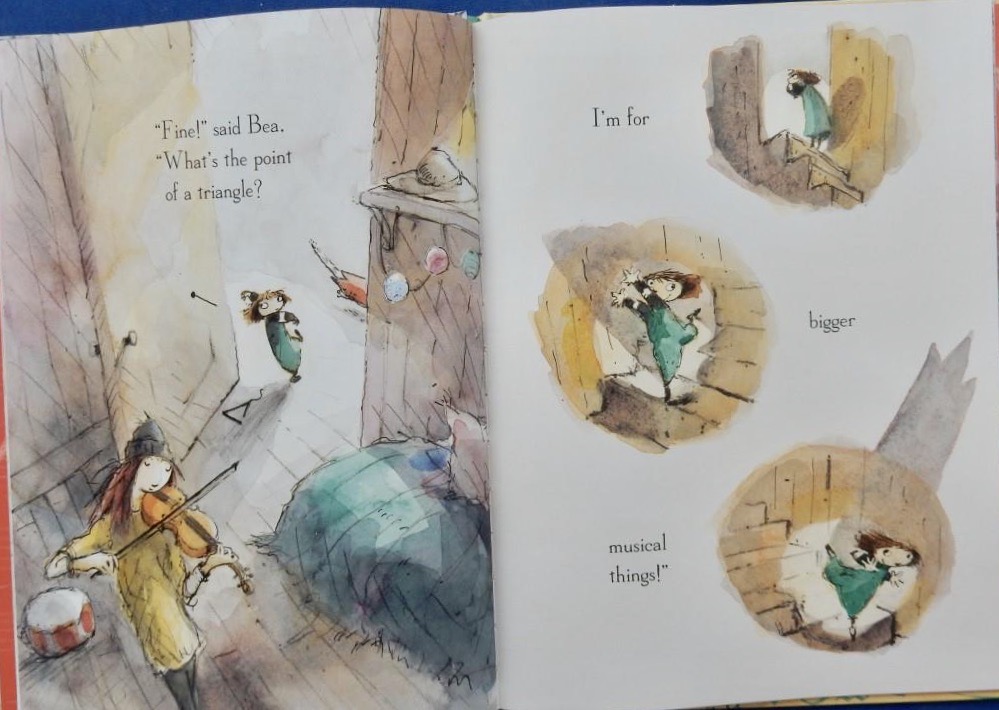
Little Bea comes from a musical family. Her self-confident and a trifle bossy big sister, Isla, creates beautiful music on her violin (her honey fog machine) while Bea, dissatisfied with the bink, bink, bink sound she makes with her triangle, casts it aside and goes to search for something with more potential on which to express her latent talent.

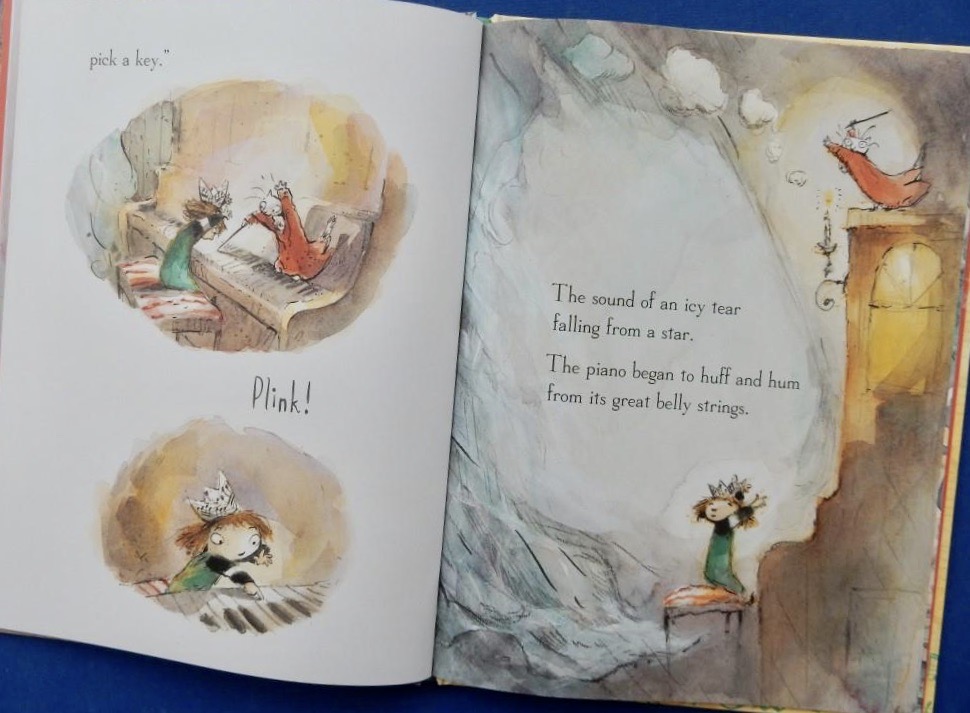
What she discovers is a piano, but despite being ‘a baby mountain’ it doesn’t play the sweet music that Bea yearns for. “The world is not ready for my genius” she declares. However, up steps the encouraging Maestro Gus with his, “There are whole symphonies up those sleeves. All you have to do is …pick a key. And with a plink there comes ‘the sound of an icy tear falling from a star.”

The music swirls forth as ‘A song of winter trees spinning barley sugar clouds for springtime.’ – what a wonderfully sparkling debut. But while Maestro Gus may have helped Bea discover her talent, she subsequently sends him packing outside into the rain in the ‘moth foggy dark’.

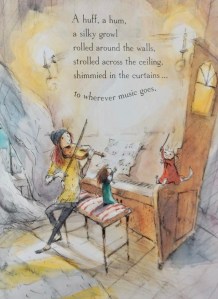
Eventually, back indoors, the three music makers, Isla, Bea and Maestro Gus come together before the Maestro retires for the night.

Their music making will assuredly enchant young listeners to this lyrical story from a hugely talented picture book creator, whose words embody musicality and when read aloud, are as mellifluous as the sounds one imagines emanating from the sisters’ instruments.

A subtle exploration of finding one’s own talent that should act as an encouragement to children to persevere, work hard and follow their passions.

Every Bunny is a Yoga Bunny / Sweet Dreams, Bruno

Every Bunny is a Yoga Bunny
Emily Ann Davison and Deborah Allwright
Nosy Crow

Little bunny Yo-Yo finds it impossible to keep still and going to bed at night, she just can’t sleep. One day Grandpa has a bright idea: he’s going to teach them some yoga he tells the little ones. Roxy and Flo soon manage the bridge and mountain poses; not so Yo-Yo who waggles, wiggles and jiggles. And when it comes to trying tree, two little bunnies can do the breathing and the balancing whereas their sibling is distracted by a passing butterfly which she just has to follow.

Before long she’s lost in a shadowy forest and starts to panic. But then having flopped to the floor she begins to recall some of the things her Grandpa has taught her. First comes the slow breathing and as she calms down she recalls the yoga shapes she’s been shown

and with her thoughts no longer whizzing, she’s able to imagine the route that will take her all the way home. Once there she finds the others still doing yoga. Can she join them and this time, stay calm and still?

Following debut author Emily Ann Davison’s sweet story, are instructions and demonstrations by Yo-Yo of six yoga poses, to help young children breathe, stretch and feel calm. Deborah Allwright’s amusing illustrations made the yoga teacher part of me giggle as I recalled some of the Yo-Yos I’ve encountered in classes over the years.

Published in collaboration with the National Trust, there’s a QR code inside the front cover of the book which if scanned with a mobile provides a free reading of the book.

Sweet Dreams, Bruno
Knister and Eve Tharlet
minedition

Despite it being that time of year, young marmot, Bruno is reluctant to settle down for a long winter sleep. Various other of the animals offer alternatives: goat suggests spending winter climbing on
the slippery rocks; jackdaw says he can share her nest high up in a tree; he could brave the moggies in the farmhouse and move in with mouse, join hare and romp in the snow or even accompany the swallows and winter in Africa. However none of these are feasible for the little creature and with a yawn and a sigh, Bruno decides, “I guess everyone spends winter in their own way. For a marmot hibernation’s the best.” Bidding a temporary farewell to his friends, he settles down in his cosy den and falls fast asleep.

His dreams provide Bruno with the action and exciting adventures he eschewed in real life as he leaps from mountain top to mountain top – ‘Hooray!’, floats up to join jackdaw in her nest – ‘Amazing!’ and even accompanies mouse on a cat hunt – ‘Woo-hoo!’

There’s further fun too, lasting until voices break into his dreamworld as his friends call him to action for a long summer of togetherness.

Eve Tharlet’s seasonal scenes are at once naturalistic and whimsical adding gentle humour to Knister’s straightforward telling. A story for bedtime sharing or KS1 story sessions.

What Makes a Lemur Listen?

What Makes a Lemur Listen?
Samuel Langley-Swain and Helen Panayi
Owlet Press

This story of Maki, a little ring-tailed lemur living in the Madagascan rainforest, was inspired by the author’s experience of being the parent of a neurodiverse child who, like the protagonist in the book, struggles to listen, especially to instructions.

Fed up with his Mama’s seemingly endless instructions,

Maki ,who always thinks he knows better, decides to go it alone on a ‘big adventure’. No more rules and no having to listen to anyone are his expectations as he moves joyfully across the forest floor. His joy doesn’t last for come nightfall a realisation dawns: Maki is far from home and completely lost. Now, having refused to eat his breakfast, his tummy is rumbly and as the chilly wind blows through the branches, he misses his siblings’ snuggly warmth.

After a night spent alone and scared he wakes and hears a voice responding to his comment. A voice Maki puts down to his imagination; but then he hears further remarks as he looks for food and continues on his way.

Come nightfall once more, Maki stops again and curls up (on a branch so he thinks) but the voice continues and mentions something very long and scaly.

Just in the nick of time, Maki responds to the “Run!’ command he hears from a small rainbow coloured creature. Then from a safe hiding place he realises that the voice he’s been hearing all the while has been that of a savvy chameleon – Sofina – as she introduces herself. Surprised that she knows all about keeping safe and finding food in the forest, Maki is even more surprised at his new friend’s next remark, “I listen to my Mama!” Perhaps now, the little lemur is ready to do likewise.

Young listeners will enjoy finding out how Maki eventually learns to listen, while parents and educators could well learn alternative non-demanding ways to communicate with children be they or be they not, neurodiverse. Debut illustrator, Helen Panayi’s scenes of the lemur family and other creatures Maki encounter are great fun. She captures the young lemur’s changing feelings really well and adds gentle humour to the story: I love the meditating lemurs on the first page.

Zoopertown: X-Ray Rabbit

Zoopertown: X-Ray Rabbit
Jem Packer and Emily Fox
Bloomsbury Children’s Books

This is the first of a new series featuring a group of animals, the Zooperheroes residents of Zoopertown. We meet the five Zoopers as they sit at the table about to consume a delicious breakfast when suddenly toast, cornflakes, waffles and pancakes all disappear simultaneously. But that merely heralds a much bigger catastrophe for as the residents of the town gather in the park for the mayor’s birthday picnic it’s discovered that all the goodies have gone, even Go-Go Gorilla’s scrumptious banana birthday cake.

To assist with his crisis Go-Go doesn’t call out Zoom-Zoom Zebra, Zip-Zap Giraffe, Snap-Crack Croc, Crash-Bang Koala; he knows that the only Zooperhero for this task is X-Ray Rabbit with her X-Ray power. Off she zooms towards the park on her vehicle – a Zooper Scooter – of course, but en route she notices, thanks to her sharp-sightedness, a trail of banana skins that lead her right out of town, through the forest to … the Atrocious Tower of Terror.

Therein resides the dastardly food-snatching baboon: he’s about to consume a birthday cake and it certainly isn’t his. Furious, not only about not being invited to the party, but by the intrusion of X-Ray Rabbit, he zaps her, trapping her in his stinky lair. Is she doomed or can she escape the clutches of Kaboom Baboon and even save the celebrations?

Perhaps, with some timely assistance from her fellow Zooperheroes.

I suspect little human would-be superheroes will relish this action-packed tale, welcome the arrival of its super-cast each with a special personal super-power and be eager for further adventures. Jem Packer’s use of wordplay throughout the narrative adds to the fun and Emily Fox’s dramatic scenes
especially those of the endearing quintet engaging in the high-octane operation are full of comic-style panache.

Elephant Island

Elephant Island
Leo Timmers
Gecko Press

As the result of a boisterous wave, seafarer Arnold elephant’s boat is destroyed. Hours later he reaches a tiny island upon which he lands and calls for help. There’s no response although his captain’s hat does float by, and with it back on his head, Arnold is able to spy a small ship in the distance. Said ship belongs to a mouse. Rescued at last – hurrah! But then …

Fortunately Arnold is familiar with a fair few knots, some of which he uses to effect, only to sabotage things when he steps aboard the next craft of a would-be rescuer. Once again it’s operation salvage as the pachyderm fashions an ever more unlikely intricate structure from the fragments, sufficiently large to accommodate everyone whose boat he’s inadvertently incapacitated.

It’s not long before Elephant Island (complete with waffle maker) becomes a ‘go to’ destination and thanks to Arnold’s welcoming attitude an ever expanding one.

Where will all this end?

Then another storm blows up; should everyone now go home, or not …

With a deliciously un-self aware, but hugely adept constructor as its main character and a splendidly silly story to star in, Leo Timmers’ illustrations steal the show. Every one is a testament to creative play and collaborative construction, increasingly full of wacky detail to pore over and giggle at. I can see Arnold’s tale becoming a storytime favourite.

Baby Bunny’s Easter Surprise / Ready! Said Rabbit

Baby Bunny’s Easter Surprise
Helen Baugh and Nick East
Harper Collins Children’s Books

With an appropriately bouncy rhyming narrative and equally spirited illustrations, team Baugh and East entertain young humans (and adult sharers) with what happens when one adorable-looking baby bunny Letty, trails her Easter Bunny mummy one Easter morning on her delivery of yummy chocolate eggs intended for the woodland dwelling creatures.
The problem is though that every egg that is so carefully placed, be it high up in a tree, low down beside the pond or a-top toadstools is so simply irresistible that little Letty, with all her senses alert, just cannot stop herself (even though she knows it’s not the right thing to do) from taking just one ‘teeny-weeny, titchy taste’ – and she’s overcome by such a superchoccylicious sensation that … I’m sure you can guess where this is going.
No matter, thinks the baby bunny, nobody else can possibly know what she’s been up to.

However, despite Letty’s repeated assertion that her misdeeds are undetectable, there’s absolutely no fooling her Mummy. Time to make amends; but that leaves mother and baby with an empty basket and Little Bunny eggless.

Or …

Much better and definitely longer lasting than chocolate eggs, get this for your little ones as an Easter treat.

Ready! said Rabbit
Marjoke Henrichs
Scallywag Press

As this second episode in the life of Dad rabbit and his little one begins, the clock on the wall says 9 o’clock. Dad announces that it’s a good day for a visit to the park and immediately the youngster starts enthusing about possibilities such as picnicking as well as mentioning all kinds of things to take along while Dad urges “Time to get ready!”. 

However it takes several changes of clothes before Dad is satisfied with the suitability of Rabbit’s attire. Then there’s the business of assembling snacks and with that completed, Rabbit finds more opportunities for getting distracted from the task in hand. 

With the clock at 11.20 Rabbit finally announces, “READY!”

Now it’s Dad’s turn to delay their departure: first there’s a phone call; then some important items are missing (hidden in plain sight) which they can’t leave without 

and it’s not until one o’clock that both parties agree that they’re ready to sally forth – hurrah!

Adult sharers of this story will appreciate the gentle irony of the situation perhaps more than young children. The latter will especially enjoy Dad’s drollery and the numerous opportunities to join in with the oft repeated “READY!” as well as the delightful details on every spread.

Some of those slightly older than Rabbit might try reading the book themselves once an adult has read it aloud: the large clear print, close match of text and illustrations, and the natural repetition all make it ideal as they encourage anticipation and prediction, both of which are vital elements of early literacy development.

Little Chick Grows Up / Little Rabbit Has Friends

Little Chick Grows Up
Yu Hongcheng
minedition

Presented from the viewpoint of Little Chick we follow him from the time he emerges from his shell in spring and takes those first cheeps through the months until autumn when he’s a full-sized rooster.
Soon after hatching he, along with lots of siblings is ready – under his mother hen’s watchful eye and guidance – to start finding food and standing up for himself, always alert for ‘bad’ animals around the farmyard.
Eventually Mum decides it’s time to leave the chicks to look after themselves; are the youngsters ready? Will they find somewhere safe to sleep? And what about finding the right things to eat without her guidance?

Will they be able to stand up to bullies and stay alert for danger. What happens when Boss Rooster shows up to challenge them?

From endpaper to endpaper, Yu Hongcheng’s superb illustrations, which accompany her first person narrative are a wonder to behold in this book that will be enjoyed by children and adults.

Little Rabbit Has Friends
Marcus Herrenberger (translated by Kathryn Bishop)
minedition

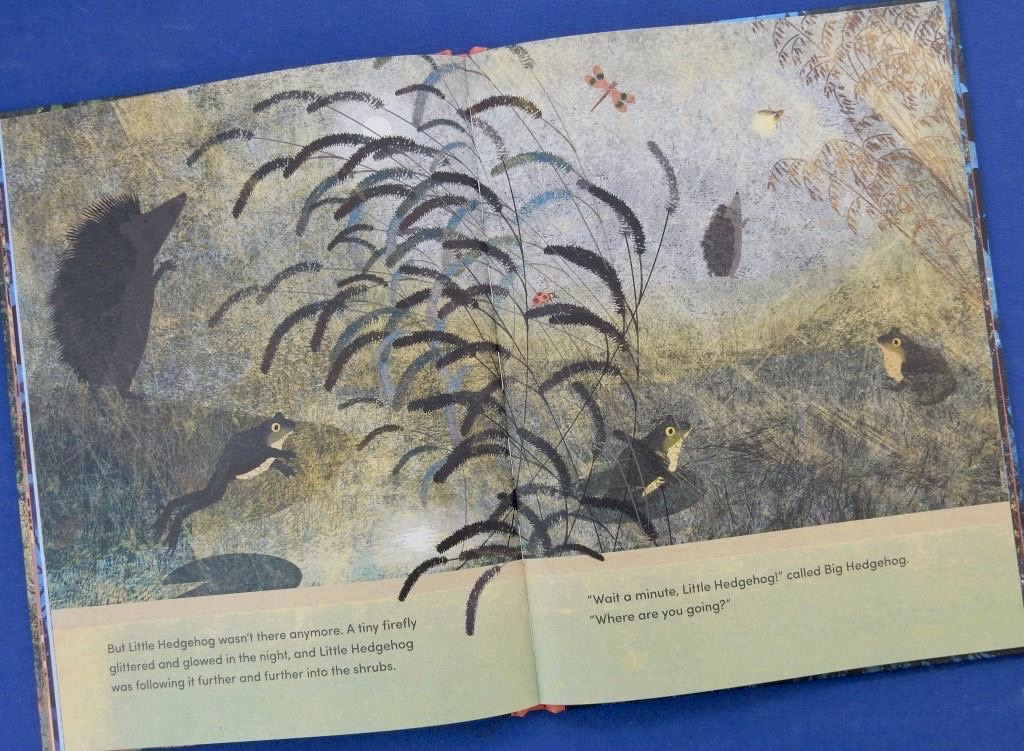
It’s not always peace and harmony in the forest for it’s a place where predators live; predators such as the fox. The very fox that, a raven informs Wren, is planning on eating his friend, Little Rabbit that day.
Wren immediately hurries off to tell Mouse and then the two proceed to tell a hedgehog, a nuthatch, a squirrel, and a mother pig. All the while their worries about Little Rabbit are mixed with concerns about their own safety but nonetheless they feel they must do something to help.

However when wild pig refuses to help, the five friends go to visit Little Rabbit to say farewell.

The terrified creatures know he’s about to become the fox’s next meal, but that’s not quite what happens after all …

Striking watercolour illustrations of the forest inhabitants show how when the less strong work together, their combined power can work wonders. Somehow at the same time both realistic and full of feeling, they make readers and listeners feel part of the unfolding drama.

The King’s Ship / If You Want to Knit Some Mittens

The King’s Ship
Valerio Vidali
Farshore

This story has its origins in the true history of a 17th century Swedish warship named the Vasa, built as a symbol of the Swedish king’s greatness when the country was at war with Poland.

Long, long ago a rich and powerful king had everything he wanted, other than one thing – a ship. All the carpenters in the kingdom are summoned and ordered to build a great ship for the king. They set to work felling trees 

and constructing but when the king sees what they’ve made he declares it too small. The carpenters are ordered to build a bigger one and do so. This time the completed ship meets the size requirements but something is lacking. First it’s cannons to make the ship terrifying but even when those are loaded the king isn’t satisfied. He wants things of beauty aboard and so on go his highness’s marble statues. 

No doubt readers will see where this is going but not the king. He is very happy with his big, terrifying, beautiful ship. Now comes an order for everyone to come and admire the thing …

Vidali’s cautionary tale is imbued with a sense of tongue-in-cheek playfulness and mischief, both verbal and visual; his straightforward, spare telling with that final twist in combination with his droll illustrations of the construction process work harmoniously towards the final revelation.

If You Want to Knit Some Mittens
Laura Purdie Salas and Angela Matteson
Boyds Mills Press

If as the title says, you want to knit some mittens, the first thing you should do is get a sheep. Of course you do! Especially if you happen to be at the apple stall with dad and spot it in a field just behind. Then having taken it back home in Dad’s truck, she needs keeping warm all through the cold winter. This mitten making is no quick job as by now is clear and in the meantime the sheep can grow a thick coat, which come spring will need attention.

And of course, the fleece that’s been sheared will have to be washed, dried and untangled (carding this is called). Next comes spinning and by the way, a spinning wheel has a soporific effect on your sheep.

Now comes the consideration of what colour should the mittens be. Happily despite your chosen colour not being that the sheep has naturally, you’ve a place to grow marigolds. Some waiting follows and more waiting. Eventually the marigolds can be picked and sun dried – well away from lively activity needless to say. 

Dyeing the yarn comes once the marigolds have throughly dried, so soak them and place the yarn in that natural dye, hang the coloured yarn to dry and finally get out those knitting needles and click, click, click.

More waiting – who wants to wear mittens in the summer – and when winter arrives again, celebrate your ‘golden sun’ hands and off you go outside to play with your friend Sheep. Hurrah! Was it all worth it – you bet!

Wonderfully whimsical – there are some delightfully humorous tips included along with the eighteen steps – and there’s even a disclaimer on the copyright page concerning the suggestions made in the story about possible injuries should readers try to be crafty and emulate the small girl protagonist. Angela Matteson’s illustrations supply plenty more amusing details as they follow girl and sheep through the year, documenting their activities together along with occasional playful incursions by various other farm animals.

Too Big or Too Small? / Pompon

Too Big or Too Small?
Catherine Leblanc and Eve Tharlet
minedition

Where his parents are concerned, little bear, Martin just can’t win with his actions. “Don’t be silly, Martin” says Mama when the cub sees his baby sister drinking from a bottle and asks for a bottle, too – “you’re far too big for a bottle!” (Is she aware of sibling jealousy one wonders.) Shortly after when the cub tries using a knife to cut his food, she insists on doing it for him. (Why not show him how to help himself?).
Then his father chastises him for dragging his favourite soft toy animal around all the time – apparently he’s too big to take him out; but then he won’t allow him to use his mobile “No Martin. you’re still too small … you might break it.”
Now Martin isn’t one to be completely dominated and tries to find some ways of his own to show his parents how he feels about what’s been happening.

He also makes the occasional comments about what his parents are attempting to do: “Mama, aren’t you too big to do that?” is his comment on seeing her taking a fingerful of chocolate frosting while baking. Eventually both Mama and Papa come to realise they need to give more importance to doing things they can all enjoy together as a family.
It’s great that Catherine Leblanc makes Martin himself instrumental in changing his mum and dad’s parenting in this fun demonstration of child activism. Throughout the story, Eve Tharlet’s droll scenes are sure to amuse adults as well as young listeners: her portrayal of the bears’ body language and facial expressions are superbly done, especially when the adults are at odds with Martin.

Pompon
Géraldine Elschner and Joanna Boillat
minedition

This story was inspired by a famous real statue almost seven feet long created by French sculptor François Pompon.
The titular Pompon is a large white bear statue in a museum, a statue that fascinates young Leo when he visits one day. Mesmerised Leo stands staring for ages, taking in its shape and enormity, its smooth texture and the curve of its ears. (This we see in Joanna Boillat’s close-ups that extend over half a dozen spreads.) Now Leo has a special magical look in his eyes and cannot resist reaching up and stroking Pompon’s cheek. The museum guard, initially angry,

then softens towards the boy, seemingly understanding how he felt but asking him to promise it was a one time only touch. A touch however that sets off a transformation in the ursine statue; wings appear on its back and Pompon is free and he takes flight, far, far away … Could it perhaps be that he becomes the constellation shown in the final illustration.

A magical tale engagingly and poetically told and even more magically illustrated, particularly on account of the artist’s clever use of the white space of the bear’s form; that, and the contrast with Leo and his red scarf. A book to encourage youngsters to imagine, to dream and to look long at art in all its forms.

The Girl Who Planted Trees

The Girl Who Planted Trees
Caryl Hart and Anastasia Suvorova
Nosy Crow

On learning from her grandpa that the mountain at the foot of which their village home is situated was once covered in a green forest a little girl becomes distraught.

The following morning she sets out up the mountain and at the top begins to dig. Then she plants a single pip and returns home forgetting to water it. When she returns there’s no sign of a shoot and back home Grandpa explains that without water a seed will never grow. Later on she enlists the help of other villagers and after a week she’s ready to return up to the mountain top with a large number of seeds all shapes and sizes. She does this day after day always remembering to water the seeds and it’s not too long before seeds are sprouting up.
Eventually she’s able to show her grandpa the results of her endeavours – a patch of green atop the great grey mountain. But then a fierce storm destroys all the trees.

Refusing to give up, the girl suggests planting more seeds and keeping them close to their home until they’re strong. She and her grandpa do just that and over the weeks their yard becomes filled with pots of thriving seedlings. Then comes the time to transplant them, but the little girl is despondent as she sees that even after all their hard work, it will take ‘a thousand years to cover the whole mountain by ourselves.”

Happily they don’t have to for the little girl has inspired the entire village to help restore the forest to its former greenness – a place where future generations too will appreciate the beauty and richness of nature.
Caryl Hart’s powerful story with its ecological theme shows the importance of conserving our precious trees and is superbly complemented by Anastasia Suvorova’s illustrations showing the changes brought about over the months and years, and all thanks to the determination and resilience of one little girl and a whole lot of pips. A terrific book to share, and bursting with potential for KS1 teachers.

This is the Way in Dog Town / Cheesed Off! / Blue Badger

This is the Way in Dog Town
Ya-Ling Huang
Frances Lincoln Children’s Books

Spend a day in Dog Town with little ones and you’ll soon be singing along to the tune of Here we go round the Mulberry Bush. Just like humans, the residents of this canines only town start by brushing their teeth, after which they get dressed (with a bit of adult assistance) as they ‘Pull, pull, pull!’ Then it’s off to school, hurrying of course as there’s so much there to enjoy be it drawing, playing outdoors and having lunch at midday. Duly sated, ‘Yum, yum, yum!’the afternoon is spent painting and swimming. Early in the evening, the young dogs, walk home and once indoors the way they eat their dinner is let’s say rather messy as they ‘Slurp, slurp, slurp! their way through plates full of spaghetti. So, it’s as well they have a jolly good scrub in the bath later in the evening before retiring to bed.

As they share this book with an adult, little humans will enjoy joining in with action words, as well as emulating the puppies’ actions and exploring the various busy scenes created by Ya-Ling Huang.

Cheesed Off!
Jake Hope and Genevieve Aspinall
uclan publishing

The humans are having a party and it’s time for the photos: on the count of three everyone say “Cheese!” but what about that warning sign at the start of this book – the one about a certain word bringing mice from their house. Too late! The partiers have uttered the word and it’s been heard behind the skirting board. Out come the mice but not a whiff of cheese can they detect. Not a single sighting of a sliver can they spy no matter how hard they try.
Then suddenly an announcement is made and something with candles atop is carried in. Now what might that be …

Huge fun for those in the early stages of becoming readers especially, is Jake Hope’s extended joke illustrated with lots of amusing details from the viewpoint of the mowses’ – oops, make that mice. Therein Genevieve Aspinall shows how humans don’t always realise what’s actually going on right under their noses – or, to be more accurate, beneath their feet.

Blue Badger
Huw Lewis Jones and Ben Sanders
Happy Yak

Badger is having an identity crisis: is he black or is he white – albeit with a blue bottom having sat down beneath a bush to eat berries. Off he goes to ask the opinion of other creatures. Bird is unsure, Dog doesn’t know either although he admires Badger’s blue rear and invites him to play. Both Cow and Skunk are dismissive whereas Zebra is equally nonplussed about his own colour markings and Panda merely takes the opportunity for some self-flattery.
Whale sends Badger off to meet Penguin whose considered response is both helpful and constructive, making Badger feel much more positive about himself as well as perhaps, a tad hungry … Happiness at last.

Author Huw Lewis Jones adopts an almost detached tone to his gently humorous text that includes a repeat refrain, while Ben Sanders places his black and white characters on stark, coloured backgrounds in this story with its ‘You can be whatever you want to be’ message.

Esme and the Sabre-Toothed Cub / Rita Wants a Dragon

Esme and the Sabre-Toothed Cub
Simon Philip and Magda Brol
Oxford Children’s Books

Could it be that Esme’s best friend Morris the mammoth has his tusks put slightly out of joint when a little sabre-toothed tiger cub appears in the village and charms all the cave kids by its actions. Despite the adults having shooed it away on several consecutive days, Esme asks the visitor she’s named Seb, “Would you like to be my pet?” However, Seb is far from impressed at receiving one order after another from the little stone age girl who eventually gets the message that the creature has no intention of becoming anyone’s pet.

Morris however, decides that perhaps friendship could be the way to go and of course, Esme is eager to join in their fun and games, albeit from some way off. Then trouble rears its ferocious head.

Can Esme save the day and learn a thing or two as well?

With certain similarities to our 21st century world, Simon Philip’s second story of bossy young Esme and her fellow troglodytes is another humorous read aloud, made even more so by Magda Brol’s highly exuberant scenes of this endearing prehistoric community.

Rita Wants a Dragon
Máire Zepf and Mr Ando
Graffeg

In the fifth of this series starring the small girl with a huge imagination, young Rita is having a bad day. Everything is going wrong and she imagines a large fiery dragon to represent her angry feelings. However, even dragons can’t remain in an angry state all the time – it’s hugely exhausting to roar

and rant, stomp and stamp and breathe fiery flames so it’s as well that they can take flight and find somewhere alone to do some slow breathing to help that rage dissipate and to talk calmly about what has gone wrong. Then anger diffused, it’s time for a snuggly cuddle with a loving grown-up, a mum for example.

With powerful images created by Mr Ando on every spread, Máire Zeph’s tale of Rita’s challenging behaviour offers parents and educators in early years settings an enjoyable starting point for discussions about feelings of anger and how to cope with them.

Goodbye Bear

Goodbye Bear
Jane Chapman
Little Tiger

Beaver and Mole are heartbroken at the loss of their dear friend, Bear. They offer gentle support and comfort to one another as they experience a gamut of emotions including sadness, anger, numbness and sometimes think they can hear Bear’s voice.

The seasons change and with Spring almost upon them, Beaver and Mole decide to pay a visit to Bear’s treehouse. “ … The woods will be full of snowdrops. Bear loved snowdrops,” Mole says as they head off through the woods.

Once outside they discover Bear’s ladder and boxes of nails and decide to put up the ladder and go inside. “Bear loved us, Mole says, “and he wouldn’t mind in the slightest.” What they discover inside makes the two decide to finish the treehouse that Bear had started and invite all their friends to come and assist with the project.

As they work, the animals take turns to share their fond memories of Bear, finding joy in so doing, as well as in their joint project.

With the task nearing completion Mouse finds finds an old painting and then finally as they sit together celebrating Bear and sharing cake they find out that their friend had been planning an awesome surprise for them. It’s one they can always treasure, just like their memories.

This is such a beautiful, sensitively written and illustrated book. Jane’s illustrations chronicles the passage of time through the changing seasons, while also showing that although some of their feelings such as anger will dissipate over the months, their fond feelings remain constant. The sharing of grief helps ease the pain of loss and makes remembering so much more joyful.  

A wonderful story to read together as a family or with a KS1 class.

Ebb and Flo and Their New Friend / The Tale of the Tiny Man

Ebb and Flo and Their New Friend
Jane Simmons
Graffeg

Jane Simmons’ books with their gorgeous, soft focus, painterly illustrations, were very popular with foundation stage classes in my early teaching days and it’s good to see Graffeg reintroducing Ebb and Flo to a new generation of young children.

For those unfamiliar with the characters and their adventures, Ebb is a dog and Flo a young girl. They live near the sea and are constant companions. As this story opens the two of them are sitting in their boat with Ebb in her favourite spot in the bow when suddenly her place is usurped by a large bird. Flo urges Ebb to accept the visitor as a friend but Ebb is anything but accepting of the newcomer with its frequent ‘beep, beep, beep’ sounds. 

As the days pass even Granny takes to Bird, giving it some of Ebb’s favourite snacks. 

Ebb wishes Bird gone and the following morning, to Flo’s disappointment, the wish has come true.

However, it quickly becomes an instance of you don’t know what you’ve got until it’s gone, for Ebb finds herself missing Bird and that beeping, especially when as the summer days pass, they see reminders on their journeys along the river. 

Then one day, Ebb hears a familiar sound: could it be …

This gentle exploration of change, jealousy and the challenges of accepting a new friend into an established group, will resonate with many young listeners who will likely look forward to hearing more about Ebb and Flo in the other titles Graffeg will also publish.

The Tale of the Tiny Man
Barbro Lindgren (translated by Julia Marshall), illustrated by Eva Eriksson
Gecko Press

This is a re-illustrated classic tale from Sweden originally published over thirty years ago. It tells of a tiny and sad man who lives a very lonely life ignored and sometimes mistreated by other people perhaps because ‘he was too small and possibly a bit slow.’
One day as spring approaches he attaches a note to a tree ‘Friend Wanted’ and giving his name and address. For ten days he waits, sitting on his doorstep by day, and crying at night on account of the blackbirds’ song. Then on the tenth night he’s dozed off only to be awakened by a large and playful stray dog.
Little by little over the next few days, the tiny man’s kind actions gain the animal’s friendship and trust. It moves in to share the man’s house, his food and even his bedroom. 

When they’re out and about, the dog protects the tiny man from bullies.

By summer life together is happy for both tiny man and big dog. Come the following spring however, a cheerful little girl comes along and she too makes friends with the dog causing the tiny man to feel left out and hurt. 

Convinced he can’t compete with the little girl, full of sorrow the tiny man wanders off into the woods. For seven days he roams alone; meanwhile dog and child sit on the steps wondering where the man has gone. On the eighth day the tiny man returns to find on his doorstep, a dejected dog and an equally dejected little girl. Can it be that this friendship can accommodate three? Is there room in dog’s heart for two human friends and in the tiny man’s heart for the dog and the girl?

With its themes of loneliness and friendship, this beautifully told and illustrated story looks at various emotions including empathy, loneliness and prejudice. Whether read alone or aloud, there’s much to think about and one hopes, talk about with family members and/or classmates.

Teapot Trouble

Teapot Trouble
Morag Hood
Two Hoots

Stars of Spaghetti Hunters, the highly opinionated Tiny Horse and Duck – he’s the thoughtful, pragmatic one – return in a new story. Duck has a problem and is far from happy: a crab has taken up residence in his teapot. Of course, Tiny Horse knows exactly how to sort out a teapot disaster; all that’s required is a wave of a whisk – or maybe not …

No matter: know-all Tiny Horse has plenty of other tools to try – a toothbrush and a net for instance; moreover, once Duck has almost certainly identified his teapot usurper, the diminutive horse claims to be an experienced crab-tamer – a picnic will definitely lure the unwanted visitor out. 

Failure follows failure until poor Duck is convinced he’ll never reclaim his teapot home.

Problem solved, announces Tiny Horse but his friend thinks otherwise. 

Now at a complete loss, off Duck stomps teapot on his back, to the beach for a spot of shell collecting. Needless to say Tiny Horse ridicules the notion of a shell teapot; but what will the outcome of this potty problem be?

Morag Hood’s wonderfully quirky wry humour will have both children and adults laughing out loud over this latest of her terrific picture books. I love the characters and I love the way they interact.

A Good Place

A Good Place
Lucy Cousins
Walker Books

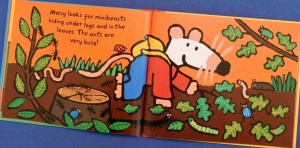
Insect friends Bee, Ladybird, Beetle and Dragonfly all set out in search of a good place to live but they all want different things. Bee desires flowers, Ladybird loves leaves, it’s dead wood for Beetle and Dragonfly wants a pond.

In turn each of them finds what seems to be the ideal place,

but all have danger or unpleasantness lurking ready to strike at any moment. 

Hungry, sick and exhausted, the friends are in despair; but then a beautiful butterfly appears and asks what is wrong. When she hears the problem, she offers to help. Might it perhaps be that what their new friend shows them could be the perfect place – somewhere that fulfils all their hopes?

What a gorgeous book: a cleverly crafted text with repetition that youngsters will love to join in with; using a vivid colour palette and bold patterns, Lucy’s portrayal of the intrepid insects will surely evoke sympathy from young readers and one hopes, inspire their own efforts to create ‘A Good Place’ for minibeasts to inhabit.

Perfect for story time sessions and for beginning readers. Definitely my favourite Lucy Cousins book for many a long day.

Chirp! / Five Little Chicks

Chirp!
Mary Murphy
Walker Books

As a new day begins, each bird adds its voice to the dawn chorus. The Thrush warbles, Blackbird whistles ‘Tooraloo’ and then in turn we hear a sequence of onomatopoeic contributions from the Wren, the Lark, the Finch,

the Robin, the Swallow, followed by Wagtails, a Starling, Magpies, the farmyard Goose, Duck and Hen, the Pigeon and the Cockerel.

Suddenly into the crescendo of early morning sound, from a tiny blue unnamed bird that’s been watching and waiting patiently, comes a “Hush! It’s my turn to sing.” It then adds a zippy-zippy-zippeeeeee that serves as a reminder that. ‘ … We all have something to say. / We all get to shout / for a brand new / day!’

As it is with our feathered friends, so it should be for humans: everyone deserves a chance to get his or her voice heard.
With its wealth of sounds that cry out to be echoed by little humans, this is a fun story with an important message at its heart. And what an abundance of sound/symbol associations to be enjoyed.

Five Little Chicks
Lily Murray and Holly Surplice
Templar Publishing

In Lily Murray’s version of the nursery song Five Little Ducks, she’s replaced the ducks with chicks and a Mama Hen and makes the entire text more interactive by asking after every foray over the hills, ‘Now how many chicks / can you see?’, as well as offering some seemingly irresistible bait to her offspring. It certainly has the desired effect and there’s a lovely final surprise for Mama Chick provided by her little ones.

Holly Surplice has included lots of other baby animals and their parents in her springtime illustrations of the chickens and their adventure that takes them through a flower-filled meadow, a bluebell wood, a field of gambolling lambs, a farmyard and beside the stream.

Every one of the scenes is absolutely bursting with bold images and bright colour; and ramping up the interactive nature of the book are the numerous flaps to explore on every spread.

Little humans will definitely enjoy sharing this with their own mother figures, particularly around Mother’s Day and Easter, though this is a book that youngsters will want to go back to time and again. With it’s predictable text it’s also a good one for those in the early stages of reading to try for themselves.

The Tiger Who Came For Dinner / The Littlest Elephant

The Tiger Who Came For Dinner
Steve Smallman and Joëlle Dreidemy
Little Tiger

In this fourth story to feature Wolf, Hotpot the lamb and their crocodile, Omelette, the friends are playing their favourite game of fetch when instead of a stick, Omelette brings back a tiny, soggy lost tiger. Hotpot is keen to keep the little thing but Wolf shakes his head “ … little tiger’s family must live further up the river. We have to take her home,” he says.
Next day off they go and on the way they encounter other animals, all of which think the little cub is a delight.

Omelette however, is not sure and becomes even less so as their journey continues; moreover he is able to recognise crocodile tears.

The following morning the group reaches a cottage – it’s the tiger cub’s home at last – and the little cub had a tricky plan tucked in his fur all the time. Can anybody save the day?

As with previous titles in the series, the importance of friendship is key. Steve and Joelle imbue the characters with warmth and oodles of personality and those already familiar with the other books will gobble up this one; however it matters little if you start here: this witty tale still works as a smashing read aloud.

The Littlest Elephant
Kate Read
Two Hoots

Having just learned to swim, such is Ellie the littlest elephant’s enthusiasm that in her haste to demonstrate her new skill, she charges off to the pool to be first in the water. On the way though, she dislodges chameleon, frightens the frogs, disturbs the monkeys’ mangoes scattering them far and wide, upsets the minibeasts and the birds,

stamps on the tiger’s tail and almost squishes a little mouse. Only then does she stop and pay heed to their warning cries to slow down and watch where she’s going. Time for some apologies realises Ellie, and with them duly accepted, all the animals head off to the swim together, with the littlest pachyderm being mindful of the wise words her new friends have spoken, until they eventually reach the pool.

Now to make the biggest splash EVER!

Kate Read captures Ellie elephant’s excitement beautifully in her bold, bright mixed media illustrations while at the same time portraying the feelings of creatures she encounters on her charge through the jungle equally well. Her story reminds youngsters – indeed all of us – of the the need to slow down sometimes, to be mindful of others , and to show empathy, consideration and kindness towards them; important lessons delivered unobtrusively in a fun picturebook.

Mindi and the Goose No One Else Could See

Mindi and the Goose No One Else Could See
Sam McBratney and Linda Ólafsdóttir
Walker Books

Young Mindi has a night time problem; it appears in her bedroom, ‘quietly as a thought comes into your head,’ in the form of a large shadowy goose, staying as long as it wants. Neither of her parents can see it but do their best to dispel her fears.

“Well, you’ll just have to close your eyes and make it not real,” says her mother.

Concerned, her father goes off to consult a wise farmer, Austen, who lives up on the hill. He suggests that both Mindi and her dad come up to visit his farm, and when they do so, he introduces the girl to his animals, including two geese before taking her inside for a drink. Suddenly, into the kitchen strolls a young goat to which Mindi takes a great liking, naming her Black-and-Whitey. On the way home however, Mindi admits she likes the Shelling Hill geese but still insists that BIG goose isn’t nice.

About a week later, who should come to visit on a wet day but Austen, plus the goat Mindi liked.

Austen says he will give her the goat but must have something in exchange. Could that perhaps be Big Goose …
What a superbly understanding character is farmer Austen who shows such empathy towards Mindi, making her become part of the solution to dispelling her fears.

Sam McBratney’s story – a longer text than many of his other titles – is one that many young children will relate to and the ending is hugely satisfying. Linda Ólafsdóttir’s mixed media illustrations – both large and small are simply gorgeous. How well she captures the warmth of Mindi’s loving family and the rural setting of the book. Read aloud or read solo, this has much to offer young audiences.

Dearest One / The Smile

Dearest One
Arielle Dance and Jenny Duke
Lantana Publishing

Warm, heartfelt affirmations of the kind your loving grandmother might share with you are presented in this book.

Look for rainbows and have fun puddle jumping on rainy days, sow seeds of kindness – their effects will last long after you’re gone, 

dance to the song of the wind – it’s music for your soul; be kind to your body and mindful of what you put in it; draw on your inner power to reach your true potential; develop resilience and understand that neither you nor others can always be winners. Then on those dark days use your inner light to find something to get that flame of yours burning 

and never forget that your ancestors’ magic lies within you always acting as a guide, so never forget the stories they’ve told and remember to pass them on to others too. And always keep an open heart: that way love can find you no matter where you are.

Arielle Dance’s lyrical text convey words of wisdom that are not only important in the here and now, but also thoughts to hold within and draw upon at any time, especially when you’re feeling unsure about the future. In combination with Jenny Duke’s uplifting illustrations into which they’re set, they offer a beautiful book to give a young child, that an adult will surely love reading too.

The Smile
Marie Voigt
Oxford Children’s Books

At the start of a picnic, a baby smiles at an older sibling and the joyful reaction of the recipient has such power it begins a chain response that travels all around the world, eventually coming full circle in this series of visual anecdotes.

The thing about smiles is that we have the power to give an infinite number: a single smile might turn someone’s sadness into happiness there and then; or alternatively a seemingly simple action such as sending a loving message to somebody far away can, after some time has passed, also bring a smile to the face of the receiver; perhaps even somebody unknown.

In the country village and its environs where I currently spend a lot of my time, almost every person one encounters while out walking smiles at you or smiles back at your smile, whereas in suburban London where I spend the rest of my time, it’s relatively rare for somebody to look you in the face, let alone smile. Perhaps if a copy of Marie’s beautifully illustrated book were given to all parents of young children, it might start a smile revolution.

When Creature Met Creature

When Creature Met Creature
John Agard and Satoshi Kitamura
Scallywag Press

As we discover in this superb collaboration between two multi-award winners, poet John Agard and illustrator Satoshi Kitamura, furry Creature-of-No-Words lives a happy, silent, ‘never in a hurry’ existence until one day, for no real reason he gets a feeling, ‘this feeling like the chill touch of ice’.
Nothing he tries, not self thumping nor groaning loudly or even cloud gazing, can shift his overwhelming feeling of sadness, even though sad isn’t a word he’s able to say.

Then along comes Creature-of-Words, another being, also happy with her furiness and ‘never in a hurry’, but altogether different with her vocal phrases that she loves to speak aloud. Empathetic soul that she is, she watches and senses her fellow creature’s utter despair.

What happens thereafter is enormously uplifting and powerfully portrayed in both words and wonderfully expressive, richly patterned vibrant scenes of the two characters’ interactions, be they silent and vocal.

Both humorous and poignant, this look at the importance and power of communication, is a thought-provoking, memorable ‘just-so’ kind of story. In addition to being a book that will resonate with listeners and readers, it’s a wonderful starting point for classroom explorations of ways of relating to, and expressing our feelings to our fellow creatures.

The Hotel For Bugs

The Hotel For Bugs
Suzy Senior and Leire Martín
Little Tiger

The excitement is huge when the brand new, absolutely fabulous Hotel for Bugs opens its doors for business. In surge the masses of mini beasts eager to sample the tasty treats on offer at the buffet and the fancy facilities such as the spa and club. Perfect for a relaxing holiday.
Then, into the lobby slides a shiny, squishy and blobby slug, leaving a trail of glittering slime in its wake and asking to book a room. More than a tad alarmed, the manager tells the prospective client that the hotel is already full and that anyway, slugs are not welcome.

Nonplussed, out glides said slug leaving a relieved manager and a crowd of onlookers that have gathered to watch the proceedings.

However, it takes just one tiny little bug to speak out, demanding to know why the slug has been sent away. After all, starting with herself, every single one of their number could be thought of as ‘different’ in some way; and before long, the other bugs are contributing supportive comments, each pointing out (or otherwise making known) its own distinctive features.

Has the manager made an irreparable error in her treatment of the slug, or is there a way that the situation can be fixed for every single one of the creatures that entered the portals of the establishment that day?

Suzy Senior’s jaunty rhyming text together with Leire Martín’s brightly coloured creepy crawly characters portrayed with their idiosyncratic features, show the importance of inclusivity and that difference is something to embrace and celebrate rather than fear.

John Agard’s Windrush Child

John Agard’s Windrush Child
John Agard and Sophie Bass
Walker Books

With a final embrace from his Gran, Windrush child waves farewell to his Caribbean home, and with his parents, boards a ship to sail across the ocean to Britain and a new life. As the blue waters roll past, the boy’s parents remember ‘story time yard and mango mornings’ as they anticipate fresh beginnings in the hope that everything will turn out all right. 

The child recalls his grandmother’s parting entreaty to remember to write as she bestows that last fond hug.

On dry land at last, as the family walk away from the ship, they feel unsure on their feet. Then once ensconced in a new home, Windrush child keeps his word, telling his grandmother in a letter about ‘stepping into history, bringing your Caribbean eye to another horizon’ her words but now winging their way back.

Meanwhile the new arrivals have much to learn about this place where so much is different and where so many challenges await. For as poet John Agard writes in his author’s note, those from the Empire Windrush and many other ships brought with them ‘Caribbean culture’ that ‘had such a powerful and positive impact on British culture’ making Britain a much better place because of them.

The author’s hugely moving, lyrical and haunting evocation of the journey families of the Windrush generation made is rendered all the more powerful by Sophie Bass’ vibrant illustrations – a vibrancy that truly reflects the richness of the contribution made by those who came.

An important book that needs to be shared as widely as possible in homes and primary schools.

Not That Pet!

Not That Pet!
Smriti Halls and Rosalind Beardshaw
Walker Books

Mabel is super excited: her family is getting a pet and she’s allowed to choose it from the pet shop she visits along with her mum and little brother. Her choice is – wait for it – an elephant! He’s a splendid hugger, gives terrific rides, makes a super slide and is really useful when it comes to watering the plants and pulling up weeds. However, he also tramples on all the family’s fruit and worst of all, sits on Mabel’s mum. “Not that pet!” comes the cry, “Choose something smaller!” And Mabel obligingly does so.

The elephant is replaced by ants, lots of them and they march through the house eventually finding their way into Dad’s underpants – yikes! You can guess what his instant reaction is, followed by instructions to choose something they can all see.

And so it continues with a skunk, a snake, a spider,

worms and several others. Poor pet shop Pete: will he ever deliver something that satisfies everyone. Eventually, close to giving up Mabel has a good think and what she thinks is ‘I just need to pick something furry and sweet … something friendly that everyone likes.’ Now what could that possibly be? It’s definitely not what you’d expect.

The final reveal will surely come as a surprise to readers and listeners. I love a fun final twist and this book certainly has that and much more. Smriti’s rhyming narrative reads aloud well and is huge fun and Rosalind Beardshaw’s illustrations are full of details to explore and giggle over, not least the bathroom scene and that of the visitors to Dad’s underpants, Make sure you watch the antics of Mabel’s little brother too: he’s a real cutie. Altogether a smashing storytime winner methinks, and one sure to get children talking.

Me, in the Middle

Me, in the Middle
Annette Demetriou and Angela Mayers
Owlet Press

Annette Demetriou’s story has its origins in a childhood experience of her own that caused her to feel she didn’t visually fit into a category.

The little girl, protagonist Georgie belongs to a mixed heritage family: her father’s family are from Uganda and have brown skin; her mother’s family presumably from England, have light skin. When Georgie’s class are having an outdoor lesson on the topic of families one day and their teacher asks them all to go and stand within the chalk outline of the country their parents come from, she has a dilemma and it’s one that leaves her feeling upset as the lesson concludes. ‘Maybe I didn’t belong … anywhere?’ she thinks to herself.
Back at home she’s reluctant to begin working on the family tree Miss Clark has set as homework but her parents soon come to her assistance suggesting the use of photographs and the end product is beautiful – ‘full of colour and so wide, it stretched all the way across the Atlantic Ocean, from England … to East Africa … with me in the middle,’ she says excitedly.

Next day at school, Georgie is proud to show and explain her family tree to the class.

Her teacher’s response is hugely positive and wise as she tells the children that they should never judge a person by external characteristics. ‘We are SO MUCH MORE than what can be seen at first glance,’ she says.

The following day Miss Clark takes the children to the park where, after a ‘family dishes’ picnic, they look at the various trees and compare them to their own family trees ( I love that idea)

and Georgie comes to the realisation that while difference can be special and exciting, people have many things in common too and that’s just fine.

The pride in her roots felt by the protagonist is something everyone should be able to feel and this story, with its wealth of diverse characters as portrayed by Angela Mayers, will help children understand that there are a multitude of ways to make a family unit and that each one is special. Angela’s depictions of Georgie’s changing feelings are beautifully captured throughout.

Definitely a book to add to family bookshelves and primary class collections. In the latter it would make an excellent resource for a topic on families.

My Must-Have Mum

My Must-Have Mum
Maudie Smith and Jen Khatun
Lantana Publishing

This smashing story is told from the perspective of Jake and shows the special close relationship he has with his much-loved mother.

Jake’s mum is an inveterate skip scavenger seeing an opportunity for upcycling almost anything and everything, hence he calls her his ‘must-have mum.’ How the two of them manage to get some of her acquisitions up to their fourteenth floor urban flat, look like pretty difficult tasks, but Jake is hugely supportive of his mum’s unusual collecting habit.
Once home, she straightway starts working, transforming other people’s throw-aways into exciting new things, even working outdoors if necessary.

There’s one person who is anything but enthusiastic about Jake’s mum’s activities and that’s Mr Price. Indeed when he sees her latest effort his comment, “There she goes again. Your mum won’t be satisfied until she’s changed every last thing in the world!” sets alarm bells ringing as Jake lies in bed that night. Suppose she decided to change him too. Best to leave before she has the opportunity to do so, so off Jake goes outside into the cold. And there he remains until morning when he wakes to find …

What his must-have mum says to her ‘one and only must-have son’ is both hugely reassuring and uplifting.

In tandem with Maudie Smith’s words, Jen Khatun’s upbeat illustrations are bursting with energy and full of vibrant detail. This is a book I’d definitely recommend adding to family and primary school classroom collections.

Penelope Snoop Ace Detective

Penelope Snoop Ace Detective
Pamela Butchart and Christine Roussey
Bloomsbury Children’s Books

With several solved cases already under her belt, young Penelope Snoop, so we read, is the best ‘Finder-Outer-in-the-Whole-Wide-World’. Now with the disappearance of her favourite toy, Sidney the Smelly Sock Snake, she’s faced with her most important case so far.
Such is her determination to crack what she decides is a case of theft, that she, together with her canine sidekick, Carlos, are prepared to search high and low for clues, even travelling to the moon and back in a super space blaster.

Although the moon proved to be absolutely empty, her space flight allows her to view planet Earth from above by means of her hugely powerful telescope. And that’s how she realises that her suspect, the mud monster, has been much closer to home all the time.

Back on familiar territory once more, she and Carlos follow a trail that might just lead to the unmasking of Sidney’s stealer …

In Penelope Snoop, Pamela Butchart has created a brilliant character and one who, thanks in no small part to Christine Roussey’s illustrations, you’ll find totally irresistible. If this hilarious story is anything to go by, young audiences, along with his adult reviewer, will be crying out to see her return to work on more mysteries.

Supertato The Great Eggscape! / Rita Wants a Fairy Godmother

These two picture books are additions to popular series:thanks to their publishers for sending them for review

Supertato The Great Eggscape!
Sue Hendra and Paul Linnet
Simon & Schuster Children’s Books

With chocolate and subterfuge at its heart is the latest Supertato episode. Easter is approaching as the story begins. The customers and staff have long since gone from the supermarket when the veggies discover that all the Easter eggs have vanished from the seasonal aisle. Immediately Supertato names his number one suspect: of course this is the work of Evil Pea.
Now, the dastardly character has barricaded himself inside his Easter egg castle.

Pretty quickly Supertato comes up with a plan to break in and liberate the chocolate from the fortress but will his disguise fool pea? Unfortunately not; Pea soon has Supertato held captive, which leaves the veggies to come up with their own rescue plan. What are the chances this one will work or will it be a case of foiled again?

Rita Wants a Fairy Godmother
Máire Zepf and Mr Ando
Graffeg

Getting dressed independently is one of those tasks that young children tend to struggle with and so it is with the endlessly imaginative Rita. In this the fourth book, the little girl entertains the possibilities that having her very own fairy godmother to act as personal dresser might mean. No more of those annoying ‘hurry up’ cries from her mum, no more struggles with sleeves or tussles with trousers. Instead, at the mere twirl of a wand she could wear the world’s most beautiful clothes no matter the occasion.
On the other hand, supposing said fairy godmother gave her inappropriate footwear 

or clothing and even worse, insisted on prettiness at the expense of fun …
Hmm! maybe that wasn’t such a good idea after all.

Like their previous books in the series Máire Zepf and Mr Ando’s godmother episode will be enjoyed by preschool children and I suspect adult sharers will have a good giggle over the two final spreads of Rita in action.

Daddy’s Rainbow

Daddy’s Rainbow
Lucy Rowland and Becky Cameron
Bloomsbury Children’s Books

Grief and loss are incredibly difficult topics to handle with children of any age and it’s both rare and wonderful to see a picture book that approaches the death of a parent with such sensitivity and delicacy.

Erin’s daddy sees colour in everything. No matter the weather, even on the rainiest of days, the two of them would don wellies and waterproof clothes and out they’d go splashing in puddles and having a wonderful time together. “We can’t see rainbows without the rain,” Daddy would say. Whatever the situation, day or even night, he always found something colourful to enjoy with the rest of the family.

Then Erin realises things are changing: her Daddy becomes increasingly poorly and the world becomes greyer until one day … Quiet. Here Becky’s illustrations are suffused with emotion and overwhelmingly, with love.

In the following days and weeks the other family members miss Daddy enormously but they join together in sharing memories of the colour and joy he brought to all their lives. Erin remembers the scrapbook and little by little they manage to smile again.

Then one rainy day, Mummy, Erin and her small sibling venture out

and on the way home when the rain has almost stopped, they see in the sky, something wonderful and we share an incredibly poignant moment …

Both words and pictures are pitch perfect and work in perfect harmony throughout. This is a book that offers families an ideal starting point for talking about the death of a loved one and equally important, about the person who has died. All primary schools should add a copy to their collections.

Thank You for the Little Things

Thank You for the Little Things
Caryl Hart and Emily Hamilton
Bloomsbury Children’s Books

‘Whenever I am feeling sad / or life feels hard or wrong or bad, / I focus for a little while … // on little things / that make me smile.’ So says the small girl narrator as she runs through the park at the start of this book.
She goes on to thank some small things she encounters on that particular day. There’s a ladybird, daisies – ‘each flower like a TINY sun / with petal rays around each one’; the playful dog that accompanies her.

Stopping for a while in the playground, she thanks the swings for the feelings they engender; the mud with its wonderful squishy squelching feel, and a strong stick. Then back home she makes pictures of some of the things she’s enjoyed, reminding herself to look forward to further possibilities of the little things.

Homely things – spicy noodles, dribble ice-cream, bath time bubbles and more are mentioned, and it’s great to see she appreciates the book she shares with her parent. Come bedtime, it’s time to thank the stars and last of all, her snuggly teddybear.

Caryl’s gentle rhyming text, together with Emily Hamilton’s gorgeous illustrations of the small girl and the things she says thank you to, offer a way into mindfulness with little ones as well as showing the importance of looking out for things to appreciate even when days might feel a bit grey and dismal .
As we emerge from Covid gloom it’s particularly important not to forget these ‘Little Things’.

Eyes that Speak to the Stars

Eyes that Speak to the Stars
Joanna Ho and Dung Ho
Harper360

With similar themes to Eyes that Kiss in the Corners is this sequel with a boy narrator and a focus on the male members of his family.

The boy comes out of school upset and shows his father a picture drawn by one of his classmates entitled ‘My Friends’. Seemingly no offence was intended but Kurt’s portrayal of the boy with slits for eyes has hurt his feelings, especially as the others in the picture all have wide open eyes.

Back at home, father and son stand in front of a mirror and the boy is comforted by these positive words, “Your eyes rise to the skies and spread to the stars. The comets and constellations show you their secrets, and your eyes can foresee the future. Just like mine.” The two head for the garden, father carrying his son on his shoulders shouts, “We’re ready for takeoff” and the boy comments ‘his eyes shine like runway lights.’ Meeting grandfather, the boy notices that he too has similar eyes though his look at the world ‘through the lenses of time’ and he ‘holds the wisdom of generations’. Those eyes are visionary, just like those of Di-Di, the boy’s younger sibling too. 

Thus little by little, the narrator, discovers the powers of his eyes, – eyes that ‘shine like sunlit rays that break through dark and doubt. … My eyes gaze into space and glimpse trails of light inviting me into impossibilities. I am the emperor of my own destiny.’ 

That’s inner strength for you.

What power there is in Joanna Ho’s poetic words too, with their emphasis on looking up. This is reflected in Dung Ho’s digital illustrations that not only portray the strength of the family bond but also elements of Chinese mythology.

A splendid celebration of family and of diversity.

Snowy White

Snowy White
Gareth P. Jones and Loretta Schauer
Farshore

This third twist on a classic fairy tale from the partnership of Gareth P. Jones and Loretta Schauer is set in Purry Tale Lane where, up on a roof top, is a cat kingdom ruled over by ginger tom, Kingsley.
He is the proud owner of a crystal ball, so the object says. It also responds to Kingsley’s nightly, “who’s the finest cat of all?” with an assurance, “Kingsley is the best of all, / as sure as I am a crystal ball … / And honestly, I am / a crystal ball.”

One night however, a newcomer, one Snowy White by name, zooms into town and Kingsley is horrified when he hears the Crystal Ball giving a different reply to his usual question. Needless to say he resolves to get rid of his rival, resorting to graffiti and bombardment to let her know she’s unwelcome.

As she flees, Snowy runs headlong into a litter-collecting mouse sending her rubbish bag flying. The mouse, surprised by Snowy’s offer to help pick up the contents of the sack, introduces herself as leader of the Mouse Cleaning Service. While Snowy spends the night with Penny and her crew collecting and sorting the rubbish, the cats continue with their mindless mess making.

At the end of the night, Kingsley is shocked to hear the Crystal Ball declaring Snowy White the finest once again and is more determined than ever to get rid of her. However he accidentally knocks the Crystal Ball off the wall and it splashes into a pond below.

This results in a face to face meeting of the rival cats, after which, something said by the Crystal Ball causes a big change, first in Kingsey and then in his cat pals. Said spherical object also makes a surprise revelation.

There’s a vital message, or several, in Gareth’s tale that, with its occasional breaks into rhyme, is a super read aloud. Equally super are Loretta’s dramatic, detailed illustrations that exude humour and energy at every turn of the page.

The More Monster

The More Monster
Hayley Wells
Pavilion Books

This allegorical tale about greed and over consumption will likely ring alarm bells with many readers.
It’s set on a small island ruled by an enormous monster who has an insatiable appetite for more of everything. To that end he has hundreds of islanders toiling at machines night and day endeavouring to keep pace with his never-ending demands for the new, improved, the latest, most fashionable, must-have things, all of which he gobbles voraciously as soon as his workers have produced them. There’s no end to their labours – or is there?

There comes a day when, seemingly unfazed by those threatened ‘consequences’ for non-fulfilment of the daily quota, one small islander begins to question things. Hurrah! Somebody that thinks for herself and not satisfied with the answers her workmates proffer, is prepared to look for answers to her ‘what if … ?’ question.
Her search takes her to a very scary place – the monster’s innards and therein she discovers something amazing: unbeknown to anyone the greedy monster is a machine.
The answer seeker is overwhelmed by the task of setting things right from within,

the result being a rampaging monster that gobbles all the workers. Is this the end for the islanders?

Happily not, for they possess a wealth of practical knowledge when it comes to machines and from within they successfully pull off a collaborative reprogramming operation.

Thereafter, it’s time for operation repair, a fair redistribution of the monster’s hoard and the creation of a new world order that works for everyone. Total revolution? Hmmm! make sure to look carefully at the final scene.

Hayley Wells’ words and playful visuals work wonderfully well together, the result being a truly thought-provoking book that has much to say to people of all ages.

Hat Cat

Hat Cat
Troy Wilson and Eve Coy
Walker Books

The old man in this story has a daily ritual: he puts peanuts in the crease on the top of his hat, goes outside, and sits, ‘as still and welcoming as a grand old tree.’ Then he waits for the squirrels to come. One day he’s delighted to find a cat emerges as he lifts up his hat and unsurprisingly he names him Hat.

Taking the creature inside, he allows Hat to do whatever he wants other than going out. “If I let you outside, you might leave me. Or you might chase the squirrels … or worse.” So whenever he goes for his daily outdoor sit, the old man closes the back door behind him leaving a mewing cat inside watching from within.

Then one day the old man isn’t there:Hat is alone for days until other people come and feed, rub and talk to him.

Times passes and one day Hat notices that the door has been left open. Seizing the opportunity, out he goes straight onto the decking. Now what will he do?

Nothing is said about why the old man is absent and we surmise that he’s been ill. Happily though there is a happy ending for Hat and for the old man and the other humans who have stepped in.

Troy Wilson’s words and Eve Coy’s soft, warm watercolour pictures work beautifully together showing the deep affection between Hat and his old man in this warm-hearted tale wherein
companionship, trust and love are key.

The Little Spacecraft That Could

The Little Spacecraft That Could
Joyce Lapin and Simona Ceccarelli
Sterling

From the title of this book you might expect a story somewhat similar to the Watty Piper classic The Little Engine that Could. Not so. This book is essentially a non-fiction story that, beginning in January 2006, chronicles the journey of NASA’s New Horizons spacecraft travelling towards Pluto, a destination that will take a decade to reach, by which time astronomers have down-graded Pluto from planet to dwarf planet. (This is covered in the text)

The author tells how having burst forth from Earth, the first engine is allowed to fall away leaving, encased in gold foil, the spacecraft ‘no bigger than a small piano’ whizzing through space at over 10 miles per second. (Illustrator Simona Ceccarelli bestows a big grin on the face of New Horizons as this happens and thereafter she becomes a quirky character with personality.)

Now tasked with many questions to answer: what is Pluto made of? What colour is its sky? Are there creepy-crawlies? being just three, New Horizons will fly 3 billion miles to collect close-up photographic evidence and other kinds of data and transmit it all back to scientists on Earth.

On route the spacecraft receives a massive gravity speed boost from ‘ginormous’ Jupiter, after which follows a very long period of hibernation during which time a weekly signal is sent back to Earth. Eventually on 6th December 2014, the probe reawakens and soon begins transmitting photos of Pluto,

photos that hugely enlarged scientists’ understanding of the dwarf planet and its moons. 

A few years later, on New Year’s Day 2019, New Horizons reaches another object called Arrokoth that had been discovered since her launch.  Photos of this far distant world helped scientists understand more about the solar system’s early years.  New Horizons continues to travel further out in space and the hope is there’ll be a visit to the Kuiper Belt sometime during this decade.

Altogether an absorbing book that, in addition to conveying a huge amount of information about space exploration and the solar system, makes scientific discovery highly engaging and accessible for readers who might not otherwise be inclined to explore this topic. It also includes a timeline, glossary, and resources for further investigation. 

Octopants: The Missing Pirate Pants / Rita Wants a Ninja / Little Scoot

Octopants: The Missing Pirate Pants
Suzy Senior and Claire Powell
Little Tiger

There’s definitely a plethora of pants in this new story about Octopants (narrator) and his ocean pals Turtle and Pufferfish. It’s the latter who has lost his favourite pirate pants and to make him feel less glum Octopants organises an undersea search. Having drawn a blank in the usual places in town, the friends brave the wreck and there they come upon a pirate crew with a pirate party in full swing with pants simply everywhere.

But then who should show up unexpectedly out of the blue sporting a funky hat and asking to join the pirate crew …
This is a jaunty rhyming text that flows well, and vibrant illustrations with plenty of humorous details to make little humans laugh, but Suzy Senior’s tale contains a serious message too: appearances can be deceptive so don’t be too hasty to make a judgement. With young children, you really can’t go wrong with a story about underpants.

Rita Wants a Ninja
Máire Zeph and Mr Ando (Andrew Whitson)
Graffeg

Is there no end to Rita’s demands? Seemingly not for now a game of hide-and-seek with her smaller sibling fuels a desire for her very own martial arts expert in the form of a ninja. How wonderful to have someone to instruct her in the art of stealth and invisibility. She’d learn how to control both mind and body as well as those shouts used when on the attack. However invincibility ninja style seemingly comes at a price –

a very big price and one she definitely isn’t prepared to pay after all. So it’s a resounding NO! for a ninja master …
Andrew Whitson’s expansive, action-packed scenes of Rita’s imaginings take readers along with the two children, into verdant Japanese bamboo forests and snowy landscapes wherein lurk fighting ninja clans.

Little Scoot
Rebecca Kai Dotlich and Edson Ikê
Boyds Mills Press

Perseverance no matter how difficult the situation, is key in this vibrantly illustrated American import.
I was itching to tweak the beginning part of the rhyming text but like its little tugboat protagonist, I kept going, and happily it improved. Keeping going and not giving up is the essence of the tale of Little Scoot. Suddenly she receives an alarm call: a large barge is aground on a sandbank and in need of her help. With a gathering storm the tiny tugboat has to force herself forward, pushing through her fears and the splashing, sploshing waves, as she tries her level best to be brave. Eventually, there before her is the stranded Big Barge.
Will the tiny craft succeed in her rescue mission? Even in the most difficult situations, she certainly isn’t a quitter …

Apple and Magnolia

Apple and Magnolia
Laura Gehl and Patricia Metola
Walker Books

Britta insists that her two favourite trees Apple and Magnolia are best friends; this she knows deep down inside herself and there’s no swaying her. She visits the trees every day and watches how they communicate with one another. Some members of her family tell her that trees cannot have friendships – her father speaking kindly, her elder sister Bronwyn forcibly; her Nan in contrast says, ‘unusual friendships can be the most powerful of all’.

One night Britta notices that Magnolia’s branches have started drooping. While her father and sister tell her the tree won’t survive the winter, Nana asks about a plan. This galvanises her into action. 

Aided and abetted by her pets she makes a telephone using cups connected by string for the trees to use, knits an enormous scarf and wraps it around them so they can share one another’s warmth during the chilly winter months and hangs a string of lights between Apple and Magnolia so they can always see each other.

Time passes and one morning Britta thinks that the trees have become closer together. She measures the distance between them and continues to do so every morning, getting the usual responses from family members. The arrival of spring sees pink blossom on Apple’s branches whereas Magnolia doesn’t flower, although Britta’s measurements decrease and you can’t argue with scientific data. 

Eventually the first blossom appears on Magnolia sending Britta’s hopes soaring. Soon it’s time for a celebration.

The repetition of the comments, be they negative or positive heightens, the impact of the telling of this delightfully fanciful story. Not entirely fanciful however; author Laura Gehl includes this in an introductory note, ‘Scientists are just at the beginning of understanding how trees are able to communicate with and support other trees.’ Equally delightful are Patricia Metola’s whimsical illustrations of the characters, both human and arboreal.

Saving the Butterfly

Saving the Butterfly
Helen Cooper and Gill Smith
Walker Books

This is a timely and very moving story about trauma, the way different people respond to it, empathy and the possibility of recovery.

Two children, a big sister and her small brother are rescued from a boat adrift on the dark sea; they’ve lost everything. The younger one remembers little of his ordeal whereas his sister appears more resourceful, talking to rescuers and being instrumental in finding them shelter in a broken house.

However, while she remains inside dwelling on what’s gone before, her little brother ventures outdoors and begins to make friends.

Feeling greatly concerned about what to do to help shift that ‘dark in her mind’ the boy, keen to coax his sister outside, catches a beautiful butterfly and brings in back to their refuge.

The girl upsets him by telling him to release the tiny thing that begins hitting its wings against the walls. It needs space and it needs time, she tells the boy. The boy goes out again; his sister counts the colours of the butterfly’s wings to calm her breathing. Eventually the girl opens the door; the butterfly settles on her hand. She steps out and blows the tiny thing. Can she now find the courage to follow the butterfly as it takes flight towards the sun where it belongs?

Helen Cooper’s heartfelt telling shows how, in their own ways, the siblings help one another to begin to move forward after such a life-changing ordeal. To me the blackness of the sea at the start represents their loss and the butterfly symbolises transcendence of that dark fearful state. Equally poignant, Gill Smith’s stunningly beautiful illustrations perfectly capture the feelings of the siblings in those early stages of rebuilding their lives.

Every primary school classroom needs a copy of this one.

One Camel Called Doug

One Camel Called Doug
Lu Fraser and Sarah Warburton
Simon & Schuster Children’s Books

Star story spinner Lu Fraser has created another winning picture book in a new partnership with illustrator Sarah Warburton.

When it comes to flying solo Doug is an expert; everything he knows about comes in the singular – at least as this rhyming story starts that is the case. But Doug thinks he might be better off with a playmate. Almost as soon as he thought that however, what should come along but another camel, Brian by name. Two proves a whole lot more fun than one but hot on his heels or rather hooves, come Claire, 

Bruce and Rita. A veritable footie team no less. And so it goes on until there’s an entire train of the humped creatures – just the thing for a party.

However, all that romping and stomping can prove a tad overwhelming if it goes on and on and on … What then for our adorable dromedary?

Lu’s faultless rhyming narrative has a fun counting element but there’s so much more to enjoy: not least the way she uses a repeat refrain, “What’s that, cried … “is it a …? to set the scene for the next arrival, the name of which is part of an on-going guessing game.

Sarah Warburton manages to bestow a real personality on each camel that comes along – no mean feat – and the scene with the ‘fancy dress camels’ is definitely one to pore over. In fact it’s the way that words and pictures work together that makes this such a super book and one that youngsters will want to hear read aloud over and over.

Mayor Bunny’s Chocolate Town

Mayor Bunny’s Chocolate Town
Elys Dolan
Oxford Children’s Books

Mr Bunny is back and he’s feeling a tad bored with his current role in the chocolate factory so he decides to run for mayor of Coop Town which is in desperate need to some repair work. Seeing the mayoral office as an ideal way of increasing his influence he zealously starts his campaign, promising to make the town great again. Does that remind you of anything I wonder?

Initially the town’s residents are delighted by what Mr Bunny promises – new amenities and houses – chocolate naturally, which, so Mr B. says is a fox repellent.

Of course, by now alarm bells should be ringing as readers realise that this particular candidate is merely seeking power, making pledges he has no intention of fulfilling and doing his utmost to discredit his sensible, honest rival, chicken Debbie. His campaign is waged with dirty tricks, a plethora of lies and come election day bribes.

However this is a tale of be careful what you wish for, at least it’s so for Mr Bunny: having been elected, he finds he has some very important lessons to learn in his new role.

As one has come to expect, Elys Dolan’s illustrations are brimming over with deliciously droll details and her wonderful narrative has a wealth of speech bubbles that are just brilliant.

Having read my copy, eagerly seized after her younger brother put it down, my nine-year old relation remarked, “I think this is going to be Dad’s new favourite picture book.” I suspect she’s right for he, along with this reviewer (apart from being chocolate addicts) will draw parallels between the antics of Coop Town’s Mr Bunny and a certain ex mayor of London.

My Mum is a Lioness

My Mum Is A Lioness
Swapna Haddow and Dapo Adeola
Macmillan Children’s Books

From the same team that gave us My Dad is a Grizzly Bear comes this hilarious follow-up starring a mum with a very big personality and a huge amount of love – love she clearly both gives and receives.

The little human narrator introduces readers to this larger than life parent serving her up by means of suitably leonine language that Dapo Adeola dramatically portrays in his action-packed scenes of family life. This powerhouse of a personality, is constantly busy. She appears to have boundless energy as she goes about her role as mum,

partner, friend, sporting hero and teacher. Most important she always manages to be there at the ready to bestow those wonderfully warm ‘lioness hugs’ just when they are most needed.

An absolute corker of a book for mums and little ones to share at home and for educators to do likewise at school or nursery. This rip-roaring tribute to the power of mums everywhere would make a smashing present for mothers of young children on Mother’s Day.

Love is … / Sometimes I feel …

Love is …
Sarah Maycock and Lily Murray
Sometimes I feel …
Sarah Maycock
Big Picture Press

In the first book, using a variety of creatures great and small, furred, 

feathered or smooth and leathery, author Lily Murray and illustrator Sarah Maycock explore some of the myriad ways that we can experience love, both feeling it and giving it.

In each example, figurative language ‘Love is / BEAUTIFUL / like the sanctuary / a bowerbird builds for its mate -/ adorned with treasures.’ … – ‘love’s beauty comes / in many forms … / … a simple song, / a colourful dance, / a loving face’, and gorgeous painterly images extend across two double spreads whereon the artist makes use of vibrant hues and monochrome colour to great effect.

Having met a host of members of the animal kingdom the final spreads make the assertion ‘Love is a POWERFUL THING, / For with love … / We can do / ANYTHING.’

What better words to give a loved one: this large format book would send a powerful message to its recipient.

Presented in a small format, again using animal similes is Sometimes I feel … which looks at emotions. 

At the end of the book, in a note the artist explains that this had its origins as a project in her final year at university. She wanted to explore the ‘universal nature of animals and how we can relate them to our own (human) experiences and characteristics. She spent a considerable time studying animals both in zoos and in natural history documentaries on TV and as she painted it seemed that like us, wild animals display a gamut of complex emotional responses. Some of these she captures in this superbly executed series of watercolour and ink paintings.

A little book that offers children an unusual starting point for exploring their own feelings and emotions and those of others.

I am NOT an Octopus

I Am Not an Octopus
Eoin McLaughlin and Marc Boutavant
Walker Books

As he pushes a shopping trolley loaded up with tins of tuna, eight-limbed Terry states firmly, ‘I am NOT an octopus.’ and continues to do so as he leaves the supermarket and walks to the park. Seeking to justify his pronouncement he continues that he’d be in the sea if that were the case, ‘Unless I were afraid of water (which I’m absolutely not).’

So why the panic when he finds himself showered by the sprinklers he passes?

Terry carries on talking about the potential difficulties fear of water would pose for an octopus: no meeting octopus friends and family, no outings to Super Octopus Fantasea Adventure World either. Perhaps Terry should try learning to swim: he asks readers for some advice were he to pay a visit to the swimming pool including to pee or not to pee, and he decides to take the plunge.

Then with a newly acquired skill under his trunks, there comes Terry’s big reveal. However what’s said will come as no surprise to readers.

Delectably daft, Eoin McLaughlin’s tale of facing and overcoming your fears, octopus style, is one that children will relate to while relishing its silliness: silliness made all the more engaging by Marc Boutavant’s zany scenes of the protagonist narrator and his antics.

Hope the Whale

Hope the Whale
illustrated by Laura Chamberlain
Macmillan Children’s Books

This picture book was published in collaboration with the Natural History Museum and inspired by one of its most popular exhibits.

In spring a boy watches from the cliffs near his small town home as two blue whales – one large, one small – glide through the water as they begin their journey north. The boy calls the smaller whale Hope and throughout the summer months he imagines her swimming through the blue waters, passing polar bears and icebergs.

The arrival of autumn brings Hope once again, still keeping close to her mother as they head for the warmer southern waters.

A stormy winter follows and come the spring again, there is Hope. This migratory journey goes on through the seasons for some years

until eventually, not only is there no sign of the mother whale, but one spring Hope doesn’t come either.
Older now, with hope in his heart, the boy heads out in his boat to search for her. Will he ever see her again?

Happily yes, she’s grown considerably and she’s not alone.

A final superbly coloured, fold-out spread follows the story. When opened up it reveals information about the real blue whale that gave rise to this story, along with facts about the annual migratory journey such creatures make.

With its whale watcher acting as narrator and Laura Chamberlain’s arresting illustrations, this is a book to add to home collections and primary school bookshelves.

I Love You, Blue

I Love You, Blue
Barroux
Otter-Barry Books

A small sailor (Jonas we learn later) in a small boat is sailing on the calm ocean when suddenly it becomes anything but. As the sea rages violently ‘neath a now black sky the cry goes out, ‘Help! help! Mayday! Mayday!

Happily to the rescue comes an enormous whale, Blue by name. Later from the safety of his lighthouse, the sailor bids goodnight to his Blue, telling the creature, ‘You are the prettiest of whales.’

The following morning it’s calm once more and the sailor searches for Blue, much concerned when the creature fails to appear. Blue is down deep and far from well. Venturing inside his mouth, Jonas is shocked to find that his belly is chock full of plastic bags. The little sailor collects up all the bags

and takes them away in his boat having told the whale to breakfast on jellyfish. Their meeting the next day sees a much livelier Blue, then an affectionate boy and Blue together and on the promontory wall beneath the lighthouse are written some crucial words.

A powerful environmental message indeed and one that young children will most certainly relate to.
Barroux’s soft-coloured illustrations with simple, thin black outlined images are highly effective conveyors of the tale alongside the child protagonist’s telling.

After the story the author leaves readers a heartfelt message explaining that Blue represents every one of the different whale species in our oceans, and giving information about things that can be done to support the causes of whales and ocean pollution.

The Fussy Flamingo

The Fussy Flamingo
Jonnie Wild and Brita Granström
Otter-Barry Books

Fantastically funny is the latest in the Five Flamingos series from team Wild and Granström. It stars Baby and as the title says, this little bird is an exceedingly fussy creature. 

On the day we meet her she’s throwing a tantrum about all things flamingo and has decided to flounce off into the forest to find a family whose diet is more to her liking. Her first encounter is with the monkey family: they, so she’s told feast on “Big burpy bananas. ” Baby consumes two but is far from impressed with their taste or her change of hue so it’s suggested she heads off to see the fruit bats. However their berries – the ‘chewy-bluey’ variety are not to Baby’s taste either. Neither is the outcome of her consuming same.

Equally unhappy about her consultations with the giraffes 

and the anteater, Baby heads off to the river to try her luck there. Meanwhile the other flamingos are desperately seeking her whereabouts. 

When she reaches her destination, Baby meets a lip-licking crocodile to which she asks a rather dangerous question … 

Brita’s hilarious scenes heighten the drama of Jonnie’s text with its playful language and plethora of speech bubbles: together they’ve created a tasty tale of a fussy eater that youngsters will relish and if they’ve not previously met the Five Flamingos, they’ll likely want to sample others of their stories.

(The author’s royalties are to be donated to support wildlife habitat conservation in Africa.)