I’m a big fan of Rob’s In the Garden books so I guess I was predisposed to like this one, which sadly, is the final title of the series.
The narrator is a little girl who greets us with a cheery wave and the words of the title. She goes on to tell readers of other sounds she’s heard in the garden – cats wailing, which results in the bird flying off in fright, the rustling of the leaves in the breeze, her feet tapping on the ground, bees buzzing among the flowers.
This child doesn’t only use her ears though, she observes with all her senses: crouching down she notices a wealth of minibeasts on the move
and keeping close to the ground, she follows a mouse into the undergrowth where she has a surprise encounter with a hopping toad.
Next comes a few minutes of mindfulness as our narrator enjoys the opportunity to listen:
following a few moments of silence she hears her own breath, her heart beating and when she opens her eyes once more there comes a pip pip pipping sound: now what could that be?
Just right for sharing with young children, Rob’s simple rhythmic text lets his beautifully patterned, screen printed illustrations carry most of the story. This book is a must for anyone who wants to encourage little ones to engage with the natural world and enjoy what it has to offer.
Having just returned from a visit to India during which my mango loving partner announced that he wants to establish a mango orchard in the grounds of our friend’s Rajasthan country hotel, I was immediately attracted to this book that features a mango-loving little girl.
Farah’s Grandpa has a mango tree in his large backyard and every year she enjoys collecting the fruits, aided by Mali the dog. Then comes a summer when the tree doesn’t produce a single mango and unsurprisingly Farah wants to know why. Dismayed, she asks Grandpa but he’s too busy with a piece of wood to respond so Farah’s questions so she takes matters into her own hands, trying out all manner of remedies to make the tree produce fruit. She sings to it, gives it milk,
adds manure, ties a red scarf around its trunk and waters it with her profuse tears, all to no avail. The tree is useless, decides an angry Farah.
Along comes Grandpa hand outstretched, puts his granddaughter on the swing he’s been making all the while and gives the swing a push.
As Farah swings up into the tree’s canopy she discovers a world of wonder far beyond anything she might have imagined. This new way of seeing brings a vital realisation: a tree is SO much more than its fruit bearing function.
Sinha’s richly hued illustrations are bursting with humour, emotion and movement extending his story far beyond the words. A fun book to share with an important lesson about ways of seeing and appreciating natural things in their entirety.
The Laugh Fay Evans and Ayse Klinge Flying Eye Books
‘There was once a lady who had the loveliest laugh in the world.’ This lady laughed both loudly and quietly, sometimes with others, sometimes to herself; her laugh was contagious
and always full of love, no matter how it sounded. But then one day, that lovely lady becomes ill and dies, and with her dies the laughter.
The lady has left a great big hole in the world.
Her little girl can’t find the laughter, no matter where she searches. Then unexpectedly, something funny happens and the girl laughs again.
This moving look at a child navigating loss is such a beautiful tribute to a mother whose presence in her child’s life is enormous. The author of the third person narrative acknowledges that after a loved one’s death the family affected are unable to ‘move on’ – and indeed don’t want to but ends on a positive suggestion that the possibility of laughter returning is in fact, welcome. Ayse Klinge’s warm, comforting mixed-media illustrations convey strong emotions throughout as the book moves from joyful laughter, to sadness and then to laughter once more.
This book would be an invaluable resource for any young child who is grieving for a loved one.
These are two recent picture books kindly sent for review by the publishers, Graffeg
Frog’s Bog Marielle Bayliss and Mariela Malova
It’s a fine sunny morning and all Frog feels like doing is relaxing on a log in the boggy pond. It’s not to be though, for first of all Fox gives him a soaking – albeit unintentionally. Then as he sits waiting for a bug to consume, along comes Dragonfly diving right at him – goodbye tasty treat.
Next Frog tries a boat in a moat, surely nothing can disturb him there. Err, he hadn’t factored in a visit from Kingfisher. Next thing he knows, Frog’s boat is upturned and as for peace and quiet, the day is fast disappearing and poor Frog still hasn’t found any of that.
Come sunset, Frog is in a brook and is ready to join the blackbirds in their evening rendition, never mind all he can manage is a raspy croaking croon. Suddenly this is brought to a conclusion thanks to a woodpecker sending down a shower of wood chippings making Frog depart hastily to the stream to contemplate his disaster of a day. As he speaks aloud of his discontent, he’s heard by the bees. They buzz off to have a few words on Froggy’s behalf with the animals that live nearby.
Can teamwork provide a means of making Frog’s Bog the very best place to be?
Mariela Malova’s scenes of Frog’s frightful day as he tries to find a peaceful piece of water are hilarious
and make Marielle Bayliss’s rhyming account of his day even more deliciously droll and dramatic.
Hugg ’n’ Bugg: The Comb Ian Brown and Eoin Clarke
The unlikely duo messy yeti Hugg, and Bugg, a flea that doesn’t like the cold, return in a new tale set as before in the Himalayas. While out wandering lower down the mountain they discover something small and pink on the snowy ground and suddenly encounter a frightened man who on seeing them, dashes away in fright leaving behind the comb.
Hugg picks up the pink object and tests it in a lock of his hair, moving on to his thicker fur. He likes the feeling and is soon bragging about his new handsome appearance, dubbing himself ‘the most stylish Mummy Nubble Snowman’. Bugg meanwhile is not enjoying the combing and a squabble ensues with Hugg going so far as suggesting the two part company.
Bugg is horrified that a new comb could result in him having to find a new home and proceeds to remind Hugg of what he will miss should they go their separate ways. But then a run-in with some very rude leopards,
followed by an alarming threat to their home, help Hugg ‘n Bugg see sense, value their togetherness; and as for the comb, it’s still safe among Hugg’s treasures.
A big thank you to Little Door Books for inviting me to take part in the blog tour for this book.
Grizzly Ben Alan Dapré and Alex Ayliffe Little Door Books
Ben is grizzly bear mad, so much so that he asks for one for his birthday. That of course is not what he finds in the large parcel that awaits in his bedroom.
Less than impressed with his ursine gift, Ben sets about training Cuddly to be a Grizzly Bear. Things however don’t quite go as intended. The honey-eating lesson,
fishing demonstration and tree climbing certainly produce transformations, just not to Cuddly. He’s left stuck up a tree while, finding it all too much to bear, Grizzly Ben stomps angrily around in the garden till he falls fast asleep from exhaustion.
When he wakes, Grizzly Ben spies something very alarming.
What he needs at that moment is a warm. cosy BIG HUG from a certain cuddly toy. Could such a hug perhaps work another transformation?
The cleverly constructed tale, full of humour and a fair amount of havoc, is complemented by Alex Ayliffe’s wonderfully expressive scenes; she clearly had great fun creating them and I love the vibrancy of her colour palette and her inclusion of the additional characters who silently involve themselves in the action throughout the story. It’s one that offers lots of opportunities for audience participation of the roaring, stomping kind, so prepare yourself for a lively session when you share this with young children.
Don’t forget to check out the posts of the other blog tour participants.
Here are two recent additions to Astra Young Readers list – thanks to GMC Distribution for sending them for review.
Dad, Don’t Miss It! Qiaoqiao Li
In her debut picture book Qiaoqiao Li starts with a situation that will be familiar to many young children: a parent – father in this instance – immersed in a computer screen. This he does even when he and his son are supposed to be sharing some quality time going on an adventure. They take a bus to their forest destination but both en route and when they arrive, Dad has his computer screen on. So distracted is he that he fails to see the red fairy and its friends, a white deer and a stone elf, the tree monsters and flower troll, all of which play with his child. Eager to introduce them to his dad the boy waits patiently in the first instance but gradually becomes more frustrated and eventually loses patience, yelling ‘Dad!’
Not only has Dad been missing the possibilities of play, he’s completely unaware of the transformation he’s been undergoing all the while until a response finally comes.This sends everyone other than Dad rolling down the hill and right into the lake.
Can this parent now forget his computer and save the day?
With otherworldly digital illustrations, this magical tale serves as a timely reminder that we should all turn off our screens, leave the virtual world behind for a while and enjoy some real life adventures.
City Under The City Dan Yaccarino
Residing in a dystopian city under constant surveillance from the Eyes are Bix and her family. Said Eyes have absolute control over the daily lives of everyone.
Wanting autonomy, young Bix is not understood by her family, plays with nobody and frequently feels completely alone, She and her schoolmates only read on handheld screens and under the constant supervision of the Eyes, never choose their reading matter. However ‘The Eyes don’t just help. They also watch.’ But why and what, Bix wants to know. All this we learn from Dan Yaccarino’s comic panels and brief accompanying text.
One day Bix hears something new – a squeaking sound and liking what she sees, follows the little creature, a friendly rat deep down underground to the ruins of a city that at first sight seems similar to, but is in fact altogether different, from that in which she lives. For there in this place she is led to its abandoned library full of books,
a museum, a restaurant and a music hall—what’s left of life before the Eyes took over. Here Bix and her new friend can be truly self-directing but what has happened to all the people?
Having spent many days down below and becoming aware of the possibilities of a different way of life, Bix feels the call of home and family. Back she goes up and up but although her family are overjoyed to see her; not so the Eyes, one of which snatches her sister. Little by little, Bix reveals what she’s discovered to her fellow citizens and eventually, bringing them all together, she leads an uprising, rescues Taff and reunites her entire family who are ‘really together for the first time.’
A scary look at a possible world ruled by AI and a surveillance culture for screen obsessed youngsters.
Mum, Me and the Mulberry Tree Tanya Rosie and Chuck Groenink Walker Books
Rituals are important and this lovely gentle book evokes the joys of simple childhood rituals as shared between a mother and child one day; rituals that will become cherished memories as well as giving pleasure in the here and now.
We follow the two from sunrise to sunset as they relish a day trip to the countryside, a special journey that takes them by bus to visit a large mulberry tree that stands on a hill in a field – ‘our tree’. Once there, the mother lifts her child high into the canopy of the tree and together they gather its abundant mulberries, eating some and getting juice all over themselves.
When they stop for a picnic lunch, down comes the rain so the two hurry back to sit sheltered beneath their tree. After lunch Mum cannot resist climbing the tree to search for more berries till as the sun sets, the two, tired but very happy, travel home together.
Back indoors Mum assisted by her daughter, gets to work preparing and baking a pie
which they sample together before the sleepy, pie-filled child is taken to bed ready to dream of her happy mulberry day.
Tanya Rosie’s lyrical text is a delight to read aloud and the calming nature of her writing makes the book an ideal bedtime share. Equally though, this would be a lovely story to share with a class of young children. Warmth radiates from Chuck Groenink’s illustrations, be they double spreads, single images or smaller framed scenes, they show so well the close relationship of mother and child and are the ideal complement for the words.
Dick the Delightful Duck Kaye Umansky and Ben Mantle Alison Green Books
Dick the Duck has been dubbed a delight by all who know him. Polite, considerate and thoughtful, a wonderful listener, cheerer-upper and fantastic friend. Then one day, he isn’t. When he rises one morning he feels at odds with himself – cranky, grouchy and ready to snap at anyone that dares to cross his path including his unsuspecting cat companion. Stamping and stomping, off he goes down the street, ignoring friends, jumping the bus queue and then occupying a seat he wasn’t entitled to before storming off at his destination and striding past everybody.
His pals are puzzled but rather than being equally unpleasant in return, they realise that everybody has an occasional bad day and decide, “We’ll do for Dick Duck what Dick Duck does for us.” And so they do. Duck is treated to kindnesses galore until little by little his frown becomes a smile and he’s back to his usual self and ready to apologise.
He even invites his pals over for a meal that evening (after he’s said sorry to his moggy and done a bit of furniture moving in his bedroom, that is).
Kaye Umansky’s rhyming text bounces – or should that be – waddles – merrily along and reads aloud well so long as you can get your tongue round those Duck Dick and Dick Ducks. Ben Mantle’s splendid illustrations of Dick Duck et al are an absolute delight – funny and bound to make you quackle. You’ll need to grab a copy of the book to discover what a quackle is, but it’s well worth so doing as it offers plenty for young listeners to enjoy.
The Toy Bus Amy Sparkes and Katie Hickey Walker Entertainment
It’s always wonderful to visit the Repair Shop whether via the tv programme or through one of Amy Sparkes and Katie Hickey’s splendid picture books of which this is the second in the series. It begins with young Toby and his Granny Elsie paying a visit to the barn that is home to the Repair Shop. Jay Blades greets them warmly and at his behest, Granny explains the purpose of their visit by telling the back story of the bus she hopes his team can work their wonders on.
As children Elise and her little brother loved going to the park and watching the large red bus drive by. It became something of a game with Elsie dashing along by the park fence waving, something her little brother couldn’t do as he’d been born with cerebral palsy and could barely manage to stand up.
One day returning from the park, David spots something in a toy shop window: a red bus. Elsie feels sure it would help her brother but Mum says they don’t have the money. Not prepared to let matters rest, Elsie empties out her piggy bank; then she and Dad return to the shop and buy the bus. Back home David is thrilled and plays with the new bus all the time. Little by little he learns to pull himself up and using the bus for support, begins to walk, gradually becoming more assured, until one day it’s his turn to play race the bus at the park.
Now Granny Elsie hopes that the Repair Shop experts can fix the bus so that her own grandchildren can play with it. Step up Dom and Lucia who begin work straight away. Back at their home we see on the final spread a grown-up David using a zimmer frame looking on joyfully as the youngsters play with the restored bus; an important example of showing not telling.
An uplifting story and one in which those familiar with the tv series will recognise Jay and members of the team. Nonetheless both children and adults can enjoy this moving tale and spend time exploring Katie Hickey’s heart-warming scenes, including the detailed endpapers, together. The final spread recounts the true story of the toy bus and gives brief details about Jay and his team. More please!
John’s Turn Mac Barnett and Kate Berube Walker Books
As the story opens we’re party to an event in the school canteen; here every Friday a school assembly takes place and one pupil presents something in what’s called the ‘Sharing Gifts’ performance. On this Friday it’s John’s turn and it’s pretty clear that he’s feeling nervous as he eats breakfast and dons his attire. Singing over, Mr Ross introduces John and out the boy steps as the curtain is pulled aside.
There’s some sniggering at the music that starts playing (‘strings, violins and things, and then maybe flutes’)
and the dance begins.
We’re treated to a sequence of double-page spreads – three wordless, two almost so – showcasing John’s moves: how stunning they are as we see his facial expressions and body language change as his fears dissipate and seemingly effortless, graceful capability takes over making him joyful.
Joyful too are the members of the audience as their doubts turn to real appreciation.
Kate Berube’s paint and ink illustrations communicate John’s feelings and showcase his accomplished athletic performance superbly, perfectly complementing Mac Barnett’s text, which takes the form of a simple pertinent narration that one assumes is by one of John’s fellow pupils.
Wonderfully empowering, this is a gorgeous book about finding the courage to be your true self that will speak to any child.
Lots of Dots Pippa Goodhart and Anna Doherty Tiny Owl
Everyone wants to feel they belong but all too often there are challenges that get in the way. Will that be the case for the creatures in Pippa’s story, much of which is in the form of dialogue.
It begins with one Jaguar expressing aloud feelings of loneliness within the hearing of Ladybird and before long they and several other animals have formed “A Dotsy Club” with a secret password to be known only by club members. The arrival of Zebra causes the club members to rethink their membership criterion and it soon becomes the Patterns Club for which they set to work creating a flag.
Then comes the question of what to play: it needs to be something inclusive but soon along comes the very plain Monkey. Does Monkey feel lonely?: definitely not. Monkey is a member of an all inclusive club and it has a badge that everybody already possesses.
Can you guess what this badge is called? Moreover, do they actually still need a club at all?
What these creatures demonstrate is something that sadly all too many humans lack: wisdom and an understanding that it’s both similarities and differences that make life interesting. Anna Doherty’s animals – patterned or otherwise – are an engaging cast of characters. Keep an eye out for the tiny, unnamed ones too: they might not be saying anything but it’s fun to follow their activities throughout the book.
You Are Loved Margaret O’Hair, Sofia Sanchez and Sofia Cardoso Scholastic
There are many ways to be a family; none is absolutely perfect but love is the vital element in every family. That message comes through loud and clear in this book, which was inspired by Sofia Sanchez whose parents, a father from Mexico and a mother from California, adopted her as a baby from an orphanage in Ukraine.
Really families are more than just those you see every day, or those related to you, perhaps you consider close friends, teachers and neighbours as part of your family too; they are certainly important.
Whether you are born into a family, chosen by your family or your family is chosen by you, its members will be special to you. They will make you feel special too and ‘strong’; they’ll tell you ‘You are enough’ and most crucially, ‘You are loved.’
Each family is different and that message is extended in Sofia Cardoso’s illustrations of diverse families, some of which are interracial..
Look closely at her scenes and you may notice some characters in more than one of them. The book closes with a note from the mother of Sofia Sanchez.
An excellent choice for inclusion in a KS1 classroom collection.
Brimming over with wit and humour is this story of young friends Grape and Mushroom. These two have a problem though. Since way, way back in time and for reasons completely forgotten the Vegetables and the Fruits have been bitterly at odds, hurling insults at each other and attempting to put paid to the friendship between Grape and Mushroom.
Now things have escalated so much that the two young ones hide themselves away during the fighting to discuss what, if anything can be done about this constant warfare.
They decide to ask the advice of the Wise Old Cheese – if such a being even exists – said to live, if the legend is correct, on the Top Shelf of the fridge. This entails scaling the heights on a perilous journey through blizzards and quicksands, each encouraging the other through the worst parts. (Beware of the puns). Finally, utterly exhausted Grape and Mushroom reach the object of their search.
Wise Old Cheese, exceedingly old, stinky and a tad mouldy, is fast asleep on that Top Shelf. Having explained their plight, the wedge promises through its moustache to think about the problem, but then promptly falls fast asleep once more. Very disappointed, the friends return, find the Fruits and Vegetables still battling and are about to part company when they become aware of a ‘mysterious milky light’ accompanied by ‘a familiar pungent pong’.
All squabbling ceases as there before them is the wise Old Cheese. The mouldy wedge announces the purpose of his visit and draws their attention to Mushroom and Grape, wonderful examples of cooperation united in a single purpose.
And so it is that the two factions, impressed at what they’ve heard, decide they have rather a lot in common and resolve to try peaceable living.
With a plenitude of wordplay, speech bubbles, splendidly expressive garden produce and instantly recognisable kitchen equipment, this is a delicious story demonstrating the all-conquering power of friendship and the importance of focussing on similarities not differences.
Pick a Perfect Egg Patricia Toht and Jarvis Walker Books
A little girl and her mother pay a visit to Patty’s Farm and there they pick their own eggs including a perfect white one. Returning home the two of them set about making coloured eggs for Easter: they boil the eggs and then as they cool, prepare the dyes using a mix of natural plant colours and bought ones.
The child suggests using a white crayon to create designs on eggs before dyeing them. Job done, the girl goes to bed thinking of what will happen in the morning.
The following day, she’s up as the sun rises, and donning her bunny suit and lining a basket, off she goes hand in hand with Mum, to join her friends for the Easter Egg hunt.
There’s plenty of excitement as the children discover all manner of eggs – chocolate ones, plastic ones with treats inside, and then there are the dyed eggs: what a very special one the little girl has crafted for this springtime celebration.
Finally it’s time to enjoy some of the chocolate variety as you wish everyone a very Happy Easter.
Patricia’s rhyming narrative and Jarvis’s brightly coloured illustrations capture so well that mounting excitement and the fun of those Easter rituals that most children love so much. With a gorgeous cover, this is a really fun book to share in the run up to Easter but make sure you read it in time for children to try some of the egg decorating ideas presented.
The Hare-Shaped Hole John Dougherty and Thomas Docherty Frances Lincoln Children’s Books
Despite their differences Bertle (a turtle) and Hertle (a hare) are almost inseparable. Hertle, the speedy one felt ill at ease in the water but with Bertle’s advice and patient support she was never left behind even though she never learned to swim. “We’re friends to the end!” they would both say but then suddenly and without warning, ‘the end came.’ Hertle was there no more; poor Bertle, all he can see is a hare-shaped hole in the air, nothing more of her at all.
Bertle finds it hard to believe so he sets out in search of his friend; he looks high, low and everywhere in between but all that remains is that empty Hertle-shaped hole. Bertle’s disbelief turns to anger and he gives vent to his feelings by shouting out until his throat hurts. No matter what Bertle tries to do, nothing brings back his friend, though the hole still accompanies him everywhere.
In utter despair Bertle sits and sobs at the side of the river, feeling himself surrounded by his sorrow. As he sits immobilised by sorrow, a kind bear, Gerda comes along. She waits a while and then gives Bertle a bear-cuddle, allowing him to feel as deeply as he needed.
After a while Gerda speaks some very wise words to the young turtle, telling him that the only thing to do is to fill that hare-shaped hollow with happy memories of the time the two friends spent together.
So begins the healing process for Bertle; certainly his emptiness won’t go away quickly but, now he has a new friend, the very wise Gerda to offer her helping paws.
The rawness readers will feel on first reading or hearing this heartfelt rhyming story of Bertle’s loss, grief and gradual embracing of life without Hertle, soon gives way to one of tenderness and appreciation of both the way John Dougherty’s tale is written and the manner in which Thomas Docherty captures the emotions in every one of his lovingly created illustrations. You might want a packet of tissues handy when you read this.
Ultimately uplifting, this poignant book is one to add to all primary school collections.
When Things Aren’t Going Right, Go Left Marc Colagiovanni and Peter H. Reynolds Scholastic
The boy protagonist in this book discovers a simple procedure for lightening the heavy weight of worries, frustrations, doubts and fears he carries around with him.
It begins thus: ‘One day, for no particular reason, nothing was going right. Absolutely, positivelyNOTHING was going right. So I decided to go left.’ We see him putting down one of the heavy pieces of luggage – his large box – and walking on without it. He continues in similar vein, leaving behind a huge sack: thus he has dropped his weighty worries (little red monsters) and doubts (hairy green beasties).
On reaching the bottom of the high diving board, the boy deposits his suitcase of orange creatures, and attempts the dive but it’s not a great success. However the lad decides to leave his backpack of frustrations on the ground, its creatures yelling, “You can’t do it!’ and has another go at the dive.
Hurrah! A perfect entry this time. Suddenly a realisation dawns: the more left he goes, the more right he feels; in fact he continues going left and pretty soon, everything is going right. Now what remains as he has a quick look at the ground, are much, much smaller nasties, shrunken so it’s easy for him to pick them up again and continue, safe in the knowledge that they just need him to keep an eye on them.
An uplifting very positive message, imparted in a somewhat light-hearted manner through lawyer/author Marc Colagiovanni’s words and Peter H. Reynolds instantly recognisable illustrations, that encourages readers/listeners to drop the baggage when things are going badly in life.
Mr Leopard’s Bookshop Alexa Brown and Julia Christians Scholastic
Sophie needs to buy a present for her very best pal, her pug puppy Boss but it’s rather late in the day so the shops are shutting. However there’s one that looks as though customers would still be welcome so she tries the door. Wow! She can hardly believe her eyes at the sight of shelves and stacks of books everywhere she looks. Then suddenly the shop’s manager emerges; it’s the great Mr Leopard. The surprise causes Sophie’s mum to fall flat, but Mr Leopard is a kindly soul and offers to help the girl immediately.
He starts piling up books and bringing them for Sophie to peruse but she’s disappointed: nothing has that special sparkle she wants for a present for Boss.
Undaunted, Mr Leopard draws back a curtain to reveal something very unexpected
When Sophie has got over her initial shock sufficiently to listen to the characters that address her, she spies a rug on which is a dog holding a pen: surely it can’t be, but yes …
It can only be in a magical place such as Mr Leopard’s Bookshop where such amazing things can happen; but that isn’t the end of the amazing events, for the very next day Sophie throws a birthday party for Boss but she finds herself playing host to rather more guests than she’d anticipated.
Providing surprise after surprise, Alexa Brown’s jolly rhyming text bounces along merrily making the book an enjoyable read aloud and Julia Christians’s wonderful scenes of Mr Leopard’s establishment are a bibliophiles delight – once they’ve got over seeing the kind of characters it attracts.
All the Wonderful Ways to Read Laura Baker and Sandra de la Prada Little Tiger
‘Each reader is different – each one unique!’ So says author Laura Baker early on in this rhyming exploration of reading styles and celebration of the power of books. A power that takes readers on journeys to places far and near and perhaps to fantastic new worlds. It’s possible to go anywhere at all so long as you have the right book to read. Books can empower the reader, help them solve a problem, help them find meaning in their own experiences or those of others: reading can completely transform a person’s life, Reading develops the imagination and connects us; and I suspect anyone reading this picture book would find examples of ways of connecting.
Some may even become authors and/or illustrators, like those we meet in Sandra de la Prada’s scene of a group of people creating pictures and that showing a queue of eager readers waiting for an author to sign copies of her book.
The crucial thing that emerges from Laura’s text is that what’s important isn’t so much what you read, where or how you read, or how fast or slowly you read, but that you DO read. There are books out there waiting for everyone to discover and love: this fun one included.
Wake Up, Trucks! Jodie Parachini and Teresa Bellón Little Tiger
A jaunty rhyming narrative and super bright scenes of a day in the life of a group of trucks and other construction vehicles: I can see this will be a hit with many small children.
We begin as, having feasted on a breakfast of fuel, the trucks trundle into life and honking as they go, make their way to the building site. There, the foreman awaits and the tugging and towing work gets going.
Each truck has a special role: there’s Dump Truck, carrier of heavy loads, Roller to smooth out the roads, the foundations pit is dug by Excavator and then little by little, Mixer does the filling. Next Loader carries wood for floors and some doors; humans fit the windows and to complete the building of one house, along comes Crane to top off the job with a roof.
Back in their yard at the end of the day, all the trucks are cleaned thoroughly and their engines allowed to cool right down. Definitely worth pointing out to all the truck enthusiastic young humans is that one of their number – a cement mixer – is plugged into an electrical charger.
Using a wealth of geometric shapes in her digital illustrations, Teresa Bellón’s vibrant scenes of those anthropomorphised vehicles provide plenty to explore and discuss.
Baby Owl Anne Rooney and Qu Lan Oxford Children’s Books
The adorable-looking white fluffy owlet that emerges from an egg, the Baby Owl featured in this book doesn’t stay like that for long. With Daddy owl’s hunting and feeding regime, the owlets soon outgrow the nest, venturing out onto the tree branches. Baby Owl however, isn’t quite ready to catch his own insects. He ends up on the forest floor in a heap and has to climb all the way back to the nest by means of his sharp beak and claws.
Soon though, the owl parents leave their little ones to hunt for their own dinner and off goes Baby Owl in search of food.
Flying is fun, he decides and eventually with mouse in beak, back he goes to show his parents his prey. After consuming same, he settles down and falls asleep warmed by the rising sun..
As with previous titles in the series, young children will absorb quite a bit of information from the well-written narrative but characteristic of the Amazing Animal Tales are the flaps beneath which additional facts are presented as well as occasional questions, which add to the book’s interactive nature. In this one, youngsters will learn that an owl can turn its head nearly all the way round and can see all of its own back. Beautifully illustrated throughout, this is certainly one to add to early years collections.
Super Poopers Alex Woolf and Isobel Lundie Little Tiger
The topic of poo almost invariably raises interest in young readers and this book will surely do so with its humorous approach to those often whiffy bodily emanations. Before you turn your nose up though, consider this statement that concludes the author’s introduction: ‘In short, there seems to be no end to human and animal ingenuity when it comes to finding uses for poo’. A fair bit of ingenuity is also presented between the covers of this collaboration between author Alex Woolf and illustrator Isobel Lundie.
They start by presenting a handful or two of the weirdest facts about creatures and their poop. Did you know for instance that a hippopotamus whirls its tail while pooing. The result being flying faeces (sometimes reaching as high as 10 metres) that can be used to mark their territory and to show off to the opposite sex.
Imagine being a pitcher plant in the vicinity of a mountain tree shrew; said animals use pitcher plants as toilets, which is of mutual benefit: the plant receives nutrients in the poo and the shrew licks the plant’s nectar.
Child readers may well be aware that poo makes a fantastic fertiliser – there’s a spread on that topic herein – but how many are aware of some of the things it can be used to make. For instance there’s a company in Thailand aptly named Poo Poo Paper that uses elephant poo to make paper. Of course, the pong is removed during a process of boiling that also disinfects the pulp before it’s mixed with plant fibres, spread on mesh trays and left to bake in the sun. The result is paper. Apparently one elephant’s daily dung dump is sufficient for over 100 sheets of paper.
There’s also a luxury coffee that uses beans collected from the poo of Asian palm civets and it’s said to cost way, way more than your usual cup of coffee. I don’t think I’ll be trying that though.
Covering twelve topics in all, Alex Woolf’s playful, punning text is both fascinating – yes really – and full of amazing information and includes such topics as diverse as ancient fossilised faeces and what it can teach us, and ways poo can or might be utilised to produce power for heating, lighting and even vehicle fuel. In keeping with the tone of the verbal content, Isobel Lundie’s bright, detailed visuals are appropriately amusing and the resulting combination is sure to produce giggles aplenty in readers.
We learn about Manny’s moods through the eyes of his younger brother Elijah. He tells how his brother’s emotions are very quick to change and with it the way in which he acts; they’re so big they seem like coloured clouds that hover above his head. When he’s angry the cloud is red (that’s when Manny feels most frustrated); a blue cloud signifies sadness – then Manny wants to be left alone. A purple one comes when he experiences panic and is scared of everything; yellow represents happiness – Manny is ‘so happy he doesn’t know what to do with himself.’
Yes we all have little clouds, explains his brother but the difficulty for Elijah is the unpredictability of his brother’s mood changes. These aren’t like other people’s clouds, these are so big they’re overwhelming.
Their supportive parents decide eventually that Manny needs more help from someone with specialist knowledge so they take him to meet a therapist. She says that Manny has what is called a ‘mood disorder’ and gradually with her help, along with the support of his empathetic parents and sibling, he can be helped to work through his feelings. No, Manny’s clouds cannot be completely eradicated, but there are practical coping strategies that the brothers can do together.
The examples given in the book are matched with the colours of Manny’s clouds which is especially helpful for families looking to support a child. It’s good to see that there’s a final spread showing a variety of other people who have mood clouds
The tone of the narration is a matter of fact one and the accompanying bright cartoon style illustrations keep the tenor of the book light and accessible for young children.
Backmatter written by clinical psychologist, Aimee Daramus offers some useful resources and tips for parents and carers of children with mood disorders.
My Momma Zo Kelly & Zoey Allen, illustrated by Tara O’Brien uclanpublishing
This bright picture book is about a family with two mums, one of whom is trans.
The narrator is young Molly who begins by showing readers a drawing of the family – herself, her brother George and their two mums. The four of them live in a small house in the city.
Molly goes on to talk of the likes and dislikes of each one: she for example likes pasta, puddle jumping and adventures with her dog; George dislikes vegetables, wearing a coat regardless of the weather and likes walking the dog, playing games and watermelon. He’s also very kind to his sister.
Among Mommy Kel’s likes are tea drinking and she shares Molly’s liking of pasta. Momma Zo likes long baths, singing and cuddles but does not like cauliflower or having to shave her face from time to time.
We’re then told something else about Momma Zo: “We used to call her Daddy. She was often sad and unhappy, but nobody knew why.’ Molly says.
Now though Momma Zo has become a trans woman; she’s so much happier and as George says, Momma Zo is still the same person inside and Ziggy the dog loves her no matter what; but then he’s just part of what is a loving and supportive family.
There are occasions however when they all go out, that somebody is unkind but since transitioning Momma Zo has become much stronger and on this matter too George has something to say ‘you should always get to know someone before finding out their gender.’ A wise boy is George.
Sensitively written, this empowering story is stylishly illustrated by Tara O’Brien and deserves a place in all primary school collections.
It’s a while since Wilbur was an easy to carry, snuggly baby; he’s now considerably bigger and stronger. Nonetheless he still tries insisting, “Carry Me!” He loves piggybacks, shoulder rides and being pushed in his buggy regardless of the weather.
Unsurprisingly, all this effort eventually takes its toll on Wilbur’s Mummy and even when she suggests he should try walking, Wilbur is ready with an excuse or two.
One day however, when out with his mum, Wilbur drops his toy, Rabbit. Out of the buggy he leaps and off he hops to retrieve Rabbit.
On his return, who should be sitting in the buggy but his Mummy. I wonder what the little lad did next …
Thereafter, Wilbur and his Mummy can be seen walking home side by side, chatting happily and Wilbur’s chief want is no longer Carry Me! He’s replaced it with another request.
A smashing story for busy, weary grown-ups to share with their little ones. It would make a warm hug of a book to give a mum on Mother’s Day but equally it’s a great one to read to a nursery group or a small child at any time. Make sure you start reading from the front endpapers where. Georgie Birkett portrays Wilbur’s mum carrying her unborn child. The illustrations throughout show so much more than the straightforward narrative; you will definitely want to linger over every spread enjoying the humorous details and watching the changing expressions and body language of the two main characters.
Meet the Weather Caryl Hart and Bethan Woollvin Bloomsbury Children’s Books
Team Hart and Woollvin follow their introductions to the planets and the oceans with an opportunity for young children to go adventuring a third time and find out about different kinds of weather. Meet the Weather sees a little girl and her canine companion soaring through the sky in a magical hot air balloon. On their journey they’ll meet shape-shifting clouds, wild whooping whooshing winds, lightning along with booming thunder, a destructive tornado that twirls and whirls sending everything in its path skywards.
Then there’s the cold murky fog with its damp greyness;
the snow that can transform the land into a carpet of white, the radiant sunshine that makes the world joyful; the vital rain to refresh the natural world and help it grow, and finally perhaps most beautiful of all, a glorious rainbow where the sun meets the raindrops.
Young children will love copying the various onomatopoeic sounds Caryl includes in her rhyming text and enjoy exploring the land- and sky-scapes presented in Bethan’s dramatic, vividly coloured illustrations in this book which provides a subtle STEM lesson woven into a fun story.
The Big Bad Bug is a self important beetle and on the beautiful morning when this story unfolds, he’s in a big bad mood that upsets all the other minibeasts in the garden. They’re especially aggrieved when the Big Bad Bug claims ownership of the splendid bug house intended for them all.
But then they come upon a ginormous, absolutely deliciously juicy-looking berry big enough for everyone. You can guess who wants it all for himself.
Now the other minibeasts stand their ground, demanding they all have a share. A tussle ensues and the outcome is one stuck bug, seemingly with more than merely his pride hurt.
Just when it looks as though the BBB is about to meet his doom with a dark shadow looming above, the caterpillar has a change of heart, so to speak, and the Big Baddie has a narrow escape. Instead of being squished out of existence, he is seized by a delighted child who lavishes kindness and care upon him for the rest of the morning.
Come lunchtime though, she releases the “sweet little bug’’ to find his friends and off he goes grumbling to himself till he comes face to face with the other bugs. A new one among their number might just be the one to stand up to selfish, bullying Big Bad Bug. Will he never learn to share though? What do you think?
Kate Read’s richly coloured, detailed illustrations of all manner of minibeasts in their natural environment are infused with humour. Her text includes lots of dialogue, which allows adult readers aloud to create plenty of drama as they share the book with young children.
My Mummies Built a Treehouse Gareth Peter and Izzy Evans Lantana
In a rhyming narrative the boy protagonist asks his two mummies to build him a treehouse. Both agree and each has different ideas and skills to bring to the project, but first they’re all three involved in the choice of the right tree. That done, the creation process gets underway with the drawing of a plan and as Mummy insists ‘very strong foundations’. Mum (a doctor) points out that trees are living things and so in order to give their tree room to grow, they should build around it.
Then it’s off to buy the wood and other materials needed for the construction and back at home the three spend the rest of the day working together. There are occasional mishaps and some adverse weather, but eventually a few days later, the narrator has the key in his hand and up, up, up the ladder he climbs to be met at the top with an amazing view of the countryside. ‘The perfect palace in the clouds for all my friends and me.’ The fulfilment of a dream and a perfect day to share it, first with his many pals and then come the evening, beneath the stars with “Mummy, Mum and Me’.
An uplifting tale that reads aloud well combined with detailed illustrations of the loving family and their activities. You’ll want to spend time enjoying each scene: the family moggy gets up to lots of antics; there’s small mammal activity underground, a plethora of potted plants and a family of birds and much more, to feast your eyes on in Izzy Evans’ richly hued illustrations.
Amazing Mum Alison Brown Farshore
Love and humour abound in Alison Brown’s celebration of mums and it seems likely that young children will find a character very like their own mum or mother figure in this exuberant celebration of their diverse talents and idiosyncrasies. They will encounter mums juggly, snuggly, those super at finding missing things, mums with an eye for the main chance when it comes to cake, supportive mums, fussy mums, those good at mending things and many others;
they’ll even find ‘Double mums’. No matter what, mums never run out of love. Finally, there’s the absolute best BIG hug sharer and that is everyone’s very own mum.
Inclusive and a delight to share with the very young: little ones will enjoy Alison’s simple rhyming text and find plenty to giggle at in her mum portrayals. There’s lots to talk about and with just the right amount of quirky detail, each one is endearing rather than overly cute.
Mums of all kinds will be very happy to receive this as a Mother’s Day present.
My Mummy Marches Samantha Hawkins and Cory Reid Lantana
The little girl herein talks about her mum and the various causes she marches for including protecting the environment and social justice. Crucially though she marches to fix the world’s problems, to say things that need saying and to remind people how to love. She marches no matter the season or the weather; she marches with lots of other people all supporting the same cause, but sometimes she’ll even march alone.
On occasion she feels sad, tears well up and then she marches quietly. She never stops marching however, just like her own mummy and grandmother did when they marched for equal rights and a better way of life.
With such a powerful advocate for social justice,
what does the little girl herself think? She’s clearly proud of her mother, telling readers, ‘She marches like the beat of a terrific, giant drum. She marches ferocious and tall, like lightning burning across the open sky … She marches proud and passionate with her face lit up in the biggest smile.’ It’s evident that our young narrator intends to follow in her mother’s footsteps – she’s already learning to march, we’re told: “I will march for freedom, for kindness and for love.’
In her straightforward narrative, Samantha Hawkins makes effective use of simile and metaphor as she presents her empowering theme and it is made even more compelling by Cory Reid’s dramatic, inclusive illustrations. A book that one hopes will galvanise young readers and listeners to stand up and march to make the world a kinder place for everyone.
Art and Joy: Best Friends Forever Danielle Krysa Prestel
Meet best friends, Art and Joy. These two love creating things together, all kinds of things and they do so with minimal resources. From paper, a few pink crayons and a roll of tape they made Gumballio, a brand new planet; boxes were fashioned into a funky parade and their homes for magical creatures were desired by all the town’s fairies, though some had particular colour requirements.
Everything is going swingingly until one day, the Art Bully criticises their latest endeavour. Art in particular is affected by the negativity: no matter what the friends work on, despite Joy’s delight in their creations, the insidious Art Bully continues to hover nearby ready to pour scorn upon their work.
Art is bemused that Joy appears to be untroubled by that bullying voice and with Art Bully’s words always there, becomes more and more miserable. Now Art refuses to make anything unless it’s ‘serious, normal, tidy, and right’.
Will Art ever be able to get the better of that self-critical voice and rediscover the delights of creative expression? Happily yes, thanks to some time spent in the great outdoors.
This book’s creator really understands that many children, especially as they get older, are beset by their own inner critic that finds fault with their artistic endeavours. Her playfully humorous collage illustrations, wise words, and clever use of typography will surely help youngsters to overcome their own Art Bullies and find joy in both the creative process and product.
The Bear and the Wildcat Kazumi Yumoto and Komako Sakai Gecko Press
‘One morning, Bear was crying. His best friend, a little bird, was dead.’ So begins this deeply moving, poignant story of friendship, loss, grief and finally, hope.
Bear fashions a small wooden box and gently places the bird inside. He carries the box everywhere showing it to other animals he meets. They admire its beauty but failing to understand why Bear takes the box around, tell him to forget his friend.
Bear returns home and shuts himself away for several days but one morning sunshine streaming through the window wakes him. This prompts him to venture outside and as he walks along the riverbank, he comes upon a wildcat dozing at the waterside; beside him are a battered rucksack and a strangely-shaped box.
The latter interests Bear who wants to know what’s inside. The wildcat agrees to show him on condition Bear opens his box too. The wildcat listens as Bear tells his story, realising that he must miss the friend he’d loved deeply. It’s the first time anybody else has acknowledged this to Bear. In return wildcat opens his box, takes out his violin and offers to play a song for Bear’s friend. As he does so, Bear remembers some of the times he and Bird had spent happily together
and in so doing Bear’s sadness begins to lift and he starts to heal. He decides it’s time to bury his friend and with the wildcat’s help they create a final resting place for the little bird.
The wildcat invites Bear to accompany him on his travels, he gives him a well-used tambourine and together the two animals move on, travelling the world and making music.
Kazumi Yumoto’s text is lyrically and lovingly written; and is accompanied by Komako Sakai’s soft edged, smudgy black and white images, which become infused with touches of pink as Bear begins to recall the happy memories and accept his friend’s death.
A beautiful book to offer comfort to those experiencing loss, and an opportunity to talk about death and grief with younger children.
Cheeky Worries Patrick Davey and Anna Smith, illustrated by Anne Wilson Jessica Kingsley Publishers
Finn is just like other boys, fun loving and adventurous; he has worries, just like other boys but he doesn’t know this as the story starts.
His worries come upon him one day as he sits on the top deck of a bus right at the front, pretending to be the driver:suddenly a frightening thought pops into his head: suppose Mummy gets off without me. His heart beats faster and he gets butterflies in his tummy. Holding onto his mummy’s hand helps him forget his scary thought and all is well.
That night another scary thought arrives in his mind. So scared does Finn feel about the possibility of a monster lurking beneath his bed that he doesn’t want to snuggle down inside.
The following day he gets a scary thought about falling from the slide and off he gets.
Sitting dejectedly alone on a bench, he hears a whooshing sound and right beside him is an owl. Now this owl knows lots about scary thoughts and their effects as she’s seen many other people who have been similarly troubled. She calls the thoughts ‘cheeky worries’ on account of the way they creep uninvited into a person’s mind and by distorting the truth, prevent them doing what they want. Moreover the owl has several strategies Finn can use to dispel his worries before they get the better of him.
Having shared her wisdom, the owl gives Finn one of her ‘magic’ feathers. Then in answer to the boy’s question regarding the number of feathers the owl has missing, she bids him farewell with a parting, ‘Because, Finn, my brave little friend, everybody – however big or small – has cheeky worries’. Finn then starts noticing other people with strategically placed feathers.
With Anne Wilson’s bright, empathetic illustrations, this engaging, hugely reassuring story for young children was written by an NHS psychiatrist (Patrick Davey) and a clinical psychologist working in the NHS (Anna Smith). The book discusses anxiety in a child-friendly manner, giving young children the tools needed to deal with their fears.
One to add to classroom resources and family bookshelves.
This is an absolute jewel of a book: a poetic reflection on the passage of time, at the centre of which is a swing.
The swing stands on a hill overlooking the sea. Said swing had always been there, the narrator tells us ‘… it invited everyone to take a seat.’ It’s a place for meeting, for being alone, a place of joy and laughter; it’s also a place for big decisions and perhaps change – beginnings and endings: somewhere anything and everything is possible. There are pensive moments, playful moments and pour your heart out moments. It’s a place to contemplate and dream about the future.
Friends meet there and so do lovers. It might be a place from which to take flight …
Seasons come and seasons go, bringing with them changes – in the natural world and also in relationships. Mia and her grandmother would stop and counting carefully, have twenty swings on their daily walk to school and even now as a grown up with a daughter of her own, Mia recalls that swinging and her beloved gran. Precious memories stay with us always.
Little by little the swing grows ever more creaky, battered by storms, until eventually nobody uses it and nobody fixes it. But then, years later, a young man and his son walked by. Another change – a vital one – takes place as the man and other people start a joint restoration … Childhood, friendship, love and loss are portrayed in Britta’s meditative, exquisitely illustrated collage style scenes. It’s amazing how she communicates so much in what at first appear to be relatively simple, yet quietly powerful, pictures and narrative.
The Emerald Forest Catherine Ward and Karin Littlewood Otter-Barry Books
A mother orangutan lives with her children in a green Sumatran forest that is teeming with wildlife. She teaches her little ones the vital life skills they need to survive but one day she hears a loud CRASH! that sends birds every which way and then she sees smoke starting to permeate the canopy. Orangutan moves her family away from the noise and smoke and for a time things are apparently back to normal.
Then again comes that terrible sound, raging like an enormous beast, accompanied by clouds of dark, dense smoke. Suddenly Orangutan and her tree are crashing earthwards.
At first it seems there’s no escaping the fires all around, but as the smoke starts to clear a smiling face and an outstretched hand appear. Help has come in the form of a woman who leads the orangutan mother and her family to a place of safety; a green, tree-filled place where they can live alongside other creatures.
The island of Sumatra has lost nearly half of its rainforest in the last thirty or so years but this poignant picture book is one of hope: the place where the fictional orangutan family found safety is based on the Bukit Tigapulu National Park on the island of Sumatra. (Notes inside the back cover give details of the Emerald Forest setting of the story as well as facts about the critically endangered orangutans.)
Author Catherine Ward’s passion for wildlife conservation is apparent in her compelling prose and Karin Littlewood’s pictures have a power and poignancy of their own that makes the book even more impactful.
Essentially this is a fun interactive challenge wherein the ‘really bad’, bespectacled, reptilian monster protagonist speaks directly to readers informing us that this beastie wants a monster buddy to participate in doing scary things. Said monster however isn’t making things easy. It has a fair few characteristics on its necessities list for a companion and won’t tolerate anyone that doesn’t come up to the mark. End of story. What! Part way through the book? Or maybe beneath that rough skin, there lies a heart that might just be ready to change.
Little ones will love romping and stomping,
growling and galumphing to prove their worth in front of this demanding monster and they will certainly enjoy the final reveal too.
Guilherme Karsten’s illustrations are great fun as well. His monster practically leaps off the page at times and despite not trying to be, the monstrous character is highly endearing. Add to that the way the presentation of his monologue breaks into appropriately monstrous size print in places offering adult sharers a great opportunity to let rip along with their young audiences, you’re in for a lively story session when you read this one.
Inside and outside both feature large in these two Little Tiger picture books: thanks to the publisher for sending them for review.
Outside Bee Chuck
Essentially this is a retrospective look at that happened to everyday life during the lockdowns and how it has affected our appreciation of the great outdoors.
It starts before we were instructed to stay indoors, life was frantic and the two narrators of the book never had a minute to pause and take notice of the natural world especially. Then, the first day of the enforced period at home turned out to be fun with hours and hours to bake cakes, chat on the phone and play on-screen games. Quickly the weather and nature were forgotten. Quickly too, those indoor pursuits got more and more boring.
However, the spin off was that without the continual rushing around, there was time to stop and really take notice of what was happening outside. Through the windows could be seen nature growing and thriving in the city: so why not try to create outside, inside – or almost inside. We see the two protagonists imagining and then creating window boxes, dangling bird feeders from tree branches and making pictures of visiting minibeasts; they even made a camp in the kitchen.
In due course, in stages the restrictions were lifted: simple outdoor activities like feeding the ducks became the highlight of the day. People rediscovered the joys of chatting face to face instead of on the phone, cycling was preferable to sitting in a car and physical activities outdoors were far more fun that on screen gaming.
When finally people could spend as much time outdoors as they wanted, our narrators (along with most of the population I suspect) have decided that their priorities have changed: outside fun in all weathers is way more pleasurable than staying in. Furthermore with wildlife now much more abundant in cities, has come the realisation that rather than overly tame nature, we can enjoy a slightly slower life, a vital part of which is cherishing the natural world.
Author/illustrator Bee Chuck’s love of nature shines through in the child-like illustrations throughout the book. Let’s hope Outside will instil that love in youngsters and the adults who share it with them, be that at home or in the classroom.
Mole’s Quiet Place Jane Chapman
Mole loves his treehouse home that he shares with his friend Beaver; best of all he enjoys their evenings together, a time when they can remember their old friend, Bear. However with its welcoming lights and welcoming atmosphere the two frequently have their peaceful evenings interrupted by visitors eager to enjoy their hospitality.
One evening as Beaver enthuses about being able to accommodate so many in their large space, the less enthusiastic Mole has, despite the heavy rain, decided to go down to the lake for some peaceful time alone.
Before long an understanding Beaver discovers the whereabouts of his friend and the following day, all the treehouse pals get busy working on a new project, just for Mole. It’s something that enables her to enjoy tranquility in watery surroundings and perhaps remember Bear; and from there she realises just how alluring their treehouse home is to the other animals.
A gentle, yet powerful tale of finding somewhere to be yourself. With her instantly recognisable illustrations, Jane Chapman’s heartfelt story will resonate with both children and adult readers aloud.
Finding Floss Cara Matheson and Mirna Imamović Owlet Press
Floss the cockapoo is an amazing pet: she can change colour and this of course makes her very hard to find. Her colour changing capacity came upon her one day while the family were picnicking. Suddenly a rainbow appeared in the sky bathing her in its light and seemingly making her vanish; then in a flash Floss was brown no longer; instead she was rainbow coloured. Then starts her continual chameleon-like colour changing that depends upon where she is. At first Floss thinks it’s a great game, but she soon starts using her ability to get up to all kinds of mischief that upsets her family. When the funfair arrives, the girl narrator is thrilled, but then her Mum says that they shouldn’t bring Floss. Before they wander around the attractions, Mum gives her daughter a wristband with her phone number on it just in case they get separated and off goes the girl to enjoy herself.
While so doing she realises that her grown-ups are nowhere in sight.
Then to her surprise her scooter begins to move, seemingly on its own,
stopping only when it reaches the lost children stand. A quick phone call leads to a joyful reunion; but was it down to the magic of the scooter or something else?
Cara Matheson’s rhyming narrative and Mirna Imamović’s spirited illustrations of what gran calls their “blended family” coping with a lively pet include an important ‘stranger danger’ message. There’s lots to engage readers in every scene.
The final page provides important advice for children about what to do should they get lost when out.
So You Want to Be a Frog Jane Porter and Neil Clark Walker Books
In her follow-up to So You Want to Be an Owl, author Jane Porter presents what it takes to be a frog. Should you decide to give it a try, you may be surprised to learn that it requires a considerable number of skills; so says Frog Club leader, Fabio Frog. Happily he is on hand to provide support and information via a set of rules..
First off, (remember there are several stages in your life-cycle) you will need to work on your wriggling. Then, once you’ve lost that tail, jumping is an important way of moving and your tongue becomes a vital part of your anatomy – it’s very useful for catching flies. Did you know, that should you manage to catch a fly, your eyeballs will push the food down your throat? Although if slugs are more appealing, they’re another live option (no self-respecting frog would eat anything already dead).
You’ll also need to be able both to breathe underwater (there’s a fuzzy-looking Hairy Frog’ that has hairs to help) and ‘drink through your skin’.
Colour is another consideration – not all frogs are green like Fabio, although there are a fair few green species in various parts of the world. Others though don’t even live in ponds: a few are desert dwellers, others high in the branches of tropical trees.
Quite a number are poisonous too, so beware.
As always Jane Porter’s love of nature shines through in her writing, which is highly engaging and fun for young readers. Cleverly integrated with the text are Neil Clark’s amusing, detailed illustrations. A considerable amount of verbal and visual information is to be found between the pages of this non-fiction picture book. One last word or several: croaking and ribbiting are not the only froggy sounds, but to discover other possibilities, you’ll need to get your own front limbs on a copy of Jane and Neil’s book.
That’s My Flower! Alice Hemming and Nicola Slater Scholastic
The rather possessive rodent and his feathered friend from The Leaf Thief return in a new story.
When Squirrel wakes one morning he’s excited to discover that the leaves are back on the trees: hurrah! it’s spring.
Suddenly Squirrel is surprised by unusual buzzing and cuckoo-ing sounds. Then a strange bird flies at his head. Fortunately Bird is close by to explain about spring’s arrival being heralded by a bumblebee, a cuckoo and a swallow. Then Squirrel notices a small, yellow flower that reminds him of the sun: another sign of spring explains Bird. By now Squirrel has decided that he likes spring but goes on to claim ownership of the flower and starts trying to protect it.
It mustn’t get wet, nor be attacked by bees, he decides until Bird tells his pal that the flower needs rain and that visiting bees help flowers. Moreover, “Your flower is a wild flower … It’s there for everyone to enjoy,”
Still Squirrel continues his safekeeping activities by covering the flower with a bucket, with disastrous results, he later discovers.
Happily though, Bird persuades Squirrel just to leave the flower alone. The following morning, a wonderful surprise awaits when the two wake up.
Bird’s gentle lesson has been a success. Such a fun lesson it was too, for young readers and listeners certainly. They will be sure to laugh at Squirrel’s lack of understanding regarding the natural world, made all the funnier by Nicola Slater’s portrayal of Squirrel’s custodial antics and his friend’s reactions.
Let’s hope Alice Hemming’s story will encourage respect for the natural world in children.
Nomi loves drawing; her Dad makes positive comments about her dog depiction but her brother Stephen makes fun of her Mallory picture. “…why is your bear in the sky? … You’re better at drawing fish” he comments. However with a fish tank on the kitchen counter top that’s no surprise; if Nomi had a real dog, it would make dog drawing much easier, so she thinks. But nobody in their flats is allowed a dog so “HA! Get real, Nomi” is Stephen’s response.
That evening in frustration, Nomi scrunches up her picture and tosses it aside. Mallory’s smile don’t make the dog special; “Get real, Mallory!” she says. And Mallory does just that.
Somewhat conflicted: ‘I wanted to tell everyone. I didn’t want anyone to know.’ Nomi suggests heading to the park, which happens to be where her brother is going.
Dogs are banned from the playground but ever resourceful, Nomi provides Mallory with a disguise and adds occasional barks to his. No matter her brother ignores her, a wealth of opportunities keep the pair happily engaged for a long while,
until hunger pangs eventually cause her to head homewards.
What of Mallory come bedtime? Happily he’s not too far away …
Daisy Hirst has a great ear and eye for detail. With Nomi as narrator, her text is a delight read aloud and her images of the child and her imaginary dog capture the togetherness of the two with panache. There is SO much to enjoy about this book, especially the way it celebrates the power of the imagination.
Oh, Armadillo! This Party’s All Wrong! Ellie Irving and Robert Starling Happy Yak
Kind, gentle Armadillo lives deep in the rainforest and longs to make friends: however he has a tendency to get everything wrong. One day he has an idea: perhaps if I throw a party I will make a few friends, after all everyone loves parties. Having made invitations off he goes to deliver them. The first goes to Jaguar who is hoping a large springy sponge cake will be on offer. Back home goes Armadillo, creating so he hopes, the perfect sponge cake.
Out he goes again, next stop the Apes: they want games especially musical chairs, pass the parcel and hide and seek. Armadillo rushes home and gets to work …
Then for the balloon loving Lemurs, Armadillo fashions what he hopes is the perfect balloon, sufficiently large for lots of passengers.
On party day our host eagerly awaits his guests and having welcomed them all, announces the fun and games. Seemingly though Armadillo’s ideas are rather different from what the other animals are anticipating: shock horror! He’s devastated by their reactions, so is this the end of his party and hoped-for friendships?
Happily not. An accidental trip that sends him hurtling onto the sponge cake and thence into the air and finally back to earth doesn’t just render the guests speechless but it makes Armadillo see things in a different light; he’s ready to acknowledge and even take pride in his divergent thinking and creativity.
Will he persuade the others to join him in some truly original ways of having fun? You bet … And as for finding friends, certainly, but Armadillo stays true to himself, muddled and different. Hurrah!
A smashing story to show children, especially those who like the protagonist think differently, that rather than a problem, it’s something to celebrate.
Out of the Blue Robert Tregoning and Stef Murphy Bloomsbury Publishing
Imagine your reality is a dystopian one wherein those in power have decreed that everything must be the colour blue. Imagine too that you are a child who loves yellow growing up in such a place. That’s how it is for the boy protagonist in this powerful story and as a result he has become indoctrinated with the idea that to be a yellow-lover is bad, so much so that he dare not even tell his Dad about his secret.
One day when participating in a collection of all things not blue to await collection by the refuge disposal crew, the boy discovers a tiny yellow rubber duck. This he stashes in his school bag. Back home he hides the duck away in the cupboard with all his other yellow things and then sits down to dinner with his Dad. How he longs to tell Dad of his find. That night the boy retrieves his duck carefully and then in an act of brave defiance he liberates all his treasures …
When he hears footsteps approaching, the boy fears the worst, but his Dad’s reaction is both surprising and reassuring. Perhaps being a lover of yellow is acceptable. Thus begins a chain reaction and before too long, change is afoot until everyone feels safe to be true to themselves in a glorious rainbow coloured world.
Would that this were so throughout our own world so that everybody can be fearlessly proud of who they are.
Robert Tregoning’s powerful, sensitive rhyming story grew out of his own experience of growing up gay in the 1990s under Section 28 law, which didn’t disappear from the UK statute books until early this century. Stef Murphy’s equally powerful illustrations capture both the fear and the liberating feeling of joy, not only of the boy but also of the book’s diverse cast of characters.
Love yourself no matter who or what you love is a crucial message that children need as soon as possible. Sharing a special picture book such as this one is a great place to start.
Beware the Blue Bagoo Karl Newson and Andrea Stegmaier Happy Yak
Rumours are rife about the Blue Bagoo: a mean marauding monster to be feared, that is for certain. But wait a minute: has anyone actually met or even seen this beastie that supposedly likes to dine on humans. Now there’s a young detective determined to uncover the truth. She roams the streets finding plenty of people ready to make statements about the monstrosity but what she discovers is something of a surprise.
Can she convince her fearful fellow townsfolk that they’ve got it all wrong? Or is it her that’s wrong after all …
Rumours are nasty things, they spread rapidly causing people to jump to conclusions about all kinds of things rather than finding the truth for themselves. Nobody should make a judgement about another person based on hearsay or appearance. With its cleverly executed twist, Karl’s rhyming account of the escalating rumours in the seaside community of Rumourville, and one person’s resolve to find the truth, contains a crucial message for us all. It’s one that’s particularly pertinent in our troubled times of misinformation. Andrea Stegmaier’s illustrations are terrific fun
and the way she varies the layout of her spreads keeps the visual impact high; there’s a smashing portrait style close up and a fair degree of quirkiness throughout.
I Want To Be A Duck I Want To Be A Bunny illustrated by Pintachan Oxford Children’s Books
These are the first titles in the publisher’s Move and Play series. Each comes with a mask to cut out from a flap inside the front cover and has a QR code which enables users to see and hear the movements of the featured characters.
The little duck starts by demonstrating his quacking and then invites little humans to emulate him. We then follow the duck as he waddles to the pond wiggling his bum and slapping his webbed feet against the ground.
Splash, he goes into the water and starts paddling those webbed feet. Feeling somewhat hungry, duck nibbles at various small water dwelling creatures. This he does by sticking his bottom up and bobbing his head beneath the surface. Along comes a dragonfly: paddle paddle goes duck in pursuit , duck flaps his wings and takes to the air, missing his prey and landing splash, back in the pond only to discover that the farmer has come to feed him. Gobble, gobble goes duck. Little humans are asked to try doing each action and making each sound during the simple story.
The Bunny story follows a similar pattern and this time there’s hopping, nose twitching, nibbling, digging , stretching up,
running, tail bobbing, hopping and snuggling down to sleep for youngsters to copy.
Both books end by putting the entire sequence together on a spread and asking ‘Do the …. Dance’. Pintachan’s bright, dynamic illustrations are alluring and engaging and Kate Woolly’s words are pitched at just the right level to encourage the very young to get active.
Who Ate All The Bugs? Matty Long Oxford Children’s Books
Doing something rather different, though still in his trademark zany style, Matty Long, creator of the Super Happy Magic Forest series takes a look at the food chain, courtesy of his minibeast narrator, Snail. The mollusc is on the trail of a dastardly killer and is determined to track down whoever is destroying bugs all over the place and bring them to justice. No help is forthcoming from any of her buggy companions so she just has to go it alone.
Bird is quick to proclaim his innocence
so Snail moves on, stopping off in the cabbage patch for a bit of sustenance and to question the bugs she finds there.
Eschewing Grasshopper’s advice to “let it go’ she creeps through the grass to accuse her next suspect, Snake. Wrong again! However Snail isn’t giving up that easily so she heads next to the greenhouse to confront her final suspect.
The arachnid isn’t guilty though, so should Snail finally take notice of Glow-worm’s insistence that “You can’t fight the food chain.” Time for some serious thinking on Snail’s part.
That’s not quite the end of this scientific story but is it perhaps the end of our justice-seeker? She might just have found out the hard way … Try asking a certain amphibian.
A slice of scientific learning served up in a deliciously funny manner that will surely have both children and adults chortling. Make that two slices – the final double spread provides additional buggy facts and the bug hunt activity page will likely send youngsters back to the start to track down the minibeasts in various stages of their life cycles. For this adult reviewer Who Ate All The Bugs is perhaps my favourite of Matty’s picture books so far.
Lizzy and the Cloud The Fan Brothers Frances Lincoln Children’s Books
The Fan Brothers set their story in a bygone era when zeppelins hovered above the row of shops and people rode penny farthing cycles.
Every Saturday Lizzy and her parents go walking in the park. Most of the children visiting make straight for the roundabout or the puppet show but not Lizzy: despite clouds being ‘a bit out of fashion’ in those days, she makes for the Cloud Seller. From him she buys not one of the fancy animal clouds on a string, but an ordinary cloud. This she names Milo. (Naming your cloud was the first instruction in the accompanying manual.).
Lizzy takes great care of her cloud, following the instructions, watering it daily, taking it for walks and allowing it to go soaring out of her window while she held the string firmly in her hand.
Over the months, Milo grows … and grows until one day it covers the whole ceiling.
There’s no instruction in the book to help fix the growing problem, then one night there’s a thunderstorm. It’s this that steers her towards a vital realisation: Milo has outgrown her room; she can’t contain him any longer: her cloud needs a bigger sky. Lizzy must do what is best for Milo and so she sets it free.
This beautiful meditation on letting go is brilliantly imagined and by blending the ordinary everyday with the extraordinary, the Fan Brothers deliver a truly original fable. It gently shows children that sometimes one needs to allow somebody (or something) you love to move on and that in time, those raw memories will become something sweet to be cherished always.
The delicate, dreamy illustrations in soft greys and browns with muted colours, are perfect for showing the alternative reality in which the tale unfolds. Whimsical and wonderful.
Super Questers: The Case of the Missing Memory Lisa Moss and Dr Thomas Bernard, illustrated by Amy Willcox Quest Friendz
Lilli, Bea and Leo return with a new problem. Bea’s toy robot is malfunctioning and to fix it they travel to the magical Questland.
On arrival they are greeted by the Queen who immediately asks for their help. The evil Lord Grumble is wreaking havoc with his new Memory Machine, stealing memories from everyone, including the Queen. The Superquesters are determined to solve the problem and find Lord Crumble’s Memory Machine before it’s too late for Questland.
To do so they have eight science,
mathematical and logic-themed quests to undertake with the help of the reader. Each quest has a different challenge: stars not shining as they should, planets not orbiting the sun, forgotten recipes,
and homing birds that have forgotten how to fly.
Adventure and enchantment await both readers and Superquesters as they work to restore a properly functioning memory to the Queen and her Questland subjects.
Cleverly constructed, this interactive book presents a different STEM aspect in each quest and it’s highly engaging. Much of the text is in the form of dialogue, there are rewards, stickers and terrific, inclusive illustrations by Amy Willcox as well as a glossary of STEM skills; and the solutions are given at the end. Playful learning of a high quality.
The little girl narrator and her lion have a special relationship, so says the child. No matter what she does, her brave lion friend stays close by. It helps her find the courage to use her voice and makes her feel safe in the dark.
One day they set out on an adventure together in the playground where a new ‘rocket-fast’ slide has been installed.
Up, up, up climbs the girl, with the lion following but just before she reaches the top she looks down. Confidence crisis! Both the narrator and her lion are stranded. Will they have to remain stuck up there forever, both too frightened to move either up or down?
No matter how fast I go, or where I end up, my brave lion sticks with me—my lion’s always there! So thinks the little girl to herself. Moreover he makes her feel as though she can do anything so maybe now it’s time to reverse roles. Can she summon the inner strength to be there for her large companion when he clearly needs her to?
Vibrantly illustrated, mostly in primary colours, Erika Mesa’s first person story really captures the little girl’s thoughts as it portrays an exceptional friendship showing how the child is enabled to find unforeseen courage thanks to her bond with an imaginary creature.
Share and talk about either at home or in the classroom: this is a book to empower young children.
Set in Shoe Town and starring a snazzy red trainer, dubbed the sneaker that just can’t stop, our hero is always on the lookout for fun in this lively romp. His unstoppability however, frequently ends in an upset, not for High Top, but for those he encounters as he hurls himself into the action wheresoever he finds it. Having inadvertently discombobulated first Lorraine Boot, then the Shoezanne Ballerina and artist Vincent Van Toe,
High Top boings and whooshes his way to the park.
There, somewhat weary at last, he encounters Platoe, the most sagacious of shoes (and slippers). Platoe suggests High Top relaxes alongside him whereupon he cannot resist recounting to Platoe all the fun he’s had. What the wise one says in reply though, really does make High Top think hard about his actions.
Can he find it in himself to apologise and even think of a way to make amends to his fellow footwear for his ebullient actions. What would you do?
Laced with humour and soled with an important (maybe for some, a tad preachy) lesson for youngsters, this highly colourful, wacky tale with wordplay aplenty and a join-in chorus, was fashioned by Tom Lacey, which I discovered is – the ‘shoedonym’ of a group of creative ‘sole mates’ who have apparently written and illustrated a number of other books too.
Squeeze In Squirrel! Take a Leap, Sheep! Tony Neal Oxford Children’s Books
These two books introduce and explore maths topics for young children, the first presenting capacity, the second, position. As with the previous titles Tony Neal presents themes and vocabulary based on the Early Years Foundation Stage maths framework and using a group of animal characters, delves into them through funny scenarios that just might happen in real life.
Squeeze In Squirrel! begins with the Rabbit and Squirrel about to depart for a trip with Rabbit at the wheel of his rickshaw. However Squirrel suddenly realises he’s sans luggage. Off he dashes and as he struggles with his trunk, other animal friends turn up one by one, each wanting a ride and the accommodating driver agrees to them getting aboard the vehicle. Eventually with the auto seemingly full to capacity, Squirrel returns dragging that trunk and somehow manages to cram in too. Off they go but almost immediately …
Is there a way they can still reach that beach destination?
In the second story Sheep points out a ferris wheel behind a wire fence and poses the question to his pals, ‘How can we get inside?’ Two of their number start to climb over the fence, pausing on top to ask, “Can you stretch up?’ By turn the remaining creatures find a way into the enclosure,
Sheep doing so in spectacular fashion. Up comes Elephant who points out the obvious, something his friends failed to notice …
With maths concepts woven into both pictures and text, these books promote children’s mathematical thinking and introduce fundamental maths concepts in an effortless and enjoyable manner. Not only that, they foster a love of story and offer opportunities for little ones to develop their language skills in tandem.
Bouncy Bo and Little Smudge live in a castle with their very serious-minded father, Mr Judge. All the adults they encounter are serious too and whenever the siblings try to enjoy themselves, all they hear is “Don’t be silly!”
After a consultation the two little ones decide that perhaps if they try to be grown up, their father will be impressed. They don what they consider appropriate clothing but their endeavours fail to impress.
One day their father instructs them to put on winter gear and implores them not to be silly as they’re off to visit their grandparents, who have just returned from a very long tour. A big surprise awaits Bo and Smudge when their Grandma and Grandpa greet them thus …
and proceed to carry out all kinds of unexpected and very energetic antics. This pair really do know how to enjoy life but what will be the reaction of their grandchildren?
Padmacandra’s tale, told through a jaunty rhyming text containing that oft repeated titular catchphrase and comical illustrations is a delight. There’s a wealth of detail in every picture, large or small, that provides additional stories for the observant. The message is a vital one: fun is a key ingredient if you are to live your life to the full.
How To Make a Story Naomi Jones and Ana Gomez Oxford Children’s Books
When Milo asks his mum for a brand new story, she suggests he should make one up for himself. This presents a problem for the boy who worries about getting it wrong but Mum assures him that ‘you can’t get stories wrong’. She mentions the need for a beginning, middle and end, and supplies a prompt to get his ideas flowing.Having named his protagonist Wolf, Milo dashes into the garden in search of ideas and there he finds his Nana. She supplies the next prompt which really gets the boy’s creative juices flowing.
Then back indoors, Dad’s comment about the middle of a story sets him off again, conjuring forth tumbling rocks and hungry monsters.
Further ideas come and by now Milo thinks his story is amazing, but how to end it.
In his room once more, he puzzles over this, recapping and then starting to play with his bricks. Can this further stimulate his creative muse enabling him to come up with a really satisfying ending. It surely can and even better, he finds an audience with whom to share his story, ‘Wolf’s Big Adventure’.
Ana Gomez presents Milo’s tale complete with child-like art on the penultimate spread and the book ends with him finding a safe place to keep his book until next time, but is it quite as safe as he thinks …
What a lovely way to explore story-telling with young children. Naomi’s narrative together with Ana’s illustrations make a superb starting point for children’s own storying.
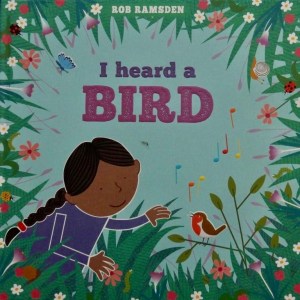
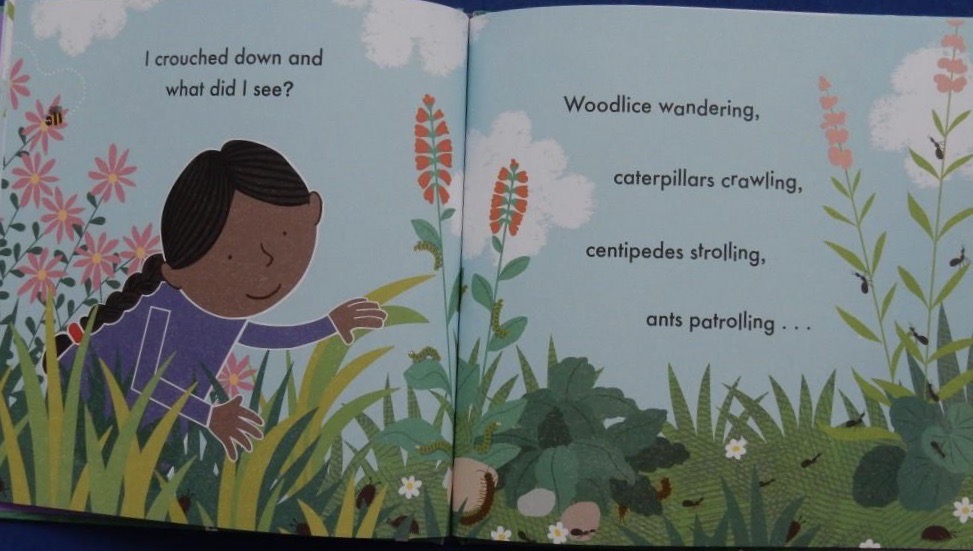


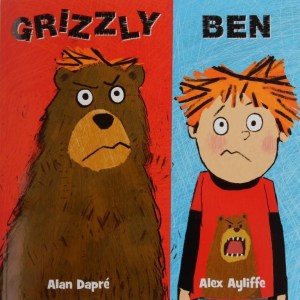
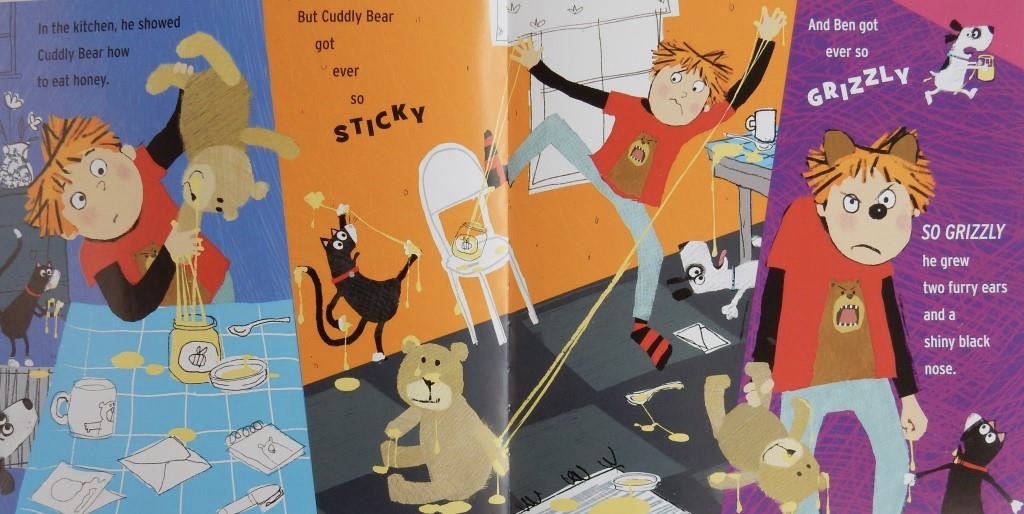

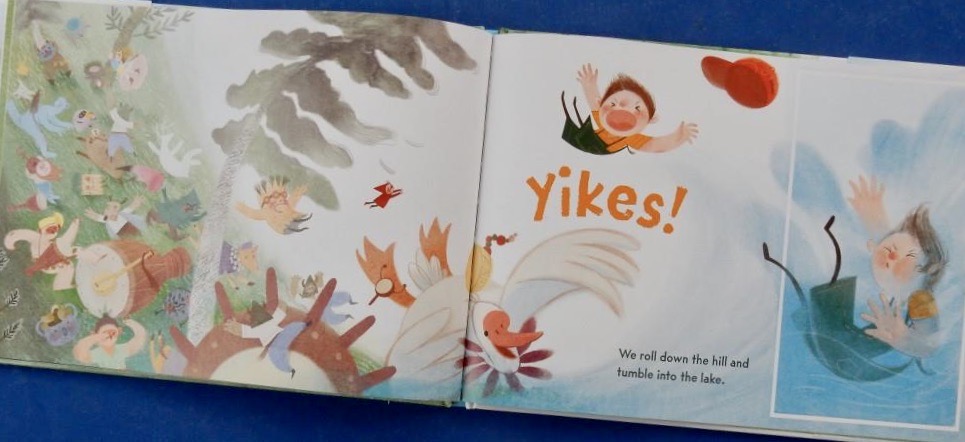



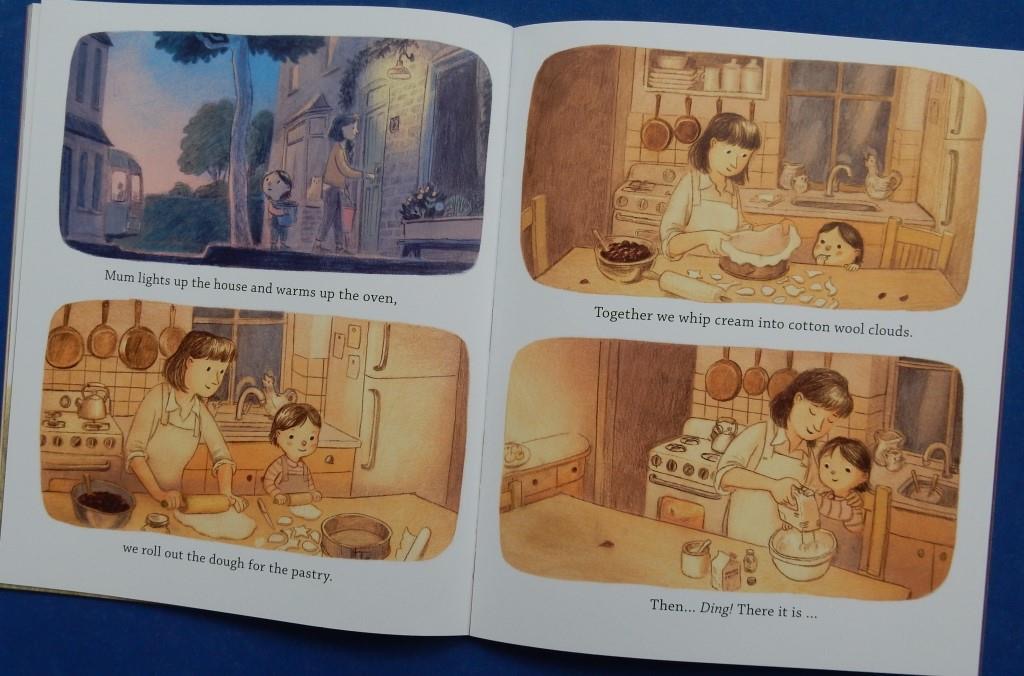
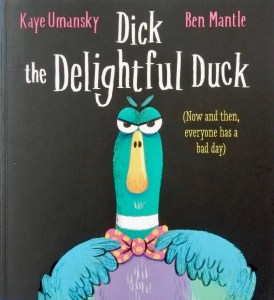
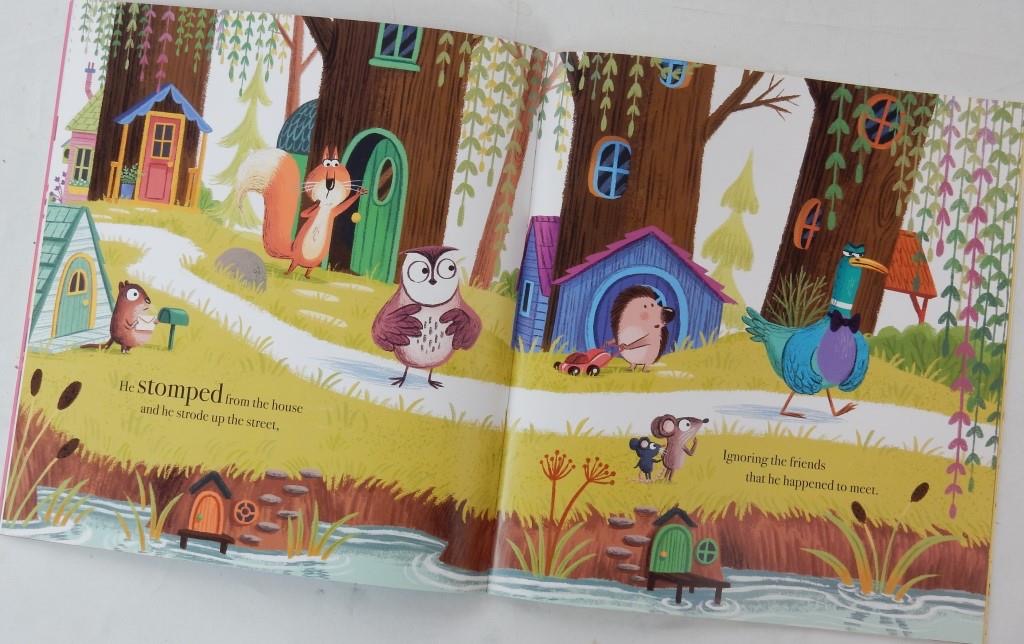


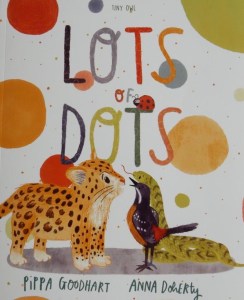


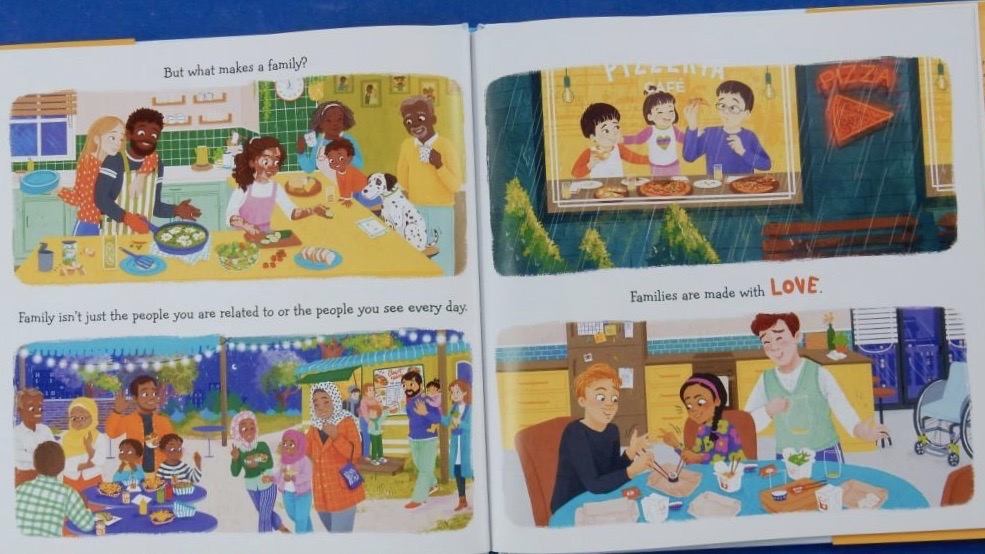


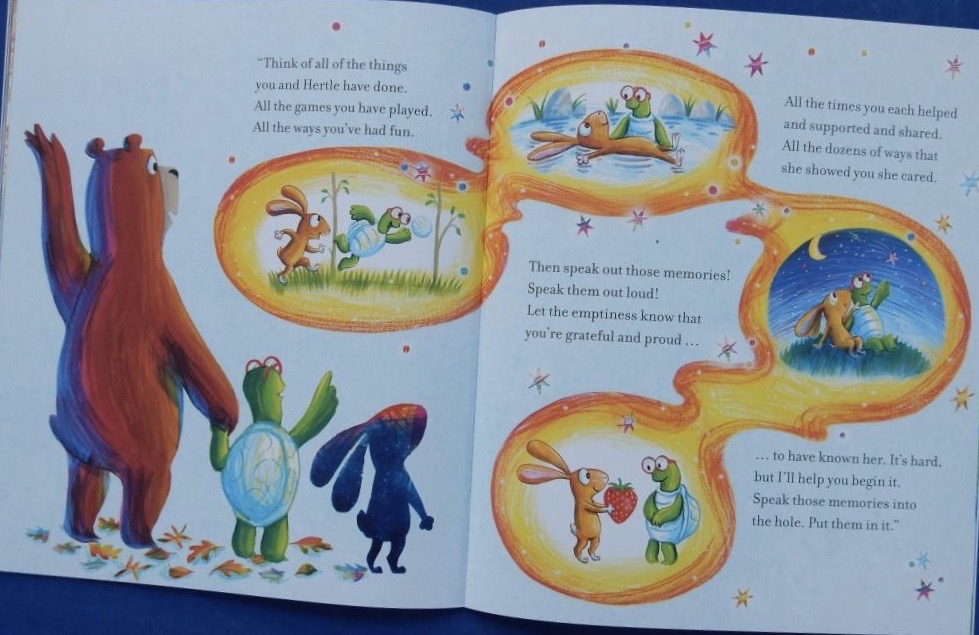
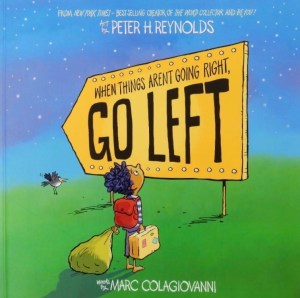


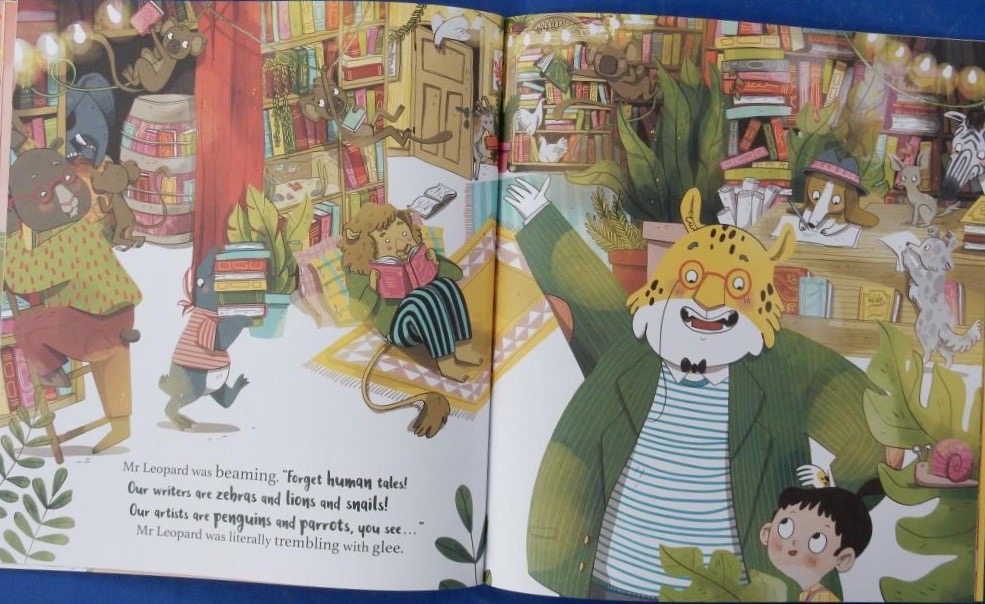


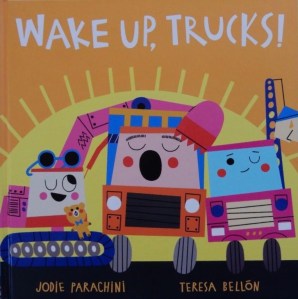
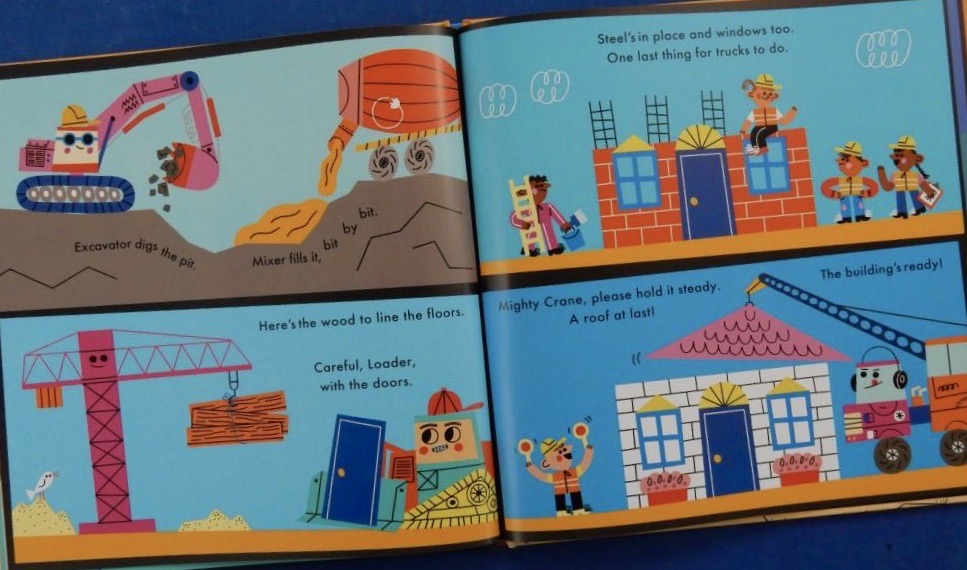


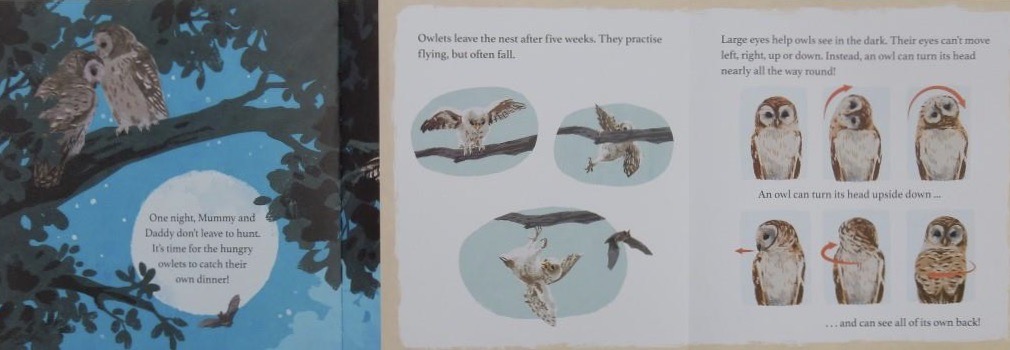
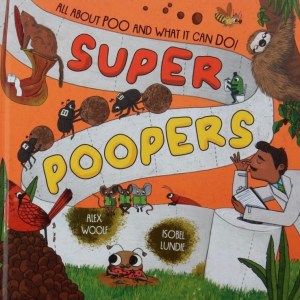
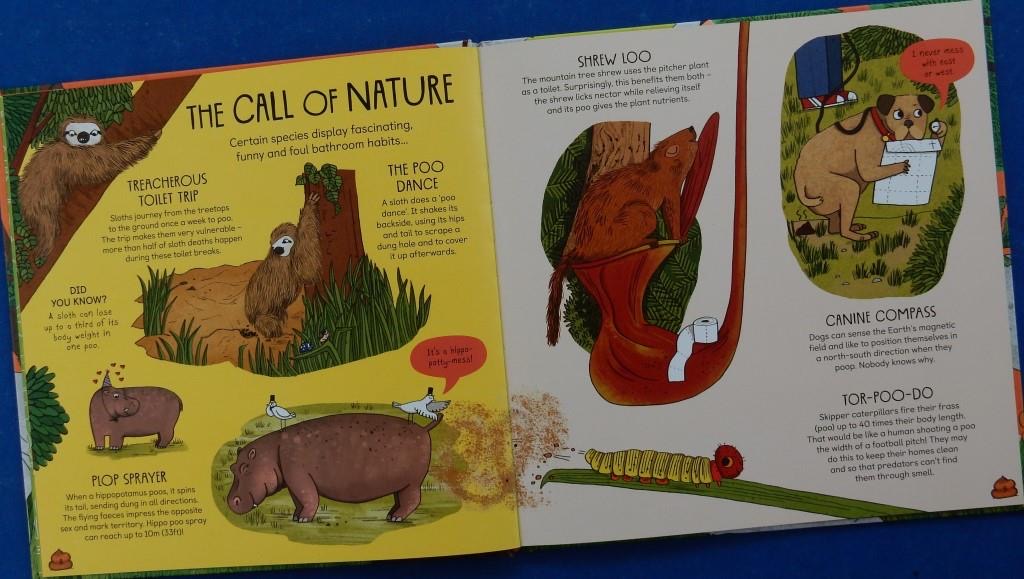
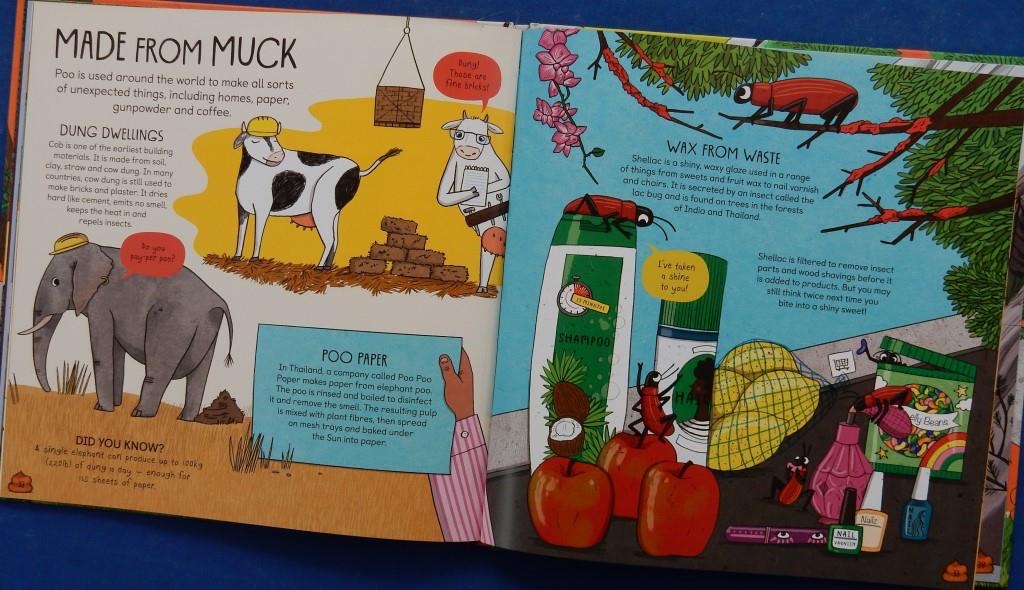
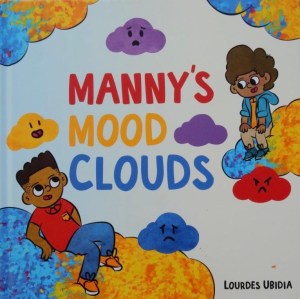

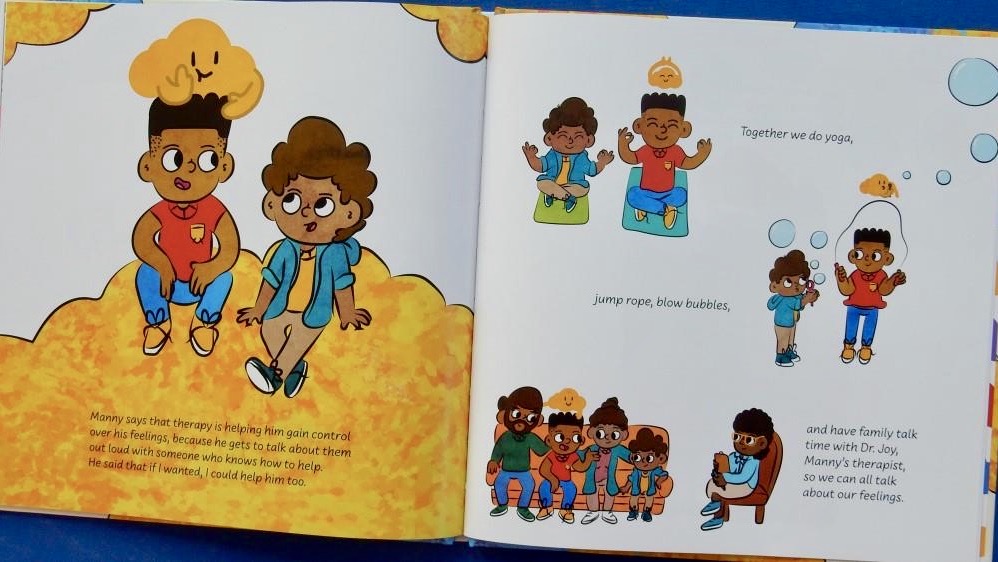

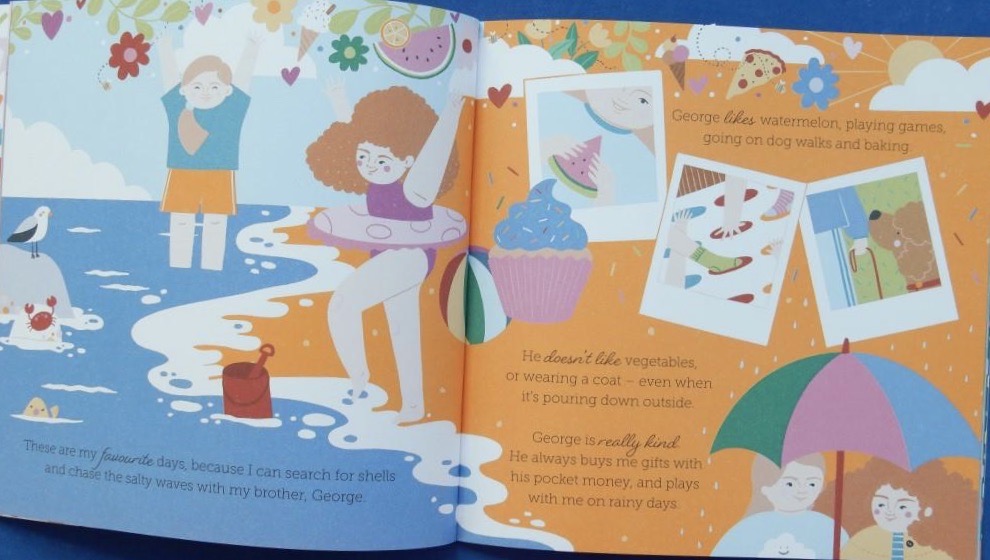






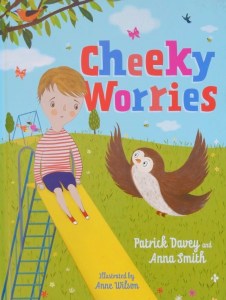
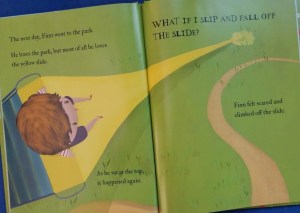
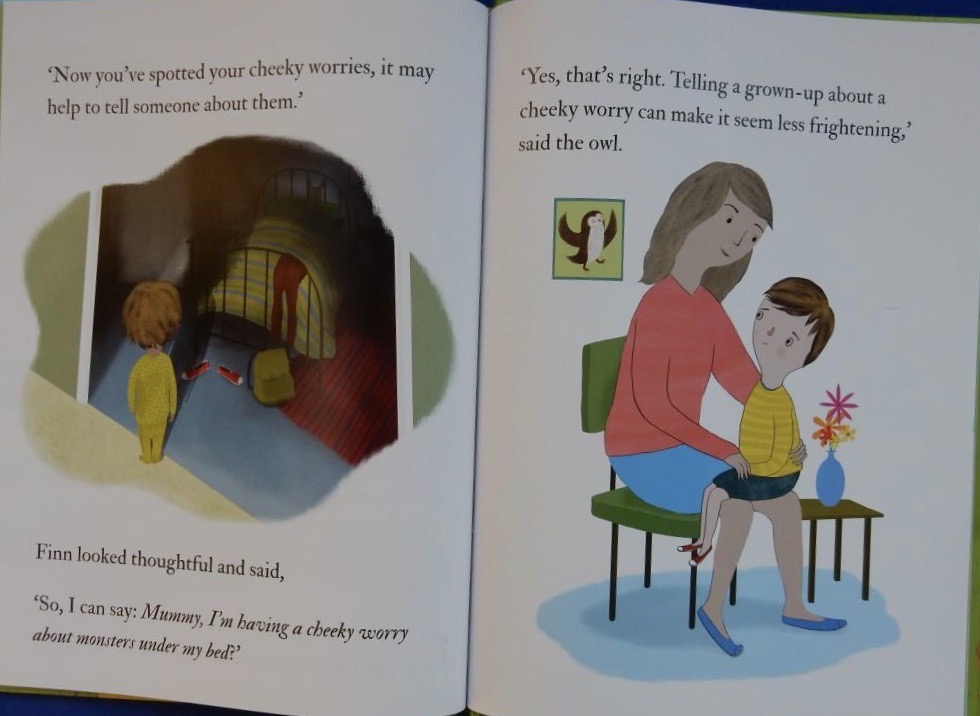


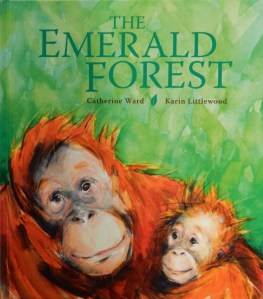
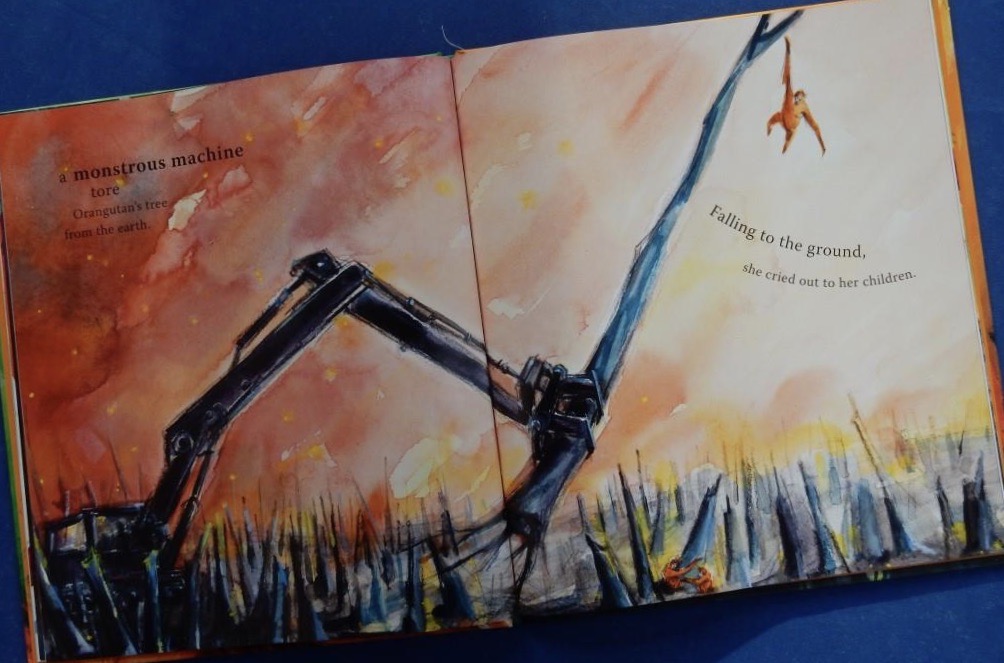
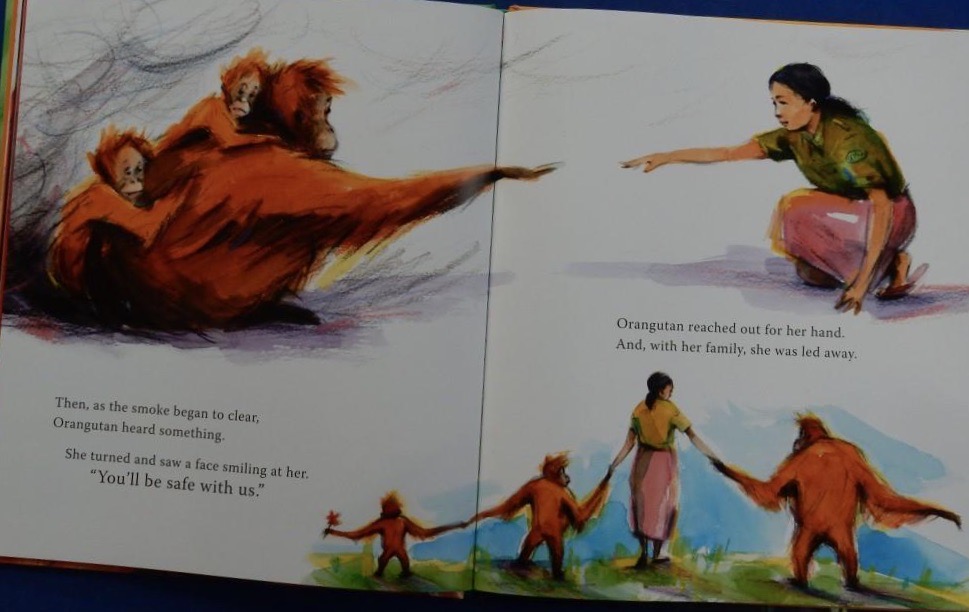
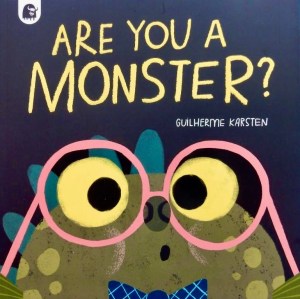
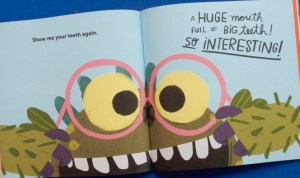
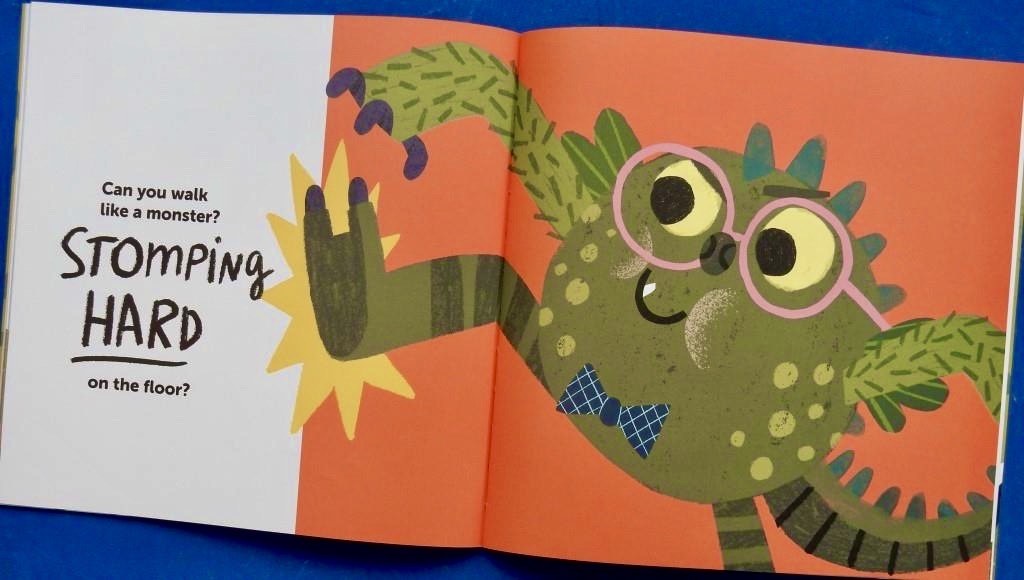


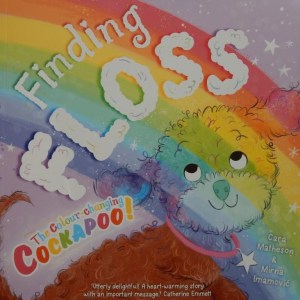

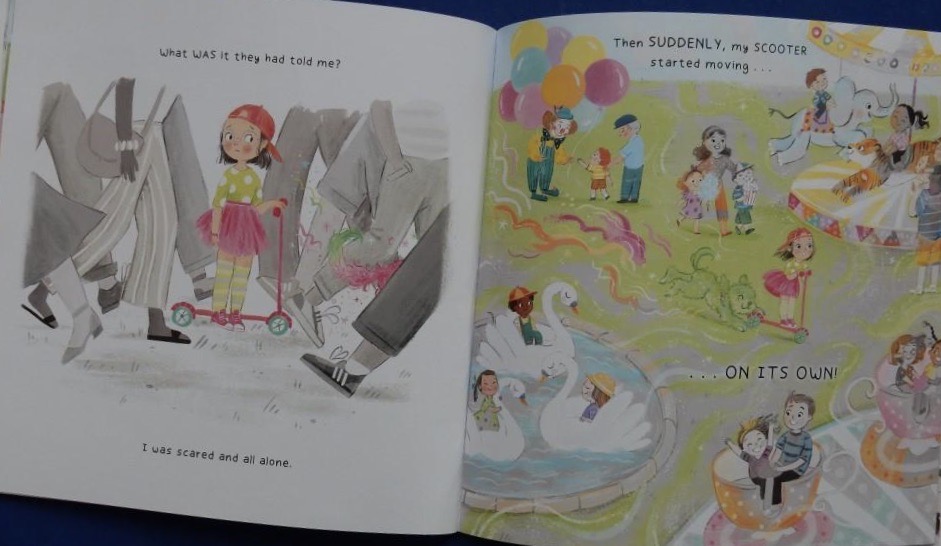
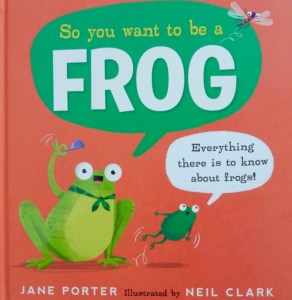
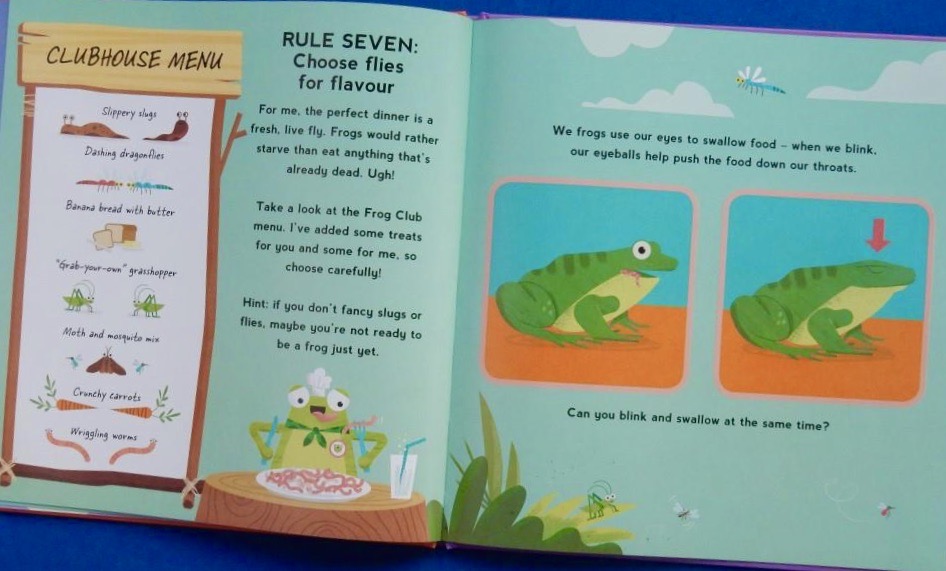
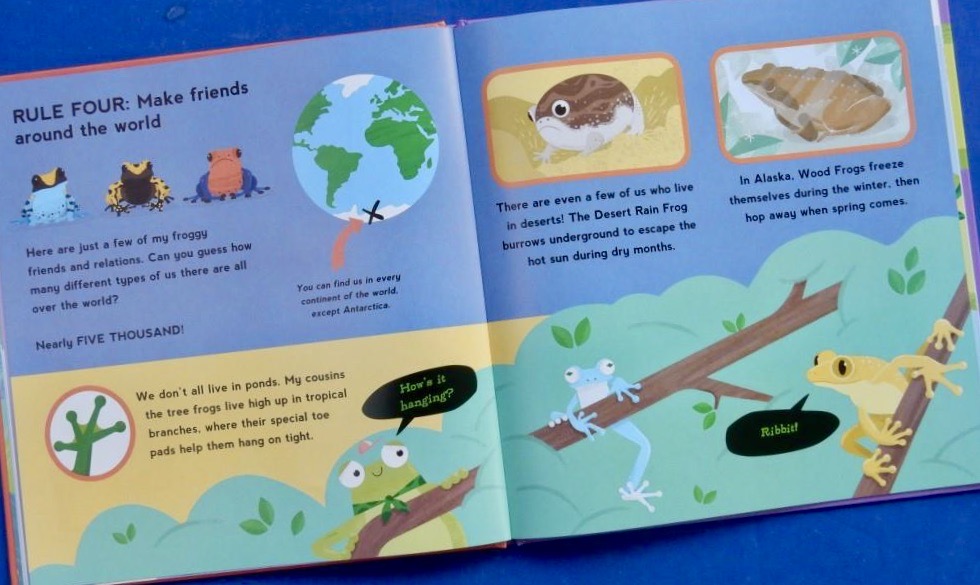




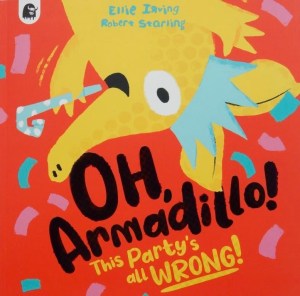
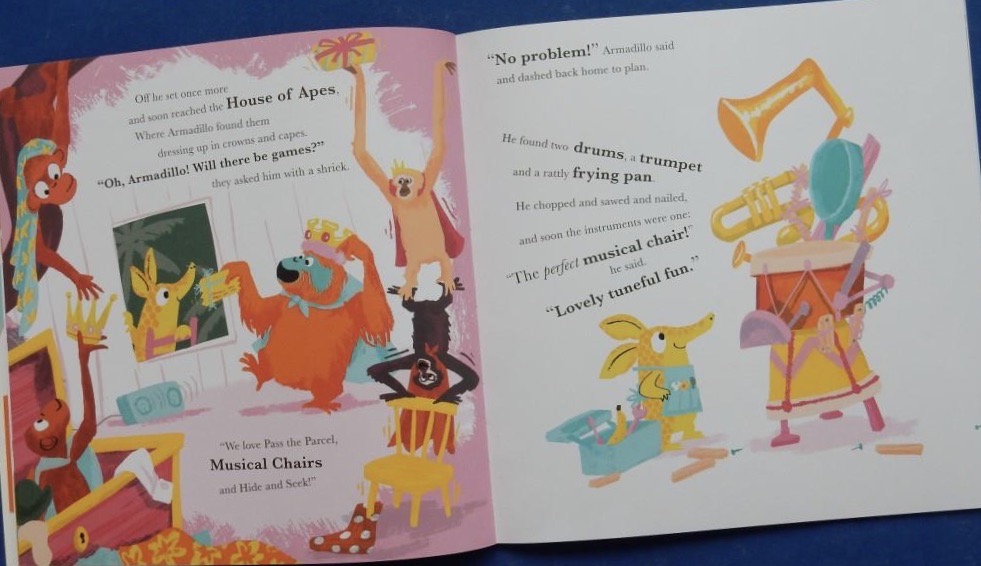
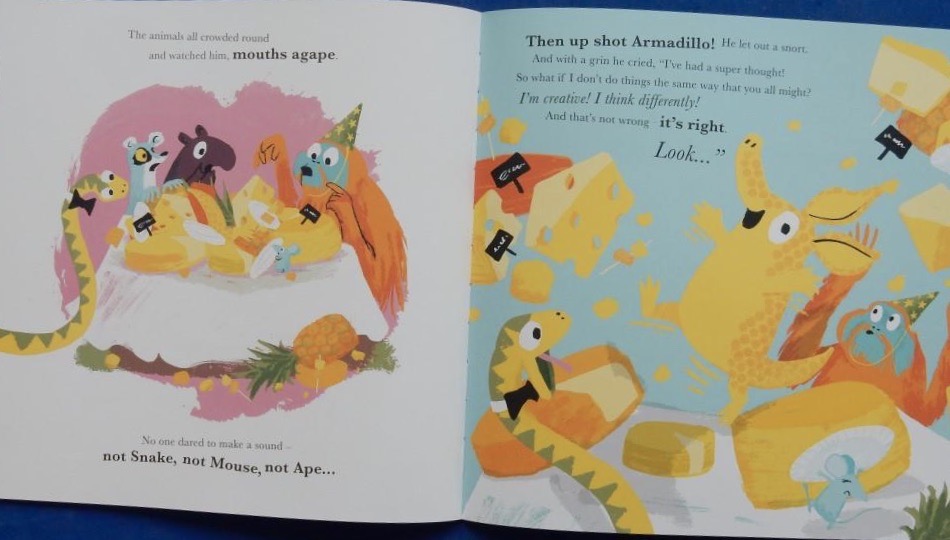


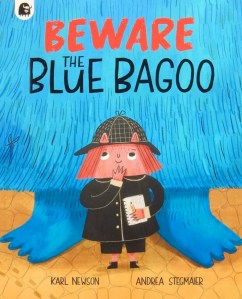
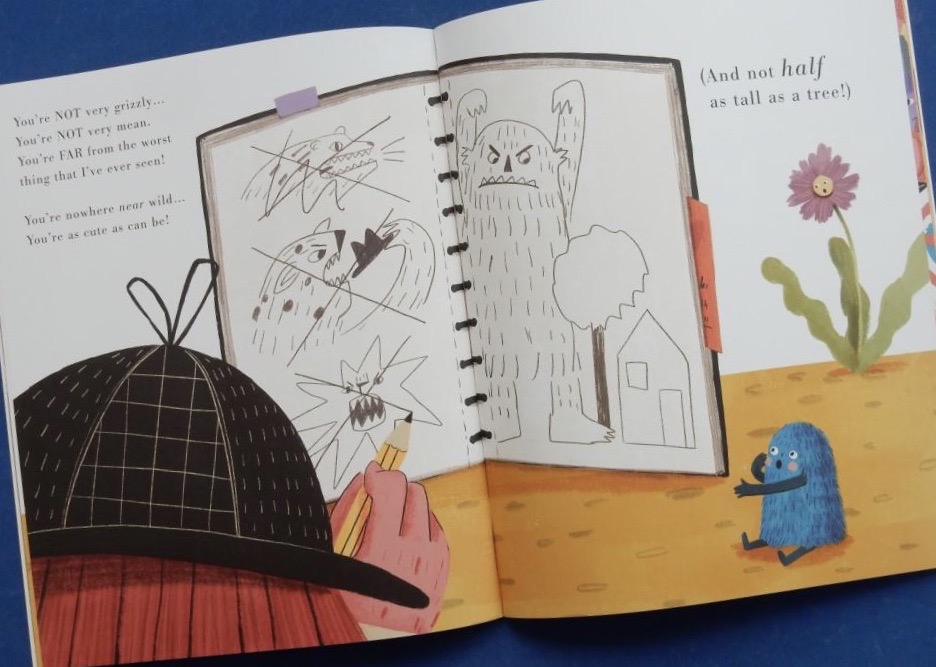
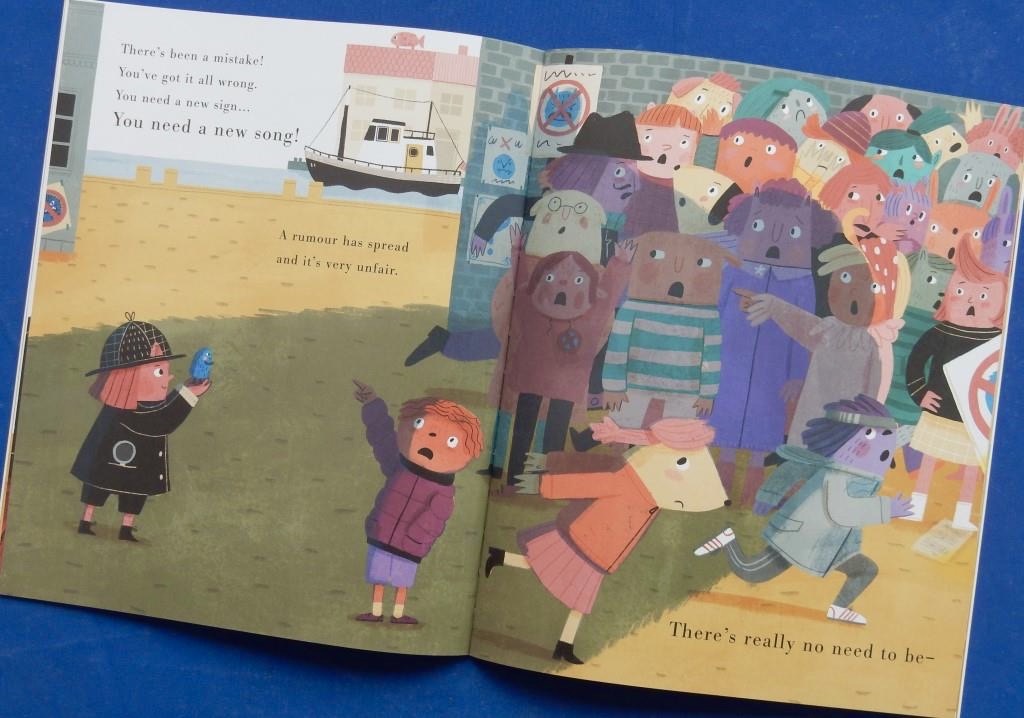

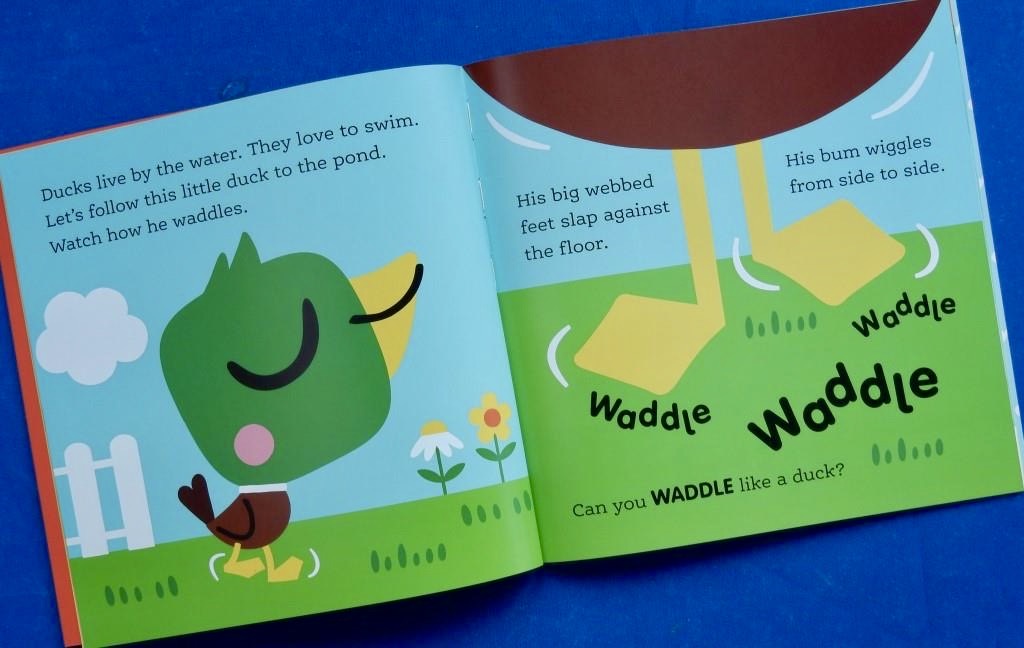

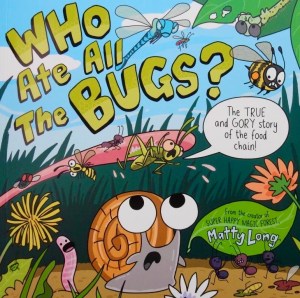
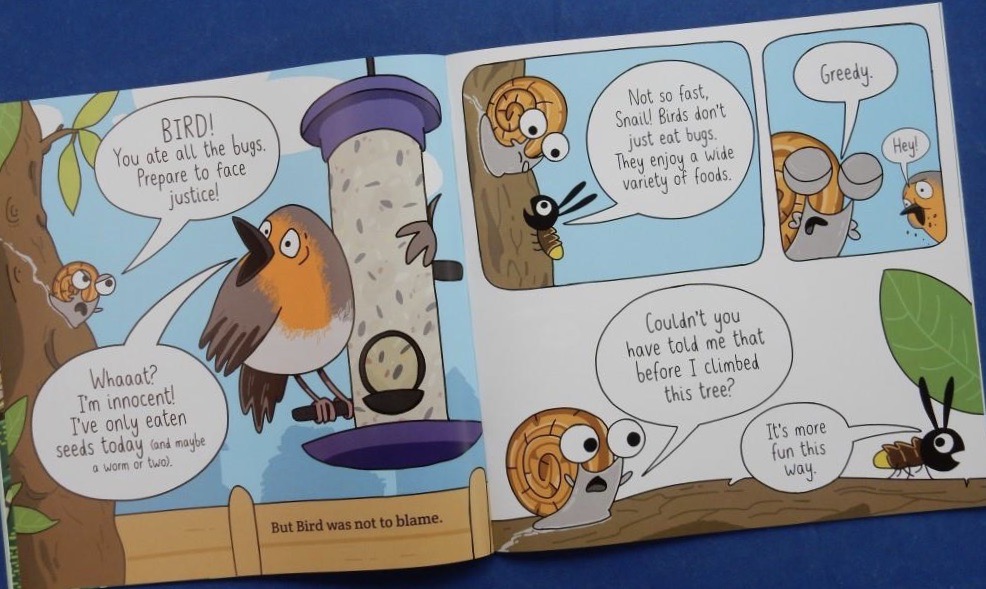
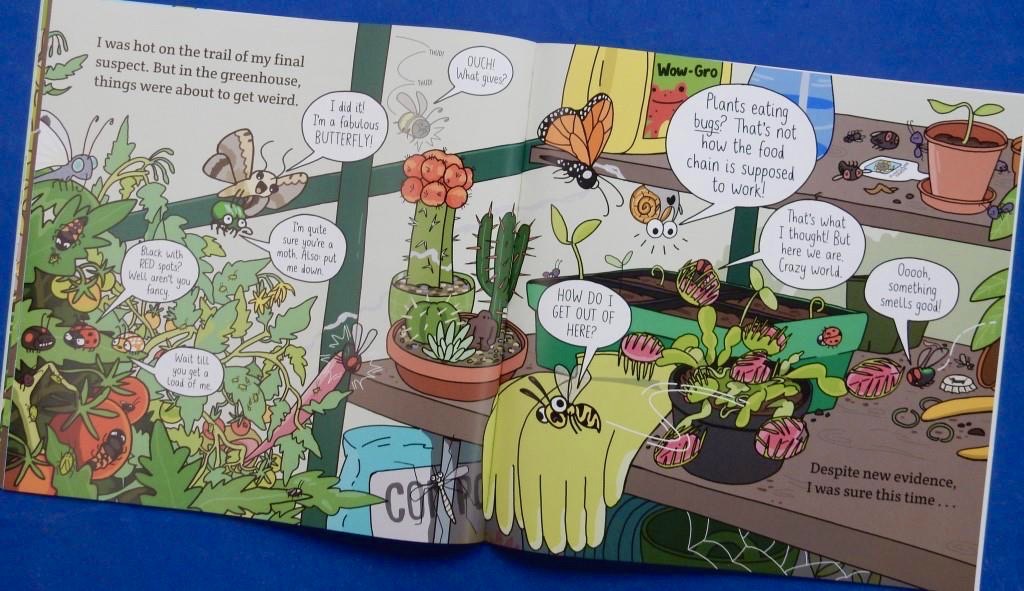


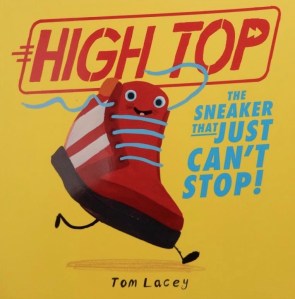
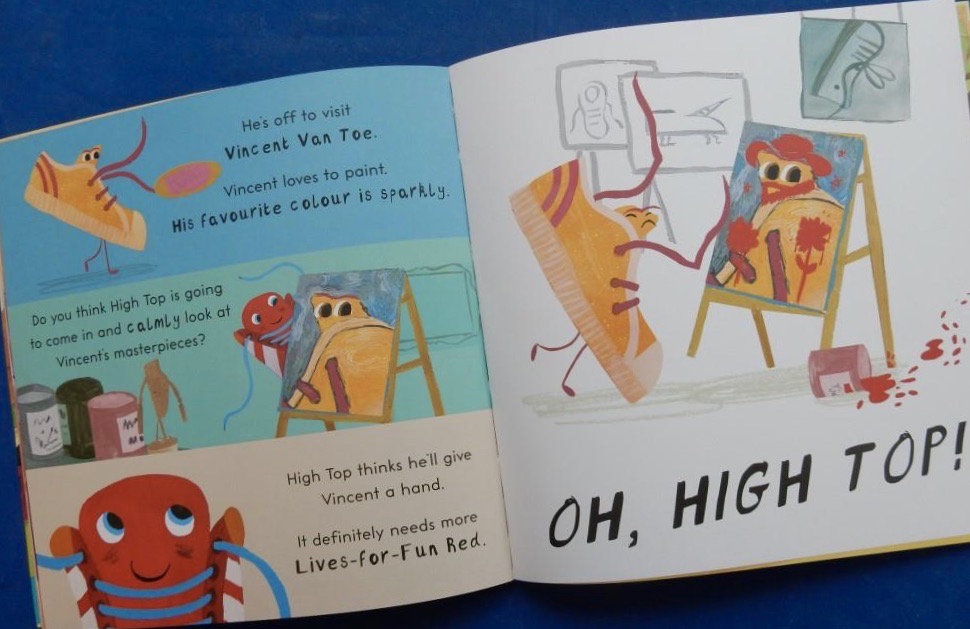
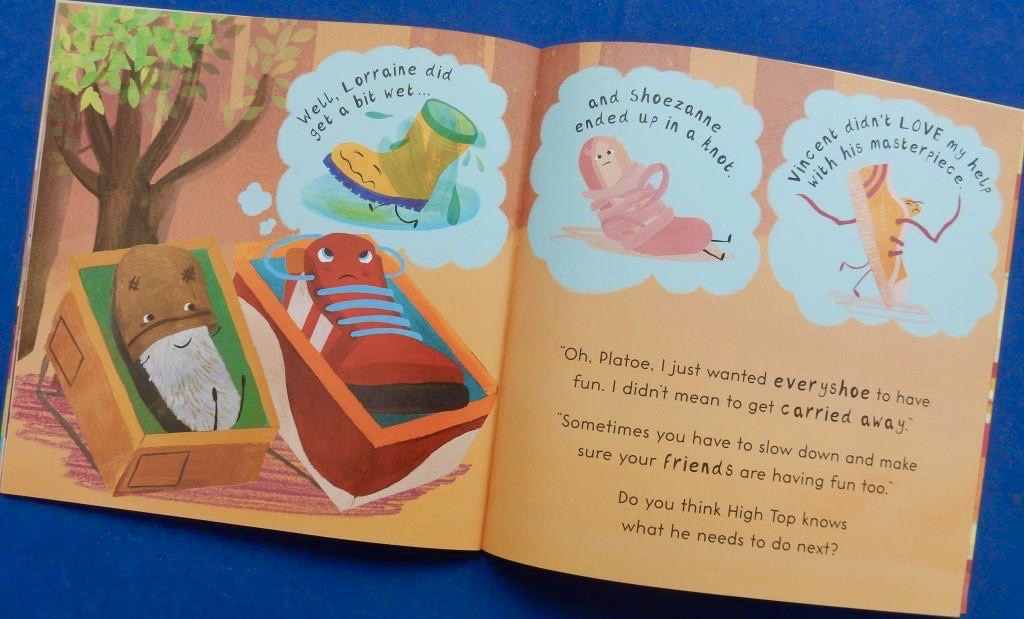
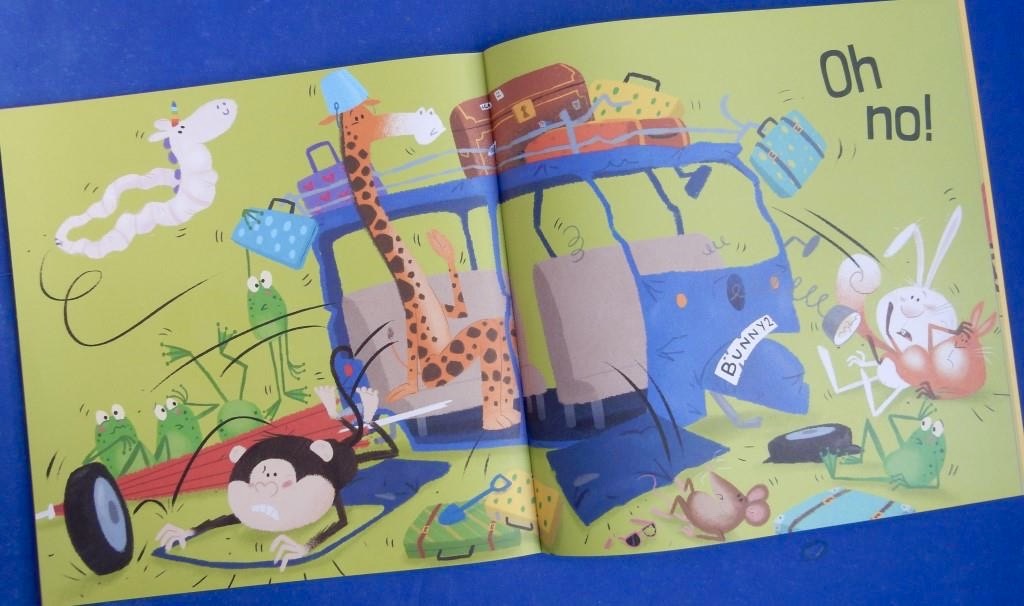
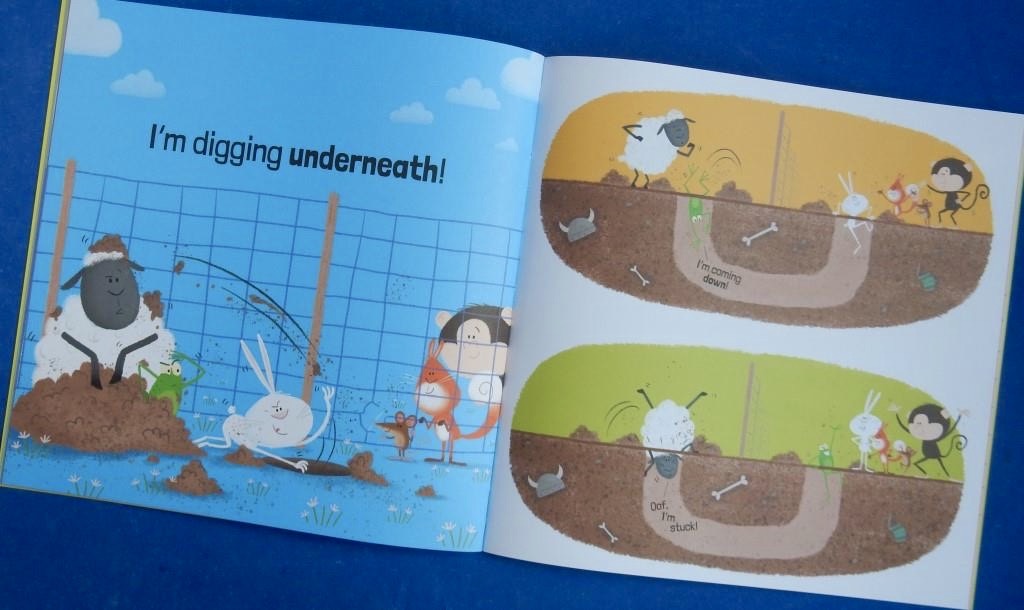


 Red Reading Hub - Jillrbennett's Reviews of Children's Books