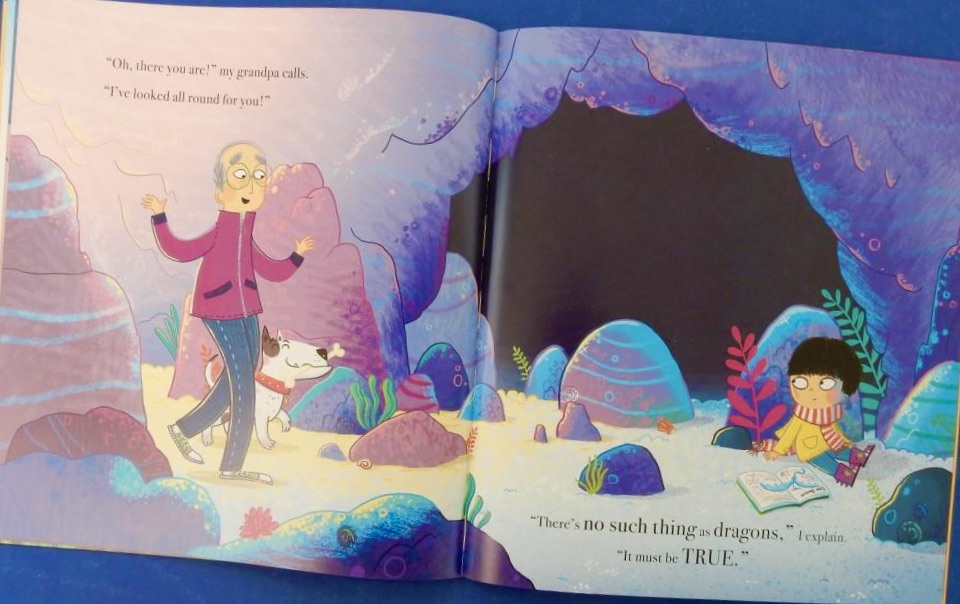
Essentially this is a fun interactive challenge wherein the ‘really bad’, bespectacled, reptilian monster protagonist speaks directly to readers informing us that this beastie wants a monster buddy to participate in doing scary things. Said monster however isn’t making things easy. It has a fair few characteristics on its necessities list for a companion and won’t tolerate anyone that doesn’t come up to the mark. End of story. What! Part way through the book? Or maybe beneath that rough skin, there lies a heart that might just be ready to change.
Little ones will love romping and stomping,
growling and galumphing to prove their worth in front of this demanding monster and they will certainly enjoy the final reveal too.
Guilherme Karsten’s illustrations are great fun as well. His monster practically leaps off the page at times and despite not trying to be, the monstrous character is highly endearing. Add to that the way the presentation of his monologue breaks into appropriately monstrous size print in places offering adult sharers a great opportunity to let rip along with their young audiences, you’re in for a lively story session when you read this one.
Inside and outside both feature large in these two Little Tiger picture books: thanks to the publisher for sending them for review.
Outside Bee Chuck
Essentially this is a retrospective look at that happened to everyday life during the lockdowns and how it has affected our appreciation of the great outdoors.
It starts before we were instructed to stay indoors, life was frantic and the two narrators of the book never had a minute to pause and take notice of the natural world especially. Then, the first day of the enforced period at home turned out to be fun with hours and hours to bake cakes, chat on the phone and play on-screen games. Quickly the weather and nature were forgotten. Quickly too, those indoor pursuits got more and more boring.
However, the spin off was that without the continual rushing around, there was time to stop and really take notice of what was happening outside. Through the windows could be seen nature growing and thriving in the city: so why not try to create outside, inside – or almost inside. We see the two protagonists imagining and then creating window boxes, dangling bird feeders from tree branches and making pictures of visiting minibeasts; they even made a camp in the kitchen.
In due course, in stages the restrictions were lifted: simple outdoor activities like feeding the ducks became the highlight of the day. People rediscovered the joys of chatting face to face instead of on the phone, cycling was preferable to sitting in a car and physical activities outdoors were far more fun that on screen gaming.
When finally people could spend as much time outdoors as they wanted, our narrators (along with most of the population I suspect) have decided that their priorities have changed: outside fun in all weathers is way more pleasurable than staying in. Furthermore with wildlife now much more abundant in cities, has come the realisation that rather than overly tame nature, we can enjoy a slightly slower life, a vital part of which is cherishing the natural world.
Author/illustrator Bee Chuck’s love of nature shines through in the child-like illustrations throughout the book. Let’s hope Outside will instil that love in youngsters and the adults who share it with them, be that at home or in the classroom.
Mole’s Quiet Place Jane Chapman
Mole loves his treehouse home that he shares with his friend Beaver; best of all he enjoys their evenings together, a time when they can remember their old friend, Bear. However with its welcoming lights and welcoming atmosphere the two frequently have their peaceful evenings interrupted by visitors eager to enjoy their hospitality.
One evening as Beaver enthuses about being able to accommodate so many in their large space, the less enthusiastic Mole has, despite the heavy rain, decided to go down to the lake for some peaceful time alone.
Before long an understanding Beaver discovers the whereabouts of his friend and the following day, all the treehouse pals get busy working on a new project, just for Mole. It’s something that enables her to enjoy tranquility in watery surroundings and perhaps remember Bear; and from there she realises just how alluring their treehouse home is to the other animals.
A gentle, yet powerful tale of finding somewhere to be yourself. With her instantly recognisable illustrations, Jane Chapman’s heartfelt story will resonate with both children and adult readers aloud.
Finding Floss Cara Matheson and Mirna Imamović Owlet Press
Floss the cockapoo is an amazing pet: she can change colour and this of course makes her very hard to find. Her colour changing capacity came upon her one day while the family were picnicking. Suddenly a rainbow appeared in the sky bathing her in its light and seemingly making her vanish; then in a flash Floss was brown no longer; instead she was rainbow coloured. Then starts her continual chameleon-like colour changing that depends upon where she is. At first Floss thinks it’s a great game, but she soon starts using her ability to get up to all kinds of mischief that upsets her family. When the funfair arrives, the girl narrator is thrilled, but then her Mum says that they shouldn’t bring Floss. Before they wander around the attractions, Mum gives her daughter a wristband with her phone number on it just in case they get separated and off goes the girl to enjoy herself.
While so doing she realises that her grown-ups are nowhere in sight.
Then to her surprise her scooter begins to move, seemingly on its own,
stopping only when it reaches the lost children stand. A quick phone call leads to a joyful reunion; but was it down to the magic of the scooter or something else?
Cara Matheson’s rhyming narrative and Mirna Imamović’s spirited illustrations of what gran calls their “blended family” coping with a lively pet include an important ‘stranger danger’ message. There’s lots to engage readers in every scene.
The final page provides important advice for children about what to do should they get lost when out.
So You Want to Be a Frog Jane Porter and Neil Clark Walker Books
In her follow-up to So You Want to Be an Owl, author Jane Porter presents what it takes to be a frog. Should you decide to give it a try, you may be surprised to learn that it requires a considerable number of skills; so says Frog Club leader, Fabio Frog. Happily he is on hand to provide support and information via a set of rules..
First off, (remember there are several stages in your life-cycle) you will need to work on your wriggling. Then, once you’ve lost that tail, jumping is an important way of moving and your tongue becomes a vital part of your anatomy – it’s very useful for catching flies. Did you know, that should you manage to catch a fly, your eyeballs will push the food down your throat? Although if slugs are more appealing, they’re another live option (no self-respecting frog would eat anything already dead).
You’ll also need to be able both to breathe underwater (there’s a fuzzy-looking Hairy Frog’ that has hairs to help) and ‘drink through your skin’.
Colour is another consideration – not all frogs are green like Fabio, although there are a fair few green species in various parts of the world. Others though don’t even live in ponds: a few are desert dwellers, others high in the branches of tropical trees.
Quite a number are poisonous too, so beware.
As always Jane Porter’s love of nature shines through in her writing, which is highly engaging and fun for young readers. Cleverly integrated with the text are Neil Clark’s amusing, detailed illustrations. A considerable amount of verbal and visual information is to be found between the pages of this non-fiction picture book. One last word or several: croaking and ribbiting are not the only froggy sounds, but to discover other possibilities, you’ll need to get your own front limbs on a copy of Jane and Neil’s book.
That’s My Flower! Alice Hemming and Nicola Slater Scholastic
The rather possessive rodent and his feathered friend from The Leaf Thief return in a new story.
When Squirrel wakes one morning he’s excited to discover that the leaves are back on the trees: hurrah! it’s spring.
Suddenly Squirrel is surprised by unusual buzzing and cuckoo-ing sounds. Then a strange bird flies at his head. Fortunately Bird is close by to explain about spring’s arrival being heralded by a bumblebee, a cuckoo and a swallow. Then Squirrel notices a small, yellow flower that reminds him of the sun: another sign of spring explains Bird. By now Squirrel has decided that he likes spring but goes on to claim ownership of the flower and starts trying to protect it.
It mustn’t get wet, nor be attacked by bees, he decides until Bird tells his pal that the flower needs rain and that visiting bees help flowers. Moreover, “Your flower is a wild flower … It’s there for everyone to enjoy,”
Still Squirrel continues his safekeeping activities by covering the flower with a bucket, with disastrous results, he later discovers.
Happily though, Bird persuades Squirrel just to leave the flower alone. The following morning, a wonderful surprise awaits when the two wake up.
Bird’s gentle lesson has been a success. Such a fun lesson it was too, for young readers and listeners certainly. They will be sure to laugh at Squirrel’s lack of understanding regarding the natural world, made all the funnier by Nicola Slater’s portrayal of Squirrel’s custodial antics and his friend’s reactions.
Let’s hope Alice Hemming’s story will encourage respect for the natural world in children.
Nomi loves drawing; her Dad makes positive comments about her dog depiction but her brother Stephen makes fun of her Mallory picture. “…why is your bear in the sky? … You’re better at drawing fish” he comments. However with a fish tank on the kitchen counter top that’s no surprise; if Nomi had a real dog, it would make dog drawing much easier, so she thinks. But nobody in their flats is allowed a dog so “HA! Get real, Nomi” is Stephen’s response.
That evening in frustration, Nomi scrunches up her picture and tosses it aside. Mallory’s smile don’t make the dog special; “Get real, Mallory!” she says. And Mallory does just that.
Somewhat conflicted: ‘I wanted to tell everyone. I didn’t want anyone to know.’ Nomi suggests heading to the park, which happens to be where her brother is going.
Dogs are banned from the playground but ever resourceful, Nomi provides Mallory with a disguise and adds occasional barks to his. No matter her brother ignores her, a wealth of opportunities keep the pair happily engaged for a long while,
until hunger pangs eventually cause her to head homewards.
What of Mallory come bedtime? Happily he’s not too far away …
Daisy Hirst has a great ear and eye for detail. With Nomi as narrator, her text is a delight read aloud and her images of the child and her imaginary dog capture the togetherness of the two with panache. There is SO much to enjoy about this book, especially the way it celebrates the power of the imagination.
Oh, Armadillo! This Party’s All Wrong! Ellie Irving and Robert Starling Happy Yak
Kind, gentle Armadillo lives deep in the rainforest and longs to make friends: however he has a tendency to get everything wrong. One day he has an idea: perhaps if I throw a party I will make a few friends, after all everyone loves parties. Having made invitations off he goes to deliver them. The first goes to Jaguar who is hoping a large springy sponge cake will be on offer. Back home goes Armadillo, creating so he hopes, the perfect sponge cake.
Out he goes again, next stop the Apes: they want games especially musical chairs, pass the parcel and hide and seek. Armadillo rushes home and gets to work …
Then for the balloon loving Lemurs, Armadillo fashions what he hopes is the perfect balloon, sufficiently large for lots of passengers.
On party day our host eagerly awaits his guests and having welcomed them all, announces the fun and games. Seemingly though Armadillo’s ideas are rather different from what the other animals are anticipating: shock horror! He’s devastated by their reactions, so is this the end of his party and hoped-for friendships?
Happily not. An accidental trip that sends him hurtling onto the sponge cake and thence into the air and finally back to earth doesn’t just render the guests speechless but it makes Armadillo see things in a different light; he’s ready to acknowledge and even take pride in his divergent thinking and creativity.
Will he persuade the others to join him in some truly original ways of having fun? You bet … And as for finding friends, certainly, but Armadillo stays true to himself, muddled and different. Hurrah!
A smashing story to show children, especially those who like the protagonist think differently, that rather than a problem, it’s something to celebrate.
Out of the Blue Robert Tregoning and Stef Murphy Bloomsbury Publishing
Imagine your reality is a dystopian one wherein those in power have decreed that everything must be the colour blue. Imagine too that you are a child who loves yellow growing up in such a place. That’s how it is for the boy protagonist in this powerful story and as a result he has become indoctrinated with the idea that to be a yellow-lover is bad, so much so that he dare not even tell his Dad about his secret.
One day when participating in a collection of all things not blue to await collection by the refuge disposal crew, the boy discovers a tiny yellow rubber duck. This he stashes in his school bag. Back home he hides the duck away in the cupboard with all his other yellow things and then sits down to dinner with his Dad. How he longs to tell Dad of his find. That night the boy retrieves his duck carefully and then in an act of brave defiance he liberates all his treasures …
When he hears footsteps approaching, the boy fears the worst, but his Dad’s reaction is both surprising and reassuring. Perhaps being a lover of yellow is acceptable. Thus begins a chain reaction and before too long, change is afoot until everyone feels safe to be true to themselves in a glorious rainbow coloured world.
Would that this were so throughout our own world so that everybody can be fearlessly proud of who they are.
Robert Tregoning’s powerful, sensitive rhyming story grew out of his own experience of growing up gay in the 1990s under Section 28 law, which didn’t disappear from the UK statute books until early this century. Stef Murphy’s equally powerful illustrations capture both the fear and the liberating feeling of joy, not only of the boy but also of the book’s diverse cast of characters.
Love yourself no matter who or what you love is a crucial message that children need as soon as possible. Sharing a special picture book such as this one is a great place to start.
Beware the Blue Bagoo Karl Newson and Andrea Stegmaier Happy Yak
Rumours are rife about the Blue Bagoo: a mean marauding monster to be feared, that is for certain. But wait a minute: has anyone actually met or even seen this beastie that supposedly likes to dine on humans. Now there’s a young detective determined to uncover the truth. She roams the streets finding plenty of people ready to make statements about the monstrosity but what she discovers is something of a surprise.
Can she convince her fearful fellow townsfolk that they’ve got it all wrong? Or is it her that’s wrong after all …
Rumours are nasty things, they spread rapidly causing people to jump to conclusions about all kinds of things rather than finding the truth for themselves. Nobody should make a judgement about another person based on hearsay or appearance. With its cleverly executed twist, Karl’s rhyming account of the escalating rumours in the seaside community of Rumourville, and one person’s resolve to find the truth, contains a crucial message for us all. It’s one that’s particularly pertinent in our troubled times of misinformation. Andrea Stegmaier’s illustrations are terrific fun
and the way she varies the layout of her spreads keeps the visual impact high; there’s a smashing portrait style close up and a fair degree of quirkiness throughout.
I Want To Be A Duck I Want To Be A Bunny illustrated by Pintachan Oxford Children’s Books
These are the first titles in the publisher’s Move and Play series. Each comes with a mask to cut out from a flap inside the front cover and has a QR code which enables users to see and hear the movements of the featured characters.
The little duck starts by demonstrating his quacking and then invites little humans to emulate him. We then follow the duck as he waddles to the pond wiggling his bum and slapping his webbed feet against the ground.
Splash, he goes into the water and starts paddling those webbed feet. Feeling somewhat hungry, duck nibbles at various small water dwelling creatures. This he does by sticking his bottom up and bobbing his head beneath the surface. Along comes a dragonfly: paddle paddle goes duck in pursuit , duck flaps his wings and takes to the air, missing his prey and landing splash, back in the pond only to discover that the farmer has come to feed him. Gobble, gobble goes duck. Little humans are asked to try doing each action and making each sound during the simple story.
The Bunny story follows a similar pattern and this time there’s hopping, nose twitching, nibbling, digging , stretching up,
running, tail bobbing, hopping and snuggling down to sleep for youngsters to copy.
Both books end by putting the entire sequence together on a spread and asking ‘Do the …. Dance’. Pintachan’s bright, dynamic illustrations are alluring and engaging and Kate Woolly’s words are pitched at just the right level to encourage the very young to get active.
Who Ate All The Bugs? Matty Long Oxford Children’s Books
Doing something rather different, though still in his trademark zany style, Matty Long, creator of the Super Happy Magic Forest series takes a look at the food chain, courtesy of his minibeast narrator, Snail. The mollusc is on the trail of a dastardly killer and is determined to track down whoever is destroying bugs all over the place and bring them to justice. No help is forthcoming from any of her buggy companions so she just has to go it alone.
Bird is quick to proclaim his innocence
so Snail moves on, stopping off in the cabbage patch for a bit of sustenance and to question the bugs she finds there.
Eschewing Grasshopper’s advice to “let it go’ she creeps through the grass to accuse her next suspect, Snake. Wrong again! However Snail isn’t giving up that easily so she heads next to the greenhouse to confront her final suspect.
The arachnid isn’t guilty though, so should Snail finally take notice of Glow-worm’s insistence that “You can’t fight the food chain.” Time for some serious thinking on Snail’s part.
That’s not quite the end of this scientific story but is it perhaps the end of our justice-seeker? She might just have found out the hard way … Try asking a certain amphibian.
A slice of scientific learning served up in a deliciously funny manner that will surely have both children and adults chortling. Make that two slices – the final double spread provides additional buggy facts and the bug hunt activity page will likely send youngsters back to the start to track down the minibeasts in various stages of their life cycles. For this adult reviewer Who Ate All The Bugs is perhaps my favourite of Matty’s picture books so far.
Lizzy and the Cloud The Fan Brothers Frances Lincoln Children’s Books
The Fan Brothers set their story in a bygone era when zeppelins hovered above the row of shops and people rode penny farthing cycles.
Every Saturday Lizzy and her parents go walking in the park. Most of the children visiting make straight for the roundabout or the puppet show but not Lizzy: despite clouds being ‘a bit out of fashion’ in those days, she makes for the Cloud Seller. From him she buys not one of the fancy animal clouds on a string, but an ordinary cloud. This she names Milo. (Naming your cloud was the first instruction in the accompanying manual.).
Lizzy takes great care of her cloud, following the instructions, watering it daily, taking it for walks and allowing it to go soaring out of her window while she held the string firmly in her hand.
Over the months, Milo grows … and grows until one day it covers the whole ceiling.
There’s no instruction in the book to help fix the growing problem, then one night there’s a thunderstorm. It’s this that steers her towards a vital realisation: Milo has outgrown her room; she can’t contain him any longer: her cloud needs a bigger sky. Lizzy must do what is best for Milo and so she sets it free.
This beautiful meditation on letting go is brilliantly imagined and by blending the ordinary everyday with the extraordinary, the Fan Brothers deliver a truly original fable. It gently shows children that sometimes one needs to allow somebody (or something) you love to move on and that in time, those raw memories will become something sweet to be cherished always.
The delicate, dreamy illustrations in soft greys and browns with muted colours, are perfect for showing the alternative reality in which the tale unfolds. Whimsical and wonderful.
Super Questers: The Case of the Missing Memory Lisa Moss and Dr Thomas Bernard, illustrated by Amy Willcox Quest Friendz
Lilli, Bea and Leo return with a new problem. Bea’s toy robot is malfunctioning and to fix it they travel to the magical Questland.
On arrival they are greeted by the Queen who immediately asks for their help. The evil Lord Grumble is wreaking havoc with his new Memory Machine, stealing memories from everyone, including the Queen. The Superquesters are determined to solve the problem and find Lord Crumble’s Memory Machine before it’s too late for Questland.
To do so they have eight science,
mathematical and logic-themed quests to undertake with the help of the reader. Each quest has a different challenge: stars not shining as they should, planets not orbiting the sun, forgotten recipes,
and homing birds that have forgotten how to fly.
Adventure and enchantment await both readers and Superquesters as they work to restore a properly functioning memory to the Queen and her Questland subjects.
Cleverly constructed, this interactive book presents a different STEM aspect in each quest and it’s highly engaging. Much of the text is in the form of dialogue, there are rewards, stickers and terrific, inclusive illustrations by Amy Willcox as well as a glossary of STEM skills; and the solutions are given at the end. Playful learning of a high quality.
The little girl narrator and her lion have a special relationship, so says the child. No matter what she does, her brave lion friend stays close by. It helps her find the courage to use her voice and makes her feel safe in the dark.
One day they set out on an adventure together in the playground where a new ‘rocket-fast’ slide has been installed.
Up, up, up climbs the girl, with the lion following but just before she reaches the top she looks down. Confidence crisis! Both the narrator and her lion are stranded. Will they have to remain stuck up there forever, both too frightened to move either up or down?
No matter how fast I go, or where I end up, my brave lion sticks with me—my lion’s always there! So thinks the little girl to herself. Moreover he makes her feel as though she can do anything so maybe now it’s time to reverse roles. Can she summon the inner strength to be there for her large companion when he clearly needs her to?
Vibrantly illustrated, mostly in primary colours, Erika Mesa’s first person story really captures the little girl’s thoughts as it portrays an exceptional friendship showing how the child is enabled to find unforeseen courage thanks to her bond with an imaginary creature.
Share and talk about either at home or in the classroom: this is a book to empower young children.
Set in Shoe Town and starring a snazzy red trainer, dubbed the sneaker that just can’t stop, our hero is always on the lookout for fun in this lively romp. His unstoppability however, frequently ends in an upset, not for High Top, but for those he encounters as he hurls himself into the action wheresoever he finds it. Having inadvertently discombobulated first Lorraine Boot, then the Shoezanne Ballerina and artist Vincent Van Toe,
High Top boings and whooshes his way to the park.
There, somewhat weary at last, he encounters Platoe, the most sagacious of shoes (and slippers). Platoe suggests High Top relaxes alongside him whereupon he cannot resist recounting to Platoe all the fun he’s had. What the wise one says in reply though, really does make High Top think hard about his actions.
Can he find it in himself to apologise and even think of a way to make amends to his fellow footwear for his ebullient actions. What would you do?
Laced with humour and soled with an important (maybe for some, a tad preachy) lesson for youngsters, this highly colourful, wacky tale with wordplay aplenty and a join-in chorus, was fashioned by Tom Lacey, which I discovered is – the ‘shoedonym’ of a group of creative ‘sole mates’ who have apparently written and illustrated a number of other books too.
Squeeze In Squirrel! Take a Leap, Sheep! Tony Neal Oxford Children’s Books
These two books introduce and explore maths topics for young children, the first presenting capacity, the second, position. As with the previous titles Tony Neal presents themes and vocabulary based on the Early Years Foundation Stage maths framework and using a group of animal characters, delves into them through funny scenarios that just might happen in real life.
Squeeze In Squirrel! begins with the Rabbit and Squirrel about to depart for a trip with Rabbit at the wheel of his rickshaw. However Squirrel suddenly realises he’s sans luggage. Off he dashes and as he struggles with his trunk, other animal friends turn up one by one, each wanting a ride and the accommodating driver agrees to them getting aboard the vehicle. Eventually with the auto seemingly full to capacity, Squirrel returns dragging that trunk and somehow manages to cram in too. Off they go but almost immediately …
Is there a way they can still reach that beach destination?
In the second story Sheep points out a ferris wheel behind a wire fence and poses the question to his pals, ‘How can we get inside?’ Two of their number start to climb over the fence, pausing on top to ask, “Can you stretch up?’ By turn the remaining creatures find a way into the enclosure,
Sheep doing so in spectacular fashion. Up comes Elephant who points out the obvious, something his friends failed to notice …
With maths concepts woven into both pictures and text, these books promote children’s mathematical thinking and introduce fundamental maths concepts in an effortless and enjoyable manner. Not only that, they foster a love of story and offer opportunities for little ones to develop their language skills in tandem.
Bouncy Bo and Little Smudge live in a castle with their very serious-minded father, Mr Judge. All the adults they encounter are serious too and whenever the siblings try to enjoy themselves, all they hear is “Don’t be silly!”
After a consultation the two little ones decide that perhaps if they try to be grown up, their father will be impressed. They don what they consider appropriate clothing but their endeavours fail to impress.
One day their father instructs them to put on winter gear and implores them not to be silly as they’re off to visit their grandparents, who have just returned from a very long tour. A big surprise awaits Bo and Smudge when their Grandma and Grandpa greet them thus …
and proceed to carry out all kinds of unexpected and very energetic antics. This pair really do know how to enjoy life but what will be the reaction of their grandchildren?
Padmacandra’s tale, told through a jaunty rhyming text containing that oft repeated titular catchphrase and comical illustrations is a delight. There’s a wealth of detail in every picture, large or small, that provides additional stories for the observant. The message is a vital one: fun is a key ingredient if you are to live your life to the full.
How To Make a Story Naomi Jones and Ana Gomez Oxford Children’s Books
When Milo asks his mum for a brand new story, she suggests he should make one up for himself. This presents a problem for the boy who worries about getting it wrong but Mum assures him that ‘you can’t get stories wrong’. She mentions the need for a beginning, middle and end, and supplies a prompt to get his ideas flowing.Having named his protagonist Wolf, Milo dashes into the garden in search of ideas and there he finds his Nana. She supplies the next prompt which really gets the boy’s creative juices flowing.
Then back indoors, Dad’s comment about the middle of a story sets him off again, conjuring forth tumbling rocks and hungry monsters.
Further ideas come and by now Milo thinks his story is amazing, but how to end it.
In his room once more, he puzzles over this, recapping and then starting to play with his bricks. Can this further stimulate his creative muse enabling him to come up with a really satisfying ending. It surely can and even better, he finds an audience with whom to share his story, ‘Wolf’s Big Adventure’.
Ana Gomez presents Milo’s tale complete with child-like art on the penultimate spread and the book ends with him finding a safe place to keep his book until next time, but is it quite as safe as he thinks …
What a lovely way to explore story-telling with young children. Naomi’s narrative together with Ana’s illustrations make a superb starting point for children’s own storying.
Let’s Stick Together Smriti Halls and Steve Small Simon & Schuster
Best friends Bear and Squirrel return in story number three wherein Squirrel suggests they throw a party and Bear, somewhat reluctantly agrees, leaving Squirrel to take the lead in its organisation.
Immediately the bushy-tailed rodent sets about arranging furniture, baking lots of goodies to eat and setting up the music system. Already Bear is feeling less than enthusiastic about their plan but Squirrel reassures him all will be well and continues amassing the necessary items.
By now Bear is overcome with shyness and thinks about heading off up to bed. However, he has second thoughts and agrees to make a quick appearance.
Before long the party spirit engulfs him and he really lets himself go.
Suddenly though it seems that things aren’t quite as they should be: oh no! Squirrel is nowhere in sight: now someone else is having a crisis of confidence. Can Bear save the day, or rather the night?
The essential warmth and gentle humour of the previous Bear and Squirrel stories is evident from the outset. Smriti’s jaunty rhyming telling and Steve’s splendidly expressive illustrations, be they poignant or humorous are enormously appealing; like their characters, the co-creators continue their felicitous partnership..
Bear and Squirrel’s loyalty and friendship no matter what, leaves a warm glow inside the reader long after the book has been set aside. A must for early years settings and family collections.
Lost Mariajo Ilustrajo Frances Lincoln Children’s Books
When a polar bear finds himself in a bustling concrete city, he knows not how he got there but he does know that he is totally lost. His attempts to ask for help are ignored – everybody is too busy to take any notice, so Bear joins a queue. Rather than the help he’s hoping for Bear receives take away coffee and discovers it definitely isn’t to his taste.
All he gets from the help desk he tries next, is a tube map that’s thrust into his paw. His North Pole home isn’t marked thereon, so Bear boards an underground train and suddenly he hears a small voice greeting him with a friendly hello.
Bear follows the child and her mother when they leave the train and the little girl leads him into her home. She makes Bear feel welcome but despite the love shown, still he knows this can’t be his forever home.
Despairing that she has no idea where the North Pole is, Bear suddenly spies a book on the shelf, takes it down and shows his host pictures of where he’s from. Soon a plan is formed and equally quickly Bear is wrapped up and air-lifted
all that way back from whence he came. There a snuggly hug (if anything in such a chilly place can be called that ) from his fellow polar bears and he shows them something very special that he’s brought with him from his little human friend.
MariaJo’s story-telling style is a skilful synthesis of humour and touching emotion that conveys the comfort and support that a loving friendship can provide in a way that both children and adults can appreciate.
The book will certainly resonate with all of us concerned about the hostile environment that the UK is currently presenting to those who arrive on our shores feeling completely lost so far from home.
If I Were The World Mark Sperring and Natelle Quek Bloomsbury Publishing
By making it sound personal this book really gets across the crucial messages about our precious environment and climate change. Written in rhyme and using ‘If I were the world’ repeatedly to introduce topics including plastic pollution, the toxicity of fossil fuel gases, the loss of animal species for various reasons, over-fishing of the oceans and catastrophe-causing climate change Mark Sperring presents the harmful things we are doing to our planet.
Then comes a rallying cry, “It’s time to take ACTION! We must do ALL WE CAN!” and the focus shifts to what can be done by each and every one of us to heal the damage. Things like recycling our waste, stopping deforestation, the greening of cities by planting seeds really can make a difference. Either we do so or the harm will definitely be irrevocable.
Natelle Quek uses three children to champion the environmental cause showing them first witnessing the harms mentioned in the words and then participating in the actions called for. Her illustrations are powerful and arresting, causing the reader to stop and look carefully at the wealth of detail included in each one
and in so doing extending the already impactful text. A smashing book both to share in primary classrooms and with individuals at home.
What begins as an ordinary day at the roadworks, becomes an extraordinary adventure for Digger. Digger has decided enough is enough when it comes to downward action; Digger decides that she wants to try the new experience she’s recently heard of. No more dark and worm-filled mud: UP is the way to go. However, for a weighty machine such as she, it’s not easy to get airborne,
but eventually, she’s able to take to the air on a solo adventure.
Digger loves the blue but after a while she realises that as well as excitement, up is empty and far from her familiar home ground. Now down is where our Digger wants to be; although perhaps not where she suddenly finds herself. No friends in sight;
but perhaps there is a solution if Digger reverts to her normal downwards occupation …
As always Morag Hood is splendidly silly and her droll humour will delight both children and adults; and the character will appeal strongly to machine-mad young children especially. So will the trail that little ones can follow with a finger as Digger goes down, along, up and down again over the pages.
Sometimes I Just Won’t Timothy Knapman and Joe Berger Macmillan Children’s Books
Determined is a word that springs immediately to mind when referring to young children and their decision making, and the small boy in this story surely is being stubborn about quite a lot of things. He won’t share his balance bike; he won’t eat his peas; bedtime is a definite no no
and bath time brings big problems be it getting in or getting out. Many parents will recognise these scenarios; they certainly can be exhausting for all concerned.
However the opportunity to spend calming down time with an empathetic grandparent like the grandmother herein, especially when she’s so good at cuddles and a chat, work wonders, allowing our protagonist to take another look at some of the things he simply won’t do.
You never know, they might just turn out to be things he loves to do after all.
As we see, this lad has certainly taken what gran says to heart about him being allowed to choose if something isn’t feeling right; about one or two things though, he remains obdurate…
This terrific follow up to Sometimes I am Furious is written in Timothy Knapman’s jaunty rhyming first person narrative and Joe Berger’s splendidly expressive illustrations capture the emotions with humour that works for both children and adults.
I Am Happy Michael Rosen and Robert Starling Walker Books
Here is the third in the series from this author/artist partnership that uses animals to present feelings and emotions to young children.
The little puppy narrator is almost bursting with happiness, so much so that it skips through puddles, chases after bubbles, dances the waltz, turns somersaults, rolls down a mountain, puts on a show and more.
Yes it’s absolutely a flight of fancy but it certainly expresses that unadulterated mood of sheer joy of little humans that we adults love to see.
With guest appearances from the cat that starred in I Am Angry and the squirrel from I Am Hungry Michael’s exuberant rhyming text and Robert Starling’s bold, energetic illustrations will surely act as an open invitation to youngsters to talk about and celebrate their own feelings.
Great for sharing with individuals or in an early years setting. I wonder if the rabbit that pops up and joins in the action part way through the book will be the main protagonist in the next title in this sequence.
I Really Really Love You So Karl Newson and Duncan Beedie Little Tiger
The adorable little bushbaby returns in a new and altogether different kind of ‘Really Really’ tale. Now the narrator has a vital message to impart; but how best to do it? That is the burning question. This particular bushbaby is prepared to go to enormous lengths to demonstrate love for somebody very important.
The possibilities are many and sometimes extreme including scaling the tallest mountain to write a loving message
and wrestling with a crocodile. More down to earth ideas come in the form of a floral bouquet, a magic trick or a model robot; perhaps studying what other animals do to say ‘I love you’ and copying such loving expressions as stamping and stomping
or squawking might work better. Assuredly there are myriad ways, but sometimes far, far simpler and most definitely the best way is … What do you think?
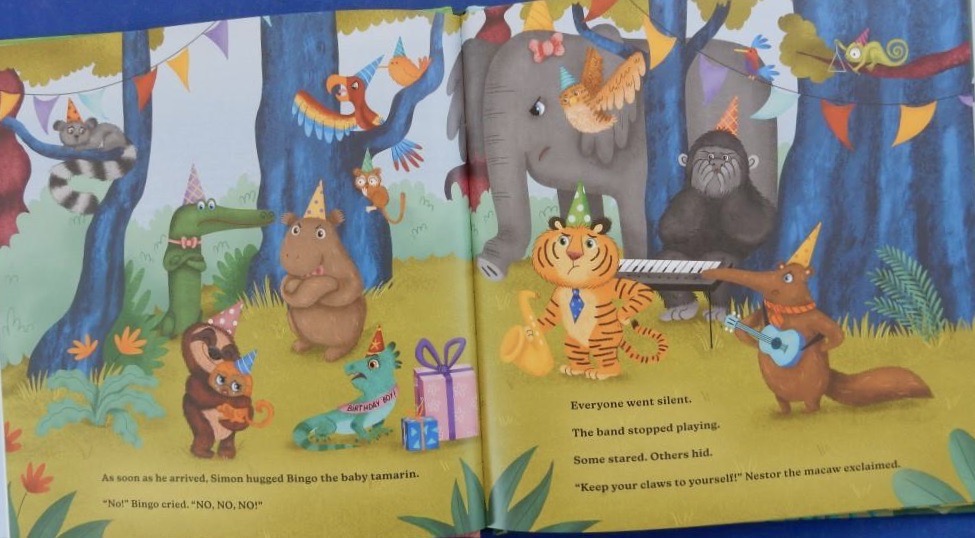
Karl’s first person rhyming text together with Duncan Beedie’s illustrations, which are bursting with humour, make a wonderfully warm, fun story for reading with young children.
Now We’re Together Nicola Edwards and Jenny Bloomfield Little Tiger
The world around us is full of wonders – real wonders; but unless we turn off the screens that constantly distract us with their virtual experiences we all miss so much.
The adult in this rhyming story decides that it’s time she and her child start by plunging themselves into darkness, holding hands and venturing outside for a real life adventure. Wow! In the night sky the moon becomes a massive pearl surrounded by stars shimmering like diamonds.
We join the two as uninhibited, they skip, splash, dance, swish and run through puddles and tall grass, into the woods where they pause for a while. Fireflies put on a magical show just for them
and then off the pair go, out of the woods and onto the seashore just as the sun begins to rise heralding the dawning of a new day – just as it does always.
Back through the streets already busy with the morning rush they go, aware that those around them are as distracted as ever by those flickering screens.
Nicola Edwards’ lyrical text and Jenny Bloomfield’s arresting illustrations convey a vital message to children and adults in this heartfelt, uplifting book. I hope it reaches a wide audience.
Starting somewhere new is often stressful but when everybody else speaks a different language it is likely to be much more difficult. So it is for Ronnie who has just moved to a new country.
Despite his parents’ efforts to equip him with some basic English vocabulary, his attempts at communication when his nursery teacher asks Ronnie to introduce himself are less than perfect. Sadly his classmates seem unwelcoming and Ronnie is upset that everybody giggles at him.
Back home he recounts what has happened to his mum and dad who do their best to reassure him.
The next day begins well and the other children want to get to know Ronnie better, but due to his lack of vocabulary he is unable to respond appropriately to their questions, leading to further confusion and leaving Ronnie as despondent as ever.
A trip to the park with Dad after school opens the way first to some non-verbal communication and then joyous laughter. It’s this laughter that leads Ronnie not only to the beginnings of friendship,
but also a realisation that both laughter and kindness are universal languages.
Illustration too is a universal language as Vyara Boyadjieva shows in her empathetic portrayal of Ronnie’s feelings and the challenges of being in a new country.
Ultimately uplifting, this sensitive debut picture book deserves to be in all early years and foundation stage settings.
Frank and Bert :The One Where Bert Learns To Ride A Bike Chris Naylor-Ballesteros Nosy Crow
Chris Naylor-Ballesteros’s bear, Bert and fox, Frank, return in a new story again narrated by the latter.
The two pals would dearly love to go on a ‘big bike ride’ but as we see, although things start off satisfactorily, it’s not long before Bert gets the wobbles and something goes wrong.
However one day with Bert claiming that he’ll be just fine, they set off together once more. After a while those wobbles start and oops …
Frank’s not giving up that easily though and he comes up with a supportive idea … or perhaps not.
Can Frank manage to think up something very special to help his best friend get back into the saddle again? And if so, can the two of them get all the way up to the top of that steep hill and safely down again without a disaster?
With its fun final twist, Chris’s story shows friendship at its best – understanding, trusting and ever patient.
Giggles galore guaranteed when you share this comic combination of words and pictures. I love the measured use of florescent colour and the unspoken commentary on Bert’s efforts provided by the bit part players.
I look forward to further episodes starring this delectable duo.
Ways to Say I Love You Madeleine Cook and Fiona Lee Oxford Children’s Books
The opening lines of Elizabeth Barrett Browning’s sonnet 43 How Do I Love Thee? sprang to mind as I read this picture book, which is a celebration of love, and in particular familial love. Madeleine Cook explores some of the multitude of ways love is expressed: it might be the tender, gentle way in which a parent holds a baby or tiny child; perhaps it’s a caress; a shared experience of the natural world when out for a walk. Sometimes it’s being there with a hug when a child is upset, or a playful tickle at feeding time and a book shared at bedtime.
Being shown love helps a small child to develop self belief and the confidence to forge a path in life. Those things come when love is shown by a listening ear and a readiness to talk things over; also through helping a youngster to learn basic life skills, as well as being supportive when a child takes an important big step such as starting nursery or school.
Those who are shown love from the outset are most likely to be loving towards others as they become more independent; love is a choice and a decision. But one thing is certain, love is conveyed differently by countless different people and that is portrayed so well in Fiona Lee’s diverse characters.
Could it possibly be that love has the potential to bind us all together – if only …
Granny and Bean Karen Hesse and Charlotte Voake Walker Books
Granny and Bean are out walking on the beach: the sea and the sky are dreary shades of grey and beige, but Granny and Bean are undeterred. Suitably clad in raincoats, warm hats, and boots, the pair make their way along the beach, enjoying their time together. Nothing is going to stop these two making the most of their time together. ‘Their laughter rose. Full of joy, it spilled / ‘cross sand, through mist, / as the curlews trilled.’ As they watch the spotted gulls,
so strong is the wind that their hats are blown off, their hair gets progressively wetter and their ‘cheeks chafed red’.
Still they keep walking, only pausing briefly to greet dogs, slowing while Bean jumps over logs until eventually they find a place out of the way of the wildness and there they stop and sit. Time for some tea: bananas and cakes come out of the bag Granny has brought with her. Then they sort through the things they’ve collected during their walk
and keeping only the best shells and a stone, with the sun trying to break through the clouds, the two head for home.
Karen Hesse’s rhyming text has the ideal complement in Charlotte Voake’s mixed media illustrations, which capture both the chill beauty of the natural environment and the tender, loving bond between grandparent and young child. I love the way the stand-out colours of their clothing helps to focus the reader’s attention on their faces and body language throughout.
Memories are made of days such as this; days spent in the natural world. From endpaper to endpaper, a gently magical book to share over and over, especially between grandparents and grandchildren.
Pick A Story: A Dinosaur + Unicorn + Robot Adventure Sarah Coyle and Adam Walker-Parker Farshore
The second in this interactive picture book choose your own adventure series offers another array of possibilities.
It’s Gwen’s birthday and Dad has made a cake; not the train shape she’d hoped for but it looked pretty tasty all the same. However with the party about to begin, said cake vanishes. Now what? Readers have three crazy starting points for the birthday girl’s search: could the thief be a unicorn from up in the clouds, a confection-loving robot in robot city
or perhaps a ravenous dinosaur roaming on a savannah?
Sarah’s super-lively text contains alliteration aplenty, a sprinkling of onomatopoeia and generous helpings of other playful language. And, in addition to choosing how the narrative plays out, readers are invited to consider various questions that feed into the action:’What amazing robot ability would you like to have?’; ‘Which cloud cake would you like to nibble?’;
Which ballistic bake would you eat? (in dino-land). Adam Walker-Parker’s humorous illustrations are equally energetic, full of comical characters and decisions to make on every spread. Another dead cert winner of a book that gives and gives and keeps on giving as it sends readers backwards and forwards through its pages. And what of the cake? Will Gwen find that which she seeks? I wonder …
A Pinch of Love Barry Timms and Tisha Lee Frances Lincoln Children’s Books
A little boy and his grandmother love to cook together and they especially like to make the titular pinch of love one of the ingredients no matter what they bake. Through Barry Timms’ rhyming text and Tisha Lee’s vibrant acrylic illustrations, that heartfelt love is shared throughout the local community. We see the empathetic little lad out offering fresh cookies to those in the neighbourhood; he seems to know just when there’s a need for a tasty treat that contains that vital ingredient.
Readers will enjoy the ‘sticky moments’ grandmother and grandson share in the kitchen as they too sometimes need a touch of tenderness especially as they prepare for that big neighbourhood fund raising bake sale at the community centre.
Choosing to be kind and loving isn’t always easy, but Tisha’s scenes of the wonderfully diverse community show just what a big difference it can make to be on the receiving end, as well as for the giver.
Love can be a power like no other: that message comes across in both the skilfully mixed text and the illustrations that add further heartwarming details to the words.
A lovely book to share with children and a smashing starting point for a class or local group event along the lines of the one shown in this story: baking/food is both a means and a metaphor for ‘paying it forward’.
A fault finding fruit if ever there was one – that’s Grape when first we encounter our narrator in this latest addition to the Food Group series. But the grape wasn’t always so, as we hear. Indeed Grape had a pretty perfect childhood growing up in a “close-knit bunch” – a community of about three thousand.
The transition from sweet to sour started when Grape planned a big birthday party to which nobody at all turned up. Thereafter began the personality change, first to a bitter grape, then a snappy one that would hold a grudge at the slightest little thing. This would manifest itself as a scowl that turned Grape’s face ‘all squishy’. Gradually the grudges built until one day, Grape is due to meet his only friend, sour Lenny, for one of their regular ranting sessions. But a sequence of mishaps result in Grape arriving at the venue three hours late. Guess who how holds a great big grudge.
A disbelieving Grape ponders on the situation and then leaves his friend to grumble alone. As Grape enjoys the surrounding nature, there follows a light bulb moment and off home goes the fruit to find and browse through a box of keepsakes. Goodness me! Grape discovers that old party invitation and the date written thereon was ten days after the birthday date. “It was all my fault. I realised nobody’s perfect. Not even me.”
Thus begins a change in the attitude of our narrator who finds that talking, listening to others and working things out calmly is the way to go.
What an important life lesson, and delivered in Jory John’s punny prose and Pete Oswald’s signature style illustrations, make it great fun. A book that adults, as well as youngsters should read; after all as Grape concludes, ‘If you look at things in the right sort of way – and if you remember to be kind, considerate, forgiving and grateful – life really can be pretty sweet.’
Be Wild, Little One Olivia Hope and Daniel Egnéus Bloomsbury Children’s Books
‘Wake up early, don’t be shy, / this bright world can make you FLY. / Be wild, little one.’ So urges the author in her opening lines of this exhilarating, rhythmic text that encourages children to believe they should go out into the world, explore it imaginatively and believe that anything is possible; in other words, to make the world their playground. Be it climbing trees, swimming in the deep blue ocean, chasing storms, (yes those will eventually go) or running with wolves through snowy mountains,
Daniel Egnéus captures and enlarges the experience with his glorious, memorable scenes of a child embracing the wonders of the natural world and experiencing every opportunity as an adventure. Not only do the words sing but so too, do the illustrations. And what better way to end than with this final spread where readers feel that they really are standing alongside the child under the starry sky ready to relish every moment of that adventure.
Truly a joyous, magical book bursting with encouragement and energy; be yourself in this wonderful world and embrace life imaginatively and fully. What better message could you give a child? A must have for class collections and family bookshelves.
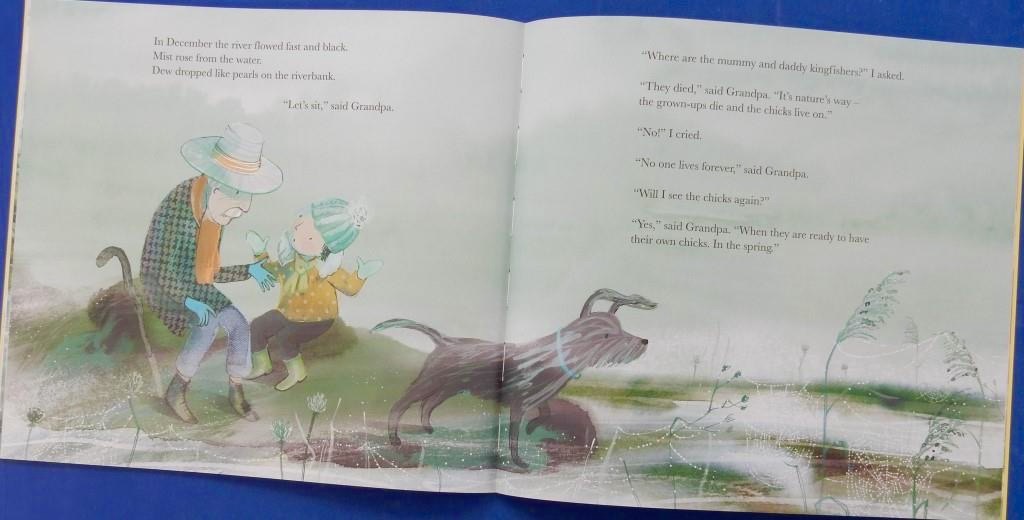
One day, a Monday to be precise, a little boy discovers a polar bear in his garden – a very tiny one. So small is the bear that he can sit in the boy’s hands. The boy speaks to the bear and realising he must be lost wants to help him. Over the next few days two things grow – the polar bear and the friendship between bear and boy and by Wednesday, it’s time for the two to set sail.
They embark on a journey that takes until Sunday when the bear is reunited with his family. After a day playing with the polar bears, the boy knows he must say goodbye to his special friend and sail back home. This he does, safe in the knowledge that the bear’s love will stay with him.
With the caring boy narrating the story, and Richard’s wonderfully gentle portrayal of the events and the growing loving bond between bear and boy, we truly feel as though we’re with them throughout. It’s this care and concern that lies at the heart of the story: “Are you lost, little bear. Can I help you?” comes the boy’s first question; then on Thursday we read ‘he had grown too big for my hat … So he curled up tightly, safe and warm in my bag.’ while on Saturday we see this:
Comforting and reassuring, this is heart-winner of a book that lingers in the mind and is open to several interpretations depending on what readers/listeners bring to the story.
Little Elf’s Christmas Surprise Helen Baugh and Nick East Harper Collins Children’s Books
Little Elf can hardly contain his excitement: at last he’s sufficiently grown up to be able to wear one of those red and green hats that are considered a special perk for Santa’s elfin helpers. As the other elves complete the loading of Santa’s sleigh, Little Elf proudly holds in his hands the final ‘Dear Santa’ letter in the entire land and begins to read. So intent is he that Little Elf fails to notice the icy patch in the workshop doorway and whoosh! He slips, slides, thumps and in so doing lets go of that all important letter.
Back on his feet, Little Elf chases the whirling, swirling letter through the snow and ice but just as it’s almost within his reach, the elf takes another tumble. ‘But he HAD to catch the letter! / It just COULD NOT disappear! / Or a child would think that Santa had / forgotten them this year.’ Off he goes again with increased determination.
After further accidents, our Little Elf finally has the letter in his hand and off he hurries back home to read it.
What he discovers as he shares its contents with his fellow elves causes considerable consternation among them and a selfless action on the part of our little hero.
Young listeners will love joining in with the repeat refrains in Helen’s rhyming text and revel in the final surprise. With gentle humour, Nick captures the chaos that is Little Elf’s chase, brilliantly showing his perturbation as he ploughs his way through the wintry landscape.
Whose Tracks in the Snow? Alexandra Milton Boxer Books
‘Look! Look! / Tracks in the snow!’ is the cry on each alternate spread in this gorgeously illustrated book that introduces readers first to the footprints and then having described the chief characteristics of the prints, ‘Tracks like hearts, Tracks in two lines’, asks them to guess who left those marks, ‘by the snow-covered pines?’
The black smudgy marks each time are a close facsimile of what children would see in the natural world and a small glimpse of a part of each animal provides an additional clue, in this instance, the dark brown tip of a lighter brown tail. The page turn reveals the answer—‘A shy red deer’—and some information about the creature depicted in all its glory.
The rhyming text with its repeat refrain is a joy to read aloud, the descriptions of the tracks are superb ‘Tracks with lines, / Tracks like a kite’ are those of a waddling wild duck,
‘Tracks like diamonds …’ refer to those made by the bushy-tailed fox’, but it is Alexandra Milton’s exquisite collage illustrations at every turn of the page that are the real show stoppers. Just look closely at the snow with its variations in colour and small portions of shading. Six animals, six landscapes and each a joy to behold.
What a wonderful way to entice youngsters out into the woods on a snowy day for some track-spotting. (The back endpapers show life size tracks of the six animals – pheasant, duck, fox, hare, deer and squirrel.)
The Frost Goblin Abi Elphinstone and Fiona Woodcock Simon & Schuster
If you don’t think winter’s frost is fun then you should read this book: actually you should read it anyway as it absolutely sparkles with magic and fizzles with enchantment.
One cold winter’s night quiet young Bertie Crash-Wallop’s heart wobble causes him to creep out from his noisy home without his family noticing. As he pauses on the swing, he spots for the first time, a door handle and having investigated further, not only does he get a tingling feeling but he discovers a small door through which he steps, only to hear someone whispering.
Thus it is that Bertie is drawn into a thrilling goblin adventure for he follows one Archibald Frostgobble and a wonderful chocolatey smell and learns that on this, the night of the deepest, most important frost of the year, the goblins must ensure that it’s scattered over the entire town of Clatterstomp before dawn. Before long it seems as though Bertie himself might make some magic; he meets a young goblin child, Ada, and is soon accompanying her on an exciting, magical undertaking scattering frost with his new friend.
Eventually ‘It was as if a giant had breathed silver into every corner of Clatterstomp.’
Goblin magic we discover has the power to transform for not only can it ‘rekindle hope in the sleeping hearts of all those who needed it,’
it also shows Bertie that he does in fact belong in his family and just how much they all love him.
Team Abi (author) and Fiona (illustrator) have created their own magic in this wonderfully heart-warming, moving story that makes a perfect read aloud, especially on the coldest days.
Floof Heidi McKinnon Allen & Unwin Childrens Books
Put me in a room with a cat and within minutes I will be wheezing and sneezing and have streaming eyes, so the thought of getting close up and cuddlesome with one is something I would certainly avoid. However, one glance at the alluring image with those big round eyes on the cover showing star of Heidi McKinnon’s book, Floof, is enough to make even this cat phobic reviewer want to spend some time with the creature.
Then to see this
brought on a strong urge to snuggle up and share some of the books in the pile with the ‘furball’. Even better, readers and listeners are able to have a whole ‘busy’ day with the mischievous Floof and in so doing, relish all the mismatches between what the words say and what the illustrations show is actually happening.
Not only is this a smashing book to share with young children, it’s also a good one for those in the early stages of reading to try for themselves, preferably after an adult or older child has read it with them.
With humour and delight in equal proportions, this fun book will bring a smile to your face at each turn of the page.
The Heart of a Giant Hollie Hughes and Anna Wilson Bloomsbury Children’s Books
Meet young Tom. His mother ‘has gone away’ we read. Not so the hills up which Tom likes to climb every day and beneath which so it’s said, sleeps a giant.
When out walking one day Tom lies down to rest and pressing his ear to the ground, he listens for a heartbeat. Suddenly he feels the earth start to tremble and shake, which sends him rolling downwards. The giant has woken, but having found his feet again, does Tom run away as his instincts first tell him? No, for he realises that the great being is a child too. The giant introduces himself as Abram, Abe as Tom is to call him and thus a new friendship is forged. Abe goes on to tell Tom that more than a century ago his Mammy Giant left him and now he’s grown tired of waiting. Perhaps she’s in need of help, they decide, and so begins their long, arduous trek in search of her.
Eventually they lose hope, Abe especially, and his outpouring of pain, frustration and fury causes the ground to open. Can Tom, an ordinary human child save the situation and perhaps even bring some cheer to Abe? He’s certainly going to have to draw on his new-found inner strength and resourcefulness.
With themes of friendship, love, loss and bravery, this beautifully written and illustrated book is one that lingers in the mind, especially the thought that as Tom’s mother said to him before she died, “each of them would always be within the other’s heart.’
Hollie’s lyrical, rhyming, self-affirming text has its perfect complement in Anna Wilson’s illustrations with that gorgeous colour palette and which capture so well the emotional roller coaster of a journey both friends undertake.
Supertato Presents Evil Pea and the Beanstalk Sue Hendra and Paul Linnet Simon & Schuster
Welcome back to the supermarket. The curtain’s up on the silliest ever pantomime performance of Jack and the Beanstalk narrated by Tomato and starring a said to be kind-hearted pea, Jack and its mum, Supertato – oops mustn’t let the name slip during the show.
In an endeavour to eke out their almost non-existent cash, Jack’s mum sends him off to market to sell Daisy their cow. You pretty much know how the story goes with Jack agreeing to swap Daisy for some supposedly magic beans, which against the odds the following morning, having been tossed out of the window in disgust, have transformed into a beanstalk.
Upon learning from said beanstalk that the riches await at its top, Jack (don’t even think of calling him ‘good’) begins to ascend, protesting loudly and vigorously.
Happily with Jack duly saved from his life threatening experience, he and his rescuer proceed upwards, enter the castle they find and encounter first an egg laying being, followed shortly after by a ‘glorious mystery guest’ of the fruity kind intent on consuming its visitors.
Fortunately for Jack and his ma they manage to escape, Jack still protesting his ‘not’ goodness, and about to receive a show-stopping surprise. With its delightfully daft finale, this latest Hendra/Linnet extravaganza definitely deserves the encores that young audiences will demand. There’s no doubt who is playing the bean swapper Jack encounters but I wonder if they’ll guess who is playing Daisy the cow.
This is the tenth Supertato book and it’s great to hear that £1.29 of the cover price from each copy of Supertato presents Jack and the Beanstalk sold will be donated to Save The Children.
Namaste is a Greeting Suma Subramaniam and Sandhya Prabhat Walker Books
When I first started visiting India many years ago ‘namaste’ was explained to me as ‘my heart to your heart’ – a lovely summary I thought. Now the author and illustrator of this delightful book explore the meaning of the word namaste, used by Hindi speakers as a greeting. Herein a little girl discovers that in fact ‘namaste’ is all around her and can be expressed by a smile, through friendship, celebration, a yoga asana, silence and much more.
I love Sandhya Prabhat’s bright storytelling illustrations showing the interactions between the child and the grandmother character and how the former nurtures a plant for the latter.
This seemingly simple book has considerable depth and is one to share over and over with young children; it’s a delight.
Balloon to the Moon Becky Davies and Jennica Lounsbury Little Tiger
Drawing on mindfulness and meditation techniques, Becky Davies’ dreamy lilting rhyming text and Jennica Lounsbury’s soft lyrical illustrations encourage young children, safely tucked up in bed to let go, relax completely and gradually drift off into dreamland.
An adult switches out the light and we watch as the moonlight calls through a small girl’s window, causing her bed to lift and balloon-like, drift gently out into the star-filled, moonlit sky, guided by firefies. Silver songbirds and sheep-shaped clouds accompany the moving bed over land and sea to the accompaniment of dolphins’ songs, shushing water and chorusing whales
as it continues its journey through the velvety night sky towards the smiling, welcoming face of the moon and sleep’s loving embrace.
If you’re looking for a sleep-inducing picture book to share with young children, try this gentle, reassuring story just before bed.
These are two small books from Gecko Press – thanks to the publisher for sending them for review
Perfect Presents Anke Kuhl
In this mini hardback wherein Kuhl uses crayon to great effect, a monstrous-looking creature sits in an armchair, waiting. He keeps looking at his watch until BRRING! goes the doorbell. Enter a skinny lizard pulling a trolley, who greets him with, “Best wishes for today!” Clearly the large creature is celebrating his birthday and the visitor holds out first a cake, then a bunch of flowers and finally, a gift-wrapped surprise, all of which the monstrous one devours with obvious relish.
He then grabs hold of his guest: surely the lizard isn’t going to be consumed too? The tension mounts … Anyone for tea? …
Hugely satisfying: I hope it’s to your taste; it certainly is to mine.
For younger children is
Let’s Play, Little Rabbit Jörg Mühle
Herein we see Little Rabbit behaving in the same exuberant fashion as would his human toddler counterparts – playing peekaboo, enjoying a swing and wanting to go ever higher, splashing in a tub of water and having fun with a soft toy rabbit. “Can my little rabbit play too? One, two, three….” “Wheeee!” comes the request in Jöge Mühle’s simple first person text, which speaks directly to his intended audience.
A sweetly playful, vibrantly illustrated, interactive board book to share with the very youngest.
Gaspard’s Christmas Zeb Soanes and James Mayhew Graffeg
The enormously popular fox Gaspard returns in his fourth adventure, the proceeds from which will go to St. Martin-in-the-Fields Charity that helps the homeless.
When out hunting for food one bitterly cold night near to Christmas, Gaspard comes upon what he thinks is a bulky black bag in a bus shelter. On investigation he discovers an old man with a white beard wearing a black overcoat who is obviously freezing. He quickly realises that the man needs help and goes off in search of assistance, calling on his friends Flinty the dog and Peter the cat before returning and attempting to warm the man whose condition has clearly deteriorated.
The savvy creatures investigate and find that the old man’s name is Nikolas and off rushes Flinty to find her person. Then together Honey and Flinty struggle through the streets back to Nikolas and the other animals.
Eventually back in the church, the old man is given a meal, clean clothes and a warm shower, and later a special temporary role at the shelter party.
Despite being given a small reward each, Peter, Flinty and Gaspard understand that their true reward is the knowledge that their kind and speedy actions have saved someone’s life.
Such a vital message about selflessness and a thought-provoking story about the importance of showing kindness to those less well off than ourselves. I love James Mayhew’s painterly, detailed illustrations that, as always in this series, are infused with loving concern.
The Red Sledge Mick Jackson and Victoria Ball Walker Books
Mabel Taylor is thrilled with her shiny new red sledge. She dresses herself warmly and opens her front door only to find – no snow. Back indoors she sits in her sledge and starts to imagine … She visualises herself as a bobsleigh champion and next morning, quite excited, she races to open the curtains. But what does she see; no snow at all. Back in her sledge she gets and this time she imagines herself as a polar explorer dragging her laden sledge and trudging through the deep snow. ‘Tomorrow it might just snow, she thinks.
The following morning, a little bit excited she opens the door and peeps out only to find – you’ve guessed it – not a single snowflake has fallen. Again she sits in that sledge and takes on the Father Christmas persona, with her sledge being drawn by four reindeer. Next morning convinced there won’t be any snow she almost fails to notice what is happening through her window: heavy snow is falling – whoopee! Warmly wrapped up, she crosses the field, climbs the steep hill and pausing to take in the view, gets into that sledge, breathes deeply and Wheeeeeeeeee! She’s off at last.
Although it’s not mentioned, in the words, young children will likely deduce from the excited look on the child’s face in the first illustration, that Mabel’s sledge is a Christmas present. I love the way she copes with the disappointments of no snow, turning them into opportunities for imagined indoor adventures.
We’re Going on a Sleigh Ride Martha Mumford and Cherie Zamazing Bloomsbury Children’s Books
Having chased elves, hunted for eggs and treasure in previous books, it’s now Christmas Eve, time for Martha Mumford’s bunnies to wrap up warm, load the presents and take off on a round the world sleigh ride with Santa and his reindeer. Much of the rhyming text comprises the refrain “We’re going on a sleigh ride./ HO! HO! HO!” along with some onomatopoeia (‘Honk! Honk!’ ‘Ding-a-ling-aling!’) and more. Readers and listeners meanwhile can have fun hunting alternate spreads for the hidden gifts and watching their tally mount and they reveal them.
The narrative zips along merrily and Cherie Zamazing’s jolly watercolour illustrations show the varied locations visited with all kinds of animals enjoying the spectacle of the sleigh whooshing by. I suspect little ones will relish the sight of Santa with his feet waving from a chimney top, down which, aided by one of the four reindeer, he’s attempting to enter a house.
With lots of flaps to explore, this is a perfect Christmas Eve read together and equally, the simple text makes it ideal for those in the early stages of reading for themselves.
We Disagree About This Tree Ross Collins Nosy Crow
The duo from There’s a Bear on My Chair are back and as usual they are disagreeing: why break an established habit just because it’s the festive season?
Mouse is excited when Bear bursts through their front door clutching a large Christmas tree and urges him to relax and leave the adorning to him. Inevitably Bear soon begins making disparaging comments about Mouse’s efforts and this precipitates back and forth critical animosity, culminating in tree overload
and disaster. However, not everything is a cause for contention thanks to two neatly wrapped packages waiting to be opened. Have the two bickerers finally found a way to share a Merry Christmas?
The interplay between Ross Collins’ sparkling verse telling together and his superbly expressive illustrations that are simply bursting with humour, is wonderfully done and will appeal to both young listeners and adult readers aloud.
The Big Christmas Bake Fiona Barker and Pippa Curnick Happy Yak
Author Fiona and illustrator Pippa cook up a wonderful festive tale based on the structural rhythm of the traditional Twelve Days of Christmas.
On the first day of Christmas two children head to the kitchen and begin to make a Twelfth Night cake. The list of ingredients is long and they wonder where everything will come from. Happily however, day after day for the next eleven days animal friends of all shapes and sizes show up bringing in turn, dried fruit, flour, sugar, candied peel, eggs, spices
and all the other things needed, until on day ten, ten lords come leaping in ready to carry the cake to the stove for baking. All that’s left then is the piping pipers to show up on the eleventh day to add the finishing touches so that come Twelfth Night, the most incredible confection is set on the table ready for every single one of the contributors to enjoy. I wonder who finds the bean that was hidden in the mix …
A tasty treat indeed and don’t forget to check out the recipe after the story.
A Family Christmas Alana Washington and Emily Nash uclan publishing
With echoes of Clement Clarke Moore’s ‘Twas the Night Before Christmas Alana Washington relates the events of a family’s Christmas day. There’s excitement about the arrival of guests and a kitchen of hot chocolate drinkers with cousins squeezing close together clutching their mugs.
Then at dinner time, dish after dish of delicious food is served up, an unexpected visitor turns up and when everyone is bursting with extra helpings of pudding, it’s time for a toast to the host. In order to work off some of that food, family members go for a walk, followed by further indoor festivities: dancing and games, singing and the playful adornment of those who take a snooze. With the washing up duly done, it’s present time at last. Darkness comes all too soon and some of the family must head for home, but there’s one final treat still to come: something big and extra bright high up in the sky. What better way to end the day than by sharing a special story and watching a sprinkling of snow fall before snuggling down in bed after a perfect family celebration.
With joyful scenes of togetherness, Emily Nash’s gently humorous art captures so well that magical feeling of the festive season described in the author’s text.
Kid Christmas of the Claus Brothers Toy Shop David Litchfield Frances Lincoln Children’s Books
Everything David Litchfield does is a winner as far as I’m concerned and this one is no exception. It features young Nicky and his three uncles: Louis, Hans and Levi, aka the Claus Brothers, the finest toy makers in all the land.
Nicky is now old enough to work for his uncles in their emporium behind which is their workshop. There, Uncle Hanz was to be found making the toys, Uncle Louis would check them and Uncle Levi had a special role: he added the magic sparkle to every single toy making it perfect for the recipient. From time to time Nicky would notice less fortunate children outside the shop peering in and on Christmas Eve, with the shop closed early, Nicky decides to follow the children. What he discovers saddens the boy greatly and he vows to give every child in the city a present to make them happy, even if only for one day.
Back in the Toy Shop, his uncles are agreeable to the plan and with huge sacks full of gifts, Nicky suddenly realises that delivering them is going to be beyond his capabilities. Or maybe not, thanks to another of his uncles’ creations.
Off he sets but then faces other difficulties on his journey pulled by reindeer that require frequent supplies of carrots. Will Nicky ever bring his plan to fruition? Happily yes: how else would the story of Father Christmas have come to be?
David’s illustrations are out of this world brilliant. Full of Victorian details to pore over, and combined with a story brimming over with kindness that will fill anybody lucky enough to read the book, with a wonderful seasonal glow.
The Christmas Doll Amy Sparkes and Katie Hickey Walker Entertainment
I have a lot of admiration for Jay Blades having heard him share some of his back story on the radio recently so was especially excited too see him as one of the characters in this seasonal Repair Shop story.
Evie and her great granny Sue, have come to the Repair Shop with a very special doll named Lizzy, who’s in need of some TLC from Jay’s Teddy Bear Ladies. “That is a very beautiful doll. Can you tell me something about her?” he asks Granny Sue. His inquiry transports Sue back to her childhood. She then recounts the story of how she was evacuated as a young girl from London at the beginning of the war in 1939. Sent to stay with the Russells, a husband and wife who treated her with such loving kindness, that by Christmas Eve, the little girl is feeling much more at home. On Christmas Day she can hardly believe her eyes when she discovers a beautifully wrapped present at the end of her bed. Inside is the doll and she names her Lizzy, taking the doll everywhere but thinking that at the end of the day she will have to return her. Imagine her joy when she’s told Lizzy is hers to keep for ever. What a truly magical Christmas.
Eventually however, it’s time for Sue to bid farewell to Mr and Mrs Russell and return to London. Even now, Granny Sue recalls the couple with fondness, going on to explain that Lizzy’s damaged state is on account of all the love and cuddles she’s been given over the years. Enter Amanda and Julie. Lizzy is left in their safe hands while for the next week they work on the precious doll
and Granny Sue is overjoyed with the result of their creative work. But that’s not quite the end of the story: a new chapter in Lizzy’s life is about to begin …
Amy Sparkes has worked her own magic by fashioning the ‘true story of the Christmas doll’ related at the end of the book, into an utterly charming, heartwarming new tale wherein past and present come together seamlessly. The Repair Shop team are immediately recognisable in Katie Hickey’s portrayal and she infuses the scenes of Granny Sue’s childhood memories with a warm glow. Don’t miss the gorgeous endpapers – the front one captures that wonderful community spirit of Jay’s team.
This is a book I see being shared in countless families and classrooms over and over, as part and parcel of the Christmas season.
The Christmas Department Store Maudie Powell-Tuck and Hoang Giang Little Tiger
It’s Christmas Eve but Benji feels anything but festive: it seems as though Christmas has lost its magic this year. His family can’t afford either a tree or a turkey and so they’re sad. As Benji walks through the snow-filled street wishing he could buy them spectacular presents he recalls his Granny’s words about magic happening on Christmas Eve. Suddenly a huge polar bear knocks him flying and as he gets up, there before him is a large department store. But this is no ordinary store; it’s full of wonder and magic, with penguin doormen and a shiny steam train that puffs along on a glittering spiral track.
One by one, Benji discovers the most perfect gifts for his family – a funky trumpet for his sister Hana, which he pays for by singing a silly song,
an unusual imaginary hat for his gran (he tells a story to a leopard in payment for that) and a very special warm-smelling potion for his dad. Full of excitement and high hopes for a wonderful Christmas Day, he returns home.
Next morning those hopes become doubts; but when he sees the smiles on Hana, Dad and Granny’s faces when they open their presents, he realises that the real gifts he’s given them are not material things but love and happiness.
Absolutely full of heart, this enchanting tale shows that the very best presents aren’t those bought with money, but those given with love and care. With their warm festive tones of red, gold and green Hoang Giang’s illustrations on every spread are filled with the magic of the department store.
The Woodcutter and the Snow Prince Ian Eagleton and Davide Ortu Owlet Press
With links to the classic fairytale The Snow Queen, Ian, a wonderful spinner of inclusive stories brings us what is, despite its wintry setting, a magical heart-warming tale of a lonely woodcutter who searches for love.
Kai is a woodcutter who enjoys carving statues for people to enjoy on Christmas Eve but nobody ever passes by. This year he is feeling particularly lonely without his grandmother, whose wondrous tale he recalls: ‘But this year he was alone,’ we read. Then as Kai ponders upon the possibility that his grandmother’s stories might be true, he is visited, but only briefly, by the Snow Prince. What he sees in the Prince’s eyes is hope.
So begins his journey to find love. To do so though, Kai undertakes a long, long journey, travelling though days, weeks and months
and all kinds of weather until it’s Christmas Eve once more. Now he needs to break the curse on the Prince imprisoned once again in his palace of ice. Can he do so with his loving touch?
The power of love is palpable in both Ian’s lyrical words and Davide Ortu’s beautiful, richly detailed filmic illustrations;
and make sure you take time to look at the pictorial maps that precede and follow the story.
Teachers and others, if you want your seasonal bookshelves to be for everyone, then you must add this LGBTQ+ picture book to your collection and share it this winter and beyond.