Why Do I Poo? / Freddie the Fox Feels Frightened

Thanks to Booklife Publishing for sending these: it’s always good to discover a new publisher.
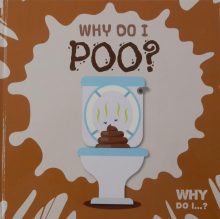
Why Do I Poo?
Kirsty Holmes
Booklife Publishing

Bodily functions and in particular, poo, seem to hold an endless fascination for young children; mere mention of the word often elicits giggles among those in a reception class or nursery group; and with a cover like the one on this book, I’m sure it will arouse interest straight away.

Actually the whole book isn’t about poo; rather it offers a straightforward look at the workings of the human digestive system, (using a pizza as exemplar)

along with some other poo-related information such as that ‘poo gives off methane and that can be burned to produce power for our homes’, as well as powering buses. Also, animal poo is useful as a fertiliser for plants and, since it contains a lot of fibre, can also be made into paper – not human poo but that of sheep, elephants and even pandas.

After a look at other waste products we make,

there’s a spread on poo-related tummy troubles, as well as one inviting you to ‘rate your poo’ (using the Bristol stool scale). Don’t try that if you’re suffering from those tummy troubles though.

If your little ones are feeling quizzical, then they might like to try matching the poo piles to the four animals illustrated on the opposite page.

The book concludes with a glossary and index. Are you ready, steady, air freshener to hand? …
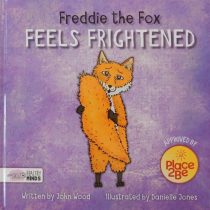
Freddie the Fox Feels Frightened
John Wood and Danielle Jones
Booklife Publishing

This is one of the Healthy Minds series aimed at the foundation stage and would work either shared at home or with a nursery group.

The author uses a narrative style to explore Freddie’s feelings on the evening before and morning of Freddie’s first day at school.

Despite Andy’s reassurances, Freddie goes to bed feeling frightened about what the next day might bring. So much so that he has a scary dream about being fired from a cannon, his fall being watched by countless pairs of eyes.

When the two leave for school, Freddie takes with him his comfort blanket and even so Andy is concerned that he looks rather unwell; he certainly feels that way on account of his fears of what might happen when they arrive.

His procrastinatory tactics take the two on a rather longer than expected route and during their journey Freddie talks more about his feelings.
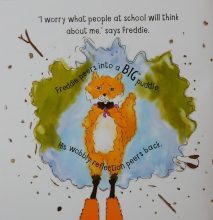
Eventually the wet, muddy pair arrive just in the nick of time, with Freddie’s tail all a-tremble and his heart beating fast. Andy continues to reassure him as he opens the door
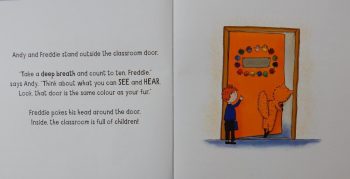
and following her instructions he counts to ten, looks around and very quickly finds himself absorbed in the children’s game.

With questions to ponder during the story and more to discuss afterwards, this book is, like Andy’s words to Freddie, a reassuring one to use with those soon to start school (or a nursery class). Danielle Jones’ bright, uncluttered illustrations show how both Freddie and Andy feel throughout and should help allay those pre-first day fears in little humans.
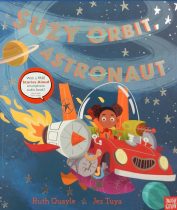
Suzy Orbit, Astronaut / Make & Play: Space / Balloon to the Moon

Here are three very different books all with a space theme:

Suzy Orbit, Astronaut
Ruth Quayle and Jez Tuya
Nosy Crow

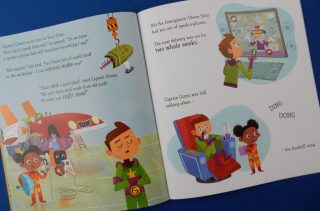
Space engineer, Suzy Orbit lives with her boss, Captain Gizmo in a lunar space station.

One morning they learn that aliens have been spotted within range of their location and they need to act quickly to launch their space pod. The Captain orders one forthwith but it arrives without batteries and those the Captain has don’t fit.
Furthermore his shiny new space suit is way too small and as the aliens have by now arrived, it’s pointless trying to get a new speak-o-phone.

Happily though, the aliens are peaceable beings but they have bad news to share. Earth is about to be blasted by a meteor storm unless Suzy and her boss can stop it. No pressure there then.

Fortunately Suzy, with her tools always to hand, is an engineer extraordinaire and just happens to have a wonderful new invention ready and waiting. It’s as well that one of the team realises that it’s better to rely on ingenuity than ordering things on the net. Before you can say ‘blaster’ the two are heading out into the meteor storm with Suzy at the controls to do battle with those errant meteoroids. Can they save the day and see off the storm?

It’s great to see Suzy as a positive STEM character in the role of engineer/inventor in Ruth Quayle’s quirky tale. Jez Tuya’s bold illustrations show her as having determination and resourcefulness – exactly what’s needed in the face of the Captain’s lack of drive and inability to show any innovative aptitude.

Make & Play: Space
Joey Chou
Nosy Crow

The latest of Joey Chou’s Make & Play interactive activity book series is sure to please young space enthusiasts.
It contains eight pages of bold, brightly coloured, double-sided press-out play pieces that can be used to create a space scene (some have a hole to suspend with thread while others slide together to stand). The entire set would make a great diorama with space dogs, aliens, astronauts and spacecraft, though if desired, the pieces can be fitted back into the spirally bound book for safe keeping.

There are also other space-related activities – a fruit rocket made from fresh fruit pieces; a song to learn; a ‘blast-off rocket’ science experiment, alien models to create (they could be made into puppets perhaps) and more.
There are hours of fun to be had with this, whether used by an individual, or a small group of young children.

For older space enthusiasts is:

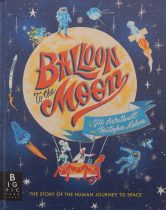
Balloon to the Moon
Gill Arbuthnott and Christopher Nielson
Big Picture Press

Rather than concentrating on the Space Race, this takes a historic look at the steps that began in the late 18th century with the Montgolfier brothers flight of a large unmanned balloon and led on to their sending a variety of animals skywards on a 3km flight three months later.

In the same year came the first manned untethered flight by inventor Pilâtre de Rozier and the Marquis d’Arlandes who flew 8km in a Montgolfier balloon. Hot on their heels came the first woman to do similar, the following year (1784). There’s a whole spread given over to this balloon bonanza.

The narrative then shifts to the first half of the 20th century with a look at some aviation pioneers, followed by a focus on some iconic planes.

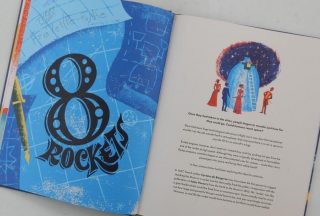
I was especially pleased to find some literary references on the opening page of the ‘rockets section’ where there’s a mention of both Cyrano de Bergerac and Jules Verne. The author uses numbers in her selection of what she includes so we have, for instance ‘8 Rockets’

and ‘Into the Unknown 7’. The seven referring to the seven animals that became the first astronauts; and this chapter cleverly links these with an explanation of g-forces and their relation to fighter pilots and astronauts.

Much of the remaining part of the book provides information on the endeavours of the US and the Soviet Union to win the space race; and what happened thereafter. In conclusion there’s a quick look at some of the new information the Apollo Moon flights gave us; what ‘space travel has done for life on earth’ and a final look to the future.

Christopher Nielson’s retro style illustrations are full of humorous touches adding to the allure of the book and the enjoyment of the whole narrative.

Animal vs Animal Who’s the Strongest? / Like a Lizard

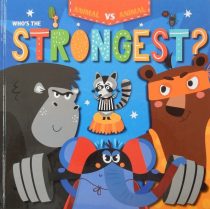
Animal vs Animal Who’s the Strongest?
Kirsty Holmes
BookLife

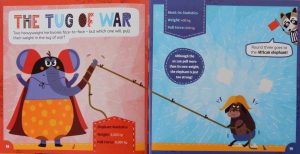
Welcome to the ‘Great and Small Games’. Essentially this show (it’s one of a series) comprises three strength events: The Tree Trunk Lift; Strong Bug Circus and Tug of War, each of which is refereed by a flag-waving racoon.

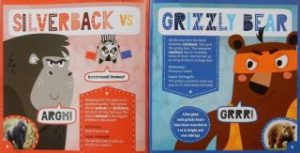
The participants are, for the bug event, dung beetle and leafcutter ant; silverback gorilla and grizzly Bear are the tree lifters;


while in the third round, an African elephant and a musk ox tug it out.

Two spreads are devoted to each pair of contenders and as the animals are introduced and perform, snippets of factual information surrounds them on banners or in bubbles,

but it’s never overwhelming thanks to the design of the pages.

A fun way to learn some animal facts, this book should pack a powerful punch with younger readers.

Like a Lizard
April Pulley Sayre and Stephanie Laberis
Boyds Mills Press

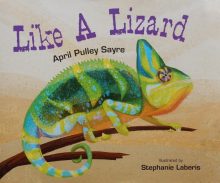
Let’s get physical and in so doing, through Sayre’s playful rhythmic text and Laberis’ expressive digital art, learn about more than 25 different lizards and some of the things they do.

So, for instance, ‘Could you drape like a lizard? / Gape like a lizard? / Do a push-up like a lizard? Scale sticks? / Curl in like a lizard?’

Each of the lizards featured is labelled with its common name and described after the main text, in a paragraph below the named behaviour illustrated in the narrative. Every paragraph provides factual information – Latin name, where in the world it’s usually found, length and other interesting details specific to the creature.

So, after an initial read aloud, can your little ones behave like lizards as you share this engaging book? They’ll certainly have fun trying and learn some herpetological facts in so doing. I wonder what they might do in response to this  …

A Planet Full of Plastic

A Planet Full of Plastic
Neal Layton
Wren & Rook

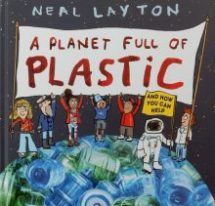
Neal Layton has created an absolutely superb information book on a topic that’s on many people’s minds at present.

Right away he addresses the reader with ‘Quick question: do you ever think about what things are made of? ’ and goes on to mention other materials such as metal, wood, glass and paper before focussing in on plastic; plastic in all its shapes, colours and sizes.

We learn about the discovery of the material by chemist Mr Baekeland and how rapidly it became enthusiastically used in pretty much anything you might think of.

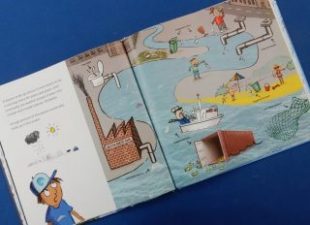
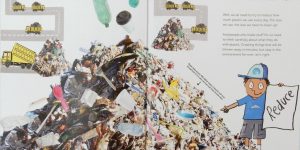
Plastic in the places it should be is all well and good, but the trouble is it doesn’t biodegrade and therein lies the problem. (Neal explains what this means with two sequences of strip pictures)

What eventually happens is that much of this plastic finds its way into our oceans

where it creates big problems for the marine animals as well as forming massive garbage patches in the Atlantic, Pacific and Indian Oceans, especially in the form of toxic microplastic particles.

All of us need to cut down on our use of plastic, especially that used only once,  is what we’re powerfully reminded here …

Neal’s narrative style is perfectly pitched for the intended audience – there’s not a scrap of preachiness about it – and his mixed media illustrations are a powerful reminder of the ubiquitous problems of plastic waste.

Children and young people care deeply about the environment as they’ve already demonstrated and the book concludes with a ‘How you can help section’.

If the government is really serious about the environment, and in particular the terrible effects of throwaway plastic, then perhaps they should fund a copy of this timely book for all primary schools and nurseries.

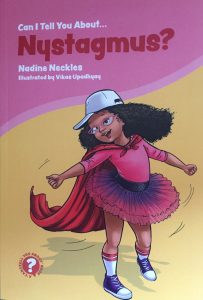
Can I Tell You About Nystagmus?

Can I Tell You About Nystagmus?
Nadine Neckles, illustrated by Vikas Upadhyay
Jessica Kingsley Publishers

I’ve only ever taught one child who had Nystagamus (due to his albinism). Now having read this excellent little book – the latest in the ‘Can I Tell You About series’, I feel ashamed about how little I really understood of the condition.

Herein a girl named Amber talks in a user-friendly manner about nystagamus -her ‘dancing eyes’, what this means for her in particular and about how she and other children with the condition will experience it differently, although they may share certain similarities such as taking longer to learn things. (This doesn’t mean they are any less clever than others however.)

We hear about Amber’s diagnosis (her eyes jiggle from side-to-side);

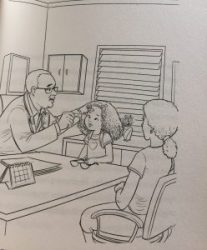
how she has to have regular eye check-ups; how she has to carefully adjust the way she sits to watch TV, preferably sitting right close to the screen; the need for her to wear glasses to prevent her ‘seeing double’ as she also has a mild squint.

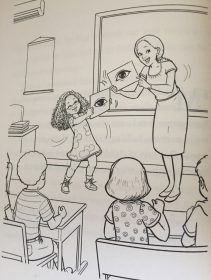
Starting school presented a challenge for Amber especially the frenetic-seeming playtimes. Amber’s school has made accommodations for her condition such as adding yellow tape to the stair edges, doorframes and potential places of danger; and her mum explained nystagmus to Amber’s classmates.

When in the classroom she has a special place to sit, is never asked to share a book or computer screen and has work printed on coloured paper.

Reading itself brings its own set of challenges but again there are aids to make things less tricky for her. Depth perception is a particular challenge, so ball games, (and other things requiring rapid hand-eye co-ordination), gymnastics and running are ‘tricky’.

Of course frustrations occur but Amber’s friends are understanding and Amber herself is bold, intelligent and resilient, refusing to let nystagamus define her.

The book concludes with some information for adults, an outline of associated conditions, an important checklist for professionals, a glossary and a list of recommended resources.

Easy to understand, this book, (written by a special needs life coach and mother of a child like Amber, with nystagmus and Chromosome 18q) encompasses all the important aspects of nystagmus making it an ideal introduction for anyone wanting to learn more about the condition be they children, parents, carers, teachers, and other professionals. Line drawings by Vikas Upadhyay show Amber as the sparky individual the author presented.

If You Had Your Birthday Party on the Moon / The Race to Space

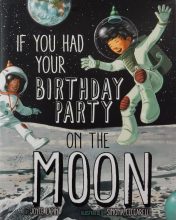
If You Had Your Birthday Party on the Moon
Joyce Lapin and Simona Ceccarelli
Sterling

Hold on to your helmets, it’s blast off time, destination a birthday party in a place you never expected it to be. Moreover, there’d be a lot more celebration time on your lunar destination for it has a 709-hour day.

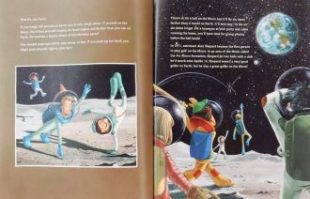
On the way to the moon you’ll discover what it feels like to be weightless and your party paraphernalia and pals will also float around inside your spaceship.

Once on the moon’s surface you’ll feel a lot lighter than on Earth and the Moon’s low gravity will keep you safe.
You won’t be able to fly any party balloons on account of the Moon being airless but you can have enormous fun doing one-handed push-ups,

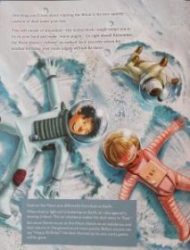
exploring the lunar craters, trying a game of freeze tag and making moondust angels.

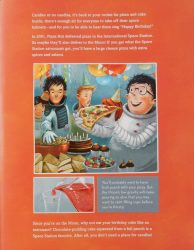
Perhaps you will have to eat your birthday cake astronaut style squeezed out of a foil pouch. Don’t think I’d be so keen on that idea.

Then on the return journey and there’ll be bags of time to open your presents, a whole three days in fact during which you could also open those party bags and sample some of the Moon pies therein.

Woven into all this partying is a great deal of STEM information on exciting topics both astronomical and cosmonautical. Why for instance is the sky black rather than blue; why your birthday will last almost 30 days, and why there wouldn’t be any point in playing musical statues on the moon.

With Simona Ceccarelli’s lively, playful digital illustrations and Joyce Lapin’s enormously engaging narrative that speaks straight to the reader, this is a sure fire winner for younger readers/listeners.

(Included at the back are a glossary, bibliography and suggestions for further reading).

For somewhat older readers is:

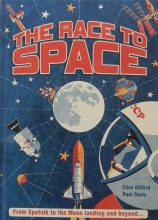
The Race to Space
Clive Gifford and Paul Daviz
Words & Pictures

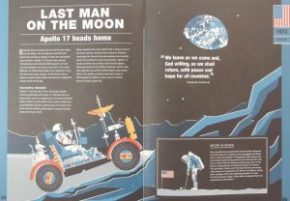
With the 50th anniversary of mankind’s first moon landing fast approaching, here’s a book that traces the history of the space race between two super powers, the U.S. and the Soviet Union, from the launch of Russia’s Sputnik to Neil Armstrong’s planting of a U.S. flag on the moon’s surface and those oft quoted words, “That’s one small step for a man, one giant leap for mankind.” That must be etched into the brains of all who saw that landing broadcast live.

From then on the relationship between the U.S. and the Soviet Union became more one of co-operation and collaboration than competition and the book documents the ‘handshake across space’ in the 1975 joint Apollo-Soyuz mission.

It concludes with more on the co-operation including the establishment of the International Space Station.

Illustrated, retro style by Paul Cadiz, in shades of red, yellow, blue plus black and white,

the book has clear explanations together with a liberal scattering of quotes from significant participants in the whole endeavour.

Recommended for individual reading at home and for KS2 class collections.

He’s Not Naughty!

He’s Not Naughty!
Deborah Brownson, illustrated by Ben Mason
Jessica Kingsley Publishers

Taryn and Jake are best friends, they’re almost inseparable, similar in lots of ways but also rather different for Jake has autism, and Taryn has taken it upon herself to explain for young readers (as well as teachers and other educators, carers, parents and family) what this means.

It most definitely does not mean, despite some of his behaviour, that he’s naughty. Far from it; rather his sensory processing disorder might result in him feeling explosive inside so that he flaps his hands and screams rather than participating in a supposedly fun activity.

Or, his tactile sensitivity might make him cast off his uncomfortable-feeling clothes or shoes and run around without the offending article(s).

Perhaps he might be so engrossed in his own world that it appears he’s ignoring another person; although there are ways to get around this, as there are ways of coping with other ‘mistakes’. After all, everyone– neuro diverse or not -, learns through their mistakes. For example, many grown-ups expect a child to look directly into their eyes when being spoken to; for children such as Jake, listening to and looking at a person at the same time, asks them to use one sense too many and as a consequence, to listen well he looks down at the floor. This is not being rude (a mistake many unknowing adults make); it’s merely coping with being different.

Taste and how food looks, reactions to strangers, taking things literally, feelings, speech (including communicating with sign language and by means of PECS);

making friends, choosing an appropriate school and routines, as well as famous people who have or may have autism are also covered.

This excellent little book is a real gem, written from first-hand knowledge and from the heart – its author is the mother of two children on the autism spectrum – and ought to be shared in all classrooms and by every family bringing up a child with autism.
Moreover, the artist Ben Mason has Asperger’s and his illustrations too are heart-felt and insightful.

Teaching Social Skills to Children with Autism Using Minecraft®


Teaching Social Skills to Children with Autism Using Minecraft®
Raelene Dundon, illustrated by Chloe-Amber Scott
Jessica Kingsley Publishers

I know from my teaching experience that children on the autism spectrum often become obsessively passionate about and often developing an enormous competence in a particular thing such as  Lego building, drumming, a certain cartoon series or drawing specific items.

The strength of the motivation towards their chosen passion tends to result in a lack of social skills: participating in Minecraft® (which is frequently called digital Lego) offers a wonderful setting to enable neurodiverse children to develop both social and communication skills. Clearly the author of this large format book, Raelene Dundon appreciates this and to that end, has created a superb resource.

Having outlined in the opening chapters the importance of social skills and how these are impaired in children with ASD, she puts the case for using group programmes, in particular Minecraft® to develop those crucial social skills.

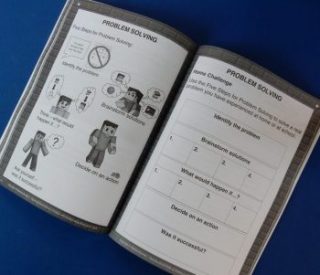
The second part of the book comprises information on how to set up a social Minecraft® group; how to use the game for supporting such skills as holding a conversation, being interested in other people and understanding the viewpoint of another person.
Each skill, for instance problem solving,

‘being creative’ or co-operation

is succinctly presented and related to what has just happened during the specific session – this is a great tool for developing awareness in the learner.

In all there are thirty sessions (around 150 pages of photocopiable material) with smashing illustrations by Chloe-Amber Scott, making this an absolutely invaluable and comprehensive resource – a veritable goldmine – for any professional working with primary children or older students, who have ASD.

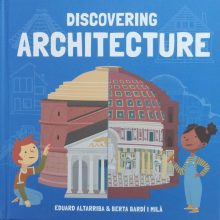
Discovering Architecture

Discovering Architecture
Eduard Altarriba and Berta Bardí I Milà
Button Books

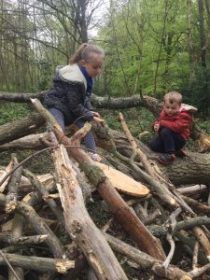
The urge to build structures is seemingly, a universal human trait. I spent some of the Easter break constructing a den in a quiet woodland glade in Bushy Park, from a fallen tree trunk and branches, with 6-year old Emmanuelle and her soon to be 4, brother Samuel.

When they are ready to discover more about the build environment, this tremendous introduction should prove invaluable.

The graphic designer and illustrator Eduard Altarriba has already introduced young readers to Quantum Physics and now in a similarly engaging manner presents a look at iconic buildings through history, their creators and some of the items that might be found inside such buildings.

Starting with the earliest known building projects, the pyramids of Egypt, Iraq and Mexico, Classical Greek, Roman and Byzantine places of worship, domestic and vernacular architecture from many parts of the world, information on architects such as Antoni Gaudí, Le Corbusier, Ludwig Mies van der Rohe and Zaha Hadid …

readers are given a superb presentation of things and people architectural.

The final spreads focus on architecture’s basic elements – there’s a cut-away diagram of the principal parts of a building; what being an architect entails and lastly a look at what buildings might be like in the future (it’s good to see sustainability given a paragraph here).

University lecturer at the School of Architecture, UPC, Barcelona, Berta Bardí I Milá packs a wealth of absorbing information into the uncluttered spreads, so finely designed and illustrated by Altarriba.

Perfect for KS2 readers and perhaps adults wanting a starting point for the topic.

The Dictionary of Difficult Words

The Dictionary of Difficult Words
Jane Solomon and Louise Lockhart
Frances Lincoln Children’s Books

American based lexicographer, Jane Solomon, and UK illustrator Louise Lockhart have collaborated on this compilation of over 400 words, the former providing the easily comprehendible definitions and the latter, the accompanying stylish graphics.

Before the alphabetic section itself are an explanation of what a dictionary is and how to use this particular one, and a spread on parts of speech that also mentions pronunciation.

Then comes the A to Z with two spreads allocated to each letter. Some of the words included are tricky to get your tongue around so the pronunciation guide for each one could prove invaluable, especially should readers come upon a word that’s new to them. I have to say having learnt Latin many years ago did help somewhat, as it did with working out the meaning of the occasional words I hadn’t come across before – yes there were one or two – as well as several, including borborygmus – a rumbling emanating from the stomach- I was glad to be reminded of.

The same is true of kakistrocracy, for obvious reasons.

Did you know that a person (such as this reviewer) who loves solving crosswords (or a compiler of same) is called a cruciverbalist? Now there’s a lovely word to get your tongue around. As is omphaloscopy (otherwise known as navel gazing) and ultracrepidarian (somebody who has big opinions relating to things about which they know nothing). I’m sure we can all think of a few such people.

You might be forgiven for thinking that vomitorium was something to do with throwing up; not so; it’s a passageway people used in ancient Roman times to enter or leave an amphitheatre.

Not all the words are long or tricky to say though: there’s yex, which refers to the act of hiccupping or crying.

I’ll conclude with a word that I absolutely love – lollapalooza – which might be used to describe this book. If you don’t know its meaning then I suggest rather than ‘googling’ it, you get a copy for yourself, your family, or your class. As well as being a celebration of words and the English language, it has the potential for increasing the vocabulary of youngsters who will love to impress others with their word power.
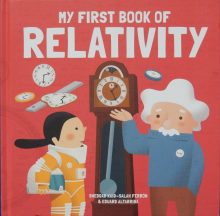
My First Book of Relativity

My First Book of Relativity
Sheddad Kaid-Salah Ferrón and Eduard Altarriba
Button Books

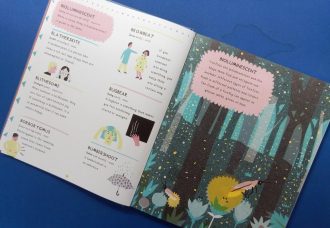
We had My First Book of Quantum Physics and now for a companion volume, its creators have turned their attention to another potentially complex science topic, that of relativity.

However, in the hands of this partnership, Einstein’s theory of relativity and other related aspects of connections between space and time are explained in such a way as to make them accessible to young readers. For, as it says on the back of this book, ‘it’s never too early to start exploring big ideas.’ So, how does one start?

The space-time theory, we read, can only be properly understood by first understanding what the two concepts mean in themselves; and then we’re in a position (like Einstein) to understand ‘the world through relativity’.

Time is succinctly explored – how it’s measured, by what means and the various units used.

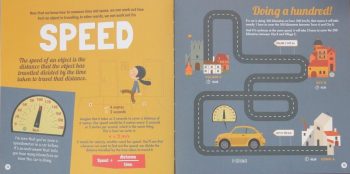
Speed,

movement and the vital importance of frames of reference are explained, the latter using the example of a moving train and then a person in space.

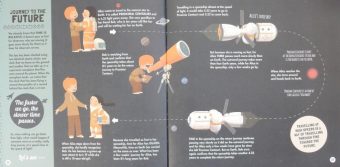
There are spreads on adding up speeds and the speed of light, leading into Einstein’s two theories, special relativity and general relativity (his theory about gravity).

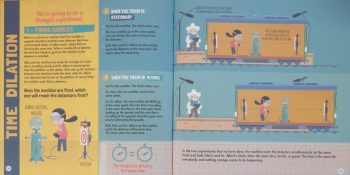
I love the ‘thought experiments’ relating to time dilation and clocks; and the wonderful spread whereon ten year old Alice travels to our nearest star Proxima Centauri, leaving her same aged friend  waiting for her on Earth and returning to find she’s still  ten whereas he is now almost 19, put me in mind of T.S. Eliot’s famous lines from Burnt Norton ‘Time present and time past / Are both perhaps present in time future / And time future contained in time past.’

If only physics had been made this fascinating back in the day when I was studying it at A-level (albeit only for a few weeks before deciding it wasn’t for me).

I’d not heard of muons before reading this book – a muon being an elementary particle of the electron family weighing around 200 times more than an electron, but again found the spread using a muon to check time dilation and length contraction totally engrossing.

The book concludes with how speed increases the mass of an object; the imaginings of the young Einstein (note the word imagined is used by the author, highlighting the crucial importance of the role of the imagination in scientific discovery) and a look at the mathematical equations Einstein used to describe his ideas of special relativity, the former taking mere weeks to find, whereas he took ten years to understand the ideas themselves.

The entire topic is mind-stretchingly incredible and brilliantly explained in this book, with the aid of Eduard Altarriba’s vibrant, graphics. Strongly recommended for budding scientists either for home reading or in school.

Planet Fashion

Planet Fashion
Natasha Slee and Cynthia Kittler
Wide Eyed Editions

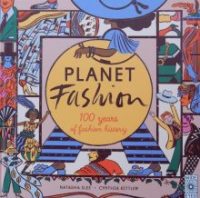
Hats firmly held on and boots duly laced, we’re off on a catwalk extravaganza that embraces cultures, time and much more as it showcases in twenty five scenes, fashion history from all over the world.

We’re in the company of two young fashionistas, one male, one female, as we embark on this globetrotting experience. (It’s fun to locate them looking the part in every scene.)

The journey begins in a high society ballroom over a century ago as elegantly attired dancers and onlookers twirl or stand in their floor-sweeping Edwardian ball-gowns and suits.

Next stop is a performance of the Ballet Russes where dancers drift across the stage clad in voluminous harem pants and feathered turbans, watched by women in empire-line dresses, often wearing huge hats.

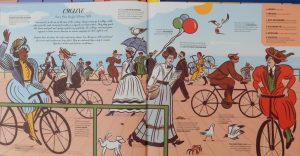
Cycling shows women sporting cycle bloomers and sometimes dresses as they pedal their bicycles in early 1900s USA.

‘Shimmying Down’ set at a Harlem Renaissance dancehall, showcases women in brightly coloured flapper fashions and men sporting long jackets or studded waistcoats.

No matter whether you wish to emulate the ’Lost generation’ of 1920s Paris; imagine yourself as a Bollywood screen star gracing the Mumbai (Bombay as it was then) roads during the 1960s, or striding carefree along the London streets of the 1950s and 60s proudly wearing a miniskirt or dress;

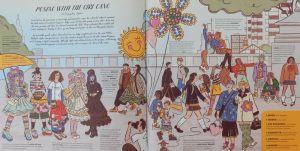
glue your hair into spikes like the London Punks of the 1970s; or try ‘Posing with the Girl Gang’ in the uber-cool Harajuku district of Japan from the late 1990s onwards;

or imagine yourself street dancing in South Africa’s townships in the earlier 2000s there’s a vibrant scene to show you how it’s done.

Every single lavishly illustrated spread is inclusive, with diverse characters wearing the distinguishing fashions of the era; and each has a fact box giving information about key designers, hemline and sleeves, and silhouette as well as the when and where, and descriptive paragraphs providing cultural history and influences.

If all that isn’t sufficient for even the most dedicated follower of fashion, then there are also timelines – the first of which gives a summary of key events of the 20th century, and the other four showing silhouettes, shoe styles, and trends in hats and bags. Plus there’s a final ‘Can you find’ challenge that will surely inspire readers to go back and peruse the scenes even more carefully to locate such as ‘a woman watering her flower garden on the streets of Saigon’; ‘a bird enjoying the breeze on a washing line in Canada’ or ‘a waiter dropping his tray of coffee on the streets of Paris’.

For anybody with an interest in fashion, this is a must-have book: I absolutely loved it.

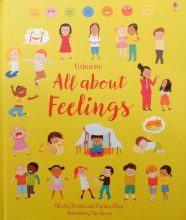
All About Feelings

All About Feelings
Felicity Brooks, Frankie Allen and Mar Ferrero
Usborne

Emotional literacy is now part and parcel of the school curriculum right from the early years, yet seldom does a week go by when we don’t read or hear of the increased concern about children’s mental health and well-being, something we in education have been highlighting for many years. So, it’s good to see a book aimed at young children to help them become aware of, and thus better able to cope with their feelings and emotions.

It’s very visual and full of bright illustrations by Mar Ferrero that make it immediately alluring to its audience be that an individual, a nursery group or early years class.

Each colourful spread is given over to a different aspect and the language used is spot on for young children.

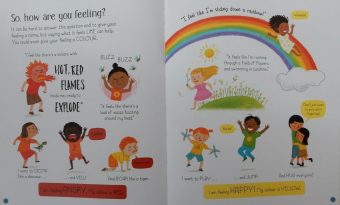
Sections include identifying how you feel (with reference to colours of the rainbow);

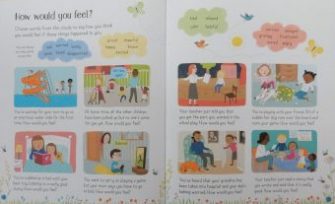
why do you feel a particular way; how would you feel if? (with helpful word clouds)…

how feelings can change during a day; ‘jumbled up feelings’ and discussing your feelings.

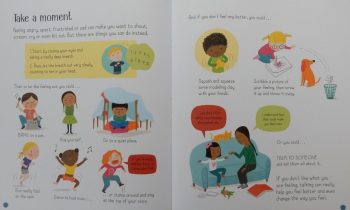
There are suggestions for things to do that help you remain in control;

ideas to alleviate worries; ways to express feelings and emotions; ‘being kind to yourself’ and ways in which an individual can help others of all ages feel good.

The final page is for adults – notes on how best to help youngsters; things to try at home (could equally apply at school or nursery) and some on-line resources.

Young children most definitely can learn to become more mindful of how they feel and thus be better in control of their feelings. The authors of this book have done an excellent job of facilitating this and I’d strongly recommend a copy for family bookshelves and all settings where young children are learning.

One thing that struck me about both it and The Unworry Book was that little is said about the benefits of being outdoors. I highlight this after returning from a walk around Ruskin Mill in Nailsworth, near to where I live. This is in part, an establishment for neurodiverse young adults that does amazing work educating its students, with a focus on the outdoors. And, I know from experience that being outside is of enormous benefit to people of all ages from the very youngest children.

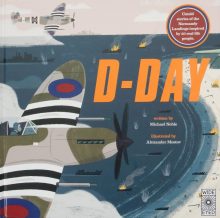
D-Day

D-Day
Michael Noble and Alexander Mostov
Wide Eyed Editions

This book commemorates the 75th anniversary since D-Day, exploring through 20 real-life stories, eye-witness accounts of the D-Day landings and through whose eyes young readers can re-live the events- stories of ‘bravery, sacrifice and innovation’ as the introduction says.

Through historian Michael Noble’s text, we follow the invasion from the planning of the landings, right through to its consequences, meeting both men and women who served in various ways.

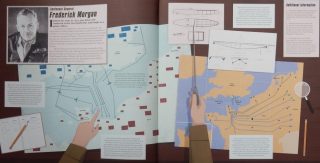
There’s Lieutenant General Frederick Morgan who fought as a junior officer in WW1 and went on to be, in WW2, part of the Supreme Headquarters Allied Expeditionary Force, one of the planners of the invasion of Europe under the joint responsibility of the British and the Americans, and in particular the Normandy landings.

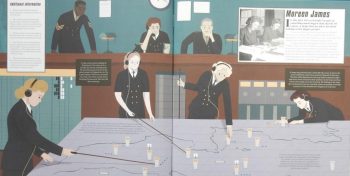
Moreen James served in the WRNS as a plotter, keeping track from her Portsmouth subterranean base, of the movement of ships in the channel; a crucial task in enabling commanders to know the whereabouts of their boats and planes.

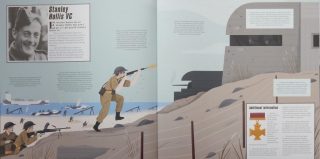
We meet the extraordinarily brave Sergeant Major Stanley Hollins, the only recipient of the Victoria Cross, considered the highest honour members of the British armed services can be awarded, for actions on D-Day.

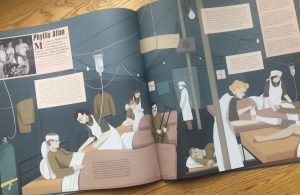
Phyllis Allan served with the Queen Alexandra’s Imperial Military Nursing Service and was based in France where she tended the wounded soldiers, some of whom had suffered horrendous injuries. “It’s just a job, really’ she said.

American Richard Winters, aged 26 calls himself ‘ancient compared to some of my men’. A paratrooper, he took command of his unit when the original commander was killed in action. WW2 was the first major conflict to make use of paratroopers, a highly dangerous role with many losing their lives before hitting the ground.

Much less would have been known about the war without the journalists who reported on what was happening. One such was American, Ernie Pyle who not only wrote numerous articles, but also came to know many of the soldiers engaged in the fighting.

Through the use of collated photographs, personal accounts such as those mentioned, and testimonies from all sides, set into Alexander Mostov’s full-page illustrations that dramatise the roles of all individuals included herein, this is an enormously inspiring book.

Include it in KS2 class collections and on family bookshelves.

What On Earth? Birds / Do Sharks Glow in the Dark?/ Do Tigers Stay Up Late?


What On Earth? Birds

Mike Unwin and Pau Morgan
QED

Natural history writer Mike Unwin and illustrator Pau Morgan turn their attention to birds for the latest book in this excellent What On Earth? series.

In its usual way it’s packed with information and practical ideas that include things to make and do including the occasional experiment, all presented in a highly visual manner with every spread using the space alluringly in a manner somewhat akin to a comic.

As well as bird facts there are poems (Tennyson’s The Eagle and Lear’s There was an old man with a beard’) along with an invitation to readers to write a bird poem of their own. On the literary side too is ‘The king of the birds’ a story based on an old Celtic folk tale, which might also inspire story writing by readers.

You may want to try dancing like a bird;

or perhaps get outdoors and listen to some birdsong, even catching the dawn chorus if you’re up early enough.

The book is divided into four sections: What is a bird?; Bird food; Bird life and behaviour and Enjoying birds, and very page turn brings something to excite, or fascinate young readers.

Offering a great way to discover things avian in all kinds of interesting ways, the book concludes with a glossary and an index.

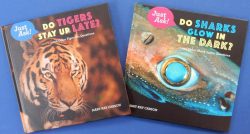
Do Sharks Glow in the Dark?
Do Tigers Stay Up Late?

Mary Kay Carson
Sterling

Splendid photographs and sequences of facts in response to a series of introductory questions – one per page (or occasionally spread) – present the essentials relating to two very different, but both predatory, animals.

No, sharks do not have bones; their skeletons are cartilaginous (a fact I remember well from my early days of studying zoology); and they have both skin and scales. Did you know people once used dried sharkskin as sandpaper? Or that adult sharks ‘don’t do the parenting thing’? Rather shark pups look after themselves.

And contrary to popular belief, only around six humans are killed by sharks in a year.

So it is with tigers: these creatures tend to avoid humans, their towns and farms, although it’s humans that are responsible for tigers being endangered with less than 4,000 roaming wild now, more than half their number being found in India.

I was fascinated to read that no two tigers have identical skin stripes, that a tiger’s skin is striped as well as its fur, and that tigers can swim for miles.

Unsurprisingly tigers don’t purr, growling, grunting and roaring are their ways of communicating.

Both books offer a fun and easy way to get to know something about two of the world’s most iconic creatures; and each has as part of the back matter, information about helping to protect the animals in question, some useful related vocabulary and an index.

When Sue Found Sue

When Sue Found Sue
Toni Buzzeo and Diana Sudyka
Abrams Books for Young Readers

“Never lose your curiosity about everything in the universe – it can take you to places you never thought possible!” so said Sue Hendrickson the palaeontologist subject herein, her quote being the starting point for this fascinating book that tells the story of the discovery of the largest and most complete Tyrannosaurus rex skeleton ever unearthed.

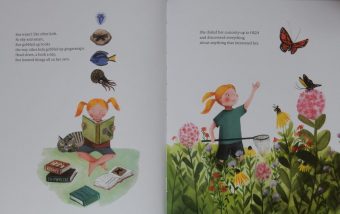
Living in Indiana, Sue was a shy child with a heuristic drive, particularly for anything in the natural world; she also had a passion for finding lost items, was often found with her head in a book

and loved to visit the Field Museum of Natural History in Chicago.

Her interests led in her teens to her joining first a team of underwater treasure hunters looking for tropical fish, lost boats, planes and cars; and then teams searching mines for prehistoric butterflies, deserts for prehistoric whale fossils and finally, the hills of western South Dakota for dinosaur fossils.

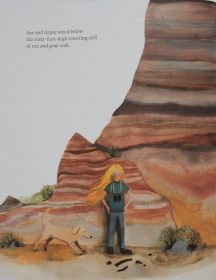
In her fourth summer of digging Sue was drawn towards a sandstone cliff and after four hours of hiking in the heat,

looking up, she spied three enormous pieces of what look like back bones protruding from the cliff. Almost unbelievably Sue and her dog, Gypsy had come upon fossils of a Tyrannosaurus rex.

Then began the arduous task of removing the 300 bones in the intense heat, a piece-by-piece task that took several days.

After an ownership dispute we see the dinosaur reconstruction duly named after Sue on permanent display at Chicago’s Field Museum.

Both Buzzeo’s narrative and Diana Sudyka’s detailed gouache and watercolour illustrations will surely inspire young readers to be mindful of the book’s opening words, to make sure they look closely at the world around them and to hold onto their own spirit of adventure and pursue their passion whatever that may be.

An author’s note about Sue Hendrickson’s contribution to the scientific community, and two resource lists end the book.

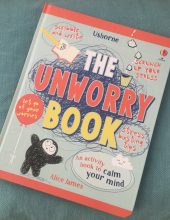
The Unworry Book

The Unworry Book
Alice James and Stephen Montcrieff
Usborne

Enormously reassuring and full of practical ideas for managing stress is this alluringly presented book written by Alice James, with expert advice from clinical psychologist, Dr Angharad Ridkin, and designed and illustrated by Stephen Montcrieff.

Having explained that we all worry from time to time and why, the book devotes the next few spreads to working out how you really feel – worried, excited, or nervous perhaps? It’s really beneficial to become emotionally aware (an emotional map is included to help) and know the kinds of things you can do to alleviate your worries.

Next comes the wealth of coping suggestions, many of which are designed to develop mindfulness. Most require nothing more than a pencil or pen like those on ‘Peaceful pencils’ which takes a multi-sensory approach -listen to the sounds of the writing implement brushing across the paper; ‘notice the glistening wet ink … or grain of the paper as your pencil draws across it’; smell – the book’s pages, the wood of your pencil or ink of your pen; feel the pencil’s ridges, or barrel of the pen; feel the textures of the page and how it seems?

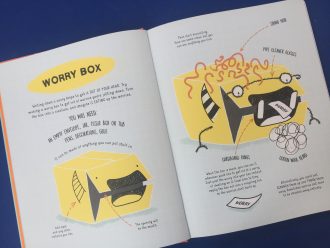
What about making a decorated worry box – an example is included here – I love the idea of it being a creature that can eat up worries.

It’s impossible in the space of a fairly short review to include all the excellent strategies offered so I’ll just mention a few. There are pages highlighting the importance of breathing and laughing (both are yoga techniques) to help cope with excess adrenalin, as well as a spread with an amorphous creature demonstrating a sun salutation.

A couple of ‘arty’ ones are tearing up paper (preferably rubbish) and using it to be creative; creating peaceful patterns being mindful of the shapes and how the space is filled. And doodling is a great stress reliever – how many of us doodle our way through stressful meetings I wonder?
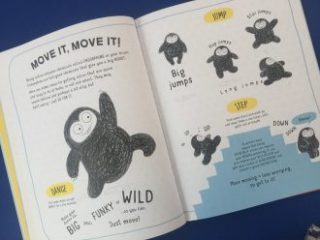
It’s well accepted now that being physically active is good for our mental well-being; it releases those mood-boosting, feel good endorphins so get moving.

There’s a focus on language too – some starting lines for limericks (great fun) an instant giggle inducer I think; a focus on the physicality of writing various words in different ways; a (behind the door) story starter; as well as a host of brain puzzles.

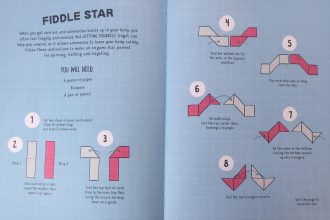
Another smashing idea is a ‘fiddle star’ – the making of which is a worry distractor,

as is the finished article.

Getting off to sleep tips form the final pages; while in conclusion are a ‘helping hand’ and a ‘who to/where to go’ for times when worries become overwhelming (including a link to the publisher’s website).

Stress among children – even very young ones is on the increase – I refrain from elaborating on the negative effects of the current ‘numbers before children’ education system, though it is a huge stress-inducing factor. There are others of course and a veritable gold mine such as this book is invaluable for both youngsters and those who live or work with children.

Counting On Katherine

Counting on Katherine
Helaine Becker and Dow Phumiruk
Macmillan Children’s Books

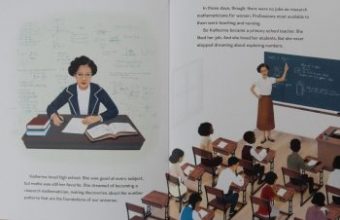
There is so much to like about this splendid picture-book biography of Katherine Johnson, a NASA mathematician.

We first meet the young Katherine as a lover of numbers and everything to do with counting, and an insatiable curiosity– about the universe in particular.

An excellent student, she jumped three school years but her US hometown high school was racially segregated and barred Katherine from attending. As a consequence, her family moved to a town that had a black high school and there the girl flourished, excelling at all subjects although still liking maths the best.

Despite there being no jobs for women research mathematicians at the time, Katherine was tenacious, holding fast to her dream while becoming a primary school teacher.

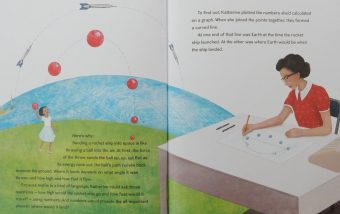
In the 1950s she finally secured a post with NACA, which was later subsumed into NASA although the job she and other women did was one the men deemed unimportant. Undaunted, Katherine knew that her role was crucial: she was able to determine the trajectory of a spaceship.

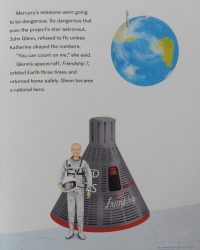
Eventually her skills in mathematical accuracy, leadership as well as her creativity and intellectual curiosity led to a promotion to Project Mercury a programme designed to send the first US astronauts into space. She won the trust of the project’s lead astronaut and promised him, “You can count on me,”.

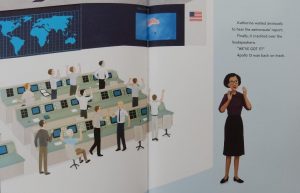
Again it was “You can count on me” when she calculated the flight path for Apollo 11, Apollo 12 and when she ensured the safe return of Apollo 13.

Having overcome much in the way of racism and sexism, on the way, Katherine had earned her place among the stars.
Helaine Becker’s direct telling is highly readable and she makes clever use of the word ‘count’ along the way; while Dow Phumirik’s excellent uncluttered illustrations, some with background computations subtly underline Katherine’s passion for things numerical.

What a splendid partnership this is; and the resulting book will surely inspire and empower youngsters, especially girls to pursue what they love.

Sea: A World Beneath the Waves / Dolphins

Sea: A World Beneath the Waves
Britta Teckentrup and Patricia Hegarty
Little Tiger

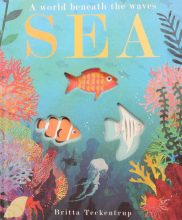
In her latest non-fiction, die-cut peep-through picture book, in a series of wondrous scenes Britta Teckentrup plunges us beneath the ocean waves, way, way down to view the wonders of the deep.

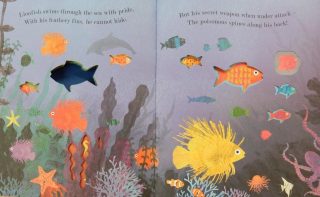
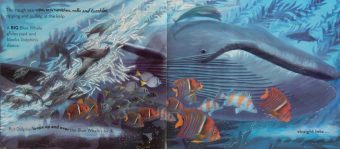
Amid the corals and seaweed fronds we see small fish, sponges, tiny graceful sea horses; a baby dolphin and its mother chirping and clicking in communication, a Lionfish with its poison spines ready to use should it be attacked.

Suddenly there’s a feeling of fear: the fish sense danger as a great white shark casts its shadow. The other sea creatures though, employ their defence mechanisms while the tropical fish swim in formation and all is well.

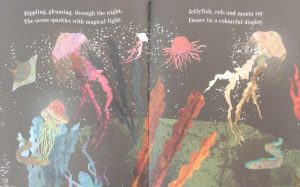
Night comes and the ocean is a-glow with light;

his song echoing far the humpback whale sings for all to hear, the manatee glides through sea grasses and the corals provide safe spaces for small ocean creatures.

Patricia Hegarty’s lyrical text ends with a plea to protect ocean life by keeping the oceans clean and free from rubbish.

Dolphins!
Laurence Pringle and Meryl Henderson
Boyds Mills Press

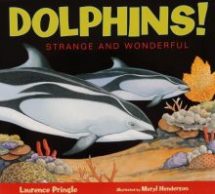
Pringle immediately grabs readers’ attention with his introductory ‘If you were a young dolphin, your mother would keep you close, feed you milk and teach you’ that could almost be referring to a human mother. The remainder of the paragraph however negates that with its ‘Soon you would learn to swim fast and catch fish to eat. And sometimes you would leap from the water, high into the air!’ while his final statement on the first page “People would be very curious about the secrets of your life beneath the surface’ sets the scene for the remainder of this fascinating book.

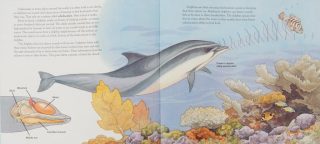
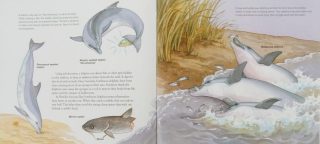
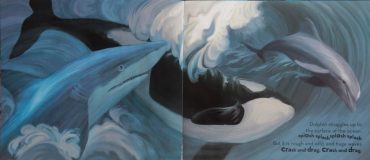
It covers many aspects of the thirty or so dolphin species including classification, morphology and physiology. There’s a fascinating account of dolphins’ use of echolocation;

another of feeding – dolphins are predators, consuming huge amounts of food daily –

and communication. I learned that in addition to sounds, dolphins send messages with their bodies, sometimes by rubbing skins, at others, by touching flippers.

All this and more is related in the author’s highly readable prose that is superbly illustrated by Meryl Hendersen in watercolour and pencil.

Although it’s likely that this will be read by individuals, this book also works really well if read aloud – a testament to the quality of the author’s writing.

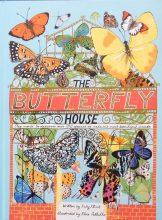
The Butterfly House

The Butterfly House
Katy Flint and Alice Pattullo
Frances Lincoln Children’s Books

Judging by the number of containers housing butterflies in the various stages of their development my partner has scattered about the place, I rather think my own home at present ought to have the same name as this book, although unlike Katy Flint’s ‘welcome’, it doesn’t have never-ending ceilings, nor does it contain the various habitats she names that provide homes for many of the world’s major butterfly and moth families. I was surprised to learn that these winged creatures make up 7% of all Earth’s forms of life.

We then visit the Hatchery, which explains the life cycle of a butterfly with reference to the Monarch as well as containing a number of unusual-looking caterpillars.

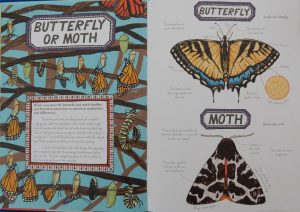
The next two spreads explain the differences between butterflies and moths,

what various adult butterflies like to eat and that caterpillars are fussy eaters usually preferring one particular host plant.

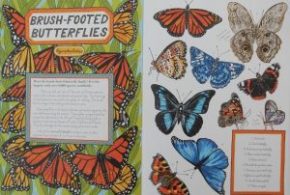
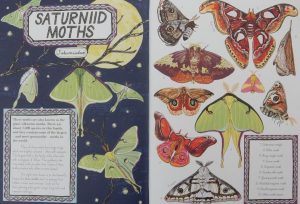
In the subsequent pages over 100 species of moths and butterflies from all over the world grouped in their various scientific families, are displayed in Alice Pattullo’s alluring, finely detailed brush and Indian ink illustrations. Some like the Small tortoiseshell

and the Orange-tip will be familiar to UK readers (and to me as their caterpillars are presently munching away on their food plants in our downstairs bathroom).

To see others such as the Crimson rose swallowtail, the Owl butterfly or the spectacular Luna moth,

you’ll have to visit a butterfly house like that at Berkeley Castle in Gloucestershire or the one in Stratford-upon-Avon.

No matter where you live or visit, this book is sure to whet your appetite to get to know more about these beautiful creatures.

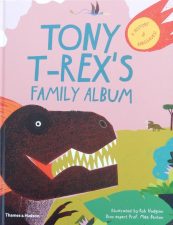
Tony T-Rex’s Family Album

Tony T-Rex’s Family Album
Mike Benton and Rob Hodgson
Thames & Hudson

The stream of dinosaur books is never ending and it’s tricky to find new angles but who better than vertebrate palaeontology professor Mike Benton to come up with a novel way of presenting one of children’s favourite topics.

Using Tony-T-Rex as dinosaur family album writer, readers are provided with rip-roaring authentic information about dinosaurs from the tyrannosaurus’ mouth. And Tony really does grab the readers’ interest and grips them between those 20cm long ridged gnashers of his throughout.

First of all he digs deep, unearthing for us just how a dead dinosaur becomes fossilised and how scientists such as the prof. differentiate between a dinosaur and a ginormous lizard. We’re then plunged back 201 million years to the Jurassic Period when dinosaurs rose to power.

Next it’s time to introduce the creatures themselves, starting in the UK with Megalosaurus Big Liz, one of the first dinosaurs and the first to be discovered, surprisingly by one, William Buckland who had no idea of the existence of dinosaurs, mistaking his find for a massive lizard. Happily though scientists soon identified differences between dinos. and lizards.

Thereafter, we travel the world meeting a host of awesome, mind-blowing relations of Tony’s, each of which has a funky name and an extraordinary body.

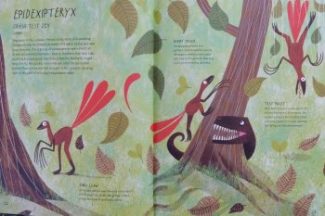
There’s Tony’s distant ancestor pigeon sized Crash-Test Dex (aka) Epidexipteryx with its long claws and sharp buck teeth. Dex had to perfect tree scrambling for it was a favourite nibble for young dinos with near ground level noses.

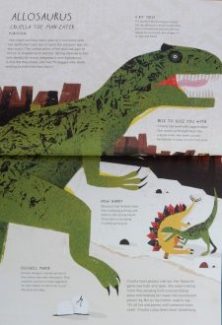
We meet the familiar Diplodocus (Dippy herein), Cowboy Spike (Stegosaurus) and then it’s Cruella the Flesh-Eater hailing from Portugal, with 70 dagger-like teeth just right for attacking unsuspecting stegosaurs and diplodocuses – EEEK!

Big Bellied Bill – Tony’s great-great-great-grandpa is memorable for his insatiable appetite for leaves that made him one of the heaviest ever land animals; unsurprisingly he suffered from horrendous wind – PHOOOAH!

It’s impossible to mention all Tony’s Cretaceous relatives here but the fossil of winged Flighty Aunt Nyx is extinct proof of a dinosaur with the ability to fly.

Moving forward to the Cretaceous Period (between 145 and 66 million years ago) we meet another creature with the ability to propel itself through the air: part lizard, part bird, Sinornithosaurus or Crouching Glider, with its alarmingly long teeth and upper jaw pocket was, reputedly, a terror.

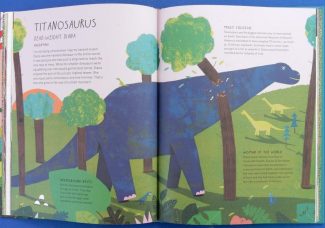
I had a good giggle at Dead-Weight Diana (Titanosaurus), Tony’s Argentinian cousin, the heaviest dinosaur in the world, scoffer of the trees’ topmost, juciest leaves. Roamers these, for fossils have been found on every one of Earth’s continents.

You simply must meet the most elegant of all the dinosaurs, Siegfried the Swan (Olorotitan), which I have to admit is new to me. I was fascinated to learn that it had a penchant for dancing and despite its 8m length and 5 tonne weight, this crested beauty loved to demonstrate its ground-shaking prowess to all around.

Two T’s bring the family album to a close, Triceratops and finally our presenter, Tony T-Rex Tyrannosauarus. He’s excited to inform us that his poo might weigh as much as a 6-month old human baby.

The final spreads are devoted to how the dinosaurs died out; a visit to the Great Hall of Fossils; a world map showing where fossil evidence has been unearthed (and might still be); how to go about a fossil hunt and some useful dinosaur lingo for those who want to impress their friends.

This splendiferous tome is a must for family bookshelves and classrooms; all the more so as Rob Hodgson has provided the funky illustrations with the delicious wry humour of his that I loved so much in The Cave.

The Academy of Barmy Composers: Baroque

The Academy of Barmy Composers: Baroque
Mark Llewelyn Evans, illustrated by Karl Davies
Graffeg

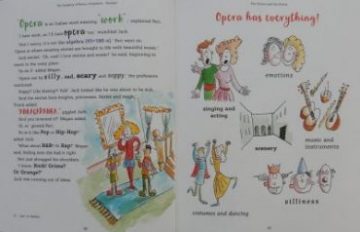
The author of this book, professional opera singer Mark Llewelyn Evans, is the founder and creative director of ABC of Opera Productions, a company that tours the UK introducing children to the stories and glories of the opera through music and storytelling.
His enthusiasm shines through this, his debut children’s book, the first in The Academy of Barmy Composers series. Herein readers follow the fabulous story of best friends Megan and Jack who climb over the gate of Pontirgorffenol village music hall, (long since fallen into disuse and said by some to contain treasure), and discover Trunk. They’re amazed to learn that this Trunk into which they’d both fallen is able to talk – in 43 languages what’s more.

Thus begins an awesome adventure with Trunk, taking them back to 1597 to the country of its origin – ‘shaped like a boot’ – and there to discover ”The ABC of Opera” and the Academy of Barmy Composers.

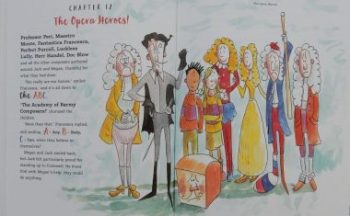
After something of a crash landing in Florence, Megan and Jack find themselves face-to-face with golden-haired Professor Peri,(aka Golden Locks) inventor of Opera who leads them into the academy hall; there to meet the ‘Baa-rockers’ – Florence’s cool “arty fartys” as the composers introduce themselves.

There is so much to discover but the prof. is a passionate teacher

and the children avid listeners who cannot help but be swept up in the crazy but enormously exciting learning experience,

which ends all too soon.

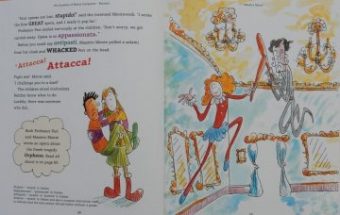
And so it will be I have no doubt, with child readers who are lucky enough to get their hands on this exuberantly presented, thoroughly engaging book. I love the characters, Karl Davies’ zany illustrations are a joy, and there are concluding spreads giving information on instruments of the time, voice types and the composers. If the whole experience doesn’t leave youngsters eager to experience baroque music, especially opera, then nothing will.
Bring on the next musical adventure.

Hummingbird

Hummingbird
Nicola Davies, illustrated by Jane Ray
Walker Books

Nicola Davies is a champion of wildlife; and the creature she has chosen here is a tiny one, smaller than a thumb and lighter than a penny, the ruby-throated hummingbird.

Using the framework of the loving relationship between a Mexican grandmother and her granddaughter, we experience the migration pattern of such birds that are soon to depart, bound for the north, perhaps as the grandmother tells the child, “they’ll visit you in New York City?”
Seated in her Grandmother’s lap, the girl is asked to “Keep still” as they proffer bowls of water to the birds; and come they do ‘Tz-unun! Tz-unun!’ flashing their feathers and beating their wings.

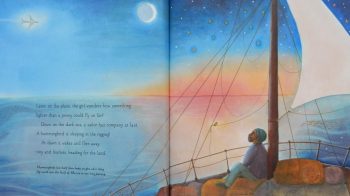
We then follow the birds’ migration route over several double spreads all the way from over the Gulf of Mexico,

through the USA and all the way to Canada. And there they set up home and later in the summer,

a little girl walking towards the park spies on the grassy verge, evidence of ‘a visitor from Granny’s garden’.

The days get shorter and it’s time once more for the hummingbirds to fly south though not all will make it safely to their destination. Granny however is anticipating their arrival as she sits in her garden reading a special letter from her granddaughter now far away, while in her lap is a tiny eggshell wrapped in cotton wool and a newspaper cutting telling of hummingbirds nesting in Central Park for the first time.

Jane Ray’s, stunning – as jewel-like as her subjects – detailed watercolour pictures almost vibrate with the Tz-unun! Tz-unun! of the hummingbirds’ wings, while tiny lines in her illustrations inject movement into the flight path of their long journey, 3000 kilometres northwards, and back.
Dropped into the spreads are such facts as what hummingbirds feed on; their nest size, and other details of their journey; and there’s a final page on which Nicola explains in detail how ornithologists have ringed and tracked hummingbirds over the years. I was intrigued to learn that they can live to be nine years old – incredible!

Altogether a fascinating book.

A Brief History of Life on Earth

A Brief History of Life on Earth
Clémence Dupont
Prestel Children’s Books

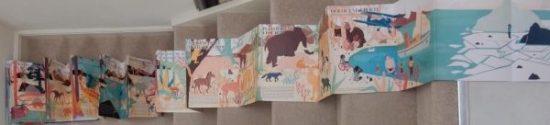
Wow! This story of life on earth truly does unfold in dramatic concertina style – to the length of one of the dinosaurs included herein, a triceratops. That though is getting ahead of things for the book begins around 4.6 billion years ago in the Hadean Age when the Earth was mega-hot and very young, the first eon of Earth history.

Thereafter comes a whistle-stop tour of the fifteen subsequent geological periods, each of which has a factual paragraph and a superb illustration.

It’s at the end of the Proterozoic Age, in what’s called the Ediacaran Period, the first (soft-bodied) organisms appeared.

Next, the Cambrian Period was when aquatic life exploded around the coastlines of continents and evolution of life gave rise to a huge variety of forms including some with a skeleton, digestive system, eyes and gills.

Aquatic life developed a-pace through the Ordovician Period (-490 to 445 million years ago) and plant life began to move onto the mainland in the form of mosses and fungi.

Then came the Silurian Period and the Devonian period, the latter being a time of extreme heat during which life diversified even more. The first sharks appeared and animal life began to make the move towards land.

We’ve now reached the Carboniferous period with its great trees, huge insects and a wealth of plant life, which eventually became buried and over 1000,000s of years compressed to form deposits of coal.

By the Permian Period, the land masses had come together creating a vast super-continent when reptile-like mammals roamed only to die out and become replaced in the Triassic Period by mammals, the first amphibians and the soon-to-be dominant dinosaurs.

Did you know that the continental split began in the Jurassic Period, the golden age of dinosaurs including Diplodocus, Ankylosaurus and Archaeopteryx. The Jurassic and Cretaceous periods saw a further drifting apart of continents and the appearance of Tyrannosaurus as well as bees and flowering plants.

Moving forwards to the hot, humid Paleogene Period, there was a huge diversification of birds and mammals around the globe; then again the climate cooled and during the Neogene Period apes, ancestors of the elephant appeared, and ungulates became widespread.
Humans evolved into their modern form during the Pleistocene Epoch becoming hunters and fishers; they also began to develop language and artistic expression.
We’re now in the Holocene Epoch, which began 11,700 years ago and readers will recognise the modern landscape shown on this penultimate spread.

Phew – such astonishing changes and so beautifully presented in this zigzag style book. A-MA-ZING!

Beetles, Butterflies and other British Minibeasts / Look and Say: What You See at the Seaside / Queen Victoria

Beetles, Butterflies and other British Minibeasts
Nikki Dyson
Nosy Crow & the National Trust

In all my time teaching under 7s, I’ve probably never come across a child, however lively or challenging who, when outside (or sometimes in) failed to become engrossed in watching such minibeasts as woodlice, ants, ladybird larva or caterpillars.

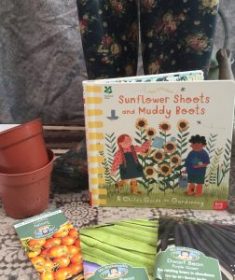
This beautifully illustrated Nature Sticker book takes users to several locations where minibeasts are likely to abound: the vegetable patch – several, but not all of the minibeasts therein are likely to be pests.

Anything but pests are bees, hugely important garden visitors that have a vital role in pollination, as do some butterflies like the beauties shown herein.

The shed is a likely place to find spiders and their webs in abundance as well as daddy-long-legs and perhaps other less desirable kinds of flies.
You’ll probably hear grasshoppers and crickets before you see them as they’re often camouflaged in the long grass they like to frequent.
Tree trunks like this one are good spots for discovering and observing beetles.

What better time that now to get outside, look for small creatures and then come back and enjoy hours of learning and fun with this beautifully illustrated book?

Look and Say: What You See at the Seaside
Sebastien Braun
Nosy Crow & the National Trust

Whether you’re building sandcastles at the water’s edge, swimming in the sea, looking at the boats in the harbour, walking on the cliffs, rock-pooling, fishing, exploring the estuary, strolling on the sand-dunes, or perhaps diving down beneath the waves, there’s always plenty of interesting things to see. when you visit the seaside.

This is what Sebastien Braun shows in his engaging scenes of the various locations, each of which has an introductory sentence and another pointing out a particular feature of note. At the bottom of each spread is a row of named objects to find in the large illustration and say together, if sharing the book as intended with an adult (or older child).

A fun way to develop vocabulary and observational skills with little ones.

Queen Victoria
Illustrated by Nina Cosford
Puffin / V&A

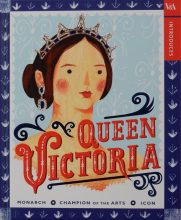
Readers with an interest in the past will enjoy this mini-hardback book that looks at the life of Victoria and her legacy.
It tells how, when the young Victoria became queen she was determined to break free from the controlling influences of her mother and her courtiers and rule Britain on her own, even if she didn’t always get things right. It was against royal protocol for her cousin Albert, with whom she fell in love, to propose marriage to her; instead she did the honours and was accepted.

As well as information about the Queen, there are spreads about the industrial revolution; the Great Exhibition at the Crystal Palace, the royal couple’s work in support of the arts and science,

their interest in the latest technological developments as well as Albert’s popularising of the Christmas tree and Victoria’s golden and diamond jubilees.

Illustrated with a mix of photographs and finely detailed illustrations by Nina Cosford this is one to add to primary school classroom shelves, or for young readers wanting an introduction to a fascinating period of great change.

In Focus: Forests

In Focus: Forests
Libby Walden et al
360 Degrees (Little Tiger Group)

Ten exciting illustrators showcase some of the world’s most famous forests in this smashing book that’s been put together under the stewardship of Libby Walden.

Herein is a wealth of information about the natural flora and fauna of these stunning green places as well as associated facts on such things as, in the first and hugely biodiverse location – The Black Forest – things to do, the Brothers Grimm and more. Grace Easton is the illustrator of this place.

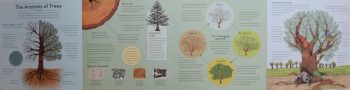
Gate fold flaps are employed by each artist, the second being Julie Colombet who explores The Anatomy of Trees;

Suzanne Washington takes us to the Rainforests; with the artistic work of Sol Linereo we visit National Parks.

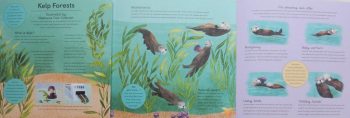
Stephanie Fizer Coleman dives deep to the Kelp Forests to show us the sea otter and many more amazing inhabitants.

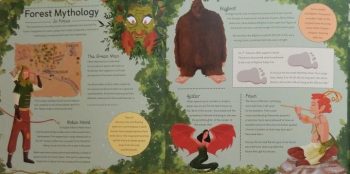
Forest Mythology is the next focus, illustrated by Irene Montano;

the Amazon Rainforest wherein we ‘meet two famous British naturalists, is illustrated by Marc Pattenden;

Alfred Wallace & Henry Bates

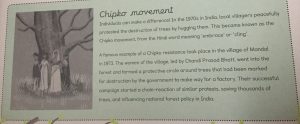
Alessandra Santelli portrays peoples of the Forest; Aaron Cushley, Mangrove Forests and the final topic is Produce and Preservation (including the tree hugging, Chipko movement) illustrated by Jenny Wren.

Each spread is totally absorbing and the entire chunky volume is sure to draw you in to what are probably my favourite places – forests – and hold you there for a considerable time.

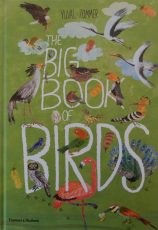
The Big Book of Birds

The Big Book of Birds
Yuval Yommer
Thames & Hudson

This is a cracking series and Yuval’s bird book is an absolute beauty.

Each and every spread, starting with the opening Bird Family Tree is full of fascinating facts and illustrated with that wonderfully playful, ‘twinkle-in-the-eye style the artist has.

Despite my partner being an avid bird spotter, I’d not realised before that there are almost 10,000 bird species and here they’re divided into family groups: birds of prey, owls, woodland and forest birds, seabirds, perching birds, water birds and the flightless kinds.

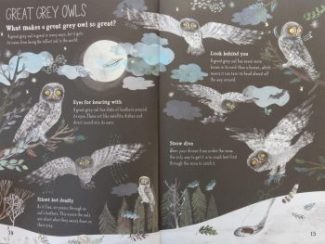
After spreads on being a bird-friendly spotter, feathers and their role in flying, and bird migration, each introduced by a question, we’re given examples of members of each family, zooming in first on great grey owls. Did you know that these are the tallest owls in the world and have special feather-formed discs around their eyes acting as satellite-like dishes directing sounds into their ears; or that with seven more neck vertebrae than humans, a great grey owl can turn its head almost completely around? (The teacher part of me loves that idea.)

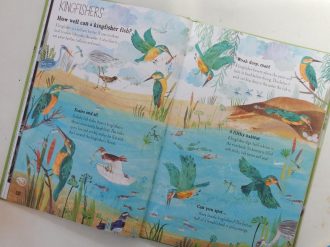
Flamingos (pink feathered on account of their diet) and magpies – not thieves of shiny things – come next and then one of my favourites, kingfishers. Currently living much of the time very close to the Nailsworth Stream along which if I’m lucky, I see a kingfisher flash by, or occasionally spot perching on a overhanging branch, these birds always make me feel uplifted; and so it was here.

I don’t think I’ll go and investigate the bank for a stinky fish bone and poo-filled burrow though.

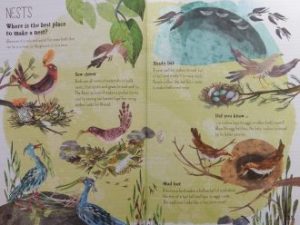
With introductory questions, there are spreads on flightless birds, secretary birds, parrots, bald eagles, puffins, albatrosses, hummingbirds, peacocks – I love to see these on walks in parts of India – robins, swans, hoopoes and red-crowned cranes. Interspersed there are pages looking at nests of various kinds,

eggs – I was amazed to learn as ostrich egg is 16cm long; beaks – their shapes and feeding functions; bird calls and songs – we’re probably all aware of the early dawn chorus these light mornings; city birds and making your garden a bird-friendly place.

If you really want to impress others, there’s a spread on specific vocabulary and as I should have mentioned at the outset, the solution to the ‘can you find the same egg 15 times’ poser from the title.

Absolutely avian-electable; and my copy came with a wonderful pictorial treat – thank you Yuval – before the title page.

If this book doesn’t get your young ones enthusing about our feathered friends, then I’ll be forced to spend a whole day doing various yoga poses like peacock or crow.

Hedy Lamarr’s Double Life / Dreaming in Code


Hedy Lamarr’s Double Life
Laurie Wallmark and Katy Wu
Sterling

Elegant film star Hedy Lamarr’s first love wasn’t in fact for making movies – she wasn’t at all interested in glitz and glamour – rather her passion was science and technology. It’s this lesser known side of her that’s the focus of this book.

Her greatest invention was ‘frequency–hopping spread spectrum’ a wonderful technological idea developed in collaboration with musician George Antheil, that helped allow the communication devices of torpedoes to change frequency quickly cutting down the opportunities for radio signals to be altered, intercepted or blocked completely; sadly it wasn’t used by the US navy during WW2 though.

Still relevant today, their invention now helps to keep our mobile messages private and defends computers from hackers.

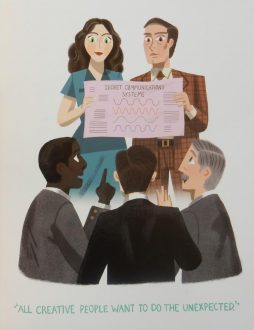
Hedy’s various inventions are described and each spread includes a quote from her: here’s one I particularly love.

We also learn of her childhood in Austria in the early 1920s and how her father, who also had a love of science and technology was such an encouragement to her curiosity and thirst for knowledge, and her creative ideas.

Laurie Wallmark’s engaging text is both inspiring and concise; and Katy Wu’s stylish, retro feel illustrations transport readers to the time when women’s achievements were under played and often undervalued (it took 50 years for her awesome brilliance to be fully recognised). However when Hedy and George finally received in 1997 the Pioneer Award from the Electronic Frontier Foundation for their contribution to computers, Hedy commented thus.’” It’s about time.” … “My life was full of colours, full of life … I don’t regret anything … I learned a lot.” Brilliance recognised at last.

So too will readers of this picture book, which also includes a timeline, bibliography, suggestions for further reading about women in STEM, a list of her films and an explanation of her secret communications system.

Equally inspiring, for older readers is:

Dreaming in Code
Emily Arnold McCully
Walker Books

This is a fascinating biography of Ada Lovelace, daughter of poet Lord Byron, who is celebrated for being the first computer programmer.

Ada’s childhood was anything but conventional; she never got to know her father and was brought up by her domineering mother who, despite showing little emotional warmth, provided for her daughter through private tutors, an intellectually stimulating education, a protection in part from any instincts towards developing her father’s poetic talent. Thus Ada developed a terrific thirst for mathematical and mental puzzles and scientific discovery.

At age seventeen, the young aristocrat Ada, was introduced at a party to widower and famous inventor and mathematician, Charles Babbage, who was to transform her life. We learn of their collaborative friendship and how Ada’s leap of imagination took her pioneering thinking beyond that of her friend and his ‘Analytical Engine’. This is what she wrote, ‘Many persons imagine that because the business of the engine is to give its results in numerical notation, the nature of its processes must consequently be arithmetical and numerical, rather than algebraical and analytical. This is an error. The engine can arrange and combine its numerical quantities exactly as if they were letters or any other general symbols.’

We read of her marriage to William King who admired Ada’s intellect as well as being rich and handsome; her motherhood years, her addictions and death at an early age from cancer.

Beautifully written by Caldecott-Medal winning author, Emily McCully this carefully researched, accessible portrait of Ada Lovelace is likely to inspire future groundbreakers to follow their dreams and not let anyone or anything stand in their way.

(There are also photographs from archives, illustrations, source notes, a glossary and a bibliography.)

My First Book of Birds / Birds

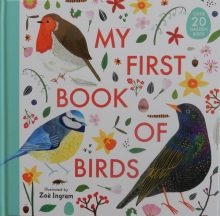
My First Book of Birds
Illustrated by Zoë Ingram
Walker Books

This is a smashing little book that introduces to youngsters twenty or so birds that commonly visit our UK gardens.
Such is the quality of Zoë Ingram’s illustrations that as well as taking delight in them, little ones can use them to help in avian identification.
After an opening spread explaining that the birds are presented in size order as well as talking about conservation status (this is given to each one in the ‘Bird Facts’ window) and feeding, each bird is showcased in a double spread.
The first is the tiny Goldcrest, Europe’s smallest bird, that over winters in Britain while the largest and final bird featured is the omnivorous Magpie that has a wingspan about four times larger than the Goldcrest.
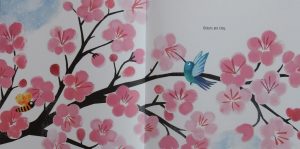
In between are some real beauties including the mellifluous colourful Goldfinch;

the yellow-billed Blackbird and the glossy feathered, bold Starling,

As well as the facts window, each bird has a paragraph about such things as plumage, diet, song; plus there are egg facts and a ‘Did you know?’

Ideal for home use as well as to add to a primary school collection; it’s important that youngsters get acquainted with birds and this is a great starting point.

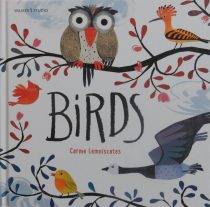
Birds
Carme Lemniscates
Walker Studio

Not a guide to birds, (although you will doubtless recognise most of those the artist includes but never names); rather, the words are at least in part, the thoughts of a little girl narrator as she moves around the countryside on foot, on her bike or even as a flight of fancy, on the back of a goose.
What starts out as straightforward observation, ‘Some birds are really big. // Others are tiny.’

gives way about half way through to simile and metaphor: ’A bird’s song is like the loving words of a friend. // A happy song that greets us every morning. // And our hearts sing, too, because birds are like good news coming. // Or messages of peace.’

The digitally rendered illustrations are richly coloured, enticing and immediately attractive to little ones, though I do wonder if there’s a slight mismatch between the intended audience for the book and some of the latter part of the child’s narrative.

A book to use with one child or a few, rather than a class I suggest.

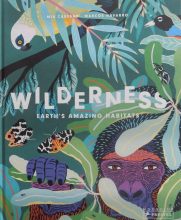
Wilderness: Earth’s Amazing Habitats

Wilderness: Earth’s Amazing Habitats
Mia Cassany and Marcos Navarro
Prestel Publishing

This large size book showcases earth’s wildernesses that are the ‘habitats of rare animals and plants’.

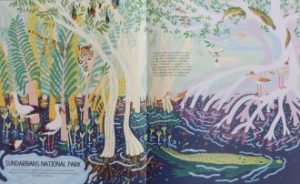
Readers are taken to sixteen locations around the world, the planet’s wild regions such as Nioko-Koba National Park in Senegal; Kahuzi-Biéga National Park in the Democratic Republic of Congo; the Qinling Mountains of China; the Sundarban islands (an Indian national park).

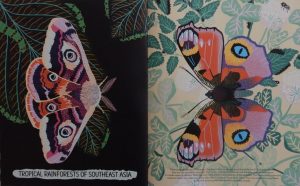
There are forest regions – that of Skihote-Alin National Park in far eastern Russia being a mix of subtropical and taiga and hence contains a mix of animal species not normally found together; the tropical rainforests of Malaysia where it’s estimated that some species are more than 100 million years old – awesome! See how stunning some of its butterfly and moth species are …

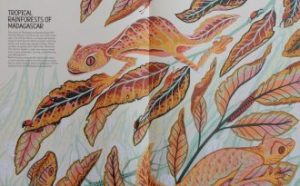
The unique Madagascan tropical rainforests wherein live almost 300 species of frogs and huge numbers of geckos, are sadly we read, under enormous threat from human actions.

Happily however, the Sri Lankan Sinharaja Forest Reserve is unspoilt since it’s almost impenetrable to humans and contains numerous rare and endangered animal species including the long-nosed whip snake and the purple-faced langur.

In addition to several other rainforest locations, we visit Tortuguero National Park on the Costa Rican coast that is a mix of beach, freshwater creeks and lagoons and surrounding rainforest. In complete contrast is the boreal (taiga) forest wilderness of north Canada, Alaska and Russia and is the most northerly of the world’s nature reserves.

Each of the landscapes is stunningly illustrated by Marcos Navarro, making each spread a visual delight before one even starts to explore closely, the fauna and flora depicted; or to read Mia Cassany’s informative paragraph(s) giving geographical and biological facts on the native species.

The final pages home in on some of animals, drawing attention to their characteristics and habits in brief paragraphs of text alongside small, labelled pictures of the featured habitats.

The book’s large format serves to draw readers in to each stopping place, making one want to linger long and explore the beauty of every spread.

Odd Science: Incredible Creatures

Odd Science: Incredible Creatures
James Olstein
Pavilion Children’s Books

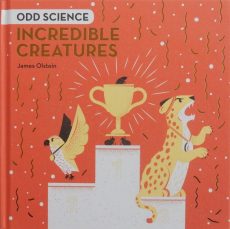
Science is cool, it’s exciting, and creatures are endlessly fascinating, as this book demonstrates. It’s full of wacky and funky facts on beasties large and small from minute bugs to massive creatures of the deep, presented in an accessible manner by James Olstein.

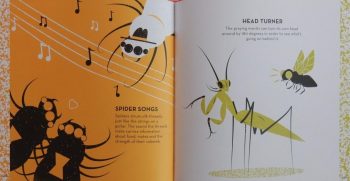
So prepare to be fascinated by the likes of the praying mantis, which can turn its head around by 180 degrees to see what’s happening behind – particularly useful should they want to be teachers –

or the fact that in Tokyo, pigeons have been trained by scientists to distinguish between the works of Monet and Picasso; now why would they want to do that?

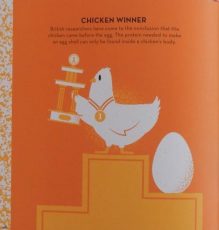
You might wish to know the answer to the time old ‘chicken or egg, which came first?’ question: the answer from some British scientists is revealed herein.

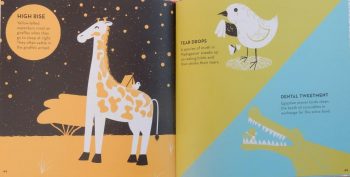
I was fascinated to discover that although sloths hang around in trees most of the time, they come down once a week for a poo; also, that yellow-billed oxpeckers roost on giraffes when they go to sleep at night often settling in the giraffe’s ‘armpit’.

Did you know that Egyptian plovers clean crocodiles’ teeth in exchange for some extra food? Risky!

The information is presented in sections such as dinosaurs, whales, octopods, cats, stripes, tongues, defences and so on.

Olstein’s retro-style, quirky pictures bring further funkiness to his array of facts.

This is ideal for dipping in and out of, though readers who find it hard to become engrossed in a book might just find themselves so doing in Incredible Creatures.

When the Stars Come Out

When the Stars Come Out
Nicola Edwards and Lucy Cartwright
360 Degrees

With the coming of darkness, everything looks different, everything feels different: night is mysterious, night is magical.

Find out what makes it so in When the Stars Come Out.Into this book the author has packed illuminating information explaining first how night works due to the constant orbiting of the sun by planet Earth, and then putting mankind’s desire to understand the night into a historical context that can be traced right back as far as the Bronze Age.

Thereafter comes an upward-looking section called The Sky at Night. This encompasses topics such as being scared (or not) of the dark and things associated with it;

some facts about the Moon – its cycle, Armstrong’s moon landing and more. Did you know that the largest stars burn for tens of millions of years before running out of energy whereas medium-sized ones including our sun can continue burning for 10 billion years. WOW!

Moving our sights down somewhat, The Earth at Night homes in on different environments – the city, the desert, the Amazonian rainforest, the mountains,

the African savannah where should you happen to visit and listen very carefully, you might just hear the squeaks of yellow-winged bats, the slithering scraping of rock pythons or even the defensive growls of aardwolves. The woodland and the ocean also have spreads allocated.

The next focus is on what animals get up to at night – how are they adapted? Did you know that there are creatures that can sleep on the move, for instance the Swainson’s thrush which power naps frequently, and the albatross? We’ve all heard of sleepwalking but sleep-flying –awesome!

Although many humans spend the night (or most nights) in sleep, or attempted sleep, the length of this depends upon where on the globe you happen to be at a particular time of year; or perhaps whether you are attending an occasional night celebration such as New Year’s Eve.

Like all living creatures, we humans have a body clock, though ours with five sleep cycles, is far more sophisticated that say plankton. I was interested to learn that there is no word for insomnia in the languages of the non-industrial societies – the Hadza people of Tanzania, the San people of Namibia and the Tsimane people of Bolivia whose general pattern of sleep is from three and a half hours after sunset to just before sunrise, with no daytime naps.

Nowadays, those of us living in the Western world tend to choose a single overnight sleep, although some who help keep the night-time economy afloat such as bakers, as well as for instance hospital staff, carers and the police work in shifts and sleep during the day.

Nicola Edwards’ fascinating and wide-ranging interpretation of night is well served by Lucy Cartwright’s enthralling, richly detailed illustrations.

A book to keep readers awake at night should they start exploring it late in the day.

The Lost Book of Adventure

The Lost Book of Adventure
edited by Teddy Keen
Frances Lincoln Children’s Books

Those with a thirst for wild adventures in particular will be immediately attracted to this stupendous tome. Others of us will perhaps take a little more time to be enticed in, but will likely become equally immersed in this amazing collection of notes, sketches and factual snippets that have been drawn, so we’re told by the editor, from the notebooks of the Unknown Adventurer.

Whether or not the claim by Teddy Keen to have discovered these items in a metal container while exploring a remote part of the Amazon, is a beguiling means of interesting readers in the book, or a fact, is immaterial.

What he has produced is a veritable treasure trove detailing all you need to know to flourish living in the wild, be it how to construct a wikiup shelter like those of the Nenet people of Arctic Siberia;

how to make a bottle raft to navigate ancient waterways; or, what the best techniques are for ‘pooing in the great outdoors;

or crucially important, first aid.

Prepare to be conveyed to various parts of the globe as you read lyrical accounts of such adventures as a narrow escape from the jaws of a crocodile in Sri Lanka, surviving a roaring dust storm, or an eye-ball to eye-ball encounter with one of the planet’s most dangerous snakes, a venomous bushmaster. Each of these is gloriously illustrated in a coloured pencil drawing.

Keen certainly succeeded in arousing the spirit of adventure in this reviewer; I’m sure that will be the case for many readers of this totally immersive volume.

From Tiny Seeds … / A Walk Through Nature

From Tiny Seeds …
Émilie Vast
Thames & Hudson

Seed dispersal mechanisms and subsequent growth are showcased in Émilie Vast’s series of predominantly visual stories of how plants travel.

Ten different methods are documented, each story being allocated several pages. Some such as flying, that is used by the dandelion (and other composites) will be familiar to many children, since they love to play dandelion clocks.

In contrast, other methods like ‘Being eaten’ as happens to berries including blackberries and elderberries, will be less well known. The berries are food for birds or animals and are passed through the eater’s digestive system.

and excreted partially digested in their droppings, which then nourish the excreted seeds once they’re ready to germinate.

I particularly like her device whereby the respective plants introduce themselves and go on to tell their own stories.

It’s good to see how the important role of humans in distributing seeds to various different parts of the world is documented. Did you know that the green bean was originally only found in Central and South America but now grows all over the world.

Émilie’s love of nature is evident from her beautiful, stylised illustrations for which she uses predominantly black and white with limited bursts of colour on each page.

A Walk Through Nature
Clover Robin and Libby Walden
Caterpillar Books

What is this life if, full of care,
We have no time to stand and stare –

So begins W.H.Davies’ famous poem Leisure. Perhaps with these opening lines in mind, as well as concern over the 2015 revelation of some 50 words relating to nature and the countryside, that are no longer included in the Oxford Junior Dictionary, the creators of this book aim to increase young children’s engagement with, and understanding of, the natural world.

The walk takes us through the seasons in addition to a variety of natural landscapes and habitats. We visit a meadow; a tree wherein birds are nesting; a pond with tadpoles, ducks and fishes swimming and water lilies and bulrushes growing.

We home in on minibeasts as they move over, under and sometimes through, an ancient log of wood;

and wander on the sandy beach in the early morning sun noticing the multitude of shells and crabs.

We’re shown seemingly magical changes – the hatching of a blue tit’s eggs, the emergence of a butterfly from its chrysalis,

and in the woods and fields, delve down beneath the earth where burrowing animals live.

We witness the gradual change from summer’s greens to autumnal hues; visit a mountainous region where a fresh spring begins its flow to the sea; and follow the migrating swallows as they depart for warmer climes.

Then back to what looks like the original meadow, snow falls transforming the landscape in ‘winter’s frosted cloak, sparkling, clear and bright.’

Finally as dusk spreads its rosy glow, day and night merge into one …

For each stopping place comprising a double spread with a gatefold perforated by small die-cuts, there’s an introductory poem by Libby, the final verse of which is revealed by opening the flap, beneath which are also small vignettes and accompanying factual snippets.

Clover’s collage style illustrations are gorgeous; each one merits spending time over and I really like the way the poems are each framed by a naturalistic collage that uses elements from the full page illustration.

Let’s hope that this ‘ Peek-through’, ‘first book of nature’ paves the way for youngsters to begin a life-long habit of going outdoors, walking and observing the beauties of the natural world.

Scratch and Learn: Human Body / The Great Big Book of Life

Scratch and Learn: Human Body
Katy Flint and Ana Seixas
Wide Eyed Editions

I’ve loved some of the EtchArt books from Quarto but this is the first science title I’ve seen, essentially an introduction to how the human body works.

It comprises two main elements: ‘Scratch to Discover’ where the reader uses the stylus to find ten things on each of the seven spreads: the skeleton, muscles,

organs, eating and digestion, the senses, the brain

and, lungs and heart.

Then there are activities – one per spread – to demonstrate how different parts of the body function. For example the muscle-related one says, ‘With your palm facing up, touch your thumb and little finger together. This shows one of your flexor tendons working in your wrist.’

There’s also an invitation to play a search-and-find memory game.

Each topic has an introductory paragraph and some also include additional bite-size snippets of information.

Spencer investigating the skeleton

Graphic designer/illustrator Ana Seixas brings a gentle humour to the pages of this fun, interactive book to use at home that is relevant to the KS1 science curriculum.

The Great Big Book of Life
Mary Hoffman and Ros Asquith
Frances Lincoln Children’s Books

The 6th in The Great Big Book of … series looks at life from conception and birth to death and memories.

The early years are allocated several spreads – infant physical development,

sleep, feeding, staying healthy, learning to use the loo and how language develops.

Subsequent topics are school (including home schooling), the teenage years, work, partners,

the middle years, old age, death and finally a spread advocating living life to the full no matter who we are, which includes thinking of other people as well as ourselves.

As in previous team Hoffman and Asquith titles, diversity is a key element. Mary’s light-hearted narrative style combined with Ros’s wonderfully witty illustrations make for an informal and explicit read.

A book to add to your home or school collection.

Sunflower Shoots and Muddy Boots

Sunflower Shoots and Muddy Boots
Katherine Hallligan and Grace Easton
Nosy Crow

Published in collaboration with the National Trust this is a super introduction to gardening for youngsters no matter whether they have available a large outdoor space or a tiny one.

In a dozen spreads author Katherine Halligan includes pretty much everything you need to know when starting out as a gardener, from the kinds of plants that are easy to grow; making an indoor garden (you might use welly boots or old suspended hats);

constructing a garden den; composting, tasty things such as radishes that can be grown in a variety of containers, and raspberries, that need more space.

Also included are ways to deter pests by gardening organically; encouraging desirable wildlife such as birds and butterflies by planting some trees

and/or sowing wild flower seeds. There’s a page on the kind of gear you’ll need, another on safety, one on pressing flowers and a final page of tips for adults.

Each spread is highly visual and there are instructional paragraphs, tips, ‘did you know?’ questions; appropriately placed lists of what’s needed for individual projects, as well as a list of useful gardening definitions.

Bursting with ideas, activities and facts to get children interested, with its wipe-clean pages, and Grace Easton’s eye-catching illustrations, this is a book to use at home, in a nursery/early years setting or a school gardening club.

The Story of People

The Story of People
Catherine Barr, Steve Williams and Amy Husband
Frances Lincoln Children’s Books

I greatly enjoyed the two previous titles in The Story of … series and this new addition is another winner.

It’s a whistle-stop tour of the historical development of humankind that begins with the earliest humans – Homo erectus – two-legged hunter-gatherer apes that lived in Africa.
Did you know that the larger brained Homo sapiens also appeared first in Africa? Travelling out across Europe and Asia, these are the people we are descended from.

The account moves to early farmers, then the Bronze Age when cities grew; diseases were caught from animals and mark making in relation to harvests was used.
The Iron Age, trading voyages across oceans and land and decisions based on philosophy are also covered, taking readers to 1CE – 1000CE during which Islam in the Middle East and Christianity in Europe were growing.

Thereafter came religious wars, trade routes opened up and between 1700-1800CE Islamic science experiments inspired new discoveries in science and nature around the world.
Technology as well as science then started to change how people lived and continues to do so. At this point the author acknowledges that in addition to the numerous changes for the good, human actions are damaging our precious world.

The book ends with a consideration of what might happen in the future ending on an optimistic note: ‘By sharing, polluting less, respecting wild places and farming alongside wildlife, there is hope for the future. We can all live in harmony with nature on our beautiful blue planet.’ Let’s hope it’s so for the young children who are the book’s audience.

Amy Husband’s alluring naïve, cartoon style collage and crayon illustrations together with Catherine Barr and Steve Williams’ highly accessible narrative provide a lively introduction to a fascinating topic.

Listen! – The Flute / World of Forests

The Flute
Ken Wilson-Max and Catell Ronca
Tiny Owl

The second in the Children Music Life series showcases a reedless woodwind instrument, the flute. Here flautists from different parts of the world come together to celebrate its magic. It’s a colourful magic that conjures up mellow sounds …

and bright ones; that sometimes speaks very softly …

or blows icily.
It might be a scream of pink, a sigh of lilac that is …

The voice through which the flutes speak is pure poetry; now why not try to discover its sounds for yourself … Where will it take you? What will you hear and see: how will you feel?

With rainbow bright illustrations from Catell Ronca and Ken Wilson-Max’s poetic words, prepare to be transported and perhaps to dance with your little one like some of the characters herein. Through music is a wonderful way to introduce very young children to stories: this little treasure of a book will help you do just that.

World of Forests
Robert Hunter
Wide Eyed Editions

Robert Hunter follows his World of Birds with a new Sounds of Nature title in which he explores ten different forest habitats from various parts of the world – Europe (including the UK), the USA, South America, Africa, India, Socotra Island (Yemen) and China.
Each habitat is given a double spread wherein are showcased the animal inhabitants (with a factual paragraph on each one) as well as a general introduction to the particular forest be it of the coniferous or deciduous kind.
Six or seven creatures are included in each location be that the German evergreen forest; the Redwood forest of California; England’s New Forest; the Amazon rainforest; a cloud forest in the Virunga Mountains of East Africa;

a desert forest of Socotra Island; a beech forest of Brussels;

the Sundarbans mangrove forest in the Bay of Bengal (I don’t think this is at ‘the southern tip of India’ as stated in the book though); the coniferous taiga (snow) forest of Alaska; or the bamboo forest in the mountains dividing North and South China.

Pressing the sound button on each spread produces a ten second burst of the natural sounds of 60 or more animals. You’ll need to listen very carefully to identify such creatures as the squawking macaws of the rainforest or the call of the Northern wren in the beech forest.

The whole thing is splendidly atmospheric: with its beautiful panoramic illustrations and fascinating soundscapes it’s a book that is likely to appeal across a wide age range.

Plant, Sow, Make & Grow

Plant, Sow, Make & Grow
Esther Coombs
Button Books

Absolutely bursting with helpful gardening information whatever the season (the book is divided into four seasonal sections), the enthusiastic author, who started a gardening club at her daughter’s primary school and still runs it, has created a super book that introduces children to the wealth of opportunities being involved in a gardening project offers.

Before the seasonal sections, readers learn what the essentials are to get started, including the idea of creating a planting plan – all vital if you’re to make a success of your garden. Re-using and recycling are a part of the former and I like the idea of using loo rolls to make seed pots (I’ve frequently cut the tops from cardboard milk cartons but never tried this idea before).

Spring seed growing suggestions include salad leaves, tomatoes

potatoes, strawberries (the purchase of a few small plants initially is suggested here), root vegetables such as carrots and beetroot, peas and sweetcorn make up the edible kinds. Growing some flower seeds is also suggested because flowers will attract pollinators to your veg patch.
Then come a page on thinning out seedlings and another on wildlife – good and not good.

The summer section focuses on pumpkin growing, companion planting and lots of ideas for making useful items including a hanging-bottle container for tomatoes, a protective cover for strawberries, a watering can out of a screw top plastic bottle, as well as some creative activities, the suggestion of measuring some of the especially tall-growing plants

and some bee-related info. Then of course, there’s the important ‘summer harvest’.

Autumn is the season when much is ready for harvesting: sweetcorn, potatoes, root crops should all offer rich pickings and diggings at this time.

Compost, potting on strawberries, harvesting wild flower seeds, carving a pumpkin, creating a seasonal wreath and a bug home are also covered in this section.

Winter is the shortest section and again it’s packed with great tips such as saving seeds to plant the following year as well as stems for next year’s canes; creating a bird feeder from a sunflower head and more.

Motivating and thoroughly down to earth, this alluringly illustrated book is one I wholeheartedly recommend for school and home.

Fanatical About Frogs

Fanatical About Frogs
Owen Davey
Flying Eye Books

For this fifth book in the series Owen Davey has chosen to focus on our amphibian friends the frogs.

Frogs in all their glory (and here Owen includes toads) can be found on all continents except Antarctica. Thus far about 7000 species have been discovered but that number is not static especially since many are very small and well camouflaged. All this and more we learn on the first spread.

On the second spread, (Warts and All) focusing on the northern leopard frog, the author discusses the particular abilities and features of Anurans – their eyes and eyelids, the tympanum, legs, feet (sometimes with sticky pads) and where appropriate, their warty bumps.

Other topics each given a spread concern the skin; feeding;

colours, pattern camouflage and other means of self-protection; ectothermic regulation (the means by which frogs regulate their temperature).

Communication,

metamorphosis; a focus on the Red-eyed tree frog, some of the ‘weird and wonderful’ varieties each occupy a spread. Next there’s a look at size – the biggest and smallest species – and a gallery showing the actual shape and size of 19 different frogs, each one having its own unique beauty.

Then, as in all Owen’s titles in this series comes ‘And the award goes to …’ show-casing the most transparent frog, the loudest, the best impersonator, the creepiest, the best jumper and the most dangerous frog. Hmm, I wouldn’t like to encounter that golden poison arrow frog; it exudes a lethal poison 20 times more deadly than any other frog.

Also characteristic of the books, along with the playful topic and paragraph headings, is a spread of associated mythology that gives paragraphs on four folklore frogs. The vital topic of conservation is the final focus and there’s a concluding index.

Informative, fascinating, absorbing and as always, stupendously well illustrated and enormously enjoyable, is this excellent non-fiction book for home or school.

The Brontës / Along Came Coco

The Brontës
Anna Doherty
Wren & Rook

According to the cover claim this is the ‘fantastically feminist (and totally true) story of the Astonishing Authors’ of the title. It’s certainly a smashing short biography of three of the most gifted female writers ever.

We start with a pictorial spread that introduces the family and other members – human and animal of the Bronte household.

Thereafter, starting in 1822, the story looks at family life in Haworth, where father Patrick was a priest and the children loved to explore the moors, using them as inspiration for their own stories and poems.

Thrown back on their own company, the four youngsters become incredibly creative and when Branwell is given some toy soldiers, they use them to create their own imaginary world. This leads to dramatic productions, story and poetry writing, illustration and 3D maps all based on Glass Town.

The young people work as teachers or governesses while daydreaming a lot of the time.

Then over the next three years, books of poetry and the three novels – one each – Jane Eyre, Wuthering Heights and Agnes Grey are published under the pseudonyms, Currer, Ellis and Acton Bell., followed by Anne’s The Tenant of Wildfell Hall.

Sadly during the next two years Branwell, Emily and Anne fall sick and die leaving Charlotte who lives only another six years during which she publishes Shirley and Vilette.

The final spreads comprise annotated portraits of Charlotte, Branwell, Emily and Anne, followed by details of how wonderfully feminist were these Victorian sisters. Their legacy lives on and continues to inspire readers today: I can’t imagine being without their awesome novels.

Youngsters will be fascinated to learn of these strong-willed writers and their achievements against the odds, in Anna’s highly readable narrative style biographical account. Her illustrations are a quirky delight

Another truly creative spirit was that of Coco Chanel celebrated in this biography:

Along Came Coco
Eva Byrne
Abrams Books for Young Readers

Born in 1883, Coco’s early life was spent in a French orphanage where she found the rigid discipline of the nuns very hard to abide by

although she was fascinated by their dramatic, mysterious demeanour as they walked about the convent in their habits.

The young rule transgressor did however learn the sewing skills that later on led to her fame, while at the same time nurturing her dreams, her imagination and her sense of style and fashion.

As soon as she was old enough, Coco left the orphanage determined to follow her highly individual fashion sense and talent for sewing. Taking inspiration from everything she saw,

she soon opened two shops, one selling quirky hats, the other stylish yet comfortable clothes. Her designs though were not to everyone’s taste, but Coco with her understanding of what women wanted, was undaunted.

Her simple, rule-breaking designs became however, a huge trend-setting success.

Popular too were her new short hairstyle and her eschewing of restrictive corsets, both of which were practical and revolutionary, changing forever how women dressed and looked.

While this story is incomplete, it’s fascinating and inspiring, especially to divergent thinkers; and at the end of the book, the author gives additional background information, mentioning her subject’s wild imagination and difficulty in distinguishing fact from fiction, along with a select bibliography for those who want to dig deeper.

The author’s suitably stylish watercolour, pen and ink illustrations capture the spirit of her subject throughout and the inky endpapers are great fun.

Follow your dreams is the message herein.

What’s Going On Inside My Head? / Step Into Your Power

What’s Going On Inside My Head?
Molly Potter and Sarah Jennings
Bloomsbury Featherstone

Developing and supporting emotional literacy is, or should be, a crucial part of young children’s education in school and most teachers consider it so.

However, parents/carers can at times feel inadequate when it comes to talking to and supporting their children’s mental health, and at an increasingly younger age children come under enormous pressure be that through the education system (I could rant at length about that) or out of school in clubs and activities in which they participate, as well as through social media and advertising. What parents need to do is to love and support children not for what they can achieve but for who and what they are.

To this end Molly Potter, a teacher who specialises in PSHE has written a very helpful book to share with young children.

By means of twelve questions she explores a range of topics: how to think about oneself; the relationship between a healthy body and a healthy mind (how the former feeds into the latter);

the notion of happiness; dealing with emotions; coping with feelings of anger, sadness and fear; coping with negative thoughts that seem overwhelming (suggestions to prevent ‘ruminating’ and instead focusing on being in the moment); dealing with upsets triggered by another person (forgiving is important here).

There’s also a spread on meditation and its potential benefits;

another on who to ask for help when it’s needed; the role of family and friends as a supportive network; being a better friend and finally, improving one’s own thinking habits – being proactive when something is upsetting you.

Many of the topics includes a ‘top tip’ or ‘It’s good (or important) to know that …’ paragraph and I particularly like the coping plan

and the invitation to hold up a mirror to oneself and think about which behaviours ‘you like’, ‘don’t mind’ and ‘really do not like’.
The book concludes with three pages of guidance for parents and carers.

Throughout Sarah Jennings’ inclusive illustrations both support and extend Molly’s straightforward, sensible, practical words.

For an older age group is:

Step Into Your Power
Jamia Wilson and Andrea Pippins
Wide Eyed Editions

Here’s a book I wish I’d had when I was growing up. Both author Jamia Wilson (executive director of the Feminist Press) and illustrator/designer Andrea Pippins act as mentors in this, their guide to helping girls to grow into confident young women, cognisant of their strengths (and the areas they need to work at), and sufficiently empowered to step out and follow their dreams.

Subtitled ‘23 lessons on how to live your best life’, the book offers exactly that and made me want to go immediately and seek out some young females to share it with.

After an inspiring introduction, said lessons are organised into five sections entitled: Power, Community, Choices, Act! and Self-Care and all sections comprise several key elements each of which is allocated a double spread (or two) illustrated in vibrant colour by Andrea.

Thinking outside the box, abandoning old habits that are no longer appropriate in today’s richly diverse society, and not always following the rules, are explored and the author mentions as examples some visionary rule-challenging individuals.

Each topic has an encouraging and uplifting ‘Step into your power’ section.

Thoroughly recommended for upper primary readers and beyond.

Dance, Dolphin, Dance

Dance, Dolphin, Dance
Patricia MacCarthy
Otter-Barry Books

Out in the surging, swishing swooshing ocean, deep down in the kelp forest, is playful Dolphin. He dances with a shoal of sardines and the sea lion;

then as the sea becomes rougher, the tuna.

As he dances over a big Blue Whale …

he suddenly encounters a Great White Shark.

The shark attacks but moving faster, Dolphin evades its jaws but the chase is on.

Where can he hide: not in the deepest depths of the forest for there lurks a Killer Whale.

Now with two huge predators hunting him, Dolphin must dance for his life. Dance, Dolphin, dance.

Then, bang! A huge wave hits the hunters, ‘boom-boom boom-boom.’ Dolphin has a chance to make an escape …

Set in the Western Gulf of California, this dramatic deep sea chase involving a Bottlenose Dolphin, provides a wonderfully rich experience for both ears and eyes – try a telling with an ocean drum. Patricia MacCarthy’s poetic text is full of action and excitement, and her illustrations are amazing.

After an initial reading to savour those illustrations and another to search them for the 36 sea creatures and birds, shown in the final spread, this book, which blurs the boundaries between fiction and non-fiction, offers a superb dance/drama opportunity for a class or group.

The Incredible Ecosystems of Planet Earth / The Story of Flight

Wren and Rook, an imprint of Hachette Children’s Books, prides itself on high quality non-fiction titles; here are a couple of recent examples:

The Incredible Ecosystems of Planet Earth
Rachel Ignotofsky
Wren & Rook

This is a super book that showcases the ecosystems of our planet organised under geographical regions – Europe, North America, South America, Asia, Africa, Australasia and The Polar Ice Caps, and then Aquatic Ecosystems.

The author packs a terrific amount of information into her text and her meticulous illustrations, maps and infographics

as she highlights our incredible ecosystems large and small with their huge varieties of flora and fauna, and different climatic conditions.

Did you know that an ecosystem can be as huge as a coral reef or as tiny as one drop of water? What an incredible thought.

A disturbing thought in contrast is that unless we take urgent steps to halt mankind’s destructive actions and strive to eliminate climate change the damage to our beautiful world will be beyond repair. We can all play our part as Rachel tells us in her ‘Protecting Our Planet’ spread, which is an optimistic way to end this splendid, beautifully designed opus.

One to add to your book collection at home or school, or indeed anywhere there are readers who love nature.

The Story of Flight
Jakob Whitfield and Us Now
Wren & Rook

This book traces the history of flight from George Cayley’s glider, flown by his coachman, to the pilotless drones of the 21st century.
This fascinating story shows how each new breakthrough paved the way for the next development

as well as explaining how social developments, war, women’s equality and endeavours to combat climate change have influenced the directions of air transport.

The book concludes with a look to the future and how new technologies could help reduce the environmental impact of aviation, and a final time line showing the history of the aeroplane.

Inevitably in a book such as this, the information Whitfield provides is not comprehensive, but there’s sufficient to whet the appetites of young readers and the dramatic Us Now illustrations are alluring and exciting.

Your Mind is Like the Sky / The Go Yogi! Card Set


Your Mind is Like the Sky
Bronwen Ballard and Laura Carling
Frances Lincoln Children’s Books

Psychologist and mindfulness teacher, Bronwen Ballard has written a book to introduce children to mindfulness. She uses similes and metaphorical language to show that our difficult thoughts and feelings are an integral part of everyone’s life and demonstrating that we all have the power to deal with them.
Sometimes she says, the mind can be like a clear blue sky but at other times it might be ‘fizzy, stormy, black and crackly’; or perhaps a ‘bit grey’.
Thoughts come and go constantly; they’re likened to the clouds – sometimes positive, pleasant white ones but at other times they become dark and negative.

For example ‘raincloud’ thoughts may well make one feel sad, cross, irritated, confused perhaps.

However there are ways to deal with them, even those that seem at first to be overwhelming and this is what the second part of the narrative discusses. The important thing to do is to acknowledge the thought but realise it’s only one of many, many in the entire sky of your mind and that way you can let that dark thought slip gently away.

The more one practices being mindful, the easier it becomes to take control and choose which thoughts to attend to.

The main narrative ends on an upbeat note reminding the young reader that, like the sky, his/her mind is bursting with amazing thoughts each one different in shape, colour and size.

There are two final spreads aimed at adults explaining concisely what mindfulness is and offering some basic ideas to try together at home.

Award-wining illustrator Laura Carlin’s soft focus, smudgy, mixed media illustrations are the ideal complement to Bronwen’s gentle narrative. Together they offer parents and carers a really helpful book to help youngsters overcome their worries.

The Go Yogi! Card Set
Emma Hughes and John Smisson
Singing Dragon

Using little humans rather than animals this time, the author, very experienced yoga teacher, Emma Hughes and illustrator, John Smisson, of the Go Yogi! book have created a set of 50 cards of popular yoga poses; and Emma has written an accompanying explanatory booklet.

The latter briefly gives the benefits of yoga for children, sets some ground rules to use and talks about how to work with a group, the names of the poses, some words on pranayama and suggests ways the cards might be used in a session – in games or for storytelling being two ideas.

It’s concise and especially useful for those who aren’t practiced in teaching yoga to children. One proviso though, I was taught that young children (under 7) should not attempt headstands as the skull may not be fully hardened.

The ‘flash cards’ themselves have a child showing a yoga asana (pose), (or in the case of paired poses, two children) set against a brightly coloured background on one side, while the reverse side shows how to get into the pose. Each card has a coloured border that suggests a possible emotional or physical benefit doing the pose might bring. Orange signifies energising; green is for calming; red for strengthening and yellow for balancing.

All in all, and I speak from experience as a specialist early years teacher and teacher of yoga to children (and adults), this little box is a real treasure for those wanting to introduce yoga to young children. I thoroughly recommend it.

Little People, Big Dreams: Muhammad Ali & Little People, Big Dreams: Stephen Hawking

Little People, Big Dreams: Muhammad Ali
Isabel Sánchez Vegara, illustrated by Brosmind
Little People, Big Dreams: Stephen Hawking
Isabel Sánchez Vegara, illustrated by Matt Hunt
Frances Lincoln Children’s Books

Following the huge success of titles celebrating amazing and inspiring females, the publishers have decided to add positive male role models to their picture book biography series and these are the first two.

First on the list is Muhammad Ali who as a boy known as Cassius had his new bike stolen and was told by the police officer that if he wanted to face the thief as he’d said, he had better learn to fight. So begins his journey to becoming a champion boxer.

Having taken a gold medal in the 1960 Rome Olympics he was determined to turn professional and win the world heavyweight championship,

which he did, defeating Sonny Liston in 1964.

Cassius however was not just a boxer; he was fierce defender of African-American rights speaking out against racial discrimination. He converted to Islam and changed his name to Muhammad Ali.

His refusal to fight in the Vietnam war, a war he considered unjust, resulted in him being stripped of his heavyweight title and banned from boxing for three years.

However he came back and won three more heavyweight titles; and after his retirement spent his time in the service of others.

With their illustrations, the Mingarro brothers, aka Brosmind, bring a gentle humour to the account of this legendary man.

Published in March is a second title, Stephen Hawking, about the scientific genius who overcame THE most enormous odds and went on to become the most brilliant scientist of our time.

We read how while studying physics at Oxford University Stephen first began to be clumsy and then having moved to Cambridge University to do a PhD, he was diagnosed with motor neurone disease and told, aged 21, that he had just a few years left to live.

Rather than spending his time dwelling upon his lack of control over his body, he decided that in order to study the universe, he needed only his mind.

Black holes became the focus of his attention and Stephen proved that rather than being wholly black, there was a tiny light escaping from them; this was named ‘Hawking radiation’.

We’d all do well to remember Stephen’s words, “however difficult life may seem, there is always something that you can do and succeed at.” An inspiration he truly remains and this is what writer Isabel Sánchez Vegara and illustrator Matt Hunt convey so well herein.

Add these to your primary school collection.

The Everyday Journeys of Ordinary Things

The Everyday Journeys of Ordinary Things
Libby Deutsch and Valpuri Kerttula
Ivy Kids

Children, especially young ones, are tremendously inquisitive, asking endless questions about how the world works. What happens to my luggage when I catch a plane to go on holiday? Where do those bananas mum’s bought at the supermarket for my lunch box come from?

Or What happens to my poo when I flush the loo?

The entire processes that answer these questions and seventeen others are presented, one per double spread by means of Valpuri Kerttula ‘s flowing style graphics and Libby Deutsch’s succinct paragraphs of text.

Not all though are physical processes: ‘Lights, Camera, Action!’ follows the journey of a film idea right through to shooting.

Where does the water in the tap come from?’ presents the water cycle while ‘The invisible Movement of Millions’ takes readers through the change from commodity trading, through coin currency to bring it right up to date with the electronic transfer of money via computer.

With its engaging visual and verbal narrative, this is just the book to have on the shelf to answer some of those How? … posers your children bombard you with be they at home or school.

Pop-up Moon

Pop-up Moon
Anne Jankeliowitch, Olivier Charbonnel and Annabelle Buxton
Thames & Hudson

Earth’s moon has long been a source of fascination and inspiration to both children and adults, and with the 50th anniversary of the first moon landing later this year, as well as the Chinese landing on the dark side of the moon at the beginning of January, this is a timely publication.

In just eight spreads, engineer and scientist Anne Jankeliowitch has packed a considerable amount of information, but it’s Olivier Charbonnel’s four spectacular pop-up visuals that steal the show.

Readers can find out about how the moon came into being; what its surface and atmosphere are like; why it apparently changes shape and how it can have an effect on the tides.

There’s a look at eclipses and their cause; as well as space exploration including the Apollo landings.

Non-scientific ideas considered by many to be mere superstition, receive a mention too.

Space enthusiasts or not, children will be excited when they open the book and images such as this leap out at them from Annabelle Buxton’s illustrations.

The spectacular nature of some of the paper engineering is likely, I think, to result in such enthusiastic handling that this is perhaps more suitable for home than classroom use.

The Song of the Dinosaurs

The Song of the Dinosaurs
Patricia Hegarty and Thomas Hegbrook
Caterpillar Books

Dinosaurs are endlessly fascinating to young children and for every book on the topic published there’s a new audience ready to lap it up.

This one with its rhyming narrative and alluring die-cut illustrations immediately transports readers back to the prehistoric world with Patricia Hegarty’s opening lines, ‘I am the song of the dinosaurs, / For millions of years my tune filled the air … / In the whisper of leaves, caught up on the breeze, / Travelling unseen, but I was still there.’

They are introduced to a line-up of dinosaurs set against richly coloured landscapes and the cleverly placed die-cuts on each spread invite the reader to turn the page forwards.

Thomas Hegbrook’s vibrant scenes are a visual treat for your little dino. enthusiasts as they follow the evolutionary story from the depths of the sea, up into the skies and over land, ‘through rocks and sand.’

The back endpapers show an illustrated time line.

Patricia’s lyrical text is both atmospheric and factual; and in combination with Thomas’ illustrations, creates an exciting educational adventure to share at home, nursery or school.

Non-Fiction Miscellany: Ambulance Ambulance / Weird Animals / Castle Adventure Activity Book

Ambulance Ambulance
Sally Sutton and Brian Lovelock
Walker Books

An ambulance crew responds to an emergency call out: a boy has come off his bike and ‘Nee nar nee nar nee nar nee nar …’ off goes the ambulance to the scene of the accident.

On arrival the paramedics make the necessary checks, put a splint on the child’s broken leg and carefully lift him onto a stretcher and into the ambulance.

Then with horn honking and lights flashing, off they go racing to the hospital, “Quick, quick quick. ‘Nee nar nee nar nee nar nee nar … ‘

Once the boy is safely inside and the hand-over complete, the crew are ready for a rest, but it’s not long before another emergency call comes and so off they go again …

Team Sally and Brian are already well known for their previous picture books such as Roadworks and Construction. Non-fiction loving little ones delight in these books and will doubtless relish this one with its bright illustrations, especially since its rhyming text comes with opportunities for joining in all those ‘Nee nar’ sounds. Share at home or in a nursery setting and watch the response …

Weird Animals
Mary Kay Carson
Sterling Children’s Books

The world of nature is full of strange and wonderful creatures, large and small, a dozen or so of which are featured in Mary May Carson’s Weird Animals. The author specialises in writing non-fiction for children and those with an insatiable appetite for the fantastically weird will enjoy her latest book.

It explains the whys and wherefores of some amazing adaptations, those odd characteristics that help these creatures survive and thrive.

Take for example the Pink Fairy armadillo with its oversized feet and fluffy underside that helps keep the creature warm through cold desert nights.

The frightening-looking fauna from different parts of the world include insects, reptiles, birds, fish, mammals, with explanations for their appearance. Weird and wonderful they surely are.

Castle Adventure Activity Book
Jen Alliston
Button Books

Children should find lots to explore in this engaging historical activity book. There are mazes, matching games, word searches, colouring pages that include things to spot of a medieval kind. Observation skills are also required for matching games, determining the winner of a joust, searching for rats in the castle kitchen and more.

There are medieval scenes to complete by drawing and adding stickers as well as a number of crafty projects. Some, such as making a sword or a conical hat for a princess, require additional items – paper, card, scissors etc. and may also need adult assistance.

Some simple maths, words to unscramble and a scattering of jokes are also part and parcel of this themed compilation that’s a fun alternative to constant screen use.