Baby’s First Train Robbery

Baby’s First Train Robbery
Jim Whalley and Stephen Collins
Bloomsbury Children’s Books

It seems there’s no stopping Baby Frank who’s back for a third, let’s say reckless escapade.

With the family home now a zoo, life is pretty exhausting for Frank and his parents, so much so that Mum and Dad decide a holiday away is needed. Frank is less than enthusiastic to leave the zoo in Grandma’s care:; can she cope with tiger-sitting for instance? Nevertheless off they drive to the seaside, parents and infant.

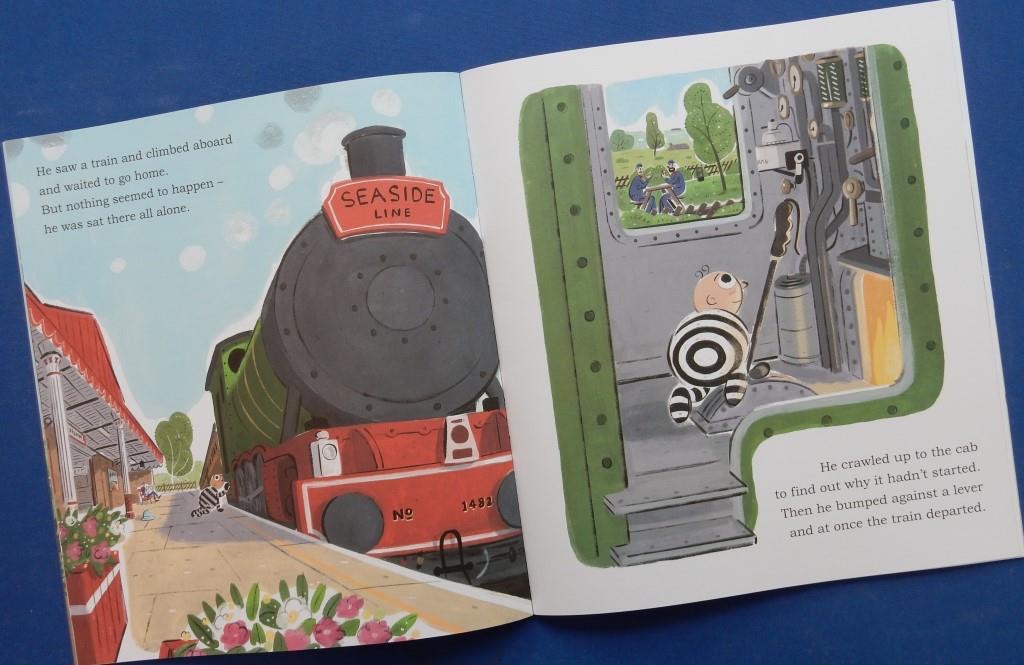
Once on the beach with Mum busy building sandcastles and Dad snoozing in the sun, Frank makes a break for it having first left them a note. At the station stands a train and the babe is soon aboard, all alone. Nothing happens so Frank decides to investigate by crawling into the driver’s cab but he accidentally bumps his bum against a lever setting the train in motion.

Back on the beach meanwhile his parents make a discovery but by then there’s nothing they can do to halt the train as it puffs merrily along towards a very steep drop. Due to his lack of stature, there’s nothing Frank can do either; but what about Grandma?

Back at the zoo, she’s having a terrific time until she she turns on the TV, hears the news and sees where Frank and the train are heading …

Will young Frank ever see his precious animals again?

Told through Jim Whalley’s faultless rhyming text and Stephen Collins’ retro style illustrations that fuel the wonderful daftness of the story, this is once again a hilarious read aloud from team Whalley and Collins.

See What I Can Do!

See What I Can Do!
Jon Roberts and Hannah Rounding
Graffeg

Everybody is different: we all have our individual strengths and weaknesses and that’s part of what makes our world such an exciting place.

Here’s a picture book that embraces difference in an entirely positive way showing how, as one of the characters, Molly, says on the first spread, ”being different doesn’t mean you can’t do anything you want!”

The author goes on to introduce three children with autism who communicate in a variety of ways including in one case, by using Makaton; and then two boys who have dyslexia who explain how this affects them.

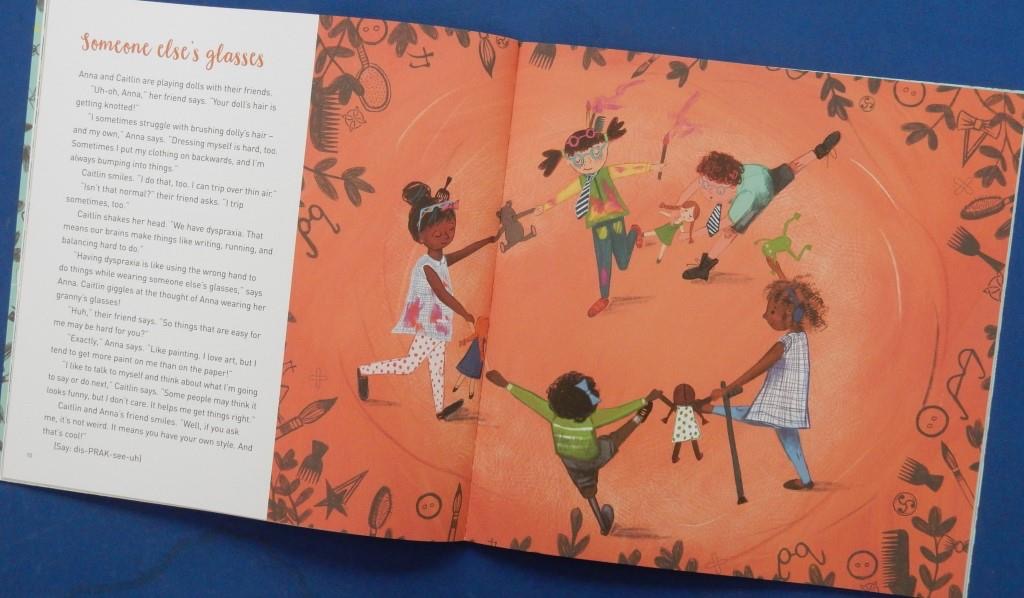
I loved what Caitlin and Anna’s friend says in response to the two girls telling her they have dyspraxia and what this means to each one them: “ Well if you ask me, it’s not weird. It means you have your own style. And that’s cool!”

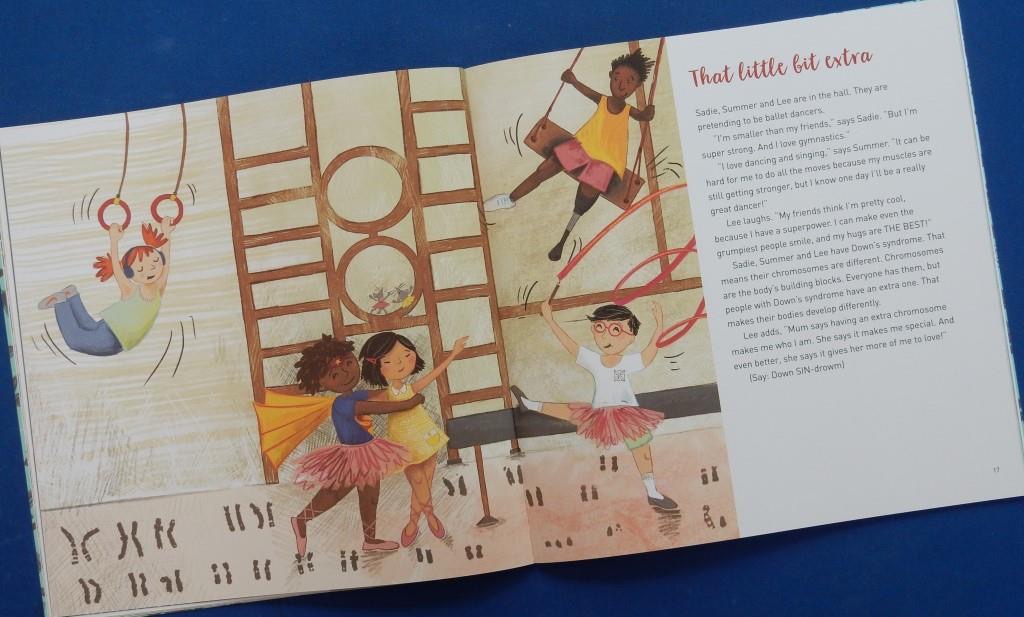
We also hear accounts from children with dyscalculia, ADHD, Down’s syndrome,

Cystic fibrosis, muscular dystrophy, cerebral palsy; others have hearing loss, low vision, spina bifida, epilepsy, brittle bone disease or asthma.

One thing they all have in common is a ‘can do’ approach to life that while acknowledging they face some challenges, emphasises what they have achieved and hope to do in the future.

Inclusive and inspiring, this beautifully illustrated picture book ought to be in every primary classroom and on family bookshelves.

Margaret’s Unicorn

Margaret’s Unicorn
Briony May Smith
Walker Books

Children seem to love unicorns and stories about these mythical creatures. I have no doubt they will love this gentle one of Briony’s with its atmospheric setting; it definitely stands out from the crowd.

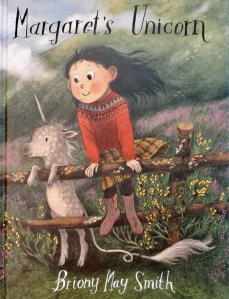
Margaret and her parents have moved to a distant cottage in the mountains to be near Grandma. To the child, this house feels strange and unfriendly so her parents send her out to explore while they organise things inside. Don’t go beyond the big stone, they warn.

As Margaret walks she suddenly notices what at first glance seems like mist over the sea but then she realises it’s unicorns leaping across the skyline, only to vanish almost immediately. 

On her way back she comes upon a baby unicorn tangled in the weeds presumably left behind by the others. Having freed the little creature, she carries it back home.

With her grandma’s help, the girl tends the little unicorn, buying it flowers to eat and making a nest in Margaret’s new room. That night she and her father don wellies and go to collect some of the “water touched by moonlight” her gran had said it would drink. And so it does, making its horn glow with magic in the dark.

Over the changing seasons Margaret nurtures her little unicorn while at the same time gradually thinking less about her old home. ‘When a unicorn is your friend, you wish spring would stay far away.’ she tells readers but inevitably come it does and with it the other unicorns, among which is her unicorn’s mother. It’s time to bid a sad farewell to her friend 

and then the unicorns depart.

By the following spring Margaret has made some new friends and feels settled in this beautiful environment; but will she ever see her unicorn friend again?

Yes there’s magic in this lyrical tale but never of the sparkly sort; rather it has an earthiness fed by the landscapes and the seasonal changes all around, so beautifully captured in the illustrations, that and the love.

Ceri & Deri: Pudding for Desert / A Little Bit of Courage

Ceri & Deri: Pudding for Desert
Max Low
Graffeg

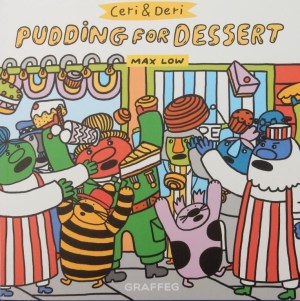
Best friends Ceri and Deri have a particular penchant for all things sweet. Their favourite shopping places to visit in town are Delwen’s Domain of Desserts and Peredur’s Pudding Parlour, each of which offers delicacies they can’t resist.

Strangely though the shops are next to each other and thus far, relations between the two vendors has been amicable. Not so today though: as Ceri and Deri approach they hear an argument in full flow.

At first it’s only insults that fly back and forth as the friends attempt to get served; but pretty soon it’s a case of flying puds and hurtling desserts. Moreover, the situation is exacerbated by various other individuals who show up – D.I Nigel, followed by the mayor

and several others each of whom takes a side in the escalating drama.

Horrified at the waste of good food, Ceri and Deri leap skywards to catch some treats to pop in their mouths.

Can there possibly be a truce between the two sides before both establishments completely run out of goodies? Perhaps, if somebody (or somebodies) can think of a compromise …

As always the cat and dog duo offer some gentle (or in this case somewhat less gentle) learning concerning different ways of seeing along the way, but it never gets in the way of the fun story, illustrated in Max Low’s characteristic expressive, gently humorous colourful small town scenes.

A Little Bit of Courage
Claire Alexander
Happy Yak

This is my first encounter with the Ploofers though it’s their second story, and they’re learning to fly.

There’s one of their number though, a little one, that is feeling fearful and too scared to become part of this exciting new adventure. So will the others leave Little One behind on the ground? Of course not; that isn’t what friends do.

Back comes Toasty to have a chat and offer some words of encouragement to help Little One lose those jelly wobbles. With Toasty’s support, can Little summon up sufficient courage to take that vital leap?

A gentle look at fear, finding the courage to step out of your comfort zone, the importance of teamwork, as well as a celebration of difference Ploofer style.

Simply illustrated and told in a suitably conversational voice, Claire Alexander provides an empowering message for little ones and adults too.

Mister Boo!

Mister Boo!
Joyce Dunbar and Petr Horáček
Walker Books

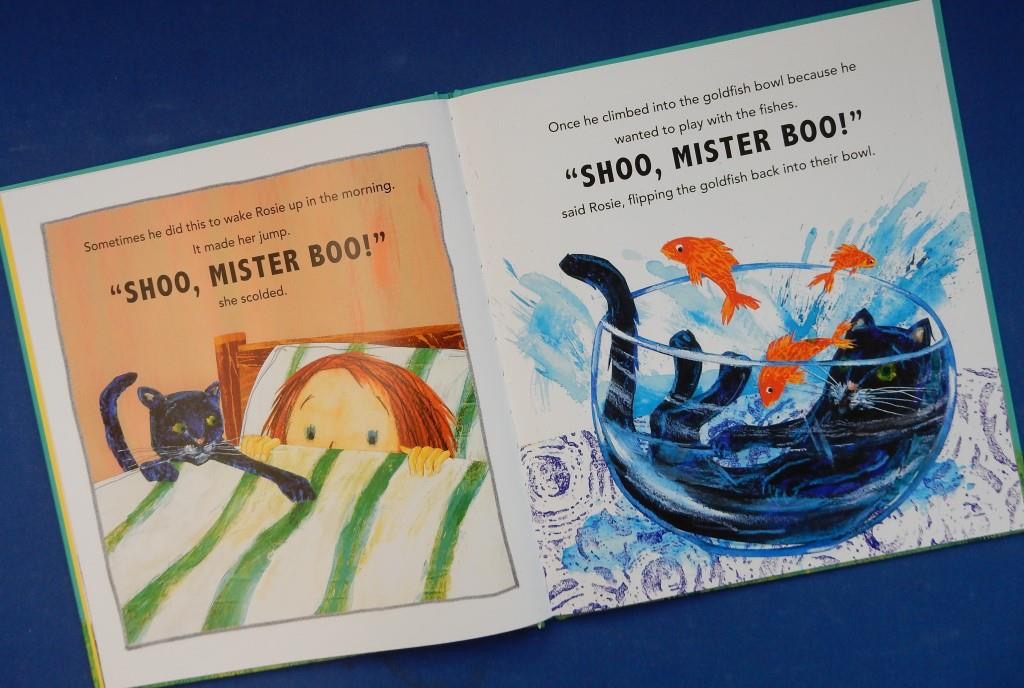
Meet Mister Boo, a mischievous moggy that loves to tease, not least Rosie when he pops his head out from the box on arrival at her home.

Surprises are his special thing: he alarms the mice, flips the goldfish from their bowl,

and come spring there’s no stopping him. He frightens the baby birds as they learn to fly,

terrifies the baby rabbits and the owl fledglings with his springtime joie de vivre.

Time passes and one morning awoken late by birdsong, Mister Boo finds that despite it being spring, he no longer feels that spring in himself. Equally upsetting is the fact that the other animals either ignore him or show him little interest other than the mother owl that lets him know what she thinks.

Feeling decidedly downhearted Mister Boo creeps back home where he’s greeted by a joyful Rosie who has a surprise in store.

Can this restore his spirits? He’ll assuredly need to accept some changes in the home …

Told through Joyce’s chatty text with its lively, playful language and Petr’s distinctive, brilliantly expressive scenes of the ups and downs of the titular character this will delight young listeners and adult sharers alike, especially those with a particular penchant for prankish cats.

Freddie’s Amazing Bakery: The Sticky Cake Race /Kitty and the Kidnap Trap / Mickey and the Trouble with Moles

These are recent additions to three deservedly popular young fiction series published by Oxford Children’s Books

Freddie’s Amazing Bakery: The Sticky Cake Race
Harriet Whitehorn, illustrated by Alex G. Griffiths

In this latest tasty offering starring sweet-natured Freddie Bonbon, Belville’s best baker, summer is drawing to an end and the town’s inhabitants are busy preparing for an important community event, the Belville Rally.
Contestants have been considering their costumes and preparing their cycles making them race worthy, including Freddie himself who is participating along with his assistant Sophie and his bakery manager Amira who are going to ride what they call a tridem. Freddie is also going to make the cake to be awarded for the best costume.

There’s one person however with eyes on winning the first prize, who will stop at nothing to sabotage things for team Freddie and that’s rival baker Bernard Macaroon.

My mouth was watering at the mere mention of all the yummy cakes and pastries mentioned during this story; but who is the eventual race winner? Suffice it to say there is one very surprising outcome of the whole event, as well as a thoroughly delicious finale and fun illustrations by Alex G. Griffiths throughout.

Kitty and the Kidnap Trap
Paula Harrison, illustrated by Jenny Lovlie

Superhero in training and still perfecting her powers, Kitty is always on the lookout for ways to help others so she’s more than happy to have the opportunity to look after her friend’s pet hamster Marvin over the weekend.
That night after her first visit to the creature, Kitty feels uneasy and so she decides to don her superhero gear and with Pumpkin alongside, to go back to check Marvin is okay. When she gets there though, the cage is empty. Disaster!

Before you can say ‘rats’ Kitty is hot on the trail. Can she track down Marvin and more importantly, rescue him and return him to the safety of his warm cage before Emily returns?

Young solo readers familiar with the series will lap this latest story up and perhaps if they’ve not read all Kitty’s previous adventures will seek out some of those too. Like this one, they’re all full of Jenny Lovie’s splendid glowing illustrations.

Mickey and the Trouble with Moles
Anne Miller, illustrated by Becka Moor

Ace code cracker Mickey is now a full member of COBRA the secret organisation of animal spies and one night there comes a knocking at her window. It’s Rupert Rat, Head of Animals at COBRA, come to inform her that her help is needed urgently on account of a bank break in perpetrated by the moles that have been extremely busy tunnelling.

Once inside the bank, the COBRA members discover things are getting somewhat chaotic with moles running hither and thither. What on earth (or under it) can they want, surely not money. Then one mole accidentally triggers the security alarm and as smoke spreads everywhere, Rupert decides to follow the escaping moles and gather information, promising to report back in the morning, while the rest of team COBRA head back to HQ. All except Mickey who goes back home before her parents discover her absence.

Next morning Mickey heads back to HQ for the briefing only to learn that there’s some concern as Rupert still hasn’t shown up. Then comes a strange message delivered by a bird. Could it be that Rupert is in need of help.
Now seems the time for the girl to use some of her particular skills – the ability to read newspapers – for instance.

With codes to crack aplenty, traps laid for COBRA members, tension between the underground animals and overground animals and the reappearance of a nefarious character, the countdown is on to find Rupert and get to the bottom of the Impossible Vault mystery.

A fun adventure full of exciting twists and turns with Becka Moore’s illustrations adding to the enjoyment.

I Love my Bike

I Love my Bike
Simon Mole and Sam Usher
Frances Lincoln Children’s Books

The little girl narrator of this story is the proud owner of a new red bike and with the help of her dad, she’s learning to ride it.

His encouragement enables her to get going and with confidence growing, ‘a tingle in her tummy’ and a ‘flame on the frame’ she soon loves the experience, even starting to take some risks as she rides.

Hills are a struggle (my bike gets lazy) but the walk up is well worth it as the view from the top is incredible.

Now for the downhill run, that’s sure to be fun, or is it?

Before long, exhilaration gives way to exasperation, the tingle in her tum turns to a tangle and …

Her response reminds me a a young relation who having taken her first tumble said, “Nincompoop bike”, threw hers down and walked away. Inevitably such falls hurt, probably both pride and limbs, but thanks to an understanding Dad and some beautiful natural surroundings to rest in, it isn’t too long before our novice cyclist is back on the saddle and feeling positive once more, off she goes again …

Both poet Simon Mole’s words and Sam Usher’s illustrations capture so well the lows and highs of learning to ride a bike as well as celebrating both a warm father/child relationship, and the sheer joy of being outdoors, especially in a green place.

The Lion on the Bus / All Aboard the Words Train & All Aboard the Sounds Train

The Lion on the Bus
Gareth P. Jones and Jeff Harter
Farshore

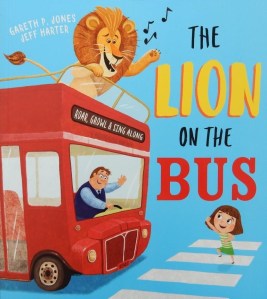
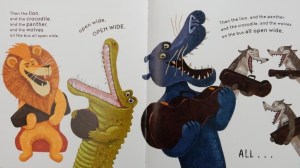
This is a really rumbustious version of the children’s nursery favourite The Wheels on the Bus. It starts with the usual verse but already there’s an anticipation of what’s to come in Jeff Harter’s opening illustration as a maned passenger carrying a bag crosses to get on board the vehicle heading for the park.

Almost instantly the driver is looking alarmed at the RAR-RAR-RAR!” that issues forth and the baby on the bus certainly isn’t happy …

On gets a panther at the next stop, a panther that insists on prowling, ‘PROWL–PROWL-PROWL, …’

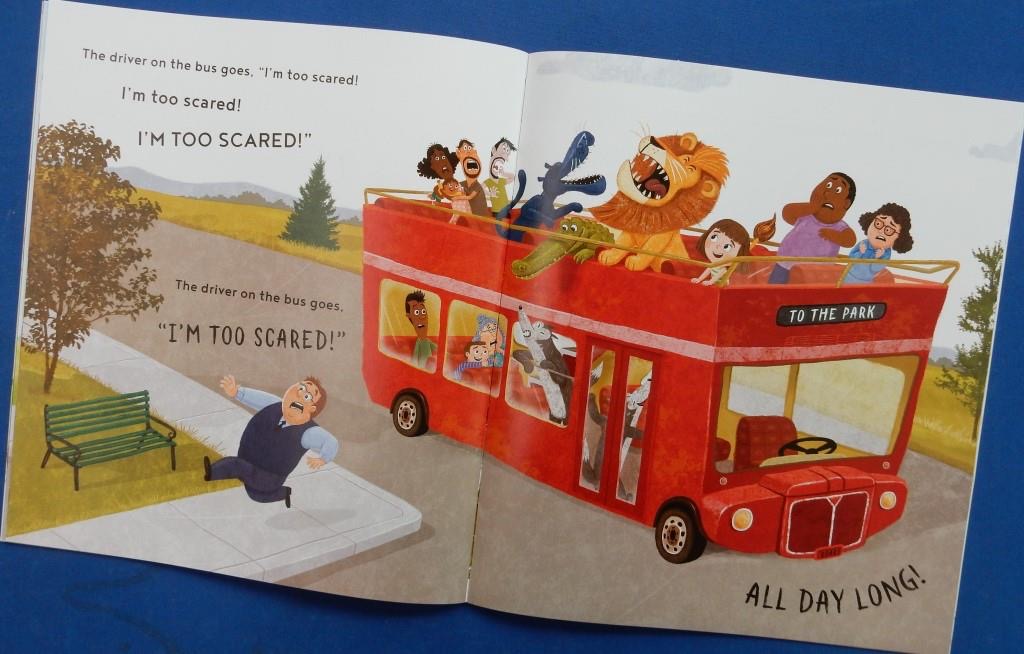
By the time a SNAP-SNAP-SNAP-ing crocodile and a trio of H-O-W-O-O-O-O-L-ing wolves have also boarded and are adding to the din, the driver decides he’s had enough and makes a hasty exit,

leaving the passengers – humans (screaming) and animals (jaws gaping wide) to face each other out.

And that’s where we’ll leave them at the ready, perhaps to exit,

with readers and listeners eagerly anticipating a rousing finale …

Assuredly, with Jeff Harter’s hilarious illustrations, Gareth’s is a version to add to early years collections; it’s one that would be enormous fun to act out in a foundation stage setting.

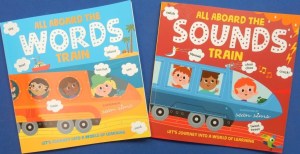
All Aboard the Words Train
All Aboard the Sounds Train

illustrated by Sean Sims
Oxford Children’s Books

No ticket necessary to climb aboard the latest excursions into Oxford Children’s fun World of Learning.
Whichever train you decide to board, you’re sure to enjoy the ride and the destination.

With six lively children plus playful dog, the Words Train is heading for the seaside. Once there, appropriately hatted and sun creamed, the gang will start exploring. First behind rocks and in the cave, after which they’ll pause for play and ice-creams, followed by a swim in the chilly water, a spot of sailing on the sea, a dive under the water, perhaps even visiting a wrecked pirate ship. All this and more before night falls and it’s time to go home.

While most spreads focus on nouns, the focus of others is either verbs or adjectives: Sean Sims’ vibrant illustrations provide just the right amount of details in each one.

The Sounds Train journeys through the seasons and concentrates on environmental sounds be they created by animals, the elements, the children or the occasional machine.

Great for introducing or reinforcing sound/symbol associations.

Secret Lives of Dragons

Secret Lives of Dragons
Prof Zoya Agnis and Alexander Utkin
Flying Eye Books

Long, long ago deep in the mountains there was a flourishing dragon kingdom. So says Prof Zoya Agnis, international expert and life-long studier of Drackenosophy, aka Sangma Francis, the author of this book.

Dragons have apparently existed on this earth for ‘as long as human memory’ and probably a lot longer but what has happened to the creatures that once guarded priceless treasures and sent their voices forth on the wind? Are there any still around and if so how would anybody know if they were to encounter one? Let alone know what to do under such circumstances.

This manual offers the answers along with a host of fascinating information about such topics as how dragons evolved; what are the key anatomical features common to all six of the dragon families; how they breathe fire and what makes it change colour; how do the creatures fly and what are the stages in a dragon’s life-cycle? All this is discussed in the first of four parts, each being dramatically illustrated by Alexander Utkin.

The second part explores the six main dragon families (or species) from the most secretive sort to the rarest; there’s even an aquatic family, pretty terrifying and some have a multitude of heads.

The prof. claims to have had recent sightings of four different kinds.

Part three charts dragon history and introduces some of the most famous dragons of myths and legends from various parts of the world; we also meet some celebrated dragon slayers of yore, pay a visit to a lair and see a hoard of treasure. Maybe you’re interested in languages, if so, there are a few riddles and half a dozen easy dragon phrases.

Finally, and particularly if the first three sections have whetted your appetite, the final part takes us to the World School of Dragons to learn what is entailed in becoming a drackenosophist. (You can guess who heads up that establishment.)

Of course the entire thing is a work of fiction but enormous fun, so cleverly written and show-stoppingly illustrated throughout.

Mr Tiger

Mr Tiger
Davide Cali and Miguel Tanco
Tate Publishing

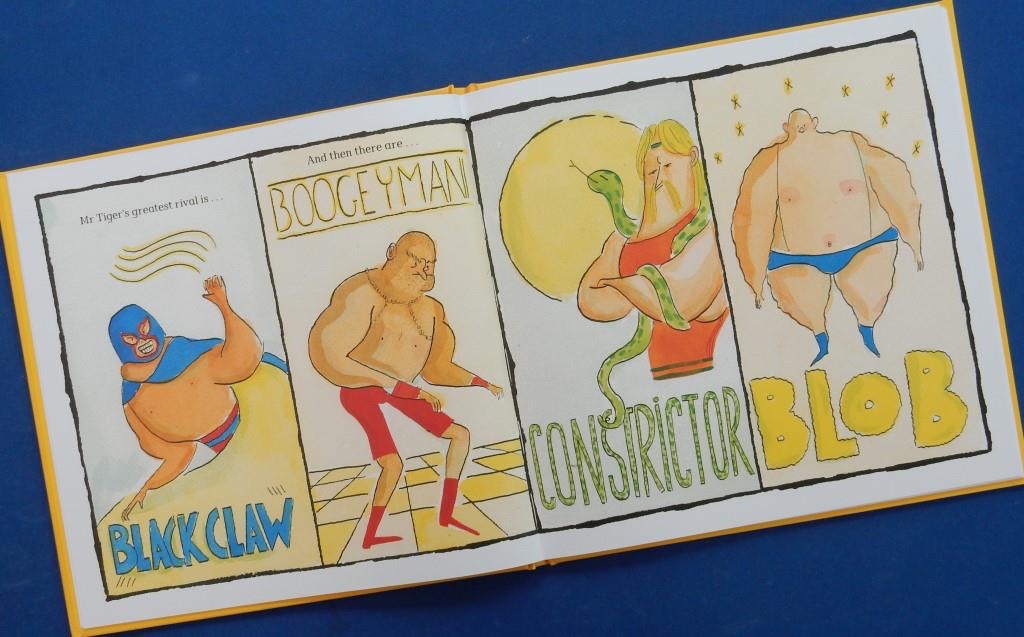
With his world-famous moves – the head smash, the pain-in-the-neck clutch, fatal hug and his trademark Leap of the Tiger – wrestler, Mr Tiger is the strongest in the world.
He’s defeated Blackclaw (his greatest rival), Boogeyman, Constrictor and Blob, all formidable opponents in the ring.

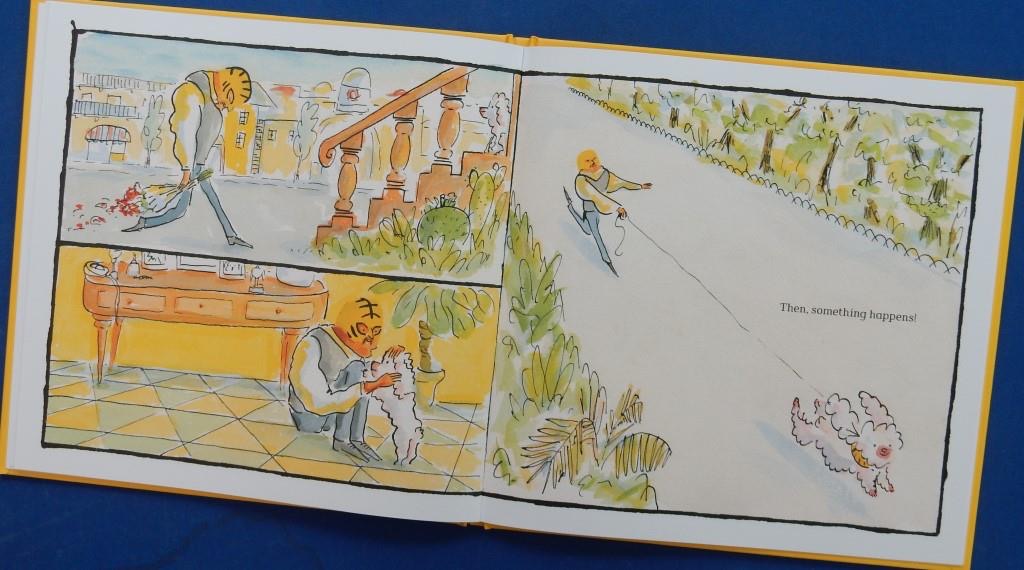
Out of the ring however, it’s an entirely different matter. Mr T. is enormously shy and entirely lacking in friends other than his canine pal, Fifi.

Of late though, Mr Tiger has become enamoured with Lily but on account of his extreme reserve, he just can’t summon the courage to speak to her; even his rivals have noticed he seems a tad less fearsome than usual.

As he sits pondering his plight and considering how he might make some sort of approach, a certain fluffy friend makes a move. 

Could that lead to our masked wrestler making the most gigantic leap of his entire life …

Inspired by the Mexican sport/art form lucha libre, this entertaining book with Miguel Tanco’s quirky illustrations and Davide Cali’s reporter style text will go down especially well with those who like something out of the ordinary when it comes to picture books.

Oscar’s Tower of Flowers

Oscar’s Tower of Flowers
Lauren Tobia
Walker Books

Oscar’s mum takes him to stay with his grandmother for a while in this wordless, wonderfully warm story. He bids a sad farewell to his mum and then despite reassuring hugs from his nan, the boy spends a very difficult first night away from home.

Next morning though his nan observes Oscar’s interest – a picture he draws, and his careful watering of a seedling.

She takes him to a very special shop where they buy all kinds of gardening things including seeds.

Back in nan’s apartment, Oscar plants and tends the seeds

until her entire residence, both inside and out, is alive with flowers, greenery, even vines. There are certainly sufficient plants to make gifts to the other residents of the block, especially a little girl who soon becomes his friend.

No words are needed here: Lauren Tobia’s gorgeous vignettes and full page scenes say it all. The emotions of the characters are made palpable both through their faces and their body language all the way through to the happy reunion of mother and child.

Perfectly paced, this is a super book to share nestled up with one child or a few, taking time to focus on and relish all the wonderful detail in every spread and both endpapers.

Let’s Go For a Walk / Look What I Found at the Seaside

Let’s Go For a Walk
Ranger Hamza and Kate Kronreif
Ivy Kids

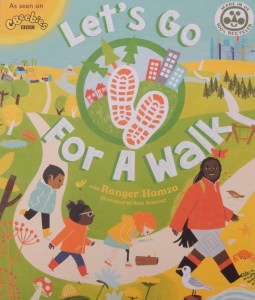
In the company of Ranger Hamza, any walk will be an experience that engages all the senses. No matter where or when you go there’s sure to be a wealth of interesting sights, sounds, smells and exciting tactile things to feel with our hands. Best to do as Ranger Hamza advises though and take a copy of this book along, then suitably attired and with eyes and ears open, everyone is ready to sally forth.

The first focus is colour and youngsters are encouraged to spot red things and of course, what is found will depend on the season and to some extent the surroundings.
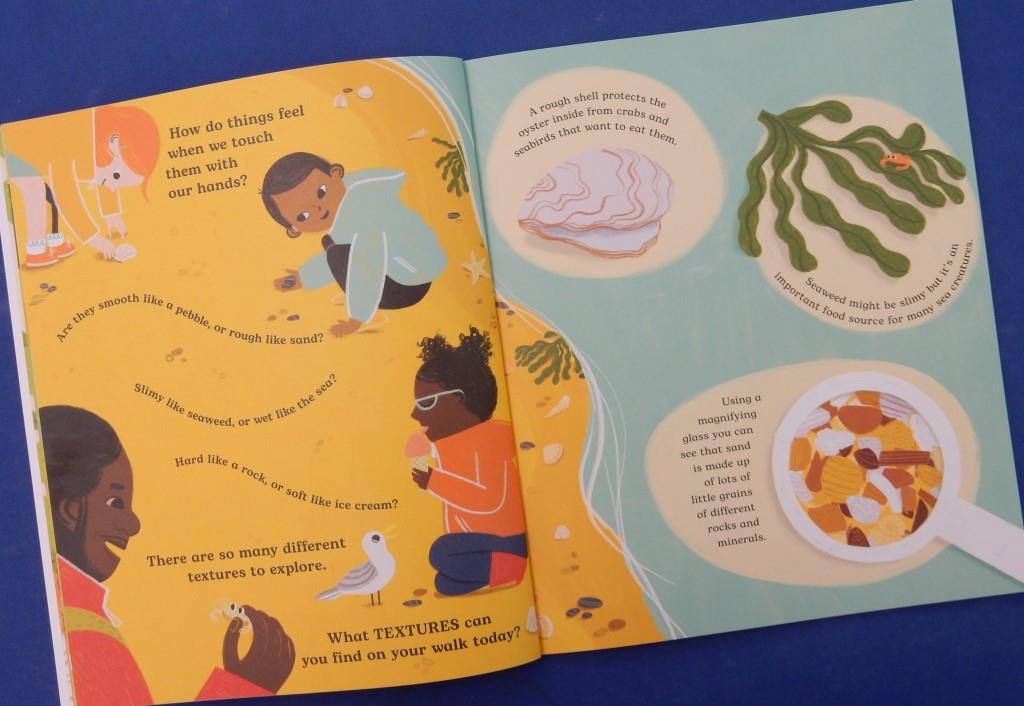
Then what about trying to spy things tall, wide or small; or feeling various things like these walkers are doing on the sea shore.

Not all smells are to be savoured; we all enjoy different ones. I for instance would not want to be in close proximity of fresh fish or chimney smoke but would love to inhale the aroma of lavender or baking bread. The important thing is to do as the ranger suggests and ‘use our noses’.

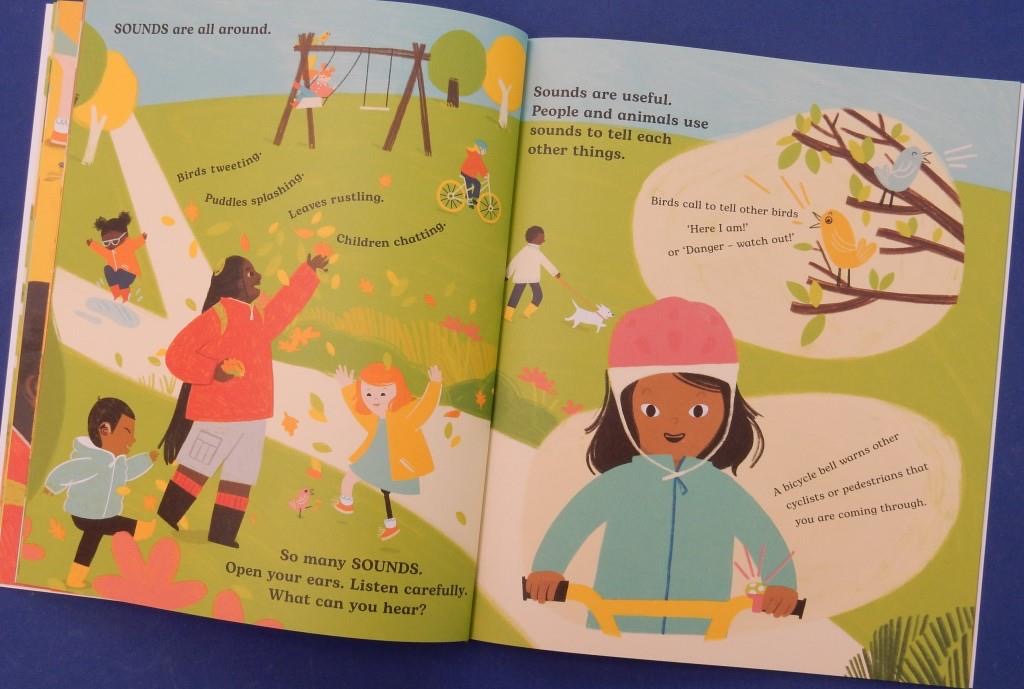
Each double spread has a new focus: there are shapes, minibeasts, sounds,

letters and numbers, pairs of objects, different materials that things are made of. The dark makes everything look different, shadowy perhaps, or you might spot some nocturnal creatures or star patterns if you walk at night.
To see other things up high though, it’s better to walk in the daytime when the clouds sometimes look amazing; while focussing on the ground can be equally rewarding with plants popping up in unexpected places and all kinds of patterns created either by humans or by nature.

With wildlife photographer and CBeebies Ranger Manza as guide and Kate Kronreif as illustrator, this guided book walk is sure to make youngsters want to undertake the real thing. Nature and being able to get outdoors are what have kept so many of us – young and not so young – sane over the past year and now I’m pretty sure that henceforward, none of us will take these things for granted. Are you ready, ‘Let’s Go For a Walk’ …

Look What I Found at the Seaside
Moira Butterfield and Jesús Verona
Nosy Crow

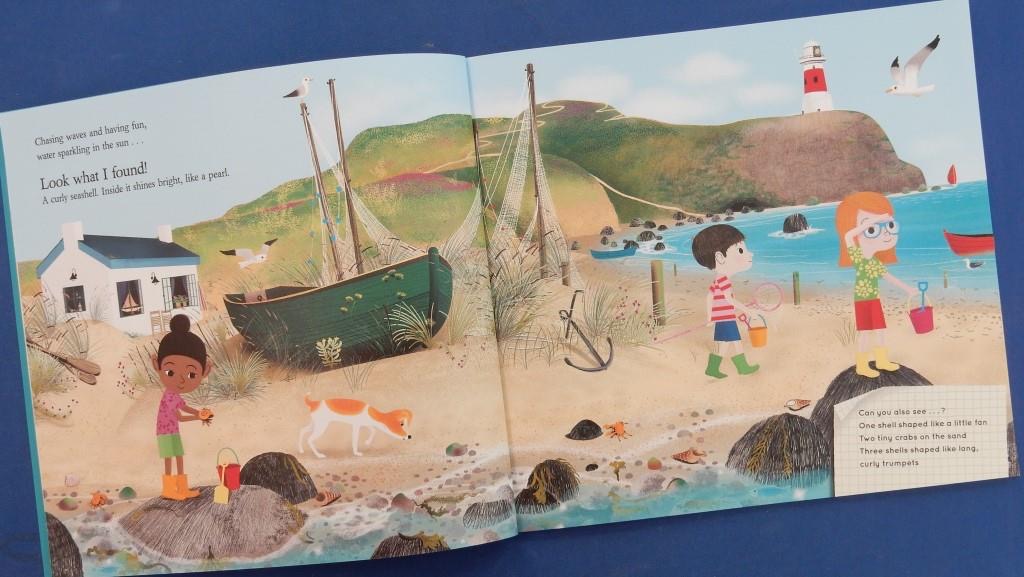
There are wonders aplenty waiting to be found if you take a stroll on the seashore with the characters in this smashing book (a companion to Look What I Found in the Woods), also published in collaboration with the National Trust).

Every spread is packed with exciting things to discover, the first being the wealth of different shaped seashells, be they curly and shining bright ‘like a pearl’,

long and curly, opening like a pair of wings or perhaps a purse.

The rock pools too are full of exciting patterned pebbles, fish and other small sea creatures; among the seaweed too are more treasures and sometimes foraging seagulls. Watch out for crabs scuttling among the fronds or peeping out of shells.

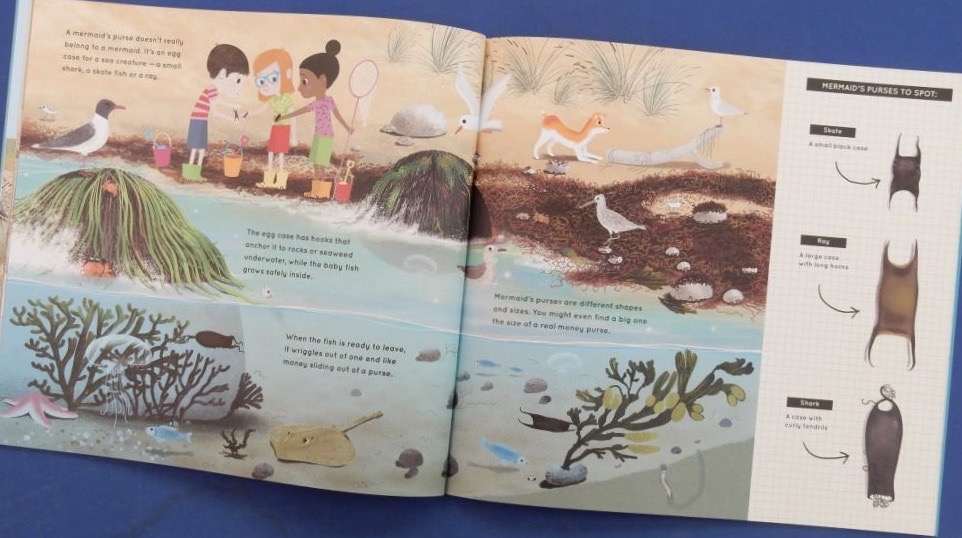
It’s interesting to imagine what a mermaid might keep in one of those mermaid’s purses close to the cave mouth …

There’s much more too if you follow the cliff path; maybe some fossils, butterflies, bees and seaside flowers; and if you are quiet you just might come upon some wonderful sea birds tucked away among the rocks.

Yes, the seaside is a veritable treasure trove but it’s important to collect thoughtfully, doing no harm and leaving nothing but your footprints behind.

Told through a gentle rhyming narrative and also bursting with fascinating facts, and illustrated with alluring scenes of the children investigating the natural world, this will surely get youngsters enthused to get out and explore nature.

A Cat About Town

A Cat About Town
Lèa Decan
Tate Publishing

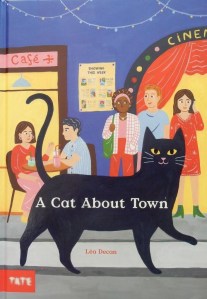
‘A cat about town’ the feline narrator of this book, surely is. Owned by Lisa, the moggy is seldom at home (one day a week to be precise); the rest of the time there’s a busy schedule in operation.

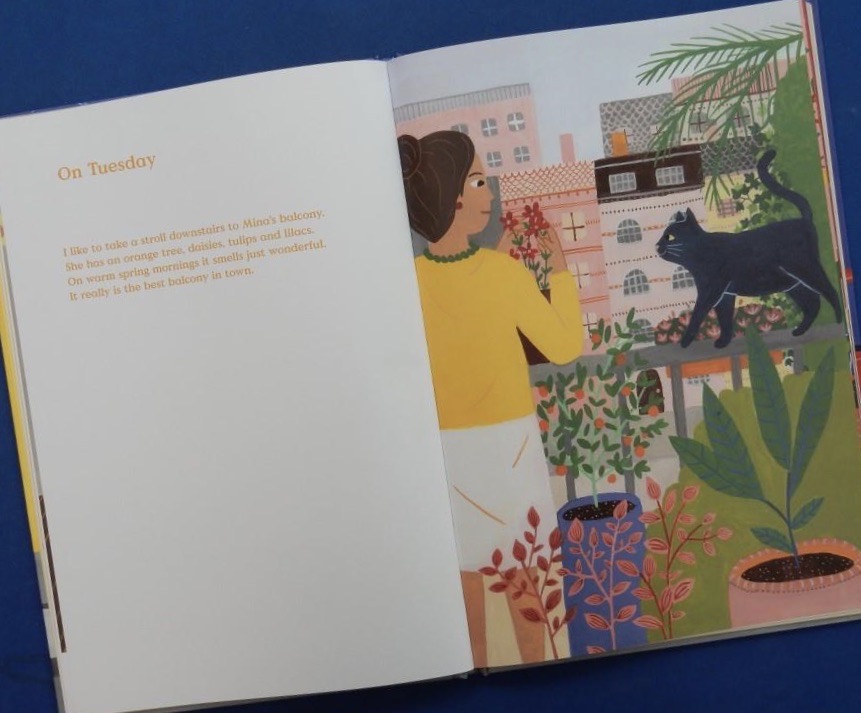
Mondays are taken up by visiting writer and intellectual, Sebastian; Tuesdays are spent downstairs mainly on Mina’s balcony crammed with plants that look and smell amazing.

Come Wednesday on the dot of twelve noon, it’s a trip to Granny Yvonne whose granddaughter visits for lunch – and it’s truly delicious, not to mention, filling.

Thursdays are for artist Maud and a bit of culture, albeit in rather messy surroundings. Apparently our narrator is the favourite subject of this famous creative woman.
Musicians of the local string quartet gather on Fridays so it’s culture of a different kind on that day and our feline visitor has the most comfortable seat in the house.

On Saturdays it’s a case of a double date: Amélie receives a visit from her boyfriend; and the narrator meets the elegant Capucine with her alluring eyes and the two cats take a wander through the city streets.

Sunday though is home and Lisa’s day; it’s she after all’s said and done, who ‘takes care of me’.

Cat lovers especially, will relish this playful, first-feline narration and the alluring, gorgeously colourful scenes of the abodes in which Lisa’s cat spends most of his days. What about the nights, one wonders …

The Pirate Mums

The Pirate Mums
Jodie Lancet-Grant and Lydia Corry
Oxford Children’s Books

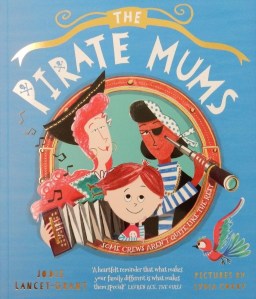
Arrr! me’arties, here’s a rousing tale of derring do that takes place on a school trip with a difference.

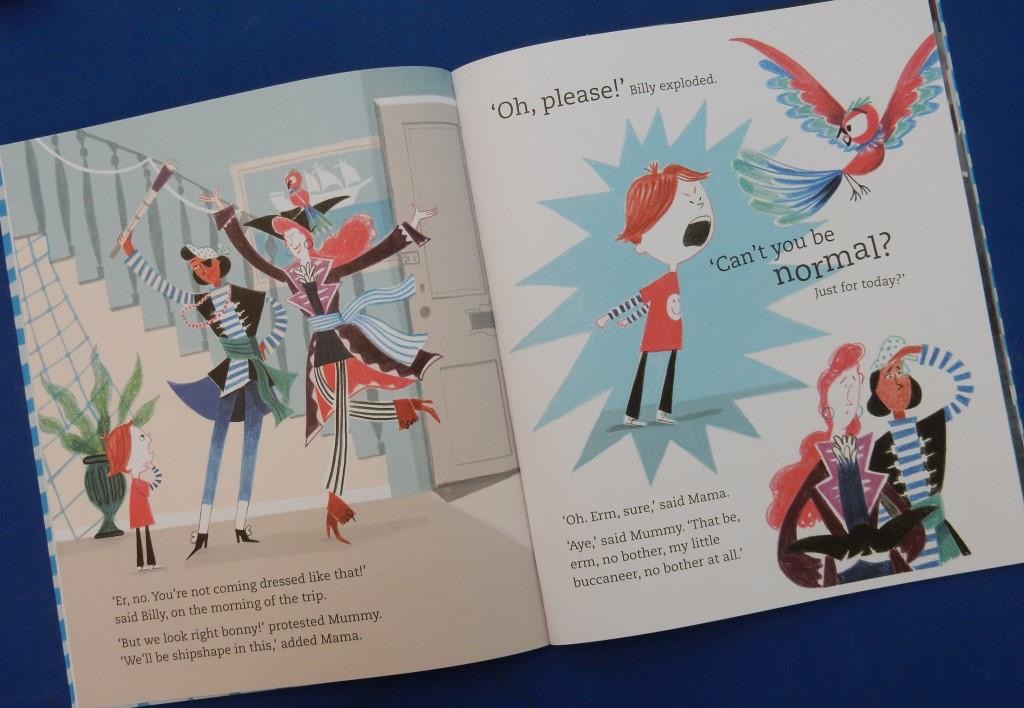
Billy isn’t overly keen when he learns that his mums have volunteered to join Mr Smart’s class on their seaside trip. His mums however can’t wait and despite their son’s best efforts to put them off, come the morning of the outing, they’re up with the lark (rather the parrot), raring to go and there’s no stopping them.

At the coast, Billy leaves them and joins his pals right away and then it’s ‘anchors away’ and off they sail.

All of a sudden Mama is alert to the black clouds the boat is heading straight towards but her attempts to inform Mr Smart come to nothing: he’s too busy throwing up. As the storm worsens a bolt of lightning does for the main mast and panic ensues among the children.

With Captain Fishface stuck in the loo …

it’s time for Billy’s mums to take charge and pretty soon with some sacrifices of the children’s clothing, expert knotting from the pirate mums and a few deft moves from Birdbrain, there’s a new sail ready to catch the wind. But still the boat remains stuck.

Never fear, the pirate mums are here and along with plenty of willing assistants they soon have the craft heading for harbour.

Could it be time for Billy to have a change of heart about wanting to be part of an ‘ordinary’ family?

What a smashing read aloud: told with a spirited text from debut picture book author Jodie Lancet-Grant and suitably dramatic illustrations by Lydia Corry, this is a splendid, open-hearted celebration of difference and families with same sex parents.

Curious About Crocodiles

Curious About Crocodiles
Owen Davey
Flying Eye Books

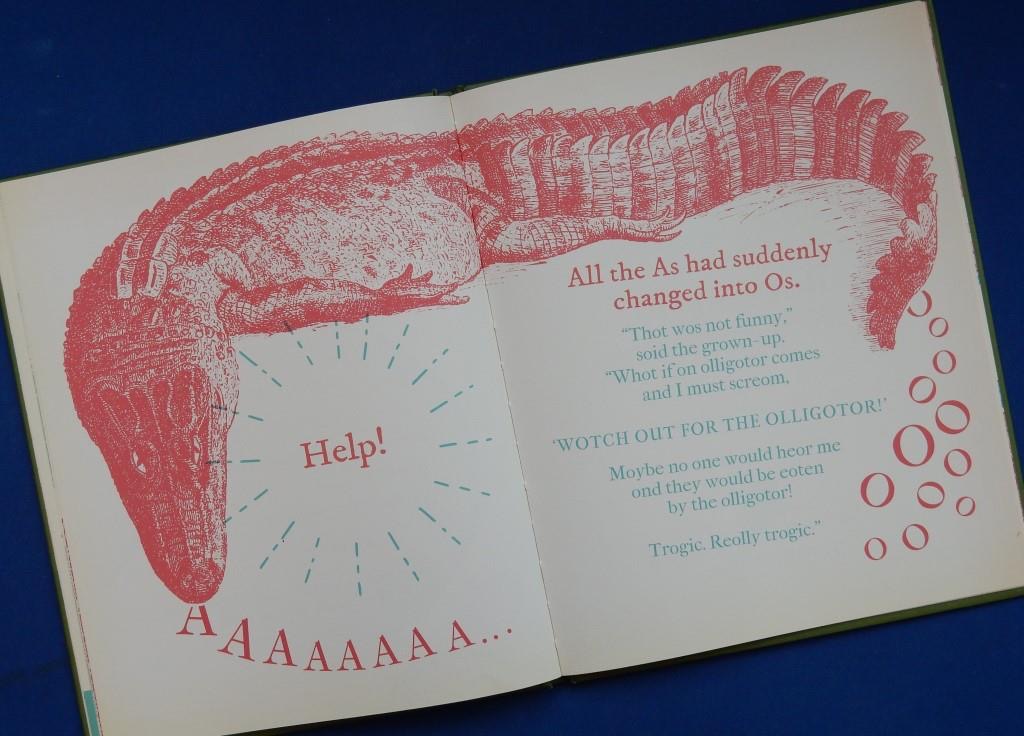
Book seven of Owen Davey’s splendid series explores members of the weird and wonderful Crocodilia order. The order includes crocodiles as well as alligators, gharials and caimans, all of which are strong, armoured reptiles with four short legs, powerful jaws – beware! long, flattened snouts and long tails. Each kind spends some time on land and some in the water.

After his general introduction, Owen looks first at design using the Orinoco crocodile to which he takes us right close up and decidedly uncomfortable. I was more than a tad jealous to read that when one of these creatures loses a tooth, another one replaces it and a single croc. can go through as many as 4000 teeth in its lifetime. 

Dinosaur enthusiasts in particular will be interested to learn that millions of years ago crocodiles and dinosaurs shared the earth.

The other dozen topics, each given a double-spread, take a look at movement – sometimes crocodilians walk low to the ground but more frequently adopt a ‘high walk’ and some of the smaller species can break into a run, while others might climb trees. Most although excellent underwater swimmers, tend to stick mainly at surface level.

Did you know that a crocodile’s gender is determined by the temperature of the nest at a crucial point in the development of the egg with high and low temperatures tending to result in female babies, though due to varying layers of a nest having different temperatures, it’s likely that a clutch will have hatchlings of both sexes? First of course, a male has to attract a mate and to do so, some blow bubbles and produce a water dance with vibrating bodies and water droplets ‘that dance around them’. 

As with his previous guides, Owen has packed this with a wealth of engrossing biological information as well as some mythology; and last but definitely not least, a look at conservation including some things readers can do to help preserve both the creatures and themselves.

Truly something to chomp on and bound to scale up the interest of budding young zoologists.

A Celebration of Dads

My Dad
Susan Quinn and Marina Ruiz
Words & Pictures

A small child celebrates their dad, and the everyday activities – real and imaginary – that make him and the days they share together so special.

In Susan Quinn’s first person rhyming narrative the child presents such things as baking, growing vegetables, grocery shopping, going for picnics and bathing, moving through the different seasons and kinds of weather: ‘If it rains, we splash through puddles, / stomp through leaves of gold and red. / And gaze at a colourful rainbow, / big above my head.’

Marina Ruiz’s illustrations are suffused with the love shared between Dad and child, while her colour palette alters to reflect the changing seasons.

No matter the particular home situation of the young reader/listener and Dad this sensitively written book is one to enjoy together.

What is Daddy Going To Do?
Carly Madden and Juliana Perdomo
Words & Pictures

This is a fun lift the flap book for toddlers to enjoy, especially with a dad. It features diverse dads, one portrayed holding or wearing an item on the flap of each recto, while opposite the text says for instance, ‘Daddy has a stopwatch. / What is Daddy going to do?’ Having had a guess, little ones lift the large, sturdy flap to reveal the answer. (‘Start the family sports day!’)

In all there are six fun activities that Daddy does with his child or children – Fly to the moon, play in the forest, build a pirate ship, play in a band and make some noise, and read a bedtime story.


Little ones will want to join in with the repeat question and the (hidden) sounds, as well as lifting the flap (great for developing fine motor skills) and they’ll certainly enjoy exploring Juliana Perdomo’s bright, gently humorous illustrations and making predictions about the hidden activities.

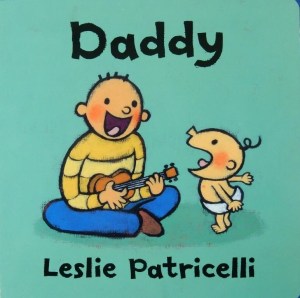
Daddy
Leslie Patricelli
Walker Books

The adorable one-haired baby is back to introduce Daddy. Said male parent is ‘so big and strong’, his ‘legs are so, so long.’ The infant then enjoys a playful time with Daddy – riding piggyback, trying to touch the sky, feeling his unshaven scratchy face, fleeing from a pretend monster, singing, wrestling till they need a rest.
At other times Dad is busy so baby helps him cook and clean and much more.

Our baby narrator also introduces several other dads pointing out that each one is different be that ‘Dressy … Messy … Bald … Hairy … Tall or Short’ before pointing out the ideal nature of ‘My Daddy’.

With its rhyming text and warm, lively scenes of baby and Daddy, this is a delight for the very youngest.

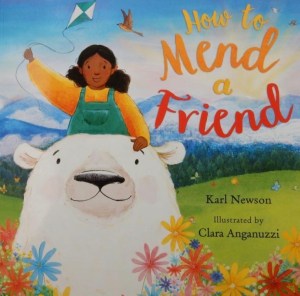
How to Mend a Friend

How to Mend a Friend
Karl Newson and Clara Anganuzzi
Studio Press

As he tells us at the end of the book, Karl’s story was written while he was undergoing treatment for cancer when inevitably things felt pretty uncertain. Nonetheless with the love and support of relations and friends, and of course the fantastic NHS staff who treated him, he found a way through and hopes that this heartfelt tale might help others.

No matter what, it’s a lovely hug of a picture book showing the importance of friendship and of people’s empathetic understanding.

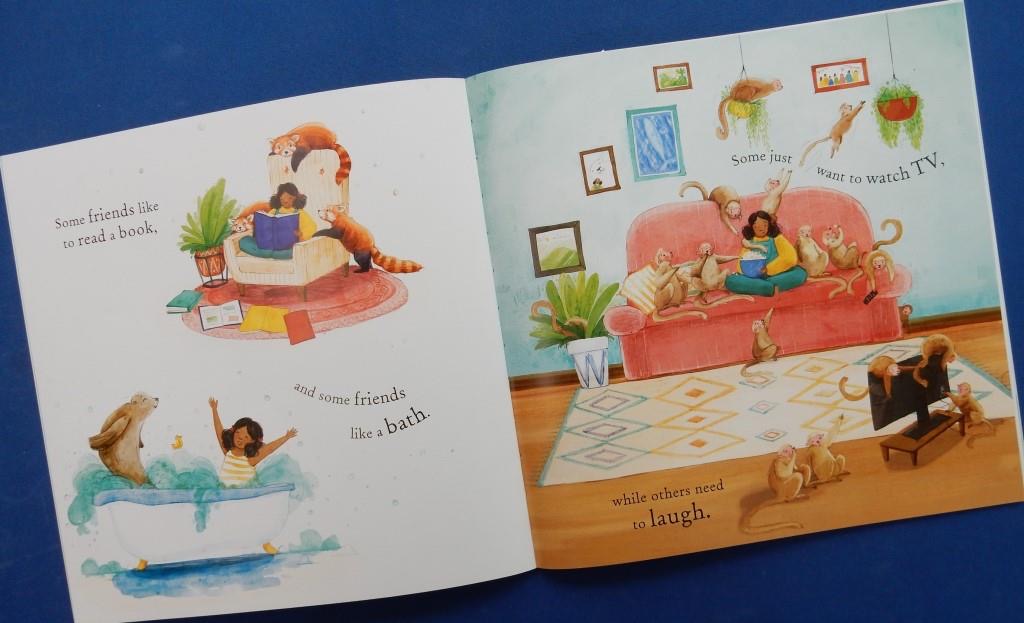
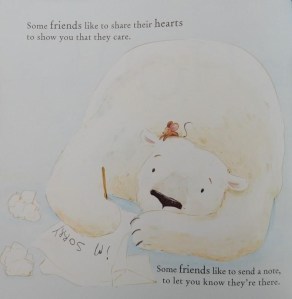
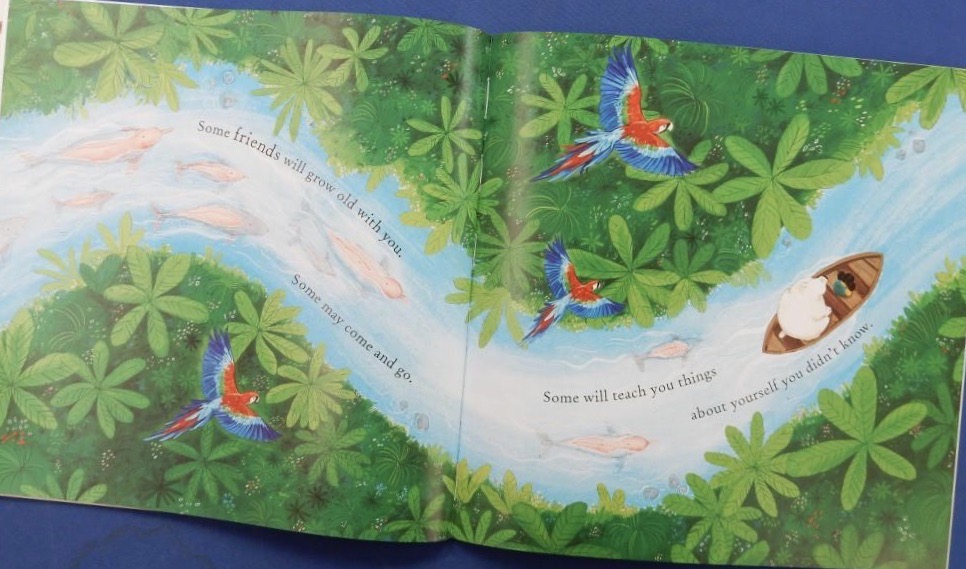
Through Karl’s rhyming text, and Clara Anganuzzi’s beautiful, detailed scenes that exude warmth and love, we follow a little girl, accompanied by her huge imaginary polar bear

and a host of other animals as she contemplates the kind of support that might be needed or offered in difficult times.

I love the various perspectives and variety of settings used in the portrayal of the protagonist’s friends

and how all the characters come together in the final scene with Karl’s crucial closing words, ‘You can be the greatest friend / just by being you.’

Positive, moving and uplifting. During the past year or so when the pandemic has overshadowed pretty much everything, we’ve all come to realise what is most significant in our lives; family, friends and community. As a result every one of us has discovered and are continuing, to learn, how better to care for the ones who, in their unique ways, are important to us.

Exploding Beetles & Inflatable Fish

Exploding Beetles & Inflatable Fish
Tracey Turner and Andrew Wightman
Macmillan Children’s Books

Sam, narrator of this funky STEM information book is totally obsessed with all that’s weird and wonderful about members of the animal kingdom. (There is mention of the occasional plant too.) He keeps four pets – stick insects of the Indian variety named Twiggy and Wiggy, a goldfish named Bob (deemed boring by Sam’s elder brother) and a hamster, Letty. Readers learn a fair bit about these creatures along the way including the fact that stick insects often eat the old skin they’ve shed and as a defence mechanism, they might exude from their joints a foul-smelling liquid or spray attackers with a nasty chemical substance. Best not to attack a stick insect then.
I should say at this point that throughout the book Sam has drawn or rather claims to have done (actually Andrew Wightman is the illustrator) all kinds of funky creatures eating, pooing and just generally going about their lives.
On the poo topic, did you know that a fair number of animals including woodlice eat their own? (they never ever wee though) Or that wombats have cube-shaped poo – how on earth do they manage excreting that without discomfort?

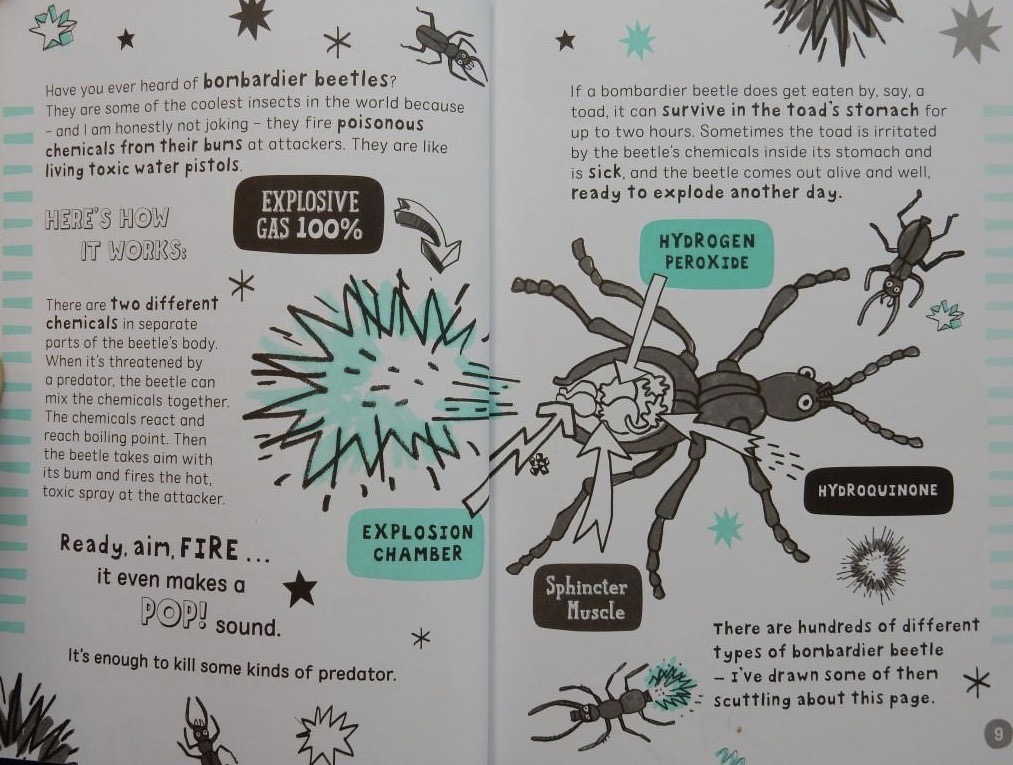
I’m pretty sure your reaction to the revelation that bombardier beetles can explode like toxic water pistols will be similar to mine – best to steer clear of their bums.

Much of this fascinating information is related during a hunt for Twiggy. Sam discovers that the little creature has gone awol from his vivarium when he goes to spray water inside.

Happily she is eventually found (hiding in plain sight) but not before Sam has shared a considerable number of amazing factual snippets with readers.

Terrific fun and gently educational too.

Somewhere

Somewhere
Jeanne Willis and Anastasia Suvorova
Nosy Crow

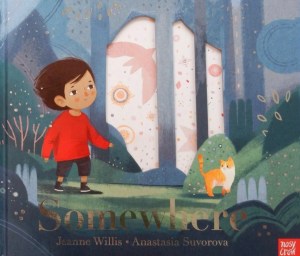
An enchanting story about a little boy and those endless annoying questions that adults ask seemingly ALL THE TIME.

Oscar feels besieged by such irritating interrogations and decides that the best way to avoid them is to take action. Off he goes out of the house, down the garden – just to the bottom – but then suddenly he’s in the middle of …

With not a soul in sight, he can wander where he pleases without such intrusions as “Do you need a wee, Oscar”; play whatever he feels like without any “What are you doing up there, Oscar?” and so he builds himself a camp.


But then as dusk falls, the boy starts missing that familiar “What about a story, Oscar?” and other such words of familiar comfort.

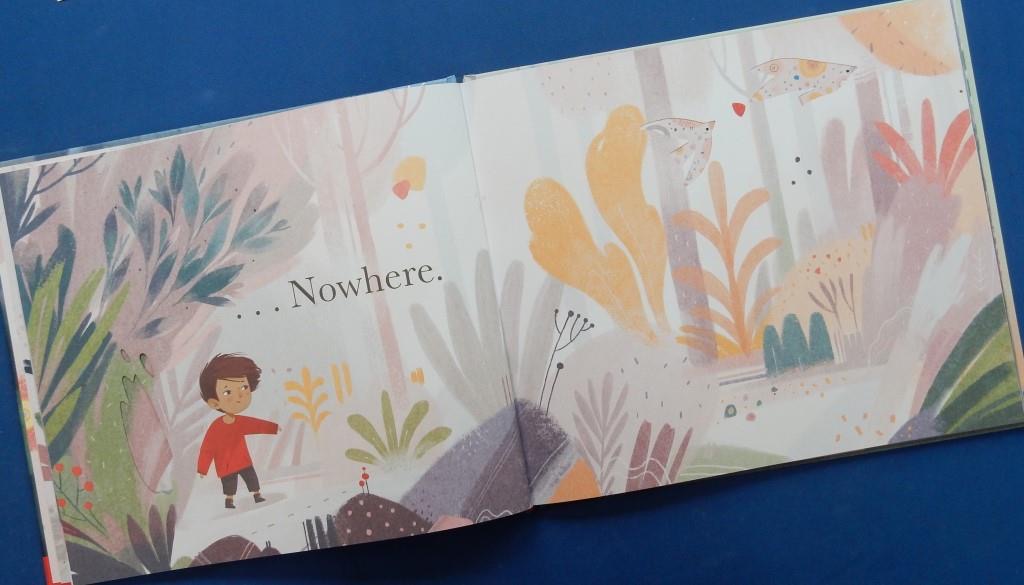
After some self questioning, he decides to head for home but each path he tries ends … Nowhere. And nobody answers his calls until out of the black there emerges a …

Seemingly this little moggy isn’t fond of questions either, so they sit in a companionable silence for a while before Oscar makes a request and the cat responds by leading him … somewhere. In fact a very special place where his homecoming is greeted by, yes more questions, and youngsters will likely guess how Oscar will respond …

The power of the imagination, finding magic in the everyday ordinary and the importance of home are at the heart of this book. Anastasia Suvorova’s chosen colour palette for her scenes of Nowhere and Somewhere are perfect for lending an otherworldly atmosphere to the former as well as creating a seamless continuity between fantasy and reality. Die-cuts on every spread serve to highlight the beautiful texturing of the scenes.
Ideal for family sharing, bedtimes and together times in foundation stage settings.

On a Building Site / How it Works: Rocket / Dinosaur Snap! The Spinosaurus

What Can You See? On a Building Site
Kate Ware and Maria Perera
Little Tiger

The building site herein is destined to become a brand new primary school. Youngsters (hard hats donned) can follow the action from the demolition of an old building to the school’s near completion. There are lots of vehicles visiting and working on site including lorries, a digger, a bulldozer, a crane and a cement mixer. It’s good to see both men and women hard at work carrying out their various roles, building, operating machinery (including a woman in a scissor lift, bricklaying, trench digging, tiling, fitting windows and solar panels and more.

In addition to the narrative describing the entire process there are questions to encourage little ones to hone their observation skills by searching for a little mouse, a white cat and other items. With die-cuts and lots of details in the illustrations this will keep your little one’s ears and eyes engaged as you share the book.

The same is true of

How It Works: Rocket
Amelia Hepworth and David Semple
Little Tiger

Get ready to zoom off into space as you read this with your toddler. It starts by explaining briefly what a rocket is and how astronauts use a service tower to get inside. David Semple’s spreads show the release of some of the rocket parts no longer required; an astronaut floating in space beside a command module; the same astronaut walking on the moon’s surface and another flying the rocket. Then come preparations for the return to earth including the ejection of everything no longer needed and finally, splashdown and the collection of the rocket and astronauts by a ship.

Simple language and illustrations to which a touch of playfulness courtesy of a tiny mouse passenger are added, provide a first introduction to the popular topic of space.

Dinosaur Snap! The Spinosaurus
Macmillan Children’s Books

A spinosaurus takes centres stage in this rhyming story inspired by the Strickland’s hugely popular Dinosaur Roar book. Said to be the scariest beast ever it lies in wait for other dinos. such as the young stegosaurus that accidentally gives it a whack with its tail. Its next encounter is with a wily oviraptor that induces an attack of dizziness in Snap before making a dash for it.
Now pretty peckish, Snap sets its sights on the compsognathus aka Dinosaur Squeak luring the little creature down to the water’s edge where a very big surprise awaits …

Created in association with the Natural History Museum this amusing sequence of events ends with a spread giving some basic information about Spinosaurus’s features and also sends young listeners back to the start of the book in a game of seek and find. Look out for further stories in the World of Dinosaur Roar.

You Can’t take an Elephant on Holiday

You Can’t Take an Elephant on Holiday
Patricia Cleveland-Peck and David Tazzyman
Bloomsbury Children’s Books

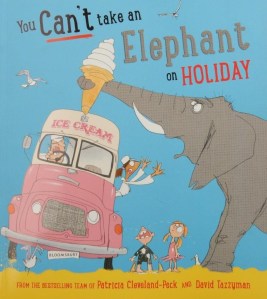
This is the fourth in the deliciously daft rhyming ‘You Can’t …an Elephant … ’ series and now the topic under consideration is the holiday-sabotaging potential of the titular pachyderm and a host of other unlikely animals.

Some of the other potentially disastrous combinations are a cheetah at the wheel of a camper van, meerkats doing a round of mini-golf, eating candy floss in the vicinity of a circling albatross, a bison on a pedalo

and venturing into a paddling pool with a lot of piraña fish swimming in wait.

David Tazzyman’s hilarious renditions of those silly scenarios and others of Patricia’s possibilities, along with an achievable crowd-pleasing finale, offer a timely vacation contemplation, virtual or actual, in these ‘green light’, or otherwise, times we’re faced with.

Youngsters will surely enjoy this book as much as the previous ones by this creative partnership and likely be inspired to think up some potentially hazardous situations of their own.

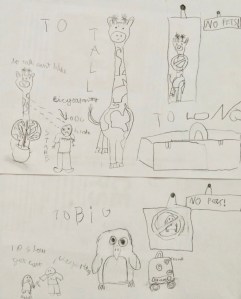
Here’s Elena who says ‘Don’t try a giraffe or a penguin – you won’t be able to pack them away and the security guard won’t let them stay.’

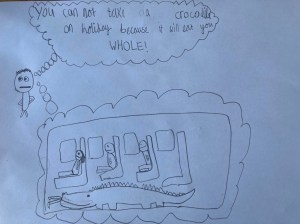
Leo chose the potential consequences of a crocodile as a holiday companion …

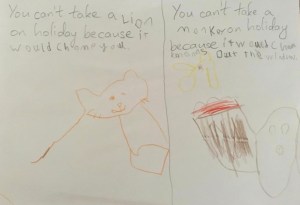
Samuel considered the possibility of both a lion and a monkey:

Emmanuelle is definitely against taking a pig: the outcome would likely be no luggage on arrival and then no water in the swimming pool …

I wonder what your listeners will come up with.

Protest!

Protest!
Alice & Emily Haworth-Booth
Pavilion Books

Did you know that people have been protesting since the time of Pharaoh Ramses 111, ruler of Egypt when the first workers’ strike took place in 1170 BCE? That’s something I learned from the first section of this book by sisters Alice and Emily that looks at the global history of protest from then (the hard-working pyramid workers were demanding more food) until now with Greta Thunberg and school children’s strikes for the climate.

It’s good to know that from early on (195 BCE) women were protesters. The women of Rome marched for the right to dress the way they wanted – and they won!

Thereafter come the peasants’ revolt, and in the 1640s the Levellers and the Diggers about whom I knew nothing before reading about them herein. Included too are the Native American Ghost Dance (1890s); the Protest Ploughs of the Maoris towards the end of the 19th century, the Salt March and of course, the Abolitionist movement, the Suffragettes (UK) and many other women’s movements in various parts of the world.

Two movements I was personally interested in and strongly supported, the Anti-Apartheid Movement and the anti-nuclear movement are covered,

as are the Stonewall Riots, the fall of the Berlin Wall, the Arab Spring and bang up to date, Black Lives Matter and Extinction Rebellion.

The authors also talk about some of the creative means of protesting: singing, tree-hugging, theatre and other performing art and even using toys as protesters.

An uplifting, inspiring and timely look at how protesting has changed our society and the world we share. Emily provides the illustrations, and she and Alice co-authored the text. It’s a call to action for sure.

Stella and the Seagull

Stella and the Seagull
Georgina Stevens and Izzy Burton
Oxford Children’s Books

Young Stella (5¾) lives with her Granny Maggie in a flat beside the sea where a little seagull visits them frequently, often bringing a small gift. Lately though, rather than such things as shells and pebbles all her gifts are plastic rubbish of one kind or another, including a wrapper from Stella’s favourite chocolate bar.

Then one day, the little seagull fails to visit and concerned about her absence, Stella and her Gran go down to the beach and look for her. What they see is troubling: the poor bird looks sick.

Off they go to the vets right away where the vet takes an x-ray of the seagull and tells Stella that the bird has consumed a lot of plastic and shows her the alarming picture.

Leaving the seagull in the care of the vet, Stella realises that the beach must be where the bird found the plastic and so she and her Granny start picking up the litter, soon admitting that there’s far too much for them alone to collect. Then a poster gives Stella a great idea – “a Beach Clean Party” and as soon as they get home they set to work poster making. Before long, notices about the beach clean are all over the town.

Back home Stella spots the address of the chocolate company on a wrapper and decides to write to them, mentioning what has happened to the seagull and inviting them to the beach clean up party.

When she and her Gran go to post the letter it’s evident that lots of other people are also concerned about the seagull and many of the shops have stopped selling plastic items. But will they join the beach clean up and what about the Delicious Chocolate Company?

Let’s just say that one small passionate girl has galvanised not only her community but a manufacturing company to take action and make a BIG difference.

Written by sustainability advisor and campaigner, Georgina Stevens and wonderfully illustrated by Izzy Burton whose use of vignettes, single, and double page spreads make readers feel fully immersed in the story, this is a lovely demonstration of community power in action that will surely inspire young listeners to get involved in making change happen, especially with regard to single use plastic.

Definitely one to add to family bookshelves and classroom collections.

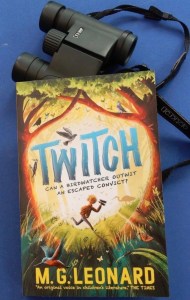
Twitch

Twitch
M.G.Leonard
Walker Books

Oh my goodness this is a totally immersive, brilliantly written, unputdownable story with a fascinating main character, Twitch.

Twelve year old Twitch is a passionate bird watcher, keeper of pigeons and pet chickens, and at certain times of the year, has swallows nesting in his bedroom. He’s kind-hearted but happy in his own company and bullied at school.

As the story starts, the summer holidays are about to begin and Twitch anticipates spending lots of time in Aves Wood where he’s constructed a hide.

Things don’t quite go as planned though for when he arrives at his hide he finds police everywhere. A potentially dangerous robber is on the run with the possibility that the missing millions from the bank haul are buried in the locality.

Can Twitch put his bird watching skills to use in tracking down the convict and even find the money?

Perhaps, with the help of some of the unexpected friends he makes, not least of whom is Jack, one of those who has bullied Twitch but actually has a kinder side that he sometimes keeps hidden. The way their friendship develops is superbly done but there are a host of other interesting characters too, several of whom aren’t what they appear.

Indeed, the entire story is full of surprises; and what a wealth of ornithological information is embedded in the plot, thanks largely to Twitch’s knowledge and passion.There’s plenty of suspense too: as the tale twists and turns; it’s hard to tell who is to be trusted and there’s a terrific finale, which one hopes indicates that we’re going to be hearing more of the newly formed club, The Twitchers.

Move, Mr Mountain!

Move, Mr Mountain!
Francesca Sanna
Templar Publishing

Mr Mountain has seen and heard much in his long lifetime and now feels that nothing can disturb him. But he’s reckoned without one very determined, angry-looking little girl Lily who stands before him shouting “Can you move, please?” at the top of her voice. She goes on to explain the reason for her rudely delivered request but the somewhat confused Mr Mountain responds by losing his long-held patience and causing a huge thundery rainstorm. This does little if nothing to dampen Lily’s determination to get the massive obstacle to shift its ground and she reissues her order albeit rather more politely.
With mounting temper, Mr Mountain sends forth an icy wind that serves only to add to the girl’s enjoyment of the changing elements, as does the ensuing snow storm.

Seeing that this young miss means business, the exhausted Mr Mountain decides that a different approach is needed. Scooping Lily up in his huge rocky hand, he places her atop his head. Suddenly she finds herself gazing at the most incredible view that’s beyond even her imagination.

Now instead of enmity, girl and mountain share many peaceful hours contemplating the distant sights and dreaming of visiting far away places.

The following day, aided by Mr Mountain, Lily starts learning how to climb, returning day after day to improve her skill until finally she no longer visits her friend.

Missing the girl, Mr Mountain becomes more and more sad, which is reflected in the weather, until many months later he hears a familiar voice calling to him one morning. Joy of joys, Lily has returned

and what wonderful stories and photos of her travels she has to share. Something she continues to do each time she returns from another journey, thus enabling Mr Mountain to see the rest of the world and what it has to offer.

Hugely uplifting (pardon the pun), this story of an unlikely friendship demonstrates the importance of showing consideration for others. Dramatically illustrated by the author, with every spread superbly composed (I absolutely love her gorgeous colour palette), this is another winning book from Francesca Sanna.

Do Animals Fall in Love?

Do Animals Fall in Love?
Katharina von der Gathen and Anke Kuhl
Gecko Press

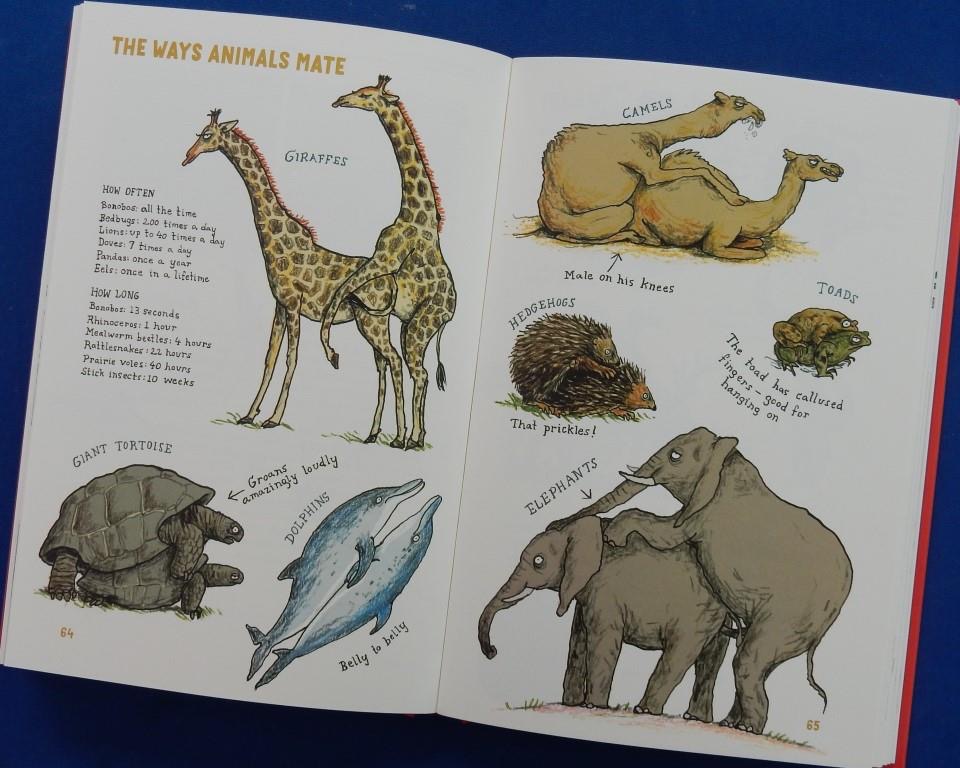
Katharina von der Gathen is a German sex-educator; her writing style is direct, packed with intriguing detail and infused with humour. This humour is reflected throughout in Anke Kuhl’s amusing cartoonish illustrations.
The author divides this book on animal reproduction into three main parts – courting (The Art of Seduction), Mating

and The Babies Arrive; but within each are lots of sub-divisions. For instance within seduction we find flashy appearance, dances, smells to attract, songs and physical fighting (sometimes head to head).

Choosing examples from a wide variety of creatures – vertebrate and invertebrate – Katharina von der Gathen uses biological terminology throughout her descriptions (normally one or two paragraphs) of the various activities while also maintaining a chatty tone.

For example, a male cabbage white butterfly ‘seems intent on being, and remaining, the only partner for his mate. The others can push off! So during mating, he sprays the female with a very special perfume. From then on, she is no longer attractive to other males. To them, for some reason, she stinks!’

At one time or many, children will ask ‘how do animals do it?’ questions. This book provides fascinating answers while taking readers on a journey through the incredible animal kingdom in so doing. It’s definitely one to add to book collections be that at home, public library or school. (Children at the younger end of the intended readership may need some further explanations)

Aunt Amelia’s House / We Want Our Books

Aunt Amelia’s House
Rebecca Cobb
Macmillan Children’s Books

When it comes to aunts, Aunt Amelia, is surely unique. Now the children are mega-excited as they’re off to stay at her house for the very first time.

Arriving with high expectations of lots of fun, they certainly aren’t expecting her to present them with a long list of jobs that need to be done.

However, whether it’s watering the plants, picking fruit and sharing it with the neighbours, feeding her pets, hanging out the washing, cleaning the windows,

or entertaining visitors, Aunt Amelia has her own highly unusual way of doing it. And the children need not have feared about chores being enjoyable: done Aunt Amelia style they are enormous fun, albeit pretty exhausting.

As always, Rebecca’s illustrations are full of fun, fascinating details making each spread one to linger over, while both words and pictures exude warmth and a gentle humour that celebrates the special relationship young children have with aunts (or other family members).

With its unexpected ending, this is a super story, to share at home or in the classroom, that will likely spark discussion of what is special about listeners’ own aunts or other relations.

We Want Our Books
Jake Alexander
Two Hoots

When Rosa visits her local library she discovers that it’s been closed. Horrified, she seeks advice from her elder sister who says that a protest is what’s needed. However their ‘SAVE OUR LIBRARY’ poster fails to impress and so the girls try to enlist help from other people in the town but they’re all too busy even to see them, or to hear their voices.

The girls aren’t giving up that easily though, so they up their game much to the disapproval of the developer.

Determined to thwart the planned closure, the family stands outside the library where they soon discover that they’re not the only ones who feel strongly about saving what is very much a vital part of their community.

Finally it’s a case of mission accomplished and rather than losing interest in using the facility, the community members make the library a thriving establishment; and it was all thanks to one little girl who reignited their enthusiasm.

Powerfully illustrated and simply told using Rosa as narrator, this story of determination and community beats the drum for local libraries, too many of which have already had their hours drastically cut or been forced to close altogether, and demonstrates the importance of protesting peacefully for what we believe in.

Sorry, Mrs Cake!

Sorry, Mrs Cake!
Kate Milner
Tiny Owl

It’s the day of the fair and Mrs Cake, a kindly woman, has assembled a delicious spread for all her friends. One little boy is hugely appreciative of what she’s done but everyone else is far too preoccupied to pay any attention to her efforts.

The boy and his cat accompany Mrs Cake around the venue site attempting to generate some interest in the yummy offerings laid out in the tent. They try in turn the dads, the mums, ‘the big kids’

and the grandparents, all to no avail: nobody has paid them any attention. The feast remains untouched.

As the little lad expresses disappointment in the fact that not a single person has listened, the cat has a brilliant idea and … Hurrah!

Finally with apologies proffered and thanks given to Mrs Cake, everybody partakes of the goodies she’s so painstakingly prepared.

With an unconventional witty style that mixes comic strip and full spread, highly detailed single illustrations, award-winning Kate Milner needs just a few words to convey her story showing how we need to listen to everyone, rather than only those who speak the loudest. (Apparently the stimulus for the book was the rowdy behaviour of politicians in the European parliament.)

Best shared one to one or in smallish groups to allow listeners to pore over the wealth of quirky, sometimes surreal, detail at almost every page turn.

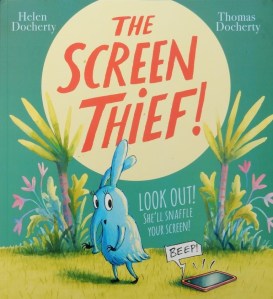
The Screen Thief!

The Screen Thief!
Helen Docherty and Thomas Docherty
Alison Green Books

Watch out, watch out, a Snaffle’s about. Newly arrived in a city near you and on the lookout for some playmates, the creature is puzzled to see that everyone she sees is too busy staring at their screens. But what exactly is so special about these things, that nobody has time to notice a newcomer?

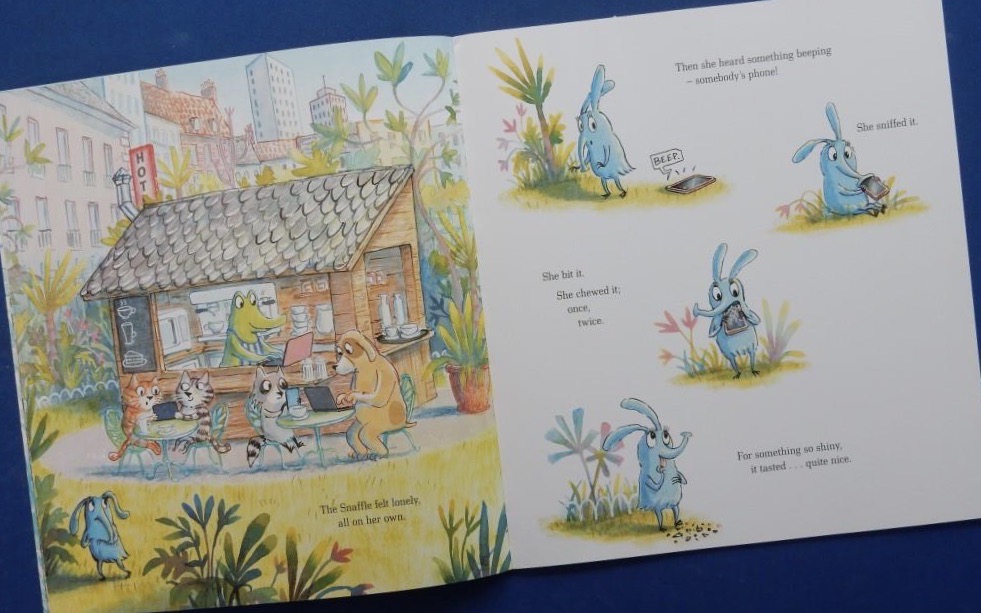
Puzzled, the Snaffle feels lonely but then she hears a beep! beep! coming from a phone on the ground so she does what all inquisitive creatures do, sniffs it and chews it and then gobbles the lot. Hmmm! Pretty tasty.

Off she goes in search of further screens to sink her teeth into, but the more she consumes, the hungrier she becomes. Before long the library has lost twenty computers and the TV shop almost sixty of its largest sets. But there’s worse to come as the hungry-for-more Snaffle makes her way through the city towards the park.
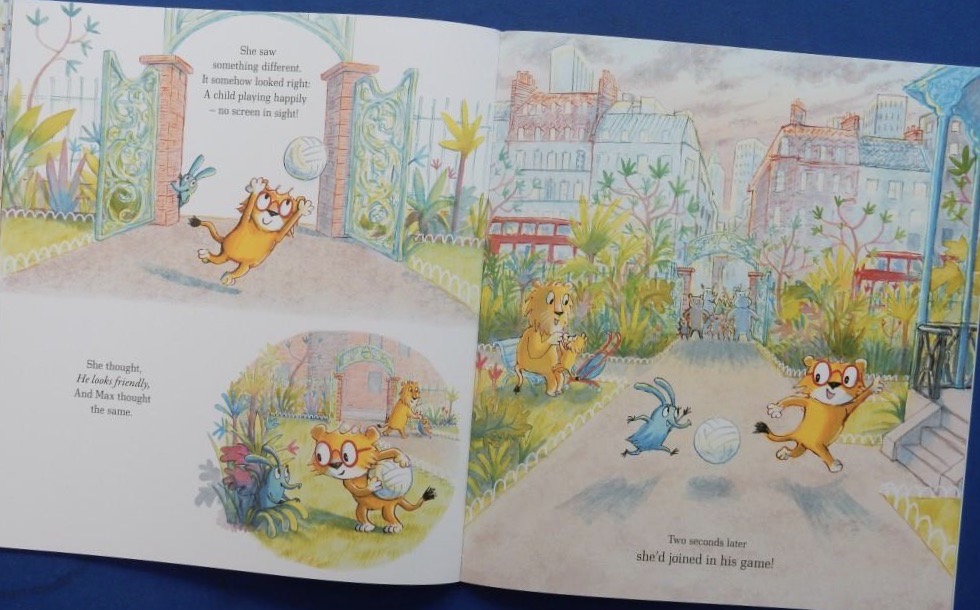
Therein are lots of very sad children eager to find the culprit and one child called Max: Max is forgiving and happy to contemplate life sans screens. Meanwhile the Snaffle is now suffering from an attack of ‘scrindigestion’ and a kind of empty inside feeling. But then she looks up and sees a happy-looking screenless child playing just inside the park and in a flash …

Suddenly the two become aware of the large angry crowd that has gathered ready to give chase. Will they listen to what Max has to say? And if so, might his words precipitate a degree of change …

Assuredly, it’s a case of put your screens away, take a rest from your play; come sit and listen to this fun, timely treat of a tale told in Helen’s faultless rhyme and Thomas’ wonderfully detailed scenes of screen obsessives who learn a very important lesson, thanks to a visit from the friend-seeking Snaffle..

Colours, Pretend Play, Nursery Fun and an Angry Bear

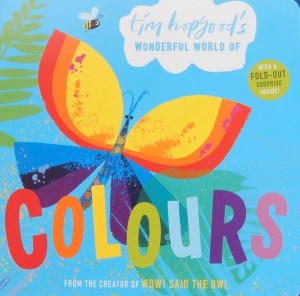
Colours
Tim Hopgood
Oxford Children’s Books

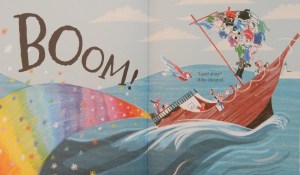
Here’s a lovely introduction to the wonderful world of colour for the very young. After presenting the primary colours with gorgeous images of the natural world, Tim Hopgood next shows the result of mixing first red and yellow, then yellow and blue, folllowed by blue and red. He then goes on to say that some things change colour during the year: a rose that’s pink in spring might fade to white in the summer, while summer’s green leaves often turn brown when autumn comes. Whereas ripening tomatoes change from green to red as the sun helps them ripen and yellow bananas, if left eventually blacken.
Best of all however is the final gatefold, opening to reveal a glorious … rainbow.

Let’s Pretend: Animal Hospital
Nicola Edwards and Thomas Elliott
Little Tiger

An animal hospital is the backdrop for young children’s role-play in this new title in the My World series. Thomas Elliott’s illustrations are a fusion of photograph and digital imagery showing the children giving a check-up to a dog, sharing the contents of a vet’s medical kit, showing the range of animals they treat and the variety of tasks they perform on pets large and small. Nicola’s narrative gives voice to the young children imagining what it might be like to be part of the team whose job is to care for the animals that visit their hospital.
This shaped-book would make a lovely addition to a role-play area in a nursery or other early years setting.

Bear & Mouse Go to Nursery
Nicola Edwards and Maria Neradova
Little Tiger

Best friends Mouse and Bear return and now they’ve started going to nursery. It’s there little humans can enjoy spending the day with them as they experiment with paint, have fun outside in the playground, share their snacks, take a nap and participate in a noisy music making session. With flaps to lift and sliders to move, this is another book of interactive fun delightfully illustrated by Maria Neradova who includes just the right amount of detail in each of her colourful spreads.

Angry Bear
Dr Naira Wilson and David Creighton-Pester
Little Tiger

Very young children, babies even, enjoy tactile books such as this one from the publisher’s Touch & Feelings series. Herein we’re introduced to Bear who on this particular morning is feeling grouchy, particularly round his middle.
perhaps keeping to his normal routine that includes some sweet tasting honey might help improve his mood unless … oops, you drop it. GRRRRR – that’s the best way to vent your anger; after which hopefully, you’ll be back to your normal calm, contented self: breathing deeply helps.
As though speaking directly to her protagonist, clinical psychologist specialising in childhood mental health, Dr Naira Wilson writes in a chatty style and the book is illustrated by David Creighton-Pester, whose pictures of the bear show the character’s range of feelings with gentle humour.

The Corinthian Girl

The Corinthian Girl
Christina Balit
Otter-Barry Books

To the ancient Greeks, female babies were dispensable: it was up to the father to decide whether or not to participate in a special naming ceremony giving the child the right to be a citizen. Sometimes it was a difficult decision for girls were expensive and one day would need a dowry, and so it was for the father of the Corinthian Girl in this story.

He wraps the child in swaddling rags, ties a Doric coin around her neck and leaves her on a stone bench, hoping somebody – perhaps a childless couple, or a merchant wanting a slave – might take her away.

Eventually an elderly slave from Athens takes her home to his master’s house where he raises her with the other slaves. Now the Master of the house, Milos, happened to be an ace javelin thrower and Olympic hero, with just one of his sons, Dion, still at home.
Sometimes Dion would invite the Corinthian girl to play with him and one morning his father stops to watch them. Wondering who this athletic girl is, he calls his son to bring her to see him right away.

Next day sees the start of a year’s training for the Corinthian girl in preparation for the Heraean Games (women only version of the Olympics), during which time she becomes super tough, lithe, fast and courageous.

When spring comes Milos, Dion and the girl go to the stadium of Olympia for the games. There, not only does she prove unbeatable in every event she enters, but she is given the name Chloris by Milos who also announces to the crowds that she is his adopted daughter.

As Chloris carves her name on the column of Hera’s temple somebody in the watching crowd sees the coin around her neck and remembers …

Christina Balit’s painterly illustrations have a power of their own, capturing superbly the slave girl’s spirit, determination and athleticism. Although the characters in her exciting, inspiring story are inventions, the details of place and time are accurate. Further details of the Heraean Games are given in a final factual spread.
Fabulous Frankie

Fabulous Frankie
Simon James Green and Garry Parsons
Scholastic

What does it take to be deemed fabulous? That issue lies at the heart of this tale of flamingo Frankie who more than anything else longs to stand out from his equally fabulous, fellow flamingos. A plan is what’s needed so Frankie gets creative fashioning a new super sparkly, shimmery designer stole. But when he gets to the lagoon what does he see but …

However, a magazine ad. beside the water gives him another idea, but it seems he’s not alone in fashionista fan waving or indeed glitter cannoning.
In the throes of a massive tantrum Frankie finds himself at the feet of his friend Pinkie to whom he cannot help but pay a compliment before flouncing off.

Frankie trudges on his way but having stopped to offer help to Flo (inadvertently upsetting a mule with his comment in so doing)

he hears his friends whispering about him. Has he finally found the key to being fabulous? And if so, what is it?

This ultimately uplifting tale of the importance of being yourself demonstrates how each and every one of us is unique: self-esteem is not reliant on appearances alone – there’s SO much more to being fabulous than that.
Garry Parsons’ fantastically funky illustrations are full of fun and feeling be that upbeat or down.

Gloria’s Porridge

Gloria’s Porridge
Elizabeth Laird and Toby Newsome
Tiny Owl

Elizabeth Laird’s story is a reimagining of an Ethiopian folk tale that begins with the making of some porridge. Gloria tells her cat she’s so hungry that rather than sharing with him as requested, she intends gobbling the whole lot herself. First though she needs to fetch some water to make it less gloopy so off she goes bucket in hand to the stream.

As you might expect the cat can’t resist sampling what appears to be delicious porridge – just a lick from the spoon, he thinks. But in no time the pot is empty. Back comes Gloria with the water and rather than listen to the cat’s explanation,

she grabs the spoon and shakes it at the creature scaring it, whiskers awry out of the house. 

This action sets in motion a chaotic concatenation of events comprising shaking trees, angry bees, a frightened hen, scattered corn and a shouting, meowing, braying, buzzing, clucking, ear-splitting din.

A passing fox pauses to ask what on earth is happening and a protracted explanation ensues to which all involved add their bit. Having listened, the fox then asks a further question. 

The end result is peace and harmony are restored, and apologies are offered and accepted; after which comes the sharing of a new pot of porridge …

Accompanying Elizabeth’s spirited telling, Toby Newsome’s illustrations, inspired by his South African home environment are full of fun and animation. Together, the result is a highly entertaining and enjoyable read aloud story.

Noah’s Seal / Captain Toby

Noah’s Seal
Layn Marlow
Oxford Children’s Books

In one way or another, the natural world offers inspiration to so many of us, and so it is with Noah, the young child protagonist in this book. As the story opens he sits on the shore looking out to sea in the hope of seeing a seal, as he has done for several days already, while his Nana talks of still needing to make the boat seaworthy before they can set sail.

Taking up her suggestion to play while he waits, Noah starts digging and soon realises that the mound he’s made is shaped very like a seal. To the boy it seems it’s ‘Just waiting to be my friend.’ He continues sculpting the creature adding natural features and then lies down beside it to dream of the ‘wild wide sea’.

Suddenly Nana’s shout, warning of an approaching storm rouses the dreamer and Noah makes a dash for cover to wait for the storm to abate.

Once it has though, the boy’s seal is no longer there.

Nana promises a sea trip the following day and starts heading home leaving Noah standing looking at the water. All of a sudden he spots something that makes his heart leap

and Nana decides that perhaps with something apparently waiting for them, the promised trip could be brought forward …
Perfectly paced, this sweet story of how a less than promising day at the beach turns into something extraordinary, thanks in part, to the power of the imagination is a delight through and through. Layn Marlow’s textured art and colour palette are wonderful.

Captain Toby
Satoshi Kitamura
Scallywag Press

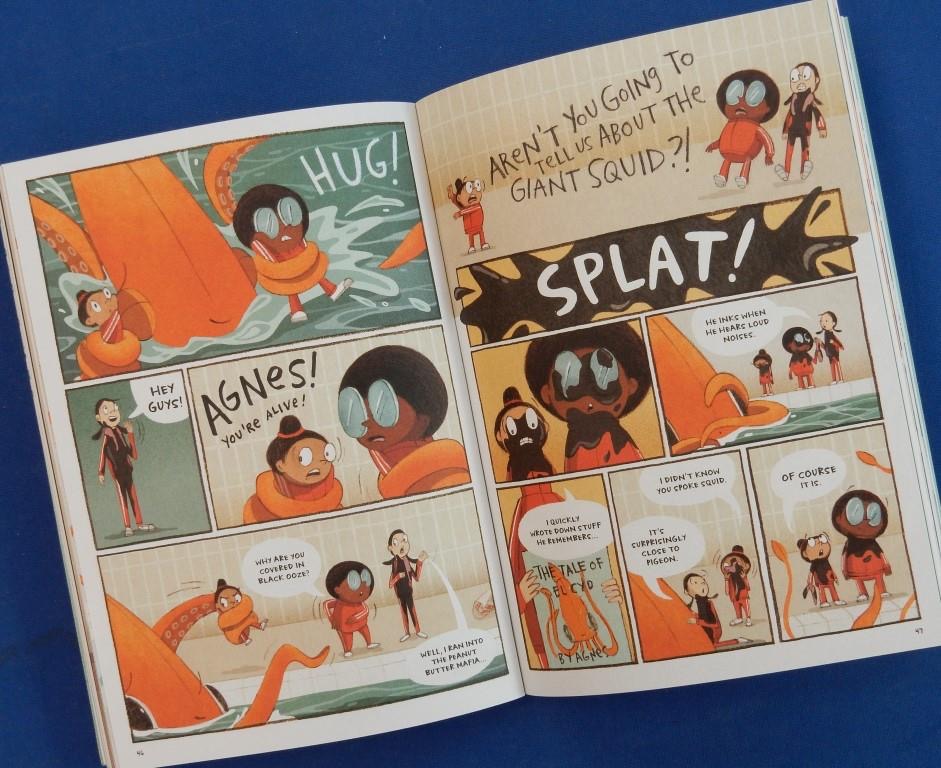
One stormy night Toby lies in bed with the wind roaring outside, the noise so loud he cannot get to sleep. Thunder crashes and suddenly he feels his house start to rise and fall, and before he knows what’s happening it’s rolling on the ocean waves. Bravely, with the aid of his cat, Captain Toby charts his course as lightning flashes in the sky above, till there comes an enormous crash. Grabbing his binoculars he sees it’s not a rock, nor a massive wave but an enormous octopus tentacles spread menacingly and it’s heading scarily close.

Then CRASH! One if its writhing tentacles smashes the window and reaches out towards him. Yikes!

Fortunately however, help is close at hand in the form of a house-submarine carrying Captain Grandpa and Chief Gunner Grandma, the latter being a brilliant shot with balls of yarn.

Eventually the seas calm, the sun rises and the captains head for the harbour leaving a now peacefully engaged octopus. And that’s where we’ll leave them all, with a wonderful finale awaiting readers.

With a mix of surreal humour and high adventure, Kitamura’s illustrations provide a visual treat. I particularly love the richly hued seascape with the two sailing houses heading landwards.

It’s good to see Scallywag Press has reissued this 1980’s charmer.

Interview with a Shark

Interview with a Shark
Andy Seed and Nick East
Welbeck Publishing

For those who like their information delivered with a degree of quirkiness then the results of Andy Seed’s latest expedition with his ‘tranimalator’ machine will definitely appeal.

In this book he dons his wet suit and dives into the ocean where, feeling more than a tiny bit nervous he faces his first interviewee, a massive bull shark. Like the author, this subject (and the others) seem to have a great sense of humour as they respond to his questions (just the sort of things a child might ask), with more than the occasional leg pull. The answers though are informative too, revealing such things as what they eat, what might eat them, where they live, (I wasn’t aware that bull sharks sometimes live in rivers as well as salty sea water.)

Andy has close encounters with nine marine giants – an awesome blue whale (the kind of whale with no teeth and the world’s biggest poos); a very toothy orca – actually a type of dolphin, 

a giant squid, a narwhal (of the stamp collecting, yoga practising variety – told you they have a sense of humour); 

a manta ray – most unhappy about the rubbish we humans dump in the oceans, as are several of the other creatures; an ocean sunfish; an octopus, a conger eel (bites like a bulldog) and finally a creepy anglerfish. 

One of this creature’s claims to fame is its soft bendy bones and stretchy belly that enable it to gobble up BIG things. 

Along with the moans about plastic pollution, we also hear grumbles reminding us of the effects of global warming and fishing (nets and noise). Andy provides a “How you can help’ spread suggesting ways readers can help take better care of our planet and its wildlife; and, there’s a final fun quiz (no cheating).

Nick East provides the visuals – they’re hugely appealing and some almost leap off the page. Young readers (and some adults) can assuredly learn a considerable amount if they dive in with Andy and Nick.

When a Dragon Meets a Baby

When a Dragon Meets a Baby
Caryl Hart and Rosalind Beardshaw
Nosy Crow

In the third story of this series, the lovable little dragon protagonist has a new baby sibling. But what will her reactions be? She might act all huffily and puffily resorting to a lot of slumping and grumping to gain the attention of Mummy and Daddy dragon. On the other hand she might just share her snuggliest toy, fetch the changing mat and nappies when baby has a leaky bottom and help find clean clothes.

Then when others pay a visit will big sis. be a pest or will she show baby’s things to the guests? Poor exhausted Mummy dragon will sometimes be in need of a quick nap but what will happen then? Noisy stomping and a romping or quiet house-tidying and story-sharing with Dad?

Behaving like the perfect older sibling is going to be a challenge and nobody – not even little dragons, can keep their fire inside all the time, surely.

Told in Caryl’s read-aloud-able rhyme, this is a fun, reassuring book that presents the conflicting emotions arising when a new baby arrives in the family and is pitch perfect for little humans who have recently or are about to become big brothers or sisters. Never mentioning a right way but merely offering a little dragon’s way, really works again here and Rosalind Beardshaw’s captivating illustrations showing what happens in this particular family are an absolute delight.

Hike

Hike
Pete Oswald
Walker Books

Wordless save for some environmental sounds and labels, this is a truly beautiful book. 

It begins one evening as a man bids goodnight to his child in a room littered with outdoor gear.

Next morning the father wakes the child who packs the gear into a rucksack, the two get into a jeep and head off from their city home into the countryside for the day.

We follow the two as they walk into the forest where they see wildlife aplenty, 

sharing in occasional small dramatic moments as the child copes with some scary challenges. 

The two stop to share snacks, take photos, enjoy the view and finally carry out the task they’ve come to perform – the planting of a sapling they’ve brought with them and the taking of a selfie beside it.

As dusk descends, they leave the woods and drive home. Once there, they don pyjamas, share some cookies and look through a photo album.
Totally immersive, this wonderfully heartwarming book, open to more than one interpretation, is one that needs slow and careful reading of every page: I love the variety of perspectives and the wealth of visual clues we’re given. I love too, how Oswald shows us the natural world through the lens of the close child/parent relationship. A special day and a special relationship. 

To sum it up, I’ll borrow the title of a very old song ‘Memories are made of this’.

The Tossy-Turny Princess and the Pesky Pea

The Tossy-Turny Princess and the Pesky Pea
Susan Verde and Jay Fleck
Abrams Books for Young Readers

Rather than being a playful fractured fairytale version of the Hans Christian Andersen classic The Princess and the Pea, this is a deliberate reworking of the story using a hippo as the princess, by yoga and mindfulness teacher and writer of I am Yoga, to help young insomniacs get a good night’s sleep.

Usually good at falling asleep, said young royal – a busy creature by day – finds that one night after her usual daytime schedule, she just cannot fall asleep. What she doesn’t know is that earlier in the day a pea from her brother’s lunch accidentally ended up in-between the mattresses on his sibling’s bed and he’d been unable to retrieve it.

After two sleepless nights the princess is by day cranky, completely lacking in energy and generally out of sorts.

Fortunately however her friends – the royal gardener, the royal chef, the royal librarian and the royal astronomer in turn, are ready and willing to give her some good advice.
The gardener teaches her the lizard pose; the cook demonstrates a calming breathing technique; the librarian shows her a ‘feet and legs up the wall’ means of relaxing, and the astronomer shares his lie down, let the whole body relax … look at the sky … and place each … worry on a star “until with every sparkle, they disappear.”

That night, the princess, once again wide awake, but somewhat relieved to know that others too have trouble sleeping from time to time, brings to mind the sage advice of her friends and tries their yoga and meditation techniques … until at last, she falls fast asleep. The following morning she’s bursting with energy once again and willing to overlook her brother’s pea accident, sure in the knowledge that it had resulted in some valuable learning experiences on her part.
Jay Fleck’s droll scenes featuring the princess and the royal entourage are engaging (little humans will be amused at their attire) and a final author’s note explains each of the techniques mentioned in the story.

Intended primarily as a pre-bedtime book, this is a gentle, soothing tale about learning to let go of your worries and the importance of friendship.

Race Cars

Race Cars
Jenny Devenny ed. Charnaie Gordan
Frances Lincoln Children’s Books

This book, is the result of a collaboration between author/illustrator Jenny Devenny who uses the metaphor of a car race to introduce institutional and systemic racism to children, and diversity and inclusion expert, Charnaie Gordon who edited the story. (Both have written an introductory note).

Meet best friends Chase and Ace. Chase is a black race car; Ace a white race car and they both love racing. Chase is super speedy and in his first year of entering, becomes the very first black car ever to win the ‘world-famous, annual race-car race.’ To his Ace friend who finishes fourth , it matters not: place is unimportant. However the race committee (all except the youngest, pink-tyred Grace, being white male autos) are anything but happy and resolve to alter some of the rules in favour of the white cars, thus disadvantaging the other cars in future races.

The route change they introduce for non-white cars

enables Ace to win the next race the following year and in the subsequent one, an official stops Chase before he enters the magic forest, demanding to be shown his ID. These two demonstrations of blatant discrimination result in Chase failing to qualify for the next year’s race. Now Ace starts to think perhaps something isn’t right: but even worse, Chase now feels inferior.

At a further committee meeting, Grace quietly talks of making the race ‘fair and equal for all’, but only one or two others agree, while the rest, fearing change, keep quiet.

The following year Chase is there spectating and supporting his friend who starts off at super speed. But as Ace approaches the magic forest, he notices something he’d not previously been aware of

and decides to take the route intended for non-white cars. Consequently he gets lost.

Back at the track the committee are worried about their star race car Ace not having crossed the line. Now, Grace knows she must speak out and so she does, with the result that Chase agrees to search for his friend … and finally they finish the race together.

Designed to be accessible to a young audience, and intended as a starting point for opening up discussion, this book has been engineered to tackle a difficult and sensitive topic. To this end there are discussion notes after the story. Almost every time I turn on the news I hear something alarming and upsetting concerning the ill-treatment of a person or persons of colour, so it’s clear that opportunities such as this book offer to get children talking are much needed.

Dance With Oti: The Bird Jive

Dance With Oti: The Bird Jive
Oti Mabuse and Samara Hardy
Walker Books

This is the debut picture book of Strictly Come Dancing star, Oti Mabuse, and as the book opens, Mrs Oti is welcoming a host of would-be dancers into her studio for their very first lesson.

Warm ups and stretches completed, everyone is ready to start learning the jive. There are the inevitable thrills and spills but under their teacher’s enthusiastic, watchful, caring eye, the children are quick learners

and in no time the lesson is halfway through. Then suddenly, an unexpected winged visitor makes an appearance.

Mrs Oti deals with the disruption in her characteristic creative way and soon everyone is back on task

and the lesson proceeds towards the final steps and a wonderful controlled POSE! Just in time to give the waiting families a first performance of The Bird Jive. And humans aren’t the only ones that show their enthusiasm as the dance draws to a close.

With some delightful characters including Poppy, Gan and Olivia, all illustrated with panache by Samara Hardy, and a step-by-step demonstration of the Bird Jive routine by Oti, this is a thoroughly enjoyable celebration of movement, dance and giving it your all. Share the book then, get on your feet and JIVE!

Mammoth

Mammoth
Anna Kemp and Adam Beer
Simon & Schuster Children’s Books

Waking from a sleep of indeterminate length an Ice Age mammoth is totally bothered, bewildered and bemused by the strange sights that meet his eyes when he heads to the meadow to join his herd for breakfast.
Having climbed to the top of a hill he sees an enormous ‘gleaming forest’ and makes his way towards it. Instead of his relations, said forest is full of weird smells and alarming sounds.

Nonetheless stuck in the big city, the visitor starts going about his daily business, despite being on the receiving end of some strange looks from those he encounters, not to mention a fair bit of shouty behaviour from the ‘cavemen’.

Deciding to make himself useful the mammoth does a spot of topiary but again his efforts are far from appreciated.

Then his hopes are raised when he finally enters the Ice Age exhibition and trumpets loudly at the mammoths before him. But these creatures he’d thought were from his herd prove not to be so and this disappointment triggers a rampage. Is he really now the only mammoth in the entire world.

In the distance he hears a faint trumpeting sound – strange and beautiful although not a mammoth sound – and it’s calling to him.

Perhaps at last he’s found his herd …

Anna Kemp tells a fun story about finding somewhere to be yourself with people who will accept you no matter what. Debut picture book illustrator, Adam Beer, brings out the humour of the mammoth’s situation, his interpretations of what he sees and some of the daft things he does (sporting a bow tie to visit the museum, for instance) while making readers feel sympathy at his plight.

The Pet

The Pet
Catherine Emmett and David Tazzyman
Macmillan Children’s Books

Young Digby David is a demanding sort of a boy, especially when it comes to wanting a pet, and happily for him, his dad is an obliging sort of guy, maybe somewhat over indulgent. So when the lad issues one of his urgent stipulations, what does Daddy do (after his hair has turned slightly grey that is) but pick up the phone to the pet shop. Before long there they stand in the shop with Digby insisting on having, contrary to the owner’s advice, the hairiest rodent there. Dad offers double the price and off they go. Digby is a loving guinea pig owner – but for a mere half day, after which the poor creature is left untended in her hutch.
Things continue in similar fashion. Digby wants to better Lily Jean’s cat,

Lola’s frog, and Dipak’s froggy threesome and each time it’s a case of Dad gaining a few more grey hairs, calling the pet shop and making an extravagant purchase.

But then what should catch young mister ‘I WANT’s eye but Gus the gorilla.
Mr David parts with all his cash (is he crazy?) and finally Digby is happy. For a while at least, but then as the novelty wears off, so does the attention Gus is paid.

What does a bored gorilla do? This one decides to make a break for it. And we’ll leave the large hairy creature there …

But what of Digby, you might be wondering. Sorry but I’m going to leave that matter hanging too …

Delivered in jaunty rhyme that reads aloud brilliantly (so long as you can resist the urge to dissolve into giggles), and David Tazzyman’s wonderfully droll, scribblesome illustrations, this is a corker of a cautionary tale showing how crucial it is to take proper care of your pets – whatever they are. Oh! and stop and think before you wish …

Destined to become a firm favourite with both adult sharers and their young audiences.

Be A Tree!

Be A Tree!
Maria Gianferrari and Felicita Sala
Abrams Books for Young Readers

‘Be a tree! // Stand tall. / Stretch your branches to the sun.’

So begins this gorgeous book. With its lyrical text and beautiful, vibrant watercolour, gouache and coloured pencil illustrations author and illustrator invite readers to look anew at ourselves and at trees, one of nature’s true treasures. By so doing we come to realise that humans and trees share similar physical characteristics: trunks and spines, branches and arms, a protective outer layer – bark and skin, a topmost crown and more.

Throughout, the trees – no matter their particular species, of which many are shown – take centre stage, standing tall and majestic, and viewed from a variety of perspectives, frequently dwarfing the humans who play, sit, walk beneath, or climb upon them.

In addition to basic anatomy, we’re asked to consider similarities such as the importance of sharing resources, alerting one another to danger, (by means of ‘a wood wide web of information’), to see the strength in diversity, while gently urging each and every one of us towards- a ‘family, a community, a country, a cosmos’ where ‘There is enough for all.’

What a wealth of wonder and learning potential is packed between the covers of this book,. It’s one to return to over and over, perhaps first being encouraged be we child or adult, to stretch and uncurl like the tree’s overground parts, then curl, coil and become rooted, as a prelude to considering the ways in which we can take our cue from the trees in how we live our lives. (The final pages suggest ways to help save trees, how to build community, there’s a spread on a tree’s anatomy and some suggested further reading and websites to visit.)

Grandpa’s Gift

Grandpa’s Gift
Fiona Lumbers
Simon & Schuster Children’s Books

The little boy narrator of this story is finding his new life in the city a dull contrast to the open spaces he’d so enjoyed till he moved just over three weeks ago.

Feeling downcast he walks in the rain through the grey dreary streets with his grandpa who has a surprise in store. When they reach a dowdy-looking shop full of what looks like a lot of junk, Grandpa stops and in they go. The lad is totally disenchanted by what he finds inside, but why is Grandpa looking so excited?

Then he opens his hand to reveal …

A geode stone. Underwhelmed, the boy just stares. Then Grandpa tells him something his own grandmother had said to him many years ago: “ … beauty and magic can be found in the most unexpected of places. You just need to look for it.” He then proceeds to prise open the stone. Amazingly a transformation occurs …

With the rain stopped, the two head outside and continue walking, the boy with the stone safe in his pocket. Now he begins to look at the world anew and before long discovers that indeed, there is beauty and magic all around.

With hope in his heart and a rainbow overhead, the narrator takes his Grandpa’s hand and together they start to walk home,

Hugely uplifting is this, the second of Fiona Lumbers’ author/illustrated picture books. Her predominantly watercolour illustrations are an absolute delight – full of interesting details and small jewels of colour. I love the way she uses the geode stone as a metaphor for the city, showing how beauty can be discovered in the most unexpected places.

A Song of Gladness

A Song of Gladness
Michael Morpurgo and Emily Gravett
Two Hoots

We’ve all in one way or another been affected by the lockdowns over the past year or so. This gorgeous timely book was inspired by a blackbird in Michael Morpurgo’s garden during the first lockdown and truly it is as the front cover says, ‘a story of hope for us and our planet’.

It begins with the author standing having a ‘conversation’ with said blackbird wherein he tells it of the sadness everyone is feeling. This precipitates an idea in the blackbird’s mind and he sings it out to the still sleepy fox near the shed. And so begins a chain reaction with the song passing from one to another with creatures all over the world, each in its own way joining in, 

until the entire animal world is singing a song of forgiveness. 

Not yet though the author who asks and receives permission from the blackbird to sing with them.

One can truly hope that humans the world over will during this last year or so, have rediscovered their connection with the natural world, and as Michael Morpurgo reminds us, will now take responsibility to care, not only for our fellow humans but for all living things on our precious planet.

Beautifully told with the author’s characteristic empathy and gentleness, this very personal, moving story speaks to us all, children and adults, capturing both our shared experience and our hearts. Emily Gravett’s illustrations brilliantly express the vital interconnectedness inherent in the text, as they carry us along from page to page swept up in the musicality both of Michael’s words, and the animals’ voices united in a final glorious harmony.

The Rock From the Sky

The Rock From the Sky
Jon Klassen
Walker Books

Quintessential quirky Klassen is this sequence of five connected short comic episodes delivered with the author’s dead pan humour, not to mention that its main characters – a tortoise, an armadillo sport Klassen’s signature style hats.

The entire thing is delivered through (colour-coded) dialogue between Tortoise and Armadillo (plus those characteristic Klassen eye-movements).

The topic under discussion in The Rock is the best place to stand/sit. Tortoise favours one particular spot, “I don’t ever want to stand anywhere else.” But Armadillo is unfavourably disposed towards it, “Actually I have a bad feeling about it.’ And rightly so; he instead goes off to try another spot. A to-ing and fro-ing ensues but it’s not until Snake rocks up to join Armadillo that Tortoise decides to join them too – and only just in time … for something huge and mightily heavy falls on his erstwhile spot. Of course, we readers in on the joke, have been anticipating same all the while as we enjoy the mounting tension.

In The Fall, Armadillo attempts to act helpfully while Tortoise tries to save face zzzz. Episode three sees the two, eyes closed, contemplating the future

watched by a futuristic creature, while The Sunset is a contemplation of same – kind of;

and finally, in No More Room Tortoise takes umbrage “Maybe I will never come back” and is once more under the watchful Eye now no longer in the future,

but perhaps soon to be in the past. Thank goodness for asteroids!

Another weird and wonderful Klassen gem, albeit somewhat longer (90 pages) than usual, set in a minimalist landscape that offers much to ponder upon in a Waiting For Godot for primary school readers.

Have You Ever Seen A Flower?

Have You Ever Seen A Flower?
Shawn Harris
Chronicle Books

This a visual feast if ever there was one. It begins in an intricately constructed city in which the only thing of colour is a small girl with rainbow tresses dashing out through a door where a car awaits within which is a terrier.

As the car moves out of the city, the dreary greyness turns first white and then explodes into a riot of colour, till the car stops.

We next see the child, her joy palpable, surrounded by fields alive with fluorescent flowers. She stops, stoops and, breathing deeply, imbibes the beauty of a single bloom and in so doing has an existential experience of complete connectedness: it’s as though she and the flower become a unified life force.

All the while, the text invites readers to ponder such questions as ‘Have you ever seen a flower using nothing but your nose? Breathe deep … what do you see?’ … “Have you ever seen a flower so deep you had to shout HELLO and listen for an echo just to know how deep it goes?’

We share the child’s exhilaration as she clutches a plucked wildflower, before herself becoming transformed into a flower.

There’s much to contemplate and reflect upon in what is, for both child and reader, a wonder-filled transformational journey into consciousness itself.

An exciting debut for Shawn Harris as author/illustrator. With their changing perspective and focus, his colour pencil illustrations are mesmerising, the playful narrative rich in metaphor with occasional alliteration and assonance. Who can resist its urgent intensity?

My Big Book of Outdoors

My Big Book of Outdoors
Tim Hopgood
Walker Books

When it comes to nature, ’The more you look, the more you see’. So says Tim Hopgood in the blurb to this stunningly beautiful bumper book.

To amplify this, starting with Spring, Tim takes us through the four seasons of the year celebrating the delights to be discovered in each one.

My favourite time, Spring, brings blossom, baby animals, bulbs busting into bloom, the birds greeting the day with their dawn chorus, nest building, egg laying and more.

There are close-ups of eggs, feathers, minibeasts, 

frogs, soil and a rain shower and more; as well as the occasional poem and activities for indoors and out.

With its longer, warmer days, Summer offers insects aplenty, baby birds taking flight, a richness of colour and scents from flowers and for some plants, it’s time for seeds to be dispersed. More colour comes from amazing skies, 

ripening fruits and vegetables and there’s the promise of a holiday, perhaps by the sea.

Misty mornings, leaves changing colour and falling in blustery winds herald Autumn as birds take flight to warmer climes, seeds are dispersed far and wide, and creatures forage for supplies in readiness for winter as do humans who harvest the spoils from trees and hedgerows.

Quiet seems to descend along with Winter’s arrival with its chilly, sometimes frosty days and cold snuggle up nights when some creatures hibernate to survive. It’s a season to remember the resident birds and perhaps using Tim’s instructions, make a feeder for the garden or balcony. Assuredly they’ll need it should snow fall.


With every page turn bringing more of nature’s delights, this is for sure, a veritable treasure trove: Tim has done nature proud.

100 Endangered Species

100 Endangered Species
Rachel Hudson
Button Books

It’s alarming to think that there are so many creatures on the endangered or threatened list; the author/illustrator of this chunky book teamed up with the People’s Trust of Endangered Species to illustrate one such animal every day for 100 days.

Those chosen come from all over the world and each has undergone evolutionary adaptations to suit its environment, be that the Red pandas found in China, Nepal and Bhutan; the Madagascan Aye-ayes, and the Indris that live in the northern and central rainforests of East Madagascar; the Sumatran tigers; the Little spotted kiwis of New Zealand; the Lulworth skipper butterfly first found in Dorset and now on the decline across Europe; 

or those magnificent polar bears whose Arctic Circle habitats are at risk both from destruction due to oil exploration work, and rising temperatures resulting from climate change.

Each of the animals depicted is on the International Union for the Conservation of Nature’s Red List (explained at the beginning of the book) and is thus a conservation priority. Opposite each gently amusing illustration is a descriptive paragraph (or two) giving interesting facts, as well as saying why the species is currently at risk and often, what is being done, or needs to be done, to protect it. There’s also a world map showing distribution, and listing habits, threats and population trend which is given, with very few exceptions, as ‘decreasing’. 

However, it’s heartening to see that numbers of the African elephant, the little spotted kiwi, the whooping crane, the greater one-horned rhino and the giant panda are on the increase as are those of the Eurasian beaver.

Readers who feel inspired to become involved in conservation issues/initiatives – hopefully that is all of them – can find a list of organisations and projects at the back of the book, as well as a glossary; and there’s a foreword by broadcaster and naturalist Brent Westwood. Give this book to a child and who knows, you might inspire a life-long passion for conservation.

Ernest the Elephant

Ernest the Elephant
Anthony Browne
Walker Books

From the much loved and highly praised Anthony Browne comes a stunningly beautiful modern day fable.
Having had thus far a safe happy life with his Mum and the rest of the herd, little elephant Ernest has become curious about what more life has to offer than mere walking, eating, drinking and sleeping.

One day Ernest and his mum are strolling happily along with the other elephants when something catches Ernest’s eye. To him it looks exciting but Mum tells him it’s not a place for baby elephants.
Somewhat put out at being called a ‘baby’ and eager to explore this alluring place, Ernest drops behind and into the jungle he goes. It’s a strange, colourful place and Ernest is fascinated by the dazzling light and dark, mysterious shadows.

Soon though, his excitement begins to wane and he contemplates rejoining the other elephants, but realises that he’s completely lost.
After some time he comes upon various other animals – a gorilla, a lion, a hippo, a gaping-mouthed crocodile –

but not a single one can be bothered to offer any assistance. Their apathy and condescension is evident in each of their faces, but then happily when Ernest is at the point of despair, one little creature stops and listens: it’s a tiny mouse.

Ernest explains his plight doubting that so small an animal could possibly help but so polite is Mouse that Ernest decides being lost with such a companion is preferable to being lost and alone.

Much to the little pachyderm’s surprise though, help is exactly what Mouse does and hurrah! Ernest and his Mum are eventually reunited and three happy animals are the outcome. After all, what better reward could there be for help so selflessly given?

While empathising with Ernest’s plight, children will love to lose themselves in Anthony Browne’s classic style surreal jungle, relishing the multitude of delicious cakes, lollipops, liquorice all sorts and other confectionary, as well as fruits, eggs both creme and fried, not forgetting the interesting variety of tree trunks one of which looks to me like a chocolate flake. There’s even a pair of socks and some underpants pegged out to dry. The illustrator clearly had huge fun with those scenes.

What a wealth of talking points this cracking book offers when adult and child(ren) share it, not to mention the visual literacy lessons aplenty.