Under the Sea 1,2,3 / Jelly-Boy

These are two picture books with an undersea setting: thanks to the publisher Walker Books for sending them for review

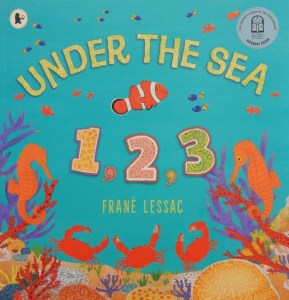
Under the Sea 1,2,3
Frané Lessac

Vibrant illustrations, a counting element, fun fascinating facts and an environmental message are combined in this picture book that takes readers beneath the ocean to meet some of the animal inhabitants living in and around the coral reef.

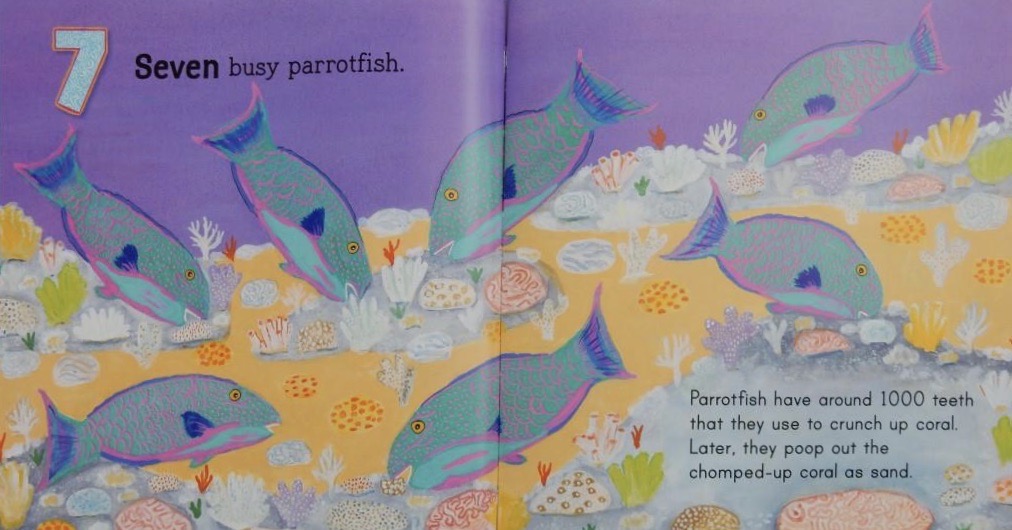
First we encounter one giant whale shark and discover that some of their kind can grow as long as a bus. Then, in a double spread each, come two dugongs, three playful clownfish … parrotfish (7) which young children will love to discover, use their sharp teeth to ‘crunch up coral’ and later ‘poop out the chomped-up coral as sand.’

After twelve tired seahorses, comes a final scene showing the reef along with a gentle message about their important role in keeping the sea and ultimately the planet, healthy. There’s also a visual summary of all the creatures we’ve met alongside the relevant numerals that may well send little ones back to the beginning to start over again.
A gentle way to learn some marine biology facts relating to habitat and habits of the creatures selected.

Jelly-Boy
Nicole Godwin and Christoper Nielsen

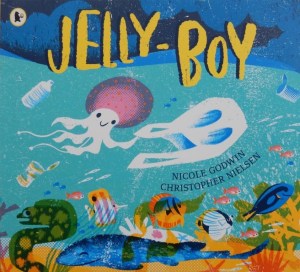
A highly important topical issue lies at the heart of this seemingly simple eco-themed love story.
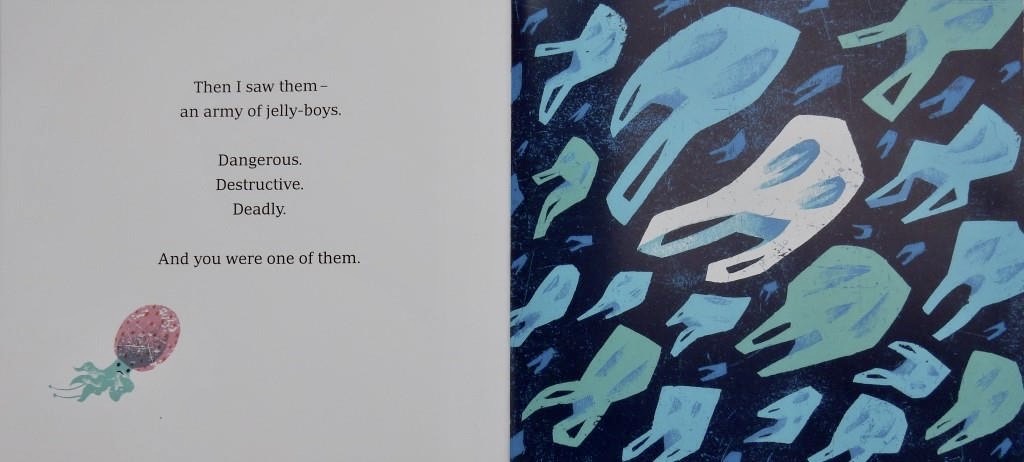
Assuming that the object of her affections is another jellyfish, Nicole Godwin’s jelly-girl narrator – against the advice of other family members – falls in love with a plastic bag. ‘ “We’ve seen his type before.” “He’s highly dangerous.” ‘ they warn. Nonetheless, the attraction is so strong that she follows the object of her affections into wild and dangerous waters as little by little the dreadful realisation dawns …

You can almost feel the pull both of the narrator’s love and the ocean waters as the narrative moves across the spreads taking readers to the final farewell.

Mixed media illustrations and an unusual telling combine to deliver the crucial message about the pollution of our oceans and its devastating effects in a picture book that will make a different starting point for primary classroom discussions about, and more important action concerning, single use plastics and caring for the environment in general.

Monster! Hungry! Phone!

Monster! Hungry! Phone!
Sean Taylor and Fred Benaglia
Bloomsbury Children’s Books

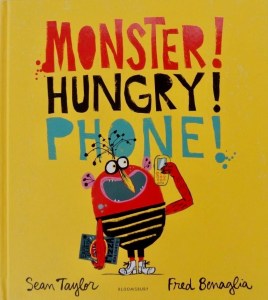
To say that Monster is hungry is something of an understatement, he’s starving. The fridge is empty. He reaches for his mobile – TAP TAP TIP TAP TAP … BLING-BRING BLING-BRING … It won’t be long before his hunger is sated – so he thinks.

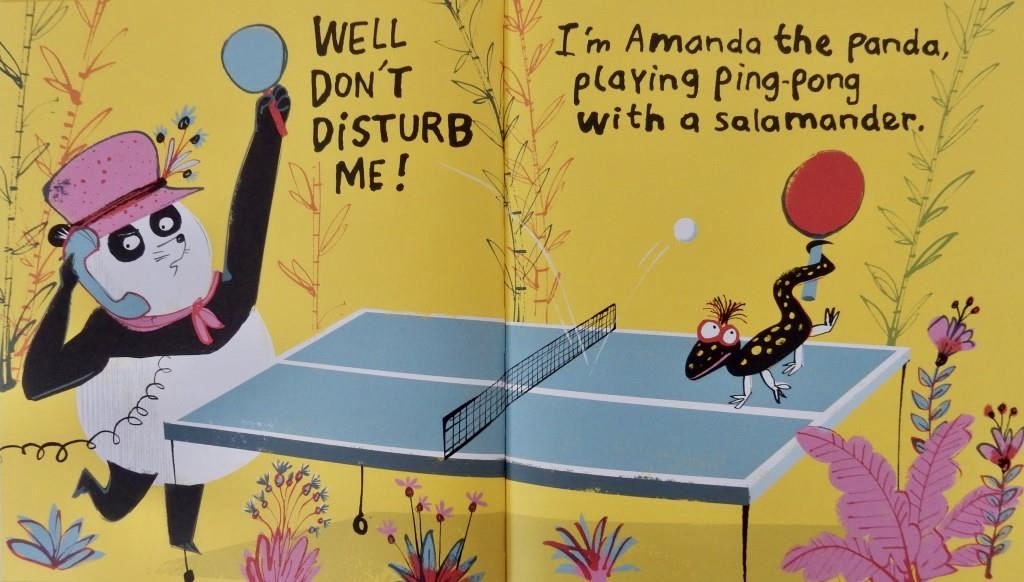
However things don’t quite go to plan. Thanks to a series of wrong numbers he calls up a jaguar, a panda,

a salamander, a sleepy sloth and an alien none of which are purveyors of pizza.

Finally – hurray! A delivery of mouth-watering cheesy pizza is on its way. Monster is drooling as he opens the front door. However even then, poor Monster is in for yet another surprise. Now what? He’s ravenous …

Stupendously silly and anarchically brilliant both verbally and visually this is a terrific treat for both listeners and readers aloud. The former will relish chiming in with the tapping and tipping, blinging and bringing, and yelling out MONSTER! HUNGRY! as the drama unfolds in Fred Benglia’s sequence of hilarious spreads and Sean’s relatively few words,carefully selected for maximum impact. Adults will appreciate the chance to deliver a monstrous performance.

A delicious offering through and through and one that’s likely to become a much requested favourite in classrooms.

When the War Came Home

When the War Came Home
Lesley Parr
Bloomsbury Children’s Books

Lesley Parr has written another wonderful story, again set in Wales. It’s an enthralling look at the impact of the first world war on a mother and her daughter, Natty who acts as narrator.

The girl is absolutely furious when her outspoken mother announces over supper that she’s lost her job and that the two of them will have to leave home to live with relations. Four days later, they’ve packed their bags and are moving in with her aunt, uncle and family on their smallholding in another Welsh valley.

Nothing is the same, school in particular, but Natty has to confront the terrible after effects of the war both on her cousin Huw (who faked his age in order to fight) and on Johnny who is at the local hospital for ex-soldiers. Huw suffers from terrors at the sound of loud bangs and grief at the loss of his best friend, while Johnny doesn’t even remember who he is.

Natty determines to help both these young men and there’s also a mystery for her (and readers) to unravel. Added to that she finds another cause to champion and decides that some causes are most definitely worth fighting for: perhaps she’s not quite so different from her mother after all.

This is a gripping tale for older readers, told with great sensitivity and superb characterisation that gives some insights into both the longer term impacts of war and of poverty, both of which are just as relevant today as they were back then.

Colour and Me!

Colour and Me!
Michaela Dias-Hayes
Owlet Press

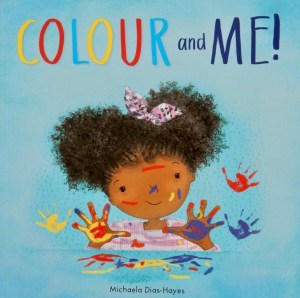
I’ll never forget, back in the day when I was doing my very first teaching practice in a primary school in south London coming upon a six year old West Indian boy, Errol, during an art session with white paint all over his hands – backs and fronts – trying to paint his face white too. ‘I hate by brown skin’ he said. That memory has stayed with me ever since and it saddens me that in the twenty first century, Michaela’s young son should have said something similar to her, prompting her to create this celebration of brown skin.

Michaela’s narrator is an adorable little girl who like many children of her age, loves finger painting. She shares with readers, her pet turtle Myrtle and her grandmother her experiments in colour mixing using the three primary colours.

First she makes orange by mixing red and yellow, then mixes yellow and blue, which results in

the same colour as her turtle and so on. Putting all three primary colours together gives her brown, which she recognises as her own colour. “This is ME. This colour suits me … PERFECTLY!” she announces and then goes on to create a glorious rainbow shaped design on the wall …

The positivity of both the rhyme and the glorious illustrations in this, the first of Michaela Dias-Hayes’ books as both author and illustrator, shine through on every spread of this, the first of a new series.

Dragon Storm Tomas and Ironskin / Dragon Storm Cara and Silverthief`

Dragon Storm Tomas and Ironskin
Dragon Storm Cara and Silverthief`

Alastair Chisholm, illustrated by Eric Deschamps
Nosy Crow

As the son of a blacksmith it seems as though eleven year old Tomas is destined to follow in his father’s footsteps. Then strange things start happening. First he sees a dragon face in the flames of the fire and then after watching Tomas wield a sword, a man returns offering the lad an apprenticeship. With his parents in financial difficulty, it’s an offer not to be refused.

Off he goes to the city leaving his parents far behind and it’s not long before he learns a secret. Despite what he’s been led to believe, the dragons are anything but extinct, at least not in the land of Draconis, and Tomas’s apprenticeship is with the secret Dragonseer’s guild. There’s a lot to learn as Tomas and his fellow apprentices discover during their training with their dragons.

Soon a problem rears its head for Tomas: Ironskin, his dragon reminds him of home and he misses his parents. This gets in the way of him forming a true bond with her, meaning he has to leave. Then a fire breaks out endangering his parents’ lives … Seemingly real trust between boy and dragon is the only thing that can save them and get everyone out of a desperate situation.

Fast moving and full of excitement, this is ideal for newly independent readers, and Eric Deschamps black and white illustrations make the book even more appealing.

The second magical adventure in the series focuses on Cara and Silverthief, her dragon. Cara, whom we met in the first book, has spent her earlier life on the streets and consequently is unused to having friends (other than the voice in her head,) nor trusting others.

What is it that they’re not being told? What lies on the other side of the stone door not to be entered?
Trust is again key in this gripping tale of derring do; so too is friendship; but then really the two are interconnected; so will rule-breaking Cara become part of the Dragonseer family or will she return from whence she came? The choice is hers …

It’s really good to see a series that both boys and girls will enjoy.

Isabelle and the Crooks

Isabelle and the Crooks
Michelle Robinson and Chris Mould
Walker Books

Young Isabelle Crook is something of a misfit in her family of ‘ordinary crooks’. Unlike her sneaky dad, stealthy mum, cunning grandparents or little brother, Isabelle is a law-abiding citizen. In one week she turns down opportunities to participate in a bank robbery, a toy shop burglary, a spot of breaking and entering with her Grandpa and Grandma; she eschews the chance of some super exciting stealing with her parents and on Friday when the entire family set out to the tower to steal the crown jewels, she firmly refuses to accompany them.

On Saturday it’s a rest day and an early night at the Crooks’ residence but Isabelle lies awake worrying about how the Queen might be feeling. So, she embarks on a mission to return those crown jewels to their rightful owner. However, despite using her innate skills to enter the tower, as she’s in the process of replacing the stolen loot Isabelle is apprehended.

Rather than have her entire family imprisoned, the girl spends a night in jail

giving the rest of a family quite a shock next morning when they wake and find her (and much more) missing.

Perhaps now Isabelle might consider breaking her own good behaviour rules just once and if so, even persuade them to emulate the Ahlberg’s Burglar Bill and put it all back.

Michelle’s cleverly constructed narrative coupled with Chris Mould’s outrageously brilliant gothic style illustrations make this a delectably droll, altogether unmissable picture book.

Board Books Small and Not So Small

Hello Frog
Sophie Ledesma and Isabel Otter
Caterpillar Books

Having greeted Frog as he sets out through the jungle, toddlers can then join him in saying ‘hello’ to in turn, Hummingbird, Snake, Monkey and Moth on subsequent spreads, as well as other creatures that have hidden themselves away behind flaps shaped as lily pads, flowers, leaves and fruit.
Then, come nightfall, as the little amphibian closes his eyes after an eventful day, it’s time to bid “Goodnight Frog” and, prompted by the question on the final spread, turn back to the beginning and search for the twelve labelled items.
With Sophie Ledesma’s bold, bright, patterned illustrations, lots of interactive features and a simple repetitive text, this is a board book little ones will want to return to over and over.

Where’s Mr Puffin?
Ingela P Arrhenius
Nosy Crow

In her bold bright scenes, the illustrator Ingela P Arrhenius introduces toddlers to in turn, a kingfisher, a blackbird, a swan and a puffin each of which is all but completely hidden behind a felt flap in this addition to the super hide-and-seek series published in collaboration with the National Trust. They’ll also meet a fish, a buzzy bee, a frog and a gull before the final ‘And where are you?’ spread whereon a mirror is revealed when the yacht sail is flipped down.

When You’re Fast Asleep
Peter Arrhenius and Ingela Arrhenius
Nosy Crow

Subtitled “Who Works At Night-Time’ this large format board book is a collaboration between team Arrhenius. With a largely urban setting, Ingela’s first six lively scenes show a busy bakery kitchen with a team of people hard at work making bread and biscuits; fishing boats setting out to sea;

a guard on the night shift of an art gallery; a train driver whose train is just emerging from beneath a bridge in the moonlight, a hospital doctor doing the ward rounds; a street deserted save for the half dozen hard-hatted men and women mending the road. FInally, as a new day begins the same street shows the night workers leaving their places of work and some other people whose days are just beginning while in his rhyming narrative, author Peter Arrhenius asks youngsters to “Remember all the special things the night workers have done.’

A fun, gently educational book to share just before little ones snuggle down at bedtime.

ADHD, Tics and Me!

ADHD, Tics and Me!
Susan Ozer & Inyang Takon, illustrated by Sophie Kennedy
Jessica Kingsley Publishers

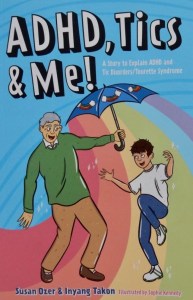
In this slim paperback we meet Jamie. Jamie is almost ten and he has ADHD and also a tic disorder called Tourette Syndrome. He talks directly to young readers about living with both of these conditions in a chatty narrative that is divided into two parts.

In the first ‘Meet Jamie’ the boy provides straightforward information about himself including his likes and dislikes, introduces his family members, and talks about how he was diagnosed.. In addition we hear how it is not always easy to tell whether those fidgety bouts he’s prone to are on account of having ADHD, tics, or both; and we learn that he is a member of an after school club called the ‘Tic Club’. As the young narrator takes readers through the first section, he offers several interactive activities for reader participation including, ‘Tell me about your happiest/ your scariest places.’ He also shares how he has learnt to relieve his ADHD symptoms, keep his tics to a minimum, and how friends and adults (including teachers) can help both at school and at home.

In part two Jamie explains the key role his Grandfather played in encouraging him to learn more about his tics. We hear how, thanks to a clever project with a competitive element, he and his fellow members of the Tic Club learn about each other by sharing their experiences of ADHD and tics at school and at home. We also meet some of Jamie’s friends who participated in this question and answer activity.
By encouraging youngsters to think about their own lives, the authors help readers like Jamie to understand that they aren’t defined by the label that comes with a diagnosis, a definite boost for self esteem – as well as showing others how to take a positive approach.

Whether or not a primary class has a child similar to Jamie on roll, this is a book that should be available in schools for both children and adults, offering as it does a good starting point for discussion.

Talking History

Talking History
Joan Haig and Joan Lennon, illustrated by André Ducci
Templar Publishing

Words have the power to move us whether addressed directly to a live audience in a formal setting – political, judicial or in a demonstration, broadcast through the media (TV, radio or social media) or, in printed form such as in newspapers or pamphlets.

The authors and illustrator introduce readers to sixteen speakers from all over the world – eight women and eight men – who over the past 150 years have made historic speeches, each of which has in some way helped to shape the societies we live in today.

Arranged chronologically the orators featured have spoken out on such fundamental issues as civil rights, war, women’s rights, (Emmeline Pankhurst and Funmilayo Ransome-Kuti) gay rights (Harvey Milk) and climate change. The contents of their speeches along with facts about the events that led up to each one, as well as what happened thereafter, are presented in infographic style in this inspiring book.
It’s good to see two not one double spread allocated to each (apart from the two ‘youth voices on the environment’, Severn Cullis-Suzuki and Greta Thunberg, who share four pages.)

Most of those included will be familiar to readers and I was thrilled to see my all time hero, Nelson Mandela with his 1964 ‘statement from the dock’, 

as well as Barack Obama’s 2015 ‘remarks by the president at the 50th anniversary of the Selma to Montgomery marches’ both featured.

A new name to me is Pearl Gibbs who spoke out for justice for the aboriginal peoples of Australia and was involved in 1939 in the very first major Aboriginal civil rights demonstration. 

This is more than just a history book, it’s essential reading for children who will one hopes feel empowered to speak out for the causes in which they believe.

The Think-Ups!

The Think-Ups!
Claire Alexander
Walker Books

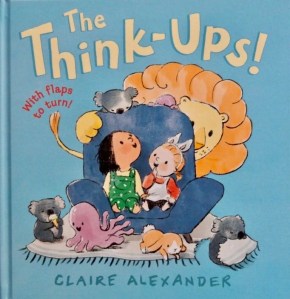
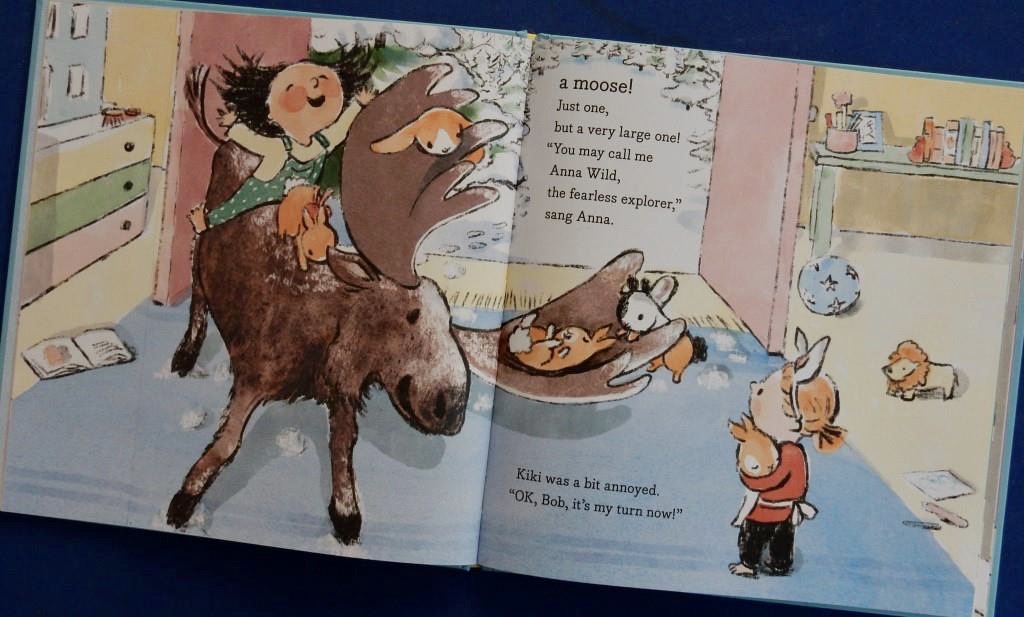
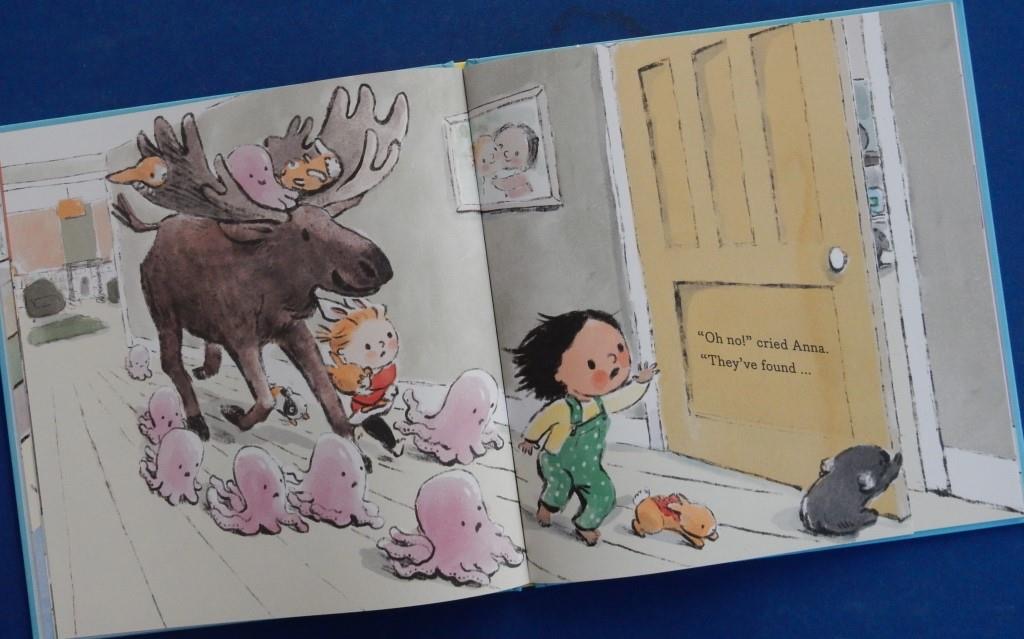
When Anna and Kiki are stuck inside on a rainy day they soon become bored with their usual indoor activities. After a short period of staring gloomily through the window at the rain teeming down Kiki has a brainwave. “We could play the Think-Ups!” she suggests. With the only rule being to think up a Think-Up and it will appear, off they go despite Anna’s initial misgivings.

Before long the girls have called into being a whole lot of bouncing bunnies, a very lively moose,

an octet of octopuses have emerged from the loo and a host of hungry koalas are attempting to sate their appetites.

It’s huge fun for a while but then mayhem ensues as the menagerie storms into the kitchen

where the friends start to lose it with one another. However in the nick of time, just as the rain stops, Kiki comes up with a solution Think-Up

– her best so far, decides Anna. Then, the girls head outdoors into the sun, order duly restored. Or is it?

With its animated language and pastel hued scenes showing superbly the descent into chaos, coupled with the author’s portrayal of girls’ irrepressible energy and rapidly changing moods that is so typical of preschoolers, this is a terrific read aloud, made all the more fun by the use of half pages and the wealth of delightful details at every page turn. Long live the power of the imagination, especially when it’s captured as adeptly as in this story.

Raven Winter

Raven Winter
Susanna Bailey
Farshore

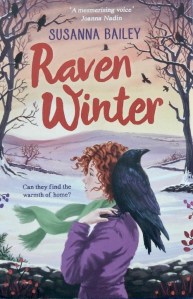
Having enjoyed both Snow Foal and Otter’s Moon I was anticipating another treat with Raven Winter and was not disappointed. Susanna’s lyrical prose sweeps you away from the start but with themes of domestic abuse, coercive control, hurt, and loneliness this is anything but a comfortable read despite the sensitivity with which difficult issues are presented.

The story is told from the viewpoint of Billie whose father is in prison and whose mother has allowed her new man, Daniel, to move into their flat making life a misery not only for the girl but also her Mam.
Eventually Billie decides that her life has become unbearable (Dad’s letters have stopped coming months back, but she doesn’t believe he’s stopped loving her) and she decides to run away. But then she finds a badly injured raven in the woods where she goes to feel closer to her Dad. She takes the bird home to care for it endangering herself and forcing her to defer her plans but in so doing she finds hope. Hope in the form of letters which her mum must have kept from her, with an address that she’s never before seen. This increases her determination to find her Dad, but now she’s even more conflicted inside.

Meanwhile Bille has met Nell, also something of a loner, who lives nearby with her Nan. At first Billie brushes aside her approaches but little by little a bond develops between the two girls.

There are many strands to this powerful story and binding them together is a celebration of nature and its power to heal: what the author has achieved is a fine balance between sadness and beauty. Not everything is resolved but father and daughter are reunited and there’s hope for the future. There’s also a reassuring message to any reader in a situation similar to Billie about the importance of going to a trusted adult for help.

Britannica’s 5 Minute Really True Stories for Family Time

Britannica’s 5 Minute Really True Stories for Family Time
Britannica Books

Authored by Alli Brydon, Catherine D. Hughes and Jackie McCann and illustrated by four artists – Anneli Bray, Vivian Mineker, Sophia Moore and Syklar White – are thirty true stories about things families do together. More than two thirds relate to humans whereas the final seven feature animal families, both sections starting with a look at homes in different parts of the world including for the former, Australia and Bangladesh.

Breakfast is the topic for the second story and I was fascinated to discover the varieties and ways families eat their porridge, whereas the thought of consuming some of the items such as those in a Japanese breakfast first thing in the morning (or at any time) turned my vegan stomach right over.

Whether the reader’s particular interest is in things scientific, or related to technology, sociology – festivals or weddings perhaps, history or art of some form there’s something to discover herein. I particularly like that ‘Storytime’ includes the fact that stories can be told in different ways including through paintings, drawings, dance or music.

Each topic is allocated three double spreads and some incorporate more than one interest area.
The question(s) embedded in each story and occasional practical possibilities provide an interactive element to the book.

For this reviewer using the term ‘true stories’ for this kind of narrative non-fiction is something of a misnomer. There’s a wealth of fascinating information in this attractively illustrated book,

but it’s one I see being used in a primary classroom as part of a topic (there are many possibilities), rather more than a family read together as suggested by the title.

Nursery? Not Today!

Nursery? Not Today!
Rebecca Patterson and Nikki Dyson
Farshore

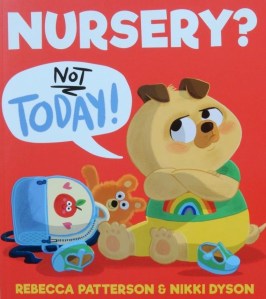
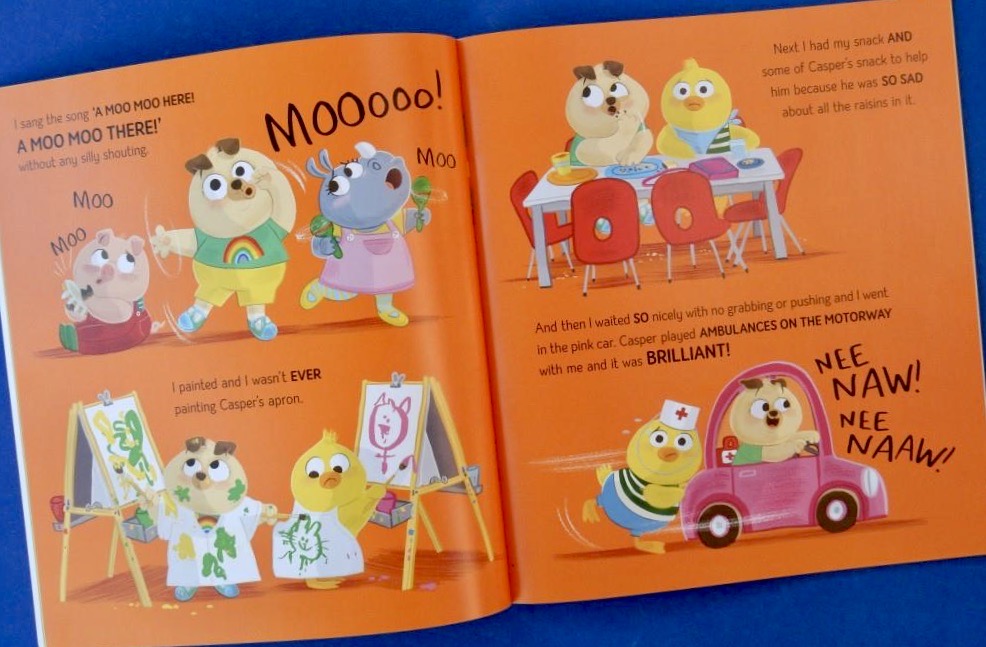
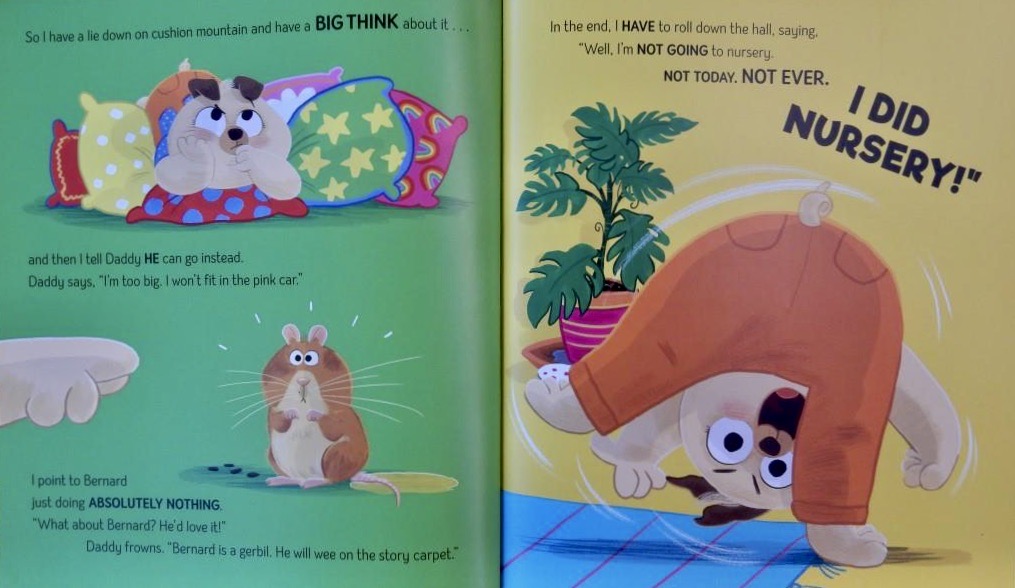
Rosa starts nursery, so she tells us, on a Monday. Everything goes wonderfully well: she paints an ace picture, sings without any shouting, enjoys lunch and plays without any rough stuff.
At the end of the day, her teacher Miss Lewis deems her ‘an absolute star!” Seemingly Miss Lewis wasn’t quite as observant as she could have been.

Assuredly the newbie enjoyed the plentiful action the nursery offered and she’s even prepared to share her new song with her younger sibling on the way home.

However, come Tuesday, Ruby has other plans that keep her more than a tad busy. Daddy is not impressed, especially when the young narrator suggests sending little brother Alby in her place and even less so when she suggests if he won’t do, perhaps Bernard (the pet gerbil) might stand in.

Is there anything that might persuade Rosa to don her coat and shoes and set out? I wonder …

Well observed, Rebecca Patterson’s funny story with Nikki Dyson’s bold, splendidly expressive, illustrations will appeal both to preschoolers and adult sharers though for different reasons. Youngsters will love exploring the wealth of detail in the illustrations as well as Rosa’s antics whereas adults will particularly appreciate the child/father interactions.

A smashing story to share with those about to start nursery and those already happily settled in a preschool setting.

Cool Technology

Cool Technology
Jenny Jacoby, illustrated by Jem Venn
Pavilion

The latest addition to the “Cool’ series takes a look at world changing technological inventions through the ages.

As a teacher who has always championed the importance of developing children’s imaginations, I love its opening quote from creator of curious contraptions Keith Newstead: ‘With a little imagination and a lot of patience you can make anything come to life.’ It’s clear from this book, which starts by going right back to stone age times with the invention of stone tools, needles etc, that this statement is spot on.

In addition to presenting bite size chunks of information about a variety of inventions from clockwork, the compass, clothes fastenings to contactless payments, photography to plastics, keyboards of various kinds, X-ray machines, toilets 

to TV and many other things we now take for granted, the author includes concise biographies of key technologists such as Johannes Gutenberg, rocket scientist Annie Easley, Bill Gates and architect Shigeru Ban who is famous for creating buildings including homes from low-tech materials.

Every spread has a clear layout with illustrations by Jem Venn. There are also some projects for readers themselves to try, a look to the future, a contents page and a glossary. And, what better way to finish that with these words from Daniel Bell” ‘Technology, like art is a soaring exercise of the human imagination.’

Primary schools should certainly add this STEM title to their book collections.

Dinosaurs on Kitten Island

Dinosaurs on Kitten Island
Michael Slack
Farshore

Despite there apparently being plenty to amuse them on their own island, the dinosaurs are bored with sandcastle construction, skeleton reassembling and the other possibilities at home, and so they decide to pay a visit to Kitten Island. After all those kittens look like friendly creatures so despite what the narrator says about them, the prehistoric creatures are having none of it and potential catastrophes notwithstanding, off they go.

Game 1 is Launch the Lizards (courtesy of a geyser) but was that sudden flight and soaking really what the visitors came for? Lesson learned: surely that’s enough. It doesn’t appear so and nor does the second game ‘Deflate the airship’.

However apparently undaunted, the dinos are daft enough to participate in some ‘hairball floaty’ racing. Hmm! this could be their worst experience to date … Or not?

Seemingly these three friends revel in a high level of risk taking or else they’ve left their dino-brains at home for even after another unsettling outcome they precede to game 4, Fall-o meow that begins with them plunging into a dark chasm.

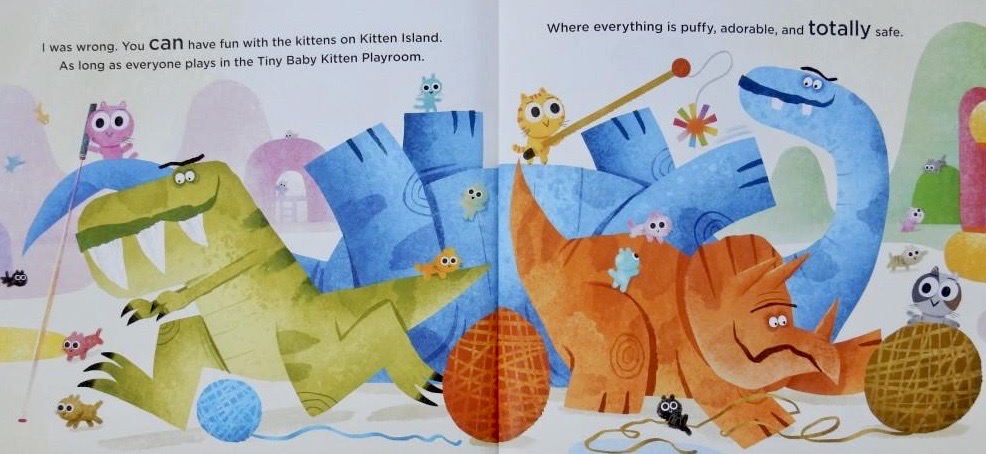
However it ends with them all in Tiny Baby Kitty Playroom, which is absolutely full of even tinier kittens. Now this looks a pretty safe place where both kittens and dinosaurs can play happily together.

Um …

With its brightly hued scenes, this is huge fun and hugely silly. It’s sure to go down well with the countless young dinosaur story enthusiasts out there who will definitely relish joining the prehistoric creatures in some loud RAWR, RAW-ing at each opportunity.

Baby, Sleepy Baby

Baby, Sleepy Baby
Atinuke and Angela Brooksbank
Walker Books

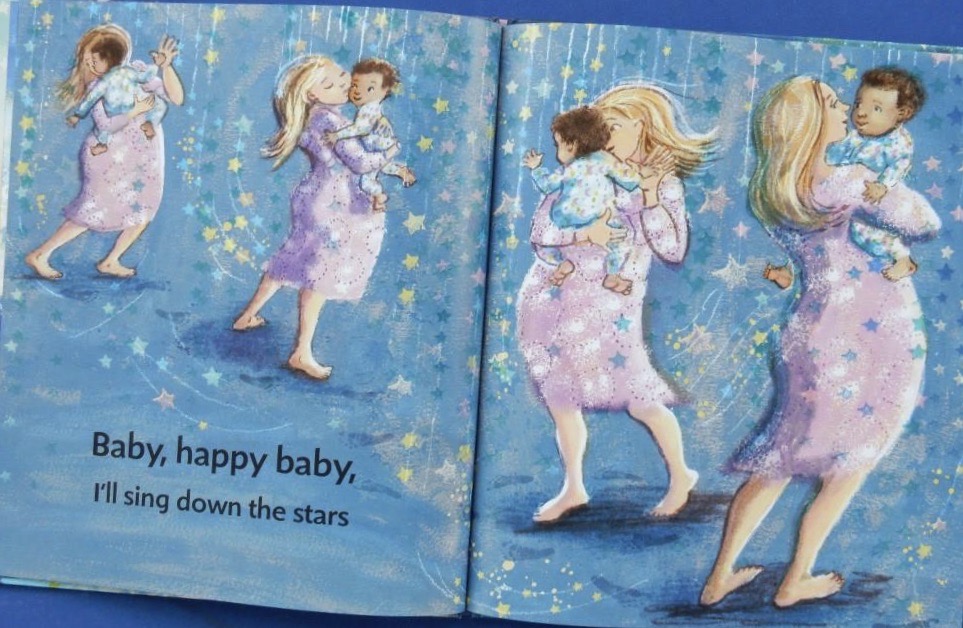
Exuding warmth and tenderness from every one of Angela Brooksbank’s illustrations is this lullaby.

Author Atinuke introduces the entire family on the title page and thereafter we see mother, father, a girl sibling and a grandmother, each of whom is shown cuddling the baby in the sequence of stunningly beautiful spreads that follow.

Although the narrative doesn’t rhyme it is lyrical: ‘Baby, sweet baby, / I’ll call on the winds // and you’ll sail like a ship / through the sky.’ it begins with infant on mother’s lap and big sister sharing the adult’s embrace.

The babe is then passed to Grandmother who bestows a kiss

then cuddles the little one with a fondness that is palpable.

We assume but it’s not certain who speaks on each spread,

although this reviewer suspects it is the person holding the little one: other readers might think differently but picture books can always open to more than one interpretation.

Once each family member has wrapped the baby in love

as well as allowing in turn, the wind, clouds, stars and moon to do likewise, everybody feels so calm and peaceful that sleep comes easily and they drift off to slumberland, with the little one between its mother and father.

Gentle, soothing and utterly gorgeous: what better book than this to give a family with a new baby.

I Love You More Than All the Stars / I Love You Forever and a Day

These are two picture books from Little Tiger both written in rhyme and both celebrating love: thanks to the publisher for sending them for review:

I Love You More Than All the Stars
Becky Davies and Dana Brown

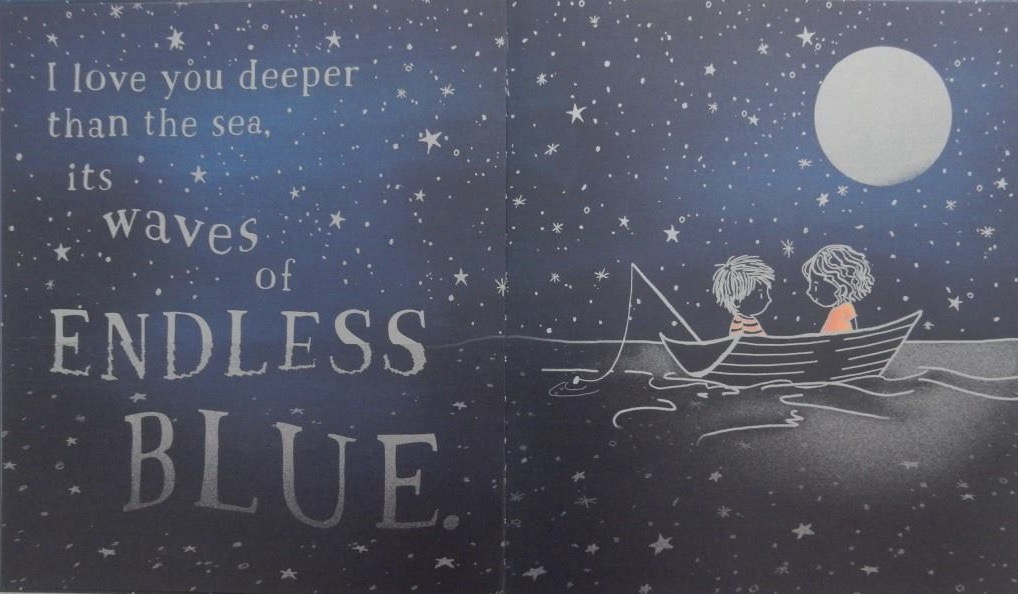
The joys of a loving friendship between two small children is celebrated against an inky sky and Dana Brown’s unusual colour palette is what helps to makes this book that bit different from many of its kind.

We hear how the young friends share an unbreakable bond that is ‘deeper than the sea’, ‘stronger than a storm’ and ‘softer than a snowflake dance’, a bond that so the speaker says, will last for ever.

Much of what we see the two enjoying together takes place at night under the moon in scenes

illuminated by silver stars and the only additional colour is provided by the pops of salmon pink on the friends’ clothing and some of the natural images, a bird in flight and dancing leaves for instance.

I Love You Forever and a Day
Amelia Hepworth and Tim Warnes

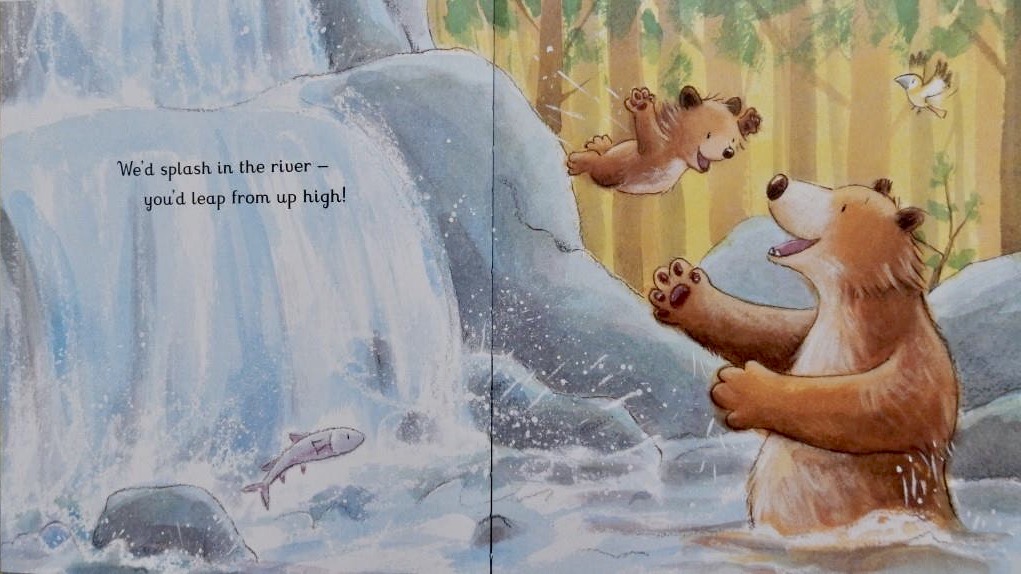
In the sequel to I Love You to the Moon and Back the focus is on parental love as an adult bear takes its cub through an idyllic day of togetherness. We meet them at sunrise and join them walking through the countryside, jumping paw-in-paw to cross the water, pausing to observe a mother bird and her young, basking in the meadow, picking wild flowers, splashing in the river

and finally, heading homewards under the stars ready to snuggle up close and fall fast asleep,

The characters’ shared joy shines out from Tim Warnes’ scenes of ursine activity: his bears are hugely appealing to young children who will delight in snuggling up close to their own mum or dad (or perhaps grandparent) for some pre bedtime togetherness with this story.

Mort the Meek and the Monstrous Quest / Mike Falls Up

These are two new fiction titles from the Little Tiger Stripes imprint – thanks to the publishers for sending them for review

Mort the Meek and the Monstrous Quest
Rachel Delahaye, illustrated by George Ermos

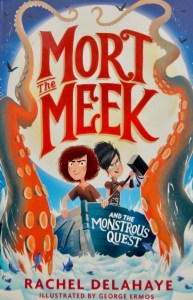
According to the introduction to this second adventure of Mort, I am mad, for it warns readers not to proceed to the first chapter if they suffer from seasickness, which I most definitely do. Nonetheless having enjoyed Mort the Meek and the Ravens’ Revenge, I was prepared to swallow some anti-nausea tablets and board ship along with the founder of Brutalia’s pacifist society and vegetarian protagonist, as eager as he, to leave the ghastly shores of Brutalia with its gruesome Queen. In fact it’s partly on account of said Queen that Mort sets sail on the Salty Sea for she has issued a challenge that would give him the opportunity to search, not for the treasure she desires, but for his missing father and sibling twins Gosh and Gee.

However, find an amazing treasure – the three tentacled Belgo – is just what Mort and his tough companion Punky, daughter of a rock crusher, do.

That happens only half way through this story though, by which time Mort has more or less convinced himself that said Belgo has consumed his missing family members, What of his pacifism now? Will it lose out to his anger?

The fact that Rachel Delahaye is a wonderfully humorous wordsmith is part of what makes this dark tale a smashing read; she’s replaced those chapter opening ravens with masters of misinterpretation, Bruce and Larry, a pair of lobsters. There’s danger aplenty too, but the story isn’t without hope: after all where there’s pacifism there’s always hope, all of which George Ermos brings out in his plentiful black and white illustrations.

For slightly younger readers is:

Mike Falls Up
Candy Gourlay, illustrated by Carles Ballesteros

This addition to the Stripes series of full colour fiction for newly independent readers begins in the Chocolate Hills, in the Philippines. It’s a very hot day, too hot really to do anything much and Mike’s mama has sent him and his dog Bowow out for some fresh air while she prepares dinner. They’re sitting on a hill when a sudden earthquake occurs, the ground splits open and Bowow leaps into the hole.

Soon after an anonymous note blows up on which is written BIRTHDAY. COME NOW. JUST FALL UP.
The boy has no idea who sent it, nor how to fall up but he does know that he has to find Bowow, so into the darkness he plunges. The next thing he knows Mike is roused by a dog with an unfamiliar face and a voice shouting, “Foofoo! Is he awake?”

What follows results in an altogether different kind of birthday party but it isn’t for the little girl Kaneisha in whose London room he finds himself. Nor does it take place in a setting either child recognises; suffice it to say that their host is exceedingly happy to see the unexpected guests, a fun time ensues and friendships are forged.

The author has certainly left gaps for readers to fill in this strange story that Carles Ballesteros has made even stranger with his almost surreal, computer game style illustrations.

Interestingly, this is the first in the series to be published as a paperback original, which I think, the target audience might prefer.


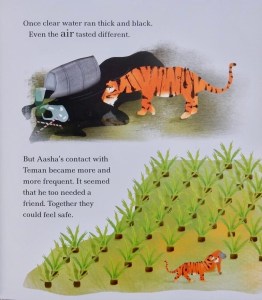
The Amazing Autism Brain Cards

The Amazing Autism Brain Cards
Glòria Durâ-Vilà, illustrated by Rebecca Tatternorth
Jessica Kingsley Publishers

Sometimes it’s the simplest things that can be the most effective and so it is with this set of cards that offer an excellent resource for those who live or work with children/ young people who have recently received an autism diagnosis.

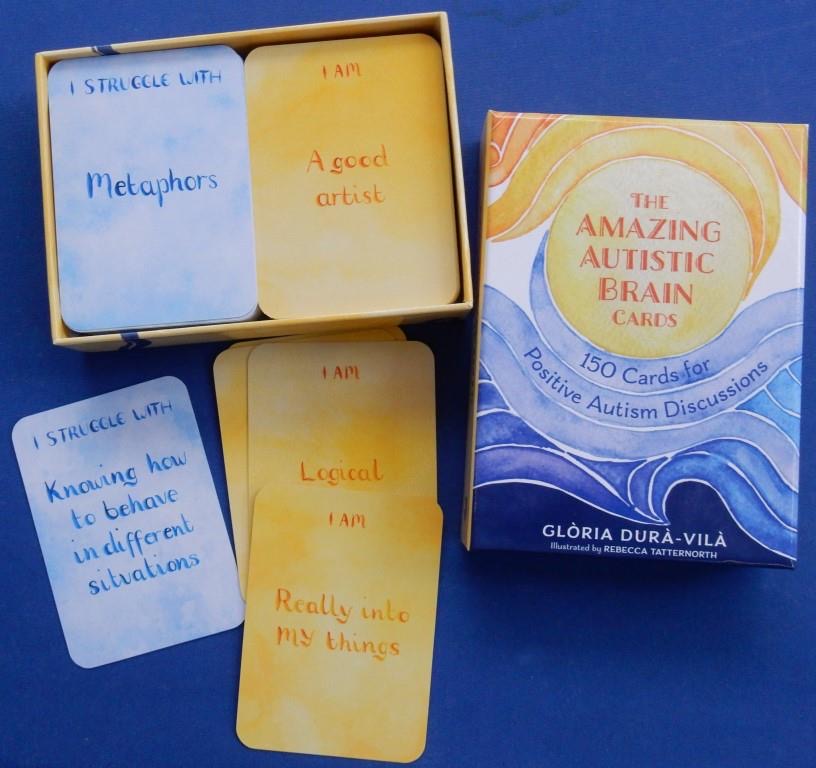
In the pack there are 150 laminated cards and an explanatory booklet explaining their purpose and offering words of wisdom about how to use them and with whom, (it could be with an individual or within a group) plus ideas, advice (choosing one’s words carefully, for example), and quotes from children themselves.

The cards are divided into two sets, one blue and the other yellow and each set also has some blanks for personalisation.

The yellow set are the ‘I am’ ones – those showing a strength – ‘fair and just’, ‘a good friend’, ‘observant’, ‘determined’ and ‘good at science’ for example.

The blue set are the ‘challenges’. They might refer to something sensory such as ‘Being cuddled’ or ‘Recognising feelings of hunger or thirst’; or related to the emotions ‘Showing my true feelings’ for instance, or seeing the big picture – ‘working towards a goal’, or perhaps ‘Knowing how to behave in different situations’.

In having the opportunity to choose those cards they feel relate to them, the young person feels in control and is helped to get a personalised picture – a celebration of how their autism looks.

Home Is Where The Heart Is

Home Is Where The Heart Is
Jonny Lambert
Little Tiger

What does it mean to really belong somewhere: that is what is explored in Jonny Lambert’s new picture book.

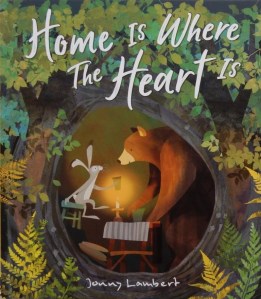
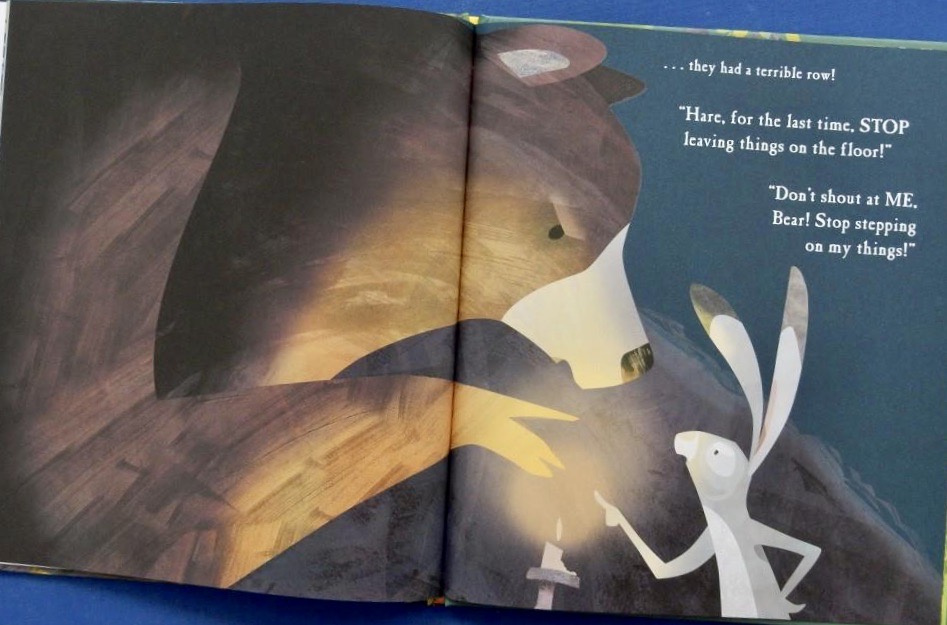
When Bear wanders into the old wild wood, he decides it’s where he wants to build himself a new home and so he does. There’s plenty of room inside and he adorns it with lovely things (those familiar with Jonny’s books will likely recognise Saffi’s portrait on the shelf); but something is missing. Feeling lonely Bear decides to pay his neighbour a visit and is immediately welcomed into Hare’s small, cramped home.

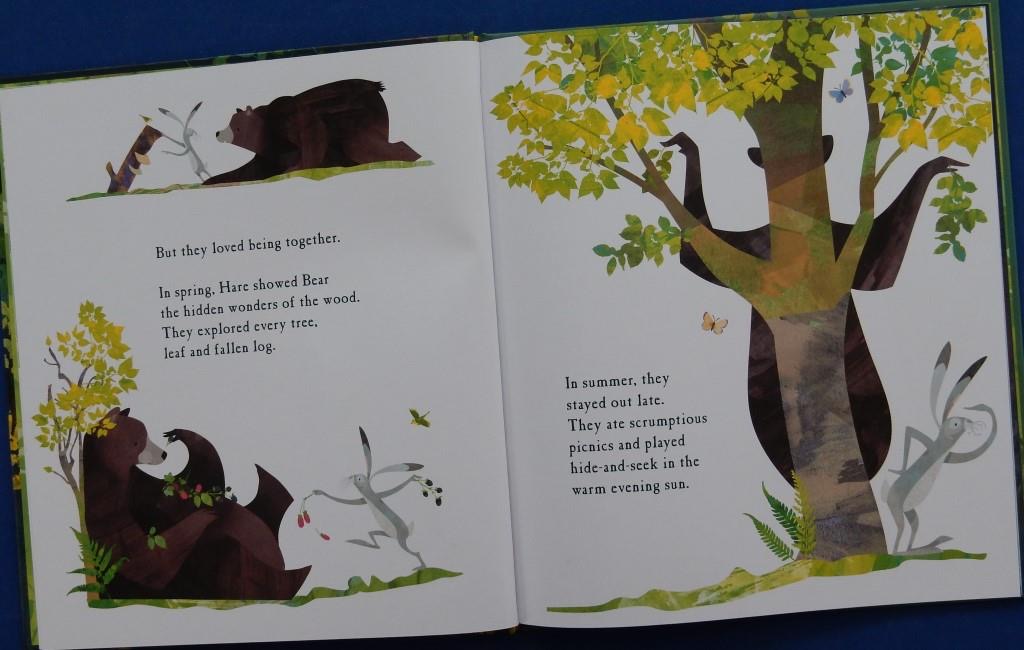
Despite being complete opposites in many ways the two absolutely love spending their days together outdoors. Spring, summer

and autumn pass in happy companionship, but come the winter, Hare takes to his bed with a nasty chill. Bear takes good care of him till his friend is back on his feet.

When a fierce storm comes crashing through the woods, Bear’s home is completely destroyed. Where can he go? He feels devastated but not for long thanks to Hare who welcomes his friend in with open paws. “From now until forever, my home is your home,” he says.

Now however, their friendship is really put to the test … Will it survive Bear’s clumsiness and Hare’s constant messiness?

The title says it all …

Jonny Lambert portrays so well the emotions of Bear and Hare: the warm glow of friendship illuminates almost every one of the elegant, textured scenes; his capturing of the storms, both meteorological and emotional are equally powerful too. And as always, the balance between text and illustrations is as harmonious as ever.

The Everyday Autism Handbook for Schools

The Everyday Autism Handbook for Schools
Claire Droney and Annelies Verbiest
Jessica Kingsley Publishers

The authors of this excellent book draw on almost forty years experience of working with neurodiverse pupils in a variety of settings. Linking theory and practice it’s a must-have, extremely readable resource for all teachers and others working with children with autism, in both mainstream primary and special schools.

Within in the six main sections or themes there are over sixty ‘guides’, encompassing associated practical activities, techniques and case studies; all anchored in evidence-based practice.

The first part comprises two important short guides on understanding autism – a kind of ‘what you need to know’ and it was especially good to find the authors stressing the importance of a focus on children’s strengths and on using positive language at all times.

It’s crucial to develop an inclusive and collaborative whole school community and this is covered in the next two sections.

Most importantly, by following the guidance herein, practitioners are likely to be able to guide the children they work with towards reaching their full potential. Whether you are looking for help on lesson plans, communicating with parents, or strategies to help youngsters cope with anxiety or stress, you’ll find it and much, much more herein.

I’d like to think that every primary teacher could find the time to read right through this book but I suspect that particularly during the current covid times which are causing increased stress to pretty much every member of a school’s staff, that’s unlikely to happen. However this is a book that works as a ‘dip in and out’ read too, and equally could also form the basis of a series of staff inset sessions.
How ever you decide to use it, if you are responsible for buying books for your primary school staff, then put this one at the top of your list for 2022.

Aaron Slater, Illustrator

Aaron Slater, Illustrator
Andrea Beaty and David Roberts
Abrams Books for Young Readers

It’s such a joy to see a child whose neurodiversity is celebrated in the latest of the Questioneers series.

The titular Aaron D. Slater, of this rhyming picture book, is based on Aaron Douglas, the African American painter, muralist, and graphic artist, who was a key figure in the Harlem Renaissance movement.

As a very young child there’s nothing Aaron loves more than to sit in the old garden swing and listen to others reading to him, and he aspires to be a writer of stories in the future.

First though he has to learn to read and to write, both of which on account of his dyslexia,
he finds challenging. ‘the words are just squiggles, and try as he might, even with help Aaron can’t get it right.’

Once he starts school, Aaron who also loves to draw, decides that rather than show his feelings, the best thing to do is to try to blend in with his classmates.

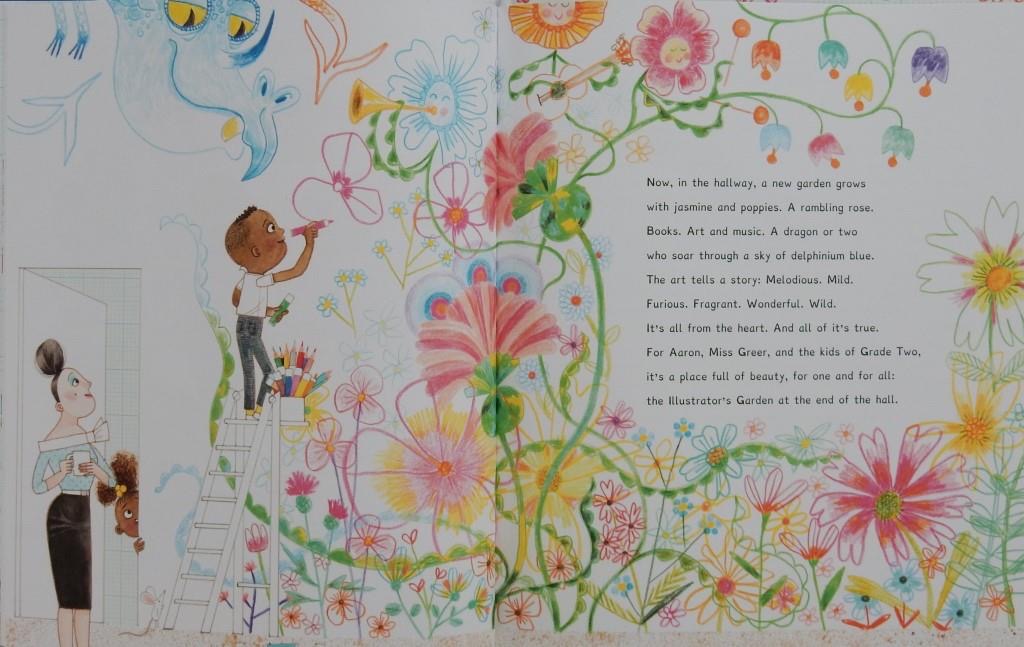
In his second year at school Aaron has a new teacher and she sets the class a story writing assignment. That night the boy spends all night attempting to write “a story. Write something true.” as his teacher has said.

Filled with fear the following morning, at Miss Greer’s behest he stands before his classmates and suddenly Aaron finds his voice: ‘beauty and kindness and loving and art / lend courage to all with a welcoming heart.’

So it is that he begins to find his own way of using visual images to create stories: ‘His art makes the difference. His art leads the way and helps him discover what he wants to say.’

This superb tale of creativity, acceptance and finding your own way to transcend insecurities and challenges, will be an inspiration to all youngsters, in particular those who like Aaron, struggle with reading and spelling. (The book is set in Dyslexie, a dyslexia-friendly typeface and David Roberts, creator of the stylish illustrations, tells in a final note how he himself has struggled with reading and spelling, making those superb spreads wherein Aaron’s images literally take flight, all the more powerful.)

The Katha Chest

The Katha Chest
Radhiah Chowdhury and Lavanya Naidu
Allen & Unwin Children’s Books

Despite all that has happened since 2018, the UK retains its rich cultural tapestry, one that we all should celebrate.

I have never before seen a picture book that celebrates Bangladeshi culture so I was thrilled to be sent this one by an author and illustrator who draw on their own Indian Hindu and Bangladeshi Muslim heritage respectively.

Together they have crafted a fascinating story of young Asiya’s visits to her Nanu’s house which is full of treasures, Asiya’s favourite being the large katha chest containing quilts Nanu has made over the years from old saris. The little girl loves to immerse herself among these soft warm quilts and imagine the stories they hold just waiting to be whispered; stories both sad and happy, told to her by family members.

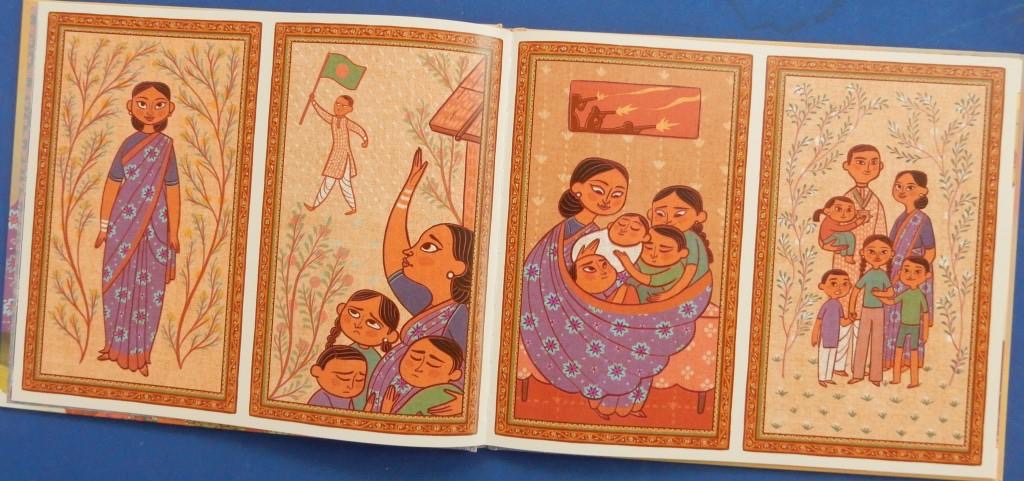
To begin with she shows readers a purple and blue quilt and we learn of Bora Khala’s medal from the war represented by the circular patterns on the fabrics. These help recall a sad time when he had to leave his wife alone with the children, to return after many years.

Then follows the first of Lavanya Naidu’s beautiful wordless double spreads of framed illustrations showing that time of the family’s life.

This and the five other four panel strips are in the style of Pattachitra – Bengali folk art cloth paintings, with simple colours, bold lines and intricate details, each one conveying a story within the main narrative. So it is that through these heirloom quilts, family history – the story of each aunt, mother and grandmother that wore the fabric – is passed on from generation to generation.

Each of the quilts holds a special memory and they’re also taken out when Asiya’s mother and aunts come together for sessions of tea drinking, story telling and reminiscing.

Both author and illustrator’s presentations of family history are imbued with so much tenderness and love that this a book for everyone regardless of their ethnic background.

Winter Lullaby / Wonky Donkey’s Big Surprise

Winter Lullaby
Dianne White and Ramona Kaulitzki
Walker Books

At the approach of winter when the air is crisp and cold, Mama Bear tells her little one that it’s time for bed but Small Bear notices Mouse and Chipmunk are still wide awake and busy; so too are Skunk and Hare.

Patiently acknowledging her offspring’s “But why must I?”, Mama explains that each one is preparing for a long winter sleep: Mouse is rushing to rest in her soft grassy nest and Chipmunk is storing nuts then he too will hibernate; Skunk will soon slumber underground and Hare will spend winter in a hollow log.

However Small Bear also spots Badger and Old Racoon, both still awake too, so he holds firm to his “But I don’t want to go inside … Why must we hide?”

Mama then promises that come the spring, they’ll both wake up and find their world green again, just waiting for them to play together once more. Finally Small Bear accepts that it is time to snuggle up warm with his mother and let the night sing them lullabies until they both fall fast asleep and slumber all winter long.

Told in rhyming couplets and through Ramona Kaulizki’s scenes of the final autumnal days giving way to winter’s bluish-silvery landscapes, this is both a lovely reassuring pre-bedtime tale and a simple explanation of hibernation for adults and little ones to share, snuggled together just like Mama Bear and her cub.

Wonky Donkey’s Big Surprise
Craig Smith and Katz Cowley
Scholastic

One morning wee Dinky Donkey is hugely excited and that’s because her pa Wonky has promised her a very big surprise. Rather than tell his little one what to expect, Wonky turns the whole surprise thing into a guessing game explaining that behind the big green door is where she’ll find her surprise. The guessing begins – “Is it warm?, “Is it washable?” … “is it witty? …

By the time Wonky has acknowledged “Sometimes it’s even whiffier than your dad!” Dinky cannot contain herself any longer. She leaps up and dashes to the door: now what could possibly be wonderful, wrinkly, wiggly, witty, weird, whiskery, washable, warm, whiffy and wise? WOW! What a lot of w’s to describe just one thing. Now what could it possibly be? It’s certainly something that will make Dinky and young listeners feel warm all over.

The story is delivered in Craig Smith’s characteristic playful, spirited rhyming narrative and Katz Cowley’s strokeable illustrations wherein the focus is on, not Wonky, but his endearing offspring.

How To Be An Explorer

How To Be An Explorer
Tiger Cox
Button Books

Tiger Cox, is a paragliding instructor and lover of outdoor actives. To encourage youngsters to acquire the know-how and the confidence to become adventurers in the great outdoors, he has written this, his debut book.

His introductory spreads focus on thinking like an explorer, what a basic explorer kit comprises, how to read a map and how to create one.

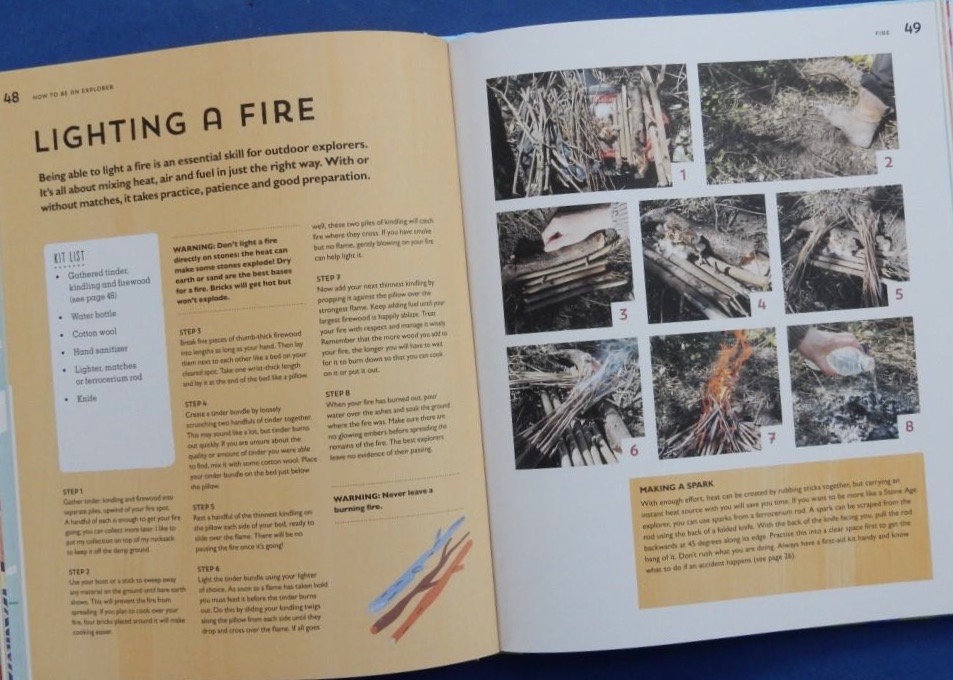
There are seven other parts: risk, skills (how to make cordage, knots to learn, using a knife and whittling a peg; how to light a fire,

cook on it, how to make a paper boiler and a couple of campfire recipes. The foraging section looks at edible insects, edible plants and those not to eat because they are poisonous; then comes a section on creating shelter followed by one on aspects of water and another on weather.

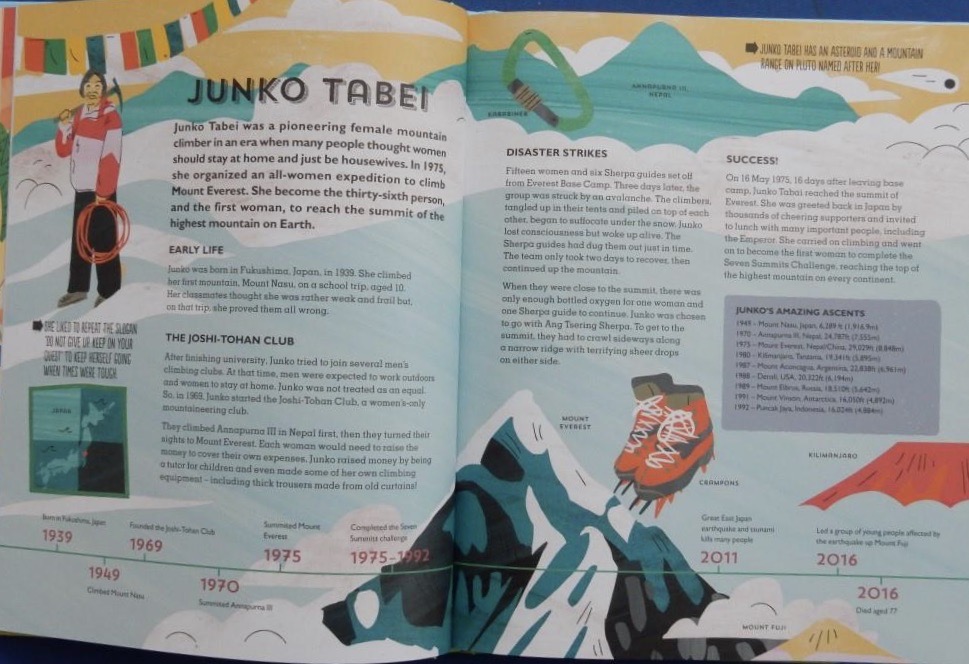
Also included in each chapter is information about a real-life explorer: map maker Muhammad al-Idrisi, female mountaineer Junko Tabei,

Matthew Henson (the first person to reach the North Pole), seafarer Bungaree, Jeanne Baret who disguised herself as a man which enabled her to become the first woman to circumnavigate the globe, and aviator Amelia Earhart each have a spread. In addition, the author includes some anecdotal snippets from his own expeditions.

Colour photographs help guide readers through the 25 activities step-by-step, whereas artistic impressions are used for the explorers’ biographies.

With the author’s enthusiasm for his subject shining through in his writing, this is a super book to encourage children away from their screens and outdoors for some adventuring.

Walrus Song

Walrus Song
Janet Lawler and Timothy Basil Ering
Walker Books

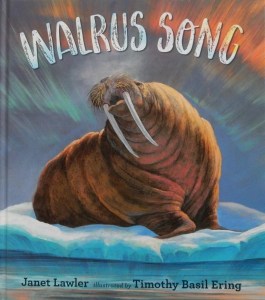
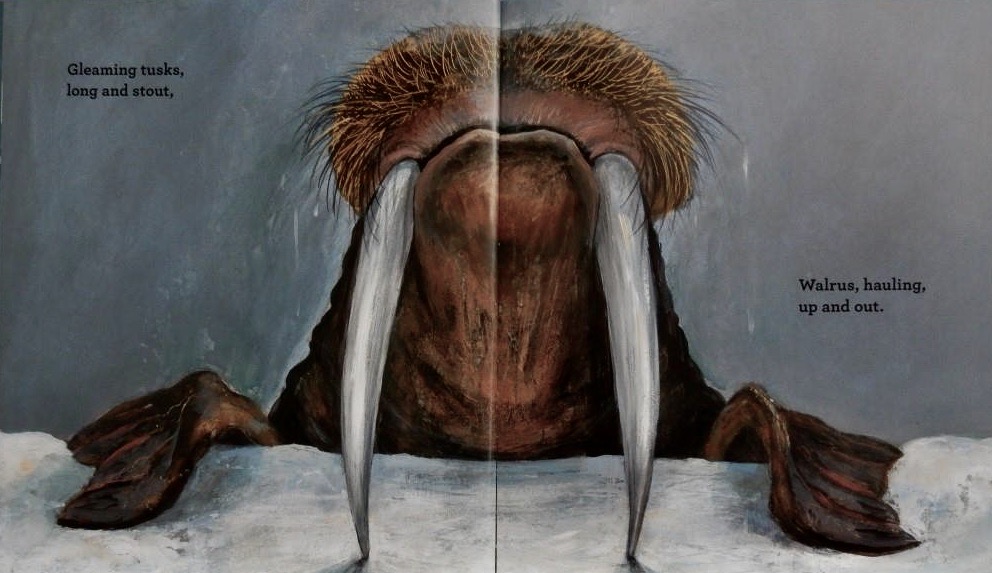
In this narrative non-fiction picture book with its lyrical rhyming text and brilliant paintings, author Janet Lawler and illustrator Timothy Basil Ering present a superb portrait of a walrus in his icy environment, taking readers right up close to the creature .

He plays on an ice floe, flopping and plopping into the chilly water where he twirls and whirls with swirling flippers, kept warm by the layer of fat beneath his coat. Then, having found some clams on which to feast, he slurps until he’s full when it’s time to tease that playful puffin before, using his powerful tusks, he heaves himself out of the water and onto the ice. 

‘Waddle. Walk. Slap! Slap!’ he lumbers, till he meets up with a pack of fellow walruses, snuggling up among them.

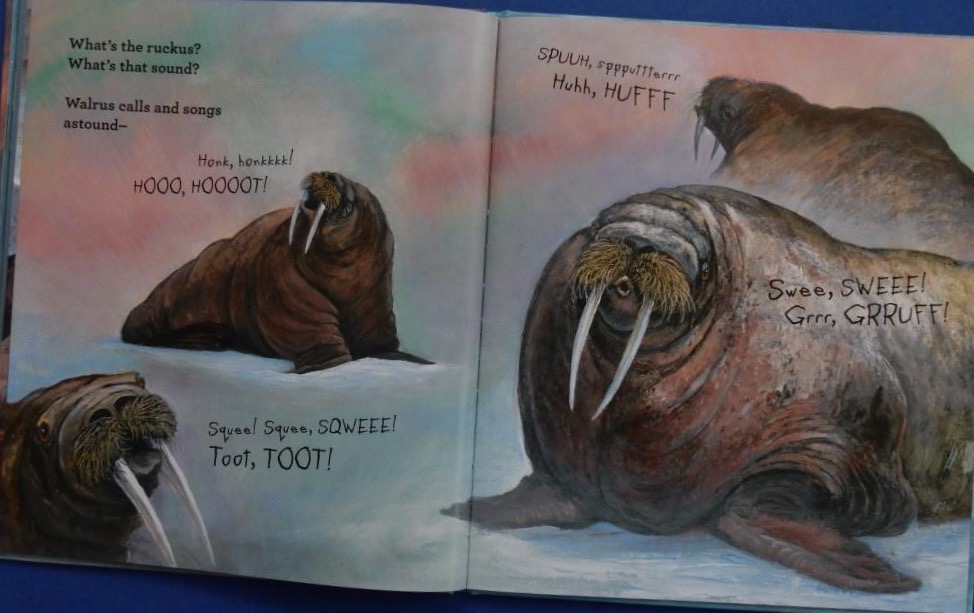
Sometimes however he get involved in a crashing, tusk-bashing fight with another walrus till fight over, he emits a variety of exciting sounding calls and songs that echo across the frozen landscape. 

I imagine young listeners will love to copy these sounds as you read.

Come the spring, baby walruses are born. Noting is said in the main narrative about mating but the author includes information about this in a final double spread of additional walrus facts.
Thanks to his chosen colour palette, you almost feel the chill as Ering’s paintings zoom in on the action documenting every move the creature makes and its every change of mood, holding readers totally captivated throughout.

Nen and the Lonely Fisherman / Love Grows Everywhere

Nen and the Lonely Fisherman
Ian Eagleton and James Mayhew
Owlet Press

Far out to sea lives Nen; he’s a merman who loves exploring but nonetheless has an empty feeling in his heart. Every night he sits beneath a starry sky singing to the sea whose waves carry his words of hope but Nen remains alone when he returns to the seabed.

Despite his father Pelagios’s warnings, Nen’s explorations of the world beyond his own lead him to discover fishing boats beyond which lives Ernest, a lonely fisherman who also feels something is lacking in his life.

One night Ernest hears Nen’s song and feeling something in his heart, he sets off in his boat to find the owner of this magical voice. So it is that a bond develops between Nen and Ernest. However Pelagios urges his son to stay away from the humans who are harming the oceans. Nen pays no heed however for he feels that the gentle, kind Ernest is special and their nightly meetings continue.

As Pelagios’ anger and sadness increase they unleash a terrible storm that puts Ernest’s life in danger as he’s thrown from his rickety boat into the foaming deep. Can Nen possibly come to his rescue

and if so, might it just change the mind of his father?

Washed through with an important conservation message, Ian Eagleton’s soft-spoken, lyrical tale of acceptance and love is compelling and perfectly paced, helped in no small part by James Mayhew’s powerfully atmospheric illustrations that include a wonderful full-length vertical scene of Nen searching the depths for Ernest, as well as small vignettes and double page spreads.

There’s love too in:

Love Grows Everywhere
Barry Timms and Tisha Lee
Frances Lincoln Children’s Books

‘Love grows everywhere…
From country farm to city square
From desert village, hot and dry,
to mountain home where eagles fly
.’
Through Barry Timms’ gentle rhyming text and Tisha Lee’s vibrant illustrations we share a family’s love, not only for one another but also for the plants they grow, nurture, sell, and give to members of their local community, newcomers especially. When reading this It’s impossible not to feel the various ways love is shown and shared

be it within the family, the richly diverse community or anywhere else: for love is a gift that helps to make the world a brighter, happier place; it keeps on growing and there’s sufficient for everyone, everywhere. It might just take some time for its magic to happen.

How wonderful it would be if this heartfelt book could show the way to everyone, in every place where such love is yet to manifest itself.

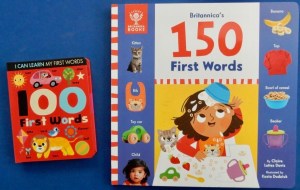
100 First Words / Britannica’s 150 First Words

100 First Words
Lauren Crisp and Thomas Elliott
Caterpillar Books an imprint of Little Tiger
Britannica’s 150 First Words
Claire Laties Davis and Kasia Dudziuk
Britannica Books

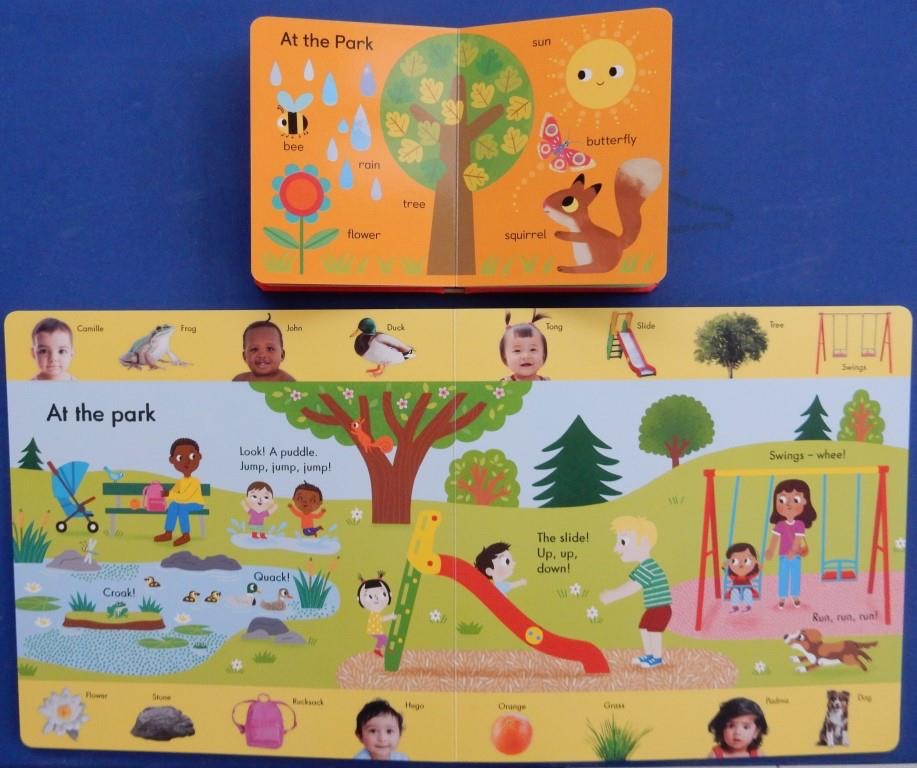
It’s interesting to look at the different approaches taken in these two recently published board books, the first being a compact book with a different theme per spread. It is easily held by small hands and has animal characters ‘At Home’, having fun with ‘Toys and Games’; there are ‘Colours’, ‘Pets’, we see what’s ‘At the park’, explore ‘Food’, ‘Clothes’, ‘Parts of the Body’, spend some time ‘On the Farm’, watch ‘Things That Go’, see animals ‘In the Wild’ and finally it’s ‘Bedtime’.
Single words label all the items depicted illustrated on Thomas Elliott’s brightly coloured spreads.

The second is a large format compilation that goes beyond the 150 named items by means of a narrative that takes little ones through a day from wake-up time to bedtime as they follow nine children from around the world through their daily routines. We wake up with John and his family; join Padma and her mum at breakfast time; meet Camille and Tong as they play; go out and about with Hugo in his pushchair, destination the park where he joins the other children and their adult carers. Then poor Ali takes a tumble but happily Dad is there to come to his aid before the two walk home.
By now it’s time to cook dinner and we watch Matias and Dad in the kitchen, Dad at the stove cooking the family meal they all share. Bathtime is spent with Tasha and finally, we pay a visit to Anna at bedtime.
This one is compiled by Claire Davies, a speech-language pathologist who used her knowledge of child development for the book in which she includes a search and find element: objects from the main scene along with a photo of the featured child are shown in a colour strip beneath each of Kasia Dudziuk’s thematic scenes.
Both books are useful for parents and carers but which would you choose, I wonder. 

I think the latter has more potential in the long run.

Classic Inspirations: Once There Was a Bear / The Little Prince

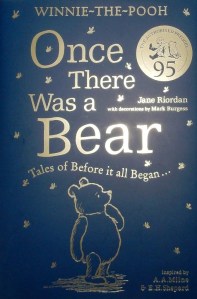
Once There Was a Bear
Jane Riordan, illustrated by Mark Burgess
Farshore

To celebrate the 95th anniversary of A.A. Milne’s Winnie-the-Pooh and The House at Pooh Corner, having previously written two standalone Pooh books, Jane Riordan has created a prequel collection of ten stories, again in the style of Milne. It takes readers back to where it all began, when Pooh was bought in Harrods as a gift for baby Christopher Robin. Using a similar style to that of E.H. Shepard, Mark Burgess illustrates each episode with panache depicting Pooh and his friends Eeyore, Rabbit, Piglet, Kanga, Roo, Owl and Tigger.
The original Pooh books have an enduring appeal for those who met them first as children; however this one has a charm of its own with many of the adventures taking place outside of Hundred Acre Wood. I loved the museum outing wherein dinosaur skeletons with their ‘bothersome long words’ for names prove unusual ladders for a bear to climb upon.

This is definitely worth getting hold of if, like this reviewer, you’re a fan of Pooh et al.

The Little Prince
Louise Greig and Sara Massini
Farshore

Award-winning author and poet Louise Greig has adapted Antoine de Saint- Exupéry’s classic as a picture book for a younger audience than the original novella: it’s illustrated by Sara Massini who has also won many awards. The result is a thing of beauty, mysterious and poetic both verbally and visually.

I’m not sure whether the stranded pilot’s encounter with a little prince who visits neighbouring planets will appeal to children; its enigmatic nature will certainly provoke much thought and lots of questions for, as the author says, ‘What is hidden is beautiful.’ That in itself is well worth exploring.

Are You Feeling Cold, Yuki?

Are You Feeling Cold, Yuki?
K.I. Al-Ghani and Haitham Al-Ghani
Jessica Kingsley Publishers

This picture book is about a family of snow monkeys that live in Japan, and one young monkey, Yuki, in particular. He gets so absorbed in what he’s doing that he frequently fails to realise when his body is signalling to him that, for instance, he is cold or hungry, needs to wee or to poo. This is of great concern to his parents and sister. Things come to a head when the family go off to bathe in the hot springs in the valley, for instead of joining the others in the warm water, Yuki continues playing in the snow. His mother calls upon his grandfather to help and the following morning Yuki pays him a visit.

Step by step, over the next days, weeks and months,

Grandfather helps Yuki to understand how his brain picks up sensations and sends ‘funny feelings’ to the relevant part of his body. For instance when he’s too cold, the skin on his feet and fingers get a tingly sensation and he starts to shiver so his brain tells his body to do something to warm up. Thus, he learns to recognise as well, the meaning of “a rumbly tummy” and the sensations he feels when he needs to get rid of excess liquid or the remains of food after all the goodness has been extracted.

The problems Yuki was having were on account of his being unaware of his bodily sensations and what his Grandfather taught him was something called ‘interoception’, which scientists call the eighth sense: the perception of sensations from inside the body including the perception of physical sensations related to internal organ function such as respiration, heartbeat and fullness.

By providing a place from which to become aware, story is a great way to help neurodiverse youngsters to learn. This one written by specialist advisory teacher Kay Al-Ghani with its mixed media illustrations by her son Haitham, subtly teaches about interoception and is accessible, empathetic and gently humorous. It would make a useful resource for parents, teachers and support staff.

Albert Upside Down

Albert Upside Down
Ian Brown and Eoin Clarke
Graffeg

The latest episode in the life of my favourite tortoise Albert is full of action; not however that of the protagonist – he finds himself belly up after an unfortunate rock climbing episode undertaken in an attempt to reach a tasty treat. During his efforts to right himself the creature gives a big sigh that attracts the attention of a passing worm. Said worm stops to enquire about its cause and is soon joined not only by a second worm but also several ants. Both parties claim to be best at moving large objects and Albert suggests they work together to flip him over.

Before long it seems that the entire minibeast population has come together in the cause of operation Albert. They give it their all as they push and shove, lift and pull but the tortoise remains stuck, legs skywards. Maybe a food luring tactic might do it, but no, though it does serve to attract further attention in the form of a butterfly that offers to assist only to be given the push by a snooty snail on account of being too delicate.

Further shoving, pushing and lifting ensue to no avail so the workers pause for some silent thinking. That silence is broken by the voice of a young worm with a clever suggestion. Under the direction of the chief worm some concentrated team work begins and there’s some movement as Albert rolls slightly but not enough. More weight is required states another worm when suddenly what should return and land gently upon that snooty snail but the butterfly. Now she might just be the one to make all the difference …

And so she does but with Albert now back on his four feet, why are all those who came to his rescue making a hasty dash to put some distance between saved and savers. Hmmm! Seemingly it’s because Albert is his normal self once more and we know what that means …

Ian Brown’s story of struggles and strife, rivalry and ultimately, creative teamwork becomes a truly comic episode thanks in no small part to Eoin Clarke’s hilarious, detailed illustrations. In the style of Tolstoy’s Great Big Enormous Turnip tale that has become a classic, we see how just a tiny bit of additional assistance can make a huge difference.

This is sure to be a winner with young listeners either in the classroom or at home. Don’t miss the final facts page about the real Albert (inspirer of the tale) and his cousins.

Goodnight Toucan

Goodnight Toucan
Joanne Partis
Little Tiger

Joanna Partis’s Toucan protagonist plans a jungle sleepover inviting his friends Tiger, Sloth, Frog, and Monkey; but he’s a perfectionist so at the last minute he has a crisis of confidence. The food he thinks, is insufficiently tasty and the bedding not snuggly enough,

so off he goes in search of items to make his party go swingingly: “the best sleepover ever!’ as his pals have declared it will be.

He fills his beak with fabulous flower decorations, then finds fluffy ferns for bedding and bananas for a yummy feast – hmm! As he flies back he spies fireflies that he decides will provide must-have, mood creating fairy lights. Swooping to collect them proves disastrous and Toucan dives headlong into the river below so it’s a distraught host that finally returns to the sleepover venue to own up to his failure. Fortunately though, the reactions of his friends reassure him that everything is, after all, just as it should be: friendship reigns supreme.

Assuredly this is a book that will resonate with youngsters who struggle with the impossible task of being perfect at all times. Joanne’s vibrant illustrations speak volumes about feelings providing a starting point for discussions about the importance of friends and of making mistakes.

Shine, Star, Shine!

Shine, Star, Shine!
Dom Conlon and Anastasia Izlesou
Graffeg

This is the latest in the excellent Wild Wanderers series about various aspects of the natural world and it’s another wonderful book.

Deep in space from the heart of a nebula many stars are born: big stars and small stars each shining forth from millions of miles away across the universe, reaching out to us with their rays of colour. And so it is with our star, the Sun, enabler of life on planet Earth that shines down from 93 million miles away. She keeps us warm, causing changes in the weather; she makes the crops grow all over the world from Idaho to the Punjab, as well as all other planet life;

she pumps air from floating green ocean gardens giving rise to wind and creating clouds and sometimes, rainbows.
Beware though, sometimes the strength of her rays can cause damage for our star can also be a ‘world-burner’ but the world she reveals is mostly one of rich life and potential.

I love the way in which both poet author Conlon’s lyrical language and illustrator Izlesou’s atmospheric art both focus on this single star of ours, turning the otherwise ordinary into the truly extraordinary: truly a painting of words and pictures. Or rather a series of paintings that remind us of how our Earth moves around our Star and what that means for different environments; or shows the gradual change from day to night,

from season to season, through countless lives and trillions of years. It’s not until the final spreads that we are shown the night sky with its ‘trillions of stars with planets of their own whose stories are yet to be heard’. That too is something to ponder upon and perhaps dream about along with the small boy and the cat that we see throughout this powerfully beautiful book. It’s one that’s sure to provoke awe and wonder in young listeners.

The Very Merry Murder Club

The Very Merry Murder Club
edited by Serena Patel & Robin Stevens, illustrated by Harry Woodgate
Farshore

This bumper collection of wintry mysteries wasn’t quite the novel I originally anticipated.. Rather it brings together stories by thirteen authors: Elle McNicoll, Roopa Farooki, Annabelle Sami, Abiola Bello, Patrice Lawrence, Maisie Chan, Dominique Valente, Nizrana Farook, Benjamin Dean, Joanna Williams, Serena Patel, E.L. Norry, and Sharna Jackson.

Only some of the tales are of murders: the first, set in Inverness, tells of a ballerina’s death, which, main character Briar, an underestimated autistic girl, is determined to show was the result of foul play.
Another murder (also taking place in a hotel) is Nizrana Farook’s ‘Scrabble’ mystery narrated by young Saba, a member of the Hassan family who are on their way to spend the Christmas holiday with Grandma. However an impassible road results in an overnight stop in an isolated hotel an hour away from their destination, and that’s where another guest is discovered stone dead after a game of Scrabble.

Other Christmas tales involve theft, sabotage and a Christmas Eve visit to a very weird funhouse that really sends shivers down your spine.

However if you want to be really chilled, then turn to Dominique Valente’s The Frostwilds which is a fantasy set in an icy-cold world wherein children’s lives are under constant threat from the mysterious Gelidbeast.

It’s impossible in a short review to mention every story but suffice it to say that with a wealth of interesting and determined, often brave protagonists, settings modern and historic, as well as invented, there’s sure to be something for everyone to puzzle over and enjoy, especially snuggled up warm with a hot chocolate and a mince pie close at hand.

Harry Woodgate’s black and white illustrations (one per story) are splendid – full of detail and there’s also a clever ‘book cover’ that serves an a visual introduction to each one:

Be sure to look under the book’s dust jacket where a colourful surprise awaits.

Happy Narwhalidays

Happy Narwhalidays
Ben Clanton
Farshore

It’s holiday time in this, the fifth instalment in the series starring the delightful duo, Narwhal and Jelly as they consume warm waffles, do some singing while swimming and eagerly anticipate the coming of the Merry Mermicorn. In case like Jelly you’re wondering what that might be here’s Narwhal’s description of her …

We meet the friends in several scenarios including The Perfect Present wherein Jelly makes a discovery and then spends ages racking his brain over the perfect present for Narwhal.

Then comes The Mean Green Jelly Bean, a story the friends co-write and illustrate about a unappealing sentient jelly bean. This sour being is, in its own words, flavoured like ‘pickle-scum snail-slime puree’ and unsurprisingly not to every one’s taste, but is it to anyone’s?

As per usual in this funky series, sandwiched between the events are some facts on ocean life – in this instance of the particularly ‘cool’ kind; and underlining the kindness theme, the book ends with a rendition of The Merry Mermicorn Song. (the friends’ version of ‘We wish you a merry Christmas’)

Perfect for new solo readers at this time of year are these delectably daft seasonal diversions of Clanton’s underwater pals, one ever the optimist, the other, decidedly not.

Einstein the Penguin

Einstein the Penguin
Iona Rangeley and David Tazzyman
Harper Collins Children’s Books

Iona Rangeley’s seasonal debut novel is sheer delight. It begins one chilly December afternoon in the Stewart household when mum suggests a visit to London Zoo.

It’s an excursion like many family outings with disagreement about which animals to look at, things being rushed and time running out. In this instance running out almost before seeing the penguins, almost but not quite for suddenly the children, Imogen and Arthur, spot a small penguin that seems to want them to be its friend.

“Can we keep him?” begs Imogen to which Mum responds by addressing the penguin directly, “And you Mr Penguin, must come and stay with us whenever you like.”

Little does she expect that later that evening what should appear at their front door but said penguin complete with rucksack. There’s only one thing to do thinks Mr Stewart: invite him in for supper and so they do, on the understanding of course that they take him back to the zoo next day.

That’s the intention but the following morning this plan quickly unravels when the zoo report that none of their penguins is missing. Time for a bit of investigating it seems. The siblings discover that penguin’s name is Einstein and that he’s lost his penguin friend, Isaac; but where is Isaac now?

With Christmas drawing ever closer Einstein’s ‘temporary, take-each day-as-it-comes’ stay is extended with the children turning detective in earnest as they determine to discover Isaac’s whereabouts. Next stop is Edinburgh but then what? …

With plenty of suspense, superb characterisation, quirkiness and a compelling plot, this is much more than a Christmas read. It’s made all the more fun by plenty of David Tazzyman’s characteristic scribbly drawings.

I’d love to hear more of Einstein et al.

Information and More Board Book Style

Zoom: Building Site Adventure
Susan Hayes, illustrated by Susanna Rumiz
Zoom: Farm Adventure
Susan Hayes, illustrated by Aviel Basil
What on Earth Books

With their strategically placed die-cuts and cutaway pages, a final pop-up scene, a simple narrative and a wealth of relevant labelled objects, these are two additions to the Zoom series for toddlers.

In the first Maxie, clad in his safety gear, spends a day on the building site where the construction of a sky-scraper is under way. Little ones will see a wealth of machines that drill, dig, scoop, move materials, mix concrete, lift heavy items and get rid of unwanted debris.
Humorous moments occur when Maxie forgets to check all the pipe connections before turning in the water – oops! All ends satisfactorily though with a building ready for visitors.

In the Farm Adventure we join Bo as he drives his shiny red truck from his city home to the farm. Once there he is greeted by the animals and then he gets on with various tasks: he milks the cows, feeds the sheep, goats and alapacas, then gathers eggs from the hens – all before breakfast. Next he collects honey from the bees, harvests fruit and vegetables, and brings in the corn and wheat that he delivers to the barn. Phew! After all this it’s time for a snack before starting the peanut harvest. The mischievous duck that accompanies him will give little ones something to giggle over as will the fact that the goats escape from their field and have to be rounded up before Bo leaves.

Both books begin and end in the children’s own rooms and young listeners will realise that therein are many of the components of the imaginary adventures.

Race to the Rescue!
Georgina Deutsch and Olivier Latyk
Little Tiger Press

Emergency vehicles driven by animal crews take centre stage in this ‘flashing lights’ , rhyming board book. Toddlers will meet police mice chasing a robber; a hippo helicopter air rescue crew; Dog and his partner assist a swimmer in trouble out at sea, the Pandas in their ambulance rush to the aid of Danny Dog; and finally, a cat stuck in a tree is rescued by Fox and his fire engine team – all in a day’s work. Providing plenty to look at, Olivier Llatyk’s bright illustrations take toddlers right up close to the action for each event,

How It Works: The Body
Amelia Hepworth and David Semple
Little Tiger Press

With its cleverly layered die-cuts this look at the human body, both outside and inside, curated by Doctor Mouse, contains much more information than your average board book. Said mouse however doesn’t supply the main text: that’s provided by Amelia Hepworth; rather he provides additional facts mentioning such things as the sign for ‘hello’ on the Super Senses spread, explains the importance of practise in muscle memory, that the small intestine is something of a misnomer on account of its length and much more. Meanwhile the main text takes us through the various components of the body – muscles, organs and skeletal structure; and David Semple’s labelled illustrations show the details.

A nursery group or preschool child will find plenty to interest and talk about in this one.

Christmas Craft Book

Christmas Craft Book
Laura Minter & Tia Williams
GMC Books

If you’re looking for inspiration for some festive projects to do with children then this could well be a boon. It’s a veritable treasure trove of thirty ideas that look impressive and are easy to make, mostly from household items, that will keep youngsters entertained in the next couple of weeks as the excitement rises.

Laura and Tia, award-winning bloggers and creators of several other craft books begin by giving an introductory page to get users in the crafting mood, followed by some words on materials, tools, tips and safety: then come the seasonal activities themselves. There’s plenty of cutting and sticking as well as printing, painting, and some sewing.

One activity I particularly like that requires the latter two is the Festive Story Stones with their own bag.

(You could easily adapt this one for other festivals such as Easter or Diwali, which gives it an extra bonus.)

Another one I was drawn to straightaway was the Elf and Fairy Peg Dolls. These would look great adorning your Christmas tree if you take up the suggestion to add a small length of ribbon to each one, but there are other ways you might use these: what about adapting them as winter puppets which could then be used in some fairyland dramas.

Young children are usually very eager to try and catch sight of Santa so what better use could they put a pair of Santa-spotter Binoculars than to have them ready for Christmas Eve. They could also leave ready for him some of the Tasty Treats (there are instructions for making Christmas cake truffles, Pinwheel Cookies and Crunchy Snowmen on the last few pages).

Every activity is clearly set out with step-by-step instructions and colour photos, and the book ends with some templates. Ready, steady … let’s get crafting.

Shifty McGifty and Slippery Sam: Santa’s Stolen Sleigh

Shifty McGifty and Slippery Sam: Santa’s Stolen Sleigh
Tracey Corderoy and Steven Lenton
Nosy Crow

What a super seasonal addition to the cracking series is this latest rhyming story of everybody’s favourite bakers.

Now it’s a chilly Christmas Eve and the duo have driven through snow and ice to Lapland to rustle up some culinary treats for a very special person. However on arrival they discover Santa is in big trouble: his elves have been hit by a mysterious disease and taken to their beds.

Suddenly, up zooms a stranger offering assistance with gift wrapping; but armed with her gadgets, is Flo Frost all that she seems or is there some kind of sneaky subterfuge at work?

If so, with the aid of their own kind of gadgets, it could be down to Shifty and Sam to pull off a rescue, save the day yet again and ensure that all those presents get to their destinations in time.


With plenty of mayhem and mix-ups, this splendid festive treat for reading aloud will delight both children and adult sharers. Steven’s illustrations too are a treat: every single spread has lots of delicious details and don’t miss that little arachnid that sneaks into each scene.

The Mouse Before Christmas / Can’t Catch Santa!

Here are two festive books from Sunbird Books -thanks to the publisher for sending them for review

The Mouse Before Christmas
Tracey Turner and Jenny Lovlie
Sunbird Books

‘ ‘’Twas the night before Christmas, / when all through the house / Not a creature was stirring / … except for one mouse.’ So begins Tracey Turner’s mouse-themed tribute to Clement Clarke Moore wherein a tiny white mouse clad in a red fur-trimmed suit opens the action by giving a wink to readers and holds up a ‘ssh’-ing paw to his mouth before introducing his fellow mice all fast asleep. He then departs on his Christmas Eve delivery round in a small-scale sleigh, pulled by stag beetles portrayed in festive hues.

“On, Stiggy! On Twiggy! On, Scatter and Skitter! / Come, Snipper! Come, Skipper! Come Patter and Pitter!” he urges, guiding them down through the trees to a smooth landing in the snow instead of on a rooftop.
Then taking one of the sacks containing gifts for all, he heads for a house, leaving snowy mouse tracks (no boots for this Santa figure), entering via a crack in the wall and thence to a convenient mouse hole. Stockings are duly filled with Mouse toys and of course, lots of cheese as well as crackers. Then it’s back to the waiting sleigh, and with a flick of the reins, a squeak and a “Merry Christmas to all, / and to all a good night!” off he flies into the moonlit sky.

If you’re looking for an alternative to the original classic poem, this one with Jenny Lovlie’s mouse-centric setting complete with a cotton reel table, holding a candle, a thimble pot containing a decorated branch, mouse paperchains and a larger branch to which tiny stockings are affixed, is a delight. Cute and cosy but not overly so thanks to the wealth of humorous details, especially those Christmassy beetles.

Can’t Catch Santa!
Emily Cunningham and Steph Lew
Sunbird Books

It’s Christmas Eve, just the time to try and catch Santa: so says the canine narrator of this lift-the-flap board book. Santa however seems somewhat elusive as each seeming sighting of the jolly fellow turns out to be something altogether different – a bobble hat worn by a carol singer glimpsed through the window of the front door, it’s a snowman wearing the black wellies and so on. It’s not until several more spreads have been explored that Santa actually does make an appearance but when he does eventually do so, his would-be catcher isn’t quick enough to apprehend the jolly fellow. Still there’s always next year …

Slightly silly, but that’s all part of the fun that toddlers will enjoy, along with the festive spirit and the build-up.

Jingle Smells

Jingle Smells
Mark Sperring and Sophie Corrigan
Bloomsbury Children’s Books

Mark Sperring’s rhyming story introduces readers to Jingle the stinky little skunk.

It’s Christmas Eve and the stripey-tailed creature is on his way into town to see the shiny lights. En route however, in true skunk style, he emits a particularly pungent aroma and as he passes it, the tree in the old town square is so overcome by the whiffy odour that the thing topples right over, sending baubles and lights flying every which way. Poor skunk is devastated that he’s spoiled Christmas for everyone and is just about to turn back home when he hears a cry for help.

Now Jingle has a chance to do something for the good of all the town’s residents, for up on the roof he discovers that robbers are at work and Santa is in big trouble.

What better way to get rid of the villains than for the little skunk to emit a a mega-stinky blast. It certainly has the desired effect 

and Jingle realises that perhaps after all, he has saved Christmas. But the night is long and Santa still has all those presents to deliver – with a little bit of help for one time only, from one small stinky skunk.

Jingle is such an endearing character and Sophie Corrigan brings this out in her fun festive illustrations that are a perfect accompaniment to Mark Sperrings’s deliciously different tale, which is a delight to read aloud.

The Twelve Green Days of Christmas

The Twelve Green Days of Christmas
Barry Timms and Siân Roberts
Farshore

The sentiments are great but I did find when reading this timely rhyming story aloud that it didn’t always quite scan; though if you sing the words using the popular seasonal tune, it works fine, beginning on the first day of Christmas with Santa coming upon ‘A star that had broken in three.’

On the next four days, as we see in Siân Roberts’ humorous, wintry illustrations, he comes upon worn-out wings (five), four party hats,/ three crushed cups, / two tattered gloves ‘ and that shattered star. What a careless lot those forest creatures are.

On the sixth day an unhappy Santa decides something has to be done. He puts up a sign urging the forest dwellers to start recycling.


Day seven brings a snowstorm which results in his sign getting blown away and Santa catching such a bad chill that he has to take to his bed, the result being the rubbish continues to spread and accumulate in piles.

Will Santa ever get his wish for a green Christmas before the big day arrives?

Happily yes, for Owl catches the flying sign, spreads the word spurring the animals to take action and on the eleventh day Santa receives something in the mail that lifts his spirits.

Next day he ventures forth and finds …

as well as five new recycling bins and lots of the animals busily restoring the broken star and putting it where it should be – right at the top of the tree. A Merry Green Christmas at last!

Who’s Got A Normal Family?

Who’s Got A Normal Family?
Belinda Nowell and Miša Alexander
Little Steps Publishing

A family is a family be it or be it not conventional – and anyway what in this day and age is a conventional family? That is what is explored in this picture book.

On ‘News Day’ young Alex is happy to share with his classmates the news of the arrival of his new baby sister, Emma. She , like Alex is a foster child. But then one boy in the class, Jimmy who seemingly doesn’t like others to feel happy, says ‘She’s not your real sister. You don’t have a normal family.’ Unsurprisingly this makes Alex feel anything but his usual happy self.

Back home that evening, Alex asks his mum, “Are we normal?” Her response in addition to a big hug, is to say “Absolutely NOT … but why don’t we find out who is?” Thus begins and exploration of Alex’s class photo as they look at the families of his classmates one by one.

We meet Katie whose grandmother is her carer; Alir who lives with his extended family that comprises grand aunty, two uncles and some cousins, having moved to this country because it was no longer safe for them in their homeland.

Then there’s Eva who lives just with her dad; underwater expert Tim who has been adopted, Henry and his two dads; and Samantha. She has recently gained five new brothers because her mum has married Nathan’s dad. Soon there’s just Jimmy; Alex and readers find out that he has cause to be feeling sad.

When Alex goes to bed his mum whispers something to him. The following morning a now happy Alex shares with Jimmy what his mum has said and shows him something too …

A celebration of familial differences showing that the most normal thing of all is that all families are different.

Definitely a book to share and discuss in any family and with primary classes.

Kids Can Bake

Kids Can Bake
illustrated by Esther Coombs
Button Books

Following on from Kids Can Cook comes another colourful book of step-by-step recipes for youngsters (under adult supervision of course). During the past eighteen months and especially during lockdowns lots of people turned to cooking, becoming enthusiastic about it and although we’re not under such restrictions now people’s enthusiasm for home cooking remains high, especially with so many cooking programmes on TV at the moment, so this is a timely publication

After the safety precautions, visual list of equipment and of some basic techniques; the book is divided into sections – Bread, Pizza & savoury snacks, Pies & tarts,

Cookies & other sweet treats, Cakes, cupcakes & muffins, Bars & tray bakes, Desserts and finally, Cake toppings.

There are alluringly illustrated instructions for making such things as soft pretzels and cornbread; many people’s favourite – pizza (choose your own additional toppings) and mini vegetable quiches; apple pie (and variations), cookies (with options for half a dozen different varieties),

as well as Swiss roll and several other family favourites. If your preference is perhaps for brownies or flapjacks, you’ll find recipes for those too. I’m going to try some vegan substitutes for the butter and other dairy ingredients.

With Christmas approaching all too fast, why not buy this for a child now and suggest they dip in and practice that yummy-looking marble cake or even the rainbow cake, so it can be offered instead of the traditional Christmas cake; and some of the other sweet delights such as caramel shortbread would make a good gift for a friend or relation.

Little Bunny’s Book of Friends

Little Bunny’s Book of Friends
Steve Smallman
Graffeg

I’m sure that since the publication of Steve’s Little Bunny’s Book of Thoughts, his adorable character has acquired enough friends to fill up countless books. However here is our long-eared Little Bunny to share with readers some of the joys that having friends can bring, be they big or small, especially when you’re feeling down.

A friend will offer a shoulder to cry on, hold you in their arms, front limbs, wings or whatever,

lend a listening ear so you can share your woes or have a little weep. Friends help you feel safe and ensure you never feel completely alone.

On the other hand, who better to share the good times with than those same friends? The very same ones who are prepared to tell you the occasional home truth but never judge you, rather they’ll always support you in being and becoming your very best self, there for them too.
What a clever little lapine our narrator is to share his thoughts on friendship entirely in rhyme, aided and abetted of course by Steve’s superb portrayal of the character’s wide range of emotions shown through both facial expressions and body language.

This is the perfect stocking filler, as well as a must buy for any one of your special friends who needs a bit of a boost.

The Girl Who Talked To Trees

The Girl Who Talked to Trees
Natasha Farrant, illustrated by Lydia Corry
Zephyr

Olive is eleven, so shy that she is overwhelmed when she has to talk to people but is comfortable talking to trees especially her old oak in the meadow. Said oak tree is four hundred years old and in great danger from Olive’s father, Sir Sydney. He has resolved to build a new summerhouse in the meadow so that he can impress friends when they visit. When Olive learns of this, so distressed is she that she finds the courage to speak out in defence of her precious friend oak. Surprised by his daughter he gives her until teatime to think of something more impressive than his proposed summerhouse and if she can, he promises not to cut down the oak. With that he departs for the day leaving Olive with just seven hours to come up with something. Full of determination, she dashes outside to think and falls asleep beneath her oak tree.

Thus, fuelled by arboreal magic, begins a truly wonderful adventure wherein Olive listens to a series of enchanting interlinked stories told by seven different trees from various parts of the world (one for each hour she has) every one at a particular stage in its development. She finds herself scaling ivy to the topmost branches of an oak and helping a prince; then she hears in turn tales told by a linden tree, an alder, a London plane, a wild apple, a tulip tree and finally a grudge-bearing box tree. She hears of such things as mermaids, a storyteller who shows a duchess something unexpected, sisters escaping from unwanted marriages

and more, each imbued with the stuff of fairy tales as well as crucial messages about conservation and especially, the vital role of trees to our planet.

Between each is a superbly illustrated double spread giving information about the next tree to regale Olive and readers with its story. Both these and the colour illustrations throughout the narrative are the gorgeous work of Lydia Corry, helping to make Natasha Farrant’s stories within a story, a book that will delight lovers of the natural world, fairy tales and captivating literature. If you want to know whether Olive succeeds in saving her oak, you’ll need to get a copy so I suggest you buy to keep and buy to give.

(The botanist in me noticed that the Linden is misnamed as Talia, not Tilia and several of the trees given both genus and species names have capital letters at the beginning of both eg Liriodendron Tulipifera rather than Liriodendron tulipifra – a shame in such a super book).

Board Books for Christmas

Here are three festive board books from Little Tiger – thanks to the publisher for sending them for review

Nibbles Christmas
Emma Yarlett

Nibbles gets all jolly and festive in this romping, chomping seasonal countdown wherein he topples the row of 10 robots, sings along with the 9 red birds , counts sleeps left till the big day with the help of the 8 stars, bounces around with the 7 bunnies and so on, taking a quick bite whenever he gets the opportunity, till we reach 1 big box beautifully wrapped and labelled. I wonder what could be found inside … It will surely be a surprise.
Emma’s mischievous toothy creature is a delight whatever the time of year so youngsters will love to meet him sporting his Santa’s hat in this rhyming Christmassy counting book.
There’s more counting fun in

Five Christmas Friends
Danielle McLean and Rosalind Maroney

Little ones can meet Santa driving his sleigh above the rooftops (just the one of course), two playful snowmen friends, 3 elves busily making presents in the workshop, four singing robins and five flying reindeer touching down alongside a house all lit up with strings of lights in this die-cut and slider book. As they manipulate the sliders, tinies might like to join in with some of Danielle McLean’s words by “ho! ho!’-ing a greeting to Santa Claus, shivering along with the snowmen, tap tap with the elves, singing along with the robins and ‘knock knock knock’-ing at the door of Little Mouse’s house where the reindeer have stopped, all of which are shown in Rosalind Maroney’s bright, jolly scenes.

What Are Santa’s Elves Made Of?
Becky Davies illustrated by Louise Angelicas

For those toddlers who stop and wonder what Santa’s special little helpers are really made of, this board book has the answers.
Having shared the book and enjoyed the final surprise pop-out spread, grown ups might even try baking some gingerbread shapes and adorning them just like the jolly elves shown herein, with their outfits made of sweets. These could then be stored away in a tin till the big day and then the lid opened at teatime to the sound of those magical jingle bells mentioned in Becky Davies rhyming narrative, with everyone present making a Christmas wish.

Wishyouwas

Wishyouwas
Alexandra Page, illustrated by Penny Neville-Lee
Bloomsbury Children’s Books

The author sets her splendid debut story in 1952 smoggy London where, in the run-up to Christmas, we meet young Penny Black. Penny is staying with her postmaster Uncle Frank above his post office because her airmail pilot mother is stuck in France due to the smog, and may not make it back in time for Christmas.

Writing to her mum one night, Penny is feeling especially lonely when she discovers a tiny creature stuck in a rat trap. However she quickly learns that this is no rat; ” I is a Sorter Second Class” the furry thing announces, going on to introduce himself as Wishyouwas and explaining that his role, along with his friends, is to collect lost mail and get it to the rightful recipients. Thus begins a wonderful adventure, for Wishyouwas takes Penny to the subterranean world of the Sorters and Deliverers whose very existence is threatened on account of Stanley Scrawl, the thoroughly unpleasant Royal Mail rat catcher.

Dear Penny, as Wishyouwas calls her, is determined to protect her new friend and the Sorters and Deliverers;

but will she be able to keep them safe and thus save Christmas, with that sinister Scrawl and his greyhound Ripper (both brilliantly described) on the prowl?

With its warmth, friendship and potential perils, who wouldn’t be enthralled by this magical seasonal adventure, made all the more so by Penny Neville-Lee’s super illustrations? I couldn’t put it down.

Fledgling

Fledgling
Lucy Hope
Nosy Crow

This is Lucy Hope’s debut novel and what a brilliant one it is: seemingly the author has a rare kind of imagination.

Perched on a rocky cliff deep in the Bavarian Forest is a house like no other: it’s 1900 and now owned by a self-absorbed opera singer mother who spends almost all her time rehearsing. This place is home to Cassie Engel (who narrates the story), her parents and her dying grandmother who is attended once a week by two seemingly sinister nurses known as Crunch and Grind. The house is full of amazing inventions: steam-powered lifts with foot brakes, mechanical morphine pumps, winches, pulleys, and has a whole storey for her erstwhile great-great grandfather’s collection of stuffed owls which now belongs to her father, whose hobby is taxidermy.

Into this strange abode one stormy night through Cassie’s bedroom window, is blown a little cherub to which Cassie feels immediately drawn.

Its arrival sets in motion a chain of weird, sometimes terrifying events. Cassie’s best friend Raphael starts to act differently – a transformation is slowly occurring, while outside in the forest is a growing sense of brooding and malevolence. Then there are the sinister Sturmfalken, the stuff of nightmares.

Cassie it seems is attempting to deal with so much on her own: she’s terrified and she, like the reader, never knows what will happen next. The tension builds as weird discoveries are made: discoveries that send Cassie and Raphael to the dusty castle library to research long-held secrets of the Engel family—dark secrets that are now closing in on the family.

Can Cassie do anything to save them? It’s certainly going to take a great deal of courage and entail accepting who she, her family and best friend are.

However, family love -complex as it may be – is a powerful driving force, so too is the love of Raphael; but prepare yourself for a shock final revelation as the story reaches its dramatic climax. Will light win over the power of darkness?

A superbly crafted gothic novel: the characterisation is superb and like this reviewer, you’ll find likely find yourself unable to put it down once you start reading.

The Smart Cookie

The Smart Cookie
Jory John and Pete Oswald
Harper 360

The narrator of this picture book is one of the residents of the bakery on the corner of Sweet Street; she now calls herself Smart and is sufficiently self-assured to share with readers her transformative journey from a cookie completely lacking in confidence to the present day.

As a pupil of Ms Biscotti, teacher at the school in a gingerbread house, said cookie didn’t think fast enough to put up her hand to answer any questions and finished last in most tests. Sometimes a lesson was so much of a challenge, our narrator felt completely at sea, totally beset by worries and would lie awake all night in the cookie jar.

Then one day Ms Biscotti announced a homework assignment asking everyone to ‘create something completely original’ and bring it to class next day.

Back home our cookie starts work right away but her initial attempts result in disasters of one kind or another, and then suddenly an idea comes – a poem! Having named the creation “My Crumby Days”, the words just keep coming to our poet in the making, so much so that it’s excitement, not worry that keeps her awake this time.

Next morning at school cookie shares the poem. Fellow pupils relate to the words, Ms Biscotti is delighted by its originality

and as for our narrator, she realises that everyone is smart in their own ways, it just takes time to discover what those ways are; our differences are something to be embraced and celebrated.


With puns aplenty and its important message, Jory John’s text together with Pete Oswald’s playful scenes of cookie’s school and home, offer a tasty confidence booster for youngsters and a great starting point for discussion in the primary classroom.