A New Friend Lucy Menzies and Maddy Vian Frances Lincoln Children’s Books
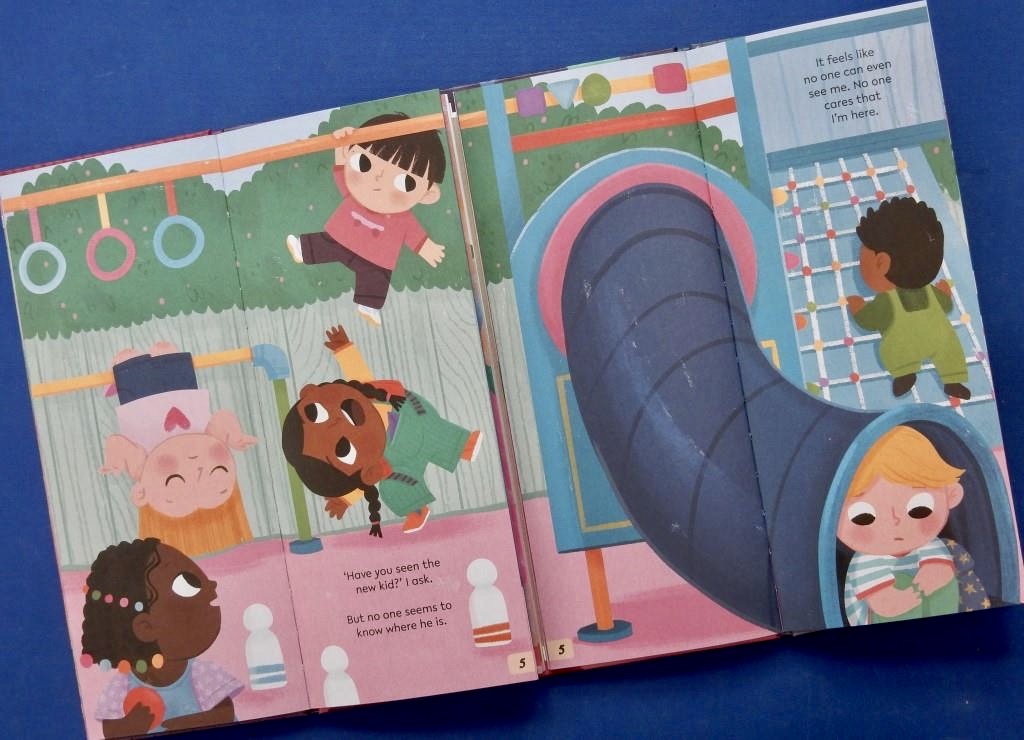
This truly heartwarming story is told from the perspectives of two children, Mae and Joe and it’s a terrific demonstration of there being two sides to every story. On the left side Mae introduces herself telling readers of her excitement about there being a new arrival in town for whom she has written a special letter to give him at school. At playtime though, she’s unable to find him anywhere.
Joe, the new boy tells his story on the right side explaining that he and his dad have just moved to a new home and now everything feels strangely different. He’s eager to make new friends like his dad says but Joe feels invisible in the playground, wishing he could be back playing space adventures with his old friends. Then suddenly …
Could this be the start of an exciting friendship, and further space adventures perhaps …
A smashing, cleverly conceived book that will help young children understand the importance of empathy and how sometimes being in an unsettling, worrying situation might lead to misunderstandings or misconstrual on a newcomer’s part. Both children however show courage: Mae for her persistence and determination to show kindness, Joe for facing up to his fears. Close perusal of Maddy Vian’s bright, inclusive illustrations will reveal lots of galactic theme details such as the sticker on Mae’s letter, toy rockets and Joe’s backpack.
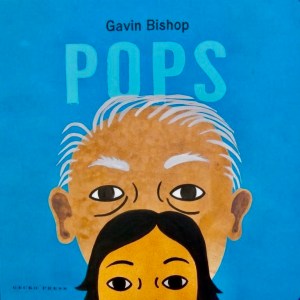
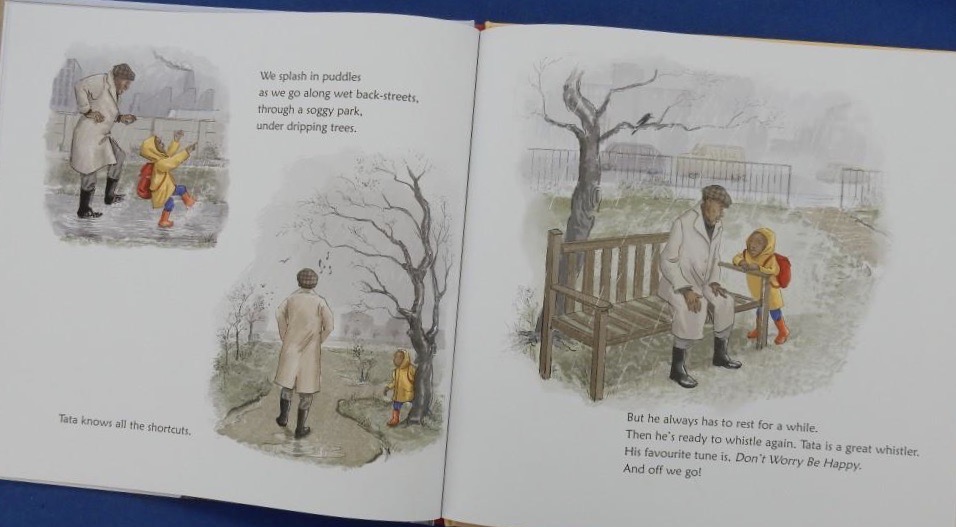
With a straightforward, minimal text and close up illustrations, Gavin Bishop zooms right in to the important elements of an activity while highlighting too, the close bond between a child and grandfather (Pops). We see clasped hands – one large one small, as they meet; a single boot and two small bare feet walking, and so on as the two gather together the essentials (some from the garden), for making their sandwiches – one each. They then tell stories to one another and fall asleep side by side. The love they share is palpable in such actions as the tender manner in which Pops extends a supportive hand just in case the little child drops the egg.
Interestingly we are never shown the whole body of either person as they engage in life’s simple pleasures made all the more enjoyable by their close connection. Full of warmth, this is a lovely book for a grandfather to share with a very young child and a good starting point for conversations about special times shared with individual’s own grandparents.
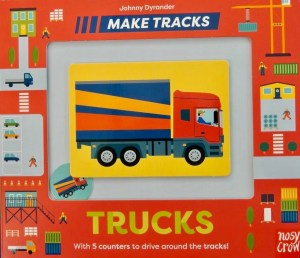
Make Tracks: Trucks Johnny Dyrander Nosy Crow
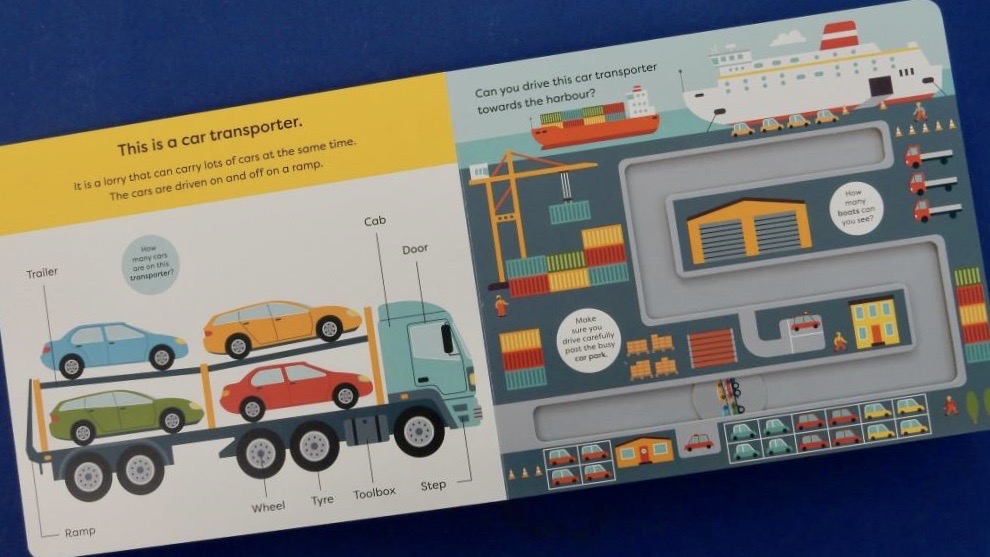
This is a real treat for truck loving young children. In addition to the cover, it introduces five kinds of truck: a forklift, a lorry, a car transporter,
a ‘monster’ truck and a dustbin lorry. The parts of each one are clearly labelled in a large illustration on the verso beneath a two sentence introduction. On each recto is a more detailed scene around which little fingers can manipulate the counter bearing a tiny illustration matching the one opposite. So, for instance in response to ‘Can you drive this forklift around the warehouse?’ children can follow the instruction “Drive up and down the aisles in straight lines.’ and in so doing develop their fine motor skills. On this particular spread there’s also the question “How many lorries are waiting to be loaded?’
Each of the other spreads is equally interactive with a simple counting activity and another question set into the scene. Bright and alluring with the potential for hours of fun learning, what more can one ask from a non fiction board book?
The Hunt for David Berman Claire Mulligan The Moth
This gripping thriller set during the early part of World War 2 is Claire Mulligan’s debut novel. Eleven year old Robert, like many other children, has been evacuated and he’s now living with his grandparents on their farm on the coast of Scotland and missing his parents greatly. His father is fighting and his mother is serving in the WRENS. The boy finds it difficult to adjust to rural life after living in London but he’s keen to use the torch his Dad gave him before he left, suggesting he use it to explore the nearby caves: maybe he’ll even find that treasure his grandfather mentioned.
What he finds however, when he enters one of the caves near Tor Head Farm, is a boy who introduces himself as David. David is a Kindertransport child who has taken refuge in the cave after running away from the cruel farmer that he’d been sent to stay with. Now terrified that he’ll be recaptured and returned to Germany and the Nazi regime, the boy is trying to survive alone.
David has unknowingly carried from Germany in the lining of his suitcase something important. That secret something is an Enigma codebook that is likely to get him killed, for a Nazi secret agent sent to retrieve it is now hunting for him.
Robert feels somewhat conflicted however: Germans are the enemy surely, the people his father is fighting, so can he trust this boy? He provides him with basic necessities – food and warm blankets – while endeavouring to keep David a secret from his grandparents. The lives of the two boys become increasingly entwined and dangerous as little by little the trust between them builds, a friendship grows, and they discover that they have more in common that they first thought and are braver than they ever imagined they could be.
With parts set in the Gestapo HQ, this is a tremendously thrilling, powerfully moving story, rich in detail, exemplifying the incredible courage and resilience of people, children included, during the Second World War. Claire Mulligan has created two superb characters in Robert and David, around whom her superbly crafted tale is constructed. Now, as we witness through the media every day children fleeing from war in Ukraine, her book has an added poignancy.
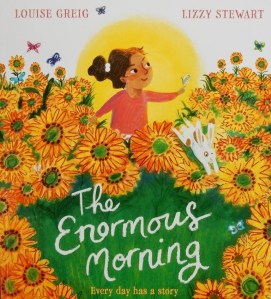
The Enormous Morning Louise Greig and Lizzy Stewart Farshore
‘Inside Day was Morning. It was a small morning. There was not much in it.’ However, there was Pia. And Rabbit.’ And Pia’s papa. But then after they’ve shared a morning enlarging breakfast, Morning keeps on getting bigger.
We accompany Pia and her father on a walk that is absolutely filled with wonder as we witness the glorious sights, sounds, shapes and colours that burst forth into young Pia’s quiet, small world. They cross a wheat field and notice a leaping hare
and from atop a hill, Pia is able to see ‘a whole garden,’ ‘a whole elephant with an elephant’s thought and an elephant’s wish.’ – what a wonderful lyrical and truly original narrative Louise Greig has created as she tells of toys, butterflies, cloud shapes in the blue sky, boats and ships in the sea far below.
Richly layered and richly described is this walk. But it’s not all walking: they stop for a picnic
before continuing their journey, Pia with her senses fully alive to all the amazing experiences and her imagination soaring. Like all mornings though, this one turns to afternoon and then to evening, this one that has become so filled with meaningful experience – just like the little girl’s heart that is full, full of love and a sense of being loved. ‘Inside Day was Morning. It was an enormous morning. There was everything in it. … And inside Pia and inside Pia’s papa was a world of love.’
Just as exquisite as Louise’s words are Lizzy Stewart’s joyful, idyllic scenes with their rich, jewel colours. Louise and Lizzy’s creation, is wonderfully different: author and artist have captured one child’s delight in the world around, truly making this a book to remind us all to slow down, open our minds, our hearts and our senses and savour our world every Enormous Morning.
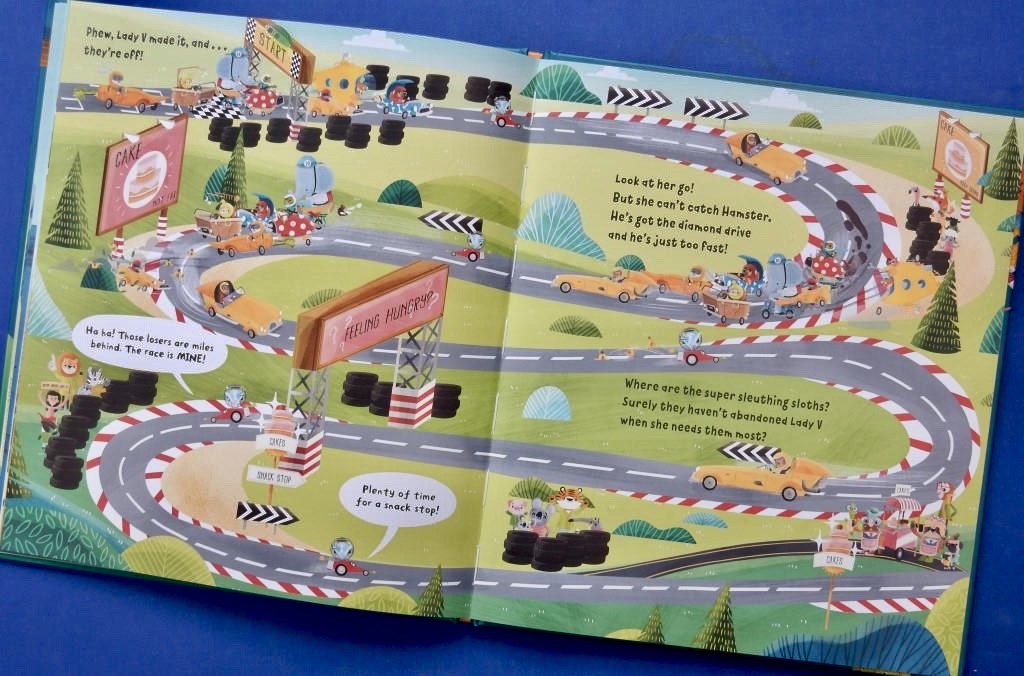
The Upside Down Detective Agency Ellie Hattie and Brendan Kearney Little Tiger
Super sleuthing sloths, Stella and Stan are so alike that only the very smartest can tell who is who. They’re in their Super Sleuth HQ one day when there’s a loud knocking on the door. It’s famous racing car driver Lady Veronica Velocity Speed announcing woefully that somebody has stolen the diamond warp drive from her car and without it there’s no chance she’ll win The Big Race to be held that very day.
Oh woe! Oh disaster. There’s no time to lose: Stella and Stan spring into action immediately but they’re going to need assistance from we eagle-eyed readers if the case is to be cracked quickly.
So begins Ellie Hattie and Brendan Kearney’s smashing interactive picture book that takes the sleuths, Lady V. and readers on a break-neck dash. Well maybe not exactly; there just might need to be the odd stop for a tasty snack before examining the racing car, her residence and workshop for clues.
Pretty quickly the sleuths are onto the thief’s identity: seemingly a rascally rodent has gone rogue but having identified the criminal, catching him is another matter.
The race is on – literally; but who will cross the finish line first? That is the vital question.
A mystery for readers to help solve that will not only be lots of fun, but with Brendan’s intricately detailed scenes with their clues aplenty, will also be great for developing observational and problem-solving skills in children.
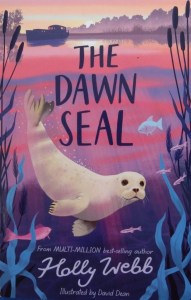
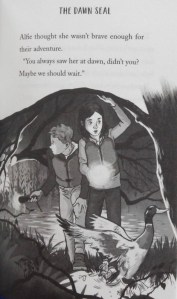
The Dawn Seal Holly Webb, illustrated by David Dean Little Tiger
Lissa, soon to be ten, is spending the summer holiday with her dad on his barge Rose Dawn, on the River Thames. She’s been looking forward to having some time with him but it doesn’t happen in the way she’d hoped. Yes, she loves the special room Dad has created for her and there’s so much wild life to see, but then on the third day of her holiday comes the news: Dad has taken some last minute work and so won’t be free for at least two weeks. What about the paddle-boarding he’d promised? Will that still go ahead? The answer is yes, but now all Dad will do is drop her off and then go back and work.
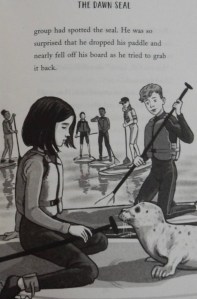
However, during her first paddle boarding lesson Lissa meets Alfie who lives on one of the houseboats; she also spots an animal swimming in the river that Alfie doesn’t think is a dog as it has no ears. In the next lesson she feels her board rocking unexpectedly and then finds herself face to face with a seal:
a seal that she gets the feeling needs her help; but she’s concerned she might merely scare away Pup as she names the creature.
Can Lissa help the seal to return to its home? Perhaps, with the assistance of Alfie
and another houseboat dweller, Rosy. To that end she does lots of research, spends a fair bit of time observing, both of which fill the void her father’s unexpected job has created.
Such is Holly Webb’s ability to draw readers into a story that as we follow Lissa’s efforts to ensure Pup returns safely to the Thames estuary, it feels as though we too are participating in both the rescue and the ups and downs of her family life, sharing her emotions every step of the way. David Dean’s black and white illustrations certainly heighten the feelings of loneliness, concern, empathy, disappointment, determination and delight during the drama. I’m sure KS2 readers will be swept away, loving every moment of this heartwarming tale. It would also be a lovely class read aloud.
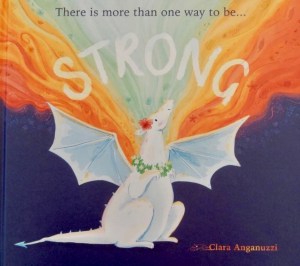
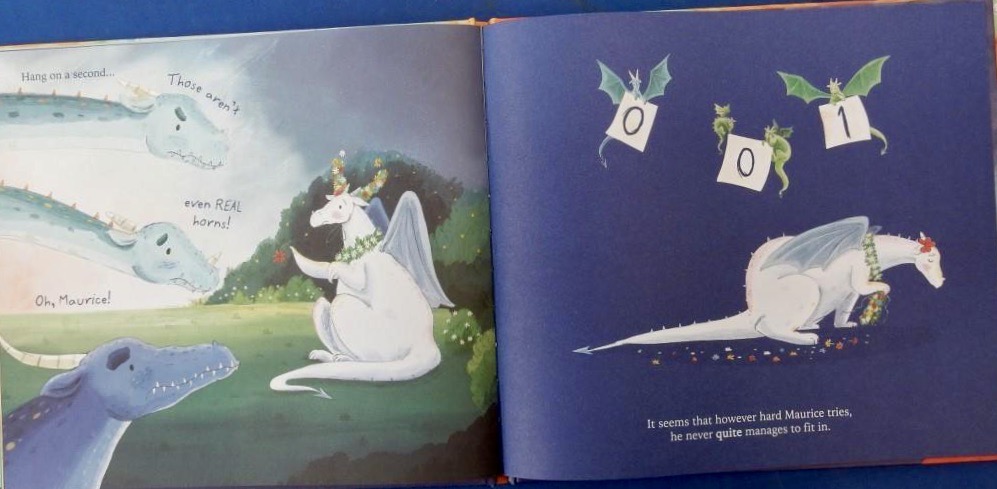
This lovely celebration of unashamedly being yourself stars a dragon named Maurice. No, he’s not tough, powerful and given to snarling and growling like his fellow dragons; far from it. Maurice is gentle, quiet and small, and an adorer of flowers. These he seeks out at every opportunity, fashioning them into wondrous floral arrangements. Other dragons have no time for such activities; they far prefer fire breathing and competitions of strength. Indeed Maurice has a brother that is a champion as these skills.
Now though, Maurice too is entering a dragons only contest and hoping to create some of his splendiferous hibiscus flowers. However that’s not what happens when it comes to his turn to throw a flame; nor does he impress with magnificent horns and ferocious teeth.
It’s no use, thinks a dejected Maurice as he lies down in the gentle rain, I just don’t fit in here.
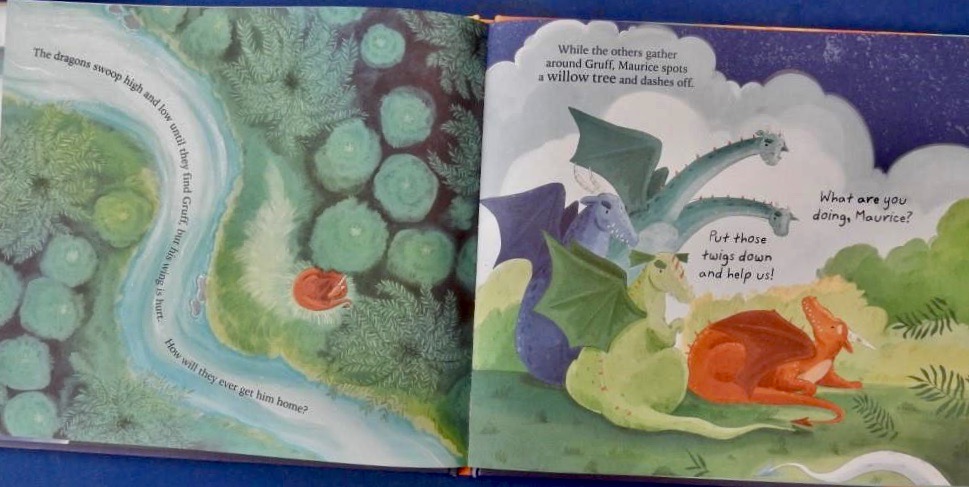
As the storm clouds gather and it’s time for the competition’s final round – the gold treasure hunt – Maurice wants to delay, but brother Gruff is determined to defend his title immediately and off he soars into he clouds. However the storm continues to rage and the other dragons start to worry about Gruff’s failure to return. Maurice ponders and puts forward an idea. Can it possibly work though? To his fellow dragons, he doesn’t appear to be doing very much to help his injured sibling.
Finally however, they start to see Maurice in a completely new light and as for Maurice, he comes at last to a realisation about himself: he’s always been strong and his strength comes from being true to himself; delectably different and proud so to be.
Clara Anganuzzi’s portrayal of the changing feelings both of Maurice and the other dragons sweep readers along in the gentle dragon’s flight towards self understanding.
The Sea Below My Toes Charlotte Guillain and Jo Empson QED
Part of the Look Closer series and following on from The Ground Beneath My Feet and others, and also presented concertina style, extending to 2.5 metres, author Charlotte Guillain and illustrator, Jo Empson, take readers on an investigation into what goes on beneath the sea.
With wet suits on, our journey moves down through the various zones beginning near the surface in the Sunlight Zone. Here there’s a forest of kelp, an algae that is the food source and safe habitat for lots of different creatures. Among the kelp sea otters can be found swimming, diving, and perhaps using rocks to break apart the shells of animals it intends eating. Shoals of mackerel too, move through the water at the surface, as do Stellar sea lions and ghostly moon jellyfish. Then a little lower the surface-breathing orca might be found, hunting for food.
The next layer is the Twilight Zone and it’s there that the ocean begins getting darker and more shadowy. There all manner of strange and wonderful marine creatures can be seen, perhaps even an almost transparent glass octopus or a barreleye fish with its see-through head. Some of the creatures at this level are bioluminescent including the lanternfish and one kind – the swell sharks – emit a green light, possibly to attract a mate. One of the oldest animals – the vampire squid – has been around deep in the ocean for about 300 million years. Amazing! You’ll likely notice tiny particles drifting downwards from above : called marine snow this shower comprises poo and decaying flora and fauna from the upper layers, and is food for many creatures.
At a depth of about one kilometre the Midnight Zone begins; there the water is almost freezing and sunlight cannot penetrate. This level is home to some weird creatures including gulper eels, about 200 species of anglerfish, and chimera (ratfish). Beware of atolla jellyfish with their long trailing tentacles that might sting should you get too close. Go down further and there is the Abysmal Zone: very few fish live so deep due to freezing temperatures and enormous water pressure from above, but you might come across snailfish or the Kaup’s arrow tooth eel and there are tube worms.
There too is melted rock – magma – that sends bubbles out through hypothermal vents on the seabed: it’s there that the tube worms find the bacteria they feed on. it’s also where underwater volcanoes form from hardened magma.
In addition to the wealth of animals and plants, we also find out about the technology used under the sea, from scuba breathing equipment to oil pipelines and deep sea submarines; and come to know about the impact humans have had on under the sea.
With its informative text, this is a book that readers will want to revisit many times as they continue to be fascinated and awed by this incredible subaquatic world. A world that Jo Empson portrays so superbly in her richly hued painted, stencilled, and collaged illustrations that are teeming with life. Definitely one for home and primary classroom collections.
I am NOT a Prince! Rachael Davis and Beatrix Hatcher Orchard Books
Somewhere on the shores of a misty lagoon, every springtime under a silver mist, so the rhyming narrative says, magic frogs gather in anticipation of a magical transformation. A dip in its waters and each one will emerge as a prince. All except one that is: Hopp has absolutely no wish to be a prince despite what the other frogs say. “It’s not for me. That’s not what I am meant to be.” is Hopp’s response to being told becoming a prince is a frog’s duty. Consequently the naysayer is banished from the lagoon and the lonely creature sets forth to the stream unsure which way to go.
Before long Hopp has come to the aid of a little Mouse in trouble, a stuck grizzly bear and a dragon, each one thanking the frog profusely and calling Hopp a prince. As night falls, poor Hopp is in despair,”I’m not a prince -they’ve got it wrong! / Oh where, oh where, do I belong” comes the cry. But then …
The kindly wizard completely understanding why those helped have called Hopp a prince, issues an invitation to the frog, “Well, tell me what you are instead.” Hopp whispers in the wizard’s ear and he in turn bestows upon the little frog a wonderful gift.
Meanwhile back at the lagoon, realising they’d been too judgemental, the other frogs are now concerned for Hopp’s well-being; will their fellow amphibian ever return? Then from the bushes they hear a BOOOO! and there is Hopp, safe and sound, totally transformed and almost bursting with pride. Hopp’s isn’t the only transformation however, for now each spring down at the lagoon something wonderful takes place …
Bursting with colour, this is an empowering read aloud with magical happenings that celebrates being true to yourself and remaining so in the face of opposition.
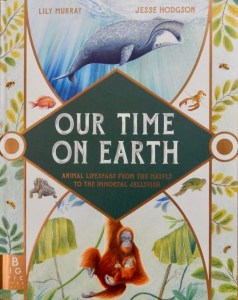
Our Time On Earth Lily Murray and Jesse Hodgson Big Picture Press
Authors are always looking for new and exciting ways to look at animals and how they live. Here, starting with the very shortest and ending with the longest, Lily Murray explores lifespans throughout the animal kingdom. The award, if there were one, for the shortest living creature goes to the wonderful-looking mayfly, the lifespan of which can last anything from five minutes (an American species) to twenty four hours during which time the adult form sheds its skin a final time and a female, having mated lays her eggs and dies in the water whereas the male flies to ground close by and dies there. It’s incredible to think that mayflies have been on Earth for at least 300 million years.
I was surprised to discover that a worker honey bee born in springtime, lives for only five to seven weeks; what a huge amount she packs into that short time, changing her roles as she ages, details of which are given on the relevant double spread. In contrast Periodical cicadas, one of the longest-lived insects might live for as long as seventeen years going through five stages of development deep down where they suck the sap from roots until the soil is sufficiently warm for them to emerge from the ground. In their adult form though, cicadas live for a mere five or six weeks; how they can tell when their seventeen year lifespan has passed, not even entomologist know.
Moving on to some small mammals: both the opossum and the Etruscan shrew live between one and two years, due in part to them being hunted by hungry predators.
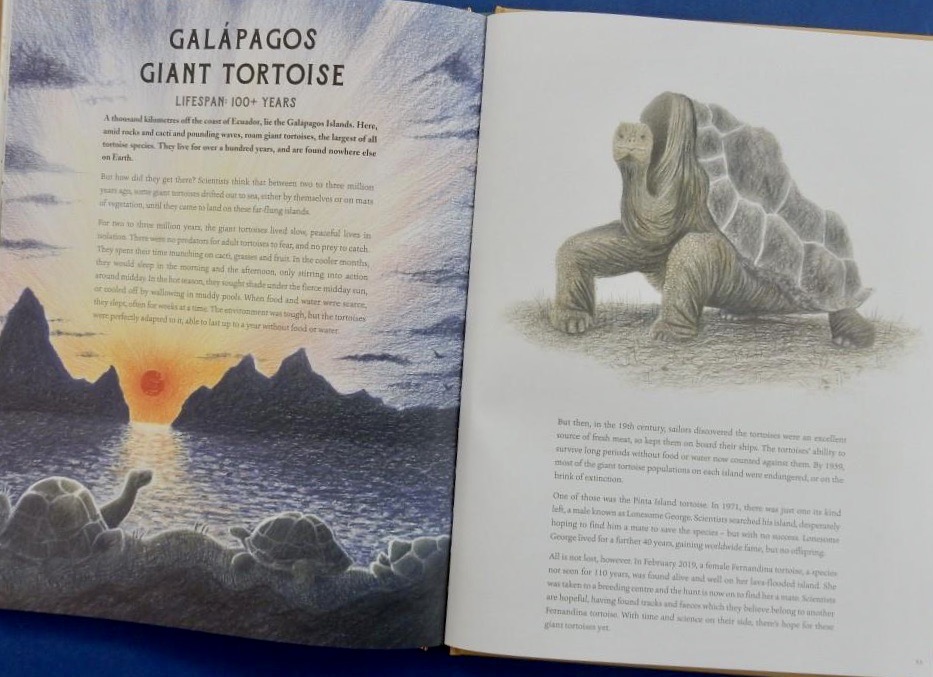
There are examples of reptiles, including the thought-to be extinct Galapagos Giant Tortoise, one of which was reported in the news this month as having been found alive,
as well as arachnids, molluscs, large mammals and with a life span of 11,000 years the longest living creature of all and found in the deep sea, the Glass Sponge.
With a wealth of exciting information, this gorgeous book is engagingly written by Lily Murray and beautifully and realistically illustrated by Jess Hodgson who places each animal in its natural habitat. A book to keep and a book to give; a book for home and a book for the classroom.
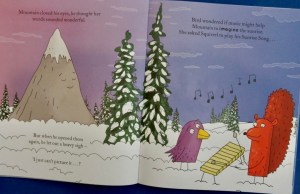
Move Mountain Corrinne Averiss and Greg McLeod Oxford Children’s Books
Although the hills around Mountain receive the sun’s rays each morning, because the sun always rises behind him, his face stays in the shade. So much does he long to feel sun’s beaming warmth that he tells Bird he wishes he were able to turn around. Bird flies off to seek help from Bear and the two of them push with all their might but Mountain remains firmly as he was.
Other ideas are tried including the use of music for conjuring up an image of the sun and although Mountain loves this, it only serves to make him want more than ever to see the sun rise.
However Bird has one last idea tucked beneath her feathers. Can this one possibly be a success? Perhaps it’s not possible to move a mountain in the physical sense but nonetheless this particular Mountain is more than happy with what he sees at dawn next day. This beautiful tale celebrates friendship, kindness, thinking outside the box and ingenuity. Truly the sun’s warm glow shines forth in Corrinne’s words and Greg McLeod’s gently humorous illustrations.
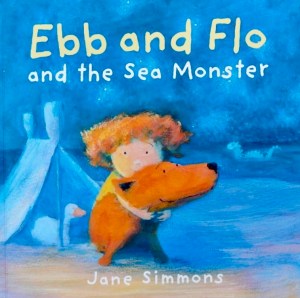
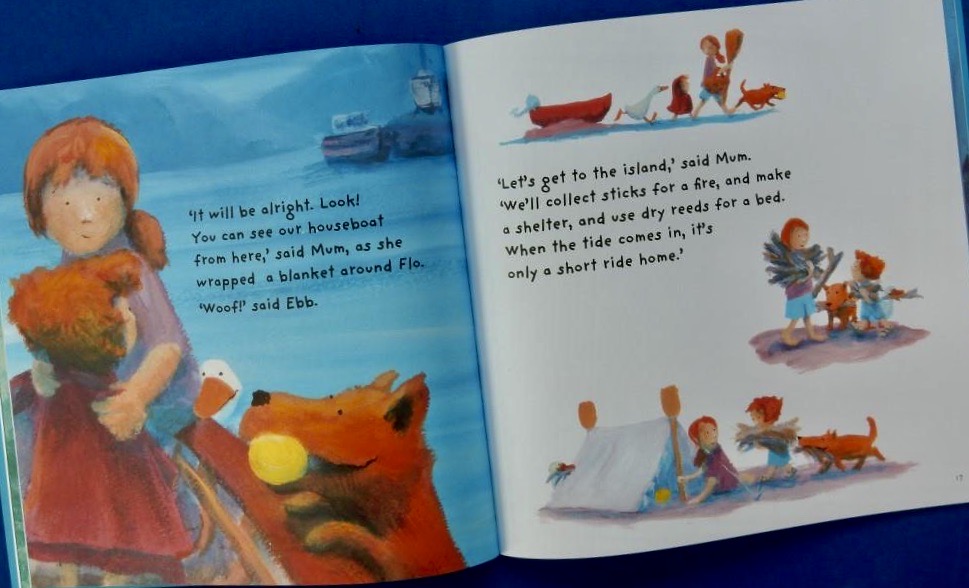
Ebb and Flo and the Sea Monster Jane Simmons Graffeg
As Flo sits with Granny sharing a local paper and focussing on a picture of Morgawr the mythical sea monster, Ebb’s ball bounces away and so begins this wonderful moonlit adventure as they search for the ball which goes overboard on their way home across the bay, and perhaps for a sighting of Morgawr too. But they find themselves marooned and have to camp put on the beach.
As Mum, Flo and Ebb gather around the fire, listen to nature’s sounds and stare out at the star-filled sky, they wonder about the enormous monster that might or might not be lying in wait for them somewhere out at sea. Later with Flo tucked up under a blanket, Mum has to leave the tent to collect more firewood. There in the shadows are Flo, Ebb, that bouncy ball – again – and the possibility of a scary monster lurking close at hand.
This latest of Jane Simmons’ modern classic rereleases, with its softly spoken words and beautifully hued, hazy illustrations will surely delight a new generation of young children as much as it did those who encountered Ebb and Flo over twenty years ago.
Thanks to Little Door Books for asking me to be part of the blog tour for this lovely book: I’m definitely happy to do so.
Happy Sad Pippa Goodhart and Augusta Kirkwood Little Door Books
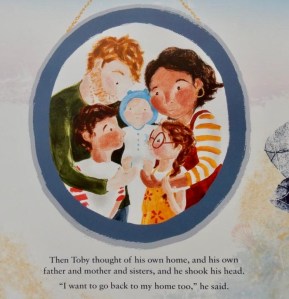
Young sea loving Toby becomes conflicted in more ways than one in this captivating picture book. Living by the seashore, the boy spends a lot of his time delighting in the natural objects he finds thereon as well, as playing in and out of the waves.
One day as he peers into a rock pool, Toby notices a fishy tail moving in the water; he dips in his net and pulls out not the fish he anticipated but a tearful little mermaid. She responds to Toby’s “Why are you sad?” by telling him she became stranded when the tide turned. Her feelings are palpable in Augusta Kirkwood’s portrayal of the two during this encounter. With great care and the best of intentions, Toby picks up the mermaid and takes her home with him.
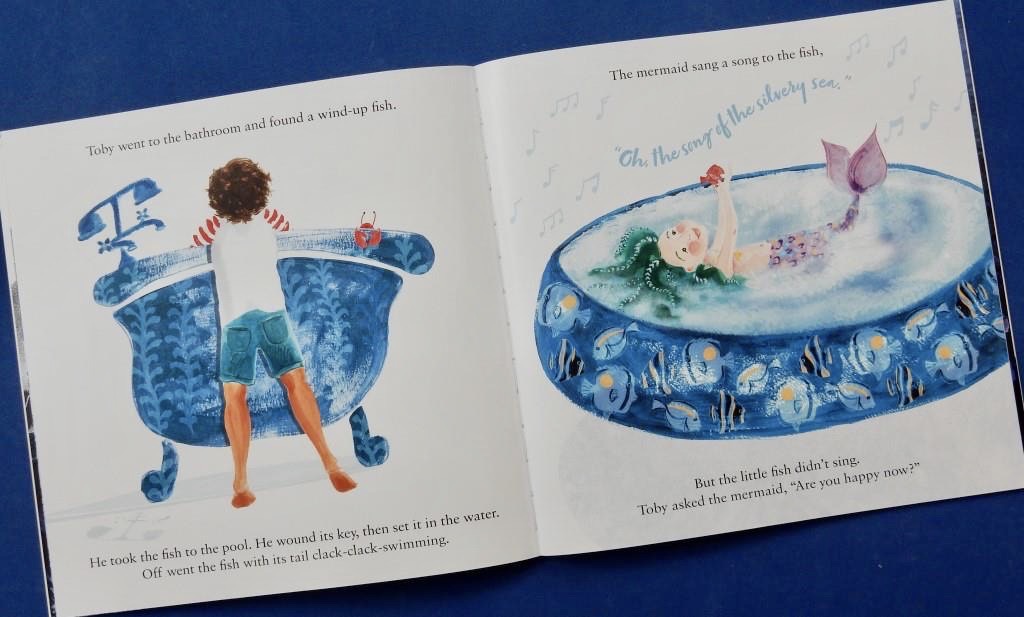
There, his Mum and Dad help him accommodate the little creature. Her response to the boy’s “Are you happy now” is that whereas she likes the pool, she misses the company of her fishy friends. Toby knows just what to do …
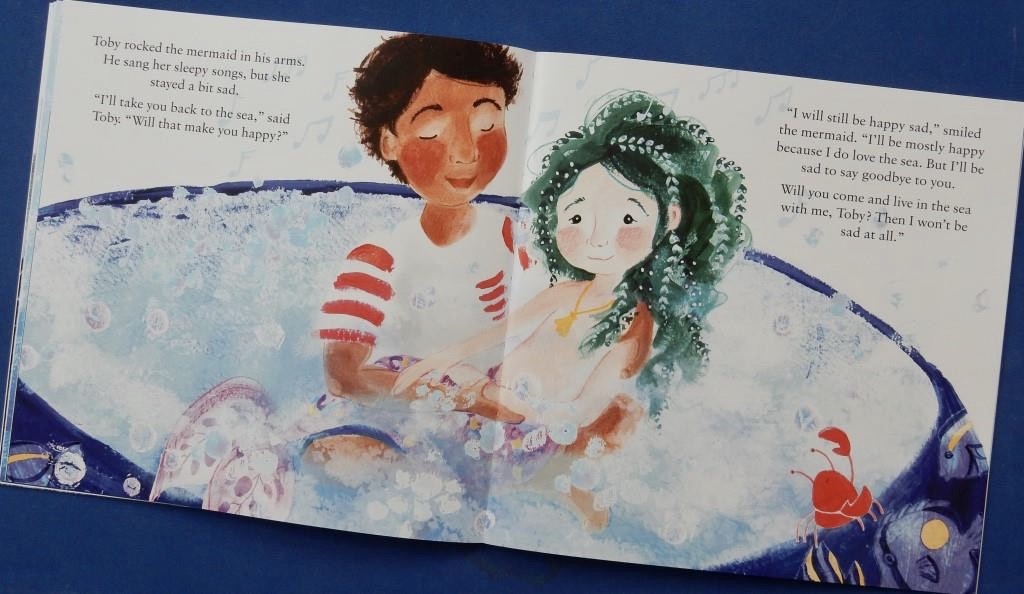
Now the mermaid feels “happy sad” – happy with the fish but sad because she isn’t able to play with her father. The empathetic Toby continues to add things to the pool but the mermaid remains “happy sad”, even when he says he’ll return her to the sea, for now a strong bond of friendship has formed between the two.
Surprised when the mermaid invites him to live in the sea with her, Toby considers this,
but then somewhat reluctantly, takes her to the water’s edge and watches her swim off. You can imagine how they both feel about their parting but perhaps it won’t be a forever one.You never know.
Pippa’s powerful story of empathy, kindness and putting others before yourself, shows that it is possible to feel both sad and happy at the same time. Together with richly coloured illustrations by Augusta Kirkwood, portraying so clearly the emotional changes both main characters undergo, this is a thought-provoking book to share, especially with KS1 children. It’s rich in classroom potential too.
You Can Be A Supercat Rosamund Lloyd and Chris Dickason Little Tiger
Here’s a rhyming narrative that, together with fun feline scenes, invites little ones to participate in some role play. I’m sure small human would-be superheroes will love the opportunity to emulate wonder kitty Supercat as she whizzes around smiling at everyone and sporting her snazzy underpants, cloak and funky purple mask (there’s even one of those tucked inside the front cover for the little reader to wear) and performing acts of kindness as she goes. She’s always ready to offer help or invite a lonely person she spies to play with her, and despite not having lots of toys Supercat is more than willing to share those she has.
When it comes to a vocal rendition, this wonder kitty will sing with gusto and assuredly bring on a laugh as she performs with her feline flair. What youngster would want to turn down the chance to be a Supercat just like her; for sure it’ll make those who seize the opportunity feel good inside.
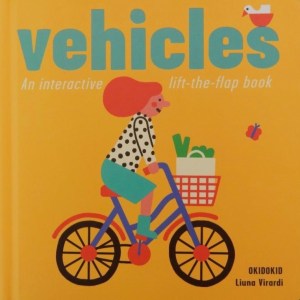
Vehicles OKIDOKID, illustrated by Liuna Viradi Little Tiger
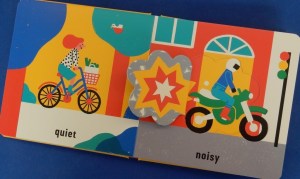
This lift-the-flap book uses all kinds of means of getting around to present and explore five pairs of opposites. Thus a tricycle goes slow whereas a train moves fast; a submarine dives down low but a hot air balloon drifts high up in the sky; as she moves a pedal cyclist is quiet, on the other hand a motorcyclist’s vehicle is noisy.
There’s a small yacht sailing on the waves and there’s also a big steamboat and finally, the pink van is empty but the larger van has a full load. The book becomes interactive when little ones open the flap on each recto but adults can instigate many more interactions. For instance they might ask a child, “where do you think the train is going to?”; “how many passengers can you count?” and so on – there are numerous possibilities herein that are presented in Liuna Viradi’s bold, bright stylised illustrations
Here are two books intended to support the mental well-being of youngsters.
The Silent Selkie Juliette Ttofa, illustrated by Paul Greenhouse Routledge
“We have to remember in order to heal,” So says one of Elif Shafak’s characters in her brilliant novel The Island of Missing Trees and so it is in this picture book.
Using the metaphor of a hidden wound this perceptive story, written by a specialist educational psychologist and child therapist and engagingly illustrated by Paul Greenhouse, is ultimately one of reassurance. Aiming to offer a safe space in which children affected by trauma can, with the help of an understanding adult, begin their crucial healing journey, it is intended to be used along with an accompanying guidebook.
The picture book shows the journey towards healing taken by a deeply traumatised young selkie that is so troubled that she’s lost the ability to speak. With her wound buried deep within she expresses her feelings through the weather
and this leads to her being questioned and then isolated in a distant cave by the seal folk who fail to understand her plight.
There she remains engulfed in a fog, growing progressively wilder until one night as dreams intrude upon her sleep, her hair becomes entangled in the nets of a fishing boat. She’s dragged from her confinement and after unsuccessful attempts by the seal folk to rouse her, the trawler pulls her to a distant unknown land.
On waking she finds herself on a sandy shore, still entangled in the net but showing some bare skin on her tail. In the full sun, it feels as though her golden scales are aflame. Then holding a shiny stone she glimpses a splinter protruding from her tail. The pain causes her to cry out but attempts to get help from self-serving creatures that stop, lead to more pain and the loss of some of her golden scales. The intensity of the burning increases and the Selkie begins picking off her own scales and that night her slumbering body remembers the long forgotten story of how as a pup, the thorn entered her skin inflicting a wound. Her moans echo through the deep sea. Next morning she sees a humpback whale and the two sing together.
Thus begins the release from her entrapment: “It is time for you to be who you really are,” the empathetic whale tells her, assuring the `Selkie’ that she won’t be alone on her healing journey.
Daisy Fitzpatrick and her Worries Nancy Carroll Ragged Bears
Daisy Fitzpatrick is beset by anxieties, and her mind is full of worries, the kind that could trouble any of us from time to time. I certainly go along with her on the fear of heights, though not really most of her other worries – buzzing bees (and other minibeasts), the dark, the sea, vegetables, storms, dying ( I guess most of us aren’t eager to contemplate the end of life), crossing the road, being alone, her parents’ separation. She considers a dozen worries in all and by the end of each poem, has found the means to discover a new perspective on each troubling issue.
Sensitively written by an author who shares many of these fears with Daisy; after the rhymes she provides helpful notes and suggestions including mindfulness and finding someone else with whom you can talk over particular anxious feelings – as well as links by which readers can get additional information. There are occasional recipes that include a vegetable ingredient too.
An unusual book to help children face and eradicate childhood worries.
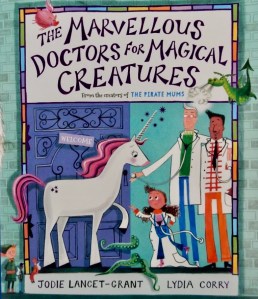
The Marvellous Doctors For Magical Creatures Jodie Lancet-Grant and Lydia Corry Oxford Children’s Books
Here’s a new and magical tale from creators of The Pirate Mums, team Jodie Lancet-Grant (author) and Lydia Corry (illustrator).
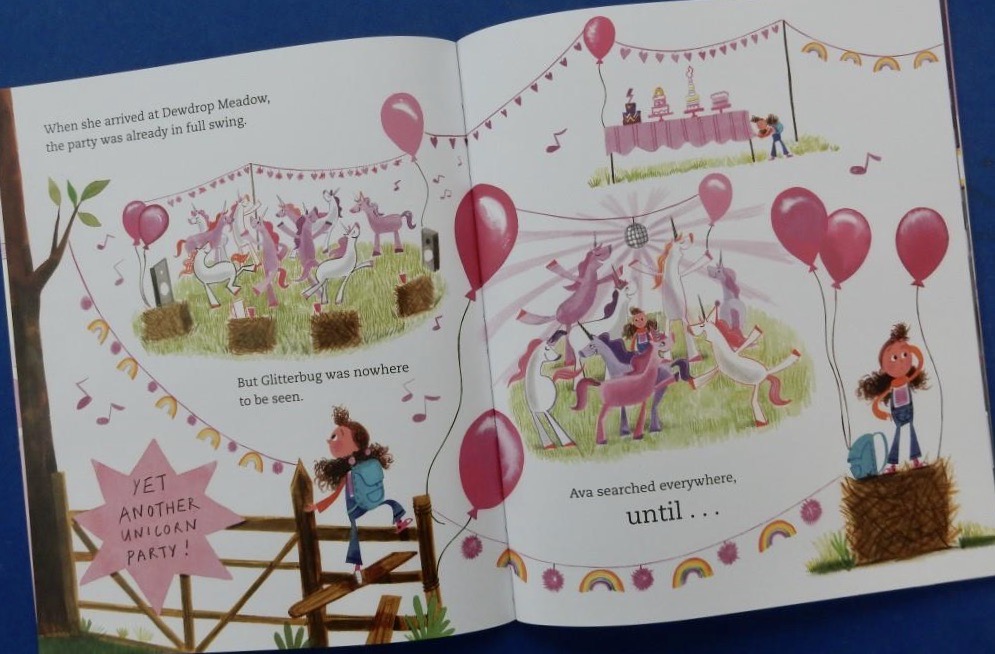
Young Ava is an aspiring doctor and loves to assist her fathers in their surgery and there’s nothing she likes better than having a mystery to solve. That she certainly has in the case of unicorn, Glitterbug and her dads give her permission to go out the following morning in search of clues. However, having spent all day among the unicorns as they prepare for a party, she hasn’t found anything to help solve Glitterbug’s tummy trouble mystery. Surely though no magical creature has a problem that cannot be solved by the Marvellous Doctors for Magical Creatures?
Back goes Ava the following day, more determined than ever to discover what’s bugging Glitterbug: she can’t find her among the partying unicorns
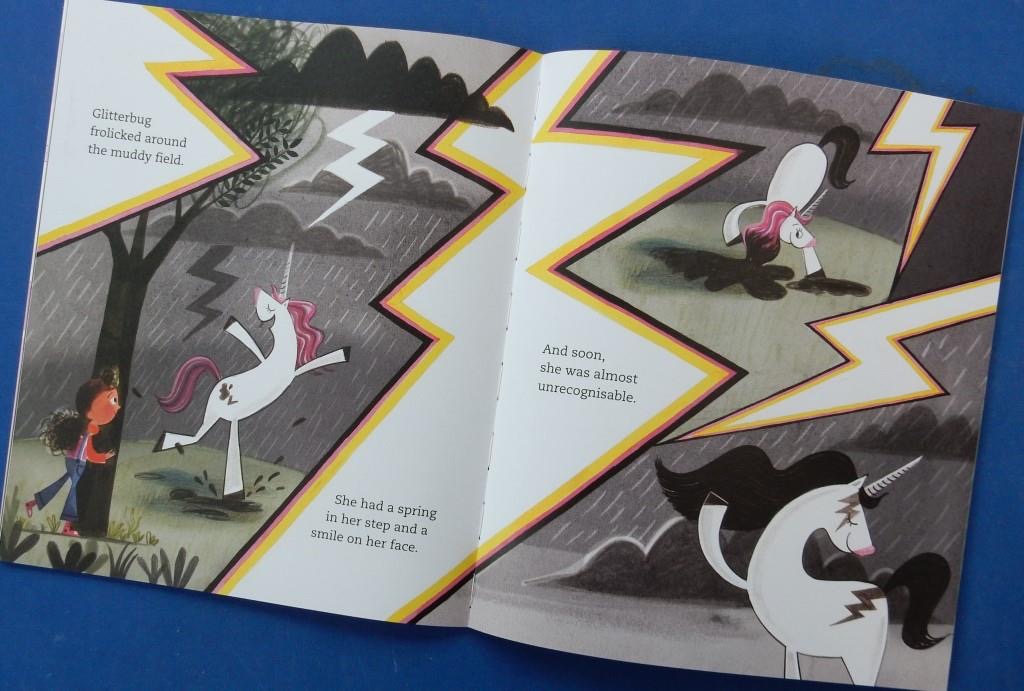
but eventually Ava discovers the ailing unicorn causing her to dash back to join the others although it’s evident to Ava that Glitterbug is faking her enjoyment. Then suddenly down comes the rain and soon it becomes clear to Ava that Glitterbug has undergone a change. More than one in fact.
With its sparky words and vibrant, detailed illustrations, this cracking book celebrates divergence, determination, doctors, finding new friends and the occasional rainbow.
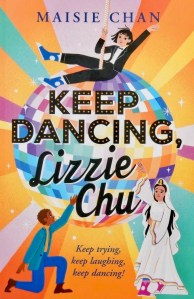
The Lizzie Chu of the title lives in Glasgow with her grandfather, Wai Gong, a ballroom-dancing enthusiast, but since the death of his wife, Grandpa has started acting strangely, forgetting things and spending lots of time talking to his statue of the Chinese goddess of kindness, compassion and mercy, Guan Yin. Lizzie already has her hands full with shopping, cooking, even making sure household bills are paid, but now there are additional things to contend with such as Grandpa almost getting run over by a bus; and she does sometimes find it rather lonely since he’s started eating his evening meal in his room.
Then comes Lizzie’s twelfth birthday and it looks as though Wai Gong has forgotten all about it: not so her friends Chi and Tyler though and in the end she’s asked to go round to Chi’s to celebrate, which she does. When she gets home after an eventful time at the Phams, her grandpa surprises her by handing her an envelope, not from himself but from Grandma Kam. Inside are a jade pendant, a note and four tickets for the tea dance at Blackpool’s Tower Ballroom in November.
Now all she has to do is to learn to dance and most important to get to Blackpool: it won’t be easy as there’s no money to spare and Wai Gong is now refusing to leave the flat and also insisting that he won’t go to Blackpool. Weirdly though when Lizzie goes to the Comic Con event she’s saved for ages to visit, she discovers her Grandpa there and he’s acting even more strangely than ever; and then he disappears.
To her relief when she returns to their flat there he is and something he says, gives Lizzie an idea of how to get Wai Gong to agree to go to Blackpool. Will she succeed in her mission? Perhaps with help from Chi and Tyler, some very clever costumes and a big brother with an old Mini, Lizzie might just manage it; but can anything help Wai Gong get better?
With her poignant, sometimes funny, and uplifting intergenerational story, once again Maisie Chen shows what a terrific storyteller she is; her characters endear themselves to you, especially Lizzie with her determination, powers of persuasion and problem solving. Cha-cha-cha anyone?
(Backmatter includes information about how to reach out for support with the dementia and grief issues raised in the story.)
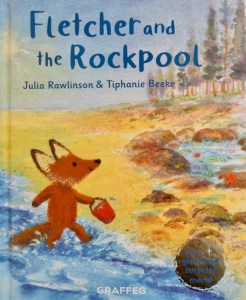
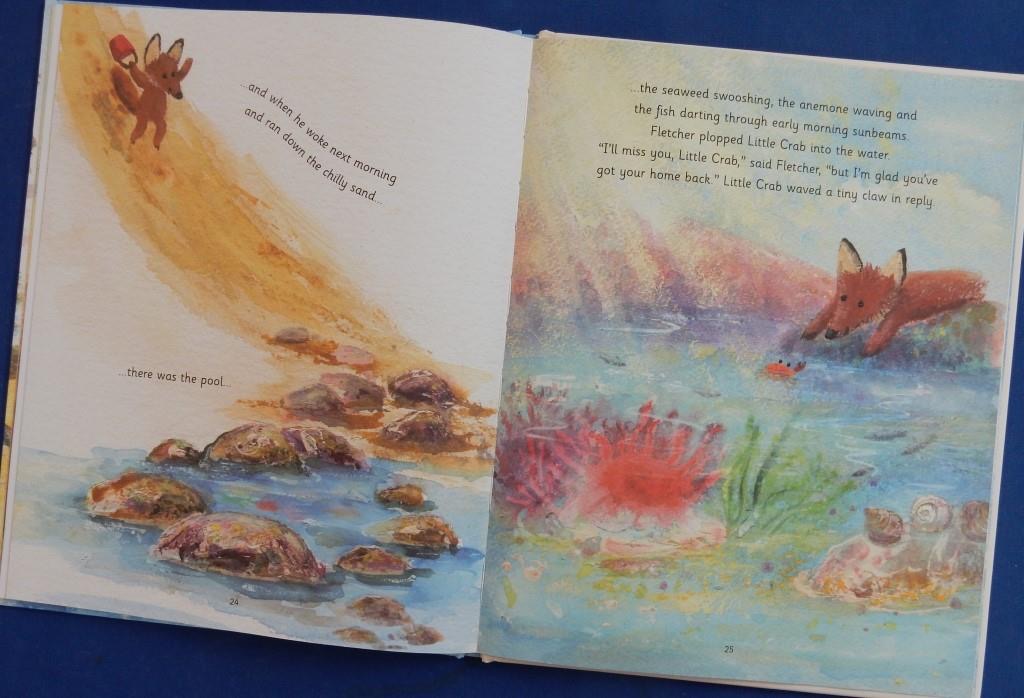
Fletcher and the Rockpool Julia Rawlinson and Tiphanie Beeke Graffeg
Summer has come, the ideal time for inquisitive young Fletcher fox and his mum to foray from their woodland home for a seaside visit.
While Mum makes a camp on the seashore, Fletcher heads down to the water’s edge, enjoying the feel of the sand beneath his paws and the waves splashing his toes. Coming upon a rockpool, he stretches himself out flat and gazes into the water observing the creatures and seaweed therein. Suddenly he notices that the pool is getting smaller and he’s concerned about the fate of the limpets and sea anemone. Unaware of the sea’s tidal ebb and flo phases, so misunderstanding what is happening, the helpful Fletcher dashes to and fro filling his bucket with water and tipping it into the seemingly ever shrinking rockpool.
His behaviour puzzles a watching seagull and it tries to tell him about the tide but Fletcher is distraught.
All he can do is save Little Crab he decides, so he takes it back up to where his Mum has made the camp, creates for it a seaweed blanket and falls asleep alongside the crustacean.
Imagine his surprise and joy when in the morning he finds …
Tiphanie Beeke’s soft glowing paintings (the final one with a sprinkling of silver) evoke both the seashore and Fletcher’s concerns about the rockpool fauna and flora and are a perfect match for Julia Rawlinson’s lyrical, wonderfully warm words as they both pay poetic tribute to the summery seaside. I have no doubt this latest Fletcher story will resonate with young listeners, as well as introducing them to the idea of tidal movement.
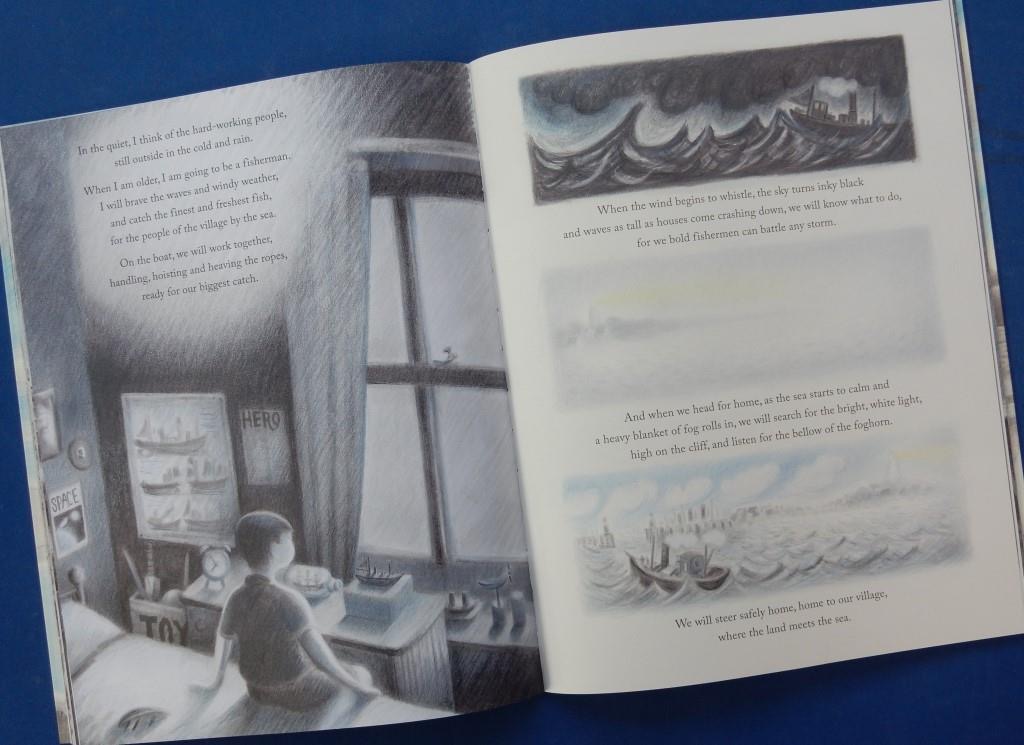
There’s a gentle lyrical feeling about Paula White’s highly detailed illustrations for this book, which is set in a beach village on Suffolk’s east coast, her erstwhile hometown that was also home to a thriving fishing community until the devastating Great Floods in the early 1950s.
A watchful young boy describes the grown-ups working hard at their various occupations: the shop-keepers, the blacksmiths, the basketmakers, the bakers – chiefly his father, the sail-makers, the net-makers and rope-makers, the coopers who make barrels in which the fish were pickled, the fisher-girls from Scotland who prepare, pickle and pack the fish and most important of all, the fishermen out in their boats while everyone else is asleep.
The boy narrator is an aspiring fisherman who imagines himself hard at work aboard a fishing-boat, helping his fellow team members at the ropes, hauling in a fine catch and perhaps battling against the elements, before sailing back to the safety of the village.
One can almost smell the wonderful aroma of his father’s fresh bread wafting across the bay to welcome both the returnees and the new day as it dawns.
It’s not just bread that his father bakes but also biscuits, buns, the boatbuilders’ favourite bacon butties. The boy loves to help in the bakery, basking in the warmth and glow within while also thinking about those outside, who toil in the cold, windy weather. He watches too, the exchange between his father and one of the returning fishermen who comes into his bakery.
A nostalgic, respectful, loving look at a community in a time gone by when everybody knew and supported one another. this lovely book concludes with a recipe for hot coconut buns taken from the author’s grandpa Percy’s notebook.
Paula’s incredibly beautiful, realistic pen-and-ink artwork, though very different in artistic style, for me is imbued with the spirit of Edward Ardizzone.
The Name Game Elizabeth Laird and Olivia Holden Tiny Owl
The little girl narrator of this story is at home and bored without anybody to play with. Suddenly there comes a tap on her window: it’s a bird the name of which she doesn’t know. So she asks and the response is ‘I’m a magpie, darlin’ … ‘ On hearing that this bird is also a jewel thief and receiving an invitation to surprise him with another name, the child suggests Diamond Dodger. From its response she assumes the bird is pleased at this. What follows is a lovely imaginative game wherein the girl thinks up new names for in turn, a tall tree close by. Emerald Queen, that one becomes, followed by a butterfly that lands on the window sill – I wonder what you’d call it –
and a cat with a long swishy tail that thinks herself special.
By this time, the little girl, content in a world of her own creating, is no longer bored: as she ventures outside, she intends to continue her name game.
Cleverly combining the natural world and the power of the imagination Elizabeth Laird’s is a delightful story to share and I have no doubt that young listeners will after hearing it, want to emulate the little girl and create names for things they encounter in nature. Indeed the Name Game could be played with a focus on other settings such as a particular room at home, or in school. The potential is enormous, but most important is that you share the book taking time to enjoy Olivia Holden’s beautifully detailed illustrations of the narrator and her immediate environment.
The Invisible World of Germs Isabel Thomas, illustrated by Geraldine Sy and Ana Seixas The Secrets of the Universe Dr Mike Goldsmith, illustrated by Adam Quest and Ana Seixas Oxford Children’s Books
These are the first two in a new small format non-fiction series Very Short Introductions for Curious Young Minds. Full of fascinating information, it was written in consultation with one expert in the field (Alan Redford of Liverpool University) and contains easily digestible infographics, photos and dialogue boxes in addition to the explanations, and in each chapter there’s a ‘Speak Like a Scientist’ feature that provides readers with key terminology. If you want to discover what germs are, something about their history, key scientists and other ‘germ heroes’, how germs are transmitted, how our natural defences work,
the affects of medicines on germs, ponder the questions ‘Will there ever be a world without germs?’ and what might be the future of germs, then this engaging little book is definitely for you. It’s also one to add to KS2 class collections.
I was equally impressed by The Secrets of the Universe, this one being written by a doctor of astrophysics in consultation with Cambridge University cosmologist Sunny Vagnozzi. Again the writing style is engaging and lively and there are the same key features as The Invisible World of Germs – infographics, photographs and cartoons and most important the key questions such as What is the universe?; how was it discovered”; what are the important findings relating to the universe and who were the scientists responsible? …
how big is the universe and what is our place therein? are explored in bite-sized, easily digestible chunks. Find out about galaxies, gravity, the Big Bang, dark energy, consider the possibilities of life existing elsewhere in the universe and even of other universes in this exciting introduction to a mind-boggling topic that science-loving children will relish.
Just Like Grandpa Jazz Tarah L. Gear and Mirna Imamovic Owlet Press
Frank, the boy narrator, and his Grandpa Jazz – (Jasodhra as we later learn) are lovers of stories – reading them and telling them, though it’s Grandpa Jazz who is storyteller extraordinaire whether his tales are made up or not.
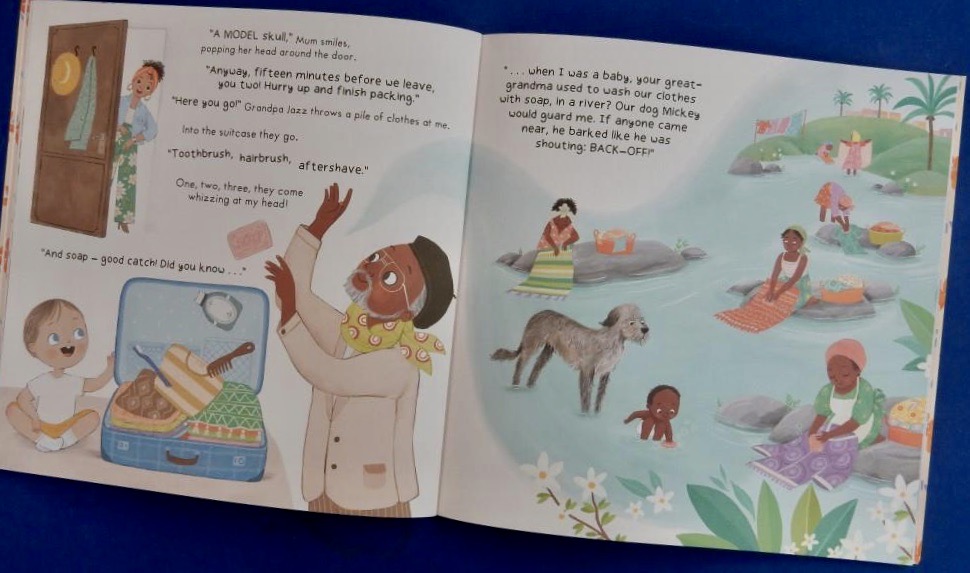
Now Grandpa is going to visit Mauritius, the island of his birth and youth, and he asks Frank to help him pack his suitcase. As they do so, Frank discovers a small holey rock in the case and that results in a story from Grandpa about how he fell into a volcano crater as a boy.
A stethoscope in a pocket of the case leads to a tale about a skull, and a bar of soap that’s going into the suitcase reminds Grandpa that his great grandmother used to wash the family’s clothes with soap in a river.
With the packing almost finished Frank spies a shirt with a badge with the word Jazz on it. Grandpa relates the story of how Her Majesty the Queen invited him to work for the NHS in the UK and how on the ship to England, people with white skin were separated from those with a different skin colour. This saddens Frank when he realises that had they both been travelling, due to racist attitudes they would have been kept apart – two people with so much in common whom the world viewed as being different.
Finally, with the packing completed, it’s off to the airport; but there’s still time for one more of Grandpa’s tales on the way. When they arrive at the airport, there’s a wonderful surprise in store for Frank …
With a lovely final twist, debut author Tarah L Gear’s wonderfully warm tale, vibrantly illustrated with gentle humour, by Mirna Imamović, (debuting as picture book illustrator) demonstrates and celebrates the intergenerational love between two terrific characters, Grandpa Jazz and Frank. It also shows the significant role passing down stories between generations can play in keeping alive that important sense of family history and heritage. It also reflects the racist attitudes at the time of Windrush, some of which sadly remain today. However, the book includes backmatter about heritage and elements of anti-racism that would be helpful in classroom and home discussions around these topics. An important book to share and talk about with children in the home or a school setting.
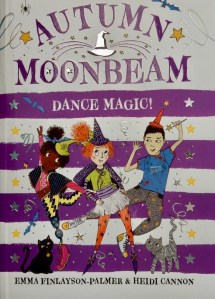
Autumn Moonbeam: Dance Magic Emma Finlayson-Palmer and Heidi Cannon UCLAN Publishing
Meet Autumn Moonbeam lover of dance and gymnastics and enthusiastic watcher of dance shows on spell-a-vision. Imagine her delight when she learns of a try-out for Sparkledale Dance Academy’s competitive dance team, Black Cats: she’s so excited she can barely concentrate in her Potions lesson in school. Once back home she and her two friends Leif and Batty practise their moves in Autumn’s garden.
There’s a rather large problem though, her arch enemy Severina Bloodworth is also trying out for the team and she’s pretty amazing. Autumn suffers a crisis of confidence: what if she’s not good enough? Then comes audition day. There are highs and lows as the event proceeds in front of the three coaches: will Autumn secure one of the four places on offer?
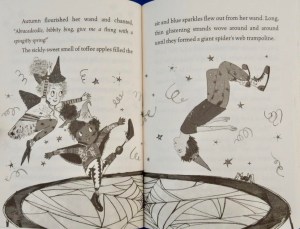
Emma Finlayson’s spell-tastic tale of whirling, twirling young witches is a delight. It has some charming characters (and the occasional not so charming one), warm family dynamics, strong friendships and key messages about self belief, overcoming your collywobbles, not forgetting the pure joyful liberating magic of dance. Pure enchantment too are Heidi Cannon’s illustrations: the perfect complement to Emma’s sparkly writing. If you know anyone looking for their next chapter book series, this would be a terrific choice, especially for lovers of dance and magical things.
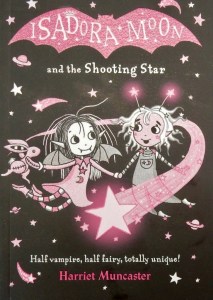
Isadora Moon and the Shooting Star Harriet Muncaster Oxford Children’s Books
Decidedly different Isadora Moon is enormously excited when her teacher Miss Cherry announces that their next class project is space. To get their brains thinking skywards, the homework for that evening is to create something to do with space. Isadora enlists the help of her Dad and that night as they watch the sky from the astronomy tower, what’s that Isadora spies falling earthwards?
A shooting star perhaps? The hunt is on for its landing place.
Then follows an encounter with a new, twinkling friend named Nova, a Glow Sprite who’s not supposed to be there. Moreover, Nova’s moon kitten Pluto is missing and she needs Isadora’s help to find him. Between space lessons with a special visitor, emergency searches in the forest, magical campfires, a glowing sleepover, not to mention moon cheese, Isadora must do all she can to help Nova find Pluto before her new friend has to fly back to the stars in time for her mother’s return.
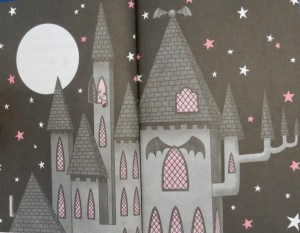
With her keynote pink, silver and black sparkly cover, and pink and black illustrations throughout, Harriet Muncaster’s fourteenth episode starring our favourite fairy/vampire is full of its usual charm and humour and certain to delight Isadora’s countless fans. They’ll be delighted too, by the Isadorable make and do activities following the story.
Rainbow Hands Mamta Nainy and Jo-Loring-Fisher Lantana Publishing
The small boy narrator of this book finds things to enjoy and appreciate no matter the time of day but his very favourite time is ‘painting-my-nails-time’. And to do that painting he uses the numerous different shades in his mother’s collection of ‘magical bottles’. Purple for instance is perfect for when he wakes from a dream of fairies in distant magical places; it’s the colour to represent mystery. White however is for life’s infinite possibilities; bright yellow is just right for bees on the garden sunflowers – that’s sun’s colour. A swirling blue is the hue for days when both sea and sky look similarly rolling, whereas the best match for mucky afternoons spent exploring in the dirt, is mossy green to match the mess.
Sometimes the boy’s Papa questions his preference for painting nails rather than paper and his response is very revealing.
His grandpa makes the boy feel soft and sweet when he gives him words of encouragement and on those occasions it’s pink nail paint that is chosen. However there are occasions when no one colour can represent all the feelings of happiness, sadness, anger and dreaminess: those are days to catch a rainbow and to make use of every single one of those marvellous bottles.
An elevating story that celebrates individuality, one’s essential nature, personal integrity and mindfulness. Like the boy protagonist, children need to be given time, time to breathe in the beauty of Jo Loring-Fisher’s mixed media illustrations on every spread.
I wonder what colour(s) you would choose to paint your nails today?
Today Will Be A Great Day! Slimy Oddity Wide Eyed Editions
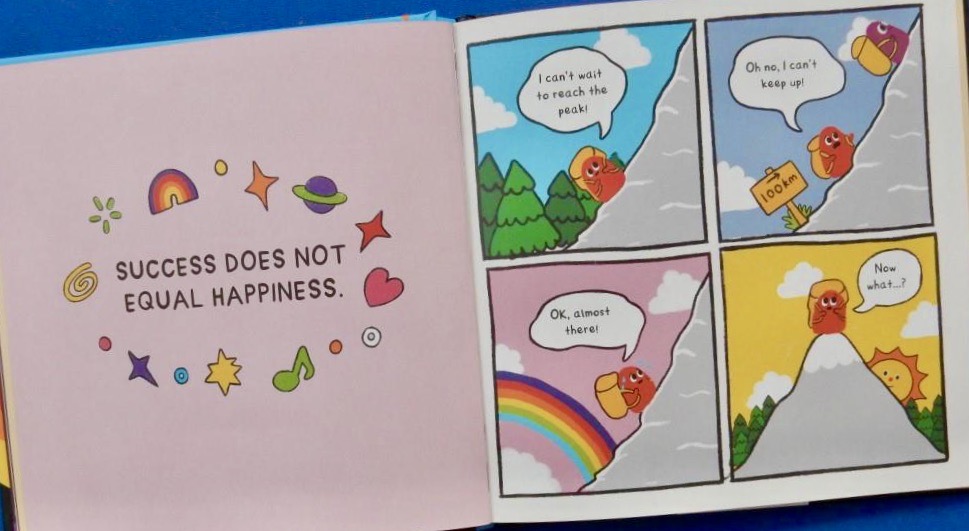
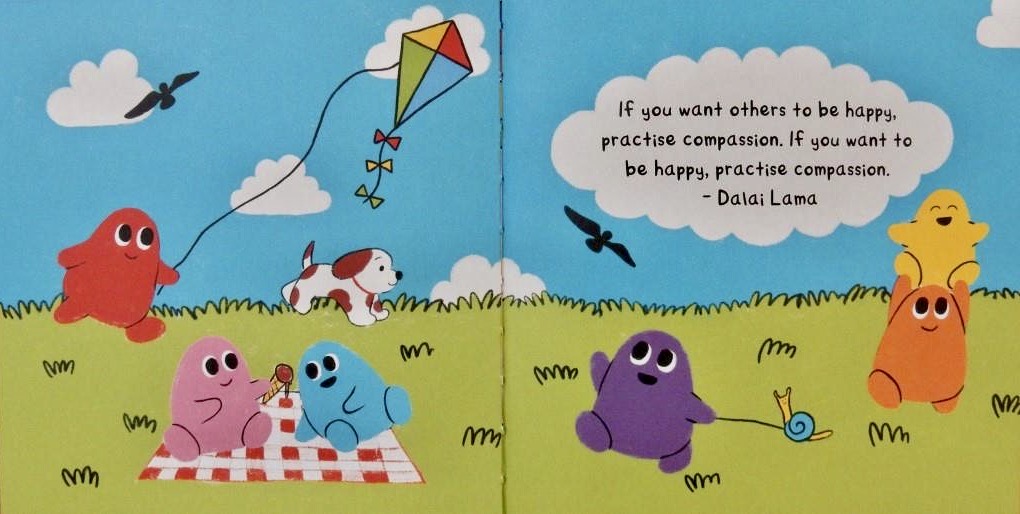
Subtitled Slimy Oddity’s Guide to Happiness, the red blobby creature of the title takes readers on a colourful, fun journey towards mindful happiness. ‘Happiness comes from within, and it is in each and every moment of your life.’ we read on the first page. That is what Slimy (from Instagram collective Slimy Oddity) intends will become so for everyone. “Happiness is being in complete harmony with what is.” is the first of his 30 plus life lessons presented in this small format book of uplifting, useful, timeless advice to help those who travel along with him find happiness and fulfillment in their lives.
Assuredly among these seemingly simple, yet often profound messages, there is something for everyone, and each affirmation or nugget of wisdom is evoked by a bright, uplifting illustration. I especially liked seeing some of the Dalai Lama’s wisdom presented.
This is not a journey to be hurried; rather the reader needs to let the unlikely guru, Slimy, gently and slowly act as guide walking beside us on the path to well-being. It might even be that you take just one of the spreads every day and let Slimy’s words and actions become your focus (or even that of members of your class at school).
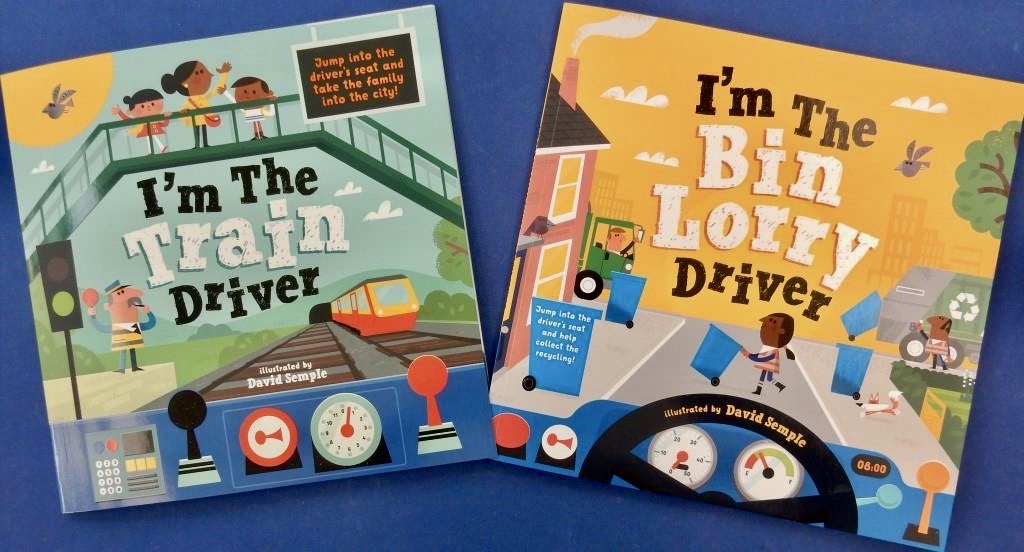
I’m The Train Driver I’m The Bin Lorry Driver David Semple and Katie Woolley Oxford Children’s Books
Young children have the opportunity to imagine themselves into the driving seat of both a passenger train and a refuse collection lorry as they share these books with an adult either at home or at nursery/preschool.
Having donned the appropriate uniform the train driver climbs into the cab, puts on a seatbelt, checks the controls, starts the engine and is responsible for taking a family to the city for some sightseeing. En route there are stations to stop at to allow more passengers to get aboard, a freight train to negotiate, a tunnel to drive through slowly and carefully,
then the level crossing gates are open so its full speed ahead until the signal controller radios to say ‘switch tracks’ and off you go to the city’s main station where the passengers are eager to get off. Finally, a train driver needs to log the train’s arrival before heading home
The driver of the bin lorry has two other team members who are also responsible for collecting the recycling from all the blue bins on their round and they start work early in the morning while it’s still dark. Having set the route, off they go, the driver taking care to stay within the speed limit. The team works hard all morning,
remembering to log each bin emptied into the hopper on the lorry’s computer screen and totalling up the final number. Then with all the blue bins duly dealt with it’s back through the now busy streets to the tip where the lorry’s contents is emptied onto the ground ready for sorting.
As with others in this series, teamwork is key in the roles presented; and there are lots of opportunities for developing vocabulary and other important early learning skills such as colour, number and shape recognition.
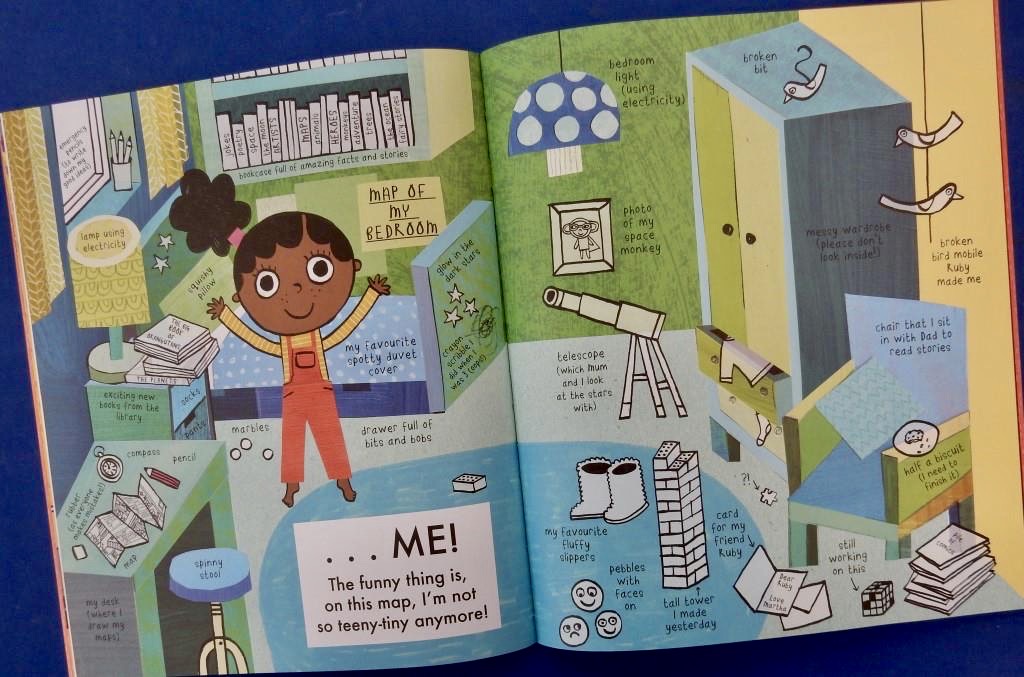
Martha Maps It Out Leigh Hodgkinson Oxford Children’s Books
Young Martha might be small but her thoughts are anything but: her mind full of BIG things. She absolutely loves drawing maps, creating them out of almost everything from the universe to her bedroom in the top floor flat in which she and her family live; she even makes maps of her thoughts, her questions and her dreams.
Through Martha’s cartographic creations readers share with the girl her entire world as she guides us through the pages and beginning in deepest space, we zoom inwards page by page to planet Earth with its awesome flora and fauna, her city, her street and community, her block of flats, her own home and her room.
From there we travel outwards once more through the thoughts, questions and those BIG dreams of a future where absolutely anything is possible: a life of discoveries … excitement,
adventure, wonder, not forgetting of course, love.
Leigh Hodgkinson is brilliant at presenting quirky details in her visuals and this book of Martha’s maps is absolutely alive with them. To these are added a wealth of labels that children will love to explore as they, one hopes, like Martha will share that sense of optimism and excitement about what the future might hold. Bursting with classroom (and home) potential, this splendidly upbeat, and unusual picture book is one to return to over and over wherever you are.
Curious Creatures: Working With Tools Zoë Armstrong and Anja Sušanj Flying Eye Books
I wonder how many children know that using tools for tasks we do often, daily even, is not confined to humans. There are, so we read in this enormously engaging book, animals in various parts of the world that display amazing problem-solving skills and adaptability, recognised by zoologists as tool using.
One such is the sea otter: these animals sometimes make use of kelp for several mooring purposes and also use rocks as hammer and anvil, for example to break open a clam shell or mussel to extract what’s inside for food.
Did you know, several creatures use sticks as tools: elephants in Bangladesh have been observed waving twigs or branches to ward off troublesome insects while others sometimes use a spiky stick as a back-scratcher. Indeed so Zoë Armstrong states, ‘the elephants choose the right tool for the job.’ So too we learn, do several primates: mandrills clean the dirt from beneath their nails with a small twig; gorillas sometimes take a long stick as a measuring device to gauge the depth of water they wish to cross before wading right in; and chimpanzees in Tanzania smooth a stick and use it to extract insects from a termite mound, eating them as we might a lollipop. I’d have been so excited had I been Dr Jane Goodall who first noticed and recorded this phenomenon.
I was especially interested to read though that tool use techniques among primates such as Orangutans sometimes differ according to the particular habitat in which they live.
Indeed some living near a research camp in Borneo’s Tanjung Putting National Park have been observed in a boat paddling it around with their arms – just one of several clever habits they’ve worked out. Birds too are skilled tool users and author Zoë and illustrator Anja Sušanj provide several examples of them. Crows in particular are known to forage and perform other tasks with sharpened sticks they shape in a variety of ways: indeed New Caledonian crows are among the most skilled toolmakers in the entire animal kingdom.
Altogether a fascinating tribute to creature ingenuity: children (and adults) will be surprised and awed by these clever animals in a book that conveys a wealth of STEM information. There are lots of potential cross-curricular links: I particularly like the way these animals encourage child readers to think creatively to solve problems, just like the exemplars herein have done.
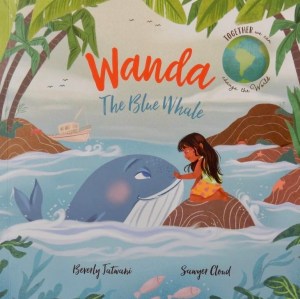
Wanda The Blue Whale Beverly Jatwani and Sawyer Cloud New Frontier Publishing
The third book of seven in the Together we can change the World series is set in South America, on and near La Serena Beach (Chile). Young Paula awakens to the sound of the ocean every day and loves the view from her bedroom window. She also loves spending her time on the sandy beach, sometimes clambering over the rocks to investigate what’s there.
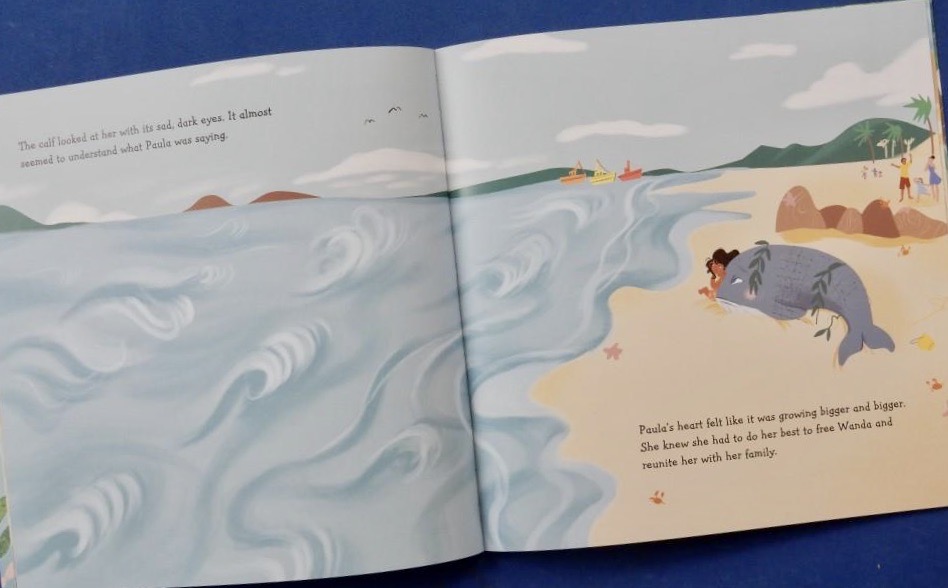
One morning early she is devastated to discover, lying on the beach, hardly moving, a blue whale calf. Going up close, she sees that it’s tangled in a fishing net and gently stroking the creature, names it Wanda. She knows she must find a way to release it so the whale can re-join its family.
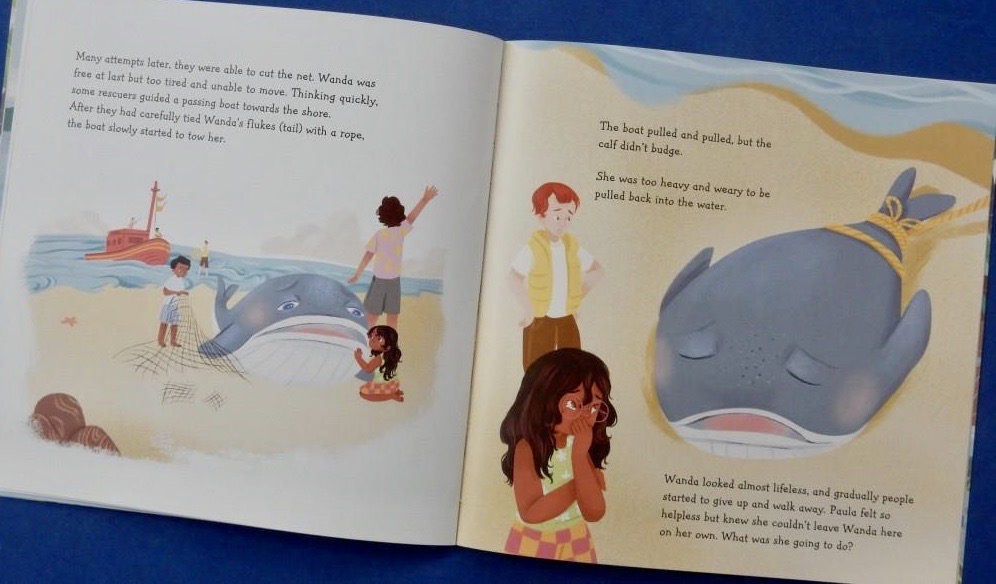
Other people gather around and Paula begs them to help her free the calf.. Immediately everyone gets to work – teamwork is key now – until finally Wanda is no longer trapped in the net but remains some distance from the ocean. Thankfully a passing boat responds to their signals for assistance but the creature’s weight is too much for the small craft.
Or is it? The tide is very slowly coming in so perhaps it’s worth having one more attempt to tug her into the waves …
On her way back up the shore, Paula notices something in the sand; something on which is written a vitally important word. Then that evening what she sees through her windows beneath the setting sun fills her heart with joy …
The final page of this book gives information about blue whales, including the fact that they are now classified as an endangered species.
The story shows the powerful emotional and transformational connection formed between the girl protagonist and the whale, the key word being the compassion shown by Paula. It also highlights the responsibility we humans all have, or need to develop, towards Planet Earth: for sure if everybody is prepared to act in a similar way to Paula, it’s possible as the series title says, to change the world. To that end, adults can start by sharing the story with youngsters who, one hopes, will want to become activists.
How To Survive Time Travel Larry Hayes, illustrated by Katie Abey Simon & Schuster
Ten year old Eliza Lemon (it’s her journal we’re reading) and her young brother Johnnie – he of the super brains and weak left leg – discover their parents have disappeared, leaving in their place a little old oak tree with three symbols on the trunk.
Johnnie informs big sis. that the car (also missing) is in fact a time machine. Now of course she knew that really didn’t she? The two quickly realise that they and they alone, (and especially without interference from the ‘pure evil’ Sadie Snickpick) must do something to rescue them; the problem being, what?
After some dangerous activity involving a tool they certainly shouldn’t have been wielding the two manage to fell the tree and inside there is a shoe bearing a message from their parents informing them they’re stuck in 5000BCE (or is it?), providing a grid reference, asking for help and saying everything they need to solve the riddle of the sphinx is in the shed. All they have to do now is build themselves a time machine and get away within two days or face the dire consequences of what the dreaded Sadie has already set in motion. Simple! Though maybe they’ll end up having to face them anyway.
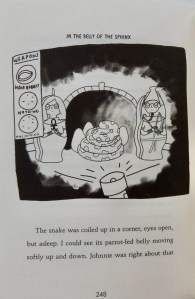
The fight is on – in more ways than one … Can Eliza keep her head? And more important can they (including dog Myrt) tolerate horrendously itchy bites by rainforest insects, get the better of the weird, dastardly Boy-God, deadly snakes,
a rainbow hued sphinx and foil the next plot to destroy the planet. As for surviving time travel to ancient Egypt – who knows? Our journalist Eliza is, in her dad’s words, the “Girl Who Never Gives Up”, so maybe, just maybe …
Laugh out loud funny, this nail-biting foray into the past, with suitably quirky black and white illustrations by Katie Abey, will keep readers on the edge of their sofas as they follow the highs and lows of Eliza and Johnnie’s time travelling exploits. A cracker this!
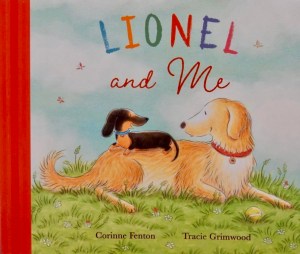
Lionel and Me Corinne Fenton and Tracie Grimwood New Frontier Publishing
This story of the effects Lionel, a small dachshund, has on a family is told from the viewpoint of Maverick, a golden retriever, that is already a well established and contented family member.
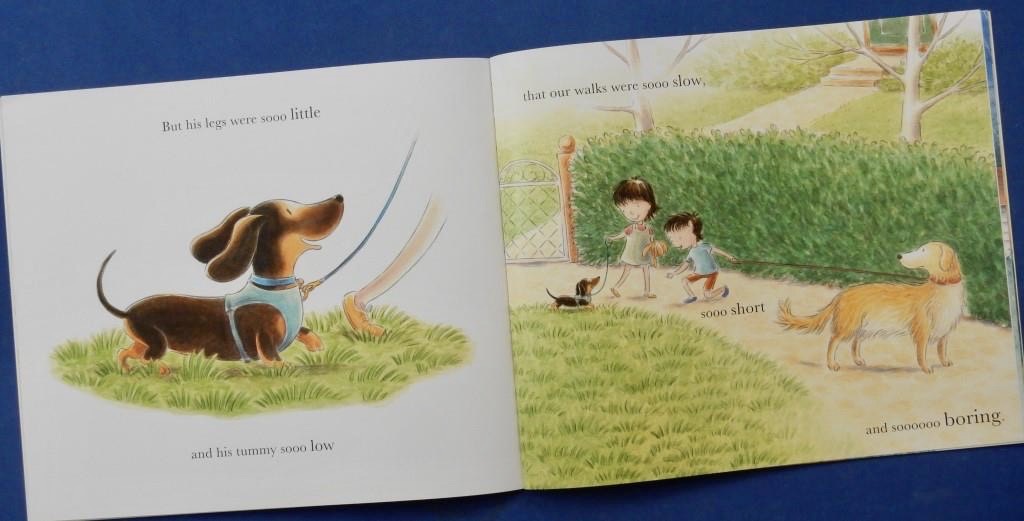
When he first arrives, the newcomer is no threat on account of his smallness and because he spends a lot of time asleep; he does leave stinky deposits indoors though and seemingly, whines constantly. Nor is Maverick’s exercise enjoyment intruded upon;
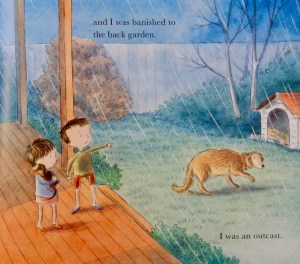
but gradually, Lionel becomes the centre of attention and a thorough nuisance: jealousy builds until Maverick decides enough is enough, his actions resulting in his banishment to the back garden.
Alone out in the cold, the retriever has lots of thinking time and he decides that all he needs to do is to wait patiently until the dachshund destroys his perfect pooch image. When he does it significantly and unexpectedly changes the canine relationship.
Beautifully portrayed in both Corinne’s words ( the dog characters are based on those of her own relations) and Tracie’s gently humorous illustrations this story of learning to accommodate a newcomer is relevant to many situations and is a lovely book to share with young children and talk about both at home or in the classroom.
These two books are additions to favourite series from Harper Collins – thanks to the publisher for sending them for review:
Genie and Teeny: The Wishing Well Steven Lenton
This third adventure of Grant the genie, and his best friend – the puppy, Teeny picks up where the previous one left off with Tilly’s mum coming into her daughter’s bedroom and hearing strange noises coming from Grant’s “Not-a-teapot’ now officially renamed tea-lamp. Those noises are made by a deeply sleeping Grant as he dreams of being back in Genie World with his family; inside the teapot, in diminutive form, are also Tilly and Teeny. On waking Grant feels even more homesick but he responds to Tilly’s urgent whispers about the close proximity of her mum with assurances about the plan he has – one that works only with the help of we readers.
Luckily the crisis is averted and after breakfast, plan B, Tilly announces will be to get Grant back to his world. The thing is Genie World, aka Wishaluzia, is an enormous distance away, high, high in the sky: no problem there then! Or rather, a very big one – how will he travel up through the sky. It’s not long before the Elastic Fantastic Flying Machine appears, first in Tilly’s mind, then on paper and finally, once they’ve assembled and fixed together all the items collected in the garden, there stands a rocket-shaped vehicle. Off goes Grant to grab some suitable gear to wear and once attired the countdown commences. Yes, the thing does get launched but almost immediately …
Time for some light refreshments and then a new plan; one that involves a visit to a theme park with an officious security guard and a no dogs rule.
From there on the action really ramps up and there are lots of laugh-out-loud moments (for readers not the characters) and wishes (of course).
What about that much anticipated and joyful reunion between Grant and his family way up high; will it eventually take place? That would be telling …
Another brilliant tale that, with Steven’s hilarious illustrations and magical mishaps aplenty, is great for both independent readers and reading aloud.
Clarice Bean Scram! Lauren Child
The utterly irrepressible, indomitable Clarice Bean, she with a skill for stretching the truth, returns in a summer adventure – or several, that begins on a scorchingly hot day in the first week of the holidays. Clarice is bored, saying she has nothing to do; her best friend is away on holiday for the entire break and her mum, annoyed at her daughter’s continual moaning, sends her outside into the garden. It’s there that she informs the irritating Robert Granger that her family is getting a dog. Now it’s not exactly a case of be careful what you wish for as it’s her sister Marcie who really really wants a dog, but near enough for before you can say ‘bark’, this nothing day turns into anything but.
For instance there’s the episode of the tin of spaghetti (or several) for the family’s dinner purchased at Clement’s corner shop. This leads to an encounter (also several) with a dog – a dog that just refuses to go away. Clarice’s parents meanwhile have realised that they’re supposed to be attending a wedding and off they dash to catch a plane.
Now Clarice has the tricky task of keeping this pooch a secret from Grandad who is now in charge of the household, as well as her siblings. But there’s the question of food and much more, including disposing of the animal’s ‘you-know-what’, as she quickly discovers. It’s a task that proves too much for Clarice – not the poo disposal – but keeping the presence of the dog under wraps and before long Marcie discovers it.
Happily she’s eager to accept the creature and help raise money for his food and other necessities;
but nobody else must find out about Clement as they decide to name him. Errr …
Related, as only Lauren Child’s Claire Bean can, in an utterly credible manner, with her seemingly innocent, astute observations and vivacious voice, both of which are brought to life by Lauren’s scattering of deliciously quirky collage illustrations and line drawings throughout the book this is Irresistible reading for almost any child (and many adults) from early KS2 onwards.
My Granny is a Queen Madeleine Cook and Rebecca Ashdown Oxford Children’s Books
Twelve children proudly and lovingly introduce their respective grandmothers in this wonderfully warm-hearted, celebratory book. Each one is, in the eyes of her doting grandchild, a true queen even if not HRH The Queen.
The first – granny – is greeted on arriving for a visit with curtsies and a red carpet on which to walk. Then in turn we meet nana with her royal pets Lord Stinkerton and Lady Battenberg the Third, classy pooches for sure though a tad mischievous at times; nonna with her precious royal jewels; oma, who arrives in her carriage ready to take the family for a drive into town.
Bibi has a penchant for spectacular events and she’s more than happy to be accompanied by her grandchild; grandma – she of the royal wave – is frequently greeted by well-wishers when out and about; nai nai inspires her grand-daughter with encouraging speeches; gran on the other hand is a bestower of special awards for bravery. Nanny’s home is a distant castle so family news often has to be communicated via technological devices; Baba loves to relax after a busy day …
whereas nani is a terrific teller of bedtime stories and abuela has a very special crown. Apart from giving their grandchildren love and affection there’s something else all these wonderful people have in common: now what might that be? … Party anyone?
A terrific celebration of grandmothers, of differences, and the special bonds of familial love that transcend all else.
Here are two hugely readable books from Harper Collins Children’s Books: thanks to the publisher for sending them for review:
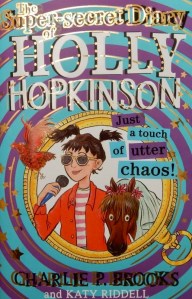
The Super-secret Diary of Holly Hopkinson: Just a touch of utter chaos Charlie P. Brooks and Katy Riddell
After the crisis with Mum almost taking a job in New York, things are once again in turmoil in the Hopkinson household, particularly where adept inventor/wielder of words, ten year old Holly is concerned. For instance she might as she says, have mentioned to her best friend Daffodil something about a New York move. Actually her mum is embarking instead on opening a farm shop/emporium.
Then her teacher Miss Blossom announces that she’s engaged to be married and that the entire class will be involved. Now while this is not good news for Holly Hopkinson (schoolgirl) and Holly Hopkinson (Band Manager Inc.) that still leaves possibilities for her Film Location and Places Inc. persona. Now she should pass on the information regarding the marriage to Aunt Electra whose establishment might just be a possibility for the wedding venue. Seemingly it’s time for Holly to make use of her magic pocket watch once again.
I loved the famous artists’ background homework episode and that of the visit to one of London’s cutting edge ‘art galleries.’ That event certainly sets some changes in motion.
As with the previous two diaries, this one is full of laugh-out-loud moments, plenty of twists and turns in the family’s fortunes, some village politics, funny food and unusual characters, including one or two unexpected ones. Like the others, Katy Riddell’s black and white illustrations provide an additional layer of humour to Charlie P. Brooks’ storytelling.
It does work as a stand-alone book but it’s probably better if readers are familiar with Holly’s previous diaries (now safely stashed in a biscuit tin) before embarking on this one.
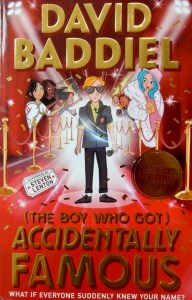
(The Boy Who Got) Accidentally Famous David Baddiel, illustrated by Steven Lenton
This is a laugh-out-loud story starring the very ordinary eleven year old Billy who lives with his ordinary mum and dad and his ten month old sister (also ordinary). Nothing out of the ordinary has ever happened to Billy; but then one day something extraordinary takes place. A TV crew from TotalTV TV descend on Billy’s school, Bracket Wood to film for a show to be called School Daze. Many of Billy’s classmates play up for the cameras, hoping one of them will become famous. Not Billy however: he’s sure that the closest to fame he’ll ever get is reading about his favourite star Sunshine De Marto in his mum’s glossy magazines.
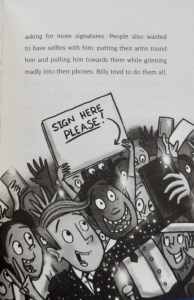
However, what happens thereafter only goes to show how wrong somebody can be: Almost overnight, on account of his ordinariness Billy becomes an internet sensation: #BillyTheNormo #OrdinaryBilly and the trending #Relatabill; there’s even a #Relatabill rap. Now at school too, everybody notices Billy especially when TotalTV want him to sign a contract. Moreover there’s a strong possibility that he might actually get to meet Sunshine De Marco.
However as his fame increases, Billy feels like somebody else entirely
and it’s fortunate that his best friend Bo has his back, at least to begin with. Billy has to make some choices for himself if he really is to meet Sunshine and caught up in his stardom, he makes some unwise decisions. Can true friendship save him and help the boy realise his dream?
David Baddiel’s witty take on fame and friendship is a very funny, heart-warming, highly engaging and relatable story that readers in KS2 will love. It also offers lots of opportunities for class discussion and more. Steven Lenton’s black and white illustrations really help bring the characters – ordinary or otherwise – to life. Unable to it put it down, I read the book in a single sitting.
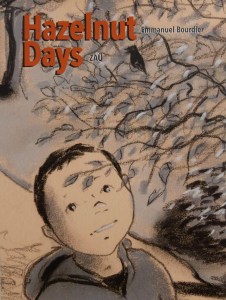
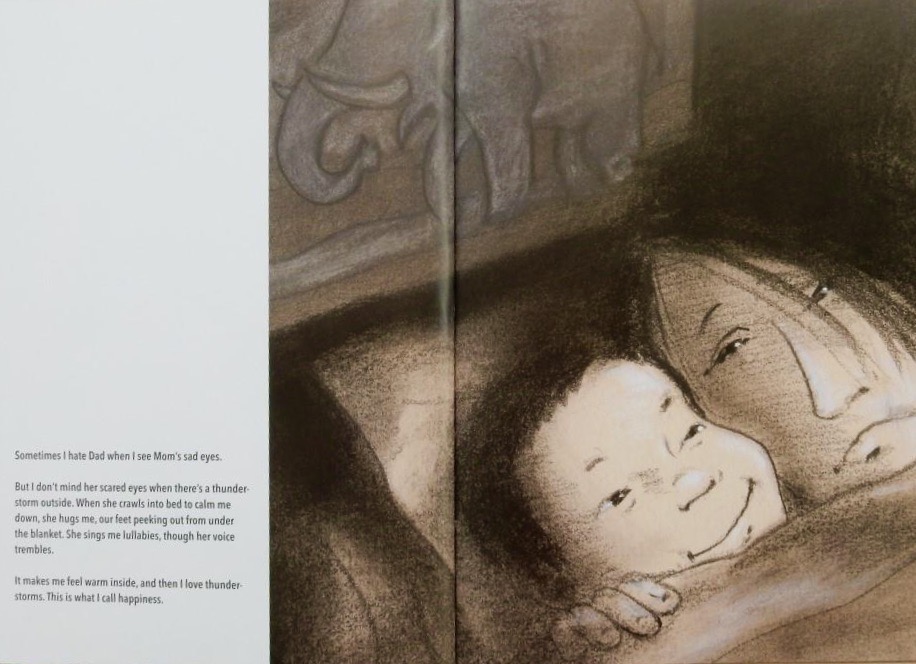
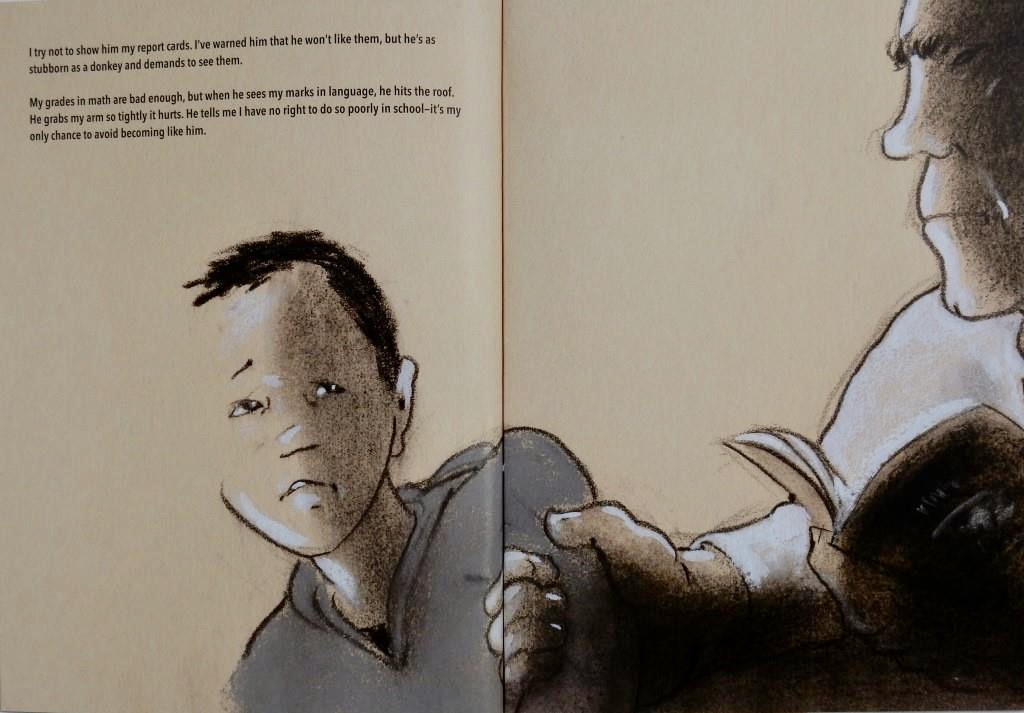
Hazelnut Days Emmanuel Bourdier and Zaü minedition
The boy narrator sees his father just once a week, when he visits him in prison. We know not why he’s there but we do discover that it’s for a long stretch and we learn a lot about him and about the complex relationship the narrator has with his Dad or “Cave Bear” as the boy and his mother call him in their conversations. Conversations with school friends are tricky for the boy who never reveals that his Dad is in prison. Instead he tells them, “He’s a ‘cloud sculptor, a mole tamer, an inventor of dirty words.”
During his son’s visits Dad smells of cigarettes along with peppermint or hazelnut on account of the two bottles of cologne Grandma once gave him. He has a gold tooth, a short temper, a good sense of humour, he’s strong and likes to copy bird sounds and imitate people. The boy blames his Dad for the anguish and sadness – the ‘fog – in his Mum’s eyes, hating him for that,
and fearing his fury over the lad’s school reports.
However, when visiting time is over and Dad cries, the narrator’s love is reawakened and he leaves with thoughts of retaining that special Dad smell till the following week, as well as bringing him a supply of hazelnuts.
This is a powerful evocation of a situation seldom presented in picture books. Both words (elegantly translated from Bourdier’s original French) and Zaü’s (André Langevin) charcoal, sepia-toned illustrations are empathetic and full of emotion, working perfectly together to produce an unforgettable book for older picture book audiences.
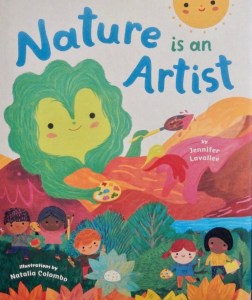
Nature is an Artist Jennifer Lavallee and Natalia Colombo Greystone Kids
Nature has many awesome qualities not least of which is its incomparable artistry – its beauty and its incredible variety: that is what this book explores and celebrates.
There is complete harmony between author Jennifer Lavallee’s rhyming text and Natalia Colombo’s striking illustrations of nature – both its manifestations and the green being that leads a group of five children on an exploratory journey through various beautiful natural landscapes showing them the sunrise over some hills; a field alive with buzzing bees and daisies growing in abundance around the trees; the rich colours of summer flowers in full bloom as they begin to scatter the petals.
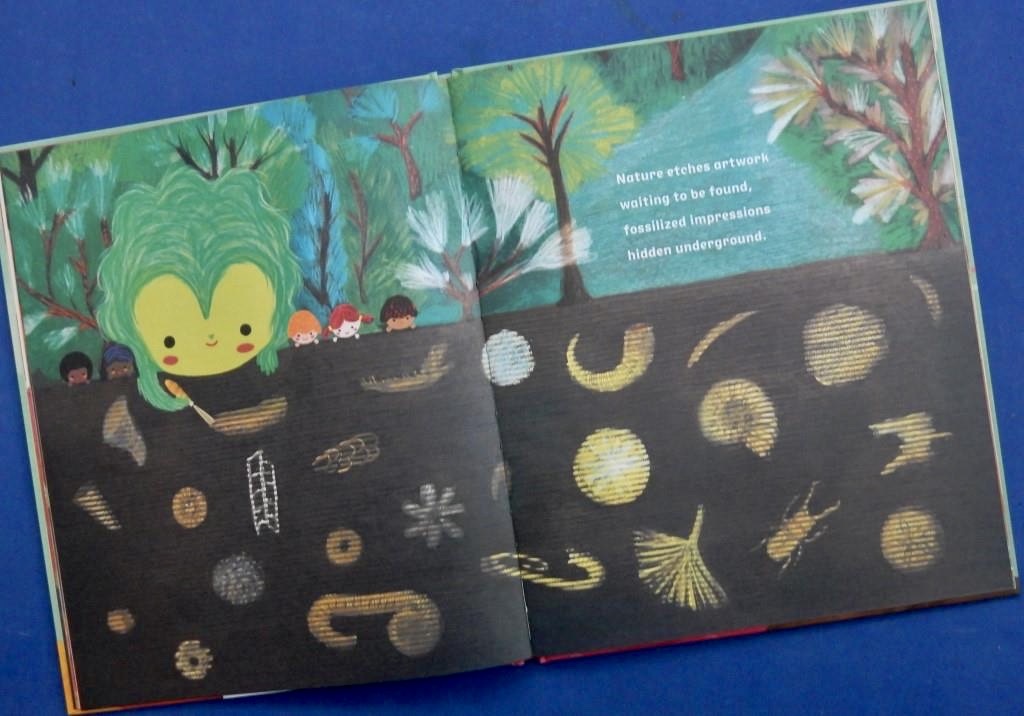
Next, resting on a rock at the water’s edge, nature shows itself as sculptor extraordinaire, carving and moulding rocks and clay. Then hidden deep beneath the ground lies evidence of nature’s etchings – those fossil impressions making patterns we all so love to find;
while with rain and sun together, high up in the sky, nature creates a rainbow: a kaleidoscope of gorgeous colours, a prism up above.
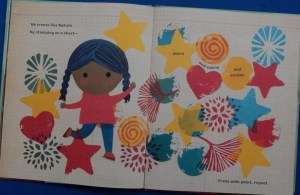
As the children witness each stunning landscape one of their number with nature now as teacher/mentor is inspired to recreate what they’ve seen in art of their own making: one by finger painting, another making a colour paper collage, one sculpts towers in sand; fossil etchings are done by stamping various shapes on a large sheet
and a rainbow is formed from torn tissue paper pasted on a glass jar and a lighted tealight within to provide the glow.
Whether used in a classroom or at home, those with whom this book is shared should not only develop a deeper appreciation of the natural world but also be motivated to try some of the art techniques the book includes.
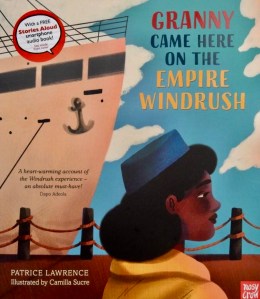
Granny Came Here on the Empire Windrush Patrice Lawrence, illustrated by Camilla Sucre Nosy Crow
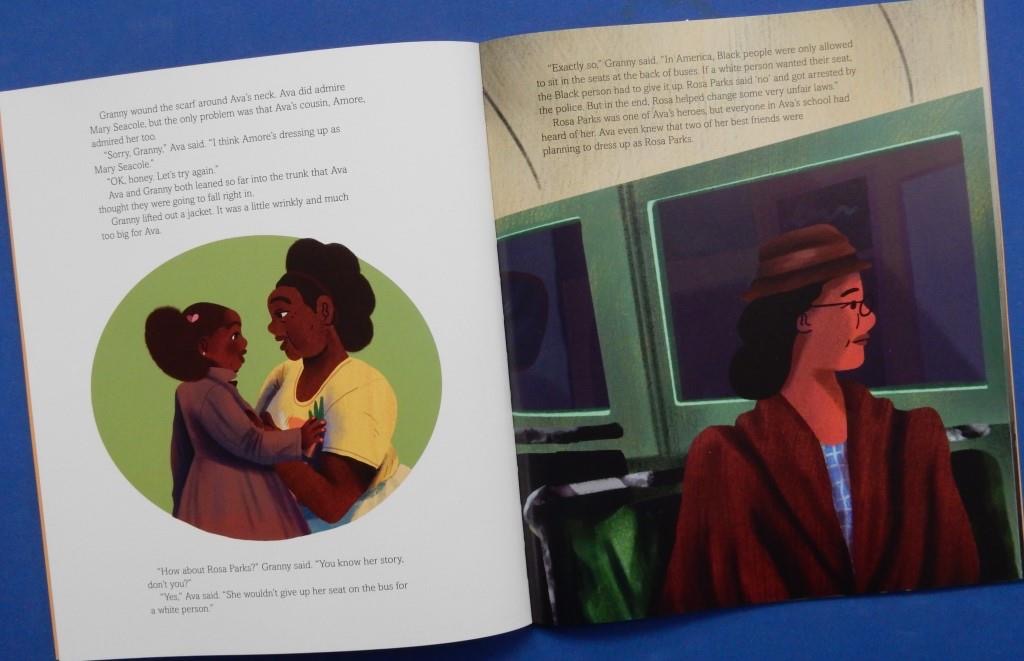
This wonderfully warm book follows Ava and her Granny as together they search Granny’s trunk one Sunday for a costume suitable for Ava to wear at her school dressing up event to represent someone she admires. Rummaging through the various items of clothing, jewellery and other objects Granny is reminded first of Winifred Atwell on account of the sparkling bead necklace, then Mary Seacole who sometimes wore a red scarf just like that in the trunk, a jacket makes her think of Rosa Parks. In each instance Ava’s grandmother tells her a little bit about each of the women mentioned: the glamorous pianist, the nurse who tended the wounded during the Crimean War, the brave woman who refused to give up her seat on the bus.
Then, hidden under all the clothes, Ava unearths something she’s not seen before: it’s a small cardboard grip in which Granny had carried presents she was given when she left her home in Trinidad and came to England on the Empire Windrush.
As she pieces together a story using the objects – a smooth grey pebble, an empty jar, a small blue hat and a pair of lacy gloves, we learn of the intense feelings of homesickness and loneliness her grandmother experienced; and how she built a life for herself in a new, chilly country, meeting and marrying the man who was to become Ava’s grandad. This woman – her own beloved Granny – is Ava’s real hero, the one she chooses to dress as.
With Patrice Lawrence’s perfectly paced telling and Camilla Sucre’s richly hued, vibrant art, this is a truly moving story that celebrates both the Windrush generation and their achievements, and the bond between Ava and her grandmother.
A superb book to share and discuss with young listeners at home and with primary children both in KS1 and KS2.
George the Brave Eva Papoušková and Galina Miklínová Graffeg
It’s off to Australia for this tale of a little wombat called George. I learned something about wombats like George before reading the story book for there’s an information page at the start. Did you know that in addition to being protected by law on account of their rareness, wombats are able to protect themselves by thrusting their rear ends at an enemy.
Let’s meet our protagonist George, and his friends. Fred the Kangaroo, Annie the Goose and Lizzie the Mouse invite George to join them in some games one day. Having got permission from his parents and a warning to be on the lookout for possible dangers in the form of hungry predators, he demonstrates his life-saving moves and off he goes to the dark woods to meet his pals. Their first game is hide and seek and when it’s George’s turn to be the seeker, he hides his eyes and starts singing a little song. However upon uncovering them he finds himself face to face with Wilma the Fox. Eek!
Now Wilma is a sly creature with her mind on her next tasty meal. To that end she invites George to show her his home and when he wants to know why, she’s gets angry. After all an entire wombat family is much more satisfying that one little one.
George is suspicious and sensing danger, flees as fast as he can. The trouble is, Wilma too has fast paws and is hot on his trail. Now is the time for George to be truly brave and use that strong, bony bottom of his.
Is it enough to do the necessary? Let’s say that Wilma loses more than just a tasty meal on account of his bum-thrusting stance.
And George? He’s learned an important life lesson about facing one’s fears – kind of!
Young children will relish George’s new story with its embedded wombat fact. With that big surprise, superb cross-hatched illustrations and dryly humorous text, it’s both lots of fun and informative. It also offers a good starting point for a circle time discussion about standing up for yourself.
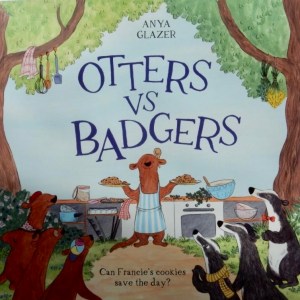
Otters vs Badgers Anya Glazer Oxford Children’s Books
Here’s a tale about difference and happily, divergent thinking; and it has a vital lesson for people of all ages, so long as they’re willing to learn from Otters and Badgers.
In this story, said creatures reside on opposite sides of the divide – a river – that they find impossible to share without resorting to pawicuffs over territorial rights. As a consequence to avoid further inflaming the situation, their two leaders decide that no badgers and no otters must EVER cross the river.
Now here’s where the divergent thinker comes in: she’s an otter and her name is Francie. A tad shy by nature, she’s the best baker of cakes anywhere along the river, so say her fellow otters anyhow. Certainly her cake creations are delectable and she loves to invent spectacular new treats too. One day while out hunting for the perfect ingredient for her next batch of baking, so wrapped up in her task is she that she strays into enemy territory.
She’s spotted so doing but fortunately her fast feet carry her out of harm’s way. However it’s not long before there’s a confrontation on otter territory with the badgers demanding to see the marauding otter. While the heated talks continue Francie is busy doing what she always does, emergency or not.
What will be the outcome of her labours now? Could it finally be time to call a truce?
In these increasingly troubled times of ours, it’s easy to draw parallels between this story and the real world. Drawing attention to the futility of conflict, Anya Glazer’s amusing telling in combination with her droll, delightfully detailed illustrations, show that compromise, finding what we have in common and learning to live peacefully side-by-side with others however different they may at first seem, is so much better that hostility.
Don’t miss the recipe for baking yummy chocolate chip cookies at the end of the story.
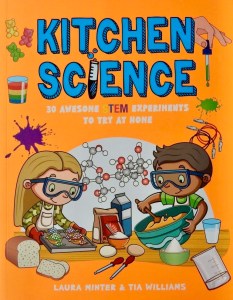
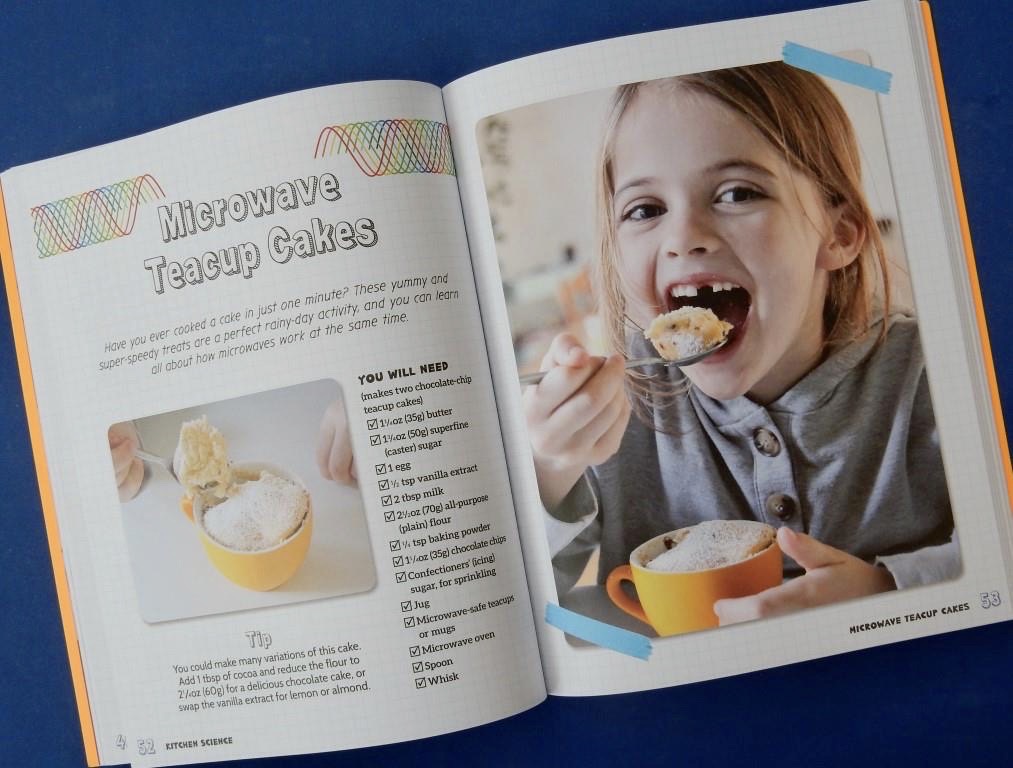
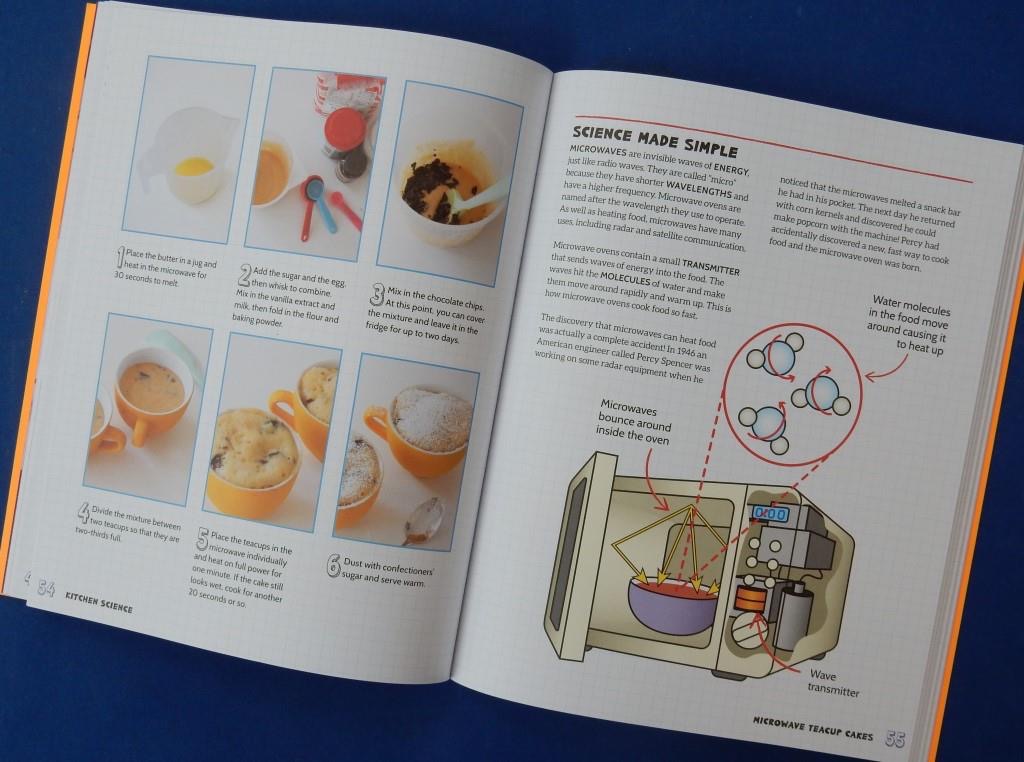
Kitchen Science Laura Minter and Tia Williams Button Books
This latest book by team Laura and Tia is a collection of science themed activities for children to do that will surely make them think of the kitchen in a different way: the place where a great deal of science happens every time some basic ingredients are mixed together, then baked or cooked in some other way.
The authors present thirty kitchen based STEM activities for youngsters to do, (under adult supervision if they require use of an oven or hob). Safety, as well as the basics needed are covered in the ‘Getting Started pages before the activities, each of which is clearly and concisely set out in illustrated steps, together with a list of ingredients required (most kitchen cupboards will already have the majority) and followed by a paragraph explaining the science involved. There’s also a final glossary of the scientific terms the experiments encompass.
How many children will have thought about generating electricity to light a bulb by means of four lemons, some copper wire and a few crocodile clips? That’s a possibility if you discover you’ve run out of battery power.
Have they tried making a cup cake in a single minute – using a microwave and a tea cup? One of my favourite cafes in Udaipur Rajasthan used to make chocolate ones for us when they’d run out of their other delicious cakes.
Like the previous titles from Laura and Tia, I strongly recommend this one: it’s huge fun as well as gently educational.
Maya’s Walk Moira Butterfield and Kim Geyer Oxford Children’s Books
Maya and her father love to walk together and no matter where they go, they make full use of all their senses so that they get the very best out of their time. With their eyes they might discover a wealth of ‘tiny secrets’ be they insects on the move or plants just beginning to sprout. They run their fingers over different surfaces experiencing different sensations as they do so.
If their feet take them through a town they listen out for the gamut of sound that surrounds them: singing birds, ringing bells, barking dogs and the constant chatter of humans. Then once out of the hustle and bustle it’s fun to be more energetic both on the way to the park and inside it where, once again, there’s an abundance of sounds and movements to emulate.
Whatever the weather – be it rain or shine – there’s always plenty to bring delight, especially if by chance a rainbow appears and Maya and Dad can focus on finding and matching all its colours with things in nature and then using their other senses too, to fully appreciate what they see. Then perhaps some of those wonderful things will become the subject of her dreams.
How fortunate is Maya to have a parent who makes every walk an adventure and who helps to make sure she finds that all important awe and wonder as she experiences the world around her.
A beautiful book to share with young children be they at home, nursery or school, preferably, with heightened awareness, just before going out walking.
This is another unmissable, wise, heartwarming story from Cath Howe; a tale of friendship, family and insecurity. It revolves around close friends Callie, Ted, Zara and Nico who are almost like family to one another, as well as Billy, with the action being narrated by Callie, Ted and Billy, three very different characters. Callie’s mum is child-minder to her three friends until to cut back on expenses for his own mother, Ted declares he no longer needs a child-minder, little realising how much he’ll miss his pals. Then he’s humiliated during their class assembly by the very annoying Billy and becomes even more distant from the others, feeling and holding onto the pain of the torment in his mind long afterwards.
After school, an envious Ted now looks on from his hiding place next door, Callie finds a gap under the fence in her back garden leading through to the school playground and he watches as she and some of the others squeeze through to investigate, and see a light in the building. That light has been switched on by Billy whose mother is away for a few days holiday and who, having received a less than warm welcome from his father’s new family, in particular his bullying step-sister, has decided to camp out in school to await his mum’s return. When Callie discovers she can get into the school building and finds Billy hiding out, she is drawn into keeping his secret. Can she keep it until his mother is back and if not what will happen?
Ted, now overwhelmed by jealousy definitely makes matters worse by acting in a very unkind manner: with all these changes having taken place, friendships are being tested to their utmost limits.
It feels as though Cath Howe can get right inside the heads of her characters, so empathetic is her writing. As it says on the cover of this unputdownable book, “Sometimes keeping things inside is dangerous’; so many misunderstandings and misinterpretations could have been avoided or sorted out through talking.
Highly recommended for older primary readers either individually or as a class read. If the latter, there’s a wealth of creative potential offered by this superb book.
On My Papa’s Shoulders Niki Daly Otter-Barry Books
The little boy narrator in Niki Daly’s compelling picture book has just started school. He’s fortunate to have members of his extended family to take turns to walk with him through the busy town to the school gate.
Mama is a quick walker and so they always arrive in plenty of time for goodbye kisses before the bell rings. Gogo likes to leave early so the two of them can avoid the busy road and along the quiet way they find lots of look at and chat about, and perhaps even pause over.
Gogo is full of wise words, talking to her grandson about how he should be gentle with his friends.
Rainy days are reserved for Tata who is fond of puddle splashing, though his more easily tired legs mean he prefers the shortcuts and needs to pause for a rest en route – the perfect opportunity for a spot of whistling. In addition to whistling, hugs are Tata’s speciality.
“But the days I love the best are when Papa takes me to school.” That’s what our narrator tells us from his vantage point on Papa’s shoulders: it’s a place where he’d like to stay for ever but knows that when they reach the school gate that “I love you” exchange is coming and their parting will only be while Papa goes off to work on a building job while the little one joins his friends in the classroom for a spot of building of his own – make sure you look at his finished construction.
Yes this gorgeous, gently humorous book truly does celebrate that father/son bond, but it also celebrates the bond between the boy and the various other members of his family – each one offering something different.
One I’d strongly recommend adding to foundation stage collections and to family bookshelves, especially if there’s a child around the school starting age. Why not start by sharing it on Father’s Day this June.
Tickle! Amelia Hepworth and Jorge Martín Little Tiger
Little ones will need their fingers at the ready to help the creatures in this lift-the-flap board book wherein Moose has set himself up as the cookie to crack in a tickling contest. An assortment of animals – teams and individuals – try their luck at making the antlered animal laugh using their paws, (team Beaver), an array of tail feathers – that’s the proud peacock, then in turn, gorilla, octopus with an abundance of tickling potential
and finally, in the nick of time, a small child. Now maybe he can find Moose’s weak spot … There’s so much to enjoy in this story told through Jorge Martįn’s droll visuals, the humorous speech bubbles, the sign (watch carefully what happens to that as the contest proceeds) and the surprise sound hidden beneath the final flap. A hoot from start to finish this.
This is the first in a fun-filled lift-the-flap board book series with a repeat pattern narrative written by Camilla Reid and striking collage illustrations, each with a decorative foil highlight element, by Clare Youngs. In turn Camilla introduces Clip Clop Zebra, Ooo Ooo Monkey,
Munch Munch Hippo and the titular Lion. Hidden behind four of the five felt flaps are mini beasts of which the text asks, ‘But can you see the … ?’ while the final spread recaps the creatures’ sounds and then asks ‘But what do YOU say?’ and when the flap is lowered a surprise, shiny mirror is revealed into which tinies will love to make their very own sound. Interactive fun and offering just the kind of experiences to help develop that all important books are fun message in the very youngest.
100 First Nature Words Edward Underwood Nosy Crow
In the same series as 100 First Words and 100 First Words: City, this large format board book has two large flaps to explore on each double spread.The first has a Garden theme, the second shows Seaside themed objects large and small; in the third little ones visit the Countryside,
the fourth has a Forest setting. Next comes a Jungle spread, followed by one rather oddly entitled ‘Cold’ and the final pages are devoted to the Seasons, two per page. Tinies will certainly have fun looking at each one, naming all the items in Edward Underwood’s bold, bright pictures, revealing the characters – human, animal or plant – hidden behind the shaped flaps. Highly engaging, lots of fun and with great learning potential, this is a super book for developing vocabulary and getting little ones talking about the natural world.
Mermaid Kenzie Charlotte Watson Sherman and Geneva Bowers Boyds Mills Press
Mermaid Kenzie as she prefers to be called, is a lover of everything sea-related. She creates sea scenes in her bedroom and goes onto the beach whenever she can. “Mermaids don’t clean up,” she insists when her Mama tells her to tidy her imaginary sea world away before venturing out. “Then this mermaid don’t go to the beach,” she retaliates. Mother and child visit the seashore by day and by night, digging for treasure, building sandcastles, venturing into echoing caves and rowing out on the ocean to look for marine wildlife.
Mermaid Kenzie loves to don her mermaid tail when they take their boat out and sometimes wearing her mask and snorkel, she dives beneath the waves playing with her seal pal named Cocoa. On one occasion, she’s horrified to discover the plastic bags causing pollution to the ocean’s ecosystem.
Mama tells her that during her own childhood, the ocean was alive with ‘squishy, squashy sea creatures’ – a veritable underwater zoo. Now is definitely time to revise her “Mermaids don’t clean up” rule. “This mermaid cleans up for my sea pals,” she announces.
Back on the shore she begins the task, urging friends to join her and so they do at the behest of “Mermaid Kenzie, Protector of the Deeps.”
Author Charlotte Watson Sherman’s narrative effectively mixes rich lyrical description – ‘Mist silver the water, / briny taste on our tongue. / Seaweed perfume the air. / Grey, the heron, drift past, / wing almost blocking the sun.’ – and dialogue. ending her story on an upbeat note that will surely inspire youngsters to take similar action for the ocean-protecting cause. Geneva Bowers digital illustrations rendered predominantly in blue, yellow and green hues present some vivid underwater scenes with a swimming Kenzie’s hair floating out behind her, adding to her ‘mermaid-ness’.
When I Was a Pirate Tom Silson and Ewa Poklewska-Koziello Flying Eye Books
Here is a story that radiates the warmth of intergenerational love.
As a grandfather playfully interacts with his grandchildren, he reminisces about his life as a pirate back in the day and in so doing unearths his sense of adventure and wonder. Remembering sailing upon the high seas, he recalls the sounds of whale songs, those searches for treasure maps, stormy waters withstood thanks to a sturdy ship, and of course, discovering buried treasure as a swashbuckling salt.
With a sprinkling of magic and a sackful of heart in both words and pictures, the story richly imagined through Tom Silson’s rhyming text and Ewa Poklewska-Koziello’s richly patterned, detailed scenes is one that grandads in particular will absolutely love to share with little ones. “When I was a pirate, we watched night waves shimmer, / As stars reflected on dark seas below. / We cruised cosmic currents, a Milky Way swimmer. / When I was a pirate and the world was aglow.”
Who knows what wonderful memories so doing might conjure up for said grandparents, while for young children, there’s a wealth of creative potential to be unleashed after a shared reading of this.
Home Is Where the Hive Is Claire Winslow and Vivian Mineker Sunbird Books
This story told from the viewpoint of Beatrice or ‘Flower-Finding Scout Bee #7394’ is one I’d strongly recommend sharing with KS1 children.
Beatrice lives with her 50,000 sisters in Big Tree Hive a place that with its wealth of tasty flowers close by and plenty of room for storing honey, has been a home for bees for ages and ages. Now however the neighbourhood is undergoing changes: the flower patch has been paved over, the stream is being polluted and tall buildings obstruct the light from the area of the hive.
When the queen bee announces that it’s time for all the hive residents to find a new home, Beatrice is determined to find a place that is the equal of Big Tree Hive and off she flies. There’s plenty of danger and she feels scared, but Beatrice isn’t one to give up easily so she keeps on searching. Will her adventure be a success; will she have sad or good news to impart when she flies back to her old home; and what will be the reaction of her sister bees?
With its themes of urban development and the loss of green spaces, Claire Winslow writes from the heart about a topic she clearly finds important to share with youngsters. In support of bees and other pollinating creatures, after the story she provides information and suggestions to help readers, their families and teachers make a difference.
With Vivian Mineker’s vibrant illustrations, this is definitely a book for KS1 class collections and for family shelves.
Princess Minna: The Enchanted Forest Kirsty Applebaum, illustrated by Sahar Haghgoo Nosy Crow
Ideal for solo readers just making their first forays into chapter books, this is one of a new series giving a new, fresh twist to traditional fairy tales. Each spread is enticingly laid out with Sahar Haghgoo’s bold, bright artwork taking at least half of the space.
Residing in Castle Tall-Towers with the King and Queen and a wizard named Raymond, Princess Minna is a confident, determined and capable young girl, always up for a challenge. In this story it comes in the form of preventing a curse taking effect. Said curse was laid by a bad fairy upon Prince Welling-Tunboot on the day of his birth to come into play on his tenth birthday, the day the King and Queen receive urgent pleas for help from the prince’s parents.
Off she goes aback her best friend, dragon Lorenzo, walloooping towards Tunboot Palace in the centre of the Enchanted Forest, pausing en route to come to the aid of various other characters that also come aboard the dragon.
All the while the clock ticks ever closer to the sundown hour by which time the sleeping prince must be awoken or remain asleep for ever more.
With its girl-power element, this very funny subversion of the Sleeping Beauty story will assuredly enchant newly independent readers and leave them eagerly awaiting further episodes in the life of this spectacle-wearing little princess.
The Allotmenteers Theo Moore, illustrated by Sarah Van Dongen Ragged Bears
This small gem is full of life lessons for youngsters, especially those just starting out on chapter books. It features the Brown family. Changes are afoot in the family with young Tim about to start ‘big school’ thus enabling Mum to return to her old job at the library. Yes, that means more money but the downside is she’ll no longer have any time to spare for looking after their allotment, something the older children Tom and Sally are very upset about.
Determined not to let it happen they persuade their mum to let them take charge of the allotment and thus they become The Allotmenteers of the title, their first job being to replant the herb garden. Very soon, the children are able to offer some of the veggies grown to their neighbours thereby changing the diet of at least one of them. Each of the three further chapters tells a different story though they all mesh well together, as more members of the local community are brought into the unfolding events and Tom and Sally become adept problem solvers as well as gardeners.
With recipes and tips on growing, this slim book is full of warmth, charm and community spirit, made all the more so by Sarah Van Dongen’s illustrations.
This in Not a Dinosaur! Barry Timms and Ged Adamson Nosy Crow
The NOT dinosaur that the small boy in this story meets is definitely a versatile creature. Said large green, possibly prehistoric being that appears in the playground offers all manner of exciting, special and useful possibilities as a playmate. It can become pretty much anything and everything from a sign-osaur to a soccer star supersonic-kick-osaur; it might morph into a tonsorial wonder-worker trimming and skilfully styling your tresses,
or a fearsome freebooter sailing upon the ocean deep. One thing is certain: should you decide to befriend this beastie, there are fun adventures aplenty in store; you might even find yourself scaling a mountain, flying through the air
or tip-toeing into a creepy haunted house.
With its wealth of wordplay, Barry Timms’ rhyming text combined with Ged Adamson’s funny, action-packed scenes of a burgeoning friendship add up to a super story to share with young humans, definitely NOT dinosaurs around the age of the un-tailed protagonist, be that at home or in school. I’ve no doubt if you read this with a Foundation Stage or KS1 class, they will imagine themselves into many more playful NOT dinosaur situations. The classroom potential this book offers is huge.
Drawing Outdoors Jairo Buitrago, (translated by Elisa Amado) and Rafael Yockteng Greystone Kids
Between two lush green mountains, beside a pure blue river in the middle of nowhere stands a small school. Education is far from dull for its pupils however. Through a girl narrator we hear about one particular day when their teacher greets them with the news that their learning will be done outside and she leads them off with notebooks and drawing equipment at the ready. ‘We are explorers” says the narrator. Even the twins who have already walked a long way to reach school leave their reluctance at the door, motivated by the prospect of an adventure day out.
First into view as they reach the river bank, among the lush vegetation stands a Brontosaurus!
Then, there’s a Triceratops,a Stegosaurus, Pterodactyls, a roaring Tyrannosaurus Rex. Finally, the group sit to eat their snacks on a branch “as big as an Ankylosaurus”.
Then with a wealth of drawings it’s back to that school with ‘almost nothing. A blackboard, some chairs. And … a teacher, and a Brontosaurus that’s as big as a mountain.’
With Jairo Buitrago’s spare, matter of fact text, it’s left to listeners and readers to decide whether the dinosaurs we see in Rafael Yockteng’s landscapes are real or not. Their book pays homage to the imaginative teachers who truly value creativity one wishes all children will meet in their time at school. I’m sure re-reads will the requested after a sharing of this story with young children.
The Secret Wild Alex Evelyn, illustrated by George Ermos Walker Books
How super to have an adventure that revolves around plants.
Ten year old Fern Featherstone is, according to her father, an overly curious child. She has spent most of her time travelling the world with her botanist parents and has accrued a fair bit of information about plants, many of which she talks to, but her father disapproves of non-theoretical knowledge. As the story begins, Fern and her parents are in the Amazonian rainforest; but after a mishap her parents decide to send her to London to live with Uncle Ned: after all she’s never had a friend or been to school like other children her age. This is something about which Fern is far from happy; but then on the plane, she finds herself unexpectedly in possession of a strange small plant – one that can understand her – her very first friend.
Once at Uncle Ned’s, she learns of strange happenings in London’s public places: a spate of unusual plants appearing from nobody knows where, growing destructively large, disrupting people’s lives and even causing seismic tremors. The following morning, feeling uprooted Fern wanders into the city, meets neighbour and plant phobic Woody. But when her plant – she’s named it Special – starts getting weaker, she only has this strange boy to ask for help to locate the botanist woman from whom she acquired it.
It’s not long before Fern discovers that this woman – Oleander, as she tells Fern to call her – has nightmarish plans and that her so called ‘green revolution’ must be stopped before time runs out.
There are so many things to love about this debut novel: the main protagonist who lives life on her terms, her lovable author Uncle Ned whose main skill apart from writing is toast-making; Fern’s friend in need, jigsaw-puzzle loving Woody, the way in which both scientific knowledge and London landmarks are woven into the story, the use of plant names for many of the characters, not forgetting that botanist turned villain and the whole thing is sprinkled with humour. With a fab. cover by George Ermos whose plant drawings grow around each new chapter page, it’s a book that will wind its tendrils around you and not unfurl them until you reach the end.
New Baby Sarah Shaffi & Isabel Otter, illustrated by Lucy Farfort Little Tiger
Young, lively twins, Bilal and Sofia eagerly anticipate the arrival of what Bilal calls a “bean in her tummy” and his sister “an apple pip”. Bilal talks of sharing his favourite animals while Sofia says she’ll show the babe how to make rockets. By winter, the Ammi’s tummy has grown considerably and she tires easily so although Baba urges gentleness the children find it hard to understand why there’s a need for her frequent snoozes. Teamwork is crucial at this time is the response from Baba.
The following morning he greets the twins with the news that the birth is imminent so their parents are off to the hospital and reassures them that Grandma and Grandpa will look after them in their absence.
Now the twins focus is on whether the new sibling will be a boy or a girl though Grandpa insists that is not an important issue. Next day the twins meet their new baby brother, Farhan, whose name their mother says means happiness and laughter.
Inevitably things at home change, for the twins now have to share their Ammi and Baba with another person and sharing is more difficult than they’d expected. Most days have their ups and downs
and reminders of teamwork are made. Then the twins put their heads together and come up with an idea: I wonder what they’re planning to do …
What a smashing family both authors and illustrator have created in this warm, reassuring and affirming story: they present so well the gamut of emotions, from elation to exhaustion, various members of the family experience both before and after the birth of the baby. A lovely book to share, especially with young children in a situation similar to that of the twins.