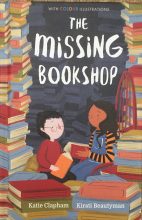
The Missing Bookshop

The Missing Bookshop
Katie Clapham and Kirsti Beautyman
Stripes Publishing
This smashing story from debut author, bookseller Katie Clapham took me back to my days working in a children’s bookshop on Saturdays and during school holidays, a job I loved and which always made me want to own a bookshop just like the one Katie has written about. It never happened though: I’ve stayed in education, albeit with a house full of as many books as some bookshops.

Mrs Minty is the owner of the one here, a place young Milly loved to visit especially for the weekly story time sessions when she’d sit transfixed on one of the cushions on the rainbow carpet listening to Mrs Minty read from a book, often in response to Milly’s ‘one with … in’. Times when Milly has saved sufficient pocket money to buy a book of her own were especially exciting.

On one such day Milly notices that both Mrs Minty and her shop have lost some of their sparkle, particularly whens she compares Mrs M. with the picture hanging on the wall behind the counter.
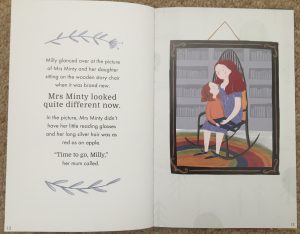
As she sits with her mum in a café after their bookshop visit, Milly expresses her concern, asking, “What do you do if something is old and creaky?”
Mum’s response about careful treatment and the possibility of replacing it with something new upsets the girl who considers Mrs Minty irreplaceable despite her “You’d make a wonderful bookseller,” words to Milly.

The next week, having watched the bookseller at work, Milly’s fears grow: the woman is a veritable encyclopaedia when it comes to knowledge about books – nobody could do better and after the session as she and her mum sit together they talk further about the bookshop’s future. So worried is Milly that she then runs back to tell Mrs Minty about her bookshop’s irreplaceability.

After the weekend the shop is closed when MIlly and her mum pay a visit. It remains so for the rest of the week until a sign appears in the window ‘CLOSED DUE TO UNFORSEEN CIRCUMSTANCES’ followed the next week ay the even more concerning ‘CLOSED UNTIL FURTHER NOTICE’. What on earth can have happened?

Another week passes and a van appears outside the bookshop full of items from inside; then a woman gets in and drives away before Milly has a chance to question her. Doom and gloom descend upon Mllly and deepen when a FOR SALE sign appears soon after.

It’s time to launch operation Save Minty’s Bookshop decides Milly and she gets busy right away.
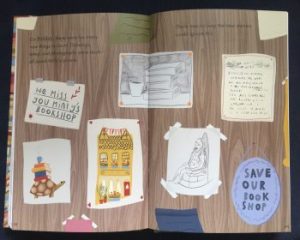
A few days later her mum returns from a supermarket visit with exciting news …

As a lover of local independent bookshops, especially those specialising in children’s books, my heart went out to Milly and Mrs Minty in this smashing story that flies the flag for such establishments. I loved Milly’s resilience and determination as well of course, as the fact that she’s a bibliophile at such a young age.

Kirsti Beautyman’s expressive illustrations portray so well, young Milly’s changing emotions as the story progresses towards its thoroughly satisfying finale.

Another cracking addition to Stripes’ series of full-colour fiction for newly independent readers; it’s bound to be devoured by book and bookshop lovers especially.
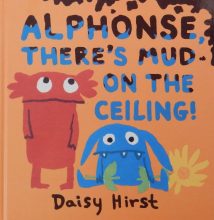
Alphonse, There’s Mud On The Ceiling

Alphonse, There’s Mud On The Ceiling!
Daisy Hurst
Walker Books

The cast from Alphonse, That Is Not OK To Do and I Do Not Like Books Any More! are back in another smashing story.

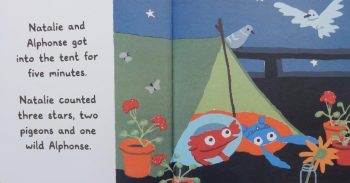
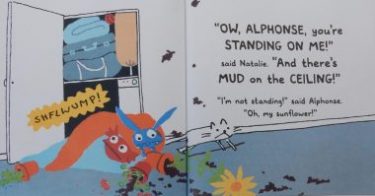
Natalie, Alphonse and family reside in a flat, on the seventh floor. The child monsters love driving their double-decker bed, playing around their large green chair, tending their sunflowers and performing somersaults down the hall and generally junglifying their surroundings until Natalie cries out “OW, ALPHONSE, you’re STANDING ON ME… and there’s MUD on the CEILING!

At this point Dad intervenes pointing out that their shenanigans are unsuitable indoor play. Natalie (who has an answer for everything) counters this with complaints about their lack of a wild jungle garden with a tent for sleeping in.

Eventually Natalie decides the park is where she want to be – alone.

Off she goes and there her explorations lead her to a bush with a hole wherein she finds …

Then, guess who arrives on the scene. A truce is called and a deal struck involving sausages and blackberries, and at Natalie’s insistence, a bundle of sticks.

Turns out there’s more than one place where you can be wild in the jungle, camping and tucking in to tea. Perhaps even sleeping too.

Another acutely observed, vibrantly illustrated tale from Daisy Hurst; these stories go from strength to strength. Everything about this book is quite simply brilliant.

I suspect adult sharers will adore it as much as the youngsters they read it with; this reviewer surely did.

There’s a Spider in My Soup

There’s s Spider in My Soup!
Megan Brewis
Oxford University Press

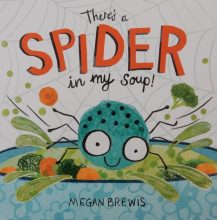
I was expecting it to be a picture book version of the nursery song of the same name but how wrong was I. Megan Brewis has dished up a playful tale of a little spider that gets a high five from me for her risk taking.
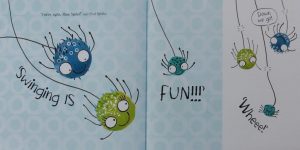
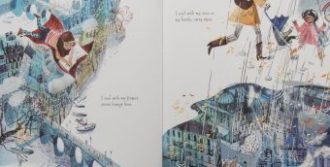
Little Spider resides with Mum Spider and Dad Spider on their web from which, despite parental warnings, she loves to swing.

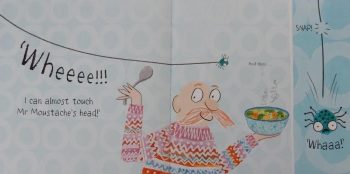
One afternoon while her parents are having some shut-eye, our intrepid Little Spider decides to take advantage of their lack of watchfulness to work on her swinging skills, arcing high and low and having great fun until …

Is she about to become part of Mr Moustache’s veggie soup lunch?

Fortunately she manages to alert her would-be accidental consumer by some loud assertions concerning her identity.
Happily Mr M. is a kindly soul and after administering some TLC, puts Little Spider safely back onto her web.

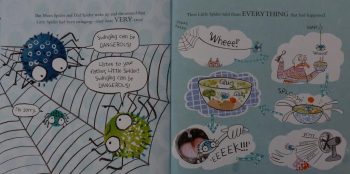
When aroused from their slumbers, her Mum and Dad give their little one a good telling off but then they learn what had taken place while they snoozed.

Maybe being adventurous isn’t such a bad idea after all, is their verdict before setting off to meet Little Spider’s saviour.

With an abundance of onomatopoeic sounds, speech bubbles and spirited, mixed media illustrations, this is a smashing story to read aloud with little ones. It could, one hopes, deter them from squashing spiders and instead releasing them into the great outdoors, should they encounter them inside; and let’s hope too that risk averse parents and others might be persuaded to give young children a little more freedom to take risks and perhaps learn from their mistakes too.

Bug

Bug
Robyn Koontz and Amy Proud
Sterling

Bug, so named because of her passion for bugs – spotting them and drawing them – finds it hard to concentrate in her maths lessons. Instead, her teacher often catches her doodling and staring outside thinking about her favourite creatures.

When Mrs Muskie tells the class that they can plan a trip to the science museum, so long as everyone does well in the maths test the following day, encouraged by her friend Jasper on their way home, Bug determines to do her best.

Sitting in the field near her school, the little girl tries hard to concentrate on maths but finds herself distracted by buzzy bees, tickly gnats, dragonflies and butterflies, which of course, she cannot resist drawing in her sketchbook.

When she notices crickets on a log in two groups, these too become objects for sketching.

But then, Bug realises that instead of a distraction, her minibeast drawings can help her understand her maths – good on you Bug – and she proceeds to use her pictures of butterflies, ants and crickets as visual aids.

I absolutely love the way that back in her classroom next day, during the test, Bug comes to the aid of her teacher when her lucky crickets become a bit too lively, escaping from her lunch box and landing in Mrs Muskie’s hair,

calmly leading her outside, collecting up the offending creatures from the field and proceeding to prove to her teacher that she was doing as she’d been told ‘showing her thinking’ on her paper, which she hands over for checking.

Congratulations are the order of the day and Mrs Muskie is as good as her word …

There’s plenty of gentle humour both in Robin Koontz’s text and Amy Proud’s enchanting illustrations executed in pencil and acrylics that are likely to make budding entomologists out of all young children (although I’ve yet to come across one who isn’t fascinated by minibeasts).

A smashing book.

Astro Girl / Where’s Mr Astronaut?

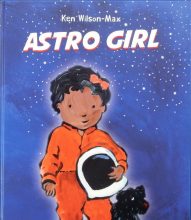
Astro Girl
Ken Wilson-Max
Otter-Barry Books

Space and stars enthusiast Astrid wants to become an astronaut, so she tells Jake her best pal as they lie stargazing.

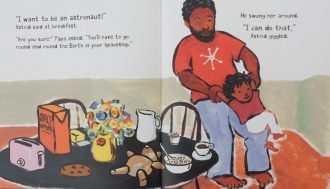
She goes on to tell the same to her papa over breakfast.

He challenges her assertion with comments about orbiting the Earth in a spaceship, dining on food from tubes and packets, becoming used to zero gravity, conducting scientific experiments …

and sleeping alone among the stars: he seems pretty knowledgeable about life in space. Astrid assures her Papa that she can manage all those things even the solo sleeping.

The day comes for the two of them to go and collect Mama in the car.

It’s then that we discover the possible reason for Astrid’s enthusiasm about space and her Papa’s knowledge.

A joyful reunion takes place and thereafter the little girl starts reading avidly to learn as much as she can about how to achieve her ambition, and about some of those trailblazing astronauts who went before, several of whom were women.

Simply and beautifully told, Ken keeps readers interested in the theme by showing us space related items such as Astrid’s t-shirt, her breakfast cereal, Papa’s T-shirts, the cookie shapes they bake together, pictures, a toy – all of which help in the build-up to the grand finale.

A smashing book for young space enthusiasts and perhaps to share on Father’s Day.

For a younger audience is:


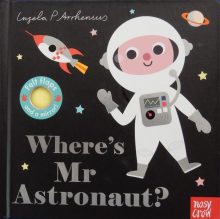
Where’s Mr Astronaut?
Ingela P.Arrhenius
Nosy Crow

Vibrant, immediately appealing illustrations characterise Ingela P.Arrhenius’ latest title for the ‘flaps and mirror’ series in an amusing introduction to space exploration for the very youngest.

The space travellers hidden herein are a delightful mix of human, canine and alien. There’s Mrs Engineer, Mr Space Dog, Mrs Alien,

Mr Astronaut and finally, whoever happens to be looking in the mirror tucked beneath the felt moon flap.

This one’s sure to add to the deserved popularity of the hide-and-seek series.

The Same But Different Too / Goodnight World

The Same But Different Too
Karl Newson and Kate Hindley
Nosy Crow

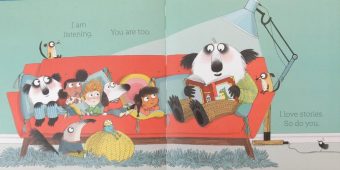
Similarities and differences are highlighted and celebrated in this joyful and engaging rhyming book that uses both human and animal characters to demonstrate examples throughout a busy, fun-filled day from breakfast time to bedtime.

In between come a look at differing heights, climbing skills,

play activity preferences, age, dentition, position, speed and much more; and it’s particularly heartening to find that everyone shares the love of a story session.

Karl’s upbeat words in combination with Kate’s vibrant, zany artwork create a great picture book that’s perfect for family sharing and for foundation stage settings.

With the emphasis on embracing differences it’s a super book to open up discussions about such issues as inclusivity and acceptance. Every spread offers much to talk about and enjoy, helping to highlight how our differences make each and every one of us special and unique.

Goodnight World
Nicola Edwards and Hannah Tolson
Caterpillar Books

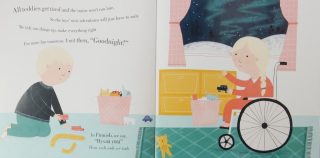
Ideal for bedtime sharing is this presentation of the ways of saying “Goodnight” in a dozen languages as well as in English.
Nicola Edwards rhyming narrative takes us through the bedtime rituals of different families as the little ones are hugged, have a bath, brush their teeth, tidy up toys,

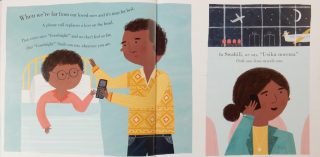
perhaps listen to a phone message from a loved one far away,

and share a bedtime story …

Some tinies are just so tired they need carrying up to bed already fast asleep, while others bid each other “Goodnight’ or in German “Gute nacht”.

Others will have trouble falling asleep and need to count sheep before dreams come.

No matter what though, come nightfall, little ones everywhere go to bed having said “Goodnight” or perhaps used the Mandarin “Wān an”, the Russian “Spokoynoy nochi”; the Italian “Buona note”; the Finnish “Hyvää yötä”; or maybe they said “Usiku mwema” (Shahili); “Buenas noches” (Spanish), the Arabic “Tisbah ala khair”; the Hindi “Shubh raatri” or the French “Bonne nuit”.

Safe in their beds under shared moon and stars, everyone finally falls asleep.

In her bold naïve style, inclusive illustrations Hannah Tolson shows all these different bedtime scenarios as they unfold in various places.

Animal Families: Forest, Animal Families: Safari / If I Were a Bear

Animal Families: Forest
Animal Families: Safari

Jane Ormes
Nosy Crow

Little ones can discover the parental names of a variety of animals in two different habitats.

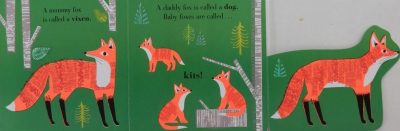
Forest presents for example a ‘mummy fox’ or vixen, a dog (daddy) fox and then if you lift the flap on the recto, you discover some baby foxes or kits.

Interestingly both a female deer and a female rabbit are called does whereas a male deer is a stag and a male rabbit is a buck; their offspring are fawns (baby deer) and like foxes, baby rabbits are called kits.

A boar (male bear) and a sow (female) produce bear cubs.

The pattern is the same throughout with the little ones being discovered by lifting the flaps on each recto.

The final spread has gatefolds opening to showcase the collective nouns for each of the animal families included.

Safari is slightly different in that each of the parent animals (leopards, zebras, lions and rhinos) are referred to as ‘daddy’ or ‘mummy’ and beneath the flaps are hidden ‘baby’ leopards, ‘baby’ zebras and so on while the final spread asks tinies to point out various items such as a pink sun’ or ‘little yellow huts’.

The real strength of both books is Jane Ormes’ striking, screen-printed patterned animal images that all have a textured look about them providing further opportunities for language development.

If I Were a Bear
Shelley Gill and Erik Brooks
Little Bigfoot

Through Shelley Gill’s informative rhyming text and Erik Brooks’ splendid, realistic painterly illustrations, the very young are introduced to several kinds of bears, their habits and habitats.

They may be surprised to learn that not only are there black, brown and polar bears, but also rare blue bears and black bears born white, also known as Kermode bears.

Read to Your Baby Every Day / Hickory Dickory Dock

Read to Your Baby Every Day
edited by Rachel Williams, illustrated by Chloe Giordano
Frances Lincoln Children’s Books

Editor Rachel Williams has chosen thirty classic Mother Goose nursery rhymes, favourite nursery songs along with the occasional action rhyme for this collection for adult carers to share with babies.

Chloe Giordana has crafted beautiful, intricately detailed sewn accompaniments to the words using a mix of stitching and fabrics that are hand-dyed.

It’s never and I mean never, too soon to introduce babies to rhymes and songs; there’s absolutely no better way not only to bond with a little one, but it’s proven that exposure to the world around through spoken words, rhymes and songs gives young children a head start in education, and not only with respect to language learning and communication skills.

This lovely collection will introduce tinies to the likes of Hey, Diddle Diddle, Hickory Dickory Dock, Twinkle Twinkle, Little Star, Humpty Dumpty

and Little Miss Muffet along with Row, Row Row Your Boat, Hush Little Baby and I’m a Little Teapot,

and even both in English and French Are you sleeping?

A lovely gift to give a new parent.

Hickory Dickory Dock
illustrated by Yu-hsuan Huang
Nosy Crow

A favourite rhyme with all the nursery classes I ever taught is this one that’s now given the ‘Sing along with me!’ format characterised by sturdy sliders and peep-holes. However in addition to singing the song, little ones will love watching the escapades of the mice as the clock strikes one, then two, then three

and finally four, and discovering that by four o’clock there’s not just one but four mice tucked up in cosy beds ready for some shut-eye, having escaped the clutches of the moggy character that has been eyeing them during the past three hours.

Yu-hsuan Huang’s illustrations are a delight with plenty to interest child and adult as they share the book or perhaps listen to the recording from the scanned QR code.

Gilly the Giraffe Self-Esteem Activity Book

Gilly the Giraffe Self-Esteem Activity Book
Dr Karen Treisman, illustrated by Sarah Peacock
Jessica Kingsley Publishers

This large format paperback is both a therapeutic story and a creative activity book for primary aged children, developed by specialist clinical psychologist, Dr Karen Treisman.

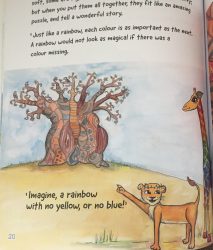
It begins with a story about Gilly the Giraffe to be shared with children. Gilly has much in her world to be happy about but she struggles with self-confidence on account of her height, her long black tongue and her colourful mosaic patches; and worse, some of the other animals make unkind remarks about these aspects of her appearance.

However, thanks to kindly Loren the lioness pointing out that being different makes Gilly exciting, beautiful and cool;

it’s all a matter of how you look at something. “We’re all precious and deserve to be appreciated.” So says Loren and thereafter not only Gilly but her classmates start to become more appreciative about one another.

A great confidence-boosting tale after which might come discussions on some of the story’s key themes.

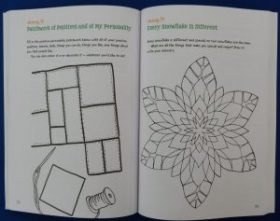
Thereafter the book offers a wealth of creative ideas through which these themes can be further explored. These are divided into two parts, the first being ‘fun activities and crafts with Gilly’ and comprises such things as mindful colouring, a word search, a quiz, questions to consider, a ‘make your own Gilly the Giraffe, a wonderful positivity wordlist, a positivity acronym using a person’s name(s) and more.

Part 2 contains over 25 further suggestions (that can be used in school or at home) for boosting self-esteem, confidence, positive thinking and self-belief,

each of which is clearly explained and where appropriate, space is provided in the book for writing, drawing or whatever is apt by way of a response.

With its integrated approach, this book is ideal for using in PSHE sessions and concludes with an excellent explanatory guide for adults; much of what is said herein, especially in the ‘practical strategies, tips and ways of being for building self-esteem’ should be read and acted upon by all who have dealings with children in whatever context.

Wearing my teacher/consultant hat, I whole-heartedly recommend this book.

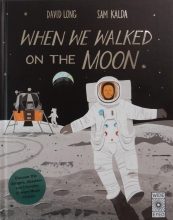
When We Walked on the Moon

When We Walked on the Moon
David Long and Sam Kalda
Wide Eyed Editions

Another of the recent, 50th anniversary of mankind’s first moon-landing outpouring of space-related books, both fiction and non-fiction, is this compelling one from David Long.

Herein, using a narrative style, he focuses in the main on the astronauts who took part in the Apollo Missions.
Dividing the text into short chapters he provides both technical details and accounts of the important incidents for the Apollo astronauts, including  pre Apollo space travels such as Yuri Gagarin’s 1961 orbiting of the Earth, before focussing on the Space Race between the Soviet and American teams to be the first to land a human on the Moon’s surface.

The focus of the second chapter is the Apollo11 flight crewed by Neil Armstrong, Buzz Aldrin and Michael Collins. We read of such domestic details as how the crew ate cooked portions of beef hash, toast, biscuits and bacon that were freeze-dried in bags; how their drinking water was made and their sleeping arrangements.

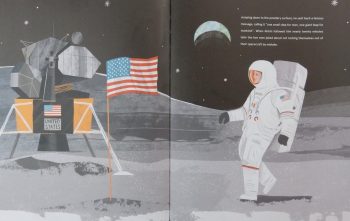
The third chapter describes the actual moon landing, how the two who were to walk outside first had to rest for four hours before venturing outside in their space suits. I was fascinated to learn that eleven layers of ‘different fabrics’ were used in their space suits to protect the men from everything from space dust to pieces of flying rock and from spacecraft fire; and that said suits weighed 80kg each.

Then comes Armstrong’s famous first Moon walk,

followed shortly after by Aldrin.

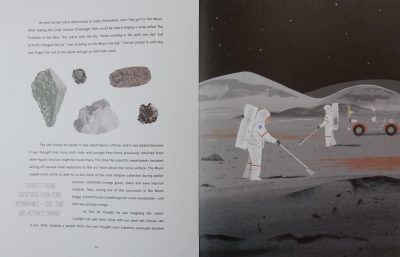
The Apollo 12 mission is described next; the crew, we’re told, had twice as much time as their predecessors on the Moon’s surface and were able to carry out tests and collect samples.

We then read of the almost disastrous Apollo 13 mission and what took place aboard the spaceship following the explosion of an oxygen tank that badly damaged the service module, causing a brief but complete loss of radio communication with Earth. Happily ground staff at NASA working non-stop, together with the awesome ingenuity and courage of the astronauts aboard Aquarius, succeeded in bringing the men back home.

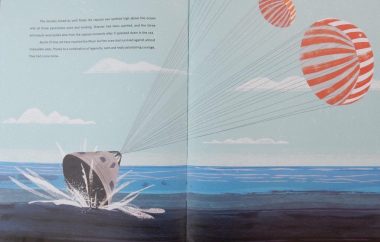
The amazing and absorbing story concludes with the safe return of the final Moon mission team aboard Apollo 17

and a brief look at future space travel with such enormous challenges as reaching Mars; however, as we read, ‘if Apollo showed us anything it is that with a combination of courage, determination and ingenuity we can and will go far.’

The final pages include group portraits of the crews of each Apollo mission together with brief biographies of each astronaut, a glossary and timeline.

Sam Kalda incorporates his love of pattern and texture into double page, single page and smaller illustrations of men, machines, lunarscapes and the Earth from space.

With its plethora of small humanising details, this book is strongly recommended for KS2 classroom collections and for home reading.

Uncle Shawn and Bill and the Not One Tiny Bit Lovey-Dovey Moon Adventure

Uncle Shawn and Bill and the Not One Tiny Bit Lovey-Dovey Moon Adventure
A.L. Kennedy, illustrated by Gemma Correll
Walker Books

This is the third title in Costa award winning author A.L.Kennedy’s series starring Uncle Shawn, his best pal Bill Badger and a cast of other larger than life, lovable and not so lovable characters.

It’s as superbly bonkers as the title indicates and had me spluttering with laughter on pretty much every page, both at the story and Gemma Correll’s splendid, liberally scattered illustrations of villains and goodies.

Early on in the tale we learn that Sky (one of the twins) has wished herself invisible and no matter how hard she tries to unwish her invisibility – which has distinct disadvantages – her second wish never comes true.

We also discover that Bill has fallen head-over-heels in love with a lovely lady badger (‘possibly the most gorgeous badger in the world’) going by the name of Miranda (although he doesn’t yet know that) and she seems as perfect as any creature could be. Romance is most definitely in the air.

Could it be though that Bill is deluding himself about the desirability of Miranda Badger. Why is it for instance that she is liaising with a bald man with ill-fitting teeth, one Sylvester Pearlyclaws, a notorious criminal?

Is it possible that he is in fact the erstwhile toothless man who had recently emerged from the sea at Shoogeldy Bay swearing to get his revenge on Uncle Shawn et al.?

Meanwhile Sky is still struggling with her invisibility problem, so much so that Uncle Shawn suggests that the way to solve it is  to visit the moon, aka – so he says – the land of wishes; and the means to travelling to their lunar destination will be, wait for it, a giant-size iron soup dish.

The entire plot is fast moving and completely crazy. It totally snares the attention holding it throughout, brimming over as it does with exciting imagery – ‘Uncle Shawn reached down and just managed to catch the magnet, It was going faster than an oiled penguin sliding down an iceberg because it was very late for dinner.’ Or, ‘The monster rattled its fangs together so that they sounded like angry knitting needles and yelled …’. and ‘ Pearlyclaws ran away as fast as he could manage, his floppy feet sounding like old towels soaked in badness.’

Clearly the author has had as much fun writing this story as youngsters will have reading or listening to it; it’s perfect for solo readers or reading aloud. If it’s the latter your listeners will urge you to keep on … and on … to discover what happens next, but do make sure you stop frequently to share Gemma Correll’s wonderful visual images as well the author’s verbal ones.

In a word, priceless.

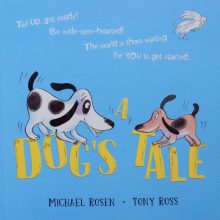
A Dog’s Tale

A Dog’s Tale
Michael Rosen and Tony Ross
Scholastic

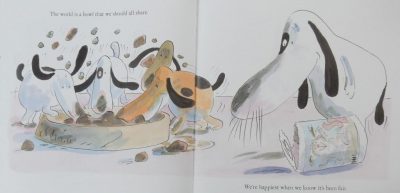
Full of worldly wisdom, is this rhyming discourse from an old dog to a concerned pup as the two take a walk together.

Reassuring from the outset, ‘an epic life story that YOU get to write. … Be wide-open hearted … Fill up on hope, throw away fears’ comes the advice.

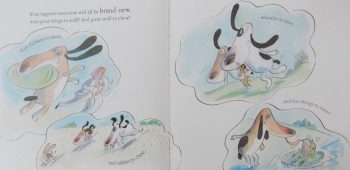
Life promises plenty of action …

no matter where your journey takes you … and opportunities – ‘you can make a mark! Make yourself heard –‘ although it’s important to be prepared for life’s downsides too – those waiting in the wings to do you down; or you might suffer the loss of a loved one.

However nobody need feel completely alone; there’ll be a friend to help you through times of sadness.

Perhaps a time will come when others will require your help; give and take is the best scenario. What we all need be we young, old or in-between, is a world where everyone is willing to share, a world where life is fair.

So says the sage old canine after which he retires for a well-earned snooze.

If only: we still have an awful long way to go but this book from two pillars of children’s books and reading, writer Michael and artist Tony, is a great reminder of what we should all be striving for. I’m no lover of dogs but I certainly fell for Michael’s canine characters as portrayed by Tony Ross in his superbly expressive scenes.

Share, discuss and act upon the advice herein wherever, whenever possible.

The Big Stink

The Big Stink
Lucy Freegard
Pavilion Books

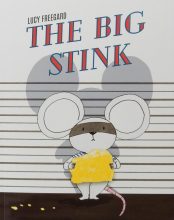
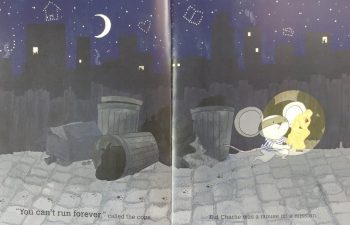
Despite his beguiling appearance, cheese-obsessive Charlie Mouse is a mouse with a mission for he’ll do anything to satisfy his lust for the stinky stuff: even perhaps following his dream of breaking into the Museum of Cheese and procuring for himself one of its famous exhibits, The Stinker.

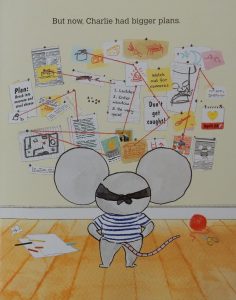
One night his avarice overwhelms him and he decides to act.

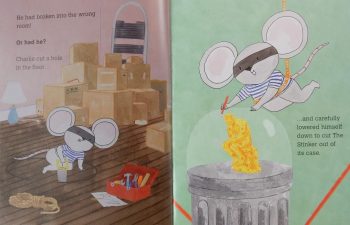
Once inside he finds that the security is excellent; so too though is his avoiding skill. Perhaps his location expertise is less so, but Charlie is forearmed with the appropriate tools to get his paws on the sculpture.

Suddenly disaster strikes in the form of a web of laser beams and the game is up. Alarms sound, security is alerted and the chase is on. Officer Rita is hot on his trail.

With her hyper-developed olfactory sense, she succeeds in tracking down the thief but by that time Charlie has seen the error of his ways. The priceless exhibit is still intact and Charlie must do his community service; but while so doing a wonderful idea strikes him …

With its twist in the tale, little ones will relish this cat-and-mouse drama; but it has plenty to offer adult readers too, not least the art and film references scattered throughout Lucy’s delicious offering.

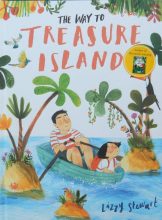
This Way To Treasure Island

This Way to Treasure Island
Lizzy Stewart
Frances Lincoln Children’s Books

Award winning author-illustrator Lizzy Stewart introduces us to two completely contrasting characters, young Matilda and her dad; he tends to be slow, messy and noisy whereas she is fast, tidy and quiet. No matter how different they are though, they almost always have fun together.

One day at the beach Matilda, in possession of a map, announces that she’s off to find treasure. Her dad, she tells him, can accompany her so long as he agrees to follow the map.

Off they go in an old wooden boat with Dad rowing and Matilda giving directions.

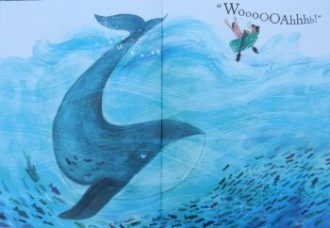
Sometimes, Dad becomes distracted and as a result the two drift far out to sea. Dad’s all for taking short cuts but Matilda isn’t sure. She’s even less sure when the nice big rock they’re circling does this …

Fortunately however, the turbulence takes the boat right close to the shore of their treasure island destination. Thereon more map reading is required and almost immediately the two agree to part company; “We’ll see who finds the treasure first!’ says Dad.

Inevitably without his daughter as guide, Dad is soon totally lost.

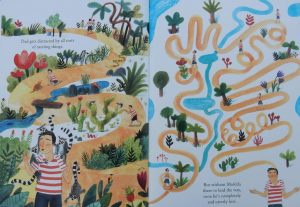
Matilda meanwhile, although she finds things a tad on the boring side, continues following the map. Eventually she finds the place where according to the map, she should find the treasure but despite looking under, over and inside things, she can’t find it. Time to return to the boat she thinks.

Dad however is still looking and wondering until …

In case you’re wondering, yes they do discover treasure although perhaps it’s not what they were expecting. And then it’s time to go home, maybe without taking any short-cuts however.

Yet again, Lizzy has created a winner with this. Her characters are convincingly portrayed and their treasure island with its rainbow hued flora and fauna, totally gorgeous.

Rich in classroom potential, this smashing book will be requested over and over.

How To Be On The Moon

How To Be On The Moon
Viviane Schwarz
Walker Books

This sequel to How to Find Gold again stars intrepid Anna and careful Crocodile.

Anna is eager to visit the moon but Crocodile is less than enthusiastic telling her it’s “out in space … really very far away … almost impossible.”

This appeals to Anna but first they have to acquire some special skills, counters Crocodile; but Anna can count backwards from five.
In fact he raises a snag at every opportunity: a great deal of patience is necessary: Crocodile has sufficient for them both, he’s told eventually.

Crocodile is then allocated the task of sandwich making while Anna builds the rocket.
Tasks complete, they count down and … blast off …

While on board they play the only game gravity allows – it involves sandwich catching and consumption (once you’ve caught all the constituents) and then as it’s still some distance to go, take a patience-extending snooze.

Finally though they land on the moon, finish their sandwiches, don space helmets and go out exploring the deserted moonscape.

Before long, as they gaze up Anna decides that “Poor Earth” is missing them and they decide to head off back home.

Once more on Earth, they bask briefly in mission-accomplished glory before deciding the rest of the world needs checking on, and off they set …

A smashing story – one expects no less from Viviane – but it’s the wonderful, wondrous textured illustrations that steal the show – just!  The dialogue’s absolutely priceless too. And I absolutely love how the two contrasting yet complementary characters rub along together so beautifully.

Sheer delight through and through.

Teaching Social Skills to Children with Autism Using Minecraft®


Teaching Social Skills to Children with Autism Using Minecraft®
Raelene Dundon, illustrated by Chloe-Amber Scott
Jessica Kingsley Publishers

I know from my teaching experience that children on the autism spectrum often become obsessively passionate about and often developing an enormous competence in a particular thing such as  Lego building, drumming, a certain cartoon series or drawing specific items.

The strength of the motivation towards their chosen passion tends to result in a lack of social skills: participating in Minecraft® (which is frequently called digital Lego) offers a wonderful setting to enable neurodiverse children to develop both social and communication skills. Clearly the author of this large format book, Raelene Dundon appreciates this and to that end, has created a superb resource.

Having outlined in the opening chapters the importance of social skills and how these are impaired in children with ASD, she puts the case for using group programmes, in particular Minecraft® to develop those crucial social skills.

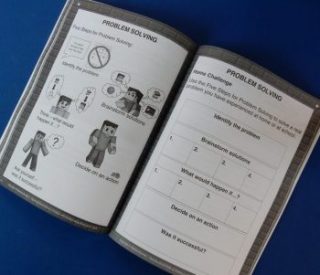
The second part of the book comprises information on how to set up a social Minecraft® group; how to use the game for supporting such skills as holding a conversation, being interested in other people and understanding the viewpoint of another person.
Each skill, for instance problem solving,

‘being creative’ or co-operation

is succinctly presented and related to what has just happened during the specific session – this is a great tool for developing awareness in the learner.

In all there are thirty sessions (around 150 pages of photocopiable material) with smashing illustrations by Chloe-Amber Scott, making this an absolutely invaluable and comprehensive resource – a veritable goldmine – for any professional working with primary children or older students, who have ASD.

The Suitcase


The Suitcase

Chris Naylor-Ballesteros
Nosy Crow

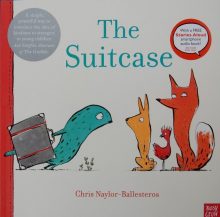
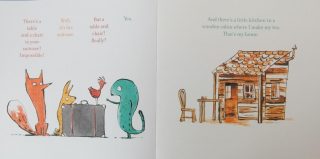
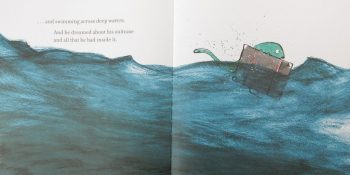
One day there comes a weary, wan and dusty looking stranger dragging behind him a large suitcase. Challenged by a watching bird as to the contents of his suitcase, the creature answers, ’Well, there’s a teacup.’

Another animal arrives on the scene expressing surprise at the size of the case in relation to a teacup and is told that it also contains a table for the cup and a wooden chair for the stranger to sit on. Up rocks a fox and on hearing what’s being said, implies the stranger is lying.

This prompts him to fill in further details about a wooden cabin with a kitchen or making tea and to describe its surrounding landscape too.

By now the creature is so exhausted he begs to be left alone to rest and falls asleep right away.

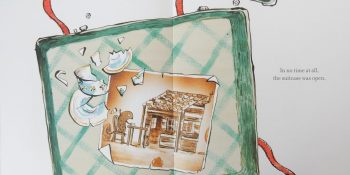
The other three creatures discuss things and fox is determined to discover the veracity or not of the information the stranger has given. His friends are less sure that breaking into the case is acceptable but fox goes ahead and the contents of the suitcase is revealed …

The damage is done: still fox insists the stranger lied to them whereas the other two are showing concern.

Meanwhile the slumberer dreams …

And when he wakes up he’s totally surprised at what the others have done …

Audiences will go through the whole gamut of emotions when this heart-rending story is shared, as did this reviewer.

It’s a totally brilliant, brilliantly simple and compelling way of opening up and discussing with little ones the idea of kindness and how we should treat those in need. I love the way the animals and what they say are colour matched and Chris’s portrayal of the characters is superb.

What better book could there be to share with a nursery or foundation stage class during refugee week than this one, offering as it does, hope and the possibility of new friendship.

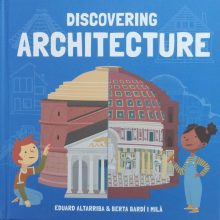
Discovering Architecture

Discovering Architecture
Eduard Altarriba and Berta Bardí I Milà
Button Books

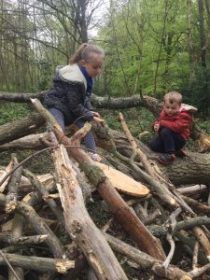
The urge to build structures is seemingly, a universal human trait. I spent some of the Easter break constructing a den in a quiet woodland glade in Bushy Park, from a fallen tree trunk and branches, with 6-year old Emmanuelle and her soon to be 4, brother Samuel.

When they are ready to discover more about the build environment, this tremendous introduction should prove invaluable.

The graphic designer and illustrator Eduard Altarriba has already introduced young readers to Quantum Physics and now in a similarly engaging manner presents a look at iconic buildings through history, their creators and some of the items that might be found inside such buildings.

Starting with the earliest known building projects, the pyramids of Egypt, Iraq and Mexico, Classical Greek, Roman and Byzantine places of worship, domestic and vernacular architecture from many parts of the world, information on architects such as Antoni Gaudí, Le Corbusier, Ludwig Mies van der Rohe and Zaha Hadid …

readers are given a superb presentation of things and people architectural.

The final spreads focus on architecture’s basic elements – there’s a cut-away diagram of the principal parts of a building; what being an architect entails and lastly a look at what buildings might be like in the future (it’s good to see sustainability given a paragraph here).

University lecturer at the School of Architecture, UPC, Barcelona, Berta Bardí I Milá packs a wealth of absorbing information into the uncluttered spreads, so finely designed and illustrated by Altarriba.

Perfect for KS2 readers and perhaps adults wanting a starting point for the topic.

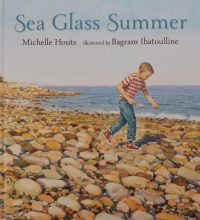
Sea Glass Summer

Sea Glass Summer
Michelle Houts and Bagram Ibatoulline
Walker Books

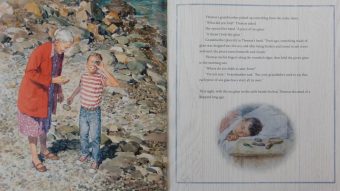
‘Some years ago a boy named Thomas spent the summer at his grandmother’s island cottage.’ So begins a beautiful story set in Maine some time in the last century.

Early in his stay his grandmother gives the boy a magnifying glass that had belonged to his grandfather and Thomas uses this as he explores the rocky beach one morning.

When he shows Grandmother a piece of glass he’s discovered she tells him that “ … your grandfather used to say that each piece of sea glass has a story all of its own.”

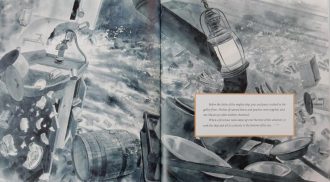
That night Thomas places the sea glass beside his bed and dreams of a shipyard long ago. The routine continues with the boy discovering bits and pieces of glass each morning and dreaming each night. (The dream stories are depicted in greyscale serving both to separate them from the present events and to bring history alive again).

In contrast, Bagram Ibatoulline’s superbly moving, equally realistic, watercolour scenes show the sometimes glowing, sometimes shadowy shore whereon Thomas, aided by the magnifying glass, makes his discoveries of mysterious magical ocean gifts and lets his imagination soar.

All too soon the holiday ends: Thomas gathers together his treasures and boards a boat back to the mainland. However, a sudden lurch causes him to drop his magnifying glass and some of the pieces fall overboard.

The story then moves to recent times: a girl named Annie walks on the beach collecting treasures and comes upon a piece of sea glass. She shows it to her Papa Tom; you can anticipate what she’s told … The tale concludes having come full circle …

Michelle Houts’ lovely story of journeys, connections, possibilities and the power of the imagination has much to appeal to older picture book readers and is full of possibilities for exploring in a KS2 classroom.

(A final author’s note explains why there is much less sea glass nowadays: a big plus for the environment but children will have to find other treasures on the seashore to fuel their imaginations.)

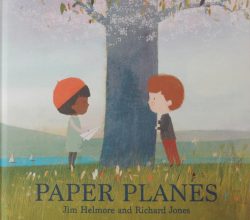
Paper Planes

Paper Planes
Jim Helmore and Richard Jones
Simon & Schuster

Following his The Snow Lion, Jim Helmore has written another  beautifully observed, enormously moving story.
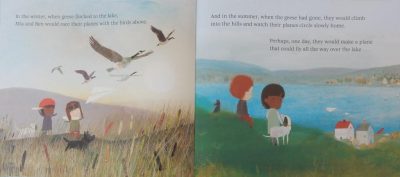
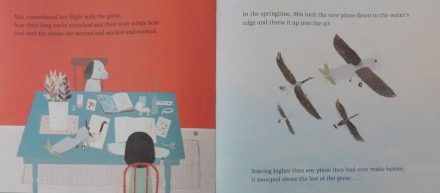
Mia and Ben are best friends; they do everything together, their favourite activity being making paper planes. In winter, they race them against the geese and hope one day to make a plane that will fly right across the lake.

Then comes some devastating news: Ben and his family are moving to a new home in the city. How will they sustain their friendship when they’re so far apart?

The two exchange planes and vow never to forget one another.

Winter comes; the days are hard for both of them and in her frustration and anger, Mia smashes the plane Ben’s given her.

That night something stirs Mia during her slumbers. The plane in the garden, appears whole once more; and then she’s flying with the geese, high in the sky. Suddenly she spies another plane: could it possibly be?

The next morning she receives a parcel from Ben. Inside is a model plane but it isn’t complete: Ben knows of only one person who can add the wings …

The friendship isn’t broken after all; the connection is still there, and the hope.

Richard Jones’ captures the changing emotions to perfection in his richly textured illustrations. They contain plenty of details, and like the words, a powerful poignancy that is impossible to forget. I love the subtlety of the STEM element especially the way Mia uses both her knowledge from her observations and her creativity to complete her task.

Readers and listeners too will need to use their observational skills to read Richard’s pictures carefully to get the most from this quietly powerful picture book.

Leyla

Leyla
Galia Bernstein
Abrams Books for Young Readers

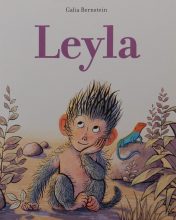
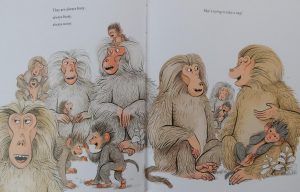
Young hamadryas baboon Leyla finds her large family overwhelming with their constant noise, grooming and snuggling.

She just wants some peace so decides to run away in search of a quiet space of her own.

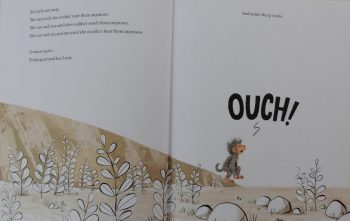
Having run sufficiently far, so she thinks, for there to be nothing around, she stubs her foot on a sharp rock

and then comes upon a lizard; a very still, quiet creature “very busy doing nothing” so he says.

At her request, the lizard teaches Layla to do the same: they sit peacefully in meditative mode feeling the warmth of the sun and listening to the rustling of the leaves, the buzzing of insects.

Some time later, Layla opens her eyes and realises that she now misses her family and is ready to go back to them. She does so however, safe in the knowledge that she can always return to doing nothing with her new friend for “I’m always around,” he assures her.
As a result she finds herself better able to cope with all the attention she receives from her welcoming family, partly because true to his word, that lizard was ‘always there.’ And she certainly enjoys talking about her adventure.

As someone who practises meditation (and yoga) daily, I can attest to the benefits of what that lizard offered Layla.

The author’s warm story, we learn was inspired by watching hamadryas baboons, in particular a very young one, in a Brooklyn zoo. Her expressive illustrations created digitally with the addition of hand-painted textures, say plenty about Layla’s feelings be they overwhelmed, angry, in pain, scared, peaceful, happy or excited.

In our ever busy, pressurised lives, we all, young and not so young, need to become more mindful; this book is a fun demonstration of the importance of mindfulness.

Party for Dads / Molly’s Magic Wardrobe: The Mermaid Mission

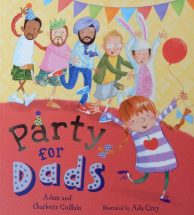
Party for Dads
Adam & Charlotte Guillain and Ada Grey
Egmont

For this follow-up to their School for Dads, the Guillians have created another joyful picture book and it’s just right for celebrating Father’s Day as well as a Dad’s birthday.

The particular dad in this rhyming tale has no time in the morning for birthdays, barely paying heed to his daughter’s “Come on – it’s time to play! … You should be having fun.”

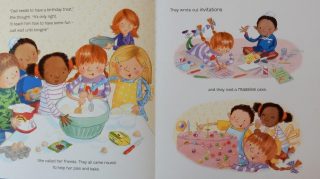
Instead he dashes out leaving young Anna and the friends she summons to plan and bake for a special surprise evening celebration.

Later in the day, Dads of all kinds arrive and are instructed to cast aside their phones and don fancy gear ready for some fun party celebrations and games both inside …

and outdoors.

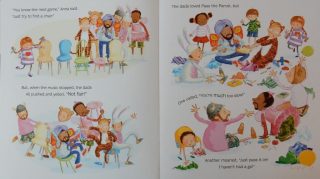
Enthusiasm for partying duly fired up, they then start bopping and before long their less than skilful moves are being scored in ‘Strictly’ style.

After that it’s time for Anna’s Dad to embrace the true party spirit, which he does by becoming a stand-in magic bunny when his daughter performs a spot of prestidigitation.

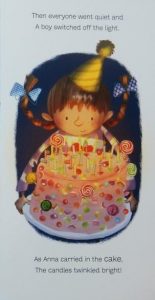
Over indulgence is inevitable after all the playful party-poppering papas tuck in to the feast on the table that culminates in the appearance of …

Then candles extinguished, it’s award presentation time: but will Anna’s dad be a prizewinner?

Fun and a certain amount of silliness prevail in this exuberant book, made all the more effervescent by Ada Grey’s funky illustrations

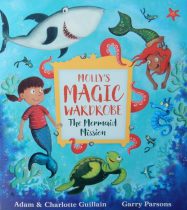
Molly’s Magic Wardrobe: The Mermaid Mission
Adam & Charlotte Guillain and Garry Parsons
Egmont

The second story starring Molly and the enchanted wardrobe she discovered at her Granny’s house sees the little girl’s attention being drawn to a mermaid costume.

Having stepped inside and counted to three, she’s off whizzing down into the depths of the ocean for a new adventure.

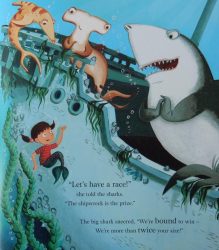
Her frolics with mermaids are soon interrupted by snarling sharks claiming ownership of a wreck and swooshing the girl and her new friends down to where more friendly creatures – a turtle and octopus are taking tea.

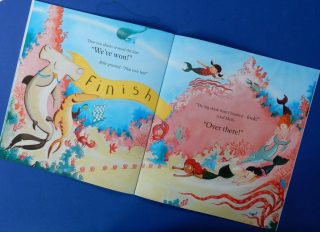
The mermaids relate what’s just happened and suddenly Molly has an idea. She challenges the sharks to a race, the prize being the shipwreck.

The sharks are confident they’ll be victorious but will they?

Lessons are learned, apologies given and accepted; and after a game of hide-and-seek, it’s time for Molly to bid her new friends farewell.

The Guillains’ magical rhyming tale is complemented by Garry Parsons’ bright, expressive, eye-popping scenes of the sub-aquatic frolics.


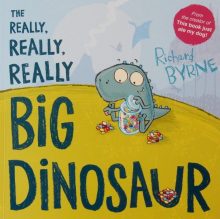
The Really, Really, Really Big Dinosaur

The Really, Really, Really Big Dinosaur
Richard Byrne
Oxford University Press

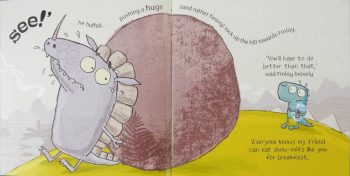
Finlay sits counting out jelly beans from a jar, ‘one for him, one for me’ when suddenly a huge dinosaur approaches – an extremely greedy dinosaur who demands all the jelly beans for himself. Now the sweet treats happen to belong to Finlay’s friend and the little dino. claims said friend is rather large but this deters the huge beast not one jot. Instead he brags even more about his size and strength and goes on the heave an enormous rock in Finlay’s direction.

Teasing follows with the huge stroppy dinosaur accusing Finlay of making up a story and further bragging about his own skills. And so it continues with the bully becoming ever more angry …

until the sleeping giant is finally awoken by his shouts of “I want the jelly beans.”

Now it’s time for the supposed make-believe creature to show that big bullying dinosaur a thing or two.

That’s not quite the end but who wants to be a story spoiler?

Splendidly witty, this tale is much more about showing than telling with the deadpan words and hilarious pictures working wonderfully in tandem.

It’s great to see a paperback version of the story that’s certainly going to appeal to the vast numbers of young dinosaur lovers out there; and it’s a perfect one for starting a discussion on bullying.

If you missed the original hardback (or it’s worn out from use), then now’s the time to get hold of a paperback replacement.

The Dictionary of Difficult Words

The Dictionary of Difficult Words
Jane Solomon and Louise Lockhart
Frances Lincoln Children’s Books

American based lexicographer, Jane Solomon, and UK illustrator Louise Lockhart have collaborated on this compilation of over 400 words, the former providing the easily comprehendible definitions and the latter, the accompanying stylish graphics.

Before the alphabetic section itself are an explanation of what a dictionary is and how to use this particular one, and a spread on parts of speech that also mentions pronunciation.

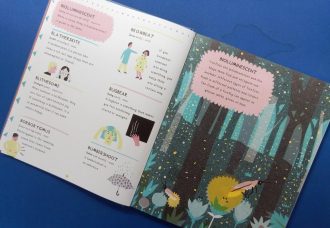
Then comes the A to Z with two spreads allocated to each letter. Some of the words included are tricky to get your tongue around so the pronunciation guide for each one could prove invaluable, especially should readers come upon a word that’s new to them. I have to say having learnt Latin many years ago did help somewhat, as it did with working out the meaning of the occasional words I hadn’t come across before – yes there were one or two – as well as several, including borborygmus – a rumbling emanating from the stomach- I was glad to be reminded of.

The same is true of kakistrocracy, for obvious reasons.

Did you know that a person (such as this reviewer) who loves solving crosswords (or a compiler of same) is called a cruciverbalist? Now there’s a lovely word to get your tongue around. As is omphaloscopy (otherwise known as navel gazing) and ultracrepidarian (somebody who has big opinions relating to things about which they know nothing). I’m sure we can all think of a few such people.

You might be forgiven for thinking that vomitorium was something to do with throwing up; not so; it’s a passageway people used in ancient Roman times to enter or leave an amphitheatre.

Not all the words are long or tricky to say though: there’s yex, which refers to the act of hiccupping or crying.

I’ll conclude with a word that I absolutely love – lollapalooza – which might be used to describe this book. If you don’t know its meaning then I suggest rather than ‘googling’ it, you get a copy for yourself, your family, or your class. As well as being a celebration of words and the English language, it has the potential for increasing the vocabulary of youngsters who will love to impress others with their word power.

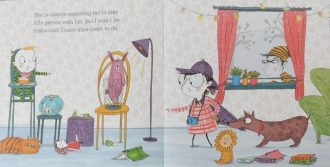
Sophie Johnson: Detective Genius

Sophie Johnson: Detective Genius
Morag Hood and Ella Okstad
Simon & Schuster

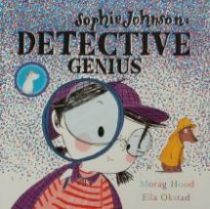
Unicorn expert Sophie Johnson now extends her skills to detecting; she’s a self-confessed expert, ably assisted though she won’t admit it, by fussy eater, anti-outdoors pooch, Bella.

Sophie knows of a ‘terrible crime’ that needs solving and fuelled by the thought of the reward, she’s on the case, determined to discover the perpetrator.

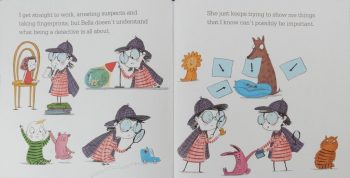
Suspects are arrested and finger-printed while Bella constantly tries in vain to draw something to Sophie’s attention; but so absorbed in her own detecting is Sophie that she’s unable to see what’s right under her nose.

Detecting is tough work but some are more adept at it than others – it’s just a matter of deciding who …

I won’t be a story-spoiler; however observant readers and listeners will likely be making their own predictions well before the final denouement of Morag’s clever, dead pan telling.

Ella’s hilarious scenes of Sophie and her assistant on the case provide the perfect foil for the droll text; and do look carefully at the back cover whereon Sophie’s library is shown.

What will Sophie turn her attention to next? No matter what, bring it on. Meanwhile, for sure, the adorable Sophie will win a lot of new fans with this latest book.

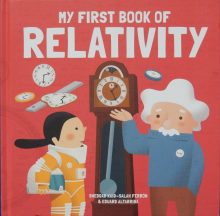
My First Book of Relativity

My First Book of Relativity
Sheddad Kaid-Salah Ferrón and Eduard Altarriba
Button Books

We had My First Book of Quantum Physics and now for a companion volume, its creators have turned their attention to another potentially complex science topic, that of relativity.

However, in the hands of this partnership, Einstein’s theory of relativity and other related aspects of connections between space and time are explained in such a way as to make them accessible to young readers. For, as it says on the back of this book, ‘it’s never too early to start exploring big ideas.’ So, how does one start?

The space-time theory, we read, can only be properly understood by first understanding what the two concepts mean in themselves; and then we’re in a position (like Einstein) to understand ‘the world through relativity’.

Time is succinctly explored – how it’s measured, by what means and the various units used.

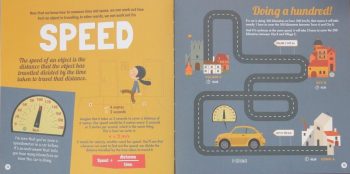
Speed,

movement and the vital importance of frames of reference are explained, the latter using the example of a moving train and then a person in space.

There are spreads on adding up speeds and the speed of light, leading into Einstein’s two theories, special relativity and general relativity (his theory about gravity).

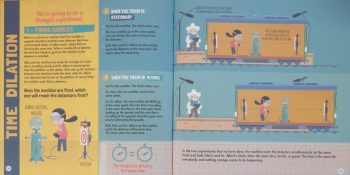
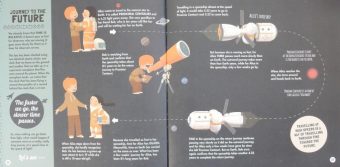
I love the ‘thought experiments’ relating to time dilation and clocks; and the wonderful spread whereon ten year old Alice travels to our nearest star Proxima Centauri, leaving her same aged friend  waiting for her on Earth and returning to find she’s still  ten whereas he is now almost 19, put me in mind of T.S. Eliot’s famous lines from Burnt Norton ‘Time present and time past / Are both perhaps present in time future / And time future contained in time past.’

If only physics had been made this fascinating back in the day when I was studying it at A-level (albeit only for a few weeks before deciding it wasn’t for me).

I’d not heard of muons before reading this book – a muon being an elementary particle of the electron family weighing around 200 times more than an electron, but again found the spread using a muon to check time dilation and length contraction totally engrossing.

The book concludes with how speed increases the mass of an object; the imaginings of the young Einstein (note the word imagined is used by the author, highlighting the crucial importance of the role of the imagination in scientific discovery) and a look at the mathematical equations Einstein used to describe his ideas of special relativity, the former taking mere weeks to find, whereas he took ten years to understand the ideas themselves.

The entire topic is mind-stretchingly incredible and brilliantly explained in this book, with the aid of Eduard Altarriba’s vibrant, graphics. Strongly recommended for budding scientists either for home reading or in school.

Planet Fashion

Planet Fashion
Natasha Slee and Cynthia Kittler
Wide Eyed Editions

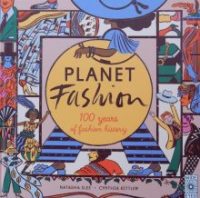
Hats firmly held on and boots duly laced, we’re off on a catwalk extravaganza that embraces cultures, time and much more as it showcases in twenty five scenes, fashion history from all over the world.

We’re in the company of two young fashionistas, one male, one female, as we embark on this globetrotting experience. (It’s fun to locate them looking the part in every scene.)

The journey begins in a high society ballroom over a century ago as elegantly attired dancers and onlookers twirl or stand in their floor-sweeping Edwardian ball-gowns and suits.

Next stop is a performance of the Ballet Russes where dancers drift across the stage clad in voluminous harem pants and feathered turbans, watched by women in empire-line dresses, often wearing huge hats.

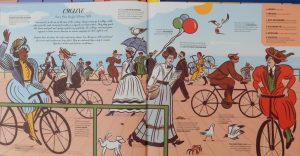
Cycling shows women sporting cycle bloomers and sometimes dresses as they pedal their bicycles in early 1900s USA.

‘Shimmying Down’ set at a Harlem Renaissance dancehall, showcases women in brightly coloured flapper fashions and men sporting long jackets or studded waistcoats.

No matter whether you wish to emulate the ’Lost generation’ of 1920s Paris; imagine yourself as a Bollywood screen star gracing the Mumbai (Bombay as it was then) roads during the 1960s, or striding carefree along the London streets of the 1950s and 60s proudly wearing a miniskirt or dress;

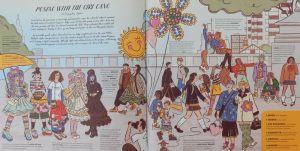
glue your hair into spikes like the London Punks of the 1970s; or try ‘Posing with the Girl Gang’ in the uber-cool Harajuku district of Japan from the late 1990s onwards;

or imagine yourself street dancing in South Africa’s townships in the earlier 2000s there’s a vibrant scene to show you how it’s done.

Every single lavishly illustrated spread is inclusive, with diverse characters wearing the distinguishing fashions of the era; and each has a fact box giving information about key designers, hemline and sleeves, and silhouette as well as the when and where, and descriptive paragraphs providing cultural history and influences.

If all that isn’t sufficient for even the most dedicated follower of fashion, then there are also timelines – the first of which gives a summary of key events of the 20th century, and the other four showing silhouettes, shoe styles, and trends in hats and bags. Plus there’s a final ‘Can you find’ challenge that will surely inspire readers to go back and peruse the scenes even more carefully to locate such as ‘a woman watering her flower garden on the streets of Saigon’; ‘a bird enjoying the breeze on a washing line in Canada’ or ‘a waiter dropping his tray of coffee on the streets of Paris’.

For anybody with an interest in fashion, this is a must-have book: I absolutely loved it.

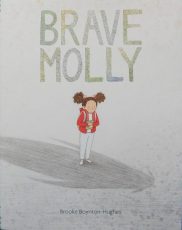
Brave Molly

Brave Molly
Brooke Boynton-Hughes
Chronicle Books

This virtually wordless picture book follows young Molly from her window seat where she sits reading and observing three young passers by, out from her house and down the street. But what is constantly lurking close by, sometimes waiting, sometimes following, sometimes stopping to watch?

It’s the monster that bears a strong resemblance to her own drawing tossed into the rubbish bin before she left home. Said monster, so we assume, is a representation of Molly’s own fear of interacting with others.

The three children leave behind a book on the seat they’d stopped on; Molly puts it in her backpack and sets off after them, with the monster not far behind.

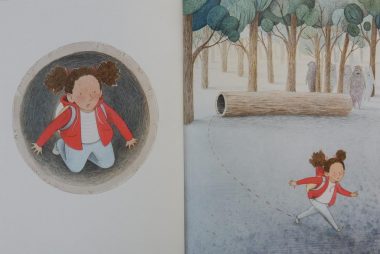
Her shyness escalates and with it the number of monsters as she runs, crawls through a tunnel

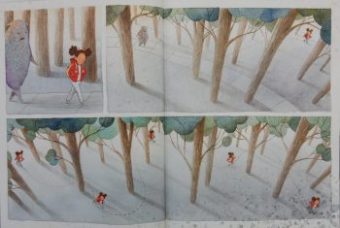
and climbs trees until she feels almost completely overwhelmed. Somehow though, she summons up the courage to confront the terrors and seemingly they vanish, or almost.

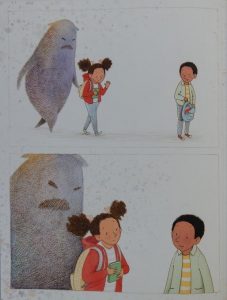
One returns as she attempts to overcome her shyness and return the book: can she manage to get the better of it?

Could a simple word perhaps be all that’s required?

Make sure to check out the endpapers – this moving, empowering story starts and concludes thereon. It’s a great book to open up discussions with youngsters, about overcoming shyness or other fears.

Wordless books leave room for readers’ own interpretations – to ask and answer their own questions, and perhaps draw their own conclusions. Brooke Boynton-Hughes’ softly coloured pencil, ink and watercolour illustrations leave plenty of space for them to do just that, not least just how much inner courage Molly had to summon up to step outside and make that journey into the anxiety-inducing world beyond the safety of her home.

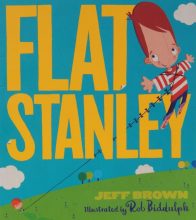
Flat Stanley / The Flat Stanley Collection

Flat Stanley
Jeff Brown and Rob Biddulph
Egmont

I was over the moon to learn that Flat Stanley was to appear in picture book form, especially with Rob Biddulph as illustrator. I could think of no better person for the task and Rob has most certainly pulled it off with aplomb.

Just in case you’ve never come across Stanley Lambchop and his family before, let me introduce them: there’s young Stanley, his younger brother Arthur and their parents Mr and Mrs Lambchop who can be a tad fussy when it comes to matters of politeness and talking properly.

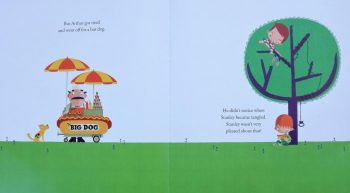
So when a huge pin board hurtles from the wall totally flattening Stanley, they’re more concerned about Arthur’s manner of delivering the news about his brother than the contents of same. Indeed they defer a doctor’s visit until after breakfast.

Happily it’s good news: Dr Dan is reassuring and so the now half inch thick boy can start to take advantage of his lack of girth, though there are snags too.

Next day news of another art theft reaches the ears of Stanley and his dad as they’re out for a stroll.

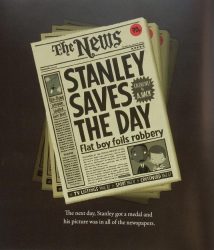
Stanley has a bright idea that just might help apprehend the thieves and that night it’s put into action: will he pull it off?

Yes Stanley does save the day – or rather the object of the thieves’ desire.

But perhaps being a hero of the extra-skinny kind isn’t all fun and flattery …

I can’t remember how many years ago I first shared the original Flat Stanley book with a class of children but it was certainly a long time back and it’s remained a favourite with me, and many more classes since. Now with this smashing picture book version of the first story, a younger audience can savour the delights of the flat but inflatable, Stanley in the new Rob Biddulph incarnation.

Rob has also illustrated a bumper collection of Stanley Stories:

The Flat Stanley Collection
Jeff Brown and Rob Biddulph
Egmont

This chunky volume contains six Stanley books – the first, together with Stanley and the Magic Lamp, Invisible Stanley, Stanley’s Christmas Adventure, Stanley in Space and Stanley, Flat Again!

Guaranteed hours of delicious Stanleyness with plenty of “Hay is for horses, not people” thrown in for extra enjoyment.

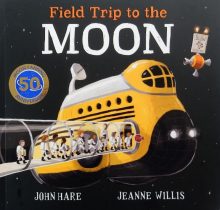
Field Trip to the Moon

Field Trip to the Moon
John Hare and Jeanne Willis
Macmillan Children’s Books

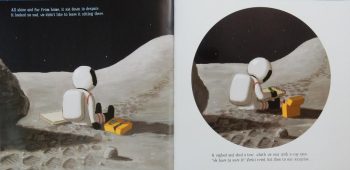
A class goes on a field trip to the moon and almost all the visitors follow their teacher, one particularly curious member of the group lags behind. This student is carrying drawing materials and decides to sit down and make use of them, watched by the residents, one of which narrates the rhyming story.
The student ‘Earthling’ drops off to sleep and wakes up to discover that the spaceship on which the party came has departed. I don’t know what the irresponsible person in charge was thinking of, not doing a head count first. The now sad-looking Earthling starts drawing again as the lunar inhabitants cautiously approach.
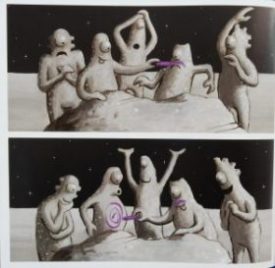
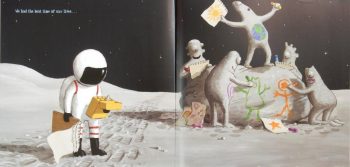
The initial surprise of a face-to-face encounter rapidly gives way to a creative session with human and lunar dwellers brightening up each other,

sheets of paper and the moonscape with colourful designs.


Meanwhile back comes the spaceship prompting the lunarians to hide themselves away though they re-emerge to wave a fond farewell to the departing young earthling who has been rather unfairly chastised, I think, by the group leader.
An experience neither side will forget, for sure.

The child’s body language, and that of the host populace in Jeanne Willis’ lunar scenes speak as loud as Hare’s verbal narrative of this expedition. Were the illustrations created using 3d models one wonders; they’re highly effective and likely to inspire children’s own creative efforts – perhaps to create their own group lunar landscape. There’s much potential for classroom activities, as well as for individuals after a sharing of this unusual book.

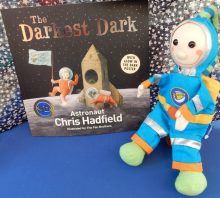
If you missed it the first time around, coming in June from Macmillan, is a special 50th Anniversary Moon Landing paperback edition of a book previously reviewed on this blog:

The Darkest Dark
Chris Hadfield and The Fan Brothers

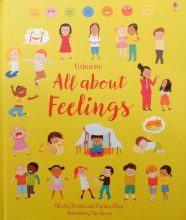
All About Feelings

All About Feelings
Felicity Brooks, Frankie Allen and Mar Ferrero
Usborne

Emotional literacy is now part and parcel of the school curriculum right from the early years, yet seldom does a week go by when we don’t read or hear of the increased concern about children’s mental health and well-being, something we in education have been highlighting for many years. So, it’s good to see a book aimed at young children to help them become aware of, and thus better able to cope with their feelings and emotions.

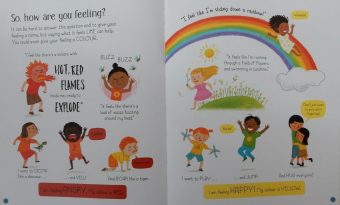
It’s very visual and full of bright illustrations by Mar Ferrero that make it immediately alluring to its audience be that an individual, a nursery group or early years class.

Each colourful spread is given over to a different aspect and the language used is spot on for young children.

Sections include identifying how you feel (with reference to colours of the rainbow);

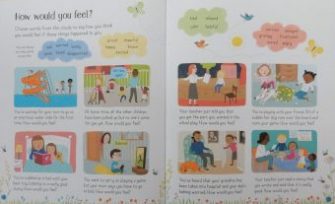
why do you feel a particular way; how would you feel if? (with helpful word clouds)…

how feelings can change during a day; ‘jumbled up feelings’ and discussing your feelings.

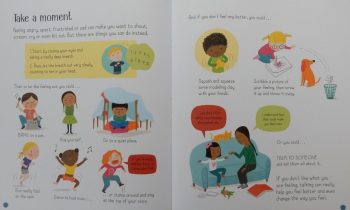
There are suggestions for things to do that help you remain in control;

ideas to alleviate worries; ways to express feelings and emotions; ‘being kind to yourself’ and ways in which an individual can help others of all ages feel good.

The final page is for adults – notes on how best to help youngsters; things to try at home (could equally apply at school or nursery) and some on-line resources.

Young children most definitely can learn to become more mindful of how they feel and thus be better in control of their feelings. The authors of this book have done an excellent job of facilitating this and I’d strongly recommend a copy for family bookshelves and all settings where young children are learning.

One thing that struck me about both it and The Unworry Book was that little is said about the benefits of being outdoors. I highlight this after returning from a walk around Ruskin Mill in Nailsworth, near to where I live. This is in part, an establishment for neurodiverse young adults that does amazing work educating its students, with a focus on the outdoors. And, I know from experience that being outside is of enormous benefit to people of all ages from the very youngest children.

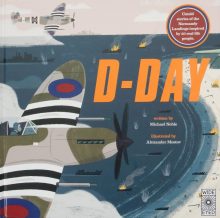
D-Day

D-Day
Michael Noble and Alexander Mostov
Wide Eyed Editions

This book commemorates the 75th anniversary since D-Day, exploring through 20 real-life stories, eye-witness accounts of the D-Day landings and through whose eyes young readers can re-live the events- stories of ‘bravery, sacrifice and innovation’ as the introduction says.

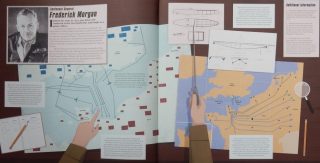
Through historian Michael Noble’s text, we follow the invasion from the planning of the landings, right through to its consequences, meeting both men and women who served in various ways.

There’s Lieutenant General Frederick Morgan who fought as a junior officer in WW1 and went on to be, in WW2, part of the Supreme Headquarters Allied Expeditionary Force, one of the planners of the invasion of Europe under the joint responsibility of the British and the Americans, and in particular the Normandy landings.

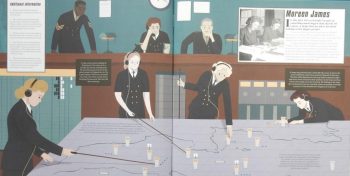
Moreen James served in the WRNS as a plotter, keeping track from her Portsmouth subterranean base, of the movement of ships in the channel; a crucial task in enabling commanders to know the whereabouts of their boats and planes.

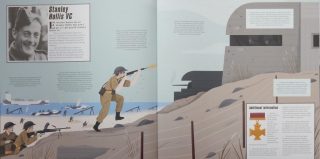
We meet the extraordinarily brave Sergeant Major Stanley Hollins, the only recipient of the Victoria Cross, considered the highest honour members of the British armed services can be awarded, for actions on D-Day.

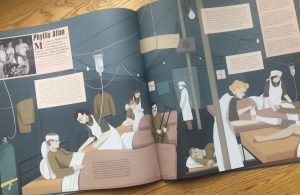
Phyllis Allan served with the Queen Alexandra’s Imperial Military Nursing Service and was based in France where she tended the wounded soldiers, some of whom had suffered horrendous injuries. “It’s just a job, really’ she said.

American Richard Winters, aged 26 calls himself ‘ancient compared to some of my men’. A paratrooper, he took command of his unit when the original commander was killed in action. WW2 was the first major conflict to make use of paratroopers, a highly dangerous role with many losing their lives before hitting the ground.

Much less would have been known about the war without the journalists who reported on what was happening. One such was American, Ernie Pyle who not only wrote numerous articles, but also came to know many of the soldiers engaged in the fighting.

Through the use of collated photographs, personal accounts such as those mentioned, and testimonies from all sides, set into Alexander Mostov’s full-page illustrations that dramatise the roles of all individuals included herein, this is an enormously inspiring book.

Include it in KS2 class collections and on family bookshelves.

What On Earth? Birds / Do Sharks Glow in the Dark?/ Do Tigers Stay Up Late?


What On Earth? Birds

Mike Unwin and Pau Morgan
QED

Natural history writer Mike Unwin and illustrator Pau Morgan turn their attention to birds for the latest book in this excellent What On Earth? series.

In its usual way it’s packed with information and practical ideas that include things to make and do including the occasional experiment, all presented in a highly visual manner with every spread using the space alluringly in a manner somewhat akin to a comic.

As well as bird facts there are poems (Tennyson’s The Eagle and Lear’s There was an old man with a beard’) along with an invitation to readers to write a bird poem of their own. On the literary side too is ‘The king of the birds’ a story based on an old Celtic folk tale, which might also inspire story writing by readers.

You may want to try dancing like a bird;

or perhaps get outdoors and listen to some birdsong, even catching the dawn chorus if you’re up early enough.

The book is divided into four sections: What is a bird?; Bird food; Bird life and behaviour and Enjoying birds, and very page turn brings something to excite, or fascinate young readers.

Offering a great way to discover things avian in all kinds of interesting ways, the book concludes with a glossary and an index.

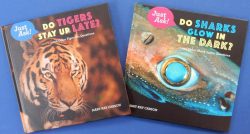
Do Sharks Glow in the Dark?
Do Tigers Stay Up Late?

Mary Kay Carson
Sterling

Splendid photographs and sequences of facts in response to a series of introductory questions – one per page (or occasionally spread) – present the essentials relating to two very different, but both predatory, animals.

No, sharks do not have bones; their skeletons are cartilaginous (a fact I remember well from my early days of studying zoology); and they have both skin and scales. Did you know people once used dried sharkskin as sandpaper? Or that adult sharks ‘don’t do the parenting thing’? Rather shark pups look after themselves.

And contrary to popular belief, only around six humans are killed by sharks in a year.

So it is with tigers: these creatures tend to avoid humans, their towns and farms, although it’s humans that are responsible for tigers being endangered with less than 4,000 roaming wild now, more than half their number being found in India.

I was fascinated to read that no two tigers have identical skin stripes, that a tiger’s skin is striped as well as its fur, and that tigers can swim for miles.

Unsurprisingly tigers don’t purr, growling, grunting and roaring are their ways of communicating.

Both books offer a fun and easy way to get to know something about two of the world’s most iconic creatures; and each has as part of the back matter, information about helping to protect the animals in question, some useful related vocabulary and an index.

Daddy Frog and the Moon / Crime Squirrel Investigators: The Naughty Nut Thief

Here are two new picture books from Little Door Books; thanks to the publisher for sending them for review:

Daddy Frog and the Moon
Pippa Goodhart and Augusta Kirkwood

Pippa pens a tale of paternal love frog style, in her sweet story wherein a father frog sets out to find something to show his baby froglet just how much she is loved.

Baby Frog though is more interested in being shown how to squiggle and even when presented with a perfectly round stone, all she asks is that he shows her how to swim. Not content with his first offering, Daddy goes off searching again but the flower wilts and Baby is eager to learn hopping. Once again, she’s left to perfect the skill herself while Daddy seeks further proof of his love for her.

By now he’s searching by moonlight. But not even with his gigantic leap can he reach the moon.

No matter, for what he does find is something much better: Baby Frog, and she has some exciting news to share …

Warmly told by Pippa using plenty of dialogue and repeat join-in phrases; and with Augusta Kirkwood’s beautiful, textured scenes of the pond, its flora and fauna, this sweet story is ideal for human sharing around Father’s Day and any other day too.

Crime Squirrel Investigators: The Naughty Nut Thief
Emily Dodd and Giulia Cregut

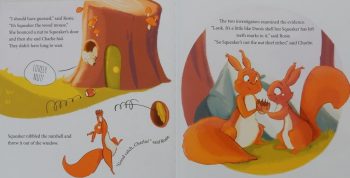
When Rosie squirrel discovers her stash of nuts has been raided and almost all are gone, she and always hungry, Charlie, decide to become Crime Squirrel Investigators. The clue is in the shells and off they go on the thief’s trail.

First stop is Dora Dormouse but she’s soon eliminated, as are Tappy the woodpecker and Squeaker the wood mouse.

Throughout  their investigation, Charlie has been trying to tell Rosie something and finally, he gets a chance to speak. What was it he wanted to tell his friend?

All ends happily with the friendship intact, and a plethora of hazelnuts to feast upon.

Rosie is quite a good detective when it comes to identifying nutshell clues and young listeners/readers will enjoy anticipating what is coming when Charlie eventually speaks out.

Equally they’ll enjoy Giulia Cregut’s amusing illustrations, which bring out the inherent humour in Emily Dodd’s telling.

Both books have additional material – audio versions and songs – that can be found at the publishers website. 


When Sue Found Sue

When Sue Found Sue
Toni Buzzeo and Diana Sudyka
Abrams Books for Young Readers

“Never lose your curiosity about everything in the universe – it can take you to places you never thought possible!” so said Sue Hendrickson the palaeontologist subject herein, her quote being the starting point for this fascinating book that tells the story of the discovery of the largest and most complete Tyrannosaurus rex skeleton ever unearthed.

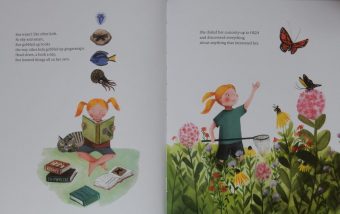
Living in Indiana, Sue was a shy child with a heuristic drive, particularly for anything in the natural world; she also had a passion for finding lost items, was often found with her head in a book

and loved to visit the Field Museum of Natural History in Chicago.

Her interests led in her teens to her joining first a team of underwater treasure hunters looking for tropical fish, lost boats, planes and cars; and then teams searching mines for prehistoric butterflies, deserts for prehistoric whale fossils and finally, the hills of western South Dakota for dinosaur fossils.

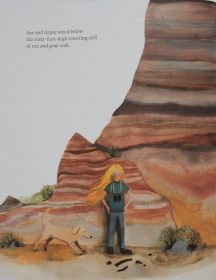
In her fourth summer of digging Sue was drawn towards a sandstone cliff and after four hours of hiking in the heat,

looking up, she spied three enormous pieces of what look like back bones protruding from the cliff. Almost unbelievably Sue and her dog, Gypsy had come upon fossils of a Tyrannosaurus rex.

Then began the arduous task of removing the 300 bones in the intense heat, a piece-by-piece task that took several days.

After an ownership dispute we see the dinosaur reconstruction duly named after Sue on permanent display at Chicago’s Field Museum.

Both Buzzeo’s narrative and Diana Sudyka’s detailed gouache and watercolour illustrations will surely inspire young readers to be mindful of the book’s opening words, to make sure they look closely at the world around them and to hold onto their own spirit of adventure and pursue their passion whatever that may be.

An author’s note about Sue Hendrickson’s contribution to the scientific community, and two resource lists end the book.

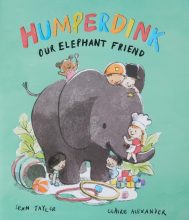
Humperdink Our Elephant Friend

Humperdink Our Elephant Friend
Sean Taylor and Claire Alexander
Words & Pictures

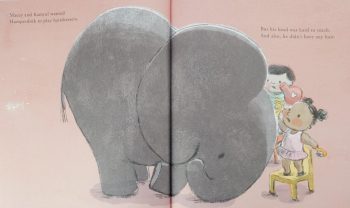
Storyteller Sean gives the impression he’s spent time standing behind the heads of young children, observing carefully, so he knows what they’d do should a playful pachyderm burst through the door of their playgroup.
That is just what happens in this book and straightaway the children attempt to accommodate him in their play, be it dressing up, hairstylists …

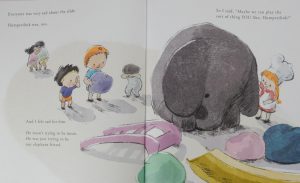
hide and seek or something more energetic. No matter how hard they try though, things keep ending in disaster.

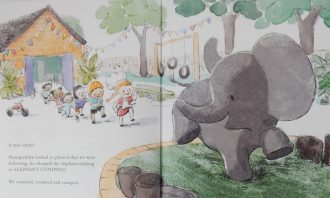
The children then change tack asking Humperdink what he likes to play and before you can say, ‘come outside’ he’s led the little ones outside for some exceedingly satisfying elephant-stomping, stamping and stumping,

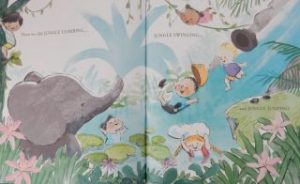
followed by elephant riding right into a jungly place that’s perfect for …

After all that romping Humbert is ready to settle down into something equally creative but rather less energetic; though of course, he and his new friends are always up for a jungle foray.

The joyful exuberance inherent in Sean’s telling is wonderfully echoed in Claire Alexander’s scenes of the characters’ imaginative play. Clearly she too spends time observing little ones – their joie de vivre, their intense concentration on whatever they’re engaged in, and the way their open hearts are sensitive to the feelings of one another, empathetic and full of love.

Perfect for story time in a playgroup or nursery and at home with little ones, this is a book that’s bound to be requested over and over.

The Unworry Book

The Unworry Book
Alice James and Stephen Montcrieff
Usborne

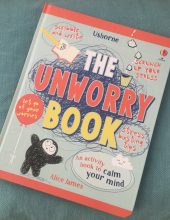
Enormously reassuring and full of practical ideas for managing stress is this alluringly presented book written by Alice James, with expert advice from clinical psychologist, Dr Angharad Ridkin, and designed and illustrated by Stephen Montcrieff.

Having explained that we all worry from time to time and why, the book devotes the next few spreads to working out how you really feel – worried, excited, or nervous perhaps? It’s really beneficial to become emotionally aware (an emotional map is included to help) and know the kinds of things you can do to alleviate your worries.

Next comes the wealth of coping suggestions, many of which are designed to develop mindfulness. Most require nothing more than a pencil or pen like those on ‘Peaceful pencils’ which takes a multi-sensory approach -listen to the sounds of the writing implement brushing across the paper; ‘notice the glistening wet ink … or grain of the paper as your pencil draws across it’; smell – the book’s pages, the wood of your pencil or ink of your pen; feel the pencil’s ridges, or barrel of the pen; feel the textures of the page and how it seems?

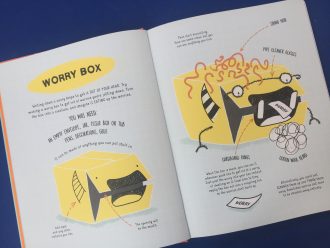
What about making a decorated worry box – an example is included here – I love the idea of it being a creature that can eat up worries.

It’s impossible in the space of a fairly short review to include all the excellent strategies offered so I’ll just mention a few. There are pages highlighting the importance of breathing and laughing (both are yoga techniques) to help cope with excess adrenalin, as well as a spread with an amorphous creature demonstrating a sun salutation.

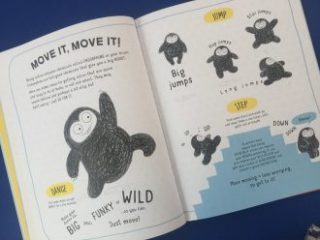
A couple of ‘arty’ ones are tearing up paper (preferably rubbish) and using it to be creative; creating peaceful patterns being mindful of the shapes and how the space is filled. And doodling is a great stress reliever – how many of us doodle our way through stressful meetings I wonder?
It’s well accepted now that being physically active is good for our mental well-being; it releases those mood-boosting, feel good endorphins so get moving.

There’s a focus on language too – some starting lines for limericks (great fun) an instant giggle inducer I think; a focus on the physicality of writing various words in different ways; a (behind the door) story starter; as well as a host of brain puzzles.

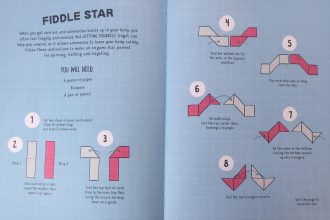
Another smashing idea is a ‘fiddle star’ – the making of which is a worry distractor,

as is the finished article.

Getting off to sleep tips form the final pages; while in conclusion are a ‘helping hand’ and a ‘who to/where to go’ for times when worries become overwhelming (including a link to the publisher’s website).

Stress among children – even very young ones is on the increase – I refrain from elaborating on the negative effects of the current ‘numbers before children’ education system, though it is a huge stress-inducing factor. There are others of course and a veritable gold mine such as this book is invaluable for both youngsters and those who live or work with children.

Just Read!

Just Read!
Lori Degman and Victoria Tentler-Krylov
Sterling

This is a picture book that really does fly the flag for the pleasures that reading has to offer and the multitude of ways and places it can be enjoyed.

We begin in a library with a group of children, one of whom declares, “Hooray! I know how to read on my own!” going on to say, “But sometimes I don’t want to do it alone. So …”

We then learn that this reader (who isn’t identified) shares the bibliographic propensity with an astronaut, pirate or farmer … a clown or knight wearing armour.

An animal can also act as reading companion be it a penguin, moose, bear, tortoise or hare.

Choosing what to read can on occasion be tricky – there’s so much choice – I definitely empathise with that – and the text need not be a book; there are codes, road signs, maps, sheet music, menus, recipes, comics, on screens and much more besides.

Moreover, some people read with their ‘fingers across bumpy lines’,

others using voice, or hand signs (inclusive though slightly inaccurate the latter two which are essentially, ways of communicating what has been read)

As for where to read – again there’s a multitude of possibilities both inside (in a bus, train, plane, cave perhaps) and out.

The book concludes with an idyllic book club setting – in a tree where many children have gathered to enjoy their chosen books.

Imagination knows no bounds, no matter what kind of book you choose, is Lori Degman’s rhyming message; and Victoria Tentler-Krylov’s stylish watercolour illustrations affirm this: all in all a great way to encourage reading and readers everywhere.

Counting On Katherine

Counting on Katherine
Helaine Becker and Dow Phumiruk
Macmillan Children’s Books

There is so much to like about this splendid picture-book biography of Katherine Johnson, a NASA mathematician.

We first meet the young Katherine as a lover of numbers and everything to do with counting, and an insatiable curiosity– about the universe in particular.

An excellent student, she jumped three school years but her US hometown high school was racially segregated and barred Katherine from attending. As a consequence, her family moved to a town that had a black high school and there the girl flourished, excelling at all subjects although still liking maths the best.

Despite there being no jobs for women research mathematicians at the time, Katherine was tenacious, holding fast to her dream while becoming a primary school teacher.

In the 1950s she finally secured a post with NACA, which was later subsumed into NASA although the job she and other women did was one the men deemed unimportant. Undaunted, Katherine knew that her role was crucial: she was able to determine the trajectory of a spaceship.

Eventually her skills in mathematical accuracy, leadership as well as her creativity and intellectual curiosity led to a promotion to Project Mercury a programme designed to send the first US astronauts into space. She won the trust of the project’s lead astronaut and promised him, “You can count on me,”.

Again it was “You can count on me” when she calculated the flight path for Apollo 11, Apollo 12 and when she ensured the safe return of Apollo 13.

Having overcome much in the way of racism and sexism, on the way, Katherine had earned her place among the stars.
Helaine Becker’s direct telling is highly readable and she makes clever use of the word ‘count’ along the way; while Dow Phumirik’s excellent uncluttered illustrations, some with background computations subtly underline Katherine’s passion for things numerical.

What a splendid partnership this is; and the resulting book will surely inspire and empower youngsters, especially girls to pursue what they love.

Sea: A World Beneath the Waves / Dolphins

Sea: A World Beneath the Waves
Britta Teckentrup and Patricia Hegarty
Little Tiger

In her latest non-fiction, die-cut peep-through picture book, in a series of wondrous scenes Britta Teckentrup plunges us beneath the ocean waves, way, way down to view the wonders of the deep.

Amid the corals and seaweed fronds we see small fish, sponges, tiny graceful sea horses; a baby dolphin and its mother chirping and clicking in communication, a Lionfish with its poison spines ready to use should it be attacked.

Suddenly there’s a feeling of fear: the fish sense danger as a great white shark casts its shadow. The other sea creatures though, employ their defence mechanisms while the tropical fish swim in formation and all is well.

Night comes and the ocean is a-glow with light;

his song echoing far the humpback whale sings for all to hear, the manatee glides through sea grasses and the corals provide safe spaces for small ocean creatures.

Patricia Hegarty’s lyrical text ends with a plea to protect ocean life by keeping the oceans clean and free from rubbish.

Dolphins!
Laurence Pringle and Meryl Henderson
Boyds Mills Press

Pringle immediately grabs readers’ attention with his introductory ‘If you were a young dolphin, your mother would keep you close, feed you milk and teach you’ that could almost be referring to a human mother. The remainder of the paragraph however negates that with its ‘Soon you would learn to swim fast and catch fish to eat. And sometimes you would leap from the water, high into the air!’ while his final statement on the first page “People would be very curious about the secrets of your life beneath the surface’ sets the scene for the remainder of this fascinating book.

It covers many aspects of the thirty or so dolphin species including classification, morphology and physiology. There’s a fascinating account of dolphins’ use of echolocation;

another of feeding – dolphins are predators, consuming huge amounts of food daily –

and communication. I learned that in addition to sounds, dolphins send messages with their bodies, sometimes by rubbing skins, at others, by touching flippers.

All this and more is related in the author’s highly readable prose that is superbly illustrated by Meryl Hendersen in watercolour and pencil.

Although it’s likely that this will be read by individuals, this book also works really well if read aloud – a testament to the quality of the author’s writing.

Mouse & Mole

Mouse & Mole
Joyce Dunbar and James Mayhew
Graffeg

First published over 25 years ago, it’s wonderful to see what was a favourite book among new solo readers in primary classes I was teaching at the time, brought back in print by Graffeg.

Mouse and Mole are great friends (somewhat similar to Arnold Lobel’s Frog and Toad to whom there’s a dedication of sorts before the five tales herein).

All five of the stories are adorable but I think my favourite remains Talk to Me. Here the two chat together about the possibilities of ‘tomorrow’ be it fine – then a picnic with cheese and cucumber sandwiches is the order of the day. If however the day isn’t fine, then an apple wood fire, cosy armchairs, roast chestnuts, toasted muffins and hot chocolate (mmm!) are on the agenda. Should it be ‘an in-between sort of day’, Mouse suggests ‘we will do something in-between’ … We will tidy up.’ I hope for their sake it isn’t the third option. I doubt we have in-between days in our house!

Salad is the title of story number two and the day is, so Mouse informs his still in bed pal, ‘wild and wintry’. Who can blame Mole for wanting to stay snuggled up in a cosy, warm bed, even with the offer from Mouse of huddling by the fire to consume toasted muffins and roast chestnuts.

Those particular items appear to be favourites with the two characters, one of which consumes large quantities of both.

I won’t divulge what happens in the other three stories – Tidying Up …

Stuff …

and The Picnic – yes they do finally go –

rather I’ll urge you to get yourself a copy of this new edition that still has as much charm – both Joyce’s deliciously comic tellings and James wonderful illustrations – as I remember from back in the day. Read alone or read aloud, it’s great either way.

My Island

My Island
Stephanie Demasse-Pottier and Seng Soun Ratanavanh
Princeton Architectural Press

“To dream and to invent allows you to discover yourself,” So said Stephanie Demasse-Pottier, the author of this book that she wrote as a tribute to the inventiveness of her two young daughters. Hurrah for her flagging up the link between the imagination and the power to be inventive – in whatever field.
The little girl narrator of the story conjures up an imaginary island world filled with flying fish, birds, constantly blooming flowers, and animals aplenty.

In this place she has tea parties for the animals, she reads, makes coffee, interacts with snails, arranges flowers – all in her own little house.

We too can share in the riches of this place, so long as we know ‘how to sing’, ‘how to share’

and ‘how to dream’.


What adult wouldn’t want their child/ren to gain access to such a place – this extraordinary and wonderful world created by the imagination of the intense, creative little girl. A place where they too can wander, or pause awhile, letting their imaginations soar, further fuelled by the vivid scenes conjured by Seng Soun Ratanavanh in her watercolours, coloured pencils, and red thread stitched illustrations (which serve both to link together what the narrator imagines and to leave gaps for readers’ imaginations to enter).

Not only is this a tribute to two little girls, it’s a tribute to the power of the imagination itself.
Remove all technology and let youngsters take that leap and linger long. Who knows what might happen …

The Butterfly House

The Butterfly House
Katy Flint and Alice Pattullo
Frances Lincoln Children’s Books

Judging by the number of containers housing butterflies in the various stages of their development my partner has scattered about the place, I rather think my own home at present ought to have the same name as this book, although unlike Katy Flint’s ‘welcome’, it doesn’t have never-ending ceilings, nor does it contain the various habitats she names that provide homes for many of the world’s major butterfly and moth families. I was surprised to learn that these winged creatures make up 7% of all Earth’s forms of life.

We then visit the Hatchery, which explains the life cycle of a butterfly with reference to the Monarch as well as containing a number of unusual-looking caterpillars.

The next two spreads explain the differences between butterflies and moths,

what various adult butterflies like to eat and that caterpillars are fussy eaters usually preferring one particular host plant.

In the subsequent pages over 100 species of moths and butterflies from all over the world grouped in their various scientific families, are displayed in Alice Pattullo’s alluring, finely detailed brush and Indian ink illustrations. Some like the Small tortoiseshell

and the Orange-tip will be familiar to UK readers (and to me as their caterpillars are presently munching away on their food plants in our downstairs bathroom).

To see others such as the Crimson rose swallowtail, the Owl butterfly or the spectacular Luna moth,

you’ll have to visit a butterfly house like that at Berkeley Castle in Gloucestershire or the one in Stratford-upon-Avon.

No matter where you live or visit, this book is sure to whet your appetite to get to know more about these beautiful creatures.

Me and Mrs Moon

Me and Mrs Moon
Helen Bate
Otter-Barry Books

In her familiar graphic novel style, Helen Bate tells a powerful story of how two children, narrator Maisie and her friend Dylan, set about helping their beloved friend and neighbour Granny Moon as she shows signs that all is not well.
Granny Moon has looked after the children during holidays for years filling their days – rain or shine – with fun and adventure.

One day though, things start going wrong.
First Granny Moon is talking about a sister Julia she doesn’t have and later the film about aliens she takes the children to scares Dylan and they have to leave.

As Christmas approaches, things get worse. At the school concert Granny causes disruptions and other children start making fun of her.

Time passes but there are further problems. Granny Moon convinces herself that a little girl is trapped in her radiator and then Dylan’s dad notices her unusual behaviour and is doubtful about whether she should still be allowed to look after his son.

Eventually Maisie’s mum decides to phone Granny’s daughter, Angela in Australia.

Maisie and Dylan then worry about the fate of Granny Moon and her beloved dog, Jack; will Angela decide to put her in a care home? Worse, the friends return home late from school after a café visit with Granny Moon to find a fire engine outside and fire-fighters waiting for them. Thankfully though, there’s no serious damage.

Next day Angela arrives and is extremely troubled by what she finds. She decides there’s only one thing to do. Granny Moon’s house is put on the market and happily it’s not a care home that she’s going to but Australia to live with Angela and her family.
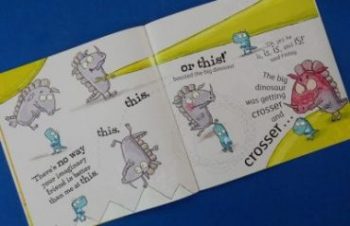
Three days later, fond farewells are exchanged and Angela and Granny depart. A certain animal isn’t accompanying them though, he has a new home – next door with Maisie who now has a companion to share memories about her erstwhile owner with whenever she needs.

The final page lists organisations that offer help for people with dementia, their families and carers.

Love and devotion radiate from the pages of this intensely moving story (based on actual events); but it doesn’t gloss over the enormous challenges those caring for someone with dementia are likely to face. Rather, it offers young readers an opportunity to better understand something of the condition and perhaps be better prepared should they encounter someone living with it.

This is a book that deserves to be in every school and should be read in all families. Particularly, as I was reminded by a charity worker from The Alzheimer’s Society who stopped me as I left Waitrose recently that while I might not know anybody with Alzheimer’s, over a quarter of the population knows someone who has this form of dementia alone.

Ceri & Deri: The Treasure Map / Ceri & Deri: Build a Birdhouse

Ceri & Deri: The Treasure Map
Ceri & Deri: Build a Birdhouse

Max Low
Graffeg

These are the latest titles featuring best friends Deri the Dog and Ceri the cat that introduce young children to specific concepts/skills through fun stories. (Here it’s orientation and design.)

The Treasure Map in the former is an old one that once belonged to Ceri’s nan, an erstwhile pirate, so the stripy feline claims. Ceri’s story of said nan sailing the high seas inspires Deri and the two set off excitedly, map in paws, to find treasure.

En route they are joined by the equally enthusiastic Gardener Glesni, Owain the Optician and Farmer Ffion who are more than willing to leave their respective allotment, spectacle selling, and vegetables to join the search.

Eventually the map leads them within smelling distance of the sea.

But is that treasure buried on the sandy beach as they’d been led to believe by the X, and if so just what will they discover when they dig?

The Bird House tells how the friends come upon a curious little bird while out walking together in town. Clearly it cannot remain on Deri’s head so the two decide to build it a house.

They think carefully about the design – a hallway with telephone for making ‘bird calls’ and ‘a place for all its shoes,” they decide; a kitchen with a plethora of bird seed, flowers, a sink; a balloon-filled dining room , amazing tree-patterned wallpaper, a record player (for listening to bird songs) a bathroom complete with bird bath entered by waterslide

and (obviously) a wave machine. The friends get even more carried away with their elaborate plans; but, tools and materials assembled, can they actually put them into action: I wonder?

This one made me laugh out loud a couple of times, it’s so sweetly silly and I’m happy to report that despite Ceri’s feline-ness, the bird has found two new friends.

If you’re yet to meet Ceri and Deri, I suggest you start here. The friends are a delight and Max Low’s stories are full of charm and engagingly illustrated.

Migrations Open Hearts Open Borders

Migrations Open Hearts Open Borders
Introduction by Shaun Tan
Otter-Barry Books

llustrators from all over the world responded to the request by The International Centre for the Picture Book in Society (based at the University of Worcester) to create an original postcard for the 2017 Migrations exhibition to be displayed at Bibiana, Bratislava. The exhibition’s creators felt that the installation should reach a wider audience and this wonderful book is the outcome, although the fifty or so images representing 32 countries reproduced in their actual size herein, are only a selection of the hundreds of postcards they received.

Each of the postcards in its unique way focuses on the positive impact of the migration of peoples the world over, showing how the flow of ideas and cultures transcends borders, barriers and even bans.

The book is divided into four themes: Departures, Long Journeys, Arrivals and Hope for the Future.

I would love to show every single one of the awesome, enormously moving postcards but can only make a very small selection for this review, so have included representatives for each of the themes, which spoke to me on my very first reading.

Departures: In the end we only regret the chances we didn’t take./ It begins with a single step …                 Rhian Wyn Harrison – UK.

Long Journeys: The skies have no borders.      Christopher Corr – UK

Arrivals: New friends coming from afar / bring us different tales!                        Marcelo Pimentel – Brazil

Hope for the Future: Share the world in peace and freedom. / The Earth and its people have no owners.           Isol – Argentina

On another day I may well have picked completely different ones, such is the power of each contribution, some of which use quotes from writers including John Clare, WB Yeats, Anita Desai and Robert Macfarlane.

If ever there was a time in our increasingly fractured world when we need this treasure of a book, it’s now. Let’s hope that those of us with open hearts who want open borders continue working to make a difference for, as Shaun Tan writes at the start of this book ‘All migration is an act of imagination, a flight of imagination. A hope that frequently exercises a previously unknown human potential. … What can be done? … That’s for us, the living, the thinking and feeling: descendants through millennia of successful migration – whose ancestors dreamed of something better … It’s left for us to imagine what to do, to pass on the dividends of hope that have been invested in us.’

Re-reading his message in its entirety in a week when our UK politicians continue wrangling about how – the universe forbid it happens – we should leave the European Union, brought tears to my eyes. Everyone needs a copy of Migrations; it reaches out to us all, offering another beacon on the uphill climb towards the creation of a better world for everyone, young, old and in-between.
(All royalties are donated to Amnesty International and IBBY)

Choo-Choo Peekaboo / Marvel Alpha Block / Where Do Pants Go?

Choo-Choo Peekaboo
Gareth Lucas
Little Tiger

Artistically minded Zebra sets out one fine morning eager to spend a day engaged in his favourite pastime, painting. Seemingly however, his animal friends and acquaintances have other ideas.

Chaos ensues wherever poor Zebra stops and begins his artistic endeavours, be it city,

riverside, by a lake, deep in the countryside,

even atop a mountain he finds no peace. Surely nothing can disturb his nocturnal attempt though? Errrm!

It looks as though there is only one way to please everyone … BEEP BEEP! TOOT TOOT! And off they go …

With paint-daubing primates, a loop-the-looping porcine, roller-skating rabbits, cable-car riding cows, a space-ship sortie by sheep even; all of which are revealed from behind the gate-fold flaps, this interactive book will delight tinies, especially those with a penchant for noisy vehicles, madcap animals and surprises – that covers pretty much all of them.

Add to the mix, laugh-out loud scenarios, speech bubbles and a highly satisfying finale, I’d say Gareth Lucas has a hit on his hands with this sturdy board book.

And adults will enjoy the visual references to famous artists along the way.
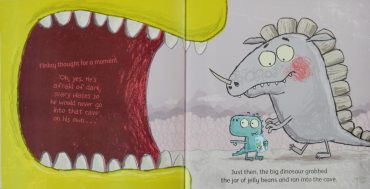
Marvel Alpha Block
Peskimo
Abrams Appleseed

Bristol based illustration/design partnership Peskimo have chosen scenes and characters from the Marvel Cinematic
Universe for their latest Block Book. As usual it’s a chunky board book with flaps and splendid action scenes, that feature herein everything from Ant Man to Falcon,

and Pepper Potts to Xandar, Yondu and Zuri, before the entire cast assembles in alphabetical order on a grand finale fold-out.

Amazingly, each superhero represents a letter of the alphabet – a large cut-out capital letter that leaps up from the centre of the spread and beneath which lurks the superhero in an action scene (along with other characters who may or may not share the same initial letter).

Watch out for punch packing potential should more than one little would-be superhero get their hands on this simultaneously. With its super art, it surely is a winning alphabet book that I suspect, adults will enjoy almost as much as their young ones.

Where Do Pants Go?
Rebecca Van Slyke and Chris Robertson
Sterling

A fun interactive book about getting dressed takes toddlers through the routine dressing ritual. To avoid confusion, adult sharers not in the US should be forewarned that “underwear’ is used for pants and pants herein refers to trousers, so readers aloud will probably want to make some adjustments as they read the question and answer narrative with tinies.

Said tinies will doubtless delight in the cumulative, predictable text with its repeated final ‘and underwear on your bottom!’

and giggle over the silly placements of the various items of clothing in this book that reminded me somewhat of Shigeo Watanabe and Yasuo Ohtomo’s How Do I Put It On? that features a muddled little bear.

A satisfying finale sees all the fully dressed little ones enjoying some outdoor play together.

Primary Fiction Shelf

The Umbrella Mouse
Anna Fargher, illustrated by Sam Usher
Macmillan Children’s Books

Here’s a war story that’s altogether different. It’s set in London in 1944 and begins in Bloomsbury’s James Smith & Sons Umbrella Shop wherein we meet Pip Hanway and her family of umbrella mice.

When disaster strikes in the form of a bomb on the building, killing her parents, Pip is forced to begin a hazardous hunt for a new home, a home in the Italian hills where her family had its origins.

She is fortunate to meet rescue dog, Dickin, and thus begins a highly unusual tale that draws on true stories of animals caught in the WW2 conflict, a story of resistance, of courage, determination, treachery, sacrifice and bravery.

Anna Fargher’s debut is a powerful, compelling telling that will have readers and listeners charged with emotion as they root for these animals fighting the evil Nazi regime; and with occasional illustrations by Sam Usher of Rain, Sun, Snow and Storm fame to add to the pleasures, the book is strongly recommended for individuals and will also make a great KS2 class read aloud, particularly for those studying WW2.

Turns Out I’m an Alien
Lou Treleaven
Maverick Arts Publishing

The narrator of this zany tale is eleven-year-old Jasper who stands 4ft 6in tall and has green hair and eyes. A highly imaginative child so his teacher tells him, Jason lives with his extremely nice foster parents Mary and Bill Clarkson.
One day in order to bring in some extra cash. Mary and Bill decide to rent out one of the now unused bedrooms.

Before their guest has even arrived, Jasper is beginning to doubt whether his foster parents really are as predictably normal as he’d heretofore thought, especially when he notices Mary cooking what appears to be a kind of glowing green rock and Bill constantly checking the night sky through his binoculars.

Then out of the dark descends a weirdly spherical being with an orange skin uttering greetings from planet Snood and introducing himself as Flarp Moonchaser, “Slayer of the Multi-Headed Muck Monster of Murg” as he stretches forth his hand for Jasper to shake. Moreover, the thing has a strange bag stuffed full of weird and wonderful objects.

I’ll say no more other than that Jasper discovers his alien origins, the children are cascaded into a madcap space adventure to save a planet from the terrible Emperor Iko Iko Iko; there are secret agents, secret, secret agents and things get pretty Gloopy.

Entirely crazy, but readers will be swept along by the unfolding drama, which perhaps doesn’t actually end at The End.

Dennis in Jurassic Bark
Nigel Auchterlounie
Studio Press

Fans of the traditional Beano comic will certainly recognise the characters Minnie the Minx and Walter although this book is a novel, not a comic, albeit with a fair sprinkling of black and white illustrations.

It’s another madcap adventure for Dennis who is plunged back in time 65 million years. First though we find the boy visiting his gran watching a TV news reporter talking about ‘what seems to be a huge mutant, ice-cream stealing seagull’ that Dennis immediately identifies as a Pterodactyl. Dennis however isn’t the only child watching the news item; so too, among others, are his worst enemy Walter and Minnie the Minx.

Before you can say Pterodactyl Dennis finds himself on Duck Island determined to save Beanotown from dinosaur disaster.

There’s no need to be a Dennis fan to be entertained by this madcap romp with its interactive puzzles to enjoy along the way.

I Don’t Want To Be Small

I Don’t Want To Be Small
Laura Ellen Anderson
Bloomsbury Children’s Books

The little boy narrator of this rhyming tale rues his lack of stature; “It’s not fair,” he says. Frequently overlooked, he’s the smallest among his friends and big bro’s castoffs are way too large.

In a fit of pique the lad tosses his Teddy Bear skywards only to get it stuck in a tree out of reach.
Nothing he tries succeeds in getting Ted down;

superfast consumption of green veggies merely serve to give him wind and attempting to become flower-like is let’s say, a damp squib.

His “I JUST WANT MY BEAR” shout causes a tall girl to come and offer her assistance; but not even she can reach Teddy.

Light bulb moment: teamwork might just do it suggests our narrator, and … hurrah! Success; but much more important, is what  ensues.

Laura’s spirited illustrations abound with humour and pathos, and her seemingly simple, funny story with its powerful messages about self-acceptance and the importance of co-operation, will resonate with all those who feel inferior for whatever reason.

Slow Samson

Slow Samson
Bethany Christou
Templar Books

Samson’s favourite activity is spreading happiness as a consequence of which he has lots of friends and many party invitations.

However this is problematic as he frequently stops on route to a venue to help a fellow animal or merely for a friendly chat.

This tardiness causes him to miss out on all the fun, not to mention the cake at Terry’s birthday bash.

Samson resolves to do better and hurry to the next party. True to his word, he dashes past all those in need but still when he arrives, the party is over; worse though without his help, others had suffered. Poor Samson sobs, despairing he’ll ever be on time on account of his slowness.

Unbeknown to the sloth, Samson’s friends are concerned and after considerable thought, come up with a plan. An invitation is sent and Samson decides that despite his lack of speed, he just cannot disappoint his pals.

Next day, off he sets but he doesn’t rush – his friends do however, causing him to feel bad; but on he goes – slowly, slowly, convinced he’ll be very late. But is he?

For fear of being a party pooper, I’ll leave the little creature dangling and you deciding for yourself.

What I will say is that with its rainforest setting, debut picture book creator Bethany Christou’s warm-hearted tale of altruism, friendship, determination, kindness (and the odd piece of cake – oops!) is a great read aloud and a perfect starting point for discussions with young listeners.

I love the expressively portrayed animals especially Samson, and there’s plenty of gently humorous detail to enjoy in every scene as well as in the playful endpapers.