Kaleidoscope of Dinosaurs and Prehistoric Life / Dinosaurs Rock!

Kaleidoscope of Dinosaurs and Prehistoric Life
Greer Stothers
Wide Eyed Editions

If you thought that dinosaurs were just brown and green, then this book will make you think again.
By means of fossil evidence and modern scientific information that uses examples of living species, author/illustrator Greer Stothers, presents a fascinating, vibrant array of prehistoric creatures like we’ve never seen before’ showing them as they might have been with colours and patterns.
Some of the ideas are speculative and based on what is already known about modern equivalents:
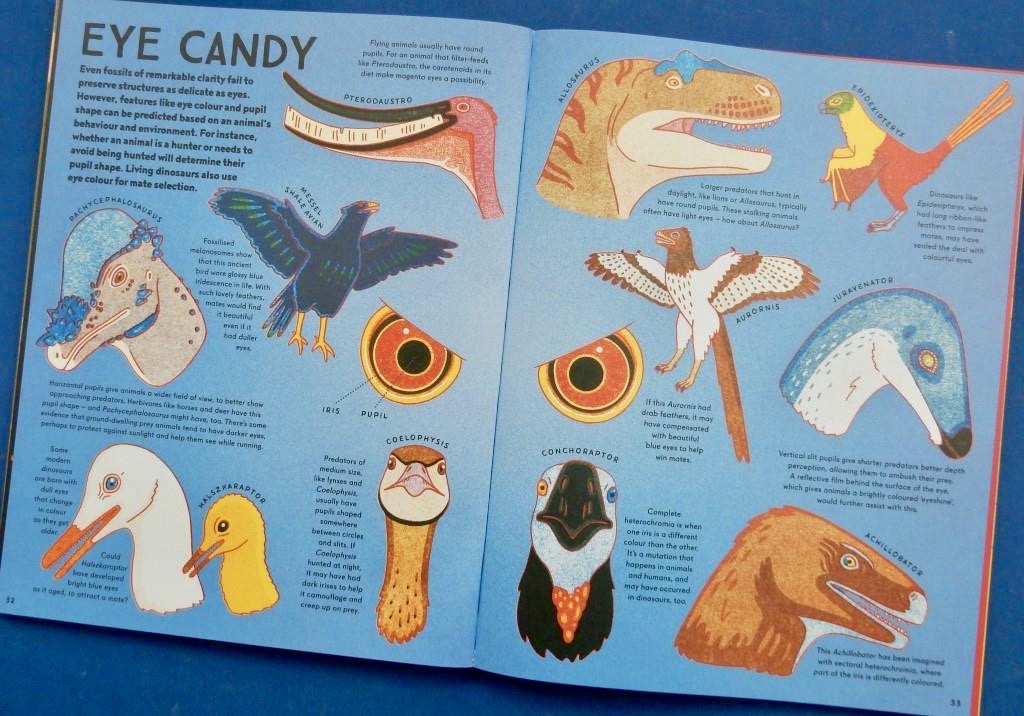
the author visits different locations – polar regions, the sea, forests, deserts – for instance, as well as using art from such places as the Ice Age Americas, ancient Africa, the cave paintings in France from which to hypothesise. We’re also given a look at primeval plants some of which died out alongside non-avian dinosaurs while others survive today.

The ‘Mighty Melanin’ spread is especially rich in detail explaining how this pigment is contained within tiny melanosomes that can be preserved in fossil feathers, scales and skin, thus offering information on the original colours. However every single spread offers plenty of food for thought: What would mutant dinosaurs have looked like? Would a dinosaur living in a snowy region have been super-white?
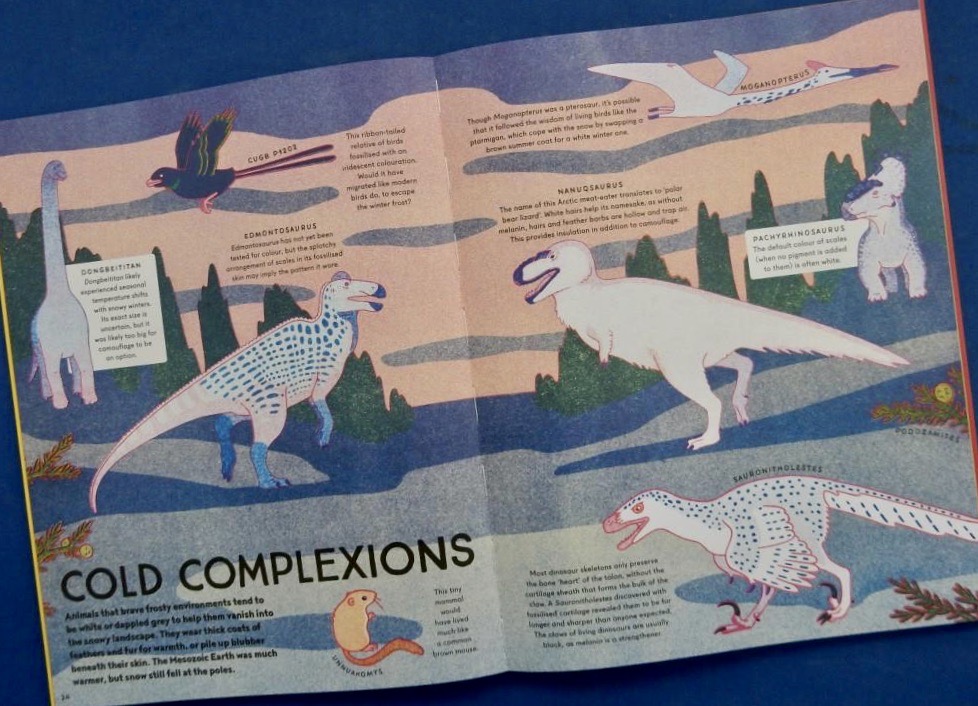
What role did camouflage play in the time of dinosaurs?

With the countless young dinosaur enthusiasts out there, always hungry for more, the approach taken by Greer Stothers (who studied evolutionary biology at university) offers something stimulating and exciting.
Dinosaurs Rock!
Dougie Poynter
Macmillan Children’s Books

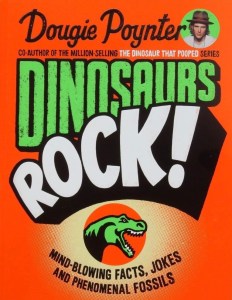
Dino fanatic (eco-warrior and bassist from McFly) Dougie Poynter turns his attention back to dinosaurs, but in a non-fiction book for older primary readers this time. He adopts a light-hearted style but this doesn’t mean that the writing is light on information, far from it. Dougie introduces readers to a wealth of dino-related topics. Before that though, we’re taken right back to the dawn of life on earth for a brief history of how these creatures evolved.

We get up close to a variety of dinosaurs with several profiles including the author’s favourites and then meet five experts on the topic some of whom work in the field of palaeontology. There’s a section on fossil evidence and we read something about Mary Anning and her discoveries in the field, as well as two Americans who started out as friends but then become arch rivals both making lots of mistakes in their efforts to become top palaeontologist.

Also included are a scattering of dino jokes, some historical errors, a sprinkling of true or false statements including this one – Dinosaurs were cold-blooded – that scientists still have different opinions on, with the majority currently thinking that most were warm-blooded.

Lots of the content is presented infographics style, which makes it more easily digested.

Hat Cat

Hat Cat
Troy Wilson and Eve Coy
Walker Books

The old man in this story has a daily ritual: he puts peanuts in the crease on the top of his hat, goes outside, and sits, ‘as still and welcoming as a grand old tree.’ Then he waits for the squirrels to come. One day he’s delighted to find a cat emerges as he lifts up his hat and unsurprisingly he names him Hat.

Taking the creature inside, he allows Hat to do whatever he wants other than going out. “If I let you outside, you might leave me. Or you might chase the squirrels … or worse.” So whenever he goes for his daily outdoor sit, the old man closes the back door behind him leaving a mewing cat inside watching from within.

Then one day the old man isn’t there:Hat is alone for days until other people come and feed, rub and talk to him.

Times passes and one day Hat notices that the door has been left open. Seizing the opportunity, out he goes straight onto the decking. Now what will he do?

Nothing is said about why the old man is absent and we surmise that he’s been ill. Happily though there is a happy ending for Hat and for the old man and the other humans who have stepped in.

Troy Wilson’s words and Eve Coy’s soft, warm watercolour pictures work beautifully together showing the deep affection between Hat and his old man in this warm-hearted tale wherein
companionship, trust and love are key.

World of Food

World of Food
Sandra Lawrence and Violeta Noy
Templar Publishing

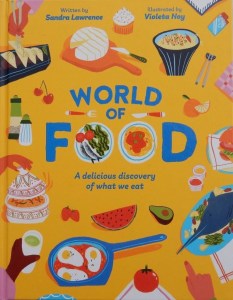
Ask a child, ‘where does food come from?’ and the most likely reply would be the supermarket or the name of the one their family shops in. Turn to page twelve of this fascinating book however and you will learn that many of the items found thereon had their origins in distant lands all over the globe.
Before that, the first thing Sandra Lawrence explores is the role food (including vitamins) plays in providing energy, in nutrition, and in the functioning of the immune system. We’re then taken back to look at how the earliest humans – hunter-gatherers – sourced and cooked what they ate; as well as finding out something of the feasts rich ancient Romans indulged in.

Next explored are various kinds of vegetables – tubers, then the edible parts that grow above the ground, followed by fruits and nuts, fungi and finally in that section, some dishes from around the world – sweet, savoury and spicy – are presented.

Grains and cereals make up section three

and then for this vegan reviewer, things get somewhat less tasty for several spreads are devoted to eggs and dairy produce, followed by meat and seafoods.

No matter what you eat, the addition of seasonings is likely to enhance your enjoyment and it’s these that are presented in the sixth section.

The next part comprises the sweet stuff. I have a weakness for dark chocolate, the fruit of the cacao tree being the topic for one spread here. Now I call myself a vegan but I have to hold my hand up to adding honey to my daily porridge every breakfast time.

There’s a short focus on festive foods using the tables of in turn, Christmas, Diwali, Passover, Eid-al-Fitr, Thanksgiving and Chinese New Year. Finally comes a brief look at some of the thorny environmental, social and economic problems food production causes; and the final spread explores food in the future.

Food is a popular theme in primary classrooms and this book, enticingly illustrated by Violeta Noy, is one certainly I’d recommend adding to school topic boxes.

The Little Spacecraft That Could

The Little Spacecraft That Could
Joyce Lapin and Simona Ceccarelli
Sterling

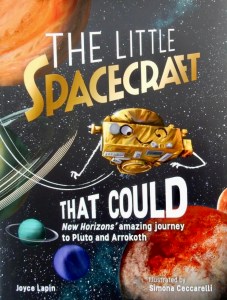
From the title of this book you might expect a story somewhat similar to the Watty Piper classic The Little Engine that Could. Not so. This book is essentially a non-fiction story that, beginning in January 2006, chronicles the journey of NASA’s New Horizons spacecraft travelling towards Pluto, a destination that will take a decade to reach, by which time astronomers have down-graded Pluto from planet to dwarf planet. (This is covered in the text)

The author tells how having burst forth from Earth, the first engine is allowed to fall away leaving, encased in gold foil, the spacecraft ‘no bigger than a small piano’ whizzing through space at over 10 miles per second. (Illustrator Simona Ceccarelli bestows a big grin on the face of New Horizons as this happens and thereafter she becomes a quirky character with personality.)

Now tasked with many questions to answer: what is Pluto made of? What colour is its sky? Are there creepy-crawlies? being just three, New Horizons will fly 3 billion miles to collect close-up photographic evidence and other kinds of data and transmit it all back to scientists on Earth.

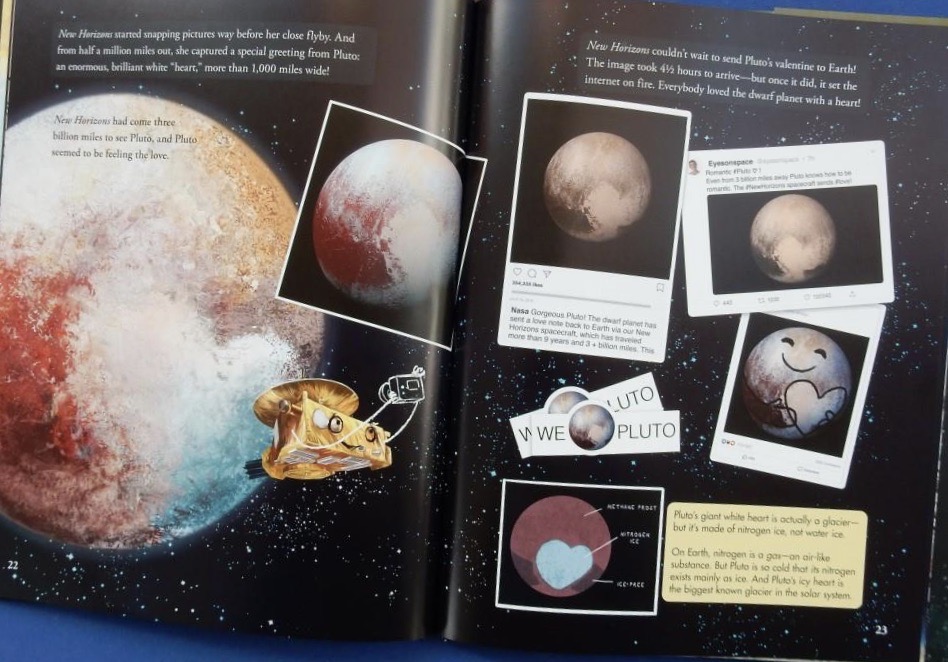
On route the spacecraft receives a massive gravity speed boost from ‘ginormous’ Jupiter, after which follows a very long period of hibernation during which time a weekly signal is sent back to Earth. Eventually on 6th December 2014, the probe reawakens and soon begins transmitting photos of Pluto,

photos that hugely enlarged scientists’ understanding of the dwarf planet and its moons. 

A few years later, on New Year’s Day 2019, New Horizons reaches another object called Arrokoth that had been discovered since her launch.  Photos of this far distant world helped scientists understand more about the solar system’s early years.  New Horizons continues to travel further out in space and the hope is there’ll be a visit to the Kuiper Belt sometime during this decade.

Altogether an absorbing book that, in addition to conveying a huge amount of information about space exploration and the solar system, makes scientific discovery highly engaging and accessible for readers who might not otherwise be inclined to explore this topic. It also includes a timeline, glossary, and resources for further investigation. 

Octopants: The Missing Pirate Pants / Rita Wants a Ninja / Little Scoot

Octopants: The Missing Pirate Pants
Suzy Senior and Claire Powell
Little Tiger

There’s definitely a plethora of pants in this new story about Octopants (narrator) and his ocean pals Turtle and Pufferfish. It’s the latter who has lost his favourite pirate pants and to make him feel less glum Octopants organises an undersea search. Having drawn a blank in the usual places in town, the friends brave the wreck and there they come upon a pirate crew with a pirate party in full swing with pants simply everywhere.

But then who should show up unexpectedly out of the blue sporting a funky hat and asking to join the pirate crew …
This is a jaunty rhyming text that flows well, and vibrant illustrations with plenty of humorous details to make little humans laugh, but Suzy Senior’s tale contains a serious message too: appearances can be deceptive so don’t be too hasty to make a judgement. With young children, you really can’t go wrong with a story about underpants.

Rita Wants a Ninja
Máire Zeph and Mr Ando (Andrew Whitson)
Graffeg

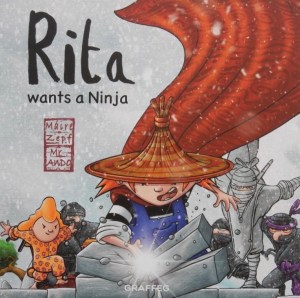
Is there no end to Rita’s demands? Seemingly not for now a game of hide-and-seek with her smaller sibling fuels a desire for her very own martial arts expert in the form of a ninja. How wonderful to have someone to instruct her in the art of stealth and invisibility. She’d learn how to control both mind and body as well as those shouts used when on the attack. However invincibility ninja style seemingly comes at a price –

a very big price and one she definitely isn’t prepared to pay after all. So it’s a resounding NO! for a ninja master …
Andrew Whitson’s expansive, action-packed scenes of Rita’s imaginings take readers along with the two children, into verdant Japanese bamboo forests and snowy landscapes wherein lurk fighting ninja clans.

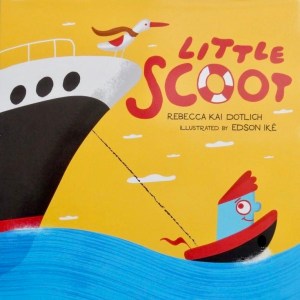
Little Scoot
Rebecca Kai Dotlich and Edson Ikê
Boyds Mills Press

Perseverance no matter how difficult the situation, is key in this vibrantly illustrated American import.
I was itching to tweak the beginning part of the rhyming text but like its little tugboat protagonist, I kept going, and happily it improved. Keeping going and not giving up is the essence of the tale of Little Scoot. Suddenly she receives an alarm call: a large barge is aground on a sandbank and in need of her help. With a gathering storm the tiny tugboat has to force herself forward, pushing through her fears and the splashing, sploshing waves, as she tries her level best to be brave. Eventually, there before her is the stranded Big Barge.
Will the tiny craft succeed in her rescue mission? Even in the most difficult situations, she certainly isn’t a quitter …

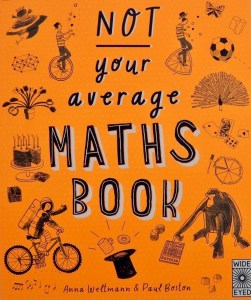
Not Your Average Maths Book

Not Your Average Maths Book
Anna Weltman and Paul Boston
Wide Eyed Editions

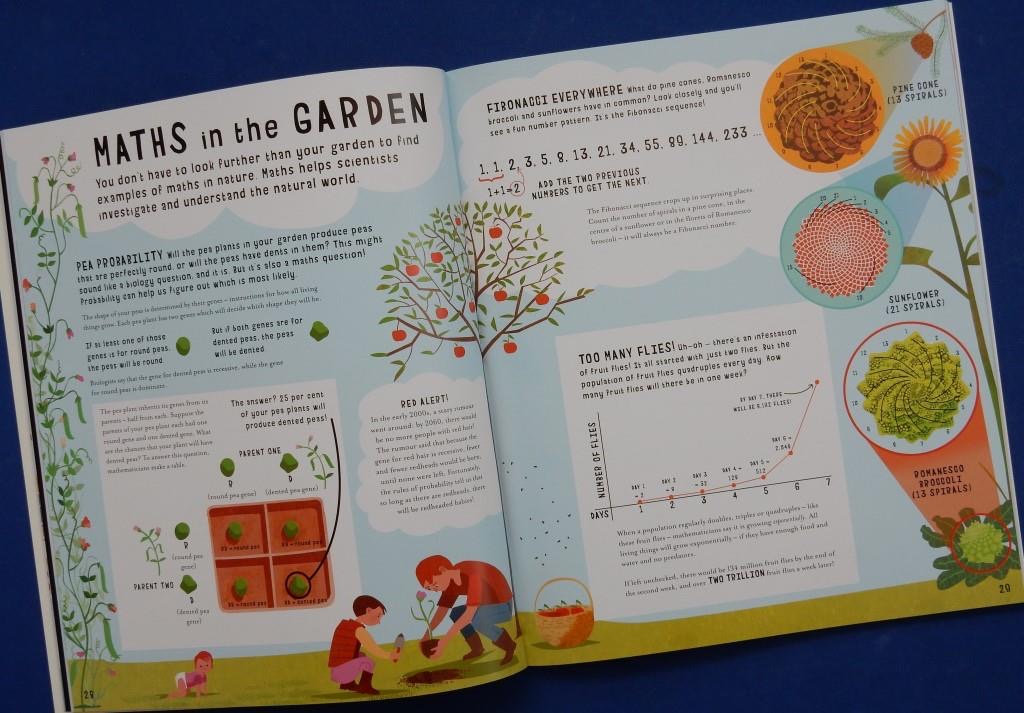
Wherever we go, wherever we live, maths is a part of our lives: just look around, we’re surrounded by it. It’s in our homes and gardens.

Yet at school it tends to be a love it or hate it subject and I have to admit that although I didn’t actually hate it, maths was one of my least favourite subjects. Now perhaps had I owned this book back then I might have felt rather differently.

Have you ever wondered why bubbles are always round – or rather spherical; why planets are never cube-shaped, , if and how animals use maths, or thought about where the plus, minus and equals signs came from. You’ll find the answers herein, along with a wealth of other fascinating mathematical facts and insights into numbers and their origins, shapes, patterns and much more. There’s a spread on mathematicians who made important breakthroughs in their fields, with thirteen men and women making up the Mathematician Hall of Fame.

We’re shown some of the many, many ways in which maths is useful in everyday life – in sports,

in the computer algorithms used to calculate plane ticket prices, the algorithms used by meteorologists in predicting the weather, the wealth of mathematical measurements needed in the erection of a building. There’s a brief history of maths going way, way back to the very first written numbers 43,000 years ago in Africa and taking us all the way to today’s unsolved problems still waiting for somebody to find solutions.

You might find you start looking at the world through different lenses if you read Anna’s book, it’s illustrated by Paul Boston whose visuals make the subject all the more inviting and accessible.

Apple and Magnolia

Apple and Magnolia
Laura Gehl and Patricia Metola
Walker Books

Britta insists that her two favourite trees Apple and Magnolia are best friends; this she knows deep down inside herself and there’s no swaying her. She visits the trees every day and watches how they communicate with one another. Some members of her family tell her that trees cannot have friendships – her father speaking kindly, her elder sister Bronwyn forcibly; her Nan in contrast says, ‘unusual friendships can be the most powerful of all’.

One night Britta notices that Magnolia’s branches have started drooping. While her father and sister tell her the tree won’t survive the winter, Nana asks about a plan. This galvanises her into action. 

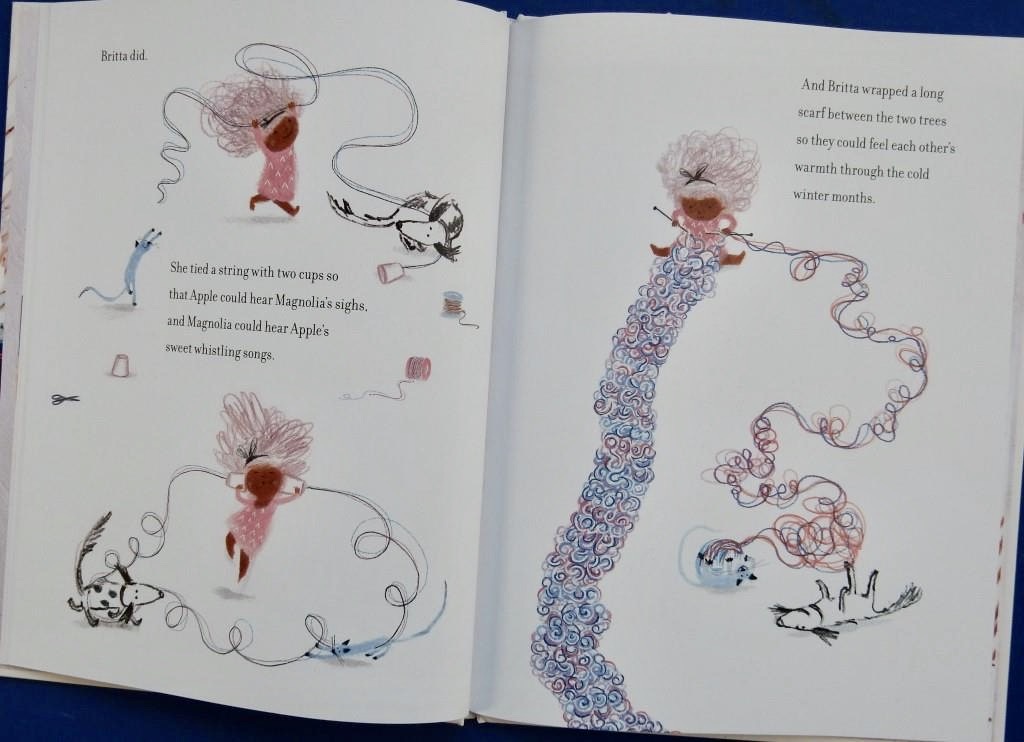
Aided and abetted by her pets she makes a telephone using cups connected by string for the trees to use, knits an enormous scarf and wraps it around them so they can share one another’s warmth during the chilly winter months and hangs a string of lights between Apple and Magnolia so they can always see each other.

Time passes and one morning Britta thinks that the trees have become closer together. She measures the distance between them and continues to do so every morning, getting the usual responses from family members. The arrival of spring sees pink blossom on Apple’s branches whereas Magnolia doesn’t flower, although Britta’s measurements decrease and you can’t argue with scientific data. 

Eventually the first blossom appears on Magnolia sending Britta’s hopes soaring. Soon it’s time for a celebration.

The repetition of the comments, be they negative or positive heightens, the impact of the telling of this delightfully fanciful story. Not entirely fanciful however; author Laura Gehl includes this in an introductory note, ‘Scientists are just at the beginning of understanding how trees are able to communicate with and support other trees.’ Equally delightful are Patricia Metola’s whimsical illustrations of the characters, both human and arboreal.

Saving the Butterfly

Saving the Butterfly
Helen Cooper and Gill Smith
Walker Books

This is a timely and very moving story about trauma, the way different people respond to it, empathy and the possibility of recovery.

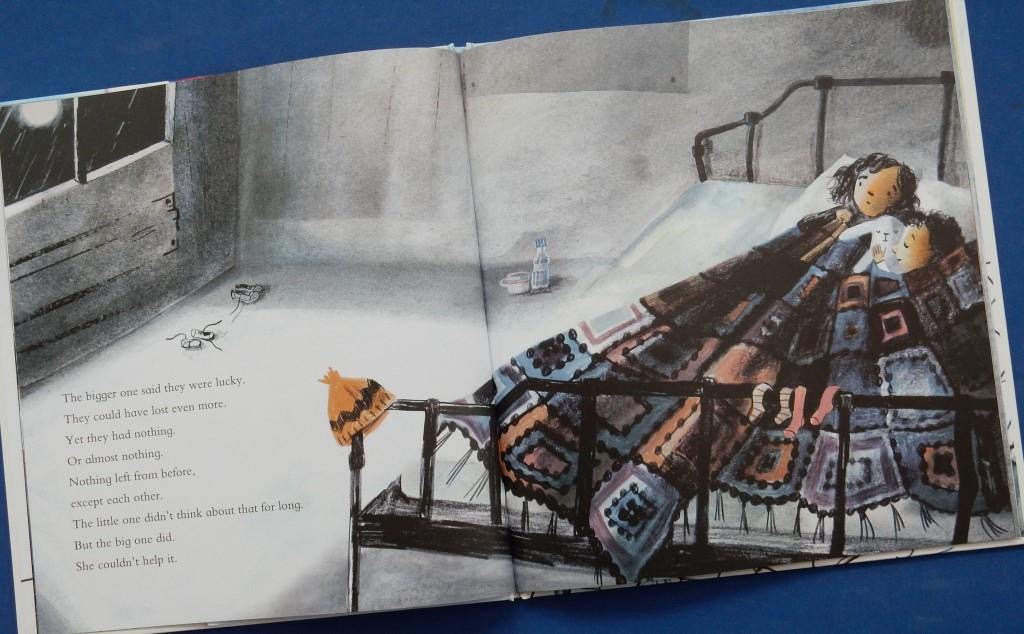
Two children, a big sister and her small brother are rescued from a boat adrift on the dark sea; they’ve lost everything. The younger one remembers little of his ordeal whereas his sister appears more resourceful, talking to rescuers and being instrumental in finding them shelter in a broken house.

However, while she remains inside dwelling on what’s gone before, her little brother ventures outdoors and begins to make friends.

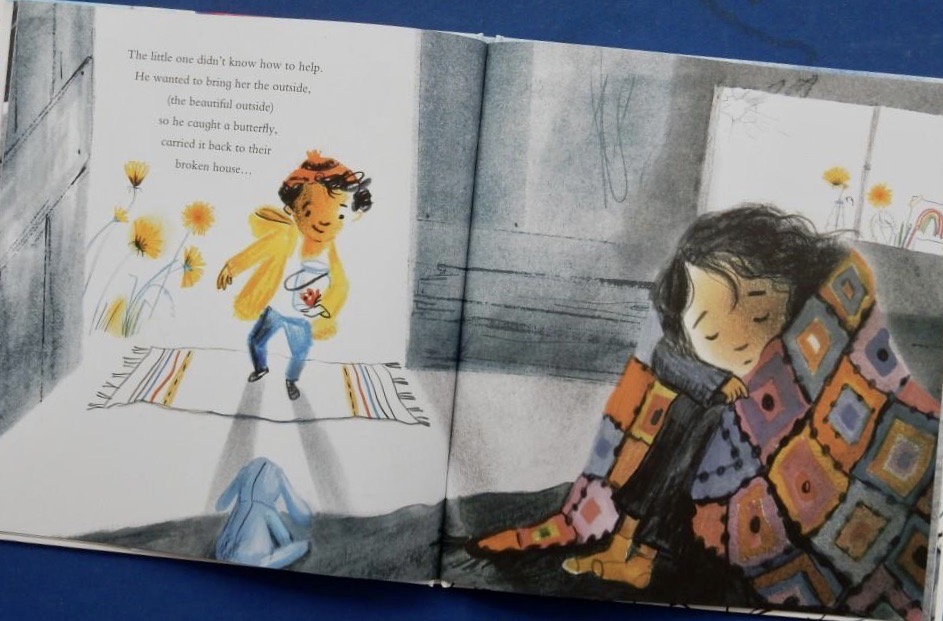
Feeling greatly concerned about what to do to help shift that ‘dark in her mind’ the boy, keen to coax his sister outside, catches a beautiful butterfly and brings in back to their refuge.

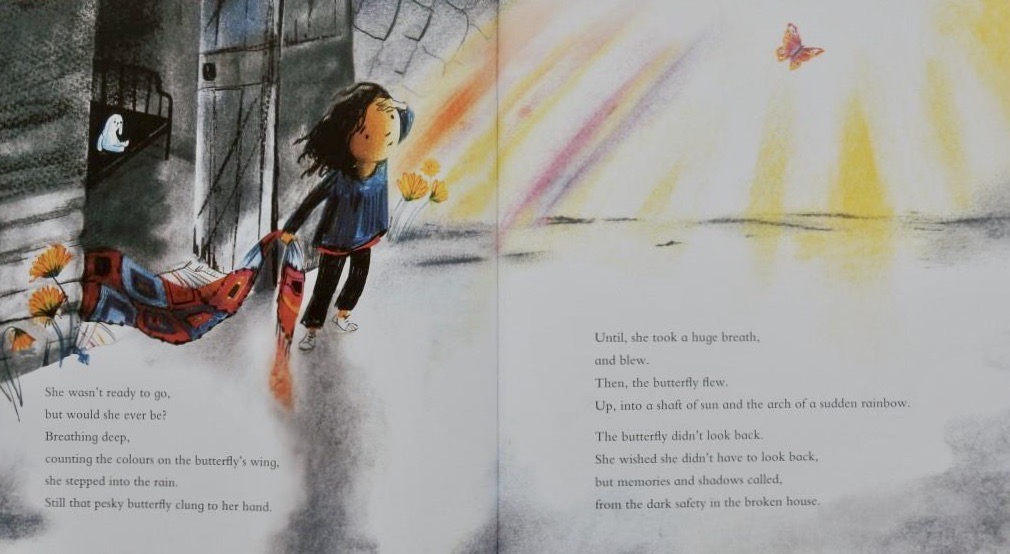
The girl upsets him by telling him to release the tiny thing that begins hitting its wings against the walls. It needs space and it needs time, she tells the boy. The boy goes out again; his sister counts the colours of the butterfly’s wings to calm her breathing. Eventually the girl opens the door; the butterfly settles on her hand. She steps out and blows the tiny thing. Can she now find the courage to follow the butterfly as it takes flight towards the sun where it belongs?
Helen Cooper’s heartfelt telling shows how, in their own ways, the siblings help one another to begin to move forward after such a life-changing ordeal. To me the blackness of the sea at the start represents their loss and the butterfly symbolises transcendence of that dark fearful state. Equally poignant, Gill Smith’s stunningly beautiful illustrations perfectly capture the feelings of the siblings in those early stages of rebuilding their lives.

Every primary school classroom needs a copy of this one.

Epic Adventures

Epic Adventures
Sam Sedgman, illustrated by Sam Brewster
Macmillan Children’s Books

Tickets ready! Sam Sedgman, co-writer of the Adventures on Trains fiction stories, turns his attention to capturing that same sense of excitement as he invites readers aboard twelve iconic trains to undertake railway journeys through some thirty four different countries and six continents.

For each journey, he and illustrator Sam Brewster, conjure up for the reader some of the history, culture and wildlife of the countries visited or passed through. Such is his enthusiasm for the subject that I will now seriously consider, when I plan my next trip to Amsterdam (one of my very favourite cities in the world) the possibility of travelling the 355 km. not by plane but through the Channel tunnel on the Eurostar.

While going from Kolkata to Darjeeling, if you change at New Jalpaiguri Junction, you can take a trip on the ‘toy train’ that uses the narrow gauge mountain railway. Or maybe you’d rather have An African Adventure, savouring the sights from Dar Es Salaam to Cape Town and imagine being on safari in Botswana en route.

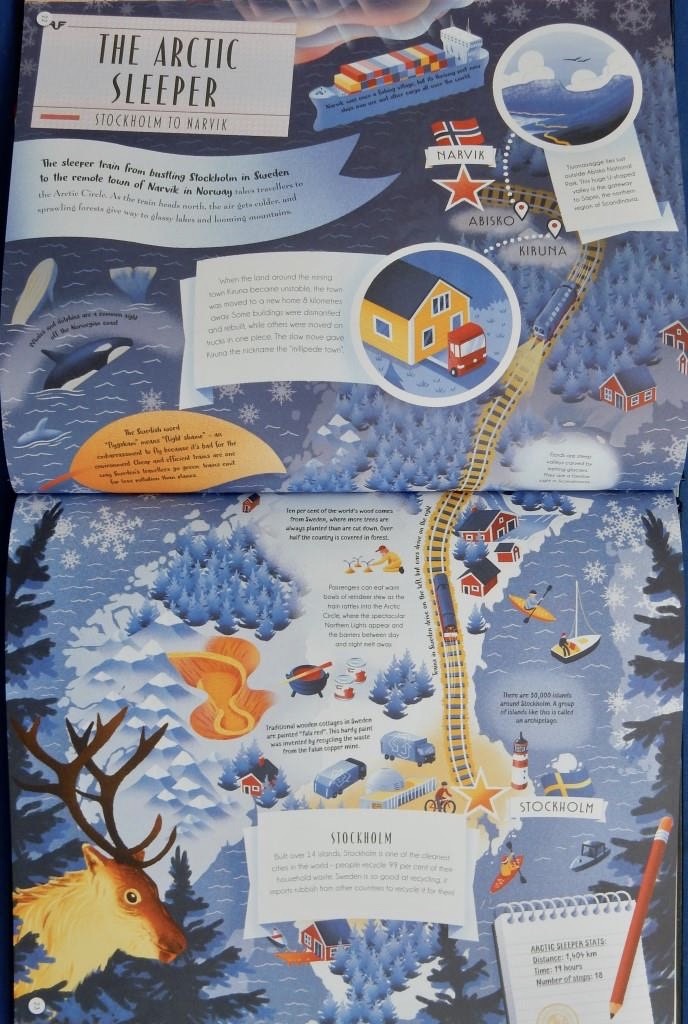
By contrast you’ll definitely need to wear your thermals if you take the sleeper train from Stockholm on a journey to the remote Norwegian town of Narvik, that will take 19 hours and make eighteen stops.You might even think about sampling some warm reindeer stew as the train nears the Arctic Circle –

think I’d stick to anticipating the appearance of the Northern Lights and pass on that stew.

Informative and filled with that special sense of wonder, the illuminative narrative – verbal and visual really makes you want to try some of those journeys for real.

One Camel Called Doug

One Camel Called Doug
Lu Fraser and Sarah Warburton
Simon & Schuster Children’s Books

Star story spinner Lu Fraser has created another winning picture book in a new partnership with illustrator Sarah Warburton.

When it comes to flying solo Doug is an expert; everything he knows about comes in the singular – at least as this rhyming story starts that is the case. But Doug thinks he might be better off with a playmate. Almost as soon as he thought that however, what should come along but another camel, Brian by name. Two proves a whole lot more fun than one but hot on his heels or rather hooves, come Claire, 

Bruce and Rita. A veritable footie team no less. And so it goes on until there’s an entire train of the humped creatures – just the thing for a party.

However, all that romping and stomping can prove a tad overwhelming if it goes on and on and on … What then for our adorable dromedary?

Lu’s faultless rhyming narrative has a fun counting element but there’s so much more to enjoy: not least the way she uses a repeat refrain, “What’s that, cried … “is it a …? to set the scene for the next arrival, the name of which is part of an on-going guessing game.

Sarah Warburton manages to bestow a real personality on each camel that comes along – no mean feat – and the scene with the ‘fancy dress camels’ is definitely one to pore over. In fact it’s the way that words and pictures work together that makes this such a super book and one that youngsters will want to hear read aloud over and over.

Mayor Bunny’s Chocolate Town

Mayor Bunny’s Chocolate Town
Elys Dolan
Oxford Children’s Books

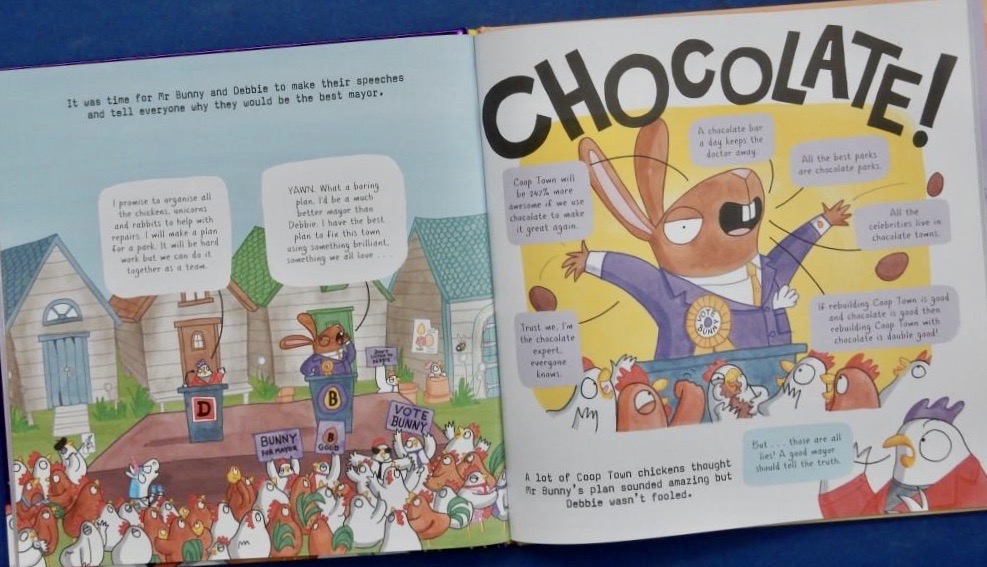
Mr Bunny is back and he’s feeling a tad bored with his current role in the chocolate factory so he decides to run for mayor of Coop Town which is in desperate need to some repair work. Seeing the mayoral office as an ideal way of increasing his influence he zealously starts his campaign, promising to make the town great again. Does that remind you of anything I wonder?

Initially the town’s residents are delighted by what Mr Bunny promises – new amenities and houses – chocolate naturally, which, so Mr B. says is a fox repellent.

Of course, by now alarm bells should be ringing as readers realise that this particular candidate is merely seeking power, making pledges he has no intention of fulfilling and doing his utmost to discredit his sensible, honest rival, chicken Debbie. His campaign is waged with dirty tricks, a plethora of lies and come election day bribes.

However this is a tale of be careful what you wish for, at least it’s so for Mr Bunny: having been elected, he finds he has some very important lessons to learn in his new role.

As one has come to expect, Elys Dolan’s illustrations are brimming over with deliciously droll details and her wonderful narrative has a wealth of speech bubbles that are just brilliant.

Having read my copy, eagerly seized after her younger brother put it down, my nine-year old relation remarked, “I think this is going to be Dad’s new favourite picture book.” I suspect she’s right for he, along with this reviewer (apart from being chocolate addicts) will draw parallels between the antics of Coop Town’s Mr Bunny and a certain ex mayor of London.

My Mum is a Lioness

My Mum Is A Lioness
Swapna Haddow and Dapo Adeola
Macmillan Children’s Books

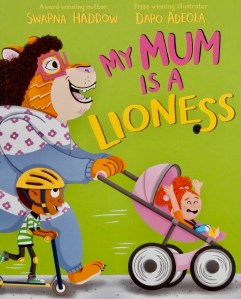
From the same team that gave us My Dad is a Grizzly Bear comes this hilarious follow-up starring a mum with a very big personality and a huge amount of love – love she clearly both gives and receives.

The little human narrator introduces readers to this larger than life parent serving her up by means of suitably leonine language that Dapo Adeola dramatically portrays in his action-packed scenes of family life. This powerhouse of a personality, is constantly busy. She appears to have boundless energy as she goes about her role as mum,

partner, friend, sporting hero and teacher. Most important she always manages to be there at the ready to bestow those wonderfully warm ‘lioness hugs’ just when they are most needed.

An absolute corker of a book for mums and little ones to share at home and for educators to do likewise at school or nursery. This rip-roaring tribute to the power of mums everywhere would make a smashing present for mothers of young children on Mother’s Day.

Love is … / Sometimes I feel …

Love is …
Sarah Maycock and Lily Murray
Sometimes I feel …
Sarah Maycock
Big Picture Press

In the first book, using a variety of creatures great and small, furred, 

feathered or smooth and leathery, author Lily Murray and illustrator Sarah Maycock explore some of the myriad ways that we can experience love, both feeling it and giving it.

In each example, figurative language ‘Love is / BEAUTIFUL / like the sanctuary / a bowerbird builds for its mate -/ adorned with treasures.’ … – ‘love’s beauty comes / in many forms … / … a simple song, / a colourful dance, / a loving face’, and gorgeous painterly images extend across two double spreads whereon the artist makes use of vibrant hues and monochrome colour to great effect.

Having met a host of members of the animal kingdom the final spreads make the assertion ‘Love is a POWERFUL THING, / For with love … / We can do / ANYTHING.’

What better words to give a loved one: this large format book would send a powerful message to its recipient.

Presented in a small format, again using animal similes is Sometimes I feel … which looks at emotions. 

At the end of the book, in a note the artist explains that this had its origins as a project in her final year at university. She wanted to explore the ‘universal nature of animals and how we can relate them to our own (human) experiences and characteristics. She spent a considerable time studying animals both in zoos and in natural history documentaries on TV and as she painted it seemed that like us, wild animals display a gamut of complex emotional responses. Some of these she captures in this superbly executed series of watercolour and ink paintings.

A little book that offers children an unusual starting point for exploring their own feelings and emotions and those of others.

Diversity Matters: We Are Family / Bindu’s Bindis

We Are Family
Lucy Reynolds and Jenna Herman
Doodles & Scribbles

‘Your family may be big / or small, / tiny or … / terrifically tall. / Perhaps you’re / raised by one dad / or mum. / Or do others / help and . ../ join the fun?…’
So begins the simple rhyming narrative in this non-fiction picture book wherein Lucy Reynolds explores the concept of family.
Fact boxes provide additional information about the exemplars she uses from the animal kingdom 

to show the many varieties there are, while at the same time, the rhyme speaks directly to readers about the possible kind of family theirs might be. The result is a positive, inclusive message coupled with information on the specific creatures chosen, which are illustrated in Jenna Herman’s mixed media, patterned illustrations.
A safe way to explore the diversity of human families, especially in a foundation stage or KS1 classroom. In the latter children can better appreciate the wealth of information about the animals featured.

Bindu’s Bindis
Supriya Kelkar and Parvati Pillai
Sterling

Bindu absolutely loves the bindis her Nani sends her from India each month with their different shapes, sizes and colours; and even more she loves the connection she feels when she wears them.Then one day, joy of joys, Nani comes to visit and the family go to the airport to meet her. However this joy is curtailed as they are soon forced to confront the xenophobic people standing outside with their racist placards. 

At first Bindu wants to rip off her bindi but manages to overcome her feelings of despondency. Back at home child and Nani are soon enjoying one another’s company especially when Bindu returns from school and picks a bindi to match her grandparent’s mood.

Then comes the day for Bindu to wear a bindi to school for the very first time; she’s to perform an Indian dance in a talent show so Nani makes sure the two of them match. But when it comes to her turn Bindu’s worries about other people’s reactions cause the little girl to have an attack of stage fright. 

Can Nani help her granddaughter summon up some inner courage, rediscover her sparkle and thus save the day?
A picture book that demonstrates the strength of family bonds showing how they can transcend long distances. The richly coloured illustrations capture Bindu’s changing emotions throughout the story and the racism strand offers a starting point to open up discussion within a family or an educational setting.

How to be a Hero: A Gathering of Giants / Agent Zaiba Investigates: The Smuggler’s Secret / Solve Your Own Mystery: The Time Thief

How to be a Hero: A Gathering of Giants
Cat Weldon, illustrated by Katie Kear
Macmillan Children’s Books

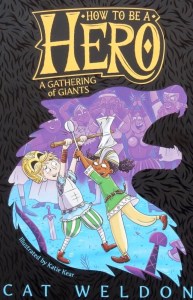
In the finale of Cat Weldon’s terrific trilogy, Whetstone and banished trainee Valkyrie Lotta are fugitives, now in hiding in Asgard. Whetstone is on a mission – to rescue his mum who, according to Thor, is being held, along with the second harp string, by the Frost Giants in Castle Utgard. It’s definitely time for him to work on becoming a proper hero, tough and fearless. Step forward Rhett the Bone-Breaker. But how many of Lotta’s plans is it going to take for them to succeed in outwitting Loki the trickster? They certainly won’t do it without encounters with treacherous trolls, indoctrinated Valkyries and an entire army of giants.

With Katie Kear’s illustrations helping to ramp up the drama, this fast-moving tale is full of thrills and a fair few spills too, plus a generous scattering of insults adding to the hilarity. This will keep readers on the edge of their seats right through to the cup’s final poetic offering. So gripped was I by the telling that after finishing the story late at night, I found myself back in the quest along with the heroic duo in my dream.

Readers who fancy sampling the sort of meal one of those giants might eat, should turn to the recipe adapted by Whetsone for spiced oat cakes. A tasty treat indeed.

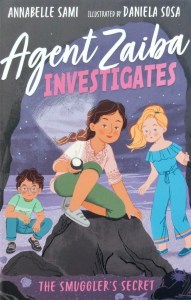
Agent Zaiba Investigates: The Smuggler’s Secret
Annabelle Sami, illustrated by Daniela Sosa
Little Tiger

Zaiba and fellow members of the Snow Leopard Detective Agency have a new case to solve. There’s a school History Club trip to Chesil Bay involving an overnight stay. The children are told that divers have just discovered a priceless artefact from Assam among the wreckage of a ship and it’s currently in the safe-keeping of the local museum prior to being sent back to India. While there they’ll be able to witness the unveiling of the artefact and Ms Talbot challenges them to discover what it is before it’s revealed. Now that is just the kind of thing Zaiba, Poppy et al love.

No sooner are they on the train down to the coast than the intrigue starts: Zaiba notices a man replacing a magnifying glass in his briefcase and then she thinks she sees him on the boat trip out to the wreck and again leaving the theatre in the evening after the play they’re invited to watch. In fact he seems to pop up all over the place. What is he up to?

Next morning everyone is excited about the big reveal but then it’s discovered that the artefact has gone.Now Zaiba and co. really must ramp up the action. There are quite a few possible suspects and some leads to follow, but not much time to discover the culprit.

Embracing a controversial topic: the returning of precious artefacts to their countries of origin, once again Annabelle Sami keeps readers guessing right to the final pages of this story of teamwork and as with previous titles in the series, there are lively black and white illustrations by Daniela Sosa throughout.

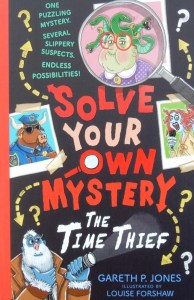
Solve Your Own Mystery: The Time Thief
Gareth P. Jones, illustrated by Louise Forshaw
Little Tiger

Choose your own adventure books have long been popular but rather went out of fashion. Now with Gareth P. Jones’ new series of which this is the second, interactive tales are back for readers who may well be offspring of the original enthusiasts.

In this instance the scene is set in the opening pages: in the town of Haventry the Museum of Magical Objects and Precious Stones (MOPS for short) is putting on a time-travelling exhibition but its key feature, the Time Sponge, an object able to stop and start time for whoever squeezes it, has gone missing. Then in the role of main character, the reader must make the first decision: two choices are presented as to what to do next: interview suspect mermaids or go to the crime scene – in the company of Klaus Solstaag the yeti detective, of course.

With a fair number of potential suspects and a multitude of paths to choose from, none leading to a dead end, you will eventually reach one of three possible endings.

A fun and intriguing read for key stage two readers especially those who like to do a bit of detecting.

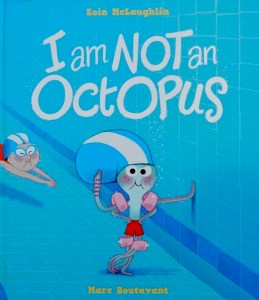
I am NOT an Octopus

I Am Not an Octopus
Eoin McLaughlin and Marc Boutavant
Walker Books

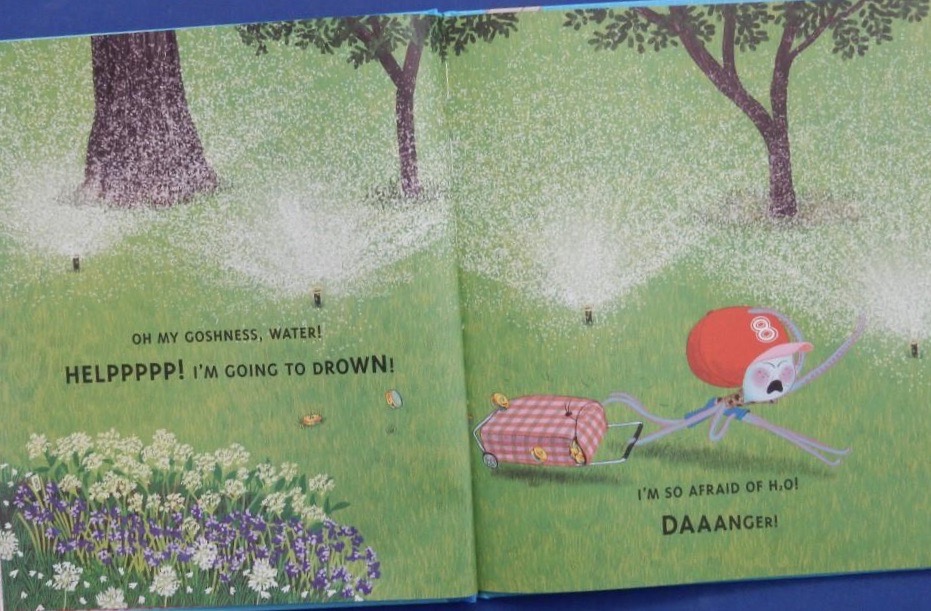
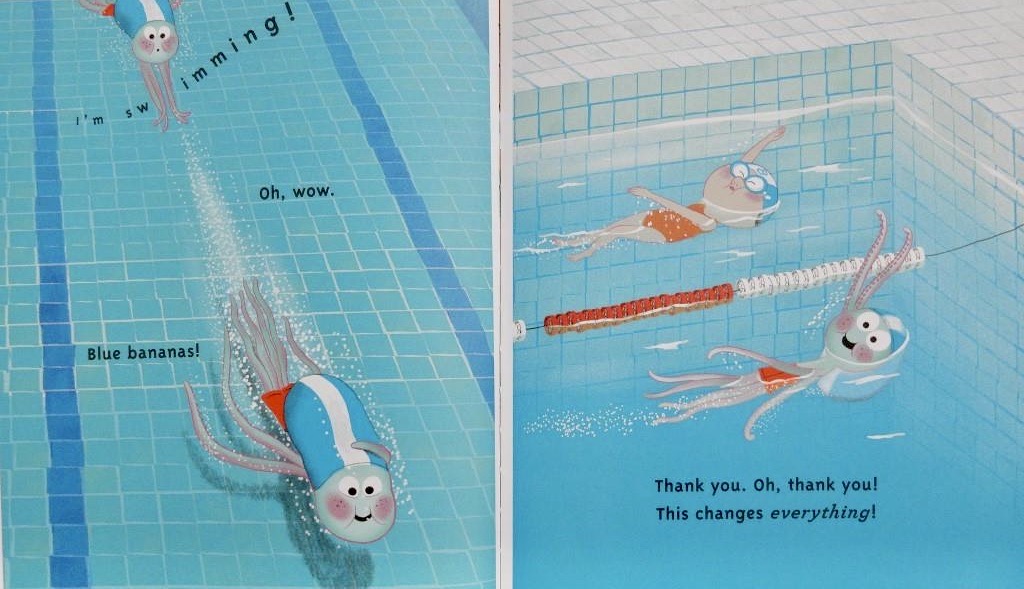
As he pushes a shopping trolley loaded up with tins of tuna, eight-limbed Terry states firmly, ‘I am NOT an octopus.’ and continues to do so as he leaves the supermarket and walks to the park. Seeking to justify his pronouncement he continues that he’d be in the sea if that were the case, ‘Unless I were afraid of water (which I’m absolutely not).’

So why the panic when he finds himself showered by the sprinklers he passes?

Terry carries on talking about the potential difficulties fear of water would pose for an octopus: no meeting octopus friends and family, no outings to Super Octopus Fantasea Adventure World either. Perhaps Terry should try learning to swim: he asks readers for some advice were he to pay a visit to the swimming pool including to pee or not to pee, and he decides to take the plunge.

Then with a newly acquired skill under his trunks, there comes Terry’s big reveal. However what’s said will come as no surprise to readers.

Delectably daft, Eoin McLaughlin’s tale of facing and overcoming your fears, octopus style, is one that children will relate to while relishing its silliness: silliness made all the more engaging by Marc Boutavant’s zany scenes of the protagonist narrator and his antics.

Hope the Whale

Hope the Whale
illustrated by Laura Chamberlain
Macmillan Children’s Books

This picture book was published in collaboration with the Natural History Museum and inspired by one of its most popular exhibits.

In spring a boy watches from the cliffs near his small town home as two blue whales – one large, one small – glide through the water as they begin their journey north. The boy calls the smaller whale Hope and throughout the summer months he imagines her swimming through the blue waters, passing polar bears and icebergs.

The arrival of autumn brings Hope once again, still keeping close to her mother as they head for the warmer southern waters.

A stormy winter follows and come the spring again, there is Hope. This migratory journey goes on through the seasons for some years

until eventually, not only is there no sign of the mother whale, but one spring Hope doesn’t come either.
Older now, with hope in his heart, the boy heads out in his boat to search for her. Will he ever see her again?

Happily yes, she’s grown considerably and she’s not alone.

A final superbly coloured, fold-out spread follows the story. When opened up it reveals information about the real blue whale that gave rise to this story, along with facts about the annual migratory journey such creatures make.

With its whale watcher acting as narrator and Laura Chamberlain’s arresting illustrations, this is a book to add to home collections and primary school bookshelves.

I Love You, Blue

I Love You, Blue
Barroux
Otter-Barry Books

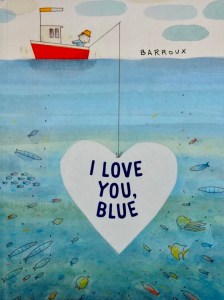
A small sailor (Jonas we learn later) in a small boat is sailing on the calm ocean when suddenly it becomes anything but. As the sea rages violently ‘neath a now black sky the cry goes out, ‘Help! help! Mayday! Mayday!

Happily to the rescue comes an enormous whale, Blue by name. Later from the safety of his lighthouse, the sailor bids goodnight to his Blue, telling the creature, ‘You are the prettiest of whales.’

The following morning it’s calm once more and the sailor searches for Blue, much concerned when the creature fails to appear. Blue is down deep and far from well. Venturing inside his mouth, Jonas is shocked to find that his belly is chock full of plastic bags. The little sailor collects up all the bags

and takes them away in his boat having told the whale to breakfast on jellyfish. Their meeting the next day sees a much livelier Blue, then an affectionate boy and Blue together and on the promontory wall beneath the lighthouse are written some crucial words.

A powerful environmental message indeed and one that young children will most certainly relate to.
Barroux’s soft-coloured illustrations with simple, thin black outlined images are highly effective conveyors of the tale alongside the child protagonist’s telling.

After the story the author leaves readers a heartfelt message explaining that Blue represents every one of the different whale species in our oceans, and giving information about things that can be done to support the causes of whales and ocean pollution.

The Fussy Flamingo

The Fussy Flamingo
Jonnie Wild and Brita Granström
Otter-Barry Books

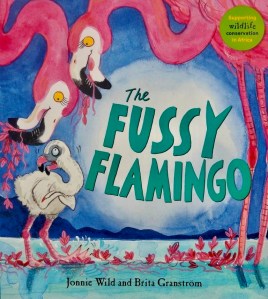
Fantastically funny is the latest in the Five Flamingos series from team Wild and Granström. It stars Baby and as the title says, this little bird is an exceedingly fussy creature. 

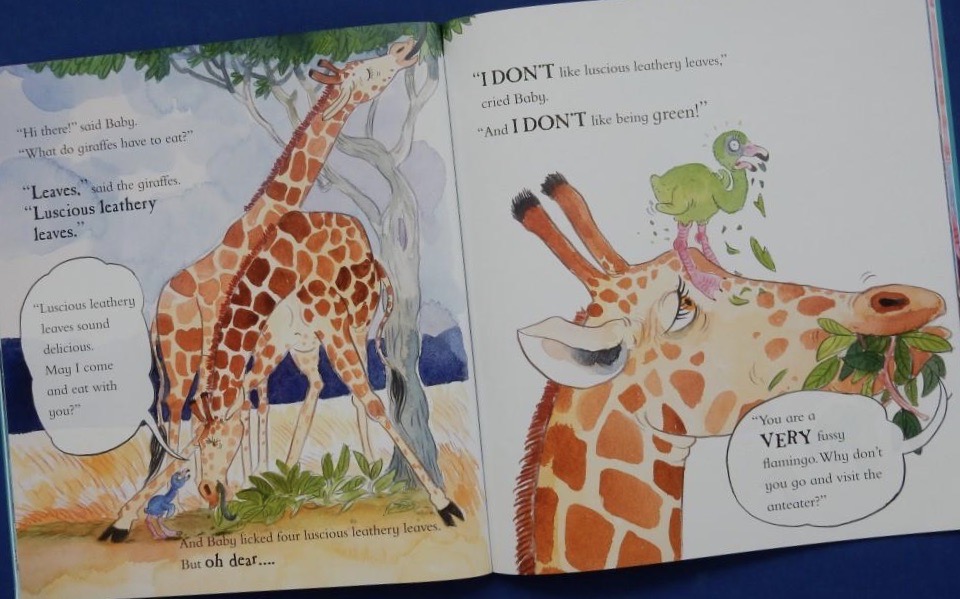
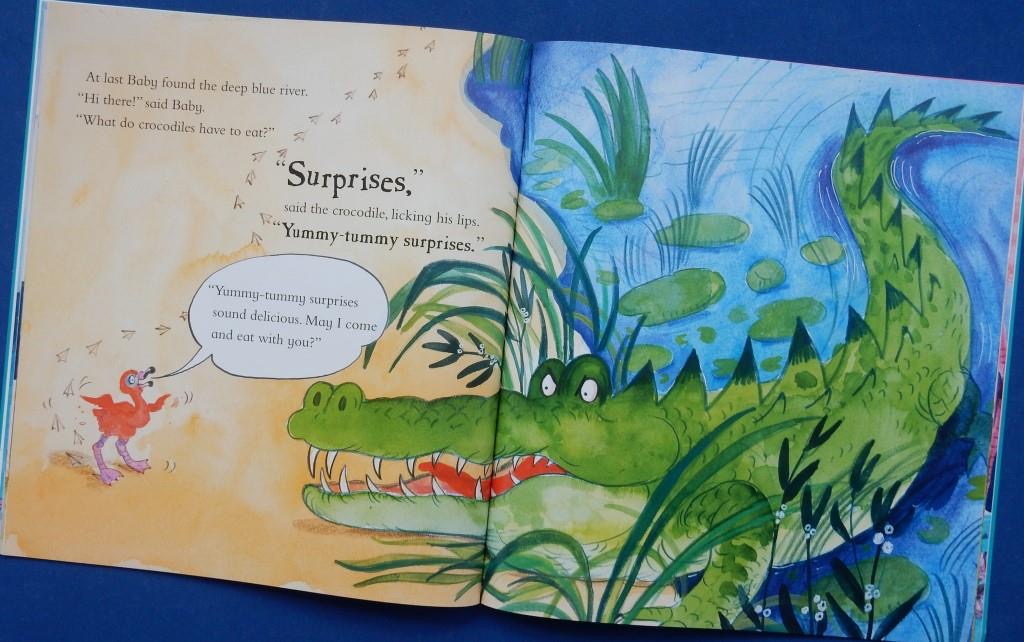
On the day we meet her she’s throwing a tantrum about all things flamingo and has decided to flounce off into the forest to find a family whose diet is more to her liking. Her first encounter is with the monkey family: they, so she’s told feast on “Big burpy bananas. ” Baby consumes two but is far from impressed with their taste or her change of hue so it’s suggested she heads off to see the fruit bats. However their berries – the ‘chewy-bluey’ variety are not to Baby’s taste either. Neither is the outcome of her consuming same.

Equally unhappy about her consultations with the giraffes 

and the anteater, Baby heads off to the river to try her luck there. Meanwhile the other flamingos are desperately seeking her whereabouts. 

When she reaches her destination, Baby meets a lip-licking crocodile to which she asks a rather dangerous question … 

Brita’s hilarious scenes heighten the drama of Jonnie’s text with its playful language and plethora of speech bubbles: together they’ve created a tasty tale of a fussy eater that youngsters will relish and if they’ve not previously met the Five Flamingos, they’ll likely want to sample others of their stories.

(The author’s royalties are to be donated to support wildlife habitat conservation in Africa.)

The Last Tiger

The Last Tiger
Becky Davies and Jennie Poh
Little Tiger

Climate change and destructive human actions are at the heart of this tale of Asha the tiger.

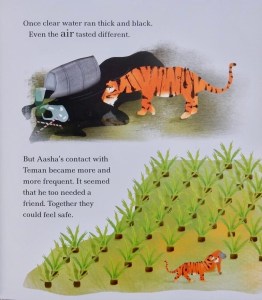
As the story opens, she and her family are living happily in a lush forest along with boars and other creatures. but little by little their environment changes. Sunny days become hotter and hotter and rainy ones, much wetter, so wet that the land is flooded, forcing the boars to leave the forest in search of other places to live. Tigers too disappear, and without the boars, food for the remaining tigers becomes extremely scarce.

Eventually Asha finds herself completely alone, save for the scent of humans. Yes, humans had come into the forest, bringing with them huge destructive machines that cut down all the trees.

As Asha creeps through the devastation the humans have left in their wake, she sees a flash of bright orange. Another tiger perhaps? But no, it’s an orangutan, but company at least. Can the two of them possibly find a new home somewhere else …

Tragic and poignant, this timely story looks at the plight of just one of the animal species endangered, due for the most part to human actions such as the deforestation we saw in Asha’s natural habitat.
Saving tigers from extinction means saving forests and there’s relevant information in the final pages of this book including the alarming fact that there are now less than 4,000 tigers left in the wild.

Toddler Take-Along: Nature / Hello, Bee / Jeppo Finds His Friends

It’s never too early to start introducing little ones to the delights of nature and the first two books from Little Tiger should help do just that. Thanks to the publishers for sending them for review

Toddler Take-Along: Nature
Ana Zaja Petrak and Becky Davies

Bold images on bright backgrounds with peep through die-cuts and a simple question per spread, invite toddlers to look all around and with the help of the labels, name what they see, be it on the ground, up in the sky, or on and around the pond.
As suggested in the title, a handy carrying handle makes this one ideal for taking out on walks.

Also bursting with mini beasts is:

Hello, Bee
Sophie Ledesma

A buzzy bee leads the way through the pages of this touchy-feely, lift the flap book wherein we meet small creatures that fly, crawl, slither and walk; there’s an odd surprise too. Sophie Ledesma’s multicoloured images are gently humorous yet recognisable, and in combination with the brief chatty text and hidden animals element and the final ‘What did you spot on the way?’ spread showing an assortment of natural objects that were passed on bee’s flight, make for an interactive experience that little humans will enjoy sharing with an adult or perhaps an older sibling.

Another interactive board book is:

Jeppo Finds His Friends
Ingela P Arrhenius
Walker Books

Tiger Jeppo can’t wait to meet up with all his friends but although he soon finds Larry Lamb and Flora Fox, of Odd the owl there’s no sign. So off the others go to look for him. After several misidentifications, disappointed, they’re on the point of giving up but there’s one last place to check. Perhaps they might be lucky this time …
Toddlers will have fun lifting the various flaps as they join in the search for Odd the owl in Ingela Arrhenius’ bold, bright playful spreads.

A World Full of Journeys & Migrations

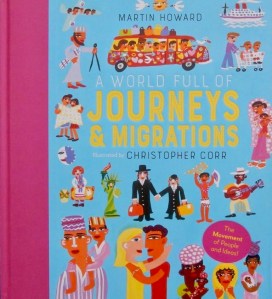
A World Full of Journeys & Migrations
Martin Howard and Christopher Corr
Frances Lincoln Children’s Books

Migration has been very much in the news for the past several years with stories of people fleeing wars in Syria and Afghanistan, overcrowded and flimsy craft undertaking hazardous crossings of the Mediterranean and the English Channel and refugees attempting to cross land borders of eastern European countries to reach the European Union. This book chronicles that migration is not a recent phenomenon but something that began 70,000 years ago when the first people started to spread out from Africa to inhabit the whole globe.

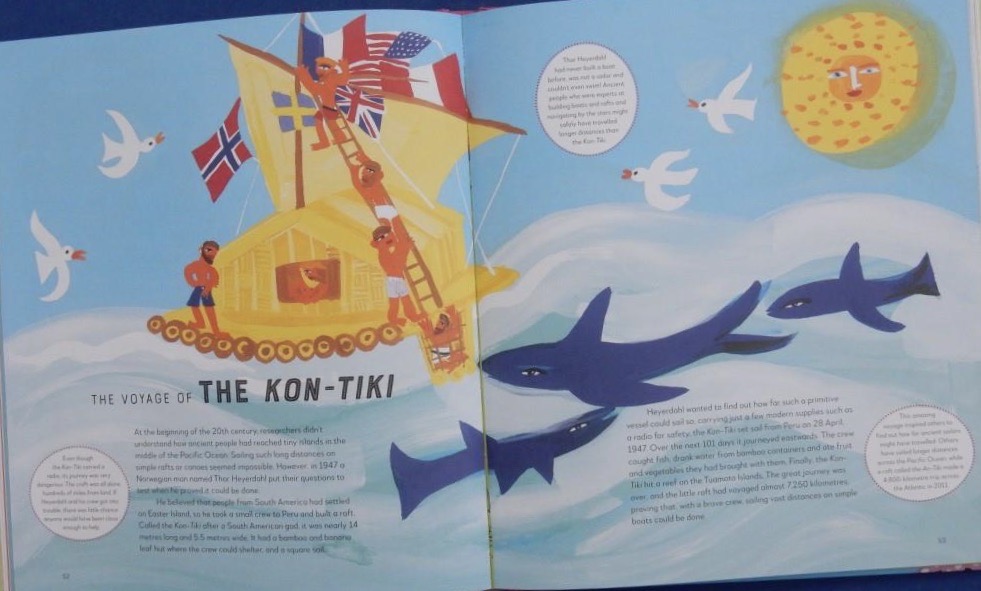
Author Martin Howard and illustrator Christopher Corr explore some fifty instances through history, continent by continent covering a large variety of relevant topics. These include navigational journeys of discovery by Marco Polo and Christopher Columbus, as well as Thor Heyerdahl’s Kon-Tiki,

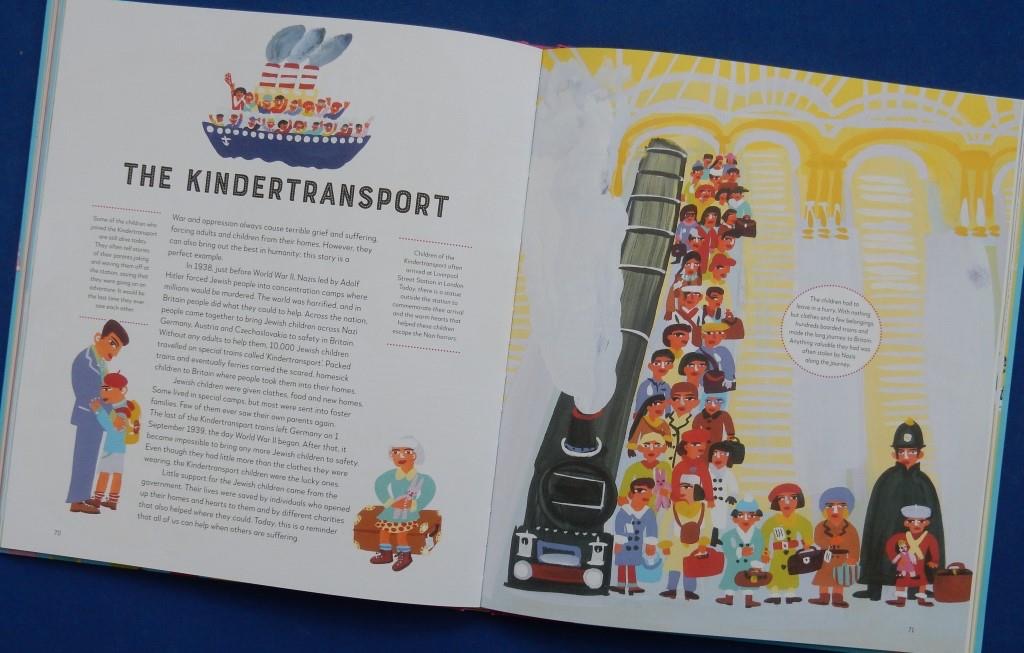
which emulated primitive vessels of ancient peoples; forced migration of slaves such as those of African peoples from their homelands to American colonies; colonial journeys for power and profit including those of the British to India and many European countries to Africa and various other parts of the world. Also included is an excellent example of what humans can do for those on whom great suffering is inflicted, the Kindertransport British people set up to bring Jewish children to Britain to prevent them being sent to concentration camps by the Nazi regime.

What is key no matter the reason, is that with the movement of people comes a wealth of new, potentially enriching ideas. The author acknowledges that in a book such as this it’s impossible to cover everything and it’s an amazing thought that as he says, inside everyone of us is a ‘kaleidoscope of human history and thousands of stories of travel and adventure.

Christopher Corr’s distinctive illustrative style is ideal for the book making what would otherwise be quite a demanding subject much more accessible.

Frank and Bert

Frank and Bert
Chris Naylor-Ballesteros
Nosy Crow

What is more important to you: is it being a winner or being a really good friend? That question is explored in Chris Naylor-Ballesteros’s new story starring bear Bert and Frank, a fox who acts as narrator.

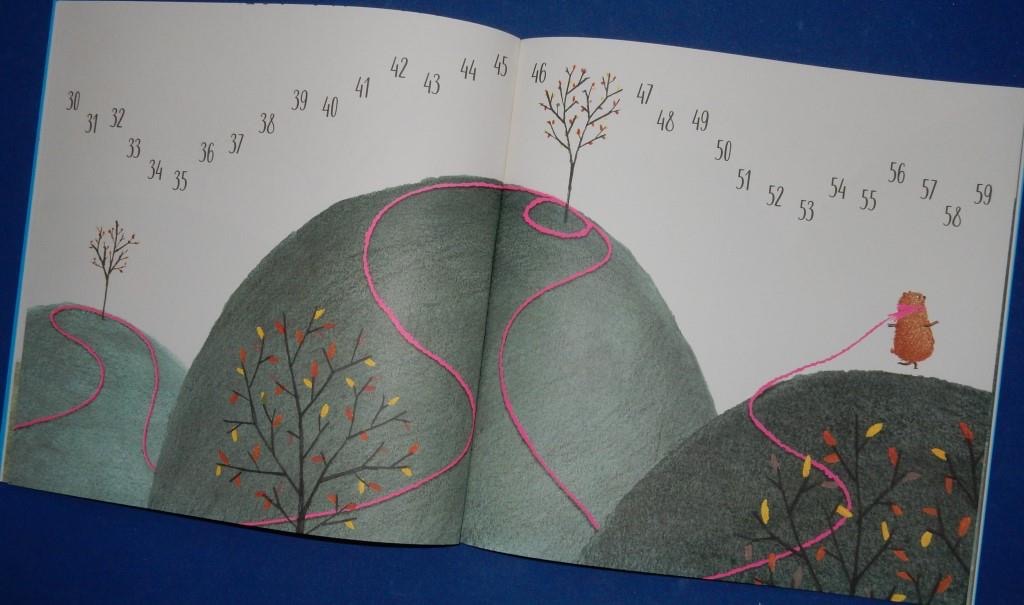
Their favourite game is hide-and-seek in which Bert is sure he’s an ace hider and loves to do so. The trouble is the bulky bear is far from an expert and inevitably Frank finds him easily every time, which Bert puts down to not being given sufficient time to stow himself away.

So, instead of the usual count of ten, Frank decides to give Bert a hundred before he starts to search.

Can he now find the perfect place to hide?

The crazy comic capers of the adorable duo are brilliantly highlighted by their day-glo bright garments be they in their appropriate places or gradually becoming unravelled across the lumpy, bumpy landscape.

Hugely entertaining yes, but with a moral dilemma at its heart. It’s great for sharing with a class, group or individual, though equally, the simplicity of the language makes it a rewarding story for learner readers too. An absolute gem of a book in every way.

Dogs in Disguise

Dogs in Disguise
Peter Bently and John Bond
Harper Collins Children’s Books

In a hilarious, bouncy rhyming text, Peter Bently introduces a veritable virtuoso performance by ingenious canines. Each successfully infiltrates some kind of humans’ place disguised in garments garish, gaudy, smart, stylish, sporty, trendy, minimal, or sometimes just plain silly and even, if unpractised in the art of deception, terrible. Clad in gear ‘borrowed’ from their places of residence, they wander the streets, strutting their stuff, then stroll into shops – we see them – that ‘pair of OLD SCHNAUZERS’ ‘there, in PINK TROUSERS …’ ; while others gain admittance to seriously cool cafes like this one

Others with a sporty inclination cleverly compete in jujitsu – that’s CHARLENE the SHIH-TZU, or splash around in the swimming pool. We view one trying its paws at a tonsorial establishment, whereas that Frenchie family might simultaneously be gorging themselves on goodies at the theatre.

Now all of this requires training from an early age; but if like Barney one tries to be just a tad too clever, there’s the danger of embarrassing moments down at the park.

With their bright blocks of colour and superbly expressive eyes, John Bond’s illustrations are the perfect match for Peter’s wacky words.

Perfect for pooch lovers, fashionistas and anybody who likes a good giggle.

The Tower at the End of Time / Diary of an Accidental Witch: Flying High

The Tower at the End of Time
Amy Sparkes
Walker Books

Reformed pickpocket Nine, Eric the troll, wizard Flabbergast et al return for a second wonderful adventure that again mixes wit, magic, some nail-biting moments and occasional chaos.

Now the curse on the magical house has been lifted allowing the friends to travel between worlds, their first destination being The Wizarding Hopscotch Championship. It’s particularly important that Flabbergast attends the championships – he’s missed three years already and his worthiness is at stake. Moreover, the final prize for winning the event is a visit to The Tower at the End of Time, where one question can be asked!

There’s a problem though, for the house, being nervous about travelling again, is beset by an attack of the hiccups, which unsurprisingly upsets plans somewhat as with each HIC they bounce from one world to another till they finally reach those championships. More problems ensue when Flabbergast discovers that the hopscotch grid is aflame and he encounters many obstacles thereon, but negotiating it is the only way he can get the answer to his question.

In the end everything becomes a race against time, or rather gigantic sand-timers, with every contestant desperate to find an answer to their particular question. And what about Nine? She too has questions concerning who she really is and who left her that music box she treasures so much.

Hugely inventive and sparkling with excitement: primary readers with a penchant for high octane fantasy will jump at the chance to read this.

Diary of an Accidental Witch: Flying High
Perdita & Honor Cargill, illustrated by Kate Saunders
Little Tiger (Stripes Publishing)

With her first diary safely hidden away and her first half term at the School of Extraordinary under her belt, Bea Black starts a new one for this second book.
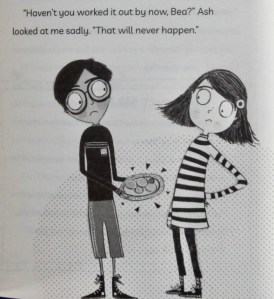
At home she’s still struggling to give sufficient time to her neighbour and close friend Ash who goes to an ordinary school..

With the Winter Solstice fast approaching, the main topic of conversation after the break is the forthcoming Grand Tournament and Bea finds herself a vice-sports captain. With the Go matches coming up, it’s even more important that she polishes up her broomstick skills. And then following a to do involving buns in town, headteacher Ms Sparks announces that in the hope of improving relations between the two schools, she is inviting the pupils from the Academy to participate in the Grand Tournament and that means no magic, no flying and definitely no Go after all. Indeed the event has now been renamed Sports Day.

Can the rift between the two establishments be healed? Then what about that egg or rather Egg, that Professor Age has given her to tend at home?

Honor Cargill’s smashing illustrations are sprinkled throughout and once again this is hugely engaging and lots of fun, with all the pupils having to deal with similar concerns and issues that readers themselves are likely experiencing.

Stop the Clock! / A Walk Through Nature

Stop the Clock!
Pippa Goodhart and Maria Christania
Tiny Owl

I do so appreciate young Joe’s frustration when everything he does has to be rushed. First it’s mum with a myriad of things on her mind, telling him to hurry up before they set off for school; then the walk itself is done at a run in case they’re late. Worse still, when he gets thoroughly immersed in the art topic Mr Khan has set the class, he’s told to stop and he’s nowhere near finished.

“STOP THE CLOCK!” he cries in sheer frustration. By now everybody else has complied with the instructions, but Joe – and who can blame him – adds his crying sister to his picture, picks it up and walks out. Now this is where readers, especially adults, will have to adopt that willing suspension of disbelief mode, for Joe leaves the school premises and heads to the street where he kneels down and continues drawing.

There is so much to see from ground level: so much to interpret about what’s going on and so many wonderful details to add to that picture of his. He even finds something that his sister must have dropped in the rush to reach school on time. Finally with picture complete to his satisfaction, Joe goes back to the classroom, leaves his picture with the others and gives instructions to the clock to restart.
Come home-time, after a slight pause, four happy people walk home together.

A heartfelt look at the busy lives that most of us live, often trying to do more than one thing at a time and in danger of missing out on those quality, slow moments we all need. In the past two years, the majority of adults at least, have come to appreciate the importance of time to stop and stare. With more and more people now back working full time as well as juggling child care and more, it’s crucial that everyone, young and not so young, has time to appreciate the world around without feeling guilty about doing so.
Author Pippa Goodhart and debut illustrator Maria Christania capture this need so beautifully in this picture book – it’s a wonderful example of how some good things have come from the lockdowns we’ve been subjected to.

Also showing the importance of taking time to appreciate the wonders of the natural world is:

A Walk Through Nature
Libby Walden and Clover Robin
Little Tiger (Caterpillar Books)

Through twelve, two verse poems and beautiful collage style illustrations with some facts tucked away behind flaps and die-cuts that allow readers to glimpse (or sometimes guess) what lies beneath, author Libby Walden and artist Clover Robin take us through the countryside presenting the numerous transformations that take place throughout the year.

No matter where one looks there’s much to wonder at. We visit a field in springtime as the flowers are starting to bloom in their myriad colours; look up high where birds fly seeking nesting places in the trees; stand at the edge of a peaceful pond wherein tadpoles are hatching and baby duckling are learning to swim.

Other habitats we visit are a woodland and a beach in summertime; a forest area and a mountainside through which a river flows in autumn, and, as winter arrives, swallows taking flight to warmer climes and foxes heading to their earths and as day turns to night, the emergence of nocturnal creatures ‘neath the silvery stars.

Containing a wealth of nature-related vocabulary, both gently educative and awe inspiring, this immersive book, now in paperback is a lovely introduction to nature poetry and nature itself.

The Midnight Fair

The Midnight Fair
Gideon Sterer and Mariachiara Di Giorgio
Walker Books

Oh WOW! This is such a superb wordess book ( wordless save for the occasional fairground signs) – definitely one of the very best I’ve seen and way too good to restrict to a particular audience.

As the book opens, forest creatures – bears, squirrels, deer, a stoat, racoons, a badger, a fox, rabbits, mice, a wolf – watch from beyond the fence as the fair unloads. From the edge of the woodlands they see the fairground filling up with humans large and small who spend the entire day enjoying the thrills, leaving only as night descends. The keeper switches off the lights.

From the shadows the animals emerge – it’s their turn now for some of that fun. In they come eyes aglow, through a gap in the fence, two racoons reactivate the power and the place becomes theirs. We also feel it’s ours, so immersive are the illustrations. As well as revelling in the rides and other attractions the animals take on the roles of the stall holders using various natural objects – acorns, pinecones, shells, leaves, fungi and wild flowers – as payment and we can almost inhale the scents of popcorn and candy floss.

At daybreak, the keeper wakes; it’s time for the animals to leave. Tired but very happy and a tad messy, they clear up the entire place and hurry away in the nick of time,

leaving only some of their currency on the ticket counter. But, their business is not quite done yet: as the others bed down, wolf carrying the goldfish won at the hoop-la stall, heads down to the lake and releases it into the water.

With clever use of both dark and light, and the natural world and the human one, Mariachiara Di Giorgio’s mixed media spreads, both detailed frames and expansive double page scenes, are a satisfying mix of the whimsical and the wondrous. This is one of those books that the more you read it, the more emerges.

Earth-Saving Acts for Eco-Warriors / Great Lives in Graphics: Shakespeare / Great Lives in Graphics : Albert Einstein

Earth-Saving Acts for Eco-Warriors
Ammonite Press

By now pretty well everyone must be aware that our world is getting hotter and that this is having a devastating environmental effect Yes ,we had COP26 in Glasgow towards the end of last year, but how many of the promises made will actually come to anything and how much will remain just rhetoric? If you want to help fight climate change – and surely hand on heart, everybody does – then here’s a helpful little book bursting with ideas and practical suggestions on how individuals can make a difference and thus be part of the drive to halt the catastrophe that is fast approaching.

None of its contents is really new: essentially the message is resist constantly buying the latest thing and when you do buy, go for quality rather than quantity; reuse and recycle, avoid single plastics whenever possible, spend more time outdoors rather than on screens, switch off lights and appliances when you don’t need them, walk, cycle or use public transport rather than travelling by car, read labels and eschew unsustainable palm oil products, eat a plant-based diet and don’t waste food.

The final quote made by Margaret Mead, ‘Never doubt that a small group of thoughtful, committed citizens can change the world; indeed, it’s the only thing that ever has.’ is apposite and one hopes a spur to activism in readers of this timely publication.

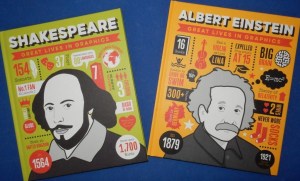
Great Lives in Graphics: Shakespeare
Great Lives in Graphics: Albert Einstein
Button Books

The first of these additions to the innovative infographics series features, I believe, the best-known playwright ever, William Shakespeare. Living in Tudor England much happened during his lifetime including outbreaks of the plague, the foiling of the Gunpowder Plot and execution of Guy Fawkes and his fellow conspirators.
As regards the bard himself, I was reminded that he left school at age fourteen, having learned only Latin and married Anne Hathaway when he was just eighteen and remained wedded to her till his death 34 years later. There is also information about other important people and places that feature in the life of the subject.

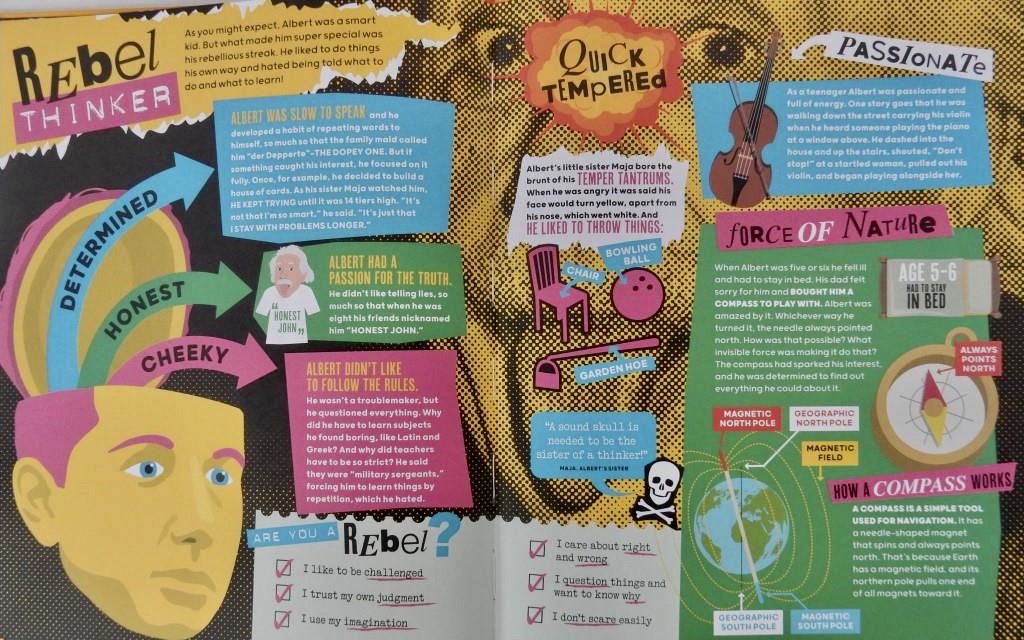
Being something of a rebel myself, I was excited to learn that Albert Einstein, subject of the second book was made special by his rebellious streak, liking to do things his own way and hating to be told what to learn or do. And I absolutely love this quote of his, “Imagination is more important than knowledge.’

These are just a few of the defining facts, thoughts, achievements and legacies of these two influential figures brought to life in these books. There are also timelines and glossaries and everything is in a form easily digested by most children in key stage two.

Amazing Animals

Amazing Animals
Sabrina Weiss and Paul Davis
What on Earth Books

Author Sabrina Weiss and illustrator Paul Davis take readers on an amazing tour of our planet’s wildlife in this addition to the Our Amazing World series.

After a general look at the relevant terminology, some double spreads focus on particular animals – leopards for instance and leafcutter ants, while others look at the fauna of specific habitats such as the Pantanal freshwater wild wetlands – a region in South America, and Africa’s Namib desert wherein live some creatures including oryx that have adapted to the harshest of landscapes.

In addition to the themed double spreads, half way through the book there’s a gate-fold world map that also gives fascinating facts about such things as the longest animal migrations, the ten biggest animals and those that live the longest.

We’re also introduced to stinky creatures, nocturnal ones, those with unusual parenting skills: did you know that there’s a female African cichlid fish that carries its eggs in its mouth for three weeks and doesn’t eat during this time? Amazing! Moreover, the hatched fry can return to their mother’s mouth should danger arise.

The final spread looks at some examples of endangered animals including the black rhinos from southern Africa, and the Chinese pangolin.

Back-matter includes a glossary and index. Subtitled ‘100+ Creatures That Will Boggle Your Mind’, stylishly illustrated and containing a wealth of information, this is a book for budding zoologists as well as school collections.

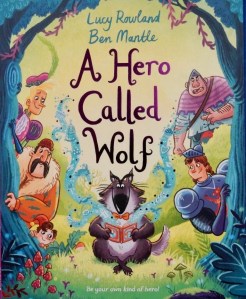
A Hero Called Wolf

A Hero Called Wolf
Lucy Rowland and Ben Mantle
Macmillan Children’s Books

There are all kinds of heroes in storybooks – big ones, small ones, male and female, but wolves? No, never. That is certainly the experience of the one in author Lucy Rowland and illustrator Ben Mantle’s new book. It’s a wonderful take on the world of fairy tales starring a reformed wolf who now, thanks to the library, has become an avid reader who loves to share that book love with his new friends.

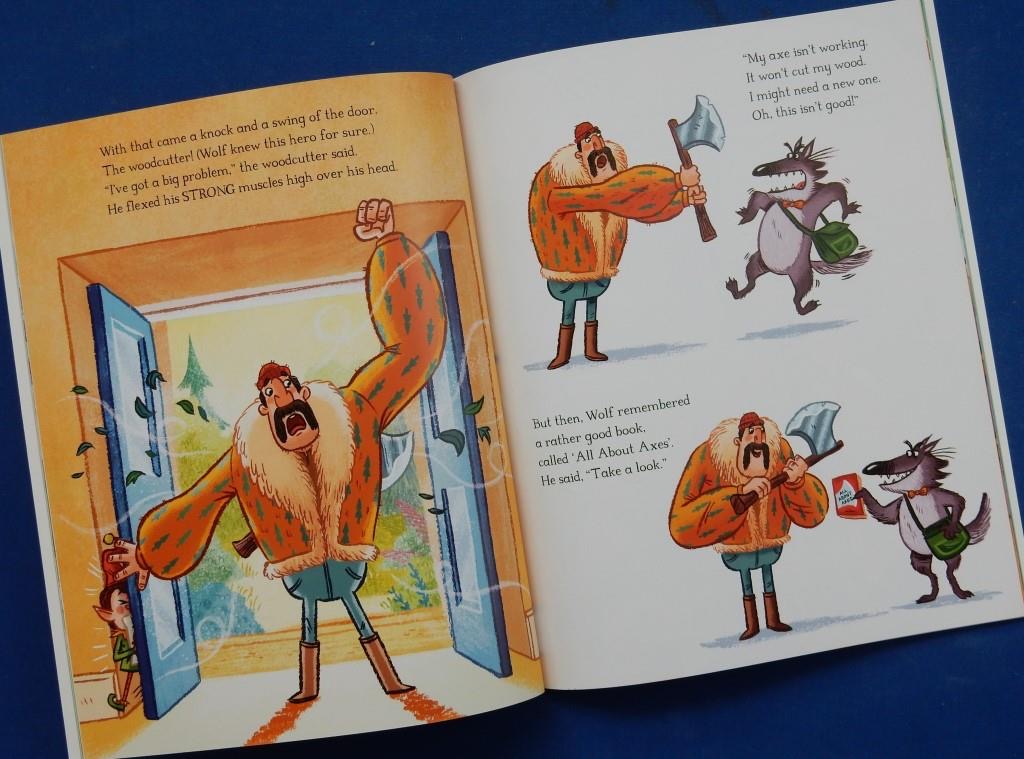
One day however, he pays a visit to the library looking very downcast. He’s come to the realisation that no matter what kind of heroes he meets in the books he reads there’s never, ever one of the lupine variety: wolves are always portrayed as the baddies. The librarian makes a suggestion: write the kind of story you want to read. Do I have what it takes, he wonders, far from sure. Then into the library storms a woodcutter with a blunt axe.

Shortly after a troubled knight appears, followed by a handsome prince, all of whom wolf helps with the aid of books, the prince actually calling him “My hero!”

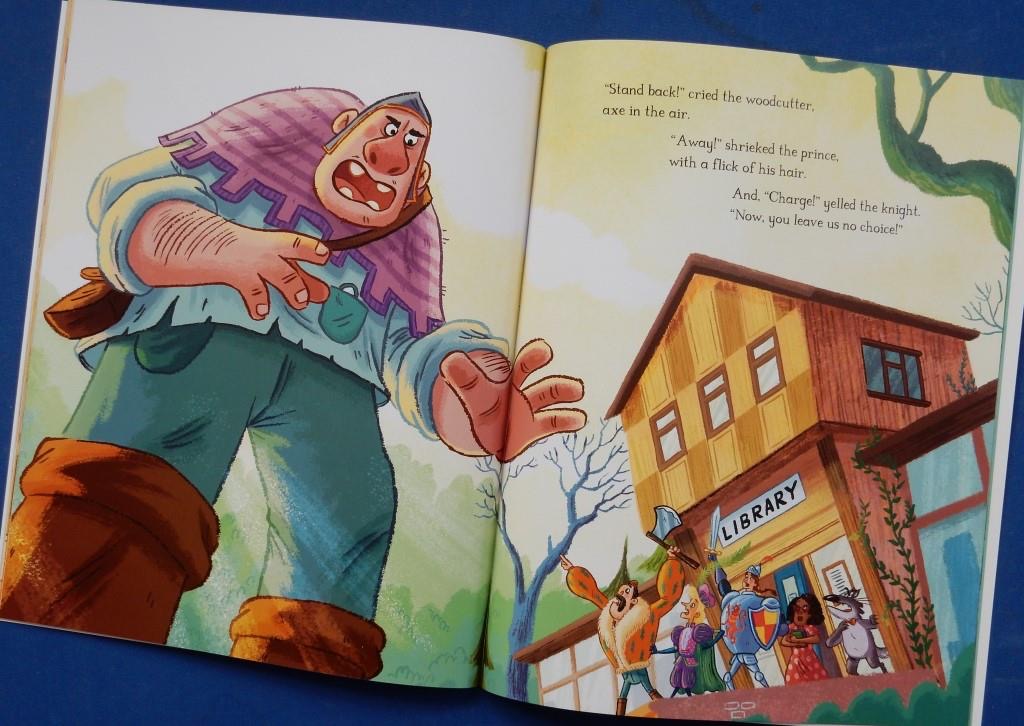
Suddenly there comes a shelf-shaking stomp heralding the arrival of a giant. The others want to send him packing.

Can Wolf summon up his courage to act … ‘For heroes are BRAVE and they’re CLEVER and KIND.’ Could that now be Wolf? …

The combination of Lucy Rowland’s rhyming text, which is a joy to read aloud, and Ben Mantle’s playful, often arresting illustrations make for a stereotype-challenging tale. As well as being huge fun to share, it demonstrates that everybody can be a hero, no matter who or what they are. That, and giving a real plug to the importance of libraries and the power of reading.

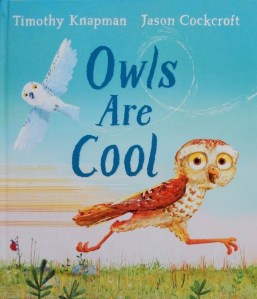
Owls Are Cool

Owls Are Cool
Timothy Knapman and Jason Cockroft
Walker Books

Meet Oscar, a burrowing owl and narrator of this story; he’s a cool creature he tells us, because of his inability to fly. He has no desire to emulate the flying owl species that soar and swoop in the sky. Instead he much prefers to spend his time burrowing and running and ZOOOOOOOOMing around the grassy terrain.

One day he issues a challenge to a watching snowy owl that comes swooping down to watch him strut his stuff. As expected the challenge is accepted and Oscar watches unimpressed at what he calls “showing off”. 

But then disaster: the snowy owl smashes right into a tree and crash lands nearby, injuring both wings. The creature introduces himself as Reggie and Oscar then has a change of heart. Offering his burrow as a temporary haven to Reggie, he discovers that the need for friendship is what really matters.

This is a sweet story showing how friendship can transcend differences and being different is ‘cool’.
I’ve never come across a burrowing owl in the wild; I don’t think they are resident in the UK and it was good to meet this one in Timothy’s tale. Jason Cockcroft captures both the long-legged strigine and the snowy one beautifully in his gently humorous scenes of the countryside shown from a variety of viewpoints.

I Am Hungry

I Am Hungry
Michael Rosen and Robert Starling
Walker Books

Following the smashing I Am Angry collaboration between Michael Rosen and Robert Starling is another offering from the poetry book A Great Big Cuddle, which again results in a terrific read aloud picture book for foundation stage children especially.

Expanding on the ideas in Michael’s poem, Robert Starling’s illustrations are executed in bright, bold hues and his characterisation of Squirrel (and the bit part players) in his dramatic scenes is superbly done.

In an introductory note, Michael writes that when he feels hunger pangs he sometimes daydreams about things he could eat, some real and some weird, going on to suggest that this might become a game. Seemingly Squirrel has read those words for that is what the ravenous creature does: starting from normal hunger sating fare like bread rolls and popcorn, cheese and peas, things become decidedly outlandish – a funny joke,

a very bad dream, a frying pan,

a nasty fright for example.

Youngsters will relish this absurdity and delight in thinking up their own lists of possibilities. What a wonderful starting point for flights of fancy – verbal or written – this would make after a class sharing of this super book.

Professor Astro Cat’s Frontiers of Space

Professor Astro Cat’s Frontiers of Space
Dr Dominic Walliman and Ben Newman
Flying Eye Books

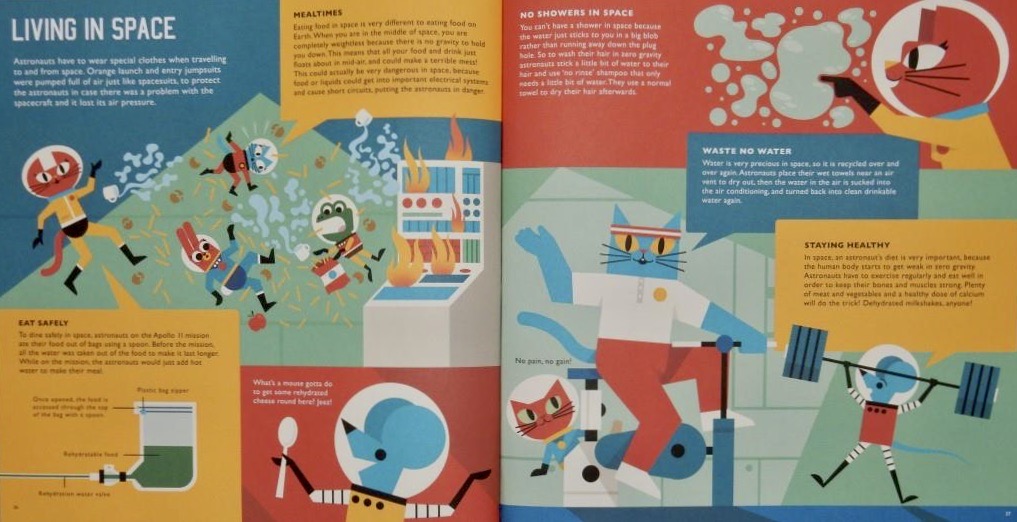
Space suits on? Professor Astro Cat, along with his sidekick Astro Mouse is ready to take us on a journey through space: it’s a skyrocket tour of the solar system and plenty else too.
First he informs us about the Big Bang and the birth of the universe, and then with a spread each, goes on to explain the formation of stars and how they collected together to form galaxies.

Next we whizz past the sun, after which our feline prof. presents in turn, all eight planets of our solar system, Earth and the Moon.

The practical aspects of space travel are covered in spreads on the early astronauts – animal and human. We meet the first moon-walkers, Buzz Aldrin and Neil Armstrong, as well their colleague Michael Collins who remained in the command module, while the others explored the moon’s surface. There’s a pause to discover some lunar information – did you know that due to lack of a wind and hence no erosion, the footprints those astronauts left will remain there for millions of years – wow!

There’s a chance to take a look at their Apollo spacesuits and some more modern ones, see some modern rockets, pay a visit to the International Space Station (ISS).

Then comes a consideration of what life in space might be like

and a whirlwind visit to each planet in turn starting nearest to the sun with Mercury and working outwards

and much, much more.

There’s also some speculation about possible ways the end of the universe might come about, the future of space and on the possibilities of alien life. Finally we have a fascinating factoids spread, followed by a glossary and index.

A whirlwind exploration indeed but it’s hugely informative and thanks to the Professor’s gently humorous, yet authoritative voice, accessible to young readers. Made all the more so by Ben Newman’s retro-style illustrations and the scattering of jokes throughout.

Catastrophe! / Noni the Pony Counts to a Million

These two picture books offer fun ways to introduce mathematical ideas to young children:

Catastrophe!
Anne Marie Stephens and Jenn Harney
Boyds Mills Press

This is a clever book about a crew of cats sporting either green or orange lifejackets that embark on a dinner-catching fishing trip. They begin well enough as they line up beside the lake with all their gear intact but then some of their lines become entangled and they’ve paid no regard for the colour of their jackets. ‘This is a CATastrophe!’ declares their leader, ‘We need a pattern.’ With the core pattern duly discovered the cats reorganise themselves ‘green, orange, green, orange and so on and climb aboard the canoe.
Captain Cat now calls the rowing pattern ’Row, row, meow’ to synchronise their paddle strokes but the kitties make a mistake which sends them into a spin. And so it goes on till the bait is dropped, but the fish have a trick under their fins and that leads to another CATastrophe …

Will this crew end up going hungry perhaps?

Author Anne Marie Stephens and illustrator Jenn Harney have created a simple, fun learning tale: youngsters will love to join with chanting the patterns, while also enjoying the playful scenes of the comedic crew.

Noni the Pony Counts to a Million
Alison Lester
Allen & Unwin Children’s Books

If you are looking for a number/ counting book that goes beyond ten, then join the lovable Noni for a whole day of counting fun that begins when she stops one morning beside one tree to watch her two friends Dave the dog and Coco the cat as they dance beside the sea.

From there Noni gives a ride to a trio of speckled hens, races with cows, then come encounters with some wallabies, the watching of swooping swallows (six), a game of puppy hide-and-seek (seven), followed by fluttering butterflies (eight) and nine spotty fish swimming through the reeds.
That takes us through to ten.


Unlike many counting books though, this one doesn’t stop there; rather it introduces ‘dozens’, ‘hundreds’, ‘thousands’ and finally, we see the three friends fast asleep beneath ‘millions of stars’.

Not only is this a delightful book about numbers, but with an interesting, short rhyming text well matched to Alison Lester’s playful scenes, it’s also great for beginning readers.