Albie’s 10 Anniversary Blog Tour: How to Catch a Dragon

It’s Red Reading Hub’s turn on the Albie 10th anniversary blog tour and today we have a ROAR of a book as our focus:
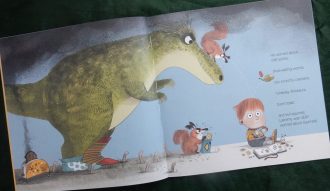
How to Catch a Dragon, Caryl Hart and Ed Eaves’ wonderful story that begins with Albie visiting the library to draw a dragon for his homework and takes him off on a fantastical adventure with a young knight.

To celebrate, Albie and his dragon adventure, author Caryl Hart shares five top facts about dragons:

Five Facts about Dragons

1. Dragons appear in stories from all over the world including India, China, Europe, Egypt and America.

2. Some scientists think that, long ago, people found dinosaur fossils and thought they belonged to dragons. Others think the idea of dragons is based on people’s fear of snakes or crocodiles or iguanas.

3. Chinese culture celebrates the Year of the Dragon every 12 years. If you were born between January 2012 and February 2013 then you are a Water Dragon. Chinese dragons are symbols of luck and good fortune and can fly, but don’t have any wings!

4. The How to Train Your Dragon films started out as a series of books written by Cressida Cowell, the first of which was published in 2003. There are now 12 books in the series!

5. Komodo dragons are real creatures that live in Indonesia. They can grow to 3 metres long and eat insects, birds and mammals.

Thanks to the lovely people at Simon & Schuster Children’s Books, Red Reading Hub has a copy of HOW TO CATCH A DRAGON to give away.

To enter, follow @jillbennett18  RT the giveaway tweet and tag a friend. A winner will be chosen at random and the publicist will send you your prize book (closing date 12th August UK entrants only please)

Look out next week for the rest of the blog tour; there are going to be lots more fun facts and giveaways.

Look out soon for Red Reading Hub’s review of Albie’s latest adventure How to Drive a Roman Chariot – that sees him whisked away to Ancient Rome where, along with a young girl, he finds himself driving a runaway chariot.

The Blue Giant

The Blue Giant
Katie Cottle
Pavilion Books

Picture book messages about helping to save the environment come in all shapes and forms.

In Katie Cottle’s second eco-story the messenger takes the form of an enormous wave that suddenly rises up out of the sea just as Meera and her mother are settling down for a relaxing day on the beach.

This blue giant urgently wants to communicate with them and its message is a vital one asking for their help.
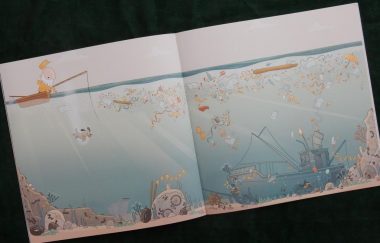
Donning their diving suits and following in their small boat, mother and daughter pursue the wave and discover that the ocean is awash with rubbish of all kinds and that many sea creatures are in great danger.

After a day of hard work a great deal remains to be done to clear up the pollution – way too much for just two people.

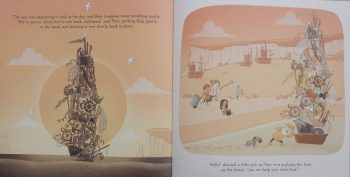
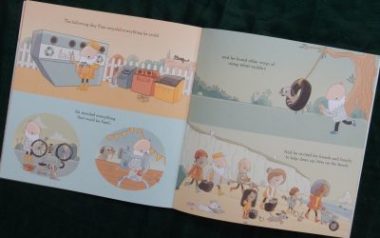
The following morning Meera is back on the beach and the next, but now she has enlisted the help of some of her friends.

They in turn enlist some of theirs and so it continues …

The narrative concludes with a list of half a dozen suggested ways in which we can all help by reducing our consumption of single-use plastics.

Katie’s powerful images convey the plastic pollution problem in a manner that young children will easily relate to, particularly those of the sea creatures caught up in the debris. Stories such as this one are a great way to galvanise youngsters into action.

I Can Roar Like A Dinosaur

I Can Roar Like a Dinosaur
Karl Newson and Ross Collins
Macmillan Children’s Books

What is it about a certain Mouse that causes him to keep on making ridiculous claims? Last time we met him he told his fellow animals that he was a tiger and now, so he’d have them all believe, he’s a fearsome ROARing dinosaur – well briefly …

Never mind; one can always turn to the trusty ‘How to Roar Like a Dinosaur’ guide book with its step-by-step instructions and why not give your pals a lesson too?

Now having watched Mouse in action, I know that he’s got absolutely no clue about how to be an effective teacher; hurling insults at the learners is not a good way to go.

Time to teach the teacher a lesson or two … Perhaps a spot of Mouse-baiting might be effective in unleashing the diminutive rodent’s ROAR.

Success of a kind – but chicken or no chicken, no creature in its right mind would try to teach its grandmother to suck eggs, so to speak …

I’m going to leave our Mouse friend rather precariously balanced upon the branch of a tree; safe in the knowledge that he’ll manage to use his imagination and extricate himself from what looks to be a rather perilous perch.

Yet again team Karl and Ross have created a pricelessly absurd ace of a book that’s full of funny foolishness, brilliantly portrayed pupils and cover to cover entertainment of the first order.

Polly Profiterole’s Little Town Good Enough to Eat / My Grandma is 100

Here are two recent picture books from Little Steps Publishing

Polly Profiterole’s Little Town Good Enough to Eat
Maggie May Gordon and Margarita Levina

Imagine living somewhere where the only ‘shop’ is the front porch of your house. That’s how it is for Polly Profiterole, pancake maker par excellence who has mixed more pancakes than she cares to remember for way, way too long in a little town without a school, a bank, a pub or a church.

Then one night as she lies in bed Polly decides something must be done to change things. With her brain in over-drive she enlists the help of her husband and the following morning Polly bakes and Percy builds

the most delicious town you could ever envisage, from the Choco-Chip Church at the very top of the hill, all the way down to the Pork Pie Pub at the bottom with some yummy establishments in between including the Cup Cake Coffee Shop

and the Honey Roll Hairdresser (shame there’s no bookshop)., Finally of course, they make ‘Polly Profiterole’s Proper Pancake Parlour’.

Thus Polly and Percy co- created a unique little town that must surely have become a go-to destination instead of a drive right through one.

If your taste buds aren’t in overdrive after sharing this fun book with youngsters, then I’d be very surprised. Poet, Maggie May Gordon and illustrator Margarita Levina serve up a tale of teamwork and enterprise, that all began because despite everything, Polly never lost the ability to imagine.

My Grandma is 100
Aimee Chan and Angela Perrini

What a wonderfully warm book is this one narrated by a small child whose Grandma Edna (great grandma) is celebrating her 100th birthday.

Plenty of thought goes into getting the day just right. What kind of food can 100 year-old teeth cope with? What should the birthday cake be like? Then there’s the consideration of a suitable present for somebody who now lives in a special home with lots of other people and doesn’t really need anything.

Next morning with mounting excitement at the prospect of having thought of the perfect present, it’s time for the narrator and family to drive to Grandma’s special party. And what a wonderful celebration it is, especially with so many relations,

as well as Grandma’s letters from The Prime Minister, the Governor General and the Queen of England. Grandma Edna is some lady with three children, four grandchildren and nine great grandchildren.

The author, Aimee Chan is the granddaughter in law of ‘Grandma Edna’ and wrote the book as a celebration of Edna Phillips’ life.

I love the way the narrator’s imaginings are given substance in some of Angela Perrini’s quirky illustrations.

That Dog!

That Dog!
Emma Lazell
Pavilion Books

Author/illustrator Emma Lazell’s second picture book features Penny who has a particular penchant for purloining pooches, and her new accomplice Pat.

Penny has set her sights on ‘new dog in town’, a multi-talented dog and spotty all over; but it’s down to Pat to procure the creature.

It’s evident from the outset that the highly desirable, dappled dog is a whole lot more savvy than his would-be dog-nappers,

not least Penny who only ever gives Pat partial information about that which she desires.

As he sets out on his first mission. ‘Spotty all over’ is the description she gives her eager to please helper.

He’s surely spoilt for choice when he reaches his destination but which one will he take? Here’s a clue – it’s ‘a bit wiggly and a bit squiggly’.

Has he bitten off more than he can chew however, for the hound (something of a spare-time detective) is watching his every move

as we see in Emma’s caninely comical art when the dog-napper returns on several occasions, each time seizing the wrong animal until …

Altogether this is most definitely, a delightfully dotty and diverting tale.

One Button Benny and the Gigantic Catastrophe / Bad Cat!

One Button Benny and the Gigantic Catastrophe
Alan Windram and Chloe Holwill-Hunter
Little Door Books

Young robot Benny returns for a new adventure (hurrah! I hear fans shout) and now the Cool Cat competition is fast approaching so, like all his friends, Benny has to get his moggy Sparky super shiny and sparkly for the big event – having done the wretched washing up, that is.

Disaster strikes though, for the next morning every single one of the cats has disappeared. An exhaustive search of the town reveals only a note on the ground: the cats have all been kidnapped.

This certainly warrants the pressing of Benny’s (only to be used in pukka emergencies) red button assures his mum.
Having duly done the deed, something unexpected happens: Benny’s button opens like a door, disgorging two rolled pieces of paper.

There’s only one thing to do if Benny and his friends are to get their pets back safely and that’s work together following the instructions on the paper

and Trojan Horse style, build an enormous scrap metal cat in which to hide and wait for the return of the alien kidnappers who will surely come and steal this massive cat once they hear about it.

And sure enough they do. Fortunately all this cat-napping has made the aliens sleepy and once back on their own planet they fall fast asleep leaving the rescuers to find their missing moggies.

Things don’t go exactly to plan thereafter but I’ll leave Benny and his friends being chased by the wobbly alien cat stealers and you to get hold of a copy of Alan (author) and Chloe – illustrator’s – wacky tale of teamwork, forgiveness and dish washing to discover what happens subsequently.

Bad Cat!
Nicola O’Byrne
Nosy Crow

Nicola O’Byrne’s feline character Fluffykins may have a cute sounding name but this moggy is anything but cute. Indeed he creates a chain of havoc as he knocks down a vase of flowers, tangles up the knitting, unwinds the loo roll, plays havoc with the venetian blind, leaves a large puddle on the floor and that’s not all.

Now I’m not a cat lover, nor am I familiar with cats’ behaviour, but it appears from his expressions that in his boundary pushing actions, Fluffykins knows exactly what he’s doing despite his owner’s warnings and chiding. On the other hand it might just be playful oblivion. In this story Nicola O’Byrne leaves it open for readers to make up their own minds.

With a text addressed directly at the mischievous moggy and so much white space around the action, this latest offering is certainly something altogether different from her previous books.

Young listeners will probably relish Fluffykins sheer devilment; this ailurophobic reviewer certainly would steer clear of his abode.

The Sloth and the Dinglewot

The Sloth and the Dinglewot
Nicole Prust and Amanda Enright
New Frontier Publishing

Think how many wonderful things you might miss if you never step outside your comfort zone.

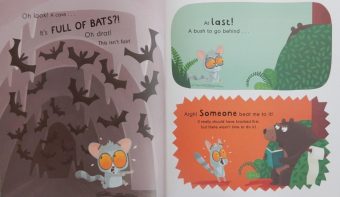
That’s exactly what Samuel the sloth does one drowsy summer’s morning. Bored with merely lazing around like his fellow sloths, he takes the opportunity provided by Dinglewot Jinglewot Dingledum Dee, the colourful bird with bells on its feet that offers him an adventure.

Samuel is forced to embrace his fears as he decides to follow the Dinglewot through the treetops, across the grasslands, past the mountains, down a ravine to a dark cave.

Then, after exciting encounters with baboons and later, bats, they finally reach Dinglewotville, the land of the bird’s birth.

There Samuel discovers an amazing carnival and dances the night away – his best night ever.

But eventually for our adventurer it’s time to leave.

He returns to his fellow sloths in the hope that some of them too might set aside their fears and join him and his new friend on another adventure. You never know …

The flowing rhyme of debut author, Nicole Prust’s narrative and Amanda Enright’s richly coloured illustrations make for a lovely storytime read aloud that shows the importance of risk taking and of seizing life’s opportunities.

Spaghetti Hunters

Spaghetti Hunters
Morag Hood
Two Hoots

Poor Duck is nonplussed; his spaghetti has gone missing. Enter right, atop the tea caddy, Tiny Horse, self-declared greatest ever spaghetti hunter, promising to ‘save the day.’

Rest assured Tiny Horse has all the necessary gear at the ready

and once it’s safely stowed in Duck’s backpack the hunt for this particularly problematic pasta is ready to begin.

Things don’t go as Duck expects but Tiny Horse is confident in her plan and soon has – to her friend’s consternation – amassed a fair bit of the missing spaghetti.

Or perhaps not!

Utterly infuriated Duck returns to the sanity of his teapot and a good book, but he soon has an uninvited visitor disturbing his peace

and criticising his culinary skills.

However, the proof of the spaghetti is in the sampling but Tiny Horse being Tiny Horse, just has to have the last word (or two, to be precise).

For me this is Morag Hood’s best yet – and that’s saying a lot. Splendidly silly, it was all I could do not to splutter my coffee all over my Mac as I was composing this review.

Octopus Shocktopus!

Octopus Shocktopus!
Peter Bently and Steven Lenton
Nosy Crow

‘One day, we found an octopus / had come to live on top of us.’

What a wonderfully wacky notion and one that instantly grabs the reader’s attention – well, with those eight day-glo orange limbs and body what else would you expect?

Said octopus has descended upon the narrator’s neat-looking house on the cliffs causing consternation with neighbour, Mrs Antrobus who calls the fire-brigade.

However they fail to shift the creature and so it remains, limbs a-dangle and looking decidedly bored with life until the children invite it to play.

It’s great fun for all concerned and they quickly discover that there are lots of other advantages to having a gigantic octopus for a pal. (Pitch that one to a class of five year olds and see what  they can come up with.)

But then comes the fateful day when the roof is bare save for the tidy rows of blue tiles. Tears are shed all round but worry not; a splendiferous finale awaits …

With themes of acceptance and friendship Peter Bently’s rhyming narrative is sheer delight to read aloud and Steven Lenton’s wacky scenes are a visual treat: the octopus’s eyes are just wonderful

and there’s SO much to explore on every spread. Make sure you peruse the endpapers too.

A treat from team Peter and Steven that’s bound to be requested over and over …

In My Dreams / Boo Loves Books

It’s good to catch up with some recent titles from New Frontier Publishing

In My Dreams
Stef Gemmill and Tanja Stephani

The jewel-like cover of this book immediately conjures up a magical world of adventures.

‘When the world is quiet and I’m alone, I like to dream’ – the opening lines drifting across the bedroom of a sleeping child draw readers into his dreams; adventures he shares with his toys as he lets his imagination take him to a fantastical land of marshmallow clouds, jelly puddles and showers of strawberry rain.

Then it’s deep down to the ocean floor, and up in the air far away riding upon a dragon’s back …

into jungles with monkeys to make mischief with, across plains to roar and leap with lions

and to frozen lands of snow and ice.

I love how the text gently meanders across the pages even towards the end when we’re suddenly told this: ‘In the darkness, the night shadows try to steal my sleep and things appear menacing …

but only momentarily for the page turn reveals the now frail-looking shadows retreating for ‘They have no power over me.’
We finish up in the light once more, a light that’s warm and shining calling the dreamer back safe and loved, to the haven of his bedroom.

What a gorgeous bedtime tale. Snuggle up and share: this will surely transport little ones into their own dream worlds secure in the knowledge that they too can let their imagination roam freely and safely, inspired by Stef Gamill’s warm, rhythmic text and Tanja Stephani’s spectacular, wonder-filled scenes of tenderness and enchantment.

Boo Loves Books
Kaye Baillie and Tracie Grimwood

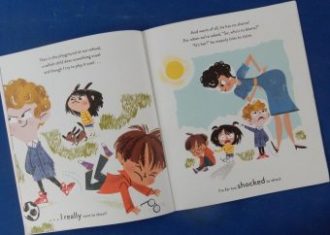
Phoebe (like a fair number of young children) finds reading aloud rather stressful: what if I make a mistake, she worries when it’s her turn to read with her teacher.

But then her teacher announces, “No reading at school tomorrow” swiftly followed by “Instead, we’ll be reading somewhere special” and that makes Phoebe’s tummy all of a flip flop. So much so that she informs her mum, “I’ll be sick tomorrow.”

But of course she isn’t and off goes the school bus with Phoebe aboard. Their destination is the animal shelter where the children are to read to the resident dogs. Another stressful situation for Phoebe: her dog is really BIG.

Understanding her fear, Miss Spinelli stays close beside Phoebe, reassuring and encouraging her pupil.

Then secure in the knowledge that the dog too is feeling anxious, the little girl settles down with a book and Big Boo, and a transformation slowly starts to take place in both parties …

A beautifully illustrated, empathetic story that is both encouraging and enabling.

Ellie’s Dragon

Ellie’s Dragon
Bob Graham
Walker Books

Bob Graham has created yet another gorgeous picture book, one that celebrates the imagination of young children.

It features Ellie who when quite young discovers a multi-hued, newly hatched baby dragon atop an egg box in the supermarket. She names him Scratch and takes him home with her.
There she accommodates the tiny creature in her doll’s house feeding him on such fare as nasturtiums, chillies and burnt toast. All the while her mother sees nothing unusual.

As she grows and changes, Ellie’s love for the dragon remains constant: she takes him to nursery

on outings and even to the cinema.

Like Ellie though, Scratch grows and changes. When Ellie turns eleven, her dragon begins to fade away until for the teenage girl, he finally disappears.

It’s time for Scratch to find a new child …

As always, Bob Graham’s illustrations are suffused with his own brand of gentle humour and full of wonderfully whimsical details, as he documents this poignant portrayal of growing up and losing that sense of awe and wonder, that boundless imagination that sadly, so many children have ‘educated’ out of them.

Freedom, We Sing

Freedom, We Sing
Amyra León and Molly Mendoza
Flying Eye Books

Here’s an enormously powerful and empowering picture book that will surely motivate children to think deeply about freedom and what it means to be free.

The author is an activist whose work focuses on Black liberation and communal healing – ‘the art of listening and honest conversation are the primary tools for lasting change’ says her biographical paragraph inside the book’s cover.
(To that end, I can’t help but recall the wonderful recent channel 4 programmes The School That Tried to End Racism.)

As well as hope, the author’s story, which takes the form of a dynamic conversation between a mother and her small child as they talk about life and the world around them, is an embodiment of determination, wonder …

and mindfulness.

The two look at family photos, reflecting on the love between those close to us making the world seem small and safe; then move outwards to encompass others living under the same sky whose lives might appear different on the surface, some of whose lives are difficult, perhaps due to war or oppression; but nonetheless whose hearts beat like their own and whose parents will do their upmost to keep their children safe from harm.

The child cogitates on the very nature of freedom

before the mother states “Breath is freedom/ A sweet release / The right to be / A universal sign / Of life and peace”.

Both reflecting and radiating the feelings and emotions of the text, so stunning are Molly Mendoza’s richly coloured illustrations that they really take your breath away.

With all that’s been happening in the world recently it’s more important than ever to start sharing, pondering upon and talking about books such as this one with young children. Where better to start than here? …

Wild

Wild
Sam Usher
Templar Publishing

Grandad and Boy are doing some cat minding for a friend. Boy (the narrator) has done his research and announces that it’s a simple task: they need to feed, cuddle and play with the moggy.

However, cats, like humans, don’t always conform to the norm and this visitor is one of those.

She definitely doesn’t want to play; she turns her back on the food they offer,

and neither a nap nor a cuddle proves any more agreeable.

Boy is convinced the creature doesn’t like him. Grandad is slightly more sanguine until, the cat makes a dash for it.

Through the window she goes with Boy and Grandad following the escapee as best they can,

out into the wilds, where the real and the imagined merge.

Eventually the chase leads them to a fabulously diverse feline gathering where Boy and Grandad join in with the frolics.

Then safely back home once more, Boy decides that perhaps Cat is now more favourably disposed towards him.

Using a repeat refrain as part of Boy’s simple narrative, Sam Usher lets his expressive, superbly detailed, scratchy pen-and-ink images do much of the talking in this splendid celebration of the power of the imagination, and the on-going loving intergenerational relationship.

Catch That Chicken!

Catch That Chicken!
Atinuke and Angela Brooksbank
Walker Books

Set in a West African village compound this is essentially Lami’s story. Lami has a special talent for catching chickens and everyone of the villagers knows she’s the best.

That’s not to say that her family and friends are without talents of their own – sister Sadia is a super speller,

brother Bilal is brave with bulls

and friend Fatima is a super-speedy plaiter of hair.

One day while chasing a chicken around the compound, Lami ignores the shouts of “Sannu! Sannu!”, “Slow down!” as she dashes madly towards and up the big baobab tree.

Suddenly as she makes a grab for the bird, Lami slips and comes hurtling to the ground where we see a painfully sprained and very puffy ankle and a very tearful little girl.

Some well-chosen words from her Nana Nadia result in a change in Lami’s chicken strategies but it’s one that proves that there’s more than one way to be an ace chicken catcher.

Once again team Atinuke and Angela Brooksbank have created a winning, enriching, gently humorous story, which shows the strong community spirit of Lami’s village wherein everyone is valued. Angela Brooksbank’s spirited scenes abound with colour, texture and pattern showing much about this particular way of life in West Africa.

A great book to add to the family shelves or foundation stage/KS1 classroom collections.

Be Kind

Be Kind
Pat Zietlow Miller and Jen Hill
Macmillan Children’s Books

Now, more than ever, it’s vitally important for everyone to act with kindness and thoughtfulness to others, no matter who they are.

Here’s a thoughtful and thought-provoking look at what it means to be kind and how kindness can spread.

It begins when a little girl, Tanisha, spills juice all over her new dress one lunchtime to the amusement of most of those in the room. The narrator tries instead words of kindness …

Tanisha however runs off leaving her friend in thoughtful mode and as she paints she muses on the nature of kindness.

It could be many things shown through actions such as giving, helping or paying attention; or perhaps by thanking someone or merely using their name – all relatively easy to do.

Sometimes however it’s more difficult …

but small acts of kindness can have a ripple effect, growing worldwide even

and … “All the way back to Tanisha and me. So we can be kind. Again.”

Throughout the author leaves space for readers/listeners to reflect on the narrator’s words, which never once become preachy.

Jen Hill’s illustrations are enormously appealing capturing so well the feelings of Tanisha, the narrator, their classmates and the wider community.

This is most certainly a book to share and discuss both at home and in primary classrooms.

Monsieur Roscoe On Holiday

Monsieur Roscoe On Holiday
Jim Field
Hodder Children’s Books

Jim Field has clearly been doing a fair bit of sitting on his own sit-upon, as he’s both author and illustrator of this picture book. The aim (as well as to entertain) is to set youngsters on a journey to becoming bi-lingual as they join the enormously endearing Monsieur Roscoe and his goldfish, Fry, for a holiday.

First comes the packing – always a bothersome task – and then with luggage loaded behind, it’s onto his bike and away through the big city to the railway station to catch the train.

It’s a close call, but fairly soon it’s time to meet up with Eva for a spot of camping. Learning to put up a tent courtesy of your rabbit friend, once you get to the campsite isn’t the best idea Monsieur R. even if you have come with all the gear.

Next morning Monsieur Roscoe and Fry bid ‘au revoir’ to Eva and board a bus bound for the ski slopes where there’s a rendezvous with another friend, Stan. Seemingly our canine holidaymaker has hidden talents …

The next destination appears a whole lot more peaceful. Caro is certainly happy to see her friends and even allows Monsieur Roscoe to take the wheel of her speedboat but it’s evident that a certain dog needs to hone his steering skills when it comes to watercraft.

The penultimate stop is the seaside where Jojo and Didi eagerly greet the new arrivals. After a splash dans la mer comes the last leg of the journey and a meet up with Dougal duck for a spot of indulgence at the busy village café.

However, even the most charming of travellers must go home eventually, and so it is with Monsieur Roscoe and Fry. Assuredly they’ll have lots to tell their friends back in their home city and who knows, perhaps after a good night’s sleep the two of them will start thinking about their next adventure …

Jim introduces youngsters to plenty of common French words and phrases in the course of this story of the delightful duo. Every double spread has a wealth of humorous detail to explore and giggle over; Fry is an absolute hoot

and there’s even a seek-and-find element to the whole thing, for on the final page are lists of items to spot at the six locations featured.

Bravo Monsieur Field – un livre divertissant et éducatif.

Found You

Found You
Devon Holzwarth
Alison Green Books

It’s difficult enough moving home, but having to flee your homeland leaving all your friends behind, to move to a new country as a refugee has challenges like nothing else.

That’s how it is for young Sami who, since his arrival with his family, has become a loner. Everything looks and feels totally different; people don’t speak your home language and it seems as though you just don’t fit.

One day Sami and his mum are visiting the park and watching from the trees is a little bird, all alone too. Suddenly she whizzes downwards smack into Sami. The little creature says she is lost and asks for his help in finding her friends.

Gradually during their search Sami finds that the people he’d previously thought of as standoffish are quite the opposite. The old lady from the bus no longer scowls; rather she smiles offering Sami grain to feed the birds.

Then the baker offers to share his lunch.

Suddenly Sami recalls where it was he’d seen birds just like Little Bird; off they go but in his anxiety and rush to help, Sami ignores the chance to play with a little girl from his nursery.

At the cherry tree Little Bird’s friends are waiting and seemingly it’s job done and time for a farewell. Little Bird thanks Sami, making him feel proud by adding “You’re a very good friend” and flies off with the others leaving the boy alone once more. Until something surprising happens …

It’s then revealed that Little Bird’s mission isn’t over just yet for in this wonderfully heart warming story there are others in situations similar to Sami’s that also need her help.

With its gorgeous colour palette and superbly expressive scenes which show much more than is said in her text, Devon Holzwarth’s debut picture book is one that’s certain to foster empathy and understanding, showing how important it is to offer a welcoming environment to newcomers. It can all begin with holding out a hand (or wing) in friendship.

Together

Together
Jane Chapman
Little Tiger

Deep within the forest, hidden among the shady leaves, a tiny face peers through the foliage. It belongs to a baby gorilla that feels totally alone in the world, a world that feels strange and a little threatening.

But then along with the downpour of refreshing rain and the smell of something to eat that wafts on the breeze, comes something different, something huge and very …

So thinks the little one. But it’s not so for despite appearances, the creature reaches out with unexpected tenderness, extending a soft paw of companionship and friendship in a hitherto scary world.

Now no matter what each day brings forth, be it beauty and magic,

or shadow and sadness, there’s always the joy and comfort of togetherness.

Jane Chapman’s illustrations are incredible, both in their lifelike portrayal of the two gorillas and in the sensitive way they convey the sense of connectedness between them.

That sense of connectedness is what all of us crave probably more than anything else in these pandemic times. This beautiful, heart-warming story is a wonderful portrayal of how reaching out – may be not physically but in what ever ways are possible – can make all the difference.

Superhero Baby!

Superhero Baby!
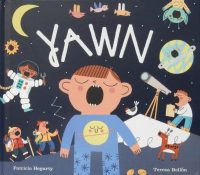
Patricia Hegarty and Alex Willmore
Little Tiger

Here’s a fun story that takes sibling rivalry to a whole new level.

In the dead of night, long past bedtime for little ones, there’s one of their number who’s still wide awake and ready to launch herself into action; and so she does when there’s a burst pipe in town.

With job duly done she’s back in her cot alongside her twin brother’s long before mum wakes her next morning.

She then spends the day putting her ‘baby power’ to good use as she performs one heroic act after another never pausing to take a nap.

There’s somebody though, who is far from happy about all the attention this diminutive superhero is receiving as she whizzes around with her seemingly inexhaustible supply of energy, testing her powers to their limits.

Would-be superhero little ones will surely delight at watching the drama unfold through Patricia Hegarty’s rhyming romp that has an unexpected twist in its tail, and Alex Willmore’s instantly appealing, telling pictures where one pair of eyes in particular speak volumes.

Sophie Johnson Sports Superstar

Sophie Johnson Sports Superstar
Morag Hood and Ella Okstad
Simon & Schuster Children’s Books

Young Sophie Johnson appears to have an ever-increasing number of strings to her bow – Unicorn Expert, Detective Genius and now Sports Superstar. Is there no limit to her talents, one wonders.

As the story opens, Sophie is engaged in her training regime and while so doing she tells readers about all her preparations for a ‘Big Race’ . She eschews assistance from her mum as she goes about her work-out. (Since when was raiding the sweet jar good for training miss Sophie?)

The girl has what she calls an ‘Excellent Plan’. This appears to involve consuming vast quantities of fast food and doing the occasional exhausting workout.

Come the big day she’s raring to go

but it would appear that in her enthusiasm there’s one very important skill she’s omitted to hone …
As always, spending time with young Sophie is sheer delight. Team Morag and Ella together have created another funny episode in the life of Sophie Johnson and once again it’s the clever way the quirky pictures and the dead pan words tell rather different stories that make the book such fun.

I love the fact that in this athletic endeavour Sophie is still sporting her tutu throughout and every spread has deliciously diverting details to chuckle over.

The splendidly spirited Sophie’s a winner in my book no matter what she does.

Poo in the Zoo: The Great Poo Mystery

Poo in the Zoo: The Great Poo Mystery
Steve Smallman and Ada Grey
Little Tiger

At the end of the first story, Poo in the Zoo, Zookeeper Bob’s enterprise had enabled him to buy a super-duper pooper scooper robot.

This technological wonder, Robbie by name, with his poop hoover, makes Bob’s job considerably easier and on this particular night as he and the animals bed down for the night, all is well at McGrew’s Zoo.

The next morning however, everything changes. There’s poo absolutely everywhere and Robbie has disappeared. Disaster!

Then suddenly a tweed-clad woman riding a ‘pooper scooter’ zooms up announcing she’s ‘here to save the day!” Her name is Arabella Slater and she claims to be the number one poo investigator when it comes to dealing with number twos.

Immediately she leaps into action locating all manner of poo piles and then she notices some stray bits of wire. The hunt is on as all the zoo residents follow a trail

that leads them through the woods and into a glade where they come upon …
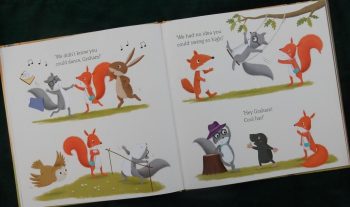
Bob then realises what has happened. But is it all over for Robbie or can Arabella live up to her claim and “save the day”?

Steve’s funny rhyming text bounces whiffily along as he regales this dung-filled drama, which Ada Grey hilariously illustrates with zany scenes of the poo-filled zoo and its environs.

Share this with a group of early years listeners or just one, and I’m pretty sure the immediate response will be “read it again!”.

My Red Hat / Sometimes Cake

It’s an absolute joy to catch up with some recently published Walker Books picture book treats

My Red Hat
Rachel Stubbs
Walker Books

I’m sure every young child would absolutely love to have a hat such as that in Rachel Stubbs’ meditative story. Said hat is bestowed with love upon a little girl by her grandfather one day.

But this is no ordinary hat, quite the opposite; it has an enchantment all of its own for its possibilities are seemingly without limit.

It might for instance keep you warm and dry, or cool; it can serve as an artist’s subject or a drink container, you can wear it to stand out or blend in…
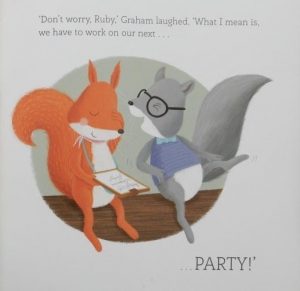
It’s a holder of dreams, a hider of secrets, a cover for fears; it will take its wearer to the most wonderful places far away

before bringing you right back to snuggle up on Grandfather’s lap.

In keeping with the harmony that exists between Grandfather and young child, there’s a sense of perfect harmony between Rachel Stubbs’ illustrations in her beautifully understated colour palette and her minimal text that leaves so much for readers and listeners to fill in.

Sometimes Cake
Edwina Wyatt and Tamsin Ainslie
Walker Books

Deliciously sweet but never sickly is this treat of a picture book.

It tells what happens when Audrey meets a lion carrying a purple balloon. She asks if it’s his birthday and he replies, “Sometimes, but not today.” Nonetheless, it must be someone’s birthday reasons Audrey and so they celebrate with a song and cheers.

There follow several further encounters between the two. In the next Lion brings a cake and they celebrate both Tuesdays and coconuts (for the icing). They go on to celebrate orange and yellow – Lion sporting a hat.

These celebrations appear to be a regular occurrence but then comes a change: Lion appears sans anything and announces it’s just an ordinary day.

Thereupon Audrey leaves him alone and goes off to set about preparing for a party to celebrate a perfectly ordinary day – only it isn’t for there’s Lion to celebrate and plenty more besides.

A tender reminder of the importance of being in the moment; and that being with a friend is always cause for celebration – something we’ll all endorse as we come out of lockdown. It’s full of warmth and the wonders that simple things can sometimes offer, beautifully expressed by Edwina Wyatt and equally beautifully illustrated in soft watercolours by Tamsin Ainslie.

Snuggle up with little ones and share with cake, especially on Tuesdays.

The Astronaut’s Cat

The Astronaut’s Cat
Tohby Riddle
Allen & Unwin

‘The astronaut’s cat is an inside cat. And she likes it like that.’

So begins this story of an indoor cat that watches through the window of a spacecraft as an astronaut explores the moon outside.

She is fascinated by this strange lunar environment but setting foot beyond the confines of the spacecraft is not something a cat should do: there’s no air and the outside temperatures range between hot enough to boil a bowl of water in the daytime to ten times colder than a fridge freezer by night. Moreover there are strange objects whizzing around which Cat finds troublesome.

Instead the moggy spends her time playing, eating, and sleeping and dreaming.

Her dreams take her outside where she’s able to leap, pounce and glide, across the dusty, rocky terrain.

She also dreams of another place, a big blue ball full of amazing shapes and forms – the natural sights, sounds and scents of nature where she can become an outside cat.

Through his fusion of photographs of the moon’s surface and the Earth, and his own art, the author/illustrator cleverly melds the real and the imagined, while at the same time weaving some basic scientific information into his lyrical narrative.

So it is for cat, and so has it been for many humans of late, cooped up inside their homes or unable to venture far beyond their own front doors – something I’m sure Tohby Riddle knew nothing about when he created this delightfully whimsical book.

Kaia and the Bees

Kaia and the Bees
Maribeth Boelts and Angela Dominguez
Walker Books

Kaia is pretty fearless but there’s one notable exception: having been stung on the foot, she’s super scared about bees despite her dad being a bee-keeper with two hives on the roof of their apartment home.

Dad does his level best to enthuse his daughter about his favourite topic but it takes being found out about her aversion by the children who also live in her block for Kaia to overcome her melissophobia.

With protective suit on she follows her Dad up the stairs and out onto the roof. There her bee education continues apace and her fear of the little insects slowly diminishes

until she thoughtlessly removes one of her gloves and OUCH! Kaia is stung again. “I’m never EVER going near those bees again!” she cries and sticks to her word.

Soon comes the time for collecting the honey from the hives. The family work hard all day in the kitchen filling jars with sweet smelling golden honey.

Then Dad’s “It’s a mystery, isn’t it!’ awakens a feeling of wonder in the girl and later, after another bee encounter, Kaia understands something about the tiny creatures that she’d never considered before.

At last she appreciates just how incredible bees are and alongside that, she finally feels brave inside.

Maribeth Boelts’ story that gently educates about the importance of bees is written from the perspective of being part of a bee-keeping family and she fully appreciates both how awesome and vital to our ecosystem the creatures are, as well as understanding that some people might, like Kaia, feel scared unless helped to overcome their fear. This understanding can be applied to a fear of anything, making the book even more helpful.

I love that Kaia’s family live in an urban location; and Angela Dominguez’s mixed-media illustrations both provide detail about bee keeping and clearly show the characters’ feelings throughout.

Paris Cat

Paris Cat
Dianne Hofmeyer and Piet Grobler
Tiny Owl

Unlike the rest of her large family and many friends, there’s one Parisian Cat that wants to see more of the world than her smelly back-alley home.

So, one wet night she enters a busy café where singer Edith Piaf, is entertaining the customers. Cat decides to do likewise

but is soon sent packing.

Back out in the rain she finds refuge in a dressmaking atelier.

Once again Cat decides “I can do that,” and as soon as the establishment has closed, she gathers up all the fabric offcuts and fashions herself a sparkly dress, dons her new attire and heads to a nightclub.

There she sees Josephine Baker dancing along with a cheetah. Yet again Cat decides, “Pffh! I can do that” and up onto the stage she springs to show her own moves.

Chiquita the cheetah is impressed, so much so that ‘Kitty’ is invited back to dance again the following evening alongside Josephine.

So it is that every night, clad in a new outfit, courtesy of the snippets from Madame Delphine’s atelier, she dances the night away, becoming a regular part of the billed act.

Eventually Cat starts to miss her family and friends. This prompts her to open her very own nightclub – Madame Kitty’s Catacombs Club so that she can see them all regularly again.

Now it’s not just one, but many cats that, if you happen to be in the vicinity after dark, you might see dancing the night away, clad thanks to Madame Kitty, in their snazzy outfits.

And Madame Kitty? She may be there too, or perhaps another new adventure has lured her away.

I absolutely love Piet Grobler’s scratchy scenes of 1920s Paris nightlife that really bring to life Dianne Hofmeyer’s deliciously quirky tale of searching for the new, pursuing your dreams, but not forgetting  where you came from. I love too, the way the author has woven into her narrative the two stars from that era both of whom had difficult early lives.

I Can Catch A Monster

I Can Catch a Monster
Bethan Woollvin
Two Hoots

In a castle in a mountainous region in days of yore live Erik, Ivar and their little sister, Bo.

When her brothers announce that they’re off on a monster hunt Bo wants to accompany them. “You’re far too little,” comes the reply but what Bo lacks in stature she makes up for in determination. “I’m smart and brave and strong!” she thinks before sallying forth on a monster quest of her own.

Very soon she has her first ‘monster’ encounter: “… get ready to be got!” she warns the creature, only to learn it’s a griffin and far too polite to be a monster.

Indeed he offers to assist Bo in her quest.

Her next encounter takes her (inadvertently) plunging beneath the ocean waves to face a kraken. She too seems at first, monstrous

but again Bo’s assumption is wrong, for the kraken also assists her.

Next destination is a cave from which issues an enormous roar.

Surely deep within must be the scary monster Bo has been seeking all along. However the roar turns out to be a dragon venting its parental anguish over missing baby, Smoky.

From then on the quest becomes not a monster hunt but a Smoky search, which eventually brings the story full circle, with Bo face to face with two human monsters.

Now she can prove well and truly, who really is in charge.

I love Bo’s rebellious attitude and applaud her open-mindedness and willingness to learn from her mistakes. There’s plenty of potential discussion sparkers in Bethan’s tale but it’s her wonderful illustrations that are the book’s real strength.

Executed in gouache with a more varied colour palette than in her fairy tale reworkings. Bethan’s idiosyncratic art uses teal, duck-egg, orange and pinks to create the mock-medieval scenes for this story. Love those end papers too.

The Walloos’ Big Adventure

The Walloos’ Big Adventure
Anuska Allepuz
Walker Books

Allow me to introduce the Walloos. Living on a rocky island at the edge of a lake, there’s a big one, a spotty one, an old one and a little one.

Each Walloo has its own particular penchant. Little Walloo loved to grow plants, Spotty Walloo had a culinary bent especially with regard to soups and salads; boat building was Big Walloo’s love and Old Walloo’s favourite occupation was storytelling, particularly about the old days and his visits to tropical-exotic islands.

Fired up by his tales, Little Walloo longs for her own tropical island adventure and one day Big Walloo builds a boat and away they go, sailing through nights and days until they spy something exciting: – a ‘tropical-exotic island.”

It’s a truly beautiful place but there’s something slightly strange about it that only Little Walloo notices – at first anyway; this island seems to be moving. It’s not long before Old Walloo agrees with her.

When is an island not an island? To tell would be to spoil this enchanting story. But what can be said is that what happens involves an idea, problem-solving, seeing things from the perspective of others, teamwork, kindness, caring and the co-creation of more stories of ‘tropical exotic adventures.

There’s an abundance of warmth and gentle humour in this smashing story of the Walloos that reminded me just a little of the Moomins in the way the characters engage with and understand one another, their charm and their thirst for adventure.

Then there’s that gentle environmental message made more evident in Anuska Allepuz’s wonderfully whimsical illustrations.

I can’t wait to share this with young children – it’s an absolute delight.

The Wonder Tree

The Wonder Tree
Teresa Heapy and Izzy Burton
Egmont

When I was a child we had a large oak tree with a resident owl in our garden; this lyrical story of Teresa’s with its wonderful illustrations by Izzy Burton, took me right back there to that tree, which I loved.

The particular oak tree in the story is home to Little Owl and his Mummy; and as it opens a leaf landing on his head disturbs Little Owl’s sleep. Despite his mother’s assurances, the little creature can’t get back to sleep. He’s concerned about the tree –surely it will be cold without its leaves, won’t it?

“Let me tell you a wonder,” comes the reply and Mummy Owl proceeds to explain first about leaf fall and seasonal change,

and then how the tree ‘drinks’.

However neither explanation sends Little Owl back to sleep and he requests a story. Happy to oblige, Mummy Owl’s story is of the tree and the stories that reside therein – held in its annular rings,

in ‘the clasp of its roots, and the kiss of its leaves’.

Then, as the moon high above sends out its silvery light, bidding a temporary farewell to the huge, ancient tree that is their home, parent and child spread their wings and sail off into the night sky.

Along with Little Owl, little humans will love learning about the natural world and its wonders, especially at bedtime. Equally, they’ll love being immersed in nature through debut illustrator’s woodland scenes showing the rich hues of autumn as they gradually fade to sepia, and the resident fauna and flora of the setting.

I Can’t Sleep

I Can’t Sleep
Gracia Iglesias and Ximo Abadía
Templar Publishing

How many people at the moment go to bed with their heads buzzing with thoughts – “I’m missing school,” … “I want to see my friends” and so on, and the consequence is that, like the little girl narrator of this story, that all important restorative sleep just won’t come.

She starts counting sheep to help her drop off and as she starts to count slowly 1 … a sheep emerges from beneath the bed and begins to devour the rug. Then a second sheep drops down the chimney (no prizes for guessing what colour it is).

The counting continues and soon there are fluffy sheep doing all kinds of interesting, though not sleep inducing things, both inside her house

and out.

It’s not until she reaches 9 and a very tiny lamb comes that sleepiness descends upon the little girl and she’s fast asleep before she can count to 10. Zzzzzzz

With Gracia Iglesias’ chucklesome counting text this is great fun for bedtime sharing with little ones, and Ximo Abadía’s illustrations are a delight. Created with graphite, wax and ink with digital colouring, they’re bold, quirky and playful: who can fail to smile at the sight of cuddle sheep number six cavorting across the bedcover

or the wisest old, guitar-playing sheep.

A New Green Day

A New Green Day
Antoinette Portis
Scallywag Press

Since the lockdown, most of us with time on our hands have been taking much more notice of the beauties of nature no matter where we live and in A New Green Day, Antoinette Portis invites readers to do just that, to see things anew and to discover the joy and wonders to be found outdoors.

Using a sequence of short poems spoken by natural things both large and small, the author/illustrator gently leads us through a summer’s day in the company of a little girl.
Said child is gently awoken by sunlight on her pillow inviting,
“… Come out and play!”

Then at the behest of that which has scribbled “on the path / in glistening ink …”
it’s time to move outdoors and there, the playful guessing game continues as we see a sequence of things in an entirely fresh, creative way.

For instance “I’m a map of my own / green home. Follow my roads and climb,” reveals when the page is turned …

How cleverly imagined are Antoinette Portis’s trees, one of which is markedly similar to the veined leaf the girl holds between her two fingers.

Some riddles are easier to anticipate than others; one such is “I’m a comma / in the long, long sentence / of the stream. / Someday soon, / you’ll hear my croak,” is uttered by …

Then come the voices – cloud, rain, lightning and thunder – of a gathering storm and what child could resist this invitation, “I am cool pudding / on a muggy day. / Let your toes / have a taste! …”

Finally as Earth is wrapped in the black cloak of night, comes the gently spoken sound from a tiny insect “I am the engine / of the summer dark. / Sleep, while I thrum / in your tomorrow … “ I will leave you to work out that which heralds “A new green day.”

There is SO much to love about this lyrically written book that gently calls us to appreciate our world afresh. Rich in texture, both verbal and visual, Antoinette Portis’ A New Green Day offers fresh lenses through which to see the natural world and its beauty each and every time we set foot outside.

Say Goodbye … Say Hello / The Happy Lion Roars

Say Goodbye … Say Hello
Cori Doerrfeld
Scallywag Press

Change is inevitable no matter what, and young children often find transitions tricky.

Through her gentle, lively illustrations and soft-spoken, simply expressed text, Cori Doerrfeld offers little ones a story exploring  the nature of change and the possibilities that embracing it can offer.

Stella, while reluctant to leave her mum and board the bus, soon discovers a new friend, Charlie, once she gets to school.

Before long the two are almost inseparable. We follow them through the seasons and goodbye summer means hello to autumn and goodbye to outside means hello to inside;
’Goodbye to snowmen … is hello to puddles!’;

and through the days when “goodbye to long walks, butterflies and the sun … is hello to long talks … fireflies and … the stars.’

But then, comes something much more difficult for Stella to cope with: the need to say goodbye to her special friend, when Charlie moves away and holding tight must be followed by letting go.

Physically yes, but not completely, for Stella is soon busy writing and posting a letter to her friend.

There’s also the possibility of someone else on the horizon, not a replacement for Charlie, but perhaps a new friendship for the making…

Splendidly expressive illustrations show both the ups and downs of change, as well as the passage of time. Ultimately however, however difficult some changes might be, as the story closes we’re given an indication of Stella’s resilience as she greets a newcomer …
A gorgeously warm portrayal of friendship, loss and the possibilities of new beginnings.

Completely different but also with a focus on friendship and new beginnings is this oldie but goodie:

The Happy Lion Roars
Louise Fatio and Roger Duvoisin
Scallywag Press

Nostalgia rules in this Happy Lion story I remember from my childhood. In this book the Happy Lion is most definitely not living up to his name, spending much of his time looking downright miserable, so much so that a doctor is called. He merely prescribes pills and departs; but the medication is totally ineffective in the face of loneliness for that is what is wrong with the Happy Lion.

Then one day into town comes a small circus and he and his friend Francois go to watch the acts. However, the Happy Lion has eyes only for the Beautiful Lioness in her cage.

Suddenly his sadness is a thing of the past and one night he goes to the cage of the Beautiful Lioness, opens the door and together they walk through the park back to his home.
A search ensues,

followed by some subterfuge, the Happy Lion’s loudest ever roar, and finally, thanks to Francois, a deal leaving not one, but two felines exceedingly happy.

Superb art and a lovely story where friendship and freedom reign supreme, characterise this classic re-issue.

No-Bot the Robot’s New Bottom!

No-Bot the Robot’s New Bottom!
Sue Hendra and Paul Linnet
Simon & Schuster

Bernard the robot, aka No-Bot, is back with a new botty but now again it seems to be giving him trouble. Not however by its absence; rather there are all manner of strange sounds apparently emanating from his rear as he plays on the park equipment with his pals.

Bernard is surprised until he turns his head to discover what looks like his very own, potentially explosive bum.

Bear decides it needs removing which leaves our robot pal in a bot-less state once more.

Reassuringly his friends are ready and willing to assist in finding a replacement but it’s not an easy task as they soon discover, for the bot needs to satisfy certain criteria – right colour, appealing smell, comfortable for sitting

and not too heavy. Will Monkey, Bear, Dog and the birds ever find a bot that it just right or is Bernard to remain in a permanent state of bottomlessness?

Finally, it appears Bernard isn’t the only one having bottom trouble …

Like the first No-bot story this one is delightfully daft and full of the kind of humour that definitely appeals to little ones. Yet again team Sue and Paul have a winner with this one; I certainly know a fair few fans who will be keen to get their hands on it.

Impossible! / I’m Sorry

Here are two recently published picture book from Little Tiger:

Impossible!
Tracey Corderoy and Tony Neal

Dog runs a laundry in a busy city but has a longing to see the ocean.

One day he comes upon Ocean Magic, a new kind of washing powder. The product promises ‘seaside freshness with every wash’ but apparently there’s something else within the box too.
Into the machine goes the powder and out later, along with the clean washing, emerges a crab suffering from a bad attack of nausea.

Dog and Crab discuss the situation over a cuppa

and eventually after declaring several times that driving Crab all the way back home is impossible, Dog lets himself be persuaded to undertake the trip.

Off they go together on a journey that takes several weeks during which they create a special memories map of their trip.

En route they encounter other travellers with seemingly impossible challenges of their own.

Now it’s Dog’s turn to utter the ‘nothing is impossible unless you say so’ maxim and with the assistance of their new friends, Dog and Crab finally reach their destination.

Both are delighted with the ocean paradise but then Dog declares he must return to his city job – or must he?

Follow your dreams and don’t allow obstacles to stand in your way, is the message Tracey’s tale imparts to youngsters. Equally the ‘it’s only impossible if you say so’ message is one we all need to remember especially in challenging times.

Tony Neal’s bright, lively, illustrations inject additional humour into the telling offering fun details to enjoy on every spread.

I’m Sorry!
Barry Timms and Sean Julian

In Walnut Wood live best friends, Scribble (squirrel) and Swoop (owl) and each morning they walk a considerable distance bringing their special things to their regular meeting spot.

Scribble has a special pencil that acts as word assistant in his play script writing, the finished dramas entertaining his friend. Swoop’s special thing is a toolbox that enables her to build anything and everything.

One day they decide to move in together; their place has ‘room for two and a little left over’.

It’s the left over bit – the veranda – that causes a rift, for each has designs on it.

A huge row ensues over the ownership of this: should it be a stage or a workshop?

Scribble decides to try and make amends with the aid of his trusty pencil but can a single word apology fix things or is something else needed?

There’s food for thought and discussion with little ones in this story that demonstrates that sometimes actions speak louder than words. Sean Julian’s beautifully expressive watercolour illustrations are for me the true show-stealers in this book.

Now Wash Your Hands!

Now Wash Your Hands!
Matt Carr
Scholastic

Hand washing was never more important than now during the current COVID-19 crisis and here’s a timely picture book from author/illustrator Matt Carr showing young children the vital importance of keeping their hands super-clean and hopefully free of those invisible nasties aka germs.

This crucial message is delivered in Mrs Moo’s class by a very important visitor, Doctorpus Doris, who talks to the pupils about the vast numbers of ‘TEENY WEENY germs’

and what they can do to send those nasty beasties packing.

The good news is that the way to do it is something as simple as washing their hands thoroughly. Doris gives several examples of times when this is especially a must-do activity. For instance after visiting a farm, working in the garden, using the loo

and before having lunch as they all do after her talk. For Doc. Doris this germ-extermination is, of course, a rather protracted process.

With his light touch, bouncy rhyming narrative that includes a song and funky bright illustrations,

Matt delivers what all foundation stage teachers and early years staff will be constantly reminding youngsters to do, ‘NOW WASH YOUR HANDS!’.

To that end this book will be an absolute boon – a must have. (for every copy sold 50p will be donated to NHS charities Together COVID-19 Urgent Appeal). Perhaps our government could add to their list of things to do: buy a copy for every school/nursery to share. Maybe I should tweet the PM and await his response …

Like the Ocean We Rise

Like the Ocean We Rise
Nicola Edwards and Sarah Wilkins
Little Tiger

Our planet is vast and it’s beautiful too,
But it needs our help; it needs me, it needs you.

Assuredly it does. I was absolutely astonished and horrified to read in the paper apropos World Oceans Day about the large percentage of microfibres in our oceans that are a result of washing synthetic clothing.

It’s never too early for young children to begin thinking about some of the ways they can help to reduce the negative impact we have on our planet and consider how everybody can help to prevent climate change.

A good place to start is with this smashing rhyming picture book.

Most of us know of the impact Greta Thunberg has had in galvanising what has become a global movement involving student protesters from over 120 countries; and Nicola Edwards’ narrative celebrates the contribution of young people; but there is a lot still to be done.

No matter where in the world we are,

we can all in our own way become eco-warriors

just like those children portrayed in Sarah Wilkins’ vibrant peek-through illustrations that use the ripple effect of a single raindrop to add to the impact of the text’s simile.

I love her final scene that shows this wave-making movement really is a global one in which we all can, indeed MUST, play our part.

The final spreadsheet provides  a brief explanation of  climate change and why it matters and some ‘What Can We Do?’ suggestions .

Monkey’s Tail

Monkey’s Tail
Alex Rance and Shane McG
Allen & Unwin

Since his retirement, due in no small part to a serious knee injury in an Australian Rules football game, Alex Rance has written another story in his series of children’s picture books.

This one, Monkey’s Tale, as the author says, is the story of how he got through the traumatic season of his injury in 2019.

It tells of Howler Monkey, one of the jungle’s very best climbers until one day while out with his pals, the branch on which he was climbing snaps sending him flying out of the tree to crash with an enormous thump right on his tail. YEOCH!

How that tail hurts and scares Howler Monkey but instead of letting on to his friends, he clowns around trying to make them laugh.

He may have fooled them but the Howler Monkey can’t fool himself and unable to climb he sits around thinking and becoming increasingly sad.

Then one day the very wise Oldest Monkey sits down beside Howler and asks what’s troubling him. Who better to confide in than Oldest Monkey so, full of self-doubt Howler Monkey reveals his secret worry: am I still a monkey if I can no longer climb?

A discussion ensues with Oldest Monkey asking some key questions that help Howler Monkey realise that no matter what, he can still make his friends laugh; he can still help them;

he still has a loving family and he can still make them proud – just in a different way. In other words, his actions do not define who he is and motivation for those actions is a key factor. Is this enough for Howler Monkey to regain his confidence and self-respect?

Resilience is key in Alex Rance’s story, illustrated digitally by Shane McG and as Oldest Monkey concludes ‘keep on being the best (monkey) you can be.’ Sage advice indeed.

The Perfect Shelter

The Perfect Shelter
Clare Helen Welsh and Åsa Gilland
Little Tiger

Clare knows how to write about areas many people find difficult, her last book being the beautiful story The Tide, featuring a loved family member with dementia.

The new book, The Perfect Shelter is also based on personal experiences, this time of cancer. It’s equally beautifully told and illustrated and it’s evident immediately that a great deal of thought and loving care has gone into its creation.

As the story starts a family shares what the little girl narrator calls ‘the perfect day’, just right for her and her older sister to build a den in the woods – the perfect shelter.

Suddenly though as the evening draws in, it’s evident that something is not right with big sister.

Back home comes the news, her sister is ill.
A storm rages but the den repairs must continue as the narrator’s beloved sibling undergoes an operation.

But then come the questions, “How did it get there? … Why MY sister?”

Eventually although the den seems beyond fixing, the narrator’s internal storm begins to abate as big sister starts to regain her strength and with it her determination: there’s a new perfect time and perfect place to build a new shelter …

And with it come smiles, new plans and that wonderful feeling of togetherness.

Although we share in the gamut of emotions of this family, it’s optimism that is key in the poignant telling and Åsa Gilland’s slightly quirky illustrations capturing the family sharing a difficult time are superbly expressive of all the uncertainty inherent in Claire’s story. I love the way she adds gorgeous tiny detail and patterning to every scene.

That there is no mention of any specific illness makes this a book that will help untie the knot of emotions in many families when one of their number (Or indeed a close friend) is diagnosed with a serious illness.

Nervous Nigel

Nervous Nigel
Bethany Christou
Templar Publishing

Bethany Christou’s follow-up to Slow Samson is another winner, even if her young crocodile protagonist is not.

Nigel comes from a long line of water-sport champions and like the rest of his family, Nigel loves to swim and his favourite spot for relaxing and thinking is in the water.

However once he has to start following a training regime, he gets butterflies in his tummy and his tail is all a-tremble, but he daren’t let on to the family.

Then comes the news. Nigel is to take part in his very first competition:

no wonder he has a sleepless night and no matter what he does or says there’s no getting out of it.

When race day dawns Nigel is a complete nervous wreck.

There’s absolutely no way he can take that dive from the starting blocks, so what will he do?

Is there perhaps something else water-related that he can enjoy

and at the same time make his family proud without winning medals?

Suffering from anxiety is part and parcel of growing up so most little ones will appreciate Nigel’s plight; so too will adult sharers who, one hopes put children’s happiness and self-fulfilment above reflected glory.

Bethany Christou’s wonderfully expressive, warm illustrations have a gentle humour that underscores her message about allowing children to be themselves and follow their own paths.

This is Crab / The Bedtime Book

Here are two titles from the Little Tiger group that are just right to share with preschool children:

This is Crab
Harriet Evans and Jacqui Lee
Caterpillar Books

This is another interactive book from Harriet Evans and illustrator Jacqui Lee and this one has an ocean floor setting and a googly-eyed red crustacean as its central character.

We join and assist Crab as he wanders around the sea bed encountering in turn, bit part players in the form of an octopus,

some coral, sea turtles, fish of various kinds and hues as well as a Decorator Crab that our meanderer gets a tad cheeky with.

Bright alluring illustrations including several spreads with die-cut overlays will certainly engage visually, while eager fingers will enjoy responding to such instructions as ‘shake your finger at Crab, please’; ‘Try tickling Crab so he lets go’ and ‘Tap on Crab to make the crack larger’ and they’ll assuredly delight in the revelation of Crab’s new pink shell once they’ve helped peel off the cracked red one.

Words such as ‘drumroll’, ‘scuttle’ and ‘pincers’ are introduced as the action proceeds, so will likely be absorbed by youngsters as they react to the prompts to facilitate Crab’s perambulations through the story.

The Bedtime Book
S. Marendaz and Carly Gledhill
Little Tiger

Like little humans, Mouse has a favourite bedtime book. Who better to help her find it when it goes missing than Frank the dachshund but he’s just snuggled down for a peaceful night’s sleep in his kennel.

Cosy as he might be though, Frank’s not one to leave his friend to search alone so off they go together ‘scurry, scurry, scurry … pant, pant, pant’ on a book hunt. They follow a trail that leads them to Bella the cat.

What Bella tells them has all three of them scurrying and panting off again but still there’s no sign of the missing book.

Owl overhears their conversation and reveals that he had it but it’s now set to be the next bedtime story for Baby Hedgehog.

Kind-hearted Mouse won’t hear of trying to retrieve it and instead goes sadly back to bed. So too does Frank although instead of falling asleep he has a wonderful idea that soon sees him back at Mouse’s residence

where in lieu of Mouse’s book, we’ll leave the two friends snuggled together under the stars having shared Frank’s bedtime favourite …

This sweet gentle story is likely to become a bedtime favourite for pre-schoolers who will love to snuggle down and make some animal friends thanks to Carly Gledhill’s delightful portrayal of the nocturnal happenings.

A Friend for Bear

A Friend for Bear
Steve Smallman and Caroline Pedler
Little Tiger

When Little Bear wakes from her long winter sleep she cannot wait to embrace spring with all its exciting possibilities for running, flower smelling, tadpole tickling and twirling.

It’s the twirling that causes her to trip and fall flat. What she fell over wasn’t in fact the stone she thought but a tortoise.

Tortoise is excited to hear about Little Bear’s plans for roly-polying, tree climbing and making new friends but knows his short legs are no match for Little Bear’s.

Bear offers Tortoise a piggyback and away they speed, with the former anything but aware of potential new pals and sweet smelling flowers they pass, right up to the top of a small hill.

After a downhill tumble the two narrowly miss hurtling into a tree. Tortoise just wants to sit and allow his head to stop spinning.

Unmindful of Tortoise’s predicament Little Bear hoists Tortoise on her shoulders again dashing up the hill only to zoom straight back down to the water’s edge. Once again Little Bear doesn’t stop long enough to allow Tortoise to finish speaking and in they leap.

Poor Tortoise can take no more. With a waterlogged shell and worse, he spells it out to Little Bear. “You never stop to listen, or think, or make friends.”

At last Little Bear pays attention to what’s being said; friendship wins through and both creatures eagerly anticipate another day in each other’s company.

Caroline Pedler shows the cuddly bear cub, with Tortoise holding on for dear life, dashing through verdant meadows and sunlit woods alive with spring flora and fauna. Like Little Bear, little humans (and big ones) can all benefit from slowing down and enjoying being in the moment as Steve’s protagonists finally demonstrate in his telling.

Little Turtle and the Sea

Little Turtle and the Sea
Becky Davies and Jennie Poh
Litte Tiger

In this story we follow Little Turtle as she emerges from a nest on the sandy shore and heads to the safety of the sea, right through to maturity.

The turtle grows to love the ocean as she herself grows larger and one day she reaches the other side of the world where she lives for many years foraging and feeding.

Then comes a time for her to make the long journey back to the beach from whence she came .

Now however, it’s different. Things are not right: the colours of the reef are fading and instead of familiar friends, all manner of weird-looking new creatures (plastic bags) float everywhere.

The strangeness increases and ‘The ocean no longer felt like a friend.’

Little Turtle is alone and entangled in a drifting net of detritus.
Fortunately just when she fears her journey is over forever, two divers appear and set her free, going on to clean up the rubbish.

Once more the bubbling ocean is a beautiful place to live.

Becky Davies keeps her narrative lyrical and gentle as she describes the changing sea shown in Jennie Poh’s beautiful mixed media illustrations, saving the starker factual information about the terrible effects of pollution on our oceans to the two final ‘note from the author’ double spreads after the story.

Beware! Ralfy Rabbit and the Secret Book Biter

Beware! Ralfy Rabbit and the Secret Book Biter
Emily MacKenzie
Bloomsbury Children’s Books

Bibliophile, young Ralfy Rabbit loves nothing better than to find a peaceful place to snuggle up with a good book (or several).

However things have changed in Ralfy’s home: there’s a new addition to the family, baby brother Rodney, whose presence means that the household is anything but quiet, and the bigger baby Rodney gets, the more noise he makes.

The impossibility of finding a quiet spot at home drives Ralfy to one of his favourite places – the library. Bliss. Peace at last.

But when Ralfy settles down with his book he gets the surprise of his life. A very large hole has been chomped right through it.

Fortunately the librarian is sympathetic but suggests Ralfy should try to track down the book biter.

Back home Ralfy dons his detective gear and starts his investigation. It can’t have been any of the grown-ups for they’ve all been too busy. It surely can’t be Nibbles – he belongs elsewhere.

Ralfy moves to the bookcase where, OH NO! the book biter has been at work on another of his books. In fact not just one, but all Ralfy’s favourities – disaster!

Then he hears some strange sounds coming from the direction of another large volume …

Finally it seems Ralfy has caught the culprit. But what does he do about it? That would be telling …

As with her previous Ralfy story, Emily’s illustrations are fabulous– witty and full of amusing details. She’s clearly had some punning fun playing with book titles. Ralfy’s collection includes Stick Bun and on the library shelves are Rabbitson Crusoe, Jane Hare, Pippi Longears and The Burrowers, which will be appreciated by older book enthusiasts sharing the story.

With Ralfy’s visits to both the library and a bookshop, this is sure to become another favourite with adults who want to encourage book loving in little humans, as well as the target audience of young listeners.

We’re Going on a Treasure Hunt

We’re Going on a Treasure Hunt
Martha Mumford and Laura Hughes
Bloomsbury Children’s Books

Martha and Laura’s four intrepid bunny hunters are ready for another expedition and now they’ve donned piratical gear ready to search for treasure. So it’s YO! HO! HO! all aboard and off they go to a desert island looking for gold coins.

As they sail they encounter some swooshing, swishing dolphins before landing on a sandy shore.

Then off they go again, carefully avoiding getting their toes nipped;

but they’ll need our help or they might miss some of what they seek, right beneath their feet.

The search continues, first at a rock pool, then beneath the coconut palms –

we know what might be hanging above their heads ready to strike – and across a rope bridge to another beach. There a somewhat scary encounter awaits.

So ‘Quick, quick, quick’, it’s time to head for their boat and sail back home.

Seemingly, once on dry land again, there’s one final thing to find: what could that be, I wonder.

With Martha’s rhythmic, rhyming, onomatopoeic, repeat pattern narrative, this is an ideal read-aloud to enjoy with pre-schoolers who will doubtlessly relish joining in as you share it, pausing on alternate spreads for individuals to lift the flaps and see what’s hidden beneath. Of course, they’ll need all their 10 fingers ready to keep a count of the coins too.

Equally with those 3Rs of reading – rhythm, rhyme and repetition – built into the text, this is an ideal book for children in the early stage of becoming readers to try for themselves.

Either way, bursting with summery sun and with plenty of flaps to lift, Laura Hughes’ lively scenes of the search provide plenty of gentle visual humour and opportunities to spot the wealth of flora and fauna on every spread.

School for Dads

With Father’s Day in mind and because I missed this one when it was published:

School for Dads
Adam & Charlotte Guillain and Ada Grey
Egmont

Like a number of others, punctuality isn’t a strong point for Anna’s dad; indeed when he turns up late to collect her from school yet again, she strikes a bargain with him. “I’ll forgive you if you go to School for Dads,” she says.

Time for a spot of role reversal. Next morning it’s all the tardy dads who have to spend the day as pupils and their teachers aren’t going to make things easy for them. First of all some bad behaviour needs sorting out: “Don’t ignore us when we’re talking, and stop looking at your phone.”

That’s only the first of the list of misdemeanours, and they must definitely never answer “NO.”

The dads have to use the little chairs, and sitting on the floor proves pretty challenging too. On the plus side though, playtime is fun and the art session releases their inner creativity.

Come lunch time, the hall turns into a rowdy place where sweet treats are off the menu; and the afternoon’s PE lesson is let’s say interesting …

By home time, it isn’t only the pupils who have had a trying day; everyone – children and adults – have learnt a lot. On reflection, Anna decides that dads really deserve to be celebrated for all the great things …

This witty, reflective rhyming tale has a great read aloud rhythm and is just right to give dads a good giggle on Fathers Day especially. Assuredly they’ll enjoy too, Ada Grey’s lively illustrations that perfectly capture the humour of the Guillain’s telling.

Bloom

Bloom
Anne Booth and Robyn Wilson-Owen
Tiny Owl

Beneath the window of a large house grows a beautiful flower and every morning as they walk to school with their mum, a brother and sister stop briefly by the flower. The little girl would go up close to savour its beauty with her eyes and nose and address it thus, “Good morning, beautiful flower … I think you’re wonderful. Thank you for being here for us. I love you.” She’d then proceed happily into school.

This went on until one morning having woken earlier than usual the man living in the big house saw what was happening and shouted threateningly at the girl and her brother.

Consequently they decided to change their route to school.

Next morning although the sun came out, the flower didn’t. The poor gardener is blamed for improper watering and the man does the job instead – but still the flower stays closed.

Perhaps it’s shade the flower needs the angry man thinks but again it fails to make a difference. No matter what he does or says the flower remains firmly shut and increasingly droopy.

Totally exasperated and full of complaints, the man calls his gardener again. Despite not knowing what the matter is, the gardener is observant and tells the man exactly what the little girl had done every day.

Finally after consideration, the man goes to the school gate, waits for the girl and her brother and tells them tearfully what has happened.

The little girl offers him some advice and the man rushes home. Instead of self-centred, self-interested orders, can kind, heartfelt words succeed in making his flower bloom again?

With echoes of Oscar Wilde’s The Selfish Giant, Anne Booth’s ultimately uplifting fable demonstrates the power of words and the importance of considering carefully how what you say will impact upon others: positivity is key.

Robyn Wilson Owen’s finely textured, mixed media illustrations show the contrast between the children’s nurturing home environment and that of the man’s lonely existence as well as documenting the changes in the flower through the story.

My Nana’s Garden

My Nana’s Garden
Dawn Casey and Jessica Courtney-Tickle
Templar Books

This is one of the most beautiful picture books about love and loss I’ve seen in a long time.

The little girl narrator visits her beloved grandmother through the different seasons of the year. Together they savour the joys of the tangly weeds or ‘wild flowers’ as Nana insists; harvest the bounties of fruit trees and wonder at the wealth of minibeasts and small animals that find their way among the jungle of brightly coloured flora.

There’s a crooked tree that’s home for an owl and a multitude of other creatures.

Evening is a lovely time too with both starlight and light from their bonfire to illuminate them as the two snuggle up together and bask in the warmth.

In late summer there’s an abundance of fruits, vegetables and seeds to collect,

but with the onset of autumn Nana starts to look frail.

Come winter it’s clear that like her garden, Nana is fading, letting go her hold on life and by the time her garden is clad in snow, only a robin sits on her chair. (A nod to John Burningham by Jessica perhaps there.)

The wheel of life never stops turning and eventually a tiny snowdrop peeps through. The little girl realises, that along with that revolving circle, her precious memories go on and on. Grandma is still there in the blossom on the trees, the smiling faces of the flowers, the starlit bonfire and in the wild abundance of all that flourishes in her garden. A garden that is now a refuge too, and a place wherein we see evidence of other changes in the narrator’s family.

Tremendous sensitivity is inherent in both Dawn’s lyrical rhyming text and the rich tapestry of flora and fauna and the Nana/child relationship shown in Jessica’s illustrations, which together epitomise that ‘a garden is a lovesome thing’.

Meet the Grumblies

Meet the Grumblies
John Kelly and Carmen Saldaña
Little Tiger

The three Grumblies are an argumentative lot as their name suggests, and that’s despite having an easy life with food readily available courtesy of the bread bushes and fruit trees, and a constant supply of fizzy juice from the pond.

This primitive trio lead a low-tech existence and like nothing better than to bicker about the relative merits of the stick, the rope and mud.

These articles are put to the test when suddenly a huge and very hungry Gobblestomp breaks into their clearing and proceeds to devour their precious crops and slurp up their bubbly beverage.

Sticks bounce harmlessly off the hairy pachyderm;

the rope fails to slow it down and as for mud, it’s far too shallow to halt its progress.

Time for Grumble-Stick, Grumble-Rope and Grumble-Mud to cease squabbling, pool resources and come up with a plan perhaps; and so, overnight, they do.

The trio’s teamwork proves highly successful stopping Gobblestomp in its tracks

but there’s more than one change afoot in the village for it’s not only the Grumblies who see the error of their ways …

John Kelly’s daft neanderthal tale demonstrates the importance of teamwork and there’s plenty to giggle over in Carmen Saldaña’s animated artwork.

Llama Glamarama

Llama Glamarama
Simon James Green and Garry Parsons
Scholastic

You can tell from the cover of this book that one llama at least is going to be deliciously, daringly divergent, and so it proves.

Not in front of his fellow llamas though, for Larry, like the other barn resident llamas, remains calm and rule-abiding by day.

Under the cover of dark however while the others are fast asleep, he dons his glamour gear and leaps into action with his iconic dance moves.

One night, as he’s twisting and stamping with gay abandon

flouting all llama laws, he realises someone is coming.

It’s not just one someone though; Larry is confronted by three incredulous llamas and pretty soon the game is up.
Rather than face the music Larry decides to disappear

and as he wanders disconsolately along he contemplates quitting the whole dance thing. But then he comes upon a sign that changes his mind.

After a joyous day grooving and hip-hopping among other like-minded creatures at the dance extravaganza, Larry returns to the barn, to own up and face the music with pride.

The reception he receives isn’t quite what he is expecting however …

What a simply splendid celebration of being yourself, being different and being proud of who you are. Bursting with joy and exuberant colour, Garry’s illustrations perfectly complement Simon’s fabulously funky rhyming story that is an absolute joy to read aloud.

A wonderfully affirmative book to share as widely as possible.

The Big Trip

The Big Trip
Alex Willmore
Tate Publishing

In these days of physical distancing, self important Bear would most definitely be in serious trouble from the powers that be.

Said creature was anything but a respecter of personal space,  showing no concern for other animals as he perambulated around the forest barging and trampling his way wherever he chose to go.

One day while out strutting his stuff as usual he encounters Moose blocking his path. Unlike the smaller creatures, Moose stands his ground

forcing the arrogant Bear to divert from his chosen way and causing him to take an extremely uncomfortable downhill tumble … YEOUCH! … and land unceremoniously in stinky subterranean surroundings.

Pride most definitely came before a fall in Bear’s case.

Talk about humiliation: the other animals are hugely amused but then Moose speaks out.

Perhaps it’s time for every one to pull together, but will that self-aggrandising Bear finally come to see the error of his ways and start to become a bit more community minded?

Alex’s modern cautionary tale is a timely reminder of the power of co-operation especially now when it seems to be the only way forward.

Mister T.V.

Mister T.V.
Julie Fulton and Patrick Corrigan
Maverick Publishing

It’s great to see more picture book non-fiction coming from Maverick with Julie Fulton’s STEM story based on the life of one of television’s inventors, John Logie Baird.

John grew up in Helensburgh, Scotland and was fortunate in that his parents filled their house with books. A sickly lad, he was often too poorly to go out and play with his friends so he pondered upon ways he might be able to communicate with them. That led to the linking of telephones from his house to theirs. It worked fine until a storm blew down one of the many lines, causing the driver of a horse-drawn cab to be knocked out of his seat. Additionally when the real phone company discovered his construction, he was ordered to stop. So came plan B.

Then with his mind whizzing away on super-drive he went on inventing – a diamond-making factory (a failure); a never rust glass razor blade (err … they all broke); air bag shoes – POP!; undersocks to keep feet dry – SUCCESS!

But the result of all this brain overload was a visit to the doctor who prescribed a seaside break.

This though didn’t stop him reading and he learned of someone who’d tried building machines to show real live pictures to people in their homes. Collecting began again (an old electric motor, a hat box, a bicycle lamp, a biscuit tin, a needle, batteries, wax and string). Eventually he got pictures but fuzzy ones, followed by …

until eventually with the help of a strategically-placed doll’s head, the picture was clearer. Then it was time to try with a real person … HURRAH! William Taynton appears live on TV for the very first time in 1925, albeit to a solo audience of one – John.

And the rest is television history … live pictures went from London to Glasgow and New York, and to passengers aboard a ship in mid Atlantic. Then in 1929 the BBC began making programmes using John’s machines, even the prime minister had a TV.

That’s not quite the end of the story for both colour TV and 3D followed.

There’s a history timeline in parallel with one for John, as well as fact boxes after the main narrative, the latter being sprinkled throughout the text too.

Patrick Corrigan’s illustrations nicely set the scene in a historical context as well as making the character of John Baird spring to life on the page in similar fashion to how the subject’s televisions sprang into being.

Now if this book’s subject isn’t an incentive to young creative minds I don’t know what is.

Definitely add a copy to primary school class collections and family bookshelves.