Pirate Stew

Pirate Stew
Neil Gaiman and Chris Riddell
Bloomsbury Children’s Books

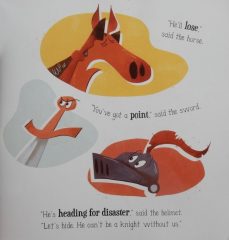
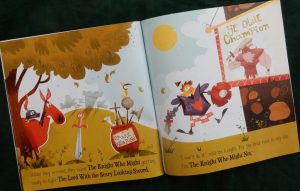
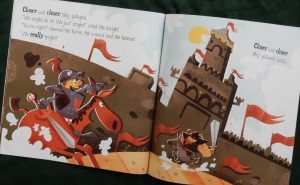
Dream team Gaiman and Riddell have again joined forces, this time creating a stonkingly brilliant piratical rhyming tale.

Stupendously silly and enormously entertaining, this story is narrated by the boy who with his sister, is left in the care of Long John McRon, ship’s cook, possibly THE most unlikely babysitter you can imagine.

He’s not the only one who comes a-knocking though; for hardly have the parents left than the entire wildly crazy crew comes charging in.

Having investigated the contents of the family fridge, the pirates decide supper is to be the “Pirate Stew! Pirate Stew! / Pirate Stew for me and you! … Eat it and you won’t be blue. / You can be a pirate too!” Furthermore, it’s to be served “ underneath a pirate’s moon!”

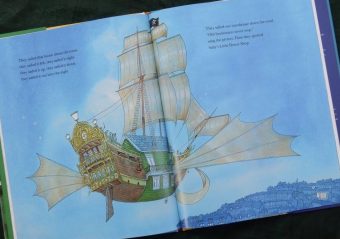
Unnoticed by the pirates too busy feasting on their own concoction, the children decide to eschew said stew with its weird and wonderful ingredients. Nevertheless, it’s not long before they find themselves sailing off into the night

and sating their appetites on doughnuts instead.

That’s not quite the end of this yummy yarn however …

Totally delicious, spectacular storytelling and incredibly detailed illustrations that make the entire cast leap right off the pages, this is perfect fare for those who relish the unexpected, the magical or the piratical – it provides all three in bowlfuls.

Pirate stew anyone?

Nature in Focus – Home / Seasons

Here are two books from Little Tiger that focus on nature and the changing seasons
Home
Patricia Hegarty and Britta Teckentrup

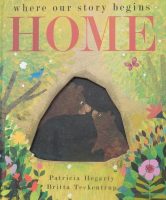
‘All of us need a place to rest – / A cave, a warren, a pond, a nest … // Wherever we may choose to roam, / We need a place to call our home.” So says Patricia Hegarty’s introduction to this look at the forest that is home to all kinds of creatures large and small.
In the company of little bear, we visit a variety of animal homes starting with the cub and her family’s cave, dark and deep.

With the advent of spring, the cub ventures out watched by an owl in her tree. He visits the place where squirrels are gathering leaves for their drey; beavers are also building a shelter; a bird is busy nest building.
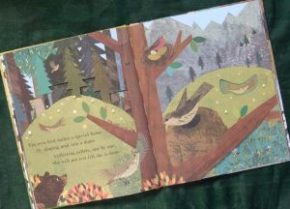
Further afield salmon spawn in the glistening river, multitudes of minibeasts are hard at work, and underground rabbits are safe in their warren.

As night begins to fall, a pack of wolves begin to prowl, hunting for food; while a flock of arctic terns make ready to begin their long journey before another winter sets in.
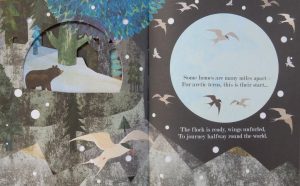
Finally as the cold arrives, it’s time for little bear and his family to hibernate ‘til spring comes round once more.

In her lyrical text Patricia takes us through the changing seasons and to the various animal homes. Britta Teckentrup’s signature style collage scenes, with their die-cut pages, follow the action and the bear cub, highlighting the importance of each home mentioned in the narrative as well as showing the seasonal changes in the forest.
Seasons
Hannah Pang and Clover Robin

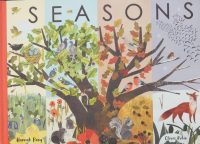
Author Hannah and illustrator Clover take us to half a dozen different locations in the world to experience the natural world in all its glory through the seasons.

We observe the changes that each season brings, starting with a focus on a mighty European oak tree that stands majestically in a meadow, its spreading branches and roots providing shelter and food for countless creatures – birds, insects and other minibeasts, small mammals and some larger ones too.

Spring, summer and autumn with their flowers, fruits and fungi are times of abundance for the various animals. Come winter, the branches are bare and it’s a hard time for animals, many of which hide themselves away in order to survive. Indeed, change through every season is vital for survival of the tree and the associated wildlife.

The other natural habitats are the chilly Arctic where the change in length of day and night is dramatic,
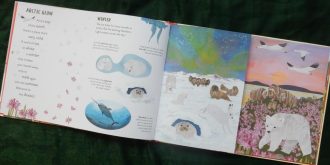
the wilds of Alaska where rivers freeze in the coldest months; a boggy mangrove in northern Australia – one season teeming with land animals, another with fish; then comes the Yellow Dragon Valley, home to some of China’s rarest animals including the giant panda.
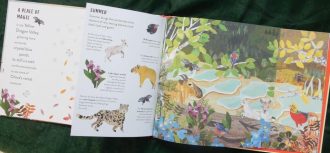
The last stop is on the grasslands of the Kenyan Maasai Mara with its wonderful richness of awesome animals and plant life.

As in the oak tree’s location so it is with all the others: change is vital for survival and the Great Migration of the animals of the final location is, so we read, ‘one of the most dramatic events on Earth. For the animals, … a journey of life and death.’

Since the pandemic struck, I think huge numbers of us have become much more aware of the importance of nature in our lives: this book, with Clover Robin’s richly detailed illustrations and Hannah Pang’s factual text, sings that song loud and clear.

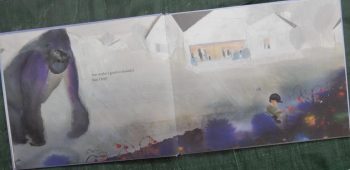
Afraid of the Dark / Noah and the Starbird

Here are two picture books  about dealing with difficult situations – thanks Little Tiger for sending these warm-hearted stories

Afraid of the Dark
Sarah Shaffi, Isabel Otter and Lucy Farfort

Moving to a new home is often scary and so it is for the little girl, Amy, who does so with her Dad and dog, Pickle in this story.
Dad is very positive about the move, but not so Amy and Pickle; it just doesn’t feel like home. Her bedroom seems full of strange sounds and shadowy creatures waiting to leap. A night’s sleep might have sent the monsters packing but still that queasy feeling remains.

A visit to the library helps a little,

especially when the kind librarian finds just the right book to transport Amy to a faraway land of adventure when her  dad reads it to her that night. But once he’s gone from her bedroom, back come those monsters.

Next morning seems a little brighter. Children outside wave and invite Amy to play with them in their den. It looks a bit dark inside, but Pickle is willing to go inside so she follows and lo and behold inside a wonderful warm welcome awaits thanks to Sofia and Bilal.

Could this be the beginning of the banishment of those scary monsters. Can Amy send the lurking shadows packing once and for all? …

Sensitively told, this story, demonstrates beautifully how it always takes time to adjust to new situations; and how love and friendship can make all the difference when it comes to coping with first experience fear. Lucy Farfort captures Amy’s fearful feelings perfectly in her illustrations, as well as her dad’s concern and warmth, and the wonderful kindness of the children who welcome her.

Noah and the Starbird
Barry Timms and Faye Hsu

Noah’s dad is ill and has gone to hospital, so Noah is staying with his kind, reassuring, Granny. As they unpack Noah’s things together, the boy notices a lamp inside which is a bird.
Granny tells him it belonged to her grandma and at bedtime Granny suggests to Noah that the bird might have magical powers.

As the boy lies wide awake in bed worrying about his dad, he’s startled by a sound. It’s the bird from the lamp. She introduces herself as Starbird, promising that his father is safe. She sings a lullaby, pulls out one of her tail feathers and gives it to Noah who eventually falls asleep.

The following morning, on hearing what happened Granny tells Noah he has a special magical friend but even she cannot hasten the process of his Daddy getting well. Instead Starbird provides a listening ear again that night before Noak goes to sleep.
Next day the news from the hospital isn’t what Noah hopes, but with some special strength from the magic feather, he and Granny create a collage bird to keep up their spirits.

Can Starbird use her magical powers to help Noah’s Daddy get well again?

Kindness, courage and friendship shine forth from this gentle story: I think right now, the entire world could do with a feather like the one therein.

If You Come to Earth

If You Come to Earth
Sophie Blackall
Chronicle Books

Award-winning author-illustrator Sophie Blackall’s inspiration for this book was her encounters with thousands of children she met while travelling the world in support of Save the Children and UNICEF – ‘a book that would bring us together’, she says in an author’s note at the end.

Her illustrations are truly breathtaking, as, by means of a child who is addressing a visitor from Outer Space, readers are taken on a journey through the solar system, down towards the surface of Earth viewing the various kinds of homes people live in, their families,

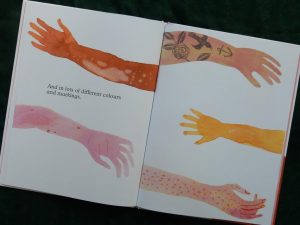
their bodies – each one different, their expressions as they think and feel, their clothing, weather both good and less so, transport, places of education and the work people do, how they spend their free time; we see some of the foods people eat. (Some of us have more food than others.’)

There’s an explanation of the importance of water, its sources and a stream of marine creatures swims majestically past. Then come Earth’s fauna: Those with feet and those with wings, leading us back to humans, their love of music making, their different ways of communicating (Some of us who are deaf talk with our hands and faces. Some of us who are blind read with our fingers’ caption a spread showing people signing and sign language, and braille with people reading it.)

With its incredible detail, each and every spread is truly a beautiful story in itself (or many) – there are natural things and those made by people, even invisible things. Sophie puts occasional humour into her narrative with such comments as ‘Some germs can make you sick. So … breathing in smoke or getting spat on by a slow loris’ (it’s venom really can cause great harm to humans).

Then come two spreads – one with fighting, the other facilitating, and the comment,’It’s better when we help each other.’( If only everybody stuck to that one)

The only sentence I took slight exception to is ‘Babies are not very good at anything.’ Babies are VERY good at learning – they do it pretty much all the time they’re awake as I observed when spending time with Faith, a six-month old relation the other day.

It’s good to see attention being given to storytelling, be it older people storying about the past, or children imagining.

The author concludes that there’s much we don’t know but ‘right this minute, we are here together on this beautiful planet.’ A fitting end to a gloriously illustrated, wonderful message. The visual detail is awesome and the importance of seeing each person as a unique, valued human being worthy of our respect and care, and of the vital necessity too caring for the Earth, shine through the entire book.

A must have for school and home.

The Spots and the Dots

The Spots and the Dots
Helen Baugh and Marion Deuchars
Andersen Press

Here’s a tale that happened long ago – or was it so long?

Told with an appropriately bouncy rhyming text by Helen Baugh (it does feature spherical objects after all) we discover what happens when the little Spots, paying insufficient heed to their parents oft repeated warning, “If you go over the hill you will be taken away by the dots”,

start getting more daring with their favourite game until Baby Spot, scared and still, finds itself one evening at the apex of the hill.

However, close by is a second small someone, equally on its own.

A conversation ensues, and a revelation, followed by something very exciting …

Flip the book and read the story from the perspective of the Dots. This small tribe are also pod dwellers and their little ones love bouncing too, receiving a similar warning about the ill-intentioned Spots.

Naturally the infant Dots play a similar game to the little Spots and you can work out the rest …

Such a clever tale of colliding communities that celebrates difference and lays bare the idea that fear and prejudice are often fuelled by ignorance, showing that we’re all much more alike than we might at first think.

Helen tells it with a deliciously wry liveliness that is mirrored in Marion Deuchars’ superbly expressive scenes of small spheres and their adult carers.

Do make sure you study closely the grand meet up of the two infant groups wherein Marion has managed to give each of the playful infants a different look.

I can’t recommend this one enough: it’s brilliant.

Feathered Serpent and the Five Suns

Feathered Serpent and the Five Suns
Duncan Tonatiuh
Abrams Books for Young Readers

Legend has it that the Mesoamerican gods had considerable bother creating humanity.

During the first tonatiuh their effort resulted in mountains, the second, fish and having modified the process, the third attempt was close, but the humans were disrespectful of their creators and so were turned into tree-dwelling monkeys.

Attempt number four produced kind-hearted, respectful beings but due to their laziness, the gods turned them into birds.

Enough! The gods were weary and ready to give up entirely, all except Quetzacóatl – the Feathered Serpent and god of knowledge. Gathering his staff, shield, cloak and good luck shell he set off to Mietlán – the underworld – to recover the bones his fellow gods had given to the lord of the underworld for safe keeping.

To reach his destination, Feathered Serpent travels through nine daunting regions,

but aided and abetted by Xolotl the dog spirit guide, he finally reaches his destination and is able to speak to the god of the underworld.

After he’s explained his mission, Mictlantecuhtli gives him one final test and Feathered Serpent finds himself on the end of a trick. However, he manages to out-trick the keeper of the bones and is given the sacred objects. Mictlantecuhtli hasn’t finished with him yet though; but Feathered Serpent finally escapes, wounded and bleeding, recollects the bones and returns.

Once there, he smashes them to a powder, mixes in his own blood and that which the other gods provide, to make a paste

and from that finally creates humanity.

Despite being a complex story, Tonatiuh’s telling is captivating and readers aloud can certainly give it a highly dramatic presentation. His superb, flat, hand drawn, digitally collaged scenes successfully conjure up pre-Columbian art, and after his enthralling rendition, to help with the historical context  there’s an author’s note on the symbolism behind the myth, a glossary with Nahuatl pronunciation guide and a select bibliography.

We’re Going on a Pumpkin Hunt / Winnie and Wilbur Around the World

We’re Going on a Pumpkin Hunt
Goldie Hawk and Angie Rozelaar
Nosy Crow

Based on the nursery favourite ‘We’re going on a bear hunt’, I’m surprised nobody thought of a pumpkin-themed variation before. It’s definitely a goodie.

Herein we join three fearless pumpkin hunters – a little skeleton, a witch and a slightly unravelling little mummy – as they sally forth one beautiful night. Needless to say their path is obstructed by various things that they can’t go over, under or around.

First it’s watchful green-eyed moggies meow-meow(ing); then cobwebs – the sticky spiders’ variety – just right to ‘tickle-swish’ through.

Yikes! What about those ‘Flap-flap’ flapping bats – fortunately they look quite friendly, and then the trio come to a house, old, dark and spooky of course. Could a pumpkin be hidden therein?

There’s only one way to find out and that’s in …

and over those creaky-squeaky floorboards and of course, our adventurers aren’t scared, are they? …

Happy trick or treating …

At every page turn, day-glo colours leap out from Angie Rozelaar’s anything but scary spreads showing the mock-spooky sortie, and Goldie Hawk’s clever adaptation of a popular join-in narrative, this will assuredly enchant, rather than scare, young listeners and solo readers around Halloween time. (or any time come to that.)

Winnie and Wilbur Around the World
Valerie Thomas and Korky Paul
Oxford Children’s Books

Inspired by a visit to the library and animal books in particular, Winne and Wilbur embark on a world trip with the aim of visiting all the animals featured in the book they’d seen (and decided to borrow).

All it takes is a hastily packed suitcase, duly attached to the broomstick, a glance at the book and a wave of Winnie’s wand;  up and away they go to land in a tree house surrounded by giraffes – very hungry ones.

Prompted by picture two (and sans lunch) they whizz on to an oasis where dates, camels’ milk and an exceedingly hot, bumpy ride await.

A spot of kangaroo bouncing (Wilbur) comes next, followed by some panda spotting (Winnie finds the creatures dull); then a too close for comfort encounter with an enormous whale …

and a polar bear.

An elephant, an aardvark and meerkats (not cat eaters happily) rendezvous leads them on to the final page and a jungle full of monkeys. Their mischief-making might well have caused the demise of both our plucky travellers but fortunately, all ends happily. With thoughts of their favourite animal in mind, and with the book duly returned to its place in the library, its time for the intrepid adventurers to relax.

What more can the countless fans of the duo want than this high-octane world trip by their favourite witch and her trusty moggy. Probably another reading of same, followed by further adventures. Perfect for Halloween and other story times.

Jeremy Worried about the Wind

Jeremy Worried About the Wind
Pamela Buchart and Kate Hindley
Nosy Crow

Young Jeremy is a worrier par excellence – we all know one I’m sure. Risk averse he surely is, and a highly sensitive little chap to the extent that he avoids pretty much anything and everything from overly crunchy crackers to dinosaurs …

and squirrels to shoelaces. His biggest worry though, is the wind.

One day he meets and befriends Maggie – she of the untied shoelaces and “What’s the worst that could happen?” attitude. Immediately Jeremy decides that she’s in need of care and protection. Taking her under his wing, he teaches her all manner of ways to stay safe.

Then comes that hugely wildly blustery day when Maggie inevitably decides to throw all caution to the wind. Out she dashes with Jeremy in hot pursuit (or maybe a cold sweat). And that’s when he finds out about the delights of living dangerously.

Bursting with zany humour, Pamela’s text will lift your spirits – it’s a great read aloud likely to help even the worst worriers among your audience to unwind a tad, (and perhaps offer a warning word or two to any Maggies sitting alongside); while Kate’s splendidly expressive scenes of the perils – possible and real, excitement and effervescence, will enchant and entertain. Make sure you slow down when you get to the wordless spreads so your listeners can savour every single tiny detail.

Ridiculously brilliant in every way.

Ruby and Graham / This Old Dog

Ruby and Graham
Lucy Barnard
New Frontier Publishing

Playful party loving Ruby and organising expert, Graham, both live in Acorn Wood ensuring that it’s both a happy lively place and a beautiful one.

However, it’s Ruby who gets all the attention from the other woodland animals, so one afternoon Graham decides to change his ways and become more funky.

Such is the improvement in his popularity that he resolves to make the change permanent.

Now while it might be a good thing for Graham, the woodland rapidly becomes a messy, confused environment. Ruby approaches her fellow squirrel and an interesting discussion ensues wherein they each talk about their feelings of self-worth.

Can the two share their abilities to their mutual benefit, as well as for the betterment of the entire community? Working together is the way to go …

Lucy Barnard’s digital illustrations add humorous details to her textual narrative, making every spread a stopping point that offers much to enjoy and talk about with young listeners, particularly with the approach of autumn and winter.

This Old Dog
Martha Brockenbrough and Gabriel Alborozo
Levine Querido

This Old Dog is a heart-warming story about a dog that’s well past its prime (‘His bones are sore but his heart is strong’) and a small girl who loves him dearly.

From the moment the child is born, the pace of life in old dog’s family speeds up, but the creature ‘likes to take things slow.’ He’d yearned to have a friend for long, slow strolls, rolls in the grass and romps in the leaves.

Both little girl and the dog truly know how to live in the moment, make the most of their experiences and cherish their time together; and once the child takes to her feet she walks straight towards old dog. At last his wish is fulfilled: there’s grass smelling, hill rolling down and much more …

some of which make the pooch enormously excited.

Together they can discover (or rediscover) what a wonderful world it is, day after day …

Just as the girl and old dog were seemingly made for one another so too was the author/illustrator partnership between Martha Brockenbrough and Gabriel Alborozo. The slow, steady text skilfully mirrors old dog’s plodding, yawning demeanour so perfectly captured in the delicately lined ink and water colour illustrations; he’s a real personality this pooch, as is the adoring little girl, his total devotee and playmate.

Whether or not you’re a lover of dogs, you’ll definitely fall for this gorgeous book.

Fergal Meets Fern / Elmer and the Lost Treasure

It’s lovely to see favourite characters returning in these two recent books from Andersen Press

Fergal Meets Fern
Robert Starling

New sibling unsettlement quickly arises when Fergal’s Mum and Dad bring home ‘the egg’. From this emerges a new baby sister for the little dragon and with its arrival, funny feelings start within Fergal. Even nan’s gift of flying show tickets lift his mood only briefly because Fern’s actions really stoke up Fergal’s inner fire.
Then to make matters worse, comes the news that the flying show excursion is off: Dad has to get medicine for Fern who’s become sick.

Inevitably Fergal’s fiery feeling grows even stronger, so much so that he does something to make him the centre of attention, which it does, once Dad discovers his whereabouts.

After a frank Father and Fergal discussion on feelings, Dad shows his son something by way of explanation.

Later on as the two do some yoga side by side, the feelings discussion continues

and eventually Fergal understands that something in him needs to change. Being a big brother is an important role and perhaps it’s one he can undertake successfully and lovingly.

As with previous Fergal stories, Robert Starling conveys this one with sensitivity, humour and considerable charm.

Share with little ones at any time but it’s especially apt if you’re a family with young child and a new arrival.

Elmer and the Lost Treasure
David McKee

The adorable elephant, Elmer stars in what is almost unbelievably, his twenty eighth picture book adventure.

He, along with cousin Wilbur and three other elephants set out on ‘a long, exploring walk’ through the jungle and after a while find themselves in unfamiliar territory.

After a roll down a steep slope with Elmer in the lead – naturally – they discover an entrance to an old forgotten palace and start exploring within, or rather Elmer and Wilbur do. The others meanwhile have their own agenda. What can they be doing?

The palace is incredible with huge domed halls in shades of blue, amazing mosaics, tiles and carvings. But who will find that Lost Treasure? And what is it?

Another absolutely smashing story of everyone’s favourite patchwork pachyderm and his pals, told and illustrated with David McKee’s usual sense of humour and fun, warmth and heart, that is also reflected in his main character.

There Must Be More Than That!

There Must Be More Than That!
Shinsuke Yoshitake
Chronicle Books

In our increasingly pessimistic times, it’s really good to have children offered an alternative perspective on the future, especially when it’s presented with the wonderfully droll humour of Shinsuke Yoshitake.

It opens on a rainy day with big brother saying to his younger sister, “Hey, Sis. … Our future is doomed … Terrible things are going to happen … That’s what a grown-up told my friend.”

Feeling somewhat deflated the little girl goes and passes on his message to her Grandma. She however is much more level-headed suggesting focussing on the good things and the many possible choices one can make: “Grown-ups act like they can predict the future … but they’re not always right,” she says, immediately triggering more positivity in her grand-daughter.

She in turn then goes on to envisage possibilities of all kinds – ‘A future where it’s okay to spend the day in pyjamas’ – little did she know! – and one where ‘robots take us everywhere’ … and ‘someone always catches the strawberry you drop’ … and ‘someone does your homework for you.’ (“Bring it on,” I hear youngsters cry).

Now the girl is really on a roll, imagining outgrown shoes put to use as planters; being able to ban carrots, and having ‘that bully’ abducted by aliens or even finding her own true love and consequently not being bothered about the bully boy.

If you’re thoughtful, you can always think of extending your horizons and not thinking in terms of polar opposites. Thus good/bad could become ‘not bad / hard to say/ questionable / interesting /could be okay / strange’ or ‘I don’t know’.

There are lots of alternatives for an aging Grandma too – who knows, she could wake up as a teddy bear or live for 300 years. And as for that boring boiled or fried egg that Mum offers as the other options to left-overs for dinner … there are plenty of better ways to make an egg …

You just have to make up your mind which …

It’s Only Stanley

It’s Only Stanley
Jon Agee
Scallywag Press

Jon Agee imbues this picture book with his usual dry humour, leaning herein towards the utterly absurd.

It tells of a family, the Wimbledons, whose slumbers are disturbed by a series of weird sounds that Mr W. (Walter) goes to investigate each time.

First he reports on their pet dog Stanley’’s howling at the moon; but on subsequent disturbing occasions we discover that Stanley has a particular penchant for engaging in noisy tasks during the hours of darkness.

Next he’s reported to have fixed the oil tank,

after which he’s provided the moggy with some delectable-looking catfish stew, the smell of which awoke young Willie Wimbledon (don’t you love the alliterative names, the entire family has them).

Thereafter Wanda’s ‘buzzing sound’ at 3.30am turns out to be our Mr Fixer repairing the old TV; Wylie’s ‘splashy sound’ proves to be a rather wet bathroom caused by Stanley’s drain fixing activities and finally the entire family is up in arms, mum Wilma included.

What repairs can our diligent, multi-talented Stanley be working on next? Let’s merely say, it’s assuredly his most ambitious project yet … and leave you, the cast and readers in suspended animation,

awaiting Agee (and Stanley’s) laugh-out-loud finale.

I’m sure if you share this with youngsters, arguments will ensue about whether the canine character is conscientious, crazed, or certifiable. Whichever they opt for listeners/readers will assuredly delight in his DIY antics so hilariously presented in Agee’s unpredictable rhyming narrative with its repeat refrains, and his droll, alternating scenes of the disturbed family and their disturber’s deeds.Make sure you closely follow Max, the cat throughout.

What a satisfying read aloud for both listeners and adult presenters. Suitable bedtime reading? – that’s entirely up to you …

Songs for our Sons

Songs for our Sons
Ruth Doyle and Ashling Lindsay
Andersen Press

Here’s a rhyming celebration of a newborn child wherein the narrator shares her future hopes for the infant, encouraging the little one, oh so full of potential, to be the very best person possible. “So dance-up your dreams; / sing out your spirit-song / And let the light that’s inside you, / guide you along.’

Whether the baby grows up to be ‘a sequinned sparkler, a kaleidoscopic colour- catcher’ or ‘a … puddle-pouncing, soil-squelching mud sculptor’ …

the hopes are that they will be proud, free and happy, an appreciator of and wonderer at, the natural world, a ‘champion of change … and non-violent fighter.’

One who rejoices in differences and their own uniqueness. All this and more in the hope of building a gentler, brighter world. Something we all wish for, especially right now.

Whether we read Ruth’s entire text as being spoken directly to the new-born, or to us as readers, the message is potent – it’s fine to show your feelings, to cry, follow your heart – and cleverly organised so that it sits within, or alongside, Ashling’s gorgeous scenes of children exploring and making the most of whatever surrounds them, culminating in an enormously uplifting, whimsically portrayed , finale …

Gentle, hopeful and a perfect book to give a newborn, at a naming ceremony, or as a present at any time throughout childhood.

A companion book Dreams for our Daughters follows in 2021, though it’s only in the title of this one that there’s any mention of gender.

A Story About Afiya

A Story About Afiya
James Berry and Anna Cunha
Lantana Publishing

Oh my goodness, Lantana publish such beautiful books and here’s another one written by Jamaican poet James Berry and illustrated by Anna Cunha.

The text is almost 30 years old and now Anna Cunha has created some stunningly gorgeous illustrations to accompany James’ lyrical prose.

The story is of Afiya, whose Swahili name means health. She’s described as having ‘fine black skin that shows off her white clothes and big brown eyes that laugh and long limbs that play.’

Young Afiya has a very special white summer dress that she wears every day, washing it every night. It’s a very special garment that picks up and collects images of things Afiya experiences – sunflowers, red roses,

grasses, butterflies, wild animals from the zoo, or fishes from the seaside.

Strangely, by night the imprint remains when she washes her dress but the following morning it’s always hanging ‘white as new paper’ once more, ready for a new design to imprint itself upon it. – boulders or autumn leaves for instance.

Each one is a source of amazement to Afiya; equally readers will be amazed at Anna Cunha’s crafting of same. Her magical matt illustrations are as lyrical as James’ text and provide the ideal complement – a perfectly seamless, unique fusion of two kinds of artistry to set the imagination soaring sky high.

Inch and Grub

Inch and Grub
Alastair Chisholm and David Roberts
Walker Books

What’s the most important thing in your life – is it the acquisition of ever more ‘must have’ stuff, or is it something as simple as friendship? I’m pretty sure that during this on-going pandemic, this is something most of us have been considering and discovering the answer to.

Let me introduce two cavemen, Inch and Grub. The latter’s cave is bigger so that makes him the best, so he says. Inch responds by adding a water feature to his abode but then Grub makes fire.

This ignites their competitive natures well and truly, resulting in a contest wherein each one tries to outdo the other, creating bigger and better things, until their colossal, precariously perched towers of furniture, homes, modes of transport,

technological devices and more,

reach their tipping point – uh-oh!

The outcome is, both rivals learn a valuable lesson – actually more than one – about themselves …

With its timely and vital message, this terrific story will make you and youngsters giggle all the way through as you eagerly anticipate the seemingly inevitable denoument.

David Roberts’ wonderfully quirky illustrations adroitly amplify the impact of the telling, showing how such games of brinkmanship are almost bound to end in disaster.

Superb!

Fox: A Circle of Life Story

Fox: A Circle of Life Story
Isabel Thomas and Daniel Egnéus
Bloomsbury Children’s Books

This beautiful book sent me straight back to my copy of T.S. Eliot’s Four Quartets, to the opening line of East Coker, ‘In my beginning is my end.’

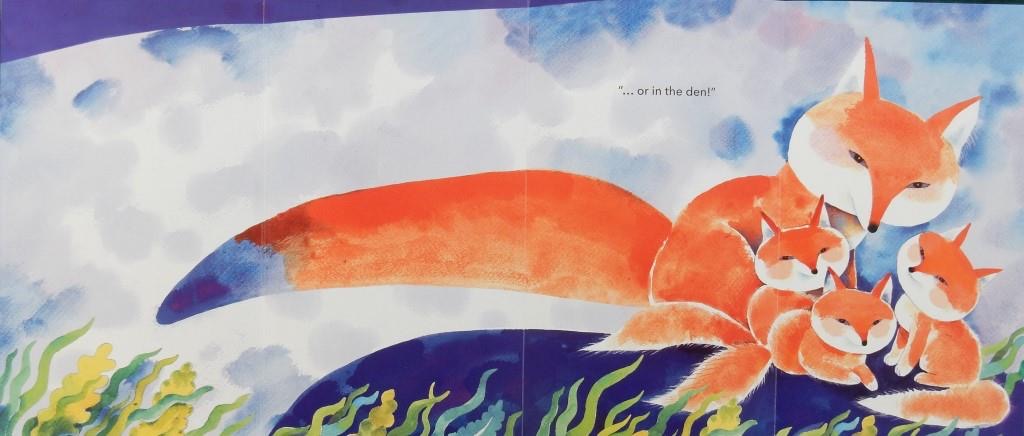
As the story opens in early spring in a still frozen forest life is astir: we follow fox as she sets out to find food for her three cubs.

We meet them a few weeks later – bigger, bolder and playful close to the safety of their den. They too decide it’s time to try being hunters as they follow their parent on the hunt.

Suddenly danger appears in the form of a car; the three cubs dash safely across the road but not so their mother. She is hit, tossed into the grass and dies.

The cubs return home leaving a decomposing body that little by little, over almost a year, returns to the earth, to the plants and to the air.

Her remains provide food and shelter for other creatures and a place for new life to be nourished and flourish. For death is not merely an end, it’s a beginning too.

The powerful, beautifully written non-fiction narrative of Isabel Thomas and the stunningly gorgeous illustrations of Daniel Egnéus combine to make a book that answers one of the ‘big’ scientific questions children ask, ‘ What happens when we die?’ and provides a perfect starting point for talking about the cycle of life and death or, as the subtitle says ‘A circle of life story.’
(There’s also a final spread that has separate paragraphs explaining ‘The building blocks of life’, “What is death?’, What is decomposition’, ‘The cycle of life’ and ‘Death is not just an end’.

There’s no need to wait for the death of a beloved pet or human before sharing this book with youngsters though: I’d suggest reading it with a class or in a family at any time, particularly at a time when the seasons change.

This Book is NOT a Bedtime Story!

This Book is NOT a Bedtime Story!
Eoin McLaughlin and Robert Starling
Pavilion Children’s Books

Whether or not you choose to believe the title of this book clutched by the red monster on its cover, or the sign held by the little frog is up to you. Best to read it to yourself before making up your mind, rather than plunging in and sharing it with little ones before you tuck them in.

Speaking in rhyme the chief monster narrator insists from the outset ‘It’s scary, strange / and rather gory. ‘ … as he attempts to convince frog, rabbit and deer of his and his fellow monsters’ intention to consume them in a dark forest,

before heading off to look for other scary possibilities – a haunted house; a ghostly galleon afloat on shark-infested waters;

a cave full of bats – oops the bats have gone AWOL!

Still however, the only ones that seem convinced of the monsters’ mega-ghastliness are the monsters themselves; but they might just have one more scare up their sleeves, or rather, furry arms. Will this one work and allow them to prove themselves to frog et al? I wonder …

Robert Starling’s mock scary scenes of the would-be terrifying beasties and those they’re attempting to put the frighteners on, are hilarious; and there are some deliciously funny words spoken by bit part players such as the mouse ‘trying to get on with my knitting’, the spider in the cave, and the exchange between rabbit and one monster beside the cooking pot.

The whole enterprise might or might not be a story for bedtime, but it’s most certainly one to share with youngsters. They’ll relish it, as will adult readers aloud, and the former will more than likely demand immediate re-reads.

Thank You

Thank You
Joseph Coelho and Sam Usher
Frances Lincoln Children’s Books

Inspired by the NHS Thursday 8pm Clap for Carers earlier in the pandemic, award-winning performance poet Joseph Coelho wrote this gorgeous story, to demonstrate to children how they, like the child in this book can show appreciation for, and celebrate the key workers, in their own lives.

The story tells of Tatenda, a thankful child who says thank you whenever he gets an opportunity: thank you to mum and dad for making breakfast, thank you to the post lady for delivering his favourite comic, to the teacher for marking his work and to the shop staff who stack the shelves.

Of late though, nobody seems to hear his words of thanks, they’re too bogged down in their fears and worries.
Consequently, the boy decides that a much bigger thank you is needed: here’s what he does …

Suddenly this thank you turns into something colourful, full of energy and movement. Out the front door it whizzes and off down the road, followed by his parents, the post lady whose smile makes the thank you ‘grow and glow’, all the way to school where’s it’s given further sparkle from the teacher’s eyes. Then off into the market it goes, with everyone touched by it in pursuit, spreading joy and colour till it reaches a massive oak tree. And there among the branches it sticks.

Eventually after a massive team effort, Tatenda is able to reach  and liberate the thank you, whereupon it continues on its way spreading colour and joy throughout the community and helping everyone feel better!

This wonderful, lyrical celebration of Joseph’s, superbly illustrated by Sam Usher, is a brilliant manifestation of the power of gratitude and of community strength.

For every book sold 3% of the retail price goes to Groundwork, a charity that helps some of the UK’s most disadvantaged communities deal with the effects of the coronavirus pandemic: another great way of showing appreciation is to get your own copy.

Dance Like a Flamingo

Dance Like a Flamingo
Moira Butterfield and Claudia Boldt
Welbeck Publishing

Little ones can receive a dozen dance lessons courtesy of the host of willing animal teachers in this lively picture book.

Whether they prefer to fly circle-wise, wiggle waggle their bottoms, point and fly like the bees, as they show fellow bees the way to their flower findings;

strut proudly as the peacock shows; or emulate the show-off crab, flexing claws and scuttling sideways in both directions, the instructions are here.

On the other hand (or tentacles) perhaps something a little more gentle in parts like the jellyfish offers, with floaty arm movements and slow, calm drifting might suit the mood: it does get faster though at the end.

I suspect the baby elephant dance will go down well – in more ways than one: make sure you have plenty of space and a soft landing if you do this with a nursery class.

Then after all the fun learning I’d suggest handing the finale over
to the group and letting them choose their moves, as the example on the final spread shows in the celebratory ‘wonderful world’ extravaganza.

With its step-by-step actions and Claudia Boldt’s gorgeous, funky illustrations, this book is terrific fun whether you choose to use it in an education setting or at home: an absolute joy from cover to cover.

While You’re Sleeping

While You’re Sleeping
Mick Jackson and John Broadley
Pavilion Books

Interestingly this collaboration brings together Booker Prize shortlisted author Mick Jackson and illustrator John Broadley, both well known for their books for adults, in a first book for a child audience; and what a superb enterprise it is.

Herein children will discover that during the time they spend sleeping, a myriad of humans are wide awake actively engaged in their world. So too are countless creatures be they owls on the hunt, foraging foxes, bats or hungry hares searching for food.

Imagine what it would be like if those cleaners hadn’t been busy on the buses and trains people take to work and school, while others clean the offices, shops and streets.

Then there are lorry drivers delivering their loads of food and other goods; post-office workers busy sorting all the mail; bakers cooking;

firefighters ready to answer emergency calls; those twenty-four hour shops and cafes; dedicated hospital staff on night duty; and ships with their crews under starry skies.

There’s a reminder that elsewhere in the world, while some children slumber, others will be in their classrooms or perhaps doing sporting activities and when their day is over, the sleepers wlll awake.

Speaking directly to young listeners/readers in a friendly tone, the narrative is a wonderful read aloud be it at bedtime or during the day. While with echoes of Eric Ravilious, John Broadley’s incredibly detailed illustrations are truly beautiful works of art (I’d love any of them as an original print on my walls.)

To open this book is like opening a gorgeous box full of jewels – each page is stunning – so too are the endpapers, the cover: the entire production in fact and to read it is like being shown around a gallery by a wise, gently spoken curator eager to open our eyes to how the world works.

The Bear, the Piano and Little Bear’s Concert

The Bear, the Piano and Little Bear’s Concert
David Litchfield
Frances Lincoln Children’s Books

This is truly a very special book but sadly, the final book in the outstanding Bear and the Piano trilogy. Having so said, it really is a sublime finale.

The book begins with a recap of Bear’s wonderful achievements in his musical career and telling how he’d found it hard at first to settle back into forest life after the buzz of the city, until along came his daughter, Little Bear.

We see the two having a wonderful time together with Little Bear learning so many new things.

One day she makes a discovery and asks Bear what the thing is that she’s come across.

Then little by little her father recounts all his adventures in the city, talking of his days in the band. Little Bear senses his sadness and that evening comes up with a plan that she hopes will cheer him up.

Will Little Bear’s idea succeed in enabling Bear to rediscover that magic of making music: perhaps with enthusiasm reignited he can even pass on that passion to his daughter?

David Litchfield’s illustrations are as always absolutely stunning, full of incredible detail and texture; and his colour palette is in places, appropriately dazzling.

The story too is pitch perfect for reading aloud at anytime, anywhere: I’d love to gather some youngsters together and share it in a forest setting. Indeed, the book is exquisite in every way and a must have.

Little People, Big Dreams: Captain Tom Moore

Little People, Big Dreams: Captain Tom Moore
Maria Isabel Sánchez Vegara and Christopher Jacques
Frances Lincoln Children’s Books

We surely all know of the selfless fundraising achievement of national treasure, Captain Tom Moore, on behalf of NHS Charities Together and of his subsequent knighthood. How many of us though, know anything of the rest of his incredible life? Relatively few I suspect.

Now this new addition to the superb Little People, Big Dreams picture book biography series written by Maria Isabel Sanchez Vegara, children who followed him in the media , as he took his daily walk during lockdown, have the opportunity to read about the earlier life of this awe-inspiring veteran.

Tom was a Yorkshire lad who from a young age was passionate about engines of all sorts. At around twelve years of age he discovered an old, broken motorcycle, paid two and six for it, determined to repair and ride it on the road.

Having become an apprentice engineer he was called up to join the Duke of Wellington’s Regiment and was sent to India, a country he found initially strange, but to which he quickly adapted. Determined and brave, he rose to become a Captain and a spirit raiser of his team.

A team that also became his friends for many years until only he remained.

A slip while on his daily walk resulted in a hospital stay, a hip replacement and two knee replacements.

Still his spirit never faltered: he bought himself a treadmill online to strengthen his legs, and installed it on his drive.

As he approached his century, Captain Tom decided to celebrate with a pre-birthday 100 laps walk around his garden. Then the global pandemic hit the UK and Captain Tom had a new goal … the result of which was not the £1000 pounds he’d hoped for but a whacking £30,000,000. A-MAZ-ING!

Dream big and never give up: that’s what he did and that’s what we must all try to do, today, tomorrow and …

3% of the cover price of every sale goes to NHS charities – another reason to get hold of this terrific tribute to an incredible person, sensitively portrayed in Christophe Jacques’ illustrations.

Say Hello to the Sun / Under the Stars

Say Hello to the Sun
Dr Lin Day and Lindsey Sagar
Scholastic

This picture book is essentially, based on a song from Dr Lin Day’s Baby Sensory interactive developmental programme, illustrated with Lindsey Sagar’s bright alluring, patterned illustrations.

Starting with the sunshine, tinies are invited to greet in turn the moon beaming down and guiding, growing corn that provides food, twinkling stars,

the cooling rain, colourful flowers to bring cheer and loving friends with whom to play.

Embedded in each illustration is a small circle showing what look like Makaton symbols and the final double spread talks about ‘how to use this book’ and repeats all the signs.

Whether or not you and your little one goes to Baby Sensory classes, this enormously attractive book is worth adding to your collection to share again and again no matter what time of day it is.

Under the Stars
Rosie Adams and Frances Ives
Little Tiger

With glowingly gorgeous illustrations by Frances Ives and Rosie Adams’ gentle rhyming narrative that has a repeat refrain: ‘The world is a family: / we are all one, / …….. together / under the sun.’ an adult fox and a little one spend the day exploring and observing together from sunrise, until the stars twinkle and the moon shines bright in the night sky.

They watch squirrels playing, pause to relax as otter and its little one float on the water.

They listen to the sky humming with the beat of birds’ wings and enjoy their songs. Then in the cool of the forest, bear cubs share their findings, watched by the two foxes;  so too are the deer family and then under the starlit sky the parent fox reminds its cub, and readers, “The world is a family: / we are all one, / United together / under stars, moon and sun.’

Would that this were so, say I.

With its lilting words and beautiful scenes of the natural world, this is a book to read with little ones either at bedtime; or perhaps earlier in the day when there’s more time to talk about the ideas presented.

Last: The story of a White Rhino

Last: The story of a White Rhino
Nicola Davies
Tiny Owl

This story of Nicola Davies’ is a fine example of how a relatively few, carefully chosen words can have a very powerful impact.

Nicola’s tale, narrated by a rhino was inspired by Sudan, the last male Northern White Rhino from Africa that died in 2018. From his captive state in a zoo situated in a grey city, the rhino talks of looking for another animal like himself before remembering his earlier life that was full of colour. A place where other rhinos roamed free and he stayed close to his mother by day and night

until the fateful day when a hunter came and shot her dead. The young rhino was captured, put in ‘a box’ and transported to a dreary place without flora and where ‘Even the rain smelled empty’.

There he speaks of being among many other ‘lasts’ that spend their days cooped up pondering upon their plight

and the state of the world where this is allowed to happen.

Then one day something wonderful happens; something that seems almost too good to be true for the rhino is taken back to his life in the wild and joy of joys, he’s no longer alone.

This is the first book Nicola has illustrated herself and her illustrations too are enormously potent, particularly the stark contrast between the captive grey environment and the colour-filled homeland and the finale.

There’s a page about the illustrations at the front of the book, which I won’t re-iterate in full but just mention the inspirational quote from environmentalist, Paul Hawken and endorse Nicola’s own “I believe that the world can change for the better, but it will change one heart at a time. Change your heart, change the world.’

I truly hope that this story will move others as it did this reviewer, to be part of that change.

I Am One / Our Little Kitchen

I Am One
Susan Verde and Peter H. Reynolds
Abrams Books for Young Readers

It’s never too soon to introduce a young child to the idea that s/he can make a change in the world and this gorgeous book by a team whose books I greatly admire, shows the way.

Subtitled ‘A book of Action’ this one is clearly much more focused on being active than several of the others in the series and it’s a pitch perfect demonstration, given by a child of how seemingly simple actions can make all the difference.

Here we witness the planting of a single seed, a brushstroke, a note ‘to start a melody’, a step to set off on a journey, and I particularly love the “One brick to start breaking down walls’ sequence of actions

so pertinent in our increasingly troubled times.

The harmony between Susan Verde’s words and Peter H. Reynolds’ signature style illustrations is what truly makes this such a special introduction to social activism; it’s tender, inspiring and uplifting.

Furthermore, Peter has dedicated the book to Greta Thunberg and in the final author’s note, (that also contains a beautiful meditation) Susan writes that her inspiration came from a quote from the Dalai Lama: what more can one ask?

A conversation opener, but equally or more importantly, an impetus to seize that inner power and take action.

Also about taking action – singly and as a community is:

Our Little Kitchen
Jillian Tamaki
Abrams Books for Young Readers

Inspired by her own experience of volunteering in a community kitchen, here’s a really tasty, deliciously diverse, offering from Jillian Tamaki. Now, with hands washed and aprons on, we’re ready to go in the community kitchen. We’ll create a meal – something that happens every Wednesday and it’s a bit of a squash to accommodate all the enthusiastic volunteers.

Luckily, they have their own little garden so there’s no need to look too far afield for ingredients; and there appears to be a fair bit stored away that needs using up and there are donations from the food bank. (Beans again – can they be creative?) It’s definitely a case of waste not, want not (although the odd item is clearly no longer fit for human consumption.

This team clearly makes its own music as they work: ‘glug, glug, chop chop, sizzzzzzzzle, pick! Peel, trim, splash! Toss, squish, mmmm!’ Then comes the shout, “Fifteen minutes!’

The countdown is on as the hungry start coming in; they clearly know one another – there’s plenty to chat about while they wait.
Eventually the leader gives the order “Let’s go!” and in comes the food – yummy and very ‘SSSSSSLLLLLUUUURRRRRPPPP!’- worthy.

Speech bubbles abound, providing a running commentary by the workers and the recipients of the bounty produced by the team; indeed, the entire atmosphere is cheery and relaxed,

made so evident by Jillian Tamaki’s vivid colour palette and the fluidity of her lines. In fact the entire book is a veritable feast for all the senses. There are even recipes on the front and back endpapers.

Shhh! QUIET!

Shhh! QUIET!
Nicola Kinnear
Alison Green Books

Little Fox is a quiet creature, a close observer of the wildlife around her about which she loves to make up stories. The trouble is though that her friends are exceedingly noisy and their boisterous activities drown out all her attempts to regale them with one of her tales.

One day Raccoon becomes aware that Fox is looking especially sad, tells the others to be quiet and asks Fox what’s upsetting her. Happily Owl, Squirrel and Raccoon are all lovers of stories and ask to be told one there and then.

Of course, Fox is ready to oblige and starts her tale of a bear; but no sooner has she spoken the word ‘bear’ than the others are off roaring and pretending to be bears up in a large tree. Back on the ground below Fox notices some claw marks that look suspiciously like those of a real bear.

But are her friends ready to listen? Oh dear me, no: instead they frolic in the river then cavort across a bridge while Fox grows increasingly alarmed.

Will she ever get them to stop and heed her words? And if so, who will listen while she tells her story?

Nicola’s narrative is a super one for adult readers aloud to let rip with, as well as for youngsters to join in with the noisy exuberance of Fox’s friends. This exuberance spills out into her illustrations of the drama and she has included some diverting details including Fox’s book, the minibeasts and Bear’s teddy comforter.

Yellow Dress Day / What’s In My Lunchbox?

Thanks to New Frontier Publishing for sending these two recent picture books:

Yellow Dress Day
Michelle Worthington, illustrated by Sophie Norsa

Ava has a particular penchant for dresses, dresses of all colours and she chooses which of them to wear according to the feeling she has about the day, when she greets it each morning.

The red dress is reserved for warm, sunny days; on pink dress days her garden is all abuzz with bees enjoying the flowers; purple dress days are those when rainstorms are around;

snowflakes swishing, swirling and sparkling in the sky signify the need to select her blue dress, while yellow dress days have a whistling wind that shakes the tree branches and send their leaves all a-scatter.

On one such whirly, windy day, Ava’s dress isn’t to be found in any of its usual places …

but then she recalls that the previous day had been similar. Oh dear! Now she can locate its whereabouts but she can’t put it on in the state it’s now in.

Perhaps her mum can find something of the appropriate colour for her to use instead so she can go out and enjoy the day playing with her pup.

Michelle Worthington’s story with a scattering of onomatopoeia  that young listeners will love, is great to read aloud, and equally fun illustrations by Sophie Norsa, capture the different moods of the days beautifully.

What’s In My Lunchbox?
Peter Carnavas, illustrated by Kat Chadwick

This book really made me laugh. I was expecting it merely to be a story about a picky eater but it’s SO much more than that.

The boy narrator is something of a fusspot when it comes to the contents of his lunchbox – he eschews the apple; fish is a definite no-no – I don’r blame him on that one;

ditto the egg. I’ve no idea how what emerges on day four has managed to hide itself in a container with so small a capacity, and even more so the item for day five.

I imagine day six’s lunch item would definitely discombobulate any self-respecting boy …

so what about day seven? Could something therein on that particular day perhaps cause a rethink on the narrator’s part?

WIth its repeat patterned text, every page of this story is a starting point for another story – one that a child creates in response.

Ideal for those in the early stages of becoming readers to try for themselves, or for class sharing, when anticipation will be high throughout, and with Kat Chadwick’s terrific illustrations, this is such a fun read. Make sure you sample the front inside cover too.

I Really Want to Shout!

I Really Want to Shout!
Simon Philip and Lucia Gaggiotti
Templar Books

Author Simon Philip and illustrator Lucia Gaggiotti deliver with high energy and humour, a third in their series of life’s vital lessons.

The opening lines of the little girl narrator go like this: ‘Sometimes I find it really tough / to make sure I’m not in a huff / because there’s simply so much stuff / that makes me want to shout.’

Well, it is pretty infuriating to have to eat all your ‘green and yucky’ things before having your pudding, as well as when you have stacks of things you want to do, your parents insist it’s bedtime.

School’s no better – getting blamed for someone else’s meanness is assuredly, a letting off steam with an explosive scream occasion.

Thank goodness then for a best friend with whom to share all that angst, somebody to make you laugh and offer rage-coping strategies – even if the teacher’s less than impressed.

Thank goodness too for an understanding Dad who will comfort and put forward other shout-control suggestions – not a total panacea but assuredly they go a long way towards solving the anger conundrum.

We all get angry occasionally, perhaps more often than normal at the moment, but like the determined protagonist here, knowing what to do about it makes SO much difference.

Youngsters need books like this rhyming, high octane drama more than ever right now: ones that offer ways forward in a fun non-preachy style that you can share and enjoy over and over.

The Leaf Thief

The Leaf Thief
Alice Hemming and Nicola Slater
Scholastic

Much as I hate to admit it, there are already signs that autumn is upon us and yes, it is as Squirrel says at the outset of this story,  ‘a wonderful time of the year’ with the sun shining through the leafy canopy ‘red, gold, orange … ‘

This particular squirrel however, is a highly observant creature for suddenly comes the cry …” one of my leaves is missing! Where is it?’.

So distressed is Squirrel that implications of stealing follow as first Bird

and then Mouse are interrogated, all the while the former attempting to convince Squirrel that it’s merely seasonal change that’s occurring.

The following morning though, with more leaves missing, Squirrel starts up again and after more accusations, little Bird suggests some relaxation techniques.

These at least calm Squirrel temporarily but next day poor Bird is on the receiving end of Squirrel’s ‘leaf thief’ allegations.

It’s time for the frustrated Bird to provide a fuller explanation about this ‘Leaf Thief’ and convince Squirrel once and for all about what has been happening.

Finally Squirrel seems satisfied and heads off for a good night’s sleep. What though will happen the following morning? …

Let’s say no more, except that the finale almost had me spluttering my hot chocolate everywhere.

Actually not the absolute finale, for on that spread Alice gives information about some of the seasonal changes that happen every autumn. Her story, told entirely through dialogue is a smashing one to read aloud (so long as you can manage not to giggle too much).

Nicola’s autumnal scenes provide the perfect complement to the telling, showing with aplomb, the high drama unfolding, and turning the characters into a talented cast of actors no matter whether they’re playing a major or minor role.

The Goody

The Goody
Lauren Child
Orchard Books

We’ve probably all met them – the goody goodies; but Chirton Krauss is by all accounts, ‘the very goodest’. He even does good things without being told. He consumes his least favourite vegetable, broccoli, washes his hands thoroughly after using the loo and goes to bed on time without so much as a murmur.
His sister Myrtle on the other hand is anything but a good child. She never cleans out the rabbit hutch when it’s her turn – why would she when Chirton will do it for her?

Nobody invites her to parties any more and she’s been told she’s not good so many times, she now has a reputation to live up to. Moreover their parents have given up trying to make her do the good things her brother does without question.

But then he does start to question: why should Myrtle not have to eat her veggies and why should she be allowed to stay up late watching TV, stuffing herself with choco puffs and dropping them all over the floor?

Maybe, just maybe, being a goody isn’t actually so good after all.

Could it be that a change is about to come upon our erstwhile goody, goody boy? And what about Myrtle? Might changes be afoot in her too? …

Delivered with Lauren Child’s unique humour and charm, and her idiosyncratic illustrative style she presents a smashing ‘goody versus naughty’ story that demonstrates how important it is for children to be allowed to be themselves and to be kind.

Whatever way youngsters present themselves to the world, they’ll love this book with its wonderfully textured art, credible characters and wry look at family life Krauss style.

The Little War Cat

The Little War Cat
Hiba Noor Khan and Laura Chamberlain
Macmillan Children’s Books

This story was inspired by a real man ‘the cat man of Aleppo’, Mohammad Alaa Aljaleel, a truly kind individual who set up a sanctuary that became home to hundreds of cats in his home city after his family left for safety.

It became a place not only for the cats; adults young and not so young also came ‘to help and play, making it a place of love and hope for everyone’. So Hiba tells readers in a note at the end of her story, a story that begins with a little grey cat living a contented life in Aleppo. But that was before the war which brought with it terrible changes including those tramping big boots and a lack of food for the little cat .

As time passes, the scared creature kept to the shadows, his hunger inceasing.

Then one day she sees someone different – a gentle, soft spoken person – and she follows him until almost at the point of exhaustion, they reach somewhere safe and she hides herself away till the kind man sees her, feeds her and stays with her the entire night.

The following morning restored and sated, the grateful cat notices something and she knows just what to do … It’s time to pay forwards the kindness she’d been shown.

Hiba Noor Khan and Laura Chamberlain together show the transformational effect of kindness; something the author writes of in relation to the war in Syria, but it’s also something that many of us have discovered during the pandemic.

Wanda’s Words Got Stuck

Wanda’s Words Got Stuck
Lucy Rowland and Paula Bowles
Nosy Crow

Written by speech and language therapist Lucy Rowland, this is an enchanting story of little witch Wanda who, determined as she might be, just can’t get her words out.

Then a new and very shy little witch Flo joins her class at school. Wanda notices and empathetically and wordlessly makes her feel welcome using alternative means of communication.

Before long the two become inseparable and the following day teacher Miss Cobweb announces a Magic Contest. The friends spend all their time after school trying out spells but still for Wanda, words won’t come.

Come Friday evening, it’s contest time: Flo’s full of excitement; Wanda’s full of fear. The spelling gets under way but quickly spirals out of control putting Flo in great danger.

Can Wanda finally summon up her courage and some magic words to save her best pal?

As a primary/ early years teacher I have over the years, worked with a great many children who for one reason or another struggle with their words. It’s terrific to have a story such as Lucy’s, wonderfully illustrated by Paula Bowles, that provides an opportunity to see things through Wanda’s lenses. Not only is it helpful to fellow strugglers, but equally their classmates and friends will likely become more aware and empathetic towards others like Wanda, who even on the final page, knows that words aren’t always the best way to express how you feel about someone especially your bestie.

In her captivating, warm illustrations. Paula captures Wanda’s feelings – her anxiety is palpable, as is her fondness for Flo.

A perfect foundation stage story time book that speaks for itself.

I say BOO You say HOO

I say BOO You say HOO
John Kane
Templar Books

In his previous interactive ‘I say’ offering John Kane had readers shouting ‘underpants, underpants’ at the top of their voices. When you read this one a fair number of ‘stinky poo’ utterances will be required.

So, let’s find out what’s actually between the covers of the book. There’s a little ghost named Boo who (oops, nearly!) lives in a haunted house and is uncharacteristically, afraid of the dark.

Now to tell the story requires the reader’s help, duly prompted by a series of cues – verbal and visual. There’s a tree, dark (which means you must bark as per instructions,) oh yes, and crows – nose holding needed for a sighting of those particular corvids – this picture may prove a trifle challenging …

In fact I have to admit that by the end of the book I really didn’t know whether I was coming or going – barking (mad), shouting or indeed tearing my hair out.

As for the noxious emanations, I’m certainly not owning up to any of those;

and it’s as well Boo is in a hurry to reach home before dark.

However, even after telling us to bid the little apparition a fond farewell, the author has the chutzpah to issue an invitation for a further reading of the book.

The thing is, he knows (should that be hopes, on his part) and I know to my cost, what the answer will be once you’d shared it with an individual, a few children or indeed a whole class. It’s quite simply another superbly ridiculous repartee of to-ing and fro-ing.

All Sorts

All Sorts
Pippa Goodheart and Emily Rand
Flying Eye Books

Frankie, like many small children in nurseries and early years classrooms, loves the playful mathematical activity of sorting, separating her belongings by various different criteria such as colour, shape and size.

She does a similar thing making sets of flowers and trees,

vehicles and animals too.

Then she tries humans; that starts fairly easily and with a degree of clarity but then things get more tricky.

Thereafter things get even more problematic as she wonders “How am I going to sort myself?”

Eventually Frankie finds herself sitting in the middle of several intersecting sets as she draws a conclusion about her uniqueness …

– an exciting understanding that leads to a glorious musical rendition …

followed by a let’s mix-up together celebratory dance.

After which everything resumed its wonderfully mixed up, muddled-up normality – sorted at last!

I love how Pippa, with her straightforward narrative and Emily with her exuberant, beautifully patterned scenes of things unsorted and sorted, have created a warm-hearted, joyful acclamation of how individual uniqueness leads to a glorious mixture where differences are not only accepted but also celebrated.

Ask First, Monkey!

Ask First, Monkey!
Juliet Clare Bell and Abigail Tompkins
Jessica Kingsley Publishers

Mischievous Monkey considers himself Tickletastic – the world’s best tickler – but in so becoming he’s most definitely been invading the personal space of others.
Goat was decidedly unhappy about being tickled; he certainly didn’t give consent and, to Monkey’s surprise, quite rightly tells him to stop.

Paying little heed however, the tickler continues to be a disrespecter of boundaries, demonstrating various other tickling styles and causing his fellow animals to show him their ‘frowny faces’

and to say how much they disliked his actions.

Eventually the message gets through; Monkey apologies to all his friends – goat, giraffe, panda, rabbit, dog, lion cub and goose, frog …

and cow.

Then comes the light bulb moment, ‘Ask first!’ And that applies to hugging or any other form of touching: No need for reasons why, no coercion; consent is crucial.

Written by Juliet Clare Bell, the story is simply and succinctly told with gentle humour yet without being overtly didactic, and illustrated with Abigail Tompkins’ vibrant, colourful portrayal of actions and reactions.

A book for sharing, discussing and acting upon that definitely should be in all nurseries, child and parent groups, early years classrooms and families with young children.

Along Came a Fox/ The Rug Bear

Along Came A Fox
Georgina Deutsch and Cally Johnson-Isaacs
Little Tiger

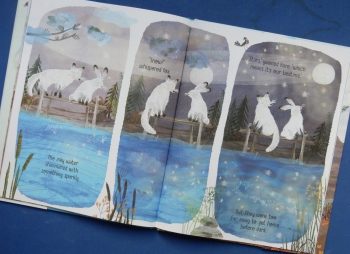
Bramble the fox decides to go hunting fireflies one silvery moonlit night, despite not knowing where the tiny insects like to hide.
Having been disturbed from her slumbers hedgehog Hazel, decides to accompany Bramble and they follow all-knowing Twig the owl’s advice to search near the lake.

En route Hazel is a little bit spooked by the shadows but Bramble urges her to hurry. “Because foxes don’t get scared … do they?”
Well maybe they do sometimes …

A bit of stomping and growling on account of the “VERY RUDE FOX!’ ensues;


then Bramble decides to go back and report to Twig.
Twig suggests they all return to the lake and try to discover what might have upset the unfriendly fox.

Back they go, but without the moonlight glowing over the pond there is nothing to see at first, which saddens Bramble who’d hoped to make amends.

But then out comes the moon from behind the clouds revealing something wonderful in the water …

And yes they do eventually see those fireflies too. It’s a wonderful night, after all.

This all goes to show that the face we put out in the world, is reflected back; in other words – to borrow the lines from Larry Shay et al. “When you’re smiling / The whole world smiles with you”.

With absolutely gorgeous illustrations and appealing characters, this book has an important message; it’s one to share and talk about with young listeners.

The Rug Bear
Emma Rattray, illustrated by Michael Terry
Matador Children’s

Emma Rattray’s rhyming story tells what happens when a bear, playing hide and seek with Lion and Fox, finds a suitable hiding place and promptly lies down falling deeply asleep.

Along comes a weary mouse. She’s most happy to find a ‘brown furry rug’ just when she’s in need of a pace to rest. So too is Hare with his heavy load;

and Squirrel on his branch is pleased to find he has a soft landing spot exactly where he intends to jump. The ‘’rug’ also tempts lonely ladybug; she deems it ‘extremely snug’.

Suddenly Bee buzzes by following a honey smell and the noise awakens Bear from his slumbers. He jiggles and wiggles, yawns and gives an enormous stretch and stands …

cascading the seated creatures to the ground.

Imagine their feelings when they discover the true nature of their rug. Fortunately, all ends happily – thanks to hospitality in the shape of cups of tea. – sweetened with honey perhaps …

Debut picture book author, Emma Rattray’s warm-hearted tale of inclusion and friendship makes a highly enjoyable read aloud for home or foundation stage setting: youngsters will love being in the know about the ‘rug’ and enjoy joining in the repeat parts of the narrative. Equally, they’ll love Michael Terry’s humorous, splendidly expressive scenes of the unfolding rug episode.

We Planted a Pumpkin

We Planted a Pumpkin
Rob Ramsden
Scallywag Press

Rob Ramsden’s boy and girl characters from We Found a Seed are now a little more savvy about what happens when a seed is planted but even so they’re a tad impatient about the pumpkin seed they plant, hoping it will bear fruit by Halloween.

Young readers and listeners share with them the gourd’s entire growing process as first roots, and then leaves, start to sprout.

Come summer the flowers bloom and are visited by bees, butterflies and other insects and as the weeks pass, the flowers die –

all except one at the base of which they find a small green bump – not yet a pumpkin but on its way to so being.

Excitement mounts along with the pumpkin’s growth, as it absorbs the rain and soaks up the sun.

Then little by little, the ripening happens; the pumpkin swells and turns orange until finally, it’s harvest time.

That’s not quite the end of the story though, for there’s the hollowing out and face carving to do – and then hurrah! It’s Halloween …

Like Rob’s previous titles, this beautifully illustrated book is pitch perfect for little ones. They’ll love spotting all the minibeasts on every spread.

I have no doubt that like the characters in the story, youngsters will be motivated to engage with nature, try planting some pumpkin seeds and become excited as they follow their development.

Just One of Those Days

Just One of Those Days
Jill Murphy
Macmillan Children’s Books

Four decades on from their first picture book appearance in the now classic Peace at Last, the adorable Mr and Mrs Bear and Baby Bear return for a third story. It begins with a late awakening Mr and Mrs Bear leaping out of bed and preparing for work, leaving Baby Bear to his dinosaur dream.

Once awake though, the little one has to get ready for nursery, a particularly protracted process on this occasion and then it’s raining, all of which means that Baby arrives late at Nursery. It’s no surprise when he’s reluctant to go in but a story does the trick and off comes his coat.

Then there are problems over a dinosaur toy but Baby Bear isn’t the only member of his family whose day doesn’t go well.

Mrs Bear sits on her glasses; Mr Bear spills coffee all over some important papers – and that’s only the morning’s mishaps.

Afternoon nursery continues to be a trial

and by the end of the session it’s a very sleepy Baby Bear that greets his Mum before they walk home through the rain.

Back indoors, the two get themselves togged out in their PJs just in time for Mr Bear’s return. Not only is he carrying a large pizza box but he also has a carrier bag containing a special surprise for Baby Bear.

Then it’s time to share that delicious pizza and exchange a few comments about their respective days, which Mr Bear aptly sums up with the title line.

As wonderfully warm as ever, this is another tour de force for Jill Murphy; a celebration of a loving family and a story that parents, carers and little ones will immediately relate to.

A must have for family bookshelves and early years collections.

Welcome to Ballet School / Pop Art

Welcome to Ballet School
Ashley Bouder and Julia Bereciartu
Frances Lincoln Children’s Books

In this book, we follow a diverse group of beginners from their first day at ballet school where they excitedly don their colourful dance attire and ballet shoes before warming up.

They then learn the five basic positions for arms and feet ready to approach the barre.

With the basic steps mastered and key techniques acquired, the children are introduced to a special guest who helps them use their learning to tell a story (Sleeping Beauty) with costumes

and a surprise finale.

A firm believer that ballet is for everyone, the author, Ashley Bouder is a principal ballerina and in addition to the concise instructions in the lessons, she’s added a useful glossary of the terms used at the back of the book. But would a teacher, however welcoming s/he wanted to be, really greet children such as those entering the class, as “ little ones”?

Julia Bereciartu’s illustrations are beautifully done and will be a great help to new learners as they zoom in on the five positions and show details of the leg movements in the steps.

I especially like the assertion that ballet is ‘an art form but requires an athlete to perform the steps’ said as the children pause to look at the final gallery of great dancers from various parts of the world.

A book for aspiring dancers and those experiencing their first classes; could that be your child?

Pop Art
Emilie Dufresne
BookLife Publishing

Courtesy of art specialist Chloe, an employee of the gallery, readers are given a preview of a Pop Art Exhibition to be held in her place of work.

Before that though comes an explanation of what Pop Art actually is, when it became popular and why.

We meet several artists – Robert Rauschenberg, Andy Warhol, Roy Lichenstein and Yayoi Kusama –

and as well as an introduction to their particular techniques, there are activity spreads.

These give instructions on, in turn, trying your hand at collage, creating a comic strip and captions; painting a portrait pop art style and painting a pumpkin after the fashion of Yayoi Kusama.

The book concludes with a quiz, encouragement to visit a gallery and a glossary.

Pop Art is a style less frequently explored with primary children; this title in the In My Gallery series provides a useful starting point for home or school.

Migrants

Migrants
Issa Watanabe
Gecko Press

Just when we’re hearing of more and more migrants attempting to reach our shores in unsafe boats, arrived this timely book.

With its striking images it snares the attention right from the start as we’re shown the journey of a disparate group of migrants who plod through a dark forest with just a few belongings in bundles.
Behind them stalks the grim reaper accompanied by a huge blue ibis.

En route to the next stage of their journey, the travellers stop to rest and share food

before moving on towards the coast where a boat is waiting.

Everyone crowds on board with Death flying above on the ibis.

But the vessel is no match for the powerful waves that destroy it long before they reach land leaving those that are able, to swim to the shore.

There, they realise that one of their number has died and having gathered around to bid a final farewell,

on they trudge, still pursued by death with more falling by the wayside as their arduous, grief stricken journey continues.

Finally the depleted group arrives at a place where tree life blossoms and maybe, … a little hope.

Issa Watanabe has created without a single word, one of the most harrowing portrayals of migration I’ve seen in a book.

With her characters standing out starkly against the constant black backdrop, each illustration captures the determination and dignified demeanour of the travellers; yet, she leaves space for readers to do some of the interpretation themselves.

Truly a visual tour-de force, albeit one that leaves us feeling raw and tearful.

Flights of Fancy: How to Drive a Roman Chariot / The Girl and the Dinosaur

How to Drive a Roman Chariot
Caryl Hart and Ed Eaves
Simon & Schuster Children’s

This tenth Albie adventure that celebrates young children and their imagination, begins as he’s out with his mum feeding some horses when the rain starts.

Taking shelter in a barn, Albie comes upon a girl named Julia with her problematic knitting. The next thing he knows is that he is whisked back in time to Ancient Rome and he and Julia are chasing after a runaway chariot.

Having managed to leap aboard as the horses gallop straight for the crowded market, a fearless Julia grabs hold of the reins and steers the chariot clear.
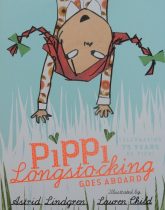
That however isn’t the only thing she wants to do: young Julia is determined to prove to everyone who says they can’t, that girls CAN drive chariots. Can they win races too, I wonder?

Whoever said ancient history is boring?

The Girl and the Dinosaur
Hollie Hughes and Sarah Massini
Bloomsbury Children’s Books

Just imagine if you had a dinosaur: that is what happens to the little girl Marianne we see digging on the beach of a seaside town on the first spread of this book. Watched by the fisherfolk concerned about her lack of friends, Marianne methodically digs up and assembles (Mary Anning style) a complete skeleton that she names Bony.

Back in bed that night she wishes life into her ‘stony bones’ and in a sky aglow with dreams, awakens a deeply slumbering dinosaur and takes off on its back into a beautiful world of wonder and magic.

The two go first to the sea and then after a dip, visit an enchanted forest alive with fairies and unicorns.

They climb to the top of a mountain, then taking a ‘mighty leap of faith’ soar up and away towards a magical island among the clouds to a very special party for children and their dream world creatures.

However eventually slumbers call, the party must end; and reveries over, it’s time to return to those empty beds.

Thereafter the story comes full circle and we’re back on the beach, only now Marianne is not alone and the fisherfolk are no longer concerned, for the single girl has been joined by lots of other children each one digging for their very own dinosaur.

Hold fast to dreams as you share Hollie Hughes’ lyrical rhyming story and Sarah Massini’s wonderfully whimsical, atmospheric illustrations of the real and dream worlds.

A great snuggle up at bedtime tale that will linger long in the mind and perhaps fuel the dreams of your little ones as, lulled by the soporific nature of the narrative, they too head off to slumberland.

It’s Only One!

It’s Only One!
Tracey Corderoy and Tony Neal
Little Tiger

This is a cautionary tale about what happens when people’s actions are thoughtless.

It’s set in Sunnyville, a fun, friendly and generally lovely place – until kind-hearted Mouse offers Rhino a toffee. Rhino tosses the wrapper away with the titular comment, but so do a host of other town residents, with one item landing hard on Tortoise’s head and leaving Giraffe outraged at the ever-growing rubbish heap.

To cheer himself up Giraffe picks a flower from the park with the same “What” It’s only one’ comment ,which of course it wasn’t.

Now it’s Penguin’s turn to feel anger, so to cheer himself up at the loss of all the flowers he turns to music – only one song of course but …

Can anyone or anything manage to curtail this catastrophic concatenation that’s caused the entire population of Sunnyville to become grumpy?

Perhaps Mouse has the perfect antidote – or at least the makings of one …

We all know only too well the terrible impact dropping rubbish has on the environment, wherever we live. And I’m sure we all want to be good neighbours – this is something that’s become all the more evident since the start of the pandemic – but it’s all too easy to slip into thoughtless actions such as tossing aside that odd car park ticket or receipt.

There are reminders from author, Tracey and illustrator, Tony at the end of their story, of the importance of considering how whatever we do might be impacting on others and their happiness. However, it’s the cast of characters (I love their zany portrayal in Tony’s expressive spreads) from this smashing and timely book that have the last word.

Share, ponder, discuss and most important, act upon this – it’s only one but think of its potential payoff.

I Really Really Need A Wee

I Really Really Need a Wee
Karl Newson and Duncan Beedie
Little Tiger

In Karl and Duncan’s story it’s a little bushbaby who suddenly gets the wiggles and the jiggles, insisting ‘I really, really, really,  REALLY NEED A WEE!’

Yes, we’ve all been there with little ones, when away from home and far from the nearest loo, coming out with the title line. It most certainly resonated with me with regard to several recent outings.

The little narrator’s efforts to distract itself with thoughts of other things only serve to make matters worse …

and its attempts to find a toilet are, shall we say, pretty disastrous.

Finally though, the object of the bushbaby’s desire is in sight, but almost inevitably there’s a long queue – isn’t it always the way?

Then whoopee! The little room is vacant at last – phew! Such relief.

I suspect you can guess how this corking story ends … and it’s wee-ally wee-ally funny. But then with its combination of Karl’s telling and Duncan’s hilarious illustrations one expects no less. I absolutely love the sets of bespoke loos that sandwich the story proper.

I envisage classrooms and nurseries full of giggling infants and staff almost wetting themselves when this is shared, and families with youngsters will absolutely burst themselves laughing in recognition.

Scared of the Dark? It’s Really Scared of You

Scared of the Dark? It’s Really Scared of You
Peter Vegas and Benjamin Chaud
Chronicle Books

The relatively common childhood fear of the dark is given a new and fun twist in this picture book wherein the dark is personified and presented as an entity that is actually afraid of … You!

It spends its daylight hours hiding away in your underwear drawer, only emerging into the outside after sundown.

Inevitably this makes its life far from perfect. Friendships are well nigh impossible, as is tree climbing and as for a decent haircut – forget it. No light equals extremely messy hair.

I’m pretty sure most young readers would be happy to share its favourite foods – black pudding, blackberries, liquorice (the black variety), dark chocolate and candle-less Black Forest gateau when its birthday comes around. (Think of the fun to be had from creating an entire menu for the dark.)

There are plenty of positive things about dark: its refusal to be inside until lights off and TV off time; it stays up the entire night but is unable to do anything and it seldom features in a child’s drawing.

But don’t think that dark is without its devotees: numbered among them are bats (they fly in it at night)

and the silent stars.

That in a nutshell is that: so youngsters who have night time frights are safe to greet the dark with a friendly “Hi!’ so long as the light’s off of course, or it will scuttle away to safety.

Definitely worth trying as a reassuring bedtime read if you have a little one averse to the dark; and even if you don’t Benjamin Chaud’s chuckle-inducing illustrations make this a book to share for the sheer fun of it.

Taking Time

Taking Time
Jo Loring-Fisher
Lantana Publishing

This is simply exquisite. In eleven different parts of the world, children savour the moment: on each double spread there is a gorgeous, mixed media scene showing a young boy or girl in an everyday setting relishing the beauty of the surroundings.

A little girl somewhere in India pauses to listen to the song of a bird;

a boy collects pink blossoms as they fall from a tree: ‘ Taking time to listen to / a bird’s song on the breeze. // Taking time to gather up the blossom dancing free.’ (I love Jo’s use of rhyming couplets on consecutive spreads here and throughout the book).

Far away in Alaska a child snuggles in the soft fur of a husky dog; indoors another child feels a soft cat, ‘taking time to feel the beat’ of its ‘rhythmic purr’.

A spider spins its web watched in awe by a little girl in Nepal, while in the Egyptian desert, clutched by a loving adult, a small child contemplates their journey.

The immensity of the evening sky, a passing flock of colourful birds,

the kind, reflecting eyes of a grandparent, soft snowflakes as they float gently down, the imagined sounds of the sea echoing in a shell – all these too are cherished moments for those who take time for awareness of the here and now.

On the final spread all the children come together in a verdant green field to share their wonderings as they play harmoniously with their special keepsakes: ‘Taking time to cherish you, / and also cherish me.’

Both sets of endpapers show details from the illustrations, the front ones annotating a world map marking the children’s homelands – Alaska, Ecuador, the U.K., Norway, Russia, Egypt, Tanzania, India, Nepal, China, and Japan;  the back ones depicting just the keepsakes, cleverly creating a matching game for readers to play.

If you have, or work with, young children, I urge you to share Jo’s beautiful book, showing similar slow mindfulness to that demonstrated by her characters in Taking Time.

I’ll Believe You When …

I’ll Believe You When …
Susan Schubert and Raquel Bonita
Lantana Publishing

Subtitled ‘Unbelievable idioms from around the world’ this is such a clever and fun book that begins on the title page with a child asking “Do you see the dragon?”

What follows is the response –, “ I’ll believe you … “ “… when pigs fly!” and it then goes on to show that nine other countries each has its own unique version of the idiom.

There are frogs growing hair from Spain, chickens with teeth in Nigeria,

herons turning black in the Philippines, summer snow in Germany.

The Netherlands offer cows dancing on ice and India, ‘when crows fly upside down!’

It’s impossible to choose a favourite but I wouldn’t mind betting that you or someone you share this book with will adopt some of these. And imagine what fun you might have if you challenge a class of six or seven year olds to come up with their own ideas and illustrate them.

It’s a terrific way to introduce the notion of idioms and the idea that they’ve been passed on from ages back as well as across the globe. There’s an explanation at the end of the book as well as a world map showing where each expression comes from and the language it’s spoken in.

Raquel Bonita’s illustrations are absolutely super: inclusive and funny at the same time.

Wonderful nonsense yes, but equally the classroom potential is huge, especially if you involve families. Emmanuelle (7) contributed “I’ll believe you when ponies grow scales” and her mum from Hungary told me that there they say, “I will believe you when it’s snowing red snowflakes.”

Oi Aardvark!

Oi Aardvark!
Kes Gray and Jim Field
Hodder Children’s Books

Frog seems to be mining a seemingly bottomless – or maybe it should be bottomful – pit in Kes and Jim’s new Oi offering.

At the outset he throws out an invitation to the titular animal to participate in his new book that’s to be entitled ‘My ALL-NEW ALPHABETTY BOTTY BOOK. Dog is all agog; not so the cat who is, as usual, a sourpuss and ready to pour cold water over the enterprise even before it gets underway.

I have to hand it to Frog with his first chair substitute though, it’s pure genius: “Aardvarks will sit on cardsharks!” Nevertheless a certain feline is ready with a bit of negativity: “What’s a cardshark?” it demands. “It’s a shark who’s really good at playing snap!” comes Frog’s rapid response. That should shut Cat up, but let’s see.

We get through B and C without any interference, and only a minor bit of banter from Cat comes to herald in D. But then Dog’s tongue-twisting mix-up of a comment fuels another catty utterance. Eventually Frog announces his D and on we go safely (actually pretty precariously) through E and F.

For G, Frog has two clever inclusions – “giraffes can sit on baths and Gazelles can sit on bells!”

With horses comfortably seated and iguanas less so, clever claws Cat cheekily interjects again. (as if Frog doesn’t know his alphabetical order – well really!).

Anyway, or rather, Frog’s way, J. is duly dealt with and then as we’ve already been told, comes K. K is splendidly stinky …

Looks like the frog is the only one amused about this botty placement.

Off we go, with the dog heaping praise on our book compiler and guess who being its usual party pooping scorn pourer. Let’s skip to P and be pretty sure there’s a treat in store – ta da! Four animals happily installed on their bum bearers; but then comes another treat in the form of a double fold-out taking us through – with an inevitable purring pouring of cold water from the cat, to X.

Yet again Frog emerges triumphant, even giving himself a round of applause before zipping off through Y to the grand finale and completion of his book.

Or maybe not quite: we’ll leave it to the threesome to get to the bottom of their zany dispute.

So far beyond brilliant that it will never find the way back is this combination of Kes’ carefully and creatively concocted, rhyming, weaving of wordplay and Jim’s superbly silly seating solutions shown in his side-splitting visuals.

I’m hoping against hope that Frog doesn’t decide to rest on his laurels after this, his latest tour de force. I can’t wait to share it with anyone I can get to sit on their selected sit-upon.

The Littlest Yak

The Littlest Yak
Lu Fraser and Kate Hindley
Simon & Schuster Children’s Books

Despite her prowess at clip-clopping up slippery cliffs and her wonderfully curly, whirly woolly back, little Gertie yak is unhappy on account of her lack of “bigness’. She longs to grow up great and tall, when she assumes, her horns and hooves will be impressively huge.

Her mum assures her that ‘bigness’ can take a variety of guises but Gertie remains impatient to assume a larger form.

To that end she embarks on a ‘growing-up’ regime: a diet of healthy veggies and vigorous physical exercise as well as mental training, thanks to her extensive library.

None of which have the desired effect.

Then all of a sudden as Gertie is near to despair, there comes a cry for help from the yak herd. The teeniest, weeniest is stranded in a perilously precarious position on a cliff edge.

Now is the time for Gertie to make use of those super-grippy hooves of hers and so she does. Onto her back leaps the teeny weeny yak and down the mountainside they both go, to safety and a congratulatory crowd.

Later, wrapped up warmly under the stars, might just be the time for one little yak to realise that she’s just right as she is.

Debut picture book author, Lu Fraser’s rhyming text flows beautifully, making it a super read aloud; and she has the perfect illustrator in Kate Hindley whose funny details – look out for the bird characters – add gigglesome delight to many of the spreads. Love those bobble hats, blankets, scarves and other items of warm clothing worn by the yaks. Perfect for this heartwarming tale.

The Grumpy Fairies

The Grumpy Fairies
Bethan Stevens
Frances Lincoln Children’s Books

I suspect that most people, youngsters especially, are of the opinion that fairies are cute, kind little things, but that isn’t true of the entire fairy race. The smallest ones especially are grumpy, not just a little bit but grumpy in the extreme. They flatly refuse to do those helpful jobs expected of them by the adults of their kind

as well as being downright rude to the birds that request their assistance. And as for the goblin warning those same birds give them, they don’t even bother listening to it.

The grumpy fairies treat the bees and Mouse in similar fashion, ignoring their words about there being a hungry goblin on the wander looking for lunch; and they’re so busy with their grumps, that they fail to notice …

It’s fortunate that in addition to grumpiness, these particular fairies have cleverness as part of their constitution. Can they succeed in extricating themselves from a very tricky situation, or will they become a ‘sweet and sour’ midday repast for a certain goblin?

This is Bethan Stevens’ debut picture book. It’s full of visual humour; I love her portrayal of those Grumpy Fairies that are similar to grumpy little humans in so many ways, and her hirsute-limbed goblin is terrific fun.

Over and Under the Rainforest

Over and Under the Rainforest
Kate Messner and Christopher Silas Neal
Chronicle Books

This beautiful book immerses readers deep in the South American rainforest in the company of an adult (Tito) and a child narrator as they trek the entire day, from early morning to evening.

They observe with all their senses enjoying the ‘symphony of sounds! Chatters and chirps and a howling roar’ of monkeys, insects and birds in the treetops.

As they continue hiking along the trail we share the sights and sounds of particular animals, ‘Up in the trees’ and ‘Down in the forest’. There are toucans that ‘croak and bicker over breakfast’; a row of bats ‘sleeps away the daylight’;

… ‘A poison dart frog makes his way up a trunk with a tadpole on his back and they find themselves ‘eye to eye with capuchin monkeys as they cross a hanging bridge.

With the afternoon comes the rain, time to snack on dried fruits alongside snacking monkeys. The rain falls more heavily causing a blue morpho butterfly to fold her wings and tuck herself away close to a sleeping mother sloth and her baby.

When evening comes, the rain lets up and the darkness falls all around, there are lots of silent hunting animals such as a parrot snake and an eyelash palm pit viper, and some new sounds too, as up in the trees howler monkeys “Rrrowf! … Rroooooaaaahhhhhh!” in response to Tito’s roar.

Night is the time for jaguars to be on the prowl so perhaps the sudden scary snap is a sign one’s on the move.
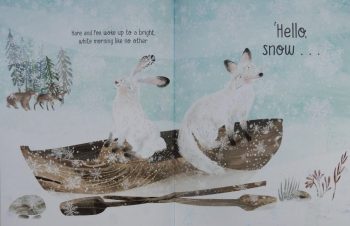
It’s also the time for the two trekkers to cross that last bridge and, with thoughts of Abuelita’s supper awaiting, to head for home to the sounds of a choir of insects and raindrops.

Kate Messner’s poetic text really does capture the atmosphere of the rainforest and the changes that happen over a day, while Christopher Silas Neal’s mixed media, matt illustrations, with their alternating views of ground level, the sky and the treetops showing the rich variety of the flora and fauna, imbue this particular ecosystem with a magic of its own.

If you want to discover more about the fauna, Kate has included notes on twenty creatures at the back of the book, along with some paragraphs about her own Costa Rican rainforest forays.