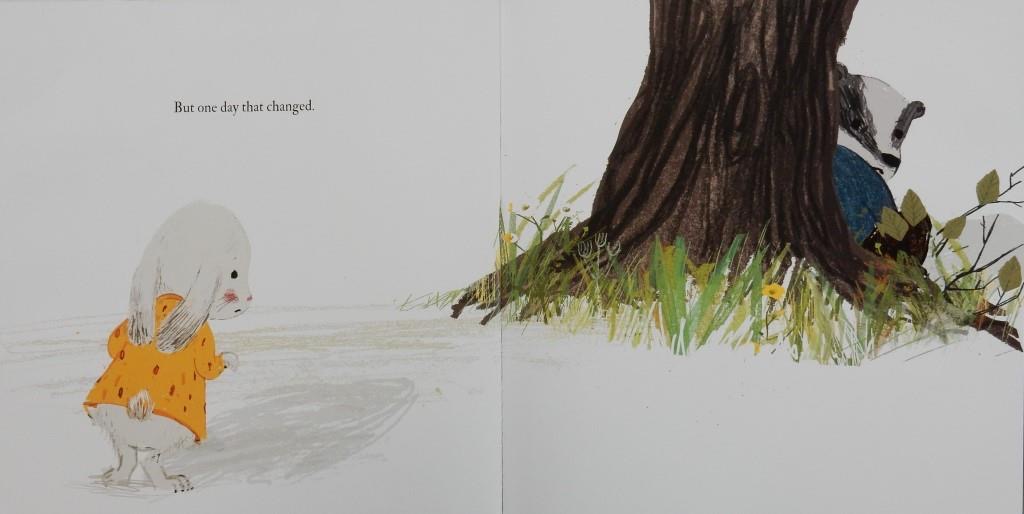
Albert and the Wind

Albert and the Wind
Ian Brown and Eoin Clarke
Graffeg

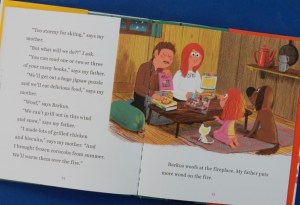
This is a playful story about Albert, a tortoise who struggles to get his message of thanks across to the various creatures that come to his aid, rescuing items of his meal that are blown away by the swooshing wind.

First to help is a bee that proffers the leaf he’s just bumped into on the wing, Albert responds thus, “To make sure it does not blow away again, I am going to sit on it.” Before he can add his words of thanks, the bee has buzzed off.

Other helpers are in turn, a spider, a snail and a worm,

followed by a whole host of other creatures from all over the garden, some of which bring items that hadn’t been part of Albert’s meal.
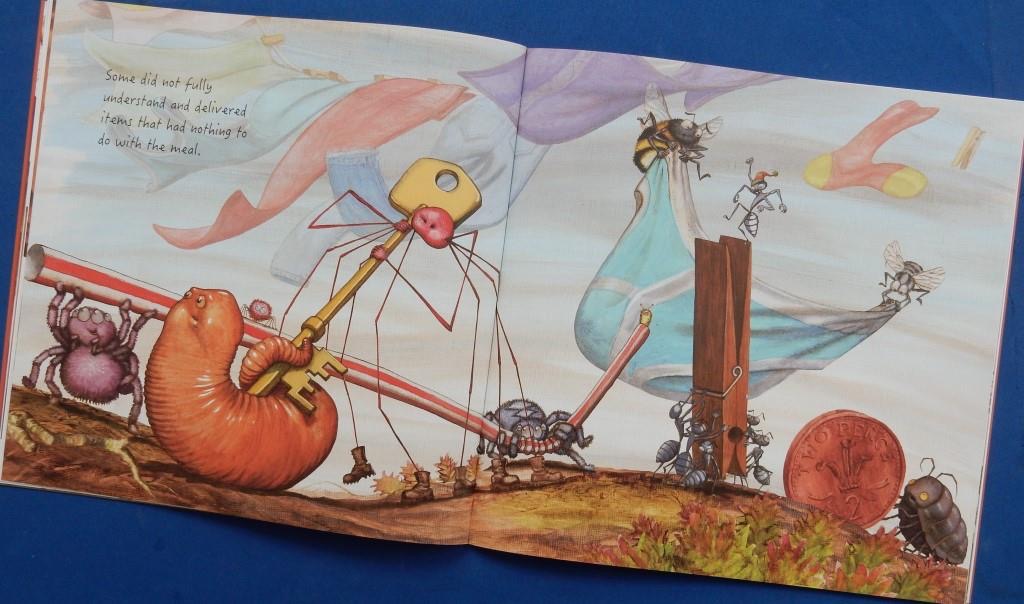
The wind continues to blow and Albert and his food items are reunited, little by little until the whole meal is ready and waiting for eating.

However, Albert is still concerned that he’s not been able to show any of his helpers how grateful he is. Can he find a way to deliver his words of thanks to everyone at the same time? Ingeniously yes, thanks to the last few items left unconsumed …

This amusing tale ends with a blast that will delight young listeners and I suspect, adult sharers. With a factual page about Albert and other tortoises, and Eoin Clarke’s quirkily humorous, larger than life illustrations of the various helper minibeasts, as well as the protagonist, this is a book that readers aloud will enjoy giving voice to as much as listeners will enjoy hearing it.

The Beasts Beneath Our Feet

The Beasts Beneath Our Feet
James Carter and Alisa Kosareva
Little Tiger

‘Beneath our feet / way deep and down / are beasts asleep / in the cold, dark ground … / They’re skeletons now … they’re fossils, bones. / They’re silent, still; / in a prison of stone.’
Poet James Carter then invites us to dig down deep, visit the various layers of the Earth while also being a time traveller able to meet all kinds of exciting creatures on our prehistoric adventure.

First come the trilobites, erstwhile crawlers on the ocean floor. Next come the scary-looking pointy-toothed metoposaurus, a fish-eater somewhat resembling a crocodile. None the less, I wouldn’t fancy a face-to-face encounter. More to my liking is the Meganeuropsis, the biggest ever bug, buzzing around – an early giant dragonfly this.

Next are the dinosaurs be they the herbivores such as Diplodocus; the bones crunchers such as T.Rex and the winged Archaeopteryx that may have been able to take to the air on its feathery appendages.
Moving north to chilly climes of everlasting winter lived herds of wooly mammoths with heir super-thick coats and ginormous tusks.

All these beasties have become extinct, wiped out on account of earthquakes, floods, disease, comets maybe, or even the poisonous lava of volcanoes.

All this information has been unearthed thanks to the work of palaeontologists investigating fossil evidence and now as James reminds us in the final part of his rhyming narrative, we can see some of these fossils in a museum; or perhaps find our own by taking a spade and digging deep.

The last spread is a kind of visual timeline of our prehistoric adventure showing all the creatures mentioned in the text.

The countless young dinosaur lovers will relish this time-travelling foray into Earth’s ancient past with James’ lyrical descriptions that really bring the creatures back to life, and illustrations by Alisa Kosareva, whose magical, dramatic scenes of all those mentioned in the text and more, are superbly imagined.

It’s Mine!

It’s Mine!
Emma Yarlett
Walker Books

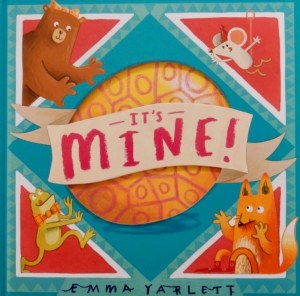
In Emma’s new book, the ‘thing’ referred to, shown atop a hill is a mystery spherical object. Mouse is first to come upon it and deciding it can be his next meal, carts it away in his wheelbarrow claiming, “That fruit … is mighty fine. … That fruit … is mine, all mine!”

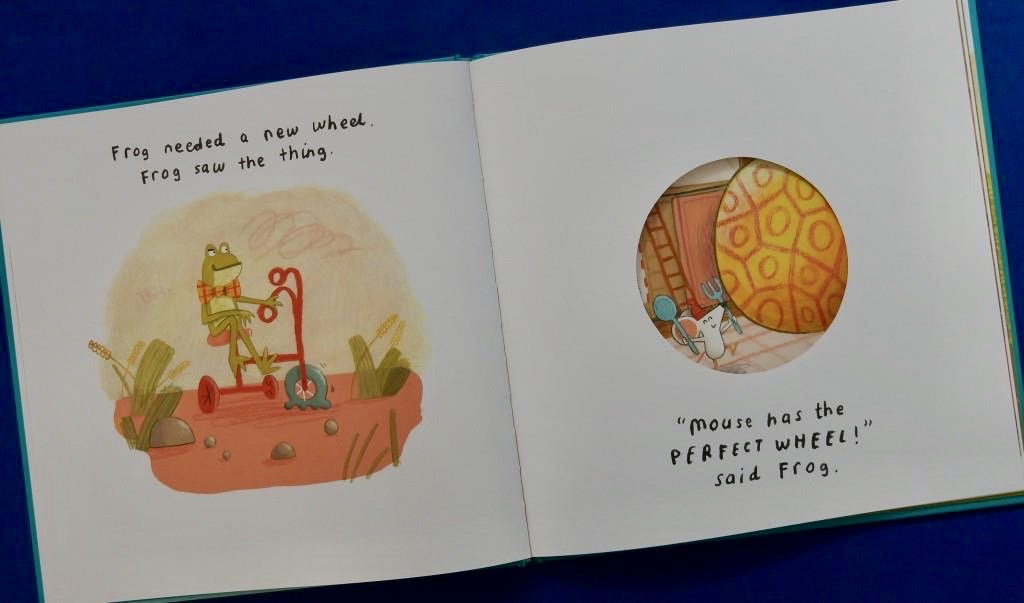
However, Frog, in need of a new wheel for his tricycle, spies the thing,

pays a call on Mouse hoping to procure the object for himself and tells him, ‘That wheel, is mine, all mine!’


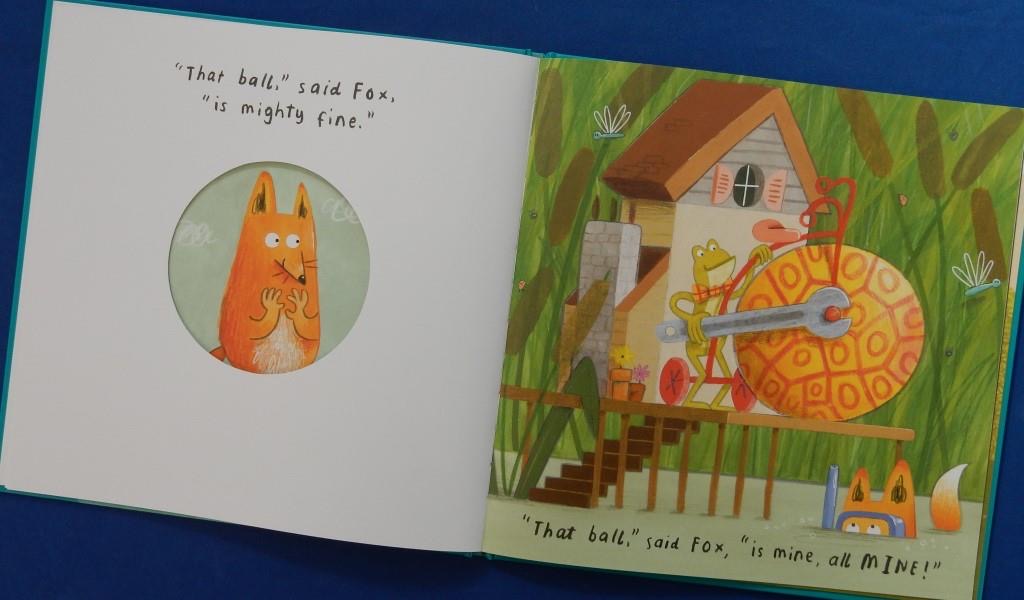
Fox sees it as just the perfect new ball for a game of footie

and popping up near Frog, proceeds to claim ownership.

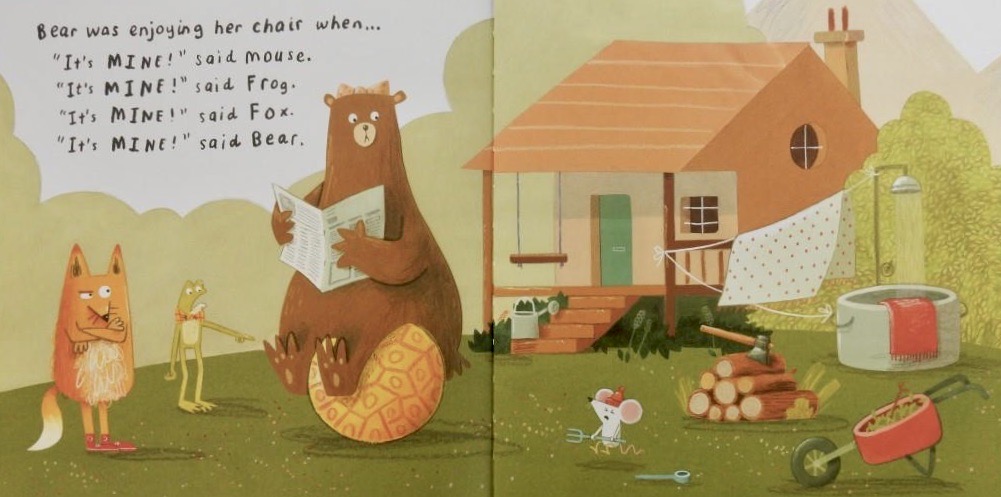
Then there’s Bear in need of a new chair, who decides Fox has the ideal item and says so, taking it off to use as a sit-upon.

So there we have four creatures, each strongly asserting, “It’s MINE!”.

Suddenly the thing gives a wobble, a crack, a crunch and …

Someone else is waiting in the wings to claim ownership but who is it? Well ,that would be to spoil the ending; let’s merely say that Mouse, Frog, Fox and Bear are more than happy to concede.

With its surprise ending, highly effective simple repetitive text, deliciously droll illustrations and die-cut circles ( not the work of Emma’s Nibbles character I hasten to add, they’re too regular for that) on alternate spreads, this is enormous fun to share in a story time session with young children, as well as for beginning readers to try themselves.

Winnie And Wilbur:Winnie’s Best Friend / Barkus:The Most Fun

Favourite characters return in these two books:

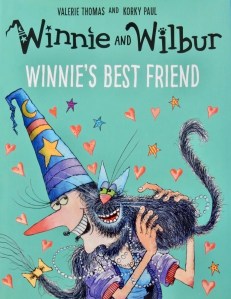
Winnie and Wilbur: Winnie’s Best Friend
Valerie Thomas and Korky Paul
Oxford Children’s Books

After more than thirty years during which witch Winnie ’s original fans have likely introduced her to a new generation, we have a story that takes us right back to the time when she met her constant and faithful black moggy companion, Wilbur.

But even that’s getting a bit ahead of this story that starts with the newly qualified witch living in that black house with which we’re now so familiar, but she’s all alone until that is, she decides to invite her three sisters to come and stay to help. They certainly alleviate her loneliness but it’s not long before sisterly squabbles begin, soon followed by cat fights. Enough is enough for Winnie so off they go but then she’s lonely once again.

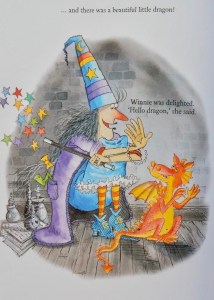
A wave of her wand results in a parrot but that’s a short-lived visitor and her next attempt brings forth a little dragon though obviously with it comes danger of the fiery kind.

Will Winnie ever find an ideal companion to share her home and her life? No prizes for guessing the answer to that one …

Delivered with their characteristic verve and humour, team Thomas and Paul have conjured forth another magical Winnie and Wilbur story that will delight readers young and not so young.

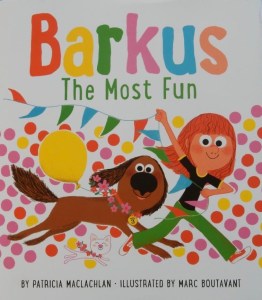
Barkus: The Most Fun
Patricia MacLachlan, illustrated by Marc Boutavant
Chronicle Books

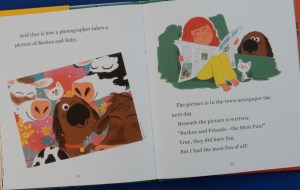
The lively, lovable dog, Barkus, is back in a third sequence of four lively, entertaining episodes, along with his human family – the child narrator, her mum and dad plus little moggy, Baby.

In the first story, the family set off for a camping trip leaving Baby in the safe care of Miss Daley, or so they think. However, on arrival at the camp site it’s revealed that Barkus has been harbouring a secret – a tiny feline one – and to the surprise of the rest of the family, the stowaway appears to enjoy camping just as much as all the others.

The second episode – a springtime one – sees the entire family visiting grandfather Jess on his farm. Barkus seems drawn to the cows and they to him and is especially happy when a baby calf is born to Dora.

Autumn is a special time for Barkus on account of the fun he can have with the fallen leaves; he also steals the show at the annual parade.

The final adventure has a chilly, wintry feel as the family take a trip to their cabin for some skiing but a big storm keeps them snuggled up indoors enjoying some storytelling.

With its mix of humorous colour illustrations and engaging text this is just right for readers just starting to fly solo.

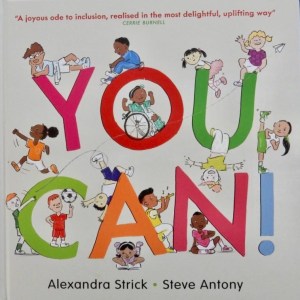
You Can!

You Can!
Alexandra Stick and Steve Antony
Otter-Barry Books

Here’s a book that began with children: those children from diverse backgrounds who responded to Alexandra Strickland’s question what they would say to their younger selves to inspire, reassure and enthuse them about the future. This wonderful book with Steve’s brilliantly inclusive illustrations using fourteen child characters, represents their answers.

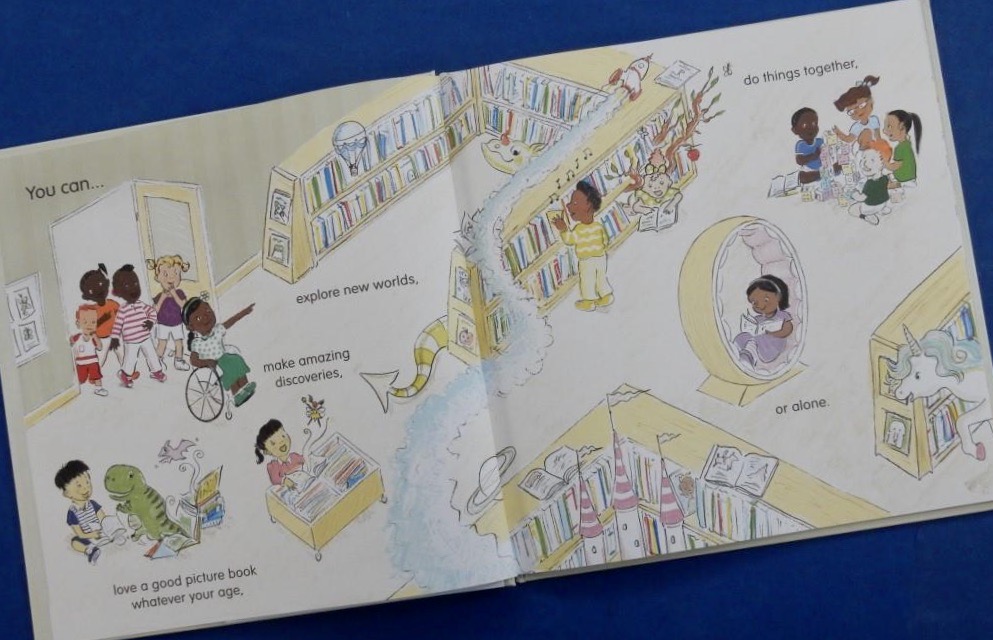
We then follow these characters as they grow from babies (on the front endpapers), to toddlers, to young children, to older children and finally, into young adults (on the back endpapers). The cast of characters truly is diverse, as their wide variety of interests, identities, friendships and futures develop as readers turn the pages.

It’s definitely no holds barred: you can be anything you want, do anything you want (including ‘love a good picture book whatever your age’) hurrah! –

safe in the knowledge that it’s fine to be sad or angry, to talk about your feelings and discover what makes you happy.

Equally, it’s important to have big dreams and pursue them using whatever path it takes, be a leader or a follower, not forgetting to make time for playfulness and silliness along the way.

It’s important to realise that those fears of yesterday will be today’s challenges and tomorrow’s achievements, practice can be fun and learning should be enjoyable.

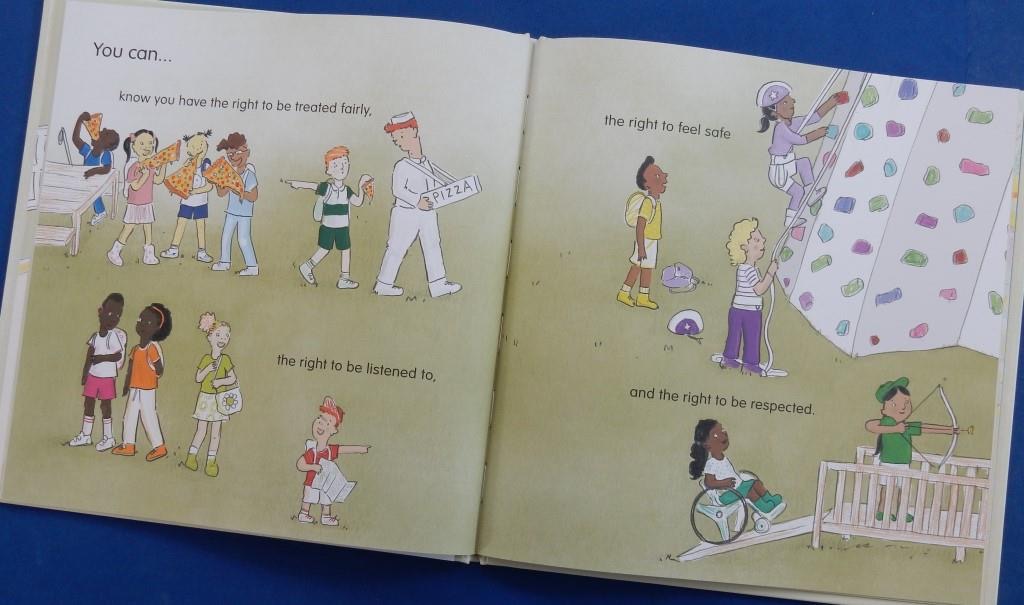
We see that seemingly small individual actions can inspire other people and together all those small somethings can and do make a difference. Equally though everybody has rights.

Not everybody needs to do things in the same way, but all honest ways must be equally valid: doing something differently is doing it nonetheless.

On this journey through life, it’s crucial to know that making mistakes is an integral part of the learning process; it’s important too, that you forgive yourself as well as others, and ask adults for help if you need. Be yourself, for yourself, determined, supportive, an individual who doesn’t allow others to categorise you, is kind and empathetic: self-belief is key probably now more than ever.

Hugely empowering and inspiring, this a book that needs to be in every home and classroom. Children and adults will love the gentle humour and playfulness in Steve’s illustrations: each spread deserves close study.

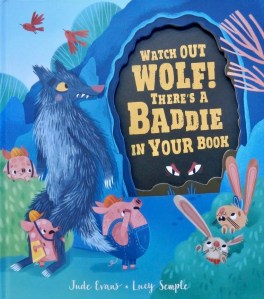
Watch Out Wolf! There’s a Baddie in Your Book

Watch Out Wolf! There’s a Baddie in Your Book
Jude Evans and Lucy Semple
Little Tiger

Who is lurking near the enchanted Wood, with a shadowy shadow, pointy ears, a furry tail and sharp claws? No doubt you’ve guessed correctly, but the rabbits aren’t in the least bothered by that presence; indeed they beg his help informing him, “There’s a beastie in our book.”

The ursine creature scoffs , telling the rabbits that he’s the only beastie in this book. A lot of chattering, shouting, huffing, puffing and stomping ensues resulting in a certain angry animal breaking a book and in so doing getting well and truly stuck. Temporarily only though, thanks to the rabbits forcefully shoving him out, whereupon he stomps off to persecute the three little pigs. You’ll know the threat he issues to them, but all they do is ask for some assistance with house construction.

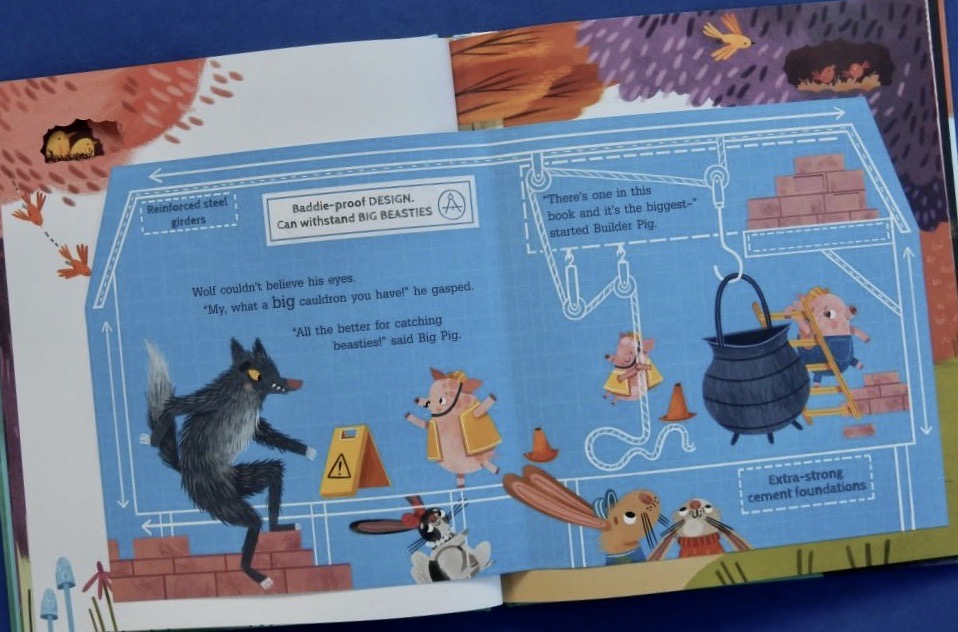
Mr W. is truly amazed at what he sees on the construction site

but continues to maintain that he is the only big beastie around, and definitely the sole beastie in his book.

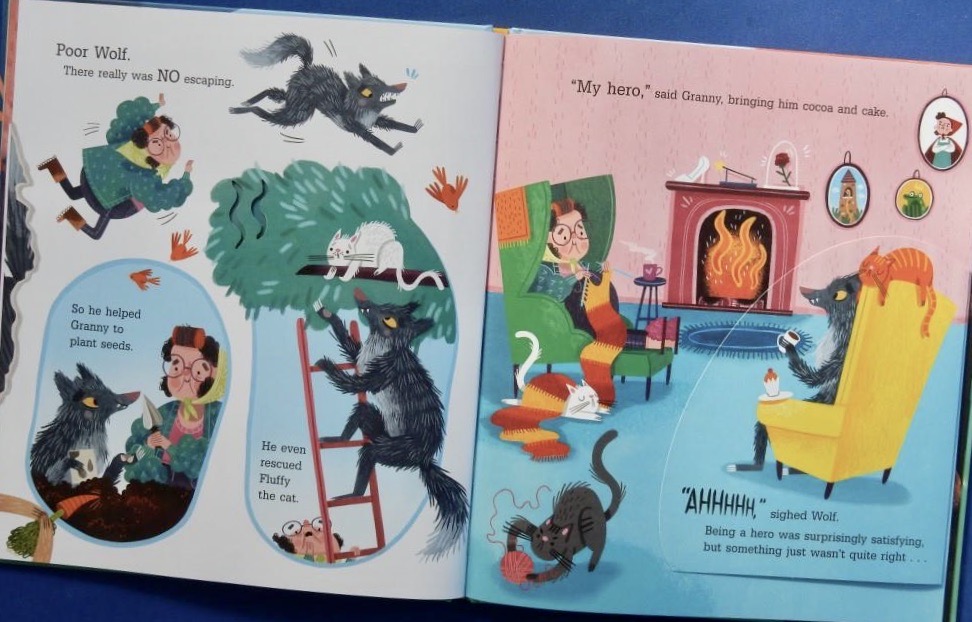
Off he thunders, next stop Granny’s cottage, where she too is unfazed by the visitor but upset by the damage that’s been done to her precious vegetable patch. Determined to procure his help, Granny grabs the creature’s tail and he ends up assisting her with several tasks after which he’s rewarded with some refreshments.

Then a realisation dawns upon our Wolf: he’s definitely no hero, and off he dashes hotly pursued by Granny, the pigs et al muttering about a beastie to himself as he stomps over a rickety bridge and takes a tumble riverwards. OOPS! The troll is sniffing the air as he too talks of – well you and our lupine friend know what. Off storms the latter to eject him from his book and soon finds himself entering a rather spooky cave.

Now what on earth, and in storybook land, could be inside?

With a scattering of peep-holes, flaps and fold-outs, Lucy Semple’s fun-filled, dramatic scenes accompany Jude Evans’ equally dramatic telling that’s full of humour, fairytale frolics and has a wonderful final twist.

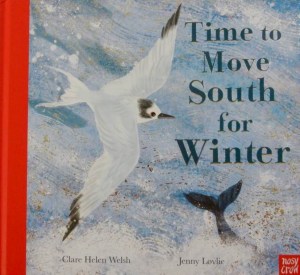
Time to Move South for Winter

Time to Move South for Winter
Clare Helen Welsh and Jenny Lovlie
Nosy Crow

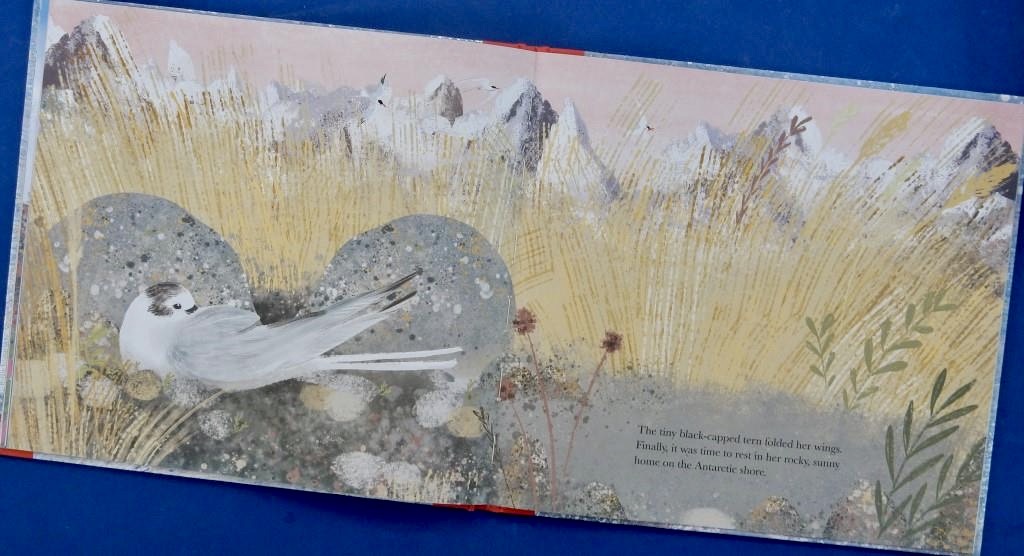
This gorgeously illustrated book follows the migratory journey of a tiny Arctic tern from the chilly northern climes to a warmer location in the south where it will spend the winter.

During this flight we also encounter several other creatures also moving south for winter. The first are whales, then as the tern flies over land it follows the tracks of caribou also seeking a warmer place. Also taking flight is a flock of geese riding the wind on their giant wings, wanting to find a summery lake location.

Next, as it flies over the coast the tern sees a turtle looking for jellyfish and summer in the ocean

and moving upwards once more the tiny tern finds herself surrounded by Monarch butterflies on the move to their mountain forest destination in Mexico. After a rest the tern takes flight eventually sighting a colony of fellow black cap terns that have also moved south for the winter and are now nesting. Time at last for our tiny winged traveller to rest in the sun on the shore of the Antarctic for the next few months before returning to start her own family back in the north.

With additional factual information at the end of the lyrical main text, map and Jenny Lovlie’s gorgeous textured, detailed illustrations, this is a lovely narrative nonfiction book to share with young listeners at home or school.

Ratty’s Big Adventure

Ratty’s Big Adventure
Lara Hawthorne
Big Picture Press

In the rainforests of Papua New Guinea is Mount Bosavi, the collapsed cone of a volcano that hasn’t erupted for more than 200, 000 years. This is the setting for Lara Hawthorne’s book which is a flawless fusion of fact and fiction and the home of Ratty, a giant woolly rat and one of the biggest creatures residing in the volcano.

Ratty lives a peaceful slow-paced life until one day while climbing up to the top of a tree to procure a juicy-looking fruit he sees before him the most awesome sight he’s ever set eyes on: the world beyond his crater where there surely must be more delectable fruits, sweeter-singing birds and larger, brighter, better dancing insects.

Eschewing the invitation of his friends to join their games Ratty hurries off in search of more interesting playmates. Following the stream to the wall of the crater, he finds himself swept into a dark cave and eventually out of the crater, leaving the warning echoes of his friends behind. Finding himself in a fast flowing river, Ratty clings to a piece of floating bark as he passes fruit trees, birds and insects not very different from those in the crater.

Eventually Ratty finds himself face to face with the biggest creature he’s ever seen: a huge, sharp-toothed, almost overly friendly animal that invites the traveller to join her for dinner.

At this point Ratty realises that after all, it’s a case of east, west, home’s best; assuredly there’s no place quite like his own. Back he goes but what will he say to his friends?

This gorgeously illustrated story was inspired by recent scientific breakthroughs at Mount Bosavi, in which over 40 new species of flora and fauna including amazing butterflies and exotic birds, were identified. many of which are included in Lara’s superbly detailed scenes.

Additional factual spreads at the end give details of the Bosavi woolly rat, a pictorial map of the researchers’ journey and ‘did you spot … ? showing more than ten of Mount Bosavi’s unique animals.

The richness and diversity of life are something we all should celebrate and this book will encourage young listeners and readers to do just that as they follow Ratty’s journey, which outlines the journey of the team of researchers that found their way into the volcano.

My Mindful A to Zen / Being Healthy / Learning

My Mindful A to Zen
Krina Patel-Sage
Lantana Publishing
As the author/illustrator points out after presenting twenty six haiku ‘for happy little minds’, each of the entries in this book highlights one or more of the ‘five ways to wellbeing’, known to boost mental health and positivity: connecting,

being active, taking notice, keeping on learning and giving.

No matter whether youngsters prefer the great outdoors and all that has to offer,

or to stay indoors getting lost in a good book, or being creative with their favourite materials,

or perhaps spending time in the kitchen cooking a yummy cake (even if it doesn’t quite go to plan), done mindfully, it can be part and parcel of getting the very best out of life.

With its diverse cast of characters bringing to life this alphabet of contented being and doing, Krina Patel-Sage offers youngsters much to think about, talk about and act upon. This teacher/yoga teacher and reviewer heartily endorses this well-being picture book.

Also for fostering children’s wellbeing:

Being Healthy
Learning
Helen Mortimer and Cristina Trapanese
Oxford Children’s Book

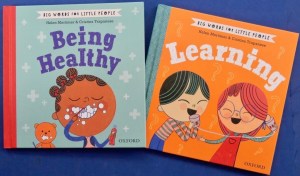
These are two new titles in the Big Words for Little People series that offers a very useful resource to early years teachers and other practitioners as well as parents of young children.

Using age-appropriate language, Helen Mortimer takes little ones through the day doing those activities that should foster their Being Healthy. There’s personal hygiene washing and tooth brushing, eating ‘wholesome’ food and drinking plenty, taking exercise that works their muscles, as well as engaging in mood boosting activities, getting out in the sun whenever possible. There are also spreads on allergies, doing things in your own way, being aware of and avoiding potential dangers, the helpers who might provide treatment when there’s an accident or illness, and finally, very important comes sleep.
Inclusive, engaging and interactive, as is Learning. This is a huge topic that begins at birth and continues throughout life but to get the most from it, that learning needs to excite the learners and that’s what this little book aims to do. It encourages questioning, problem solving, taking advantage of technology, developing good concentration, trying hard and taking risks with learning, as well as keeping the mind open to new ideas. Like previous titles, both books have Cristina Trapanese’s lively illustrations, a spread with helpful ideas for adult users and a glossary.

My Green Cookbook / Polly Bee Makes Honey

My Green Cookbook
David Atherton, illustrated by Alice Bowsher
Walker Books

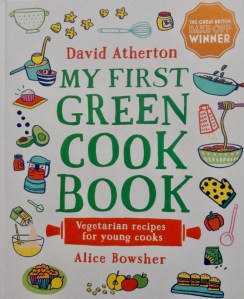
Hot on the heels of his excellent My First Cook Book, Great British Bake Off winner David Atherton offers around forty vegetarian recipes. No matter if you’re looking for a tasty meal, snacks, a sweet treat or an attractive cake (several, even), there’s something here.

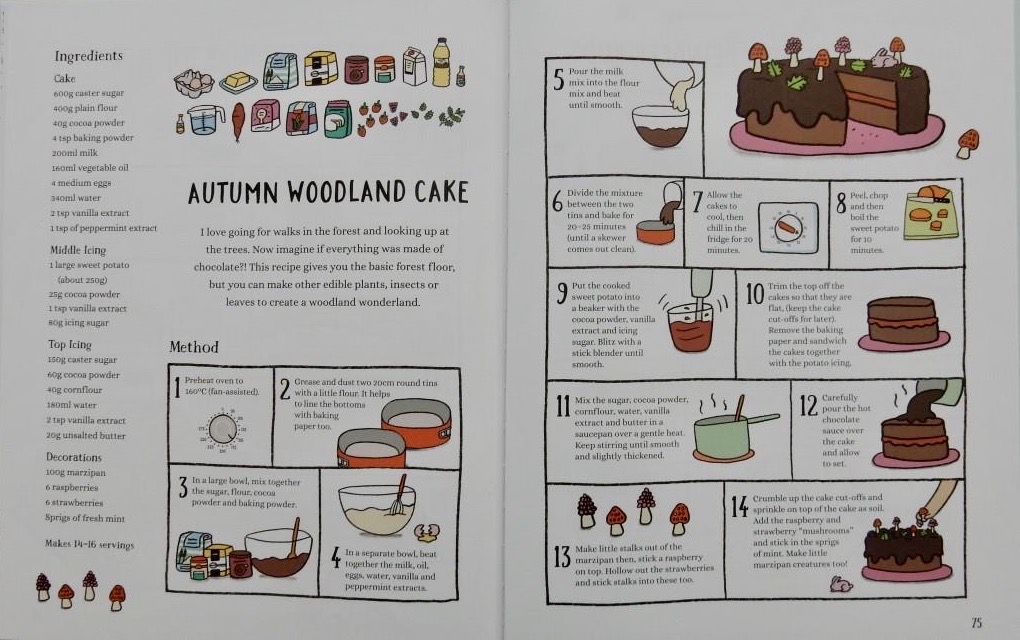
Like the author, I love walking in the forest and looking up at the trees so was immediately drawn to the yummy-looking Autumn Woodland Cake, though as a vegan, I’d want to make one or two slight tweaks to the ingredients list.

The Curry Korma Bowl too caught my eye right away. Indian food is one of my favourite kinds of cuisine. Having been unable to travel to India since fleeing that country at the start of the pandemic I can’t wait to go back but with all the necessary ingredients for this dish already in my cupboards, this is one of the recipes I’ll try first.

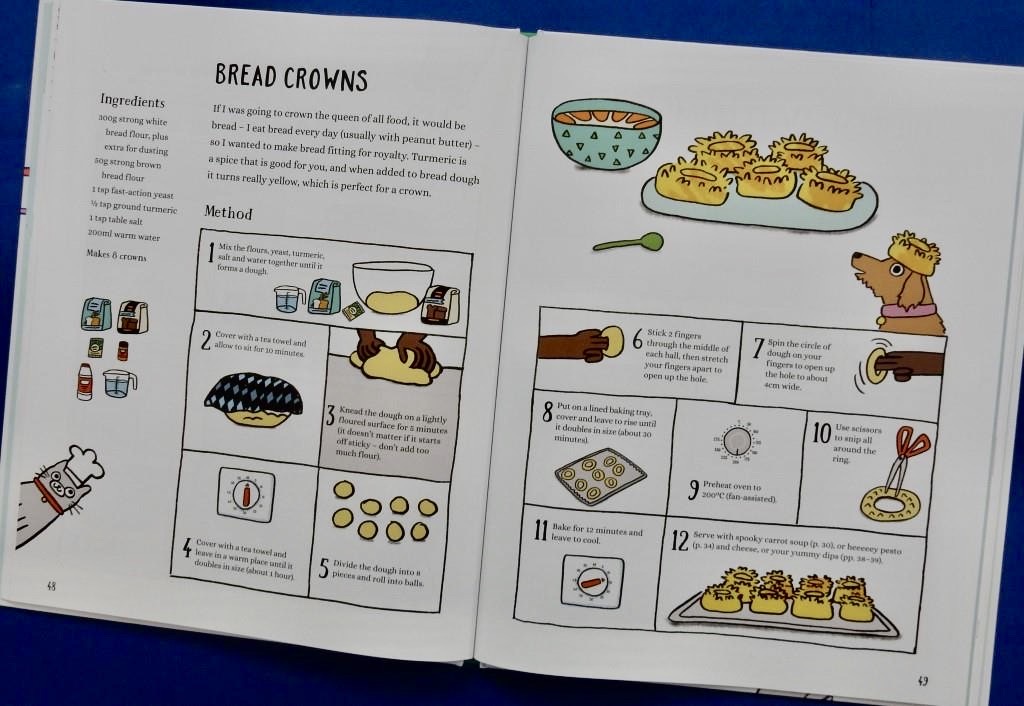
And, having requested a large amount of haldi from an Indian student studying here the last time he returned to the UK, I have lots of turmeric and so next week intend to have a go at making the Bread Crowns – they look really fun and tasty too.

Among the Sweet Treats, I was attracted to the lemon and pear muffins as the young relations who often visit, are fond of muffins of many kinds. We can try making those together. (Maybe we’ll do two batches with me using a vegan egg substitute in one).

David’s enthusiasm shines through in this recipe book wherein he also explains the impact ‘eating green’ can have on health and well-being, and on the environment. With occasional touches of humour, Alice Bowsher’s illustrations add extra allure to the recipes.

Buy to keep and buy to give.

Honey was used in several of David’s recipes, now here’s a book all about that delicious ingredient/food.

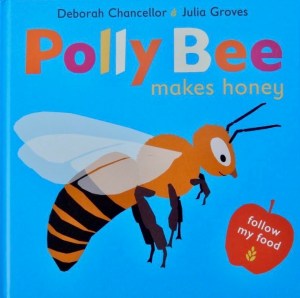
Polly Bee Makes Honey
Deborah Chancellor and Julia Groves
Scallywag Press

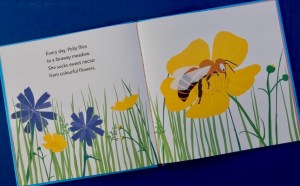
This is the second book in the Follow My Food series. Here, a girl follows worker bee Polly as she (and her ‘sisters’) work hard first collecting pollen and nectar from various flowers in a meadow

and then taking it back to the hive where the nectar is squirted into the honeycomb and some of the pollen acts as food for the baby bees inside the hive.

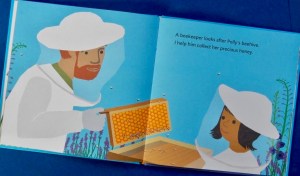
During the narration we also meet the drones (Polly’s brothers), the queen (the egg layer) as well as the beekeeper who cares for the hive and harvests the honey,

helped by the girl narrator who is shown happily and appreciatively tucking into a slice of bread spread with delicious honey.

After the main narrative come a ‘pollen trail’ and a factual spread giving further information about bees.

With Deborah’s straightforward narrative and Julia’s bold, bright illustrations, this is a good starting point for youngsters especially if they’re working on a food (or perhaps even minibeast) theme in a foundation stage classroom.

The Wind May Blow / Someday

Here are two beautiful picture books kindly sent for review by Little Tiger

The Wind May Blow
Sasha Quinton and Thomas Hegbrook

With its cut away pages and tender illustrations this is a beautiful book – both visual and verbal – for adults to share with little ones.

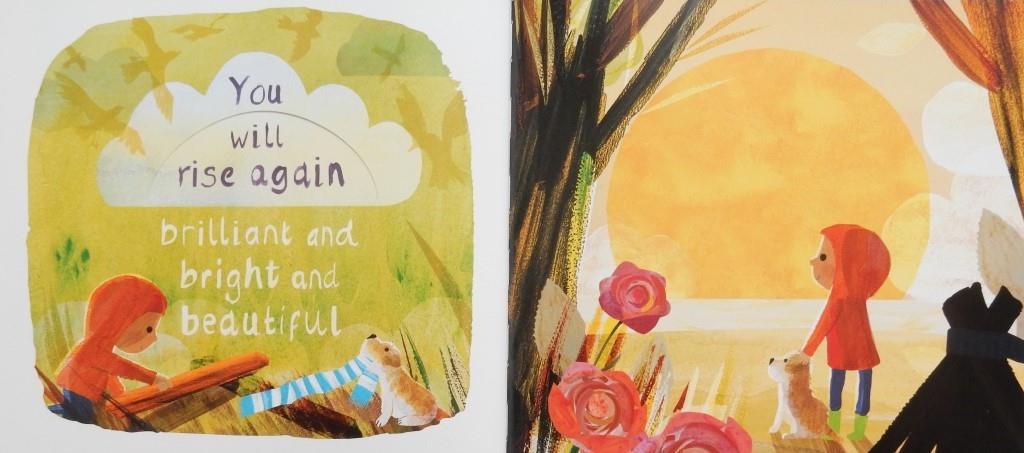
The voice is that of an adult speaking to a young child, “On the day you were born the sun rose brilliant and bright and beautiful,” in a place where “the sun rose and kissed your toes as warm roses bloomed in each cheek.”

Time passes, the child grows to face a life that inevitably isn’t all filled with sun and roses: stormy times are likely to occur. 

What’s required then is to stop, pause and take time to breathe deeply 

in the knowledge that you have the inner strength, life skills and whatever is needed to face challenges, overcome adversity and emerge out of the storm. The moon will be there burning brighter down on you and when the sun rises next morning, so too will you. There’s always the possibility of a new beginning.

So goes the seemingly simple, gently affirming wise message of this cleverly designed book with its die-cuts strategically placed throughout.

Altogether a splendid amalgam of words, pictures and design that is just right for many occasions: adults will know when it’s appropriate to revisit this timely picture book after a first reading.

Someday
Stephanie Stansbie and Frances Ives

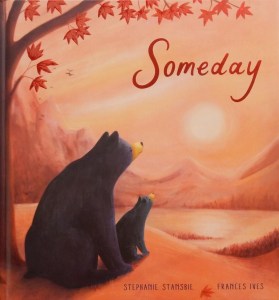
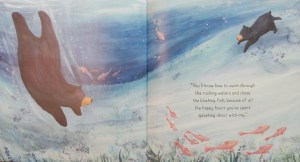
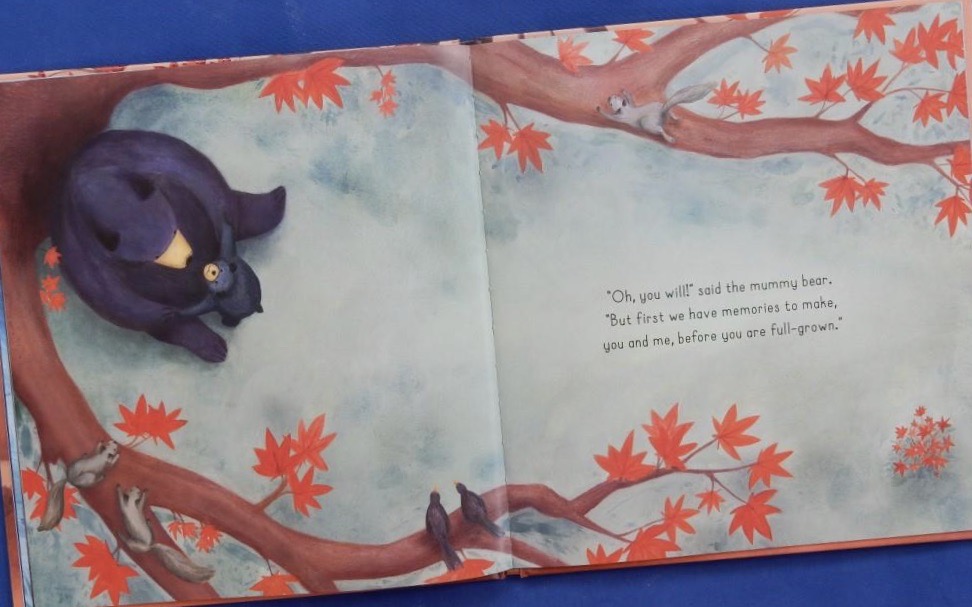
When a little bear cub tells his mother one morning that it wants to be just like her, she likens her little one to a sapling that will soon be a tree. This doesn’t quite satisfy the cub, for that so mummy says, won’t be tomorrow. First they have lots of things to do together – memories to make – of happy hours and days spent frolicking through grassland, jumping over rocks, climbing trees in search of juicy berries, splashing and swimming among fish in the fast-flowing waters.

And all the while growing stronger and learning to cope with things that might at first seem frightening.

Then will come the possibility of meeting a mate and producing a new family. As they sit beneath the branches of a spreading tree, Mummy Bear talks of the cub’s memories acting like the tree’s roots keeping it “strong as you grow and flourish and bloom.” It’s their togetherness that prompts the little cub to express happiness in the here and now, with the promise of many many wonderful tomorrows.

Frances Ives’ illustrations capture the warmth and love between ursine mother and offspring; but as it is with bears, so as this lyrical book implies can it be with human parent and little one: memories to cherish as a child grows up and finds his/her way in the world.

Moose’s Book Bus

Moose’s Book Bus
Inga Moore
Walker Books

With a dearth of storybooks among his friends, Moose who has exhausted his repertoire of new tales to tell his family after supper, sets out to find the town library. he’s fortunate to discover a wealth of exciting books await him and Moose borrows all the librarians’s s suggestions and more.

That same evening, no sooner has he settled down to regale his family with one of the storybooks than Bear brings her cubs along to hear his Little Red Riding Hood rendition.

Word spreads and it’s not long before Moose’s evening story times become exceedingly popular

with his living room rather crowded ‘like being in a sardine tin’. Now what’s a bright creature like Moose to do next …

Ingenious creature that he is, Moose finds a wheeled solution and it’s one that benefits his entire community in more ways than one.

This is a brilliant book, paying homage as it does to the power of story, of books and of libraries (something not every community is fortunate enough to have nowadays). With her somewhat whimsical cast of woodland characters, Inga Moore’s soft-edged, earthy rural scenes with their wealth of detail and gentle humour draw the reader in from the start.

I can’t wait to share this terrific book far and wide; it’s my favourite Inga Moore story so far.

SuperJoe Does Not Do Cuddles

SuperJoe Does Not Do Cuddles
Michael Catchpool and Emma Proctor
Lantana Publishing

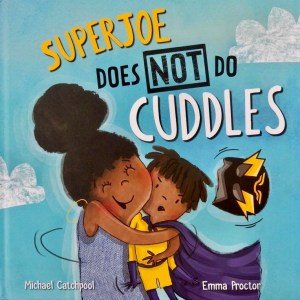
Life as a young superhero able to do pretty much anything is hard work, that’s the conviction of SuperJoe; he’s equally sure though that superheroes don’t do cuddles – even from their mums. Well, let’s see …

Despite having to wear his scarf (Mum insists on that), in just one day SuperJoe rescues tourists from a ferocious and very hungry tiger, (that’s before tea);

stops a runaway train, (that’s before bath time) and saves people crossing a collapsing bridge over a raging river in the depths of the jungle (just before bed),

each of these potential calamities being engineered by his arch nemesis, the Grey Shadow.

Before he sets out on each undertaking, our young superhero evades his Mum’s attempts to get a cuddle although at her behest, he does have to don a vest, a belt to keep up his superhero shorts and, that scarf.

Come bedtime however, a sleepless Joe, having eschewed a warm drink, decides that there is just one thing that he really, really needs, something he must never let Grey Shadow know about…

What a lovely story of independent thinking, the power of the imagination and maternal love, this gently humorous book will delight young would-be superheroes as well as their parents/carers. Emma Proctor’s illustrations wittily and cleverly complement Michael Catchpool’s telling, showing for instance, the uses to which SuperJoe puts the items his mum insists he ‘wears’, and those double bedtime scenes reveal much too.

A Song in the Mist

A Song in the Mist
Fiona Woodcock and Corrine Averiss
Oxford Children’s Books

In this breathtakingly beautiful book we meet Chi, a shy panda that loves to listen. She’s never alone though for being silent and attentive brings all manner of sounds to her ears: the swishing of the bamboo, the chittering of tiny birds and on one particular day, something altogether different, a sound new, gentle, sweet and musical comes floating on the breeze. Following it, Chi is led close to a small house,

close enough to discover that the sound is emanating from a little boy’s length of bamboo.

The boy stops his playing and looks at Chi but she dashes away taking cover in the forest and the safety of her own tree where all is still. Until that is, she hears first a twig snap and then a voice that makes her heart beat faster.

Remaining hidden in the canopy, Chi follows the boy through the forest as the evening mist begins to descend.

Suddenly the boy trips sending his flute tumbling to the floor and shortly after comes a cry, ‘Grandpa, help! I’m lost!’
Picking up the bamboo, Chi now needs to summon up all her courage and overcome her shyness to use it …

Happily she does and thus begins an understanding that leads not only to the safety of the boy flute-player, but also to the forging of a wonderful friendship: a friendship that is sustained by bamboo, breath and of course, love and kindness.

Corrine’s lyrical narrative combined with Fiona’s gorgeous grainy scenes powerfully evoke the misty beauty of the bamboo and conifer forest setting through which you can almost hear those musical notes drawing the reader gently but urgently though the story.

Where is Everyone? / The Day Time Stopped

These are two quirky books from Prestel – thanks to the publisher for sending them for review

Where is Everyone?
Tom Schamp
Prestel

Herein Tom Schamp invites little ones to discover the unexpected in the expected as they lift the flaps to find what is hiding beneath in turn the bushes, a toadstool, a small car,

a washing machine, a fridge, a toaster, a cup and saucer, a sofa, a toilet, a sink, a bath, a bed, a gift-wrapped box and a tiered decorated cake. The text on each page comprises a ‘who question’ and the answer hidden under the flap – a peacock, Puss in Boots or a tortoise raring to go, for instance.

Now who would expect to find a racoon inside the washing machine or a hamster getting rather heated in the toaster? And I suspect nobody would anticipate there being a monkey on a surfboard lurking behind that cup containing that cuppa, nor a napping camel tucked away behind that comfy couch.

Full of whimsical ideas, this playful board book with its duck commentator surely will encourage youngsters to go beyond the information given and look at things with a fresh, creative mind and eye.

The Day Time Stopped
Flavia Ruotolo

If you’ve ever stopped to wonder what your friend in another part of the world is doing right now, perhaps because you want to call them on your mobile, then here’s a fun book for you.

The young narrator who happens to be in Genoa, Italy is just taking her first bite from an ice-lolly (she calls it a popsicle) at 5:33pm her time when inexplicably, time stops.

At that exact time in another part of Europe – Berlin – Selma and Nora bring their scooter to a sudden halt – just in time to prevent a small creature getting run over.

In La Paz (Bolivia) however it’s 12.33pm and Rosa’s grandmother has just finished knitting a sweater while in New York City two children discover their tube of toothpaste is empty – it’s 11.33 am their time.

At that moment too Kimo’s underwear pings off the washing line in Port Moresby (Papua New Guinea) where the time is 2:33am and in Sapporo, Japan Yuki’s cat is woken by a noise. (The clock there would say 1:33am).

Concurrently, Makena, way off in Nairobi proudly shows her first ever self portrait to her dad, the time there being 7:33pm; whereas in Maurituis’s Port Louis it’s 8:33pm and Carl the canary wants his dinner.

And so on …

Then, suddenly time restarts and things seem normal once more: now for our narrator back in Genoa, it’s 5:34pm.

Flavia Ruotolo’s seemingly simple playful presentation of people, animals and their activities is essentially a philosophical reflection on the notion of time and place that takes readers across two dozen time zones and on a lightning visit to twenty six countries. These are shown on a world map on the penultimate spread and the book concludes with an explanation of why it isn’t the same time the world over.

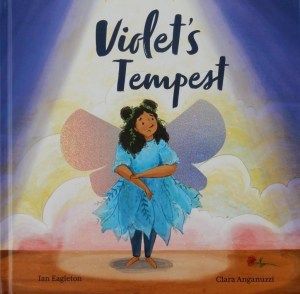
Violet’s Tempest

Violet’s Tempest
Ian Eagleton and Clara Anganuzzi
Lantana Publishing

There’s a change in Violet’s world: what was once her giggly voice is now a whisper. Consequently when Mr Newland, her teacher, casts her as the mischievous Ariel in the school play, she’s beset by nerves and worries – suppose people laugh at her?

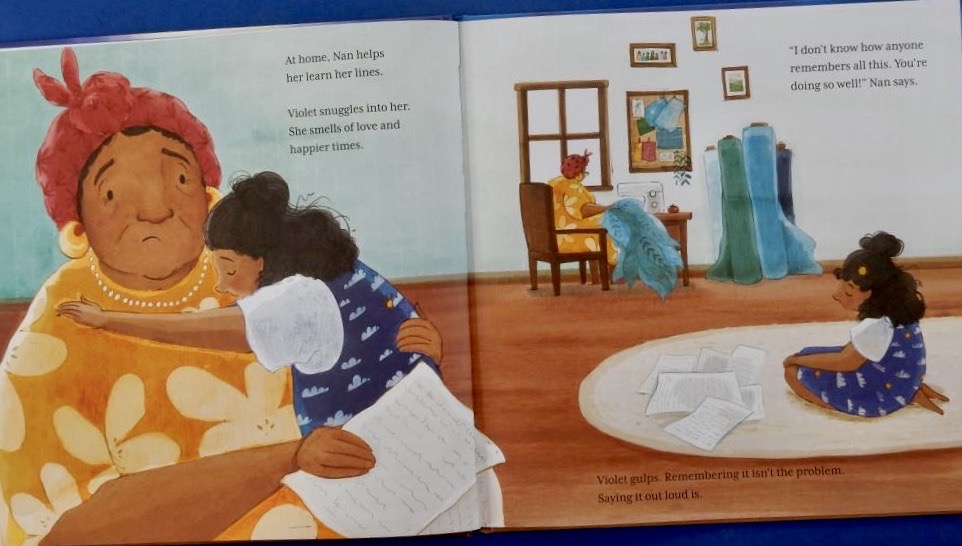
Back home, Violet’s loving, empathetic Nan offers her support and encouragement,

so too do her uncle Tony and his partner Uncle Sebastian.

Meanwhile the rehearsals continue apace at school where her teacher too is supportive and suggests Violet tries to imagine how Ariel would feel trapped and unable to escape.

The weeks pass and the day of the performance of The Tempest draws ever closer, with Nan continuing to inspire and embolden Violet as she practises her lines. Then comes the dress rehearsal: “Violet … think about how Ariel will feel once they’re free” Mr Newland tells her. The girl breathes deeply reminding herself of her Nan, and beginning with a whisper, starts playing her part.

When the big night arrives, Violet is beset by the inevitable racing heart and turbulent tummy but nonetheless as she steps out onto the stage, something amazing, indeed magical happens: Violet feels at peace with herself as Ariel

gliding and swooping across the stage and suddenly her voice changes from a soft whisper to a wonderful roar, much to the delight of her family and doubtless everyone else.

This is a wonderfully warm story of facing up to and over-coming your fears, as well as the power of a supportive family. Clara Anganuzzi’s sensitive illustrations capture effectively the characters’ feelings, making this book one to share and discuss with children either in the classroom or at home. (Despite how he looks in the story, I can’t help but think the author and teacher Ian Eagleton would be just as empathetic as Violet’s class teacher in a similar situation).

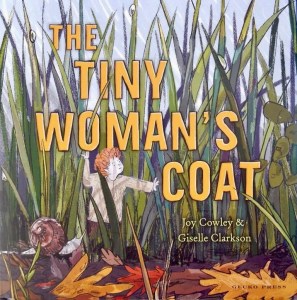
The Tiny Woman’s Coat

The Tiny Woman’s Coat
Joy Cowley and Giselle Clarkson
Gecko Press

This is a heart-warming autumnal tale of need and kindness.

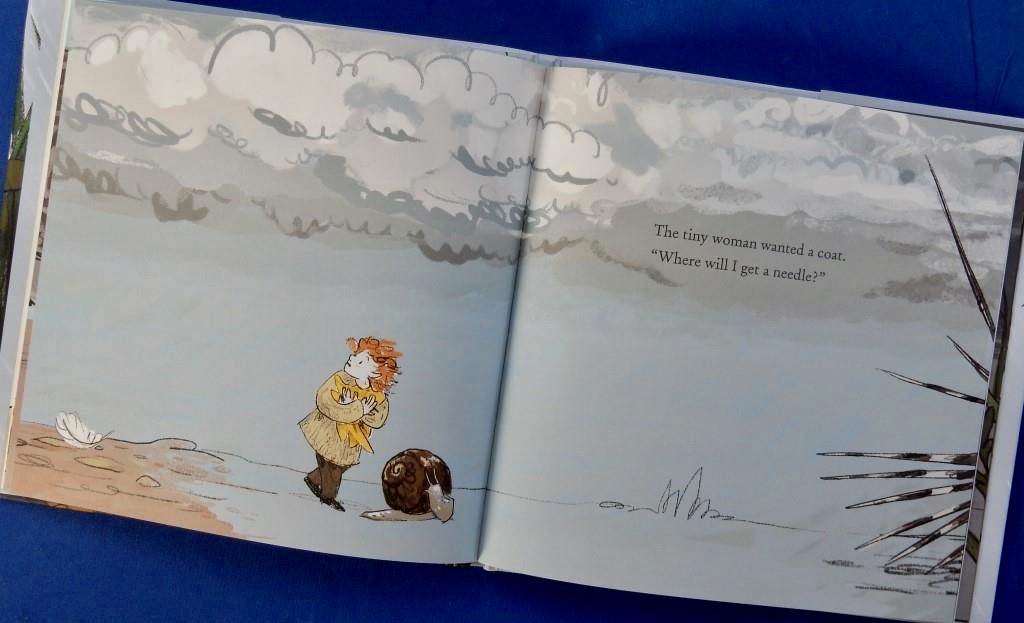
A tiny woman shivering in the chilly wind wants a coat, a coat she resolves to make herself. There might be something of a problem though, for she lacks the necessary tools and materials with which to do the job.

However, happily for her, there are plenty of offers from things natural. The autumn trees provide leaves – ‘Rustle, rustle, rustle.’ Then a grey goose offers its beak in lieu of scissors and ‘Snip, snip, snip’ the leaves are cut into a body and sleeves.

A porcupine’s generosity takes the form of one of its quills

but then this needs to be threaded with something suitable.

A friendly horse provides the thread and then all that’s needed is a means of fastening the garment. The three buttons are seeds given by the ‘wild wet weeds’ and finally hurrah! Out to face the storm, ‘snug as a bug in a rug’ goes the tiny woman clad in her new warm coat of kindness.

Simply constructed and written, Joy Cowley’s folksy story is sheer delight to share and also, with its repeat patterned text, ideal for beginning readers. sheer delight too, and the perfect complement for the text, are Giselle Clarkson’s detailed illustrations with their gentle humour, autumnal hues and close observation of the natural world.

We’re Going Places

We’re Going Places
Mick Jackson and John Broadley
Pavilion Children’s Books

After their terrific debut picture book While You’re Sleeping, author Mick Jackson and illustrator John Broadley pair up again and the result is another exciting, engrossing book, this one being somewhat more philosophical than the first.

Travel and journeying is the theme here and through Jackson’s playfully poetic narrative and Broadley’s meticulously detailed scenes, readers follow a child’s development from adult dependence, through those first unstable steps, to assured confident strides out and about, then onto wheels – ‘tricycles, bicycles, skateboards, roller skates’.

More and more possibilities open up – perhaps a trip in a hot air balloon, or something that needs to be done speedily such as a train ride to somewhere exciting – another country even.

Some journeys however are meant to be done slowly, slowly, allowing plenty of time for pausing to watch and ponder upon the host of other creatures that, while they might be part of your particular journey, are also undertaking their own, some on foot, others on the wing such as bumblebees or migrating birds.

It might be that a journey is seasonal, on a frozen river for instance; or that of a bee ‘bumbling from blossom to blossom’ (love that alliteration); it could even be made by something inanimate such as a raindrop on a window pane.

There have always been divergent thinkers who like to try doing things differently and in this ever-changing world of ours, what seemed once impossible will one day be part and parcel of everyday.

With choices to be made and a wealth of possible ways to go, none of us can ever be absolutely sure of the twists and turns our life will take.

However one thing that’s almost certain is that as people grow old, their journeys will likely be much slower, and less confident perhaps, almost as though we’ve come full circle, with what’s past always there, deep within.

There’s an absolute wealth of texture and pattern, as well as potential stories on every spread, so that readers will undoubtedly find themselves pausing on their journey through the book, adults possibly pondering upon their own life’s journey past, present and future, perhaps like the grandmother sitting in a chair, shown on the final spread.

Assuredly this is a book to return to over and over with the likelihood of new questions and fresh understanding emerging on each reading.

The Visible Sounds

The Visible Sounds
Yin Jianling and Yu Rong (translated by Filip Selucky)
UCLAN Publishing

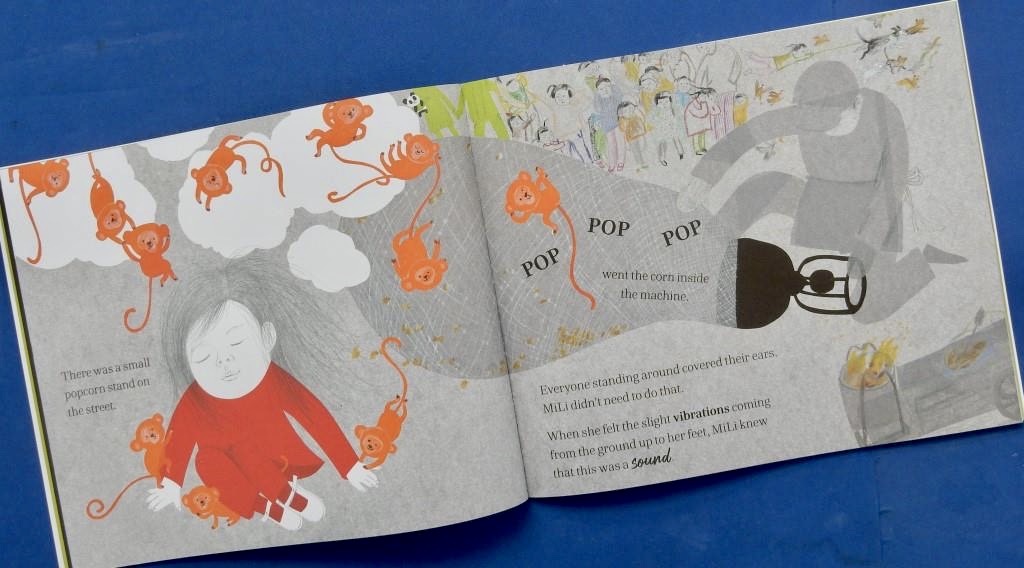
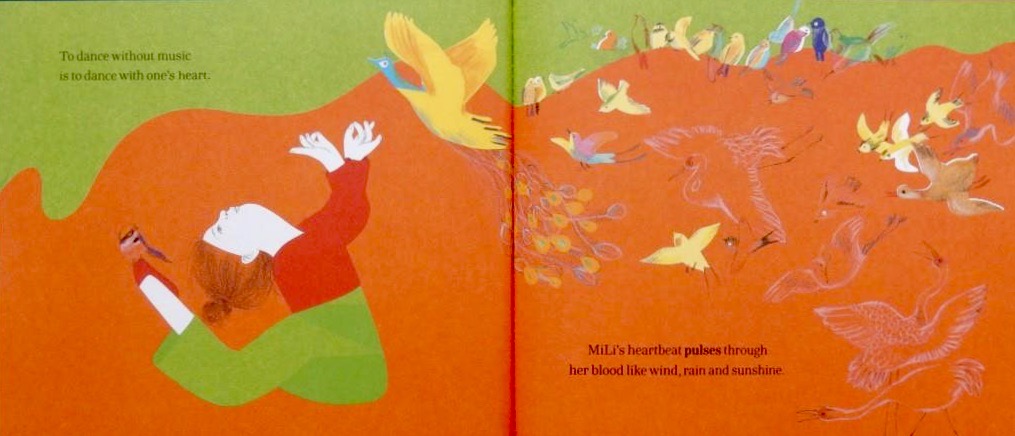
This is the powerfully affecting picture book, based on the true story of Chinese dancer Lihua Tai. It tells of MiLi, who as a little girl of two, suffers an illness and loses her hearing as a result. Initially frustrated, anxious, and alone in her world of silence, MiLi uses tears to express how she feels. Doctors are unable to cure her but then one day MiLi realises that although she’s unable to hear sounds, she is able to perceive them in other ways: sound can be felt within, touched, and seen through understanding and interpreting vibrations and movements in the world.

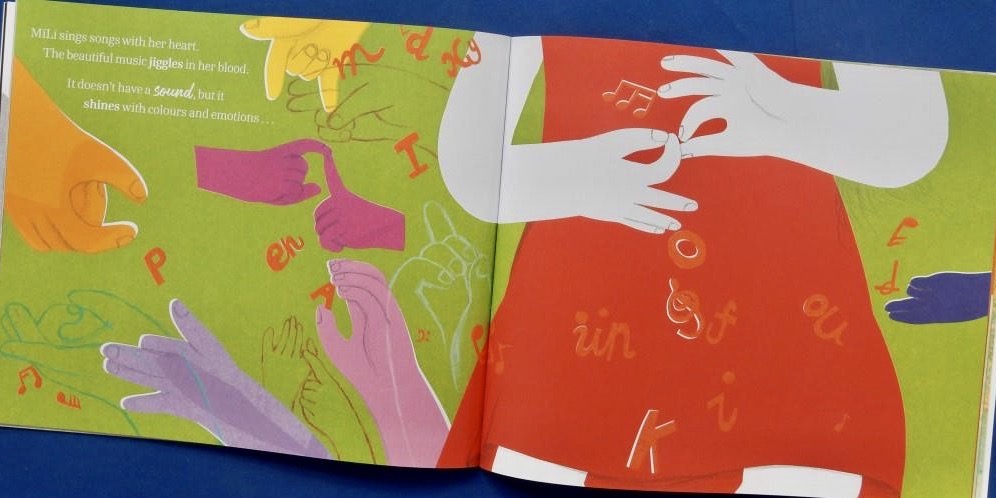
The author expresses the child’s realisation through a plethora of sensory musical phrases: ‘Sounds are waves when fish pass through water, like the lightest of kisses.’ … ‘Sound is the bright sunshine flowing into one’s blood, beaming with rays.’ … ‘Language is a river, flowing and flooding into MiLi’s body.’ … ‘The beautiful music jiggles in her blood. It doesn’t have a sound, but it shines with colours and emotions …’

Perfectly complementing the beauty of the text are Yu Rong’s illustrations with their synthesis of striking graphic style, detail and blending of colours and greyness.

This is a book, that with themes of aiming high and being our very best selves,

while offering a message of hope to differently abled youngsters, surely speaks to us all. It concludes with a note on sign language and a page about Tai Lihua.

A must have for schools, and for family collections.

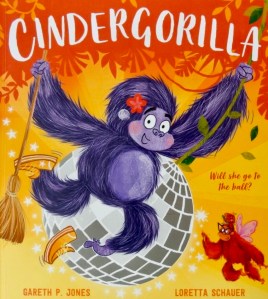
Cindergorilla

Cindergorilla
Gareth P. Jones and Loretta Schauer
Farshore

Readers of this blog will probably know that I am a great enthusiast of fairy tale spin-offs so long as they’re done well, as is the case with Gareth P. Jones and Loretta Schauer’s follow-up to Rabunzel, another in The Fairytales for the Fearless series.

Star of the show in this story is jungle dwelling Cindergorilla. Cinder lives with her mean Aunt Linda and cousins Gertrude and Grace, who spend much of their time bossing her about.

Despite this Cinder manages to remain upbeat by turning her chores into funky dance moves: Her broom becomes an object with which to boogie, she moonwalks with her mop, twirling as she tidies and accompanying her washing up with her wiggliest waggles. Oh how she would love to go to the weekly Disco Ball, but her aunt vetoes her every chance.

Then one Saturday there’s much ado in their household as the cousins discuss their potential chances of becoming the next partner of Disco Prince Travis. Needless to say, they scoff at Cinder as they leave her alone with just a list of tasks to be done.

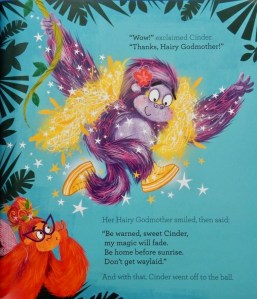
Enter with a RAZZA-MATANG an orangutan, her Hairy Godmother no less, who, with a deft wand flick, transforms Cinder into a sparkly disco diva, leaving her with a slightly different warning from the traditional midnight: “Be home before sunrise” she instructs.

Off goes Cinder, slightly on edge as she steps onto the dance floor but there’s no love at first sight episode when she and Travis meet. Said Disco Prince is egocentricity personified. Or should that be gorilla-ified? Impressed by her moves, he merely tells her she’s to dance with him for the rest of the ball.

Come the first rays of morning sun, Cinder remembers what she’s been told by her Hairy Godmother and tells her partner she must leave right away, his response being the self-centred, “But you haven’t seen my best move yet!”
Nonetheless Cinder makes a hasty exit leaving behind a single shoe and Travis determined to find it’s owner’s whereabouts.

Which he does – eventually, much to the surprise of Cinder’s relations. Seems that now, Travis is ready to offer a somewhat better deal. But is it one Cinder will accept?

Now that would be telling and I’ll leave it to the story creators, merely adding that like most fairytales, there is a happily ever after ending – of sorts – rendered in song.

This terrific tale of resilience and empowerment is huge fun and a smashing read aloud. I love the way Gareth’s narrative is sprinkled with alliterative phrases and breaks into rhyme from time to time. Equally good fun are Loretta’s funny, funky scenes of the action in which she portrays all the characters with real gorilla-alities.

Destined to become a story-time favourite for sure.

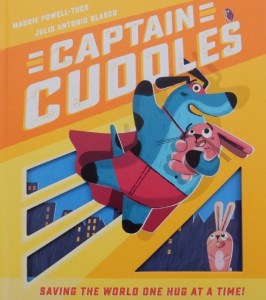
Captain Cuddles

Captain Cuddles
Maudie Powell-Tuck and Julio Antonio Blasco
Little Tiger

There’s a new superhero on the block: step up Captain Cuddles. This clever canine, with his cape, mask and ginormous pink pants, is capable of the most amazing feats of heroism including turning baddies into goodies, merely with the power of a single hug. Don’t believe it? : well we all appreciate the power of a hug, having had to do without hugging during the worst of pandemic times.

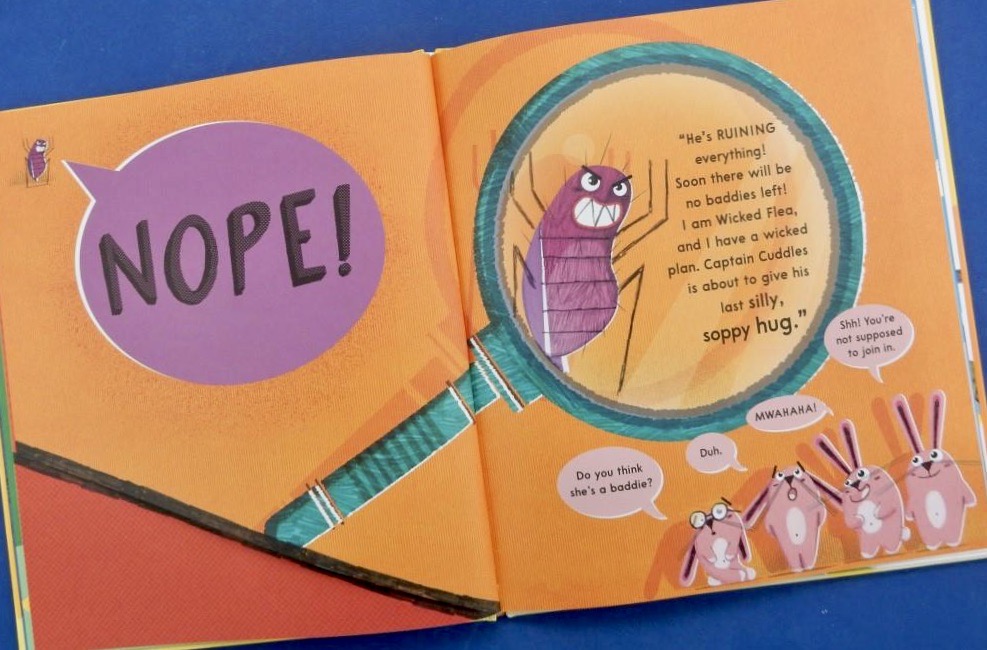
There’s one singularly evil baddie however, that definitely has no intention of letting herself be embraced by the Captain and that is Wicked Flea. Said dastardly creature has a plan tucked beneath her wings and is about to unleash it in the name of all that’s bad.

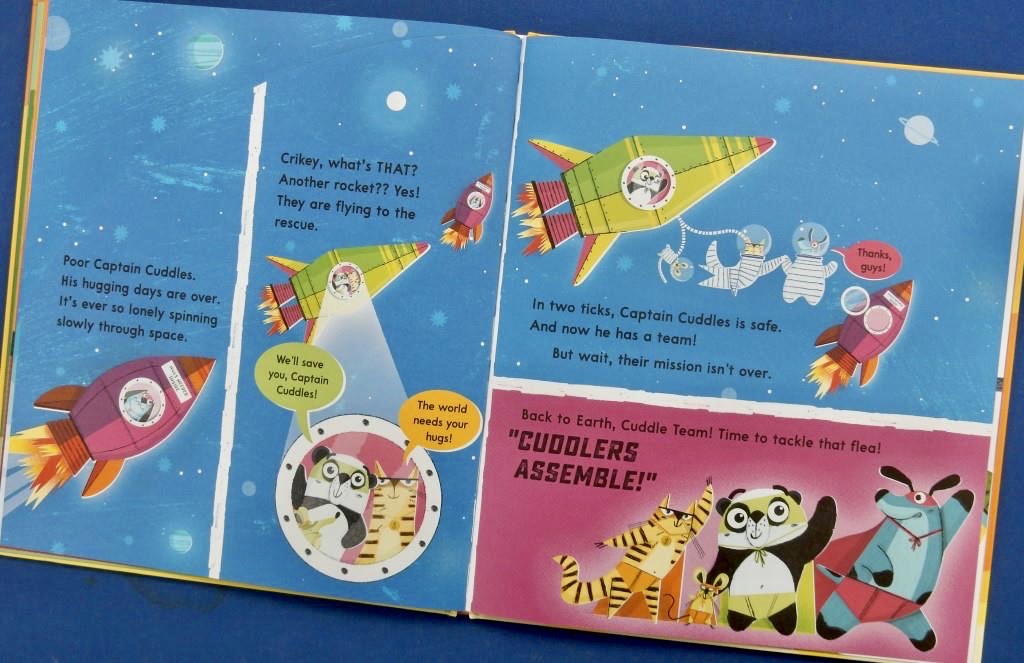
She lures Captain Cuddles into a rocket on the pretext of someone within being in desperate need of a hug. The next thing he knows, our hugs hero is heading off into the depths of space, trapped within that space craft leaving the earth clear for all its baddies, like it or not to revert to their former pre-hug ways under the leadership of WF herself.

Or so she expects, for they’re not so easily persuaded as she thinks.

Captain Cuddles converts have a plan of their own but they appear to have reckoned without the wiliness of Wicked Flea.

What will win out: Team Huggers and their healing embrace or Teeny Team Flea? Or, maybe it it could even turn out to be a win-win situation … I wonder.

With cut away pages, flaps to explore and speech bubbles aplenty, this zany tale is full of dramatic moments brought into being through Blasco’s flattened images of the unlikely cast of characters and the lively text.
Superhero stories are very popular with young listeners and I have a feeling Captain Cuddles will join their number.

What the Elephant Heard

What the Elephant Heard
Charlotte Guillain and Sam Usher
Welbeck Publishing

Charlotte Guillain tells this rhyming non-fiction story from the viewpoint of a young elephant that lives on the African savannah with her herd.

We learn of the wisdom and knowledge of the narrator’s grandmother always able to find water just like the grandmothers before her. Those that could tell of roaring lions, zebra herds and the activities of humans with their smoke belching machines,

their aeroplanes and their cars bringing tourists.

Worse than all those though, are the sounds of buzzing, whining tree destroying monsters that carried the felled trees off to people in towns,

and then that tragic shot from a poacher’s gun which killed the young elephant’s own father.

Now, as Sam Usher’s watercolour illustration shows, with the land dusty and parched, the herd awaits the welcome sounds of thunder and rain. With Grandma as leader, they lumber across the denuded savannah in the hope that once more, their leader wiii be successful in locating a waterhole …

After the elephant has finished speaking, come three prose spreads, the first giving basic information about elephants, their features and habits, the second discusses the work of elephant rescue teams and wildlife rangers and the third presents worrying facts about the declining numbers of elephants and some ways in which humans can help support these amazing creatures.

Equally lyrical in their own way as Charlotte’s words, are Sam Usher’s scenes of both the beauty and the harshness of the elephants’ environment over time and place. Altogether a heartfelt and timely presentation of pachyderm plight and majesty.

Witch In Training

Witch in Training
Michelle Robinson and Briony May-Smith
Walker Books

Following their Tooth Fairy in Training, Michelle and Briony present another trainee this time in the form of a little witch.

We meet the young narrator as the final preparations for her training are, with her mum’s help, being made. Off they zoom on broomsticks to obtain all that’s necessary for her very first potion, Magic Stew.

First come the sky ingredients,

after which it’s down to Monster Town for wood-related supplies.

Next stop is a tomb for further slightly gruesome requirements, but the list still isn’t all ticked off: the final visit is a sub-aquatic rendezvous.

Then, full of excitement back home young Betty, hands duly washed, starts brewing with a wave of her wand, some magic words and . …

Uh- oh! in goes an additional ingredient that was not on that list and whoops! What has become of kitten, Pumpkin Patch?

Can Betty brew another potion and save the day? (or rather the night) … Well maybe – or almost …

Told in Michelle’s magical rhyming text and Briony’s wonderful scenes of moonlit ingredient gathering and spelling, create their own brand of enchantment that youngsters will delight in becoming a part of when the book is shared.

Perfect for a run-up to Halloween story time, or indeed, any other time.

My Beautiful Voice

My Beautiful Voice
Joseph Coelho and Allison Colpoys
Frances Lincoln Children’s Books

From the duo who created the hugely moving If All the World Were… comes an inspirational story about finding your voice, literally as well as metaphorically.

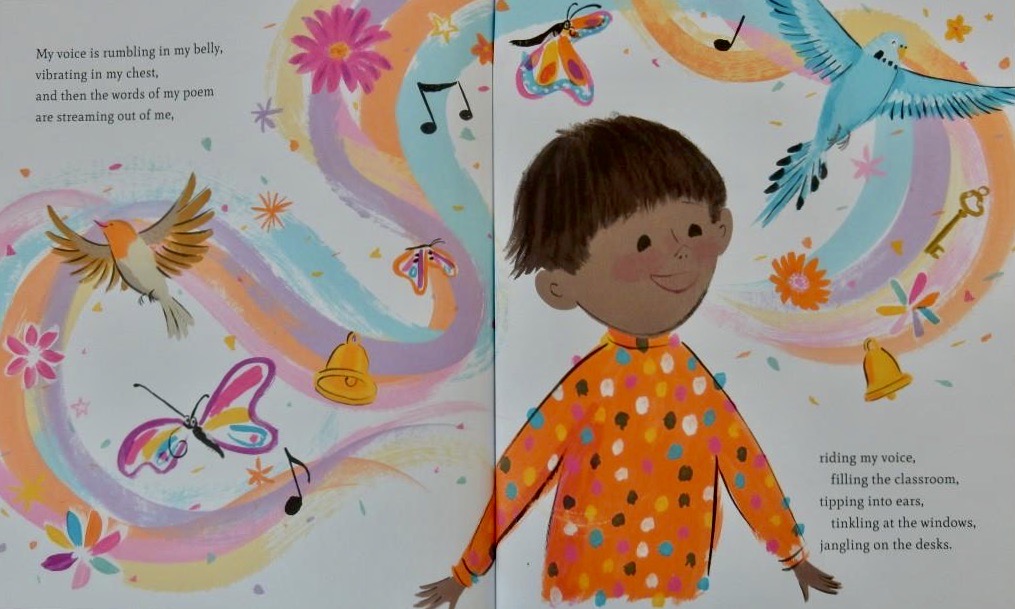
Joseph Coelho’s narrator is a shy child who doesn’t talk at school, that is until a flamboyant, understanding new teacher, poetry lover Miss Flotsam, wields her transformative magic in the classroom.

She starts by sharing stories of her adventures, then moves on to sharing stories from books

and then the very personal form of her own poetry; and little by little one shy child begins to unleash that inner creativity we all have if only there’s somebody to nurture it.
A poem begins to form on the page, line by line and eventually, judging when the time is right, Miss Flotsam proffers its author an invitation to share that poem with the class …

With poet and playwright Joseph’s heartwarming, highly empathetic text and Allison’s superb, powerful illustrations of creativity at work,

with their splashes of neon-bright colour that capture so well the feelings of the two main characters, this is a perfect book to foster empathy in children. They’ll surely respond to the inherent themes of courage, resilience and determination in this heartfelt story of unlocking a child’s potential.

Every youngster deserves to have at least one teacher like the one portrayed here, during their early years of education.

Rock and Roll

Rock and Roll
Hazel Terry
Tiny Owl

The book reminded me slightly of Michael Foreman’s classic picture book The Two Giants.

Meet two boulders Rock and Roll, the former stands flat, the latter stands tall and so it has been in the mountains for countless years with both of them awestruck by the world’s magnificent beauty no matter the season, or be it day or night. 

Both are proud of how long they’ve’ stood and of the visual evidence of their endurance.

Then one fateful day everything changes: people come to visit Rock and Roll, delighting them and bringing them such gifts as flags, piles of small stones and necklaces of bunting. 

That is at first, but then each rock begins to resent the new adornments given to the other. Roll moans to the wind making unkind comments about Rock’s colourful flags: Rock in turn, talks to a cloud complaining about Roll’s crown and saying callous things.

Consequently wind and cloud become upset, bashing into one another and arguing about ‘their’ respective boulders.

A vicious storm of thunder and lightning strikes the boulders sending them hurtling down the mountainside breaking apart as they go.

Eventually all that remains of Rock and Roll are small pieces of detritus. With all those arguments having rolled far away, happiness comes in their place and with it, a sharing of the things that precipitated the fallout.

Not only is Hazel Terry’s debut picture book a thought-provoking fable with themes of jealousy and its consequences, and being in harmony with the self, with awesome fossil prints on every page, it’s a thing of real beauty. It truly celebrates the marvels of the natural world: indeed I was out with two young relations who were staying with us last week and one of the things that most excited them was discovering fossils in a Cotswold stream not far from my home. I can’t wait to show them this gorgeous book and to share it much more widely.

When I’m Big

When I’m Big
Ella Bailey
Flying Eye Books

In an ancient forest a small, single egg hatches, from it emerging a weeny dinosaur, Fern by name. Having surveyed her surroundings she deduces that she’s no bigger than the smallest fern frond.

Pondering upon the question of what she’d be like when she’s big, she spies a massive dinosaur gobbling the leaves of the trees towering above her. A bite of one of the leaves doesn’t tingle her taste buds so off she goes to investigate further. Next stop is a clearing but the loud honking of a dinosaur herd there sends her searching for a more peaceful place.

So what about the river? Could she be a subaquatic dinosaur perhaps? Not with a body like hers seemingly …

Fern keeps wandering and searching for a dinosaur that might perhaps be her like her grown up self, but none of the pointy horned ones, those with bumpy armour on their backs, nor the feathered kind feel right for her. Will she ever know: maybe she’ll not be big at all.

Feeling thoroughly downcast she bumbles on till all of a sudden there in front of her is something she recognises:

Fern has come full circle but something has changed …

A realisation dawns: whatever the future holds, it’s a matter of wait and see …

A sweet, warm story of finding a place in the world and being content in the here and now, prehistoric style.

Youngsters will delight in the telling, the gorgeous illustrations and exploring the back endpapers, which will send them back to the beginning of the book for a re-read to search for fourteen dinosaurs Ella has depicted thereon.

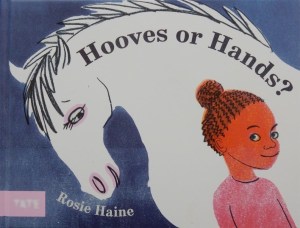
Hooves or Hands?

Hooves or Hands?
Rosie Haine
Tate Publishing

Following her debut picture book, It Isn’t Rude to be Nude, author/illustrator Rosie Haine invites readers to ponder on the possibilities that being a pony instead of a human might offer.

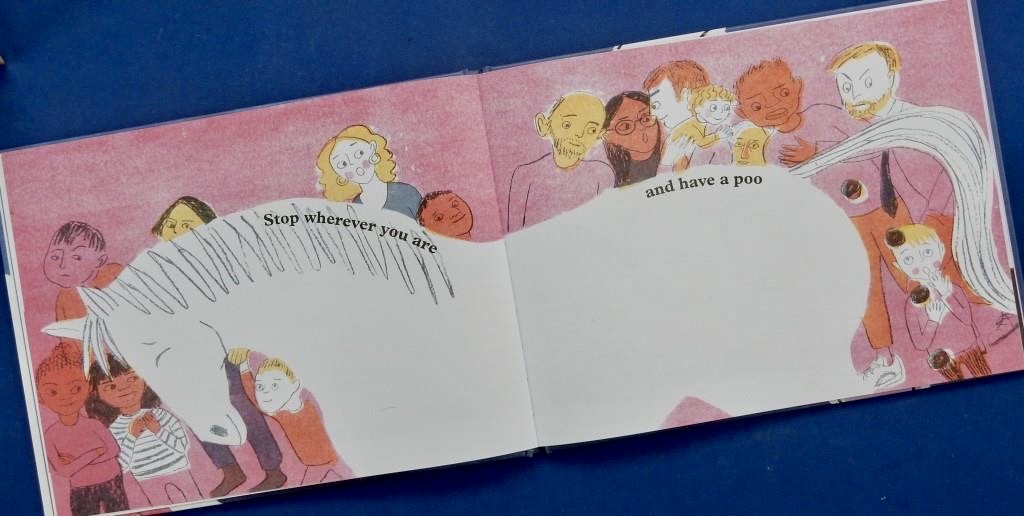
Taking by turn a series of parts of a pony’s anatomy – hooves, legs, face, hairy parts and then moving onto topics such as pooing, movement, diet and mode of communication, she presents the alternative equine /human scenarios starting with the title hands or hooves, followed by being four or two legged, having a long or short face, possessing a mane, tail, forelock and fetlocks or not, pausing for a dump wherever you are or having to hold on,

galloping or running, whether or not your bum is furry,

whether you dine on a variety of foods or have to stick to hay and whether you utter words or a neigh (yes the text does rhyme).

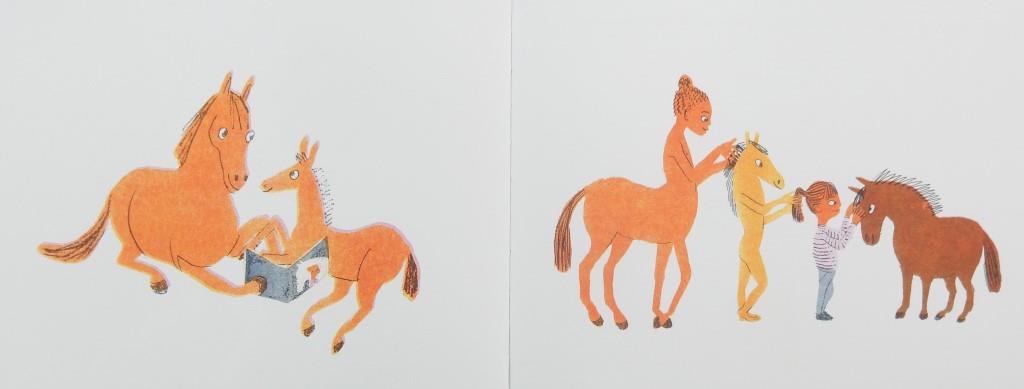
The key question is ‘… would you rather be a pony or a person?’ Which would bring more fun? There’s even the prospect of being both. The key thing however, is individual choice and making the most of what you choose.

Playful, clever, quirky and thought-provoking.

Share this in a classroom and you might find children trying their own versions using a different animal of their choosing.

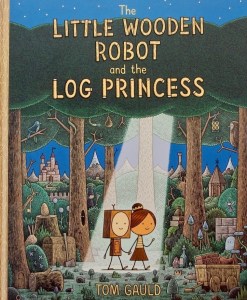
The Little Wooden Robot and the Log Princess

The Little Wooden Robot and the Log Princess
Tom Gauld
Templar Books

This is a whimsical, truly magical neo fairy tale that begins as often fairy tales do with a king and queen ruling happily, from their hilltop castle; but they are childless.

One night both husband and wife decide to try and change that: the king consults the royal inventor; the queen pays a visit to a clever witch living in the woods.

Inventor and witch set to work right away, the former using her best tools to fashion a tiny intricate robot, the latter uses her deepest magic on a log and from it conjures a perfect little living log princess.

All family members love one another and the siblings spend their days playing happily but they share a secret: by night the princess reverts to her log form and is only woken by her brother’s incantation of “Awake, little log, awake.”

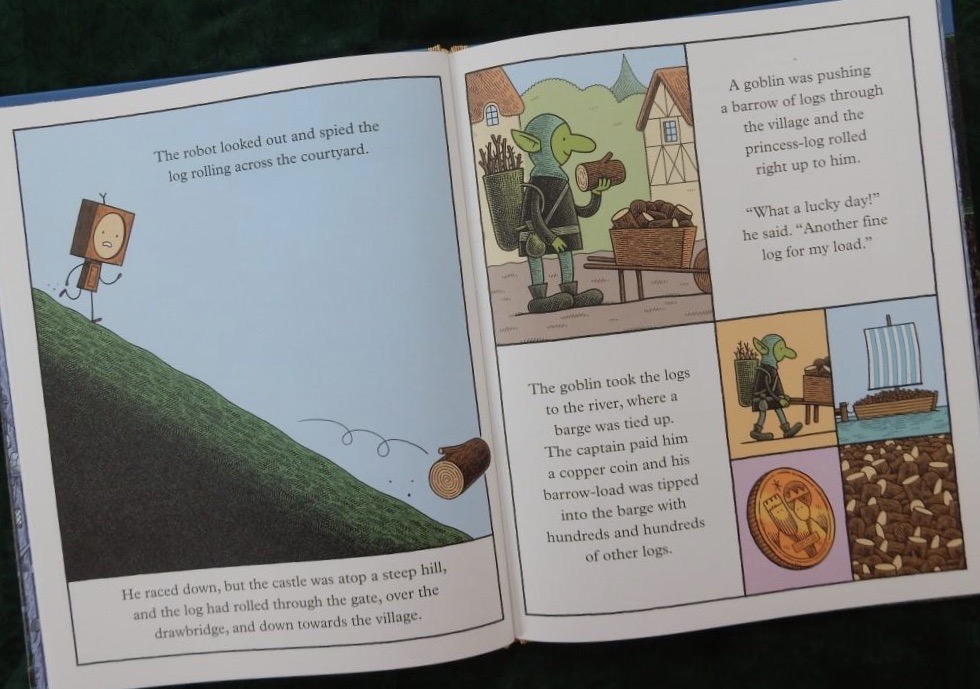
One morning though, the princess is left alone in bed sleeping and catastrophe – she is tossed out of the window by a maid and ends up rolling away toward the village.

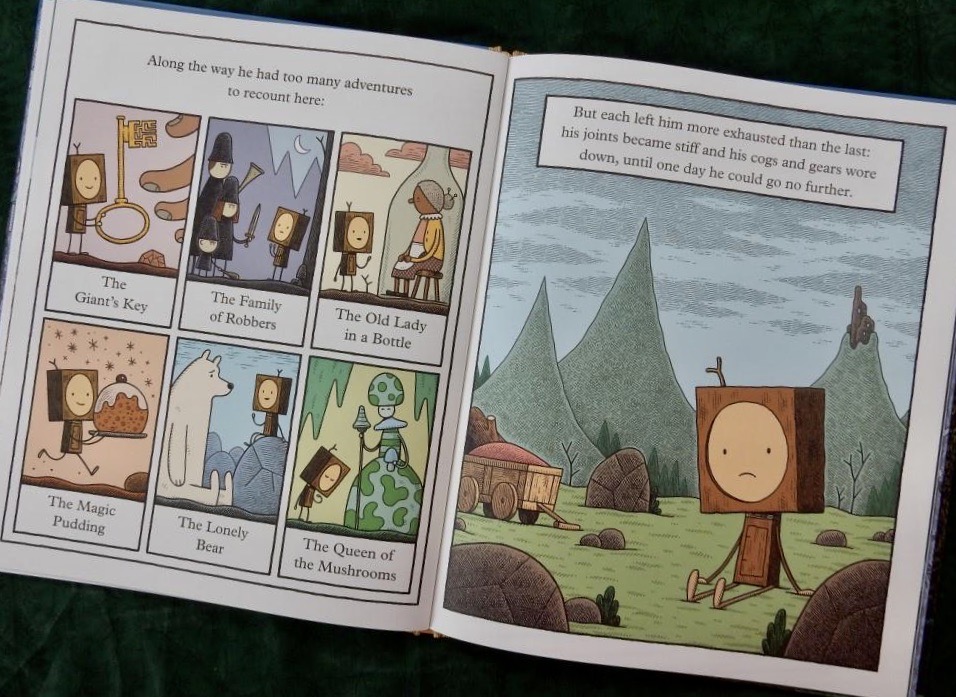
Her brother gives chase only to discover she has been sold to a barge captain taking a cargo of logs to the Frozen North. Unhesitatingly to rescue her, he boards the barge as it sails away and eventually his search is rewarded. Then it’s time to begin the arduous journey home, a journey that is so full of hazards and adventures that the hero’s parts wear right out.

But not before he’s uttered the magic words, brought the princess back to life and recounted all that’s happened.
Words of forgiveness are spoken, then it’s her turn to take charge of the situation and she bravely steps up.

The princess too has many adventures, with obstacles to overcome, not the least being her increasing tiredness. Fighting sleep she trudges on until she can go no further and …

Will they ever reach home? Well, this is a fairytale that began, as many do, ‘There once lived a king and queen …’ so as readers will be hoping, it does end ‘and they all lived happily ever after.’ Before that though, there’s a further sequence of selfless acts of kindness, a witch encounter and yet more kindness.

There is a tremendous amount to love about this book, not least being the wonderful montages of both heroes’ adventures. Then there’s Tom Gauld’s artistic style with its textures, well-chosen colour palette and the wealth of delightful details that start on the front endpapers and continue throughout the book, adding further depth to the text, while his portrayal of characters be they key protagonists or bit part players, are an absolute delight.

A cracking book to get lost in, time and again, whether you share it with one child, several or a whole class.

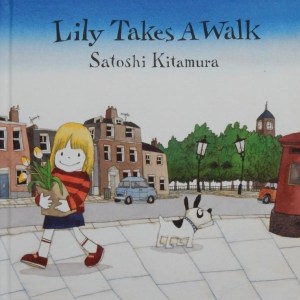
Lily Takes A Walk

Lily Takes a Walk
Satoshi Kitamura
Scallywag Press

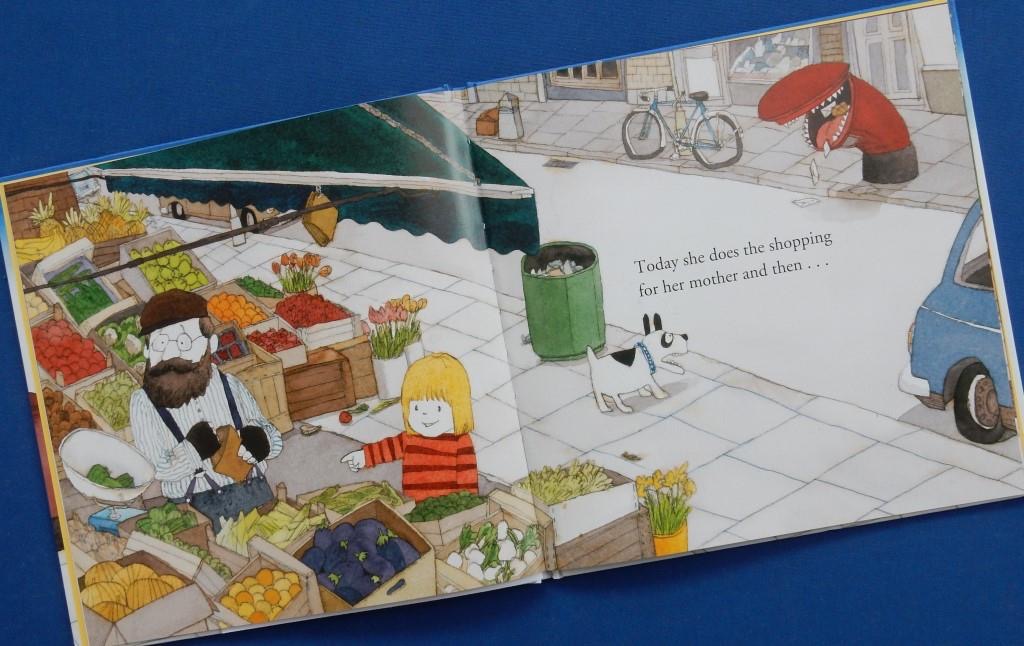
Kitamura is most assuredly in playful mode as he presents what happens when young Lily, accompanied by her dog, Nicky goes shopping for her mother.

While intent on buying at the market stalls she fails to notice the post box with it’s sharp-toothed mouth but her dog sees.

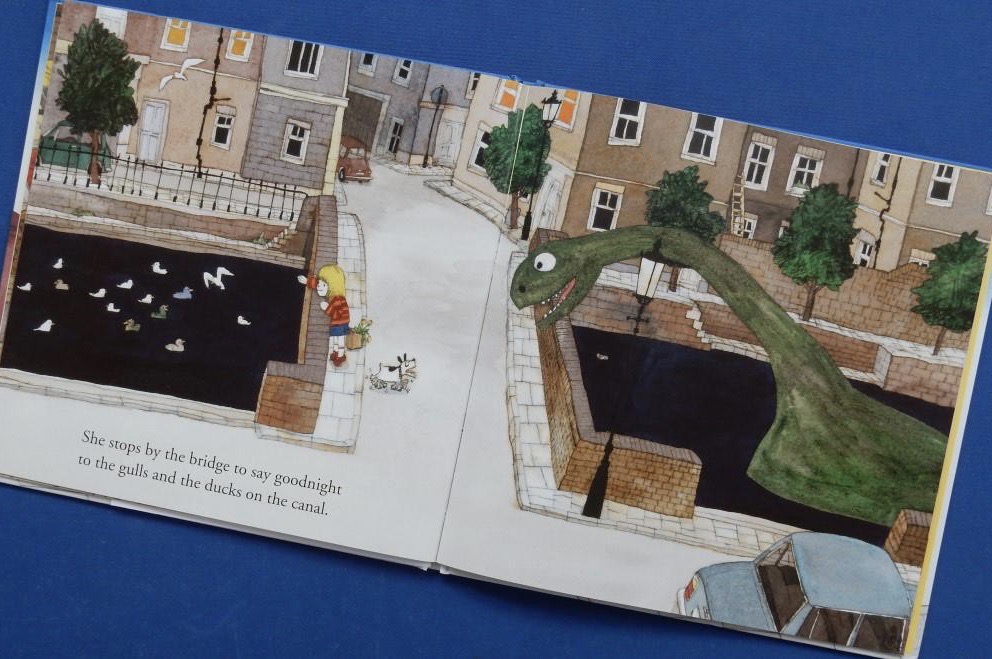
He sees further scary or startling things – the tunnel entrance with pointy teeth and staring street lamp eyes and threatening monsters at every turn, while she is aware only of the Dog Star in the sky, Mrs Hall knitting at her window, bats all a-flitter and birds on the canal.

Then finally at the last corner wafts the smell of her supper cooking.

Back home while consuming same with her parents, Lily smilingly tells what she’s seen on her walk, while thought bubbles around Nicky reveal what he might describe were he able to speak.

There’s a final gatefold that opens to reveal yet another thoroughly unpleasant experience for the dog of which Lily, eyes closed, is blissfully unaware.

The juxtaposition of child and dog’s divergent perceptions of the same journey taken together is done with Kitamura’s genius mix of the real and surreal; thus making this book an experience to savour and return to for several further excursions.

It’s fantastic to see Scallywag Press publishing this new edition of a modern classic.

The ABC Factor

The ABC Factor
Katrina Charman and Tony Neal
Farshore

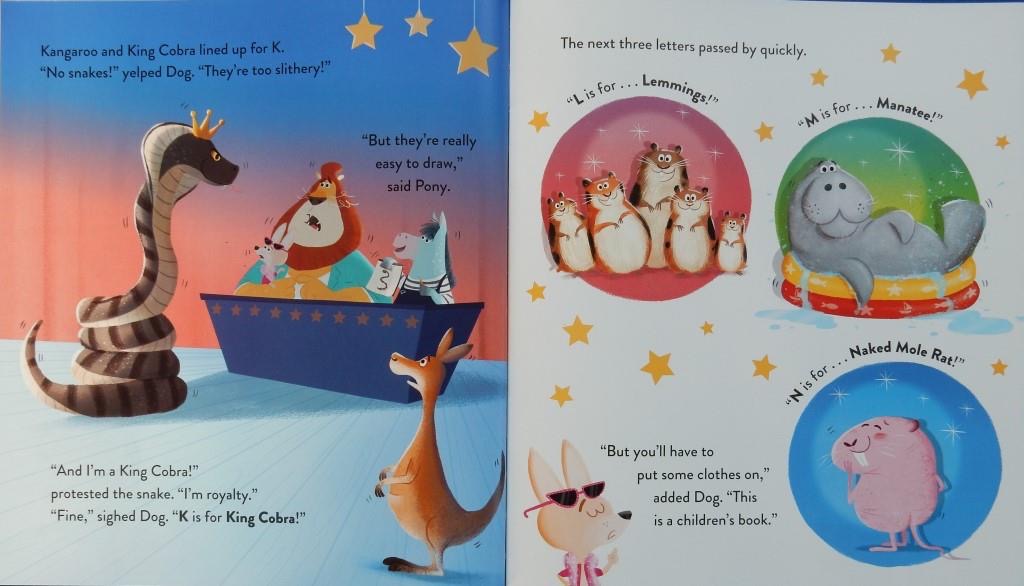
If you’re looking for a smashing alphabet book that’s also a hilarious story then look no further: Katrina Charman and Tony Neal’s presentation is huge fun and highly original. So without further ado let’s join Stick Insect in his search for stardom in Dog’s Amazing ABC. This entails participating in an audition to determine that special ‘difference’

that is Dog’s criterion for inclusion: none of your ordinary bears or cats will do for judges Dog, her illustrator Pony and guest judge Lion.

As the auditioning gets under way it’s obvious that they’re a pernickety lot: Stick Insect’s attempt to justify selection for B (bug) is instantly deemed “boring!” and he tries again for H failing to impress a second time (can you guess what he called himself that time?) and clearly common or garden “insect” isn’t going to cut it.
On go the proceedings somewhat speedily and with the occasional dispute.

Surely though he has to be the choice for his initial S but no – something sleepy is selected ‘zzzzzz’.

The selection process draws dangerously close to the end of the alphabet as the judges zoom through V, W, X and Y. Stick Insect has one last attempt giving it all he’s got …

Youngsters will definitely give star marks to author Katrina and illustrator Tony for this book – it’s definitely a winner for me.

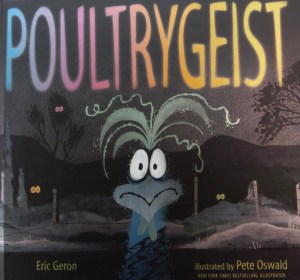
Poultrygeist

Poultrygeist
Eric Geron and Pete Oswald
Walker Books

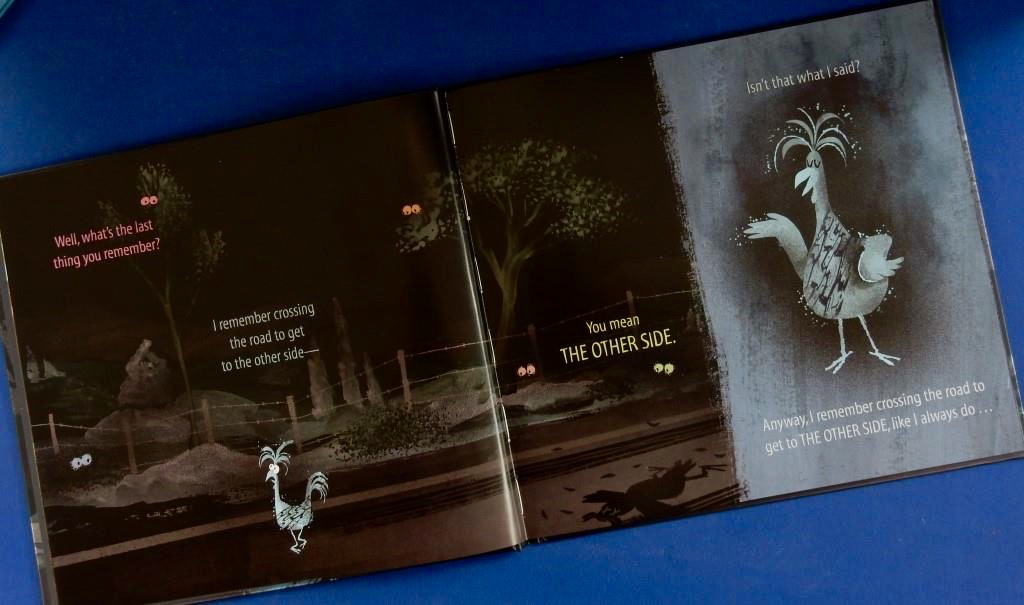
With a touch of the macabre, this is a deliciously dark tale that begins before the title page, with a chicken crossing the road – as chickens do – to get to the other side. Only the result of this one so doing is that it’s splatted against the front of a huge tractor-trailer becoming a ghostly version of its former self.

The next thing the creature knows is that it’s greeted by a host of other animal ghosts informing it of its new status as the titular Poultrygeist and ordering the erstwhile ‘spring chicken’ to start acting scarily – like a ‘foul, fowl’ no less.

Despite haunting not really being the chicken’s thing, the now featherless creature ends up frightening its fellow phantoms.

(It does though give a nod to readers/listeners to make sure they’re not similarly scared at any point.)

With its hilarious finale, this has just the right amount of scariness for most youngsters, thanks in no small part to Pete Oswald’s superb artistry. His use of colour for the ghosty animals against a black background is brilliantly done with the spoken part of the text corresponding in colour to the speaker and that revelation of the poultrygeist’s scariest possible, ‘not even scary’ face is show-stoppingly superb.

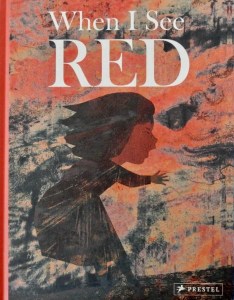
When I See Red

When I See Red
Britta Teckentrup
Prestel

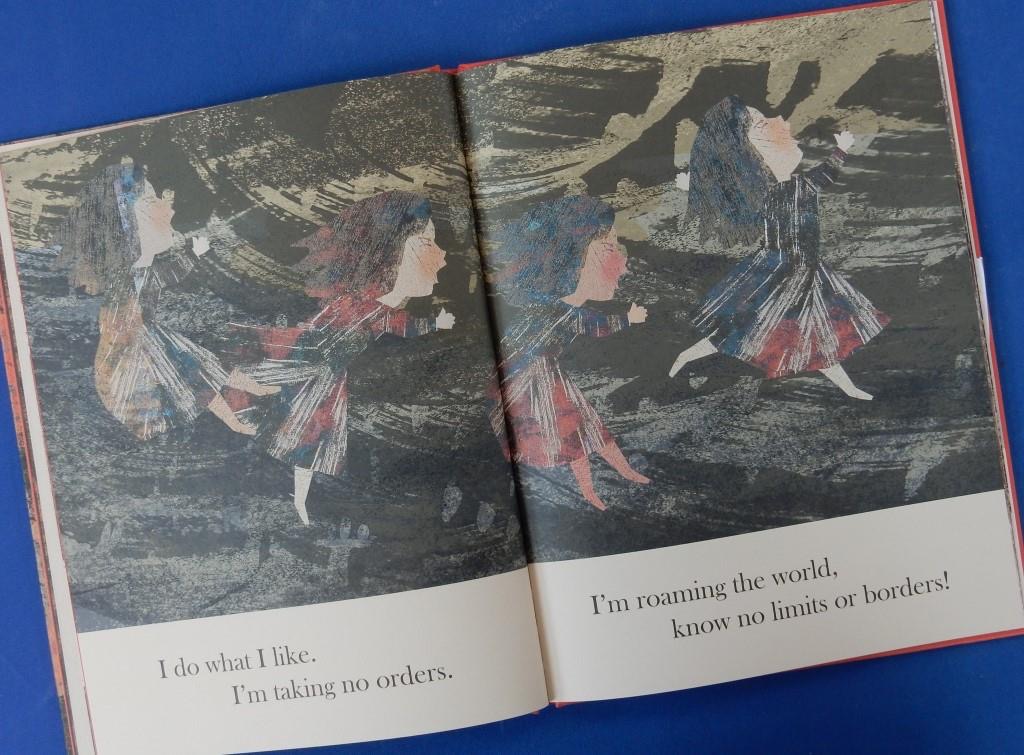
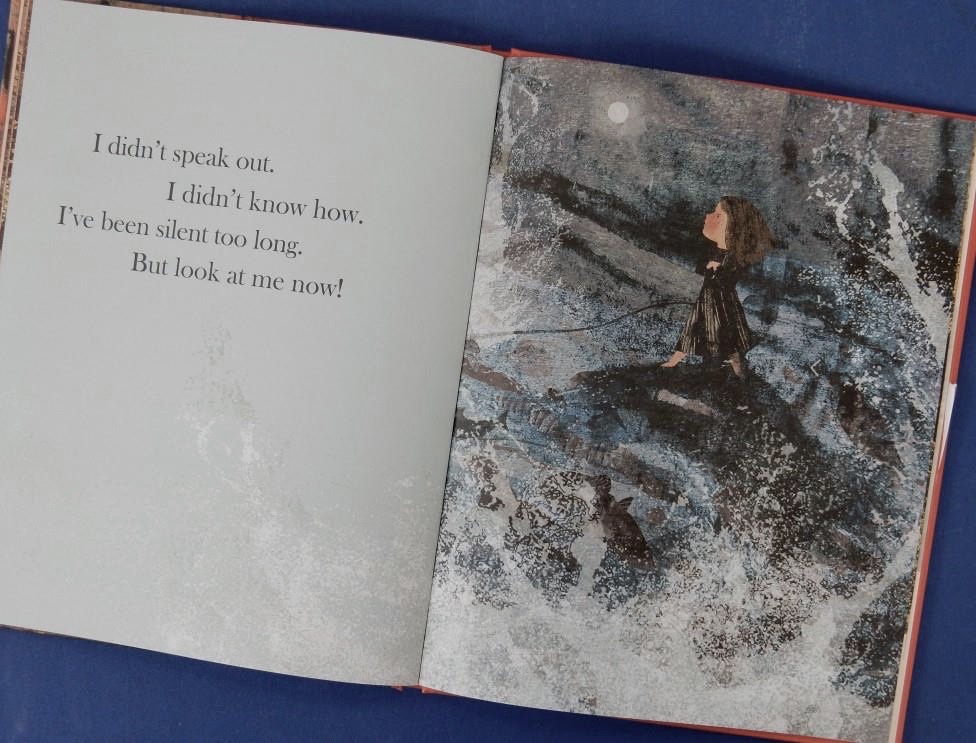
The child protagonist in Britta Teckentrup’s study of anger feels her fury as a gushing, twisting, twirling swirling roaring dragon that then morphs into a raging tornado as it rumbles and crashes. She bellows, booms and hollers as she roams the world seawards becoming that sea rider proud, bold and absolutely in control as she traverses the world.

Too long has she held back before pouring forth her torrent

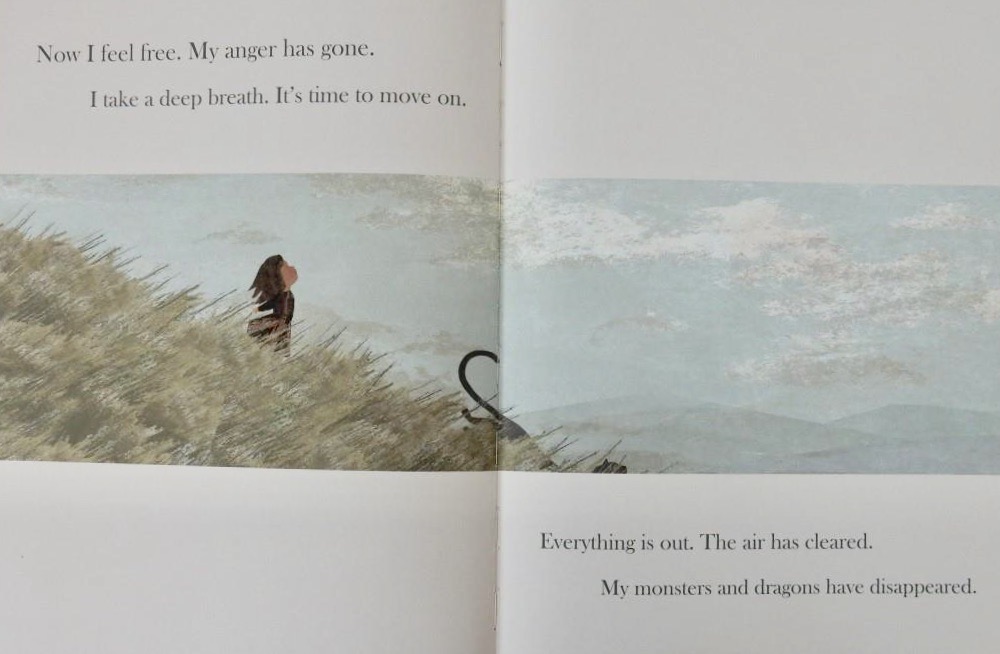
but once she’s given vent to all that’s inside, it’s time to move forward leaving rage behind. Now storm spent, there’s a sense of freedom:

there’s a new and powerful force that comes with inhaling deeply and slowly. Let another journey commence with calmness and positivity.

The girl’s wild ride encompasses so many facets of anger, both negative and positive: she feels alone and isolated, engulfed and thoroughly overwhelmed, alarmed, perhaps frightened of the power of her emotions; on the other hand that power can be transformed into a force for good, a vehicle for changing from within.

Through her dramatic paintings, and words relating to earth and the elements, Britta portrays an emotional journey that offers youngsters both an affirmation of, and an opening to talk about their own feelings of anger. It couldn’t be more timely especially with all that everyone has gone through over the last eighteen months.

Let’s Save Antarctica

Let’s Save Antarctica: Why We Must Protect Our Planet
Catherine Barr and Jean Claude
Walker Books

This book is an urgent plea from author Catherine Barr and illustrator Jean Claude for readers and listeners to help in the vital task of protecting our precious planet, in particular Antarctica from climate change and plastic pollution, and all that means.

That vast white continent covering the South Pole – the most extreme environment on earth – is home to millions of Emperor penguins as well as safe waters for the enormous whales that live in the depths of the surrounding Southern Ocean. Losing these, thus far tough survivors just doesn’t bear thinking about, but think about it we must.
Penguins though are just some of the awesome inhabitants of the vast icy wilderness, for eons ago it was home to dinosaurs, and fossils, footprints, teeth and ginormous bones have been discovered by scientists investigating the ancient volcanic ash of the Antarctic sea floor.
Other scientists have and still are investigating what Antarctica can reveal about how earth’s climate – the temperatures and wind patterns – have changed over hundreds and thousands of years.

But what are the secrets to the survival of the flora and fauna of this extreme environment? Yes they are all protected in this our last great wilderness.

However, it’s something biologists are studying while others are looking at what allows deep sea life to survive.

So too is the crucial work that scientists are doing to monitor the effects and speed of climate change, Antarctica’s greatest risk of all, and something that will also have a huge impact on all of our lives.

You don’t have to be a scientist to contribute to the saving of Antarctica and the final spread comprises things that we can all do to stop plastic pollution in the ocean and help slow down climate change. What Catherine has written will surely spark action to protect this incredible place; it’s up to us …

The Dragon with the Blazing Bottom

The Dragon With the Blazing Bottom
Beach
Simon & Schuster Children’s Books

Back in the days of yore, disaster has struck: Sir Wayne’s dragon has lost his fearsome flame. Not a flash or a flicker can he raise no matter how hard he huffs and puffs. Sir Wayne’s alternative ideas go down like a damp squib;

only a flaming breath will do.

So what is causing this lack of fire? Could it be those spotless teeth or is his tongue too pink? The trouble must be down to diet, the knight suggests, but no need to worry. Sir Wayne has a dietary plan so sizzlingly hot it just can’t fail.

A single hot dinner comprising electric eels, half a dozen sacks of coal, an unspecified amount of oil, a couple hundred fireflies, a blazing log fire, a barbed wire-wrapped cactus, a heat-seeking rocket, a burning bush, sparklers and fireworks so long as they ‘WHOOSH!’ and finally and most disgustingly, a small piece of cheese – “Almost as green as the snot from a sneeze.”

It most definitely looks astonishing. Foolproof surely? Erm … The proof of the dinner is in the eating …

Beach has certainly created a sure fire winner of the whiffy kind with this, which apparently is the start of a series. The rhyming text reads aloud splendidly and with comical incidents aplenty, the illustrations are suitably hilarious. I can’t imagine a single child failing to respond with spluttering delight. Bring on the next episode say I.

Daisy’s Dragons / Green

Daisy’s Dragons
Frances Stickley and Annabel Tempest
Studio Press

Here’s a picture book that encompasses dealing with your feelings, owning a pet (or several) and even perhaps coping with pandemic reds, greens and silvers, and sometimes blues, pinks, and purples too. These colours refer to the pet dragons that young Daisy has and only she knows they’re there, each playing its own particular role. That is until one day when everything goes haywire on a visit to the ice-cream shop

and the result is that three of Daisy’s dragon friends go missing, and Daisy herself gives vent to her own emotions as she becomes scared, angry and sad, sending the others away.

In an attempt to bring back the absent Happy dragon feelings, the little girl plays with her toys and as she does so she realises that it’s actually very important to have the entire range of emotions: “None of you are bad,” she says, confirming what an apologetic Sad has already articulated with “But all of us are part of you … and none of us are bad.”

Told in Frances Stickley’s rhyming narrative and with Annabel Tempest’s splendidly portrayed dragons, this is an engaging story that opens up opportunities to talk about the all important topic of emotions with young children. I suspect that by the time the story’s told, both adult sharers and young listeners will have developed a fondness for all six special dragons.

Green
Louise Greig and Hannah Peck
Farshore

There’s always a slight quirkiness to Louise Greig’s books that I love, and so it is with this one.
Ed becomes downhearted when he’s no longer the owner of the best sled of the slopes. Back to his shed he goes to build an outstanding one, spending many a wintry day and night to that end. Despite knowing that he’s missing out on lots of fun he just can’t bring himself to go out and join his friends who are eager to see him.

Unbeknown to the boy, during the time he’s been working away, the days have been growing longer and warmer, and when he finally emerges he fails to hear the song of the blackbird and see the blue flowers peeping through. Then unexpectedly after a shower, everything turns green, speckled with white daisies. Now what will he do with a sled, even if it is THE best?

Suddenly he hears his name being called: it’s his friends saying how much they’ve missed him. Now at last Ed feels the sun’s warmth and he’s filled with joy but feels somewhat foolish as he explains what he’s been doing. Soon he realises that he’s missed so much: the companionship and exhilaration he now experiences are the things that really matter; they’re way more important than having something biggest and best.

Told in Louise Greig’s poetic text with Hannah Peck’s scenes that perfectly capture the feelings of the characters and their movement, this is a thought-provoking story about emotions, showing how envy negates the pleasures of the here and now.

The More the Merrier

The More the Merrier
David Martin and Raissa Figueroa
Walker Books

Bursting with delicious movement words – stepping, galumphing, slipping and sliding, and wiggling, leaping, swooping and flying, skipping, even flappity-flipping – go the creatures in this book as we meet in turn Bear with kicking feet and bending knees, Moose going high, low, fast and slow,

Snake doing what it can, beat-loving Deer and round-eyed Owl.

Then come cute Baby Mouse drawn to the action as are Mouse’s friends with their “Hey diddle, diddle”. Round they cavort singing at the tops of their voices until sleep finally overcomes them and zzzzzzz.

Who could resist the call to action to head over to that forest and join Bear in following the infectious beat of the rhyming telling. Inspired by the dancing animals shown in Raissa Figueroa’s dynamic scenes, young listeners will probably also want to offer their own unique dance moves performed with similar abandon to the animal cavorters that grace the pages accompanied by David Martin’s joyfully upbeat, cleverly patterned text with its almost irresistible beat.

By the way, it’s also a great book for developing sound/symbol awareness. The foundation stage classroom potential is huge but more important, it’s a super story that supports the all-important message that playing with language is fun..

The Fairy Dogmother

The Fairy Dogmother
Caroline Crowe and Richard Merritt
Little Tiger

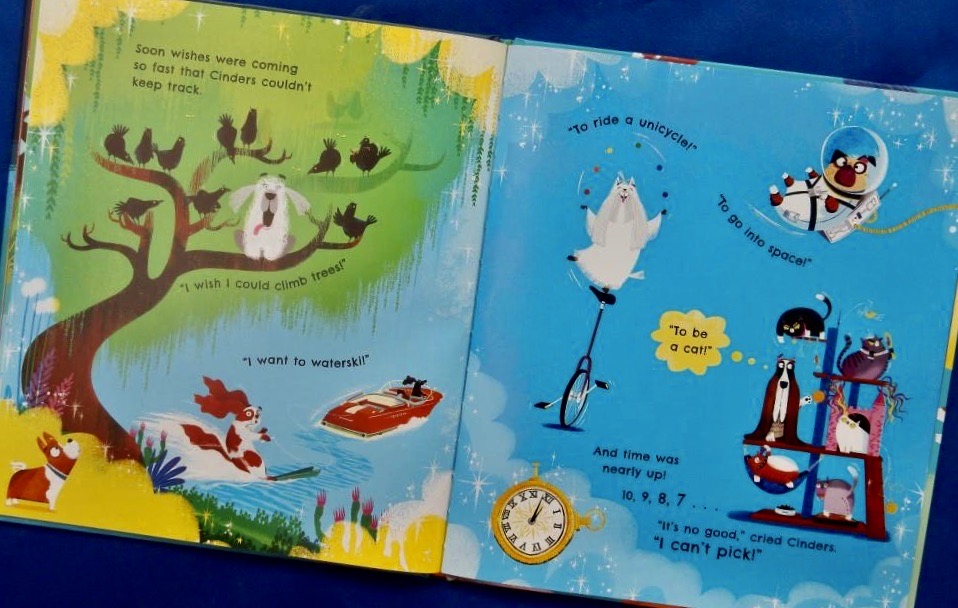
This playful modern fairy tale has its origins in Cinderella and is set in Woofington’s Dog Shelter, home to most of the characters in the book including Cinders. This resident is just contemplating lunch when suddenly one Priscilla Paws, Fairy dog mother announces herself and offers Cinders a wish – “Whatever will make you the happiest you can be,” she suggests.

Now Cinders is pretty satisfied already with his home, food and friends so he tells Priscilla, but the fairy urges him to make haste before the wish times out. Unable to come up with anything, Cinders consults his friends and every one has a different suggestion, Boris’s idea being a ball … How do you think Priscilla envisages that one?

The clock ticks on and Cinders’ time is almost up …

when suddenly Old Wally has a brilliant proposal. Kind-hearted Cinders happily makes the wish but it leaves him without any companions. Or does it? For as Priscilla’s experience tells her and she tells Cinders, “fairy tails always have a happy ending” …

Dreams sometimes do come true, perhaps even when the dreamers don’t realise what their deepest wishes are.

Be they bursting with detail and pattern or less ornate, Richard Merritt’s vibrant humorous scenes completely fill every page and along with Caroline Crowe’s positive message about Cinders’ kindness and generosity,.this is a fun book to share with youngsters, preferably once they know a traditional version of Cinderella.

Nook

Nook
Sally Anne Garland
Sunbird Books

This is a gentle, sweet tale that shows the empowering quality of the kindness of others.

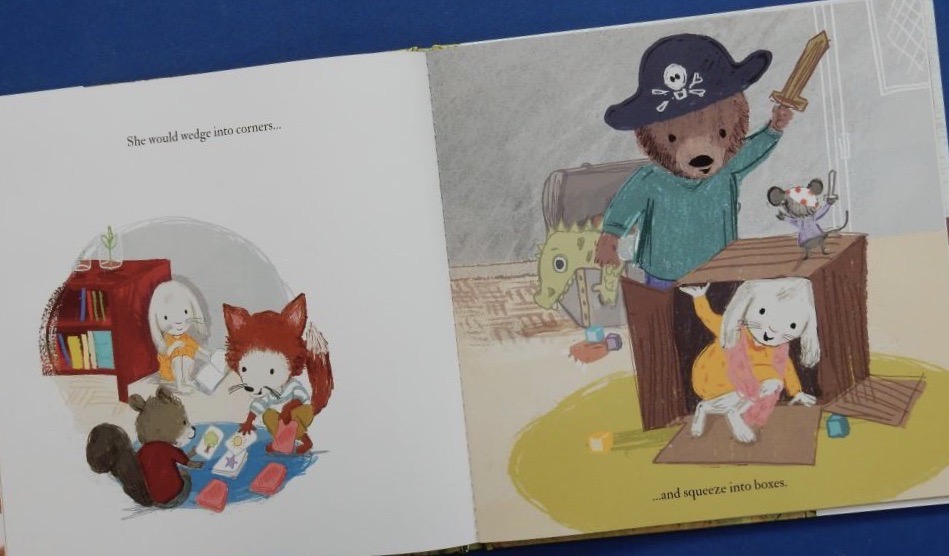
Nook is a small, shy rabbit; she speaks little and prefers to stay in quiet spots with somewhere against which to press her back so she feels safe.

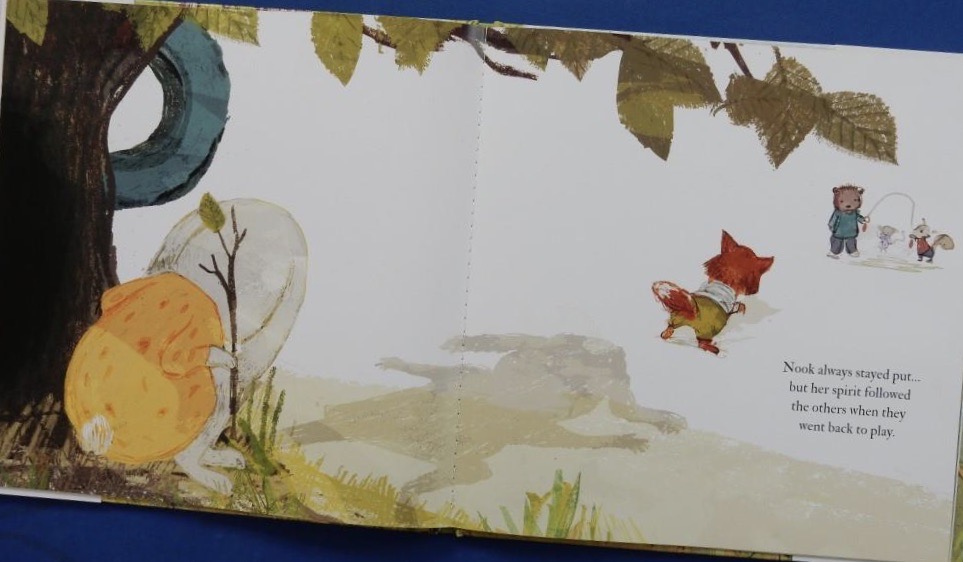
Her most favourite place of all is the deep hollow in an old elm tree, the ideal place from which to watch the other animals play. Try as they might to entice her out to join them, Nook prefers to keep her body feeling safe in her nook, but in spirit she’d be a participant in their games.

‘Nook’s place’ is what the hollow becomes known as, a place where other creatures know not to sit. Or rather, not quite all of them, for one day filling the hollow she finds …

The surly creature claims the space as his own, leaving Nook with welling tears and panic stricken.

Not for long however for her fear gives ways to surprise when the other animals stand behind her and speak out in her support. As they edge forward, the little rabbit feels protected and encouraged so that at last she feels confident enough to let them lead her away and play …

Do you think she continued so to do? You bet.

As it is with little animals so it is with young humans; some are outgoing and happy to be one of the crowd from the start, others – the introverts – need empathetic understanding and encouragement so they don’t stay forever on the sidelines.

Sally Anne Garland uses bold brush and coloured pencil strokes to imbue her animal characters with kindliness and humanity while also including in her outdoor scenes, lovely details from the natural world – a ladybird, seed heads, small flowers, for instance.

Definitely a book to share with foundation stage children, and individuals at home.

Big Dance / Bea by the Sea / The Roller-Coaster Ride

There are three recent releases from Child’s Play – thanks to the publisher for sending them for review

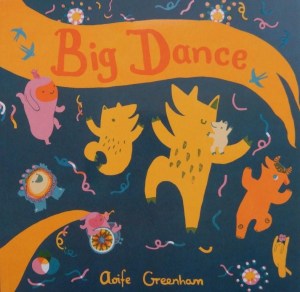
Big Dance
Aoife Greenham

As the Big Dance draws near, everyone seems excited about their moves, except young Pippa. Despite what her Poppa says she doesn’t think she has a dance inside. To prove his point, he decides to show her what Kit, Hip, Skip and Whizz and the others can do.

However, Pippa remains unconvinced about her own ability so Poppa then demonstrates his dance. “I’m not anything like that. I’m just a ME” muses Pippa but nonetheless she finds herself trying just a little dance and initially things look as though they’re going well but then she decides it’s no go nonsense. Her pals concede that it may be so, but add that it’s also fun – and inclusive. “It’s all of us … where we are all the same and all different … we can all be ourselves together. It’s where we all belong.” How aptly they put it but is it sufficient to encourage the one that’s still missing? What do you think?
Reassuring, all encompassing and a reminder of the importance of having the freedom to be yourself (something not everybody has) as well as a delightful demonstration of the joy of joining in. There’s plenty to talk about be that at home or in a school setting, when this quirky delight is shared with youngsters.

Bea by the Sea
Jo Byatt

Young Bea is a lion expert, thinking about the creatures all day long. When her mum suggests a day at the beach Bea would much prefer to stay at home playing lions especially as she doesn’t like the gritty, scratchy sand at all. Nonetheless she packs her lion paraphernalia, puts on her wellies and decides the best way is to pretend she too is a lion. Off they go with Bea concentrating on hopping from rock to rock rather than noticing the awesome lion sculptures her mum points out.
Suddenly she trips and falls flat on her face scattering her lion things all over the place.

As she brushes herself off a loud voice introduces itself as Sand Lion, suggests she leave her boots off and leads the way towards the sea. Gradually Bea sees as they play together, that sand can be great fun and they spend the entire day enjoying its possibilities, the Sand Lion also making a discovery.
The following day Bea returns eagerly to the beach but the tide has changed everything. No Sand Lion to be seen but Bea knows the best thing to do …
Bea is a delightful character and Jo Byatt’s portrayal of her is superb: I love the resemblance between the Lion’s mane and her hairstyle as well as the way she captures movement in her illustrations.
When you share this lovely book make sure you allow time to explore the factual endpapers.

The Roller-Coaster Ride
David Broadbent

As Vincent and his grandma journey in the purple bus towards the beach they talk of the exciting rides, especially Vincent’s favourite roller coaster, the boy eagerly anticipating and imagining its many interesting possibilities. However when they reach their Funland destination there’s a sign saying it’s closed for repairs. You can imagine Vincent’s disappointment, but Grandma offers encouragement and alternatives in the form of splendiferous ice-cream

and a play park, not to mention an unusual way of getting back to the bus stop.
I was quite surprised to see how accommodating Vincent is and impressed by his flexibility and positivity in not letting unforeseen circumstances completely ruin his day out: a great example to little ones. It’s good to see the author/illustrator’s inclusivity in his lively, brightly coloured scenes -I wonder how many of them will notice Vincent is differently abled on a first reading. The environmental positives include that the bus is electric, the charging points available, the cycle track, wetlands and wild life reserve all shown on the endpapers’ maps.

Max + Xam / I’m Not a Mouse!/ Best Friends, Busy Friends / New Shoes, Red Shoes

Thanks to Child’s Play for sending these ‘catch-up’ books for review

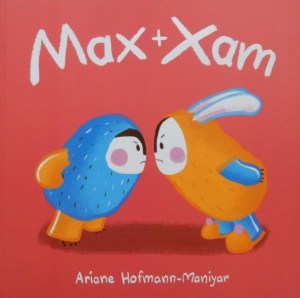
Max + Xam
Ariane Hofmann-Maniyar
Meet next-door neighbours and long-time friends Xam and Max. They live alongside one another spending much of their time together until comes a day when an amicable teatime turns nasty bringing to a halt their sharing of pleasurable encounters.
Max gets to work on a plan fashioning his own set of friends from bits and pieces; Xam does a similar thing

but creates even more inanimate friends than Max. Pretty soon both of them learn two things: firstly that such friends offer no fun at all; secondly that they miss one another very much.
Time for reparations. Gifts in the form of edible and floral treats are exchanged and after a bit of a mishap, amicability and happiness resume.
A lively, playful tale of the highs and lows of friendship presented through a straightforward text and enchantingly detailed illustrations. Perceptive youngsters will enjoy the nominative wordplay, likely relish the explosive falling out and the occasional surprises in this feel-good look at enduring friendship.

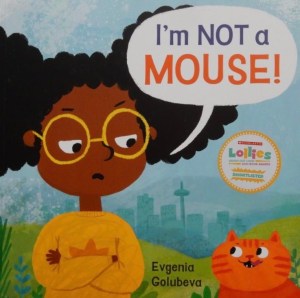
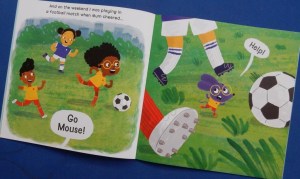
I’m Not a Mouse!
Evgenia Golubeva

Parents can sometimes really irritate their offspring by inventing and insisting on using pet names and so it is for the young narrator of this book. Her mum annoyingly calls her Mouse all the time the effect being that the little girl morphs into a mouse whenever she’s so called. Thus far this has caused at best inconvenient, at worst, extremely dangerous situations. There was the birthday incident, the occasion of the soccer match,

the time the two were out roller-skating and the life-threatening occasion in front of the family cat.
Enough is enough decides our protagonist, refusing to respond to the next “Mouse!” calls that greet her after school the following day. It’s not until she uses “Olivia” instead that the little girl is happy and reacts accordingly.
But then it turns out that she’s not the only one whose parents or adult relations use embarrassing nicknames creating similar problems.
Highly entertaining, with splendidly exuberant illustrations this is a fun story to share and a playful reminder to adults that not all children are happy to be called anything other than their given name. There’s more visual pleasure to be had by exploring the endpapers – the front ones showing Mouse, the back ones an assortment of pet names none of which I suspect, would be happily received.

Best Friends, Busy Friends
Susan Rollings and Nichola Cowdery

Interestingly during a walk I was having a discussion with a young relation about the various things her friendships offer and got home to find this book among those that had arrived for review.
Essentially it’s an inclusive rhyming observation by what look to be twins, of their friends that takes us through their school day from wake-up time to a final celebration. We meet among others, friends fast and slow, tall and small, messy and tidy, kind and caring, not so kind; some are funny, other silly, those who enjoy sharing a story. Some might be sad, some happy, there are even feathered ones needing a feed and fluffy ones that can be over-playful.
This inclusive presentation of friendship with its simple text and Nichola Cowdery’s bold, lively, illustrations of young children and their care-givers offers lots of possibilities for discussions with toddlers and preschoolers.

New Shoes, Red Shoes
Susan Rollings and Becky Baur

Here’s a simple story of a child going with his mother to buy new shoes. Their journey to the shop is an opportunity to observe all manner of shoes being worn in Becky Baur’s scenes – by people at the bus stop, on the bus, in the park, in the street at a friend’s and in the market.
When they finally reach the shoe shop there are so many possibilities: which ones will they buy and for what special occasion are they getting them?
With a simple rhythmic text and inclusive illustrations, in particular that the family comprises two mothers and a child, this is a good one for beginning readers and young listeners.

Mo and Crow

Mo and Crow
Jo Kasch and Jonathan Bentley
Allen & Unwin

‘No man is an island’ wrote poet John Donne more than 400 years ago but Mo wants it so to be.

Mo is a loner and that’s the way he likes it. He’s built a sturdy house surrounded by a protective wall to deter intruders be that elemental, animal or human kind. Privacy is vital so he thinks.
Then from behind the wall he hears tap tap tap over and over. Mo’s various ways to block out the infuriating sound invading his silence prove futile and it’s not long before the continual tapping causes the displacement of a stone and there is a beak belonging to Crow.

Mo pushes back the stone but the next day Crow pushes out another one and another …

Furious, Mo tries begging, yelling and shouting but to no avail. The invader doesn’t go. The size of the hole increases and eventually Mo seizes the biggest stone he can find and hurls it at Crow. The creature remains. The two sit watching one another; Mo within his house Crow from his perch on the broken wall.

This goes on all day and eventually Mo goes to bed and sleeps. Next morning no Crow. Mo prepares,,,, materials to repair his wall and then as he looks up there’s space, clouds in the sky and hills: a whole world has been opened up.

But where is Crow?

Debut picture book author Jo Kasch and illustrator Jonathan Bentley present two contrasting characters – one a seeker of company, one who eschews it, in this tale of diversity, acceptance, the breaking down of barriers and the importance of friendship. With the economic text occasionally breaking into rhyme and lots of repetition providing joining in possibilities, and Jonathan Bentley’s boldly coloured scenes of the unfolding drama to feast their eyes on, youngsters will certainly have their attention held throughout this thought-provoking allegory.

Flip Flap Zoo / Where’s Mr Fire Engine?

These are recent additions to popular, playful series from Nosy Crow – thanks to the publishers for sending them for review

Axel Scheffler’s Flip Flap Zoo

The zoo is the latest location for Axel Scheffler’s split page animal extravaganza and happily there’s not a cage in sight for the dozen creatures that offer rhyming verses on themselves.
What fun you can have generating your own crazy conglomerates – 121 possibilities according to the frog on the back cover.

What would you get by crossing a lemur with an ostrich?

In case you didn’t guess – it’s a lemich. Then what about a jaguar and a hippopotamus? Roar! Roar! Growl! Growl! that one’s a jagotamus.

Full of zany names, noises aplenty to exercise the vocal cords and all those creature combinations to giggle over, this book will give preschool joiners-in, and Foundation Stage/KS1 children hours of pleasure both visual and verbal.

Where’s Mr Fire Engine?
Ingela P Arrhenius

Four potentially very noisy vehicles lurk beneath the variously shaped felt flaps in the latest of this series that ends with a surprise mirror (or maybe not such a surprise if your little one is familiar with previous titles). Nonetheless the very youngest will enjoy guessing what’s hidden, exploring the bright stylised scenes and joining in with the ‘Here s/he is!’ as the police car, ambulance, helicopter and fire engine are revealed.

Fletcher and the Rainbow

Fletcher and the Rainbow
Julia Rawlinson and Tiphanie Beeke
Graffeg

The latest in this series featuring Fletcher and his animal friends is again a delight. Young listeners will be swept along with the little fox in his determined effort to find the rainbow before it disappears, gone in the rainy autumn mist. He hopes that if he’s able to find it he could help it shine forever rather than as his mum had said, “soon be gone”.

Through the dripping wood he goes soon coming upon birds giving themselves a final feed before setting off to fly south. They tell him that the rainbow’s end is at Hedgehog’s nest and Fletcher hastens on his way.

His search takes him next to Squirrel, also preparing for winter; then as he tumbles into the stream where Squirrel has helpfully sent him, Goose. She’s doubtful when Fletcher tells her that the rainbow has fallen in the stream but helps him look nonetheless. They do see a reflection but it’s a learning experience for Fletcher.

Finally as he hurries past the rabbits the little fox sees …

but even then the rainbow eludes him.

Stopping now, Fletcher reflects on his search and how the rainbow’s led him through the woods and he decides he can at least create a rainbow memorial …

All his friends are happy to assist and together they create the most gorgeous autumn rainbow …

Whether you want a story to introduce to young children the scientific ideas connected with rainbows or the natural world in autumn, hope and determination, or creative problem solving, this is a lovely starting point. Most important though, it’s a sweet, uplifting book for sharing and pausing to delight in the captivating, richly hued scenes of Fletcher’s journey. and that sparkling finale spread.

Scaredy Bat

Thanks to Little Door Books for inviting me to join the blog tour for:

Scaredy Bat
Jonathan Meres and Anders Frang
Little Door Books

Absolutely bat-tastic sums up my response to this book. It had me hooked from the opening lines, so poetically describing the coming of morning to the Dark, Dark Wood. A wood where, in an old oak, dangle Big Bat, Middle Bat and Little Bat, snuggled up and ready for rest and perhaps some inverted dreams.

However, bothered by the buzzing, humming and drumming that fills the air, Little Bat just can’t get to sleep. The others tease him and so he decides to prove to them that he’s not in the slightest bit scared of the light. Off he goes with a ‘Wheeeee!’,

their warnings about the BOGEY BAT and bothersome bumps echoing in his ears. ‘Scaredy Bat! Scaredy Bat! Ner, ner, ner, ner, ner!” was their mocking cry.

As Little Bat fizzes and whizzes around in and out of the branches his confidence grows and he feels like he’s king of the wood. But then a strange feeling comes upon him – a feeling he’s no longer alone.

Surely it couldn’t be that bogey bat after all, could it?

Quickening his pace has no effect: wherever he goes that dark creature goes too until a sudden realisation dawns … But then he really knew all the time didn’t he?

Time to head back home to the others, both now a bit bothered by his prolonged absence.

Could there be another fright in store? …

Jonathan Meres’ dramatic rhyming narrative reads aloud like a dream (not of the upside down kind) and adult sharers will enjoy performing the tale probably as much as little humans will enjoy being entertained, both by the words and Anders Frang’s equally theatrical scenes. I love the way he uses the bats’ eyes to show their various feelings, and the cuddly toy rabbit.
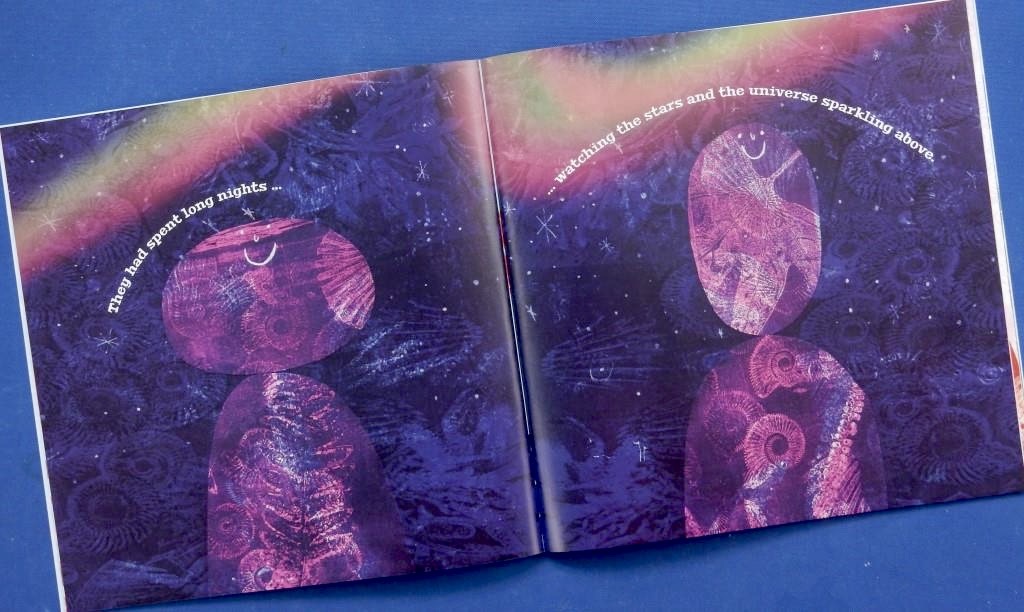
Sing Like a Whale

Sing Like a Whale
Moira Butterfield and Gwen Millward
Welbeck Publishing

Previously Moira Butterfield invited youngsters to lessons that would help them Dance Like a Flamingo. Now in this spirited book their voices are the focus as they take delight in joining in with this exploration of the variety of sounds made by creatures large and small.

First to perform its song is the male humpback whale as he swims through the ocean with a long low Hoooooooo Hoooooooo.

Back on land we meet shaggy maned father lion ready and waiting to make his loudest Roar! Roar! – the ideal sound for little ones to stand proud and tall ready to give vent to their feelings.

Next to use its vocal organ is an owl Hoot, hoot! it goes as it perches on a branch. Make sure youngsters are ready to emulate its turning head movements as well as its hooting before spreading their wings and gliding off.

Also enjoying a moonlit singing session are a pack of wolves, each one A-woooooooo-ing and waiting for little humans to creep, sit and create an echoing A-woo! A-woo!

A further eight creatures, some feathered, others furry and one scaly are all eager to give renditions and encourage children to copy them

and then it’s the turn to the children to issue an invitation to “Sing with me!”

Whether you share this book with one, several or an entire foundation stage class prepare yourself for a very noisy and thoroughly enjoyable story/movement session. Make sure you allow time to let your audience see Gwen Millward’s humorous illustrations of the various animals, and the animated child mimickers clearly enjoying themselves.

Bird’s Eye View

Bird’s Eye View
Frann Preston-Gannon
Templar Books

Little Bird is curious about what lies beyond the treetops wherein she nests with her mother. Mama tells her that beyond the forest live people though she knows not what people actually are other than that her own mother has told her to avoid them. However, once her wings are sufficiently strong, Little Bird tells her Mama that she’s ready to leave the nest and see the world. Off she flies enjoying the freedom as she observes the world from above and it’s not long before she spies what she thinks must be people.

As she flies further, Little Bird becomes increasingly confused: some people are quiet and slow, others frantically hurrying around. There are happy, colourful people sharing what they have and singing lovely songs.

But then she sees something that leads her to believe that not everybody values freedom, they put birds in cages, spoil the environment with rubbish and burning fossil fuels. Other people in contrast are cleaning up the mess.
Her journey takes her over land and sea until eventually Little Bird needs to pause for rest; that’s when she has a narrow escape.

Now hurt and doubting whether she’ll ever see her mama again, Little Bird feels gentle hands. Hands that rescue and nurture her until she’s strong enough to take flight once again.

Finally back home, Little Bird has much to tell her Mama, the most important relating to acts of kindness.

Cleverly using a bird’s eye view, Frann weaves powerful themes relating to the impact humans have on the world into both her verbal and her visual storytelling. There are ‘people on the move. “Migrating like birds”,

black smoke billowing into the sky and those who share whatever they can, all acting as powerful reminders of the importance of having a sense of responsibility and showing kindness. Therein ultimately lies freedom.

Share this beautiful story at home with little humans especially those just starting to spread their wings; share it in the classroom as an inspiration to help make the world a better place.

The Hundred Decker Bus / The Hundred Decker Rocket

The Hundred Decker Bus
The Hundred Decker Rocket

Mike Smith
Macmillan Children’s Books

New to me but a reissue of his debut picture book is Mike Smith’s The Hundred Decker Bus. Tired of his usual routine, the bus driver takes inspiration from a passing hot air balloon and decides to take a new route that he’s never before noticed. Imagine being on that bus: what would your reaction be to a diversion to nobody knows where? That of the passengers (whose numbers increase en route), is one of happy abandon, as after a day’s driving the bus reaches …

But that is only a small part of their adventure about which I’ll say no more other than the sky’s the limit … or maybe it’s not.

This fantastical story with its awesome fold-out page will grip youngsters as they explore not only that spread but every one of Mike Smith’s humorous, highly detailed scenes be they large or small.
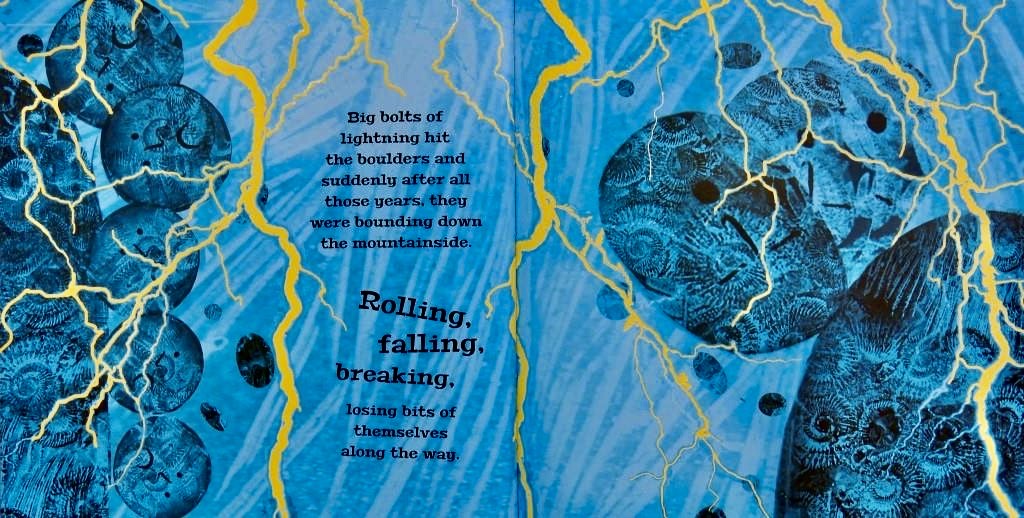
Share this uplifting picture book reissue either with one child, a group or a whole class. It has huge potential in the classroom.

So too does The Hundred Decker Rocket. This begins in Ivy’s bedroom where she’s just finished creating a massive telescope through which she sees a strange and beautiful ‘something’ glimmering in the sky far off. An adventure beckons Ivy and her trusty dog Eddie, but that will require another round of constructing.

Several days later the two are blasting off skywards in their rocket, landing unceremoniously, after what seems an incredibly long journey. on a planet entirely covered in rubbish.

Eddie learns from the resident environmentally un-savvy aliens that they’ve messed up their home and now want to leave and find a new place to live – if Ivy and Eddie help them build a spaceship that is. The construction continues apace as more and more aliens appear and yet more rubbish accumulates and is used, leaving the planet much cleaner.

With a hundred decks duly built, they deem the rocket ready for boarding and blast off takes place that night.

Eventually the aliens agree on what they feel is a suitable new planet and down they go … but there’s a strange familiarity about it …

With a great final twist, incredibly detailed, zany scenes that youngsters will pore over for hours revelling in the wealth of humorous touches, including speech bubbles and onomatopoeic noises off, and its fold-out page, this is a cracking book. Highly relevant is the vital environmental message about the importance of caring for our planet.

If you’re after a fun story or a super starting point for an ecological discussion that will galvanise children to take care what they throw out and where/how they dispose of it, this is it.

Look, Puppy!

Look Puppy!
Mary Murphy and Victoria Ball
Walker Books

A little girl has long awaited the arrival of her new puppy and now, hurrah! At last the nameless creature has arrived and she is eager to introduce the newcomer, first to the immediate surroundings and then the world at large. The latter entails a walk around the neighbourhood to see the various houses and their inhabitants both human and canine,

most of whom are very welcoming and offer to help choose Puppy a name. But then disaster! The creature disappears.

Where is Puppy?

A frantic search begins, followed by a pause for some reflection,

a joyful reunion and a return home.

Will the little girl ever settle on a name for her puppy though. Yes of course, but what will it be?

With endearing, finely detailed illustrations by Victoria Ball, Mary Murphy’s is a warm, gentle tale that will especially appeal to youngsters with a dog in the family. The little human protagonist herein shows such understanding and love in her dealings with her puppy offering a great example to young readers.

Ruffles and the Teeny, Tiny Kittens / I am Dog!

Ruffles and the Teeny, Tiny Kittens
David Melling
Nosy Crow

Puppy Ruffles is in many ways similar to a little human as he learns about the world – its ups and downs. There’s much he enjoys but if there’s one thing he particularly dislikes it’s teeny tiny kittens. So you can imagine his feelings when five lively kittens of the teeny tiny kind come to stay. He is far from happy about their high-spirited actions, their noises and their poo. They follow him wherever he goes and try to do whatever anti-sharer Ruffles does. Worst of all is that they want to enjoy the delights of his Big Blue Blankie.

When a tug of war over this special object occurs the kittens’ game results in catastrophe.

Can these frolicking felines perhaps help Ruffles learn one of life’s important lessons – that sharing is the best way to make friends and have fun.
Once again David’s observations are spot on and this funny follow up to Ruffles and the Red, Red Coat is sure to be another winner with youngsters of the human kind. With its text closely matching the terrific illustrations this is also an ideal book for young learner readers.

I am Dog!
Peter Bently and Chris Chatterton
Macmillan Children’s Books

We meet another playful pooch herein, this time acting as the book’s narrator and telling of a day in its life from its very own doggy viewpoint. And what a clever creature to speak in clipped canine rhyme about liking such things as ‘beggy-beggy trick’ and ‘fetchy-fetchy stick’.
This canine can’t resist a watery chase,

a race or ‘feeling wind in face’, not to mention rolling in strongly ponging foxy droppings.

However, like the majority of canines, our narrator has a great aversion to the moggy residing next door.

Much more enjoyable are cosy cuddles, ‘lap-lap-lappy puddles’, sniffing the rear ends of fellow dogs and the ‘sniff-sniff’ aromas emanating from the tasty meal laid out on the table. But therein lies both disaster and satisfaction:

now what does the little human residing in the same home think of all this? …

Chris’s action-packed scenes portraying the predilections and pranks of Dog are hilarious and provide the perfect complement to Peter’s bouncy, splendidly onomatopoeic text.

I Am Am Artist

I Am Am Artist
Kertu Sillaste (translated by Adam Cullen)
Graffeg

Who or what is an artist? That lies at the heart of this picture book by illustrator/art teacher Kertu Sillaste. My experience of teaching young children indicates that it’s not until they reach about seven that they start saying such things as “I can’t draw” when what they mean is more like “I can’t create what I consider an accurate representation of this or that” – a tiger is the exemplar this book’s creator uses – but art is so much more.
This is what the young artist main character and narrator discusses and demonstrates herein.

First, with reference to a self-portrait, he presents the variety of processes that an artist might use, ‘An artist thinks and draws and paints and glues and sketches and moulds and photographs and films and considers and constructs and assembles.’ Most important at the outset is ‘a good idea’ and this can be generated in different ways including using one’s imagination, looking at art, taking out your paints and paper or perhaps you don’t even know what sparked it but you feel so inspired that you just have to get to work right away.

I love the playful ways the boy creates memorials for his grandparents 

and others, as well as his creative putting together of found objects. 

At other times art might be story-telling through pictures, and these pictures can perhaps be about worrying events or people, or in contrast reveal what makes that particular artist happy.

Not all creative ideas reach fruition though – some remain as ideas while others might be possibilities for another day. Indeed some days can go particularly unsatisfactorily with nothing at all working out; 

but still the creative spark is re-ignited the following morning.

There’s also the consideration of revealing what you’ve done to others – what will the reaction be? … ‘An artist really needs praise’ says John. Over-ridingly though the narrator loves to make art; that is what the author hopes he’ll put across to young readers of this book and in so doing, expand their boundaries of art and being an artist. Thinking outside the box is what we want to encourage.

Undoubtedly Kertu Sillaste succeeds in her mission and I suggest this is a book to share and discuss with KS1 children especially, ‘before that “I can’t draw’ notion takes root.