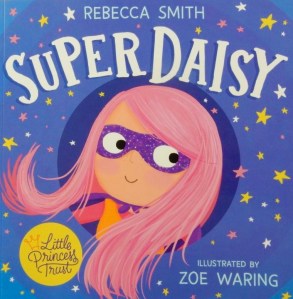
SuperDaisy Rebecca Smith and Zoe Waring Harper Collins Children’s Books
Young Daisy is an aspiring princess and really feels like a fairy princess when she dons the pink gown and crown from her dressing up box. This make-believe helps Daisy to forget about the less happy parts of her life, for this little girl has cancer and often needs to go and stay in a hospital far from her home to have medicine that makes her feel sick and weak. Worse though is that the medicine causes her hair to fall out.
Then back at home she rediscovers that forgotten pink sparkly wig and when she puts it on, Daisy is transformed into Daisy the Superhero complete with flowing cape and matching shimmery mask. Wearing this amazing attire Daisy transports herself to the town zoo where she comes to the aid of some lemurs being cruelly frightened by a boy.
She goes on to rescue a bear trapped beneath a fallen tree in the forest and to help a little girl at the seaside who has dropped her ice-cream in fright when a seagull came too close. Now when she’s back in that ward for treatment Daisy wears her pink hair, bolstered by the knowledge that her kindness power has made her a superhero able to face anything.
Eventually Daisy’s hair grows back: the wig has done its job and more.
This inspiring, uplifting rhyming book based on a true story is published in support of the Little Princess Trust, which supplies wigs for children with cancer. With its plethora of pink touches as well as that wig in Zoe Waring’s illustrations, this is definitely one to share with youngsters like Daisy undergoing cancer treatment (or perhaps sick with another serious illness).
Leila The Perfect Witch Flavia Z.Drago Walker Books
Young Leila is a multi-talented little witch with awards for fast flying, cunning conjuring, sneaky shape-shifting and crafty carving. However, there’s one trophy she longs to add to the display cabinet – her dream is to win the Magnificent Witchy Cake-Off. Leila comes from a long line of baking experts and this year she’s at last old enough to enter the contest and has high hopes of claiming the prize. Then comes a big shock: in contrast to her other endeavours, Leila finds that the requisite skills for becoming an expert in the Dark Arts of Patisserie elude her. Not so her determination however. She eschews having fun with her siblings and devotes her time to creating that perfect recipe – with disheartening results. What will her family think? It’s not what she anticipated.
Instead, her sisters offer to help. Leila accepts, learns a lot and thoroughly enjoys the time they spend together.
When the night of the event arrives, she overcomes her nerves and does her best. Leila doesn’t win that trophy but she does learn something very important: there’s more than one way to feel like a winner and sharing an experience and being supported by a loving family are wins for her.
Take one little witch, a supportive family, a froggy friend, a bowlful of whimsy, lashings of visual humour, spoon in a visitor from another picture book, mix them all together and the result is a very sweet, satisfying story with an agreeable message.
Winnie and Wilbur: The Festival of Witches Valerie Thomas and Korky Paul Oxford Children’s Books
Winnie and Wilbur have been enchanting children for about thirty-five years and still the magic holds good. Now it’s time for the two of them to have a holiday – a very special one on an island in the middle of the ocean. So, with suitcase packed off they fly to the Festival of Witches. It’s an amazing event attended by witches from all over the world and a considerable number of cats too.
There are opportunities to learn new spells, dance, sing, eat lots and generally have a great time. When she’s about to depart, Winnie receives lots of invitations from other witches to come and pay them a visit; these Winnie stashes in her suitcase. Now this had happened on previous occasions but Winnie had never responded to any such invitations. However after a few days in her own home, Winnie begins to miss the company of the other witches. Out come those invitations and she goes through them.
Selecting four places to visit, Winnie and Wilbur go first to a tree house, then to a mountain top residence, a seashore castle owned by three witches and finally, a lighthouse.
Once again though, the peace and quiet of home on their return is a tad underwhelming; but then …
Korky Paul’s vibrant, richly detailed illustrations of the diverse witch community and their interactions will keep youngsters entertained for hours, long after they’ve heard this thoroughly enjoyable story read aloud.
These are two picture books that deal with current political events and issues.
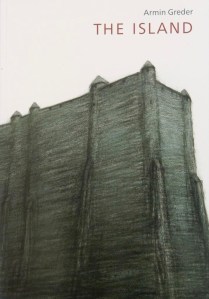
The Island Armin Greder Allen & Unwin
This is probably even more pertinent today than when it was first published in the UK around fifteen years ago.
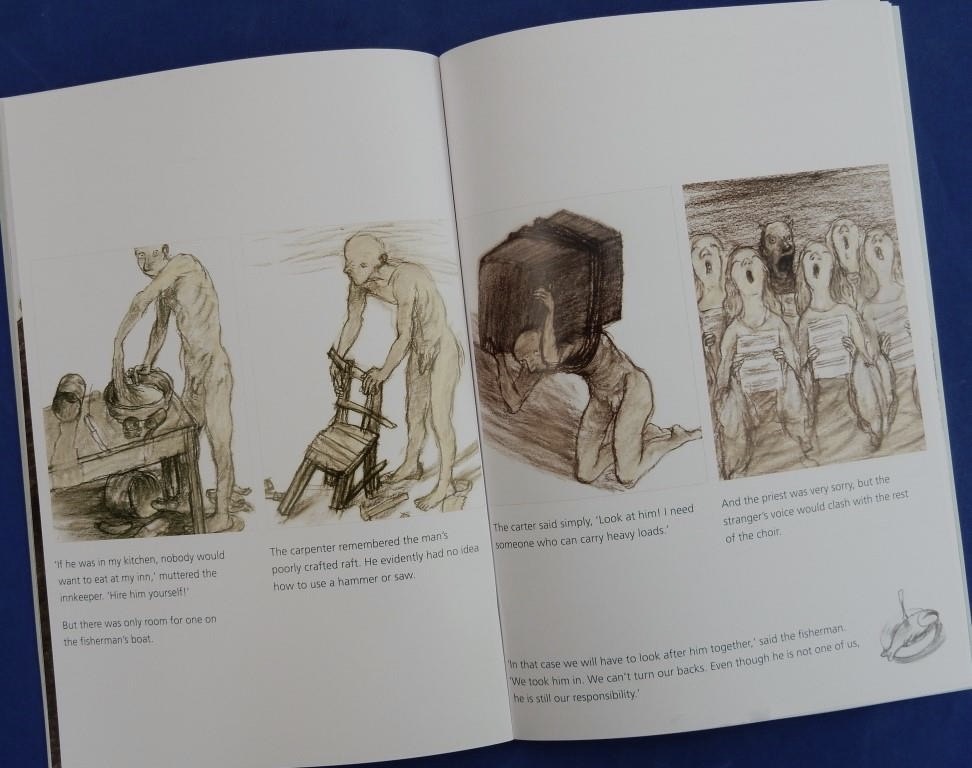
Washed ashore on his inadequate raft is a man, different from the islanders, which causes them to fear him, but a fisherman persuades the others to take him in. Reluctantly they do so but immediately send him to a deserted part of the island, locking him in a goat pen and leaving him alone. One morning though, the man appears in the town and again is met with hostility except from the fisherman who suggests the possibility of finding a job for the stranger. Excuses pour forth
and the man is returned to the pen but the islanders are increasingly hostile and eventually they reject him completely, savagely driving him with their farming implements, back into the sea.
They turn on the fisherman too, setting fire to his boat and fuelled by their fear, they erect a huge wall around their island to deter further newcomers.
With his brilliant combination of words and deliberately ugly unforgettable images, it feels to me as though Greder is holding up a mirror to the all too many people – including some in positions of power – who are unashamedly hostile towards refugees and asylum seekers. They are the ones who really need to read this book with its themes of prejudice, racism, xenophobia and human rights. With those intensely disturbing scenes of viciousness to another member of the human race, it’s impossible not to feel disgust and shame at such attitudes.
Sarah Rising Ty Chapman and DeAnn Wiley Beaming Books
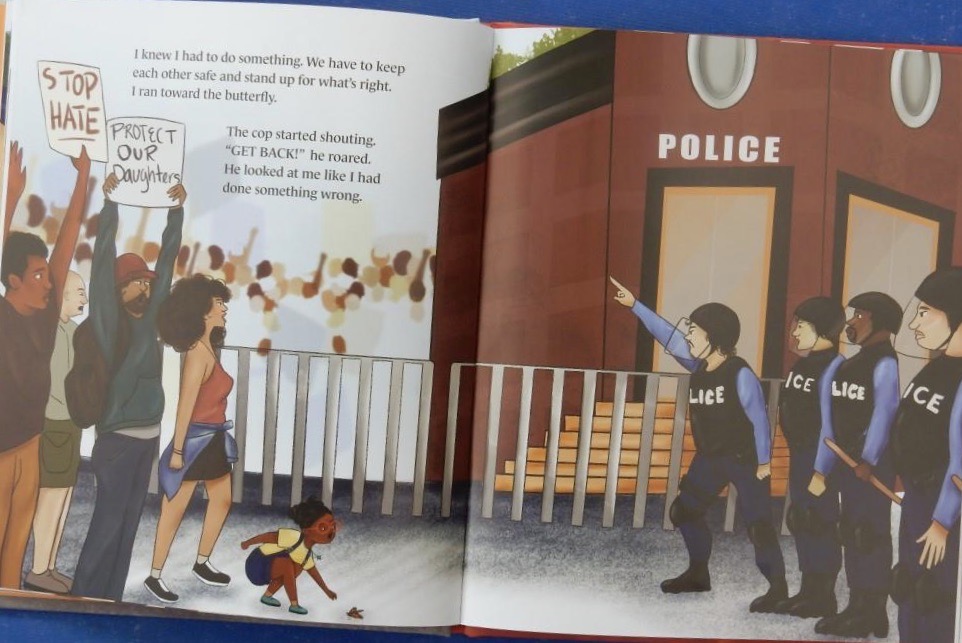
This first person narrative is presented by young Sarah whose day starts in the usual way having breakfast, feeding her insect pets and packing her things in her school bag. But then her Dad gives her some news that changes things completely: he tells her that the police have ‘killed another Black person.’ “They’re supposed to serve and protect us … but they hurt us instead.” ‘ He takes his daughter along to a protest; she joins the throng demanding justice and in so doing she sees for herself the cruel way a police officer attacks a harmless butterfly. Sarah rescues the butterfly left lying on the ground
and rejoins the marching crowd but suddenly realises that in so doing she’s lost her Dad. However with the help of a kindly woman who sees her distress, together with her own inner strength, she gradually overcomes her fear and is eventually reunited with her Dad. A scary experience for first time activist Sarah but one that will surely be the first of many demonstrations of dissent designed to make a crucial difference.
Vividly illustrated by DeAnn Wiley whose scenes include one showing murals of George Floyd and Breonna Taylor, both of whom were brutally killed by the US police – a vivid reminder of these terrible events. If a girl like Sarah can make a difference so can youngsters everywhere: backmatter includes some suggestions of ways to create change in a community.
Where Have You Been, Little Cat? Richard Jones Simon & Schuster
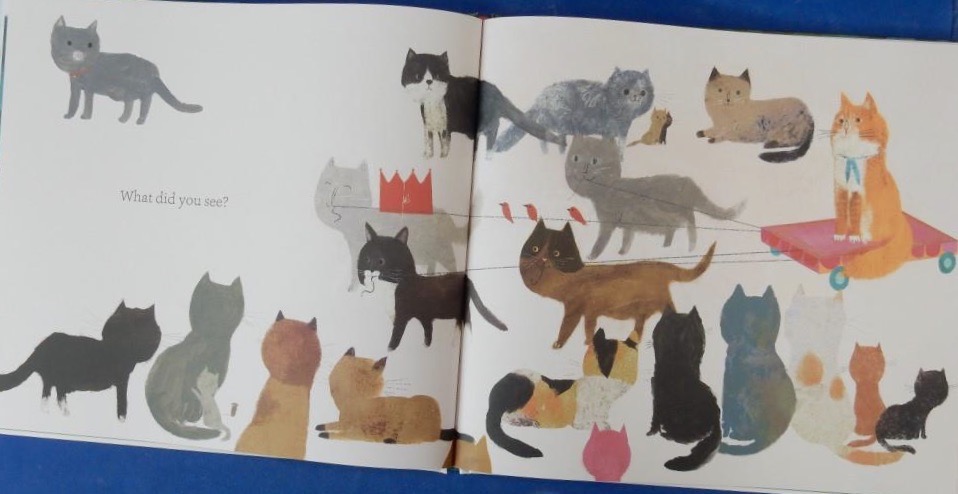
On returning after a day outside, a little cat’s owner is eager to learn what the moggy has been doing. ‘Where did you go?’ she asks, going on to pose a series of further questions. These comprise almost all of the simple straightforward text. What we’re shown in Richard Jones’ storytelling sequence of illustrations offers one possible way of filling in the gaps left by his words. It involves a coming together of cats,
a crown, a special event suddenly interrupted by the arrival of a canine intruder, a confrontation,
a resolution and finally, a return home with a very warm welcome.
Young readers and listeners pouring over the playful pictures still have room to imagine their own interpretation of the events or indeed, invent their own stories. They will surely notice the bit part players – three small red birds and a tiny mouse.
Rich in possibilities, this is a story that children will enjoy returning to over and over again.
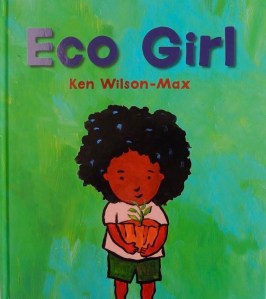
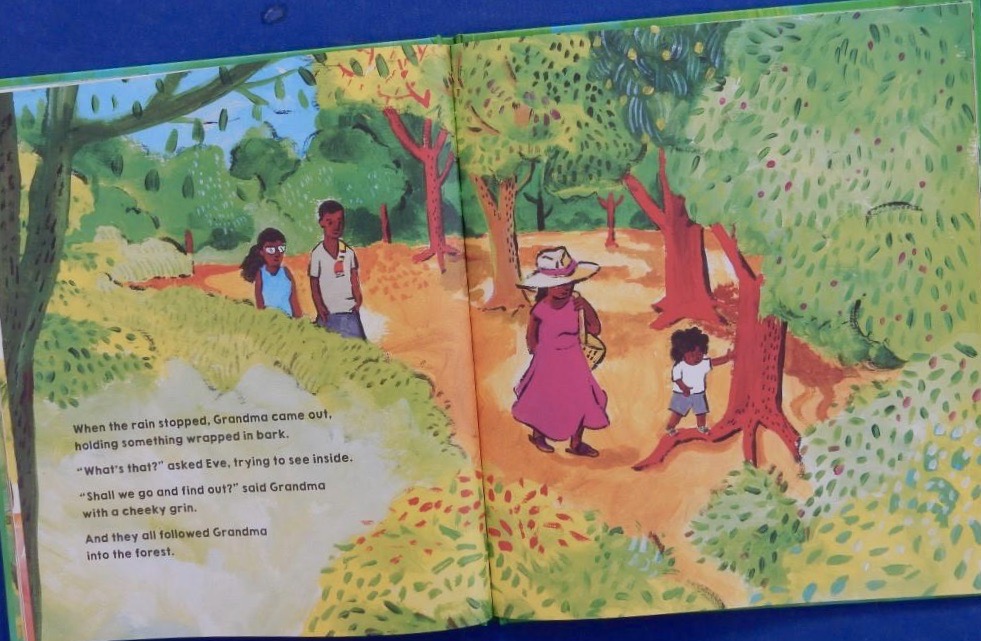
Eve loves the forest beside her home; she loves the animals and birds, but most of all she loves the trees, her favourite being the Baobab tree. Do those trees talk to one another, she wonders wishing that she could be a Baobab and hence talk to the other trees. To be a tree is to be patient her mother tells her and later her father says that each tree plays its own special role in caring for the living things in the world. Soon after, on a pre birthday visit to her Grandma deep in the forest, after remembering to be patient on their long walk, Eve asks her grandmother, “Would you talk to me if I was a Baobab tree?” Delighted by the response and Grandma’s mention of the next day being a special day, Eve can hardly wait.
Next morning, she gets a magical surprise. Carrying something, Grandma leads her into the forest.
What could it be? It’s something very special that Eve must plant, love and take care of, something that will connect her for ever with the forest she so delights in. That, she proudly assures her Grandma, is something she definitely can do. Many happy returns of the day, Eco Girl.
Heart-warming and inspiring, this is a lovely demonstration of the importance of planting and nurturing trees wherever you live in the world. I love the vibrant colours of the illustrations, especially the variety of greens in the forest landscape.
(After the story are some tree facts including a mention of Wangari Maathai who started the Green Belt Movement in Kenya.)
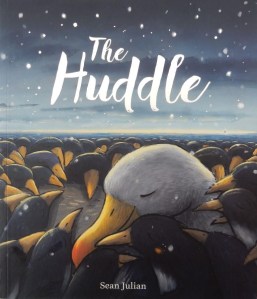
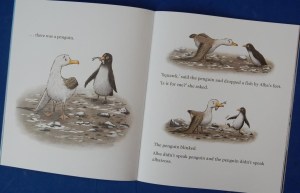
When albatross chick, Alba, feels the time is right she spreads her wings and taking advantage of the wind, takes to the air. Her flight takes her away from everything familiar and as she searches the sea beneath for food, she fails to notice the huge wave coming up behind. Crash! Alba lands up on a rocky shore but her wing is damaged to that it won’t move. Exhausted and in pain, Alba falls asleep. When she wakes, she sees a penguin close by. The penguin drops a fish beside her.
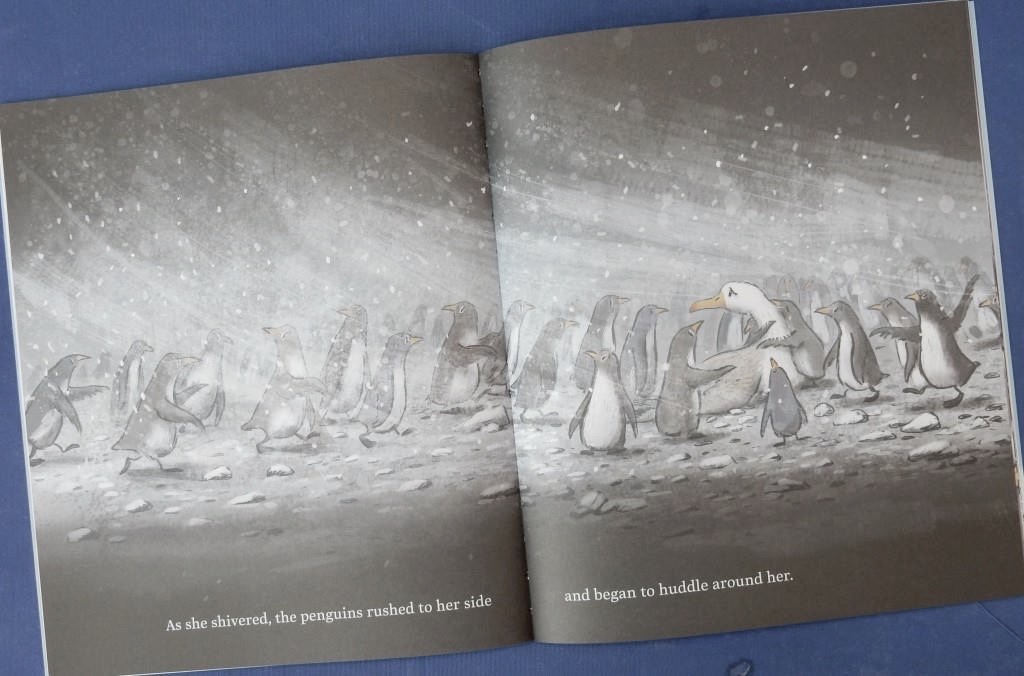
Over the days and weeks, more friendly penguins come sometimes bringing her fish, but always making Alba feel cared for and safe from potential harm. Alba loves the playful penguins and little by little she forgets about flying through the sky. Then one day at sundown she notices that her friends look troubled. Dark storm clouds are brewing and there’s a chill wind. The penguins huddle protectively around her
and eventually she falls asleep encircled in their love. After many days the storm abates and Alba wakes to see lots of excited penguin activity as the sun begins to come up on the horizon. Her friends stretch out their wings expectantly, not to fly but to feel its rays. For Alba though, with her wing now mended, it is departure time. Difficult though it is, she stretches out her wings and lifts off to the sound of cheering penguins. Penguins that she will never forget; she’ll cherish those memories and use that love she felt in their company as a model for raising her very own little chick.
The care and concern shown by that penguin colony is a wonderful example of how a simple act of kindness can make all the difference to a struggling individual. Despite its Antarctic setting, this story leaves you with a wonderful warm feeling inside. Sean Julian’s illustrations convey so well both the chill of the landscape and the compassion of the penguins.
When Mino Took the Bus Simon Ciraolo Flying Eye Books
When he turns eight weeks old, young chipmunk, Mino must bid his mother farewell and set out into the world alone. With the instructions he’s been given running through his mind and his ticket at the ready, Mino excitedly boards the bus to the very last stop. He can hardly wait to reach his destination where he will find his future home, plant his seeds and watch them grow. To help pass the time Mino chats to the driver, shows him his leaf collection and asks, “How can you spend all day waiting to arrive?’ Guido responds thus, “ I often think the journey is just as important as the destination.”
As the journey continues other passengers come on board. First there’s Béatrice who shares her snacks with Milo and receives one of his seeds in return; then others who treat Milo with varying degrees of friendliness. Sometimes the bus stops to allow the passengers to have a little walk and perhaps find something of interest to show each other and especially Milo.
The hours aboard the bus pass almost without notice as Milo is surrounded by his new friends and he decides to collect the memories they share with him. Some passengers depart
and eventually the bus comes to its last stop. None of the remaining passengers hurry to get out and embrace the future but eventually each one leaves and having had to retrace his steps and give the driver something, Mino sets off to find that new home.
What matters most in Simona’s uplifting story so enchantingly illustrated, are the small moments the friends have shared, those are the ones they will remember and cherish.
The Circles in the Sky Karl James Mountford Walker Books
After reading this intensely powerful fable-like picture book I needed to sit quietly and just be for a while.
Having spent a night hunting, Fox is reluctant to leave his den, despite the disturbing chorus of birds outside; but follow the sound he must so strange and different does it sound. He follows the birds across the rushing river, past the forgotten house and through the old woodlands to a place where many kinds of flowers grow: an entirely new place for Fox. He also misses the birds huddled in a circle on the ground till they suddenly take to the air, but one is left there, lying quite still. Nothing Fox tries can make this broken Bird move but unbeknown to him his attempts have been watched by Moth.
Moth starts to talk to Fox; she talks of the moon reflecting the sun’s rays, even long after sundown. Fox remains puzzled until Moth explains that the bird is dead. “I was trying to be kind,” she tells Fox. “Sad things are hard to hear. They are pretty hard to say, too. They should be told in little pieces. Bird isn’t here any more … because … Bird is dead.” As the realisation dawns for Fox, Moth offers him comfort and the two sit and share their sadness for a while. Further understanding follows for Fox – like the moon always remembering the sun, he can remember Bird.
Yes, death is a confusing time for those left, as Mountford shows, but equally he offers through Moth a model of being there for the grievers, a simple ritual for saying goodbye and most important of all, hope.
Using earthy hues of the natural world that starkly contrast with the black of sinewy Fox, Moth and Bird, geometric shapes including circles aplenty, straight lines and angles, James’ art captures so wonderfully both the stillness of things gone and the movement of living things.
Not a single hint of talking down to children is there in this awesome book, just a beautiful message beautifully presented.
You Need to Chill! Juno Dawson and Laura Hughes Farshore
The narrator of this upbeat rhyming picture book has an older brother, Bill; but her friends haven’t seen him for a while and want to know what has happened: where is he? They put forward all manner of possibilities that could account for his absence but from our narrator come denials that all end “And, hun you need to chill.”
However these friends are persistent, caring and determined, till finally comes the revelation, “… The truth is that my brother Bill … is now my sister Lily.’ Yes it may have been something of a shock initially but despite her new name and looks, much remains the same: she’s still as kind, funny and clever as ever; her family all love her.
Both Juno Dawson’s words and Laura Hughes’ pictures are full of warmth and a gentle humour: with its themes of identity, kinship and acceptance this inclusive story beautifully conveys its message in a manner that allows young children to take what they need and ask questions if they want further explanations. Fiction books such as this one are a very good way of opening discussion with primary children in PSHE sessions: such discussions help children learn that differences make the world a much more interesting place.
I Believe In Me Emma Dodd Templar Books
In conversation as the two swim together through the swampy landscape, a little crocodile speaks of the self belief the Mother crocodile has instilled in her offspring. Knowing one can do anything if only you try; the importance of never giving up if something goes wrong, as well as telling yourself that those dark days are always followed by brighter ones if you keep reaching for the sky, are key for little humans as well as little crocodiles. That way keeps the entire world open for you to forge your path through life, optimistic and confident in yourself. So says this inspiring little book through Emma’s simple rhyming text and bold digital illustrations, some with gold foil, that perfectly capture the little croc’s sentiments.
These are two picture books from Allen & Unwin – thanks to the publishers for sending them for review.
Whisper on the Wind Claire Saxby and Jess Racklyeft
A gorgeous, lyrical cumulative tale celebrating the ocean and its wonders with equally gorgeous watercolour illustrations that perfectly capture the words and spirit of Claire’s writing. Young Ren lies asleep dreaming in her lighthouse bedroom: ‘This is the whisper / in Ren’s dream’ we read, as the wind captures that whisper whisking it across a moonbeam lit dreamscape filled with playful fish and dolphins diving in the swirling sea.
It reaches a small sailing boat whereon a sailor with a net catches the whisper, fathoms its message and knows just where she must go. And so she does in good time for a perfect start to the day for two people, for love has a special power of its own.
Childhood magic is encapsulated in both Claire Saxby’s multi-layered text and Jess Racklyeft’s powerfully evocative illustrations that together gently pull you into the ocean’s depths and back to safety on land once more.
By the same creators, and now in paperback is
Iceberg Claire Saxby and Jess Racklyeft
In a poetic text sophisticated and yet accessible, Claire presents the life story of an iceberg through the changing seasons of its Antarctic location. To read it aloud is music to the ear; to gaze at each richly layered illustration is to immerse oneself in the natural beauty of an awe-inspiring landscape. To experience the two together is artistic richness indeed.
As you open the first page prepare to be taken on a journey above and below the ocean: you will see penguin tracks, orcas’ shadowy shapes and spy seals and seabirds – terns and cormorants – and a multitude of other life forms that are all part and parcel of an environment that is at the same time seemingly endless, full of life, capable of renewing itself, yet frighteningly fragile.
Such a brilliant gatefold illustration
This stunning book draws our attention to the melting Antarctic snows, suggesting subtly during the journey and asking much more strongly in an afterword, that we humans do everything within our power to address the effects climate change is having and will increasingly have, and thus protect and preserve the fauna and flora of an environment that is unlike any other.
All the Animals Were Sleeping Clare Helen Welsh and Jenny Lovlie Nosy Crow
Author Clare and illustrator Jenny transport readers to the dry, grassy plains of the Serengeti where a little mongoose makes his way back to his burrow. As he scurries beneath the darkening sky he encounters in turn giraffes, vervet monkeys, zebras, a herd of elephants – ‘The Elephants’ ears draped like sails. Their trunks muzzled in the dry, dusty ground.’
storks, a monitor lizard near the riverbank,
spotted butterflies and a cheetah family, all of which are sleeping, each in their own way. Finally under a star-filled sky, the little mongoose reaches the burrow where he joins his sisters and brothers curled up with a parent and then he too closes his eyes and at last it truly is a case of All the Animals Were Sleeping.
Lyrically written and strikingly illustrated with gorgeous details of the featured fauna and background flora, this is a gorgeous book to share at bedtime or indeed any time. (After the main narrative are three pages with information about each the animals featured in the story and about the Serengeti itself.) Add to KS1 topic boxes and family bookshelves.
Amazing Animal Treasury Chris Packham, illustrated by Jason Cockroft Red Shed
This large volume brings together all three of Chris Packham and Jason Cockcroft’s titles: Amazing Animal Babies, Amazing Animal Homes and Amazing Animal Journeys. Chris uses a simple, direct and clear writing style appropriate for the intended young audience and there’s an absolute wealth of information here as readers join a group of explorers who travel the world observing various creatures and in particular their young. There are froglets, baby Komodo dragons, albatross chicks as well as baby earthworms, tiger cubs and meerkat pups and we learn something of how they feed and attempt to stay alive.
Just like we humans, animals need somewhere secure and safe to be a family, a place that is home. It might be in a building already constructed, it could be underground, in or near water, in a tree but some creatures – banded snails for instance – have ready-made homes.
Certain animals live in colonies, African termites are one example but others have to work hard to create a safe place just for one (a Bark spider, say). There is so much to discover about Animal Homes and this is a great place to start.
With just the right amount of detail as before, Journeys explains why animals migrate and presents some of those that do including the ‘masters of migration’ – leatherback turtles, red crabs, wildebeest, free-tailed bats, the monarch butterfly and blackcap birds as well as others that make much shorter, but vital, journeys.
For young animal enthusiasts and school collections; it’s ideal for the foundation stage and just beyond.
I Remember Jeanne Willis and Raquel Catalina Nosy Crow
George’s grandma, Kathleen, is having trouble remembering things, even recognising her grandson. When he visits her one afternoon she’s forgotten that the last time he called was just the previous day. George however, is full of love and acceptance of his grandma’s forgetfulness and they share a wonderful time together as they eat a chocolate biscuit between them and go to play outside in the garden wearing their blue coats. Kathleen has a problem with her buttons
and then as they walk out together she explains how she is able to recall being five but is unable to remember what she did just five minutes earlier.
In the garden George involves his gran in some pretend play with her as an astronaut, himself as pilot of their spaceship (the garden bench) and the pigeons as aliens. When George climbs a tree, Kathleen suddenly becomes anxious but he quickly comes to her rescue and they go in together. There’s further confusion and George reminds her who he is as they look at a photo of when they were both younger.
After shedding a few tears, Kathleen joins her grandson in a song and dance until they’re both in need of a rest.
All ends happily with George knowing that even though her mind might forget, her heart never does: that shared love will always be there transcending all else
This is an important and beautifully told story of the effects of dementia, memory loss and confusion ,, the effects of which some children may well recognise in people they know and love. George’s way of dealing with how Kathleen is affected will reassure youngsters and Raquel Catalina’s brilliantly expressive illustrations portray the intergenerational love between the two characters perfectly. A real treasure for sharing at home or in school.
Introducing two recent Farshore picture books – thanks to the publishers for sending them for review.
The Odd Fish Naomi Jones and James Jones
The inspiration for this eco-tale came from the author and illustrator’s then two year old son watching Blue Planet 11 and being unable to differentiate between the real fish and the plastic floating in the ocean. Equally unable to do so is the helpful Little Fish out swimming with her family who comes upon Odd Fish bob, bobbing along alone and assumes that he’s become separated from his family and must be lonely. She suggests she and her shoal help find them and while searching they come upon a seashorse who says that if they follow the current they will find others like Odd Fish. They swim on and come upon and untangle Octopus caught up in a fishing net, have a narrow escape, come to the aid of a turtle endeavouring to eat a plastic bag
and finally there in front of Little Fish is a whole school of odd fish of various shapes, sizes and colours: ‘There’s too many odd fish to count! Where did they all come from?’
The placing of text and images ensures this gentle story flows along beautifully and it’s impossible to avoid the fact that sadly we humans have to take responsibility for what Little Fish encounters – a huge mass of plastic that is a constant danger to the creatures of our oceans. Naomi reminds readers of this on a final spread stating that around 12,000,000 tonnes of plastic finds its way into the ocean every year and asks everyone at home and in school to help reduce this terrible, potentially deadly, pollution.
How to Spot a Dinosaur Suzy Senior and Dan Taylor
In Suzy Senior’s bouncy rhyming tale of dinosaur hunting in the park we join two dino-enthusiasts, a sister, and her brother who acts as narrator,. Armed with a book of dino-facts and binoculars, the siblings are sure they’re going to find a fair few of these stomping, roarsome creatures. However after several incidences of mistaken identity,
their enthusiasm turns to disappointment and despair; but then the snack man suggests another location to try. Off they go again until they reach a huge building and lo and behold …
Suddenly a fearsome “ROAAAARRRR!” sends them fleeing for their lives, so they think, but perhaps this too is a case of mistaken identity that can only be relieved by slices of cake and cold drinks. Perhaps then the siblings could be persuaded to take another look inside that large building they dashed from. After an exciting day it’s time to head for home, safe in the knowledge that there’s no need to bother looking out for dinosaurs as they died out long, long ago …
There’s a gentle nod to We’re Going on a Bear Hunt in this lively quest for prehistoric reptiles that continue to be many young children’s favourite storybook creatures. Such dino-fans will definitely love the various misidentifications shown in Dan Taylor’s humorous scenes of the determined dinosaur seekers.
Greek Heroes: Top Ten Myths and Legends Marcia Williams Walker Books
Well-known for her adaptations of classic tales into comic strip format for younger readers, Marcia Williams has chosen ten heroes almost all of whom are male to present in this collection and all having the requisite characteristics – strength, looks, charm and brains. Marcia lists ten heroic essentials on the opening spread then goes on to introduce the gods of Olympus, they who hold in their hands the fate of every would-be hero, most importantly those we meet in this book.
I love the way a cheeky Pan puts down his musical pipes and moves around the beautiful borders augmenting Marcia’s comic strips with his interjections, as readers meet first Perseus, slayer of the gorgon Medusa; Bellerophon destroyer of the Chimera, who loses his winged horse Pegasus in so-doing, and then Atlanta – she who uses her spear to kill a monstrous boar.
The remaining encounters are with Jason, Achilles – he of the vulnerable heel; daring Heracles who spent ten years undertaking the ten labours set by King Eurystheus; Theseus, the stunningly beautiful Psyche, tragic lovers Orpheus and Eurydice and finally, Odysseus of Trojan horse fame who blinds the Cyclops, resists the song of the Sirens is captured and kept for seven years by a nymph, Calypso and finally returns home to his wife Penelope who has trouble recognising him after so long apart.
This is enormous fun for individual readers and a terrific primary classroom resource.
The World at your Feet Karl Newson and Clara Anganuzzi Studio Press
What a wonderful title for this book, the theme of which is hugely important for children in these times of increasing uncertainty about so many things in a world that I know for some of them, feels scary and out of control.
On the first spread we see a small child standing alongside a group of friendly-looking animals accompanied by Karl’s words that open the dialogue, ‘Who? What? Where? Why? I don’t really know but I’ll give it a try.’ The child/creature conversation continues throughout the book assuring youngsters that it’s okay if you don’t always have the answers.
What is important is to try your best, be your best self and yes there will be things that don’t work out; there will be things and people that you’ll leave behind or, perhaps lose, although their memories remain, ready to be triggered, sometimes unexpectedly.
There’s a big wide world out there waiting to be shared, to be explored and to be appreciated for its beauty and its diversity.
All this and much more are conveyed both through Karl’s empowering rhyming narrative and Clara’s stunningly beautiful scenes of the child exploring that world with those animal friends we met on the opening spread.
A superb combination of words and pictures that gently encourage youngsters to go out, discover their potential and to be creators of their own story. A gorgeous uplifting book to share with the children in your life be that at home, in school or anywhere else you can.
Life is peaceful in Park View Rise until that is, the sounds of diva Honky Tonk practising her scales and weight lifter Hunky Dory’s exercise regime travels downwards to awaken Tippy Toes’ baby from a much-needed nap, whose wailing upsets Smart Alec hard at work on his latest book. He then resorts to a spot of cacophonous DIY instead and so on until there’s total chaos with flying cakes and other sweet confections.
However just as a fight is breaking out, ground floor resident, Kitsy Bitsy, senses something is amiss and up the stairs she goes to act as peacemaker and guide in how to move forward after the issues her fellow residents have unwittingly caused.
The combination of Polly Faber’s roll off the tongue rhyming text and Melissa Crowton’s comical scenes of the ever increasing chaos and its solution, make this a smashing read aloud to share at home or with a class. Listeners will love the funny names of the characters and their activities, as well as exploring the wealth of detailed illustrations in this celebration of community and high-rise living.
Blue Badger and the Big Breakfast Huw Lewis Jones and Ben Sanders Happy Yak
In this second story, despite a blue tinge around his rear Badger no longer feels blue; how could he when he has a delicious breakfast of blue berries to feast upon.
His best pal Dog however is decidedly sad on account of his lost ball; but even when he discovers this, Badger continues consuming his berries. Has he though unknowingly consumed Dog’s ball too? Owl’s remark certainly makes him think it’s a possibility so Badger goes off and offers to play with Dog. Will he do anything else besides?
With a witty finale, this tale of friendship and putting right what you may however unintentionally have done wrong, will with its deadpan humour both verbal and visual, make child audiences and those who share it with them laugh. The observant among them will also long to shout out to Badger what they’ve noticed but he obviously hasn’t, so busy sating his appetite is he.
The Worry Jar Lou John and Jenny Bloomfield Oxford Children’s Books
Frida is an inveterate worrier; she worries about big things and little things. She also collects pebbles and the weight of her worries feels as heavy as that of the pebbles; indeed she picks up one for every worry. It might be the weather, what she should wear to walk to school, has she packed everything in her school bag. When she arrives, she worries about where to sit in class and what to do at playtime. All these things leave her rather left out of things and weighed down with pebbles. Then at playtime she comes upon a shiny black pebble on the ground and puts it in her pocket. Still she worries though, about having tea with a friend and at bedtime, about a lost toy, Rabbit. Instead of her usual cuddly companion, she takes her new pebble to bed; it’s warm and smooth. Could it work as a substitute for Rabbit perhaps.
The worries continue all week; then on Sunday, Frida’s favourite day her beloved Granny comes to visit. Granny senses her anxiety and as the two make jam together, she tells Frida that everybody has worries, even herself, and worrying only makes things worse.
Perhaps Granny’s large empty jar might help as a collector of Frida’s worry pebbles? It’s definitely worth a try, so in go all the pebbles save her special black one. Several days pass: has Frida finally been able to put that black pebble in the jar with the others? What do you think?
Perceptive and empathetic: Lou John’s telling with Jenny Bloomfield’s carefully observed illustrations that are full of sensitivity and beautifully capture Frida’s emotions throughout, show young children that it is possible to manage those anxious feelings that beset us all from time to time.
Everything Changes Clare Helen Welsh and Åsa Gilland Little Tiger
A parental break up is never easy for a young child and it’s certainly challenging for the young narrator of this picture book.
Clare Helen Welsh is a perceptive and skilled writer who handles difficult topics with great sensitivity, always keeping in mind that she’s creating a compelling story that is also a source of acknowledgement, guidance, and comfort. Through her sensitive words and Åsa Gilland’s exquisite illustrations we see and feel the emotional upheaval of the child from the time Mummy and Daddy announce one summer’s day against the backdrop of the seashore, that they can no longer live together.
The parents in this story both clearly very much love their child and using the natural world against which to have this story unfold is, like The Perfect Shelter, inspired. Herein we see the changing seasons as we follow the changes in the life of the three characters through the eyes of the child. Autumn brings a new house for dad, a garden with trees that shed their leaves forming a ‘blanket of red and orange’ and strong wind that causes the little one to wonder, ‘Was it my fault?’ Dad’s reassuring explanation in response calms his daughter’s inner turbulence however and her worries dissipate.
Winter brings snowy days and discussions with both mum and dad, further reassurance of their love for the narrator for ‘ it isn’t about hoping that the storm will pass … it’s about learning to dance in the raindrops!’
The story ends with a celebratory sixth birthday gathering of adults and children and the uplifting narrative conclusion, that change can bring good things and once you know that, everything changes. Åsa Gilland uses a changing colour palette for her striking illustrations that capture superbly the gamut of emotions and the different seasons of the text.
When You Joined Our Family Harriet Evans and Nia Tudor Little Tiger
This is a wonderfully warm look at the experience of adoption and a celebration belonging in a family, seen through the eyes of several adopters. Love is the key element that unites a family and love is what shines out from Nia Tudor’s illustrations on every spread.
The children adopted might look different from their new parent(s), be differently abled, tiny babies or of school age, it matters not. In this book we share in the entire adoption experience from those very first meetings to feeling a part of something unique and special:
there’s excitement, strangeness, reassurances, pride, unconditional love, a sharing of stories, sometimes the meeting of a new brother or sister and the beginning of new family traditions. All this is presented through a straightforward, affirmative text and Nia Tudor’s beautifully patterned, details illustrations that underscore the positive nature of Harriet’s words.
Both books are musts for primary school collections. I’d also recommend any family experiencing a break up to get hold of Everything Changes, and any new adoptive parents to have a copy of When You Joined Our Family to share.
Together With You Patricia Toht and Jarvis Walker Books
No matter the weather or the season, the small child in this absolutely gorgeous book enjoys every moment with his beloved grandmother. In spring suitably clad and wearing wellies, a sudden shower doesn’t wet the two as they dash side by side beneath a large umbrella.
Summer is a time for shorts, sprinkler hosing and sucking sweet ice-lollies together then cooling down under a shady tree. Come autumn it’s time for warmer clothes – a sweater and cosy hat for gran and a fleece and snuggly scarf for the boy narrator as they take advantage of the strong winds for some kite flying fun.
Winter’s chilly days are for wrapping up in soft thick quilts, pulling on furry slippers and sharing a story together especially when it’s followed by delicious hot drinks – peppermint tea for gran and cocoa topped with marshmallows for her grandson. It’s definitely a cuddle right up close season. Having said all that, it matters not what the weather is, as Patricia Toht’s rhyming narrative confirms, ‘every day spent with you is the very best thing.’ Memories are created from the everyday events they turn into adventures.
Come rain or shine, sweltering heat or frost and snow, Jarvis’ illustrations exude warmth and love at every turn of the page. The jewel-like colours are simply beautiful and the details in every scene, sheer delight.
Grandmothers in particular will love spending time sharing this treasure of a book with their young grandchildren over and over again.
Gently opening one of his eyes, a little girl wakes her snoozing dad and demands he tells her a story – not one of the familiar ‘Once upon a time’ kind but a NEW story about a lion. However it matters not what dad says or how exciting it sounds, the little girl isn’t happy with what’s said: the lion need not be bigger than the sofa, nor smaller than a button
and that ‘not-so-big-not-so-little lion’ is definitely not called Fred.
Somewhat nonplussed by his daughter’s constant naysaying Dad suggests they compose the story together with him providing the structural elements and the girl filling in the gaps with details of her choosing (this is where the reader of the book comes in with their own ideas.) Where the lion lives ‘The buildings are made of ——-, gardens that grow singing ——— , shops that sell ———-, and fountains filled with delicious ————- .’ The lion invents a flying ———- . ‘ ROAR! Off he flies into space
destination an unknown planet that he names ———– and sets out to explore. Inevitably all this is tiring work and eventually the hero returns home, dons his pyjamas and thus the book turns into a bedtime tale. Y-A-W-N.
Kara Kramer’s mixed media illustrations are huge fun and observant readers/listeners will notice details such as the headlines on Dad’s newspaper and that his daughter’s toy lion morphs into the protagonist of the story they co-create. Hugely (dare I say it without fear of interruption from a little girl) imaginative and full of interactive possibilities: a great book to share with one child, several or perhaps even a class.
The Snakes on a Train have become construction vehicle operators in charge of a variety of vehicles – bulldozers, diggers, dump trucks, loaders, cranes and more. ‘They slide into trucks and roll out slow. Hisssssssssssss goes the sound of the brakes.’
Midway through the operation, up rolls a food truck to provide lunch for the workers then it’s back to work once again. The fruits of their labours is a wonderful surprise revealed just before the end of the story and it looks such a terrific endeavour that some friendly hamsters want to join the fun. What will the response of the snakes be? … With that repeat sibilant sound and other wordplay, this is an enjoyable read aloud for little ones. They’ll love the bright digital art and the simple tale wherein teamwork is paramount. One to add to your nursery collection or home shelves if you have very young children,
Ebb and Flo and the Greedy Gulls Jane Simmons Graffeg
Jane Simmons is a brilliant illustrator and it’s really good to see Graffeg gradually bringing this series with its hugely likeable Ebb and Flo characters back into print. As always there are small disasters – in this instance Ebb gets wrongly blamed for consuming all the sandwiches during the beach picnic. Inevitably the dog is upset and goes off to sulk in her favourite place. Eventually Mum and Flo realise who the real sandwich snatchers are but by this time Ebb has drifted out to sea in the boat. Sulking certainly hasn’t paid off, but will Ebb reach the shore safely? Let’s just say, all’s well that ends well: three characters have learned a lesson but not so the marauding picnic pinchers.
Molly and the Dolphins Malachi Doyle and Andrew Whitson Graffeg
In Molly’s sixth adventure she receives a very special present from her father: a lovely little dinghy that she names The Mermaid. Every morning the two set out in it and Molly learns how to read the wind, trim the sails and ride the waves; however her father begs that she doesn’t try sailing solo until he’s sure she’s ready. One day when out together Molly spies a pod of dolphins and they surround their boat. One dolphin Molly names Dot swims with them every day. Later on though, she’s joined by a tiny dolphin: Dot has a baby.
Eventually Molly’s father declares that she’s ready to sail solo and under his watchful eye off she sets, just her, her boat and the birds under the sky. Suddenly she notices that something untoward has happened to her dolphin friend: the baby is caught up in a fishing net.
Fortunately Molly’s father is able to free it, then throughout the summer Molly shows her human friends Dylan and Amina how to sail while the dolphins play around their boat. A wonderful season passes all too soon and then come the darker, shorter days and Molly realises there are no dolphins.
Suddenly the wind changes direction taking girl and boat far from home. Now Molly is in need of help: how will she find her way back to the safety of the harbour?
With dramatic illustrations and an important ecological message, this is another treat from team Doyle and Whitson.
I See the Sea Julia Groves Child’s Play
The eye staring out from the front cover of this book is repeated by use of a die-cut connecting hole, which builds up creating concentric circles that form a part of different sea creatures when the pages are turned as readers participate in a game of aquatic I spy discovering in turn a whale, dolphins, an octopus, rays, a turtle, lobsters – nocturnal hunters they, squid, shimmering seahorses,
more fish and finally plankton silently drifting. There is so much to see and enjoy in Julia’s illustrations for this ocean foray that truly captures its awesomeness and majesty while her lyrical narrative beginning ‘I SEE’ on each spread evokes the wonders of the diverse marine life and flows beautifully from one spread to the next throughout.
Backmatter comprises further information about each of the creatures depicted and about environmental threats to our oceans and many of the species completes this strikingly beautiful picture book. It’s surely one that will both capture the imaginations of child readers and at the same time, inspire them to find out more about the astonishing life beneath the waves.
The Blue-footed Booby Rob Biddulph Harper Collins Children’s Books
A laugh-out-loud rhyming tale from Rob Biddulph: what more can a picture book lover ask? This one is all about boobies – the red-footed variety – all of which are at heart, bakers creating fantastic delicacies like those of Desmond whose speciality is frangipani tarts. His latest creation however has vanished but of the culprit there is no sign save a trail of large blue footprints. Immediately Desmond is in hot pursuit ‘Left footprint … right footprint … dash through the snow!’ First stop is Maureen’s establishment but there’s no time to partake of her delectable doughnuts, there are footprints to follow and now two boobies are following them. They have to eschew Rod’s black forest gateau next but he’s willing to join the hunt, as are others until there are ten boobies dashing down the street on their bright red feet.
The trail stops outside a house with a small blue door,
which is opened by a booby but not seemingly of the red-footed sort; this booby’s feet are – you’ve guessed it – bright blue. Apparently this bird consumes only vegetables of the green kind, is he telling the truth though? Desmond isn’t sure but then he notices a new clue in the form of tart crumbs so it’s now a case of look smart and follow the crumb trail all the way back in the direction they’ve come. Where though are all the other yummy, cake treats?
Eventually the trail leads the ten to a clearing in the woods from whence there comes a tell tale sound of munching …
Maybe it’s time to apologise for jumping to false conclusions Des, and to make amends for so doing … But that’s not quite the end of this crazy tale. Cakes anybody? Or would you prefer some green veggies?
With the occasional red herring and a handful of additional objects to search for during the story, this is Biddulph at his priceless and silliest best.
The Perfect Present Petr Horáček Otter-Barry Books
Mot and Tom are the best of friends; they also share a birthday on which they exchange gifts. Tom gives Mot a multi-coloured feather which his friend imagines might be from the world’s most spectacular bird. Mot gives Tom a marble, also multi-coloured; could that perhaps be the universe’s smallest planet. Tom would love to give his friend an entire ocean alive with creatures large and small, perhaps even a monster
and a host of wild animals like lions, monkeys and an elephant. Mot’s choices to give Tom are hills, rivers, forests and mountains, the sun too.
Having spent a long time in all these imaginings the two friends go outdoors to play in the rain
and then back indoors after a bath together they share a scrumptious birthday tea. I wonder what Tom and Mot decided was the best present of all as they snuggled down ready for sleep.
Petr Horáček’s vibrant mixed media illustrations radiate the warmth these two moggy pals share in this gorgeous celebration of friendship and the power of the imagination that’s perfect for giving and sharing with young humans on any day but perhaps birthdays especially.
Also showing the importance of spending time together is
Tofu Takes Time Helen H. Wu and Julia Jarema Beaming Books
Instead of popping to the supermarket to buy readymade tofu, it’s a case of PLINK PLANK PLUNK followed by CLICK CLACK WHIRRRR as Lin’s grandmother, NaiNai begins making tofu from scratch, watched by the little girl who is impatient to see the finished product. But all good things take time and patience, and that is what NaiNai tells Lin from the outset as she gradually involves her in some of the tofu-making tasks including straining the soy milk, lemon squeezing
and squishing and moulding the curds into shape.
However, as Lin gradually learns, the tofu making process not only takes time, it takes the whole universe too. It takes the seed from soil and sunshine, the cloth from thread and fibre,
weight and space, stories and pictures from books: and most of all, it takes spending precious time with her much-loved grandmother.
Julia Jarema’s illustrations have a feeling of gentleness, as they alternate between details of the tofu-making and Lin’s imaginings in Helen Wu’s tasty tale of patience and delayed gratification. Her inclusion of playful, onomatopoeic language and NaiNai’s repeat phrase add to the fun for young listeners; and her ‘more about tofu’ and author’s note will interest both adults and youngsters with an interest in cooking.
Geraldine has a new baby brother and she’s experiencing the turbulent feelings that many elder siblings go through when it’s no longer the case of ‘there was Daddy and Mummy and me.’
Baby Boo is, let’s say, demanding and forceful; he can roar, he can kick and he can bite. Now Geraldine can do all these things too and she’s certainly not going to be overlooked. Consequently she roars at her toys – very loudly, she demonstrates her kicking skills with Mummy instead of a football
and she bites her Daddy on the leg. Her parents are not pleased; only her toys appear empathetic towards young Geraldine
and soon there’s a tearful huddle of little girl and three cuddly elephants, a crocodile and a kangaroo.
Then suddenly baby Boo cries too and this changes things completely: “Don’t cry baby Boo,” says big sister reaching out to him. Now there is Daddy and Mummy, Geraldine and Boo, a happy family and they all love each other.
Sensitively written and illustrated, Marie-Louise beautifully captures the feelings of a young child adapting to a new baby in the family. I’d strongly recommend families in a similar situation to the family in the story to get hold of a copy of this lovely book and share it with the big brother or sister. It’s a good one to add to foundation stage collections too.
Brave Dave Giles Andreae and Guy Parker-Rees Orchard Books
Reading Giles and Guy’s fantabulous book made me want to get up and dance around the room in delight: it’s absolutely brilliant and maybe for me even outshines Giraffes Can’t Dance.
It’s the story of little bear Dave who reveres and is awed by his braver, stronger older brother, Clarence. he even tries to emulate his big bro. until one day this little bear who much prefers gentle creative pastimes, decides he’s no match for Clarence. Sad and lonely off he goes for a solo walk but on the way home something catches his eye that lifts up his heart and soul.
Next day he starts collecting beautiful things but fearing ridicule, off he goes to hide himself away each night. Little does he realise that others are watching him however.
One day when he’s summoned up sufficient courage he calls all the animals to his den and then gives something to his brother
before going on to reveal how he’s been spending his time.
Be brave enough to be yourself and celebrate your uniqueness: what a terrific life-affirming lesson for little Dave and there’s an important life lesson for his fellow animals too: accept people for what they are and celebrate difference.
Giles’ rhyming narrative is a joy to read aloud and what a fabulous finale. Guy’s illustrations are out of this world gorgeously uplifting. I can’t wait to share this far and wide; it’s a must have for classrooms and family bookshelves.
It’s exciting to be part of the blog tour for this uplifting book – thank you to the publishers for inviting me.
How To Catch a Rainbow Naomi Jones and Ana Gomez Oxford Children’s Books
Meet the adorable Freya, a rainbow lover: she delights in its bright colours and its curved shape. In fact her greatest wish is to have a rainbow of her very own..After searching everywhere she turns to science to make one herself; however she has no success. Refusing to give up on her dream, she comes up with another idea. Clad in her rainbow-hunting attire, clutching a net and with a rucksack of equipment off she goes to collect items of the constituent colours. This task is not without its challenges
but resilience is key and mindfulness helpful; eventually Freya has gathered something for each of the seven colours.
Inspecting her rainbow colours back at home, Freya is disappointed.
Will she ever get that longed-for rainbow? Can she find yet another way to obtain her heart’s desire? Perhaps, with the support of an understanding Dad.
Try your upmost to follow your dream but equally, be ready to adapt and widen your horizons are key messages in this enchanting story of an imaginative girl who will surely capture your heart as she uses her creativity and determination to fulfil her wish. Ana Gomez’s portrayal of the spirited Freya truly captures the ups and downs of her rainbow quest. Listeners will love her attire and relish the opportunity to go on a rainbow hunt through the book’s pages once they’ve heard the story.
Before sharing the book I asked for some suggestions for the colour I was representing and these are the responses: ‘A bunch of lavender from the fields of Provence.’ ‘Violets collected from a forest. I’d put the petals in an airtight container and they could last up to a month.’ ‘I would go out and find red berries and blueberries on the bushes, squeeze them together over something to catch the juice, then add water if the colour is too dark.’ ‘A scabious flower from the common.’ ‘A huge thistle flower.’
I Hate Borsch! Yevgenia Nayberg Eerdmans Books for Young Readers
The young narrator of this picture book loathes her family’s and fellow Ukranians’ favourite food, borsch; despite it being considered a national delicacy . In a cleverly bringing together of the ingredients
and the process of making this supposed culinary treat, the girl puts her case for being anti-borsch. The stuff even invades her imaginings giving her daydreams of being marooned on a deserted island of sour cream in a red sea of borsch whereon dill floats wherever she looks. Sunflowers too grow profusely in Ukraine, so why not instead have sunflower borsch she pleads, only to receive a resounding NO!
Every single grandma in Kiev, we read, has the one ‘true’ borsch recipe so inevitably when the girl narrator and her family move to America, you can imagine what she receives as a farewell present from each grandmother. Once in the new country however she finds this dreaded foodstuff has gone there before her – although both its name spelling and taste are different – further reasons to detest this red sludgy stuff. Or maybe not entirely.
For after a surfeit of American cuisine and the passing of time our narrator – having rediscovered the old family recipes – finds an old friend: borsch. Anybody fancy a bowl of the Ukrainian staple?
Yes this tale, based on the author’s own experiences might at first appear to be about hating a specific food as a child; however beneath the surface are themes of how food is embedded in cultural expression, holding on to one’s cultural identity as an immigrant, and better appreciating the past as you grow up. The bold, mixed media illustrations are both arresting and imbued with a sense of nostalgia and there’s even a borsch recipe at the end of the story.
With the on-going Russian invasion of Ukraine forcing so many Ukrainians from their homeland to safety in other countries including the UK, this book will be especially welcome in schools, both to celebrate the Ukranian culture and the enduring strength of Ukranian people.
Our Tower Joesph Coelho and Richard Johnson Frances Lincoln Children’s Books
This is Joseph Coelho’s first book as Children’s Laureate and what a truly magical one it is. Inspired by Joseph’s childhood growing up with his sister in a tower block on an estate in Roehampton, close to Richmond Park it is deeply personal and exquisitely told. The story – a modern fable – follows three children who live in a high-rise block, ‘Boring, hard and grey.’ but with a view to greenness beyond the drab grey, as they venture away from the suburban streets in search of a special tree with big leafy brows.
Having found what they were seeking,
the children tumble through a gap in its trunk into a magical world deep down where all kinds of creatures lurk.
There too on a throne sits an old tree-grown green man with bushy brows and he holds out something to the three. It’s a circular stone with a hole in the middle; this he gives the children and it’s as though he’s given them a new lens through which to view the world. For when they peer through the hole ‘the world goes upside-a-diddle’ and they suddenly see their own tower in a completely new light. It’s full of the love and laughter that they’d really been seeking all along: a place where everyday magic can happen once you know how to look.
Looking is assuredly what the artist Richard Johnson has done for his powerfully atmospheric, evocative illustrations. It’s so brilliant how his colour palette changes as the children move between their mundane urban home environment, the fantasy world and the natural one; this adds to the feeling of poetry in motion in Jospeh’s lyrical words. Richard includes details of architecture and sculpture (a version of Lynn Chadwick’s The Watchers) that make several links for this reviewer as well as the author.
Full of hope and enchantment, this timely story is a glorious fusion of words and pictures that blends the mundane and the dark with the magical and the triumphant, the urban and the countryside: nature and magic are everywhere if you know how to look. Unmissable this.
Pick A Story Sarah Coyle and Adam Walker-Parker Farshore
Involving younger readers in the decision making in stories is a great way to get them interested in reading and to keep that interest, but whereas there are plenty of interactive choose your own adventure stories for the over eights, there are relatively few pick a path picture books. The creators of this Pirate + Alien + Jungle adventure put the reader firmly in the navigator’s seat in their picture book starring Vincent and his dog, appropriately named Trouble.
It all begins in the park where the two are enjoying a stroll when all of a sudden Trouble disappears; where has she gone? Now Vincent needs the help of the reader to help him find his pooch: there are three possibilities in the first instance. The first will lead Tom to a stinky pirate galleon; the second will send him to the depths of the jungle and if he chooses the third option, he’ll find himself on board an alien spaceship. The problem is none of these actually help in the search for the missing Trouble. With judging a talent show,
exploding asteroids, sea monsters and whirlpools to contend with, not to mention a dozen pirates brandishing swords and the possibility of a pursuing zombie,
Vincent has a tough time of it, but will he find the trophy and more importantly will he and the elusive Trouble ever be reunited?
Sarah Coyle plunges her protagonist and the reader headlong into an adventure with an abundance of possibilities shown in Adam Walker-Parker’s energetic, comic illustrations with their plethora of funny characters and decisions to be made on every spread.
The Book that Kibo Wrote Mariana Ruiz Johnson Eerdmans Books for Young Readers
This book contains the story of a story that begins one evening under the setting sun of a warm savannah with Kibo a rhino who wants to capture the beauty of his surroundings. Before he knows it, Rhino has written a whole book under the watchful eye of Naki the crane who has read every word. She uses her beak to sew the written pages between two strong covers making a sturdy book.
Next morning, bidding farewell to Kibo, off she flies over land and sea, eventually dropping the book in a city.
There it’s discovered by Camilo the lion and reading the book gives him a strong nostalgic longing for his savannah birthplace. Camilo passes the yellow book on to a friend and it passes from friend to friend until Kibo’s story of the African savanna has travelled all the way to the Arctic and into the paws of a resident polar bear.
As night descends on the North Pole, polar bear Nanuk feels warmed by the savannah heat as he completes his reading of the book from a distant land.
The open-ended nature of the narrative encourages readers to become participants in the story and I love the use of patterning in the vivid illustrations, which creates a folklorish feeling about the tale. (translated by Lawrence Schimel).
A Perfect Wonderful Day with Friends Philip Waechter Gecko Press
Alone in his house, Racoon decides that baking an apple cake will alleviate his boredom, but then he discovers he has no eggs. Oh bother! Maybe his chicken-owning friend Fox can help out, so off he pops to see her, only to find her precariously balanced and attempting unsucessfully to mend a leaky roof as the hole’s out of reach. The two set out to Badger’s in the hope he might have a ladder. Badger too needs help with a crossword and Fox suggests asking Bear to solve the clue. On route to Bear’s home the friends pause for a blackberry picnic but on arrival they discover Bear is not at home. Happily Crow can assist and leads them down to the river bank where eventually they find Bear fishing. Unfortunately though the fish aren’t biting… not even a nibble.
Not wanting to waste a moment the five pals decide to dive into the river and have fun together. It feels great to cool off on such a hot day and equally pleasurable to dry off in the warm sun. They also solve the crossword clues, then as evening approaches they head off home
pausing whenever appropriate to complete each of the other tasks in turn, finally reaching Racoon’s residence. Once indoors, Raccoon bakes not one but TWO CAKES: one to be shared by Fox, Badger, Crow. and himself. Fortunate Bear however has a cake all for himself. I wonder why that could be …
Willingness to embrace new and unexpected situations, and whole-hearted participation therein, is key to a happy life, as are friends and teamwork. Philip Waechter’s intricately detailed illustrations of bucolic contentment brought about by these elements work harmoniously with his heartwarming story; it’s one children will definitely warm to as they share in the day’s events of the five friends.
Wooolf! Stephanie Blake Gecko Press
Stephanie Blake’s little rabbit, Simon, certainly gets his come uppance in this fun take on the cry wolf classic as he plays the wolf card at home and school in order to get his own way. Eventually though he tries it one time too many, the occasion being the use – or not – of his potty.
Has he learned his lesson once and for all though? What do you think? … With its funny final twist and illustrations that leap off the page little rabbit style, this will certainly amuse little humans and might just deter them from emulating a certain little leporine creature.
Thanks to Gecko Press for sending copies of these books for review.
I Want The Moon Frann Preston-Gannon Templar Books
As a child, the protagonist in Frann Preston-Gannon’s new book is so over-indulged by his parents that he’s unable to make even a single friend. Instead the result of them trying to engineer a friendship between their son and the boy next door results in the two becoming enemies.
Suddenly one night after a particularly ferocious fury his parents offer to buy him anything he wants. But money can’t buy the moon.
As a grown man, the same character is rich, important and lives the life of royalty, but that childhood longing for the moon remains. He summons all his team members and together they draw up plans for a ‘Get Moon’ machine. Hard toil on behalf of his workers results in the mindless destruction of vital elements of the local community
and the construction of a towering machine that just keeps on growing up and up. Rampant capitalism is at large here.
Then one night the moon is almost within his grasp: he stretches out his hands and …
An inevitable tug of war ensues and I expect you can guess the outcome of that.
Can the townsfolk’s children perhaps do anything to fix this disastrous situation?
This clever parable that is highly relevant today, shows the foolishness of greed and the importance of understanding where true happiness can be found: it certainly isn’t where this moon-grabber was looking. Do your child listeners think he finally learned the error of his ways, I wonder?
With her characteristic large variety of textures and wealth of small details, Frann’s boldly coloured illustrations will definitely hold the interest of young readers and encourage them to revisit the story over and over. If you share the book with a group or class, make sure you build in time to allow your audience to explore every spread.
I am Cat! Peter Bently and Chris Chatterton Macmillan Children’s Books
It’s pretty clear who rules the roost in this story: it’s the moggy narrator and very cleverly, said creature is able to talk in rhyme as it presents a day in the life of itself.
Whether it’s causing damage to the furniture, demanding to be fed, alarming intruders – really?
or any other of its vital cat pursuits, our narrator does it with gusto and indeed panache – well maybe not when it comes to encountering the large hound next door.
Imaginative play is our cat’s forte as it takes on the personas of in turn Tiger, Leopard – “ I am Cat. Bird I see. / Leopard, leopard up the tree. / Bird up. Cat up./ Bird Up. Cat. // Bird. Cat. Now I’ll catch you! Drat.” and Lion before running out of steam and seeking a temporary respite before the next mealtime.
Team Bently and Chatterton have created another highly amusing read aloud tale with lots of fun action that young children will love to follow in Chris’s hilarious scenes and Peter’s catchy, highly join-in-able, rhythmic text. Even this cat fur allergic reviewer was captivated by their feline protagonist.
Achoo! Simon Philip and Nathan Reed Bloomsbury Children’s Books
As a hay fever sufferer I frequently find myself reaching for a tissue or if absolutely necessary, using my hand to catch my sneezes. However, Sid, the protagonist in this hilarious book does neither. This hitherto ordinary boy’s first sneeze causes an elephant to fly from his nose and even more crazy, the huge creature’s in a canoe. Yes really. Moreover said canoe can also accommodate Sid so on he hops, grabs the spare paddle and away they go.
The trouble is that almost immediately he lets forth another ACHOO! thus precipitating the canoe over a waterfall towards a ravine. From there things just keep getting weirder and weirder as Sid comes upon a pirate ship.
He assists the pirates in their treasure hunt and while so doing, with yet another sneeze he ejects a circus performer, followed shortly after as he participates in the performance, by a panda and her cubs. This story can’t possibly get any sillier you might be thinking but you’re wrong.
And dare I say it, sneezes can be very catching …
With its brilliant finale, this is a super read aloud of the totally daft kind. maybe not totally daft actually, for the message about remembering to cover your nose when you feel a sneeze coming on is an important one, especially in these covid times. Listeners will love Simon’s rollicking rhyming narrative and relish Nathan’s increasingly high octane scenes, every one of which exudes (A)tissues full of humour. A rip-roaring read indeed.
With its first rate service, Valentine’s guest house is a popular place to stay. When the owner’s daughter opens a storeroom and discovers a large tiger with a big smile inside asking for accommodation she is astonished. However despite her mum Valentine saying they don’t have a spare room, Elsie is determined to help. She offers to share her room with Emmet and she and her mum rearrange things in preparation for the new guest.
Sadly however, the other guests are far less accommodating and leave as fast as they can.
As his hosts put up a ‘Vacancies’ sign, a grateful Emmet gets busy messaging all his friends and acquaintances about Valentine’s
and after a long wait, the guest house is once again thriving, albeit with a different clientele. Then follow some imaginative modifications to the building: a lift is installed, the door is enlarged when a huge guest arrives, a rooftop hole provides a room with a wonderful view, there’s a cool spot for a pair that like to chill and underground spaces are created for those accustomed to a subterranean lifestyle.
Harmonious living is the way to go as is shown in Sam Sharland’s gently humorous scenes of the guests’ comings and goings and further comings; but there’s one guest who isn’t going anywhere: you can guess which one that is.
A delightful picture book debut with vital messages about acceptance, inclusivity and empowerment.
We Are the Shapes Kevin Jenner Happy Yak
There are the squares – honest, supportive even, and reliable, dislikers of difference; there are also the triangles – creative, edgy, odd and happy to be different. Triangles consider squares boring. These two groups do not get on at all, in fact they have diametrically opposing views on everything and are positively hostile towards one another.
Then there are circles: they know the issues existing between squares and triangles but believe that if they were prepared to ‘roll with their differences’, the two parties could get along.
Can they rectify things between these opposing factions? It’s worth a try: consider this equation – triangles + squares = rocket to the moon. So maybe … but then just when things seemed to be going well, a row breaks out.
Is circle able to turn this situation around? Perhaps with a bit of creative thinking and a new and tasty notion.
How much better it is to accept and celebrate difference. Learning to get along with those who seem – superficially at least – to be different from ourselves is an important life lesson all young children need to learn, (though perhaps it’s their parents for whom difference is an issue not the youngsters themselves). So it’s appropriate to share this easy to relate to book with its satisfying solution at home as well as in the classroom. With its easy-to-read text, it’s also a book that KS1 readers might well be able to enjoy reading for themselves.
The Can Caravan Richard O’Neill and Cindy Kang Child’s Play
What a wonderfully uplifting and affirming contemporary story is the latest one by Romani storyteller Richard O’Neill. Janie, an imaginative child, lives on a travellers’ site with her mother and her grandfather. Also living among them is her grandfather’s friend Mrs Tolen, whose caravan has seen better days.
At school one day Janie’s teacher announces that the class are to visit a can recycling plant and Janie is able to respond to his question about the history of recycling by relating it to what members of the travelling community have done for centuries. Back on the site, she’s eager to tell Mrs Tolen about the visit only to discover that she’s had a fall and is in hospital with a broken hip.
A couple of days later, Janie goes to see Mrs Tolen in the hospital and hears that environmental health inspectors have deemed her caravan unfit for living in. She is determined that rather than the old lady having to move out, she, her friends and other members of her community will restore her old caravan. The visit to the can recycling plant further motivates and inspires Janie
and back home she can hardly contain herself with excitement as she tells her Mum and grandfather about her plans. The same thing happens at school next day where she receives many offers of help from her classmates on behalf of family members. The recycling plant agrees to donate recycled metal sheets and the community collect cans to raise the rest of the money needed. Then under Janie’s leadership everybody sets to work rebuilding the caravan.
Eventually Mrs Tolen has a wonderful surprise when she is able to move into her recycled trailer – her “Can Caravan” as she names it joyfully.
What this community achieves is an inspiration to us all: the loyalty, determination, resilience and ability to adapt inherent in the Traveller peoples should make those of us who are all too ready to rush out and buy new things, ashamed of such consumerist attitudes. Cindy Kang’s bright, realistic illustrations underline the community spirit and there’s a final aluminium recycling flow chart that also includes some interesting facts about this metal.
Sand Between My Toes Caroline Cross and Jenny Duke Child’s Play
The opening spread of this lovely book shows a little girl walking slightly behind the rest of her family as they arrive on the cliff above the beach. Immediately many adult readers will be transported back to their own childhood memories of such occasions when family seaside holidays and days beside the sea were the norm. What unfolds thereafter is the family enjoying a wealth of experiences: barefoot toe wriggling on the sandy shore, playing ball and splashing in the waves,
discovering what’s in a rockpool, relishing a fast melting, dripping ice-cream (dog hot on the trail); there’s sandcastle constructing
and some inevitable upsets too, as well as a sudden downpour. All ends happily with the entire family sitting together consuming chips beneath a shelter and then once the rain has stopped, wending their way back towards home beneath a gorgeously hued sky. Caroline Cross’s spare poetic rhyming text allows plenty of space for Jenny Duke’s beautiful, almost dreamy scenes, as well as child audiences to fill in the gaps.
Covered in Adventures Gillian Hibbs Child’s Play
There are certain articles of clothing that we hang on to for years, unable to part with them for the memories they hold. One such is the old sweater belonging to young Sasha. Dad Greg’s comment in response to Dad Toby’s suggestion that she gets rid of said sweater is “ … at least let us wash it. Look how dirty it is!” Sasha disagrees: “It’s covered in adventures!” she asserts and together they begin to reminisce about some of what has happened to contribute to the garment’s appearance of having seen better days.
Yes, the sweater shows wear and mess from her imaginative journey on the high seas, from science experiments,
cooking, camping, nature explorations, a game of soccer, some DIY to her go-kart and more, but all this is evidence of her many and varied adventures.
It was even nibbled by a goat during a farm visit. However, rather than despairing about her mucky sweater, Sasha’s supportive dads surprise her and at the same time she realises that actually it was herself rather than the sweater that made all those wonderful adventures happen. Moreover, she is now ready for some exciting new ones.
Gently humorous and uplifting, with Gillian Hibbs’ captivating illustrations this is a picture book for sharing at home or in the classroom.
Using the backdrop of a lido on a summer’s day, this debut picture book explores some of the many decisions children will be faced with in their lives. Relatively few words and engaging playful scenes of a wonderfully diverse cast of characters and one little girl in particular, invite youngsters to consider the possible choices they might make and the consequences thereof.
Some are simple: what kind of ice-cream to buy, should I be kind and share my lunch with somebody else; or much harder – shall I take a dive from the high diving board?
But what I really like about the entire book is that the text never actually says what is happening on the page, allowing the reader/ listener to explore each illustration, discuss what the little girl is doing, how she could be feeling, and perhaps what the consequences of her choices might be.
Teaching children about choices and consequences, and causes and effects is part and parcel of the foundation stage curriculum and beyond as well as something parents are involved in – it’s a part of growing up but sometimes living with the outcomes of those choices is more difficult. This book offers a really good starting point for conversations with a very young child or class of little ones but equally could be used again later on for reflection and further discussion
The book ends with a reminder of everyone’s uniqueness not spoken this time, but hinted at in the final scene wherein the smiling little girl takes centre stage (almost!) beneath which are the words ‘and with every choice you grow!’ It’s definitely one to add to class, school, and home collections.
There are important choices too in:
Bye, Car Naomi Danis and Daniel Rieley Child’s Play
Whether or not they understand the green message of this book, youngsters will enjoy seeing the wide variety of cars and perhaps trying to identify some of them, as two young children bid farewell to those passing by. They start by watching from a window the ones travelling along the busy road and then accompanied by an adult, they venture out into the hustling bustling urban streets for further vehicle spotting. Naomi Danis’ rhyming narrative includes basic opposites such as near/far, and becomes increasingly descriptive – ‘car in a hurry/ car in a flurry’, ‘howling car, growling car’
and is nicely balanced by Daniel Rieley’s alluring, unfussy illustrations that starkly remind us of the way our streets are vehicle dominated. Happily however, come the new day, the walk shows greener alternatives to the pollution-spewing cars as we see an electric bus, cyclists and other eco-friendly modes of transport.
These are two thought-provoking picture books from minedition – thanks to GMC Distribution for sending them for review
The Path Bob Staake minedition
As we follow a small character walking along on a winding path, we soon realise that this path is a metaphor for life’s journey and its challenges. ‘You will walk along a well-worn path that many others have taken before you.” we read at the outset. To start with the walk is easy; but inevitably there will be bumps and obstacles along the way, perhaps a dark forest will replace those valleys of wildflowers bathed in sunlight. You may even get lost, face terrifying dangers or encounter what seems to be a dead end. Prepare to be surprised.
Like the character, you will emerge elated and ready to forge a path of your own making head held high. Poetic and to the point, the thoughtful narrative has a gentle lyricism but for me the real show stealers are Staake’s digitally created illustrations of the ever changing landscape through which the character journeys.
A wonderful conversation starter that could be used at various stages in a child or young person’s life from moving to KS2 in a primary school right up to a new graduate. Essentially this is a book of possibilities, perspective and an individual’s outlook on life: the message is that it’s the journey not the destination that matters.
Why? Nikolai Popov minedition
As this wordless story begins a frog sits peaceably atop a rock holding a flower, a serene expression on his face. Suddenly, from a hole very close up pops a mouse clutching an umbrella. They look expectantly at one another. Could Frog be anticipating making a new friend of mouse. It certainly doesn’t happen: the mouse has designs on the frog’s flower, leaps at the creature and steals it. Up come two well built frogs and see the mouse off. Very soon more frogs and mice enter the battle, the tools of which become increasingly powerful
and eventually the conflict escalates into a full-scale war; the result being the entire terrain lies wasted,: there are no winners in this war, just total devastation all round.
All this we see in the the artist’s delicate watercolour scenes with their droll animal characters against the backdrop of blasting guns and explosions that make the reality of the situation even harsher. Then there’s that final spread.
Why? Oh why? we ask ourselves. Why indeed.
With what is happening with the increasingly ugly war in Ukraine, this question and indeed Popov’s powerful condemnation of war in this allegory is particularly pertinent. Why, oh why can’t a certain despot see the utter futility of war?
Cats in Chaos Peter Bently and John Bond Harper Collins Children’s Books
Moggy mayhem it most certainly is in this superb presentation from team Bently and Bond, their laugh-out-loud follow up to Dogs in Disguise.
Peter has taken the predilections of cats and woven them into an action-packed show-stopping treat with all the most entertaining circus acts you could imagine, and many you can’t until you see them in John Bond’s sensational scenes that overflow with warmth and wittiness. There are conjurors, a dog tamer, a cannonball cat, a juggling clown, trapeze artists and an amazing balancing act – look out for a friendly favourite from children’s TV among the throng;
but these are just some of the awesome artists that the mischievous mouse distracts at each and every opportunity.
Peter’s naming of the entertainers is splendidly silly and sometimes alliterative; children will adore even EVEL KATNEVEL ;
his wordplay is wonderful too; then there’s fun onomatopoeia – all this in a cleverly structured rhyming text that trips off the tongue and comes full circle to cats snoozing and snuggling – mostly anyhow.
Share this with a class or group and I guarantee there will be instant cries for an encore and pleas for further repeat performances. Give it to a single child or a few together and they will spend ages pouring over (maybe pawing over) the delicious details of disarray on every spread.
The Great Hamster Getaway Lou Carter and Magda Brol Bloomsbury Children’s Books
Bored by his life confined in a cage all the time seeing nobody and going nowhere, hamster Raffleton Grey decides to break free. He dreams of life in the great outdoors, splashing in the sea and feasting on people’s leftovers. “Tomorrow’s the day” he tells himself as he stargazes one night, a plan forming in his mind.
Next day having free fallen a fair way he lands beside a fellow hamster, all be it a rather scruffy specimen.
But freedom is much better shared with a like-minded friend so Raffleton and Puckerford spend time together running, splashing, snoozing beside the harbour, gobbling goodies and generally having a fantastic fun time. However as night falls things look rather different; pairs of eyes belonging to cats, foxes, gulls and worst of all, rats, follow their every movement however fast they try to run.
Come morning the two friends are exhausted and ponder upon their future; then Raffleton speaks up and another plan is conceived and carried out. After all, a comfy cage with company seems like the ideal solution and so it proves to be, at least when we leave the two.
Lou’s rhyming narrative bounces along beautifully when read aloud and is complemented by Magda Brol’s imaginative illustrations of Raffleton’s daring escape plan and what follows when he meets Puckerford. Her lively scenes really do capture the delights of being beside the seaside. Hamster holiday or human one, this tale is a perfect start to the summer break.
Amazing Animal Tales: Little Tiger Anne Rooney and Carolina Rabei Amazing Animal Tales: Baby Koala Anne Rooney and Qu Lan Oxford Children’s Books
These, first of a new series, follow the survival stories of baby animals. You can use them either as narrative stories of each animal baby or, if you open the flaps (four per book) as a combination of story and information. Each has the additional interactive feature of a creature to look for on every spread and sometimes, a question which needs some investigation by the child to answer. Little Tiger lives in the Asian tropical rainforest and when we first meet him, is snuggled up with his mother and fellow cubs in a safe warm den. We then see the cub being suckled before venturing outside into the sunlight of the noisy habitat where there’s time for some playful fighting with the other cubs. There’s a near encounter with a noisy elephant after which Mama carries her tired cub back to the den. However this protectiveness can’t continue and Mamma Tiger must teach her cubs to hunt if they are to thrive.
That still leaves time for some playfulness and a quick dip before sleep time.
The Australian Bush is the setting for Baby Koala. This little joey, like other koalas, spends all its time in the eucalyptus trees sleeping and feeding, either suckled by its mother, or about nine months later, eating eucalyptus leaves. Dangers come in the form of hungry owls and forest fires caused by the intense heat but Mum koala still keeps a protective watch on her Baby Koala, even after it’s outgrown her pouch and instead is carried on her back.
The texts are engaging and will hold a young child’s interest and the illustrations from, in Little Tiger, Carolina Rabei and in Baby Koala, Qu Lan include lots of detail of the flora and fauna of the animals’ respective habitats to explore and talk about. Both titles would be good additions to foundation stage collections and home bookshelves.
Written in a totally different style and for an older audience:
Bugs Space Noodle Fuel and Rich Watson Little Tiger
These two titles in a new Brain Bursts series are characterised by comical illustrations, simple, with quirky edge diagrams, and contained within fact boxes, a wealth of information is presented in a light-hearted style, complete with speech bubbles from the bugs themselves.
It’s incredible to read on the opening page of Bugs that insects make up almost three quarters of all animal species on Earth. Then after an introductory spread readers meet among others, bees, ladybirds, grasshoppers and crickets, damselflies and dragonflies, moths and ants. Can you believe that there are estimated to be ten quadrillion ants on our planet – 10,000,000,000,000,000 – that is indeed a ‘very big number’. I was amazed to discover that there are more than 10,000 different ant species.
Among the most bizarre facts though is one found on the ‘Top Ten Weird Bugs’ spread: did you know that honeybees have hairy eyeballs? There’s also a fun activities page, instructions on how to play Beetle – a game I’ve not played since I was a child – and a final glossary.
Space is similar in tone and covers such topics as stars and star maps, satellites, space travel, space junk (apparently there are such unlikely things as a pair of pliers and a spatula floating around somewhere in space), black holes and red dwarfs. Several space scientists and cosmonauts make an appearance and the book ends with some activities and a glossary.
‘Boredom-free guaranteed!’ is claimed on the cover: I can’t imagine any child being bored by either of these books.
Milo’s Monster Tom Percival Bloomsbury Children’s Books
In the sixth of Tom’s wonderful Big Bright Feelings series the green-eyed jealousy monster appears. Milo loves to spend time with his best friend and neighbour, Jay. But then a new family moves into a house opposite the boys and Milo watches a girl dashing about in her garden. That same afternoon when Milo calls for Jay he learns that he is across the road with Suzi.
Inevitably Milo feels left out and that manifests as a funny squirmy feeling in his tummy. The same thing happens the following day: suppose Jay doesn’t want to be his best friend any longer. That awful feeling gets stronger and stronger until right before Milo’s eyes is A GREEN-EYED MONSTER.
Thereafter said monster invades all Milo’s thoughts; the thing just won’t leave him be and Milo decides he will ignore Jay and Suzi. Instead he sulks and skulks away from everyone except the monster
until one day Suzi stops him. From what she says, Milo knows that it’s time to get rid of that horrible lying monster once and for all. A battle of wills between attacker and attacked ensues and at last, realising the truth, Milo apologies and is free to have fun, not just with one friend but two.
This compelling story offers a great way to show young children that jealousy can make you feel really miserable. It’s a wonderful book to start a circle-time discussion and perhaps look at ways to help deal with feelings of jealousy that everyone has from time to time.
Imagine Eating Lemons Jason Rhodes and Richard Dearing Graffeg
In recent years there has been increased concern about the mental well-being of youngsters and what can be done to help reduce their anxieties. As a yoga teacher I know well how mindfulness techniques can have a positive effect on both mental and physical health, so with this in mind it’s time to introduce Chester Chestnut.
In his decidedly mucky dungarees, cheerful little chap Chester Chestnut stands at the ready to guide young children through an introduction to mindfulness. He’s a character they’ll find easy to relate to and now he’s starting school – the only one doing so – he’s feeling anxious. Supposing he’s too shy to play and so won’t make any friends? Following a tumble, Chester picks himself up sits down and begins to breathe slowly and deeply, focussing on the various feelings as he scans his body, and paying attention to the sounds he can hear.
‘Imagine eating lemons and your mouth will think it’s real.” Now he feels much calmer, he can think about lots of positive and playful ideas.
The weeks pass; a new worry arises as he plays with his friends. Suppose when he’s participating in that talent show something goes wrong? Time to remember those calming techniques Chester. In his rhythmic, rhyming text, Jason Rhodes now describes the sounds of the trees, the bees and the birdsong and gives a reminder about those lemons,
so that in addition to Chester, readers/listeners will know what to do to conquer those fears, and why to do it, then and throughout the rest of the story. Richard Dearing’s illustrations give the story a slightly whimsical feel almost as though it’s set in a world of faerie.
The final page gives half a dozen things to remember about feelings and the practice of mindfulness. You try imagining eating a lemon and see what happens.
A book that is well worth having for home and school use.
Sometimes I’m a Baby Bear, Sometimes I’m a Snail Moira Butterfield and Gwen Millward Welbeck Editions
Embracing an entire gamut of childhood emotions, author Moira Butterfield uses different animals to explore and help little ones understand their feelings.
Whether it’s a bouncy puppy full of fun and wanting to play with others; a snail inside its shell ‘I’d rather be quiet and on my own. / I’m fine playing games alone.’ (I love that);
or perhaps a hug-loving baby bear, or no-hug bird, a blowfish blowing kisses instead of giving hugs; even a fearless lion expressing itself through a roar, it’s absolutely fine,
as are those scared, tiny mouse feelings about trying something tricky.
We all experience different emotions at times and it’s perfectly OK to feel that way: you can turn down a hug till another day, or feel happy in some solo play, as might some of your friends or siblings, so assures Moira in her appealing rhyming narrative. All these feelings are illustrated in Gwen Millward’s brightly coloured, equally appealing art showing the humans and animals with similar expressions and body language.
There’s a final spread giving advice to adults suggesting ways to use the book and providing helpful information about teaching children to identify, name and understand their feelings. This book developed with the support of a child psychologist is one to use in the foundation stage and with little ones at home.
Dinos Don’t Give Up! Smriti Halls and Richard Merritt Little Tiger
The little dino in this rhyming tale is a darling diplodocus named Dinah. Famed throughout dino-world for her seemingly endless abilities, young Dinah is a veritable superstar.
She’s also .kind, considerate, supportive and always willing to help others.
One day into Dino Town comes some exciting news: a surfing contest is to be held; every single little dinosaur is eager to try its luck at staying dry and thus winning the surfing crown. Now surfing is something Dinah hasn’t done before; nonetheless she’s confident as ever when she takes her place at the starting line, even anticipating treating her pals in a celebratory party after receiving the prize.
However, this is one activity at which Dinah is not destined to become top-dino; indeed no matter how hard she tries she just can’t stay atop her surfboard.
Disaster strikes as she finds herself almost completely submerged in the sea: a veritable dino flop.
Happily though her friends are at the ready to give a tearful Dinah what she most needs when a dino-catastrophe strikes and she in return is ready to follow that ‘if at first you don’t succeed’ adage and try, try again. Vitally, in so doing, little Dinah discovers that having fun isn’t contingent on winning. An important lesson for Dinah but equally, an important one for young humans
Smriti’s narrative bounces along beautifully, tripping easily off the tongue when read aloud and Richard Merritt’s vibrant illustrations, be they small, or occupying an entire double-spread are detailed dino-delights. This is a book that’s likely to make a big splash with little dinosaur lovers.
The Elephant Detectives Ged Adamson Nosy Crow
This funny story of, among other things, wanting to find a friend, begins happily with Alan and his elephant anticipating having fun with the balloon they’ve just bought from the seller in the park. It’s not to be however for a sudden gust of wind whips it away to the top of the Very Tall Tree: Alan announces that he’s an ace tree climber but fails to rescue the balloon. With his mind on alternative ways of enjoying themselves, Alan reaches the ground only to find – or rather not find his elephant.
Along comes Edie who declares herself an Elephant Detective and tells Alan to follow her. Together they set off on an elephant search, first stop the library. There, they borrow a book containing elephant facts, which Edie uses to provide clues to the elephant’s whereabouts. Next stop is one of the places that’s a possibility thanks to the facts in said book.
The hilarious element of this story is that all the time Alan’s elephant is following the two searchers, doing pretty much what they do but from a slight distance. Youngsters will love this.
Ged’s tongue in cheek story is made all the more amusing by his illustrations that are full of fun and diverting happenings and from his portrayal of the elephant it’s easy to see why Alan is so fond of his hāthī, pal. On the serious side though, is Edie’s admission to Alan that she only pretended to be an elephant detective in order to become his friend, a confession he willingly accepts.
Peggy the Always Sorry Pigeon Wendy Meddour and Carmen Saldaña Oxford Children’s Books
Try as she might Peggy Pigeon manages to please nobody; all she succeeds in doing is getting in the way and apologising for so doing. The scruffy pigeons, the road sweeper, and a yappy dog all shoo her out of their way, watched unbeknown to Peggy, by a seagull that introduces herself as Joan.
Joan too receives an immediate apology from Peggy but she in response tells the pigeon to stop saying sorry when she’s done nothing to apologise for. She also calls Peggy’s explanations ‘Nonsense’ and goes on to explain why. She insists Peggy must stand up for herself and goes on to support the pigeon in her efforts so to do. Little by little Peggy’s confidence grows as she gives as good as she gets to the very same characters that treated her unkindly.
I love her ‘SOGGY HAT SANDWICH’ and other retorts that definitely give her bossy persecutors a big surprise.
By the end of the day when Peggy and Joan relax together on the water as the sun sets, Peggy thanks her new friend and also gives her supportive seagull pal something of a surprise; seemingly Joan has done her job even better than she thought.
With its lovely, somewhat unexpected finale, Wendy Meddour’s tale of learning to stand up for yourself, supportiveness and friendship is an empowering story to share with young listeners who will love the opportunity to emulate Peggy’s retorts as she stands up for herself and enjoy Carmen Saldaña’s splendidly expressive illustrations of the action: the looks on the faces of the various characters – avian and otherwise – are wonderful.
Turtle Bay Saviour Pirotta and Nilesh Mistry Otter-Barry Books
The conservation message in this story is even more pertinent now than when the book was first published about 25 years back.
Essentially it’s a look at the breeding process of Japanese loggerhead turtles, but it’s much more too. Taro is firm friends with Jiro-San whom in response to his sister calling the man weird, the boy says is “old and wise and full of wonderful secrets.” The two spend a lot of time on the beach where Tiro has already learned both how to care for some of the sea creatures and how to be mindful and watch what’s happening in the rockpools. Now Jiro-San is often to be seen sweeping the rubbish and broken glass from the beach or sitting on a rock watching and listening and one day that is how Taro finds him. He’s preparing for the return of his “old friends”, Jiro-San explains to the boy. Having spent the following day together sweeping the beach and placing the rubbish in Jiro-San’s cart, he invites Taro to meet him that evening by the big rock. He does, but that’s not when they see the particular friends the old man has been talking about.
That happens a few days later, when accompanied by his somewhat reluctant sister, Taro heads off to the usual meeting spot. Suddenly something emerges from the water: it’s a mother turtle, come to lay her eggs on the beach, which she does before heading back to the sea to let the other turtles know the beach is safe. The following evening a band of female turtles arrive and lay their eggs in holes on the sandy shore.
Some weeks later Jiro-San and the two children observe the nocturnal emergence of hundreds of baby sea turtles and see them scuttling down to the sea.
Nilesh Mistry’s gorgeous blue, yellow and lavender-hued scenes show these events and create a sense of calm and of wonder that will be shared by children who read or listen to Saviour Pirotta’s perfectly paced tale with its important messages about caring for the environment, mindfulness, patience and being open-minded about people.
(There’s additional information about saving sea turtles at the end of the book.)
The Panda on PDA Gloria Dura-Vilà , illustrated by Rebecca Tatternorth Jessica Kingsley Publishers
Explaining autism and especially PDA through the lens of ursine characters is an ingenious, highly accessible, child-friendly way of doing so. Both the strengths and the challenges of PDA are explained by the Panda narrator and co-author of the book, a positive, charming and honest character. who also offers some things that might be helpful to turn a potentially bad day into a good one, (Keeping calm is key to remaining in control, we learn.) Underscoring the idea that each Panda and thus child, is unique, are opportunities to personalise the narrative helping to make this such an affirmative book.
With her wealth of experience, Gloria Dura-Vilà is a passionate advocate for neurodiversity and her enthusiasm is apparent on every page of this book; and Rebecca Tatternorth’s illustrations are a delight as they bring her main character to life.
Maybe though, the real show-stealers are the Pandas depicted on both front and back endpapers; these were drawn by children with Pathological Demand Avoidance, their siblings and friends.
Altogether a super resource: I strongly recommend it to any parent with a PDA child, other family members, all teachers and professionals who support such children, and indeed anybody who seeks to understand PDA. Read the book and join the Panda tribe (or see things from a Panda’s perspective) is the message.
The Red Beast K.I. Al-Ghani, illustrated by Haitham Al-Ghani Jessica Kingsley Publishers
The main aim of this book – now in a new edition – is to help children who are neurodivergent to cope with and process their anger. It could however also work well with any child that has occasional outbursts of uncontrollable anger. But first they have to acknowledge this emotion, the ’red beast’ that lurks deep inside us all, dormant until something happens to awaken it. Said beast then starts to grow and grow and grow until it can’t be contained and out pour those hurtful words, “I hate you! I hate you!” accompanied by spiteful actions such as kicking, biting, swearing and spitting.
The story here is one of Danni and what happens when the Red Beast within him is accidentally woken up when a ball kicked by somebody in the playground hits him in the stomach. Despite Charlie’s apologies, the Red Beast rages alarmingly at him,
until a teacher arrives on the scene to remove Danni from the situation.
Once inside Danni is calmly given a stress ball to help diffuse his anger. Little by little with slow deep breathing and squeezes of the ball, Danni’s Red Beast grows smaller and sleepier until it’s fast asleep. Danni is then given cool water to drink, followed by some bubble wrap to pop and it’s not long before he’s ready to return to class where he apologises to an understanding, non-judgemental Charlie. Thereafter Danni knows what to do should that Red Beast reawaken.
Further helpful calming strategies are listed after the story. It’s good to see that the overarching idea in this accessible story is to deem the behaviour negative rather than the child. That is one all adults should remember to adopt when dealing with youngsters both at school and at home, so this is a helpful book for any primary school collection.
Supermouse and the Volcano of Doom M.N. Tahl and Mark Chambers Little Tiger
In case you didn’t make the acquaintance of Supermouse in his previous adventure, Peter Parmesan is no ordinary mouse. When disaster strikes, Peter morphs into Supermouse ready to save the day. Now along with the regular news of crooks creating chaos comes news of the imminent eruption of Mount Fondue, way too big a task for our hero to handle entirely alone. So, he decides to hold auditions for ‘The League of Remarkable Rodents’ but none of the many that show up for the audition are sufficiently remarkable. Supermouse must face the volcano of doom alone.
As he starts to investigate this hot, hot mountain, there’s a sudden SPLAT that sends our hero skywards. However, refusing to be overcome he fights with all his might to fend off the fiery onslaught until disaster strikes in the form of hot molten cheese.
Is there anyone that could help rescue Supermouse and in so doing save the city? You never know: assistance sometimes comes from an unlikely source.
With its plethora of flaps to explore, speech bubbles, peep-through pages aplenty, wealth of wordplay and rodents of several kinds, this madcap superhero romp will go down well with young would-be superhero humans. They’ll absolutely relish Mark Chambers’ zany action-packed illustrations, that’s for sure.
Ebb and Flo and the Baby Seal Jane Simmons Graffeg
As Ebb sits listening to the pitter patter of the rain she hears a ‘Wah! Wah!’ coming from the direction of the beach. Off she dashes and there she discovers a baby seal – a playmate at last.After a day romping on the beach and in the waves, a hungry Ebb decides to head home; the little seal tries to follow. Ebb realises that it needs help, seeks the assistance of Mum and Flo
and eventually together they find a way to reunite the baby with its mother.
Jane Simmons’ misty watercolour illustrations evoke the seaside setting beautifully in this third reissue in a wonderful series that, with themes of kindness and teamwork, is as relevant now as twenty years back when the book was originally published.
The Invention Julia Hubery and James Munro Graffeg
How do you get all the seemingly exceedingly busy people who live in the same block of flats as you do to take time to interact with one another? That’s what Fili, who lives in said flats with her caretaker Dad wonders as she watches their comings and goings with barely a ‘hello’ being spoken day in day out.
However young Fili isn’t one to feel sad and do nothing about the situation; instead she thinks further, talks with her Dad and then sets to work, making … an Invention, As yet she’s unable to explain how it works, nor what it does
but what is evident is that it keeps getting larger and larger and everybody is interested in Fili’s mysterious creation. Eventually someone asks, ‘ … how will you know when it’s finished?’ Fili responds that she’ll need everyone’s help with that.
One day she delivers invitations to all the residents of their block, thus arousing further curiosity on their part. Needless to say the Invention party is well attended although at first the attendees are somewhat nonplussed at the Invention’s lack of action.
Now Fili’s plan moves up a gear, “Will you help to start it?’ she asks. Immediately everybody begins twiddling and fiddling, and more importantly, giggling and chatting until finally … There we have it: one little girl, one idea, one supportive parent, a lot of determination to build, not just her invention but a collaborative community.
James Munro’s superbly quirky illustrations are perfect for Julia Hubery’s straightforward droll telling about a child with a good idea, ingenuity and lots of determination, and the bringing together of people to form a real community.