Grow, Tree, Grow!

Grow, Tree, Grow!
Dom Conlon and Anastasia Izlesou
Graffeg

The fifth in the Wild Wanderers series is every bit as good as the previous titles; in fact as trees are my number one thing in nature, this, with an Oak tree as its main focus is my favourite so far.

In his wonderful lyrical text Dom describes how in the forest as winter departs, an oak sapling is slowly growing to become Tree. All around minibeasts, rabbits and larger creatures are hunting for food to survive.

Many years later we see Tree has become a safe haven – ‘a canopy-guarder / a sanctuary for all to share.’ All being squirrels, woodpeckers, birds, bats, spiders and badgers. 

Growing in the forest too are other trees – chestnut, ash and beech, each helping to keep the atmosphere clean, … ‘and branch is to sky / as root is to earth so // grow, Tree, grow!’ urges the narrative.

Seasons come and go bringing changes in the form of acorns within each of which lies another potential oak, but squirrels have designs on these goodies so Tree must make more and yet more till they’re ready to fall. The ground though is shared with acorn-loving pigs but they are not the biggest danger: that is the people who chop down the precious trees to make room for towns full of houses, shops and traffic.

Is it possible that a thousand years have passed since Tree’s tiny sapling started to grow; it surely is, but nothing in nature lasts for ever. Even an oak as majestic, as awesome as Tree must eventually die and now its time has come so, ‘rest Tree, rest.’ while all around new life springs forth and the wondrous cycles of nature continue – each to each returns its need and life goes on.

The web of life that is harboured during the lifetime of an oak tree is brilliantly caught in Anastasia Izlesou’s intricate tracery of lines and shades of russets and greens. Simply gorgeous!

Princesses Break Free

Princesses Break Free
Timothy Knapman and Jenny Lovlie
Walker Books

Timothy Knapman does a splendid job of stirring things up when it comes to princesses. Princess Tilly in this wonderful story – or rather the second part of same – not only challenges the stereotypical inactive damsel in distress ‘wait for a handsome prince to come and rescue me, then we’ll both live happily ever after’ princess image, but knocks it clean out of the court.

When this young princess is seized by a dragon she rescues herself by the creative use of some rather large knickers. But then she’s apprehended by her Fairy Godmother who admonishes Tilly and puts her in Princess Prison to learn proper princessy behaviour. That of course, Tilly is not prepared to tolerate and once again she rescues herself.

This mightily impresses another princess, one of the waiting to be rescued kind, or make that formerly of that kind. For, empowered by Tilly she makes a break for it and the two flap to freedom courtesy of two passing swans.

Before long new princess stories are spreading across the kingdom featuring mountain climbing princesses, jungle explorers and those who sailed the seven seas – the very things they’d always wanted to do. Left with nothing else to do all the dragons, witches and evil queens find alternative ways of occupying themselves and to their surprise have fun so doing, so much so that the now redundant princess-rescuing princes join them.

Indeed nothing is as before in this particular fairytale realm but taking one’s fate into one’s own hands doesn’t preclude the possibility of a ‘happily ever after’ ending, rather it does the complete opposite. Really truly it does.

With its deliciously divergent Princess Tilly showing the way, Timothy’s tale is a real winner in my book, Equally winning are Jenny Lovlie’s action-packed scenes of fairytale characters coming into their own as they decide to follow Tilly’s example and think outside their various boxes.

Hop on Top, Mouse! / Too Heavy Elephant!

Hop on Top, Mouse!
Too Heavy Elephant!

Tony Neal
Oxford Children’s Books

The ideal way for young children to develop mathematical concepts about weight, height etc is through practical experience. Fun books such as these two help the process too, especially when there’s a simple story with vital vocabulary, and funny pictures by Tony Neal to enjoy with a supportive adult.

Hop on Top, Mouse! starts with a cupcake atop a tall cupboard and a tiny mouse looking longingly up at the object of its desire. Too high! says the text. (presumably the mouse’s frustrated comment). he calls on Monkey for help but the cupboard is too slippery for Monkey to climb. They call Rabbit to assist; his hopping skills are pretty good but even so all three are just ‘too short’. So what about a bit of co-operation. First one on top of another, but the cake is still too far away.

Happily though several other creatures are ready and willing to assist in operation cupcake. What will be the outcome – disaster or satisfaction all round?

The episode is followed by some activities for children to try both at home and out walking, and some basic key vocabulary.

The same cast of characters participate in Too Heavy Elephant! along with the titular pachyderm. Mouse and Elephant are keen to play together on a seesaw but inevitably the latter is too heavy but Mouse isn’t giving up that easily; he’s finding another way to get onto the plank but even then he’s just too light and elephant too heavy to operate said seesaw. I wonder how many of Mouse’s animal friends it will take to find the balance …

Co-operation reigns … The friends haven’t reckoned on the appearance of Daddy Elephant however …

Again the funny story is followed by some ‘heavy and light’, and weight comparing activities, and some basic vocabulary.

A thoroughly enjoyable way to support mathematical learning at home or in an early years setting.

The Fog Catcher’s Daughter

The Fog Catcher’s Daughter
Marianne McShane and Alan Marks
Walker Books

Somewhere on the Irish coast (three fields away from the sea to be precise) near the enchanted isle of Lisnashee where the Good People, or fairy folk, dwell, live young Eily and her fog catcher father.
The villagers stay well away from the island, fearing the consequences, should they anger the sinister sprites known for spoiling livestock, wrecking ships, and stealing people away in the night.
However members of Eily’s family have for generations, journeyed to the island once a year in their role as fog-catchers. Their task is to collect magical beads of mist that will help grow herbs Annie uses for protection charms, and to make potions, and healing ointments in her apothecary.

With the fairy wind on the rise, Eily knows that this year her father faces a treacherous crossing to Lisnashee. So she heads down to Annie’s apothecary to choose him a journey treasure and when she leaves Annie gives the child a blessing, “A smooth way before you, child.”

By the time she reaches the shore her Papa has already loaded his boat so she bids him a safe journey, gives him a farewell hug and puts the stone into his hand. Returning home she discovers that Papa’s charm has been snatched from his grasp by the fairy wind and fears for his safety. She does as she’s bid, leaves butter on the doorstep and curls up holding the charm.

However soon after, what she finds on the doorstep prompts her to undertake a perilous journey in Lapwing, rowing out on the storm tossed sea to rescue her beloved Papa.

Suffused with folklore of the Emerald Isle, Marianne McShane’s elegantly told, powerfully atmospheric story is both haunting and timeless, made all the more so by Alan Marks’ delicate, almost ethereal, watercolour scenes. How perfectly he captures the white-capped, rolling waves, the ghostly, menacing faeries, and the determination of Eily.

Child listeners and anybody with an interest in folklore will surely love this magical tale. In a final note, the author explains what inspired her to write it.

Our Story Starts In Africa

Our Story Starts in Africa
Patrice Lawrence, illustrated by Jeanetta Gonzales
Magic Cat

Paloma is visiting Trinidad, staying with Tante Janet and is eager to play with her cousins whom she’s not met before. They however don’t want to play with her; “How can you be family?” they say in response to her different way of speaking. Paloma’s sadness at her cousins’ comments is palpable in Jeanetta Gonzales richly hued illustrations, but Tante Janet is on hand to comfort her and tell her a secret.

Little by little she tells Paloma a story, one that starts in Africa. She explains how the comb the child holds is like combs found by scientists investigating the banks of the River Nile in northeastern Africa, used by people similar to the two of them, who lived thousands of years back, The conversation moves to warrior queens of yore, in particular one who fought the Romans two thousand years ago. I love how present and past come together by the visual juxtaposing of Paloma and her aunt, the comb and the historic ruler they are talking of.

This device continues to be used as their discussion turns to story telling and how African people preserved their stories on parchment, carved in stone, painted in caves and on jars, woven into kente cloth and through the beating of talking drums, not forgetting most importantly the passing on of stories orally from generation to generation. “Just like we’re doing now, Tante!” says Paloma.

Prompted by Paloma’s next question about writing books, the narrative turns to the role of libraries past and present, by which time the two decide to have a break for some refreshing ginger beer specially made by Tante Janet. This necessitates picking some limes from the yard, which is full of trees that Paloma hasn’t ever seen before. As the picking proceeds the two discuss some of Africa’s treasures; fruits, spices, precious wood and frankincense resin used in perfume making. Children will be horrified to read of jealous rulers from other lands, stealing diamonds, gold and most precious of all, African people.

Then with the limes collected, the subject of enslavement comes up :“That’s how we came to Trinidad,” Tante Janet says, leading on to colonisation,

and eventually through the wretched times of colonisation and enslavement, to the emergence of the fifty African countries comprising a thriving, present-day community of many places, faces and achievements.

That is where this superbly illustrated, engagingly and sensitively written book differs from many others about the African continent wherein the focus tends to be on (non contentious) topics like dance, music and traditional costume. How refreshing and exciting is Patrice’s approach for any adult who wants to present Black history to today’s youngsters, including this reviewer who feels increasingly ashamed of British policies and actions both past and present.

(In the final spread there’s more information about the topics discussed during the story.)

Loujain Dreams of Sunflowers

Loujain Dreams of Sunflowers
Lina AlHathloul & Uma Mishra-Newbery, illustrated by Rebecca Green
Minedition

This is the debut book for authors Uma Mishra-Newbery and Lina AlHathloul, both human rights activists; Lina being the sister of Loujain AlHathloul, the women’s rights activist formerly imprisoned by the Saudi government for advocating women’s right to drive.

Many readers, adults at least, will be familiar with Icarus and his flight but fewer I suspect, will know of LouJain AlHathloul, the inspiration for this story. The Loujain in this story is a young girl who longs to fly like her father who talks of what her baba describes as a ‘carpet of a million sunflowers’. It’s this that fills the girl’s dreams while in the daytime she dons her father’s wings and pretends she can soar high into the sky. The problem is a big one however: girls are not allowed to fly. Nevertheless despite the taunting from her peers, she holds fast to her dream and baba’s assertion, “the only way to see the sunflowers is to fly over to where they are.”

Eventually baba relents and in the garden as he has done with his boys, he teaches her to fly. Now the possibility of reaching those ever beckoning fields of sunflowers is more than just a dream and one day the two – baba and Loujain spread their wings and …

Her baba takes a photo of his daughter in flight and next morning on the way to school Lulu is in the news.

What a wonderfully empowering story for children; they need to know that it’s important to dream big, to believe in yourself and to reach for the stars; that way will they see life’s wonders as they fly for peace of mind, for freedom and for their rights. Rebecca Green’s illustrations, with their warm hues and powerful images are show-stopping – a perfect backdrop for the words.
(Backmatter provides further information about Loujain AlHathloul and her work in the Saudi Women’s Rights movement and an inspiring letter from the authors.)

Jigsaw: A Puzzle in the Post

Jigsaw: A Puzzle in the Post
Bob Graham
Walker Books

Such is the excitement at the arrival of a parcel containing a jigsaw puzzle of a beautiful African sunrise that the entire Kelly family is eager to get started on it right away. Dad declares, “I’ve got time on my hands …” and setting his watch to Late Autumn, they begin sorting the pieces. Unbeknown to them however is the fact that in Dad’s haste to get out all the pieces, he’s sent one flying;. it’s landed on the dog’s back and … 

As Winter comes, with Kitty and Katie’s help (and perhaps a bit from Lucy the dog), they finished the edges. Through Spring and Summer Dad is the only person working on the jigsaw: the girls preferring to play outside, but come the approach of Autumn, Dad makes an announcement: “The hippo’s swim shorts …” Disaster that piece is missing.

A thorough search ensues and then Mum has an idea about what might have happened to the vital piece. Unwilling to give up, off they go to the rubbish tip … 

where a near exhaustive search yields all kinds of interesting items but not that which they seek and eventually they make a wish and sadly return home.

That though is not quite the end of this wonderful story, but story spoiler I won’t be; it’s well worth getting hold of a copy of any book that Bob Graham creates in his signature style and this one demonstrating the power of positive thinking is absolutely enchanting.

The Girl Who Noticed Everything

The Girl Who Noticed Everything
Jane Porter and Maisie Paradise Shearring
Walker Books

Little Stella is a wonderfully imaginative child who notices everything around her – clouds shaped like horses, a lonely glove waving from some railings, dustbins with faces, birds so cold they need blankets to keep them warm,

a man with upside down hair and another wearing a cat on his head. She excitedly shares her observations about all of these with her Dad as they walk to the park to meet their friends. He though is concerned that Stella’s forthright comments might hurt people’s feelings, so after a while she stops talking about what she sees.

However once they reach the park, she just has to draw her Dad’s attention to the colourfully dressed but sad looking woman walking very slowly calling, “Frankie! Frankie! Frankie?” His response is that they should play not noticing things for a while but that doesn’t stop Stella spotting a beautiful blue feather, which she picks up and tucks in her pocket.

Once at the park, Stella’s cross feelings disappear as she joins her friends in the sandpit. Even there though her eyes are busy looking everywhere especially at the nearby tree with its ‘pleated paper’ bark and toffee coloured leaves. Suddenly she spies a bright flash among the branches and shortly after comes a squawk. It’s this sound that makes her recall where she’d seen those bright colours before.

Now she knows that she really needs to speak out. What she says results in a joyful reunion, followed by a walk home during which both Dad and Stella both notice all manner of exciting things and Stella gives Dad a very special present. What he says in return should ensure that his daughter continues to speak out, and to use her observation skills and her imagination wherever she goes.

Jane Porter’s wonderfully empowering story is a must to share with young children at home and in nursery or school. Maisie Paradise Shearring’s brightly coloured scenes, expand the telling with a wealth of detail, not spoken of – small animals, birds, flowers, patterns, textures, and more. Having read the story in its entirety first, I’d like to think an adult and young child would spend ages looking at and discussing each spread.

Family and Me! / Wildflower

Family and Me!
Michaela Dias-Hayes
Owlet Press

What a gorgeous celebration of herself, her family and her heritage, the little girl narrator of this rhyming book shares with readers. Feature by feature she presents key parts of herself starting with her eyes – these are just like her mum’s eyes, caring and true; her nose is similar to the beautiful one her Nanny has, which she puts to good use when they cook together . 

From grandad comes her glowing skin, from her aunt dazzling hair to crown her super sense of fashion. Her dad has passed on his super smile and cheeky expression, 

uncle his gentle touch and love of creating art, she has her grandma’s finely tuned ears whereas with his amazing dance moves, Grandpa has passed on his joyful sense of movement and ever dancing feet. 

Thus we see this little girl has dual heritage and she goes on to show off her framed portraits of her Mum’s family that make one half of her and her Dad’s, which provide the other half. How wonderful to celebrate such a super family – nine individuals (plus pets) – who so clearly love one another dearly.
That love shines forth from every single one of Michaela’s gorgeous warm illustrations is so evident and the shared tenderness between adults and child is unmistakeable throughout.

Wildflower
Melanie Brown and Sara Gillingham
Greystone Kids

Newly in bloom, Daisy is happy in her sunny spot in the garden. However her happiness is short-lived thanks to Rose’s hurtful words, “My mama says you’re just a weed, and you don’t belong here.” Poor Daisy’s petals droop even further each time another flower tells her she’s a weed. Sage says that she is a chef’s best friend, Sunflower towers over the garden and has seeds that are good to eat, 

Chamomile makes soothing tea that helps people sleep, and Strawberry Flower produces sweet, juicy fruits to feed people. Then, Sweet Pea shares the information that like Daisy, she wasn’t planted; she too was blown in by the wind and is sometimes called a weed. Up chimes Blackberry Vine imparting the news that despite the delicious fruits she produces, she also gets called a weed. Moreover Dandelion’s seeds are windborne but she calls herself a wild flower that grows wherever the wind drops a seed. 

By now, Daisy’s self belief has been restored. Finally there grows a Milkweed flower, meek and mild; this one introduces itself as a weed but Daisy is ready to speak out against Rose, giving her vital information, “Every plant I met today has something special about them to be proud of, no matter what you may call them.” She also warmly welcomes the newcomer to the garden they all share.

The ‘believe in yourself and love yourself exactly as you are’ and ‘stand up for others against prejudice’ messages are engagingly conveyed for young children in this beautifully simple story where words and pictures work in harmony.

Know It Owl

Know It Owl
Emma Perry and Andrea Stegmaier
Storyhouse Publishing

Owl’s hyper-enthusiasm for passing on information causes the bird to interfere with the den building process of a weasel-looking creature, not just once but at every stage,

even down to the snacks to put inside once the project is finished; and as for reading material, no prizes for guessing what all the books must be about. Is that strigine ever going to stop poking its beak into another creature’s business one wonders.

The answer happily for all, is yes, and having seen the error of its ways Owl is off to fashion something with which to save this whole sorry situation once and for all. Or should that be just the once. And as for seeing the error of one’s ways, well that’s rather a different story …

With some fun puns, Owl’s teacherly mode with way, way too many don’ts for this reviewer/teacher’s liking but perfect for the character, and a funny finale, this tale of learning to play and work with others will make for an entertaining story session. Make sure that you allow plenty of time for young children to explore every one of Andrea Stegmaier’s wonderfully droll illustrations – there’s a wealth of delightful detail at each page turn; the final double spread is full of stories and make sure not to miss the very last page – what a hoot – it’s brilliant!

(If you buy a copy of this book 3% of the cover price is donated to children’s mental health charity Place2Be.)

A Day That’s Ours

A Day That’s Ours
Blake Nuto and Vyara Boyadjieva
Flying Eye Books

With normal life more or less resumed, post pandemic, for many of us that means back to dashing around trying to pack way too much into our days and forgetting those leisurely lockdown days when there was plenty of time and opportunity to slow down and appreciate just being together, savouring the simple things. The kind of little things the father and small child do in this gorgeous book, such as tucking into an enormous pile of pancakes at breakfast time, walking hand in hand discovering tiny treasures waiting to be seen on the way to the park.

The sounds too – they, just like Vyara Boyadjieva’s exhilarating illustrations – are captivating and need to be savoured.

There seems to be all the time in the world to notice the seasonal changes – those small signs like the leaves turning golden or orange, then not long after drifting down;

as well as to rest beneath the spreading branches of a tree before the day begins to fade.

Lyrically written in gentle rhyme, Blake Nuto has captured that magical window of time before even the quite young have their lives packed with worries about school grades, tests and exams, as the parent here knows all too well loom on the horizon for his child, a time all to soon over and one to celebrate.

A perfect fusion of words and pictures that adults will definitely want to share with young children over and over and over …

No Sleep For Bear

No Sleep For Bear
Duncan Beedie
Templar Publishing

Duncan Beedie’s staring Bear returns in another droll, diverting episode.

With signs of the approach of winter, Bear is eagerly anticipating his long period of sleep, a very long one he thinks. Bear has a proclivity to make lists so the very first thing he does is list requirements for the perfect sleep and having written and ticked off same, he closes his eyes and … stays awake.

That’s not right he thinks as he spends a restless night till bird song reminds him it’s morning. Maybe a long walk might make me sleepy wonders Bear. He walks from sunrise till almost sunset and suddenly notices a Blackbird preparing to sleep by chirping tunefully. Could that work for me, Bear thinks. Soon, from the top of a tree comes a “GRROOWWOO!” followed by a great deal of fidgety fussing until morning comes.
Off goes Bear once more and noticing Badger busy burrowing into his sett for a cosy snooze, our ursine friend decides to try burrowing along behind. Talk about a squash and a squeeze.

Morning comes around again and Bear returns to his cave where he starts another of those lists. While so doing in flutters Bat and hangs itself up head downwards. It’s not one of Bear’s best ideas to try emulating Bat.

Out into the moonlit night he creeps, heading for the pond deeper in the forest. That’s where he comes upon Frog. Bear explains his plight and Frog comes up with an important point, the gist of which he proceeds to demonstrate. Bear copies Frog to the best of his ability, mindfully contemplating the sights and sounds of the darkness until finally he falls fast asleep. Great for Bear but not of course for the other forest dwellers that had been asleep too. Now what?

That would be telling, and Duncan’s last three superb spreads do it to perfection, about these I’ll only say, there’s another list and the need for some patience.

A terrific tongue-in-cheek offering with some fun alliteration to treat young listeners; but equally, adult readers aloud will relish Bear’s bodily contortions and expressions. Oh! those eyebrows – and not just those of Bear.

Little Bee / Little Lion

Little Bee
Anna Brett, illustrated by Rebeca Pintos
Little Lion
Anna Brett, illustrated by Carmen Saldaña
QED

These are the first titles in the new Really Wild Families series, each book being narrated by the titular Little animal.

Little Bee is a bumblebee, just a few days old that’sfreshly emerged from its cell in the nest ready to introduce its entire family. We meet first a few little brother bees and more than a hundred sisters (the workers) and the Queen, their mother. The babies’ first task of the day is to clean the wax cells in their nest: their very first lesson. They also help look after their mother so she has sufficient energy to lay more eggs. However their role changes as they age, the elder ones caring for the queen and her eggs; in addition they go out collecting pollen and nectar for food. What stories they have to tell about the wonderful aromas of some of the flowers they visit. In contrast, the young drones leave the home fairly soon and go off in search of young queens to mate with.

All the female bees need to be on the alert for intruders such as birds or small mammals that like nectar and if necessary they’ll defend themselves with venom-covered stingers.
The queen prepares the young females for the time they too will lay eggs and set up their own nests, giving them step-by-step instructions.

Our narrator tells readers about the nurse bees and the larvae that they feed with royal jelly and once they’ve grown sufficiently, seal them in separate cells by means of a wax cover and there each will pupate, eventually transforming into new queens. After that she talks more about nectar and pollen collecting.
A considerable amount of information is included in this chatty narrative but further spreads contain more ‘fun facts’ about pollination, a quiz and some other fun activities.

Little Lion works in a similar way with a cub reporting on life in the grasslands of the African savannah. We meet the pride that comprises mother, father, siblings and many relations, learning of the roles of the adults and how the cubs spend their time in a playful manner that helps prepare them for hunting in the future. She also says that lions are territorial creatures, explaining what that means and how lions keep safe; she tells readers about surviving through the dry season

and introduces some very young cubs belonging to another adult female. On this particular day, night brings a storm which serves to make hunting easier but after so much talking, our cub narrator is ready to curl up with other family members for some sleep.
Again there’s a ‘fun facts’ spread, information about white lions as well as the need to conserve lions, now classed as a vulnerable animal species, and other activities for little humans.

Both illustrators make the creatures they portray more endearing than realistic, but there are some photographs of bees and lions after the main narratives. Attractively presented, basic scientific information embedded in a story form easily absorbed by young children make this series written by Anna Brett, one to share in foundation stage settings or at home.

Queen of the Classroom

Queen of the Classroom
Derrick Barnes and Vanessa Brantley-Newton
Scallywag Press

In a similar manner to their King of the Classroom author Derrick Barnes and illustrator Vanessa Brantley-Newton follow a young child through the first day of school. Now though it’s an endearing little girl, MJ and for sure, thanks to her mum placing a crown on MJ’s head, and priming her on the appropriate behaviour of a classroom queen, as well as her father’s supportive hand holding all the way to the school door, together with his farewell hug, she’s ready to face the world of school.
Her teacher too is warm and friendly, initiating each newcomer into classroom life and allocating them a role apiece. That given to MJ ensures that she fulfils one of those queenly duties her mother spoke of. An opportunity to demonstrate another – “Queens are caring and kind” – is presented by Rayna who is sitting beside MJ, looking very miserable and saying that she wants to go home.

Straightway MJ takes Rayna’s hands and gives them a friendly, empathetic squeeze – helping hands indeed. Chances to show helpfulness crop up several times during the day and always MJ steps up to the royal mark.

It’s a tired but very happy MJ and her fellow classmates who finish their perfect first day with some ‘wind-down” music that Miss Lovingood plays on her stereo before home-time. However, MJ’s true queenliness continues at home when she presents little brother Samson with the picture of him she created in the school art room,

as well as at bedtime when she recounts her day to Mama.

In his entertaining, wonderfully heartwarming prose, Derrick Barnes creates a delightful, can-do protagonist with nurturing parents (if only every child had the same). His text is perfectly complemented by Vanessa Brantley-Newton’s vivid, energetic, gently humorous illustrations of one stylish child and the diverse supporting cast.

A book that’s empowering and full of softly spoken lessons for all young children whether or not they are experiencing their first day at school.

Scientists are Saving the World!

Scientists are Saving the World!
Saskia Gwinn and Ana Albero
Magic Cat

In this comic strip format book a little boy (with special interests in time travel and dinosaurs) and his mum spend time together talking about scientists and some of their amazing work.

First come the palaeontologists, one of whom was Mary Anning who inspired many others to search for dinosaur remains; another was Louis R. Purnell, an ex-fighter pilot who looked after fossils in, among others, the Smithsonian museum in the USA.

Their discussion then moves on to astronauts; it’s great to see Leonid Kadenyuk, the first Ukranian citizen to blast off into space, as well as Liu Yang who flew to a space station to undertake experiments to find out if it was safe for other astronauts to live there. Did you know though, that it takes thousands of scientists to launch a rocket?

Next up are the meteorologists and we’re introduced to two women, Joanna Simpson who discovered how hurricanes work and June Bacon-Bercey whose knowledge of Earth’s atmosphere meant she could predict when very hot weather was on its way.

The talk then focuses on acoustic biologists. It’s clever how this entire discussion is advanced by the boy’s question and his mum’s response at the end of the previous topic. In this instance the two biologists we meet are new to me: Deepal Warakagoda, an expert in bird sounds who, when walking in the Sri Lankan rainforest, heard an owl noise never before recorded. The other is Katy Payne, recorder of elephant sounds but not only that, for when out on the ocean with her husband, she discovered that humpback whales sing songs.

They move on first to robotic engineers, then in turn marine biologists, geologists, botanists, arthropodologists (scientists who study many-legged bugs), conservationists working tirelessly on save the world: Sir David Attenborough being one, another is Wangari Maathai who started a famous campaign to help more women plant trees in Africa.

Unsurprisingly there’s a spread devoted to those life saving inventors of vaccines including Ugur Sahin and Özlem Türeci two of those behind the Pfizer-BioNTech vaccine that protects against COVID-19.

We return to the boy’s thoughts about time travel: Mum talks of astrophysicists, introduces Neta Bahcall who studies dark matter, and the bedtime part of this awesome exploration brings the focus right back to the child who falls asleep thinking of the idea that all those incredible people were once small children like him who asked lots of questions, had big dreams and followed them.

What a wonderful way to inspire the next generation of scientists: this collaboration between author Saskia Gwinn and illustrator Ana Albero works really well, making this a book that can either be read right through, or with pauses at the end of whichever spread one chooses, so cleverly is it put together.

Five Bears

Five Bears
Catherine Rayner
Macmillan Children’s Books

With every book I see by Catherine Rayner, I think to myself, this is her best, but now staring out at me from the cover of her new one are five absolutely wonderful bears and I know this is going to be my favourite ever.
It begins with just one Bear, a nice one by all accounts; but then he finds himself face to face with Other Bear, a shaggy one. Bear’s initial reaction is guarded, even a tad antagonistic so Other Bear calmly continues walking, followed now by Bear rather more slowly, each thinking different thoughts and looking in different directions, but both moving the same way towards a new bear.
Slightly suspicious, Grunty Bear asks what the other two want and seems rather embarrassed by their placatory response, so decides to tag along.

Soon before the three, looking right down at them stands the far from friendly Very Big Bear. “Go away” he says immediately. The other three ask “Why?” “Because I don’t know you,” comes the response.

Their calm, friendly “… good to meet you. Have a nice day” disarms Very Big Bear. Feeling a trifle lonely he follows the others. They now, we learn, are starting to think similar thoughts and to enjoy one another’s company. Of course they’re all looking in the same direction and consequently all spot a bear in a very large tree. A Stuck Bear but one that eschews their company and indeed their help, for its evident that Stuck Bear needs help.

So there we have four like-minded bears co-operatively and gently encouraging their fellow bear safely to the ground.

The now Unstuck Bear wants to know why the others helped and is calmly told, “Some things are hard on your own”

There follows a crucial life lesson for Unstuck Bear that is equally applicable to humans, for we too tend to be wary of those whom we perceive as different. Many of us know however that superficial differences are easily transcended and strong friendships can be built by kindness and empathy.
With her utterly delightful ink and watercolour illustrations, Catherine’s story is a brilliant one to demonstrate this to young children, though perhaps it’s not they who need the story so much as their parents and grandparents. Share, share, share wherever you get an opportunity.

The Perfect Rock

The Perfect Rock
Sarah Noble
Flying Eye Books

I’d just finished reading another Flying Eye book, Curious Creatures: Working With Tools, when I picked up this one, little realising it too involves tool-using otters.
However, Sarah Noble’s narrative is a story about three busy young otters, Ollie, Bea and Ula that on account of their busy schedule, don’t generally have time to consider rocks. Nonetheless their shellfish feasting cannot happen in the future unless they can open the shells for themselves; so say their Papa and Mama. They go on to explain the qualities the opening tool – the Perfect Rock of the title – needs to have concluding with, “Most importantly, … something you hold dear, something you’ll hold tight and never lose.”

Off swim the little otters through the seaweed forest searching both high and low tides until at last … 

However a squabble ensues as each states the case for taking possession of this perfect finding and their squabbles lead to a scrap and chase resulting in the loss of the vital object and angry feelings bubble up. Then a scary storm blows in, delivering an important life lesson that changes everything. 

With gorgeous illustrations of both the otters and their environment, and words that are a delight to read aloud, this is such a lovely book offering as it does life lessons on sibling rivalry and finding your independence for the young otters, that are equally applicable to little humans. The otters’ changing feelings are so well expressed in Sarah’s scenes of their search, squabbles and final serenity.

Lifesize: Baby Animals / My First Book of Minibeasts

Lifesize: Baby Animals
Sophy Henn
Farshore

This is the third of Sophy Henn’s ingenious Lifesize series and right from the cover image, this slightly oversize book draws you in. The focus is on some of the world’s most amazing baby animals. We start by staring right into the eye of a baby blue whale, the world’s biggest baby, that when born is astonishingly about the same size as an ambulance and grows to be as long as two buses.

That’s just one of the wow moments Sophy provides along with the interesting facts and fun questions. Here’s an example relating to the baby flamingo: “What colour would you be if you turned the same colour as your favourite food?’ (not that humans are born grey like baby flamingoes)

Such questions are one of the interactive features of the book.

I had to look twice to spot the baby zebra seashores that at first glance looked like musical notes emanating from the adult’s pouch. Did you know it’s the male seahorses that give birth and there can be as many as 2000 born at one time. Alongside a wealth of other marine fauna including green turtles, these creatures live on Australia’s coral reefs.

An adorable-looking baby black bear stares straight at readers from another spread. Imagine a human baby growing to three times its birth size in three months – that’s something to consider. These bears are mostly found in the mountain forests of North America, a terrain they occupy along with wolves and raccoons.

Readers will also meet red panda cubs with their super-long tails, clouded leopards, golden snub-nosed monkey babies and then when they open a double spread showing an African waterhole and turn the book through 90% they’ll meet a baby African elephant that is likely to be taller than some younger child readers.

The final interactive element involves measurement: you can see, when measured in Lifesize books how large some of the babies are at birth and when fully grown. Readers are then invited to do the same kind of measurement with their own family members.

Cleverly designed, with stunning images at every page turn, this is a book to read and delight in over and over.

My First Book of Minibeasts
illustrated by Zoë Ingram
Walker Books


This new addition to the My First Book of series is, like its predecessors, a great place to start exploring the topic. Herein Zoē Ingram strikingly portrays twenty minibeasts, one per double spread. Each illustration is accompanied by a fact box containing its scientific name, lifespan, diet and habitat, another presents its size in silhouette form and in millimetres; there’s also a ‘did you know’ feature and a main paragraph giving basic facts.

Youngsters will meet the shade-loving garden snail and the gorgeous glow worm – did you know it’s only the females that have bioluminescent tail lights? There are among others, bluebottles, black garden ants that live in colonies,

the emperor dragonfly and the Red-tailed bumblebee. (0nce called a dumbledore, interestingly.)

An ideal book to share with young children before going out exploring be that in the garden, the park or further afield.

The Boy Who Rescued a Rainbow

Red Reading Hub is thrilled to be participating in the Little Door Books blog tour for this lovely book

The Boy Who Rescued a Rainbow
Corrina Campbell
Little Door Books

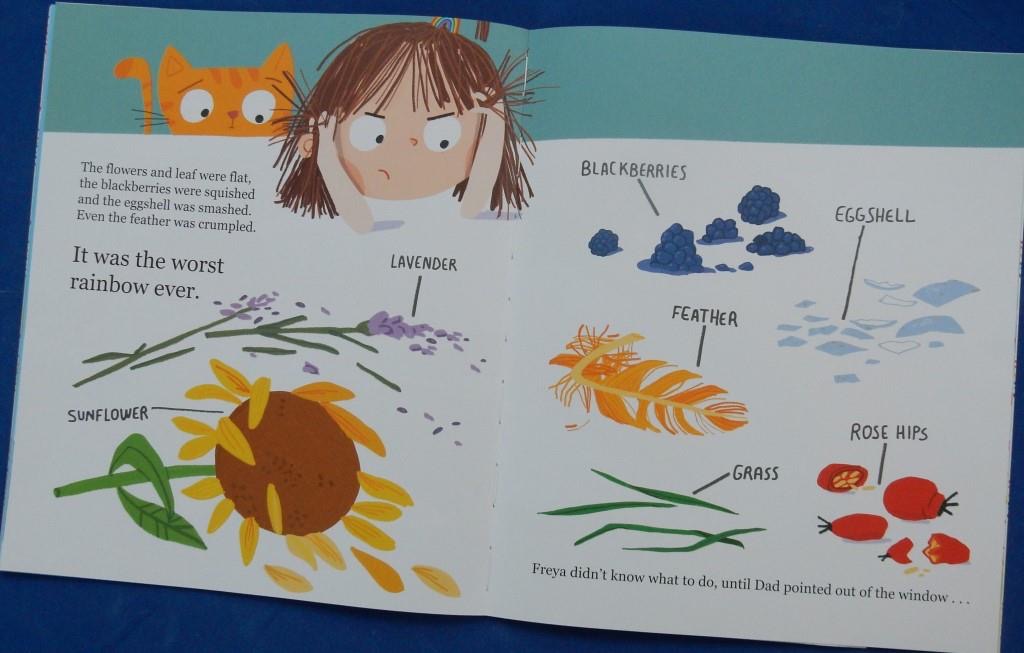
Now who would have thought that a boy as small as the protagonist in this super story could rescue something so massive as a rainbow: well this little guy is both strong and fearless, indomitable you might say, for accompanied by his dog, he climbs mountains ever so tall and fights off the fiercest of dragons.

One day he comes upon something protruding from a tree; it’s a rainbow and it’s stuck fast, faded, and exceedingly raggedy. Now being a kind child, the boy very carefully frees the rainbow and puts it in his cart to take home. Once there he sets to work repairing the damage, matching, stitching and patching and then restoring its beautiful hues.

Together the boy and his rainbow friend have many adventures

but sadly the size of the rainbow diminishes little by little, until one day, it’s there no more. The boy hunts everywhere but to no avail. Puzzled he begins to grow angry; after all the care he’s given to the thing, why has it vanished without a word of thanks or even a farewell?

Looking skywards he cries out but there’s no sign of the rainbow. The boy is distraught but after everything he remains the strong fearless lad he’s always been, going about his adventuring once more until one day something gives him cause for joy …

As we accompany this small boy on his journey through love and loss, he discovers what it really means to be strong, brave and fearless: we readers truly empathise with the child, so close to him does Corrina Campbell make us feel in this magical book.

Rainbows are magical seeming things that occur when light is reflected, refracted and dispersed in airborne water droplets, which results in the light being split into a visible spectrum. Symbolically though they represent different things to different people – hope, thankfulness, peace, pride, mystery and more: I thought I’d ask some children for their ideas: Here are a few:
It means God will never flood the world again.
Rain and sunshine at the same time.
I want to know why some people think there’s the end of a rainbow.”
Thank you to the NHS.”
My nan’s jumper.”
Leprechauns and pots of gold” “My Dad’s favourite socks
The aurora borealis might be a bit like a rainbow

Make sure you check out all the other posts on this blog tour.

The Gifts That Grow

The Gifts That Grow
Monika Singh Gangotra and Michaela Dias-Hayes
Owlet Press

This story is based on a true one from author Monika Singh Gangotra’s own family
When Amrita, her best friend Kiki and their pal Finn, return from school Finn tells Amrita’s mum that they have to create a recipe. Happily Amrita’s mum is busy in the kitchen preparing spices; it is, so she says a ‘garam masala grinding day.’

Having helped grind the spices, Finn notices that the background to a photograph hanging on the wall looks exactly like the tree growing in his backyard. Amrita’s mum confirms that it is the very same tree and that the person in the foreground is her own mum, Amrita’s Nani. She mentions that she has skin the colour of the masala they’ve been preparing and her smiling lips are the colour of jamun. This needs some explanation: Mum says it’s a purple fruit and that her mum brought a seedling from her jamun tree in India to their old house, the one Finn now lives in.

When they take Finn home, his dads Hayden and Andy welcome everyone warmly and Amrita asks their permission to show Kiki the jamun tree. Then Amrita’s mum tells them the wonderful, sometimes tear inducing story of the big tree, allowing space for a few interjections from Amrita along the way. 

Said tree was brought by Nani from India as a cutting taken from one planted there by Amrita’s mother’s great-grandmother when the little girl was a ‘little seed’ growing in her mother’s tummy as a celebration of that special time when Amrita was born.

With Indian motifs, objects including a tuk-tuk conjuring forth Amrita’s heritage land as part and parcel of Michaela’s brilliant, gorgeously hued illustrations 

and Monika’s beautifully told story rich in detail, full of love both intergenerational and that between the friends and their families, and that perfect ending, this is a book for everyone, everywhere.

If you eat eggs, there’s a recipe on the final page that sounds delicious, though if like me you don’t, you’ll need to think of an egg substitute.

Blobfish

Blobfish
Olaf Falafel
Walker Books

Way, way, way down at the bottom of the sea lives sad, lonely Blobfish. Without any friends, he tells jokes to himself and when he’s not doing that he searches for somebody to play with.

One day. while humans are busy enjoying themselves on land, and Blobfish is in the depths of despair, a carelessly discarded plastic bag comes sailing through the air, splashes down on the sea’s surface and starts to sink. It catches the eye of Blobfish. Oh Joy! Finally a friend for Blobfish.

Things starts well, albeit sans conversation but then – disaster.

Could this lead to the tragic demise of our blobby pal? Happily not thanks to the human rubbish collectors: and what about a friend for Blobfish? Well, it’s a ‘blobbily ever after’ ending, so you decide.

With plenty of fun dialogue in the form of speech and thinks bubbles, this highly amusing, occasionally ridiculous, strikingly illustrated story about looking for friendship has at its heart a vitally important message about plastic pollution and its impact on ocean life.

Share with little humans at home and in school. They will love it; so will you.

Bob the Dog Gets a Job

Bob the Dog Gets a Job
Tracey Hammett and Angie Stevens
Graffeg


Bob (actually female despite the name) is a dog that likes to keep busy; this perplexes her pal Pat the Cat.

One day Bob hears an ice-cream van outside and decides what a perfect job selling ice-cream would be. She trails the van to the local park where she discovers not one ice-cream van but a veritable fleet of them, as well as a poster announcing that an ice-cream festival is being held that very day.

Oh what delight, thinks Bob, anticipating the increased likelihood of obtaining a position as a vendor of ice cream. She asks around but to no avail

until she moves on to Mr Flaky’s van and again tries her luck.

Happily for Bob, Mr Flaky comes up with an offer, hands Bob the appropriate garments, gives a few important instructions and leaves her to it.

Before long eager customers roll up and things are going deliciously well. Then an entire soccer team rocks up, a very long queue quickly forms and before you can say cornetto, the very last cone has been used. Furthermore the control switch to turn off the flow of ice-cream has started to malfunction. Can some quick and creative thinking on Bob’s part save the day?

It more than does, but to find out how this yummy story ends, you’ll just have to join the queue and buy a copy of the book. Anyone for ice-cream?

For sure, through their combination of playful narrative and comical illustrations, author Tracey Hammett and illustrator Angie Stevens have served up a treat with this one. As well as making readers and listeners laugh it will assuredly, make their mouths water.

Once Upon a Fairytale

Once Upon a Fairytale
Natalia and Lauren O’Hara
Macmillan Children’s Books

This is the fourth collaboration between the O’Hara sisters, author Natalia and Lauren, illustrator.
It’s a ‘choose you own fairytale adventure’ that really does put child readers centre stage as they decide the direction in which the story goes at almost every turn of the page.

Things start peacefully enough in fairyland with the land being ruled by a wise, kind Queen; but then comes a messenger to the door of the first character of the reader’s choice with some terrible news. “A villain has put a curse on the realm and done something outrageous: you might choose turning ‘all the babies into pigs’, ‘the mums and dads into rocks’, ‘the Queen and court to birds and bugs’ or ‘our dinners into socks’. Her royal highness needs a hero to set forth, fight and defeat the villain and break the curse.
Now’s the time for whichever character the reader selected – maybe a friendly gingerbread man, a kindly farm girl or a jolly woodcutter’s son – to sally forth clad in a scarlet cloak.

Thereafter said character has the opportunity to dine with gnomes upon gold bars sprinkled with rubies, or indulge in roast stars, mashed snow cloud and fresh-buttered sunbeams at the fairies’ table.

You’ll plunge into rivers, climb mountains, fly through the air and creep through a dark wood to reach the villain’s abode; but what about defeating that villain – I wonder …

Superbly interactive with hundreds of possible combinations, this captivating magical book is an empowering springboard to encourage young readers to let their imaginations soar off to that once upon a time world of fairyland, creating a new and exciting adventure every time they pick up this book.

Alongside those exciting words of Natalia are Lauren’s bold, exquisitely detailed illustrations making the whole experience sheer joy. Perhaps later with creative juices flowing, children will want to start writing/drawing their own fairytales. You never know they might even be so inspired that one day, like the O’Hara sisters, they will start delving into the works of Joseph Campbell and Vladimir Propp. Till then, happy story-creating from this latest spellbinding O’Hara offering.

A Seed Grows

A Seed Grows
Antoinette Portis
Scallywag Press

Brilliantly simple and simply brilliant is Antoinette Portis’s new picture book documenting the life cycle of a sunflower. With its pleasing rhythmic pattern, the entire written narrative comprises just two sentences, that are ideal for beginning readers. The first, which presents ten stages, starts with a single seed and brings us almost full circle. The second, ‘ And a seed falls’ completes that circle, setting the reader up to turn back to the beginning and start all over again. There’s a pattern too, to the whole story with almost every verso containing a single phrase – ‘and the sun shines’ … ’and the plant grows’ with the key word colour coded to match the illustration on the recto.

Beauty and clarity sum up Antoinette’s science-based introduction to one of nature’s wonders, about which readers and listeners will feel a sense of awe and wonder as they follow the falling seed, that settles, sprouts, roots and pushes its way through into the air, growing and growing, forming a bud that, almost magically, opens into a glorious tall flower

the centre of which becomes filled with seeds. These seeds fall to the ground, provide food for the birds and they in turn facilitate dispersal and the process begins again.

Before re-reading however, adults will likely want to share the information pages with young children – two spreads, one giving straightforward facts about a sunflower seed and plant opposite which is a visual life cycle; the other provides some botanical activities and five true or false questions.

I think this one even outshines the creator’s previous presentations of nature and its wonders.

Mrs Noah’s Song

Mrs Noah’s Song
Jackie Morris and James Mayhew
Otter-Barry Books

The third in this series wherein Jackie Morris’ lyrical words are visually sung in collage style art by James Mayhew, is again gorgeous. Together they tell a magical tale about how Mrs Noah brings song back into the world. Music and song are a way of connecting people no matter where they are and Mrs Noah assuredly unites her family by singing to the children, morning, noon and night, while Mr Noah listens enraptured.

One morning the children ask Mrs Noah where she learned to sing and she tells them sadly that it was “Far away and long ago.” Called by the sunshine, the children then leave, save the youngest who asks the singer, “Why are you sad?” Having given an explanation about remembering her mother and grandmother, Mrs Noah says that-sometimes the sadness caused by missing somebody you love is a good kind of feeling.

They then both venture outside to greet the day watched by Mr Noah who had heard what was said.

Outside it’s time for a singing lesson, which must start with learning how to listen properly – eyes closed, ears open wide, wide. After a while the youngest child joyfully announces, “I can hear the garden singing.” And, it most certainly was, with birdsong, humming bees, dragonfly wings rattling and a gentle breeze setting the leaves in musical motion.

Mr Noah gets busy fashioning a huge hammock and they all spend a blissful night under the stars listening to the magical music created by the natural world together with Mrs Noah’s songs.

Next morning having slept soundly, to everyone’s delight they’re woken as the sun rises, by the dawn chorus. United in song, united in music, united in love. If only it could be so the world over, if only …

Like many people in our current turbulent world with wars and people forced to flee, Mrs Noah was actually a refugee who had to start her life anew in an unknown place; she knew that music could be a way of helping her children develop a sense of belonging in a new land. Music speaks a universal language, one that transcends barriers and that’s something that’s vitally needed in our divisive world. “If music be the food of love, play on.” So said Duke Orsino in the first scene of Twelfth Night. Let it be so.

Wild Summer: Life in the Heat

Wild Summer: Life in the Heat
Sean Taylor & Alex Morss, illustrated by Cinyee Chiu
Happy Yak

Like many of us, the little girl character in this narrative non-fiction book, is eagerly anticipating the summer. It’s coming, her nature-loving Grandpa tells her, mentioning some of the signs of seasonal change. He also says that close to his new abode is something exciting he wants to show his granddaughter, who acts as narrator.

Grandpa is right: summer with its blue skies and warmer days, does come. The girl reminds him of the thing he mentioned and together they pack a bag and set out along the track.

As they walk the girl notices the abundance of plants and minibeasts, wondering aloud if they want summer to last forever. Grandpa doesn’t supply an immediate answer but responds by suggesting they continue looking and then decide, although he does mention water as being a factor to consider.
Stopping by a stream Grandpa points out a golden-ringed dragonfly and tells his granddaughter a little about the insect. He also points out the mere trickle of water suggesting this could be a result of climate change, a topic the girl has learned about in school.

Further on in the increasing heat, the child expresses a wish to find some shade, and Grandpa likens her to many of the wild flora and fauna, explaining how some respond. They reach a place with trees blackened due to a fire the previous summer, talking of the pros and cons of such events.

Eventually they reach a spot at the edge of the seashore where they find what they’d come for.

Then they continue walking, on the beach now; Grandpa draws attention to some summer-loving Arctic terns, before with the ‘summer forever’ question duly answered, they cool off in the sea.

A companionable walk, and for the little girl, a wonderful learning journey with her Grandpa who educates her in the best possible way, never forcing, merely gently guiding.

Straightforward back-matter comprises an explanatory spread explaining “What is summer?, another giving facts relating to ways some land animals have adapted to better cope with heat. There’s one looking at the evolutionary changes of plants to cope with hot, dry summers and the final one looks at ocean life and how climate change is taking effect while the last page suggests some ways to get involved in wildlife protection.

With its wealth of ecological information and bright, detailed illustrations bursting with wonderful plants and animals to explore and enjoy. this is a terrific book to share either before or after a walk in nature, whether or not it ends on the beach. There’s lots to inspire awe and wonder here.

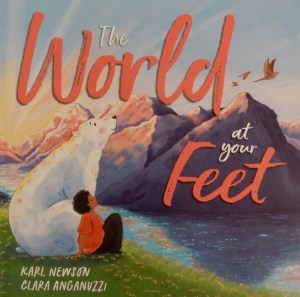
I’ll Be There

I’ll Be There
Karl Newson and Rosalind Beardshaw
Nosy Crow

What a wonderfully reassuring title this celebration of the loving bond shared between parents and their offspring has. Through Karl Newson’s gently rhyming text and Rosalind Beardshaw’s alluring, lively illustrations suffused with gentle humour, we follow a young elephant, led by a parent setting out on its life adventure; watch a polar bear cub wobble tentatively across the ice towards an encouraging adult;

see a baby whale and a big one swimming through the waves side by side. Then come in turn a tiny playful field mouse, a small tiger cub and its watchful, roarsome parent, an owl chick that must overcome its fear of the dark and finally, an adorable little human baby held gently in a father’s hands.

As each of these makes those important first steps in the world and begin to explore what it has to offer, the crucial thing is that each one will know there is an adult to support them in all they do. This is such an important, affirming message for young children, who in addition to enjoying the story will love to join in with animal sounds and the refrain. Make sure you leave plenty of time to explore the final spread so little humans can have fun looking for all the animals featured on the previous pages.

A calming bedtime book to share but also one that can be enjoyed in an early years setting.

How To Count To One

How To Count To One
Caspar Salmon and Matt Hunt
Nosy Crow

Terrific fun – albeit rather a teaser – is this interactive counting book that despite its warning subtitle, may well actually enhance the number skills of little ones way beyond one and make them laugh a lot along the way too.

It starts off in a pretty straightforward manner with a single elephant: no confusion there but turn the page and there are two whales, one of which is sporting a sausage: guess what the equation asks about. The next spread shows three bowls of soup, one with a fly swimming in. You can see how this is going … or maybe not for then comes this …

From then on author Caspar Salmon becomes increasingly bossy, aided and abetted first by Matt Hunt’s dapper duck depictions and the cleverly designed page layout.

Carry on reading/counting (to one only, remember) and you’ll meet worms wiggling their way through the soil, a gathering of mammals together with some reptiles and insects; a spread of framed pictures all hanging neatly arranged – don’t forget what Caspar said now, though you can be forgiven for ignoring the notion put forward on the next page and proceed to this one with a goldfish bowl.

Tee tee! That author is getting a bit too big for his boots though I think he well deserves the prize for what’s on the back endpapers. Outsmarted us, or what? That depends on the one to one correspondence proficiency of the one doing the counting. Oh course, none of this would be half the fun without Matt Hunt’s zany illustrations.

What Do You See When You Look At A Tree?

What Do You See When You Look At A Tree?
Emma Carlisle
Big Picture Press

Trees are my very favourite thing in the natural world and I most definitely see much more than the ‘leaves and twigs and branches’ referred to in Emma Carlisle’s opening question in this arboreal delight. In fact on our daily walks my partner and I always stop and sit in a quiet spot surrounded by trees and enjoy being there, savouring each one. 

As Emma points out in her rhyming narrative, every tree is special and unique, always has been and always will be. It’s incredible how many different shapes and colours there are, and the variety of locations where trees grow, be they solitary or forming part of a wood or forest. All of this and much more, readers experience through the voice and senses of a child, and of course, Emma’s beautiful mixed media illustrations.

We’re reminded of the crucial role a single tree often plays in supporting and providing a safe place for animals be they birds, squirrels, foxes or other mammals, that might be found safely curled up in the root system.

I suspect many young readers will be surprised to learn that trees communicate with one another and like the girl narrator may ponder upon a tree’s history: what has it seen over the centuries; did children of past times play beneath it, or feel its bark? And what might the future hold for any particular tree? This too is considered in the book. 

Books themselves (modern ones certainly), as we’re reminded, wouldn’t exist without trees.

All the thought-provoking questions posed encourage youngsters (and adults) to appreciate not merely trees, but the natural world itself and the book concludes with suggestions for some mindfulness – Listening to Trees and How to Be More Like a Tree.

Published in collaboration with the Royal Botanic Gardens Kew, this is wonderful book to share and discuss either at home or in the classroom before or after a walk among trees.

Everywhere With You

Everywhere With You
Carlie Sorosiak and Devon Holzwarth
Walker Books

This gorgeous book is about a little girl, a lonely dog, two homes separated by a fence, reading together and the power of the imagination.

In one home lives the little girl who doesn’t have a pet, in the other lives the seemingly neglected dog. One evening the little girl creeps up to the fence, savoury biscuit in hand and offers it to the dog. Next day at sunset she returns with another tasty offering and some books; she reads aloud wonderful stories, “I hope you don’t mind,” she says. “I’ve noticed that no one ever plays with you – and I like reading aloud. These are my favourites.”

So begins a series of wonderful meetings full of magical story time adventures that continue through the seasons and a warm, close bond develops between girl and dog.

We cannot help but feel the conflicting emotions: the joy of the time together but then there’s sadness about the dog’s circumstances.

Then one night in the lights of the windows next door, the dog sees the family clearly very happy in their love together: he longs to be a part of all that. Could there be a way …

The ending will bring a tear to your eye; it did mine and I’m not a dog lover.

The relatively spare prose of the telling works really well and allows artist Devon Holzwarth plenty of scope to take readers, as well of the book’s main characters, on fantastic adventures and voyages of discovery. She changes the colour palette of her vibrant illustrations as the narrative switches from the reality of the girl/dog encounters, to their flights of fancy when the child reads aloud to the animal.

Never Brush A Bear

Never Brush A Bear
Sam Hearn
Happy Yak

Young Herschel is a budding hair stylist, a coiffeur of creatures; as yet though he’s not brushed the hair of a bear, but despite warnings of the possibility it could result in his demise, Herschel is determined so to do. So, brush in hand, he goes into the woods where he eventually approaches a cave. Could this be the place to find what he seeks?

GRRRR! A ginormous wild bear is within though despite his dishevelled state, he’s not really very wild at all, rather he looks as though he could be friendly. Definitely up for some tonsorial treatment thinks Herschel starting with the creature’s arms, followed by his chin.

With his brush Herschel continues working around the bear’s body, aware of the likelihood of the occasional stinky part. What our stylist isn’t expecting however is what happens when his brush comes in contact with the ursine’s hirsute armpit…

The result is that both parties find themselves cascading downhill at breakneck speed only to end up on their bums somewhere decidedly damp and gunky. Time to start again my friend.

Despite the slightly clunky rhyme at times, with its bold, bright cartoonish style illustrations this whimsical tale of ambition and determination is huge fun; requests for re-reads will be likely after you share it with young children.

Hot Dog

Hot Dog
Mark Sperring and Sophie Corrigan
Bloomsbury Children’s Books

Totally and adorably silly is the latest offering from the creators of Jingle Smells. It’s the tale of a hot dog sausage that yearns for just one thing – to be a real-life dog that can frolic on the beach, play with sticks and generally do doggy things. Standing on a shelf close at hand just as the little hot dog is making that wish, is none other than the Mustard Fairy. With a few squirts of mustard she grants his wish and off dashes one transformed pooch to enjoy himself.

There’s a problem however: with their superior sense of smell, the other dogs on the sandy shore, sniff-sniff something they seem to like just a bit too much. YIKES! Off dashes poor Hot Dog towards Flo’s ice-cream stand, begging for help.

Now being a kindly woman, Flo immediately responds positively to Hot Dog’s plaintive plea by launching a counter-attack with her wares, causing the marauding and increasingly hungry hounds to turn tail and flee.

That leaves – hidden ‘neath a parasol – our little Hot Dog, albeit with some adornment near his rear. And Flo? Well, she has something super-special to offer her new friend.

Infused with summery sunny feelings, Mark Sperring’s rhyming romp together with Sophie Corrigan’s splendid seasonal scenes showing Hot Dog, hilarious high spirits and much of the action at close quarters, make this book one to share and relish over and over, this season and beyond.

A New Friend

A New Friend
Lucy Menzies and Maddy Vian
Frances Lincoln Children’s Books

This truly heartwarming story is told from the perspectives of two children, Mae and Joe and it’s a terrific demonstration of there being two sides to every story. On the left side Mae introduces herself telling readers of her excitement about there being a new arrival in town for whom she has written a special letter to give him at school. At playtime though, she’s unable to find him anywhere.

Joe, the new boy tells his story on the right side explaining that he and his dad have just moved to a new home and now everything feels strangely different. He’s eager to make new friends like his dad says but Joe feels invisible in the playground, wishing he could be back playing space adventures with his old friends. Then suddenly …

Could this be the start of an exciting friendship, and further space adventures perhaps …

A smashing, cleverly conceived book that will help young children understand the importance of empathy and how sometimes being in an unsettling, worrying situation might lead to misunderstandings or misconstrual on a newcomer’s part. Both children however show courage: Mae for her persistence and determination to show kindness, Joe for facing up to his fears. Close perusal of Maddy Vian’s bright, inclusive illustrations will reveal lots of galactic theme details such as the sticker on Mae’s letter, toy rockets and Joe’s backpack.

The Enormous Morning

The Enormous Morning
Louise Greig and Lizzy Stewart
Farshore

‘Inside Day was Morning. It was a small morning. There was not much in it.’ However, there was Pia. And Rabbit.’ And Pia’s papa. But then after they’ve shared a morning enlarging breakfast, Morning keeps on getting bigger.

We accompany Pia and her father on a walk that is absolutely filled with wonder as we witness the glorious sights, sounds, shapes and colours that burst forth into young Pia’s quiet, small world. They cross a wheat field and notice a leaping hare

and from atop a hill, Pia is able to see ‘a whole garden,’ ‘a whole elephant with an elephant’s thought and an elephant’s wish.’ – what a wonderful lyrical and truly original narrative Louise Greig has created as she tells of toys, butterflies, cloud shapes in the blue sky, boats and ships in the sea far below.

Richly layered and richly described is this walk. But it’s not all walking: they stop for a picnic

before continuing their journey, Pia with her senses fully alive to all the amazing experiences and her imagination soaring. Like all mornings though, this one turns to afternoon and then to evening, this one that has become so filled with meaningful experience – just like the little girl’s heart that is full, full of love and a sense of being loved. ‘Inside Day was Morning. It was an enormous morning. There was everything in it. … And inside Pia and inside Pia’s papa was a world of love.’

Just as exquisite as Louise’s words are Lizzy Stewart’s joyful, idyllic scenes with their rich, jewel colours.
Louise and Lizzy’s creation, is wonderfully different: author and artist have captured one child’s delight in the world around, truly making this a book to remind us all to slow down, open our minds, our hearts and our senses and savour our world every Enormous Morning.

The Upside Down Detective Agency

The Upside Down Detective Agency
Ellie Hattie and Brendan Kearney
Little Tiger

Super sleuthing sloths, Stella and Stan are so alike that only the very smartest can tell who is who. They’re in their Super Sleuth HQ one day when there’s a loud knocking on the door. It’s famous racing car driver Lady Veronica Velocity Speed announcing woefully that somebody has stolen the diamond warp drive from her car and without it there’s no chance she’ll win The Big Race to be held that very day.

Oh woe! Oh disaster. There’s no time to lose: Stella and Stan spring into action immediately but they’re going to need assistance from we eagle-eyed readers if the case is to be cracked quickly.

So begins Ellie Hattie and Brendan Kearney’s smashing interactive picture book that takes the sleuths, Lady V. and readers on a break-neck dash. Well maybe not exactly; there just might need to be the odd stop for a tasty snack before examining the racing car, her residence and workshop for clues.

Pretty quickly the sleuths are onto the thief’s identity: seemingly a rascally rodent has gone rogue but having identified the criminal, catching him is another matter.

The race is on – literally; but who will cross the finish line first? That is the vital question.

A mystery for readers to help solve that will not only be lots of fun, but with Brendan’s intricately detailed scenes with their clues aplenty, will also be great for developing observational and problem-solving skills in children.

Strong

Strong
Clara Anganuzzi
Little Tiger

This lovely celebration of unashamedly being yourself stars a dragon named Maurice. No, he’s not tough, powerful and given to snarling and growling like his fellow dragons; far from it. Maurice is gentle, quiet and small, and an adorer of flowers. These he seeks out at every opportunity, fashioning them into wondrous floral arrangements. Other dragons have no time for such activities; they far prefer fire breathing and competitions of strength. Indeed Maurice has a brother that is a champion as these skills.

Now though, Maurice too is entering a dragons only contest and hoping to create some of his splendiferous hibiscus flowers. However that’s not what happens when it comes to his turn to throw a flame; nor does he impress with magnificent horns and ferocious teeth.

It’s no use, thinks a dejected Maurice as he lies down in the gentle rain, I just don’t fit in here.

As the storm clouds gather and it’s time for the competition’s final round – the gold treasure hunt – Maurice wants to delay, but brother Gruff is determined to defend his title immediately and off he soars into he clouds. However the storm continues to rage and the other dragons start to worry about Gruff’s failure to return. Maurice ponders and puts forward an idea. Can it possibly work though? To his fellow dragons, he doesn’t appear to be doing very much to help his injured sibling.

Finally however, they start to see Maurice in a completely new light and as for Maurice, he comes at last to a realisation about himself: he’s always been strong and his strength comes from being true to himself; delectably different and proud so to be.

Clara Anganuzzi’s portrayal of the changing feelings both of Maurice and the other dragons sweep readers along in the gentle dragon’s flight towards self understanding.


I am NOT a Prince!

I am NOT a Prince!
Rachael Davis and Beatrix Hatcher
Orchard Books

Somewhere on the shores of a misty lagoon, every springtime under a silver mist, so the rhyming narrative says, magic frogs gather in anticipation of a magical transformation. A dip in its waters and each one will emerge as a prince. All except one that is: Hopp has absolutely no wish to be a prince despite what the other frogs say. “It’s not for me. That’s not what I am meant to be.” is Hopp’s response to being told becoming a prince is a frog’s duty. Consequently the naysayer is banished from the lagoon and the lonely creature sets forth to the stream unsure which way to go.

Before long Hopp has come to the aid of a little Mouse in trouble, a stuck grizzly bear and a dragon, each one thanking the frog profusely and calling Hopp a prince. As night falls, poor Hopp is in despair,”I’m not a prince -they’ve got it wrong! / Oh where, oh where, do I belong” comes the cry. But then …

The kindly wizard completely understanding why those helped have called Hopp a prince, issues an invitation to the frog, “Well, tell me what you are instead.” Hopp whispers in the wizard’s ear and he in turn bestows upon the little frog a wonderful gift.

Meanwhile back at the lagoon, realising they’d been too judgemental, the other frogs are now concerned for Hopp’s well-being; will their fellow amphibian ever return? Then from the bushes they hear a BOOOO! and there is Hopp, safe and sound, totally transformed and almost bursting with pride. Hopp’s isn’t the only transformation however, for now each spring down at the lagoon something wonderful takes place …

Bursting with colour, this is an empowering read aloud with magical happenings that celebrates being true to yourself and remaining so in the face of opposition.

Move Mountain / Ebb and Flo and the Sea Monster

Move Mountain
Corrinne Averiss and Greg McLeod
Oxford Children’s Books

Although the hills around Mountain receive the sun’s rays each morning, because the sun always rises behind him, his face stays in the shade. So much does he long to feel sun’s beaming warmth that he tells Bird he wishes he were able to turn around. Bird flies off to seek help from Bear and the two of them push with all their might but Mountain remains firmly as he was.

Other ideas are tried including the use of music for conjuring up an image of the sun and although Mountain loves this, it only serves to make him want more than ever to see the sun rise.

However Bird has one last idea tucked beneath her feathers. Can this one possibly be a success?
Perhaps it’s not possible to move a mountain in the physical sense but nonetheless this particular Mountain is more than happy with what he sees at dawn next day.
This beautiful tale celebrates friendship, kindness, thinking outside the box and ingenuity. Truly the sun’s warm glow shines forth in Corrinne’s words and Greg McLeod’s gently humorous illustrations.

Ebb and Flo and the Sea Monster
Jane Simmons
Graffeg

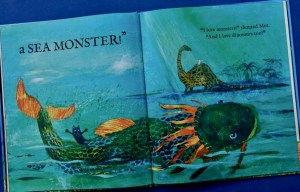
As Flo sits with Granny sharing a local paper and focussing on a picture of Morgawr the mythical sea monster, Ebb’s ball bounces away and so begins this wonderful moonlit adventure as they search for the ball which goes overboard on their way home across the bay, and perhaps for a sighting of Morgawr too. But they find themselves marooned and have to camp put on the beach.

As Mum, Flo and Ebb gather around the fire, listen to nature’s sounds and stare out at the star-filled sky, they wonder about the enormous monster that might or might not be lying in wait for them somewhere out at sea. Later with Flo tucked up under a blanket, Mum has to leave the tent to collect more firewood. There in the shadows are Flo, Ebb, that bouncy ball – again – and the possibility of a scary monster lurking close at hand.

This latest of Jane Simmons’ modern classic rereleases, with its softly spoken words and beautifully hued, hazy illustrations will surely delight a new generation of young children as much as it did those who encountered Ebb and Flo over twenty years ago.

Happy Sad

Thanks to Little Door Books for asking me to be part of the blog tour for this lovely book: I’m definitely happy to do so.

Happy Sad
Pippa Goodhart and Augusta Kirkwood
Little Door Books

Young sea loving Toby becomes conflicted in more ways than one in this captivating picture book.
Living by the seashore, the boy spends a lot of his time delighting in the natural objects he finds thereon as well, as playing in and out of the waves. 

One day as he peers into a rock pool, Toby notices a fishy tail moving in the water; he dips in his net and pulls out not the fish he anticipated but a tearful little mermaid. She responds to Toby’s “Why are you sad?” by telling him she became stranded when the tide turned. Her feelings are palpable in Augusta Kirkwood’s portrayal of the two during this encounter. With great care and the best of intentions, Toby picks up the mermaid and takes her home with him. 

There, his Mum and Dad help him accommodate the little creature. Her response to the boy’s “Are you happy now” is that whereas she likes the pool, she misses the company of her fishy friends. Toby knows just what to do … 

Now the mermaid feels “happy sad” – happy with the fish but sad because she isn’t able to play with her father. The empathetic Toby continues to add things to the pool but the mermaid remains “happy sad”, even when he says he’ll return her to the sea, for now a strong bond of friendship has formed between the two.

Surprised when the mermaid invites him to live in the sea with her, Toby considers this, 

but then somewhat reluctantly, takes her to the water’s edge and watches her swim off. You can imagine how they both feel about their parting but perhaps it won’t be a forever one.You never know.

Pippa’s powerful story of empathy, kindness and putting others before yourself, shows that it is possible to feel both sad and happy at the same time. Together with richly coloured illustrations by Augusta Kirkwood, portraying so clearly the emotional changes both main characters undergo, this is a thought-provoking book to share, especially with KS1 children. It’s rich in classroom potential too.

The Silent Selkie / Daisy Fitzpatrick and her Worries

Here are two books intended to support the mental well-being of youngsters.

The Silent Selkie
Juliette Ttofa, illustrated by Paul Greenhouse
Routledge

“We have to remember in order to heal,” So says one of Elif Shafak’s characters in her brilliant novel The Island of Missing Trees and so it is in this picture book.

Using the metaphor of a hidden wound this perceptive story, written by a specialist educational psychologist and child therapist and engagingly illustrated by Paul Greenhouse, is ultimately one of reassurance. Aiming to offer a safe space in which children affected by trauma can, with the help of an understanding adult, begin their crucial healing journey, it is intended to be used along with an accompanying guidebook.

The picture book shows the journey towards healing taken by a deeply traumatised young selkie that is so troubled that she’s lost the ability to speak. With her wound buried deep within she expresses her feelings through the weather 

and this leads to her being questioned and then isolated in a distant cave by the seal folk who fail to understand her plight.

There she remains engulfed in a fog, growing progressively wilder until one night as dreams intrude upon her sleep, her hair becomes entangled in the nets of a fishing boat. She’s dragged from her confinement and after unsuccessful attempts by the seal folk to rouse her, the trawler pulls her to a distant unknown land.

On waking she finds herself on a sandy shore, still entangled in the net but showing some bare skin on her tail. In the full sun, it feels as though her golden scales are aflame. Then holding a shiny stone she glimpses a splinter protruding from her tail. The pain causes her to cry out but attempts to get help from self-serving creatures that stop, lead to more pain and the loss of some of her golden scales. The intensity of the burning increases and the Selkie begins picking off her own scales and that night her slumbering body remembers the long forgotten story of how as a pup, the thorn entered her skin inflicting a wound. Her moans echo through the deep sea. Next morning she sees a humpback whale and the two sing together. 

Thus begins the release from her entrapment: “It is time for you to be who you really are,” the empathetic whale tells her, assuring the `Selkie’ that she won’t be alone on her healing journey.

Daisy Fitzpatrick and her Worries
Nancy Carroll
Ragged Bears

Daisy Fitzpatrick is beset by anxieties, and her mind is full of worries, the kind that could trouble any of us from time to time. I certainly go along with her on the fear of heights, though not really most of her other worries – buzzing bees (and other minibeasts), the dark, the sea, vegetables, storms, dying ( I guess most of us aren’t eager to contemplate the end of life), crossing the road, being alone, her parents’ separation. She considers a dozen worries in all and by the end of each poem, has found the means to discover a new perspective on each troubling issue.

Sensitively written by an author who shares many of these fears with Daisy; after the rhymes she provides helpful notes and suggestions including mindfulness and finding someone else with whom you can talk over particular anxious feelings – as well as links by which readers can get additional information. There are occasional recipes that include a vegetable ingredient too.

An unusual book to help children face and eradicate childhood worries.

The Marvellous Doctors For Magical Creatures

The Marvellous Doctors For Magical Creatures
Jodie Lancet-Grant and Lydia Corry
Oxford Children’s Books

Here’s a new and magical tale from creators of The Pirate Mums, team Jodie Lancet-Grant (author) and Lydia Corry (illustrator).

Young Ava is an aspiring doctor and loves to assist her fathers in their surgery and there’s nothing she likes better than having a mystery to solve. That she certainly has in the case of unicorn, Glitterbug and her dads give her permission to go out the following morning in search of clues. However, having spent all day among the unicorns as they prepare for a party, she hasn’t found anything to help solve Glitterbug’s tummy trouble mystery. Surely though no magical creature has a problem that cannot be solved by the Marvellous Doctors for Magical Creatures? 

Back goes Ava the following day, more determined than ever to discover what’s bugging Glitterbug: she can’t find her among the partying unicorns 

but eventually Ava discovers the ailing unicorn causing her to dash back to join the others although it’s evident to Ava that Glitterbug is faking her enjoyment. Then suddenly down comes the rain and soon it becomes clear to Ava that Glitterbug has undergone a change. More than one in fact.

With its sparky words and vibrant, detailed illustrations, this cracking book celebrates divergence, determination, doctors, finding new friends and the occasional rainbow.

Fletcher and the Rockpool

Fletcher and the Rockpool
Julia Rawlinson and Tiphanie Beeke
Graffeg

Summer has come, the ideal time for inquisitive young Fletcher fox and his mum to foray from their woodland home for a seaside visit.

While Mum makes a camp on the seashore, Fletcher heads down to the water’s edge, enjoying the feel of the sand beneath his paws and the waves splashing his toes. Coming upon a rockpool, he stretches himself out flat and gazes into the water observing the creatures and seaweed therein. Suddenly he notices that the pool is getting smaller and he’s concerned about the fate of the limpets and sea anemone. Unaware of the sea’s tidal ebb and flo phases, so misunderstanding what is happening, the helpful Fletcher dashes to and fro filling his bucket with water and tipping it into the seemingly ever shrinking rockpool.

His behaviour puzzles a watching seagull and it tries to tell him about the tide but Fletcher is distraught.

All he can do is save Little Crab he decides, so he takes it back up to where his Mum has made the camp, creates for it a seaweed blanket and falls asleep alongside the crustacean.

Imagine his surprise and joy when in the morning he finds …

Tiphanie Beeke’s soft glowing paintings (the final one with a sprinkling of silver) evoke both the seashore and Fletcher’s concerns about the rockpool fauna and flora and are a perfect match for Julia Rawlinson’s lyrical, wonderfully warm words as they both pay poetic tribute to the summery seaside.
I have no doubt this latest Fletcher story will resonate with young listeners, as well as introducing them to the idea of tidal movement.

The Baker by the Sea

The Baker by the Sea
Paula White
Templar Books

There’s a gentle lyrical feeling about Paula White’s highly detailed illustrations for this book, which is set in a beach village on Suffolk’s east coast, her erstwhile hometown that was also home to a thriving fishing community until the devastating Great Floods in the early 1950s.

A watchful young boy describes the grown-ups working hard at their various occupations: the shop-keepers, the blacksmiths, the basketmakers, the bakers – chiefly his father, the sail-makers, the net-makers and rope-makers, the coopers who make barrels in which the fish were pickled, the fisher-girls from Scotland who prepare, pickle and pack the fish and most important of all, the fishermen out in their boats while everyone else is asleep.

The boy narrator is an aspiring fisherman who imagines himself hard at work aboard a fishing-boat, helping his fellow team members at the ropes, hauling in a fine catch and perhaps battling against the elements, before sailing back to the safety of the village.

One can almost smell the wonderful aroma of his father’s fresh bread wafting across the bay to welcome both the returnees and the new day as it dawns.

It’s not just bread that his father bakes but also biscuits, buns, the boatbuilders’ favourite bacon butties. The boy loves to help in the bakery, basking in the warmth and glow within while also thinking about those outside, who toil in the cold, windy weather. He watches too, the exchange between his father and one of the returning fishermen who comes into his bakery.

A nostalgic, respectful, loving look at a community in a time gone by when everybody knew and supported one another. this lovely book concludes with a recipe for hot coconut buns taken from the author’s grandpa Percy’s notebook.

Paula’s incredibly beautiful, realistic pen-and-ink artwork, though very different in artistic style, for me is imbued with the spirit of Edward Ardizzone.

The Name Game

The Name Game
Elizabeth Laird and Olivia Holden
Tiny Owl

The little girl narrator of this story is at home and bored without anybody to play with. Suddenly there comes a tap on her window: it’s a bird the name of which she doesn’t know. So she asks and the response is ‘I’m a magpie, darlin’ … ‘ On hearing that this bird is also a jewel thief and receiving an invitation to surprise him with another name, the child suggests Diamond Dodger. From its response she assumes the bird is pleased at this. What follows is a lovely imaginative game wherein the girl thinks up new names for in turn, a tall tree close by. Emerald Queen, that one becomes, followed by a butterfly that lands on the window sill – I wonder what you’d call it –

and a cat with a long swishy tail that thinks herself special.

By this time, the little girl, content in a world of her own creating, is no longer bored: as she ventures outside, she intends to continue her name game.

Cleverly combining the natural world and the power of the imagination Elizabeth Laird’s is a delightful story to share and I have no doubt that young listeners will after hearing it, want to emulate the little girl and create names for things they encounter in nature. Indeed the Name Game could be played with a focus on other settings such as a particular room at home, or in school. The potential is enormous, but most important is that you share the book taking time to enjoy Olivia Holden’s beautifully detailed illustrations of the narrator and her immediate environment.

Just Like Grandpa Jazz

Just Like Grandpa Jazz
Tarah L. Gear and Mirna Imamovic
Owlet Press

Frank, the boy narrator, and his Grandpa Jazz – (Jasodhra as we later learn) are lovers of stories – reading them and telling them, though it’s Grandpa Jazz who is storyteller extraordinaire whether his tales are made up or not.

Now Grandpa is going to visit Mauritius, the island of his birth and youth, and he asks Frank to help him pack his suitcase. As they do so, Frank discovers a small holey rock in the case and that results in a story from Grandpa about how he fell into a volcano crater as a boy.

A stethoscope in a pocket of the case leads to a tale about a skull, and a bar of soap that’s going into the suitcase reminds Grandpa that his great grandmother used to wash the family’s clothes with soap in a river.

With the packing almost finished Frank spies a shirt with a badge with the word Jazz on it. Grandpa relates the story of how Her Majesty the Queen invited him to work for the NHS in the UK and how on the ship to England, people with white skin were separated from those with a different skin colour. This saddens Frank when he realises that had they both been travelling, due to racist attitudes they would have been kept apart – two people with so much in common whom the world viewed as being different.

Finally, with the packing completed, it’s off to the airport; but there’s still time for one more of Grandpa’s tales on the way. When they arrive at the airport, there’s a wonderful surprise in store for Frank …

With a lovely final twist, debut author Tarah L Gear’s wonderfully warm tale, vibrantly illustrated with gentle humour, by Mirna Imamović, (debuting as picture book illustrator) demonstrates and celebrates the intergenerational love between two terrific characters, Grandpa Jazz and Frank. It also shows the significant role passing down stories between generations can play in keeping alive that important sense of family history and heritage. It also reflects the racist attitudes at the time of Windrush, some of which sadly remain today. However, the book includes backmatter about heritage and elements of anti-racism that would be helpful in classroom and home discussions around these topics. An important book to share and talk about with children in the home or a school setting.

Rainbow Hands

Rainbow Hands
Mamta Nainy and Jo-Loring-Fisher
Lantana Publishing

The small boy narrator of this book finds things to enjoy and appreciate no matter the time of day but his very favourite time is ‘painting-my-nails-time’. And to do that painting he uses the numerous different shades in his mother’s collection of ‘magical bottles’. Purple for instance is perfect for when he wakes from a dream of fairies in distant magical places; it’s the colour to represent mystery. White however is for life’s infinite possibilities; bright yellow is just right for bees on the garden sunflowers – that’s sun’s colour. A swirling blue is the hue for days when both sea and sky look similarly rolling, whereas the best match for mucky afternoons spent exploring in the dirt, is mossy green to match the mess.

Sometimes the boy’s Papa questions his preference for painting nails rather than paper and his response is very revealing.

His grandpa makes the boy feel soft and sweet when he gives him words of encouragement and on those occasions it’s pink nail paint that is chosen. However there are occasions when no one colour can represent all the feelings of happiness, sadness, anger and dreaminess: those are days to catch a rainbow and to make use of every single one of those marvellous bottles.

An elevating story that celebrates individuality, one’s essential nature, personal integrity and mindfulness. Like the boy protagonist, children need to be given time, time to breathe in the beauty of Jo Loring-Fisher’s mixed media illustrations on every spread.

I wonder what colour(s) you would choose to paint your nails today?

I’m The Train Driver / I’m The Bin Lorry Driver

I’m The Train Driver
I’m The Bin Lorry Driver

David Semple and Katie Woolley
Oxford Children’s Books

Young children have the opportunity to imagine themselves into the driving seat of both a passenger train and a refuse collection lorry as they share these books with an adult either at home or at nursery/preschool.

Having donned the appropriate uniform the train driver climbs into the cab, puts on a seatbelt, checks the controls, starts the engine and is responsible for taking a family to the city for some sightseeing. En route there are stations to stop at to allow more passengers to get aboard, a freight train to negotiate, a tunnel to drive through slowly and carefully,

then the level crossing gates are open so its full speed ahead until the signal controller radios to say ‘switch tracks’ and off you go to the city’s main station where the passengers are eager to get off. Finally, a train driver needs to log the train’s arrival before heading home

The driver of the bin lorry has two other team members who are also responsible for collecting the recycling from all the blue bins on their round and they start work early in the morning while it’s still dark. Having set the route, off they go, the driver taking care to stay within the speed limit. The team works hard all morning,

remembering to log each bin emptied into the hopper on the lorry’s computer screen and totalling up the final number. Then with all the blue bins duly dealt with it’s back through the now busy streets to the tip where the lorry’s contents is emptied onto the ground ready for sorting.

As with others in this series, teamwork is key in the roles presented; and there are lots of opportunities for developing vocabulary and other important early learning skills such as colour, number and shape recognition.

Martha Maps It Out

Martha Maps It Out
Leigh Hodgkinson
Oxford Children’s Books

Young Martha might be small but her thoughts are anything but: her mind full of BIG things.
She absolutely loves drawing maps, creating them out of almost everything from the universe to her bedroom in the top floor flat in which she and her family live; she even makes maps of her thoughts, her questions and her dreams.

Through Martha’s cartographic creations readers share with the girl her entire world as she guides us through the pages and beginning in deepest space, we zoom inwards page by page to planet Earth with its awesome flora and fauna, her city, her street and community, her block of flats, her own home and her room.

From there we travel outwards once more through the thoughts, questions and those BIG dreams of a future where absolutely anything is possible: a life of discoveries … excitement,

adventure, wonder, not forgetting of course, love.

Leigh Hodgkinson is brilliant at presenting quirky details in her visuals and this book of Martha’s maps is absolutely alive with them. To these are added a wealth of labels that children will love to explore as they, one hopes, like Martha will share that sense of optimism and excitement about what the future might hold. Bursting with classroom (and home) potential, this splendidly upbeat, and unusual picture book is one to return to over and over wherever you are.

Wanda The Blue Whale

Wanda The Blue Whale
Beverly Jatwani and Sawyer Cloud
New Frontier Publishing

The third book of seven in the Together we can change the World series is set in South America, on and near La Serena Beach (Chile). Young Paula awakens to the sound of the ocean every day and loves the view from her bedroom window. She also loves spending her time on the sandy beach, sometimes clambering over the rocks to investigate what’s there.

One morning early she is devastated to discover, lying on the beach, hardly moving, a blue whale calf. Going up close, she sees that it’s tangled in a fishing net and gently stroking the creature, names it Wanda. She knows she must find a way to release it so the whale can re-join its family.

Other people gather around and Paula begs them to help her free the calf.. Immediately everyone gets to work – teamwork is key now – until finally Wanda is no longer trapped in the net but remains some distance from the ocean. Thankfully a passing boat responds to their signals for assistance but the creature’s weight is too much for the small craft.

Or is it? The tide is very slowly coming in so perhaps it’s worth having one more attempt to tug her into the waves …

On her way back up the shore, Paula notices something in the sand; something on which is written a vitally important word. Then that evening what she sees through her windows beneath the setting sun fills her heart with joy …

The final page of this book gives information about blue whales, including the fact that they are now classified as an endangered species.

The story shows the powerful emotional and transformational connection formed between the girl protagonist and the whale, the key word being the compassion shown by Paula. It also highlights the responsibility we humans all have, or need to develop, towards Planet Earth: for sure if everybody is prepared to act in a similar way to Paula, it’s possible as the series title says, to change the world. To that end, adults can start by sharing the story with youngsters who, one hopes, will want to become activists.

Lionel and Me

Lionel and Me
Corinne Fenton and Tracie Grimwood
New Frontier Publishing

This story of the effects Lionel, a small dachshund, has on a family is told from the viewpoint of Maverick, a golden retriever, that is already a well established and contented family member.

When he first arrives, the newcomer is no threat on account of his smallness and because he spends a lot of time asleep; he does leave stinky deposits indoors though and seemingly, whines constantly. Nor is Maverick’s exercise enjoyment intruded upon;

but gradually, Lionel becomes the centre of attention and a thorough nuisance: jealousy builds until Maverick decides enough is enough, his actions resulting in his banishment to the back garden.

Alone out in the cold, the retriever has lots of thinking time and he decides that all he needs to do is to wait patiently until the dachshund destroys his perfect pooch image. When he does it significantly and unexpectedly changes the canine relationship.

Beautifully portrayed in both Corinne’s words ( the dog characters are based on those of her own relations) and Tracie’s gently humorous illustrations this story of learning to accommodate a newcomer is relevant to many situations and is a lovely book to share with young children and talk about both at home or in the classroom.