Tyrannosaurus Rex

Tyrannosaurus Rex
Dougal Dixon and Rachel Caldwell
Templar Books

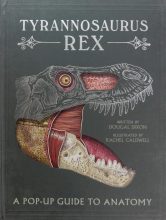
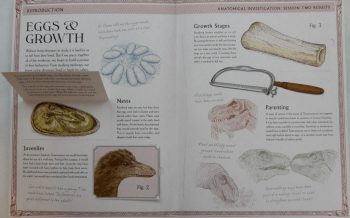
Subtitled ‘ A Pop-Up Guide to Anatomy’, this totally splendid book from Dougal Dixon and Rachel Caldwell, zooms readers right up close to and within what is possibly THE most fearsome of the dinosaurs.

Dougal so he would have readers believe, is in attendance at the dissection of one of these incredible creatures – ‘a world first’ so he says as we’re treated to the stripping away of its layers.

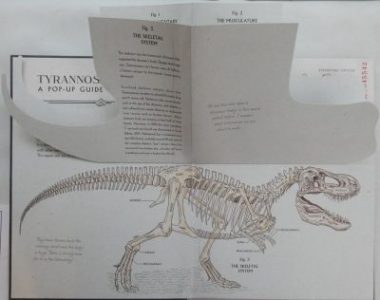
First there’s the integumentary system (outer covering), then a look at the musculature system

beneath which is the skeletal support system. All of these reveal just how amazing an anatomy these super-strong, speedy predators had. It is after all called by many, the lizard king of all the dinosaurs and Rachel’s stunning illustrations certainly make that evident throughout – oh my goodness those daggers of teeth and colossal jaws – bone crushers they surely were.

The book is designed to give the impression of a Victorian science tome with medical notes, masses of facts, sketches of the instruments used in the dissection and of parts of the creatures and much more. There are flaps aplenty, many revealing additional facts as well as visual information

and the back endpapers have a glossary and a superb view of a Victorian laboratory cupboard filled with scientific paraphernalia.

Awesome through and through – the book as well as the dinosaur; what superb innovation; what brilliant pop-up paper-engineering. A wonderful interactive offering that makes my zoological dissections back in the day look totally pathetic; and yes I still have the set of instruments tucked away so I might have to dig them out for my next reading of this stunner of a book.

Discovering Energy

Discovering Energy
Eduard Altarriba, Johannes Hirn & Veronica Sanz
Button Books

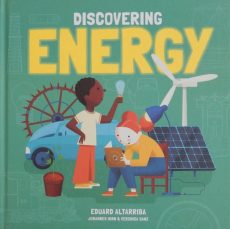
In his characteristic bright, retro illustrative style, Eduard Altarriba in collaboration with writers Hirn and Sanz, both of whom are experts in physics, explores the vital topic of energy and its effects on all our lives.

After a spread on the sun’s energy, the book looks at what energy actually is including the difference between potential and kinetic energy.

It goes on to investigate the interrelationship between energy and power, exploring wind power, water power, electricity, fossil fuels, nuclear power, solar power and much more.

Historical pioneers including Aristotle, Galileo, Newton, James Watt of steam engine fame, Alessandro Volta who created the first battery and Einstein

are all introduced in relation to their contributions to our understanding of the topic.

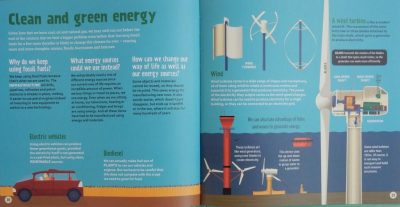
In the light of the drastic effects of climate change on the planet and life thereon, there is a spread on the all-important area of ‘clean and green energy’ and the crucial developments that will make safe, clean, sustainable energy now and in the future.

This vast subject is one we all need to come to grips with and it’s never too soon to start learning. This enlightening book, although aimed at young audiences, could also be useful to adults who have no background at all in physics.

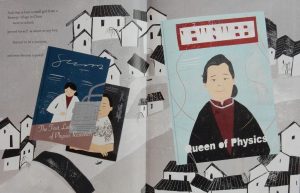
Queen of Physics

Queen of Physics
Teresa Robeson and Rebecca Huang
Sterling

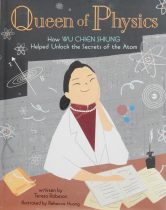
Subtitled How Wu Chien Shiung Helped Unlock the Secerts of the Atom, this is a fascinating exploration of the life of a woman who overcame the barriers of gender and race to become a ground breaking experimental physicist.

Born in China in 1912, Wu Chien Shiung (meaning Courageous hero) was fortunate in having forward thinking parents. Her mother even opened a school in Liuhe to encourage parents to educate their daughters, so it was waiting by the time her own daughter was ready to start.

But it wasn’t long before Chien Shiung had outgrown her parents’ school

so they sent her fifty miles away to the city of Suzhou. There, despite opting for teacher training, she developed a passion for science, especially physics. Not only that but she became her fellow students’ leader in an underground group to fight against the injustices of the oppressive Chinese government.

Eventually her talents took her far from home, first to Berkley and then to New York’s Columbia University to continue her studies in beta decay.

Three times her outstanding work deserved the Nobel Prize but it was those men who had enlisted her help in their research, not Chien Shiung who won the award.

Not only that but she was passed over for jobs she wanted  ‘because she was a woman, because she was Asian’.

Sadly she never saw her parents again but Chien Shiung continued achieving amazing things in physics while continuing to fight prejudice against woman and Asians and in 1963 was declared ‘Queen of Physics’ by Newsweek.

Robeson explains scientific concepts in a straightforward, accessible manner, providing at the end of the book a summary of her subject’s life and there’s also a glossary and suggestions for further reading. Rebecca Huang’s mixed media illustrations add further inspiration to this biography that is rich in potential for classroom discussion as well as for aspiring young scientists.

Argh! There’s a Skeleton Inside You! / A Cat Called Trim

Allen & Unwin offer some unusual ways of presenting information in these two non-fiction books

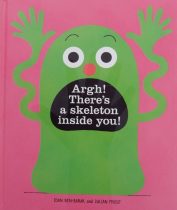
Argh! There’s a Skeleton Inside You!
Idan Ben-Barak and Julian Frost
Allen & Unwin

Quog (a blobbly armless thing) and Oort (a gas cloud) are in their spacecraft going to a party but mechanical issues hold things up. They need to get out and fix the problem but without hands or arms, opening the door isn’t possible. Or is it? That’s when the narrative becomes interactive – the reader turns the page and … out they come.

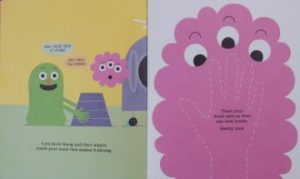
‘Give Quog and Oort a wave,’ we’re told and a page turn reveals Quog has grown arms and hands. That’s a good start but there are further issues.

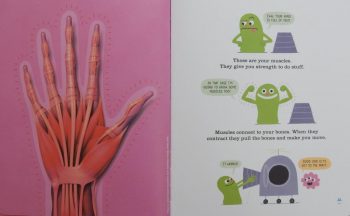
Little by little youngsters are then introduced to the bones,

muscles …

and nerves of the hand – their form and function.

With simple, bright, lively illustrations, this, zany mix of fact and fiction is enormously engaging: little humans will love the idea of helping the little aliens reach their destination, and in so doing learning some basic human biology – anatomy and physiology – as presented by the clever human team Idan Ben-Barak (author/scientist) and illustrator Julian Frost.

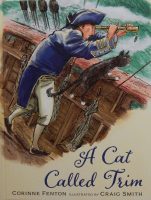
A Cat Called Trim
Corinne Fenton and Craig Smith
Allen & Unwin

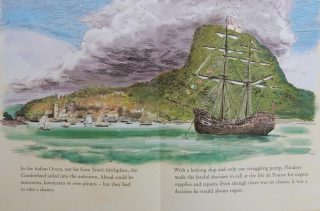
‘Trim was a cat born for adventure.’ That he surely was having been born aboard the sailing ship Reliance bound for Botany Bay and then not long after, finds himself hurtling over the side of the ship into the inky depths of the Indian Ocean.

Happily for the kitten and his saviour Matthew Flinders, a special relationship is forged, with Trim accompanying his master on all his expeditions until the fateful day when Flinders was accused of spying, his precious books, charts and journals confiscated and he became a prisoner on the Isle de France (Mauritius).

After a while Trim disappeared and his master never saw him again.

Both educative and entertaining, Corinne Fenton’s telling of this true story is compelling and accompanied by Craig Smith’s dramatic, detailed illustrations, and maps, makes for an absorbing starting point for primary readers interested in Australia and its history.

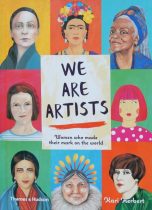
We Are Artists

We Are Artists
Kari Herbert
Thames & Hudson

For this splendid celebration of creativity, Kari Herbert has selected fifteen influential women artists from various cultures and different parts of the world who succeeded, often against considerable odds.

Each one is the subject of a chapter that includes a quote, a fantastic portrait (by Herbert), a short biography and one or two reproductions of their work.

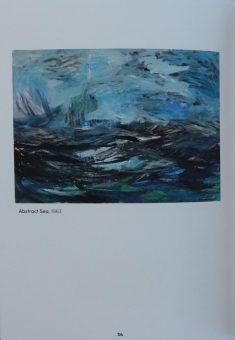
I was thrilled to see Tove Jansson, especially her Moomins sketches. Kari Hebert’s ‘Back in 1950s Finland, for a woman to love another woman was illegal. But on the islands… they could live and love as they wanted.’ is an example of the sensitive manner in which this book is written.

Abstract Sea, Tove jansson 1963

As you might expect we meet Georgia O’Keeffe and Frida Kahlo but there are also Corita Kent, Yayoi Kusama and Emily Kame Kngwarreye.

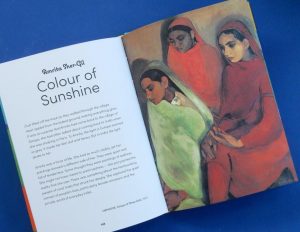
Among the few artists new to me, and despite my being a frequent visitor to India with two close friends who are artists, is Amrita Sher-Gil whose interpretations of the rich colours she saw in the everyday lives of India’s poor are enormously moving.

Group of Three Girls, 1935

‘In India the light spoke to her’, we read in contrast to the greyness of Europe where as daughter of a Hungarian opera singer mother and an aristocratic North Indian Sikh father, she spent her early years.

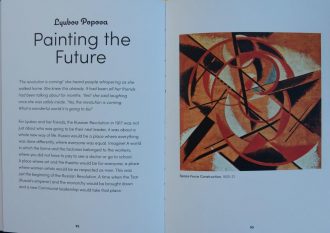
Another new discovery for me is Lyubov Popova, one of several avant-garde women artists in Russia in the early part of the 20th century. I love the quote that introduces her: ‘ Most important of all is the spirit of creative process.’

Engrossing and inspiring, this superb book is for youngsters with an interest in art and those who want to encourage creativity especially in young people.

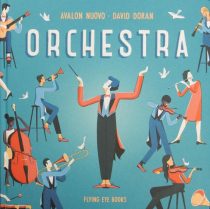
Orchestra

Orchestra
Avalon Nuovo and David Doran
Flying Eye Books

Here’s a concise, engaging introduction to western music for young readers.

It’s divided into three parts, the first – The Orchestra – being the longest, and the parts are subdivided into double page sections.

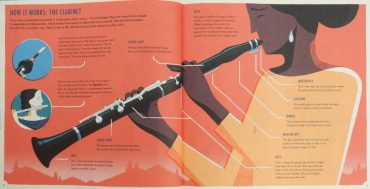
The Orchestra looks at the arrangement of an orchestra, exploring its different sections (strings, woodwind, brass, percussion, guests – those instruments not always there such as the harp), and also looks at how representative instruments from each category work and how their sound is created. For instance of the clarinet representing the woodwind section, ‘When the player blows into the instrument it is the reed’s vibration against the mouthpiece that makes the sound.’

When we reach the percussion section we see how the author develops an idea when she says, ‘You may have started to see a pattern in how instruments work. Some use air, some are plucked or bowed, but all of them are doing the same thing to make sound: vibrating. With percussion, vibrations come from the force of a player striking the instrument.’

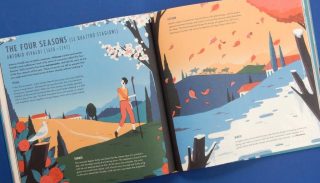
Part two Music and its Makers discusses music and composers. There’s a spread on reading music and one on musical composition after which the focus turns to individual composers with a look at Hildegard of Bingen, Vivaldi and the Four Seasons,

Amy Beach, Gustav Holst and The Planets, Duke Ellington, and six others – Mozart, Beethoven, Mendelssohn, Ethel Smyth, William Grant Still and Michel Legrand are included in a Hall of Fame that spans the second half of the 18th century to the present.

The third part takes us Beyond the Concert Hall to look at the mythology of music, opera, there’s a look at music as the basis for dancing, in particular ballet (Orchestra and Dance) and then come pages talking about the differences between composing for musical theatre and cinema.

Orchestra and technology examines how digital technology has changed both the way music is performed and how it is written.

Encouraging young readers to learn music is the object of the last spread and the book concludes with a glossary and index.

David Doran’s stylised illustrations gracing every spread, reinforce the idea that music is cool, inclusive and fun: I love his colour palette.

Great for home or school use.

A World of Plants

A World of Plants
James Brown and Martin Jenkins
Walker Studio

With the continuous stream of books about animals, it’s great to see this large format volume about plants.

There’s an absolute wealth of information packed between its covers with each spread focusing on a different aspect of plant life. The author, Martin Jenkins is highly adept at presenting complicated topics in such a way as to make them accessible and enjoyable for children. Having explained what a plant is, he includes information about such aspects of plant life as photosynthesis, the carbon cycle and reproduction.

There’s a spread on the functions of xylem and phloem (tissues I didn’t come across until I studied A-level botany).

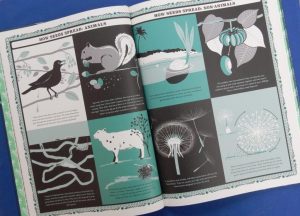
Seeds and their dispersal mechanisms are discussed;

so too are plant hormones, and climbing plants – those with twining stems, tendrils, clinging suckers or roots, and hooks.

Symbiosis and other plant interactions are explored, as are carnivorous plants – I’m always fascinated by these when I visit Kew Garden – and parasitic plants.

Sacred and Symbolic Plants talks about the many thousands of plants used as medicinal herbs and stimulants, provide spices, flavourings and perfumes or for ornamental purposes. I knew that the sacred lotus is an important symbol in Buddhism but was surprised to read that it was also revered in Ancient Egypt on account of the way its beautiful pure flowers emerge from unclean waters.

There’s a look at plant defences: I was fascinated to discover that there are plants with ‘spikes’ (needle-like crystals of calcium minerals called raphides) in their tissues that can penetrate the lining of an animal’s mouth and throat releasing poison into its bloodstream.

In fact no matter which spread you choose to read, you cannot  but be excited by the manner in which Jenkins and illustrator/print maker, James Brown present the botanical world. The latter’s full page illustrations, double spreads and borders are absolutely awesome.

This book provides wonderful insight into the wide and varied world of plants.

Rise Up! The Art of Protest

Rise Up! The Art of Protest
Jo Rippon
Palazzo

Developed in collaboration with Amnesty International and with a foreword by Chris Riddell, Rise Up! celebrates the human right of peaceful protest. At the same time it encourages young people to engage in such protest for causes they believe in and to stand up for freedom.

Arranged thematically there are posters relating to the on-going fight for gender equality, civil rights, LGBTQ rights,

refugee and immigrant rights, peace, and the environment.

First come images of protest posters going back to the early decades of the twentieth century when women’s struggle for equality gave rise to the suffrage movement, which became popular across Europe at that time

coming right up to 2017 with the official poster for the 2017 women’s March on Washington but used around the world, in protest at comments made by Trump that many felt disrespected the rights of women.

Each theme is introduced by an apposite and powerful quote, such as this one from Nelson Mandela for the racial equality section, “No one is born hating another person because of the colour of his skin, or his background, or his religion. People must learn to hate, and if they can learn to hate, they can be taught to love, for love comes more naturally to the human heart than its opposite.”

As you turn the pages you cannot help but feel both humbled and inspired. We seem to be living through a time when ever increasing numbers of people, especially the young, are politically aware, but there also seems to be more than ever to protest about. In the last couple of years I’ve carried pro refugees banners, anti BREXIT placards, of late proudly wear my pro EU sweatshirt and trainers, and have joined protests about climate change. I consider myself fortunate to be able to do so without any risk to myself, unlike many of those who carried some of the posters whose images are included in this enormously exhilarating, empowering book.

A copy, preferably several, should be in all schools and colleges; it’s a wonderful demonstration of the way in which a combination of creativity and bold resistance can help bring about positive changes that ultimately benefit everyone.

Earth Heroes

Earth Heroes
Lily Dyu
Nosy Crow

In this timely book from travel journalist Lily Dyu we meet twenty individuals – conservationists and inventors from around the globe who are actively engaged in their work to save the world, to counter climate change and save its humans and our precious wildlife.

Familiar names such as Greta Thunberg, Sir David Attenborough and Stella McCartney are present, and we read fascinating information about their backgrounds and what set them on their paths.

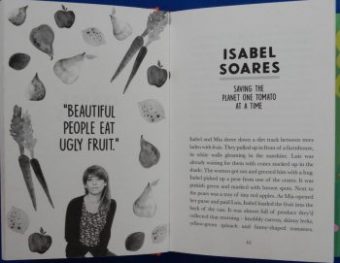
Alongside these are less well-known people whose work is also inspiring: these include Mohammed Rezan, architect of floating schools in Bangladesh; Isabel Soares from Portugal a pioneer of cutting down food waste by persuading people to use ‘Fruit Feia (ugly fruit)

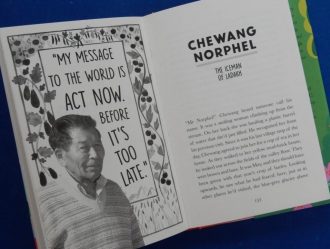
and the ingenious Chewang Norphel who was responsible for the building of artificial glaciers in Ladakh that have transformed thousands of lives.

Great for individual reading or classroom use, Lily Dyu’s engaging text is readable and pitched just right for its intended audience of young readers and cover designer Jackie Lay has provided splendidly designed art with a relevant and inspiring quote to introduce each entry.

Lily’s final words speak to us all ‘ … we need to fight for the planet we love. The future is ours for the making. You too can change the world.’ A powerful rallying cry for sure.

Be Your Best Self

Be Your Best Self
Danielle Brown and Nathan Kai
Button Books

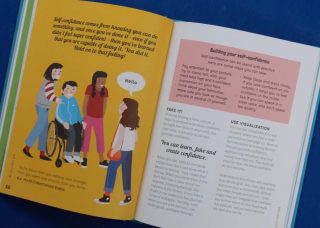
At a time when more and more youngsters are suffering from low self-esteem, Danielle Brown double Paralympic Gold medallist and five times world champion in archery and Nathan Kai, (just seven at the time of writing), a member of MENSA and an elite athlete, have joined forces, creating a book to empower children to become their very best selves.

Profusely illustrated and including motivational quotes from the authors as well as the likes of Dr Seuss and J.K.Rowling, Michelle Obama and Amelia Earhart, this certainly is an inspiring book.

With a straightforward, thematically organised framework children are told to dream big and then determine what steps they need to take to fulfil their dreams.

Aspects such as The Mind and Mindset, which looks at the importance of developing a growth mindset rather than a fixed mindset,

Staying Focused, Learning How to Fail Well ( it’s a chance to learn), Self-Confidence,

People Skills, and the importance of eating well and getting plenty of sleep are included.

I have a teenage friend in Udaipur, Rajasthan who, one Christmas holiday four years ago announced she wanted to be sports captain of her school. She is a talented athlete but there is a tradition in Rajasthan for shooting and Karttiki decided she would try to become a shooter.

She started to practice in earnest and by luck one of the older girls fell sick at the last moment and Karttiki was given a chance to participate in an inter-school tournament. Thus began her shooting journey: one of determination and great focus.
Having researched several kinds of shooting, she decided that her best bet if she wanted to become a champion, was skeet. It’s a tough sport and very expensive but her father (my close friend) is very supportive. This year though still a junior, she has made the senior national team and in 2019, has represented India in the World Cup, World Championships and is about to go to the Asian Games (all this before A-levels). She’s had her downs as well as her ups along the way and feels tired a lot of the time, but as she says, “I’m doing it because I love it.”

Turning a dream into reality is just what this 17 year old is surely doing: she epitomises the spirit of this splendid book.

Snow Leopard: Grey Ghost of the Mountain / Who Am I?

Our precious wild animals are under threat as these two books show:

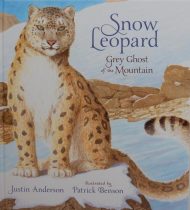
Snow Leopard: Grey Ghost of the Mountain
Justin Anderson and Patrick Benson
Walker Books

Here we have the latest addition to the Nature Storybook series that Walker Books does so brilliantly.

Filmmaker Justin Anderson debuts as an author; his narrative is accompanied by award winning Patrick Benson’s awesome,  finely detailed illustrations. The result is a wonderful look at the animal the inhabitants of the high Himalayas call the “Grey Ghost’, a very rare and beautiful animal.

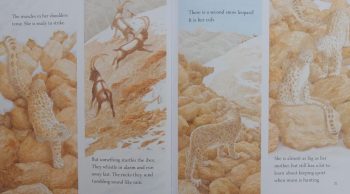
Patrick Benson takes us right up close to the creature as it weathers a blizzard,

then communicates with other snow leopards by squirting pee.

She uses her camouflage coat to sneak up close to her prey – half a dozen ibex – lower down. Her meal however eludes her on this occasion because her cub alerts them to the danger.

We then follow mother and cub as they seek the sun’s warmth, then briefly curl up together before as the sun sinks they wake and continue their climb, disappearing into the silence of the mountain.

A final note provides further information highlighting the vulnerability of the species and detailing conservation organisations, while accompanying the narrative, in a different font, are snippets of factual information not woven into
the main text.

One feels privileged to have met these stunning animals in this quietly beautiful book.

Who Am I?
Tim Flach
Abrams Books for Young Readers

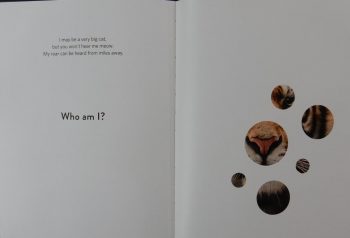
The award winning photographer Tim Flach whose superb photographs grace the pages of this ‘peek-through-the-pages’ book of endangered and threatened animals is passionate about rewilding.

Here, using riddles, full page shots, small circular images of parts of animal faces, and die-cut peek-through windows,

he introduces youngsters to a dozen animals (or rather they introduce themselves) including the Bengal tiger, a white-belied pangolin,

an axolotl and a giant panda.

In the final pages we learn what makes each creature special and why it’s endangered, and the author ends by asking young readers to help save these amazing animals, indicating how best to get involved in so doing.

A rallying call indeed.

Nose Knows: Wild Ways Animals Smell the World

Nose Knows: Wild Ways Animals Smell the World
Emmanuelle Figueras and Claire de Gastold
What on Earth Books

Did you know that our noses can detect some 400,000 different smells, each one carrying its own message?

However, this large format book investigates the sense of smell – its detection and use – not only in humans but also in a variety of animals whose snouts, trunks, rostra, muzzles and beaks are given prominence in this thematically organised volume.

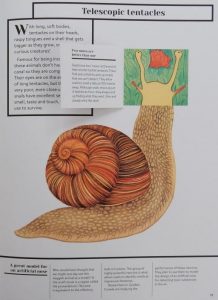
There are flaps that can be lifted to reveal inside views of such things as a snail’s two ‘noses’ that amazingly allow a snail to detect the smell of a lettuce from a distance of 100 metres.

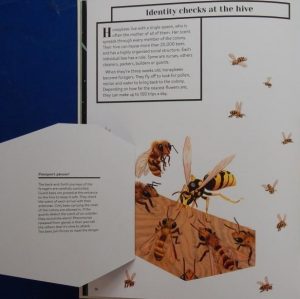
I was fascinated to read that honeybees post guard bees at the entrance to a hive to check the scent of each arrival with their antennae, allowing only those carrying the scent of the colony to enter.

We read of the different uses of the olfactory sense – to identify mates and offspting, to locate prey or other food, to detect danger as well as to assist in finding the way when travelling long distances.

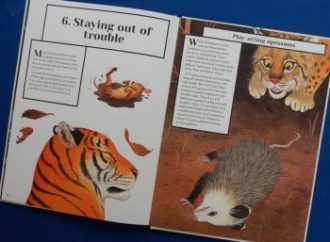
Moving from the general to the specific, the author presents difficult concepts in a manner that older primary school readers will find accessible (‘Polar bears have wide nasal cavities that allow them to inhale large amounts of air and detect odorant molecules over long distance’ for instance) and this is also facilitated by the layout of the pages where text never dominates.

There are also humorous touches both verbal – male giraffes smell and taste the urine of females to check out their hormone levels and thus ascertain the female’s readiness to mate – and in Claire de Gastold’s realistic illustrations (the blissful somnolent stretch of the cat on the armchair and the horses pulling funny faces (on account of their Jacobson’s organs.

An Informative book but  fun too, and there’s a final index, plus suggestions for further reading.

Africa: Amazing Africa

Africa: Amazing Africa
Atinuke, illustrated by Mouni Feddag
Walker Books

Nigerian-born storyteller Atinuke takes us on an exciting journey through the countries of Africa in her celebration of this incredible continent – its history, culture, religions, traditions and languages.

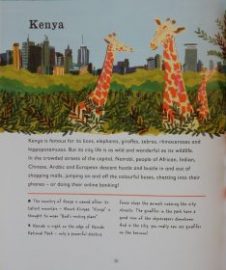
She divides the 55 or so countries into regions – Southern Africa, East Africa, West Africa, Central Africa and North Africa providing quintessential details of each country: the wild life for which Kenya is famous;

the irresistible drumming rhythms of Burundi – (who can fail to respond to the sound of those awesome Royal Drummers of Burundi, certainly not me),

the diamond industry and contrasting cattle-herding of Botswana for instance.

There are also maps, pages featuring hairstyles, football and religions.

Mounti Feddag’s vibrant illustrations are superb, exploding into colour and pattern on every page.

I’m fortunate in having many friends from different parts of this huge continent but have never visited it other than for a childhood holiday to the island of Mauritius, and occasionally in transit; brimming with gorgeousness, this book has made me want to change that.

Those with a thirst for finding out about life in different parts of the world will also enjoy this activity book:

This Is How I Do It
Matt Lamothe
Chronicle Books

The creator of This Is How We Do It, Matt Lamothe invites the reader to document his or her own daily life and compare and contrast it with children from over 50 other countries. Included in the book are punch-out postcards, sheets of stickers, a fold-out map and photos of members of four families.

Together / Insect Superpowers

Red Reading Hub looks at two interesting, unusual and very different ways of presenting non-fiction:

Together
Isabel Otter and Clover Robin
Caterpillar Books

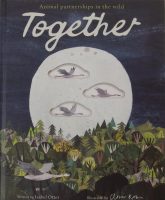
By means of gorgeous collage style, die cut illustrations and a series of haiku accompanied by factual paragraphs, illustrator Clover Robin and writer Isabel Otter present a nonfiction nature book that looks at animal partnerships in the wild.

Beginning thus: ‘ A vast migration. / Cranes take turns to lead their flock: / The feathered arrow.’ and explaining that when cranes migrate and the leader of the group becomes tired, another takes its turn to lead and so on.

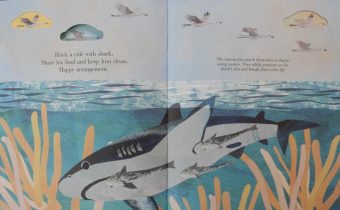
The migrating cranes fly above in turn, a pack of wolves; a herd of chamois deer; and a pod of pilot whales. They then pass above a shark that has its skin kept parasite free by remora fish that get a free lift;

anemones kept clean by goby fish; a badger that works with a honey guide bird; a crocodile that has its teeth cleaned by plovers; a herd of loyal elephants; giraffes with oxpecker birds that help keep down their fleas,

and finally, zebras and ostriches that use their complementary sense organs to alert each other to danger.

At last the cranes reach their winter feeding grounds and their journey is over – for the time being.

A fascinating way of presenting non-fiction that offers youngsters an introduction to an intriguing aspect of animal life.

Insect Superpowers
Kate Messner, illustrated by Jillian Nickell
Chronicle Books

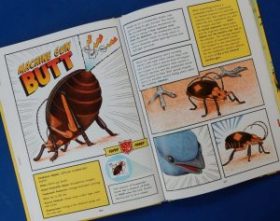
Taking advantage of the seemingly never-ending popularity of superheroes, author Kate Messner and illustrator Jillian Nickell present in action-packed, graphic novel format, an alluring array of eighteen insects with extraordinary abilities.

Before plunging readers into the specifics of the various insects’ superpowers, Messner provides an introduction to insect orders and using the Monarch butterfly as her example, shows how biological classification works.

Dramatic illustrations immediately snare the reader’s attention as they confront the bugs one by one starting with in the first FAST & FIERCE chapter, ‘Supersonic Assassin Giant robber fly – more like a supervillian – that uses its venomous spit to paralyse its prey.

Also in this chapter are The Decapitator aka the Asian giant hornet with its painful sting and fierce jaws that often rip bees apart before stealing their larvae and feeding them to their own hornet larvae.

Other chapters feature insects that use mimicry (the ‘Great Imposters’); the ‘Big & Tough’ bugs some of which are among the strongest creatures on earth; then come the ‘Masters of Chemical Weaponry’. I definitely wouldn’t fancy being sprayed by the hot noxious mist that the African bombardier beetle can emit from its abdomen when something bothers it. Yikes!

Further chapters are devoted to ‘Engineers & Architects’ and ‘Amazing Ants’ (although some of the insects in the previous chapter are also ants).

For each insect included there are facts about habitat, size, diet, allies and enemies, and of course, its superpower.

If you have or know children who are into superheroes but have yet to discover the delights of insects, this book that’s all a-buzz with superpowered bugs might just fire up their enthusiasm.

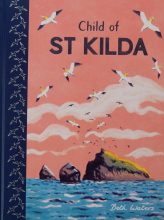
Child of St. Kilda

Child of St. Kilda
Beth Waters
Child’s Play

Here’s a part of British history about which I for one, had no idea before reading this book so a big thank you to Child’s Play for sending it for review.

In this fascinating tale of the last human inhabitants of the remote Outer Hebridean islands of St.Kilda, Beth Waters relates the story of those living on Hirta, the largest of the islands and in particular of Norman John Gillies, born there in 1925.

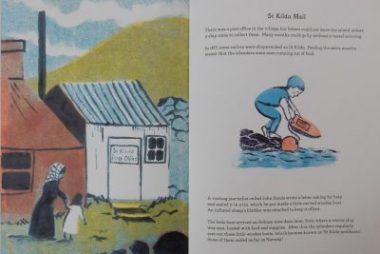
Dividing her narration into short sections – What People Did, School, St.Kilda Mail

and so on, she tells of the ups and downs of a subsistence community wherein everybody knew one another, crops often failed and there was no money; sheep were kept for the production of tweed, and wild birds or fish sometimes provided the food as supplies could only be delivered for half the year.

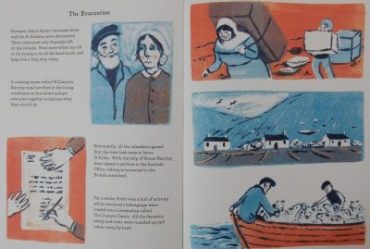
When John Gillies was not quite five his mother became ill, was taken to the mainland and there she died. This precipitated a petition from the remaining inhabitants of St. Kilda to the government asking to be moved to the British mainland and by 1930 the entire population was evacuated.

The islands are now a World Heritage Site.

Beth Walters’ monoprint illustrations of the sea, sky and cliffs, executed in green, blue and russet hues are superbly evocative of a long gone way of life; and she also includes some contemporary photographs and excerpts from her sketchbook.

Step Inside Homes Through History / Darwin’s Voyage of Discovery

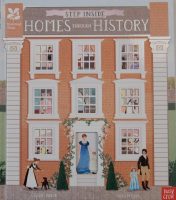
Step Inside Homes Through History
Goldie Hawk and Sarah Gibb
Nosy Crow

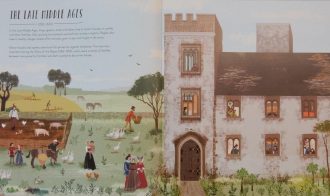
Most readers of this book will recognise many of the features of the contemporary house illustrated herein, and those who are as old as this reviewer will recognise some of the rather garish décor shown in the sixties home. How many though, unless they are members of the National Trust or have a special interest in the topic, will know what living in a Late Middle Ages manor house or a Tudor mansion was like?

Three double spreads each, explore seven periods in time from the mid 13th century through to the present day.
Intricately detailed laser-cut pages show us not only the particular residence outside

and in, but also the fashions, family life and furniture of the period.

You can have fun tracing the evolution of the bathroom from the medieval gardrobes – ‘a bench over a big hole which went outside the house’

to the Georgian chamber pot beneath the bed, the new Victorian indoor flushing toilet through to the present day en-suite bathrooms that many of us have. Also fun is the ‘spot the artefact’ feature where readers are asked to find a named item of furniture or small object in each house.

Full of interesting snippets of information, this well-illustrated book is worth buying for a classroom collection, or if you intend visiting a stately home or historic house, whether or not it belongs to the National Trust, Nosy Crow’s collaborators for this title.

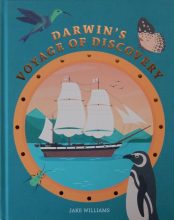
Darwin’s Voyage of Discovery
Jake Williams
Pavilion Books

Following his Really Remarkable Reptiles, illustrator/designer Jake Williams has created another fascinating, stylishly illustrated book, this time about the naturalist and geologist Charles Darwin famous for his epic voyages of adventure on HMS Beagle and his theory of evolution ‘On the Origin of Species’.

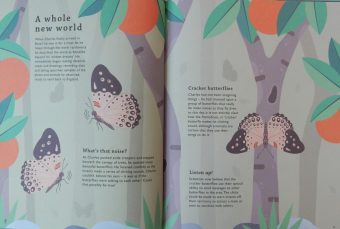
The amazing creatures both large and small that Darwin saw during his explorations (some of which we see larger than life illustrated herein) furnished a wealth of detailed notes and drawings, observation data and fossil specimens; and readers can follow in the footsteps of the famous biologist as he travels the world for five years as the Beagle ship’s biologist sailing from England to the Cape Verde islands, from Brazil to the Galapagos and from Tahiti to Australia and finally, back home.

There’s a wealth of information about such things as the ‘cracker’ butterflies of Brazil;

how Darwin unearthed the skull of a giant ground sloth in Argentina and the steamer ducks he observed in the Falklands,

as well as maps showing the Beagle’s progress.

Recommended for all those with enquiring minds, this is a beautifully produced book that highlights the importance that careful observation makes in the furtherance of scientific discovery.

Into the Deep

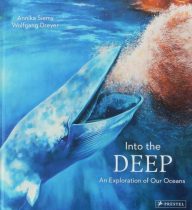
Into the Deep: An Exploration of Our Oceans
Wolfgang Dreyer and Annika Siems
Prestel

Prepare to be swept away at the sights you’ll see as you plunge into this exploration of the awesome life forms that lie beneath our oceans.

We journey, with marine biologist Wolfgang Dreyer, courtesy of the research vessel Meteor aboard which is a submersible that enables us to meet some of the incredible creatures from plankton, the tiniest microscopic life forms, to the enormous mammalian creatures such as the sperm whale, and its prey, the giant squid, the largest invertebrate on earth.

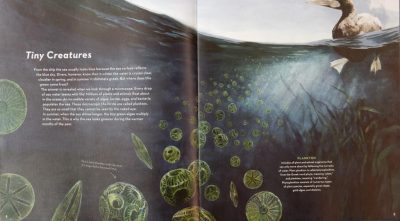
Did you know the reason the sea looks greener during the warmer months is down to the proliferation of phytoplankton, the minute chlorophyll-containing organisms.

These are a vital food source for many kinds of aquatic animals; indeed phytoplankton are at the base of the ocean food chain.

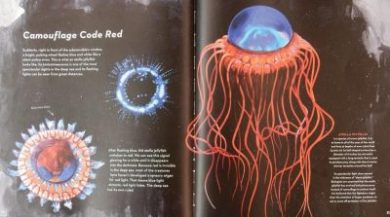
I was totally fascinated to read about the atolla jellyfish, in particular Atolla wyvillei a species of crown jellyfish, and the way in which it uses bioluminescence, flashing first blue and then red, the latter being invisible in the deep sea and thus acting as a protective mechanism.

Perhaps even more surprising is that there are other unrelated deep-sea creatures that also use red for protection including, the world’s largest crab, the Japanese spider crab.

The author has packed a considerable amount of information into this book but at no time does it overwhelm despite the fact that he never talks down to his audience, rather he uses scientific terminology throughout to discuss such things as morphology and physiology.

The nature of this book is such that readers are unlikely to encounter in the flesh most of the animals featured, but Annika Siems’ oil paintings, some in really large format, bring them to life and allow for close scrutiny of the wonders of the deep.

A terrific book for the curious, for those inspired by David Attenborough’s Blue Planet 2 series and budding marine biologists alike. It ends with a heartfelt plea from author and artist to stop littering our oceans with plastic and other garbage.

Meet the Gumboot Kids

The Case of the Vanishing Caterpillar
The Case of the Wooden Timekeeper
The Case of the Growing Bird Feeder
The Case of the Story Rock

Eric Hogan and Tara Hungerford
Firefly Books

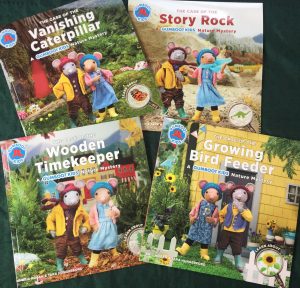
These four nature story books feature a couple of soft-toy mouse characters Daisy and Scout and are a spin-off from a Canadian animated TV series The Gumboot Kids.

In The Case of the Vanishing Caterpillar the pair track down Scout’s caterpillar friend, following clues such as nibbled leaves and an empty chrysalis case on a branch before spotting the missing insect in the form of a butterfly.

Scout sets Daisy the puzzle of searching the forest to find The Missing Timekeeper in the second book. Even when she locates the tree stump, Scout has to point out the rings on the cut surface of the Douglas Fir and they head to the library to discover their significance.

In the Growing Bird Feeder story it’s Daisy’s turn to set the challenge, but her friend is puzzled to hear while they picnic in the woods that she has forgotten to water her feeders. “What kind of bird feeders grow?’ he wants to know.
Returning to Daisy’s garden they eventually see a bird land on one of her tall sunflowers for a seed feast.

In the fourth book the two friends unearth the Story Rock when they dig up an ammonite fossil; then back at the campsite Daisy’s book explains how fossils are formed and that fossils tell us stories about ancient plants and animals.

Each book has a similar structure  – a nature puzzle being set by one or other of the mice, with clues provided in their notebooks. Once the mystery is solved further information is sought from a reference or library book.

The characters then share a mindfulness moment when they  consider their findings and at the end of the book there are double spreads with field notes and a related craft activity.

I’m always advocating the importance of fostering a love of nature in the very young, so welcome this series which clearly aims to get young children outdoors and eager to discover more about the world around them; these stories are certainly engaging and contain just the right amount of information in the narrative to spark their curiosity.

The History of Prehistory

The History of Prehistory
Mick Manning and Brita Granström
Otter-Barry Books

Team Manning and Granström present another first-rate non-fiction book for young readers.

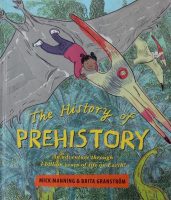
We join their two child protagonists as they set off on an incredible adventure that takes them back 4 billion years to the time when Earth was volcanic and still way too hot to support life.

To travel from those fiery beginnings of Earth and Moon right through to the Bronze Age (5.300 to 3,200 year ago) is an awesome journey that encompasses a stop to investigate the explosion of life during the Cambrian period,

followed by a canoe trip to view the giant fungi of the late Silurian Period.

From then animal life proliferates and the time travellers encounter an incredible array of creatures including giant dragonflies, the first completely land-based reptiles; and even more awesome they get to fly on the backs of Pterosaurs above such dinosaurs as Diplodocuses.

Having investigated the Periods when dinosaurs ruled, they pause to spend a while with tree-dwelling mammals before they join the clever apes of the Miocene Epoch as they swing above the forest floor and on to the Pliocene Epoch to meet our earliest two-legged human ancestors.

With a lively narrative that respects young readers by using the correct terminology and splendid, gently humorous scenes of the various creatures, as well as a glossary and timeline game, this exciting book will be avidly read by individuals fascinated with past times as well as being welcomed by teachers using it to support the primary curriculum.

Atlas of Amazing Birds

Atlas of Amazing Birds
Matt Sewell
Pavilion Books

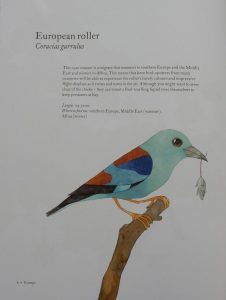
Well-known wildlife author/artist Matt Sewell has selected some incredible birds – more than 120 – from all over the world for his latest book.

In his introduction he talks of ‘my personal selection of the most amazing birds in the world—the most beautiful, strange, scary, speedy, and enchanting.’ He also points out that his illustrations – full colour stylised watercolours labelled with both the bird’s common and scientific names – are not to scale (although dimensions of each are provided).

Using the continents as the organisational device, he begins in Europe with 22 birds, which are listed together with a map that labels the countries and an introductory couple of paragraphs. This same format is provided for each of the other six continents.

The accompanying text certainly doesn’t talk down to readers; its conversational style is engaging, humorous on occasion and he’s chosen his words for maximum impact. For example of the European roller he says, ‘impressive flight displays as it twists and turns in the air’; and of the chicks “they can vomit a foul-smelling liquid over themselves to keep predators at bay.’

Also included is information about whether the bird is migratory.

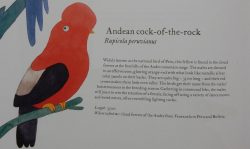
I particularly liked this description of the Andean cock-of-the-rock, ‘The males are dressed in an effervescent, glowing orange-red with what looks like metallic silver solar panels on their backs.’

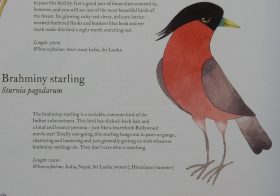
And this one really made me smile: “brahiminy starling … has slicked-back hair and a loud and bouncy persona – just like a heartthrob Bollywood movie star.’ That bird is one I recognise from frequent visits to India as are several of the other beauties from the Asia section.

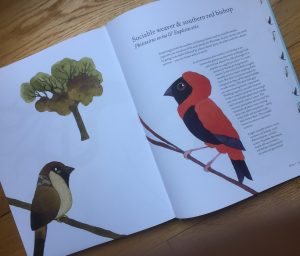
It’s hard to believe but these two African birds come from the same family for as we read ‘one could be going to the ballet, followed by a fancy dinner-party, the other could be a desert sparrow.’

All in all an alluring volume for a wide age range, show-casing some of the avian wonders of the world.

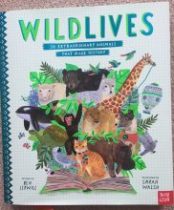
Wild Lives

Wild Lives
Ben Lerwill, illustrated by Sarah Walsh
Nosy Crow

Subtitled 50 Extraordinary Animals that Made History, this large book celebrates animals large and small that deserve to be remembered for all time.

They are grouped together under category headings: Rescue & Protect, Adventure & Explore, Change & Solve, Discover & Pioneer and Inspire & Influence.

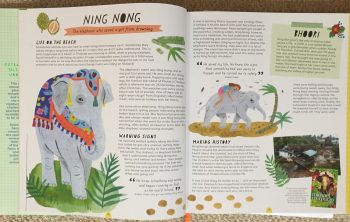
I’m ashamed to say that many of these amazing animals and their feats have passed me by. Not though, thanks to Michael Morpurgo’s book Running Wild based on their escape, Ning Nong the elephant that saved the life of a little girl staying in Phuket in the 2004 tsunami.

The first creature in the same opening section is Cher Ami a homing pigeon that towards the end of the First World War managed to withstand bullet injuries to her breast, leg and eye to deliver a crucial message about a battalion of American soldiers who were unknowingly being attacked by their own men. In the same section is Wojtek, an ursine member of the Polish army during WW2 when, standing on his hind legs he carried onto the battlefield vital heavy boxes of bullets and bombs.

Many people know about Laika the space dog but how many know of Montauciel the sheep that also took flight, in a hot-air balloon no less? I certainly didn’t.

Because of Dianne Hofmeyr’s picture book Zeraffa Giraffa, I was familiar with the story of Zaraffa the giraffe that was sent from Egypt in the early C19th to Paris as a gift for the King of France. These animals are remembered in the Adventure & Explore section.

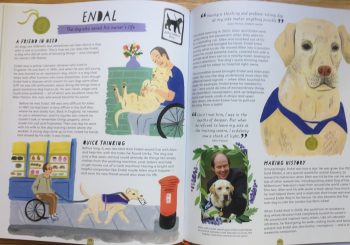
Again on account of a picture book, My Name is Bob, by James Bowen whose life was changed by the stray feline that befriended him, I knew of Streetcat Bob, celebrated in the Change & Solve section. It’s thanks to this fascinating section too that I learnt about another dog that changed a life forever. Endal, became an assistance dog to a wounded naval officer, Allen, and subsequently won a gold medal for bravery when Allen was hit by a car and knocked out of his wheelchair. The dog was able to move him to a safe position, run to a hotel close by and raise the alarm. Incredible.

Other animals whose stories are part of this fascinating book have had an influence on how we relate to the natural world, or have enhanced our understanding of social interaction and behaviour. Some including the dog Hackiko, Keiko the orca whale (Free Willy), Elsa the Lioness and Seabiscuit the champion racehorse have become film stars.

Every spread includes Sarah Walsh’s empathetic illustrations along with archive photos and sometimes, relevant documents; and each has a  quotation from a person, a press cutting or perhaps a TV programme.

The book ends with a world map showing where each of the fifty animals was born, annotated with a postage stamp size portrait  and a glossary.

Engrossing and enlightening Ben Lerwill’s first book for children will delight animal lovers of all ages.

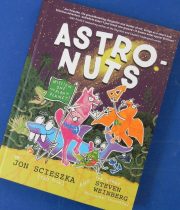
AstroNuts

AstroNuts
Jon Scieszka and Steven Weinberg
Chronicle Books

In this, the first book of what is to be a series, our narrator is planet Earth, yes that’s right Earth and it starts by taking readers back thirty one years to 1988 when, so we hear, in a secret lab. within Mount Rushmore two scientists working for NNASA (Not the National Aeronautics and Space Administration) built four super-powered animal astronauts designed to become activated should humans ever come near to destroying their home planet. Their role would be to travel through outer space in search of a new ‘Goldilocks Planet’ (not too hot, not too cold, but just right for human habitation).

That catastrophic time now has come, so let’s meet the AstroNuts – fearless leader AlphaWolf, along with SmartHawk the super-organised planner, electromagnetic LaserShark – protector and food finder, and StinkBug -as they blast off in their secret craft.

Having travelled 39 light-years in less than 3½ hours they crash land their rocket on Plant Planet.

This place certainly does have a super-abundance of lush vegetation. But it turns out that these plants aren’t the mindless flora the AstroNuts first thought. And yes, there’s food aplenty; shelter building potential – well maybe,

but a balanced ecosystem? Seemingly not. But are those inhabitants actually friend or foe? Don’t miss the fold-out feature.

This is a clever mix of science and laugh-out loud bonkerness.

What better way to put across the climate change message and along the way impart a considerable amount of biological and chemical information, than with this heady concoction of Scieszka’s irresistible verbal playfulness and Weinberg’s clever digital collages constructed in part from images from the Rijksmuseum in Amsterdam.

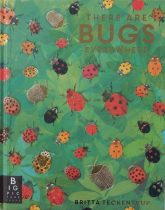
There are Bugs Everywhere

There are Bugs Everywhere
Lily Murray and Britta Teckentrup
Big Picture Press

The title of this book proved all too true for this reviewer – an elephant hawk moth caterpillar crawled past my foot as I sat outside my favourite café this morning. This insect …

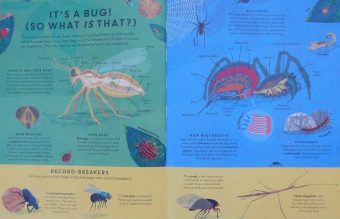
is one of over 100 ‘bugs’ Britta Teckentrup has illustrated in this colourful and fascinating book.

The term bugs is here used as a catchall to include six legged insects, eight legged arachnids and multi legged myriapods and collectively there are, we’re told, millions of different species.
With spreads devoted to bug anatomy,

feeding habits, survival techniques, social insects, the life cycle of the Madagascan Sunset moth and much more, there is a mine of information for the curious reader.

Did you know that Chan’s megastick which inhabits the Borneo rainforest is the largest bug in the world, growing up to 56cm.

There’s even a ‘can you find?’ challenge posed on the final end paper to track down the golden tortoise beetle from North America hidden somewhere in the book. This will surely encourage further close perusal of every one of Britta’s already inviting spreads.

A Life Made by Hand: The story of Ruth Asawa

A Life Made by Hand: The story of Ruth Asawa
Andrea D’Aquino
Princeton Architectural Press

I have to admit that despite my interest in art the name of this book’s subject is new to me.

Brought up on her family farm in California, Japanese-American artist Ruth Asawa was from an early age, mesmerised by the flora and fauna she saw around her.

Her close observation of such things as insects she saw led her to make representations of them from wire or folded paper, and she also loved to draw in the dirt with her feet.

At weekends, instead of working on the farm, Ruth studied Japanese calligraphy and later she went to art school where she gained further inspiration from dance choreography, and her teachers, in particular Buckminster Fuller and Josef Albers.

Travelling to Mexico she learned wire weaving from local craftsmen who twisted the metal to make baskets.

Back home Ruth experimented with this medium and finally knew what was THE medium for her.

Her sculptures are enormously complex, beautiful graceful pieces that are now to be found in art museums mostly in the US

where they inspire others to look closely, imagine and create for themselves.

This short interesting introductory biography for youngsters with an interest in both art and the natural world omits the darker events in the life of Asawa and her family, but the author provides factual notes on these, as well as an explanation for her own inspiration in creating the book, and instructions for making a paper dragonfly.

D’Aquino’s collage style illustrations – a combination of charcoal and colour pencil drawings with hand-printed and monoprinted paper are quirky and arresting, and may well inspire readers to experiment with collage too.

So You Think You’ve Got it Bad? A kid’s life in Ancient Rome

So You Think You’ve Got It Bad? A kid’s life in Ancient Rome
Chae Strathie and Marisa Morea
Nosy Crow

Imagine having your pet parrot or fish ending up in the cooking pot, or being sold as a slave to cook for richer neighbours.

How would you feel if you had a headache and the remedy was finding an elephant to touch your head with its trunk and hoping it sneezed a trunkful of snot right at you?

Or worse perhaps, if you were a boy you’d have to go to school every single day of the week (except holidays) and anyone who made more than the occasional mistake in class, would be held down by a couple of slaves while the teacher beat you with a leather whip: scary or what?

Alarm bells ringing I suspect, but this is just a small glimpse of what life was like for children in Ancient Rome that is provided in this fascinating book. There’s a section on clothing, hairstyles and make-up – supposing your mum used bear fat to make her hair grow, or pigeon poop to lighten it?

Other sections include food, family life, the home, gods, fun and games – yes there were some,

gladiators and emperors. And there’s a final glossary and index.

High on entertainment for sure, but also high on information of the accessible sort, this book published in association with the British Museum and with an abundance of amusing illustrations by Marisa Morea, is definitely one for primary school classes and individuals interested in ancient times.

Out and About: Night Explorer / Animal Homes

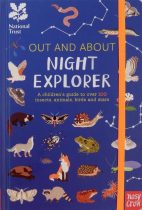
Out and About: Night Explorer
Robyn Swift, illustrated by Sara Lynn Cramb
Nosy Crow

Created in collaboration with the National Trust, this is an excellent little book if you’re planning on doing some exploring after dark with youngsters or are off camping somewhere.

It’s packed with information about such things as suitable clothing, creating a night-time den, star gazing, nocturnal creatures – from minibeasts to moths and mammals including bats, plus owls and amphibians; and, it’s good to see several spreads on night-time flowers.

There are lots of helpful hints on such things as tracking animals by means of footprints and poo deposits.

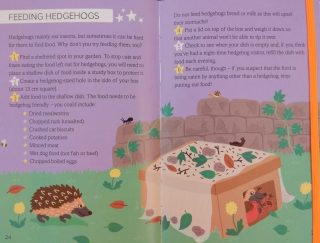
No matter the season there’ll be ideas herein: how about creating a house for creepy-crawlies in your garden during winter; or setting up a hedgehog feeding station?

I especially like the idea of making a sensory map at night, particularly focusing on sounds and smells as you walk and then repeating the same route in the light and comparing what you notice.

There are even suggestions for games, a quiz and a glossary.
All in all, with its plethora of very attractive labelled, coloured illustrations by Sara Lynn Cramb, this is ideal for encouraging young explorers (with an adult or older sibling) to get closer to nature at night.

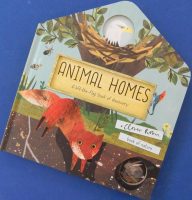
Animal Homes
Clover Robin and Libby Walden
Caterpillar Books

Wherever we walk there are likely to be animals living either in the earth beneath our feet, at eye level, or high up above our heads. We currently have a bees’ nest in our chimney.

Illustrator Clover Robin and author Libby Walden offer us an insight into six different animal homes, in various parts of the world.

After a general introductory page, we visit a beehive;

a beaver lodge; the nest (eyrie) of a North American Bald Eagle; a rabbit warren; a termite mound and the earth of a Red Fox.

As well as the habitats themselves, each spread (one per home) provides factual snippets about each of the inhabitants and their habits, some of which is hidden beneath flaps.

It’s unlikely that young children will encounter these particular habitats but nevertheless this little book, with its attractive collage style illustrations will encourage them to keep their eyes open for animal homes in the environment. Should they find any it’s important to remember Libby’s final rules: ‘Find, Look, Leave’.

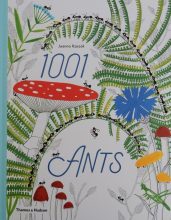
1001 Ants

1001 Ants
Joanna Rzezak
Thames & Hudson

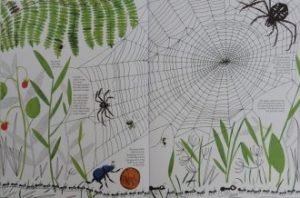
If you stop by an anthill and have time to watch the activity, you’ll discover that ants are fascinating creatures. The trouble is though that we cannot see what is going on inside.

Author/artist Joanna Rzezak shows us on her opening spread of this large format book. Thereon is a cross-section of an anthill where we see chambers connected by lots of branching tunnels, some of the former containing ants, while others hold such things as aphids, leaves and seeds needed as food by the ants.

The factual narrative is brief and light-hearted for we’re told ‘there is a little ant with red socks hiding in every picture in this book’ and asked to try and locate same.

A smell tells the ants it’s time to start walking, where we know not, and we then follow the long line of tiny creatures as they march single file through bracken, over fungi and among fallen leaves. All the while the playful red-socked ant comments and sometimes gets sidetracked.

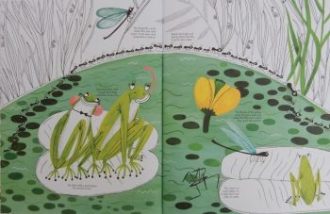
Surprisingly for this reader, the ants traverse the edge of a pond using lily pads as stepping-stones, fortunately taking a route behind the large green frogs with protruding tongues just waiting for some tasty insects.

Their journey takes them through a field containing a variety of plants in various stages of flowering and fruiting, full of other insects including the caterpillar of a swallowtail butterfly; then beneath a large spider’s web

and even over the body of a huge sleeping bear.

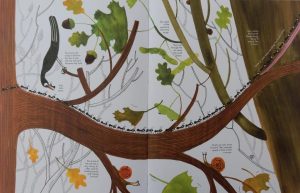
Eventually they reach a tree and up its trunk they climb, carefully avoiding an owl resting therein, along a branch they continue; but this is nature so what is that drumming sound and what is that long pinkish worm-like protrusion.

Oh no!

The food chain must be kept working and so a large bird is left to utter the punch line. Not quite the last word though – that is left for the red-socked ant …

Factual snippets about the flora and fauna encountered on the journey will definitely keep readers interested in the natural history side, while curiosity will drive them forward as they follow the ants’ journey to its end.


How To Be Extraordinary

How To Be Extraordinary
Rashmi Sirdeshpande and Annabel Tempest
Puffin Books

What an inspirational selection of people Rashmi Sirdeshpande has chosen for her look at the lives of fifteen men and women from around the world, each of whom has made a truly impressive contribution to humanity. The balance of male and female inspirers is as equal as an odd number allows with one more male. I think if I were asked to compile a book like this, I’d want to include every one of these, who come from all walks of life.

There’s my all time hero, freedom fighter, Nelson Mandela, Britain’s first female spy, Polish born Krystyna Skarbek who once faced off German officers while in possession of a top-secret silk map, which she rolled and used as a headscarf. (Sadly, the extent of her bravery wasn’t recognised until after she died).

I’ve followed the career of Sir “Mo” Farah” from his early days in a secondary school just up the road from the primary one I taught at, through the time he trained at St Mary’s University, becoming elated as he won those Olympic gold medals, until now; his athletic skills and versatility are undoubtedly ‘superstordinary’.

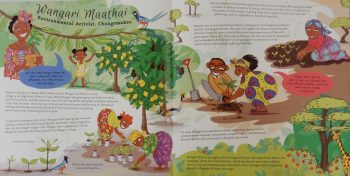
It’s great to see the author/illustrator of much-loved children’s books, Judith Kerr, who with her parents fled Nazi Germany, arriving in London in 1936; and the unstoppable environmentalist, Sir David Attenborough, who continues to be an inspiration in his 90s as well as another environmentalist, Wangari Maathai from Kenya.

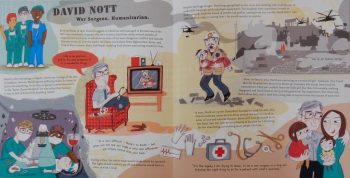
Readers (even adult ones) will be less likely to know more than the names of particle physics phenomenon, San Lan Wu; Aeham Ahmad, Syrian musician and ‘peace-builder’; and I must mention the phenomenal war surgeon David Nott who for more than 25 years has been taking unpaid leave to volunteer in places of conflict and natural disaster including Afghanistan, Sierra Leone and Syria.

The potted biographies are each allocated a double spread, which is packed but not overwhelmingly so, with information, quotes, and illustrations by Annabel Tempest.

One of the messages young readers will take from this book is that there’s a multitude of ways to be extraordinary. I watched two young children on TV the other night with their campaign against free throwaway plastic toys. I’m sure there are countless other youngsters out there whose imaginations these fifteen inspirational role models might ignite.

Add this one to family bookshelves and primary school class collections.

When We Became Humans

When We Became Humans
Michael Bright, illustrated by Hannah Bailey
Words & Pictures

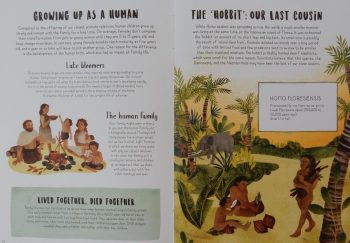
Here’s a large format, illustrated book that provides an accessible overview of human evolution from our earliest primate ancestors right through to Homo sapiens.

Having explained such terms as hominids, hominins and haplorhins, the author takes readers back to our earliest primate ancestors – tiny rodent-like mammals – of some 65 millions years back; then moves on 35 million years to the monkey-like ape ancestors that were starting to bear a greater resemblance to the apes we know today. (Here, I was fascinated to read of the theory of the parallel evolution of primates and fruit trees).

Then comes a spread on how scientists study fossil evidence and the kind of information this can yield.

Next is a look at the move to bipedalism and how this enabled early hominins both to see further across the plains and to grasp and carry tools, food and even babies.

Bright presents the theory that a number of different hominid species lived at the same time, as well as stating that as DNA analysis shows, Neanderthals and modern humans interbred.

There is just so much absorbing information packed between the covers. In addition to exploring physical changes,

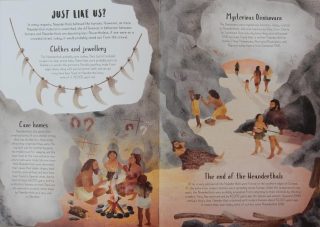
the author includes a look at the stages of cultural development, tool use and its modification.

I was particularly fascinated by the cultural spreads such as the look at health care, and jewellery, (Neanderthals and humans both wore it),

trinkets and charms.

The book ends with the question of whether or not humans are still evolving, plus a visual presentation of chronology and migration routes.

Hannah Bailey’s plentiful illustrations are excellent, making the considerable amount of information feel much less challenging to primary school readers.

A book I’d thoroughly recommend adding to family shelves or a KS2 collection for supporting both the history and the science curriculum, as well as for interested individuals.

Hello Horse / How Far Can a Kangaroo Jump?

Hello Horse
Vivian French and Catherine Rayner
Walker Books

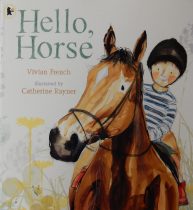
This is one of the Nature Storybooks series that provides a perfect amalgam of information in narrative form and superb illustration, in this instance with Vivian French as author and Catherine Rayner as illustrator.

Vivian’s text gives just the right amount of detail for a young child to absorb as she describes via her boy narrator what happens when he is introduced to her friend Catherine’s horse named Shannon.

The boy soon overcomes his initial apprehension about meeting the horse but under Catherine’s guidance his fears are soon allayed as he learns about how to approach, touch and feed a horse. He also learns about grooming and finally, how to ride Shannon.

Every one of Catherine’s watercolour illustrations is beautiful and she does bring to life beautifully the equine creature that we learn in an author’s note really does belong to the illustrator.

A gorgeous introduction to horses and riding.

How Far Can a Kangaroo Jump?
Alison Limentani
Boxer Books

Ever wondered how far a kangaroo can jump; or perhaps four rabbits, or even eight coyotes? If so this book is definitely for you.

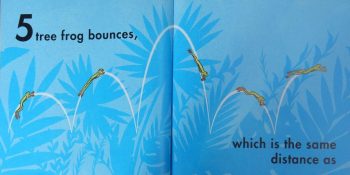
It’s beautifully illustrated by the author who showcases eleven different animals in total, each demonstrating its leaping, diving, hopping, bouncing,

skipping, bounding, vaulting, hurdling or springing skill.

Don’t be misled into thinking the titular marsupial is the longest jumper of all though; there’s a creature that well and truly outsprings it; now what might that be?

The book concludes by answering Alison’s own question: ‘How many kangaroo jumps would it take to get all the way around the earth?’ and posing another for young humans to answer.

Trainers on? Ready, steady, jump …

On landing, readers can compare their efforts with those of the other animals from the book, each of which is shown mid spring on the explanatory back endpapers.

Deep in the Ocean / The Big Sticker Book of Birds

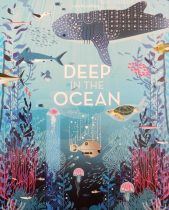
Deep in the Ocean
Lucie Brunellière
Abrams Appleseed

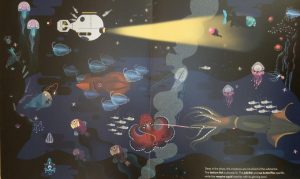
In this large format board book, readers follow Oceanos, a shiny silver submarine, as it takes an exploratory voyage into the depths of the oceans.
From the first opening, we’re immersed in the ocean’s waters along with the submarine’s scientific crew

but as their craft dives deep and travels through a deep abyss, a fierce storm blows up, whisking the little shiny submarine right off its intended course.

Instead, eddying whirlpools cause it to journey to the polar waters of the Arctic; then it’s pulled by a blue whale towards tropical waters of a coral reef, travelling on until one imagines, it resurfaces, with the crew having collected a wealth of information.

There is a free accompanying 10-minute, atmospheric sound track available to download, though to get the most out of the dual experience, you need to synchronise the track timings with page turns.

It’s easy to get lost in the colourful ecosystems with their standout bright flora and fauna depicted in Brunellière’s multi-layered, finely detailed spreads that do a splendid job of capturing the awe and immensity of our ocean ecosystems.

Dive in and be amazed at the riches therein.

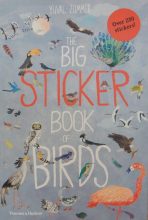
The Big Sticker Book of Birds
Yuval Zommer
Thames & Hudson

Following Yuval’s wonderful The Big Book of Birds comes an activity book on the same theme.

Readers are in the company of Polly the Pigeon. She guides us through as we’re told, ‘the feathery world of birds’ and all that’s needed for the journey is a pencil, some colouring pens and ‘a flighty imagination’. Some of the latter might be used in deciding how to adorn the pages with the 200+ stickers provided at the end of the book.

There’s a wealth of fascinating facts embedded within the spreads that are allocated either to specific kinds of birds such as albatrosses or puffins, or to avian topics including feathers, nesting, and migration.

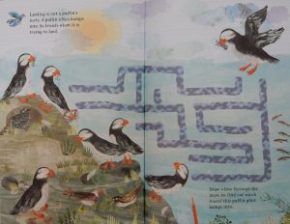
Children might accept Yuval’s invitation to complete a maze,

design a feather for a new bird species, spot the difference, design a bird box, imagine and draw what a dozen magpies might have picked up in their beaks and more. Or what about playing a game of Blackbird bingo or adding foliage to a tree for wild birds to hide among?

I love the way all Yuval’s creatures be they birds or other, have a slightly mischievous look in their eyes, which adds to the allure of the already engaging pages.

Immersive and fun while unobtrusively educating the user(s).

Engineering for Babies, Economics for Babies / Little Adventurers Airport

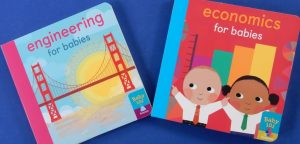
Engineering for Babies
Economics for Babies

Jonathan Litton and Thomas Elliott
Caterpillar Books

There’s a brand new ‘Science’ title as well as a ‘Business’ one in the Baby 101 board book series.

In the first book, tinies can find out some of the different roles engineers perform be that making, problem solving , improving how things work or perhaps investigating health-related issues.

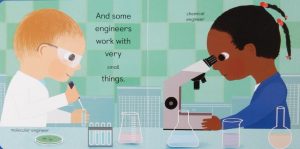
Some will make enormous things while others such as molecular engineers work with things that cannot be seen with the naked eye alone.

A molecular engineer and a chemical engineer at work

Maths and science are often used by engineers in the planning of their projects: to a considerable extent our futures are in their hands.

Economics looks simply at the development of trading from bartering/swapping to pricing and what might affect changes in prices.

Both titles end by asking ‘Can you be a little … ?’ with a final lift the flap surprise.

Thomas Elliott’s boldly illustrated, bright colourful scenes will help babies focus their attention on each spread.

Just right for kick starting your toddler’s interest in STEM topics.

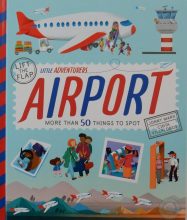
Little Adventurers: Airport
Jonny Marx and Cinta Villabos
360 Degrees

There’s plenty to engage little minds, eyes and fingers in this large format board book with its busy airport setting.
We start in the check-in area then move through security all a beep with detectors and a buzz with gizmos.
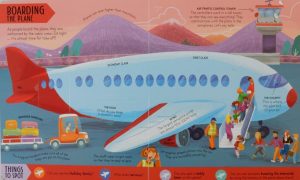
From there it’s on to the departure lounge to wait until the flight is  at the gate and ready for boarding.

On board the plane we see things from inside – the seating and cockpit, as well as being able to view the take off.

The final spread has a gatefold that opens right out to show the passengers’ arrival, passage through passport control and airport exit.

Every spread has straightforward narrative information, questions to think about, flaps to explore, speech bubbles and a bottom border of four items to spot.

Fun, interactive and with lots of potential for language development, this will keep your little ones interested throughout and they’ll likely keep going back to join the jet-setting family on their journey.

A Clutch of Activity and Craft Books

Scratch and Learn: Space
illustrated by Victoria Fernández
Scratch and Learn: Animals
illustrated by Natasha Durley
Wide Eyed Editions

These are new additions to the series, both of which have seven interactive spreads and an attached stylus for young readers to do the scratching.

Each spread explores a different theme and in the Space title, these start with the Big Bang and the scratching reveals 10 galaxies. Then come a look at the solar system, the Moon, ‘Spacecraft’, which has the Space Shuttle as a featured image, a peep at life on board the International Space Station, an account of the life cycle of a star, and finally, a constellation map.

Spencer investigating the map

There are 10 ‘scratch and discover’ shapes to investigate with the stylus on every spread as well as a lead-in, easy to understand, factual paragraph (or two), clearly labelled objects and an additional ‘fact’ most in speech bubble form, for example ‘The light from the closest star still takes 4 years to reach us.’

The Animals featured in the second book come from different habitats around the world and as in the previous title, Lucy Brownridge supplies the succinct text.

Ten animals have ‘hidden’ themselves in each of Natasha Durley’s alluringly illustrated locations: the Amazon rainforest, the Great Barrier Reef, the Sundarbans Mangrove forest, (between India and Bangladesh), the grasslands of the African Savannah, a coniferous forest of northern Canada, the arid Gobi Desert and Antarctica.

Both titles are appealing early interactive books that can be brought out anywhere especially on a journey or a rainy day.

The Mermaid Craft Book
Laura Minter and Tia Williams
GMC Publications

Prolific craft book creators, Laura and Tia have added a new title to their series, this time with a mermaid theme.
It’s filled with ideas for making things to use, things to wear and tasty things to eat.

Having provided a list of what is needed, the authors give step-by-step instructions for such diverse projects as creating a seashore garden, making aquarium puppets and a theatre to use with them,

and you can even bake a mermaid cake or throw an ‘under-the-sea’ party serving only sea themed food and serve up that cake then. Young merpeople will love it.

Youngsters will also be enthusiastic about the book as a whole though they’ll require adult support with several of the activities.

Ancient Egypt Adventure Activity Book
illustrated by Jen Alliston
Button Books

Historical fun aplenty Ancient Egyptian style is found in this activity book.

Little ones can immerse themselves in the world of mummies, pyramids, pharaohs, hieroglyphics and ancient gods as they engage in mask making, maze manoeuvring, maths, message decoding, crafty creations, unscramble muddled up words and more. There are more than 100 activities in all as well as 4 pages of stickers to use to complete some of the scenes.

While engaging in these activities youngsters will likely learn some Ancient Egypt related language and facts too, as well as developing their fine motor and observational skills.

Jen Alliston has provided the illustrations and where relevant, answers are provided at the back of the book.
Why Do I Poo? / Freddie the Fox Feels Frightened

Thanks to Booklife Publishing for sending these: it’s always good to discover a new publisher.

Why Do I Poo?
Kirsty Holmes
Booklife Publishing

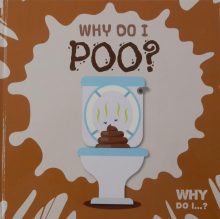
Bodily functions and in particular, poo, seem to hold an endless fascination for young children; mere mention of the word often elicits giggles among those in a reception class or nursery group; and with a cover like the one on this book, I’m sure it will arouse interest straight away.

Actually the whole book isn’t about poo; rather it offers a straightforward look at the workings of the human digestive system, (using a pizza as exemplar)

along with some other poo-related information such as that ‘poo gives off methane and that can be burned to produce power for our homes’, as well as powering buses. Also, animal poo is useful as a fertiliser for plants and, since it contains a lot of fibre, can also be made into paper – not human poo but that of sheep, elephants and even pandas.

After a look at other waste products we make,

there’s a spread on poo-related tummy troubles, as well as one inviting you to ‘rate your poo’ (using the Bristol stool scale). Don’t try that if you’re suffering from those tummy troubles though.

If your little ones are feeling quizzical, then they might like to try matching the poo piles to the four animals illustrated on the opposite page.

The book concludes with a glossary and index. Are you ready, steady, air freshener to hand? …

Freddie the Fox Feels Frightened
John Wood and Danielle Jones
Booklife Publishing

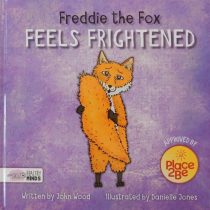
This is one of the Healthy Minds series aimed at the foundation stage and would work either shared at home or with a nursery group.

The author uses a narrative style to explore Freddie’s feelings on the evening before and morning of Freddie’s first day at school.

Despite Andy’s reassurances, Freddie goes to bed feeling frightened about what the next day might bring. So much so that he has a scary dream about being fired from a cannon, his fall being watched by countless pairs of eyes.

When the two leave for school, Freddie takes with him his comfort blanket and even so Andy is concerned that he looks rather unwell; he certainly feels that way on account of his fears of what might happen when they arrive.

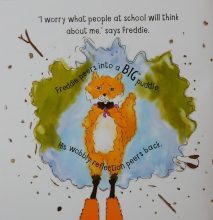
His procrastinatory tactics take the two on a rather longer than expected route and during their journey Freddie talks more about his feelings.

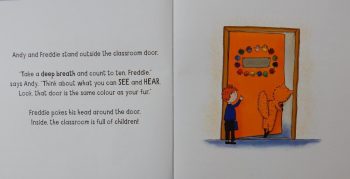
Eventually the wet, muddy pair arrive just in the nick of time, with Freddie’s tail all a-tremble and his heart beating fast. Andy continues to reassure him as he opens the door

and following her instructions he counts to ten, looks around and very quickly finds himself absorbed in the children’s game.

With questions to ponder during the story and more to discuss afterwards, this book is, like Andy’s words to Freddie, a reassuring one to use with those soon to start school (or a nursery class). Danielle Jones’ bright, uncluttered illustrations show how both Freddie and Andy feel throughout and should help allay those pre-first day fears in little humans.

Suzy Orbit, Astronaut / Make & Play: Space / Balloon to the Moon

Here are three very different books all with a space theme:

Suzy Orbit, Astronaut
Ruth Quayle and Jez Tuya
Nosy Crow

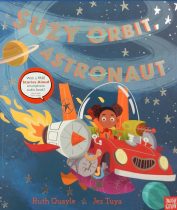
Space engineer, Suzy Orbit lives with her boss, Captain Gizmo in a lunar space station.

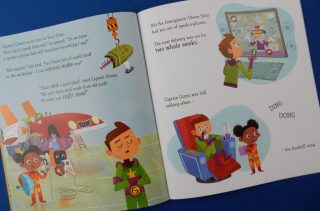
One morning they learn that aliens have been spotted within range of their location and they need to act quickly to launch their space pod. The Captain orders one forthwith but it arrives without batteries and those the Captain has don’t fit.
Furthermore his shiny new space suit is way too small and as the aliens have by now arrived, it’s pointless trying to get a new speak-o-phone.

Happily though, the aliens are peaceable beings but they have bad news to share. Earth is about to be blasted by a meteor storm unless Suzy and her boss can stop it. No pressure there then.

Fortunately Suzy, with her tools always to hand, is an engineer extraordinaire and just happens to have a wonderful new invention ready and waiting. It’s as well that one of the team realises that it’s better to rely on ingenuity than ordering things on the net. Before you can say ‘blaster’ the two are heading out into the meteor storm with Suzy at the controls to do battle with those errant meteoroids. Can they save the day and see off the storm?

It’s great to see Suzy as a positive STEM character in the role of engineer/inventor in Ruth Quayle’s quirky tale. Jez Tuya’s bold illustrations show her as having determination and resourcefulness – exactly what’s needed in the face of the Captain’s lack of drive and inability to show any innovative aptitude.

Make & Play: Space
Joey Chou
Nosy Crow

The latest of Joey Chou’s Make & Play interactive activity book series is sure to please young space enthusiasts.
It contains eight pages of bold, brightly coloured, double-sided press-out play pieces that can be used to create a space scene (some have a hole to suspend with thread while others slide together to stand). The entire set would make a great diorama with space dogs, aliens, astronauts and spacecraft, though if desired, the pieces can be fitted back into the spirally bound book for safe keeping.

There are also other space-related activities – a fruit rocket made from fresh fruit pieces; a song to learn; a ‘blast-off rocket’ science experiment, alien models to create (they could be made into puppets perhaps) and more.
There are hours of fun to be had with this, whether used by an individual, or a small group of young children.

For older space enthusiasts is:

Balloon to the Moon
Gill Arbuthnott and Christopher Nielson
Big Picture Press

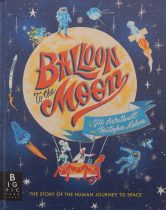
Rather than concentrating on the Space Race, this takes a historic look at the steps that began in the late 18th century with the Montgolfier brothers flight of a large unmanned balloon and led on to their sending a variety of animals skywards on a 3km flight three months later.

In the same year came the first manned untethered flight by inventor Pilâtre de Rozier and the Marquis d’Arlandes who flew 8km in a Montgolfier balloon. Hot on their heels came the first woman to do similar, the following year (1784). There’s a whole spread given over to this balloon bonanza.

The narrative then shifts to the first half of the 20th century with a look at some aviation pioneers, followed by a focus on some iconic planes.

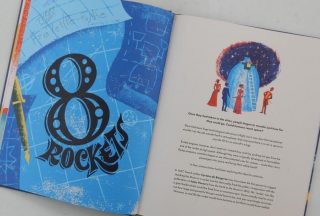
I was especially pleased to find some literary references on the opening page of the ‘rockets section’ where there’s a mention of both Cyrano de Bergerac and Jules Verne. The author uses numbers in her selection of what she includes so we have, for instance ‘8 Rockets’

and ‘Into the Unknown 7’. The seven referring to the seven animals that became the first astronauts; and this chapter cleverly links these with an explanation of g-forces and their relation to fighter pilots and astronauts.

Much of the remaining part of the book provides information on the endeavours of the US and the Soviet Union to win the space race; and what happened thereafter. In conclusion there’s a quick look at some of the new information the Apollo Moon flights gave us; what ‘space travel has done for life on earth’ and a final look to the future.

Christopher Nielson’s retro style illustrations are full of humorous touches adding to the allure of the book and the enjoyment of the whole narrative.

Animal vs Animal Who’s the Strongest? / Like a Lizard

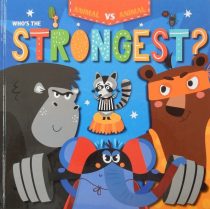
Animal vs Animal Who’s the Strongest?
Kirsty Holmes
BookLife

Welcome to the ‘Great and Small Games’. Essentially this show (it’s one of a series) comprises three strength events: The Tree Trunk Lift; Strong Bug Circus and Tug of War, each of which is refereed by a flag-waving racoon.

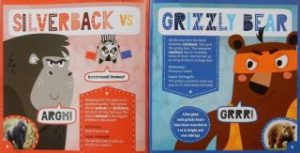
The participants are, for the bug event, dung beetle and leafcutter ant; silverback gorilla and grizzly Bear are the tree lifters;


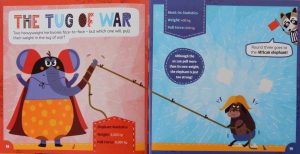
while in the third round, an African elephant and a musk ox tug it out.

Two spreads are devoted to each pair of contenders and as the animals are introduced and perform, snippets of factual information surrounds them on banners or in bubbles,

but it’s never overwhelming thanks to the design of the pages.

A fun way to learn some animal facts, this book should pack a powerful punch with younger readers.

Like a Lizard
April Pulley Sayre and Stephanie Laberis
Boyds Mills Press

Let’s get physical and in so doing, through Sayre’s playful rhythmic text and Laberis’ expressive digital art, learn about more than 25 different lizards and some of the things they do.

So, for instance, ‘Could you drape like a lizard? / Gape like a lizard? / Do a push-up like a lizard? Scale sticks? / Curl in like a lizard?’

Each of the lizards featured is labelled with its common name and described after the main text, in a paragraph below the named behaviour illustrated in the narrative. Every paragraph provides factual information – Latin name, where in the world it’s usually found, length and other interesting details specific to the creature.

So, after an initial read aloud, can your little ones behave like lizards as you share this engaging book? They’ll certainly have fun trying and learn some herpetological facts in so doing. I wonder what they might do in response to this  …

A Planet Full of Plastic

A Planet Full of Plastic
Neal Layton
Wren & Rook

Neal Layton has created an absolutely superb information book on a topic that’s on many people’s minds at present.

Right away he addresses the reader with ‘Quick question: do you ever think about what things are made of? ’ and goes on to mention other materials such as metal, wood, glass and paper before focussing in on plastic; plastic in all its shapes, colours and sizes.

We learn about the discovery of the material by chemist Mr Baekeland and how rapidly it became enthusiastically used in pretty much anything you might think of.

Plastic in the places it should be is all well and good, but the trouble is it doesn’t biodegrade and therein lies the problem. (Neal explains what this means with two sequences of strip pictures)

What eventually happens is that much of this plastic finds its way into our oceans

where it creates big problems for the marine animals as well as forming massive garbage patches in the Atlantic, Pacific and Indian Oceans, especially in the form of toxic microplastic particles.

All of us need to cut down on our use of plastic, especially that used only once,  is what we’re powerfully reminded here …

Neal’s narrative style is perfectly pitched for the intended audience – there’s not a scrap of preachiness about it – and his mixed media illustrations are a powerful reminder of the ubiquitous problems of plastic waste.

Children and young people care deeply about the environment as they’ve already demonstrated and the book concludes with a ‘How you can help section’.

If the government is really serious about the environment, and in particular the terrible effects of throwaway plastic, then perhaps they should fund a copy of this timely book for all primary schools and nurseries.

Can I Tell You About Nystagmus?

Can I Tell You About Nystagmus?
Nadine Neckles, illustrated by Vikas Upadhyay
Jessica Kingsley Publishers

I’ve only ever taught one child who had Nystagamus (due to his albinism). Now having read this excellent little book – the latest in the ‘Can I Tell You About series’, I feel ashamed about how little I really understood of the condition.

Herein a girl named Amber talks in a user-friendly manner about nystagamus -her ‘dancing eyes’, what this means for her in particular and about how she and other children with the condition will experience it differently, although they may share certain similarities such as taking longer to learn things. (This doesn’t mean they are any less clever than others however.)

We hear about Amber’s diagnosis (her eyes jiggle from side-to-side);

how she has to have regular eye check-ups; how she has to carefully adjust the way she sits to watch TV, preferably sitting right close to the screen; the need for her to wear glasses to prevent her ‘seeing double’ as she also has a mild squint.

Starting school presented a challenge for Amber especially the frenetic-seeming playtimes. Amber’s school has made accommodations for her condition such as adding yellow tape to the stair edges, doorframes and potential places of danger; and her mum explained nystagmus to Amber’s classmates.

When in the classroom she has a special place to sit, is never asked to share a book or computer screen and has work printed on coloured paper.

Reading itself brings its own set of challenges but again there are aids to make things less tricky for her. Depth perception is a particular challenge, so ball games, (and other things requiring rapid hand-eye co-ordination), gymnastics and running are ‘tricky’.

Of course frustrations occur but Amber’s friends are understanding and Amber herself is bold, intelligent and resilient, refusing to let nystagamus define her.

The book concludes with some information for adults, an outline of associated conditions, an important checklist for professionals, a glossary and a list of recommended resources.

Easy to understand, this book, (written by a special needs life coach and mother of a child like Amber, with nystagmus and Chromosome 18q) encompasses all the important aspects of nystagmus making it an ideal introduction for anyone wanting to learn more about the condition be they children, parents, carers, teachers, and other professionals. Line drawings by Vikas Upadhyay show Amber as the sparky individual the author presented.

If You Had Your Birthday Party on the Moon / The Race to Space

If You Had Your Birthday Party on the Moon
Joyce Lapin and Simona Ceccarelli
Sterling

Hold on to your helmets, it’s blast off time, destination a birthday party in a place you never expected it to be. Moreover, there’d be a lot more celebration time on your lunar destination for it has a 709-hour day.

On the way to the moon you’ll discover what it feels like to be weightless and your party paraphernalia and pals will also float around inside your spaceship.

Once on the moon’s surface you’ll feel a lot lighter than on Earth and the Moon’s low gravity will keep you safe.
You won’t be able to fly any party balloons on account of the Moon being airless but you can have enormous fun doing one-handed push-ups,

exploring the lunar craters, trying a game of freeze tag and making moondust angels.

Perhaps you will have to eat your birthday cake astronaut style squeezed out of a foil pouch. Don’t think I’d be so keen on that idea.

Then on the return journey and there’ll be bags of time to open your presents, a whole three days in fact during which you could also open those party bags and sample some of the Moon pies therein.

Woven into all this partying is a great deal of STEM information on exciting topics both astronomical and cosmonautical. Why for instance is the sky black rather than blue; why your birthday will last almost 30 days, and why there wouldn’t be any point in playing musical statues on the moon.

With Simona Ceccarelli’s lively, playful digital illustrations and Joyce Lapin’s enormously engaging narrative that speaks straight to the reader, this is a sure fire winner for younger readers/listeners.

(Included at the back are a glossary, bibliography and suggestions for further reading).

For somewhat older readers is:

The Race to Space
Clive Gifford and Paul Daviz
Words & Pictures

With the 50th anniversary of mankind’s first moon landing fast approaching, here’s a book that traces the history of the space race between two super powers, the U.S. and the Soviet Union, from the launch of Russia’s Sputnik to Neil Armstrong’s planting of a U.S. flag on the moon’s surface and those oft quoted words, “That’s one small step for a man, one giant leap for mankind.” That must be etched into the brains of all who saw that landing broadcast live.

From then on the relationship between the U.S. and the Soviet Union became more one of co-operation and collaboration than competition and the book documents the ‘handshake across space’ in the 1975 joint Apollo-Soyuz mission.

It concludes with more on the co-operation including the establishment of the International Space Station.

Illustrated, retro style by Paul Cadiz, in shades of red, yellow, blue plus black and white,

the book has clear explanations together with a liberal scattering of quotes from significant participants in the whole endeavour.

Recommended for individual reading at home and for KS2 class collections.

He’s Not Naughty!

He’s Not Naughty!
Deborah Brownson, illustrated by Ben Mason
Jessica Kingsley Publishers

Taryn and Jake are best friends, they’re almost inseparable, similar in lots of ways but also rather different for Jake has autism, and Taryn has taken it upon herself to explain for young readers (as well as teachers and other educators, carers, parents and family) what this means.

It most definitely does not mean, despite some of his behaviour, that he’s naughty. Far from it; rather his sensory processing disorder might result in him feeling explosive inside so that he flaps his hands and screams rather than participating in a supposedly fun activity.

Or, his tactile sensitivity might make him cast off his uncomfortable-feeling clothes or shoes and run around without the offending article(s).

Perhaps he might be so engrossed in his own world that it appears he’s ignoring another person; although there are ways to get around this, as there are ways of coping with other ‘mistakes’. After all, everyone– neuro diverse or not -, learns through their mistakes. For example, many grown-ups expect a child to look directly into their eyes when being spoken to; for children such as Jake, listening to and looking at a person at the same time, asks them to use one sense too many and as a consequence, to listen well he looks down at the floor. This is not being rude (a mistake many unknowing adults make); it’s merely coping with being different.

Taste and how food looks, reactions to strangers, taking things literally, feelings, speech (including communicating with sign language and by means of PECS);

making friends, choosing an appropriate school and routines, as well as famous people who have or may have autism are also covered.

This excellent little book is a real gem, written from first-hand knowledge and from the heart – its author is the mother of two children on the autism spectrum – and ought to be shared in all classrooms and by every family bringing up a child with autism.
Moreover, the artist Ben Mason has Asperger’s and his illustrations too are heart-felt and insightful.

Teaching Social Skills to Children with Autism Using Minecraft®


Teaching Social Skills to Children with Autism Using Minecraft®
Raelene Dundon, illustrated by Chloe-Amber Scott
Jessica Kingsley Publishers

I know from my teaching experience that children on the autism spectrum often become obsessively passionate about and often developing an enormous competence in a particular thing such as  Lego building, drumming, a certain cartoon series or drawing specific items.

The strength of the motivation towards their chosen passion tends to result in a lack of social skills: participating in Minecraft® (which is frequently called digital Lego) offers a wonderful setting to enable neurodiverse children to develop both social and communication skills. Clearly the author of this large format book, Raelene Dundon appreciates this and to that end, has created a superb resource.

Having outlined in the opening chapters the importance of social skills and how these are impaired in children with ASD, she puts the case for using group programmes, in particular Minecraft® to develop those crucial social skills.

The second part of the book comprises information on how to set up a social Minecraft® group; how to use the game for supporting such skills as holding a conversation, being interested in other people and understanding the viewpoint of another person.
Each skill, for instance problem solving,

‘being creative’ or co-operation

is succinctly presented and related to what has just happened during the specific session – this is a great tool for developing awareness in the learner.

In all there are thirty sessions (around 150 pages of photocopiable material) with smashing illustrations by Chloe-Amber Scott, making this an absolutely invaluable and comprehensive resource – a veritable goldmine – for any professional working with primary children or older students, who have ASD.

Discovering Architecture

Discovering Architecture
Eduard Altarriba and Berta Bardí I Milà
Button Books

The urge to build structures is seemingly, a universal human trait. I spent some of the Easter break constructing a den in a quiet woodland glade in Bushy Park, from a fallen tree trunk and branches, with 6-year old Emmanuelle and her soon to be 4, brother Samuel.

When they are ready to discover more about the build environment, this tremendous introduction should prove invaluable.

The graphic designer and illustrator Eduard Altarriba has already introduced young readers to Quantum Physics and now in a similarly engaging manner presents a look at iconic buildings through history, their creators and some of the items that might be found inside such buildings.

Starting with the earliest known building projects, the pyramids of Egypt, Iraq and Mexico, Classical Greek, Roman and Byzantine places of worship, domestic and vernacular architecture from many parts of the world, information on architects such as Antoni Gaudí, Le Corbusier, Ludwig Mies van der Rohe and Zaha Hadid …

readers are given a superb presentation of things and people architectural.

The final spreads focus on architecture’s basic elements – there’s a cut-away diagram of the principal parts of a building; what being an architect entails and lastly a look at what buildings might be like in the future (it’s good to see sustainability given a paragraph here).

University lecturer at the School of Architecture, UPC, Barcelona, Berta Bardí I Milá packs a wealth of absorbing information into the uncluttered spreads, so finely designed and illustrated by Altarriba.

Perfect for KS2 readers and perhaps adults wanting a starting point for the topic.

The Dictionary of Difficult Words

The Dictionary of Difficult Words
Jane Solomon and Louise Lockhart
Frances Lincoln Children’s Books

American based lexicographer, Jane Solomon, and UK illustrator Louise Lockhart have collaborated on this compilation of over 400 words, the former providing the easily comprehendible definitions and the latter, the accompanying stylish graphics.

Before the alphabetic section itself are an explanation of what a dictionary is and how to use this particular one, and a spread on parts of speech that also mentions pronunciation.

Then comes the A to Z with two spreads allocated to each letter. Some of the words included are tricky to get your tongue around so the pronunciation guide for each one could prove invaluable, especially should readers come upon a word that’s new to them. I have to say having learnt Latin many years ago did help somewhat, as it did with working out the meaning of the occasional words I hadn’t come across before – yes there were one or two – as well as several, including borborygmus – a rumbling emanating from the stomach- I was glad to be reminded of.

The same is true of kakistrocracy, for obvious reasons.

Did you know that a person (such as this reviewer) who loves solving crosswords (or a compiler of same) is called a cruciverbalist? Now there’s a lovely word to get your tongue around. As is omphaloscopy (otherwise known as navel gazing) and ultracrepidarian (somebody who has big opinions relating to things about which they know nothing). I’m sure we can all think of a few such people.

You might be forgiven for thinking that vomitorium was something to do with throwing up; not so; it’s a passageway people used in ancient Roman times to enter or leave an amphitheatre.

Not all the words are long or tricky to say though: there’s yex, which refers to the act of hiccupping or crying.

I’ll conclude with a word that I absolutely love – lollapalooza – which might be used to describe this book. If you don’t know its meaning then I suggest rather than ‘googling’ it, you get a copy for yourself, your family, or your class. As well as being a celebration of words and the English language, it has the potential for increasing the vocabulary of youngsters who will love to impress others with their word power.

My First Book of Relativity

My First Book of Relativity
Sheddad Kaid-Salah Ferrón and Eduard Altarriba
Button Books

We had My First Book of Quantum Physics and now for a companion volume, its creators have turned their attention to another potentially complex science topic, that of relativity.

However, in the hands of this partnership, Einstein’s theory of relativity and other related aspects of connections between space and time are explained in such a way as to make them accessible to young readers. For, as it says on the back of this book, ‘it’s never too early to start exploring big ideas.’ So, how does one start?

The space-time theory, we read, can only be properly understood by first understanding what the two concepts mean in themselves; and then we’re in a position (like Einstein) to understand ‘the world through relativity’.

Time is succinctly explored – how it’s measured, by what means and the various units used.

Speed,

movement and the vital importance of frames of reference are explained, the latter using the example of a moving train and then a person in space.

There are spreads on adding up speeds and the speed of light, leading into Einstein’s two theories, special relativity and general relativity (his theory about gravity).

I love the ‘thought experiments’ relating to time dilation and clocks; and the wonderful spread whereon ten year old Alice travels to our nearest star Proxima Centauri, leaving her same aged friend  waiting for her on Earth and returning to find she’s still  ten whereas he is now almost 19, put me in mind of T.S. Eliot’s famous lines from Burnt Norton ‘Time present and time past / Are both perhaps present in time future / And time future contained in time past.’

If only physics had been made this fascinating back in the day when I was studying it at A-level (albeit only for a few weeks before deciding it wasn’t for me).

I’d not heard of muons before reading this book – a muon being an elementary particle of the electron family weighing around 200 times more than an electron, but again found the spread using a muon to check time dilation and length contraction totally engrossing.

The book concludes with how speed increases the mass of an object; the imaginings of the young Einstein (note the word imagined is used by the author, highlighting the crucial importance of the role of the imagination in scientific discovery) and a look at the mathematical equations Einstein used to describe his ideas of special relativity, the former taking mere weeks to find, whereas he took ten years to understand the ideas themselves.

The entire topic is mind-stretchingly incredible and brilliantly explained in this book, with the aid of Eduard Altarriba’s vibrant, graphics. Strongly recommended for budding scientists either for home reading or in school.

Planet Fashion

Planet Fashion
Natasha Slee and Cynthia Kittler
Wide Eyed Editions

Hats firmly held on and boots duly laced, we’re off on a catwalk extravaganza that embraces cultures, time and much more as it showcases in twenty five scenes, fashion history from all over the world.

We’re in the company of two young fashionistas, one male, one female, as we embark on this globetrotting experience. (It’s fun to locate them looking the part in every scene.)

The journey begins in a high society ballroom over a century ago as elegantly attired dancers and onlookers twirl or stand in their floor-sweeping Edwardian ball-gowns and suits.

Next stop is a performance of the Ballet Russes where dancers drift across the stage clad in voluminous harem pants and feathered turbans, watched by women in empire-line dresses, often wearing huge hats.

Cycling shows women sporting cycle bloomers and sometimes dresses as they pedal their bicycles in early 1900s USA.

‘Shimmying Down’ set at a Harlem Renaissance dancehall, showcases women in brightly coloured flapper fashions and men sporting long jackets or studded waistcoats.

No matter whether you wish to emulate the ’Lost generation’ of 1920s Paris; imagine yourself as a Bollywood screen star gracing the Mumbai (Bombay as it was then) roads during the 1960s, or striding carefree along the London streets of the 1950s and 60s proudly wearing a miniskirt or dress;

glue your hair into spikes like the London Punks of the 1970s; or try ‘Posing with the Girl Gang’ in the uber-cool Harajuku district of Japan from the late 1990s onwards;

or imagine yourself street dancing in South Africa’s townships in the earlier 2000s there’s a vibrant scene to show you how it’s done.

Every single lavishly illustrated spread is inclusive, with diverse characters wearing the distinguishing fashions of the era; and each has a fact box giving information about key designers, hemline and sleeves, and silhouette as well as the when and where, and descriptive paragraphs providing cultural history and influences.

If all that isn’t sufficient for even the most dedicated follower of fashion, then there are also timelines – the first of which gives a summary of key events of the 20th century, and the other four showing silhouettes, shoe styles, and trends in hats and bags. Plus there’s a final ‘Can you find’ challenge that will surely inspire readers to go back and peruse the scenes even more carefully to locate such as ‘a woman watering her flower garden on the streets of Saigon’; ‘a bird enjoying the breeze on a washing line in Canada’ or ‘a waiter dropping his tray of coffee on the streets of Paris’.

For anybody with an interest in fashion, this is a must-have book: I absolutely loved it.

All About Feelings

All About Feelings
Felicity Brooks, Frankie Allen and Mar Ferrero
Usborne

Emotional literacy is now part and parcel of the school curriculum right from the early years, yet seldom does a week go by when we don’t read or hear of the increased concern about children’s mental health and well-being, something we in education have been highlighting for many years. So, it’s good to see a book aimed at young children to help them become aware of, and thus better able to cope with their feelings and emotions.

It’s very visual and full of bright illustrations by Mar Ferrero that make it immediately alluring to its audience be that an individual, a nursery group or early years class.

Each colourful spread is given over to a different aspect and the language used is spot on for young children.

Sections include identifying how you feel (with reference to colours of the rainbow);

why do you feel a particular way; how would you feel if? (with helpful word clouds)…

how feelings can change during a day; ‘jumbled up feelings’ and discussing your feelings.

There are suggestions for things to do that help you remain in control;

ideas to alleviate worries; ways to express feelings and emotions; ‘being kind to yourself’ and ways in which an individual can help others of all ages feel good.

The final page is for adults – notes on how best to help youngsters; things to try at home (could equally apply at school or nursery) and some on-line resources.

Young children most definitely can learn to become more mindful of how they feel and thus be better in control of their feelings. The authors of this book have done an excellent job of facilitating this and I’d strongly recommend a copy for family bookshelves and all settings where young children are learning.

One thing that struck me about both it and The Unworry Book was that little is said about the benefits of being outdoors. I highlight this after returning from a walk around Ruskin Mill in Nailsworth, near to where I live. This is in part, an establishment for neurodiverse young adults that does amazing work educating its students, with a focus on the outdoors. And, I know from experience that being outside is of enormous benefit to people of all ages from the very youngest children.

D-Day

D-Day
Michael Noble and Alexander Mostov
Wide Eyed Editions

This book commemorates the 75th anniversary since D-Day, exploring through 20 real-life stories, eye-witness accounts of the D-Day landings and through whose eyes young readers can re-live the events- stories of ‘bravery, sacrifice and innovation’ as the introduction says.

Through historian Michael Noble’s text, we follow the invasion from the planning of the landings, right through to its consequences, meeting both men and women who served in various ways.

There’s Lieutenant General Frederick Morgan who fought as a junior officer in WW1 and went on to be, in WW2, part of the Supreme Headquarters Allied Expeditionary Force, one of the planners of the invasion of Europe under the joint responsibility of the British and the Americans, and in particular the Normandy landings.

Moreen James served in the WRNS as a plotter, keeping track from her Portsmouth subterranean base, of the movement of ships in the channel; a crucial task in enabling commanders to know the whereabouts of their boats and planes.

We meet the extraordinarily brave Sergeant Major Stanley Hollins, the only recipient of the Victoria Cross, considered the highest honour members of the British armed services can be awarded, for actions on D-Day.

Phyllis Allan served with the Queen Alexandra’s Imperial Military Nursing Service and was based in France where she tended the wounded soldiers, some of whom had suffered horrendous injuries. “It’s just a job, really’ she said.

American Richard Winters, aged 26 calls himself ‘ancient compared to some of my men’. A paratrooper, he took command of his unit when the original commander was killed in action. WW2 was the first major conflict to make use of paratroopers, a highly dangerous role with many losing their lives before hitting the ground.

Much less would have been known about the war without the journalists who reported on what was happening. One such was American, Ernie Pyle who not only wrote numerous articles, but also came to know many of the soldiers engaged in the fighting.

Through the use of collated photographs, personal accounts such as those mentioned, and testimonies from all sides, set into Alexander Mostov’s full-page illustrations that dramatise the roles of all individuals included herein, this is an enormously inspiring book.

Include it in KS2 class collections and on family bookshelves.

What On Earth? Birds / Do Sharks Glow in the Dark?/ Do Tigers Stay Up Late?


What On Earth? Birds

Mike Unwin and Pau Morgan
QED

Natural history writer Mike Unwin and illustrator Pau Morgan turn their attention to birds for the latest book in this excellent What On Earth? series.

In its usual way it’s packed with information and practical ideas that include things to make and do including the occasional experiment, all presented in a highly visual manner with every spread using the space alluringly in a manner somewhat akin to a comic.

As well as bird facts there are poems (Tennyson’s The Eagle and Lear’s There was an old man with a beard’) along with an invitation to readers to write a bird poem of their own. On the literary side too is ‘The king of the birds’ a story based on an old Celtic folk tale, which might also inspire story writing by readers.

You may want to try dancing like a bird;

or perhaps get outdoors and listen to some birdsong, even catching the dawn chorus if you’re up early enough.

The book is divided into four sections: What is a bird?; Bird food; Bird life and behaviour and Enjoying birds, and very page turn brings something to excite, or fascinate young readers.

Offering a great way to discover things avian in all kinds of interesting ways, the book concludes with a glossary and an index.

Do Sharks Glow in the Dark?
Do Tigers Stay Up Late?

Mary Kay Carson
Sterling

Splendid photographs and sequences of facts in response to a series of introductory questions – one per page (or occasionally spread) – present the essentials relating to two very different, but both predatory, animals.

No, sharks do not have bones; their skeletons are cartilaginous (a fact I remember well from my early days of studying zoology); and they have both skin and scales. Did you know people once used dried sharkskin as sandpaper? Or that adult sharks ‘don’t do the parenting thing’? Rather shark pups look after themselves.

And contrary to popular belief, only around six humans are killed by sharks in a year.

So it is with tigers: these creatures tend to avoid humans, their towns and farms, although it’s humans that are responsible for tigers being endangered with less than 4,000 roaming wild now, more than half their number being found in India.

I was fascinated to read that no two tigers have identical skin stripes, that a tiger’s skin is striped as well as its fur, and that tigers can swim for miles.

Unsurprisingly tigers don’t purr, growling, grunting and roaring are their ways of communicating.

Both books offer a fun and easy way to get to know something about two of the world’s most iconic creatures; and each has as part of the back matter, information about helping to protect the animals in question, some useful related vocabulary and an index.

When Sue Found Sue

When Sue Found Sue
Toni Buzzeo and Diana Sudyka
Abrams Books for Young Readers

“Never lose your curiosity about everything in the universe – it can take you to places you never thought possible!” so said Sue Hendrickson the palaeontologist subject herein, her quote being the starting point for this fascinating book that tells the story of the discovery of the largest and most complete Tyrannosaurus rex skeleton ever unearthed.

Living in Indiana, Sue was a shy child with a heuristic drive, particularly for anything in the natural world; she also had a passion for finding lost items, was often found with her head in a book

and loved to visit the Field Museum of Natural History in Chicago.

Her interests led in her teens to her joining first a team of underwater treasure hunters looking for tropical fish, lost boats, planes and cars; and then teams searching mines for prehistoric butterflies, deserts for prehistoric whale fossils and finally, the hills of western South Dakota for dinosaur fossils.

In her fourth summer of digging Sue was drawn towards a sandstone cliff and after four hours of hiking in the heat,

looking up, she spied three enormous pieces of what look like back bones protruding from the cliff. Almost unbelievably Sue and her dog, Gypsy had come upon fossils of a Tyrannosaurus rex.

Then began the arduous task of removing the 300 bones in the intense heat, a piece-by-piece task that took several days.

After an ownership dispute we see the dinosaur reconstruction duly named after Sue on permanent display at Chicago’s Field Museum.

Both Buzzeo’s narrative and Diana Sudyka’s detailed gouache and watercolour illustrations will surely inspire young readers to be mindful of the book’s opening words, to make sure they look closely at the world around them and to hold onto their own spirit of adventure and pursue their passion whatever that may be.

An author’s note about Sue Hendrickson’s contribution to the scientific community, and two resource lists end the book.
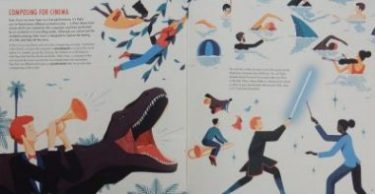
The Unworry Book

The Unworry Book
Alice James and Stephen Montcrieff
Usborne

Enormously reassuring and full of practical ideas for managing stress is this alluringly presented book written by Alice James, with expert advice from clinical psychologist, Dr Angharad Ridkin, and designed and illustrated by Stephen Montcrieff.
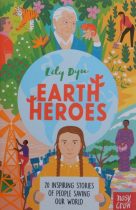
Having explained that we all worry from time to time and why, the book devotes the next few spreads to working out how you really feel – worried, excited, or nervous perhaps? It’s really beneficial to become emotionally aware (an emotional map is included to help) and know the kinds of things you can do to alleviate your worries.

Next comes the wealth of coping suggestions, many of which are designed to develop mindfulness. Most require nothing more than a pencil or pen like those on ‘Peaceful pencils’ which takes a multi-sensory approach -listen to the sounds of the writing implement brushing across the paper; ‘notice the glistening wet ink … or grain of the paper as your pencil draws across it’; smell – the book’s pages, the wood of your pencil or ink of your pen; feel the pencil’s ridges, or barrel of the pen; feel the textures of the page and how it seems?

What about making a decorated worry box – an example is included here – I love the idea of it being a creature that can eat up worries.

It’s impossible in the space of a fairly short review to include all the excellent strategies offered so I’ll just mention a few. There are pages highlighting the importance of breathing and laughing (both are yoga techniques) to help cope with excess adrenalin, as well as a spread with an amorphous creature demonstrating a sun salutation.

A couple of ‘arty’ ones are tearing up paper (preferably rubbish) and using it to be creative; creating peaceful patterns being mindful of the shapes and how the space is filled. And doodling is a great stress reliever – how many of us doodle our way through stressful meetings I wonder?
It’s well accepted now that being physically active is good for our mental well-being; it releases those mood-boosting, feel good endorphins so get moving.

There’s a focus on language too – some starting lines for limericks (great fun) an instant giggle inducer I think; a focus on the physicality of writing various words in different ways; a (behind the door) story starter; as well as a host of brain puzzles.

Another smashing idea is a ‘fiddle star’ – the making of which is a worry distractor,

as is the finished article.

Getting off to sleep tips form the final pages; while in conclusion are a ‘helping hand’ and a ‘who to/where to go’ for times when worries become overwhelming (including a link to the publisher’s website).

Stress among children – even very young ones is on the increase – I refrain from elaborating on the negative effects of the current ‘numbers before children’ education system, though it is a huge stress-inducing factor. There are others of course and a veritable gold mine such as this book is invaluable for both youngsters and those who live or work with children.