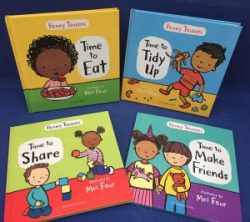
Time to Eat, Time to Tidy Up, Time to Share, Time to make Friends

Time to Eat, Time to Tidy Up, Time to Share, Time to make Friends
Penny Tassoni and Mel Four
Bloomsbury Education

Written by education consultant Penny Tassoni whose roots are in early years teaching, is the Time to series of which these are the first titles.

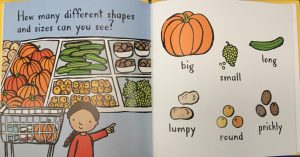
Aimed at pre-schoolers, the language is simple and engaging, encouraging little ones to interact by for example in Time to Eat, focussing on the different shapes and sizes of the fruit and vegetables shown …

This book also looks at colours of foods and their textures; and talks about why we need food. It also introduces the idea of likes and dislikes.
There’s a wordless spread of different foods that should encourage plenty of food-related talk and a final spread of notes for parents and carers. These include guidance on what to observe, how to assess what is seen and ideas for supporting a child’s next steps. (all good early years practice)

Time to Tidy Up explains why tidying up is important, looks at storage places and to encourage little ones to get involved, suggests ways of making it fun by singing, dancing, or taking on a particular role – even superheroes tidy up!

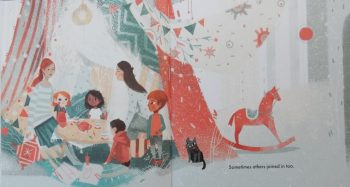
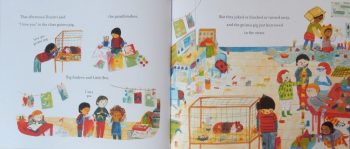
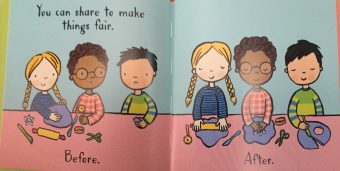
We all need to share and it’s never too soon to learn how is beautifully demonstrated by the small children using the dough in this spread of Time to Share

Sharing is caring, a means to make friends, and makes things more fun. That might be in the playground, at the swimming pool, or at nursery where you might need to share sand, toys and other resources. There too you’ll need to take turns – a form of sharing but some negotiation might be needed.
As important as sharing is, there are certain things that are not for sharing: this too is covered.

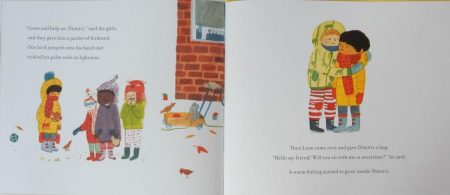
Of course, sharing is very much part and parcel of making friends the theme of Time to Make Friends which looks at the ups and downs of friendship and introduces the concept of kindness as well as togetherness.

Mel Four’s bold, bright illustrations of the young children are appealing and work really well with the text making for a handy and helpful resource for early years practitioners, parents and carers.

What I Like Most / Goodbye House, Hello House

What I Like Most
Mary Murphy and Zhu Cheng-Liang
Walker Books

A small girl narrator takes us through the day sharing the favourite things in her life.

Assuredly she has much to like – the window through which she watches the comings and goings, apricot jam to spread on her toast, her trainers with the flashing lights,

the tree-lined river, her red pencil, chips, the storybook she knows by heart, her teddy bear.

All these are favourite things but the girl knows that while the view through the window changes, the jam is finished, her feet outgrow her shoes, the river changes,

her red pencil is all used up, her plate empties, the book is no longer interesting, there is someone there whom no matter what, she’ll always, always love and that someone is what she likes ‘the very, very most in the world.’

What a lovely way to express one’s love for a mother while also showing that maternal love is constant. Mary Murphy’s lyrical text combined with Zhu Cheng-Liang’s richly coloured illustrations with their unusual and varied viewpoints offer a wonderful demonstration that it’s not the flashy, expensive things in life that make us happy but the everyday ones we could so easily take for granted.

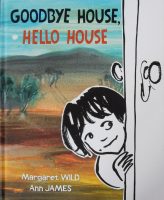
Goodbye House, Hello House
Margaret Wild and Ann James
Allen & Unwin

Endings and beginnings can be challenging for anyone, but here in this story the little girl narrator appears to be embracing change bravely.

She spends a while on ‘last times’, bidding farewell to things she has loved to do – fishing in the river, running through the trees;

swinging on the gate.

Inside she embraces domestic last times before saying goodbye to the rooms in the country house. Then Emma (only now her name is revealed), changes the writing on the wall to the past tense …

and it’s time to leave.

At the new city house, there are exciting first times

and hellos to be said, new writing to put on the wall and anticipation of things to come.

Yes the landscapes may be very different but with a positive attitude familiarity can be found. . Emma’s body language says much about her emotions, but no matter the location Emma is still Emma.

Margaret Wild’s minimal text combined with Ann James’ muted story-telling illustrations leave plenty of room for the reader’s imaginations.

This heart-warming book offers a great starting point for opening up discussion about change whether or not children have had an experience similar to Emma’s.

My Friend Fred / Pip Finds a Home

My Friend Fred
Frances Watts and A. Yi
Allen & Unwin

An unseen narrator (mostly), dachshund Fred’s best friend tells of the doggy things he gets up to. He loves dog food (disgusting!), chasing balls, sniffing trees and digging holes.

However he doesn’t like stairs unlike his pal; he loves baths, (his friend hates them)

and Fred does some rather odd things like howling at the moon and turning around thrice before sleeping.

Youngsters will delight in guessing the nature of Fred’s best friend (there are some visual clues in A. Yi’s adorable watercolour illustrations) so may work it out before the final reveal. Whether or not they do, with its themes of friendship and difference this is an engaging book to share with your little ones.

Pip Finds a Home
Elena Topouzoglou
New Frontier Publishing

Due to a case of mistaken identity Pip undertakes a long journey to the South Pole for that’s where those that look like him live.

He’s met by four friendly Adélie penguins who want to know what kind of penguin Pip is.

They attempt to identify him but he doesn’t have feathers on his head like a Macaroni penguin, is too short to be an Emperor Penguin and lacks the orange beak of a Gentoo.

Perhaps he isn’t a penguin after all.

Nonetheless he’s made welcome by the Adélies until another black and white bird approaches and then Pip learns his real name.

It’s time to go home …

This simply told, beautifully illustrated in watercolours, tale of friendship, similarities and differences and belonging gently informs young listeners too; and the final three pages give additional facts about the four kinds of penguins and the species to which Pip belongs.

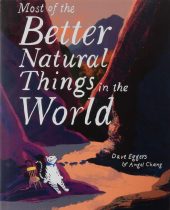
Most of the Better Natural Things in the World

Most of the Better Natural Things in the World
Dave Eggers and Angel Chang
Chronicle Books

Stunningly illustrated, this book is really unusual.

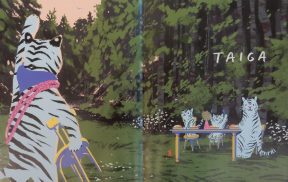
The opening spread shows on a bleak STEPPE, an empty chair draped with coloured rope.

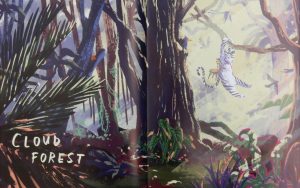
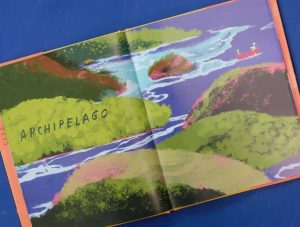
We then accompany a black and white tiger through a series of lush landscapes on a solitary journey that takes him with the chair now strapped to his back, through a gorge, a valley, across a plain, through a cloud forest,

past an atoll, an archipelago, an estuary, an oasis, a lagoon and an alpine lake. He climbs, strides, swings, swims, rows,

walks upright and on all fours; occasionally we see a white bird that may be travelling along too.

Pausing after the chaparral, the tiger puts down the chair and takes in the incredible vista. (shown in a double gatefold).
But where is the creature going and why the chair?

On he travels until finally after another pause to view the northern lights he arrives here:

This cleverly named ‘taiga’ destination reveals the purpose of all his travelling and there’s an empty place for one that has come so far.

We never lose interest in the tiger’s almost dreamlike journey thanks in no small part to the way each page turn reveals a different visual perspective.

The combination of Eggers’ minimal text  – a prose poem of sorts – and Angel Chang’s awesome art make for an exciting picture book that leaves much for readers to imagine and decide for themselves.

Board Book Miscellany

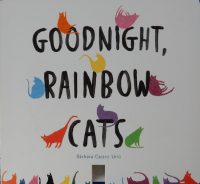
Goodnight, Rainbow Cats
Barbara Castro Urio
Chronicle Books

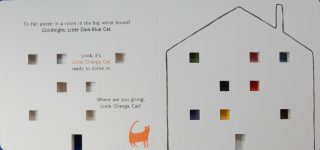
The setting is a big white house wherein sleeps Little Red Cat. How do we know this? Because on the recto we see a die-cut window coloured red, while opposite on the verso is a Little Green Cat about to cross the book’s gutter and enter the door of the house. And the text bids ‘Goodnight, Little Red Cat.’

When the page is turned it’s evident that the Little Green Cat is now inside and Little Yellow Cat (from the verso) will be next to enter.

All the while the narration is presented in a conversational style above the awaiting cat. For instance we read, ‘Up to a room in the big white house!/ Goodnight, Little Yellow Cat. / Look who is waiting outside. / It’s Little Brown Cat! / Where are you going, / Little Brown Cat?’ (Each new cat is introduced with its own colour font which will help little ones predict what colour window will appear next in the house.)

When all twelve cats are safely indoors and asleep in the big white house it’s time to bid ‘Goodnight, rainbow cats!’A fun bedtime wind down for little humans and one that’s sufficiently strongly built to stand up to the frequent readings youngsters will likely insist on.

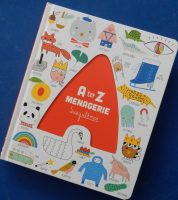
A to Z Menagerie
Suzy Ultman
Chronicle Books

With wonderfully quirky illustrations some of which have lovely touches (the horse wears ‘high-tops’) Suzy Ultman has created a distinctive board book picture dictionary with a pullout tab highlighting each letter.

Every page features one letter that fills up with colour when its tab (placed halfway down the edge) is pulled; for instance the C becomes a caterpillar and O an owl.

The vocabulary is interesting and will likely introduce young users of the book to new words such as axolotyl, challah, iguana, pennant and zooplankton, as well as including some vocabulary you might expect.

The whole alphabet is introduced by a page inviting little ones to “look and touch’ and there’s a concluding A to Z asking users to choose a favourite discovery.
Idiosyncratic, gently educational and great fun.

Now for two Nosy Crow titles new in board book format both of which were smashing picture books previously featured on this blog:

Neon Leon
Jane Clarke & Britta Teckentrup

A book about a chameleon that’s great for audience participation and features colours, counting, camouflage and different environments.

There’s a Bear on My Chair
Ross Collins

This features a little mouse upon whose chair a huge bear has placed his bottom and it’s clearly going to be a difficult task to get him to shift it. So much so that the little rodent narrator decides that the only solution is to quit the scene and let his paws take him elsewhere.
Wonderfully droll illustrations and a superb monologue in a small package for small hands.

At the Beach, On the Farm, In the Forest, Under the Ocean
illustrated by Nancy Bevington
Catch a Star Books

Four Can You Find? board books designed to encourage the very youngest to learn new words are illustrated by Nancy Bevington. Her brightly coloured, amusing images of animals, plants and the occasional human are clearly labelled.

Of the eight double spreads in each book, the first seven are introduced by a sentence such as ‘Under the ocean there are …’, or ‘At the beach there is … ‘ and the final one asks ‘Can you find all the things under the … ? inviting users to turn back and look again at the previous pages.

Adults/infants can play other games such as finding all the things with wheels in the Farm book; there’s plenty of potential for extending the use of each book depending on the interest of the little one involved.

Early Years Picture Book Shelf

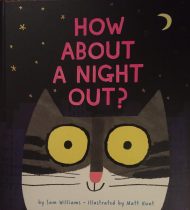
How About a Night Out?
Sam Williams and Matt Hunt
Boxer Books

We join a kitty cat embarking on a nocturnal excursion through the city where  adventures aplenty await. There are friends to meet for a ‘catercall’ upon the wall,

a roundabout to ride upon, birds to scare and much more. A ‘night to sing about’ claims our adventurer but all too soon the sun comes up and it’s time to head for home and some city kitty slumbers.

Delivered in jaunty rhyming couplets and Matt Hunt’s alluring art showing the cat’s journey against the inky dark sky, this will surely please early years listeners.

What Colour Is Night?
Grant Snider
Chronicle Books

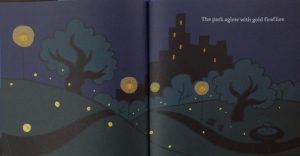
If you’re thinking night is black, then have another think. You certainly will having read Grant Snider’s poetic nocturnal exploration. Herein he shows us the multitude of colours that a closer look will reveal. There’s blue for a start, ‘a big yellow moon beginning to rise’, the fireflies glowing gold in the park.

But that’s just the start: there are ‘Fat brown moths dancing in yellow streetlights’, a whole city lit with red neon signs, the green-eyed glow of prowling raccoons, silver stars spilling across the sky above the barely visible countryside.

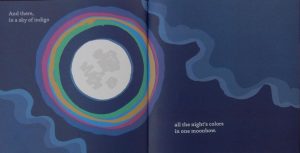
The silent stillness of his scenes though, is not confined to the outdoors. Inside we see the grey face of a clock, the shapes afloat in the bowl holding a midnight snack are yellow blue and pink; while through the window we start to see the moon’s rings and outdoors once more are ‘all the night’s colours in one moonbow’.

I’m pretty sure that young readers and listeners will envy the sleeping child picked up and taken on a dream flight through pink and purple clouds over the city aglow with colours. Snider offers an ideal excuse for little ones to request a delay to their own slumbers in order to view those ‘colours unseen’.

What Can You See?
Jason Korsner and Hannah Rounding
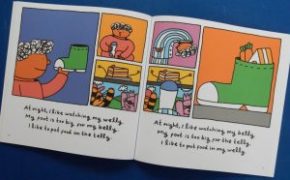
I Like to Put Food in My Welly
Jason Korsner and Max Low
Graffeg

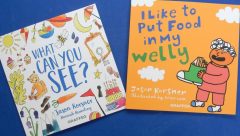
What Can You See? invites little ones to develop their observation skills as they focus on in turn a table laid for tea, a lounge, the garden, the sky, the jungle, a flower and a host of other focal points to locate the objects named in the relevant verse in Hannah Rounding’s delectable illustrations.
In I Like to Put Food in My Welly, playful topsy-turvies result from putting butter on the bread, pulling a rabbit from a hat, climbing an apple tree and other starting points, each scenario being presented in Max Low’s zany sequences (Did I see two of Max’s popular characters making a guest appearance?)

Engaging rhymes and art: just right for putting across the ‘language is fun’ message to pre-schoolers.

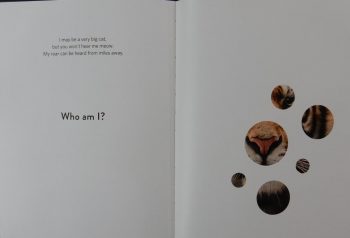
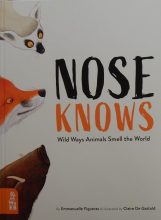
Nose Knows: Wild Ways Animals Smell the World

Nose Knows: Wild Ways Animals Smell the World
Emmanuelle Figueras and Claire de Gastold
What on Earth Books

Did you know that our noses can detect some 400,000 different smells, each one carrying its own message?

However, this large format book investigates the sense of smell – its detection and use – not only in humans but also in a variety of animals whose snouts, trunks, rostra, muzzles and beaks are given prominence in this thematically organised volume.

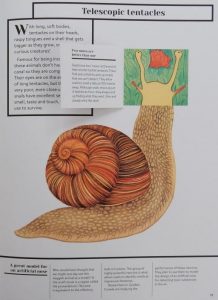
There are flaps that can be lifted to reveal inside views of such things as a snail’s two ‘noses’ that amazingly allow a snail to detect the smell of a lettuce from a distance of 100 metres.

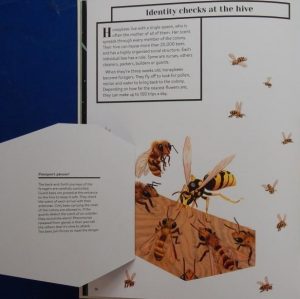
I was fascinated to read that honeybees post guard bees at the entrance to a hive to check the scent of each arrival with their antennae, allowing only those carrying the scent of the colony to enter.

We read of the different uses of the olfactory sense – to identify mates and offspting, to locate prey or other food, to detect danger as well as to assist in finding the way when travelling long distances.

Moving from the general to the specific, the author presents difficult concepts in a manner that older primary school readers will find accessible (‘Polar bears have wide nasal cavities that allow them to inhale large amounts of air and detect odorant molecules over long distance’ for instance) and this is also facilitated by the layout of the pages where text never dominates.

There are also humorous touches both verbal – male giraffes smell and taste the urine of females to check out their hormone levels and thus ascertain the female’s readiness to mate – and in Claire de Gastold’s realistic illustrations (the blissful somnolent stretch of the cat on the armchair and the horses pulling funny faces (on account of their Jacobson’s organs.

An Informative book but  fun too, and there’s a final index, plus suggestions for further reading.

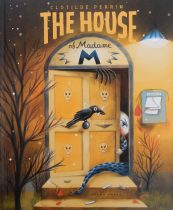
The House of Madame M

The House of Madame M
Clotilde Perrin (translated by Daniel Hann)
Gecko Press

Following on from Clotilde Perrin’s super-sized Inside the Villains comes another large format lift-the-flap picture book.
Once again this one immediately snares the reader’s attention as they’re invited to enter and explore the residence of Madame B by an extremely strange-looking being.

Enter if you dare for she doesn’t, so we’re told, live alone in this strange house. There too dwell creepy creatures aplenty, hiding in unexpected places to fill you with the frights.

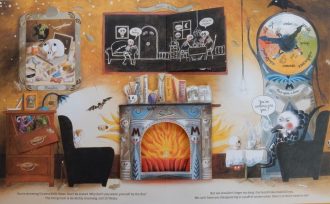
As you peek inside each room you’ll likely be brushed by cobwebs, scuttled over by spiders, grimaced at by alarming monsters and your nostrils will be assaulted by smells of mould and decay; you’ll feel icy winds and hear creaks as you open doors, lift flaps, and come upon jokes of the weirdest kinds.

Hilariously creepy details abound – lurking in the cupboards, in the pots and pans, even beneath the loo seat, in this veritable treasure trove of frights and giggles for chilly nights.

Assuredly a book to relish far beyond the night of Halloween; this is one to enjoy snuggled in a warm place with a comforting hot chocolate and cosy slippers.

I still have a much treasured copy of Jan Pieńkowski’s awesome Haunted House on my shelves. This slightly more macabre offering will sit alongside it as a 21st century complement.

Africa: Amazing Africa

Africa: Amazing Africa
Atinuke, illustrated by Mouni Feddag
Walker Books

Nigerian-born storyteller Atinuke takes us on an exciting journey through the countries of Africa in her celebration of this incredible continent – its history, culture, religions, traditions and languages.

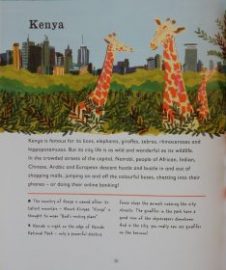
She divides the 55 or so countries into regions – Southern Africa, East Africa, West Africa, Central Africa and North Africa providing quintessential details of each country: the wild life for which Kenya is famous;

the irresistible drumming rhythms of Burundi – (who can fail to respond to the sound of those awesome Royal Drummers of Burundi, certainly not me),

the diamond industry and contrasting cattle-herding of Botswana for instance.

There are also maps, pages featuring hairstyles, football and religions.

Mounti Feddag’s vibrant illustrations are superb, exploding into colour and pattern on every page.

I’m fortunate in having many friends from different parts of this huge continent but have never visited it other than for a childhood holiday to the island of Mauritius, and occasionally in transit; brimming with gorgeousness, this book has made me want to change that.

Those with a thirst for finding out about life in different parts of the world will also enjoy this activity book:

This Is How I Do It
Matt Lamothe
Chronicle Books

The creator of This Is How We Do It, Matt Lamothe invites the reader to document his or her own daily life and compare and contrast it with children from over 50 other countries. Included in the book are punch-out postcards, sheets of stickers, a fold-out map and photos of members of four families.

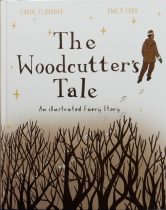
The Woodcutter’s Tale

The Woodcutter’s Tale
Carol Florence and Emily Ford
Ragged Bears

This is a story with a timeless feel that has much to say to readers and listeners in our acquisitive times.

It tells in highly descriptive prose of a hard-working Woodcutter who lives with his family in at cottage at the edge of the woods, a Woodcutter who likes to tell magical tales to his children at bedtime to send them off into dream worlds.

One night the Woodcutter himself has a dream. In his dream he sees in a tree, a Faery who fills his heart with joy.

Next morning as he goes to the forest he takes with him memories of the dream and having done his work, instead of going home he walks onto the common to a thorny grove and there he comes upon the tree of his dream.

Throughout the winter and into spring the Woodcutter returns to the tree but although he never sees the Faery he can feel her presence. He brings tiny gifts for her and pours out to her the story of his life.

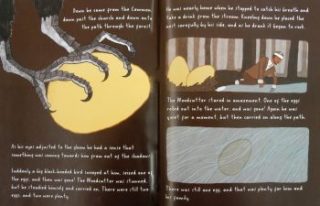
One day the Faery leaves a gift of three golden eggs in a nest for the Woodcutter to find. The gentle soul can barely believe what is before his eyes.

On his return journey things happen

and the Woodcutter arrives home with only one of the eggs, but even that is stolen the very same night.

That isn’t the end though, for this is not just a tale of receiving and loss; all ends happily with all three eggs safely restored to the rightful owners in the family cottage on the edge of the wood.

Carol Florence’s poetic narrative combined with Emily Ford’s distinctive illustrations make for a modern interpretation of an ancient story that will speak to readers and listeners of all ages. It’s a tale to share on chilly days and dark nights that will fill everyone with warmth and a feeling of having been part of the unfolding of something magical.

The Best Kind of Bear / Keith among the Pigeons

The Best Kind of Bear
Greg Gormley and David Barrow
Nosy Crow

We first meet Bear sitting in the library trying to find out what kind of bear he is.

When a little girl Nelly, comes in and asks him the very same question he sets out on a journey of self-discovery. “Maybe there’s a bear out there who can help me,” he says.

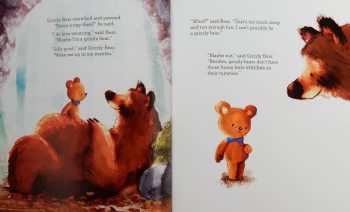
Travelling west he meets, deep in the forest a big brown grizzly bear who tells Bear he loves ‘nice long naps’. So too does our identity seeker but he definitely does not want to sleep for the next six months and with the ‘funny little stitches’ on his tummy that Grizzly Bear points out, he knows he can’t possibly be a grizzly.

Thereafter Bear visits a polar bear in the north, a spectacled bear in the south, and finally, a Sun Bear in the east.

Each encounter only confirms what Bear is not so he decides to go home.

In the library Nelly is waiting. It’s a very dispirited Bear who enters admitting that he’s no further forward. He knows what he isn’t, but not what he is: I’m just ordinary, he concludes.

Then Nelly draws his attention to his unique features – the ‘funny little stitches … washing label on his bottom,’ soft bounciness and smart bow tie; she invites him to be her bear and … then he knows that’s the ‘very best kind of bear to be.’

Greg Gormley’s wonderfully warm story is essentially a tale of identity and belonging and with David Barrow’s superbly expressive, smudgy ursine scenes that are an absolute delight from first to last, this is a book to read and re-read over and over, perhaps with small children cuddled up with their very own special bears.

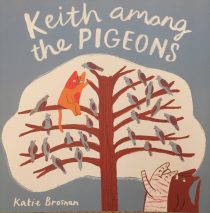
Keith among the Pigeons
Katie Brosnan
Child’s Play

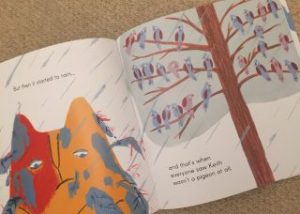
When is a cat not a cat? That is the question; and the answer? Perhaps, when he is Keith.

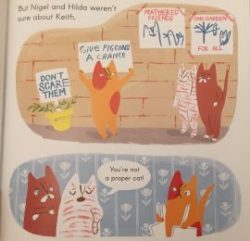
Like other cats, Keith has a predilection for pigeons, spending much of his time observing them. Not with the intention of catching the feathered creatures; rather he wants to be a pigeon himself. His feline acquaintances certainly don’t rate him highly as a member of the feline fraternity.

His avian efforts however meet with little success until he hits upon an idea …

Foolproof it might be, but water proof – er?? …
Perhaps after all, it’s best to stick to honing one’s feline skills.

Or is there perhaps another solution that allows Keith to feel happy in his own furry skin.

This reviewer is ailurophobic but despite this, couldn’t help but fall for Keith. His’ ‘hi-coos’ are a hoot; I love his poster creating,

note taking and his sheer determination to be more pigeon. And he certainly gets across the message that being ourselves is what really matters.

The Gobbledegook Book

The Gobbledegook Book
Joy Cowley illustrated by Giselle Clarkson
Gecko Press

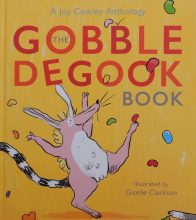
This is an a smashing anthology that brings together twenty of New Zealand author Joy Cowley’s much-loved stories, poems and nonsense rhymes, newly illustrated by Giselle Clarkson whose witty, energetic art is full of fun – a kind of visual poetry.

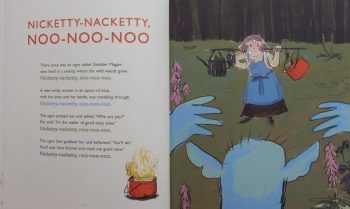
Open the book anywhere and you’ll find something to love be it the bizarre Nicketty-Nacketty, Noo-Noo-Noo that begins thus;
‘There once was an ogre called Gobbler Magoo / who lived in a swamp where the wild weeds grew. Nicketty-naketty, noo-noo-noo.’

It continues in this sing-song fashion for a further 13 verses, each spread with a splendid illustration.

Or perhaps The Tiny Woman’s Coat about an old woman in need of a coat who is helped by the kindly animals she encounters will tickle your fancy: I love the swirl of rustling autumn leaves and the happy snug-as-a-bug final scene.

How many young listeners will know what a singlet is but they surely will having encountered Uncle Andy and his multi-purpose garment.’Uncle Andy bought the singlet / from an army surplus store. It was the only upper garment / Uncle Andy ever wore. That’s as maybe but it also doubles as a foot warmer, a carrying pouch, a wire substitute, a fire extinguisher and a tea towel. This item has one snag though but to discover what, you’ll need to get your hands on a copy of the book for book yourself.

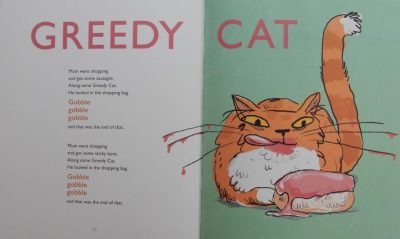
You’ll also meet several felines including Greedy Cat,

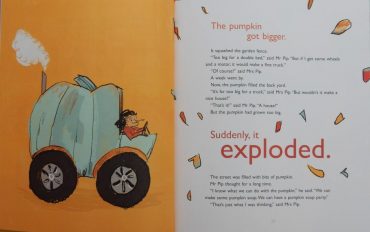
Grandma who owns not spectacles but Goggly Gookers and gives other crazy answers to children’s questions, an exploding pumpkin

and The Jumbaroo that gets a pain in its woggly and more.

Everything about this book is perfect. For those who love to read aloud and those who listen, it’s an absolute cracker: utter zany joyfulness – a treasure for family and school collections. Buy it to keep and buy it to give.

Read it here, read it there, read it pretty much anywhere.

Refugees

Refugees
Brian Bilston and José Sanabria
Palazzo

Here’s a book to make you think hard no matter what your feelings on the topic.

Two opposing viewpoints on migration and the refugee story are presented in Brian Bilston’s poem Refugees.

The first presents the reaction of separatist-minded individuals – all too many sadly – who think badly of refugees deeming them scroungers and wasters after an easy life in a new country: an attitude I fear in the fractured society of the UK at least, that has been fuelled by the current BREXIT thinking of those advocating our leaving the EU. ‘Go back to your own country’ is what people seeking asylum might be told having risked life and limb to find a safe haven.

Read the other way however,

the poem offers a warm welcome to displaced people needing asylum: understanding, compassion and kindness are the order of the day in this alternative viewpoint.

Now I am totally of the second view and have taught countless children from refugee and asylum seeking families from as far afield as Afghanistan, Sudan, Somalia, Sri Lanka, Bosnia, Sierra Leone, Bangladesh, Pakistan in schools around London gradually coming to know what traumas the families have undergone. More recently, I have befriended one Syrian family who have come to live in Stroud, the town where I currently spend much of the time.

However I am fortunate – one of the ‘haves’ with my own house, car etc. and have seldom been without anything I have wanted let alone needed, so really who am I to condemn those less fortunate – the ‘have-nots’ let’s say, who have little themselves and fear losing what little they have to others – the outsiders.
It is far less easy to understand the prejudice of the powerful and affluent who prey on those suspicions and fears to serve their own interests.

The dystopian world illustrator José Sanabria creates in his first six spreads where refugees arrive in an armada of hot air balloons and guardians of the ‘anywhere’ homeland are depicted as penguin-like police,

distance the dilemma from any particular reality, giving the reader space to ponder the topic transnationally. Those for the second part show open-armed residents welcoming the newcomers with offerings of food, drink, flowers, toys and more.

This poem has already been included in an anthology of poetry entitled From Syria with Love. Presented as it is now in this superbly illustrated book, Refugees offers a powerful and pertinent message for readers/listeners of all ages from KS1 upwards to adults, some of whom might one hopes, start to question their own attitudes.

No matter what, the book ought to be shared, discussed and pondered upon by all.

How the Stars Came to Be

How the Stars Came to Be
Poonam Mistry
Tate Publishing

I’ve loved Poonam’s art since I saw her first collaboration with Chitra Soundar, so was totally thrilled to learn of her new solo picture book.

Perhaps like most people you’ve wondered how the stars came to be in the sky and this story offers one possibility.

Way back in time the only light came from the sun and the moon.

A fisherman’s daughter loved feeling the Sun’s rays on her during the daytime while at night she would lie in her bed thinking of her father on his boat out at sea with only the light of the Moon to guide him.

That’s fine, other than for the few nights every month there’s no visible Moon at all, leaving the fisherman to work in total darkness. This troubles the Girl so much that one morning the Sun discovers her shedding tears and asks what’s upsetting her.

On hearing the girl’s concern and pondering upon it, the Sun takes one if its golden rays and throws it down to earth where it breaks into a million glowing fragments.

“Gather together all the shining pieces,” the Sun tells the Girl,  “…Then tonight when I drop beneath the horizon … place each of them into the sky. … We will call them stars.”

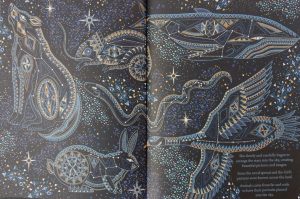
The Girl does as she’s bid, naming the brightest Polaris; then continues her task creating wonderful images with her positioning of the pieces.

Week after week she works on her skyscape but months later her bag still seems full of stars. How will she ever complete her work?

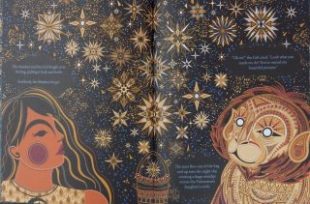
Meanwhile a Monkey has been watching the Girl and while she’s distracted he descends, seizes the bag and dashes back up into the tree.

A tussle follows,

and out of the bag tumble all the remaining stars, spoiling the work of the Fisherman’s daughter.

Or perhaps not; for sometimes accidents have happy outcomes …

This is an incredibly beautiful book – let’s call it a neo pourquoi tale – where every spread stuns you with its awesomeness. Poonam’s art is inspired by her love of nature, and her gorgeous, intricately patterned work, is based on Indian designs and colours that I as a frequent visitor to India appreciate all the more.

I wish I could show you every single illustration but for that you’ll have to get hold of a copy for yourself.

The Caveman Next Door / Twelve Days of Kindness

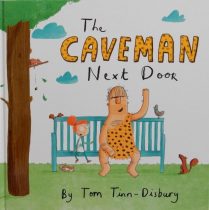
The Caveman Next Door
Tom Tinn-Disbury
New Frontier Publishing

Penny’s street is perfectly ordinary until a caveman moves in next door to her. He does little but grunt by way of communication, is scantily clad and his only furniture is made from sticks or stones.
Thinking he seems a little lost, Penny decides to befriend him and takes him on a tour of the town starting with the library where he receives a less than welcoming reception.

No matter where they go Ogg seems to manage to annoy somebody or embarrass Penny; seemingly he just doesn’t fit in.

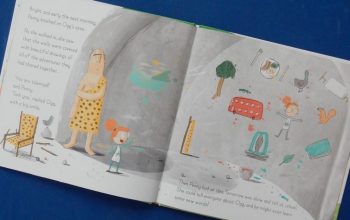
But then, having seen inside Ogg’s cave with its wonderful mural documenting all their adventures, Penny has a great idea;

Ogg will visit her school.
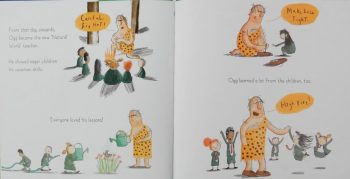
After an initial setback, the headteacher recognises that in Ogg he has not only an interesting artist but someone who can educate his pupils about the natural world.

Tom Didsbury’s fanciful story of friendship and finding a place to fit in, with its wonderfully quirky illustrations will delight and amuse young listeners.

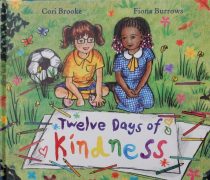
Twelve Days of Kindness
Cori Brooke and Fiona Burrows
New Frontier Publishing

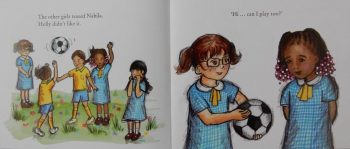
When Holly realises that new girl Nabila is having trouble making friends among her classmates she decides something needs to be done to help her.

Both girls are picked for the school soccer team but despite this her fellow team- mates are not showing any signs of welcoming Nabila. With just twelve days left before the first match, the girls still haven’t gelled as a team.

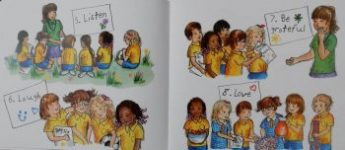
Nabila and Holly devise a plan: for every remaining day they will do something good and kind for the team and gradually not only does the team come together

but the “Twelve Days of Kindness’ is a winning formula.

An effective lesson about acceptance, welcoming strangers, friendship and of course, kindness, beautifully delivered in Cori Brookes’ straightforward narrative and Fiona Burrows’ powerful pictures of the girls is one to share and discuss in lower classrooms especially.

Izzy Gizmo and the Invention Convention

Izzy Gizmo and the Invention Convention
Pip Jones and Sara Ogilvie
Simon & Schuster

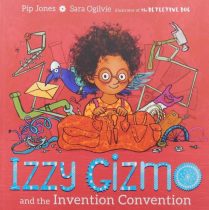
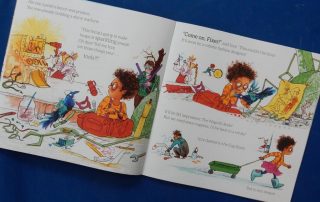
It’s great to see a second rhyming story about young designer/inventor Izzy Gizmo and Fixer her crow collaborator.

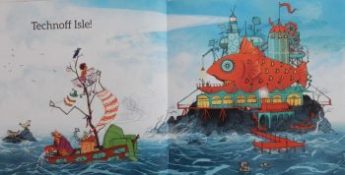
Now she’s super excited, for an invitation to the annual Invention Convention has arrived through her letterbox. Grandpa ensures she overcomes her initial uncertainty about the reliability of her machines and off they sail to Technoff Isle in a machine of Izzy’s design.

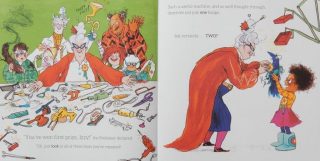
Izzy has set her sights on the badge to the Genius Guild to be awarded to the winning design. Inevitably so have all the others

and one in particular is a selfish hoarder of materials.

Despite this and other setbacks, Izzy’s unfailing creativity and ingenuity (not to mention some assistance from Fixer) finally win through …

Izzy’s such a powerful role model – resilient, inspiring but also on occasion apt to let her frustrations get the better of her until Grandpa and Fixer offer encouragement.

Fast paced and spirited as Izzy herself, Pip Jones’ narrative drives its message to a satisfying finale and in combination with Sara Ogilvie’s splendidly energetic, offbeat illustrations, this is a smashing book to set the imagination of young readers and listeners sparking with creativity.

More please!

Together / Insect Superpowers

Red Reading Hub looks at two interesting, unusual and very different ways of presenting non-fiction:

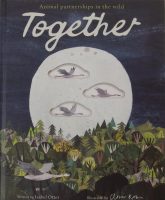
Together
Isabel Otter and Clover Robin
Caterpillar Books

By means of gorgeous collage style, die cut illustrations and a series of haiku accompanied by factual paragraphs, illustrator Clover Robin and writer Isabel Otter present a nonfiction nature book that looks at animal partnerships in the wild.

Beginning thus: ‘ A vast migration. / Cranes take turns to lead their flock: / The feathered arrow.’ and explaining that when cranes migrate and the leader of the group becomes tired, another takes its turn to lead and so on.

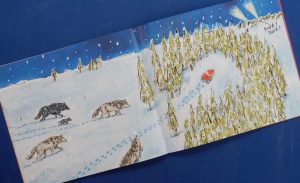
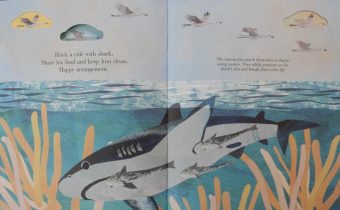
The migrating cranes fly above in turn, a pack of wolves; a herd of chamois deer; and a pod of pilot whales. They then pass above a shark that has its skin kept parasite free by remora fish that get a free lift;

anemones kept clean by goby fish; a badger that works with a honey guide bird; a crocodile that has its teeth cleaned by plovers; a herd of loyal elephants; giraffes with oxpecker birds that help keep down their fleas,

and finally, zebras and ostriches that use their complementary sense organs to alert each other to danger.

At last the cranes reach their winter feeding grounds and their journey is over – for the time being.

A fascinating way of presenting non-fiction that offers youngsters an introduction to an intriguing aspect of animal life.

Insect Superpowers
Kate Messner, illustrated by Jillian Nickell
Chronicle Books

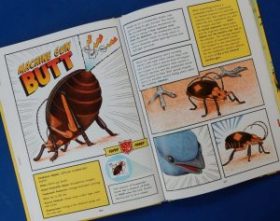
Taking advantage of the seemingly never-ending popularity of superheroes, author Kate Messner and illustrator Jillian Nickell present in action-packed, graphic novel format, an alluring array of eighteen insects with extraordinary abilities.

Before plunging readers into the specifics of the various insects’ superpowers, Messner provides an introduction to insect orders and using the Monarch butterfly as her example, shows how biological classification works.

Dramatic illustrations immediately snare the reader’s attention as they confront the bugs one by one starting with in the first FAST & FIERCE chapter, ‘Supersonic Assassin Giant robber fly – more like a supervillian – that uses its venomous spit to paralyse its prey.

Also in this chapter are The Decapitator aka the Asian giant hornet with its painful sting and fierce jaws that often rip bees apart before stealing their larvae and feeding them to their own hornet larvae.

Other chapters feature insects that use mimicry (the ‘Great Imposters’); the ‘Big & Tough’ bugs some of which are among the strongest creatures on earth; then come the ‘Masters of Chemical Weaponry’. I definitely wouldn’t fancy being sprayed by the hot noxious mist that the African bombardier beetle can emit from its abdomen when something bothers it. Yikes!

Further chapters are devoted to ‘Engineers & Architects’ and ‘Amazing Ants’ (although some of the insects in the previous chapter are also ants).

For each insect included there are facts about habitat, size, diet, allies and enemies, and of course, its superpower.

If you have or know children who are into superheroes but have yet to discover the delights of insects, this book that’s all a-buzz with superpowered bugs might just fire up their enthusiasm.

Storytime with Child’s Play Picture Books

Red Reading Hub welcomes the opportunity to catch up with some recent Child’s Play picture books

Astrid and the Sky Calf
Rosie Faragher

This is a truly magical story about a young doctor and a very unusual, special hospital. The doctor’s name is Doctor Astrid and she runs The Hospital for Magical Beasts. Thus far there’s not been a single untreatable patient or incurable illness at her hospital but that changes when a new patient suddenly arrives, a sky calf no less.

Doctor Astrid does her very best to diagnose the problem but none of her usual methods are any good at all. She’s bemused and frustrated, doubting her own skills, and her patient is far from happy. Surely there must be something she can do to restore the sky calf to her usual healthy self.

Happily there is, but it’s not sticky tape, potions or bandages: rather, the successful treatment involves showing empathy and friendship.

Full of heart, this is a sweet story beautifully illustrated by Rosie the author in a delightfully scribbly fashion. Adorable!

King Leonard’s Teddy
Phoebe Swan

Wealth and consumerism reign in King Lion’s world of use once and throw away; life is peachy so he thinks, merely sending his servant out to buy a replacement for anything that breaks or even gets dirty. Not once does he consider the idea of the environmental impact of his lifestyle.

But then his beloved teddy bear is broken one night. This is something irreplaceable so what can he do? The toyshop can only sell him a new one, the toy factory only manufactures brand new bears and all the repair shops have long since closed down.

Back home a further accident happens and this gives King Leonard an idea: perhaps he can fix the bear himself. It’s not an east task for sure but eventually determination wins through and what’s more the king has learned a host of new skills that he can use for the good of the whole community.

A delightful story that has a strong and very important environmental message that is never too soon for young children to hear. To that end King Lion and his trusty helper Max have compiled a final spread of ideas for reducing, reusing and recycling items to help the environment. Love the bold mixed media illustrations that really help increase the impact of the telling.

The Things
Petronela Dostalova

This is a somewhat surreal tale about  Thing. Thing has a best pal, Cactus, actually make that two best friends; the other is Moose the shadow puppet. Thing loves spending time with these two; he even talks to his prickly friend in bed.

Life ticks along well in its uneventful way until one day Thing discovers another Thing nearby. Thing 2 also has two friends Mitten and Mitten. But Thing starts to worry about the Other Thing: could it be dangerous?

Then Moose suddenly disappears and guess who suspect number one is. Nevertheless perhaps working with Thing 2 might help work out what has happened to the shadow puppet.

Young readers and listeners will definitely enjoy being in the know in this quirky tale of tolerance and friendship

The Lost Homework
Richard O’Neill and Kirsti Beautyman

This is the latest of the author’s stories set in a traveller community and features young Sonny.

Sonny loves school and usually gets his homework done on a Friday so he has the entire weekend to spend helping his family and fellow travellers with all manner of tasks.

On this particular weekend there’s to be a wedding – one of his cousin’s is getting married and there’s a huge amount of preparations even before the family leaves for the venue which is 180km away. Over the weekend Sonny uses a great many different skills that involve maths, music making, story telling, ICT and painting. Pretty well the only thing that doesn’t get done is Sonny’s homework.

Happily though despite Sonny’s fears, when he tells the class about his weekend, his teacher shows considerable insight and understanding.

A super story showing that school isn’t the only place where important learning happens; it’s illustrated by Kristi Beautyman whose artwork is truly captivating.

Milo and Monty
Roxana De Rond

Monty and Milo are two new canine additions to the McKenzie family but they’re very different dogs.

Monty is a sociable animal whereas Milo prefers being quiet and on his own. This behaviour worries the latter dog’s new family.

One Sunday afternoon some cousins pay a visit and Milo goes off to his favourite quiet place but when he gets there, it’s already occupied – by cousin Henry. It seems that Henry and Milo have much in common – both are tactile sensitive, have special toys that go everywhere with them and like a regular routine.

With new understanding, perhaps if the McKenzie family make some adjustments both Monty and Milo can be happy family members.

A sensitive, warm-hearted tale of differences and learning how to accommodate them with super equally warm-hearted illustrations by the author.

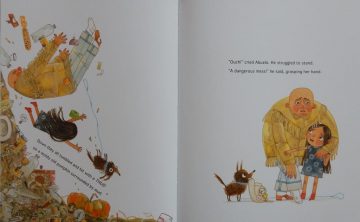
Sulwe

Sulwe
Lupita Nyong’o and Vashti Harrison
Puffin Books

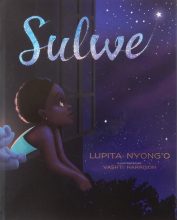
You’ll surely be awed by the sheer beauty of the illustrations in this wonderful book.

It tells of young Sulwe (her name means star in the Kenyan Luo language) who was ‘born the colour of midnight.’ Her skin is darker than anyone else in her multi-hued family and when children at school call her names, Sulwe decides to lighten her skin. Nothing she tries, however, makes any difference,

and next morning her mother talks to her of her inner brightness and beauty; still though Sulwe isn’t convinced:

how can she be a star, she wonders.

That same night on a magical journey she discovers a fable wherein two sisters Night and Day get very different reactions from people, those towards Day are positive while Night receives negative ones. As a result she leaves the earth taking with her dreams and secrets, until her sister’s “we need you just the way you are” persuades her to return.

Now Sulwe understands that she too is “Dark and beautiful, bright and strong.’

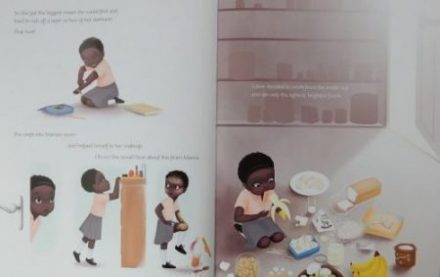
This is a debut picture book for Kenyan actor/producer Lupita Nyong’o who based the story on her own childhood experience. She confronts the crucial and sensitive topic of skin colour head on, but in a way that young children can relate to. (I recall being extremely distressed when I first started teaching to find a 5- year old boy from Nigeria covering his arms with white chalk. He told me that he was trying to get his skin light like his friends. Nothing I said could persuade him that he was just perfect as he was.) Vashti Harrison wonderful illustrations are a celebration of all skin tones reinforcing Lupita’s message that everyone, like Sulwe, is uniquely beautiful, inside and out.

A must have book for all primary schools.

Koshka’s Tales: Stories from Russia

Koshka’s Tales: Stories from Russia
James Mayhew
Graffeg

Immediately engaging from the outset is James Mayhew’s deft weaving together of a handful of Russian folktales using Koshka the story-spinning feline of the title as narrator.
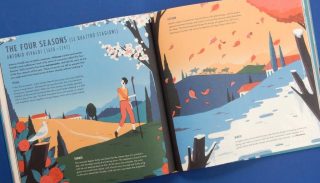
We meet this cat at the end of the first tale in which Tsar Saltan marries one of three sisters, Militrissa, who promises to bear him seven sons, and is tricked several times by her jealous siblings.

As a result he has her tossed into the sea in a casket but Militrissa, along with one baby son whom she has hidden up her sleeve, do not perish and eventually end up on the far distant island of Buyan. And it’s there they meet the wise Koshka and before long she begins to tell the new arrivals The Tale of the Snowmaiden.

Thereafter comes another story telling of an encounter with a merchant who acts as a link between Tsar Saltan and his wife on the island.

The merchant returns taking back on subsequent trips each of Koshka’s tales, the others being The Tale of Sadko the Minstrel,

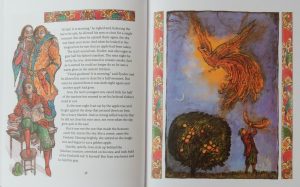
the Tale of Ivan, the Grey Wolf and the Firebird,

The Tale of Vassilisa the Fair and Baba-Yaga, to the Tsar until eventually he is convinced to set sail himself and find his wife.

James’s illustrations are absolutely gorgeous. I love the ornamental folklore inspired motifs that border the text and the beautiful richly coloured side panels and full-page illustrations that make every page turn a delight.

A terrific way to introduce youngsters to the riches of Russian folklore; this book would make a great present and is perfect for sharing on chilly wintry days and nights.

Madame Badobedah / A Sea of Stories / Zippel: The Little Keyhole Ghost

Madame Badobedah
Sophie Dahl and Lauren O’Hara
Walker Books

This is a rather longer than usual picture book story of an unusual older woman and the young narrator, Mabel.

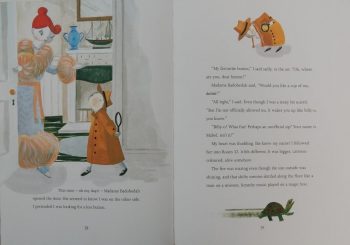
Mabel lives at The Mermaid Hotel an establishment managed by her parents. She’s an only child with a fertile imagination and a thirst for adventure and here she acts as narrator of the tale of what happens when a certain rather unusual guest arrives. Not only does the woman have twenty-three bags, two large trunks, lots of jewels and a dressing table but also two cats, two dogs and a tortoise, oh! and a penchant for toffees too.

So high-handed is her manner that Mabel takes an instant dislike to her, naming her Madame Badobedah and deciding she’s a villain. Donning her large raincoat, hat and sunglasses the girl becomes Mabel the Spy.

One Saturday morning the strange guest invites Mabel into her room for tea.

We learn that Madame Badobedah had long ago come across the sea on a big ship to escape war and had once been a ballerina – hence the jewelled tiara.

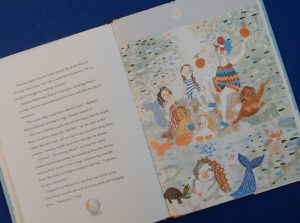
Gradually as this rather unlikely friendship blossoms we learn more about Madame Badobedah – she’s ready to apologise when she thinks it’s due, enjoys visiting the mermaids,

and also has some secrets that she wants to keep to herself. I love the way Sophie Dahl’s narrative gradually reveals things about the lonely Irena (as we discover is her real name) but leaves plenty of gaps for readers to fill in for themselves.

Lauren O’Hara captures the inherent warmth of the story in her deliciously whimsical illustrations that are just perfect for the quirky telling.

Another story about an intergenerational friendship is:

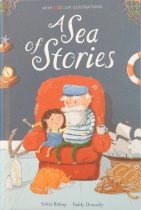
A Sea of Stories
Sylvia Bishop, illustrated by Paddy Donnelly
Stripes Publishing

Young Roo loves to visit her grandpa who lives in a cottage beside the sea with Bathsheba, his ancient cat and a large collection of Bits-and-Pieces he’s accumulated over the years.

Grandpa has a garden that has become overgrown and wild, the ideal place for a game of hide-and-seek when she goes to stay for a few days. When he gets tired there’s nothing he likes better than to sit in his favourite armchair and tell stories to Roo; stories inspired by the objects in his collection.

They all relate to the hidden cove at the bottom of the cliff, a place that Grandpa’s legs won’t carry him to any longer on account of the ‘rambly-scrambly path’ that leads down there.

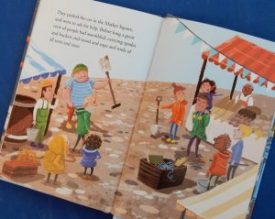
On her final night at Grandpa’s Roo turns her wish for a way to bring Grandpa and his favourite cove back together into a plan; a plan that the following day is brought to fruition.

Highlighting the importance of sharing stories, this unusual story is both warm and infused with a delightful quirkiness.

Zippel: The Little Keyhole Ghost
Alex Rühle, trans. Rachel Ward, illustrated by Axel Scheffler
Andersen Press

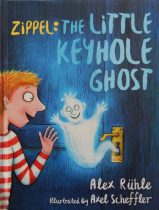
One day after the holidays Paul returns home from school and gets the surprise of his life: a voice comes from the keyhole when he inserts his key and it turns out to be a tiny ghost claiming he lives in the keyhole.

He names the being Zippel; but later on that same day he learns that the lock on the front door is to be replaced in just three days.

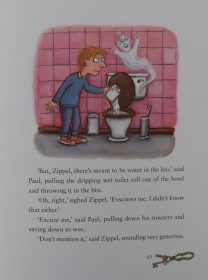
Later that evening Paul’s parents leave him alone and go to a meeting. Immediately the lad informs Zippel and the race is on to find the enormously inquisitive ghost (with an interest in everything including toilets) a new home before the three days are out.

With smashing Axel Scheffler colour illustrations and absolutely full of delicious wordplay and puns, not to mention Zippel’s rhymes, this warm-hearted story about discovering friends in the strangest of places is fun around Halloween especially, but worth reading any time.

Our Favourite Day / Around the Table That Grandpa Built

Our Favourite Day
Joowon Oh
Walker Books

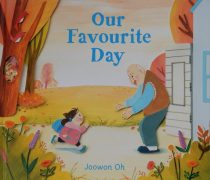
As we’re shown in Joowon Oh’s expressive watercolour, gouache collaged illustrations, Grandpa has a routine: every day he gets up, drinks tea, tends his plants, does the odd domestic job, dresses and catches the bus into town.

There he takes a walk, window shops, partakes of his favourite dumpling lunch, returns home and on this particular night is in bed early with an idea in his head generated by his walk past the town craft shop.

The following day he starts off in the same manner but stops at the craft shop to buy some supplies

before heading to the usual restaurant. Today however, he doesn’t eat in; instead he orders two take-away portions of dumplings, stops to pick wild flowers on his way home and then waits.

Once all his preparations are set out on the table, a page turn shows the reason for his different actions – his granddaughter appears.

The joy of both on meeting is palpable as she dashes into his open arms; and so it is too in what they then do together.
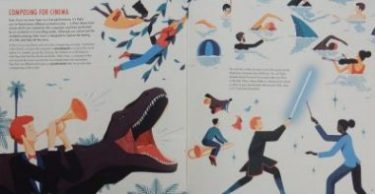
The remaining narrative takes the form of the dialogue between the two as they spend an uplifting Thursday together.
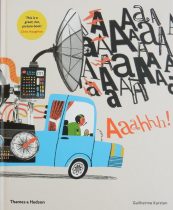
Full of warmth and tenderness, debut author/illustrator Joowon Oh’s portrayal of the special relationship between a child and grandparent is a charmer.
Around the Table That Grandpa Built
Melanie Heiiser Hill and Jaime Kim
Walker Books

Using the rhythmic structure of ‘The House that Jack Built’ Melanie Hill has created a lovely story as we join in the celebration meal that is being prepared for when family and friends come together ‘Around the table that Grandad built.’

The table isn’t the only item with family associations: there are sunflowers picked by the young narrator’s cousins; napkins sewn by Mum; glasses from Mum and Dad’s wedding are set out; and the cutlery was given long ago by Dad’s grandma.
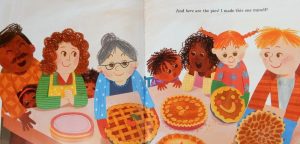
Then comes a look at the food – squash, roast potatoes and peppers, beans, ‘toasty tamales’, spicy samosas and rice pudding; there’s warm bread, butter made by the children and jam made by Dad; not to mention pies a plenty.

Everyone is thankful for the tasty food and for the bonds they share ‘around this table that Grandad built.’

Feelings of joy radiate from Jaime Kim’s bright mixed media illustrations in this story that celebrates togetherness and sharing the bounties of the season.

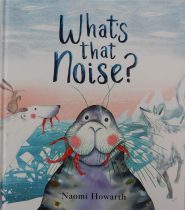
What’s that Noise?

What’s that Noise?
Naomi Howarth
Otter-Barry Books

Naomi Howarth introduces young readers and listeners to seven wonderful Arctic animals in her latest story.

Set in the frozen north we meet first of all, a ringed seal Magnus, a very fine creature that is woken one morning from his deep slumbers by a loud, low rumbling that he doesn’t recognise.
Could it be the wind perhaps, or the sea, or even a crumbling iceberg? Eager to identify the sound he sets off, asking first his friend Hare but Hare is equally puzzled.

Over the ice they go together, stopping by the forest to ask Owl. She knows it’s not the trees creaking but nothing more, so they travel further.

Neither Fox on the snowy rocks,

nor Polar Bear beside the icy river knows, but when they reach the sea they meet Walrus who has a suggestion that might just help find the source of those rumbly emanations …

Mystery solved, the animal friends enjoy a feast and then settle down to sleep … rumble, rumble, rumble – now what could it be this time?

Naomi Howarth’s gently humorous telling with its simplicity and repeat pattern has the feel of a folk tale while her watercolour illustrations are outstandingly gorgeous. She succeeds in portraying the animals realistically in their Arctic setting and yet readers can relate to them as real characters capable of showing feelings.

Make sure you peruse the back inside cover where there are key facts about the creatures from the story.

The Hairdo That Got Away / My Name is Bear

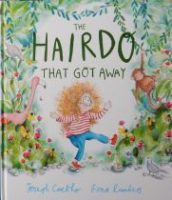
The Hairdo That Got Away
Joseph Coelho and Fiona Lumbers
Andersen Press

A small child narrator tells us how he’s used to a monthly visit to the barbershop with Dad, till one day Dad isn’t there. We don’t know the reason for this separation – perhaps his cool new haircut precipitated a parental row. The consequence though, is that the child’s hair starts growing and growing.

The days become weeks and then months; the hair grows ‘ginormous’ until his teacher, Miss Clarke is unable to recognise her pupil and Mum can’t hear her own child.

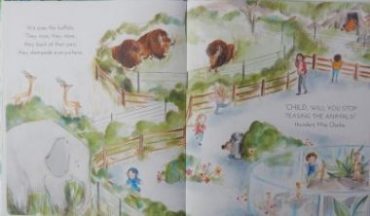
There follows a class visit to the zoo when the child, who is without any spending money, is accused of ‘teasing the animals’.

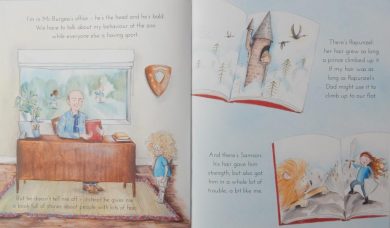
It seems that it’s down to the headteacher to recognise the recalcitrant child is actually struggling with his now unmanageable tangle of emotions and provide some bibliotherapy rather than a telling off.

All ends happily with Dad’s return (now also with a huge mass of troublesome hair) and a new hairstyle for each member of the now re-united family.

Like this reviewer, others both children and adults may find performance poet and author, Joseph Coelho’s warm-hearted story slightly enigmatic. Assuredly youngsters will delight in the unruly head of hair the narrator grows during his emotional upheaval and the funky stars the barber cuts for him.

My Name is Bear
Nicola Killen
Egmont

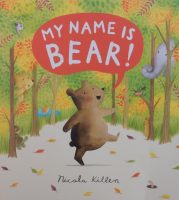
The bear in this story has just moved home and is extraordinarily fond of his name, Bear. So much so that he soon starts introducing himself to his neighbours: “Hello! My name is Bear’ he says to Bird and Fish in turn but can’t stop himself from being rude about their respective names.

This doesn’t slip the notice of an observant earthworm that pops up every time Bear stops to talk.

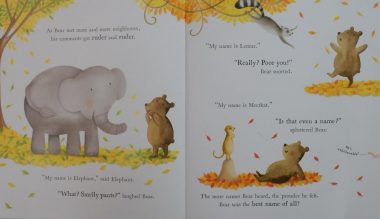
The exchange with Elephant is downright insulting and Bear continues with his rudeness

until he comes face to face with another ursine character. Now there’s a problem: both claim to be called Bear.
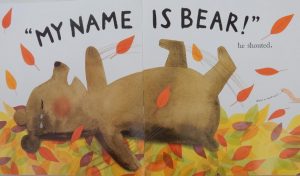
However although Bear 1 loses it completely throwing a tantrum on the spot,

the other Bear is ready to compromise. Eventually, after giving it some consideration, Bear number one agrees that perhaps after all they can share the same name.

Thereafter it’s a case of apologies to all the neighbours who in turn start to think that perhaps the newcomer isn’t quite so bad after all.

That’s not the end of this tale though for not long after a third new neighbour, bear number three, arrives and introduces himself … To reveal the finale would make me a story-spoiler so I’ll merely say that the worm actually has the last word.

Nicola Killen’s amusing tale of acceptance and learning how to get along with others is just right for little humans learning to make their way in the wider world, perhaps having started at playgroup or nursery.

Just Because

Just Because
Isabelle Arsenault and Mac Barnett
Walker Books

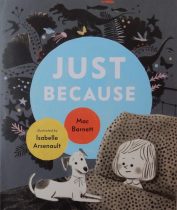
Would that every young child had a parent as ready and willing to answer the seemingly endless string of questions as the father of the small girl in this book even though her “Why is the ocean blue?” ; “What is rain?”; “Why do leaves change colour?”

and the other posers she puts forward as she lies tucked under her duvet in the dark, are clearly in part a tactic for delaying bedtime.

Quality time is what he provides and never once does he find himself trotting out the titular ‘Just because’.

Instead his responses are flights of fancy: the ocean’s blueness is because ‘the fish take out guitars. They sing sad songs and cry blue tears’; rain is “The tears of flying fish”; Leaves change colour because “the trees keep warm by setting quiet little fires in their leaves? By winter, their branches have all burned up.” (I love that!).

The answers get increasingly and wonderfully outlandish: The reason dinosaurs disappeared is that “Millions of years ago thousands of asteroids fell on the earth. / But the dinosaurs had planned for this. They fastened themselves to big balloons, floated up to space, and stayed there.”

The ever-patient father’s benedictory finale is surely, pitch perfect to send his little daughter off into her own dream world at last.

Mac Barnett’s story takes creative thinking to a new level that will likely inspire youngsters to think up their own playful answers to the questions his child protagonist poses.

A perfect complement to the telling, Isabelle Arsenault’s mixed media illustrations have a retro feel, while the imaginary worlds she conjures forth are intricately detailed and full of wonderful whimsical otherworldly touches.

Child of St. Kilda

Child of St. Kilda
Beth Waters
Child’s Play

Here’s a part of British history about which I for one, had no idea before reading this book so a big thank you to Child’s Play for sending it for review.

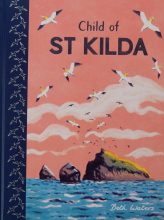
In this fascinating tale of the last human inhabitants of the remote Outer Hebridean islands of St.Kilda, Beth Waters relates the story of those living on Hirta, the largest of the islands and in particular of Norman John Gillies, born there in 1925.

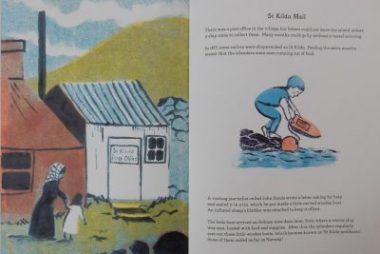
Dividing her narration into short sections – What People Did, School, St.Kilda Mail

and so on, she tells of the ups and downs of a subsistence community wherein everybody knew one another, crops often failed and there was no money; sheep were kept for the production of tweed, and wild birds or fish sometimes provided the food as supplies could only be delivered for half the year.

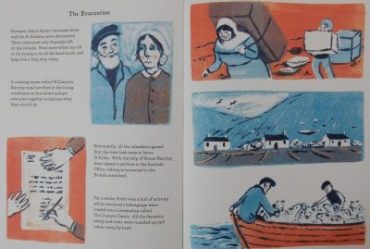
When John Gillies was not quite five his mother became ill, was taken to the mainland and there she died. This precipitated a petition from the remaining inhabitants of St. Kilda to the government asking to be moved to the British mainland and by 1930 the entire population was evacuated.

The islands are now a World Heritage Site.

Beth Walters’ monoprint illustrations of the sea, sky and cliffs, executed in green, blue and russet hues are superbly evocative of a long gone way of life; and she also includes some contemporary photographs and excerpts from her sketchbook.

Patience, Miyuki

Patience, Miyuki
Roxane Marie Galliez and Seng Soun Ratanavanh
Princeton Architectural Press

I’ve not met Miyuki before although this book is a follow up to Time for Bed, Miyuki and it seems slightly strange to receive for review as summer gives way to autumn, a story about the magic of spring. Nonetheless it’s a beauty and so worth drawing attention to.

Miyuki is excited at the arrival of spring and cannot wait to revel in the joys it brings. On her walk with her Grandfather she notices a flower that is yet to open. “Be patient” she’s told, this delicate little flower needs the purest water.

At these words she’s off on a mission to find that water to make the flower burst into bloom.

Her quest leads to an encounter with a toad in a well, a pretty cloud, a beautiful waterfall

and a boy watering his garden who does provide her with what she seeks.

In her haste to return however she trips, hurts her leg and spills the water.

As a result she has to stop and in the silence of the moment she hears the song of the river. “Be patient,” it says promising to take her home.

Lulled by the water, she falls asleep and the river keeps its promise carrying her home, borne by an origami swan to her Grandfather.

Next morning, the second day of spring, Grandfather is able to get her to be still

so that she can observe the wonderful surprise that awaits.

There’s a dream-like quality to this sweet, soft-spoken story that is reflected in Seng Soun Ratanavan’s beautiful jewel-coloured, occasionally playful, illustrations of the natural world, some of which include traditional Japanese objects.

Enjoy the moment is the message of this book, and it’s one we could all do with paying heed to in our increasingly busy times, whatever the season.

One Fox / The Button Book

Just right for an early years collection are:

One Fox
Kate Read
Two Hoots

One moonlit night down on the farm, with his two sly eyes, one famished fox is on the prowl. Lots of lovely alliteration describes the happenings:

The three plump hens need to keep their ears and beady eyes open.
However that fox is in for a big surprise when he takes six silent steps towards the hencoop and taps seven times upon the outside …

In a dramatic and satisfying climax (although not for the fox), debut author/illustrator Kate Read takes us right up close to the action in her counting story.

With an economy of words she creates a visual comedy that is both exciting and gently educational; but It’s her superb visuals that carry the power – bright, textured art combining paint and collage – that build up expectations of the outcome

and then turn the tale right over on itself.

The Button Book
Sally Nicholls and Bethan Woollvin
Andersen Press

Take a group of inquisitive animals and an assortment of ‘pressable’ buttons of different shapes and colours; add several generous spoonfuls of imagination and stir. The result is this playful interactive picture book for little ones.

Squirrel starts the whole thing off by prodding at the red button with his stick and wondering what will happen. It beeps, and that sets off the button investigation.

To discover which is the clapping button, which one sings songs;

which blows a raspberry;

what joys the yellow button delivers, and the pink and purple ones, you need the fingers of a child or so, and the willingness to indulge in some pretend play.

This is children’s / YA author Sally Nicholls debut picture book and it appears she’s had as much fun creating it as will its intended preschool audience. The latter will take great delight in all the noisy, occasional mischievous activities offered at the mere touch of a button. Adult sharers on the other hand might well be relieved to learn what the white button does.

Seemingly too Bethan Woollvin had fun creating the illustrations; she’s certainly done a cracking job showing the seven characters having a thoroughly good time as investigators and participants in their own comedic performance.

Under the Great Plum Tree

Under the Great Plum Tree
Sufiya Ahmed and Reza Dalvand
Tiny Owl

This is a new addition to Tiny Owl’s smashing One Story, Many Voices series.

I felt very pleased with myself for realising as I started reading that the names of the two main characters in Sufiya Ahmed’s version of an Indian fable from the Panchatrantra are the Hindi for monkey and crocodile, only to find on finishing the book a note at the back saying just that. Still it didn’t say that hati is Hindi for elephant!

Now let me introduce the two characters who have formed a rather unlikely friendship under a plum tree in their jungle home. There’s the always kind-hearted Miss Bandari and well past his hunting days crocodile, Mr Magarmach.

The latter regales Miss Bandari with his tales of days gone by but one day instead of his regular story, he invites his friend to lunch as repayment for all her kindness.

That’s an offer too good to turn down so Miss Bandari leaps onto Mr Magarmach’s back and off they go down the river.

After a while they encounter Dame Hati who warns of a terrible danger that awaits should they proceed: the always hungry King Crocodile no less.

Now this troubles Miss Bandari but Mr Magarmuch assures her that King Crocodile wants only to see her big golden heart.

Luckily Dame Hati has her wits about her

and assists Miss Bandari in avoiding a terrible fate.

But the result is that the long-standing friendship between Miss Bandari and Mr Magarmach is tested close to its limits.

Fortunately though the latter’s courage prevails when King Crocodile’s true intentions are revealed and all ends happily.

Sufiya Ahmed’s lively rendition is a great read aloud, while reminiscent of Gujarati Pithora art, Reza Dalvand’s stylised, multi-patterned illustrations flow freely over the pages seducing the eye, making the entire reading experience an absolute delight for audiences and those sharing the book.

My Monster and Me

My Monster and Me
Nadiya Hussain and Ella Bailey
Hodder Children’s Books

Nadiya Hussain has recently spoken out about her own anxiety issues and now has written a picture book intended to give little ones and their carers a starting point for talking about anxiety and worries.

The narrator is a small boy who talks of his ever-present monster that nobody is able to banish; a bossy creature that gets in the way of everything the lad wants to do. It prevents him from playing with his own toys and even his friends.

After school one day the monster is waiting – huge and bad tempered – and it follows the boy all the way to his grandma’s house.

Seeing how upset he looks, Gran listens to her grandson’s tale of woe

and as he talks the monster starts to shrink and that’s when the boy gains control.

The monster never completely goes away but now it no longer wields the power.

Told in a straightforward manner that young children can easily relate to, Nadiya’s reassuring tale is made all the more so by rising star, Ella Bailey’s smashing illustrations. She portrays the monster as a mischievous rather rotund creature, rather than a scary one.

With ever more children of all ages having anxiety issues books such as this one can be an absolute boon for parents and teachers to share.

Lights on Cotton Rock

Lights on Cotton Rock
David Litchfield
Frances Lincoln Children’s Books

Totally out of this world, breathtakingly brilliant is this science fiction picture book by David Litchfield.

It begins with star-grazing Heather whose chosen place to contemplate the universe is Cotton Rock. Here she sits and with torch directed up, sets her sights towards the star spangled sky in the hope that someone in the inky black of space will see her light.

Believing that there are others somewhere in outer space she flashes her torch off on, off on … until lo and behold, it looks as though her wish has been answered for into the forest glade there appears …

Sadly the ensuing awesome encounter is over all too soon

and the spacecraft departs.

Is this to be a once in a lifetime experience?

Heather certainly hopes not for she goes back to Cotton Rock at intervals hoping that her alien friend will return and transport her far away.

As she grows older Heather’s visits to her rock become less and less frequent but she never loses that hope …Could it happen?

Or could it be that what we most yearn for isn’t in fact what will ultimately come to mean most to us; maybe what we are truly looking for is just so close we can’t see it …

With every book David creates, I think to myself, he just can’t better that, but then he goes and proves me wrong. I can think of very few illustrators whose use of dark and light comes anywhere near what is between the covers of this book, at every single turn of the page; it’s utter genius.

I keep on going back to it and gaining new insights but then that’s what happens with the very best picture books.

Caspian Finds a Friend

Caspian Finds a Friend
Jacqueline Veissid and Merrilees Brown
Chronicle Books

In a lighthouse lives a boy named Caspian whose loneliness we feel right from the opening spread that reveals the stark beauty of his location.

How does someone find a friend whose every night is spent casting light into the darkness waiting for someone to arrive, but nobody does.

Then one day Caspian decides to write a message and use his flower jug to cast it into the ocean.

Weeks pass, then months as the boy waits and waits. Eventually he discovers something ‘a glistening nestled in the rocks.’ It’s his bottle and inside is a single word response.

He rushes to his little boat and under the night sky with its shimmering constellations he rows on the gentle sea until he falls asleep.

Waking next morning now in icy waters, Caspian finally meets that which he’s longed for …

and together they journey back to the lighthouse.

The combination of Jacqueline Veissid’s lyrical text and debut illustrator, Merrilees Brown’s beautiful art, which is a mixture of oil paints, relief print and charcoal digitally combined, creates an almost dreamlike gentle adventure story to delight and perhaps to encourage little ones to realise that within themselves they have the power to make changes happen.

The Cloud Horse Chronicles: Guardians of Magic

The Cloud Horse Chronicles: Guardians of Magic
Chris Riddell
Macmillan Children’s Books

I was thrilled to receive a copy of this, Chris Riddell’s first story in a new fantasy series.

The story is set in the kingdom of Thrynne, a place of ancient magic, the source of which is the Forever Tree hidden in the Great Wood.

‘For as long as anyone can remember, children of Thynne have looked at billowing clouds in the sky and wished on a cloud horse, always hoping … But no one has seen a cloud horse.’ That though is about to change …

We meet in turn three ordinary children each from a different town within the kingdom, into whose hands come three magical objects made with wood: to baker Zam Zephyr a runcible spoon;

to cellist Phoebe Limetree a talking cello;

to Bathsheba Greengrass a worpal sword with a carved wooden handle.

And thus it is that these unsuspecting children are destined to be the Guardians of Magic.

But anyone thought to wield the magic of Thrynne is in terrible danger especially from those who have their own reasons to keep that magic at bay: there’s chief rat King Tiberius-Tiberius who terrorises Sam’s home town Troutwine; the ruler of Phoebe’s home, Nightingale is a power-mad Clockmaker with an army of mechanical tin-men; while in Bathsheba’s tree-house town of Beam is Euphemia Goldencurls, a professional Princess who desires to keep alive the lucrative business of giant slaying.

Also cleverly woven into the story are fairy tale characters including a gingerbread man, the Pied Piper and the three bears.

The last section of the book brings together the three children who use their wits against the dastardly characters threatening the magical Forever Tree and the cloud horses that nestle in its branches.

If that’s not enough magic for you, there are also Chris’s awesome, instantly recognisable, detailed illustrations liberally scattered throughout the story, as well as a full colour fold-out guide to the giants of the Great Wood, aerial townscapes and cross-sections of buildings.

The result is an utterly compelling, enchanting and immersive book that you’ll find almost impossible to put down. I can’t wait for the next instalment.

Oscar Seeks a Friend

Oscar Seeks a Friend
Pawel Pawlak
Lantana Publishing

How is a self-confessed ugly looking skeleton to make friends, especially so since he’s lost a front tooth? At least it doesn’t deter his skeleton dog Tag from playing with him.

One day he comes upon a little girl who is burying a tooth in the ground and asks her if perhaps she might give him the tooth.

Her response is that she needs it to help her dreams come true but then she changes her mind, gives him the tooth and taking his hand leads him away on an adventure.

Together, the two visit a meadow, smell the scent of wet grass, visit her home and see a rainbow.

Then they enjoy a seaside romp …

and share their secrets and dreams.

Oscar in return takes the girl’s hand and leads her to some of the places he likes best: the park, the library

and a leafy tree among whose branches butterflies sleep.

The story ends with the girl expressing hope that the two will meet the following day and the skeleton narrator handing back the girl’s tooth, safe in the knowledge that a friendship has been forged.

In contrast to the bright backgrounds of the girl’s world, those of the skeleton are predominantly black with occasional details in reds, pinks and orange. I’d love to have seen Pawel Pawlek’s original 3D paper collage art for this book; it must have been truly magnificent. Instead I and other readers will have to be satisfied with the richly textured, cleverly composed digital renderings in this unusual picture book with friendship at its heart.

Dracula Spectacular / Moldilocks and the Three Scares

Dracula Spectacular
Lucy Rowland and Ben Mantle
Macmillan Children’s Books

Lucy Rowland’s way with rhyme is superb and here she introduces readers to the Draculas, a family of vampires – father, mother and child who live in a dark dusty residence in the park.

Unlike his parents Dracula Boy loves bright clothes – no black outfits for him – and he really doesn’t want to go around scaring the townsfolk. Indeed some of the children allow him to try on their colourful gear and they become his friends; so much so that he offers to accompany scared-of-the-dark Rose, on a night-time exploration.

The two enjoy flying through the night sky, watching fireflies and gazing at the moon but must this wonderful adventure be for one night only?

Happily both his caring parents and his new friends want to see Dracula Boy happy, so perhaps there is a way to bring a touch of rainbow magic into his life.

Ben Mantle’s spirited scenes, by turns mock scary and vibrant, are a perfect match for the jaunty rhyming narrative.

A warm and sparkling alternative to the usual spooky Halloween stories, this one will work at any time.

Moldilocks and the Three Scares
Lynne Marie and David Rodriguez Lorenzo
Sterling

Let me introduce the Scares: there ‘s Papa Scare (bearing a striking resemblance to Frankenstein’s monster), Mama Scare (green skinned mummy/Bride of Frankenstein) and Baby Scare, a diminutive vampire.

As the story opens Papa is brewing up a large container of Alphabat Soup. “The recipe serves four. Just enough for one more,” he announces. Meanwhile Mama mixing potions in the lab, expresses a wish for an assistant and Baby is desirous of a playmate.

When Papa serves up the soup it’s too hot to eat straightaway, so he suggests a walk with their ghost dog Plasma.

Meanwhile, Moldilocks out sleepwalking is drawn to their residence by the smell of soup wafting in the air. In she goes and well, the rest is as you’d expect in this delicious fractured fairytale: Baby’s soup is gobbled up, his chair broken and his bed usurped.

Now here comes the twist: instead of being full on furious when they discover the intruder, the Scares, after Papa’s …

… eat without us”, welcome Moldilocks unreservedly.

Then in best spooky fairytale tradition the now enlarged family ‘lived hauntingly ever after.’

With plenty of puns to giggle over, an adoption/Halloween spin to the tale, and Lorenzo’s acrylic and colour pencil illustrations that are full of appropriately frightful details to ‘claw over’, this book is a fun read aloud for Halloween or as part of a classroom fairy tale theme.

Oi Puppies!

Oi Puppies!
Kes Gray and Jim Field
Hodder Chidlren’s Books

YAP! YAP! YAP! YES! YES! YES! The long anticipated Gray and Field new ‘Oi … !’ episode Oi Puppies! is finally here and it was definitely worth the wait – expectations exceeded yet again!

It appears that the dog might have bitten off rather more than he can chew when it comes to the plethora of pups he’s rashly undertaken to puppy-sit. Certainly his pals the cat and the frog are not impressed with their mischief.

We all know from previous experience as the cat points out, that puppies should sit on guppies, but “These puppies are really badly trained” admits the dog.

Thank goodness then for the frog. With a deft manoeuvre he produces his mobile and makes a call to …

Puppies with names require tailor made seating apparently and so the fun begins as one by one each cute little canine creature is paired with a suitable seat as befits its name.

The dog is practically dumbfounded; cat momentarily silent while the frog looks mighty pleased with himself. But it doesn’t do to gloat.

The pups are certainly sitting comfortably now but that’s not quite the end of the story. Perhaps personalised perches can produce problems from time to time …

Nineteen puppies, each with a distinct personality – that’s no mean feat even for Jim Field – and the sight of the whole motley crew sitting there as though butter wouldn’t melt is absolutely superb.
Stupendously silly nonsense that only this partnership can provide: if you’ve not read any of the others I recommend getting the lot and reading them in order although this one works perfectly in its own right.

I’m Actually Really Grown-Up Now

I’m Actually Really Grown-Up Now
Maisie Paradise Shearring
Two Hoots

Meena’s parents are having a party but, so she’s told as she reluctantly goes to bed, it’s for grown-ups only. Party loving Meena however makes her own plan.

The following morning she makes a very important announcement to her family, “I’m actually really grown-up now!”

What’s more she is having her own party – parents welcome.

Raiding mum’s wardrobe to find the perfect outfit is fun;

but grown ups also have to work and of course the party itself needs to be prepared.

Who will be invited? What about the food – that has to be bought. (with Dad’s assistance).

Before too long, Meena realises that this grown-up business isn’t all easy or fun.

And as for the party? Perhaps best not to expect too much

and just go with the flow …

The author’s skill at appreciating and portraying the spirit of adventure young children have in this wryly humorous story of the ups and downs of childhood is superbly presented in both her playful narrative and illustrations. Both exude warmth and understanding while her protagonist is an absolute delight – determined and resourceful, and ready to capitalise on whatever situation she finds herself in.

The Sleepy Pebble and other stories

The Sleepy Pebble and other stories
Doctor Alice Gregory, Christy Kirkpatrick and Eleanor Hardiman
Flying Eye Books

Alice Gregory, sleep researcher and writer Christy Kirkpatrick have collaborated on this book of stories to share at bedtime.

Adults, parents in particular, know how hard it can be to get little ones off to sleep and this collection of calming tales, together with the activities suggested, is specially designed to help children wind down and relax, allowing them to drift off into the land of nod.

There are five stories, each one soothing and an ideal length for bedtime. They feature in turn the sleepy pebble; a willow tree that wants to stay up late;

a giraffe that enjoys a long bath to relax her at night, a kind and careful snail and finally, a pig that loves to cook.

The same muscle relaxation routine is used during each one except that the child is asked to imagine holding and squeezing in the first, Pebble, in the second some soil, in the third big heavy clouds, in the fourth the listener becomes the snail curling into its shell and soft warm dough is the final item to squeeze.

The guided visualisation intended to engage all the senses uses imagery appropriate to each story and the mindfulness – the focus on body awareness – is repeated for concluding every story session.

Eleanor Hardiman’s exquisitely detailed illustrations executed in calming colours (different hues for each story) add to the book’s dreamy quality.
Also included are an explanatory introduction, tips for ‘relaxing bedtime and better sleep’ plus ten questions and answers.

Wearing my yoga teacher’s hat I fully endorse the techniques included in this beautifully produced storybook. It should prove invaluable to parents who struggle with getting their children to nod off and to sleep through so they wake next morning restored and full of energy.

Star / Beyond Platform 13

Star
Holly Webb, illustrated by Jo Anne Davies
Stripes

Here’s a wonderfully wintry tale about a little girl named Anna who finds a small carved wooden tiger figure at her grandmother’s house. She puts the carving under her pillow at bedtime and the following morning when she wakes up she is somewhere completely different, a snowy village in Russia.

What’s more there are reports of a tiger cub in the vicinity.

Then Anna/Annushka realises the reason she’s where she is – that cub needs to be kept safe. She’s even more sure when she comes face to face with the little tiger in the forest and Annushka is convinced it’s a female.

Something has to be done,but her father, who doesn’t know she’s actually seen the cub, thinks they shouldn’t get involved.
Even the idea of going out alone in the snow is enormously scary but she’s a determined, resourceful young miss and so when everyone else is fast asleep out she creeps.

This nail biting story is based on a real event, so says the author’s note at the end wherein she tells of a cub whose parents had been killed by poachers that was rescued, cared for in a rehabilitation centre and eventually released back into the wild at a nature reserve in Russia.

Beyond Platform 13
Sibéal Pounder, Eva Ibbotson, illustrated by Beatriz Castro
Macmillan Children’s Books

Eva Ibbotson’s original magical book The Secret of Platform Thirteen was published about 25 years ago and now Sibéal Pounder has penned a smashing sequel that is also both funny, and full of magic and madness.

It’s now nine years after the events of The Secret of Platform 13; the Island of Mist is besieged and Prince Ben and friend Odge Gribble (the hag) are hiding away. The protective mist surrounding the island is disappearing and in the hope of discovering the reason why, Odge decides to travel to Vienna (via the gump – a bump containing a hidden door to another world) to secure the services of a mistmaker. And so it is, in a case of mistaken identity (Odge’s speciality) young adventurous Lina Lasky who most certainly is no mistmaker, becomes involved in a quest to foil the plan of the power-mad harpies before the gump closes over.

Totally captivating and full of priceless comic moments and strange creatures,

A bagworm shot out and a bridge was created

this story absolutely whizzes along sweeping readers with it; and zany as it is, there lie within messages relating to kindness and finding a place in the world – whatever world.

With smashing black and white illustrations by Beatriz Castro, this is an unputdownable delight through and through.

Who’s Afraid of the Quite Nice Wolf? / A Home for Luna

Who’s Afraid of the Quite Nice Wolf?
Kitty Black and Laura Wood
New Frontier Publishing

Not all wolves are big and bad: meet wolf Wilfred; he’s not at all scary despite being a member of a rather unpleasant pack. Their leader despairs of Wilfred’s un-lupine characteristics taunting the poor creature mercilessly

and ordering him to join in the attack on the sheep the following night to learn proper wolf behaviour.

That night however, Wilfred visits Mildred sheep and together they come up with a plan to help the other sheep.

Will their ruse be successful in foiling the wolves’ attack?

Debut picture book author, Kitty Black’s funny tale turns on its head the wolf stereotype (this wolf is a vegetarian) and in best picture book tradition Laura Wood’s hugely expressive illustrations are immediately engaging and extend the narrative.

A Home for Luna
Stef Gemmill and Mel Armstrong
New Frontier Publishing

When Luna is washed up on a strange shore far from her home, hearing nothing but the sound of the waves she feels lonely and afraid.
After spending the night sleeping beneath the container she’d arrived in, she smells a smell not unlike home. Following her nose she comes upon some penguins feasting on sardines and one in particular with yellow eyes catches her attention.

During the course of the day Tiny penguin makes approaches to Luna, offering her a shellfish to eat and the following night Luna joins the colony catching fish, ‘Not exactly like a penguin … but good enough. Then when marauding gulls attempt to steal what she’s caught, Yellow-Eye sees them off ‘Not exactly like a cat … but good enough.’

Little by little Luna gets closer to Yellow-Eye and it isn’t long before she’s become a part of the huddle.

One night a boat nears the shore; the crew are surprised to see a cat among the penguins and want to take her with them. The reaction of the penguins and Luna convey to the well-intentioned fishermen that this is not going to happen; and as the boat sails into the darkness, it’s clear to Luna that she has a new home with the penguin huddle and that’s where she now belongs.

In this tale of displacement and friendship, a spare telling that is in keeping with the stark setting, combined with debut illustrator, Mel Armstrong’s textured illustrations capturing the bleakness of the penguins’ home against the movement of the ocean, and clearly showing in-comer Luna’s changing relationship with the resident penguins, convey something of the isolation felt by refugees in a strange land.

Aesop’s Fables

Aesop’s Fables
Retold by Elli Woollard, illustrated by Marta Altés
Macmillan Children’s Books

To attempt a rhyming rendition of one of Aesop’s fables is rather a risky business; to do it well and then go on to write a further seven in unfaltering rhyme that just glides off the tongue is incredible; but that is just what Elli Woollard has done. How she’s pulled off this feat I can’t imagine but only surmise it was with a combination of wit, wisdom and trickery – the characteristics exhibited by the animals she writes about.

Whether you choose to share one of the better known tales such as The Hare and the Tortoise, The Boy Who Cried Wolf; or The Town Mouse and the Country Mouse;

or want to discover what the bear whispered in the small traveller’s ear in the first story; or perhaps learn how the peacock was taken down a peg or two,

each telling is a treat for both reader aloud and listeners

Marta Altés illustrations too are absolutely superb. Every single one, be it a small vignette, a double spread or the single page pattern design sandwiching alternate stories,

is a seductive combination of a rich colour palette and inbuilt humour that fits the vivacious, up-to-the minute tellings of the stories perfectly.

Otto Blotter, Bird Spotter

Otto Blotter, Bird Spotter
Graham Carter
Andersen Press

Young Otto comes from a family of avid birdspotters who spend all their waking moments spotting their feathered friends from within their hide of a home. Not so Otto however; he loves to explore in the great outdoors and while doing so one day he discovers first a huge footprint, then a very large poo

and finally, a highly unusual little bird hidden in the bushes.

Despite the ‘no pets’ rule at home, the lad sneaks the creature into his bedroom and the bird starts growing and growing until it seems he’ll no longer be able to hide it.

The bird however has a power that he’s yet to show his carer: the art of camouflage, and this enables the pair to have amazing adventures together unbeknown to anyone else.

However a visit to the zoo makes Bird unhappy and Otto realises that it’s missing its family.

Time to introduce Bird to his own family thinks Otto and having recovered from the shock revelation they construct the tallest ever bird-spotting tower. Eventually the missing birds are found and all ends happily with Otto now a bird-watching convert and his parents, fans of the great outdoors and its potential for making discoveries.

A zany tale illustrated from a variety of perspectives and in a multitude of hues, this is an unusual picture book with plenty of visual interest, not least the parent birds hiding in plain sight.

The Secret of the Tattered Shoes

The Secret of the Tattered Shoes
Jackie Morris and Ehsan Abdollahi
Tiny Owl

The latest addition to Tiny Owl’s ‘One Story, Many Voices’ is a rather different interpretation of the Brothers Grimm tale The Twelve Dancing Princesses.
Here the princesses are still locked up each night, and their dancing shoes are still worn down each morning.

However, having met a beautiful woman in the forest

and learned of the princesses, the strong handsome soldier who takes it upon himself to accept the king’s challenge to discover their secret, is weary of life.

Unlike those who have gone before he has a different ending in mind from that offered by the princesses’ father.

Jackie Morris’s text is poetic: ‘The soldier followed, out from the twisting tunnel of steps to an avenue of trees lit by curious starlight. The leaves shone with silver as if painted by moonlight’.
It’s also rather dark: it’s certainly not marriage to one of the king’s daughters – the happily ever after ending of the Grimm version that this soldier seeks. Nevertheless although readers are left to decide for themselves what happens to him, we’re left with a hope that the soldier finds that which he goes in search of after leaving the royal gathering.

Ehsan Abdollahi’s collage illustrations are absolutely right for Jackie Morris’s rendition: from endpaper to endpaper, with puppet-like figures, they’re exquisitely detailed, infused with melancholy and mystery, and reminded me rather of medieval tapestries.

The Misadventures of Frederick

The Misadventures of Frederick
Ben Manley and Emma Chichester Clark
Two Hoots

Frederick lives in a large mansion surrounded by beautiful countryside and seemingly lacks for nothing, except the one thing he truly wants – freedom.

Emily in contrast is free to roam but lacks a friend and playmate.
One day she notices Frederick and realising he is bored, she sends him a note inviting him to join her outside for ice-cream.

Much of the ensuing story takes place through Emma Chichester Clark’s exquisite illustrations that are alternately dark and gloomy (when the focus is on Frederick), or bright and full of light and colour when showing Emily’s actions in the great outdoors.

The text in contrast is almost exclusively in the form of the written communication between the two characters; Emily’s being short, sharp notes;

Frederick’s are penned in a rather flowery, poetic style characteristic of a child who lives his life in his head.

Gradually Emily’s messages grow briefer until there comes a cry,

a cry that finally lures Frederick into taking a risk and tasting what it’s like to be free.

His freedom however comes at a small price as the final page shows; but readers are left knowing that one small setback isn’t going to deter the boy in future.

I absolutely loved this book: the combination of the clever narrative and the story extending illustrations makes for a highly unusual picture book with a strong message for risk averse adults as well as listeners whether or not they’re unlucky enough to be in situations similar to Frederick’s.

Step Inside Homes Through History / Darwin’s Voyage of Discovery

Step Inside Homes Through History
Goldie Hawk and Sarah Gibb
Nosy Crow

Most readers of this book will recognise many of the features of the contemporary house illustrated herein, and those who are as old as this reviewer will recognise some of the rather garish décor shown in the sixties home. How many though, unless they are members of the National Trust or have a special interest in the topic, will know what living in a Late Middle Ages manor house or a Tudor mansion was like?

Three double spreads each, explore seven periods in time from the mid 13th century through to the present day.
Intricately detailed laser-cut pages show us not only the particular residence outside

and in, but also the fashions, family life and furniture of the period.

You can have fun tracing the evolution of the bathroom from the medieval gardrobes – ‘a bench over a big hole which went outside the house’

to the Georgian chamber pot beneath the bed, the new Victorian indoor flushing toilet through to the present day en-suite bathrooms that many of us have. Also fun is the ‘spot the artefact’ feature where readers are asked to find a named item of furniture or small object in each house.

Full of interesting snippets of information, this well-illustrated book is worth buying for a classroom collection, or if you intend visiting a stately home or historic house, whether or not it belongs to the National Trust, Nosy Crow’s collaborators for this title.

Darwin’s Voyage of Discovery
Jake Williams
Pavilion Books

Following his Really Remarkable Reptiles, illustrator/designer Jake Williams has created another fascinating, stylishly illustrated book, this time about the naturalist and geologist Charles Darwin famous for his epic voyages of adventure on HMS Beagle and his theory of evolution ‘On the Origin of Species’.

The amazing creatures both large and small that Darwin saw during his explorations (some of which we see larger than life illustrated herein) furnished a wealth of detailed notes and drawings, observation data and fossil specimens; and readers can follow in the footsteps of the famous biologist as he travels the world for five years as the Beagle ship’s biologist sailing from England to the Cape Verde islands, from Brazil to the Galapagos and from Tahiti to Australia and finally, back home.

There’s a wealth of information about such things as the ‘cracker’ butterflies of Brazil;

how Darwin unearthed the skull of a giant ground sloth in Argentina and the steamer ducks he observed in the Falklands,

as well as maps showing the Beagle’s progress.

Recommended for all those with enquiring minds, this is a beautifully produced book that highlights the importance that careful observation makes in the furtherance of scientific discovery.

It’s MY Sausage! / The Cutest Thing Ever

It’s MY Sausage!
Alex Willmore
Maverick Publishing

One fat juicy sausage, five cats all with designs on it. The mustard coloured moggy lays claim, having so we hear ‘seen it first’ but has decided to delay gratification.

A dramatic comedy then unfolds as the others endeavour to procure the desired item by means of a rod and line, a ball of wool …

and some acrobatics.

Deceptively simple and hugely expressive illustrations of the rival felines tell much of the story along with a brief discourse provided by mustard moggy and punctuated with descriptive onomatopoeic sound effects and exclamations by the competing cats.

Who actually gets to eat the tempting morsel though? That would be telling wouldn’t it …

A hugely entertaining romp of a picture book.

The Cutest Thing Ever
Amy Ignatow and Hsinping Pan
Abrams Appleseed

A small purple bat narrator poses the question ‘Want to see the cutest thing ever?’

We turn the page to find a cuddly looking monster. Our bat friend then goes on to present an assortment of alternative possibilities adding kittens, hats and a unicorn to ride on. Not satisfied he continues with ‘A parade of koala bears’ – musical making ones, dancing bunnies, and then the whole show goes crazy with …

These astronauts eventually surround the rest of the competing crew before the bat, now appearing absolutely desperate to please, proffers one last suggestion … could that reveal the cutest ever possibility.

Little ones will certainly enjoy the finale. Silly nonsense but I imagine cries of ‘again’!

Into the Deep

Into the Deep: An Exploration of Our Oceans
Wolfgang Dreyer and Annika Siems
Prestel

Prepare to be swept away at the sights you’ll see as you plunge into this exploration of the awesome life forms that lie beneath our oceans.

We journey, with marine biologist Wolfgang Dreyer, courtesy of the research vessel Meteor aboard which is a submersible that enables us to meet some of the incredible creatures from plankton, the tiniest microscopic life forms, to the enormous mammalian creatures such as the sperm whale, and its prey, the giant squid, the largest invertebrate on earth.

Did you know the reason the sea looks greener during the warmer months is down to the proliferation of phytoplankton, the minute chlorophyll-containing organisms.

These are a vital food source for many kinds of aquatic animals; indeed phytoplankton are at the base of the ocean food chain.

I was totally fascinated to read about the atolla jellyfish, in particular Atolla wyvillei a species of crown jellyfish, and the way in which it uses bioluminescence, flashing first blue and then red, the latter being invisible in the deep sea and thus acting as a protective mechanism.

Perhaps even more surprising is that there are other unrelated deep-sea creatures that also use red for protection including, the world’s largest crab, the Japanese spider crab.

The author has packed a considerable amount of information into this book but at no time does it overwhelm despite the fact that he never talks down to his audience, rather he uses scientific terminology throughout to discuss such things as morphology and physiology.

The nature of this book is such that readers are unlikely to encounter in the flesh most of the animals featured, but Annika Siems’ oil paintings, some in really large format, bring them to life and allow for close scrutiny of the wonders of the deep.

A terrific book for the curious, for those inspired by David Attenborough’s Blue Planet 2 series and budding marine biologists alike. It ends with a heartfelt plea from author and artist to stop littering our oceans with plastic and other garbage.

Speedy Monkey / An Owl Called Star

Speedy Monkey
Jeanne Willis, illustrated by Chantelle & Burgen Thorne
Stripes

Speedy Monkey, like many young humans is bursting with energy and inquisitiveness. Nothing wrong with that except that the other rainforest creatures think that his constant capering is way too lively and noisy; peace and quiet is what they crave.

Speedy’s efforts to be more like them are a dismal failure and none of them has any desire to emulate the little monkey.

Come nightfall, as the animals try to sleep, Bat suggests if Speedy wants to do what he was born to do he should go to the  edge of the forest, climb to the top of the Kapok tree and … “Everyone will love you for it.”

Speedy does just that, but being completely alone is no fun at all.
Suddenly a really fierce storm approaches and Speedy knows that he has to warn his fellow animals of the danger.

There’s no time to lose, but will they heed his warning?

Happily yes, but once they’re all safely gathered in Bat’s cave, one creature is notable by his absence …

Jeanne Willis’s telling is as lively and full of fun as her protagonist in this latest addition to the Stripes’ series of full colour fiction for new solo readers. Also exuding liveliness are Chantelle and Burgen Thorne’s funny, spirited illustrations of Speedy and his fellow rainforest dwellers.

For those ready for a longer read is

An Owl Called Star
Helen Peters, illustrated by Ellie Snowdon
Nosy Crow

This is the eighth story about Jasmine and her best friend Tom. Here the two are out walking with Jasmine’s sheepdog when he disappears and in their hunt for him, they come upon an injured barn owl in some brambles and they name it Star.

With the help of Jasmine’s mum, the owl gradually regains its strength; but barn owls are hunters that love to feed on small mammals and Jasmine has also offered to look after Aisha’s hamster for the weekend. Is it wise to keep both cages in the same room? Not only that but she’s also planning a secret Halloween party. It looks as though she might just have taken on rather more than she can cope with, especially when the hamster goes missing after Jasmine forgets to secure the door of his cage, and then Mum declares that Star is ready to be released.

Readers, especially animal lovers, will lap up this story and along the way learn a fair bit about barn owls from the information Helen Piers has skilfully woven into her narrative. Ellie Snowden’s detailed pencil drawings that break up the text are a delight.

Flaps, Frights and Fun for Little Ones

Where’s Mrs Bear?
Where’s Mrs Witch?

Ingela P Arrhenius
Nosy Crow

The two new additions to the deservedly popular hide-and-seek series that uses a simple repeat question and answer pattern are terrific fun. Using shaped felt flaps and a final mirror, tinies can enjoy discovering the whereabouts of several woodland animals in the former before being confronted, thanks to the hidden mirror, by their own image beneath the flap on the final spread.
The second title has a distinct Halloween theme with a skeleton, a spider, a vampire and Mrs Witch to find as well as enjoying a spot of self-revelation beneath the ghost.
Engaging, spot on interactive entertainment and unobtrusive learning for the very youngest.
Talking of Halloween …


Monsters Come Out Tonight!
Frederick Glasser and Edward Miller
Abrams Appleseed

There surely are all manner of ghastlies and ghoulies lurking behind the flaps in this jaunty rhyming, mock scary book. There are witches combing their locks, Frankenstein showing off his new sporty trainer boots, Dracula brushing his fangs and ghosties sporting bow ties and top hats. What is the purpose of all this titivating, you might be wondering. The final fold out spread reveals all.

Little human monsters can enjoy some monstrously shivery, door-opening fun herein.

Farmblock
Christopher Franceschelli and Peskimo
Abrams Appleseed

The latest of the popular block series takes us down on the farm where little ones can follow the two children through a day’s work as well as the seasonal activities that take place.
The cock crows, the children do their round, collecting eggs from the hens, carrying compost and then bathing the dog after a stinky roll in the muck, help with the milking and feeding the pigs. It’s harvest time so they stop for a lunchtime picnic in the field before picking baskets of rosy apples for pie-making .
There are pumpkins to carve, and later on a celebratory thanksgiving feast.
Winter brings the frost and snow; Mum chops wood and they make sure the animals and birds have enough to eat before heading home for toasted marshmallows by the fire.
At last it’s spring and with it come baby lambs and seed planting.
When summer arrives there’s grass cutting and baling, berry picking, and jam making ready for the farmers’ market.

As is characteristic of the series, this one has gatefolds, die-cut pages and plenty to enjoy in team Peskimo’s attractive illustrations.

Yum Yummy Yuck
Cree Lane and Amanda Jane Jones
Prestel

Here’s a very simply illustrated board book that offers a fun way to show toddlers what is fine to consume and what definitely isn’t.

Using the titular patterned text followed by a ‘don’t put in your mouth’ item that is explained simply, such as ‘If you try to eat sand … you’ll immediately regret it’;’ or ‘Coins don’t go in your tummy, they go in your piggy bank!’ accompanied by simple stylised images of such items as ice-cream, fruit, vegetables as well as crayons, bogies, soap and toothpaste.

Having shared this, adults might collect items from around the kitchen and play a ‘yum’ ‘yucky’ game with their tinies using a thumbs up/thumbs down action to reinforce the idea.

Meet the Gumboot Kids

The Case of the Vanishing Caterpillar
The Case of the Wooden Timekeeper
The Case of the Growing Bird Feeder
The Case of the Story Rock

Eric Hogan and Tara Hungerford
Firefly Books

These four nature story books feature a couple of soft-toy mouse characters Daisy and Scout and are a spin-off from a Canadian animated TV series The Gumboot Kids.

In The Case of the Vanishing Caterpillar the pair track down Scout’s caterpillar friend, following clues such as nibbled leaves and an empty chrysalis case on a branch before spotting the missing insect in the form of a butterfly.

Scout sets Daisy the puzzle of searching the forest to find The Missing Timekeeper in the second book. Even when she locates the tree stump, Scout has to point out the rings on the cut surface of the Douglas Fir and they head to the library to discover their significance.

In the Growing Bird Feeder story it’s Daisy’s turn to set the challenge, but her friend is puzzled to hear while they picnic in the woods that she has forgotten to water her feeders. “What kind of bird feeders grow?’ he wants to know.
Returning to Daisy’s garden they eventually see a bird land on one of her tall sunflowers for a seed feast.

In the fourth book the two friends unearth the Story Rock when they dig up an ammonite fossil; then back at the campsite Daisy’s book explains how fossils are formed and that fossils tell us stories about ancient plants and animals.

Each book has a similar structure  – a nature puzzle being set by one or other of the mice, with clues provided in their notebooks. Once the mystery is solved further information is sought from a reference or library book.

The characters then share a mindfulness moment when they  consider their findings and at the end of the book there are double spreads with field notes and a related craft activity.

I’m always advocating the importance of fostering a love of nature in the very young, so welcome this series which clearly aims to get young children outdoors and eager to discover more about the world around them; these stories are certainly engaging and contain just the right amount of information in the narrative to spark their curiosity.