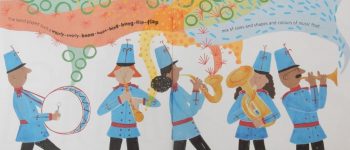
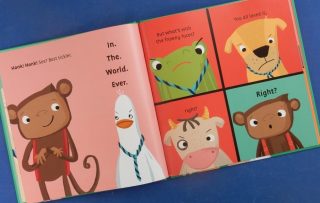
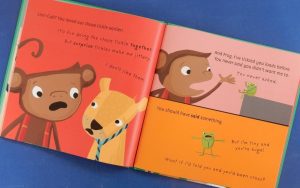
Dance Like a Flamingo

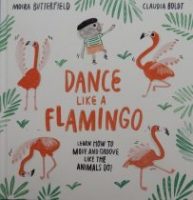
Dance Like a Flamingo
Moira Butterfield and Claudia Boldt
Welbeck Publishing

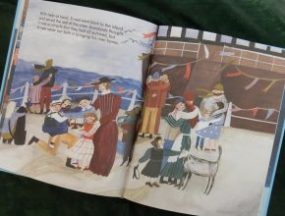
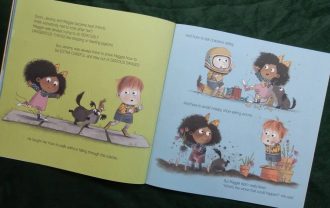
Little ones can receive a dozen dance lessons courtesy of the host of willing animal teachers in this lively picture book.

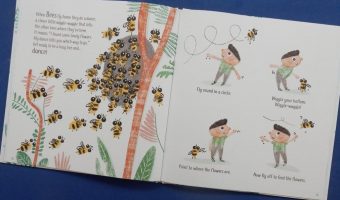
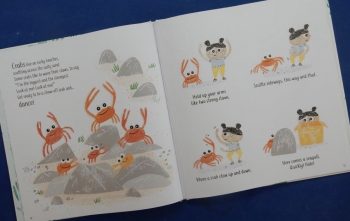
Whether they prefer to fly circle-wise, wiggle waggle their bottoms, point and fly like the bees, as they show fellow bees the way to their flower findings;

strut proudly as the peacock shows; or emulate the show-off crab, flexing claws and scuttling sideways in both directions, the instructions are here.

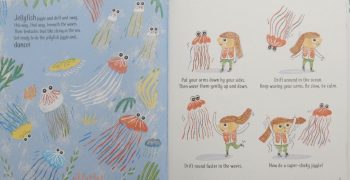
On the other hand (or tentacles) perhaps something a little more gentle in parts like the jellyfish offers, with floaty arm movements and slow, calm drifting might suit the mood: it does get faster though at the end.

I suspect the baby elephant dance will go down well – in more ways than one: make sure you have plenty of space and a soft landing if you do this with a nursery class.

Then after all the fun learning I’d suggest handing the finale over
to the group and letting them choose their moves, as the example on the final spread shows in the celebratory ‘wonderful world’ extravaganza.

With its step-by-step actions and Claudia Boldt’s gorgeous, funky illustrations, this book is terrific fun whether you choose to use it in an education setting or at home: an absolute joy from cover to cover.

While You’re Sleeping

While You’re Sleeping
Mick Jackson and John Broadley
Pavilion Books

Interestingly this collaboration brings together Booker Prize shortlisted author Mick Jackson and illustrator John Broadley, both well known for their books for adults, in a first book for a child audience; and what a superb enterprise it is.

Herein children will discover that during the time they spend sleeping, a myriad of humans are wide awake actively engaged in their world. So too are countless creatures be they owls on the hunt, foraging foxes, bats or hungry hares searching for food.

Imagine what it would be like if those cleaners hadn’t been busy on the buses and trains people take to work and school, while others clean the offices, shops and streets.

Then there are lorry drivers delivering their loads of food and other goods; post-office workers busy sorting all the mail; bakers cooking;

firefighters ready to answer emergency calls; those twenty-four hour shops and cafes; dedicated hospital staff on night duty; and ships with their crews under starry skies.

There’s a reminder that elsewhere in the world, while some children slumber, others will be in their classrooms or perhaps doing sporting activities and when their day is over, the sleepers wlll awake.

Speaking directly to young listeners/readers in a friendly tone, the narrative is a wonderful read aloud be it at bedtime or during the day. While with echoes of Eric Ravilious, John Broadley’s incredibly detailed illustrations are truly beautiful works of art (I’d love any of them as an original print on my walls.)

To open this book is like opening a gorgeous box full of jewels – each page is stunning – so too are the endpapers, the cover: the entire production in fact and to read it is like being shown around a gallery by a wise, gently spoken curator eager to open our eyes to how the world works.

A Journey Through Greek Myths

A Journey Through Greek Myths
Marchella Ward, illustrated by Sander Berg
Flying Eye Books

Classics expert Marchella Ward, courtesy of Little Owl and her grandpa owl, takes readers on an exciting journey through Ancient Greece and the Greek myths from the beginnings of the Universe in Greek mythology, right through to the tale of Daedulus and Icarus, via the Labours of Heracles in her spellbinding sequence of stories awesomely illustrated by Sander Berg.

Perched atop the Parthenon in Athens, Little Owl listens to her Grandfather Night owl as he begins to regale her with stories of the ancient Greek world, stories that had so he says ‘taught the owls all of their wisdom’, the first being of events before Athens even existed and of whence came gods that first the Greeks and then, all humankind came to know.

The stories are divided into several parts: Athens, (where we hear of The Birth of Zeus and the incredible Birth of Athena), Mount Pellon, Mount Parnassus, where the owls encounter Pegasus, and we’re told the tale of his friendship with Bellerophon;

the city of Thebes, Across the sea, The city of Argos,

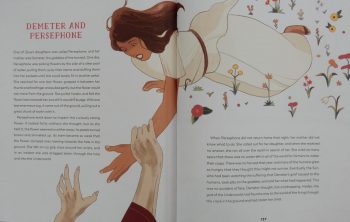
the Underworld (approaching which the two owls meet a third, White Owl that tells his favourite story Demeter and Persephone;

and finally, the ‘Land of the Living’, each of which acts as a stopping point on the journey we take with the two owls during a cool, dark night.

Be regaled by tales well known and less so, of gods and goddesses, and heroes as you tour the Mediterranean, learning too about the places where each story takes place and why it is important.

As well as the manner in which the myths unfold, I love the family tree at the start, the map of the stopping points and the end papers.

This book would make a smashing present for an older child (there’s a note before the title page that ‘some content may not be suitable for younger readers).

The Bear, the Piano and Little Bear’s Concert

The Bear, the Piano and Little Bear’s Concert
David Litchfield
Frances Lincoln Children’s Books

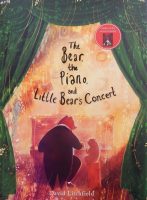
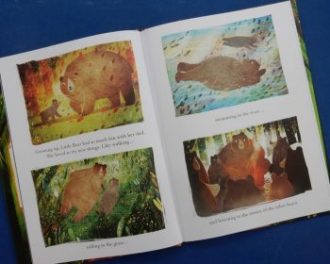
This is truly a very special book but sadly, the final book in the outstanding Bear and the Piano trilogy. Having so said, it really is a sublime finale.

The book begins with a recap of Bear’s wonderful achievements in his musical career and telling how he’d found it hard at first to settle back into forest life after the buzz of the city, until along came his daughter, Little Bear.

We see the two having a wonderful time together with Little Bear learning so many new things.

One day she makes a discovery and asks Bear what the thing is that she’s come across.

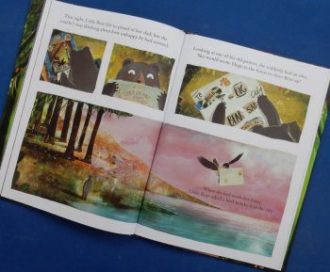
Then little by little her father recounts all his adventures in the city, talking of his days in the band. Little Bear senses his sadness and that evening comes up with a plan that she hopes will cheer him up.

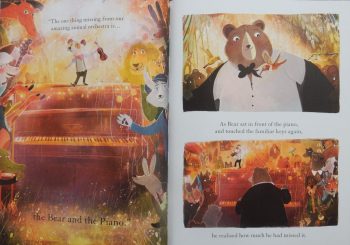
Will Little Bear’s idea succeed in enabling Bear to rediscover that magic of making music: perhaps with enthusiasm reignited he can even pass on that passion to his daughter?

David Litchfield’s illustrations are as always absolutely stunning, full of incredible detail and texture; and his colour palette is in places, appropriately dazzling.

The story too is pitch perfect for reading aloud at anytime, anywhere: I’d love to gather some youngsters together and share it in a forest setting. Indeed, the book is exquisite in every way and a must have.

Lottie Loves Nature: Frog Frenzy / Mermaid’s Rock: The Ice Giant

Here are two young fiction titles with ecological themes:

Lottie Loves Nature: Frog Frenzy
Jane Clarke, illustrated by James Brown
Five Quills

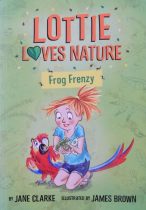
I’d not met nature-obsessed Lottie Boffin in the Al’s Awesome Science series but was excited to make her acquaintance now in her very own-eco adventure series for young solo readers.

In a cleverly and carefully constructed story so that youngsters learn a lot about the natural world as they read, Jane and James include a wealth of information (verbal and visual) via such scrapbook pages,

activities and experiments about such things as ants, worms, the frog life cycle and other froggy facts, hydroponics, potential pond residents and visitors, and creating a wormery.

Lottie, inspired by her favourite wildlife TV show presenter, Samira Breeze, decides to make a pond in her back garden using an old dustbin lid, in the hope that frogs will come and inhabit it and perhaps, if she writes up and sends in her nature notes to the programme, she might even win the opportunity to be a presenter on ‘Every Little Thing’.

However, new next door neighbour, Mr Parfitt with his pristine fake grass putting green is definitely not going to be enthusiastic about Lottie’s plans and he’s far from happy about her pet parrot but maybe she can enlist the help of his son Noah who aspires to become an inventor and programmer of robots. That’s when he made sure that his dad’s back garden is totally minibeast free and it will help him keep fit.

With Mr Parfitt’s ant infestation (on a special cake for a special visitor) to contend with,

not to mention a lively dog, and a plethora of parrot poop, will Lottie succeed in her environmental enterprise?

I look forward to Lottie’s Bee adventure coming early next year. So too, I’m sure will newly independent readers who meet her in this first Lottie Loves Nature book.

Mermaid’s Rock: The Ice Giant
Linda Chapman, illustrated by Mirelle Ortega
Little Tiger

There’s a decidedly chilly feel to the third Mermaid’s Rock adventure.

When Marina announces that she is to accompany her father to the Arctic so he can do his walrus research, her friend Kai is not happy. However Kai’s mum says she can stay with them so long as Marina’s father, Tarak, is agreeable. He is, and she does.

Before he leaves, Marina gives her father a bag of stones, each with an M on and he promises to keep in touch by dropping one each day through the whirlpool. In the meantime there’s the ‘most talented pet’ competition for Marina and her friends to think about.

On the sixth day of her father’s absence, when Marina goes to look for the stone, there isn’t one, nor the next day. Marina and her friends grab some necessary supplies and via the whirlpool, Operation Arctic Rescue is under way.

They soon discover that the ice has begun melting uncustomarily early, spelling danger. Can they find Tarak and get him to safety before it’s too late?

Newly independent readers, especially fans of the series will likely devour this story in a single sitting, enjoying Mirelle Ortega’s black and grey illustrations along the way, and afterwards can learn something about one of the important ecological issues our planet is facing.

The World Made a Rainbow

The World Made a Rainbow
Michelle Robinson and Emily Hamilton
Bloomsbury Children’s Books

What a gorgeous book this is, and it’s pitch perfect for children at the present time of continuing uncertainty when very little seems normal, and for youngsters a lot of what’s happening isn’t fully understood (and that’s only the children!)

Michelle and Emily’s story begins when everyone must stay at home and inevitably friends and relations are being missed – but only until ‘everything mends’ as the child narrator’s mum says unable to be more specific regarding time.

Meanwhile normal life is on hold but there are things that families can do and this one, like so many others during this 6 months of pandemic, have to carry on somehow, some way. And one way is to make a rainbow – that symbol of hope that so many of us have been displaying.

But mum has to work, so it’s down to dad to look after a little brother (‘who’s going berserk’) with the result that our narrator has to be extra creative.

As she works on her rainbow (aided by dad when he’s free ) the little girl finds each new colour stirs a memory or acts as a reminder of something

or somebody.

Eventually her creation is a truly special piece of art and one that she’s happy to put on display in her window so that everyone can enjoy it. And yes, things aren’t perfect but in the meantime there’s much she (and we) can be thankful for.

The story is so movingly and beautifully written and illustrated.

Thank you, Michelle and Emily and of course Bloomsbury Children’s Books for this touching, heartfelt book.

Yes, it’s one for now, but not just for now: it will surely act as a reminder to reflect on in the future, of that time in 2020 when, with ever more new challenges, we all pulled together as communities, showing what the mum in the book said, “All rainstorms must end, and this rainstorm will, too.”  As the little girl says in conclusion, “And we’ll still have each other when this rainstorm ends.’

(A percentage of the proceeds of sales will be donated to The Save the Children Fund.)

Turns Out I’m an Evil Alien Emperor / The Orphans of St Halibut’s

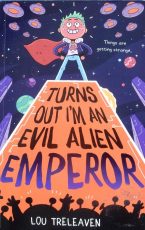
Turns Out I’m an Evil Alien Emperor
Lou Treleaven
Maverick Publishing

A month on from saving Earth from an alien invasion, things have got even weirder for Jasper and his sister Holly. He now knows that his true parents are slugs and that he too can turn into one  (especially at inconvenient times and often triggered by anger), as well as that he’s heir to a planet full of green slime.

Peculiar enough and more than enough to come to terms with surely, but not so. Despite reservations on the part of his foster parents (soon to be his adoptive ones), Mary in particular, Holly drags him off to her teen pop idol, Harry Handsome’s concert. Naturally Jasper has an ulterior motive for going however.

Thus begins another intergalactic adventure wherein seemingly HH is up to his old tricks helping Andromeda invade Earth and brainwashing the whole planet starting with the concert attendees. Why though; and what role is the Asbi supermarket chain in all this shenanigans?

Add to the mix, fluffy balls aptly named Fluffians, assorted aliens and robots, a spindly spider receptionist, an army of clones, plus coping with a surge of hormones and changes in Jasper’s body, as well as an upcoming adoption party; oh and regular things like attending school, and what readers have is an action- packed, slimy, fast moving story that will keep them turning the pages right through to the final Fluffy chirrup.

Can Jasper save the Earth again and can he do so in time to attend his adoption party? Pressure? Who says? After all’s said and done, ‘ It’s a wonderful world’  …

Another winner from Lou Treleaven, Jasper et al.

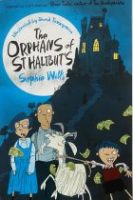
The Orphans of St Halibut’s
Sophie Wills
Macmillan Children’s Books

Readers who are fond of dark stories will love this grisly comedy of errors.

It stars eight year old Herc, his older sister Tig and their friend Stef, the only three orphans remaining at St Halibuts home for Waifs and Strays in the aptly named town Sad Sack. Also playing a significant role is Pamela, a goat.

Indeed, they’re now the only residents, due to an unfortunate freak library accident (for the matron who lost her life) and ‘Happy’ for the children,

After careful consideration, the children accept the utter importance of keeping their new-found freedom secret and thus some semblance of normality must be shown to the town’s inhabitants even though most rules are tossed aside with joyful abandon.

Into the midst of this jubilant happiness comes a letter duly delivered by postie Maisie. “DEATH is coming’ announces Tig, DEATH being The Department for Education, Assimilation, Training and Health coming to inspect the orphanage. The intention is to ensure the highest of standards are being adhered to; and should the residents not manage to deceive the inspector they’ll be sent to The Mending House of Sad Sack for troublesome children.

For sure the three have a pretty big task, but they’re both shrewd and clever. Is that sufficient to keep them living the good life?

Full of wonderfully funny, twisting, turning antics, mischief and mishaps, superb wordplays and delicious description, not forgetting the sprinkling of fantastic fiends, Sophie Wills’ comedic Victorian story world is one children will relish, (along with a game of football with a broccoli muffin) as will adult readers aloud.

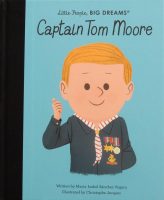
Little People, Big Dreams: Captain Tom Moore

Little People, Big Dreams: Captain Tom Moore
Maria Isabel Sánchez Vegara and Christopher Jacques
Frances Lincoln Children’s Books

We surely all know of the selfless fundraising achievement of national treasure, Captain Tom Moore, on behalf of NHS Charities Together and of his subsequent knighthood. How many of us though, know anything of the rest of his incredible life? Relatively few I suspect.

Now this new addition to the superb Little People, Big Dreams picture book biography series written by Maria Isabel Sanchez Vegara, children who followed him in the media , as he took his daily walk during lockdown, have the opportunity to read about the earlier life of this awe-inspiring veteran.

Tom was a Yorkshire lad who from a young age was passionate about engines of all sorts. At around twelve years of age he discovered an old, broken motorcycle, paid two and six for it, determined to repair and ride it on the road.

Having become an apprentice engineer he was called up to join the Duke of Wellington’s Regiment and was sent to India, a country he found initially strange, but to which he quickly adapted. Determined and brave, he rose to become a Captain and a spirit raiser of his team.

A team that also became his friends for many years until only he remained.

A slip while on his daily walk resulted in a hospital stay, a hip replacement and two knee replacements.

Still his spirit never faltered: he bought himself a treadmill online to strengthen his legs, and installed it on his drive.

As he approached his century, Captain Tom decided to celebrate with a pre-birthday 100 laps walk around his garden. Then the global pandemic hit the UK and Captain Tom had a new goal … the result of which was not the £1000 pounds he’d hoped for but a whacking £30,000,000. A-MAZ-ING!

Dream big and never give up: that’s what he did and that’s what we must all try to do, today, tomorrow and …

3% of the cover price of every sale goes to NHS charities – another reason to get hold of this terrific tribute to an incredible person, sensitively portrayed in Christophe Jacques’ illustrations.

Say Hello to the Sun / Under the Stars

Say Hello to the Sun
Dr Lin Day and Lindsey Sagar
Scholastic

This picture book is essentially, based on a song from Dr Lin Day’s Baby Sensory interactive developmental programme, illustrated with Lindsey Sagar’s bright alluring, patterned illustrations.

Starting with the sunshine, tinies are invited to greet in turn the moon beaming down and guiding, growing corn that provides food, twinkling stars,

the cooling rain, colourful flowers to bring cheer and loving friends with whom to play.

Embedded in each illustration is a small circle showing what look like Makaton symbols and the final double spread talks about ‘how to use this book’ and repeats all the signs.

Whether or not you and your little one goes to Baby Sensory classes, this enormously attractive book is worth adding to your collection to share again and again no matter what time of day it is.

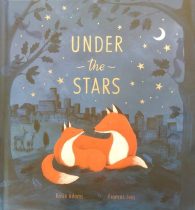
Under the Stars
Rosie Adams and Frances Ives
Little Tiger

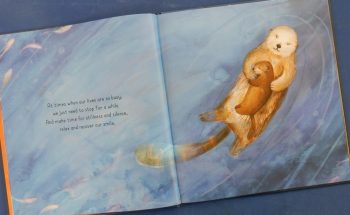
With glowingly gorgeous illustrations by Frances Ives and Rosie Adams’ gentle rhyming narrative that has a repeat refrain: ‘The world is a family: / we are all one, / …….. together / under the sun.’ an adult fox and a little one spend the day exploring and observing together from sunrise, until the stars twinkle and the moon shines bright in the night sky.

They watch squirrels playing, pause to relax as otter and its little one float on the water.

They listen to the sky humming with the beat of birds’ wings and enjoy their songs. Then in the cool of the forest, bear cubs share their findings, watched by the two foxes;  so too are the deer family and then under the starlit sky the parent fox reminds its cub, and readers, “The world is a family: / we are all one, / United together / under stars, moon and sun.’

Would that this were so, say I.

With its lilting words and beautiful scenes of the natural world, this is a book to read with little ones either at bedtime; or perhaps earlier in the day when there’s more time to talk about the ideas presented.

Human Journey / Prehistoric Pets

Human Journey
Professor Alice Roberts, illustrated by James Weston Lewis
Red Shed

Readers may recall the BBC documentary series researched and presented by biological anthropologist, Professor Alice Roberts about a decade back called The Incredible Human Journey and now at last we have this superbly presented illustrated book Human Journey for children.

In a dramatic telling, that includes sufficient but never an excess of detail, we’re taken on a journey way, way back to the beginning of time to trace our ancestors. Did you know that at the Dawn of Humankind, our early human ancestors lived on the grasslands of Africa some two and a half million years ago?

It’s those people whose migrations it’s possible to trace to other parts of the globe, and that’s what this fascinating, highly accessible book does. We follow the spread of humankind to Asia, then to Australia; then around 50,000 years ago to Europe where Homo sapiens encountered the Neanderthals.

Then come several spreads on the Ice Age after the peak of which, human hunters began to colonise the Americas – first North and then South.

There’s a map at the end tracing the entire human journeys; journeys where there were perils to face in the form of deserts, climate change, oceans, volcanoes, enormous creatures, floods

and even more. Incredibly however, the people adapted and invented, survived and thrived.

If you’ve ever pondered upon what it means to be part of the human race, this book is one to read. It’s one too where, with their wonderful details, the illustrations of James Weston Lewis merit close attention. There’s also a useful timeline and glossary.

For family bookshelves and school collections from KS2 on.

Prehistoric Pets
Dr Dean Lomax and Mike Love
Templar Books

If you’ve ever wondered what your moggy or your pooch’s ancestors long, long ago were like, then this book is for you. And even if you haven’t or perhaps don’t own a pet but are interested in the branch of science that is concerned with fossil animals and plants, called palaentology as is the author Dr Dean Lomax, then this book will fascinate you.

Herein Dr Lomax has selected seven animals, four of which are mammals: representing the rodents is Ernest the guinea pig, the Felidae is Flossy the cat; there’s Toby whose Canidae family first evolved some 40 million years back,

while horse, Pippa with her thick keratin hooves to help her run on both hard and soft ground, is the Equidae representative.

Each of these creatures, as well as budgerigar Lucky, Jasper the corn snake and Goldfish, Bubbles that belongs to a group of ray-finned fish that first appeared some 415 million years back – wow!

Every one has a double spread with a gatefold that opens to reveal, not only lots more fascinating paleontological information including a fossil file, but also an exciting, sometimes alarming pop-out creature, its prehistoric ancestor, which virtually springs to life before you.

Illustrator Mike Love provides the visuals and has done a terrific job in making every page alluring and exciting; indeed the design of the whole book is terrific.

Last: The story of a White Rhino

Last: The story of a White Rhino
Nicola Davies
Tiny Owl

This story of Nicola Davies’ is a fine example of how a relatively few, carefully chosen words can have a very powerful impact.

Nicola’s tale, narrated by a rhino was inspired by Sudan, the last male Northern White Rhino from Africa that died in 2018. From his captive state in a zoo situated in a grey city, the rhino talks of looking for another animal like himself before remembering his earlier life that was full of colour. A place where other rhinos roamed free and he stayed close to his mother by day and night

until the fateful day when a hunter came and shot her dead. The young rhino was captured, put in ‘a box’ and transported to a dreary place without flora and where ‘Even the rain smelled empty’.

There he speaks of being among many other ‘lasts’ that spend their days cooped up pondering upon their plight

and the state of the world where this is allowed to happen.

Then one day something wonderful happens; something that seems almost too good to be true for the rhino is taken back to his life in the wild and joy of joys, he’s no longer alone.

This is the first book Nicola has illustrated herself and her illustrations too are enormously potent, particularly the stark contrast between the captive grey environment and the colour-filled homeland and the finale.

There’s a page about the illustrations at the front of the book, which I won’t re-iterate in full but just mention the inspirational quote from environmentalist, Paul Hawken and endorse Nicola’s own “I believe that the world can change for the better, but it will change one heart at a time. Change your heart, change the world.’

I truly hope that this story will move others as it did this reviewer, to be part of that change.

I Am One / Our Little Kitchen

I Am One
Susan Verde and Peter H. Reynolds
Abrams Books for Young Readers

It’s never too soon to introduce a young child to the idea that s/he can make a change in the world and this gorgeous book by a team whose books I greatly admire, shows the way.

Subtitled ‘A book of Action’ this one is clearly much more focused on being active than several of the others in the series and it’s a pitch perfect demonstration, given by a child of how seemingly simple actions can make all the difference.

Here we witness the planting of a single seed, a brushstroke, a note ‘to start a melody’, a step to set off on a journey, and I particularly love the “One brick to start breaking down walls’ sequence of actions

so pertinent in our increasingly troubled times.

The harmony between Susan Verde’s words and Peter H. Reynolds’ signature style illustrations is what truly makes this such a special introduction to social activism; it’s tender, inspiring and uplifting.

Furthermore, Peter has dedicated the book to Greta Thunberg and in the final author’s note, (that also contains a beautiful meditation) Susan writes that her inspiration came from a quote from the Dalai Lama: what more can one ask?

A conversation opener, but equally or more importantly, an impetus to seize that inner power and take action.

Also about taking action – singly and as a community is:

Our Little Kitchen
Jillian Tamaki
Abrams Books for Young Readers

Inspired by her own experience of volunteering in a community kitchen, here’s a really tasty, deliciously diverse, offering from Jillian Tamaki. Now, with hands washed and aprons on, we’re ready to go in the community kitchen. We’ll create a meal – something that happens every Wednesday and it’s a bit of a squash to accommodate all the enthusiastic volunteers.

Luckily, they have their own little garden so there’s no need to look too far afield for ingredients; and there appears to be a fair bit stored away that needs using up and there are donations from the food bank. (Beans again – can they be creative?) It’s definitely a case of waste not, want not (although the odd item is clearly no longer fit for human consumption.

This team clearly makes its own music as they work: ‘glug, glug, chop chop, sizzzzzzzzle, pick! Peel, trim, splash! Toss, squish, mmmm!’ Then comes the shout, “Fifteen minutes!’

The countdown is on as the hungry start coming in; they clearly know one another – there’s plenty to chat about while they wait.
Eventually the leader gives the order “Let’s go!” and in comes the food – yummy and very ‘SSSSSSLLLLLUUUURRRRRPPPP!’- worthy.

Speech bubbles abound, providing a running commentary by the workers and the recipients of the bounty produced by the team; indeed, the entire atmosphere is cheery and relaxed,

made so evident by Jillian Tamaki’s vivid colour palette and the fluidity of her lines. In fact the entire book is a veritable feast for all the senses. There are even recipes on the front and back endpapers.

Shhh! QUIET!

Shhh! QUIET!
Nicola Kinnear
Alison Green Books

Little Fox is a quiet creature, a close observer of the wildlife around her about which she loves to make up stories. The trouble is though that her friends are exceedingly noisy and their boisterous activities drown out all her attempts to regale them with one of her tales.

One day Raccoon becomes aware that Fox is looking especially sad, tells the others to be quiet and asks Fox what’s upsetting her. Happily Owl, Squirrel and Raccoon are all lovers of stories and ask to be told one there and then.

Of course, Fox is ready to oblige and starts her tale of a bear; but no sooner has she spoken the word ‘bear’ than the others are off roaring and pretending to be bears up in a large tree. Back on the ground below Fox notices some claw marks that look suspiciously like those of a real bear.

But are her friends ready to listen? Oh dear me, no: instead they frolic in the river then cavort across a bridge while Fox grows increasingly alarmed.

Will she ever get them to stop and heed her words? And if so, who will listen while she tells her story?

Nicola’s narrative is a super one for adult readers aloud to let rip with, as well as for youngsters to join in with the noisy exuberance of Fox’s friends. This exuberance spills out into her illustrations of the drama and she has included some diverting details including Fox’s book, the minibeasts and Bear’s teddy comforter.

Sona Sharma Very Best Big Sister / Agents of the Wild: Operation Icebeak

Here are two terrific young fiction titles from Walker Books

Sona Sharma Very Best Big Sister
Chitra Soundar, illustrated by Jen Khatun

Young Sona Sharma lives with her family in the Tamil Nadu city of Chennai.

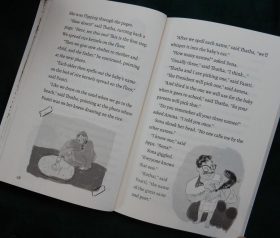
As the story opens, she’s getting increasingly agitated about the forthcoming birth of a new baby sibling, an event about which the rest of her household and extended family seems obsessed. (It’s also one that children in a similar situation to Sona might find difficult adapting to).

Sona most definitely needs the sympathetic listening ear of Elephant, her best friend and constant companion (except at school). Everybody seems set on Amma having a baby boy and when talk of the naming ceremony comes up, Sona resolves to help her Appa find the perfect girl’s name (her Amma is ‘looking for boy names’ he tells her.) Nobody in the family is allowed to know if it’s a boy or girl until after the birth.

Even with this important task, sharing is still a big issue for young Sona: can it be resolved before the baby arrives?

Can Sona become the very best big sister and live up to that family motto ‘Iyavadhu Karavel’? (Always help as best you can.)

I totally fell in love with Sona and the rest of her family and community (how great to have a woman auto driver). Through Chitra’s absolutely gorgeous story of welcoming a new arrival into the hearts and home of a loving community, told from Sona’s perspective and beautiful line drawings by Jen Khatun, readers/listeners will encounter some of the traditions

and rituals – cultural and familial – of this large Indian Hindu family which may well be new to them.
I can almost smell the jasmine and feel the steamy heat as I’m transported to one of my most favourite parts of the world – one I can’t wait to revisit once this terrible pandemic allows. Till then I have this warm-hearted tale to re-read over and over (until I can bear to pass it on). More please.

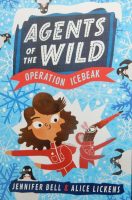
Agents of the Wild: Operation Icebeak
Jennifer Bell and Alice Lickens

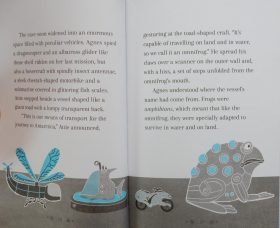
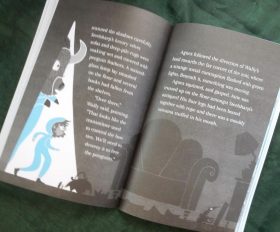
Now permanent SPEARS field agents, Agnes and her partner Attie receive an emergency call and before you can say ‘penguins’ the two of them are disappearing down a speed funnel, destination Antarctica. It’s from there, sent by the team at the marine outpost, that the distress call came.

What is causing the seismic tremors being felt within and around the vicinity of the treatment centre, outpost 22? Why are all the Adelie penguins behaving in such an odd fashion? And, what on earth is the celebrity presenter and rare bird expert Cynthia Steelsharp, (one of Attie’s heroes) doing in a tent in the middle of the ice fields?

Moreover, why is she so interested in the little shrew’s trinoculars (that he’d needed to pass a two weeks training before being allowed to use in the field)?
Looks as though it’s a case of ‘operation species rescue’ for the SPEARS partnership (even though it may also mean an operation rescue of one of the pair).

Once again, team Jennifer (author) and Alice (illustrator) successfully interweave ecology and biology into an exciting and very funny story making it both enormously entertaining and educative (not a hint of preachiness at all).

Established Agnes and Attie enthusiasts (and I know a fair number) will devour this, likely in a single sitting; but you don’t really need to have read the first book to love this one, though if you’ve missed it I’d recommend getting hold of book Operation Honeyhunt and then move on to Operation Icebeak.

If you’re a teacher of 7s to 9s and would like to encourage your children to become eco-warriors, either book makes an enormously enjoyable class read aloud. (Back-matter includes information about the fragility of the Antarctic ecosystem and how readers can help reduce global warming.)

A word of warning – two actually: first -never say the word ‘onesie’ to your partner, let alone one clad in a watertight thermal body suit with SPEARS emblazoned across it; second – it doesn’t always pay to trust little lizards with the ability to change their colour.

Yellow Dress Day / What’s In My Lunchbox?

Thanks to New Frontier Publishing for sending these two recent picture books:

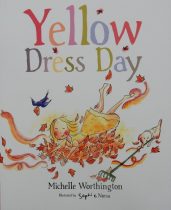
Yellow Dress Day
Michelle Worthington, illustrated by Sophie Norsa

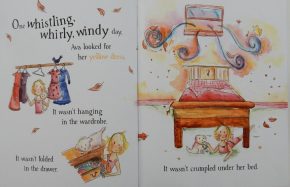
Ava has a particular penchant for dresses, dresses of all colours and she chooses which of them to wear according to the feeling she has about the day, when she greets it each morning.

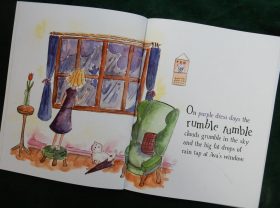
The red dress is reserved for warm, sunny days; on pink dress days her garden is all abuzz with bees enjoying the flowers; purple dress days are those when rainstorms are around;

snowflakes swishing, swirling and sparkling in the sky signify the need to select her blue dress, while yellow dress days have a whistling wind that shakes the tree branches and send their leaves all a-scatter.

On one such whirly, windy day, Ava’s dress isn’t to be found in any of its usual places …

but then she recalls that the previous day had been similar. Oh dear! Now she can locate its whereabouts but she can’t put it on in the state it’s now in.

Perhaps her mum can find something of the appropriate colour for her to use instead so she can go out and enjoy the day playing with her pup.

Michelle Worthington’s story with a scattering of onomatopoeia  that young listeners will love, is great to read aloud, and equally fun illustrations by Sophie Norsa, capture the different moods of the days beautifully.

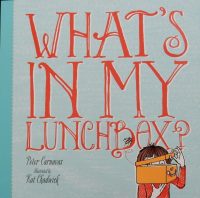
What’s In My Lunchbox?
Peter Carnavas, illustrated by Kat Chadwick

This book really made me laugh. I was expecting it merely to be a story about a picky eater but it’s SO much more than that.

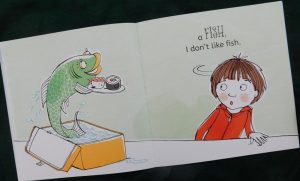
The boy narrator is something of a fusspot when it comes to the contents of his lunchbox – he eschews the apple; fish is a definite no-no – I don’r blame him on that one;

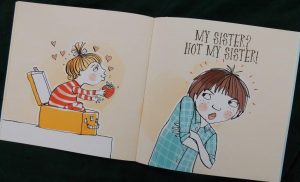
ditto the egg. I’ve no idea how what emerges on day four has managed to hide itself in a container with so small a capacity, and even more so the item for day five.

I imagine day six’s lunch item would definitely discombobulate any self-respecting boy …

so what about day seven? Could something therein on that particular day perhaps cause a rethink on the narrator’s part?

WIth its repeat patterned text, every page of this story is a starting point for another story – one that a child creates in response.

Ideal for those in the early stages of becoming readers to try for themselves, or for class sharing, when anticipation will be high throughout, and with Kat Chadwick’s terrific illustrations, this is such a fun read. Make sure you sample the front inside cover too.

Interview with a Tiger

Interview with a Tiger
Andy Seed and Nick East
Welbeck Publishing

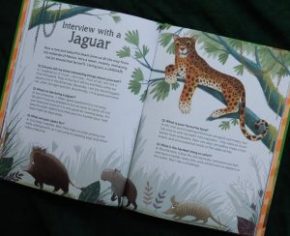
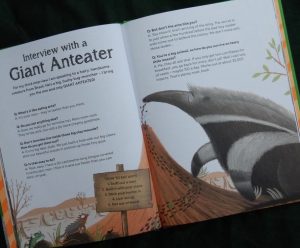
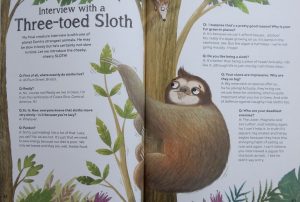
Ever fancied getting close up and chatty with some clawed creatures? Probably not but nevertheless, the creators of this book, author Andy and Nick (illustrator) would have readers believe that is just what they’ve done. Courtesy that is of a unique invention named a tranimalator that enabled Andy at least, to speak directly with ten creatures of the chelate kind. (Maybe Nick had his own ‘viewing from afar’ machine to facilitate creating his funky illustrations.)

Now, without further delay, let us too meet the interviewees, starting with a Bengal tiger hailing all the way from the wild grasslands and jungles of India.

The questions are tailor made for each animal, so our tiger is asked about her stripes, hunting, food preferences and catching thereof, offspring, her partner, her ideal day, dislikes, adversaries and rivals. Oh! And apparently, Def Leppard is her favourite band.

Other big cat interviews are with an extremely rare Snow Leopard; a (don’t call me spotted, call me rosetted) Jaguar from the Mexican wetlands, (3rd biggest in the cat ranking order); and the mighty African lion(ess).

There’s a yellow-eyed wolf that only howls to keep in touch with pack members or scare off other wolves. Apparently, such animals eat not only the flesh of their catches but also pretty much every other part too. Cheeky creature this one, talking of the online ordering habit of humans.

If you prefer bug-munchers then head straight to the Giant Anteater pages where you’ll discover how they extract their next meal – ants or termites – by licking up the tasty treats from their holes with their long, sticky-spit covered tongues. Interestingly anteaters lack teeth and have tiny mouths.

Or, why not try meeting the tough, fearless Honey Badger (though it will eat all manner of plant and animal fare) but it’s pretty small (think little dog size).

Don’t miss the chat with a Polar Bear, or the Giant Armadillo and the final, Three-toed Sloth either. The last one clearly has a sense of humour and will make readers laugh at his responses. Tee hee!

This is such a fun, hip way of presenting information – a considerable amount of it – in a memorable fashion that will appeal particularly to young humans that prefer a touch of light-heartedness to their learning.

I Really Want to Shout!

I Really Want to Shout!
Simon Philip and Lucia Gaggiotti
Templar Books

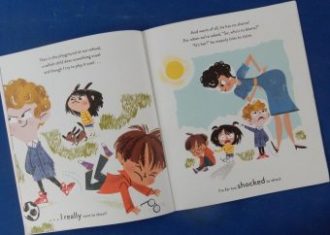
Author Simon Philip and illustrator Lucia Gaggiotti deliver with high energy and humour, a third in their series of life’s vital lessons.

The opening lines of the little girl narrator go like this: ‘Sometimes I find it really tough / to make sure I’m not in a huff / because there’s simply so much stuff / that makes me want to shout.’

Well, it is pretty infuriating to have to eat all your ‘green and yucky’ things before having your pudding, as well as when you have stacks of things you want to do, your parents insist it’s bedtime.

School’s no better – getting blamed for someone else’s meanness is assuredly, a letting off steam with an explosive scream occasion.

Thank goodness then for a best friend with whom to share all that angst, somebody to make you laugh and offer rage-coping strategies – even if the teacher’s less than impressed.

Thank goodness too for an understanding Dad who will comfort and put forward other shout-control suggestions – not a total panacea but assuredly they go a long way towards solving the anger conundrum.

We all get angry occasionally, perhaps more often than normal at the moment, but like the determined protagonist here, knowing what to do about it makes SO much difference.

Youngsters need books like this rhyming, high octane drama more than ever right now: ones that offer ways forward in a fun non-preachy style that you can share and enjoy over and over.

The Leaf Thief

The Leaf Thief
Alice Hemming and Nicola Slater
Scholastic

Much as I hate to admit it, there are already signs that autumn is upon us and yes, it is as Squirrel says at the outset of this story,  ‘a wonderful time of the year’ with the sun shining through the leafy canopy ‘red, gold, orange … ‘

This particular squirrel however, is a highly observant creature for suddenly comes the cry …” one of my leaves is missing! Where is it?’.

So distressed is Squirrel that implications of stealing follow as first Bird

and then Mouse are interrogated, all the while the former attempting to convince Squirrel that it’s merely seasonal change that’s occurring.

The following morning though, with more leaves missing, Squirrel starts up again and after more accusations, little Bird suggests some relaxation techniques.

These at least calm Squirrel temporarily but next day poor Bird is on the receiving end of Squirrel’s ‘leaf thief’ allegations.

It’s time for the frustrated Bird to provide a fuller explanation about this ‘Leaf Thief’ and convince Squirrel once and for all about what has been happening.

Finally Squirrel seems satisfied and heads off for a good night’s sleep. What though will happen the following morning? …

Let’s say no more, except that the finale almost had me spluttering my hot chocolate everywhere.

Actually not the absolute finale, for on that spread Alice gives information about some of the seasonal changes that happen every autumn. Her story, told entirely through dialogue is a smashing one to read aloud (so long as you can manage not to giggle too much).

Nicola’s autumnal scenes provide the perfect complement to the telling, showing with aplomb, the high drama unfolding, and turning the characters into a talented cast of actors no matter whether they’re playing a major or minor role.

A Poem for Every Autumn Day

A Poem for Every Autumn Day
ed. Allie Esiri
Macmillan Children’s Books

Allie Esiri has selected 61 autumnal poems for this terrific poetry collection to take readers through from 1st September to 30th November.

For this poetry-loving reviewer much of it was a trip down memory lane, some of which, including Christina Rossetti’s Who Has Seen the Wind?, William Blake’s The Tiger, Someone Came Knocking (Walter de la Mare) and Leigh Hunt’s Abou Ben Adhem took me right back to my primary school days when I learned them by heart.

I’m back in my secondary classroom with my English teacher reading us Edward Thomas’ Digging, Hardy’s Drummer Hodge, Betjeman’s Diary of a Church Mouse and Robert Frost’s The Runaway with that beautiful soft Welsh lilt to her voice.

Then I’m up on the stage in my final year at the same school performing those lines from Longfellow’s The Song of Hiawatha.

Some of my favourite poems are included: there’s Shakespeare’s Sonnet 116 ; and Robert Frost’s The Road Not Taken; I can think of no better way to start October than with that.

It’s great to discover new things too.
Surprisingly I’d not comes across John Agard’s terrific poem about bullying, The Hurt Boy and the Birds, beginning ‘The hurt boy talked to the birds / and fed them the crumbs of his heart’ , the final lines of which are, ‘But the hurt boy talked to the birds /and their feathers gave him welcome – // Their wings taught him new ways to become.’

Bang up to date is Michaela Morgan’s Malala: the opening verses  are: ‘A girl with a book. A girl with a book. / That’s what has scared them – / A girl with a book. // They get on to the bus. / They call out my name. They aim. And they fire. / A shot to the brain.’

I was greatly moved by all the war poems chosen for November, and by James Berry’s Benediction, also new to me, that goes like this:
‘Thanks to the ear / that someone may hear // Thanks for seeing / that someone may see // Thanks for feeling / that someone may feel // Thanks for touch / that someone may be touched // Thanks to flowering of white moon / and spreading shawl of black night / holding villages and cities together’

Reminding us of the way smell and taste can bring back long forgotten memories, Crab Apples (Imtiaz Dharker) is another exciting discovery for me: ‘My mother picked crab apples / off the Glasgow apple trees / and pounded them with chillies / to change / her homesickness / into green chutney.’

Much as I really don’t want the summer to end, this treat of a book will assuredly help me feel my way through the shortening daylight hours as I read A Poem for Every Autumn Day.

Butterfly Brain

Butterfly Brain
Laura Dockrill and Gwen Millward
Piccadilly Press

Gwen Millward’s cover for this book is absolutely delightful; don’t be beguiled by this however. What’s inside is a story about a boy dealing with his grief. There’s even a warning on the first page informing readers that what follows is ‘rather strange and gory.’

Time and time again, Gus gets into trouble; he breaks the rules at school, is rude to his teachers, angry towards others and is always leaning back on his chair, taking not one scrap of notice of warnings about injury from those in school or at home whose anger he’s aroused.

Then one day, the inevitable happens …

CRACK! and that crack becomes a large gap through which Gus’s brains with his dreams, understandings, feelings and memories are exposed for all to see.

A butterfly appears – his very own brain butterfly – a guardian guiding light, it says, but that too flies away. There’s only one thing to do.

Out of the window and up into the night sky goes the pyjama clad boy in pursuit.

During their journey Gus learns how important memories are, be they good or bad, including those buried deep within. He revisits long gone, alarming dreams, learning of one that should not be left behind, and discovers the vital importance of the imagination.

Is he ready finally to own the secret and the painful fear of loss?

Enormously moving, forthright, and written in rhyme, this is a truly heart-rendingly incredible book that can speak to everyone, child and adult, through its words (Laura’s) and its powerful pictures (Gwen’s) rendered in mood-invoking hues.

A definite keeper this.

The Goody

The Goody
Lauren Child
Orchard Books

We’ve probably all met them – the goody goodies; but Chirton Krauss is by all accounts, ‘the very goodest’. He even does good things without being told. He consumes his least favourite vegetable, broccoli, washes his hands thoroughly after using the loo and goes to bed on time without so much as a murmur.
His sister Myrtle on the other hand is anything but a good child. She never cleans out the rabbit hutch when it’s her turn – why would she when Chirton will do it for her?

Nobody invites her to parties any more and she’s been told she’s not good so many times, she now has a reputation to live up to. Moreover their parents have given up trying to make her do the good things her brother does without question.

But then he does start to question: why should Myrtle not have to eat her veggies and why should she be allowed to stay up late watching TV, stuffing herself with choco puffs and dropping them all over the floor?

Maybe, just maybe, being a goody isn’t actually so good after all.
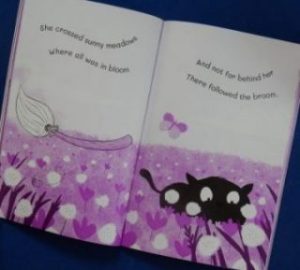
Could it be that a change is about to come upon our erstwhile goody, goody boy? And what about Myrtle? Might changes be afoot in her too? …

Delivered with Lauren Child’s unique humour and charm, and her idiosyncratic illustrative style she presents a smashing ‘goody versus naughty’ story that demonstrates how important it is for children to be allowed to be themselves and to be kind.

Whatever way youngsters present themselves to the world, they’ll love this book with its wonderfully textured art, credible characters and wry look at family life Krauss style.

Honey for You, Honey for Me

Honey for You, Honey for Me
collected by Michael Rosen, illustrated by Chris Riddell
Walker Books

I danced around the kitchen and leapt in glee on opening the parcel containing this book from the team that gave us the anthology A Great Big Cuddle.

It’s an absolutely stonking first book of forty nursery rhymes and one of the very best gifts you could give a baby or toddler.

Michael has always been fascinated with nursery rhymes calling them ‘surprising little dramas, full of mysteries and unanswered questions.’ Like this reviewer he’s been an avid collector of books of nursery rhymes and in this new one of his, Michael has put not only popular favourites and playground chants, but also some rhymes that have lain forgotten perhaps for a generation or two.

From cavorting elephants en route from Wibbleton to Wobbleton, wibbly wobbly jelly and frizzle frazzle sausages,

as well as dancing ones summoned into life by a whistling boy, a mop-consuming dog and a ton weight of a giant who’s all a-tremble at the mere sight of a mouse – we know we’ve entered that magical land of topsy turvy where playful language is loved for the sheer delight it offers both to those who hear it and to those who utter it.

Chris Riddell’s illustrations are outstanding, making the characters utterly memorable in a new way, be they of those you might already have met such as the all in black clad Miss Mary Mack and Little Poll Parrot or some delightful revelations that for me were the hiccup remedy …

the hungry frog and for the sheer joy of sharing something delectably new and bouncy to boot, ‘Dibbity, dibbity, dibbity, doe, / Give me a pancake and I’ll go. // Dibbity, dibbity, dibbity, ditter, / Please to give me a bit of fritter.’

For utter adorableness, Chris’s character illustration that completely stole my heart was The man in the moon.

Guaranteed to become a favourite in any household with young children, in nursery and early years settings and with anybody who wants to promote a love of language and art for their own sake (surely, that’s pretty much all of us), this is joyful magic from cover to cover.

Mason Mooney Paranormal Investigator

Mason Mooney Paranormal Investigator
Seaerra Miller
Flying Eye Books

Aspiring paranormal investigator, Mason Mooney resident of the terrifying town of Grimbrook is determined to discover the cause of legendary freaky phenomena affecting the neighbourhood.

It all begins when he receives a letter from Iris a recent purchaser of Tanglewood Mansion telling of strange goings on in the old house and the threat of a curse written on her sister’s mirror.

Off he sets with his investigator’s gear on the allegedly fateful morning of 1st October; but his first impression of Iris is far from favourable and her big sister seems thoroughly unpleasant.

Luckily Mason is well prepared but things quickly ramp up a notch with the appearance of a new message.

Mason decides to hold a séance and is soon confronted by …

Then who should turn up but Mason’s worst nightmare, the cocky Trent Reilly and his Paranormal Society whose team Mason had failed to become part of.

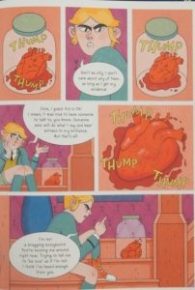
The fact that Mason carries his heart around in a jar,

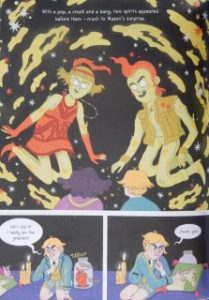
three cursed spirits to contend with and that deadline to beat, who will prove to have the real talent? Perhaps Iris herself with a single selfless action might just be able to break the heinous curse and save her sister?

But what of that involving Mason’s heart? A loophole maybe? But that’s for another time, for where one story closes, another one opens …

This graphic novel with its underlying theme of sibling jealousy, the combination of weird characters, lurid art, and an accursed setting, make for a decidedly spooky read,

The Inkberg Enigma

The Inkberg Enigma
Jonathan King
Gecko Press

Meet Miro and Zia, residents of the small fishing town, Aurora, nestled in the shadow of a mysterious castle.

Miro is an avid reader; school acquaintance Zia takes her camera everywhere. A chance encounter between the two characters sets them off on an adventure with Miro reluctant at first to get involved.

Zia’s response to Miro’s comments about Jules Verne and the term adventure, ‘What do you think this is? This is an adventure. This is how you have adventures. You find cool things and you do them … You don’t just READ books about them!’ still don’t persuade him yet somehow Miro finds himself sucked into attempting to unravel a mystery that involves historic corruption, some extremely shady characters currently running the town, not least the somewhat sinister mayor, and some decidedly weird sea creatures.

Something very odd is going on but what?

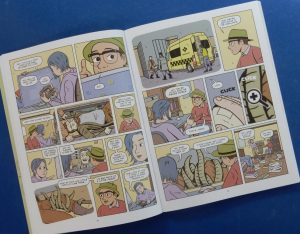
Driven by a powerful narrative, exciting, humorous and scary in parts, this plot twisting page-turner is skilfully delivered in graphic novel style by Jonathan King who has a background in filmmaking; indeed it would make a smashing film.

What’s not to love, especially since, for one of the characters, books play a vital role in the story. KS2 readers and beyond, especially those with a preference for visual story-telling will simply gobble it up.

The Little War Cat

The Little War Cat
Hiba Noor Khan and Laura Chamberlain
Macmillan Children’s Books

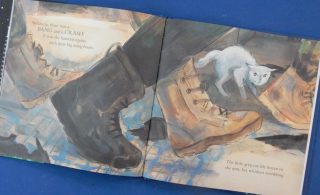
This story was inspired by a real man ‘the cat man of Aleppo’, Mohammad Alaa Aljaleel, a truly kind individual who set up a sanctuary that became home to hundreds of cats in his home city after his family left for safety.

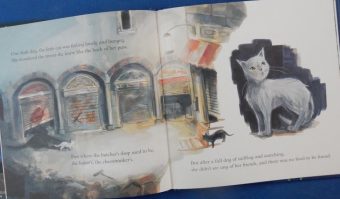
It became a place not only for the cats; adults young and not so young also came ‘to help and play, making it a place of love and hope for everyone’. So Hiba tells readers in a note at the end of her story, a story that begins with a little grey cat living a contented life in Aleppo. But that was before the war which brought with it terrible changes including those tramping big boots and a lack of food for the little cat .

As time passes, the scared creature kept to the shadows, his hunger inceasing.

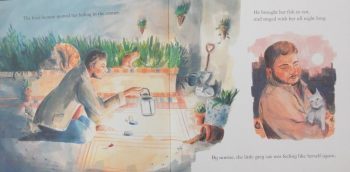
Then one day she sees someone different – a gentle, soft spoken person – and she follows him until almost at the point of exhaustion, they reach somewhere safe and she hides herself away till the kind man sees her, feeds her and stays with her the entire night.

The following morning restored and sated, the grateful cat notices something and she knows just what to do … It’s time to pay forwards the kindness she’d been shown.

Hiba Noor Khan and Laura Chamberlain together show the transformational effect of kindness; something the author writes of in relation to the war in Syria, but it’s also something that many of us have discovered during the pandemic.

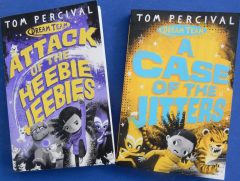
Attack of the Heebie Jeebies / A Case of the Jitters

Attack of the Heebie Jeebies
Tom Percival
Macmillan Children’s Books

Tom Percival is extremely empathetic and skilled when it comes to creating highly engaging picture books dealing with children’s emotions – think of Ravi’s Roar and Ruby’s Worry for instance.

Now comes the Dream Team series (this is the first) that aims to help slightly older readers explore childhood emotions.

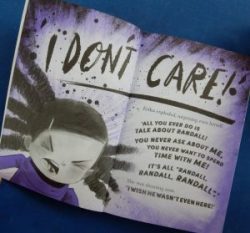
Meet Erika Delgano who is far from happy. Her baby brother is getting away with everything, ruining her favourite toy, scribbling on her pictures and generally making an atrocious noise. Worse than that, her parents are too tired or even too busy to talk to her.
Angry to the point to exploding,

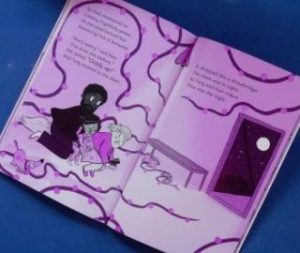
Erika stomps off up to bed; but, going to bed angry can result in bad dreams, an Angermare indeed. Uh-oh!

She finds herself in a very strange world with rainbow coloured trees, bouncy grass and waterfalls that flow in an upward direction. This world powered by dream crystal is the province of the Dreamteam whose role it is to protect children from Angermares and Anxietymares. However, weird creatures called Heebie Jeebies (fluffy beings with fangs) have invaded Erika’s dream and are consuming it.

They also steal a vital object – a powerful dream crystal – that could assist the girl in returning home safely, worries overcome, before the end of the dream cycle. The alternative is that she remains forever trapped in the Dreamscape.

With a host of weird characters in addition to the titular ones,

including a stoneman Wade and Madam Hettyforth, Tom has deftly, sensitively and with gentle humour, woven together a wonderful story with several threads, that explores angry feelings and their management.

With a purple colour theme, his fantastic illustrations are full of wonderful details and add to the impact of the book.

The development of emotional literacy in children is crucial if they are to grow up confident, happy, well-adjusted individuals. Tom deserves accolades for his contribution to that end in a way that encourages both self-reflection and conversation.

Whether or not there’s a new sibling at home, this is a corking book for home or school reading.

A Case of the Jitters
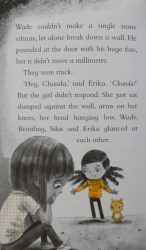
The second adventure begins with Erika contemplating a notice about the school talent show and desperately trying to think of a talent of her own to perform when suddenly she receives a communication via the magic crystal from Silas of the Dream Team. They have a rather tricky case and her help is required  with a girl named Chanda Anand.

Chanda is decidedly lacking in confidence, her dreams being haunted by a jittery dark shadow that refuses to go away, even in the daytime, such is its power.

Now it’s up to the Dream Team to help her regain control of both her dreams and her life. It certainly won’t be an easy task, but courageous Erika isn’t one to give up easily. Could it be that she does indeed have a special talent?

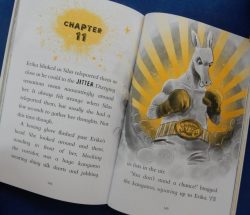
Another superb read (you have to work on your inner demons in order to deal with those outside of you) wherein friendship features strongly, anxiety is got to grips with and self-belief emerges. And, another set of terrific illustrations, this time with yellow, and some great new characters including a boxing kangaroo.

What next for Erika in Dreamteam story 3?

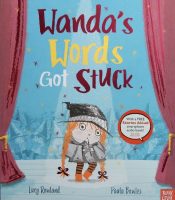
Wanda’s Words Got Stuck

Wanda’s Words Got Stuck
Lucy Rowland and Paula Bowles
Nosy Crow

Written by speech and language therapist Lucy Rowland, this is an enchanting story of little witch Wanda who, determined as she might be, just can’t get her words out.

Then a new and very shy little witch Flo joins her class at school. Wanda notices and empathetically and wordlessly makes her feel welcome using alternative means of communication.

Before long the two become inseparable and the following day teacher Miss Cobweb announces a Magic Contest. The friends spend all their time after school trying out spells but still for Wanda, words won’t come.

Come Friday evening, it’s contest time: Flo’s full of excitement; Wanda’s full of fear. The spelling gets under way but quickly spirals out of control putting Flo in great danger.

Can Wanda finally summon up her courage and some magic words to save her best pal?

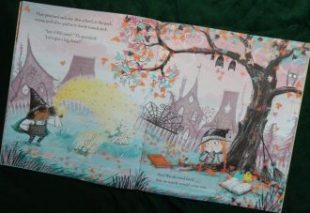
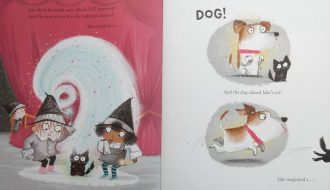
As a primary/ early years teacher I have over the years, worked with a great many children who for one reason or another struggle with their words. It’s terrific to have a story such as Lucy’s, wonderfully illustrated by Paula Bowles, that provides an opportunity to see things through Wanda’s lenses. Not only is it helpful to fellow strugglers, but equally their classmates and friends will likely become more aware and empathetic towards others like Wanda, who even on the final page, knows that words aren’t always the best way to express how you feel about someone especially your bestie.

In her captivating, warm illustrations. Paula captures Wanda’s feelings – her anxiety is palpable, as is her fondness for Flo.

A perfect foundation stage story time book that speaks for itself.

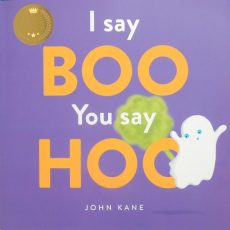
I say BOO You say HOO

I say BOO You say HOO
John Kane
Templar Books

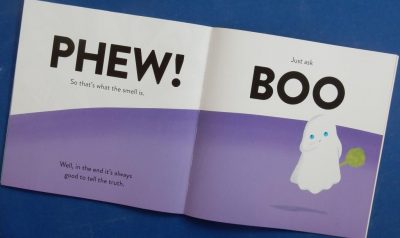
In his previous interactive ‘I say’ offering John Kane had readers shouting ‘underpants, underpants’ at the top of their voices. When you read this one a fair number of ‘stinky poo’ utterances will be required.

So, let’s find out what’s actually between the covers of the book. There’s a little ghost named Boo who (oops, nearly!) lives in a haunted house and is uncharacteristically, afraid of the dark.

Now to tell the story requires the reader’s help, duly prompted by a series of cues – verbal and visual. There’s a tree, dark (which means you must bark as per instructions,) oh yes, and crows – nose holding needed for a sighting of those particular corvids – this picture may prove a trifle challenging …

In fact I have to admit that by the end of the book I really didn’t know whether I was coming or going – barking (mad), shouting or indeed tearing my hair out.

As for the noxious emanations, I’m certainly not owning up to any of those;

and it’s as well Boo is in a hurry to reach home before dark.

However, even after telling us to bid the little apparition a fond farewell, the author has the chutzpah to issue an invitation for a further reading of the book.

The thing is, he knows (should that be hopes, on his part) and I know to my cost, what the answer will be once you’d shared it with an individual, a few children or indeed a whole class. It’s quite simply another superbly ridiculous repartee of to-ing and fro-ing.

The Monsters of Rookhaven

The Monsters of Rookhaven
Pádraig Kenny, illustrated by Edward Bettison
Macmillan Children’s Books

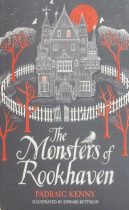
Prepare to be intrigued, startled, uncomfortable, terrified and mesmerised as you follow orphan siblings Jem and Tom through a rip in the air and into the grounds of an other-worldly manor house, Rookhaven and almost into the mind, much of the time, of Jem herself.  She is welcomed by one of the residents, Mirabelle, and thus spends time with other members of The Family while her brother recovers from his sickness.

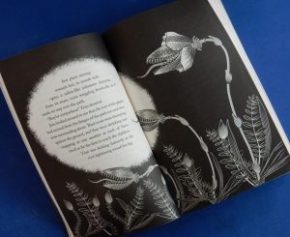
I’ve not come across the work of Pádraig Kenny before but he’s an enormously talented writer who, in this instance, has interwoven motifs from both contemporary and classic stories producing a book that, rather like the carnivorous flora standing sentry on the Path of Flowers therein,

grips the reader tightly; it feels as though it will become a neo classic.

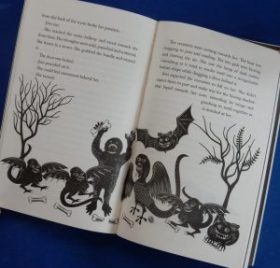
There are monsters,

notably Piglet, a misunderstood character who plays a key part in the resolution of the story in a totally unexpected, but wonderful way; and then there’s Mr Pheeps who will certainly make you shudder at the way he manipulates others.

Equally as brilliant as the writing are Edward Bettison’s black and white woodcut style illustrations that show detail but never too much;

and his Flowers of Divine Lapsidy are truly horrifying.

Both timeless and a story of our times, this is a tale of division, empathy, high drama and healing that will make you think and keep on thinking long after you’ve closed the covers of the book.

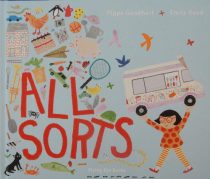
All Sorts

All Sorts
Pippa Goodheart and Emily Rand
Flying Eye Books

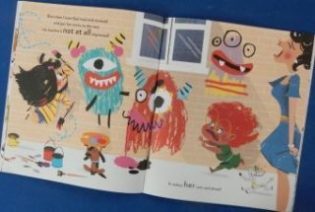
Frankie, like many small children in nurseries and early years classrooms, loves the playful mathematical activity of sorting, separating her belongings by various different criteria such as colour, shape and size.

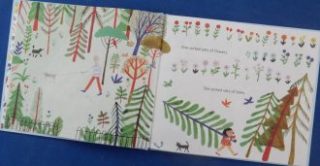
She does a similar thing making sets of flowers and trees,

vehicles and animals too.

Then she tries humans; that starts fairly easily and with a degree of clarity but then things get more tricky.

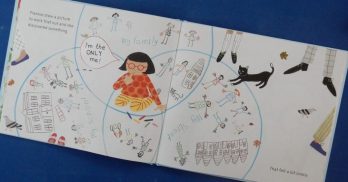
Thereafter things get even more problematic as she wonders “How am I going to sort myself?”

Eventually Frankie finds herself sitting in the middle of several intersecting sets as she draws a conclusion about her uniqueness …

– an exciting understanding that leads to a glorious musical rendition …

followed by a let’s mix-up together celebratory dance.

After which everything resumed its wonderfully mixed up, muddled-up normality – sorted at last!

I love how Pippa, with her straightforward narrative and Emily with her exuberant, beautifully patterned scenes of things unsorted and sorted, have created a warm-hearted, joyful acclamation of how individual uniqueness leads to a glorious mixture where differences are not only accepted but also celebrated.

Ask First, Monkey!

Ask First, Monkey!
Juliet Clare Bell and Abigail Tompkins
Jessica Kingsley Publishers

Mischievous Monkey considers himself Tickletastic – the world’s best tickler – but in so becoming he’s most definitely been invading the personal space of others.
Goat was decidedly unhappy about being tickled; he certainly didn’t give consent and, to Monkey’s surprise, quite rightly tells him to stop.

Paying little heed however, the tickler continues to be a disrespecter of boundaries, demonstrating various other tickling styles and causing his fellow animals to show him their ‘frowny faces’

and to say how much they disliked his actions.

Eventually the message gets through; Monkey apologies to all his friends – goat, giraffe, panda, rabbit, dog, lion cub and goose, frog …

and cow.

Then comes the light bulb moment, ‘Ask first!’ And that applies to hugging or any other form of touching: No need for reasons why, no coercion; consent is crucial.

Written by Juliet Clare Bell, the story is simply and succinctly told with gentle humour yet without being overtly didactic, and illustrated with Abigail Tompkins’ vibrant, colourful portrayal of actions and reactions.

A book for sharing, discussing and acting upon that definitely should be in all nurseries, child and parent groups, early years classrooms and families with young children.

Along Came a Fox/ The Rug Bear

Along Came A Fox
Georgina Deutsch and Cally Johnson-Isaacs
Little Tiger

Bramble the fox decides to go hunting fireflies one silvery moonlit night, despite not knowing where the tiny insects like to hide.
Having been disturbed from her slumbers hedgehog Hazel, decides to accompany Bramble and they follow all-knowing Twig the owl’s advice to search near the lake.

En route Hazel is a little bit spooked by the shadows but Bramble urges her to hurry. “Because foxes don’t get scared … do they?”
Well maybe they do sometimes …

A bit of stomping and growling on account of the “VERY RUDE FOX!’ ensues;


then Bramble decides to go back and report to Twig.
Twig suggests they all return to the lake and try to discover what might have upset the unfriendly fox.

Back they go, but without the moonlight glowing over the pond there is nothing to see at first, which saddens Bramble who’d hoped to make amends.

But then out comes the moon from behind the clouds revealing something wonderful in the water …

And yes they do eventually see those fireflies too. It’s a wonderful night, after all.
This all goes to show that the face we put out in the world, is reflected back; in other words – to borrow the lines from Larry Shay et al. “When you’re smiling / The whole world smiles with you”.

With absolutely gorgeous illustrations and appealing characters, this book has an important message; it’s one to share and talk about with young listeners.

The Rug Bear
Emma Rattray, illustrated by Michael Terry
Matador Children’s

Emma Rattray’s rhyming story tells what happens when a bear, playing hide and seek with Lion and Fox, finds a suitable hiding place and promptly lies down falling deeply asleep.

Along comes a weary mouse. She’s most happy to find a ‘brown furry rug’ just when she’s in need of a pace to rest. So too is Hare with his heavy load;

and Squirrel on his branch is pleased to find he has a soft landing spot exactly where he intends to jump. The ‘’rug’ also tempts lonely ladybug; she deems it ‘extremely snug’.

Suddenly Bee buzzes by following a honey smell and the noise awakens Bear from his slumbers. He jiggles and wiggles, yawns and gives an enormous stretch and stands …

cascading the seated creatures to the ground.

Imagine their feelings when they discover the true nature of their rug. Fortunately, all ends happily – thanks to hospitality in the shape of cups of tea. – sweetened with honey perhaps …

Debut picture book author, Emma Rattray’s warm-hearted tale of inclusion and friendship makes a highly enjoyable read aloud for home or foundation stage setting: youngsters will love being in the know about the ‘rug’ and enjoy joining in the repeat parts of the narrative. Equally, they’ll love Michael Terry’s humorous, splendidly expressive scenes of the unfolding rug episode.

We Planted a Pumpkin

We Planted a Pumpkin
Rob Ramsden
Scallywag Press

Rob Ramsden’s boy and girl characters from We Found a Seed are now a little more savvy about what happens when a seed is planted but even so they’re a tad impatient about the pumpkin seed they plant, hoping it will bear fruit by Halloween.

Young readers and listeners share with them the gourd’s entire growing process as first roots, and then leaves, start to sprout.

Come summer the flowers bloom and are visited by bees, butterflies and other insects and as the weeks pass, the flowers die –

all except one at the base of which they find a small green bump – not yet a pumpkin but on its way to so being.

Excitement mounts along with the pumpkin’s growth, as it absorbs the rain and soaks up the sun.

Then little by little, the ripening happens; the pumpkin swells and turns orange until finally, it’s harvest time.

That’s not quite the end of the story though, for there’s the hollowing out and face carving to do – and then hurrah! It’s Halloween …

Like Rob’s previous titles, this beautifully illustrated book is pitch perfect for little ones. They’ll love spotting all the minibeasts on every spread.

I have no doubt that like the characters in the story, youngsters will be motivated to engage with nature, try planting some pumpkin seeds and become excited as they follow their development.

How Do You Make A Baby?

How Do You Make a Baby?
Anna Fiske
Gecko Press

‘You were a baby once.’ But how do you make a baby? That’s what this wittily presented, forthright, highly informative, graphic book details. No words were minced in the making of this one!

But it does more than merely provide the facts; it’s also a celebration of life and of difference.

Twins, IVF (for ‘couples who can’t make babies when they have sex’) and the unpredictability of fertilisation after coitus, are all presented before the descriptions of pregnancy,

preparations for, and the actual birth.

Value judgements are never made; same sex couples are presented in both words and pictures, but it’s a pity they’re not in the very brief mention of adoption near the end of the book. ‘Children born to parents who can’t look after them can be adopted. Parents who adopt a child have been waiting a very long time.’

Anna Fiske’s book offers a great starting place for conversations about birth, sex, and families with children from around 4+.

However the final two spreads that include the words, ‘A new baby in the world is one of the most brilliant and beautiful things there is. Every child is different. There’s only one like you.’ move it beyond mere biology to the uniqueness of every individual.

I was reminded of this when the arrival of this book for review coincided with a brief stay of my nephew who brought his baby daughter, Faith, born just before the pandemic restrictions. I watched her very closely over the time she was visiting, realising how truly amazing she is at this preverbal stage when she’s just about to start propelling herself across the floor.

Just One of Those Days

Just One of Those Days
Jill Murphy
Macmillan Children’s Books

Four decades on from their first picture book appearance in the now classic Peace at Last, the adorable Mr and Mrs Bear and Baby Bear return for a third story. It begins with a late awakening Mr and Mrs Bear leaping out of bed and preparing for work, leaving Baby Bear to his dinosaur dream.

Once awake though, the little one has to get ready for nursery, a particularly protracted process on this occasion and then it’s raining, all of which means that Baby arrives late at Nursery. It’s no surprise when he’s reluctant to go in but a story does the trick and off comes his coat.

Then there are problems over a dinosaur toy but Baby Bear isn’t the only member of his family whose day doesn’t go well.

Mrs Bear sits on her glasses; Mr Bear spills coffee all over some important papers – and that’s only the morning’s mishaps.

Afternoon nursery continues to be a trial

and by the end of the session it’s a very sleepy Baby Bear that greets his Mum before they walk home through the rain.

Back indoors, the two get themselves togged out in their PJs just in time for Mr Bear’s return. Not only is he carrying a large pizza box but he also has a carrier bag containing a special surprise for Baby Bear.

Then it’s time to share that delicious pizza and exchange a few comments about their respective days, which Mr Bear aptly sums up with the title line.

As wonderfully warm as ever, this is another tour de force for Jill Murphy; a celebration of a loving family and a story that parents, carers and little ones will immediately relate to.

A must have for family bookshelves and early years collections.

Oceans and Feelings Explored in Board Books

Oceans
Lorna Freytag
Studio Press

This is one of the Ecobaby board book series that aims to introduce the very youngest children to important environmental issues, and assuredly it’s never too soon to start thinking about the importance of caring for the planet.

In Oceans, little ones are told about the threat ocean flora and fauna are under from plastic pollution; how over-fishing is depleting the fish population …

and ships are pouring polluting oil into the sea.

Finally come some suggestions to help make a difference.
Author/illustrator Lorna Freytag ‘s succinct text and simple, almost diagrammatic, illustrations put across the crucial message adeptly and one hopes this and its companion book Recycling will set under 4s off on the path to being ecowarriors.

When I am Happy
Sometimes I am Angry

illustrated by Marie Paruit
Campbell Books

Written in collaboration with early years consultant Dr Janet Rose, are these two board books in the Little BIG Feelings series.

The Happy book introduces Bella, Jamie, Zach and members of their families, and shows examples of how kindness and inclusion lead to happiness. So too do thinking about life’s ‘good things’,

doing things you enjoy and staying healthy. It’s no surprise to see that happiness is infectious. I had no trouble moving the slider – just one of the book’s interactive features – all the way to 10 as I thought of things that make me happy.

It’s all too easy to have angry feelings bubbling up in these difficult times (I’ll say no more) but little ones such as Oliver, Amy and their friends all of whom are at a party, find things that make them feel angry too.

Oliver finds his face getting red, his heart beating super fast and his fists curling when somebody knocks his block tower down. Others are not happy about the food, the drink incident, and Evie’s anger is not getting the hat she wants.

Fortunately each of the party grumpies can demonstrate a way to diffuse those feelings of anger and there’s a final slider to assist your little one(s) with calming down.

Both books have a final spread for parents/carers containing advice and strategies to try.

As the logo on each front cover informs, these are just right for ‘Sharing and Talking’.

For nursery collections and family shelves where there are very young children.

Welcome to Ballet School / Pop Art

Welcome to Ballet School
Ashley Bouder and Julia Bereciartu
Frances Lincoln Children’s Books

In this book, we follow a diverse group of beginners from their first day at ballet school where they excitedly don their colourful dance attire and ballet shoes before warming up.

They then learn the five basic positions for arms and feet ready to approach the barre.

With the basic steps mastered and key techniques acquired, the children are introduced to a special guest who helps them use their learning to tell a story (Sleeping Beauty) with costumes

and a surprise finale.

A firm believer that ballet is for everyone, the author, Ashley Bouder is a principal ballerina and in addition to the concise instructions in the lessons, she’s added a useful glossary of the terms used at the back of the book. But would a teacher, however welcoming s/he wanted to be, really greet children such as those entering the class, as “ little ones”?

Julia Bereciartu’s illustrations are beautifully done and will be a great help to new learners as they zoom in on the five positions and show details of the leg movements in the steps.

I especially like the assertion that ballet is ‘an art form but requires an athlete to perform the steps’ said as the children pause to look at the final gallery of great dancers from various parts of the world.

A book for aspiring dancers and those experiencing their first classes; could that be your child?

Pop Art
Emilie Dufresne
BookLife Publishing

Courtesy of art specialist Chloe, an employee of the gallery, readers are given a preview of a Pop Art Exhibition to be held in her place of work.

Before that though comes an explanation of what Pop Art actually is, when it became popular and why.

We meet several artists – Robert Rauschenberg, Andy Warhol, Roy Lichenstein and Yayoi Kusama –

and as well as an introduction to their particular techniques, there are activity spreads.

These give instructions on, in turn, trying your hand at collage, creating a comic strip and captions; painting a portrait pop art style and painting a pumpkin after the fashion of Yayoi Kusama.

The book concludes with a quiz, encouragement to visit a gallery and a glossary.

Pop Art is a style less frequently explored with primary children; this title in the In My Gallery series provides a useful starting point for home or school.

The Jackie Morris Book of Classic Nursery Rhymes

The Jackie Morris Book of Classic Nursery Rhymes
illustrated by Jackie Morris
Otter-Barry Books

This is a wonderful new edition of Jackie Morris’ selection of forty nursery rhymes. In her introduction Jackie talks of their crucial importance and vitality in our modern digital world.
Of those included here, some will likely be familiar: there’s Ride a Cock-Horse, Hickory, Dickory Dock, Twinkle, Twinkle, Little Star and Baa, Baa, Black Sheep and Sing a Song of Sixpence, for example;

whereas others – The Hart and the Hare, To the Bat and All the Pretty Little Horses, for example might be new discoveries.

The entire book has a dream-like, timeless quality to it thanks to the exquisite watercolour paintings that grace every spread. It’s virtually impossible to choose a favourite but on this day of writing and sweltering heat, I was drawn to the absolute tranquillity of Baby’s Bed’s a Silver Moon.

There’s humour, the beauty of the natural world, surprises and more; in fact pretty much everything you could wish for in a book that’s an absolute treasure, not just for the very youngest, but for anyone who loves art and language.

Sadly many young children nowadays don’t have that bedrock of nursery rhymes that we nursery and reception class teachers tended to take for granted when little ones began school decades back; but giving a new parent a copy of this stunningly beautiful book might just start a child off on a journey of becoming a lover of words, stories and reading.

Migrants

Migrants
Issa Watanabe
Gecko Press

Just when we’re hearing of more and more migrants attempting to reach our shores in unsafe boats, arrived this timely book.

With its striking images it snares the attention right from the start as we’re shown the journey of a disparate group of migrants who plod through a dark forest with just a few belongings in bundles.
Behind them stalks the grim reaper accompanied by a huge blue ibis.

En route to the next stage of their journey, the travellers stop to rest and share food

before moving on towards the coast where a boat is waiting.

Everyone crowds on board with Death flying above on the ibis.

But the vessel is no match for the powerful waves that destroy it long before they reach land leaving those that are able, to swim to the shore.

There, they realise that one of their number has died and having gathered around to bid a final farewell,

on they trudge, still pursued by death with more falling by the wayside as their arduous, grief stricken journey continues.

Finally the depleted group arrives at a place where tree life blossoms and maybe, … a little hope.

Issa Watanabe has created without a single word, one of the most harrowing portrayals of migration I’ve seen in a book.

With her characters standing out starkly against the constant black backdrop, each illustration captures the determination and dignified demeanour of the travellers; yet, she leaves space for readers to do some of the interpretation themselves.

Truly a visual tour-de force, albeit one that leaves us feeling raw and tearful.

I am a Bird / Colours of the World: Green Planet

Here are two recent books about the natural world from the Little Tiger Group

I am a Bird
Isabel Otter and Fernando Martin

Through a text narrated for the most part by an eponymous bird and illustrated throughout in a vibrant colour palette, readers share in the world of birds, large and small from various parts of the globe.

We discover some intricately built nests;

find out why birds sing, what they eat and how they obtain their food. We learn why migration happens and read something about the process with reference to specific birds as well as discovering that not all birds including kiwis, kakapos and penguins are unable to fly.

There’s a spread about birds that live near water; one about the ostrich – the world’s largest bird and another about the bee hummingbird, the smallest bird in the world.

The text is written in a chatty, highly readable manner and is accompanied by stylised, simplified yet totally recognisable images of the avians featured.

Colours of the World: Green Planet
Moira Butterfield and Jonathan Woodward

This is a companion volume to Blue Planet and is subtitled ‘Life in our Woods and Forests’.

Having shown on a world map the forested areas and explained briefly the different kinds of forests, (did you know that forests are home to more than 50 % of the world’s plants and animals?) the book goes on to explain the anatomy of trees and to discuss their importance.

Double-page spreads discuss Extreme Trees – the widest, tallest, oldest, fastest growing and smallest; how trees obtain nutrition from their leaves as well as how they provide food and hiding places for certain animals.

Much of the rest of the book then focuses on the kinds of forests starting with boreal forests with their moose, eagles, cats, wolves, hares, minibeasts and of course, bears.

We then move to the hot steamy rainforests and in particular, Amazonia with its wealth of incredible fauna both large and small.

Third are the temperate forests where the trees lose their leaves in autumn and grow new ones in the spring. These places are home to deer, mice, squirrels, foxes, woodpeckers and hunters such as pine martens and owls.

The final pages look at forests as sources of materials for human homes; as well as some of the uses of wood and a brief mention of sustainability.

With Jonathan Woodward’s visually appealing graphics and Moira Butterfield’s succinct paragraphs, this book like Blue Planet offers a good, highly readable introduction to a vital aspect of our planet. It’s one to add to classroom libraries and family book collections.

Flights of Fancy: How to Drive a Roman Chariot / The Girl and the Dinosaur

How to Drive a Roman Chariot
Caryl Hart and Ed Eaves
Simon & Schuster Children’s

This tenth Albie adventure that celebrates young children and their imagination, begins as he’s out with his mum feeding some horses when the rain starts.

Taking shelter in a barn, Albie comes upon a girl named Julia with her problematic knitting. The next thing he knows is that he is whisked back in time to Ancient Rome and he and Julia are chasing after a runaway chariot.

Having managed to leap aboard as the horses gallop straight for the crowded market, a fearless Julia grabs hold of the reins and steers the chariot clear.

That however isn’t the only thing she wants to do: young Julia is determined to prove to everyone who says they can’t, that girls CAN drive chariots. Can they win races too, I wonder?

Whoever said ancient history is boring?

The Girl and the Dinosaur
Hollie Hughes and Sarah Massini
Bloomsbury Children’s Books

Just imagine if you had a dinosaur: that is what happens to the little girl Marianne we see digging on the beach of a seaside town on the first spread of this book. Watched by the fisherfolk concerned about her lack of friends, Marianne methodically digs up and assembles (Mary Anning style) a complete skeleton that she names Bony.

Back in bed that night she wishes life into her ‘stony bones’ and in a sky aglow with dreams, awakens a deeply slumbering dinosaur and takes off on its back into a beautiful world of wonder and magic.

The two go first to the sea and then after a dip, visit an enchanted forest alive with fairies and unicorns.

They climb to the top of a mountain, then taking a ‘mighty leap of faith’ soar up and away towards a magical island among the clouds to a very special party for children and their dream world creatures.

However eventually slumbers call, the party must end; and reveries over, it’s time to return to those empty beds.

Thereafter the story comes full circle and we’re back on the beach, only now Marianne is not alone and the fisherfolk are no longer concerned, for the single girl has been joined by lots of other children each one digging for their very own dinosaur.

Hold fast to dreams as you share Hollie Hughes’ lyrical rhyming story and Sarah Massini’s wonderfully whimsical, atmospheric illustrations of the real and dream worlds.

A great snuggle up at bedtime tale that will linger long in the mind and perhaps fuel the dreams of your little ones as, lulled by the soporific nature of the narrative, they too head off to slumberland.

The B on your Thumb

The B on your Thumb
Colette Hillier and Tor Freeman
Frances Lincoln Children’s Books

This is a book of 60 poems, each of which aims to help youngsters learn a particular sound, spelling or rule, and each with a Tor Freeman illustration to make readers giggle.

The author passionately believes that ‘even very young children are receptive to the joys of wordplay’. She’s likely read Kornei Chukovsky’s From Two to Five (required reading when I was  studying the role of language in education under Margaret Meek/Spencer at London University Institute of Education). Here Colette’s clever use of wordplay and rhythm will help develop sound/symbol awareness as well as promote thinking skills, and  demonstrates that there’s pleasure aplenty to be derived from the foibles of the English language and its spelling rules.

Having read the author’s look at language right through, this reviewer, an ardent believer and promoter of the crucial importance of context and meaning as key factors in early reading, wonders how young children manage to learn to read the way it is currently taught in most UK schools. However, Colette’s book is full of loopy delights and she does provide meaning of a playful kind in her poems (many of which are nonsense verse) and I love it, especially as a means to help with spelling.

Deliciously daft from cover to cover (apart from the introduction for grown-ups) this volume is divided into four parts entitled First Sounds …

This ‘Enough of Uff’ is a tricky one: ‘Uff, uff. / Do your stuff. / You’re there in every / huff and puff. / But where are you/ when things get tough? / Perhaps you felt you’d / had enough!’

Then come Silent Letters and Secrets that includes these …

Spellings, and Words that Sound the Same.

Here’s an example from Spellings; it’s called The E on Your Shoe: ‘There is an E / on the tip of your shoe. / Just sitting there / with nothing to do. // Now take off your shoe / and what do you know? Another E / on the end of your toe!’

The book concludes with seven lively ideas for ‘Getting the most out of the rhyme’

A definite thumbs up to this one: get it if you’re a primary teacher, a family with young children or somebody who wants to promote the joy of language for its own sake.

It’s Only One!

It’s Only One!
Tracey Corderoy and Tony Neal
Little Tiger

This is a cautionary tale about what happens when people’s actions are thoughtless.

It’s set in Sunnyville, a fun, friendly and generally lovely place – until kind-hearted Mouse offers Rhino a toffee. Rhino tosses the wrapper away with the titular comment, but so do a host of other town residents, with one item landing hard on Tortoise’s head and leaving Giraffe outraged at the ever-growing rubbish heap.

To cheer himself up Giraffe picks a flower from the park with the same “What” It’s only one’ comment ,which of course it wasn’t.

Now it’s Penguin’s turn to feel anger, so to cheer himself up at the loss of all the flowers he turns to music – only one song of course but …

Can anyone or anything manage to curtail this catastrophic concatenation that’s caused the entire population of Sunnyville to become grumpy?

Perhaps Mouse has the perfect antidote – or at least the makings of one …

We all know only too well the terrible impact dropping rubbish has on the environment, wherever we live. And I’m sure we all want to be good neighbours – this is something that’s become all the more evident since the start of the pandemic – but it’s all too easy to slip into thoughtless actions such as tossing aside that odd car park ticket or receipt.

There are reminders from author, Tracey and illustrator, Tony at the end of their story, of the importance of considering how whatever we do might be impacting on others and their happiness. However, it’s the cast of characters (I love their zany portrayal in Tony’s expressive spreads) from this smashing and timely book that have the last word.

Share, ponder, discuss and most important, act upon this – it’s only one but think of its potential payoff.

Wulfie Stage Fright

Wulfie: Stage Fright
Lindsay J. Sedgwick, illustrated by Josephine Wolff
Little Island Books

Young Libby is something of a Cinderella character with an archetypal wicked step-mother who makes her life a misery while doting on her own son, Rex (a real meanie). Her father is too busy being a boffin to notice what’s going on, or even listen properly to most of what his daughter has to say.

Consequently Libby is excited to discover in an old trunk in her bedroom, a little purple wolf-like creature that she names Wulfie for short. Said creature has three tummies, the ability to grow and shrink pretty much at will and an aptitude for getting into trouble; he quickly becomes Libby’s best friend on account of his sweetness and loyalty.

When Libby’s teacher announces that she’s written a play to be performed by the pupils and entitled The Big Bad Wolf Learns his Lesson, she longs to star in it. However there seems little chance especially as Rex (also in her class) has drama lessons.

Nevertheless, her name is signed up on the auditions list

and thanks to Wulfie, she lands the part of her dreams.

Then comes the hard work but up steps Head Coach of Wolfing, aka Wulfie, to help her get to grips with the lupine moves and sounds she needs for a stellar performance, aided and abetted by her other new friend and classmate Nazim.

But come the big day, will Libby be able to produce a performance worthy of Ms Emily’s ‘Be spectacular’? And, can she finally get her own back on her brother?

Young readers will empathise with the long-suffering Libby who, despite everything remains determined and positive; and there’s plenty to laugh at too.

The other characters- pleasant or unpleasant – are also memorable, made all the more so through Josephine Wolff’s black and grey illustrations.

I Really Really Need A Wee

I Really Really Need a Wee
Karl Newson and Duncan Beedie
Little Tiger

In Karl and Duncan’s story it’s a little bushbaby who suddenly gets the wiggles and the jiggles, insisting ‘I really, really, really,  REALLY NEED A WEE!’

Yes, we’ve all been there with little ones, when away from home and far from the nearest loo, coming out with the title line. It most certainly resonated with me with regard to several recent outings.

The little narrator’s efforts to distract itself with thoughts of other things only serve to make matters worse …

and its attempts to find a toilet are, shall we say, pretty disastrous.

Finally though, the object of the bushbaby’s desire is in sight, but almost inevitably there’s a long queue – isn’t it always the way?

Then whoopee! The little room is vacant at last – phew! Such relief.

I suspect you can guess how this corking story ends … and it’s wee-ally wee-ally funny. But then with its combination of Karl’s telling and Duncan’s hilarious illustrations one expects no less. I absolutely love the sets of bespoke loos that sandwich the story proper.

I envisage classrooms and nurseries full of giggling infants and staff almost wetting themselves when this is shared, and families with youngsters will absolutely burst themselves laughing in recognition.

Scared of the Dark? It’s Really Scared of You

Scared of the Dark? It’s Really Scared of You
Peter Vegas and Benjamin Chaud
Chronicle Books

The relatively common childhood fear of the dark is given a new and fun twist in this picture book wherein the dark is personified and presented as an entity that is actually afraid of … You!

It spends its daylight hours hiding away in your underwear drawer, only emerging into the outside after sundown.

Inevitably this makes its life far from perfect. Friendships are well nigh impossible, as is tree climbing and as for a decent haircut – forget it. No light equals extremely messy hair.

I’m pretty sure most young readers would be happy to share its favourite foods – black pudding, blackberries, liquorice (the black variety), dark chocolate and candle-less Black Forest gateau when its birthday comes around. (Think of the fun to be had from creating an entire menu for the dark.)

There are plenty of positive things about dark: its refusal to be inside until lights off and TV off time; it stays up the entire night but is unable to do anything and it seldom features in a child’s drawing.

But don’t think that dark is without its devotees: numbered among them are bats (they fly in it at night)

and the silent stars.

That in a nutshell is that: so youngsters who have night time frights are safe to greet the dark with a friendly “Hi!’ so long as the light’s off of course, or it will scuttle away to safety.

Definitely worth trying as a reassuring bedtime read if you have a little one averse to the dark; and even if you don’t Benjamin Chaud’s chuckle-inducing illustrations make this a book to share for the sheer fun of it.

Taking Time

Taking Time
Jo Loring-Fisher
Lantana Publishing

This is simply exquisite. In eleven different parts of the world, children savour the moment: on each double spread there is a gorgeous, mixed media scene showing a young boy or girl in an everyday setting relishing the beauty of the surroundings.

A little girl somewhere in India pauses to listen to the song of a bird;

a boy collects pink blossoms as they fall from a tree: ‘ Taking time to listen to / a bird’s song on the breeze. // Taking time to gather up the blossom dancing free.’ (I love Jo’s use of rhyming couplets on consecutive spreads here and throughout the book).

Far away in Alaska a child snuggles in the soft fur of a husky dog; indoors another child feels a soft cat, ‘taking time to feel the beat’ of its ‘rhythmic purr’.

A spider spins its web watched in awe by a little girl in Nepal, while in the Egyptian desert, clutched by a loving adult, a small child contemplates their journey.

The immensity of the evening sky, a passing flock of colourful birds,

the kind, reflecting eyes of a grandparent, soft snowflakes as they float gently down, the imagined sounds of the sea echoing in a shell – all these too are cherished moments for those who take time for awareness of the here and now.

On the final spread all the children come together in a verdant green field to share their wonderings as they play harmoniously with their special keepsakes: ‘Taking time to cherish you, / and also cherish me.’

Both sets of endpapers show details from the illustrations, the front ones annotating a world map marking the children’s homelands – Alaska, Ecuador, the U.K., Norway, Russia, Egypt, Tanzania, India, Nepal, China, and Japan;  the back ones depicting just the keepsakes, cleverly creating a matching game for readers to play.

If you have, or work with, young children, I urge you to share Jo’s beautiful book, showing similar slow mindfulness to that demonstrated by her characters in Taking Time.

A Trio of Little Tiger Board Books

Kindness makes us Strong
Sophie Beer

What is kindness? Sophie Beer provides some examples in this little book beginning each double-page spread with “Kindness is …’ following it with illustrations of children who show care and consideration towards their peers, grown-ups and animals.

It might be something as simple as saying hello, or cheering on participants in a race, giving a warm hug or taking turns.

The bright, enormously attractive illustrations show how much difference acts of kindness make in creating  a happier world.

With its brief, simple repetitive but empowering text, this little book can be shared with the very youngest but equally slightly older children might enjoy reading it for themselves.

A lovely introduction to kindness.

Owl Always Love You
Patricia Hegarty and Bryony Clarkson
Caterpillar Books (Little Tiger)

It’s bedtime for the little forest animals: time that baby rabbit snuggled down in the burrow, time for tiny dormouse and hedgehog to curl up; and up in the tree, for baby squirrel to close its eyes.

The tree is also the place where new chicks in their nest await their mother songbird’s return before they too can sleep.

With die-cut holes to peep through, raised images to feel and adorable little creatures to enjoy in Bryony Clarkson’s nocturnal scenes, sleepy little humans can listen to Patricia Hegarty’s gentle reassuring rhyming narrative before they too succumb to the call of sleep.

Also with a night-time theme is

What Can You See? At Night
illustrated by Maria Perera

With the emphasis on facts, little ones are introduced to a host of nocturnal feeders such as squirrels, owls and foxes in the town.

Moving on to a more rural setting we meet creatures around a pond including singing frogs, bats on the hunt for insects, while in the field rabbits, mice and foxes forage and fireflies flit above them.

It’s not only wild creatures that are out and about at night: postal workers, delivery drivers and sometimes farmers, are at work when most of us are fast asleep.

There’s plenty to interest toddlers on every spread including some humorous items and die cuts.

Luna / Museum Kittens: The Pharaoh’s Curse

Here are two new young fiction stories from Holly Webb, both published by Little Tiger

Luna
Holly Webb, illustrated by Jo Anne Davies

The ninth of Holly Webb’s Winter Animal Stories is another time-slip adventure, this one featuring young Hannah.

She’s on holiday with her family and visiting a Christmas market in Dresden when she spots a wooden bear cub puppet on one of the stalls and knows immediately that she wants it.

Then back at the hotel in the bedroom she was sharing with her sister, the two get into a squabble over the bear and it gets broken.

During the night, Hannah wakes up and finds she is not in her hotel room but sitting on a dirty, straw strewn floor. She’s in a stable; a bear cub is there too and a much larger bear, she thinks.

Managing to open the door of the stall, she bumps into a boy and the two go outside and into a market square. But why is he anxious not to be seen?

Little by little Matthias explains what he was doing in the stable and why he is so determined to stop the cruel bear leaders getting hold of the cub Luna especially, and training her to be a dancing bear. She also learns that the boy sells carved wooden toys and when he invites her to join him in a rescue Luna attempt, she cannot but agree, especially when she actually sees bear dancing in action.

Another lovely seasonal tale full of snow and festivity, but also with a big emotional pull about the plight of the real bear cub and about the cruelty of bear dancing, which happily has almost died out.

Museum Kittens: The Pharaoh’s Curse
Holly Webb, illustrated by Sarah Lodge

Watched by the resident museum kittens, there’s great excitement among the museum staff standing in the Egyptian Gallery and it’s on account of a part of the Book of the Dead on loan from another museum.

It’s rumoured that there’s a curse on this particular piece of papyrus and when unpleasant things start occurring coinciding with its arrival, Peter kitten decides something terrible is going to happen to the museum. Tasha thinks otherwise and is determined to prove him wrong.

Then part of the gallery ceiling collapses, but that’s only the first disaster.

The entire gallery is flooded on account of a burst pipe; the kittens are trapped, so too is Grandpa Ivan. Is he right when he says, “Museum cats are perfectly capable of rescuing themselves,” or are they to fall victim to that pharaoh’s curse everyone’s been talking of? And what of the precious papyrus? Will it be ruined by the water?

Exciting stuff; those relatively new to chapter books will be whisked away, rooting for the kittens throughout; they’re made even more adorable thanks to Sarah Lodge’s plentiful illustrations.

All’s Happy that Ends Happy

All’s Happy that Ends Happy
Rose Lagercranz, illustrated by Eva Eriksson
Gecko Press

I suspect that a great many young readers will be sad to learn that this, the 7th book, concludes the My Happy Life series featuring Dani, her family and friends, in particular, her bestie Ella.

The story opens at the start of the Easter holiday without Dani. She’s been off school for seven weeks. But where is she?

Certainly not at home, as visiting classmates discover; nor has she as others assume, gone to stay with Ella. Even she doesn’t know where Dani is, though she’s determined to find out. To that end, Ella writes a letter which she puts in a bottle and despite having been left in charge of little sister Miranda, runs to the cliff to toss her message into the sea. Having done so she goes back to the house but there’s no Miranda.

Frightened of the consequences when her mother returns, Ella goes into hiding too.

Dani herself eventually appears in the seventh chapter; she’s in hospital still recovering from the pheumonia that was a result of her failed attempt to visit Ella in the previous book.

In the eighth chapter there’s a lovely proposal attempt from Danis’ dad to Sadie, leading into much ado about a wedding in Dani’s head.

The real thing does happen though not quite in the same way as she’d imagined but still in Rome; it’s only to be a small affair and without Ella as a guest.

Meanwhile the Italian side of Dani’s family are eager to introduce her to the sights of the city

Once the wedding celebrations are over, there’s more exciting news. But will Dani ever get to see Ella; that always seems to be uppermost in her mind, no matter what.

There are more surprises in store before the end, but as readers know, Dani is determined, resilient and has a firm belief in happiness.

This book is longer than any of the previous ones but Rose Lagercrantz’s terrific, gently humorous text is conveniently broken up into seven parts, each comprising short chapters with plenty of Eva Eriksson’s utterly charming, splendidly expressive black-and-white illustrations throughout.

A smashing solo read, but also a lovely read aloud.