The Spots and the Dots

The Spots and the Dots
Helen Baugh and Marion Deuchars
Andersen Press

Here’s a tale that happened long ago – or was it so long?

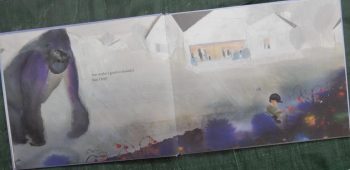
Told with an appropriately bouncy rhyming text by Helen Baugh (it does feature spherical objects after all) we discover what happens when the little Spots, paying insufficient heed to their parents oft repeated warning, “If you go over the hill you will be taken away by the dots”,

start getting more daring with their favourite game until Baby Spot, scared and still, finds itself one evening at the apex of the hill.

However, close by is a second small someone, equally on its own.

A conversation ensues, and a revelation, followed by something very exciting …

Flip the book and read the story from the perspective of the Dots. This small tribe are also pod dwellers and their little ones love bouncing too, receiving a similar warning about the ill-intentioned Spots.

Naturally the infant Dots play a similar game to the little Spots and you can work out the rest …

Such a clever tale of colliding communities that celebrates difference and lays bare the idea that fear and prejudice are often fuelled by ignorance, showing that we’re all much more alike than we might at first think.

Helen tells it with a deliciously wry liveliness that is mirrored in Marion Deuchars’ superbly expressive scenes of small spheres and their adult carers.

Do make sure you study closely the grand meet up of the two infant groups wherein Marion has managed to give each of the playful infants a different look.

I can’t recommend this one enough: it’s brilliant.

Great Lives: Martin Luther King JR, Anne Frank, Stephen Hawking & Cleopatra

Martin Luther King JR
Anne Frank
Stephen Hawking
Cleopatra

Button Books

These are four titles in the publisher’s new infographic biography series Great Lives in Graphics aimed primarily at older KS2 school readers.

Whether their interest is in human and civil rights, the holocaust in the German -occupied Netherlands as a member of the Frank family desperately trying to avoid being detected by the Gestapo; an awesome scientist and cosmologist who refused to let his ALS diagnosis hold him back; or, the woman in ancient Egypt who first married her brother, became a wise political figure and writer of books on medicine and science, going on to make a famous match with Antony,

then one of these will definitely be worth seeking out and putting their way.

Martin Luther King’s story is one that, despite his awesome achievements, and his “I have a dream” speech “… that my four little children will one day live in a nation where they will not be judged by the colour of their skin but by the content of their character”, which inspired America to end segregation, the world changing, peaceful protests he used in overcoming enormous obstacles, is conveniently and sadly forgotten by a certain element of the population of the US today.

I had to laugh when I read that Anne Frank was dubbed a ‘chatterbox’ by some of her teachers in her Amsterdam school, something that I was also often called at school.

Each book has an introductory page of narrative, a timeline, details of family life and spreads detailing the subject’s key achievements; and each brings to life through its stylish, easily understood infographics, the person and the accomplishments of a memorable human being.

Well worth adding to primary school topic boxes and libraries.

Love, Hide-and-Seek and Night-time Board Book Style

Little Love Bug
Illustrated by Emily Dove
Chronicle Books

Author/illustrator and nature enthusiast, Emily Dove, uses a popular minbeast as the featured creature in her latest in the finger puppet series to share with babies. We see a parent and little bug spending a busy day together snuggling, meeting friends, taking a slow wander, enjoying a dance and having a goodnight hug. No matter the time of day you can find an opportunity to show your love.

Bright, cute and sturdily built for lots of reading together times.

Where’s Mrs T-Rex?
illustrated by Ingela P Arrhenius
Nosy Crow

There’s a decidedly dinosaurish theme to the latest in Nosy Crow’s ever-popular felt flaps series with that final mirror that tinies love.. In this one you can introduce babies and toddlers to the four dinosaurs that are playing hide-and-seek from various minibeasts, a pterodactyl and a turtle.

It’s never too early to expose them to such names as Stegosaurus (Mr) Diplodocus (Mrs), Triceratops (Mr) and T-Tex, herein set against vibrant, patterned backgrounds. What fun!

Shhh … Good Night
Nicky Benson and Thomas Elliott
Caterpillar Books

With Nicky Benson’s gentle, rhyming text and Thomas Elliott’s gorgeously hued illustrations, this lovely book with its die-cut pages, showing a mother bird and her baby, a baby squirrel with its parent, a big and small firefly and deer, little and large, settling down for a night’s sleep, this book is a lovely way to bid little humans goodnight; they’ll surely sleep well after this dreamy meditative experience.

And if you missed the paperback version of Britta Teckentrup’s beautifully illustrated Moon, reviewed already on this blog, Little Tiger have now published a die-cut paged board book edition showing animals around the world at night-time.

Skeleton Keys: The Legend of Gap-Tooth Jack / The Thing at Black Hole Lake

Skeleton Keys: The Legend of Gap-Tooth Jack
Guy Bass, illustrated by Pete Williamson
Little Tiger

If you’re looking for a darkly comic adventure story that’s full of mystery, monster chases, and outlandish ghoulish decapitations, (that’s also about friendship, fitting in and finding self-confidence), then accept the invitation of Keys – Skeleton Keys – and allow this character to tell his tale (actually it’s that of Gap-Tooth Jack) that he claims is a “truly unbelievable, unbelievably true’ one.

However, in order for this tale to be unfolded back in the past, it’s necessary to begin in the here and now with a second story and in particular with wildly imaginative, seven-year-old, Kasper. This lad conjures himself up an imaginary friend whom he names Wordy Gerdy. By all accounts (or rather our storyteller’s), this ghost of a girl possessed an amazing ability: once she has in her fragile fingers a pen, she can rewrite any story she cares to, or even as here, she doesn’t.

Oh! We must mention Daisy; she’s Skeleton Keys’ unimaginary partner-in-problem-solving without whom, our bony being storyteller might have been a has been.

Find out what takes place when a highly dangerous, ghasty, goulish unimaginary escapes into yesteryear. Can Jack thwart her malevolent game plan by joining forces with Mr Keys? Plunge into Guy’s spooky saga, full of terrific characters,

extremely quirky humour with Pete Williamson’s fangtastically spooky illustrations and find out. It will definitely make some superbly silly story sessions as a lower KS2 class read aloud.

For a slightly older audience is:

The Thing at Black Hole Lake
Dashe Roberts
Nosy Crow

We’re back at Sticky Pines, the small US town of weird events and secrets lurking in woods, for this spooky sequel to the Bigwood Conspiracy; and once again there are weird things afoot.

We get two perspectives on events, those of Milo and Lucy (currently not on speaking terms). Milo Fisher, loyal son of business tycoon NuCo president – a double-crossing guy; and Lucy Sladen, who’s determined to discover the truth about the mysterious, alien life, Pretenders of Sticky Pines, and protect them from the greedy NuCo company, set on exploiting every one of the town’s resources.

In the previous adventure it was Lucy who made the astonishing discovery but now it’s Milo’s turn, for there’s something very strange in Black Hole Lake; something that will put both he and Lucy in terrible danger. Danger that begins as Milo leaves a party early in order to avoid Lucy, takes a short cut and soon finds himself sinking into the lake and there are eyes watching him from below the surface.

Mesmerisingly brilliant fun., fast-paced with lots of twists and an abundance of ever-deepening mysteries, creepiness and with the philosophical good guy/bad guy dilemma underpinning the tale, this is a stonkingly good, enormously satisfying read.

Feathered Serpent and the Five Suns

Feathered Serpent and the Five Suns
Duncan Tonatiuh
Abrams Books for Young Readers

Legend has it that the Mesoamerican gods had considerable bother creating humanity.

During the first tonatiuh their effort resulted in mountains, the second, fish and having modified the process, the third attempt was close, but the humans were disrespectful of their creators and so were turned into tree-dwelling monkeys.

Attempt number four produced kind-hearted, respectful beings but due to their laziness, the gods turned them into birds.

Enough! The gods were weary and ready to give up entirely, all except Quetzacóatl – the Feathered Serpent and god of knowledge. Gathering his staff, shield, cloak and good luck shell he set off to Mietlán – the underworld – to recover the bones his fellow gods had given to the lord of the underworld for safe keeping.

To reach his destination, Feathered Serpent travels through nine daunting regions,

but aided and abetted by Xolotl the dog spirit guide, he finally reaches his destination and is able to speak to the god of the underworld.

After he’s explained his mission, Mictlantecuhtli gives him one final test and Feathered Serpent finds himself on the end of a trick. However, he manages to out-trick the keeper of the bones and is given the sacred objects. Mictlantecuhtli hasn’t finished with him yet though; but Feathered Serpent finally escapes, wounded and bleeding, recollects the bones and returns.

Once there, he smashes them to a powder, mixes in his own blood and that which the other gods provide, to make a paste

and from that finally creates humanity.

Despite being a complex story, Tonatiuh’s telling is captivating and readers aloud can certainly give it a highly dramatic presentation. His superb, flat, hand drawn, digitally collaged scenes successfully conjure up pre-Columbian art, and after his enthralling rendition, to help with the historical context  there’s an author’s note on the symbolism behind the myth, a glossary with Nahuatl pronunciation guide and a select bibliography.

We’re Going on a Pumpkin Hunt / Winnie and Wilbur Around the World

We’re Going on a Pumpkin Hunt
Goldie Hawk and Angie Rozelaar
Nosy Crow

Based on the nursery favourite ‘We’re going on a bear hunt’, I’m surprised nobody thought of a pumpkin-themed variation before. It’s definitely a goodie.

Herein we join three fearless pumpkin hunters – a little skeleton, a witch and a slightly unravelling little mummy – as they sally forth one beautiful night. Needless to say their path is obstructed by various things that they can’t go over, under or around.

First it’s watchful green-eyed moggies meow-meow(ing); then cobwebs – the sticky spiders’ variety – just right to ‘tickle-swish’ through.

Yikes! What about those ‘Flap-flap’ flapping bats – fortunately they look quite friendly, and then the trio come to a house, old, dark and spooky of course. Could a pumpkin be hidden therein?

There’s only one way to find out and that’s in …

and over those creaky-squeaky floorboards and of course, our adventurers aren’t scared, are they? …

Happy trick or treating …

At every page turn, day-glo colours leap out from Angie Rozelaar’s anything but scary spreads showing the mock-spooky sortie, and Goldie Hawk’s clever adaptation of a popular join-in narrative, this will assuredly enchant, rather than scare, young listeners and solo readers around Halloween time. (or any time come to that.)

Winnie and Wilbur Around the World
Valerie Thomas and Korky Paul
Oxford Children’s Books

Inspired by a visit to the library and animal books in particular, Winne and Wilbur embark on a world trip with the aim of visiting all the animals featured in the book they’d seen (and decided to borrow).

All it takes is a hastily packed suitcase, duly attached to the broomstick, a glance at the book and a wave of Winnie’s wand;  up and away they go to land in a tree house surrounded by giraffes – very hungry ones.

Prompted by picture two (and sans lunch) they whizz on to an oasis where dates, camels’ milk and an exceedingly hot, bumpy ride await.

A spot of kangaroo bouncing (Wilbur) comes next, followed by some panda spotting (Winnie finds the creatures dull); then a too close for comfort encounter with an enormous whale …

and a polar bear.

An elephant, an aardvark and meerkats (not cat eaters happily) rendezvous leads them on to the final page and a jungle full of monkeys. Their mischief-making might well have caused the demise of both our plucky travellers but fortunately, all ends happily. With thoughts of their favourite animal in mind, and with the book duly returned to its place in the library, its time for the intrepid adventurers to relax.

What more can the countless fans of the duo want than this high-octane world trip by their favourite witch and her trusty moggy. Probably another reading of same, followed by further adventures. Perfect for Halloween and other story times.

Victoria Stitch Bad and Glittering

Victoria Stitch Bad and Glittering
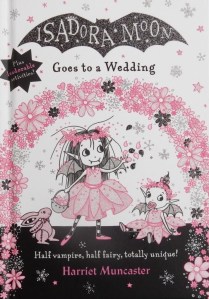
Harriet Muncaster
Oxford University Press

As the story starts, living alone in a small tree trunk, twin fairy-like beings ‘wisklings’, Celestine and Victoria should be princesses.

But the single royal diamond from which they were born is impure so their birthright is denied them.

The mild Celestine is accepting, but with her frenzied energy, Victoria Stitch as she likes to be called, is obsessed with becoming the next queen and very angry about the decision Lord Astrophel has made.

Between the twins there exists a fondness, but it’s maintained by a fragile thread that’s all too easily snapped. ”She took all the kindness and I got all the rage,” is how Victoria Stitch puts it.

Then Victoria encounters secret-loving Ursuline who needs a friend and offers to help in her unthwartable mission to become queen after Cassiopeia.

But will this new alliance prove to be a force for good or not? And what will happen after the twin’s graduation …

Any reader who fell for Isadora Moon and is ready for something a bit longer and rather darker, will surely love Harriet’s new gothic fantasy. The illustrations are simply divine especially as Victoria Stitch with her funky, pointy toed, heeled boots is a fashionista who loves to strut her stuff in melodramatic wiskling style as befits the superbly woven, absorbing narrative.

To enter Wiskling Wood is utter enchantment every step of the way; it’s hard to leave for whatever reason …

Saving the Planet – The International Yeti Collective: Shadowspring / Astronuts Mission Two: The Water Planet

The International Yeti Collective: Shadowspring
Paul Mason, illustrated by Katy Riddell
Little Tiger

The Yeti Collective is a worldwide organisation with each of its strands having responsibility for an element of conservation while simultaneously aiming to avoid human detection.

Shadowspring (underground water upon which all wildlife and the humans depend) is under the protection of the Greybeards (the British group) but now somebody or something is interfering with the water levels and things are looking bad for the inhabitants of Tadpole’s community.

Tadpole (she of unripe character), daughter of the sett’s leader, Shipshape (she in perfect order), is next in line to become the Greybeards’ leader, a role for which she feels anything but fit.

Despite the precedent for avoiding humans contact, like her grandfather before her, Tadpole meets a human; his name is Henry, a boy just adapting to boarding school life.

Now, on account of the danger the Greybeards are facing, Tadpole and Henry (aka Hen-ree) must work together: an extremely dangerous undertaking ensues.

It’s a delight to enter and share in this world with its highly pertinent environmental messages, that’s populated by wonderful characters such as the two main ones in this story.

I missed the first book in the series, but I intend getting hold of it forthwith; I’m sure it too will be a superb read.

Astronuts Mission Two: The Water Planet
Jon Scieszka and Steven Weinberg
Chronicle Books

AstroWolf, LaserShark, SmartHawk, and StinkBug, the four NNASA agents, return having previously failed to find the perfect Goldilocks Planet, with a new mission, to find a planet fit for human habitation.

Having splash-landed on Water Planet, they discover it is awash with clams, a power-hungry, sub-aquatic force led by their president, P.T.Clam . Said creature is absolutely gushing with praise about his home planet and more than a little keen to swap his planet of residence for Earth. the polluted waters of which he claims to filter. Now why might he be so eager for that exchange?

It appears that he’s willing to do a special deal on the quiet with AlphaWolf (the mission’s leader) but another clam, Susan B. Clamthony tells a rather different story

and it’s one that the Astronuts really need to hear. It sounds as though not all the residents of Water Planet are as dastardly as their leader.

Packing the adventure with punny humour, hilarious interchanges and with a bounteous brio, Jon Scieszka, via his Earth narrator, cleverly knits together environmental information and facts about climate change. Combined with Steven Weinberg’s equally zany collage illustrations, every one of which is as immersive as the watery environment of the story’s setting, (love the spread on how they were created) this is a terrific second instalment.

More please! I hear youngsters, (especially fans of graphic novels) cry. (And this reviewer.)

Jeremy Worried about the Wind

Jeremy Worried About the Wind
Pamela Buchart and Kate Hindley
Nosy Crow

Young Jeremy is a worrier par excellence – we all know one I’m sure. Risk averse he surely is, and a highly sensitive little chap to the extent that he avoids pretty much anything and everything from overly crunchy crackers to dinosaurs …

and squirrels to shoelaces. His biggest worry though, is the wind.

One day he meets and befriends Maggie – she of the untied shoelaces and “What’s the worst that could happen?” attitude. Immediately Jeremy decides that she’s in need of care and protection. Taking her under his wing, he teaches her all manner of ways to stay safe.

Then comes that hugely wildly blustery day when Maggie inevitably decides to throw all caution to the wind. Out she dashes with Jeremy in hot pursuit (or maybe a cold sweat). And that’s when he finds out about the delights of living dangerously.

Bursting with zany humour, Pamela’s text will lift your spirits – it’s a great read aloud likely to help even the worst worriers among your audience to unwind a tad, (and perhaps offer a warning word or two to any Maggies sitting alongside); while Kate’s splendidly expressive scenes of the perils – possible and real, excitement and effervescence, will enchant and entertain. Make sure you slow down when you get to the wordless spreads so your listeners can savour every single tiny detail.

Ridiculously brilliant in every way.

The Accidental Prime Minister Returns / Roald Dahl Rotsome & Repulsant Words

Books that make us laugh are much needed at the moment: here are two such, sent for review by Oxford University Press

The Accidental Prime Minister Returns
Tom McLaughlin

Do I detect a touch of irony in this title? Perhaps the return of Joe who found fame by accidentally becoming Prime Minister while trying to save his local park, knew just when he’d be needed again. Now, I defy you to get through even one chapter of this new story without splitting your sides with sniggering snuffling laughs and ginormous guffaws, let alone wait till chapter four.

Who better than Joe (aka your Primeministerness) to bring back a bit of cheer? So here he is – the perfect counter to all the current doom and gloom – at the ready to remind the populace of life’s good things, and how they can all do their bit to make our great country (or rather, tiny island) and the world, a better place in which to live.

With his entourage, that’s best pal, Ajay dubbed ‘an all round absolute dude, and Alice, democracy’s most mega enthusiast (also a total dude), not to mention Mr Rottweiler (a useful ally?) who else could possibly get our vote. (He’s even got the right colour hair – almost!)

With its healthy herbal juice, spare false eyelashes and an absolute wealth of shenanigans, book seven, laying bare the ups and downs of political life, could not have come at a more apt time. Bring on the ‘coal addition’ – right now!

Delicious daftness of a different kind in:

Roald Dahl Rotsome & Repulsant Words
illustrated by Quentin Blake

Roald Dahl was a prolific inventor of rude words. He used some incredibly adroit putdowns and curses, insults and expletive forms.

Now, thanks to editor and lexicographer Dr Susan Rennie, they’ve all been brought together into this collection of naughty-sounding words that will absolutely delight any child (and probably adult) who gets their hands on a copy of Rotsome & Repulsant Words. (my spell check is NOT happy!)

So, if you want to try creating your very own ‘gigantuous’ curse word, there’s a spread to show you how. Or perhaps you’d rather become ‘as Grumpy as a Grandma’ then you can find out how so to do.

I have to say I rather enjoyed the ‘How to be rude in other languages (so grown-ups won’t notice).’ It doesn’t always hold true however: I can recall several occasions when teaching reception and nursery age children, hearing extremely insulting words (meaning much worse things than the examples in this book) coming from the role play area, spoken by children not knowing that their teacher could understand their Hindi, Urdu, Panjabi etc.

Naturally children will relish the collecting of ‘bottom’ words and even more so, those relating to sounds that emanate from same.

There are some smashing onomatopoeic examples here including the Spanish ‘popotraques’ and the Scots ‘rummlypumps’.

Think of the fun you might have in a group discussing ‘swatchwallop’ (the most disgusting thing you can eat. An opportunity for some more creative word inventions methinks. Think too of the wealth of language lessons you could enliven using this with your class.

Whether or not you’re a Dahl fan, I’m pretty sure you’ll relish this little linguistic goldmine, especially with those Quentin Blake illustrations.

Ruby and Graham / This Old Dog

Ruby and Graham
Lucy Barnard
New Frontier Publishing

Playful party loving Ruby and organising expert, Graham, both live in Acorn Wood ensuring that it’s both a happy lively place and a beautiful one.

However, it’s Ruby who gets all the attention from the other woodland animals, so one afternoon Graham decides to change his ways and become more funky.

Such is the improvement in his popularity that he resolves to make the change permanent.

Now while it might be a good thing for Graham, the woodland rapidly becomes a messy, confused environment. Ruby approaches her fellow squirrel and an interesting discussion ensues wherein they each talk about their feelings of self-worth.

Can the two share their abilities to their mutual benefit, as well as for the betterment of the entire community? Working together is the way to go …

Lucy Barnard’s digital illustrations add humorous details to her textual narrative, making every spread a stopping point that offers much to enjoy and talk about with young listeners, particularly with the approach of autumn and winter.

This Old Dog
Martha Brockenbrough and Gabriel Alborozo
Levine Querido

This Old Dog is a heart-warming story about a dog that’s well past its prime (‘His bones are sore but his heart is strong’) and a small girl who loves him dearly.

From the moment the child is born, the pace of life in old dog’s family speeds up, but the creature ‘likes to take things slow.’ He’d yearned to have a friend for long, slow strolls, rolls in the grass and romps in the leaves.

Both little girl and the dog truly know how to live in the moment, make the most of their experiences and cherish their time together; and once the child takes to her feet she walks straight towards old dog. At last his wish is fulfilled: there’s grass smelling, hill rolling down and much more …

some of which make the pooch enormously excited.

Together they can discover (or rediscover) what a wonderful world it is, day after day …

Just as the girl and old dog were seemingly made for one another so too was the author/illustrator partnership between Martha Brockenbrough and Gabriel Alborozo. The slow, steady text skilfully mirrors old dog’s plodding, yawning demeanour so perfectly captured in the delicately lined ink and water colour illustrations; he’s a real personality this pooch, as is the adoring little girl, his total devotee and playmate.

Whether or not you’re a lover of dogs, you’ll definitely fall for this gorgeous book.

Kids Knit

Kids Knit
Kerry Kimber
GMC Publications

I’ve never really got to grips with knitting – just the odd (very) scarf, a jumper that I abandoned and numerous blanket squares for charitable causes over the years. And, rather than making me feel relaxed, something my mum used to say about knitting, I always ended up having tense shoulders from trying to go fast, so I was interested to see these listed in the “Ten Great Things About Knitting’ at the front of the book:
#2 Feel Good, #3 Relax,  #7 Cheer You Up  – failure on my part with those.

What about the others? #1You Can Make Stuff – sort of; #4 Improve Your Maths – yes possibly; #5 No Screens – absolutely! #6 Banish Boredom – perhaps for a short time #8Make Friends – I definitely never joined a class; #9 Start a Movement – I was never sufficiently proficient to be enthusiastic to teach anybody else #10 Gifts From the Heart – yes hurrah!
However a book such as this with its upbeat, encouraging tenor and emphasis on creativity might well have made all the difference.

After talking about the basics: what you need, needle sizes and yarn selection, comes the part I really love that starts with ‘Get Creative’ …

and there’s a lovely traditional rhyme, (new to this reviewer, certainly in a knitting context) “In through the door / Once round the back / Peep through the window / Off jumps Jack.” And an invitation to young users to invent their own version with the key words ‘in, round, through off’.

There are tutorials on the basic stitches, casting on and off. Then comes “Sewing On’ bits and pieces so that you can make cute creatures such as Frog,

monster hand puppets, a sweet tufty owlet (its instructions come with an owl joke).

Things step up a level then as readers learn about colour changing; that results in patterned items including a rose, bunting, a cup cuddler and beanbags.

After this section of tutorials you might be sufficiently proficient to start on the “Star Knitter Tutorials’. Herein you can find out how to make your very own stylish beanie,

a funky field mouse and several, a ladybird, a crown or even a cactus.

The book concludes with information about the origin of different yarns and being a responsible kids knitter, a bit of history and some useful templates.

There’s a wealth of photographs to provide further inspiration should you need it and the children shown with their creations look really proud of what they’ve made.

With the shorter days and less time to be outside, this is the ideal Kids Knit time.

Fergal Meets Fern / Elmer and the Lost Treasure

It’s lovely to see favourite characters returning in these two recent books from Andersen Press

Fergal Meets Fern
Robert Starling

New sibling unsettlement quickly arises when Fergal’s Mum and Dad bring home ‘the egg’. From this emerges a new baby sister for the little dragon and with its arrival, funny feelings start within Fergal. Even nan’s gift of flying show tickets lift his mood only briefly because Fern’s actions really stoke up Fergal’s inner fire.
Then to make matters worse, comes the news that the flying show excursion is off: Dad has to get medicine for Fern who’s become sick.

Inevitably Fergal’s fiery feeling grows even stronger, so much so that he does something to make him the centre of attention, which it does, once Dad discovers his whereabouts.

After a frank Father and Fergal discussion on feelings, Dad shows his son something by way of explanation.

Later on as the two do some yoga side by side, the feelings discussion continues

and eventually Fergal understands that something in him needs to change. Being a big brother is an important role and perhaps it’s one he can undertake successfully and lovingly.

As with previous Fergal stories, Robert Starling conveys this one with sensitivity, humour and considerable charm.

Share with little ones at any time but it’s especially apt if you’re a family with young child and a new arrival.

Elmer and the Lost Treasure
David McKee

The adorable elephant, Elmer stars in what is almost unbelievably, his twenty eighth picture book adventure.

He, along with cousin Wilbur and three other elephants set out on ‘a long, exploring walk’ through the jungle and after a while find themselves in unfamiliar territory.

After a roll down a steep slope with Elmer in the lead – naturally – they discover an entrance to an old forgotten palace and start exploring within, or rather Elmer and Wilbur do. The others meanwhile have their own agenda. What can they be doing?

The palace is incredible with huge domed halls in shades of blue, amazing mosaics, tiles and carvings. But who will find that Lost Treasure? And what is it?

Another absolutely smashing story of everyone’s favourite patchwork pachyderm and his pals, told and illustrated with David McKee’s usual sense of humour and fun, warmth and heart, that is also reflected in his main character.

Fire Burn, Cauldron Bubble

Fire Burn, Cauldron Bubble
chosen by Paul Cookson, illustrated by Eilidh Muldoon
Bloomsbury Education

Poet, Paul Cookson has brewed up an anthological crucible that’s brimming over with magical poems, over seventy in all. He’s spread his web wide gathering a rich and varied mix of ingredients that includes classics such as Shakespeare’s Over Hill, Over Dale; from a Midsummer Night’s Dream, Tennyson’s The Kraken and Lewis Carroll’s Dreamland, as well as a host of contemporary poets, established and rising.

I really enjoyed every single one and it’s impossible to select favourites, as it depends on mood as much as anything; but on the day I received my review copy I’d spent at least two hours screaming at my new Macbook which had supposedly had everything migrated from the previous one, but there were lots of things unexpectedly going wrong.

I was greatly amused to find the book opened itself at Stan Cullimore’s Song of the Witches (when their Internet Wasn’t Working) with its opening lines ‘Double, double, click that bubble / We have got computer trouble’. Shame I couldn’t fix it with the poet’s final line ‘Just had to switch it off and on again’ that works so often with computer woes. I suspect Paul himself was using a bit of his ‘Telepathically Magical’ power to cause me to start on that particular page, and no, my answer was not … 3 and I’m still struggling – three days later. A-hah! That’s it!

I know many youngsters who will take great delight in James Carter’s How To Turn Your Teacher Purple! – ‘Heebie Geebie, Hurple Burple / Time To Turn My Teacher … PURPLE!’
I just hope none of them test it out on me though. I definitely wouldn’t countenance being fed with ‘beetroot every hour’ – can’t stand the stuff.

I will certainly avoid doing what the filling of Graham Denton’s four liner did too …

And I’m going to share Matt Goodfellow’s An Example of my Amazing Ability to Make People (Namely my Older Sister) Spontaneously Combust Without Even Touching Them with 5 year old Samuel. It goes like this:
‘I pour away her perfume / scribble in her books / dribble on her mobile phone / and give her dirty looks // pull down all her posters / trample on her clothes / then leg it to my bedroom / and hey presto // she explodes.’
I suspect however that he’s too good natured to try it, but you never know.

Rather than waxing lyrical about the rest of the elements of this marvellous mix, let me just say that Paul serves up a terrific repast here and it’s one to relish whatever the season. Spellbinding it certainly is and I totally love the addition of Eilidh Muldoon’s visual garnishing.

There Must Be More Than That!

There Must Be More Than That!
Shinsuke Yoshitake
Chronicle Books

In our increasingly pessimistic times, it’s really good to have children offered an alternative perspective on the future, especially when it’s presented with the wonderfully droll humour of Shinsuke Yoshitake.

It opens on a rainy day with big brother saying to his younger sister, “Hey, Sis. … Our future is doomed … Terrible things are going to happen … That’s what a grown-up told my friend.”

Feeling somewhat deflated the little girl goes and passes on his message to her Grandma. She however is much more level-headed suggesting focussing on the good things and the many possible choices one can make: “Grown-ups act like they can predict the future … but they’re not always right,” she says, immediately triggering more positivity in her grand-daughter.

She in turn then goes on to envisage possibilities of all kinds – ‘A future where it’s okay to spend the day in pyjamas’ – little did she know! – and one where ‘robots take us everywhere’ … and ‘someone always catches the strawberry you drop’ … and ‘someone does your homework for you.’ (“Bring it on,” I hear youngsters cry).

Now the girl is really on a roll, imagining outgrown shoes put to use as planters; being able to ban carrots, and having ‘that bully’ abducted by aliens or even finding her own true love and consequently not being bothered about the bully boy.

If you’re thoughtful, you can always think of extending your horizons and not thinking in terms of polar opposites. Thus good/bad could become ‘not bad / hard to say/ questionable / interesting /could be okay / strange’ or ‘I don’t know’.

There are lots of alternatives for an aging Grandma too – who knows, she could wake up as a teddy bear or live for 300 years. And as for that boring boiled or fried egg that Mum offers as the other options to left-overs for dinner … there are plenty of better ways to make an egg …

You just have to make up your mind which …

Midnight Magic / Cally & Jimmy Twins in Trouble

Midnight Magic
Michelle Harrison, illustrated by Elissa Elwick
Stripes Publishing, Little Tiger

This is the first of a new rhyming series by author of the A Pinch of Magic books, Michelle Harrison; it’s superbly illustrated by Elissa Elwick and it’s absolutely perfect for young solo readers or for reading aloud.

It all begins when with tummy swollen and heavy, ‘One frosty evening, / A tabby cat prowled / Through white winter fields / While a bitter wind howled.’

Said tabby cat makes her way into a barn and there, watched by the animal residents, produces three kittens that she duly and aptly names Snowdrop, Foxy and Midnight. The third one, born at midnight is different – both mischievous and magical. And this magic seems to be doubling each day and potentially troublesome. Indeed, she soon starts calling herself a ‘cat-astrophe’ and before long forges a friendship with the broom from the barn, naming the thing `Twiggy’.

The two travel together and they’re spotted by a girl named Trixie as she plays in her village.

Trixie takes the kitten home where she’s eventually welcomed whereas the broom is treated less favourably. But with her mischievous nature, will the rest of Trixie’s family allow Midnight to stay?

Trixie is certainly happy with her new friend but it’s not long before sparks start to fly. And then Nan makes a discovery about that broom she’d unceremoniously tossed into the cupboard.

W-hay – it’s up and away …

A magical tale, this surely is; it reads aloud like a dream and is perfect for sharing or independent reading. especially around Halloween time.

Cally & Jimmy Twins in Trouble
Zoe Antoniades, illustrated by Katie Kear
Andersen Press

Meet twins Cally and Jimmy: twins they might be, but you’d be hard pushed to find two more different people. Cally – short for Calista meaning ‘most beautiful’ – the quiet one, is our narrator and is well behaved, most of the time. Jimmy in contrast (his real name is Dimitri on account of having a Greek mother) is far from quiet and his behaviour, not helped by ADHD, leaves a fair bit to be desired. In class, he has a special table right beside the teacher’s desk and far away from his sister’s ‘top table’.

In four short stories we get a pretty clear picture of what it’s like to live with the most-annoying-brother-in-the-whole-wide-world. His actions frequently land them both in trouble, though there are plenty of fun times too. And even after getting into trouble together they often end up laughing together afterwards.

Like the time when they made brownies using dad’s ‘fool-proof recipe’ only they added some rather interesting extra ingredients to the mixture. Not sure I’d want to sample those.

Then there’s the time they contribute to a class assembly, the practising of which doesn’t quite go smoothly.

The final episode sees the celebration of the twins achieving double digits and celebrating it in style.

Other colourful characters include Yiayia (grandma)

and lunchtime supervisor, Mrs Gutteridge.

It’s Only Stanley

It’s Only Stanley
Jon Agee
Scallywag Press

Jon Agee imbues this picture book with his usual dry humour, leaning herein towards the utterly absurd.

It tells of a family, the Wimbledons, whose slumbers are disturbed by a series of weird sounds that Mr W. (Walter) goes to investigate each time.

First he reports on their pet dog Stanley’’s howling at the moon; but on subsequent disturbing occasions we discover that Stanley has a particular penchant for engaging in noisy tasks during the hours of darkness.

Next he’s reported to have fixed the oil tank,

after which he’s provided the moggy with some delectable-looking catfish stew, the smell of which awoke young Willie Wimbledon (don’t you love the alliterative names, the entire family has them).

Thereafter Wanda’s ‘buzzing sound’ at 3.30am turns out to be our Mr Fixer repairing the old TV; Wylie’s ‘splashy sound’ proves to be a rather wet bathroom caused by Stanley’s drain fixing activities and finally the entire family is up in arms, mum Wilma included.

What repairs can our diligent, multi-talented Stanley be working on next? Let’s merely say, it’s assuredly his most ambitious project yet … and leave you, the cast and readers in suspended animation,

awaiting Agee (and Stanley’s) laugh-out-loud finale.

I’m sure if you share this with youngsters, arguments will ensue about whether the canine character is conscientious, crazed, or certifiable. Whichever they opt for listeners/readers will assuredly delight in his DIY antics so hilariously presented in Agee’s unpredictable rhyming narrative with its repeat refrains, and his droll, alternating scenes of the disturbed family and their disturber’s deeds.Make sure you closely follow Max, the cat throughout.

What a satisfying read aloud for both listeners and adult presenters. Suitable bedtime reading? – that’s entirely up to you …

Build a Skyscraper

Build a Skyscraper
Paul Farrell
Pavilion Books

Following on from his Build a Castle, graphic artist and illustrator Paul Farrell has, with a different colour scheme, created another terrific set of 64 slot-together building cards, this time with the intention that users build something very tall.

I put my set in front of Samuel (5) who delightedly seized it saying, “That’s a bit like the castle one”, clearly recognising the distinctive graphic style of Paul Farrell.

He then spent the next hour engrossed in building, wanting to know if he could build a skyscraper as tall as himself. “I bet it’s nearly up to my head” he commented. (estimating). He then proceeded to find out, carefully slotting the pieces together concentrating hard the entire time

and getting progressively more excited as it grew higher than his shoulder level.

When he put the final piece in place he was thrilled to find his skyscraper was taller than he is.

During the building, Samuel’s big sister came in and she was told to see where it reached on her body which she duly did, with Samuel suggesting he’d need 4 more pieces to get to her height. (estimating again).

Samuel had been watched throughout the building process by his baby sister Faith (6 months) who was clearly fascinated by what was going on. Samuel then went outside for a little while for a kickabout with a ball and before so doing he built a barricade around his construction with cushions and other items.

As soon as he left, Faith started rolling towards his model with a mischievous look about her, seemingly intent on destruction. However, she couldn’t get close enough to do the deed. PHEW! The tower was saved.

There are SO many learning possibilities presented by this set. Samuel clearly was using his fine motor and manipulative skills, his imagination, and several maths skills. The potential for creative play by adding toy characters and working with one or more children is enormous. I suspect it could embrace all the areas of the early years curriculum if used in a foundation stage setting; and if put into a KS1 class, there are further possibilities.

An excellent resource for home or school use.

Trail Blazers: Stephen Hawking / Little People Big Dreams: Ernest Shackleton

Trail Blazers: Stephen Hawking
Alex Woolf, illustrated by David Shephard
Little Tiger (Stripes Publishing)

‘Be inspired’ says the first line of the blurb of this book. Who could fail to be inspired by reading about Stephen Hawking, an incredible individual who refused to be defined by his illness and which he never allowed to hold him back from pursuing his awesome scientific dreams, and whose life story is told therein by historian Alex Woolf.

It’s both a biography and a science book – ‘A life beyond limits’ as the subtitle says. Alex Woolf explains by means of an informative narrative together with David Shephard’s illustrations and clear diagrams, Stephen Hawking’s scientific discoveries (panels giving theoretical summaries are provided)

and the challenges he faced through much of his life.

There’s just enough detail of the genius’s revolutionary theories and of the key questions cosmologists have sought answers for, to inspire but not overwhelm readers from the top of KS2 onwards.

The narrative begins with a summary of the history of black holes theory, a brief explanation of the space-time continuum and a mention of other mathematicians and physicists involved in the theory.

There’s also information about Stephen’s formative years: I was particularly interested and amused to read of his family’s trip to India when the car got caught in monsoon floods and had to be towed to safety. (Sounds to me like an almost familiar incident!).

Children will be interested to learn that during his under-grad. days Stephen was far from hard-working and later calculated that he’d spent on average just one hour a day studying, spending much of his time rowing or at the boat club; getting by on his utter brilliance and managing to talk his way into getting a first in his Oxford degree.

It was when he became a student at Cambridge that both Stephen’s clumsiness and his resulting focus on his intellect began to take hold. A diagnosis of the incurable amyotrophic lateral sclerosis (ALS) might have overwhelmed even the most determined of people. Not so Stephen whose propensity to ask difficult questions and to put forward new theories without fear of being wrong is exemplary.

“Look up at the stars and not down at your feet. Try to make sense of what you see and wonder about what makes the universe exist. Be curious. “ So says the final quote – truly inspiring and one hopes, motivating …

Strongly recommended reading for older children.

Little People, Big Dreams: Ernest Shackleton
Maria Isabel Sánchez Vegara, illustrated by Olivia Holden
Frances Lincoln Children’s Books

This addition to the popular series of biographical stories presents the famous Antarctic explorer Ernest Shackleton from the time he was a child growing up in rural Ireland dreaming of wider horizons, when even at a young age, he showed the qualities of a good explorer – optimism, idealism, patience and courage.

We learn of his participation as a young man, in expeditions endeavouring to reach the South Pole. Then how, inspired by Roald Amundsen, he planned to cross Antarctica from sea to sea, via the pole.

This expedition aboard Endurance, began in August 1914 with a crew of 28 enthusiastic, optimistic men and assorted animals. After months crossing the ocean, the ship became trapped in ice;

and so it remained for nine months with their calm leader doing his utmost to keep the spirits of his crew high, until the ice began to break up their ship.

Though there was scant hope of a rescue, Ernest never lost hope of saving his crew, and finally he and five of his men reached a whaling station. Then, having found help, he returned and brought his crew back home, Incredible though it may seem, every one of them survived.

With his unfailing optimism, Shackleton, a true inspiration to countless others, died at the young age of 48, as the final timeline shows. A true inspiration to young readers too, especially at this time when remaining optimistic is to say the least, challenging for us all.

Winter Wishes / Frost

Winter Wishes
illustrated by Alison Edgson
Little Tiger

This collection of tales comprises ten illustrated wintry tales each by a different author.

From Caroline Juskus, there’s a lively little penguin Pip, eager to improve his marching in time for The Penguin Parade. There’s a rather confused, large hairy ape-like creature wandering around the snowy forest in Guy Bass’s Finding Bigfoot, an adorable seal pup eager to get in on the act in Michael Broad’s Seeley’s Song.

Caroline Pitchers’s story Is of a husky pup, anxious about her first sledge pull as a member of the team;

Elizabeth Baguley tells of a rather homesick little girl, wishing and an elephant, set in India; while Karen Wallace’s story has a fox cub puzzled about the white ‘feathers’ in the garden in the days coming up to Christmas – he certainly has a lot of learning to do about the season.

Malachy Doyle’s Morning Bear is full of wishing, surprises and lots of guessing; The Kitten in the Snow takes a while to acquire a name in Penny Dolan’s chilly tale; Narinder Dhami’s Tiger in the Night has three fox cubs discovering what it means to be a Siberian tiger and Holly Webb provides the final Just in Time for Christmas, telling how little dog Max leaves the rescue shelter and finds a family home.

Just right to snuggle up and dip into, along with a hot chocolate. Young independent readers might want to read one or two stories a day, or spend a whole afternoon/evening relishing the entire book.
More from the final author in:

Frost
Holly Webb
Stripes Publishing, Little Tiger
This story is part of the author’s wintry animal tales that cleverly mixes fantasy and historical fiction to create magical books for younger solo readers, and for reading aloud.

This one features Cassie, often known as William’s ‘baby sister’ and hence frequently left behind when it comes to the activities of the other older flat-living children. But on one occasion being left behind gives rise to her spotting a little fox on the waste ground close to her London home.

Cassie forms a special bond with the fox cub naming it Frost and feeds it regularly till one winter’s night the creature leads her off on a very special adventure, as they time-slip back to the 1683  Frost Fair on the frozen River Thames.

It’s exciting spending time in this other world but Carrie finds herself lost; can she make it safely back to her own time …

In addition to the consideration of urban foxes and the differing viewpoints about these creatures, another element woven into the story is that of the importance of understanding and helping others, herein through Cassie’s developing relationship with her somewhat irascible neighbour, Mrs Morris.

Plenty of food for thought and discussion, as well as a wondrous wintry adventure. (Line drawings from the Artful Doodlers add further atmosphere to Holly’s telling.)

Songs for our Sons

Songs for our Sons
Ruth Doyle and Ashling Lindsay
Andersen Press

Here’s a rhyming celebration of a newborn child wherein the narrator shares her future hopes for the infant, encouraging the little one, oh so full of potential, to be the very best person possible. “So dance-up your dreams; / sing out your spirit-song / And let the light that’s inside you, / guide you along.’

Whether the baby grows up to be ‘a sequinned sparkler, a kaleidoscopic colour- catcher’ or ‘a … puddle-pouncing, soil-squelching mud sculptor’ …

the hopes are that they will be proud, free and happy, an appreciator of and wonderer at, the natural world, a ‘champion of change … and non-violent fighter.’

One who rejoices in differences and their own uniqueness. All this and more in the hope of building a gentler, brighter world. Something we all wish for, especially right now.

Whether we read Ruth’s entire text as being spoken directly to the new-born, or to us as readers, the message is potent – it’s fine to show your feelings, to cry, follow your heart – and cleverly organised so that it sits within, or alongside, Ashling’s gorgeous scenes of children exploring and making the most of whatever surrounds them, culminating in an enormously uplifting, whimsically portrayed , finale …

Gentle, hopeful and a perfect book to give a newborn, at a naming ceremony, or as a present at any time throughout childhood.

A companion book Dreams for our Daughters follows in 2021, though it’s only in the title of this one that there’s any mention of gender.

A Story About Afiya

A Story About Afiya
James Berry and Anna Cunha
Lantana Publishing

Oh my goodness, Lantana publish such beautiful books and here’s another one written by Jamaican poet James Berry and illustrated by Anna Cunha.

The text is almost 30 years old and now Anna Cunha has created some stunningly gorgeous illustrations to accompany James’ lyrical prose.

The story is of Afiya, whose Swahili name means health. She’s described as having ‘fine black skin that shows off her white clothes and big brown eyes that laugh and long limbs that play.’

Young Afiya has a very special white summer dress that she wears every day, washing it every night. It’s a very special garment that picks up and collects images of things Afiya experiences – sunflowers, red roses,

grasses, butterflies, wild animals from the zoo, or fishes from the seaside.

Strangely, by night the imprint remains when she washes her dress but the following morning it’s always hanging ‘white as new paper’ once more, ready for a new design to imprint itself upon it. – boulders or autumn leaves for instance.

Each one is a source of amazement to Afiya; equally readers will be amazed at Anna Cunha’s crafting of same. Her magical matt illustrations are as lyrical as James’ text and provide the ideal complement – a perfectly seamless, unique fusion of two kinds of artistry to set the imagination soaring sky high.

The Hat Full of Secrets

The Hat Full of Secrets
Karl Newson, illustrated by Wazza Pink
Stripes Publishing, Little Tiger

Picture book author, Karl Newson turns his hand to writing a longer story, and with Wazza Pink’s full colour illustrations it has become one of Stripes Publishing ‘Colour Fiction’ series for emergent readers.

It’s a cracking story that starts with young Henry Pepper discovering a ‘secret’- a really big one. He rushes back excitedly to tell his Grandad but finds himself getting tongue-tied as he attempts to do so.

Grandad however understands and suggests that a good place for keeping secrets is under your hat. Henry has no hat, but Grandad comes to his rescue giving him one of his specials, a very large one called a Jones, ‘made for adventures’.

And so it is, for no sooner has Henry set off again down the garden path than strange things start happening in the form of flying luggage labels – five of them – all of which except one, float off in different directions.

Henry picks up the remaining one which reads, ‘Shh! The Egg Box Crown’ and returns to his grandpa to tell him. Grandad too has a label and he tells Henry that they’re his secrets.

As memories come back, Grandad regales the boy with wonderful stories of things that have happened in his life relating to each label that once read aloud, morphs into an item pertinent to the message, before disappearing into dust.

Besides the one already mentioned, there’s a label about a missing Tyrannosaurus Rex Bone, another about The Ice and the Polar Bear, one that says ‘Shh! The Fastest Arrow’ about an awesome drive and the final label, ‘Shh! A Moon with a View’ that results in an incredible lunar happening.

Having shared Grandad’s secrets, it’s time for the wonderful final surprise in the form of Henry’s own secret. What could it possibly be? Is that Jones hat large enough to contain it – I wonder.

I absolutely loved every minute spent reading this gorgeous tale that has at its heart the special relationship between a young boy and his aging Grandad. It truly celebrates the power of the imagination and the magic that memories can bring. Illustrator Wazza Pink succeeds in bringing out these qualities in her scenes of the two characters together.

Inch and Grub

Inch and Grub
Alastair Chisholm and David Roberts
Walker Books

What’s the most important thing in your life – is it the acquisition of ever more ‘must have’ stuff, or is it something as simple as friendship? I’m pretty sure that during this on-going pandemic, this is something most of us have been considering and discovering the answer to.

Let me introduce two cavemen, Inch and Grub. The latter’s cave is bigger so that makes him the best, so he says. Inch responds by adding a water feature to his abode but then Grub makes fire.

This ignites their competitive natures well and truly, resulting in a contest wherein each one tries to outdo the other, creating bigger and better things, until their colossal, precariously perched towers of furniture, homes, modes of transport,

technological devices and more,

reach their tipping point – uh-oh!

The outcome is, both rivals learn a valuable lesson – actually more than one – about themselves …

With its timely and vital message, this terrific story will make you and youngsters giggle all the way through as you eagerly anticipate the seemingly inevitable denoument.

David Roberts’ wonderfully quirky illustrations adroitly amplify the impact of the telling, showing how such games of brinkmanship are almost bound to end in disaster.

Superb!

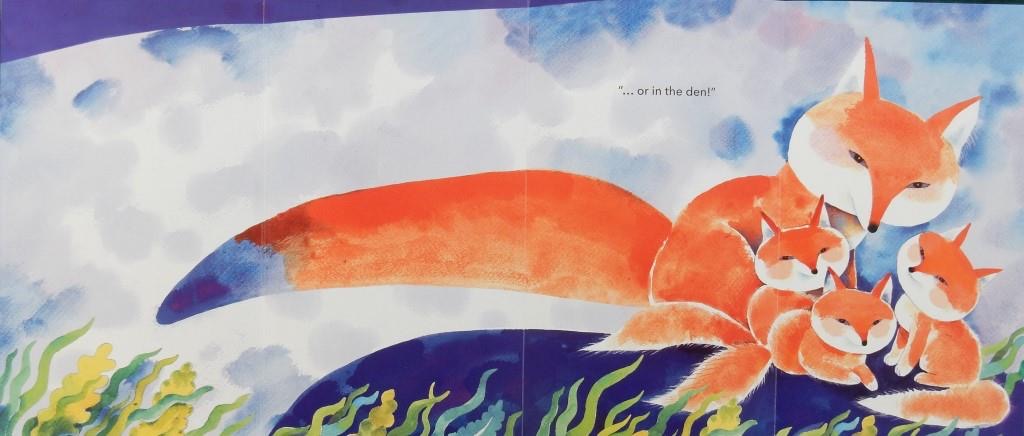
Fox: A Circle of Life Story

Fox: A Circle of Life Story
Isabel Thomas and Daniel Egnéus
Bloomsbury Children’s Books

This beautiful book sent me straight back to my copy of T.S. Eliot’s Four Quartets, to the opening line of East Coker, ‘In my beginning is my end.’

As the story opens in early spring in a still frozen forest life is astir: we follow fox as she sets out to find food for her three cubs.

We meet them a few weeks later – bigger, bolder and playful close to the safety of their den. They too decide it’s time to try being hunters as they follow their parent on the hunt.

Suddenly danger appears in the form of a car; the three cubs dash safely across the road but not so their mother. She is hit, tossed into the grass and dies.

The cubs return home leaving a decomposing body that little by little, over almost a year, returns to the earth, to the plants and to the air.

Her remains provide food and shelter for other creatures and a place for new life to be nourished and flourish. For death is not merely an end, it’s a beginning too.

The powerful, beautifully written non-fiction narrative of Isabel Thomas and the stunningly gorgeous illustrations of Daniel Egnéus combine to make a book that answers one of the ‘big’ scientific questions children ask, ‘ What happens when we die?’ and provides a perfect starting point for talking about the cycle of life and death or, as the subtitle says ‘A circle of life story.’
(There’s also a final spread that has separate paragraphs explaining ‘The building blocks of life’, “What is death?’, What is decomposition’, ‘The cycle of life’ and ‘Death is not just an end’.

There’s no need to wait for the death of a beloved pet or human before sharing this book with youngsters though: I’d suggest reading it with a class or in a family at any time, particularly at a time when the seasons change.

This Book is NOT a Bedtime Story!

This Book is NOT a Bedtime Story!
Eoin McLaughlin and Robert Starling
Pavilion Children’s Books

Whether or not you choose to believe the title of this book clutched by the red monster on its cover, or the sign held by the little frog is up to you. Best to read it to yourself before making up your mind, rather than plunging in and sharing it with little ones before you tuck them in.

Speaking in rhyme the chief monster narrator insists from the outset ‘It’s scary, strange / and rather gory. ‘ … as he attempts to convince frog, rabbit and deer of his and his fellow monsters’ intention to consume them in a dark forest,

before heading off to look for other scary possibilities – a haunted house; a ghostly galleon afloat on shark-infested waters;

a cave full of bats – oops the bats have gone AWOL!

Still however, the only ones that seem convinced of the monsters’ mega-ghastliness are the monsters themselves; but they might just have one more scare up their sleeves, or rather, furry arms. Will this one work and allow them to prove themselves to frog et al? I wonder …

Robert Starling’s mock scary scenes of the would-be terrifying beasties and those they’re attempting to put the frighteners on, are hilarious; and there are some deliciously funny words spoken by bit part players such as the mouse ‘trying to get on with my knitting’, the spider in the cave, and the exchange between rabbit and one monster beside the cooking pot.

The whole enterprise might or might not be a story for bedtime, but it’s most certainly one to share with youngsters. They’ll relish it, as will adult readers aloud, and the former will more than likely demand immediate re-reads.

Thank You

Thank You
Joseph Coelho and Sam Usher
Frances Lincoln Children’s Books

Inspired by the NHS Thursday 8pm Clap for Carers earlier in the pandemic, award-winning performance poet Joseph Coelho wrote this gorgeous story, to demonstrate to children how they, like the child in this book can show appreciation for, and celebrate the key workers, in their own lives.

The story tells of Tatenda, a thankful child who says thank you whenever he gets an opportunity: thank you to mum and dad for making breakfast, thank you to the post lady for delivering his favourite comic, to the teacher for marking his work and to the shop staff who stack the shelves.

Of late though, nobody seems to hear his words of thanks, they’re too bogged down in their fears and worries.
Consequently, the boy decides that a much bigger thank you is needed: here’s what he does …

Suddenly this thank you turns into something colourful, full of energy and movement. Out the front door it whizzes and off down the road, followed by his parents, the post lady whose smile makes the thank you ‘grow and glow’, all the way to school where’s it’s given further sparkle from the teacher’s eyes. Then off into the market it goes, with everyone touched by it in pursuit, spreading joy and colour till it reaches a massive oak tree. And there among the branches it sticks.

Eventually after a massive team effort, Tatenda is able to reach  and liberate the thank you, whereupon it continues on its way spreading colour and joy throughout the community and helping everyone feel better!

This wonderful, lyrical celebration of Joseph’s, superbly illustrated by Sam Usher, is a brilliant manifestation of the power of gratitude and of community strength.

For every book sold 3% of the retail price goes to Groundwork, a charity that helps some of the UK’s most disadvantaged communities deal with the effects of the coronavirus pandemic: another great way of showing appreciation is to get your own copy.

Dance Like a Flamingo

Dance Like a Flamingo
Moira Butterfield and Claudia Boldt
Welbeck Publishing

Little ones can receive a dozen dance lessons courtesy of the host of willing animal teachers in this lively picture book.

Whether they prefer to fly circle-wise, wiggle waggle their bottoms, point and fly like the bees, as they show fellow bees the way to their flower findings;

strut proudly as the peacock shows; or emulate the show-off crab, flexing claws and scuttling sideways in both directions, the instructions are here.

On the other hand (or tentacles) perhaps something a little more gentle in parts like the jellyfish offers, with floaty arm movements and slow, calm drifting might suit the mood: it does get faster though at the end.

I suspect the baby elephant dance will go down well – in more ways than one: make sure you have plenty of space and a soft landing if you do this with a nursery class.

Then after all the fun learning I’d suggest handing the finale over
to the group and letting them choose their moves, as the example on the final spread shows in the celebratory ‘wonderful world’ extravaganza.

With its step-by-step actions and Claudia Boldt’s gorgeous, funky illustrations, this book is terrific fun whether you choose to use it in an education setting or at home: an absolute joy from cover to cover.

While You’re Sleeping

While You’re Sleeping
Mick Jackson and John Broadley
Pavilion Books

Interestingly this collaboration brings together Booker Prize shortlisted author Mick Jackson and illustrator John Broadley, both well known for their books for adults, in a first book for a child audience; and what a superb enterprise it is.

Herein children will discover that during the time they spend sleeping, a myriad of humans are wide awake actively engaged in their world. So too are countless creatures be they owls on the hunt, foraging foxes, bats or hungry hares searching for food.

Imagine what it would be like if those cleaners hadn’t been busy on the buses and trains people take to work and school, while others clean the offices, shops and streets.

Then there are lorry drivers delivering their loads of food and other goods; post-office workers busy sorting all the mail; bakers cooking;

firefighters ready to answer emergency calls; those twenty-four hour shops and cafes; dedicated hospital staff on night duty; and ships with their crews under starry skies.

There’s a reminder that elsewhere in the world, while some children slumber, others will be in their classrooms or perhaps doing sporting activities and when their day is over, the sleepers wlll awake.

Speaking directly to young listeners/readers in a friendly tone, the narrative is a wonderful read aloud be it at bedtime or during the day. While with echoes of Eric Ravilious, John Broadley’s incredibly detailed illustrations are truly beautiful works of art (I’d love any of them as an original print on my walls.)

To open this book is like opening a gorgeous box full of jewels – each page is stunning – so too are the endpapers, the cover: the entire production in fact and to read it is like being shown around a gallery by a wise, gently spoken curator eager to open our eyes to how the world works.

A Journey Through Greek Myths

A Journey Through Greek Myths
Marchella Ward, illustrated by Sander Berg
Flying Eye Books

Classics expert Marchella Ward, courtesy of Little Owl and her grandpa owl, takes readers on an exciting journey through Ancient Greece and the Greek myths from the beginnings of the Universe in Greek mythology, right through to the tale of Daedulus and Icarus, via the Labours of Heracles in her spellbinding sequence of stories awesomely illustrated by Sander Berg.

Perched atop the Parthenon in Athens, Little Owl listens to her Grandfather Night owl as he begins to regale her with stories of the ancient Greek world, stories that had so he says ‘taught the owls all of their wisdom’, the first being of events before Athens even existed and of whence came gods that first the Greeks and then, all humankind came to know.

The stories are divided into several parts: Athens, (where we hear of The Birth of Zeus and the incredible Birth of Athena), Mount Pellon, Mount Parnassus, where the owls encounter Pegasus, and we’re told the tale of his friendship with Bellerophon;

the city of Thebes, Across the sea, The city of Argos,

the Underworld (approaching which the two owls meet a third, White Owl that tells his favourite story Demeter and Persephone;

and finally, the ‘Land of the Living’, each of which acts as a stopping point on the journey we take with the two owls during a cool, dark night.

Be regaled by tales well known and less so, of gods and goddesses, and heroes as you tour the Mediterranean, learning too about the places where each story takes place and why it is important.

As well as the manner in which the myths unfold, I love the family tree at the start, the map of the stopping points and the end papers.

This book would make a smashing present for an older child (there’s a note before the title page that ‘some content may not be suitable for younger readers).

The Bear, the Piano and Little Bear’s Concert

The Bear, the Piano and Little Bear’s Concert
David Litchfield
Frances Lincoln Children’s Books

This is truly a very special book but sadly, the final book in the outstanding Bear and the Piano trilogy. Having so said, it really is a sublime finale.

The book begins with a recap of Bear’s wonderful achievements in his musical career and telling how he’d found it hard at first to settle back into forest life after the buzz of the city, until along came his daughter, Little Bear.

We see the two having a wonderful time together with Little Bear learning so many new things.

One day she makes a discovery and asks Bear what the thing is that she’s come across.

Then little by little her father recounts all his adventures in the city, talking of his days in the band. Little Bear senses his sadness and that evening comes up with a plan that she hopes will cheer him up.

Will Little Bear’s idea succeed in enabling Bear to rediscover that magic of making music: perhaps with enthusiasm reignited he can even pass on that passion to his daughter?

David Litchfield’s illustrations are as always absolutely stunning, full of incredible detail and texture; and his colour palette is in places, appropriately dazzling.

The story too is pitch perfect for reading aloud at anytime, anywhere: I’d love to gather some youngsters together and share it in a forest setting. Indeed, the book is exquisite in every way and a must have.

Lottie Loves Nature: Frog Frenzy / Mermaid’s Rock: The Ice Giant

Here are two young fiction titles with ecological themes:

Lottie Loves Nature: Frog Frenzy
Jane Clarke, illustrated by James Brown
Five Quills

I’d not met nature-obsessed Lottie Boffin in the Al’s Awesome Science series but was excited to make her acquaintance now in her very own-eco adventure series for young solo readers.

In a cleverly and carefully constructed story so that youngsters learn a lot about the natural world as they read, Jane and James include a wealth of information (verbal and visual) via such scrapbook pages,

activities and experiments about such things as ants, worms, the frog life cycle and other froggy facts, hydroponics, potential pond residents and visitors, and creating a wormery.

Lottie, inspired by her favourite wildlife TV show presenter, Samira Breeze, decides to make a pond in her back garden using an old dustbin lid, in the hope that frogs will come and inhabit it and perhaps, if she writes up and sends in her nature notes to the programme, she might even win the opportunity to be a presenter on ‘Every Little Thing’.

However, new next door neighbour, Mr Parfitt with his pristine fake grass putting green is definitely not going to be enthusiastic about Lottie’s plans and he’s far from happy about her pet parrot but maybe she can enlist the help of his son Noah who aspires to become an inventor and programmer of robots. That’s when he made sure that his dad’s back garden is totally minibeast free and it will help him keep fit.

With Mr Parfitt’s ant infestation (on a special cake for a special visitor) to contend with,

not to mention a lively dog, and a plethora of parrot poop, will Lottie succeed in her environmental enterprise?

I look forward to Lottie’s Bee adventure coming early next year. So too, I’m sure will newly independent readers who meet her in this first Lottie Loves Nature book.

Mermaid’s Rock: The Ice Giant
Linda Chapman, illustrated by Mirelle Ortega
Little Tiger

There’s a decidedly chilly feel to the third Mermaid’s Rock adventure.

When Marina announces that she is to accompany her father to the Arctic so he can do his walrus research, her friend Kai is not happy. However Kai’s mum says she can stay with them so long as Marina’s father, Tarak, is agreeable. He is, and she does.

Before he leaves, Marina gives her father a bag of stones, each with an M on and he promises to keep in touch by dropping one each day through the whirlpool. In the meantime there’s the ‘most talented pet’ competition for Marina and her friends to think about.

On the sixth day of her father’s absence, when Marina goes to look for the stone, there isn’t one, nor the next day. Marina and her friends grab some necessary supplies and via the whirlpool, Operation Arctic Rescue is under way.

They soon discover that the ice has begun melting uncustomarily early, spelling danger. Can they find Tarak and get him to safety before it’s too late?

Newly independent readers, especially fans of the series will likely devour this story in a single sitting, enjoying Mirelle Ortega’s black and grey illustrations along the way, and afterwards can learn something about one of the important ecological issues our planet is facing.

The World Made a Rainbow

The World Made a Rainbow
Michelle Robinson and Emily Hamilton
Bloomsbury Children’s Books

What a gorgeous book this is, and it’s pitch perfect for children at the present time of continuing uncertainty when very little seems normal, and for youngsters a lot of what’s happening isn’t fully understood (and that’s only the children!)

Michelle and Emily’s story begins when everyone must stay at home and inevitably friends and relations are being missed – but only until ‘everything mends’ as the child narrator’s mum says unable to be more specific regarding time.

Meanwhile normal life is on hold but there are things that families can do and this one, like so many others during this 6 months of pandemic, have to carry on somehow, some way. And one way is to make a rainbow – that symbol of hope that so many of us have been displaying.

But mum has to work, so it’s down to dad to look after a little brother (‘who’s going berserk’) with the result that our narrator has to be extra creative.

As she works on her rainbow (aided by dad when he’s free ) the little girl finds each new colour stirs a memory or acts as a reminder of something

or somebody.

Eventually her creation is a truly special piece of art and one that she’s happy to put on display in her window so that everyone can enjoy it. And yes, things aren’t perfect but in the meantime there’s much she (and we) can be thankful for.

The story is so movingly and beautifully written and illustrated.

Thank you, Michelle and Emily and of course Bloomsbury Children’s Books for this touching, heartfelt book.

Yes, it’s one for now, but not just for now: it will surely act as a reminder to reflect on in the future, of that time in 2020 when, with ever more new challenges, we all pulled together as communities, showing what the mum in the book said, “All rainstorms must end, and this rainstorm will, too.”  As the little girl says in conclusion, “And we’ll still have each other when this rainstorm ends.’

(A percentage of the proceeds of sales will be donated to The Save the Children Fund.)

Turns Out I’m an Evil Alien Emperor / The Orphans of St Halibut’s

Turns Out I’m an Evil Alien Emperor
Lou Treleaven
Maverick Publishing

A month on from saving Earth from an alien invasion, things have got even weirder for Jasper and his sister Holly. He now knows that his true parents are slugs and that he too can turn into one  (especially at inconvenient times and often triggered by anger), as well as that he’s heir to a planet full of green slime.

Peculiar enough and more than enough to come to terms with surely, but not so. Despite reservations on the part of his foster parents (soon to be his adoptive ones), Mary in particular, Holly drags him off to her teen pop idol, Harry Handsome’s concert. Naturally Jasper has an ulterior motive for going however.

Thus begins another intergalactic adventure wherein seemingly HH is up to his old tricks helping Andromeda invade Earth and brainwashing the whole planet starting with the concert attendees. Why though; and what role is the Asbi supermarket chain in all this shenanigans?

Add to the mix, fluffy balls aptly named Fluffians, assorted aliens and robots, a spindly spider receptionist, an army of clones, plus coping with a surge of hormones and changes in Jasper’s body, as well as an upcoming adoption party; oh and regular things like attending school, and what readers have is an action- packed, slimy, fast moving story that will keep them turning the pages right through to the final Fluffy chirrup.

Can Jasper save the Earth again and can he do so in time to attend his adoption party? Pressure? Who says? After all’s said and done, ‘ It’s a wonderful world’  …

Another winner from Lou Treleaven, Jasper et al.

The Orphans of St Halibut’s
Sophie Wills
Macmillan Children’s Books

Readers who are fond of dark stories will love this grisly comedy of errors.

It stars eight year old Herc, his older sister Tig and their friend Stef, the only three orphans remaining at St Halibuts home for Waifs and Strays in the aptly named town Sad Sack. Also playing a significant role is Pamela, a goat.

Indeed, they’re now the only residents, due to an unfortunate freak library accident (for the matron who lost her life) and ‘Happy’ for the children,

After careful consideration, the children accept the utter importance of keeping their new-found freedom secret and thus some semblance of normality must be shown to the town’s inhabitants even though most rules are tossed aside with joyful abandon.

Into the midst of this jubilant happiness comes a letter duly delivered by postie Maisie. “DEATH is coming’ announces Tig, DEATH being The Department for Education, Assimilation, Training and Health coming to inspect the orphanage. The intention is to ensure the highest of standards are being adhered to; and should the residents not manage to deceive the inspector they’ll be sent to The Mending House of Sad Sack for troublesome children.

For sure the three have a pretty big task, but they’re both shrewd and clever. Is that sufficient to keep them living the good life?

Full of wonderfully funny, twisting, turning antics, mischief and mishaps, superb wordplays and delicious description, not forgetting the sprinkling of fantastic fiends, Sophie Wills’ comedic Victorian story world is one children will relish, (along with a game of football with a broccoli muffin) as will adult readers aloud.

Little People, Big Dreams: Captain Tom Moore

Little People, Big Dreams: Captain Tom Moore
Maria Isabel Sánchez Vegara and Christopher Jacques
Frances Lincoln Children’s Books

We surely all know of the selfless fundraising achievement of national treasure, Captain Tom Moore, on behalf of NHS Charities Together and of his subsequent knighthood. How many of us though, know anything of the rest of his incredible life? Relatively few I suspect.

Now this new addition to the superb Little People, Big Dreams picture book biography series written by Maria Isabel Sanchez Vegara, children who followed him in the media , as he took his daily walk during lockdown, have the opportunity to read about the earlier life of this awe-inspiring veteran.

Tom was a Yorkshire lad who from a young age was passionate about engines of all sorts. At around twelve years of age he discovered an old, broken motorcycle, paid two and six for it, determined to repair and ride it on the road.

Having become an apprentice engineer he was called up to join the Duke of Wellington’s Regiment and was sent to India, a country he found initially strange, but to which he quickly adapted. Determined and brave, he rose to become a Captain and a spirit raiser of his team.

A team that also became his friends for many years until only he remained.

A slip while on his daily walk resulted in a hospital stay, a hip replacement and two knee replacements.

Still his spirit never faltered: he bought himself a treadmill online to strengthen his legs, and installed it on his drive.

As he approached his century, Captain Tom decided to celebrate with a pre-birthday 100 laps walk around his garden. Then the global pandemic hit the UK and Captain Tom had a new goal … the result of which was not the £1000 pounds he’d hoped for but a whacking £30,000,000. A-MAZ-ING!

Dream big and never give up: that’s what he did and that’s what we must all try to do, today, tomorrow and …

3% of the cover price of every sale goes to NHS charities – another reason to get hold of this terrific tribute to an incredible person, sensitively portrayed in Christophe Jacques’ illustrations.

Say Hello to the Sun / Under the Stars

Say Hello to the Sun
Dr Lin Day and Lindsey Sagar
Scholastic

This picture book is essentially, based on a song from Dr Lin Day’s Baby Sensory interactive developmental programme, illustrated with Lindsey Sagar’s bright alluring, patterned illustrations.

Starting with the sunshine, tinies are invited to greet in turn the moon beaming down and guiding, growing corn that provides food, twinkling stars,

the cooling rain, colourful flowers to bring cheer and loving friends with whom to play.

Embedded in each illustration is a small circle showing what look like Makaton symbols and the final double spread talks about ‘how to use this book’ and repeats all the signs.

Whether or not you and your little one goes to Baby Sensory classes, this enormously attractive book is worth adding to your collection to share again and again no matter what time of day it is.

Under the Stars
Rosie Adams and Frances Ives
Little Tiger

With glowingly gorgeous illustrations by Frances Ives and Rosie Adams’ gentle rhyming narrative that has a repeat refrain: ‘The world is a family: / we are all one, / …….. together / under the sun.’ an adult fox and a little one spend the day exploring and observing together from sunrise, until the stars twinkle and the moon shines bright in the night sky.

They watch squirrels playing, pause to relax as otter and its little one float on the water.

They listen to the sky humming with the beat of birds’ wings and enjoy their songs. Then in the cool of the forest, bear cubs share their findings, watched by the two foxes;  so too are the deer family and then under the starlit sky the parent fox reminds its cub, and readers, “The world is a family: / we are all one, / United together / under stars, moon and sun.’

Would that this were so, say I.

With its lilting words and beautiful scenes of the natural world, this is a book to read with little ones either at bedtime; or perhaps earlier in the day when there’s more time to talk about the ideas presented.

Human Journey / Prehistoric Pets

Human Journey
Professor Alice Roberts, illustrated by James Weston Lewis
Red Shed

Readers may recall the BBC documentary series researched and presented by biological anthropologist, Professor Alice Roberts about a decade back called The Incredible Human Journey and now at last we have this superbly presented illustrated book Human Journey for children.

In a dramatic telling, that includes sufficient but never an excess of detail, we’re taken on a journey way, way back to the beginning of time to trace our ancestors. Did you know that at the Dawn of Humankind, our early human ancestors lived on the grasslands of Africa some two and a half million years ago?

It’s those people whose migrations it’s possible to trace to other parts of the globe, and that’s what this fascinating, highly accessible book does. We follow the spread of humankind to Asia, then to Australia; then around 50,000 years ago to Europe where Homo sapiens encountered the Neanderthals.

Then come several spreads on the Ice Age after the peak of which, human hunters began to colonise the Americas – first North and then South.

There’s a map at the end tracing the entire human journeys; journeys where there were perils to face in the form of deserts, climate change, oceans, volcanoes, enormous creatures, floods

and even more. Incredibly however, the people adapted and invented, survived and thrived.

If you’ve ever pondered upon what it means to be part of the human race, this book is one to read. It’s one too where, with their wonderful details, the illustrations of James Weston Lewis merit close attention. There’s also a useful timeline and glossary.

For family bookshelves and school collections from KS2 on.

Prehistoric Pets
Dr Dean Lomax and Mike Love
Templar Books

If you’ve ever wondered what your moggy or your pooch’s ancestors long, long ago were like, then this book is for you. And even if you haven’t or perhaps don’t own a pet but are interested in the branch of science that is concerned with fossil animals and plants, called palaentology as is the author Dr Dean Lomax, then this book will fascinate you.

Herein Dr Lomax has selected seven animals, four of which are mammals: representing the rodents is Ernest the guinea pig, the Felidae is Flossy the cat; there’s Toby whose Canidae family first evolved some 40 million years back,

while horse, Pippa with her thick keratin hooves to help her run on both hard and soft ground, is the Equidae representative.

Each of these creatures, as well as budgerigar Lucky, Jasper the corn snake and Goldfish, Bubbles that belongs to a group of ray-finned fish that first appeared some 415 million years back – wow!

Every one has a double spread with a gatefold that opens to reveal, not only lots more fascinating paleontological information including a fossil file, but also an exciting, sometimes alarming pop-out creature, its prehistoric ancestor, which virtually springs to life before you.

Illustrator Mike Love provides the visuals and has done a terrific job in making every page alluring and exciting; indeed the design of the whole book is terrific.

Last: The story of a White Rhino

Last: The story of a White Rhino
Nicola Davies
Tiny Owl

This story of Nicola Davies’ is a fine example of how a relatively few, carefully chosen words can have a very powerful impact.

Nicola’s tale, narrated by a rhino was inspired by Sudan, the last male Northern White Rhino from Africa that died in 2018. From his captive state in a zoo situated in a grey city, the rhino talks of looking for another animal like himself before remembering his earlier life that was full of colour. A place where other rhinos roamed free and he stayed close to his mother by day and night

until the fateful day when a hunter came and shot her dead. The young rhino was captured, put in ‘a box’ and transported to a dreary place without flora and where ‘Even the rain smelled empty’.

There he speaks of being among many other ‘lasts’ that spend their days cooped up pondering upon their plight

and the state of the world where this is allowed to happen.

Then one day something wonderful happens; something that seems almost too good to be true for the rhino is taken back to his life in the wild and joy of joys, he’s no longer alone.

This is the first book Nicola has illustrated herself and her illustrations too are enormously potent, particularly the stark contrast between the captive grey environment and the colour-filled homeland and the finale.

There’s a page about the illustrations at the front of the book, which I won’t re-iterate in full but just mention the inspirational quote from environmentalist, Paul Hawken and endorse Nicola’s own “I believe that the world can change for the better, but it will change one heart at a time. Change your heart, change the world.’

I truly hope that this story will move others as it did this reviewer, to be part of that change.

I Am One / Our Little Kitchen

I Am One
Susan Verde and Peter H. Reynolds
Abrams Books for Young Readers

It’s never too soon to introduce a young child to the idea that s/he can make a change in the world and this gorgeous book by a team whose books I greatly admire, shows the way.

Subtitled ‘A book of Action’ this one is clearly much more focused on being active than several of the others in the series and it’s a pitch perfect demonstration, given by a child of how seemingly simple actions can make all the difference.

Here we witness the planting of a single seed, a brushstroke, a note ‘to start a melody’, a step to set off on a journey, and I particularly love the “One brick to start breaking down walls’ sequence of actions

so pertinent in our increasingly troubled times.

The harmony between Susan Verde’s words and Peter H. Reynolds’ signature style illustrations is what truly makes this such a special introduction to social activism; it’s tender, inspiring and uplifting.

Furthermore, Peter has dedicated the book to Greta Thunberg and in the final author’s note, (that also contains a beautiful meditation) Susan writes that her inspiration came from a quote from the Dalai Lama: what more can one ask?

A conversation opener, but equally or more importantly, an impetus to seize that inner power and take action.

Also about taking action – singly and as a community is:

Our Little Kitchen
Jillian Tamaki
Abrams Books for Young Readers

Inspired by her own experience of volunteering in a community kitchen, here’s a really tasty, deliciously diverse, offering from Jillian Tamaki. Now, with hands washed and aprons on, we’re ready to go in the community kitchen. We’ll create a meal – something that happens every Wednesday and it’s a bit of a squash to accommodate all the enthusiastic volunteers.

Luckily, they have their own little garden so there’s no need to look too far afield for ingredients; and there appears to be a fair bit stored away that needs using up and there are donations from the food bank. (Beans again – can they be creative?) It’s definitely a case of waste not, want not (although the odd item is clearly no longer fit for human consumption.

This team clearly makes its own music as they work: ‘glug, glug, chop chop, sizzzzzzzzle, pick! Peel, trim, splash! Toss, squish, mmmm!’ Then comes the shout, “Fifteen minutes!’

The countdown is on as the hungry start coming in; they clearly know one another – there’s plenty to chat about while they wait.
Eventually the leader gives the order “Let’s go!” and in comes the food – yummy and very ‘SSSSSSLLLLLUUUURRRRRPPPP!’- worthy.

Speech bubbles abound, providing a running commentary by the workers and the recipients of the bounty produced by the team; indeed, the entire atmosphere is cheery and relaxed,

made so evident by Jillian Tamaki’s vivid colour palette and the fluidity of her lines. In fact the entire book is a veritable feast for all the senses. There are even recipes on the front and back endpapers.

Shhh! QUIET!

Shhh! QUIET!
Nicola Kinnear
Alison Green Books

Little Fox is a quiet creature, a close observer of the wildlife around her about which she loves to make up stories. The trouble is though that her friends are exceedingly noisy and their boisterous activities drown out all her attempts to regale them with one of her tales.

One day Raccoon becomes aware that Fox is looking especially sad, tells the others to be quiet and asks Fox what’s upsetting her. Happily Owl, Squirrel and Raccoon are all lovers of stories and ask to be told one there and then.

Of course, Fox is ready to oblige and starts her tale of a bear; but no sooner has she spoken the word ‘bear’ than the others are off roaring and pretending to be bears up in a large tree. Back on the ground below Fox notices some claw marks that look suspiciously like those of a real bear.

But are her friends ready to listen? Oh dear me, no: instead they frolic in the river then cavort across a bridge while Fox grows increasingly alarmed.

Will she ever get them to stop and heed her words? And if so, who will listen while she tells her story?

Nicola’s narrative is a super one for adult readers aloud to let rip with, as well as for youngsters to join in with the noisy exuberance of Fox’s friends. This exuberance spills out into her illustrations of the drama and she has included some diverting details including Fox’s book, the minibeasts and Bear’s teddy comforter.

Sona Sharma Very Best Big Sister / Agents of the Wild: Operation Icebeak

Here are two terrific young fiction titles from Walker Books

Sona Sharma Very Best Big Sister
Chitra Soundar, illustrated by Jen Khatun

Young Sona Sharma lives with her family in the Tamil Nadu city of Chennai.

As the story opens, she’s getting increasingly agitated about the forthcoming birth of a new baby sibling, an event about which the rest of her household and extended family seems obsessed. (It’s also one that children in a similar situation to Sona might find difficult adapting to).

Sona most definitely needs the sympathetic listening ear of Elephant, her best friend and constant companion (except at school). Everybody seems set on Amma having a baby boy and when talk of the naming ceremony comes up, Sona resolves to help her Appa find the perfect girl’s name (her Amma is ‘looking for boy names’ he tells her.) Nobody in the family is allowed to know if it’s a boy or girl until after the birth.

Even with this important task, sharing is still a big issue for young Sona: can it be resolved before the baby arrives?

Can Sona become the very best big sister and live up to that family motto ‘Iyavadhu Karavel’? (Always help as best you can.)

I totally fell in love with Sona and the rest of her family and community (how great to have a woman auto driver). Through Chitra’s absolutely gorgeous story of welcoming a new arrival into the hearts and home of a loving community, told from Sona’s perspective and beautiful line drawings by Jen Khatun, readers/listeners will encounter some of the traditions

and rituals – cultural and familial – of this large Indian Hindu family which may well be new to them.
I can almost smell the jasmine and feel the steamy heat as I’m transported to one of my most favourite parts of the world – one I can’t wait to revisit once this terrible pandemic allows. Till then I have this warm-hearted tale to re-read over and over (until I can bear to pass it on). More please.

Agents of the Wild: Operation Icebeak
Jennifer Bell and Alice Lickens

Now permanent SPEARS field agents, Agnes and her partner Attie receive an emergency call and before you can say ‘penguins’ the two of them are disappearing down a speed funnel, destination Antarctica. It’s from there, sent by the team at the marine outpost, that the distress call came.

What is causing the seismic tremors being felt within and around the vicinity of the treatment centre, outpost 22? Why are all the Adelie penguins behaving in such an odd fashion? And, what on earth is the celebrity presenter and rare bird expert Cynthia Steelsharp, (one of Attie’s heroes) doing in a tent in the middle of the ice fields?

Moreover, why is she so interested in the little shrew’s trinoculars (that he’d needed to pass a two weeks training before being allowed to use in the field)?
Looks as though it’s a case of ‘operation species rescue’ for the SPEARS partnership (even though it may also mean an operation rescue of one of the pair).

Once again, team Jennifer (author) and Alice (illustrator) successfully interweave ecology and biology into an exciting and very funny story making it both enormously entertaining and educative (not a hint of preachiness at all).

Established Agnes and Attie enthusiasts (and I know a fair number) will devour this, likely in a single sitting; but you don’t really need to have read the first book to love this one, though if you’ve missed it I’d recommend getting hold of book Operation Honeyhunt and then move on to Operation Icebeak.

If you’re a teacher of 7s to 9s and would like to encourage your children to become eco-warriors, either book makes an enormously enjoyable class read aloud. (Back-matter includes information about the fragility of the Antarctic ecosystem and how readers can help reduce global warming.)

A word of warning – two actually: first -never say the word ‘onesie’ to your partner, let alone one clad in a watertight thermal body suit with SPEARS emblazoned across it; second – it doesn’t always pay to trust little lizards with the ability to change their colour.

Yellow Dress Day / What’s In My Lunchbox?

Thanks to New Frontier Publishing for sending these two recent picture books:

Yellow Dress Day
Michelle Worthington, illustrated by Sophie Norsa

Ava has a particular penchant for dresses, dresses of all colours and she chooses which of them to wear according to the feeling she has about the day, when she greets it each morning.

The red dress is reserved for warm, sunny days; on pink dress days her garden is all abuzz with bees enjoying the flowers; purple dress days are those when rainstorms are around;

snowflakes swishing, swirling and sparkling in the sky signify the need to select her blue dress, while yellow dress days have a whistling wind that shakes the tree branches and send their leaves all a-scatter.

On one such whirly, windy day, Ava’s dress isn’t to be found in any of its usual places …

but then she recalls that the previous day had been similar. Oh dear! Now she can locate its whereabouts but she can’t put it on in the state it’s now in.

Perhaps her mum can find something of the appropriate colour for her to use instead so she can go out and enjoy the day playing with her pup.

Michelle Worthington’s story with a scattering of onomatopoeia  that young listeners will love, is great to read aloud, and equally fun illustrations by Sophie Norsa, capture the different moods of the days beautifully.

What’s In My Lunchbox?
Peter Carnavas, illustrated by Kat Chadwick

This book really made me laugh. I was expecting it merely to be a story about a picky eater but it’s SO much more than that.

The boy narrator is something of a fusspot when it comes to the contents of his lunchbox – he eschews the apple; fish is a definite no-no – I don’r blame him on that one;

ditto the egg. I’ve no idea how what emerges on day four has managed to hide itself in a container with so small a capacity, and even more so the item for day five.

I imagine day six’s lunch item would definitely discombobulate any self-respecting boy …

so what about day seven? Could something therein on that particular day perhaps cause a rethink on the narrator’s part?

WIth its repeat patterned text, every page of this story is a starting point for another story – one that a child creates in response.

Ideal for those in the early stages of becoming readers to try for themselves, or for class sharing, when anticipation will be high throughout, and with Kat Chadwick’s terrific illustrations, this is such a fun read. Make sure you sample the front inside cover too.

Interview with a Tiger

Interview with a Tiger
Andy Seed and Nick East
Welbeck Publishing

Ever fancied getting close up and chatty with some clawed creatures? Probably not but nevertheless, the creators of this book, author Andy and Nick (illustrator) would have readers believe that is just what they’ve done. Courtesy that is of a unique invention named a tranimalator that enabled Andy at least, to speak directly with ten creatures of the chelate kind. (Maybe Nick had his own ‘viewing from afar’ machine to facilitate creating his funky illustrations.)

Now, without further delay, let us too meet the interviewees, starting with a Bengal tiger hailing all the way from the wild grasslands and jungles of India.

The questions are tailor made for each animal, so our tiger is asked about her stripes, hunting, food preferences and catching thereof, offspring, her partner, her ideal day, dislikes, adversaries and rivals. Oh! And apparently, Def Leppard is her favourite band.

Other big cat interviews are with an extremely rare Snow Leopard; a (don’t call me spotted, call me rosetted) Jaguar from the Mexican wetlands, (3rd biggest in the cat ranking order); and the mighty African lion(ess).

There’s a yellow-eyed wolf that only howls to keep in touch with pack members or scare off other wolves. Apparently, such animals eat not only the flesh of their catches but also pretty much every other part too. Cheeky creature this one, talking of the online ordering habit of humans.

If you prefer bug-munchers then head straight to the Giant Anteater pages where you’ll discover how they extract their next meal – ants or termites – by licking up the tasty treats from their holes with their long, sticky-spit covered tongues. Interestingly anteaters lack teeth and have tiny mouths.

Or, why not try meeting the tough, fearless Honey Badger (though it will eat all manner of plant and animal fare) but it’s pretty small (think little dog size).

Don’t miss the chat with a Polar Bear, or the Giant Armadillo and the final, Three-toed Sloth either. The last one clearly has a sense of humour and will make readers laugh at his responses. Tee hee!

This is such a fun, hip way of presenting information – a considerable amount of it – in a memorable fashion that will appeal particularly to young humans that prefer a touch of light-heartedness to their learning.

I Really Want to Shout!

I Really Want to Shout!
Simon Philip and Lucia Gaggiotti
Templar Books

Author Simon Philip and illustrator Lucia Gaggiotti deliver with high energy and humour, a third in their series of life’s vital lessons.

The opening lines of the little girl narrator go like this: ‘Sometimes I find it really tough / to make sure I’m not in a huff / because there’s simply so much stuff / that makes me want to shout.’

Well, it is pretty infuriating to have to eat all your ‘green and yucky’ things before having your pudding, as well as when you have stacks of things you want to do, your parents insist it’s bedtime.

School’s no better – getting blamed for someone else’s meanness is assuredly, a letting off steam with an explosive scream occasion.

Thank goodness then for a best friend with whom to share all that angst, somebody to make you laugh and offer rage-coping strategies – even if the teacher’s less than impressed.

Thank goodness too for an understanding Dad who will comfort and put forward other shout-control suggestions – not a total panacea but assuredly they go a long way towards solving the anger conundrum.

We all get angry occasionally, perhaps more often than normal at the moment, but like the determined protagonist here, knowing what to do about it makes SO much difference.

Youngsters need books like this rhyming, high octane drama more than ever right now: ones that offer ways forward in a fun non-preachy style that you can share and enjoy over and over.

The Leaf Thief

The Leaf Thief
Alice Hemming and Nicola Slater
Scholastic

Much as I hate to admit it, there are already signs that autumn is upon us and yes, it is as Squirrel says at the outset of this story,  ‘a wonderful time of the year’ with the sun shining through the leafy canopy ‘red, gold, orange … ‘

This particular squirrel however, is a highly observant creature for suddenly comes the cry …” one of my leaves is missing! Where is it?’.

So distressed is Squirrel that implications of stealing follow as first Bird

and then Mouse are interrogated, all the while the former attempting to convince Squirrel that it’s merely seasonal change that’s occurring.

The following morning though, with more leaves missing, Squirrel starts up again and after more accusations, little Bird suggests some relaxation techniques.

These at least calm Squirrel temporarily but next day poor Bird is on the receiving end of Squirrel’s ‘leaf thief’ allegations.

It’s time for the frustrated Bird to provide a fuller explanation about this ‘Leaf Thief’ and convince Squirrel once and for all about what has been happening.

Finally Squirrel seems satisfied and heads off for a good night’s sleep. What though will happen the following morning? …

Let’s say no more, except that the finale almost had me spluttering my hot chocolate everywhere.

Actually not the absolute finale, for on that spread Alice gives information about some of the seasonal changes that happen every autumn. Her story, told entirely through dialogue is a smashing one to read aloud (so long as you can manage not to giggle too much).

Nicola’s autumnal scenes provide the perfect complement to the telling, showing with aplomb, the high drama unfolding, and turning the characters into a talented cast of actors no matter whether they’re playing a major or minor role.

A Poem for Every Autumn Day

A Poem for Every Autumn Day
ed. Allie Esiri
Macmillan Children’s Books

Allie Esiri has selected 61 autumnal poems for this terrific poetry collection to take readers through from 1st September to 30th November.

For this poetry-loving reviewer much of it was a trip down memory lane, some of which, including Christina Rossetti’s Who Has Seen the Wind?, William Blake’s The Tiger, Someone Came Knocking (Walter de la Mare) and Leigh Hunt’s Abou Ben Adhem took me right back to my primary school days when I learned them by heart.

I’m back in my secondary classroom with my English teacher reading us Edward Thomas’ Digging, Hardy’s Drummer Hodge, Betjeman’s Diary of a Church Mouse and Robert Frost’s The Runaway with that beautiful soft Welsh lilt to her voice.

Then I’m up on the stage in my final year at the same school performing those lines from Longfellow’s The Song of Hiawatha.

Some of my favourite poems are included: there’s Shakespeare’s Sonnet 116 ; and Robert Frost’s The Road Not Taken; I can think of no better way to start October than with that.

It’s great to discover new things too.
Surprisingly I’d not comes across John Agard’s terrific poem about bullying, The Hurt Boy and the Birds, beginning ‘The hurt boy talked to the birds / and fed them the crumbs of his heart’ , the final lines of which are, ‘But the hurt boy talked to the birds /and their feathers gave him welcome – // Their wings taught him new ways to become.’

Bang up to date is Michaela Morgan’s Malala: the opening verses  are: ‘A girl with a book. A girl with a book. / That’s what has scared them – / A girl with a book. // They get on to the bus. / They call out my name. They aim. And they fire. / A shot to the brain.’

I was greatly moved by all the war poems chosen for November, and by James Berry’s Benediction, also new to me, that goes like this:
‘Thanks to the ear / that someone may hear // Thanks for seeing / that someone may see // Thanks for feeling / that someone may feel // Thanks for touch / that someone may be touched // Thanks to flowering of white moon / and spreading shawl of black night / holding villages and cities together’

Reminding us of the way smell and taste can bring back long forgotten memories, Crab Apples (Imtiaz Dharker) is another exciting discovery for me: ‘My mother picked crab apples / off the Glasgow apple trees / and pounded them with chillies / to change / her homesickness / into green chutney.’

Much as I really don’t want the summer to end, this treat of a book will assuredly help me feel my way through the shortening daylight hours as I read A Poem for Every Autumn Day.

Butterfly Brain

Butterfly Brain
Laura Dockrill and Gwen Millward
Piccadilly Press

Gwen Millward’s cover for this book is absolutely delightful; don’t be beguiled by this however. What’s inside is a story about a boy dealing with his grief. There’s even a warning on the first page informing readers that what follows is ‘rather strange and gory.’

Time and time again, Gus gets into trouble; he breaks the rules at school, is rude to his teachers, angry towards others and is always leaning back on his chair, taking not one scrap of notice of warnings about injury from those in school or at home whose anger he’s aroused.

Then one day, the inevitable happens …

CRACK! and that crack becomes a large gap through which Gus’s brains with his dreams, understandings, feelings and memories are exposed for all to see.

A butterfly appears – his very own brain butterfly – a guardian guiding light, it says, but that too flies away. There’s only one thing to do.

Out of the window and up into the night sky goes the pyjama clad boy in pursuit.
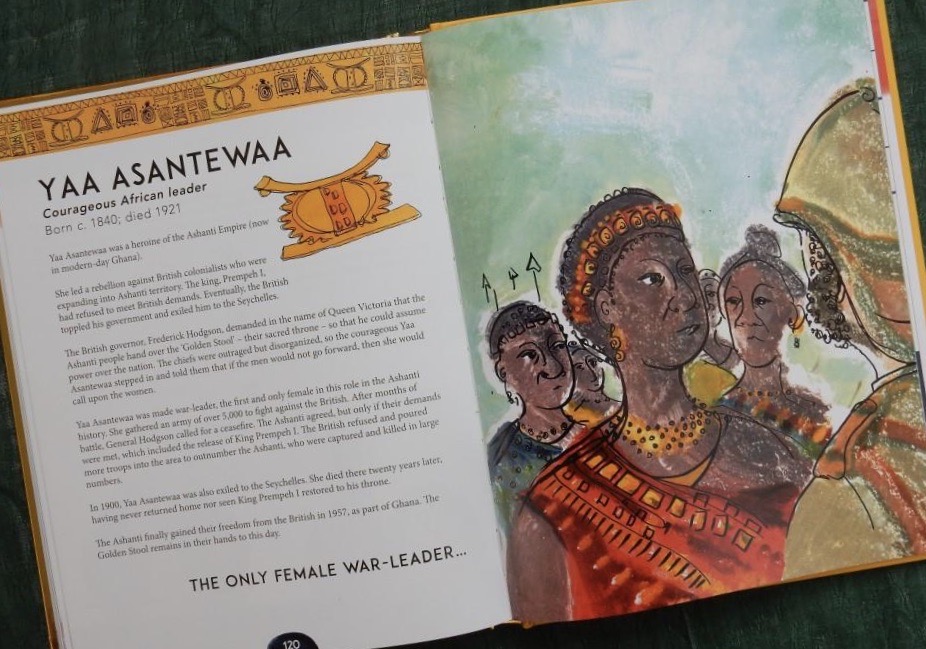
During their journey Gus learns how important memories are, be they good or bad, including those buried deep within. He revisits long gone, alarming dreams, learning of one that should not be left behind, and discovers the vital importance of the imagination.

Is he ready finally to own the secret and the painful fear of loss?

Enormously moving, forthright, and written in rhyme, this is a truly heart-rendingly incredible book that can speak to everyone, child and adult, through its words (Laura’s) and its powerful pictures (Gwen’s) rendered in mood-invoking hues.

A definite keeper this.

The Goody

The Goody
Lauren Child
Orchard Books

We’ve probably all met them – the goody goodies; but Chirton Krauss is by all accounts, ‘the very goodest’. He even does good things without being told. He consumes his least favourite vegetable, broccoli, washes his hands thoroughly after using the loo and goes to bed on time without so much as a murmur.
His sister Myrtle on the other hand is anything but a good child. She never cleans out the rabbit hutch when it’s her turn – why would she when Chirton will do it for her?

Nobody invites her to parties any more and she’s been told she’s not good so many times, she now has a reputation to live up to. Moreover their parents have given up trying to make her do the good things her brother does without question.
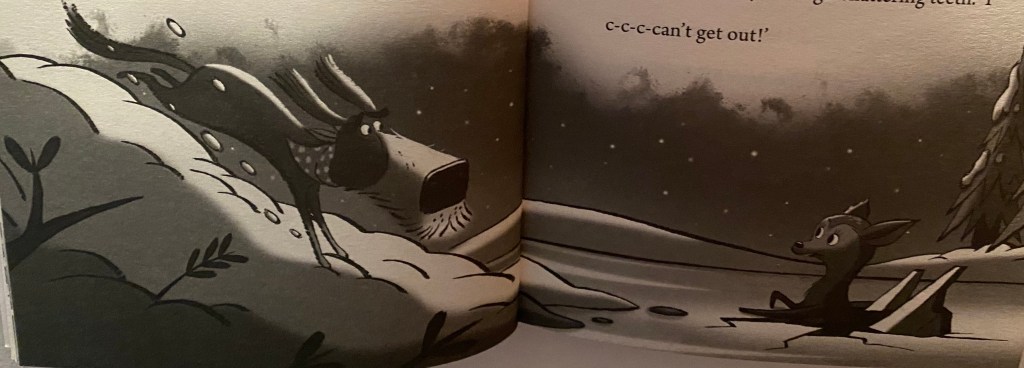
But then he does start to question: why should Myrtle not have to eat her veggies and why should she be allowed to stay up late watching TV, stuffing herself with choco puffs and dropping them all over the floor?

Maybe, just maybe, being a goody isn’t actually so good after all.

Could it be that a change is about to come upon our erstwhile goody, goody boy? And what about Myrtle? Might changes be afoot in her too? …

Delivered with Lauren Child’s unique humour and charm, and her idiosyncratic illustrative style she presents a smashing ‘goody versus naughty’ story that demonstrates how important it is for children to be allowed to be themselves and to be kind.

Whatever way youngsters present themselves to the world, they’ll love this book with its wonderfully textured art, credible characters and wry look at family life Krauss style.

Honey for You, Honey for Me

Honey for You, Honey for Me
collected by Michael Rosen, illustrated by Chris Riddell
Walker Books

I danced around the kitchen and leapt in glee on opening the parcel containing this book from the team that gave us the anthology A Great Big Cuddle.

It’s an absolutely stonking first book of forty nursery rhymes and one of the very best gifts you could give a baby or toddler.

Michael has always been fascinated with nursery rhymes calling them ‘surprising little dramas, full of mysteries and unanswered questions.’ Like this reviewer he’s been an avid collector of books of nursery rhymes and in this new one of his, Michael has put not only popular favourites and playground chants, but also some rhymes that have lain forgotten perhaps for a generation or two.

From cavorting elephants en route from Wibbleton to Wobbleton, wibbly wobbly jelly and frizzle frazzle sausages,

as well as dancing ones summoned into life by a whistling boy, a mop-consuming dog and a ton weight of a giant who’s all a-tremble at the mere sight of a mouse – we know we’ve entered that magical land of topsy turvy where playful language is loved for the sheer delight it offers both to those who hear it and to those who utter it.

Chris Riddell’s illustrations are outstanding, making the characters utterly memorable in a new way, be they of those you might already have met such as the all in black clad Miss Mary Mack and Little Poll Parrot or some delightful revelations that for me were the hiccup remedy …

the hungry frog and for the sheer joy of sharing something delectably new and bouncy to boot, ‘Dibbity, dibbity, dibbity, doe, / Give me a pancake and I’ll go. // Dibbity, dibbity, dibbity, ditter, / Please to give me a bit of fritter.’

For utter adorableness, Chris’s character illustration that completely stole my heart was The man in the moon.

Guaranteed to become a favourite in any household with young children, in nursery and early years settings and with anybody who wants to promote a love of language and art for their own sake (surely, that’s pretty much all of us), this is joyful magic from cover to cover.

Mason Mooney Paranormal Investigator

Mason Mooney Paranormal Investigator
Seaerra Miller
Flying Eye Books

Aspiring paranormal investigator, Mason Mooney resident of the terrifying town of Grimbrook is determined to discover the cause of legendary freaky phenomena affecting the neighbourhood.

It all begins when he receives a letter from Iris a recent purchaser of Tanglewood Mansion telling of strange goings on in the old house and the threat of a curse written on her sister’s mirror.

Off he sets with his investigator’s gear on the allegedly fateful morning of 1st October; but his first impression of Iris is far from favourable and her big sister seems thoroughly unpleasant.

Luckily Mason is well prepared but things quickly ramp up a notch with the appearance of a new message.

Mason decides to hold a séance and is soon confronted by …

Then who should turn up but Mason’s worst nightmare, the cocky Trent Reilly and his Paranormal Society whose team Mason had failed to become part of.

The fact that Mason carries his heart around in a jar,

three cursed spirits to contend with and that deadline to beat, who will prove to have the real talent? Perhaps Iris herself with a single selfless action might just be able to break the heinous curse and save her sister?

But what of that involving Mason’s heart? A loophole maybe? But that’s for another time, for where one story closes, another one opens …

This graphic novel with its underlying theme of sibling jealousy, the combination of weird characters, lurid art, and an accursed setting, make for a decidedly spooky read,