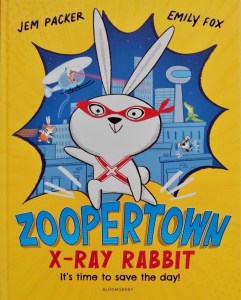
Zoopertown: X-Ray Rabbit

Zoopertown: X-Ray Rabbit
Jem Packer and Emily Fox
Bloomsbury Children’s Books

This is the first of a new series featuring a group of animals, the Zooperheroes residents of Zoopertown. We meet the five Zoopers as they sit at the table about to consume a delicious breakfast when suddenly toast, cornflakes, waffles and pancakes all disappear simultaneously. But that merely heralds a much bigger catastrophe for as the residents of the town gather in the park for the mayor’s birthday picnic it’s discovered that all the goodies have gone, even Go-Go Gorilla’s scrumptious banana birthday cake.

To assist with his crisis Go-Go doesn’t call out Zoom-Zoom Zebra, Zip-Zap Giraffe, Snap-Crack Croc, Crash-Bang Koala; he knows that the only Zooperhero for this task is X-Ray Rabbit with her X-Ray power. Off she zooms towards the park on her vehicle – a Zooper Scooter – of course, but en route she notices, thanks to her sharp-sightedness, a trail of banana skins that lead her right out of town, through the forest to … the Atrocious Tower of Terror.
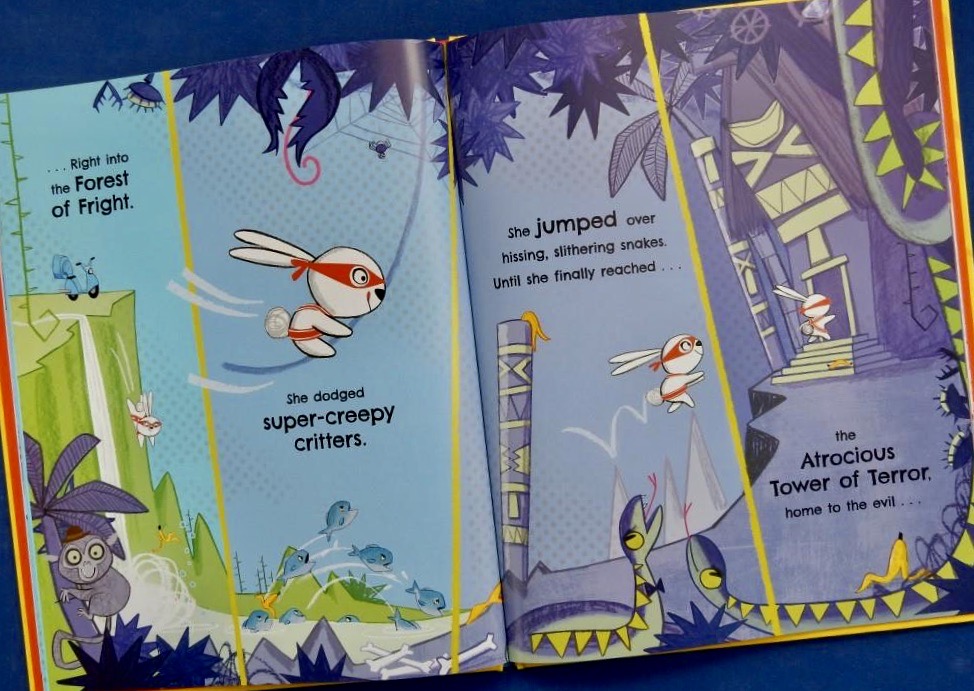
Therein resides the dastardly food-snatching baboon: he’s about to consume a birthday cake and it certainly isn’t his. Furious, not only about not being invited to the party, but by the intrusion of X-Ray Rabbit, he zaps her, trapping her in his stinky lair. Is she doomed or can she escape the clutches of Kaboom Baboon and even save the celebrations?
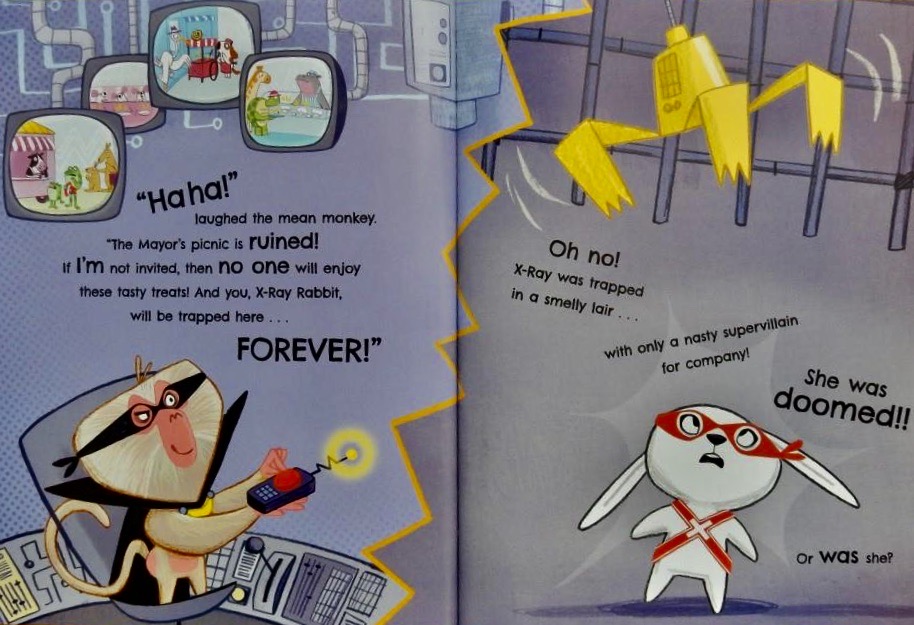
Perhaps, with some timely assistance from her fellow Zooperheroes.

I suspect little human would-be superheroes will relish this action-packed tale, welcome the arrival of its super-cast each with a special personal super-power and be eager for further adventures. Jem Packer’s use of wordplay throughout the narrative adds to the fun and Emily Fox’s dramatic scenes
especially those of the endearing quintet engaging in the high-octane operation are full of comic-style panache.
Elephant Island

Elephant Island
Leo Timmers
Gecko Press

As the result of a boisterous wave, seafarer Arnold elephant’s boat is destroyed. Hours later he reaches a tiny island upon which he lands and calls for help. There’s no response although his captain’s hat does float by, and with it back on his head, Arnold is able to spy a small ship in the distance. Said ship belongs to a mouse. Rescued at last – hurrah! But then …
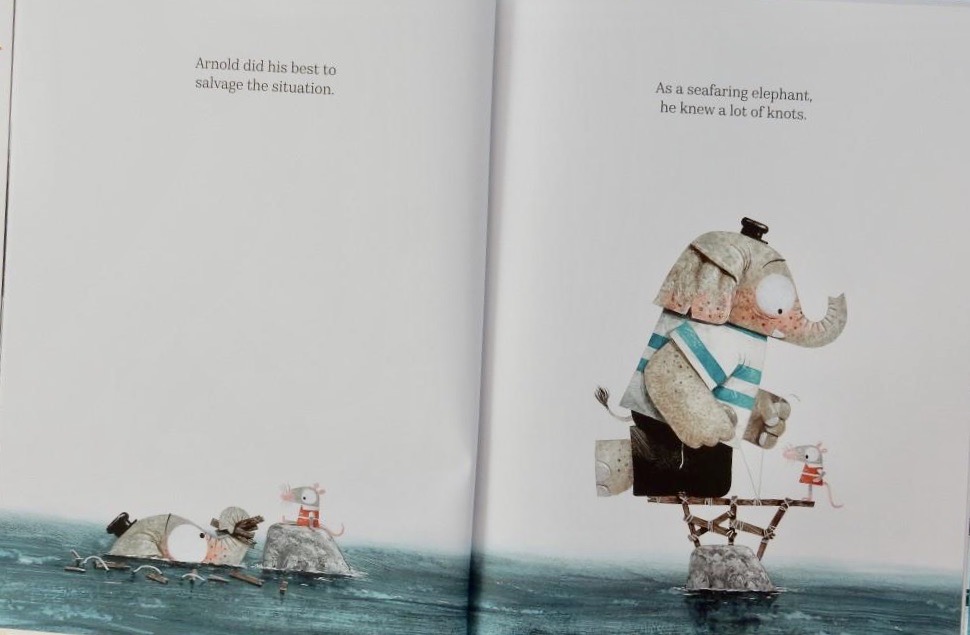
Fortunately Arnold is familiar with a fair few knots, some of which he uses to effect, only to sabotage things when he steps aboard the next craft of a would-be rescuer. Once again it’s operation salvage as the pachyderm fashions an ever more unlikely intricate structure from the fragments, sufficiently large to accommodate everyone whose boat he’s inadvertently incapacitated.

It’s not long before Elephant Island (complete with waffle maker) becomes a ‘go to’ destination and thanks to Arnold’s welcoming attitude an ever expanding one.

Where will all this end?

Then another storm blows up; should everyone now go home, or not …

With a deliciously un-self aware, but hugely adept constructor as its main character and a splendidly silly story to star in, Leo Timmers’ illustrations steal the show. Every one is a testament to creative play and collaborative construction, increasingly full of wacky detail to pore over and giggle at. I can see Arnold’s tale becoming a storytime favourite.

Baby Bunny’s Easter Surprise / Ready! Said Rabbit

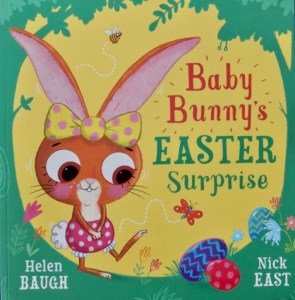
Baby Bunny’s Easter Surprise
Helen Baugh and Nick East
Harper Collins Children’s Books

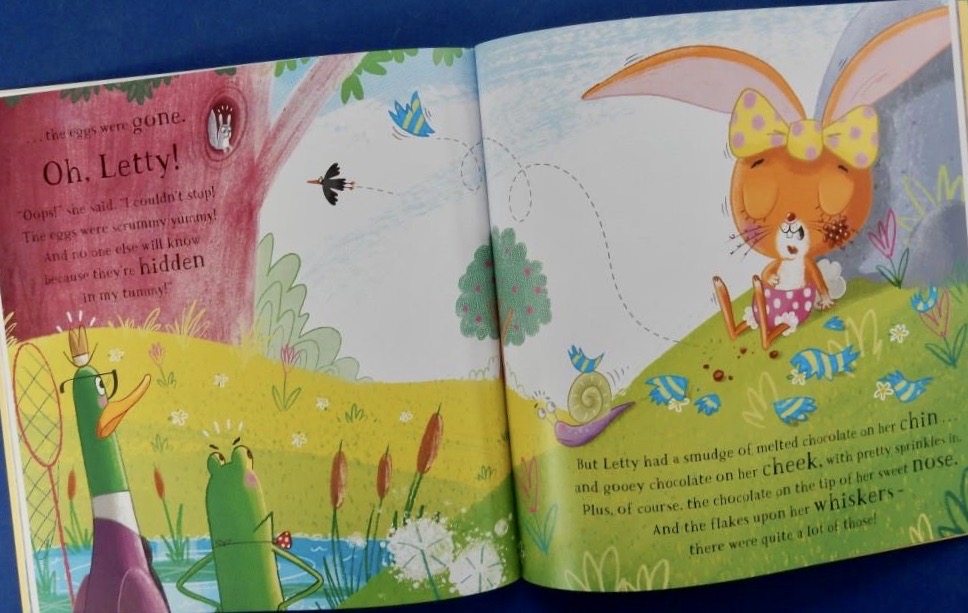
With an appropriately bouncy rhyming narrative and equally spirited illustrations, team Baugh and East entertain young humans (and adult sharers) with what happens when one adorable-looking baby bunny Letty, trails her Easter Bunny mummy one Easter morning on her delivery of yummy chocolate eggs intended for the woodland dwelling creatures.
The problem is though that every egg that is so carefully placed, be it high up in a tree, low down beside the pond or a-top toadstools is so simply irresistible that little Letty, with all her senses alert, just cannot stop herself (even though she knows it’s not the right thing to do) from taking just one ‘teeny-weeny, titchy taste’ – and she’s overcome by such a superchoccylicious sensation that … I’m sure you can guess where this is going.
No matter, thinks the baby bunny, nobody else can possibly know what she’s been up to.

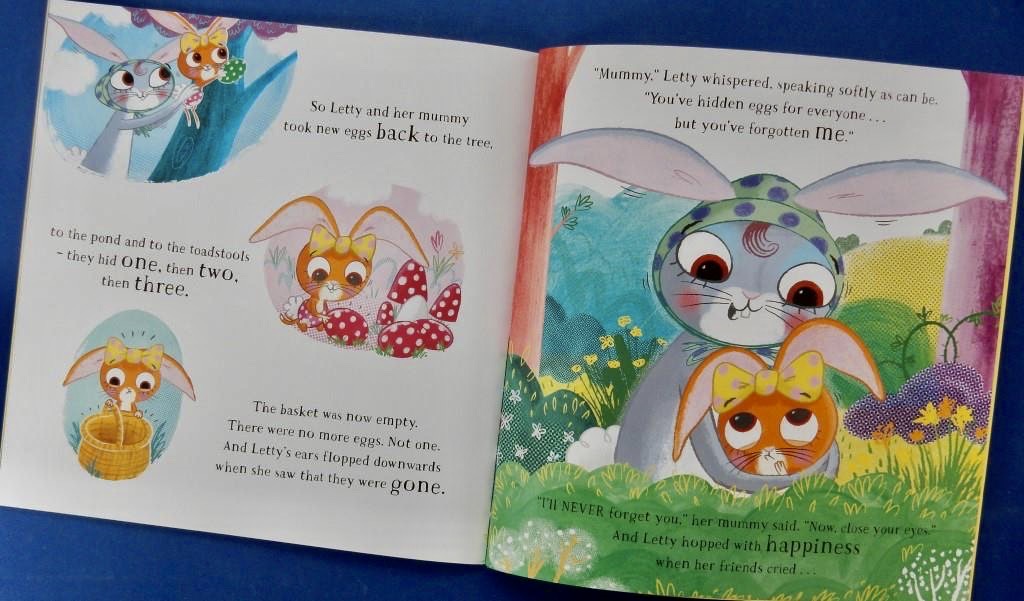
However, despite Letty’s repeated assertion that her misdeeds are undetectable, there’s absolutely no fooling her Mummy. Time to make amends; but that leaves mother and baby with an empty basket and Little Bunny eggless.

Or …

Much better and definitely longer lasting than chocolate eggs, get this for your little ones as an Easter treat.

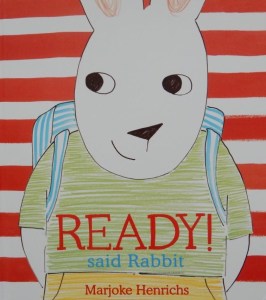
Ready! said Rabbit
Marjoke Henrichs
Scallywag Press

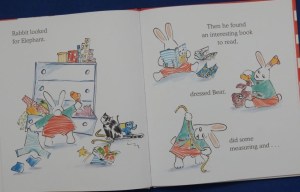
As this second episode in the life of Dad rabbit and his little one begins, the clock on the wall says 9 o’clock. Dad announces that it’s a good day for a visit to the park and immediately the youngster starts enthusing about possibilities such as picnicking as well as mentioning all kinds of things to take along while Dad urges “Time to get ready!”. 

However it takes several changes of clothes before Dad is satisfied with the suitability of Rabbit’s attire. Then there’s the business of assembling snacks and with that completed, Rabbit finds more opportunities for getting distracted from the task in hand. 

With the clock at 11.20 Rabbit finally announces, “READY!”

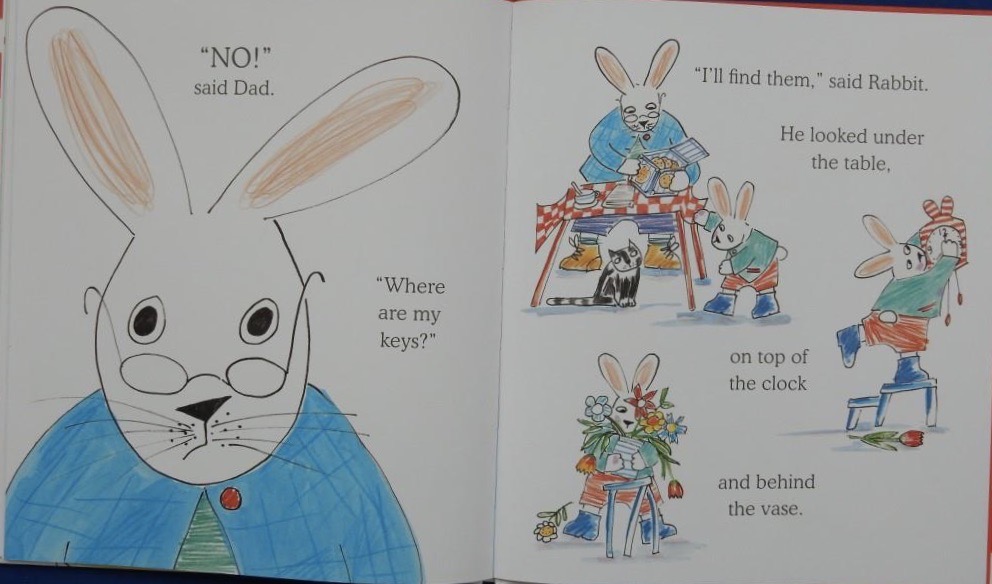
Now it’s Dad’s turn to delay their departure: first there’s a phone call; then some important items are missing (hidden in plain sight) which they can’t leave without 

and it’s not until one o’clock that both parties agree that they’re ready to sally forth – hurrah!

Adult sharers of this story will appreciate the gentle irony of the situation perhaps more than young children. The latter will especially enjoy Dad’s drollery and the numerous opportunities to join in with the oft repeated “READY!” as well as the delightful details on every spread.

Some of those slightly older than Rabbit might try reading the book themselves once an adult has read it aloud: the large clear print, close match of text and illustrations, and the natural repetition all make it ideal as they encourage anticipation and prediction, both of which are vital elements of early literacy development.

A Quartet of Board Books

Bumblebee Grumblebee
David Elliot
Gecko Press

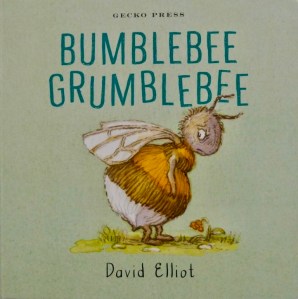
Brilliantly playful is David Elliot’s sequence of rhyming scenarios. We see, among others, an elephant donning dance gear, hence elephant balletphant; there’s a rhinoceros dropping a yummy ice cream cone and becoming crynocerus; pelican rushing to put its botty on a potty – pelican smellican; and when the bumblebee breaks its pull-along toy it becomes grumblebee. Last of all comes turtle – now what could the grinning creature be about to do …
This is just the kind of book to encourage very young children to delight in hearing and creating language and adult sharers will have fun as they read it aloud be that at home or in an early years setting.

How To Say Hello
Sophie Beer
Little Tiger

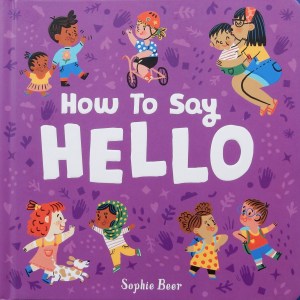
At the start of the pandemic people had to look for alternative ways to greet one another rather than with a hug or a kiss. Those are two of the ways illustrated in this board book; however some of the others – elbow bumping, smiling, fist bumping, waving would have been acceptable even before restrictions were lifted. How lovely it is to be able once again to give somebody a high five, a cuddle, to greet somebody with the offer of a snack, all of which Sophie Beer portrays in her latest inclusive book for adults to share with toddlers: there’s plenty of fun detail to enjoy in each inviting spread, while so doing.

Sing A Song Of Kindness
Becky Davies and Ciara Ni Dhuinn
Little Tiger

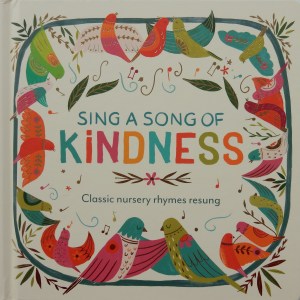
‘Sing a song of kindness, / a pocket full of joy. / Share a slice of friendship /with every girl and boy.’ That’s the first verse of the title song in this board book for which Becky Davies has adapted the words of ten favourite nursery rhymes and songs so that each one offers ideas of friendship, kindness, consideration or compassion.
Each one is illustrated by Ciara Ni Dhuinn who uses images of plants and animals to create gorgeous scenes that offer adult sharers and their little ones plenty to pause and talk about as they sing their way through this book, which is best kept until children are familiar with the originals.

Thank You, Little Rabbit
illustrated by Michelle Carlslund
Happy Yak

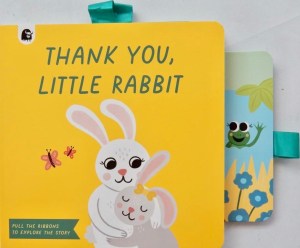
It looks as though Little Rabbit is going to have a busy day. As she wanders in the woods she notices her friend Little Squirrel is distressed. He’s hungry and unable to find food but Little Rabbit directs him to search in just the right place (little ones can assist by pulling the ribbon tab) to find a rich source of nuts. She also comes to the aid of Mama Goose and her little ones; they’re lost on their way to warmer climes for the winter. Little Frog has become separated from his friends and Little Rabbit offers a comforting hug and points them out. The result of all that helping is a lot of happy friends and a Little Rabbit who receives a big hug from a parent rabbit.

Little humans should certainly feel part of the action as they manipulate the tabs to reveal the outcomes of Little Rabbit’s helpfulness depicted in Michelle Carlslund’s empathetic illustrations as the story is read aloud.

Little Chick Grows Up / Little Rabbit Has Friends

Little Chick Grows Up
Yu Hongcheng
minedition

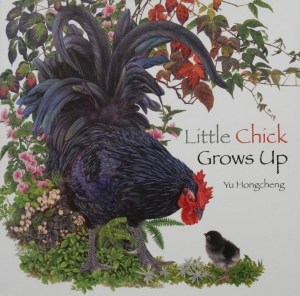
Presented from the viewpoint of Little Chick we follow him from the time he emerges from his shell in spring and takes those first cheeps through the months until autumn when he’s a full-sized rooster.
Soon after hatching he, along with lots of siblings is ready – under his mother hen’s watchful eye and guidance – to start finding food and standing up for himself, always alert for ‘bad’ animals around the farmyard.
Eventually Mum decides it’s time to leave the chicks to look after themselves; are the youngsters ready? Will they find somewhere safe to sleep? And what about finding the right things to eat without her guidance?

Will they be able to stand up to bullies and stay alert for danger. What happens when Boss Rooster shows up to challenge them?

From endpaper to endpaper, Yu Hongcheng’s superb illustrations, which accompany her first person narrative are a wonder to behold in this book that will be enjoyed by children and adults.

Little Rabbit Has Friends
Marcus Herrenberger (translated by Kathryn Bishop)
minedition

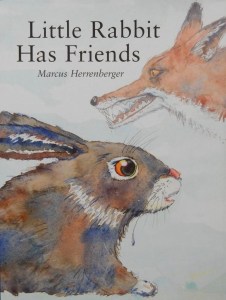
It’s not always peace and harmony in the forest for it’s a place where predators live; predators such as the fox. The very fox that, a raven informs Wren, is planning on eating his friend, Little Rabbit that day.
Wren immediately hurries off to tell Mouse and then the two proceed to tell a hedgehog, a nuthatch, a squirrel, and a mother pig. All the while their worries about Little Rabbit are mixed with concerns about their own safety but nonetheless they feel they must do something to help.

However when wild pig refuses to help, the five friends go to visit Little Rabbit to say farewell.

The terrified creatures know he’s about to become the fox’s next meal, but that’s not quite what happens after all …

Striking watercolour illustrations of the forest inhabitants show how when the less strong work together, their combined power can work wonders. Somehow at the same time both realistic and full of feeling, they make readers and listeners feel part of the unfolding drama.

The King’s Ship / If You Want to Knit Some Mittens

The King’s Ship
Valerio Vidali
Farshore

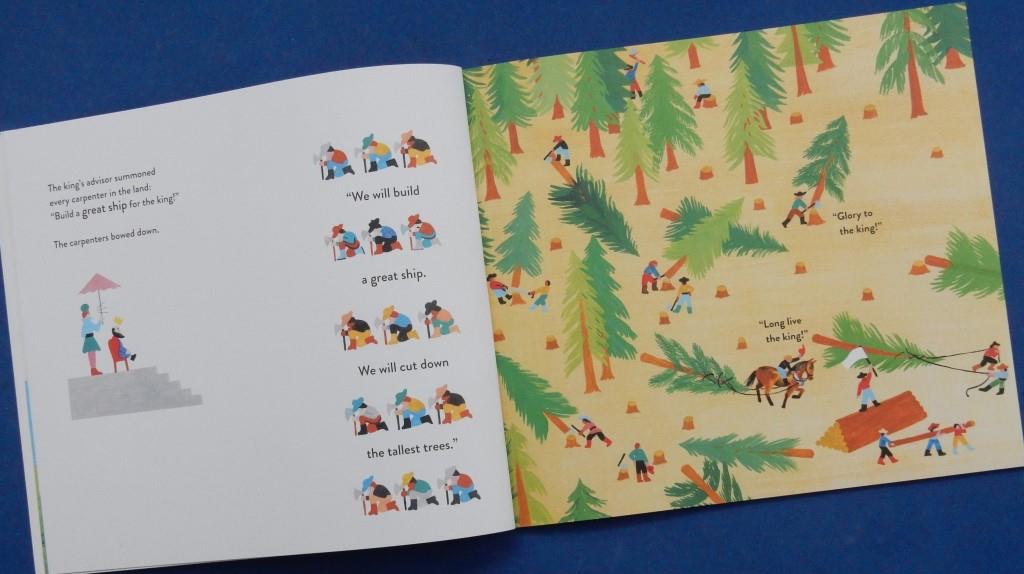
This story has its origins in the true history of a 17th century Swedish warship named the Vasa, built as a symbol of the Swedish king’s greatness when the country was at war with Poland.

Long, long ago a rich and powerful king had everything he wanted, other than one thing – a ship. All the carpenters in the kingdom are summoned and ordered to build a great ship for the king. They set to work felling trees 

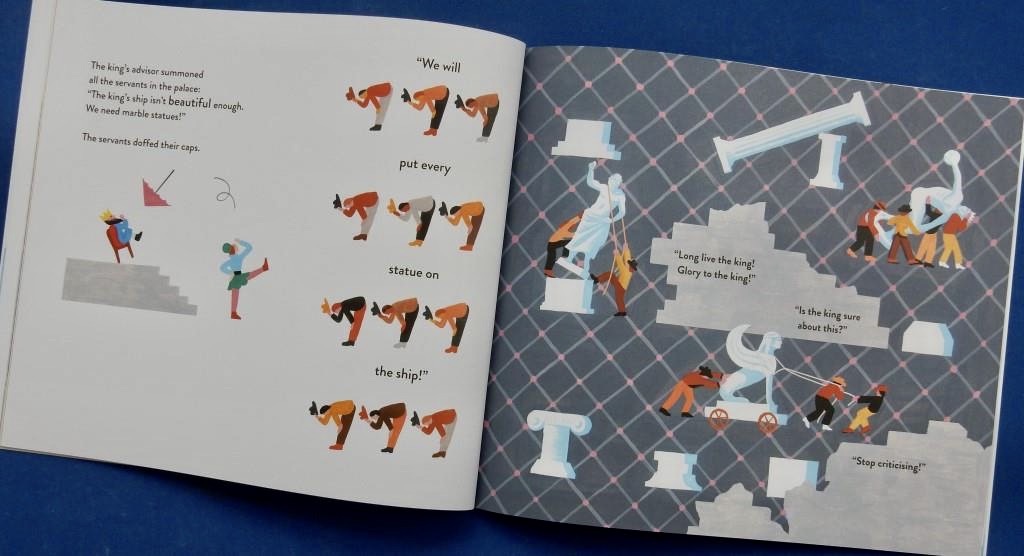
and constructing but when the king sees what they’ve made he declares it too small. The carpenters are ordered to build a bigger one and do so. This time the completed ship meets the size requirements but something is lacking. First it’s cannons to make the ship terrifying but even when those are loaded the king isn’t satisfied. He wants things of beauty aboard and so on go his highness’s marble statues. 

No doubt readers will see where this is going but not the king. He is very happy with his big, terrifying, beautiful ship. Now comes an order for everyone to come and admire the thing …

Vidali’s cautionary tale is imbued with a sense of tongue-in-cheek playfulness and mischief, both verbal and visual; his straightforward, spare telling with that final twist in combination with his droll illustrations of the construction process work harmoniously towards the final revelation.

If You Want to Knit Some Mittens
Laura Purdie Salas and Angela Matteson
Boyds Mills Press

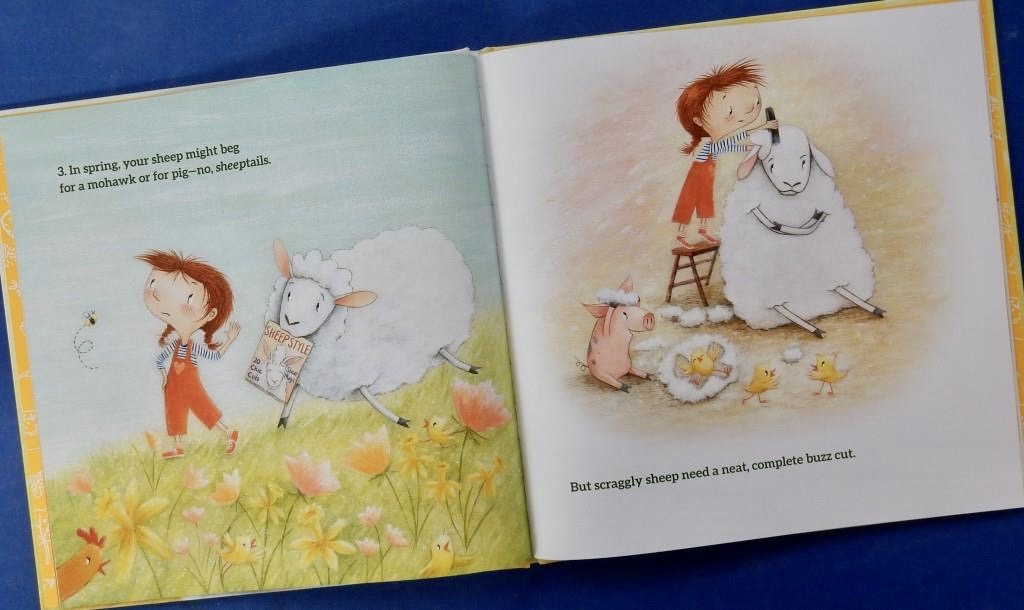
If as the title says, you want to knit some mittens, the first thing you should do is get a sheep. Of course you do! Especially if you happen to be at the apple stall with dad and spot it in a field just behind. Then having taken it back home in Dad’s truck, she needs keeping warm all through the cold winter. This mitten making is no quick job as by now is clear and in the meantime the sheep can grow a thick coat, which come spring will need attention.

And of course, the fleece that’s been sheared will have to be washed, dried and untangled (carding this is called). Next comes spinning and by the way, a spinning wheel has a soporific effect on your sheep.

Now comes the consideration of what colour should the mittens be. Happily despite your chosen colour not being that the sheep has naturally, you’ve a place to grow marigolds. Some waiting follows and more waiting. Eventually the marigolds can be picked and sun dried – well away from lively activity needless to say. 

Dyeing the yarn comes once the marigolds have throughly dried, so soak them and place the yarn in that natural dye, hang the coloured yarn to dry and finally get out those knitting needles and click, click, click.

More waiting – who wants to wear mittens in the summer – and when winter arrives again, celebrate your ‘golden sun’ hands and off you go outside to play with your friend Sheep. Hurrah! Was it all worth it – you bet!

Wonderfully whimsical – there are some delightfully humorous tips included along with the eighteen steps – and there’s even a disclaimer on the copyright page concerning the suggestions made in the story about possible injuries should readers try to be crafty and emulate the small girl protagonist. Angela Matteson’s illustrations supply plenty more amusing details as they follow girl and sheep through the year, documenting their activities together along with occasional playful incursions by various other farm animals.

Investigators: Off the Hook / Investigators: Ants in Our P.A.N.T.S

Investigators: Off the Hook
Investigators: Ants in Our P.A.N.T.S

John Patrick Green
Macmillan Children’s Books

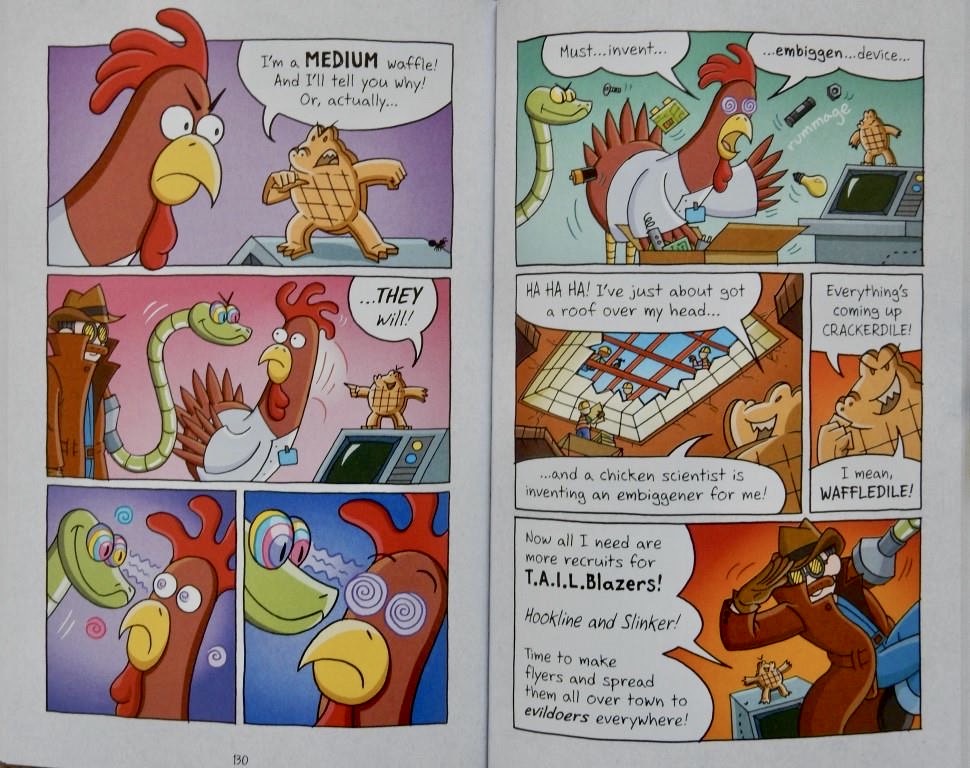
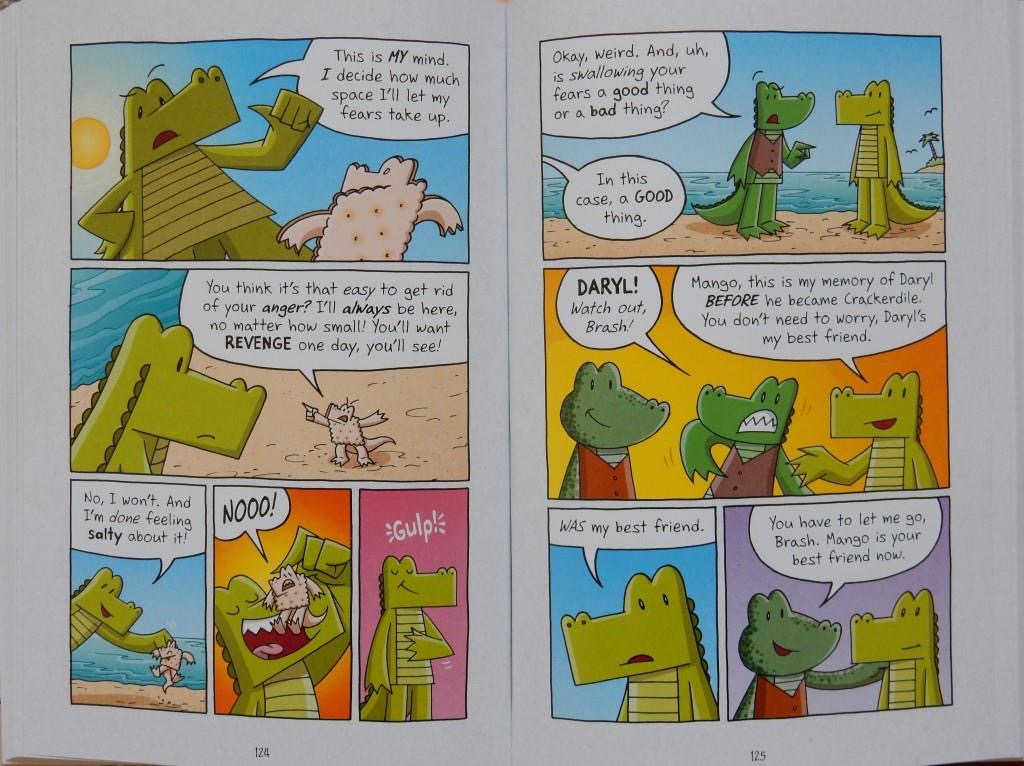
More crime busting, pun filled sprees for Investigators Mango and Brash. As Off the Hook opens Mango and Brash are debating the tricky question:should you or should you not let your partner die for the cause of the greater good, or save your partner first and foremost. Little do they know however that Mango is going to have to face what he calls that ‘no-win scenario’ for real in their next mission – a mission in which they are to test the latest camouflage V.E.S.T technology. while tracking down and seizing Crackerdile et al. Crackerdile has enlisted into his evil T.A.I.L.Blazers the combined Hookline and Slinker – now a snake-armed man.

He and his new recruits – the only two of what he hopes will grow into a large criminal team – rob a bank and then head to a Chicken and Waffle restaurant so that he can be turned into a waffle – the largest size possible.

Can our agents possibly work out exactly what is going on, capture the arch villain and most important, both emerge intact from what seems to be their most difficult mission to date?

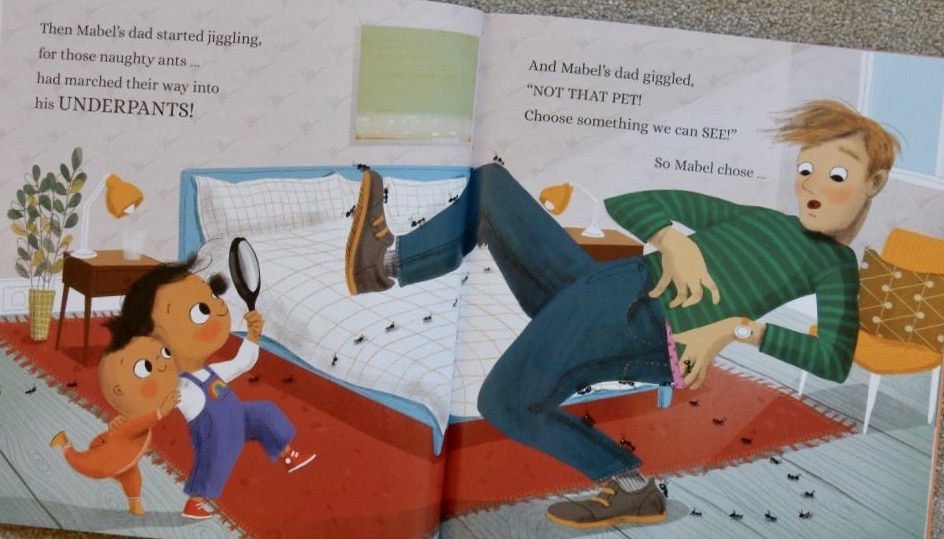
As always Green’s plot abounds with clever humour and madcappery, contains a layer of intertextuality for adult audiences and a motley cast of lesser characters; plus the book ends with a hook to lead you into the ‘Ants’ story. Don’t miss the detail in these illustrations -it’s terrific. (Colour added in Off the Hook by Aaron Polk.)

Taking up where the previous book left off, it’s been decided by HQ that rather than wait for crimes to occur, as soon as they ‘get wind of an evil-doer’s scheme an Anti-Crime-Unit will go undercover as fellow evil-doers and follow the straightforward P.A.N.T.S procedure. Easy-peasy – errr … Maybe not quite so with one of our star team temporarily out of action. Meanwhile those all-purpose V.E.S.T.s have been deemed not really ready for purpose and so it’s back to the assignment-specific kind for this mission.

We soon find Cilantro wrestling with herself: should she turn evil or not? But then she notices someone seemingly up to no good in the old opera house and realises it’s a heroine, not a villain she wants to be. Cilantro reports her findings to our Investigators and it’s a case of putting those new P.A.N.T.S. procedures into action forthwith.

With a decided lack of information regarding Crackerdile, and Brash’s mind to be sorted out, the do-gooding duo have an awful lot of work to do if they’re to prevent the city being taken over by giant ants. Then there’s the question of a certain agent facing up to his fears 

– a Miss Tick or maybe Mrs Tick, but certainly not a mystical thing.Time perhaps to allow Cilantro out in the field and for the Aunty Crime Unit to step forth and put their knitting skills and their ‘purls of wisdom’ to work.

With the usual super-abundance of groan-worthy puns and the reappearance of some characters from previous books, this is yet another high octane (and high-tech) drama, this time with added colour by Wes Dzioba. Established fans will gobble it up but if you’ve not read any of this series, you are missing out on a great deal of fun.

Too Big or Too Small? / Pompon

Too Big or Too Small?
Catherine Leblanc and Eve Tharlet
minedition

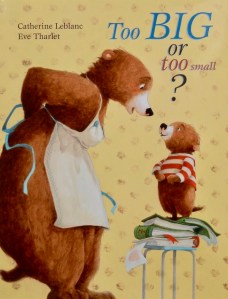
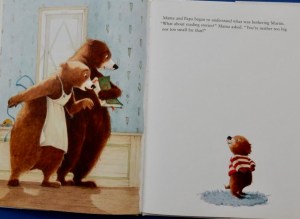
Where his parents are concerned, little bear, Martin just can’t win with his actions. “Don’t be silly, Martin” says Mama when the cub sees his baby sister drinking from a bottle and asks for a bottle, too – “you’re far too big for a bottle!” (Is she aware of sibling jealousy one wonders.) Shortly after when the cub tries using a knife to cut his food, she insists on doing it for him. (Why not show him how to help himself?).

Then his father chastises him for dragging his favourite soft toy animal around all the time – apparently he’s too big to take him out; but then he won’t allow him to use his mobile “No Martin. you’re still too small … you might break it.”

Now Martin isn’t one to be completely dominated and tries to find some ways of his own to show his parents how he feels about what’s been happening.

He also makes the occasional comments about what his parents are attempting to do: “Mama, aren’t you too big to do that?” is his comment on seeing her taking a fingerful of chocolate frosting while baking. Eventually both Mama and Papa come to realise they need to give more importance to doing things they can all enjoy together as a family.

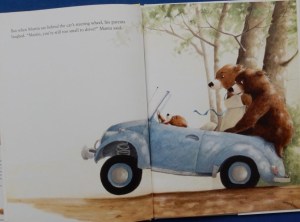
It’s great that Catherine Leblanc makes Martin himself instrumental in changing his mum and dad’s parenting in this fun demonstration of child activism. Throughout the story, Eve Tharlet’s droll scenes are sure to amuse adults as well as young listeners: her portrayal of the bears’ body language and facial expressions are superbly done, especially when the adults are at odds with Martin.

Pompon
Géraldine Elschner and Joanna Boillat
minedition

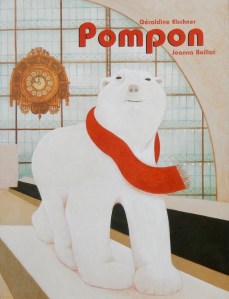
This story was inspired by a famous real statue almost seven feet long created by French sculptor François Pompon.
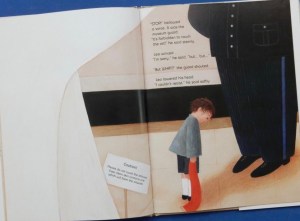
The titular Pompon is a large white bear statue in a museum, a statue that fascinates young Leo when he visits one day. Mesmerised Leo stands staring for ages, taking in its shape and enormity, its smooth texture and the curve of its ears. (This we see in Joanna Boillat’s close-ups that extend over half a dozen spreads.) Now Leo has a special magical look in his eyes and cannot resist reaching up and stroking Pompon’s cheek. The museum guard, initially angry,

then softens towards the boy, seemingly understanding how he felt but asking him to promise it was a one time only touch. A touch however that sets off a transformation in the ursine statue; wings appear on its back and Pompon is free and he takes flight, far, far away … Could it perhaps be that he becomes the constellation shown in the final illustration.

A magical tale engagingly and poetically told and even more magically illustrated, particularly on account of the artist’s clever use of the white space of the bear’s form; that, and the contrast with Leo and his red scarf. A book to encourage youngsters to imagine, to dream and to look long at art in all its forms.

Sabotage on the Solar Express

Sabotage on the Solar Express
M.G. Leonard & Sam Sedgman, illustrated by Elisa Paganelli
Macmillan Children’s Books

In the fifth of the Adventures on Trains series, Hal and his Uncle Nat are on a three week trip to Australia. Billionaire train enthusiast, August Reza, has invited Hal and his uncle on the inaugural journey of the Solar Express – the winning design of his Reza’s Rocket competition. Also on the maiden voyage is Marianne, August’s daughter about whom Hal has rather mixed feelings though with her around he knows the journey won’t be boring. So too is the inventor of the hydrogen powered, Solar Express, a 14-year-old Aboriginal boy, Boaz who is enormously proud of his ‘no pollution, no waste’ engine as Hal discovers when he meets him on the day they arrive.

The following day comes the actual train journey, it’s to last around four and a half hours but as the locomotive departs, Hal is concerned that something isn’t right. His suspicions are confirmed when the journey gets underway for it’s not long before an alarming discovery is made: the Solar Express has been sabotaged. What’s more Hal and his team, notably Marianne and Boaz, only have a small window of time to find out exactly what the saboteur has planned.

Full of twists and turns, this truly nail-biting, unputdownable story unfolds at breakneck speed. With each new book authors M.G. Leonard, Sam Sedgman, and illustrator Elisa Paganelli add to the series, I think it’s the best so far, and then along comes another that’s even better.

Live Like a Hunter Gatherer

Live Like a Hunter Gatherer
Naomi Walmsley, illustrated by Mia Underwood
Button Books

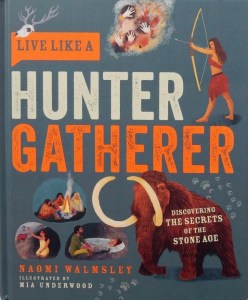
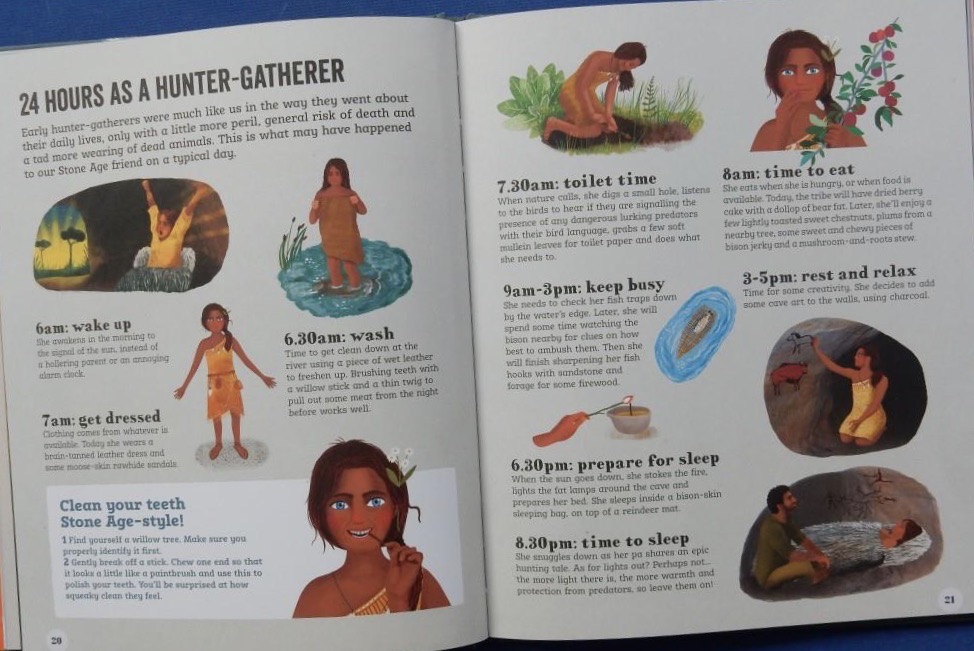
If you think that early humans were not very clever, or that they frequently said, ‘ugg’ and not much else, then this book will dispel those myths along with providing a considerable amount of fascinating information about how they lived, starting with a map of the Stone Age people’s movements and a timeline showing the three main periods of the Stone Age.

Readers are in the company of an eight-year old girl from a fictional tribe who at various times throughout the book, talks directly to us, sharing her feelings about such things as fishing trips and beginning to use her own bow and arrows. We also get a glimpse of how our stone age ‘friend’ might have passed her time during a typical day, sharing her feelings too,

and realise that the everyday needs of our Stone Age ancestors’ were quite similar to ours – how to keep warm, where to sleep safely and what to eat and drink.

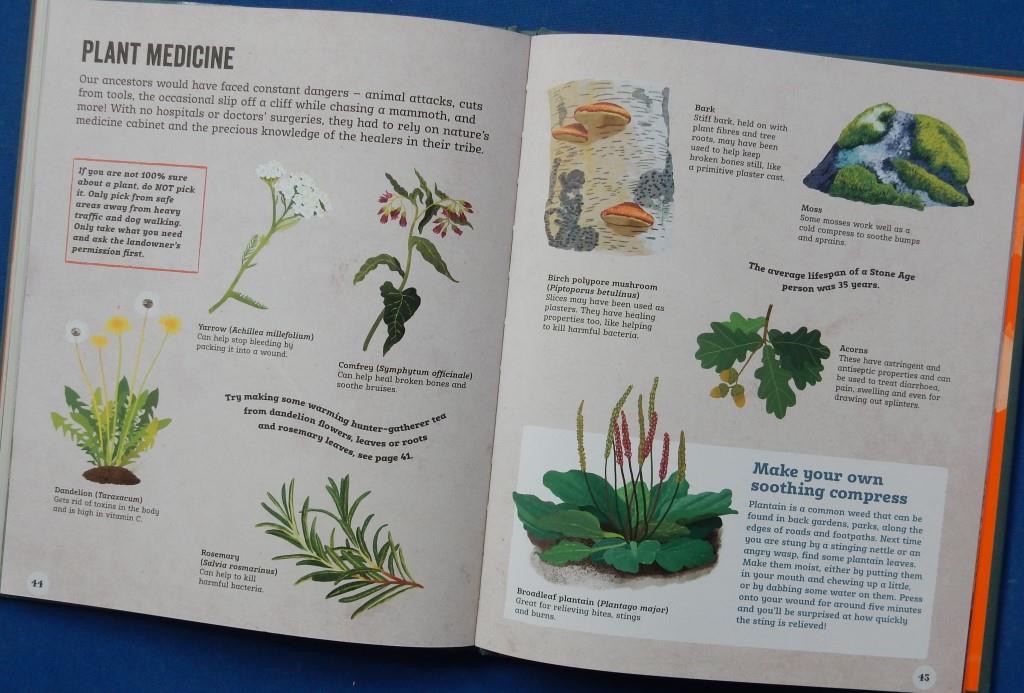
There are spreads on how those basic needs were met, and we learn how they made use of everything from an animal hunted; such a creature provided food yes, but also the means of making weapons, tools, jewellery, clothes and more. Constant danger surrounded these ancestors of ours and without doctors or hospitals, they had only the knowledge of healers in their particular tribe and the medicines nature provided; it’s hardly surprising that the average life of a typical Stone Age person was just thirty five years.

It wasn’t however a life without any fun: early humans made music, engaged in occasional celebrations and made art in the form of small sculptures and paintings especially on cave walls.

Mia Underwood brings all these activities and more to life in her detailed illustrations large and small; while in addition to providing a wealth of factual information, author Naomi Walmsley (who is a forest school and bushcraft instructor), also gives step-by-step craft activities and recipes offering readers first-hand experience of some vital Stone Age skills including making a Mesolithic shelter, some fat lamps, a digging stick and creating cave art.

An intriguing, gently educative resource for home and primary school users.

The Girl Who Planted Trees

The Girl Who Planted Trees
Caryl Hart and Anastasia Suvorova
Nosy Crow

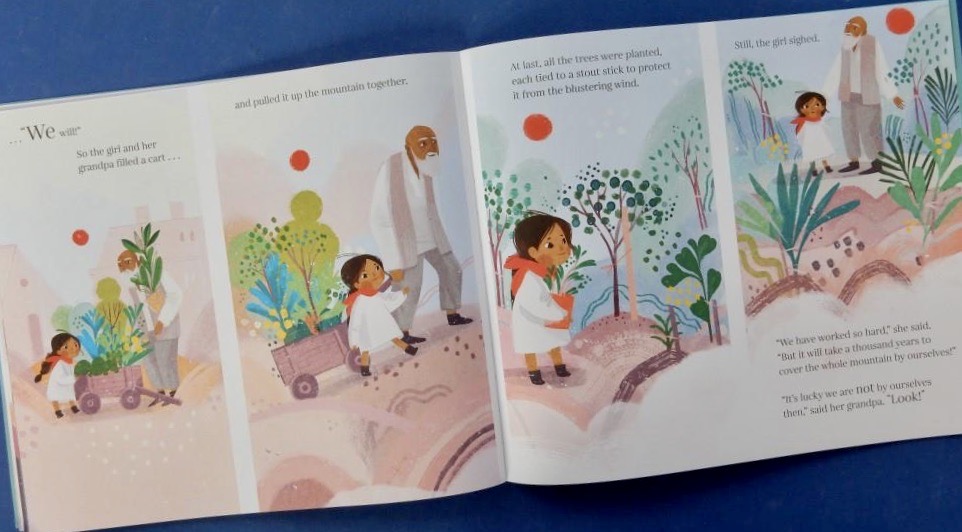
On learning from her grandpa that the mountain at the foot of which their village home is situated was once covered in a green forest a little girl becomes distraught.

The following morning she sets out up the mountain and at the top begins to dig. Then she plants a single pip and returns home forgetting to water it. When she returns there’s no sign of a shoot and back home Grandpa explains that without water a seed will never grow. Later on she enlists the help of other villagers and after a week she’s ready to return up to the mountain top with a large number of seeds all shapes and sizes. She does this day after day always remembering to water the seeds and it’s not too long before seeds are sprouting up.

Eventually she’s able to show her grandpa the results of her endeavours – a patch of green atop the great grey mountain. But then a fierce storm destroys all the trees.

Refusing to give up, the girl suggests planting more seeds and keeping them close to their home until they’re strong. She and her grandpa do just that and over the weeks their yard becomes filled with pots of thriving seedlings. Then comes the time to transplant them, but the little girl is despondent as she sees that even after all their hard work, it will take ‘a thousand years to cover the whole mountain by ourselves.”

Happily they don’t have to for the little girl has inspired the entire village to help restore the forest to its former greenness – a place where future generations too will appreciate the beauty and richness of nature.

Caryl Hart’s powerful story with its ecological theme shows the importance of conserving our precious trees and is superbly complemented by Anastasia Suvorova’s illustrations showing the changes brought about over the months and years, and all thanks to the determination and resilience of one little girl and a whole lot of pips. A terrific book to share, and bursting with potential for KS1 teachers.

If the World were 100 Animals

If the World were 100 Animals
Miranda Smith and Aaron Cushley
Red Shed

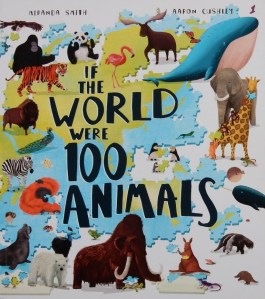
The total number of individual animals on Earth is around 20 billion billion. So says Miranda Smith, author of this book; but it’s exceedingly difficult to visualise such a number, so instead let’s use just one hundred: how does that look? Well, there are many ways of looking at that number; for instance how many are vertebrates and how many invertebrates; how do they differ?

What about mammals? It appears that of the 100, 94 are placental ( I was fascinated to learnt that baby dolphins are born with a moustache), 5 are marsupial and just one is a monotreme -an egg laying mammal) with all five species living in Australia and New Guinea. We’re also shown – by means of a pictorial map – the distribution of wild mammals across the continents.

I was astonished that when considering 100 marine animal species, a mere 9 are already known, the rest have yet to be discovered. I guess that’s not really surprising as we also read that 95% of our oceans haven’t been explored.

Flighted animals, mammals living in the wild,

pets, the animals most deadly to humans, extinct animals and those endangered are the remaining explorations based on that one hundred supposition, and this hugely thought-provoking exploration of biodiversity concludes with some key questions relating to human actions and how these endanger the world of animals, to consider, discuss and one hopes, act upon to ensure the survival of the creatures threatened.

With Aaron Cushley’s bright, eye-catching illustrations on each of the eleven double-page spreads, what is quite a difficult overall concept (that of percentage), with a fair number of biological terms used in Miranda Smith’s text, becomes much more approachable. However, parents of children under seven (the publishers state 5+ in their PR) who haven’t studied biology beyond the basics may well find it tricky to help youngsters grasp some of the content..

This is the Way in Dog Town / Cheesed Off! / Blue Badger

This is the Way in Dog Town
Ya-Ling Huang
Frances Lincoln Children’s Books

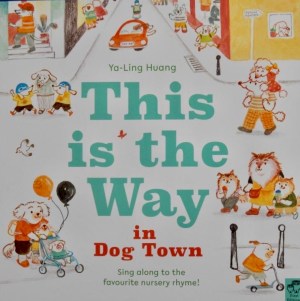
Spend a day in Dog Town with little ones and you’ll soon be singing along to the tune of Here we go round the Mulberry Bush. Just like humans, the residents of this canines only town start by brushing their teeth, after which they get dressed (with a bit of adult assistance) as they ‘Pull, pull, pull!’ Then it’s off to school, hurrying of course as there’s so much there to enjoy be it drawing, playing outdoors and having lunch at midday. Duly sated, ‘Yum, yum, yum!’the afternoon is spent painting and swimming. Early in the evening, the young dogs, walk home and once indoors the way they eat their dinner is let’s say rather messy as they ‘Slurp, slurp, slurp! their way through plates full of spaghetti. So, it’s as well they have a jolly good scrub in the bath later in the evening before retiring to bed.

As they share this book with an adult, little humans will enjoy joining in with action words, as well as emulating the puppies’ actions and exploring the various busy scenes created by Ya-Ling Huang.

Cheesed Off!
Jake Hope and Genevieve Aspinall
uclan publishing

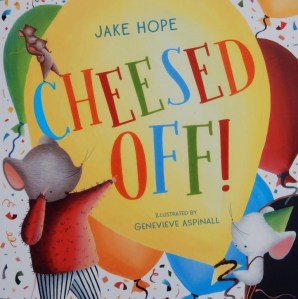
The humans are having a party and it’s time for the photos: on the count of three everyone say “Cheese!” but what about that warning sign at the start of this book – the one about a certain word bringing mice from their house. Too late! The partiers have uttered the word and it’s been heard behind the skirting board. Out come the mice but not a whiff of cheese can they detect. Not a single sighting of a sliver can they spy no matter how hard they try.
Then suddenly an announcement is made and something with candles atop is carried in. Now what might that be …

Huge fun for those in the early stages of becoming readers especially, is Jake Hope’s extended joke illustrated with lots of amusing details from the viewpoint of the mowses’ – oops, make that mice. Therein Genevieve Aspinall shows how humans don’t always realise what’s actually going on right under their noses – or, to be more accurate, beneath their feet.

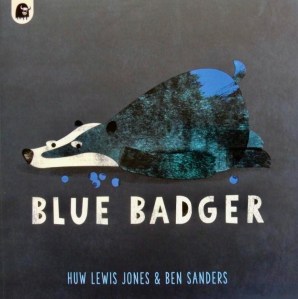
Blue Badger
Huw Lewis Jones and Ben Sanders
Happy Yak

Badger is having an identity crisis: is he black or is he white – albeit with a blue bottom having sat down beneath a bush to eat berries. Off he goes to ask the opinion of other creatures. Bird is unsure, Dog doesn’t know either although he admires Badger’s blue rear and invites him to play. Both Cow and Skunk are dismissive whereas Zebra is equally nonplussed about his own colour markings and Panda merely takes the opportunity for some self-flattery.
Whale sends Badger off to meet Penguin whose considered response is both helpful and constructive, making Badger feel much more positive about himself as well as perhaps, a tad hungry … Happiness at last.

Author Huw Lewis Jones adopts an almost detached tone to his gently humorous text that includes a repeat refrain, while Ben Sanders places his black and white characters on stark, coloured backgrounds in this story with its ‘You can be whatever you want to be’ message.

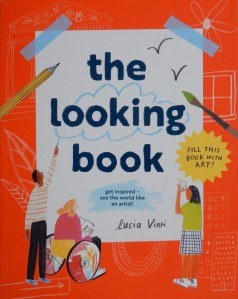
The Looking Book

The Looking Book
Lucia Vinti
Pavilion Children’s Books

Very young children are all artists, no one’s told them otherwise; but once they get to around seven, many become hypercritical of what they create saying such things as “I can’t draw”. Or to use the words of Pablo Picasso, “ Every child is an artist. The problem is how to remain an artist once he grows up.”
Now here is a book that will help them get over that can’t do notion.

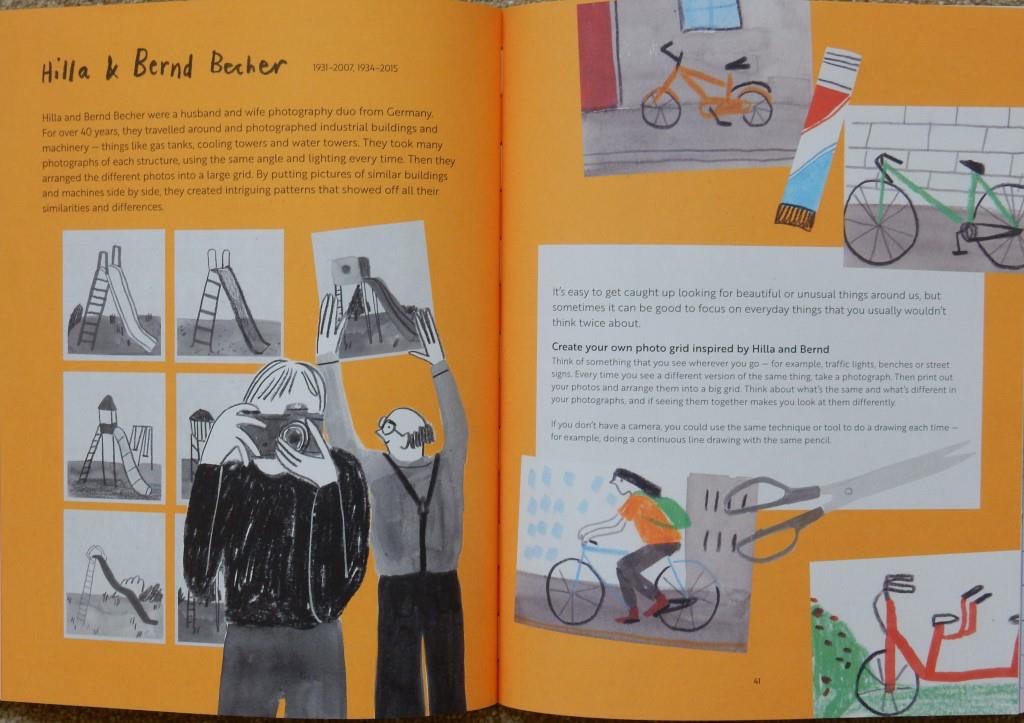
It’s full of creative ideas that show youngsters how to view the world as an artist might and then go on to create art of their own. By looking at things as if through the lenses of eleven artists including Clementine Hunter, David Hockney, husband and wife photographers Hilla and Bernd Becher,

Kehinde Wiley and Henry Moore children can try their hand at producing folk art paintings, a ‘joiner’ sequence, a photo grid of different versions of one item (a bench perhaps), a portrait in the style of Kehinde Wiley

and draw a collection of some interesting natural objects, maybe textured sticks and leaves to use in a design for a sculpture, as did Henry Moore.

These are just a few examples of the exciting challenges of the seventy suggested by illustrator Lucia Vinti. She encourages looking closer, looking up, down and all around, taking time to appreciate the surroundings, not taking anything you see for granted wherever you are and wherever you go (ideally with a copy of this book at the ready along with items from the toolkit shown on the opening spread).

Esme and the Sabre-Toothed Cub / Rita Wants a Dragon

Esme and the Sabre-Toothed Cub
Simon Philip and Magda Brol
Oxford Children’s Books

Could it be that Esme’s best friend Morris the mammoth has his tusks put slightly out of joint when a little sabre-toothed tiger cub appears in the village and charms all the cave kids by its actions. Despite the adults having shooed it away on several consecutive days, Esme asks the visitor she’s named Seb, “Would you like to be my pet?” However, Seb is far from impressed at receiving one order after another from the little stone age girl who eventually gets the message that the creature has no intention of becoming anyone’s pet.

Morris however, decides that perhaps friendship could be the way to go and of course, Esme is eager to join in their fun and games, albeit from some way off. Then trouble rears its ferocious head.

Can Esme save the day and learn a thing or two as well?

With certain similarities to our 21st century world, Simon Philip’s second story of bossy young Esme and her fellow troglodytes is another humorous read aloud, made even more so by Magda Brol’s highly exuberant scenes of this endearing prehistoric community.

Rita Wants a Dragon
Máire Zepf and Mr Ando
Graffeg

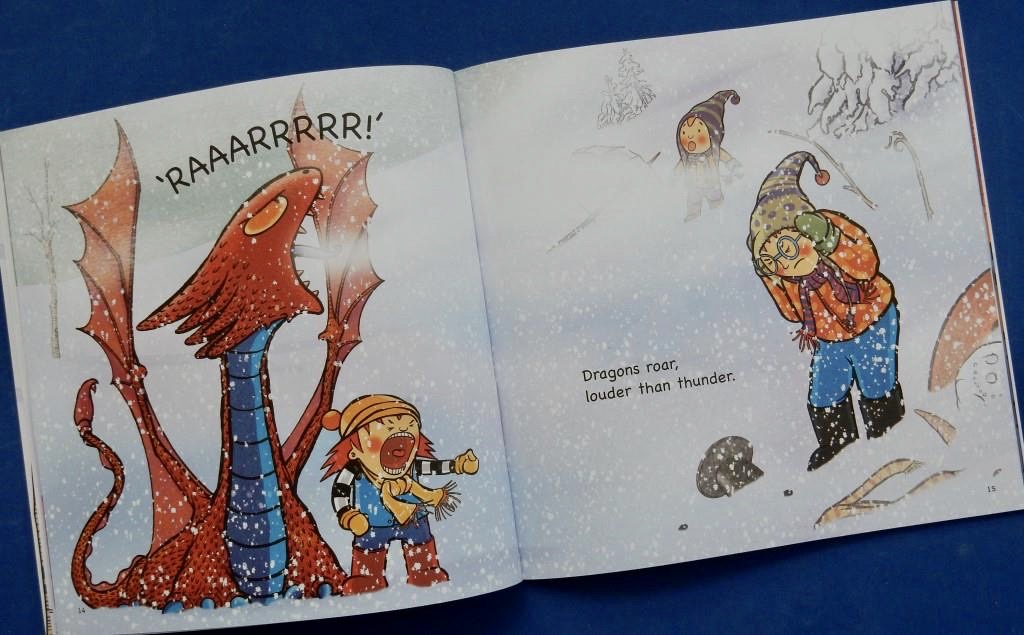
In the fifth of this series starring the small girl with a huge imagination, young Rita is having a bad day. Everything is going wrong and she imagines a large fiery dragon to represent her angry feelings. However, even dragons can’t remain in an angry state all the time – it’s hugely exhausting to roar

and rant, stomp and stamp and breathe fiery flames so it’s as well that they can take flight and find somewhere alone to do some slow breathing to help that rage dissipate and to talk calmly about what has gone wrong. Then anger diffused, it’s time for a snuggly cuddle with a loving grown-up, a mum for example.

With powerful images created by Mr Ando on every spread, Máire Zeph’s tale of Rita’s challenging behaviour offers parents and educators in early years settings an enjoyable starting point for discussions about feelings of anger and how to cope with them.

Mole’s Spectacles / My Garden / Feeling Hungry

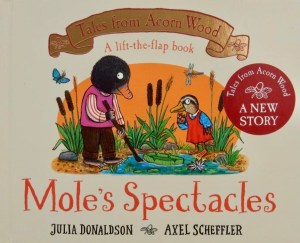
Mole’s Spectacles
Julia Donaldson and Axel Scheffler
Macmillan Children’s Books

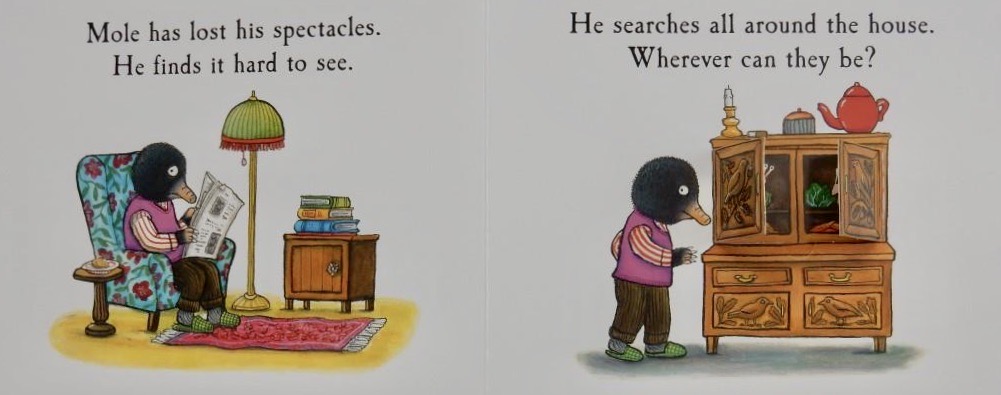
We’re back in Acorn Wood and Mole’s spectacles have gone missing. Wherever can they be? He hunts high and low in his house but they’re not in the cupboard, nor in his writing desk. 

They’re definitely not under the floor though there are some visitors down there. Off he goes to check the garden but they aren’t in the pond; nor did he leave them in Weasel’s sweet shop. After a day spent searching Mole’s in need of a comforting hot cuppa. I wonder what he’ll discover in his teapot …

Axel Scheffler adds lots of fun details to Julia Donaldson’s simple rhyming text in their latest lift-the-flap story. Little ones will enjoy helping Mole in his search and talking with an adult about the various parts of his underground home and what they can see in each.

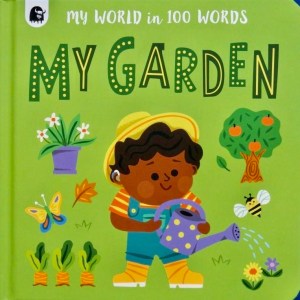
My Garden
illustrated by Marijke Buurlage
Happy Yak

This addition to the My World in 100 words series presents small children and adults exploring the garden through the seasons. In spring lots of things are bursting into flower, it’s a good time for some planting; there’s plenty of things to discover beside the pond too and lots of tools will be needed for doing the gardening. Come summer, the sunflowers have grown tall and it’s so warm that it’s good to cool down under the hose or with a long drink. Up high, everything is in bloom and the bees and butterflies are busy as well as the humans who are planting. Which of the minibeasts will the latter come upon as they work and play? It’s decidedly chillier in the autumn and the wind brings the leaves tumbling down. Time for reaping the bounty of all that planting – there’s a wealth of veggies waiting to be picked or pulled. Winter has just one spread – a snowy one – so everybody is wrapped up warmly.

In addition to the items named in each scene, some of the spreads also have ‘an action word’ and a ‘feeling word’, for instance in autumn a child is ‘kicking’ leaves and an adult and dog are wrapped up because they feel ‘chilly’. 

There’s certainly plenty to explore and talk about with toddlers in Marijke Buurlage’s bright seasonal scenes.

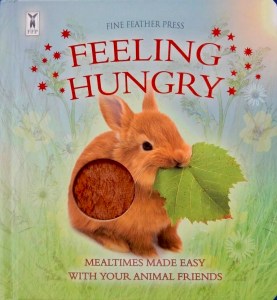
Feeling Hungry
Andrea Pinnington and Caz Buckingham
Fine Feather Press

With a rhyming text and appealing photographic images of a series of animals in natural surroundings, this board book explores choices of food, getting ready for a meal – washing hands, helping lay the table, good table manners, being prepared to try new foods and enjoying a family meal, each presented alluringly for little humans.

The narrative reads aloud well and has a gentle humour: ‘try not to guzzle / or eat with a slurp, / or finish your meals / with a really big burp!’ is one bit of advice.

Adding to the fun for young children is the touch-and-feel element on each spread. Adults whose small child finds mealtimes challenging might well find this a helpful book to share; however there’s plenty of language development potential even if this isn’t the case.

Favourite Characters Return: Isadora Moon Gets the Magic Pox / Kitty and the Woodland Wildcat

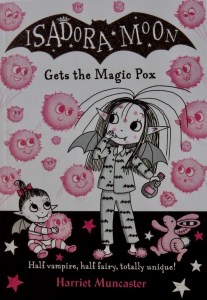
Isadora Moon Gets the Magic Pox
Harriet Muncaster

When Isadora Moon receives the news that after the weekend, her class will be tested on their times tables, she decides to contact her cousin Mirabelle just on the off chance she might be able to offer a maths test avoidance spell. The answer is yes – hence the title of this latest book in the series – and then, armed with a list of the ingredients she’ll need to collect, Isadora sets out to search for them.
Having collected the required items, that night she mixes the potion, rubs some on her face, hides the rest outside and goes off to sleep. However, what happens the next morning isn’t exactly what Isadora had been hoping for. Yes it does result in her missing school, but the side-effects are shall we say a fluffy, magic-induced chaos that’s impossible to keep from her Mum …
Is there any chance Isadora can make everything better again?
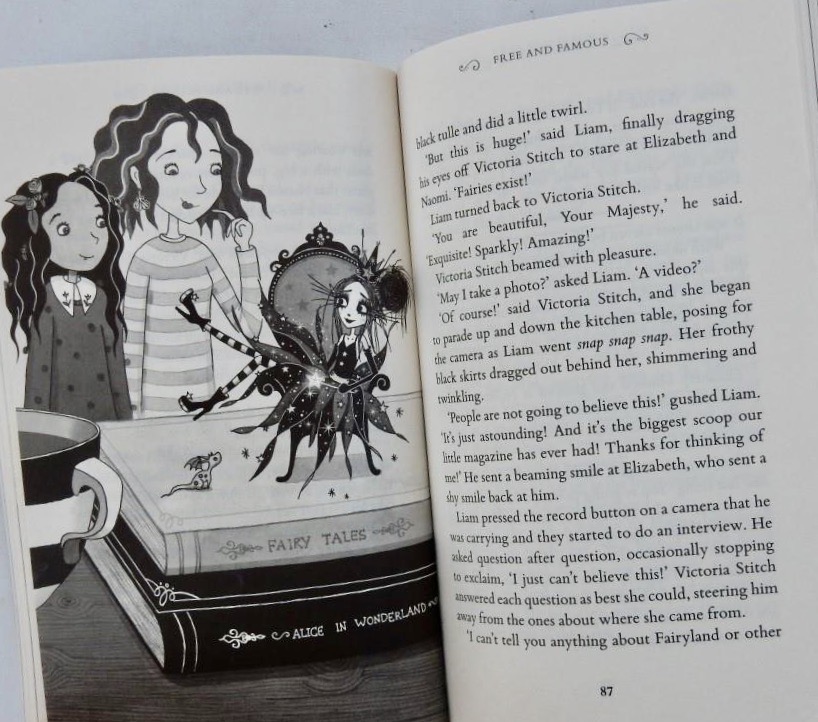
Isadora is an irresistible delight and although some of those emerging readers who lapped up her first stories may well have moved on to Harriet’s Victoria Stitch books, I’m sure there are plenty more waiting in the wings to meet the little half-fairy, half-vampire in this magical offering.

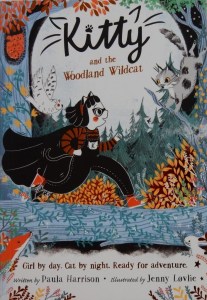
Kitty and the Woodland Wildcat
Paula Harrison, illustrated by Jennie Lovlie


Kitty and her friend and fellow superhero-in-training Ozzy are on a camping holiday with their families. The first night Kitty hears what she’s sure is a cat outside but Ozzy thinks she’s mistaken. Next morning Kitty finds a cat’s pawprints in the mud she follows them and discovers a wild cat. When she tells Ozzy he agrees to stay awake with her that night and together they find her and eventually persuade her they can help her find her missing kittens.
However, the forest is large and it looks as though a storm could be brewing. Kitty and Ozzy are definitely going to have to use their superpowers if they are to have any chance of finding Hollytail’s kittens.
This latest magical adventure, with Jennie Lovlie’s eye-catching two colour illustrations on every spread is, like the previous eight in the series, ideal for readers just starting out on chapter books.

Thanks to the publishers Oxford Children’s Books for sending these titles for review.

Goodbye Bear

Goodbye Bear
Jane Chapman
Little Tiger

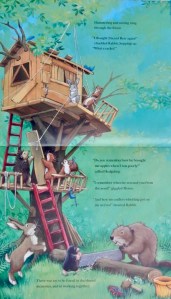
Beaver and Mole are heartbroken at the loss of their dear friend, Bear. They offer gentle support and comfort to one another as they experience a gamut of emotions including sadness, anger, numbness and sometimes think they can hear Bear’s voice.

The seasons change and with Spring almost upon them, Beaver and Mole decide to pay a visit to Bear’s treehouse. “ … The woods will be full of snowdrops. Bear loved snowdrops,” Mole says as they head off through the woods.

Once outside they discover Bear’s ladder and boxes of nails and decide to put up the ladder and go inside. “Bear loved us, Mole says, “and he wouldn’t mind in the slightest.” What they discover inside makes the two decide to finish the treehouse that Bear had started and invite all their friends to come and assist with the project.

As they work, the animals take turns to share their fond memories of Bear, finding joy in so doing, as well as in their joint project.

With the task nearing completion Mouse finds finds an old painting and then finally as they sit together celebrating Bear and sharing cake they find out that their friend had been planning an awesome surprise for them. It’s one they can always treasure, just like their memories.

This is such a beautiful, sensitively written and illustrated book. Jane’s illustrations chronicles the passage of time through the changing seasons, while also showing that although some of their feelings such as anger will dissipate over the months, their fond feelings remain constant. The sharing of grief helps ease the pain of loss and makes remembering so much more joyful.  

A wonderful story to read together as a family or with a KS1 class.

The Story Shop: Blast Off! / Dirty Bertie: Poop!

These are two young fiction titles from the Stripes imprint of Little Tiger – thanks to the publisher for sending them for review

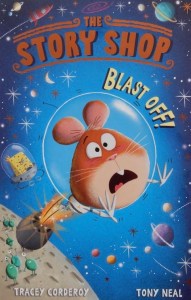
The Story Shop: Blast Off!
Tracey Corderoy, illustrated by Tony Neal

The Story Shop – now there’s an irresistible name to give a place selling stories, but if that isn’t enough to lure in customers, then surely the idea that this particular establishment run by shopkeeper Wilbur and Fred Ferret his assistant, sells stories you can actually BE in with characters you can meet, should be irresistible. Moreover they have a huge stock of plots and props just waiting for customers.
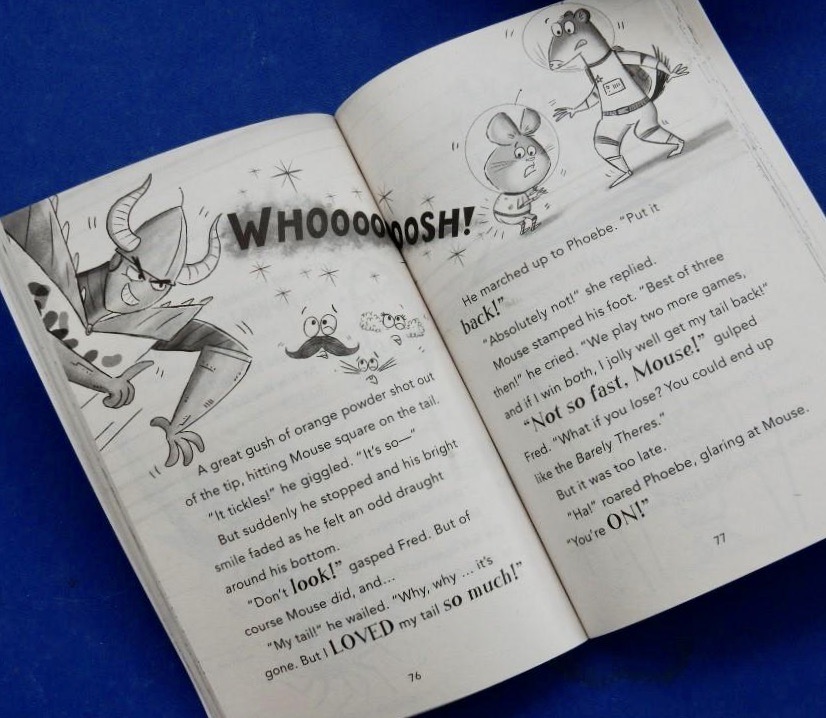
On the particular day the story starts, the first customer to enter is a rather boastful mouse. Said mouse knows just what he wants, demanding “Something out of this world”. Then it’s time for the story pot to appear, and the ingredients to be added. With that task duly done, and an important reminder given to Mouse, WHOOSH! POP! the adventure begins. In no time at all Mouse, together with Fred, find themselves on the moon, whereupon a certain rodent very quickly lands himself in a whole lot of trouble with the resident aliens in a very cheesy environment. However having managed to get away from that particular whiffy situation, largely thanks to Fred’s help, Mouse quickly discovers planets with other kinds of aliens. On the Planet of Games he recklessly bets his tail on a game of Tiddlywonks with Phoebe FairPlay as his opponent. Will he, or will he not, end up tailless.

In the third of the linked adventures complete chaos ensues when a certain Mouse lands on Planet Cog. Can order be restored and even more important will the two space adventurers manage to return safely to the Story Shop?

Bursting with fun and humour, and a wonderful celebration of the power of the imagination, this first of a new series, full of smashing illustrations, is spot on for emergent readers.

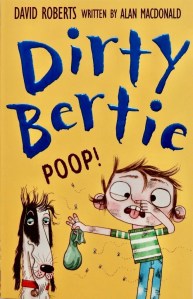
Dirty Bertie: Poop!
David Roberts, illustrated by Alan MacDonald

Is there no end to Dirty Bertie’s misdemeanours? Ideal for those fairly new to chapter books here are three further episodes. The first relates what happens when the zealous park-keeper, he who has recently erected new signs, bans him and Whiffler from the park on account of the pongy deposits his pooch has supposedly left on the grass. Could it perhaps be a case of mistaken identity …
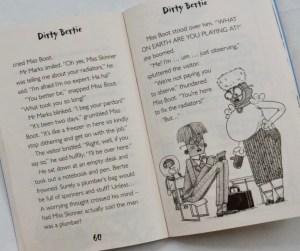
In the second chapter there’s more mistaken identity only of the human variety this time. This happens when Bertie tries his level best to get his unfavourite class teacher, Miss Boot, an award for excellence in education and in so doing see her promoted out of his school.

The trouble is that the arrival of the judge pretty much coincides with that of another visitor.
Finally – well not actually finally as we know Bertie will be back – he manages to get himself on a film set in the role of an extra: what could possibly go wrong?

Splendid shenanigans as ever when this young lad is involved, and hilariously illustrated with Alan MacDonald’s plentiful line drawings.

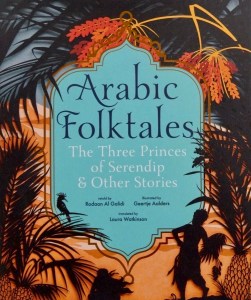
Arabic Folktales: The Three Princes of Serendip & Other Stories

Arabic Folktales: The Three Princes of Serendip & Other Stories
retold by Rodaan Al Galidi (trans. Laura Watkinson), illustrated by Geertje Aalders
Walker Books

This is a collection of stories Rodaan Al Galidi has garnered from his childhood, from history and from literature, universal stories that belong to everyone, rewritten in his own style. Through tales such as these we find the commonalities among humankind.

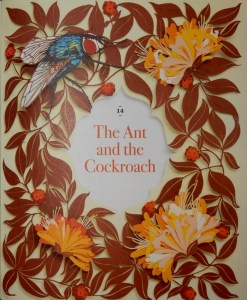
Having said that, it’s probably true to say that there’s something for all interests in this gorgeously illustrated offering of twenty short tales. Some feature animals: an ant and a cockroach debate whether hard work and preparation are more important than doing things that make you happy;

a group of turtles endeavour to get a visiting partridge to change his lifestyle and remain on their island always; and an arrogant rooster learns that he’s not as indispensable as he’d always thought; and, a lion, a wolf and a fox discover that they have different views about sharing their hunting spoils.

Humans too have much to learn, not least regarding perceptions: upset as a result of boys calling her ugly, a beautiful girl retreats inside her grandmother’s home. In response her grandmother tells her of a father, his son, and a donkey travelling to Baghdad. The man rode, the son walked, and people thought it was disgraceful that the father was not more caring for the boy. Hearing their comments father and son change places before reaching the next village. I’m sure you can already imagine where this story is going …
There’s a tale about finding a way to eat with a spoon three feet long (one I’ve used in school assemblies from time to time) that demonstrates the difference between merely having love on your lips and having love in your heart too.

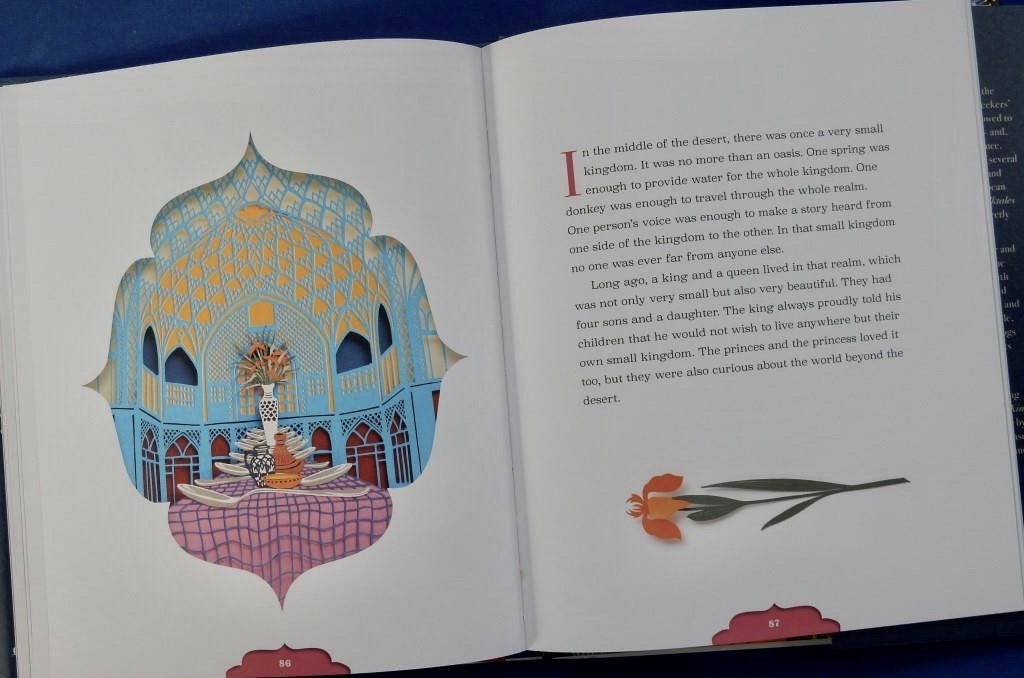
The title page of each story has a gorgeous cut paper design surround and further beautiful illustrations, some exquisitely detailed, are woven into the fabric of every tale by the hand of Geertje Aalders. These help readers and listeners conjure up ideas of the setting the author uses for each of his tellings although in his introduction is this: ‘Feel free to change the names or to choose other flowers, waters, windows or doors. … stories are the best migrants and the finest travellers. Let these stories become your own.’ Assisting readers of English to do exactly that is Laura Watkinson the translator, who like the illustrator, lives in the Netherlands.

Ancient though folktales may be, they contain much that is relevant in today’s world and I’d wholeheartedly recommend adding this book to your shelves at home or at school.

Ebb and Flo and Their New Friend / The Tale of the Tiny Man

Ebb and Flo and Their New Friend
Jane Simmons
Graffeg

Jane Simmons’ books with their gorgeous, soft focus, painterly illustrations, were very popular with foundation stage classes in my early teaching days and it’s good to see Graffeg reintroducing Ebb and Flo to a new generation of young children.

For those unfamiliar with the characters and their adventures, Ebb is a dog and Flo a young girl. They live near the sea and are constant companions. As this story opens the two of them are sitting in their boat with Ebb in her favourite spot in the bow when suddenly her place is usurped by a large bird. Flo urges Ebb to accept the visitor as a friend but Ebb is anything but accepting of the newcomer with its frequent ‘beep, beep, beep’ sounds. 

As the days pass even Granny takes to Bird, giving it some of Ebb’s favourite snacks. 

Ebb wishes Bird gone and the following morning, to Flo’s disappointment, the wish has come true.

However, it quickly becomes an instance of you don’t know what you’ve got until it’s gone, for Ebb finds herself missing Bird and that beeping, especially when as the summer days pass, they see reminders on their journeys along the river. 

Then one day, Ebb hears a familiar sound: could it be …

This gentle exploration of change, jealousy and the challenges of accepting a new friend into an established group, will resonate with many young listeners who will likely look forward to hearing more about Ebb and Flo in the other titles Graffeg will also publish.

The Tale of the Tiny Man
Barbro Lindgren (translated by Julia Marshall), illustrated by Eva Eriksson
Gecko Press

This is a re-illustrated classic tale from Sweden originally published over thirty years ago. It tells of a tiny and sad man who lives a very lonely life ignored and sometimes mistreated by other people perhaps because ‘he was too small and possibly a bit slow.’
One day as spring approaches he attaches a note to a tree ‘Friend Wanted’ and giving his name and address. For ten days he waits, sitting on his doorstep by day, and crying at night on account of the blackbirds’ song. Then on the tenth night he’s dozed off only to be awakened by a large and playful stray dog.
Little by little over the next few days, the tiny man’s kind actions gain the animal’s friendship and trust. It moves in to share the man’s house, his food and even his bedroom. 

When they’re out and about, the dog protects the tiny man from bullies.

By summer life together is happy for both tiny man and big dog. Come the following spring however, a cheerful little girl comes along and she too makes friends with the dog causing the tiny man to feel left out and hurt. 

Convinced he can’t compete with the little girl, full of sorrow the tiny man wanders off into the woods. For seven days he roams alone; meanwhile dog and child sit on the steps wondering where the man has gone. On the eighth day the tiny man returns to find on his doorstep, a dejected dog and an equally dejected little girl. Can it be that this friendship can accommodate three? Is there room in dog’s heart for two human friends and in the tiny man’s heart for the dog and the girl?

With its themes of loneliness and friendship, this beautifully told and illustrated story looks at various emotions including empathy, loneliness and prejudice. Whether read alone or aloud, there’s much to think about and one hopes, talk about with family members and/or classmates.

Teapot Trouble

Teapot Trouble
Morag Hood
Two Hoots

Stars of Spaghetti Hunters, the highly opinionated Tiny Horse and Duck – he’s the thoughtful, pragmatic one – return in a new story. Duck has a problem and is far from happy: a crab has taken up residence in his teapot. Of course, Tiny Horse knows exactly how to sort out a teapot disaster; all that’s required is a wave of a whisk – or maybe not …

No matter: know-all Tiny Horse has plenty of other tools to try – a toothbrush and a net for instance; moreover, once Duck has almost certainly identified his teapot usurper, the diminutive horse claims to be an experienced crab-tamer – a picnic will definitely lure the unwanted visitor out. 

Failure follows failure until poor Duck is convinced he’ll never reclaim his teapot home.

Problem solved, announces Tiny Horse but his friend thinks otherwise. 

Now at a complete loss, off Duck stomps teapot on his back, to the beach for a spot of shell collecting. Needless to say Tiny Horse ridicules the notion of a shell teapot; but what will the outcome of this potty problem be?

Morag Hood’s wonderfully quirky wry humour will have both children and adults laughing out loud over this latest of her terrific picture books. I love the characters and I love the way they interact.

Water: Protect Freshwater to Save Life on Earth

Water: Protect Freshwater to Save Life on Earth
Catherine Barr and Christiane Engel
Otter-Barry Books

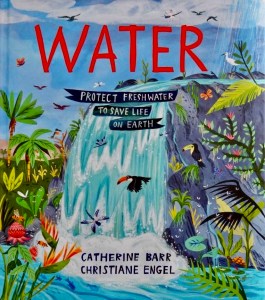
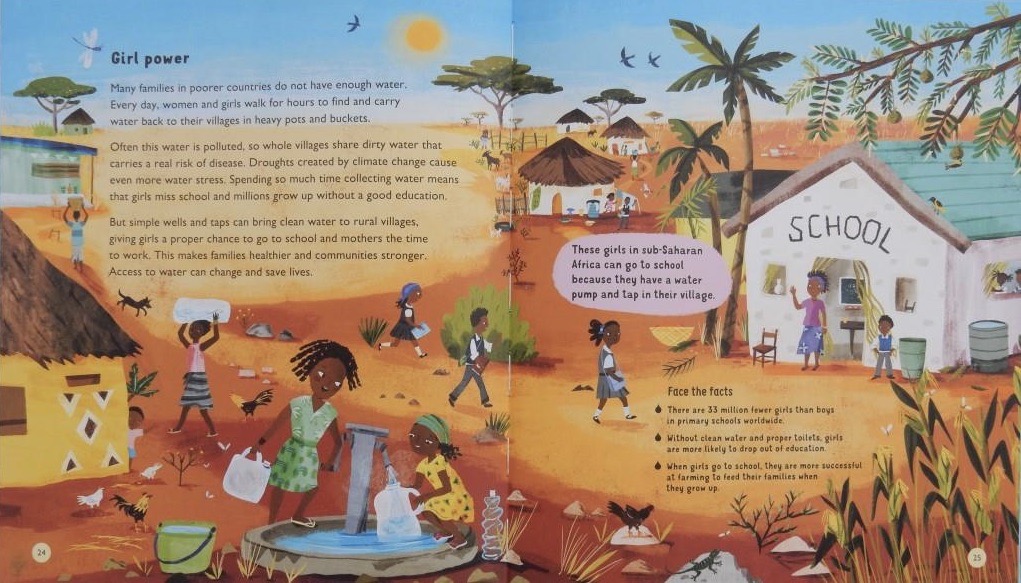
I was surprised to learn from this absorbing book that despite 70% of the Earth’s surface being covered by water only 3% of all of that is freshwater, most of it existing in polar ice sheets. These because of global warming, are starting to melt at an alarming rate.

Having given readers that information and more in the opening pages of this book, author Catherine Barr presents eleven further spreads, illustrated with lots of detail by Christiane Engel. These look at a variety of topics including the water cycle, freshwater habitats (some of the Earth’s most endangered environments); water power (the pros and cons); the impact of climate change on farming; the importance of careful usage of freshwater (there’s mention of the impact of large companies using more than their fair share of this precious resource).

It’s alarming to read the way in which polluted water – 80% of Earth’s wastewater – is adversely affecting freshwater habitats, killing wildlife and poisoning drinking water.

Of the final three topics: one explains that despite many women and girls still having to walk considerable distances from their village homes to access water, the provision of pumps and taps close to where they live is enabling girls living in some sub-Saharan African villages to go to school regularly and giving their mothers time to work.

Another calls on humanity to act now to protect vital freshwater; and this is followed by a look at some of the ways readers can use water judiciously: Take action to shrink your water footprint! urges the author. If those of us fortunate enough to have ready supplies of water at the turn of a tap followed the suggestions perhaps we can still make that all important difference in what is the UN’s Water Action Decade (2018-2028).

Goddess:50 Goddesses, Spirits, Saints and Other Female Figures Who Have Shaped Belief

Goddess:50 Goddesses, Spirits, Saints and other female figures who have shaped belief
Dr Janina Ramirez, illustrated by Sarah Walsh
Nosy Crow

With its more explanatory subtitle ’50 Goddesses, Spirits, Saints and other female figures who have shaped belief ‘ and published in collaboration with the British Museum, this book showcases the lives of female figures whose qualities and skills as creators, warriors, leaders, healers, and protectors of the mystical kind have helped shape belief today.

Organised into five sections – Ruling and Guiding, New Life, War and Death, Love and Wisdom and, Animals and Nature, cultural historian Dr Janina Ramirez presents stories of fascinating female figures some of which will likely be familiar to readers, others who probably will not.
First though comes an introduction that shares ideas about how the meaning of the word ‘goddess’ has changed over time.
Thereafter, each double spread presents a different character with associated legends and is brought to life by Sarah Walsh’s bold, bright illustrations together with photographs of objects from the collections of the British Museum.

You’ll read about figures from Greek, Celtic and Norse mythology, as well as those from further afield -West African,

Indian and Native American – mythology. From Ariadne, Asase Yaa and Anat to Sarasvati, Tiamat and Xiwangmu there’s a connecting thread – that of the power of the female – that runs throughout the book.

Both educational and entertaining, this fascinating celebration of woman power in its many forms should definitely find a place in school topic boxes, libraries, and home collections.

Stick Boy and the Rise of the Robots

Stick Boy and the Rise of the Robots
Paul Coomey
Little Tiger

Strange things are again happening in Little Town and it’s all on account of the super new gadget given to all residents by Baron Ben. Called the HeadBox, it is according to the Baron, “a marvel of modern technology.”

Within a couple of days everybody is plugged in to their amazing techno thrills, or rather everybody except Stick Boy and that’s because the HeadBox just won’t fit over his different shaped head. So that ‘one size fits all’ claim. isn’t one hundred per cent accurate. In addition, the megalomaniac has been elected Mayor of the town, electronically of course.

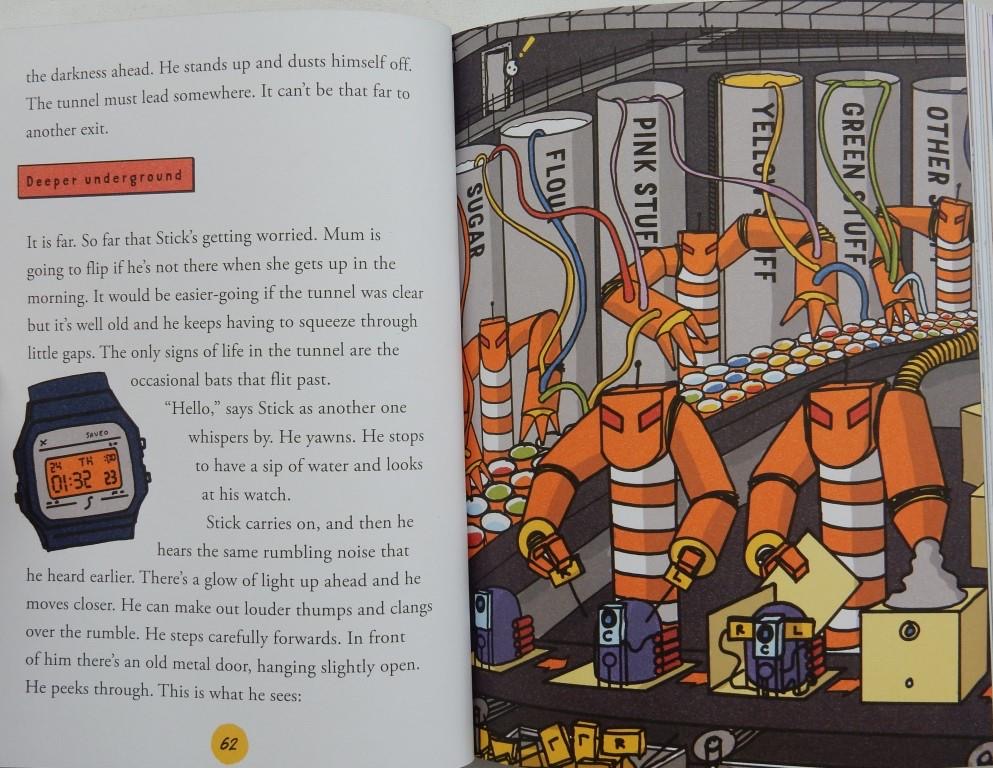
Now, feeling isolated both in class and at home, the already suspicious Stick Boy gets on the case. His investigations soon see him discovering a secret underground tunnel that leads him to a cavern full of robots. Looks like a take over of the town is indicated.

However, Stick’s pals Ekam, Milo and Nick are so busy playing Battle Racers that it looks like he’s going to have to go it alone.

Then unexpectedly he comes upon somebody who shares his passion for hot chocolate and biscuits.
Can she help Stick persuade the other Mystery Mates to set aside those techno games and join them in saving their home town?

One final consideration: when is a secret library not a secret library? To discover the answer, get hold of a copy of the book.

Existing Stick Boy enthusiasts will wholeheartedly welcome his return and he and his friends should win lots more followers with this latest episode.

Llama on Holiday

Llama on Holiday
Annabelle Sami, illustrated by Allen Fatimaharan
Farshore

This is the third Llama extravaganza starring Yasmin and her toy best friend, Levi, as well as Yasmin’s human bestie, Ezra. It’s the May half-term holiday, an ideal time to have a break from Guardian Llama responsibilities especially when a week’s visit to the seaside is in the offing. The only snag is it means having to share a bedroom with cousin Omar who is let’s say, not at all their favourite person and exceedingly unwelcoming.

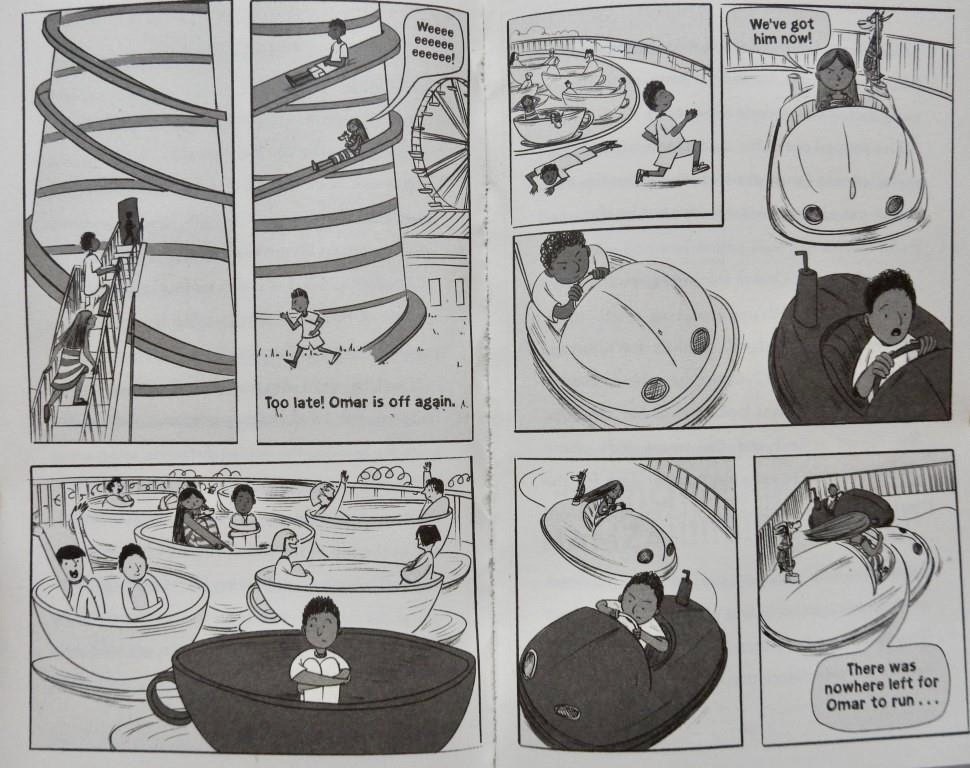
At breakfast on the first morning of their Whitehove stay there comes a beeping on the llama landline: it’s a message from Mama Llama regarding a new mission, the only other information being, it’s called Help Omar. Is it at all possible to get the boy to lighten up and have some fun? Team Yasmin, Levi and Ezra need to find out what is troubling Omar. A good place to start is the funfair but that proves to be a dodgem disaster.

So what about a beach party with all the activities Omar likes? That too ends in disaster in more ways that one. It now appears that what at first seemed like an easy mission might be turning into Yasmin and Levi’s toughest challenge so far, especially when the two fall out.

Could a visit to the arcade on the pier be a better bet?

Can Omar start to believe in himself and could it be that at the end of the day, being a bit weird is something to be celebrated.

I suspect a lot of primary school readers, along with this adult reviewer, will be sad that this story with its terrific black and white illustrations by Allen Fatimaharan, concludes the super series during which Yasmin has grown hugely in self-confidence, and happily as she transitions to secondary school with Ezra, she’s determined not to let go of all the fun and magic in her life.

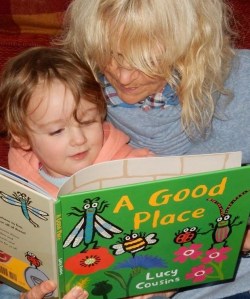
A Good Place

A Good Place
Lucy Cousins
Walker Books

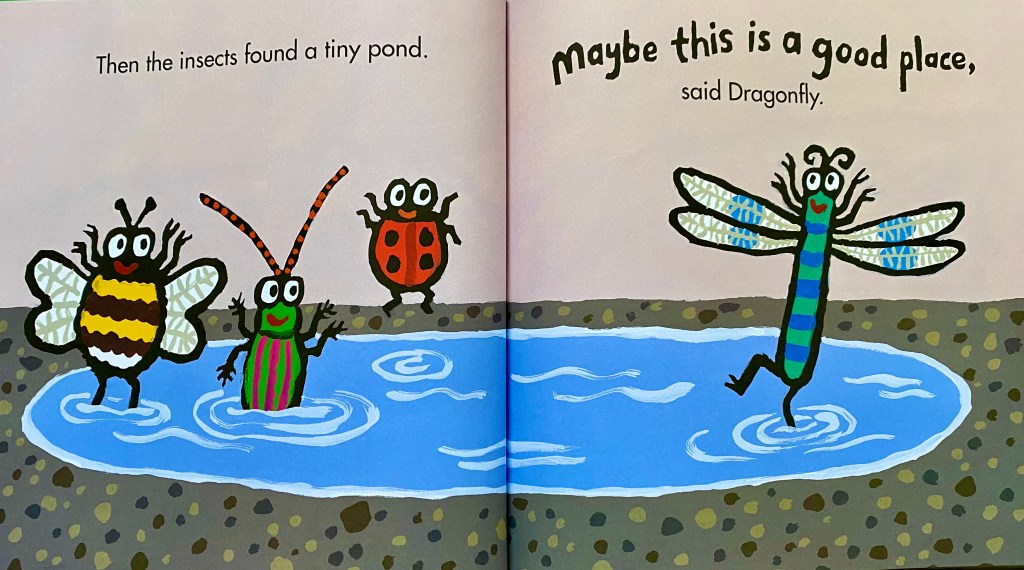
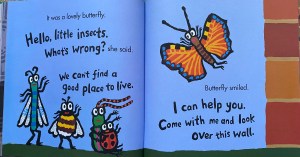
Insect friends Bee, Ladybird, Beetle and Dragonfly all set out in search of a good place to live but they all want different things. Bee desires flowers, Ladybird loves leaves, it’s dead wood for Beetle and Dragonfly wants a pond.

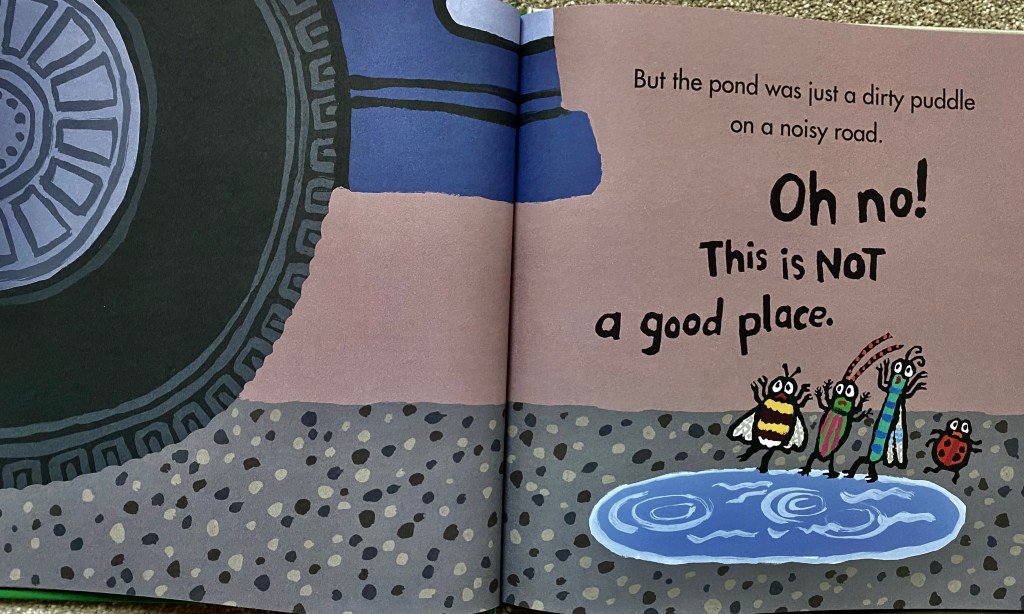
In turn each of them finds what seems to be the ideal place,

but all have danger or unpleasantness lurking ready to strike at any moment. 

Hungry, sick and exhausted, the friends are in despair; but then a beautiful butterfly appears and asks what is wrong. When she hears the problem, she offers to help. Might it perhaps be that what their new friend shows them could be the perfect place – somewhere that fulfils all their hopes?

What a gorgeous book: a cleverly crafted text with repetition that youngsters will love to join in with; using a vivid colour palette and bold patterns, Lucy’s portrayal of the intrepid insects will surely evoke sympathy from young readers and one hopes, inspire their own efforts to create ‘A Good Place’ for minibeasts to inhabit.

Perfect for story time sessions and for beginning readers. Definitely my favourite Lucy Cousins book for many a long day.

Board Book Fun: Parp! / What is Chick going to do?

These are two new board books from Happy Yak – thanks to the publishers for sending them for review

Parp!
Mike Henson and Jorge Martin


Have some room freshener to hand when you share this whiffy book with your little ones.
It tells the tale of what happens as a group of assorted animals get into a lift, the doors close – it’s a tight fit – and then shortly after, one of their number breaks wind emitting a very very stinky aroma. But who was the culprit?

At the next floor, the lift stops, the doors open and an animal exits – the whiff maker? We’re not sure. The same thing happens again as soon as the lift continues its journey – PHOAW! 

Then at the next floor another animal walks out and so it continues until there are just two animals left – or are there? No! make that three. So who is the malodorous culprit? …
All is eventually revealed though the identity of the parp perpetrator might come as a surprise.

With sliders Mike Henson’s squashy, stinky scenario, and a red herring on every one of Jorge Martin’s splendidly expressive spreads, this is huge fun; it’s as well it’s so sturdily built as I’m sure it will need to stand up to lots of re-reads.

What is Chick going to do?
Carly Madden and Caroline Dall’Ava


In this interactive board book that provides a statement and then asks the titular question on every spread, toddlers are introduced to six hatchlings, every one of which is ready for its very first experience. Each chick’s particular adventure is discovered when the curved flap is opened to reveal a colourful scene that often includes little humans.

The first little one belongs to a mother hen and once free from its shell she greets the world with a ‘Cheep, cheep!’. Next comes an adventurous duckling, followed by a little moorhen Then there’s a puffy-looking baby plover, 

a gosling and finally, a cute, sleepy owl ready to take a snooze alongside her parents.

Bright, inviting and engaging, this little book offers plenty of opportunities for adult/child conversations.

Chirp! / Five Little Chicks

Chirp!
Mary Murphy
Walker Books

As a new day begins, each bird adds its voice to the dawn chorus. The Thrush warbles, Blackbird whistles ‘Tooraloo’ and then in turn we hear a sequence of onomatopoeic contributions from the Wren, the Lark, the Finch,

the Robin, the Swallow, followed by Wagtails, a Starling, Magpies, the farmyard Goose, Duck and Hen, the Pigeon and the Cockerel.

Suddenly into the crescendo of early morning sound, from a tiny blue unnamed bird that’s been watching and waiting patiently, comes a “Hush! It’s my turn to sing.” It then adds a zippy-zippy-zippeeeeee that serves as a reminder that. ‘ … We all have something to say. / We all get to shout / for a brand new / day!’

As it is with our feathered friends, so it should be for humans: everyone deserves a chance to get his or her voice heard.
With its wealth of sounds that cry out to be echoed by little humans, this is a fun story with an important message at its heart. And what an abundance of sound/symbol associations to be enjoyed.

Five Little Chicks
Lily Murray and Holly Surplice
Templar Publishing

In Lily Murray’s version of the nursery song Five Little Ducks, she’s replaced the ducks with chicks and a Mama Hen and makes the entire text more interactive by asking after every foray over the hills, ‘Now how many chicks / can you see?’, as well as offering some seemingly irresistible bait to her offspring. It certainly has the desired effect and there’s a lovely final surprise for Mama Chick provided by her little ones.

Holly Surplice has included lots of other baby animals and their parents in her springtime illustrations of the chickens and their adventure that takes them through a flower-filled meadow, a bluebell wood, a field of gambolling lambs, a farmyard and beside the stream.

Every one of the scenes is absolutely bursting with bold images and bright colour; and ramping up the interactive nature of the book are the numerous flaps to explore on every spread.

Little humans will definitely enjoy sharing this with their own mother figures, particularly around Mother’s Day and Easter, though this is a book that youngsters will want to go back to time and again. With it’s predictable text it’s also a good one for those in the early stages of reading to try for themselves.

So You Think You’ve Got It Bad? A Kid’s life in Prehistoric Times

So You Think You’ve Got it Bad: A Kid’s Life in Prehistoric Times
Chae Strathie and Marisa Morea
Nosy Crow

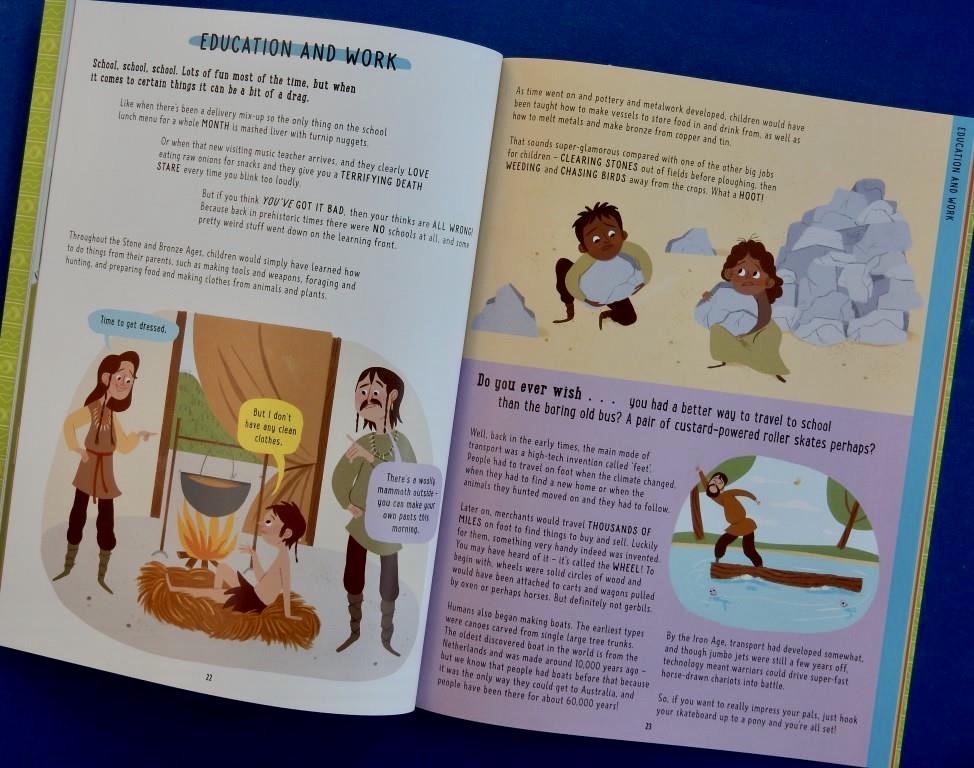
Book five in the Kid’s Life series published in collaboration with The British Museum and characterised by Chae Strathie’s chatty narrative style, takes readers into the deepest past to look at the lives of children in the Stone Age, Bronze Age and Iron Age.

Are you ready to leave behind those jeans and trainers and instead don animal skins and perhaps a pair of itchy woollen pants you’ve had to make yourself, and then get on with a bit of stone clearing

or tool making? No, well that’s what a youngster in prehistoric times might have been faced with. A bit later, in the Bronze Age, in addition to gathering berries and nuts you could well have been told to spend a day cleaning up piles of animal pooh – Phoaw!

With sections on hair and clothing, the home, education and work, health and medicine (you might have been subjected to trepanning – the drilling of a hole into your skull to release the evil spirits causing your problem), religion and gods, myths and legends, fun and games (yes there were some occasionally) and finally, the beginnings of written history, each one brought to life by Marisa Morea’s amusing illustrations, this book presents information in a manner that’s both accessible and entertaining.
(Backmatter comprises a glossary and index.) Fun for school and home reading.

The Tiger Who Came For Dinner / The Littlest Elephant

The Tiger Who Came For Dinner
Steve Smallman and Joëlle Dreidemy
Little Tiger

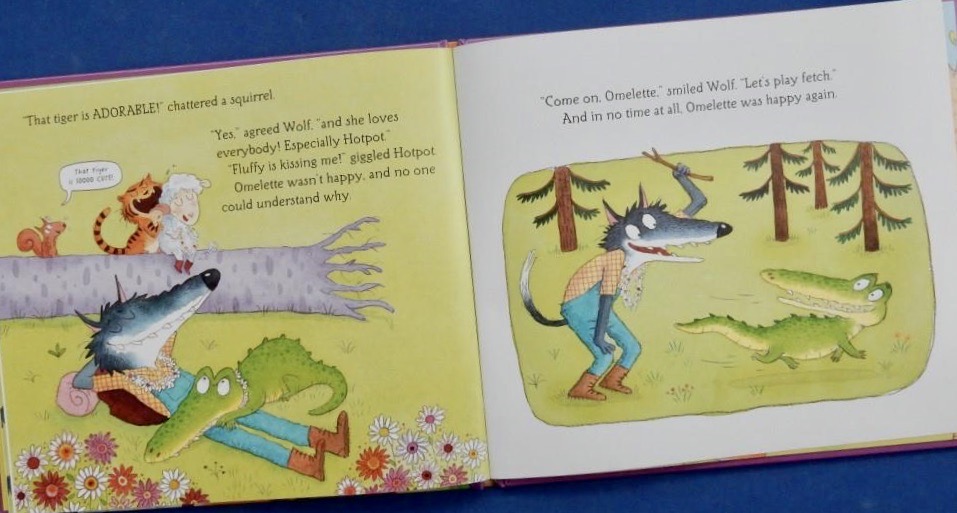
In this fourth story to feature Wolf, Hotpot the lamb and their crocodile, Omelette, the friends are playing their favourite game of fetch when instead of a stick, Omelette brings back a tiny, soggy lost tiger. Hotpot is keen to keep the little thing but Wolf shakes his head “ … little tiger’s family must live further up the river. We have to take her home,” he says.
Next day off they go and on the way they encounter other animals, all of which think the little cub is a delight.

Omelette however, is not sure and becomes even less so as their journey continues; moreover he is able to recognise crocodile tears.

The following morning the group reaches a cottage – it’s the tiger cub’s home at last – and the little cub had a tricky plan tucked in his fur all the time. Can anybody save the day?

As with previous titles in the series, the importance of friendship is key. Steve and Joelle imbue the characters with warmth and oodles of personality and those already familiar with the other books will gobble up this one; however it matters little if you start here: this witty tale still works as a smashing read aloud.

The Littlest Elephant
Kate Read
Two Hoots

Having just learned to swim, such is Ellie the littlest elephant’s enthusiasm that in her haste to demonstrate her new skill, she charges off to the pool to be first in the water. On the way though, she dislodges chameleon, frightens the frogs, disturbs the monkeys’ mangoes scattering them far and wide, upsets the minibeasts and the birds,

stamps on the tiger’s tail and almost squishes a little mouse. Only then does she stop and pay heed to their warning cries to slow down and watch where she’s going. Time for some apologies realises Ellie, and with them duly accepted, all the animals head off to the swim together, with the littlest pachyderm being mindful of the wise words her new friends have spoken, until they eventually reach the pool.

Now to make the biggest splash EVER!

Kate Read captures Ellie elephant’s excitement beautifully in her bold, bright mixed media illustrations while at the same time portraying the feelings of creatures she encounters on her charge through the jungle equally well. Her story reminds youngsters – indeed all of us – of the the need to slow down sometimes, to be mindful of others , and to show empathy, consideration and kindness towards them; important lessons delivered unobtrusively in a fun picturebook.

Yesterday Crumb and the Storm in a Teacup

Yesterday Crumb and the Storm in a Teacup
Andy Sagar
Orion

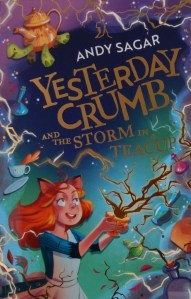
Born with fox ears, and nothing of her own except The Pocket Book of Faeries bearing her name found by her side, Yesterday Crumb has spent the first part of her life trapped in a cage, a curiosity for visitors to the travelling circus.

Then one day, with the aid of a raven familiar she escapes, having first learned that she’s actually a witch herself, albeit now without her magic; but she meets the sinister Mr Weep, demon in charge of the world of the Dead and he puts a shard of ice into her heart. Happily though she is then taken in by Miss Dumpling, a tea witch who runs the magical tea shop with legs, Dwimmerly End, where the raven familiar and a boy with a wolf’s nose also dwell. However unless she can remove that shard of ice before the winter solstice just a month away, Yesterday’s blissful new existence with its sense of belonging as a trainee witch will be very short-lived.

Meanwhile that new nurturing learning environment with its fantastical customers, flying teapot turtle Pascal and magic in every teacup, along with supportive Miss Dumpling’s ‘where there’s a witch there’s a way” attitude, Yesterday begins to believe in the possibility of finding the all important spell ingredient needed to break that curse of the shard. Before that she has to face a visit from the College of Witches and the test on her magic skills; that and learn to deal with her anger.

Both wonderfully whimsical and sometimes, surprisingly spooky and sinister, this is a truly spellbinding adventure quest and there’s a twist in its tail. With a touch of genius Andy Sagar has created a wonderful world full of teapots, tea and brewing, not to mention scrumptious cakes and a little coffee, as well as a cast of amazing characters, (and the occasional rogue) to populate it. Prepare to be swept away; it’s absolutely superb and I can’t wait for the next brew.

Mindi and the Goose No One Else Could See

Mindi and the Goose No One Else Could See
Sam McBratney and Linda Ólafsdóttir
Walker Books

Young Mindi has a night time problem; it appears in her bedroom, ‘quietly as a thought comes into your head,’ in the form of a large shadowy goose, staying as long as it wants. Neither of her parents can see it but do their best to dispel her fears.

“Well, you’ll just have to close your eyes and make it not real,” says her mother.

Concerned, her father goes off to consult a wise farmer, Austen, who lives up on the hill. He suggests that both Mindi and her dad come up to visit his farm, and when they do so, he introduces the girl to his animals, including two geese before taking her inside for a drink. Suddenly, into the kitchen strolls a young goat to which Mindi takes a great liking, naming her Black-and-Whitey. On the way home however, Mindi admits she likes the Shelling Hill geese but still insists that BIG goose isn’t nice.

About a week later, who should come to visit on a wet day but Austen, plus the goat Mindi liked.

Austen says he will give her the goat but must have something in exchange. Could that perhaps be Big Goose …
What a superbly understanding character is farmer Austen who shows such empathy towards Mindi, making her become part of the solution to dispelling her fears.

Sam McBratney’s story – a longer text than many of his other titles – is one that many young children will relate to and the ending is hugely satisfying. Linda Ólafsdóttir’s mixed media illustrations – both large and small are simply gorgeous. How well she captures the warmth of Mindi’s loving family and the rural setting of the book. Read aloud or read solo, this has much to offer young audiences.

Dearest One / The Smile

Dearest One
Arielle Dance and Jenny Duke
Lantana Publishing

Warm, heartfelt affirmations of the kind your loving grandmother might share with you are presented in this book.

Look for rainbows and have fun puddle jumping on rainy days, sow seeds of kindness – their effects will last long after you’re gone, 

dance to the song of the wind – it’s music for your soul; be kind to your body and mindful of what you put in it; draw on your inner power to reach your true potential; develop resilience and understand that neither you nor others can always be winners. Then on those dark days use your inner light to find something to get that flame of yours burning 

and never forget that your ancestors’ magic lies within you always acting as a guide, so never forget the stories they’ve told and remember to pass them on to others too. And always keep an open heart: that way love can find you no matter where you are.

Arielle Dance’s lyrical text convey words of wisdom that are not only important in the here and now, but also thoughts to hold within and draw upon at any time, especially when you’re feeling unsure about the future. In combination with Jenny Duke’s uplifting illustrations into which they’re set, they offer a beautiful book to give a young child, that an adult will surely love reading too.

The Smile
Marie Voigt
Oxford Children’s Books

At the start of a picnic, a baby smiles at an older sibling and the joyful reaction of the recipient has such power it begins a chain response that travels all around the world, eventually coming full circle in this series of visual anecdotes.

The thing about smiles is that we have the power to give an infinite number: a single smile might turn someone’s sadness into happiness there and then; or alternatively a seemingly simple action such as sending a loving message to somebody far away can, after some time has passed, also bring a smile to the face of the receiver; perhaps even somebody unknown.

In the country village and its environs where I currently spend a lot of my time, almost every person one encounters while out walking smiles at you or smiles back at your smile, whereas in suburban London where I spend the rest of my time, it’s relatively rare for somebody to look you in the face, let alone smile. Perhaps if a copy of Marie’s beautifully illustrated book were given to all parents of young children, it might start a smile revolution.

Cameron Battle and the Hidden Kingdoms / Escape Room

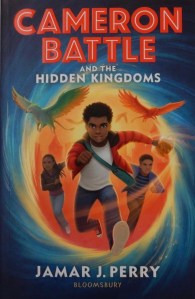
Cameron Battle and the Hidden Kingdoms
Jamar J. Perry
Bloomsbury Children’s Books

Drawing on West African and Igbo culture and mythology the author has created a powerful, multi-layered fantasy quest.

Twelve year old Cameron is of Igbo descent and having lost his parents two years earlier, is living with his grandmother in Atlanta. From time to time he has strange experiences but puts them down to his prolific imagination. Cameron is forbidden to enter the attic wherein is kept The Book of Chidani, a family heirloom which he’s been told not to touch.

At the start of the summer holidays, he and his two best friends Aliyah and Zion are having a sleepover. Drawn by the book, Cameron’s last connection to his parents, they sneak into the attic to read it and in so doing, open the portal to the kingdom of Chidani.

There he learns that he’s now the Chidani people’s Descendant and is tasked with saving the country from a power grab by the Queen’s sister Amina. That means he, with the help of his friends has to retrieve three stolen magical artefacts while at the same time face monsters, gods, and their personal fears. They have just three moons in which to do it: will they find all three in that time?

A gripping adventure of loss and love, courage and perseverance.

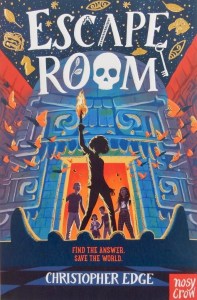
Escape Room
Christopher Edge
Nosy Crow

Christopher Edge’s story sucks you in right away. Full of twists and turns, it’s a fast-paced adventure, a mystery and a game all in one and will have special appeal to fans of computer games.

The narrator is twelve year old Ami, who is given a ticket to an escape room as a birthday gift from her dad. On arrival she’s expecting to participate in a game but having checked in, met her fellow players – Adjoa, Ibrahim, Oscar and Min – Ami learns from the Host that they have been chosen to save the world and they must work together to find the Answer.

However, when he locks them inside the first room, they quickly realise this is no ordinary game. It’s essential that this disparate group learn to work together, drawing on individual’s strengths in order to solve all the problems they confront in the various chambers they enter. There’s a chess computer to beat, a vast dusty library, a Mayan tomb, a shopping mall that’s deserted save for extinct animals, as well as the commando module of a spaceship bound for Mars. Is there no end to the dangers?

Time is running out: Ami just needs to find the Answer …

There’s a brilliant final twist to this hugely thought-provoking, topical tale and it’s one that lingers long after you’ve put the book down. Just superb.

When Creature Met Creature

When Creature Met Creature
John Agard and Satoshi Kitamura
Scallywag Press

As we discover in this superb collaboration between two multi-award winners, poet John Agard and illustrator Satoshi Kitamura, furry Creature-of-No-Words lives a happy, silent, ‘never in a hurry’ existence until one day, for no real reason he gets a feeling, ‘this feeling like the chill touch of ice’.
Nothing he tries, not self thumping nor groaning loudly or even cloud gazing, can shift his overwhelming feeling of sadness, even though sad isn’t a word he’s able to say.

Then along comes Creature-of-Words, another being, also happy with her furiness and ‘never in a hurry’, but altogether different with her vocal phrases that she loves to speak aloud. Empathetic soul that she is, she watches and senses her fellow creature’s utter despair.

What happens thereafter is enormously uplifting and powerfully portrayed in both words and wonderfully expressive, richly patterned vibrant scenes of the two characters’ interactions, be they silent and vocal.

Both humorous and poignant, this look at the importance and power of communication, is a thought-provoking, memorable ‘just-so’ kind of story. In addition to being a book that will resonate with listeners and readers, it’s a wonderful starting point for classroom explorations of ways of relating to, and expressing our feelings to our fellow creatures.

Olaf Hajek’s Fantastic Fruits

Olaf Hajek’s Fantastic Fruits
Annette Roeder and Olaf Hajek
Prestel

A veritable array of scrumptious fruits – depending on your taste of course – are served up in this third collaboration between author Annette Roeder and illustrator Olaf Hajek.

As with Veggie Power and Flower Power, Hajek draws on a variety of cultural heritages and artistic traditions, as he playfully conjures up an entire, imagination-sparking story world brimming with details in every one of his seventeen luscious surreal paintings.

For instance the style of the richly hued mango scene transported me to India and Mughal art, but Hajek’s arrangement of images with the dominant parrot clutching in its claws a neatly cut slice of the juicy fruit raised the question, ‘Was it sliced by human hands and if so, whose?’

In contrast the gooseberry and currant composition, had for me, something of the Mexican, Frida Khalo about it.

As well as providing visual clues as to how each fruit is grown, in some paintings, the featured fruit or the skin thereof, is used as part and parcel of a character’s attire. That is so with the gooseberries while in the case of banana, there’s a woman’s dress and hat comprised mostly of that fruit.

No matter where you open the book, opposite the illustration is an engaging page of text by Annette Roeder. This provides straightforward factual information drawn from history as well as modern times; there’s often some folklore, or perhaps a truncated myth or traditional fairytale. The final spread entitled ‘A colourful fruit salad fairy tale’ has a story so the author says, whispered to her by a woman in a shop about a spoiled prince and pineapples that grow wings so he can consume them at their perfect stage of ripeness; and there’s information about choosing wisely when it comes to selecting what to include in your own fruit salad.

Assuredly this large format book is full of mouth-watering delights and occasional surprises too.

The Hotel For Bugs

The Hotel For Bugs
Suzy Senior and Leire Martín
Little Tiger

The excitement is huge when the brand new, absolutely fabulous Hotel for Bugs opens its doors for business. In surge the masses of mini beasts eager to sample the tasty treats on offer at the buffet and the fancy facilities such as the spa and club. Perfect for a relaxing holiday.
Then, into the lobby slides a shiny, squishy and blobby slug, leaving a trail of glittering slime in its wake and asking to book a room. More than a tad alarmed, the manager tells the prospective client that the hotel is already full and that anyway, slugs are not welcome.

Nonplussed, out glides said slug leaving a relieved manager and a crowd of onlookers that have gathered to watch the proceedings.

However, it takes just one tiny little bug to speak out, demanding to know why the slug has been sent away. After all, starting with herself, every single one of their number could be thought of as ‘different’ in some way; and before long, the other bugs are contributing supportive comments, each pointing out (or otherwise making known) its own distinctive features.

Has the manager made an irreparable error in her treatment of the slug, or is there a way that the situation can be fixed for every single one of the creatures that entered the portals of the establishment that day?

Suzy Senior’s jaunty rhyming text together with Leire Martín’s brightly coloured creepy crawly characters portrayed with their idiosyncratic features, show the importance of inclusivity and that difference is something to embrace and celebrate rather than fear.

Marv and the Mega Robot / Marv and the Dino Attack

Marv and the Mega Robot
Marv and the Dino Attack

Alex Falase-Koya, illustrated by Paula Bowles
Oxford Children’s Books

This is a new series of early chapter books that star a new superhero protagonist, Marv along with his excitable sidekick, robot Pixel. One of the author’s aims in writing the series was so that children would have black superheroes in their stories, something he didn’t find when he was growing up.

Essentially Marvin is a normal boy who likes to spend his time with his empathetic Grandpa, reading comics and doing science experiments with best friend, Joe. Life is fairly normal until one day, Grandpa sends Marvin up to the attic where, stowed away in a dusty old suitcase, he finds a superhero outfit, which when he tries it on, shrinks to fit him perfectly. He soon discovers that Grandpa too was a superhero and that the suit is powered by two things: kindness and imagination; now it’s up to Marvin to take on that mantle.

In the first story supervillain Mastermind, plus her evil giant robot appear at the school science fair, it’s up to Marvin to assume his Marv role and try to save the day.

Aided and abetted by Pixel, of course the time has come for Marvin to meet his destiny.

In the second book Marvin and his friends are super excited: their class is on a school trip to The Natural History Museum. Marvin and Joe are thrilled to get right up close to their favourite dinosaur skeletons when suddenly the ground begins to shake and skeletons start to move. It’s supervillain Rex intent on causing complete dino-chaos. Marv knows he must employ those newly found superhero skills to save his classmates (and everyone else) from violent velociraptors, trampling T-Rexs and the other rampaging dino-skeletons.
Will it be another case of ‘superhero mission accomplished’ for Marv – hopefully so long as he can assume that super-suit in time.

Fizzing with excitement, and with themes of kindness, friendship, creativity, courage and resilience these two snappily-written tales are a super-duper start to Alex Falase-Koya’s action-packed series. Paula Bowles’ two-colour illustrations are terrific fun and help ramp that action right up.

John Agard’s Windrush Child

John Agard’s Windrush Child
John Agard and Sophie Bass
Walker Books

With a final embrace from his Gran, Windrush child waves farewell to his Caribbean home, and with his parents, boards a ship to sail across the ocean to Britain and a new life. As the blue waters roll past, the boy’s parents remember ‘story time yard and mango mornings’ as they anticipate fresh beginnings in the hope that everything will turn out all right. 

The child recalls his grandmother’s parting entreaty to remember to write as she bestows that last fond hug.

On dry land at last, as the family walk away from the ship, they feel unsure on their feet. Then once ensconced in a new home, Windrush child keeps his word, telling his grandmother in a letter about ‘stepping into history, bringing your Caribbean eye to another horizon’ her words but now winging their way back.

Meanwhile the new arrivals have much to learn about this place where so much is different and where so many challenges await. For as poet John Agard writes in his author’s note, those from the Empire Windrush and many other ships brought with them ‘Caribbean culture’ that ‘had such a powerful and positive impact on British culture’ making Britain a much better place because of them.

The author’s hugely moving, lyrical and haunting evocation of the journey families of the Windrush generation made is rendered all the more powerful by Sophie Bass’ vibrant illustrations – a vibrancy that truly reflects the richness of the contribution made by those who came.

An important book that needs to be shared as widely as possible in homes and primary schools.

The Magic of Seasons

The Magic of Seasons
Vicky Woodgate
Dorling Kindersley

From this veritable cornucopia of a book about the changing seasons in our world, with Mimi the cat for company, readers can experience seasons- related science, history, geography, myths and legends.

First comes a scientific explanation about what exactly is meant by the seasons, after which is a quick generalised look at in turn, spring, summer, autumn and winter, as well as a spread explaining how for many places in the tropics, there are just the wet and the dry seasons, (these seem to be getting a bit blurred though for, according to my friends in Udaipur city in India, it’s rained every single month in the last year.)

My favourite part was the ‘Seasons in Nature’ section that gives more detailed information about the incredible changes and different delights that characterise each of the seasons – be they the four we have in temperate climes or the tropical two, rainy and dry.

This part also encompasses information relating to animal migrations by land, sea and air as well as seasonal effects on the world’s ocean life.

Throughout, Vicky Woodgate’s text uses language appropriate for most key stage two children, and visuals – illustrations, maps and charts that make every spread enticing, so that readers never feel overwhelmed. There are also occasional quizzes, tips and activities.

A book for classroom use as well as one parents and children can enjoy browsing together.

Return to Factopia!

Return to Factopia!
Kate Hale, illustrated by Andy Smith
Britannica Books

This second book in the series that invites readers to choose their own paths is every bit as much fun as the first. Again it’s bursting with informative tidbits (more than 400 facts in all) relating to such diverse topics as libraries, lions and loud things, bees to blood and bananas, and morning to musical instruments (of the unusual kind of course). Did you know that certain bumblebees bite plants’ leaves to speed up the flowering process? I certainly didn’t.

Astonishingly, bananas are naturally radioactive? (You’d need to consume at least a billion in a single meal to receive a lethal dose though.)

Equally weird is that a species of ancient whale had four legs and webbed feet, and that scientists are able to tell the age of a whale from its earwax. I’d love to know how that’s done. Those are just a couple of the weird and wonderful things you can discover about various kinds of whales herein.
Equally astonishing and astounding is that ants have been around since the time of dinosaurs; perhaps even more amazing is that certain fungi are able to control the minds of ants, turning them into zombified insects.

No matter whether you decide to follow a jumpy trail, or read straight through, one thing is certain, you’ll put the book down knowing a multitude of things you hadn’t even thought about before.
Easy to read and engagingly illustrated in a variety of styles by Andy Smith, this clever web of information will assuredly bind you in.

The Extraordinary World of Birds

The Extraordinary World of Birds
David Lindo and Claire McElfatrick
Dorling Kindersley

Did you know that ‘birds are dinosaurs in the same way that humans are mammals’? So says David Lindo, aka the Urban Birder, at the start of this engaging look at birds from all over the globe.

The book is divided into five main parts: What is a bird?; Bird families; Bird behaviour; Bird habitats and finally, Birds and me. The author takes readers on a journey through the avian world providing information on fundamentals, through to the enormous variety of incredible adaptations of species in different locations.

The Bird families section presents different groups – the flightless kind, game birds, parrots – I was astonished to find there are as many as 350 species; the only ones I’m familiar with are those Ring-Necked Parakeet tree wreckers in Bushy Park. I was equally fascinated to learn in the behaviour section that songbirds are able to breathe through one lung at a time so they don’t need to pause for breath when singing.

The habitats we visit range from tropical forests that are rich in species, to deserts where, in the most extreme conditions, highly specialised birds such as the difficult to detect, Crowned sandgrouse live. Amazingly the males’ belly feathers have become adapted to soak up and hold water.

In the final part, we encounter some of the birds that are now at risk of extinction on account of human action and the author stresses the importance of nature reserves as well as describing ways in which all of us can help our neighbourhood birds.

By the time readers reach the ‘Birding’ spread, some will need little encouragement to become birders themselves and David gives some helpful tips about so doing.

No matter the section, Claire McElfatrick’s alluring, detailed, often dramatic illustrations, in combination with photographs, really bring each spread to life.
(Backmatter comprises a list of the national birds of over 100 countries, a glossary and index.)

Given the broad scope of its content, I see this as a book for school collections, either for dipping in and out of, or to use as a project resource, rather than for budding ornithologists who would require something with a more specific geographic focus.

Not That Pet!

Not That Pet!
Smriti Halls and Rosalind Beardshaw
Walker Books

Mabel is super excited: her family is getting a pet and she’s allowed to choose it from the pet shop she visits along with her mum and little brother. Her choice is – wait for it – an elephant! He’s a splendid hugger, gives terrific rides, makes a super slide and is really useful when it comes to watering the plants and pulling up weeds. However, he also tramples on all the family’s fruit and worst of all, sits on Mabel’s mum. “Not that pet!” comes the cry, “Choose something smaller!” And Mabel obligingly does so.

The elephant is replaced by ants, lots of them and they march through the house eventually finding their way into Dad’s underpants – yikes! You can guess what his instant reaction is, followed by instructions to choose something they can all see.

And so it continues with a skunk, a snake, a spider,

worms and several others. Poor pet shop Pete: will he ever deliver something that satisfies everyone. Eventually, close to giving up Mabel has a good think and what she thinks is ‘I just need to pick something furry and sweet … something friendly that everyone likes.’ Now what could that possibly be? It’s definitely not what you’d expect.

The final reveal will surely come as a surprise to readers and listeners. I love a fun final twist and this book certainly has that and much more. Smriti’s rhyming narrative reads aloud well and is huge fun and Rosalind Beardshaw’s illustrations are full of details to explore and giggle over, not least the bathroom scene and that of the visitors to Dad’s underpants, Make sure you watch the antics of Mabel’s little brother too: he’s a real cutie. Altogether a smashing storytime winner methinks, and one sure to get children talking.

Women Who Led The Way

Women Who Led The Way
Mick Manning and Brita Granström
Otter-Barry Books

Herein, team Mike and Brita celebrate 21 inspiring women adventurers and explorers from all over the world, going back as far as the 9th century. Speaking for themselves, these women are exemplars of the huge amount of courage, determination and sheer power their achievements demonstrate against the odds: boundary breakers all for sure.

A new name to me, the first to tell her story is Aud (the deep-minded), daughter of a Viking ruler of the Hebrides, who, after her warrior son was killed in battle, secretly had a ship built and then together with a loyal crew of twenty warriors, captained a voyage of escape and discovery, eventually starting a Christian settlement on an Icelandic hillside.

French woman Jeanne Baret, disguised herself as her beloved husband’s manservant in order to accompany him on a voyage that eventually took them around the world, exploring and collecting specimens of plants, shells and stones for study, retiring to her native France ten years later, after the death of her husband.

Not all the women travelled so far from home though: In the 18th-19th century Caroline Herschel whose vision was damaged by childhood Typhus, became an astronomer who not only discovered eight comets, but was awarded a gold medal by the Royal Astronomical Society, even being elected an Honorary Member.

Some of the others featured will likely be familiar names to readers – adult ones at least. There’s Mary Anning, Harriet Tubman who escaped slavery to become an army scout and political freedom activist, undercover journalist Nellie Bly, Bessie Coleman the first African-American and Native American female to hold a pilot’s licence, Amelia Earhart (first woman pilot to fly the Atlantic), archaeologist Mary Leakey and nature conservationist Jane Goodall.

It’s impossible in a short review to name all those included herein but we meet Barbara Hillary polar explorer;

the first woman to climb to the top of Everest, and the first female amputee to climb both Everest and Mt. Vinson. Wow! “Set your goals high in life and don’t stop until you reach there.” are words spoken by this inspirational mountaineer on the final spread.

Set into many of Brita’s arresting scenes along with the main narrative, are small illustrated fact boxes, some giving dramatic moments in the life of the featured woman, others providing brief details of another one or two who followed in her footsteps.

One can’t help but feel awed by the achievements of every single one of those exceptional women. Adults who want to inspire children, either in school or at home, to reach high and never stop believing in themselves, should make sure they read this book.

Fred and the Fantastic Tub-Tub

Fred and the Fantastic Tub-Tub
Zeb Soanes, illustrated by Anja Uhren
Graffeg

Fred is staying with her grandfather in the countryside for the summer holidays. Grandpa is a botanist who lives in a messy farmhouse around which are dilapidated greenhouses housing all manner of plants from all over the world. Imagine her surprise when one night she hears a banging sound outside and when she investigates, discovers her Grandpa attached to a sausage-shaped balloon.

Even more surprising is his announcement that this contraption is to take them to Papa Nupi a distant island whereon it’s said the rare Tub-Tub plant grows. This plant blooms just once every two hundred years when it is reputed to produce the most amazing music.The last time it bloomed was two hundred years ago the following week so time is of the essence and as Grandpa says, “There’s no time like the present.”

So begins a magical adventure that embraces the threat plastic pollution poses to wildlife as well as showing the transformative possibilities of music and the difference one small hand held device can make.

Which all goes to show that Grandpa was absolutely right when he said at the start of this unusual story, “Music is a language everyone can understand.”

The engaging tale had its origins in a project between the author Zeb Soanes and composer James Marangone. The latter wanted to create an inclusive narrated adventure that inspired children to explore sound no matter their musical ability. To go alongside the music, Zeb included in his story ‘audio clues’ that children can listen for in the text.

With the addition of Anja Uhren’s fantastic quirky illustrations, this became a tale told through illustration, music and writing. The orchestral performance, which includes narration of the story by Zeb alongside James Marangone’s music, will be premiered by Orchestra Sinfonia later this year.

(Related facts and some suggestions for reusing plastic are given at the back of the book.)

Me, in the Middle

Me, in the Middle
Annette Demetriou and Angela Mayers
Owlet Press

Annette Demetriou’s story has its origins in a childhood experience of her own that caused her to feel she didn’t visually fit into a category.

The little girl, protagonist Georgie belongs to a mixed heritage family: her father’s family are from Uganda and have brown skin; her mother’s family presumably from England, have light skin. When Georgie’s class are having an outdoor lesson on the topic of families one day and their teacher asks them all to go and stand within the chalk outline of the country their parents come from, she has a dilemma and it’s one that leaves her feeling upset as the lesson concludes. ‘Maybe I didn’t belong … anywhere?’ she thinks to herself.
Back at home she’s reluctant to begin working on the family tree Miss Clark has set as homework but her parents soon come to her assistance suggesting the use of photographs and the end product is beautiful – ‘full of colour and so wide, it stretched all the way across the Atlantic Ocean, from England … to East Africa … with me in the middle,’ she says excitedly.

Next day at school, Georgie is proud to show and explain her family tree to the class.

Her teacher’s response is hugely positive and wise as she tells the children that they should never judge a person by external characteristics. ‘We are SO MUCH MORE than what can be seen at first glance,’ she says.

The following day Miss Clark takes the children to the park where, after a ‘family dishes’ picnic, they look at the various trees and compare them to their own family trees ( I love that idea)

and Georgie comes to the realisation that while difference can be special and exciting, people have many things in common too and that’s just fine.

The pride in her roots felt by the protagonist is something everyone should be able to feel and this story, with its wealth of diverse characters as portrayed by Angela Mayers, will help children understand that there are a multitude of ways to make a family unit and that each one is special. Angela’s depictions of Georgie’s changing feelings are beautifully captured throughout.

Definitely a book to add to family bookshelves and primary class collections. In the latter it would make an excellent resource for a topic on families.

Victoria Stitch Free and Famous

Victoria Stitch Free and Famous
Harriet Muncaster
Oxford Children’s Books

Breaking Wiskling law, Victoria Stitch has escaped from Wiskling Wood and entered the world of humans. Once there she talks to and soon becomes best friends with a young human named Naomi, something that is to have repercussions not only for her but for her twin sister Celestine who is now the wisklings’ queen, as well as for the safety of the entire kingdom.

It’s not long before their friendship has led to fame and indeed adoration for Victoria Stitch, who humans believe to be a fairy.

Meanwhile back in Wiskling Wood, Celestine has learned of her twin’s activities, and greatly alarmed at the possible consequences of her sister’s acclaim in the human’s world, determines to go out in secret, find Victoria Stitch and warn her before it’s too late.

With the help of her loyal friend, Tiska, off she goes, putting herself in great danger; but even if she’s successful in finding her twin, will Victoria Stitch even take notice of what she has to say?

It’s definitely a case of freedom comes at a price: but at the end of the day, is it one Victoria Stitch is prepared to pay? Has the bond between the siblings reached breaking point or is it just too strong, especially when there’s the possibility of a new role for both sisters on the horizon in Wiskling Wood?

With themes of fame and friendship, love and loyalty, this magical tale sometimes frizzles with frights as well as sparkling with the intensity of the enchanting world Harriet has created in this wonderful series.

Emmanuelle (9) shown above couldn’t wait to start reading this new book commenting “The first Victoria Stitch is one of my very favourite books ever.”

My Must-Have Mum

My Must-Have Mum
Maudie Smith and Jen Khatun
Lantana Publishing

This smashing story is told from the perspective of Jake and shows the special close relationship he has with his much-loved mother.

Jake’s mum is an inveterate skip scavenger seeing an opportunity for upcycling almost anything and everything, hence he calls her his ‘must-have mum.’ How the two of them manage to get some of her acquisitions up to their fourteenth floor urban flat, look like pretty difficult tasks, but Jake is hugely supportive of his mum’s unusual collecting habit.
Once home, she straightway starts working, transforming other people’s throw-aways into exciting new things, even working outdoors if necessary.

There’s one person who is anything but enthusiastic about Jake’s mum’s activities and that’s Mr Price. Indeed when he sees her latest effort his comment, “There she goes again. Your mum won’t be satisfied until she’s changed every last thing in the world!” sets alarm bells ringing as Jake lies in bed that night. Suppose she decided to change him too. Best to leave before she has the opportunity to do so, so off Jake goes outside into the cold. And there he remains until morning when he wakes to find …

What his must-have mum says to her ‘one and only must-have son’ is both hugely reassuring and uplifting.

In tandem with Maudie Smith’s words, Jen Khatun’s upbeat illustrations are bursting with energy and full of vibrant detail. This is a book I’d definitely recommend adding to family and primary school classroom collections.

Penelope Snoop Ace Detective

Penelope Snoop Ace Detective
Pamela Butchart and Christine Roussey
Bloomsbury Children’s Books

With several solved cases already under her belt, young Penelope Snoop, so we read, is the best ‘Finder-Outer-in-the-Whole-Wide-World’. Now with the disappearance of her favourite toy, Sidney the Smelly Sock Snake, she’s faced with her most important case so far.
Such is her determination to crack what she decides is a case of theft, that she, together with her canine sidekick, Carlos, are prepared to search high and low for clues, even travelling to the moon and back in a super space blaster.

Although the moon proved to be absolutely empty, her space flight allows her to view planet Earth from above by means of her hugely powerful telescope. And that’s how she realises that her suspect, the mud monster, has been much closer to home all the time.

Back on familiar territory once more, she and Carlos follow a trail that might just lead to the unmasking of Sidney’s stealer …

In Penelope Snoop, Pamela Butchart has created a brilliant character and one who, thanks in no small part to Christine Roussey’s illustrations, you’ll find totally irresistible. If this hilarious story is anything to go by, young audiences, along with his adult reviewer, will be crying out to see her return to work on more mysteries.