The Muddy Puddle KS1 Teacher

Brimming over with outdoor activities, this handbook is based on the Muddy Puddle Teacher Approach and follows the Three Muddy M’s – mother nature, mental health and movement, and includes activities for every season. As Sarah Seaman says in her introduction, ‘My work and this book, is about more than outdoor learning. it is about inclusion, confidence and self-esteem.’ – three elements that should be at the heart of any learning establishment.

Muddy Puddle teaching is presented in eighteen succinct chapters starting with safety, then planning and assessment, followed by supporting neurodivergent and SEND children, before moving on to areas of the curriculum. It’s great to see that chapters include group activities. You’ll find lots of cross curricular ideas and suggestions for using very basic equipment creatively. Many activities are differentiated and whether you wish to develop a child’s fine motor or gross motor skills, you’ll find ideas.

Every chapter includes colour photographs, contains useful links, a ‘top muddy tip’ and no activity is going to break the budget. Whatever the weather or season, whatever outdoor space you have, use it as your classroom and watch the learners thrive. I thoroughly recommend this book for any KS1 teacher, no matter your experience; Sarah’s passion will surely be your motivating guide.

Ready Eddie Go! Dressing Up / Ready Eddie Go! Painting

In the first book, young narrator Eddie is joined at home by his two friends, Akil and Nina as they explore the contents of the dressing up box full of ready-made costumes and the materials to invent others.
Child users of this interactive book learn of Eddie’s sensory preferences and the difficulties he has when planning what he’ll wear, as well as being reassured that choosing not to dress up at all, or removing a costume when it gets uncomfortable, are also acceptable. Interwoven into the narrative are both tips to manage any challenges that might crop up such as scratchy labels (it’s not only neurodivergent people who find this unpleasant; I always remove them from jumpers etc.) and related practical ideas including finding a range of items to feel.
Once the three friends are ready, they choose to show their costumes to friends and family

and the book ends with a recap on the whole dressing up experience.
Well presented and relatable to neurodivergent youngsters, this is a very useful book.

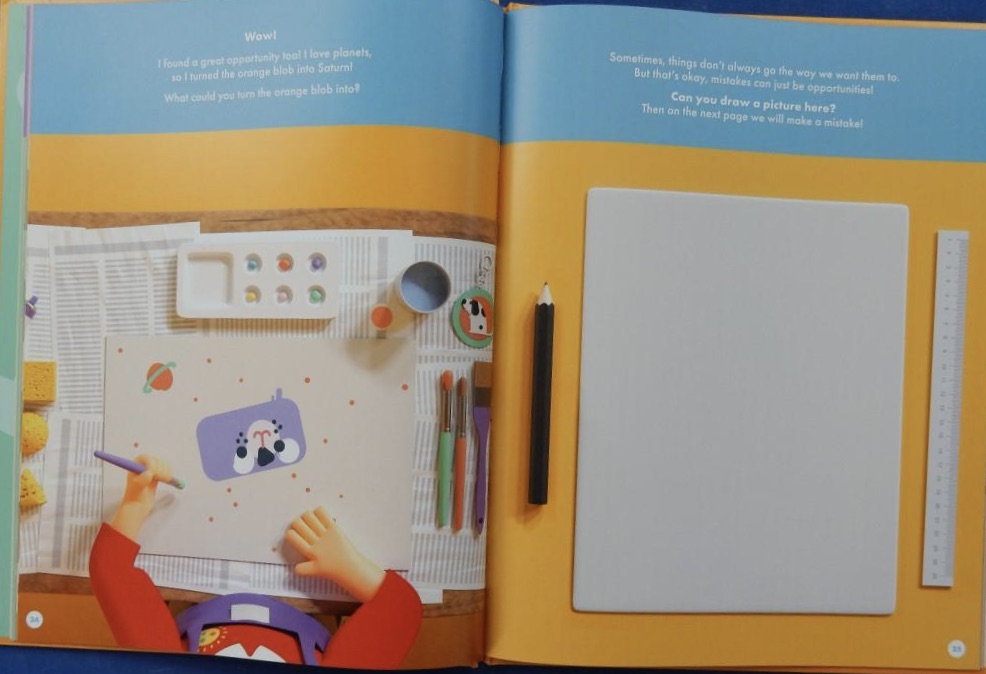
So too in the same series is Painting. This one has a school setting and introduces children to messy play activities. Again the possibility of having an itchy label arises when the friends put on their aprons. Coming up with ideas can also be a challenge, as can dropping paint in an unintended place,

and having messy hands.
There are helpful strategies including list making to help with planning and organising, and it’s particularly good to see making ‘mistakes’ presented as normal: for any child mistakes are a vital part of the learning process Another confidence building book.

100 Forest School Activities / Bird, Bee & Bug Houses

Team Naomi and Dan, who run Outback2Basics, bring their ardour for the outdoors to the pages of another book.

Forest School should be part and parcel of the curriculum for every primary school child and the activities herein offer a wide range of ways to get youngsters connecting with the natural world.
It’s divided into five main sections, the first being Connecting With Nature. I particularly like something I’ve not tried before – making a camouflage cape. It will involve some cutting and sewing so make sure you check the ‘You Will Need’ list before setting out.
Chapter two Fire, Food and Shelter has more than ten food-related suggestions including making feta rolls, which sound tasty and something I plan to try.
Decorating leaves as per the instructions for one of the Nature Crafts is a creative idea that has lots of potential and once decorated said leaves can then be used to make for instance, greetings cards, a mobile or leafy butterflies. Another leafy possibility is to mould a leaf bowl using air dry clay and it can be done during any season of the year.
It’s great to see that most of the Games in the section of the same name are designed to get children working co-operatively and who wouldn’t want to try creating a ‘twiggy owl’.

There’s a template given at the back of the book but children might like to create a much larger owl so they could start by drawing their own template. Equally delightful is the leaf bat also made from sticks and leaves. All members of your forest school group could then leave one leaf bat dangling somewhere to create a collaborative display.
Before the five chapters are an introductory spread, followed by some general practical information including safety preparation, basic knots and vital pages about knives and fire.

Teachers and others working with children, this latest book by the Walmsleys is well worth adding to your resources.

Our local community-built forest play area for young children contains two bug hotels. Little humans and their carers who may be inspired to open heir own establishments would do well to get hold of a copy of this enticingly illustrated book. Therein are practical, clear instructions on how to do so, as well as a dozen or so other projects to help and encourage wild-life from birds to beetles, bats to butterflies.
Some projects such as making a bird box or a bat house

will need considerable adult involvement but others, a bird bath, a butterfly puddle area or a mini meadow for instance, require minimal adult intervention. Alongside the projects there are spreads with useful factual information relating to terminology and about some of the creatures likely to be encountered including owls, bats and frogs.
Esther Coombs supplies clear visual support and relevant illustrations of the animals. Backmatter includes a glossary and lists some conservation websites.

Thumbsucker / I am an Autistic Girl

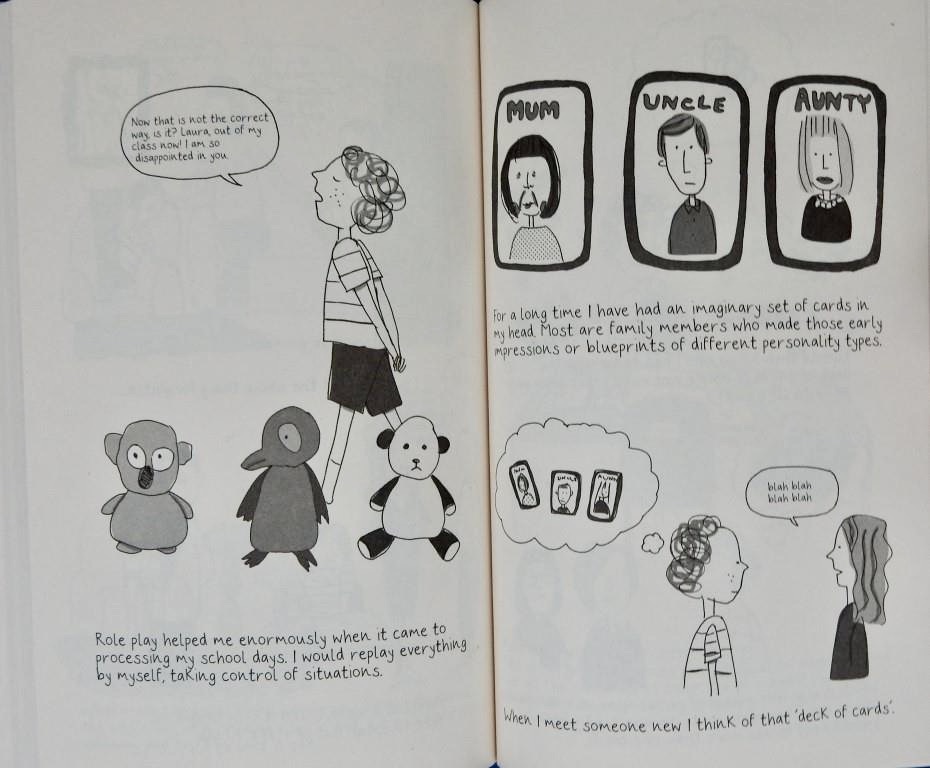
Eliza Fricker is a neurodivergent author and illustrator who didn’t receive an autism diagnosis until she was an adult. In this moving book she writes about what it was like as a girl who grew up in the 1980s feeling different and constantly beset by worries.

She was called among other things, fussy, a hypochondriac, fickle, spoilt, contrary, gullible, a freak, a chatterbox, a wimp and a weirdo, some of these labels being given to her child self by other people, and some perhaps were self dubbed.

She takes each one and in graphic novel style presents a vignette exemplar.

Fiercely honest, humorous and affecting, it reinforces my feeling that all teachers and others who work with children or young adults should have training on how neurodivergence presents itself in childhood, especially in girls and how best they can support neurodivergent learners. This book is an excellent, albeit salutary starting point for anybody involved with the welfare of the young.
A copy should definitely be in every school staff collection.

This is an updated edition of I am an Aspie Girl published several years ago, which was reviewed on this blog in 2016.

Where Do I Start?

Subtitled ‘How to Navigate the Emotional Journey of Autism Parenting’ this is I would say the go to guide for any parent with a neurodivergent child whether or not that child has already got a diagnosis. It’s written by Kate Laine-Toner, founder of Bristol Autism Support, the mother of a 13 year old child with autism and also received a neurodivergence diagnosis herself last year. So, this comes from a place of deep understanding, knowledge and empathy.

I’m not a parent but have taught many children from age three to eleven who were clearly neurodivergent; sometimes this was acknowledged by parents and shared with me and sometimes not. So I’m not the target audience for this book but I wish it had been around when I was in the classroom. I know I would have been in a better position to help those parents having read it.
There are two parts to the book, the first focuses on How to Help Yourself (as a parent); the second is on How to Help Your Child.

The seven chapters that comprise the first section give helpful advice on topics that include looking after yourself, talking to family and friends about autism and being assertive with professionals in education and healthcare, why you need help and how to get it. Interwoven throughout are Kate’s story of her daughter’s journey and her own experiences. For example she looks at some of the true feelings around a diagnosis that parents may be too frightened to disclose. I love the garden metaphor used: ‘view your autistic child as an amazing garden, and that autism is the soil in which everything in your child grows. … there will be plants and flowers that thrive without any help and those that need support and extra nourishment.’

Not all parents are by nature assertive but parents need to be assertive to get the help they need and to this end, several ‘why’ questions are offered (with an extended example).
Why can’t my child have this reasonable adjustment at school?
Why can’t we have the first appointment of the day?
Why can’t the GP meet us in the waiting area?
Why can’t we arrive 15 minutes before everyone else?
Why can’t my child eat the food we brought from home when the rest of us are ordering meals?

These asked in a non aggressive manner should, one hopes, get the person you are addressing thinking about how they might help.
Other key pieces of advice include never comparing your child with other children and focusing on the positives.

Part two has 12 chapters; these look at topics such as ‘How to Advocate for Your Child’, coping with your child’s anxiety, how and when to talk to your child about autism, emotional regulation (this includes an explanation of the differences between meltdowns, tantrums and shutdowns), sensory processing differences and executive functioning. The last – the ability to plan, organise and carry out tasks is something most neurodivergent people struggle with. Chaining (a technique to help with learning a new skill/routine) and using visuals can be a great help here.

The final chapter reminds readers of the importance of being in the here and now with a child, rather than worrying unduly about what their future might hold.
The book concludes with a lovely poem by Kate, which is also entitled ‘Where Do I Start?’

Thoroughly recommended no matter where a parent is on their journey with their neurodivergent child. I would also suggest a copy should be in every primary school.

Poetry Prompts

This image has an empty alt attribute; its file name is dscn9672-4.jpg


Children’s laureate, Joseph Coelho provides 41 ways for readers to ‘discover the poet within.’
His first prompt is to have a dedicated notebook of your own that you can always have to hand when an idea arises; he even demonstrates how to make such a book from a single sheet of paper.
He then proceeds to one word poems; the trick so we read, is to have a long title. If this idea works for you, you can he suggests, in his first ‘poetry power-up,’ write several on the same theme for example: ‘The Sound of Water / Splash. // The Feel of Water / Cold. // The Taste of Water / Nothing.’


There are suggestions for penning poems that use rhyme and repetition, alliteration, onomatopoeia, similes, and metaphors as well as certain poetic forms such as haiku, and more challenging, triolets.
Most of the ideas are relatively light-hearted but there are also prompts for a ‘Home Is …’ poem in relation to World Refugee Day, and another for plastic pollution.


The four illustrators portray a diverse cast of children, as well as playful images of fauna, flora and an abundance of food ,

This image has an empty alt attribute; its file name is dscn9673-4.jpg

which offer further inspiration. The message that poetry is “about having fun with words” comes through loud and clear. I envisage lots of primary age children having great fun with the ideas in this book. (If used in a classroom though, it would be advisable, I think, to include prompts for some non-Christian festivals as well as those for Christmas and Easter.)


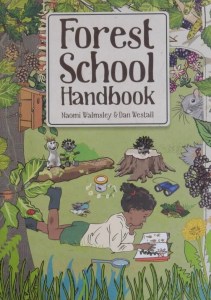
Forest School Handbook

Forest School Handbook
Naomi Walmsley and Dan Westall
GMC Publications

It’s great to see husband and wife team Naomi and Dan, who run Outback2Basics bringing their passion for the outdoors to the pages of another book.

As a teacher, I’ve long been a firm believer in the vital importance of outdoor education for children right from their early years and consequently many of the activities in this handbook are not new to me. Nonetheless, it’s always good to be reminded of things as well as to discover fresh ideas.

After an introduction, which talks about the purposes of forest school activities and the benefits from playing outside and interacting with the natural world, the book is divided into ten sections, each with an abundance of colour photographs, and the age appropriateness, time, materials and tools needed for every activity.

Controlled risk taking and developing social skills, both of which are fundamental to forest schooling are two of the most vital elements of education and the sessions this book offers are so much more worthwhile than being cooped up all day in a stuffy classroom. What would you rather your child(ren) did: make charcoal (and perhaps use it to draw with), build a shelter from the materials lying around in the environment or spending hours staring at a screen?

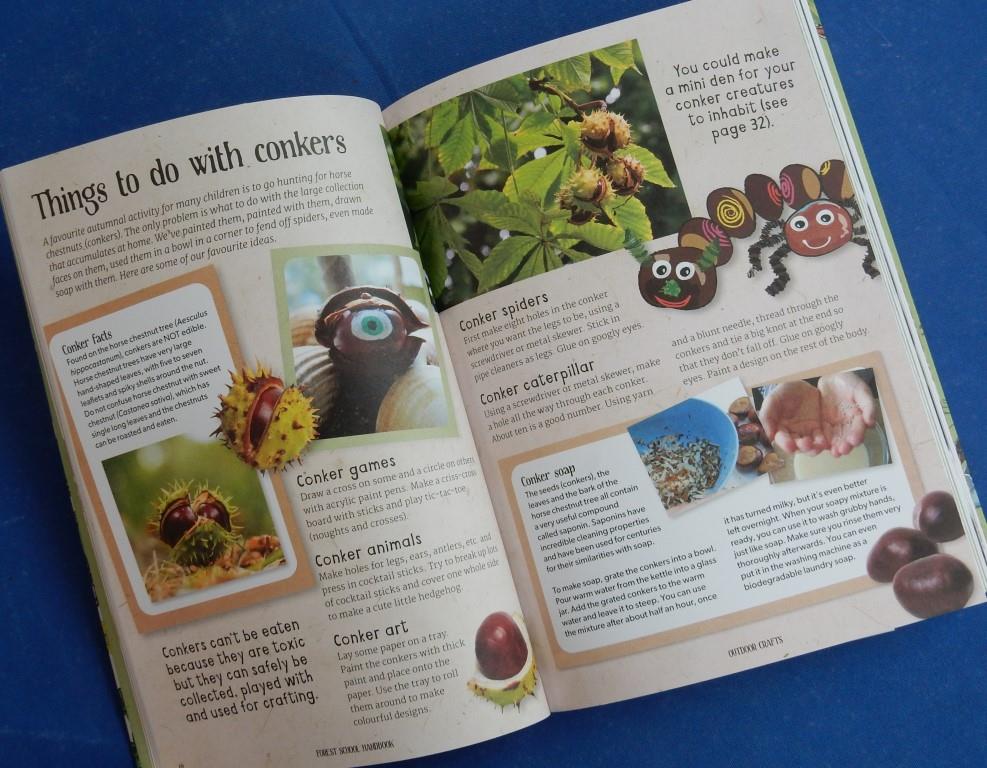
One activity that appealed to me especially from he ‘Things to do with conkers’ spread is creating conker animals, in particular a conker caterpillar.

Making soap from conkers also sounds interesting .

Altogether a smashing little book that deserves to be in every family and class collection.

A Little Dose of Nature / Look What I Found: On the Farm

A Little Dose of Nature
Dr. Alison Greenwood and Anneli Bray
Ivy Kids

Written by psychologist, Dr Alison Greenwood who has set up a charity called Dose of Nature, this book as the cover says, suggests ‘outdoor fun to help happiness bloom’. To improve mental health and wellbeing, twenty five activities are suggested for children (and adults), all to be done outside in the natural world, well away from the distractions of social media, computer games etc.

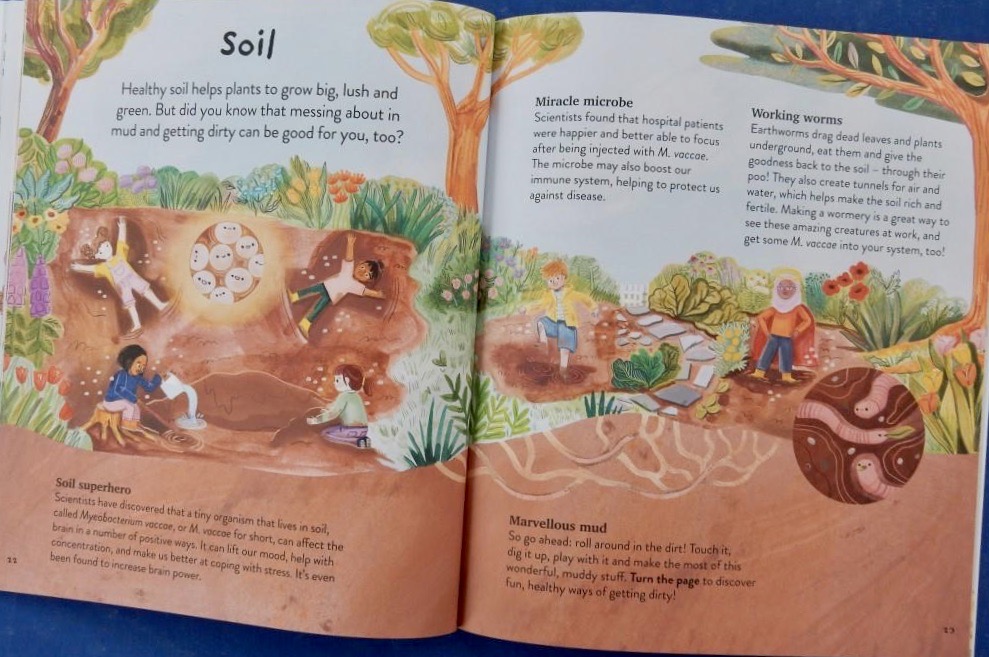
First though the author states that nature has five active ingredients that are of benefit to humans; these will give us more energy, improve concentration and sleep, help us to relax, and to be in a better mood. These include fractal patterns, nature’s sounds, phytoncides (natural chemicals), soil bacteria and sunlight. I expect some of these science terms will be unfamiliar to younger children and Alison pitches her explanations at just the right level. The book has five main sections, entitled Nature’s Fractals, The Science of Sounds, Fresh Air, Soil

and Soak Up the Sunshine!

Who could fail to connect with nature as they collect and arrange natural objects to create a mandala – in my experience children love to do this.

The same is true of getting messy by sculpting animals using sludgy mud or running around barefoot in a muddy patch and then comparing the experience with walking barefoot on grass.

Brilliant for forest school and outdoor science. I love that Alison’s final words include paragraphs on awe and what she calls ‘wow moments’.
Anneli Bray’s detailed illustrations are an inclusive delight and certainly make this particular book stand out from others on the theme of appreciating the great outdoors..

Look What I Found: On the Farm
Moira Butterfield and Jesús Verona
Nosy Crow

Bursting with information, this is the third title in a series published in collaboration with the National Trust.
Readers join the three young adventurers on a new expedition one spring day as they investigate their surroundings while following the path through the fields. Each in turn exclaims in the rhyming narrative, “Look what I found!”

excitedly showing the others and readers the discovery, be it animal related, such as a tuft of sheep’s wool or a feather, or plant-related like the fluffy head of dandelion seeds.


Another engaging mix of story, non-fiction and search-and-find, illustrated by Jesús Verona whose scenes of the natural world, both the close-ups and landscapes are immersive.

Recommended for family bookshelves and KS1 class collections, especially if you want to encourage children to get outside and explore their surroundings.

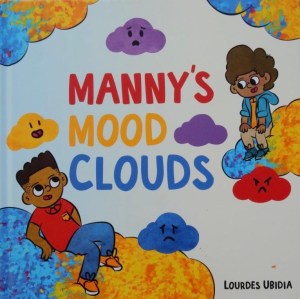
Manny’s Mood Clouds

Manny’s Mood Clouds
Lourdes Ubidia
Jessica Kingsley Publishers

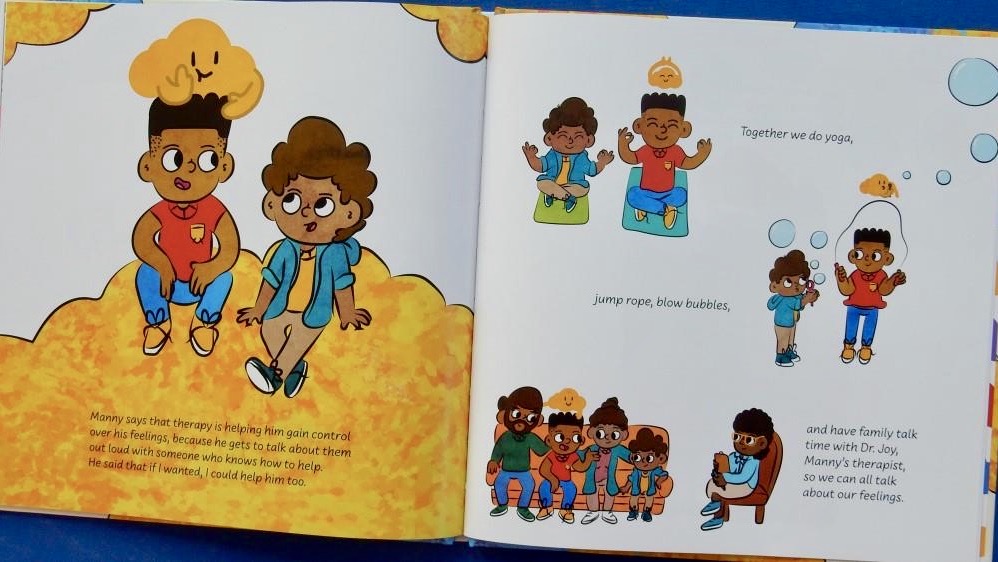
We learn about Manny’s moods through the eyes of his younger brother Elijah. He tells how his brother’s emotions are very quick to change and with it the way in which he acts; they’re so big they seem like coloured clouds that hover above his head. When he’s angry the cloud is red (that’s when Manny feels most frustrated); a blue cloud signifies sadness – then Manny wants to be left alone. A purple one comes when he experiences panic and is scared of everything; yellow represents happiness – Manny is ‘so happy he doesn’t know what to do with himself.’

Yes we all have little clouds, explains his brother but the difficulty for Elijah is the unpredictability of his brother’s mood changes. These aren’t like other people’s clouds, these are so big they’re overwhelming.

Their supportive parents decide eventually that Manny needs more help from someone with specialist knowledge so they take him to meet a therapist. She says that Manny has what is called a ‘mood disorder’ and gradually with her help, along with the support of his empathetic parents and sibling, he can be helped to work through his feelings. No, Manny’s clouds cannot be completely eradicated, but there are practical coping strategies that the brothers can do together. 

The examples given in the book are matched with the colours of Manny’s clouds which is especially helpful for families looking to support a child. It’s good to see that there’s a final spread showing a variety of other people who have mood clouds

The tone of the narration is a matter of fact one and the accompanying bright cartoon style illustrations keep the tenor of the book light and accessible for young children.

Backmatter written by clinical psychologist, Aimee Daramus offers some useful resources and tips for parents and carers of children with mood disorders.

 Lourdes UbidiaManny’s Mood Cloudsmood disorder

Big Feelings

Big Feelings
Rebekah Ballagh
Allen & Unwin

Author/illustrator Rebekah Ballagh has drawn on her skills as a counsellor to create a book to help develop children’s emotional literacy and better manage their feelings. Combining storytelling, illustration and child-friendly strategies, she uses fourteen child characters to help explore fourteen different emotions. Written in verse, each story introduces a character whose emotion has an effect on the body and then explains what to do about it.

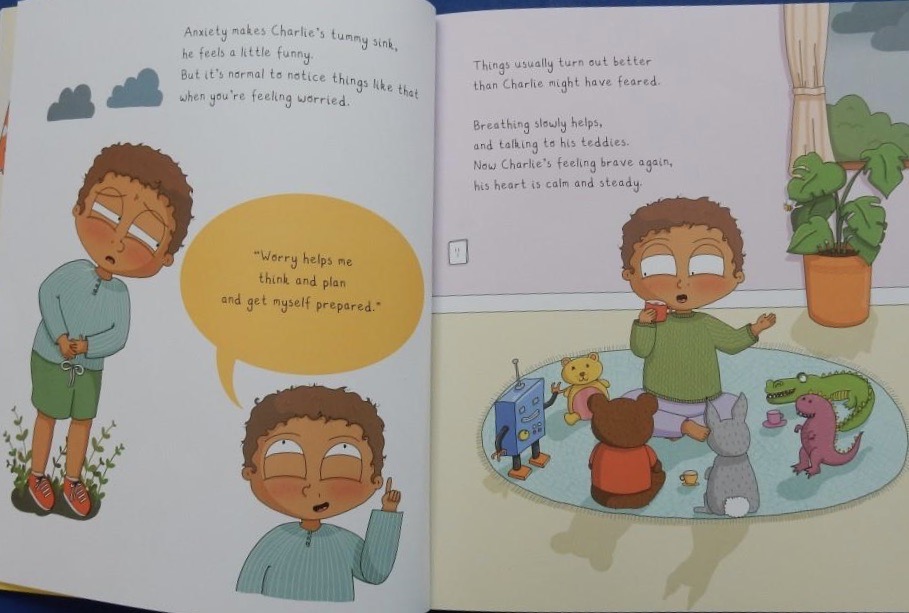
For example, Charlie is feeling very anxious: reading in class scares him; he’s frightened of monsters and of getting into trouble. He has a sinking feeling in his tummy, but by breathing slowly and talking to his teddies, he gradually calms himself.

Chloe feels angry: she stamps and stomps, slams doors and shouts at her brother; her anger is showing her that something hasn’t gone her way or perhaps she’s feeling sad. That’s okay she needs to acknowledge the feeling and diffuse that anger. Chloe does, first by naming it and then actively; she might breathe slowly and count, or jump around and throw pillows at the wall.

With each character, the author not only helps expand children’s emotional vocabulary; she also empowers them by showing examples of how better to cope with these feelings in everyday life. She makes it clear though, it’s not about fixing feelings, it’s fine just to sit quietly and let them be. ‘Feelings are messages from the heart sent here to help you. So listen close and take a breath, they’ll show you what to do.’ If you know why, you’ll likely know what …

The second part of the book offers tools and resources to aid adults in supporting the mental wellbeing of youngsters.

Bright, expressive illustrations, including a bee to find on each spread, help ensure Rebekah’s wisdom and understanding enables both children and adults to get the most from the book. It’s one to use both at home and in primary classrooms.

The Panda on PDA / The Red Beast

The Panda on PDA
Gloria Dura-Vilà , illustrated by Rebecca Tatternorth
Jessica Kingsley Publishers

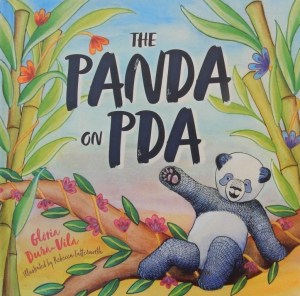
Explaining autism and especially PDA through the lens of ursine characters is an ingenious, highly accessible, child-friendly way of doing so. Both the strengths and the challenges of PDA are explained by the Panda narrator and co-author of the book, a positive, charming and honest character. who also offers some things that might be helpful to turn a potentially bad day into a good one, (Keeping calm is key to remaining in control, we learn.)
Underscoring the idea that each Panda and thus child, is unique, are opportunities to personalise the narrative helping to make this such an affirmative book.

With her wealth of experience, Gloria Dura-Vilà is a passionate advocate for neurodiversity and her enthusiasm is apparent on every page of this book; and Rebecca Tatternorth’s illustrations are a delight as they bring her main character to life.

Maybe though, the real show-stealers are the Pandas depicted on both front and back endpapers; these were drawn by children with Pathological Demand Avoidance, their siblings and friends.

Altogether a super resource: I strongly recommend it to any parent with a PDA child, other family members, all teachers and professionals who support such children, and indeed anybody who seeks to understand PDA. Read the book and join the Panda tribe (or see things from a Panda’s perspective) is the message.

The Red Beast
K.I. Al-Ghani, illustrated by Haitham Al-Ghani
Jessica Kingsley Publishers

The main aim of this book – now in a new edition – is to help children who are neurodivergent to cope with and process their anger. It could however also work well with any child that has occasional outbursts of uncontrollable anger. But first they have to acknowledge this emotion, the ’red beast’ that lurks deep inside us all, dormant until something happens to awaken it. Said beast then starts to grow and grow and grow until it can’t be contained and out pour those hurtful words, “I hate you! I hate you!” accompanied by spiteful actions such as kicking, biting, swearing and spitting.

The story here is one of Danni and what happens when the Red Beast within him is accidentally woken up when a ball kicked by somebody in the playground hits him in the stomach. Despite Charlie’s apologies, the Red Beast rages alarmingly at him, 

until a teacher arrives on the scene to remove Danni from the situation. 

Once inside Danni is calmly given a stress ball to help diffuse his anger. Little by little with slow deep breathing and squeezes of the ball, Danni’s Red Beast grows smaller and sleepier until it’s fast asleep. Danni is then given cool water to drink, followed by some bubble wrap to pop and it’s not long before he’s ready to return to class where he apologises to an understanding, non-judgemental Charlie. Thereafter Danni knows what to do should that Red Beast reawaken.

Further helpful calming strategies are listed after the story. It’s good to see that the overarching idea in this accessible story is to deem the behaviour negative rather than the child. That is one all adults should remember to adopt when dealing with youngsters both at school and at home, so this is a helpful book for any primary school collection.

The Silent Selkie / Daisy Fitzpatrick and her Worries

Here are two books intended to support the mental well-being of youngsters.

The Silent Selkie
Juliette Ttofa, illustrated by Paul Greenhouse
Routledge

“We have to remember in order to heal,” So says one of Elif Shafak’s characters in her brilliant novel The Island of Missing Trees and so it is in this picture book.

Using the metaphor of a hidden wound this perceptive story, written by a specialist educational psychologist and child therapist and engagingly illustrated by Paul Greenhouse, is ultimately one of reassurance. Aiming to offer a safe space in which children affected by trauma can, with the help of an understanding adult, begin their crucial healing journey, it is intended to be used along with an accompanying guidebook.

The picture book shows the journey towards healing taken by a deeply traumatised young selkie that is so troubled that she’s lost the ability to speak. With her wound buried deep within she expresses her feelings through the weather 

and this leads to her being questioned and then isolated in a distant cave by the seal folk who fail to understand her plight.

There she remains engulfed in a fog, growing progressively wilder until one night as dreams intrude upon her sleep, her hair becomes entangled in the nets of a fishing boat. She’s dragged from her confinement and after unsuccessful attempts by the seal folk to rouse her, the trawler pulls her to a distant unknown land.

On waking she finds herself on a sandy shore, still entangled in the net but showing some bare skin on her tail. In the full sun, it feels as though her golden scales are aflame. Then holding a shiny stone she glimpses a splinter protruding from her tail. The pain causes her to cry out but attempts to get help from self-serving creatures that stop, lead to more pain and the loss of some of her golden scales. The intensity of the burning increases and the Selkie begins picking off her own scales and that night her slumbering body remembers the long forgotten story of how as a pup, the thorn entered her skin inflicting a wound. Her moans echo through the deep sea. Next morning she sees a humpback whale and the two sing together. 

Thus begins the release from her entrapment: “It is time for you to be who you really are,” the empathetic whale tells her, assuring the `Selkie’ that she won’t be alone on her healing journey.

Daisy Fitzpatrick and her Worries
Nancy Carroll
Ragged Bears

Daisy Fitzpatrick is beset by anxieties, and her mind is full of worries, the kind that could trouble any of us from time to time. I certainly go along with her on the fear of heights, though not really most of her other worries – buzzing bees (and other minibeasts), the dark, the sea, vegetables, storms, dying ( I guess most of us aren’t eager to contemplate the end of life), crossing the road, being alone, her parents’ separation. She considers a dozen worries in all and by the end of each poem, has found the means to discover a new perspective on each troubling issue.

Sensitively written by an author who shares many of these fears with Daisy; after the rhymes she provides helpful notes and suggestions including mindfulness and finding someone else with whom you can talk over particular anxious feelings – as well as links by which readers can get additional information. There are occasional recipes that include a vegetable ingredient too.

An unusual book to help children face and eradicate childhood worries.

I’m Not Upside Down, I’m Downside Up / All About Dyspraxia

Here are two recent neurodiversity titles from Jessica Kingsley Publishers – thanks to the publisher for sending them for review.

I’m Not Upside Down, I’m Downside Up
Harry Thompson and Danielle Jata-Hall, illustrated by Mollie Sherwin

In this slim but hugely informative book we meet Ariana; PDA (Pathological Demand Avoidance) is what I am she says. This is a form of autism and the girl narrator gives readers an insight into her mind explaining why the feeling she has that she must be in control all the time can look as though she’s just badly behaved. 

School is challenging as she feels it takes away her freedom to be her true self. Assuredly Ariana’s behaviour is often unpredictable but she’s also creative, witty and clever: ‘I want to tackle the big questions of life …what happened before the big bang’ is indicative of her preference for big talk as opposed to small talk – the everyday natter other people often use.
I wish I’d been able to read this when several years ago I had a little boy in my nursery class. who had a PDA diagnosis and like Ariana, his behaviour was unpredictable. I’ll never forget one story time he took himself off into the cloakroom and there he remained singing Rod Stewart songs until it was time to go home.

All About Dyspraxia
Kathy Hoopmann


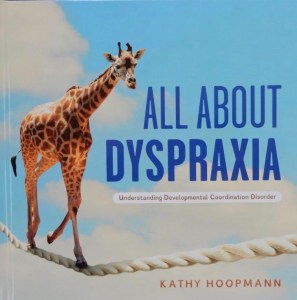
As with her All Cats Are on the Autism Spectrum, Kathy Hoopmann uses superb colour photos
of animals paired with a direct text (plus occasional thinks and speech bubbles) to show children how dyspraxia isn’t all about being clumsy. Along with other neurodiverse people, those with dyspraxia have brains that are wired differently from others.
This means we learn, that a child with dyspraxia might become adept at avoiding activities if they fear they might fall but with encouragement and time, with the activity or instructions broken down and lots of practice, they often manage a lot better. It’s good to allow plenty of time to learn a task or grasp new ideas,

and to celebrate achievements: reading for example is tiring and the text may well become blurred.
Did you know that movement often facilitates listening for a dyspraxia learner and for those who find writing especially challenging, a keyboard can make life much easier.
Rather than making a child with dyspraxia anxious by saying that they are lazy, not trying hard, not listening or whatever, it’s important for adults – parents, teachers or other educators – to appreciate how hard they work, how clever they really are, to celebrate their creativity, their unusual ways of solving problems, their determination and successes.
A book to have in school collections, both to show educators and classmates ways to be understanding and supportive, and to lend to parents with a child recently diagnosed with dyspraxia.

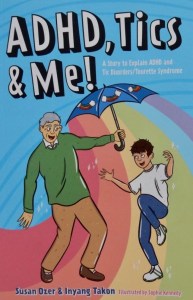
ADHD, Tics and Me!

ADHD, Tics and Me!
Susan Ozer & Inyang Takon, illustrated by Sophie Kennedy
Jessica Kingsley Publishers

In this slim paperback we meet Jamie. Jamie is almost ten and he has ADHD and also a tic disorder called Tourette Syndrome. He talks directly to young readers about living with both of these conditions in a chatty narrative that is divided into two parts.

In the first ‘Meet Jamie’ the boy provides straightforward information about himself including his likes and dislikes, introduces his family members, and talks about how he was diagnosed.. In addition we hear how it is not always easy to tell whether those fidgety bouts he’s prone to are on account of having ADHD, tics, or both; and we learn that he is a member of an after school club called the ‘Tic Club’. As the young narrator takes readers through the first section, he offers several interactive activities for reader participation including, ‘Tell me about your happiest/ your scariest places.’ He also shares how he has learnt to relieve his ADHD symptoms, keep his tics to a minimum, and how friends and adults (including teachers) can help both at school and at home.

In part two Jamie explains the key role his Grandfather played in encouraging him to learn more about his tics. We hear how, thanks to a clever project with a competitive element, he and his fellow members of the Tic Club learn about each other by sharing their experiences of ADHD and tics at school and at home. We also meet some of Jamie’s friends who participated in this question and answer activity.
By encouraging youngsters to think about their own lives, the authors help readers like Jamie to understand that they aren’t defined by the label that comes with a diagnosis, a definite boost for self esteem – as well as showing others how to take a positive approach.

Whether or not a primary class has a child similar to Jamie on roll, this is a book that should be available in schools for both children and adults, offering as it does a good starting point for discussion.

The Amazing Autism Brain Cards

The Amazing Autism Brain Cards
Glòria Durâ-Vilà, illustrated by Rebecca Tatternorth
Jessica Kingsley Publishers

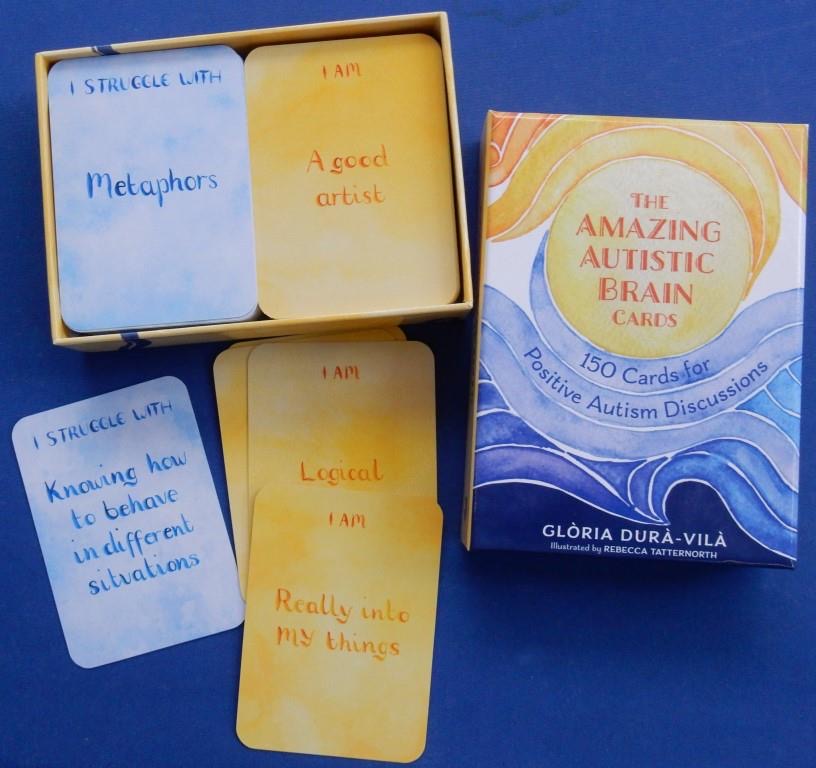
Sometimes it’s the simplest things that can be the most effective and so it is with this set of cards that offer an excellent resource for those who live or work with children/ young people who have recently received an autism diagnosis.

In the pack there are 150 laminated cards and an explanatory booklet explaining their purpose and offering words of wisdom about how to use them and with whom, (it could be with an individual or within a group) plus ideas, advice (choosing one’s words carefully, for example), and quotes from children themselves.

The cards are divided into two sets, one blue and the other yellow and each set also has some blanks for personalisation.

The yellow set are the ‘I am’ ones – those showing a strength – ‘fair and just’, ‘a good friend’, ‘observant’, ‘determined’ and ‘good at science’ for example.

The blue set are the ‘challenges’. They might refer to something sensory such as ‘Being cuddled’ or ‘Recognising feelings of hunger or thirst’; or related to the emotions ‘Showing my true feelings’ for instance, or seeing the big picture – ‘working towards a goal’, or perhaps ‘Knowing how to behave in different situations’.

In having the opportunity to choose those cards they feel relate to them, the young person feels in control and is helped to get a personalised picture – a celebration of how their autism looks.

The Everyday Autism Handbook for Schools

The Everyday Autism Handbook for Schools
Claire Droney and Annelies Verbiest
Jessica Kingsley Publishers

The authors of this excellent book draw on almost forty years experience of working with neurodiverse pupils in a variety of settings. Linking theory and practice it’s a must-have, extremely readable resource for all teachers and others working with children with autism, in both mainstream primary and special schools.

Within in the six main sections or themes there are over sixty ‘guides’, encompassing associated practical activities, techniques and case studies; all anchored in evidence-based practice.

The first part comprises two important short guides on understanding autism – a kind of ‘what you need to know’ and it was especially good to find the authors stressing the importance of a focus on children’s strengths and on using positive language at all times.

It’s crucial to develop an inclusive and collaborative whole school community and this is covered in the next two sections.

Most importantly, by following the guidance herein, practitioners are likely to be able to guide the children they work with towards reaching their full potential. Whether you are looking for help on lesson plans, communicating with parents, or strategies to help youngsters cope with anxiety or stress, you’ll find it and much, much more herein.

I’d like to think that every primary teacher could find the time to read right through this book but I suspect that particularly during the current covid times which are causing increased stress to pretty much every member of a school’s staff, that’s unlikely to happen. However this is a book that works as a ‘dip in and out’ read too, and equally could also form the basis of a series of staff inset sessions.
How ever you decide to use it, if you are responsible for buying books for your primary school staff, then put this one at the top of your list for 2022.

The Same but Different

The Same but Different
Molly Potter and Sarah Jennings
Featherstone

This is the latest in the excellent series written by Molly Potter and illustrated by Sarah Jennings that are used by so many teachers to stimulate thought and discussion.

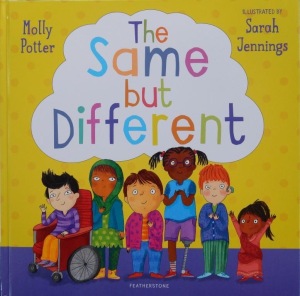
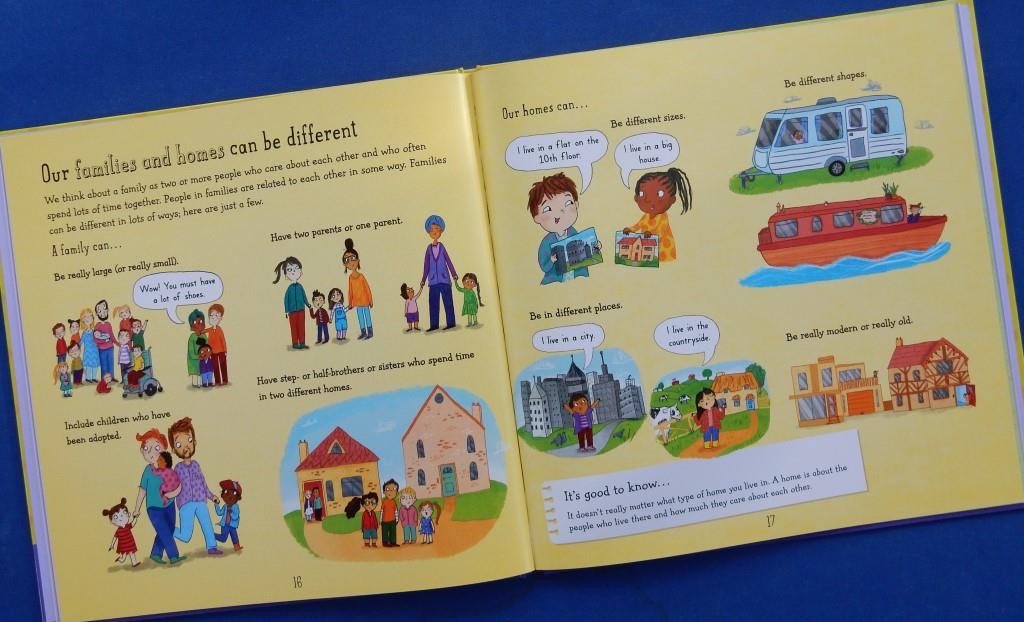
Herein youngsters are invited to recognise, explore and celebrate both the things we have in common with other people and those that make us different. After all, every single one of us is a unique human being and our differences need to be acknowledged, respected and celebrated. Imagine a world wherein we are all identical in every way: how dull and boring life would be.

Sarah Jennings’ splendid illustrations portray a diverse mix of children (and some adults) and Molly’s narrative focuses largely on differences including how people look – skin colour, hair styles and colours, eye colour, whether or not we wear glasses, height and clothing styles.
There’s a page on talents and skills, another explores preferences such as foods, favoured times of day and another on personality.

That everyone is entitled to have his or her own opinions and beliefs is acknowledged and these should be respected (provided that nobody is harmed, that is.) The concept of family and that of a home are both presented and some of the ways families and homes can be different, mentioned.


However, in addition to the differences, there are spreads that look at some things that are likely to be same or nearly the same as other people –

things that are part of our shared humanity such as the need to eat, a desire to be loved, a felt discomfort at excessive cold or heat, a brain that enables decision making and an imagination.

The book concludes with some helpful tips for adults sharing it with children to help in their understanding of various forms of diversity and the celebration of difference. There’s also a final glossary. All in all a very useful starting point for discussions on inclusion both at home and in the classroom.

My Mindful A to Zen / Being Healthy / Learning

My Mindful A to Zen
Krina Patel-Sage
Lantana Publishing
As the author/illustrator points out after presenting twenty six haiku ‘for happy little minds’, each of the entries in this book highlights one or more of the ‘five ways to wellbeing’, known to boost mental health and positivity: connecting,

being active, taking notice, keeping on learning and giving.

No matter whether youngsters prefer the great outdoors and all that has to offer,

or to stay indoors getting lost in a good book, or being creative with their favourite materials,

or perhaps spending time in the kitchen cooking a yummy cake (even if it doesn’t quite go to plan), done mindfully, it can be part and parcel of getting the very best out of life.

With its diverse cast of characters bringing to life this alphabet of contented being and doing, Krina Patel-Sage offers youngsters much to think about, talk about and act upon. This teacher/yoga teacher and reviewer heartily endorses this well-being picture book.

Also for fostering children’s wellbeing:

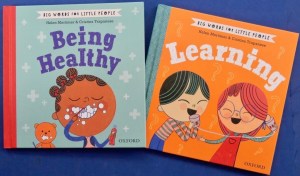
Being Healthy
Learning
Helen Mortimer and Cristina Trapanese
Oxford Children’s Book

These are two new titles in the Big Words for Little People series that offers a very useful resource to early years teachers and other practitioners as well as parents of young children.

Using age-appropriate language, Helen Mortimer takes little ones through the day doing those activities that should foster their Being Healthy. There’s personal hygiene washing and tooth brushing, eating ‘wholesome’ food and drinking plenty, taking exercise that works their muscles, as well as engaging in mood boosting activities, getting out in the sun whenever possible. There are also spreads on allergies, doing things in your own way, being aware of and avoiding potential dangers, the helpers who might provide treatment when there’s an accident or illness, and finally, very important comes sleep.
Inclusive, engaging and interactive, as is Learning. This is a huge topic that begins at birth and continues throughout life but to get the most from it, that learning needs to excite the learners and that’s what this little book aims to do. It encourages questioning, problem solving, taking advantage of technology, developing good concentration, trying hard and taking risks with learning, as well as keeping the mind open to new ideas. Like previous titles, both books have Cristina Trapanese’s lively illustrations, a spread with helpful ideas for adult users and a glossary.

Science School / Out and About Minibeast Explorer

Science School
Laura Minter & Tia Williams
Button Books

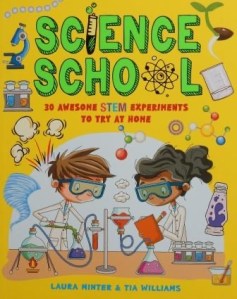
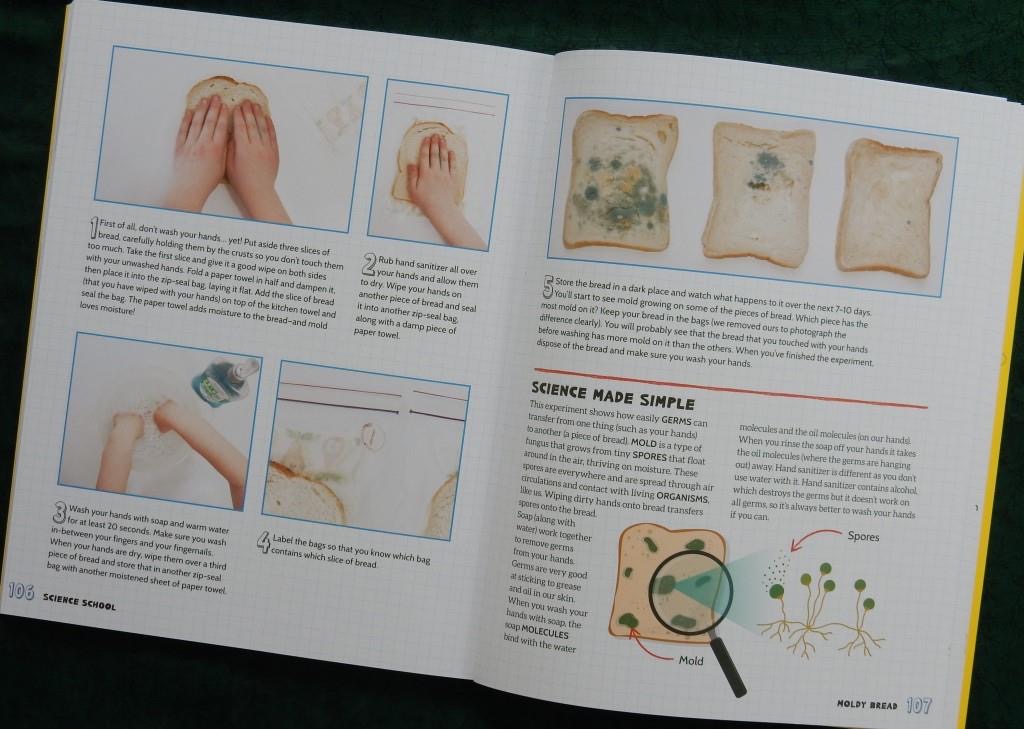
Covering such topics as magnetism, gravity, change of state, oxidation, the growth of fungus and much more – all relating to basic scientific principles, the latest collaboration from Laura Minter and Tia Williams offers thirty STEM experiments, some crafty, for youngsters to try at home.

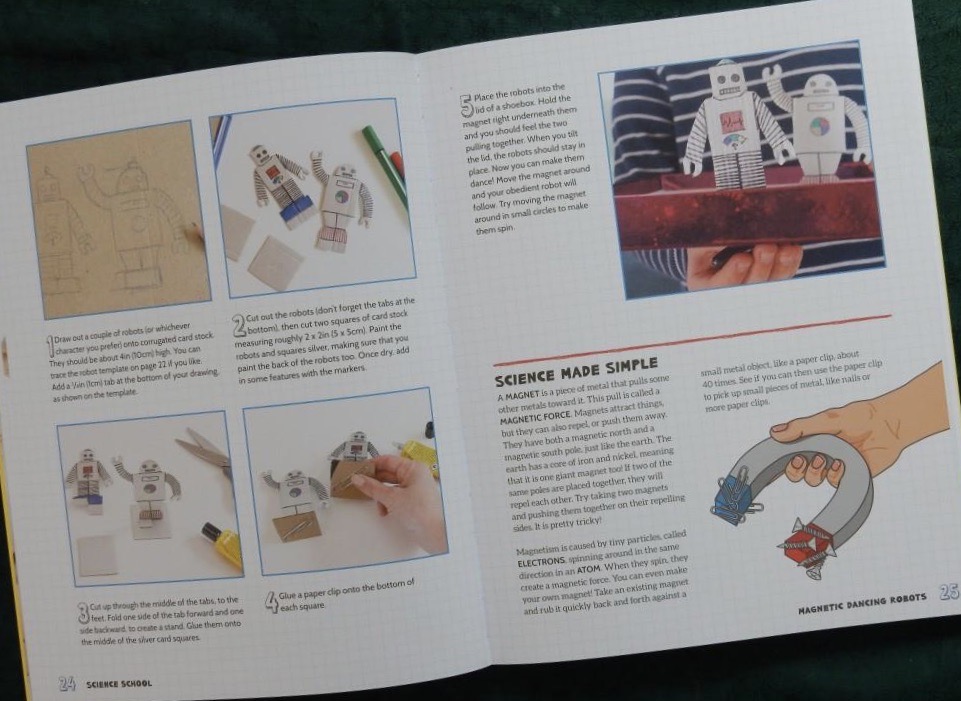
None of the activities require sophisticated equipment; rather they can be done at home with everyday materials you’re already likely to have knocking around somewhere. A list of what’s needed is given at the start of each project and there are photographs showing what to do, beneath each of which are step-by-step instructions, and, the science behind the experiment is concisely explained in the final ‘Science Made Simple’ paragraph(s) that often takes the science a bit further too.

My experimenters especially enjoyed making the “Magnetic Dancing Robots’ and other characters. 

Important at all times, but even more so as COVID is still with us, is the experiment showing the difference after around 10 days to three slices of bread: the first wiped all over with unwashed hands; the second wiped with sanitised hands and the third with hands that have been thoroughly washed with warm soapy water for 20+ seconds, completely dried and then wiped on slice number 3 (make sure the bag into which each is placed is labelled before putting it in a dark place.)

Providing hours of fun learning, this book is particularly useful for homeschooling.

Out and About Minibeast Explorer
Robyn Swift, illustrated by Hannah Alice
Nosy Crow

Published in collaboration with the National Trust, this handy guide for youngsters features more than sixty minibeasts about which Robyn Swift presents a wealth of information related to identification, lifecycles, habitats, anatomy and more. Did you know that a decapitated cockroach is able to live for up to nine days; that the blood of slugs is green, or that seagull sized dragonflies lived before dinosaurs roamed the earth?

The importance of minibeasts is explained and also included are some pages of activities, a classification chart and a quiz.

Hannah Alice’s illustrations of the creatures are clear and easily recognisable making this a super little book to tuck into a backpack when you go out and about no matter if it be in town, countryside or the garden.

Wild Days: Outdoor Play for Young Adventurers / The Gruffalo and Friends Outdoor Activity Book

Wild Days: Outdoor Play for Young Adventurers
Richard Irvine
GMC Publications

The author of this super book runs Forest School training for new leaders as well as Forest School programmes so most certainly knows what he’s talking about. I was convinced of this as I read in the book’s introduction, ‘To be safe in the world, young people need to be allowed to take risks.’ In fact, wearing my teacher’s hat, I’d say that risk taking is key in any real learning, not only that which takes place outdoors.

There are three main sections ‘Making’, ‘Games and stories’ and ‘Exploring’; but before plunging into these it’s important to read the pages on responsible behaviour (Leave no trace being key), being prepared before setting out, suggestions for tools you might want to take along and what you might do with them.

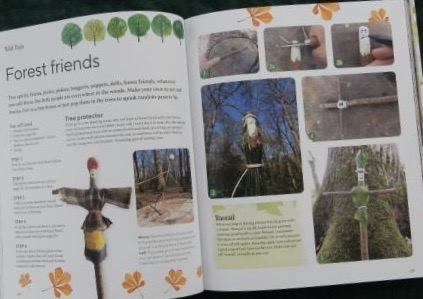
The Making activities vary from den building and campfire cooking to painting with natural materials. I loved the Forest friends spread, even more so the later suggestion that the characters created could be used in Storytelling, one of the ideas in the Games and Stories section.

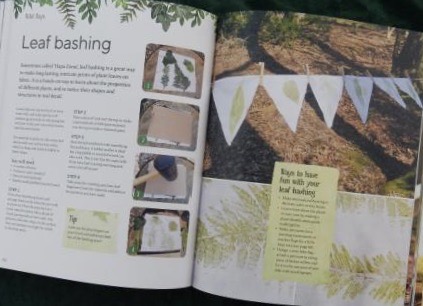
Another idea that I can’t wait to try with some youngsters is Leaf Bashing aka Hapa Zome – a method of making leaf prints that works well on old sheets or similar cotton material and of course, the bashing part is a great way of letting off steam and a terrific lockdown antidote.

A great group activity in the second section is a ‘Finding things’ Treasure hunt and with younger children especially, the author’s suggestion to stay in pairs is advisable.

Much of the third Exploring part is concerned with identification, be that of plants, birds and their songs, butterflies or invertebrates, but a gentle word of warning: it’s important not to get too obsessed with mere naming to the exclusion of observing and relishing the beauty of nature’s flora and fauna.

I could go on extolling the virtues of this cracking book but instead I’ll suggest that as well as families, all education settings add a copy to their collections, and start putting some of Richard Irvine’s ideas into action whatever the weather. Each one of them has a list of what you’ll need and step-by-step instructions as well as colour photographs. What better way to get youngsters of all ages outdoors learning through and about nature; in fact it covers pretty much every area of the curriculum.

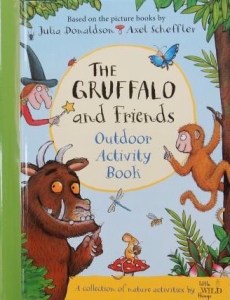
The Gruffalo and Friends Outdoor Activity Book
Julia Donaldson and Axel Scheffler
Macmillan Children’s Books

The twenty four activities in this spirally bound book have been created by Forest School specialists, Little Wild Things and are based on Julia and Axel’s The Gruffalo, Monkey Puzzle, Room on the Broom and Charlie Cook’s Favourite Book.

Each section has a context setting spread with a quote from the relevant book ‘A mouse took a stroll through the deep dark wood. / A fox saw the mouse and the mouse looked good.’ and every activity has a list of what’s needed, numbered ‘What to do’ instructions, hints and tips and some extension suggestions.

Whether used with a group or by an individual, there’s lots of fun learning across the curriculum herein.

Friendship / Calmness

Friendship
Calmness

Helen Mortimer and Cristina Trapanese
Oxford University Press Children’s Books

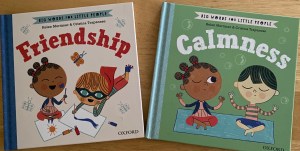
These are two additions to the Big Words for Little People series: the first explores what being a good friend really means and the second presents various elements that are associated with feeling calm.
Each of the first eleven spreads takes a key word (or two) exploring it through an engaging scene and an explanatory sentence or two.

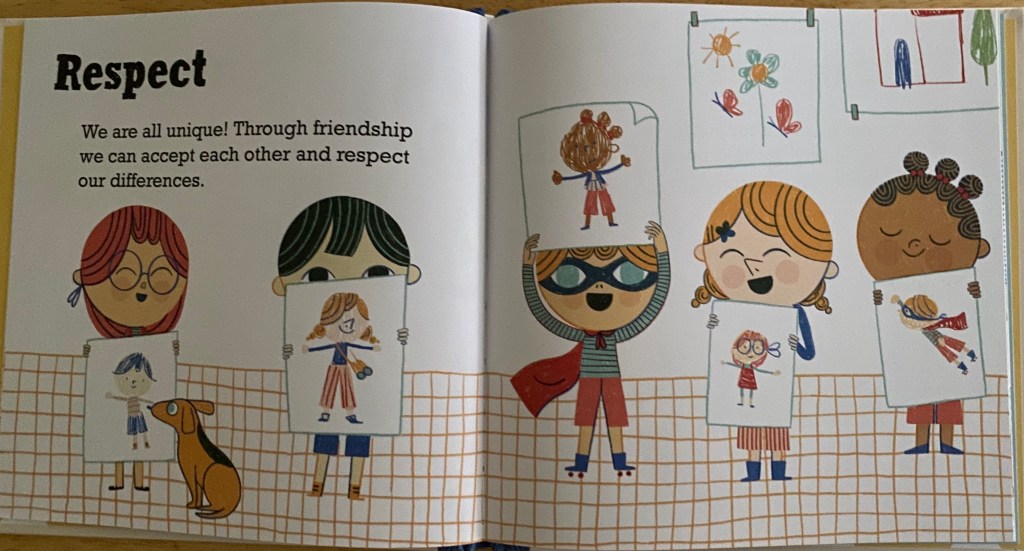
For instance part and parcel of Friendship is Respect and that entails accepting and showing respect towards differences.

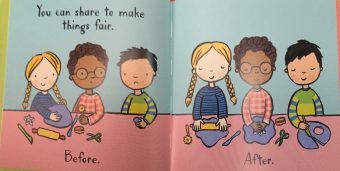
Share offers examples of what you might share with friends – memories, ideas, treats and especially, time.
The penultimate spread is an affirmation of Friendship itself and then comes a spread aimed at adult sharers giving ten ideas of how to get the most from the book and a final glossary.

Calmness has spreads on quiet, feeling safe, breathing,

what to do about worries, focus, time – ‘Something as simple as walking gives you time to watch and listen while you move.’ I think that’s something we’ve all appreciated during the past year.

Other ideas suggested to induce that sometimes elusive sense of calm are to Pause, Imagine, ways to ‘get past your angry feelings’, Balance and to take a Softly, softly approach.
Calmness also ends within ideas and a glossary.

Both these engaging little books are well worth adding to an early years collection, as well as for sharing with little ones at home. Cristina Trapanese uses a different theme to illustrate each one. Friendship shows children engaged in a variety of art and craft activities while Calmness has an appropriate outdoor setting reflecting the important role the natural world plays in inducing calm. Both contain a wealth of language learning potential.

Avoiding Anxiety in Autistic Children

Avoiding Anxiety in Autistic Children
Dr Luke Beardon
Sheldon Press

Dr Luke Beardon is a passionate autism advocate, particularly, as is evident in this book, the well-being of autistic children. To that end he writes through the autism lens, something that is rarely done, so that readers feel as though they’re wearing the shoes of a child with autism, while directing his wise words to each and every one of us PNTs (Predominant neurotypes) – his term for what other writers might refer to as neurotypicals. I say this for although the book is aimed primarily at parents who have an autistic child, we all, especially those of us in education, need the best possible understanding of autism we can develop, if we aren’t unwittingly to contribute to a child’s distress. Teachers in particular, one hopes, understand that unless a child’s mental well-being is central to their educational experience, no learner, let alone an autistic child will thrive: all else depends upon it.

Who better to put the case for anxiety avoidance that the author, who has a deep and acute sense of understanding of autism acquired through many years of observation, and research (qualitative, I surmise) at Sheffield University’s Autism Centre. Using a ‘difference not deficit’ model, what Dr Luke has written is a distillation of that wisdom and those insights of his. For instance, he strongly makes the case that no two autistic children are exactly the same – why would one expect them so to be – consequently too much generalisation is to be avoided. To this end, he includes in his narrative, many first-person comments and excerpts from case studies.

Central to his approach is child empowerment – the better informed the child, the lower is the risk of anxiety- and he builds upon his foundational ‘autism + environment = outcome’ equation. I was particularly interested to see the comment in the ‘School’ chapter that ‘some children would actually be better suited to doctoral-style learning that secondary-age educational systems’ … ‘if a child is given access to uninterrupted learning … for extended periods of time – then he might be far more able to learn effectively.’ (As a teacher whose preferred age group is the foundation stage wherein even now for the most part, this is what happens, I’ve always wondered why as any child progresses through the education system s/he is subjected to an increasingly -often unnecessarily in my opinion – fragmented curriculum driven by testing and scores.)

Another issue explored is the child’s fear of getting it wrong and the way this can all too easily lead to the individual becoming so inhibited s/he won’t take those vital risks inherent in learning, or indeed try anything new.

Reading this highly accessible, optimistic book, not through the lens of a parent, but a teacher I have tended so far to focus on the school issues, however, every chapter is full of wise words be they related to behaviour, sensory issues (both hypo and hyper sensitivities are discussed), communication, social challenges and well-being, or meltdowns and shutdowns. In the latter chapter, it’s worth stressing these words from one individual relating to meltdowns, “I don’t know when it will happen. I don’t have any warning, and I can’t do anything about it. I live in constant fear because, despite not knowing when it might happen, I know all too well what happens when it does, and there’s nothing I can do about it.’ Just imagine being a child living in constant fear of such an event, which might happen if blame is the reaction of the adult parent/teacher or carer. Reassuringly though Dr Beardon states ‘Your child is not to be blamed for a meltdown: it cannot be helped.’

He also provides some personal stories about reducing anxiety in the same chapter wherein individuals mention meditation, deep breathing, a red card/green card system at school, certain physical activities including trampolining and strimming movements like flapping, rocking and twirling, and being out in nature as being personally helpful in avoidance of anxiety; but the importance of ‘being allowed to be me’ must never be overlooked for as one girl says, “it’s like I’m looked down on just for being myself … I don’t see what’s so bad about me. I like me, why can’t anyone else?” Heart breaking words indeed, but balanced by those of another boy, “Until you’ve been accepted for who you are, you won’t know what an absolute joy it can be!”

The author too ends on an upbeat note, ‘my perspective is that one can absolutely be autistic and in a state of genuine happiness.’ … ‘Never underestimate anxiety, Never underestimate the impact the pure joy of being able to live without it. Never underestimate the impact you can have on your child.’ Now if that doesn’t fly the flag for each and every one of us to increase our understanding of autism, then I don’t know what will.
So yes, this book’s for parents, but it’s also for every member of society, whoever, wherever they are.

All Cats are on the Autism Spectrum

All Cats are on the Autism Spectrum
Kathy Hoopmann
Jessica Kingsley Publishers

This book is an updated version of the author’s 2006 All Cats Have Asperger Syndrome and since then what is considered acceptable terminology has changed and the author says in her note for this edition that people’s views are not all the same and that she hopes ‘readers will see past the finer details of disagreement and join me in celebrating, and deepening our understanding of, the richness and diversity of the autistic community.’ You can’t say fairer than that.

Essentially the book shows a sequence of photographs of cats/kittens in various situations accompanied by a sentence relating the visual to an element of being on the autism spectrum or as I prefer to say, neurodiversity. Thus the book opens with a shot of a kitty wrapped in a scarf and wearing a woolly hat introduced by ‘The first signs of autism are usually picked up very young.’ Now I could from my own experience challenge that for several reasons, but will say no more other than it’s generally truer for boys than girls, and remember the author’s words on her introductory page.
What I think Kathy Hoopmann is intending to present to readers how a child with autism might view the world: thus we have ‘Autistic people often have exceptionally good hearing, and loud sounds and sudden movements may scare them.’ 

and ‘Daily rituals comfort them, and they get worried if their schedules or surroundings are changed.’ 

as well as ‘When they are spoken to, they may refuse to make eye contact. When they talk, they go on and on about the same topic or ask the same questions over and over again …’

It’s great to read the acknowledgement that ‘with their unique perspective on life, their eye for details that others often miss and their passion for researching something they love, many will reach the top of their chosen fields … those on the spectrum are just like everyone else. They need love, encouragement and a purpose for life … and then everyone can sit back and enjoy the unique individuals they become.’

Poignant at times, funny at others, this book is a useful resource for teachers, parents, siblings, therapists; indeed everyone could benefit from reading it.

The Jackie Morris Book of Classic Nursery Rhymes

The Jackie Morris Book of Classic Nursery Rhymes
illustrated by Jackie Morris
Otter-Barry Books

This is a wonderful new edition of Jackie Morris’ selection of forty nursery rhymes. In her introduction Jackie talks of their crucial importance and vitality in our modern digital world.

Of those included here, some will likely be familiar: there’s Ride a Cock-Horse, Hickory, Dickory Dock, Twinkle, Twinkle, Little Star and Baa, Baa, Black Sheep and Sing a Song of Sixpence, for example;

whereas others – The Hart and the Hare, To the Bat and All the Pretty Little Horses, for example might be new discoveries.

The entire book has a dream-like, timeless quality to it thanks to the exquisite watercolour paintings that grace every spread. It’s virtually impossible to choose a favourite but on this day of writing and sweltering heat, I was drawn to the absolute tranquillity of Baby’s Bed’s a Silver Moon.

There’s humour, the beauty of the natural world, surprises and more; in fact pretty much everything you could wish for in a book that’s an absolute treasure, not just for the very youngest, but for anyone who loves art and language.

Sadly many young children nowadays don’t have that bedrock of nursery rhymes that we nursery and reception class teachers tended to take for granted when little ones began school decades back; but giving a new parent a copy of this stunningly beautiful book might just start a child off on a journey of becoming a lover of words, stories and reading.

Outdoor Science Lab for Kids

Outdoor Science Lab for Kids
Liz Lee Heinecke
Quarry Books (Quarto Knows)

Just right for the summer break especially, but for any time you can get outside, is this resource book of 52 ‘family-friendly’ experiments you can do with children in the garden or yard, the playground and the park.

The dozen units (each with 3-5 ‘labs’) are wide ranging and include exciting-sounding activities such as making ‘driveway frescoes’ on cornstarch (cornflour in the UK) and water using food colourings and tiny paint brushes or toothpicks to create the designs; that’s in the Picnic Table Chemistry unit. There’s a list of materials needed, ideas for extending the activity and an explanation of the science involved, as there is for each of the other ‘labs’.

I’m sure children will relish the prospect of engaging in some ‘Garden Hose Science’, trying such fun things as the ‘siphon roller coaster’ that starts with a water balloon fight.

Author and mother Liz Lee Heinecke covers ecology, earth science, botany, physics and zoology in her inspiring book. One hopes that doing some of the activities will show children that real hands-on science is fun and well worth spending their time on, just like those in the photographs included for each of the projects. (As she hails from the US, some of the names the author used will be unfamiliar to UK readers, for instance in the ‘Invertebrate Inspection’ unit,‘ pill bugs’ and ‘sow bugs’ are what we commonly call ‘woodlice’, though I think only the former can curl themselves up into a ball).

Art Workshop for Children / Play Make Create

Ideal for the long summer break as well as for Foundation Stage / KS1 staff during term time are these two terrific titles from Quarry Books that encourage and develop creativity in children:

Art Workshop for Children
Barbara Rucci and Betsy McKenna

Process, not product is what matters most in this bumper book of creative art projects for young children written by an author who runs art workshops for youngsters.

Nobody who has taught or worked in other capacities with foundation stage learners and those even younger could possibly disagree with the closing paragraph in Barbara Rucci’s introduction: “Let’s raise creative thinkers who explore their world, express their dreams, embrace differences, and never lose touch with their inner artist.’

Her premise is that art should be open-ended and child-led, ‘open-ended creativity … empowers our children to mess about, take risks and discover that they have good, original ideas.’
The first chapter is about setting up an art space after which come a series of workshops that are set out following a similar basic structure: Gather your materials – a bullet point list of what’s needed; a paragraph on how to Prepare your space;
then comes The process – again with bullet points; Observations; and finally Variations for next time – additional ideas for repeating the experience with some different materials or adding a degree of complexity for those with more experience.

Each of the 25 workshops has photographs of materials and children using them; and interspersed between workshops there are essays by Reggio Emilia-inspired educator, Betsy McKenna that will help those working with young children to reflect on what they are doing and saying if they want them to develop as confident, creative, problem-solving learners.

The materials required don’t need a great outlay – most projects can be done with paints, crayons, paper and card, plus the basic tools you’d find in a nursery setting and nothing is difficult to get hold of – maybe just a little effort as in the collaborative Branch Painting

that I particularly liked on account of its social nature.

What a boon for parents/carers of young children this will prove during long holidays especially.

The same is true of

Play – Make – Create
Meri Cherry

Subtitled ‘A Process-Art Handbook’ this one is based on a similar philosophical approach and has 40 ‘invitations’ to be creative and have fun in so doing.

The opening chapter sets the scene for good practice discussing the way to talk with children and how to store and present materials and then come the sequence of creative ‘Art Invitations’.

Whether it’s taking up an Invitation to Explore, such as experimenting with cotton swab oil painting; making and discovering the joys of ‘oobleck’ (cornstarch and water)

– it’s brilliant fun and one of the ten ‘Sensory-Based’ activities; or introducing the delights of the hammer as a creative tool used in the process of making a ‘Crazy Contraption’

included in the ‘On-going process-art activities Big Projects’ chapter, each project will surely spark the imagination. There are also collaborative activities that can be done with friends or family members.

Throughout the emphasis is on encouraging children to experiment and discover the potential of the materials, to make their own choices, employ critical thinking and problem solving to what they’re doing, thus helping to build self-confidence in their own creative potential; and of course, to enjoy what they’re doing.

Strongly recommended for parents, carers, teachers (the author has 20+ years of teaching experience) and anyone else who wants to provide enriching process art for children. (There’s a fair bit of science learning potential in there too though it’s never spelt out.) What are you waiting for? …

It’s OK to Cry / The Happy Book

It’s OK to Cry
Molly Potter, illustrated by Sarah Jennings
Featherstone (Bloomsbury Education)

Molly Potter’s latest book that offers both parents and teachers a starting point for developing emotional intelligence/ emotional literacy with youngsters is written particularly with boys in mind.

How many times in my teaching career have I heard a parent say to his/her young boy words such as “Stop all the fuss, boys don’t cry like that.”? Way too many; and if children are subjected to such comments from a very young age they soon internalise what they’ve been told and become afraid to show their feelings. Instead, from the outset we all need to encourage children to feel safe to talk about and show how they feel.

The author starts by presenting some commonplace scenarios to explore why it is that boys have a tendency to keep their emotions under wraps.

She then goes on to look at where some of the messages about ‘acting tough’ might come from, and to explore the importance of being able to articulate how you really feel.

This is followed by a look at a variety of different feelings, some positive, others negative. In each case the text is straightforward and easy to grasp, and offers starting points for opening up discussion, and is accompanied by Sarah Jennings bright, friendly illustrations.

There’s also a ‘park full of feelings’ that is a great discussion jumping off point, as well as some suggestions to help cope with ‘uncomfortable feelings’.

The final pages are directly aimed at parents and carers again with the emphasis on boys.  Included is the stark reminder that ‘poor male emotional literacy is reflected in the fact that in the UK suicide is the single biggest cause of death for men under the age of 45.’

With a down to earth approach such as the one Molly Potter offers herein, let’s hope all children will develop coping strategies to deal with feelings and emotions.

The Happy Book
Alex Allan and Anne Wilson
Welbeck Publishing

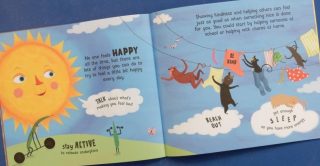
Developed in collaboration with child, psychotherapist Sarah Davis, this accessible book explores with a young audience in mind, five emotions – happiness, sadness, anger, fear and worry.

The author’s tone is warm as she encourages readers to consider carefully so they can identify their feelings and possible causes, as well as the reactions they might cause.

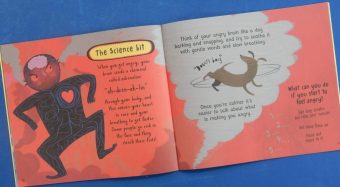
Occasional questions add to the interactive nature of the text and for each emotion, there is a paragraph (or several) explaining the science of what happens in both the brain and the body: ‘When you are happy, your brain releases a chemical called dopamine that helps you to learn, remember and helps you sleep well.’

There are also ‘top tips’ as well as a host of other suggestions to encourage positive feelings.

Anne Wilson varies her colour palette according to each emotion so for example red reflects an angry mood

and blue-black, sadness in her amusing illustrations. I particularly like the green vegetable characters and I’m sure they will appeal to youngsters.

This book provides an ideal starting point for parents and educators wanting to develop emotional intelligence in young children.

The Ice-Cream Sundae Guide to Autism

The Ice-Cream Sundae Guide to Autism
Debby Elley & Tori Houghton, illustrated by J.C. Perry
Jessica Kingsley Publishers

Everyone is an individual be they neuro-typical or neuro-diverse, so there are as many ways of experiencing autism as there are people on the autism spectrum. However there are three things that all those with autism have in common, albeit in different degrees – difficulties with speech and language, difficulties with social skills and rigidity of thought.

Here’s a handy little book to help youngsters, understand the complexities of the condition.

Its authors (both with a wealth of experience relating to neurodiversity) use the ice-cream sundae simile and its ingredients to explain autism in a non-threatening, non-judgemental way to young people, both those with autism and neuro-typicals.

They first did so as editors of AuKids magazine when they published an article called The Autism Sundae Dessert with an aim to show autism, not as a disability but a difference – a dynamically evolving condition.

Such was the response that their article evolved into posters, demonstrations and now, this book, The Ice-Cream Sundae Guide to Autism with its three different flavoured scoops (chocolate ice-cream for speech and language, vanilla for social skills, and strawberry for rigidity of thought; plus extras – chocolate sauce (sensory processing disorder) and a wafer (self-regulation).

Parents, teachers, and others working with youngsters can use the book with its clear, unambiguous illustrations and puzzles

to solve, either with an individual, or a class or group, depending on their personal circumstances. It might act as a starting point for a practical ice-cream sundae making session, or as something to refer to over and over, to help build understanding of the advantages and challenges of autism.

Urban Forest School

Urban Forest School
Naomi Walmsley and Dan Westall
GMC Publications

Wow! What an absolute treasure trove of ideas this is for anyone who wants to include forest school and all that this has to offer into an urban school or nursery setting. That, one hopes (unless it’s already embedded into their curriculum) includes all early years and primary teachers and other staff.

Equally during this time when many parents are faced with home schooling their children, this book by a husband and wife team totally dedicated to outdoor learning, offers a wealth of activities across the whole curriculum and most could be used with a very wide age range.

After an introduction explaining what urban forest school actually is and where to look for urban nature, why it’s important to do so, and giving instructions on how to tie some useful knots, the main body of the book is divided into four sections.

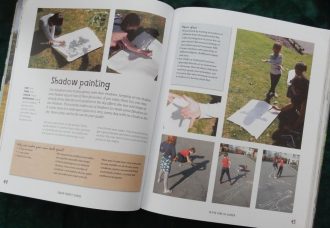
We start with In the park or garden (a quiet street or a porch would suffice) where one of my favourite activities is shadow painting. Strangely enough as I was walking with my partner the other day past a patch of stinging nettles I remarked that their shadows looked much more striking than the actual plants. Then two days later I found this idea in the book. I’ve had children draw around their own or a friend’s shadow many times but never thought of using plants – love it!

Moving further afield Around the city or town has a nature focus and includes such things as cloud spotting and I really like the idea of the city sit spot – an opportunity for mindfulness of whatever your surroundings might be. From that sit spot or walking around, children can begin to get to know about the trees and the flora and fauna close by.

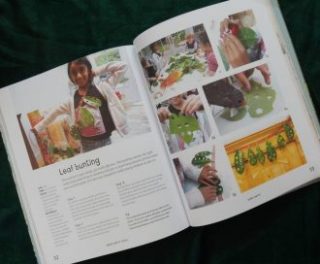
The third section – Home crafts – offers a wealth of creative activities: the leaf watercolour printing can be fun in its own right but also the starting point for other arty projects. I can’t wait to try the leaf bunting activity with children – I have to admit to having a go myself with some leaves and hole punches.

Recipes comprise the final section and there you’ll finding such diverse ideas as stinging nettle smoothie – this one might be an acquired taste, and spiced blackberry sorbet – more up my street I think, but the blackberry plants are still at the flowering stage just now.

Packed with enticing illustrations and photos, and covering so many areas of the curriculum, this bumper book includes something for all ages from the very young upwards, and is a fantastic encouragement to get children outdoors learning about and through nature.

The Spectrum Girl’s Survival Guide

The Spectrum Girl’s Survival Guide
Siena Castellon, illustrated by Rebecca Burgess
Jessica Kingsley Publishers

Sienna Castellon, the seventeen-year-old author is an award winning anti-bullying campaigner and autism advocate; she is on the autism spectrum, and is also dyspraxic and dyslexic, and has ADHD. She is also gifted in physics and maths.

As we learn, her journey thus far has been anything but easy, so who better to write this book subtitled ‘How to grow up Awesome and Autistic’ than she, especially, as she writes in the first chapter, ‘I view my autism as a strength and as an advantage, a modern day superpower.”

Essentially Siena has compiled a comprehensive and detailed manual for readers of twelve plus about living the best life a young female with autism possibly can in a predominantly neurotypical world.

She covers such diverse topics as embracing who you are then deciding with whom to share your autism and how, to clothes and fashion ,

dating, sex and sexuality.

Other sections focus on bullying: face to face

and cyberbullying are covered in separate chapters and strategies for coping with both are discussed.

Self-esteem is key throughout: people with autism do not need pitying, they need understanding is another key message. The neurotypical brain is wired to socialise; in contrast most autistic brains need a fair amount of time alone for the mind to settle and the senses to be soothed.

On the topic of senses, Siena devotes a whole chapter to ‘Managing your sensory sensitivities and sensory overload.’  Siena mentions the relatively simple steps that some supermarkets, cinemas, airports and the like have taken to create a more inclusive environment for people with autism.

Throughout the authorial voice remains both earnest and compassionate; and in between her narrative are some comic style pages drawn by Rebecca Burgess that encapsulate what has been said in a particular section.

Yes, this book has a specific target audience in mind; however the insights it offers need to be shared with everyone. I’m a primary/foundation stage teacher and over the years have taught dozens of children with autism (mainly boys) and have some degree of understanding of neurodiversity. Nonetheless I welcomed the insights I gained from this guide and thoroughly recommend that all educators, parents, indeed anyone who hopes to ensure that all females on the autism spectrum have the very best possible chance to flourish, should read it and carefully consider this enormously wise young woman’s words. Surely that is every one of us, isn’t it?

It’s a Great Big Colourful World

It’s a Great Big Colourful World
Tom Schamp
Prestel

Otto the cat wakes one morning wondering why everything is so grey. His chameleon friend, Leon is on hand to show him the delights of the various shades of grey and the multitude of beautiful grey things around.

Thereafter Leon takes him on a journey through the wonderful world of colour starting with grey’s components, the complementary black and white.

Moving on from those it’s a veritable riot of colours each represented by a plethora of characters and objects large and small. Yellow includes a yellow submarine, a big yellow taxi, a variety of cheeses, a butterfly and banana peel.

One orange spread is dominated by a magnificent tiger that’s found its way to Orange County and as yet, hasn’t consumed the tomato soup, clementines or orange juice on the previous spread.

There’s a wealth of transport on the red pages that also include Red Square and tulips – no not from Amsterdam but Turkey.
Flamingos strut their way across the pink spreads maintaining their colour courtesy of the pink algae and shrimps they dine upon.

Rather more restful on the eye the blues have a whale that swims through all four pages at once and the greens with dinosaurs, crocodiles, plants aplenty and the occasional caterpillar,

not forgetting Greenland.

Beer, cupcakes, tanned sunbathers, brownstone houses, a toffee even, are part of the brown spreads; and both the colour tourists Otto and Leon are hiding in plain sight on every spread, each  cleverly adapted to their surroundings. In the final pages the friends are thrilled by the coming together of all the colours for a glorious final journey through the four seasons.

However many times you look at this ingenious, intricately detailed offering from Tom Schamp, you’ll always find something new.

In addition to being a feast for the eyes, with his playful linguistic imagination and references, Schamp guarantees that this book will have a wide age appeal. No matter what you bring to it, you’ll emerge richer and wanting to dive straight back in, hungry for more.


Flights of Fancy

Flights of Fancy
Quentin Blake, Anne Fine, Michael Morpurgo, Jacqueline Wilson, Michael Rosen, Julia Donaldson, Anthony Browne, Malorie Blackman, Chris Riddell, Lauren Child
Walker Books

Now in paperback, here’s a truly special gem of an anthology subtitled ‘Let your imagination soar with top tips from ten Children’s Laureates’. It brings together the ten awesome authors and illustrators who have held the title (given in celebration of their outstanding achievements) and first awarded to Quentin Blake in 1999.

To open, Michael Morpurgo explains how the original idea of the role (each person holds it for two years), was first thought up by himself and Ted Hughes, the then Poet Laureate.

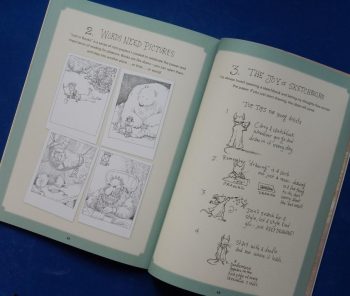
You might be especially interested in poetry, rhyme and wordplay, if so head first to the sections from Michael Rosen and Julia Donaldson. Michael in Poetry Belongs to Everyone talks about playing around with a word to create a poem. Julia Donaldson’s Plays to Read and to Write discusses one of her own plays that she based on the Aesop’s fable, The Hare and the Tortoise, offering a fun, lively 6-parter

If you’d rather be playful in the visual sense then Anthony Browne’s The Shape Game could be your starting point: having talked about how to play it, he showcases some examples from 3 other famous illustrators to whom he gave the same shape to play as the one of his own shown in the book. The potential with this one is endless. Probably that is the case with most of the chapters however.

In The Only Way to Travel, Quentin Blake writes with reference to  Dahl’s stories, about how when illustrating someone else’s texts it’s important to ‘put yourself inside their story’ and capture the atmosphere before diving in and drawing those fabulous illustrations of his.

More about how other fabulous illustrators approach their drawing and what provides their inspiration comes from Chris Riddell –

make sure you check out his brilliant cartoons of all ten Children’s Laureates in the final section – and Lauren Child.

How fantastic and moving is Michael Morpurgo’s Find Your Own Voice that tells children how to do so in ‘I Believe in Unicorns’.
I thoroughly enjoyed too, Malorie Blackman’s Taking a Word for a Walk using SEA as her example,

before she moves on to discussing from whose viewpoint a story is being told when one writes.

If you want to inspire children to let their imaginations soar, then you really, really must have a copy of this cracker of a book in your home or classroom; not only will it do just that, but it will also ignite or add fuel to a passion for reading, writing and illustrating. (BookTrust, which manages the Children’s Laureate gets 50p from every sale.)

Time to Eat, Time to Tidy Up, Time to Share, Time to make Friends

Time to Eat, Time to Tidy Up, Time to Share, Time to make Friends
Penny Tassoni and Mel Four
Bloomsbury Education

Written by education consultant Penny Tassoni whose roots are in early years teaching, is the Time to series of which these are the first titles.

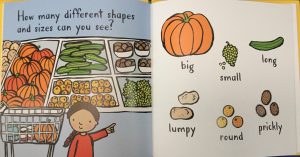
Aimed at pre-schoolers, the language is simple and engaging, encouraging little ones to interact by for example in Time to Eat, focussing on the different shapes and sizes of the fruit and vegetables shown …

This book also looks at colours of foods and their textures; and talks about why we need food. It also introduces the idea of likes and dislikes.
There’s a wordless spread of different foods that should encourage plenty of food-related talk and a final spread of notes for parents and carers. These include guidance on what to observe, how to assess what is seen and ideas for supporting a child’s next steps. (all good early years practice)

Time to Tidy Up explains why tidying up is important, looks at storage places and to encourage little ones to get involved, suggests ways of making it fun by singing, dancing, or taking on a particular role – even superheroes tidy up!

We all need to share and it’s never too soon to learn how is beautifully demonstrated by the small children using the dough in this spread of Time to Share

Sharing is caring, a means to make friends, and makes things more fun. That might be in the playground, at the swimming pool, or at nursery where you might need to share sand, toys and other resources. There too you’ll need to take turns – a form of sharing but some negotiation might be needed.
As important as sharing is, there are certain things that are not for sharing: this too is covered.

Of course, sharing is very much part and parcel of making friends the theme of Time to Make Friends which looks at the ups and downs of friendship and introduces the concept of kindness as well as togetherness.

Mel Four’s bold, bright illustrations of the young children are appealing and work really well with the text making for a handy and helpful resource for early years practitioners, parents and carers.

The Sleepy Pebble and other stories

The Sleepy Pebble and other stories
Doctor Alice Gregory, Christy Kirkpatrick and Eleanor Hardiman
Flying Eye Books

Alice Gregory, sleep researcher and writer Christy Kirkpatrick have collaborated on this book of stories to share at bedtime.

Adults, parents in particular, know how hard it can be to get little ones off to sleep and this collection of calming tales, together with the activities suggested, is specially designed to help children wind down and relax, allowing them to drift off into the land of nod.

There are five stories, each one soothing and an ideal length for bedtime. They feature in turn the sleepy pebble; a willow tree that wants to stay up late;

a giraffe that enjoys a long bath to relax her at night, a kind and careful snail and finally, a pig that loves to cook.

The same muscle relaxation routine is used during each one except that the child is asked to imagine holding and squeezing in the first, Pebble, in the second some soil, in the third big heavy clouds, in the fourth the listener becomes the snail curling into its shell and soft warm dough is the final item to squeeze.

The guided visualisation intended to engage all the senses uses imagery appropriate to each story and the mindfulness – the focus on body awareness – is repeated for concluding every story session.

Eleanor Hardiman’s exquisitely detailed illustrations executed in calming colours (different hues for each story) add to the book’s dreamy quality.
Also included are an explanatory introduction, tips for ‘relaxing bedtime and better sleep’ plus ten questions and answers.

Wearing my yoga teacher’s hat I fully endorse the techniques included in this beautifully produced storybook. It should prove invaluable to parents who struggle with getting their children to nod off and to sleep through so they wake next morning restored and full of energy.

Can I Tell You About Nystagmus?

Can I Tell You About Nystagmus?
Nadine Neckles, illustrated by Vikas Upadhyay
Jessica Kingsley Publishers

I’ve only ever taught one child who had Nystagamus (due to his albinism). Now having read this excellent little book – the latest in the ‘Can I Tell You About series’, I feel ashamed about how little I really understood of the condition.

Herein a girl named Amber talks in a user-friendly manner about nystagamus -her ‘dancing eyes’, what this means for her in particular and about how she and other children with the condition will experience it differently, although they may share certain similarities such as taking longer to learn things. (This doesn’t mean they are any less clever than others however.)

We hear about Amber’s diagnosis (her eyes jiggle from side-to-side);

how she has to have regular eye check-ups; how she has to carefully adjust the way she sits to watch TV, preferably sitting right close to the screen; the need for her to wear glasses to prevent her ‘seeing double’ as she also has a mild squint.

Starting school presented a challenge for Amber especially the frenetic-seeming playtimes. Amber’s school has made accommodations for her condition such as adding yellow tape to the stair edges, doorframes and potential places of danger; and her mum explained nystagmus to Amber’s classmates.

When in the classroom she has a special place to sit, is never asked to share a book or computer screen and has work printed on coloured paper.

Reading itself brings its own set of challenges but again there are aids to make things less tricky for her. Depth perception is a particular challenge, so ball games, (and other things requiring rapid hand-eye co-ordination), gymnastics and running are ‘tricky’.

Of course frustrations occur but Amber’s friends are understanding and Amber herself is bold, intelligent and resilient, refusing to let nystagamus define her.

The book concludes with some information for adults, an outline of associated conditions, an important checklist for professionals, a glossary and a list of recommended resources.

Easy to understand, this book, (written by a special needs life coach and mother of a child like Amber, with nystagmus and Chromosome 18q) encompasses all the important aspects of nystagmus making it an ideal introduction for anyone wanting to learn more about the condition be they children, parents, carers, teachers, and other professionals. Line drawings by Vikas Upadhyay show Amber as the sparky individual the author presented.

Teaching Social Skills to Children with Autism Using Minecraft®


Teaching Social Skills to Children with Autism Using Minecraft®
Raelene Dundon, illustrated by Chloe-Amber Scott
Jessica Kingsley Publishers

I know from my teaching experience that children on the autism spectrum often become obsessively passionate about and often developing an enormous competence in a particular thing such as  Lego building, drumming, a certain cartoon series or drawing specific items.

The strength of the motivation towards their chosen passion tends to result in a lack of social skills: participating in Minecraft® (which is frequently called digital Lego) offers a wonderful setting to enable neurodiverse children to develop both social and communication skills. Clearly the author of this large format book, Raelene Dundon appreciates this and to that end, has created a superb resource.

Having outlined in the opening chapters the importance of social skills and how these are impaired in children with ASD, she puts the case for using group programmes, in particular Minecraft® to develop those crucial social skills.

The second part of the book comprises information on how to set up a social Minecraft® group; how to use the game for supporting such skills as holding a conversation, being interested in other people and understanding the viewpoint of another person.
Each skill, for instance problem solving,

‘being creative’ or co-operation

is succinctly presented and related to what has just happened during the specific session – this is a great tool for developing awareness in the learner.

In all there are thirty sessions (around 150 pages of photocopiable material) with smashing illustrations by Chloe-Amber Scott, making this an absolutely invaluable and comprehensive resource – a veritable goldmine – for any professional working with primary children or older students, who have ASD.

All About Feelings

All About Feelings
Felicity Brooks, Frankie Allen and Mar Ferrero
Usborne

Emotional literacy is now part and parcel of the school curriculum right from the early years, yet seldom does a week go by when we don’t read or hear of the increased concern about children’s mental health and well-being, something we in education have been highlighting for many years. So, it’s good to see a book aimed at young children to help them become aware of, and thus better able to cope with their feelings and emotions.

It’s very visual and full of bright illustrations by Mar Ferrero that make it immediately alluring to its audience be that an individual, a nursery group or early years class.

Each colourful spread is given over to a different aspect and the language used is spot on for young children.

Sections include identifying how you feel (with reference to colours of the rainbow);

why do you feel a particular way; how would you feel if? (with helpful word clouds)…

how feelings can change during a day; ‘jumbled up feelings’ and discussing your feelings.

There are suggestions for things to do that help you remain in control;

ideas to alleviate worries; ways to express feelings and emotions; ‘being kind to yourself’ and ways in which an individual can help others of all ages feel good.

The final page is for adults – notes on how best to help youngsters; things to try at home (could equally apply at school or nursery) and some on-line resources.

Young children most definitely can learn to become more mindful of how they feel and thus be better in control of their feelings. The authors of this book have done an excellent job of facilitating this and I’d strongly recommend a copy for family bookshelves and all settings where young children are learning.

One thing that struck me about both it and The Unworry Book was that little is said about the benefits of being outdoors. I highlight this after returning from a walk around Ruskin Mill in Nailsworth, near to where I live. This is in part, an establishment for neurodiverse young adults that does amazing work educating its students, with a focus on the outdoors. And, I know from experience that being outside is of enormous benefit to people of all ages from the very youngest children.

Migrations Open Hearts Open Borders

Migrations Open Hearts Open Borders
Introduction by Shaun Tan
Otter-Barry Books

llustrators from all over the world responded to the request by The International Centre for the Picture Book in Society (based at the University of Worcester) to create an original postcard for the 2017 Migrations exhibition to be displayed at Bibiana, Bratislava. The exhibition’s creators felt that the installation should reach a wider audience and this wonderful book is the outcome, although the fifty or so images representing 32 countries reproduced in their actual size herein, are only a selection of the hundreds of postcards they received.

Each of the postcards in its unique way focuses on the positive impact of the migration of peoples the world over, showing how the flow of ideas and cultures transcends borders, barriers and even bans.

The book is divided into four themes: Departures, Long Journeys, Arrivals and Hope for the Future.

I would love to show every single one of the awesome, enormously moving postcards but can only make a very small selection for this review, so have included representatives for each of the themes, which spoke to me on my very first reading.

Departures: In the end we only regret the chances we didn’t take./ It begins with a single step …                 Rhian Wyn Harrison – UK.

Long Journeys: The skies have no borders.      Christopher Corr – UK

Arrivals: New friends coming from afar / bring us different tales!                        Marcelo Pimentel – Brazil

Hope for the Future: Share the world in peace and freedom. / The Earth and its people have no owners.           Isol – Argentina

On another day I may well have picked completely different ones, such is the power of each contribution, some of which use quotes from writers including John Clare, WB Yeats, Anita Desai and Robert Macfarlane.

If ever there was a time in our increasingly fractured world when we need this treasure of a book, it’s now. Let’s hope that those of us with open hearts who want open borders continue working to make a difference for, as Shaun Tan writes at the start of this book ‘All migration is an act of imagination, a flight of imagination. A hope that frequently exercises a previously unknown human potential. … What can be done? … That’s for us, the living, the thinking and feeling: descendants through millennia of successful migration – whose ancestors dreamed of something better … It’s left for us to imagine what to do, to pass on the dividends of hope that have been invested in us.’

Re-reading his message in its entirety in a week when our UK politicians continue wrangling about how – the universe forbid it happens – we should leave the European Union, brought tears to my eyes. Everyone needs a copy of Migrations; it reaches out to us all, offering another beacon on the uphill climb towards the creation of a better world for everyone, young, old and in-between.
(All royalties are donated to Amnesty International and IBBY)

Yoga for Children and Young People with Autism

Yoga for Children and Young People with Autism
Michael Chissick, illustrated by Sarah Peacock
Jessica Kingsley Publishers

Highly experienced yoga teacher, Michael Chissick has created another absolutely smashing book, for those who teach yoga to youngsters, specifically those with autism, although much of what is included here would work well with neurotypical children too.

At the outset Michael states his case explaining that perfection is not on the agenda, so an adult-style class approach is inappropriate as is chanting.

A plan is vital; intuitive teaching won’t work with children on the autism spectrum: I know from experience they need a structure and that is what the book provides, whether the teaching is done in a mainstream school that includes children with autism or a special school where everyone being taught is on the autism spectrum. If the latter is the case, Chissick suggests three groups(his are named after trees) which can be fluid but are based on the degree of challenge both students and the teacher of the class face.

He then goes on to offer four different lesson plans – one being suitable for all students (universal) and three others – and each of the latter is progressive.

Much of the remainder of the book contains the differentiated tried and tested games, thirteen in all, some of which require additional resources that are flagged up at the outset. There are also sequences such as the Sun Salutation and some sequence games, followed by the postures themselves including ‘good sitting’

(illustrated by Sarah Peacock whose work will be familiar to those who know Michael’s other books such as Ladybird’s Remarkable Relaxation and Sitting on a Chicken .)

And of course, there are ideas for the vital ‘calming stage’ and final relaxation.

There’s a chapter on teaching yoga to children who have ASD in a mainstream classroom, followed by some case studies and extremely useful visual resources.

A wealth of experience has gone into this book: it’s a veritable treasure trove for anyone who teaches yoga to children, whatever the setting, but especially children with ASD.

Your Mind is Like the Sky / The Go Yogi! Card Set


Your Mind is Like the Sky
Bronwen Ballard and Laura Carling
Frances Lincoln Children’s Books

Psychologist and mindfulness teacher, Bronwen Ballard has written a book to introduce children to mindfulness. She uses similes and metaphorical language to show that our difficult thoughts and feelings are an integral part of everyone’s life and demonstrating that we all have the power to deal with them.
Sometimes she says, the mind can be like a clear blue sky but at other times it might be ‘fizzy, stormy, black and crackly’; or perhaps a ‘bit grey’.
Thoughts come and go constantly; they’re likened to the clouds – sometimes positive, pleasant white ones but at other times they become dark and negative.

For example ‘raincloud’ thoughts may well make one feel sad, cross, irritated, confused perhaps.

However there are ways to deal with them, even those that seem at first to be overwhelming and this is what the second part of the narrative discusses. The important thing to do is to acknowledge the thought but realise it’s only one of many, many in the entire sky of your mind and that way you can let that dark thought slip gently away.

The more one practices being mindful, the easier it becomes to take control and choose which thoughts to attend to.

The main narrative ends on an upbeat note reminding the young reader that, like the sky, his/her mind is bursting with amazing thoughts each one different in shape, colour and size.

There are two final spreads aimed at adults explaining concisely what mindfulness is and offering some basic ideas to try together at home.

Award-wining illustrator Laura Carlin’s soft focus, smudgy, mixed media illustrations are the ideal complement to Bronwen’s gentle narrative. Together they offer parents and carers a really helpful book to help youngsters overcome their worries.

The Go Yogi! Card Set
Emma Hughes and John Smisson
Singing Dragon

Using little humans rather than animals this time, the author, very experienced yoga teacher, Emma Hughes and illustrator, John Smisson, of the Go Yogi! book have created a set of 50 cards of popular yoga poses; and Emma has written an accompanying explanatory booklet.

The latter briefly gives the benefits of yoga for children, sets some ground rules to use and talks about how to work with a group, the names of the poses, some words on pranayama and suggests ways the cards might be used in a session – in games or for storytelling being two ideas.

It’s concise and especially useful for those who aren’t practiced in teaching yoga to children. One proviso though, I was taught that young children (under 7) should not attempt headstands as the skull may not be fully hardened.

The ‘flash cards’ themselves have a child showing a yoga asana (pose), (or in the case of paired poses, two children) set against a brightly coloured background on one side, while the reverse side shows how to get into the pose. Each card has a coloured border that suggests a possible emotional or physical benefit doing the pose might bring. Orange signifies energising; green is for calming; red for strengthening and yellow for balancing.

All in all, and I speak from experience as a specialist early years teacher and teacher of yoga to children (and adults), this little box is a real treasure for those wanting to introduce yoga to young children. I thoroughly recommend it.

Forest School and Autism

Forest School and Autism
Michael James
Jessica Kingsley Publishers

Let me say from the outset, wearing my early years teacher’s hat, I’m a firm believer in the benefits of Forest School for all children be they neuro-typical or with an autistic spectrum condition, so I was excited to receive this book, the first of its kind on Forest School and Autism.

The author, Michael James has a wealth of experience of Forest School and now runs his own Forest School in Somerset; his enthusiasm shines through in everything he says.

Having provided background chapters on both Forest School, its principles and practice, and autism (wherein he asserts crucially, ‘In order to offer autism-inclusive practice, you must view each autistic person as an individual.’), Michael goes on to discuss with the help of case studies, the positive impact of Forest School on health; its sensory benefits and the opportunities it can offer for the learning of new skills. Fun however, so the author asserts, is a primary objective.

Sensitivity and positive relationships lie at the heart of the whole of Forest School practice and the importance of empathy is paramount.

So too is observation, which is the biggest responsibility of all practitioners; how otherwise can effective communication between learners and practitioners (who need to be clear, sensitive and frequently literal) take place (each can learn from the other) and true developmental learning take place?

Crucial to the success of an inclusive practice is preparation – preparation at the outset of a course of sessions – coupled with on-going reflection and further preparation. A chapter is allocated to this and a summary of its key points, such as the importance of individual learning programmes, is given at the end. Indeed a useful summary of key points concludes the other chapters too.

This most definitely is a book to be recommended for all Forest School practitioners rather than only those who work with learners who have ASC. After all, our connection with nature enhances our humanity and focussing on a child’s strengths, abilities, sensory preferences and likes is beneficial to every learner.

Mindful Little Yogis

Mindful Little Yogis
Nicola Harvey, illustrated by John Smisson
Singing Dragon

The author of Mindful Little Yogis is an education writer and children’s mindfulness practitioner and the book is based on her experiences as a teacher working with children in both primary and secondary schools with a range of learning abilities and needs. Several years ago around 20% of children were identified as having special educational needs and the number is rising, making additional demands on classroom teachers in both mainstream and special schools. Nicola stresses the importance of these children receiving consistent positive messages from all adults be they parents, carers, teachers, teaching assistants, therapists.

She advocates using mindfulness techniques to help build self-assurance and describes the STAR model: ‘STOP. Take a breath. And. Relax.’ that provides a framework, a four part developmental tool.

Then follows a section on mindful breathing, giving guidance on a range of sensory breathing techniques that I know from experience work very well with young children and those with additional needs.
The same is true of Animal Breathing (children I know especially love lion’s breath, bee breath and snake breath); Shape Breathing techniques and the use of sound, and body flow are explored next.

Part two ‘AND …’ comprises a range of self-regulation activities, grounding and sensory yoga games. There are also sections on emotional intelligence, using music as therapy and much more. I especially like the emphasis Nicola puts on positivity throughout.

With illustrations by John Smisson, this is a smashing book for all children of all abilities in all places for all times. With our increasingly pressurised education system all schools would do well to include some of these techniques and activities in their daily schedule.

Thera-Build with LEGO® / Art Therapy Cards for Children

Thera-Build with LEGO®
Alyson Thomsen
Jessica Kingsley Publishers

Alyson Thomsen was a senior teacher and since creating and developing the Thera-Build methodology, runs a business consultancy for schools, families and others interested in using LEGO® bricks with children therapeutically.

Purposeful play with these bricks aims to develop social competence, reduce stress, boost self-esteem and confidence.

As a teacher I have used LEGO® bricks across the curriculum, but never as a therapeutic tool. However I was pleased to discover that I share with Alyson some basic underlying educational principles, most notably vital the importance of play in children’s development be that social, emotional or academic; and the crucial role of adult as facilitator – flexible and enthusiastic – in the learning process.

Drawing on her wealth of experience, Alyson provides in this book a veritable treasure trove of ideas for using LEGO®, a resource loved by so many children, in a therapeutic way, as well as giving readers an introduction to the brain science behind her methods, a wealth of advice that includes both the strategies for, and practicalities of, using the materials. and much more.

Not only will this inspiring book be a great resource for those working in schools and for parents, even more importantly, it has the potential to result in extremely positive outcomes for children.

Art Therapy Cards for Children
Elitsa Velikova
Jessica Kingsley Publishers

This resource comprises a box containing 22 stimulus cards (105x 150cm) and an accompanying explanatory book, and could be used for anyone (art therapists, social workers, psychologists, teachers and counsellors) who works with children and perhaps parents. The author, Elitsa Velikova, is an art therapist and psychologist with extensive experience, and is also Director of the Arts and Therapy Institute in Sofia (Bulgaria)

The cards offer creative art therapy opportunities for primary school age children and encompass four themes: feelings and emotions, relationships with family and friends, the body and imagination.
There are opportunities for exploring in both two and three dimensions and all the materials required are listed in the booklet.

Each card provides a different prompt, for instance, ‘Draw a person in the rain using pastels or pencils’ (feelings); ‘Create a nest and a bird with clay’ (relationships); or ‘draw or create a happiness machine (imagination). All are illustrated in bright collage style.
The booklet explains each prompt and its aim(s), the materials needed and how a child might benefit from experiencing the activity.

A useful resource but it could I think, have been even more so, especially for teachers and other non-specialists in art therapy, to have at least the materials needed listed on the reverse of each card.

All About Ben / The Giant from Nowhere

All About Ben
Dorothy Markham & Aileen O’Donnell
Jessica Kingsley Publishers

Here’s a little book for children from around five to the age of Ben, the narrator who is eight, particularly those who have attachment issues, but equally for children who have a Ben character in their lives either as a friend, member of their peer group or relation. It aims to help children like Ben understand their feelings and emotions and how these cause them to behave in certain ways; and to develop the confidence to open up to an adult who can help them manage all their different parts.

Ben introduces himself, part by part: his action parts and nine feeling parts.

He goes on to talk about and give examples of, how different situations cause him to feel different parts – when playing with friends he feels his happy part whereas falling out with a friend brings his hurt part into play;

when he helps others he feels his caring part; and it’s the combination of all these different parts that makes him who he is.

Readers are then asked about their own feeling parts to add to Ben’s lists and we learn how feeling parts affect action parts (cause and effect) – which is important for children’s self understanding.

The final pages are devoted to the crucial roles of talking and listening (including the role of a trusted adult) in the development of a secure, integrated, happy and confident person able to understand and manage his/her emotions.

Reassuring and helpful, this is a useful book to have in primary school classrooms.

The Giant from Nowhere
Frances Dickens and Peter Hughes
Jessica Kingsley Publishers

When the Giant from Nowhere sets out to find a place with some company, little does he know that his sheer size is going to cause him problems. So it is in the little village of Somewhere. Its residents are terrified when he appears in their midst, and tell him in no uncertain terms to go away. His angry response causes damage to their homes and the Giant departs.

The villagers then decide to hunt him down and put him on trial. After a newspaper report and a police search, the Giant is found and eventually a little boy succeeds in getting him to answer some questions.

A trial follows and the defendant pleads guilty. The boy speaks up for him and the judge decides on a community sentence.

To reveal what happens thereafter would spoil the ending but suffice it to say all ends happily for everybody.

This is an insiders and outsiders story that should encourage plenty of discussion on such themes as empathy, mutual understanding and inclusivity.

A class of primary children could have fun acting it out in addition to participating in some of the activities included at the back of the book.

Can I Tell You About … Auditory Processing Disorder / Forgiveness?

Can I Tell You About … Auditory Processing Disorder?
Alyson Mountjoy, illustrated by Kelly Davies
Can I Tell You About … Forgiveness?
Liz Gulliford, illustrated by Rosy Salaman
Jessica Kingsley Publishers

These are two recent additions to the excellent Can I Tell You About series aimed at primary school audiences, their families, teachers and others who work with them.

Each illustrated book has a child narrator, and in the Auditory Processing Disorder (APD) book it’s Amy who herself has the disorder. After an explanatory introduction for adults, she talks about how the condition affects her; how she got her diagnosis and how she is supported both in school and at home.

We also learn that APD isn’t the same for all those affected: one of her friends, Tom has the condition too but has different challenges to cope with. Amy’s dad also has APD but received his diagnosis after his daughter.

One of the most important things for teachers to know is the emotional strain that children like Amy are under and in addition to this being a helpful book for young readers, it’s one teachers should read too.

Amy herself ends on an upbeat note: having described both her own and Tom’s particular strengths she says, “Work hard, believe in yourself, and you can make your dreams come true too.” How adults can help a child make this so are listed in the final pages.

Forgiveness, as author Liz Gulliford states in her introduction, is a complex, frequently misunderstood concept. It’s one that she has researched for many years. Liz feels it’s important for children not to be made to apologise automatically after a dispute between classmates for instance, something that can happen in schools or between siblings at home

Here she uses Joseph as her narrator and together with his family offers a story designed to stimulate discussion on forgiveness at home and school.
Joseph talks about different scenarios – his best friend telling others something Joseph confided in him, thus breaking his trust in Billy.

He then goes on to talk of an instance when he took his sister’s ball without asking and lost it, which required not only Joelle’s forgiveness, but also self-forgiveness on his own part.

There’s also the important consideration of another of Joseph’s school friends, George who is being bullied. Perhaps forgiveness in this instance is not appropriate in case the perpetrator then goes on to bully another child. Could a degree of compassionate concern, at least from Joseph be better?

These are some of the ideas explored in this book that will certainly be a valuable resource in starting explorations of forgiveness in PSHE lessons at KS2. To this end the final pages are devoted to notes and key learning points.

I Am Human: A Book of Empathy / Let’s Talk About When Someone Dies

I Am Human: A Book of Empathy
Susan Verde and Peter H.Reynolds
Abrams Books

The team who gave us I am Yoga and I am Peace now explore what it means to be human.

Humans have a playful side and find joy in relationships, we hear; but on the negative side sadness brings a heavy heart. This though, is countered by a reminder that part of being human is the ability to make choices.
Positive actions – such as compassion and helping others, being fair and treating all people equally, bring a feeling of connectedness with fellow humans.

In keeping with the child narrator’s mood, Reynolds changes his colour palette from bright to a dull bluish grey as the actions switch from positive to negative.

Yes, we’re all flawed human beings who make mistakes but Susan Verde and Peter Reynold’s little book of empathy is perfect for starting a discussion with young children about making good choices. To this end, there’s also a loving-kindness meditation to share.

Let’s Talk About When Someone Dies
Molly Potter and Sarah Jennings
Featherstone (Bloomsbury)

Most young children will bring up the subject of death either at home or in school, or both, and many adults are unsure of how to engage in a discussion about it. This book, written in child-friendly language by a teacher, will for those adults especially, prove extremely helpful.

Each double spread – there are a thirteen in all – takes a different aspect and almost all start with a question such as ‘Are there different words for death?’; ‘What might you feel when someone dies?’ …

‘What do people believe happens after death?’ and, the only one that isn’t prefaced by a question, “To remember a person who has died, you could …’.
There’s a brief ‘It’s important to know’ paragraph at the end of most sections and Sarah Jennings has provided bright, appealing illustrations (often including speech bubbles).

The tone of the entire book – both verbal and visual – is spot on for the primary audience and is suitable for those of all faiths or none.

Storytelling and Story-Reading in Early Years

Storytelling and Story-Reading in Early Years
Mary Medlicott
Jessica Kingsley Publishers

That Mary Medicott, herself a professional storyteller and trainer, is passionate about the power of story is evident in this her latest book.
Like myself she believes that story time is for young children THE most important learning experience we offer them and should be part and parcel of their everyday experience. For one little girl I saw last Sunday it certainly was. I sat listening to a dad sharing a picture book (Percy the Park Keeper -The Treasure Hunt) with his young daughter outside a cafe. The experience was magical, not only for the two of them but also for the early years teacher part of me as I watched her slip from his lap saying “I’m going to ask that big rabbit if he knows where my bead is.” She walked over to talk to a huge decorated hare statue at the doorway, whispered something and went back to her dad who then continued with the story.

Drawing on her thirty plus years of experience she offers advice and support for anyone who wants to help youngsters from 2 to 5 further their imaginative development, enhance their language growth, listening skills, emergent literacy and reading achievement, and encourage them to create mental pictures, all of which are furthered by the sharing of stories either from a book or through a telling.

Having stated her case for the importance of story, she discusses the vast variety of stories available including personal stories, both children’s and adults’, picture book stories, nursery rhymes and chants, and traditional tales from a wide range of cultures.

For those who are less confident about themselves as storytellers, Mary talks in detail about various aspects of preparation for a story session, all of which help to make the whole experience enjoyable for both audience and story sharer whether they choose to tell the story or read a picture book. The importance of treating children as collaborators or even co-creators in the story process is discussed: ‘Children like being asked to think,’ says the author – yes they most certainly do.

There is a chapter on ‘props’ and their use; these can help enhance audience involvement both during the story and after in discussion.

Teamwork and involving all staff to their mutual benefit is another aspect covered, as is what staff members other than the storyteller are doing during the story sharing session; all adults should be involved and sitting among the children.

Children’s responses is the subject of another chapter be that through discussion, artistic interpretation and/ or their own scribed words.

Some of my favourite writers on young children and story, including Eileen Colwell, Betty Rosen, Vivian Gussin Paley and Tricia Lee, are referenced and key elements of their practice discussed, the latter two in the final ‘Consolidating’ chapter.

There are also two appendices, the first providing versions of stories, rhymes and action chants referred to in the main narrative; these can be used directly or in the case of the stories, adapted by the particular teller. The second offers a selection of tried and tested picture books and traditional tales – a good starting point for those new to the whole business of story sharing.

I’d strongly recommend this book (love Rosamund Bird’s cover images) for all early years educators and those who train them; in fact anyone who wants to draw all young children into those magical worlds of ‘Once upon a time’, worlds that offer as yet unimagined experiences that have the power to enthral, transport and inspire.

Stewart’s Tree

Stewart’s Tree
Cathy Campbell
Jessica Kingsley Publishers

Subtitled ‘A book for Brothers and Sisters When a Baby Dies Shortly after Birth’, this little picture book is intended to help explain sibling loss to young children.

Ellen has been waiting for a new baby – ‘something special’ but her new brother Stewart is very weak and never makes it back home. He’s been ‘lost’ is how her Granny puts it.

Ellen searches all over the house for Stewart even in the washing machine,

wondering perhaps, if he’s gone to the moon in his spaceship.

Her parents then help her to understand the new baby has died and isn’t going to come back.

Together they plant a cherry tree for Stewart, so they will always have a special place to remember him.

The book concludes with a guide to bereavement aimed at adults, written by qualified clinicians; this includes some suggested activities.

Sensitively told and illustrated, with gentle touches of humour, this is a book that one hopes few people will have need of, but it could prove invaluable to those families unfortunate enough to suffer such a bereavement. Schools, nurseries and children’s centres should certainly keep a copy on their shelves.

Sitting on a Chicken

img_1311

Sitting on a Chicken
Michael Chissick, illustrated by Sarah Peacock
Singing Dragon
What a wonderful title! What a wonderful book, but one would expect no less from yoga teacher and writer Michael Chissick. Its subtitle ‘the best ever 52 yoga games to teach in schools’ pretty much sums up the whole thing and right from the introduction (don’t skip that) you know you’re in the hands of a highly experienced expert. Many of the games included will be familiar to those who work with children and probably to children themselves but Chissick has cleverly transformed them by adding a yogic element.
The book is divided into three sections: the first, an introduction, explains how to structure a lesson and showcases Chissick’s visual timetable which he considers key to the whole thing.

img_1325

Most teachers, though perhaps not yoga teachers will be familiar with visual timetables, particularly if they’ve worked with children on the autism spectrum.
Next comes the core of the book, essentially the games – the ‘What’ – matching your learning objectives with a game; the ‘When’ – putting games into the relevant stage of a lesson. (From Key Stage 1 and beyond a lesson has seven stages, for nursery and reception children, a lesson is divided into four parts, for at least the first couple of terms); and ‘How‘ – the actual teaching of the games. This in particular is a veritable treasure trove of ideas.
It’s broken down into sections: beginning games, sequences – essentially adaptations of the sun salutation or surya namaskar sequence, development games and finally calming games leading into relaxation; the one used here is the ladybird relaxation.
There’s a short sub-section for working with nursery and reception groups.
This is a must have for the primary teachers’ bookshelf and for anyone who works to bring children and yoga together.

Striker, Slow Down!

How often do we ask children to ‘calm down’ or ‘slow down’? Fairly frequently I suggest. Now here’s a little book to help subtitled “A calming book for children who are always on the go‘:

dscn9421

Striker, Slow Down!
Emma Hughes and John Smisson
Singing Dragon
Striker the kitten, like many young children, leads a frenetic life, dashing from one activity to the next, never stopping or slowing down, despite frequent pleas from his mum and dad.

%0a

Seemingly the only times he stays put are mealtimes and when he’s fast asleep. Now if you’re the parent of a whirlwind-type youngster, this will surely resonate.
One day though, the inevitable happens: Striker’s rushing results in a bumped head. Only then is he ready to sit down quietly with his mum, and start to relax.

%0a

Those of us who work with young children know it’s not as simple as that. I do know however, that regular short sessions, be they of yoga, breathing, listening to a meditative story or whatever, do lead to calmer youngsters who can spend short spells being relaxed and peaceful in mind and body.
This little book is written in rhyme (creaking slightly once or twice) and Emma Hughes, the author, is herself a yoga teacher so obviously knows things don’t happen overnight as the book might suggest. However, if it does nothing more than set adults and young children off on the calming path, then it will have served its purpose.
For a start, take time to sit quietly together, share the book and enjoy the bright, bold, appropriately uncluttered illustrations.