The Immortal Jellyfish

The Immortal Jellyfish
Sang Miao
Flying Eye Books

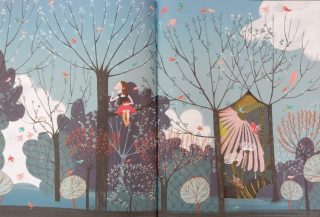
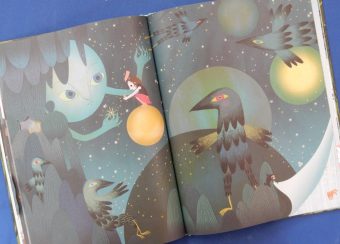
‘A boy and his grandpa sat drawing one afternoon.’ So begins Sang Miao’s first book as both author and illustrator in which at the start we see the two together as they share a conversation about a special kind of jellyfish and immortality.

Not long after, the boy learns that his beloved grandfather has died and that night he feels lost.

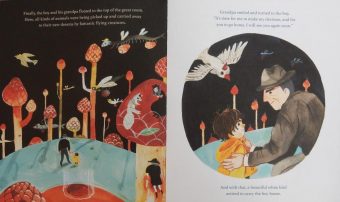
In a dream his grandfather returns and takes him along on his very last journey, beneath the ocean to a yellow door.

Beyond the door is his destination, The Life Transfer City.

This dream world is a place where those who have died choose a spirit creature to become that will live on in memory. There, after meeting some of the other choosers, boy and old man must part company.

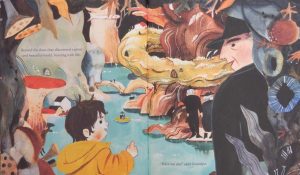
Miao’s dream world is alive with spirit animals and strange-looking fungi illustrated in an arresting colour palette giving a surreal feel to the whole place, a place wherein the end of life offers a new beginning as something or someone altogether different.

Whether or not reincarnation fits into your worldview, with its themes of death and rebirth, this is a powerful, uplifting story, told with the utmost sensitivity that should be of great help to grieving children and their families.

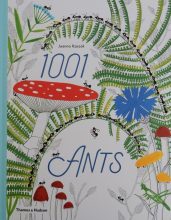
1001 Ants

1001 Ants
Joanna Rzezak
Thames & Hudson

If you stop by an anthill and have time to watch the activity, you’ll discover that ants are fascinating creatures. The trouble is though that we cannot see what is going on inside.

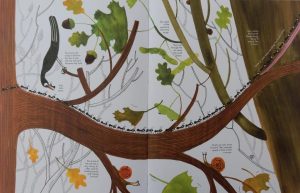
Author/artist Joanna Rzezak shows us on her opening spread of this large format book. Thereon is a cross-section of an anthill where we see chambers connected by lots of branching tunnels, some of the former containing ants, while others hold such things as aphids, leaves and seeds needed as food by the ants.

The factual narrative is brief and light-hearted for we’re told ‘there is a little ant with red socks hiding in every picture in this book’ and asked to try and locate same.

A smell tells the ants it’s time to start walking, where we know not, and we then follow the long line of tiny creatures as they march single file through bracken, over fungi and among fallen leaves. All the while the playful red-socked ant comments and sometimes gets sidetracked.

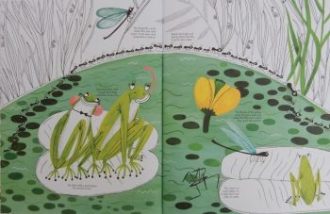
Surprisingly for this reader, the ants traverse the edge of a pond using lily pads as stepping-stones, fortunately taking a route behind the large green frogs with protruding tongues just waiting for some tasty insects.

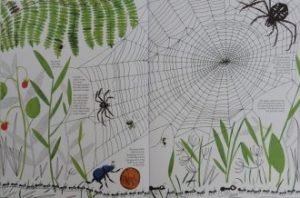
Their journey takes them through a field containing a variety of plants in various stages of flowering and fruiting, full of other insects including the caterpillar of a swallowtail butterfly; then beneath a large spider’s web

and even over the body of a huge sleeping bear.

Eventually they reach a tree and up its trunk they climb, carefully avoiding an owl resting therein, along a branch they continue; but this is nature so what is that drumming sound and what is that long pinkish worm-like protrusion.

Oh no!

The food chain must be kept working and so a large bird is left to utter the punch line. Not quite the last word though – that is left for the red-socked ant …

Factual snippets about the flora and fauna encountered on the journey will definitely keep readers interested in the natural history side, while curiosity will drive them forward as they follow the ants’ journey to its end.


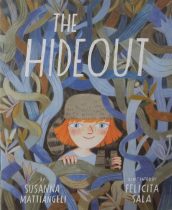
The Hideout

The Hideout
Susanna Mattiangeli and Felicita Sala
Abrams Books for Young Readers

This truly is a book of surprises.
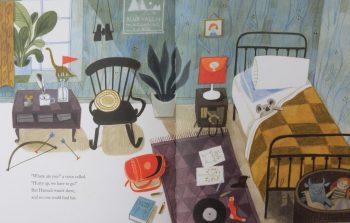
It begins with a call, “Where are you? Hurry up, we have to go!” But Hannah is nowhere to be found and all we see is her bedroom …

We then see Hannah in a park and it seems she’s not leaving any time soon (she’s heard the voice, we learn).

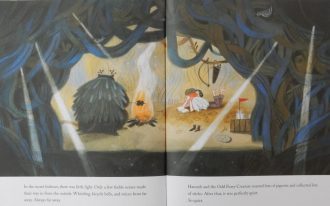
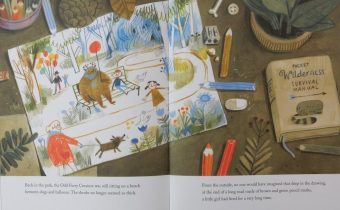
In fact she’s made herself a feather cape, a bed of leaves, a bow and arrow and we see her accompanied by an ‘Odd Furry Creature’ for which she has fashioned another feather cape – a much larger one to accommodate its huge bulk – and a bed of leaves beside her own. Together they forage for food, which they share, but nobody else enters their secret hideout.

After some while Hannah hears a voice. “Where are you?” it asks and she decides it’s time to venture out and show the Odd Furry Creature things he’s never before seen out in the world beyond.

Pretending to hear an affirmative response, she takes off its cloak, placing it beside her own, extinguishes the fire and the two leave their secret hideaway and paw in hand, walk around the park.

“Hurry up!” comes the distant call, “We have to go!”

Then a page turn reveals the unexpected: Hannah sitting busy creating a scene: all the while she has been drawing the story …

From the outset (there’s the soft toy in her bedroom basket on the first spread), there have been allusions to Sendak’s Where the Wild Things Are – a visit to a dreamlike wild place, safe yet without parental interference, from which she’s called back from her imaginary journey – the journey that she has all the while been drawing on her paper; even Sala’s colour palette is similar to Sendak’s.

Mattiangeli’s telling is enigmatic and powerful; I love her concluding lines: “From the outside, no-one would have imagined that deep within the drawing, at the end of a long road made of brown and green pencil marks, a little girl had lived for a very long time. “

How perfectly she shows the way in which children’s art can, if they’re left alone, take them completely out of themselves into flow mode where they do indeed become as one with their creations.

Sala’s largely muted illustrations are the perfect complement for the author’s words, richly detailed and having the power to pull the reader right in to every scene, so that they too feel almost a part of the story – a story in which imagination and creation are inseparable.

Life on Mars

Life On Mars
Jon Agee
Scallywag Press

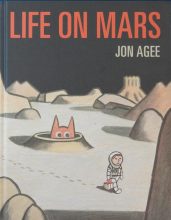
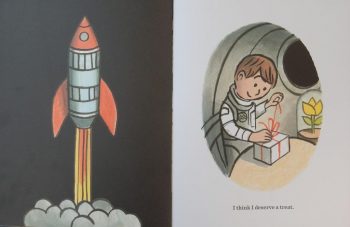
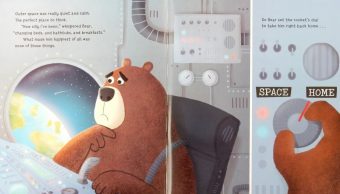
A lone astronaut – a little one – arrives on Mars determined to find life. ‘Everybody thinks I’m crazy. Nobody believes there is life on Mars. But I do.’ is what he tells readers.
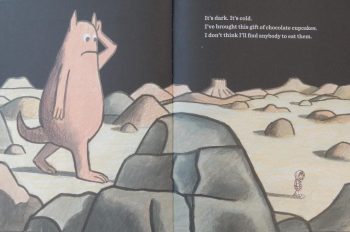
What he sees though as he wanders around the dark, cold Martian landscape clutching his box of chocolate cupcakes (an offering for any alien he might encounter), is a planet seemingly devoid of life.

The visitor starts to have doubts about finding any sort of life form, while unbeknown to him there’s a large creature following not far behind keeping a close watch on the explorer.

Having abandoned his box of goodies, the disillusioned little human decides to return to his spaceship. But where is it?
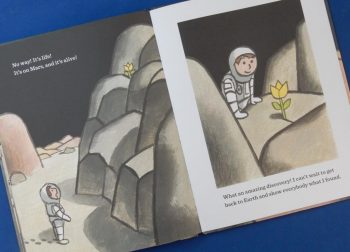
Lost he might be, but his search yields something exciting …

along with his box of cupcakes.
(I held my breath when I saw that the little astronaut had picked that yellow flower; I hope it isn’t the only one on the entire planet.)

Now, flower and box in hand, he is all the more determined to locate his spaceship, which he does by scaling the ‘err’ mountain.

Then, mission accomplished, when he’s inside and homeward bound, it’s the perfect time to tuck in to one of those yummy chocolately confections …

Witty, ironic, thought-provoking and with that surprise ending, Agee’s offering, with his stark Martian scenery, is eminently re-readable. Children love to be in the know about stories and as they listen to the young astronaut’s earnest narration, they’ll be hard put to resist yelling “he’s behind you”.

We Found a Seed

We Found A Seed
Rob Ramsden
Scallywag Press

In this follow up to I Saw a Bee, Rob Ramsden adds a female character.

While outside playing, the boy and girl find a seed. They put it in a box and use it in their play, dancing and singing to it;

but the seed doesn’t grow.

They ask the seed for advice, listen and wait for a response; and then they know. …

The seasons change – gusty autumn winds, icy wintry rain and then spring with its gentle warmth. The seed grows and grows and …

The friends are delighted but when autumn comes again the flower dies; that though isn’t the end for what lies scattered around is full of potential …

Next time the children will know what to do.

This simple look at a sunflower life cycle and the seasons is again pitch perfect for the very young. Rob’s rhythmic text is memorable while his illustrations show just how worthwhile and rewarding continuing contact with the natural world can be.

A small piece of brilliance.

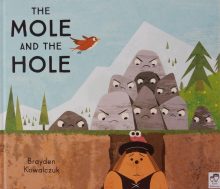
The Mole and the Hole

The Mole and the Hole
Brayden Kowalczuk
Frances Lincoln Children’s Books

It’s kind of dark and boring being Mole if you’re stuck inside your dark hole, never seeing a fellow creature or the light of day.

Try as he might, our Mole narrator finds that however much he digs, there’s always something blocking his exit to the great outside.

“No moles above ground!” comes the cry from the rocks doing the blocking.

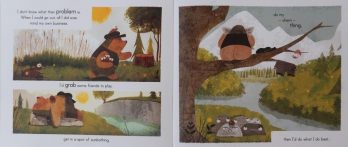
Mole muses on the problem: thus far his time spent above ground has always been devoted to playing with friends, basking in the sun and doing his business,

whereafter down he’d go again. A good neighbour most certainly – or is he?

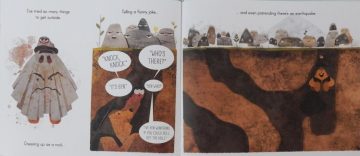
No matter what clever ideas he comes up with – disguise, joke telling or downright lying – nothing succeeds in shifting the determination of those rocks to keep him down under..

Is he now destined to be forever sub terra, he wonders.

Suddenly though there is light at the end of the tunnel and Mole finds himself face to face with …

He beats a hasty retreat but not long after our friend is heard extolling the virtues of his new living place.

What about his new neighbours though: are they equally enthusiastic about their new neighbour? Um …

Disney character artist and now debut picture book author-illustrator Kowlaczuk’s digitally created scenes of Mole’s totally inappropriate, un-neighbourly behaviour and what his neighbours think of it, are depicted with a deliciously dry humour that will delight young listeners. Listeners who will enjoy the fact that no matter what, no matter where, Mole is always accompanied by his best friend and silent participant Grub..
At the same time, the story wherein showing not telling is key, wryly demonstrates the importance of being a good neighbour for all concerned.

A thought-provoking addition to the FL First Editions list.

Leaping Lola

Leaping Lola
Tracey Hawkins and Anil Tortop
New Frontier Publishing

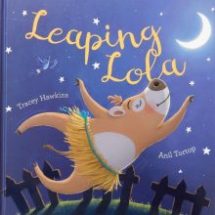
Young Lola the Jersey cow has a penchant for dancing and is energetically practising her steps for the ball to be held that evening in the barn. But then comes information from her mother that entirely deflates Lola: ‘It’s the Black and White Ball’ so a brown cow such as she won’t be welcome.

Having heard her tale of woe, Pearl the pig offers to disguise her friend.

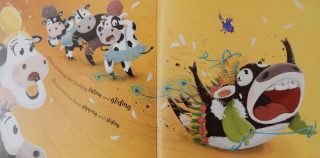
Suitably attired that evening, Lola is admitted to the ball and she’s immediately swept along by the beat of the music as she swoops and slides across the floor, then kicking up her heels she wows the crowd by ‘swirling and twirling her large derrière.’

Then disaster strikes as Lola mistimes her landing and slithers on her stomach through the Friesians

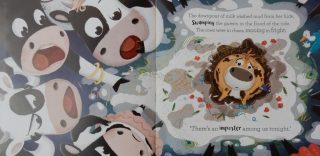
and straight into a tower of milk churns. Chaos ensues as she’s washed clean of her muddy disguise and cries of ‘imposter’ issue from the frightened onlookers. Is that the end for Lola?

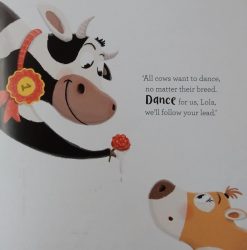
Happily not for then up steps the prize-winning bull who urges her to dance no matter what.

And so she does. Led by Lola in a joyful romping, stomping line, all the cows dance the night away.

With plenty of drama, Tracey Hawkins’ lively rhyming text complemented by Anil Tortop’s splendidly expressive illustrations make for a smashing read aloud to share with youngsters who will delight in the spirited mooover, Lola.

The book has much to say about the importance of inclusivity and might well be a starting point for a discussion on the topic of insiders and outsiders.

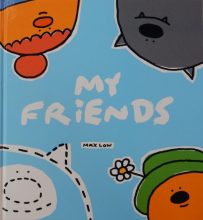
My Friends

My Friends
Max Low
Otter-Barry Books

We don’t actually meet the narrator of this book until the final endpapers but that’s getting ahead of things, so let’s be content and accept the invitation to meet ‘My Friends’.

An interesting and diverse lot they definitely are, starting with Mossy, the perfect friend for some quiet interchange or silent contemplation.
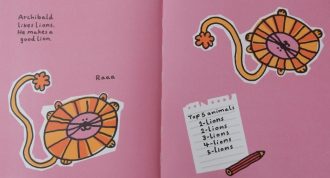
Then comes lion-loving Archibald …

followed by cloud watching Ezra who points out all manner of interesting shapes drifting across the sky.

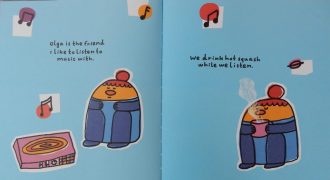
There’s Pepper who cooks tasty food; Olga, the music lover;

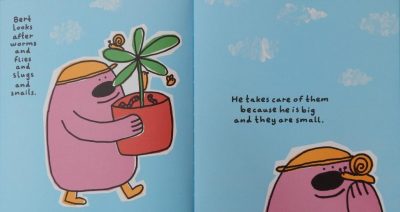
Herman the knitter (or should that be, tangler); the inventive Lina ; Bert who cares for minibeasts on account of their smallness and his bigness

as well as Plim and an imaginary friend, Klaus.
Each is unique, special and loved; but occasionally it’s good to be on your own.

And as for the narrator, I’m not revealing the identity of same – you’ll have to get hold of a copy of the book to find that out.

This quirky, playful look at friendship offers a great starting point for exploring the topic with young listeners who will readily relate to rising star, Max Low’s bold bright images.

Why not treat your friend to a copy to celebrate International Friendship Day on 30th July?

The Colour Monster Goes to School / Beautiful Bananas

The Colour Monster Goes to School
Anna Llenas
Templar Publishing

It’s the day Colour Monster starts school and he’s rather confused about what to expect as he anticipates what this new place might be like.

His friend Nuna is there to reassure him about what to put in his bag as well as to introduce him to his teacher and new classmates and to accompany him as he discovers the activities on offer that day.

First comes Nuna’s favourite, music, in which Colour Monster is let’s say, an enthusiastic participant though he seems even more enthusiastic about stories …

There are lessons to learn about turn taking, appropriate use of the toilet facilities

and how to eat lunch.
The afternoon comprises some gymnastics – with an additional piece of equipment; followed by a creative session with Colour Monster as the subject.

Come home time, it’s clear that the newbie has had a fun-filled day; but poor Nuna is completely worn out.

If you’ve not come across the Colour Monster in his previous escapades, then this is a great place to start especially if you have little ones starting school or nursery next term.

With her wonderful mixed media illustrations, Anna Llenas’ funny story of the risk-taking protagonist is a delight, reassuring with plenty to giggle over, as the big day draws close.

Beautiful Bananas
Elizabeth Laird and Liz Pichon
Oxford University Press

There are gentle echoes of Handa’s Surprise in this African setting tale of Beatrice, who sets out through the jungle with a bunch of beautiful bananas for her granddad.

That’s her intention, but along the way a giraffe flicks his tail accidentally displacing the bananas and sending them into a stream.

This sets off a concatenation of animal-related mishaps involving a swarm of bees, then some mischievous monkeys,

a lion, a parrot and finally an elephant each of which apologises and provides a replacement gift, with the story coming full circle with the elephant’s offering. It’s a delighted Beatrice who then heads to her Grandad’s home, assuring herself that after all, “Bananas are best.”

There’s plenty to spot in Liz Pichon’s vibrant scenes, not least the tiny jungle creatures

and the pairs of eyes peeping out from among the foliage as youngsters listen to Elizabeth Laird’s amusing story that is still a winner with me 15 years after its first publication.

Hello Horse / How Far Can a Kangaroo Jump?

Hello Horse
Vivian French and Catherine Rayner
Walker Books

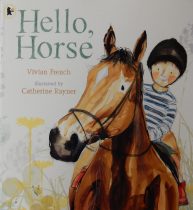
This is one of the Nature Storybooks series that provides a perfect amalgam of information in narrative form and superb illustration, in this instance with Vivian French as author and Catherine Rayner as illustrator.

Vivian’s text gives just the right amount of detail for a young child to absorb as she describes via her boy narrator what happens when he is introduced to her friend Catherine’s horse named Shannon.

The boy soon overcomes his initial apprehension about meeting the horse but under Catherine’s guidance his fears are soon allayed as he learns about how to approach, touch and feed a horse. He also learns about grooming and finally, how to ride Shannon.

Every one of Catherine’s watercolour illustrations is beautiful and she does bring to life beautifully the equine creature that we learn in an author’s note really does belong to the illustrator.

A gorgeous introduction to horses and riding.

How Far Can a Kangaroo Jump?
Alison Limentani
Boxer Books

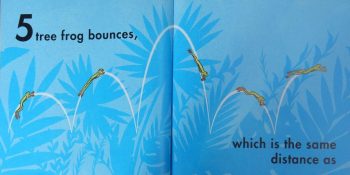
Ever wondered how far a kangaroo can jump; or perhaps four rabbits, or even eight coyotes? If so this book is definitely for you.

It’s beautifully illustrated by the author who showcases eleven different animals in total, each demonstrating its leaping, diving, hopping, bouncing,

skipping, bounding, vaulting, hurdling or springing skill.

Don’t be misled into thinking the titular marsupial is the longest jumper of all though; there’s a creature that well and truly outsprings it; now what might that be?

The book concludes by answering Alison’s own question: ‘How many kangaroo jumps would it take to get all the way around the earth?’ and posing another for young humans to answer.

Trainers on? Ready, steady, jump …

On landing, readers can compare their efforts with those of the other animals from the book, each of which is shown mid spring on the explanatory back endpapers.

Deep in the Ocean / The Big Sticker Book of Birds

Deep in the Ocean
Lucie Brunellière
Abrams Appleseed

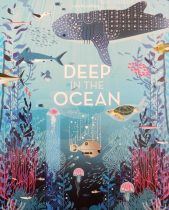
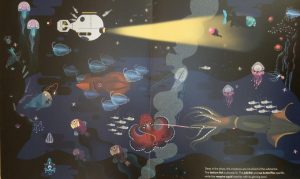
In this large format board book, readers follow Oceanos, a shiny silver submarine, as it takes an exploratory voyage into the depths of the oceans.
From the first opening, we’re immersed in the ocean’s waters along with the submarine’s scientific crew

but as their craft dives deep and travels through a deep abyss, a fierce storm blows up, whisking the little shiny submarine right off its intended course.

Instead, eddying whirlpools cause it to journey to the polar waters of the Arctic; then it’s pulled by a blue whale towards tropical waters of a coral reef, travelling on until one imagines, it resurfaces, with the crew having collected a wealth of information.

There is a free accompanying 10-minute, atmospheric sound track available to download, though to get the most out of the dual experience, you need to synchronise the track timings with page turns.

It’s easy to get lost in the colourful ecosystems with their standout bright flora and fauna depicted in Brunellière’s multi-layered, finely detailed spreads that do a splendid job of capturing the awe and immensity of our ocean ecosystems.

Dive in and be amazed at the riches therein.

The Big Sticker Book of Birds
Yuval Zommer
Thames & Hudson

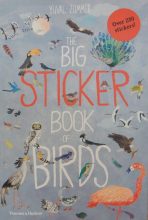
Following Yuval’s wonderful The Big Book of Birds comes an activity book on the same theme.

Readers are in the company of Polly the Pigeon. She guides us through as we’re told, ‘the feathery world of birds’ and all that’s needed for the journey is a pencil, some colouring pens and ‘a flighty imagination’. Some of the latter might be used in deciding how to adorn the pages with the 200+ stickers provided at the end of the book.

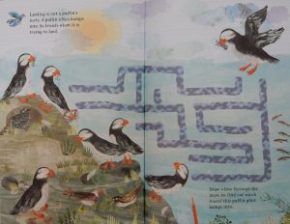
There’s a wealth of fascinating facts embedded within the spreads that are allocated either to specific kinds of birds such as albatrosses or puffins, or to avian topics including feathers, nesting, and migration.

Children might accept Yuval’s invitation to complete a maze,

design a feather for a new bird species, spot the difference, design a bird box, imagine and draw what a dozen magpies might have picked up in their beaks and more. Or what about playing a game of Blackbird bingo or adding foliage to a tree for wild birds to hide among?

I love the way all Yuval’s creatures be they birds or other, have a slightly mischievous look in their eyes, which adds to the allure of the already engaging pages.

Immersive and fun while unobtrusively educating the user(s).

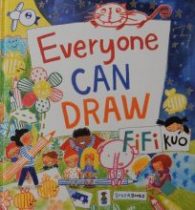
Everyone Can Draw

Everyone Can Draw
Fifi Kuo
Boxer Books

Having been a foundation stage teacher for many years, I know that within each and every young child is an artist; this is what is celebrated in Fifi Kup’s upbeat book wherein she calls upon that innate creative spark, a spark that we adults need to nurture and do our utmost to make sure is never extinguished.

As she states and shows in her wonderful scenes of artists at work however, people exhibit different preferences when it comes to drawing. Some like drawing characters whereas others would rather draw scenes.

Then there are those who favour black and white drawing in contrast to those whose preference is for bright colours.

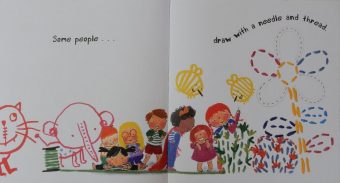
There are a variety of tools that can be used for drawing as the increasing number of enthusiastic artists demonstrate – scissors, parts of the body such as hands or feet; and some people favour needle and thread drawing.

If you don’t enjoy drawing alongside others, you can find your own special corner or even draw in your dreams.

The most important consideration of all though is saved until last

– or almost last.

Finally comes a question addressed to us all – ‘What will you draw?’

Fifi further explores different tools for drawing on the endpapers for which she uses childlike images akin to those a four or five  year old might create.

Crayons, pens, paints, scissors, pencils, inks ready. Everybody draw! First though immerse yourself in this joyful book.

The Spacesuit

The Spacesuit
Alison Donald and Ariel Landy
Maverick Publishing

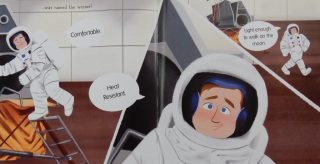
Over the last week many of us have been enthralled to watch the first moon landing in 1969 relived on our televisions screens for its 50th anniversary; but how many of us thought about what went into the designing and making of the protective spacesuits worn by the three Apollo astronauts, and in particular, Neil Armstrong and Buzz Aldrin when they walked on the moon.

These suits were the work of a team of women, led by Ellie Foraker, who were employed by the manufacturer of Playtex bras.

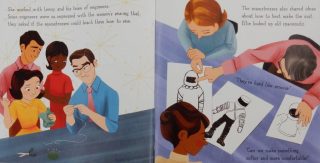
Even as a child, Ellie had loved designing and sewing on her machine and when an adult she got a job making garments with ILC Dover in the Plaxtex division. It was there that the quality of her work caught the attention of a company engineer. He asked Ellie if she was interested in entering a competition to design and make a prototype for a spacesuit that would be worn on the moon.

The competition was fierce with teams of engineers and military designers also participating but Ellie had a great team of hard workers determined to complete the task in time.

Their suit was to be flexible, have lots of soft, thin layers and protect the wearers from extremes of temperature.

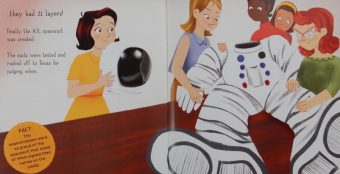
Working all day and into the night, the women stitched and glued the layers until eventually the AL7 spacesuit was done – all 21 layers of it.

The entries were tested by the judges and finally the winner was declared. It was Ellie and her team’s AL7.

Alison Donald’s straightforward, accessible narrative focuses on Ellie Foraker’s skills and her determination to win the NASA competition, making it one of a very few moon-related books I’ve seen this past few months that has chosen to put the spotlight on women and their role in helping to send men to the moon.

Ariel Landy’s digitally worked illustrations too capture the resolve of Ellie and her team throughout the task, showing the tension when things get tough as well as the times when the mood was upbeat.

Along with the facts included in the story itself, the inside covers have short snippets of space travel information and there’s a glossary and a space time line extending from1957 and the launch of the 1st Russian satellite, through to the 1969 moon walk.

All in all an inspiring picture book for young readers. I received my copy after returning from a few days away so was unable to beat the 20th July commemoration but nonetheless this is well worth seeking out whatever the date.

Molly and the Whale

Molly and the Whale
Malachy Doyle and Andrew Whitson
Graffeg

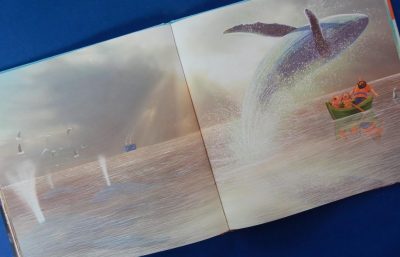
Following a stormy night, Molly and Dylan go down to the seashore in search of interesting items that might have been washed up. What they find however is not what they’d been anticipating.

“Daddy! Daddy! … There’s an enormous whale on the beach!” comes Molly’s cry.

Loading up the barrow with buckets and spades, the father and children head for the beach again where it’s now low tide.

There, with the help of their friends, Molly and Dylan keep the whale’s skin cool and her dad digs a trench around the huge creature.

Then they wait the long wait for the tide to come in, which they hope, will be sufficiently high to enable the whale to free itself and swim away. Molly sings to the massive creature in an effort to calm her own nerves although her heartfelt song cannot cool the increasingly unhappy whale.

Disappointment comes when the high tide proves insufficiently deep to enable the creature to swim off.

Molly is distraught: her father sends her home promising to wait on the beach for the full moon tide. Perhaps that will be higher … and happily, so it proves.

This is the second story to feature island-dwelling Molly, her family and friends. I quickly found myself drawn to the young girl, her empathy with the whale and her determination to save it.

I’m sure young listeners will be too as they hear Malachy’s tale and see Andrew Whitson’s quirky, richly coloured, patterned illustrations of teamwork set against beautiful sea and landscapes .

The Boy Who Knew Nothing

The Boy Who Knew Nothing
James Thorp and Angus Mackinnon
Templar Publishing
In the town of Solo Capoo lives a boy who supposedly knows nothing at all – his classmates tell him so, calling him a ‘fool’.

However when the lad comes upon an unusual-looking object in a dressing-up box, he’s eager to find out what it is. Waking his dozing parents he asks them. “Everyone knows that’s a sleepy giraffe!” comes his dad’s reply.
Unconvinced, the boy cycles off to consult the old whispering witch who tells him it’s a whispery owl.

Not satisfied however, the lad pays a call on ex-astronaut, Miss Susan only to be told the object is a clumsy gnu.

Exasperated our questioner climbs onto the back of the ‘thingy’

and flies home, where his parents greet him with questions about his attire and his companion.

Now the boy speaks out telling of his magical adventure and those he conversed with;

but his parents merely pack him (along with his fellow travellers) off to bed.

It’s there, tucked under his covers, that the boy learns from his ‘thingy’ its true identity – something listeners will have enjoyed being in the know about from the outset.

Back in class next day, our erstwhile adventurer has some words of wisdom to impart to the other children …

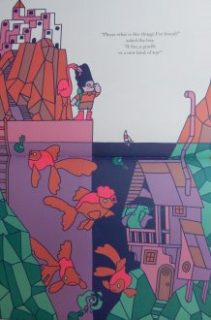
Delivered through James Thorp’s wacky rhyming text and Angus Mackinnon’s bizarre imagery that reminded me of 1960’s psychedelic pop art, this surreal picture book questions the nature of knowledge and knowing, but I’ll leave the philosophical ideas to those who decide to hold a community of enquiry with their audience having shared the story.

Prudence and Her Amazing Adventure

Prudence and Her Amazing Adventure
Charlotte Gastaut
Thames & Hudson

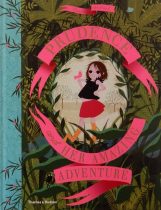
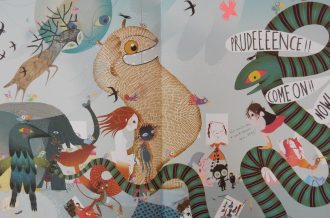
Amazing is something of an understatement when it comes to young Prudence’s flights of fancy that take place as she blocks out her parents’ increasingly urgent calls to tidy up and get ready to go out.

Out she certainly does go, far, far away to wonderful woodlands,

incredible tropical jungles, deep down into the ocean and way, way up among the stars.

All kinds of creatures, strange and stranger still, as well as some more expected ones, inhabit the landscapes, seascapes and skyscapes she visits on her imaginary journey; until eventually those parental voices once more break into her fantasy worlds and it’s time to answer their call.

As well as her awesome double spread illustrations, French artist extraordinaire, Charlotte Gastaut has included cut-outs and translucent pages to flip back and forth, as readers join the little girl on her incredible adventures.

There is SO much to see in every scene, some of which almost leaps from the page thanks to Charlotte’s bright pink colour pops, whereas other details are less easily discernible hidden between the swirling textures of the rocks, stones and foliage.

Who would want to tidy up a room when it can furnish such breath taking experiences as Prudence’s?

A stunning book to immerse oneself in, and to visit over and over, losing track of time just like Prudence.

Unicorn Club / Ten Minutes to Bed Little Mermaid


Unicorn Club
Suzy Senior and Leire Martin
Little Tiger

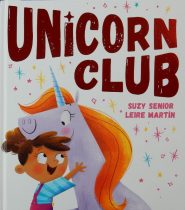
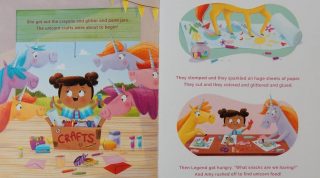
It’s Saturday morning and young Amy is eagerly anticipating the inaugural meeting of her unicorn club, but as the time comes for the grand opening it seems as though there won’t be any takers. Upset, Amy rips down her poster and heads to her tree house.

There however, she receives a wonderful surprise and what’s more the creatures can’t wait for the promised crafting to commence.

They have to though, for long enough to relocate to Amy’s more spacious garage where she gets out all the resources.

Being creative gives those unicorns an appetite and one of their number demands the promised snacks, which are enthusiastically consumed in almost no time at all.

Fuelled up with cake, it’s time for the unicorns to show their dance moves but they’re all so groovy that Amy just cannot pick a winner; her chalks however are certainly the losers as they’re unknowingly squashed to pieces by the dancers.

Poor Amy: how will they create that club mural now? I wonder …
Illustrated in suitably garish hues and with scenes of unicorn frolics, this tale should certainly enchant the seemingly ever-growing numbers of young unicorn enthusiasts out there who will enjoy discovering how Amy’s nearly disastrous Saturday becomes the start of something magical.

Ten Minutes to Bed Little Mermaid
Rhiannon Fielding and Chris Chatterton
Puffin Books

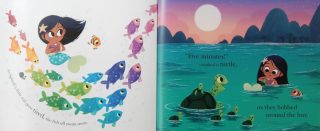
In the third of their countdown to bedtime series, Rhiannon Fielding and Chris Chatterton take a dive down to the kingdom of merpeople and in particular little mermaid, Splash and her grandpa. It’s he who keeps count of the passing minutes as the playful Splash frolics with dolphins, dives beneath waves, bops with crabs, swims along with rainbow fish,

talks to turtles and has a scary encounter with a shark before pausing on a beach where she’s reminded of the time by a friendly passing whale that helps her on her way.

But will she make it in time before that final minute has gone …

The magical formula still holds good in this latest pre-bedtime fantasy that should ensure your little ones have sweet dreams in The Land of Nod. (The final map shows several more potential settings so I suspect this series will run and run.)

Song of the River

Song of the River
Joy Cowley and Kimberly Andrews
Gecko Press

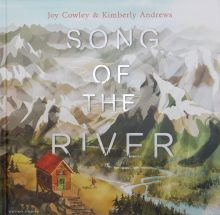
In this new illustrated Joy Cowley story first published 25 years ago, Kimberly Andrews re-imagines a journey of a little boy, Cam and his adventure as he follows a river from its trickling source all the way to the sea.

One spring morning the lad decides not to wait for his grandfather’s promise to take him to the sea but instead he listens to the watery voice of the first trickle, the waterfall, the leaping trout, the green and gold frogs as the stream becomes a river

that widens, deepens and joins other rivers. Then its voice is that of ‘big brass engines soaked in oil’,

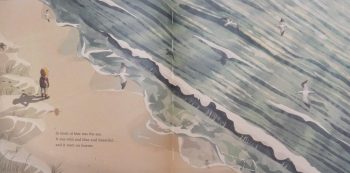
growing louder at the wharves to become ‘the voice of salty wind and crying birds and deep, secret places where whales swim with their young.’ And all the while the river urges Cam to continue his journey until eventually there before him, ‘wild and blue and beautiful … and going on forever’ is …

A sea whose song is deep and wide and truly wonderful.

Back home again, the boy tells his grandfather of his adventure and once again receives the ‘One day we will go there,” response.

No matter whether the boy’s travels were real or imagined, his journey was filled with wonder.

Joy Cowley’s poetic narrative truly sings throughout and is made all the more powerful in the company of Kimberly Andrews’ superb landscapes executed in muted, natural earthy hues.

An awe-inspiring tribute to the natural world and to storytelling itself.

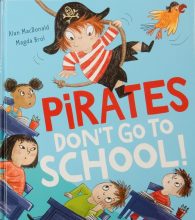
Pirates Don’t Go To School!

Pirates Don’t Go To School!
Alan MacDonald and Magda Brol
Little Tiger

There seems to be no limit to the stream of piratical picture books set on the high seas; but a young pirate enrolling in a primary school, now that’s something rather different.

It is though what young Jake, fed up with ‘mopping parrot poop’ from the deck of the Salty Prawn, eventually persuades his Ma and Pa to allow him to do.

On arrival however, he does have some first day jitters.

And when he gets inside the classroom and removes his hat, both teacher and children – not to mention Jake himself – are in for something of a surprise.

His stowaway parrot, Poll, is in playful mood and leads Jake, children and teachers a merry dance

until the young pirate suddenly has an idea.

His action succeeds in calming down the lively bird, much to everyone’s relief, leaving Jake anticipating being sent home in disgrace.

Not so! Miss Cherry is an accommodating teacher and the lad happily spends his first day with the others until it’s time for his family to meet him.

That evening he regales them with the story of his first day at school; but will they allow him to return next morning? You bet; can Miss Cherry cope though?

Dirty Bertie author, Alan Macdonald has struck gold with this unlikely starting school tale. It’s perfect for young listeners soon to start school themselves, but equally will delight anyone partial to funny stories. This one’s made all the funnier thanks to Magda Brol’s spirited scenes of Jake, his family and his new friends, whether at sea or on land.

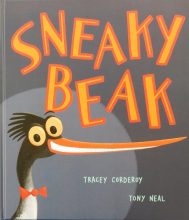
Sneaky Beak

Sneaky Beak
Tracey Corderoy and Tony Neal
Little Tiger

The dangers of succumbing to advertising are hilariously explored in this tale of friends and house-sharers, Bear and Hamster.

First, Bear allows himself to be persuaded by Sneaky Beak that his bed had lost all its bounce when he’s summoned in response to the previous evening’s TV ad.

Not only does Sneaky rock up in his van, but he brings an entourage of bunnies to help clinch a deal for the ‘Snores-Galore Mega bed’.

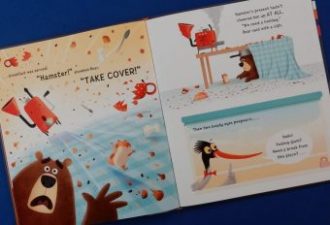
Poor Hamster is less than pleased when his things are moved out of the bedroom to accommodate Bear’s purchase.

But worse is to come. That Sneaky Beak leaves a leaflet about a very special kind of bathtub. Bear’s determination to resist lasts only until bathtime when he’s on the phone again and guess who he’s calling …

Not a wise move, Bear; and nor was his ‘twirly thing’ investigation …

I’ll leave readers of this romp to decide themselves which is more catastrophic – that, or his next purchase, revealed at breakfast time the following morning, which results in …

That definitely doesn’t have the Hamster mood-lifting effect Bear’s hoping for.

So why oh why is he letting that wily Sneaky Beak beguile him into making yet another purchase?

Disastrous as the Beak’s new sale might have been, it actually provides Bear with some much-needed thinking space

and all ends happily – with some serious recycling and a certain salesbird’s beak somewhat out of joint.

The combination of Tracey’s tongue-in-cheek telling and Tony Neal’s superbly entertaining scenes of the results of falling prey time and again to a determined capitalist’s sales patter, make for a crazy consumerist caper that is bound to bring on fits of laughter on the part of both listeners and readers aloud.

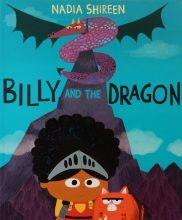
Billy and the Dragon

Billy and the Dragon
Nadia Shireen
Jonathan Cape

One of my favourite picture book characters from last year, Billy, and her sidekick Fatcat, return for another action-packed adventure.

It all begins with the two setting out to a fancy dress party, Fatcat rather more reluctantly, but fuelled by the promise of cake.

On arrival Billy greets their friends while Fatcat heads straight for the food. He doesn’t quite make it though for he’s seized by enormous claws and whisked skywards.

After a quick rummage around in her hair Billy produces a telescope that she uses to locate Fatcat’s whereabouts

and operation ‘save Fatcat’ commences.

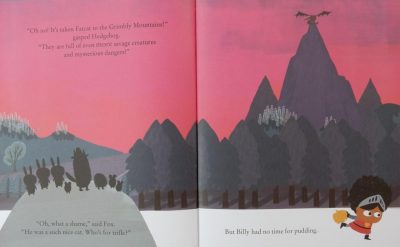
Billy, the mice, the little bunny rabbits, Fox and Hedgehog (less enthusiastically) head for the Deep Dark Forest. How on earth (or sky) is Billy going to get herself up the massive tree wherein Fatcat has been plonked?

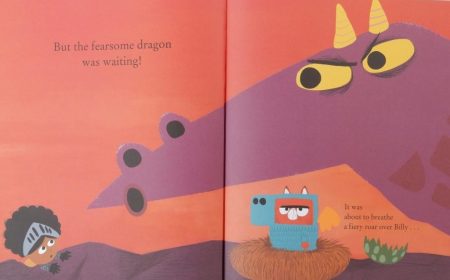
Happily Hedgehog has come with some of the party stuff. But a fiery roar from the fearsome dragon kidnapper puts paid to her first attempt and then the catnapper takes to the air again, coming to land in an even more terrifying spot.

So terrifying in fact that only Billy continues on the perilous journey during which she comes upon and ‘rescues’ a scaly little creature that she takes along with her.

This might just be the wisest move she’s made, for eventually this is the sight that meets her eyes …

Once again, Nadia’s perfectly paced story is a winner; it’s full of moments to savour and the drama is brought out so brilliantly in her smashing scenes of the chief protagonist and her supporting animal cast. (Watch out for the worm.)

Bring on the next one.

Monkey On the Run

Monkey on the Run
Leo Timmers
Gecko Press

This wordless picture book starts with a father monkey collecting his little one from school and right away their funky motorbike is in a nose-to-tail traffic jam.

Rather than sit frustratedly in the side car, Little Monkey gets out and starts wending his own way home.

Every spread offers potential stories aplenty so this definitely is not a book to hurry through. Rather one needs to slow the pace and relish the on-the-move fire fighting scenario; Little Monkey’s cake-lifting episode from the royal ‘feastmobile’…

cake he subsequently consumes in the crow’s nest of a wheeled boat.

There follow a confrontation with a rooster; a circus-like dangling act from a very bendy drinking straw

and later on Dad monkey gets an ice-cream surprise from above.

Then our inventive traveller secures a wonderful gift box

that he presents to his mum when father and son finally reach home.

Timmers’ vehicles are veritable inventive wonders, every one; and the way in which the interaction on each spread occurs is sheer comic genius. I’m sure readers will discover new things to relish on every re-reading, of which I’m sure there will be many.

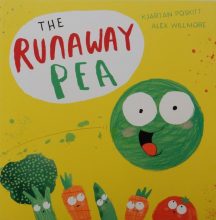
The Runaway Pea

The Runaway Pea
Kjartan Poskitt and Alex Willmore
Simon & Schuster

We’ve all heard of the runaway gingerbread man and the runaway pancake but now they’ve got some opposition in the exciting escapade stakes – from a fleeing pea no less.
Said little green seed decides to up and leave the plate before tea-time and so he does, despite taunts from fellow veggies over a minor mishap with a splodge of sauce.

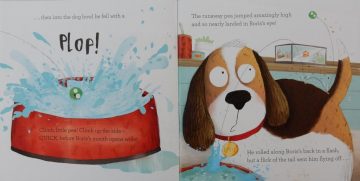
Although the little pea might have escaped from becoming tea for a human there are still plenty of hazards to contend with: the dog’s drinking bowl,

a goldfish tank, a mousetrap, a toaster, a tumble dryer and an iron to be precise.
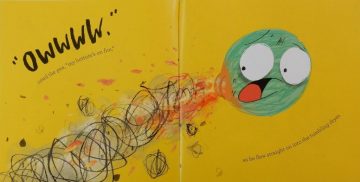
Having managed to avoid the dog’s mouth, been squirted unceremoniously from Adele’s tank, catapulted onto a shelf, blown into a toaster and pinged out again,

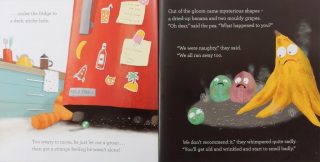
buffeted round inside a revolving drum and almost squished flat ‘neath a steam iron, our pea finds himself rolling under a fridge.

Exhausted, in this dark spot he comes upon several shrivelled shapes, which he hears, were also runaways,

They advise the newcomer against remaining to get wrinkly and stinky like them as well as telling him that there’s no point returning to his original plate, leaving the little fellow to fall fast asleep.

And that’s when something amazing happens to him that might just be the start of something truly eye-poppingly astonishing …

Poskitt’s zany narrative rolls merrily along in faultless rhyme and makes for a smashing read aloud, all the more so thanks to Alex Willmore’s dramatic, action-packed art. His scenes of near disaster will likely have your little ones rolling around in laughter at the pea’s plight and clapping in delight at the hapPEA ending.

The Jacket

The Jacket
Sue-Ellen Pashley and Thea Baker
Walker Books

Young Amelia is absolutely thrilled with her present – a new jacket, ‘soft like dandelion fluff … ‘ ‘warm like the afternoon sun … comforting like a hug from your favourite teddy’, and with four bright, shiny buttons down the front.
She wears it everywhere until the day it no longer fits her.

It’s then given to little sister, Lily who also wears it everywhere – even to the beach – until she too grows too big for it.

Lily’s doll is the next recipient but then Lily starts school and sets aside doll play.

The jacket has lost a button and with paint and dirt on it, that specialness has gone; it’s left unwanted in a corner of Lily’s room. But is it really unwanted?

Not so: Cornflake the cat has kittens and they’re kept snug and warm on the jacket.

With the kittens gone to new homes, Mum decides the jacket has served its purpose. “We should get rid of this old, dirty thing,” she tells the children.

Lily is sad; but not for too long; Mum has a change of heart when she realises and she refashions the garment for yet another life …

A beautifully told, and equally beautifully illustrated tale of a treasured childhood object that shows how we all learn to let go of childhood attachments as we grow up.

Thea Baker’s mixed media scenes bring out the inherent warmth of the text in a book that will resonate with readers aloud as well as young listeners.

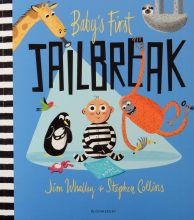
Baby’s First Jailbreak

Baby’s First Jailbreak
Jim Whalley and Stephen Collins
Bloomsbury Children’s Books

The Bank Heist baby Frank is back for another rollicking rhyming adventure, but he’s not the only baby that features in this follow up story. There’s also baby Bruce – more of him shortly.

In case you don’t already know, baby Frank has turned his home into a zoo so that his debts can be paid off for the bank raid he was involved in. This zoo was doing very well for itself but gradually the crowds have dropped off until one morning nobody at all was waiting to pay to enter Frank’s Zoo.

While out for a walk with his parents they come upon the reason for this loss of custom: baby Bruce, of rich parentage,

has opened a zoo too (on his parents private polo pitch) and is now coining it in by showing tutu clad tigers, dancing chimps, bicycling elephants, not to mention penguins wandering around giving out free ice creams. Hmmm! And to make matters worse, the place is festooned with flags bearing Bruce’s face.
Pretty soon, Frank’s Mum has seen enough and Dad is ready to give up in the face of unbeatable competition.

That evening however, Frank is visited by an escaped penguin who tells of the terrible treatment he and his fellow animals at Bruce’s establishment receive, and begs his help.

Needless to say, Frank is on the case immediately, planning a ‘daring prison break’ and by 2am he, together with a few animal friends, head to Bruce’s zoo.

Scaling the high wall isn’t too much of a challenge and neither is picking the lock on the door of the penguin enclosure.
Before long not only the penguins but also the tortoises, hyena and every other creature from the zoo has been liberated and is on the way to the safety of Frank’s home.

The infant zoo-breaker will have a bit of explaining to do next morning when his parents confront the lad about the sudden increase in animal numbers residing with them but before he can do so, there’s a knock at the door.

Baby Bruce and his mother have come calling and are making accusations.

Now what? Can Frank and the animals convince the visitors that they belong right where they are?

The answer is both yes and no, though what happens finally, you’ll have to discover by getting your flippers, trunks or other appropriate appendages on a copy of this corker of a read aloud. That way you can also relish Stephen Collins’ superbly droll illustrations each of which is packed with wonderful chuckleworthy details.

Think Big!

Think Big!
Kes Gray and Nathan Reed
Hodder Children’s Books

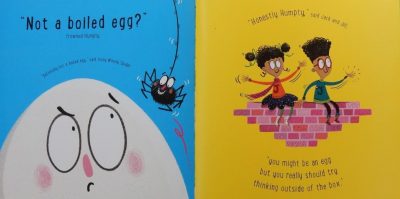
Humpty Dumpty sits on a wall, but he’s not alone; his friends sit alongside and they are considering their futures.

Humpty however, sets the bar very low: “A boiled egg” is his only ambition. Shock horror among the others who go on to urge him to Think Big!

“Buy a pair of football boots and become a footballer,” suggests Wee Willie Winkie.

“Look for clues and become a detective, says Little Bo-Peep.

He could perhaps, like Little Miss Muffet, consider becoming a scientist.

Egg though he might be, he “really should try thinking outside of the box.” as Jack and Jill recommend. I second that!

An artist, a policeman, a doctor or a firefighter are also put forward as possibilities; but it is perhaps the Cow who jumped over the moon that really gets Humpty’s brain buzzing with potential personal achievements.

But will our eggy friend actually manage to live up to his elevated thoughts and reach for the stars …

Storytelling maestro Kes Gray smashes it again with this tale that will surely have you giggling from start to final, laugh-out-loud punchline (or more accurately crunchline).

Nathan Reed does a terrific job capturing Kes’s droll humour in his high-voltage illustrations, every one of which is a cracker.

With its powerfully positive ‘believe, work hard and you can achieve’ message this is an eggstra-special offering for young children.

Pink! / Alfred and the Blue Whale

It’s always good to discover new publishers so Red Reading Hub was excited to come across Wacky Bee Books to whom thanks for sending these for review.

Pink!
Lynne Rickards and Margaret Chamberlain
Wacky Bee

Patrick is a penguin, a pretty ordinary young penguin until one morning, shock horror; he wakes up and discovers he’s turned pink overnight.

Dr Black is no help suggesting that he tries getting used to his new hue. “But I’m a BOY! And BOYS CAN’T BE PINK!’ is his response.

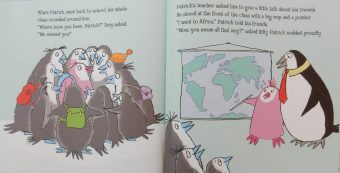
At school, his fellow penguins tease Patrick until he’s had enough. Deciding he wants to fit in, he packs his rucksack and sets off to find the African flamingos his Dad had showed him in a bird book.

It’s a seven-day, seven-night swim but Patrick is a powerful swimmer and on day eight he reaches his destination.
The flamingos are friendly, inviting the newcomer to join them for lunch; but the visitor’s beak is all wrong, so things go very badly.

The same is true when Patrick tries out other things flamingo, like standing on one leg.

Patrick realises he doesn’t fit in here either.

Back home he swims. His parents welcome him; and then to his surprise, so too do his schoolmates. Indeed they’re mightily impressed by what their pink pal has to tell them about his travels; now being pink is cool.

Acceptance rules: not only Patrick but also his classmates have realised that real friends love you no matter how different you might appear on the outside.

With Margaret Chamberlain’s characterful illustrations, Lynne Rickards’ story of Patrick’s learning journey will help little ones both at home and in early years settings understand that diversity is something to be celebrated, as well as help challenge gender stereotypes.

Alfred and the Blue Whale
Mina Lystad, (trans. Sian Mackie) illustrated by Ashild Irgens
Wacky Bee

This is one of the publisher’s Buzzy Reads titles for those readers just starting to fly solo and has been translated from the author’s original Norwegian.

Young Alfred is scared of lots of things, but his worst nightmare is speaking in front of the class. Imagine how he feels then when he learns that everyone must take their turn to talk to the others about the animal named on the paper his teacher gives them.

Alfred’s animal is the Blue Whale and all he wants to do at the thought of the following Friday is to hide away.

Little by little though, he starts collecting information about the creature and the more he discovers, the more interested he becomes, so much so that he forgets about his nerves …

until Friday morning.

But then those scared feelings come flooding back. Can he summon up the courage to share all that Blue Whale information he has in his head with his classmates?

The author seamlessly includes a number of easily digested Blue Whale facts in her very readable story about facing your fears and self belief. (There’s also a final double spread fact file.)

Ashild Irgens’ plentiful illustrations convey so well Alfred’s fluctuating emotions over the five days from Monday till Friday.

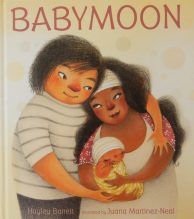
Babymoon

Babymoon
Hayley Barrett and Juana Martinez-Neal
Walker Books

A new baby has just been born and the two new parents spend their first days after their baby’s arrival on their ‘babymoon’.

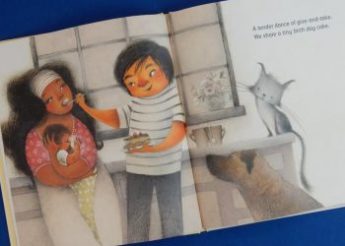
During this precious time they experience tender moments, ‘A sweet, secluded afternoon – / this restful time, our babymoon’; joyful ones, ‘ A tender dance of give-and-take. / We share a tiny birth day cake.’

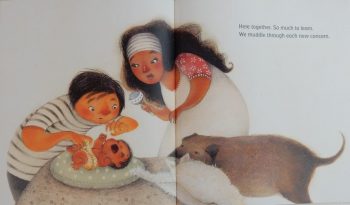
and occasionally, anxious ones – ‘Here together. So much to learn. / We muddle through each new concern.’

From the opening alliterative line, ‘The house is hushed. The lights are low.’, readers are enfolded in Hayley Barratt’s gentle rhyming narrative of moments to savour, moments shared not only with parents and child but the family dog and cat are also included in the building of that loving bond.

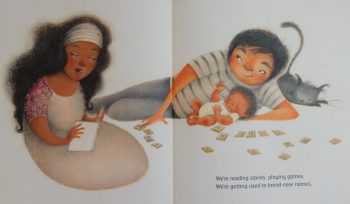
The sense of serenity is reflected in Juana Martinez-Neal’s breathtakingly beautiful illustrations, which show the warm loving involvement of both parents.

This is a gorgeous book to give to new parents especially perhaps, to encourage them to savour the precious ‘babymoon’ time (the word was coined by the late anthropologist Shelia Kitzinger to do just that.) I absolutely love that the parents are shown sharing stories right from the start of their baby’s life.

Who’s Going to Bed? / Somewhere Out There, Right Now

Who’s Going to Bed?
Abie Longstaff and Eve Coy
Puffin Books

‘The stars are out, / the moon is bright’; that means it’s bedtime for the pirates on the high seas, most of the animals in the jungle, the teddy bears in their cottage, the king and queen and their family of young knights.

There’s one mischievous baby though, who embarks on a very noisy adventure. His music making meandering arouses all those would-be slumberers,

who with the infant playing a kind of pied piper role are led a merry dance all the way to the beach where they come upon …

The trouble is, she’s an extremely tired little dragon and wants nothing more than to be allowed some peace and quiet so she can snuggle down for the night.

Now it’s time for that cheeky toddler to take control of the situation. With a single “SHHHH!” he sets in motion a concatenation of actions that see the baby dragon safely tucked up in her bed.

The efforts of his helpers however have brought on a desire for sleep in all the revellers, not least the instigator of the fun; and so finally the little babe is transported all the way home …

to bed. Goodnight and sweet dreams.

An enchantingly playful bedtime story told through Abie’s carefully measured text and Eve’s moonlit scenes of the nocturnal high jinks. I love her colour palette and the way she brings out the inherent gentle humour of a tale that’s a terrific one to share with little ones before bed. (I suggest any musical instruments are tucked right away first though – just in case …)

Somewhere Out There, Right Now
Gemma Wells
Ragged Bears

This softly spoken picture book connects young listeners to the natural world outside while at the same time helping them to find calm within as they wind down for bedtime.

Somewhere in the darkness a monkey takes cover from the heavy rain, baby beetles are buried beneath the earth,

birds come in to roost, there’s a fox out in a city street – perhaps seeking shelter or food – and waves gently lap a moonlit beach; there are kittens snuggling up to their mother.

All these peaceful scenes help to induce a sense of inner calm as the body slows, safe in the knowledge that the beloved listener to the gentle narrative is in a safe, nurturing place and all is well.

Gemma Wells’ affinity for nature is reflected in her bold, digitally worked scenes of the animals, the adult and child looking outwards.

A lovely book for parents and carers to share with the very young just before bed.

The Princess and the Shoe

The Princess and the Shoe
Caryl Hart and Sarah Warburton
Nosy Crow

Young Princess Jasmine, hater of fancy frills and beribboned gowns has much better things to do than think about dancing with a prince, let alone getting one to kiss her. She’d far rather run about playing on the green with the other children, so when she spies a poster announcing a cross country race scheduled for the following Sunday, she’s determined to enter.

First though, she has to practise, which proves something of a challenge, especially as she ends up waist deep in muck.

And then she discovers that the date of the race clashes with her Big Birthday Ball.

It’s a rather downcast young Jasmine who sits in her window that night contemplating her lot. Suddenly out of the darkness there appears …

The tiny being offers to grant young Jasmine her wish and with a swish of her wand she produces some super go-fast shoes, saying that the magic runs out at midday.

On race day, Jasmine is ready at the starting line and sets off confidently, looking as though she’ll easily finish in time to get to the ball. But then as she’s crossing a sticky, muddy patch disaster strikes and one of her shoes is washed away down the stream.

Does the princess give up in despair: oh no she doesn’t. On she strides wearing just one red trainer gaining speed all the time …

Guess who makes it first through the finishing tape where a welcome party awaits.

Was her win due to those magic trainers or could it have been Jasmine’s self-belief and determination?

As always Caryl’s faultless rhyming narrative slides off the tongue making it a joy to read aloud, while Sarah’s scenes are sheer delight, brilliantly expressive and full of sparkle without the need for any added glitter or foil adornment.

A deliciously different Cinderella tale.

This is Frog / Let’s Find the Tiger

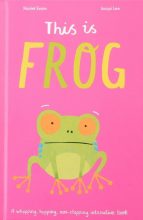
This is Frog
Harriet Evans and Jacqui Lee
Caterpillar Books

Rainforest dwelling Frog (a tree frog) needs help with everyday life and little ones can help him by following the author’s suggestions throughout the story.
Occasionally though the outcome is somewhat unexpected as when having followed him up the page, we discover Frog now upside down, but happily he can use those sticky feet to stay attached to the branch.
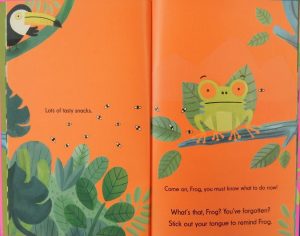
When he has a brief attack of forgetfulness as a swarm of yummy-looking flies are blown in his direction, he needs readers to show him how to use his tongue, and then to stop all but the one he’s savouring from buzzing away.

If Frog’s not careful he’ll be the next meal of a toucan who most definitely hasn’t come along for a friendly visit – a loud croak will warn our Frog though, along with a deft hand movement.

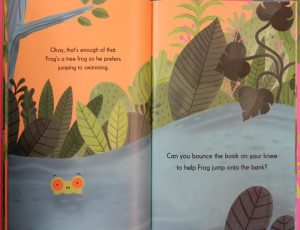
There’s more to do however, when monsoon rains come splashing down, especially as our Frog friend, being a tree frog isn’t enthusiastic about swimming, so help is needed to ensure that he ends the day’s adventure safe and sound on his branch to recover for his next round of froggy fun.

With a spattering of playful language throughout and a plethora of interactive opportunities for little ones to perform, Harriet Evans’ narrative should keep them interested throughout.

With occasional cutaway pages, Jacqui Lee’s amusing illustrations of Frog in his lush habitat make for a fun book to share with the very young, and along the way they might absorb a few Tree froggy facts.

Let’s Find the Tiger
illustrated by Alex Willmore
Caterpillar Books

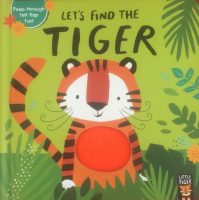
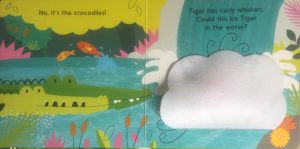
In this seek-and-find, peep through, felt flap board book, little ones are invited to find Tiger. The playful creature has hidden away somewhere in the jungle wherein live lots of other creatures some of which when almost completely hidden away behind the flora or even in the water, might at first glance be the animal they’re looking for.

But the supposed long stripy tail, sparkly white teeth, curly whiskers,

and striped curvy objects are not Tiger.

Could the dark, tucked away location be its hideaway?

With an engaging question and answer, repeat refrain narrative and Alex WIllmore’s colourful jungle scenes to explore, this is both fun and gently educative.

Swarm of Bees

Swarm of Bees
Lemony Snicket and Rilla Alexander
Andersen Press

This is the second ‘Swarm of Bees’ to arrive at my house in the last couple of weeks. A real swarm dropped down our chimney the other day and after an initial invasion of our bedroom, the bees are now safely at home nesting in the chimney flue.

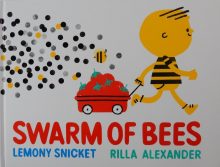
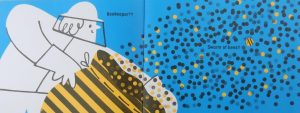
In the story, a boy throws a tomato at a nest of bees. Why, one wonders. He certainly looks pretty angry as he walks along pulling that cart. But to take his anger out on the bees is surely not acceptable behaviour. His action causes the nest to swing, and disturbed, the bees come swarming out: do they do so to protect their queen perhaps?

Through the town fly the bees with the narrator wondering about possible targets for their stings. A sailor? No he’s spent nine months at sea and is rushing home to give his mother a hug. Maybe a mother, a bricklayer,

chefs, a cat or residents of a flat: using repetition the narrator considers each potential target and provides reasons why not.

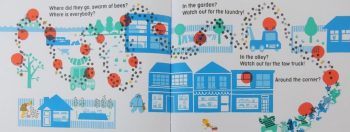
What about the boy? We then see that he in fact is pelting each of the potential targets with tomatoes; they’re all feeling indignant and chase the boy across a tomato-splattered town layout

in a sequence of wonderfully buzzy spreads.

Eventually the beekeeper calms the swarm and catches them in his bee sack.

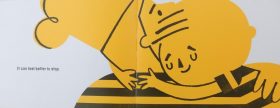
The boy meanwhile, is pacified by an embrace from a parent who doesn’t chastise,

but the narrator echoes his thoughts with ‘It can feel good to be angry. / it can feel better to stop.’

Clever use of metaphor for the feelings of the characters, combined with the exuberant illustrations provoke ideas about anger management and the other emotions the characters exhibit in Rilla Alexander’s bold, mixed media scenes, providing a nice balance of humour and emotional charge.

The entire book is thoughtfully designed from cover to cover with the story starting and concluding on the endpapers.

An interesting, thought provoking book to share as a prelude to a circle time discussion with young listeners.

Why Do I Poo? / Freddie the Fox Feels Frightened

Thanks to Booklife Publishing for sending these: it’s always good to discover a new publisher.

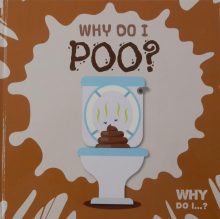
Why Do I Poo?
Kirsty Holmes
Booklife Publishing

Bodily functions and in particular, poo, seem to hold an endless fascination for young children; mere mention of the word often elicits giggles among those in a reception class or nursery group; and with a cover like the one on this book, I’m sure it will arouse interest straight away.

Actually the whole book isn’t about poo; rather it offers a straightforward look at the workings of the human digestive system, (using a pizza as exemplar)

along with some other poo-related information such as that ‘poo gives off methane and that can be burned to produce power for our homes’, as well as powering buses. Also, animal poo is useful as a fertiliser for plants and, since it contains a lot of fibre, can also be made into paper – not human poo but that of sheep, elephants and even pandas.

After a look at other waste products we make,

there’s a spread on poo-related tummy troubles, as well as one inviting you to ‘rate your poo’ (using the Bristol stool scale). Don’t try that if you’re suffering from those tummy troubles though.

If your little ones are feeling quizzical, then they might like to try matching the poo piles to the four animals illustrated on the opposite page.

The book concludes with a glossary and index. Are you ready, steady, air freshener to hand? …

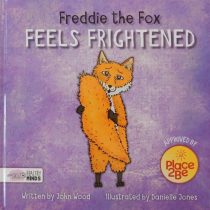
Freddie the Fox Feels Frightened
John Wood and Danielle Jones
Booklife Publishing

This is one of the Healthy Minds series aimed at the foundation stage and would work either shared at home or with a nursery group.

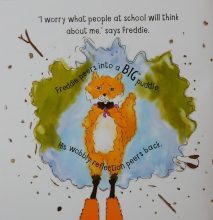
The author uses a narrative style to explore Freddie’s feelings on the evening before and morning of Freddie’s first day at school.

Despite Andy’s reassurances, Freddie goes to bed feeling frightened about what the next day might bring. So much so that he has a scary dream about being fired from a cannon, his fall being watched by countless pairs of eyes.

When the two leave for school, Freddie takes with him his comfort blanket and even so Andy is concerned that he looks rather unwell; he certainly feels that way on account of his fears of what might happen when they arrive.

His procrastinatory tactics take the two on a rather longer than expected route and during their journey Freddie talks more about his feelings.

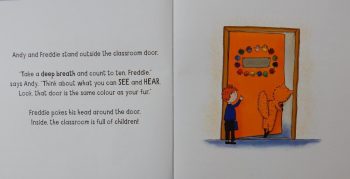
Eventually the wet, muddy pair arrive just in the nick of time, with Freddie’s tail all a-tremble and his heart beating fast. Andy continues to reassure him as he opens the door

and following her instructions he counts to ten, looks around and very quickly finds himself absorbed in the children’s game.

With questions to ponder during the story and more to discuss afterwards, this book is, like Andy’s words to Freddie, a reassuring one to use with those soon to start school (or a nursery class). Danielle Jones’ bright, uncluttered illustrations show how both Freddie and Andy feel throughout and should help allay those pre-first day fears in little humans.

The Rabbit Listened

The Rabbit Listened
Cori Doerrfeld
Scallywag Press

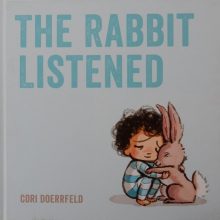
Something terrible happens to Taylor in Cori Doerrfeld’s story. It certainly appears devastating when a flock of birds swoops through, knocking down the complicated construction the small, momentarily proud, child has just built.

One after another various animals come along and attempt to help; but Taylor doesn’t want to talk, doesn’t feel like shouting,

nor remembering as the elephant suggests, certainly doesn’t want to laugh, pretend the event never happened or do any of the other things the creatures, from their own view point think might be supportive.

Eventually Taylor is left alone and that’s when a rabbit creeps up. The rabbit says not a word; it merely snuggles up beside Taylor, offering a listening ear and creating space until the little human is ready to respond to those pent-up emotions held within.

The author/illustrator too creates space, a lot of white space on the page for the story to unfold as Taylor moves from grief, to anger and finally, resolution.

Perfectly paced, seemingly simple but with plenty of space for deeper connections to be made where and when appropriate, this is a book for adults to share especially when there’s a child in need of emotional support who will process it in his/her own way, just like Taylor does.

Cori Doerrfeld’s elegant, empathetic illustrations perfectly orchestrate her wonderfully wise story that’s a must have for anyone who lives or works with young children.

Suzy Orbit, Astronaut / Make & Play: Space / Balloon to the Moon

Here are three very different books all with a space theme:
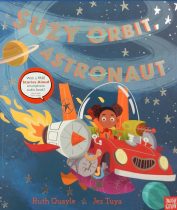
Suzy Orbit, Astronaut
Ruth Quayle and Jez Tuya
Nosy Crow

Space engineer, Suzy Orbit lives with her boss, Captain Gizmo in a lunar space station.

One morning they learn that aliens have been spotted within range of their location and they need to act quickly to launch their space pod. The Captain orders one forthwith but it arrives without batteries and those the Captain has don’t fit.
Furthermore his shiny new space suit is way too small and as the aliens have by now arrived, it’s pointless trying to get a new speak-o-phone.
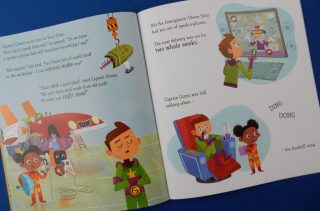
Happily though, the aliens are peaceable beings but they have bad news to share. Earth is about to be blasted by a meteor storm unless Suzy and her boss can stop it. No pressure there then.

Fortunately Suzy, with her tools always to hand, is an engineer extraordinaire and just happens to have a wonderful new invention ready and waiting. It’s as well that one of the team realises that it’s better to rely on ingenuity than ordering things on the net. Before you can say ‘blaster’ the two are heading out into the meteor storm with Suzy at the controls to do battle with those errant meteoroids. Can they save the day and see off the storm?

It’s great to see Suzy as a positive STEM character in the role of engineer/inventor in Ruth Quayle’s quirky tale. Jez Tuya’s bold illustrations show her as having determination and resourcefulness – exactly what’s needed in the face of the Captain’s lack of drive and inability to show any innovative aptitude.

Make & Play: Space
Joey Chou
Nosy Crow

The latest of Joey Chou’s Make & Play interactive activity book series is sure to please young space enthusiasts.
It contains eight pages of bold, brightly coloured, double-sided press-out play pieces that can be used to create a space scene (some have a hole to suspend with thread while others slide together to stand). The entire set would make a great diorama with space dogs, aliens, astronauts and spacecraft, though if desired, the pieces can be fitted back into the spirally bound book for safe keeping.

There are also other space-related activities – a fruit rocket made from fresh fruit pieces; a song to learn; a ‘blast-off rocket’ science experiment, alien models to create (they could be made into puppets perhaps) and more.
There are hours of fun to be had with this, whether used by an individual, or a small group of young children.

For older space enthusiasts is:
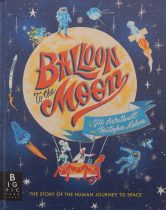
Balloon to the Moon
Gill Arbuthnott and Christopher Nielson
Big Picture Press

Rather than concentrating on the Space Race, this takes a historic look at the steps that began in the late 18th century with the Montgolfier brothers flight of a large unmanned balloon and led on to their sending a variety of animals skywards on a 3km flight three months later.

In the same year came the first manned untethered flight by inventor Pilâtre de Rozier and the Marquis d’Arlandes who flew 8km in a Montgolfier balloon. Hot on their heels came the first woman to do similar, the following year (1784). There’s a whole spread given over to this balloon bonanza.

The narrative then shifts to the first half of the 20th century with a look at some aviation pioneers, followed by a focus on some iconic planes.

I was especially pleased to find some literary references on the opening page of the ‘rockets section’ where there’s a mention of both Cyrano de Bergerac and Jules Verne. The author uses numbers in her selection of what she includes so we have, for instance ‘8 Rockets’
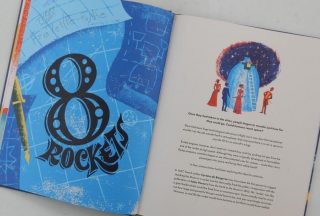
and ‘Into the Unknown 7’. The seven referring to the seven animals that became the first astronauts; and this chapter cleverly links these with an explanation of g-forces and their relation to fighter pilots and astronauts.

Much of the remaining part of the book provides information on the endeavours of the US and the Soviet Union to win the space race; and what happened thereafter. In conclusion there’s a quick look at some of the new information the Apollo Moon flights gave us; what ‘space travel has done for life on earth’ and a final look to the future.

Christopher Nielson’s retro style illustrations are full of humorous touches adding to the allure of the book and the enjoyment of the whole narrative.

Harry in a Hurry

Harry in a Hurry
Timothy Knapman and Gemma Merino
Macmillan Children’s Books

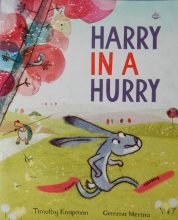
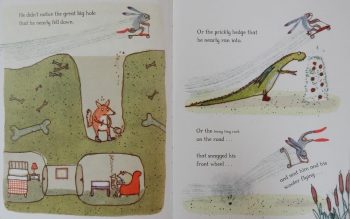
Harry the hare is always in a frantic rush to do everything and go everywhere, so much so that he’s apt to cause chaos wherever he goes.

He makes some pretty perilous moves as he speeds around on his scooter until he suddenly finds himself hurtling through the air and into a pond.

Happily Tom Tortoise is there to fish him out, scooter and all and is even good enough to offer to mend Harry’s battered scooter.
Being a tortoise however, means that whatever Tom does, it’s at an extremely slow speed and inevitably it will be so with the task he’s kindly undertaken.

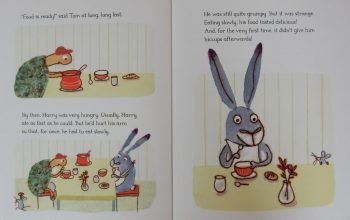
The badly bruised Harry has no choice but to wait and accept his friend’s offer of lunch.

As he does so, something strange starts to happen.

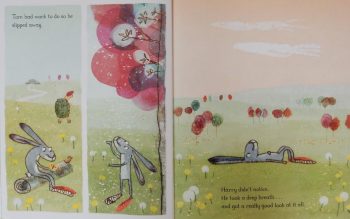
After their lunch Tom suggests a walk and more of Harry’s grumpiness dissipates as he pauses and takes notice of his surroundings.

Tom slips quietly back to finish his task, returning several hours later with the job done, to discover a decidedly more composed Harry, now mindful of his previous bad manners, and appreciative of both his friend’s efforts and the beauty all around.

Timothy’s tale, funny though it may be, has serious messages about kindness, friendship and the importance of taking time to enjoy everything that slowing down offers, not the least being good-natured interactions with others and the beauty of the natural world.

Gemma Merino’s expressive illustrations orchestrate the action brilliantly, bringing out the contrasts between the characters with gentle humour, and providing lots of amusing touches, not the least being the activities of the little mouse and other unmentioned creatures – an extra reward for those who read the book slowly.

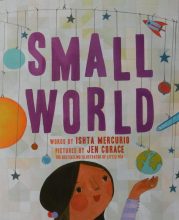
Small World

Small World
Ishta Mercurio and Jen Corace
Abrams Books for Young Readers

Quietly powerful is Ishta Mercurio’s lyrical story of Nanda.
Her life starts as a tiny baby, wrapped safely in the ‘circle of her mother’s arms.’

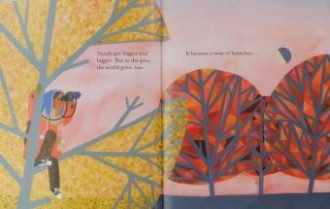
As she grows, so too does her world; it grows to encompass the ‘circle of her loving family’ and spreads outwards and outwards to become ‘a sway of branches …’

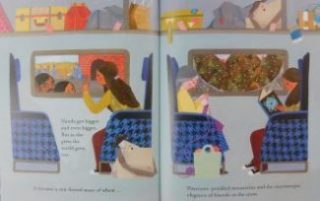
… ‘a sun-kissed maze of wheat … Pinecone-prickled mountains and the microscopic elegance of fractals in the snow.’

As a young woman her interest in flight takes her to the skies, piloting a plane and then as an astronaut, clad in a spacesuit far out into space, the culmination of her pushing out the edges of her world.

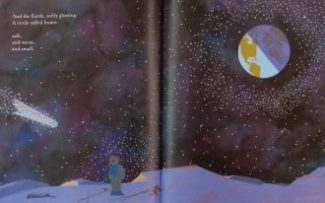
Standing among ‘A sea of stars’, gazing into ‘ink-black space’ viewing Earth from afar she realises that she’s come full circle;

for what she sees is a distant place ‘safe, and warm and small’, as it was when she was that tiny baby in her mother’s arms all ‘those years ago.

The author’s richly detailed narrative paints a gorgeously meditative picture of the girl’s life and this is beautifully visualised in Jen Corace’s gouache, ink, and acrylic, richly patterned spreads that have a quiet, graceful serenity.
The empowering message that emerges from both is that the combination of learning and of the imagination has the potential to open up the entire world.

All in all it’s an elegant celebration of dreaming big, working hard and the joys of discovery especially in things STEAM.
This is a book that should work with older readers/listeners rather than little ones.

I Am A Tiger / The Happy Lion

I Am A Tiger
Karl Newson and Ross Collins
Macmillan Children’s Books

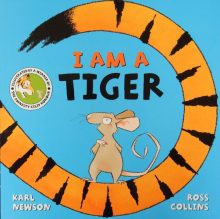
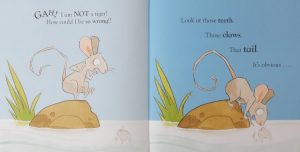
Ignorance? Bravado? Or playfulness? What is driving Karl’s Mouse protagonist to insist that he’s a tiger. Fox, racoon, snake and parrot in turn, challenge the small creature to prove himself but his lack of size, stripes and tree climbing skills do nothing to convince the others of his claim and that growl is – let’s say somewhat feeble.

Suddenly along comes another animal proclaiming …

The ‘not-tiger’ then goes on to try and persuade the stripy character that HE is in fact a mouse with some deft moves.

These he follows with some further ridiculousness

before departing in search of lunch.

This sees our little grey friend heading towards a watery place wherein he spies his reflection and there he learns the error of his claims …

With it’s wonderful surprise finale, this is a grrralectable piece of comic theatre picture book style delivered through Karl’s droll mouse narrative and Ross Collins’ brilliantly expressive scenes.

Hilarious, and I look forward to the next of the promised Karl/Ross creations; they’ve certainly set the bar pretty high with this one. Young listeners will absolutely love it and it’s a gift for those who enjoy throwing themselves into story sharing.

The Happy Lion
Louise Fatio and Roger Duvoisin
Scallywag Press

This is a new edition of a classic story originally published in the 1950s and is set in a French town.

In that town is a zoo, the home of the Happy Lion. He leads a contented life there with daily visits from friends young and not so young, as well as being entertained by the town’s band on Sundays during the summer.

One day, the keeper forgets to close the door and the lion decides to go out and visit all those kind people who were his regular visitors.

Their reactions however are not at all what the Happy Lion expects; he’s barely acknowledged by the animals and the humans are terrified.

Bemused he stops, meditates, concludes, “this must be the way people behave when they are not in the zoo” and continues on his way hoping to find a friend.

He does so, after some drama involving a fire engine, firefighters and their very long hose; and all ends happily with the Happy Lion and his young friend walking back to the zoo together …

With alternate black and white, and three-colour, textured spreads, Duvoisin’s illustrations – wonderful, sketchy, smudgy scenes – still hold their magical charm – for this reviewer certainly – providing the perfect complement to Fatio’s tale.

Animal vs Animal Who’s the Strongest? / Like a Lizard

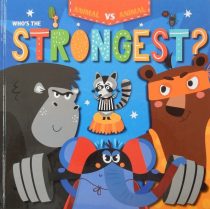
Animal vs Animal Who’s the Strongest?
Kirsty Holmes
BookLife

Welcome to the ‘Great and Small Games’. Essentially this show (it’s one of a series) comprises three strength events: The Tree Trunk Lift; Strong Bug Circus and Tug of War, each of which is refereed by a flag-waving racoon.

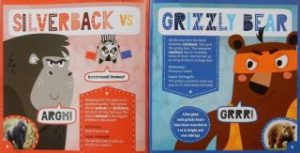
The participants are, for the bug event, dung beetle and leafcutter ant; silverback gorilla and grizzly Bear are the tree lifters;


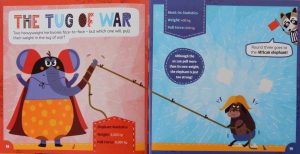
while in the third round, an African elephant and a musk ox tug it out.

Two spreads are devoted to each pair of contenders and as the animals are introduced and perform, snippets of factual information surrounds them on banners or in bubbles,

but it’s never overwhelming thanks to the design of the pages.

A fun way to learn some animal facts, this book should pack a powerful punch with younger readers.

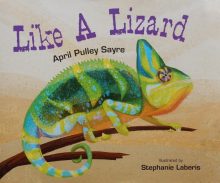
Like a Lizard
April Pulley Sayre and Stephanie Laberis
Boyds Mills Press

Let’s get physical and in so doing, through Sayre’s playful rhythmic text and Laberis’ expressive digital art, learn about more than 25 different lizards and some of the things they do.

So, for instance, ‘Could you drape like a lizard? / Gape like a lizard? / Do a push-up like a lizard? Scale sticks? / Curl in like a lizard?’

Each of the lizards featured is labelled with its common name and described after the main text, in a paragraph below the named behaviour illustrated in the narrative. Every paragraph provides factual information – Latin name, where in the world it’s usually found, length and other interesting details specific to the creature.
So, after an initial read aloud, can your little ones behave like lizards as you share this engaging book? They’ll certainly have fun trying and learn some herpetological facts in so doing. I wonder what they might do in response to this  …

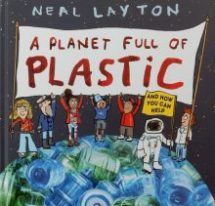
A Planet Full of Plastic

A Planet Full of Plastic
Neal Layton
Wren & Rook

Neal Layton has created an absolutely superb information book on a topic that’s on many people’s minds at present.

Right away he addresses the reader with ‘Quick question: do you ever think about what things are made of? ’ and goes on to mention other materials such as metal, wood, glass and paper before focussing in on plastic; plastic in all its shapes, colours and sizes.

We learn about the discovery of the material by chemist Mr Baekeland and how rapidly it became enthusiastically used in pretty much anything you might think of.

Plastic in the places it should be is all well and good, but the trouble is it doesn’t biodegrade and therein lies the problem. (Neal explains what this means with two sequences of strip pictures)

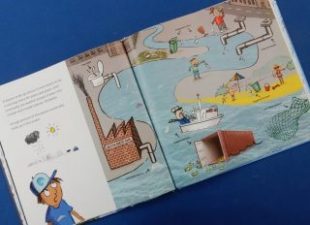
What eventually happens is that much of this plastic finds its way into our oceans

where it creates big problems for the marine animals as well as forming massive garbage patches in the Atlantic, Pacific and Indian Oceans, especially in the form of toxic microplastic particles.

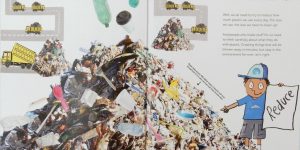
All of us need to cut down on our use of plastic, especially that used only once,  is what we’re powerfully reminded here …

Neal’s narrative style is perfectly pitched for the intended audience – there’s not a scrap of preachiness about it – and his mixed media illustrations are a powerful reminder of the ubiquitous problems of plastic waste.

Children and young people care deeply about the environment as they’ve already demonstrated and the book concludes with a ‘How you can help section’.

If the government is really serious about the environment, and in particular the terrible effects of throwaway plastic, then perhaps they should fund a copy of this timely book for all primary schools and nurseries.

Flock

Flock
Gemma Koomen
Frances Lincoln Children’s Books

This is the latest in the Frances Lincoln First Editions series of debut picture books and introduces readers to thumb-sized people called the Treekeepers, and in particular one named Sylvia.

Sylvia is something of a loner and despite her role as a nurturer and mender, gatherer and tender, she is almost unnoticeable as she goes about searching for just the right twig or petal to take back to her special secret tree hollow to use in her play.

One spring day, a very windy one, Sylvia discovers a bird in her special hideaway and she decides to look after it. She names it Scruff and soon the creature has found its way into her affections.

She even wants to fly like Scruff and so mustering her courage, Sylvia holds on tightly as the two soar skywards on a journey of discovery.

They spend the day together exploring and encountering new things until as the light fades, Scruff suddenly takes to the wing again

for he’s spied a flock of birds looking just like him. Scruff is lost no longer.

Scruff and Sylvia return to the secret tree hole but Sylvia knows she must bid her new friend farewell.

That though isn’t the end of the story: rather it’s the start of a new chapter, for soon afterwards Sylvia accepts the invitation of another girl keeper to join her and her friends in their play; and as you would expect they love to hear her stories of her adventure in the sky.

Seemingly, Sylvia will never be a loner again.

Wonderfully whimsical and with a slightly Scandinavian feel, Gemma Koomen’s story is enchanting. I love discovering new authors and illustrators so was thrilled to receive a copy of this book. The wildlife details are a delight, making every spread something to become immersed in and I’m sure I’ll be discovering new quirky Tree Keeper activities on each re-reading. It’s certainly the case so far and I’m sure young listeners will want to spend ages pouring over the pages too.

‘A tree keeper adventure’ announces the cover so let’s hope further adventures are to come.

No Longer Alone

No Longer Alone
Joseph Coelho and Robyn Wilson-Owen
Egmont

My heart really went out to the so-called shy, quiet little girl narrator of this beautiful story.
Actually however, those who’ve called her either of these are wrong; it’s just that due to events that have gone before she just doesn’t feel like talking or being noisy.

Nor does she feel like running around in the park with her siblings;

instead she wants to be alone, even though her loving, understanding Dad encourages her to try and find the “old you, the get-up-and-go you. The loud –and-active you, the happy you, the you, you used to be,”

Dad’s comments open the floodgates  for an outpouring of feelings as his little daughter opens up about the things that worry her, upset her and make her feel alone.

As the two sit together something shifts inside our narrator and things begin to feel a bit different.

Then slowly, slowly she finds that she can be that chatty self with others as well as when she’s alone; and she can play with her sisters again, sharing feelings and imaginings, alone no more.

Joseph’s beautiful heartfelt, poetic telling is full of poignancy and Robyn Wilson-Owen captures the inherent turmoil and tenderness in the tale with her beautifully textured illustrations of a family whose loss is palpable.

Umbrella

Umbrella
Elena Arevalo Melville
Scallywag Press

Imagine a world where everyone is kind and forgiving, and where anything is possible. How wonderful would that be. That is the world Elena Arevalo Melville creates in this uplifting story that begins one morning with Clara without anybody to play with in the park.

But then she comes upon an umbrella, albeit somewhat worn, but Clara picks it up and places it gently on a bench close by. To her surprise the umbrella thanks her and goes on to say, “Look inside me. Anything is possible!”

And so it is, for when she opens it up she finds herself face to face with a splendid playmate. Now for Clara at least, the park is quite simply perfect as it had been to near neighbour, old Mr Roberts when he was a boy.

But from his wheel chair he can only look up towards those tasty-looking apples in the tree and think, ‘if only’. Not for long though for Clara is there telling him ‘anything is possible’, with the umbrella urging him, “Look inside me.”

Before long, not only has Mr Roberts got an umbrella full of the yummy fruit, but he’s asking his helper to pick enough for everyone.

And so it goes on until the park is alive with magic and music courtesy of the butterfly band. Everyone joins the dance

except one rather unsavoury character watching from the side with his eyes firmly on that umbrella; a foxy gentleman with only one thing in mind – a very selfish thing.

Can that umbrella work its own special magic yet again and perhaps enable a state of perfection to pervade the entire park?

Debut author/illustrator Elena Arevalo Melville’s use of a minimal colour palette until the penultimate spread serves to make that illustration all the more perfect too. Her somewhat surreal tale of empathy, kindness and community is one to share and discuss at every opportunity.

Then I’d suggest asking listeners to make their own wishes. Perhaps they could write them down and drop them into a partially open umbrella safely secured in a strategic spot.

The Moosic Makers / The Pirate Who Lost His Name

The Moosic Makers
Heather Pindar and Barbara Bakos
Maverick Publishing

Farmer Joni loves the ‘MOO-grass’ music her cows Celery and Nutmeg create, although the other animals are less enthusiastic wanting instead mandolins and singing lessons.

But when a wild storm rips the roof from Joni’s barn all the animals are ready to pitch in and raise money for a new one.
While the cows busk, Billy and Esme hold the hat. They’ve only managed to get three coins when a snappy dresser calling himself Georgie Smarm rocks up offering to make them rich and famous so long as they take up DisCOW instead of their MOO-grass music.

Leave it all to us, the cows tell Esme and Billy as they send them back to the farm and embark on their new career.

DisCOW music as delivered by Nutmeg and Celery is a huge success and they play to packed houses.

What of that fortune they’ve been promised? It seems Smarm is nothing but an exploiter who has no intention of handing over the money they’ve earned.

After almost thirty performances the two conclude it’s time to go  home and they return without a single coin.

Undaunted and determined to raise the money for the new roof, the cows decide to do it their way and so, with the help of Billy and Esme, a brand new kind of music festival is announced.

Will the animals raise sufficient funds for the much-needed repair to that barn? What do you think?

Full of MOO-puns and craziness, Heather and Barbara’s teamwork has created a satisfying tale of determination and cooperation that will be a hit with young listeners.

The Pirate Who Lost His Name
Lou Treleaven and Genie Espinosa
Maverick Publishing

Lou Treleaven and Genie Espinosa’s take on the seemingly ever-popular pirate tale features a very forgetful piratical character.

So bad is his memory that, despite having all the other necessary pirate requirements, he’s forgotten his own name.

His pirate pals all have suitable names but the nameless pirate is too embarrassed to ask them for help so instead he sets out on a quest to find his name. The journey takes him to several possible memory-jogging locations but neither the Captain Dreamboat’s residence, nor Captain Anorak’s Collector’s Cave can help; not even Pirate Lop-It-Off’s barber shop yields what he needs.

Our nameless pirate despairs. Then his parrot lets him know he’s hungry so they stop and buy some seed at Pirate Duff’s on the way home.

There the name forgetter learns that on his previous visit, he’d left behind his pirate membership card; I wonder what he might find written thereon?

That isn’t quite the end of Lou’s rollicking tale but let’s not spoil the surprise throwaway finale, which will likely make young listeners squawk with delight. They’ll also delight in Genie Espinosa’s zany, larger than life characters executed with a super-bright colour palette.

Ella May Does It Her Way!

Ella May Does It Her Way!
Mick Jackson and Andrea Stegmaier
Words & Pictures

Let me introduce young Ella May; she’s a little girl who lives on a boat and knows what she wants and how she’s going to do it. Good on you Ella May, you’re not about to let anyone push you around.

One day, Ella’s Mum gives her something new to eat saying, “It’s good to try new things.”

The idea appeals to Ella and so later in the park she decides to try walking backwards and having pretty much got the hang of that, she does a whole lot of other things backwards too.

Despite her Mum hoping she’ll soon tire of the backwards notion, it’s not long before Ella has got her Mum as well as pretty much everyone else in the neighbourhood joining the backwards walking parade through the town.

Having harnessed their enthusiasm though, Ella decides enough is enough with walking backwards; but being Ella she’s not going to revert to a normal way of moving around. After all there are plenty of other ways and as she says in parting, “It’s good to try new things!” And so it is.

Billed as the first of a series, I look forward to seeing more of Mike Jackson’s determined character in further funny episodes. Andrea Stegmaier’s illustrations are an equal delight: I love her colour palette, her portrayal of Ella, her Mum and the bit part players, all of whom contribute to the splendid scenes of purpose and tenacity the Ella May way. Long may young Ella continue.

I, Pod / Don’t Eat Pete!

I, Pod
Rebecca Lisle and Richard Watson
Maverick Publishing

Little stone age boy, Pod returns for another adventure and it’s certainly action-packed despite beginning when little Nim’s mum assigns him the role of babysitter.

Determined to get the infant to say his name, Pod repeats it over and over but the baby comes up with plenty of close alternatives until when she says “Poo!” Pod decides it’s time to do something else.

With Little Mammoth’s help, he constructs a swing, sits Nim on and starts pushing – rather too enthusiastically …

… sending the babe right into the river.

Fortunately for both of them the river is fast moving and little Nim, a quick thinker for she saves herself with one deft move after another as a green snapper, a sabre-toothed tiger

and a huge eagle attempt to make her their next meal.

She’s not safe yet though for her craft is heading towards the waterfall. Happily Little Mammoth is also close by and his accidental action saves the day.

Pod is able to scoop up Nim forthwith and none the worse for her adventure, albeit rather wet.

Can Pod talk himself out of this one when they return home to find Nim’s mum already waiting for them?

Pod fans will thoroughly enjoy his latest, fun-filled book and he’ll likely the win a lot more enthusiasts thanks to Rebecca and Richard’s latest verbal and visual accounts of his exploits.

It’s not baby-sitting but puppy-sitting that provides the action in:

Don’t Eat Pete!
Sue Walker and Carlo Beranek
Maverick Publishing

It’s Moll’s Uncle Boll who is given the task of minding puppy Pete when she goes off to work having first ensured there’s plenty to eat and said quite forcefully, “DON’T EAT PETE!’ As if … comes the assurance.

But then Uncle Boll starts to consider the cute little furry bundle and the more he interacts with Pete, the more tempted he feels.

He diverts himself with biscuits followed by a tasty bacon snack but still, despite the reminder notice

and scoffing the entire meal, the greedy troll is still salivating.

Poor Pete in the meantime is becoming increasingly hungry and he eagerly anticipates what Moll will bring home to satisfy his now enormous appetite.

But can he manage to wait until her return to fill his rumbly tum?

With debut author Sue Walker’s droll rhyming narrative and Carlo Beranek’s deliciously expressive illustrations, this is a tasty book to share with little ones either at home or in an early years setting. They’ll certainly relish the final surprise twist in the tale.

Cloud Forest

Cloud Forest
Victoria Turnbull
Frances Lincoln Children’s Books

This is an absolutely beautiful, gentle but powerful story of love and of loss.

Umpa’s garden is the young child narrator’s favourite place, filled as it is with flowers and fruit trees. Umpa shows his grandchild how to plant seeds and watch them grow. He also plants stories in her mind, stories of imagined worlds – wonderful new places they can travel to together; places that, fuelled by the imagination can stay with you forever.

Time passes; Umpa grows older

and eventually he dies.

His distraught grandchild grieves, “The clouds had swallowed me whole’ she tells us.

Then one day, she remembers: his legacy lives on …

and he will always be there in her heart and in her memories of those treasured experiences they shared together.

Books and stories have transformative powers: Victoria’s new book is a wonderful reminder of that, showing some of the myriad ways those powers can help to heal, to bond people together, as well as to fuel the imagination. The softness of the story is evoked in her beautiful pastel colour palette, her graceful lines and the fluidity of her images. Do spend time on every spread; there is so much to see and feel.

A book to share and to cherish.

Look Up!

Look Up!
Nathan Bryon and Dapo Adeola
Puffin

Young Rocket, the narrator of the story and an aspiring astronaut is for ever looking upwards; her head’s ‘always floating in the clouds’ her mother tells her.

Inspired by Mae Jemison, the first African-American woman in space, the little girl has two missions, the longer term space-travelling one and one much more immediate.

She is determined to get her older brother Jamal who is charged with taking her to the park to see the meteor shower, to stop staring at his mobile and direct his gaze upwards to view the spectacle.

He though, isn’t the only one of the town’s screen-obsessed characters; but despite this, Rocket wants everyone to join her in viewing the phoenix meteor shower that night at the park.
As she prepares, the girl shares with readers facts about the cause of meteor showers, the size and composition of meteors and when best to view a shower.

As portrayed in Dapo Adeola’s splendid digital illustrations, the main character is a real personality sporting funky star-stud earrings, orange space suit, and so excited about the prospect of the meteor shower that she is able to enthuse the entire neighbourhood – even finally her brother; while Nathan Byron’s story interweaves Rocket’s enthusiasm for all things space with the tension within her family fuelled by the sibling relations.

But will the townsfolk ever get to see that promised spectacle? It’s certainly a long wait …

A wonderfully uplifting celebration of STEM, especially space topics, as well as a timely reminder that setting aside screens facilitates one’s reaching for the stars and achieving one’s ambitions.

I Have an Idea!

I Have an Idea!
Hervé Tullet
Chronicle Books

Is there perhaps a science of ideas? Or a special skill for finding them?

If so, genius finder of ideas Hervé Tullet could be the right person to demonstrate it and he certainly provides a great way to show young readers the elements, and how they might work.

The whole thing starts, so Tullet says with a single moment …

and he then goes through the entire process – looking and keeping on looking till you get beyond the nothing, the boredom or blind alley and suddenly there it is – something new.

‘It’s a little like finding a seed, …’ we learn …

Sometimes though, ideas are messy, bubbly and require time to work, so here’s what to do …

until there emerges that ‘good idea!’ And it contains ‘a seed of madness.’

Cultivation is crucial; but ideas are to be found all over the world, what’s needed is curiosity, looking, listening, touching, tasting, smelling, learning …

What though is the purpose of all this collecting of information and idea cultivation? Is it truly worthwhile? Tullet enlightens readers with possibilities “just for the fun of it’ perhaps or ‘to change the world’.

It is for sure, despite the challenges, a worthwhile endeavour no matter which you decide for rest assured if you look, you will, eventually find. Hurrah! Tullet shows this by scattering small red, blue and yellow ideas among the frenetic black lines of the world, there for those prepared to look closely, ready to grow into something bright and beautiful.

Play, have fun, seek and … find: then treasure your ideas. That’s the message one hopes youngsters will take from this book.
It’s also a message that teachers need to take notice of in their often unrealistic expectations of even quite young children in this results driven educational climate.

Joy / Harris Finds His Feet

Joy
Yasmeen Ismail and Jenni Desmond
Walker Books

A little grey and black kitty is in effervescent mood as she goes ‘Bounce bounce, ding-a-ling, ring ring, let’s sing! And who can resist her invitation as the happy creature plays with her favourite toy

and then in her glee, narrowly avoiding a large canine in front of her, uh-oh, down she tumbles ‘trip, trip, slip, flop and …

Happily however, there’s a parent not far away ready with a little hug, a kiss, a squeeze and a quick check the little kitty is okay after a bit of a tumble.

What a wonderfully upbeat, rhythmic text to read aloud is this one from Yasmeen and unusually, she hasn’t done the illustrations. Jenni Desmond did those and they’re equally joyful and brilliantly expressive; the two together have created a smashing book to share with your little ones.

And for those interested in developing young children’s sound/symbol awareness, this picture book is in an entirely different league from those specifically designed for that purpose.

Harris Finds His Feet
Catherine Rayner
Little Tiger

I adored this book when it first came out over ten years ago so was thrilled to get this board book edition to share with even younger little ones.

Meet Harris a small, very large footed hare. One day he asks his grandfather, “Why do I have such large feet, Grandad?”

Smiling, Grandad explains he and all other hares have big feet and goes on to demonstrate the benefits of same.

Together they spend time hopping, springing and mountain climbing with Harris copying his expert grandparent until he has mastered each skill.

They explore the world creating resting places as well as being active with Harris learning more every day …

until Grandad decides Harris is ready.

Then he explains gently that it’s time for Harris to discover more about the big wide world for himself and that is what the now stronger, bigger young hare does by using all the skills his Grandad has helped him to learn.

Every spread of this book is pure pleasure, as the little hare bounds gleefully across Kate Greenaway medal winning Catherine Rayner’s wonderful watercolour-washed spreads, pausing sometimes for discussions on his journey towards independence.

A must have addition to your board book collection.