The Stuff between the Stars / Get Up, Elizabeth!

The Stuff Between the Stars
Sandra Nickel and Aimée Sicuro
Abrams Books for Young Readers

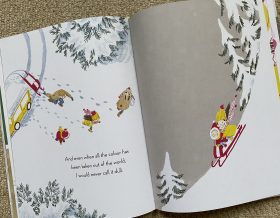
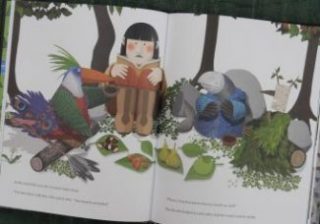
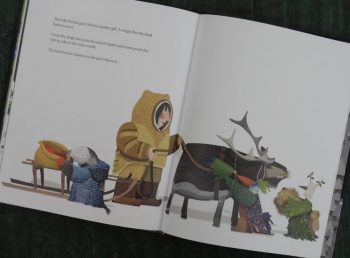
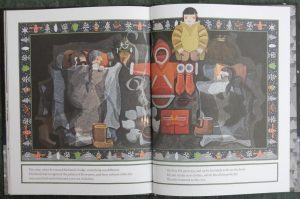
This is an inspiring picture book biography of brilliant astrophysicist Vera Rubin, from the time when she was a star-gazing eleven year old who, despite opposition and ridicule

and being ignored during much of her lifetime, became, thanks to her dedication and an opportunity at the Carnegie Institution, a recognised and leading light in the field of astronomy. For it was while working at one of the Institution’s observatories that Rubin made her seminal discovery that “dark matter” explains the phenomenon that stars on the edges of the galaxy move as quickly as those at the centre—and that this dark matter makes up 80 per cent of the matter in the universe.

I love the Rubin quote at the end of the story,: ‘Each one of you can change the world, / for you are made of star stuff, / and you are connected to the universe.’

If the main body of this hugely engaging book hasn’t inspired youngsters, those words surely will. So too will Aimée Sicuro’s gorgeous watercolour, ink and charcoal illustrations that cleverly reflect Rubin’s spiralling ideas in this well researched, enormously engaging account.

An author’s note on Vera, a timeline of her life and a select bibliography conclude the book. It’s one I’d strongly recommend for primary age readers.

Get Up, Elizabeth!
Shirin Yim Bridges and Alea Marley
Cameron Books

The Elizabeth of this rhyming narrative is in fact, the child who later became Queen Elizabeth 1 of England.
It’s her morning routine we share as we hear her being roused from her slumbers. She’s then ordered by the rather impatient-sounding lady-in-waiting to submit to donning her smock, having her stockings laced, her face scrubbed and her teeth rubbed (with soot no less!). All this she tolerates with a degree of meekness but then having been laced into a petticoat,
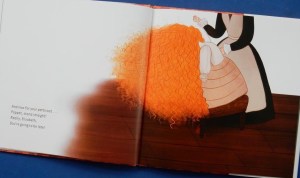
and acquiesced to sleeve pinning, the young miss attempts to assert herself by stashing a mouse in her skirt. It’s no go though; and with her ruff duly stitched in place, there’s still that mop of unruly hair to be tackled.
Finally, she’s set to go and we watch as she stands, still seemingly meekly, before a throng of waiting subjects.

Shirin Yim Bridges’ rhyming narrative falters slightly on occasion during this chivvying regime and in this small slice of history, it’s Alea Marley’s visuals of the shock-headed miss with her radiant tresses that are the real show stoppers.

There’s a final page giving some extra details on Elizabethan fashion and routine ablutions, as well as a cheeky message from that mouse asking ‘Did you find me on all the pages?’ which adds a search-and-find element to the book. It certainly takes a bit of finding on one or two spreads.

Where is the Dragon?

Where is the Dragon?
Leo Timmers
Gecko Press

Oh dear me! The king is having dreadful dragon nightmares, so much so that he’s scared to got to bed. He dispatches his three trusty knights, One, Two and Three out into the dark night to save the realm, and more crucially, him.

The three have a slight problem however, they’ve never actually set eyes on a dragon, although the king has given them a few clues as to what such a creature might be like. As they venture forth Knight One and Knight Two take turns to share snippets of information, each of which seemingly appears in shadowy form. Then when Knight Three (the small one) illuminates the scene, something completely other is revealed. In the first instance it’s a harmless group of long-eared rabbits munching on carrots.

However Knight Two then drops in ‘Well the king alleged their teeth aren’t used for fruit and veg!”

but again Knight Three shines his trusty candle.

Knight One’s third comment talks of long necks and flaring nostrils as they approach another dark dragon-like form, and so it continues with each silhouette being a close fit for the king’s description and the revelation being something innocuous and wonderfully daft.

What about the last shape though? Following another tumble, all three knights are ready to return and inform his highness that there’s no such thing as dragons.

No cause for alarm at all. But are they correct? I wonder …

Translated from the original Dutch by James Brown, the rhyming text has an occasional blip, but for me it’s the illustrations with the superb characters, skillful use of dark and light, clever details (small and large), textures and rich colour palette, that are the real show stealers. Zimmers has a wacky sense of humour that is evident at every page turn, especially the final one.

Little ones will relish this as a storytime read aloud, delighting both in guessing and knowing. Ensure you give your audience time to look closely at the revelatory spreads so they can appreciate Zimmers’ transformations of the imagined into the real.

Gaspard’s Foxtrot

Gaspard’s Foxtrot
Zeb Soanes and James Mayhew
Graffeg

Gaspard the Fox returns for a third adventure and it’s a totally unexpected one.

While chatting to his friends Peter the cat and Flinty the dog he learns from the latter that his owner Honey is taking him to a concert ‘about London’s wildlife’ in Hyde Park that very evening and suggests that Gaspard should come along.
So when Honey and Flinty head for the number 38 bus-stop Gaspard tags along behind.

As Honey boards the bus she drops her scarf. Gaspard catches it and jumps aboard intending to return it when they get off.
Then follows a journey through London – we’re given the fox’s eye view in James Mayhew’s exquisite illustrations- that takes them through Islington with its iconic war memorial,

past China Town, into the heart of theatre land, passing Piccadilly with its famous statue, all the while the recorded voice announcing where they are. Suddenly he hears “Hyde Park Corner’ and off pile the passengers. In the crowd, Gaspard almost loses sight of Honey and Flinty but just in time he makes his exit and follows the masses to the centre of the park

where he finds a suitable spot to stop, wait, hope and listen to the music.

Onto the stage walks a man Gaspard recognises as living close to his den and he’s holding what looks like a white stick. He tells the audience that the next piece of music is so new it’s yet to have a title.

What happens thereafter is truly amazing, but I won’t spoil this eventful, gently humorous story at the heart of which is friendship.

It’s full of lovely details about nature, London (Peter talking of his peregrinations makes me miss it all the more at present) and of course, the music; the map endpapers are terrific too.

How exciting to learn that the story has been adapted by composer Jonathan Dove and is due to be performed with Zeb narrating and James as illustrator.

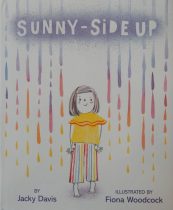
Sunny-Side Up

Sunny-Side Up
Jacky Davis and Fiona Woodcock
Harper Collins (Harper 360)

The little girl protagonist always looks on the bright side of life, but after breakfast (sunnyside-up eggs) when the blind is lifted to reveal a grey rainy day, her reaction is to throw a tantrum at the prospect of being stuck indoors all day – perish the thought.
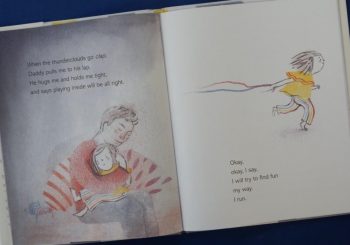
After a mollifying hug from dad

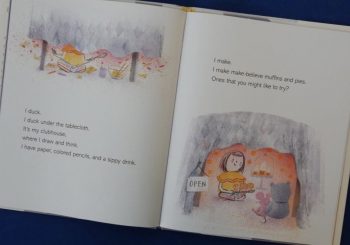
she decides to make the best of things with imaginative play, block building and some creative pursuits; she even opens a cafe for her soft toys serving muffins and pies.

And all the while the rain ‘drip, drip drops’. Lunch follows and then another paddy, again placated by dad following which the girl agrees to have a rest.

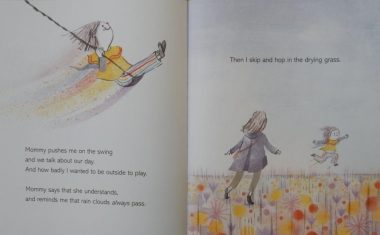
By the time Mum comes home, thanks to some painting and lots of calming reading, her daughter’s inner sunshine has returned just in time for the clouds to part and reveal something bright peeking through the clouds. At last, with the rain gone mother and child visit the park for some fresh air and a reminder ‘that rainclouds always pass.”

Jacky Davis’ first person rhyming narration conveys the little girl’s desire to be in control and find her own way through a difficult day ‘I found fun inside when it was grey’ she tells us as she snuggles down in bed after stories and warm milk.

Equally perfectly, Fiona Woodcock’s mixed media spattered illustrations executed in warm pastel shades portray to perfection the changes in the protagonist’s mood, as well as her irrepressible energy both indoors and out. 

Ideal for sharing with little ones and not just on rainy days.

The Perfect Fit

The Perfect Fit
Naomi Jones and James Jones
Oxford Children’s Books

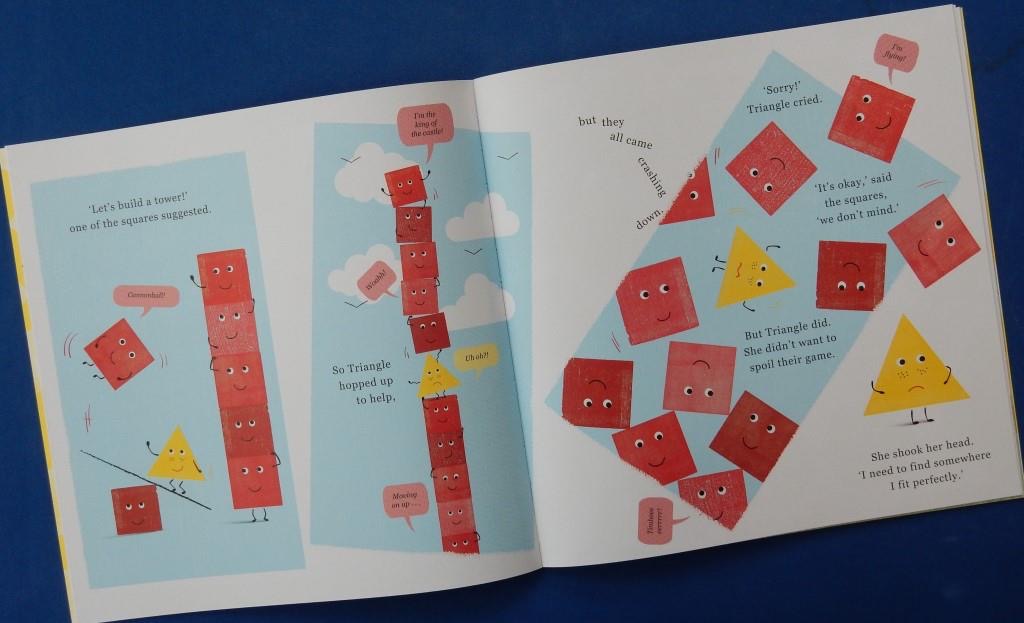
This is a story about what happens when a triangle that feels different among the circles decides to embark on a journey to find a community wherein she feels she belongs.

The squares are welcoming and invite the newcomer to play with them. With high hopes she joins in their building but then despite encouraging comments from her fellow builders, Triangle feels she must move on …

The hexagons are similarly accommodating though still Triangle worries about being different and continues her search. Increasingly despondent she begins to feel that perhaps she’s the only triangle there is, but then a star speaks and hope returns. On goes the search till finally there before her …

However there are limits to the games that triangles can play – no rolling for instance. Triangle remembers the fun she had with all those other shapes and …

A smashing celebration of difference and diversity showing that to fit in, doesn’t mean you have to be like everyone else: a variety of experience leads to a richer community. Life is much more enjoyable when people welcome those who are different, enabling everyone to feel comfortable about themselves. The key is to go beyond the confines of your perceived identity.

This seemingly simple story inspired by author Naomi and illustrator James son’s struggle to fit in when he started nursery, is a perfect foundation stage book for fostering personal, social and emotional development. It’s also rich in mathematical potential.

How Do You Make a Rainbow? / Finney’s Story

Positivity shines through in both these recent picture books:

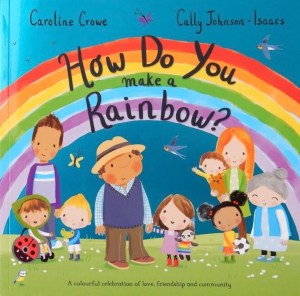
How Do You Make a Rainbow?
Caroline Crowe and Cally Johnson-Isaacs
Macmillan Children’s Books

Rainbows have always been symbols of hope but during the last year have come to symbolise not only that hope of better things to come, but also our appreciation of NHS staff and other key workers with children everywhere creating their own rainbows to say thank you.

This book starts with a little girl and her grandad looking out on a grey rainy world and the child asking for his help to create a cheering up the sky rainbow. Rather than offering a scientific answer, Grandad explains that rainbows aren’t really painted; rather they’re created from kindness and hope, love and thinking of others.

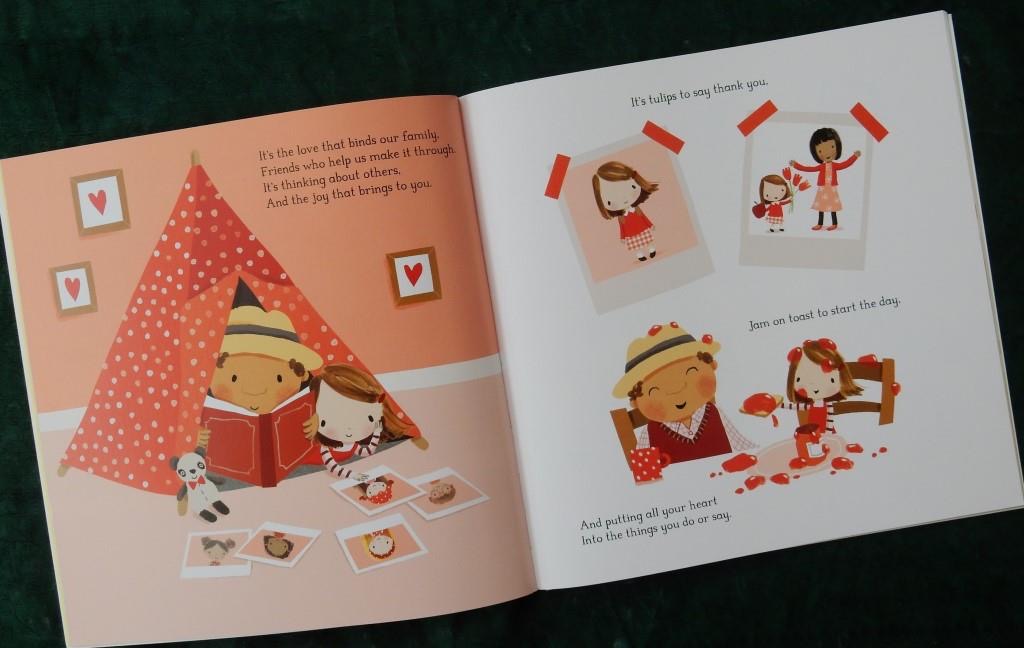
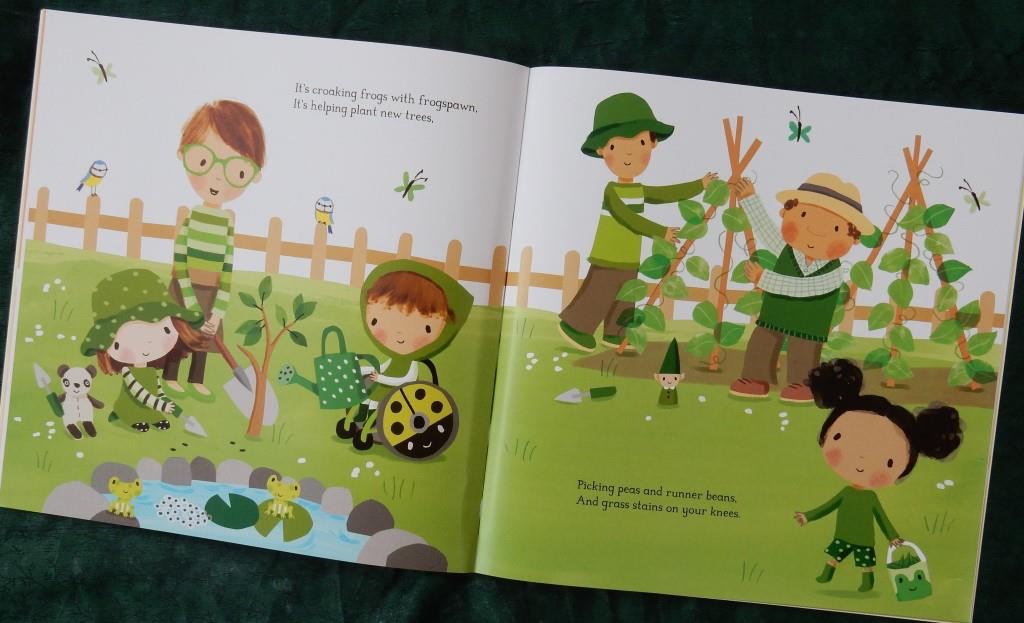
Then, taking one colour at a time,

he goes on to give examples of small, everyday things that bring and give cheer both to others and ourselves.
Told in Caroline’s jaunty rhyme and through Cally’s playful, vibrant illustrations that exude positivity and kindness,

this is a hugely heartwarming book (with two final spreads of activities), for sharing both at home and in foundation stage settings. Definitely one to reach for if you’re feeling a bit down; it will surely act as a reminder of focusing on the positive things in life.

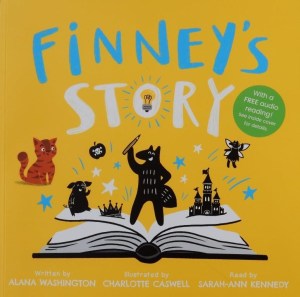
Finney’s Story
Alana Washington and Charlotte Caswell
UCLan Publishing

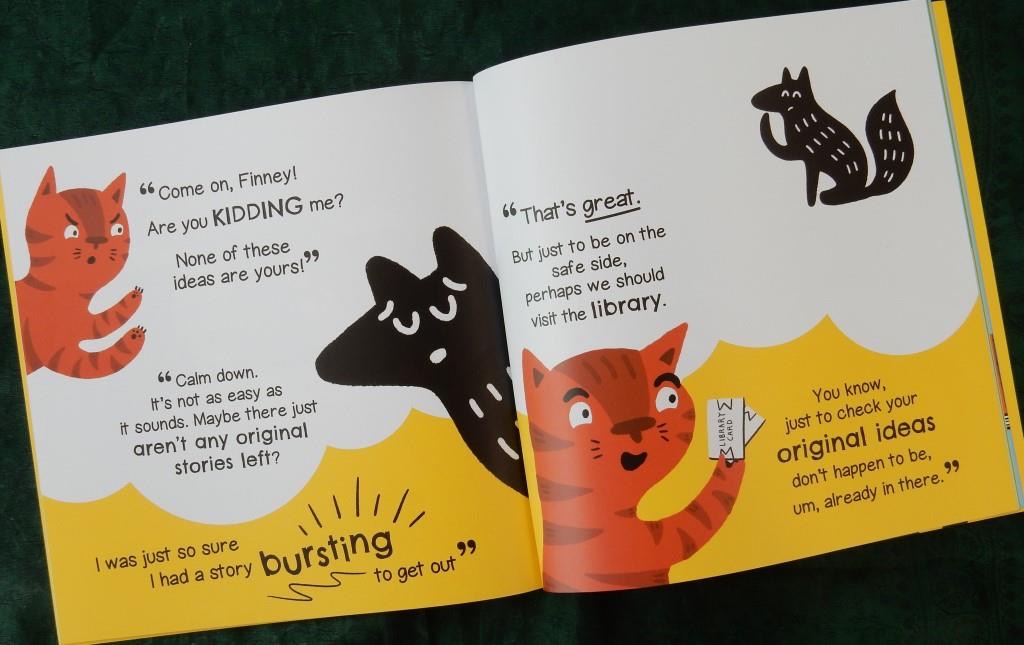
Finney the fox is an aspiring book author but he has a lot to learn about the whole process of authorship. Fortunately however, he has a moggy friend that is ready and willing to offer some helpful advice, or should that be, criticism. The trouble is, does Finney really have any ideas of the original kind,

let alone an understanding of what that word actually means.

Cat’s suggested visit to the library …

leaves him even more dispirited “All the original stories are gone,” he reports. Finney does notice something else however, something that might just be of assistance. But will this ‘ideas machine’ as he calls himself ever actually produce the goods?

Listeners will love being in the know with Cat as Finney puts forward his proposed storylines from traditional tales in this dialogue between the two friends. They’ll love too, Charlotte Caswell’s bold illustrations with their silhouettes depicting the fairytale characters Finney mentions in his story openers.

There’s a QR code inside the front cover which when scanned gives access to a free Sarah-Ann Kennedy audio reading of the book.

Eyes that Kiss in the Corners

Eyes that Kiss in the Corners
Joanna Ho and Dung Ho
Harper Collins

There’s a pleasing circularity about Joanna Ho’s lyrical tale of self awareness, family love and tradition that is narrated by an un-named schoolgirl.

At the start, having described the eyes of some of her schoolmates – ‘ like sapphire lagoons / with lashes like lace trim on ballgowns’ she says, ‘I have eyes that kiss in the corners and glow like warm tea. / My eyes are just like Mama’s.’
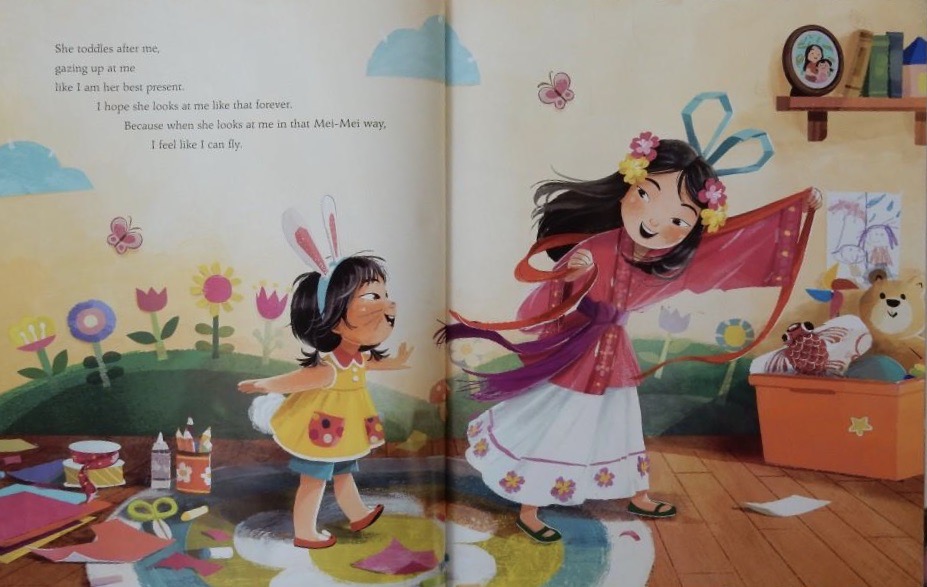
She then goes on to tell us that the other women in her family have similar eyes. Her Amah has eyes filled with stories; her younger sister Mei-Mei uses her eyes to watch at the window for the return of big sister from school when they can be together again.

We then share in the delights her own eyes discover. With Amah beside her she sees ‘Guanyin with the Money King / sitting on a lotus, serene, // baubles of lychee on trees, / and mountains that reach for the sea.’ … ‘I see kingdoms in  the clouds. ‘

Throughout, the vibrant digital illustrations of Dung Ho with their swirling patterns and beautiful flora, are strongly evocative of Chinese culture and stories; and there are some unmentioned additions such as the jade bangle worn by Amah.

(my mother had a similar one she bought in Hong Kong) and the upside-down Fu (happiness arriving) symbol on the front door.

A lovely celebration of being who and what you are, with an uplifting final statement ‘My eyes … are a revolution … They are me. And they are beautiful.’

Foundation stage classes often explore ‘myself’ and ‘family’ as part of the curriculum: this is a book to share as part of either topic.

Meet the Oceans

Meet the Oceans
Caryl Hart and Bethan Woollvin
Bloomsbury Children’s Books

Like Caryl and Bethan’s previous collaboration Meet the Planets, this one is both full of fun and informative. Speaking in rhyme, Caryl’s young narrator invites youngsters to participate in an underwater adventure to visit the seas and oceans of the world.

The first destination is the decidedly chilly Arctic Ocean that like the other marine locations tells us directly about itself, mentioning such things as giant jellyfish, narwhals, beluga whales and walruses, as well as polar bears that pad on the ice floes.

Next to introduce itself is the Atlantic – a huge ocean so we hear, full of undersea caves, subaquatic mountains and teeming with salmon and silver swordfish, while less easy to spot, swimming among the sea grass are occasional wild manatees.

If warm waters are more to your taste, then you might decide to have a longer float around the tropical islands of the Caribbean Sea. Beneath its surface you’ll encounter all kinds of wonderfully patterned fish, as well as myriads of starfish. We can’t spend too long counting them though, for six watery worlds remain to be seen.

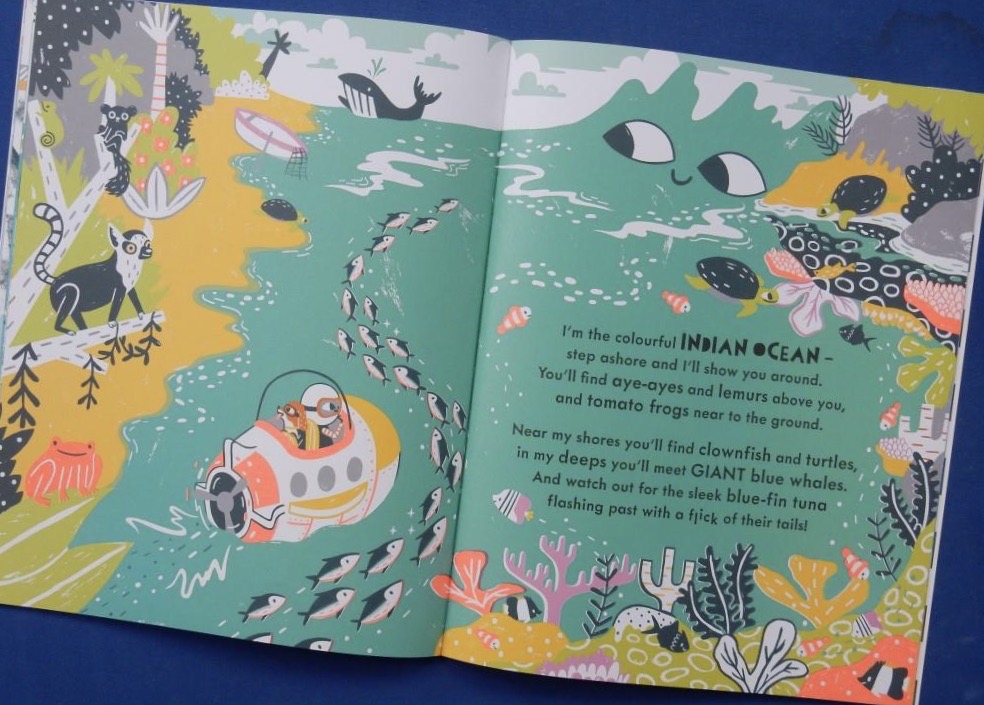
There’s the Pacific with its plastic pollution problem, the South China Sea with its plethora of ships and seabirds, the wonderful coral sea around the Great Barrier Reef, the Indian Ocean alive with gloriously coloured creatures waiting should you have time to step ashore …

before heading down to the Southern Ocean of the Antarctic. BRRR! Watch out for biting gales if you plan stopping at one of the research stations.

Much more frequently visited is the final watery wonder, the Mediterranean Sea: a great place for a spot of snorkelling as I recall.

With pops of day-glo colour Bethan’s distinctive visual style successfully personifies each of the watery worlds that Caryl has given voice to on this splooooshing, whooshing foray aboard a submarine.

Great for pre-bathtime sharing with youngsters as well as for foundation stage storytime sessions.

Alone!

Alone!
Barry Falls
Pavilion

Living in a little house atop a hill, young Billy McGill is a reclusive individual. “This is my hill, … I live here alone! Always have, always will” he asserts and so it is.

Down below the town is a bustle with traffic and people but none ever venture near Billy’s abode.
Sheltered within he barely hears a sound until the fateful day when he detects an unwelcome, indeed unacceptable, intruder …

It’s an occasion that calls for a visit to town to purchase a moggy that will chase the creature away and peace will be restored.

That’s not quite what happens however and before long Billy’s residence is accommodating a host of creatures large and small including a stripy one that develops a cold – so the vet informs Billy. She offers to knit the sneezer a warm fluffy coat but for that yarn is required. Hmm.
But although things go from bad to worse, to downright terrible, through all the trials and tribulations,

the up and downs, Billy McGill continues repeating his “This is my hill … “ litany.

Just when it seems the situation might be about to improve a terrific storm blows up whisking away an all important pacifier and Billy is almost at breaking point; but he’ll do pretty much anything to find peace and quiet, even embarking on a journey across land and sea, and scaling another high hill.

It’s there that as young Billy ponders on the possibility of solo living once more, something drifts into sight.

Now he’s faced with a decision – should he or should he not stay?

In addition to the pleasing circularity – almost – of the rhyming tale, there’s much to enjoy about this book. Barry Falls’ quirky illustrations are a wry delight as they depict the catastrophic concatenation of crazy events involving the growing cast of characters both animal and human.

Sunday Rain

Sunday Rain
Rosie J. Pova and Amariah Rauscher
Lantana Publishing

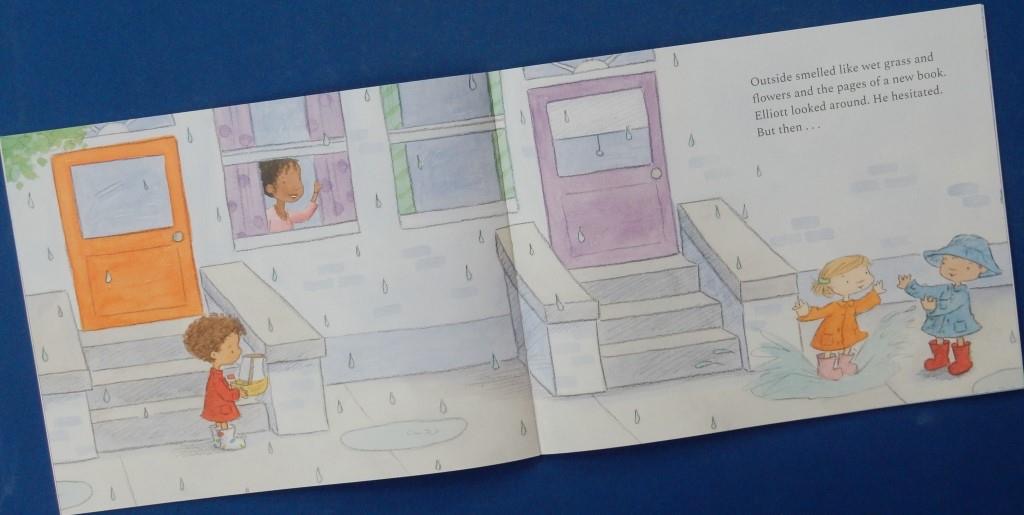
Recently moved, little Elliott is in his bedroom reading as the story opens. Hearing noises outside he gets up looks through the window at the coming storm, returns to the bed and continues reading about a little princess and her adventure, ‘ … the sea kept swallowing the royal boat as the night pushed the day down the horizon.’

Once the rain has stopped he returns to his window and sees other children outside enjoying playing in the puddles. Encouraged by his Mama – “Sunday rain is the most fun” – to venture out and make some new friends, Elliott takes his toy boat and sallies forth.

Then, drawing on the story in his book, he play-acts a scenario involving a little boat, a dragon and a princess that sail on the high seas and land on a desert island, an adventure the other children are only too happy to participate in.

Beautifully written and illustrated in watercolour and charcoal, this sweet story immediately draws readers in, immersing them in the sights, sounds and smells of the events – imagined and real: ‘Outside smelled like wet grass and flowers and the pages of a new book.’

With its themes of stepping out of your comfort zone, overcoming shyness and making new friends, it’s perfect for sharing in a family setting or foundation stage story time. Equally important is its celebration of books, reading and the power of the imagination.

Doctorsaurus / It’s So Quiet (A Not-Quite-Going-To-Bed Book)

Doctorsaurus
Emi-Lou May and Leire Martín
Little Tiger

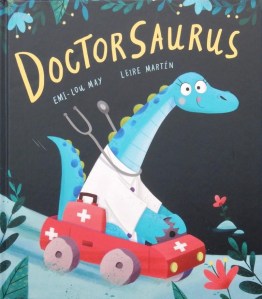
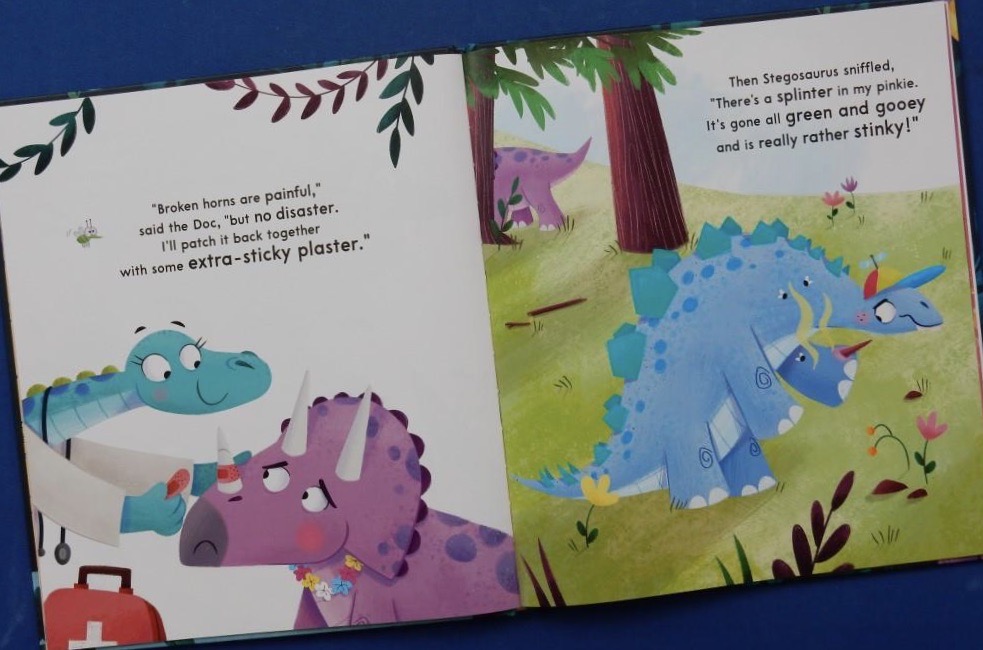
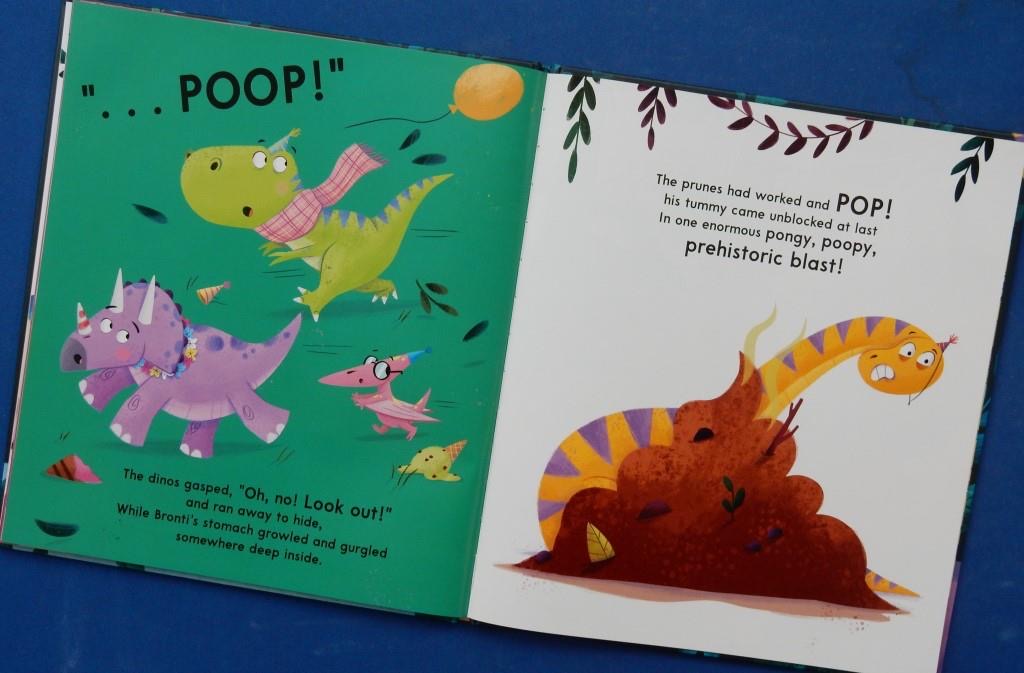
When Doctorsaurus is summoned to the aid of young Triceratops after a chasing accident, little does the Doc. know that it’s not just a broken horn she’ll need to treat when she arrives at the their picnic spot. Stegosaurus has a septic toe;

T-Rex is suffering from an allergic attack and is all stuffed up and as for Brontosaurus, a blocked belly is the problem there and Doctorsaurus has just the thing – a dose of prunes.

Having done the needful, Doctorsaurus receives an invitation to stay and partake of the picnic and while they’re all tucking in there comes an earth moving rumble from a certain direction. Those prunes have worked rather more effectively than anticipated.
Oh the relief!

Time for a boogie, with some special guests to join the party …

Dinosaurs never fail to amuse little ones and I have no doubt Emi-Lou May’s rollicking, prehistoric picnic flavoured with poo – another of youngsters’ favourite topics – will hit the mark in story time sessions.

Leire Martín’s dinosaur depictions are a comedic delight – suitably silly and hugely expressive.

It’s So Quiet (A Not-Quite-Going-To-Bed Book)
Sherri Duskey Rinker and Tony Fucile
Chronicle Books

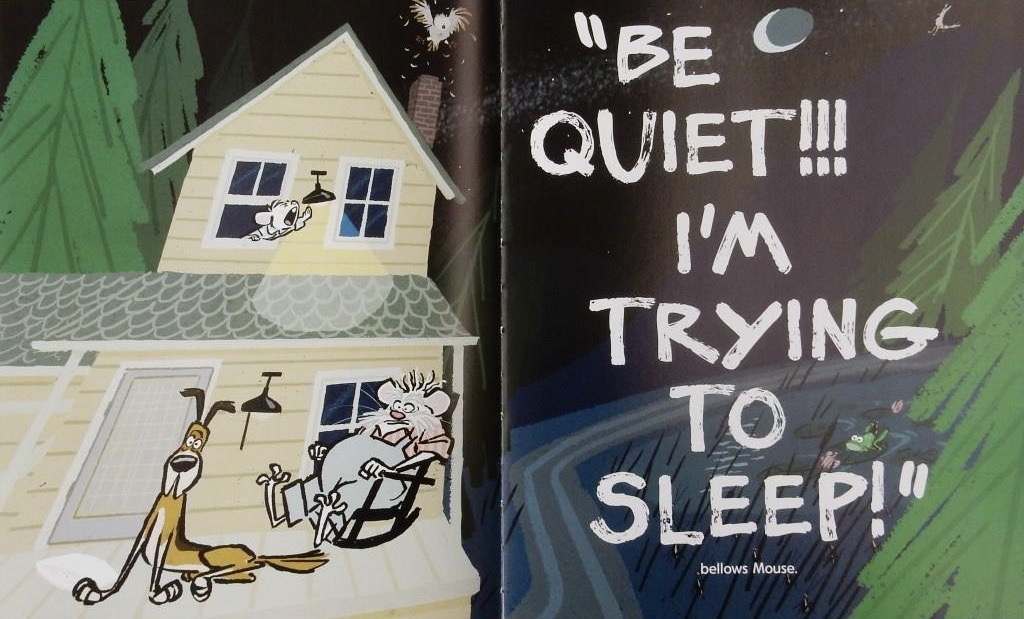
Subtitled A Not-Quite-Going-To-Bed Book, this could equally be dubbed ‘A Not-Quiet-Going-To-Bed Book for as soon as sleepy mama mouse has turned off the light and instructed her little (very sleepless) one to settle down, listen and allow the ‘small sweet sound of nighttime’ to whisper her offspring to slumberland, than a veritable outdoor symphony ensues. It begins relatively softly with the ‘crrr-oak’ of the bullfrog singing, the crickets chirp chirping and the dog’s tail tip-tapping. But this is soon joined by a veritable gamut of increasingly loud sounds both natural and otherwise causing the little mouse to get up, open the window and investigate.

As it reaches its crescendo, the, by this time sleep-deprived little mouse, gets out of bed again, re-opens the window and yells.

Peace is finally restored or … is it?

Guided by the increasing size of the print, little humans will relish joining in enthusiastically with all the onomatopoeic sound effects, as an equally enthusiastic adult sharer reads the rhyming narrative and shows the energetic nocturnal scenes.

I am a Fish / Birch Trees, Bluebells and other British Plants

I am a Fish
Isabel Otter and Fernando Martin
Little Tiger

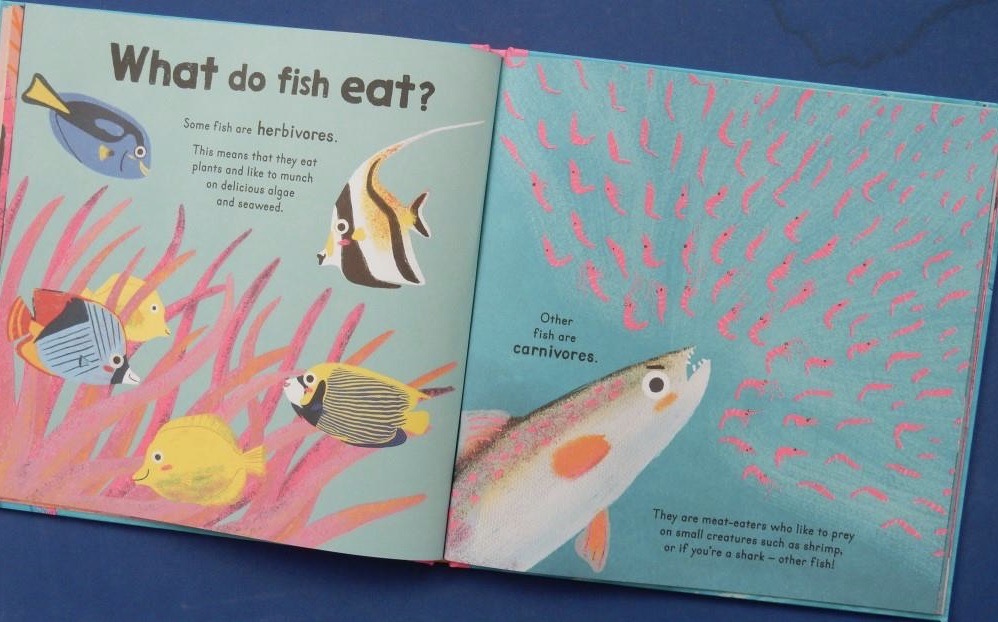
This is a companion volume to I am a Bird from the same team. Using an un-named fish, youngsters are introduced to the general characteristics of a fish and then dive underwater to discover a variety of aquatic habitats and learn something of fishes’ habits (we meet both herbivores and carnivores),

shapes, size and distinguishing features. Mention is made that ‘rays don’t have bones’ but that they and the sharks illustrated alongside, are cartilaginous fish is not stated.
If you’ve ever wondered whether or not fish sleep, this subject is discussed on another of the vibrant spreads while another spread introduces seahorses, which some little ones might be surprised to discover are actually classed as fish.
The chatty narrative and arresting subaquatic scenes make this a book for early years audiences and foundation stage topic boxes.

Birch Trees, Bluebells and other British Plants
Nikki Dyson
Nosy Crow

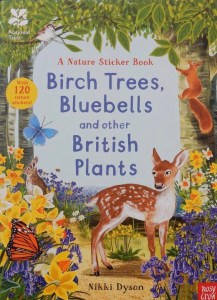
Here’s a gorgeous ‘Nature Sticker Books’ to lift the spirits. Published in collaboration with the National Trust, it contains eleven beautiful scenes by Nikki Dyson that are brimming over with the bounties of nature whatever the season.

It starts with spring and its gorgeous insect-attracting blossom and wild flowers aplenty. Summer scenes show gardens are full of bright flowers and butterflies, as well as meadows of poppies, daisies and other composites. Summer’s a good time to visit a pond or perhaps the coast: those locations too, have a wealth of beautiful wild plants and birds. Come autumn ripening berries are waiting to be gathered and the deciduous trees take on their yellow, orange and red hues while in gardens and allotments there are vegetables aplenty as well as herbs to pick and you’re likely to come across lots of minibeasts that also like to have a nibble.
Finally winter comes around when there is much less colour but there are still wonderful flora and fauna to discover when you brave those chills.

Each spread has a couple of introductory factual paragraphs as well as suggestions for adding some of the relevant stickers provided in the centre of the book. There’s also a checklist of the plants in the book so young naturalists can enjoy an additional I-spy element.

Chicken Little: The Real and Totally True Tale

Chicken Little: The Real and Totally True Tale
Sam Wedelich
Scholastic

From the outset Chicken Little insists that she’s a plucky creature, fearless in fact. Nonetheless, when a mysterious object falls from above, landing BONK! on her head, she is a tad perturbed. There must be a logical explanation: the sky can’t be falling surely. Determined to discover the truth, she climbs a ladder and interrogates said sky.

Along comes a hen and bemused by what Chicken Little is doing, misunderstands and rushes off to stir up her fellow farmyard fowls with the news, “The sky is falling! RUUUUUUUUUUUUUUUN!!!”

Back on the ground, Chicken Little is left accepting responsibility and proclaiming, “This is clucky chaos! Utter hen-demonium!” before proceeding to set matters straight about what really happened. This results in sympathetic clucking all round and some frantic fowl first aiding.

With a nod to Mo Willems, debuting picture book author Sam Wedelich delivers a fractured folk tale of the comedic kind. Its mix of straightforward commentary and deliciously dramatic speech makes for a hugely enjoyable, STEM-flavoured read aloud for both presenters and audiences.

The Song for Everyone

The Song for Everyone
Lucy Morris
Bloomsbury Children’s Books

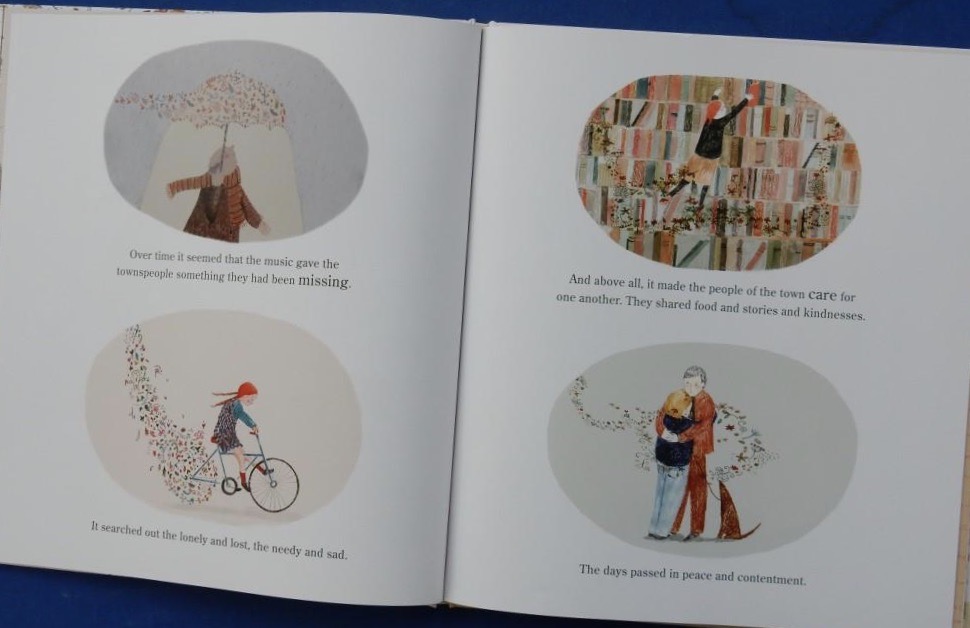
This story starts high up in a tiny window one morning when a sweet sound issues forth. A boy on his way to school stops to enjoy the music and in so doing his loneliness is forgotten. He though, isn’t the only one affected by the beauty of the tune: an old lady is enlivened and filled with joy,

and gradually as the music continues to float on its way, all the townsfolk receives something that has been missing from their lives. Most important though, is that they start to feel a sense of connectedness as they ‘share food, stories and kindness.’ It takes just one small thing to change an entire perspective.

Then one day unexpectedly, the music stops: total silence fills the town.

Dispirited, the townsfolk come together to discuss the absence of the magical music and the lonely schoolboy takes it upon himself to climb up to the window and investigate.

Two days pass and then joy of joys, a sweet sound drifts out through the window and once again the townsfolk are transported by the beauty of music flowing through the streets and through their lives : truly a song for everyone. And the identity of the singer? It’s revealed on the penultimate spread, but story spoiler I won’t be.

A gentle tribute to the power of music, of community and of loving kindness, all of which are more important than ever in our lives at the moment. Without actually using musical notation, Lucy Morris has created a wonderful representation of music as it flows across the pages and over the story’s characters on its transformative way through the town There’s lyricism too in the words Lucy has used in this lovely debut picture book.

When Jelly Had a Wobble / Ceri & Deri: Get Your Skates On

When Jelly Had a Wobble
Michelle Robinson and Tom Knight
Scholastic

Should you or should you not let others know how you are feeling? That dilemma lies at the heart of this story.

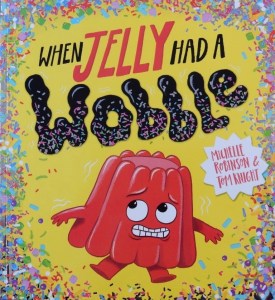
Jelly, the main protagonist definitely has some feelings of self-doubt he’s not eager to share when he’s expected to tag along with all the other dinners heading to the Kitchen Hall of Fame keen to discover which of their number will receive the golden crown for “Best in Show’. He’s the only one showing any reluctance to participate in this culinary extravaganza.

In fact he’s all of a wobble, unable to ‘take the tension’ despite the enthusiasm and determination of fellow foodies that he be there for the big announcement.

So determined are they that some are even ready to offer some calming techniques to help with his wibble-wobble nerves …

Imagine Jelly’s surprise then, when the announcement is made.

With its repeat ‘jelly on a plate’ refrain to join in with, and plenty of speech bubbles along the way, Michelle Robinson’s jolly rhyming narrative reads aloud well. Tom Knight’s foodie characters are a whacky lot with their googly eyes that clearly express how they’re feeling in his bright, funny scenes. The combination of words and pictures provides a taste bud tickling tale about being yourself to share with foundation stage children and little ones at home.

Ceri & Deri: Get Your Skates On
Max Low
Graffeg

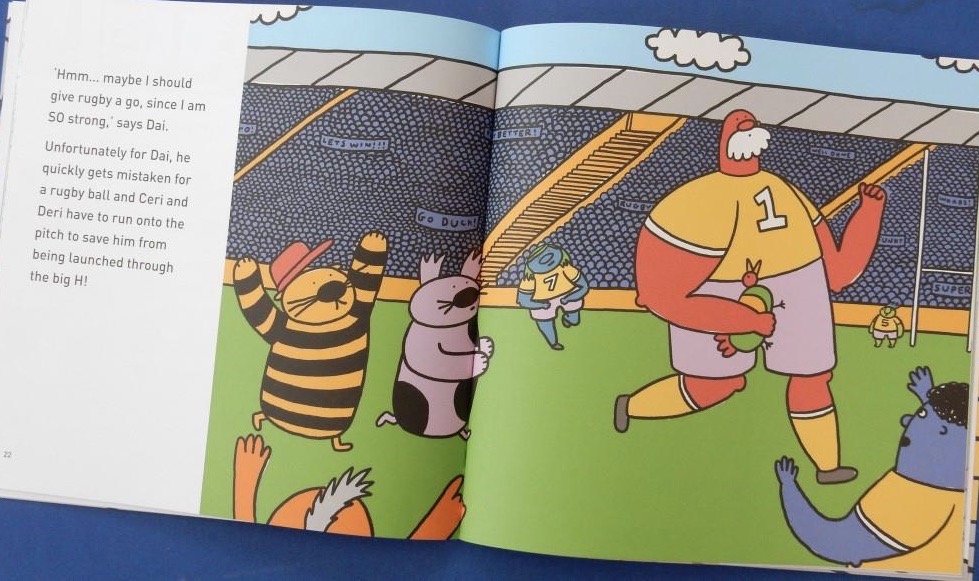
In the latest of Max Low’s gently educational series featuring striped moggy Ceri and her spotty pooch pal, Deri, the two help Dai Duck learn some important life lessons.

Dai is absolutely determined to be the best at anything and everything he tries and wants it to happen straightaway. So when he tries his hand (s), feet and brain at skateboarding, spelling, music making, DIY and rugby

and a host of other activities, the result is disaster. The trouble is Dai just isn’t prepared to put in all the hard work, perseverance and positive thinking that’s required when you want to be successful at something.

Until that is, Ceri and Deri step in and introduce him to Barbara Bear, ace skateboarder. She explains how her success is down to all the tumbles she’d taken as a learner acting not as a deterrent, but a motivation and an opportunity to spend time having fun with her friends. Can a similar attitude work for Dai? You bet …

The inherent humour and Max Low’s distinctive, bold illustrative style make for another enjoyable Ceri and Deri experience.

The Lipstick

The Lipstick
Laura Dockrill and Maria Karipidou
Walker Books

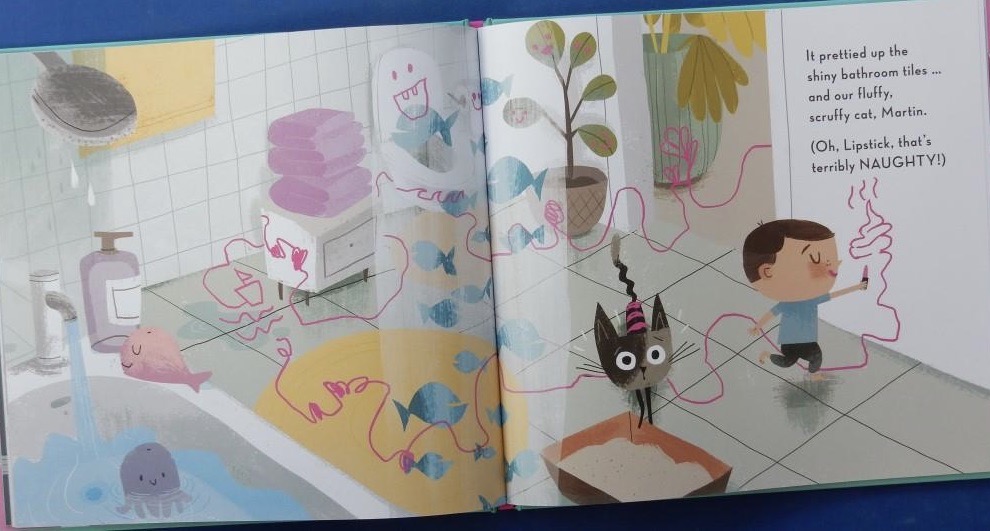
This is a hugely entertaining story of what happens when the small child protagonist gets hold of one of Mum’s lipsticks.

Having used it for its intended purpose, our young narrator gets his creative juices flowing as he ‘takes the lipstick for a little walk.’ Actually not such a little one as his enthusiastic doodles and oodles are soon adorning various walls,

playthings, the floor and more. And that’s only upstairs. Down he goes guided by the mark making stick, jazzing up the bathroom,

things in the kitchen, big sister’s bedroom and more until …
DETECTION!

Apologies attempted (not by the smug lipstick needless to say) and then it’s time to let operation clean up commence. Were any parts left unscrubbed? What do you think?

I absolutely love the mischievous spirit of this infant who reminds me very much of an even younger relation of mine whose cheeky doings are equally let’s say, experimental. I must make sure I keep this book well away from her or I’m sure it will give her ideas …

The combination of Laura Dockrill’s text and Maria Karipidou’s rib-tickling storytelling pictures with that all-seeing moggy, make for a smashing story to share with an early years class or group just past the stage of the little boy narrator.

Bears Don’t Wear Shoes

Bears Don’t Wear Shoes
Sharon Davey
New Frontier Publishing

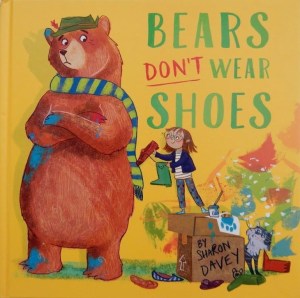
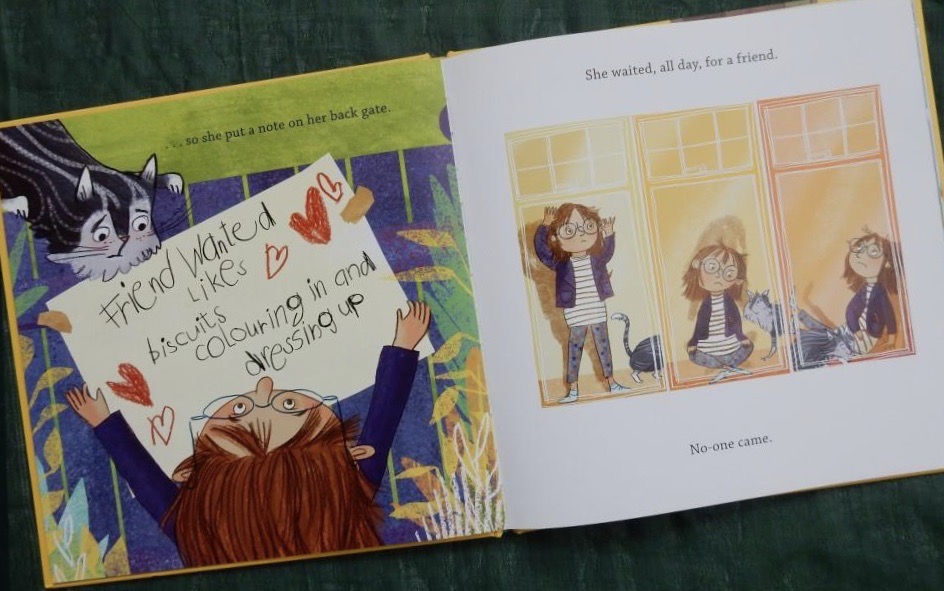
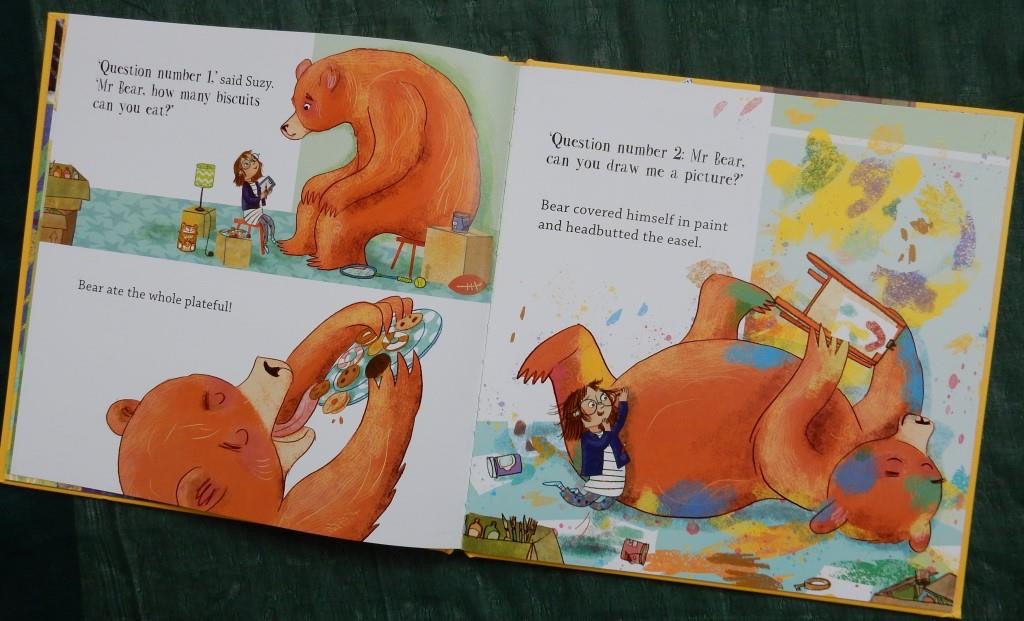
Not only have Suzy and her family just moved house, they’re in a new country too. Inevitably there’s a lot of unpacking and locating things in various rooms to keep them busy. Watching all the adults frantically working, Suzy is desperate for someone to play with, but nobody has any time for her.
The lonely little girl decides to look elsewhere and so she puts up a sign on her back gate and waits… and waits all day.

Nobody comes.

The following morning one applicant shows up so she takes him inside and proceeds to interview him. Mr Bear fits all the criteria

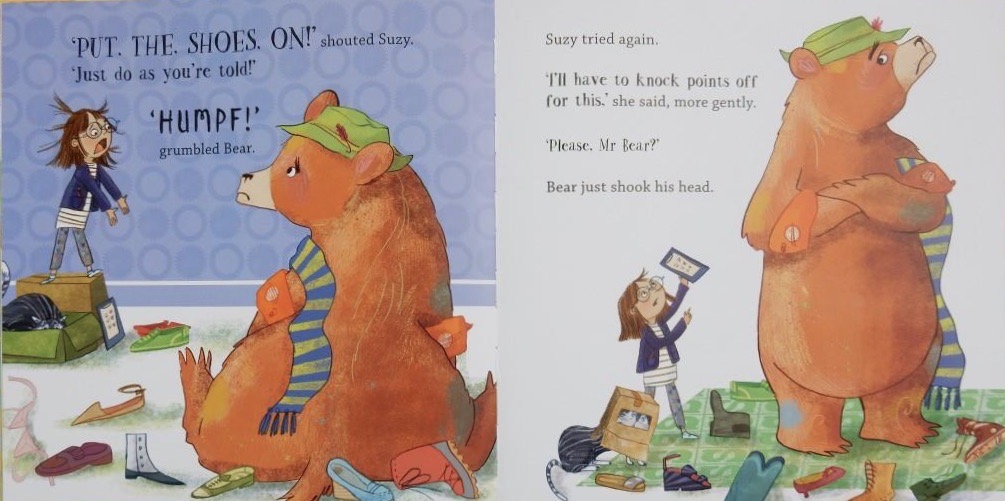
until having dressed him up in Dad’s bermuda shorts, Grandad’s fishing hat, Grandma’s bra, a woolly scarf and armbands, Suzy hands him a pair of shoes. Uh-oh!

Bear voices his aversion to shoe wearing in no uncertain terms. Try as she might Suzy meets with a flat refusal when it comes to footwear.

Now she has a dilemma. Her applicant is suitable in all respects except this one. What should she do? What would you do?

Sharon Davey’s book ticks all the boxes when it comes to a book to share with young children: an engaging story with themes of friendship and problem solving and splendidly expressive, funny illustrations. Each spread has a wealth of visual jokes to make readers and listeners giggle, even the contrasting end papers offer plenty to enjoy and talk about.

Rabunzel

Rabunzel
Gareth P. Jones and Loretta Schauer
Egmont

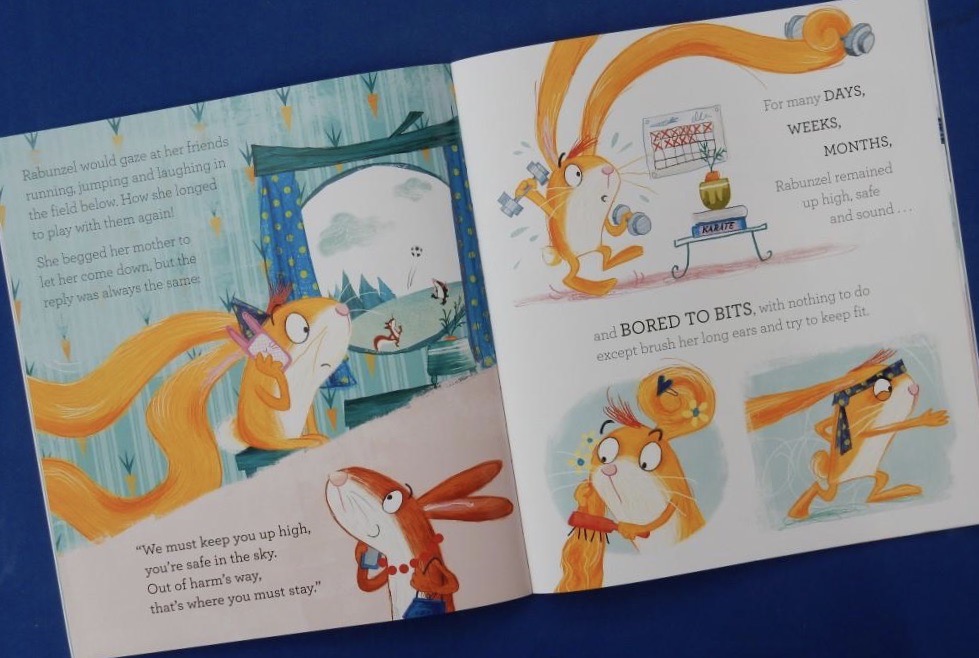
Totally crazy but enormous fun is Gareth P. Jones’s reimagining of the Grimm fairy tale Rapunzel with a rabbit, Rabunzel – she of the massively long, lop ears. The forest dwelling character gives her mother cause for concern on account of said ears, for this parent like other inhabitants of Furry Tail Hill are mighty fearful of the hungry-eyed beasties that lurk deep in the dark forest.

To keep her offspring safe, mum bun incarcerates Rabunzel in a very, very tall tree. Each morning she’d arrive at the bottom of this tree with her daily ration of carrots, lettuce and water, call out, “Rabunzel, Rabunzel, let down your ears!” and wait for the ears to unwind allowing her to ascend.

No matter how much her daughter pleads for release, mummy bunny remains resolute, ‘there you must stay’ she insists.

After months of utter boredom Rabunzel receives the surprise of her life. Who should climb up her long ears but Flash Harry the Hare.

He’d spotted the whole ear-dropping procedure, fallen head over heels in love with their owner and resolved to rescue her.
Weeee!

With her paws on the ground Rabunzel however, has her own ideas about how to proceed thereafter. You’ll be happy to learn that the whole thing ends hoppily ever after.

The text has some lovely wordplay and occasionally breaks into rhyme. It’s a read aloud romp that will be enjoyed whether or not little ones are familiar with the original story. With their zany details, and some clues concerning Rabunzel’s hidden talent, Loretta Schauer’s dramatic scenes burst with energy and humour.

Just Like You

Just Like You
Jo Loring-Fisher
Otter-Barry Books

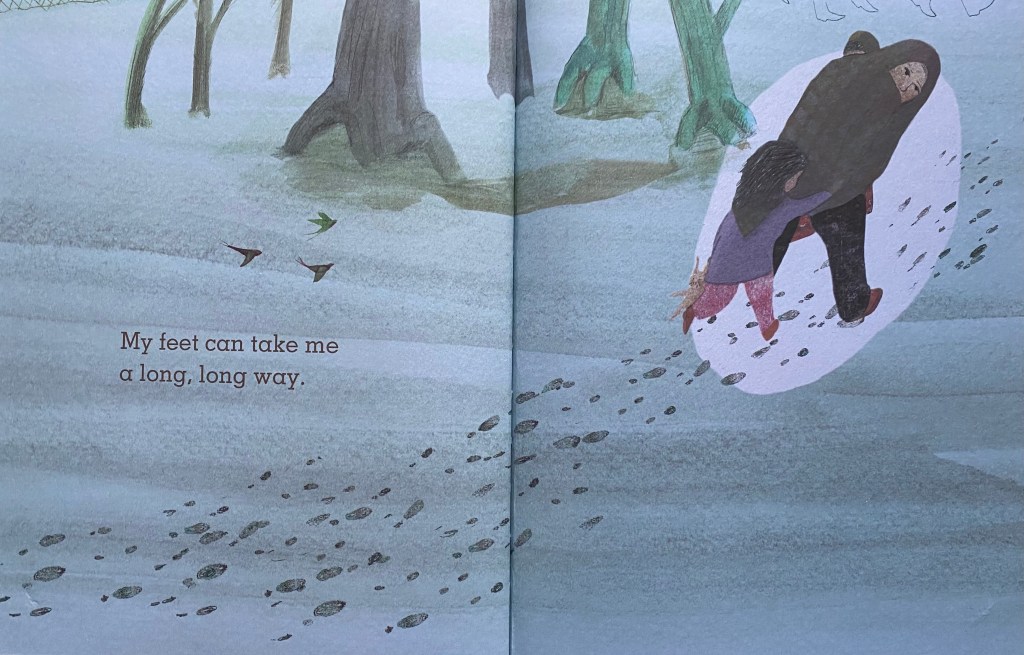
The nameless little girl narrator is just like other children everywhere. ‘I’ve got two eyes. / I’ve got two ears. / I’ve got one mouth. / And one nose.” she tells us …
‘My feet can take me a long, long way.’

Like other children too, she sometimes feels happy

and sometimes feels sad. She loves cosy cuddles and has dreams when warm and safe.

However, as the penultimate spread shows, this little girl is going on a journey and as we see at the end, as she speaks she’s living in a refugee camp and that is what makes her different from most others. Nevertheless, ‘I am just like you.’ this brave girl concludes.

This simple, beautiful, moving story with its surprise final spread exudes warmth and empathy. Equally important though, it is infused with hope.

Jo’s compelling images ensure that the feeling of togetherness is indisputable as the narrative takes us towards its final revelation.

If you are looking for a powerful picture book to introduce the theme of refugees or displacement to young children, this is one I’d strongly recommend.

The King with Dirty Feet

The King with Dirty Feet
Sally Pomme Clayton and Rhiannon Sanderson
Otter-Barry Books

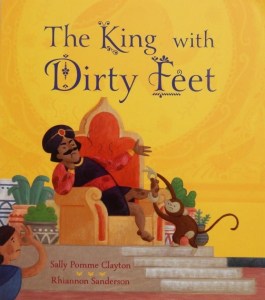
This is a retelling of a folktale from India and Bangladesh. It tells of a king in India who hated to wash until so malodorous does he become that even he can’t stand the stench. Off he heads down to the river, closely followed by lots of his subjects who want a good view of their ruler performing his ablutions.

After a hugely satisfying scrub, complete with his bath toys, the king emerges squeaky clean and calls for his Royal Towel. However once he sets foot on the ground this is what happens …

and even after a rewash and scrub of those tootsies they are still muddy.
Furious, the king summonses his trusty servant Gabu, ordering, “Get rid of all this dirt, so my feet stay clean.” His ultimatum gives the poor Gabu just three days so to do or lose his head.
A frenzied two days go by with first a dust-swirling sweeping and then a washing of the land.

Finally on day three, some swift stitching yields a huge patchwork covering of cloth. Fine, so far as keeping the king’s feet clean but now the kingdom has another problem. Nothing will grow if the entire land is covered, as a little old man points out.

Happily that same man has the perfect solution

and thus a wonderful invention is created …

Folktales have a timelessness that offers both simplicity and profundity: Sally Pomme Clayton’s lively version retains the essential inherent humour and directness making it great for reading aloud. Rhiannon Sanderson’s beautiful traditional style illustrations capture both those qualities making this a book that deserves a place in family and primary classroom collections

The Incredible Painting of Felix Clousseau

The Incredible Painting of Felix Clousseau
Jon Agee
Scallywag Press

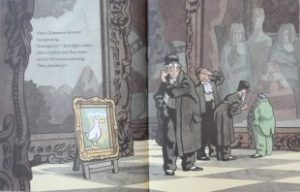
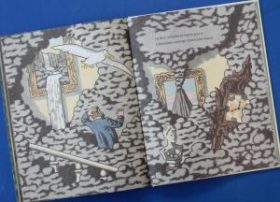
In Paris, The Royal Palace is holding its Grand Contest of Art. All the famous painters are showing: there’s Gaston du Stroganoff with his The King on His Throne, Felicia Caffay Ollay with The King on Horseback and Alphonse LeCamembair with The King in Armour. However an unknown painter, Felix Clousseau has the utter temerity to roll up with an entry.

Having been scorned by the judges for its simplistic style (not a king in sight), something truly unexpected and amazing happens. The painting emits a ‘Quack!’

Guess who becomes an immediate sensation? Having been dubbed a ‘genius’, Clousseau’s art is quickly in great demand with the rich. Not so however, the general public for his realism is way too real – disastrously so.

The unfortunate Clousseau is thrown into gaol and his paintings locked safely away – all except one that is. A single image of a dog remains on the wall of the King’s Palace. Now at that time an infamous jewel thief is at work in Paris and when he decides to try his luck with the royal crown, he gets the surprise of his life.

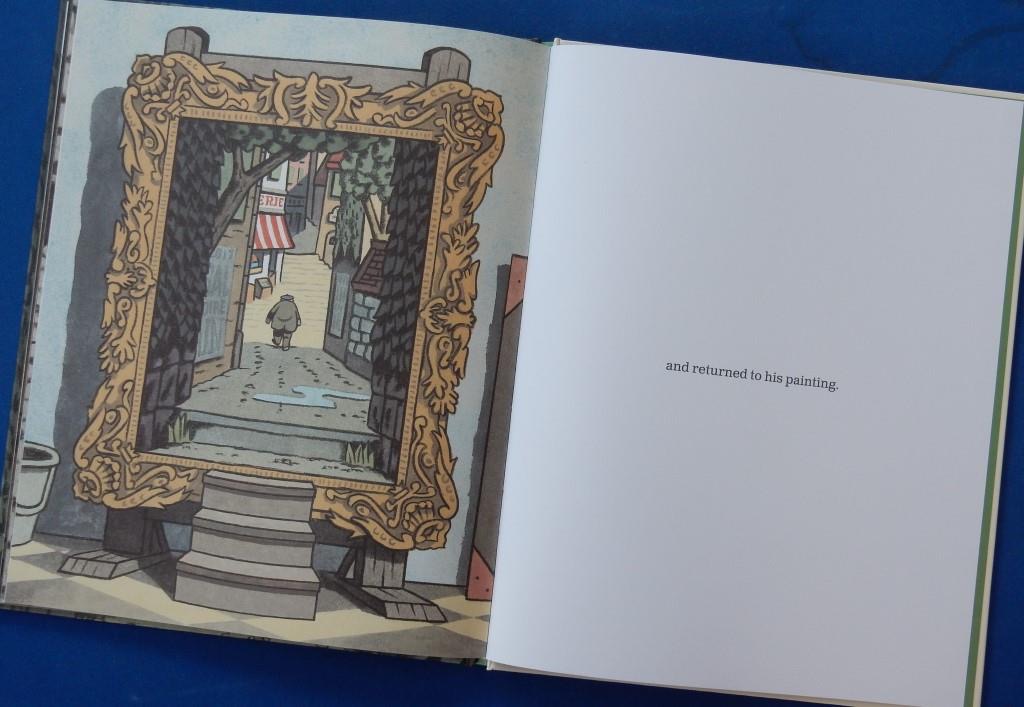
So too does his highness the next morning. He issues a royal pardon and a Medal of Honour to Clousseau who as the final page shows, ‘returned to his own painting’ …

the ambiguity of which will surely delight readers of all ages.

Deliciously droll, this is a reissue of one of Jon Agee’s earlier picture books: it’s certainly stood the test of time and great to see Scallywag republishing it now some thirty years on.

If you’re looking for a book to use as a starting point with an arty theme for a community of enquiry session, this one will definitely fit the bill.

One Little Bird

One Little Bird
Sheryl Webster and Helen Shoesmith
Oxford University Press

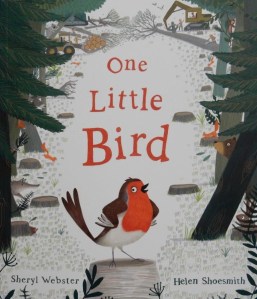
Rosa the robin isn’t one to stand by and do nothing when a man chops down the tree in which she’s nesting. Rather than finding another tree as the fellow says, she snatches up his hat, flies to his chimney and proceeds to nest therein.

She doesn’t leave things there either. Instead, she issues a rallying cry, “Animals, everywhere! We must stop people from taking our homes!”

Before long, Rosa is the talk of the forest, the tropical jungle, the grasslands, and the animal residents thereof, having lost their own homes, move into those of the destructive humans who have made them homeless.

Needless to say this infuriates the fellers, the jungle clearers and the road builders and eventually both animals and humans are incensed. The news gets back to Rosa and she realises that things have to change: surely a harmonious co-existence is possible.

Again Rosa sends her words over land and sea, summoning both animals and humans to a meeting and having heard both sides say exactly the same thing, she delivers a stark reminder to the destroyers of the animals’ homes.
From that day on, things begin to change for the better …

Sheryl Webster’s Rosa certainly had the courage of her convictions in this fun cautionary tale that might well serve as a call to young humans to become environmental activists too. Helen Shoesmith’s cover illustrations definitely depicts her as a bird with attitude, while her scenes of Rosa’s actions and their results are amusingly portrayed with a wealth of diverting detail on every spread.

What Did the Tree See?

What Did the Tree See?
Charlotte Guillain and Sam Usher
Welbeck Publishing

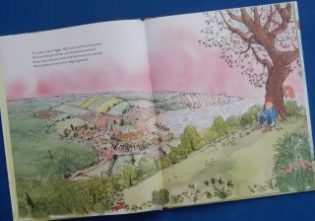
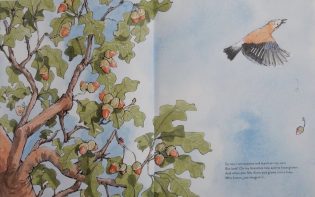
Oak trees are wondrous things. With its spreading branches to climb and a resident owl, I was endlessly fascinated as a child by the large one growing in our garden. They’re also well known for their exceptionally long life spans.
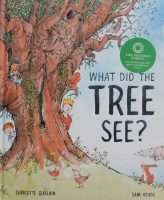
Not primarily a natural history book but rather, using the oak as a chronicler of the landscape wherein it grows, Charlotte Guillain has written a sequence of verses telling how an unnamed place somewhere in the UK has grown from a small village in the days of yore

to a vast industrial coastal city.

From its beginning ‘I was first an acorn, so tiny and round, / I fell from a branch and sank into the ground. / Then as I grew up, I turned into a tree … / over hundreds of years! So what did I see?’ Sam Usher’s fine illustrations make evident what it did see, showing just how much a landscape is altered by the action of humans,

in stark contrast to the oak, the life cycle of which we witness both in words and pictures.

The final few pages chronicle significant events in world history and their dates occurring during the life span of our narrating oak, the life cycle of an oak tree and suggestions for children to investigate the history of their own locality, as well as finding out more about trees and the life they might support.

With its unusual approach, this is an engrossing book to share and talk about with primary age children. I particularly like the way the oak’s own story comes full circle.

Moreover it could be an absolute boon for home-schooling parents (COVID even gets a mention in the timeline.)

The Invisible

The Invisible
Tom Percival
Simon & Schuster Children’s Books

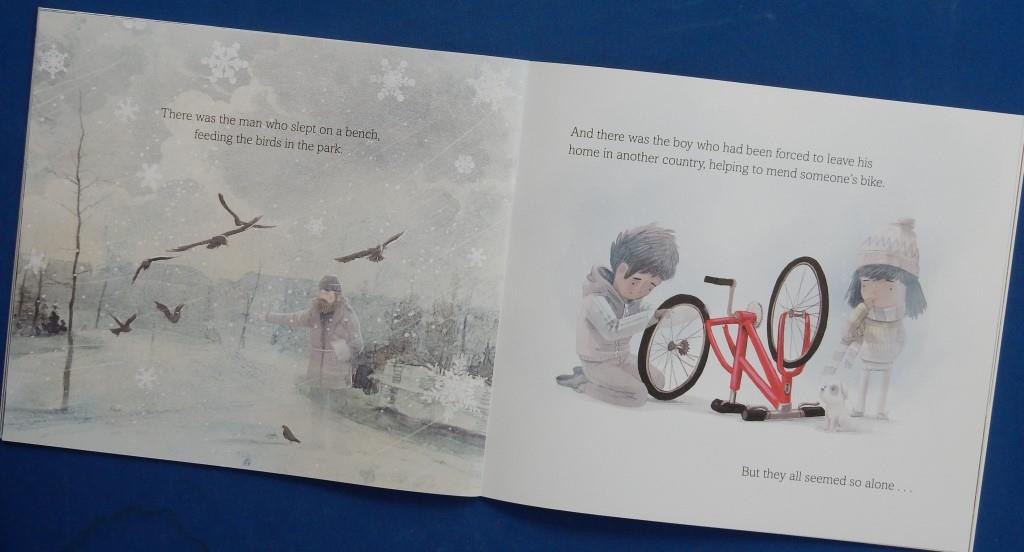
With very little money, Isabel and her family are unable to afford the things that some people take for granted. Isabel takes notice of the beautiful things in life and she loves her family dearly – they’re all she needs.

One day though there’s not enough money to pay the bills or the rent, so the family have to leave their home and move to the other side of the city. Now Isabel feels she doesn’t belong; she’s unable to find a single cheering thing in this cold, lonely environment where nobody seems to notice her at all; it’s as though she’s become completely invisible. Never once though, does she complain.

Strangely though, the less Isabel is seen, the more she is able to see other invisible people in her new locality. Overlooked they might be, but each one in his or her own way, is quietly helping out..

And so it comes about that Isobel too decides to do things to help: she plants flowers, cares for stray animals and joins in with fixing things. Gradually other people join her endeavours;

eventually nobody is invisible: Isabel has done something truly amazing: she’s made a difference.

Moving and compassionate, Tom’s story shows how it’s possible for everyone to feel that they belong, and indeed have a right so to do. It’s a tale that is very personal to its creator who himself grew up in poverty living in a caravan for six years as a child often feeling overlooked; but it’s also the story of everyone who, for whatever reason is overlooked by society. Not all of those as lucky as Tom who says in his author’s note, that as well as love and beautiful countryside, he did have, thanks to a mobile library, plenty of books. Clearly those helped make his world a better place.

This beautifully illustrated, poignant story is one that everyone should read. Tom’s use of colour, or lack of it, mirror Isabel’s changes in circumstances. Readers can almost feel the chill of the ice and snow in the wintry scenes and the contrasting warmth in the spirited energy of a supportive collaborative community.

Lionel the Lonely Monster

Lionel the Lonely Monster
Fred Blunt
Oxford University Press

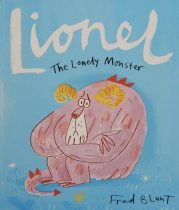
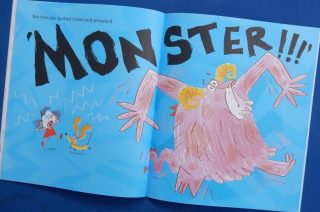
It will come as no surprise that despite his sign offering free hugs, with his dragon-like tail and large curly horns making him look like a cross between an overweight dragon and a jolly sheep that’s fallen in a vat of blackberry juice, monster Lionel alarms children. They flee in terror at the mere sight of him though grownups seem not to notice him at all.

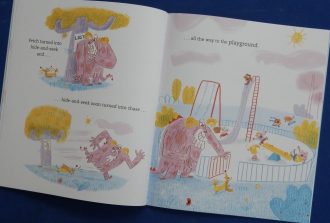
Consequently, poor Lionel feels downcast and lonely; so lonely in fact that noticing his tears, a kindly dog stops and having bestowed upon him a friendly lick, brings a stick.

A game of fetch ensues with both characters having a whale (or monster) of a time. So much so that they proceed to play hide-and-seek and end up chasing one another all the way to a playground which, pretty soon they have all to themselves.

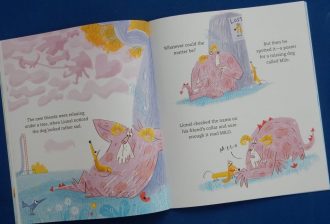
As they relax after a hugely enjoyable time, Lionel is concerned to see that his new friend has lost his earlier zippiness. And then he notices a poster pinned to the tree …

Now Lionel has a dilemma but he chooses to do the right thing. A joyful reunion ensues followed swiftly by …

Is it all over for Lionel’s new friendship?

The story demonstrates so well both the power of kindness, and that actions are key; you should never judge anyone (or any monster) by appearances.

Lionel is such an adorable monster, he’ll immediately endear himself to young children when you share this book: ensure you leave plenty of time to have a close look at the wonderful details in the illustrations. Fred’s distinctive style is as always, playful, and his wicked sense of humour shines out from every spread.

Can Bears Ski?

Can Bears Ski?
Raymond Antrobus and Polly Dunbar
Walker Books

Why does everyone keep asking “Can bears ski?” That’s the puzzle for the little bear narrator of this story.

Dad says it frequently, the kindly class teacher says it,

puzzled classmates say it, “Can Bears ski?”

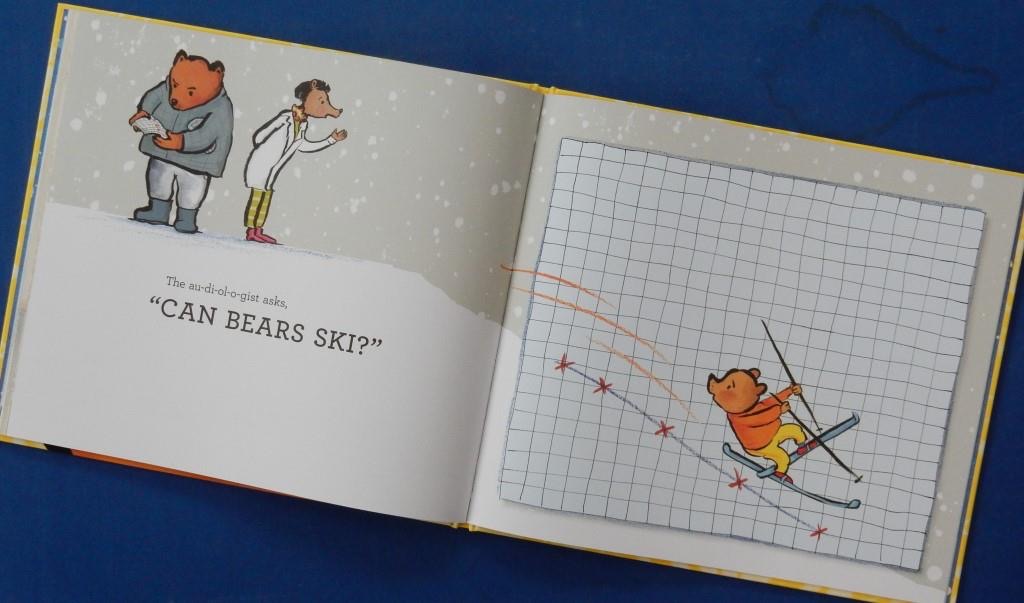
One day after school Dad takes his little cub to visit an ‘au-di-ol-o-gist’ She does lots of tests and she too asks that same question …

The audiogram shows little bear has hearing loss.

Eventually several weeks and more tests later she prescribes hearing therapy and lip-reading classes. She also gives little bear a pair of ‘plastic ears called hearing aids.’.

These enable the cub to realise what everyone has been asking all along. “Whoa … Is life this loud?!”
All the noise now means that our narrator feels tired sometimes and out come the hearing aids. The library was a place of peace pre hearing aids; perhaps it will be still; and a bedtime story is certainly on the agenda with Dad taking care to speak clearly and look directly at his little one.

And what about answering that titular question? What do you think?

The book’s author, poet and educator Raymond Antrobus, is himself deaf and this, his debut picture book draws on his personal experience, demonstrating how a small deaf child can feel frustrated and isolated in a hearing world. The illustrator Polly Dunbar also brings her own experience of partial deafness to her scenes of the hugely likeable protagonist attempting to cope with a plethora of sensory challenges – shaking bannisters and wobbling pictures, a ground shaking classroom floor for instance..

The resulting collaboration is a hugely compassionate book wherein Dad’s love is evident throughout. (This is just one individual’s experience of being deaf so there’s no mention of BSL or any form of signing.)

A thoughtful story to share in foundation stage settings and families whether or not these include a young one with hearing loss.

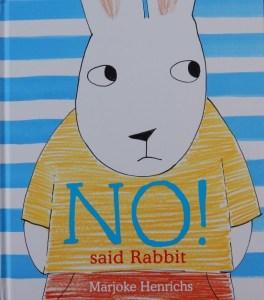
NO! said Rabbit

No! said Rabbit
Marjoke Henrichs
Scallywag Press

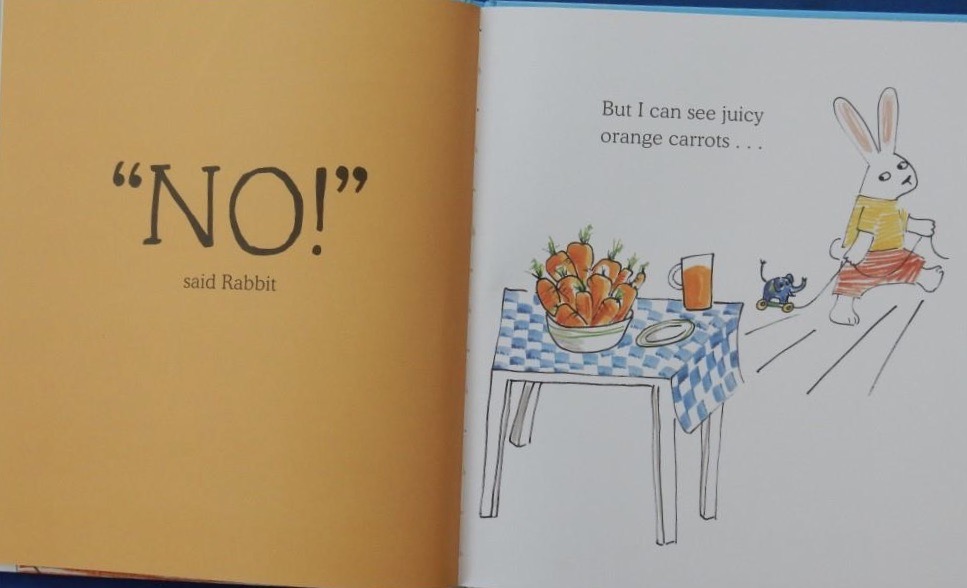
Rabbit is one contrary little creature. He replies in the negative to everything his mum tells him to do. It’s a firm “NO!’ to getting dressed, eating his breakfast carrots,

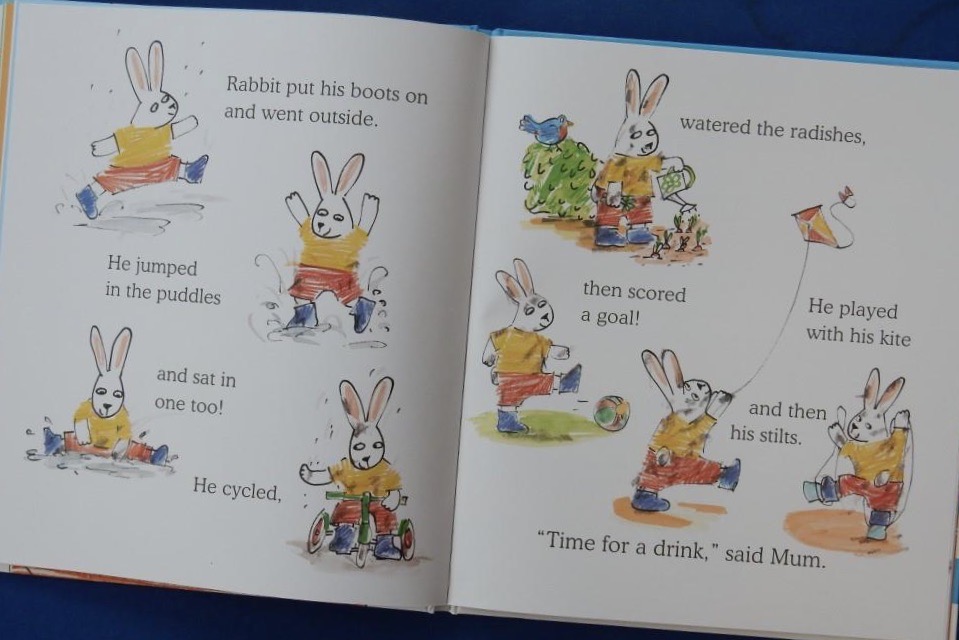
going outside to play, stopping for a snack and more. Throughout the day his recalcitrant responses issue forth but despite what he says, he always finds just the right inducement to comply with his parent’s requests.

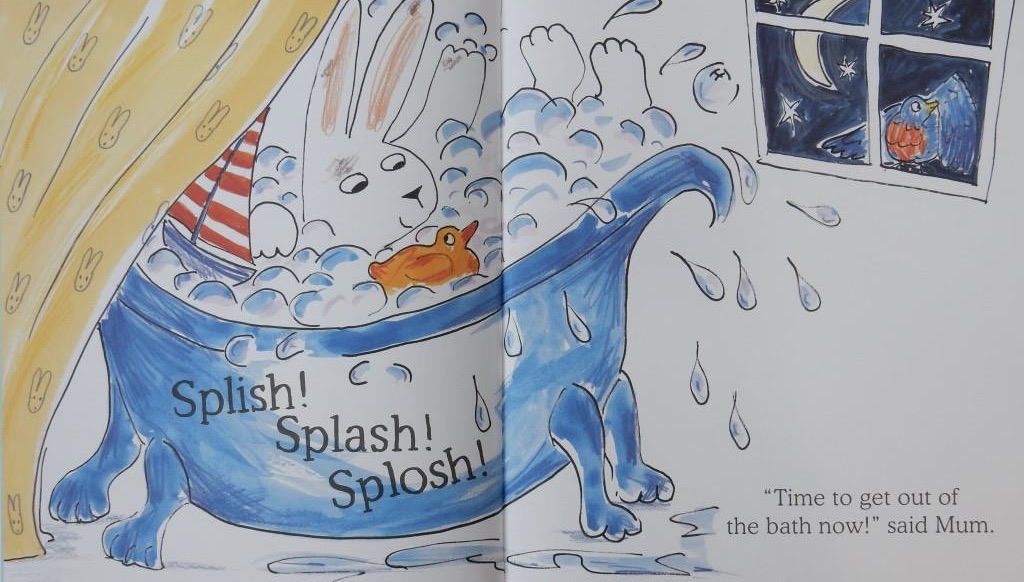
Fortunately this patient Mum knows how best to manage her spirited little one’s behaviour. She continues cajoling him right through bath time

to bedtime and the book’s satisfying conclusion.

With its delightful irony, Marjoke Henrichs’ debut picture book is pitch perfect for sharing with preschoolers. The story’s structure cleverly offers an important reading lesson – that of prediction – and as they view the unfolding action in Marjoke’s chucklesome scenes, little ones will delight in chorusing NO! along with the protagonist at every opportunity.

I’m pretty sure most adults, especially parents and teachers of young children, will have encountered a little rabbit somewhere along the way.

Over the Shop

Over the Shop
JonArno Lawson and Qin Leng
Walker Books

This is a wordless picture book that tells an uplifting tale of acceptance, trust and transformation.

As the story starts we see a child and her grandmother who is evidently the proprietor of the corner general store, at the back of which are their living quarters. It’s a run down place and upstairs is an empty flat. It’s not an inviting prospect for renters as is evident from the number of people who turn their backs on the place having viewed it.

Then, along come a couple of young people and it’s clear from the grandmother’s expressions that she has her doubts about them as tenants. They however are able to see past the run-down state of what’s on offer, and the child appears to be drawn to them and so begins project metamorphosis.

Not only do they, aided and abetted by the girl and the occasional neighbour, enthusiastically transform the apartment,

they also give the shop’s exterior a fresh coat of paint and help with the day-to-day running of the enterprise.
Meanwhile the girl has also enticed inside the cat her grandmother shooed away early on in the story, and that too now has a home. Thus from unpromising beginnings, a wonderful new family is formed.

Full of vitality, Qin Leng’s intricately detailed storytelling pictures rendered in ink and watercolour, are somewhat reminiscent of Sarah Garland. The presence of a rainbow flag in the final couple of spreads confirm what readers attentive to the fine detail might already have suspected.

This is one of those books where the more you look, the more you discover and the more stories emerge.

The Bee’s Sneeze / The Fidgety Itch

The Bee’s Sneeze
The Fidgety Itch

Lucy Davey and Katz Cowley
Scholastic Children’s Books

Here are a pair of rollicking rhyming reads from New Zealand author Lucy Davey, illustrated by Katz Cowley (of The Wonkey Donkey fame). Lucy Davey’s rhyming skills are excellent but make sure you practice reading the two stories before sharing them with an audience. They’re absolutely full of wonderful alliteration and onomatopoeic phrases that are sometimes tricky to get your tongue around.

The Bee’s Sneeze begins when a lorikeet expels a seed from its rear, a seed that soon grows into a blooming Tootletuff plant that catches the eye of Buzzy McBee.

Buzzy cannot resist sipping the sweet nectar from a bloom and before long her knees are all a-wobble on account of the teasy sneeze that despite her best efforts, she cannot contain and … AH-CHOO! Buzzy tumbles right into Monkey Minx.

Thus begins an inadvertent nose-teasing chain as the culprit bloom is passed first to Monkey and then on in turn to Barefoot Bear and lizard Lizzie-ma-Lou before an explosive sneeze precipitates a fall and all the sneezers tumble right into Crocodile’s open jaws.

SNAP! However,Croc’s satisfaction comes before a Tootletuff tickle in his tum, for just in the nick of time an unstoppable fizzle becomes an explosive sternutation and the story satisfyingly concludes by coming full circle.

It’s patently obvious from her mix of real and invented language that the author loves playing with words and it’s equally evident that Katz Cowley thoroughly enjoyed creating her dramatic scenes of the events.

Young listeners will relish both especially the opportunity to let rip with some AH-CHOOs (post COVID and with tissues at the ready) and to join in chanting the repeat refrain, “I smell a whiff, a tickle-is sniff, / I’ll squeeze the sneeze inside!”

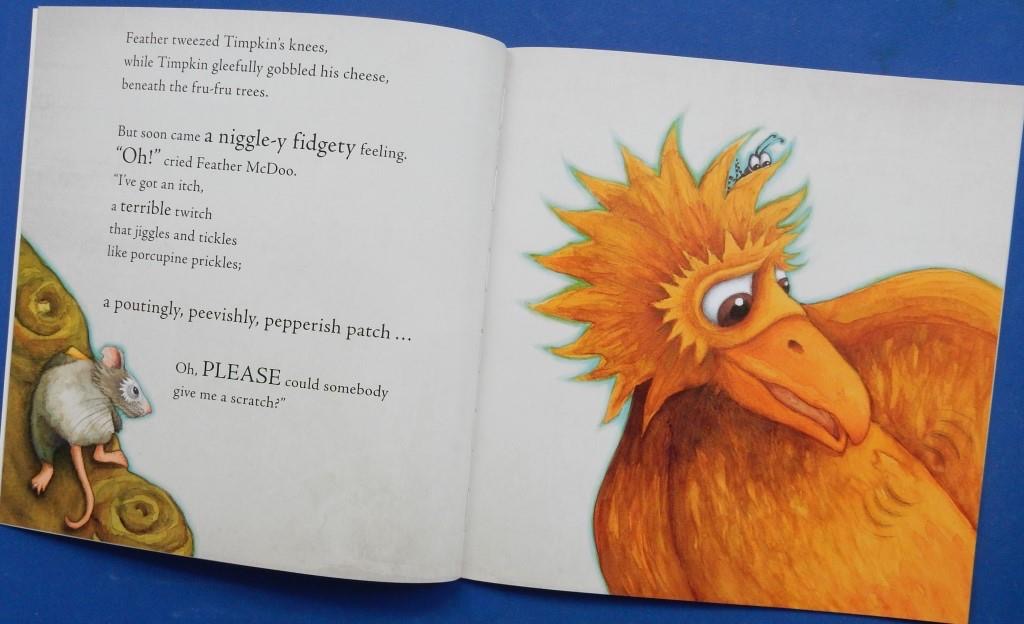
Equally bursting with delicious language of the rhyming rhythmic kind is The Fidgety Itch with its clever cumulative structure. The key elements – chief protagonist (Timpkin mouse with his penchant for cheese), setting (beneath the fru-fru trees) and the problem – an escalating itch caused by a tiny creature that lurks ready to act. A creature that’s shown but never talked of in the text but is capable of causing for instance a ‘poutingly, peevishly, peppers patch … ‘ that desperately needs a relieving scratch.’

What ensues is a concatenation of co-operative creatures each offering to be a scratcher and becoming the scratch needer,

and all the while Timpkin gleefully gobbles his cheese ‘neath those fru-frus and a certain insect lurks somewhere in plain sight. Until … Fuzzy O’Hare’s cry causes Timpkin to leap ino action and with teamwork all is resolved satisfactorily.

There’s terrific teamwork too between author and illustrator in this zany story that’s a wonderful embodiment of the all important ‘language is fun’ message.

Both books are sure to become favourites with young listeners.

Let’s Play Monsters!

Let’s Play Monsters!
Lucy Cousins
Walker Books

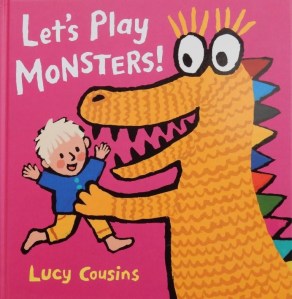
It’s always a delight to see a new picture book from Lucy Cousins and this one (inspired by a game its creator played with her own grandson) will most definitely delight little ones.

Three year old Gabriel urges each of his family members in turn “Come on, … / I WANT TO PLAY! / You chase me / and I’ll run away.”

First to participate in the romping stomping pursuit is big sister Josie who morphs into a horror ‘green and scary, / with sharp, pointy teeth / and feet that are hairy’ and eager to MUNCH, CRUNCH, SCRUNCH, her brother for lunch.

Uncle Rufus obligingly grows imaginary cow horns and pig’s tail and sets off in hot pursuit …


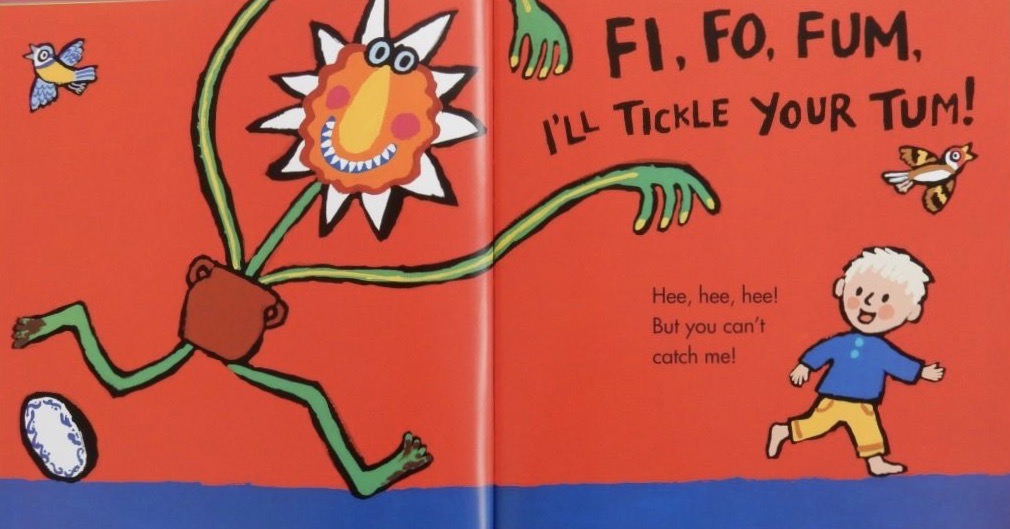
The game continues with his gran and the family moggy giving chase as a pink jelly, smelly footed monster and a hissing roaring clawed creature; even the potted plant joins the frolicking …

The established predictability of the game takes a twist though when it’s Mum’s turn. She proceeds to comply with the child’s desire but his “Hee, hee, hee! / But you can’t / catch me!” is met with his ensnarement in her outstretched arms and an instruction that leads to the book’s highly satisfying finale.

As always Lucy Cousins’ signature illustrative style is arresting: accompanied by her rhyming narrative with its reassuring predictability, this entire chasing game is MONSTROUS fun and just right for a lead-up to bedtime story. I love the endpapers too – the front one shows the cast of characters as per normal and the back depicts their mock scary other selves; and of course, the entire book is an endorsement of the power of young children’s imaginations.

Everybody Worries / Dino Love

Everybody Worries
Jon Burgerman
Oxford University Press

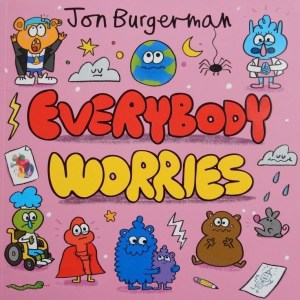
No matter what they might say to the contrary, it’s probably true that Everybody Worries – probably for many of us, more often during this past year than at any other time.

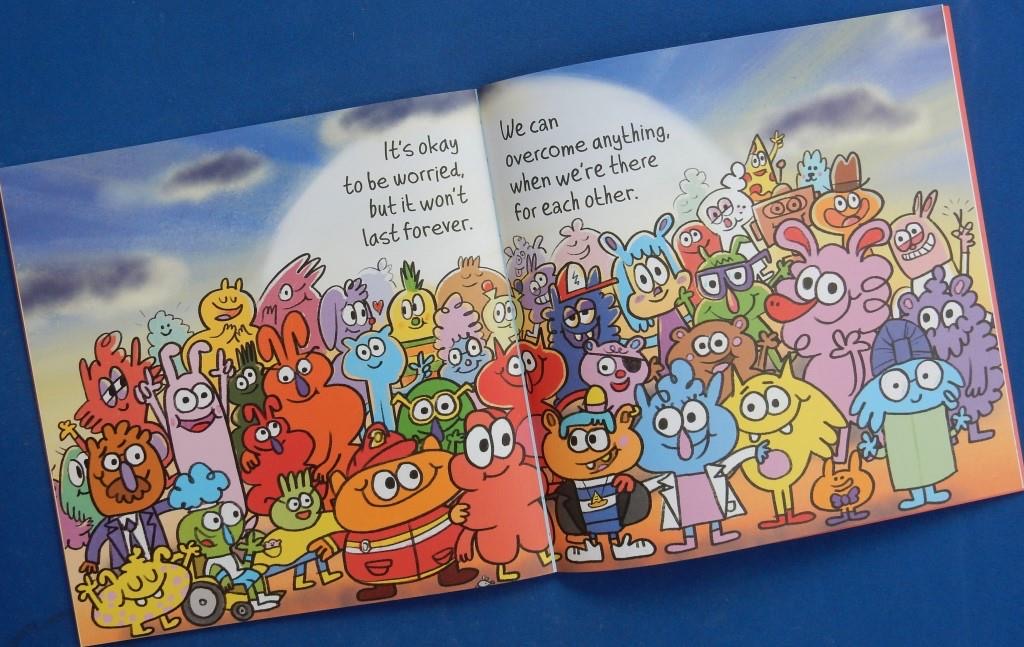
Jon Burgerman’s typically zany characters offer reassurance to youngsters as they reveal that even the coolest, bravest, toughest and smartest worry.

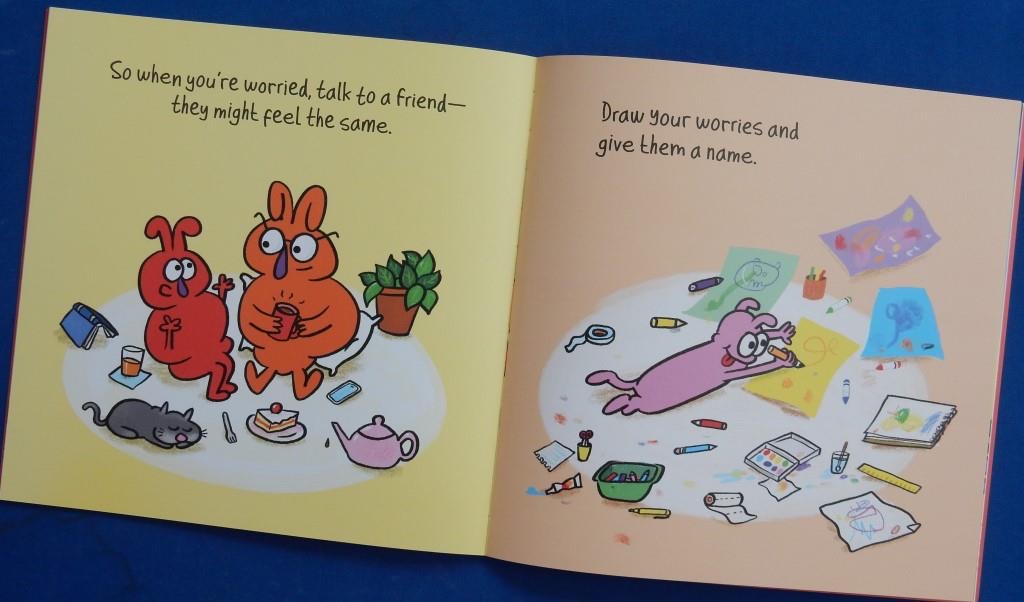
That not everyone worries about the same things is demonstrated: what bothers one person might well be relished by others, although worrying is a normal response to life’s changes. You might experience an increased heart rate, or feel queasy as a result so it’s great to have some strategies to help you cope. You can talk to a friend, draw and name your worries

and try some slow, deep breathing, sleep and eat well and keep fit.

Shared worries help to relieve the angst and rest assured, no matter what, nothing lasts forever; do what you can for others – togetherness is key, (even if right now you can’t get physically close) and remember, ‘We can overcome anything, when we’re there for each other.’

The perfect panacea for pandemic wobbles, Jon Burgerman’s book is full of wisdom and practical suggestions: have it to hand to share with little ones whenever needed.

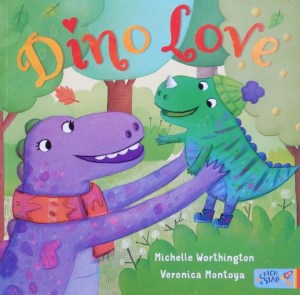
Dino Love
Michelle Worthington and Veronica Montoya
Catch a Star

There’s a lot to learn when you start at nursery or preschool and so it is for the little dinosaur character in this simple story.

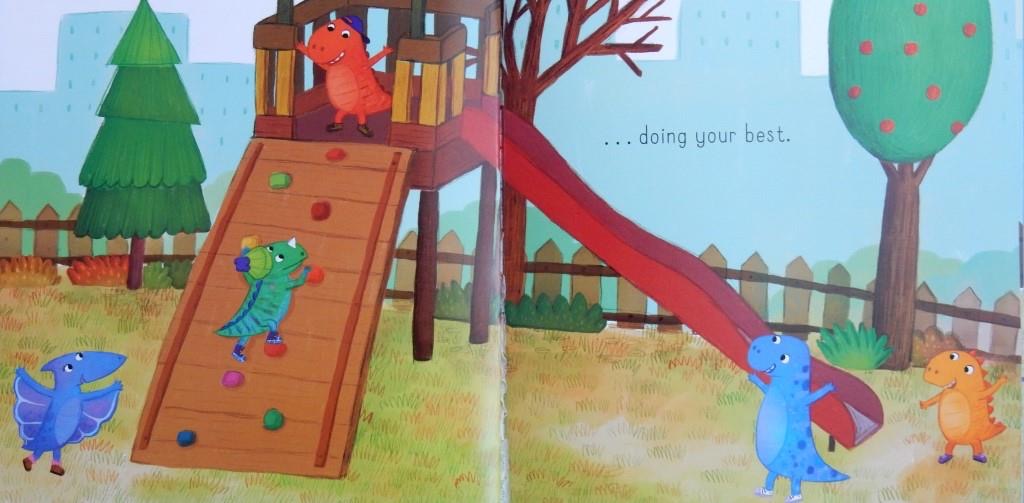
First there are those goodbyes to family members … ” I’ll miss you(s)” to cope with at the door. However these apprehensive feelings soon give way to lots of love and friendship opportunities … so long as you’re open to new experiences, willing to try your best

and remember to take some deep breaths should you feel anxious.

Yes, love is often expressed verbally, but also through actions. This is what the little dinosaur discovers as, secure in the love of family, s/he embraces the new and welcomes the multiplicity of opportunities that stepping out of your comfort zone can offer.

Many little humans are dinosaur enthusiasts and this reassuring book is just right to share and talk about when youngsters are about to take those next steps. Michelle Worthington’s minimal verbal narrative allows Veronica Montoya’s bright, jolly scenes to do much of the telling.

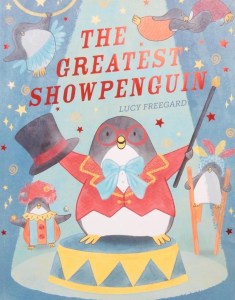
The Greatest Showpenguin

The Greatest Showpenguin
Lucy Freegard
Pavilion

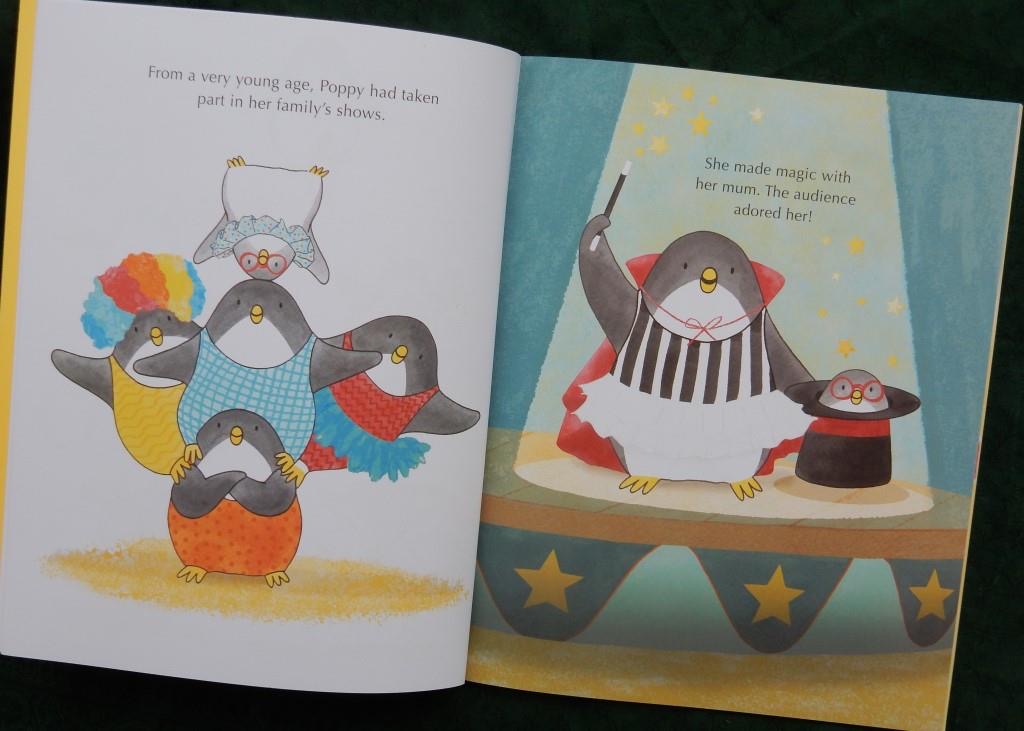
Young Poppy has performing ancestors going back many generations and consequently has inherited a variety of skills that have become part and parcel of the family’s travelling show.

Eager to make her parents proud, Poppy trains hard, learning some amazing audience-pleasing moves. There’s a snag though: Poppy knows in her heart that her passion lies elsewhere, somewhere she can feel inner peace. But how does she tell her mum of her need to feel calm and composed about what she does.

Then one day while mother and child are relaxing beside the sea, Poppy feels rather strange

and suddenly – light bulb moment! – there’s a solution that offers all that she desires, but equally means the show’s buzz and magical elements that she loves can still be a part of her daily life.

Let the learning commence as well as the pleasure of developing a new role – one that earns Poppy a special name. Good on you little penguin having the courage to be yourself.

Lucy Freegard’s story highlights both the fact that each and every individual has a special ‘something’, and the importance of following your heart and being the best you can no matter what you choose to do.
The watercolour illustrations have a freeze-frame quality about them as well as an abundance of pattern in the details making you want to pause and take time to enjoy each one.

Pablo the Rescue Cat / Stupid Baby

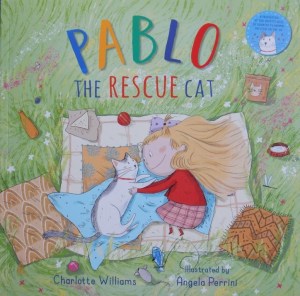
Pablo the Rescue Cat
Charlotte Williams and Angela Perrini
Little Steps Publishing

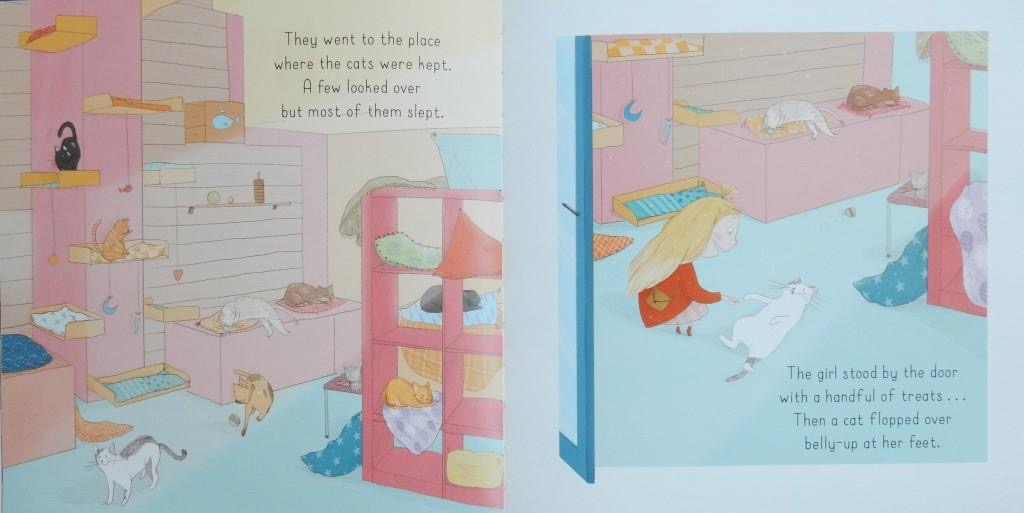
What would you do if you were feeling just a little bit lonely? You might think of getting a pet and that is just what the little girl in this sweet story does. Off she goes with her mum to the animal shelter with the intention of finding something suitable.

As they walk around the shelter, she immediately falls for the pooches but quickly realises that leaving a dog home alone is a bad idea, so the helpful staff member moves on to the cat section and there, to her delight, the little girl finds the perfect moggy.

His name is Pablo and his previous owner has died.

WIth the adoption formalities done, Pablo can begin his new life and it’s not long before he’s starting to feel like one of the family. And so he remains; as the little girls grows up the friendship continues to flourish. No matter what mischief the animal gets up to, he’s won the heart of his adopter. for as she says, … “you rescued me too.”

Told through a rhyming text that occasionally creaks and scenes of feline felicity and domestic contentment, this gentle tale is a good introduction to what’s entailed in adopting a new pet. A percentage of profits from sales of the book will be donated to UK animal shelters.

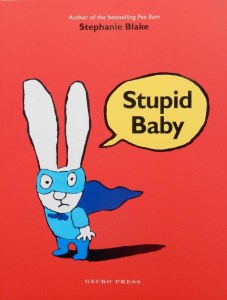
Stupid Baby
Stephanie Blake
Gecko Press

Stephanie Blake’s rabbit Simon stars in a funny, somewhat anarchic take on new sibling jealousy.

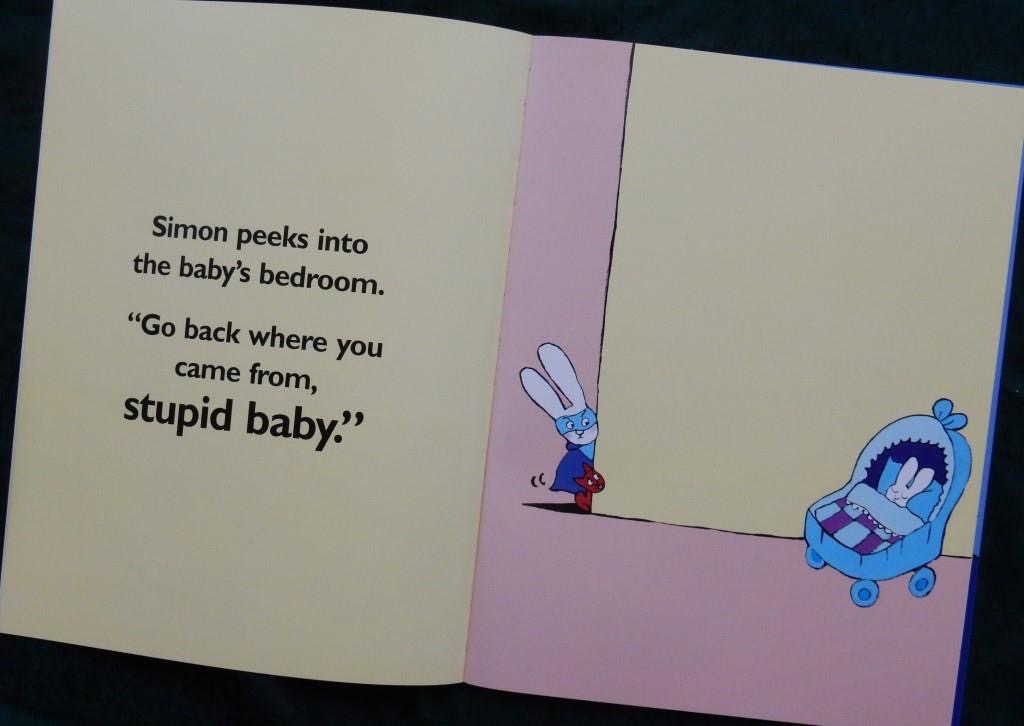
Simon is far from pleased at being told to play quietly on account of the ‘tiny tiny little baby’ that’s been present in his home for a whole three days. Suppose he stays forever, worries big bro. who feels his own needs are being compromised.
When is the stupid baby going back to the hospital, is what he wants to know. But shock horror! The infant is there to stay forever.

That’s bad enough but come bedtime, Simon’s insecurity is evident. Suppose those big bad wolves lurking outside his window come in to attack him. He needs parental comfort in his hour of need but a rejection is all he receives from that quarter.

Suddenly though he discovers a most surprising source of succour/support …

Great for sharing with the very young around the time of a new baby’s arrival. Despite his bad-mouthing of the babe, Simon is an endearing character whose charms endure no matter what. Stephanie’s bold, bright illustrations are hilarious and splendidly expressive.

Into the Wild / Poppy Goes Wild

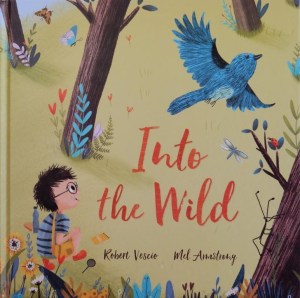
Into the Wild
Robert Vescio and Mel Armstrong
New Frontier Publishing

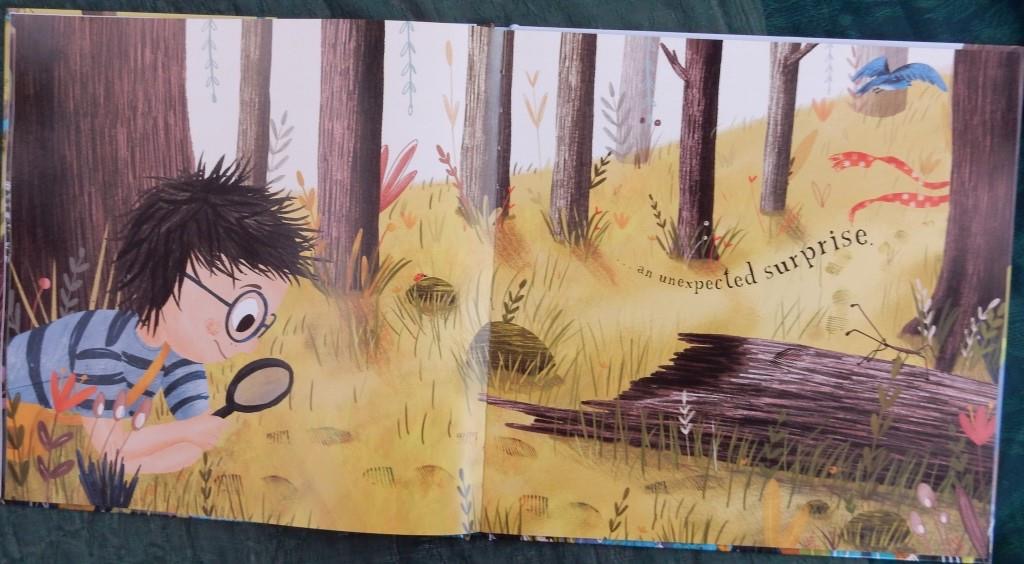
Young Roman has an adventurous spirit and a love of nature that often take him to new places where he makes exciting discoveries. They might be hidden away, mysterious, wonderfully wild or all of those. He needs to keep his senses alert ready for new sights, sounds and tactile experiences.

Sometimes though in the vast, wild depths of the natural world, Roman feels that despite the wonders he’s discovered something is missing; he longs to be able to share his excitement and enthusiasm.
And then unexpectedly he comes upon something that might just satisfy that longing – something interesting and rare …

Since the start of this pandemic and especially during lockdown, more and more of us, wherever we are, have been discovering (or rediscovering) the joys of the natural world. Equally, most of us have been longing to be able to share some of the pleasure with other people, not merely virtually but in the flesh. So, this story of Robert Vescio’s with its illustrations by Mel Armstrong is a smashing portrayal of the marvels of the natural world and friendship – especially when experienced together.

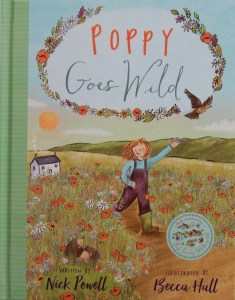
Poppy Goes Wild
Nick Powell and Becca Hall
Little Steps Publishing

TV producer Nick Powell has written this story of rewilding wherein he tells how young Poppy in partnership with her grandad embark on a scheme to return his farmland to the way nature intended it to be. The way it was some fifty years back when wildflowers grew in abundance and native animals such as hares and field mice, otters, insects and birds including peregrine falcons and soaring skylarks thrived.

As Poppy’s Grandad reminisces, she and readers learn of the dramatic changes that have happened due to such things as wetland drainage, intensive farming resulting in habitat loss, and the use of harmful pesticides. “We thought we were doing the right thing,“ Grandad tells her.

Poppy’s great enthusiasm for doing what some of the farmers she’s read about are trying, reignites her grandad’s love of the natural world and project ‘rewilding’ is agreed on. Every weekend and during school holidays Poppy intends to work on the plan but their first task is to identify areas for nature to replenish itself. Then comes providing the best conditions for this to happen.

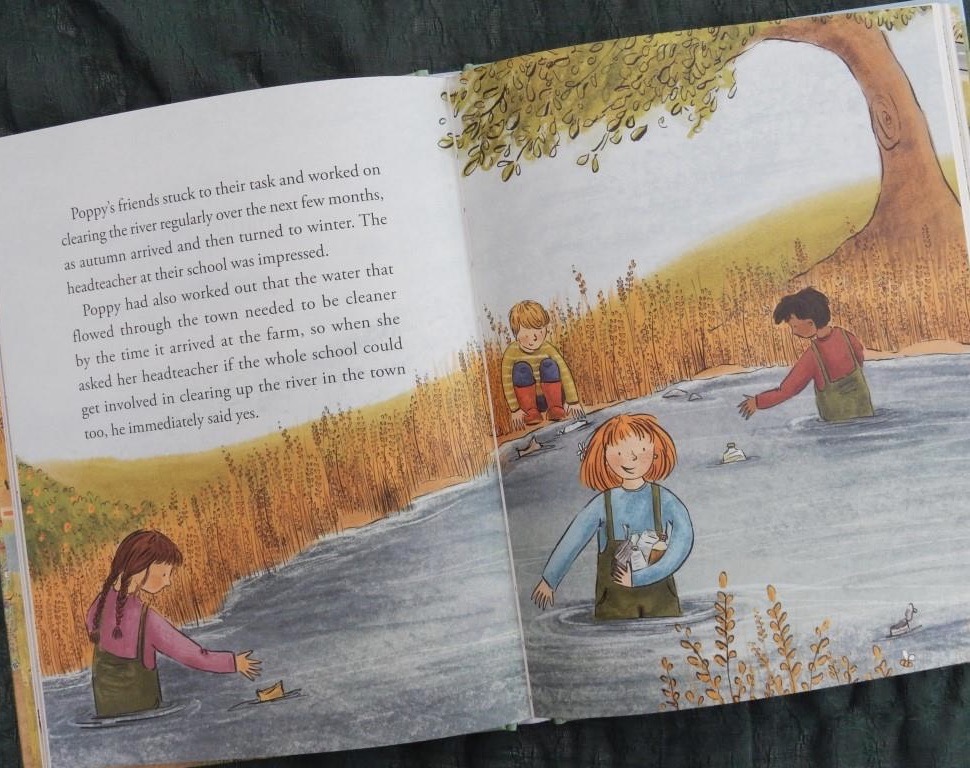
As the work gets under way, Poppy realises that it’s more than a two-person task. She enlists the help of her classmates from the town near the farm

and over the next few months great headway is made. But, as the story ends, the wonderful restorative transformation work goes on.

An inspiring, uplifting, hopeful story that presents many of the environmental challenges we face at the moment with so many of our species declining alarmingly thanks to the destabilising effects on ecosystems of human activity. In addition there are other themes – collaboration and the wonderful camaraderie between Poppy and Grandad that exemplifies intergenerational relationships.

Becca Hall’s painterly, carefully detailed, illustrations are simply gorgeous. Her colour palette is aglow with the sun’s warmth as well as evoking that inner warmth and exhilaration so many of us feel when immersed in nature.

Nick Powell hopes the book will inspire youngsters to do all they can to look after wildlife, while in a foreword, Hugh Fearnley-Whittingstall, celebrity chef, writer and broadcaster, urges us all to be part of the re-wilding movement in whatever way we can. One truly hopes that, inspired by Poppy et al. both young and not so young will respond to their rallying call.

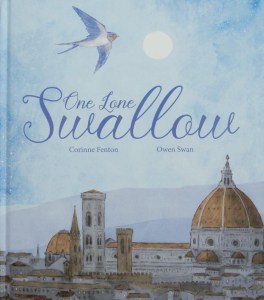
One Lone Swallow

One Lone Swallow
Corinne Fenton and Owen Swan
New Frontier Publishing

This unusual tale is set at the start of the 19th century in Florence. From its opening illustration of a swallow taking flight from her nest high above the city, readers are swept up in the story.

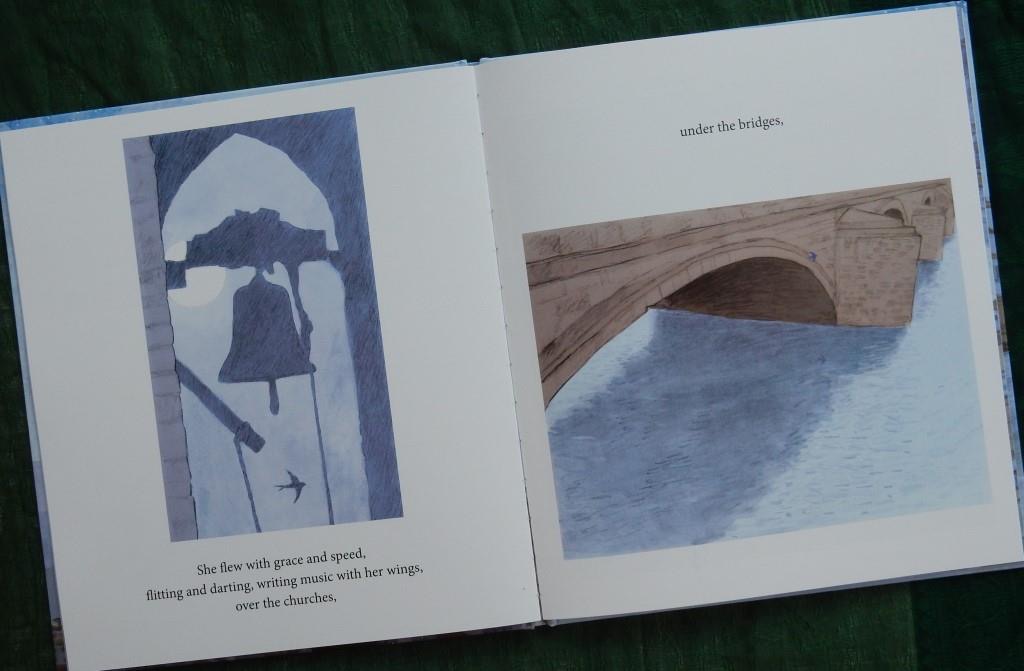
Leaving her nestlings, the swallow flies through the moonlit sky over the rooftops and chimneys searching, searching for her mate. We follow her over the ancient walls and towers, over the chimneys and roofs, under the bridges,

through the arches and above the piazzas, pausing briefly to rest, all the while searching yet knowing that back at the nest her young are calling out their need for food.

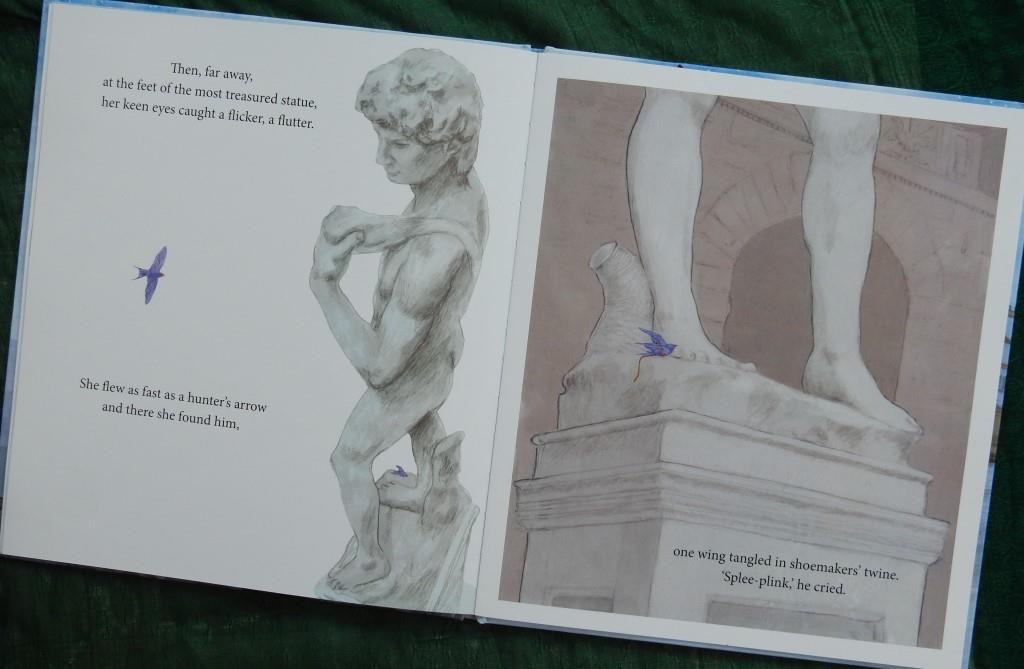
Then resuming her search, her eyes detect a slight movement. At the feet of Michelangelo’s statue of David, one wing entangled in ‘shoemakers’ twine’ is her mate.

She takes the end of the twine in her beak and gently begins the task of unravelling the twisted threads. Hidden out of sight lurks a huge rat just waiting to pounce but just in time, with one more pull the last twist of thread comes loose.

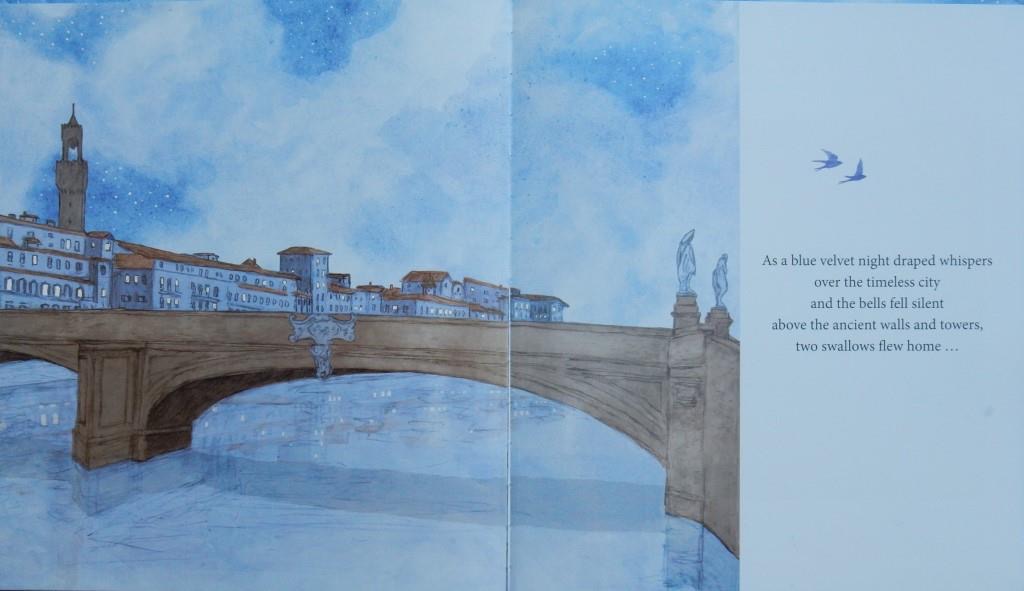
Finally not one, but two swallows start their flight back home to their nest.

This is a beautifully told, stunningly illustrated tale of commitment and fidelity. Corinne’s poetic text in combination with Owen Swan’s breath-taking scenes of the twilight Florence of yesteryear make for an extraordinary cultural and aesthetic experience.

The Castle the King Built

The Castle the King Built
Rebecca Colby and Tom Froese
Nosy Crow

Using the rhythmic pattern and structure of the nursery rhyme This is the House that Jack Built, Rebecca Crosby cleverly mixes fact and fiction to create a story of the building of a medieval castle.

We meet those involved in its creation – stonemasons, carpenters

and smiths, as well as, once it’s built, the people who contribute to the castle’s functioning – grooms, knights, merchants, bakers, servants, minstrels and of course, ruler of the land -the king himself.

The final spread presents the entire cast of characters each of them explaining their part (this includes a few women residents not mentioned in the main text)

Rebecca’s skilful use of rhyme and rhythm ensures that the book reads aloud well and Tom Froese uses an appropriate retro style for his striking illustrations helping to create the long ago atmosphere of those days of yore when knights would joust and singing minstrels pipe and strum.

A thoroughly well-presented, enticing and gently educative book for classroom sharing and individual reading, published in collaboration with the National Trust. I specially like the final acknowledgement that everyone included played their part in the life of the making of the castle.

Out of Nowhere

Out of Nowhere
Chris Naylor-Ballesteros
Nosy Crow

Following his superb The Suitcase picture book, Chris Naylor-Ballesteros has created another compelling tale, this time on the theme of enduring friendship.

The story begins as the friendship is in its first stage with the arrival ’out of nowhere’ of caterpillar into the world of a beetle (the narrator). The two become friends eating together, and watching the moon come up.

One morning the beetle awakes to find no sign of caterpillar and unaware of the presence or significance of something close by…

Beetle waits, scouring the landscape until eventually he spies through his binoculars something that could be his friend. Heavily weighed down by a basket and trying to feel strong, he treks off through the forest to search,

until he discovers that it’s not her after all – he’s made a huge mistake. Now what? Feeling tired and dejected our seeker decides to rest and revive himself before attempting that long return journey. While so doing, ‘out of nowhere, someone suddenly arrived’

After closer inspection, glimmerings of recognition give way, to absolute joy and a celebratory sharing of food …

Chris’s portrayal of a friendship that changes and grows, (as cherished friendships do) is uplifting and profound. His uncluttered illustrations rendered in a minimal colour palette are highly effective and simply stunning, showing young readers/listeners the way to be a true friend.

I Talk Like A River

I Talk Like A River
Jordan Scott and Sydney Smith
Walker Books

The transformational power of just a few words can sometimes be truly amazing and so it is in Jordan Scott’s autobiographical story. He’s a poet and this is reflected in his lyrical prose wherein he reflects on his childhood stutter and how a conversation with his father after a particularly bad day at school made all the difference.

That day gets off to the usual kind of reflective start but it’s in the classroom where things really take their toll.


When his dad collects him after school, the two take a walk beside the river. It’s quiet surrounded by nature, and having watched his son finally let the pent up emotions of the day flow from his eyes, “They don’t see a pine tree sticking out from my lips instead of a tongue.”

dad sits beside the boy and together they watch the water. “See how that water moves? / That’s how you speak.” he says.

The boy sees ‘bubbling, / whirling, / churning, / and crashing’ and then, keeping his dad’s words in his head he wades into the sunlit water. (shown behind a glorious gatefold) …

Next morning at school the narrator is able to recall these words and ‘to think of the calm river beyond the rapids / where the water is smooth and glistening. … Even the river stutters. / Like I do.’’
No, there’s no instant cure, but this experience does enable the narrator to find a way to tell the class about his favourite place. One cannot help but feel tearful at reading his final few sentences.

I can think of no better artist than Sydney Smith to illustrate Scott’s often painful language. Smith’s wonderfully atmospheric paintings are simply exquisite capturing not only the gut-wrenching pain the boy feels but also the power and energy of the river and of nature itself.


Following the story is a moving ‘How I Speak’ note by the author. Herein he gives additional details of his own childhood experience – his road to self-acceptance and finding a context in which to place his own stutter: ’he (dad) gave image and language to talk about something so private and terrifying.’

This reviewer was absolutely swept away by this awesome collaboration.

Which Food Will You Choose?

Which Food Will You Choose?
Claire Potter and Ailie Busby
Bloomsbury Education (Featherstone)

When Mum opens up the fridge one Monday and sees nothing but beige food items she decides to take the two small narrators straight off to the supermarket to find something more enticing, telling them they’re going to play a game. “But we can’t play games in the supermarket” comes their immediate response.
On arrival she invites her little ones to choose three foods but they have to be red.

Off they go selecting pepperoni, watermelon and a tin of tomato soup. ‘Which three of these RED foods would YOU choose?’ asks the author.

Back home they use the pepperoni as topping for the pizzas they make, chomp into slices of the watermelon (planting the seeds afterwards) and put the soup in a flask to drink when they visit the park .
The narrative then asks, ‘What would YOU do with the three red foods you chose?

A similar thing happens on Tuesday, Wednesday, Thursday and Friday with the children being asked select in turn three yellow, green, orange

and then purple foods.

Come Saturday Mum is caught beige-handed,

so on Sunday the children take things into their own hands …

This is a fun, non-judgemental approach to ‘picky eating’ that should definitely encourage youngsters to try some new foods and Claire Potter, the author includes two sets of notes to help adult sharers to ‘get the most out of ‘ the book.

To add to the enjoyment of the text, she uses some playful alliterative descriptions such as “Gorgeous, glorious, groovy green “ and ‘gazillions of green foods’ and ‘Zingy, zesty, zippy orange !’ … ‘oodles of orange foods’. and adults might like to extend the word play by asking youngsters to make up their own alliterative phrases for others of the foods labelled in Ailie Busby’s enticing spreads. The brother and sister certainly appear to be making the most out of their choices – its good to see wonky carrots and using the celery leaves to feed the rabbit – no food taste there.
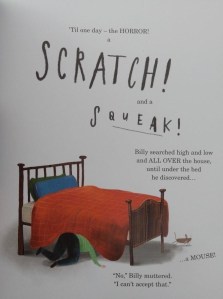
There’s a wealth of potential between the covers of this little book, not only for – parents/carers but for foundation stage teachers too.

Slug in Love / How Big Is Love?

Slug in Love
Rachel Bright and Nadia Shireen
Simon & Schuster

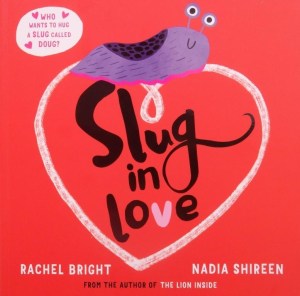
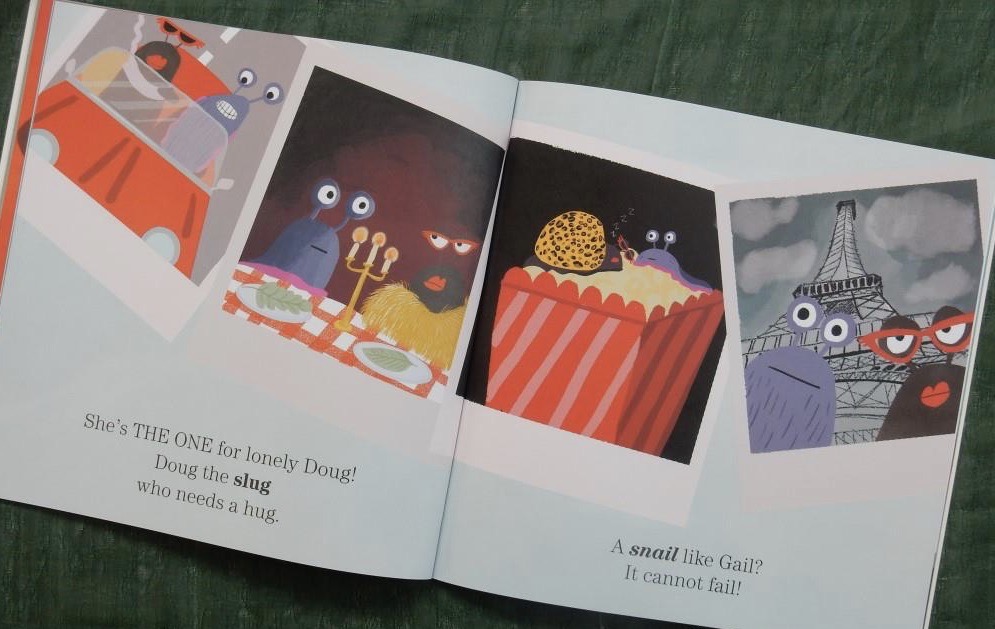
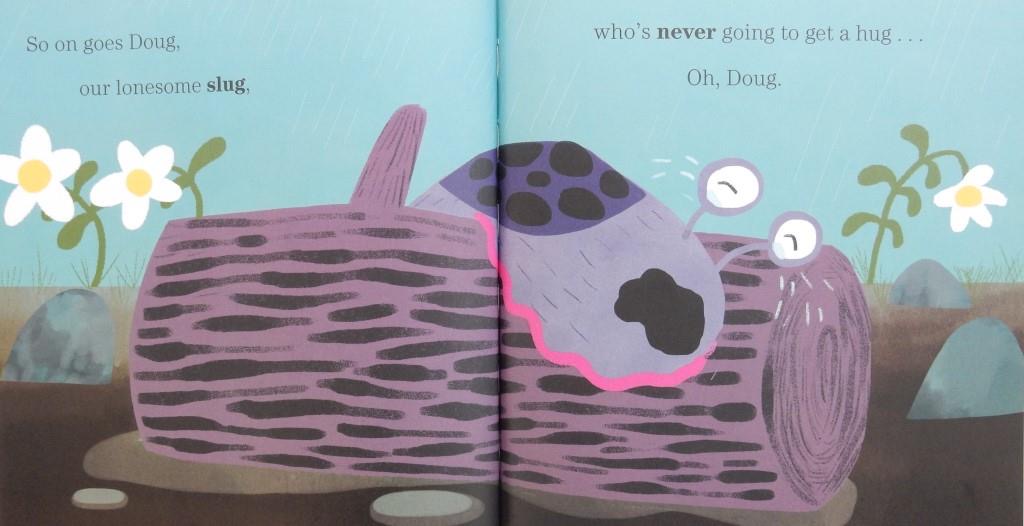
Meet Doug, a slug that’s feeling rather lonesome; he would really love a hug. (Wouldn’t we all?) But just imagine hugging a slug – not a very pleasurable prospect me thinks. So agree the various minibeasts he encounters. There’s earthworm, spider, ant, caterpillar each of which beats a hasty retreat; but not before uttering some thoroughly disheartening words.
Oh dear! Is poor Doug to remain forever sans hug? Hold on, what about Gail the stylish snail? She exhibits all the characteristics eschewed by the four previous creatures – now surely she must be THE one …

Once again though, our slug is given the thumbs – or rather antennae – down.

Feeling ever more dejected, Doug pauses to contemplate his lack of an embrace

and unexpectedly something comes flying along. Could she be his hugger at last? With its wealth of wordplay, Rachel’s punchy rhyming narrative, combined with Nadia’s delicious depictions of Doug, the naysayers and more, make for a book that’s a gigglesome delight. In addition, it’s great for developing sound/symbol awareness and, you’ll absolutely love the final twist.

How Big Is Love?
Emma Dodd
Templar Books

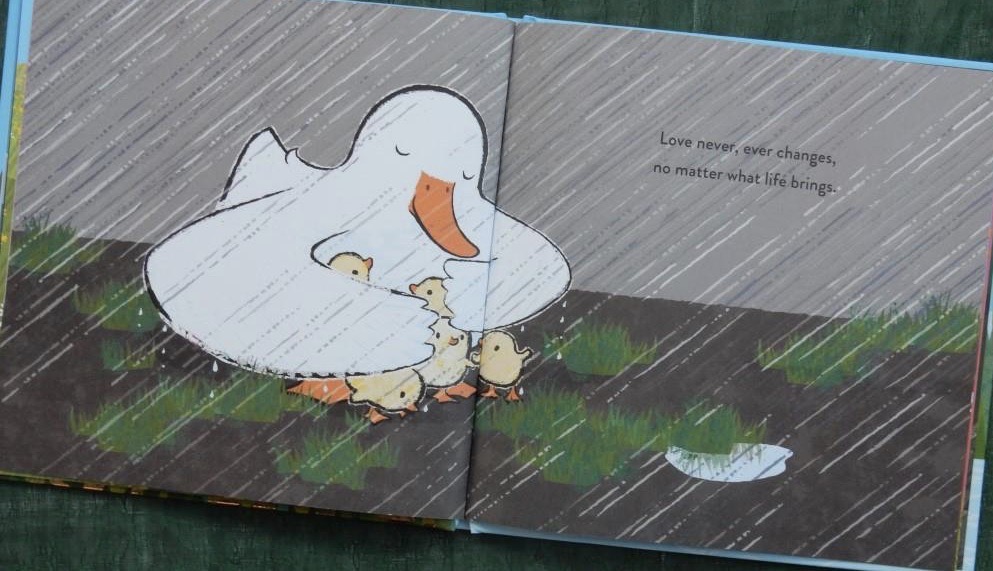
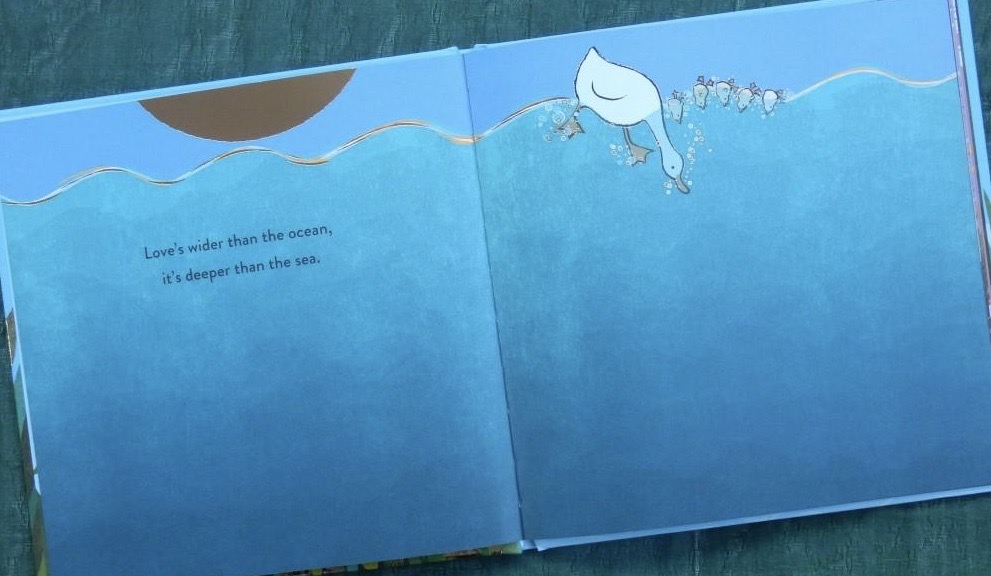
In Emma Dodd’s gorgeous story, a mother duck shows her five little ducklings just how boundless is her love for them. Such love as hers illuminates the entire world, is heart filling, unchanging in the face of life’s unsettling moments,

it’s uplifting and supportive, all day every day even in the darkest of difficult times. But these thoughts haven’t come to the mother of their
own accord, it’s through her day-to-day interactions with her little ones that these feelings have emerged so that she can express them through both her words and dealings.
Heartfelt sentiments, beautifully expressed and tenderly illustrated with gorgeous scenes of the natural world, (alternating ones embellished with gold) Emma’s new book is ideal for sharing with the very youngest,

My Bum is So Noisy!

My Bum is So Noisy!
Dawn McMillan and Ross Kinnaird
Scholastic

Assuredly we all need laughs at the moment and be you an adult sharer or a child, you will certainly find plenty in this, the third of Dawn McMillan and Ross Kinnaird’s New Bum series.

Here, the young boy narrator and his raucous rear have an unexpected cacophonous adventure. Not though before the lad has shared with us some of the trials of having such a turbulent tail that emits a veritable and varying trail of emanations, often at the most inconvenient moments. There are for instance hoots and toots, hums and strums, clangs and bangs,

not only when the house is empty. Visitors too are subjected to sounds aplenty – it’s enough to drive them crazy;

well perhaps not all of them. The younger relations (whose rears are a trifle restricted in their sound-producing capacity) are a tad envious and happily our narrator’s parents appear to support their son.
However the real excitement begins when the boy’s unique talent is discovered and put to creative use by a company who are quick to recognise its potential.

Dawn’s crazy rhyming narrative tumbles forth and rumbles along with laugh-out loud examples of whiffy wonders that Ross Kinnaird renders even more hilarious in his zany illustrations. May I suggest having a room spray to hand when you share this one – just in case …

All Aboard the Numbers Train / All Aboard the Shapes Train

All Aboard the Numbers Train
All Aboard the Shapes Train

Sean Sims
Oxford University Press Children’s Books

Based on topics popular with little ones, these two All Aboard titles of a new thematic series are intended to support the early learning goals.
The Numbers Train is in fact a spacecraft that moves through the sky taking six small children and their canine companion on an exploration of the cosmos.

There’s so much to see including rockets, planets, evidence that others have been there too, aliens – of the friendly fun-loving variety fortunately –

and that only takes us as far as number five.

By the time we reach ten the passengers have left their train and are stretching their legs beneath the stars. Back inside again there’s a wealth of number symbols (1-10) on the various levers, dials and other instruments to spot and then it’s time for the countdown before the train leaves for home.

On the return journey there’s an opportunity to count in tens as they whizz past the 100 guiding stars and the penultimate spread maps the entire trip asking ‘Can you remember the numbers we saw on the way?’

No space attire needed on the second ride; the Shapes Train, with its variously 2D shaped windows takes its passengers (and readers) on a journey to the world of playtime, searching for shapes, and the patterns they can create.

We start with circles: ‘There are circles everywhere! The bubbles, balls and bugs are circles.’ says the text. Yes, that is how they’re represented in Sean Sim’s alluring, brightly coloured scene of the train’s first stop but this could be confusing for young learners as foundation stage teachers (certainly this one) would say that bubbles and balls are spheres (3D shapes) not circles (2D shapes).

Other shapes included are squares, triangles,

rectangles, diamonds, as well as semi-circles, ovals, pentagons, hexagons, stars and spirals.

This promises to be a bright, jolly series with lots of learning potential but use the Shapes Train judiciously.

There’s No Such Thing As … Unicorns

There’s No Such Thing As … Unicorns
Lucy Rowland and Katy Halford
Scholastic

Whether or not you know youngsters who are besotted with unicorns (and that’s an awful lot even in my experience), or are acquainted with young search-and- find fans, then this story will likely appeal.

Its narrator is a little girl – a unicorn obsessive if her bedroom is anything to go by and when her big brother tells her that these magical creatures just don’t exist. she decides to try and prove him wrong.

Next morning having packed her bag with the necessary accoutrements, she sets out on a unicorn search. It’s a search that takes her to a variety of places – a farm, the zoo, a lake …

the woods, each of which yield negative results. Now what about the meadow? That looks more promising, but no unicorns appear to frolic among the ponies. Nor are they evident at the seaside, even in the dark depths of that cave …

Equally, the school classroom and the park in the gathering dark furnish for our seeker, not a single unicorn sighting and so disillusioned, she takes refuge to let her tears flow.

Suddenly who should appear but her brother who’s been hunting, not for unicorns but for his little sister. A comforting cuddle ensues and then, under the twinkling stars, the two make a wish …

With its repeat titular refrain,, Lucy’s rhyming telling as always, is a delight to read aloud, and if you share it with more than one or two little ones at a time, make sure you leave plenty of time for listeners to peruse each of Katy’s busy scenes. They simply burst with enchanting details and rainbow hues; and of course there’s that elusive one-horned creature lurking somewhere at each location.

Love

Love
Corrinne Averiss and Kirsti Beautyman
Words & Pictures

Young Tess is part of a loving family – love surrounds her like the ‘light inside one of Daddy’s little houses.’

However, when the time comes for her to start school, the worries creep in. School is big and scary – nothing like that warm scarf that she feels wrapping around her when she goes out with her parents. Will the love still find her?

Her mother tries reassuring her saying as they part by the gate, that love will still find her even when they’re apart “like a string between us – it can stretch as far as it needs to.”

Tess though isn’t sure. Her understanding teacher offers some comfort – ‘Tess noticed a little thread between them. That felt nice.’

Little by little she continues discovering new strings of connectedness, friendship and love throughout the day.

Come hometime though, the anxiety returns when her mother is late to collect her.: that string doesn’t appear to be connecting Tess to anything or anyone. Finally, however, there with an explanation and a string-fixing hand, stands Mummy and all is well once more.

Enormously reassuring for young children who experience separation anxiety, Corrinne cleverly uses the string trope to make tangible the bond between loved ones in her story. But she makes it all the more impactful – love connects us no matter the distance between us – with her own ‘candle house’, ‘warm scarf and other metaphors. Employing a limited colour palette to great effect, Kirsti Beautyman’s sequence of textured illustrations are full of feeling, be that love, tenderness, worry, or empathy.

I Love You With All My Heart / The Curious Case of the Missing Mammoth

I Love You With All My Heart
Jane Chapman
Little Tiger

When Little Bear’s exuberant music making very close to where his mother is tending her sunflower plant results in a catastrophe, the little creature is worried that his mother will be angry with her offspring – and even worse that she’ll stop loving her.

Admirably, Little Bear owns up right away and happily, Mummy is equally quick in her response. She scoops the cub up in her arms and reassuringly says “I’ll ALWAYS love you,” and proceeds to soothe her by asking that she place her paw on her heart to “feel my love beating on and on for ever”. She goes on to tell Little Bear that a similar “Ba ba boom” beats within her little one’s heart.

Next day at preschool, the little cub draws on that knowledge when she’s upset about losing a race, and then later back in the garden when her new kite is whisked away by an unexpected gust of wind. Seemingly, no matter what upsets life throws at Little Bear, she can draw strength from that never-ending motherly love.

There’s a lovely final twist when Mother Bear’s cake baking is interrupted by her cub’s enthusiastic, mud-splashing announcement about her kite rescue …

Would that all little humans had a mother as understanding and unconditionally loving as Little Bear who is brought to life along with Mother Bear in Jane Chapman’s splendidly expressive illustrations that show just how full of love they are, and how comforting the feel of a heartbeat can be to someone needing a bit of TLC. Yes, this book is brimming over with love but it never becomes sentimental.

The Curious Case of the Missing Mammoth
Ellie Hattie and Karl James Mountford
Little Tiger

Now out in paperback is this wonderful magical adventure that unfolds inside The Curious Museum wherein Oscar, clad in his night attire, and mammoth Timothy search for Timothy’s baby brother, Teddy, intent on finding him before the clock strikes one. The hardback version was reviewed on the blog but if you’ve missed the book, it’s definitely worth seeking out the paperback to share with youngsters. There’s SO much to explore in the illustrations and there’s a wealth of information and more to discover behind the flaps.

Wolf Girl

Wolf Girl
Jo Loring-Fisher
Frances Lincoln Children’s Books

Sophy tries her best to fit in at school, even wearing her wolf suit, that helps her to feel fierce and perhaps a bit brave, but no matter what she does, her shyness takes hold, she just cannot find her voice and the other children laugh at her.

Safe at home once more, she lets her tears flow and then something amazing happens. Sophy is transported to a magical snowy woodland world and there she finds herself face to face with a wolf and her pup. The pup and girl romp together in the snow becoming friends

but as the snow falls faster the three seek shelter in a cave.

Once inside, the roaring Sophy suddenly hears is both without and within, and there before her is a huge bear. She’s terrified but somehow finds her inner wolf and sends the bear packing.

However, on reflection, she has a change of heart and realises that there’s another way to show her bravery, one that’s more important than any other …

Through both words and pictures, Jo has created a totally credible child in urban-residing Sophy; (indeed I’ve taught many Sophys in my time in the classroom) though she leaves her sensitive, lyrical illustrations to do much of the talking, speaking powerfully of the importance of drawing on your inner strength, finding your voice and friendship.

Definitely a book to share and discuss – with individuals, in the classroom or foundation stage settings especially.

The Tale of the Valiant Ninja Frog

The Tale of the Valiant Ninja Frog
Alastair Chisholm and Jez Tuya
Walker Books

Siblings Abby and Jamie certainly aren’t lacking in imagination and they love to hear a good story, so a night camping under the stars offers the perfect time and place for a tale from Dad. He’s more than willing so, as he toasts marshmallows over a fire, the children suggest the characters to include – the Prince, the Frog, (inspired by Abby’s soft toy) the Princess, the Witch and a MONSTER.

Dad begins his yarn: “It was a dark and stormy night and at the bottom of a horrible mountain … were the heroes.” Enter the cast – mounted on his steed comes the handsome Prince; then there’s the Princess (a closet jewel thief of the daring kind), witch Bogwort – (a Ninja when necessary)

and the gruesome Grubber.

Soon the interruptions start: first it’s Abby who seems set on ensuring that the Frog features large despite its diminutive stature. Thereafter the siblings’ interjections turn the plot this way and that as the three of them co-create a very funny, exciting fantasy with Dad accommodating the children’s ideas into the narrative. A narrative made all the more fun thanks to Jez Tuya’s comical – often slapstick – illustrations of larger-than-life story characters particularly that hirsute giant,

and Barry the frog – hurrah! Yes, despite Jamie’s dismissive scorning, the part he plays in making a happy ever after finale is far from small.

I love the close-up perspectives and the panel sequence

– actually I love everything about this book. So too will young listeners who will surely respond with relish to any adult sharer giving it the dynamic performance the tale deserves.

If Winter Comes, Tell It I’m Not Here

If Winter Comes, Tell It I’m Not Here
Simona Ciraolo
Walker Books

As the small boy narrator of this story revels in the last days of summer, swimming at every opportunity, his elder sister tells him of the approaching seasons.

First will be autumn with its chillier air and falling leaves,

followed by winter. That’s a time of constant rain, darkness and being stuck indoors, cold and dullness.

Time passes and inevitably autumn and winter come. There’s a distinct lack of yearning for ice-cream or a swim; however, each season brings delights of its own: there’s a parent’s long, long scarf to use as a wrap, and family snuggles on the sofa in autumn;

and yes lots of rain but also yummy warm soup.

But it’s winter that’s most surprising and hurrah! Our narrator has lots of exhilarating fun in the snow

and determines to make the most of every opportunity. Big sisters aren’t always right after all, it would seem.
Simona Ciraolo certainly portrays the best of each season in her illustrations and the characters’ expressions speak volumes. This, her latest book is one that offers a good starting point for a discussion on seasonal changes and favourite times of the year with youngsters.

ABCs of Kindness

ABCs of Kindness
Samantha Berger and Ekaterina Trukhan
Highlights

I suspect most people would agree that since the start of this current pandemic they’ve discovered that it’s not material things that are important, but acts of kindness. Now here’s a large format alphabet board book that presents different ways of being kind be that to one another, to animals, to the planet or to ourselves.

Thus we have, ‘F is for Finding a friend who sits alone and sitting with them’; ‘’D is for Donating your blanket to a dog who doesn’t have one’;

G is for Gratitude – remembering things to be grateful for every night’; ‘P is for Protecting and Preserving our planet’

and ‘Q is for Quiet moments to listen to the world around you.’

Each example is illustrated in bold bright, geometric style and Ekaterina Trukhan’s overall visual presentation is diverse and inclusive. If you work with young children and want to encourage them to be considerate and respectful towards others and the planet then this is a good starting point; it’s sufficiently large to be shared with a group rather than just an individual.

The Three Wishes

The Three Wishes
Alan Snow
Pavilion Books

Rooted in a northern folk tale, this is a story of hope and kindness about the origins of Father Christmas. It tells of some nomadic people (Sami perhaps) living in the far north. The adults mostly forage and hunt while the children’s role (alongside playing) is to tend the deer.

One winter as the solstice approaches, in one particular family, the task of feeding the deer falls on the elder boy. A job he does reluctantly on account of his fear of the dark, until one day he discovers that all the deer are gone: without them how will his family survive?

Out into the silent forest runs the boy searching but it’s not long before as the snow falls ever faster, he realises that he’s lost. He struggles on until he’s near exhaustion but as he lays on the snow with sleep coming on him, he hears a sound. It’s a reindeer bell; the boy struggles to his feet and follows the sound until he finds the reindeer clustered around a cave entrance. The boy follows the deer inside the cave and suddenly finds himself in a timeless summer world where he’s confronted by three creatures.

They explain that he can never return to his home as this place must be kept secret. They grant him three wishes. He chooses freedom, happiness, and time. At the end of the year, they offer him a reward for his good work.

He’s then allowed to return to the outer world to visit his family, but only in the dead of winter each year, and on each visit, he leaves them a gift.
After three years, the bird, impressed by the boy’s love for his folks, offers him four feathers from its tail, tying them to the harness of the deer.

Their magic allows the deer to fly and one year, anticipating his visit, the family leaves a special set of new red clothes for their visitor …

The author has cleverly structured his story with the elements of gift giving, flying reindeer and a red suit being gradually interwoven into the enchanting narrative,

until we eventually realise where it’s all going. Snow’s illustrations are superb – beautifully designed and composed be they contained within intricate borders or not. I love the colour palette contrast between the eternal summer world and the chilly winter outside.

This is a delightful book to share over the festive season, perhaps sitting by a fire on a cold evening sipping a favourite hot drink.