Into the Wild / Poppy Goes Wild

Into the Wild
Robert Vescio and Mel Armstrong
New Frontier Publishing

Young Roman has an adventurous spirit and a love of nature that often take him to new places where he makes exciting discoveries. They might be hidden away, mysterious, wonderfully wild or all of those. He needs to keep his senses alert ready for new sights, sounds and tactile experiences.

Sometimes though in the vast, wild depths of the natural world, Roman feels that despite the wonders he’s discovered something is missing; he longs to be able to share his excitement and enthusiasm.
And then unexpectedly he comes upon something that might just satisfy that longing – something interesting and rare …

Since the start of this pandemic and especially during lockdown, more and more of us, wherever we are, have been discovering (or rediscovering) the joys of the natural world. Equally, most of us have been longing to be able to share some of the pleasure with other people, not merely virtually but in the flesh. So, this story of Robert Vescio’s with its illustrations by Mel Armstrong is a smashing portrayal of the marvels of the natural world and friendship – especially when experienced together.

Poppy Goes Wild
Nick Powell and Becca Hall
Little Steps Publishing

TV producer Nick Powell has written this story of rewilding wherein he tells how young Poppy in partnership with her grandad embark on a scheme to return his farmland to the way nature intended it to be. The way it was some fifty years back when wildflowers grew in abundance and native animals such as hares and field mice, otters, insects and birds including peregrine falcons and soaring skylarks thrived.

As Poppy’s Grandad reminisces, she and readers learn of the dramatic changes that have happened due to such things as wetland drainage, intensive farming resulting in habitat loss, and the use of harmful pesticides. “We thought we were doing the right thing,“ Grandad tells her.
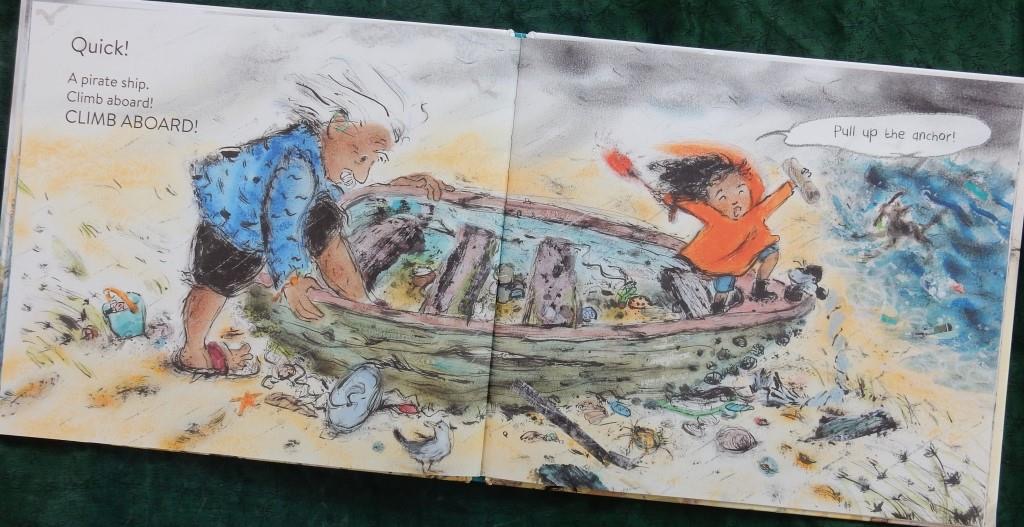
Poppy’s great enthusiasm for doing what some of the farmers she’s read about are trying, reignites her grandad’s love of the natural world and project ‘rewilding’ is agreed on. Every weekend and during school holidays Poppy intends to work on the plan but their first task is to identify areas for nature to replenish itself. Then comes providing the best conditions for this to happen.

As the work gets under way, Poppy realises that it’s more than a two-person task. She enlists the help of her classmates from the town near the farm

and over the next few months great headway is made. But, as the story ends, the wonderful restorative transformation work goes on.

An inspiring, uplifting, hopeful story that presents many of the environmental challenges we face at the moment with so many of our species declining alarmingly thanks to the destabilising effects on ecosystems of human activity. In addition there are other themes – collaboration and the wonderful camaraderie between Poppy and Grandad that exemplifies intergenerational relationships.
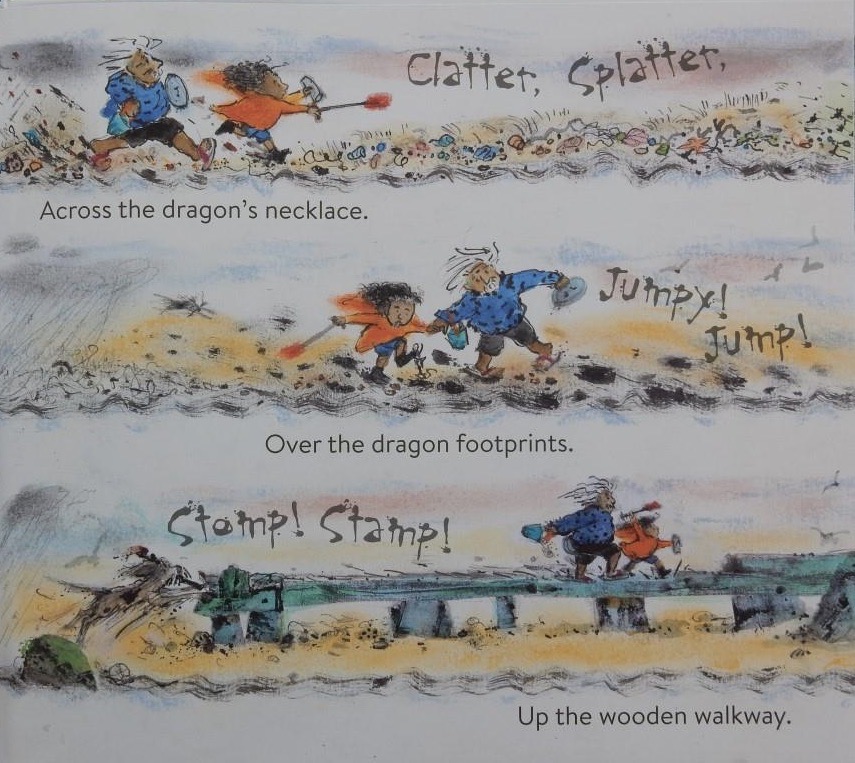
Becca Hall’s painterly, carefully detailed, illustrations are simply gorgeous. Her colour palette is aglow with the sun’s warmth as well as evoking that inner warmth and exhilaration so many of us feel when immersed in nature.
Nick Powell hopes the book will inspire youngsters to do all they can to look after wildlife, while in a foreword, Hugh Fearnley-Whittingstall, celebrity chef, writer and broadcaster, urges us all to be part of the re-wilding movement in whatever way we can. One truly hopes that, inspired by Poppy et al. both young and not so young will respond to their rallying call.

One Lone Swallow

One Lone Swallow
Corinne Fenton and Owen Swan
New Frontier Publishing

This unusual tale is set at the start of the 19th century in Florence. From its opening illustration of a swallow taking flight from her nest high above the city, readers are swept up in the story.

Leaving her nestlings, the swallow flies through the moonlit sky over the rooftops and chimneys searching, searching for her mate. We follow her over the ancient walls and towers, over the chimneys and roofs, under the bridges,

through the arches and above the piazzas, pausing briefly to rest, all the while searching yet knowing that back at the nest her young are calling out their need for food.

Then resuming her search, her eyes detect a slight movement. At the feet of Michelangelo’s statue of David, one wing entangled in ‘shoemakers’ twine’ is her mate.

She takes the end of the twine in her beak and gently begins the task of unravelling the twisted threads. Hidden out of sight lurks a huge rat just waiting to pounce but just in time, with one more pull the last twist of thread comes loose.

Finally not one, but two swallows start their flight back home to their nest.

This is a beautifully told, stunningly illustrated tale of commitment and fidelity. Corinne’s poetic text in combination with Owen Swan’s breath-taking scenes of the twilight Florence of yesteryear make for an extraordinary cultural and aesthetic experience.

The Castle the King Built

The Castle the King Built
Rebecca Colby and Tom Froese
Nosy Crow

Using the rhythmic pattern and structure of the nursery rhyme This is the House that Jack Built, Rebecca Crosby cleverly mixes fact and fiction to create a story of the building of a medieval castle.

We meet those involved in its creation – stonemasons, carpenters

and smiths, as well as, once it’s built, the people who contribute to the castle’s functioning – grooms, knights, merchants, bakers, servants, minstrels and of course, ruler of the land -the king himself.

The final spread presents the entire cast of characters each of them explaining their part (this includes a few women residents not mentioned in the main text)

Rebecca’s skilful use of rhyme and rhythm ensures that the book reads aloud well and Tom Froese uses an appropriate retro style for his striking illustrations helping to create the long ago atmosphere of those days of yore when knights would joust and singing minstrels pipe and strum.

A thoroughly well-presented, enticing and gently educative book for classroom sharing and individual reading, published in collaboration with the National Trust. I specially like the final acknowledgement that everyone included played their part in the life of the making of the castle.

Out of Nowhere

Out of Nowhere
Chris Naylor-Ballesteros
Nosy Crow

Following his superb The Suitcase picture book, Chris Naylor-Ballesteros has created another compelling tale, this time on the theme of enduring friendship.

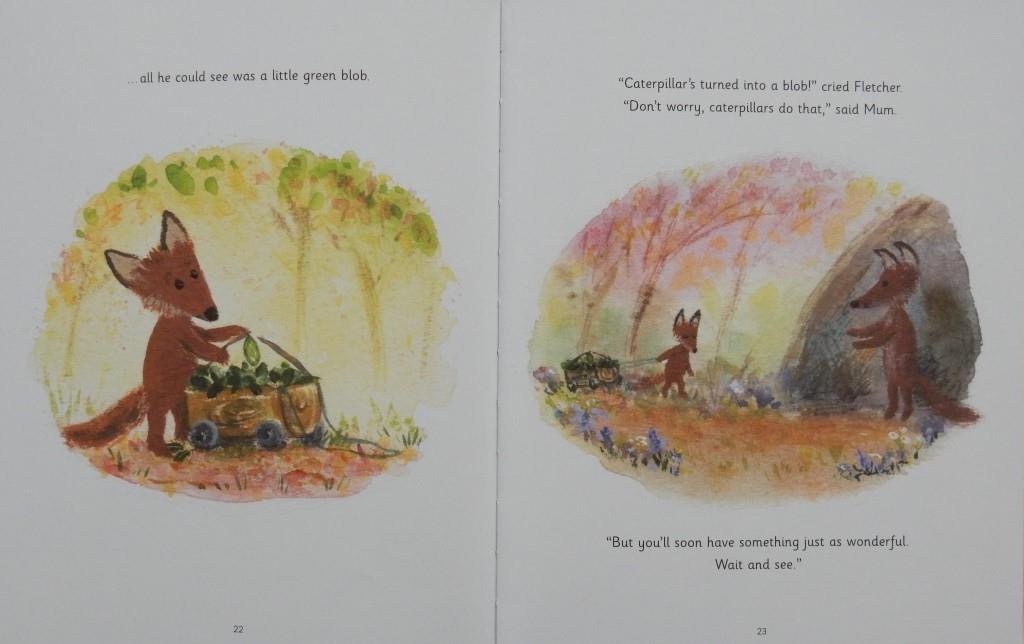
The story begins as the friendship is in its first stage with the arrival ’out of nowhere’ of caterpillar into the world of a beetle (the narrator). The two become friends eating together, and watching the moon come up.

One morning the beetle awakes to find no sign of caterpillar and unaware of the presence or significance of something close by…

Beetle waits, scouring the landscape until eventually he spies through his binoculars something that could be his friend. Heavily weighed down by a basket and trying to feel strong, he treks off through the forest to search,

until he discovers that it’s not her after all – he’s made a huge mistake. Now what? Feeling tired and dejected our seeker decides to rest and revive himself before attempting that long return journey. While so doing, ‘out of nowhere, someone suddenly arrived’

After closer inspection, glimmerings of recognition give way, to absolute joy and a celebratory sharing of food …

Chris’s portrayal of a friendship that changes and grows, (as cherished friendships do) is uplifting and profound. His uncluttered illustrations rendered in a minimal colour palette are highly effective and simply stunning, showing young readers/listeners the way to be a true friend.

I Talk Like A River

I Talk Like A River
Jordan Scott and Sydney Smith
Walker Books

The transformational power of just a few words can sometimes be truly amazing and so it is in Jordan Scott’s autobiographical story. He’s a poet and this is reflected in his lyrical prose wherein he reflects on his childhood stutter and how a conversation with his father after a particularly bad day at school made all the difference.

That day gets off to the usual kind of reflective start but it’s in the classroom where things really take their toll.


When his dad collects him after school, the two take a walk beside the river. It’s quiet surrounded by nature, and having watched his son finally let the pent up emotions of the day flow from his eyes, “They don’t see a pine tree sticking out from my lips instead of a tongue.”

dad sits beside the boy and together they watch the water. “See how that water moves? / That’s how you speak.” he says.

The boy sees ‘bubbling, / whirling, / churning, / and crashing’ and then, keeping his dad’s words in his head he wades into the sunlit water. (shown behind a glorious gatefold) …

Next morning at school the narrator is able to recall these words and ‘to think of the calm river beyond the rapids / where the water is smooth and glistening. … Even the river stutters. / Like I do.’’
No, there’s no instant cure, but this experience does enable the narrator to find a way to tell the class about his favourite place. One cannot help but feel tearful at reading his final few sentences.

I can think of no better artist than Sydney Smith to illustrate Scott’s often painful language. Smith’s wonderfully atmospheric paintings are simply exquisite capturing not only the gut-wrenching pain the boy feels but also the power and energy of the river and of nature itself.


Following the story is a moving ‘How I Speak’ note by the author. Herein he gives additional details of his own childhood experience – his road to self-acceptance and finding a context in which to place his own stutter: ’he (dad) gave image and language to talk about something so private and terrifying.’

This reviewer was absolutely swept away by this awesome collaboration.

Which Food Will You Choose?

Which Food Will You Choose?
Claire Potter and Ailie Busby
Bloomsbury Education (Featherstone)

When Mum opens up the fridge one Monday and sees nothing but beige food items she decides to take the two small narrators straight off to the supermarket to find something more enticing, telling them they’re going to play a game. “But we can’t play games in the supermarket” comes their immediate response.
On arrival she invites her little ones to choose three foods but they have to be red.

Off they go selecting pepperoni, watermelon and a tin of tomato soup. ‘Which three of these RED foods would YOU choose?’ asks the author.

Back home they use the pepperoni as topping for the pizzas they make, chomp into slices of the watermelon (planting the seeds afterwards) and put the soup in a flask to drink when they visit the park .
The narrative then asks, ‘What would YOU do with the three red foods you chose?

A similar thing happens on Tuesday, Wednesday, Thursday and Friday with the children being asked select in turn three yellow, green, orange

and then purple foods.

Come Saturday Mum is caught beige-handed,

so on Sunday the children take things into their own hands …

This is a fun, non-judgemental approach to ‘picky eating’ that should definitely encourage youngsters to try some new foods and Claire Potter, the author includes two sets of notes to help adult sharers to ‘get the most out of ‘ the book.

To add to the enjoyment of the text, she uses some playful alliterative descriptions such as “Gorgeous, glorious, groovy green “ and ‘gazillions of green foods’ and ‘Zingy, zesty, zippy orange !’ … ‘oodles of orange foods’. and adults might like to extend the word play by asking youngsters to make up their own alliterative phrases for others of the foods labelled in Ailie Busby’s enticing spreads. The brother and sister certainly appear to be making the most out of their choices – its good to see wonky carrots and using the celery leaves to feed the rabbit – no food taste there.

There’s a wealth of potential between the covers of this little book, not only for – parents/carers but for foundation stage teachers too.

Slug in Love / How Big Is Love?

Slug in Love
Rachel Bright and Nadia Shireen
Simon & Schuster

Meet Doug, a slug that’s feeling rather lonesome; he would really love a hug. (Wouldn’t we all?) But just imagine hugging a slug – not a very pleasurable prospect me thinks. So agree the various minibeasts he encounters. There’s earthworm, spider, ant, caterpillar each of which beats a hasty retreat; but not before uttering some thoroughly disheartening words.

Oh dear! Is poor Doug to remain forever sans hug? Hold on, what about Gail the stylish snail? She exhibits all the characteristics eschewed by the four previous creatures – now surely she must be THE one …

Once again though, our slug is given the thumbs – or rather antennae – down.

Feeling ever more dejected, Doug pauses to contemplate his lack of an embrace

and unexpectedly something comes flying along. Could she be his hugger at last? With its wealth of wordplay, Rachel’s punchy rhyming narrative, combined with Nadia’s delicious depictions of Doug, the naysayers and more, make for a book that’s a gigglesome delight. In addition, it’s great for developing sound/symbol awareness and, you’ll absolutely love the final twist.

How Big Is Love?
Emma Dodd
Templar Books

In Emma Dodd’s gorgeous story, a mother duck shows her five little ducklings just how boundless is her love for them. Such love as hers illuminates the entire world, is heart filling, unchanging in the face of life’s unsettling moments,

it’s uplifting and supportive, all day every day even in the darkest of difficult times. But these thoughts haven’t come to the mother of their

own accord, it’s through her day-to-day interactions with her little ones that these feelings have emerged so that she can express them through both her words and dealings.

Heartfelt sentiments, beautifully expressed and tenderly illustrated with gorgeous scenes of the natural world, (alternating ones embellished with gold) Emma’s new book is ideal for sharing with the very youngest,

My Bum is So Noisy!

My Bum is So Noisy!
Dawn McMillan and Ross Kinnaird
Scholastic

Assuredly we all need laughs at the moment and be you an adult sharer or a child, you will certainly find plenty in this, the third of Dawn McMillan and Ross Kinnaird’s New Bum series.

Here, the young boy narrator and his raucous rear have an unexpected cacophonous adventure. Not though before the lad has shared with us some of the trials of having such a turbulent tail that emits a veritable and varying trail of emanations, often at the most inconvenient moments. There are for instance hoots and toots, hums and strums, clangs and bangs,

not only when the house is empty. Visitors too are subjected to sounds aplenty – it’s enough to drive them crazy;

well perhaps not all of them. The younger relations (whose rears are a trifle restricted in their sound-producing capacity) are a tad envious and happily our narrator’s parents appear to support their son.
However the real excitement begins when the boy’s unique talent is discovered and put to creative use by a company who are quick to recognise its potential.

Dawn’s crazy rhyming narrative tumbles forth and rumbles along with laugh-out loud examples of whiffy wonders that Ross Kinnaird renders even more hilarious in his zany illustrations. May I suggest having a room spray to hand when you share this one – just in case …

All Aboard the Numbers Train / All Aboard the Shapes Train

All Aboard the Numbers Train
All Aboard the Shapes Train

Sean Sims
Oxford University Press Children’s Books

Based on topics popular with little ones, these two All Aboard titles of a new thematic series are intended to support the early learning goals.
The Numbers Train is in fact a spacecraft that moves through the sky taking six small children and their canine companion on an exploration of the cosmos.

There’s so much to see including rockets, planets, evidence that others have been there too, aliens – of the friendly fun-loving variety fortunately –

and that only takes us as far as number five.

By the time we reach ten the passengers have left their train and are stretching their legs beneath the stars. Back inside again there’s a wealth of number symbols (1-10) on the various levers, dials and other instruments to spot and then it’s time for the countdown before the train leaves for home.

On the return journey there’s an opportunity to count in tens as they whizz past the 100 guiding stars and the penultimate spread maps the entire trip asking ‘Can you remember the numbers we saw on the way?’

No space attire needed on the second ride; the Shapes Train, with its variously 2D shaped windows takes its passengers (and readers) on a journey to the world of playtime, searching for shapes, and the patterns they can create.

We start with circles: ‘There are circles everywhere! The bubbles, balls and bugs are circles.’ says the text. Yes, that is how they’re represented in Sean Sim’s alluring, brightly coloured scene of the train’s first stop but this could be confusing for young learners as foundation stage teachers (certainly this one) would say that bubbles and balls are spheres (3D shapes) not circles (2D shapes).

Other shapes included are squares, triangles,

rectangles, diamonds, as well as semi-circles, ovals, pentagons, hexagons, stars and spirals.

This promises to be a bright, jolly series with lots of learning potential but use the Shapes Train judiciously.

There’s No Such Thing As … Unicorns

There’s No Such Thing As … Unicorns
Lucy Rowland and Katy Halford
Scholastic

Whether or not you know youngsters who are besotted with unicorns (and that’s an awful lot even in my experience), or are acquainted with young search-and- find fans, then this story will likely appeal.

Its narrator is a little girl – a unicorn obsessive if her bedroom is anything to go by and when her big brother tells her that these magical creatures just don’t exist. she decides to try and prove him wrong.

Next morning having packed her bag with the necessary accoutrements, she sets out on a unicorn search. It’s a search that takes her to a variety of places – a farm, the zoo, a lake …

the woods, each of which yield negative results. Now what about the meadow? That looks more promising, but no unicorns appear to frolic among the ponies. Nor are they evident at the seaside, even in the dark depths of that cave …

Equally, the school classroom and the park in the gathering dark furnish for our seeker, not a single unicorn sighting and so disillusioned, she takes refuge to let her tears flow.

Suddenly who should appear but her brother who’s been hunting, not for unicorns but for his little sister. A comforting cuddle ensues and then, under the twinkling stars, the two make a wish …

With its repeat titular refrain,, Lucy’s rhyming telling as always, is a delight to read aloud, and if you share it with more than one or two little ones at a time, make sure you leave plenty of time for listeners to peruse each of Katy’s busy scenes. They simply burst with enchanting details and rainbow hues; and of course there’s that elusive one-horned creature lurking somewhere at each location.

Love

Love
Corrinne Averiss and Kirsti Beautyman
Words & Pictures

Young Tess is part of a loving family – love surrounds her like the ‘light inside one of Daddy’s little houses.’

However, when the time comes for her to start school, the worries creep in. School is big and scary – nothing like that warm scarf that she feels wrapping around her when she goes out with her parents. Will the love still find her?

Her mother tries reassuring her saying as they part by the gate, that love will still find her even when they’re apart “like a string between us – it can stretch as far as it needs to.”

Tess though isn’t sure. Her understanding teacher offers some comfort – ‘Tess noticed a little thread between them. That felt nice.’

Little by little she continues discovering new strings of connectedness, friendship and love throughout the day.

Come hometime though, the anxiety returns when her mother is late to collect her.: that string doesn’t appear to be connecting Tess to anything or anyone. Finally, however, there with an explanation and a string-fixing hand, stands Mummy and all is well once more.

Enormously reassuring for young children who experience separation anxiety, Corrinne cleverly uses the string trope to make tangible the bond between loved ones in her story. But she makes it all the more impactful – love connects us no matter the distance between us – with her own ‘candle house’, ‘warm scarf and other metaphors. Employing a limited colour palette to great effect, Kirsti Beautyman’s sequence of textured illustrations are full of feeling, be that love, tenderness, worry, or empathy.

I Love You With All My Heart / The Curious Case of the Missing Mammoth

I Love You With All My Heart
Jane Chapman
Little Tiger

When Little Bear’s exuberant music making very close to where his mother is tending her sunflower plant results in a catastrophe, the little creature is worried that his mother will be angry with her offspring – and even worse that she’ll stop loving her.

Admirably, Little Bear owns up right away and happily, Mummy is equally quick in her response. She scoops the cub up in her arms and reassuringly says “I’ll ALWAYS love you,” and proceeds to soothe her by asking that she place her paw on her heart to “feel my love beating on and on for ever”. She goes on to tell Little Bear that a similar “Ba ba boom” beats within her little one’s heart.

Next day at preschool, the little cub draws on that knowledge when she’s upset about losing a race, and then later back in the garden when her new kite is whisked away by an unexpected gust of wind. Seemingly, no matter what upsets life throws at Little Bear, she can draw strength from that never-ending motherly love.

There’s a lovely final twist when Mother Bear’s cake baking is interrupted by her cub’s enthusiastic, mud-splashing announcement about her kite rescue …

Would that all little humans had a mother as understanding and unconditionally loving as Little Bear who is brought to life along with Mother Bear in Jane Chapman’s splendidly expressive illustrations that show just how full of love they are, and how comforting the feel of a heartbeat can be to someone needing a bit of TLC. Yes, this book is brimming over with love but it never becomes sentimental.

The Curious Case of the Missing Mammoth
Ellie Hattie and Karl James Mountford
Little Tiger

Now out in paperback is this wonderful magical adventure that unfolds inside The Curious Museum wherein Oscar, clad in his night attire, and mammoth Timothy search for Timothy’s baby brother, Teddy, intent on finding him before the clock strikes one. The hardback version was reviewed on the blog but if you’ve missed the book, it’s definitely worth seeking out the paperback to share with youngsters. There’s SO much to explore in the illustrations and there’s a wealth of information and more to discover behind the flaps.

Wolf Girl

Wolf Girl
Jo Loring-Fisher
Frances Lincoln Children’s Books

Sophy tries her best to fit in at school, even wearing her wolf suit, that helps her to feel fierce and perhaps a bit brave, but no matter what she does, her shyness takes hold, she just cannot find her voice and the other children laugh at her.

Safe at home once more, she lets her tears flow and then something amazing happens. Sophy is transported to a magical snowy woodland world and there she finds herself face to face with a wolf and her pup. The pup and girl romp together in the snow becoming friends

but as the snow falls faster the three seek shelter in a cave.

Once inside, the roaring Sophy suddenly hears is both without and within, and there before her is a huge bear. She’s terrified but somehow finds her inner wolf and sends the bear packing.

However, on reflection, she has a change of heart and realises that there’s another way to show her bravery, one that’s more important than any other …

Through both words and pictures, Jo has created a totally credible child in urban-residing Sophy; (indeed I’ve taught many Sophys in my time in the classroom) though she leaves her sensitive, lyrical illustrations to do much of the talking, speaking powerfully of the importance of drawing on your inner strength, finding your voice and friendship.

Definitely a book to share and discuss – with individuals, in the classroom or foundation stage settings especially.

The Tale of the Valiant Ninja Frog

The Tale of the Valiant Ninja Frog
Alastair Chisholm and Jez Tuya
Walker Books

Siblings Abby and Jamie certainly aren’t lacking in imagination and they love to hear a good story, so a night camping under the stars offers the perfect time and place for a tale from Dad. He’s more than willing so, as he toasts marshmallows over a fire, the children suggest the characters to include – the Prince, the Frog, (inspired by Abby’s soft toy) the Princess, the Witch and a MONSTER.

Dad begins his yarn: “It was a dark and stormy night and at the bottom of a horrible mountain … were the heroes.” Enter the cast – mounted on his steed comes the handsome Prince; then there’s the Princess (a closet jewel thief of the daring kind), witch Bogwort – (a Ninja when necessary)

and the gruesome Grubber.

Soon the interruptions start: first it’s Abby who seems set on ensuring that the Frog features large despite its diminutive stature. Thereafter the siblings’ interjections turn the plot this way and that as the three of them co-create a very funny, exciting fantasy with Dad accommodating the children’s ideas into the narrative. A narrative made all the more fun thanks to Jez Tuya’s comical – often slapstick – illustrations of larger-than-life story characters particularly that hirsute giant,

and Barry the frog – hurrah! Yes, despite Jamie’s dismissive scorning, the part he plays in making a happy ever after finale is far from small.

I love the close-up perspectives and the panel sequence

– actually I love everything about this book. So too will young listeners who will surely respond with relish to any adult sharer giving it the dynamic performance the tale deserves.

If Winter Comes, Tell It I’m Not Here

If Winter Comes, Tell It I’m Not Here
Simona Ciraolo
Walker Books

As the small boy narrator of this story revels in the last days of summer, swimming at every opportunity, his elder sister tells him of the approaching seasons.

First will be autumn with its chillier air and falling leaves,

followed by winter. That’s a time of constant rain, darkness and being stuck indoors, cold and dullness.

Time passes and inevitably autumn and winter come. There’s a distinct lack of yearning for ice-cream or a swim; however, each season brings delights of its own: there’s a parent’s long, long scarf to use as a wrap, and family snuggles on the sofa in autumn;

and yes lots of rain but also yummy warm soup.

But it’s winter that’s most surprising and hurrah! Our narrator has lots of exhilarating fun in the snow

and determines to make the most of every opportunity. Big sisters aren’t always right after all, it would seem.
Simona Ciraolo certainly portrays the best of each season in her illustrations and the characters’ expressions speak volumes. This, her latest book is one that offers a good starting point for a discussion on seasonal changes and favourite times of the year with youngsters.

ABCs of Kindness

ABCs of Kindness
Samantha Berger and Ekaterina Trukhan
Highlights

I suspect most people would agree that since the start of this current pandemic they’ve discovered that it’s not material things that are important, but acts of kindness. Now here’s a large format alphabet board book that presents different ways of being kind be that to one another, to animals, to the planet or to ourselves.

Thus we have, ‘F is for Finding a friend who sits alone and sitting with them’; ‘’D is for Donating your blanket to a dog who doesn’t have one’;

G is for Gratitude – remembering things to be grateful for every night’; ‘P is for Protecting and Preserving our planet’

and ‘Q is for Quiet moments to listen to the world around you.’

Each example is illustrated in bold bright, geometric style and Ekaterina Trukhan’s overall visual presentation is diverse and inclusive. If you work with young children and want to encourage them to be considerate and respectful towards others and the planet then this is a good starting point; it’s sufficiently large to be shared with a group rather than just an individual.

The Three Wishes

The Three Wishes
Alan Snow
Pavilion Books

Rooted in a northern folk tale, this is a story of hope and kindness about the origins of Father Christmas. It tells of some nomadic people (Sami perhaps) living in the far north. The adults mostly forage and hunt while the children’s role (alongside playing) is to tend the deer.

One winter as the solstice approaches, in one particular family, the task of feeding the deer falls on the elder boy. A job he does reluctantly on account of his fear of the dark, until one day he discovers that all the deer are gone: without them how will his family survive?

Out into the silent forest runs the boy searching but it’s not long before as the snow falls ever faster, he realises that he’s lost. He struggles on until he’s near exhaustion but as he lays on the snow with sleep coming on him, he hears a sound. It’s a reindeer bell; the boy struggles to his feet and follows the sound until he finds the reindeer clustered around a cave entrance. The boy follows the deer inside the cave and suddenly finds himself in a timeless summer world where he’s confronted by three creatures.

They explain that he can never return to his home as this place must be kept secret. They grant him three wishes. He chooses freedom, happiness, and time. At the end of the year, they offer him a reward for his good work.

He’s then allowed to return to the outer world to visit his family, but only in the dead of winter each year, and on each visit, he leaves them a gift.
After three years, the bird, impressed by the boy’s love for his folks, offers him four feathers from its tail, tying them to the harness of the deer.

Their magic allows the deer to fly and one year, anticipating his visit, the family leaves a special set of new red clothes for their visitor …

The author has cleverly structured his story with the elements of gift giving, flying reindeer and a red suit being gradually interwoven into the enchanting narrative,

until we eventually realise where it’s all going. Snow’s illustrations are superb – beautifully designed and composed be they contained within intricate borders or not. I love the colour palette contrast between the eternal summer world and the chilly winter outside.

This is a delightful book to share over the festive season, perhaps sitting by a fire on a cold evening sipping a favourite hot drink.

The Song of the Nightingale

The Song of the Nightingale
Tanya Landman and Laura Carlin
Walker Books

Based on a creation myth, this fabulous book is a neo pourquoi tale about how the animals got their colours and a feathered creature acquired something very special.

In powerful prose Tanya Landman presents a dramatic unfolding of a spectacular creative enterprise by one named as ‘the painter’.
With the young earth and its flora already rich in colour, she summons all members of the animal kingdom together in their dreary drabness, speedily organises them and then, in a determined manner (sleeves rolled up), she opens her paintbox. Starting with the fiddly wrigglers, sets about adding colour to each and every creature – small and great.

Enter illustrator Laura Carlin to wield her own paintbrush bestowing with sweeps, daubs, splashes and spatters upon the grey creatures their rich array of tints and tones until all earth’s fauna have undergone a remarkable transformation. Some such as the mandrill

and the parrots are instrumental in their own colour schemes.

But what of the one that comes after the painter has closed her box for the day? That shy little creature too scared to leave the shadows until nightfall when the painter’s colours are, seemingly all used up – or are they?

With consummate skill Laura captures both the wit and the lyricism of Tanya’s telling; the combination of the two make the book itself such a wonderful work of art. It’s most definitely one to return to over and over wherever it’s read.

Dogger’s Christmas

Dogger’s Christmas
Shirley Hughes
Puffin Books

I think Shirley’s Dogger has been introduced to every foundation stage and KS1 class I’ve ever taught so I was enormously excited to see Dave’s beloved toy dog return in a seasonal sequel. Now considerably older, Dave still takes his favourite soft toy to bed with him every night, although his interest in toys has broadened to all kinds of vehicles.

As Christmas approaches, we share the family’s preparations – writing to Father Christmas, putting up decorations, shopping –

till, come Christmas Eve, the tree is a-glow and the children’s stockings are ready to hang up.

Next morning there’s huge excitement as Dave, Bella and Joe open their presents littering the floor with the wrappings. They also give their own specially chosen gifts to their Mum and Dad before Bella and Mum visit a neighbour, leaving Dad busy with the Christmas dinner ready for the arrival of Granny and Grandpa.

After a wonderful family day, when the visitors have gone and the children are in bed, disaster strikes. Dave wakes to discover that his beloved Dogger is missing. His parents and Bella help him search but of Dogger, there’s no sign.

Next morning and in the days following Dave is totally downcast; he’s sad that he’d neglected his old favourite and not interested in his new toys. Surely Dogger can’t be lost forever? No of course not, for this special toy has not lost his own knack of turning up in the most unlikely of places.

Shirley’s magic shows no sign of waning in this wonderful festive sequel to her original, now classic, picture book. Every spread exudes love and warmth – both in the account of the family, and in Shirley’s illustrations. It’s interesting to see how much Dave, Bella and little Joe appear to have grown.

A must for family sharing this Christmas, and for many to come.

I Love You more than Christmas / The Snowiest Christmas Ever / Can You Find Santa’s Pants

Here are 3 seasonal picture books from Little Tiger kindly sent for review

I Love You more than Christmas
Ellie Hattie and Tim Warnes

Little Bear love, love, loves pretty much everything about Christmas but what is it that he -and indeed his mother and father- love even more than Christmas? We’ll discover the answer – eventually – but adults will probably guess it from the outset. Every attempt one of them makes to reveal that one better thing is interrupted by something or someone that is part and parcel of the exciting build-up to the big day.

First it’s the mail delivery (Mrs Postman with a sackful of cards), then it’s Daddy Bear bursting through the door dragging an enormous tree to decorate, after which it’s Mummy who’s been hunting for the decorations in the loft; but that’s just the start.

It takes until bedtime before Little Bear is finally able to share that all important message.

Tim Warnes’ wonderfully warm illustrations are an ideal complement to Ellie Hattie’s homely tale of togetherness and celebration.

The Snowiest Christmas Ever
Jane Chapman

In the run up to Christmas things are pretty nearly perfect in the bear family’s cabin but there’s one thing lacking, so says young Button Bear cub, and that is snow. Her brother is equally eager for the fluffy stuff to be ready for Santa’s sleigh to land in. Then come bedtime, lo and behold what should the cubs spy as they peep through the curtains but swirling, whirling snowflakes. As the bears fall asleep snug inside, the snow continues falling all night getting ever deeper outside.

The following morning though, things on the snow front seem to have got rather excessive and it looks as though the entire family is stuck indoors. Was that wish of Button’s a mistake? Will Santa be able to make his delivery to the cabin?

Perhaps the cubs can turn the situation around so they all have a truly memorable Christmas …
This is definitely a cuddle up and share picture book that focuses on the anticipation and excitement of the days leading up to Christmas.

Can You Find Santa’s Pants?
Becky Davies and Alex Willmore

Here’s a new take on the ever-popular subject of pants and on Christmas, that I suspect many youngsters will find irresistible. Just imagine the sight of a bare-bottomed Santa sitting atop his sleigh; but that is a decided possibility when on Christmas Eve he discovers, horror of horrors, that his pants have gone awol. Hang on though; what about all the spare pairs hanging on the washing line? Oh dear me, now they too are playing hard to get as they detach themselves from the line and take flight.

The hunt is on but if Santa can’t locate any of the errant underwear, can he find a suitable alternative so he doesn’t have to expose his rear end to the elements on his chilly delivery round.

An emergency is declared and all his friends – elven and animal – rally round to join the hunt. Will they or won’t they avert a chuddie crisis: it’s a case of …

Told through Becky Davies’ jaunty rhyming text and absolutely hilarious illustrations presented by Alex Willmore (of pea fame), this will be one of the year’s festive favourite for sure.

A House for Christmas Mouse / The Lightbringers / Magnificent Mabel and the Christmas Elf

A House for Christmas Mouse
Rebecca Harry
Nosy Crow

On a snowy Christmas Eve an excited Mouse arrives at Treetop Forest in search of somewhere to call home – somewhere cosy and warm, with food and friends.

Coming upon a little rabbit outside his burrow she knows she must stop and help him light a fire within and so she does. She also stops to assist Fox in his cake making

and Bear with hanging up Christmas decorations, but having done so it’s almost sundown and Mouse still hasn’t found her new home.

Suddenly a gust of wind sends her tumbling into the deep snow and when she gets up, there before her is something that might just be the perfect place to make her home. On closer inspection it seems far from perfect though, so off she goes to search for leaves to make a bed. As she looks, who should come hurrying by but Bunny, followed soon after by Fox and then bear, each carrying something with them.

Where are they going and why?

With its wintry woodland setting and sparkly touches, Rebecca Harry’s lovely gentle tale of kindness repaid is just right for sharing with the very young this festive season.

The Lightbringers
Karin Celestine
Graffeg

This is the first of a new four book series, Tales of the Turning Year. With a combination of folklore and nature the author weaves an uplifting, hopeful story that retells an ancient renewal tale found in various parts of the world in honour of the winter solstice. Assuredly during this current covid lockdown we would all welcome a visit from The Lightbringers – small beings that gather embers and put them into their seed lanterns.

Karin explains how the seasons change as the earth breathes, with a particular focus on the increasing darkening with the approach of December 21st, the winter solstice – a turning point that heralds the spring and longer, lighter days.

Her words are simple but impactful, accompanying her atmospheric, beautifully composed photographic tableaux of the natural world populated by her felted animals, particularly the Lightbringers led by Hare – the caller. With its reassuring final, ‘The light will always return because it is guarded by small beings and they are steadfast in their dark’ this is a book to share and be cheered by in these dark days.

For new solo readers is

Magnificent Mabel and the Christmas Elf
Ruth Quayle, illustrated by Julia Christians
Nosy Crow

Mabel of Rabbit Riot fame returns to relate three further episodes in which she demonstrates her magnificence. In the first we find our young narrator in the sweetest of moods as she unearths her Christmas Elf from the box of decorations. She tries to get her classmate Edward into the Christmas spirit too but without much success; but she’s more successful in allowing her naughty little elf get her into big trouble over Christmas presents.

In the second story Mabel tries her very best to befriend a new boy and also finds out that once in a while school can be really interesting.

It’s toddler-minding that gets our young heroine into a tizzy in the final episode, and that’s after she’s declared that looking after toddlers is ‘easy and fun’. Really – Even cousin William?…

Huge entertainment from such a delightful character: Ruth Quayle really does appear to have the ability to see things from the viewpoint of six-year-olds, and Julia Christians’ black and white illustrations are a spirited delight.

The After Christmas Tree / Dinosaur Christmas!

The After Christmas Tree
Bethan Welby
Scallywag Press

Here’s a debut picture book festive story with a difference: it features a little boy named Brian who comes upon a discarded Christmas tree by the roadside while out walking with an adult one grey January day. Feeling sorry for the abandoned tree he takes it home, promising to care for it.

However, once back indoors he’s the only member of his family who is pleased about his find, particularly as he moves it around wherever he goes.

By bedtime even Brian is feeling unhappy and Mum offers to help him take it outside. However, the boy insists on doing the job himself and it’s left outside in the snow overnight.

Brian meanwhile has an anxious night but when sleep finally comes, he has a wonderful dream – or is it? …
Both words and pictures are presented with sensitivity: the telling is straightforward leaving plenty of room for Bethan’s expressive illustrations to do much of the talking and with a knowledge of the huge number of Christmas trees that are merely thrown out every year, the message about sustainability is clear and important.

Dinosaur Christmas!
Penny Dale
Nosy Crow

Penny Dale’s terrific dinosaur team are back and now it’s Christmas Eve and they’re called to the aid of Santa. In order to rescue him they have to make their way through a swirling, whirling snowstorm. Be they at the wheel of a snow plough crunching over the snowy road, whizzing along on snowmobiles, zooming Whoosh! Whoosh! over the water on a hovercraft or chugga chugging in search of Santa’s house,

the crew will be there in the nick of time to unearth (or un-snow) the old man’s sleigh and make sure he’s suitably fuelled with seasonal fare. Then with presents duly loaded (courtesy of the helicopter dinosaurs), it’s up and away with a Ho! Ho! Ho! leaving the dinosaurs time to make their own preparations for the big day. Will Santa be kind to them too?

Young dino. fans will thoroughly enjoy the return of the prehistoric brigade showing their manoeuvres in new forms of locomotion for the festive season.

How To Make A Bird

How To Make a Bird
Meg McKinlay and Matt Ottley
Walker Books

This stunner of a book has at its heart, the imagination. It shows through the eyes of a solitary young girl protagonist, the importance of hope and determination in the creative process as you embark on a journey, not entirely sure of where it will lead.

We follow the girl as she collects, designs and builds using hundreds of hollow, light bones (when they rest in your palm you will hardly feel them, she says.) So much the better if they are to become airborne, but that’s kind of getting ahead.

As she lays them out into a bird shape, she contemplates, ‘the proud arch of an eagle, the soft curve of a sparrow’. Maybe, but this is a slow process,

this fashioning into a finished form and it can’t be done without feathers for both warmth and flight

and of course, a fast-beating heart. Then come those finishing touches that make your creation entirely unique – so much more that the sum of its parts.

That’s the magic and eventually it’s time to set free your deeply personal entity, to let it soar up and away …

Truly special, this is a book for all ages, a book where words and pictures are in complete harmony, a book for anyone who loves nature and being creative. Such is the attention to detail throughout that readers will want to pause on each exquisite spread, fill with awe, and wondering at the precious nature of life itself. Matt Ottley’s art has a musicality that is simply perfect for this story, as he gently infuses his visuals with the intimacy of Meg McKinlay’s telling : a telling that has an ethereal haunting quality that will stay with you long after you’ve closed the book.

The Night the Reindeer Saved Christmas / Santa Jaws

The Night the Reindeer Saved Christmas
Raj Kaur Khaira and Kasia Nowowiejska
Studio Press

On the eve of Christmas Eve at the North Pole, Mr Claus is feeling chuffed: everything is ready, so he decides a short period of relaxation is in order.
Suddenly though there comes a message calling him to an emergency meeting: the rockets on the Christmas sleigh have exploded. At the prospect of Christmas being cancelled by their leader, the elfin team are at a loss.

Not so though Mrs Claus. She suggests calling on the creatures whose homes are nearby to assist in the delivery of the gifts. It’s not long before all the animals are assembled and ready to demonstrate their suitability. The polar bears are certainly strong, the narwhals speedy, the kittiwakes willing but inept

and the arctic foxes just disappear. Sleepy bears, a lack of waterproof wrapping and vanishing foxes are enough to send poor Mr Claus crazy. Off he goes for a meditative wander and as he’s contemplating his plight, he spots two creatures flying past.
Then Mr C. gets the surprise of his life. There before his eyes are Comet and Blitzen and he follows them back to their herd and there discovers some creatures that just might save Christmas after all.

Let’s hear it for the women and of course, the female reindeer.
I loved this clever story (complete with a few final creature facts) and it’s especially good to see Kasia Nowowiejska’s portrayal of such a diverse cast of characters in her zany illustrations.

Santa Jaws
Mark Sperring and Sophie Corrigan
Bloomsbury Children’s Books

A snappily fun seasonal story is this one of Mark Sperring’s set beneath the sea as Christmas Eve approaches.
Meet Shelly who’s been shopping at the Deep Sea Christmas Store where she’s bought a special bobble hat.
Back home she makes a snazzy sign which she affixes to her front door.

It doesn’t fool the local undersea population; they beat a hasty retreat but Sid squid is a newbie to the location and is beguiled by the sign as he contemplates stars, candy cane and snowman building. His lucky day has surely come. Up to that front door he goes and what he encounters when it’s opened is certainly alluring

but then comes a BIG sharp-toothed surprise.
All is not what it first seems though, but faced with a dilemma, what will Sid do next?

Sophie Corrigan’s sub aquatic scenes of corals decorated with Christmas decorations as well as the sight of the hapless Sid and the sharky Shelly are sure to make your little ones giggle in delight.

The Twelve Days of Christmas

The Twelve Days of Christmas
Alex T. Smith
Macmillan Children’s Books

Creator of the wonderful Claude books, Alex T. Smith presents a comical sparkling new take on the seasonal classic song. Herein the narrator is a stylish young miss and ‘my true love’ has been replaced by a generous grandma. To call her merely generous might be somewhat inaccurate for despite starting off relatively sensibly – the partridge in a pear tree on day one, the two turtle doves along with the partridge in its tree on day two but by day five things have begun to get a tad out of hand,

and thereafter, particularly from day seven things are completely crazy …

And as for that final twelfth day gift, I’ll leave you that to discover what it is and how it’s received … I’m pretty sure it’ll make you splutter; I certainly did!

There’s some delicious alliteration, and

an abundance of visual hilarity – heaven help the post-person who has to deliver all that lot. Alternatively titled ‘Grandma is Overly Generous’ is most definitely no exaggeration (unless the grandma in question happens to be giving a copy of this book; in that case, she’s perfectly generous.)

Monster Christmas

Monster Christmas
Giles Andreae and Nikki Dyson
Orchard Books

As Christmas approaches, Father Christmas, relaxing by the fire, is feeling somewhat jaded with his creaky knees; he seems to have lost the zest for that delivery job of his. Perhaps it’s finally time to recruit a replacement – someone special – young and different – to take on the role of spreading kindness and good cheer. He writes a wanted notice and duly dispatches it.

Meanwhile in distant Monster Land a family talks over tea. Little Monster informs his parents that it’s time for him to see more of the world.
Just as he’s uttered his intention, what should come wafting in but that note of FC’s.

Then having bid his parents a fond and hasty farewell, he’s up and off trudging through chilly weather, destination the North Pole and Father Christmas’s front door.

There he is eagerly recruited, and a training regime begins. It’s not too long before he’s declared ready for the task

and so off he sets, destination this time, a shopping mall, therein to erect a grotto wherein to welcome all the little children.
Things don’t go quite as planned however as it’s with terror not seasonal delight, that Monster Christmas is received. Sob sob – that’s the monster, not the children who scream and shout. Surely things will improve thinks our optimistic would-be gift bestower. Instead there’s not a single house in a single town prepared to welcome Monster Christmas and his sleigh that year.

Exhausted, the reindeer plummet earthwards to land right on the edge of the world and it’s there that a lonely young lass lies abed slumbering in her cosy igloo.

Will she too send little Monster Christmas packing? What do you think?

With its wonderfully heart-warming conclusion, Giles Andreae delivers a terrific rhyming narrative that will certainly remind readers and listeners of what Christmas is really all about. Nikki Dyson’s depictions of Monster Christmas will definitely win him countless admirers with his adorable demeanour and positive attitude against all the odds.

Monstrous fun: this one’s an instant winner in my book and so it will be with youngsters who will definitely demand frequent re-readings during the build-up to yuletide. Teachers, just think what a smashing school festive performance this would make.

The Night After Christmas

The Night After Christmas
Kes Gray and Claire Powell
Hodder Children’s Books

For many, Boxing Day is something of a come down after the big day itself. Not so for Santa and his wife, especially come evening time. That’s when things really start to hot up for them, as well as for his faithful band of elves who are eagerly awaiting that rallying cry to the eight giant owls aptly named Snowy, Ghost, Blizzard, Snowball, Milkshake, Whitefly, Misty and Noble. Their task on this special occasion is to safely deliver a ginormous cracker – XXL-plus size no less, filled to near bursting point and ready for the big bang.

Once the elves have pulled the thing and spilled out its super-tasty contents, it’s time for Mrs Claus to step up for the big switch-on. And what a magnificent sight she triggers: first the colours cascade forth and then the stars shift to create spectacular ‘Yule constellations’.

Thereafter comes the dancing with both elves and reindeer performing their ‘Strictly’ moves with panache – all except Vixen who has four left hooves, so we’re told.

But all good things must come to an end and as the northern lights begin to fade, Santa starts to feel the need for some shut-eye. Off go the revellers and you can guess what Mr and Mrs Claus do (after a quick stop under the mistletoe) – zzzzz.

Brilliantly told in Kes Grey’s unfaultable rhyming text that bounces joyfully along to that final throwaway finale, and equally exuberantly illustrated in Claire Powell’s fantastically funky scenes of festivity. How she managed to portray all those elves as the party erupts, is an astonishing feat in itself.

A Christmas cracker with a superabundance of ‘rooty-toot-toot’ magic that will surely become a seasonal classic.

Santa Post

Santa Post
Emma Yarlett
Walker Books

A few days before Christmas something comes whooshing down Santa’s chimney and into the fireplace. It’s a letter from someone signing herself Amy but the vital information about what she would really like for Christmas has been burnt away, leaving Santa puzzled but determined to discover what the missing words were.

There’s certainly one person he can turn to for the help he so badly needs: Head elf Elfalfa at the North Pole. With a letter duly dispatched all he can do is wait. Meanwhile at the North Pole the elves are exceedingly busy but Alfalfa issues a toy-making request to the only one of her helpers free to assist – Elf Boggins. The little fellow does his best with what little resources are left in the almost bare cupboard and Amy’s present is back to Santa, special delivery with an attached note of explanation. Imagine Santa’s reaction when he opens the parcel and sees this …

Still determined to find the perfect present, Santa decides to ask for further help from others of his North Pole pals.

Will he ever be able to deliver to Amy what she truly longs for?

With letters and parcels to open, this joyful festive offering from Emma is sure to delight. Her splendidly expressive illustrations combined with her deliciously quirky humour evident in both words and pictures, make this a seasonal treat that will be brought out and enjoyed year after year by teachers in classrooms, and families with young children.

The Couch Potato

The Couch Potato
Jory John and Pete Oswald
Harper360

Here’s a spudalicious tale from popular duo Jory John and Pete Oswald who add a new veggie character to their entourage in the form of a potato, one wedded or should that be, welded to his sofa – almost – and by his own admission, the ap-peel of this comfy spot is irresistible. Especially when everything a spud needs is within easy reach.

Our dumpy narrator, like many humans during the on-going pandemic one suspects, has become well, a couch potato. Moreover this veggie has a huge number of screens for the purposes of watching favourite shows, playing video games, face to face conversations and more. He surely has everything under control, this spuddy guy.
But one day, disaster strikes; plugging in his latest device (mail order of course), causes the electricity to PEW-WWWWWWW resulting in darkness and, can you imagine, our potato leaving his favourite spot to look out the window. yes he can manage that!

With nothing else to do, he decides to go for a walk in the great outdoors, accompanied by his pooch Tater. This foray in the open air causes something of a cathartic release: there’s peace, nature and reality out there, liberating and sometimes exhilaratingly beautiful.

Time to make some permanent changes, thinks our starchy spud pal and yes, having found a happy medium, life is great …

Nature and the outdoors are things Covid hasn’t taken from us all; I certainly feel that in addition to books and reading, my well-being depends on getting outdoors and walking in the beautiful countryside around me, no matter the weather.

Love the humour inherent in both the punny writing and the illustrations of this book. There are intertextual winks, an abundance of genial spuds and the final spread with the hero enjoying a cuppa and reading The Catcher in the Fry is a delicious way to end a story that will appeal to both children and adults.

The Snowflake

The Snowflake
Benji Davies
Harper Collins Children’s Books

Benji Davies has created yet another heart-warming and absolutely beautiful picture book about on the one hand, a little snowflake and on the other, a little girl, named Noelle. The former, as the story opens, is in the process of falling, albeit rather reluctantly at first. Far below, the second is returning home through the city with her grandpa, Pappie, wondering as she walks about the possibility of snow that night.

As the snowflake falls, she wonders about where she will eventually land and where she truly belongs, but the choice isn’t hers to make as her fate is controlled by the wind that bears her drifting and swirling towards the bright lights as they get ever closer. Both child and snowflake are drawn by a wondrous sight – a large Christmas tree that glistens and sparkles in a window, the one wishing for such a tree for herself, the other wanting to be the star atop that tree.

Then close to home, Noelle finds the perfect little tree of her very own, while far above, the snowflake is still wondering where she might find to land.

Back home, Noelle’s mother gets out the decorations and together with Pappie, the child sets about adorning the little tree. 

Eventually Noelle puts it outside on her windowsill; but goes to bed feeling that the tree is lacking something special. But what? …

A magical, truly memorable, heart-warming Christmassy tale about finding your true purpose. It’s Benji’s art that really steals the show here: it’s full of glorious, festive details on the one hand and on the other, those wintry skyscapes are simply superb. When you share this, like the snowflake aglow on the final spread, everyone will be left with a wonderful glow within.

The Tooth Fairy and the Home of the Coin Makers / The Tooth Fairy and the Magical Journey / Dilwyn the Welsh Dragon

The Tooth Fairy and the Home of the Coin Makers
The Tooth Fairy and the Magical Journey

Samuel Langley-Swain and Davide Ortu
Dilwyn the Welsh Dragon
Samuel Langley-Swain and Jessica Rose
Owlet Press & The Royal Mint

The Tooth Fairy titles are a contemporary take on the tooth fairy tradition that divulges the fairy’s time-honoured teamwork with the original maker of coins.
In the first story we meet twins Grace and Ollie and their Grandpa at whose home they spend every weekend. The twins are thrilled when they both manage to get their wobbly tooth to pop out and rush excitedly to reveal their gaps to Grandpa an erstwhile employee at The Royal Mint. 

He explains that the tooth fairy will pay them a visit that night, exchanging the teeth for a coin apiece; he also makes little pouches to facilitate the exchange.

Excitement rules when the following morning the pouches both contain a gold coin, and then Grandpa shows the twins his own coin collection. He tells them how the Mint acts as a training school for the fairies and how once situated in London it has relocated to a Welsh valley. At the end of the story the twins lose another tooth each and cannot wait to share the news with their Grandpa.

In the second story, summer has come and the twins are losing more teeth. A sleepover at Grandpa’s is arranged. During the evening he regales the children with tales of a fairy, gold coins and a fearsome dragon; and tells them about his time as a Coin Minter for Her Majesty. Eager to learn how to fly, that night the twins set a trap for the tooth fairy but instead they’re visited by the Wensleydale Watch-Mouse and he’d spotted their trap.

When Grandpa, disturbed by all the noise, finds out what they’ve been up to, he’s far from pleased but asks the mouse to take them to his favourite place. Something magical happens and off they all go on an exciting journey of discovery …

Told in Samuel Langley-Swain’s rhyming text accompanied by Davide Ortu’s lively, funky illustrations of gappy-mouthed children, Grandpa and an entourage of fairies and more, these stories will fascinate youngsters especially, when they lose that first tooth.

For a slightly younger audience is Dilwyn the Welsh Dragon, another rhyming tale, set in the relocated Royal Mint in Wales. Here, one night among the golden coins an egg appears from which emerges a tiny dragon.
Next morning the coin makers discover the hatchling naming it Dilwyn (truth) and caring for him. They bestow on him the task of guarding the coins and one night his powers are put to the test when a pair of robbers break in …

This clever interweaving of a fun story with real history will entertain little ones and the book will make an especially worthwhile purchase should they visit Llantrisant where the story is set.

Will You Be My Friend? / The Purple Puffy Coat

Here are two enormously enjoyable but very different books, each of which has friendship at its heart. Thanks to Walker Books who sent them for review.

Will You Be My Friend?
Sam McBratney and Anita Jeram

This gorgeous sequel to Guess How Much I Love You (now celebrating its 25th anniversary) comes with a touch of sadness as author Sam McBratney died recently. The new story continues on from the first with Little Nutbrown Hare venturing out to look for a playmate. Initially he finds only replicas – a reflection and a shadow of himself.

But then up on Cloudy Mountain he comes face to face with the real thing. It’s Tipps, the Cloudy Mountain Hare and she too wants a friend and playmate.

They play chase and engage in other fun activities, followed by a game of hide and seek. Tipps goes off to hide but will Little Nutbrown Hare ever see her again?

Another timeless treasure and classic to be, to add to family bookshelves and to share with early years children.

The Purple Puffy Coat
Maribeth Boelts and Daniel Duncan

With Stick Insect’s birthday just a week away, his pal Beetle just can’t wait to give Stick Insect his present. It’s a purple puffy coat, wonderfully warm and ideal for wearing when the two go out for walks together. There’s a slight snag though for Stick Insect is rather an introvert and isn’t sure this rather ostentatious coat is quite his style. However, Beetle insists that he dons the new garment and off they both go to show off this ‘generous gift’ around town. And so they do: Beetle boasts and Stick Insect keeps well out of the way.

And even when the former notices what’s happening, he’s adamant that that a daily outing in the coat will get his friend used to being looked at.

On the eve of the birthday, Beetle decides that he’ll give his friend a second gift. And it’s while preparing it that he realises what Stick Insect’s recent glum expression signifies.

Time to reconsider the coat situation and to fix things once and for all …

This wry lesson about respecting and understanding one another’s differences is delivered through a text that’s largely dialogue between the two friends and Daniel Duncan’s delightfully droll illustrations of the rise and fall of the purple puffy coat and those that either wear it or encounter it being worn about town.

A Polar Bear in the Snow / In the Half Room

Here are two recent picture books from Walker Books kindly sent for review:

A Polar Bear in the Snow
Mac Barnett and Shawn Harris

In dramatic fashion a sleeping polar bear stirs, sniffs the air and sets forth on a walk the destination of which is known only to himself. Readers join him as he’s observed by seals, arctic foxes,

a human even

until, having traversed the snowy, icy landscape, he arrives at the startlingly blue sea.

Plunging in, the creature’s feeling playful as he enjoys frolicking amidst the fishes and fronds,

before clambering back onto the snow and continuing on his way.
Wither is he bound now? That is left for readers to ponder upon …

Splendidly playful: who can resist accompanying the polar protagonist in Mac Barnett’s spare narrative and Shawn Harris’s arresting torn paper art that’s cleverly layered to give the illustrations a three-dimensional effect, as the creature sallies forth on his walk.

In the Half Room
Carson Ellis

This is a somewhat surreal, enigmatic, rhyming bedtime book wherein Carson Ellis presents a moonlit room in which everything is carefully cut in half. We don’t see the entire setting initially; rather we’re shown a series of partial items – ‘Half chair/ Half hat / Two shoes, / each half / Half table / Half cat’.

Then, once the room has all the half items mentioned, comes ‘Half a knock on half a door’ and there stands the woman’s other half.

Having come together, she’s wholly ready to dash out to embrace the world beneath a starry sky.

Meanwhile, in through the door left ajar, comes half a cat

to participate with its other half in a half-cat fight’ after which the two entwine un-united, on the mat and fall asleep.

With bold images, this is wholly entertaining and intriguing though perhaps some youngsters will be left feeling just a tad bemused by such an offbeat offering.

Wild is the Wind

Wild is the Wind
Grahame Baker-Smith
Templar Books

This is a story of a journey or perhaps, several journeys – that of young Cassi in her hot air balloon, that of the little swift she has nursed until its wings are strong enough to take to the sky and join its fellows on their path across land and sea, a journey of eight thousand miles, that takes three months to complete; and of course, there’s the path of the wind.

As the morning sun rises in Southern Africa, the world is temporarily on hold until a breeze stirs the leaves and the seeds in the butterfly trees. Then with the strengthening of the wind, it’s time to let go of the tiny winged creature and allow it to join its fellow travellers on a prodigious migratory journey

as a cyclone swirls, spirals and howls, whipping the waves into wild white horses.

Then on over deserts and rocky terrain sculpted by windstorms until at last, the swifts are nearing their destination on the other side of the ocean. And there, without pausing once, Cassie’s little swift and the others are greeted in China by Kûn who has long awaited their appearance.

There too, will they build their nests and rear their young until, once again the wild wind calls them to make their return journey to that little girl so far, far away on distant shores.

With Grahame Baker-Smith’s spare lyrical prose in combination with his equally lyrical, breath taking, powerfully atmospheric, detailed illustrations, Wild is the Wind is narrative non-fiction at its memorable best.

The Boy and the Gorilla

The Boy and the Gorilla
Jackie Azúa Kramer and Cindy Derby
Walker Books

Profound in its impact, this is a story of loss, mourning and grief told entirely in dialogue and through a sequence of absolutely beautiful, understated illustrations.

We see a young boy, his grief palpable, on the day of his mother’s funeral as he envisions a companion – a gentle gorilla

– that accompanies him through those dark hours ready to answer all the questions that the little child is reluctant to put to his father. The creature’s wisdom is demonstrated through its responses to ‘Where did Mum Go?’ ‘No one knows for sure.’ Can’t my mum come back home?’ ‘No but she’s always with you.’ ‘I wish my Mum was here to read to me.’ ‘It’s a good story. Your father might like this book too.’ 

And little by little, through this unlikely friendship, the boy starts to open up and express his feelings: ‘Sometimes I want to be alone.’ … ‘Mum and I loved baseball.’ He also begins to find comfort in such activities as biscuit baking and tending to the garden flowers: ‘The seeds you planted together are like your mother’s love, a gift to keep forever.’

What this gentle gorilla shows is the importance of being able to talk about what you’re going through, particularly with those (like dad) who will be feeling equally sad and alone, as yet unable to open up.

Eventually, we see father and son beginning to feel their way forwards together through sharing a story and planting new flowers

and finally, walking off together, taking those first steps on the path to healing.

The True Story of Zippy Chippy: The Little Horse That Couldn’t

The True Story of Zippy Chippy: The Little Horse That Couldn’t
Artie Bennett and Dave Szalay
NorthSouth Books

You’ll find it hard not to fall for the racehorse that stars in this true picture book story; I say stars because despite expectations Zippy Chippy never won a single race. Thoroughbred from champion genes, Zippy loved to run but his behaviour on the track was totally unpredictable: sometimes he merely stood and never ran at all, on another occasion he stopped dead in the middle of the track to enjoy the wonderful smells in the air.

After nineteen losses his owner trades him for a truck and then – new trainer not withstanding – fuelled by sweet goodies – Zippy is relegated to the second-rate races breaking the record for the most consecutive losses. However, Felix (the new owner/ trainer) doesn’t give up easily and a year later, Zippy (apparently a lover of being a racehorse despite his ineptitude) is given yet another chance and another and …

Winner he might not be, but Zippy certainly caught people’s attention including his trainer’s young daughter and later on, press sportswriters and the crowds that came to cheer him on. Determined to make the horse a winner, Felix sets up a race against a baseball player and guess who wins …

Down but not entirely out, Zippy comes in second in race number ninety-eight but come race one hundred, he brings up the rear – again! But does Zippy go out quietly and unobtrusively? Absolutely not, for after the starting bell, before taking a single step in the race, he entertains the crowd with a final farewell, bowing out gracefully to tearful onlookers.

A legend indeed, but what he showed not only those involved in horse racing, but readers and listeners too, as author Artie Bennett writes, ‘you can lose and lose and lose and still be a winner.’ Zippy’s attitude is ultimately what counts: you don’t need to be a winner to be loved, being best isn’t THE most important thing, taking part is. In other words, be true to yourself and don’t be afraid to walk your own path: such a great message to give children.

With their changing perspectives, Dave Szalay’s zany illustrations will surely make readers chuckle, capturing both the spirit of the horse, and the heartfelt humour, love and perseverance inherent in Artie’s writing about Zippy.

Ella’s Night Lights

Ella’s Night Lights
Lucy Fleming
Walker Books

Ella is a tiny, moth-like girl who longs above all else to see the sunrise; but she has to avoid the sun, so delicate are her feathery wings. Consequently, Ella leads a nocturnal existence collecting light from all that glows and glimmers by moonlight and sleeping by day. 

This light she would share with anyone who needed some help in the dark, while repeating her heart-warming chant “Here’s some bright light, here’s a night light. / A little ray to calm your fright.”
One night she bestows this light upon a little fox named Sable 

and the two become friends, searching together nightly for ‘shimmering light’.

Another night – a snowy one – she shines a calming light on a lonely little owl in a tree; then Luna joins forces with the light-givers, and the animals always ensured that little Ella was safely back before sunrise.

One night her animal friends decide that it’s time that Ella’s kindness is returned: together they create a very special gift to show their appreciation of her thoughtfulness and altruism, a gift to make her dreams come true.

Through both words and pictures, this story positively exudes charm, and sweetness – of the magical not the cloying kind. It’s a lovely warm-hearted book to share with youngsters especially now when we all need some light and kindness to help us through these difficult times.

Chitty Chitty Bang Bang

Chitty Chitty Bang Bang
Ian Fleming, adapted by Peter Bently, illustrated by Steve Antony
Hodder Children’s Books

This is a retelling of Ian Fleming’s classic tale by the popular picture book author Peter Bently, illustrated by Steve Antony of Mr Panda fame..

The Potts family – mum, dad (a clever inventor) and their two children Jemima and Jeremy – are a poor but happy family. That is, until one of dad’s inventions makes a fortune and off they go to buy a car. 

Unimpressed by any of those on offer at the garage, they’re about to leave when Dad notices something under a cover. Beneath that cover is a large and very much the worse for wear, racing car, destined the next day for the scrapyard.

Young Jeremy has great faith in his father’s ability to restore it to its former glory and after spending weeks shut away in his workshop, Dad introduces them to a splendidly shiny vehicle.

In climbs Dad and when he starts the engine, they hear this ‘CHITTY! CHITTY! BANG! BANG!’ before the vehicle rumbles into life. There’s only one thing they can call this car and you know what that is … Off they go for a drive to the beach and when they get stuck in a traffic jam, a mere push of a knob causes it to WHOOSH skywards as they take flight, 

destination a beach on a deserted island.

Fortunately, the car is better at spotting danger than the humans, and just before the tide engulfs them, Mum presses the flashing button and Chitty is transformed into a speedboat that takes them whizzing through the foggy waters to the coast of France.

What follows is an even more exciting part of their adventure involving a chase (of a famous robber and his gang) 

through the streets towards Paris where a hot-air balloon awaits the gold thieves. But they’d reckoned without a certain amazingly adaptable car …

Peter’s telling sweeps you along in the mounting excitement and Steve’s terrific, detailed illustrations provide readers with varying perspectives from which to witness the action. Together they’ve created a wonderful way to introduce youngsters to the original story.

Molly and the Mathematical Mystery

Molly and the Mathematical Mystery
Eugenia Cheng and Aleksandra Artymowska
Big Picture Press

There are challenges aplenty in mathematician and maths advocate and demystifier Eugenia Chen’s picture book for older primary children. In collaboration with illustrator Aleksandra Artymowska she presents a plethora of mind-boggling mathematical ideas in a creative and enormously alluring mystery story that involves readers who join Molly in a series of challenges as she ventures forth into a weird world where everything is other than it appears.

If you are one of those people who when somebody says the word ‘maths’, thinks of times tables and numerical problems, then this interactive journey will surely show you that it’s about SO much more, most importantly about imagination.

With letters to read, clues to find, flaps to explore, wheels to manoeuvre, and an absolute wealth of mathematical information at the end of the story, this incredible book will have you confounded, bemused, astonished and absorbed.

Aleksandra Artymowska has packed so much into every double spread scene, be it the impossible staircase,

the garden of hidden shapes with its tessellations, that hall of endless doors with their intricate patterns, the steam room with its plethora of pipes, wheels and vents, the room adorned with carpets of awesome designs. Then come the mixed-up library where you’ll love to linger among the books of all sizes, the beautiful symmetry garden,

the high-walled fractal garden or the scene that shows Molly all the places she’s visited or even her very own bedroom at home wherein the adventure starts and concludes.

Highly recommended for school and home.

There’s A Mouse In My House

There’s a Mouse in my House
Ross Collins
Nosy Crow

A tiny mouse has had the temerity to move into our Bear narrator’s residence so he tells us. Outraged, Bear is determined to oust his unwanted interloper by telling him ‘he has to go.’ But what he doesn’t know it that the little rodent has been taking lessons in taekwondo – of all things – and you can see who comes off worse in that encounter. OUCH!

So what about suggesting alternative spots Mouse might prefer to be – Luxembourg or Borneo perhaps. But it’s no go on that score. Apparently, the intruder is staying put and is making it known in no uncertain terms by usurping Bear’s chair.

Yes, Mouse might be a dapper dresser as well as being a diminutive creature but he has a gargantuan appetite and is eating his host out of house and home – literally. Then there’s the nocturnal noise pollution habit: how on earth is our narrator supposed to sleep with all that row? But it’s the bathroom disaster that’s just about the last straw …

Uh-oh! Someone’s come a-knocking on this snowy night. Who on earth would venture out right now? And why? …

Delivered with Ross’s characteristic rollicking rhyming panache and brilliantly droll scenes showing how in this sequel Bear gets repaid (to begin with anyway) for his misdeeds in There’s a Bear on My Chair. But it’s the clever interplay between text, illustrations and design that is SO well done.

AGAIN! I hear the cries from young humans, who will relish this delectable drama (along with the adults who read it aloud).

Snow Ghost / Snow Woman

Here are two super snowy picture books – the first new, the second, a reissue:

Snow Ghost
Tony Mitton and Diana Mayo
Bloomsbury Children’s Books

In a lyrical tale of hoping and searching, Snow Ghost flies through the snow-filled sky seeking a place that she can call home.
She swoops first towards a town all a-twinkle with its lights in shops and houses; but it doesn’t feel right, so it’s on through the darkness and into the woods. There though she meets shadowy darkness and that too feels unwelcoming.

Windblown to a hilltop it’s impossible to rest with those hostile murmurs telling her to go, the Snow Ghost drifts towards a small moorland farm.

There in the fields are a boy and a girl playing snowballs and seeming full of joy. Now here’s a place which might just afford the welcome that can end the Snow Ghost’s long search …

– a place she can finally call home.

Tony Mitton’s rhyming narrative flows with the grace and beauty of his subject, gliding perfectly off the tongue as you read it aloud. Diana Mayo’s equally lyrical illustrations that almost float over the pages are mesmerising; the colour palette pervades every spread with an ethereal quality, and oh wow! those endpapers are exquisite.

A memorable magical wintry book from cover to cover that’s destined to become a seasonal treasure.

Snow Woman
David McKee
Andersen Press

David’s wry look at the question of gender, Snow Woman, has recently been reissued. It tells of Rupert who informs his dad that he’s building a snowman, only to have his terminology corrected to ‘snow person” by dad. And of Rupert’s sister Kate who before embarking on her snow construction, tells her mum, it’s to be a snow woman. Mum accepts this.

The completed snow people stand side by side duly dressed and are photographed along with their creators, by Mum.

The following morning the snow twosome have vanished, along with their clothes. Kate makes a thoughtful observation about a possible reason and the two decide a to build instead, a snow bear – not a man or a lady -merely a bear, Rupert suggests.

Playful and pertinent still, McKee’s deadpan humour shines out of his illustrations all the way through to that seeming throwaway final line of Rupert’s. Make sure you study all the household décor and other ephemera lying around indoors, particularly the art adorning the walls; it’s hilarious.
This book will surely appeal to both children and adults.

David Roberts’ Delightfully Different Fairy Tales / Pippi Longstocking Goes Aboard

These are two special gift editions with Christmas in mind

David Roberts’ Delightfully Different Fairy Tales
written by Lynn Roberts-Maloney
Pavilion Books

This sumptuous edition brings together three of the brother and sister team’s fairy tales previously published as separate books, Cinderella, Rapunzel and Sleeping Beauty. Lynn’s texts written with enormous verve and David’s magnificent illustrations that set each of the stories in a different era combine to re-energise tales from way back making readers experience them with fresh eyes, ears and hearts.

For Cinderella we’re transported to the art deco 1920s, age of flapper girls and glamour, where Greta’s (aka Cinderella) stepsisters, are Elvira (the wicked one) and Ermintrude (she’s exceedingly dim).

Her fairy godmother is a fashionista and her stepmother is a stone cold-hearted bullying female who immediately evicts Greta from her room giving it to her own offspring instead.

Rapunzel is set in the 1970s when platform shoes were all the rage. The beautiful miss in this version has a red-haired stunner as its star and she resides in a tower block flat, (or rather is imprisoned by her Aunt Edna who owns a ghastly pet crow).

Edna insists that safety is the reason for her niece’s current incarceration, and she uses occasional gifts of second-hand records and magazines to placate the girl, promising to show her the city sights once she’s older. Said aunt is employed as a school dinner lady, one who almost force feeds her charges with such ghastly fare as lumpy custard. Enter stage left, young Roger, lead singer of the school band. Could he be the one to rescue the red-haired damsel?

Sleeping Beauty has an entirely female cast, a 1950s vibe and a science fiction loving young lady Annabel who on her first birthday, falls under the evil spell of spiteful witch Morwenna, and wakes many more years later than the sixteen she’d first thought.

If you know somebody (or several people) who love fairy tales, then buy them this totally brilliant book: I’m going to have to invest in several copies this season. And, KS2 teachers just think of the potential this offers in the classroom.

Pippi Longstocking Goes Aboard
Astrid Lindgren, illustrated by Lauren Child
Oxford University Press

This bumper book with superbly spirited, full-colour illustrations by Lauren Child (who better to illustrate this Pippi 75th anniversary edition?) is an ideal present for a lively child with an inquiring mind, and a cracking way to bring Pippi, fellow residents of Villa Villekulla, monkey, Mr Nilsson and her horse – the one she can lift with her super strength – (strictly speaking he lives on the veranda), and her next-door friends, Annika and Tommy, alive to a new generation of readers and listeners.

The episodes herein include that where Pippi gets a trifle carried away when she goes on a shopping spree with a pocketful of golden coins. The consequences are pretty unlikely (unless you’re Pippi) with a bit of bother over a false arm and whether or not the particular shop is self-service. She also gets carried away in the sweet shop buying rather an excessive amount of sugary confectionery, and uses her common sense in the pharmacy.

Another time there’s an addition to the school role, though only briefly; Pippi also livens up the school outing;

has an encounter with a rather large ’kitty’, she gets shipwrecked and almost leaves her ‘more organised’ Villa Villekulla life and sails away with her father to live a thoroughly disorganised one.

Hours of pleasure visual and verbal, lie between the two covers of this gift edition.

A Thing Called Snow

A Thing Called Snow
Yuval Zommer
Oxford University Press

This wonderful book has classic written all over it. It’s absolutely gorgeous from cover to cover; but one has come to expect nothing less from Yuval who puts his heart and soul as well as that of the natural world into every book he creates.

The story tells of arctic creatures Fox and Hare; springtime born, they grew up during the summer, and come autumn were best friends. Expert at sniffing distant things, Fox finds joy in leaping and bouncing while Hare – also a lover of leaping and bouncing has superb hearing ability.

One day Fox’s nose twitches and Hare’s ears prick: ‘Winter’s on its way,’ Tern tells them, pausing on its journey southwards, going on to talk of ‘this thing called snow!’ wherein the friends can jump, leap and bounce. 

But what on earth is snow?

Off go Hare and Fox into the forest to try and find out. Bear’s answer to their question provides information as to it its colour, while Caribou adds that snow’s cold and Salmon tells them it’s fluffy like their tails. Having heard from Goose that it also sparkles, the friends still haven’t found the complete answer they seek, though they have had some misconceptions corrected. They’re also cold and tired, and as darkness starts to descend they stop beside a lake, too far from home to return. 

Snuggled up together they fall fast asleep. Next day they awake to a ‘cold, fluffy, sparkly’ surprise; but that’s not the only surprise they get that joyful sparkling morning. 

Despite the chilly season of this story’s setting, a feeling of warmth emanates from many of its pages on account of the kindness of the forest animal community. 

With a pleasing circularity and true harmony between words and pictures, it’s a real treasure. Yuval breathes life into his characters with those trademark eyes, yet every one of the animals shows his love of and respect for, nature. 

With its sparkling, tactile dust jacket, this book is a must have this season.

Kindness / Moo-Moo, I Love You

Kindness
Helen Mortimer and Cristina Trapanese
Oxford Children’s Books

This is one of the publisher’s new ‘Big Words for Little People’ series that aims with carefully selected ‘feature’ words embedded in a short narrative,, to help young children develop an understanding of how by means of words, they can best deal with their emotions and first experiences.
Kindness starts with a welcoming word – ‘hello’ perhaps and a welcome smile to help newcomers feel at ease.
Sharing,

Giving, Understanding (especially another person’s feelings), Listening, Helping, Caring (for the natural world as well as other people and ourselves), Being thankful, Loving (by reaching out with kind words and actions), Taking turns, being Thoughtful, showing Kindness are each given a double spread illustrating the action with stylised youngsters and a brief descriptive text.There’s also a final spread giving helpful guidance to adult users and a short glossary.

A useful addition to a preschool setting for both personal, social and emotional development, and language development, or for family use.

Moo-Moo, I Love You!
Tom Lichtenheld and Amy Krouse Rosenthal
Abrams Books for Young Readers

What a delectably adorably moo-vingly mood-uplifting way to tell your little one how mooch you loove them, is this moo-cow monologue (almost) directed at her little moo (who actually has the last word – or actually, four words).

Amy Krouse Rosenthal’s word play is crazily comical and exuberantly expressed, becoming even more comical when combined with Tom Lichtenheld’s thickly outlined cow characters clearly relishing being in each other’s company as they share their love of pizza, popcorn and farm hu-moo-r;

the adornment of their residence so it morphs into a moo-seum …

and a moo-se moo-ve-ment. Ma moo even states her readiness to launch herself loo-nar-wards to express her fondness for her little moo.

This crazily moo-ving manner in which a moo-ma shows her infant moo how much it’s loo-ved could also work as a valentine, especially if your partner’s into word play and you think they’d find it a-moo-sing.

Diamonds

Diamonds
Armin Greder
Allen & Unwin

Thought-provoking, enormously powerful and definitely not for little ones, this picture book begins with a girl, Carolina, watching her mother put on a pair of diamond earrings in preparation for an evening out. She asks how much they cost receiving the response, “I don’t know. You’d have to ask Uncle Winston. He bought them for me. … because he loves me very much.” Carolina is an inquisitive child, so the questions continue: where did the earrings come from? What is mined? Where are diamonds mined?
After receiving a cavalier reply to her question about their maid Amina’s lack of diamonds despite like the gemstones, coming from Africa, Carolina is left in the care of the maid, and her mama departs.

Then comes a series of wordless spreads beginning with Amina seeing Carolina into bed. 

There follows a nightmarish account documenting the journey of these conflict diamonds from their source to the giving of the earrings. Greder shows how the miners extract the gems from the ground while being brutalised and perhaps worse by overseers. 

They are then passed through a corrupt chain of middlemen until they reach an up-market jeweller’s shop to await purchasers.

The book ends with Amina comforting a tearful Carolina who has woken from her horrendous dream.

Hugely unsettling, made particularly so by the sombre, haunting charcoal images in the wordless scenes, this important book raises highly pertinent issues of social injustice, exploitation and human rights, and of human consumption and greed. The clever juxtaposition of concerns about Amina’s role as a domestic servant in a wealthy home with those of the exploitation of the mine workers, as well as Carolina’s mother’s attitude towards her daughter’s probing about the diamonds, ensure that this book truly packs a powerful punch, leaving the reader with a determination to endeavour to ensure they have no part in any oppression of other human beings.

A book to discuss – with the aid of the three afterwords that talk of conflict diamonds and The Democratic Republic of Congo – with upper primary children and beyond.

Fact and Fiction for your Early Years Bookshelves

All Kinds of Families
Sophy Henn
Red Shed (Egmont)

No two human families are exactly alike but assuredly each of them is special in its own way. So it is for animal families and that’s what Sophy explores in this picturebook as she portrays various ways of parenting in the animal kingdom.

Orang-utan mothers are solely responsible for looking after their young and look after their offspring longer than any other animal parent. In contrast, it’s the emu father that tends the eggs and raises the chicks. 

Clownfish males and females share the care of the little ones – sometimes a mother can lay as many as 1000 eggs, so it’s no easy task, and that’s alongside keeping the home clean for the eggs.

I was interested to learn that in a Long-tailed tit family as many as twenty birds might live together with older infants helping to care for the younger ones. Come winter they can all snuggle together to keep warm. 

Elephants do things completely differently living in large family groups. A senior female takes charge, sharing her knowledge with younger members of the family and all the elephants look after the babies.

Young humans will also find information about the long-living Orca whale families, learn that sometimes two female albatrosses pair up and raise chicks, as well as that for example among cheetahs, little ones without a family might be adopted and reared by two males 

and that Meerkats live in communities.

The final spreads are devoted to first a family portrait gallery and then a double page giving a factual paragraph about each of the animals whose family has been featured. Sophy emphasises that love is key, no matter what in this gorgeously illustrated, first celebratory look at the diversity of family life.

Recommended for foundation stage settings and families with young children.

The Golden Treasure
Marie Voigt
Simon & Schuster Children’s Books

As young Max considers whether or not to take his soft toy dog, Toffee to school for show and tell, he spies something glowing high up on the ‘Unreachable Shelf’. It looks like a treasure chest and having wished he could reach it the boy finds himself and Toffee embarking on a magical quest to reach the Golden Treasure. First they convince a knight of their worthiness to continue on their way through the Land of the Brave, 

then comes a challenge by a racing car driver in the Land of the Fast, followed by another from a scornful unicorn in the Land of the Shiny. 

With Toffee’s morale-boosting support and his own bravery, the two finally reach the chest and open it. Then comes a surprising revelation: the greatest of all treasures isn’t what Max was expecting. Now though he has no doubt as to what he’ll be taking for that show and tell session.

This simple fantasy is essentially a tale of friendship, valuing and appreciating what you already have, self-belief and not letting others influence your confidence to make your own decisions. Marie’s glowing illustrations are suffused with warmth, light and a feeling of magic. Young listeners will especially enjoy the various characters Max and Toffee encounter on their journey.

Where Snow Angels Go

Where Snow Angels Go
Maggie O’Farrell and Daniela Jaglenka Terrazzini
Walker Books

‘Have you ever woken suddenly, in the middle of the night, without knowing why?’ So begins Maggie O’Farrell’s debut picture book wherein it’s young Sylvie who wakes unexpectedly to find her bedroom pulsing with a glimmering light, her curtains disturbed and a chill in the air. Suddenly a breathtaking sight meets her eyes, glowing white with a shimmering outline and an enormous pair of snow-white feathery wings. Before her an angel is creeping across the room muttering softly to himself.

Amazed that Sylvie can see him, he says that he’s her snow angel, there to look after her: Sylvie, he insists, is not as well as she thinks. He also reminds her that she has, despite what she says, heard of a snow angel, having made one the previous winter.

Assuring the girl that he’ll always be there watching her, the being disappears.

Many months later, after a long illness, Sylvie is feeling much better and recalling the visit, longs to see the angel again, for it was he who saved her life. Now she has a lot to tell him and even more she wants to know but of the snow angel there is no sign. Sylvie decides risk taking and putting herself in danger might precipitate his return, but throughout the summer nothing works. Then, as summer draws to an end, there are occasions when she feels he’s responsible for saving her life, but still she doesn’t see her angel.

Determined that those she loves – family and friends – have their very own protector, the girl tries asking if they too have ever made snow angels. Maybe if she calls on her Snow Angel to grant her a very special wish, something truly amazing can happen …

Maggie O’Farrell together with artist Daniela Jaglenka Terrazzini, have created their own small miracle in this powerful, exceptionally beautiful book that is essentially a 21st century fairy tale about a little girl, bravery, wishing and love – and of course – the wonders of snow. Daniela’s illustrations are hauntingly ethereal at times, at others superbly realistic, but always full of charm and in perfect harmony with Maggie O’Farrell’s compelling, suspenseful story weaving. (I love the circularity of her telling.)

Destined to become a seasonal classic assuredly. Make some hot chocolate, snuggle up and read with family this winter.

Who’s Driving? / What a Ship Sees

Who’s Driving?
Leo Timmers
Gecko Press

Toddlers and pre-schoolers will absolutely love playing this matching /prediction game wherein Leo Timmers invites them to guess ‘Who’s driving …’ – in the first instance the fire-engine – from the animal character line up on the verso each clutching a key and hastening towards the vehicle shown on the recto. Turn the page ‘wheeooh wheeooh wheeooh’ and the answer is revealed along with the vehicle’s destination. (Sharp-eyed youngsters will likely have spotted some of the clues as to the driver on the first spread.)

A different four animals appear as possible drivers for each of the new vehicles depicted – the limousine, the racing car,

the tractor, the convertible, the jeep and finally, the aeroplane.

There’s an element of the Hare and the Tortoise fable here too, though probably only appreciated by adults. Little ones will love the explosive onomatopoeic, sound-making opportunities that seemingly make the vehicles whizz right off the pages; and the unlikely drivers depicted in Timmers’ acrylic illustrations. Both visual skills and observation skills will certainly have been stretched too after sharing this.

What a wealth of learning potential there is in this fun little book: it’s a must for nursery/preschool settings and enormous fun for home too.

What A Ship Sees
Laura Knowles and Vivian Mineker
Welbeck Publishing

In this cleverly designed concertina book, we follow the journey of a little red ship as it sets out from the jetty on a voyage across the sea. This is no smooth journey though as a storm blows up shortly after the boat has passed a desert island, but all is well and the sailors pause for a while to help remove some of the floating plastic litter before continuing to move north to chilly waters and finally reaching home shores once more.

During the unfolding trip guided by Laura Knowles chatty style narrative, youngsters can enjoy spotting in Vivian Mineker’s illustrations, various sea craft – fishing vessels, a tanker and an enormous cruise ship, as well as dancing dolphins, a shoal of flying fish,

and the changing weather.

There’s a wealth of talk and story-telling potential in the 2.5 metre long unfolding drama, on the reverse side of which is a cutaway of the little red boat, as well as individual elements of the journey along with further information about each one be that ocean fauna, nautical communication,

safety, or ships and boats.

Little Bunny’s Book of Thoughts

Little Bunny’s Book of Thoughts
Steve Smallman
Graffeg

This is exactly what we all need right now: a little book to have to hand when everything is getting on top of us, the pandemic news is getting worse day by day, and the thought of not seeing friends and relations looms large. It’s so easy to start feeling like Little Bunny at the start of this book – lost and alone, all at sea.

But as the little creature slowly, slowly discovers through mindfulness, that looking at things from a different perspective,

perhaps by something as seemingly simple as looking outwards instead of inwards, it’s possible to turn those negative thoughts into positive ones.

Yes, better days will surely come and in the meantime, it’s wise to return to Bunny’s reminder as he shares his thoughts in a rhyming narrative, that ‘life’s not as bad as it seems’.

I was fascinated to read how this book of Steve’s developed as he was experimenting with a new technique using a soft pencil. The outcome is a pocket /handbag size book that is assuredly one to give and one to keep. I will certainly be doing both in the coming weeks.

Judge Juliette / Bling Blaine Throw Glitter, Not Shade

Here are two recent picture books from Sterling Children’s Books:

Judge Juliette
Laura Gehl and Mari Lobo

Juliette is a girl with a dream – to become a judge; meanwhile she dons her mum’s old black skirt and uses her grandpa’s old mallet to play at so being. Already she’s the person those in her locality increasingly turn to for decisions of what is fair from bedtimes to bat losses.

This causes her parents to decide that their daughter has proved herself sufficiently responsible to be allowed that much wanted pet.

But then who should walk into her courtroom but mum and dad: Mum thinks she should get a dog, Dad pins his hopes on a cat and each parent has plenty of evidence to back up their side of the argument. Moreover, both are prepared to try a little bit of bribery on their daughter. This is going to be tricky to say the least.

How can Juliette possibly make a fair decision in this Cat vs Dog case?

Youngsters, many of whom will already have a strong sense of fairness, will enjoy this story with its bold illustrations, especially the finale, and during the course of a book sharing will likely learn some legal terminology.

Bling Blaine Throw Glitter, Not Shade
Rob Sanders and Letizia Rizzo

Make no mistake Blaine is into all things sparkly; he adorns his school uniform, his book bag and cap with glittery things. He’s popular, spreading happiness wherever he goes, is a sporting star and extremely bright. Most people are accepting of his predilection

but a few lack understanding and eventually those hurtful words begin to take effect on the boy especially when someone calls him ‘Sissy!”
Next Monday he arrives at school sans sparkles and this continues through the week and by midweek the entire school has lost its shine. Something has to be done and so his classmates take action: the following morning several children show up defiantly sporting sparkly items of clothing.

This precipitates a change of heart in others, and after some discussion between the pro- and anti-sparkle individuals,

things change: a small gift is given, and a decision is made: everyone is free to be themselves, at least at this school.

A gentle lesson, with expressive cartoon style illustrations, on the individual’s right to be him/herself, and on being an ally. (the final spread talks about what the latter entails).