Have You Ever Seen A Flower?

Have You Ever Seen A Flower?
Shawn Harris
Chronicle Books

This a visual feast if ever there was one. It begins in an intricately constructed city in which the only thing of colour is a small girl with rainbow tresses dashing out through a door where a car awaits within which is a terrier.

As the car moves out of the city, the dreary greyness turns first white and then explodes into a riot of colour, till the car stops.

We next see the child, her joy palpable, surrounded by fields alive with fluorescent flowers. She stops, stoops and, breathing deeply, imbibes the beauty of a single bloom and in so doing has an existential experience of complete connectedness: it’s as though she and the flower become a unified life force.

All the while, the text invites readers to ponder such questions as ‘Have you ever seen a flower using nothing but your nose? Breathe deep … what do you see?’ … “Have you ever seen a flower so deep you had to shout HELLO and listen for an echo just to know how deep it goes?’

We share the child’s exhilaration as she clutches a plucked wildflower, before herself becoming transformed into a flower.

There’s much to contemplate and reflect upon in what is, for both child and reader, a wonder-filled transformational journey into consciousness itself.

An exciting debut for Shawn Harris as author/illustrator. With their changing perspective and focus, his colour pencil illustrations are mesmerising, the playful narrative rich in metaphor with occasional alliteration and assonance. Who can resist its urgent intensity?

My Big Book of Outdoors

My Big Book of Outdoors
Tim Hopgood
Walker Books

When it comes to nature, ’The more you look, the more you see’. So says Tim Hopgood in the blurb to this stunningly beautiful bumper book.

To amplify this, starting with Spring, Tim takes us through the four seasons of the year celebrating the delights to be discovered in each one.

My favourite time, Spring, brings blossom, baby animals, bulbs busting into bloom, the birds greeting the day with their dawn chorus, nest building, egg laying and more.
There are close-ups of eggs, feathers, minibeasts, 

frogs, soil and a rain shower and more; as well as the occasional poem and activities for indoors and out.

With its longer, warmer days, Summer offers insects aplenty, baby birds taking flight, a richness of colour and scents from flowers and for some plants, it’s time for seeds to be dispersed. More colour comes from amazing skies, 

ripening fruits and vegetables and there’s the promise of a holiday, perhaps by the sea.

Misty mornings, leaves changing colour and falling in blustery winds herald Autumn as birds take flight to warmer climes, seeds are dispersed far and wide, and creatures forage for supplies in readiness for winter as do humans who harvest the spoils from trees and hedgerows.

Quiet seems to descend along with Winter’s arrival with its chilly, sometimes frosty days and cold snuggle up nights when some creatures hibernate to survive. It’s a season to remember the resident birds and perhaps using Tim’s instructions, make a feeder for the garden or balcony. Assuredly they’ll need it should snow fall.

With every page turn bringing more of nature’s delights, this is for sure, a veritable treasure trove: Tim has done nature proud.

Ernest the Elephant

Ernest the Elephant
Anthony Browne
Walker Books

From the much loved and highly praised Anthony Browne comes a stunningly beautiful modern day fable.
Having had thus far a safe happy life with his Mum and the rest of the herd, little elephant Ernest has become curious about what more life has to offer than mere walking, eating, drinking and sleeping.

One day Ernest and his mum are strolling happily along with the other elephants when something catches Ernest’s eye. To him it looks exciting but Mum tells him it’s not a place for baby elephants.
Somewhat put out at being called a ‘baby’ and eager to explore this alluring place, Ernest drops behind and into the jungle he goes. It’s a strange, colourful place and Ernest is fascinated by the dazzling light and dark, mysterious shadows.

Soon though, his excitement begins to wane and he contemplates rejoining the other elephants, but realises that he’s completely lost.
After some time he comes upon various other animals – a gorilla, a lion, a hippo, a gaping-mouthed crocodile –

but not a single one can be bothered to offer any assistance. Their apathy and condescension is evident in each of their faces, but then happily when Ernest is at the point of despair, one little creature stops and listens: it’s a tiny mouse.

Ernest explains his plight doubting that so small an animal could possibly help but so polite is Mouse that Ernest decides being lost with such a companion is preferable to being lost and alone.

Much to the little pachyderm’s surprise though, help is exactly what Mouse does and hurrah! Ernest and his Mum are eventually reunited and three happy animals are the outcome. After all, what better reward could there be for help so selflessly given?

While empathising with Ernest’s plight, children will love to lose themselves in Anthony Browne’s classic style surreal jungle, relishing the multitude of delicious cakes, lollipops, liquorice all sorts and other confectionary, as well as fruits, eggs both creme and fried, not forgetting the interesting variety of tree trunks one of which looks to me like a chocolate flake. There’s even a pair of socks and some underpants pegged out to dry. The illustrator clearly had huge fun with those scenes.

What a wealth of talking points this cracking book offers when adult and child(ren) share it, not to mention the visual literacy lessons aplenty.

How To Be Cooler Than Cool

How To Be Cooler Than Cool
Sean Taylor and Jean Jullien
Walker Books

Coming upon a pair of sunglasses unexpectedly immediately transforms Cat from ordinary to real cool with the ability to glide effortlessly backwards down the slide – or does it? Err … 

Cockatoo, next to come upon the sun-specs is instantly rendered supercool when he dons his find and dances along the see-saw – 

but not for long … and those shades are then caught by Pig.

‘Mr Totally Completely Cool’ is how he anticipates being seen as he stands posing nonchalantly on the swing until … 

and even he has to admit he doesn’t quite live up to his own expectation.

Disappointment, and realisation concerning the non-effect of the sunglasses reign; but then who should rock up but Chick clutching said article. 

The others warn him of their inability to make their feathered friend cool but is she bothered? No way, all she wants is some fun time with friends … And does it prove ‘cooler than cool’? What do you think? …

Assuredly this new story from the duo that gave us Hoot Owl, Master of Disguise is another splendidly silly slapstick offering that will surely have both children and adults laughing out loud. Be yourself is the message that emerges from this zany celebration of play and unconditional friendship.

Many Shapes of Clay

Many Shapes of Clay
Kenesha Sneed
Prestel

Kenesha Sneed the author and illustrator of this beautiful book is an award-winning multidisciplinary artist and creative director of Tactile Matter. Now she has created this story wherein we share in the work and daily lives of a girl named Eisha and her ceramic artist mother who works in a basement studio. Eisha too uses clay but unlike her mother, she doesn’t put her creations on a shelf and one day she forms a shape that makes her feel happy, reminding her of her Papa whom she has lost fairly recently.

As the heat of the day increases, Eisha’s Mama suggests some fresh air and they go out to do some errands. While her mother shops, Eisha sits playing with her yellow shape; now it reminds her of the ocean. Gradually though it hardens in the heat and eventually cracks, shattering into small pieces:

‘ Each piece reflects the sadness she feels.’

When her Mama sees the pieces and hears what her daughter has to say she knows instinctively of a way to help, and together they create something new and different.

With a focus on the process of healing through creativity, Kenesha Sneed’s powerful, poignant story shows a girl learning to live with her loss while at the same time using her inventiveness to fashion something new from what remains.

By using a straightforward text, Kenesha allows her striking images to convey much of the emotion and her story’s powerful message that within us all is the power to heal.

Not only will this book resonate with those who have lost someone dear to them, it also offers all youngsters an opening to talk about their feelings of loss in relation to the pandemic and what it has taken from them during the last twelve months or so, be that contact with friends, family, classmates, even normal life in general. It’s definitely one I’d advocate adding to primary class collections and family bookshelves.

Crown: An Ode to the Fresh Cut

Crown: An Ode to the Fresh Cut
Derrick Barnes and Gordon C. Jones
Walker Books

The barber’s shop is where transformation happens. Through tonsorial magic, boys who enter as ‘lumps of clay’ or ‘marble slabs’, are transformed. First comes a protective cape that makes you feel ‘like royalty’ allowing the wearer to contemplate the possibility of having a super-powered brain;

then with a dab of shaving cream on the forehead, a slow steady cut with the razor you become much more visible: girls take notice of your style; even your mother’s looks assures you that you’re ‘someone that matters’. And assuredly you are; as are the shop’s other clients – important and uber-stylish every one.

This is a super celebration of that boost in self esteem, that confidence amplification, that uber-cool swagger that comes upon you as you leave the safety of the barber’s shop and step forth in the knowledge that with that fresh cut you look a million dollars …

The combination of Derrick Barnes rhythmic prose and Gordon C. James’ mesmerising portraits of the splendid cast of characters is a book that needs to be in every classroom. It truly is a stunning demonstration and timely affirmation that there’s no doubt about it: ‘Black Lives Matter’.

The Best Worst Day Ever

The Best Worst Day Ever
Sophy Henn
Simon & Schuster Children’s Books

Poor Arthur: it seems as though he can’t do a single thing right – this truly IS a really bad day. So bad that the young lad decides the only option is to run away. And so he does, albeit with a few things packed neatly in a bag.

Having been running for what feels like ages, he runs out of steam, lies flat on his back and ponders on his situation, wondering if he should return home. However when he turns around, he’s confronted by a deep, dark forest. 

Considering the options he decides to go right through it, though he’s filled with apprehension on account of the dark and the strange noises he hears.

There follow encounters with first a stomping Bear, then a huffing Elephant … 

and finally a roaring Lion. 

Seemingly these animals know just what Arthur needs and eventually after a great deal of skipping, wiggling, tooting and hooting and finally, singing as they all continue through the forest, where do they find themselves but … 

Should Arthur cross the threshold and face the music for running away after sharing in what’s turned out to be the best worst day ever? Suppose big trouble awaits.

No matter what, it all goes to show just how much can happen in twenty minutes …

What anger, what energy, what drama, what exuberance, what delight is expressed by the characters, human and animal, in this romping, stomping story. Hugely enjoyable for both listeners and adult readers aloud who will, I suspect, find the opportunities to emulate Arthur and the animals irresistible. Sophy’s art is simply fabulous with every spread a visual treat – so full of emotion – and I love the colour palette; it’s quite perfect for this book.

Definitely one to share with preschool and foundation stage youngsters at home or school.

Pip & Egg

Pip & Egg
Alex Latimer and David Litchfield
Scholastic

This week for the first time in many months I’ve been able to spend time with some of my very close friends and I know just how important strong bonds of friendship are. This poignant story is a demonstration of what true friendship really means.

When Pip and Egg meet, there’s an instant attraction on account of the similarity in their shape and size. Their friendship grows but so too do they: Pip grows roots that hold him in one place, which means that for the friendship to continue, change is necessary: Egg makes daily visits to see sapling Pip. Over the weeks though Egg is transformed with a beak, feathers and wings –

wings that grow so strong she eventually takes to the air.

With Pip’s blessing, Egg decides that it’s time to explore the big wide world. Off she flies leaving a broken hearted Pip rooted to his spot, where he’ll always remain should she ever return.

From the air Egg is amazed at the sights – the forests, lakes, mountains and most of all the city where she stops, forming new attachments.

Eventually though, she knows it’s time to return to the valley from whence she came …

Like everything he does, David Litchfield’s illustrations for this story are stunningly beautiful: rich in fine detail and texture, and the way he uses light and shade creating atmosphere and focus on Egg in the city especially, is truly magical.

The Boys

The Boys
Lauren Ace and Jenny Lovlie
Little Tiger

From the same team as The Girls, is this, a companion book that presents the story of an enduring friendship between Tam, Rey, Nattie and Bobby who we first meet as toddlers playing together and alongside one another on the beach. Their interests differ: Tam expresses himself through art, Rey makes music, Nattie is bookish and a storyteller while Bobby likes to find out how things work and share his discoveries with the other three. In short they make a great team.

Inevitably though things change as the boys grow and develop: their interests take them in different directions and there’s even an element of competitiveness between two of them. Now it’s individuality that matters most;

but as adults having gone through successes and some of life’s milestones, that need for one another reemerges: those early bonds have been stretched but have always remained strong and become even stronger than ever.

In her narrative Lauren presents friendship from infancy to adulthood as dynamic and respective of individuality while Jenny Lovlie’s illustrations are absolutely splendid – inclusive and full of warmth.
I’d strongly recommend sharing and discussing this in primary and early years classes as well as among family members and between friends.

The Plesiosaur’s Neck

The Plesiosaur’s Neck
Dr Adam S.Smith & Jonathan Emmett, illustrated by Adam Larkum
uclan publishing

I certainly wasn’t expecting a rhyming text when I received this book but wow! It really works and is a terrific read aloud.

Plesiosaur expert Dr Adam S.Smith teamed up with children’s author Jonathan Emmett to create a cracking narrative to investigate the evolutionary conundrum of the long neck of Albertonectes using Poppy the plesiosaur as their main character. Poppy, so we learn, was an ocean dwelling Albertonectes plesiosaur – a prehistoric reptile from the Cretaceous Period living around the same time as the land living dinosaurs. Said creature was around 12 metres long and had many features similar to those of other sea creatures, but that stupendous neck (apparently around two-thirds of its whole body length) – what ever could have been the purpose of that?

Various possibilities are posited: maybe it was a pterosaur grabber …

or, could it have been a parasite picker-offer.? Perhaps it was a tunnelling tool to procure crunchy-shelled nibbles,

or contained an electric zapping mechanism to stun unsuspecting prey swimming too close. Poppy would most definitely have required a huge amount to food to keep her going.

This prehistoric poser is still being puzzled over and I love that the authors end by asking young budding palaeontologist readers, ‘So, what do YOU think that immense neck was for?’

Along with the playful, punning rhyming narrative is a series of fact boxes containing a wealth of additional information and in a rather wacky role are a pair of molluscs, Alfie Ammonite and Bella Belemnite, that chip in with jokes, and cheeky comments and puns relating mainly to Poppy.

The final spread is devoted to a glossary and a spotter’s guide to the Cretaceous Period with fifteen creatures to send readers back to the beginning of the book on a search-and-find quest. Adam Larkum’s illustrations are full of fun, adding to the entertainment of what is a smashing exploration.

Is There Life on Your Nose?

Is There Life on Your Nose?
Christian Borstlap
Prestel

Dutch illustrator/designer Christian Borstlap presents a playful look at some of the vast number of microbes that occur everywhere you can imagine and places you probably can’t.

Despite his light-hearted style, there’s a lot of information contained between the covers of this book as readers are introduced to a host of these invisible organisms, starting with those living on our noses. Amazingly like all of us humans, these microorganisms are sensitive, able to move, eat and release things from within.

Contrast a single microbe with the largest living thing on our planet: I was surprised to discover that it’s a ginormous fungus that has grown to a size of 3.8 square miles and lives under the Blue Mountains in the USA. The author provides additional details about this and each of the other largely illustrative spreads presented in a ‘Find out more’ section at the end of the book.

The rate at which microbes reproduce is phenomenal as is the tolerance to extremes shown by some – those living in boiling water for instance, or barren deserts. And, did you know that some of these organisms even feed on metal,

and others on oil – both of which can be a good thing.

None of us would be able to digest our food without the action of the microbes living in various parts of our digestive system. So these are definitely vital to our well-being.

During the past year we’ve all become hyper-aware of the harmful kind of microbes, viruses, in particular COVID 19 (mentioned in the final notes) but only alluded to on the relevant spread.

With the ever growing problem of plastic waste, it’s great to read of the possibility of microbes offering an organic solution to this huge issue. Others are even able to generate clean energy through gas production.

Now you might think you’re pretty good when it comes to recycling but we learn here that microbes are actually the very best of all recyclers …

All in all, none of us would be here at all without microbes: those known as cyanobacteria produce almost 50 per cent of the oxygen we breathe.

This fascinating account has truly whetted my appetite and I can’t wait to visit Amsterdam (one of my very favourite places) again: this time I will definitely head for Microbia – the world’s only microbe museum – mentioned at the back of the book.

Thunder Down Under

Thunder Down Under
Timothy Knapman and Steve James
Little Tiger

This is a terrific laugh-out-loud story about a rear end explosion that will be a sure fire winner with youngsters. It had my partner in fits of giggles too; and neither of us were certain whether the diminutive numbat, star of the show, is actually a real animal or not until we looked it up.

The sweet smell of the air heralding the arrival of summer brings the animals outdoors for some boisterous play. So intent on their games are they that they fail to notice one small Numbat looking for food. Then, quite suddenly into that sweet scented atmosphere there erupts an exceedingly obnoxious fart that turns the air green and causes consternation among the animals as to who is responsible.

Eager to make his presence felt, the numbat says, “Ask me!” but nobody listens and the discussions continue with various suggestions being put forward as to the culprit each of which is immediately denied by the accused.

And every so often comes that “Ask me,!” from a certain tiny creature, which of course goes unheeded: only an important, large animal could have created such a stink.

All of a sudden there comes a second ear-shattering flatulus

followed by the moment of revelation … The message is clear, so too is the moral …

Steve James’ wonderfully wacky, expressive scenes of creature consternation combined with Timothy Knapman’s hilarious rhyming text result in a picture book that can’t fail to delight. I suspect an initial read will lead to cries of “again” whether you share it with an individual, group or class. It’s certainly been my experience.

Itty-Bitty Kitty Corn / The Three Happy Lions

Itty-Bitty Kitty Corn
Shannon Hale and Leuyen Pham
Abrams Books for Young Readers

Mere kitty cat, or is she a unicorn?

Kitty has an overwhelming desire to be a unicorn like the one on her poster. So much so that she fashions a paper horn for her head and what she sees in the mirror reflects her unicorn-ness – there’s no disputing that. Or is there? Certainly there is when it comes to Parakeet and Gecko, a pair of denigrating naysayers if ever.

Nonetheless Kitty continues undaunted until come sundown she’s certain the long shadow has convinced the killjoys. Not so though for this shadow belongs to … a unicorn.

Now Kitty feels totally dejected until this compassionate creature does something that completely changes things

allowing Kitty to see herself as the fabulous creature she truly is – not just a kitty but a Kitty-Corn, majestic, magnificent and quite perfect … just as she is.

From two of the creators of The Princess in Black series this is an enchanting tale of acceptance and true friendship: make sure you read from the front endpapers to the back to get the entire story though.

Also with a theme of finding your true self is

The Three Happy Lions
Louise Fatio and Roger Duvoisin
Scallywag Press

First published over sixty years ago and now reprinted for a new audience is this classic tale that tells what happens after Happy Lions One and Two produce an offspring that they name Francois.

Having pondered upon what their cub might do with his life, fate takes a hand in the form of a rich lady who visits the zoo and expresses a wish to have Francois as a pet. Somewhat reluctantly, his parents agree and so begins a pleasant life of pampering.

But like all lion cubs, Francois keeps on growing until the lady decides he’s become too big and she gives him to her friend Monsieur Tambour, a circus owner. However, the creature fails to become either sufficiently ferocious or a flaming hoop jumper and so back to the zoo he goes.

All the while though, Francois has harboured a yen. Perhaps now is the time to follow his true calling: he certainly has a good role model in his namesake…

With its occasional French phrases and its enchanting illustrations it’s good to see this book back in print again. I loved The Happy Lion as a child but was not familiar with this story of being true to yourself.

Escape: One Day We Had To Run

Thank you so much to Lantana Publishing for inviting me to take part in the Escape: One day We Had To Run blog tour. 

Escape: One Day We Had To Run
Ming & Wah and Carmen Vela
Lantana Publishing

For centuries, people have left their homes for such reasons as famine, slavery, war, intolerance, political turmoil and more recently, climate change. They had two things in common, their determination to search for a better life elsewhere, and their bravery.

This hugely inspiring, timely book tells a dozen stories of some of these seemingly ordinary human beings, starting with sisters Yusra and Sara Martini who fled the war-torn Syrian city of Damascus to Turkey where they boarded an overloaded dinghy bound for Greece. When the boat’s engine failed and to prevent it from capsizing, the girls plunged into the sea. Desperately holding on, and freezing cold, they helped direct the dinghy until it’s engine restarted and it eventually reached the shore. The girls later made it to Germany and Yusra swam in the Refugee Olympic team at the 2016 Rio Olympics.

Also escaping by sea were Chan Hak-chi and his girlfriend Ly Kit-hing who roped themselves together and swam for six hours across a shark-infested bay to reach Hong Kong, thus escaping famine and persecution in mainland China.
Another twosome was Hans and Margret Rey who, carrying the manuscript for the very first Curious George picture book, fled Paris on bikes just hours before the Nazi invasion of the city, cycling for days to reach the Spanish border from where with the money from selling their bikes they bought train tickets to Lisbon from whence they made their way by boat eventually reaching New York where twelve months later their book was published.
Escaping underground were Joachim Neumann and his girlfriend, members of a group of 57 East german students who tunnelled under the Berlin Wall from East to West Germany and freedom, through what is now known as Tunnel 57.

Those featured on other spreads – each escapee has one – include fleer from Kiribati, Ioane Teitiota, who became the first legal climate change refugee when granted special status by New Zealand’s Prime Minister, Jacinda Ardern.

However the person I’ve chosen to highlight is Russom Keflezighi. He had supported Eritrean rebels in their protracted attempt to win independence from Ethiopia. Walking overland from war torn Eritrea at his wife’s insistence, Russom Keflezighi left his family, encountering many dangers before reaching Sudan, and then Italy. After five years he was reunited with his family and they settled in the USA where his son later became one of America’s greatest marathon runners.

Russom Keflezighi

I just can’t imagine the heartache and pain caused by the decision fleeing father Russom Keflezighi had to make in leaving all his loved ones behind, then walking vast distances every day under constant threat from enemy soldiers until he crossed the border into Sudan. The very thought of leaving behind my own family to do such a thing is just unbearable.
Dramatic, graphic style illustrations by Carmen Vela show escapers swimming, biking, walking, flying even, as they flee danger and this moving book fittingly concludes with two Articles from The Universal Declaration of Human Rights relating to movement and asylum.
ESCAPE: ONE DAY WE HAD TO RUN will be available in all good bookshops in the UK from May 6th and in the USA & CAN from May 4th! OR, buy your copy from Lantana’s online shop and donate a book to children who need books the most with your purchase: www.lantanapublishing.com

The Little Things: A Story About Acts of Kindness

The Little Things: A Story About Acts of Kindness
Christian Trimmer and Kayla Juanita
Abrams

Here’s a sweet story showing how small acts of kindness can cumulatively create a large impact on an entire community.

It all begins with a spirited little girl (who prefers the look of three pigtails to two) walking onto the beach after a terrible storm has washed up thousands of starfish. She carefully picks them up one after another and puts them back in the sea. As she does so she’s approached by a man who asks, “What’s the point? You won’t be able to save them all.”

Acknowledging this, her next action triggers the old man to do likewise and this small act of kindness sets in motion a chain reaction.

The man takes his grandson along to the animal rescue centre where he adopts a dog; the boy later goes to help his neighbour clean up the mess the storm has created in her garden and so on. Each small act not only triggers another but its effect on each individual’s mood is transformational, and kindness spreads throughout the entire neighbourhood.

Not long after, another storm blows through that town: the little girl returns to the beach: can you guess what she discovers there…

Kaylani Juanita’s portrayal of the diverse cast of characters is superb: each person’s identity is celebrated through her attention to detail in every scene she’s created for this uplifting tale.

The Mystery of the Golden Pyramid / Wide Awake Wolf

The Mystery of the Golden Pyramid
Adela Norean and Aaron Cushley
Little Tiger

When Sophie moves into a new house, the last thing she expects to find sitting in her bedroom is a talking dog. The creature introduces himself as Ari and tells her that within the casket before her is the first piece of a puzzle that only she can solve. She also learns that she’s the descendant of one of the pharaohs.

That’s the start of a magical mystery adventure that takes Sophie and readers back in time on an exciting quest to search for stolen treasures belonging to King Nebra.

There are flaps to lift and die-cuts to peep through as Sophie, accompanied by Ari travel over land and sea and across the desert to an ancient temple,

a palace and thence, once they have three of the four missing items, to the golden pyramid.
Can they find the last amulet and bring peace to their true owner?

With Adela Norean’s exciting action-packed narrative, the wealth of interactive features and Aaron Cushley’s richly detailed illustrations, this is a highly engaging read; and, if Ancient Egypt happens to be on the curriculum for your early KS2 class, this is a fun book to share with them.

Wide Awake Wolf
Georgiana Deutsch and Megan Tadden
Little Tiger

Suffering from insomnia and having tried all the usual remedies, Wolf decides that sleep is hiding somewhere in the forest and sets out to find it. His loud cries arouse slumbering Badger who joins the search as does lullaby singing Hedgehog.

After having no success, they decide to seek out Owl. As they near her tree, Wolf makes a suggestion as to where sleep might be hiding, but the three only succeed in upsetting Rabbit with a sneeze-inducing tickle on the nose.

Having finally located the branch bearing the wise one, they learn that sleep is not something to be found; rather it finds you under the right circumstances.

Happily, Owl knows just the right way to provide those … zzzzzz

A gently humorous, comforting bedtime read to share with little ones who will enjoy pointing out the similarity between the book being read to them and that shown in Megan Tadden’s penultimate moonlit scene.

The King’s Birthday Suit

The King’s Birthday Suit
Peter Bently and Claire Powell
Bloomsbury Children’s Books

This is a priceless telling of Hans Andersen’s classic The Emperor’s New Clothes revamped for the 21st century.
Peter’s gleeful rhyming narrative is faultless and absolutely brilliant to read aloud (if you can overcome your giggles), and Claire’s detailed illustrations are a veritable feast for the eyes.

So without further ado, let me introduce King Albert-Horatio-Otto the Third with his special attire for every activity you can imagine and likely more that you can’t. I hate to think what his laundry bill cost. 

With his birthday fast approaching said king simply MUST have a new outfit to impress the visitors he’ll receive but none of the creations of the fashion designers win his approval. So when two apparently well-intentioned fabric merchants – McTavish and Mitch – show up promising to fashion THE perfect cloth, the king can’t resist their offer.
Now this pair look the real deal but what is that clickety-clackety loom actually producing? 

Time for the King’s ministers to take a look and report back. Their descriptions “That cloth, sir – oh my!’ … We just can’t describe it!” have the King rushing to see for himself. A fitting ensues, followed by the final try-on the following day. 

Then come the evening when all the guests have gathered it’s time for the great reveal …

and everything that ensues thereafter. Which all goes to show youngsters the importance of having the confidence to speak out and say what they believe is the truth.

Gloriously and gleefully silly, this is an unmissable book for family and primary classroom collections.

Grandpa Across the Ocean

Grandpa Across the Ocean
Hyewon Yum
Abrams

When a little boy travels with his mum, across the ocean to Korea, to visit his Grandpa, he is bemused by what he finds – strange smells, sights and sounds, even the way his Grandpa greets him seem strange.

The food isn’t to the lad’s liking, he can’t understand what Grandpa says and he spends much of his time sleeping in his chair in front of the TV; in short everything is boring. It’s his feelings of frustration that lead the small boy narrator to grab at the only toy available – his own ball – and because he starts kicking it indoors, very soon disaster happens.

Surprisingly for the boy, Grandpa isn’t angry, rather he shows concerned care towards him, probably feeling more than a tad guilty himself. Before you can say ‘smashed orchid pot’ the two are playing and watching TV together, before heading out to the market for a new plant pot and the introduction of some Korean words.

The rest of the visit is filled with a sense of connectivity as a seemingly indefatigable grandfather and grandson play at the beach every day …

and when it’s time to go home, the boy feels sad and is eagerly anticipating a return visit the following summer.

Hyewon Yum’s coloured pencil illustrations exude warmth and the mutual love that grows between the old man and his grandson over the weeks; a love that will remain strong across time and distance.

Unlocked: Stories of hope from Tiny Owl artists in lockdown

Unlocked: Stories of hope from Tiny Owl artists in lockdown
Tiny Owl

During the pandemic I’m sure most of us have tried to remain as upbeat as possible, looking for the things that despite everything, make us feel uplifted and this is what all the contributing illustrators to this book have done.
During lockdown, Delaram co-founder of Tiny Owl asked fifteen of their artists from various parts of the world to reflect on their experiences, ‘focusing on what filled them with hope and joy’ during this difficult time. The result is an absolutely superb book of memories published as we draw close to the final step out of what for many, has been an exceedingly hard year to cope with.

It’s a treasure of a compilation full of wonderfully different pictures each accompanied by some descriptive text.
Like this reviewer, several of the contributors – Jenny Bloomfield, Piet Grobler, Hazel Terry, Catell Ronca

and Nicola Davies – have found solace in the natural world, walking, taking time to be still, observing with all their senses and delighting in spring with its burgeoning wildlife.

Some took to baking – Kate Milner’s family sampled her sweet treats

whereas Maria Chrisiana Winardi made an abundance of kimchi.

Kindness is a thread running through the entire book, manifesting itself in a variety of ways: Ehsan Abdollahi shared it with dog Fido; Sarah van Dongen and her partner used their imaginations; Jenny Duke found new ways to communicate; Ken Wilson-Max spent a lot of time talking on-screen and Anna Doherty participated in several celebrations on-line. Nahid Kazemi worked exceedingly hard both at her art and fitness regime; Dunja Jogan and her neighbours helped one another.

Thinking outside the box, Dale Blankenaar ‘made a box for you to hide with lines to keep you safe. Inside there is a flowering field and, eventually, an escape.’ – how cool is that?

I’d love to show you every single spread but hopefully the examples will send you out to your nearest bookshop for your own copy to share with youngsters.

Educators, this a fantastic starting point for children to share their own experiences in a similar way, with classes or school making their own editions of ‘Unlocked’.

Stop That Dinosaur! / Mamasaurus

Stop That Dinosaur!
Alex English and Ben Cort
Bloomsbury Children’s Books

‘I was in my Granny’s kitchen eating extra-special cake / when the walls began to tremble / and the room began to SHAKE. / The window panes all rattled / and there was a MIGHTY ROAR!’

Granny responds to the knocking at her door, opens it up and lets out a mighty scream as a brontosaurus grabs her by her sweater and runs away on its very fast feet.

Hot on the trail comes the little girl narrator on her scooter, whizzing along the road to the playground, throughout the high street and out into the countryside showing no signs of slowing whatsoever. Through fields of corn, uphill and down go pursuer and pursued until the girl finally loses sight of the beast in the depths of the dark wood.

Is that the end of Granny? Will the girl ever see her again?

Alex’s brilliantly paced rhyming text really builds up the tension and sense of anticipation as the story races along; combined with Ben Cort’s splendidly dramatic illustrations with their plethora of amusing details (love those scattering rabbits), this is terrific read aloud book and I suspect it will fast become a rip roaring favourite with foundation stage listeners (not to mention their grans).

In board book format for younger dino, enthusiasts is

Mamasaurus
Stephan Lomp
Chronicle Books

Babysaurus loves to ride atop his Mamasaurus’s back from where he can nibble at the juicy leaves. One day though, he slips right down to the very tip of her tail and ‘Wheeeeeee!’ Having extricated himself from the leaves, he cannot see his mama at all – where can she be?

Off he goes wandering through the wild landscape, searching and each time he encounters another creature he asks, (just like the baby bird in P.D. Eastman’s classic Are You My Mother? “Have you seen my mama?”

Little humans will love joining in the repeat question and enjoy the stand-out images, set against black, used throughout the sweet story.

A Way with Wild Things

A Way with Wild Things
Larissa Theule and Sara Palacios
Bloomsbury Children’s Books

Poppy Ann Fields is perfectly happy and at ease in the natural world but when it comes to engaging with humans at social gatherings, she’d much rather blend in with the surroundings and not be noticed.

Then at Grandma Phyllis’s hundredth birthday party something happens that changes things: a dragonfly lands on the birthday cake and its wings shimmer in the sunlight. Absolutely delighted, Poppy claps her hands causing her Uncle Dan to spot her and he draws attention to her presence in a booming voice. The last thing the girl wants is to become the centre of attention but all of a sudden she has to decide: should she take flight or stay and fight her fear?

Nobody is more delighted than Grandma Phyllis by her decision to share her knowledge with the guests; indeed it’s she who enables Poppy to realise that rather than a wallflower, most assuredly she’s a wildflower.

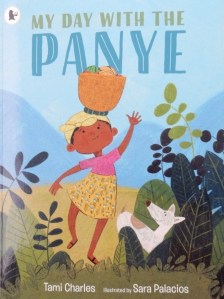
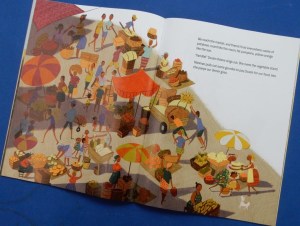
Gently and empathetically told, Larissa Theule’s uplifting poetic narrative celebrates Poppy’s quiet gentleness and her keen observational skills showing them as valuable assets, rather than drawbacks. A wonderful encouragement to all those youngsters like Poppy to have the confidence to share their knowledge and shine too. Sara Palacios’ beautifully textured, brightly coloured illustrations draw the eye to each and every detail so that we too, like Poppy, stop and enjoy the delights of nature shown in her scenes.

Upside Down Friday / The Art of Words

Upside Down Friday
Lana Spasevski and Nicky Johnston
EK Books

Unlike his mum little Hugo monkey hates Fridays. That’s the day when his usual routine changes. Consequently he walks to school with a sad face, butterflies in his tummy and a rapidly beating heart as he anticipates spending his time doing sport. 

On this particular Friday though things turn out a whole lot better that expected thanks to Maddison who announces that she’s Hugo’s buddy for the day. She goes on to give him a bright red balloon 

and tell him that just like Hugo she didn’t like Upside Down Fridays and later she reassures him that ‘after a while, it will feel the right way up.” And those kind words make all the difference … 

A sweet story for the very young about the power of friendship.

The Art of Words
Robert Vescio and Joanna Bartel
EK Books

Author Robert Vescio and illustrator Joanna Bartel present an exploration of the playful possibilities of words and their power to generate a variety of emotions, feelings and ideas. 

We see two children (accompanied by a dog) reading, relaxing, climbing, gardening and much more as they snip, 

squash, expand and collect words, weaving them together (along with some punctuation), and creating stories to bring magic, joy and excitement.

The art is a delight and a wonderfully imagined presentation of the author’s engaging narrative.

This is Not a Unicorn / Ruffles and the Red, Red Coat

Two fun picture books from Nosy Crow Books – thanks to the publishers for sending them for review

This Is Not a Unicorn
Barry Timms and Ged Adamson

This is a wonderfully silly tale of a ‘NOT’ unicorn with a very special horn that is able to morph into all sorts of incredible things. So, be ready for a truly magical adventure wherein, along with a little girl, readers participate in a hilarious corn-u-copia of delight as they experience the appendage that becomes, among other things a trumpet, an ice cream scoop, a pump, a wishing wand, a ginormous fishing net, a feather duster, a helicopter rotor blade, an angle poise lamp,

an x-ray machine, even a space rocket – awesome!

Central to this rhyming romp of a book, replete with fun wordplay, is the warm friendship between the two main characters as they let their imaginations take flight.

Ged Adamson portrays the creature with a rainbow-hued mane, the dayglo pink and other colours being picked out in other details in every one of his wonderfully imagined scenes.

With unicorns remaining one of the favourite characters among younger children, Barry Tims and Ged Adamson created a winner here.

Ruffles and the Red, Red Coat
David Melling

Adorable pooch Ruffles loves to do the usual doggy kind of things such as playing, sniffing, fetching, digging and chewing; but there’s one thing he does NOT love at all and that’s his new red coat. He absolutely hates the thing to the extent that he manages to extricate himself from it and cast it aside. But then he decides that he really wants to go outside in the rain, play in the puddles and have a jolly good time.

Out he goes and soon along comes his friend, Ruby sporting her brand new blue coat. Together they romp, frolic and jump

until some large bully dogs arrive and that’s the end of their puddle. Now Ruffles is wet, cold and grumpy but Ruby is still in a playful mood and tries to encourage Ruffles to play again – with no success.

Off she goes leaving him all alone but then back she comes carrying something red. Can she persuade her Ruffles to think again about his hated garment?

David Melling’s combination of simple text and illustrations that positively exude charm, work really well in what is sure to become a favourite with under fives. Slightly older children might start reading some of the words themselves.

Coyote’s Soundbite

Coyote’s Soundbite
John Agard and Piet Grobler
Lantana Publishing

Planet Earth is in a terrible state on account of the thoughtless environmental damage caused by human actions. The earth-goddesses call a conference to which every female creature is invited to discuss what should be done.

When he learns that it’s a females only affair, Coyote is disappointed and an impulsive decision sees him borrowing his wife’s blue dress, sandals and bag. Thus attired, he manages to gain admission.

In turn each of the goddesses gives a speech about what they’ve contributed to life,

expressing their disappointment at how humanity has subsequently treated the planet, and then it’s time for questions.

Nothing is forthcoming so Coyote decides to put forward a suggestion, “Excuse me, ladies! / Forgive my interjection, / but from my study of the human breed, / I’ll say a soundbite is what you ladies need!”

Everyone is in total agreement and Coyote returns home.

Imagine his surprise to discover his wife clad in his suit. She explains that she’s just come from a males only earth-gods conference and guess what: she too made a soundbite suggestion, which goes to show that the way ahead is “Earth-lovers of the world unite! / Mother Nature is always right!”

With its diverse selection of mythological characters, John Agard’s engaging rhythmic narrative poem packs a powerful punch as it imparts its crucial environmental message. Brimming over with energy, Piet Grobler’s trademark scribbly, collage style mixed media illustrations are a spirited complement to the text, adding to the impact of this thought-provoking, picture book.

The Neighbourhood Surprise

The Neighbourhood Surprise
Sarah van Dongen
Tiny Owl

Redbird Road, where both Koya and Mrs Fig live, appears to have a strong community feel, with Koya and her friends, Hassan and Alex often visiting their elderly neighbour, and friend, Mrs Fig. She enjoys telling them stories of days gone by, creating costumes for dressing up and sharing the yummy cookies she bakes.

Needless to say, when they hear that Mrs Fig is moving away, the children are very upset and decide to organise a ‘going away party’ to show how much they’ll miss her. Dad suggests involving the entire street and so they do.

Kaya decides that the cake she and her dad bake must make allowances for the fact that Hassan is vegan. Hassan and his mum’s offering is falafel and a spicy curry,

while taking into account Mrs Fig being vegetarian, Alex and her family make a vegetable pie.

The afternoon of the party is a sunny one so Mrs Fig’s surprise party is to be held outside. She can hardly believe her eyes when she opens her door to discover …

A wonderful time is had by all, made all the more so when Mrs Fig announces that her new home is very close by, near enough for regular visits and another party the following year …

Rich in pattern and detail, Sarah van Dongen’s illustrations for her wonderfully warm-hearted story are a joy to contemplate. She also includes a final spread explaining vegetarianism and veganism. I was concerned to read there that honey is on the ‘no’ list for vegans so I’ll have to reclassify myself.

Stuck Inside

Stuck Inside
Sally Anne Garland
Sunbird Books

I suspect we can all relate to the title of this story, though perhaps not for the reasons that Tilly and her dog Toby are faced with. The latter has an injured paw so his usual walks have temporarily stopped; Tilly is staying in on account of the rain storm and both girl and dog are feeling hemmed in.

Cooped up together with no adults around, what can they do? Then Toby brings something that belongs outdoors and puts it at Tilly’s feet. This gives her an idea and together they start to explore their large home in search of outdoor items.

Somewhat apprehensively they look behind ‘doors that had always seemed closed’,

inspect beneath beds, open drawers and scour shelves uncovering ‘dusty things long forgotten.’ There they find hitherto unnoticed and interesting things – toys, old walking sticks, broken brollies, roller skates and other items with wheels, a deflated paddling pool even.

Having spent some time tweaking and twiddling these long lost treasures, remembering places visited and creating imaginative adventures, they proudly contemplate their astonishing machine …


Sally Anne Garland’s carefully chosen words in combination with her richly patterned and textured illustrations with their rural setting, effectively demonstrate that boredom can be the best possible stimulus for children’s creativity.

Tisha and the Blossom

Tisha and the Blossom
Wendy Meddour and Daniel Egnéus
Oxford Children’s Books

What is this life if, full of care,
We have no time to stand and stare.

To me, these opening lines of the WH Davies poem I learned in primary school lie at the heart of this latest collaboration between Wendy Meddour and Daniel Egnéus.

Like most of us, young Tisha and her family lead busy lives and wherever she goes, whatever she does, the little girl is constantly being told by adults to “Hurry up”. It happens in the morning as she enjoys watching the blossom fall, as she leaves for school and all the way through the school day.

So when her mum arrives to pick her up and urges her to hurry for the bus, it’s the last straw.

Fortunately Tisha’s request that they slow down results in mother and daughter walking home and enjoying a special game to help them do just that.

Then when they reach home Dad is there to join in with the welcome change of pace.

We all need to make time to be still and mindful in our hectic world; if nothing else the last twelve months has made us realise the importance of paying attention to the pleasure offered by small things. Wendy’s engaging story with Daniel Egnéus’ scenes – especially the blossom-filled ones, are a truly gorgeous affirmation of this.

Shu Lin’s Grandpa

Shu Lin’s Grandpa
Matt Goodfellow and Yu Rong
Otter-Barry Books

Shu Lin has recently come from China and with very little English, is struggling to fit in at her new school.

At lunchtime the other children are fascinated as they watch her tuck in to her little boxes of food. On the way home, one of her classmates recalls when he too was a newcomer but it’s not until Shu Lin’s grandpa visits the class with his Chinese paintings that anything really changes.

No words are needed as the children look in awe at his scrolls with their amazing scenes.

Then as silently as he arrived, Shu Lin’s grandpa leaves the classroom. That afternoon, the class teacher gives the children the opportunity to try painting their own pictures in response to what they’ve seen.

Matt Goodfellow’s text is presented through the narration of one of Shu Lin’s classmates and this is highly effective in that the boy relates his own experience to that of the newcomer showing understanding throughout the book, while Yu Rong’s illustrations, including a gate-fold that opens to reveal a remarkable Chinese scene, are absolutely superb.

That art is a hugely effective way of helping to develop empathy with other cultures comes across with a quiet power in this story that celebrates the imagination while demonstrating the importance of reaching out to others.

An important book to include in primary school class collections.

Gerald Needs a Friend

Gerald Needs a Friend
Robin Boyden
Frances Lincoln Children’s Books

Guinea pig Gerald is a loner and fanatical about his routine. His entire world is his garden wherein he spends most of his days nurturing his flowers, fruit and vegetables.

Come 5 o’clock he goes indoors and has tea, reads twenty pages of his book and at 7pm he retires to bed: a risk-taker he most certainly is not.

One morning he heads off into town with his shopping bags and is surprised to discover a new stall run by two lively mice. The mice introduce themselves and for the rest of the day, after some initial hesitancy, Gerald experiences lots of fun exciting things

and thanks to Marcy and Marcel, has the time of his life until …

That night he lies awake in bed contemplating the day and next morning …

Robin Boyden’s Gerald most certainly discovered that by stepping out of the comfort zone of his hitherto fulfilling life, the world had a lot more to offer, the most important thing being friendship.

The illustrations are terrific – hugely expressive and full of amusing details to pore over. A book to share with KS1 classes (make sure you allow time to explore each spread), as well as individuals and small groups.

Once Upon A Mermaid’s Tail

Once Upon A Mermaid’s Tail
Beatrice Blue
Frances Lincoln Children’s Books

Beatrice Blue’s new story in her series of ‘Once Upon A … ‘ neo pourquoi tales makes an urgent environmental plea on behalf of the planet’s wildlife.

Herein we meet young Theodore, a passionate fish collector who loves nothing better than to go out once a week in his little boat searching for new fish to add to his aquaria. On one such expedition he nets something amazingly beautiful: a tiny creature encased in a clear shell. No sooner does he start handling it than a voice booms a warning, “Leave her, Theodore! She belongs to the ocean.”

Disregarding the voice he takes her home ignoring the same voice urging him to return the creature to the ocean. Convincing himself he can take great care of the tiny thing, he names it Oceanne and places her into a tank.

As the days go by, instead of thriving the little creature becomes weaker and weaker. Now Theodore is alarmed. What is wrong? The return of that booming voice makes him realise that he must return the creature to the lagoon; but will he be in time to save Oceanne?

Beautifully illustrated and skilfully told, this timely book is another reminder of the fragility of nature and the importance of doing our part in its preservation. It offers a starting point for discussion that young children will find easy to relate to.

Nano: The Spectacular Science of the Very (Very) Small

Nano: The Spectacular Science of the Very (Very) Small
Dr Jess Wade and Melissa Castrillón
Walker Books

Talking to nine year olds about nano particles? Surely not, you might at first think. However the author of this book knows just how to do it.

This is a totally captivating look at materials and the uses scientists make of them by physicist Dr Jess Wade from Imperial College, London and illustrator, Melissa Castrillón.

Right from the opening spread containing the words, “Look around your home. Everything is made of something … “ readers are drawn in, all the more so as the text then goes on to use the book itself as an exemplar to remind us of some basic descriptions of materials as well as introducing the importance of microscopy. 

That leads neatly in to a spread on atoms – those building blocks from which ‘every single thing on this planet is made …’ and molecules.

A great thing about this book is that every new term that’s introduced – elements for instance- is immediately then related to something familiar to its target audience:. So we’re told, the human body comprises eleven different elements including carbon. This element is part of the make up of every living thing, but sometimes existing solely as layers of carbon atoms; graphite (the lead in pencils) is given as an example.

By moving on to graphene (created by removing a single layer of carbon atoms from graphite) the author takes us into unfamiliar territory with a new material: or rather, a ‘nanomaterial’ that has taken countless experiments and many years to make.

Graphene, we’re told, already has many uses in technology but because nanotechnology is a dynamic field of study, there are further possibilities, some not perhaps even dreamt of yet. Neatly bringing the narrative full circle to the reader, the author concludes ‘There are so many secrets left for scientists to unlock, And who knows the key person might just be … YOU.’

A hugely inspiring combination of superb science and awesome art.

Do You Love Dinosaurs?

Do You Love Dinosaurs?
Matt Robertson
Bloomsbury Children’s Books

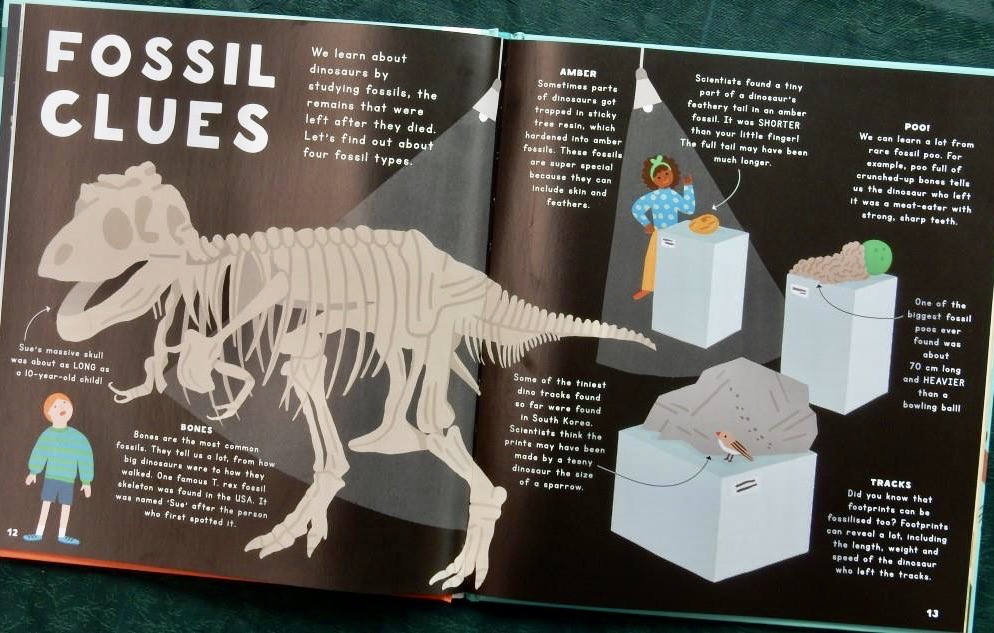
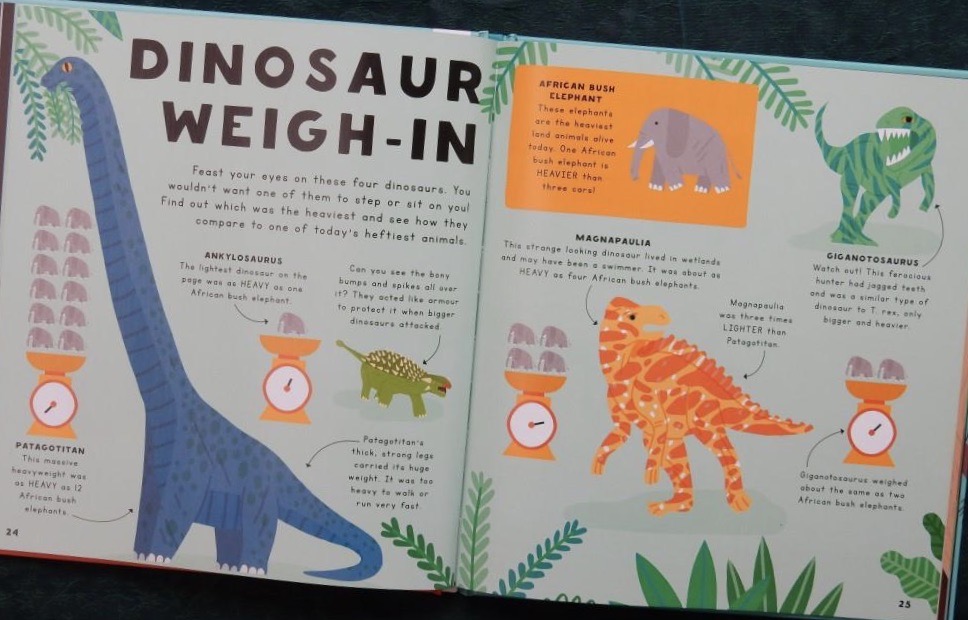
Ask a group of children the title question and almost certainly the vast majority will answer in the affirmative, so this book, brimming over with awesome, roarsome dinos is set to be a winner.

Accompanied by some young palaeontologists, Matt Robertson takes readers way way back in time to meet these incredible creatures large and small. First though come ten ‘must obey’ dinosaur rules to help ensure that youngsters get the maximum from their experience.

It’s then time to introduce in turn, the theropods – meat eating, terrifying two-legged beasts; then the sauropods (gigantic vegetarian, gentle creatures) among which were the diplodocuses.

Prepare to hide, for Tyrannosaurus rex comes next – AAARRRHH! those gaping jaws. Much less alarming are the herbivores including several new to me, as are some of the omnivores with which they share a double spread.

Horns and spikes were great protectors and the armoured dinosaurs also show their skills and how they used their incredible armour; and last we meet the deadly bird-like raptors.

The final spreads look at dinosaur fossils, development from egg to adult, there’s a dino sports event, a look at some other prehistoric creatures and last of all, annotated portraits of extra special dinos in a hall of fame.

The author takes a light-hearted approach and his illustrations are huge fun, while there’s a considerable amount of information packed into each spread.

Howard the Average Gecko

Howard the Average Gecko
Wendy Meddour and Carmen Saldaña
Oxford Children’s Books

Howard apparently has a very high opinion of himself and a seeming disregard for his fellow rainforest dwellers. So intent on bragging about his camouflage skills is he,

that he fails to notice that same ability in a number of the other creatures, that is until he encounters a stick insect. Stick insect’s “The rainforest is full of camouflaged creatures”

is let’s say, an ego deflater, even more so is its “You’re average”. and Howard has a crisis of confidence about his lovableness.

Suddenly out of the foliage comes a stunning creature

and despite what the stick insect thinks of her, Howard declares the wobbly-eyed reptile “magnificent”. This other gecko introduces herself as Dolores. The instantly smitten Howard invites her to watch the sunset with him and together these two ‘average geckos’ climb up a tree onto …

With its surprise finale, this is a fun story that introduces animal camouflage (look out for the creatures Carmen Saldaña has hidden away in her leafy scenes) while being a smashing book to show all young children that they’re just right as they are. Endless comparisons with others do nothing to foster self-esteem: it’s having people who love you that counts – to them you are in your own unique way, very special.

Ten Little Dogs / Ten Little Yoga Frogs

Ten Little Dogs
Ruth Brown
Scallywag Press

Who can fail to delight in this rhyming countdown by well-loved and respected author/illustrator Ruth Brown. Her array of pooches look such engaging creatures as they romp energetically in all kinds of settings indoors and out with their number diminishing on each double spread

until just one remains. But not for long because being alone is not nearly as much fun as dashing off to rejoin your nine friends cavorting and barking loudly in the park.

Yes there’s some simple maths herein but it’s the spirited illustrations that count for much of the pleasure to be discovered between the covers of this book. Every double spread is a visual feast with detailed, realistic images of adorable canines in beautiful surroundings, accompanied by a four line text with perfectly calculated page turns.
A treat for dog lovers of all ages, this.

Ten Little Yoga Frogs
Hilary Robinson and Mandy Stanley
Catch a Star

This is a fun way to engage in some counting practice while at the same time trying some basic yoga poses along with the snazzily attired yogi frogs.

Wearing both my foundation stage teacher hat and my yoga teacher hat simultaneously, I absolutely love this rhyming counting book. It’s great to see that not all the participants are experts at doing the poses: take a look at these three.

And who wouldn’t want to respond with a resounding yes to the invitation on the final spread …

With its predictable text and hilarious illustrations (each spread has a small box in the corner showing the specific yoga asana the frogs are doing) this book would make a smashing addition to any early years setting or foundation stage classroom, as well as being one to add to family collections where there are young children.

Maybe …

Maybe …
Chris Haughton
Walker Books

“Whatever you do, do NOT go down to the mango tree. There are tigers down there.” So says the departing adult monkey to the three little monkeys. An invitation to do just that, if ever there was one and as you might expect, after due consideration and a quick scan below, the trio start descending through the canopy lured by an irresistibly delicious sight.

After another quick scan for tigers (your audience will have spotted something but not the eager threesome), they dash down, secure a yummy fruit and consume same. But is just one sufficient? Of course not, so the monkeys climb right the way down to the ground.

As they sit feasting on some succulent spoils, the monkeys become aware that this latest step was perhaps one too many, for there follows a dramatic case of tiger confrontation and a splendidly scary, suspenseful dash for their lives that listeners will relish. But what about the monkeys?

To discover that, and how the story ends, you’ll need to creep out to a nearby bookshop and get a copy of your own.

Maybe, just maybe this is my favourite of Chris’s books so far, but then I love boundary pushing risk-takers. That chase over four double spreads is absolutely superb; in fact the whole book is simply brilliant.

Chickenology / Milly Cow Gives Milk

Chickenology
Barbara Sandri and Francesco Giubbilini, illustrated by Camilla Pintonato
Princeton Architectural Press

This introductory book contains everything you ever wanted to know about chickens and probably a lot more too. There are five sections (listed on contents page but not mentioned thereafter) into which is packed an incredible amount of information presented in a highly readable manner with well-designed, stylishly illustrated spreads, every one of which has just the right amount of text so that at no time does the reader feel overwhelmed.

It starts with pages on identification; how to tell the difference between a hen and a rooster, courtship and mating, a spread on shape and size – astonishingly a Jersey Giant is almost the height of a three year old child. Communication is given a double spread; feathers have two and the Leghorn spread presents a dozen different varieties of the same breed, something I didn’t know.

Last in the first section is an exploration of the question ‘Can chickens fly?’

The next part begins with a look at the anatomy – internal and external and then comes a section comprising an egg-sploration of eggs.

My favourite section is ‘Chickens and Humans’ that encompasses some history, symbolism, folktales and more.

And last of all is a presentation of just some of the estimated 300 different breeds.

There’s likely something of interest to readers of all kinds here.

For a younger audience is:

Milly Cow Gives Milk
Deborah Chancellor and Julia Groves
Scallywag Press

Ask a group of young children where milk comes from and if my experience is anything to go by, some of them will name a supermarket. Now here’s a simple picture book (endorsed by the Royal Association of British Dairy Farmers), the first of a series, that goes right back to grass roots, to Farmer McBean’s farm to be precise.

There, in the company of a child, we meet Milly, one of a well cared for, ’happy herd’ and learn the basic facts about her daily life as she grazes on tasty grass in summer and is fed lots of hay to see her through the winter. Molly has to chew and chew what she eats to help its passage through her system, as well as drinking large amounts of fresh water, inevitably making lots of cow pats in the process.

Readers get right up close to her swollen udder as it bulges with milk and watch her being led to the milking parlour (which happens at sunrise and sundown). I was astonished to learn that Molly’s daily yield is around sixty pints and that along with the milk from the rest of the herd, is made ready for drinking and eventually once packed, it does reach the shelves of supermarkets and other outlets.

The final pages gives some further, basic facts about cows, milk and dairy farming. Julia Groves’ clean, bold illustrations and Deborah Chancellor’s straightforward account show that milk production involves a lot of hard work and for many people, it’s a vital item in their daily diet, unless like me they happen to be vegan.

For foundation stage and KS1 topic boxes.

Amira’s Suitcase / Dandy & Dazza

Recent hardcover publications from New Frontier Publishing – thanks for sending them for review

Amira’s Suitcase
Vikki Conley and Nicky Johnston

Set in what looks like a shanty town, this is a lovely story about what happens when a little girl makes an unlikely and unexpected discovery.

What is poking out from the corner of an old suitcase? Amira is intrigued to find a tiny seedling while searching for a hiding place. She makes friends with the little plant, tending it carefully: ‘Amira smiled at the sprout. She felt something blossom deep inside her.’

She takes the suitcase outside into the sunlight and is reminded of a pear tree she misses. The following day she takes her friend Nala to see the sprout and for her too, a memory is triggered.

When she comes on a subsequent visit Nala brings something with her, something tiny that she drops into the suitcase. News of the enterprise spreads among the other children and they too add seeds to the case.

These thrive on the children’s tender care and a small green world is the result. Eventually the plants grow too big for their container and then it’s time to find them a new home.
Sensitively told and beautifully illustrated (each spread reflects the inherent warmth of the text), this hopeful tale of kindness and friendship is just right for sharing with foundation stage listeners.

Dandy & Dazza
Mike Dumbleton and Brett Curzon

Meet dogs Dandy and Dazza. Dandy is well-behaved – a pampered pooch no less while Dazza is a mongrel – a rule-breaking, go crazy mongrel that can barely wait to get off his lead. One day they encounter one another at the park and despite their differences, a friendship is forged. To his pal’s surprise, Dandy discovers the fun in being a little bit crazy from time to time, while Dazza learns to keep his super-abundance of energy under control – sometimes at least.

With high energy illustrations that bring out the contrasting personalities of the two creatures this is an entertaining book about friendship and difference canine style.

Best Test

Best Test
Pippa Goodhart and Anna Doherty
Tiny Owl

What does being best really mean? It’s the topic under dispute in this follow up to Pippa and Anna’s Fair Shares.

Bird finds a delicious-looking juicy strawberry just right for pecking, but other creatures have designs on it too. Frog is the first but Bird insists being ‘the best’ is entitlement to the entire thing and for the feathery one, “Biggest is best.’ Frog thinks best is all about pulling a funny face while little Shrew says that he too is special and a test will help them all decide which of them IS best.

After further discussion and negotiation as to what the the test will comprise, Shrew volunteers to act as referee and watched by an onlooker, Rat, Frog, Bird and Squirrel take their places at the starting line ready for the off.

During the test though, something unexpected happens: the animals start helping each other 

and they finish the Best Test race all together. So what about that prize strawberry?

Seemingly another animal has already crossed the finishing line ahead of all the others and is tucking into the much-wanted fruit. Despite protests, Shrew declares the winner to be Snail. Snail however, has something far more important to say on the definition of ‘best’.

Pippa’s thought-provoking story demonstrates that no matter who or what we are, just like the animals herein, each of us has our own particular aptitude. That’s life lesson number one, but equally, there are messages about collaboration and teamwork.

Anna’s illustrations are wonderfully playful: who can fail to smile at the sight of frog’s silly face demonstrations for instance, and the looks of consternation on the other competitors’ faces when the additional participant is discovered.

This book is full of potential for early years/ KS1 teachers but most important, it’s a smashing story to share with youngsters either at home or school.

Where the World Ends

Where the World Ends
Davide Cali and Maria Dek
Princeton Architectural Press

With nothing better to do on a sultry summer’s day but lie around watching and discussing the clouds, why not go on a quest to discover where the world ends. That’s just what three friends Zip, Trik and Flip decide to do in this quirky story, having first packed plenty of peanuts and other essential items such as skis, binoculars, pencils and paper.

En route they stop several times asking for directions and receive a number of less than helpful answers -“Why would you want to go there?”

… “not here for sure”, “You can’t … nobody has ever been there. I forbid you to cross here!” … “at the peak of a nearby mountain” for instance. One more considerate boatman does take them across a lake though, and others are a tad more obliging in their comments.

On trudge the three, meandering, like Cali’s narrative, hither and thither, over hill and down dale,

up mountains and down, through a forest until finally driven by the logic of children at play they find that which they seek …

It’s only by turning to the final endpapers that we see a child-like map of the route the friends have taken.
Yes, the ending is somewhat strange and some may not find it satisfying, although the adventurers certainly did.

Executed in watercolours, Maria Dek’s sunny scenes are delightfully whimsical making every one a place to pause and enjoy its inventiveness.

The Crocodile Who Came For Dinner

The Crocodile Who Came For Dinner
Steve Smallman and Joëlle Dreidemy
Little Tiger

Best friends, Hotpot (lamb) and Wolf are out doing a stint of ‘wolfy things’ one night when they come upon a huge egg. Wolf’s first thought is making an omelette, quickly countered by Hotpot’s “No … baby bird.”
Having ascertained from the nest dwellers close by that the egg doesn’t belong to any of them, the friends decide to take it home.
Before you can say, ‘yummy omelette’ the egg cracks and what should pop out but a baby crocodile. There’s only one thing the friends can call it and after discovering that the little creature is omnivorous,

they head off for some shut eye. Guess who makes a bid for Wolf’s bed. Eventually both Wolf and Omelette spend the night snuggled up together on a chair but somehow Omelette makes it to the kitchen first next morning – with chaotic results.

Just as Hotpot and Wolf are preparing to take the newcomer out for a walk, some wolf friends arrive at the door and receive some unexpected affection of the crocish kind. Their game of chase through the woods leads them down the river where Omelette alarms the boating bunnies by diving in for a swim.

Curmudgeonly Badger takes delight in pointing out that while Omelette might be harmless right now, he will grow and grow. Sure enough he does but remains totally lovable to all but Badger.

One night a terrible storm blows up and the forest is flooded. Worse though, Omelette has gone missing but he’s left a trail of footprints that lead to where we see, some baby ducklings are in great danger.
Can they be saved? And if so, by whom? …

Steve’s text is a superb read aloud: I’m sure both listeners and adult readers aloud will find it hilarious. Equally droll are Joelle Dreidemy’s illustrations which contain a wealth of detail and a liberal scattering of speech bubbles in this tale where appearances can be deceptive .

Molly and the Lockdown

Molly and the Lockdown
Malachy Doyle and Andrew Whitson
Graffeg

Molly and her mum and dad are island dwellers only now Dad is stuck on the mainland because the island – like many other parts of the world – is in lockdown. Inevitably Molly misses her dad who is staying with her Uncle Ed, though she talks to him on the phone and promises to do everything she can to help her mum.

Despite all the precautions taken, the virus reaches the island making a few people so sick they have to be taken to the mainland hospital.

With her mum assisting Nurse Ellen, there’s plenty to keep Molly busy. She does almost all the jobs around the house, cares for the dog and the hens, and makes masks for the islanders.

The lockdown drags on. School is closed so Molly chats with her friends on the phone, reads and rereads her books, does her jigsaws super fast, improves her fiddle playing and hears her Uncle Ed’s bagpipes in the background whenever her Dad rings.

Eventually school reopens, albeit with precautionary measures in place, they hear good news about a vaccine

and finally, everybody goes down to the harbour to welcome home Molly’s father – hurrah!

Most of us have experienced a spirit of community during the last year: this is encapsulated in Malachy Doyle’s story of the lockdown, COVID 19 and the affects on a particular family and their small community. Molly’s anxiousness and concern – feelings that so many children have suffered – comes across clearly in Andrew Whitson’s, richly patterned illustrations. So too does the wonderful warmth of the islanders coping as best they can with the crisis.

An ideal book for sharing with children as we begin to emerge from the restrictions; it offers a great opportunity for them to talk of their own experiences and to share future hopes.

Esme’s Rock

Esme’s Rock
Simon Philip and Magda Brol
Oxford Children’s Books

Esme is a little cave girl with a lot of energy and curiosity and, a very powerful voice. That’s very useful if you want to ward off scary big creatures but definitely not so when it comes to keeping things secret. One thing she intends to do her utmost to keep her voice down about is the birthday surprise she’s organising for her best pal Morris the mammoth’s birthday.

Having wished him many happy returns, the transport arranged turns up to whisk Morris away for some pampering and she’s able to get on with carrying out the plans for the rest of the surprise. For this she has enlisted the help of her fellow cave people and they’re horrified at what the task entails in so short a time.

Come lunchtime it seems as though the painters are way behind schedule and Esme can’t keep her voice down any longer. What she yells echoes far and wide. Then, just when the painters are on the point of giving up their mammoth task, a party of strangers arrive armed with the necessary tools and it’s all systems go once more.

Finally it’s time for Esme to use that booming voice to summon Morris to his surprise celebration …
At last Esme’s voice comes into its own …

With Magda Brol’s exuberant illustrations, Simon Philip’s celebration of community spirit is a fun read aloud demonstrating that everybody has a special something to offer, albeit with a bit of channeling sometimes.

Jonathan! / The Best Mum

These are two recent paperback from New Frontier Publishing – thanks to the publishers for sending them for review

Jonathan!
Peter Carnavas and Amanda Francey

Jonathan has great fun dressing up in different costumes and scaring other members of his family when they least expect it. No matter what he wears the response from in turn his dad, sister and mum is “Not scary, Jonathan.’

Disheartened he walks away and soon discovers that he’s climbing a lumpy, bumpy hill. After a conversation boy and beast head back towards the house. Seemingly he’s now found the ideal scary trick.

Peter Carnavas’ simple rhyming story accompanied by Amanda Francey’s expressive watercolour and pencil illustrations make for a fun read aloud with a twist in its tail.

The Best Mum
Penny Harrison and Sharon Davey

The little girl narrator of this rhyming story compares her mum to lots of others she knows, recounting the many ways her friends’ mums are better skilled than hers. But is there ever a perfect mum? Would she be the one who can make incredible costumes for dressing up days, or the one who roller skates gracefully, the disco dancer and pop song singer; is she the one who’s always on time or the baker of delicious treats?

Despite all her own mum’s shortcomings and embarrassing acts, at the end of the day she’s still THE best mum who gives the best cuddles. Who would have expected any other conclusion?

Lots of fun and a great conversation opener, and hilariously illustrated by Sharon Davey whose daft details are sure to make you laugh.

Turtle Rescue

Turtle Rescue
Jonny Marx and Xuan Le
Little Tiger

I suspect the burgeoning of picture books telling of the plastic pollution of the oceans is indicative that the problem is on many people’s minds. Sadly though, not those who continue to throw rubbish onto the beaches or in the sea. One can but hope that Jonny Marx and Xuan Le’s Turtle Rescue will help in this hugely important environmental cause.

Flora, marine biologist and ace underwater swimmer, Fauna, inventor and turtle lover, and their child, Baby Bud, are holidaying at the seaside intending to take it easy for a while. That isn’t what happens however.

Soon they find themselves helping with a rubbish collection during which they’re told it’s hoped it will help bring back the turtles to lay their eggs on the sandy beach once more. Before long the three of them have packed supplies, chartered a boat and are sailing off to investigate the lack of turtles.

As they sail towards the reef, Bud is excited to see all the different sea animals and plants and keeps pointing out what he calls ‘jellyfish’ – the floating plastic bags he insists on counting. Eventually Flora sights a turtle

and carefully follows it until she runs out of air. Back on board the boat again, it’s obvious a storm is looming but eventually it blows itself out and there ahead is an island. Just the place to stop and let Fauna’s queasiness subside. Imagine their delight when Bud notices tracks in the sand leading right across the dunes at the end of which are …

After an eventful and hugely exciting trip, with sail duly repaired, it’s time to head home.

There’s an amazing amount of information about turtles and other marine wildlife packed between the pages of this fascinating part fact, part fiction book.

Never Mess with a Pirate Princess

Never Mess with a Pirate Princess
Holly Ryan and Siân Roberts
Little Tiger

Princess Prudence is a loving little miss who dotes on her royal bear, Little Ted, taking him absolutely everywhere with her – even the loo. Then comes the terrible day when, as she naps ‘neath a shady tree, up creeps a pirate and boldly steals her beloved Teddy right off her lap.

Distraught, Princess Prue hollers so loud that up charges a gallant knight offering to come to her aid. 

Eager to be part of the rescue effort, she pleads with Sir Frank to take her along but meets merely with scorn.

Undaunted plucky Princess Prudence decides to do things her way and off she goes upon a trusty, wait for it … goat! Having searched for most of the day to no avail, she reaches the seashore and what does she spy: somebody being forced to walk along the plank – somebody she recognises – a knight in shining armour no longer.

But our Prue isn’t one to let a gang of teddy robbing pirates get the better of her, or even Frank …

Debut picture book writer Holly Ryan’s rhyming text is a rollicking read aloud and in Princess Prudence she has created a gutsy gal to delight adventure-loving, teddy-hugging little ones. Siân Roberts’ portrayal of the princess and her adventure is terrific fun with every spread providing giggle-worthy incidents from this stirring romp.

No More Babies!

No More Babies!
Madeleine Cook and Erika Meza
Oxford Children’s Books

Sofia finds her baby brother exceedingly annoying. On this particular day he smashes down her amazing brick construction, starts a food fight, makes a terrible din on a drum and just when mum and dad are ready to read her a story, he diverts their attention by needing a nappy change.

After all this, her parents’ news that she’s going to be a big sister again, doesn’t go down at all well. “No more babies!” she yells at her bemused mum and dad who now offer a sympathetic ear. Sofia’s account of the morning follows and then cuddles and lots of special attention for the little girl.

Suddenly Arlo surprises his sister and after that she begins to feel much more positive about him. Despite his continuing messiness, smelliness and slobbering, Sofia decides she loves him very much, telling her parents at bedtime, “Okay, you can have one more baby,” …

There’s a throwaway line surprise finale that will surely make both adults and young listeners laugh when they read this funny book.

With Erika Mesa’s wonderfully expressive illustrations it’s one for families to share when a new sibling is on the way, as well as a good foundation stage storytime read aloud especially if somebody in the group is in a situation similar to Sofia’s; or as part of a family theme.

Old Mother Hubbard’s Dog Takes Up Sport / Old Mother Hubbard’s Dog Learns to Play

Old Mother Hubbard’s Dog Takes Up Sport
Old Mother Hubbard’s Dog Learns to Play

John Yeoman and Quentin Blake
Walker Books

The laugh-out-loud antics of Old Mother Hubbard’s Dog take the form of a variety of playful activities in these two paperbacks.

In the first, Old Mother Hubbard is unhappy at the sight of her canine companion merely lazing around all day and suggests he get up out of his chair, set aside his book and do something more active. And so he does. First it’s tennis (over her full washing line), followed by a spot of pole vaulting, then soccer – with very muddy results.
Having had a bath beside the fire the daft creature heads outside again and further athletic mayhem ensues including putting the shot using live projectiles.

Eventually, unable to stand any more, Old Mother Hubbard orders Dog inside and suggests a much more sober activity.

The second episode begins with Dog in his favourite chair reading once more. Old Mother Hubbard expresses a wish that he “learn how to play.” Before you can turn around she hears a raucous rendition on a flute, closely followed by various other musical instruments. 

Greatly regretting her ill-chosen words, Old Mother Hubbard is at a temporary loss to know what to do, but is ready to try anything including some drupe diversion tactics …

Brilliant nonsense both in John Yeoman’s rhyming narrative and Quentin Blake’s exuberant portrayal of the canine capers; adults and children will love this craziness. Don’t miss the back endpapers.

Beatrix and her Bunnies

Beatrix and her Bunnies
Rebecca Colby and Caroline Bonne-Müller
Nosy Crow

For many adults, myself included, Beatrix Potter’s animal stories and nursery rhyme books were part and parcel of childhood. Indeed I had the entire set. How many though, are aware that Benjamin Bunny and Peter Rabbit were real live creatures that the author befriended as she was growing up. That’s getting rather ahead though, for this pictorial biography of Beatrix starts with her childhood when she lived a rather lonely existence in a large London house. Even then she was an animal lover and had lots of small creatures as pets, but nonetheless she longed for a ‘special friend’ with whom she could play.

Rebecca Colby writes of how on family visits to the countryside, Beatrix would search for wild rabbits to play with but none would stay. None that is until Benjamin. A friend at last and one that would allow his carer make lots of sketches of him, honing her drawing skills in so doing. Inevitably though, Benjamin eventually dies and once more, Beatrix feels lonely. She uses drawing and painting to lift her spirits but, it’s only when she visits the countryside that Beatrix’s drawing really flourishes.

Some time later, another rabbit enters her life, it’s Peter, a truly playful and engaging creature, much loved by visiting children.

This gives Beatrix an idea. Perhaps she can write and illustrate a story about her much-loved bunnies so that children everywhere could read about them, and so she does.

Getting Peter’s adventures published is challenging but eventually she succeeds and the book becomes a huge success, allowing her to move to the countryside where she creates lots more stories.

A lovely book for young enthusiasts of her books and of the environment about which Beatrix cared so much. The elements of Beatrix’s life are beautifully interwoven by the author, who also provides an additional final note explaining Beatrix’s connection with the National Trust (who are collaborators in its publishing) – and equally beautifully illustrated by Caroline Bonne-Miller.

Frog vs Toad

Frog vs Toad
Ben Mantle
Walker Books
Seeing beyond our differences lies at the heart of Ben Mantle’s splendidly silly fable.

It begins when an unassuming fly is zapped by the tongue of Frog, followed shortly after by a second attack from the opposite side, this time by Toad. A nightmare situation for sure but what the fly says …

precipitates a set to between the two amphibians both of which feel grossly insulted by the fly’s remark. A tirade of verbal insults are hurled and the squabbling continues

until they reach the swamp where things get even more heated when Frog issues a final threat followed shortly after by some mud slinging of the physical kind, triggering a free for all with everybody joining in.

Both sides are so busy SLIP! SPLAT! SPLOTCHING and SQUELCHING that they fail to notice the approach of a large grumpy reptile displeased at being aroused from its slumbers. Quick to jump to their own defence Frogs and Toads blame one another but the jagged-toothed creature tells them something that comes as a huge surprise.

Both Frog and Toad are ready to accept one another as family members and apologies ensue, followed by some words of thanks to their informer. But that’s not quite the end of the story …

This is the first picture book for which Ben Mantle has written his own words. Being both a cracking storytime read aloud, and with an abundance of droll details – small and large – in every scene it’s a definite winner with me.

Look What I Found in the Woods

Look What I Found in the Woods
Moira Butterfield and Jesús Verona
Nosy Crow

‘Follow me. I know the way. / We’re walking in the woods today.’ So says the child narrator of this book.
The woods are my favourite place to walk and during the pandemic I’ve spent a lot of time so doing in woodlands close to my home, always returning home feeling considerably uplifted. Consequently I was more than happy to take up the invitation to participate in this woodland foray with the three child adventurers shown on the first spread.

Readers are immediately engaged by means of an insert in the bottom right-hand corner that asks us to find one signpost, two butterflies and three bright yellow flowers.
The second spread shows the children making observations while the text provides facts about the trees and a sidebar showing labelled tree shapes.

The subsequent spreads alternate between these two styles of layout

as readers learn about leaves, bark,

fruits and seeds, fir cones and shells while the children continue their exploration discovering exciting ‘treasure’ throughout their walk; treasure that they present on the final spread once back indoors.

This highly engaging nature book published in collaboration with the National Trust, successfully mixes story, non-fiction and search-and-find. Jesús Verona’s illustrations are an absolute delight. Each one offers an immersive scene to linger over and wonder at the fine detail included; and the final endpaper shows the children’s creative efforts with some of their findings.