The Afterwards

The Afterwards
A.F. Harrold and Emily Gravett
Bloomsbury Children’s Books

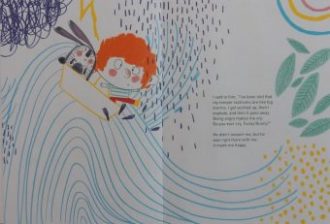
Let me say at the outset, this is a remarkable book; intensely moving and quite unlike anything else, even the author’s previous stories, The Imaginary and The Song From Somewhere Else.

The story starts with best friends Ember and Ness who are pretty much inseparable but then comes an announcement in school assembly. There’s been an accident in the park and one of the pupils has died; it’s Ness.

For Ember, the world is unimaginable without her bestest buddy. Then, through another grieving person, she becomes aware of a strange grey afterworld and there she finds Ness again. Can she bring her back? That is Ember’s plan but should she fail, it seems she too will have to remain in that eerie place, leaving behind her Dad and Penny, his partner.

The push and pull between the two worlds presents Ember with a dilemma that is unbearable, especially when she discovers that Ness is not the only one of those she loves in the netherworld.

I’ll say no more about the story itself except that I urge you to read it.

A.F. Harrold’s writing is totally gripping, dark, profound, occasionally scary, and suffused with grief; but it’s also full of love and tenderness, and there’s hope too. There’s also a cat that keeps putting in an appearance. Does that sound a little familiar?
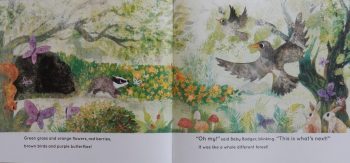
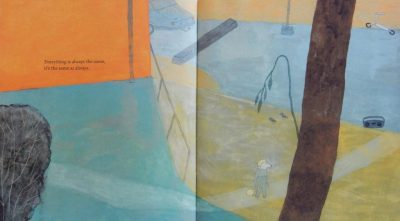
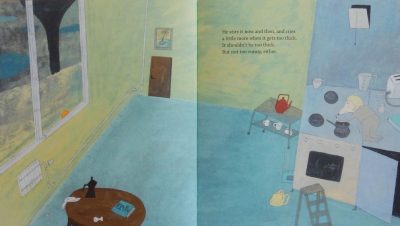
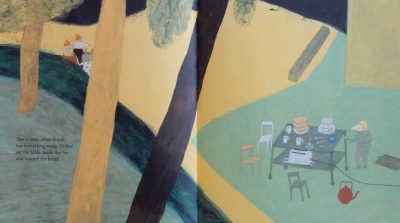
Emily Gravett’s powerfully atmospheric illustrations provide the perfect complement to the text, making one’s reading experience of The Afterwards feel like a seamless whole.

Little Bear’s Big House / There’s a Dinosaur on the 13th Floor

Little Bear’s Big House
Benjamin Chaud
Chronicle Books

Tired of his uneventful life in the forest Little Bear leaves his Mama, Papa and Teeny Tiny bear to embark on a big adventure, “far from the forest” so he says.

His exploratory intent means that he turns down invitations from his forest dwelling friends, to keep moving
till eventually, as night falls he comes upon a huge, amazing-looking house in a clearing.
The door is ready to be opened so Little Bear, acting like a little boy, decides to enter.

Once inside the real adventure begins …

“Being on my own is so much fun!’’ comes the cry until there is an enormous BANG! Little Bear dives beneath the bedcovers and his imagination runs riot.

What ensues is something of a surprise but suffice it to say that when Little Bear finally reaches home after an adventure that proves a little too much for the young ursine character, he learns that he isn’t the only one with an exciting story to tell about a big house.

Hilarious scenes of Little Bear and his antics as he seeks a modicum of independence, offer plenty for little humans to pore over.

There’s a Dinosaur on the 13th Floor
Wade Bradford and Kevin Hawkes
Walker Books

Mr Snore, an extremely tired musician checks into the very grand-looking Sharemore Hotel hoping for a good night’s sleep. No sooner has his head hit the pillow however than he discovers that his bed is already occupied. He demands a new room and there are plenty of options starting on the second floor but he has no intention of sharing his slumber time with a pig so he calls the front desk again.

And so it goes on until despite the knowing porter’s unfinished warning, Mr Snore ends up at floor number thirteen. The bed is definitely gigantic and might at last prove satisfactory.

Now however, it isn’t Mr Snore who makes a call downstairs to the front desk …

With its crazy finale, nicely contrasting main characters and Kevin Hawkes’ zany illustrations, this romp of Wade Bradford’s truly is a bedtime tale with a difference.

I’ll Love You For Ever

I’ll Love You For Ever
Owen Hart and Sean Julian
Little Tiger

Using the perennial theme of adult/infant love Owen Hart and Sean Julian offer a delightfully illustrated rhyming book for sharing with the very young.

Together with an adult polar bear and a little cub we travel through the very different seasons of an arctic year starting with the stark wintery snow and ice. ‘Come look at the snowflake / and I will explain: / In spring it’ll melt / but my love will remain.’

Spring brings flowers peeping through to wonder at and warmer seas for swimming together.

By summer the meadows have turned green, flowers bloom in abundance and bees hum gently.

Then in autumn the trees glow golden and flowers fade away heralding once more the onset of winter. ‘When cold, winter winds / blow the leaves far and wide, / You’ll cross the great icebergs / with me by your side.’ So says the affectionate parent bear before the two animals snuggle up together ready to sleep.

As the seasons change so too does Sean Julian’s colour palette, but what remains constant is the look of love on the adult bear’s face, making this a reassuring read for little humans that isn’t overly sentimental.

My First Book of London

My First Book of London
Ingela P Arrhenius
Walker Studio

No matter whether Ingela P Arrhenius is working in large or small format, her retro-modern style is always eye catching.

In her latest large scale offering Ingela has chosen to explore London. She takes readers on a whistle-stop tour to visit all the popular tourist destinations in the capital showcasing each with a double spread of labelled images and an introductory sentence or two.

First stop is Buckingham Palace after which we visit the Houses of Parliament, the Tower of London, the Globe Theatre and its neighbour. Tate Modern.
Then, it’s on to London Zoo, Trafalgar Square, Hyde Park – a great place for a picnic; followed by the London Eye (taking in the National Theatre). Phew!

If shopping is your thing, then you might take a stroll to the famous Carnaby Street, or perhaps take a trip to Harrods, Liberty or Hamleys toy shop, by which time afternoon tea will be the order of the day.

Covent Garden, with its street performers, stalls and cafes (one of my favourite parts) is the next venue.

You can enjoy a virtual visit to all these and other famous places, including Greenwich, home of the Cutty Sark and the Royal Observatory, which is slightly further out that most of the other locations Ingela has chosen to showcase.

A great book to use in nurseries, or to give to a young child who is from outside the capital before a visit.

The Boy on the Bench

The Boy on the Bench
Corrinne Averiss and Gabriel Alborozo
Egmont

Observe young children in a playground, be that at school or in a park: there are many who love to be at the centre of the action and others who lack the confidence and linger on the sidelines watching and wondering how they might join in. That author Corrinne Averiss has done so is evident in her story of Tom, who is one of the watchers.

As the story opens he sits with his dad on a bench in the busy playground.

When Dad suggests that with dinnertime approaching he should take the opportunity to use the equipment, “In a minute …” is Tom’s response as he looks for somewhere he might find a space he can fit into.

One of the children starts playing at being a fireman, soaking the others as they come down the slide.

Tom is amused and clearly would like to join in the fun but still lacks the courage to do so.

It’s only when a little girl’s teddy is stranded atop the climbing frame as a result of the rescue game suddenly switching focus

that Tom leaves the bench and little by little, starts climbing until …

At last Tom has found a friend and that makes all the difference.

So much so that when his dad tells him it’s time to go home, he’s so comfortable in the Tom-shaped space he’s finally found, that his “In a minute!’ reply signifies something totally different.

Gabriel Alborozo too must have been an avid playground watcher judging from his beautifully observed scenes detailing Tom’s transition from nervous watcher to confident participant in the playground activities.

Sonam and the Silence

Sonam and the Silence
Eddie Ayres and Ronak Taher
Allen & Unwin

Imagine living in a world without music; it’s almost unthinkable but that’s how it is for young Sonam in Eddie Ayres’ story set in Kabul, Afghanistan at the time when the Taliban forbade the playing of music.

Ayres is himself a musician and broadcaster who spent a year teaching music at the Afghanistan National Institute of Music, formed after the 6-year Taliban-imposed ban was lifted.

One of the pupils he met was named Sonam and it is she who inspired his story.

When Sonam, who lives with her mother, two brothers and a sister, turns seven her older brother tells her she is no longer a child: now she must cover her hair and start working, selling chewing gum on the streets of the city.

On the way to work, the girl hears a wonderful sound and follows it to discover, sitting in a room among the pomegranate trees, an old man playing music on a rubab. Sonam is captivated.
The old man tells her that “There is music everywhere, ‘In the wind, in the earth, in the trees. Music is forbidden, but that’s when we need it most. But you can only hear music if you listen with all your heart.”
He gives Sonam his instrument and now although she continues working, the sounds of fear she felt are replaced by the music running through her entire being.

Then one day her brother discovers the girl humming and he takes away her instrument and forbids her to sing. Now her music has been silenced, Sonam’s world is full only of sounds of war.

Desperate she goes to the old man’s garden but he is no longer there; however she finds just one pomegranate. That she picks intending to plant its seeds in her own garden.

As she does so she unearths something that makes her heart sing. Her brother has in fact hidden her rubab to protect her.

Returning to the old man’s garden she sits beneath a withered tree remembering and as she does so, sounds of the old man’s music replace those of fear emanating from the city. Gradually she comes to understand that now, the old man and the music is within her, and deep inside it will always be.

Seemingly simple this is a profound, heartfelt tale of resilience, love and hope made all the more impactful by Eddie Ayres’ use of the present tense; and by Ronak Taher’s powerful mixed media illustrations. These are multi-layered and intricate with backgrounds carpeted with fragments of petals, leaves and grasses in autumnal shades over which are placed the storytelling images and the sinister silhouettes of war.

Like the music that plays such a big part in the story, this book is such that it reverberates in the mind, long after it’s been read.

Emmett and Caleb

Emmett and Caleb
Karen Hottois and Delphine Renon
Book Island

Emmett and Caleb are neighbours and good friends. Despite having totally different morning rituals, they manage to spend much of their time together going for walks and enjoying nature.

Come summer late riser Caleb is unusually, awake early and he wants to give his pal a present to celebrate their long-standing friendship. Having pondered hard, he decides to write Emmett a poem: ‘Emmett, you look handsome in your hat and you’re not fat.’ and give it to him after they’ve consumed their meal. This however, doesn’t quite go as well as he hopes: Emmett focuses on the superficial errors rather than the content of the message and so finds Caleb’s effort funny, which upsets the writer who snatches back his work, taking drastic action.

Emmett ponders, gently admonishes himself and decides to make recompense. By sunset the two are reconciled

Autumn brings forest walks, damp earth and the harvesting of nature’s bounties – a truly golden time for the pair.

Then in the winter it’s time to celebrate Caleb’s birthday with a party, presents, a special cake and dancing;

it even snows as midnight strikes.

This celebration of friendship, life’s simple pleasures and the gifts of nature, translated from the author’s original French by Sarah Ardizzone, is enchanting. In her illustrations, Delphine Renon beautifully captures the warmth between the two characters as well as the inherent beauty of each season.

A quirky delight to read aloud or equally, a lovely book for those just taking off as independent readers.

Treasure of the Golden Skull

Treasure of the Golden Skull
Chris Priestley
Bloomsbury Children’s Books

When Mildew and Sponge learn of the possibility of their school’s closure, despite being less than enthusiastic about almost all aspects of Maudlin Towers, a thoroughly gloomy establishment, the two boys do regard it as home and resolve that something must be done. The money supposedly stowed safely away by Reverend Brimstone to cover much-needed repairs to the place has been stolen (along with the chair he stashed it in) and now the school coffers are empty and the governors totally unwilling to help – anything but in fact.

The two boys conclude they’ll be sent to separate places of education if the school is shut down and that’s unthinkable; a rescue mission must be put into action forthwith.

It’s a mission that begins with a surprising revelation concerning a pirate connection and continues with a hunt for buried treasure, the onset of green parrot sightings by Sponge and a new boy going under the name of err, Newboy who manages to bend the will of others to his own.

Add to this the fact that Sponge’s predilection for biscuits shows no sign of abating, as his pal points out in the staff graveyard, “Your head is full of biscuits. Buck up, Sponge. How are you ever going to detectivate? Finlay Feathering wouldn’t let a bit of biscuitlessness bother him”.
Oh and there’s also an entire new set of very strange replacement staff.

Throw in a floating eyeball and a werewolf (both feature in the plethora of delicious line drawings herein) to satisfy spooky-loving readers and the result is a sequel to Curse of the Werewolf Boy that is every bit as silly and entertaining.

And the treasure? Let’s say ‘busted’ about covers it.

Seems there’s to be a third biscuit-fuelled adventure somewhere on the horizon … eagerly anticipated by countless Maudlin Towers fans I have no doubt.

Josie’s Lost Tooth

Josie’s Lost Tooth
Jennifer K. Mann
Walker Books

Josie shines at pretty much everything she turns her hand to at school, but when it comes to losing a tooth, she’s way behind all her classmates.

Her best friend Richard proudly tells of rewarding visits from the tooth fairy, which makes Josie determined to hasten the falling out of her slightly wobbly tooth. Despite her determined efforts – dangling upside down, chomping a particularly crunchy apple and chewy carrot sticks,

and the rather more drastic string pulling technique – the tooth remains lodged in her gum.

The prospect of having baby teeth for life makes Josie glum so Richard suggests a cheering-up game of sharks and squid chase.
The result is that Josie loses her tooth – literally – leaving her with nothing to hide under her pillow for the tooth fairy.

Richard kindly offers his shark tooth but it just won’t do. Instead Josie writes a note appealing to the Tooth Fairy, leaving it along with the shark tooth under her pillow.

Next morning what Josie discovers isn’t money but a very special surprise gift – a wonderful tribute to friendship, demonstrating the donor’s understanding of what is really important.

Jennifer Mann’s digitally worked pencil, pastel and collage illustrations have a delightful child-like quality and her dialogue is akin to that of children, making this an engaging tale of friendship run through with gentle humour. Those at the first tooth-losing stage in particular will love this.

Little People, Big Dreams L.M.Montgomery / Little People Big Dreams Maya Angelou

Little People, Big Dreams L.M.Montgomery
Mª Isabel Sánchez Vegara and Anuska Allepuz
Lincoln Children’s Books

This is an excellent series of books each featuring a woman who made a significant contribution to society. The latest features L.M.Montgomery whose books I loved as a child.

Maud, as she was called, had a rather sad, lonely childhood. After her mother died, her father left her in the care of her strict grandparents on Prince Edward Island, Canada. She was forced to create her own happiness and books became her best friends. She dreamed of becoming a writer, something her grandparents discouraged, but nevertheless at night Maud began writing in secret, creating both stories and poems.

As an adult, Maud first became a teacher, a job that gave her time to continue with her writing and later on she was offered a job on a newspaper.

In less than a year, her grandfather died and she was forced to return home and care for her grandmother.

However she continued writing combining it with working at the local post office; before long 30 of her stories had been published in the newspapers.

One day she found an old newspaper with a story that became the inspiration for Anne of Green Gables. Through this story, Maud rewrote her own childhood as she wished it had been and after numerous rejections and a period of two years, Anne of Green Gables was finally published.

The illustrations of Anuska Allepuz are an absolute delight – wonderfully expressive and bringing out Maud’s joy in simple things and her determination to become a writer.

A super addition to the series.

For those with a particular interest in writers especially, is another of the series that I missed earlier:

Little People Big Dreams Maya Angelou
Lisbeth Kaiser and Leire Salaberria
Lincoln Children’s Books

Maya Angelou grew up in the American South in the 1930s – a time of racial tension and segregation.
The hardships she endured – racism, gender prejudice, and abuse by her mother’s partner which resulted in the child losing her will to speak,- would have been too much for many people. Not so Maya who found her voice again thanks to a friend of her grandmother and the power of reading aloud.

At school Maya was told she wouldn’t amount to anything but her determination “There’s nothing I can’t be.” was proved right.

She grew up to become a singer, dancer, actress, poet, novelist, and eminent Civil Rights campaigner. Her fortitude and compassion changed the lives of countless people the world over: her legend lives on.

Like all titles in the series, the book concludes with a time line.

Eloquently illustrated by Leire Salaberria, Lisbeth Kaiser’s pen portrait of Maya is a must have for primary schools.

Time for Play with Nosy Crow: Alphabet Street / Pip and Posy Book and Blocks Set

Alphabet Street
Jonathan Emmett and Ingela P Arrhenius
Nosy Crow

It’s the alluring design that immediately attracts young children to this concertina alphabet book though I don’t imagine any wanting to let go once they start exploring inside. It’s terrific fun, folding out to make an entire street of shops – thirteen in all – each with an apartment above; and all are populated with animal characters either shopping or doing something of a homely nature.

For instance we might choose to stop at Coffee and Doughnuts café outside which two elephants are enjoying a drink and a snack.
Lift the flap and inside we have ‘Dd D is for Dog, who is drying a dish’, an illustration of same, and two more customers drinking.
Above them in the apartment … ‘Cc C is for Cat, who is cooking some fish.’

The shop names make up the entire alphabet ending with

In between are all sorts of wonderful places to visit, not least of which is this one:

Jonathan Emmett’s cleverly constructed, fun alliterative rhyming text, together with Ingela P Arrhenius’ bold, bright, retro style illustrations make for a splendidly interactive book and even more clever, on the back is a complete fold-out park scene which can be used as a backdrop for small world play. So too can Alphabet Street itself which could perhaps be used in conjunction with a play mat. The learning possibilities, in addition to the obvious alphabet element, are enormous.

Pip and Posy Book and Blocks Set
Axel Scheffler
Nosy Crow

This set includes a board book copy of Pip and Posy: The Big Balloon and a set of nine jigsaw puzzle building blocks.

In case you’re not familiar with the story, essentially it tells what happens when Pip lets go the string of his prized shiny red balloon and it floats away. The best friends give chase but the balloon bursts. Fortunately Posy is ready and willing to provide cheer in the form of bubbles – lots of them. And if they pop, well it doesn’t matter for that’s what bubbles are supposed to do.

The blocks can be used to make 6 different scenes from Pip and Posy stories: toddlers may need some help with this activity but a pictorial guide is provided.

If you’re looking for a fun present for a little one, this gift set might well fit the bill: Pip and Posy are a delightful duo.

The Tall Man and the Small Mouse

The Tall Man and the Small Mouse
Mara Bergman and Birgitta Sif
Walker Books

There are two residents of the tall house atop the tall hill; one human, the other a mouse. The tall man and the small mouse lead parallel lives, the man doing tall (and often caring) things that need doing, the mouse doing small things that need doing after which she falls fast asleep in a cosy, comfy place.

One day the man has a fixing task concerning the town’s clock – it’s no longer going tick or tock; but try as he might, the tall man cannot get inside that tickless, tockless timepiece and so, silent it remains.

Back home he researches but his books yield nothing so eventually he falls fast asleep.

The mouse meanwhile is up and about creeping hither and thither till she goes off to sleep inside a tall boot.

Next morning when the man discovers not only the mouse in his boot but also a all his missing things, he’s delighted and enlists the little creature’s help.

After searching high and low inside the clock, the mouse finally discovers the source of the problem.

With assorted bits and pieces, she soon has those bells ringing out once more making the two residents of the house on the hill (as well as the townsfolk) extremely happy.

Thus a new camaraderie is forged and a new partnership as well.

Told in rhyme, Mara Bergman’s fable of fixing and friendship is a quirky delight, made all the more so by Birgitta Sif’s adorable illustrations. Full of her wonderful whimsy every one, large or small, is an absolute treat; such a gorgeous colour palette too.

I Am Human: A Book of Empathy / Let’s Talk About When Someone Dies

I Am Human: A Book of Empathy
Susan Verde and Peter H.Reynolds
Abrams Books

The team who gave us I am Yoga and I am Peace now explore what it means to be human.

Humans have a playful side and find joy in relationships, we hear; but on the negative side sadness brings a heavy heart. This though, is countered by a reminder that part of being human is the ability to make choices.
Positive actions – such as compassion and helping others, being fair and treating all people equally, bring a feeling of connectedness with fellow humans.

In keeping with the child narrator’s mood, Reynolds changes his colour palette from bright to a dull bluish grey as the actions switch from positive to negative.

Yes, we’re all flawed human beings who make mistakes but Susan Verde and Peter Reynold’s little book of empathy is perfect for starting a discussion with young children about making good choices. To this end, there’s also a loving-kindness meditation to share.

Let’s Talk About When Someone Dies
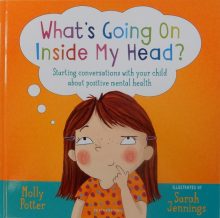
Molly Potter and Sarah Jennings
Featherstone (Bloomsbury)

Most young children will bring up the subject of death either at home or in school, or both, and many adults are unsure of how to engage in a discussion about it. This book, written in child-friendly language by a teacher, will for those adults especially, prove extremely helpful.

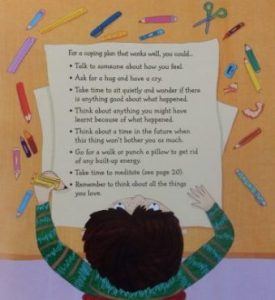
Each double spread – there are a thirteen in all – takes a different aspect and almost all start with a question such as ‘Are there different words for death?’; ‘What might you feel when someone dies?’ …

‘What do people believe happens after death?’ and, the only one that isn’t prefaced by a question, “To remember a person who has died, you could …’.
There’s a brief ‘It’s important to know’ paragraph at the end of most sections and Sarah Jennings has provided bright, appealing illustrations (often including speech bubbles).

The tone of the entire book – both verbal and visual – is spot on for the primary audience and is suitable for those of all faiths or none.

Oscar the Hungry Unicorn

Oscar the Hungry Unicorn
Lou Carter and Nikki Dyson
Orchard Books

Unicorns are very much THE favourite among young children at the moment but I’ve never come across one with quite such a winning expression as Oscar.

Having eaten himself out of house and home – literally – the chubby creature is on the hunt for a new place to live.
The trouble is, his habit of sinking his teeth into pretty much everything he sets eyes on, means he’s far from popular with the witch, the pirates, the fairies and the dragons he encounters.

The giant is willing to accommodate Oscar but not quite in the way Oscar hopes, so his home certainly won’t do.

That leaves just one option: he has to try his luck on the other side of the bridge.

This doesn’t look too promising however …

Fortunately though, a certain young princess Oola just happens along and she’s been on the lookout for a unicorn FOR EVER. So maybe …

With its sparkly cover and Oscar’s irresistible allure thereon, Lou and Nikki’s character and his all-consuming escapades will satisfy lots of unicorn-hungry little ones; my review copy has already been appropriated by one such.

Tiger Walk

Tiger Walk
Dianne Hofmeyr and Jesse Hodgson
Otter-Barry Books

Tom’s visit to an art gallery and Rousseau’s famous painting, Surprised! inspire the boy to create his own large tiger picture.

Little does he imagine though that this is to lead to an amazing nocturnal adventure, for out of the shadows in his bedroom appears a large, stripy animal inviting him on a moonlit walk.

Somewhat fearful by nature, Tom mounts the tiger’s back and off they go into a forest alive with bears, foxes and lions.

In the tiger’s company they turn out to be playful rather than the scary creatures Tom has anticipated.

The adventure continues with a river crossing,

a fairground ride and an encounter with what seem at first to be frozen tiger forms.

All of these too engender fearful feelings in the boy, but somehow with his own tiger friend beside him Tom is emboldened. He swims, flies round and around aboard a merry-go-round and dances in an icy cave till sleep overcomes him and it’s time to return home.

Your senses are immediately stimulated as you start to read Dianne Hofmeyr’s dramatic present tense telling of this entrancing tale of a little boy’s transformation from fearful to fearless; and with the side lining of art in the curriculum it’s fantastic to see a painting such as this one of Henri Rousseau’s used as the starting point for the story. Suspense is built by variation of sentence length and conjunctions strategically placed at page breaks, while Tom’s anxious “I’m a little bit scared of …’ iteration followed by tiger’s assurances add to the power of the narrative.

Jesse Hodgson’s arresting tigerish scenes are more mannered, bright and colourful than Rousseau’s windswept, storm-tossed jungle and have just the right balance of ferocity, realism and reassurance as befits a bedtime story.

Only One Of Me

Only One Of Me
Lisa Wells, Michelle Robinson and Catalina Echeverri
Graffeg

Less than twelve months ago at just thirty-one, Lisa Wells, mother of two young children, was diagnosed with terminal bowel and liver cancer. Instead of letting herself become overwhelmed by gloom, Lisa was determined to leave something very special to show her abiding and unconditional love for her two little girls, and also to help other families in similar situations. Part of this is Lisa’s Army UK and the other is Only One of Me, the book, which, thanks to co-writer and friend Michelle Robinson, illustrator Catalina Echeverri and crowd funding, was completed in a matter of months.

Speaking in rhyme to her children Lisa wistfully acknowledges that her time left is all too short and insufficient to do all that she’d hoped with her little ones.

Instead, with the loving support of those left behind (family and friends),

the remainder of her message is one of enormously inspiring positivity: ‘Be kind! Be Brave! Be free! Remember all our joy and fun / When you remember me. Love you always, Mummy xxx’ she tells the girls.

The love this mother has for her family shines through in every one of Catalina Echeverri’s beautiful illustrations.

There’s also a version of the book – ‘A love letter from Dad’ illustrated by Tim Budgen and both artists waived their illustrator’s fees and like the co-authors are giving their royalties from sales to We Hear You (WHY) and Mummy’s Star charities.

Powerful, poignant and comforting, this is a book that nobody wants to have to use, but one that could offer essential reading for families facing and coping with, impending bereavement.

Grandma Bird

Grandma Bird
Benji Davies
Simon & Schuster

As an avid fan of Benji Davies’ world of Noi books, I was eagerly anticipating this new one and it certainly lives up to expectations.

Noi is off to spend the summer with his Grandma whose home is on a windswept rock across the water. He’s less than enthusiastic at the prospect of this solitary place and the idea of Grandma’s seaweed soup. Worse, he discovers they have to sleep head to toe in her small bed where Grandma snores loudly and the blankets itch; and during the day she’s so busy she has no time to play with her grandson.

The boy decides to explore the seashore alone. Suddenly he spies something shining in the distance and discovers a large hole-filled rock – the perfect place for some imaginary play.

The wind lashes outside, the sea beats against the rocks and suddenly out of the storm a little bird drops at Noi’s feet.

Knowing it needs help, Noi tries to make his way back across the rocks towards Grandma’s home and as he battles against the lashing storm he sees the bright red sail of a little boat.

Grandma has come to his rescue and once safely aboard her boat, boy and Gran gather up more bedraggled birds which they take back to dry out indoors.

Eventually the storm abates and the birds depart, all except one. Could it be that Grandma feels lonely sometimes in her solitary existence, Noi wonders.

Then for the remainder of the summer two humans, one young, one old and a feathered companion spend their days exploring the tiny island together.

Despite the remoteness and bleakness of the setting this is a story full of warmth and tenderness. Gran’s apparent absorption with her daily routine doesn’t prevent her from keeping a watchful eye on Noi from a distance and she’s quick to act when the storm blows up, while the notion that his Gran might be lonely occurs to the boy as the rescued birds depart.

Such is Benji Davies’ way with words that they alone paint wonderful images in the mind, while every one of his illustrations, large or small merits close attention. I love Grandma’s upturned boat of a cottage and its cosy interior complete with’ One Hundred and One Uses for Seaweed’ book, not to mention her skill at stone balancing and yoga; all of which can be relished during the course of this tender tale.

When the Whales Walked / Rivers


When the Whales Walked
Dougal Dixon and Hannah Bailey
Words & Pictures

By means of thirteen case studies, readers can discover how for example, dinosaurs evolved into birds and how whales were once four-legged creatures that walked on the land. These are just two of the fascinating evolutionary journeys told through a mix of annotated illustrations by Hanna Bailey, superbly illustrated scenes and family trees.

Did you know that way back in time snakes too had legs and crocodiles were warm blooded?

Written by evolution and earth sciences specialist, Dougal Dixon, this is a book that will broaden the horizons of dinosaur mad readers and, with evolution now a topic in the KS2 science curriculum, it’s one to add to primary school collections.

Rivers
Peter Goes
Gecko Press

In his follow up to Timeline, Belgian illustrator Peter Goes takes readers by means of a series of large size maps, on a continent-by-continent tour of all the world’s great rivers.

Those featured flow across  predominantly monochromic double spreads that are illustrated with images of iconic structures – bridges and buildings, vehicles, people, deities, monsters, wildlife and physical features.

Factual information – historical, geographical, biological, mythical, cultural – is provided in snippets (the book is translated from the original text by Bill Nagelkerke) through and around which each river meanders from source to sea.

I’ve visited relatively few of the rivers featured (though various parts the River Thames have always been part and parcel of my life and I’ve visited locations along the Ganges). Some including the River Onxy in Antarctica that flows only in summer, I’d never heard of.

This super-sized book has made me want to do some more river exploring; perhaps, like its creator I’ll start closest to home, in Europe.

A fascinating book for young would-be travellers and school libraries in particular.

Find My Rocket / Elephants on Tour / Egypt Magnified

Find My Rocket
Aleksandra Artymowska
Laurence King Publishing

Aleksandra Artymowska is a terrific illustrator; I first came across her amazing work through another maze book, Amazed. Now it looks as though the same boy from that book has returned needing help in another puzzling adventure. This time having sent his red rocket jetting off into space he needs our help to locate it in eleven differently themed maze scenes. It’s easy enough for readers to spot the whizzing spacecraft but finding the right way through the intricately detailed possible pathways presents a real puzzler.

Every one of Aleksandra’s scenes be it the paper cranes, the building blocks, the toolbox or the teddies,

is packed with wonderful small objects, visual jokes and more – love the alliterative manoeuvres the lad performs during his search– catapulted through the cars, dodged all the dominoes, for instance, before he finally succeeds in retrieving the object he launched.

A great book to immerse oneself in as the evenings draw in; if you’ve yet to discover Aleksandra Artymowska, then this is a great place to start.

Elephants on Tour
Guillaume Cornet
Laurence King Publishing

Having packed their trunks, five elephants are ready to embark on a world tour and we’re invited. First though we need to get to know something about our fellow adventurers: there’s the highly organised guy with his bags full of maps and tickets. He’s accompanied by a food connoisseur; the arty one, the photographer and the energetic one who insists on taking his skateboard along.

Having done London aboard a red double decker, the next port of call is Amsterdam with its canals and cycle lanes to explore. No doubt they sampled the syrupy waffles, a speciality of the city.

I’m sure they would also have tried the blinis in St. Petersburg and kayaked along one of the rivers or taken a ride on the Mongolian railway.

After visiting sixteen locations on five continents the final stop in their frenetic journey before returning to home shores, is Paris.

Along the way we receive a running commentary from the five travellers and for each location a fact file and other useful information. We’ll definitely need all that because at the outset, we are asked to make sure we find each of the elephants and their favourite belongings at every stopping place. No easy task with so much to look at. (Answers are supplied at the end of the tour.) My head is spinning after that.

With Guillaume Cornet’s intricately detailed scenes, this search and find journey is totally engrossing; those cityscapes are mind-boggling.

Egypt Magnified
David Long and Harry Bloom
Wide Eyed Editions

One possible way to get youngsters interested in times past, especially those who can’t get enough search-and-find books is this offering from Long and Bloom. Readers are invited to travel back through the centuries and visit sixteen Egyptian scenes, including the Great Pyramid and Tutankhamun’s tomb that are absolutely teeming with tiny figures.

Once in ancient Egypt, there are  ten items or people to spot in each illustration and on reaching the end, readers are encouraged to go back and hunt for another 57, plus a hidden mummy on every spread. (There’s a magnifying glass to facilitate the search inside the front cover, because, so we’re told, every Egyptologist needs one.)

The Mud Monster

The Mud Monster
Jonnie Wild and Brita Granström
Otter-Barry Books

What on earth is the terrible mud monster that is sending all the animals into a panic? Despite the fact that not a single one of them has seen it, they know for sure it’s huge and horrible.

One day as the monkeys are playing among the creepers they spy something: “Help! It’s the mud monster!” comes the cry. Despite being covered in mud, it isn’t a monster, merely five flamingos, mire-bespattered and desperately in need of a bath in the river. The monkeys are happy to carry them there.

They’re not the only animals to ‘see’ the Mud Monster though. Warthog and rhinoceros also mistakenly identify the moving creature as that which they fear before they too join the throng heading to the river.

When they finally reach their destination, there before them is something huge and exceedingly muddy: surely it couldn’t be that which they dread …

Hilariously illustrated and full of fun, this second tale set in the African rainforest to feature the five flamingos, is one of teamwork and overcoming imaginary fears, and comes from Jonnie and Brita, two people who have a special interest in Africa and its wildlife. Jonnie’s royalties are donated to support conservation projects in Africa, details of which are given at the back of the book.

Rosie Revere and the Raucous Riveters

Rosie Revere and the Raucous Riveters
Andrea Beaty, illustrated by David Roberts
Amulet Books

This is the first of a new chapter book series from the Beaty/Roberts partnership that gave us engineer Rosie Revere, scientist Ada Twist and Iggy Peck, architect.

Now these three have become a team calling themselves The Questioneers and they have plenty of calls on their time and brains. That’s thanks to Rose’s much-loved Aunt Rose and her spirited friends, the Raucous Riveters who built B-29 aeroplanes during World War 2. These women are unstoppable but one of their number, June, has broken both her wrists in a motor scooter accident. Unless somebody – ie Rosie – can find a way to help her, she won’t be able to participate in the forthcoming art competition.

Into action leaps our young engineer aided and abetted by Ada and Iggy, using all kinds of paraphernalia, and after a few false starts, the Paintapalooza is finally ready – just in time for the Art-a-Go-Go.

This affectionate, lively tale is full of things to make newly independent readers smile – not least being the raucous bunch of indomitable Riveters, as well as important lessons about the role of the imagination in problem solving and the importance of resilience in learning.

Clever design gives the book a STEAM feel and Roberts’ zany illustrations are terrific fun.

You’re Snug With Me

You’re Snug With Me
Chitra Sounder and Poonam Mistry
Lantana Publishing

Chitra Soundar sets the follow up the You’re Safe With Me in the wintry wilds of the Arctic.

Her tale of care and protection begins in a den dug into a snowdrift by Mother Bear where she gives birth to two cubs.

As they grow they become more curious: “What lies beyond here?” they ask. Their mother tells them of the frozen lands without, lands where, thanks to the hard snow, it’s safe for them to walk; but “only where the land will let us walk . .. “But hush now, you’re snug with me.”

Longer nights bring restlessness to the growing cubs and a reassurance that “As long as the ice stays frozen, we will never go hungry.”

From then on, Mother Bear gently teaches her little ones about the importance of maintaining the delicate balance of nature: the ice will only melt “if we don’t take care of it.” …

“We should only take what we need.”

In between times she answers their questions, telling of the approaching spring; of Earth’s place in the cosmos and the other animals they share the land with. All the while punctuating her lessons with the reassuring refrain, “But hush now, you’re snug with me.”

By the time there’s a whiff of spring in the air outside. Mother Bear has taught her cubs all she knows, thus preparing them for their independence.

Now it’s time to venture outside and welcome the new spring – Mother and cubs together.

The environmental message is soft spoken in Chitra’s mellifluous text but she adds a final page spelling out her hopes that readers will take on a stewardship role when it comes to caring for our precious planet. We’re also given some additional information about polar bears and I was surprised to learn that new- born cubs are only the size of guinea pigs.
Inspired, I think, by Indian folk art patterns and repetitive block print motifs, such is the mesmeric quality of Poonam’s intricately patterned images that you find yourself transfixed by every spread and her colour palette is absolutely gorgeous.
Picture books don’t get more beautiful than this.

A winter blanket, a hot chilli chocolate and Chitra and Poonam’s book – bliss on a chilly day.

Story Box Animal Adventures / My RSPB Nature Craft Box

Story Box Animal Adventures
Claudia Boldt
Magma for Laurence King Publishing

With the twenty sturdy, double-sided puzzle pieces, users can create endless stories: the pieces are interchangeable and when all are used it’s possible to create an adventure stretching out across 2.4 metres.

Brimming over with narrative possibilities involving a polar bear and his animal friends, wicked pirates, a party throwing tortoise and much more, this is a terrific resource for developing language, especially children’s oral storytelling, either in a classroom or at home. It’s especially good for those (adults included) learning English as an additional language.

Here’s Alesha having fun creating her own stories

The potential is terrific and if used by several children together, turn taking, negotiation and other skills also come into play.

A smashing resource, with illustrations by picture book artist Claudia Boldt, that allows a different story to be told every time it’s used.

My RSPB Nature Craft Box
Sarah Edmonds
Walker Books

This is a collaborative venture with the RSPB. Within the chunky box you’ll find a book full of crafty ideas relating to the natural world: you can for example, discover how to make a nest, birds to sit on it and binoculars for bird watching.

Illustrator/designer Sarah Edmonds also offers minibeast-related ideas, masks to make, instructions to construct a forest diorama, ways to create cards, wrapping paper, baking recipes and more. There’s a ‘you will need’ list for each activity as well as visual prompts.

In the box too, are a dozen activity cards that relate to the activities in the book, 4 mask outlines and 5 metres of pre-cut bunting with natural world images to colour.

All in all it’s a great way to encourage your little ones to get outdoors and explore the natural world.

Little Wise Wolf

Little Wise Wolf
Gijs van der Hammen and Hanneke Siemensma
Book Island

Little Wolf is renowned for his wisdom and it makes him proud. He’s so busy studying that he has no time to answer the questions of others.

One day he receives a visitor: it’s the king’s crow bearing a message from his highness. The king is ill and believes that only Wise Wolf can make him better.

Reluctantly he agrees setting out next morning on his bicycle. The other animals are concerned about the distance Little Wolf must travel.

The journey is very long and the terrain hilly. Little Wolf abandons his bike and watched by several pairs of eyes, continues on foot.

Come nightfall he’s exhausted, cold and very hungry; but even worse, he’s lost. On the point of despair he notices a light in the distance. It’s coming from the campfire outside a tent and bubbling away is a pot of soup.

Sated, Little Wolf falls fast asleep.

Next morning another surprise awaits: it’s the other animals. They encourage Little Wolf to continue alone and eventually, totally worn out, he reaches the castle gate and after some persuasion, enters the king’s bedchamber.

A single spoonful of Little Wise Wolf’s herbal medicine is all that’s required to cure the patient.

The grateful king makes him a tempting offer but his decision to turn it down and return to his friends, whom he acknowledges have much to teach him, shows that Little Wolf now truly does deserve to be called wise.

Wise words too from the author: for a bibliophile it is all too easy to become engrossed in books and decide one is too busy for other things and that spoke to me; but what I enjoyed particularly was Hanneke Siemensma’s art.

Using a largely muted colour palette, she portrays the red-booted lupine’s journey to real wisdom in a series of wonderful spreads, each of which offers details to amuse and delight. In addition to the standout red wellies that draw the eye immediately, there is a white dotted line tracking the path Little Wolf takes. Peer into the depths of each scene and you’ll discover much more.

Rama and Sita

Rama and Sita
Malachy Doyle and Christopher Corr
Bloomsbury Education

Every autumn term countless teachers in primary schools share the story of Diwali with their classes. This retelling with Christopher Corr’s vibrant folk art style illustrations and Malachy Doyle’s straightforward narrative is an ideal introduction that really brings to life the ancient Hindu tale of the victory of light over dark.

It recounts how living in exile Rama and his wife Sita are tricked by the demon king Ravanna who wants Sita for himself. He sends a deer into the forest and Rama follows it at his wife’s request leaving Sita alone.

In his absence, Ravanna kidnaps Sita and takes her away to his island kingdom.

When Rama realises he’s been duped, he resolves to rescue his beloved wife and as luck would have it Hanuman the monkey king comes to his assistance.

With the help of Hanuman and his monkey army, who build a bridge across from the mainland, Rama rescues Sita from the island whereon Ravanna is holding her prisoner. First though, a terrible battle is fought on that island between the monkey army and the wicked demon army until finally an arrow from Rama’s bow pierces the chest of the ten-headed demon Ravanna who falls down dead.

With Sita safe once more, the fighting is called to a halt and the reunited couple return to a huge welcome in their homeland

where divas are lit everywhere in honour of their homecoming.

During my time as a teacher I’ve collected several beautiful picture book tellings of the Diwali story that are now sadly out of print, so it’s great to see this new one.

The Antlered Ship

The Antlered Ship
Dashka Slater and The Fan Brothers
Lincoln Children’s Books

Fox Marco has an insatiable appetite for knowledge: ‘Why don’t trees ever talk? How deep does the sun go when it sinks into the sea?’ he wonders while his fellow foxes merely ponder upon the nature of their next meal.

When a huge antlered ship docks at the harbour, Marco goes down to the waterside where he discovers from crew members that the ship has got lost (they admit to being poor sailors).

Intent on discovering more foxes to answer his questions, Marco, along with a flock of pigeons, joins the crew

and they embark on a voyage bound for an island upon which tall, sweet grass and short, sweet trees grow.

Their journey is hard: the sailors battle against stormy weather, their own fears and meagre rations. Days of drifting dampen their enthusiasm for adventure and it’s left to Marco to keep up the spirits of his fellow travellers.

Finally though, having fended off a pirate attack,

the ship reaches the island. Thereon his fellow crew members sate their appetites for sweet things but Marco’s hunt for foxes yields not a single one.

Instead though he does make some important discoveries and draws some conclusions about the nature of friendship and community, asking questions and seeking answers.

As with The Night Gardener and The Darkest Night, the Fan Brothers attention to detail in their pen and pencil illustrations is immaculate. Be they seascapes or portrayals of the happenings below deck, there’s a crepuscular quality about many of their richly textured scenes, while those on the island take on the brighter verdant hues of the animals’ surroundings.

Dashka Slater’s is a story to get lost in, and one to provoke questions of the philosophical kind among thoughtful readers and listeners. Who can but marvel at the artistic brilliance of Eric and Terry Fan and delight in the portrayal of such characters as the peg-legged, red bandana sporting pigeon?

Door

Door
JiHyeon Lee
Chronicle Books

I loved JiHyeon Lee’s debut Pool and this story too is wordless or virtually so.

It begins with a boy finding a key and following a flying insect through miserable-looking humans to a door.
Having turned the key and ventured forth he finds himself in a new world populated by strange-looking creatures, the first being one carrying a large musical instrument case. Alarmed, the lad runs off …

only to encounter another creature, who also speaks to him.

Overcoming his initial alarm, the boy allows her to take his hand and lead him to join a group of picnickers.

After partaking of some food, the boy swings,

climbs trees and generally has a fabulous time, as more doors appear through which many more creatures enter.

One of them is a bride and then we discover where everyone has been heading: a very special celebration.

Differences in language and kind matter not: all are welcome at this joyful occasion so wonderfully depicted in Lee’s intricately detailed, enchantingly whimsical scenes. The speech bubbles show many different languages being spoken but the understanding comes not through the words, rather it’s the inclusive, all-embracing attitude of the creatures that speaks of open-heartedness and warmth.

Observant readers will notice that as the story progresses, the boy’s appearance changes from a frightened grey to rosy, full colour.

Alice’s Wonderland Tea Party

Alice’s Wonderland Tea Party
Poppy Bishop and Laura Brenlla
Little Tiger

Poppy Bishop and Laura Brenlla present a new take on a classic tale.

Welcome to Alice’s tea party. Unlike that thrown by the Mad Hatter, she wants hers to be just perfect. No unexpected shrinking, growing or any other such craziness, just full of sweet things to eat.

As some of her guests sit at the table in comes White Rabbit announcing he indeed, has “something sweet to eat.” His insistence that clocks, especially those sprinkled with sugar and dipped in tea, will be absolutely yummy is met with scorn by the host.

She’s equally unimpressed with Dodo’s upside down cake

and Cheshire Cat’s vanishing pie and she’s certainly not intending to sample any of the tarts proffered by the Knave of Hearts, especially as the Queen of Hearts is hot on his trail.

Tums are all a-rumble when the Last Cook and Duchess arrive with a large plate of chocolate eclairs with a secret ingredient – uh! oh!

Alice’s “This is the silliest tea party ever” comment is bang on; but then Caterpillar turns up clutching cupcakes – something normal at last, thinks Alice settling to the now TERRIBLY ordinary tea party. But …

All our favourite characters are included, (the Cheshire cat is up to his usual vanishing and re-appearing trick as always) wonderfully portrayed by Laura in zesty vintage style. Every scene is sure to make you laugh, and there are flaps and cutaways to add to the enjoyment.

I’d definitely accept Alice’s invitation inside the front cover; this interactive experience is great fun.

Early Years Assortment: Where’s Mr Penguin? / Monsters Go Night-Night / Balance the Birds

Where’s Mr Penguin?
Ingela P Arrhenius
Nosy Crow

Just right for sharing with the very youngest is this new addition to the Nosy Crow felt flaps series splendidly illustrated by Ingela P Arrhenius.

Infants will be immediately attracted by her colourful art and be enchanted to join in the game of hide-and-seek to find the missing animals – Mrs Seal, Mr Seagull, Mrs Whale and Mr Penguin that have tucked themselves neatly behind the bright, shaped felt flaps before seeing themselves in the final spread.

Monsters Go Night-Night
Aaron Zenz
Abrams

As you might expect, the bedtime routine for little monsters isn’t quite the same as that of little humans. Yes they do have an evening snack, bath, don their night attire, find something to snuggle up with, clean their teeth, use the potty (yes they’re like little humans in this respect) and they do love their ‘night-night kisses; but bedtime feasting after they’ve cleaned those teeth, now that is not such a good idea.

The seven little monsters certainly do have a lot of fun in this participatory guessing game story. Let’s hope it doesn’t put ridiculous ideas into the heads of little humans though. Sleep inducing, it definitely is not.

Balance the Birds
Susie Ghahremani
Abrams Appleseed

Following her Stack the Cats, Susie Ghahremani presents youngsters with another mathematical observing/thinking game.
To get the most from it I’d suggest having read the title and the opening page, that the adult pauses to give children time to do their own thinking before turning the page to reveal how the birds settle.

Their equilibrium however is soon upset by a pesky squirrel that sends half of the feathered creatures flying, leaving the branches unbalanced unless they rearrange themselves.

Another squirrel sighting then causes the hasty departure of three of the four remaining birds. Along comes an owl: now what? Certainly it’s much too heavy to balance the single remaining little blue bird.

With the advent of each new intruder, the balance becomes far more of a challenge to young humans who will likely enjoy observing the chain of events in all its colourful glory without becoming too bogged down in the mathematical concepts.

A simple balance, some small toys of equal weights and a larger one, will clarify things.

Forgotten Beasts / Dictionary of Dinosaurs / Dinosaur Bingo

Forgotten Beasts
Matt Sewell
Pavilion Children’s Books

If you’ve ever wondered about the strange animals that were concurrent with, or followed in the footsteps of, the dinosaurs, then Matt Sewell’s sumptuous new book is the place to go. ‘Welcome to the amazing world of forgotten beasts!’ announces the introductory line of the book’s blurb. Of the over forty astonishing creatures large and small, most are completely new to this reviewer. Matt supplies readers with a note on his illustrations and there’s a double spread with a time line and other introductory matter before the animals are showcased.

First, we’re introduced to some of the very earliest ones that made their homes in the water: there’s the Ordovician marine dwelling Cameroceras with its 9-metre-long conical shell and the Dunkleosteus from the late Devonian period with its razor sharp teeth that it used to crack open shells of the creatures it fed on.

Two of my favourites though come much later, from the late Pliocene – late Pleistocene era.: meet the herbivorous rhino-like Elasmotherium that weighed between 3,500 and 4,500 kg.

Despite being only around a metre tall, the horn of the male sometimes grew to a length of 1.8 metres.
Another, the enormous owl Ornimegalonyx, is also from the late Pleistocene era. Over a metre tall, it weighed nine kilos.

Awesome!

Written in consultation with vertebrate palaeontologist, Dr Stephen Brusatte from Edinburgh University, this fascinating book will broaden he horizons of dinosaur enthusiasts. Every one of Matt’s magnificent paintings is a stunner.

Dictionary of Dinosaurs
illustrated by Dieter Braun, edited by Dr. Matthew G.Baron
Wide Eyed Editions

Wow! Every dinosaur that has ever been discovered is featured in this pictorial dictionary and who better to grace its pages with his awesome illustrations than Dieter Braun.

After a short introduction explaining the what, when, the demise and evidence of dinosaurs, comes a timeline and a page explaining how the book might be used.
Then we meet each one from Aardonyx and Abelisaurus to Zhuchengtyrannus and Zuniceratops, none of which I’d previously heard of.
There’s a brief informative description that includes  how to pronounce the name, length, diet, when it lived and where found – just sufficient to whet the appetite and perhaps send eager readers off searching for additional information about some of particular interest.

For dinosaur addicts and school libraries or topic boxes I suggest.

For those who can’t get enough of things prehistoric, is a game for the dino-mad:

Dinosaur Bingo
illustrated by Caroline Selmes
Magma for Laurence King Publishing

In the sturdy box are a folded caller’s game board, eight double-sided players’ game boards, 48 dinosaur tokens, 150 circular counters and a dinosaur head box to contain the tokens.
Between three and eight people can participate in what is likely to be a popular take on the classic game. Players might even learn some new dinosaur names such as Maiasaura or Therizinosaurus along the way. I certainly did.

Great for families or a group of friends, and it would make a good present for a dinosaur-loving child.

The Very Last Castle

The Very Last Castle
Travis Jonker and Mark Pett
Abrams Books for Young Readers

In the centre of a small town stands a castle, the very last castle. Every day Ibb walks past it and notices up in a turret, the guard watching the passers by.

Speculations are rife about who or what is within. Could it be monsters, or giants; snakes even?

They certainly make snaps, thuds and hisses. Ibb however is ready to be more open minded “Maybe it’s something terrible … but maybe it’s something else,” she thinks. She decides to investigate but what happens makes her run away in fright.

Shortly after she receives an invitation. Stay away comes the advice, but come Sunday Ibb ventures forth and does something nobody else in her town has done: she enters the grounds.

What she discovers isn’t monsters, giants or snakes: a warm welcome from the guard awaits. He shows her around and finally reveals what he wants – someone brave and curious to take his place.

Ever thoughtful, Ibb agrees but with a proviso and eventually the castle grounds become a welcoming place for everyone.

Beautiful illustrations by Mark Pett in pen and ink and watercolour, combined with Travis Jonker’s spare text create a lovely tale of curiosity, courage, reaching out and creating community.

Peter Pan

Peter Pan
J.M.Barrie, Caryl Hart and Sarah Warburton
Nosy Crow

Caryl Hart retells in rhyme, the ever-popular J.M. Barrie classic Peter Pan, the boy who wanted never to grow up, making it a truly magical experience for children long before they’re able to read the original for themselves.

And to keep up the rhyme so superbly well making it easy on the ear and a pleasure to read aloud – all seventy odd pages of it – is something of a mammoth achievement.

Right from the gorgeous silver embossed cover you know this book is going to be something special and Caryl’s wonderful telling in combination with Sarah’s gorgeous, brilliantly expressive illustrations make it truly that. The characterisation is terrific and every scene worth lingering over.

“Second to the right!” they cried. “Then straight on until morning!” If you start reading this with a child at bedtime, you may well find that enchantment prevails and straight on till morning is exactly what happens.

I love everything about this book and what a smashing present it would make this Christmas season.

Good Morning, Neighbour

Good Morning, Neighbour
Davide Cali and Maria Dek
Princeton Architectural Press

It all begins when Mouse decides to make an omelette, the problem being he lacks an egg. Mouse asks his neighbour Blackbird.

Blackbird doesn’t have one but offers flour and the suggestion they make a cake. They both call on Dormouse but instead of an egg, Dormouse provides butter for the cake and suggests they find Mole who has sugar – still no egg however.

Could Hedgehog oblige perhaps. The animals roll up at his home and ask.

No luck; and so it continues as the group adds fruit, cinnamon (for flavour) and raisins to their list of ingredients but as yet not that elusive egg.

Thank goodness then for Bat.

The culinary activities begin with all the animals doing their bit.

Now who can offer the use of an oven? Owl obliges and the cake is duly ready to eat.

“How many slices should I cut?” asks Owl. All who contributed an ingredient must surely get a piece but what about Mouse. Surely he won’t be left out; or will he?

Young listeners and readers will delightedly join in with the growing list of animals as well as the “Good morning, neighbour,” refrain.

Davide Cali’s tale of collaborative endeavour is illustrated in rather charming folk-art style watercolour illustrations that embody the feeling of camaraderie that exists among the forest animals and in the end the ingredients of warmth, friendship and teamwork that contribute towards its making are as important as the edible ones that go into the cake.

A tasty tale and a great lesson in co-operation and sharing that provides plenty of food for thought.

The Way Home for Wolf

The Way Home for Wolf
Rachel Bright and Jim Field
Orchard Books

Fiercely independent, little wolfling Wilf considers himself big, strong and tough, so when it’s time for the wolves to find themselves a new cave, he’s eager to lead the way. “One day,” comes the response from the others.

Their journey through the snowy arctic tundra is a struggle for all members of the pack but despite his strong will, Wilf struggles to keep up finding the gap between himself and the adults growing ever larger until exhausted and out of breath, he loses his way in a blizzard. Too proud and indeed hoarse to howl for help he’s forced to spend the night alone beneath the stars.

Suddenly the ice beneath him shatters sending him cascading into the chill inky depths.

Rather than the end he fears, Wilf finds himself being rescued by a sea unicorn (narwhal) that takes him safely back to shore.
From there a host of other arctic animals, large and small, assist the little creature

until finally he’s reunited with his pack.

Thankful to all his rescuers, Wilf makes them a promise, “If ever I meet one who’s strayed off their track, / I’ll help them along by guiding them back.”

Wilf’s journey, both emotional and physical is truly testing, indeed too much for the young wolf to cope with alone.

Rachel Bright’s narrative style, at times poetic and at times matter-of-fact, allows young humans to come to an understanding that there are times when asking for help is exactly the right thing to do; and that team work is as important as going it alone, often more so.

Jim Field’s illustrations rendered in hues of indigo, white, cream, purple, silver and brown have a luminosity that invokes a sense of awe and wonder, making the arctic tundra a truly beautiful mystical place imbued with its own natural magic. I absolutely love the way the essence of the animals is shown in the aurora borealis both when Wilf is lost and when he’s safe once more.

A beautiful book to share and to return to, over and over.

Perfectly Peculiar Plants

Perfectly Peculiar Plants
Chris Thorogood and Catell Ronca
Words & Pictures

Books about animals seem to drop into my post box in relatively large numbers, not so ones featuring plants. It’s fantastic then, to see botanist Chris Thorogood’s title, superbly illustrated in vibrant style by Catell Ronca, which goes just a small way towards redressing the balance.

After all, without plants, where would we animals be? Despite the fact that some of those featured herein actually devour creatures from the animal kingdom we’re dependent on plants for oxygen and need them for food.

In addition to insectivorous plants, some species appearing here make use of insects in ingenious ways, often for pollination or seed dispersal, while others steal their food from the roots or stems of other plants. Still others – the Queen of the Night Cactus being one – absorb nutrients from bird poo.

Another poo feeder (animal faeces in this instance) is the tree shrew toilet pitcher found in Borneo.

I was amazed to learn that Entada gigas, the sea bean has large brown seeds that can sometimes travel across oceans for thousands of miles before they reach a place to germinate.

Between the pages featuring the astonishing plants themselves are more general spreads introduced by questions such as ‘How do plants get energy?’ and ‘Can plants move?’ Each of these sets the scene for the showcasing of individual species; and it’s great to see the final ‘Protecting plants’ spread though perhaps some information could have been included for how those motivated by the author’s ‘they all deserve a place on planet Earth’, might help towards protecting threatened habitats or species.

Storm

Storm
Sam Usher
Templar Publishing

The fourth of Sam Usher’s series of picture books about a little boy and his grandfather continues to celebrate their special relationship.

It’s a very blustery autumn morning and when the little boy wakes up he sees leaves flying, dancing and tumbling down.

Eager to get outside, he calls his Grandad who suggests flying a kite. First though they have to find it.
During their search they rediscover several items – a cricket bat, letters and a telescope that bring back memories of previous adventures – until finally, they find the kite.

Off they set under a stormy-looking sky to the park

where they discover lots of other kite fliers. “Hold on tight,” calls Grandad as their fantasy adventure begins.

Up, up, up they go swooping and twisting as the sky is filled with an amazing, colourful array of kites of all different  shapes and patterns.

The wind intensifies and the boy lets go of the kite string. Luckily though, Grandad catches it “There’s a storm brewing!

Let’s head for home,” he urges and they do.

Back indoors, as the storm rages outside, they share some tea and Grandad declares, “The best adventure is an adventure shared.” And so it is, just like the one herein: what better prelude to a kite-flying foray than this.

With russet, gold, orange and brown hues, and a darkening grey, Sam Usher’s watercolour and ink illustrations  capture so well both the trees’ autumnal foliage and the brooding nature of the storm.

The Clue is in the Poo

The Clue is in the Poo
Andy Seed and Claire Almon
QED

The author of this book is passionate about getting children (and their teachers) enthusiastic about reading and a great one for making non-fiction fun. Here’s his latest and let’s say, enticingly titled offering  that as well as investigating their faecal matters, looks at animals’ footprints, homes, nests, skulls,

coprolites (fossilised dung to you and me), and more. And yes, it’s terrific fun.

Poo, so we’re told is a good indicator when it comes to clues regarding which animals you’re likely to come across on your foray into the wild; and generally speaking the larger the animal, the larger its poo. Hmm! A rhino for instance leaves deposits of between 50 and 90 cm whereas that of a wolf is only 12 to 15 cm and shrew poos are a minute 2-4mm.

For those interested in classifying things we’re given half a dozen different turd types – tubular, lumpy, pea-like, pancake, shiny blocks/clumps and twisted/hairy, deposited by various mammals to start us off.

Bird droppings, you’ll be interested to learn, are generally more tricky to identify than those of mammals and should you want to become a bird poo detective, illustrations of seven types of bird plops are provided.

Now who would have thought that an adult reviewer could become completely engrossed in a book that focuses on excretory matter? It was certainly so where this one is concerned: my next forest expedition will perhaps take on a completely different focus; and yes, I’ve read the rules of tracking provided at the front of the book along with the annotated list of things needed on an expedition.
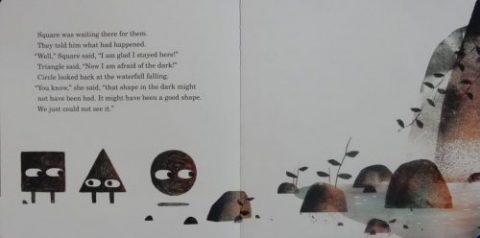
I must mention the illustrations: bear in mind that Claire Almon whose watercolours grace the pages is from the USA; thus her blue robin’s egg is of the North American robin whereas the European robin lays creamy eggs with light reddish-brown markings.

Interrupting Chicken and the Elephant of Surprise

Interrupting Chicken and the Elephant of Surprise
David Ezra Stein
Walker Books

Little Chicken is back and she’s full of what she’s just learned at school. “My teacher told us every story has an elephant of surprise” she says excitedly. Papa puts her right, responding, “She was talking about an element of surprise,” and goes on to explain.
Papa shares stories with her to prove his point but Chicken remains unconvinced and eager to find those surprising elephants.

Needless to say she manages to do so; first in The Ugly Duckling, then Rapunzel and finally, The Little Mermaid.
Each time Papa opens the storybook, Stein changes his illustrative style. Instead of the bright warm tones of their abode, his story scenes are rendered in sepia pen and ink

into which at the appropriate time, he drops a friendly-looking little blue elephant.

In a final story – one penned by Papa and deftly illustrated by Chicken – despite Papa’s best efforts to prevent it, that elephant of surprise puts in an appearance there too. Seems there’s no getting away from the little pachyderm.

This sequel to Interrupting Chicken had me spluttering with delight from the outset and the fun cleverly built up throughout the story. Who wouldn’t be in fits of giggles over that baby blue elephant, first with feathered swan-like wings, then wearing very long plaits and finally, a grass skirt and coconut bra. (I had to put my coffee aside for fear of sending it flying as hysterics overtook me at that sight.)
Another absolutely cracking metafictive tale to delight both adult story readers and young listeners alike. It also has great classroom potential.

My Friend Sleep

My Friend Sleep
Laura Baker and Hannah Peck
Words & Pictures

A little girl narrator takes a magical journey in the company of her friend and nocturnal companion, Sleep. “Come with me, my friend, take hold of my hand. / Together we’ll travel through night’s dreamland” he calls.
They visit such amazing places as a land full of sweets where the clouds are of candyfloss, crystal jellies glisten in the moonlight and sweet dewy berries exude their scent.

Full to capacity, it’s time to move on: Sleep sings again and the two continue their journey to a strange fairground where, aboard a strange craft on a big wheel they’re lifted skyward while down below, dinosaurs romp and aliens dance.

Then between the stars comes a huge dragon upon whose back they leap at Sleep’s behest.
Through the clouds, looping and swirling fly dragon, child and Sleep …

till the dragon drops them off at the entrance to a gloomy cave.
Once more come Sleep’s friendly, reassuring words making the darkness feel less scary. Till, full of menace a monster looms,

but again Sleep is there to proffer help by way of a magic wand to shrink the monster and turn it into a friendly little thing.

Now fly back, they must, child and Sleep through the starry night sky; back into the bedroom once more before the girl wakes to a memory of dreams in time for all that day will bring.

Spellbinding images conjured up in words and pictures (love the colour palette) create a somnolent picture book dreamscape for bedtime sharing.  The storybook encounters with things happy, thrilling and scary, should help little ones overcome any nighttime fears they might have from time to time.

The Secret of the Egg / Amazing Animal Babies

The Secret of the Egg
Nicola Davies and Abbie Cameron
Graffeg

What a cracking book this is; the first one I’ve seen in this series by zoologist, poet and author, Nicola Davies and illustrator Abbie Cameron.

Through a highly engaging rhyming narrative, Nicola introduces children to animal eggs of all shapes and sizes;

eggs that might be found in puddles or high in a tree; those you might have to dig for, or search in the sea or pond to discover. There are reptiles’ eggs, birds’ eggs, amphibians’ eggs, fishes’ eggs, even mammalian eggs.

With the exception of the platypus, none of the creatures featured are named so identifying whose eggs are whose is left to Abbie Cameron’s richly detailed, painterly pictures so adult assistance or some additional research may be needed.

This would make a great way to introduce a ‘new life’ topic to young children.

Amazing Animal Babies
Aina Bestard
Thames & Hudson

Animals large and animals small, from various parts of the world feature in Aina Bestard’s book.
Using as many as six intricately detailed transparent overlays the author/illustrator documents in words and aptly coloured visual images, how each animal produces and rears its young.

Herein readers will discover that the penguin parents, as well as the other members of a penguin colony play a part in the rearing of penguin chicks but it’s the Dad penguin that keeps the egg warm while Mum penguin goes off searching the ocean for food. After a chick is hatched however, both parents take turns to find food until their little one can care for itself.

In contrast, having found a safe place to lay her eggs, a mother tortoise leaves them alone to hatch and feed on the surrounding vegetation.

Once they’re laid it’s the father seahorse that takes care of the eggs inside his pouch, whereas with the kangaroo, the baby kangaroo is kept safe in its mother’s pouch.

The monarch butterfly and the common toad never meet their parents and grow up entirely on their own.

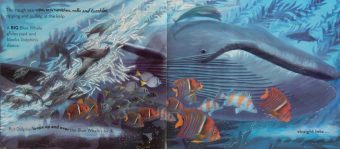
The final animal, the blue whale is reared on its mother’s milk, sometimes with the help of other whales.

The illustrations are exquisite and the narrative chatty: prepare to be amazed as you turn the pages of this fascinating book.

The Moon

The Moon
Hannah Pang and Thomas Hegbrook
Stripes Publishing

It was the non-scientific chapters of this superbly illustrated volume that attracted me most, rather than those on the space race, lunar exploration and moon missions.

Earth’s moon has inspired countless people – artists, poets, mathematicians, astronomers and a great many others have aspired to investigate it scientifically and some have even managed to pay it a visit. It’s truly a source of awe and wonder to us all, no matter what our predilections.

There is an enormous amount of fascinating information in this book published to coincide with the anniversary of the moon landing, as well as myths and legends, poetry, folklore and Thomas Hegbrook’s wonderful, wonderful full-page illustrations of such things as  the celebration of the Chinese New Year.

On this spread we learn that the festival was long ago a celebration of a successful harvest of wheat and rice, when food was offered to the moon; this has been celebrated since the Shang dynasty around 1600-1046BCE.
Other aspects of the celestial calendar are covered in this chapter including paragraphs relating to some religions that follow a lunar calendar including Buddhism, although I saw no mention of Hinduism.

The Moon features in many myths, some being concerned with the Man in the Moon; we learn of such from the Haida people who live on the Pacific coast of Canada; from Germany, including residents of Rantum a small village on the German island of Sylt. It’s said there, that the Earth’s tides are controlled by the Man in the Moon, a giant responsible for pouring water onto Earth creating high tides, and resting as the waters die down.
There are also many Moon Rabbit myths from as far afield as Japan, Korea and Africa.
I especially liked The Fox and the Wolf fable and the way it’s set within a beautiful moonlit scene.

Other parts I found fascinating were The Moon and our Bodies, sleep being one aspect affected by its cycle, as well as the chapter on how a full moon is thought to make people do strange things, even perhaps having an effect on such diverse things as the stock exchange and emergency service call outs.

Numerous artists have included the moon in their paintings. In traditional Chinese art it’s most often shown as a tiny object in the distance; whereas Japanese paintings frequently show a large, partially hidden moon.

Architects too have been inspired to use the moon in their building designs.

There is SO much to learn from this book but it’s impossible to cover everything in a review such as this. Instead I suggest you treat yourself to a copy of Hannah Pang and Thomas Hegbrook’s magnificent moon-filled compilation.

All Except Winston / Good Rosie!

All Except Winston
Rochelle Brunton and Nicoletta Bertelle
Ragged Bears
Young giraffe Winston is left out no matter whether the other giraffes are eating, drinking, playing their favourite game or sleeping. Winston does all these things alone.

Then one day when all the other giraffes are so busy grazing on yummy fruits high in the treetops, he hears a sound. His fellow long-necks ignore the rustle and the snap but Winston lets out a very loud, shrill whistle just in time to warn the others that a lion is on the prowl, hungry for its next meal.

Off they all dash for safety – just in time
Now Winston is ignored no longer; instead he’s a hero.

This seemingly simple story with it’s themes of celebrating difference and finding where you fit into a group is ideal for young children who have just started school or nursery, especially those who like Winston at the start of the book have yet to find out where they fit in.

Nicoletta Bertelle’s richly coloured, textured scenes reflect the glow of the savannah setting adding further warmth to Rochelle Brunton’s gentle telling.

Good Rosie!
Kate DiCamillo and Harry Bliss
Walker Books

Rosie is a terrier who lives with her owner George. She loves her owner but is eager to find another friend of the canine kind: (her reflection in her empty food bowl never answers).

On their daily walks together George and Rosie look at the clouds and one day George points out a dog-shaped one; this saddens Rosie so George suggests something new.

That something is the dog park but Rosie is overwhelmed by their sheer number and doesn’t know how to make friends; she feels a little afraid. Then she meets first Maurice a large Saint Bernard, then bouncy Chihuahua, Fifi. Initially she doesn’t like either of them, but then something happens to change all that.

Then it’s down to little Fif (what happens results in a name change for the Chihuahua) to demonstrate how to make a friend and before the end of the day, the three dogs are best pals and Rosie has something to look forward to on future walks with her human.

This warm-hearted, thoughtful, gently funny story presented in nine parts, is a neat blend of picture book and graphic novel: Harry Bliss’s humorous illustrations contrast nicely with Kate DiCamillo’s understated text in what is an ideal book for those making the transition to independent reading.

A Scattering of Magic: The Magic Misfits: The Second Story / The Littlest Witch / Lavinia and the Magic Ring

The Magic Misfits: The Second Story
Neil Patrick Harris with Lissy Marlin and Kyle Hilton
Egmont

I hadn’t read the first The Magic Misfits book so in case you’re in the same situation, it tells how young street musician Carter having been taken in after the disappearance of his parents, by his Sly ‘uncle’ Mike, escapes and ends up becoming friends with other variously talented children who together form The Magic Misfits.

This second story continues right on from the first only the focus now turns to Leila Vernon who lives with her two fathers above Vernon’s Magic Shop.

One day out of the blue, a stranger from Dante’s past appears in the shop. The woman, Sandra Santos, aka Madame Esmerelda, was so she says, a friend of Carter’s father.
What though is she doing in Mineral Wells? Whatever it is, it might be that she knows why Leila was placed in an orphanage and by whom. Could it be that Sandra holds the key to these questions?
Scattered throughout this intriguing pacey tale are riddles and puzzles as well as some magic tricks to try and a liberal sprinkling of black and white illustrations by Lissy Marlin.

Carter, Leila and her friends are well worth getting to know, especially for readers who like their stories sprinkled with magic.

The Littlest Witch
Bianca Pitzorno, illustrated by Mark Beech
Catnip

The author of this crazy book is considered to be one of Italy’s best childrens’ writers. It’s a tale of a young man, Alfonso Terribile and what happens when his Great Uncle Sempronio dies.

Alfonso is left a fortune but there is a condition: he has to marry a witch and do so within a year and a month or else his fortune will go elsewhere.

There’s a zany cast of characters including the Zep’s seventh daughter, the infant Sibylla who seems to be behaving in a rather strange fashion. Could she perhaps be the one? Maybe, but there are a lot of other possible contenders too, not least being the spirited Wanda …
Greed quickly consumes Alfonso but will he manage to fulfil his uncle’s criteria? That would be telling; let’s just say that he receives his just deserts.

Mark Beech’s line drawings scattered throughout the book add to the delightful quirkiness.

Lavinia and the Magic Ring
Bianca Pitzorno, illustrated by Quentin Blake
Catnip

Imagine what might happen if you were a little girl and received a ring with a very special power. That is what happens one chilly Christmas Eve, to seven-year-old Lavinia, a modern-day match girl residing in Milan.

Lying in the cold just before midnight dreaming of good things to eat, she’s suddenly awoken by a beautiful lady dressed unsuitably for the cold, asking for a light and professing to be a fairy. Lavinia is nonplussed but agrees and by way of thanks, the witch slips a ring onto her finger, a magic ring that turns things into poo – yes poo!

The girl’s reaction is to try and pull the thing off right away, but the ring is stuck fast.

Now it’s up to Lavinia to use her weird powers judiciously.

There are a lot of decidedly stinky situations in this story so definitely don’t give it to a squeamish child; the rest however will doubtless revel in the ponginess of Lavinia’s mess-making escapades hilariously illustrated by none other than the inimitable Quentin Blake.

The Hungry Goat

The Hungry Goat
Alan Mills and Abner Graboff
Bodleian Children’s Books

So insatiable is Hungry Goat’s appetite that he consumes pretty much everything he sets eyes on – grass, twigs, leaves, pigs’ swill, bugs of all kinds, bees included –AAGGHH!, the bark from trees, paper bags, string, filthy rags, chicken feathers; even these seemingly indigestible items – OUCH!

as well as old car tyres and broken glass. Goodness knows the condition of his innards, which, so we’re told, have contained barbed wire and more.

Surprisingly instead of dropping down dead, the animal grows and grows and … which pleases his master on account of the prizes they bag.
One day he angers this master by consuming from the washing line, three of his red shirts. These however come in useful when tied to a railway line in punishment, the goat regurgitates said shirts and succeeds in stopping the approaching train.

That action though, lands him in gaol, temporarily nonetheless – more chewing gets him out. But once free, the creature – will he never learn – consumes something that not only inflates him but also sends him off on his greatest ever adventure.

With Alan Mills’ superbly paced rhyming text and Abner Graboff’s distinctive, wonderfully quirky illustrations, this re-issue of a 1964 classic comic cautionary will delight a new generation of children as well as reminding adults of its seemingly simple brilliance.

The Space Train

The Space Train
Maudie Powell-Tuck and Karl James Mountford
Little Tiger

Light years from Earth in a space station live Jakob, his robot chicken named Derek and his granny.

Jakob has made a discovery: in hangar 19 is, so he thinks, a huge abandoned rocket.
Granny knows otherwise. “It’s the Space Train,” she tells her grandson … “When I was little, the Space Train criss-crossed the universe on tracks of stardust visiting station after station –“.

Jakob’s excitement mounts as he thinks about all the places they might visit and potential friends he could discover if they fixed the train.

After a week of hard work,

riveting, welding, fixing and cleaning the train was finally ready. Tomorrow they would launch it.
Next morning however didn’t quite go to plan. A resounding BANG and sooty faces were the only outcomes when Jakob pulls the launch lever.

Jakob and Derek are ready to give up: not so Granny, so it’s back to look at the plans again.

Soon, they’re ready to give it another go and this time …

With its space setting, quirky characters, problem-solving, a plethora of flaps to explore as well as Jakob’s logs to study, this unusual story should please young readers, especially those with a liking for things mechanical. Karl’s zany, illustrations are packed with other-worldly paraphernalia, mechanical bits and pieces and the occasional alien. Love the colour palette and the nuts and bolts laying Derek.

A Stage Full of Shakespeare Stories

A Stage Full of Shakespeare Stories
Angela McAllister, illustrated by Alice Lindstrom
Lincoln Children’s Books

I was one of those not turned off Shakespeare at school despite having to study several plays between the ages of 11 and 16 and my favourite, despite having to ‘do’ it for O-level, remains Twelfth Night. This is largely thanks to an amazing English teacher that I had throughout my time at grammar school, who managed to bring out the magic of the plays we read and now the beauty of the language completely enthrals me. So, I wasn’t sure what I’d make of A Stage Full of Shakespeare Stories wherein Angela McAllister retells a dozen of the bard’s most popular plays, both comedies and tragedies.

However, she does it in such a way that young readers will be engaged immediately . Each one is introduced with a quote and a pictorial cast of characters, and the tellings themselves are up to date so that youngsters will quickly find themselves immersed in the story, be that of A Midsummer Night’s Dream, Twelfth Night,

Much Ado About Nothing, King Lear, The Tempest

or any of the others included.

Alice Lindstrom’s artwork, whether a full page illustration, or a smaller one, is absolutely fabulous, really capturing the atmosphere of each tale, drawing in the audience and making them feel as though they’re watching a staged performance.

Also included is a wealth of information about the great man himself, a complete list of his plays and a taster paragraph about each of the twelve plays herein.

Yes, we have lost the Bard’s awesome language here, but instead, what Angela McAllister offers is access to that language for youngsters by way of stories that can be read aloud to an individual or class; or read alone, before the exam treadmill turns them off from the riches that are Shakespeare’s legacy.

Not Yet a Yeti / Froggy Day

Not Yet a Yeti
Lou Treleaven and Tony Neal
Maverick Publishing

High up in the snowy mountains live George and his family.

All George’s family are yetis: “When will I be a yeti?” the little creature asks.

Having consulted in turn, his grandfather, his dad, his big sister and his mum, George concludes that he lacks the necessary qualities for full yeti status. He has no desire to terrorise visitors to the mountain,

leave scary footprints in the snow (his feet are too small anyway), or chase ramblers like other family members.

Suddenly George knows what he wants to be …

Lo and behold as he speaks, a horn grows from his forehead, his limbs grow hooves and he acquires a swishy tail and mane.

Alarmed, Mum consults Dad and a compromise is reached: after all if his other family members continue eating hikers, the human race faces extinction.

An offbeat tale of having the courage to be yourself and acceptance that manages to include the creature that seems to be every young child’s favourite at present – the unicorn. For this reason, if nothing else, it’s likely to become a crowd pleaser. Tony Neal’s entire family of yetis are, despite their claims, thoroughly unscary and totally likeable creatures as is George himself.

Froggy Day
Heather Pindar and Barbara Bakos
Maverick Publishing

Imagine watching the weather forecast on the TV and being told “Today is going to be froggy, very froggy!” by the forecaster. That however is what happens in Heather Pindar and Barabara Bakos’ zany book.

No sooner are the words out of her mouth than chaos descends in the form of little green amphibians. They create havoc in the streets, on the bus, the supermarket is over-run with the creatures,

the building site workers are totally bemused, animals stampede and frog horns boom out warning the sailors at sea.
There isn’t a single place in town without an invasion of frogs – imagine the uproar in the classroom.

Then comes the evening weather forecast: now what might that hold in store, I wonder …

Crazy as Heather’s tale may sound, I was once in Udaipur, Rajasthan during the monsoon season and as we emerged from a café into sudden torrential rain, it did seem as though it was raining frogs: the tiny creatures (not green ones but brown) fell in thousands from the rooftops of all the buildings. Goodness knows how they got up there in the first place but the sight was truly bizarre.

Heather Pindar’s play on words is a great starting point for her gigglesome story and Barbara’s illustrations of the frogs’ frolics are a real hoot.

Stubby: A True Story of Friendship

Stubby: A True Story of Friendship
Michael Foreman
Andersen Press

Here’s a book that leaves you with a warm glow tinged with sadness. Published in time for the centenary of the armistice of the First World War, Michael Foreman presents in his own unique style, the true story of Sergeant Stubby, the dog who served in WW1 and became the most decorated dog of the war.

His story is told by Corporal Robert Conroy, an American soldier who adopts Stubby during training in Connecticut, and with a little help of his friends, manages to smuggle the dog aboard the troop ship and all the way to the front line in France.

It’s a tale that brings home to readers the terrible dangers faced by, and amazing bravery of, those who fought in WW1.

Stubby is badly injured

but manages to survive thanks to the care he received alongside the wounded troops and he’s back in action on the day peace is declared.

It’s an enthralling read, with a happy ending. Sadly though, that wasn’t the case for so many of the brave soldiers who lost their lives in that a brutal war. It’s so important that we continue to remember these men, particularly now as there are so few war veterans remaining alive. It’s through such superbly told and illustrated books as this that one hopes we will never forget.

Thanks to Foreman’s wonderful scenes, Stubby and his soldier friends will linger in our minds long after this treasure of a book has been set aside.

Share it widely, pause to remember, and give thanks for the contribution those who served in both World Wars made to our all too fragile peace

An Anty-War Story

An Anty-War Story
Tony Ross
Andersen Press

Of all the residents of Antworld, there’s only one little ant with a name. Meet the new born Douglas. Douglas watches the other ants carrying food and longs to fit in and be part of that ‘beautiful line’. But that isn’t the role the Chief Ant has in mind for him; Douglas’s destiny lies elsewhere. He too will march in line but instead of food, he will carry a rifle. Douglas is to be a uniform wearing soldier charged with defending Antworld and making it a safer place for all the little ants.

Douglas is proud of his uniform and his assigned role, as well as the banner-bearing band that marches behind the ‘rifle carrying ants’. But then war does come.

It comes in human form: shells WHIZZ and with a BANG Antworld is completely obliterated.

Ross shows this in a devastating shift from the colourful pageantry as the explosion spread is followed by a gloomy grey view of advancing WW1 soldiers with mustard gas swirling across the landscape and below a smudge of red in one corner, the words “The end.’

Then follows an equally sombre monument to the fallen.

That only serves to bring home the awful reality of how war can change lives in a single instant – one flash and it’s all over for some, or many.

Sobering and intensely powerful, a reading of this allegorical tale is certain to bring on discussion about war wherever it’s shared.

Moon River

Moon River
illustrated by Tim Hopgood
Oxford University Press

Once again Tim Hopgood has turned an enduringly popular song into a magical experience that feels brand new.
His latest offering is based on Johnny Mercer and Henry Mancini’s song Moon River made famous by Andy Williams. (There’s a sing-along CD featuring the classic song inside the back cover).

Moonlight streaming, river like through a child’s bedroom window gently nudges a slumberer and she embarks on a breathtaking journey of discovery in the company of a white horse and a guitar-playing brown bear.

Together they travel on their small craft through a glowing watery world,

then take to the air flying over not-yet sleeping cities before landing and riding off in search of that illusive rainbow’s end, a place that’s always just that little bit out of reach.

As those notes drift across the pages of Tim’s deliciously dreamy scenes who could resist following them and joining the adventurers as they sally forth into the night on a voyage that will take them they know not where.

Adult readers however, will recognise some of the famous landmarks depicted as they share this gorgeous book with their little ones.

Joy and hope shine forth from every one of Tim’s spreads in this enchanting dream of a book.