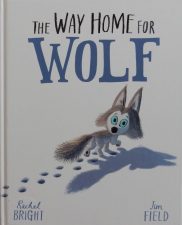
The Way Home for Wolf

The Way Home for Wolf
Rachel Bright and Jim Field
Orchard Books

Fiercely independent, little wolfling Wilf considers himself big, strong and tough, so when it’s time for the wolves to find themselves a new cave, he’s eager to lead the way. “One day,” comes the response from the others.

Their journey through the snowy arctic tundra is a struggle for all members of the pack but despite his strong will, Wilf struggles to keep up finding the gap between himself and the adults growing ever larger until exhausted and out of breath, he loses his way in a blizzard. Too proud and indeed hoarse to howl for help he’s forced to spend the night alone beneath the stars.
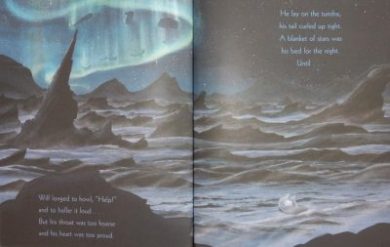
Suddenly the ice beneath him shatters sending him cascading into the chill inky depths.

Rather than the end he fears, Wilf finds himself being rescued by a sea unicorn (narwhal) that takes him safely back to shore.
From there a host of other arctic animals, large and small, assist the little creature
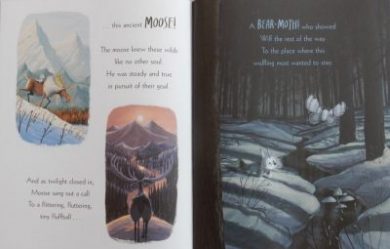
until finally he’s reunited with his pack.

Thankful to all his rescuers, Wilf makes them a promise, “If ever I meet one who’s strayed off their track, / I’ll help them along by guiding them back.”
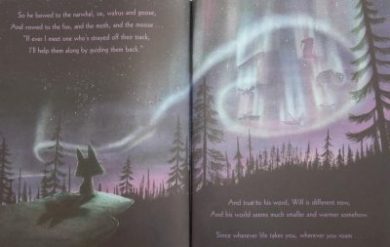
Wilf’s journey, both emotional and physical is truly testing, indeed too much for the young wolf to cope with alone.

Rachel Bright’s narrative style, at times poetic and at times matter-of-fact, allows young humans to come to an understanding that there are times when asking for help is exactly the right thing to do; and that team work is as important as going it alone, often more so.

Jim Field’s illustrations rendered in hues of indigo, white, cream, purple, silver and brown have a luminosity that invokes a sense of awe and wonder, making the arctic tundra a truly beautiful mystical place imbued with its own natural magic. I absolutely love the way the essence of the animals is shown in the aurora borealis both when Wilf is lost and when he’s safe once more.

A beautiful book to share and to return to, over and over.
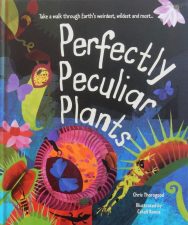
Perfectly Peculiar Plants

Perfectly Peculiar Plants
Chris Thorogood and Catell Ronca
Words & Pictures

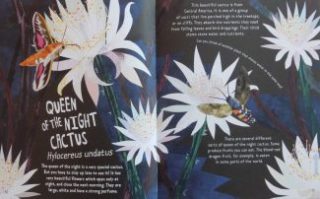
Books about animals seem to drop into my post box in relatively large numbers, not so ones featuring plants. It’s fantastic then, to see botanist Chris Thorogood’s title, superbly illustrated in vibrant style by Catell Ronca, which goes just a small way towards redressing the balance.

After all, without plants, where would we animals be? Despite the fact that some of those featured herein actually devour creatures from the animal kingdom we’re dependent on plants for oxygen and need them for food.

In addition to insectivorous plants, some species appearing here make use of insects in ingenious ways, often for pollination or seed dispersal, while others steal their food from the roots or stems of other plants. Still others – the Queen of the Night Cactus being one – absorb nutrients from bird poo.

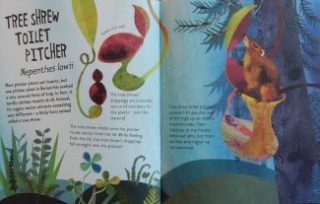
Another poo feeder (animal faeces in this instance) is the tree shrew toilet pitcher found in Borneo.

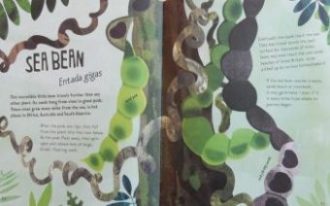
I was amazed to learn that Entada gigas, the sea bean has large brown seeds that can sometimes travel across oceans for thousands of miles before they reach a place to germinate.

Between the pages featuring the astonishing plants themselves are more general spreads introduced by questions such as ‘How do plants get energy?’ and ‘Can plants move?’ Each of these sets the scene for the showcasing of individual species; and it’s great to see the final ‘Protecting plants’ spread though perhaps some information could have been included for how those motivated by the author’s ‘they all deserve a place on planet Earth’, might help towards protecting threatened habitats or species.

Storm

Storm
Sam Usher
Templar Publishing

The fourth of Sam Usher’s series of picture books about a little boy and his grandfather continues to celebrate their special relationship.

It’s a very blustery autumn morning and when the little boy wakes up he sees leaves flying, dancing and tumbling down.

Eager to get outside, he calls his Grandad who suggests flying a kite. First though they have to find it.
During their search they rediscover several items – a cricket bat, letters and a telescope that bring back memories of previous adventures – until finally, they find the kite.

Off they set under a stormy-looking sky to the park

where they discover lots of other kite fliers. “Hold on tight,” calls Grandad as their fantasy adventure begins.

Up, up, up they go swooping and twisting as the sky is filled with an amazing, colourful array of kites of all different  shapes and patterns.

The wind intensifies and the boy lets go of the kite string. Luckily though, Grandad catches it “There’s a storm brewing!

Let’s head for home,” he urges and they do.

Back indoors, as the storm rages outside, they share some tea and Grandad declares, “The best adventure is an adventure shared.” And so it is, just like the one herein: what better prelude to a kite-flying foray than this.

With russet, gold, orange and brown hues, and a darkening grey, Sam Usher’s watercolour and ink illustrations  capture so well both the trees’ autumnal foliage and the brooding nature of the storm.

The Clue is in the Poo

The Clue is in the Poo
Andy Seed and Claire Almon
QED

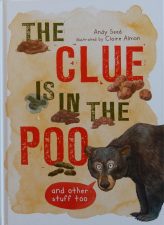
The author of this book is passionate about getting children (and their teachers) enthusiastic about reading and a great one for making non-fiction fun. Here’s his latest and let’s say, enticingly titled offering  that as well as investigating their faecal matters, looks at animals’ footprints, homes, nests, skulls,

coprolites (fossilised dung to you and me), and more. And yes, it’s terrific fun.

Poo, so we’re told is a good indicator when it comes to clues regarding which animals you’re likely to come across on your foray into the wild; and generally speaking the larger the animal, the larger its poo. Hmm! A rhino for instance leaves deposits of between 50 and 90 cm whereas that of a wolf is only 12 to 15 cm and shrew poos are a minute 2-4mm.

For those interested in classifying things we’re given half a dozen different turd types – tubular, lumpy, pea-like, pancake, shiny blocks/clumps and twisted/hairy, deposited by various mammals to start us off.

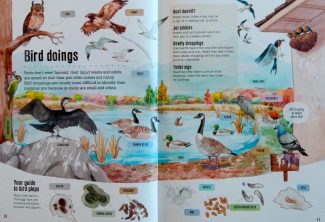
Bird droppings, you’ll be interested to learn, are generally more tricky to identify than those of mammals and should you want to become a bird poo detective, illustrations of seven types of bird plops are provided.

Now who would have thought that an adult reviewer could become completely engrossed in a book that focuses on excretory matter? It was certainly so where this one is concerned: my next forest expedition will perhaps take on a completely different focus; and yes, I’ve read the rules of tracking provided at the front of the book along with the annotated list of things needed on an expedition.

I must mention the illustrations: bear in mind that Claire Almon whose watercolours grace the pages is from the USA; thus her blue robin’s egg is of the North American robin whereas the European robin lays creamy eggs with light reddish-brown markings.

Interrupting Chicken and the Elephant of Surprise

Interrupting Chicken and the Elephant of Surprise
David Ezra Stein
Walker Books

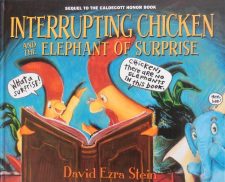
Little Chicken is back and she’s full of what she’s just learned at school. “My teacher told us every story has an elephant of surprise” she says excitedly. Papa puts her right, responding, “She was talking about an element of surprise,” and goes on to explain.
Papa shares stories with her to prove his point but Chicken remains unconvinced and eager to find those surprising elephants.

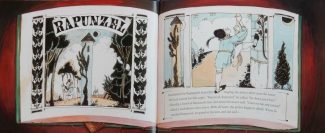
Needless to say she manages to do so; first in The Ugly Duckling, then Rapunzel and finally, The Little Mermaid.
Each time Papa opens the storybook, Stein changes his illustrative style. Instead of the bright warm tones of their abode, his story scenes are rendered in sepia pen and ink

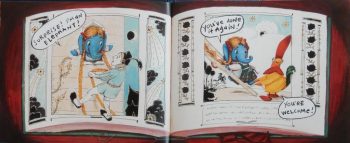
into which at the appropriate time, he drops a friendly-looking little blue elephant.

In a final story – one penned by Papa and deftly illustrated by Chicken – despite Papa’s best efforts to prevent it, that elephant of surprise puts in an appearance there too. Seems there’s no getting away from the little pachyderm.

This sequel to Interrupting Chicken had me spluttering with delight from the outset and the fun cleverly built up throughout the story. Who wouldn’t be in fits of giggles over that baby blue elephant, first with feathered swan-like wings, then wearing very long plaits and finally, a grass skirt and coconut bra. (I had to put my coffee aside for fear of sending it flying as hysterics overtook me at that sight.)
Another absolutely cracking metafictive tale to delight both adult story readers and young listeners alike. It also has great classroom potential.

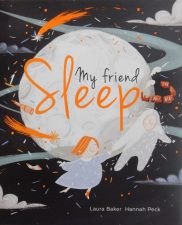
My Friend Sleep

My Friend Sleep
Laura Baker and Hannah Peck
Words & Pictures

A little girl narrator takes a magical journey in the company of her friend and nocturnal companion, Sleep. “Come with me, my friend, take hold of my hand. / Together we’ll travel through night’s dreamland” he calls.
They visit such amazing places as a land full of sweets where the clouds are of candyfloss, crystal jellies glisten in the moonlight and sweet dewy berries exude their scent.

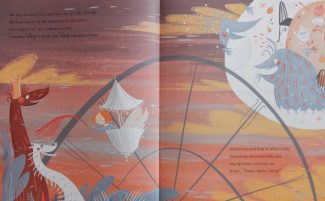
Full to capacity, it’s time to move on: Sleep sings again and the two continue their journey to a strange fairground where, aboard a strange craft on a big wheel they’re lifted skyward while down below, dinosaurs romp and aliens dance.

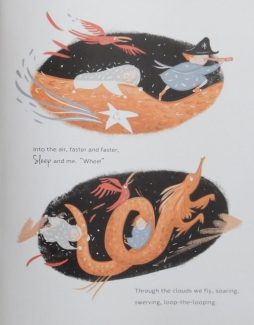
Then between the stars comes a huge dragon upon whose back they leap at Sleep’s behest.
Through the clouds, looping and swirling fly dragon, child and Sleep …

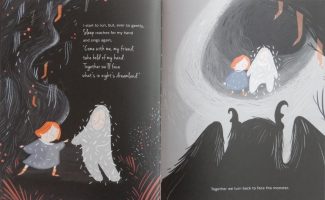
till the dragon drops them off at the entrance to a gloomy cave.
Once more come Sleep’s friendly, reassuring words making the darkness feel less scary. Till, full of menace a monster looms,

but again Sleep is there to proffer help by way of a magic wand to shrink the monster and turn it into a friendly little thing.

Now fly back, they must, child and Sleep through the starry night sky; back into the bedroom once more before the girl wakes to a memory of dreams in time for all that day will bring.

Spellbinding images conjured up in words and pictures (love the colour palette) create a somnolent picture book dreamscape for bedtime sharing.  The storybook encounters with things happy, thrilling and scary, should help little ones overcome any nighttime fears they might have from time to time.

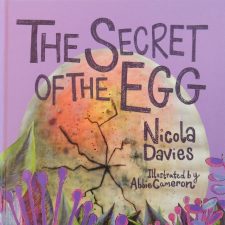
The Secret of the Egg / Amazing Animal Babies

The Secret of the Egg
Nicola Davies and Abbie Cameron
Graffeg

What a cracking book this is; the first one I’ve seen in this series by zoologist, poet and author, Nicola Davies and illustrator Abbie Cameron.

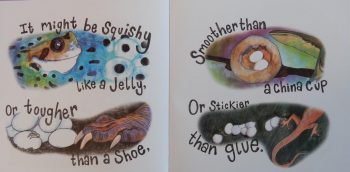
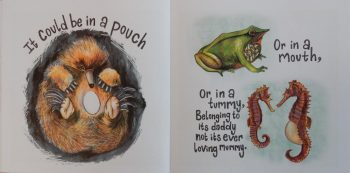
Through a highly engaging rhyming narrative, Nicola introduces children to animal eggs of all shapes and sizes;

eggs that might be found in puddles or high in a tree; those you might have to dig for, or search in the sea or pond to discover. There are reptiles’ eggs, birds’ eggs, amphibians’ eggs, fishes’ eggs, even mammalian eggs.

With the exception of the platypus, none of the creatures featured are named so identifying whose eggs are whose is left to Abbie Cameron’s richly detailed, painterly pictures so adult assistance or some additional research may be needed.

This would make a great way to introduce a ‘new life’ topic to young children.

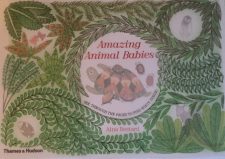
Amazing Animal Babies
Aina Bestard
Thames & Hudson

Animals large and animals small, from various parts of the world feature in Aina Bestard’s book.
Using as many as six intricately detailed transparent overlays the author/illustrator documents in words and aptly coloured visual images, how each animal produces and rears its young.

Herein readers will discover that the penguin parents, as well as the other members of a penguin colony play a part in the rearing of penguin chicks but it’s the Dad penguin that keeps the egg warm while Mum penguin goes off searching the ocean for food. After a chick is hatched however, both parents take turns to find food until their little one can care for itself.

In contrast, having found a safe place to lay her eggs, a mother tortoise leaves them alone to hatch and feed on the surrounding vegetation.

Once they’re laid it’s the father seahorse that takes care of the eggs inside his pouch, whereas with the kangaroo, the baby kangaroo is kept safe in its mother’s pouch.

The monarch butterfly and the common toad never meet their parents and grow up entirely on their own.

The final animal, the blue whale is reared on its mother’s milk, sometimes with the help of other whales.

The illustrations are exquisite and the narrative chatty: prepare to be amazed as you turn the pages of this fascinating book.

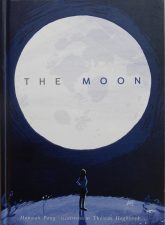
The Moon

The Moon
Hannah Pang and Thomas Hegbrook
Stripes Publishing

It was the non-scientific chapters of this superbly illustrated volume that attracted me most, rather than those on the space race, lunar exploration and moon missions.

Earth’s moon has inspired countless people – artists, poets, mathematicians, astronomers and a great many others have aspired to investigate it scientifically and some have even managed to pay it a visit. It’s truly a source of awe and wonder to us all, no matter what our predilections.

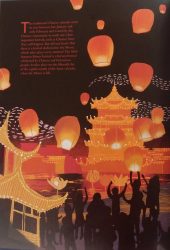
There is an enormous amount of fascinating information in this book published to coincide with the anniversary of the moon landing, as well as myths and legends, poetry, folklore and Thomas Hegbrook’s wonderful, wonderful full-page illustrations of such things as  the celebration of the Chinese New Year.

On this spread we learn that the festival was long ago a celebration of a successful harvest of wheat and rice, when food was offered to the moon; this has been celebrated since the Shang dynasty around 1600-1046BCE.
Other aspects of the celestial calendar are covered in this chapter including paragraphs relating to some religions that follow a lunar calendar including Buddhism, although I saw no mention of Hinduism.

The Moon features in many myths, some being concerned with the Man in the Moon; we learn of such from the Haida people who live on the Pacific coast of Canada; from Germany, including residents of Rantum a small village on the German island of Sylt. It’s said there, that the Earth’s tides are controlled by the Man in the Moon, a giant responsible for pouring water onto Earth creating high tides, and resting as the waters die down.
There are also many Moon Rabbit myths from as far afield as Japan, Korea and Africa.
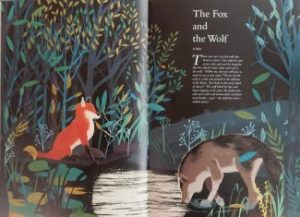
I especially liked The Fox and the Wolf fable and the way it’s set within a beautiful moonlit scene.

Other parts I found fascinating were The Moon and our Bodies, sleep being one aspect affected by its cycle, as well as the chapter on how a full moon is thought to make people do strange things, even perhaps having an effect on such diverse things as the stock exchange and emergency service call outs.

Numerous artists have included the moon in their paintings. In traditional Chinese art it’s most often shown as a tiny object in the distance; whereas Japanese paintings frequently show a large, partially hidden moon.

Architects too have been inspired to use the moon in their building designs.

There is SO much to learn from this book but it’s impossible to cover everything in a review such as this. Instead I suggest you treat yourself to a copy of Hannah Pang and Thomas Hegbrook’s magnificent moon-filled compilation.

All Except Winston / Good Rosie!

All Except Winston
Rochelle Brunton and Nicoletta Bertelle
Ragged Bears
Young giraffe Winston is left out no matter whether the other giraffes are eating, drinking, playing their favourite game or sleeping. Winston does all these things alone.

Then one day when all the other giraffes are so busy grazing on yummy fruits high in the treetops, he hears a sound. His fellow long-necks ignore the rustle and the snap but Winston lets out a very loud, shrill whistle just in time to warn the others that a lion is on the prowl, hungry for its next meal.

Off they all dash for safety – just in time
Now Winston is ignored no longer; instead he’s a hero.

This seemingly simple story with it’s themes of celebrating difference and finding where you fit into a group is ideal for young children who have just started school or nursery, especially those who like Winston at the start of the book have yet to find out where they fit in.

Nicoletta Bertelle’s richly coloured, textured scenes reflect the glow of the savannah setting adding further warmth to Rochelle Brunton’s gentle telling.

Good Rosie!
Kate DiCamillo and Harry Bliss
Walker Books

Rosie is a terrier who lives with her owner George. She loves her owner but is eager to find another friend of the canine kind: (her reflection in her empty food bowl never answers).

On their daily walks together George and Rosie look at the clouds and one day George points out a dog-shaped one; this saddens Rosie so George suggests something new.

That something is the dog park but Rosie is overwhelmed by their sheer number and doesn’t know how to make friends; she feels a little afraid. Then she meets first Maurice a large Saint Bernard, then bouncy Chihuahua, Fifi. Initially she doesn’t like either of them, but then something happens to change all that.

Then it’s down to little Fif (what happens results in a name change for the Chihuahua) to demonstrate how to make a friend and before the end of the day, the three dogs are best pals and Rosie has something to look forward to on future walks with her human.

This warm-hearted, thoughtful, gently funny story presented in nine parts, is a neat blend of picture book and graphic novel: Harry Bliss’s humorous illustrations contrast nicely with Kate DiCamillo’s understated text in what is an ideal book for those making the transition to independent reading.

A Scattering of Magic: The Magic Misfits: The Second Story / The Littlest Witch / Lavinia and the Magic Ring

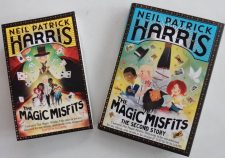
The Magic Misfits: The Second Story
Neil Patrick Harris with Lissy Marlin and Kyle Hilton
Egmont

I hadn’t read the first The Magic Misfits book so in case you’re in the same situation, it tells how young street musician Carter having been taken in after the disappearance of his parents, by his Sly ‘uncle’ Mike, escapes and ends up becoming friends with other variously talented children who together form The Magic Misfits.

This second story continues right on from the first only the focus now turns to Leila Vernon who lives with her two fathers above Vernon’s Magic Shop.

One day out of the blue, a stranger from Dante’s past appears in the shop. The woman, Sandra Santos, aka Madame Esmerelda, was so she says, a friend of Carter’s father.
What though is she doing in Mineral Wells? Whatever it is, it might be that she knows why Leila was placed in an orphanage and by whom. Could it be that Sandra holds the key to these questions?

Scattered throughout this intriguing pacey tale are riddles and puzzles as well as some magic tricks to try and a liberal sprinkling of black and white illustrations by Lissy Marlin.

Carter, Leila and her friends are well worth getting to know, especially for readers who like their stories sprinkled with magic.

The Littlest Witch
Bianca Pitzorno, illustrated by Mark Beech
Catnip

The author of this crazy book is considered to be one of Italy’s best childrens’ writers. It’s a tale of a young man, Alfonso Terribile and what happens when his Great Uncle Sempronio dies.

Alfonso is left a fortune but there is a condition: he has to marry a witch and do so within a year and a month or else his fortune will go elsewhere.

There’s a zany cast of characters including the Zep’s seventh daughter, the infant Sibylla who seems to be behaving in a rather strange fashion. Could she perhaps be the one? Maybe, but there are a lot of other possible contenders too, not least being the spirited Wanda …
Greed quickly consumes Alfonso but will he manage to fulfil his uncle’s criteria? That would be telling; let’s just say that he receives his just deserts.

Mark Beech’s line drawings scattered throughout the book add to the delightful quirkiness.

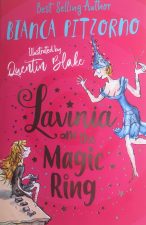
Lavinia and the Magic Ring
Bianca Pitzorno, illustrated by Quentin Blake
Catnip

Imagine what might happen if you were a little girl and received a ring with a very special power. That is what happens one chilly Christmas Eve, to seven-year-old Lavinia, a modern-day match girl residing in Milan.

Lying in the cold just before midnight dreaming of good things to eat, she’s suddenly awoken by a beautiful lady dressed unsuitably for the cold, asking for a light and professing to be a fairy. Lavinia is nonplussed but agrees and by way of thanks, the witch slips a ring onto her finger, a magic ring that turns things into poo – yes poo!

The girl’s reaction is to try and pull the thing off right away, but the ring is stuck fast.

Now it’s up to Lavinia to use her weird powers judiciously.

There are a lot of decidedly stinky situations in this story so definitely don’t give it to a squeamish child; the rest however will doubtless revel in the ponginess of Lavinia’s mess-making escapades hilariously illustrated by none other than the inimitable Quentin Blake.

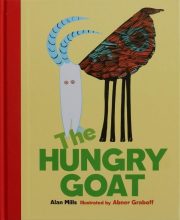
The Hungry Goat

The Hungry Goat
Alan Mills and Abner Graboff
Bodleian Children’s Books

So insatiable is Hungry Goat’s appetite that he consumes pretty much everything he sets eyes on – grass, twigs, leaves, pigs’ swill, bugs of all kinds, bees included –AAGGHH!, the bark from trees, paper bags, string, filthy rags, chicken feathers; even these seemingly indigestible items – OUCH!

as well as old car tyres and broken glass. Goodness knows the condition of his innards, which, so we’re told, have contained barbed wire and more.

Surprisingly instead of dropping down dead, the animal grows and grows and … which pleases his master on account of the prizes they bag.
One day he angers this master by consuming from the washing line, three of his red shirts. These however come in useful when tied to a railway line in punishment, the goat regurgitates said shirts and succeeds in stopping the approaching train.

That action though, lands him in gaol, temporarily nonetheless – more chewing gets him out. But once free, the creature – will he never learn – consumes something that not only inflates him but also sends him off on his greatest ever adventure.

With Alan Mills’ superbly paced rhyming text and Abner Graboff’s distinctive, wonderfully quirky illustrations, this re-issue of a 1964 classic comic cautionary will delight a new generation of children as well as reminding adults of its seemingly simple brilliance.

The Space Train

The Space Train
Maudie Powell-Tuck and Karl James Mountford
Little Tiger

Light years from Earth in a space station live Jakob, his robot chicken named Derek and his granny.

Jakob has made a discovery: in hangar 19 is, so he thinks, a huge abandoned rocket.
Granny knows otherwise. “It’s the Space Train,” she tells her grandson … “When I was little, the Space Train criss-crossed the universe on tracks of stardust visiting station after station –“.

Jakob’s excitement mounts as he thinks about all the places they might visit and potential friends he could discover if they fixed the train.

After a week of hard work,

riveting, welding, fixing and cleaning the train was finally ready. Tomorrow they would launch it.
Next morning however didn’t quite go to plan. A resounding BANG and sooty faces were the only outcomes when Jakob pulls the launch lever.

Jakob and Derek are ready to give up: not so Granny, so it’s back to look at the plans again.

Soon, they’re ready to give it another go and this time …

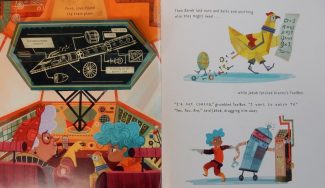
With its space setting, quirky characters, problem-solving, a plethora of flaps to explore as well as Jakob’s logs to study, this unusual story should please young readers, especially those with a liking for things mechanical. Karl’s zany, illustrations are packed with other-worldly paraphernalia, mechanical bits and pieces and the occasional alien. Love the colour palette and the nuts and bolts laying Derek.

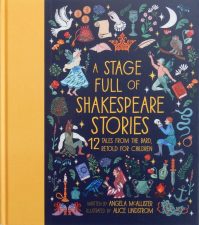
A Stage Full of Shakespeare Stories

A Stage Full of Shakespeare Stories
Angela McAllister, illustrated by Alice Lindstrom
Lincoln Children’s Books

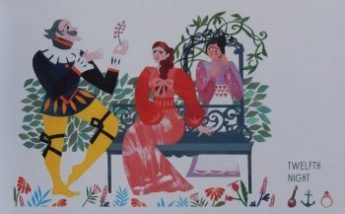
I was one of those not turned off Shakespeare at school despite having to study several plays between the ages of 11 and 16 and my favourite, despite having to ‘do’ it for O-level, remains Twelfth Night. This is largely thanks to an amazing English teacher that I had throughout my time at grammar school, who managed to bring out the magic of the plays we read and now the beauty of the language completely enthrals me. So, I wasn’t sure what I’d make of A Stage Full of Shakespeare Stories wherein Angela McAllister retells a dozen of the bard’s most popular plays, both comedies and tragedies.

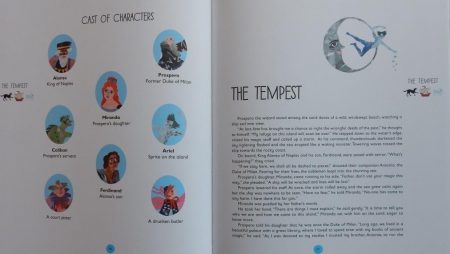
However, she does it in such a way that young readers will be engaged immediately . Each one is introduced with a quote and a pictorial cast of characters, and the tellings themselves are up to date so that youngsters will quickly find themselves immersed in the story, be that of A Midsummer Night’s Dream, Twelfth Night,

Much Ado About Nothing, King Lear, The Tempest

or any of the others included.

Alice Lindstrom’s artwork, whether a full page illustration, or a smaller one, is absolutely fabulous, really capturing the atmosphere of each tale, drawing in the audience and making them feel as though they’re watching a staged performance.

Also included is a wealth of information about the great man himself, a complete list of his plays and a taster paragraph about each of the twelve plays herein.

Yes, we have lost the Bard’s awesome language here, but instead, what Angela McAllister offers is access to that language for youngsters by way of stories that can be read aloud to an individual or class; or read alone, before the exam treadmill turns them off from the riches that are Shakespeare’s legacy.

Not Yet a Yeti / Froggy Day

Not Yet a Yeti
Lou Treleaven and Tony Neal
Maverick Publishing

High up in the snowy mountains live George and his family.

All George’s family are yetis: “When will I be a yeti?” the little creature asks.

Having consulted in turn, his grandfather, his dad, his big sister and his mum, George concludes that he lacks the necessary qualities for full yeti status. He has no desire to terrorise visitors to the mountain,

leave scary footprints in the snow (his feet are too small anyway), or chase ramblers like other family members.

Suddenly George knows what he wants to be …

Lo and behold as he speaks, a horn grows from his forehead, his limbs grow hooves and he acquires a swishy tail and mane.

Alarmed, Mum consults Dad and a compromise is reached: after all if his other family members continue eating hikers, the human race faces extinction.

An offbeat tale of having the courage to be yourself and acceptance that manages to include the creature that seems to be every young child’s favourite at present – the unicorn. For this reason, if nothing else, it’s likely to become a crowd pleaser. Tony Neal’s entire family of yetis are, despite their claims, thoroughly unscary and totally likeable creatures as is George himself.

Froggy Day
Heather Pindar and Barbara Bakos
Maverick Publishing

Imagine watching the weather forecast on the TV and being told “Today is going to be froggy, very froggy!” by the forecaster. That however is what happens in Heather Pindar and Barabara Bakos’ zany book.

No sooner are the words out of her mouth than chaos descends in the form of little green amphibians. They create havoc in the streets, on the bus, the supermarket is over-run with the creatures,

the building site workers are totally bemused, animals stampede and frog horns boom out warning the sailors at sea.
There isn’t a single place in town without an invasion of frogs – imagine the uproar in the classroom.

Then comes the evening weather forecast: now what might that hold in store, I wonder …

Crazy as Heather’s tale may sound, I was once in Udaipur, Rajasthan during the monsoon season and as we emerged from a café into sudden torrential rain, it did seem as though it was raining frogs: the tiny creatures (not green ones but brown) fell in thousands from the rooftops of all the buildings. Goodness knows how they got up there in the first place but the sight was truly bizarre.

Heather Pindar’s play on words is a great starting point for her gigglesome story and Barbara’s illustrations of the frogs’ frolics are a real hoot.

Stubby: A True Story of Friendship

Stubby: A True Story of Friendship
Michael Foreman
Andersen Press

Here’s a book that leaves you with a warm glow tinged with sadness. Published in time for the centenary of the armistice of the First World War, Michael Foreman presents in his own unique style, the true story of Sergeant Stubby, the dog who served in WW1 and became the most decorated dog of the war.

His story is told by Corporal Robert Conroy, an American soldier who adopts Stubby during training in Connecticut, and with a little help of his friends, manages to smuggle the dog aboard the troop ship and all the way to the front line in France.

It’s a tale that brings home to readers the terrible dangers faced by, and amazing bravery of, those who fought in WW1.

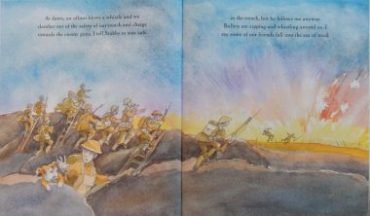
Stubby is badly injured

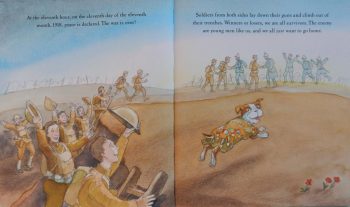
but manages to survive thanks to the care he received alongside the wounded troops and he’s back in action on the day peace is declared.

It’s an enthralling read, with a happy ending. Sadly though, that wasn’t the case for so many of the brave soldiers who lost their lives in that a brutal war. It’s so important that we continue to remember these men, particularly now as there are so few war veterans remaining alive. It’s through such superbly told and illustrated books as this that one hopes we will never forget.

Thanks to Foreman’s wonderful scenes, Stubby and his soldier friends will linger in our minds long after this treasure of a book has been set aside.

Share it widely, pause to remember, and give thanks for the contribution those who served in both World Wars made to our all too fragile peace

An Anty-War Story

An Anty-War Story
Tony Ross
Andersen Press

Of all the residents of Antworld, there’s only one little ant with a name. Meet the new born Douglas. Douglas watches the other ants carrying food and longs to fit in and be part of that ‘beautiful line’. But that isn’t the role the Chief Ant has in mind for him; Douglas’s destiny lies elsewhere. He too will march in line but instead of food, he will carry a rifle. Douglas is to be a uniform wearing soldier charged with defending Antworld and making it a safer place for all the little ants.

Douglas is proud of his uniform and his assigned role, as well as the banner-bearing band that marches behind the ‘rifle carrying ants’. But then war does come.

It comes in human form: shells WHIZZ and with a BANG Antworld is completely obliterated.

Ross shows this in a devastating shift from the colourful pageantry as the explosion spread is followed by a gloomy grey view of advancing WW1 soldiers with mustard gas swirling across the landscape and below a smudge of red in one corner, the words “The end.’

Then follows an equally sombre monument to the fallen.

That only serves to bring home the awful reality of how war can change lives in a single instant – one flash and it’s all over for some, or many.

Sobering and intensely powerful, a reading of this allegorical tale is certain to bring on discussion about war wherever it’s shared.

Moon River

Moon River
illustrated by Tim Hopgood
Oxford University Press

Once again Tim Hopgood has turned an enduringly popular song into a magical experience that feels brand new.
His latest offering is based on Johnny Mercer and Henry Mancini’s song Moon River made famous by Andy Williams. (There’s a sing-along CD featuring the classic song inside the back cover).

Moonlight streaming, river like through a child’s bedroom window gently nudges a slumberer and she embarks on a breathtaking journey of discovery in the company of a white horse and a guitar-playing brown bear.

Together they travel on their small craft through a glowing watery world,

then take to the air flying over not-yet sleeping cities before landing and riding off in search of that illusive rainbow’s end, a place that’s always just that little bit out of reach.

As those notes drift across the pages of Tim’s deliciously dreamy scenes who could resist following them and joining the adventurers as they sally forth into the night on a voyage that will take them they know not where.

Adult readers however, will recognise some of the famous landmarks depicted as they share this gorgeous book with their little ones.

Joy and hope shine forth from every one of Tim’s spreads in this enchanting dream of a book.

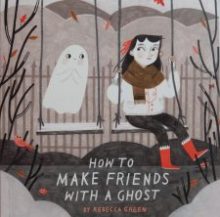
How To Make Friends With a Ghost

How to Make Friends with a Ghost
Rebecca Green
Andersen Press

Written in the style of a guide book, this is a fun story to have at Halloween or any other time – perhaps not bedtime though, if you have an impressionable small child.
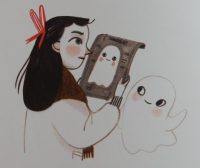
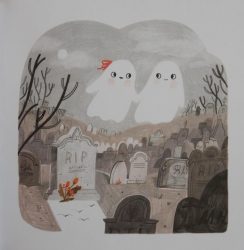
Herein we learn how to identify a ghost – very important if you want to make friends with one. Those depicted are of the especially endearing, somewhat whimsical kind.

Divided into parts, we look first at ‘Ghost Basics’, starting with, not to flee from a ghost should one choose to greet you – that’s on account of their sensitivity. Instead appear friendly and bestow upon the apparition a beautific smile.
Then, should it decide to follow you home, welcome it in, if needs be helped by a gentle blow (of the breathy variety I hasten to add). And, it’s especially important to keep your hands clear just in case you accidentally put one of them right through and cause the thing a stomach ache.
“Ghost Care’ describes feeding – preferably plenty of its favourite treats – cooking together …

and recommended ghost-tempting fare. Think I’d pass on sharing any of that.

Recommended activities come next. Apparently ghosts have a special liking for collecting items such as worms, leaves and acorns; reading scary stories is another favourite pastime,

and of course, joke telling – particularly of the ‘knock knock sort.

The more obvious Halloween activities are included, naturally. So too are bedtime considerations (eerie hums and wails make great lullabies); places to hide your visitor should someone come calling; hazards – avoid using your ghost as a nose wiper; banning ghost help with the washing and most crucially, ‘Do not let your ghost get eaten! (in mistake for whipped cream or marshmallows perhaps)

Part Three comprises ideas for life together as you both age for, as we hear, a ghost friend is a forever friend. And to end with a quote from Dr Phantoneous Spookel: “If you’ve been lucky enough to be found / by a ghost that calls you its ‘friend’, / Then your friendship will last / for it knows no bounds – / you’ll be friends even after the end.”

Now that’s a spooky, albeit tenderly poignant ending, if ever.

With somewhat sophisticated gouache, ink and pencil illustrations, executed in an appropriately subtle colour palette, even down to the endpapers and some of the printed text, the whole ghostie experience, imbued as it is with a sense of mischief, is enormous fun.

With a debut picture book this good, I look forward to seeing what will follow.

A Cat’s Guide to the Night Sky

A Cat’s Guide to the Night Sky
Stuart Atkinson and Brendan Kearney
Laurence King Publishing

I love this idea: an introduction to astronomy courtesy of Felicity the cat. With those alluring eyes, it’s hard to resist the offer of a guided tour around the universe from this enthusiastic stargazer who acts as our nocturnal companion.
Suitably prepared with essential stargazing gear, under her expert guidance, readers will receive a terrific introduction to the wonders of our solar system and much more.

The book is absolutely packed with information presented in such a manner that the reader never feels overwhelmed. Stuart Atkinson’s enthusiasm for his subject shines out from every page, his explanations are clear and lucid and he imparts an amazing amount of information almost without you noticing through the down-to-earth voice of the feline Felicity.

I’ve never been able to grasp the concept of star constellations – those pattern in the sky –

but thanks to Felicity’s descriptions and Brendan’s silvery outlines of the likes of Cygnus: the swan,

Sagittarius: the archer and Aquila: the eagle superimposed on the star patterns, I can’t wait for the next dark cloudless night for a spot of stargazing.

They’ll be all the more easy to spot now I know about the seasonal differences in the night sky.

A super book for your little, and not so little, stargazers.

Halloween is Coming: The Right One / Monster School / Bizzy Bear Spooky House

The Right One
Violeta Noy
Templar Books

New Spanish author/illustrator Violeta Roy presents in bold graphics, a cute story about daring to be different ghost-style: it’s perfect for Halloween, especially for those who don’t like to be scared.

Roderic is the smallest ghost in a very large, ancient family. They all look pretty much alike on account of wearing sheets although Roderic’s is the tiniest.

This diminutive ghost is the last of a long line and he feels more than a little insignificant. None of his family seems to notice his presence. Roderic decides to do something about this. His name is fixed, ditto his family but he can change his appearance. Both a hat, and a scarf prove problematic.

Next morning, deciding a more radical approach is required, our little ghost experiments until finally he’s ready to sport his new gear.

However the reception he receives isn’t quite what he’d hoped, so off he goes to strut his stuff among the city folks. Once again though, nobody notices him at all: poor little thing is now feeling even more invisible than ever.

Back home again he’s given a fresh white sheet but it makes him anything but happy. His frustration causes things to start flying around, one of which just happens to land upon the little ghost and yippee! It feels absolutely right.

What’s more, it looks absolutely right and now nobody is going to stop him from wearing it.
And maybe, just maybe, his new appearance might have some influence on other members of Roderic’s family.

For older readers:

Monster School
Kate Coombs and Lee Gatlin
Chronicle Books

A school it may be, but despite its fairly typical activities – homework for example, there’s a class pet and a regular weekly menu on offer at the cafeteria – Monster School’s pupils are anything but your usual boys and girls; the staff are pretty weird too.

Let’s meet some of them. There’s Stevie the Loser, who manages to lose pretty much anything and everything from backpack, book and homework, to his eyeball, kneecap and arm; what a zombie! He may not be able to find said homework but keen-eyed readers will surely spot it still attached to that missing arm of his.
There’s also ‘a ‘multicultural’ miss – whose family tree comprises giants, witches, trolls and other ghoulies.

Computer Wizard has tech skills aplenty: app creator, program writer extraordinaire, with a mouse that dines on virtual crackers and cheese and a ram that consumes virtual grass; seemingly this guy can do anything so long as it’s not a word problem.
I should also mention she of the amazing hair; it’s entirely reptilian with an abundance of adders, vipers and other venomous twisters and twiners.

Katie Coombs imaginative verses employ a variety of forms that will send tingles down the spines of primary age readers while Lee Gatlin’s creepy illustrations home in on the grim and gruesome with plenty of details of the shivery kind.

For the youngest:

Bizzy Bear Spooky House
Benji Davies
Nosy Crow

In his latest adventure, Bizzy Bear dons his starry costume and accompanied by his pal, ventures into a spooky house. Therein are plenty of things to make him shiver as he enters the spiders’ web festooned hall, climbs the creaky stairs and discovers a surprise party at the very top of the house.
Benji Davies’ scenes have plenty to amuse and explore and with a slider or tab to manipulate on every spread, this is mock scary Halloween fun for toddlers.

Short Fiction Roundup: A Case for Buffy / Dear Professor Whale / Corey’s Rock

A Case for Buffy
Ulf Nilsson, illustrated by Gitte Spee
Gecko Press

Detective Gordon (a philosophical elderly toad) returns with a final case to solve. This, the most important one in his whole career, sees him and young detective, cake-loving mouse Buffy attempting to solve a mystery that takes them to the very edge of the forest as they endeavour to discover the whereabouts of Buffy’s missing mother. In their search, they’re aided by two very new recruits,

who accompany the detectives, as they follow clues across a mountain and over water, all the way to Cave Island.

There’s an encounter with Gordon’s arch-enemy, a wicked fox who might or might not make a meal of one of the detectives.
All ends satisfactorily and there’s a sharing of cake – hurrah!

I’ve not encountered this charming series before but this one is a gentle little gem made all the more so by Gitte Spee’s whimsical illustrations.

Read aloud or read alone, either way it’s a delight.

Dear Professor Whale
Megumi Iwasa, illustrated by Jun Takabatake
Gecko Press

Professor Whale is now the only whale remaining at Whale Point and thus feels more than a little bit lonely. He remembers the days when he was surrounded by friends and they participated in the Whale Point Olympics.
In an attempt to find some new friends the Prof. sends out letters to ‘Dear You, Whoever You Are, Who Lives on the Other Side of the Horizon’ His only reply comes from Wally, grandson of an old friend. After getting over his initial disappointment, Professor Whale is inspired, to organise, with Wally’s help another Whale Point Olympics. It’s full of exciting events such as The Seal Swimming Race and The Penguin Walking race and there’s also a Whale Spouting Contest.

Friendship and kindness abound in this gentle tale, a follow-up to Yours Sincerely, Giraffe, which I’m not familiar with. However after enjoying this warm-hearted story, I will seek it out. With it’s abundance of amusing black and white illustrations,

It’s just right for those just flying solo as readers.

Corey’s Rock
Sita Brahmachari and Jane Ray
Otter-Barry Books

After the death of her young brother Corey, ten year old Isla and her parents leave their Edinburgh home and start a new life in the Orkney islands.
So begins a heart-wrenching story narrated by Isla wherein she discovers an ancient Orcadian selkie legend.

This becomes significant in her coming to terms with her loss and adjusting to her new life.

It’s beautifully, at times poetically written, interweaving elements of Isla’s dual heritage, folklore, the Hindu belief in reincarnation, coming to terms with loss, making new friends, family love, rebuilding lives and more.

Equally beautiful are Jane Ray’s illustrations that eloquently capture the tenderness, beauty and the magic of the telling.

This is a treasure of a book that deserves a wide audience and at the right time, could help grieving families come to terms with their own loss.

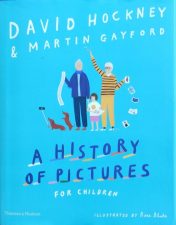
A History of Pictures for Children

A History of Pictures for Children
David Hockney and Martin Gayford, illustrated by Rose Blake
Thames & Hudson

It’s great to see so many art books for children published in recent months particularly since the creative subjects – art in particular – are being side-lined in the curriculum; a ridiculously short-sighted act I believe. We need to foster, nurture and develop children’s creativity rather than stifling it. Being able to think outside the box, to say, ‘what if ? …’ is the root of all development including scientific and technical. The current tick-box mentality and constant testing of children does absolutely nothing for their true development; hoop-jumpers are not what is desirable at all.
Hurrah then for such books as this.

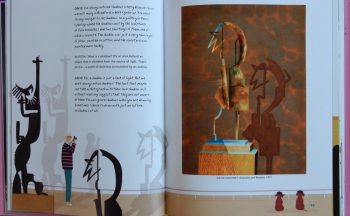
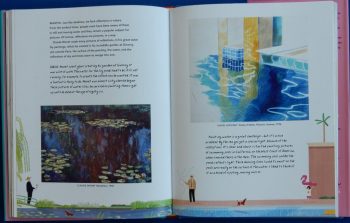
Essentially it is a totally enthralling and immersive conversation between artist Hockney and art critic Gayford, wherein through eight chapters they look at, discuss and ponder upon works of art, providing a condensed history of art that encompasses Hockney’s art, those who influenced his works and some awesome work from others through the ages.

Rose Blake provides terrific additional illustrations of her own that cleverly bring the whole enterprise together.

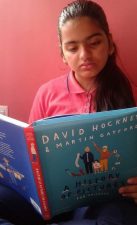
I opened the parcel containing my review copy the day before I was leaving for 3 weeks in India so I tucked it into my laptop bag to take with me. I showed it to my friend Shahid Parvez, an artist and assistant Professor in the Department of Visual Arts, at Mohanlal Sukhadia University – Udaipur.
He also shared it with his artistic 11-year-old daughter Saba.
Here in brief are their comments:
Shahid: ‘What a lovely book – very readable and absorbing. It certainly makes you curious to know more about art and you don’t want to put it down until the end. I wish we had books such as this one in India to give our kids exposure to art in such an interesting, easy to understand way.

Saba: ‘Such an interesting book telling me about art history and the different aspects of art. I specially liked the “Light and Shadows’

and ‘Mirrors and Reflections’ chapters

and the Timeline of Inventions. I would love to read more books like this one.’

Altogether an excellent enterprise that will assuredly engage and excite both young readers and adults.

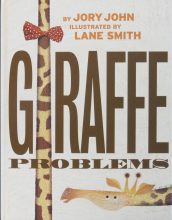
Giraffe Problems

Giraffe Problems
Jory John and Lane Smith
Walker Books

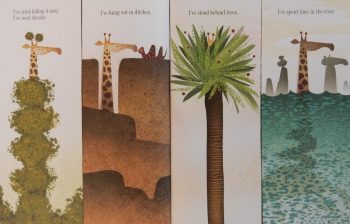
Following on from their Penguin Problems, Jory John and Lane Smith present Giraffe Problems. The giraffe in question being Edward; his problem coming in the form of his neck. A neck that is too long, too bendy, too narrow, too dopey, too patterned, too stretchy, too high, too lofty: in short too necky. Said neck causes other animals to stare at him wherever he goes.

It’s not as though Edward hasn’t tried to improve matters; he’s adorned the thing with all manner of scarves and ties and attempted to hide himself away but without success.

Other animals have enviable necks so why is his the object of attention all the time? He has, assuredly, a long-lasting problem.

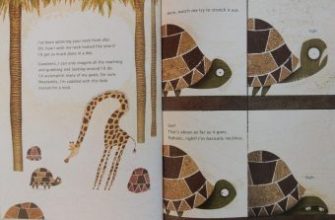
Then Edward comes upon a creature that is his polar opposite: Cyrus is a turtle but he too has a neck issue. “I’m basically neckless,” he tells the giraffe.

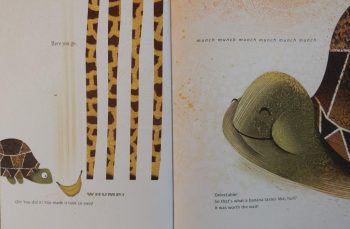
He also tells Cyrus of his yearning for and futile efforts to obtain, a lone banana dangling alluringly from a tree atop a distant hill. “I’ve felt like such a fool as I stretched my neck toward those greedy branches, only to be limited by my own physical shortcomings.”

Said fruit poses no challenge to Edward; in just a few seconds he causes the desired object to land right in front of Cyrus. (gatefold reveal).

Then it’s down to Cyrus to help Edward with his own neck issue. Is it possible that they can both end up feeling good about themselves – perhaps with the help of a small, strategically placed adornment?

Jory John’s entire wry, comical text is in the form of speech- monologue or dialogue – with occasional touches of bathos, and is perfectly complemented by Lane Smith’s retro style, textured artwork executed in earthy tones that cleverly captures the emotions of the two protagonists and showcases their distinctive patterns.

Courtesy of the John/Lane partnership we’ve visited Antarctica and Africa: whither next for animals with problems, I wonder?

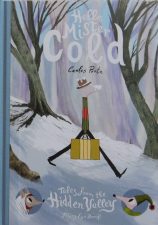
Hello, Mister Cold

Hello, Mister Cold
Carles Porta
Flying Eye Books

The opening paragraph from The second in the Tales from the Hidden Valley sequence repeats that used in the first book before plunging readers into deepest winter. This one however starts not in the winter-engulfed valley but in a distant town.
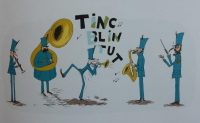
Enter one Maximillan Cold, ‘child of the richest, most ambitious, coldest family in town.’ To his family’s shock horror, the lad wants to be a musician and so the family disowns the boy trumpeter who joins a band.
Its leader however doesn’t appreciate his TINC-BLIN-TUT improvisations and so fires him instantly.

Maxi boards a train but is soon ejected by some travelling musicians and thereafter lost, he finds shelter in a cave, the floor of which gives way sending him cascading down between precious stones and fossils.
The chilly world in which he finds himself is that inhabited by Yula, just off for her music practice with Sara, and the other assorted characters we met in The Artists.

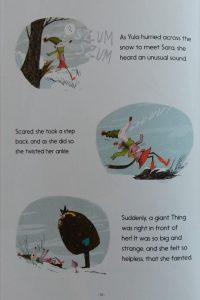
It’s the tiny, onion-headed ballerina who finds Maximillan lying flat out in the snow. Concerned at his inappropriate garb she opens his suitcase and dresses him in swathes of clothes, making him look like a ‘giant’ Thing.

This Thing accidentally alarms the hurrying Sara, causing her to start and fall down in a faint.

Concerned, Maxi resolves to find a safe place to take her and thus allows himself to be led to a dead tree wherein he deposits her and wraps her up warmly. Meanwhile, a watching raven, alarmed by seeing the little wolf carried away, flies off to inform Sara, thereby starting a rumour that Yula has been kidnapped by a monster.

Sara and her friends then devise a decidedly crazy plan with the intention of hounding out monster Maxi.

After another monster encounter – not Maxi but a totally weird giant worm thing that he himself comes upon, some magical music, the unpacking of Maxi’s suitcase, a realisation on the trumpeter’s part and a further musical rendition,

all ends happily and readers are left to draw the satisfying conclusion that a new friend has been added to the residents of Hidden Valley just in time for the arrival of spring …

Delectably droll narrative drives the plot, which, together with Portas’s quirky portrayal of the fanciful friends in a wonderful mix of scenes large and small, makes for another enormously engaging Hidden Valley flight of fancy. Roll on Book 3.

These stories surely have the makings of a wonderful children’s TV series.

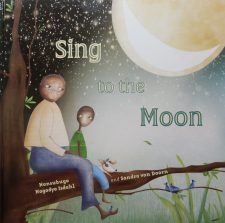
Sing to the Moon

Sing to the Moon
Nansubuga Nagadya Isdahl and Sandra van Doorn
Lantana Publishing

A Ugandan boy relates one unexpectedly magical day spent at his grandfather’s house.

When he awakes it’s to the sound of the rain’s patter and the sight of dark, brooding clouds. He anticipates that none of those wishes he shared at the outset: the flight to the stars; the ocean crossing aboard a dhow to the old spice markets of Zanzibar or the flight on the back of a crested crane culminating in a wonderful forest feast, will come true.

“Sing to the moon” his Jjajja always tells him if he wants a wish granted.

Instead, there’s nothing for it but to go and join his Jjajja in the kitchen as he sips his morning tea, and together they break their fast on porridge.

The boy’s intention is to return to his room and mope but his grandfather has other ideas. Taking the boy by the hand he leads him to the storeroom …

and that’s where the magic begins as Jjajja starts to reminisce about his boyhood days.

As they pack away the peas he talks of his best friend Kirobo with the enormous smile.
Then they move to the veranda where the boy hears of Jjajja’s guava tree climbing, something his grandson also loves.

At sundown, they prepare the ingredients for a fish stew supper while the boy’s grandfather shares tales of fishing expeditions.

By now darkness has descended and then their ‘night adventures’ commence.
Jjajja has a huge stack of books, a veritable tower containing tales of brave kings and crooks; fables of long gone cities full of gold and African kingdoms. He talks of how the sky once rose and fell, as thunder raged.

Then outside they go and to the sound of echoing drums and grasshoppers’ song the lad is reminded that no matter what he’s always loved.
Now all that’s left is to savour the sweetness of the day; the boy safe in the knowledge that nothing could possibly have been as wonderful as their rainy day together, a day rounded off perfectly with Jjajja’s soft goodnight bidding, “Sing to the moon.”

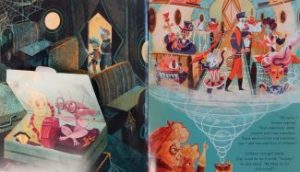
Not only does this beautiful book portray that very special intergenerational relationship, the spellbinding tale also evokes the natural world and life of a distant land that most of us won’t ever visit for real, both through Nansubuga Nagadya Isdahl’s rhyming narrative that’s a real joy to read aloud, and Sandra van Doorn’s absolutely stunning illustrations. I’d love to include every single one but hopefully those included here will inspire readers sufficiently to seek out their own copy of the book. It’s a must.

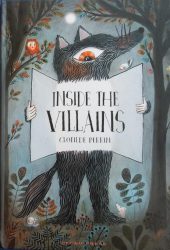
Inside the Villains

Inside the Villains
Clotilde Perrin
Gecko Press

Wow! This is a BIG book; it’s also a pop-up, lift-the-flap, pull-the-tab volume wherein we meet three of the biggest villains of fairy tale.

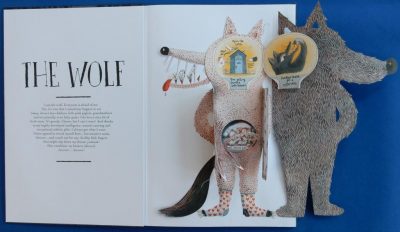
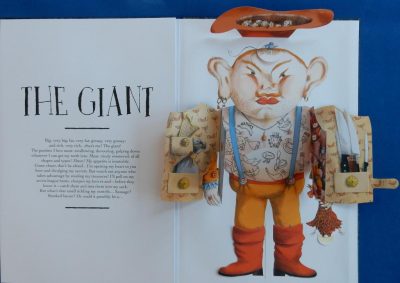
If you’ve ever wondered what really lies behind the three characters, this larger-than-life volume supplies the information. It takes readers deep within and around on a tour of discovery that reveals what’s hidden beneath their clothing, what lurks in their pockets and even behind their ears; and be prepared for a peep at stomach contents.

Each character is immaculately constructed with layers to peel back and investigate. For instance in the wolf (my favourite) we’re shown the working of his grey matter and when you pull a tiny thread, the contents of his stomach – see if you can guess what lies therein – the creature’s been pretty busy of late; either that or he digests his food very slowly.
On the opposite page is a self-written profile of the lupine creature wherein he recounts his dietary preferences and describes himself as having ‘highly developed intelligence, natural cunning and exceptional athletic gifts.’

Unfold the left-hand page and you’ll discover a terrific ‘More About Me’ section with story references aplenty as well as a list of other related tales. Opposite all this is the story of The wolf and the seven little goats.

The giant clearly has several layers of adipose tissue – not surprising as he talks of his ‘insatiable appetite’. Beware his beguiling banter “I’m opening my heart to you’. Hmm! Unfasten his belt and take a look beneath that waistcoat, then have a peek behind his hat.

As for the witch, she sports a feathery cape, perfect for ensuring that the contents of her pocket stays toasty warm. Under her dress and petticoat she has a stash of terrible treasures, so ignore what she says about those pockets full of sweets, if you value your life, her gnashers look evil indeed.
Her hidden story is Alyoshka and Baba Yaga.

Brilliantly conceived and equally brilliantly constructed, Clotilde Perrin takes interactive novelty books to a whole new level.

The Rabbit, The Dark and the Biscuit Tin

The Rabbit, The Dark and the Biscuit Tin
Nicola O’Byrne
Nosy Crow

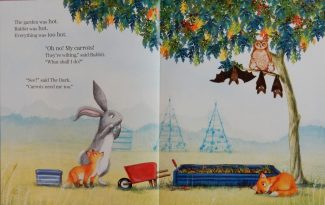
It’s almost bedtime but rabbit is not  ready for sleep. Suddenly, while out in his garden he has a bright idea: If it doesn’t get dark then he need not go to bed at all. Grabbing his best biscuit tin with a single remaining biscuit inside, he heads back outside to find The Dark.
An easy job and Rabbit offers it the biscuit but as Dark reaches out, SNAP goes the lid of the tin: Rabbit has caught The Dark inside.
From inside the box comes a voice chastising Rabbit for his thoughtless action. What about all the animals that get up as night falls: The Dark is vital for them.

Selfishly Rabbit goes inside clutching his tin of Dark. Their conversation continues with The Dark pointing out what his captor will miss unless he frees his prisoner. Rabbit’s mood deteriorates and he stomps back outside clutching his tin tightly.

What he sees and feels – a very hot, sad looking place full of very hot sad-looking animals and even worse, his favourite carrots have all wilted.

The Dark makes one more plea for release: “I want to show you how wonderful I can be …” he says.
This makes Rabbit really think and slowly, slowly he opens the lid to find …

Dark points out some further good things he has to offer, not least of which is bedtime stories. Now though it appears that he’s too tired even for one of those.

Nicola’s lovely story is perfect for bedtime reading. It gently and unobtrusively introduces the idea of nocturnal animals as well as only thinking of oneself.
With gorgeous illustrations and a pop-out surprise to open, this book may well cause little ones to delay bedtime to hear the story ‘just one more time’.

Midnight Monsters / The Ultimate Spell-Caster

Midnight Monsters
Helen Friel
Lawrence King Publishing

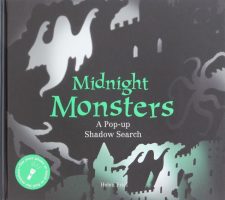
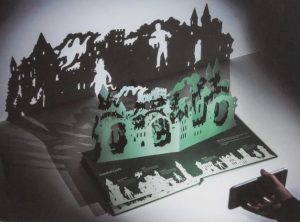
Billed as a ‘Pop-up Shadow Search’, this is a really clever take on the search for hidden objects book. To make it work you need these two things:
a) a largish blank wall, and b) a torch (the powerful kind is best).

Now, turn off the lights, stow away any screens that might be lurking (unless you happen to be using your mobile as a light source), place the book on a flat surface, open up the book, power on your torch and prepare to journey to five pop-up scene locations starting with the wild woods’ Therein, lurking among the branches are a jabberwock, a bigfoot, a werewolf, a dingonek and a headless horseman. (Brief descriptions of each are supplied).

Other settings are creepy caves, mysterious mountains, a misty lagoon and a haunted castle, in each of which hides five creepy creatures whose whereabouts you should seek among the shadows cast on the wall.

What a great thing to produce at a Halloween party; it will keep your guests absorbed for ages as they hunt for all those mythical beasties – a grandylow, a krampus, a tikbalan and a grootslang to name just a few.

Perfect after dark reading of the spooky kind: Spellbinding indeed.

The Ultimate Spell-Caster
Mike Barfield
Lawrence King Publishing

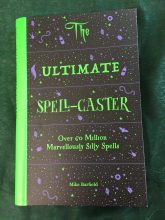
Can you imagine a magical book that offers potential witches and wizards more than 60 million spooky spells of the silly kind? No: then you definitely need Mike Barfield’s splendidly interactive, spirally bound volume that provides the means of doing just that.
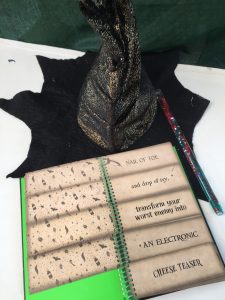
If incantations are your thing then the five interchangeable strips presented in a variety of fonts, providing spooky or daft phrases along with the occasional contemporary one for good measure will keep you entranced for hours.
Here’s one spellbinding possibility:

And another: ‘Flap of cat and gum of boot, turn your dad into a self-propelling snot bottler.’

Embellished with speckled strips, luminous green endpapers and the occasional splattering of potion, the book has the appearance of an ancient tome.

Why not gather together with a group of fellow spell-casters suitably clad and have some fun conjuring up some weird and wonderful spells this Halloween.

Cackles and giggles guaranteed.

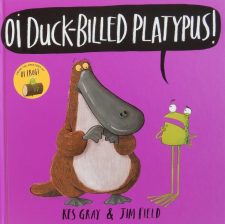
Oi Duck-Billed Platypus!

Oi Duck-Billed Platypus!
Kes Gray & Jim Field
Hodder Children’s Books

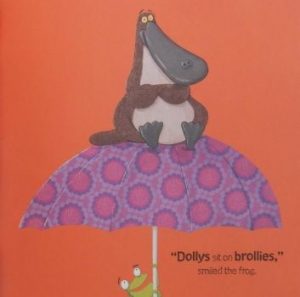
Seemingly Frog’s work is never done, at least when it comes to finding suitable places upon which animals can rest their situpons.

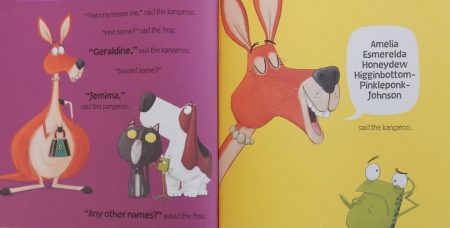
Now he’s faced with not just the creature from the title but a whole host of other animals all wanting to know upon what they can sit and even worse, each one has a name that’s impossible to find a rhyme for – try hedgehog, say. Well perhaps the spiky creature could sit upon er, Frog. Ouch! I suspect that’s completely out of the question though. And kookaburra – hmm! Surely there must be another way of approaching this impasse. And happily there is!

Frog is a genius! “… what’s your first name?” he asks the duck-billed platypus. “Dolly,” comes the reply. Easily sorted.

Then, with moral support from his pals – the dog and the cat, our amphibious friend rapidly comes up with places upon which another twenty or so animals can park their bottoms.

That leaves just the matter of Geraldine the kangaroo …

I think this book has ousted any of the other Oi titles to become my very favourite of the seemingly effortless, utterly priceless. rhyming gems Kes Gray produces. Brilliant as they are though, they wouldn’t be quite so fantastic without Jim Field’s side-splitting illustrations.
Unmissable!

Oi teachers, think what terrific fun you could have with your classes …

Speed Birds

Speed Birds
Alan Snow
Oxford University Press

Rather than being awed by his mother’s talk of potentially deadly falcons, a crow chick is entranced when he sees the speed at which a falcon zooms through the air.

Come autumn, the little crows learn that it’s time for them to fend for themselves in the big, wide world. Excited and with his mother’s words “… if you stay curious, use your mind, and believe in yourself, there is no limit to what you can achieve” the little bird sets off one morning with the other young crows.
Convinced that there are wonders to be discovered, the little crow urges the others onwards till eventually they stop to spend the night in a lone tree.

It’s here next morning that one little crow makes a most thrilling discovery that is to change his life and that of his fellow crows.

Below the tree is a junkyard full of abandoned vehicles and car parts as well as a shed full of tools, more car parts, trophies and most important, plans and a notebook containing drawings, diagrams and lists.

So begins the project to become the fastest bird in the world.

This is a book that makes nonsense of the notion some primary teachers adhere to that once children achieve reading fluency, they should no longer read picture books. Alan Snow’s illustrations are truly awesome – a combination of fine art and technical drawing with clearly annotated detailed inventories of the car’s and engine’s components and how  the internal combustion engine works as well as the formula for calculating the speed and more.

Mechanically minded adults, as well as older primary children and above, will be enthralled by both the story and the intricate technical details of the art. I wonder if Lewis Hamilton would go even faster with a feather festooned Mercedes?

Coping the Change: Charlie Star / How to Feed Your Parents

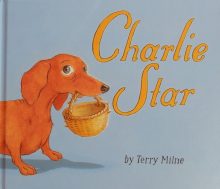
Charlie Star
Terry Milne
Old Barn Books

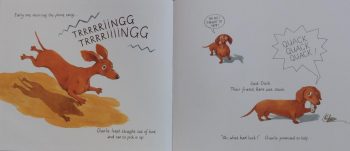
Charlie Star is a dachshund with a difference; he suffers from anxiety and it makes him exhibit repetitive behaviours. The creature is frightened that if he doesn’t do certain things such as checking under his bed and always walking the same side of a tree on the way to market, or lining up his toys neatly every night, something terrible will happen. He uses these routines to hold his anxiety at bay: it sounds to me as though he may have OCD.

One day however, an emergency occurs: his friend Hans is in trouble and is in urgent need of Charlie’s help.

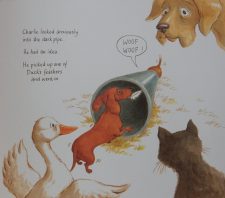
Off dashes the dog not stopping to carry out all his usual routine actions to discover that Hans has his head stuck in a length of pipe as a result of a game of hide-and-seek.

Good old Charlie comes up with a clever way of extricating his friend and thus learns that a change in routine isn’t quite so scary after all.

That day his thought as he goes to bed is “Forgot everything today but things turned out okay.”

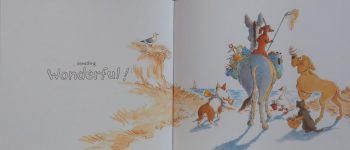
But what about the following day? Does he revert to his usual routine sequence? The answer is yes but also no for now Charlie knows that the occasional change isn’t a disaster and perhaps it might lead to something wonderful…

I love the focus on the importance of friendship at the end of the story.
The author/illustrator has a daughter who exhibits anxiety and repetitive behaviour and as a result she wrote this story to reassure other children who might have similar struggles. Assuredly, with its wonderfully expressive illustrations, it’s a good starting point for opening discussion on the topic, particularly in the way it demonstrates that change isn’t really so scary as we might suppose.

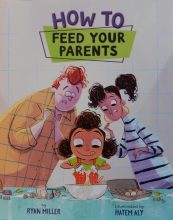
How to Feed Your Parents
Ryan Miller and Hatem Aly
Sterling

Matilda Macaroni is an adventurous eater, eager to try new foods, not so her mum and dad. They insist on sticking to half a dozen items – chicken, macaroni, burgers, grilled cheese, pizza and cereal.

In contrast Matilda’s foray into other fare starts when she tastes her grandma’s jambalaya and continues as she tries goulash (at Grandma’s), sushi – at a sleepover and pork paprika on a play date.
She comes to the conclusion that the only way to get her parents to sample different foods is to take over the kitchen and do the cooking herself. With the help of her gran, she soon learns the niceties of knife wielding, cookbooks become her bedtime reading and her babysitter shops at the local farmers’ market for the necessary ingredients.

It’s not long before the young miss has a repertoire of tasty dishes she wants to share with her mum and dad; the next task is to get them to sample some.

She decides on one of their favourites for supper – burgers – albeit with a few modifications.

“There are mushrooms on it. And green things,” protests her mum. But what will be the verdict when they sink their teeth into the only thing on offer that night?

A comic, wackily illustrated role-reversal tale that might even persuade young picky eaters to adopt Matilda’s parents revised attitude at the end of the tale and try anything.

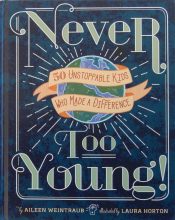
Never Too Young!

Never Too Young!
Aileen Weintraub and Laura Horton
Sterling

Fifty people from different parts of the world and from different times who by the age of 18 have made a difference to society are featured in this volume, each person being allocated a spread.
Their contributions are diverse and range from some well known contemporary figures such as Malala Yousafzai and Serena and Venus Williams, as well as equally well-known individuals from other times such as Joan of Arc who lived in the early part of the 15th century, Helen Keller (activist for the deaf and blind who was born in 1880), artist Pablo Picasso from the same era and Wolfgang Amadeus Mozart.

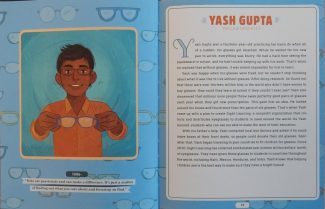
Some of those featured were new to me. One is Yash Gupta, a young philanthropist who after breaking his specs. found it hard to cope in school without them until his new ones arrived and consequently came up with the plan to start Sight Learning, an organisation that collects and distributes old spectacles to students all over the world.

Another new name so far as I’m concerned is Nkosi Johnson who lived only twelve years. The boy was one of 70,000 children born HIV positive, something only discovered when his foster mother tried to enrol him in school aged eight and was told he couldn’t go. However the boy fought against this discrimination and eventually won the right to attend. In a conference speech, aged eleven he said this, “ Care for us and accept us – we are all human beings. We are normal. We have hands. We have feet. We can walk. We can talk, we have needs just like everyone else. Don’t be afraid of us – we are all the same.” Sadly the boy died not long after and his funeral was attended by Nelson Mandela. An organisation called Nkosi’s Haven was created in the boy’s honour. Wow. Talk about an inspiration to the young (and not so young).

Young women include Muzoon Almellehan, a Syrian activist for girls’ rights and education who became the youngest Goodwill Ambassador for UNICEF and now lives in the UK.

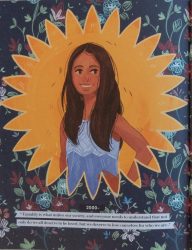
Another is US trans activist Jazz Jennings, co-founder of Transkids Purple Rainbow Foundation; her featured words (there’s a quotation from each person included in the book) are: “Equality is what unites our society, and everyone needs to understand that not only do we all deserve to be loved, but we deserve to love ourselves for who we are.”

All these young people and the others featured herein accomplished amazing things and their achievements will surely inspire young readers to seek ways to help their own communities wherever they are.

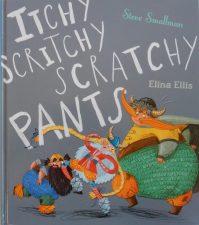
Itchy Scritchy Scratchy Pants

Itchy Scritchy Scratchy Pants
Steve Smallman and Elina Ellis
Little Tiger

Stories about pants are always popular with young children but what about itchy scritchy scratchy ones like those of the title? They don’t sound a very inviting prospect at all but don’t be put off; this bum-tickling rhyming tale is terrific fun.
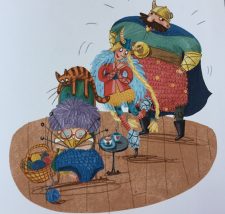
It features a gang of five Vikings who are suffering from chilly nether regions on account of their participation in a fight resulting in the destruction of their bum-covering undergarments.
Time for some new knickers they decide and head to the appropriate shop wherein they locate, not the desired knickers but a knitter of same.
She’s sold right out and is unable to meet their request unless they can provide a new supply of wool.

This means yet another quest- a very bleak and chillsome one – for the hardy crew.

Off they set to track down the famous and mysterious yeti from whose wool she can fulfil their knicker order with the warmest ever pants.

It’s certainly an action-packed, hair-raising adventure.

Off the wall – or rather – off the bum – craziness, both visual and verbal will assuredly have enormous appeal for children who will especially love the notion of yeti fleas feasting upon the nether regions of that Viking crew. YEOUCH! Not what anyone wants from their eagerly anticipated new underwear.

Smashing end papers, smashingly silly story and hilarious scenes of Viking shenanigans: Steve and Elina have done a great job to tickle the fancy of young listeners.

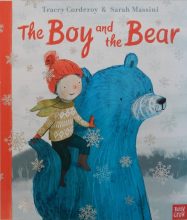
The Boy and the Bear / This Book Just Stole My Cat!

The Boy and the Bear
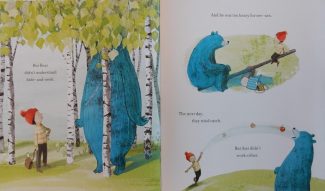
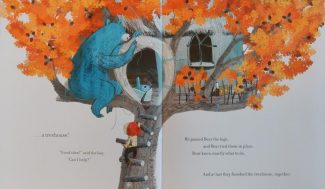
Tracey Corderoy and Sarah Massini
Nosy Crow

It’s not much fun playing alone as the little boy in this story knows so well; he longs to have a friend to share in such games as hide-and-seek and catch.

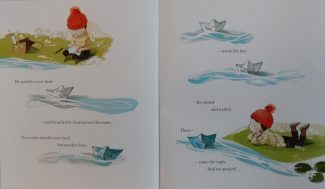
One day as he sits alone, he spies a paper boat floating towards him; on it is the brief message, BOO! Could perhaps it be from the best friend he so longs for? Messages are exchanged and a meeting arranged.

Bear however isn’t exactly the kind of best friend he so desires. Nevertheless he does invite the bear to play hide-and-seek. The game is not a success, neither are the other activities they try.

Bear however does have other positive qualities that are revealed one morning in autumn. The two then embark upon a collaborative project –

one that once complete results in a special time together.Time doesn’t stand still though and as autumn gives way to winter, Bear has to depart leaving the boy with a realisation of all that he’s lost. But not lost forever: come the spring boy spies not one but three message carrying paper boats …

Tracey’s enchanting tale of the joys of establishing and maintaining a special friendship is illustrated in Sarah’s equally enchanting spreads that show how the friendship develops across the seasons.

A lovely book to be shared over and over.
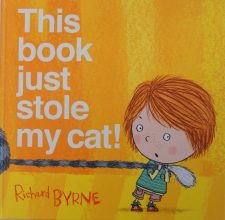
This Book Just Stole My Cat!
Richard Byrne
Oxford University Press

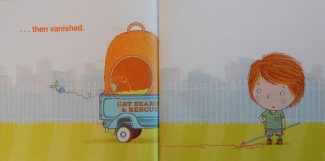
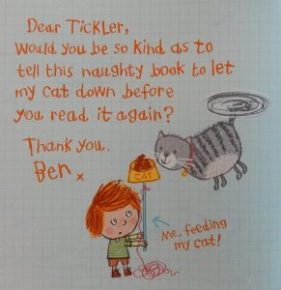
A certain book seems to have an insatiable desire for furry creatures (and other items on occasion): first it consumed a dog and here it’s become a cat thief. Poor Ben, for it’s his cat that’s gone missing, followed shortly after by Bella who has kindly offered to help in the search.
Along comes a rescue vehicle and guess what …

That leaves only Ben (and a tiny fluffy rodent) to proceed with the rescue mission: Ben however doesn’t last much longer.

Not long after, a message appears requesting the reader’s assistance: tickling seems to be a possible rescue facilitator for said book is bound to respond to a dose of tickly fingers by emitting a rather forceful sneeze.

Yeah! Success! There’s only a slight issue that needs to be sorted now …

Another fun, interactive tale of Ben and Bella for little ones; it’s great for beginning readers too.

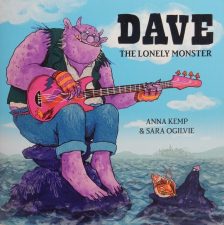
Dave The Lonely Monster

Dave the Lonely Monster
Anna Kemp and Sara Ogilvie
Simon & Schuster Children’s Books

Dave lives all alone in a retirement cave; his only companion is his guitar.

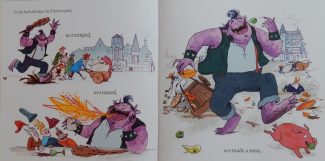
Back in the day – the bad old days to be precise – Dave had been a huge pest rampaging and roaring wherever he went.

Until that is, the townsfolk, tired of his mess making, exiled him to Echo Rock where he spends the next sixty years, just him, his knitting, the odd poetry book and his old instrument upon which he strummed the night away.
By day the local knights would taunt him and try to engage him in combat, but of fighting Dave would have no part.

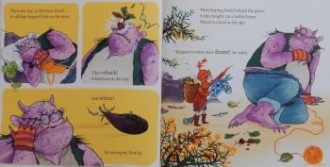
One day his slumbers are disturbed, first by a flying cabbage that hits his nose, then a beetroot biffs him in the eye and an aubergine whizzes past.
Out from behind a bush emerges a tiny knight wielding a carrot. “Prepare to meet your doom!” he cries.

Somewhat nonplussed, Dave challenges this lad who calls him a fiendish monster, pointing out that proper knights do not speak so, and that monstrous beasts, like others, also have feelings.
Realising the error of his ways, Percy apologies, a pledge is taken and a firm friendship forged.
The two have the time of their lives

while back in town, on account of the lack of exciting action, boredom and grumpiness have set in. Monster-bashing is what they need, the townsfolk decide.

Can young Percy persuade them otherwise, armed as they are with fistfuls of mouldy fruit and veg.?
Surely there must be a better way to liven things up and bring fun back for those would-be assailants of Dave’s. He certainly thinks so …

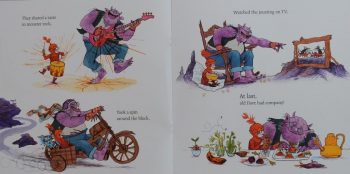
Rollicking rhyme that beats out a heart-warming tale of music and friendship – that’s Anna Kemp’s – and delicious olde-worlde scenes of bygone times that might have been but never were, on account of the crazy mix of knights of yore, Dave’s 60s style bass guitar, mini-skirts and dance moves, not to mention a hells angels wooden Harley style bike complete with side car (those are all part and parcel the super scenes created by Sara Ogilvie)  – combine to make a super read-aloud romp with an important message.

Out with rebel-rousing and war; long live love and peace.

This book will have to be one of my ‘secret story-teller’ choices for the autumn term.

Grumpy Duck

Grumpy Duck
Joyce Dunbar and Petr Horáček
Walker Books

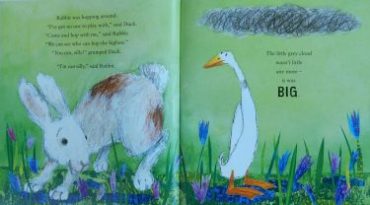
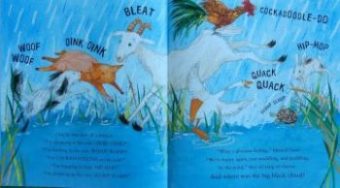
Down at the pond there’s a duck with the grumps but who can blame her since her pond is dry and she’s all alone without a playmate in sight.

Off she goes to seek one, her first request being directed to Dog. Dog is more than willing so long as Duck will join in with some messy hole digging. Duck, having no wish for filthy feathers turns down the offer, thus increasing the size of the little grey cloud that is accompanying her.

Pig’s muddy puddle is deemed too pongy, she doesn’t do ‘cockadoodling’, nor competitive hopping,

peaceful dozing or clothes chomping, so Duck also refuses the suggestions proffered by Cockerel, Rabbit, Tortoise and Goat.

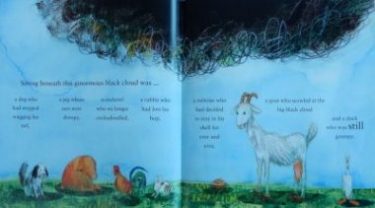
By now, that cloud above her is both black and absolutely ginormous; big enough to cover all those animals whose offers have been rejected and now they, along with Duck, look pretty dejected.

All of a sudden that black cloud, as is the wont of such aerosol masses, decides to burst, precipitating a multitude of BIG SHINY WET SPLASHY RAINDROPS.

Before long the cacophony issuing from their sloshy, sploshy, splashy splishy surroundings is that emitted by seven joyful farmyard residents having the time of their lives.

And the big black cloud? That’s nowhere to be seen; instead the sky is emblazoned with all the colours of the rainbow.

Joyce Dunbar’s patterned text is full of delicious alliteration and a delight to read aloud. I can see this soon becoming a storytime favourite and one that children may well want to try reading for themselves once they’ve heard the story a couple of times.

Petr Horáček’s illustrations are more scribbly delicious than ever. Splendidly expressive and instantly recognisable: I wonder how many listeners, already lovers of Horáček’s vibrant art will bring to mind his Greedy Goat when they see the garment gobbling Goat in this story.

I Am the Seed that Grew the Tree

I Am the Seed that Grew the Tree
selected by Fiona Waters, illustrated by Frann Preston-Gannon
Nosy Crow

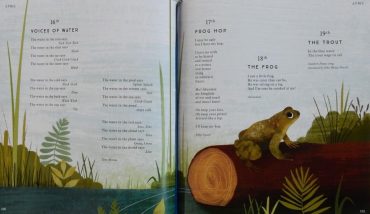
Wow! this huge, weighty volume is most definitely something to celebrate. Containing 366 nature poems, one for every day of the year, the collaboration between publishers Nosy Crow and the National Trust is a veritable treasure trove.

Fiona Waters wonderfully thoughtful compilation includes something for all tastes and all moods: there are poems, chants, songs and rhymes including a fair sprinkling from the great anon.

Each month contains a mix of the familiar including timeless classics, and a wealth of new offerings to delight and enchant.

185 poets are presented, both contemporary and from past times, mainly from UK based and American poets including Alfred, Lord Tennyson, Robert Louis Stevenson, Edward Lear, Thomas Hardy, Edward Thomas, William Blake from the UK; and Emily Dickinson, Amy Lowell, my very favourite poet Robert Frost, E. E. Cummings from the US. Alongside are more modern offerings from Charles Causley, Carol Ann Duffy, Richard Edwards, John Agard, Tony Mitton,

Philip Gross, Benjamin Zephaniah to name but a few and from the USA: Aileen Fisher, Jack Prelutsky, David McCord and Myra Cohn Livingstone.

Almost all the poems are familiar to me (no surprise as I have compiled over 30 books of poetry) but I’ve also discovered some new gems such as Adelaide Crapsey’s November Night:
Listen … / With faint dry sound, / Like steps of passing ghosts, / The leaves, frost-crisp’d, break from the trees / And fall.
And Snow Toward Evening by Melville Cane:
Suddenly the sky turned gray, / The day, / Which had been bitter and chill, / Grew soft and still. / Quietly. / From some invisible blossoming tree / Millions of petals cool and white / Drifted and blew, / Lifted and flew, / Fell with the falling night.

Frann Preston-Gannon has done an amazing job with her art work: helping to reflect the beauty of the natural world and the changing seasons she provides a fine complement to the poems.

I found this beautifully bound, utterly enthralling book waiting for me on my recent return from India; I’ve been dipping in and out of it ever since, rediscovering old favourites and unearthing some fresh treasures. I suspect I shall continue to do so for a long time yet. It’s an ideal family book, a must for every school and a perfect way to start or end the day (or both).

Come on teachers – what about a poem a day with your class: Fiona has done all the hard work for you.

Mini Rabbit Not Lost

Mini Rabbit Not Lost
John Bond
Harper Collins Children’s Books

Mini Rabbit has a particular penchant for cake and seemingly nothing will stop him from getting the vital ingredients he needs to make one. A lack of berries sees him rushing off in search of same with but one thought in his mind ‘Must have cake, cake … cake … cake’.

Turning down offers of help on the way …

the little creature heads down to the beach and off out to sea. What is the fellow thinking? Well we know the answer to that, don’t we.

His search becomes a quest of epic proportions as he traverses dangerous stretches of water, climbs to enormous heights and dangles himself over precipitous ledges.

Far from home Mini Rabbit eventually comes to this conclusion –

That’s when a delicious smell suddenly sends his nostrils into overdrive. He even makes a small discovery that, when he finally makes his way back home, he presents to his Mother. She too has something to present to Mini Rabbit.

It doesn’t quite receive the reception she’d been anticipating though.

This thoroughly delicious story is, unbelievably, John Bond’s debut picture book. He cleverly shows but never tells how on several occasions Mini Rabbit fails to notice berry locations, something observant youngsters will delight in pointing out. They will delight too in the final punch-line, but I won’t spoil it by revealing what that is. Instead I suggest you get hold of a copy of this tasty book and relish the whole thing yourself (along with one or many small listeners of course).

The King Who Banned the Dark

The King Who Banned the Dark
Emily Haworth-Booth
Pavilion Children’s Books

There was once a boy who, like many children was afraid of the dark. The difference here is that the boy in question is a prince.
He resolves that as soon as he becomes King he will ban the dark once and for all.

His advisers are wary of his subjects’ response and so instead their plan is to make the king’s subjects think that getting rid of the dark is their idea.

They start spreading anti dark rumours, which soon have the desired affect. Now all that’s left to do is to ensure darkness never returns; this is done by the installation of a massive artificial sun above the palace and light enforcers.

Soon people have dispensed with their curtains, anti-dark hats are given out, lamps shine continuously and nights are spent in celebrating.

Unsurprisingly this crazy situation is unsustainable: the pleasure of continual celebrating wanes and instead, constant sleeplessness results in extreme tiredness. The people realise they’ve made a huge mistake. (Sounds familiar)
Even the King is affected.
Something must be done: his advisors hatch a plan. So too do the people.

All power to the people say I; and it’s they who finally win through.

To me this reads like a cautionary tale of our BREXIT times. But no matter how you interpret Emily Haworth-Booth’s debut picture book it’s a powerful reminder of what might happen when people act in haste without thinking things through.

Her choice of a predominantly yellow, black and white colour palette is perfect for spotlighting the messages of the story, not least of which are that we have the collective power to influence our future and, to do things rather than to let things be done to us. Could this be the light at the end of the tunnel: bring on The People’s Vote.

A smashing and thoroughly provocative picture book. Wither next for Emily Haworth-Booth I wonder: I can’t wait to see.

Everest

Everest
Sangma Francis and Lisk Feng
Flying Eye Books

The closest I’ve ever come to the world’s most famous mountain, Everest, is a couple of visits to Dharamshala and McLeod Ganj and environs, in the Himalayan foothills. It was truly memorable to walk in the forest areas and see some of the incredible wildlife – langurs and other monkeys, rhododendrons growing wild, beautiful birds, many of which are illustrated in two of the early spreads of this superb book –

and which I learn herein are sadly now in danger on account of deforestation.

Yes, many climbers are drawn to climb Everest each year, aiming for its summit, as they follow in the footsteps of Edmund Hillary and Tenzing Norgay. That in itself is amazing but there is much more in the way of the mountain’s associated history, mythology, wildlife, religion and culture to find out about as Sangam Francis and Lisk Feng tell and show readers of this beautifully presented book.

We’re taken right back to the formation of the Himalayan range out of which, in Tibet and Nepal, Everest rises. Each of these countries has a name for the mountain: for Tibetans it’s Chomolunga or ‘Mother Goddess of the World’; in Nepal, she’s Saramatha ‘goddess of the Sky’.

For many cultures Mount Everest is a sacred place: in the valleys and passes leading to its peak are places of worship and prayer for both Hindus and Buddhists

and travellers will often see strings of prayer flags hanging from chortens such as this one –

Unsurprisingly there are a great many legends associated with the mountain, an especially famous one being that of the hidden kingdom of Shambhala, a place only the pure of heart can enter. The entire legend is outlined in the book.
Higher up the mountain, the landscape changes; the flora and fauna have adapted to survive the extreme cold and wind. Unfortunately though, climate change is affecting crucial habitats so that small, cold-loving creatures such as the furry-footed pika

will be forced to move and perhaps be unable to find the vital food they need for survival.

Everest is the home of five goddesses each of whom rides a different animal and wears a dazzlingly coloured robe. More about them is included on ‘The Five Sisters of Long Life’ spread.

Thereafter comes information about the sometimes perilous, climatic conditions; facts about those who have attempted to reach Everest’s summit including their equipment and climbing garb; the problems of waste is mentioned

and the legendary Yeti also makes an appearance.

Here is the Sanskrit word for Himalaya हिमालय, which translates as ‘the home of snow’: Everest is surely that and thanks to the creators of this cracking book, readers will likely be sucked into its multitude of wonders. Who knows, some may even be inspired to pay it a visit.

Dragon Post

Dragon Post
Emma Yarlett
Walker Books

When narrator, Alex discovers a dragon in the basement of his house he quickly realises that he needs help: after all, the thing might set fire to his home. So, he writes to the fire brigade.

Thus begins a sequence of written communications in which the lad seeks expert advice from various other parties with regard to the creature’s feeding and general care.

We have to surmise what the boy writes; but the responses to his missives are presented in the form of small letters, notes and cards, each of which fits neatly into an envelope-shaped pocket.

Alex and his dragon have some amazing times together but eventually the lad realises that dragons do not make ideal pets. So he writes to his best friend Hillary (“the wisest person I knew.”)

Following her advice, Alex reluctantly bids his dragon a fond farewell after one more special day together.
That isn’t quite the end of the dragon though: the boy eventually receives a very special card in the mail …

Author/illustrator, Emma wrote this lovely book based on a story told to her by her husband who had an imaginary friend.

As a child, influenced by my avid reading of pony books I was horse mad; so much so that I would often find myself talking to my own imaginary horse – a beautiful chestnut colour it was and I named him Sorrel.
Sorrel would get me out of tricky situations and would come to me whenever I called his name. I’d sometimes find myself blaming the poor animal for leading me astray, venturing to places I’d been forbidden by my mother such as the overgrown part of my local park.
I also had a fairly large collection of horse statues from various parts of the world.
On a very recent trip to Udaipur, India I was saddened to learn of the likely demise in the city, of the centuries old craft of making wooden rocking horses so I decided to share it with my erstwhile imaginary horse friend.

My Dear Friend Sorrel,
I expect you are very surprised to hear from me after so many years. I hope you still remember me. I’m no longer that mischievous, bookish child you knew; I’m all grown up now, have become a teacher. I visit India at least once a year, mainly to see friends, and it’s something I discovered when I was away in Udaipur just recently that upset me and I want to tell you about it.
For many, many years Udaipur has been a big centre for making wooden toys.
The brightly coloured rocking horses were big sellers.
Now though there are just two men making them and they only plan to carry on for another couple of years. They say, nobody, or rather very few people, want to buy their horses now. Instead people prefer to buy their children plastic toys made in China or let them play on screens a lot of the time.
Here are 2 photos of the two craftsmen in their workshop.

And another of their beautiful horses.

A few years ago my artist friend Shahid Parvez specially ordered 500 plain horses from the two men, These were painted by school children from all over the city and exhibited in the grounds of Udaipur City Palace. Shahid hoped to make parents stop and think and perhaps encourage them to provide toys like this instead of letting them play all the time on tablets and mobiles. For a short while the sales of the horses rose dramatically but now again, nobody seems interested.
I can’t believe that this is nearly the end of such lovely toys and wonder if you have any ideas of ways to help; after all you are a horse and a very clever one.
I’m going back again in a few months so please put on that special thinking hat of yours.
Hope to hear from you soon.

Fond wishes, Jill xxx

What’s For Lunch, Papa Penguin?

What’s For Lunch, Papa Penguin?
Jo Williamson
Scholastic

Somewhere in the Antarctic is a café, the best in the region. It goes by the name of Papa and Pip’s. The only thing on the menu is fish, albeit served in a variety of ways: fried, baked, grilled, boiled; they even offer fish ice cream, lollies and pancakes. Seemingly fish is everyone’s favourite.

One day however, a customer demands something else.Papa Penguin is nonplussed but quick to respond.

He and Pippin set out on a long journey in search of some new culinary possibilities. The pandas certainly seem to relish bamboo shoots, after all they’re very bendy, but the chefs need more.
Next stop is a hot hilly location; the climate isn’t to their taste but the nuts, seeds and dates offered by some camels definitely hit the spot.

On they journey adding bread, cheese, cakes, chocolate shakes and yummy fruits to their trolley before heading back to the café.

Before long they’re ready to re-open with a brand new, lip-smacking menu that’s certain to please their faithful customers. Frank however, – the penguin whose demand for “something different” sent Papa and Pip off on their travels – has a surprise in store when he places his order …

Jo Williamson’s new offering is a taste-bud tickler set to please those with a liking for adventure especially of the comestible kind. Papa and Pip are a great comic team whose antics are sure to delight. Love the colour palette and the interplay between words and pictures.

I’d put this one on my early years menu any day.

Happy / As We Grow / We Are Together

Here’s a trio of books from Caterpillar Books one of the Little Tiger Group imprints that I was excited by on my return  home after three weeks away in India.

Happy
Nicola Edwards and Katie Hickey
Caterpillar Books

Mindfulness is a popular theme at present and we’ve had several books on the subject for children in recent months, possibly as a response to the growing concern about the pressures even very young children are under in their everyday lives both in school and at home.

I know from experience that offering youngsters a brief period of quiet, calm time each day when they can be in the here and now away from the stresses and strains of life leads to a happier, more relaxed classroom or home atmosphere.

This beautiful book encourages children to become mindful, offering them some ways to be in the moment, to explore their emotions by tuning in to their senses in a meditative manner. They can listen to the natural sounds around them; or tune in to and focus on their feelings. Tension can be released not only from our minds but also our bodies in a manner similar to that at the end of a yoga session when participants are encouraged to tense and relax the muscles in their bodies one by one until the whole body is completely relaxed.

How many of us really pay attention to what we eat, to savour every mouthful noticing the texture and flavour as we chew: it’s a really great way of being mindful and perhaps more appreciative of our food.

Touch too is a way of connecting and calming, particularly when outdoors in natural surroundings; looking with awareness too works to calm and connect as do smelling and deep slow breathing.

The gorgeous illustrations and gentle, rhyming text herein will surely encourage children to slow down and become mindful, to discover that place of peace that’s deep within us all.

As We Grow
Libby Walden and Richard Jones
Caterpillar Books

This Walden/Jones collaboration is a great way to look at life as a journey full of changes, challenges and joy, that begins as a very tiny babe totally unaware of what is to come as we grow and travel through the years. What we can be sure of though, is that each stage will be different, full of excitement and new adventures. There’s that toddling stage that opens up a myriad of new experiences and quickly gives way to the more assured young child full of imaginative ideas, when language develops rapidly and words are a toy and a tool. Fuelled (one hopes) by mind-opening books a plenty that help with those ‘hows’, whys’ and whats’.

The transformation into a teen is a dramatic one when times are unsettled, restless and confusing, a time of self-discovery prior to adulthood; in the early stages of which independence and challenge go hand in hand before perhaps settling down and maybe even becoming the parent of a new little one.

Like life, this entire book is full of beautiful, memorable stopping points

richly portrayed in Richard Jones gorgeous scenes and Libby Walden’s lyrical text.

We Are Together
Britta Teckentrup
Caterpillar Books

Britta Teckentrup celebrates human diversity through a rhyming text and her inimitable vibrant style illustrations with their peep through cut out pages.

What better way to encourage young children to value togetherness than these opening lines: ‘On our own we’re special, / and we can chase our dream, / But when we join up, hand in hand, / together, we’re a team.’

Readers are then presented with a sequence of gorgeous scenes of children out together in the natural world that will surely encourage positive feelings in youngsters both about themselves and others.

Perfect for sharing in foundation stage settings and a great starting point for a circle time discussion.

Rosa Loves Cars / Looking Good! / Matchstick Monkey: Colours

Rosa Loves Cars
Jessica Spanyol
Child’s Play

This is one of a new board book series that celebrates the uniqueness of every child; it stars car loving Rosa. She likes nothing better than to do stunts and act out scenarios with her vehicles small and large.

Using her imagination along with some small world toys. she plays with them and her pals in a variety of places such as in the sandpit and on the car mat.
Finally Rosa and friend Samira use a large cardboard box to build a car themselves; it’s a great place for having a snack.
Rosa is a delight and it’s great to see books for the very youngest that promote gender equality.

Looking Good!
Ailie Busby
Child’s Play

We meet five adorable babies who have a characteristic- floppy ears, big eyes, pointy nose, sharp teeth and little toes and fingers – similar to in turn, Elephant, Bush baby,

Fox, Crocodile and Lizard.

Infants beginning to talk will soon enjoy being able to join in the repeat ‘So do I!’ hidden beneath the flap on each spread.
With their various expressions, the babes show off their particular feature that is similar to the animal flap beneath which they hide.

Fun, interactive and great for promoting early language.

Matchstick Monkey: Colours
Ladybird Books

Some people tend to show off and brag about their talents, confident in their ability to be the best no matter what. Others just quietly get on with the job and surprise everyone.
So it is with the simian inhabitants of Matchstick Jungle. Red monkey with his dazzling spins is convinced he’s the quickest and certain to win the race; the swaying blue monkeys think otherwise.

So do the zigzagging yellow and pink monkeys, while loop the looping green monkey thinks he’s the speediest and bouncing orange monkey announces that he’s fastest of all.
But what about quiet, unassuming grey Matchstick Monkey, could it be that he has something to show the others …

As well as enjoying the simple story, toddlers will have great fun using a finger and following the trails of each of the competitors in this Matchstick Monkey teether-toy inspired board book and develop their fine motor skills and hand-eye co-ordination at the same time. They might also enlarge their understanding of some colour names along the way.

Where Happiness Lives / One Day So Many Ways

Where Happiness Lives
Barry Timms and Greg Abbott
Little Tiger

What is your idea of a perfect house; perhaps it’s similar to one of the three we visit courtesy of their mouse owners each of which thinks they have the perfect home, to begin with that is.

First off we visit Grey Mouse’s residence: it’s just the right size for him and his family and it’s built in the shade of a wonderful oak tree. In short, it’s just perfect.


But then out walking one day, he comes upon an impressive-looking residence with a balcony belonging to White Mouse. What more could any mouse want, thinks Grey Mouse. But he’s soon to find out, for his new acquaintance too has his sights set on a bigger, better residence.

Together the two set off to climb the mountain whereon this amazing place is to be found. Herein lives Brown Mouse who is quick to invite her visitors in for a guided tour of her luxurious home.

A surprise is in store though, for Brown Mouse has a telescope and what she shows her visitors through its lens causes them to stop and rethink the whole notion of home and contentment.

Greg Abbott’s mice are truly enchanting and there’s a plethora of cutaways and flaps to explore and delight little ones in the splendid illustrations that accompany Barry Timms’ engaging, gentle rhyming narrative.

One Day So Many Ways
Laura Hall and Loris Lora
Lincoln Children’s Books

None of us adults spends their day in exactly the same way and so it is with children and the latter is the focus of Laura Hall and Loris Lora’s splendidly diverse close up on the lives of some 40 children from different parts of the world over 24 hours. Readers will be able to compare and contrast as they follow the youngsters as they wake up in their various homes, have breakfast and go to school.

We watch them as they learn, play, get together with friends, enjoy quiet times;

eat lunch, engage in sports, participate in creative activities and more.

After school there’s the inevitable homework for many; but there’s also time to spend with the family; time to read, to sleep and to dream.

Every spread in this lightning world tour focuses on a different aspect of the day with bright engaging artwork and brief descriptions. It’s a great book for opening up discussion among primary children and enormous fun to pore over particularly with another person.
Good to have on a family bookshelf or in your classroom library; either way it’s engaging and delivered with style.

Nipper and the Lunchbox / Gently Bentley!

Nipper and the Lunchbox
Lucy Dillamore
Child’s Play

Nipper truly loves his owner, Richard who has to leave him at home all alone when he sets off to work every morning.

One day in his haste, Richard forgets his lunchbox; Nipper spies it on the kitchen worktop and sets forth to take it to him.

Handle in mouth, the dedicated dog journeys through the countryside

and after a somewhat perilous journey with all kinds of mishaps en route including getting completely lost in a market, manages to reach the town; albeit with some timely assistance and locate Richard’s Toyshop.

Once there he has to track down its owner and then finds himself the centre of attention as crowds of people stop to look at the wonderful new window display.

It’s a thoroughly satisfying finale as Richard makes him a partner at his shop and thus there are no more lonely days for Nipper. …

Lucy’s slightly muted, soft-focus illustrations are full of things to spot, particularly in the bustling market square scene where Nipper gets himself lost: there’s the plethora of pants that the creature then manages to get himself entangled with.

Nipper he might be named, but this small canine creature is determined, brave and resourceful. Based on a real life rescue dog, his story is a delight.

Gently Bentley!
Caragh Buxton
Child’s Play

Like most five year olds, young Bentley rhino is bursting with energy, easily excitable and thus, apt to get into trouble. “Gently Bentley!’ comes the oft repeated cry from his mum or dad as the little guy creates havoc in the living room; manages to slop his breakfast in all the wrong places;

he even causes a crack to appear across the ceiling, so exuberantly does he dash down the stairs before school.
It’s much the same at school; he trips and scatters his belongings everywhere, whizzes madly around the playground alarming his classmates. Again it’s a case of “Gently Bentley” this time from his teacher and pals.
Then on the way home he manages to terrorise the ducks.

Once indoors however, he spies Baby fast asleep in the cot. Now we see a totally different side of big brother, Bentley.

Many families and all early years teachers will recognise Caragh Buxton’s Bentley; he’s thoroughly endearing and let’s say, super-spirited. Perhaps though, he could do with a little bit of regular yoga breathing or mindfulness.

Angry Cookie

Angry Cookie
Laura Dockrill and Maria Karipidou
Walker Books

Who can resist the words of the chief protagonist on the back cover: “Don’t even think about opening this book, you nosy noodle. I’m warning you. I am very angry.”
Of course, like me you will immediately open the book and discover that Cookie IS angry, very angry and causing him to have daylight flooding into the book and thus his bedroom, is quite simply, intolerable.

However since we’ve already committed that outrageous act and are apparently not going anywhere, the biccy feels bound to share the reasons why he’s so aggrieved.

It’s on account of the previous day – a terrible one by all accounts – that began when flat mate Barbra insisted on playing the same tune on her new recorder over and over. (Cookie has my sympathies there.)

Next came running out of his favourite sweet toothpaste and having to use an unpleasant spicy one instead.

Even worse though was the bad haircut that forced our cookie narrator to wear an ill-fitting hat; unsurprisingly nobody makes hats for cookies, hence the bad fit that makes him a source of amusement to others.

If you can believe it though, the day has to throw in an even bigger disaster. Angry Cookie heads to the ice cream parlour, his heart set on his favourite vanilla sundae topped with all manner of yummy sprinkles and served in a tall glass. But – I’m sure you’ve already guessed – they’ve run out. Can you blame the poor thing for his anger?

Then on the way home along comes a bird that almost makes a meal of Angry Cookie himself;

but perhaps there is one consolation. Could our devotion and friendship be the key to a happier Cookie? After all we have stuck around despite all that the self-confessed ‘grumpy lump, horrid humph’ has said and done, so it’s worth waiting around a little longer to see if happiness is lurking somewhere under that tiny titfer.

What a deliciously quirky, witty tale Laura Dockrill has cooked up. Young children will adore this grump of a character and likely identify with his moody moaning.

Maria Karipidou has done a terrific job portraying Angry Cookie, making him, despite all that ranting, a character one cannot help but love right from the start.

Destined to become an early years storytime favourite methinks, and a great starting point for talking about emotions.

Dark Sky Park

Dark Sky Park
Philip Gross illustrated by Jesse Hodgson
Otter-Barry Books

To say this book is extraordinary is no exaggeration.

Crafted with consummate skill every one of the poems is a gem, not least those that make up the four Tardigrade Sagas. There are, so Philip Gross tells us in a note, over 1000 tardigrade species; they’ve been on earth for 500 million years and are known also as water bears or moss piglets.
Tardigrade in its Element begins thus: ‘This is the kingdom of the Water Bear. / To enter here, you have to shrink / and slow down, down. / A day is one tick of the clock, one blink // of the sun’s eye.’

In Tardigrade in the Cambrian Era we learn: ‘I was there from the off – / the sound of life revving up all over. / This was, oh, a cool half billion years ago.’ Amazing, tiny eight-legged creatures, who can but marvel at such small wonders less than ½ mm. long? Here’s Tardigrade in Focus: ‘OK, so you imagine it: something / a thousand times your size – // a medium village, maybe, or a cloud / with an enquiring mind – // stops. Bends down very close … / Gets out its magnifying glass // and looks at you.’
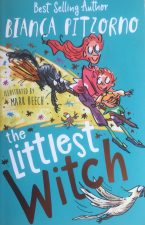
In complete contrast very recent happenings are powerfully evoked in Aleppo Cat. Herein Gross describes a cat’s wanderings in the ruined city: ‘ First, months / of flash, thud, shudder. // then the wailing … // Months , // that’s half a young cat’s life’ … ‘Where the bread smells came from … // Gone. //And where the fish man // tossed the bones. // Gone. // Where the children chased her // with fierce cuddles, too young // to know their strength. // Gone.’
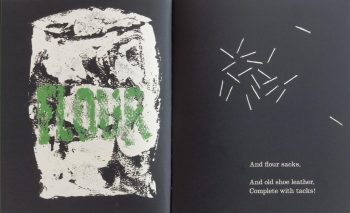
I have Syrian friends who came from that city a couple of years back with their two young children; this one made me shudder.
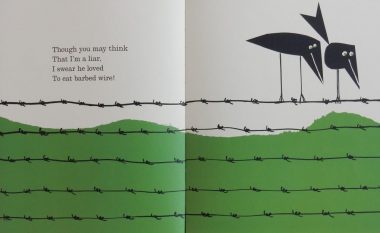
There’s humour too however, as in Extreme Aunt who ‘set off to school // with her four huskies, mush, mush! // to outrun the polar bears’; remembered as being ‘poised // on the diving board, the top, //with the wind in her hair. // She had to go further, further and it seems, // too far.’ Now she’s vanished and presently there’s a submarine searching for her.
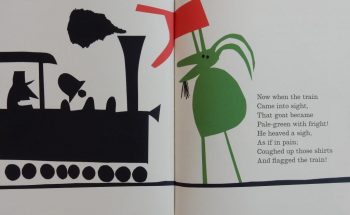
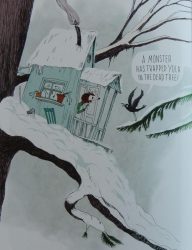
There’s an Extreme Uncle and Extreme Dining too, if you’re fond of things in the extreme: the latter, a French establishment boasts ‘Pick our Own. // The whole garden’s underwater, a mangrove swamp. // You pay your money, you get your canoe, // (in the shadows, dark ripples and a sluggish // splash … ) your Swiss Army knife and harpoon.’ … Seemingly ‘It’s true // what the menu says: Our food’s so fresh // it bites. Eat it before it eats you’.
I think I’ll give this place a miss; it definitely doesn’t sit well with my vegetarian sensibilities.

Instead I’ll head over to The Extreme Music Festival and perhaps listen to The Storm Harp: ‘Tune up the mountain to the pitch // of music. Set each blade quivering. // Turn up the wind // until the hillside shudders like an animal // shrugging its pelt to scratch an itch.’ // Hear its sigh. Bring on the bad maraccas / of the slipping scree. The landslide starts.’

So vivid, as is, Moon Music: ‘She longed for night. // Now she sits with heavy // curtains open just a chink – a slant, a glint, a cool spark // in the darkened room, // hears how light pings // a prism off the mirror’s edge, // her glass of water tinkling // at its wink.’ Awesome.

Gross invites children in a footnote, to imagine their own kinds of extreme music noting, “The fantastical answers may turn out to say a lot about a real place, or person”.

This is a book to make its readers wonder, imagine, look, look and look again, listen and then wonder more. Gross’s poetic voice is enormously enriching, sometimes challenging, but always accessible.

Illustrator Jesse Hodgson has done a fine job illuminating many of the poems; her inky drawings are on occasion funny, beautiful, arresting or even downright scary,

sinister even.

If you want children to be tuned in to the magic and music of language, and who doesn’t, then this treasure trove is your book.

Stories of the Night

Stories of the Night
Kitty Crowther
Gecko Press

Here’s a gorgeous little book to share at bedtime that reminded me a tad of one of Arnold Lobel’s stories in Mouse Tales. It begins with Little Bear requesting three stories from his Mother as she tucks him into bed and she’s happy to oblige; seemingly this is part and parcel of their usual bedtime routine.

The first tale is “The one that says it’s time to go to sleep,” as Little Bear describes it and features a Night Guardian – an oldish, long haired woman who goes about the forest banging her gong and announcing to all the forest animals that they must cease what they’re doing for bedtime has arrived and they must sleep.

Then having put all the creatures to bed, she returns home and she too sleeps, but not before she’s banged her gong (very gently) just one more time.

The second story is of a sword-carrying child, Zhora who gets lost in the forest while out picking blackberries and is given shelter for the night by her bat friend, Jacko Mollo.

The third is also seemingly a familiar story, “The one with the man in a big coat who never sleeps!” as Little Bear describes it. This character, Bo, keeps his coat on all the time and has in exchange for his silver watch, been allowed to take up residence in a nest that once belonged to a grumpy old owl. An absolute delight, this tells how the sleepless Bo is persuaded by Otto otter to go for a swim in his overcoat, gives away his hat and finally gets himself a wonderful night’s sleep.

Kitty Crowther uses some beautiful sleep inducing recitations such as “The sky is all black now. But we can count on the stars to lead us into tomorrow.” and “Choose a star to lead you into tomorrow” that I can envisage being used with little humans as well as Little Bear.
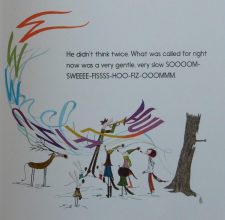
Crowther’s pink glowing, textured scenes are an absolute delight, infused as they are with warmth and love, be that between Mother Bear and her infant, or the other characters in the tales she tells.
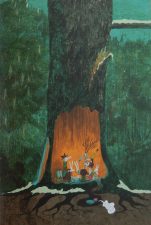
Quirky, quietly beautiful, and a wonderful demonstration of the power of stories, this is a small gem.

Norbert

Norbert
Joanna Boyle
Templar Books
Why would anyone with a whole lot of friends and family decide to uproot himself and set off for distant shores? That’s what penguin Norbert decides to do when he discovers one day, a flyer about a musical in the big city.
None of his fellow penguins shows the least bit of interest in joining him so, sad as he feels at their lack of enthusiasm, Norbert sets sail on a somewhat perilous voyage of rough waters and seasickness

that finally takes him to an enormous city.

Perhaps it’s time to write home, he thinks but the sight of the theatre sends the notion clean out of his head. Instead he heads straight inside where he is quickly spellbound by the performance.
Immediately, Norbert knows he too wants to be on the stage. He joins a long line of auditioners – singers, all.
The judges are seemingly, impressed; but the role they allocate Norbert isn’t exactly what he’d hoped for.

He does get a chance to try his flippers at various other jobs too; plenty to tell those at home, yet still he doesn’t write.

Then one day, the star of the show –something of a prima donna – quits and guess who is asked to step in.

Norbert wows the audience; he’s a star. Life as a famous singer comprises rounds of party going, being a passenger in a limousine and singing in every Broadway musical you can think of. Still he doesn’t write that letter home.

When he wins a prestigious award, the star penguin suddenly feels there is something he really must do – right away.
Letter of apology duly penned and posted he waits for a response.

Meanwhile back in the Antarctic his penguin pals have been busy organising something special to welcome him home.

What could it be? They’ve certainly been inspired by their friend and are eager that he return to their midst.

Joanna Boyle has created a super story of determination, difference, following and fulfilling your dreams and friendship. Imbued in turn with pathos and humour, her illustrations both large and small are staged with impressive style.