The Proper Way to Meet a Hedgehog

The Proper Way to Meet a Hedgehog
Selected by Paul B. Janeczko, illustrated by Richard Jones
Walker Books

Young children certainly, are innately curious, constantly sensing, observing, investigating, relating, questioning, thinking, communicating and loving. In so doing they create theories that explain how and why our world works. This propensity can sadly, start to wane as they move further up the education system.
With this collection Paul B. Janeczko  counters this fact, helping to nurture (or re-awaken) that natural curiosity in those who encounter his wonderful selection of poems.

Essentially it is a kind of instruction manual for such diverse topics as being mole-like, toasting marshmallows, distinguishing between goblins and elves, being a tree in winter, making a snow angel

and playing jacks – not a game one sees children playing much now.

The order may at first glance seem random but it certainly isn’t – far from it: great care has been taken in arranging this selection and there’s a contents page to start, which begins with Charles Ghigna’s How to Build a Poem – an observation on the power of the right words in just the right order: ‘ … words like ladders / we can climb, / with words that like / to take their time, // words that hammer, words that nail, / words that saw, / words that sail, / words that whisper, / words that wail.
A perfect opening that as the final lines say, ‘words that leave us / wanting more.’

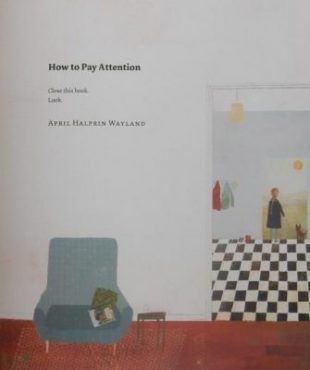
There’s an equally perfect concluding poem too: April Halprin Wayland’s – How To Pay Attention: ‘Close this book. / Look.’
In between are some thirty other golden nuggets, mainly contemporary although a few such as Robert Louis Stevenson’s The Swing from the 19th century are also included. I recall as a young child sitting on my garden swing chanting , ‘How do you like to go up in a swing, // Up in the air so blue?’ as I kicked my legs.

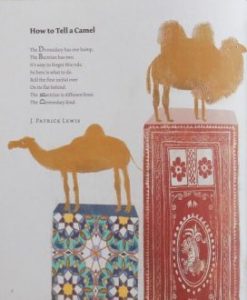
It’s absolutely impossible for me to chose a favourite, I liked every one; but some of my favourites on this reading (ask me another time and it will perhaps be different) are: J. Patrick Lewis’ How to Tell a Camel (for its sheer playfulness);
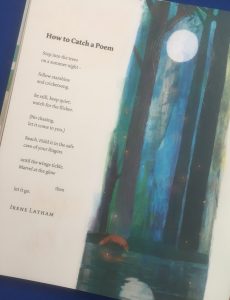
How to Catch a Poem (Irene Latham);
Ralph Fletcher’s How to Make a Snow Angel : ‘Go alone or with a best friend. / Find a patch of unbroken snow. // Walk on tiptoes. Step backwards / Into your very last footprints.// Slowly sit back onto the snow. / Absolutely do not use your hands..’ … ‘Stretch. Float. Fly!’

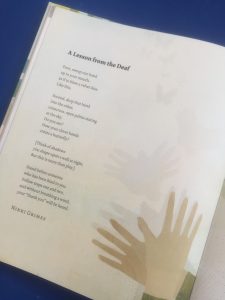
And I was especially pleased to find Nikki Grimes’ A Lesson from the Deaf- a poem on using sign language.
I could enthuse at length about this book but in conclusion, I absolutely love its eclectic nature.

Richard Jones has done a terrific job illustrating each poem so as to leave room for the words to breathe on the page, never overwhelming them but also inviting readers to look closely at his work too with its textures and patterns and admire his carefully chosen colours.

A must have book for all poetry lovers and those who want to encourage children to become so. These are poems to read, read aloud, savour, consider, share, enthuse about and thereafter to look, look and look again.
Mira’s Curly Hair

Mira’s Curly Hair
Maryam al Serkal and Rebeca Luciani
Lantana Publishing

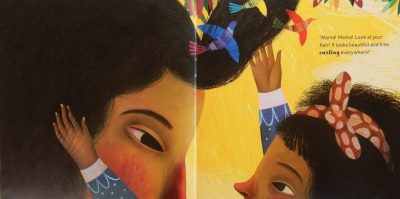
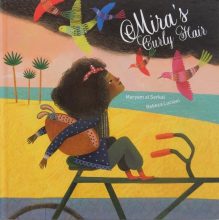
How many of us are satisfied with our natural hair? We often deem it too straight or too curly and spend countless hours styling it and making it look different. I for one have given up on the straighteners other than on very rare occasions but like Mira, the main protagonist in this story, would really like effortlessly straight and smooth hair.

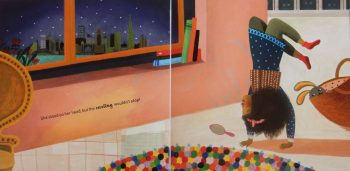
Like Mira too I’ve tried pulling it down to get rid of the kinks and I know from my daily yoga practice that headstanding has absolutely no effect when it comes to hair straightening.

Mira even goes to the lengths of piling books on her hair but inevitably once she moves those curls spring up as if to say, we told you so.

The child covets her mother’s long, smooth straight locks but then one day while out walking with her it starts to rain heavily. They run for shelter ‘neath a palm tree but as they wait, Mira notices to her amazement, something different about her mother’s long locks. They’re straight no more; thanks to the moisture her hair is curling and curling … and Mira loves it.

Thereafter there’s only one hairstyle for both Mira and her mum; it’s natural and it’s curly.

With its theme of self-acceptance, this simple story is beautifully told by debut picture book author, Maryam al Serkal

Prize-winning Argentine illustrator Rebeca Luciani’s scenes executed in jewel-like acrylic colours and digitally worked are superb. I especially love the way items such as toy soldiers and hair styling tools are woven into one illustration,

while others feature modern and traditional Islamic style architecture, as well as richly patterned clothing both traditional and modern.

Another wonderful addition to the culturally enriching picture book list that is Lantana Publishing.

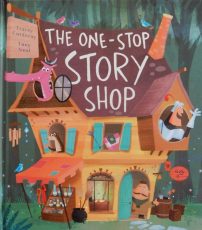
The One-Stop Story Shop

The One-Stop Story Shop
Tracey Corderoy and Tony Neal
Little Tiger

How many stories can you pack into one? A fair few it seems when Tracey Corderoy is the author and the tale is The One-Stop Story Shop.

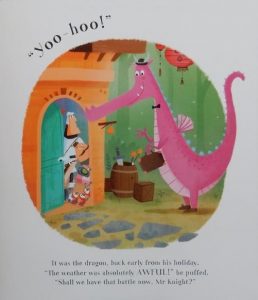
Having discovered that the terrible dragon he intended to slay is temporarily absent taking a well-earned break, a knight finds himself sans story.

Luckily he happens upon a helpful neighbour who takes him to the perfect place named in the title where his problem might be solved, thereby placing the fearless knight on a hunt to find an appropriate story.

The shopkeeper however, has sold out of dragons and instead offers a feisty ferret.

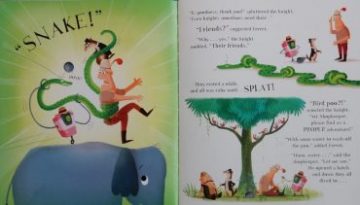
By means of an ingenious plot said ferret then acts as foil for a series of one act dramatic misadventures – a space extravaganza, a cowboy yarn, a rumble-in-the-jungle adventure,

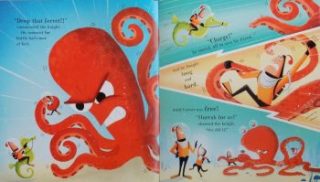
and a depths of the ocean journey. Along the way additional characters tag along, notably a space robot and on every occasion it’s down to feisty ferret to save the situation.

Do the knight and his entourage finally emerge safe and sound from all their adventuring?

Most certainly they do, arriving back in the ‘real’ world of the shop just in time to welcome a certain dragon back from his hols. and ready and willing to do battle.

The knight’s response to his offer demonstrates that he’s graduated from ready-made tales, and with his ferrety sidekick and friend, is more than capable of finding his own adventures.

Enormous fun, this foray into the magical world of storytelling is a great read aloud. Tracey’s text is comically illustrated by Tony Neal. Every one of his spreads is packed with giggle inducing details; and who can resist a poop joke?

An absolute winner and a smashing take on the knight vs dragon tale.

Once Upon A Unicorn Horn

Once Upon A Unicorn Horn
Beatrice Blue
Frances Lincoln Children’s Books

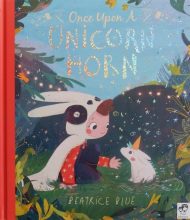
This simply gorgeous book – a neo pourquoi tale -is Beatrice Blue’s debut picture book and what a smasher it is.
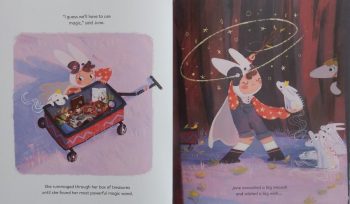
Meet June, a small girl with a wonderful imagination and a taste for all things magical. She knows ‘the woods were full of treasures waiting to be discovered’ and one day she finds the greatest possible treasure – magic horses learning to fly.
One little horse however isn’t whizzing through the air with the others, fluttering his sparkly tail and he’s very sad about the fact. June is anxious to help him but no matter what they try, nothing gets him airborne, so she decides to try a touch of magic. This too fails leaving both girl and horse even more sad.

Back home, June’s parents are sympathetic telling her not to worry, together they can fix things.

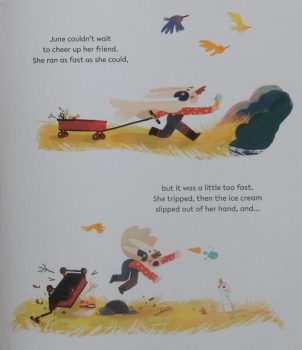
Next morning they all think hard and together come up with a possibility: something sweet, happy and to share. Ice-cream fits the bill thinks June; and having whispered sweetening formula over the cartons, she sets out eagerly and very fast, in search of her friend.

Oops! Disaster … or is it? Look at the trajectory of that cone …

Suddenly something magical really does happen …

Billed as the first of a new picture series about how magical creatures got their special features, this story will immediately be devoured by the countless young unicorn lovers out there.

Beatrice’s story is fantastically funny, and deliciously sweet, but thanks in part to the humour, not in a sickly way. Her illustrations are enchanting, quirky and, in the appropriate places, full of joy; and June is a delightful character.

A winning addition to the First Editions titles; I (along with masses of youngsters) look forward to more, both in the series and from Beatrice.

My First Book of Birds / Birds

My First Book of Birds
Illustrated by Zoë Ingram
Walker Books

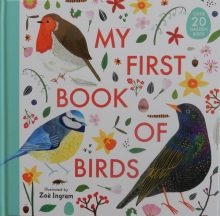
This is a smashing little book that introduces to youngsters twenty or so birds that commonly visit our UK gardens.
Such is the quality of Zoë Ingram’s illustrations that as well as taking delight in them, little ones can use them to help in avian identification.
After an opening spread explaining that the birds are presented in size order as well as talking about conservation status (this is given to each one in the ‘Bird Facts’ window) and feeding, each bird is showcased in a double spread.
The first is the tiny Goldcrest, Europe’s smallest bird, that over winters in Britain while the largest and final bird featured is the omnivorous Magpie that has a wingspan about four times larger than the Goldcrest.
In between are some real beauties including the mellifluous colourful Goldfinch;

the yellow-billed Blackbird and the glossy feathered, bold Starling,

As well as the facts window, each bird has a paragraph about such things as plumage, diet, song; plus there are egg facts and a ‘Did you know?’

Ideal for home use as well as to add to a primary school collection; it’s important that youngsters get acquainted with birds and this is a great starting point.

Birds
Carme Lemniscates
Walker Studio

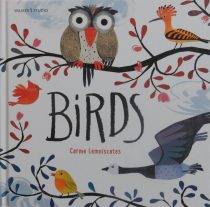
Not a guide to birds, (although you will doubtless recognise most of those the artist includes but never names); rather, the words are at least in part, the thoughts of a little girl narrator as she moves around the countryside on foot, on her bike or even as a flight of fancy, on the back of a goose.
What starts out as straightforward observation, ‘Some birds are really big. // Others are tiny.’

gives way about half way through to simile and metaphor: ’A bird’s song is like the loving words of a friend. // A happy song that greets us every morning. // And our hearts sing, too, because birds are like good news coming. // Or messages of peace.’

The digitally rendered illustrations are richly coloured, enticing and immediately attractive to little ones, though I do wonder if there’s a slight mismatch between the intended audience for the book and some of the latter part of the child’s narrative.

A book to use with one child or a few, rather than a class I suggest.

I Saw a Bee

I Saw a Bee
Rob Ramsden
Scallywag Press

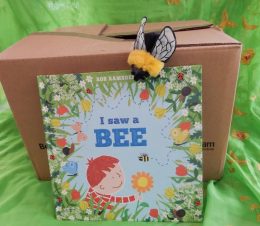
Having introduced himself, the small boy narrator of this largely visual story tells what happens when he opens a big box and discovers a bee.

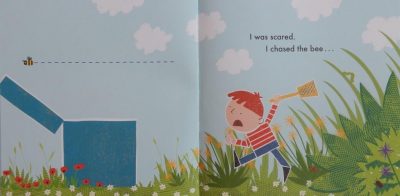
Unsurprisingly, once the lid is lifted the bee buzzes out straight at the lad, scaring him so much that he gives chase.

The bee reciprocates, buzzing after its pursuer who leaps into the box to hide. Inevitably the insect flies off leaving other minibeasts to enter the arena.

Then however, the boy, presumably tired of being stuck inside the box,

emerges and searches for the bee; but the buzzy insect remains elusive, so much so that it’s missed by the lad.

Suddenly ‘Buzz Buzzz’ – could it be? Following the buzzing sound results in a great deal of celebratory buzzing around

and an outpouring of reciprocal love between the human character and the stripy insect he’s befriended.

Beautifully simple – it’s perfect for beginning readers, as well as young listeners, Rob Ramsden’s debut picture book (the first of a promised series that aims to encourage appreciation of the natural world in little ones), has a vital message, all the more so when we read of the decline in insect numbers in our countryside.

Told with a catchy natural rhythm, Rob’s text is highly repeatable; and in conjunction with his wonderfully patterned, screen printed illustrations of the child in the natural world, makes for a book to read, read and read again; and one which should playfully launch the ‘bees are vital’ message that will stay with the very young through their lives.

A delicious first picture book: I look forward to more.

My Tree and Me

My Tree and Me
Jo Witek and Christine Roussey
Abrams Appleseed

This latest title in team Witek and Roussey’s In My Heart series presents the seasons through the eyes of the little girl narrator as she introduces her tall, more than 100 year old friend with ‘birds in his hair’ that she calls My Tree.

It’s with this understanding, non-judgemental tree that she shares the ups and downs of her life as well as using him as a partner for singing and dancing.

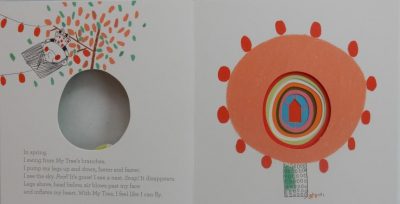
We learn of how the different seasons affect how she feels and what she does in relation to her friend; ‘With My Tree, I feel like I can fly’ she says of spring …

In summer said tree is a place under which to picnic, becoming a big house for all her animal friends as well as a static participant in a game of hide-and-seek.

Bare-branched and all a-tremble in winter, My Tree is kept warm by the child’s scarf and her fast jumping upon his ‘frozen feet’ – (strangely out of seasonal sequence this).

Said tree also has magical transformational powers, bestowing some on our narrator as she mixes a potion of earthworms, mouldy chestnuts and decaying leaves.

Come autumn My Tree’s branches with their colour changing leaves, provide umbrella-like protection from the sun’s rays.

No matter the season, My Tree, we’re told, smells good: in summer it’s with fruit and honey; moss and mushrooms signify autumn, peppermint is winter’s smell and fresh lime is his springtime one.

For My Tree, it’s easy to stay rooted to the spot but when the little girl tries a yoga tree pose, she finds balancing without wobbling something of a challenge …

both of the friends though, exhibit seasonal growth.

Like previous titles in the series, this has thick die cut pages; and Christine Roussey’s characteristic adorable ink-drawn narrator as well as inky aspects of My Tree, the rest of which is portrayed in colours appropriate to the season.

Celebrating the wonders of the natural world, this is another winning combination of words and pictures from the series’ collaborators.

Perfectly Peculiar Pets

Perfectly Peculiar Pets
Elli Woollard, illustrated by Anja Boretzki
Bloomsbury Chlldren’s Books

This is an alphabet of rhyming verse wherein readers encounter twenty six of the most unlikely creatures you’d (n)ever imagine keeping as pets.

There are huge ones such as the killer whale – kept to the neighbours’ consternation, in a garden pond and the Elephant: ‘My elephant’s a perfect pet. / Nothing can improve her. / As when my room is full of junk / Her trunk’s a brilliant hoover.
With an untidy partner such as mine, this pet is one I’d certainly like to have around. And come to think of it the creature featured in R is for Rhino would come in extremely useful when it comes to finding somewhere to put all the items of clothing a certain person leaves around.

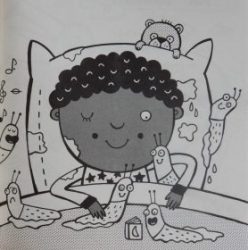
At the opposite end of the size-spectrum is S for Slugs. I definitely would not consider trying the suggestions put forward here: ‘Can you smuggle six slugs in / your sweater / And stroke all their lovely soft slime / Then juggle the slugs, and jiggle the slugs. / Maybe all six at a time? Can you snuggle six slugs in your duvet, / And lie next to them all / night through.
Now while not having anything against the little creatures other than the fact that they’re a menace in the garden, I most definitely do not ‘adore them’, would never ‘bow down before them’. And as for uttering the final ‘ewwwwwwwwwww!’, so long as they keep off my plants, there’s no need to say that.

Playful, rhythmic and often gigglishly silly, there’s sure to be a pet poem or several for every young child in this assortment of Elli’s. Her final offering is an invitation to her readers to try writing their own poem – it’s issued first in rhyme and then followed by a helpful prose explanation on how children might have a go, and some of the tools they might use in so doing.

Anja Boretzki’s inclusive black and white, textured illustrations capture the humour of the verses, adding to the fun.

Ruby’s Sword

Ruby’s Sword
Jacqueline Veissid and Paola Zakimi
Chronicle Books

However hard she tries, spirited, young Ruby always seems to get left behind when out with her two older brothers. Pausing for breath on their walk, she discovers three long sword-like sticks in the grass; and feeling ‘invincible’ she offers two of the ‘dragon-fighting swords’ to her brothers.

They however only proceed to play with each other leaving her out once again. Disappointed she storms off.
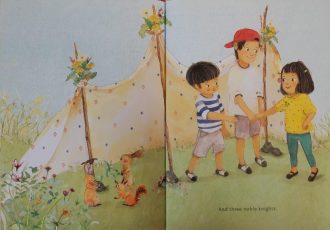
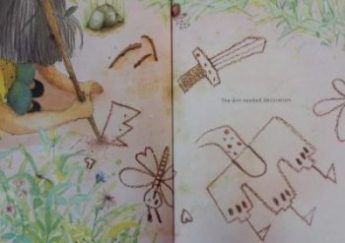
Then, she comes upon an apple tree bearing ‘a royal feast’; she spears the fruit with her sword, which she also uses to help a colony of ants ‘Loyal subjects saved’, as well as to decorate the dirt with her creative efforts.

When a storm gathers scattering swallows, Ruby lifts her sword, whipping the wild winds, swishing at the rumbling, grumbling clouds, the raindrops and, when a huge gust of wind rips a sheet from a clothesline, she catches it on the tip of her sword and uses it to construct a tented dwelling.

Inevitably this attracts the interest of her siblings who are given the cold shoulder when they offer their help.

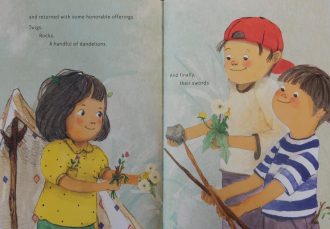
Now it’s their turn to feel snubbed and off they march but return soon after with handfuls of peace offerings.

Then all three work together to create a ‘magnificent castle’ – the perfect place to shelter loyal subjects – noble knights as well as animal friends.

Jacqueline Veissid’s charming story of sibling squabbles and reconciliation pays tribute to the power of the imagination in her softly spoken narrative, while in her digitally worked watercolour and pencil illustrations, Paola Zakimi clearly shows the siblings changing feelings and adds some lovely details of flora and fauna, along with touches of whimsy through the activities of her playful furry creatures.

A debut story for the author; I shall look out for more from her.

Me and My Sister

Me and My Sister
Rose Robbins
Scallyway Press

Readers are not told that the sister referred to in this book’s title is differently abled or has an autism spectrum condition, in this account of the life shared by the narrator and his sibling: it’s left for us to infer through Rose Robbins’ verbal and visual narrative.

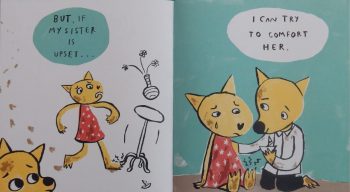
Therein we witness the highs and lows of having a much loved but differently abled younger sister who communicates through sounds and actions rather than words, actions that might be challenging or unsettling although not to understanding older family members.

The siblings attend different schools where the activities are different, although they both do a lot of learning.

There are plenty of fun times, as well as some embarrassing ones especially where strangers are concerned; and it’s frustrating to get chastised for things that aren’t your fault when it seems as though others are getting away with things.

Big bro. reassures us that no matter what, despite their obvious differences he’s an understanding and very loving brother

who is loved back by his little sister.

Told and illustrated with great sensitivity and gentle humour, in no small part because debut author/illustrator Rose Robbins teaches young people who have autism and also has a brother with autism, this is a book that should help foster empathy and understanding to share and talk about in school and at home.
Almost every class I’ve taught has included one or more children with autism and I know that their behaviour can sometimes be challenging; but more importantly, what they need is a loving, stable, structure within which to learn. That is what’s shown in Rose’s story.

(I’m writing this review having spent time today having coffee at Ruskin Mill organic café near where I live. Ruskin Mill is an educational establishment for learners with complex needs; it’s evident from observing those who work with the 16-25 year old students that sensitivity, humour, respect and understanding are part and parcel of their philosophy and approach to everything that happens there.)

Wilderness: Earth’s Amazing Habitats

Wilderness: Earth’s Amazing Habitats
Mia Cassany and Marcos Navarro
Prestel Publishing

This large size book showcases earth’s wildernesses that are the ‘habitats of rare animals and plants’.

Readers are taken to sixteen locations around the world, the planet’s wild regions such as Nioko-Koba National Park in Senegal; Kahuzi-Biéga National Park in the Democratic Republic of Congo; the Qinling Mountains of China; the Sundarban islands (an Indian national park).

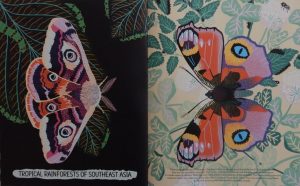
There are forest regions – that of Skihote-Alin National Park in far eastern Russia being a mix of subtropical and taiga and hence contains a mix of animal species not normally found together; the tropical rainforests of Malaysia where it’s estimated that some species are more than 100 million years old – awesome! See how stunning some of its butterfly and moth species are …

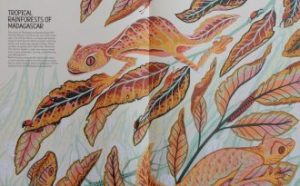
The unique Madagascan tropical rainforests wherein live almost 300 species of frogs and huge numbers of geckos, are sadly we read, under enormous threat from human actions.

Happily however, the Sri Lankan Sinharaja Forest Reserve is unspoilt since it’s almost impenetrable to humans and contains numerous rare and endangered animal species including the long-nosed whip snake and the purple-faced langur.

In addition to several other rainforest locations, we visit Tortuguero National Park on the Costa Rican coast that is a mix of beach, freshwater creeks and lagoons and surrounding rainforest. In complete contrast is the boreal (taiga) forest wilderness of north Canada, Alaska and Russia and is the most northerly of the world’s nature reserves.

Each of the landscapes is stunningly illustrated by Marcos Navarro, making each spread a visual delight before one even starts to explore closely, the fauna and flora depicted; or to read Mia Cassany’s informative paragraph(s) giving geographical and biological facts on the native species.

The final pages home in on some of animals, drawing attention to their characteristics and habits in brief paragraphs of text alongside small, labelled pictures of the featured habitats.

The book’s large format serves to draw readers in to each stopping place, making one want to linger long and explore the beauty of every spread.

A Mouse Called Julian

A Mouse Called Julian
Joe Todd-Stanton
Flying Eye Books

This is the tale of a rather reclusive rodent, one Julian, a mouse who invests a considerable amount of his time dodging other tunnelling animals, avoiding the farmer and her dog, and evading the clutches of the barn owl. So much so that he’s completely unaware of the watchful beady eyes of a fox.

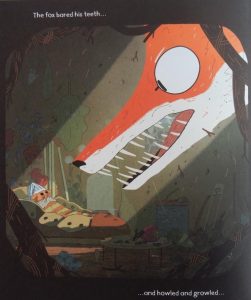
One particular night said fox – a particularly cunning creature – creeps up to Julian’s cosy residence and smashes through the window.

Fortunately for the little mouse however, he’s unable to reach his intended prey and gets himself well and truly stuck.

The wily devil then has the audacity to ask for Julian’s assistance in extricating himself, claiming to be just popping in for a friendly social visit.

Now Julian has no desire to be stuck with this vulpine visitor so he does his best to free the beast; but no amount of pulling and pushing makes any difference, so come dinner time, Julian decides to share his meal and some nocturnal conversation with the intruder. During this time both parties realise things of significance.

The following morning Julian succeeds in releasing the fox who disappears off into the woods once more.

Things go back to normal for Julian until on his ramblings he finds himself confronted by one of his arch enemies.

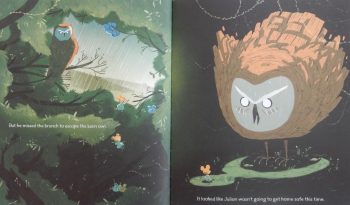
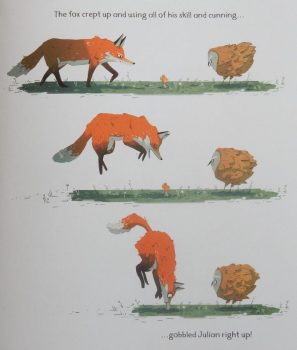
Its eyes aren’t the only pair watching our furry friend though; who should come creeping along but a certain fox and can you believe,  he swallows Julian right in front of the owl.

Is that the end for the little mouse?

Not quite for there’s a surprising twist in the tale of this cracking story, which is best summed up in the words of the fox himself – ‘Wow we ware weven.”

I’ll leave you to work that one out and to relish Joe’s delicious finale when you bag yourself a copy of this enormously satisfying saga. Full of suspense, it’s a veritable visual and verbal feast.

Going To The Volcano

Going To The Volcano
Andy Stanton and Miguel Ordóñez
Hodder Children’s Books

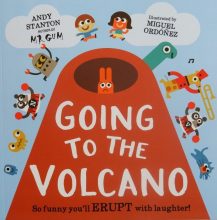
Meet Jane and Dwayne: whether they’re friends or siblings I know not but they’re both heading to the same place to look at the same thing.

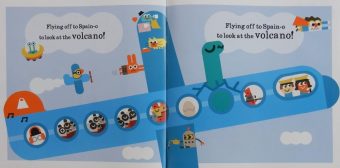
Its location is somewhere in Spain and to get there requires walking (down the lane-o); riding a Great Dane-o; sitting on a train-o; jumping on a plane-o, which flies them to their target country

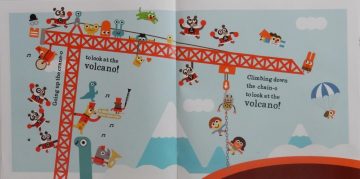
where it happens to be raining. Splashing through it, – the rain-o, climbing up the crane-o and down the chain-o, (fortunately the rain has now stopped)

takes the two, plus the host of other interested parties who have tagged along during the journey, to the rim of the titular volcano.

That however, is not quite the end of this crazy saga for as perhaps the visitors were unaware, but little ones will be eagerly anticipating, said volcano is active and …

It’s easy to be wise after the event but those who value their lives and limbs will do well to heed the advice proffered by those who learned the hard way to STAY OFF THE VOLCANO!

For the full cast of volcano visitors, see the final spread, which in itself is sufficient to make you sputter with laughter – no not lava; despite those lava ‘girls’ lined up thereon, one of whom is called Trevor.

Stupendously silly, but then that is what makes Andy’s rhyming recklessness so riveting, all the more so when coupled with Miguel Ordóñez’ scenes of the comical cast cavorting towards their destination.

The Rescue Princesses: The Amber Necklace / Arlo, Miss Pythia and the Forbidden Box

The Rescue Princesses: The Amber Necklace
Paula Harrison
Nosy Crow

In the 15th and final adventure in the series, it’s up to Zina and her friends to save the tamarind trees of their rainforest home. These trees are the only ones that provide year round food for the lemurs but they’re scheduled to be cut down to make way for the carnival that has been re-routed on account of the usual road being flooded.

Princess Zina is horrified at the prospect; but the princesses must use their intelligence, co-operative skills, kindness and courage to protect the animals and their precious tamarinds.

With their camouflage ninja gear and Zina’s special amber necklace, said by her grandma to hold the heart of the forest it might just be possible to persuade Ando and his workmates to find another path. If not, could the amber jewel works it magic? …

Another exciting tale with short chapters, plenty of line drawings and an exciting and intriguing plot to keep readers turning the pages, this is ideal for new solo readers.

For readers who like longer stories there are two new fiction titles from Maverick Publishing coming soon: one is

Arlo, Miss Pythia and the Forbidden Box
Alice Hemming, illustrated by Mike Garton
Maverick Publishing

4X have become 5P and they’re back with another highly unusual teacher, not from the stone age this time but nevertheless there’s something not quite normal about Miss Pythia.
For a start, she always seems to know exactly what is about to happen; she has a weird-looking symbol tattooed on the back of her neck; she never seems to change her clothes, and there’s that box she keeps on her desk. Mmmm! And could it be sheer co-incidence that she shares her name with a priestess of the Ancient Greek world?

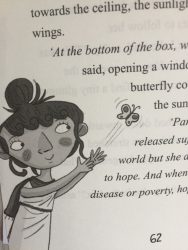
When I taught nursery children we often did an activity called, ‘What’s in the box?’ Singing a little ditty based on those words served to arouse the children’s interest and enthusiasm before the lid was lifted and we investigated its contents. And that is just what Miss Arlo does when she instructs her class that opening the particular box she has in her safe-keeping, is strictly forbidden.

But then 5P are selected to participate in A Play a Day, electing to perform a version of Pandora’s Box and Arlo is chosen to act as director. Can his classmates resist the temptation to open Miss Pythia’s actual box as they rehearse?

What Arlo doesn’t immediately spot as he gets engrossed in his directing role is that the replica box made for the drama has been switched.

Then with the play in full swing a terrible realisation comes upon him …

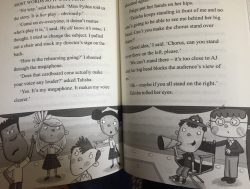
Another winner from Alice Hemming; it’s full of suspense, gently humorous and splendidly complemented by Mike Garton’s lively, expressive drawings, which provide additional details and humour.

Now set fair to become a super series, this story is great for solo reading as well as highly appropriate as a class read aloud especially if the Ancient Greeks are on the agenda.

Rocketmole

Rocketmole
Matt Carr
Scholastic

Armstrong the star-nosed mole finds his subterranean life boring. But Armstrong is an inventive fellow with a thirst for adventure who likes to keep his sights fixed skywards; and to this end (or rather beginning) he builds himself a telescope and some special specs.

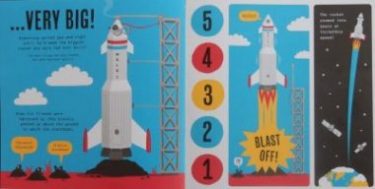
When he announces to his pals that he’s going to visit the moon they’re totally discouraging. Danger is no deterrent to Armstrong though and after a rather bumpy start, our daring mole has built himself an enormous rocket that impresses even the naysayers when they pop their heads up to watch the countdown.

Following an arduous journey with trials and tribulations including tea drinking and loo-going, our space-creature makes his lunar landing, taking ‘one giant leap for a mole!’

The very first lunar-visiting mole is basking in starlit glory.

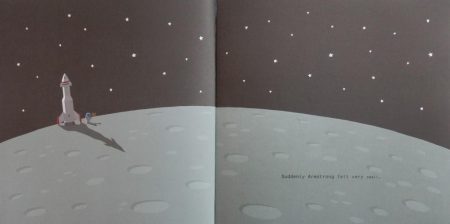
His exaltation though, is short-lived: the moon is, let’s say, boring; it lacks atmosphere.

Dwarfed by the moon’s size, Armstrong feels totally insignificant.

As he sits trying in vain to eat a spot of lunch, he looks earthwards and feels homesick.

There’s just one way to go – back home.

And who should be waiting for him but a welcoming party of his moley pals who have summoned up sufficient courage to come above ground and pay tribute to the inspiring Armstrong.

Over cake and cups of fizz (or maybe juice) their hero announces that he now wants to see the world, but not alone. With newfound daring, his fellow moles agree to accompany him, precipitating a light bulb moment in Armstrong.

Let operation world tour commence …

Out of this world crazy, the entire book is replete with groan-worthy humour though the final tour spread really beats the rest for bonkersness.

Using his characteristic primary colours plus black and white, (don’t miss the front endpapers) Matt’s scenes are a wonderful amalgam of pictures and text, full of puns and spaced-out soppiness that this particular reviewer was absolutely swept away by.

Wide Awake / Creature Features:Dinosaurs

Wide Awake
Rob Biddulph
Harper Collins Children’s Books

This is Rob Biddulph’s third in the Dinosaur Juniors series that’s bound to delight your dino-littles.

The stars of this particular nocturnal show are Winnie – the wide awake one and Otto whom she wakes up to tell she cannot sleep.

Otto once roused has a simple plan in the form of a soothing lullaby and it goes like this:

Easy peasy: job done! Not quite; Winnie is still wide awake, so maybe a memory game that requires recalling everything they did during the day … a doddle surely.

But no; wide eyed she remains.

Third time lucky then? Counting sheep never fails … success! One deeply sleeping twin sister. Shame she snores ….

Hilarious, and delivered in Rob’s faultless rhyming and priceless pictorial style, this is the perfect read-to-your-little-ones tale, be it or be it not bedtime; and you certainly won’t find yourself nodding off as you share it; rather you’ll end up hoarse after repeated re-reads. Bring on the fourth book say I.

And if your dino-tinies can’t get enough of their favourite creatures then try:

Creature Features:Dinosaurs
Natasha Durley
Big Picture Press

This over-sized board book is brimming over with prehistoric beasties of the ‘Humongous horns’ variety, as well as those with ‘Terrifying teeth’, ‘Wonderful wings’, ‘Hefty head crests’, ‘Brilliant beaks’, ‘Amazing armour’,

not to mention ‘Fabulous flippers’, exceedingly long necks, ‘Super sails & spines’, ‘Creepy claws’ and ‘Fantastic fur’.

Illustrated with super-bright colours and splendid shapes, these creatures will make your little ones pause and linger over every spread to learn lots of new names, hone their observation skills and learn some dino-facts along the way.

What Do They Do With All That Poo?

What Do They Do With All That Poo?
Jane Kurtz and Allison Black
Simon & Schuster Children’s Books

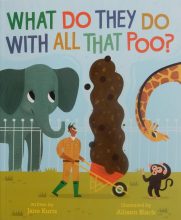
Of zoo books there’s an abundance, but when it comes to talking about the animals’ poo and what happens to it after passing out of the animals, is another matter. A faecal matter one might say and the author Jane Kurtz knows exactly how to grab the attention of young listeners even before the text begins with poo-filled endpapers – don’t miss those.Then, from the start (with a clever page turn) ‘At zoo after zoo / the animals chew. / And then … // they poo!” she holds that attention throughout.

Thereafter she digs into the diverse nature of droppings using rhyming couplets:‘A hippo sprays a shower / with its flipping, flapping tail. // To weigh a day of elephant’s poo, / you need a sturdy scale.’

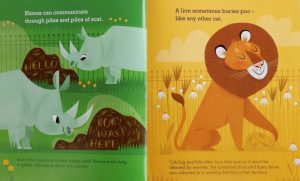
Beneath each illustration in smaller print come further facts concerning the animal’s business: ‘Hippos use dung to mark their territories and warn off predators. They shoot their dung out while flapping their tails to spray it around.’ ‘Rhinos can communicate / through piles and piles of scat. // A lion sometimes buries poo – / like any other cat.’
‘Each rhino’s poo has its own unique smell.’ ‘Rhinos smell dung to gather information about each other.’

Cats big and little often bury their poo so it won’t be detected by enemies. But sometimes lions and tigers leave poo unburied as a warning that this is their territory.’

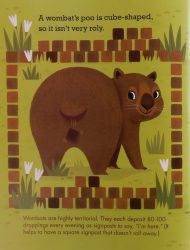
In her playful, scatological scenes Allison Black succeeds in giving each animal a personality with its distinctive shape and wide-open eyes; I love the hippo’s cheeky grin, the snake’s sneaky smile and the wombat’s look of seeming wonder at the shape of its turds.

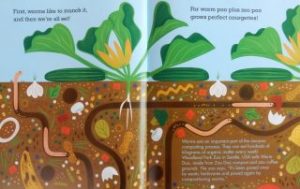
Having discussed a dozen zoo inmates, the author turns her attention to vast quantities of poo deposited each day (possibly as much as 2,270 kg). Much is taken away in lorries to landfills while some goes to scientists and vets for study and gardeners use some for compost:

did you know carnivore poo can be spread around gardens to prevent deer eating the plants and trees?

In addition to concluding the book with a huge grin on their faces, (apart from the squeamish few who might be feeling somewhat nauseous) little ones will end up having ingested a considerable amount of information to inwardly digest, not the least being that elephant poo can be made into attractive paper products – hmm!

Educative and enormous fun; if used in a school context, children might wish to find out what their nearest zoo does about poo.

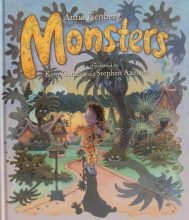
Monsters

Monsters
Anna Fienberg, Kim Gamble and Stephen Axelsen
Allen & Unwin

I was knocked out by this beautiful book that celebrates the power of friendship and its role in finding the courage to overcome fears.

Many young children go through a night-time monster-fearing stage (under the bed or in a cupboard); and so it is with young Tildy. The little girl knows there are monsters; they’re brought in by moonlit, hiding themselves behind the curtains and so Tildy hates moonlight.

Her dad and mum assure her there are no such things, telling her to go to sleep; her aunts and uncles can’t see them so she writes to her cousins – all 23 of them – but she receives only one response telling her not to eat spicy food before bed.

So, Tildy gives up her talk of monsters but sleeps with one eye open, growing increasingly nervous as the sun goes down: nothing it seems can get rid of her fear.

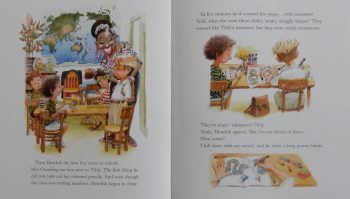
Then a new boy Hendrik joins Tildy’s school. He draws monsters during maths time explaining to Tildy how he deals with them.

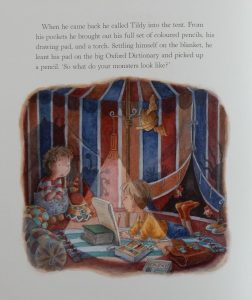
The two become friends and Hendrik invites Tildy to sleep at his house; the plan is to camp in the garden and despite her worries, she agrees, packs her bag including dad’s Oxford Dictionary to hurl at the first monster she sees, and her mum drives her over.

The children have a great time together but as the shadows engulf the afternoon sun, Tildy’s fears reawaken.

Can her friend help her to make the impending dark feel like a safe place so that they can spend that night together

and watch the moon sail like a ship across the starry sky?

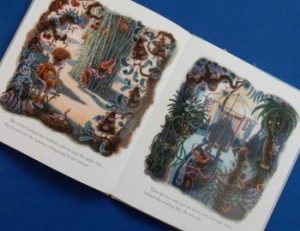
Open to many interpretations, this book is superb in every way. Anna Fienberg’s prose narrative is brilliantly expressed and the illustrations both wonderfully whimsical and detailed. It was Kim Gamble’s final book (she died in 2016) with Anna, and her great friend, illustrator Stephen Axelsen took over after she died, helping to bring the project to fruition and to make this special book a celebration of her work.

An absolutely smashing book to share, especially with youngsters who themselves are challenged by and endeavouring to work with, their own fears.

Definitely one to add to a family collection or the class bookshelves.

Odd Science: Incredible Creatures

Odd Science: Incredible Creatures
James Olstein
Pavilion Children’s Books

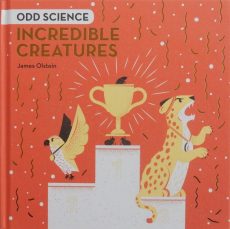
Science is cool, it’s exciting, and creatures are endlessly fascinating, as this book demonstrates. It’s full of wacky and funky facts on beasties large and small from minute bugs to massive creatures of the deep, presented in an accessible manner by James Olstein.

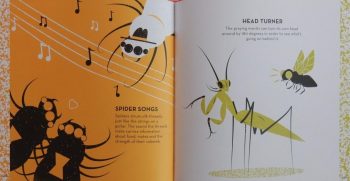
So prepare to be fascinated by the likes of the praying mantis, which can turn its head around by 180 degrees to see what’s happening behind – particularly useful should they want to be teachers –

or the fact that in Tokyo, pigeons have been trained by scientists to distinguish between the works of Monet and Picasso; now why would they want to do that?

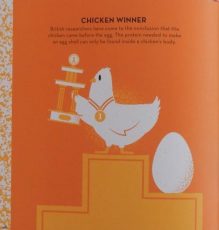
You might wish to know the answer to the time old ‘chicken or egg, which came first?’ question: the answer from some British scientists is revealed herein.

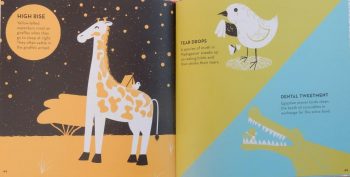
I was fascinated to discover that although sloths hang around in trees most of the time, they come down once a week for a poo; also, that yellow-billed oxpeckers roost on giraffes when they go to sleep at night often settling in the giraffe’s ‘armpit’.

Did you know that Egyptian plovers clean crocodiles’ teeth in exchange for some extra food? Risky!

The information is presented in sections such as dinosaurs, whales, octopods, cats, stripes, tongues, defences and so on.

Olstein’s retro-style, quirky pictures bring further funkiness to his array of facts.

This is ideal for dipping in and out of, though readers who find it hard to become engrossed in a book might just find themselves so doing in Incredible Creatures.

When the Stars Come Out

When the Stars Come Out
Nicola Edwards and Lucy Cartwright
360 Degrees

With the coming of darkness, everything looks different, everything feels different: night is mysterious, night is magical.

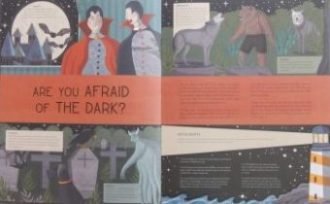
Find out what makes it so in When the Stars Come Out.Into this book the author has packed illuminating information explaining first how night works due to the constant orbiting of the sun by planet Earth, and then putting mankind’s desire to understand the night into a historical context that can be traced right back as far as the Bronze Age.

Thereafter comes an upward-looking section called The Sky at Night. This encompasses topics such as being scared (or not) of the dark and things associated with it;

some facts about the Moon – its cycle, Armstrong’s moon landing and more. Did you know that the largest stars burn for tens of millions of years before running out of energy whereas medium-sized ones including our sun can continue burning for 10 billion years. WOW!

Moving our sights down somewhat, The Earth at Night homes in on different environments – the city, the desert, the Amazonian rainforest, the mountains,

the African savannah where should you happen to visit and listen very carefully, you might just hear the squeaks of yellow-winged bats, the slithering scraping of rock pythons or even the defensive growls of aardwolves. The woodland and the ocean also have spreads allocated.

The next focus is on what animals get up to at night – how are they adapted? Did you know that there are creatures that can sleep on the move, for instance the Swainson’s thrush which power naps frequently, and the albatross? We’ve all heard of sleepwalking but sleep-flying –awesome!

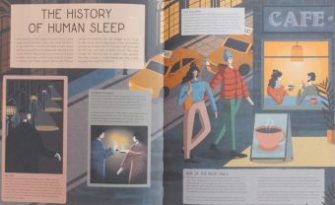
Although many humans spend the night (or most nights) in sleep, or attempted sleep, the length of this depends upon where on the globe you happen to be at a particular time of year; or perhaps whether you are attending an occasional night celebration such as New Year’s Eve.

Like all living creatures, we humans have a body clock, though ours with five sleep cycles, is far more sophisticated that say plankton. I was interested to learn that there is no word for insomnia in the languages of the non-industrial societies – the Hadza people of Tanzania, the San people of Namibia and the Tsimane people of Bolivia whose general pattern of sleep is from three and a half hours after sunset to just before sunrise, with no daytime naps.

Nowadays, those of us living in the Western world tend to choose a single overnight sleep, although some who help keep the night-time economy afloat such as bakers, as well as for instance hospital staff, carers and the police work in shifts and sleep during the day.

Nicola Edwards’ fascinating and wide-ranging interpretation of night is well served by Lucy Cartwright’s enthralling, richly detailed illustrations.

A book to keep readers awake at night should they start exploring it late in the day.

The Lost Book

The Lost Book
Margarita Surnaite
Andersen Press

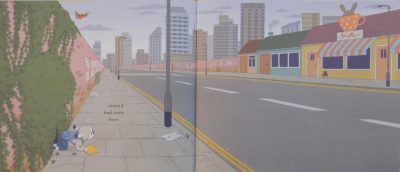
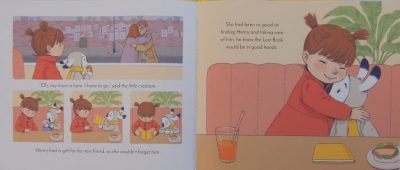
Of all the rabbits in Rabbit Town Henry is the only one who isn’t a book enthusiast; he much prefers real life adventures. Then one day when he discovers a book in the hedgerow, he finds himself drawn into an adventure of his very own, not in Rabbit world but in the world of humans.

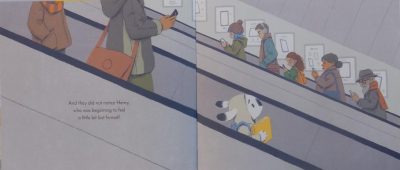
He sets off to try and find the owner of the Lost Book and is puzzled to find that those he encounters have no interest in books, they’re all absorbed in their mobiles and seemingly oblivious to everything around them.

Feeling rather lost and beginning to lose hope, Henry starts reading the Lost Book and then an encounter takes place with a little girl. Getting lost isn’t so bad after all for, by the end of the afternoon a new friendship has been formed.

So much fun does Henry have with his friend that he forgets about his mission until the little girl’s mum appears and it’s time for her to go.

What better parting thank you gift could he give to make sure his new friend doesn’t forget him than the Lost Book?

Back home in Rabbit Town that evening Henry’s family greet him in relief and come night-time, a certain little rabbit tells his first ever bedtime story.

An enchanting meta-fictive tale with a meta-fictive poser in its tail that little ones may or may not wish to consider. Doubtless though they’ll become absorbed in Margarita Surnaite’s debut picture book with its techno-saturated visuals be they double page scenes, comic strip sequences or a combination of both full page and vignette strips that on occasion reminded me of   Edward Hopper’s work.

Arty! The First Artist in Space

Arty! The First Artist in Space
William Bee
Pavilion Children’s Books

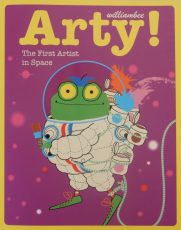
I fell for Arty Farty when I met him in his acrobatic efforts to become The Greatest Artist in the World so was over the moon to receive his new space adventure to review.

Can you believe that our amphibious artist friend is set to become the world’s very first artist in space for you see, NASA – I’m surmising that’s who they are -have tried unsuccessfully, year after year, to recruit a famous artist to go into space.

Thus far all they’ve received is a series of negative responses,(we’re shown a priceless gallery of naysayers)  so it’s really no surprise to learn that they send a bunch of scientists to Paris with an invitation to zoom off in a rocket bound for the depths of the cosmos. You won’t be surprised either if you’ve previously encountered his agent, Mr Grimaldi, that it’s he who consents to this vacation in the void, (it’s a great PR stunt) but Arty who must make the voyage.

First though, comes a rather rigorous training regime,

after which inevitably, our Arty Farty friend ends up flat on his back, and no, it’s not in surprise at having passed the tests with flying colours, although he has.

Thereafter the entire stomach swirling set of tests is repeated with Arty clad in his splendid art-supply stocked spacesuit. Then following one more lie down, off he shoots into space in a rocket.

Emulating Buzz Aldrin, his first stop is the Moon, which is really the most uninspiring place for a creative creature like Arty to land up on. What is there to paint? NADA, thinks the new arrival; but then comes a lunar moment DING! Out comes the painting gear and it’s project space transformation.

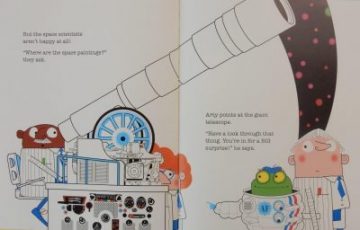
Are the space scientists happy on Arty’s return – what do you think? Maybe not but somebody else is …

Totally pricelessly hilarious from start to finish, this book is a blast; it’s absolutely guaranteed to make you giggle till your guts hurt as you follow one frog where no artist has gone before but where, courtesy of William Bee, readers will surely go – over and over.

Joseph’s Cradle

Joseph’s Cradle
Jude Daly
Otter-Barry Books

I’ve admired the work of both Jude and Niki Daly for many a long year and so was thrilled to see this, Jude Daly’s new picture book.

At the heart of a village in Africa stands an enormous, ancient tree. It’s loved by all the villagers, particularly Joseph who had climbed to its very top as a boy. Now Joseph is a grown man and one stormy night, his favourite tree is blown down.

Joseph feels sad that his soon to be born baby will never be able to climb the tree but he saves a piece of its trunk and little by little fashions it into a beautiful cradle. He also plants a new young tree to replace the old one.
When the new baby, Sisi, is born, Joseph is thrilled and every night until she outgrows it, he and his wife Mandisa sit beside the cradle singing the baby an African lullaby.

Thereafter a tradition begins: every new baby would sleep in Joseph’s cradle until they outgrew it and Joseph would add its name to those carved into the cradle’s side.

When the time comes for SIsi’s own grandchild to be rocked in the cradle, disaster strikes: a fire rages across the veld towards the village destroying Joseph and Mandisa’s home and everything in it.

The villagers build a new home for Joseph and his wife but what of the cradle; is it forever gone?

Let’s just say that Joseph isn’t the only person dancing in joyful thanks that day …

Inspired by a true story set in Australia, Jude Daly has set her telling in South Africa, home to the aptly called Cradle of Humankind, one of eight South African World Heritage Sites. It’s both moving and a reminder of the importance of continuity and renewal.

The painterly illustrations are a fine portrayal of the life of a village over several generations.

The Green Giant

The Green Giant
Katie Cottle
Pavilion Children’s Books

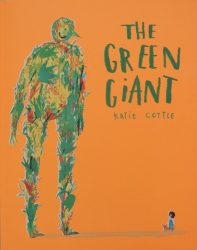
The natural world and our part in conserving it has never been more in the media than now with children marching for the environment and against climate change; in tandem there’s been a burgeoning of conservation/environment non-fiction books recently. Less so of fictional ones, so it’s especially good to see Katie Cottle’s debut picture book.

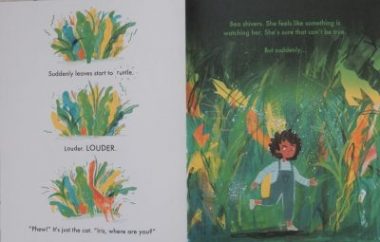
Bea is a little girl who goes to visit her garden-loving Grandad in the country; Bea when we first meet her, seems wedded to her tablet while her Dalmatian, Iris likes nothing better than chasing things.

When Iris gives chase to a ginger moggy, Bea sets aside her tablet and follows her dog, over the fence and into the garden next door.

The greenhouse she finds there is full of plants. From the rustling leaves leaps the cat but could something else be watching the girl, casting an enormous shadow over her?

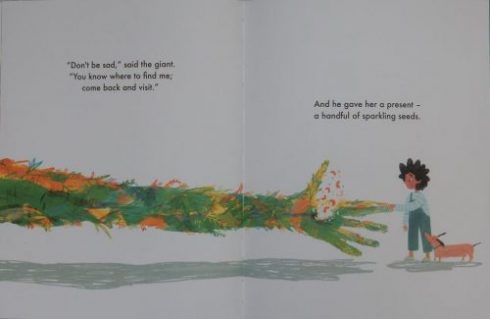
Before her stands a huge green giant, friendly seeming and with a story he wants to share. Bea learns that long ago back in the city he germinated becoming a happy seedling but then as the city air became increasingly toxic, he was forced to flee, eventually finding refuge in the roomy greenhouse wherein he now stays.

It’s a happy summer Bea spends with her green friends but all too soon, the holiday draws to an end.

The giant gives his human friend a parting gift – handful of seeds.

Back in the city once more, Bea is struck by its greyness and she knows just what to do.

Thus with the help of sunlight and water, operation transformation begins to take place … Perhaps it might one day be a place which her giant friend would be happy to visit.

The disconnect with the natural world that has come about in part due to the digital gadget obsession of many youngsters is cleverly understated, while the importance of caring for our precious natural environment comes through more urgently in Katie’s eco-story. There are definite links between them and it’s up to us as educators/parents to set a positive example to youngsters before it’s too late.

A book to share, discuss and act upon at home and in school.

The Lost Book of Adventure

The Lost Book of Adventure
edited by Teddy Keen
Frances Lincoln Children’s Books

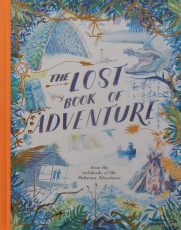
Those with a thirst for wild adventures in particular will be immediately attracted to this stupendous tome. Others of us will perhaps take a little more time to be enticed in, but will likely become equally immersed in this amazing collection of notes, sketches and factual snippets that have been drawn, so we’re told by the editor, from the notebooks of the Unknown Adventurer.

Whether or not the claim by Teddy Keen to have discovered these items in a metal container while exploring a remote part of the Amazon, is a beguiling means of interesting readers in the book, or a fact, is immaterial.

What he has produced is a veritable treasure trove detailing all you need to know to flourish living in the wild, be it how to construct a wikiup shelter like those of the Nenet people of Arctic Siberia;

how to make a bottle raft to navigate ancient waterways; or, what the best techniques are for ‘pooing in the great outdoors;

or crucially important, first aid.

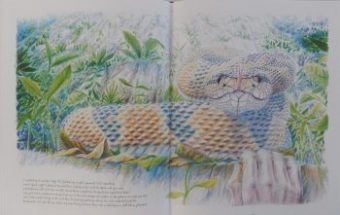
Prepare to be conveyed to various parts of the globe as you read lyrical accounts of such adventures as a narrow escape from the jaws of a crocodile in Sri Lanka, surviving a roaring dust storm, or an eye-ball to eye-ball encounter with one of the planet’s most dangerous snakes, a venomous bushmaster. Each of these is gloriously illustrated in a coloured pencil drawing.

Keen certainly succeeded in arousing the spirit of adventure in this reviewer; I’m sure that will be the case for many readers of this totally immersive volume.

A Friend for Henry

A Friend for Henry
Jenn Bailey and Mika Song
Chronicle Books

Softly spoken though this story is, its impact is powerful. It tells of Henry’s search for a friend among his classmates. Henry has autism, something we’re never told although we’re shown it’s so through his behaviour and his thoughts.

To Henry, Vivianne is ‘a kaleidoscope, a tangle of colours; Samuel ‘a thunderstorm, booming and crashing.’ Later he’s unable to cope with Samuel’s flight of fancy when he grabs one of the tiles Henry has taken such care to arrange, (‘All the edges met and the corners fit perfectly’) describing it as ‘a magic … from a genie’s lamp: “It’s not! It’s from Rug World” the literal-minded Henry insists pointing out the identifying sticker. Now the little lad seems as though he’s getting close to a melt down.

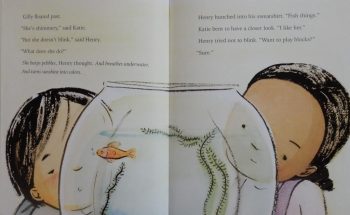
Later on though, Katie joins him as he stands watching the class goldfish in her bowl. Henry considers her, they speak

and then the two go off to play together, first with the blocks …and then outside where Henry waits in eager anticipation for his new friend till she reaches the bottom of the Big Slide.

That Jenn Bailey writes with such sensitivity and understanding is due in no small way to the fact that, as we learn from the book’s cover, one of her son’s has autism. This narrative really does ring true as those of us who have taught differently abled children will appreciate; it feels as though she’s standing behind Henry’s head as she tells her story, while at the same time leaving space for readers’ own interpretations And I really like that there are no labels.

Mika Song’s ink and watercolours illustrations capture Henry and his classmates with grace and economy of line, imbuing each character with a real identity, different feelings and predilections.

An empathetic look at the emotions of finding a friend from a child’s viewpoint whether or not s/he has autism.

From Tiny Seeds … / A Walk Through Nature

From Tiny Seeds …
Émilie Vast
Thames & Hudson

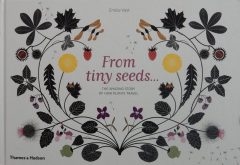
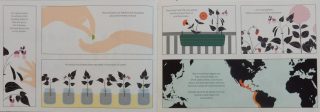
Seed dispersal mechanisms and subsequent growth are showcased in Émilie Vast’s series of predominantly visual stories of how plants travel.

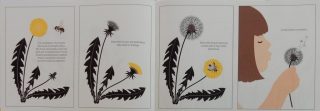
Ten different methods are documented, each story being allocated several pages. Some such as flying, that is used by the dandelion (and other composites) will be familiar to many children, since they love to play dandelion clocks.

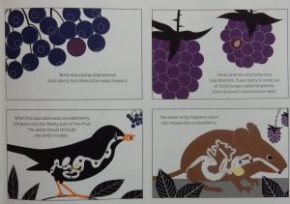
In contrast, other methods like ‘Being eaten’ as happens to berries including blackberries and elderberries, will be less well known. The berries are food for birds or animals and are passed through the eater’s digestive system.

and excreted partially digested in their droppings, which then nourish the excreted seeds once they’re ready to germinate.

I particularly like her device whereby the respective plants introduce themselves and go on to tell their own stories.

It’s good to see how the important role of humans in distributing seeds to various different parts of the world is documented. Did you know that the green bean was originally only found in Central and South America but now grows all over the world.

Émilie’s love of nature is evident from her beautiful, stylised illustrations for which she uses predominantly black and white with limited bursts of colour on each page.

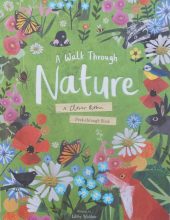
A Walk Through Nature
Clover Robin and Libby Walden
Caterpillar Books

What is this life if, full of care,
We have no time to stand and stare –

So begins W.H.Davies’ famous poem Leisure. Perhaps with these opening lines in mind, as well as concern over the 2015 revelation of some 50 words relating to nature and the countryside, that are no longer included in the Oxford Junior Dictionary, the creators of this book aim to increase young children’s engagement with, and understanding of, the natural world.

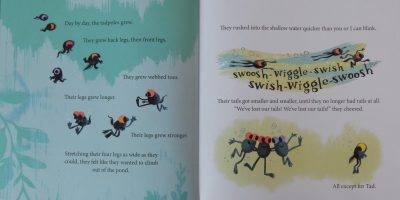
The walk takes us through the seasons in addition to a variety of natural landscapes and habitats. We visit a meadow; a tree wherein birds are nesting; a pond with tadpoles, ducks and fishes swimming and water lilies and bulrushes growing.

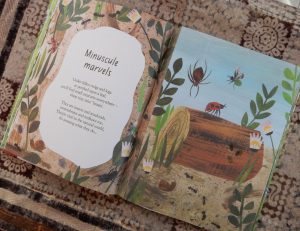
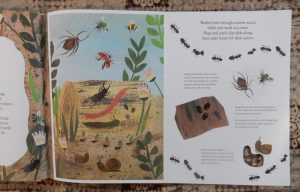
We home in on minibeasts as they move over, under and sometimes through, an ancient log of wood;

and wander on the sandy beach in the early morning sun noticing the multitude of shells and crabs.

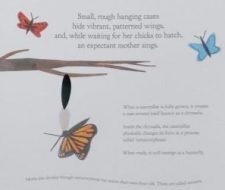
We’re shown seemingly magical changes – the hatching of a blue tit’s eggs, the emergence of a butterfly from its chrysalis,

and in the woods and fields, delve down beneath the earth where burrowing animals live.

We witness the gradual change from summer’s greens to autumnal hues; visit a mountainous region where a fresh spring begins its flow to the sea; and follow the migrating swallows as they depart for warmer climes.

Then back to what looks like the original meadow, snow falls transforming the landscape in ‘winter’s frosted cloak, sparkling, clear and bright.’

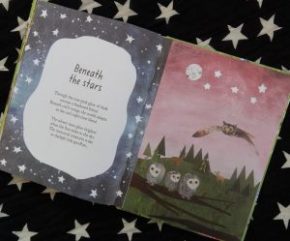
Finally as dusk spreads its rosy glow, day and night merge into one …

For each stopping place comprising a double spread with a gatefold perforated by small die-cuts, there’s an introductory poem by Libby, the final verse of which is revealed by opening the flap, beneath which are also small vignettes and accompanying factual snippets.

Clover’s collage style illustrations are gorgeous; each one merits spending time over and I really like the way the poems are each framed by a naturalistic collage that uses elements from the full page illustration.

Let’s hope that this ‘ Peek-through’, ‘first book of nature’ paves the way for youngsters to begin a life-long habit of going outdoors, walking and observing the beauties of the natural world.

The Go-Away Bird

The Go-Away Bird
Julia Donaldson and Catherine Rayner
Macmillan Children’s Books

The Go-Away-bird is a real African species (so named after its call that sounds as though it’s warning others when it sees danger).

Julia Donaldson makes her bird a loner that drives away potential friends, although apparently go-away birds can sometimes be found in groups of as many as thirty. So let’s meet the story one right away.

‘The Go-Away bird sat up in her nest, / With her fine grey wings and her fine grey crest.’

Thus begins this story wherein one after another the Chit-Chat bird, the Peck- Peck bird, the Flip-Flap bird approach her tree wanting to talk, share a meal or fly with her and each is insulted and given the same “Go away! Go away! Go away!” rejection.

Then along comes the very large and dangerous Get-You bird with just one thing in mind – a tasty meal. Oh no!

Luckily for the Go-away bird along comes a Come-back bird willing to stick his beak out and summon his friends.

Now it looks as though it’s time for the naysayer to understand the need for, and appreciate, friendship after all.

This is a stellar author/artist partnership. Julia’s witty, bouncy rhyming text is pure pleasure to read aloud and highly join-in-able; and Catherine’s art is simply awesome – richly coloured and textured, superbly expressive: every spread is a joy to linger over – after you’ve read the story aloud once first.

A golden tale about the importance of friendship, co-operation and teamwork that is just perfect for sharing and discussing.

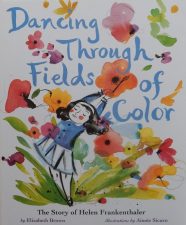
Dancing Through Fields of Colour

Dancing Through Fields of Colour
Elizabeth Brown and Aimée Sicuro
Abrams Books for Young Readers

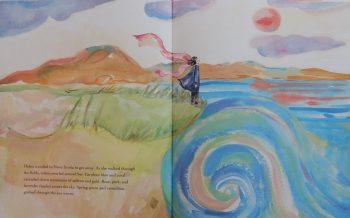
Right from its opening page whereon we learn that the young Helen Frankenthaler was a rule breaker, I knew I was going to love this book.

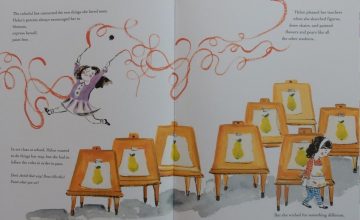
Helen’s parents encouraged her divergence, especially her artistic tendency towards abstraction, while her school art class in contrast, laid down strict rules which had to be followed in order to pass.

After the death of her beloved father, Helen went through a dark period, unable to put anything on canvas until eventually her memories of the colours and warmth of her father’s hand on country walks had a healing effect and she begun painting once more.

Towing the professor’s line, she passed through college and returned to New York where she encountered the work of abstract expressionist Jackson Pollock,

Helen started to travel further afield and eventually, inspired by the shapes and colours of the countryside,

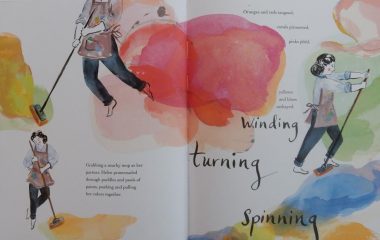
and led by emotions that fuelled her artistic decisions, she found her own path, – ‘Colors jetéd across the painting, merged and connected, like rivers into oceans’ – becoming with her soak-stain technique, a leading artist of the Abstract Expressionist movement of the 1950s

and playing a vital role in the evolution of Colour Field Painting; (these details we learn in the detailed notes in the pages that follow the story).

Elizabeth Brown’s text describing the artist’s processes is itself poetic, while Aimée Sicuro’s watercolour, ink and charcoal pencil illustrations are absolutely gorgeous.

Through words and pictures, readers really share Helen’s emotions and creative journey and sharing the book in a classroom will surely inspire listeners to experiment with their own creativity be that with paint, dance or even perhaps another medium.

The Wolves Who Came for Dinner / The Lamb Who Came for Dinner

The Wolves Who Came for Dinner
Steve Smallman and Joëlle Dreidemy
Little Tiger

Wolf and Hotpot (who nearly became Wolf’s dinner in a previous story) are now the best of pals much to the puzzlement of the other forest animals.

So when Wolf invites all the bunnies for a playdate and subsequently spends the morning cooking carrot cakes, his greeting of “Teatime!’ has the bunnies fleeing for, so they think, their lives. Poor Wolf is downcast. Hotpot assures Wolf of his goodness and in return Wolf suggests going out to find and play with the bunnies in the forest.

Things don’t go well in the hide-and-seek game; the terrified bunnies make a bolt for it.

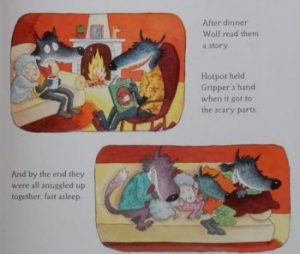
Wolf decides to invite his lupine pals to meet Hotpot instead; but when they turn up Gripper, Nipper and Growler have ominously grumbly tums. Wolf however serves up a yummy vegetable soup after which they settle down for a story followed by a snuggly sleep.

Nevertheless the other forest creatures remain convinced Wolf’s friendship with Hotpot is a sham and things turn very soggy for good old Wolf.

Back home, who should be waiting for the two friends but Gripper, Nipper and Growler requesting another story and a sleepover.

So bothered about Hotpot’s fate are the other woodland animals that they stage a further rescue attempt, charging in on the slumberers.

Initially the other wolves are reluctant to drop their stereotypes, offering to consume some of the intruders; but Hotpot stands up for her best pal and all ends satisfactorily like all good stories – and I definitely count this one among them, -with the whole cast of characters living ‘happily ever after.”

Steve’s toothsome tale is a great one for challenging stereotypes and showing that it’s wrong to prejudge others, while simultaneously gently advocating a plant-derived diet. And as someone who eschews animal and dairy products I’m all for this.

Joëlle Dreidemy’s characters are splendidly rendered in her hilarious scenes of the woodland animals as they gradually come to terms with, and overcome, their prejudiced assumptions.

The Lamb Who Came for Dinner
Steve Smallman and Joëlle Dreidemy
Little Tiger

A dozen or so years ago I reviewed in BKF, this story of love and vegetarianism triumphing over Wolf’s inherent carnivorous instincts. I loved it then and do so now with Steve’s super characterisation, deliciously funny text and Joëlle Dreidemy’s droll illustrations.

Now with an accompanying audio CD, a new generation of listeners will relish seeing and hearing of what appears to be a thoroughly menacing Wolf’s first encounter with a freezing cold lamb that comes a-knocking on his door seeking shelter from the elements.

Board Book Extravaganza

Cat & Mouse
Britta Teckentrup
Prestel Publishing
There’s a surprise ending in store for listeners to this rhyming tale of a cat and mouse chase.

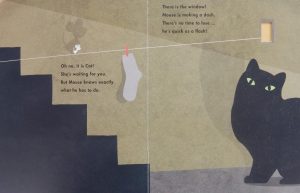
That though is getting ahead of the tale that begins with a warning to Little Mouse to hide inside the blue house. Through the door goes Little Mouse but the door is open wide so another furry creature enters too.
A chase ensues with Mouse running round and round eventually diving down a hole leaving the moggy pondering momentarily on his whereabouts and the little rodent in boastful mood.

Not for long however for the mouse soon exits the hole and the chase is on again.

A clever manoeuvre on Mouse’s part sees him outside under the moonlight without a hint of a cat. Not for long though for Mouse is being trailed around and about and back to the house that both creatures enter. But is all as it first appeared?

With its strategically placed die-cuts, minimalist illustrations and playful narrative this board book will amuse little ones who watch the lively events as they unfold towards the unexpected finale.

Hug Me Little Bear
Chronicle Books
Here’s a very cute little finger puppet book that, courtesy of a thoroughly endearing parent bear, little ones find out what arms can do. There’s a favourite song to dance together to; a gentle game of lift and catch; scrummy breakfast treats to cook up; a tummy tickle and best of all lots of ‘I love you’ hugs.

Full of sweetness and bound to bring on big smiles is this cuddlesome offering.

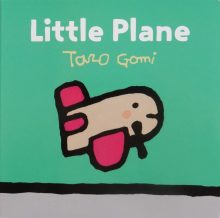
Little Plane
Taro Gomi
Chronicle Books
It’s take off time for Little Plane. He zooms skywards for an adventure one beautiful day. However his playful flight suddenly encounters some turbulence courtesy of the smoke pouring from the factory chimneys to which he gets a tad too close.
His landing attempts as he skims and tries to stop atop a tree and whizzes into a very muddy mountain aren’t a great success; and then it looks as though our intrepid friend is about to become engulfed within the huge open mouth of a building.

All ends happily though as Little Plane emerges safely, ready to fly off back home, looking even more shiny-bright than when he began his adventure. (A plane-wash perhaps?)

Little Plane is, like most little humans, learning by experience to cope with the ups and downs of life, and showing resilience in so doing.

Goodnight, Goodnight, Construction Site: Bulldozer’s Shapes
Sherri Duskey and Ethan Long
Chronicle Books

Get ready to shape up along with your little ones and their favourite construction vehicles, in particular big Bulldozer. Aided and abetted by Crane Truck he prepares the site for building. Along the way he shifts the rubble forming first a squiggle, then a ‘triangle’ (strictly speaking though it’s a cone), a circle, a diamond, a rectangle (kind of! But it’s more of a cuboid), a star, an oval and he finishes by squaring the plot off, nice and flat.

With Sherri Duskey’s rhyming couplets and Ethan Long’s digital art this little book will appeal to the many established fans of the series. I’d suggest reading it along with some small world construction toys and a set of both 2D and 3D shapes.

Pigs in a Blanket
Hans Wilhelm and Erica Salcedo
Chronicle Books

Before you  even open up the first page, you’ll be captivated by this charmer with the porcine trio fast asleep tucked cosily beneath the wrap-around blanket that stays in place courtesy of the strategically placed hidden magnet on the front cover.

We then follow the pigs as they wake up, playfully get dressed and style their hair before setting out for a run. The three also attend a ballet class, do a spot of baking, revel in some puddle jumping followed by a warm-up treat.

Goodness they do pack a lot into their day, as there’s still time for some theatrical fun before their bath, tooth-brushing and final clambering back into bed in their moonlit room.

Wilhem’s rhyming text coupled with Salcedo’s comical, energetic piggy scenes make for a fun-filled book that celebrates the simple delights of early childhood and is ideal for sharing with the very young, who are likely to recognise the piggies’ actions as akin to their own.

Builders & Breakers / A Bare Bear / In A Minute

Here are some picture books suggestions for your early years book collection:

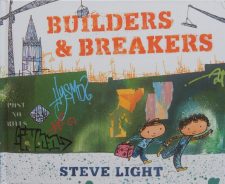
Builders & Breakers
Steve Light
Walker Books

Two small children, whose father has left behind his lunch box, are sent by their mum to give it to him. They run to his place of work, an urban construction site.

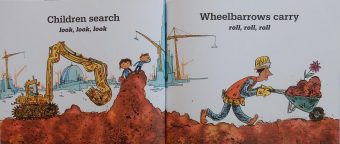
There they see the employees hard at work banging and jackhammering, digging

and welding, operating cranes and pushing wheelbarrows. – the entire structure creating process no less.

So noisy is the site and so intent on his work is their dad, that it takes a while for the children to attract his attention amid the bangs, rat-a-tat-tat-tats

and sparks, but eventually they do.

And then (sans hard hats), they’re hauled up to join him for a well-earned break perched precariously on a horizontal construction beam.

With its onomatopoeia, alliteration and other wordplay, Light’s minimal text is perfect for little ones to join in with during a storytime, and for beginning readers to try for themselves. No matter which, they’ll absolutely love Steve Light’s scribbly-seeming, intricately detailed scenes of the construction workers and the impressive machines they operate.

Don’t miss the endpapers or the author’s final note wherein he talks of his fascination with and love of, classical, Gothic and art deco architectural styles.

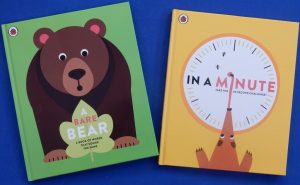
A Bare Bear
Caz Hildebrand and Ashlea O’Neill
In A Minute
Clare Lowther and Ashlea O’Neill
Ladybird Books

Subtitled ‘A book of words that sound the same’, A Bare Bear will certainly transmit the ‘language is fun’ message to little ones as well as demonstrating to adults the importance of word and language play in young children’s development.
It contains bright, attractive, humorous spreads depicting examples of homonyms

or homophones.

With the book’s contemporary feel and subtle language lessons, young children will have a good laugh at the same time as being gently educated into the delights and vagaries of the English language.

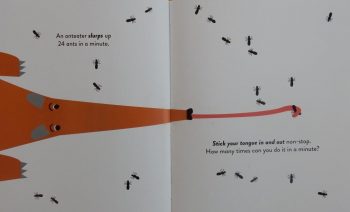
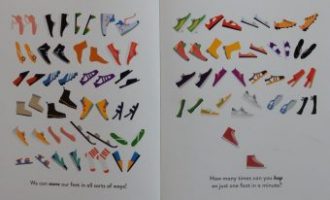
In a Minute invites readers/listeners to ‘Take the 60-second challenge!’ as it first makes a statement and then issues a related challenge on the opposite side of the spread.

Have lots of fun joining your early years children in such inviting activities as a minute’s competitive sticking your tongue out and in

or hopping on one foot.

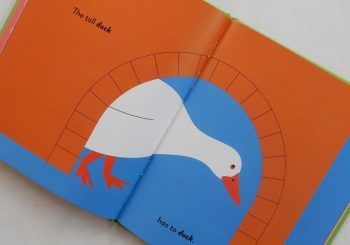
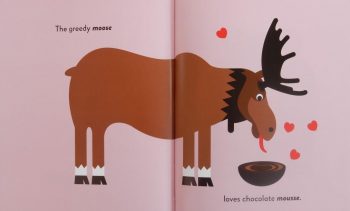
Great attention has been paid to the design of each spread: I particularly like the one of two woodpeckers attacking opposite sides of a tree trunk, that of the star-jumping girl and … actually, they’re all immediately arresting and invite longer engagement.

Get counting, get active – what are you waiting for?

Scratch and Learn: Human Body / The Great Big Book of Life

Scratch and Learn: Human Body
Katy Flint and Ana Seixas
Wide Eyed Editions

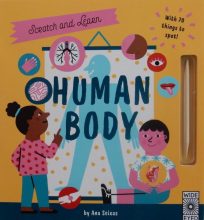
I’ve loved some of the EtchArt books from Quarto but this is the first science title I’ve seen, essentially an introduction to how the human body works.

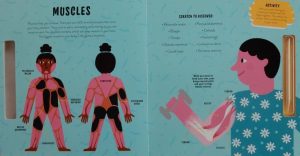
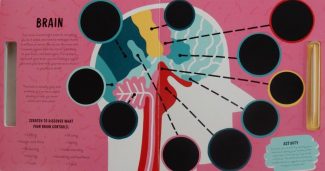
It comprises two main elements: ‘Scratch to Discover’ where the reader uses the stylus to find ten things on each of the seven spreads: the skeleton, muscles,

organs, eating and digestion, the senses, the brain

and, lungs and heart.

Then there are activities – one per spread – to demonstrate how different parts of the body function. For example the muscle-related one says, ‘With your palm facing up, touch your thumb and little finger together. This shows one of your flexor tendons working in your wrist.’

There’s also an invitation to play a search-and-find memory game.

Each topic has an introductory paragraph and some also include additional bite-size snippets of information.

Spencer investigating the skeleton

Graphic designer/illustrator Ana Seixas brings a gentle humour to the pages of this fun, interactive book to use at home that is relevant to the KS1 science curriculum.

The Great Big Book of Life
Mary Hoffman and Ros Asquith
Frances Lincoln Children’s Books

The 6th in The Great Big Book of … series looks at life from conception and birth to death and memories.

The early years are allocated several spreads – infant physical development,

sleep, feeding, staying healthy, learning to use the loo and how language develops.

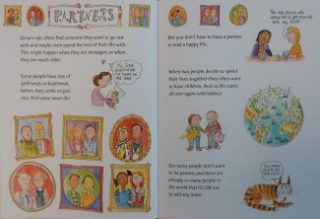
Subsequent topics are school (including home schooling), the teenage years, work, partners,

the middle years, old age, death and finally a spread advocating living life to the full no matter who we are, which includes thinking of other people as well as ourselves.

As in previous team Hoffman and Asquith titles, diversity is a key element. Mary’s light-hearted narrative style combined with Ros’s wonderfully witty illustrations make for an informal and explicit read.

A book to add to your home or school collection.

Everybunny Dream! / Hop Little Bunnies / This is Owl / Sleep, My Bunny

Everybunny Dream!
Ellie Sandall
Hodder Children’s Books

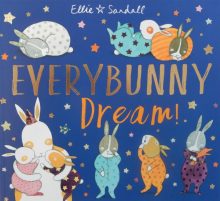
Ellie Sandall’s latest Everybunny tale is essentially a bedtime story.

Through a gentle rhyming narrative and a sequence of captivating scenes, some frolicsome, others more peaceful, we share in the bedtime ritual of the little bunnies as they respond to their mother’s instructions,

until they’re tucked up cosily under the covers.

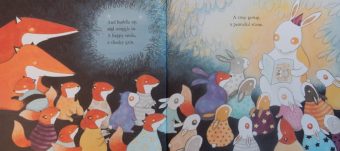
Who should appear suddenly though but another creature with a long orange bushy tail, also clad in night attire.

Before long there’s a host of baby fox cubs sitting with the little bunnies – who have now all hopped out of bed – avidly listening to a good night tale

and then it really is time to snuggle down altogether for some shut-eye and perhaps some pleasant dreams.

A lovely way to send your little ones off into the land of nod at the end of a busy day.

Hop Little Bunnies
Martha Mumford and Laura Hughes
Bloomsbury Children’s Books

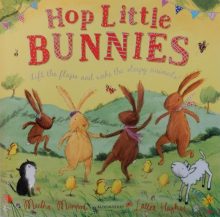
Based on nursery favourite Sleeping Bunnies, Martha Mumford has written a jaunty text that includes not only the bunnies of the original song but also fluffy lambs, tiny chicks, kittens and ducklings

all of which sleep until noon and wake up and make lots of noise.

They then go on to play for the rest of the day before a bedtime song sends them all off to sleep once more.

With plenty of flaps to investigate and sounds to make, Laura Hughes charming rural illustrations add to the springtime bounce of Martha’s words.

This cheery charmer is likely to become a much requested book for young listeners be that at home or in an early years setting.

After an initial sharing I’d suggest an action packed story session with sleeping, hopping, leaping and swimming, not forgetting baa-ing, cheeping, mewing and quacking.

Another book that invites interaction is:

This is Owl
Libby Walden and Jacqui Lee
Caterpillar Books
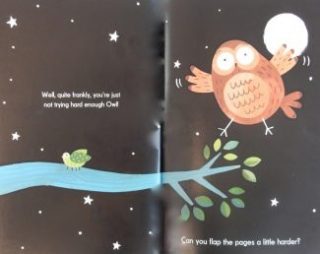
The sun is shining, Owl is fast asleep and doesn’t want to wake up but the book has to start so the reader’s help is needed to rouse our feathered friend.

Tummy tickling is only partially successful so the sun needs to be extinguished and replaced by a moon.

Hurrah Owl now has both eyes open but Beetle further along the branch is causing a distraction.

A considerable amount of page flapping is required to help Owl reach Beetle but then they both disappear. Oops! Where can Owl be?

With the help of several more birds Owl is eventually located and it seems one has become two for alongside is Other Owl.

Strangely the pair of them are doing a little uncharacteristic nest building so a bit of twig collecting from reader’s won’t come amiss.

Sometime later, once that threatening raincloud has gone, Owl has something in the nest to show off to readers.

By the time the sun starts to come up once again, two owls have become three and it’s time to bid them all farewell.

Feathery fun with a tad of scientific learning included, Libby Walden’s gently humorous, guiding words, in tandem with Jacqui Lee’s eye-catching, funny illustrations will certainly make for an active animal shared book experience.

Sleep, My Bunny
Rosemary Wells
Walker Books

Here’s a lovely way to wind down with your little one(s) at the end of the day.

Rosemary Wells’ gently flowing text reads like a lullaby as it talks of the sounds of evening: the simultaneous song of owls and crickets; the night wind that has ‘taken the moon for a ride’, the first soft summer rain.

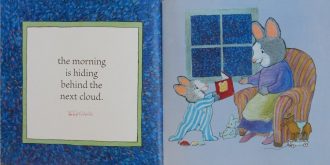
Alongside we see, in Van Gogh-like impressionist style, a sunlit tree outside and then as the sun goes down, a series of gradually darkening skies shown through the window, foregrounded by scenes of a little bunny going through his night-time routine with his mother and father.

On each spread the textual border mirrors the sky seen outside.

There’s obvious love and tenderness in this bunny family so adorably depicted in this lovely bedtime book.

When a Dragon Comes to Stay

When a Dragon Comes to Stay
Caryl Hart and Rosalind Beardshaw
Nosy Crow

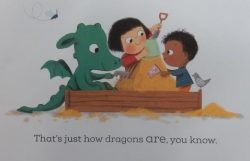
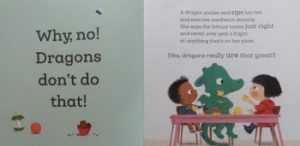
When a scaly creature turns up at number 124 with a shoulder bag it looks as though she’s there for the long haul. Perhaps though, she does need some guidance when it comes to good behaviour.

Snatching toys rather than sharing; breaking the rules in a supposed-to-be co-operative set-up; cheating and messy eating; all these need attending to; so its fortunate for this particular little dragon that she’s found some small, kind, friendly residents ready and willing to lead the way as positive role models:
‘And does she snatch and keep the toys / away from other girls and boys? //Why, no! / Dragons don’t do that! // A dragon knows she must play fair / And wait her turn and always share. / She knows the rules of all the games / and never argues or complains …’

Caryl cleverly alternates the undesirable with the desirable behaviours in a rhyming narrative that gently guides without preaching (in the same way, one hopes teachers/parents model what they hope to see rather than drawing attention to the misdemeanours of little ones).

And of course, allowances need to be made for nobody’s perfect, and certainly not little dragons.
I particularly like the sequence where the dragon’s messy eating is helped when she’s given a stable seat.

In her wonderfully expressive scenes of the adorable humans and their visitor, Ros. brings out the gentle humour in Caryl’s telling, showing how hard the little dragon is trying to behave appropriately.

Altogether a smashing book to share with little humans at home, or in an early years setting.

Toppsta have created some very useful reading records for schools: for further details follow the link.

When I Was a Child

When I Was a Child
Andy Stanton & David Litchfield
Hodder Children’s Books

You’re swept away with this enormously heart-warming book right from Andy Stanton’s opening lines, ‘ “Back in the days before you were born, “ said Grandma, / “when the world was a rose’s dream … “ / There was butterfly-and-daffodil ice cream.‘

Back in the day, so she tells her grandchild, the world was ‘a crystal jewel’ full of beauty and magical events: ‘… in the summers of long ago, / when the world married the sun, / there was music in everyone.’

Now though that magic has gone, thinks the world-weary gran. But perhaps it hasn’t.

It’s down (or rather up) to young Emily to re-awaken the ability in her grandmother to see the world as that place of magic, with its beauty and hope once more: ‘ I can show you how to see.” Take my hand and come with me … she gently urges her gran as they embark on further flights of fancy, this time under the child’s guidance.

If you’re not brimming over with the joy it exudes having read this book once, then start over and soak up the transformative power of young Emily’s imagination as she finds magic, wonder and awe even in the most seemingly ordinary things such as  flowers and raindrops.

‘The world is a spinning star … no matter how old you are’ is what’s said on the book’s final spread.

A child’s wisdom is as fresh and young, and as old as the world itself; that is something we all need to remember especially in these troubled times of ours.

Totally immersive, tender and uplifting, this stunning creative collaboration between two  favourite book creators is also a celebration of a special intergenerational bond.

Verbal and visual poetry both: Awesome!

Cyril the Lonely Cloud

Cyril the Lonely Cloud
Tim Hopgood
Oxford University Press

Cyril is a cloud whose main desire is to see a happy world; however all he seems to do is put the dampers on people and their fun; nobody’s ever happy to see him, a fact the knows all too well.

Cyril decides to go off and seek friendly faces but no matter where he floats be it land or sea he cannot find that which he seeks. All he does is increase in size.

At last the now huge cloud reaches a new and parched land where the cooling effect of his shadow is entirely welcomed by the residents.

Its cathartic effect on Cyril himself is one not of sadness but joy. Nonetheless his tears most definitely achieve his hearts desire – to ‘look down on the world and see a happy smile’. Not just one however, now he sees smiling faces everywhere …

Tim’s story certainly brought a happy smile to the face of this reviewer; he’s made the amorphous Cyril with his smile-inducing mission, a thoroughly endearing character that hovers over gorgeous, layered scenes of the natural world.

Youngsters will love his upbeat, optimistic nature as well as delighting in the wild animals  particularly that of the lion beaming a beatific smile.

If you are studying the weather with foundation stage children this is a must include book for your topic.

Sunflower Shoots and Muddy Boots

Sunflower Shoots and Muddy Boots
Katherine Hallligan and Grace Easton
Nosy Crow

Published in collaboration with the National Trust this is a super introduction to gardening for youngsters no matter whether they have available a large outdoor space or a tiny one.

In a dozen spreads author Katherine Halligan includes pretty much everything you need to know when starting out as a gardener, from the kinds of plants that are easy to grow; making an indoor garden (you might use welly boots or old suspended hats);

constructing a garden den; composting, tasty things such as radishes that can be grown in a variety of containers, and raspberries, that need more space.

Also included are ways to deter pests by gardening organically; encouraging desirable wildlife such as birds and butterflies by planting some trees

and/or sowing wild flower seeds. There’s a page on the kind of gear you’ll need, another on safety, one on pressing flowers and a final page of tips for adults.

Each spread is highly visual and there are instructional paragraphs, tips, ‘did you know?’ questions; appropriately placed lists of what’s needed for individual projects, as well as a list of useful gardening definitions.

Bursting with ideas, activities and facts to get children interested, with its wipe-clean pages, and Grace Easton’s eye-catching illustrations, this is a book to use at home, in a nursery/early years setting or a school gardening club.

What’s Next?

What’s Next?
Timothy Knapman and Jane McGuinness
Walker Books

Time and again Timothy creates wonderful picture book stories. Here’s another winner.

It tells of curious Baby Badger who loves nothing better than to go exploring; and having exhausted the possibilities in his underground home, he asks his father, “What’s Next?”

Daddy Badger’s response is to take his little one up and out to the forest the very next night.

It’s an exciting place with soft moss to roll in, and bluebell bulbs to snuffle for.

Under the starry sky, Baby Badger thanks his dad, inquiring again, “What’s next?” Daddy points out the sinking moon and announces that since day is coming soon, it’s time for bed.

Little Badger understands that next comes daytime and this too stimulates his curiosity, all the more so since his dad has only dim memories of the daylight world.

Unsurprisingly sleep eludes our ever-inquisitive little friend and he follows his nose out of the sett once more.

The daylight forest is certainly a bright, colourful, exciting place;

but it’s also rather lonely and proves an overwhelming experience for Baby Badger, who now wants nothing except his cosy home and his beloved Daddy.

You can easily imagine what comes next – a wonderfully satisfying finale …

Jane McGuinness has created the perfect pictures to illustrate this smashing story. Rich in detail and beautifully textured, her mixed media scenes of the natural world provide delight at every turn of the page.

A smashing book to share with little ones that will likely stimulate interest in the natural world.

Lubna and Pebble

Lubna and Pebble
Wendy Meddour and Daniel Egnéus
Oxford University Press

Every pebble is different, some are special, others not: the pebble in this beautifully moving story is of the former kind. It’s smooth, shiny, grey and it’s Lubna’s best friend. She discovered it when she and her father arrived one night on the beach before falling fast asleep in her Daddy’s embrace.

These two people have landed in a tented world and with her pebble clutched in one hand and her Daddy’s hand in the other, the little girl feels protected.

In one of the tents she finds a felt-tip pen, which she uses to draw a smiling face on her pebble.

Lubna opens up to Pebble telling her now much loved new pal of the war, her home and her brothers.

Winter comes and with it chill winds that flap the tents. Daddy keeps his daughter warm and together they make a warm bed for Pebble.

Into this chilly camp comes a little boy, silent and afraid. Lubna introduces him to Pebble and the boy introduces himself to Pebble: Amir is his name.

A new friendship develops between Lubna and the newcomer although Pebble remains her best friend.

One day Daddy receives some wonderful news: he and Lubna are leaving for a new home.

Amir’s reaction means that Lubna now has mixed feelings and that night in bed she lies awake pondering. She consults Pebble but no answer is forthcoming.

By morning though, Lubna knows what she must do when she leaves …

This is a book that really tugs at your heartstrings. Wendy’s tale of love, hope, friendship, sacrifice and transcendence perfectly complemented by Daniel Egnéus’ powerful, sometimes sombre, scenes of the refugee camp dwellers left me with tears in my eyes and a lump in my throat.

Definitely one to add to the growing number of beautiful picture books featuring people displaced from their own home country seeking safe refuge elsewhere.

My Mum Always Looks After Me So Much!

My Mum Always Looks After Me So Much!
Sean Taylor and David Barrow
Frances Lincoln Children’s Books

Like most youngsters, the little gorilla narrator of this story isn’t keen on injections. However mum insists she has to look after him and so off they go to see the doctor.

Things go smoothly enough – the doctor cracks jokes to distract from the prick and rewards the little gorilla with a special strawberry-smelling ‘stick thing’.

Off he goes feeling chuffed and on the bus home he experiments with his new acquisition.

When they get off though, a terrible realisation strikes our little hero.

Happily Mum knows exactly what to do; after all she always looks after little gorilla so much. Moreover, banana flavour tastes much better than strawberry.

Warm, funny and full of heart is Sean’s tale of maternal love and infant appreciation.

Embodying a variety of techniques and executed in a gorgeous colour palette the illustrations of award winning David Barroux are absolutely smashing: his characters are superbly expressive with the little gorilla displaying the full range of emotions, and his solicitous mother is adorable..

Young listeners (and adult sharers) will love this book.

One thing though, why do so many picture book titles have exclamation marks? It seems to be in vogue of late.

My Grandma and Me

My Grandma and Me
Mina Javaherbin and Lindsey Yankey
Walker Books

What an utterly gorgeous book is this tribute to a beloved Iranian grandmother from the young Mina with whom she lived.

The two do everything together be that cooking, cleaning, praying or visiting neighbours: grandma is the centre of Mina’s universe.

There are companionable times when two sets of best friends – young and old – play, or chat and knit together;

occasions that will make readers laugh, like Mina’s account of draping her grandma’s beautiful chadors to build a rocket ship or using one to transport her on her astro-explorations.

Be it during Ramadan, when the two would visit the mosque together for midnight prayers; or showing ingenuity over getting a fresh loaf daily without leaving their 3rd floor apartment,

this autobiographical celebration of a special intergenerational bond is truly special; in part because it’s a portrayal of a culture and country relatively few children will be familiar with.

With her lovely patterns, Lindsey Yankey’s beautiful, respectful visual portrayal is the perfect complement to Mina’s written memories in a book that transcends cultural boundaries and speaks to everyone.

The Story of People

The Story of People
Catherine Barr, Steve Williams and Amy Husband
Frances Lincoln Children’s Books

I greatly enjoyed the two previous titles in The Story of … series and this new addition is another winner.

It’s a whistle-stop tour of the historical development of humankind that begins with the earliest humans – Homo erectus – two-legged hunter-gatherer apes that lived in Africa.
Did you know that the larger brained Homo sapiens also appeared first in Africa? Travelling out across Europe and Asia, these are the people we are descended from.

The account moves to early farmers, then the Bronze Age when cities grew; diseases were caught from animals and mark making in relation to harvests was used.
The Iron Age, trading voyages across oceans and land and decisions based on philosophy are also covered, taking readers to 1CE – 1000CE during which Islam in the Middle East and Christianity in Europe were growing.

Thereafter came religious wars, trade routes opened up and between 1700-1800CE Islamic science experiments inspired new discoveries in science and nature around the world.
Technology as well as science then started to change how people lived and continues to do so. At this point the author acknowledges that in addition to the numerous changes for the good, human actions are damaging our precious world.

The book ends with a consideration of what might happen in the future ending on an optimistic note: ‘By sharing, polluting less, respecting wild places and farming alongside wildlife, there is hope for the future. We can all live in harmony with nature on our beautiful blue planet.’ Let’s hope it’s so for the young children who are the book’s audience.

Amy Husband’s alluring naïve, cartoon style collage and crayon illustrations together with Catherine Barr and Steve Williams’ highly accessible narrative provide a lively introduction to a fascinating topic.

My Town’s (Extra) Ordinary People / This Love

My Town’s (Extra) Ordinary People
Mikel Casal
Prestel Publishing

Everybody, no matter who they are, or where they’re from is worth valuing; that is the inherent message in Mikel Casal’s amusing look at examples of humankind residing in a seaside town.

Theo, the boy narrator introduces first himself and then another 22 characters, each unique and special, who also live in the town. Some are young, others old and many in-between.

There’s Theo’s best pal Felix an expert skateboarder, aspiring jazz guitarist Kim, Alexandra the potter (who ‘shapes beautiful and useful objects that please our senses’), Dave the gentle giant, cool Mike who loves to surf, bookstore owner Sara, Jalen creator of art from geometric shapes.

We also meet Abigail, someone after my own heart who is always immersed in a book;

and Lorca accompanied by Deshaun his dad who insists on reciting poetry as they walk to school together.

And I’m sure readers will take to free-spirited Ayaan who one hot summer day, filled the back of his pickup truck with water for his much-loved nephews Rashid and Ismail to frolic in.

Each and every one and the others not mentioned here have something to admire, not least being Zaza. This elegant guy receives numerous invitations because ‘when he has arrived, so has the party!’ There’s even a Labrador, Nickel owned by Felix’s grandpa.

Spanish artist Casal’s retro style screen print illustrations are arresting and delightfully playful.

Adults might try inviting youngsters to contemplate those in their own lives and doing as Theo suggests and looking for the extraordinary something in them all. This would make a super class project especially if those involved illustrated their ideas.

For younger children is:

This Love
Isabel Otter and Harriet Lynas
Caterpillar Books

The universality of love and its power to unite is celebrated in Isabel Otter’s rhyming text and Harriet Lynas’s richly coloured illustrations of children and adults showing and sharing love around the world and through the seasons.

There’s parental love expressed both outdoors and in: love of a playful loyal pet; love of friends whatever the weather;

the love shown by a patient grandparent; and love towards a new-born sibling.

No matter who, no matter where, urges the rhyme, ‘join hands and stand up tall. / Love is a special language / that’s understood by all.’

A book to enjoy and discuss with little ones.

Listen! – The Flute / World of Forests

The Flute
Ken Wilson-Max and Catell Ronca
Tiny Owl

The second in the Children Music Life series showcases a reedless woodwind instrument, the flute. Here flautists from different parts of the world come together to celebrate its magic. It’s a colourful magic that conjures up mellow sounds …

and bright ones; that sometimes speaks very softly …

or blows icily.
It might be a scream of pink, a sigh of lilac that is …

The voice through which the flutes speak is pure poetry; now why not try to discover its sounds for yourself … Where will it take you? What will you hear and see: how will you feel?

With rainbow bright illustrations from Catell Ronca and Ken Wilson-Max’s poetic words, prepare to be transported and perhaps to dance with your little one like some of the characters herein. Through music is a wonderful way to introduce very young children to stories: this little treasure of a book will help you do just that.

World of Forests
Robert Hunter
Wide Eyed Editions

Robert Hunter follows his World of Birds with a new Sounds of Nature title in which he explores ten different forest habitats from various parts of the world – Europe (including the UK), the USA, South America, Africa, India, Socotra Island (Yemen) and China.
Each habitat is given a double spread wherein are showcased the animal inhabitants (with a factual paragraph on each one) as well as a general introduction to the particular forest be it of the coniferous or deciduous kind.
Six or seven creatures are included in each location be that the German evergreen forest; the Redwood forest of California; England’s New Forest; the Amazon rainforest; a cloud forest in the Virunga Mountains of East Africa;

a desert forest of Socotra Island; a beech forest of Brussels;

the Sundarbans mangrove forest in the Bay of Bengal (I don’t think this is at ‘the southern tip of India’ as stated in the book though); the coniferous taiga (snow) forest of Alaska; or the bamboo forest in the mountains dividing North and South China.

Pressing the sound button on each spread produces a ten second burst of the natural sounds of 60 or more animals. You’ll need to listen very carefully to identify such creatures as the squawking macaws of the rainforest or the call of the Northern wren in the beech forest.

The whole thing is splendidly atmospheric: with its beautiful panoramic illustrations and fascinating soundscapes it’s a book that is likely to appeal across a wide age range.

Tad

Tad
Benji Davies
Harper Collins Children’s Books

As a huge Benji Davies enthusiast I was eagerly awaiting Tad and it’s another winner.

Let me introduce Tad; she’s the tiniest, almost a frog, tadpole in the entire pond who can only keep up with her tad siblings by wiggling her tail at double the speed they do.

These little creatures share a problem though, for there’s another resident of their pond; Big Blub is its name and it’s said this great big nasty ancient fish lives in the darkest, murkiest part of the pond and lies in wait to gobble up unsuspecting little wrigglers like her.

Tad resolves not to believe in such a beastie, confining her swimming to the shallow water and hiding behind the plants at sundown – just in case.

Gradually as tadpoles do, Tad and her siblings’ grow legs and lose their tails,

finding large leaves on which to spend the nights. But there seem to be fewer of them about

and then there are just two remaining – oops! One brother gone!

Make that just Tad with her determination to escape the mouth of Big Blub.

It’s no good pretending the predator doesn’t exist any longer; there’s just one way to save herself …

Could her leap into the unknown perhaps herald not only a startling reunion but also the start of a new and exciting, rather different way of life?

This is perfect springtime reading; dramatic illustrations to feast your eyes on and a perfectly paced telling with just sufficient suspense to send small frissons of fear running through your little ones, as they listen to Benji’s delicious tad-tale.

The Princess in Black and the Mysterious Playdate / The Princess in Black and the Science Fair Scare

The Princess in Black and the Mysterious Playdate
The Princess in Black and the Science Fair Scare

Shannon & Dean Hale, illustrated by LeUyen Pham
Walker Books

I know a fair number of newly independent readers who will be dancing in delight at these latest The Princess in Black stories.

In the Mysterious Playdate, Princess Magnolia, aka the monster-fighter, Princess in Black has an engagement with Princess Sneezewort.

Off she goes, accompanied by Blacky, to execute her ‘mysterious plan’ leaving Goat Avenger guarding the hole into Monster Land to prevent any monsters escaping. Or so she thinks, for a shape-shifting monster is following her and manages to hide away on her carriage as Frimblepants pulls it to her friend’s kingdom and her castle residence.

While the two princesses play

the monster’s hunger gets the better of him and he tries to eat someone’s kitten.

Soon both princess have made excuses to leave the castle, donned disguises and set out to rescue the little animal.

When kitten’s duly saved there’s still the matter of the elusive monster. With ninja moves aplenty, they might just succeed in capturing the monster as well as keeping their secret identities undiscovered.

Princess Sneezewort is a thoroughly delightful addition to the bum-wiggling superhero troop in this action-packed treat.

In the Science Fair Scare, Princess Magnolia’s destination is the Interkindgom Science Fair, an event she hopes to keep monster-free especially as she’s going to present her project poster on the growth of plants.

Once there though, having met her friends, she begins to feel her project is inferior to those of the other participants particularly that of Tommy Wigtower. His talking volcano soon has the princess’s alarm bells ringing.

Happily her new friend aka The Princess (Sneezewort) in Blankets just happens to be nearby and before long a fierce battle is under way and it’s not just those two princesses, but three more, who join the fray.

Can they succeed in their endeavours to prevent the goo monster from devouring everything in its path?  Perhaps it could find a new home through that hole to Monster Land so zealously guarded by The Goat Avenger.

Welcome three more princesses to the superhero brigade. It’s good to see an addition to the series of a STEM story with its teamwork and spot of problem-solving alongside the monster pounding.

Another satisfying tale from the Hales with as always, splendidly spirited illustrations from LeUyen Pham.

Toppsta have a new reading record that is particularly appropriate for school use: see the details on Toppsta

Daisy and Bear

Daisy and Bear
Fabi Santiago
Scholastic

Take your seats alongside Bear and his human friend Daisy as they pay a visit to the cinema for a Sunday afternoon treat. The perfect place to go for a first experience of soft comfy seats, big velvet curtains and yummy warm popcorn, you might think.

Potentially yes, but however comfy the seats appear, it’s important to remember to pay a visit to the loo before the film starts.

And creating lots of noise during the performance is also a big no, no, be that with super-crunchy popcorn, deliciously slurpy fizzy drinks or …

This however, is only the precursor to the show-stopping distraction caused by our mega enthusiastic ursine friend …

On his own admission he should never have set a paw in the cinema; Bear is down-hearted for a short while but then … light bulb moment! Can he make recompense where the rest of the audience is concerned? Well maybe …

This is a delight from beginning to end and I don’t mean the movie: Fabi’s latest story is in itself a smashing performance that unfolds like a cinematic comedy.

Two of my story enthusiasts were so taken with the book that they constructed a den/cinema and disappeared inside to read it again.

Plant, Sow, Make & Grow

Plant, Sow, Make & Grow
Esther Coombs
Button Books

Absolutely bursting with helpful gardening information whatever the season (the book is divided into four seasonal sections), the enthusiastic author, who started a gardening club at her daughter’s primary school and still runs it, has created a super book that introduces children to the wealth of opportunities being involved in a gardening project offers.

Before the seasonal sections, readers learn what the essentials are to get started, including the idea of creating a planting plan – all vital if you’re to make a success of your garden. Re-using and recycling are a part of the former and I like the idea of using loo rolls to make seed pots (I’ve frequently cut the tops from cardboard milk cartons but never tried this idea before).
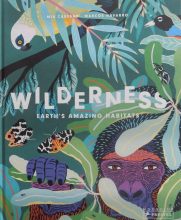
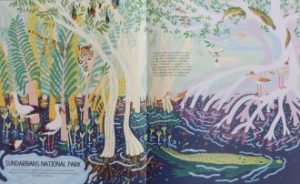
Spring seed growing suggestions include salad leaves, tomatoes

potatoes, strawberries (the purchase of a few small plants initially is suggested here), root vegetables such as carrots and beetroot, peas and sweetcorn make up the edible kinds. Growing some flower seeds is also suggested because flowers will attract pollinators to your veg patch.
Then come a page on thinning out seedlings and another on wildlife – good and not good.

The summer section focuses on pumpkin growing, companion planting and lots of ideas for making useful items including a hanging-bottle container for tomatoes, a protective cover for strawberries, a watering can out of a screw top plastic bottle, as well as some creative activities, the suggestion of measuring some of the especially tall-growing plants

and some bee-related info. Then of course, there’s the important ‘summer harvest’.

Autumn is the season when much is ready for harvesting: sweetcorn, potatoes, root crops should all offer rich pickings and diggings at this time.

Compost, potting on strawberries, harvesting wild flower seeds, carving a pumpkin, creating a seasonal wreath and a bug home are also covered in this section.
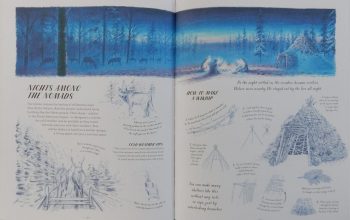
Winter is the shortest section and again it’s packed with great tips such as saving seeds to plant the following year as well as stems for next year’s canes; creating a bird feeder from a sunflower head and more.
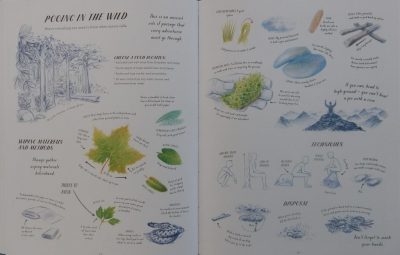
Motivating and thoroughly down to earth, this alluringly illustrated book is one I wholeheartedly recommend for school and home.

Sticky

Sticky
Anna Doherty
Scholastic

When it comes to wrapping presents some of us are highly skilled and manage to make wonderfully inviting packages; others make a mess of things.

Badger, certainly on this occasion, is one of the latter. His efforts at wrapping Owl’s birthday gift are thwarted by a particularly sticky roll of tape that no matter how hard he tries, only becomes more and more entangled.

Along comes Deer with an offer of a helping hoof but things do not go well … and despite his claims, Rabbit’s eager assistance does not live up to his assertions.

So what about Mouse’s paw? Or the endeavours of Fox, Snake and Bear? All equally, sticklily, unsuccessful.

Enter Owl who is duly informed of his present. There follows a massive peeling, tugging, pulling, nibbling effort on the part of all the animals and finally hurrah!

The perfect present is revealed for which the recipient is duly thankful and thereafter Badger sets off home with an idea in his head …

Slapstick comedy from start to finish, Anna Doherty’s debut picture book will have young listeners chortling with delight over the animals’ antics and demanding an action replay as you close the book.

Anna is a new talent I shall watch with interest.