My Island

My Island
Stephanie Demasse-Pottier and Seng Soun Ratanavanh
Princeton Architectural Press

“To dream and to invent allows you to discover yourself,” So said Stephanie Demasse-Pottier, the author of this book that she wrote as a tribute to the inventiveness of her two young daughters. Hurrah for her flagging up the link between the imagination and the power to be inventive – in whatever field.
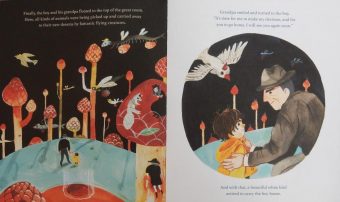
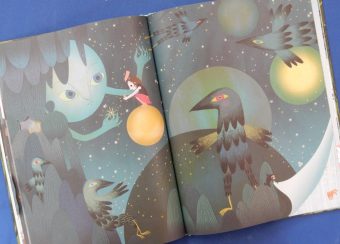
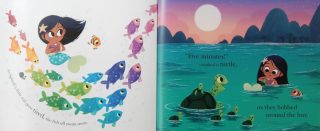
The little girl narrator of the story conjures up an imaginary island world filled with flying fish, birds, constantly blooming flowers, and animals aplenty.

In this place she has tea parties for the animals, she reads, makes coffee, interacts with snails, arranges flowers – all in her own little house.

We too can share in the riches of this place, so long as we know ‘how to sing’, ‘how to share’

and ‘how to dream’.


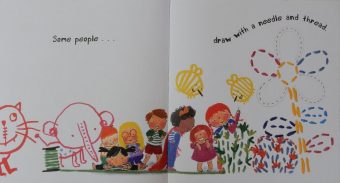
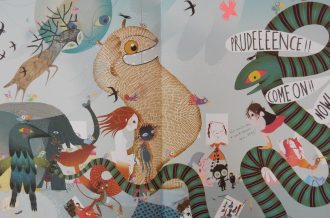
What adult wouldn’t want their child/ren to gain access to such a place – this extraordinary and wonderful world created by the imagination of the intense, creative little girl. A place where they too can wander, or pause awhile, letting their imaginations soar, further fuelled by the vivid scenes conjured by Seng Soun Ratanavanh in her watercolours, coloured pencils, and red thread stitched illustrations (which serve both to link together what the narrator imagines and to leave gaps for readers’ imaginations to enter).

Not only is this a tribute to two little girls, it’s a tribute to the power of the imagination itself.
Remove all technology and let youngsters take that leap and linger long. Who knows what might happen …

The Butterfly House

The Butterfly House
Katy Flint and Alice Pattullo
Frances Lincoln Children’s Books

Judging by the number of containers housing butterflies in the various stages of their development my partner has scattered about the place, I rather think my own home at present ought to have the same name as this book, although unlike Katy Flint’s ‘welcome’, it doesn’t have never-ending ceilings, nor does it contain the various habitats she names that provide homes for many of the world’s major butterfly and moth families. I was surprised to learn that these winged creatures make up 7% of all Earth’s forms of life.

We then visit the Hatchery, which explains the life cycle of a butterfly with reference to the Monarch as well as containing a number of unusual-looking caterpillars.

The next two spreads explain the differences between butterflies and moths,

what various adult butterflies like to eat and that caterpillars are fussy eaters usually preferring one particular host plant.

In the subsequent pages over 100 species of moths and butterflies from all over the world grouped in their various scientific families, are displayed in Alice Pattullo’s alluring, finely detailed brush and Indian ink illustrations. Some like the Small tortoiseshell

and the Orange-tip will be familiar to UK readers (and to me as their caterpillars are presently munching away on their food plants in our downstairs bathroom).

To see others such as the Crimson rose swallowtail, the Owl butterfly or the spectacular Luna moth,

you’ll have to visit a butterfly house like that at Berkeley Castle in Gloucestershire or the one in Stratford-upon-Avon.

No matter where you live or visit, this book is sure to whet your appetite to get to know more about these beautiful creatures.

Me and Mrs Moon

Me and Mrs Moon
Helen Bate
Otter-Barry Books

In her familiar graphic novel style, Helen Bate tells a powerful story of how two children, narrator Maisie and her friend Dylan, set about helping their beloved friend and neighbour Granny Moon as she shows signs that all is not well.
Granny Moon has looked after the children during holidays for years filling their days – rain or shine – with fun and adventure.

One day though, things start going wrong.
First Granny Moon is talking about a sister Julia she doesn’t have and later the film about aliens she takes the children to scares Dylan and they have to leave.

As Christmas approaches, things get worse. At the school concert Granny causes disruptions and other children start making fun of her.

Time passes but there are further problems. Granny Moon convinces herself that a little girl is trapped in her radiator and then Dylan’s dad notices her unusual behaviour and is doubtful about whether she should still be allowed to look after his son.

Eventually Maisie’s mum decides to phone Granny’s daughter, Angela in Australia.

Maisie and Dylan then worry about the fate of Granny Moon and her beloved dog, Jack; will Angela decide to put her in a care home? Worse, the friends return home late from school after a café visit with Granny Moon to find a fire engine outside and fire-fighters waiting for them. Thankfully though, there’s no serious damage.

Next day Angela arrives and is extremely troubled by what she finds. She decides there’s only one thing to do. Granny Moon’s house is put on the market and happily it’s not a care home that she’s going to but Australia to live with Angela and her family.

Three days later, fond farewells are exchanged and Angela and Granny depart. A certain animal isn’t accompanying them though, he has a new home – next door with Maisie who now has a companion to share memories about her erstwhile owner with whenever she needs.

The final page lists organisations that offer help for people with dementia, their families and carers.

Love and devotion radiate from the pages of this intensely moving story (based on actual events); but it doesn’t gloss over the enormous challenges those caring for someone with dementia are likely to face. Rather, it offers young readers an opportunity to better understand something of the condition and perhaps be better prepared should they encounter someone living with it.

This is a book that deserves to be in every school and should be read in all families. Particularly, as I was reminded by a charity worker from The Alzheimer’s Society who stopped me as I left Waitrose recently that while I might not know anybody with Alzheimer’s, over a quarter of the population knows someone who has this form of dementia alone.

Ceri & Deri: The Treasure Map / Ceri & Deri: Build a Birdhouse

Ceri & Deri: The Treasure Map
Ceri & Deri: Build a Birdhouse

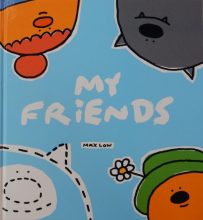
Max Low
Graffeg

These are the latest titles featuring best friends Deri the Dog and Ceri the cat that introduce young children to specific concepts/skills through fun stories. (Here it’s orientation and design.)

The Treasure Map in the former is an old one that once belonged to Ceri’s nan, an erstwhile pirate, so the stripy feline claims. Ceri’s story of said nan sailing the high seas inspires Deri and the two set off excitedly, map in paws, to find treasure.

En route they are joined by the equally enthusiastic Gardener Glesni, Owain the Optician and Farmer Ffion who are more than willing to leave their respective allotment, spectacle selling, and vegetables to join the search.

Eventually the map leads them within smelling distance of the sea.

But is that treasure buried on the sandy beach as they’d been led to believe by the X, and if so just what will they discover when they dig?

The Bird House tells how the friends come upon a curious little bird while out walking together in town. Clearly it cannot remain on Deri’s head so the two decide to build it a house.

They think carefully about the design – a hallway with telephone for making ‘bird calls’ and ‘a place for all its shoes,” they decide; a kitchen with a plethora of bird seed, flowers, a sink; a balloon-filled dining room , amazing tree-patterned wallpaper, a record player (for listening to bird songs) a bathroom complete with bird bath entered by waterslide

and (obviously) a wave machine. The friends get even more carried away with their elaborate plans; but, tools and materials assembled, can they actually put them into action: I wonder?

This one made me laugh out loud a couple of times, it’s so sweetly silly and I’m happy to report that despite Ceri’s feline-ness, the bird has found two new friends.

If you’re yet to meet Ceri and Deri, I suggest you start here. The friends are a delight and Max Low’s stories are full of charm and engagingly illustrated.

Migrations Open Hearts Open Borders

Migrations Open Hearts Open Borders
Introduction by Shaun Tan
Otter-Barry Books

llustrators from all over the world responded to the request by The International Centre for the Picture Book in Society (based at the University of Worcester) to create an original postcard for the 2017 Migrations exhibition to be displayed at Bibiana, Bratislava. The exhibition’s creators felt that the installation should reach a wider audience and this wonderful book is the outcome, although the fifty or so images representing 32 countries reproduced in their actual size herein, are only a selection of the hundreds of postcards they received.

Each of the postcards in its unique way focuses on the positive impact of the migration of peoples the world over, showing how the flow of ideas and cultures transcends borders, barriers and even bans.

The book is divided into four themes: Departures, Long Journeys, Arrivals and Hope for the Future.

I would love to show every single one of the awesome, enormously moving postcards but can only make a very small selection for this review, so have included representatives for each of the themes, which spoke to me on my very first reading.

Departures: In the end we only regret the chances we didn’t take./ It begins with a single step …                 Rhian Wyn Harrison – UK.

Long Journeys: The skies have no borders.      Christopher Corr – UK

Arrivals: New friends coming from afar / bring us different tales!                        Marcelo Pimentel – Brazil

Hope for the Future: Share the world in peace and freedom. / The Earth and its people have no owners.           Isol – Argentina

On another day I may well have picked completely different ones, such is the power of each contribution, some of which use quotes from writers including John Clare, WB Yeats, Anita Desai and Robert Macfarlane.

If ever there was a time in our increasingly fractured world when we need this treasure of a book, it’s now. Let’s hope that those of us with open hearts who want open borders continue working to make a difference for, as Shaun Tan writes at the start of this book ‘All migration is an act of imagination, a flight of imagination. A hope that frequently exercises a previously unknown human potential. … What can be done? … That’s for us, the living, the thinking and feeling: descendants through millennia of successful migration – whose ancestors dreamed of something better … It’s left for us to imagine what to do, to pass on the dividends of hope that have been invested in us.’

Re-reading his message in its entirety in a week when our UK politicians continue wrangling about how – the universe forbid it happens – we should leave the European Union, brought tears to my eyes. Everyone needs a copy of Migrations; it reaches out to us all, offering another beacon on the uphill climb towards the creation of a better world for everyone, young, old and in-between.
(All royalties are donated to Amnesty International and IBBY)

Choo-Choo Peekaboo / Marvel Alpha Block / Where Do Pants Go?

Choo-Choo Peekaboo
Gareth Lucas
Little Tiger

Artistically minded Zebra sets out one fine morning eager to spend a day engaged in his favourite pastime, painting. Seemingly however, his animal friends and acquaintances have other ideas.

Chaos ensues wherever poor Zebra stops and begins his artistic endeavours, be it city,

riverside, by a lake, deep in the countryside,

even atop a mountain he finds no peace. Surely nothing can disturb his nocturnal attempt though? Errrm!

It looks as though there is only one way to please everyone … BEEP BEEP! TOOT TOOT! And off they go …

With paint-daubing primates, a loop-the-looping porcine, roller-skating rabbits, cable-car riding cows, a space-ship sortie by sheep even; all of which are revealed from behind the gate-fold flaps, this interactive book will delight tinies, especially those with a penchant for noisy vehicles, madcap animals and surprises – that covers pretty much all of them.

Add to the mix, laugh-out loud scenarios, speech bubbles and a highly satisfying finale, I’d say Gareth Lucas has a hit on his hands with this sturdy board book.

And adults will enjoy the visual references to famous artists along the way.

Marvel Alpha Block
Peskimo
Abrams Appleseed

Bristol based illustration/design partnership Peskimo have chosen scenes and characters from the Marvel Cinematic
Universe for their latest Block Book. As usual it’s a chunky board book with flaps and splendid action scenes, that feature herein everything from Ant Man to Falcon,

and Pepper Potts to Xandar, Yondu and Zuri, before the entire cast assembles in alphabetical order on a grand finale fold-out.

Amazingly, each superhero represents a letter of the alphabet – a large cut-out capital letter that leaps up from the centre of the spread and beneath which lurks the superhero in an action scene (along with other characters who may or may not share the same initial letter).

Watch out for punch packing potential should more than one little would-be superhero get their hands on this simultaneously. With its super art, it surely is a winning alphabet book that I suspect, adults will enjoy almost as much as their young ones.

Where Do Pants Go?
Rebecca Van Slyke and Chris Robertson
Sterling

A fun interactive book about getting dressed takes toddlers through the routine dressing ritual. To avoid confusion, adult sharers not in the US should be forewarned that “underwear’ is used for pants and pants herein refers to trousers, so readers aloud will probably want to make some adjustments as they read the question and answer narrative with tinies.

Said tinies will doubtless delight in the cumulative, predictable text with its repeated final ‘and underwear on your bottom!’

and giggle over the silly placements of the various items of clothing in this book that reminded me somewhat of Shigeo Watanabe and Yasuo Ohtomo’s How Do I Put It On? that features a muddled little bear.

A satisfying finale sees all the fully dressed little ones enjoying some outdoor play together.

Primary Fiction Shelf

The Umbrella Mouse
Anna Fargher, illustrated by Sam Usher
Macmillan Children’s Books

Here’s a war story that’s altogether different. It’s set in London in 1944 and begins in Bloomsbury’s James Smith & Sons Umbrella Shop wherein we meet Pip Hanway and her family of umbrella mice.

When disaster strikes in the form of a bomb on the building, killing her parents, Pip is forced to begin a hazardous hunt for a new home, a home in the Italian hills where her family had its origins.

She is fortunate to meet rescue dog, Dickin, and thus begins a highly unusual tale that draws on true stories of animals caught in the WW2 conflict, a story of resistance, of courage, determination, treachery, sacrifice and bravery.

Anna Fargher’s debut is a powerful, compelling telling that will have readers and listeners charged with emotion as they root for these animals fighting the evil Nazi regime; and with occasional illustrations by Sam Usher of Rain, Sun, Snow and Storm fame to add to the pleasures, the book is strongly recommended for individuals and will also make a great KS2 class read aloud, particularly for those studying WW2.

Turns Out I’m an Alien
Lou Treleaven
Maverick Arts Publishing

The narrator of this zany tale is eleven-year-old Jasper who stands 4ft 6in tall and has green hair and eyes. A highly imaginative child so his teacher tells him, Jason lives with his extremely nice foster parents Mary and Bill Clarkson.
One day in order to bring in some extra cash. Mary and Bill decide to rent out one of the now unused bedrooms.

Before their guest has even arrived, Jasper is beginning to doubt whether his foster parents really are as predictably normal as he’d heretofore thought, especially when he notices Mary cooking what appears to be a kind of glowing green rock and Bill constantly checking the night sky through his binoculars.

Then out of the dark descends a weirdly spherical being with an orange skin uttering greetings from planet Snood and introducing himself as Flarp Moonchaser, “Slayer of the Multi-Headed Muck Monster of Murg” as he stretches forth his hand for Jasper to shake. Moreover, the thing has a strange bag stuffed full of weird and wonderful objects.

I’ll say no more other than that Jasper discovers his alien origins, the children are cascaded into a madcap space adventure to save a planet from the terrible Emperor Iko Iko Iko; there are secret agents, secret, secret agents and things get pretty Gloopy.

Entirely crazy, but readers will be swept along by the unfolding drama, which perhaps doesn’t actually end at The End.

Dennis in Jurassic Bark
Nigel Auchterlounie
Studio Press

Fans of the traditional Beano comic will certainly recognise the characters Minnie the Minx and Walter although this book is a novel, not a comic, albeit with a fair sprinkling of black and white illustrations.

It’s another madcap adventure for Dennis who is plunged back in time 65 million years. First though we find the boy visiting his gran watching a TV news reporter talking about ‘what seems to be a huge mutant, ice-cream stealing seagull’ that Dennis immediately identifies as a Pterodactyl. Dennis however isn’t the only child watching the news item; so too, among others, are his worst enemy Walter and Minnie the Minx.

Before you can say Pterodactyl Dennis finds himself on Duck Island determined to save Beanotown from dinosaur disaster.

There’s no need to be a Dennis fan to be entertained by this madcap romp with its interactive puzzles to enjoy along the way.

I Don’t Want To Be Small

I Don’t Want To Be Small
Laura Ellen Anderson
Bloomsbury Children’s Books

The little boy narrator of this rhyming tale rues his lack of stature; “It’s not fair,” he says. Frequently overlooked, he’s the smallest among his friends and big bro’s castoffs are way too large.

In a fit of pique the lad tosses his Teddy Bear skywards only to get it stuck in a tree out of reach.
Nothing he tries succeeds in getting Ted down;

superfast consumption of green veggies merely serve to give him wind and attempting to become flower-like is let’s say, a damp squib.

His “I JUST WANT MY BEAR” shout causes a tall girl to come and offer her assistance; but not even she can reach Teddy.

Light bulb moment: teamwork might just do it suggests our narrator, and … hurrah! Success; but much more important, is what  ensues.

Laura’s spirited illustrations abound with humour and pathos, and her seemingly simple, funny story with its powerful messages about self-acceptance and the importance of co-operation, will resonate with all those who feel inferior for whatever reason.

Slow Samson

Slow Samson
Bethany Christou
Templar Books

Samson’s favourite activity is spreading happiness as a consequence of which he has lots of friends and many party invitations.

However this is problematic as he frequently stops on route to a venue to help a fellow animal or merely for a friendly chat.

This tardiness causes him to miss out on all the fun, not to mention the cake at Terry’s birthday bash.

Samson resolves to do better and hurry to the next party. True to his word, he dashes past all those in need but still when he arrives, the party is over; worse though without his help, others had suffered. Poor Samson sobs, despairing he’ll ever be on time on account of his slowness.

Unbeknown to the sloth, Samson’s friends are concerned and after considerable thought, come up with a plan. An invitation is sent and Samson decides that despite his lack of speed, he just cannot disappoint his pals.

Next day, off he sets but he doesn’t rush – his friends do however, causing him to feel bad; but on he goes – slowly, slowly, convinced he’ll be very late. But is he?

For fear of being a party pooper, I’ll leave the little creature dangling and you deciding for yourself.

What I will say is that with its rainforest setting, debut picture book creator Bethany Christou’s warm-hearted tale of altruism, friendship, determination, kindness (and the odd piece of cake – oops!) is a great read aloud and a perfect starting point for discussions with young listeners.

I love the expressively portrayed animals especially Samson, and there’s plenty of gently humorous detail to enjoy in every scene as well as in the playful endpapers.

Stick & Fetch Investigate: The Wrong End of the Stick / The Naughtiest Unicorn

Stick & Fetch Investigate: The Wrong End of the Stick
Philip Ardagh, illustrated by Elissa Elwick
Walker Books

Top-notch undercover detective duo Sally Stick and her canine pal Fetch return in another set of gigglesome episodes.
In the first, Glass Half Full, we learn that the friends have had to shift their operation to a temporary HQ on account of their stay at artist Uncle Bob’s residence for the duration of Granny Stick’s hospital sojourn.

It’s not long before the detectives have a case: Uncle Bob has lost his glasses and there’s a tasty reward on offer for finding them. But there are glasses, and there are glasses. The particular ones in question have gold rims and although there are glasses aplenty in the house, none have gold rims – or do they.

This is a case of can’t see for looking; but can Sally and Fetch solve it ?

Hmmm! What’s that smell – could it be sausages? …

Bothersome beavers are at the heart of the next case, or so the detectives surmise when they come across a snapped-in-two lamppost on their way back from the library where they’d read about the tree chomping creatures. They find  clues in the form and aroma of baked beans; and see a sign indicating the location of a swimming pool. Sally puts two and one together and off they head to the pool.

Time to go undercover, but will they find a beaver on arrival and if so, can a damming crisis be averted?

Two further cases, equally zany are concerned first with, assisting the police when a spate of bag-snatching breaks out –

there’s a frog and a whiffy man involved here; and the second, a bit of bed-digging that might just happen to yield treasure, of a sort.

Delectably silly, enormously engaging and very importantly, celebrating the imagination, (or maybe just the wrong end of the stick), with its plenitude of comical illustrations by Eliissa Elwick, this smashing little book is perfect just flying solo reading.

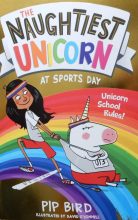
The Naughtiest Unicorn
Pip Bird, illustrated by David O’Connell
Egmont

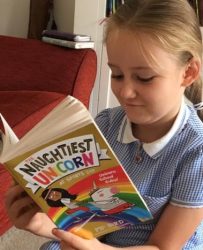
The particular Unicorn School in this story runs during the holidays and young Mira is overjoyed when she receives an invitation to join, especially as her sister is also a pupil and her mum had been too.

Having successfully entered the portal with another newcomer Raheem, Mira meets her teacher and classmates, then enters the hall to learn of the principles on which the school prides itself. She can hardly wait to be paired with her unicorn and at last it’s her turn.

However, the squat, pot-bellied creature, Dave, that is eventually coaxed through the door is somewhat lacking in sparkles, although he does have a twinkle in his eye.

Once in the classroom, Mira hears that there are only two days before they must go out on their first magical quest.

Can she possibly get ready when the recalcitrant creature objects even to being groomed? Do they actually have a totally magic bond?

Things don’t look promising especially as Dave’s penchants seem to be for doughnuts and falling asleep in lessons. Will Mira’s ambitions to go on that quest ever be fulfilled? Perhaps her friends Darcy and Raheem can help …

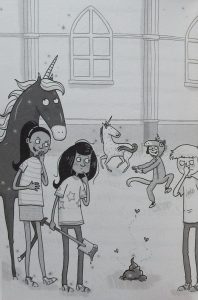
Just right for newly independent readers, this is a sparky tale that focuses as much on friendship as the glittery world of unicorns, showing that magic comes both from the former and the latter. Humour runs throughout Pip Bird’s telling and is brought out further in David O’Connell’s zany illustrations clearly drawn with a twinkle in his eye. Add to all that a quiz to help readers identify their unicorn type, and some jokes; and those who enjoy the book will be excited to learn that there’s a promise of more to come.

Tony T-Rex’s Family Album

Tony T-Rex’s Family Album
Mike Benton and Rob Hodgson
Thames & Hudson

The stream of dinosaur books is never ending and it’s tricky to find new angles but who better than vertebrate palaeontology professor Mike Benton to come up with a novel way of presenting one of children’s favourite topics.

Using Tony-T-Rex as dinosaur family album writer, readers are provided with rip-roaring authentic information about dinosaurs from the tyrannosaurus’ mouth. And Tony really does grab the readers’ interest and grips them between those 20cm long ridged gnashers of his throughout.

First of all he digs deep, unearthing for us just how a dead dinosaur becomes fossilised and how scientists such as the prof. differentiate between a dinosaur and a ginormous lizard. We’re then plunged back 201 million years to the Jurassic Period when dinosaurs rose to power.

Next it’s time to introduce the creatures themselves, starting in the UK with Megalosaurus Big Liz, one of the first dinosaurs and the first to be discovered, surprisingly by one, William Buckland who had no idea of the existence of dinosaurs, mistaking his find for a massive lizard. Happily though scientists soon identified differences between dinos. and lizards.

Thereafter, we travel the world meeting a host of awesome, mind-blowing relations of Tony’s, each of which has a funky name and an extraordinary body.

There’s Tony’s distant ancestor pigeon sized Crash-Test Dex (aka) Epidexipteryx with its long claws and sharp buck teeth. Dex had to perfect tree scrambling for it was a favourite nibble for young dinos with near ground level noses.

We meet the familiar Diplodocus (Dippy herein), Cowboy Spike (Stegosaurus) and then it’s Cruella the Flesh-Eater hailing from Portugal, with 70 dagger-like teeth just right for attacking unsuspecting stegosaurs and diplodocuses – EEEK!

Big Bellied Bill – Tony’s great-great-great-grandpa is memorable for his insatiable appetite for leaves that made him one of the heaviest ever land animals; unsurprisingly he suffered from horrendous wind – PHOOOAH!

It’s impossible to mention all Tony’s Cretaceous relatives here but the fossil of winged Flighty Aunt Nyx is extinct proof of a dinosaur with the ability to fly.

Moving forward to the Cretaceous Period (between 145 and 66 million years ago) we meet another creature with the ability to propel itself through the air: part lizard, part bird, Sinornithosaurus or Crouching Glider, with its alarmingly long teeth and upper jaw pocket was, reputedly, a terror.

I had a good giggle at Dead-Weight Diana (Titanosaurus), Tony’s Argentinian cousin, the heaviest dinosaur in the world, scoffer of the trees’ topmost, juciest leaves. Roamers these, for fossils have been found on every one of Earth’s continents.

You simply must meet the most elegant of all the dinosaurs, Siegfried the Swan (Olorotitan), which I have to admit is new to me. I was fascinated to learn that it had a penchant for dancing and despite its 8m length and 5 tonne weight, this crested beauty loved to demonstrate its ground-shaking prowess to all around.

Two T’s bring the family album to a close, Triceratops and finally our presenter, Tony T-Rex Tyrannosauarus. He’s excited to inform us that his poo might weigh as much as a 6-month old human baby.

The final spreads are devoted to how the dinosaurs died out; a visit to the Great Hall of Fossils; a world map showing where fossil evidence has been unearthed (and might still be); how to go about a fossil hunt and some useful dinosaur lingo for those who want to impress their friends.

This splendiferous tome is a must for family bookshelves and classrooms; all the more so as Rob Hodgson has provided the funky illustrations with the delicious wry humour of his that I loved so much in The Cave.

The Academy of Barmy Composers: Baroque

The Academy of Barmy Composers: Baroque
Mark Llewelyn Evans, illustrated by Karl Davies
Graffeg

The author of this book, professional opera singer Mark Llewelyn Evans, is the founder and creative director of ABC of Opera Productions, a company that tours the UK introducing children to the stories and glories of the opera through music and storytelling.
His enthusiasm shines through this, his debut children’s book, the first in The Academy of Barmy Composers series. Herein readers follow the fabulous story of best friends Megan and Jack who climb over the gate of Pontirgorffenol village music hall, (long since fallen into disuse and said by some to contain treasure), and discover Trunk. They’re amazed to learn that this Trunk into which they’d both fallen is able to talk – in 43 languages what’s more.

Thus begins an awesome adventure with Trunk, taking them back to 1597 to the country of its origin – ‘shaped like a boot’ – and there to discover ”The ABC of Opera” and the Academy of Barmy Composers.

After something of a crash landing in Florence, Megan and Jack find themselves face-to-face with golden-haired Professor Peri,(aka Golden Locks) inventor of Opera who leads them into the academy hall; there to meet the ‘Baa-rockers’ – Florence’s cool “arty fartys” as the composers introduce themselves.

There is so much to discover but the prof. is a passionate teacher

and the children avid listeners who cannot help but be swept up in the crazy but enormously exciting learning experience,

which ends all too soon.

And so it will be I have no doubt, with child readers who are lucky enough to get their hands on this exuberantly presented, thoroughly engaging book. I love the characters, Karl Davies’ zany illustrations are a joy, and there are concluding spreads giving information on instruments of the time, voice types and the composers. If the whole experience doesn’t leave youngsters eager to experience baroque music, especially opera, then nothing will.
Bring on the next musical adventure.

Rumple Buttercup

Rumple Buttercup
Matthew Gray Gubler
Puffin Books

Just a quick look at green-skinned Rumple Buttercup with his wonky teeth, odd sized feet and just three strands of hair might indicate that this creature is something out of the ordinary – weird – so the author tells us at the outset of his immediate interest snarer.

Convinced that his unusual appearance with scare people, his residence is a sewer  – albeit nicely decorated,

where he listens in to conversations of passers-by, longing to be a participant but making do with pretence.

The one time Rumple feels safe to sally forth as part of the community, is his favourite event, the Annual Pajama Jam Cotton Candy Pancake Parade; a day nobody will, he thinks, notice him amid the carnival revels.

Having eagerly anticipated the day all year, his excitement rises but then on the morning of the event, there’s a distinct lack of banana peel in the bin beside his home.

Devastated and deciding he must stay below ground and miss all the fun, the creature suddenly hears a voice calling down the drain to him.

What he discovers is that he’s not quite as strange as he’s always thought – unique perhaps, but then we’re all strangely different in our own ways.

So let’s join him in a celebratory wave and an acknowledgement that self-acceptance, flaws and all, is the way to go and that there are others out there who will celebrate our individuality, no matter what.

This delectably quirky, slightly surreal offering – a blend of picture book and chapter book – is one that will appeal to a wide readership, young and not so young.

Kind

Kind
Alison Green & 38 illustrators
Alison Green Books

With a foreword by Axel Scheffler, this book about kindness has been illustrated by 38 ‘kind’ artists (including Axel) all of whom donated their work for free in aid of the Three Peas charity.

‘Imagine a world where everyone is kind. How can we make that come true?’ are the opening lines and what follows are a host of suggestions for fulfilling that dream which almost every single human being would love to come true.

Most of what’s suggested are easy, everyday acts such as smiling at somebody, listening to people especially when they’re feeling sad, hugging a lonely person; offering a hand to hold to someone who is frightened or worried, or helping someone in trouble.

by Pippa Curnick;                    by Barbara Nascimbeni

Stories can help make others more cheerful be they listener or teller and it’s vital to ensure nobody feels left out or uncared for.

top LHS by Moni Port, bottom LHS by Anke Kuhl: top RHS by Philip Waechter, bottom RHS by Jörg Mühle

I’ve had a kindness jar like the one suggested in some of my classrooms and I know how fast it can get filled up; and acts of kindness can be directed towards animals as well as humans.

Everyone needs to be given the opportunity to shine – after all we’re all good at something.

by Sarah McIntyre:               by Benjamin Chaud

There are occasions however, when extra kindness is required – maybe towards a newcomer, or somebody who is trying to learn our language whatever that may be and it’s always good to learn some important words in their language too. Then there are those who have overcome tremendous odds in leaving their own country which is no longer safe and travelling to find a safe haven elsewhere – let’s listen to their stories but only when they’re ready to share them. Meanwhile toys and creative acts can be shared; and people might need accommodating so it’s wonderful to invite them in …

by David Barrow:             by Marianna Cop

An open mind and an open heart are what’s required similarities and differences notwithstanding. Who knows, if everyone tried just that little bit harder, something extraordinary might happen; now is the time to start. What will you do – today? And tomorrow? And …

We all need constant reminders in the current climate, no matter what part of the world we live in.

I’d absolutely love to be able to show every single one of the awesome illustrations in this celebration of kindness but I’ve only been able to include a few as examples in a book that’s bursting with inspiring suggestions and positivity.

The final spread is devoted to the work of Three Peas a charity that gives crucial practical help to those who have had to flee their war-torn countries and seek a safe haven elsewhere. (£1 of every copy sold goes to the charity).

What a terrific book to share over time with a class, perhaps using a spread or illustration as the starting point for the day and should you exhaust the ideas herein, children could suggest their own perhaps together making a follow-up book or picture gallery spreading throughout an entire school.

Meanwhile I’d like to see a copy of this in every home and classroom, after all children are the future.

The Anzac Billy

The Anzac Billy
Claire Saxby, Mark Jackson & Heather Potter
Walker Books

I totally fell for the little boy character in The Anzac Billywhen I saw him on the front cover. Based on true events, it’s set during World War 1 in a week when Christmas is approaching and the boy (and his family) are packing carefully chosen items into a billy in the hope it will reach his dad in time for Christmas. From Monday to Friday, one thing per day, the small boy puts in butterscotch (his own favourite), yucky fish (Dad’s favourite), walnuts from their tree, a bar of chocolate, and a pair of ‘just-knit’ socks.

On Saturday it’s Mum’s turn and she adds a razor, safety pins and soap (‘to wash his undies’) and Nan fills the remaining space on Sunday with a couple of handkerchiefs and paper and pencil for writing home.

Now all this so lovingly packed cannot be posted, nor sent by road or rail; it has to be shipped along with boxes of other billies; and naturally the boy is concerned that it might not reach his own dad for as his Mum tells him, ‘there’s a Christmas billy for every warfield soldier, filled by families, filled by friends’.

To make sure though, Billy puts in a note requesting that if another soldier receives his offering, then ‘please send my letter on.’ – this letter that he so carefully penned during that week from which we see how much he misses his Dad.

Claire Saxby’s telling feels authentic and is full of tenderness and poignant moments; all this is echoed in Mark Jackson and Heather Potter’s soft sepia scenes of Australia in a bygone era when light was not electric and life was much harder for everyone.

An ideal book for young readers, and KS1/ lower KS2 pupils studying the period; it would also make an unusual, but highly pertinent, Christmas time story.


Nell & the Circus of Dreams

Nell & the Circus of Dreams
Nell Gifford and Briony May Smith
Oxford University Press

Circuses hold a tremendous fascination for many children and so it is with young Nell although she doesn’t know it when the story begins. What she does know though is that she feels sad on account of her mother being ill and then, when she discovers a tiny chick in the farmyard, very happy.

Nell and the lost chick – she names it Rosebud – become almost inseparable.

One night Rosebud disappears from the end of her bed and when Nell wakes next morning her feathered friend is nowhere to be seen. Dashing outside she leaves the farmyard and heads through the still dewy meadows till she finds herself surrounded by enormous wooden wheels.

There’s an intoxicating aroma of coffee, toast and hedgerow flora, and she hears hammers striking metal. Lo and behold, she’s walked right into a circus.

Up goes the huge tent and Nell sees girls busy adding adornments inside and out. She helps and is invited into one of the wheeled homes where she joins a large family meal. She endeavours to communicate that she’s searching for her lost chick but suddenly the music starts and everyone rushes out and into the big tent.

Nell is mesmerised by the performances she sees …

but even better a wonderful surprise awaits her in the ring: there’s something feathery standing in a circle of light.
From then on, although sadly the circus has to depart, remembering doesn’t;

Nell carries the memories always in her heart and relives them in her own way.

Beautifully and movingly told by Nell, founder of Giffords Circus that has its home on the outskirts of Stroud, near to where I currently live much of the time, her words really capture the magic of all things wonderful about a circus community such as theirs.

I can think of nobody better than Briony to illustrate the story. Her jewel-like scenes are out-of-this-world wonderful, be they of Nell’s farmhouse home and yard, the temporary homes of the circus community or of the performance.

A must have picture book, this.

Will You Help Me Fall Asleep? / I’m Not Grumpy!

Will You Help Me Fall Asleep?
Anna Kang & Christpoher Weyant
Hodder Children’s Books

Little Frog is anxious to fall asleep and asks readers to help him for if he doesn’t get sufficient sleep his mother won’t allow him to participate in the Frogatta boat races the following day; in other words he’ll be in BIG, big trouble and there’s no fooling his observant mum.

He tries our (supposed) suggested counting sheep, a bedtime book – definitely not the best idea – and a chat with last year’s prize caterpillar toy all of which fail and then he recalls his teacher, Miss Chon’s advice to breathe long and deep then mind travel to his ‘happy place …

and joy of joys, zzzzzzzz.

Whether the final wordless spread is Monty’s blissful dream or the young frog’s elated presence (along with his parents) at the next day’s Frogatta is left open to readers to decide: no matter which, one cannot help but root for little amphibious Monty in this frog-a-licious bedtime tale.

With Christpher Weyant’s super, lively, cartoonish scenes of Anna Kang’s dramatic telling, the book is enormous fun for pre-sleep sharing, especially for little ones with a touch of insomnia.

I’m Not Grumpy!
Steve Smallman and Caroline Pedler
Little Tiger

Waking up to discover a huge furry bottom blocking your door might put most of us in a bad mood; it certainly does Mouse whose mood further deteriorates when he’s splatted on the nose by – so he thinks – a splashy raindrop.

In fact it’s a tear shed by a distraught little badger just outside his window wailing, “Where’s my Mummy?”

Together the two animals set off in search of the Mummy Badger only to find themselves lost.

Encounters with Squirrel and Owl both of which recognise Mouse as ‘that grumpy mouse”, (hotly denied by said Mouse), are willing to help in the search and off they all go deep into the forest.

There they come upon a large bear. On learning that Mouse is in fact helping Little Badger get home, the bear changes his grumpy accusation to “a kind friend”; a first for Mouse.

They travel deeper into the forest until Mouse becomes overwrought

which results in Owl giving him a cheer-up hug – another unusual event for the little creature. Suddenly out of the bushes emerges a very scary, very hungry predator.

Does that mean Squirrel, Badger, Owl and Mouse become a lupine’s evening meal?

Happily not. I won’t divulge the ending, but what ensues will certainly bring a happy smile to the faces of young listeners.

With opportunities for audience participation, Steve’s warm-hearted story with Caroline Pedler’s expressively portrayed woodland animals provides a good starting point for circle time discussion with early years children on themes of friendship, kindness, and on how their moods might affect other people.

Hummingbird

Hummingbird
Nicola Davies, illustrated by Jane Ray
Walker Books

Nicola Davies is a champion of wildlife; and the creature she has chosen here is a tiny one, smaller than a thumb and lighter than a penny, the ruby-throated hummingbird.

Using the framework of the loving relationship between a Mexican grandmother and her granddaughter, we experience the migration pattern of such birds that are soon to depart, bound for the north, perhaps as the grandmother tells the child, “they’ll visit you in New York City?”
Seated in her Grandmother’s lap, the girl is asked to “Keep still” as they proffer bowls of water to the birds; and come they do ‘Tz-unun! Tz-unun!’ flashing their feathers and beating their wings.

We then follow the birds’ migration route over several double spreads all the way from over the Gulf of Mexico,

through the USA and all the way to Canada. And there they set up home and later in the summer,

a little girl walking towards the park spies on the grassy verge, evidence of ‘a visitor from Granny’s garden’.

The days get shorter and it’s time once more for the hummingbirds to fly south though not all will make it safely to their destination. Granny however is anticipating their arrival as she sits in her garden reading a special letter from her granddaughter now far away, while in her lap is a tiny eggshell wrapped in cotton wool and a newspaper cutting telling of hummingbirds nesting in Central Park for the first time.

Jane Ray’s, stunning – as jewel-like as her subjects – detailed watercolour pictures almost vibrate with the Tz-unun! Tz-unun! of the hummingbirds’ wings, while tiny lines in her illustrations inject movement into the flight path of their long journey, 3000 kilometres northwards, and back.
Dropped into the spreads are such facts as what hummingbirds feed on; their nest size, and other details of their journey; and there’s a final page on which Nicola explains in detail how ornithologists have ringed and tracked hummingbirds over the years. I was intrigued to learn that they can live to be nine years old – incredible!

Altogether a fascinating book.

Helping Hedgehog Home / Grotwig the Goblin

Helping Hedgehog Home
Karin Celestine
Graffeg

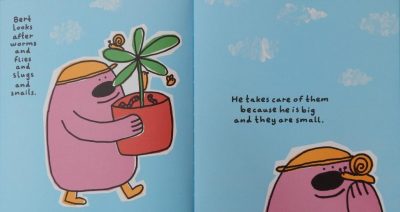
This is the ninth adventure of Karin Celestine’s Celestine and the Hare series in which friendship, fun and kindness are the essence. The characters are little felt animals, particularly the Water Vole family comprising Bertram who likes sewing, his gardening lover dad Bert, Grandpa Burdock a nature expert who makes others laugh with his silliness, Granny Dandelion, fixer extraordinaire and Bertram’s mum Beatrice, explorer and inventor.

When a hedgehog in a hot air balloon crashes into the pond while Grandpa Burdock is investigating it for possible newcomers, he learns that the prickly creature has been shut out of her log pile home in the garden next door on account of a new fence. Now her balloon has burst and Hedgehog has no way of getting back.

While she refreshes herself with tea and bramble biscuits, Grandpa’s head buzzes with ideas for getting their visitor home. As his drawings of possible contraptions get ever more dangerous-looking,

Granny has been otherwise occupied, but when she appears on the scene and learns of Hedgehog’s plight, she too gets busy to find a solution.
Her workshop resounds with sawing and hammering and before long Granny reveals something that sends Hedgehog’s heart soaring with happiness …

This super-sweet altruistic tale bubbles over with kind thoughts and deeds; with a papier-mâché hot air balloon making activity and information about hedgehogs and how to help them at the end, it’s a delightfully playful, warm-hearted book for sharing with little humans.

Grotwig the Goblin
John Swannell
John Swannell Studios

‘Where’s Wally?’ and ‘a needle in a haystack’ sprung to mind on opening this photographic book, even though there’s not a haystack in sight.

Narrated in rather creaky corny rhyme by goblin, Grotwig, we share in his ramblings through the countryside: ramblings that, at different times of the year take him, as we see in Swannell’s photographs of topiary, pine and mixed deciduous woods, dry stone walls and hedgerows, ancient Yews and Oaks,

moorland hills and byways, and tranquil lakes, through all kinds of terrain.

There are times when the goblin asks readers to find him (with the aid of a magnifier housed in a pocket on the inside front cover) in the photos, This makes us slow right down and look closely at each of the rural landscapes. In itself, that is a good thing: the photographs are lovely and the peaceful scenes well worth paying attention to,

reminding this reviewer of some of the walks taken around the Gloucestershire countryside.

Children are increasingly pressurised and tend to seek escape on screens rather than going outdoors. A book like this might help to tempt them to do the latter and although they won’t encounter any goblins, there’s nature’s magic aplenty to discover in the great outdoors.

The Colour of Happy / Some Days / A Thank You Walk

The Colour of Happy
Laura Baker and Angie Rozelaar
Hodder Children’s Books

This sweet, simple rhyming story of a boy finding a dandelion seed head and what happens thereafter is the means for an exploration of feelings for young children around the age of the child narrator, using a rainbow of emotions and the fluffy seed head.

The child, out walking with a pup, spies a dandelion clock: ’Yellow is for happy when I spot a special thing,’ he tells us and having picked it, hops and skips along. But when a gust of wind whisks his treasure away, the boy is engulfed in dark blue sadness.

His emotions then run through the colour spectrum: red for anger as he watches it sail away;

green for feelings of envy when he sees a girl with the seed head; grey when he cannot believe things will be okay; gold for the kindly response from a little girl, and the return of hope as they play together chasing the dandelion clock while it sails off again;

purple for the proud feeling when the boy again holds his treasure safe and bids his friend farewell; orange for the mounting excitement as he heads home and finally, pink as he reaches the front door with his somewhat depleted, love-filled offering …

Little ones will certainly relate to Laura Baker’s lovely story, which offers a great starting point for becoming mindful about their own responses to situations. With a foundation stage class, I envisage children talking about the book, their own feelings with regard to a particular happening; and then perhaps responding with paints or whatever medium they feel right, in music or a dance with coloured scarves perhaps.

Some Days
Karen Kaufman Orloff and Ziyue Chen
Sterling Children’s Books

We all experience different feelings at different times and so it is with young children and this book, with Karen Kaufman’s lively rhyming text and Ziyue Chen’s warmly hued illustrations, conveys that huge gamut of emotions through the course of a year.

Through two young children, we share in their everyday highlights such as ‘chocolate pudding pie day’s’, ‘Kites up in the sky days. Jumping super high days’; the joys of swimming and sunbathing;

as well as the downs – a nasty cut knee for instance.

Some days are extra special like that for ‘picking out a pup’ or winning a cup. Then come fussy mum days

and days when raincoats just won’t do, and there are  too wet to play football days with glum stay indoors faces; better though are snow angel making days and watching a warm fire days.

The author acknowledges those bad days when everything feels wrong

and those when it’s best to be alone.

Finally comes ‘Learning to be me days’ which is really the essence of the whole, a book that celebrates the positive but doesn’t gloss over the negative feelings. It’s a good starting point for discussion in an early years setting, or after a one-to-one sharing at home, perhaps about how best to respond to and deal with negative emotions. After all, being mindful of, and being able to talk about, our emotions and feelings helps us best deal with them.

Helping to develop mindfulness in even younger children is:

A Thank You Walk
Nancy Loewen and Hazel Quintanilla
Words & Pictures

Nancy Loewen’s brief story of a mother and little girl walking their dog, Duke, is one of the Bright Start series aimed at developing emotional intelligence in the very young.

Simply expressed it tells how as they stroll hand in hand mother and child interact with the animals they encounter. The barking sounds of Duke, the chirping of birds eating seeds, a neighing pony fed carrots, an overturned beetle that they rescue, which flies off with a buzz-buzz,

are, the child is told, the creatures’ ways of saying thank you.

Cutely and expressively illustrated in black and white with orange pops, by Hazel Quintanilla the book demonstrates the importance of showing appreciation and thankfulness. It’s never too soon to start saying thank you and as an introduction to being mindful about expressing gratitude it offers a useful starter for a circle time session with a nursery group, or for individual sharing at home.

The Prince and the Witch and the Thief and the Bears

The Prince and the Witch and the Thief and the Bears
Alastair Chisholm and Jez Tuya
Walker Books

This is essentially a bedtime story treasure trove – a fairy story with a very clever twist or two, or even more.

It begins with Dad asking son Jamie what kind of bedtime story he’d like. Jamie requests “A made-up one!” to include the titular characters and so Dad does as he’s bid and begins to tell his tale within a tale and a right rambling yarn it is into which Jamie insists breaking with questions and interjections. Dad then weaves these into his telling, no matter how far off piste they might be or how irritating. “Why couldn’t the Princess rescue the Prince? … Mum says Princesses in stories are rubbish.” Dad eventually concedes only for Jamie to decide, “No actually I want the Prince.” …

The Princess has been incarcerated in a tower by “her wicked aunt, a Witch with an Evil Eye, ” Dad continues and so it goes on.

We discover that the castle is made (to Jamie’s disgust) entirely out of broccoli and the Witch is really a Ninja. Uh-ha! And if that’s not enough topsy-turvyness, then I’ll have you know that as they approach Castle Broccoli the Prince is actually carrying the horse

and the Princess isn’t all she seems.

Nonetheless all ends happily – twice over- in this splendid romp of a bedtime tale telling experience that will delight both receivers and deliverers. It well and truly flips the traditional fairy story right on its head and not only is it a smashing bedtime offering (albeit not a brief one); it’s absolutely bursting with classroom potential too; and not simply because Dad promises a continuation involving the Bears on the following night.

Yes, Alistair Chisholm’s telling is terrific, but Jez Tuya’s illustrations are pretty cool too – or should that be hot – certainly so here …

and full of hilarious, chortle worthy details.

Dogs in Space: The Amazing True Story of Belka and Strelka

Dogs in Space: The Amazing True Story of Belka and Strelka
Vix Southgate and Iris Deppe
Wren & Rook

We’ve already had picture books about Laika (notably Owen Davey’s Laika the Astronaut) but now this, author Vix Southgate’s debut, celebrates two canine heroes from Moscow, Belka and Strelka, the first living creatures to actually survive being hurtled into space to orbit several times before being brought safely back to earth.

That though is getting ahead of ourselves so let’s go back to earlier in their amazing lives when the two stray dogs were roaming the streets of Moscow. From there they were picked up and taken to Moscow’s Space Centre for training to become part of the Russian Space Programme. The two little dogs were, so a space centre scientist Oleg decided, just right as they were clever, brave, calm and obedient; perfect characteristics for Space Dogs.

They were then subjected to all kinds of scientific experiments and a training regime before being blasted off in a rocket in August 1960. As Belka and Strelka orbited in space there were anxious times on earth; so still were they, that it was feared they’d not survived the launch. All was well however

and after circling Earth many times, the two dogs started their descent – a dangerous operation – but finally …

History had been made.

The book doesn’t end there though: we learn that Strelka gave birth to six healthy puppies, both dogs lived long happy lives and that their incredible adventure acted as a trailblazer for Yuri Gagarin, Valentina Tereshkova and other astronauts. All this and other key events are presented, timeline style, in the final pages.

A real life story, engagingly and dramatically presented both in words and Iris Deppe’s pictures. It’s a fascinating and exciting way to introduce young children to the history of human space exploration.

Early Years Round-Up

Father’s Day
Shirley Hughes
Walker Books

A gorgeously warm celebration of moments shared with a beloved dad are woven together to make a super little book for dads and their very little ones to share around Father’s Day, or on any other day. There’s a lively early morning awakening and musical rendition at breakfast time and a walk to playgroup. The highlight though is a day spent at the beach, playing, snoozing, sandcastle building and picnicking. Then it’s back home for bathtime, a spot of first aid,

a goodnight story and some moon spotting.
Bliss! And who better to show all that than the wonderful Shirley Hughes.

Maisy Goes to a Show
Lucy Cousins
Walker Books

Maisy and friends are off to the theatre to see a performance of Funny Feathers, starring Flora Fantastica. Maisy finds it hard to contain her excitement as they queue, browse a programme and eventually take their front-row seats just as the music starts and the curtain lifts for the drama to begin.

During the interval, there’s time for a loo visit and snacks before the bell rings for curtain up again and the cast, led by Flora, sing in the big city of their desires before heading back to their jungle home, and a curtain call farewell.

Maisy fans will love it, and she’ll likely win some new followers with this latest “First Experiences’ story.
More new experiences come in:

The Scooter
Judy Brown
Otter-Barry Books

Twin rabbits Bruno and Bella and back in a second story. Bruno is thrilled to bits with his brand new scooter, practising eagerly using alternate legs and travelling at different speeds in different places. The only trouble is he forgets to perfect one crucial aspect of the entire process: how to use the brake. This precipitates some high drama as he whizzes downhill, through fields, a garden, the market and the park before Bella finally catches up with him – almost.

Anyone for a repeat performance?: Bruno certainly and I’m pretty sure very little humans will demand a re-run too; it’s smashing fun and who can resist Bruno’s enthusiasm?
And for slightly older listeners:

Sandy Sand Sandwiches!
Philip Ardagh and Elissa Elwick
Walker Books

Philip Ardagh and Elissa Elwick’s ‘sticky stickers’ awarders, The Little Adventurers return with their zest for life and bonhomie. It’s a very hot day as they assemble in their HQ shed, collect the necessary items and await one of their number, Finnegan who eventually turns up already sporting his snazzy trunks.

Off they go to the beach in his daddy’s car, arriving full of enthusiasm but with a modicum of good sense as they share the safety rules before heading onto the sand for some sculpting.
Masterpieces complete, it’s time to stand back and admire each one in turn.

Then after ice-cream treats it’s off for some paired rock-pooling,

followed by shell collecting and an unplanned treasure hunt. Then it’s time for a quick dip before they all head home with a few grains of sand to remind them of their day and back at HQ, a final sticker awarding, including one to Snub for his very helpful ‘mouse-sitting’.

Brimming over with silliness, friendship, sandy treats and other adorable delights (including the occasional fact), this is a treat for littles around the age of the characters herein.

Finally, if you missed the original, there’s now a board book version of:

Princess Mirror-Belle and the Dragon Pox
Julia Donaldson and Lydia Monks
Macmillan Children’s Books

Now a tiny version of a favourite spotty tale for very littles.
Ellen has chicken pox; she’s covered from head to toe in horribly itchy spots; and what does she want to do to those spots? Scratch them, especially the one right on the tip of her nose. As she gazes in the bathroom mirror, about to do the deed, she hears a voice – no, not mum’s but Princess Mirror-Belle’s.

Thus begins a funny story, delivered for a change in prose rather than Donaldson’s more usual rhyme. Lydia Monks’ sparkle-spangled, collage constructed illustrations offer readers an abundance of opportunities for visual and tactile exploration.


It’s Your World Now!

It’s Your World Now!
Barry Falls
Pavilion Children’s Books

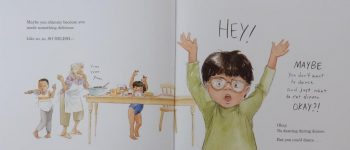
This upbeat rhyming picture book offers three lessons to young ones, lessons about the world, what it has to offer, the disappointments that sometimes befall us all, and how to live life to the full. Barry Falls’ rhythmic narrative calls to mind the Seuss manner of delivery in The Cat in the Hat.

The first lesson talks of a wealth of delights – singing birds, brightly coloured butterflies … autumn leaves / and splashy puddles. / Chocolate cake and ice-cream sundaes, / never-ending-summer-fun-days.’ Now who wouldn’t want those?

But more important is the assurance to the small child that ‘your future’s bright’ (not so bright with BREXIT looming, I fear) and that she and others like her ‘ … can choose whate’er they want to be / and be that thing, quite splendidly …’ Not of course, without hard work and application though; and the sky’s the limit – literally. I love the fact that pushing boundaries and rule breaking are acknowledged as lesson one draws to a close.

Life though isn’t always peaches and cream as the second lesson says and youngsters must be aware of the likelihood that along the way, things will go wrong, others will win or do better; some might seek to disenchant you or thwart your enthusiasm and determination, try to push you around or block your goals.

But each must follow his/her own path and purpose: that way lies fulfilment and ultimate success.

The final and most important lesson is a love-fuelled sending forth into the future, safe in the assurance that in this magical world of the next generation, these particular children are cherished no matter what.

Fascinatingly detailed and vibrantly illustrated (other than in lesson 2 – which has some rather menacing images) this is a wonderful celebration of the worth and potential of every child.

Grumpycorn

Grumpycorn
Sarah McIntyre
Scholastic

We all use displacement activities to avoid things we ought to get on with, like writing, as those of us who write for whatever purpose know all too well; and these are what we find Unicorn employing as he starts his session ensconced in his special writing house intent on writing ‘the most fabulous story in the world’.

Inspiration is lacking though and he just cannot get going. Up he jumps reaching for his special fluffy pen – still nothing comes. He makes himself a cup of ‘special moonberry tea.’ Surely that will help bring ideas flooding in; but no.

His wish for an idea to knock at his door isn’t fulfilled; instead Narwhal comes a-knocking. Rather than inviting him in or indeed granting his request to be in the story, Unicorn insults Narwhal and sends him packing.

When Narwhal meets Mermaid he tells her what’s happened and she too goes to see the writer, inquiring how the writing is going. Unicorn’s response that he needs cookies to get his genius working gives Mermaid an idea and she offers a deal: cookies in return for being in his story. So long as those cookies provide inspiration is his response and off goes Mermaid to start baking.

Despite scoffing the entire plate full of delicious-looking delicacies, Unicorn deems Mermaid’s efforts uninspiring.

Next to try their luck is Jellyfish but Unicorn’s reaction to her visit is to lose his temper completely and hurl his writing accoutrements into the sea.
Is that to be the end of his creativity or can his would-be story characters save the situation for everyone?

Funny, reassuring in its demonstration that everyone – even a unicorn- suffers from writer’s block (why don’t all teachers make allowance for that in school?); and that friendship rules; and deliciously illustrated in wonderful rainbow hues, this story is a great one to share – perhaps accompanied by some pizza.

The Tide

The Tide
Clare Helen Welsh and Ashling Lindsay
Little Tiger

What a heart-wrenchingly beautiful story Clare Helen Welsh’s little girl narrator tells as she talks of her beloved Grandad. ‘Mummy says that Grandad loves me very much but that sometimes he gets confused.’

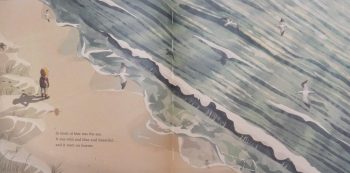
We then spend a day with the family at the beach – the child, her mum and Grandpa set up camp and as Mum watches, child and Grandad build sand castles and forts, crown themselves ‘king and queen of net and shells’. They all share a picnic (Grandad gets confused and buries the sandwiches) and then they go rock pooling (Grandad and granddaughter) and watch the movement of the tide as it comes in.

Mum likens Grandad’s memories to the tide – ‘sometimes near and close and full of life. Other times, far away and distant.’

Their musings are broken by voices and the family proceed together to buy ice-creams and again child and grandfather watch the tide

before becoming ankle deep in sea-water.

All too soon it’s time to go home but first they must shake away and wash off the sand and salty water.

Then it’s back home to talk lovingly together about their shared day.

The likening of Grandad’s memory to the ebb and flow of the tide is both moving and enormously powerful: Clare has chosen the perfect figurative language to help children to begin to understand dementia and be at ease with the subject. And, I can think of no better illustrator than Ashling Lindsay whose work I’ve loved since seeing her very first picture book. Her warm colour palette here is just gorgeous, radiating the unconditional love that so clearly exists between family members, especially child and Grandad.

A must have for family collections and for primary schools to share and talk about together.

Narwhal Unicorn of the Sea / Super Narwhal and Jelly Jolt

Narwhal Unicorn of the Sea
Super Narwhal and Jelly Jolt

Ben Clanton
Egmont

In Unicorn of the Sea. Ben Clanton introduces readers to Narwhal, a self-aggrandising creature.

In the first of three sub-aquatic adventures, while cruising in ‘new waters’ Narwhal encounters a jellyfish and despite doubting each other’s realness, the two interrogate one another, forge a friendship and eat waffles together.

The second tale sees the two involved in forming their very own ‘podtastic’ pod of awesomeness that includes other ocean buddies – shark, turtle, blowfish, octopus and of course – though he’s very nearly left out – Jelly, each of which receives a tusk tooth in honour of the occasion.

My favourite of the three stories is the book’s final one wherein Narwhal introduces Jelly to his ‘favourite book in the whole wide water and probably the rest of the universe too!’ It’s a book without any words or pictures and Clanton provides two blank pages for maximum effect here. Narwhal tells his pal that ‘it’s an imagination book … you’ve got to pretend.’ Brilliant! And so thinks Jelly too for having tried it out, he wants to borrow it right away.

With its splendid dialogue, this is irresistible, sub-aquatic bonkersness of the first order delivered in graphic novel style for young readers. There’s even a silly narwhal song so sing and clap along to.
This twosome is up there with Arnold Lobel’s Frog and Toad, and Mo Willems’ Gerald and Piggy.

In Super Narwhal and Jelly Jolt, Narwhal swathes himself in superhero-ness assuming a secret identity and appointing a sidekick (Jelly Jolt) but despite this, he seems to lack the necessary superpowers, so he thinks. Nonetheless fuelled by waffles – the friends’ ‘super weakness’ – he sets about helping a star(fish) to become a cosmic being. This involves cannon blasting and wishing (I won’t say which, if either, works).

There’s also a comic – no prizes for guessing it’s a waffle-themed one, created by none other than Narwhal and Jelly themselves.

And then in the final tale here, Narwhal finally does discover his very own superpower; it’s a super-important one too, discovered by an act of altruism towards crab.

Once again the whole thing – super sea creature facts and all – is super-brilliant and full of heart. I just love how it effortlessly demonstrates the importance of friendship, of encouragement and that all of us – if we look hard enough –possess a world-improving superpower. With laughs aplenty and the most adorable illustrations, this book is an unmissable gem, not only for young readers, but adults too.

A Brief History of Life on Earth

A Brief History of Life on Earth
Clémence Dupont
Prestel Children’s Books

Wow! This story of life on earth truly does unfold in dramatic concertina style – to the length of one of the dinosaurs included herein, a triceratops. That though is getting ahead of things for the book begins around 4.6 billion years ago in the Hadean Age when the Earth was mega-hot and very young, the first eon of Earth history.

Thereafter comes a whistle-stop tour of the fifteen subsequent geological periods, each of which has a factual paragraph and a superb illustration.

It’s at the end of the Proterozoic Age, in what’s called the Ediacaran Period, the first (soft-bodied) organisms appeared.

Next, the Cambrian Period was when aquatic life exploded around the coastlines of continents and evolution of life gave rise to a huge variety of forms including some with a skeleton, digestive system, eyes and gills.

Aquatic life developed a-pace through the Ordovician Period (-490 to 445 million years ago) and plant life began to move onto the mainland in the form of mosses and fungi.

Then came the Silurian Period and the Devonian period, the latter being a time of extreme heat during which life diversified even more. The first sharks appeared and animal life began to make the move towards land.

We’ve now reached the Carboniferous period with its great trees, huge insects and a wealth of plant life, which eventually became buried and over 1000,000s of years compressed to form deposits of coal.

By the Permian Period, the land masses had come together creating a vast super-continent when reptile-like mammals roamed only to die out and become replaced in the Triassic Period by mammals, the first amphibians and the soon-to-be dominant dinosaurs.

Did you know that the continental split began in the Jurassic Period, the golden age of dinosaurs including Diplodocus, Ankylosaurus and Archaeopteryx. The Jurassic and Cretaceous periods saw a further drifting apart of continents and the appearance of Tyrannosaurus as well as bees and flowering plants.

Moving forwards to the hot, humid Paleogene Period, there was a huge diversification of birds and mammals around the globe; then again the climate cooled and during the Neogene Period apes, ancestors of the elephant appeared, and ungulates became widespread.
Humans evolved into their modern form during the Pleistocene Epoch becoming hunters and fishers; they also began to develop language and artistic expression.
We’re now in the Holocene Epoch, which began 11,700 years ago and readers will recognise the modern landscape shown on this penultimate spread.

Phew – such astonishing changes and so beautifully presented in this zigzag style book. A-MA-ZING!

You Can’t Cuddle a Crocodile

You Can’t Cuddle a Crocodile
Diana Hendry and Ed Eaves
Hodder Children’s Books

Why would anyone want to, was my immediate response to the title of this book but said crocodile doesn’t actually make an appearance until quite a way into the story – on Friday to be precise – so let’s go back to the start and meet the family on Monday morning.

There’s our narrator, a fresh-faced boy together with his smiling parents who counter the lad’s claim that on this particular day his sister is a monkey, with a question about the nature of monkeys’ choice of breakfast, and go on to fabricate further fanciful monkey-associated notions.

Come Tuesday, said sister has morphed into a bear whose ursine antics cause early morning chaos in the household.

And so it goes on through the week: Wednesday a camel accompanies mum and boy to the beach; Thursday sees a rainy shopping expedition with a flat-footed, flap, flap, flippered sibling slowing down the journey and causing consternation with the shopkeeper.

Friday it’s the turn of a visit from that crocodile – a decidedly uncuddle-able incarnation, particularly at bedtime story time and on Saturday the unsuspecting postie is scared silly when something roars at him and makes a grab for his sack. He isn’t impressed, preferring the human sibling.

On Sunday, Freya makes a welcome return as herself but suddenly Mum notices the absence of our narrator. What could have happened to him? … Seemingly he has the final chuckle in this tall tale.

Diana’s crazy story coupled with Ed’s zany digital scenes of young Freya’s incarnations and their outcomes, is likely to entertain youngsters in an early years setting or at home as well as providing a gentle introduction to, or reminder of, the days of the week sequence.

I’m a Baked Potato

I’m a Baked Potato
Elise Primavera and Juana Medina
Chronicle Books

As a stylish woman sits relaxing in her garden she admires her potato plants for she has a particular penchant for potatoes.

She also has a great liking for dogs and one day she goes out and gets a little brown terrier, likening it to her favourite baked potato food and constantly calling it “Baked Potato” as they spend their days inside together.

One day though, the two sally forth but not together.

As the dog searches for the woman, little by little he starts to wonder whether perhaps after all, he’s not a baked potato; but nor is he as the big dog tells him, a groundhog; nor is he a plump bunny like the fox says, igniting his oven and licking his lips in eager anticipation.

Happily for the ‘bunny’ an owl happens along and taking the little canine under its wing, explains that he’s a dog and points out that “dogs are very good at finding things, especially with their noses.” And the rest, shall we say is a sniffing journey and a joyful reunion.

Slightly crazy, but full of cosy charm and gentle humour is Elise Primavera’s telling; and with Juana Medina’s brightly coloured, detailed, swirling, whirling digital art, the book is a delightful read aloud either to a class or individuals with lots of possibilities for adult/child dramatising along the way.

Beetles, Butterflies and other British Minibeasts / Look and Say: What You See at the Seaside / Queen Victoria

Beetles, Butterflies and other British Minibeasts
Nikki Dyson
Nosy Crow & the National Trust

In all my time teaching under 7s, I’ve probably never come across a child, however lively or challenging who, when outside (or sometimes in) failed to become engrossed in watching such minibeasts as woodlice, ants, ladybird larva or caterpillars.

This beautifully illustrated Nature Sticker book takes users to several locations where minibeasts are likely to abound: the vegetable patch – several, but not all of the minibeasts therein are likely to be pests.

Anything but pests are bees, hugely important garden visitors that have a vital role in pollination, as do some butterflies like the beauties shown herein.

The shed is a likely place to find spiders and their webs in abundance as well as daddy-long-legs and perhaps other less desirable kinds of flies.
You’ll probably hear grasshoppers and crickets before you see them as they’re often camouflaged in the long grass they like to frequent.
Tree trunks like this one are good spots for discovering and observing beetles.

What better time that now to get outside, look for small creatures and then come back and enjoy hours of learning and fun with this beautifully illustrated book?

Look and Say: What You See at the Seaside
Sebastien Braun
Nosy Crow & the National Trust

Whether you’re building sandcastles at the water’s edge, swimming in the sea, looking at the boats in the harbour, walking on the cliffs, rock-pooling, fishing, exploring the estuary, strolling on the sand-dunes, or perhaps diving down beneath the waves, there’s always plenty of interesting things to see. when you visit the seaside.

This is what Sebastien Braun shows in his engaging scenes of the various locations, each of which has an introductory sentence and another pointing out a particular feature of note. At the bottom of each spread is a row of named objects to find in the large illustration and say together, if sharing the book as intended with an adult (or older child).

A fun way to develop vocabulary and observational skills with little ones.

Queen Victoria
Illustrated by Nina Cosford
Puffin / V&A

Readers with an interest in the past will enjoy this mini-hardback book that looks at the life of Victoria and her legacy.
It tells how, when the young Victoria became queen she was determined to break free from the controlling influences of her mother and her courtiers and rule Britain on her own, even if she didn’t always get things right. It was against royal protocol for her cousin Albert, with whom she fell in love, to propose marriage to her; instead she did the honours and was accepted.

As well as information about the Queen, there are spreads about the industrial revolution; the Great Exhibition at the Crystal Palace, the royal couple’s work in support of the arts and science,

their interest in the latest technological developments as well as Albert’s popularising of the Christmas tree and Victoria’s golden and diamond jubilees.

Illustrated with a mix of photographs and finely detailed illustrations by Nina Cosford this is one to add to primary school classroom shelves, or for young readers wanting an introduction to a fascinating period of great change.

In Focus: Forests

In Focus: Forests
Libby Walden et al
360 Degrees (Little Tiger Group)

Ten exciting illustrators showcase some of the world’s most famous forests in this smashing book that’s been put together under the stewardship of Libby Walden.

Herein is a wealth of information about the natural flora and fauna of these stunning green places as well as associated facts on such things as, in the first and hugely biodiverse location – The Black Forest – things to do, the Brothers Grimm and more. Grace Easton is the illustrator of this place.

Gate fold flaps are employed by each artist, the second being Julie Colombet who explores The Anatomy of Trees;

Suzanne Washington takes us to the Rainforests; with the artistic work of Sol Linereo we visit National Parks.

Stephanie Fizer Coleman dives deep to the Kelp Forests to show us the sea otter and many more amazing inhabitants.

Forest Mythology is the next focus, illustrated by Irene Montano;

the Amazon Rainforest wherein we ‘meet two famous British naturalists, is illustrated by Marc Pattenden;

Alfred Wallace & Henry Bates

Alessandra Santelli portrays peoples of the Forest; Aaron Cushley, Mangrove Forests and the final topic is Produce and Preservation (including the tree hugging, Chipko movement) illustrated by Jenny Wren.

Each spread is totally absorbing and the entire chunky volume is sure to draw you in to what are probably my favourite places – forests – and hold you there for a considerable time.

A Boy’s Best Friend / The Mountain Lamb

These are books five and six in Nicola and Cathy’s Country Tales short fiction series about young people growing up in a rural environment, published by Graffeg who kindly sent them for review.

A Boy’s Best Friend
The Mountain Lamb
Nicola Davies, illustrated by Cathy Fisher

A Boy’s Best Friend starts with young Clinton reluctant to leave his tropical island home, his gran and his fisherman Uncle Cecil to join his mother in London where she’s lived for five years. He feels anxious about meeting his step-father, eager to meet new little sister and very unhappy at the prospect of having to leave behind his much loved dog, Rufus.

But leave the island he does arriving in England as spring approaches. At first, despite the family’s best efforts, he feels lost and as though all the light has been leeched from him in this chill, drear place called London.

Then comes news of a school trip by minibus to a castle in Kent and despite there not being the intended farm visit, Clinton joins the party. But when the minibus meets with an accident and ends up partly in a ditch, Clinton takes the opportunity to help an old man, David with his stampeding cows, scared by the crash.

From then on, despite being in big trouble at school and at home for running off after the accident, things start to look brighter for young Clinton who readily takes up the farmer’s subsequent offer to visit his farm and lend a hand.

Beautifully told and full of warmth, Nicola’s short tale of love, change and adjusting to a new life, will speak to everyone, especially those who have had to leave much of what they love to start a new life elsewhere. Cathy Fisher’s delicately worked black, white and grey illustrations further add to the atmosphere of the telling.

Young Lolly in The Mountain Lamb is faced with tremendous challenges too. Her mother has died and now Lolly lives on a sheep farm with her grandparents. It’s lambing time and up on the moor, she finds an orphaned baby lamb so small it fits inside the woolly hat she uses to carry it home.

Fearing that it won’t live through the night, Lolly is surprised to hear its tiny bleat next morning at breakfast time: seemingly the lamb wants feeding. Lolly decides to call it Susan after her mother.

Grandpa encourages the girl to take responsibility for rearing the little creature. She rapidly forms at attachment to it, knowing though that it will eventually have to become part of the flock.

After months of not leaving the farm and its surroundings, it’s time for Lolly to return to school but fog causes Gran to abort the journey and they go back to the farm.

Time passes with Lolly staying back rearing the lamb and helping her grandparents indoors and out. One day Susan goes missing and despite a blizzard, Lolly embarks on a perilous search. Is she to meet a fate similar to her mother whom we learn had died in an accident on a Himalayan climb?

Happily not, for her Gran is experienced in Mountain Rescue.

The lost lamb makes its own way safely back and finally Lolly returns to school after a long, hard but rewarding few months.

This tale of courage and love is potent and moving throughout; I couldn’t put it down.

Fabio: Mystery of the Ostrich Express / Ariana and Whisper / Princess of Pets: The Naughty Kitten

Fabio: Mystery of the Ostrich Express
Laura James, illustrated by Emily Fox
Bloomsbury Children’s Books

Fabio, flamingo detective and resident of a small town on the banks of Lake Laloozee, returns to solve his second case and it involves a stolen necklace.

Fabio and his trusty associate Gilbert giraffe are about to depart on the Ostrich Express for a much-needed holiday at Coconut Palm Resort when something, or rather someone, catches Fabio’s eye.

Once on the train, a desert fox who introduces herself as Zazie – appears in the dining car sporting a fur stole and enormous ruby pendant – the legendary, -very valuable so she tells Fabio and Gilbert – Lalooze Ruby.

As the train speeds across the desert, unexpected happenings take place, the first being that Gilbert is knocked unconscious when he hits his head against the window as the train is suddenly brought to a full-stop. Leaving his friend in the care of Zazie, Fabio leaves the train and discovers a baby elephant lying beneath the stars tied to the tracks. Fabio unties him and learns that a gang of bandits – hyenas and a leopard – had tied him down.

That though is only the beginning. Soon a scream pierces the dark followed by hyena’s laugh and as Fabio climbs back aboard the train he spots a leopard silhouette and learns that the ruby has vanished from around Zazie’s neck – pulled off by a thief so she says.

Never fear, Fabio is hot on the case; he merely needs to enlist the aid of the train crew to help power his refurbished handcar,

let loose the tied-together table cloths , … cavort across a few train carriages, execute a deft flick of Gilbert’s cane and … and … that would be telling way too much of this exciting, fast-paced, perfect for just flying solo readers tale.

And with Emily Fox’s dayglo bright, pink and orange powered illustrations and occasional text backgrounds, plus Fabio-patterned chapter breaks, what more can any young reader want?

Ariana and Whisper
Julie Sykes, illustrated by Lucy Truman
Nosy Crow

Unicorn Academy is ‘where magic happens’ and now in story number 8, arachnid-fearing  Ariana is finding it hard to make friends. She does however love her special unicorn Whisper and enjoys spending time in the stables bonding with him and helping him discover his magic power.

Things improve somewhat when she starts to bond with untidy Matilda and then Ms Nettles announces that the day’s lessons are to be replaced by a field trip to the edges of the woods to find out which animals are leaving and why. An adventure is set to begin: something is very wrong in the woods and Ariana can feel it.

Not long after, Whisper discovers his special power: perhaps with its help, together with the courage of Ariana, her unicorn and the other students, the mystery of what has been happening with the animals can be solved.

Fans of the sparkling series will lap this up with its short, bite-size chapters and Lucy Truman’s enchanting black and white drawings.

Princess of Pets: The Naughty Kitten
Paula Harrison, illustrated by Olivia Chin Mueller
Nosy Crow

Princess Bea is an animal lover but her father King George tells her time and again that Ruby Palace is ‘no place for a pet’. However, the nine-year-old princess isn’t one to be deterred by royal rules when it comes to taking care of animals needing help.

While she’s at the kite festival with her teacher Mr Wells, Bea climbs up a tree to free her kite and there comes upon a ginger kitten; and of course, she just has to rescue it.

Determined to keep it safe until they can find its owner she manages to sneak it in to the palace but discovers that Tiger as she calls it, is rather excitable. Moreover when her father discovers the creature, he’s far from pleased and gives Bea just 24 hours to get rid of it.

At night the kitten decides to go exploring and Bea needs to summon up all her courage to hunt around the palace in the pitch dark, especially when she hears a noise that doesn’t sound like Tiger …

Young animal lovers just flying solo as readers will enjoy this addition to the series illustrated by Olivia Chin Mueller.

Springtime Picture Book Delights

This is a catch-up of some Macmillan titles:

The Nature Girls
Aki (DelphineMach)
Macmillan Children’s Books

Sixteen inquisitive girls – I love the fact they’re introduced by name on the title page – don identical yellow safari suits and sally forth to explore nature, in particular different biomes.
Bags on backs, having observed some rabbits in their garden, they head for the beach and clad in sub aqua gear, dive down

and swim with dolphins.

Then it’s back on with the safari suits and off they go walking through rainforest, across a desert,

then aboard a safari bus travelling through grasslands; on a plane tundra bound where they board a dog sledge

and finally, they sail off destination a forest alive with sounds of its wildlife.

Observant listeners and readers will notice the less obvious as well as obvious animals and other detail in Aki’s playfully adorable scenes, as her rhyming text bounces along as enthusiastically as the intrepid travellers. I absolutely love the sense of mischief occasionally shown by some of the young female friends in this joyous adventure and the final scene hinting of further wonder-filled adventures in the offing. Hooray for girl power!

A fun introduction to the scientific notion of biomes – the final spread about these may well set the inquisitive off researching the topic further.

Little Bear’s Spring
Elli Woollard & Briony May Smith
Macmillan Children’s Books

As any walk in town or rural parts will show, spring has well and truly sprung now and what better way to celebrate its joys (apart from a walk) than with terrific twosome Elli and Briony’s gorgeous book collaboration that celebrates not only the coming of my favourite time of year, but also, friendship.

When a little bear awakes one morning all he sees is a vast, seemingly empty snowy landscape.
Without a playmate, Little Bear spies a small smooth stone that feels like a promise.

Tucking it into his fur, he heads off down the track in search of friends.

Too busy for friendship, the birds are nest building and bear’s efforts to do likewise fail so off he goes again.

He finds however that the hares and wolves are also busy with spring preparations and his attempts to emulate them are, in the first instance merely a flop and in the second, pretty scary. This brief scariness however, precipitates the perfect finale of the story …

for when Little Bear awakes next morning a whole new world with an exciting surprise awaits …

Delivered in faultless lyrical rhyme Elli’s terrific tale with its wonderful evocations of spring, and Briony’s stupendous scenes of the natural world and the changes therein, (her use of ‘night and light and the half light’) with the terrific portrayal of the zestiness of life in springtime make this book’s a true treasure no matter what time of year you share it.

What Clara Saw
Jessica Meserve
Macmillan Children’s Books

Clara’s enthusiasm for the school trip to a wildlife park could so easily have been thwarted by the egotistic, know-all, humans are vastly superior to other animals, attitude of teacher, Mr Biggity, as he walks around intent on proving the veracity of his fake-scientific assertions to the children in his class at every opportunity, talking down the animals’ awesome characteristics.

Clara in contrast walks around with an open mind and eyes, wondering and observing what the residents of the animal park are doing. “Do animals feel sad?” she asks … ‘no, no and NO, … their brains are far too small for feelings” comes his retort.

And of course they can’t possibly communicate, use tools to get what they need and absolutely ‘don’t care about the world around them’ …

As Mr B. rabbits on, the animals are engaged in using their aptitudes, knowledge, skills and natural instincts to outwit the park keeper and come to the aid of a giant tortoise, about to be transported away from her fellow animals.

So much is shown rather than told. Jessica’s exquisitely observed watercolour and pen illustrations say far more than her words: Clara’s fascination and joy as she watches the animals is evident from the outset as is Mr Biggity’s condescending attitude both to his charges and the animals. Note the position of his right hand as they enter the park, his meticulously tied laces, his upturned foot as he strides forth and in contrast, the expressions of the children, as they look in wonder at what they see.

This humorous, cleverly constructed story brilliantly demonstrates how best to learn; how not to be gulled by false information (HMMM!) and there’s not a tiny weeny touch of the dogmatic preachiness that is Mr B. anywhere in sight.

My Pet Star / Little Fish

My Pet Star
Corrinne Averiss and Rosalind Beardshaw
Orchard Books

Beneath a tree one night, a little girl discovers a star. The star has been hurt by its fall and its glow has gone, so she takes him home.

There she acts as a ‘cosmic super vet’ tenderly nurturing her ‘pet’ star, sharing books with him

and cuddling up with him at bedtime.

The days go by and the young narrator finds out a great deal about her star and his habits and all the while, the star glows brighter. She misses him during the day when he sleeps a lot; and he eschews her games merely looking on silently and benevolently.

At night though, he comes to life, his sparkle preventing the girl from sleeping as he twinkles above her bed – until she makes a decision.

Leaping from her bed she opens wide her window and … whoosh! Away flies her astral friend, fully restored, back into the dark sky where he belongs, from there to brighten up the sky and his new friend’s life from afar.

Corrinne’s magical story demonstrates the importance of kindness, altruism and friendship; it’s beautifully illuminated by Ros. Beardshaw in her mixed media scenes. Her narrator is shown as an adorable child who seems to live alone in a shepherd’s hut or travellers’ caravan.

Little Fish
Emily Rand
Thames & Hudson

Five vibrant, layered neon scenes of life beneath the ocean waves pop out of this book, the covers of which can be tied back to create a standing carousel.

A short rhyming narrative introduces two orange goby fish playing among the corals. The duo become separated when a large shoal swims past sweeping one of them with it, into a dark patch of kelp in which rests a friendly-looking turtle.

Less friendly though is the hungry grouper that lurks in the cave nearby eyeing the little goby. Then, even more scarifying are the white teeth of a marauding shark that appears on the scene snapping its jaws threateningly.

Happily though, the little fish finally makes it back home where it re-joins its playmate on the reef.

A lovely way to introduce your little ones to marine life, but equally this would be great as part of an early years display for a sea-related theme.

The Big Book of Birds

The Big Book of Birds
Yuval Yommer
Thames & Hudson

This is a cracking series and Yuval’s bird book is an absolute beauty.

Each and every spread, starting with the opening Bird Family Tree is full of fascinating facts and illustrated with that wonderfully playful, ‘twinkle-in-the-eye style the artist has.

Despite my partner being an avid bird spotter, I’d not realised before that there are almost 10,000 bird species and here they’re divided into family groups: birds of prey, owls, woodland and forest birds, seabirds, perching birds, water birds and the flightless kinds.

After spreads on being a bird-friendly spotter, feathers and their role in flying, and bird migration, each introduced by a question, we’re given examples of members of each family, zooming in first on great grey owls. Did you know that these are the tallest owls in the world and have special feather-formed discs around their eyes acting as satellite-like dishes directing sounds into their ears; or that with seven more neck vertebrae than humans, a great grey owl can turn its head almost completely around? (The teacher part of me loves that idea.)

Flamingos (pink feathered on account of their diet) and magpies – not thieves of shiny things – come next and then one of my favourites, kingfishers. Currently living much of the time very close to the Nailsworth Stream along which if I’m lucky, I see a kingfisher flash by, or occasionally spot perching on a overhanging branch, these birds always make me feel uplifted; and so it was here.

I don’t think I’ll go and investigate the bank for a stinky fish bone and poo-filled burrow though.

With introductory questions, there are spreads on flightless birds, secretary birds, parrots, bald eagles, puffins, albatrosses, hummingbirds, peacocks – I love to see these on walks in parts of India – robins, swans, hoopoes and red-crowned cranes. Interspersed there are pages looking at nests of various kinds,

eggs – I was amazed to learn as ostrich egg is 16cm long; beaks – their shapes and feeding functions; bird calls and songs – we’re probably all aware of the early dawn chorus these light mornings; city birds and making your garden a bird-friendly place.

If you really want to impress others, there’s a spread on specific vocabulary and as I should have mentioned at the outset, the solution to the ‘can you find the same egg 15 times’ poser from the title.

Absolutely avian-electable; and my copy came with a wonderful pictorial treat – thank you Yuval – before the title page.

If this book doesn’t get your young ones enthusing about our feathered friends, then I’ll be forced to spend a whole day doing various yoga poses like peacock or crow.

Most Marshmallows

Most Marshmallows
Rowboat Watkins
Chronicle Books

Imagine an entire world populated by marshmallows; it’s what story-inventor extraordinaire, Rowboat Watkins does, one way or another.
As he informs us at the outset, ‘Most marshmallows don’t grow on trees … or come from storks — or even Mars.’

Instead most are mostly born of marshmallow parents and reside in various kinds of homes. They do the kind of things you and I would do like celebrating birthdays, watching television, going to school – well the young ones do, and presumably the marshmallow teachers.

Lessons are taught in being squishy – yes even these already soft confections have to perfect their squishiness, and in standing in rows – I’m not a big fan of that one, but some educational establishments think it’s super important;

and most definitely they should come to understand why they cannot breathe fire (that art is the preserve of dragons).

Now happily there are some divergent thinking marshmallows with secret knowledge and it’s something SO important I’ll share it with you humans so you can make sure your little ones know too: ‘Marshmallows – all of them – can do or be anything they dare to imagine.’

Now I’ve always said how crucial the development of the imagination is in education, or anywhere really and now THANK YOU Rowboat for your affirmation of this, with the help of those malleable little confections of yours.

Superbly creative, funny and positively inspiring, this is a truly tasty tale to share with young humans. Rowboat’s mixed media photo images are absolutely terrific; his scenes of what marshmallows do – be that most, the exceptions, or indeed all, are quite brilliant.

I was partial to marshmallows before reading this book, I’m even more so now.

How To Light Your Dragon

How To Light Your Dragon
Didier Lévy and Fred Benaglia
Thames & Hudson

What do you do when you discover that your much-loved pet dragon’s spark has gone out? This delicious book with its exciting amalgam of words and pictures offers a range of possible curative strategies.

The dragon belonging to a child owner emits not a single flicker when first we encounter it but the child remains upbeat as ideas are put forward one by one in the manner of an instruction guide.

What about lifting his rear legs and giving him a ‘good shake’? Nothing doing?

Maybe use his tummy as a trampoline. No? A feather duster toe-tickle, underarm feathery feel or a nasal nudge duster-style maybe. Uh-uh, no go!

Make him really, really angry by cheating at cards or make a large cake complete with candles – irresistible surely? Actually no; and even the oven shop with its jealousy-inducing latest models pointed out fails to spark a response.

By now said dragon appears decidedly downcast and even consumes the false flames stuck on his snout then flops down defeated and immobile.

Perhaps the time has come for an entirely different approach; unconditional love – now there’s an idea … recollections of good times shared, a big smacking kiss right on his nostrils and … TA-DA!

The fusion of near show-stopping typography, arresting design, and wildly bright colours is powerful enough; but even that is eclipsed by the message that someone or here, something, is loved no matter what, gives the book its hottest, most radiant magic.

Didier Lévy and Fred Benaglia most definitely lit my fire with this one.

The Phoenix of Persia

The Phoenix of Persia
Sally Pomme Clayton and Amin Hassanzadeh Sharif
Tiny Owl

What better way to welcome the month of May than with this wonderful new book and music project from Tiny Owl, The Phoenix of Persia. The tale, told by acclaimed storyteller Sally Pomme Clayton is the second in the publisher’s One Story, Many Voices series.

It’s based on a story from Iran’s most important epic, and one of the world’s greatest, Shahnameh, by 10th century Iranian poet, Ferdowsi and tells of an ancient Persian king.

The setting for the telling is Daneshjoo park where children, including Ali and his sister Shirin, are gathered awaiting the magical ‘Once upon a time …’

We hear of the birth of the multi-hued Simorgh, a firebird with a secret: her feathers have the magical power of granting wishes and making dreams become reality, a bird that is reborn every thousand years from the ashes of her nest. This magnificent creature is the titular Phoenix of Persia.

At that time the land is under the rule of King Sam and Queen Aram who are overjoyed at the birth of a long-awaited child, a son and prince whom they name Zal.

The ruler’s joy is short-lived though for when he uncovers the child’s head he sees, not the locks of a baby but the white hair of an old man. Immediately rejecting what he considers an imperfect infant, the king summons a soldier and orders him to take him to the mountains and leave him. Reluctantly the soldier does as he’s bid, placing Prince Zal on a wind-swept rock.

The sobs of a hungry, distraught babe reverberate over the mountains and are heard by the Simorgh out hunting for food for her chicks. Resolving to care for the tiny human, the creature picks him up, carries him to her nest and tucks him in among feathers.
Years of lessons in languages, the arts,

sciences and princely skills follow and sixteen years later Zal is a wise teenager. His parents meanwhile are suffering – his mother from nightmares, his father from regrets. So terrible does he feel that King Sam calls the soldier and the two men ride off into the mountains, and come upon …

“Can you forgive me?” called King Sam.

Forgiveness follows and a paternal plea to return home initially refused, is accepted thanks to Simorgh’s words of wisdom to Zal that bring about a change of heart.

Then father and son (with some special feathers from the phoenix’s tail) travel home to be welcomed by an overjoyed mother. He adds a fiery phoenix feather for protection to his new crown

and there the storyteller in the arena stops, leaving one of the audience wondering about whether it was ever burned.

With acceptance at its heart, Sally Pomme Clayton’s telling really does feel like a drama unfolding before you, all the more so accompanied by Amin Hassanzadeh Sharif’s wonderful, richly textured, jewel-hued scenes. That’s not all though: there’s a QR code at the beginning of the book you can use to listen to a beautiful musical accompaniment on Iranian instruments to Sally’s narration.

Rich in classroom potential, this book is FAB-U-LOUS!


The Climbers

The Climbers
Ali Standish, illustrated by Alette Straathof
Stripes Publishing

This new title in Stripes full-colour fiction books for new solo readers stars young Alma who lives with her overbearing uncle in a town bordering a forest, a forest in and beyond which young Alma longs to explore. “The forest is full of fearsome beasts. That’s why only hunters are allowed there,” her uncle insists when he discovers she’s climbed a tree. And as for the mountains beyond, they are populated by settlers as bad as the beasts.

Nevertheless Alma feels drawn to the world beyond her narrow hometown and that night she ventures out into the darkness determined to see the forest for herself.

As she walks deeper among the trees, the bird song seems to be welcoming her and suddenly, hearing a cry, she comes upon a frightened – looking bear cub. Unable to leave it alone but unable to take it home, she carries him gently to a disused shed on the edge of town; then she creeps back indoors and falls fast asleep.

Every night thereafter, Alma and the cub – she calls it Star Bear – slip out and explore the forest together.

The cub as bear cubs do, grows bigger and one day rumours of a bear sighting are spreading in the town’s market square. Fears escalate: a giant sharp-toothed beast brought by the mountain settlers, they decide. Anna keeps her knowledge to herself, while the mayor decides a wall round the town is to be erected to keep outsiders from entering and a search for the ‘beast’ begun.

She takes Star Bear back into the forest, fearing that what the townsfolk are doing will shortly prevent them from meeting.
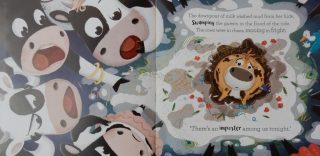
More and more trees are felled to build the stockade and lack of food in the dwindling forest results in empty-bellied townsfolk. Should Alma now reveal the truth? She does and soon finds herself on Star Bear’s back as they flee for safety into the deepest depths of the forest. Before them are the mountains. There’s only one way to go …

On the mountainside the two come upon a boy riding a tiger; the boy’s not scary or furry and introduces himself as Tully. The friendship that forms between them changes everything.
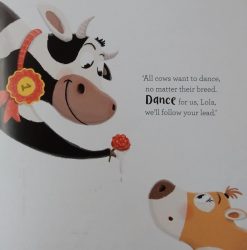
Without being a story spoiler I’ll say little more except that it’s a case of onwards and upwards, as the two children, and others they meet, (together with their animals) finally see the light: love and courage conquer and connect us all.

As in this powerful, moving story, so it is in our increasingly troubled times: it’s children who show the way when it comes to optimism, open minds and open hearts.

Beautifully told by Ali and dramatically illustrated by Alette Straathof, be it read alone or read aloud, this is a must read..

Have You Seen My Blankie?

Have You Seen My Blankie?
Lucy Rowland and Paula Metcalf
Nosy Crow

Lucy Rowland is a highly skilled rhyme writer and here she uses her verbal artistry to tell the tale of young Princess Alice and her soft, warm, snuggly blankie.

One day this exceedingly cuddlesome item goes missing. Alice hunts high and low unsuccessfully
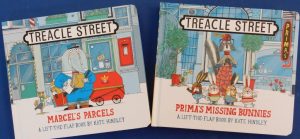
and then heads outside to consult her brother Jack playing in his den. Jack informs her that he’d used it a while back but then a giant took it away.

Off goes Alice to find the giant. He invites her in to partake of tasty pies but tells her that yes, he’d had the item, used it to wipe his nose, whereafter a witch flew off with it. Again, the witch had made use of the object (as a cloak) until it was snatched by a dragon.
Following a snoring sound coming from the forest, Alice puts on a brave face and walks towards a cave wherein, seated at the entrance she finds …

Surprisingly however, the dragon isn’t at all ferocious and instead tells the child how much he benefits from such a soft item to protect him from the cold, rough cave floor when he sleeps.

Alice’s first thought is to establish owner’s rights, then on further consideration she comes up with an alternative plan: to help the dragon find a warm, soft, snuggly substitute.

Easy, you might be thinking but their search is far from so and both Alice and dragon become increasingly troubled

until finally they arrive back at the royal palace sans anything suitable.

Eventually up in the attic the little princess extricates the perfect item … Sleep well Alice, sleep well dragon friend.

Equally as enchanting as Lucy’s telling are Paula Metcalf’s illustrations. Her colour palette – mainly greeny, orangey, browny, bluey hues is a great choice and her characters human and animal are adorable and splendidly expressive.

A felicitous collaboration, an enormously successful mix of words and pictures: in short, a super read-aloud picture book to enjoy especially just before snuggle up time.

Oink! / Daddy Fartypants

In your face or subtle, toilet humour books are always winners with young children: here are a couple of recent, contrasting examples:

Oink!
David Elliot
Gecko Press

David Elliot tells this hilarious tale entirely through delicate watery scenes of a pig’s bathtime along with onomatopoeic sound effects, mostly animal but punctuated by ‘Knock! Knock! (s)

It starts with pig climbing into his, one assumes, eagerly anticipated steaming bath-tub; but he’s no sooner sat back for a relaxing soak when ‘ Knock! Knock!’ “Maaa?” a sheep clad in pink frilly skirt and clutching a toy boat enters and proceeds to climb into the tub. (Her utterance, one assumes is a polite request).

Further knocks see more unruly creatures, first a horned bovine character …

followed by an ungulate (donkey/horse?) ensconcing themselves in pig’s increasingly noisy bath.

Pig though utters not a sound but then … One tub-emptying action later


things – or actually animals – start to move …

Peace at last! Time to top up the hot water and relax. Ahhhh! Bliss.

No telling – just showing – and absolutely brilliantly done in Elliott’s subtly comic, brilliantly expressive pencil and watercolour scenes.

An absolutely smashing pre-bedtime sharing book for which your little humans will delight in supplying the various noises. If I was in an early years setting I’d set up a small world play scene complete with tub and animals for the children to act out the tale.

Daddy Fartypants
Emer Stamp and Matt Hunt
Orchard Books

Meet dad bear, farty bum extraordinaire. The trouble is no matter how clear it is that’s he’s the culprit when it comes to noxious rear end emissions, he never never owns up to his trumps and parps. Instead he blames others, no matter who, no matter where, no matter when.

Not a single apology or pardon so much as reaches his lips, no not ever.

One day when collecting his forbearing son from school, Daddy Fartypants encounters an attractive new teacher, Miss Lovelybear and as he eagerly approaches, she lets loose a gargantuan gust from her derrière. And does that teacher issue an excuse? Oh dear me, no she does not: instead she points the paw at guess who … Outrageous!

Game, set and match to Miss L. Her terrible toot triggers a realisation on Daddy F’s part. Repentant, he promises to become a changed character when it comes to rear end rumbles and so far as we know he’s been true to his word.

Totally terrific fun, Emer Stamp has come up trumps with this thoroughly moral tale, and Matt Hunt’s splendid, sonic blast, pant-ripping illustrations speak volumes – quite literally. PHOOAW! Your little ones will relish this book as did this reviewer whose partner could give Daddy Fartypants a run for his money when it comes to windy issuances – he does own up though, I hasten to add.

Brian the Brave

Brian the Brave
Paul Stewart and Jane Porter
Otter-Barry Books

Paul Stewart’s story stars a curly-horned, white woolly sheep going by the name of well, Brian.

It all begins one sunny day with Brian busy nibbling in a grassy meadow when along comes curly-horned, black woolly sheep Rose. The two agree to become friends and are happily playing chase when along comes Stanley. This sheep wants only to play with Rose on account of their both being black. Hmm – you can see where this is going. Poor Brian is now excluded and he feels sad.

Two spotty sheep arrive; they share the horny characteristic with Brian and Rose leaving a fed up Stanley out of the gang.

Up trot a hornless striped trio, Cassidy, Lou and Hamish, Brian suggests they all become friends but the three snub his invitation.

Enough is finally enough for Brian: He tells them ” We are all sheep, … We should all play together!” It looks as though things might just work out well for all but suddenly things kick off again leaving blue-eyed Brian exceedingly downcast and isolated.

Off he walks, looks at his reflection in a lake, continues his stroll up a hill, through a forest and there comes face to face with …

He dashes away, hotly pursued by the hungry lupine creature, to warn his fellow sheep. The situation is grave: somebody has to do something and fast.

Good old Brian steps in as operation attack-wolf co-ordinator and happily his fellow sheep co-operate until their joint biffing (the curly horners’ contribution) and butting (by the noses of the hornless ones) sees off their would-be guzzler once and for all.

There are SO many ways you can interpret this book in our increasingly troubled, B–X-T times but however you do – and it might be different on different days – it’s definitely a biffing, butting, cracking celebration of courage, self-belief, acceptance, co-operation, difference and friendship.

Jane Porter’s various sheep characters are splendidly portrayed in her dramatic, often funny, colourful collage scenes of the ups and downs of life ovine style.

Revenge of the Living Ted

Revenge of the Living Ted
Barry Hutchinson, illustrated by Lee Cosgrove
Stripes Publishing

This is the sequel to Night of the Living Ted and it’s every bit as good a tale.

Early on in the story we meet  Bearvis, Dad’s birthday gift styled on his favourite singer who plays a significant role later on.

A little while after, Lisa Marie and Vernon are just leaving Drake’s house having discovered that he remembers nothing – so he says – of their previous teddy bear filled adventure, when two pairs of rough furry hands throw bags over their heads and bundle them into the back of a car.

The next thing they know is that they’re sitting chained up in what looks like from the clues they spot, the boardroom of a successful business establishment.

Suddenly in bursts a strangely shaped man who introduces himself as Ursine Kodiak. Said character boasts that he’s the genius responsible for building the machine that brought monstrous teddy bears to life and then was able to eradicate the events surrounding them from the memories of those involved.

Then he takes the two children into his bear-filled factory and starts blabbing on about Mummy Bear (from the Goldilocks story which he misremembers), artificial intelligence and other alarming things. Furthermore he wants to enlist Lisa Marie’s help with his future plans for saving the world and things really seem dangerous. Should she become his Executive Senior Assistant?

Let’s go no further with this smashing fast-moving, fur-filled farce, but just say that it’s sure to fire up enthusiasm with readers and listeners – it’s a terrific read aloud – and along the way might introduce youngsters to some exciting new vocabulary. To add to the enjoyment, the text is liberally sprinkled with dramatic illustrations by Lee Cosgrove.

Roll on the third adventure.

Board Book Gathering: Jump! / Hello House / Hello Garage / Meeko and the Big Red Potty

Jump!
Tatsuhide Matsuoka
Gecko Press

This is such a cool board book; it made me want to go out, find the nearest toddler, share the book and do some joyful, very noisy celebratory jumping about together.

The idea is so simple yet SO effective: a patterned text accompanies a statement going over two vertically opening spreads, starting with ‘A frog jumps. // Boing!’
It then proceeds to introduce other agile jumping creatures – a kitten, a dog, a grasshopper …

a rabbit, a snail – although that one just cannot get airborn,

a mother hen and chick, a fish and finally the small girl narrator of Tatsuhide Matsuoka’s cracking little book.

Ready to jump? Everybody ready? 1, 2, 3 … BOING!

Hello House
Hello Garage

Nicola Slater
Nosy Crow

In Hello House little Ludo is out and about in search of some friends to play with. He calls first at the home of Milly and Dylan who are busy cooking in their kitchen. Next stop is at the rabbits’ residence where he invites the bunnies to join him. Ludo and entourage then proceed to Ruby and Ned’s house and ask the pups to leave the TV and play outside.

Their final port of call is Bruno Bear’s and there they discover a sleeping friend who needs a spot of nose tickling to wake him from his slumbers. Then with all the friends assembled it’s time for some fun …

Little fingers will enjoy lifting the house-shaped flaps to assist Ludo as he rounds up his pals.

Equally enjoyable is Hello Garage and again Ludo is on the hunt for playmates only now his search takes him to the garage where he looks in various vehicles in the hope that he’ll find some not too busy animals with time to play.

With Leo, Mabel, Olaf, Daisy, George, and finally (after a tummy tickling rousing) Lucy duly invited, let playtime begin on the ‘soft, green grass’

Toddler fun through a pleasing repeat pattern text, and bright illustrations with plenty of detail to peruse and discuss.

Meeko and the Big Red Potty
Camilla Reid and Nicola Slater
Nosy Crow

Little ones just at the potty training stage will love that you can orchestrate Camilla Reid’s story by means of the strategically placed sound buttons as they hear how now a big bear, Meeko recently has graduated from nappies to big bear pants. However there are still times like this one when he just can’t manage to hold it and so does a wee, soaking his pants and the floor.
Happily next time though he remembers he needs to run to his red potty before it’s too late

and the simple story ends with a proud Meeko and equally proud parents and animal friends. Splendidly expressive illustrations from Nicola Slater make this down-to-earth board book a winner.

Hedy Lamarr’s Double Life / Dreaming in Code


Hedy Lamarr’s Double Life
Laurie Wallmark and Katy Wu
Sterling

Elegant film star Hedy Lamarr’s first love wasn’t in fact for making movies – she wasn’t at all interested in glitz and glamour – rather her passion was science and technology. It’s this lesser known side of her that’s the focus of this book.

Her greatest invention was ‘frequency–hopping spread spectrum’ a wonderful technological idea developed in collaboration with musician George Antheil, that helped allow the communication devices of torpedoes to change frequency quickly cutting down the opportunities for radio signals to be altered, intercepted or blocked completely; sadly it wasn’t used by the US navy during WW2 though.

Still relevant today, their invention now helps to keep our mobile messages private and defends computers from hackers.

Hedy’s various inventions are described and each spread includes a quote from her: here’s one I particularly love.

We also learn of her childhood in Austria in the early 1920s and how her father, who also had a love of science and technology was such an encouragement to her curiosity and thirst for knowledge, and her creative ideas.

Laurie Wallmark’s engaging text is both inspiring and concise; and Katy Wu’s stylish, retro feel illustrations transport readers to the time when women’s achievements were under played and often undervalued (it took 50 years for her awesome brilliance to be fully recognised). However when Hedy and George finally received in 1997 the Pioneer Award from the Electronic Frontier Foundation for their contribution to computers, Hedy commented thus.’” It’s about time.” … “My life was full of colours, full of life … I don’t regret anything … I learned a lot.” Brilliance recognised at last.

So too will readers of this picture book, which also includes a timeline, bibliography, suggestions for further reading about women in STEM, a list of her films and an explanation of her secret communications system.

Equally inspiring, for older readers is:

Dreaming in Code
Emily Arnold McCully
Walker Books

This is a fascinating biography of Ada Lovelace, daughter of poet Lord Byron, who is celebrated for being the first computer programmer.

Ada’s childhood was anything but conventional; she never got to know her father and was brought up by her domineering mother who, despite showing little emotional warmth, provided for her daughter through private tutors, an intellectually stimulating education, a protection in part from any instincts towards developing her father’s poetic talent. Thus Ada developed a terrific thirst for mathematical and mental puzzles and scientific discovery.

At age seventeen, the young aristocrat Ada, was introduced at a party to widower and famous inventor and mathematician, Charles Babbage, who was to transform her life. We learn of their collaborative friendship and how Ada’s leap of imagination took her pioneering thinking beyond that of her friend and his ‘Analytical Engine’. This is what she wrote, ‘Many persons imagine that because the business of the engine is to give its results in numerical notation, the nature of its processes must consequently be arithmetical and numerical, rather than algebraical and analytical. This is an error. The engine can arrange and combine its numerical quantities exactly as if they were letters or any other general symbols.’

We read of her marriage to William King who admired Ada’s intellect as well as being rich and handsome; her motherhood years, her addictions and death at an early age from cancer.

Beautifully written by Caldecott-Medal winning author, Emily McCully this carefully researched, accessible portrait of Ada Lovelace is likely to inspire future groundbreakers to follow their dreams and not let anyone or anything stand in their way.

(There are also photographs from archives, illustrations, source notes, a glossary and a bibliography.)

The Secret Lives of Unicorns

The Secret Lives of Unicorns
Dr Temisa Seraphini and Sophie Robin
Flying Eye Books

Most people consider those much loved unicorns, that are all the rage just now, are imaginary; Dr Temisa Seraphini, author of this book and ‘leading expert’ so she says, on unicornology, would like to persuade readers to think otherwise.

She divides her fanciful presentation into three parts: the first being “What is a Unicorn?; the second provides examples of unicorns from various parts of the world and the third looks at the relationship between humans and unicorns. Her over-arching aim in all this is to encourage those magical creatures of yore back into our technological world of today.

In her introduction to the first part we read that unicorns are herbivorous but unlike their horse cousins, have magical properties; the author places them in the order Artiodactyla that includes, giraffes and goats among other even-toed ungulate creatures, assigning them to a separate family: Unicornus.

Then on the first spread we’re shown the six different species of the legendary creatures on a evolutionary timeline.

This is followed by a page detailing which parts of the unicorn’s anatomy have magical properties: Did you know that unicorn tears can apparently heal the sick and that the drinking of unicorn blood provides unimaginable strength. Hmmm!

The Horn is the next topic and there are supposedly three varieties – ridged, smooth and pearlescent; the latter so loved by some recent picture book creators; and if you believe it, in 1858 someone unearthed a skull that had once borne a unicorn’s horn. Uh-huh!

The second section takes us to six different habitats (with accompanying atlas), from the regions around Mount Everest

to the sandy African dunes and the moorlands of northern Europe. We learn  how different adaptations to climate have occurred over time  There’s an introduction to the winged variety and flight.

The final part talks of legendary unicorns; those who found their way into the annals of history or became subjects of artistic representation, as well as introducing some other unicornologists, giving guidance on tracking and communicating with the creatures.

Tongue in cheek though all this may be, it’s fun and rather enchanting. So too are Sophie Robin’s detailed illustrations that will definitely make readers smile as they peruse the pages and get lost in the spellbinding silliness.

Little Frida

Little Frida
Anthony Browne
Walker Books

Who better than the inimitable, brilliant Anthony Browne to create a picture book about another brilliant artist, Frida Kahlo? And what a wonderful and surreal (it is Anthony Browne after all) story he tells. It was inspired by her ‘magic friendship’ and her “The Two Fridas’ self-portrait that she painted in 1939.

From the start our young narrator Frida says, her physical difference made her an outsider, often lonely but not unhappy at being ‘separate’, which she quite liked.
The wish to fly filled both her night-time dreams and her daydreams but her birthday dream of a toy plane is dashed when instead her parents give her a pair of wings. Rather than show her disappointment, alone in her room the young girl lets her imagination take flight.

She runs and runs and when all her energy is spent she stops by a dairy. Finding no way in, she’s about to return home, another door opens,

cascading her down, down to the earth’s depths and there she meets a strange but seemingly familiar girl.

This girl then begins a magnificent dance of life and while she does so, Frida shares with her, her own secret worries

and a close friendship is forged.

All too soon the time comes for Frida to bid farewell to her friend from the dairy and return to her own reality a much happier child than before, and ready to begin her artistry with a paintbrush.

Iconic Frida truly was, so too in his own way is, Anthony Browne. Allowing the imagination to take flight and soar so you become free is what Frida did and what Anthony has done here in his magnificent magical scenes, every one of which is packed with images that will inspire in readers further flights of their own fancy.

I’d love to show every single illustration but to see the rest, you will need to get your own copy of this stunning, out-of-this-world picture book.

Yoga for Children and Young People with Autism

Yoga for Children and Young People with Autism
Michael Chissick, illustrated by Sarah Peacock
Jessica Kingsley Publishers

Highly experienced yoga teacher, Michael Chissick has created another absolutely smashing book, for those who teach yoga to youngsters, specifically those with autism, although much of what is included here would work well with neurotypical children too.

At the outset Michael states his case explaining that perfection is not on the agenda, so an adult-style class approach is inappropriate as is chanting.

A plan is vital; intuitive teaching won’t work with children on the autism spectrum: I know from experience they need a structure and that is what the book provides, whether the teaching is done in a mainstream school that includes children with autism or a special school where everyone being taught is on the autism spectrum. If the latter is the case, Chissick suggests three groups(his are named after trees) which can be fluid but are based on the degree of challenge both students and the teacher of the class face.

He then goes on to offer four different lesson plans – one being suitable for all students (universal) and three others – and each of the latter is progressive.

Much of the remainder of the book contains the differentiated tried and tested games, thirteen in all, some of which require additional resources that are flagged up at the outset. There are also sequences such as the Sun Salutation and some sequence games, followed by the postures themselves including ‘good sitting’

(illustrated by Sarah Peacock whose work will be familiar to those who know Michael’s other books such as Ladybird’s Remarkable Relaxation and Sitting on a Chicken .)

And of course, there are ideas for the vital ‘calming stage’ and final relaxation.

There’s a chapter on teaching yoga to children who have ASD in a mainstream classroom, followed by some case studies and extremely useful visual resources.

A wealth of experience has gone into this book: it’s a veritable treasure trove for anyone who teaches yoga to children, whatever the setting, but especially children with ASD.