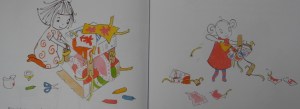
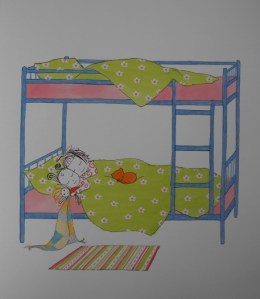
Ady and Me

“I have a secret that lives in my brain. / I call him Ady, that’s not his name … / Doctors told Dad it’s called ADHD. / But that’s way too boring for Ady and me.” So says young Sophie at the start of this story.
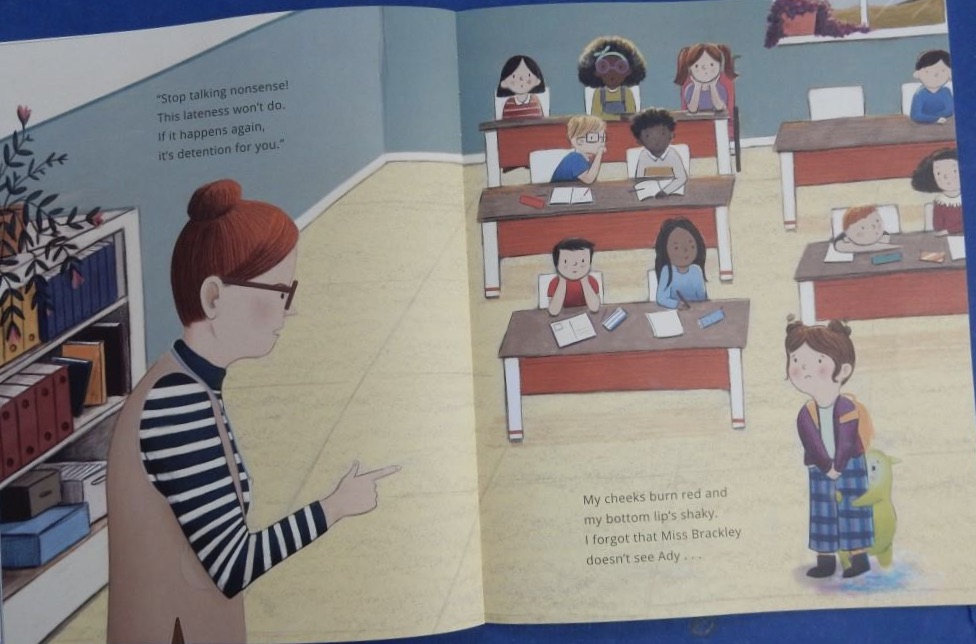
We follow Sophie through a day at school as she experiences good times and bad starting with being late and her teacher’s upsetting response.

More negative responses follow when she doodles on her book during history, talks during another lesson and despite her best intentions in science, is made to sit on a table labelled ‘naughty’. (The teacher part of me is horrified at this). Then in art Sophie accidentally knocks a pot of paint on Miss Brackley’s shoes. The response to this is almost unbelievable and Sophie is taken to the head’s office. However it’s not Sophie but Miss Brackley that gets the dressing down; moreover Headteacher Grant loves Sophie’s rainbow painting and has another surprise in store for her, Ady and for readers.

Told through a rhyming text written by partners Roxanne who brings her ADHD experience and Rich who brings his neurotypical perspective to the story and Sara Rhys’ eloquent scenes of a neurodivergent girl attempting to cope in a classroom where for the teacher, only neurotypical behaviour is acceptable.
This is an important picturebook that uses a metaphor one hopes will help children (and adults) see that ADHD should be accepted and understood.

My Mum / Come What May

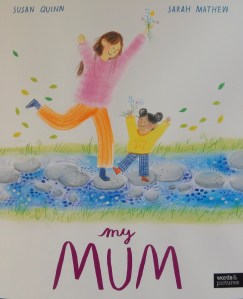
Mums do so many things for their little ones and this book is a warmly appreciative and loving way to celebrate the day to day adventures they have big and small, told from the viewpoint the little girl narrator. To a mother fixing a child’s broken toy or running through a wildflower meadow and then making a daisy chain may not seem particularly significant but to her offspring, they mean the world. So too of course, do those days at the seaside, building sandcastles, searching for shells, wave jumping and making seaweed crowns. It’s evident that the mum featured loves to encourage and participate in imaginative play; and no matter the weather,

day or night, she’s close by to make things turn out right.

Sarah Mathew’s vibrant mixed-media illustrations are a delight, full of small details for mums and small children to explore and enjoy together. With Mother’s Day approaching, perhaps after several readings, a child could be encouraged to make up their own pictorial celebration of ‘My Mum.

As this story opens Large and Small are doing some baking but it’s not going well for Small AT All. Things are getting dropped, spilled, broken and everywhere is splashed with cake ingredients.
Both cooks want to scream and shout but Large declares love for Small “come what may”. The best way to defuse the situation is to get outside into the fresh air, have a walk and maybe a little picnic in the countryside.

This gives Small an opportunity to indulge in some what ifs, imagining being in turn a roaring dinosaur,

a tiger, a buzzing stinging insect; but for each comes the response ‘I’ll love you come what may’ from Large. Bad mood or good, Large’s love is unconditional, so too is that of Small.

Some of the adults who share this with their little ones are likely to be those who enjoyed the delights of Debi’s No Matter What first published twenty five years ago.

Don’t Squish A Slug

Following his general introduction, author, zoologist and wildlife presenter, Yussef Rafik, divides his bug information under five headings, Masters of Disguise, Amazing Evolution, Daring Defence, Record Breakers and All Sorts of Relationships (some of which are parasitic). The world of minibeasts is truly amazing, albeit on occasion pretty gruesome, so get ready to dive in.

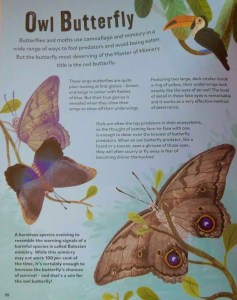
Have you ever wondered why the owl butterfly is so called; indeed were you aware there was such creature? It has earned itself the title ‘Master of Mimicry’ on account of the way the detailed fake eyes on the underwings look so like an owl’s eyes they act as a superb deterrent for potential predators.

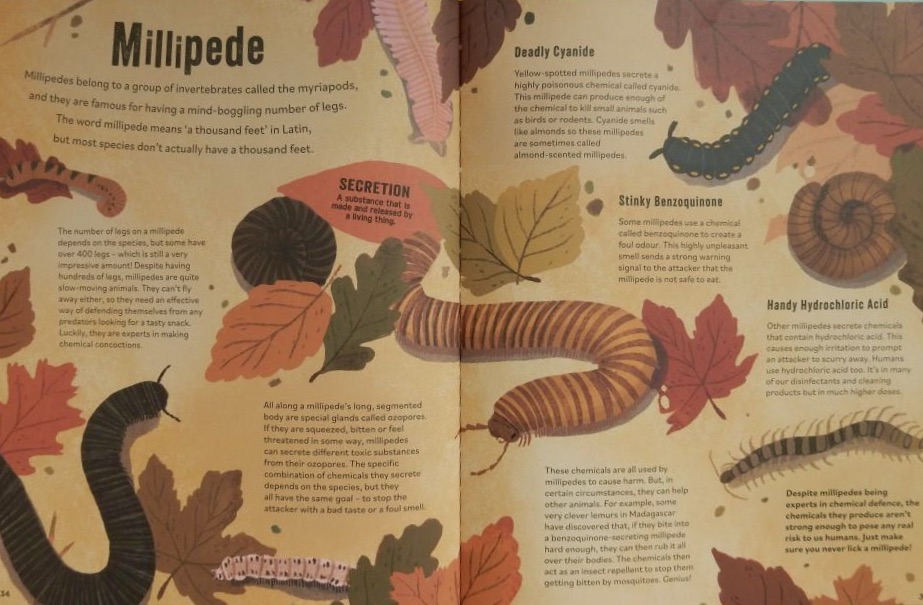
I was fascinated to learn that millipedes have special glands called ozogpores from which they secrete poisonous substances. The yellow-spotted kind secrete the highly toxic chemical cyanide in sufficient quantity to kill rodents or birds. Other kinds use the malodorous benzoquinone, which warns attackers not to eat them. Under certain circumstances though, these chemicals can be of help to other animals, an example being the lemurs in Madagascar. They’ve found out that if they bite a benzoquinone-secreting millipede sufficiently hard, then rub it over their bodies, the chemical acts as a mosquito repellent.

Every bug is either allocated a double spread or single page that includes a superbly detailed illustration the creature in its natural habitat along with the information that is just the right amount for KS2 readers. The author’s knowledge and enthusiasm shine through his text, indeed in his introduction he writes, ’It’s really important that we have empathy for bugs. We should appreciate what they do for our planet and learn to love living alongside them.’

Riley Samels’ illustrations are an ideal complement for the text, detailed but not overly so, and there’s a final glossary and index. Thoroughly recommended for school collections and for budding minibeast zoologists.

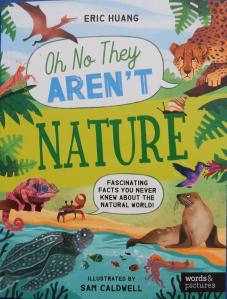
Oh No They Aren’t: Nature

Playful in approach it may be, but there’s a wealth of information about the natural world to be found in this book.

Following his introduction the author adopts his tongue-in-cheek question and answer style replete with pantomime-like ‘Oh no they aren’t!,’ ‘Oh no they weren’t!’ ‘Oh no they don’t’ interjections, in the book’s six thematic sections. These are in order, Prehistoric Life, Green Planet, Under the Sea, Creepy-Crawlies, Predator and Prey and High Fliers.

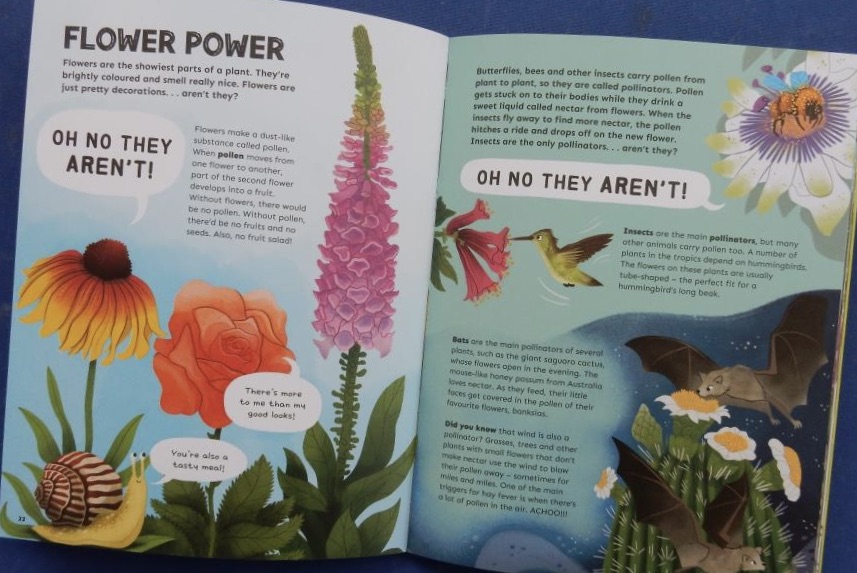
In Green Planet we read, ‘Flowers are just pretty decorations … aren’t they?’ followed by the rejoinder ‘OH NO THEY AREN’T!’ and an explanation of pollination and its importance.

Then in Predator and Prey we meet several sharks – all of which are fearsome predators aren’t they? Actually no: the whale shark – the largest shark in the world – is a gentle giant. Moreover, if you thought all sharks are very big, that’s wrong too: dwarf lantern sharks are only about the size of a mobile phone. Now that I didn’t know.

Sam Caldwell’s humorous illustrations match the jaunty style of the writing and the book concludes with a useful illustrated geological timeline and a glossary.
A thoroughly engaging addition to the Oh No’ series that will be lapped up by those with a preference for reading factual books rather than fiction.

Wonderful Words That Tell A Tale

Presented by word wizard Tom Read Wilson, this is another collection, alphabetically organised, of fascinating facts and anecdotal stories related to everyday words. There are four words for every letter of the alphabet and each starts with an amusing ‘star word’ poem/story after which come a definition, information about its origin, meaning and etymology.

Did you know for example that astronauts wore nappies during take off and space walks as it’s impossible to go to the loo, so instead they use what are called MAGs (Maximum Absorbency Garments).

What about those jeans you love to wear: the word denim is a contraction of ‘serge of Nimes’( a French city), serge being a heavy fabric from which lumberjacks’ workwear was made. I loved discovering this palindromic phrase – palindromes need not be single words, we’re told – is made up of seven words – ‘Murder for a jar of red rum’.

Assuredly a book to encourage children to enjoy language and words for their own sake as well as showing how the English language has evolved and continues to do so. Have a copy in your classroom collection: youngsters can have fun reading it, enjoy the humour in Ian Morris’s illustrations, then go home and impress their parents and siblings with what they’ve discovered.

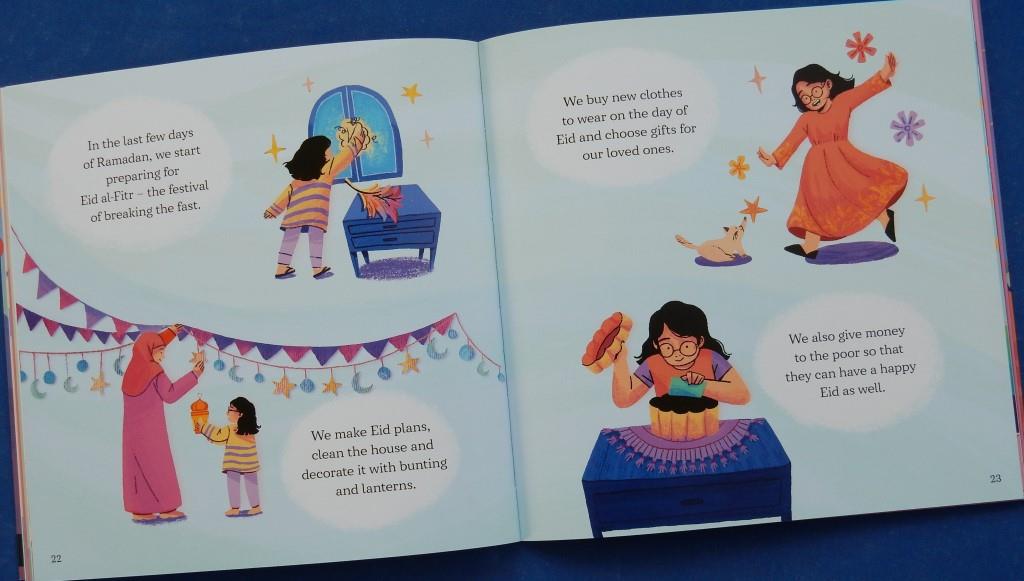
Ramadan and Eid al-Fitr / The Best Eid Ever

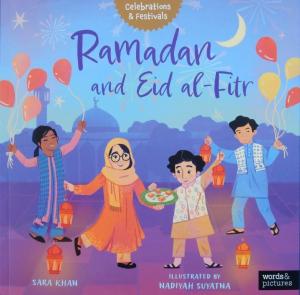
Raya, a little Muslim girl invites readers and listeners to meet her Mama and Aba (who come from different cultural backgrounds) and share what happens during Ramadan and the celebration of Eid al-Fitr, especially in their family. By means of both Sarah Khan’s narrative and Nadiyah Suyatna’s richly coloured illustrations, young children will discover that Ramadan is a month of fasting during the day from dawn to sunset, doing good deeds and being kind and patient to everybody and showing mercy to others.

Then comes Eid-al-Fitr. Raya wears her best bright clothes when she accompanies her parents to the local park where they will join in the Eid prayer, wish one another Eid Mubarak, play games and have a wonderful time. Later there is a big family feast where all Raya’s relations sit down together and share tasty food, both savoury and sweet. This is followed by game playing and a late night. It’s no surprise that Raya tells readers that Ramadan and Eid al-Fitr are her favourite time of the year.

The book concludes with ‘fun facts’ including a presentation of the Five Pillars of Islam, a spread on the lunar calendar and a recipe. Informative and easy to understand this is spot on for KS1 class sharing.

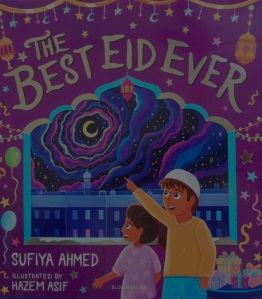
This story starts on the day before Eid al-Fitr with the sighting of the crescent moon signifying the end of the month of Ramadan. Eid al-Fitr is eight year old Aisha’s favourite festival and she’s excited at the prospect of receiving Eid gifts. This year these have been hidden and in order to find them, Aisha and her brother, Samir, must solve a sequence of clues.

Before that though, there are other traditions to complete. Mum decorates her daughter’s hands with beautiful henna designs; there are decorations to hang up, but Aisha doesn’t help as the henna takes two hours to dry by which time it’s sleep time.

Next morning Aisha again starts asking about hunting for those gifts. First though, wearing their new clothes, the family go to say their Eid prayers at the mosque, after which they say, “Eid Mubarak!” to all their family and friends. Back at home, the two siblings take homemade sweets to all their neighbours

and once that’s done, everyone sits down for lunch. At long last Aisha gets the first clue to finding her gifts and the treasure hunt gets under way.

After the story there’s a page of Eid related facts, and a final glossary.
Young listeners will enjoy hearing of Aisha’s eagerness for that treasure hunt, which crops up frequently throughout the narrative. They’ll also enjoy the details and rich patterns in the vibrant illustrations. Personally I’m not keen on digitally created facial features, especially eyes; they remind me too much of those ‘googly eyes’ sold in craft shops. Nonetheless this book is certainly one to include in class collections for sharing with KS1 children before Eid.

Lunar New Year / The Lucky Red Envelope

This image has an empty alt attribute; its file name is dscn9965-1.jpg

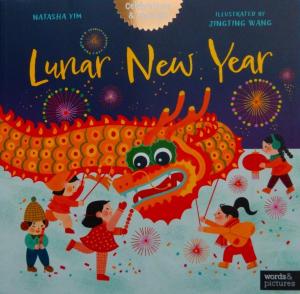
A special fifteen day holiday, the Lunar New Year, is fast approaching and young Ling, our narrator explains clearly the traditions she and her family follow. They clean the house thoroughly, “We sweep away bad luck and evil spirits, “ and polish the statue of the Kitchen God before painting honey onto his lips so he reports only sweet things to the heavenly Jade Emperor. The family fills their home with fragrant blooms; Ling makes special red signs to welcome visitors and it’s customary to wear new clothes, so they go shopping for those as well as red lanterns and favourite foods. The foods will be cooked and shared at the big New Year’s Eve family reunion dinner.


This image has an empty alt attribute; its file name is dscn9966-1.jpg

The symbolism behind each tradition is presented: “We eat dumplings for wealth, noodles for long life and turnip cakes for good luck …” Ling says. She also recounts the legend of the New Year beast and offers descriptions of the New Year’s parade, kite flying, and the Lantern Festival that ends the celebrations. Best of all though, Ling enjoys being surrounded by her family.


Jingting Wang’s illustrations are bursting with bold, brightly coloured images and back matter gives additional information on the history of the holiday, New Year greetings in Cantonese and Mandarin, information on the Chinese zodiac, riddles, a recipe for dumplings, how to make a lucky money envelope, examples of how Lunar New Year is observed in other cultures, and a quiz.


An accessible and broad introduction to an important holiday for many Asian cultures.

This image has an empty alt attribute; its file name is dscn9967-1.jpg

There are over 140 flaps to explore in this interactive, large format book with stiff card pages. It features Yue, her Mama and Baba and baby brother, Ru, for whom it’s his first ever New Year. By following what Yue and her family do each day in Vikki Zhang’s busy scenes as well as the written narrative, readers will learn the meaning behind the various objects and symbols. There are rich colours, gorgeous patterns and an abundance of detail to feast the eyes on at every turn of the page: the candles lit for the kitchen god, the offerings the family will make to their ancestors, the red wall and door hangings, as well as the food spread out ready for the family reunion dinner, Yue’s beautiful new red cheongsam,

This image has an empty alt attribute; its file name is dscn9968-1.jpg

the lucky red envelopes containing money and finally, the lighted lanterns.


The main text is in paragraphs written in a lively style (it’s good to see an acknowledgement that “ People celebrate Lunar New Year differently in different countries”,) and smaller captions ask the reader to look for specific objects – the yin-yang symbol for example, or draw attention to particular symbols such as Yue’s traditional dress.

There are a dozen flaps on every double spread helping to ensure that this is a comprehensive look at the holiday and a book that children will want to immerse themselves in over and over.

Add both books to class libraries from foundation stage upwards.

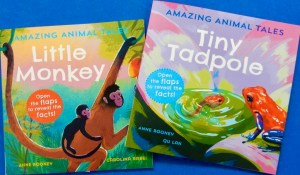
Little Chimpanzee / Little Whale / Little Monkey / Tiny Tadpole

Little Chimpanzee
Anna Brett, illustrated by Rebeca Pintos
Little Whale
Anna Brett, illustrated by Carmen Saldaña
Words & Pictures

These are the latest additions to the Really Wild Families series of fun, informative interactive books for children and adults to share.
Having introduced itself, Little Chimpanzee invites readers to spend a day exploring its African rainforest home and meeting the sociable family community comprising father, mother, older brother, aunts, uncles and cousins. The creature narrator explains how chimpanzees care for and groom each other and talks about the social structures and relationships in the group , including how they communicate with one another.There’s a spread about chimp conservation and another about the vital work of Jane Goodall and the chimps in Gombe Stream National Park.
The narrative is followed by a quiz and a craft activity. A charming, effective way for young children to find out about our nearest relative, while gently reminding them of the importance of caring for creatures in the wild; vibrantly illustrated with gentle humour.

The Little Whale of the title introduces itself and the rest of its pod of humpback whales and readers join their annual journey from warm waters to search for the cold waters of the Antarctic Ocean where there’s plenty of food. On the way we learn about how the creatures move, their external features, breathing, breeding, diet and feeding,

possible predators and whale song.
Following the story are the usual factual spread, a look at conservation, a craft activity, a quiz and we meet Migaloo, a albino humpback that lives off the Queensland coast of Australia. Carmen Saldana’s underwater illustrations are beautiful and really add to the book’s appeal.

Narrative works really well as a means of transmitting information to young children and these are additions to the Amazing Animal Tales series that also successfully use this approach along with straightforward facts found beneath the flaps.

Little Monkey
illustrated by Caroline Rabei
Tiny Tadpole
illustrated by Qu Lan
both written by Anne Rooney
Oxford Children’s Books

Little Monkey is a spider monkey and we first encounter him high in the rainforest treetops clinging round his mother’s tummy as she moves from branch to branch. Lifting the full-page flap reveals two pages of information and a simple question to further engage listeners.
As the story continues there is information about feeding, what this entails.and how it changes as he becomes more independent, an independence that makes him want to go off exploring by himself.

Anne Rooney’s way of presenting the information is appealing and perfectly pitched for an Early Years audience, the special skill being the combination of the two styles, with Caroline Rabei’s delightful illustrations containing just the right amount of detail.

The Tiny Tadpole also lives in the rainforest but further south than the monkey family. Herein we follow the transformation from tadpoles hatching out of the protective jelly eggs and the growth and changes that ensue in their habits and in the care provided by the mother frog,

until the tiny black dot has become a froglet. This one is illustrated using a rich colour palette by Qu Lan and every picture is bursting with life.

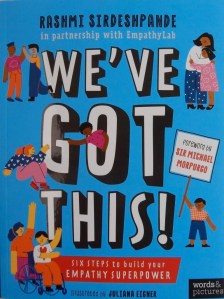
We’ve Got This!

We’ve Got This!
Rashmi Sirdeshpande with EmpathyLab, illustrated by Juliana Eigner
Words & Pictures

One of the most important life skills children need to develop is empathy and this book is intended to help them do that. How exciting it is to have a book emphasising the power of reading to boost empathy and to read this in Sir Michael Morpurgo’s foreword: ‘ Books and stories to me are the key to empathy and understanding everyone. They are the pathway to understanding people as individuals. Read books. Enjoy books. And, most of all, learn from books.’

Readers of this particular book will assuredly do so. Empathy, we read at the outset is a ’real superpower’ and herein youngsters are offered a six-step process that uses case studies, empathy exercises and activities, to supercharge their empathy. Participating along with readers on this exciting journey are members of the Sharma family – mum Shivaji and her children, Isha and Rahul.

There are pieces by a number of well-known authors – Cressida Cowell, Malorie Blackman, Jacqueline Wilson, Sue Cheung (aka Sue Pickford), Jen Carney, Manon Steffan Ros, Ben Davis, Patrice Lawrence, Nadia Shireen,

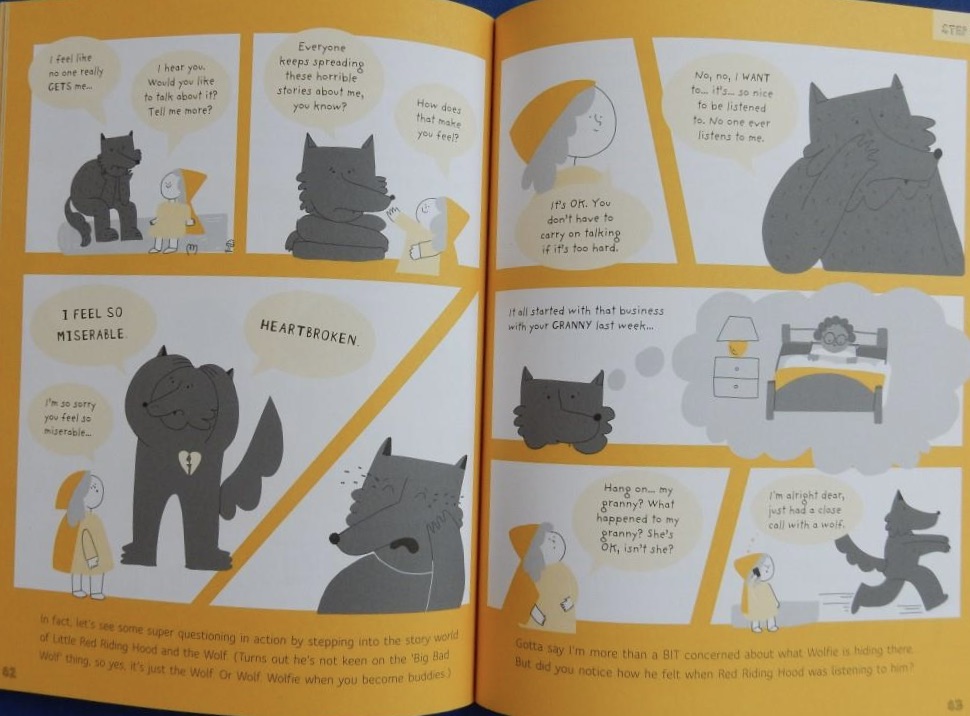
Abigail Balfe, Dom Conlon, SF Said and Joseph Coelho, all of whom are affiliated with EmpathyLab. And there are examples from books by other writers in the fourth step Learn to Recognise Emotions, where one of the ideas is to be an emotions detective as you read. From the next section, I love this example of ‘super questioning between Little Red Riding Hood and the Wolf.

The text is chatty and child-friendly, and Juliana Eigner’s inclusive, often gently humorous illustrations are engaging. (Further resources are listed at the back of the book.)

A must for all KS2 school children, classroom collections and I think lots of adults would do well to read it too.

Every Word Tells A Story

Every Word Tells A Story
Tom Read Wilson, illustrated by Ian Morris
Words & Pictures

This is one of those books about which you think, right I’ll just give it a bit of time, sufficient to write a review, only to find that it’s drawn you right in and a couple of hours have passed.

There are four words for each letter of the alphabet, each letter having for the first of the four, a funny, short, rhyming story, followed by a definition, information about its origin, meaning and its etymology, together with a humorous illustration by Ian Morris, the lead ones occupying most of the spread.
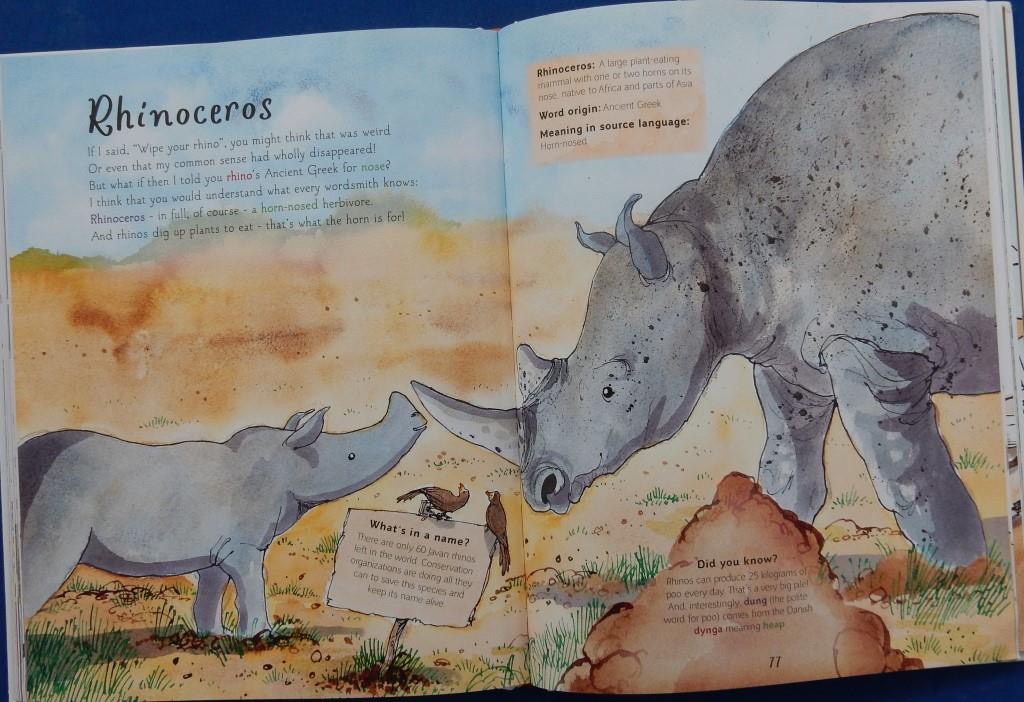
Did you know that a rhinoceros can produce as much as twenty five kg of poo every day?

Or that the word rhino is Ancient Greek for nose, and furthermore dung comes from the Danish dynga meaning heap? I certainly didn’t but I did however know that the word rupee comes from the Sanskrit meaning ‘beautiful form”; I have a considerable number of these coins tucked away in various purses on account of my frequent trips to India.

Whether it’s fun anecdotal stories or fascinating facts that you are interested in, you are certain to find plenty of both in this exploration of everyday words that shows how the English language evolved (and indeed still is). Equally it’s likely to encourage children to enjoy words and language for their own sakes. Supplying additional humour, illustrator, Ian Morris brings every entry to life with his dynamic pen and watercolour illustrations.

A Celebration of Dads

My Dad
Susan Quinn and Marina Ruiz
Words & Pictures

A small child celebrates their dad, and the everyday activities – real and imaginary – that make him and the days they share together so special.

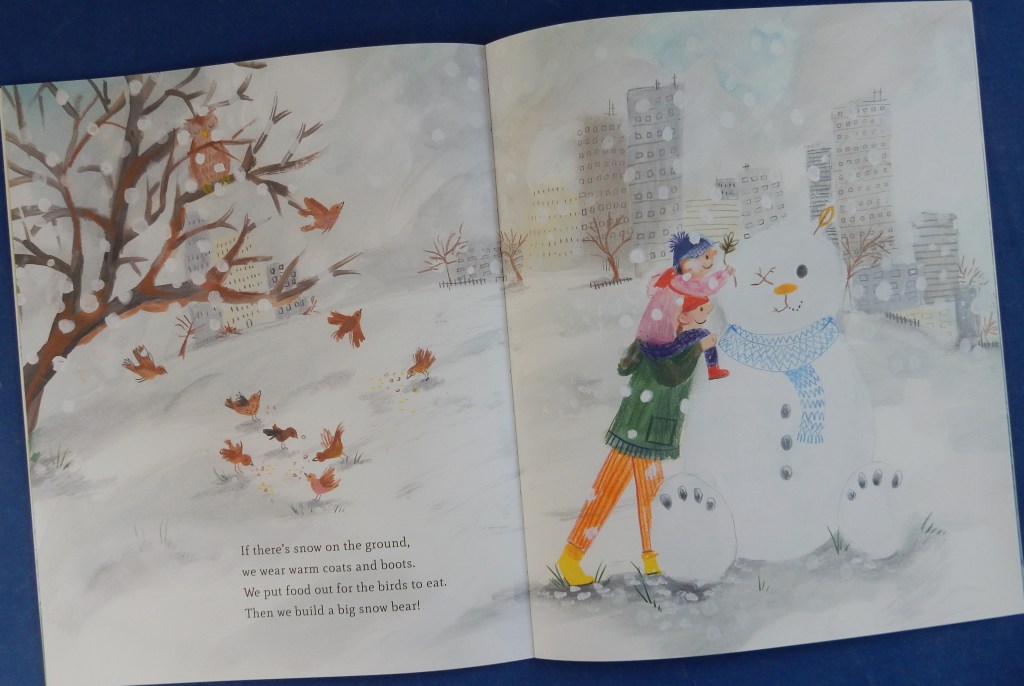
In Susan Quinn’s first person rhyming narrative the child presents such things as baking, growing vegetables, grocery shopping, going for picnics and bathing, moving through the different seasons and kinds of weather: ‘If it rains, we splash through puddles, / stomp through leaves of gold and red. / And gaze at a colourful rainbow, / big above my head.’

Marina Ruiz’s illustrations are suffused with the love shared between Dad and child, while her colour palette alters to reflect the changing seasons.

No matter the particular home situation of the young reader/listener and Dad this sensitively written book is one to enjoy together.

What is Daddy Going To Do?
Carly Madden and Juliana Perdomo
Words & Pictures

This is a fun lift the flap book for toddlers to enjoy, especially with a dad. It features diverse dads, one portrayed holding or wearing an item on the flap of each recto, while opposite the text says for instance, ‘Daddy has a stopwatch. / What is Daddy going to do?’ Having had a guess, little ones lift the large, sturdy flap to reveal the answer. (‘Start the family sports day!’)

In all there are six fun activities that Daddy does with his child or children – Fly to the moon, play in the forest, build a pirate ship, play in a band and make some noise, and read a bedtime story.


Little ones will want to join in with the repeat question and the (hidden) sounds, as well as lifting the flap (great for developing fine motor skills) and they’ll certainly enjoy exploring Juliana Perdomo’s bright, gently humorous illustrations and making predictions about the hidden activities.

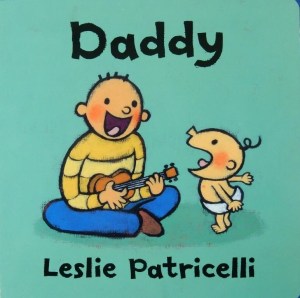
Daddy
Leslie Patricelli
Walker Books

The adorable one-haired baby is back to introduce Daddy. Said male parent is ‘so big and strong’, his ‘legs are so, so long.’ The infant then enjoys a playful time with Daddy – riding piggyback, trying to touch the sky, feeling his unshaven scratchy face, fleeing from a pretend monster, singing, wrestling till they need a rest.
At other times Dad is busy so baby helps him cook and clean and much more.

Our baby narrator also introduces several other dads pointing out that each one is different be that ‘Dressy … Messy … Bald … Hairy … Tall or Short’ before pointing out the ideal nature of ‘My Daddy’.

With its rhyming text and warm, lively scenes of baby and Daddy, this is a delight for the very youngest.

The Secret Life of Bees

The Secret Life of Bees
Moira Butterfield and Vivian Mineker
Words & Pictures

In this large format book you can learn all about the life of the domesticated honey bee and much more. The bee’s life cycle, anatomy,

life in a hive including the tasks undertaken by workers – cleaning, care of the bee nursery, making honey and wax, guard duty and finally, foraging for nectar and pollen outside; plus facts and figures about other species at home and abroad, honey thieves,

pollination, what bee keepers do and how to create a bee-friendly environment are all explained by our narrator worker guide, Buzzwing the honeybee.

There are also five bee tales from various parts of the world including Greece, India and Australia.

Vivian Mincer’s enticingly colourful, gently humorous child-friendly illustrations with Buzzwing’s invitation to spot various creatures hiding within many of the scenes, are likely to be pored over at length by young readers. Author, Moira Butterfield even invites budding poets to write their own bee poetry as did the character in the Indian tale she retells. Indeed, there are activities relating to each of the tales included.

The health of our natural ecosystems is intrinsically linked to the health of our bees (and other pollinators) but their numbers are in decline. Let’s hope this fascinating book will enthuse youngsters to do whatever they can to halt this potential catastrophe.

Altogether a super introduction to the world of bees.

Busy Spring: Nature Wakes Up

Busy Spring: Nature Wakes Up
Sean Taylor , Alex Morss and Cinyee Chiu
Words & Pictures

If you live in the northern hemisphere, like me you have probably been noticing beautiful wild flowers – snowdrops, daisies, celandines and primroses springing up, an abundance of catkins, blossom starting to open on trees, pussy willow buds bursting; as well as the occasional bee and butterfly. We even saw frogspawn a couple of times last week (the end of February). Definitely spring, with its promise of so much, is my favourite season and this year it seems even more important than ever to celebrate its arrival.

That is exactly what the two children in this beautiful book (written by children’s author Sean Taylor and ecologist Alex Morss) are doing. The older girl acting as narrator, tells us how what starts out as a hunt for Dad’s fork so he can plant some carrots turns into an exploration of the family’s garden. ’Everything smelled like wet earth and sunshine.”

“The spring sunlight is nature’s alarm clock,” Dad says, taking the opportunity to mention pollination.
Both girls are observant, asking lots of questions and noticing signs of new life all around – tadpoles,

a bird building its nest and a wealth of minibeasts – ants, woodlice, worms and beetles and several species of butterfly, as well as playfully emulating some of the creatures they discover.
Throughout, Dad subtly provides snippets of relevant information concerning life cycles, habitats

and what causes the seasons; and throughout the children’s sense of excitement is palpable.

Cinyee Chiu’s illustrations are absolutely gorgeous, beautifully composed and carefully observed.

At the back of the book are several pages of more detailed information about spring and how it affects the flora and fauna, as well as some suggestions for ways children can get involved in helping nature in its struggle against climate change.

A must have book for families with young children, as well as foundation stage settings and KS1 classrooms.

Love

Love
Corrinne Averiss and Kirsti Beautyman
Words & Pictures

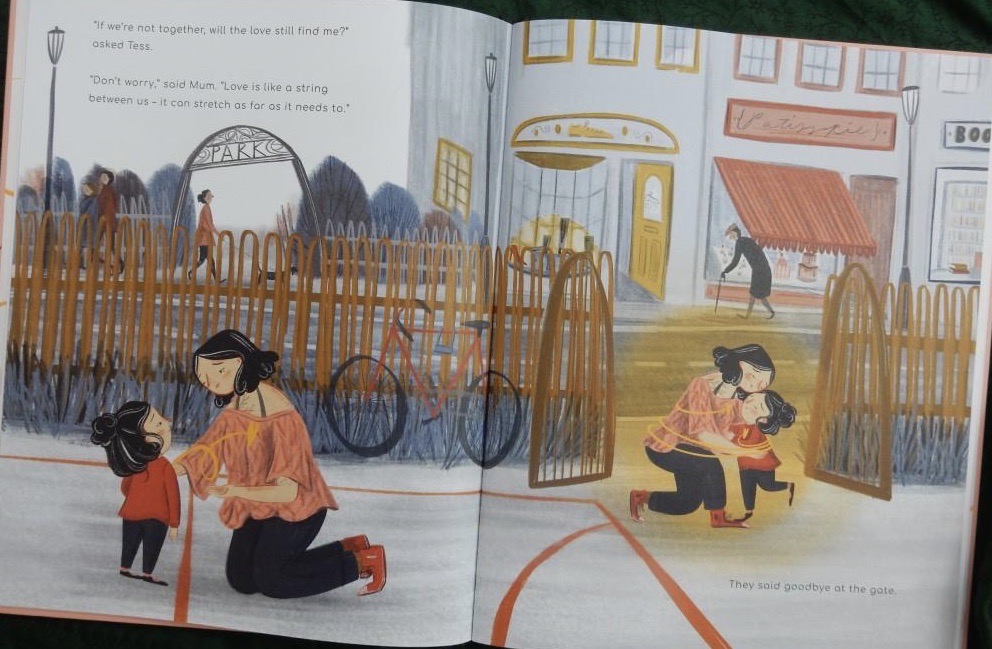
Young Tess is part of a loving family – love surrounds her like the ‘light inside one of Daddy’s little houses.’

However, when the time comes for her to start school, the worries creep in. School is big and scary – nothing like that warm scarf that she feels wrapping around her when she goes out with her parents. Will the love still find her?

Her mother tries reassuring her saying as they part by the gate, that love will still find her even when they’re apart “like a string between us – it can stretch as far as it needs to.”

Tess though isn’t sure. Her understanding teacher offers some comfort – ‘Tess noticed a little thread between them. That felt nice.’

Little by little she continues discovering new strings of connectedness, friendship and love throughout the day.

Come hometime though, the anxiety returns when her mother is late to collect her.: that string doesn’t appear to be connecting Tess to anything or anyone. Finally, however, there with an explanation and a string-fixing hand, stands Mummy and all is well once more.

Enormously reassuring for young children who experience separation anxiety, Corrinne cleverly uses the string trope to make tangible the bond between loved ones in her story. But she makes it all the more impactful – love connects us no matter the distance between us – with her own ‘candle house’, ‘warm scarf and other metaphors. Employing a limited colour palette to great effect, Kirsti Beautyman’s sequence of textured illustrations are full of feeling, be that love, tenderness, worry, or empathy.

The Secret Life of Trees

The Secret Life of Trees
Moira Butterfield and Vivian Mineker
Words & Pictures

Oakheart the Brave, oldest tree in the forest wherein it stands, acts as narrator of this revealing look at what happens beneath the bark and ‘neath the branches, below the roots even, of trees –arguably THE most important life form on our planet. Some of what we read contains truth in the form of fiction, some is fact.

To begin this fascinating book, Oakheart tells of how a marauding mouse seizes the acorn containing the very seed from which emerges the little shoot that is to become our enormous narrator.

He goes on to regale readers with arboreal tales including a version of an Indian one, The Banyan Tree, as well as The Sky-High Tree from Hungary

and some season-related stories: from Scotland comes The Fairy Tree, from Norway, The Summer Storm and with its autumnal setting we have The Tree of Life from Persia, while the final tree tale Magic in the Forest comes from Britain and is a legend about the wizard , Merlin.

There’s plenty of science too, relating to photosynthesis;

facts and figures about the oak’s growth; information about its animal inhabitants – small and very small; how trees communicate; seasonal change is discussed and much more, concluding with the all-important How to be Tree-Happy that explains briefly how to care for our precious trees and how you might grow one yourself.

Moira’s mix of information and story works wonderfully so the book should have a wide appeal; every spread offers an exciting visual experience too. I love the different viewpoints and clever ways of presenting information such as that of Secrets Inside Us.

Thank you Oakheart for your special gift.

If You See a Lion

If You See a Lion
Karl Newson and Andrea Stegmaier
Words & Pictures

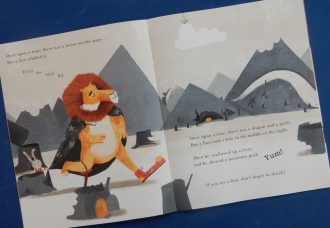
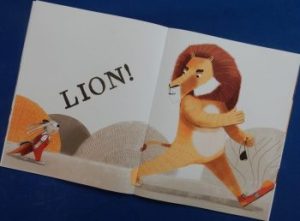
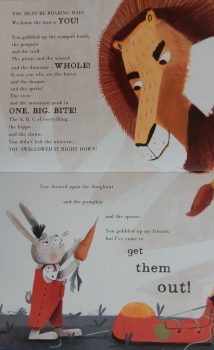
First there was Emma Yarlett’s Nibbles, the book devouring little monster and now courtesy of Karl Newson, we have a lion on the loose – ‘orange, furry, handsome and tall’ by all accounts – that’s had the impudence to eat the story right out of his book; not to mention the corner of its cover. Well really!

Not content with the story though, this creature has also consumed a brass band, a penguin, a troll, a pirate, a wizard and a dinosaur; and don’t believe a word when you read that he’s ‘Dashing, charming, gentle, fun’. Far from it; for this beastie has also devoured an entire forest, a river, a mountain peak

plus a dragon and a sprite. And he doesn’t stop there. What does stop our errant lion right in his tracks however, is a cry

from the little rabbit that’s been on his trail throughout.

Does the little long eared fellow fall for the lion’s beguiling invitation? Far from it. Instead he gives the guzzler what for

and then makes him do what young listeners will have been hoping all along.

And how does this rhyming hide and seek story finish? Well, let’s merely say, satisfyingly, roaringly well and leave you to discover for yourself.

Karl and illustrator Andrea Stegmaier have created a corker of a book that little ones will relish as much as readers aloud who can have enormous fun sharing it with them. Rabbit’s actions throughout are especially entertaining.

The Skies Above My Eyes

The Skies Above My Eyes
Charlotte Guillain and Yuval Zommer
Words & Pictures

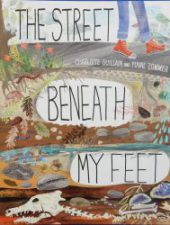
This follow-up to The Street Beneath My Feet uses the same double-sided format unfolding to 2.5 metres only now we’re directed to look at what’s above the Earth’s surface.

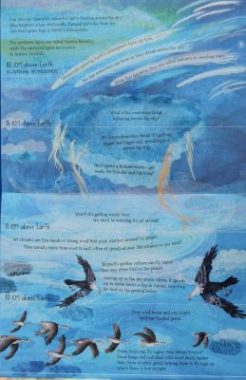
Standing alongside the child at the bottom of Zuval Zommer’s continuous concertina illustration readers are taken on an exciting journey from ground level, billions of kilometres up and right out to the farthest reaches of the solar system and back again.

We travel past high-rise buildings, through the layers of the atmosphere to the imaginary Karman line to where 400 kilometres above the Earth is the International Space Station and thence to the Moon and out into the Solar System where the planets are found.

Beyond Neptune lies the Kuiper Belt that includes Pluto and even further out beyond the Solar System we can see hundreds of billions of star-filled galaxies.


After a period of stargazing, it’s time to travel back earthwards. We might spy comets, meteoroids, the Aurora Borealis and lower down, migrating birds on the wing;

and if we look very carefully, ballooning spiders drifting parachute-like a few metres above Earth as well as, rather more easy to spot, mountain sheep on a rocky escarpment.

Our long, long journey comes to an end on a grassy hillock where alongside the little girl we saw as the start, we can relax and enjoy nature’s bounties that surround us.

Charlotte’s narrative is certainly fascinating and informative as her enthusiasm sweeps us up and away. However it’s Yuval’s richly detailed art that ensures that the reader is not only informed but filled with awe and wonder about so many aspects of the mind-stretching, The Skies Above My Eyes.

Why not step outside with your children and see that you can spy in the sky …

(I missed this super book when it first came out but thank you to the publisher for sending it out now.)

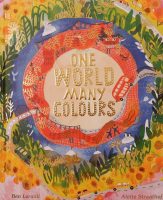
One World Many Colours

One World Many Colours
Ben Lerwill and Alette Straathof
Words & Pictures

Award winning travel writer Ben Lerwill takes readers on a journey to celebrate the wonderful colours to be discovered all over the world, demonstrating his opening line ‘We share one world. We share many colours.’

We travel from the desert of Oman with its white Arabian oryx, to icy white Antarctica whose ‘frozen land furls out forever’ and the Sydney Opera House glowing in the morning light,

all the way to the pyramids of Egypt glowing at the day’s end as the final rays of the sun bathe the ancient stones in a beautiful red light.

In between, the journey takes us to see the soft pink blossoms of the cherry trees in Japan and the lakes of Kenya with their pink hued flamingos.

Yellow stands out glowing and gleaming in a football stadium in Brazil, on the New York streets with their numerous taxi cabs and in the sunflower fields of Spain – silent save only for the wind’s whisper.

Blue is found not only in the deepest oceans and in the sky above Mount Everest but also on the beautiful feathers of the Canadian blue jay.

The wilds of South Africa, the countryside of Vietnam with its ripening rice fields and the Amazon Rainforest all glow with their gorgeous greens.

Chinese New Year celebrations in Hong Kong are alive with red but equally bright is the London double-decker bus driving over Westminster Bridge during the rush hour.

Our magical journey shows that the same vibrant colours are found in nature, in culture and in our cities. Both Lerwill and illustrator Alette Straathof will surely open the eyes of young readers to the wonders of our world while also linking us all together through a shared colour spectrum. Connectivity indeed.

Alette’s colour palette is rich and vibrant; Ben’s writing lyrical and a breath of fresh air; together they’ve created a captivating book that is uplifting, and gently educational.

Board Book Christmas

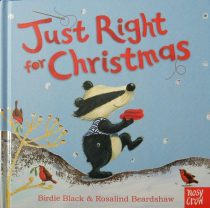
Just Right for Christmas
Birdie Black and Rosalind Beardshaw
Nosy Crow

A board book version of a Christmas favourite from a few years ago unfolods over two days.

It begins on a snowy Christmas Eve with the king walking around the market. His purchase of a roll of beautiful red cloth to make a cloak for his daughter results in the left-over scraps of fabric being placed outside the back door.  Jenny the kitchen maid finds them and makes  a jacket for her ma. The remaining scraps are turned into a hat for Bertie Badger’s pa, then gloves for Samuel Squirrel’s wife and a scarf for Milly Mouse’s little one, and all just in time for Christmas Day.

A warm, feel-good story ‘… just how Christmas should feel’ celebrating the pleasures of giving, made all the more so with Rosalind Beardshaw’s, mixed media illustrations that help stitch the narrative together beautifully.

The Twelve Days of Christmas
Illustrated by Britta Teckentrup
Little Tiger

In this board book, using two enchanting elf characters and her trademark die-cut collage style illustrations, Britta Teckentrup presents a favourite seasonal song aimed at the very youngest listeners. As the song progresses, one verse per spread, the gift is revealed through the cut out. Then on the fourth day additional die-cuts are used to accommodate the 4 colly birds and so on until the eleventh day. On day twelve all the gifts are revealed around the tree on the recto while in the bottom corner on the verso the elves give each other a Christmas kiss.

Just right for tiny hands and there’s plenty of counting fun to be had too.

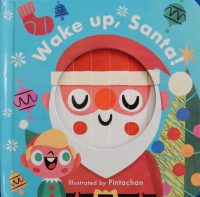
Wake up, Santa!
illustrated by Pintachan
Words & Pictures

With cleverly designed paper engineering and digital illustrations, this bright, jolly interactive board book will get little ones and their sharers in festive mood as they waken in turn Santa, the elves, Rudolph and a teddy bear.

There are things to find, name, count and talk about all in a tiny, fun-filled ‘Little Faces’ package.

Christmas is Awesome!
Sabrina Moyle and Eunice Moyle
Abrams Appleseed

The Moyle sisters go to town to demonstrate the veracity of their latest board book’s title.

Popping with neon pink, Eunice provides lively scenes of assorted animals getting into the festive spirit with ‘twinkling lights, silent nights, being nice ‘(of course) and much more.

Humorous touches abound with ‘ugly sweaters’, a dachshund sporting one such takes the opportunity to get beneath the mistletoe and bestow a long-tongued lick upon the cat’s beaming countenance; and don’t miss the lump of coal getting in on the act by knitting itself a sweater from ‘darkest black abyss’ yarn. And the nativity scene is priceless: Mary and Joseph are two birds looking benevolently upon their newborn baby Jesus – a haloed egg.

Sabrina’s rhyming narrative orchestrates the celebrations concluding thus: ‘Joy and kindness, love and fun, Christmas is for everyone!’ Their portrayal is certainly a whole lot of fun.

Busy Reindeer
illustrated by Samantha Meredith
Campbell Books

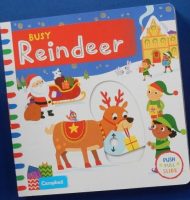
As an adult reads the rhyming couplets, little fingers can manipulate the sliders to activate Santa’s reindeer Ruby, then watch the sleigh take flight over a snowy landscape, help Santa down the chimney and finally, open the stable door for him to thank and bid goodnight to his number one helper. All of this is illustrated in Samantha Meredith’s bright, jolly scenes of a busy Christmas delivery round.

Hope

Hope
Corrinne Averiss and Sébastien Pelon
Words & Pictures

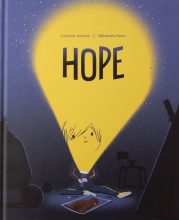
Finn is a small boy with a very large dog called Comet. The two are best friends and do pretty much everything together.

One morning Comet isn’t his usual lively self: “He’s poorly,” Mum says, “he needs to go to the vet’s.”

Off go Dad, Finn and the dog in the car. The vet is uncertain about Comet’s recovery but promises to do his best.

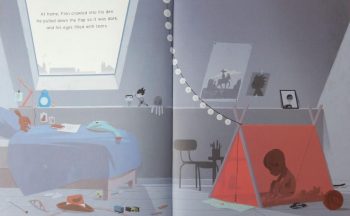
Alone in his den on their return, Ben lets his tears flow.

Dad comes into the boy’s room with a torch offering advice. “All we can do is hope, … Hope is keeping a little light on however dark things seem,’ he tells the boy.

That night Finn lies in bed, torch on for Comet and unable to sleep.

Suddenly he notices another light: it’s the bright moon shining right into his room as if it too is hoping.

Eventually Finn does fall asleep and outside the sky is alight with hopes – big and small, old and new, some shining right down on the vet’s.

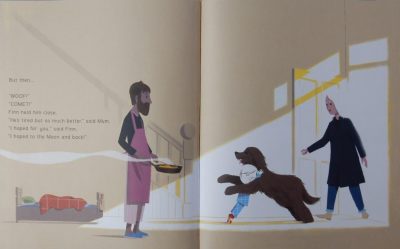
Next morning it’s an anxious boy who rushes downstairs just in time for a wonderful surprise …

A powerful, positive message shines forth both from Corrinne’s appropriately direct telling and Sébastien Pelon’s illustrations. His effective use of dark, light and shadow serves to intensify the emotional power of the story showing little ones that even in dark times, you should never give up hope.

When We Became Humans

When We Became Humans
Michael Bright, illustrated by Hannah Bailey
Words & Pictures

Here’s a large format, illustrated book that provides an accessible overview of human evolution from our earliest primate ancestors right through to Homo sapiens.

Having explained such terms as hominids, hominins and haplorhins, the author takes readers back to our earliest primate ancestors – tiny rodent-like mammals – of some 65 millions years back; then moves on 35 million years to the monkey-like ape ancestors that were starting to bear a greater resemblance to the apes we know today. (Here, I was fascinated to read of the theory of the parallel evolution of primates and fruit trees).

Then comes a spread on how scientists study fossil evidence and the kind of information this can yield.

Next is a look at the move to bipedalism and how this enabled early hominins both to see further across the plains and to grasp and carry tools, food and even babies.

Bright presents the theory that a number of different hominid species lived at the same time, as well as stating that as DNA analysis shows, Neanderthals and modern humans interbred.

There is just so much absorbing information packed between the covers. In addition to exploring physical changes,

the author includes a look at the stages of cultural development, tool use and its modification.

I was particularly fascinated by the cultural spreads such as the look at health care, and jewellery, (Neanderthals and humans both wore it),

trinkets and charms.

The book ends with the question of whether or not humans are still evolving, plus a visual presentation of chronology and migration routes.

Hannah Bailey’s plentiful illustrations are excellent, making the considerable amount of information feel much less challenging to primary school readers.

A book I’d thoroughly recommend adding to family shelves or a KS2 collection for supporting both the history and the science curriculum, as well as for interested individuals.

Ella May Does It Her Way!

Ella May Does It Her Way!
Mick Jackson and Andrea Stegmaier
Words & Pictures

Let me introduce young Ella May; she’s a little girl who lives on a boat and knows what she wants and how she’s going to do it. Good on you Ella May, you’re not about to let anyone push you around.

One day, Ella’s Mum gives her something new to eat saying, “It’s good to try new things.”

The idea appeals to Ella and so later in the park she decides to try walking backwards and having pretty much got the hang of that, she does a whole lot of other things backwards too.

Despite her Mum hoping she’ll soon tire of the backwards notion, it’s not long before Ella has got her Mum as well as pretty much everyone else in the neighbourhood joining the backwards walking parade through the town.

Having harnessed their enthusiasm though, Ella decides enough is enough with walking backwards; but being Ella she’s not going to revert to a normal way of moving around. After all there are plenty of other ways and as she says in parting, “It’s good to try new things!” And so it is.

Billed as the first of a series, I look forward to seeing more of Mike Jackson’s determined character in further funny episodes. Andrea Stegmaier’s illustrations are an equal delight: I love her colour palette, her portrayal of Ella, her Mum and the bit part players, all of whom contribute to the splendid scenes of purpose and tenacity the Ella May way. Long may young Ella continue.

If You Had Your Birthday Party on the Moon / The Race to Space

If You Had Your Birthday Party on the Moon
Joyce Lapin and Simona Ceccarelli
Sterling

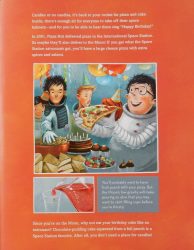
Hold on to your helmets, it’s blast off time, destination a birthday party in a place you never expected it to be. Moreover, there’d be a lot more celebration time on your lunar destination for it has a 709-hour day.

On the way to the moon you’ll discover what it feels like to be weightless and your party paraphernalia and pals will also float around inside your spaceship.

Once on the moon’s surface you’ll feel a lot lighter than on Earth and the Moon’s low gravity will keep you safe.
You won’t be able to fly any party balloons on account of the Moon being airless but you can have enormous fun doing one-handed push-ups,

exploring the lunar craters, trying a game of freeze tag and making moondust angels.

Perhaps you will have to eat your birthday cake astronaut style squeezed out of a foil pouch. Don’t think I’d be so keen on that idea.

Then on the return journey and there’ll be bags of time to open your presents, a whole three days in fact during which you could also open those party bags and sample some of the Moon pies therein.

Woven into all this partying is a great deal of STEM information on exciting topics both astronomical and cosmonautical. Why for instance is the sky black rather than blue; why your birthday will last almost 30 days, and why there wouldn’t be any point in playing musical statues on the moon.

With Simona Ceccarelli’s lively, playful digital illustrations and Joyce Lapin’s enormously engaging narrative that speaks straight to the reader, this is a sure fire winner for younger readers/listeners.

(Included at the back are a glossary, bibliography and suggestions for further reading).

For somewhat older readers is:

The Race to Space
Clive Gifford and Paul Daviz
Words & Pictures

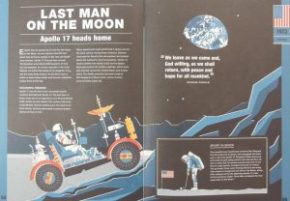
With the 50th anniversary of mankind’s first moon landing fast approaching, here’s a book that traces the history of the space race between two super powers, the U.S. and the Soviet Union, from the launch of Russia’s Sputnik to Neil Armstrong’s planting of a U.S. flag on the moon’s surface and those oft quoted words, “That’s one small step for a man, one giant leap for mankind.” That must be etched into the brains of all who saw that landing broadcast live.

From then on the relationship between the U.S. and the Soviet Union became more one of co-operation and collaboration than competition and the book documents the ‘handshake across space’ in the 1975 joint Apollo-Soyuz mission.

It concludes with more on the co-operation including the establishment of the International Space Station.

Illustrated, retro style by Paul Cadiz, in shades of red, yellow, blue plus black and white,

the book has clear explanations together with a liberal scattering of quotes from significant participants in the whole endeavour.

Recommended for individual reading at home and for KS2 class collections.

Humperdink Our Elephant Friend

Humperdink Our Elephant Friend
Sean Taylor and Claire Alexander
Words & Pictures

Storyteller Sean gives the impression he’s spent time standing behind the heads of young children, observing carefully, so he knows what they’d do should a playful pachyderm burst through the door of their playgroup.
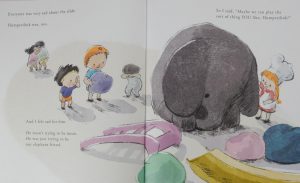
That is just what happens in this book and straightaway the children attempt to accommodate him in their play, be it dressing up, hairstylists …

hide and seek or something more energetic. No matter how hard they try though, things keep ending in disaster.

The children then change tack asking Humperdink what he likes to play and before you can say, ‘come outside’ he’s led the little ones outside for some exceedingly satisfying elephant-stomping, stamping and stumping,

followed by elephant riding right into a jungly place that’s perfect for …

After all that romping Humbert is ready to settle down into something equally creative but rather less energetic; though of course, he and his new friends are always up for a jungle foray.

The joyful exuberance inherent in Sean’s telling is wonderfully echoed in Claire Alexander’s scenes of the characters’ imaginative play. Clearly she too spends time observing little ones – their joie de vivre, their intense concentration on whatever they’re engaged in, and the way their open hearts are sensitive to the feelings of one another, empathetic and full of love.

Perfect for story time in a playgroup or nursery and at home with little ones, this is a book that’s bound to be requested over and over.

The Colour of Happy / Some Days / A Thank You Walk

The Colour of Happy
Laura Baker and Angie Rozelaar
Hodder Children’s Books

This sweet, simple rhyming story of a boy finding a dandelion seed head and what happens thereafter is the means for an exploration of feelings for young children around the age of the child narrator, using a rainbow of emotions and the fluffy seed head.

The child, out walking with a pup, spies a dandelion clock: ’Yellow is for happy when I spot a special thing,’ he tells us and having picked it, hops and skips along. But when a gust of wind whisks his treasure away, the boy is engulfed in dark blue sadness.

His emotions then run through the colour spectrum: red for anger as he watches it sail away;

green for feelings of envy when he sees a girl with the seed head; grey when he cannot believe things will be okay; gold for the kindly response from a little girl, and the return of hope as they play together chasing the dandelion clock while it sails off again;

purple for the proud feeling when the boy again holds his treasure safe and bids his friend farewell; orange for the mounting excitement as he heads home and finally, pink as he reaches the front door with his somewhat depleted, love-filled offering …

Little ones will certainly relate to Laura Baker’s lovely story, which offers a great starting point for becoming mindful about their own responses to situations. With a foundation stage class, I envisage children talking about the book, their own feelings with regard to a particular happening; and then perhaps responding with paints or whatever medium they feel right, in music or a dance with coloured scarves perhaps.

Some Days
Karen Kaufman Orloff and Ziyue Chen
Sterling Children’s Books

We all experience different feelings at different times and so it is with young children and this book, with Karen Kaufman’s lively rhyming text and Ziyue Chen’s warmly hued illustrations, conveys that huge gamut of emotions through the course of a year.

Through two young children, we share in their everyday highlights such as ‘chocolate pudding pie day’s’, ‘Kites up in the sky days. Jumping super high days’; the joys of swimming and sunbathing;

as well as the downs – a nasty cut knee for instance.

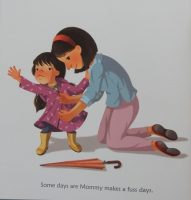
Some days are extra special like that for ‘picking out a pup’ or winning a cup. Then come fussy mum days

and days when raincoats just won’t do, and there are  too wet to play football days with glum stay indoors faces; better though are snow angel making days and watching a warm fire days.

The author acknowledges those bad days when everything feels wrong

and those when it’s best to be alone.

Finally comes ‘Learning to be me days’ which is really the essence of the whole, a book that celebrates the positive but doesn’t gloss over the negative feelings. It’s a good starting point for discussion in an early years setting, or after a one-to-one sharing at home, perhaps about how best to respond to and deal with negative emotions. After all, being mindful of, and being able to talk about, our emotions and feelings helps us best deal with them.

Helping to develop mindfulness in even younger children is:

A Thank You Walk
Nancy Loewen and Hazel Quintanilla
Words & Pictures

Nancy Loewen’s brief story of a mother and little girl walking their dog, Duke, is one of the Bright Start series aimed at developing emotional intelligence in the very young.

Simply expressed it tells how as they stroll hand in hand mother and child interact with the animals they encounter. The barking sounds of Duke, the chirping of birds eating seeds, a neighing pony fed carrots, an overturned beetle that they rescue, which flies off with a buzz-buzz,

are, the child is told, the creatures’ ways of saying thank you.

Cutely and expressively illustrated in black and white with orange pops, by Hazel Quintanilla the book demonstrates the importance of showing appreciation and thankfulness. It’s never too soon to start saying thank you and as an introduction to being mindful about expressing gratitude it offers a useful starter for a circle time session with a nursery group, or for individual sharing at home.

Dragons in Love / Bagel in Love

Dragons in Love
Alexandre Lacroix and Ronan Badel
Words & Pictures

Dragon, Drake, as some of you may know from Dragons: Father and Son is a troglodyte residing with his father at the bottom of a steep valley. He frequently leaves his cave and ventures forth into the town to play with the children and so it is on this particular day. But although he may know a bit about playing, kissing is entirely new to him. So when his friend Violet lands him a smacker on the snout he feels all hot and bothered.

On reflection however, he realises no personal harm has been done but avoiding Violet is the best plan henceforth. Not easy as it means avoiding all his favourite haunts.

Drake talks to his dad who explains that the fire is a dragon’s natural way of showing love and tells what happened when he and Drake’s mom were courting.

This is all very well for dragons but what about human Violet? Poor Drake feels at a loss to know where to go; but then he hears noises coming from the nearby park. Violet is being bullied, he discovers. It’s time to act, thinks Drake and so he does …

Friendship fully restored, what will be Drake’s next move … ?

Badel’s ink and watercolour illustrations are full of detail with a wealth of wonderfully humorous touches. I love the early spread with the football being kicked and ending up way out of reach in a tall tree.

Beautifully droll as before, Lacroix’s story is sure to strike a chord especially this season when love is in the air, though with its standing against bullying message it’s a good one to share with young listeners at any time.

Bagel in Love
Natasha Wing and Helen Dardik
Sterling

Bagel is a talented dancer: his spins and swirls, taps and twirls make him feel anything but plain. The trouble is however that he doesn’t have a partner and so can’t enter the Cherry Jubilee Dance Contest.

Poppy, the best dancer he knows tells him his steps are half-baked: Pretzel says his moves don’t cut the mustard and from Matzo he receives a flat refusal.

Not one to give up easily, Bagel heads to Sweet City where things aren’t actually much sweeter when it comes to the responses of Croissant, Doughnut, and Cake. But then outside the café, Bagel hears music coming from the contest venue and he breaks into a tap routine.

To his surprise a tapping echo comes right back. Has he finally found the perfect partner?

Natasha Wing has thrown plenty of puns into her narrative mix with its underlying message about determination and not giving up on your dream, while Helen Dardik treats readers to a plethora of sticky confections and some salty ones too in her digitally worked, richly patterned scenes.

A sugary romance for Valentine’s Day this surely is. Anyone want to dance?

When the Whales Walked / Rivers


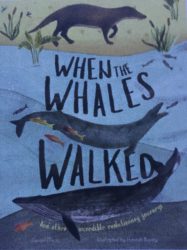
When the Whales Walked
Dougal Dixon and Hannah Bailey
Words & Pictures

By means of thirteen case studies, readers can discover how for example, dinosaurs evolved into birds and how whales were once four-legged creatures that walked on the land. These are just two of the fascinating evolutionary journeys told through a mix of annotated illustrations by Hanna Bailey, superbly illustrated scenes and family trees.

Did you know that way back in time snakes too had legs and crocodiles were warm blooded?

Written by evolution and earth sciences specialist, Dougal Dixon, this is a book that will broaden the horizons of dinosaur mad readers and, with evolution now a topic in the KS2 science curriculum, it’s one to add to primary school collections.

Rivers
Peter Goes
Gecko Press

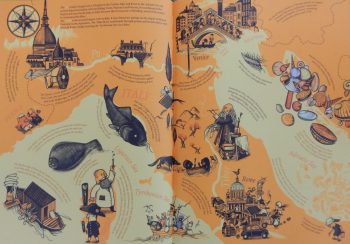
In his follow up to Timeline, Belgian illustrator Peter Goes takes readers by means of a series of large size maps, on a continent-by-continent tour of all the world’s great rivers.

Those featured flow across  predominantly monochromic double spreads that are illustrated with images of iconic structures – bridges and buildings, vehicles, people, deities, monsters, wildlife and physical features.

Factual information – historical, geographical, biological, mythical, cultural – is provided in snippets (the book is translated from the original text by Bill Nagelkerke) through and around which each river meanders from source to sea.

I’ve visited relatively few of the rivers featured (though various parts the River Thames have always been part and parcel of my life and I’ve visited locations along the Ganges). Some including the River Onxy in Antarctica that flows only in summer, I’d never heard of.

This super-sized book has made me want to do some more river exploring; perhaps, like its creator I’ll start closest to home, in Europe.

A fascinating book for young would-be travellers and school libraries in particular.

My Friend Sleep

My Friend Sleep
Laura Baker and Hannah Peck
Words & Pictures

A little girl narrator takes a magical journey in the company of her friend and nocturnal companion, Sleep. “Come with me, my friend, take hold of my hand. / Together we’ll travel through night’s dreamland” he calls.
They visit such amazing places as a land full of sweets where the clouds are of candyfloss, crystal jellies glisten in the moonlight and sweet dewy berries exude their scent.

Full to capacity, it’s time to move on: Sleep sings again and the two continue their journey to a strange fairground where, aboard a strange craft on a big wheel they’re lifted skyward while down below, dinosaurs romp and aliens dance.

Then between the stars comes a huge dragon upon whose back they leap at Sleep’s behest.
Through the clouds, looping and swirling fly dragon, child and Sleep …

till the dragon drops them off at the entrance to a gloomy cave.
Once more come Sleep’s friendly, reassuring words making the darkness feel less scary. Till, full of menace a monster looms,

but again Sleep is there to proffer help by way of a magic wand to shrink the monster and turn it into a friendly little thing.

Now fly back, they must, child and Sleep through the starry night sky; back into the bedroom once more before the girl wakes to a memory of dreams in time for all that day will bring.

Spellbinding images conjured up in words and pictures (love the colour palette) create a somnolent picture book dreamscape for bedtime sharing.  The storybook encounters with things happy, thrilling and scary, should help little ones overcome any nighttime fears they might have from time to time.

Joy

Joy
Corrinne Averiss and Isabelle Follath
Words & Pictures

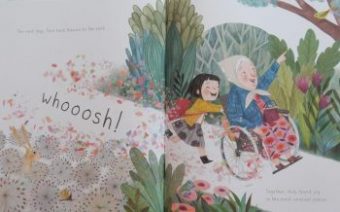
Where can you find joy, and once found, how can you capture it? That’s the conundrum young Fern sets herself in this gorgeous story.
Fern’s Nanna has not been her usual self recently; her sparkle’s gone and with it her love of cake baking and even worse, her smile. That’s what upsets Fern most.
It’s like the joy has gone out of her life.” is what her Mum says when Fern asks what’s wrong with Nanna.
Once she’s understood that joy involves experiences that generate a ‘whooosh!’ factor, Fern packs her catching kit into her bag

and sets out for the park to catch some and bring them back for her Nanna.

Sure enough, the park is brimming with joyful moments, but try as she might, those whooshes refuse to be caught in her various receptacles …

and she trudges sadly home.

Now it’s Nanna’s turn to notice how sad her granddaughter is. As Fern recounts her abortive attempts to bring home some joy for her, lo and behold, Nanna’s face breaks into the ‘BIGGEST, WIDEST WHOOOSH! of a smile’ and next day they’re off to the park together.

Corrine Averiss’s empathetic tale showing that unique bond between grandparent and child, is in itself elevating and a gentle demonstration that love is the true generator of joy however manifested: coupled with debut picture book illustrator Isabelle Follath’s tender, mixed media scenes of both sadness and jubilation, this very special book makes one want to break into WHOOOSH-induced handsprings of delight.

Ready to Ride

Ready to Ride
Sébastien Pelon
Words & Pictures

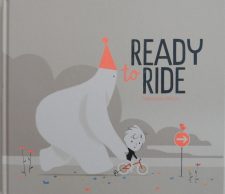
What can you do on a dull, stay- indoors kind of a day that’s already become boring? You might perhaps, like the small child narrator of this story, venture outside and see what unfolds.

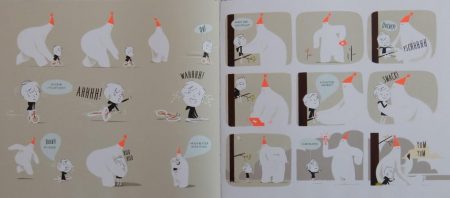
Into view comes a large furry shape riding a tiny bike and sporting a luminous pink hat. They make eye contact and the boy hops on his own bike and off they go.

It isn’t long before the human is wanting rid of his stabilisers, which his new friend helpfully consumes leaving the lad struggling to cope with trying to ride his ‘big boy’s’ bike.

The learning curve is steep with the usual frights, falls and rallying,

along with the odd spot of relaxation,

until finally come success, speed and some over-confidence.

All the while though, the silent, white lumpy creature is there ready to offer succour and the occasional bit of provocation: then suddenly he’s gone.

Perhaps he was never there at all except in the boy’s mind.

Back home goes one small child, proud of himself and eager to tell his mum and dad about his adventure but when a “What did you do?’ comes from Mum his answer is let’s say, understated.

You can succeed so long as you show resilience, is what comes through in Pelon’s picture book.

Its graphic format is such that it works best as a one-to-one share and with that blank ‘Super Cyclist’ certificate on the back endpapers, is certainly one to offer a child at that same stage of readiness to fly solo on two wheels. I love the colour palette and the plethora of humorous details.

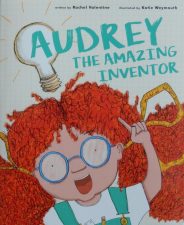
Audrey the Amazing Inventor

Audrey the Amazing Inventor
Rachel Valentine and Katie Weymouth
Words & Pictures

Hot on the heels of Ada Twist, Scientist and Rosie Revere, Engineer comes another young girl character with a passion.
Meet Audrey, inquisitive and an inveterate fiddler with things, who, having declared to her teacher, her intention to be an inventor, sets about achieving her ambition.

She starts with items to make life better for her dad and Happy Cat but after a very rocky start

and even more disastrous next efforts, Audrey miserably declares herself “the world’s worst inventor!

Luckily for her, her dad, far from making disparaging remarks, encourages his daughter to learn from her mistakes and carry on trying. Wise advice.

It works too, for it isn’t long before Audrey is inventing again, but this time she’s extra careful at the planning stage, the constructing stage and the testing stage. Dad cannot wait to see the new invention.

Will it work to the satisfaction of all though? It’s certainly wildly inventive, and sophisticated; but will it deliver?
Crazy, but enormously enjoyable and an inspiration to young female would-be scientists, technologists and engineers: Audrey demonstrates just how much enjoyment the STEM curriculum offers and Rachel Valentine’s narrative reminds children of the importance of persevering, and of following your dreams.

There’s a slight touch of the Heath Robinsons about some of Katie Weymouth’s zany scenes of Audrey at work on her inventions, and she also adroitly captures the close and supportive relationship between father and daughter.

Rosa Draws

Rosa Draws
Jordan Wray
Words & Pictures

Rosa is happiest when using her drawing pencils and letting her imagination run wild and that’s what this story is all about.

Seemingly her favourite subjects are animals, fairly ordinary ones, but what happens to them is anything but ordinary.

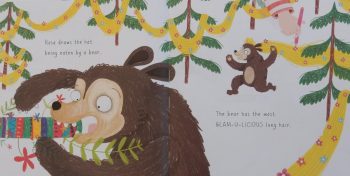
For when Rosa adorns her fuzzy black cat with a ‘RIDONKULOUS’ hat, it triggers an increasingly crazy concatenation of events involving a hat-eating bear with GLAM-U-LICIOUS long hair (yes the whole thing is recounted in rhyme with only the occasional slight creak).

Said bear has its hair sat upon by a moose that takes tea with a la-dee-dah goose and so on until the ants – a zillion of them – board a train and plunge Rose into darkness, cutting off her train of thought and completely stifling her imagination.

Only temporarily though, for the tugging on a light switch cord puts her back ‘on track’ and her ideas flow freely once more until suddenly who should arrive on the scene but Rosa’s mum.

Apologies are immediately forthcoming but it turns out that young Rosa isn’t the only one with an artistic bent …

Packed with zany details – look out for the peacock sporting jazzy socks – Wray’s illustrations will amuse both children and adults and the former will enjoy the invented words and the surprise finale.

Maths, Manipulations and Mindfulness

5 Wild Numbers
Bella Gomez
Words & Pictures

Vibrant scenes of jungle animals introduce counting and the numerals 1 to 5 in this chunky book.
The thick sturdy pages accommodate a die-cut numeral on each spread with a sliding disc so that small fingers can follow the arrows, move the disc and trace the numeral for ‘One fierce tiger’, ‘Two stripy zebras’, ‘Three parrots’, ‘Four long-tailed monkeys’ and ‘Five pink flamingos’.

The rhyming text introduces exciting words such as ‘paces and snarls’ for the tiger; ‘laze’ and ‘scorching days ‘ for the zebras and even metaphorical language – ‘ their feathers shining bright as jewels’

A fair bit of pressure is needed to move the discs so in my view the value of this activity lies in helping develop fine motor skills but is of limited help in learning to form the numerals.

Shapes Colours Numbers
Dario Zeruto
Words & Pictures

This is a wordless, (apart from the initial ‘How many shapes and colours can you find?) simple, yet ingenious, chunky book that as it unfolds, encourages youngsters to find out about 2D shapes and colours, and do some counting along the way as they explore a series of gatefold flaps.

Playful, engrossing and educational, and all based on five colours, squares, triangles, rectangles, circles and diamonds.

Touch Think Learn Wiggles
Claire Zucchelli-Romer
Chronicle Books

An engaging rhythmic text, inspired perhaps by Hervé Tullet, urges young children to use their wiggly fingers to dance on each spread as they trace shapes, tap and hop, slide up and down, follow circle outlines, zigzags, and spirals as the text is read aloud.

The text is upbeat and playful, the shapes cut out in fluorescent green, pink, or yellow are attractive and inviting but the white type against pale blue pages less satisfying that the brighter shade of blue used for the cover.

ABC Mindful Me
Christiane Engel
Walter Foster Jr.

Mindfulness – paying attention to the present moment, or being in the here and now – is very much in vogue at the moment, with schools adding it to their daily programme, often sadly, tacked on as an optional after school extra rather than it being part and parcel of the curriculum.

Christiane Engel’s sturdy large format board book could help integrate it into the foundation stage curriculum at least. She takes us on a journey through the alphabet linking each letter to an activity – walk, yoga, breathe for example, or a state of mind or concept –awareness, giving, joy or thankfulness.
The rhyming text talks directly to the child and the illustrations are attractive and inclusive.

The book concludes with some creative ideas related to the book’s overall theme.

If you think young children need help to be mindful then this will be useful: I know from experience that if left to their own devices, preschool children naturally reach a state of mindfulness; adults just need to step back – it’s they, rather than children who need a book such as this.

Wild World, The Coral Kingdom and Who’s Hiding on the River? / Who’s Hiding on the Farm?

Wild World
Angela McAllister, Hvass & Hannibal
Wide Eyed Editions

The author has chosen thirteen natural habitats – Rainforest, Arctic, Prairie, Woodland, Coral reef, Desert, Rock pool, Mountain, The Outback, Moorland, Deep sea, Mangrove and Savannah – that are under threat due to human activity, and captures the essence of each one in a series of free verses.
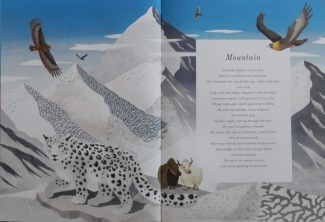
Here’s the opening to Mountain:
‘I am the highest mountain, / Born in a collision of continents. / All is beneath me, except the sun, moon and stars. / I am rock, / Crag, cliff and ledge, draped in veils of white. / I am snow-maker, with glaciers in my arms, / Whose meltwater swells great rivers below.’
In stark contrast is the quieter sounding Savannah, which opens like this: ‘Savannah speaks in whispering grasses, / In the chatter of cicadas across an endless plain. / Spacious homeland of swift cheetah / And gazelle, with the horizon in her eye.’

Using matte colours, the illustrators Hvass and Hannibal showcase the flora and fauna of each location in a series of eye-catching paintings that incorporate the text within them.

Human use, climate change and pollution are responsible for the damage to the environment and after her introductory poem, it’s not until the final pages that the author enlarges upon her conservation message citing the specific damage within the thumbnail sketch of each of the places portrayed. Thereafter she implores readers to use less energy, to recycle and to buy with care.

We’d all do well to keep in mind her final words about our precious planet: ‘Explore it, protect it, love it. / Our Earth is a wonderful wild world. ‘

Also with an ecological message is:
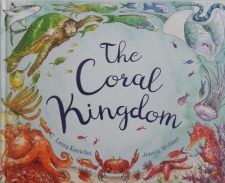
The Coral Kingdom
Laura Knowles and Jennie Webber
Words & Pictures

Our coral reefs, with their gorgeous colours: crimson, red, rose, yellow,

turquoise, emerald, jade, purple, even black, that have taken 1000s of years to grow and give home to a myriad of creatures large and small are under threat.

When the coral is bleached white due to acidity caused by climate change, and stays white for too long, then the reef dies.

Laura Knowles has written a rhyming narrative that outlines the life cycle of a reef and includes a caution that unless we humans take action these amazing ecosystems will be lost forever.

Jennie Webber’s detailed watercolour illustrations show the beauty of the undersea habitat and a final fold-out page gives additional information about coral reef conservation.

A useful addition to a primary school conservation topic box, or, for a child interested in ocean life or ecosystems.

Who’s Hiding on the River? / Who’s Hiding on the Farm?
Katharine McEwen
Nosy Crow

It’s never too early to start learning about nature and here are two board books just right for introducing animals, some wild and some domesticated, to the very young.

Both are beautifully illustrated by Katharine McEwen and there are lots of animals to find in both locations.

Toddlers can spend a day by the river, from a busy morning through to night-time as they explore the pages, manipulate the sturdy flaps in response to the ‘Who’s hiding here?’ on every right hand page to discover tadpoles, cygnets, fish, dragonflies, a stoat, a beaver and more as they swim, wriggle, wade, leap, build and paddle.
The farm book also moves through the day in similar fashion and McEwen’s text is carefully worded to introduce new vocabulary including ‘pecking,’ ‘trotting’, ‘snoozing’ ‘prowling’, munching’ and ‘diving’ along the way.

Published in collaboration with the National Trust these are fun and at the same time, gently educational.

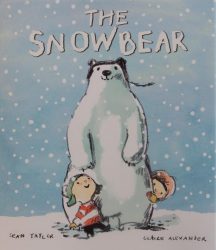
The Snowbear

The Snowbear
Sean Taylor and Claire Alexander
Words & Pictures

Two small children, a brother and sister wake to find that overnight their world has turned completely white. “Make a snowman if you want. But be careful because the hill is too steep and slippery,” is their mother’s warning as they sally forth into the great outdoors.
Slips and slides are inevitable and a snowman, of sorts is duly built, although they decide their creation looks more like a snowbear.
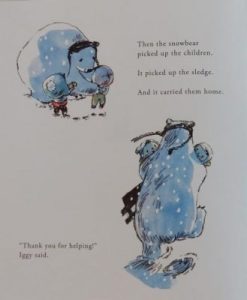
Having completed their chilly enterprise, the children take to their sledge and go hurtling downhill, faces a-tingle, towards the woods.

Eventually they come to a halt and decide home is where they now most want to be. But the climb is steep and there’s something watching them from between the trees.

Suddenly they hear a sound. Could it be that something or someone is coming to their rescue in that chilly white wood?
It is and it does.

Next morning though, the sun has melted their snowbear right away; at least that’s Martina’s suggestion. Iggy puts forward an alternative. “… he could have gone back in the woods and he’s alive down there.” I wonder …
A lovely wintry tale with just a frisson of fear, and an acknowledgement of the boundless imaginations of young children. This is, I think a new author/artist collaboration: in her eloquent, soft focus illustrations, Claire Alexander brings out the drama of Sean Taylor’s deliberately understated narrative, as well as showing young children’s ability to immerse themselves completely in the here and now.

Two Dragon Tales

Dragons: Father and Son
Alexandre Lacroix and Ronan Badel
Words & Pictures
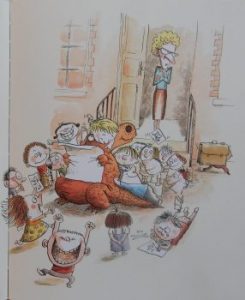
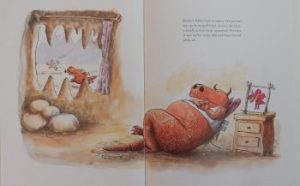
Young dragon Drake, a chunky little charmer, lives with his pot-bellied father, a traditionalist, who decrees that the time has come for his son to start behaving like a real dragon; and that means burning down a few houses in the village over the mountain. Poor Drake. He seldom emits a plume of smoke and setting fire to houses is something he does not want to do at all.
Next morning though he does as he’s ordered and finds himself a likely target. Just as he’s stoking himself up to commence his flame throwing, out rushes a little boy who offers a larger alternative, the village school.
Here however, as he’s about to disgorge his destructive breath, the teacher and pupils disarm him completely with their appreciation …

and Drake finds himself heading for a third target. Yet again though, he is diverted.

What is his father going to say when Drake returns home and reports on his activities?
Needless to say, he’s more a than a little displeased; so it’s just as well that young Drake has, in the course of his travels, ‘learned a lot from the humans about being smart.’
Thereafter, we leave both father and son satisfied in the knowledge that there is, after all, more than one way to be a respected dragon.

Lacroix debut picture book text, although longish, is mostly in dialogue and has a droll humour that, with its themes of divergence and tolerance, will give it a wide age range appeal.
Badel’s watercolour and ink illustrations show Drake’s appearance in the village striking fear and consternation among the adult population but only excitement and adulation in the children he encounters. Perusal of the pictures also reveals an intriguing bit part player in the form of Drake’s pet bird which accompanies him on his adventure, appearing in both the large coloured scenes and the line drawn vignettes that punctuate the text.

Sir Scaly Pants: The Dragon Thief
John Kelly
Bloomsbury Children’s Books
Sir Scaly Pants, the one and only Dragon Knight returns for his second adventure.
It all begins when a fire-breathing dragon kidnaps the King right from his saddle while he and the Queen are enjoying a paddle in the river. The Queen is distraught and of course, Sir Scaly Pants, furious at the behaviour of a fellow dragon, resolves to do his bounden duty and rescue his Highness from the kidnapper’s clutches.
He leaps on his trusty steed, Guinevere, and gallops off eventually discovering the King’s whereabouts in a dark tower.

A tower guarded by the fearsome king-napper demanding gold in return for releasing his captive.
It certainly seems as though Sir Scaly has bitten off more than he can chew when he charges right at the open jaws of his adversary.

However, thanks to Gwinny, not to mention his own fireproof shield, Sir Scaly finally releases the King, removes his helmet and gives the king-napper the surprise of his life. It turns out that he’s not so wicked as Sir Scaly first thought: let a new friendship commence …

Striking, melodramatic illustrations with eloquently humorous expressions on the characters’ faces and in their body language, should ensure that this rhyming tale is set fair to captivate young audiences and win Sir Scaly more fans than just Flame.

A Trio of Search-and-Find Books

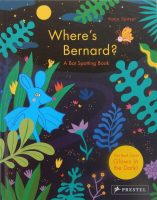
Where’s Bernard?
Katja Spitzer
Prestel
Bernard the bat is preparing for his night-time birthday celebrations but he wants help to find everything he needs for the party he’s throwing for his friends. His search involves nine items …

and takes him hunting in all manner of fascinating places: a greenhouse, an underground cavern, an ice-rink, a garden,

the woods, beneath the ocean and even in outer space, each one being populated by weird and wonderful creatures.
With its ‘glow-in-the-dark’ cover and quirky, vibrantly coloured, magical scenes that are not too busy for the youngest seekers, this is a good place to start on the whole ‘search and find’ genre.

A Thousand Billion Things (and some sheep)
Loic Clement and Anne Montel
Words & Pictures
A small girl takes us through a variety of everyday happenings – having breakfast, taking a bath, getting dressed, exploring the garden, going to market, helping dad prepare the dinner and more, asking us to locate items hidden in spreads brimming over with food, clothes, vegetables, …

fish and more. Each of these events offers plenty of choices and entices readers to linger over the delicately drawn flora, toys, clothes, delicious pastries etc –which almost prove too much for the young protagonist while also locating such items as 4 hedgehogs, a frog mask, a spotty green sweater, or a pyramid of cream cakes.
Then comes bedtime, which, so the young narrator tells us on the first page, is the one time she dislikes: instead of a multitude of choices, bedtime offers nothing but sheep, endless sheep and ‘it’s a complete nightmare!’
Accompanying Clement’s quirky textual narrative, Montel’s slightly whimsical images provide a visual feast; and it’s as well, in case one gets too carried away over the details, that a visual key with the answers is provided at the back of the book.
Absorbing, fun and rewarding.

Find Me: A Hide-and-Seek Book
Anders Arhoj
Chronicle Books
Children can join with two friends as they engage in a game of hide-and-seek from opposite ends of this book.

Two large pairs of eyes peer through the die-cut holes in the front and back covers, forewarning that child participants are going to need to keep their eyes peeled to spot the protagonists in their play.
Arhoj teases with his own game of give and take: if you look at the endpapers you’ll also be forewarned that the playmates sport differently shaped hats – that should make the whole thing easier surely. But then to make the spotting considerably more difficult, he makes the two slightly foxy characters change colour; not only once but on every spread, as they move through the book and their world of hustle and bustle.
It’s a world populated by all kinds of strange and cute creatures going about their daily lives and its these, as much as the main protagonists, that provide a lot of the intrigue. I found myself distracted in every setting, just exploring all the quirky goings-on, before even starting to discover the whereabouts of the foxy friends. Every location be it shop, office, park, hospital

or elsewhere, has potential for stories aplenty.
With minimal text Arhoj has created an engrossing story-cum game picture book that will enthral and gently challenge young readers.

Preschool Menagerie

Animosaics: Can You Find Me?
Surya Sajnani
Words & Pictures
This lovely, large format search-and-find counting book will keep youngsters engaged for ages while they look for the animals illustrated on the right-hand pages that are also hidden within the full-page mosaic style habitat opposite; habitats such as the garden, the pond, on the farm, in the jungle or in the ocean.

In addition this is a counting book wherein you are invited to spot other creatures, for example, 1 butterfly in the garden, 2 tadpoles in the pond, 3 hens on the farm and so on, culminating in 10 fireflies in the nocturnal sky mosaic.
What makes this large format book stand out is Surya Sajnani’s bold, graphic art style, which is immediately striking, and also her cubist-constructed creatures set within the habitat appropriate coloured tesserae.

How Do You Sleep?
Olivia Cosneau and Bernard Duisit
What Are You Wearing Today?
Janik Coat and Bernard Duisit
Thames & Hudson
Here are two new additions to the playful, interactive Flip-Flap-Pop-Up series of board books with Duisit acting as paper engineer for both titles.
In the first readers can by manipulating the tabs, discover the sleeping places/positions of seven different animal species from various parts of the world.

In the second book children will enjoy changing the animals’ dress depending on their location, the weather conditions; or on occasion, the mood of the featured animal. This one has both tabs and flaps to help develop manipulative skills.
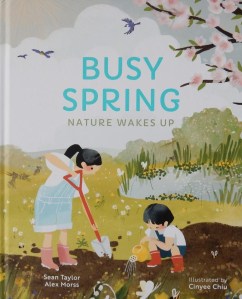
I’m sure Rita Rhino’s skirt being lifted by the wind …

will be a favourite with youngsters.

Dress Up Jojo
Xavier Deneux
Twirl
Jojo rabbit is back and he’s in playful mood. He dresses up in eight different ways: as a snowman, a spotty leopard, a sword-wielding knight, a cowboy, an alien, an astronaut bound for the moon, a deep sea diver and finally a pilot.
Toddlers can develop their fine motor skills by covering the little creature with snow, helping him balance on a tree branch, swish his sword, open the gates for him to find his horse, roll his eyes like an alien,

spin around in space, dive down deep in the ocean and resurface, and fly away on an adventure; all by placing a finger on the red dots and using their fingers to activate Jojo in his let’s pretend activities.

Zoo
Lisa Jones and Edward Underwood
Nosy Crow
In the second ‘Tiny Little Story’ Baby Boo and Daddy are off to the zoo on the bus. Once there, they meet giraffe, elephant, lion,

monkey, snake and the penguins and then it’s time to leave.
Short and sweet.
With attractive, brightly coloured, strikingly patterned illustrations and a brief text with some animal sounds to enjoy, soft, squashy cloth pages, and a velcro strap for attaching it to a buggy, it’s a perfect introduction to books for the very youngest; and, it’s washable.

The Secret Life of a Tiger

The Secret Life of a Tiger
Przemystaw Wechterowicz and Emilia Dziubak
Words & Pictures

Tigers aren’t necessarily all that they seem. Most certainly that is the case with the particular big cat who acts as narrator herein.
Yes, he’s a jungle dweller, brave and cheerful, wandering around his leafy abode, gossiping with friends, taking an occasional power nap and partaking of the odd morsel to keep his tummy rumbles at bay. A pretty peaceable life all told.
That of course, is contrary to all the rumours circulating about his dangerous nature.
However, our friendly narrator has, what he calls, his secret life, and that’s when his do-gooding persona emerges.
In fact, the creature has a multitude of nocturnal occupations.
He rustles up a yummy fruit salad for baby elephant,

acts as coiffeur for some orang-utans,

becomes a surrogate parent for some parrot’s eggs, an architect for some ants and much more.
Are we readers to be beguiled by all this altruistic behaviour? Hmmm!
As the narrator himself says, “ … don’t forget – you can’t believe all the stories you hear in the jungle.
Wecherowic’s tongue-in-cheek, chatty telling sits so well with Emilia Dziubak’s fantastically funny illustrations. Don’t miss the balloon-twisting antics performed on cobra …

that’s a real rib-tickler – not least for that cobra!

I’ve signed the charter  

Have You Heard?

Have You Heard?
Hannah Dale
Words & Pictures

With echoes of the traditional Chicken Licken and the falling sky, Hannah Dale has cooked up a rhyming beauty.
A fox – a big red one – is on the prowl; that’s what Mouse decides when he’s awoken from his slumbers one night.
He tells the ‘sleepy, slimy’ frog who passes the news to sparrow, who informs squirrel, who tells owl and owl tells hedgehog

and so on …

until,  so rooster cautions goose, “His claws are like needles, his eyes shine like lights And he’ll eat you up in THREE BIG BITES!
This well-constructed dialogue poem wherein the fox’s fearsome nature is elaborated upon by each woodland creature in turn, demonstrates the consequences of such speculative chitchat.
Hannah Dale’s beautiful and realistic watercolour paintings capture so well the growing alarm that seizes the animals until all is finally revealed (to readers, though perhaps not the panic-stricken characters herein) in a glorious culmination that will melt your heart.
A captivating read aloud treat.

I’ve signed the charter  

Once Upon a Jungle

Once Upon a Jungle
Laura Knowles and James Boast
words & pictures
James Boast’s vibrant floral images of the jungle setting that provides a home for myriads of creatures, almost leap out at you  off the pages of this book that focuses on a small number of those creatures, a few of which are just visible on the opening spread …

The straightforward, patterned text then introduces ants, a preying mantis, a lizard, a monkey, a panther that ages and is eventually broken down by roaming beetles.

Thus the soil is enriched, new seedlings thrive and eventually, become part of the jungle habitat: home to …

Simply, and highly effectively, Laura Knowles has demonstrated a food chain within this jungle ecosystem; a food chain that is further elucidated on the final fold-out spread wherein information is given about the various roles played by the sun, producers, consumers and decomposers, along with a final challenge to re-read this alluring book and identify which flora and fauna are performing each role.
As well as being an eye-wateringly beautiful book in its own right, this is an excellent way to introduce the concept of food chains to young children; in addition, it’s a book that children would (once it’s been shared with them) be able to read for themselves. They can along the way, also see how many of the jungle fauna they can spot.

I’ve signed the charter  

Hug Me, Please!

Hug me, Please!
Przemystaw Wechterowicz and Emilia Dziubak
Words & Pictures
Przemystaw Wechterowicz weaves a seemingly simple, enchanting, tale of two bears.
With the taste of sweet honey on their tongues, Daddy Bear and Little Bear, spend the day hugging each and every character whose path they cross on the woodland walk they take together.
First off is Mr Beaver, a somewhat reluctant recipient who nonetheless agrees, only to discover ‘It felt strange but nice.’ Heartened by the experience, Little Bear suggests finding others to hug and so they do. he bestows a calming hug upon the alarmed Miss Weasel, two hares, an elderly elk, a Red-Riding Hood-hungry wolf …

even an anaconda.

Full of the feel-good factor, with occasional touches of surrealism …

this story imparts a vital message concerning the importance of being able to show and receive affection openly, about empathy and not overlooking anyone. (Listeners will be quick to point out at the end of the story, who it is that’s yet to be a hug receiver.
Emilia Dziubak’s bears are real large creatures with very sharp claws to their paws but this is the only scary thing about them;

and she beautifully rings the emotional changes with the animals’ expressions. I also love the focus on small things – a rainbow hued caterpillar, the delights of dancing, for instance, that are sources of pleasure; and the way in which scenes are framed with things of the natural world – leaves, berries, carrots, and wild flowers.
Both author and illustrator are award winners in Poland; it’s easy to see why. this is sheer delight from cover to cover.

I’ve signed the charter 

The Street Beneath My Feet

dscn0214

The Street Beneath My Feet
Charlotte Guillain and Yuval Zommer
Words & Pictures
This large format volume takes the form of a concertina book that invites readers to stop and look down, posing the question, ‘What’s going on deep in the ground under your feet?’ and then takes them, layer by layer down, down through the earth’s structure to its core, and back again.
Through Charlotte Guillain’s accessible narrative style text and Yuval Zommer’s super-stylish illustrations the whole experience encompasses aspects of biology, archaeology, geology and civil engineering …

%0a

There are questions such as ‘Who do you think wore this helmet on their head?’ to ponder and perhaps research,

%0a

as well as less satisfying ones like ‘What’s that loud rumbling noise making the ground shake?’ that are immediately answered by the next sentence. In fact, any small paragraph or picture might generate some research if it catches the interest of a young reader and that, must surely be part of the intention of the joint enterprise.
Those same readers may well find themselves getting a little dizzy at the point the pace accelerates with ‘Let’s pick up speed as we delve down deeper. Hold on tight because things are about to get shaky. We’re deep in the Earth’s crust now and things are moving!’ and there follows talk of an earthquake and how it happens.

%0a

If you can’t experience the real things, this book is a stimulating substitute; alternatively and better, read the book and then, enthused by what is between its covers, get out into the world and discover first hand, what lies under the ground beneath your feet in your particular part of the world.

Line, Colour, Shape and Contrasts: Some Explorations

dscn9121

Free the Lines
Clayton Junior
Words & Pictures
It’s amazing how much you can say in a picture book without a single word of text. Clayton Junior does it all with lines – straight lines, curvy lines, thick lines and thin lines, lines close together and lines far apart; white lines and black lines. Using all these and the occasional bit of blocking, he tells a story of a small cat in a small boat sailing out into a large ocean to catch fish.

%0a

Into that same water comes a huge, smoke-belching trawler,

%0a

a trawler that casts an enormous net, an enormous net that scoops up everything in its path.

%0a

Fortunately- for the trapped, though not the trawler’s crew – an outstretched paw with a large pair of scissors puts paid to the marine life devastation and cat sails serenely into port over an ocean once more teeming with life.
This thought-provoking tale poses questions about the ethics of fishing and the fishing industry, as well as offering lessons in visual literacy and opportunities to explore and experiment Clayton Junior’s minimalist techniques of creating shape and form. It has something to offer all ages from around four to adult.
From the same artist is

%0a

Alone Together
Herein all manner of animals are shown as a means of exploring a wide range of opposites and contrasts. Each one of the stylish spreads could well be a storying starting point in addition to demonstrating the concepts chosen. This one really made me smile:

%0a

Also worth adding to your early years collection are:

dscn9118

Blue and Other Colours with Henri Matisse
Squares and Other Shapes with Josef Albers

Phaidon
These are two of the ‘First Concepts with Fine Artists’ series, beautifully produced board books that use the work of famous artists to introduce very young children to everyday concepts.
In the first, coloured cutouts from Matisse’s collages are the basis for teaching not only about colour, but also about shape and form, and how various colours can work when juxtaposed. Although blue crops up on most spreads, here’s one where it doesn’t …

%0a

Both inside covers are used to provide information: at the back is a brief introduction to the artist and some of his works, in particular the cutouts; and at the front, in tiny print, is a key to the works featured with their dates.
An unusual way to introduce colours and the notion of ‘painting with scissors’ and more important, especially if like me, you believe most children do not actually learn colours from books but from life experience, a springboard to creativity.
Equally fascinating and also essentially about colour juxtaposition and perception too, but this time introducing basic 2D shapes is an introduction to the 20th century artist Josef Albers’ work, in particular, Homage to the Square.

Wonderful Wildlife

dscn9092

It Starts With a Seed
Laura Knowles and Jennie Webber
Words & Pictures
Sometimes I open a parcel and just know I’m going to love a book before I’ve even got inside the cover. Such a one is this and as the title says It Starts With a Seed – a sycamore seed.
In this gorgeous book Laura Knowles’ rhyming narrative takes us on a journey – a journey through days, weeks, months, seasons and years as we follow the growth of that seed from the time it falls to earth right through until it’s a mature tree – fully formed with its own ecosystem. Jenny Webber’s delicate, detailed illustrations show every stage of the tree’s development from seedling …

dscn9095

to sapling to the ‘leaf-laden, bark-bound arboreal home’ to the plethora of insects, birds and mammals that live therein.

%0a

What I love so much about this book though is the sense of awe and wonder it’s likely to engender in those who read or listen to its lyrical words and pore over its painterly portrayals of the natural world. Such a superb way to embody a fair amount of information and the whole narrative is presented again on the front of a gatefold finale that opens to show seasonal changes to the leaf and flower and provide additional information such as ‘A sycamore’s small flowers grown in clusters known as racemes’ and ‘A sycamore can grow 35 metres tall’ – wow! And all from one tiny seed.
A book to buy and to keep, a book to share and a book to give: it’s perfect for autumnal reading but equally, it’s one to be returned to often, at home or in the classroom.
Laura Knowles has also has co-written

%0a

British Wildlife
Matthew Morgan & Laura Knowles
QED
Essentially this is a visual introduction to some of the riches of the natural world to be found in the British Isles from frogs to fruits …

%0a

and fishes to fungi.

%0a

Illuminature
Rachel Williams and Carnovsky
Wide Eyed Editions
This is an awesome look at over 180 animals and the plethora of plants that inhabit ten of the world’s very different environments from the Congo Rainforest to Loch Lomond and from the Californian Redwood Forest to the Ganges River Basin.

%0a

Awesome because, thanks to the three-coloured lens (included in a pocket at the front of the book) readers are able to get three different views. Look through the red lens and you see the diurnal animals, the blue lens will show nocturnal and crepuscular creatures and the green lens reveals each habitat’s plant life.
Each habitat is allocated six pages – two ‘viewing’ spreads, one giving key facts about the place and a textless “observation deck’ …

dscn9090

followed by a black and white one –

dscn9091

a ‘species guide’ that provides more detailed information on the particular animals featured in the coloured scenes. I foresee squabbles arising over this one.

Animals: Eyes, Bunches, Numbers and Squares

DSCN4656 (800x600)

Who’s Who in the Woods?
Eryl Norris and Andy Mansfield
Templar Publishing
It’s nighttime in the woods: everywhere eyes peep out from the inky darkness. Eyes belonging to all manner of creatures; but which is the one causing all the unease?
Pop-ups on every spread but the first, leap out from the pages to reveal the animal with a frightening stare, the one with a fearsome roar and more

DSCN4657 (800x600)

in this exciting and engaging little book, written in rhyme for which the artist has used a limited palette to great effect. I suggest it’s best saved for home use as some of the pop-outs are quite fragile and might not stand up to the repeated readings this is bound to have.

DSCN4725 (800x600)

A Tower of GiraffesAnimal Bunches
Anna Wright
Words & Pictures
Subtitled ‘Animal Bunches’ this book is essentially a mixed media visual presentation of just that, with each of the sixteen animals represented under the heading of its collective noun. Thus we have the gloriously messy “A Drove of Pigs”,

DSCN4726 (800x600)

a wonderfully woolly Flock of Sheep,

DSCN4727 (800x600)

the florally coated …

DSCN4728 (800x600)

the oh-so-showy Ostentation of Peacocks and many others all portrayed in their full glory. There is a delightful quirkiness about the whole thing and the range of expressions on the animals’ faces in every group is splendid.
Alongside each animal portrait is a paragraph giving some information about the habits and characteristics. Thus we learn for instance that ‘Flamingos are highly sociable, living in groups of up to one thousand … These fancy feathered friends also work together to make theatrical displays … marching in time to impress other birds.
This book is likely to appeal as much to those interested in design as nature and animals. It is certainly one for the school library or family bookshelf.

DSCN4694 (800x600)

Bear Counts
Karma Wilson and Jane Chapman
Simon and Schuster pbk
A cumulative counting book whose rhyming text takes listeners through a sequence of encounters along with friends Mouse and Bear from their shared breakfast in the morning sun. Bear is the leader showing Mouse one sun, one dragonfly, one robin on her nest and one mouse disappointedly clutching just one berry. Then along comes Hare clutching two fruits and …

DSCN4693 (800x600)

so on until there’s a whole host of friends splashing and floating in the pond counting …

DSCN4691 (800x600)

Gorgeous double page spreads of the various stopping points alternate with the counting pages where the focus is on the individual items seen on the previous friend-encounter spread.

DSCN4683 (800x600)

Take a Square
Britta Teckentrup
Words and Pictures
This is one of a new series for the very young that looks at concepts in a fresh, imaginative way at the heart of which is clever design and uncluttered images. Herein, we trail a small dog as he involves readers in a follow-my-leader game taking them through the pages on a playful journey that encompasses a toy truck, the demolition of a block building, a cat, a bone, a toy robot, children playing,

DSCN4684 (800x600)

a visit to the park and finally, a bus ride home and bed.

DSCN4685 (800x600)

But the story is not quite over as closer study reveals …
As the journey progresses, the line of objects accumulates down the left-hand side of each double spread forming a kind of visual list of the story ingredients. Totally involving and lots of fun.

Use your local bookshop    localbookshops_NameImage-2

Monsters and Underpants; Dinosaurs and Poo

poo 005 (800x600)

Monsters Love Underpants
Claire Freedman and Ben Cort
Simon & Schuster
We’ve had aliens, pirates and dinosaurs with a penchant for underpants; now it’s the turn of monsters, all manner of the beasties. We meet the howlers a-prowl in dingy dungeons and drooly swamp dwellers who fill their pants with gooey slime;

poo 006 (800x600)

YUCK – you can imagine what happens to those. Then there’s the spiky, spooky variety from outer space, not to mention the enormous sand dwelling monster whose bum just won’t fit comfortably into his pants. All these and more sport their snazzy underpants at the Saturday night disco and what a sight they look as they jiggle and jive …

poo 007 (800x600)

but they must be sure to leave on time. For as they say,
We can’t risk being spotted!
For no one will be scared of us,
In pants all striped and dotted.”
Make sure you don’t leave a pair of yours under the bed …
I can see this one going down a storm in early years settings. The sight of those, mock scary monsters with their day-glo undies is guaranteed to have young children giggling with delight at every turn of the page and the rhyming text is great fun to read aloud. Be prepared for cries of “read it again’ at the end.
I can see lots of potential for creative work here too.

devon 018 (800x600)

Savouring the story?

Dinosaur Poo!
Diane and Christyan Fox
Words & Pictures (Frances Lincoln Children’s Books)
Poo is one topic that unfailingly seems to delight young children; another is dinosaurs: put the two together in a zany no holds barred rhyming text and add wacky, vividly coloured illustrations of dinosaurs in all shapes and sizes, plus flaps to open and reveal all manner of pongy ploppings and it seems you cannot fail to please the under sixes. Certainly that’s the case when the Pterodactyl sets out to prove the superiority of his poo to an unimpressed Velociraptor and the two embark on the biggest and best poo quest.

poo 004 (800x600)

Seemingly they are not the only interested ones though; there’s a ladybird that keeps popping up at every dropping site. Fun endpapers too.

Find and buy from your local bookshop:

http://www.booksellers.org.uk/bookshopsearch


Welcome to the Family & Little Sisters

tin 004 (800x600)

Welcome to the Family
Mary Hoffman and Ros Asquith
Frances Lincoln Children’s Books
Full of wit and wisdom is this look at families of all kinds; in fact it’s the book for you no matter what kind of family yours is. It offers a straightforward exploration of the many ways in which a child or baby becomes part of a family. This might be through a natural birth into a nuclear family, through adoption or fostering,

tin1 002 (800x600)

perhaps by a same sex couple, through IVF, or maybe, as often happens, by the ‘blending’ of two families. Every possibility is explained in a straightforward, matter of fact manner; it’s the illustrations, speech and thoughts bubbles that supply the gentle humour. Having said that, the author doesn’t avoid potential difficulties – settling in,

tin1 001 (800x600)

accommodating new siblings etc. are tackled head on as here:
It can take a while for children to settle down and get along together, and get used to the new person acting as their parent. They can also worry about the mum or dad who no longer lives with them.
The message that shines through loud and clear from this totally affirming, all-inclusive book is that no matter how your family came about, it and you are special, different from all others, valued and valid.
This is another ‘must have’ for every primary school classroom and early years setting from the fantastic Hoffman/Asquith team who gave us The Great Big Book of Families and The Great Big Book of Feelings.

poo 008 (800x600)

A Guide to Sisters
Paula Metcalf and Suzanne Barton
Words & Pictures (Frances Lincoln Children’s Books)
Told from the viewpoint of a big sister this cute and funny book explores the pros and cons of having a sister and some of the things you (and she) might get up to, if and when you have one. We get right up close from the start with that new baby feel, noises and habits, then move on to toddling, tickling, TV tampering, teetering in high heels

poo 009 (800x600)

(only permitted to big sisters on their seventh birthdays), taking things apart – the model you’ve just spent hours constructing for instance,

poo 010 (800x600)

and much more. There are of course compensations; little sisters enjoy improving their skills at tidying up big sisters’ bedrooms for instance; and who better to snuggle up with if a big sister gets a bit scared in the middle of the night …

poo 011 (800x600)


There’s another troublesome little sister in:

tin 001 (800x600)

Tin
Chris Judge
Andersen Press
Tin is supposed to be minding Nickel, his little sister but becomes engrossed in his comic. Then ‘WOOF! WOOF! WOOF!‘ That’s Zinc the dog sounding the alarm: Nickel is up in a tree and before Tin can reach her she floats away, born aloft by a red balloon. Tin leaps on his bike and sets off in hot pursuit – all the way to the big city. Therein the rescue attempt continues with a cycle up a helter-skelter followed by a brave leap into the air

tin 003 (800x600)

resulting in Tin catching hold of Nickel and her balloon. The balloon then bursts and they hurtle downwards towards a passing animal parade heading for the safari park, Tin and Zinc landing on an elephant and Nickel, a giraffe’s neck. Once in the safari park the elephant and giraffe head off in different directions but a dramatic chase ensues with Tin and Zinc in hot pursuit. Eventually Nickel is stopped in her tracks by a park ranger and handed over to her brother. He in turn hands her a new balloon: oh dear was that a wise move? …
A pacey text accompanies Chris Judge’s action-packed visual narrative, but it’s his vividly coloured illustrations that show the setting to be a futuristic city

tin 002 (800x600)

inhabited solely (apart from the wild animals) by robots of various hues.
Great fun and just the thing to inspire a class of infants to create their own rainbow-hued futuristic city from recycled materials.

Find and buy from your local bookshop:

http://www.booksellers.org.uk/bookshopsearch