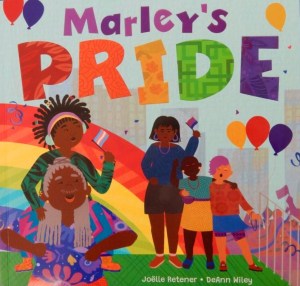
Marley’s Pride / You Are Brave

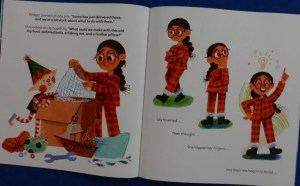
It’s June and for Marley and for Marley’s grandparent Zaza, that means Pride month with its parades and other celebratory activities. Marley really wants to join Zaza at the festivities when they’re to receive an award for transgender advocacy, but with sensory sensitivities noise and crowds making the child tense up at the very thought, it’s a no go for the young narrator.
Come the morning of the parade, the child decides to give it a go after all. Into a bag go noise-cancelling headphones a fidget spinner and favourite lavender bunny and off go Zaza and Marley, the latter feeling very uncertain.
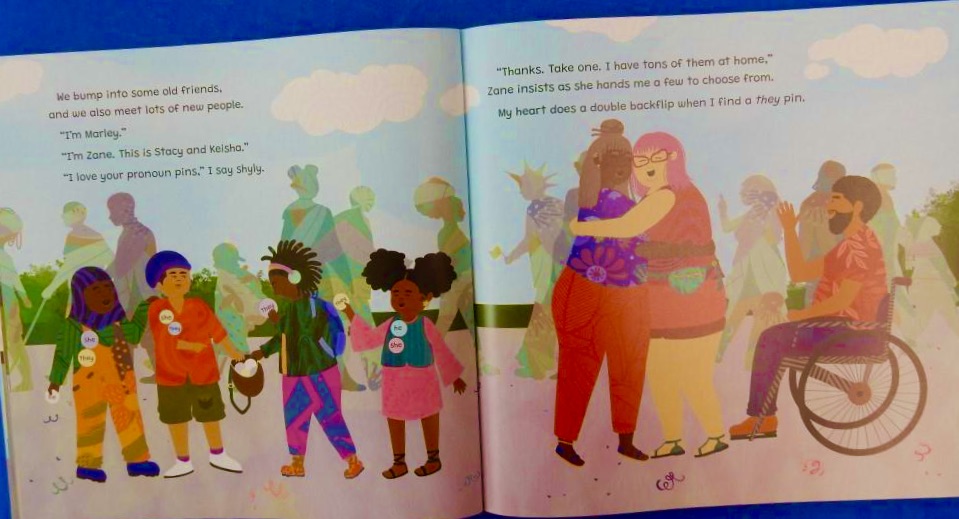
At the venue, just as things threaten to overwhelm Marley, Zaza’s reminder, “Pride isn’t just a big ole party. It’s about celebrating who we are, about community, and love” gives the child a boost of courage to go among the crowds. By the end of the day, Marley feels a part of that community with new friends

and a personal delight at belonging.

Author, Joëlle Retener’s telling is a celebration of Pride’s communal spirit brought wonderfully to life with DeAnn Wiley’s inclusive, splendidly textured, bold digital illustrations.
Backmatter comprises double spreads entitled the History of Pride, that includes paragraphs about sensory sensitivities, the other, with lots of definitions and explanations is called More About Marley’s Pride. An invaluable resource for primary schools especially.

‘Being brave does not mean you are not afraid. It means you are afraid, but you do the scary thing anyway.’ Inspired by Sofia Sanchez, a young actress and model who happens to have Down syndrome, that is the vital life lesson contained in this book.

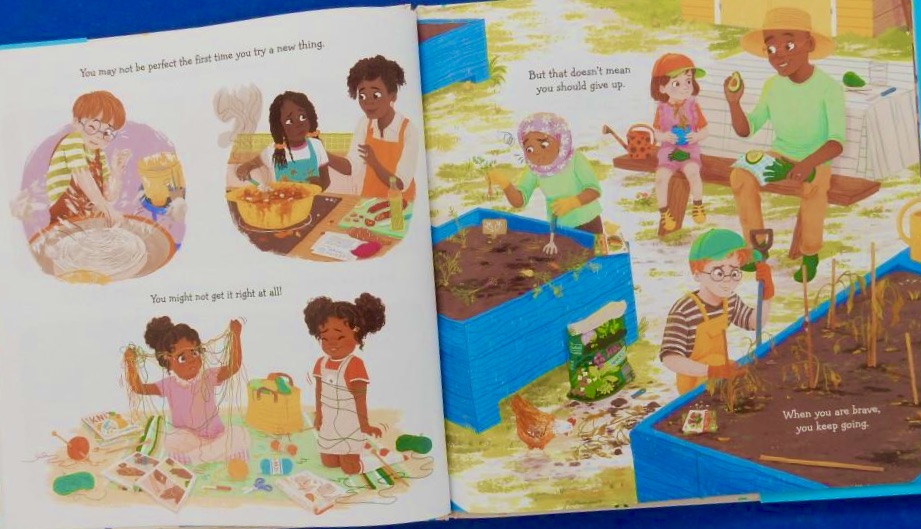
‘Every day, says author Margaret O’Hair, we meet people who inspire us – people who are amazing at the things they do.’ Sofia Cardoso illustrates a guitarist, a vet, a pilot, a baker, a gardener and several others. Before they became amazing though, they had to make the ‘tough decision’ to try something new, which likely meant they had to be brave. This is something that needs to be learned like everything else and no matter what ‘being brave means doing something you want to try.’ Of course, success seldom comes at the first try, but that’s no reason to give up;

Inclusive and optimistic in tone, this is surely an encouraging invitation to challenge yourself, have a go and try something new. With its important messages, this is a book to share and discuss in primary classrooms.

Kevin the Vampire: A Wild and Wicked Witch / Goosebumps House of Shivers: Goblin Monday

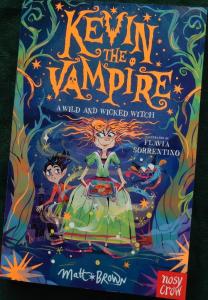
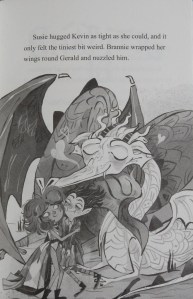
In this sequel to A Most Mysterious Monster Kevin (almost eleven) and his family, plus human best friend Susie Cabbage who now lives with them, and the Carnival Monstromo carriages are heading to Monstro City to take part in the Dragon Parade. Reluctantly, Susie is clad in an exceedingly itchy, scratchy dress.

As they are running late, Kevin’s family take a shortcut through the perilous Wild Woods, a place nobody ever goes on account of the dastardly witch who lives there. Everything should be fine as long as no one gets out and no one eats anything … err? Kevin will be at the Festival before you can say incredible (which Susie does) After all, nothing goes wrong for the Carnival Monstromo, never ever …
With the performing of awesome tricks including the Danger Dive of Death, revelations relating to Uncle Drax’s falling out with Lazarus Vandross, the disappearance of Dog, some serious sadness for Susie,

and aided and abetted by The Sphinx, the fizzling out of Grayvon Fury, the most evil witch in Grackelser Odd, this is a real humdinger of an adventure. Those familiar with the first book will recognise some of the magical monstrous creatures from that, but Matt Brown has invented some additional characters, mostly of the humorous, even slightly bonkers variety. All this plus Flavia Sorrentino’s weird and wonderful illustrations: primary age readers could ask for nothing more.

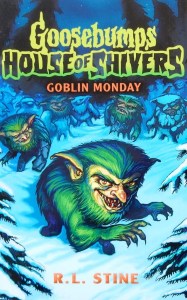
This story is narrated by Mario who has recently moved with his family from Florida to Philadelphia. He’s been invited to join his new friends Todd and Jewel on their winter holiday at their grandparents’ home in Vermont and is thrilled at the prospect of seeing snow for the first time.

Pretty soon after they arrive, Mario starts to suspect that something really weird is going on inside this house. Todd and Jewel’s grandparents are more than a little odd: Grandpa Tweety really loves his birds and in the evenings tells tales about goblins, gremlins and imps; he’s also written books about them. MomMom loves to make stews and she knits strange green outfits. However, the real terrors begin when Mario finds that the fairy tales may not be made up stories after all. He’s attacked by a creature in the garden and his friends’ parents disappear.

Full of twists and turns, it’s all a bit creepy and anyone prone to nightmares is advised not to read this just before bedtime.

I’m Not Sleepy

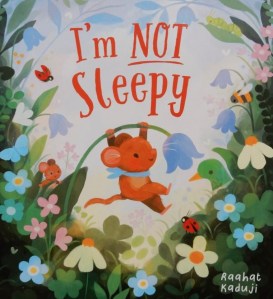
When Flora, the littlest dormouse stirs from the long winter sleep, she’s raring to go with a head full of questions, unlike her friends; they just want to sleep. She though is ready to explore the big wide world to try and find answers to ‘Why are bees so busy?’, ‘What do caterpillars eat?’ and ‘How do birds build nests?’ for instance. Ignoring the call to nap with her companions, Flora storms out and immediately encounters a duck. She tells him of her urge to see the world; he offers her a lift to the pond and off they soar together. At the pond Flora is intrigued by the wiggly things, which she learns are tadpoles and the duck talks of recently hatched ducklings.

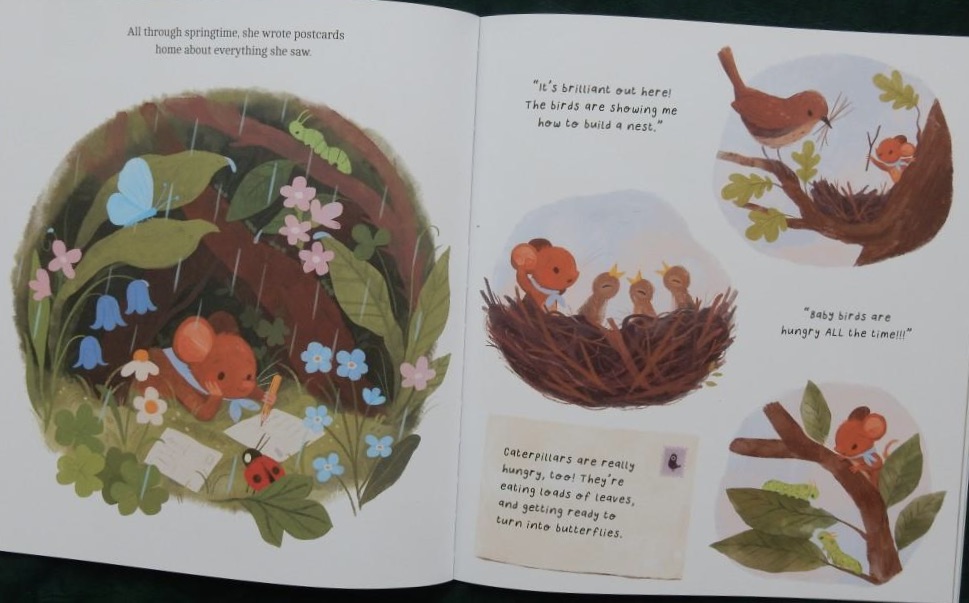
Flora spends the spring learning new things and writing postcards home about what she observes. She follows the development of new baby birds and caterpillars

and watches the bees through the seasons as well as seeing the autumnal pursuits of spiders, squirrels and migrating geese, and despite missing her friends, she doesn’t go home.

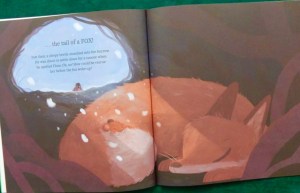
Snow falls and Flora starts feeling drowsy. Time for a little nap,she decides, snuggling down among the tree roots where she’s happy to find something fluffy to curl up on. ZZZZZ! Little does she know that her comfy bed is a fox’s tail. Along comes a beetle that immediately realises he needs to get help for Flora before the fox wakes.

Will Flora be rescued or will she become a tasty meal for the fox?

The story has a lovely final twist to it that is sure to make young children and adult readers aloud smile and Flora shares some of the entries from her nature diary, after the tale ends.

Raahat Kaduji neatly weaves facts about the natural world into her story and her illustrations are a delightful mix of the real and the whimsical.

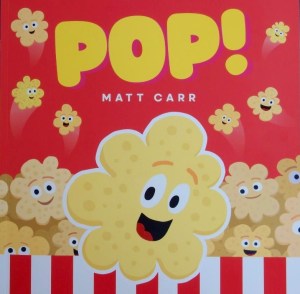
Pop!

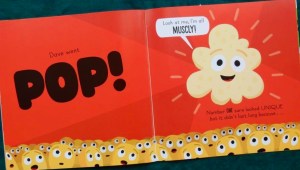
If you’re looking for a wacky way to encourage small children to practise counting to ten then get your hands on this rhyming story that begins to explode one rainy afternoon when the contents of a packet of popcorn is sent tumbling into a pan atop the stove. On goes the lid and happy to be out of the bag, the corn pieces are in party mood despite the rising temperature. Suddenly there comes a POP! It’s Dave delighted at his muscly new shape.

There’s no time to brag about being unique though, for almost immediately comes POP! number two; Monique has joined Dave making a ‘pair of superhero corn’. Small explosions continue as Shaun, Clare, Dean, Debbie, Ben, Sue, Wendy and Brian. joined the pair in rapid succession. A hip-hop popping party if ever there was one.

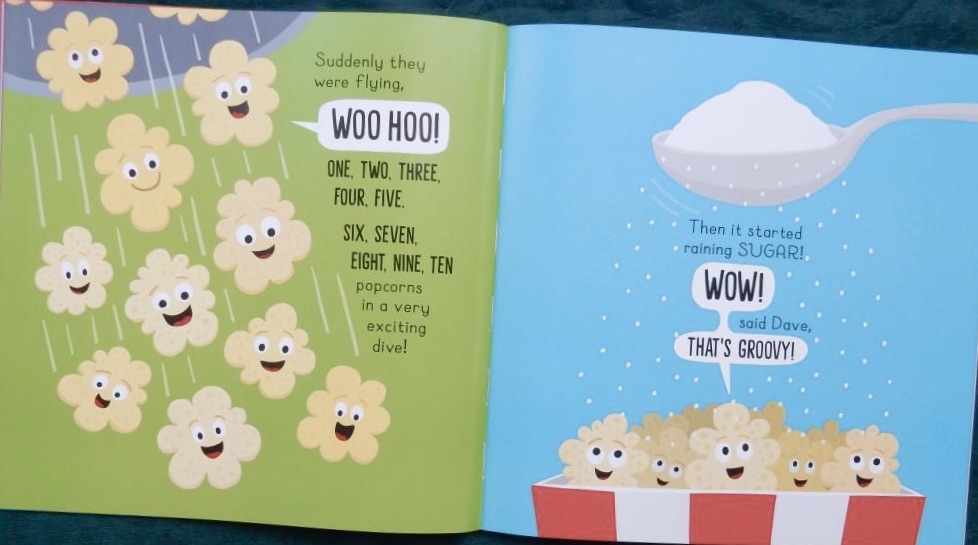
Eventually those pops stop and onto the popcorn pals there comes a shower of sugar.

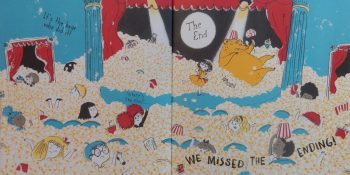
Then from their new resting place the crew settles down to watch – wait for it, a movie. The kind of movie will perhaps make adult sharers cringe at it’s punny nature.

Ridiculous, irresistible fun: this book is sure to become hugely POP-ular with little humans who will want to hear it over and over as they eagerly join in with all the popping.

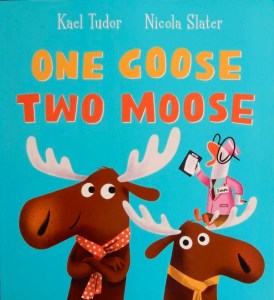
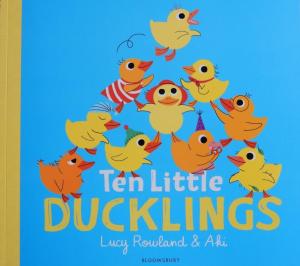
One Goose Two Moose / Ten Little Ducklings

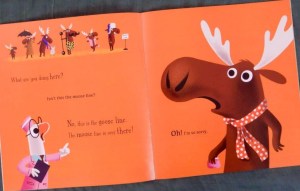
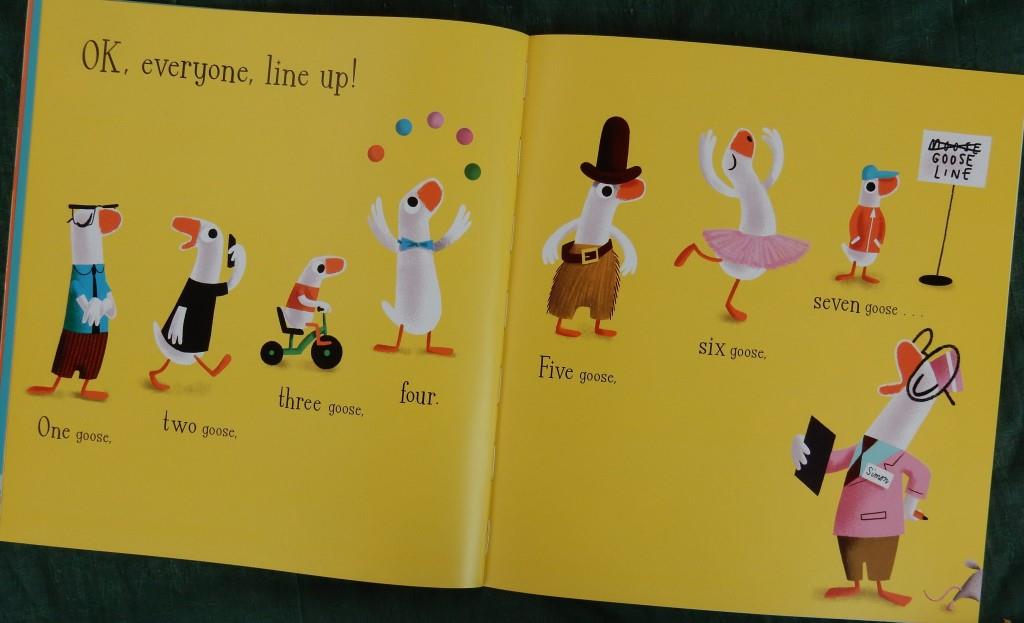
Under the direction of a rather bossy goose named Simon, a queue, no make that two queues, are forming outside an ice cream shop. There’s a goose line and a moose line. The trouble is the customers are having trouble getting in the assigned lines. Should I say it’s mainly the Moose that keep getting it wrong to the considerable annoyance of Simon Goose.

Whether it’s intentional or down to the fact that none of the queuers can read the signs, it’s somewhat chaotic. Eventually though after a lot of angst on Simon’s part, there is a line with seven geese, one behind the other. Are those in said line now about to take turns to make a purchase of some delicious frozen confection of their choice?

Look carefully in the bottom right corner of Nicola’s spread showing the seven; there’s something lurking that might just sabotage the entire system. I wonder who gets the last laugh …

Debut author Kael Tudor’s text is huge fun with some cheeky counting opportunities included, and illustrator Nicola has clearly enjoyed herself creating snazzy attire for the moose and geese. Young listeners will delight in the daftness of the whole thing and demand “Read it again” each time you share the story.

‘The sun is up, / it’s a brand new day. Ten little ducklings / want to play.’ And play they surely do in this delightful, interactive, rhyming game of hide-and-seek. First they splash around in the pool, swimming, diving, floating and fishing. Thereafter they zoom around on their scooters, take to the sky in hot air balloons, frolic in the farmyard, explore the jungle, have a snowball fight, attend a chaotic birthday tea, spend time on the beach and eventually tire themselves out ready for bed.

Before Lucy Rowland’s rhyming text begins, is a spread whereon each duckling is named and there’s a never mentioned eleventh character, a little mouse that triumphantly calls, ‘I see you, duckling!’ on every spread bar the final one whereon we assume, he reads the weary ducklings a bedtime story. Aki’s bright scenes have just the right amount of detail for little children who will have great fun finding whichever duckling is hiding in plain sight in every playful situation. I wonder if they might, on a second reading, go back and try naming the one they need to find each time.

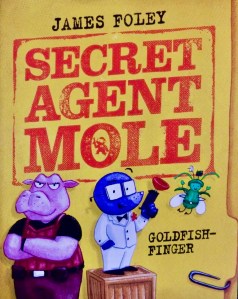
Secret Agent Mole

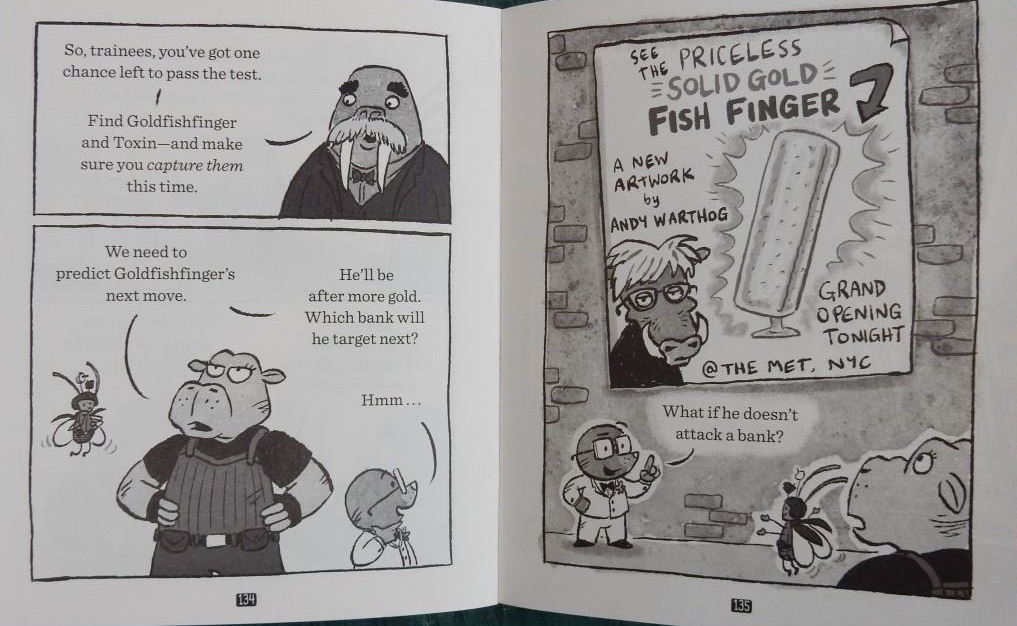
Anarchic nonsense in graphic novel form, this story introduces readers to secret agents in training Max Mole, Helena Hippo and June Bug, an unlikely trio if ever there was one. Under the watchful eyes of the judges, these friends are on a mission – their very first – to go up against the nefarious Dr Nude. However having done so, one of the three doesn’t satisfy the judges, which means that despite the other two passing with flying colours, the whole team fails the test. They still have two chances left though.

Then comes news of another case: the First Bank of New York has just been robbed and Interpol need their assistance. Eric Goldfishfinger and his pufferfish partner in crime have stolen 10 million $ in gold bars. Catching them is the next mission for the three trainees. The chase is on … Can they catch the fishy thieves before they get that priceless solid gold fish finger?

You never know: they might even live up to the new name agent Walrus has put forward for the agency: The Official International League Exterminating Terrorism with its inevitable acronym.
What will the judges back at HQ have decided about granting Max, Helena and Bug’s secret agent licences?

With a fair degree of TOILET humour, flushings of puns and other sizeable servings of silliness, this will get young readers giggling (and groaning) from start to finish.

Kwame’s Magic Quest: Rise of the Green Flame / Future Hero: Battle For Sky Kingdom

This image has an empty alt attribute; its file name is dscn0072-1.jpg

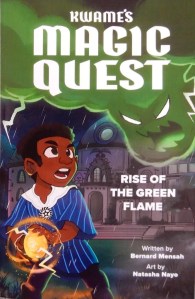
Eight year old Kwame wakes feeling super-excited: today he will start Nkonyaa School and finally learn some calabash magic. That means finding out his magic type: maybe he’ll be a Weather Handler like his mum, or perhaps a Time Bender like his Dad. However, when his turn comes to stand before the Nkonyaa Tree and tap his head against its trunk, things don’t exactly go as anticipated for a red light pulses forth – something it’s never done before according to elder, Ms Dofi. She takes the calabash that falls, explains the procedure to Kwame and enters the hut, leaving him waiting outside. It transpires that his calabash hasn’t reacted like those of other students. Kwame fears something is wrong with it. When it’s time to be assigned rooms, Kwame is put with a boy named Fifi and before they go to sleep, the two have become friends.


Next morning things still aren’t going right for Kwame: his calabash isn’t accepting his gift. Kwame begins to fear he’ll be kicked out of the school but as the day progresses, Fifi is subjected to bullying, after which there’s more trouble. Can Kwame finally discover his magic power and help his friend?


Wow! The author has packed so much into such a short adventure, I suspect young readers will devour it a in a single sitting. With its themes of friendship and helping another in need, there’s a fair amount of Ghanian culture woven into the tale. In addition, back matter includes a spread giving additional information about Ghana and its ethnic groups. Natasha Nayo’s black and white illustrations break up the text and add further interest to the story.

This image has an empty alt attribute; its file name is dscn0071-1.jpg

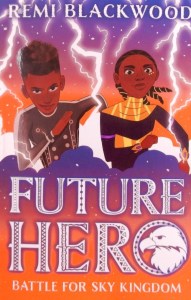
This is the final story in the thrilling Future Hero fantasy quartet. With the astounding revelation that he is the Future Hero of the oppressed people of his ancestral land of Ulfrika – a land ruled over by Ikala, an evil sorcerer – young Jarell’s life has changed forever.  


Now he must make a final visit – via the barber’s shop mirror – to Sky City to stop Ikala getting his hands on the Iron Eagle, the last remaining animal from the Staff of Kundi.. That means Jarell must win the deadly gladiatorial competition to find Ulfrika’s greatest warrior, for which the Iron Eagle is offered as the prize. Fortunately though, he won’t be travelling alone; some friends, one of whom is young warrior Kimisi, are also making the journey.


Fraught with danger from the outset, is the battle he faces a challenge from which Jarell can emerge victorious? Followers of the series who will be rooting for Jarell, will certainly be satisfied with how the saga ends, but if you haven’t read any of the previous books, I recommend you do so before plunging into this one.

Heroes / I Survived The Battle of D-Day, 1944

This image has an empty alt attribute; its file name is dscn0030-1.jpg

In this gripping story we follow best friends Frank and his Japanese American buddy Stanley who live in Pearl Harbour Hawaii. Frank’s father is a Navy fighter pilot and Stanley’s works at the Naval Air Station, with both families living on the base. It’s December 1941 and the two boys are sailing across the harbour brainstorming their own superhero comic book character (Frank is the writer, Stanley the illustrator) as the book opens. Frank is hiding a secret anxiety of getting hurt as a result of what he calls ‘The Incident’ but it becomes evident when he avoids helping Stanley confront bullies, which prompts Stanley to ask, “How do you think you can write about heroes if you can’t be one yourself?” At this time the war in Europe seems distant to the boys until that is, Frank’s sister’s boyfriend, Brooks, who is in the navy is showing the boys around a battleship and suddenly planes start dropping bombs on all the battleships.. They realise this isn’t a drill, it’s an attack by the Japanese.


As a consequence, the boys witness horror after horror. Then there’s the issue that Stanley appears Japanese and has Japanese ancestry meaning that he is suddenly subjected to racism. This causes the Japanese Americans to start digging holes in the yard to bury any relics or heirlooms relating to their ancestry. However the situation does ultimately allow Frank to address the episode that has long haunted him relating to friendship, loyalty and his own mental health. Can he overcome his fears and stand by his best friend even when they have to part? Before so doing though they agree to continue working on the comic. And so they do: the final chapter of the novel is followed by the two boys’ ten page comic, The Arsenal of Democracy.


Well researched, totally gripping, albeit heartbreaking where we read of those who perished in the attack and the responses of those who help the injured. Back matter includes a map of Pearl Harbour December 7 1941 and an author’s note, both of which are important.


Equally affecting, with a French setting and presented in graphic novel form is:

This image has an empty alt attribute; its file name is dscn0065-1.jpg

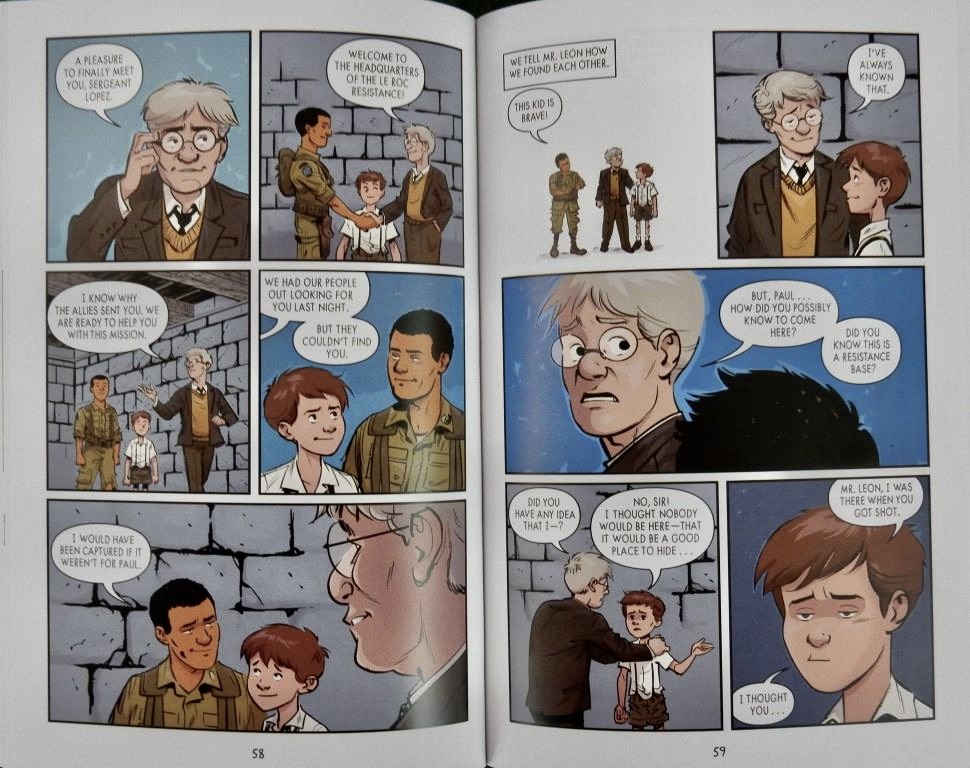
As the book opens Paul Colbert is walking in the rain through the Normandy village where he lives with his mother. It’s been under Nazi occupation for a long time but he’s trying to forget this and the fact that his Jewish best friend is missing and focus on his mother’s birthday. He follows a pigeon and discovers a US army paratrooper, Sergeant Victor Lopez, caught in a tree having jumped from his plane. Paul helps to free him and rather than let him fall into enemy hands, he leads the man to a nearby abandoned castle.

Or so he thinks, for the building is actually being used as a resistance hideout. And, to his joy there he discovers his old teacher, Mr Leon, whom he thought was dead.

This image has an empty alt attribute; its file name is dscn0063-1.jpg

Paul finds himself drawn into the underground organisation, playing a vital part in the Allies secret plans to cross the English Channel and land on the beaches of Normandy with the hope that France can be liberated.


Primary age readers, like this adult reviewer will be enthralled by this, especially the bravery shown by the Resistance and the military forces, and of course Paul. With the D-Day 80th anniversary this summer, this is a must for KS2/KS3 resources. (The author includes a timeline and other historical notes at the end of the book.)

The Great Reindeer Rescue

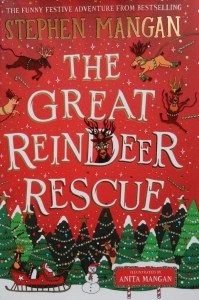
There will be laughs aplenty when you read this hugely funny seasonal adventure.
A new recruit to Santa’s team of reindeers, Dave, yes that’s really his name, is thoroughly fed up. He’s taken over from Blitzen and is suffering from nerves that make him chatter non-stop too, made much worse on account of Rudolph’s constant bragging about his number one status.

Meanwhile, elsewhere Holly is wide awake, partly because she’s excited it’s Christmas Eve but also
due to exceedingly bright light flooding her bedroom thanks to the decorations with which her Christmas fanatic father, Simon, has festooned the outside of their home as a tribute to Holly’s Mum.

Just as the sleigh draws near to Holly’s abode, with Dave desperately trying to stay awake, Rudolph lets off an enormous fart right in his face. The result is that Rudolph becomes detached from the rest of his retinue and Santa’s sleigh makes an emergency landing on Holly’s pitched roof and out go all the lights. Up goes her Dad, Simon, to investigate and before long there’s a huge explosion that scatters the reindeers all over the world. And of Holly’s dad there is no sign.

With just a few hours before the dawning of Christmas Day, having sorted out the not insignificant matter of retrieving Santa’s magic box, Dave needs to fly with Holly rescuing reindeer from bizarre situations, first stop Cupid atop the Empire State Building in New York.

Thereafter they visit the icy Arctic, alarmingly close to a hungry polar bear, a beach in Tahiti where a relaxing Dasher is totally against being collected,

and then other locations around the globe. A hectic hunt it certainly is, but can they possibly find all the missing characters and save Christmas?
Included in the unlikely cast are the wonderful twins, Dorothy Dithers and Griselda Dithers who will surely make readers smile.

Drama and humour abound in this romp, added to by the illustrations of Anita Mangan, sister of the author. Read aloud or read alone.

Santa’s Marvellous Mechanical Workshop / Santa Shark

This image has an empty alt attribute; its file name is dscn9727-4.jpg


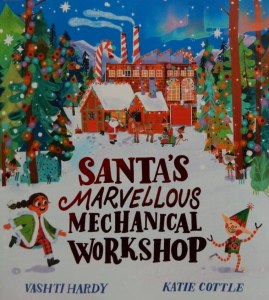
It’s Christmas Eve and Lily has just moved into a new house but it doesn’t feel like home, there’s no food in the cupboards and she hasn’t got a single friend in this neighbourhood.


Acting on her mum’s suggestion to go upstairs and unpack her own things, Lily sets to work. She labels, sorts and organises until it’s almost time for bed. Then at the bottom of a box, she comes upon a wrapped package. Inside is a book but the cover and pages are blank. So it seems, but then a strange tiny creature waves and almost the next thing she knows, Lily is surrounded by snow and is being given warm clothes by the creature who tells her that it’s called Widget and is one of Santa’s elfbots. Moreover, she learns, Santa needs her help.

The bot leads Lily to Santa’s workshop wherein many more elfbots are busy making new toys. This isn’t however, where Lily’s assistance is required. In another section, Santa’s favourite, are all manner of old, broken toys. What’s needed Lily is told, is her imagination.

This image has an empty alt attribute; its file name is dscn9728-4.jpg

Can one little girl, one tiny bot and a lot of ingenuity transform piles of what looks like junk into wonderfully exciting toy inventions?


When asked what she would like in return for her efforts, Lily tells Widget her dearest wish before falling fast asleep on the sleigh. What will next morning bring: sadness at missing Santa’s visit or hope and the envisioning of making a new exciting family home?


I love the combination of creativity and up cycling in this magical seasonal story. It’s perfect for sharing in classrooms especially where there are children recently arrived from different parts of the world, and feeling like Lily as Christmas approaches, whether or not it’s a festival they would celebrate.

This image has an empty alt attribute; its file name is dscn9799-1.jpg

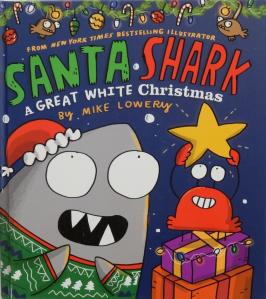
Ex-sea-dingly silly, laugh out loud sea-sonal fun is to be found ‘neath the waves in the company of Edgar the shark. It’s late in December and elasmobranch, Edgar, is getting ready to receive a very special guest; it’s none other than Santa Shark. For this he enlists the help of his crab best pal, Lotta. Lotta however has never before heard of Santa Shark so she takes a bit of convincing, but before long she agrees to assist Edgar. As they work together preparing for the visitor, readers are treated to a plethora of puns such as the making of Christmas cods

This image has an empty alt attribute; its file name is dscn9800-1.jpg

and a rendition of “We fish you a Merry Christmas.” However as bedtime draws near, Edgar suddenly has a horrible realisation: there’s no snow. What’s to be done? If there’s no snow, it means no visit from Santa. Can anything cause the desired precipitation? Perhaps the lovely Lotta might have a brainwave …
Dramatic illustrations and a zesty text will amuse both child and adult readers aloud.

Rosie Frost & the Falcon Queen

When Rosie Frost’s mother dies, her world is upended. She’s an orphan and according to her mother’s letter of final wishes, she is sent to Bloodstone Island where there’s a school for exceptional students. This school – Heverbridge – was founded by Queen Elizabeth I to honour her late mother, Anne Boleyn. As a scholarship girl, Rosie soon finds herself on the wrong side of some of the pupils and the unpleasant deputy head, Mr. Hemlock. Part of the island is a conservation site where many endangered species are found. It’s not long before Rosie is worried that Mr Hemlock has plans that will harm the island’s precious animal inhabitants and indeed their whole environment.

Believing he needs to be stopped and aiming to make her voice heard, Rosie enters the Falcon Queen Games, a three-part competition aligned with the school’s values of courage, power, and freedom. By so doing, she also hopes to discover more about herself and who she is.

As a pupil, and even more so as a contestant, Rosie faces bullying and adversity at almost every turn. However, she makes a number of helpful friends and allies, though isn’t always sure who is to be trusted. As Rosie faces misfortunes and mishaps, she does so with determination, constantly endeavouring to push herself beyond her comfort zone.

With its fantastical and historical elements, this fast-paced, twisting, turning story will captivate older readers who enjoy mystery adventures. It ends on a cliff-hanger with its main protagonist clutching something that she is told, is a reminder of the the spark within her, of who she really is.
I look forward to the next episode.

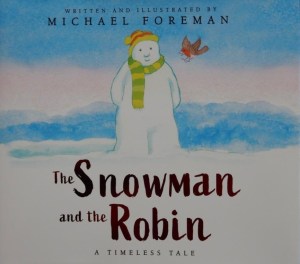
The Snowman and the Robin

Over forty years ago, Raymond Briggs created the The Snowman, which has become a classic. Since then others have added additional layers of seasonal magic to the story and now we have this wondrous tale by Michael Foreman.

On a chilly winter’s evening in a park in London there stands a snowman created by children who have clad him in a striped scarf and old woolly bobble hat. As the snow falls around him, the snowman suddenly hears, “Hey! Mr Snowman! You’re back!” It’s a little robin standing atop a statue, the Snowman discovers having turned his head around with considerable effort. The two strike up a conversation that quickly becomes a friendship as Robin invites the snowman to accompany him on a tour of the city.

We then follow the two on a night of adventure as the robin takes to the wing and the snowman finds his feet. Gliding through Hyde Park they pass the Albert Memorial and Marble Arch, then onwards to other famous London landmarks including Buckingham Palace,

Piccadilly Circus, Trafalgar Square with Nelson’s Column, and Big Ben. As the sun rises, their itinerary also takes them to the Millennium Wheel

and it’s there that the snowman notices something, to his eyes the wheel is growing. Robin knows that it’s not the wheel but the snowman that is gradually changing.
His night of wonderment is coming to an end but not before he discovered how absolutely amazing the world is, even if his own existence is short. The last few spreads are truly beautiful and poignant. Foreman’s artistry with words and pictures remained undimmed; indeed here it shines brighter than ever.

This, like its progenitor, is sure to become a classic. Buy to give and buy to keep.

The Oak Tree

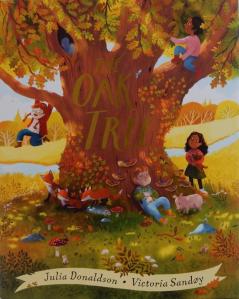
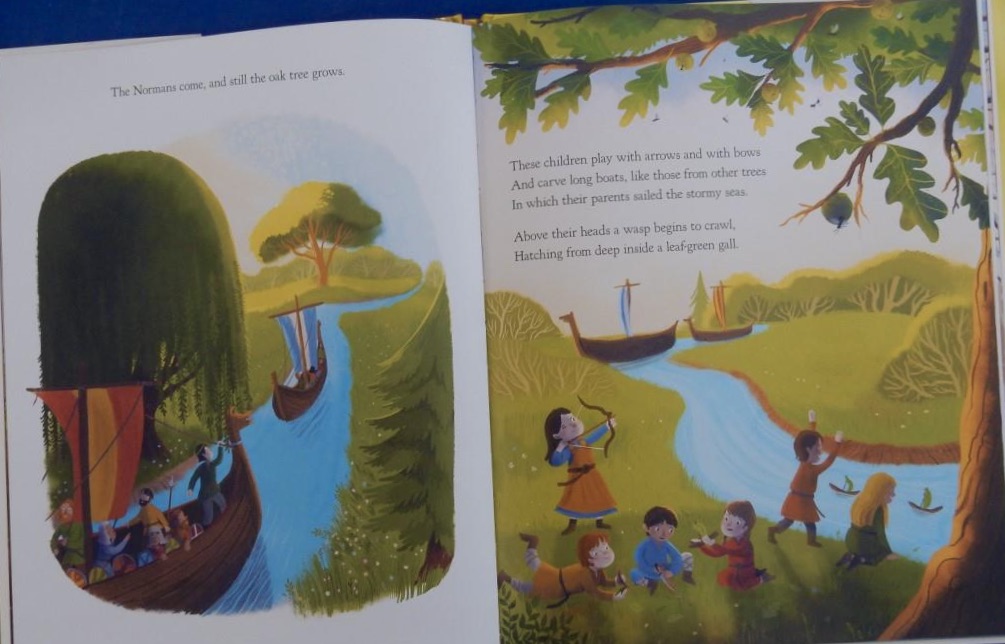
One thousand years ago, a little acorn began to grow. Through Julia’s characteristic rhyming narrative and Victoria Sandøy’s illustrations we follow a thousand years of changes through the Norman

and Tudors periods, the Victorian age and the 20th century World Wars, as it grows to become a magnificent oak tree in modern times.

A tree that provides food and shelter for a multitude of birds including jays, owls and woodpeckers; and creatures such as squirrels and bats, a king even, until having become hollowed out, it topples in a storm and becomes a place of play for both children and animals

as well as an abode for hedgehogs and somewhere for ants to deposit their eggs, spiders to spin and beetles to scuttle.

That is not the end though, we come full circle as there on the ground beside the fallen oak is an acorn that is just beginning to grow into a new tree.

A clever amalgam of fact and fiction: I love that Victoria always shows this tree as a location where children play happily: her atmospheric pictures capture beautifully, the changing seasons, even in the snowy scene a warmth emanates from her illustration.

Young children will delight in spotting all the creatures mentioned in Julia’s text as they follow the story.

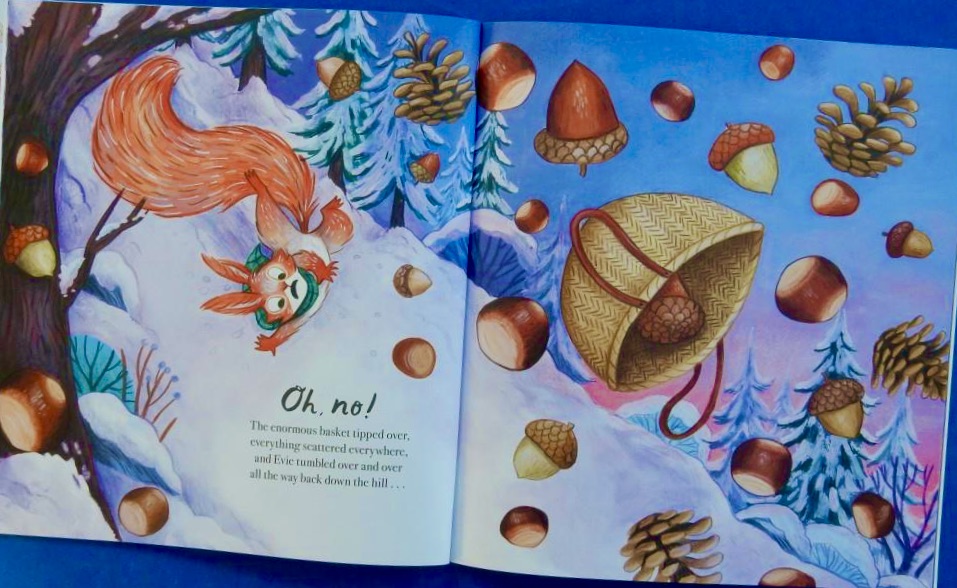
Ready, Steady Squirrel

When little Evie squirrel’s Granny is poorly, Evie takes it on herself to collect all the food they need for the long winter. Having consulted the map and wrapped up warm, she sallies forth clutching a huge basket, on her first ever solo squirrelling expedition. Close by she discovers acorns hidden in a tree stump. Into the basket they go as it begins to snow. Then, after a considerable amount of wriggling and attempting to avoid all the prickles, she has collected all the fir cones.

Chestnuts are next, followed by hazelnuts. This involves digging right down into the snow but Evie’s determined to collect every single nut. Now all she needs to do is to push her load home and as she tells herself at every challenge, she doesn’t need help from anyone. It’s an uphill struggle but Evie reaches the hilltop and then decides to have a little rest. Closing her eyes she leans back and …

The next thing she knows is the contents of her basket are scattered every which way. As for Evie, she tumbles all the way back down the hill to land in the midst of her friends. Her response when asked if she’d like to play is tears, followed by the story of how she’s collected everything herself, only to lose it in the snow.

Moose and Woodpecker reassure Evie that help is at hand and operation treasure hunt begins. It’s not too long before, with a brimming basket and a toboggan ride, the little squirrel arrives back home. “We did it together!” she tells Granny.

A warm-hearted tale of determination, friendship and courage, that Nicola has illustrated with elan to match her main character.

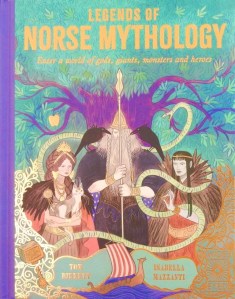
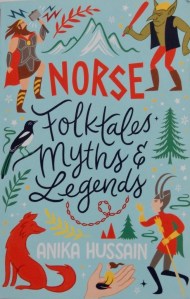
Legends of Norse Mythology / Norse Folktales, Myths and Legends

This image has an empty alt attribute; its file name is dscn9983-1.jpg


This book transports readers way, way back through time to a realm of ice and fire, magic and mischief. There they will encounter characters from Norse mythology including gods and goddesses, monsters, giants, elves, dwarfs, the Valkyries and other mythical beings – over thirty in all.


Starting with Odin, each individual profile introduces us to the character, giving such details as their chief attributes, there’s a story and additional details. Yes, all the well-known deities are there but you will also meet the likes of the bright and shining god, Baldur, renowned for his goodness,

This image has an empty alt attribute; its file name is dscn9984-1.jpg

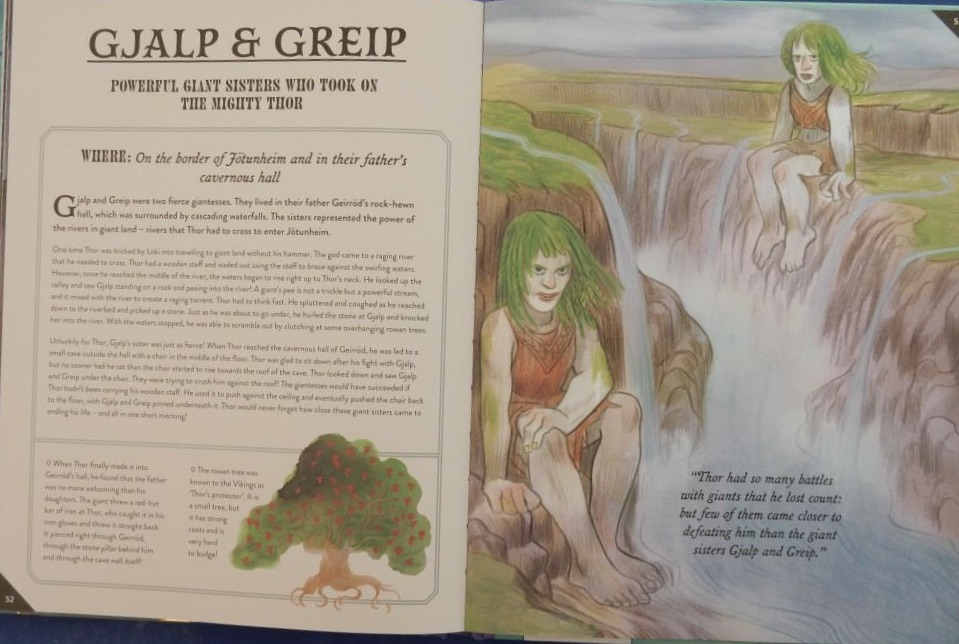
Sif, goddess of wheat and golden hair, married to Thor, the Norns – Urd, Verdandi and Skull, controllers of the destiny of each and every living being in the world. If your preference is giants then you can search the contents page for where to learn of giant sisters Gjalp and Greip,

This image has an empty alt attribute; its file name is dscn9985-1.jpg

and Fenja and Menja, strong giantesses who grind out the salt on the ocean bottom.
Interspersed with the profiles are summaries of famous Norse tales and events such as that of Thor’s hammer and the story of Ragnarök.


The book is concisely written by Norse mythology expert Dr Thomas Birkett and illustrated beautifully, occasionally aptly spookily, by Isabella Mazzanti who manages to capture the essence of each character in her portrayals.


Altogether a very useful introduction to an endlessly fascinating topic; for KS2 readers and beyond.

This image has an empty alt attribute; its file name is dscn9996-1.jpg


Divided into four parts, the book comprises Legends from Norse Mythology, and a selection of folk tales from Denmark, Norway and Sweden, each section having five stories.


As you would expect, Loki the cunning, shape-changing trickster and powerful Thor, his ‘brother’ feature in the first, the Norse mythology section.


Along with lesser-known stories, the Danish section includes a retelling of Hans Christian Andersen’s Little Thumbelina, the tiny golden-haired girl with the beautiful voice who enchants creatures with her singing including a mole that she narrowly misses having to marry.


New to me in the Norwegian part, using the same folktale structure as Snow White, is The Twelve Wild Ducks wherein a queen who yearns for a daughter makes a deal with a witch: give up her twelve sons in return for a princess daughter.


I read of Jolly Calle for the first time in the Swedish section. It tells of a boy who remains upbeat and positive no matter what, and finds beauty in simple everyday things.


A delightful collection of tales retold in an appropriately direct style; it deserves to be added to KS2 primary class libraries and home bookshelves.

Home Bird Hoot

Hoot is a home loving bird, never venturing beyond her perch in her snuggly treetop abode. The only drawback is she’s always alone. Until that is, Momo, a little mouse, calls one night and invites Hoot to hang out with him. Hoot invites him in and as they sit chatting a friendship begins to develop. One night Momo suggests the two of them explore further afield but Hoot is too scared of what might be lurking outside.

Then one night Momo doesn’t appear for their usual get together. A troubled Hoot summons up all her courage and little by little ventures out into the night. Hearing a squeak, she looks around and what she sees makes her tummy turn over. Can she now leave her perch, find her wings and come to the aid of her friend?

Smriti’s rhyming tale demonstrates how an important friendship can fuel empowerment and inner strength, making someone braver than they’d every thought possible when danger strikes.

Don’t be afraid to embrace the unknown, be a risk taker is the message: new experiences such as those of Hoot broaden a person’s horizons. There are some delightful details in Lucy Fleming’s illustrations: I particularly love the ‘Peckado’ home delivery service and all the minibeasts but young children will doubtless find other things that especially appeal to them.

A good story time tale to share and talk about.

AlphaBot / The Secret Mountain / Albert Puzzles and Colouring

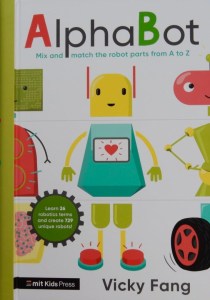
This interactive, non-fiction book published under Walker Books mitKidsPress imprint is sure to be a winner with children. On the first page comes the invitation: ‘Mix and match the AlphaBot parts! / What kind of robot will you build?’ Subsequent pages are split into three parts with scientific terms in alphabetical order defined on the verso sections and robot related illustrations are on each recto section.

The split pages make the book huge fun allowing the reader to design numerous different robots.. Its sturdy construction with a spiral binding will enable it to stand up to the heavy handling it is sure to get in a classroom or at home, as eager youngsters delightedly flip the sections back and forth, playfully learning a considerable amount while so doing. I met a couple of terms I’d not encountered before.

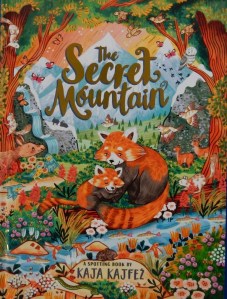
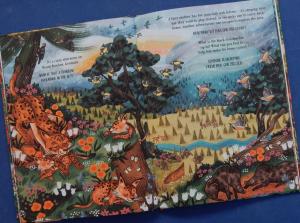
This book takes children on a long, long journey from Mount Everest all the way to Iceland. They will travel via Scotland’s Ben Nevis, then in turn the highest peak in the Andes, the Rocky Mountains, the Urals dividing Europe and Asia, Mount Broken in Germany, the Dolomites, the Heavenly Mountains of central Asia’s Tian Shan, California’s Mount Whitney, Mount Fuji and finally as night falls, Iceland’s Kirkjufell mountain.

As the sun rises over the Himalayas youngsters will see in the foreground of the illustration, a young snow leopard and her cubs heading off to hunt for food. Also out hunting is a bear and readers are asked, ‘What might he be searching for?’

In each of the following illustrations, every one of which is bursting with wildlife, there’s a mother animal of some kind and her young. So across the day you’ll also spot golden eagles, llamas, moose, brown bears, lynx

and more; some are foraging, others in flight or perhaps playing.

Each spread has a search and find element, another of the interactive elements of this immersive, creature-filled compilation for adults and children to share. Additional facts about eleven animals – one per stopping place – are provided in the three final spreads.

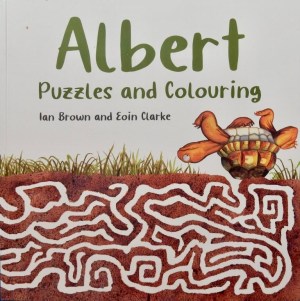
Albert the Tortoise loves to play games with his garden dwelling pals and now in this book he invites young readers to join him and participate in some playful activities at home. There are pages of silhouettes to identity, mazes to negotiate, a search and find, as well as several spreads to colour, others for playing spot the difference, and young children can hone their fine motor skills with dot to dots (those can be coloured in too).

Fox’s Favourite Autumn

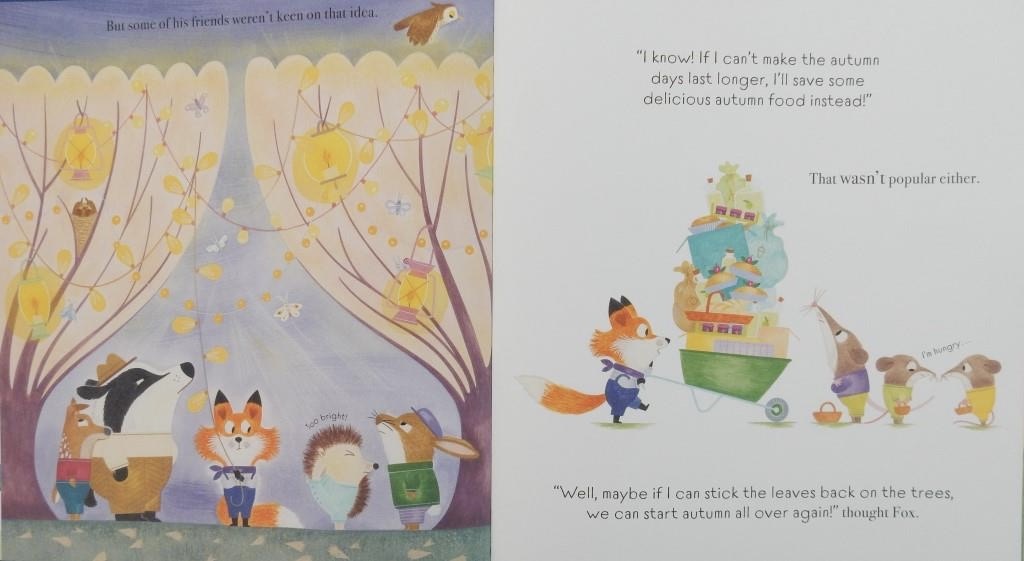
Autumn is Fox’s favourite season, he loves everything about it: the abundance of ripe fruits, the misty mornings and honey sunsets. But with autumn come shorter days; Fox isn’t happy about that. He decides to make the days longer, trying several ideas but his friends don’t like what he does.

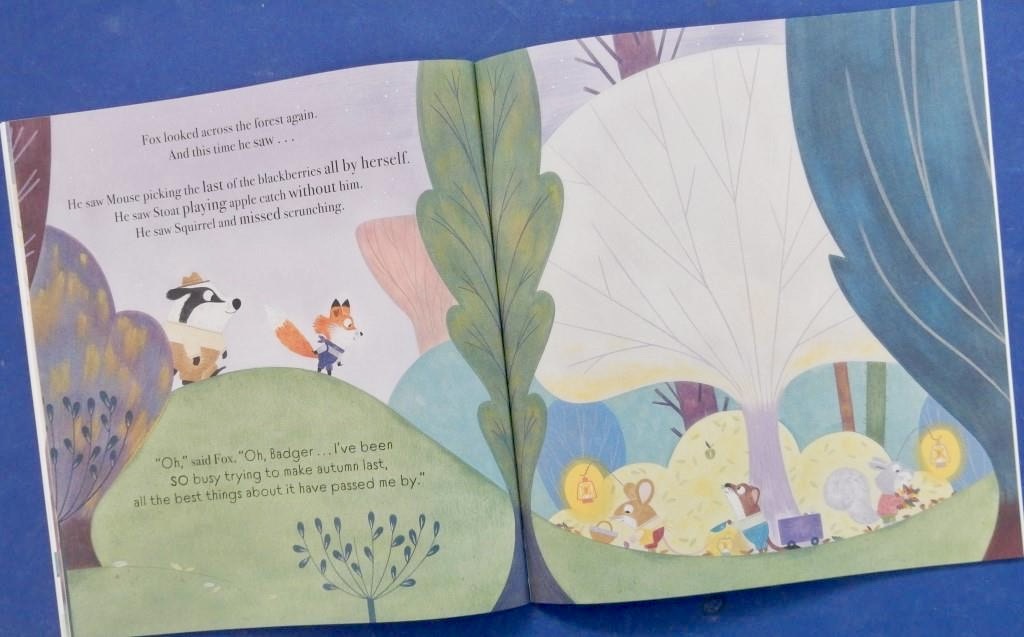
Nor do they approve of his food-saving. Then, as he desperately tries to stick leaves back on the trees, he encounters Badger wanting to know what he’s up to.

Badger asks Fox what he’ll miss about autumn and Fox starts to list autumnal things he loves so much. As he does so, Fox realises that he’s been missing out on sharing in his friends’ autumnal pleasures.

Wise Badger then points out that it’s the sharing that’s vital and all seasons have pleasurable things to offer if they’re done with friends. Will Fox finally take on board these sage words and make the most of every season and its possibilities?

An important life lesson is presented with gentle humour in this seasonal tale. It’s all too easy to become like Fox and allow the possibilities each season presents to pass us by. Christine Pym’s jolly seasonal scenes reflect the humour in Fiona Barker’s words and together offer a thought-provoking book to share and discuss with young children as the days draw in.

Good Night My Sweet Island / Fantastic Families

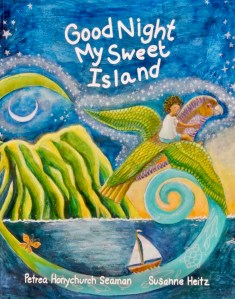
Essentially this is a seductively illustrated lullaby that bids, ‘goodnight to all things we love’ on the Caribbean island of Waitukubuli (Dominica). In so doing it celebrates the lush natural world – the forest covered mountains and valleys, the rivers, the wind, the rain and thunderstorms, the rainforest trees, the birds, bees and water-living creatures,

the fruit trees with their luscious mangoes and guavas, breadfruit and the cinnamon trees. It’s also goodnight to the tasty food the child and family are eating, to the festive music and dance, the beaches, cliffs and ‘coral-filled bays.’

Words and pictures work in perfect harmony throughout making every turn of the page both a verbal and visual feast.

I love the patterns, textures and rich colours of the flora and fauna, the waters and sky, and the characters too: the more you look, the more you see in every one of Susanne Heitz’s illustrations. Adding further authenticity to the lyrical telling is the inclusion of some Kwéyòl (Creole) words, definitions of which are given on the final page of the book.

I’ve never visited any of the tropical Caribbean islands but this gorgeous portrayal of the one where the author was born and grew up has made me want to do so.

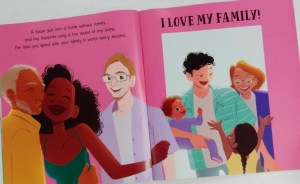
Young vegan chef, Omari McQueen, celebrates the diversity of families in this picture book, which is inspired by his own large family. Herein he introduces his relatives telling readers, “Family love is like no other and having each other is all that matters.’ Size is unimportant, but the love you have for them all is what counts. He goes on to liken families to food, some are spicy, some savoury, some sweet, but ‘always the most delicious dish.’
Families provide togetherness, safety, comfort, empowerment, support …

and unforgettable shared experiences that make for treasured experiences, they make a house a home.

On the final double spread is one of Omari’s own recipes, cookie dough chocolate cups, which I intend to try soon; and the last page asks readers to think about their own family.

A real warmth emanates from the pages, in no small part on account of Sophia Green’s vibrant illustrations. A book for family bookshelves but also one to share in primary schools especially to open up a classroom theme about families.

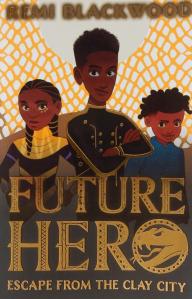
Future Hero: Escape from the Clay City

Jarell is the ancestor of an Ulfrikan warrior hero called Kundi.and as this third story opens, he is in his cousin’s South London barbershop, Fades undergoing training from barber Legsy to become a mighty warrior.. He’s eager to return to Ulfrika to find the rest of the Iron Animals and reassemble the staff of Kundi. Suddenly he hears the voice of Kimisi calling seemingly from Ulfrika but convincing Legsy of its importance takes some doing. Legsy tells Jarell his hair hasn’t regrown sufficiently to have another symbol shaved into it but on account of the urgency, Legsy agrees to use some special sacred paste instead; however, there is a time limit to how long this will last and without the symbol Jarell will be unable to return from Ulfrika.

Almost the next thing he knows, Jarell is back in the kingdom of his ancestors. There he’s greeted by a small boy, Bo-de, a member of Kimisi’s family who is determined to be in on the journey Jarrell and Kimisi are to undertake. A journey that takes them to Keesah, the underground city of clay. There deadly creatures, Asanbosams, await.

Again Jarrell and Kimisi must work closely together if they are to overcome those with evil intentions, reunite Iron Snake with the Staff of Kind, save the people of Keesah and enable Darrell to return home in time before his symbol wears off completely.

It’s possible to enjoy this as I did, without having read the previous books in the series, but young readers might do better to start with Race to the Mountain and Mission to the Shadow Sea. Black and white illustrations by Alicia Robinson and Deise Lino make it even more dramatic.

I Can See Nature’s Rainbow

This image has an empty alt attribute; its file name is dscn9793-2.jpg


There’s a kaleidoscope of vibrant colours to be found in the natural world and that’s what author/artist Vicky Woodgate celebrates in this book.


Starting with blue, a spread is allocated to each of eleven different colours. Yes we all know that sometimes the sky is blue but did you know that there is a blue daisy and a blue starfish?
Thanks to chlorophyll, there is an abundance of green in nature’s flora; there are also lots of green insects, quite a few birds and animals. Among the snippets of fascinating information is the fact that ‘the world’s heaviest parrot (the kakapo) weighs as much as a brick. You probably won’t be surprised to discover that kakapos don’t fly.
Keep going through the book and you will come upon lots of other things of interest.


Have you ever thought about why there are so few purple animals? You will find the answer on the relevant spread as well as being introduced to several purple bugs, birds, flowers and a peculiar Indian frog that spends just two weeks above ground each year and clucks like a chicken: it’s not surprising I’ve never seen one on my frequent visits to India.


These are just a few of the delights you will encounter as you turn the pages towards the final spreads, one showing rocks and minerals, which explains how they get their unique colouring and the last pages explain what colour is and present some arty activities.

A visual feast for younger primary readers.

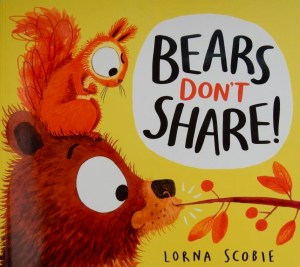
Bears Don’t Share!

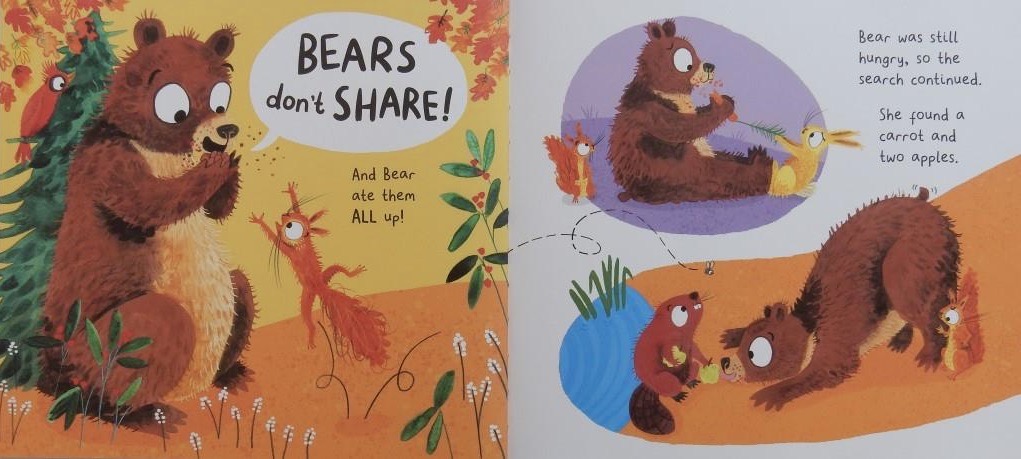
With winter fast approaching Bear and Squirrel are having a discussion about the long sleep Bear is soon to have and Squirrel suggests his friend should go with him to find some food. Off they go and soon both animals have found berries. Guess who eats them all. “Save some for me please!” begs Squirrel, “Sharing is caring, you know!” to which Bear responds, “Bears Don’t share!”. The same thing happens when they find nuts – Squirrel’s favourite food. Bear scoffs the lot. He also consumes the carrot, apples, pizza and ice cream without sharing a single morsel.

Eventually the two come upon a picnic laid out on a cloth. This, Squirrel says, is ideal for sharing. Bear however proceeds to stuff sandwiches, smoothies, jelly, cookies and veggie sausage rolls before noticing an enormous cake.

Now Squirrel is at the begging stage and Bear is just about to swallow the entire thing when she notices Squirrel. A funny feeling comes upon the ursine character: what do you think she does next?
Come the spring what will Squirrel do with his stash of berries, seeds and cake?

With a fun final twist, this is a delicious story to share especially during autumn days: I love the expressions on the faces of the two main characters. I suspect some young children will be horrified at what they consider to be Bear’s greed, but in the final spread – Winter in the Wild – the author explains that Bear isn’t really being selfish, just consuming sufficient to get him through the period of hibernation.

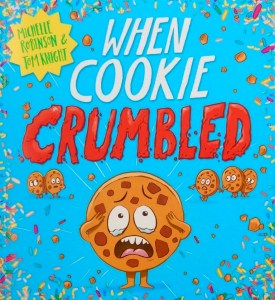
When Cookie Crumbled

Author Michelle Robinson and illustrator Tom Knight seem to have a special propensity to create books with food characters. Their latest stars a cookie named Michael; all the other characters herein are also cookies but Michael is a cookie with a difference. he doesn’t want to match all the rest with their circular, beige spottiness. Instead he likes to sport sprinkles, sweets, have a spicy aroma or even cut a dash with a splash of strawberry jam or chocolate sauce. “Fall in line,” the others tell him.

Eventually he becomes thoroughly dejected, almost at breaking point. “Why can’t I be myself?’ he wants to know. Having one last go at individuality and receiving negative reactions all round, poor Michael crumbles, scattering crumbs every which way.

But then, he listens to what his heart is telling him and he reaches for the tube of icing.

What will the reaction of all the other cookies be?

With Michelle’s highly engaging rhyming text and Tom’s dramatic, laugh-inducing illustrations, this mouth-watering tale celebrates difference, being oneself, acceptance and understanding. Take pride in who you are is it’s vital message.

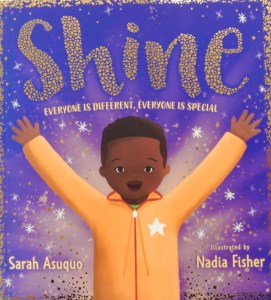
Shine

After the end of the summer holiday, Kai’s enthusiasm for returning to school and meeting his friends again, is quickly dampened on the very first day. The reason for this, he tells his mother, is because having participated in building a den, which he understood was for everyone, the other children told him he was too tall to fit inside. “I wish I wasn’t tall.” he says.
His mother responds, “Be proud my son, that you are tall; stand as high as you can be.” His height, she continues, enables him to see beyond what other children can. Yes, Kai is different in this respect but he should be true to himself, letting the special light that is within us all, shine through.

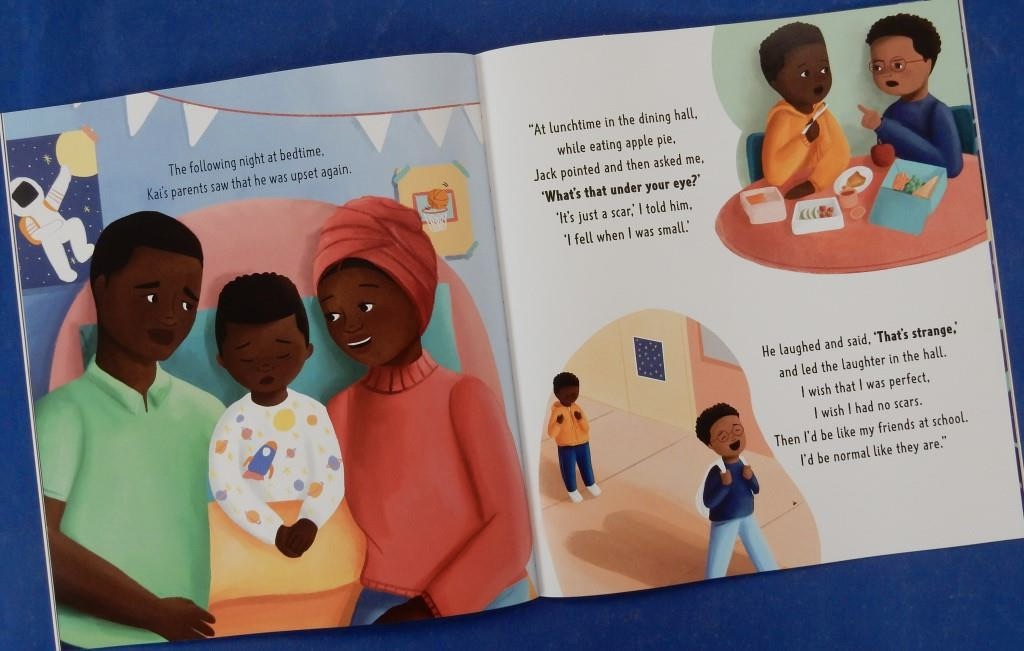
Next evening at bedtime, Kai is upset again, this time on account of being laughed at for the small scar beneath his eye. He feels this imperfection stops him from being normal.

Now dad speaks, gently telling his son to be proud of his scar for it adds to his shine. Then he opens the curtains and asks whether it’s possible to say that either the stars or the moon is best. ‘Everyone is different, son. You must be true to you. // Within us all is a special light. / Will you let yours shine through?” Kai nods in assent and then it’s time to say goodnight. The boy now realises that the very things that make him different also make him special.

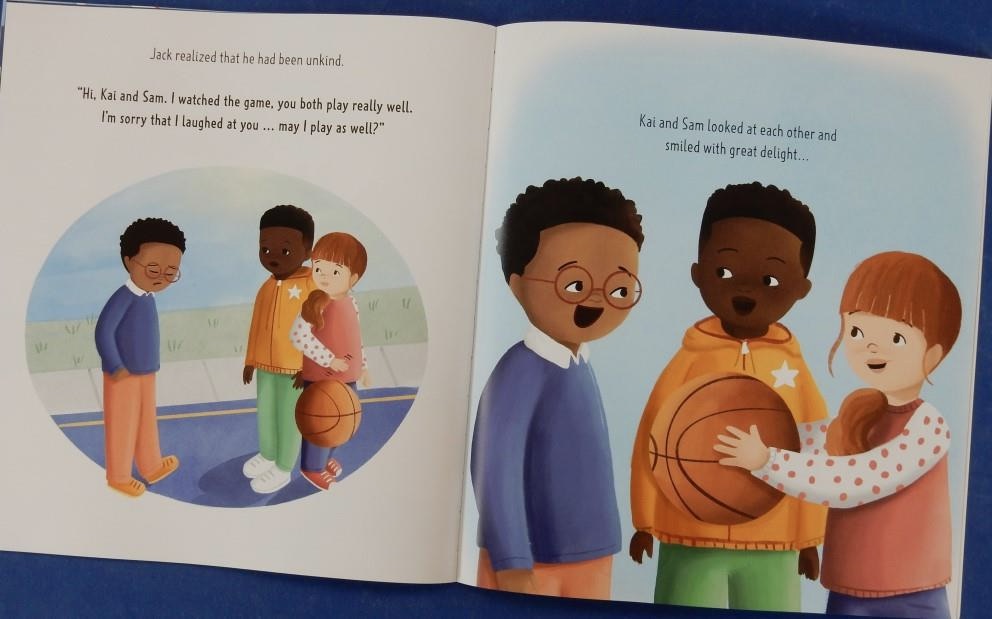
At school the following playtime, Kai’s friend, Sam, is upset: she had been told she was too small to join the game of basketball. Kai shares his parents’ wisdom , likening her speed when she plays to a shooting star. An ideal complement for his height – the perfect team. Moreover the two impress their classmates and the boy who had laughed at Kai’s scar realises that he needs to apologise for his unkindness.

Then when he asks to join their game, Kai’s affirmative response is “we all can shine if we just unite.”

Kai underwent a big change as, with his parents help, his low self-esteem was transformed into inner confidence, and an ability to understand the importance of both individuality and inclusivity.

Sarah Asuquo’s narrative is presented in prose and the text breaks into rhyme whenever a character speaks. Nadia Fisher’s mixed media, digitally worked illustrations shine a light on Kai’s feelings as he navigates the first week back at school and a steep learning journey.

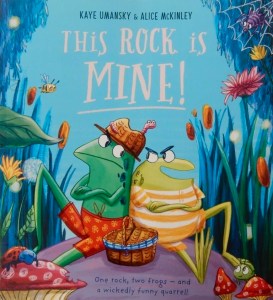
This Rock is Mine!

This image has an empty alt attribute; its file name is dscn9535-2.jpg


This Rock is Mine!
Kaye Umansky and Alice McKinley
Alison Green Books


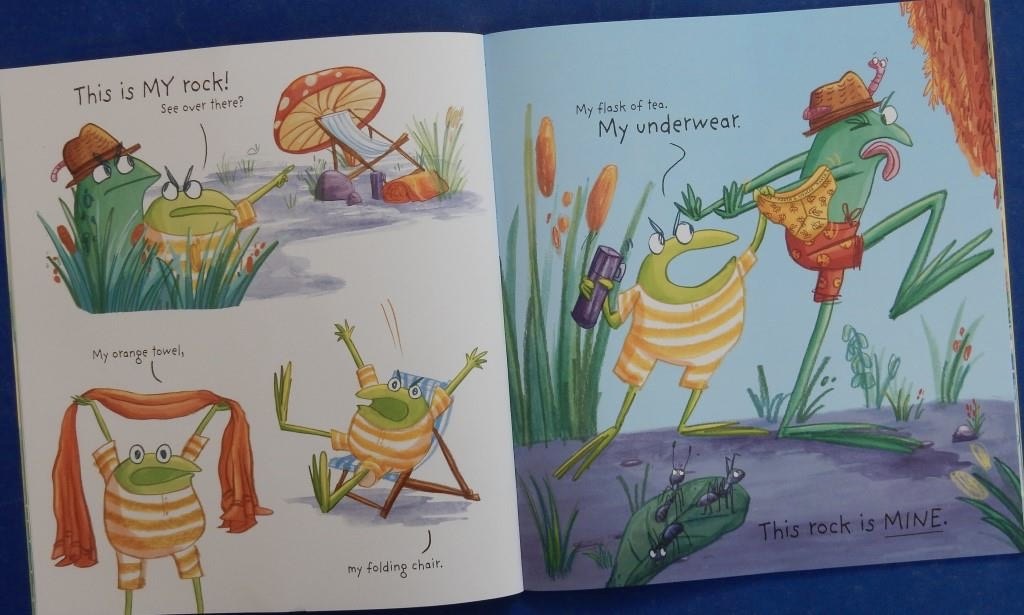
What starts as a silly spat between two frogs about the ownership of a small rock quickly escalates into a full scale fight with each frog in turn drawing the other’s attention to belongings that prove the rock is theirs..

This image has an empty alt attribute; its file name is dscn9536-2.jpg

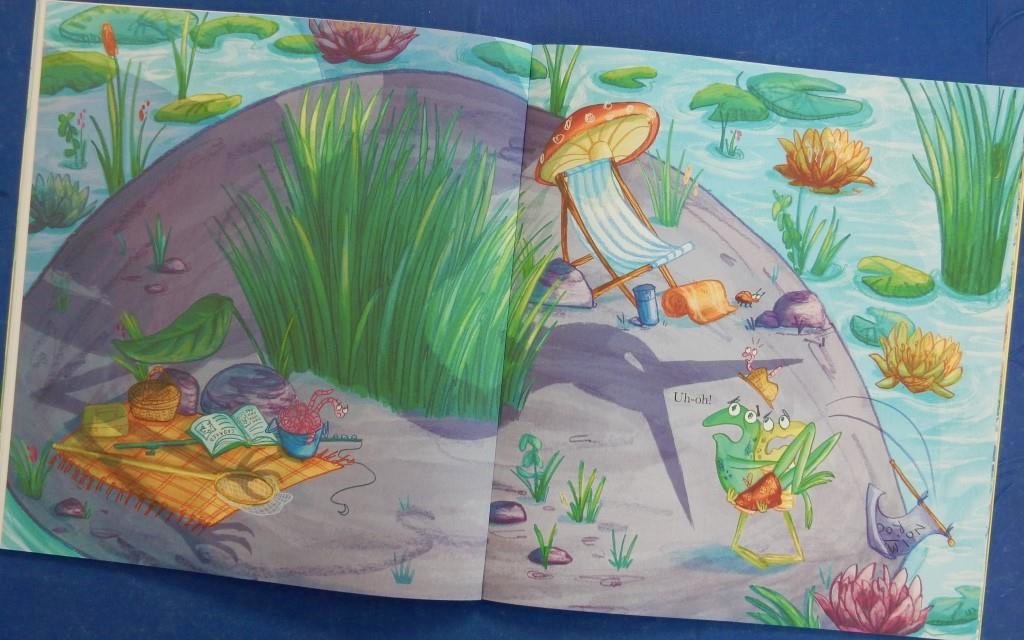
Unbeknown to the two little amphibians, their altercation has been watched by a very large long-legged, long-necked bird. Suddenly, as we see in Alice McKinley’s close-up scene, a menacing shadow appears over the disputed rock and two tiny lives are in danger of being extinguished.


This image has an empty alt attribute; its file name is dscn9537-2.jpg

After a desperate dive and a decision about the worthiness of the cause of their argument, the frogs come to two conclusions: the first is that the rock is after all, ‘no good’ and another needs to be found; the second is that friendship is far better than fighting and sharing is the way to a happy co-existence.


Kaye Umansky’s bouncy rhyming text combined with Alice McKinley’s dramatic visuals make a superb read aloud that adults will delight in presenting to young children; they in turn will delight in the unfolding of events. I really love what happens on the penultimate spread where we see two rocks and an indication that frogs are not the only creatures with a possessive streak.

We Are Expecting You! / Dear Star Baby

We Are Expecting You!
Barney Salzburg
Scholastic

Little elephant excitedly anticipates the arrival of a new sibling but it’s hard having to wait so long. However the little purple pachyderm goes through all the things the two siblings will do together- play peekaboo, tell jokes for instance. “I will read to you. I can sing to you. …

We can dance together. …”

Reminding this reviewer somewhat of Mo Willems’ artwork, Saltburg’s simple, stylised illustrations show the little elephant always close to its expectant mother directly addressing her bump until the wait almost gets too much and its “I can’t wait for you to be here” changes into a very loud assertion of readiness. All the time the focus of the brief text is on what the siblings will share, making this a warm and captivating way to introduce the notion of a growing family to a very young child.

Sadly not all pregnancies end in a joyful outcome as we see in

Dear Star Baby
Malcolm Newsome and Kamala Nair
Beaming Books

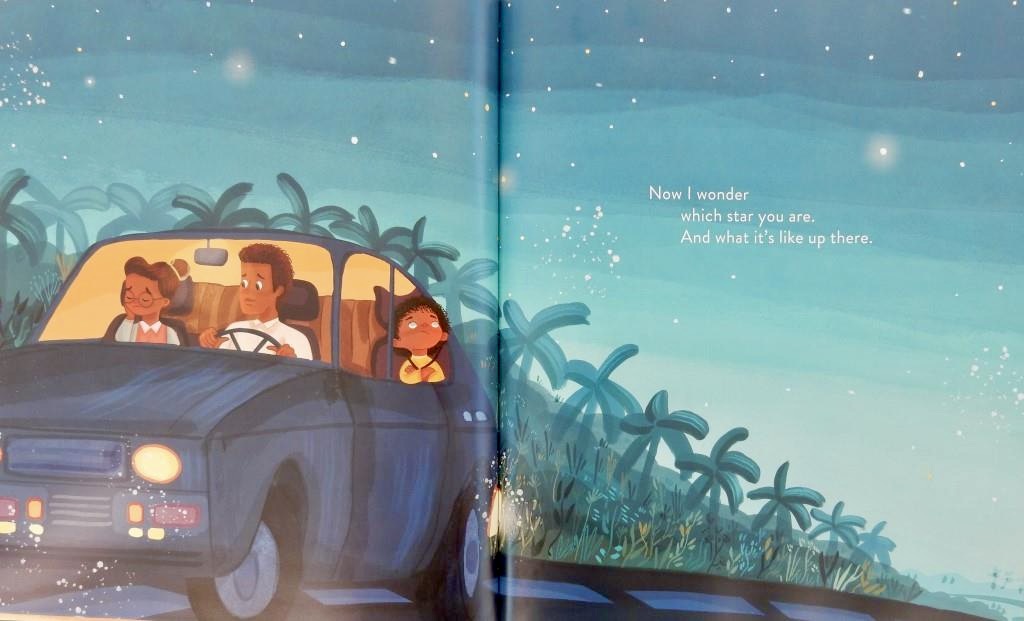
This is a heartfelt story written as a letter from a small boy to his baby sibling that didn’t come home. He starts by saying how happy he felt as he helped his Daddy prepare the room, accompanied his Mama to buy some gifts and Dad shared stories about being a helpful big brother. But then Mama goes to hospital and his parents have to break some very difficult news: the baby won’t be coming home after all, and has gone to be with the stars.

He goes on to talk about the things he was looking forward to doing with his sibling and how the family members process their grief after this devastating loss.

Miscarriage is something many families experience and Malcom Newsome’s tender telling written out of his own personal experience, and Kamala Nair’s equally tender illustrations expressing love, loss and remembrance, offer a safe space for those who lose a baby through miscarriage, as they share the book.

Animal Explorers: Ivy the Bug Hunter

Animal Explorers: Ivy the Bug Hunter
Sharon Rentta
Alison Green Books

Meet Ivy the elephant, a hater of bugs, or rather that is early in the day when she’s trying to enjoy her picnic. However, thanks to an encounter with Emperor Swallowtail caterpillar, by the evening she’s telling her mum that she loves bugs and wants to be a bug hunter. So Mum agrees to let Ivy accompany her new caterpillar pal on a bug safari.

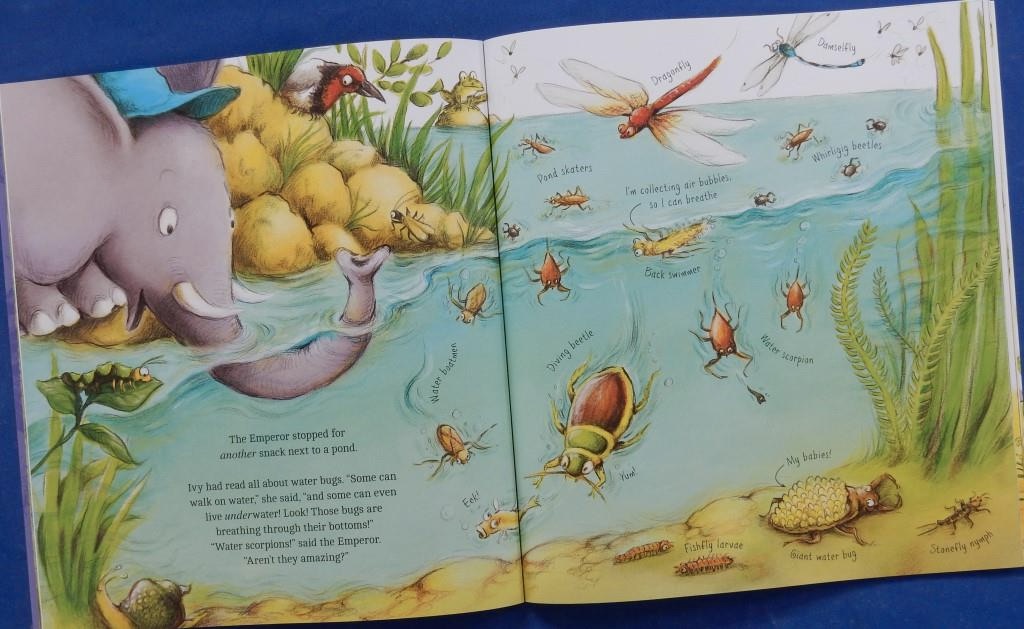
Next morning Ivy is up early to assemble her equipment and a tasty picnic (for herself); the caterpillar sates his appetite by munching on leaves en route. They see various kinds of bug houses, up high and down low as well as a huge termite nest, then at Emperor’s next snack stop beside a pond, they watch all sorts of aquatic bugs.

As the safari stops continue, Ivy learns about camouflage, drawing in her notebook, some examples of bugs that disguise themselves ,and also comments that her companion has shed his skin four times. At nightfall as the fireflies glow in the sky, Emperor Swallowtail is exceedingly sleepy and informing Ivy how proud he is of her, says that she must continue without him hereafter, then promptly falls asleep.

The following morning Ivy can’t see a sign of the Emperor but there is a ‘funny brown thing stuck to a branch’. Savvy children will likely know what that is but not Ivy. However, remembering Emperor’s last words, she continues her bug hunt, has the occasional set-back but makes lots of exciting discoveries,

though still she wonders if she’ll ever see her friend again. Then one afternoon, to her delight something makes her sneeze: I wonder what that could be.

Sharon Rentta’s vibrant, gently humorous scenes of the safari are a delight to pore over and she has included brief biographies of famous real life bug hunters at the end, as well as a page showing the life cycle of the Emperor Swallowtail.

This is science writing for the young in a highly accessible, absorbing and fun form.

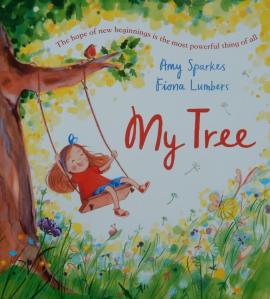
My Tree

My Tree
Amy Sparks and Fiona Lumbers
Scholastic

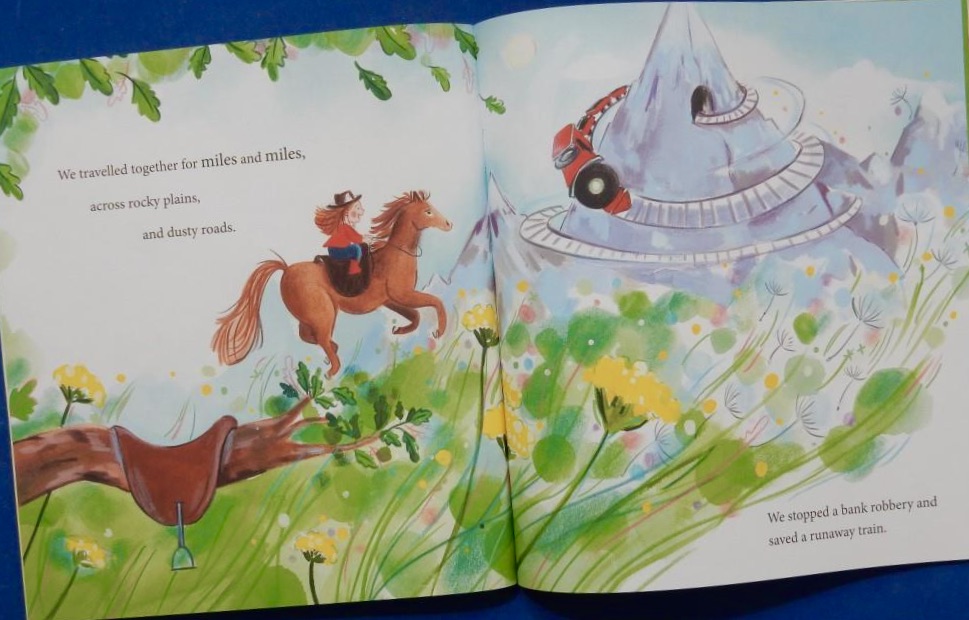
The small girl narrator of this story had a favourite place, her tree, which she loved dearly. It acted as a listener when she felt sad and a playmate when she needed an adventure. No matter what, the tree was always on her side; her family loved it too, no matter the weather. And what a wealth of nature relied on that tree: it provided food for squirrels, a nesting pace for birds, and of course it acted as the starting point for a multitude of exciting imaginary adventures.

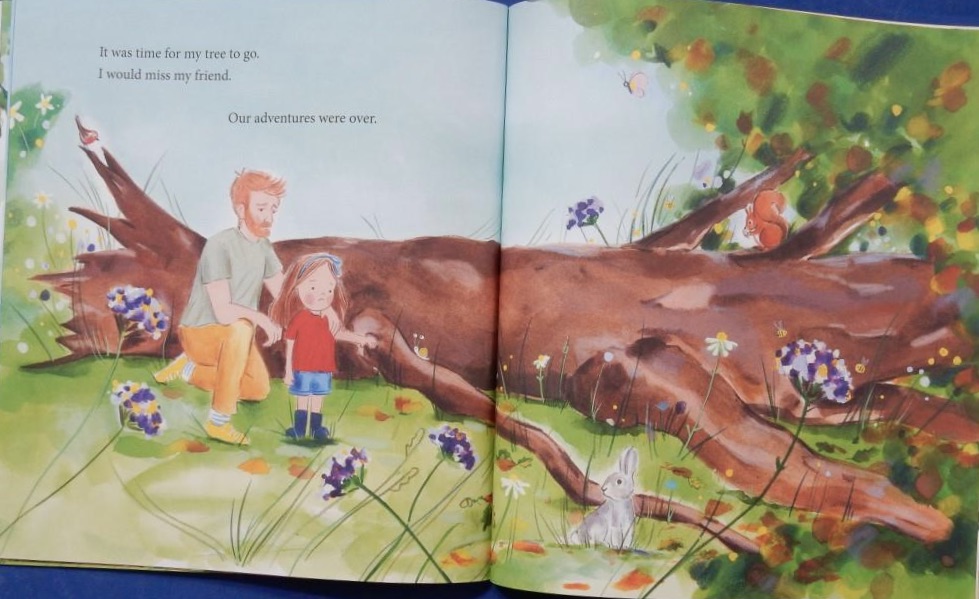
One night however, everything changes; incessant rain and wind result in the tree’s destruction. No more adventures: the little girl is distraught.

But then she notices something wonderful. The wind has scattered the tree’s fruits all over the ground; she knows what to do next. Having planted an acorn, the girl tends to it, giving it water and telling it exciting stories.

Gradually both child and tree grow … and grow … and grow … Now the girl has a special new best friend; one that will stay with her for ever, so she hopes.

Just as the narrator found joy in nature, so too do many of us, children and adults. It’s always there offering hope of renewal and the possibility of new beginnings. ‘In my end is my beginning’ – so said TS Eliot at the conclusion of East Coker. And so it is for the tree in Amy Sparks’ warm, reassuring story with Fiona Lumbers inspiriting illustrations.

Did You Do This Poo?

Did You Do This Poo?
Lucy Rowland and Gareth Conway
Scholastic

A little unicorn turns detective when walking in the forest one morning, on account of a strange aroma that on further investigation turns out to be a rather large, slimy poo. He asks readers to join him in a search for the poo perpetrator.

First to be questioned is Rabbit who happens to hop by, but responding to the interrogation thus, “My poos aren’t so slimy. They don’t have that smell. In fact, they’re so nice that I eat them as well!”, it’s obvious that Rabbit is innocent. So too is Wise Owl – a splat clears that creature. Then Badger appears and on being asked like the others, ‘did YOU do this poo?’ does turn a tad pink but is quick to point out that he uses a special latrine in which to drop his excretory matter. Bear, Bat and Deer’s poos don’t match the pongy turd either.

It appears that somebody is not being truthful, but who could it be?

Suddenly Badger advances and explains that earlier that morning, he’d gone to his latrine, found it engaged and unable to hold on, did a dump elsewhere – the very one that they’ve spent so long trying to identify.

Now with the culprit having owned up, the animals – now poo experts – turn their attention to examining what was left in Badger’s pit. Will they solve that case? Have you?

Let’s just say this poo leaver has no option but to own it with pride.

With her combination of unicorn protagonist and poo, rhyming expert extraordinaire, Lucy Rowland, is surely on to a winner with young children, even more so with Gareth Conway’s hilarious scenes of the animals’ search for the pooing culprit. A smashing whodunit for story time sharing; you might want to have some air freshener at the ready.

Total Splashdown / Press Start: Super Rabbit Racers!

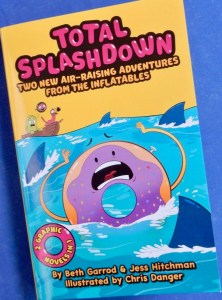
Total Splashdown
Beth Garrod & Jess Hitchman, illustrated by Chris Danger
Scholastic

This is two stories in one book and features those five inflatable pool float pals, Flamingo, Cactus, Donut, Watermelon and Lynn Lilo, residents of Have a Great Spray Water Park.

The first, Do-Nut Panic sees the friends, led by Donut on an epic quest to find the one and only remaining Cookie of Contentment, thus preventing the closing down (so they think) of the Slip ’N’ Slice Pizza stall. Said quest is perhaps THE most dangerous on earth and certainly in the entire inflataverse. Needless to say their journey is fraught with dangers,

not to mention a fair few disasters as the puffed up pals head towards the desert island whereon said Cookie is heavily guarded by not one but three protectors, Fickle Pickle, Energetic Enchilada and Unimpressed Pretzel.
Could our questers be on a hiding to nothing? It certainly seems so when they fail dismally to sweet talk the three into handing over their keys. But our friends don’t give up that easily: let the show begin. Crumbs! That pretty much sums up the next few spreads but all ends let’s say, pretty tastily.

However before they’ve had time to digest those cloned goodies, the gang are off on another mega daft adventure: The Splash of the Titans. Bring on those Air-lympic Games – the most competitive day in the inflate calendar and bring on Team Watermelon. Needless to say there’s a lot of shenanigans from some of the other entrants but which team will emerge victorious, winners of the much coveted Golden Pump?

Replete with puns and jokes, these super-silly stories with those mega-dramatic black and white graphics will have readers rolling around at the delicious daftness of this graphic novel.

Press Start: Super Rabbit Racers!
Thomas Flintham
Nosy Crow

Book three in the Press Start graphic novel series follows along similar lines as the previous two, only Chris has joined Sunny and Rue to play the Super Rabbit video game, Rabbit Racers, which is new to him.

Obviously the main conflict is between the racers, with King Viking determined to win the Super Cup (a special power up that gives the winner the power of super speed) and he’ll go to any lengths to do so. However there’s also a bit of bad feeling at one stage between Sunny and Rue over an accidental sideswipe. With four races in all, who will be the victor in the Super Cup Grand Prix?

Like the previous books this fast moving tale is ideal for new solo readers with a penchant for video games.

The Frog’s Kiss

The Frog’s Kiss
James Mathew and Toto
Scholastic

I was knocked out by the beauty of Toto’s misty illustrations for this LGBTQ+ retelling of the frog prince story: it’s such a wonderful debut as a picture book team James and Toto.

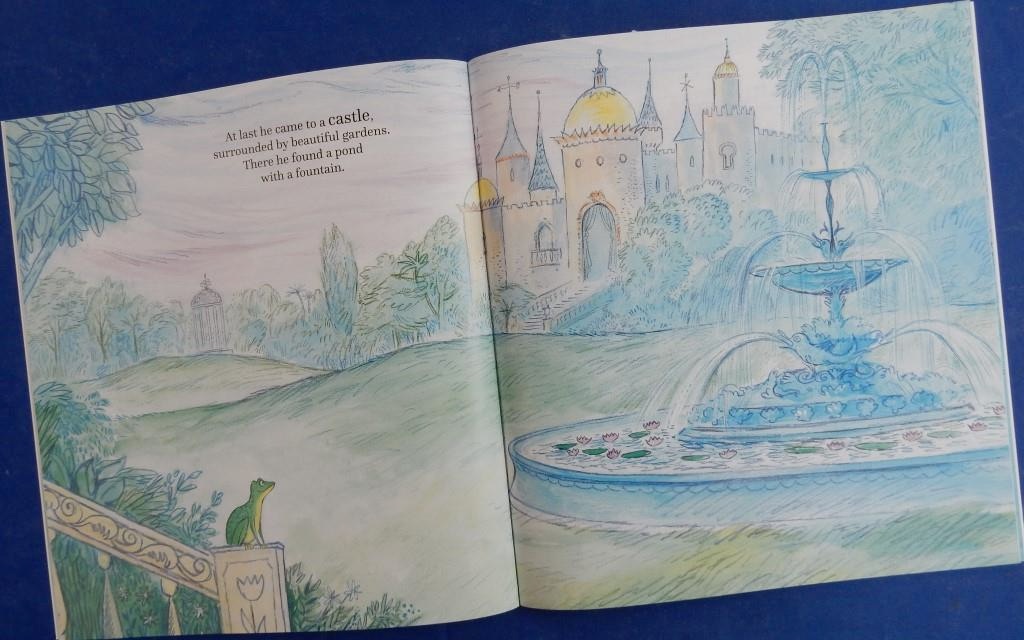
The book begins with a frog sitting atop a lily pad when suddenly something falls into the pond. Frog investigates and discovers a book; a book that shows a frog very similar to himself being kissed by a princess. The image of the kiss stirs his froggy heart and he decides to search for a special somebody too.

His quest eventually takes him to a castle surrounded by gorgeous gardens wherein there is a pond with a fountain just like that of the book he’d found.

Having washed off the dust from his travels, frog sits and waits and waits. As the moon rises, three princesses appear, come for the summer ball. Unbeknown to frog, one, so the king and queen hope, will become the bride for their son.

Devastated by what the three princesses say when it’s suggested they might kiss a frog, our frog sits once more on a lily pad feeling stupid. All of a sudden who should approach but a prince who addresses him and having received consent, tenderly picks up the frog and kisses him. And the rest, of course leads to a happily ever after fairy tale ending. After all, everyone deserves that.

It’s no exaggeration to say James and Toto have done the Grimm tale proud. This is a stunner.

The Unbelievable Top Secret Diary of Pig

The Unbelievable Top Secret Diary of Pig
Emer Stamp
Scholastic

If you didn’t read the original black and white edition of this crazy story when it was published some ten years back, then you need to know that Pig’s assertion, ‘I is 465 sunsets old’ definitely needs updating although the creature does supply a kind of get out clause in his introduction. This version has colour on every spread : I’m not sure if that makes it even sillier but it certainly makes it a whole lot brighter. Pig’s grammar hasn’t improved however.

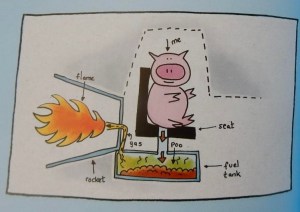
Essentially it’s a hugely funny book written in diary form by a farmyard pig called Pig who has a best friend called Duck, another so he thinks friend, Farmer, and some dastardly enemies, the Evil Chickens. They, Duck reports, are secretly building a space rocket from a broken tractor. A trocket, so the Super Evil Chicken informs Pig and proceeds to ask the porcine diarist to fly the thing to Pluto. 

At first Pig refuses but then, having learned something horrifying about Farmer’s intentions, decides to reverse his decision and grab the chance to escape the terrible fate that otherwise awaits.

Now this machine is poo powered so rest assured there will be a fair bit of poo involved in the story, farts too, so if that bothers you and you choose not to read the book, you are missing a treat. It’s exuberant and so well imagined, Yes, the mission goes somewhat awry but all ends satisfactorily for Pig and Duck, more or less, anyhow.

There’s No Such Thing As Dragons

There’s No Such Thing As Dragons
Lucy Rowland and Katy Halford
Scholastic

Prompted by the titular remark of his grandfather during a story-sharing session, a young child embarks on a mission: to find out whether or not dragons exist. Before leaving he packs the items he needs in his backpack and asks the readers to assist in the search. 

Then having checked his own abode the lad heads off up the hills, climbs a mountain, 

and then enters a forest, takes flight in a hot air balloon, tries the museum and several other places but with no success. He does find the occasional knight in the castle though, before heading to the final location on his list of possibilities: the rocky seashore below the castle.

As he sits checking his dragon book beside the entrance to a cave who should appear but his grandpa who has been searching for him all the time. Reluctantly the boy concedes “There’s no such thing as dragons” 

as the two watch the shadows dancing in the moonlight. Suddenly as they are about to depart, they hear a sound and there’s a distinct rise in the temperature … Then comes a surprise revelation: what could it be?

Lucy’s spirited rhyming text scans well, so it’s a good one to read aloud to a class or group; and individuals will enjoy scanning Katy Halford’s illustrations that underscore the whimsical humour of the story as they too search for the dragon hiding in plain sight.

You Are Loved

You Are Loved
Margaret O’Hair, Sofia Sanchez and Sofia Cardoso
Scholastic

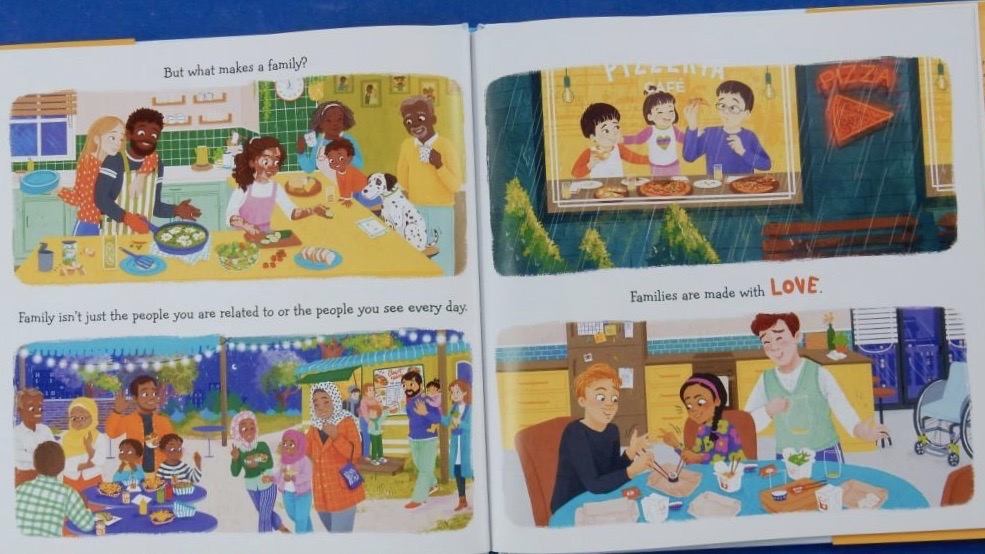
There are many ways to be a family; none is absolutely perfect but love is the vital element in every family. That message comes through loud and clear in this book, which was inspired by Sofia Sanchez whose parents, a father from Mexico and a mother from California, adopted her as a baby from an orphanage in Ukraine.

Really families are more than just those you see every day, or those related to you, perhaps you consider close friends, teachers and neighbours as part of your family too; they are certainly important.

Whether you are born into a family, chosen by your family or your family is chosen by you, its members will be special to you. They will make you feel special too and ‘strong’; they’ll tell you ‘You are enough’ and most crucially, ‘You are loved.’

Each family is different and that message is extended in Sofia Cardoso’s illustrations of diverse families, some of which are interracial..

Look closely at her scenes and you may notice some characters in more than one of them.
The book closes with a note from the mother of Sofia Sanchez.

An excellent choice for inclusion in a KS1 classroom collection.

When Things Aren’t Going Right, Go Left

When Things Aren’t Going Right, Go Left
Marc Colagiovanni and Peter H. Reynolds
Scholastic

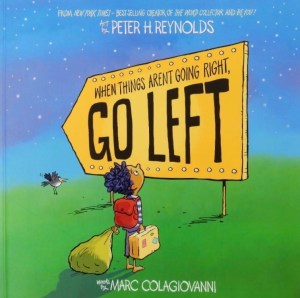
The boy protagonist in this book discovers a simple procedure for lightening the heavy weight of worries, frustrations, doubts and fears he carries around with him.

It begins thus: ‘One day, for no particular reason, nothing was going right. Absolutely, positivelyNOTHING was going right. So I decided to go left.’ We see him putting down one of the heavy pieces of luggage – his large box – and walking on without it. He continues in similar vein, leaving behind a huge sack: thus he has dropped his weighty worries (little red monsters) and doubts (hairy green beasties).

On reaching the bottom of the high diving board, the boy deposits his suitcase of orange creatures, and attempts the dive but it’s not a great success. However the lad decides to leave his backpack of frustrations on the ground, its creatures yelling, “You can’t do it!’ and has another go at the dive.

Hurrah! A perfect entry this time. Suddenly a realisation dawns: the more left he goes, the more right he feels; in fact he continues going left and pretty soon, everything is going right. Now what remains as he has a quick look at the ground, are much, much smaller nasties, shrunken so it’s easy for him to pick them up again and continue, safe in the knowledge that they just need him to keep an eye on them.

An uplifting very positive message, imparted in a somewhat light-hearted manner through lawyer/author Marc Colagiovanni’s words and Peter H. Reynolds instantly recognisable illustrations, that encourages readers/listeners to drop the baggage when things are going badly in life.

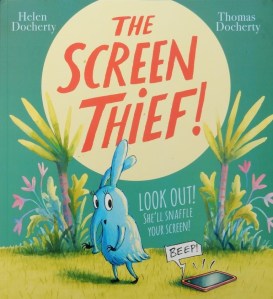
The Screen Thief!

The Screen Thief!
Helen Docherty and Thomas Docherty
Alison Green Books

Watch out, watch out, a Snaffle’s about. Newly arrived in a city near you and on the lookout for some playmates, the creature is puzzled to see that everyone she sees is too busy staring at their screens. But what exactly is so special about these things, that nobody has time to notice a newcomer?

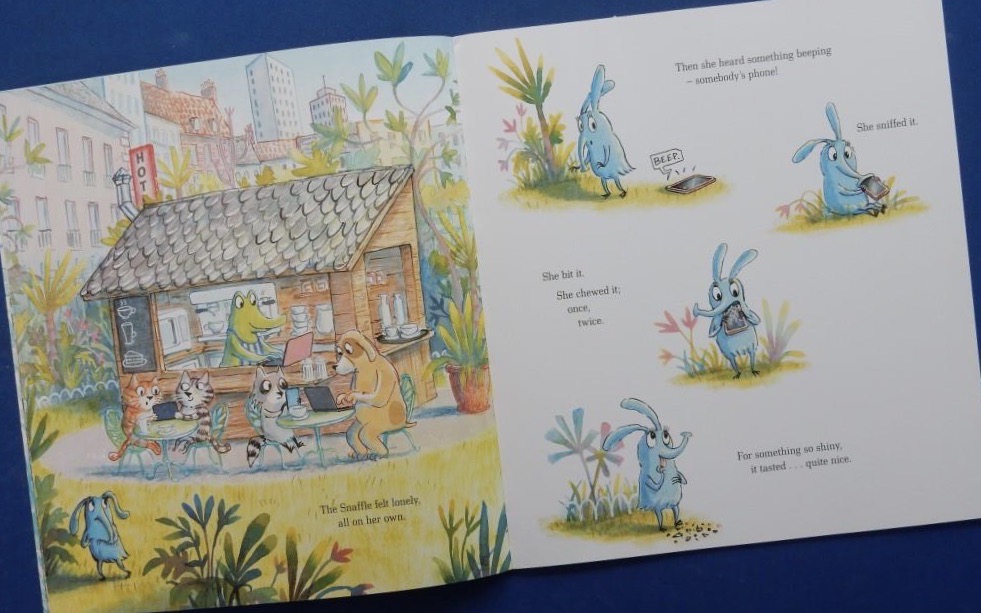
Puzzled, the Snaffle feels lonely but then she hears a beep! beep! coming from a phone on the ground so she does what all inquisitive creatures do, sniffs it and chews it and then gobbles the lot. Hmmm! Pretty tasty.

Off she goes in search of further screens to sink her teeth into, but the more she consumes, the hungrier she becomes. Before long the library has lost twenty computers and the TV shop almost sixty of its largest sets. But there’s worse to come as the hungry-for-more Snaffle makes her way through the city towards the park.
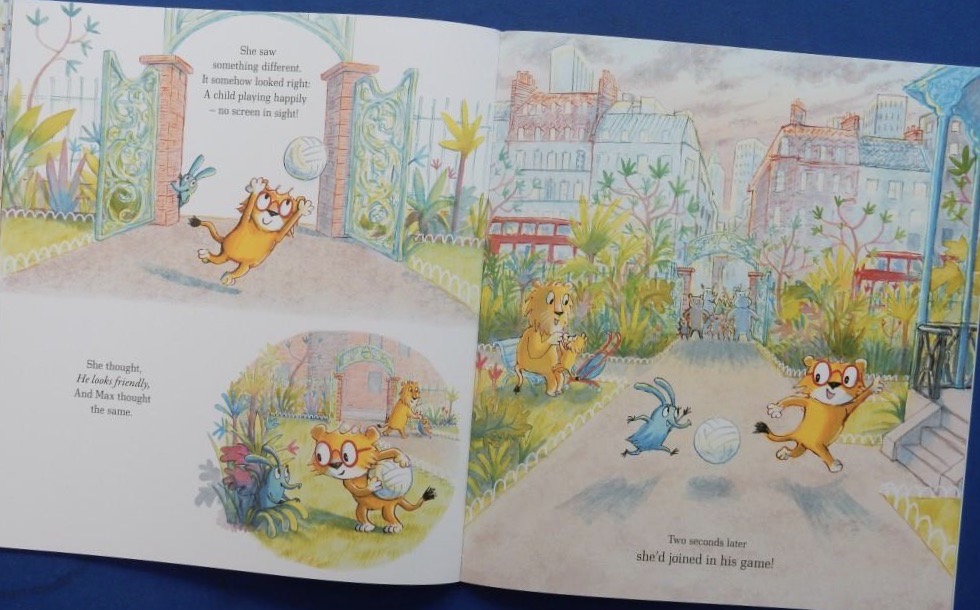
Therein are lots of very sad children eager to find the culprit and one child called Max: Max is forgiving and happy to contemplate life sans screens. Meanwhile the Snaffle is now suffering from an attack of ‘scrindigestion’ and a kind of empty inside feeling. But then she looks up and sees a happy-looking screenless child playing just inside the park and in a flash …

Suddenly the two become aware of the large angry crowd that has gathered ready to give chase. Will they listen to what Max has to say? And if so, might his words precipitate a degree of change …

Assuredly, it’s a case of put your screens away, take a rest from your play; come sit and listen to this fun, timely treat of a tale told in Helen’s faultless rhyme and Thomas’ wonderfully detailed scenes of screen obsessives who learn a very important lesson, thanks to a visit from the friend-seeking Snaffle..

Pip & Egg

Pip & Egg
Alex Latimer and David Litchfield
Scholastic

This week for the first time in many months I’ve been able to spend time with some of my very close friends and I know just how important strong bonds of friendship are. This poignant story is a demonstration of what true friendship really means.

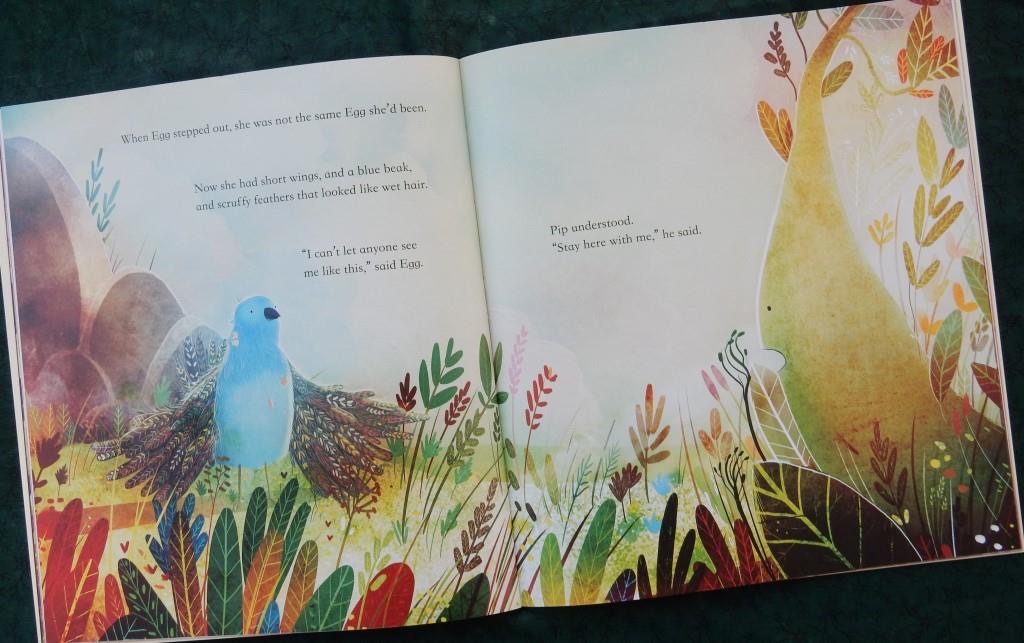
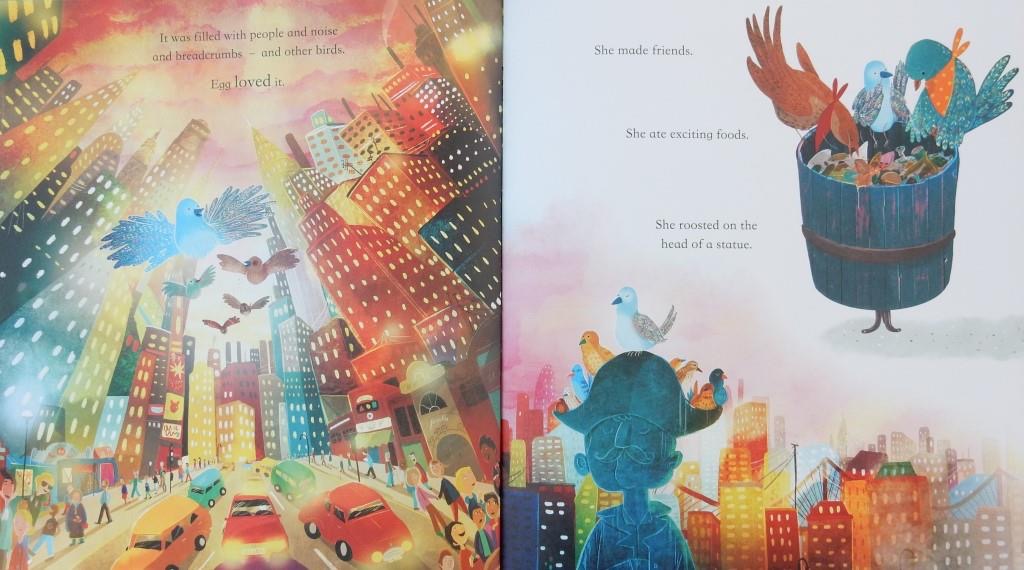
When Pip and Egg meet, there’s an instant attraction on account of the similarity in their shape and size. Their friendship grows but so too do they: Pip grows roots that hold him in one place, which means that for the friendship to continue, change is necessary: Egg makes daily visits to see sapling Pip. Over the weeks though Egg is transformed with a beak, feathers and wings –

wings that grow so strong she eventually takes to the air.

With Pip’s blessing, Egg decides that it’s time to explore the big wide world. Off she flies leaving a broken hearted Pip rooted to his spot, where he’ll always remain should she ever return.

From the air Egg is amazed at the sights – the forests, lakes, mountains and most of all the city where she stops, forming new attachments.

Eventually though, she knows it’s time to return to the valley from whence she came …

Like everything he does, David Litchfield’s illustrations for this story are stunningly beautiful: rich in fine detail and texture, and the way he uses light and shade creating atmosphere and focus on Egg in the city especially, is truly magical.

There’s No Such Thing As … Unicorns

There’s No Such Thing As … Unicorns
Lucy Rowland and Katy Halford
Scholastic

Whether or not you know youngsters who are besotted with unicorns (and that’s an awful lot even in my experience), or are acquainted with young search-and- find fans, then this story will likely appeal.

Its narrator is a little girl – a unicorn obsessive if her bedroom is anything to go by and when her big brother tells her that these magical creatures just don’t exist. she decides to try and prove him wrong.

Next morning having packed her bag with the necessary accoutrements, she sets out on a unicorn search. It’s a search that takes her to a variety of places – a farm, the zoo, a lake …

the woods, each of which yield negative results. Now what about the meadow? That looks more promising, but no unicorns appear to frolic among the ponies. Nor are they evident at the seaside, even in the dark depths of that cave …

Equally, the school classroom and the park in the gathering dark furnish for our seeker, not a single unicorn sighting and so disillusioned, she takes refuge to let her tears flow.

Suddenly who should appear but her brother who’s been hunting, not for unicorns but for his little sister. A comforting cuddle ensues and then, under the twinkling stars, the two make a wish …

With its repeat titular refrain,, Lucy’s rhyming telling as always, is a delight to read aloud, and if you share it with more than one or two little ones at a time, make sure you leave plenty of time for listeners to peruse each of Katy’s busy scenes. They simply burst with enchanting details and rainbow hues; and of course there’s that elusive one-horned creature lurking somewhere at each location.

All Because You Matter

All Because You Matter
Tami Charles and Bryan Collier
Orchard Books (Scholastic)

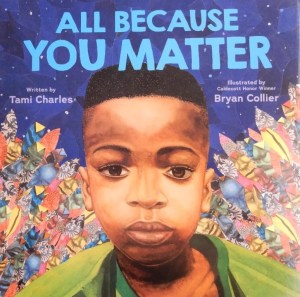
This wonderful, empowering celebration of young Black lives is for everyone, not just those with black or brown skin. Herein author Tami Charles’ lyrical prose poem, an ode to a ‘dear child’ spoken by a parent reads like a love letter to said infant whom we watch in Bryan Collier’s sequence of tender, mixed media portraits, grow from new born infant, to toddler taking his first steps, to story sharer,

to school child, mocked on occasion by cruel classmates.

The author uses ‘matter’ as both verb – ‘The words and pictures / coming together like / sweet jam on toast / … sun in blue sky … / all because you matter.’ And as noun: ‘But in galaxies far away, / it may seem that / light does not always reach / lonely planets, / covered moons, / stars unseen, / as if matter no longer exists.’

Ancestors are recalled – queens, chiefs, legends – but the focal point is always the child being addressed. Yet, this book reassures all youngsters that no matter what, they are loved and cherished ‘strength, power, and beauty lie within you’.

Affirming, awe-inspiring, and acknowledging and remembering those victimised by racial violence – teenager Trayvon (Martin), 12 year old Tamir (Rice) and young man Philando (Castile),

as well as for me, the not mentioned young Damilola Taylor who lost his life in the UK twenty years ago to the day as I write, when just short of eleven years old. What we have here is a great starting point for a conversation that puts forward the notion that Black Lives Matter, indeed, All Lives Matter at all times in their homes, in their community, in the entire universe.

Everyone is an amazing individual; everyone has something to offer whoever and wherever they are; but it starts with children … Parents know that, we teachers know that; it’s up to us to make sure youngsters know that. One way so to do is to share this book at home and in classrooms.

Say Hello to the Sun / Under the Stars

Say Hello to the Sun
Dr Lin Day and Lindsey Sagar
Scholastic

This picture book is essentially, based on a song from Dr Lin Day’s Baby Sensory interactive developmental programme, illustrated with Lindsey Sagar’s bright alluring, patterned illustrations.

Starting with the sunshine, tinies are invited to greet in turn the moon beaming down and guiding, growing corn that provides food, twinkling stars,

the cooling rain, colourful flowers to bring cheer and loving friends with whom to play.

Embedded in each illustration is a small circle showing what look like Makaton symbols and the final double spread talks about ‘how to use this book’ and repeats all the signs.

Whether or not you and your little one goes to Baby Sensory classes, this enormously attractive book is worth adding to your collection to share again and again no matter what time of day it is.

Under the Stars
Rosie Adams and Frances Ives
Little Tiger

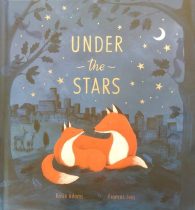
With glowingly gorgeous illustrations by Frances Ives and Rosie Adams’ gentle rhyming narrative that has a repeat refrain: ‘The world is a family: / we are all one, / …….. together / under the sun.’ an adult fox and a little one spend the day exploring and observing together from sunrise, until the stars twinkle and the moon shines bright in the night sky.

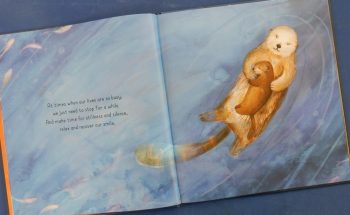
They watch squirrels playing, pause to relax as otter and its little one float on the water.

They listen to the sky humming with the beat of birds’ wings and enjoy their songs. Then in the cool of the forest, bear cubs share their findings, watched by the two foxes;  so too are the deer family and then under the starlit sky the parent fox reminds its cub, and readers, “The world is a family: / we are all one, / United together / under stars, moon and sun.’

Would that this were so, say I.

With its lilting words and beautiful scenes of the natural world, this is a book to read with little ones either at bedtime; or perhaps earlier in the day when there’s more time to talk about the ideas presented.

Shhh! QUIET!

Shhh! QUIET!
Nicola Kinnear
Alison Green Books

Little Fox is a quiet creature, a close observer of the wildlife around her about which she loves to make up stories. The trouble is though that her friends are exceedingly noisy and their boisterous activities drown out all her attempts to regale them with one of her tales.

One day Raccoon becomes aware that Fox is looking especially sad, tells the others to be quiet and asks Fox what’s upsetting her. Happily Owl, Squirrel and Raccoon are all lovers of stories and ask to be told one there and then.

Of course, Fox is ready to oblige and starts her tale of a bear; but no sooner has she spoken the word ‘bear’ than the others are off roaring and pretending to be bears up in a large tree. Back on the ground below Fox notices some claw marks that look suspiciously like those of a real bear.

But are her friends ready to listen? Oh dear me, no: instead they frolic in the river then cavort across a bridge while Fox grows increasingly alarmed.

Will she ever get them to stop and heed her words? And if so, who will listen while she tells her story?

Nicola’s narrative is a super one for adult readers aloud to let rip with, as well as for youngsters to join in with the noisy exuberance of Fox’s friends. This exuberance spills out into her illustrations of the drama and she has included some diverting details including Fox’s book, the minibeasts and Bear’s teddy comforter.

The Leaf Thief

The Leaf Thief
Alice Hemming and Nicola Slater
Scholastic

Much as I hate to admit it, there are already signs that autumn is upon us and yes, it is as Squirrel says at the outset of this story,  ‘a wonderful time of the year’ with the sun shining through the leafy canopy ‘red, gold, orange … ‘

This particular squirrel however, is a highly observant creature for suddenly comes the cry …” one of my leaves is missing! Where is it?’.

So distressed is Squirrel that implications of stealing follow as first Bird

and then Mouse are interrogated, all the while the former attempting to convince Squirrel that it’s merely seasonal change that’s occurring.

The following morning though, with more leaves missing, Squirrel starts up again and after more accusations, little Bird suggests some relaxation techniques.

These at least calm Squirrel temporarily but next day poor Bird is on the receiving end of Squirrel’s ‘leaf thief’ allegations.

It’s time for the frustrated Bird to provide a fuller explanation about this ‘Leaf Thief’ and convince Squirrel once and for all about what has been happening.

Finally Squirrel seems satisfied and heads off for a good night’s sleep. What though will happen the following morning? …

Let’s say no more, except that the finale almost had me spluttering my hot chocolate everywhere.

Actually not the absolute finale, for on that spread Alice gives information about some of the seasonal changes that happen every autumn. Her story, told entirely through dialogue is a smashing one to read aloud (so long as you can manage not to giggle too much).

Nicola’s autumnal scenes provide the perfect complement to the telling, showing with aplomb, the high drama unfolding, and turning the characters into a talented cast of actors no matter whether they’re playing a major or minor role.

Now Wash Your Hands!

Now Wash Your Hands!
Matt Carr
Scholastic

Hand washing was never more important than now during the current COVID-19 crisis and here’s a timely picture book from author/illustrator Matt Carr showing young children the vital importance of keeping their hands super-clean and hopefully free of those invisible nasties aka germs.

This crucial message is delivered in Mrs Moo’s class by a very important visitor, Doctorpus Doris, who talks to the pupils about the vast numbers of ‘TEENY WEENY germs’

and what they can do to send those nasty beasties packing.

The good news is that the way to do it is something as simple as washing their hands thoroughly. Doris gives several examples of times when this is especially a must-do activity. For instance after visiting a farm, working in the garden, using the loo
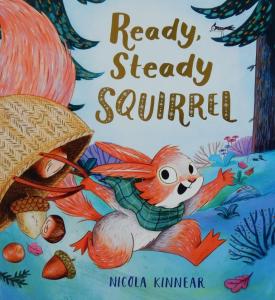
and before having lunch as they all do after her talk. For Doc. Doris this germ-extermination is, of course, a rather protracted process.

With his light touch, bouncy rhyming narrative that includes a song and funky bright illustrations,

Matt delivers what all foundation stage teachers and early years staff will be constantly reminding youngsters to do, ‘NOW WASH YOUR HANDS!’.

To that end this book will be an absolute boon – a must have. (for every copy sold 50p will be donated to NHS charities Together COVID-19 Urgent Appeal). Perhaps our government could add to their list of things to do: buy a copy for every school/nursery to share. Maybe I should tweet the PM and await his response …

Llama Glamarama

Llama Glamarama
Simon James Green and Garry Parsons
Scholastic

You can tell from the cover of this book that one llama at least is going to be deliciously, daringly divergent, and so it proves.

Not in front of his fellow llamas though, for Larry, like the other barn resident llamas, remains calm and rule-abiding by day.

Under the cover of dark however while the others are fast asleep, he dons his glamour gear and leaps into action with his iconic dance moves.

One night, as he’s twisting and stamping with gay abandon

flouting all llama laws, he realises someone is coming.

It’s not just one someone though; Larry is confronted by three incredulous llamas and pretty soon the game is up.
Rather than face the music Larry decides to disappear

and as he wanders disconsolately along he contemplates quitting the whole dance thing. But then he comes upon a sign that changes his mind.

After a joyous day grooving and hip-hopping among other like-minded creatures at the dance extravaganza, Larry returns to the barn, to own up and face the music with pride.

The reception he receives isn’t quite what he is expecting however …

What a simply splendid celebration of being yourself, being different and being proud of who you are. Bursting with joy and exuberant colour, Garry’s illustrations perfectly complement Simon’s fabulously funky rhyming story that is an absolute joy to read aloud.

A wonderfully affirmative book to share as widely as possible.

Early Years Bookshelf: Moon and Me / All Around Me: A First Book of Childhood

Moon and Me
Andrew Davenport and Mariko Umeda
Scholastic

Not being familiar with the TV programmes I watched an episode and with its generous sprinkling of ‘tiddle toddle’s, it certainly does have some of the magic of the Teletubbies and In the Night Garden.

What we have in this book is a sequence of episodes starting with Pepi Nana’s sending of a magical letter to the moon that results in a visit from Moon Baby and his magical kalimba; and thus she makes a new friend.

Once at Pepi Nana’s Toy House he wakes her friends with his music: for the uninitiated they are Mr Onion, Colly Wobble, Sleepy Dibillo, Little Nana, Lambkin and Lily Plant. They create tissue paper flowers from the resources in the curiosity box and one ends up looking like a seed that becomes the inspiration for the next Storyland tale wherein ‘Tiddle toddle’ Pepi Nana’s magical seed grows into a large beanstalk which everybody climbs

and there they see something wonderful.

And so it continues until finally, it’s time for sleep and for their visitor to return to the moon.

There are songs to learn and the repeated “And I think she was right about that’ to join in with, as well as a lot of playing of Moon Baby’s magical kalimba.

If your little ones enjoy the Moon and Me CBeebies series then I suspect they’ll love this attractively presented, whimsical picture book.

All Around Me: A First Book of Childhood
Shirley Hughes
Walker Books

Putting together five previously published books, this is the most delightful children’s collection of basic concepts done with genius as only Shirley Hughes can.

Enormous fun and wonderfully engaging for little ones, we’re shown the world of childhood through the eyes of Katie and her smaller brother, Olly.

Whether it’s the rhyming look at Opposites; the story of an outing (Grandpa and Katie) to the park that provides a superb opportunity for Counting; Colours identified through wondrous scenes and accompanying rhymes;

the enchanting visual presentation of All Shapes and Sizes, again with accompanying rhymes; or cacophonous Sounds alongside some gentler ones, each section offers sheer pleasure (and some gentle learning) at every page turn.

If you have a little one or know others who have, then this is for you. Equally it’s a classic to add to a nursery or playschool collection.

A Dog’s Tale

A Dog’s Tale
Michael Rosen and Tony Ross
Scholastic

Full of worldly wisdom, is this rhyming discourse from an old dog to a concerned pup as the two take a walk together.

Reassuring from the outset, ‘an epic life story that YOU get to write. … Be wide-open hearted … Fill up on hope, throw away fears’ comes the advice.

Life promises plenty of action …

no matter where your journey takes you … and opportunities – ‘you can make a mark! Make yourself heard –‘ although it’s important to be prepared for life’s downsides too – those waiting in the wings to do you down; or you might suffer the loss of a loved one.

However nobody need feel completely alone; there’ll be a friend to help you through times of sadness.

Perhaps a time will come when others will require your help; give and take is the best scenario. What we all need be we young, old or in-between, is a world where everyone is willing to share, a world where life is fair.

So says the sage old canine after which he retires for a well-earned snooze.

If only: we still have an awful long way to go but this book from two pillars of children’s books and reading, writer Michael and artist Tony, is a great reminder of what we should all be striving for. I’m no lover of dogs but I certainly fell for Michael’s canine characters as portrayed by Tony Ross in his superbly expressive scenes.

Share, discuss and act upon the advice herein wherever, whenever possible.

Willbee the Bumblebee

Willbee the Bumblebee
Craig Smith, Maureen Thomson and Katz Cowley
Scholastic

A plug for bees and a slightly crazy story of an unravelling black and yellow jersey belonging to one particular buzzy bumblebee named Willbee are knitted together in this rhyming story endearingly portrayed by Katz Cowley.

One day while out and about foraging Willbee snags his jersey on a rose thorn and as he flies away, the jersey gradually unravels until his bare bum is exposed. The now decidedly chilly little insect has to remain unprotected in the garden as he’s too cold to fly home.
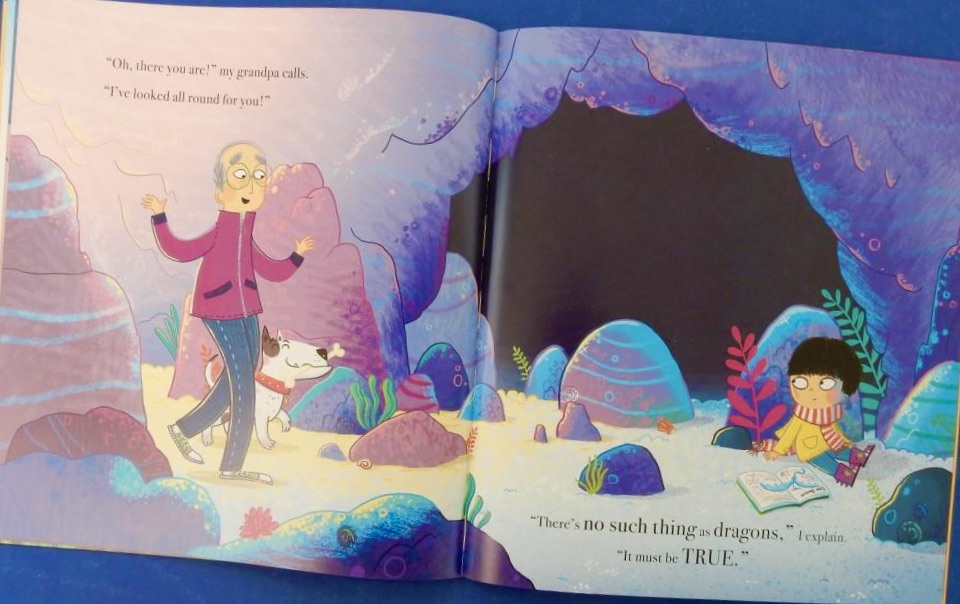
Alone and scared humless, he’s spotted by kindly butterfly, Monica who flies down to his aid. She frees the wool and takes it off to spider Steve who agrees to weave the yarn into a brand new jersey for Willbee; and so he does. Back to Willbee flies Moni with the jersey.

Donning his new garment at super fast speed, Wilbee revives, gets back his hum, rewarms his bum, gives thanks to his benefactors and buzzes off happily home to his mum.

A fun, giggle inducing read aloud to share with little ones at home or in an early years setting.

Rocketmole

Rocketmole
Matt Carr
Scholastic

Armstrong the star-nosed mole finds his subterranean life boring. But Armstrong is an inventive fellow with a thirst for adventure who likes to keep his sights fixed skywards; and to this end (or rather beginning) he builds himself a telescope and some special specs.

When he announces to his pals that he’s going to visit the moon they’re totally discouraging. Danger is no deterrent to Armstrong though and after a rather bumpy start, our daring mole has built himself an enormous rocket that impresses even the naysayers when they pop their heads up to watch the countdown.

Following an arduous journey with trials and tribulations including tea drinking and loo-going, our space-creature makes his lunar landing, taking ‘one giant leap for a mole!’

The very first lunar-visiting mole is basking in starlit glory.

His exaltation though, is short-lived: the moon is, let’s say, boring; it lacks atmosphere.

Dwarfed by the moon’s size, Armstrong feels totally insignificant.

As he sits trying in vain to eat a spot of lunch, he looks earthwards and feels homesick.

There’s just one way to go – back home.

And who should be waiting for him but a welcoming party of his moley pals who have summoned up sufficient courage to come above ground and pay tribute to the inspiring Armstrong.

Over cake and cups of fizz (or maybe juice) their hero announces that he now wants to see the world, but not alone. With newfound daring, his fellow moles agree to accompany him, precipitating a light bulb moment in Armstrong.

Let operation world tour commence …

Out of this world crazy, the entire book is replete with groan-worthy humour though the final tour spread really beats the rest for bonkersness.

Using his characteristic primary colours plus black and white, (don’t miss the front endpapers) Matt’s scenes are a wonderful amalgam of pictures and text, full of puns and spaced-out soppiness that this particular reviewer was absolutely swept away by.

Daisy and Bear

Daisy and Bear
Fabi Santiago
Scholastic

Take your seats alongside Bear and his human friend Daisy as they pay a visit to the cinema for a Sunday afternoon treat. The perfect place to go for a first experience of soft comfy seats, big velvet curtains and yummy warm popcorn, you might think.

Potentially yes, but however comfy the seats appear, it’s important to remember to pay a visit to the loo before the film starts.

And creating lots of noise during the performance is also a big no, no, be that with super-crunchy popcorn, deliciously slurpy fizzy drinks or …

This however, is only the precursor to the show-stopping distraction caused by our mega enthusiastic ursine friend …

On his own admission he should never have set a paw in the cinema; Bear is down-hearted for a short while but then … light bulb moment! Can he make recompense where the rest of the audience is concerned? Well maybe …

This is a delight from beginning to end and I don’t mean the movie: Fabi’s latest story is in itself a smashing performance that unfolds like a cinematic comedy.

Two of my story enthusiasts were so taken with the book that they constructed a den/cinema and disappeared inside to read it again.

Sticky

Sticky
Anna Doherty
Scholastic

When it comes to wrapping presents some of us are highly skilled and manage to make wonderfully inviting packages; others make a mess of things.

Badger, certainly on this occasion, is one of the latter. His efforts at wrapping Owl’s birthday gift are thwarted by a particularly sticky roll of tape that no matter how hard he tries, only becomes more and more entangled.

Along comes Deer with an offer of a helping hoof but things do not go well … and despite his claims, Rabbit’s eager assistance does not live up to his assertions.

So what about Mouse’s paw? Or the endeavours of Fox, Snake and Bear? All equally, sticklily, unsuccessful.

Enter Owl who is duly informed of his present. There follows a massive peeling, tugging, pulling, nibbling effort on the part of all the animals and finally hurrah!

The perfect present is revealed for which the recipient is duly thankful and thereafter Badger sets off home with an idea in his head …

Slapstick comedy from start to finish, Anna Doherty’s debut picture book will have young listeners chortling with delight over the animals’ antics and demanding an action replay as you close the book.

Anna is a new talent I shall watch with interest.