Find My Rocket / Elephants on Tour / Egypt Magnified

Find My Rocket
Aleksandra Artymowska
Laurence King Publishing

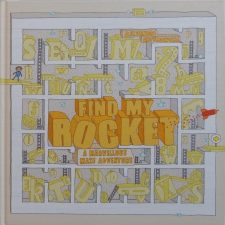
Aleksandra Artymowska is a terrific illustrator; I first came across her amazing work through another maze book, Amazed. Now it looks as though the same boy from that book has returned needing help in another puzzling adventure. This time having sent his red rocket jetting off into space he needs our help to locate it in eleven differently themed maze scenes. It’s easy enough for readers to spot the whizzing spacecraft but finding the right way through the intricately detailed possible pathways presents a real puzzler.

Every one of Aleksandra’s scenes be it the paper cranes, the building blocks, the toolbox or the teddies,

is packed with wonderful small objects, visual jokes and more – love the alliterative manoeuvres the lad performs during his search– catapulted through the cars, dodged all the dominoes, for instance, before he finally succeeds in retrieving the object he launched.

A great book to immerse oneself in as the evenings draw in; if you’ve yet to discover Aleksandra Artymowska, then this is a great place to start.

Elephants on Tour
Guillaume Cornet
Laurence King Publishing

Having packed their trunks, five elephants are ready to embark on a world tour and we’re invited. First though we need to get to know something about our fellow adventurers: there’s the highly organised guy with his bags full of maps and tickets. He’s accompanied by a food connoisseur; the arty one, the photographer and the energetic one who insists on taking his skateboard along.

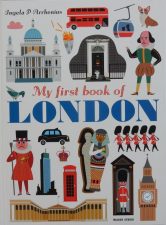
Having done London aboard a red double decker, the next port of call is Amsterdam with its canals and cycle lanes to explore. No doubt they sampled the syrupy waffles, a speciality of the city.

I’m sure they would also have tried the blinis in St. Petersburg and kayaked along one of the rivers or taken a ride on the Mongolian railway.

After visiting sixteen locations on five continents the final stop in their frenetic journey before returning to home shores, is Paris.

Along the way we receive a running commentary from the five travellers and for each location a fact file and other useful information. We’ll definitely need all that because at the outset, we are asked to make sure we find each of the elephants and their favourite belongings at every stopping place. No easy task with so much to look at. (Answers are supplied at the end of the tour.) My head is spinning after that.

With Guillaume Cornet’s intricately detailed scenes, this search and find journey is totally engrossing; those cityscapes are mind-boggling.

Egypt Magnified
David Long and Harry Bloom
Wide Eyed Editions

One possible way to get youngsters interested in times past, especially those who can’t get enough search-and-find books is this offering from Long and Bloom. Readers are invited to travel back through the centuries and visit sixteen Egyptian scenes, including the Great Pyramid and Tutankhamun’s tomb that are absolutely teeming with tiny figures.

Once in ancient Egypt, there are  ten items or people to spot in each illustration and on reaching the end, readers are encouraged to go back and hunt for another 57, plus a hidden mummy on every spread. (There’s a magnifying glass to facilitate the search inside the front cover, because, so we’re told, every Egyptologist needs one.)

The Mud Monster

The Mud Monster
Jonnie Wild and Brita Granström
Otter-Barry Books

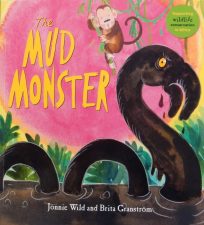
What on earth is the terrible mud monster that is sending all the animals into a panic? Despite the fact that not a single one of them has seen it, they know for sure it’s huge and horrible.

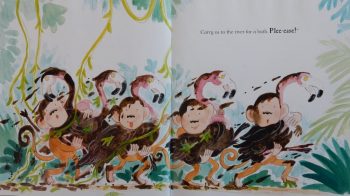
One day as the monkeys are playing among the creepers they spy something: “Help! It’s the mud monster!” comes the cry. Despite being covered in mud, it isn’t a monster, merely five flamingos, mire-bespattered and desperately in need of a bath in the river. The monkeys are happy to carry them there.

They’re not the only animals to ‘see’ the Mud Monster though. Warthog and rhinoceros also mistakenly identify the moving creature as that which they fear before they too join the throng heading to the river.

When they finally reach their destination, there before them is something huge and exceedingly muddy: surely it couldn’t be that which they dread …

Hilariously illustrated and full of fun, this second tale set in the African rainforest to feature the five flamingos, is one of teamwork and overcoming imaginary fears, and comes from Jonnie and Brita, two people who have a special interest in Africa and its wildlife. Jonnie’s royalties are donated to support conservation projects in Africa, details of which are given at the back of the book.

You’re Snug With Me

You’re Snug With Me
Chitra Sounder and Poonam Mistry
Lantana Publishing

Chitra Soundar sets the follow up the You’re Safe With Me in the wintry wilds of the Arctic.

Her tale of care and protection begins in a den dug into a snowdrift by Mother Bear where she gives birth to two cubs.

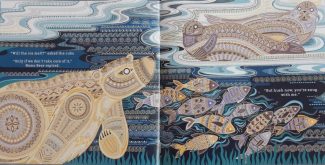
As they grow they become more curious: “What lies beyond here?” they ask. Their mother tells them of the frozen lands without, lands where, thanks to the hard snow, it’s safe for them to walk; but “only where the land will let us walk . .. “But hush now, you’re snug with me.”

Longer nights bring restlessness to the growing cubs and a reassurance that “As long as the ice stays frozen, we will never go hungry.”

From then on, Mother Bear gently teaches her little ones about the importance of maintaining the delicate balance of nature: the ice will only melt “if we don’t take care of it.” …

“We should only take what we need.”

In between times she answers their questions, telling of the approaching spring; of Earth’s place in the cosmos and the other animals they share the land with. All the while punctuating her lessons with the reassuring refrain, “But hush now, you’re snug with me.”

By the time there’s a whiff of spring in the air outside. Mother Bear has taught her cubs all she knows, thus preparing them for their independence.

Now it’s time to venture outside and welcome the new spring – Mother and cubs together.

The environmental message is soft spoken in Chitra’s mellifluous text but she adds a final page spelling out her hopes that readers will take on a stewardship role when it comes to caring for our precious planet. We’re also given some additional information about polar bears and I was surprised to learn that new- born cubs are only the size of guinea pigs.
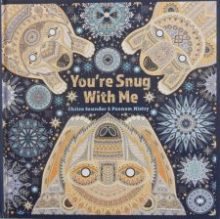
Inspired, I think, by Indian folk art patterns and repetitive block print motifs, such is the mesmeric quality of Poonam’s intricately patterned images that you find yourself transfixed by every spread and her colour palette is absolutely gorgeous.
Picture books don’t get more beautiful than this.

A winter blanket, a hot chilli chocolate and Chitra and Poonam’s book – bliss on a chilly day.

Little Wise Wolf

Little Wise Wolf
Gijs van der Hammen and Hanneke Siemensma
Book Island

Little Wolf is renowned for his wisdom and it makes him proud. He’s so busy studying that he has no time to answer the questions of others.

One day he receives a visitor: it’s the king’s crow bearing a message from his highness. The king is ill and believes that only Wise Wolf can make him better.

Reluctantly he agrees setting out next morning on his bicycle. The other animals are concerned about the distance Little Wolf must travel.

The journey is very long and the terrain hilly. Little Wolf abandons his bike and watched by several pairs of eyes, continues on foot.

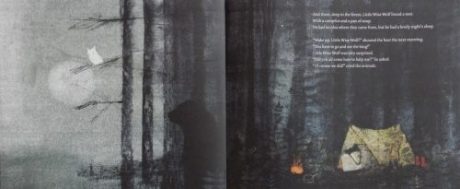
Come nightfall he’s exhausted, cold and very hungry; but even worse, he’s lost. On the point of despair he notices a light in the distance. It’s coming from the campfire outside a tent and bubbling away is a pot of soup.

Sated, Little Wolf falls fast asleep.

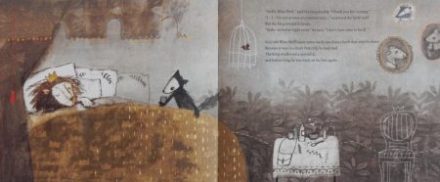
Next morning another surprise awaits: it’s the other animals. They encourage Little Wolf to continue alone and eventually, totally worn out, he reaches the castle gate and after some persuasion, enters the king’s bedchamber.

A single spoonful of Little Wise Wolf’s herbal medicine is all that’s required to cure the patient.

The grateful king makes him a tempting offer but his decision to turn it down and return to his friends, whom he acknowledges have much to teach him, shows that Little Wolf now truly does deserve to be called wise.

Wise words too from the author: for a bibliophile it is all too easy to become engrossed in books and decide one is too busy for other things and that spoke to me; but what I enjoyed particularly was Hanneke Siemensma’s art.

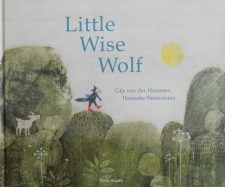
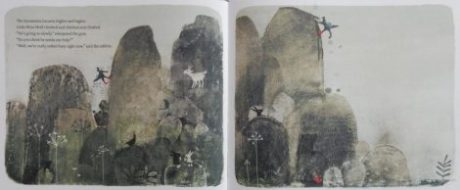
Using a largely muted colour palette, she portrays the red-booted lupine’s journey to real wisdom in a series of wonderful spreads, each of which offers details to amuse and delight. In addition to the standout red wellies that draw the eye immediately, there is a white dotted line tracking the path Little Wolf takes. Peer into the depths of each scene and you’ll discover much more.

Rama and Sita

Rama and Sita
Malachy Doyle and Christopher Corr
Bloomsbury Education

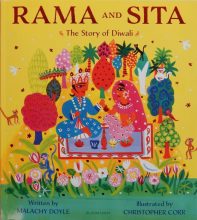
Every autumn term countless teachers in primary schools share the story of Diwali with their classes. This retelling with Christopher Corr’s vibrant folk art style illustrations and Malachy Doyle’s straightforward narrative is an ideal introduction that really brings to life the ancient Hindu tale of the victory of light over dark.

It recounts how living in exile Rama and his wife Sita are tricked by the demon king Ravanna who wants Sita for himself. He sends a deer into the forest and Rama follows it at his wife’s request leaving Sita alone.

In his absence, Ravanna kidnaps Sita and takes her away to his island kingdom.

When Rama realises he’s been duped, he resolves to rescue his beloved wife and as luck would have it Hanuman the monkey king comes to his assistance.

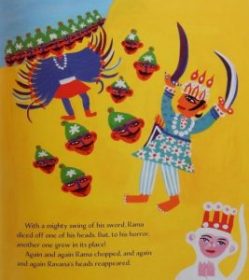
With the help of Hanuman and his monkey army, who build a bridge across from the mainland, Rama rescues Sita from the island whereon Ravanna is holding her prisoner. First though, a terrible battle is fought on that island between the monkey army and the wicked demon army until finally an arrow from Rama’s bow pierces the chest of the ten-headed demon Ravanna who falls down dead.

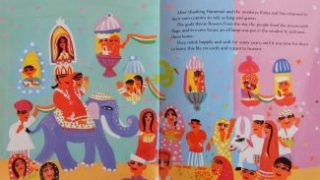
With Sita safe once more, the fighting is called to a halt and the reunited couple return to a huge welcome in their homeland

where divas are lit everywhere in honour of their homecoming.

During my time as a teacher I’ve collected several beautiful picture book tellings of the Diwali story that are now sadly out of print, so it’s great to see this new one.

The Antlered Ship

The Antlered Ship
Dashka Slater and The Fan Brothers
Lincoln Children’s Books

Fox Marco has an insatiable appetite for knowledge: ‘Why don’t trees ever talk? How deep does the sun go when it sinks into the sea?’ he wonders while his fellow foxes merely ponder upon the nature of their next meal.

When a huge antlered ship docks at the harbour, Marco goes down to the waterside where he discovers from crew members that the ship has got lost (they admit to being poor sailors).

Intent on discovering more foxes to answer his questions, Marco, along with a flock of pigeons, joins the crew

and they embark on a voyage bound for an island upon which tall, sweet grass and short, sweet trees grow.

Their journey is hard: the sailors battle against stormy weather, their own fears and meagre rations. Days of drifting dampen their enthusiasm for adventure and it’s left to Marco to keep up the spirits of his fellow travellers.

Finally though, having fended off a pirate attack,

the ship reaches the island. Thereon his fellow crew members sate their appetites for sweet things but Marco’s hunt for foxes yields not a single one.

Instead though he does make some important discoveries and draws some conclusions about the nature of friendship and community, asking questions and seeking answers.

As with The Night Gardener and The Darkest Night, the Fan Brothers attention to detail in their pen and pencil illustrations is immaculate. Be they seascapes or portrayals of the happenings below deck, there’s a crepuscular quality about many of their richly textured scenes, while those on the island take on the brighter verdant hues of the animals’ surroundings.

Dashka Slater’s is a story to get lost in, and one to provoke questions of the philosophical kind among thoughtful readers and listeners. Who can but marvel at the artistic brilliance of Eric and Terry Fan and delight in the portrayal of such characters as the peg-legged, red bandana sporting pigeon?

Door

Door
JiHyeon Lee
Chronicle Books

I loved JiHyeon Lee’s debut Pool and this story too is wordless or virtually so.

It begins with a boy finding a key and following a flying insect through miserable-looking humans to a door.
Having turned the key and ventured forth he finds himself in a new world populated by strange-looking creatures, the first being one carrying a large musical instrument case. Alarmed, the lad runs off …

only to encounter another creature, who also speaks to him.

Overcoming his initial alarm, the boy allows her to take his hand and lead him to join a group of picnickers.

After partaking of some food, the boy swings,

climbs trees and generally has a fabulous time, as more doors appear through which many more creatures enter.

One of them is a bride and then we discover where everyone has been heading: a very special celebration.

Differences in language and kind matter not: all are welcome at this joyful occasion so wonderfully depicted in Lee’s intricately detailed, enchantingly whimsical scenes. The speech bubbles show many different languages being spoken but the understanding comes not through the words, rather it’s the inclusive, all-embracing attitude of the creatures that speaks of open-heartedness and warmth.

Observant readers will notice that as the story progresses, the boy’s appearance changes from a frightened grey to rosy, full colour.

Alice’s Wonderland Tea Party

Alice’s Wonderland Tea Party
Poppy Bishop and Laura Brenlla
Little Tiger

Poppy Bishop and Laura Brenlla present a new take on a classic tale.

Welcome to Alice’s tea party. Unlike that thrown by the Mad Hatter, she wants hers to be just perfect. No unexpected shrinking, growing or any other such craziness, just full of sweet things to eat.

As some of her guests sit at the table in comes White Rabbit announcing he indeed, has “something sweet to eat.” His insistence that clocks, especially those sprinkled with sugar and dipped in tea, will be absolutely yummy is met with scorn by the host.

She’s equally unimpressed with Dodo’s upside down cake

and Cheshire Cat’s vanishing pie and she’s certainly not intending to sample any of the tarts proffered by the Knave of Hearts, especially as the Queen of Hearts is hot on his trail.

Tums are all a-rumble when the Last Cook and Duchess arrive with a large plate of chocolate eclairs with a secret ingredient – uh! oh!

Alice’s “This is the silliest tea party ever” comment is bang on; but then Caterpillar turns up clutching cupcakes – something normal at last, thinks Alice settling to the now TERRIBLY ordinary tea party. But …

All our favourite characters are included, (the Cheshire cat is up to his usual vanishing and re-appearing trick as always) wonderfully portrayed by Laura in zesty vintage style. Every scene is sure to make you laugh, and there are flaps and cutaways to add to the enjoyment.

I’d definitely accept Alice’s invitation inside the front cover; this interactive experience is great fun.

Early Years Assortment: Where’s Mr Penguin? / Monsters Go Night-Night / Balance the Birds

Where’s Mr Penguin?
Ingela P Arrhenius
Nosy Crow

Just right for sharing with the very youngest is this new addition to the Nosy Crow felt flaps series splendidly illustrated by Ingela P Arrhenius.

Infants will be immediately attracted by her colourful art and be enchanted to join in the game of hide-and-seek to find the missing animals – Mrs Seal, Mr Seagull, Mrs Whale and Mr Penguin that have tucked themselves neatly behind the bright, shaped felt flaps before seeing themselves in the final spread.

Monsters Go Night-Night
Aaron Zenz
Abrams

As you might expect, the bedtime routine for little monsters isn’t quite the same as that of little humans. Yes they do have an evening snack, bath, don their night attire, find something to snuggle up with, clean their teeth, use the potty (yes they’re like little humans in this respect) and they do love their ‘night-night kisses; but bedtime feasting after they’ve cleaned those teeth, now that is not such a good idea.

The seven little monsters certainly do have a lot of fun in this participatory guessing game story. Let’s hope it doesn’t put ridiculous ideas into the heads of little humans though. Sleep inducing, it definitely is not.

Balance the Birds
Susie Ghahremani
Abrams Appleseed

Following her Stack the Cats, Susie Ghahremani presents youngsters with another mathematical observing/thinking game.
To get the most from it I’d suggest having read the title and the opening page, that the adult pauses to give children time to do their own thinking before turning the page to reveal how the birds settle.

Their equilibrium however is soon upset by a pesky squirrel that sends half of the feathered creatures flying, leaving the branches unbalanced unless they rearrange themselves.

Another squirrel sighting then causes the hasty departure of three of the four remaining birds. Along comes an owl: now what? Certainly it’s much too heavy to balance the single remaining little blue bird.

With the advent of each new intruder, the balance becomes far more of a challenge to young humans who will likely enjoy observing the chain of events in all its colourful glory without becoming too bogged down in the mathematical concepts.

A simple balance, some small toys of equal weights and a larger one, will clarify things.

The Very Last Castle

The Very Last Castle
Travis Jonker and Mark Pett
Abrams Books for Young Readers

In the centre of a small town stands a castle, the very last castle. Every day Ibb walks past it and notices up in a turret, the guard watching the passers by.

Speculations are rife about who or what is within. Could it be monsters, or giants; snakes even?

They certainly make snaps, thuds and hisses. Ibb however is ready to be more open minded “Maybe it’s something terrible … but maybe it’s something else,” she thinks. She decides to investigate but what happens makes her run away in fright.

Shortly after she receives an invitation. Stay away comes the advice, but come Sunday Ibb ventures forth and does something nobody else in her town has done: she enters the grounds.

What she discovers isn’t monsters, giants or snakes: a warm welcome from the guard awaits. He shows her around and finally reveals what he wants – someone brave and curious to take his place.

Ever thoughtful, Ibb agrees but with a proviso and eventually the castle grounds become a welcoming place for everyone.

Beautiful illustrations by Mark Pett in pen and ink and watercolour, combined with Travis Jonker’s spare text create a lovely tale of curiosity, courage, reaching out and creating community.

Peter Pan

Peter Pan
J.M.Barrie, Caryl Hart and Sarah Warburton
Nosy Crow

Caryl Hart retells in rhyme, the ever-popular J.M. Barrie classic Peter Pan, the boy who wanted never to grow up, making it a truly magical experience for children long before they’re able to read the original for themselves.

And to keep up the rhyme so superbly well making it easy on the ear and a pleasure to read aloud – all seventy odd pages of it – is something of a mammoth achievement.

Right from the gorgeous silver embossed cover you know this book is going to be something special and Caryl’s wonderful telling in combination with Sarah’s gorgeous, brilliantly expressive illustrations make it truly that. The characterisation is terrific and every scene worth lingering over.

“Second to the right!” they cried. “Then straight on until morning!” If you start reading this with a child at bedtime, you may well find that enchantment prevails and straight on till morning is exactly what happens.

I love everything about this book and what a smashing present it would make this Christmas season.

Good Morning, Neighbour

Good Morning, Neighbour
Davide Cali and Maria Dek
Princeton Architectural Press

It all begins when Mouse decides to make an omelette, the problem being he lacks an egg. Mouse asks his neighbour Blackbird.

Blackbird doesn’t have one but offers flour and the suggestion they make a cake. They both call on Dormouse but instead of an egg, Dormouse provides butter for the cake and suggests they find Mole who has sugar – still no egg however.

Could Hedgehog oblige perhaps. The animals roll up at his home and ask.

No luck; and so it continues as the group adds fruit, cinnamon (for flavour) and raisins to their list of ingredients but as yet not that elusive egg.

Thank goodness then for Bat.

The culinary activities begin with all the animals doing their bit.

Now who can offer the use of an oven? Owl obliges and the cake is duly ready to eat.

“How many slices should I cut?” asks Owl. All who contributed an ingredient must surely get a piece but what about Mouse. Surely he won’t be left out; or will he?

Young listeners and readers will delightedly join in with the growing list of animals as well as the “Good morning, neighbour,” refrain.

Davide Cali’s tale of collaborative endeavour is illustrated in rather charming folk-art style watercolour illustrations that embody the feeling of camaraderie that exists among the forest animals and in the end the ingredients of warmth, friendship and teamwork that contribute towards its making are as important as the edible ones that go into the cake.

A tasty tale and a great lesson in co-operation and sharing that provides plenty of food for thought.

The Way Home for Wolf

The Way Home for Wolf
Rachel Bright and Jim Field
Orchard Books

Fiercely independent, little wolfling Wilf considers himself big, strong and tough, so when it’s time for the wolves to find themselves a new cave, he’s eager to lead the way. “One day,” comes the response from the others.

Their journey through the snowy arctic tundra is a struggle for all members of the pack but despite his strong will, Wilf struggles to keep up finding the gap between himself and the adults growing ever larger until exhausted and out of breath, he loses his way in a blizzard. Too proud and indeed hoarse to howl for help he’s forced to spend the night alone beneath the stars.

Suddenly the ice beneath him shatters sending him cascading into the chill inky depths.

Rather than the end he fears, Wilf finds himself being rescued by a sea unicorn (narwhal) that takes him safely back to shore.
From there a host of other arctic animals, large and small, assist the little creature

until finally he’s reunited with his pack.

Thankful to all his rescuers, Wilf makes them a promise, “If ever I meet one who’s strayed off their track, / I’ll help them along by guiding them back.”

Wilf’s journey, both emotional and physical is truly testing, indeed too much for the young wolf to cope with alone.

Rachel Bright’s narrative style, at times poetic and at times matter-of-fact, allows young humans to come to an understanding that there are times when asking for help is exactly the right thing to do; and that team work is as important as going it alone, often more so.

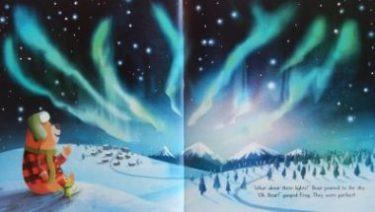
Jim Field’s illustrations rendered in hues of indigo, white, cream, purple, silver and brown have a luminosity that invokes a sense of awe and wonder, making the arctic tundra a truly beautiful mystical place imbued with its own natural magic. I absolutely love the way the essence of the animals is shown in the aurora borealis both when Wilf is lost and when he’s safe once more.

A beautiful book to share and to return to, over and over.

Storm

Storm
Sam Usher
Templar Publishing

The fourth of Sam Usher’s series of picture books about a little boy and his grandfather continues to celebrate their special relationship.

It’s a very blustery autumn morning and when the little boy wakes up he sees leaves flying, dancing and tumbling down.

Eager to get outside, he calls his Grandad who suggests flying a kite. First though they have to find it.
During their search they rediscover several items – a cricket bat, letters and a telescope that bring back memories of previous adventures – until finally, they find the kite.

Off they set under a stormy-looking sky to the park

where they discover lots of other kite fliers. “Hold on tight,” calls Grandad as their fantasy adventure begins.

Up, up, up they go swooping and twisting as the sky is filled with an amazing, colourful array of kites of all different  shapes and patterns.

The wind intensifies and the boy lets go of the kite string. Luckily though, Grandad catches it “There’s a storm brewing!

Let’s head for home,” he urges and they do.

Back indoors, as the storm rages outside, they share some tea and Grandad declares, “The best adventure is an adventure shared.” And so it is, just like the one herein: what better prelude to a kite-flying foray than this.

With russet, gold, orange and brown hues, and a darkening grey, Sam Usher’s watercolour and ink illustrations  capture so well both the trees’ autumnal foliage and the brooding nature of the storm.

Interrupting Chicken and the Elephant of Surprise

Interrupting Chicken and the Elephant of Surprise
David Ezra Stein
Walker Books

Little Chicken is back and she’s full of what she’s just learned at school. “My teacher told us every story has an elephant of surprise” she says excitedly. Papa puts her right, responding, “She was talking about an element of surprise,” and goes on to explain.
Papa shares stories with her to prove his point but Chicken remains unconvinced and eager to find those surprising elephants.

Needless to say she manages to do so; first in The Ugly Duckling, then Rapunzel and finally, The Little Mermaid.
Each time Papa opens the storybook, Stein changes his illustrative style. Instead of the bright warm tones of their abode, his story scenes are rendered in sepia pen and ink

into which at the appropriate time, he drops a friendly-looking little blue elephant.

In a final story – one penned by Papa and deftly illustrated by Chicken – despite Papa’s best efforts to prevent it, that elephant of surprise puts in an appearance there too. Seems there’s no getting away from the little pachyderm.

This sequel to Interrupting Chicken had me spluttering with delight from the outset and the fun cleverly built up throughout the story. Who wouldn’t be in fits of giggles over that baby blue elephant, first with feathered swan-like wings, then wearing very long plaits and finally, a grass skirt and coconut bra. (I had to put my coffee aside for fear of sending it flying as hysterics overtook me at that sight.)
Another absolutely cracking metafictive tale to delight both adult story readers and young listeners alike. It also has great classroom potential.

My Friend Sleep

My Friend Sleep
Laura Baker and Hannah Peck
Words & Pictures

A little girl narrator takes a magical journey in the company of her friend and nocturnal companion, Sleep. “Come with me, my friend, take hold of my hand. / Together we’ll travel through night’s dreamland” he calls.
They visit such amazing places as a land full of sweets where the clouds are of candyfloss, crystal jellies glisten in the moonlight and sweet dewy berries exude their scent.

Full to capacity, it’s time to move on: Sleep sings again and the two continue their journey to a strange fairground where, aboard a strange craft on a big wheel they’re lifted skyward while down below, dinosaurs romp and aliens dance.

Then between the stars comes a huge dragon upon whose back they leap at Sleep’s behest.
Through the clouds, looping and swirling fly dragon, child and Sleep …

till the dragon drops them off at the entrance to a gloomy cave.
Once more come Sleep’s friendly, reassuring words making the darkness feel less scary. Till, full of menace a monster looms,

but again Sleep is there to proffer help by way of a magic wand to shrink the monster and turn it into a friendly little thing.

Now fly back, they must, child and Sleep through the starry night sky; back into the bedroom once more before the girl wakes to a memory of dreams in time for all that day will bring.

Spellbinding images conjured up in words and pictures (love the colour palette) create a somnolent picture book dreamscape for bedtime sharing.  The storybook encounters with things happy, thrilling and scary, should help little ones overcome any nighttime fears they might have from time to time.

The Secret of the Egg / Amazing Animal Babies

The Secret of the Egg
Nicola Davies and Abbie Cameron
Graffeg

What a cracking book this is; the first one I’ve seen in this series by zoologist, poet and author, Nicola Davies and illustrator Abbie Cameron.

Through a highly engaging rhyming narrative, Nicola introduces children to animal eggs of all shapes and sizes;

eggs that might be found in puddles or high in a tree; those you might have to dig for, or search in the sea or pond to discover. There are reptiles’ eggs, birds’ eggs, amphibians’ eggs, fishes’ eggs, even mammalian eggs.

With the exception of the platypus, none of the creatures featured are named so identifying whose eggs are whose is left to Abbie Cameron’s richly detailed, painterly pictures so adult assistance or some additional research may be needed.

This would make a great way to introduce a ‘new life’ topic to young children.

Amazing Animal Babies
Aina Bestard
Thames & Hudson

Animals large and animals small, from various parts of the world feature in Aina Bestard’s book.
Using as many as six intricately detailed transparent overlays the author/illustrator documents in words and aptly coloured visual images, how each animal produces and rears its young.

Herein readers will discover that the penguin parents, as well as the other members of a penguin colony play a part in the rearing of penguin chicks but it’s the Dad penguin that keeps the egg warm while Mum penguin goes off searching the ocean for food. After a chick is hatched however, both parents take turns to find food until their little one can care for itself.

In contrast, having found a safe place to lay her eggs, a mother tortoise leaves them alone to hatch and feed on the surrounding vegetation.

Once they’re laid it’s the father seahorse that takes care of the eggs inside his pouch, whereas with the kangaroo, the baby kangaroo is kept safe in its mother’s pouch.

The monarch butterfly and the common toad never meet their parents and grow up entirely on their own.

The final animal, the blue whale is reared on its mother’s milk, sometimes with the help of other whales.

The illustrations are exquisite and the narrative chatty: prepare to be amazed as you turn the pages of this fascinating book.

All Except Winston / Good Rosie!

All Except Winston
Rochelle Brunton and Nicoletta Bertelle
Ragged Bears
Young giraffe Winston is left out no matter whether the other giraffes are eating, drinking, playing their favourite game or sleeping. Winston does all these things alone.

Then one day when all the other giraffes are so busy grazing on yummy fruits high in the treetops, he hears a sound. His fellow long-necks ignore the rustle and the snap but Winston lets out a very loud, shrill whistle just in time to warn the others that a lion is on the prowl, hungry for its next meal.

Off they all dash for safety – just in time
Now Winston is ignored no longer; instead he’s a hero.

This seemingly simple story with it’s themes of celebrating difference and finding where you fit into a group is ideal for young children who have just started school or nursery, especially those who like Winston at the start of the book have yet to find out where they fit in.

Nicoletta Bertelle’s richly coloured, textured scenes reflect the glow of the savannah setting adding further warmth to Rochelle Brunton’s gentle telling.

Good Rosie!
Kate DiCamillo and Harry Bliss
Walker Books

Rosie is a terrier who lives with her owner George. She loves her owner but is eager to find another friend of the canine kind: (her reflection in her empty food bowl never answers).

On their daily walks together George and Rosie look at the clouds and one day George points out a dog-shaped one; this saddens Rosie so George suggests something new.

That something is the dog park but Rosie is overwhelmed by their sheer number and doesn’t know how to make friends; she feels a little afraid. Then she meets first Maurice a large Saint Bernard, then bouncy Chihuahua, Fifi. Initially she doesn’t like either of them, but then something happens to change all that.

Then it’s down to little Fif (what happens results in a name change for the Chihuahua) to demonstrate how to make a friend and before the end of the day, the three dogs are best pals and Rosie has something to look forward to on future walks with her human.

This warm-hearted, thoughtful, gently funny story presented in nine parts, is a neat blend of picture book and graphic novel: Harry Bliss’s humorous illustrations contrast nicely with Kate DiCamillo’s understated text in what is an ideal book for those making the transition to independent reading.

The Hungry Goat

The Hungry Goat
Alan Mills and Abner Graboff
Bodleian Children’s Books

So insatiable is Hungry Goat’s appetite that he consumes pretty much everything he sets eyes on – grass, twigs, leaves, pigs’ swill, bugs of all kinds, bees included –AAGGHH!, the bark from trees, paper bags, string, filthy rags, chicken feathers; even these seemingly indigestible items – OUCH!

as well as old car tyres and broken glass. Goodness knows the condition of his innards, which, so we’re told, have contained barbed wire and more.

Surprisingly instead of dropping down dead, the animal grows and grows and … which pleases his master on account of the prizes they bag.
One day he angers this master by consuming from the washing line, three of his red shirts. These however come in useful when tied to a railway line in punishment, the goat regurgitates said shirts and succeeds in stopping the approaching train.

That action though, lands him in gaol, temporarily nonetheless – more chewing gets him out. But once free, the creature – will he never learn – consumes something that not only inflates him but also sends him off on his greatest ever adventure.

With Alan Mills’ superbly paced rhyming text and Abner Graboff’s distinctive, wonderfully quirky illustrations, this re-issue of a 1964 classic comic cautionary will delight a new generation of children as well as reminding adults of its seemingly simple brilliance.

The Space Train

The Space Train
Maudie Powell-Tuck and Karl James Mountford
Little Tiger

Light years from Earth in a space station live Jakob, his robot chicken named Derek and his granny.

Jakob has made a discovery: in hangar 19 is, so he thinks, a huge abandoned rocket.
Granny knows otherwise. “It’s the Space Train,” she tells her grandson … “When I was little, the Space Train criss-crossed the universe on tracks of stardust visiting station after station –“.

Jakob’s excitement mounts as he thinks about all the places they might visit and potential friends he could discover if they fixed the train.

After a week of hard work,

riveting, welding, fixing and cleaning the train was finally ready. Tomorrow they would launch it.
Next morning however didn’t quite go to plan. A resounding BANG and sooty faces were the only outcomes when Jakob pulls the launch lever.

Jakob and Derek are ready to give up: not so Granny, so it’s back to look at the plans again.

Soon, they’re ready to give it another go and this time …

With its space setting, quirky characters, problem-solving, a plethora of flaps to explore as well as Jakob’s logs to study, this unusual story should please young readers, especially those with a liking for things mechanical. Karl’s zany, illustrations are packed with other-worldly paraphernalia, mechanical bits and pieces and the occasional alien. Love the colour palette and the nuts and bolts laying Derek.

Not Yet a Yeti / Froggy Day

Not Yet a Yeti
Lou Treleaven and Tony Neal
Maverick Publishing

High up in the snowy mountains live George and his family.

All George’s family are yetis: “When will I be a yeti?” the little creature asks.

Having consulted in turn, his grandfather, his dad, his big sister and his mum, George concludes that he lacks the necessary qualities for full yeti status. He has no desire to terrorise visitors to the mountain,

leave scary footprints in the snow (his feet are too small anyway), or chase ramblers like other family members.

Suddenly George knows what he wants to be …

Lo and behold as he speaks, a horn grows from his forehead, his limbs grow hooves and he acquires a swishy tail and mane.

Alarmed, Mum consults Dad and a compromise is reached: after all if his other family members continue eating hikers, the human race faces extinction.

An offbeat tale of having the courage to be yourself and acceptance that manages to include the creature that seems to be every young child’s favourite at present – the unicorn. For this reason, if nothing else, it’s likely to become a crowd pleaser. Tony Neal’s entire family of yetis are, despite their claims, thoroughly unscary and totally likeable creatures as is George himself.

Froggy Day
Heather Pindar and Barbara Bakos
Maverick Publishing

Imagine watching the weather forecast on the TV and being told “Today is going to be froggy, very froggy!” by the forecaster. That however is what happens in Heather Pindar and Barabara Bakos’ zany book.

No sooner are the words out of her mouth than chaos descends in the form of little green amphibians. They create havoc in the streets, on the bus, the supermarket is over-run with the creatures,

the building site workers are totally bemused, animals stampede and frog horns boom out warning the sailors at sea.
There isn’t a single place in town without an invasion of frogs – imagine the uproar in the classroom.

Then comes the evening weather forecast: now what might that hold in store, I wonder …

Crazy as Heather’s tale may sound, I was once in Udaipur, Rajasthan during the monsoon season and as we emerged from a café into sudden torrential rain, it did seem as though it was raining frogs: the tiny creatures (not green ones but brown) fell in thousands from the rooftops of all the buildings. Goodness knows how they got up there in the first place but the sight was truly bizarre.

Heather Pindar’s play on words is a great starting point for her gigglesome story and Barbara’s illustrations of the frogs’ frolics are a real hoot.

Stubby: A True Story of Friendship

Stubby: A True Story of Friendship
Michael Foreman
Andersen Press

Here’s a book that leaves you with a warm glow tinged with sadness. Published in time for the centenary of the armistice of the First World War, Michael Foreman presents in his own unique style, the true story of Sergeant Stubby, the dog who served in WW1 and became the most decorated dog of the war.

His story is told by Corporal Robert Conroy, an American soldier who adopts Stubby during training in Connecticut, and with a little help of his friends, manages to smuggle the dog aboard the troop ship and all the way to the front line in France.

It’s a tale that brings home to readers the terrible dangers faced by, and amazing bravery of, those who fought in WW1.

Stubby is badly injured

but manages to survive thanks to the care he received alongside the wounded troops and he’s back in action on the day peace is declared.

It’s an enthralling read, with a happy ending. Sadly though, that wasn’t the case for so many of the brave soldiers who lost their lives in that a brutal war. It’s so important that we continue to remember these men, particularly now as there are so few war veterans remaining alive. It’s through such superbly told and illustrated books as this that one hopes we will never forget.

Thanks to Foreman’s wonderful scenes, Stubby and his soldier friends will linger in our minds long after this treasure of a book has been set aside.

Share it widely, pause to remember, and give thanks for the contribution those who served in both World Wars made to our all too fragile peace

An Anty-War Story

An Anty-War Story
Tony Ross
Andersen Press

Of all the residents of Antworld, there’s only one little ant with a name. Meet the new born Douglas. Douglas watches the other ants carrying food and longs to fit in and be part of that ‘beautiful line’. But that isn’t the role the Chief Ant has in mind for him; Douglas’s destiny lies elsewhere. He too will march in line but instead of food, he will carry a rifle. Douglas is to be a uniform wearing soldier charged with defending Antworld and making it a safer place for all the little ants.

Douglas is proud of his uniform and his assigned role, as well as the banner-bearing band that marches behind the ‘rifle carrying ants’. But then war does come.

It comes in human form: shells WHIZZ and with a BANG Antworld is completely obliterated.

Ross shows this in a devastating shift from the colourful pageantry as the explosion spread is followed by a gloomy grey view of advancing WW1 soldiers with mustard gas swirling across the landscape and below a smudge of red in one corner, the words “The end.’

Then follows an equally sombre monument to the fallen.

That only serves to bring home the awful reality of how war can change lives in a single instant – one flash and it’s all over for some, or many.

Sobering and intensely powerful, a reading of this allegorical tale is certain to bring on discussion about war wherever it’s shared.

Moon River

Moon River
illustrated by Tim Hopgood
Oxford University Press

Once again Tim Hopgood has turned an enduringly popular song into a magical experience that feels brand new.
His latest offering is based on Johnny Mercer and Henry Mancini’s song Moon River made famous by Andy Williams. (There’s a sing-along CD featuring the classic song inside the back cover).

Moonlight streaming, river like through a child’s bedroom window gently nudges a slumberer and she embarks on a breathtaking journey of discovery in the company of a white horse and a guitar-playing brown bear.

Together they travel on their small craft through a glowing watery world,

then take to the air flying over not-yet sleeping cities before landing and riding off in search of that illusive rainbow’s end, a place that’s always just that little bit out of reach.

As those notes drift across the pages of Tim’s deliciously dreamy scenes who could resist following them and joining the adventurers as they sally forth into the night on a voyage that will take them they know not where.

Adult readers however, will recognise some of the famous landmarks depicted as they share this gorgeous book with their little ones.

Joy and hope shine forth from every one of Tim’s spreads in this enchanting dream of a book.

How To Make Friends With a Ghost

How to Make Friends with a Ghost
Rebecca Green
Andersen Press

Written in the style of a guide book, this is a fun story to have at Halloween or any other time – perhaps not bedtime though, if you have an impressionable small child.
Herein we learn how to identify a ghost – very important if you want to make friends with one. Those depicted are of the especially endearing, somewhat whimsical kind.

Divided into parts, we look first at ‘Ghost Basics’, starting with, not to flee from a ghost should one choose to greet you – that’s on account of their sensitivity. Instead appear friendly and bestow upon the apparition a beautific smile.
Then, should it decide to follow you home, welcome it in, if needs be helped by a gentle blow (of the breathy variety I hasten to add). And, it’s especially important to keep your hands clear just in case you accidentally put one of them right through and cause the thing a stomach ache.
“Ghost Care’ describes feeding – preferably plenty of its favourite treats – cooking together …

and recommended ghost-tempting fare. Think I’d pass on sharing any of that.

Recommended activities come next. Apparently ghosts have a special liking for collecting items such as worms, leaves and acorns; reading scary stories is another favourite pastime,

and of course, joke telling – particularly of the ‘knock knock sort.

The more obvious Halloween activities are included, naturally. So too are bedtime considerations (eerie hums and wails make great lullabies); places to hide your visitor should someone come calling; hazards – avoid using your ghost as a nose wiper; banning ghost help with the washing and most crucially, ‘Do not let your ghost get eaten! (in mistake for whipped cream or marshmallows perhaps)

Part Three comprises ideas for life together as you both age for, as we hear, a ghost friend is a forever friend. And to end with a quote from Dr Phantoneous Spookel: “If you’ve been lucky enough to be found / by a ghost that calls you its ‘friend’, / Then your friendship will last / for it knows no bounds – / you’ll be friends even after the end.”

Now that’s a spooky, albeit tenderly poignant ending, if ever.

With somewhat sophisticated gouache, ink and pencil illustrations, executed in an appropriately subtle colour palette, even down to the endpapers and some of the printed text, the whole ghostie experience, imbued as it is with a sense of mischief, is enormous fun.

With a debut picture book this good, I look forward to seeing what will follow.

Halloween is Coming: The Right One / Monster School / Bizzy Bear Spooky House

The Right One
Violeta Noy
Templar Books

New Spanish author/illustrator Violeta Roy presents in bold graphics, a cute story about daring to be different ghost-style: it’s perfect for Halloween, especially for those who don’t like to be scared.

Roderic is the smallest ghost in a very large, ancient family. They all look pretty much alike on account of wearing sheets although Roderic’s is the tiniest.

This diminutive ghost is the last of a long line and he feels more than a little insignificant. None of his family seems to notice his presence. Roderic decides to do something about this. His name is fixed, ditto his family but he can change his appearance. Both a hat, and a scarf prove problematic.

Next morning, deciding a more radical approach is required, our little ghost experiments until finally he’s ready to sport his new gear.

However the reception he receives isn’t quite what he’d hoped, so off he goes to strut his stuff among the city folks. Once again though, nobody notices him at all: poor little thing is now feeling even more invisible than ever.

Back home again he’s given a fresh white sheet but it makes him anything but happy. His frustration causes things to start flying around, one of which just happens to land upon the little ghost and yippee! It feels absolutely right.

What’s more, it looks absolutely right and now nobody is going to stop him from wearing it.
And maybe, just maybe, his new appearance might have some influence on other members of Roderic’s family.

For older readers:

Monster School
Kate Coombs and Lee Gatlin
Chronicle Books

A school it may be, but despite its fairly typical activities – homework for example, there’s a class pet and a regular weekly menu on offer at the cafeteria – Monster School’s pupils are anything but your usual boys and girls; the staff are pretty weird too.

Let’s meet some of them. There’s Stevie the Loser, who manages to lose pretty much anything and everything from backpack, book and homework, to his eyeball, kneecap and arm; what a zombie! He may not be able to find said homework but keen-eyed readers will surely spot it still attached to that missing arm of his.
There’s also ‘a ‘multicultural’ miss – whose family tree comprises giants, witches, trolls and other ghoulies.

Computer Wizard has tech skills aplenty: app creator, program writer extraordinaire, with a mouse that dines on virtual crackers and cheese and a ram that consumes virtual grass; seemingly this guy can do anything so long as it’s not a word problem.
I should also mention she of the amazing hair; it’s entirely reptilian with an abundance of adders, vipers and other venomous twisters and twiners.

Katie Coombs imaginative verses employ a variety of forms that will send tingles down the spines of primary age readers while Lee Gatlin’s creepy illustrations home in on the grim and gruesome with plenty of details of the shivery kind.

For the youngest:

Bizzy Bear Spooky House
Benji Davies
Nosy Crow

In his latest adventure, Bizzy Bear dons his starry costume and accompanied by his pal, ventures into a spooky house. Therein are plenty of things to make him shiver as he enters the spiders’ web festooned hall, climbs the creaky stairs and discovers a surprise party at the very top of the house.
Benji Davies’ scenes have plenty to amuse and explore and with a slider or tab to manipulate on every spread, this is mock scary Halloween fun for toddlers.

Giraffe Problems

Giraffe Problems
Jory John and Lane Smith
Walker Books

Following on from their Penguin Problems, Jory John and Lane Smith present Giraffe Problems. The giraffe in question being Edward; his problem coming in the form of his neck. A neck that is too long, too bendy, too narrow, too dopey, too patterned, too stretchy, too high, too lofty: in short too necky. Said neck causes other animals to stare at him wherever he goes.

It’s not as though Edward hasn’t tried to improve matters; he’s adorned the thing with all manner of scarves and ties and attempted to hide himself away but without success.

Other animals have enviable necks so why is his the object of attention all the time? He has, assuredly, a long-lasting problem.

Then Edward comes upon a creature that is his polar opposite: Cyrus is a turtle but he too has a neck issue. “I’m basically neckless,” he tells the giraffe.

He also tells Cyrus of his yearning for and futile efforts to obtain, a lone banana dangling alluringly from a tree atop a distant hill. “I’ve felt like such a fool as I stretched my neck toward those greedy branches, only to be limited by my own physical shortcomings.”

Said fruit poses no challenge to Edward; in just a few seconds he causes the desired object to land right in front of Cyrus. (gatefold reveal).

Then it’s down to Cyrus to help Edward with his own neck issue. Is it possible that they can both end up feeling good about themselves – perhaps with the help of a small, strategically placed adornment?

Jory John’s entire wry, comical text is in the form of speech- monologue or dialogue – with occasional touches of bathos, and is perfectly complemented by Lane Smith’s retro style, textured artwork executed in earthy tones that cleverly captures the emotions of the two protagonists and showcases their distinctive patterns.

Courtesy of the John/Lane partnership we’ve visited Antarctica and Africa: whither next for animals with problems, I wonder?

Hello, Mister Cold

Hello, Mister Cold
Carles Porta
Flying Eye Books

The opening paragraph from The second in the Tales from the Hidden Valley sequence repeats that used in the first book before plunging readers into deepest winter. This one however starts not in the winter-engulfed valley but in a distant town.
Enter one Maximillan Cold, ‘child of the richest, most ambitious, coldest family in town.’ To his family’s shock horror, the lad wants to be a musician and so the family disowns the boy trumpeter who joins a band.
Its leader however doesn’t appreciate his TINC-BLIN-TUT improvisations and so fires him instantly.

Maxi boards a train but is soon ejected by some travelling musicians and thereafter lost, he finds shelter in a cave, the floor of which gives way sending him cascading down between precious stones and fossils.
The chilly world in which he finds himself is that inhabited by Yula, just off for her music practice with Sara, and the other assorted characters we met in The Artists.

It’s the tiny, onion-headed ballerina who finds Maximillan lying flat out in the snow. Concerned at his inappropriate garb she opens his suitcase and dresses him in swathes of clothes, making him look like a ‘giant’ Thing.

This Thing accidentally alarms the hurrying Sara, causing her to start and fall down in a faint.

Concerned, Maxi resolves to find a safe place to take her and thus allows himself to be led to a dead tree wherein he deposits her and wraps her up warmly. Meanwhile, a watching raven, alarmed by seeing the little wolf carried away, flies off to inform Sara, thereby starting a rumour that Yula has been kidnapped by a monster.

Sara and her friends then devise a decidedly crazy plan with the intention of hounding out monster Maxi.

After another monster encounter – not Maxi but a totally weird giant worm thing that he himself comes upon, some magical music, the unpacking of Maxi’s suitcase, a realisation on the trumpeter’s part and a further musical rendition,

all ends happily and readers are left to draw the satisfying conclusion that a new friend has been added to the residents of Hidden Valley just in time for the arrival of spring …

Delectably droll narrative drives the plot, which, together with Portas’s quirky portrayal of the fanciful friends in a wonderful mix of scenes large and small, makes for another enormously engaging Hidden Valley flight of fancy. Roll on Book 3.

These stories surely have the makings of a wonderful children’s TV series.

Sing to the Moon

Sing to the Moon
Nansubuga Nagadya Isdahl and Sandra van Doorn
Lantana Publishing

A Ugandan boy relates one unexpectedly magical day spent at his grandfather’s house.

When he awakes it’s to the sound of the rain’s patter and the sight of dark, brooding clouds. He anticipates that none of those wishes he shared at the outset: the flight to the stars; the ocean crossing aboard a dhow to the old spice markets of Zanzibar or the flight on the back of a crested crane culminating in a wonderful forest feast, will come true.

“Sing to the moon” his Jjajja always tells him if he wants a wish granted.

Instead, there’s nothing for it but to go and join his Jjajja in the kitchen as he sips his morning tea, and together they break their fast on porridge.

The boy’s intention is to return to his room and mope but his grandfather has other ideas. Taking the boy by the hand he leads him to the storeroom …

and that’s where the magic begins as Jjajja starts to reminisce about his boyhood days.

As they pack away the peas he talks of his best friend Kirobo with the enormous smile.
Then they move to the veranda where the boy hears of Jjajja’s guava tree climbing, something his grandson also loves.

At sundown, they prepare the ingredients for a fish stew supper while the boy’s grandfather shares tales of fishing expeditions.

By now darkness has descended and then their ‘night adventures’ commence.
Jjajja has a huge stack of books, a veritable tower containing tales of brave kings and crooks; fables of long gone cities full of gold and African kingdoms. He talks of how the sky once rose and fell, as thunder raged.

Then outside they go and to the sound of echoing drums and grasshoppers’ song the lad is reminded that no matter what he’s always loved.
Now all that’s left is to savour the sweetness of the day; the boy safe in the knowledge that nothing could possibly have been as wonderful as their rainy day together, a day rounded off perfectly with Jjajja’s soft goodnight bidding, “Sing to the moon.”

Not only does this beautiful book portray that very special intergenerational relationship, the spellbinding tale also evokes the natural world and life of a distant land that most of us won’t ever visit for real, both through Nansubuga Nagadya Isdahl’s rhyming narrative that’s a real joy to read aloud, and Sandra van Doorn’s absolutely stunning illustrations. I’d love to include every single one but hopefully those included here will inspire readers sufficiently to seek out their own copy of the book. It’s a must.

The Rabbit, The Dark and the Biscuit Tin

The Rabbit, The Dark and the Biscuit Tin
Nicola O’Byrne
Nosy Crow

It’s almost bedtime but rabbit is not  ready for sleep. Suddenly, while out in his garden he has a bright idea: If it doesn’t get dark then he need not go to bed at all. Grabbing his best biscuit tin with a single remaining biscuit inside, he heads back outside to find The Dark.
An easy job and Rabbit offers it the biscuit but as Dark reaches out, SNAP goes the lid of the tin: Rabbit has caught The Dark inside.
From inside the box comes a voice chastising Rabbit for his thoughtless action. What about all the animals that get up as night falls: The Dark is vital for them.

Selfishly Rabbit goes inside clutching his tin of Dark. Their conversation continues with The Dark pointing out what his captor will miss unless he frees his prisoner. Rabbit’s mood deteriorates and he stomps back outside clutching his tin tightly.

What he sees and feels – a very hot, sad looking place full of very hot sad-looking animals and even worse, his favourite carrots have all wilted.

The Dark makes one more plea for release: “I want to show you how wonderful I can be …” he says.
This makes Rabbit really think and slowly, slowly he opens the lid to find …

Dark points out some further good things he has to offer, not least of which is bedtime stories. Now though it appears that he’s too tired even for one of those.

Nicola’s lovely story is perfect for bedtime reading. It gently and unobtrusively introduces the idea of nocturnal animals as well as only thinking of oneself.
With gorgeous illustrations and a pop-out surprise to open, this book may well cause little ones to delay bedtime to hear the story ‘just one more time’.

Oi Duck-Billed Platypus!

Oi Duck-Billed Platypus!
Kes Gray & Jim Field
Hodder Children’s Books

Seemingly Frog’s work is never done, at least when it comes to finding suitable places upon which animals can rest their situpons.

Now he’s faced with not just the creature from the title but a whole host of other animals all wanting to know upon what they can sit and even worse, each one has a name that’s impossible to find a rhyme for – try hedgehog, say. Well perhaps the spiky creature could sit upon er, Frog. Ouch! I suspect that’s completely out of the question though. And kookaburra – hmm! Surely there must be another way of approaching this impasse. And happily there is!

Frog is a genius! “… what’s your first name?” he asks the duck-billed platypus. “Dolly,” comes the reply. Easily sorted.

Then, with moral support from his pals – the dog and the cat, our amphibious friend rapidly comes up with places upon which another twenty or so animals can park their bottoms.

That leaves just the matter of Geraldine the kangaroo …

I think this book has ousted any of the other Oi titles to become my very favourite of the seemingly effortless, utterly priceless. rhyming gems Kes Gray produces. Brilliant as they are though, they wouldn’t be quite so fantastic without Jim Field’s side-splitting illustrations.
Unmissable!

Oi teachers, think what terrific fun you could have with your classes …

Speed Birds

Speed Birds
Alan Snow
Oxford University Press

Rather than being awed by his mother’s talk of potentially deadly falcons, a crow chick is entranced when he sees the speed at which a falcon zooms through the air.

Come autumn, the little crows learn that it’s time for them to fend for themselves in the big, wide world. Excited and with his mother’s words “… if you stay curious, use your mind, and believe in yourself, there is no limit to what you can achieve” the little bird sets off one morning with the other young crows.
Convinced that there are wonders to be discovered, the little crow urges the others onwards till eventually they stop to spend the night in a lone tree.

It’s here next morning that one little crow makes a most thrilling discovery that is to change his life and that of his fellow crows.

Below the tree is a junkyard full of abandoned vehicles and car parts as well as a shed full of tools, more car parts, trophies and most important, plans and a notebook containing drawings, diagrams and lists.

So begins the project to become the fastest bird in the world.

This is a book that makes nonsense of the notion some primary teachers adhere to that once children achieve reading fluency, they should no longer read picture books. Alan Snow’s illustrations are truly awesome – a combination of fine art and technical drawing with clearly annotated detailed inventories of the car’s and engine’s components and how  the internal combustion engine works as well as the formula for calculating the speed and more.

Mechanically minded adults, as well as older primary children and above, will be enthralled by both the story and the intricate technical details of the art. I wonder if Lewis Hamilton would go even faster with a feather festooned Mercedes?

Coping the Change: Charlie Star / How to Feed Your Parents

Charlie Star
Terry Milne
Old Barn Books

Charlie Star is a dachshund with a difference; he suffers from anxiety and it makes him exhibit repetitive behaviours. The creature is frightened that if he doesn’t do certain things such as checking under his bed and always walking the same side of a tree on the way to market, or lining up his toys neatly every night, something terrible will happen. He uses these routines to hold his anxiety at bay: it sounds to me as though he may have OCD.

One day however, an emergency occurs: his friend Hans is in trouble and is in urgent need of Charlie’s help.

Off dashes the dog not stopping to carry out all his usual routine actions to discover that Hans has his head stuck in a length of pipe as a result of a game of hide-and-seek.

Good old Charlie comes up with a clever way of extricating his friend and thus learns that a change in routine isn’t quite so scary after all.

That day his thought as he goes to bed is “Forgot everything today but things turned out okay.”

But what about the following day? Does he revert to his usual routine sequence? The answer is yes but also no for now Charlie knows that the occasional change isn’t a disaster and perhaps it might lead to something wonderful…

I love the focus on the importance of friendship at the end of the story.
The author/illustrator has a daughter who exhibits anxiety and repetitive behaviour and as a result she wrote this story to reassure other children who might have similar struggles. Assuredly, with its wonderfully expressive illustrations, it’s a good starting point for opening discussion on the topic, particularly in the way it demonstrates that change isn’t really so scary as we might suppose.

How to Feed Your Parents
Ryan Miller and Hatem Aly
Sterling

Matilda Macaroni is an adventurous eater, eager to try new foods, not so her mum and dad. They insist on sticking to half a dozen items – chicken, macaroni, burgers, grilled cheese, pizza and cereal.

In contrast Matilda’s foray into other fare starts when she tastes her grandma’s jambalaya and continues as she tries goulash (at Grandma’s), sushi – at a sleepover and pork paprika on a play date.
She comes to the conclusion that the only way to get her parents to sample different foods is to take over the kitchen and do the cooking herself. With the help of her gran, she soon learns the niceties of knife wielding, cookbooks become her bedtime reading and her babysitter shops at the local farmers’ market for the necessary ingredients.

It’s not long before the young miss has a repertoire of tasty dishes she wants to share with her mum and dad; the next task is to get them to sample some.

She decides on one of their favourites for supper – burgers – albeit with a few modifications.

“There are mushrooms on it. And green things,” protests her mum. But what will be the verdict when they sink their teeth into the only thing on offer that night?

A comic, wackily illustrated role-reversal tale that might even persuade young picky eaters to adopt Matilda’s parents revised attitude at the end of the tale and try anything.

Itchy Scritchy Scratchy Pants

Itchy Scritchy Scratchy Pants
Steve Smallman and Elina Ellis
Little Tiger

Stories about pants are always popular with young children but what about itchy scritchy scratchy ones like those of the title? They don’t sound a very inviting prospect at all but don’t be put off; this bum-tickling rhyming tale is terrific fun.
It features a gang of five Vikings who are suffering from chilly nether regions on account of their participation in a fight resulting in the destruction of their bum-covering undergarments.
Time for some new knickers they decide and head to the appropriate shop wherein they locate, not the desired knickers but a knitter of same.
She’s sold right out and is unable to meet their request unless they can provide a new supply of wool.

This means yet another quest- a very bleak and chillsome one – for the hardy crew.

Off they set to track down the famous and mysterious yeti from whose wool she can fulfil their knicker order with the warmest ever pants.

It’s certainly an action-packed, hair-raising adventure.

Off the wall – or rather – off the bum – craziness, both visual and verbal will assuredly have enormous appeal for children who will especially love the notion of yeti fleas feasting upon the nether regions of that Viking crew. YEOUCH! Not what anyone wants from their eagerly anticipated new underwear.

Smashing end papers, smashingly silly story and hilarious scenes of Viking shenanigans: Steve and Elina have done a great job to tickle the fancy of young listeners.

The Boy and the Bear / This Book Just Stole My Cat!

The Boy and the Bear
Tracey Corderoy and Sarah Massini
Nosy Crow

It’s not much fun playing alone as the little boy in this story knows so well; he longs to have a friend to share in such games as hide-and-seek and catch.

One day as he sits alone, he spies a paper boat floating towards him; on it is the brief message, BOO! Could perhaps it be from the best friend he so longs for? Messages are exchanged and a meeting arranged.

Bear however isn’t exactly the kind of best friend he so desires. Nevertheless he does invite the bear to play hide-and-seek. The game is not a success, neither are the other activities they try.

Bear however does have other positive qualities that are revealed one morning in autumn. The two then embark upon a collaborative project –

one that once complete results in a special time together.Time doesn’t stand still though and as autumn gives way to winter, Bear has to depart leaving the boy with a realisation of all that he’s lost. But not lost forever: come the spring boy spies not one but three message carrying paper boats …

Tracey’s enchanting tale of the joys of establishing and maintaining a special friendship is illustrated in Sarah’s equally enchanting spreads that show how the friendship develops across the seasons.

A lovely book to be shared over and over.

This Book Just Stole My Cat!
Richard Byrne
Oxford University Press

A certain book seems to have an insatiable desire for furry creatures (and other items on occasion): first it consumed a dog and here it’s become a cat thief. Poor Ben, for it’s his cat that’s gone missing, followed shortly after by Bella who has kindly offered to help in the search.
Along comes a rescue vehicle and guess what …

That leaves only Ben (and a tiny fluffy rodent) to proceed with the rescue mission: Ben however doesn’t last much longer.

Not long after, a message appears requesting the reader’s assistance: tickling seems to be a possible rescue facilitator for said book is bound to respond to a dose of tickly fingers by emitting a rather forceful sneeze.

Yeah! Success! There’s only a slight issue that needs to be sorted now …

Another fun, interactive tale of Ben and Bella for little ones; it’s great for beginning readers too.

Dave The Lonely Monster

Dave the Lonely Monster
Anna Kemp and Sara Ogilvie
Simon & Schuster Children’s Books

Dave lives all alone in a retirement cave; his only companion is his guitar.

Back in the day – the bad old days to be precise – Dave had been a huge pest rampaging and roaring wherever he went.

Until that is, the townsfolk, tired of his mess making, exiled him to Echo Rock where he spends the next sixty years, just him, his knitting, the odd poetry book and his old instrument upon which he strummed the night away.
By day the local knights would taunt him and try to engage him in combat, but of fighting Dave would have no part.

One day his slumbers are disturbed, first by a flying cabbage that hits his nose, then a beetroot biffs him in the eye and an aubergine whizzes past.
Out from behind a bush emerges a tiny knight wielding a carrot. “Prepare to meet your doom!” he cries.

Somewhat nonplussed, Dave challenges this lad who calls him a fiendish monster, pointing out that proper knights do not speak so, and that monstrous beasts, like others, also have feelings.
Realising the error of his ways, Percy apologies, a pledge is taken and a firm friendship forged.
The two have the time of their lives

while back in town, on account of the lack of exciting action, boredom and grumpiness have set in. Monster-bashing is what they need, the townsfolk decide.

Can young Percy persuade them otherwise, armed as they are with fistfuls of mouldy fruit and veg.?
Surely there must be a better way to liven things up and bring fun back for those would-be assailants of Dave’s. He certainly thinks so …

Rollicking rhyme that beats out a heart-warming tale of music and friendship – that’s Anna Kemp’s – and delicious olde-worlde scenes of bygone times that might have been but never were, on account of the crazy mix of knights of yore, Dave’s 60s style bass guitar, mini-skirts and dance moves, not to mention a hells angels wooden Harley style bike complete with side car (those are all part and parcel the super scenes created by Sara Ogilvie)  – combine to make a super read-aloud romp with an important message.

Out with rebel-rousing and war; long live love and peace.

This book will have to be one of my ‘secret story-teller’ choices for the autumn term.

Grumpy Duck

Grumpy Duck
Joyce Dunbar and Petr Horáček
Walker Books

Down at the pond there’s a duck with the grumps but who can blame her since her pond is dry and she’s all alone without a playmate in sight.

Off she goes to seek one, her first request being directed to Dog. Dog is more than willing so long as Duck will join in with some messy hole digging. Duck, having no wish for filthy feathers turns down the offer, thus increasing the size of the little grey cloud that is accompanying her.

Pig’s muddy puddle is deemed too pongy, she doesn’t do ‘cockadoodling’, nor competitive hopping,

peaceful dozing or clothes chomping, so Duck also refuses the suggestions proffered by Cockerel, Rabbit, Tortoise and Goat.

By now, that cloud above her is both black and absolutely ginormous; big enough to cover all those animals whose offers have been rejected and now they, along with Duck, look pretty dejected.

All of a sudden that black cloud, as is the wont of such aerosol masses, decides to burst, precipitating a multitude of BIG SHINY WET SPLASHY RAINDROPS.

Before long the cacophony issuing from their sloshy, sploshy, splashy splishy surroundings is that emitted by seven joyful farmyard residents having the time of their lives.

And the big black cloud? That’s nowhere to be seen; instead the sky is emblazoned with all the colours of the rainbow.

Joyce Dunbar’s patterned text is full of delicious alliteration and a delight to read aloud. I can see this soon becoming a storytime favourite and one that children may well want to try reading for themselves once they’ve heard the story a couple of times.

Petr Horáček’s illustrations are more scribbly delicious than ever. Splendidly expressive and instantly recognisable: I wonder how many listeners, already lovers of Horáček’s vibrant art will bring to mind his Greedy Goat when they see the garment gobbling Goat in this story.

Mini Rabbit Not Lost

Mini Rabbit Not Lost
John Bond
Harper Collins Children’s Books

Mini Rabbit has a particular penchant for cake and seemingly nothing will stop him from getting the vital ingredients he needs to make one. A lack of berries sees him rushing off in search of same with but one thought in his mind ‘Must have cake, cake … cake … cake’.

Turning down offers of help on the way …

the little creature heads down to the beach and off out to sea. What is the fellow thinking? Well we know the answer to that, don’t we.

His search becomes a quest of epic proportions as he traverses dangerous stretches of water, climbs to enormous heights and dangles himself over precipitous ledges.

Far from home Mini Rabbit eventually comes to this conclusion –

That’s when a delicious smell suddenly sends his nostrils into overdrive. He even makes a small discovery that, when he finally makes his way back home, he presents to his Mother. She too has something to present to Mini Rabbit.

It doesn’t quite receive the reception she’d been anticipating though.

This thoroughly delicious story is, unbelievably, John Bond’s debut picture book. He cleverly shows but never tells how on several occasions Mini Rabbit fails to notice berry locations, something observant youngsters will delight in pointing out. They will delight too in the final punch-line, but I won’t spoil it by revealing what that is. Instead I suggest you get hold of a copy of this tasty book and relish the whole thing yourself (along with one or many small listeners of course).

The King Who Banned the Dark

The King Who Banned the Dark
Emily Haworth-Booth
Pavilion Children’s Books

There was once a boy who, like many children was afraid of the dark. The difference here is that the boy in question is a prince.
He resolves that as soon as he becomes King he will ban the dark once and for all.

His advisers are wary of his subjects’ response and so instead their plan is to make the king’s subjects think that getting rid of the dark is their idea.

They start spreading anti dark rumours, which soon have the desired affect. Now all that’s left to do is to ensure darkness never returns; this is done by the installation of a massive artificial sun above the palace and light enforcers.

Soon people have dispensed with their curtains, anti-dark hats are given out, lamps shine continuously and nights are spent in celebrating.

Unsurprisingly this crazy situation is unsustainable: the pleasure of continual celebrating wanes and instead, constant sleeplessness results in extreme tiredness. The people realise they’ve made a huge mistake. (Sounds familiar)
Even the King is affected.
Something must be done: his advisors hatch a plan. So too do the people.

All power to the people say I; and it’s they who finally win through.

To me this reads like a cautionary tale of our BREXIT times. But no matter how you interpret Emily Haworth-Booth’s debut picture book it’s a powerful reminder of what might happen when people act in haste without thinking things through.

Her choice of a predominantly yellow, black and white colour palette is perfect for spotlighting the messages of the story, not least of which are that we have the collective power to influence our future and, to do things rather than to let things be done to us. Could this be the light at the end of the tunnel: bring on The People’s Vote.

A smashing and thoroughly provocative picture book. Wither next for Emily Haworth-Booth I wonder: I can’t wait to see.

Dragon Post

Dragon Post
Emma Yarlett
Walker Books

When narrator, Alex discovers a dragon in the basement of his house he quickly realises that he needs help: after all, the thing might set fire to his home. So, he writes to the fire brigade.

Thus begins a sequence of written communications in which the lad seeks expert advice from various other parties with regard to the creature’s feeding and general care.

We have to surmise what the boy writes; but the responses to his missives are presented in the form of small letters, notes and cards, each of which fits neatly into an envelope-shaped pocket.

Alex and his dragon have some amazing times together but eventually the lad realises that dragons do not make ideal pets. So he writes to his best friend Hillary (“the wisest person I knew.”)

Following her advice, Alex reluctantly bids his dragon a fond farewell after one more special day together.
That isn’t quite the end of the dragon though: the boy eventually receives a very special card in the mail …

Author/illustrator, Emma wrote this lovely book based on a story told to her by her husband who had an imaginary friend.

As a child, influenced by my avid reading of pony books I was horse mad; so much so that I would often find myself talking to my own imaginary horse – a beautiful chestnut colour it was and I named him Sorrel.
Sorrel would get me out of tricky situations and would come to me whenever I called his name. I’d sometimes find myself blaming the poor animal for leading me astray, venturing to places I’d been forbidden by my mother such as the overgrown part of my local park.
I also had a fairly large collection of horse statues from various parts of the world.
On a very recent trip to Udaipur, India I was saddened to learn of the likely demise in the city, of the centuries old craft of making wooden rocking horses so I decided to share it with my erstwhile imaginary horse friend.

My Dear Friend Sorrel,
I expect you are very surprised to hear from me after so many years. I hope you still remember me. I’m no longer that mischievous, bookish child you knew; I’m all grown up now, have become a teacher. I visit India at least once a year, mainly to see friends, and it’s something I discovered when I was away in Udaipur just recently that upset me and I want to tell you about it.
For many, many years Udaipur has been a big centre for making wooden toys.
The brightly coloured rocking horses were big sellers.
Now though there are just two men making them and they only plan to carry on for another couple of years. They say, nobody, or rather very few people, want to buy their horses now. Instead people prefer to buy their children plastic toys made in China or let them play on screens a lot of the time.
Here are 2 photos of the two craftsmen in their workshop.

And another of their beautiful horses.

A few years ago my artist friend Shahid Parvez specially ordered 500 plain horses from the two men, These were painted by school children from all over the city and exhibited in the grounds of Udaipur City Palace. Shahid hoped to make parents stop and think and perhaps encourage them to provide toys like this instead of letting them play all the time on tablets and mobiles. For a short while the sales of the horses rose dramatically but now again, nobody seems interested.
I can’t believe that this is nearly the end of such lovely toys and wonder if you have any ideas of ways to help; after all you are a horse and a very clever one.
I’m going back again in a few months so please put on that special thinking hat of yours.
Hope to hear from you soon.

Fond wishes, Jill xxx

What’s For Lunch, Papa Penguin?

What’s For Lunch, Papa Penguin?
Jo Williamson
Scholastic

Somewhere in the Antarctic is a café, the best in the region. It goes by the name of Papa and Pip’s. The only thing on the menu is fish, albeit served in a variety of ways: fried, baked, grilled, boiled; they even offer fish ice cream, lollies and pancakes. Seemingly fish is everyone’s favourite.

One day however, a customer demands something else.Papa Penguin is nonplussed but quick to respond.

He and Pippin set out on a long journey in search of some new culinary possibilities. The pandas certainly seem to relish bamboo shoots, after all they’re very bendy, but the chefs need more.
Next stop is a hot hilly location; the climate isn’t to their taste but the nuts, seeds and dates offered by some camels definitely hit the spot.

On they journey adding bread, cheese, cakes, chocolate shakes and yummy fruits to their trolley before heading back to the café.

Before long they’re ready to re-open with a brand new, lip-smacking menu that’s certain to please their faithful customers. Frank however, – the penguin whose demand for “something different” sent Papa and Pip off on their travels – has a surprise in store when he places his order …

Jo Williamson’s new offering is a taste-bud tickler set to please those with a liking for adventure especially of the comestible kind. Papa and Pip are a great comic team whose antics are sure to delight. Love the colour palette and the interplay between words and pictures.

I’d put this one on my early years menu any day.

Happy / As We Grow / We Are Together

Here’s a trio of books from Caterpillar Books one of the Little Tiger Group imprints that I was excited by on my return  home after three weeks away in India.

Happy
Nicola Edwards and Katie Hickey
Caterpillar Books

Mindfulness is a popular theme at present and we’ve had several books on the subject for children in recent months, possibly as a response to the growing concern about the pressures even very young children are under in their everyday lives both in school and at home.

I know from experience that offering youngsters a brief period of quiet, calm time each day when they can be in the here and now away from the stresses and strains of life leads to a happier, more relaxed classroom or home atmosphere.

This beautiful book encourages children to become mindful, offering them some ways to be in the moment, to explore their emotions by tuning in to their senses in a meditative manner. They can listen to the natural sounds around them; or tune in to and focus on their feelings. Tension can be released not only from our minds but also our bodies in a manner similar to that at the end of a yoga session when participants are encouraged to tense and relax the muscles in their bodies one by one until the whole body is completely relaxed.

How many of us really pay attention to what we eat, to savour every mouthful noticing the texture and flavour as we chew: it’s a really great way of being mindful and perhaps more appreciative of our food.

Touch too is a way of connecting and calming, particularly when outdoors in natural surroundings; looking with awareness too works to calm and connect as do smelling and deep slow breathing.

The gorgeous illustrations and gentle, rhyming text herein will surely encourage children to slow down and become mindful, to discover that place of peace that’s deep within us all.

As We Grow
Libby Walden and Richard Jones
Caterpillar Books

This Walden/Jones collaboration is a great way to look at life as a journey full of changes, challenges and joy, that begins as a very tiny babe totally unaware of what is to come as we grow and travel through the years. What we can be sure of though, is that each stage will be different, full of excitement and new adventures. There’s that toddling stage that opens up a myriad of new experiences and quickly gives way to the more assured young child full of imaginative ideas, when language develops rapidly and words are a toy and a tool. Fuelled (one hopes) by mind-opening books a plenty that help with those ‘hows’, whys’ and whats’.

The transformation into a teen is a dramatic one when times are unsettled, restless and confusing, a time of self-discovery prior to adulthood; in the early stages of which independence and challenge go hand in hand before perhaps settling down and maybe even becoming the parent of a new little one.

Like life, this entire book is full of beautiful, memorable stopping points

richly portrayed in Richard Jones gorgeous scenes and Libby Walden’s lyrical text.

We Are Together
Britta Teckentrup
Caterpillar Books

Britta Teckentrup celebrates human diversity through a rhyming text and her inimitable vibrant style illustrations with their peep through cut out pages.

What better way to encourage young children to value togetherness than these opening lines: ‘On our own we’re special, / and we can chase our dream, / But when we join up, hand in hand, / together, we’re a team.’

Readers are then presented with a sequence of gorgeous scenes of children out together in the natural world that will surely encourage positive feelings in youngsters both about themselves and others.

Perfect for sharing in foundation stage settings and a great starting point for a circle time discussion.

Where Happiness Lives / One Day So Many Ways

Where Happiness Lives
Barry Timms and Greg Abbott
Little Tiger

What is your idea of a perfect house; perhaps it’s similar to one of the three we visit courtesy of their mouse owners each of which thinks they have the perfect home, to begin with that is.

First off we visit Grey Mouse’s residence: it’s just the right size for him and his family and it’s built in the shade of a wonderful oak tree. In short, it’s just perfect.


But then out walking one day, he comes upon an impressive-looking residence with a balcony belonging to White Mouse. What more could any mouse want, thinks Grey Mouse. But he’s soon to find out, for his new acquaintance too has his sights set on a bigger, better residence.

Together the two set off to climb the mountain whereon this amazing place is to be found. Herein lives Brown Mouse who is quick to invite her visitors in for a guided tour of her luxurious home.

A surprise is in store though, for Brown Mouse has a telescope and what she shows her visitors through its lens causes them to stop and rethink the whole notion of home and contentment.

Greg Abbott’s mice are truly enchanting and there’s a plethora of cutaways and flaps to explore and delight little ones in the splendid illustrations that accompany Barry Timms’ engaging, gentle rhyming narrative.

One Day So Many Ways
Laura Hall and Loris Lora
Lincoln Children’s Books

None of us adults spends their day in exactly the same way and so it is with children and the latter is the focus of Laura Hall and Loris Lora’s splendidly diverse close up on the lives of some 40 children from different parts of the world over 24 hours. Readers will be able to compare and contrast as they follow the youngsters as they wake up in their various homes, have breakfast and go to school.

We watch them as they learn, play, get together with friends, enjoy quiet times;

eat lunch, engage in sports, participate in creative activities and more.

After school there’s the inevitable homework for many; but there’s also time to spend with the family; time to read, to sleep and to dream.

Every spread in this lightning world tour focuses on a different aspect of the day with bright engaging artwork and brief descriptions. It’s a great book for opening up discussion among primary children and enormous fun to pore over particularly with another person.
Good to have on a family bookshelf or in your classroom library; either way it’s engaging and delivered with style.

Nipper and the Lunchbox / Gently Bentley!

Nipper and the Lunchbox
Lucy Dillamore
Child’s Play

Nipper truly loves his owner, Richard who has to leave him at home all alone when he sets off to work every morning.

One day in his haste, Richard forgets his lunchbox; Nipper spies it on the kitchen worktop and sets forth to take it to him.

Handle in mouth, the dedicated dog journeys through the countryside

and after a somewhat perilous journey with all kinds of mishaps en route including getting completely lost in a market, manages to reach the town; albeit with some timely assistance and locate Richard’s Toyshop.

Once there he has to track down its owner and then finds himself the centre of attention as crowds of people stop to look at the wonderful new window display.

It’s a thoroughly satisfying finale as Richard makes him a partner at his shop and thus there are no more lonely days for Nipper. …

Lucy’s slightly muted, soft-focus illustrations are full of things to spot, particularly in the bustling market square scene where Nipper gets himself lost: there’s the plethora of pants that the creature then manages to get himself entangled with.

Nipper he might be named, but this small canine creature is determined, brave and resourceful. Based on a real life rescue dog, his story is a delight.

Gently Bentley!
Caragh Buxton
Child’s Play

Like most five year olds, young Bentley rhino is bursting with energy, easily excitable and thus, apt to get into trouble. “Gently Bentley!’ comes the oft repeated cry from his mum or dad as the little guy creates havoc in the living room; manages to slop his breakfast in all the wrong places;

he even causes a crack to appear across the ceiling, so exuberantly does he dash down the stairs before school.
It’s much the same at school; he trips and scatters his belongings everywhere, whizzes madly around the playground alarming his classmates. Again it’s a case of “Gently Bentley” this time from his teacher and pals.
Then on the way home he manages to terrorise the ducks.

Once indoors however, he spies Baby fast asleep in the cot. Now we see a totally different side of big brother, Bentley.

Many families and all early years teachers will recognise Caragh Buxton’s Bentley; he’s thoroughly endearing and let’s say, super-spirited. Perhaps though, he could do with a little bit of regular yoga breathing or mindfulness.

Angry Cookie

Angry Cookie
Laura Dockrill and Maria Karipidou
Walker Books

Who can resist the words of the chief protagonist on the back cover: “Don’t even think about opening this book, you nosy noodle. I’m warning you. I am very angry.”
Of course, like me you will immediately open the book and discover that Cookie IS angry, very angry and causing him to have daylight flooding into the book and thus his bedroom, is quite simply, intolerable.

However since we’ve already committed that outrageous act and are apparently not going anywhere, the biccy feels bound to share the reasons why he’s so aggrieved.

It’s on account of the previous day – a terrible one by all accounts – that began when flat mate Barbra insisted on playing the same tune on her new recorder over and over. (Cookie has my sympathies there.)

Next came running out of his favourite sweet toothpaste and having to use an unpleasant spicy one instead.

Even worse though was the bad haircut that forced our cookie narrator to wear an ill-fitting hat; unsurprisingly nobody makes hats for cookies, hence the bad fit that makes him a source of amusement to others.

If you can believe it though, the day has to throw in an even bigger disaster. Angry Cookie heads to the ice cream parlour, his heart set on his favourite vanilla sundae topped with all manner of yummy sprinkles and served in a tall glass. But – I’m sure you’ve already guessed – they’ve run out. Can you blame the poor thing for his anger?

Then on the way home along comes a bird that almost makes a meal of Angry Cookie himself;

but perhaps there is one consolation. Could our devotion and friendship be the key to a happier Cookie? After all we have stuck around despite all that the self-confessed ‘grumpy lump, horrid humph’ has said and done, so it’s worth waiting around a little longer to see if happiness is lurking somewhere under that tiny titfer.

What a deliciously quirky, witty tale Laura Dockrill has cooked up. Young children will adore this grump of a character and likely identify with his moody moaning.

Maria Karipidou has done a terrific job portraying Angry Cookie, making him, despite all that ranting, a character one cannot help but love right from the start.

Destined to become an early years storytime favourite methinks, and a great starting point for talking about emotions.

Stories of the Night

Stories of the Night
Kitty Crowther
Gecko Press

Here’s a gorgeous little book to share at bedtime that reminded me a tad of one of Arnold Lobel’s stories in Mouse Tales. It begins with Little Bear requesting three stories from his Mother as she tucks him into bed and she’s happy to oblige; seemingly this is part and parcel of their usual bedtime routine.

The first tale is “The one that says it’s time to go to sleep,” as Little Bear describes it and features a Night Guardian – an oldish, long haired woman who goes about the forest banging her gong and announcing to all the forest animals that they must cease what they’re doing for bedtime has arrived and they must sleep.

Then having put all the creatures to bed, she returns home and she too sleeps, but not before she’s banged her gong (very gently) just one more time.

The second story is of a sword-carrying child, Zhora who gets lost in the forest while out picking blackberries and is given shelter for the night by her bat friend, Jacko Mollo.

The third is also seemingly a familiar story, “The one with the man in a big coat who never sleeps!” as Little Bear describes it. This character, Bo, keeps his coat on all the time and has in exchange for his silver watch, been allowed to take up residence in a nest that once belonged to a grumpy old owl. An absolute delight, this tells how the sleepless Bo is persuaded by Otto otter to go for a swim in his overcoat, gives away his hat and finally gets himself a wonderful night’s sleep.

Kitty Crowther uses some beautiful sleep inducing recitations such as “The sky is all black now. But we can count on the stars to lead us into tomorrow.” and “Choose a star to lead you into tomorrow” that I can envisage being used with little humans as well as Little Bear.

Crowther’s pink glowing, textured scenes are an absolute delight, infused as they are with warmth and love, be that between Mother Bear and her infant, or the other characters in the tales she tells.

Quirky, quietly beautiful, and a wonderful demonstration of the power of stories, this is a small gem.

Norbert

Norbert
Joanna Boyle
Templar Books
Why would anyone with a whole lot of friends and family decide to uproot himself and set off for distant shores? That’s what penguin Norbert decides to do when he discovers one day, a flyer about a musical in the big city.
None of his fellow penguins shows the least bit of interest in joining him so, sad as he feels at their lack of enthusiasm, Norbert sets sail on a somewhat perilous voyage of rough waters and seasickness

that finally takes him to an enormous city.

Perhaps it’s time to write home, he thinks but the sight of the theatre sends the notion clean out of his head. Instead he heads straight inside where he is quickly spellbound by the performance.
Immediately, Norbert knows he too wants to be on the stage. He joins a long line of auditioners – singers, all.
The judges are seemingly, impressed; but the role they allocate Norbert isn’t exactly what he’d hoped for.

He does get a chance to try his flippers at various other jobs too; plenty to tell those at home, yet still he doesn’t write.

Then one day, the star of the show –something of a prima donna – quits and guess who is asked to step in.

Norbert wows the audience; he’s a star. Life as a famous singer comprises rounds of party going, being a passenger in a limousine and singing in every Broadway musical you can think of. Still he doesn’t write that letter home.

When he wins a prestigious award, the star penguin suddenly feels there is something he really must do – right away.
Letter of apology duly penned and posted he waits for a response.

Meanwhile back in the Antarctic his penguin pals have been busy organising something special to welcome him home.

What could it be? They’ve certainly been inspired by their friend and are eager that he return to their midst.

Joanna Boyle has created a super story of determination, difference, following and fulfilling your dreams and friendship. Imbued in turn with pathos and humour, her illustrations both large and small are staged with impressive style.

Errol’s Garden

Errol’s Garden
Gillian Hibbs
Child’s Play

Urban tower-block-dwelling Errol loves to grow things; he knows he’s good at the job as his family starts running out of space in their cramped home. The green-fingered lad dreams of having a real garden to cultivate and one day discovers the perfect spot: a flat roof on top of the very block he lives in.

With the help of his Dad and small sister, he researches

and then enlists the help of all his friends and neighbours and together they draw up a plan.

Everyone has something to contribute …

and they each take on a different aspect of project garden until together they create a smashing green space that’s full of plants both edible and beautiful to look at.

What joy to be able to harvest produce from right there atop their very own place of residence

and to have a place that’s constantly changing and surprising them.

As well as a celebration of cultivating a community garden, this smashing story celebrates diversity and co-operation.
Errol is both enterprising and inspiring: a lad to emulate no matter whether you live in an urban, suburban or rural environment.

I am at present living in a house in the country with a huge garden, so I know the enormous pleasure of being able to consume home-grown produce – plums, apples, strawberries, beans, tomatoes and chard – to name just some of its bounties, for several months of the year. You can’t beat that and it’s what bursts forth from Gillian Hibbs’ super spreads.

Thoroughly recommended for families and classrooms.

Mae’s First Day of School / No Frogs in School

Mae’s First Day of School
Kate Berube
Abrams Books for Young Readers

I loved the author’s Hannah and Sugar book and this one is equally charming.

It’s Mae’s first day at school and she definitely does not want to go.
En route while her mum enthuses about all the fun things school has in store, Mae worries about all the possible bad things that might happen: the other children won’t like her, she’s she only one unable to write; she’ll miss her mum.

Once at school she hides in a large tree, refusing to come down; but then somebody else joins her; it’s Rosie another reluctant new pupil.

After a while, some of the other children go inside; not so the tree climbers. Suddenly up the tree comes a tall lady, Ms Pearl.

It’s also her first day and she too is worried. Suppose the children don’t like her, supposing she forgets vital spellings; suppose she misses her cat …

As well as her list of worries though, Ms Pearl has some reassuring words for Mae and Rosie. Perhaps rather than becoming tree dwellers they should venture down and go in together for their first day …

A reassuring, first day story that’s perfect for those just starting in a reception class. It’s full of charm and gentle humour; Kate Berube’s expressive illustrations portray those first day nerves wonderfully well.

No Frogs in School
A LaFaye and Eglantine Ceulemans
Sterling

Pet loving Bartholomew insists on taking one of his animals to school every day. On Monday it’s Ferdinand frog but the creature causes havoc in the art lesson so teacher Mr Patanoose bans frogs.

On Tuesday Sigfried salamander needs company so off he goes with Bartholomew (after all he’s not one of the banned animals). However he too causes classroom chaos and is put on the banned list along with all other amphibians.

Wednesday sees a hamster in the classroom via the pocket on Bartholomew’s bag but the creature gets out and the consequence is a ‘no rodents in school’ rule.

A snake is Thursday’s school visitor and the outcome is a ban on reptiles.

Friday is show and tell day but ‘no pets’ is what Mr Patanoose firmly insists. Now surely it wouldn’t hurt to take Rivka rabbit along would it, thinks Bartholomew.
But can he get away with taking a soft furry mammal for the event? After all he’s something of a rule subverter …

Fun and also informative is this story of classroom chaos and a pet-loving boy who tries to keep one step ahead of his teacher. The energetic illustrations are zany and full of things to enjoy.

Polonius the Pit Pony

Polonius the Pit Pony
Richard O’Neill and Feronia Parker-Thomas
Child’s Play

Having taught many Traveller children in various London schools, I was thrilled to have this new addition to Child’s Play’s books that feature travellers and their way of life.

This one tells of an erstwhile pit pony that escapes his underground life and gets in with a group of horses belonging to a Travelling family. Initially there’s some reluctance on their part to accept a pit pony: Grandad in particular wants to send him back to his fellow pit ponies but eventually he is persuaded to keep the animal and his granddaughter, young Lucretia volunteers to help look after the newcomer.

Polonius is quick to adapt to Travelling life and the children love him. Now all that Polonius wants is to be thought of as a hero.

One day his chance comes when the entire family has a large order of wooden stools to deliver to the docks in Daddo’s brand new truck, in time to be shipped to the USA the very next afternoon.

Next morning though, when they are due to set off, the family is engulfed in a thick blanket of fog that’s come down overnight. Could there be another way to make that important delivery? Perhaps with Grandad’s cart, so long as they can find an animal willing to brave the thick fog and lead the way to the docks.
It looks as though Polonious’s chance to thank his new family and be a hero has come …

Romany storyteller, Richard O’Neill introduces readers to a wonderful, hardworking, loving Traveller family. With a sprinkling of traveller dialect he roots the family in its culture, an early 20thC industrial countryside, although some of the words are still used today. Readers and listeners will be able to work out the gist of the meaning of the occasional unfamiliar words from the context.
Feronia Parker Thomas’ scenes of a bygone rural life are painted with delicacy and really show the warmth of family feeling for one another and for their animals.