Along Came a Fox/ The Rug Bear

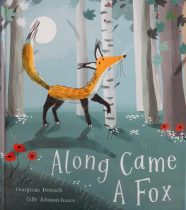
Along Came A Fox
Georgina Deutsch and Cally Johnson-Isaacs
Little Tiger

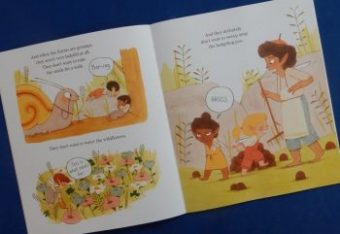
Bramble the fox decides to go hunting fireflies one silvery moonlit night, despite not knowing where the tiny insects like to hide.
Having been disturbed from her slumbers hedgehog Hazel, decides to accompany Bramble and they follow all-knowing Twig the owl’s advice to search near the lake.

En route Hazel is a little bit spooked by the shadows but Bramble urges her to hurry. “Because foxes don’t get scared … do they?”
Well maybe they do sometimes …
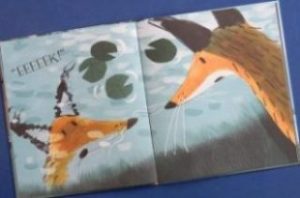
A bit of stomping and growling on account of the “VERY RUDE FOX!’ ensues;


then Bramble decides to go back and report to Twig.
Twig suggests they all return to the lake and try to discover what might have upset the unfriendly fox.

Back they go, but without the moonlight glowing over the pond there is nothing to see at first, which saddens Bramble who’d hoped to make amends.
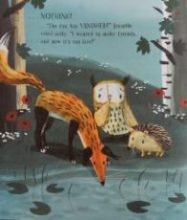
But then out comes the moon from behind the clouds revealing something wonderful in the water …

And yes they do eventually see those fireflies too. It’s a wonderful night, after all.

This all goes to show that the face we put out in the world, is reflected back; in other words – to borrow the lines from Larry Shay et al. “When you’re smiling / The whole world smiles with you”.

With absolutely gorgeous illustrations and appealing characters, this book has an important message; it’s one to share and talk about with young listeners.
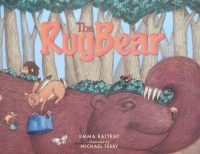
The Rug Bear
Emma Rattray, illustrated by Michael Terry
Matador Children’s

Emma Rattray’s rhyming story tells what happens when a bear, playing hide and seek with Lion and Fox, finds a suitable hiding place and promptly lies down falling deeply asleep.

Along comes a weary mouse. She’s most happy to find a ‘brown furry rug’ just when she’s in need of a pace to rest. So too is Hare with his heavy load;
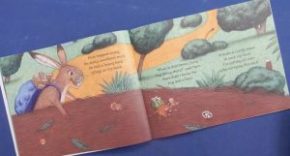
and Squirrel on his branch is pleased to find he has a soft landing spot exactly where he intends to jump. The ‘’rug’ also tempts lonely ladybug; she deems it ‘extremely snug’.

Suddenly Bee buzzes by following a honey smell and the noise awakens Bear from his slumbers. He jiggles and wiggles, yawns and gives an enormous stretch and stands …
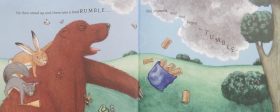
cascading the seated creatures to the ground.

Imagine their feelings when they discover the true nature of their rug. Fortunately, all ends happily – thanks to hospitality in the shape of cups of tea. – sweetened with honey perhaps …

Debut picture book author, Emma Rattray’s warm-hearted tale of inclusion and friendship makes a highly enjoyable read aloud for home or foundation stage setting: youngsters will love being in the know about the ‘rug’ and enjoy joining in the repeat parts of the narrative. Equally, they’ll love Michael Terry’s humorous, splendidly expressive scenes of the unfolding rug episode.

We Planted a Pumpkin

We Planted a Pumpkin
Rob Ramsden
Scallywag Press

Rob Ramsden’s boy and girl characters from We Found a Seed are now a little more savvy about what happens when a seed is planted but even so they’re a tad impatient about the pumpkin seed they plant, hoping it will bear fruit by Halloween.

Young readers and listeners share with them the gourd’s entire growing process as first roots, and then leaves, start to sprout.

Come summer the flowers bloom and are visited by bees, butterflies and other insects and as the weeks pass, the flowers die –

all except one at the base of which they find a small green bump – not yet a pumpkin but on its way to so being.

Excitement mounts along with the pumpkin’s growth, as it absorbs the rain and soaks up the sun.

Then little by little, the ripening happens; the pumpkin swells and turns orange until finally, it’s harvest time.

That’s not quite the end of the story though, for there’s the hollowing out and face carving to do – and then hurrah! It’s Halloween …

Like Rob’s previous titles, this beautifully illustrated book is pitch perfect for little ones. They’ll love spotting all the minibeasts on every spread.

I have no doubt that like the characters in the story, youngsters will be motivated to engage with nature, try planting some pumpkin seeds and become excited as they follow their development.

Just One of Those Days

Just One of Those Days
Jill Murphy
Macmillan Children’s Books

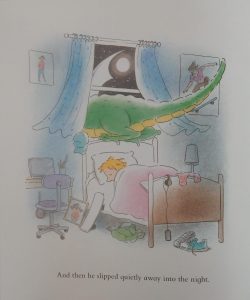
Four decades on from their first picture book appearance in the now classic Peace at Last, the adorable Mr and Mrs Bear and Baby Bear return for a third story. It begins with a late awakening Mr and Mrs Bear leaping out of bed and preparing for work, leaving Baby Bear to his dinosaur dream.

Once awake though, the little one has to get ready for nursery, a particularly protracted process on this occasion and then it’s raining, all of which means that Baby arrives late at Nursery. It’s no surprise when he’s reluctant to go in but a story does the trick and off comes his coat.

Then there are problems over a dinosaur toy but Baby Bear isn’t the only member of his family whose day doesn’t go well.

Mrs Bear sits on her glasses; Mr Bear spills coffee all over some important papers – and that’s only the morning’s mishaps.

Afternoon nursery continues to be a trial

and by the end of the session it’s a very sleepy Baby Bear that greets his Mum before they walk home through the rain.

Back indoors, the two get themselves togged out in their PJs just in time for Mr Bear’s return. Not only is he carrying a large pizza box but he also has a carrier bag containing a special surprise for Baby Bear.

Then it’s time to share that delicious pizza and exchange a few comments about their respective days, which Mr Bear aptly sums up with the title line.

As wonderfully warm as ever, this is another tour de force for Jill Murphy; a celebration of a loving family and a story that parents, carers and little ones will immediately relate to.

A must have for family bookshelves and early years collections.

Welcome to Ballet School / Pop Art

Welcome to Ballet School
Ashley Bouder and Julia Bereciartu
Frances Lincoln Children’s Books

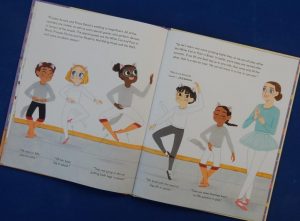
In this book, we follow a diverse group of beginners from their first day at ballet school where they excitedly don their colourful dance attire and ballet shoes before warming up.

They then learn the five basic positions for arms and feet ready to approach the barre.

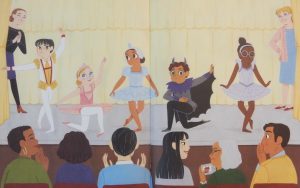
With the basic steps mastered and key techniques acquired, the children are introduced to a special guest who helps them use their learning to tell a story (Sleeping Beauty) with costumes

and a surprise finale.

A firm believer that ballet is for everyone, the author, Ashley Bouder is a principal ballerina and in addition to the concise instructions in the lessons, she’s added a useful glossary of the terms used at the back of the book. But would a teacher, however welcoming s/he wanted to be, really greet children such as those entering the class, as “ little ones”?

Julia Bereciartu’s illustrations are beautifully done and will be a great help to new learners as they zoom in on the five positions and show details of the leg movements in the steps.

I especially like the assertion that ballet is ‘an art form but requires an athlete to perform the steps’ said as the children pause to look at the final gallery of great dancers from various parts of the world.

A book for aspiring dancers and those experiencing their first classes; could that be your child?

Pop Art
Emilie Dufresne
BookLife Publishing

Courtesy of art specialist Chloe, an employee of the gallery, readers are given a preview of a Pop Art Exhibition to be held in her place of work.

Before that though comes an explanation of what Pop Art actually is, when it became popular and why.

We meet several artists – Robert Rauschenberg, Andy Warhol, Roy Lichenstein and Yayoi Kusama –

and as well as an introduction to their particular techniques, there are activity spreads.

These give instructions on, in turn, trying your hand at collage, creating a comic strip and captions; painting a portrait pop art style and painting a pumpkin after the fashion of Yayoi Kusama.

The book concludes with a quiz, encouragement to visit a gallery and a glossary.

Pop Art is a style less frequently explored with primary children; this title in the In My Gallery series provides a useful starting point for home or school.

Migrants

Migrants
Issa Watanabe
Gecko Press

Just when we’re hearing of more and more migrants attempting to reach our shores in unsafe boats, arrived this timely book.

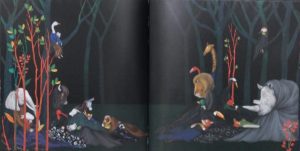
With its striking images it snares the attention right from the start as we’re shown the journey of a disparate group of migrants who plod through a dark forest with just a few belongings in bundles.
Behind them stalks the grim reaper accompanied by a huge blue ibis.

En route to the next stage of their journey, the travellers stop to rest and share food

before moving on towards the coast where a boat is waiting.

Everyone crowds on board with Death flying above on the ibis.

But the vessel is no match for the powerful waves that destroy it long before they reach land leaving those that are able, to swim to the shore.

There, they realise that one of their number has died and having gathered around to bid a final farewell,

on they trudge, still pursued by death with more falling by the wayside as their arduous, grief stricken journey continues.

Finally the depleted group arrives at a place where tree life blossoms and maybe, … a little hope.

Issa Watanabe has created without a single word, one of the most harrowing portrayals of migration I’ve seen in a book.

With her characters standing out starkly against the constant black backdrop, each illustration captures the determination and dignified demeanour of the travellers; yet, she leaves space for readers to do some of the interpretation themselves.

Truly a visual tour-de force, albeit one that leaves us feeling raw and tearful.

Flights of Fancy: How to Drive a Roman Chariot / The Girl and the Dinosaur

How to Drive a Roman Chariot
Caryl Hart and Ed Eaves
Simon & Schuster Children’s

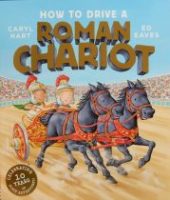
This tenth Albie adventure that celebrates young children and their imagination, begins as he’s out with his mum feeding some horses when the rain starts.

Taking shelter in a barn, Albie comes upon a girl named Julia with her problematic knitting. The next thing he knows is that he is whisked back in time to Ancient Rome and he and Julia are chasing after a runaway chariot.

Having managed to leap aboard as the horses gallop straight for the crowded market, a fearless Julia grabs hold of the reins and steers the chariot clear.

That however isn’t the only thing she wants to do: young Julia is determined to prove to everyone who says they can’t, that girls CAN drive chariots. Can they win races too, I wonder?

Whoever said ancient history is boring?

The Girl and the Dinosaur
Hollie Hughes and Sarah Massini
Bloomsbury Children’s Books

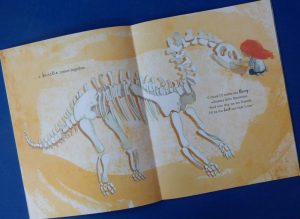
Just imagine if you had a dinosaur: that is what happens to the little girl Marianne we see digging on the beach of a seaside town on the first spread of this book. Watched by the fisherfolk concerned about her lack of friends, Marianne methodically digs up and assembles (Mary Anning style) a complete skeleton that she names Bony.

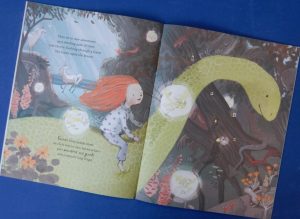
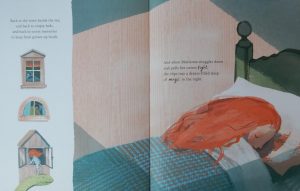
Back in bed that night she wishes life into her ‘stony bones’ and in a sky aglow with dreams, awakens a deeply slumbering dinosaur and takes off on its back into a beautiful world of wonder and magic.

The two go first to the sea and then after a dip, visit an enchanted forest alive with fairies and unicorns.

They climb to the top of a mountain, then taking a ‘mighty leap of faith’ soar up and away towards a magical island among the clouds to a very special party for children and their dream world creatures.

However eventually slumbers call, the party must end; and reveries over, it’s time to return to those empty beds.

Thereafter the story comes full circle and we’re back on the beach, only now Marianne is not alone and the fisherfolk are no longer concerned, for the single girl has been joined by lots of other children each one digging for their very own dinosaur.

Hold fast to dreams as you share Hollie Hughes’ lyrical rhyming story and Sarah Massini’s wonderfully whimsical, atmospheric illustrations of the real and dream worlds.

A great snuggle up at bedtime tale that will linger long in the mind and perhaps fuel the dreams of your little ones as, lulled by the soporific nature of the narrative, they too head off to slumberland.

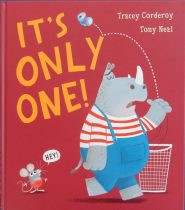
It’s Only One!

It’s Only One!
Tracey Corderoy and Tony Neal
Little Tiger

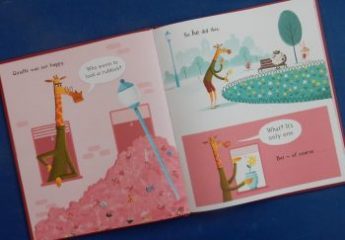
This is a cautionary tale about what happens when people’s actions are thoughtless.

It’s set in Sunnyville, a fun, friendly and generally lovely place – until kind-hearted Mouse offers Rhino a toffee. Rhino tosses the wrapper away with the titular comment, but so do a host of other town residents, with one item landing hard on Tortoise’s head and leaving Giraffe outraged at the ever-growing rubbish heap.

To cheer himself up Giraffe picks a flower from the park with the same “What” It’s only one’ comment ,which of course it wasn’t.

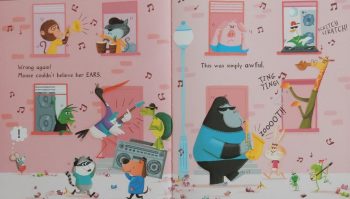
Now it’s Penguin’s turn to feel anger, so to cheer himself up at the loss of all the flowers he turns to music – only one song of course but …

Can anyone or anything manage to curtail this catastrophic concatenation that’s caused the entire population of Sunnyville to become grumpy?

Perhaps Mouse has the perfect antidote – or at least the makings of one …

We all know only too well the terrible impact dropping rubbish has on the environment, wherever we live. And I’m sure we all want to be good neighbours – this is something that’s become all the more evident since the start of the pandemic – but it’s all too easy to slip into thoughtless actions such as tossing aside that odd car park ticket or receipt.

There are reminders from author, Tracey and illustrator, Tony at the end of their story, of the importance of considering how whatever we do might be impacting on others and their happiness. However, it’s the cast of characters (I love their zany portrayal in Tony’s expressive spreads) from this smashing and timely book that have the last word.

Share, ponder, discuss and most important, act upon this – it’s only one but think of its potential payoff.

I Really Really Need A Wee

I Really Really Need a Wee
Karl Newson and Duncan Beedie
Little Tiger

In Karl and Duncan’s story it’s a little bushbaby who suddenly gets the wiggles and the jiggles, insisting ‘I really, really, really,  REALLY NEED A WEE!’

Yes, we’ve all been there with little ones, when away from home and far from the nearest loo, coming out with the title line. It most certainly resonated with me with regard to several recent outings.

The little narrator’s efforts to distract itself with thoughts of other things only serve to make matters worse …

and its attempts to find a toilet are, shall we say, pretty disastrous.

Finally though, the object of the bushbaby’s desire is in sight, but almost inevitably there’s a long queue – isn’t it always the way?

Then whoopee! The little room is vacant at last – phew! Such relief.

I suspect you can guess how this corking story ends … and it’s wee-ally wee-ally funny. But then with its combination of Karl’s telling and Duncan’s hilarious illustrations one expects no less. I absolutely love the sets of bespoke loos that sandwich the story proper.

I envisage classrooms and nurseries full of giggling infants and staff almost wetting themselves when this is shared, and families with youngsters will absolutely burst themselves laughing in recognition.

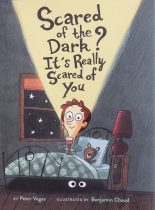
Scared of the Dark? It’s Really Scared of You

Scared of the Dark? It’s Really Scared of You
Peter Vegas and Benjamin Chaud
Chronicle Books

The relatively common childhood fear of the dark is given a new and fun twist in this picture book wherein the dark is personified and presented as an entity that is actually afraid of … You!

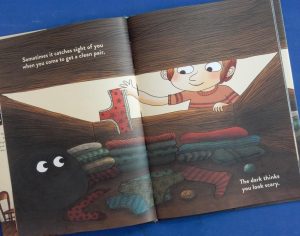
It spends its daylight hours hiding away in your underwear drawer, only emerging into the outside after sundown.

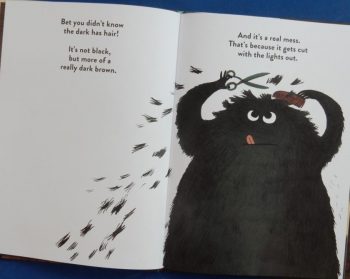
Inevitably this makes its life far from perfect. Friendships are well nigh impossible, as is tree climbing and as for a decent haircut – forget it. No light equals extremely messy hair.

I’m pretty sure most young readers would be happy to share its favourite foods – black pudding, blackberries, liquorice (the black variety), dark chocolate and candle-less Black Forest gateau when its birthday comes around. (Think of the fun to be had from creating an entire menu for the dark.)

There are plenty of positive things about dark: its refusal to be inside until lights off and TV off time; it stays up the entire night but is unable to do anything and it seldom features in a child’s drawing.

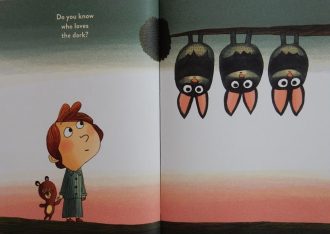
But don’t think that dark is without its devotees: numbered among them are bats (they fly in it at night)

and the silent stars.

That in a nutshell is that: so youngsters who have night time frights are safe to greet the dark with a friendly “Hi!’ so long as the light’s off of course, or it will scuttle away to safety.

Definitely worth trying as a reassuring bedtime read if you have a little one averse to the dark; and even if you don’t Benjamin Chaud’s chuckle-inducing illustrations make this a book to share for the sheer fun of it.

Taking Time

Taking Time
Jo Loring-Fisher
Lantana Publishing

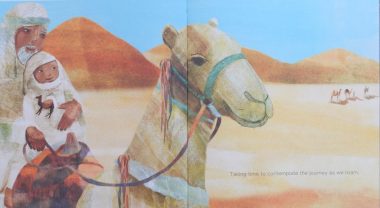
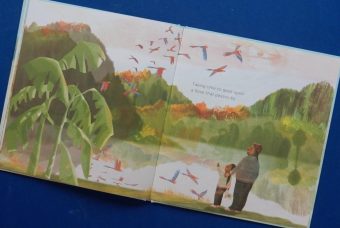
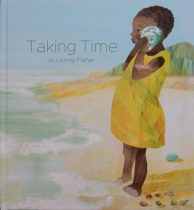
This is simply exquisite. In eleven different parts of the world, children savour the moment: on each double spread there is a gorgeous, mixed media scene showing a young boy or girl in an everyday setting relishing the beauty of the surroundings.

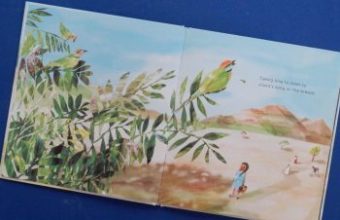
A little girl somewhere in India pauses to listen to the song of a bird;

a boy collects pink blossoms as they fall from a tree: ‘ Taking time to listen to / a bird’s song on the breeze. // Taking time to gather up the blossom dancing free.’ (I love Jo’s use of rhyming couplets on consecutive spreads here and throughout the book).

Far away in Alaska a child snuggles in the soft fur of a husky dog; indoors another child feels a soft cat, ‘taking time to feel the beat’ of its ‘rhythmic purr’.

A spider spins its web watched in awe by a little girl in Nepal, while in the Egyptian desert, clutched by a loving adult, a small child contemplates their journey.

The immensity of the evening sky, a passing flock of colourful birds,

the kind, reflecting eyes of a grandparent, soft snowflakes as they float gently down, the imagined sounds of the sea echoing in a shell – all these too are cherished moments for those who take time for awareness of the here and now.

On the final spread all the children come together in a verdant green field to share their wonderings as they play harmoniously with their special keepsakes: ‘Taking time to cherish you, / and also cherish me.’

Both sets of endpapers show details from the illustrations, the front ones annotating a world map marking the children’s homelands – Alaska, Ecuador, the U.K., Norway, Russia, Egypt, Tanzania, India, Nepal, China, and Japan;  the back ones depicting just the keepsakes, cleverly creating a matching game for readers to play.

If you have, or work with, young children, I urge you to share Jo’s beautiful book, showing similar slow mindfulness to that demonstrated by her characters in Taking Time.

I’ll Believe You When …

I’ll Believe You When …
Susan Schubert and Raquel Bonita
Lantana Publishing

Subtitled ‘Unbelievable idioms from around the world’ this is such a clever and fun book that begins on the title page with a child asking “Do you see the dragon?”

What follows is the response –, “ I’ll believe you … “ “… when pigs fly!” and it then goes on to show that nine other countries each has its own unique version of the idiom.

There are frogs growing hair from Spain, chickens with teeth in Nigeria,

herons turning black in the Philippines, summer snow in Germany.

The Netherlands offer cows dancing on ice and India, ‘when crows fly upside down!’

It’s impossible to choose a favourite but I wouldn’t mind betting that you or someone you share this book with will adopt some of these. And imagine what fun you might have if you challenge a class of six or seven year olds to come up with their own ideas and illustrate them.

It’s a terrific way to introduce the notion of idioms and the idea that they’ve been passed on from ages back as well as across the globe. There’s an explanation at the end of the book as well as a world map showing where each expression comes from and the language it’s spoken in.

Raquel Bonita’s illustrations are absolutely super: inclusive and funny at the same time.

Wonderful nonsense yes, but equally the classroom potential is huge, especially if you involve families. Emmanuelle (7) contributed “I’ll believe you when ponies grow scales” and her mum from Hungary told me that there they say, “I will believe you when it’s snowing red snowflakes.”

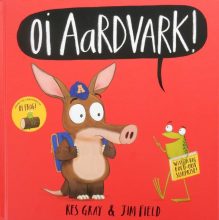
Oi Aardvark!

Oi Aardvark!
Kes Gray and Jim Field
Hodder Children’s Books

Frog seems to be mining a seemingly bottomless – or maybe it should be bottomful – pit in Kes and Jim’s new Oi offering.

At the outset he throws out an invitation to the titular animal to participate in his new book that’s to be entitled ‘My ALL-NEW ALPHABETTY BOTTY BOOK. Dog is all agog; not so the cat who is, as usual, a sourpuss and ready to pour cold water over the enterprise even before it gets underway.

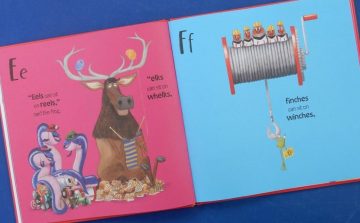
I have to hand it to Frog with his first chair substitute though, it’s pure genius: “Aardvarks will sit on cardsharks!” Nevertheless a certain feline is ready with a bit of negativity: “What’s a cardshark?” it demands. “It’s a shark who’s really good at playing snap!” comes Frog’s rapid response. That should shut Cat up, but let’s see.

We get through B and C without any interference, and only a minor bit of banter from Cat comes to herald in D. But then Dog’s tongue-twisting mix-up of a comment fuels another catty utterance. Eventually Frog announces his D and on we go safely (actually pretty precariously) through E and F.

For G, Frog has two clever inclusions – “giraffes can sit on baths and Gazelles can sit on bells!”

With horses comfortably seated and iguanas less so, clever claws Cat cheekily interjects again. (as if Frog doesn’t know his alphabetical order – well really!).

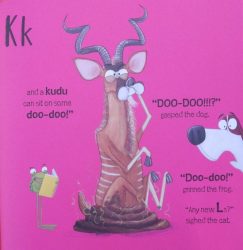
Anyway, or rather, Frog’s way, J. is duly dealt with and then as we’ve already been told, comes K. K is splendidly stinky …

Looks like the frog is the only one amused about this botty placement.

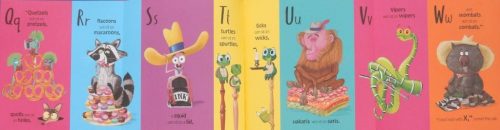
Off we go, with the dog heaping praise on our book compiler and guess who being its usual party pooping scorn pourer. Let’s skip to P and be pretty sure there’s a treat in store – ta da! Four animals happily installed on their bum bearers; but then comes another treat in the form of a double fold-out taking us through – with an inevitable purring pouring of cold water from the cat, to X.

Yet again Frog emerges triumphant, even giving himself a round of applause before zipping off through Y to the grand finale and completion of his book.

Or maybe not quite: we’ll leave it to the threesome to get to the bottom of their zany dispute.

So far beyond brilliant that it will never find the way back is this combination of Kes’ carefully and creatively concocted, rhyming, weaving of wordplay and Jim’s superbly silly seating solutions shown in his side-splitting visuals.

I’m hoping against hope that Frog doesn’t decide to rest on his laurels after this, his latest tour de force. I can’t wait to share it with anyone I can get to sit on their selected sit-upon.

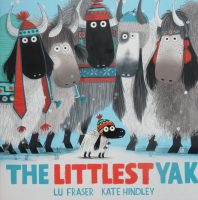
The Littlest Yak

The Littlest Yak
Lu Fraser and Kate Hindley
Simon & Schuster Children’s Books

Despite her prowess at clip-clopping up slippery cliffs and her wonderfully curly, whirly woolly back, little Gertie yak is unhappy on account of her lack of “bigness’. She longs to grow up great and tall, when she assumes, her horns and hooves will be impressively huge.

Her mum assures her that ‘bigness’ can take a variety of guises but Gertie remains impatient to assume a larger form.

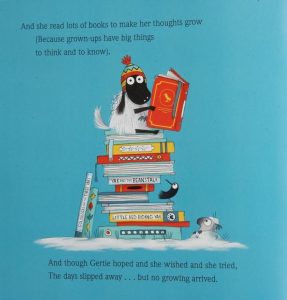
To that end she embarks on a ‘growing-up’ regime: a diet of healthy veggies and vigorous physical exercise as well as mental training, thanks to her extensive library.

None of which have the desired effect.

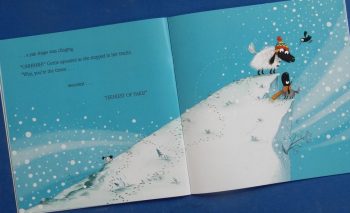
Then all of a sudden as Gertie is near to despair, there comes a cry for help from the yak herd. The teeniest, weeniest is stranded in a perilously precarious position on a cliff edge.

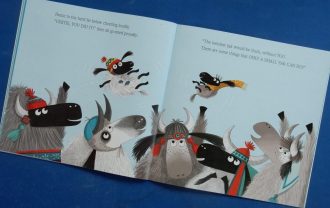
Now is the time for Gertie to make use of those super-grippy hooves of hers and so she does. Onto her back leaps the teeny weeny yak and down the mountainside they both go, to safety and a congratulatory crowd.

Later, wrapped up warmly under the stars, might just be the time for one little yak to realise that she’s just right as she is.

Debut picture book author, Lu Fraser’s rhyming text flows beautifully, making it a super read aloud; and she has the perfect illustrator in Kate Hindley whose funny details – look out for the bird characters – add gigglesome delight to many of the spreads. Love those bobble hats, blankets, scarves and other items of warm clothing worn by the yaks. Perfect for this heartwarming tale.

The Grumpy Fairies

The Grumpy Fairies
Bethan Stevens
Frances Lincoln Children’s Books

I suspect that most people, youngsters especially, are of the opinion that fairies are cute, kind little things, but that isn’t true of the entire fairy race. The smallest ones especially are grumpy, not just a little bit but grumpy in the extreme. They flatly refuse to do those helpful jobs expected of them by the adults of their kind

as well as being downright rude to the birds that request their assistance. And as for the goblin warning those same birds give them, they don’t even bother listening to it.

The grumpy fairies treat the bees and Mouse in similar fashion, ignoring their words about there being a hungry goblin on the wander looking for lunch; and they’re so busy with their grumps, that they fail to notice …

It’s fortunate that in addition to grumpiness, these particular fairies have cleverness as part of their constitution. Can they succeed in extricating themselves from a very tricky situation, or will they become a ‘sweet and sour’ midday repast for a certain goblin?

This is Bethan Stevens’ debut picture book. It’s full of visual humour; I love her portrayal of those Grumpy Fairies that are similar to grumpy little humans in so many ways, and her hirsute-limbed goblin is terrific fun.

Over and Under the Rainforest

Over and Under the Rainforest
Kate Messner and Christopher Silas Neal
Chronicle Books

This beautiful book immerses readers deep in the South American rainforest in the company of an adult (Tito) and a child narrator as they trek the entire day, from early morning to evening.

They observe with all their senses enjoying the ‘symphony of sounds! Chatters and chirps and a howling roar’ of monkeys, insects and birds in the treetops.

As they continue hiking along the trail we share the sights and sounds of particular animals, ‘Up in the trees’ and ‘Down in the forest’. There are toucans that ‘croak and bicker over breakfast’; a row of bats ‘sleeps away the daylight’;

… ‘A poison dart frog makes his way up a trunk with a tadpole on his back and they find themselves ‘eye to eye with capuchin monkeys as they cross a hanging bridge.

With the afternoon comes the rain, time to snack on dried fruits alongside snacking monkeys. The rain falls more heavily causing a blue morpho butterfly to fold her wings and tuck herself away close to a sleeping mother sloth and her baby.

When evening comes, the rain lets up and the darkness falls all around, there are lots of silent hunting animals such as a parrot snake and an eyelash palm pit viper, and some new sounds too, as up in the trees howler monkeys “Rrrowf! … Rroooooaaaahhhhhh!” in response to Tito’s roar.

Night is the time for jaguars to be on the prowl so perhaps the sudden scary snap is a sign one’s on the move.

It’s also the time for the two trekkers to cross that last bridge and, with thoughts of Abuelita’s supper awaiting, to head for home to the sounds of a choir of insects and raindrops.

Kate Messner’s poetic text really does capture the atmosphere of the rainforest and the changes that happen over a day, while Christopher Silas Neal’s mixed media, matt illustrations, with their alternating views of ground level, the sky and the treetops showing the rich variety of the flora and fauna, imbue this particular ecosystem with a magic of its own.

If you want to discover more about the fauna, Kate has included notes on twenty creatures at the back of the book, along with some paragraphs about her own Costa Rican rainforest forays.

Hello Friend! / Bunny Braves the Day

Hello Friend!
Rebecca Cobb
Macmillan Children’s Books

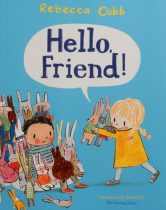
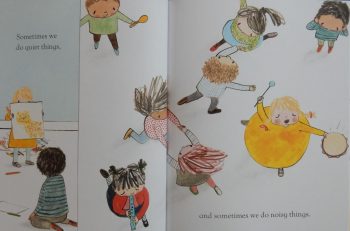
It’s the mismatch between what is said by the small girl narrator and what is shown in Rebecca Cobb’s enchanting, warm illustrations that make this book such a winner.

From the start the girl enthusiastically shares everything during playtime both indoors and out, at lunchtime, during quiet times and noisy ones.

What is evident though is that the boy on whom she focuses all this sharing attention is going to take much longer to feel ready to share in the well-intentioned advances of the little girl.
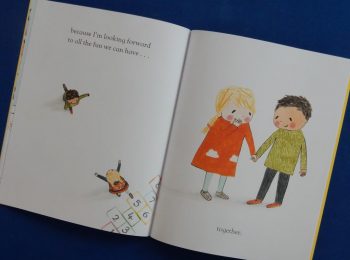
However, a friendship does develop …

and it’s one where both parties are equally enthusiastic about their togetherness.

This is a gorgeous story to share with youngsters especially those starting school; it offers plenty to reflect on and talk about, both at home and in the classroom.

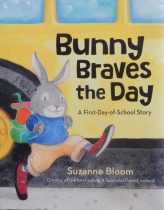
Bunny Braves the Day
Suzanne Bloom
Boyds Mills Press

It’s Bunny’s first day of school but he wants nothing of it: he doesn’t know anybody, supposes nobody likes him; his socks are too short, his shorts too long and he can’t tie his shoes. Oh woe!

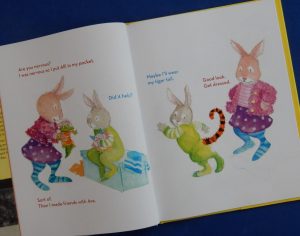
Big sister cajoles him with plenty of empathy and ideas,

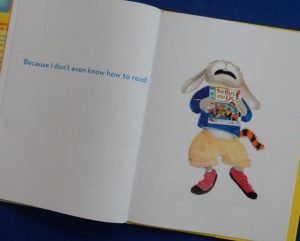
but with a hurting tummy, it’s decided … ‘I’d better not go … Because I don’t even know how to read!’

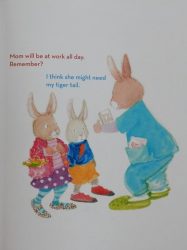
After more loving comments, ‘Sometimes you just feel like crying before you feel like trying. You’ll find a friend. Not all shoes use laces. And teachers love to teach reading…’ and listing things little bro. CAN do, he’s almost ready to surrender but not before one last try, ‘Mom will miss me.’ (Said parent has uttered not a word in all this, though she does take a photo).

Finally, it’s time to face up to the inevitable and once more it’s down to big sis. to deliver the final upbeat reassurance at the classroom entrance.

The entire text takes the form of the dialogue between the bunny siblings –blue for the new boy and red for older sister; while Suzanne Bloom’s watercolour and pencil illustrations highlight the feelings of the two characters beautifully.

Just right to share with little ones, especially in families where there’s likely to be starting school nerves; or with children in a nursery setting.

My Friends and Me

My Friends and Me
Stephanie Stansbie and Katy Halford
Little Tiger

Families come in many different forms; this book celebrates that diversity. It’s narrated by a cheerful child who introduces, matter-of-fact style, families belonging to several friends.

There’s Kate who has two dads, best friend Harry with just his multi-talented mum

and Olivia with two sisters, two mums and a little brother. Then comes Lily with two homes, one belonging to her dad, the other to her mum.

Some friends are especially good for sleepovers: one lives in an enormous mansion, another in a caravan and a third, on a boat.

Hannah on the other hand, lives with her foster mum (among others in the household) Then there’s Ned’s mum who turns out to be not the man people originally thought but a super-surfer all the same.

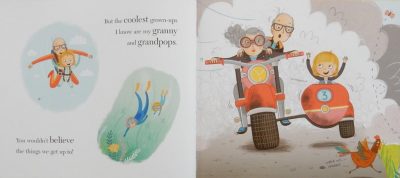
In fact each of the families is a happy one and love is the key, not least in the narrator’s own, for we discover that this young child lives with granny and grandpops who are the ‘coolest grown-ups’.

The up-beat tone of the narrator is reflected in Katy Halford’s bright, cheery illustrations that have lots of amusing details such as ‘Frank’ the goldfish and Harry’s toy bear Bon-Bon.

Presenting as it does both traditional and non-traditional family units, this book would be especially helpful for teachers exploring families as a theme ; and of course it’s worth pointing out that every family is in some ways, different from every other one.

If You See a Lion

If You See a Lion
Karl Newson and Andrea Stegmaier
Words & Pictures

First there was Emma Yarlett’s Nibbles, the book devouring little monster and now courtesy of Karl Newson, we have a lion on the loose – ‘orange, furry, handsome and tall’ by all accounts – that’s had the impudence to eat the story right out of his book; not to mention the corner of its cover. Well really!

Not content with the story though, this creature has also consumed a brass band, a penguin, a troll, a pirate, a wizard and a dinosaur; and don’t believe a word when you read that he’s ‘Dashing, charming, gentle, fun’. Far from it; for this beastie has also devoured an entire forest, a river, a mountain peak

plus a dragon and a sprite. And he doesn’t stop there. What does stop our errant lion right in his tracks however, is a cry

from the little rabbit that’s been on his trail throughout.

Does the little long eared fellow fall for the lion’s beguiling invitation? Far from it. Instead he gives the guzzler what for

and then makes him do what young listeners will have been hoping all along.

And how does this rhyming hide and seek story finish? Well, let’s merely say, satisfyingly, roaringly well and leave you to discover for yourself.

Karl and illustrator Andrea Stegmaier have created a corker of a book that little ones will relish as much as readers aloud who can have enormous fun sharing it with them. Rabbit’s actions throughout are especially entertaining.

New in Town

New in Town
Marta Altés
Macmillan Children’s Books

Despite its shaggy dog narrator, Marta Altés latest book is anything but a shaggy-dog story.

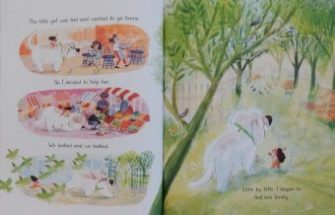
After a long and tiring journey, said narrator, in search of a new home, arrives at a large town.

After asking around and looking in lots of places, and in spite of all the wonderful sights, sounds and smells, he still hasn’t found anywhere that feels just right.

The people are a delight despite their rather different ways of doing things

but everyone seems just too busy, and nobody can understand, or perhaps even see the home seeker

untll the dog has a chance encounter with a little girl who is lost and wants to go home.

As they look for the child’s home together, the feelings of loneliness (the dog’s) and of being lost (the child’s) grow less

but then it’s time to say goodbye – or is it?

Warm and funny – the illustrations especially – this tale of kindness, friendship and accommodating differences needs to be read several times to appreciate all that’s going on in Marta’s splendid scenes of bustling city life.

Snooze / The Whales on the Bus

Here are two fun picture books that will ensure very noisy storytime sessions

Snooze
Eilidh Muldoon
Little Door Books

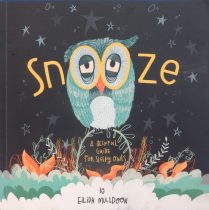
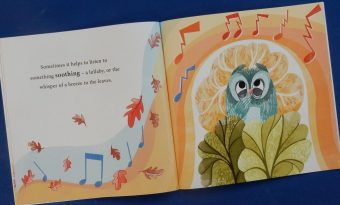
Courtesy of Eilidh Muldoon’s wide-eyed (mostly) owl, what is offered here is a splendidly soporific explanation of how to ensure the best sleep ever. Mmm!

It all begins well enough with our strigine narrator locating a comfortable, peaceful place for slumbering … errr?

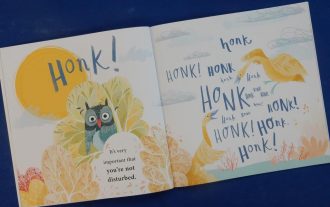
– a place wherein you can snuggle and appreciate the surrounding silence – so long as other avians aren’t anywhere around, that is.

Darkness is highly desirable and some soft background music often works wonders

– so long as that’s all you can hear; so maybe it’s wise to check out the location in case of caterwauling felines and yapping pooches. And if your neighbours are not aware of your desire to sleep, a polite request to keep the volume down would be appropriate.

That should mean, that at last it really is slumber time; aaaah!. And once you’ve had that wonderful sleep why not do as our narrator suggests and let one of your pals try using the book too. Sweet dreams …

The clever combination of tongue-in-cheek text and wryly amusing, beautifully executed illustrations make for a splendid debut picture book from Eilidh Muldoon. Whether or not it works as a bedtime story, I’ll leave you to discover.

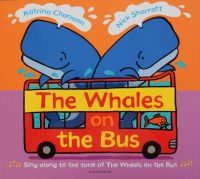
The Whales on the Bus
Katrina Charman and Nick Sharratt
Bloomsbury Children’s Books

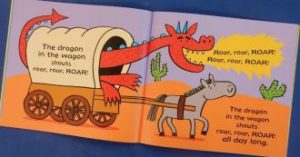
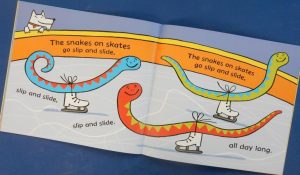
Expect a great deal of enthusiastic noise and lots of action when you share this with little ones. It’s an open invitation to choo, choo, zoom, zoom. dive, loop-the-loop, quack, quack, beep, roar,

yo, ho ho, slip and slide, float and even perhaps whisper nighty night along with the bus riding whales, crane train passengers, skiing bees, jeep driving sheep, submarine diving seals, gliding piloting tiger, truckload of ducks, skating snakes

and the other adventurers in Katrina Charman’s joyful animal extravangaza.

Using the tune of the nursery favourite ‘The wheels on the bus’ and showing each in turn of Nick’s zany scenes of the (largely) cacophony-creating creatures you can have an absolute whale of a time with a class of pre-schoolers when you read this.

Slightly older children could have terrific fun creating their own verses to add to those composed by Katrina and then illustrating them. Bring it on, say I.

The Teeny Weeny Genie

The Teeny Weeny Genie
Julia Donaldson and Anna Currey
Macmillan Children’s Books

There are faint echoes of the traditional Aladdin and The Fisherman and his Wife in this wonderfully funny tale of wishing that gets totally out of hand.

It all begins down on the farm when Old Macdonald decides to do a spot of cupboard cleaning. Having given his dusty old teapot a good wash, he’s rubbing it dry when out through the spout wafts the resident teeny weeny blue genie. The genie offers the farmer a wish.

It’s not too long before not only does Old Macdonald have that bright red tractor he so wanted, but a wife, a wardrobe, a cradle with a bawling baby,

a host of noisy animals; he’s called the fire-brigade to rescue a cat,

the crew have joined in with the wishing, and then there are superheroes whizzing every which way. The poor long-suffering genie can stand no more.

Powerless to make a wish for himself, he sneaks back into the farmhouse and back to his teapot home. So delighted is he at the sight of it that he gives the teapot a stroke, after which something wonderful and surprising happens …

Now should any of you lovely readers come upon a red teapot with white spots somewhere totally unlikely and feel the need to make a wish, then please be very careful what you wish for.

As always, Julia Donaldson’s zany story is a delight to read aloud, offering as it does, plenty of noisy joining-in opportunities for enthusiastic listeners who equally, will delight in Anna Currey’s watercolour scenes of the mounting mayhem that all began with a single wish and The Teeny Weeny Genie. Like the characters in the story, youngsters will certainly wish for more.

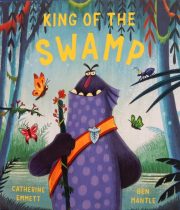
King of the Swamp

King of the Swamp
Catherine Emmett and Ben Mantle
Simon & Schuster

In a dark dank swamp living peacefully alone and growing orchids in his neat garden, is McDarkly.

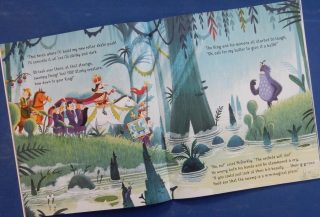
One day, this peaceful existence is shattered by a royal entourage led by a roller skating enthusiast King who wants to turn the swamp into a roller-skate park.

However at McDarkly’s mention of orchids the Princess’s ears prick up and an agreement is made that the royal party will give the orchid cultivator just ten days for his orchids to bloom so that the princess can learn from these wonderful plants.

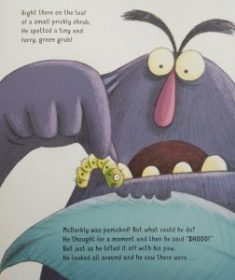
Determined to save his swampy environment from the King’s destructive clutches, McDarkly labours night and day, and as his allocated time is about to end, he comes upon a small green grub on one of the leaves.

Disaster! But all the more so when the one proves to be a great many of the wrigglers and they devour his precious flowers overnight.

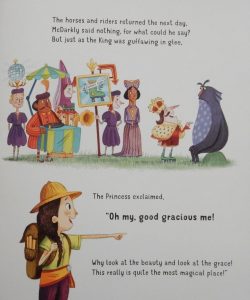
Back come the royals, with the King in high spirits when he discovers the lack of orchid flowers. Once again though, it’s down to the Princess to save the day …

Delectably silly, Catherine Emmett’s rhyming tale is an exceedingly clever and enormously enjoyable way of putting across an environmental message or two so that young audiences will be both greatly amused and one hopes, ready to get behind the conservation crusade that still needs lots more activists.

Ben Mantle’s comical scenes are rich in detail – daft and otherwise. Who can fail to giggle over the sight of McDarkly sitting atop a bush outside his home sipping tea from a china cup, or that of the creature singing to his plants.

Shy Ones

Shy Ones
Simona Ciraolo
Flying Eye Books

We first officially meet flapjack octopus Maurice, the story’s main character, on the front endpapers. Said creature is extremely shy, hiding behind his mum, under his desk at school and among the seaweed fronds in the playground. ‘Unless you were looking for him, you wouldn’t know he’s missing,’ says the narrator.

‘Right about now, you’re probably thinking “What a bore!” But I wouldn’t be so quick to jump to conclusions’ we read but then we see the little cephalopod on his way to Deep Blue Dance Hall where, surrounded by a host of glowing creatures and looking as though he’s blissfully happy, he performs a solo dance.

Then comes an invitation to a party, which Maurice somewhat reluctantly turns up to with a handy disguise; then the omniscient narrator steps in again with some revealing comments …

and a friendship is forged. Finally on the back endpapers we discover the narrator’s identity is Lucy the Box Fish another reclusive marine creature.

Observant readers/listeners may just have noticed that said fish has been lurking in the background in several of the early spreads and those who haven’t can enjoy looking back and discovering her whereabouts in Simona Ciraolo’s wryly humorous sub aquatic scenes full of charming, jewel bright sea creatures.

A gentle delight to share with many little humans – introverted or extroverted – or perhaps, just one little shy one.

Too Many Bubbles

Too Many Bubbles
David Gibb and Dan Taylor
Simon & Schuster

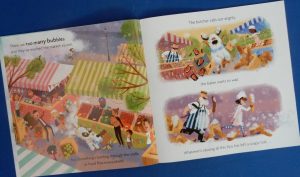
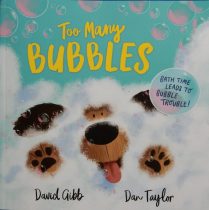
Dogs and exceedingly dirty water or mud seem to have a magnetic attraction and it’s certainly the case in musician/songwriter David Gibb’s madcap rhyming tale that begins with an extremely mucky pooch and instructions from Mum to ‘give the dog a bath’.

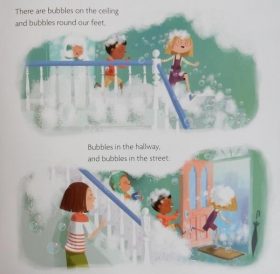
It’s not long though before this seemingly straightforward enterprise has descended into uncontrollable bubbly mayhem as the three children concerned set out in hot pursuit of their havoc-wreaking pet and the bubbling soapy trail.

As we follow the foam it becomes clear that the cause of the chaos is grasped firmly between the pooch’s jaws as it dashes rather in the fashion of the traditional Magic Porridge Pot, through the market square

and the park to the zoo.

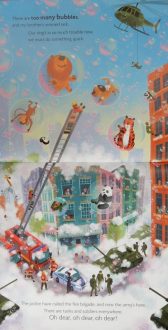
There bubbles soon enclose not just the perpetrator of the chaos but all the inhabitants of said zoo as well. Something has to be done and quickly.

And something is, but it’s not quite what the rescue services have in mind as they risk life and limb…

And the dog? Err – let’s just say he seems to have thoroughly enjoyed himself and is badly in need of another dip in the tub.

Dan Taylor’s effervescent illustrations are enormous fun too: I particularly love the scene of the fountain invasion.

Arlo, the Lion Who Couldn’t Sleep

Arlo, the Lion Who Couldn’t Sleep
Catherine Rayner
Macmillan Children’s Books

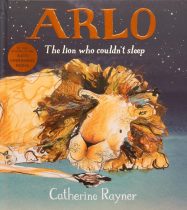
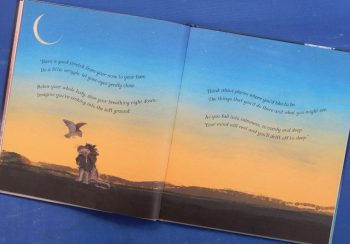
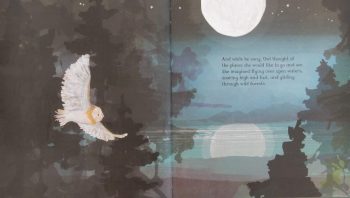
Catherine Rayner has created an absolute stunner of a bedtime book in this story of Arlo the insomnia-suffering lion. He’s tried everything without success and now he’s feeling fed up and thoroughly exhausted.

But then he has an encounter with Owl

an expert at sleeping when it’s noisy and hot, and in her sing-song voice, she teaches Arlo how to wind down ready to fall fast asleep.

It works wonders and the lion feels rejuvenated after a long sleep. So much so that he bounds off to tell Owl, waking her up in so doing.

Arlo reciprocates with a sleep-inducing song for his feathered friend.

Both creatures are delighted. Their celebratory cheer in the evening however, doesn’t go unheard but perhaps the words ‘Have a good stretch from your nose to your toes. / Do a little wriggle, let your eyes gently close … As you fall into calmness, so comfy and deep / Your mind will rest and you’ll drift off to sleep’ sung as a duet will prove even more soporific where it’s needed.

Perfectly paced, the combination of a calming narrative with its in-built repetition of mindful meditative verses, and totally gorgeous, amazingly textured illustrations that take your breath away, this is sheer delight no matter how many times you read it.

I can think of no better book to share with little ones at bedtime; it’s brilliant through and through.

The Monstrous Tale of Celery Crumble

The Monstrous Tale of Celery Crumble
Ben Joel Price
Oxford University Press

Meet Celery Crumble, a mischievous young miss if ever there was one. Whenever Celery commits one of her misdemeanours she doesn’t apologise in the proper way; instead she says, ‘Sorry! Not sorry!’ and shortly after goes on to do something equally outrageous.

There was the time she treated her father to a birthday breakfast in bed but omitted one very vital thing.

Then, when the boy next door comes to play at Celery’s invitation, her rainbow painting is NOT on paper (or even the wall).

On each occasion, the person on the receiving end of her bad behaviour responds thus: ‘If you act like a monster then a monster you’ll become. Then you’ll be sorry for all the naughty things you’ve done!’

On the school zoo trip, this recalcitrant child takes a large sealed glass jar into which she’s collected the most obnoxious smells she could find. Needless to say, said jar doesn’t stay sealed for long and the result is pandemonium …

You can guess how everyone responded.

Back home in bed that evening, Celery’s sleep is, let’s say monstrously uncomfortable, not to mention transformative …

Perhaps it’s now time to make apologies for real. Err …

Young children will absolutely relish this ‘do-as-you-would-be done-by’ cautionary tale with its spirited scenes of Celery’s preposterous actions and their outcomes and demand immediate re-readings.

Lisette’s Green Sock

Lisette’s Green Sock
Catharina Valckx
Gecko Press

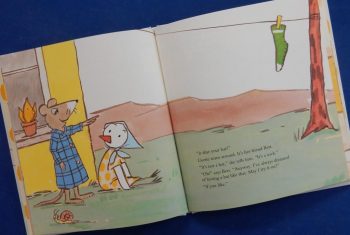
One bright sunny day while out for a walk, Lisette comes upon a single green sock, puts it on and continues walking happily along until a pair of cat brothers make fun of her for wearing just one sock.

Having searched unsuccessfully for its pair, she returns home where her mum is none too impressed at the one sock and its dirty state, but she washes it all the same.

As Lisette waits for it to dry, along comes her friend Bert

who mistaking it for a hat, asks to try it on.

Up come the bullying cat brothers with the matching sock but instead of giving it to Lisette they lead her and Bert a merry dance before throwing the sock into the water.

Disappointed Lisette and Bert return home to Lisette’s house and there, joy of joys, Lisette’s mother has knitted a new green sock and everyone is happy.

Not least the fish that discovers a sock in the pond and finds a wonderful use for it.

Which all goes to show how an odd sock, a pair of bullying cats, a good friend and a change of viewpoint can turn a dismal expression into one of delight (or several!). Long live individuality.

A charmer of a book with lively, expressive watercolour illustrations; it’s just right for sharing with a nursery or reception class, or with one child.

Best Day Ever / Invent-a-Pet

Here are a couple of recent titles from Sterling Children’s Books

Best Day Ever
Michael J. Armstrong and Églantine Ceulemans

It’s the last day of summer and William has just one goal on his list left: have the most fun ever, and he has a handy fun-o-meter invention to help in his assessment of attempts.

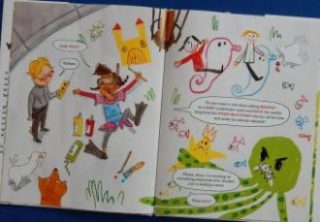
What he hasn’t bargained for though is the non-stop interruptions by his neighbour Anna, she of the incredible imagination. As he pursues his fun-finding in trampolining, art

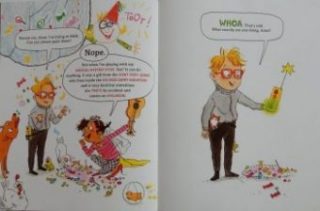
and scooting, she subverts his every effort by her messy, noisy creative play that scores high on William’s fun-o-meter, in contrast to his own activities.

Eventually however, the boy realises that perhaps a bit of silly, messy, possibly even dangerous play might be the way to go;

and thus with William way out of his comfort zone, a fantastic day ensues and an unlikely friendship between two contrasting characters is forged. Not to mention that a satisfying green light from a certain fun-o-meter also results.

Debut picture book author, Armstrong’s story is a great reminder of the importance of having permeable constructs, and of accepting and celebrating difference.

In her mixed media art Églantine Ceulemans adroitly shows how Anna’s zany, exuberant world gradually impinges upon the matter-of-fact notions of William. There’s a wealth of amusing details, not least the silent, bit-part playing animals to which William seems completely oblivious.

Invent-a-Pet
Vicky Fang and Tidawan Thaipinnarong

Katie wants a pet, but not anything ordinary like a goldfish: her pet must be something extraordinary.

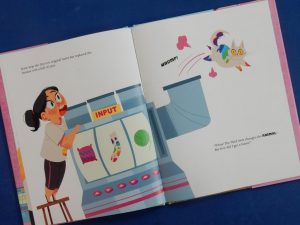
One day she finds a strange-looking machine in her living room, put there by her mum with a note saying ‘Hope this helps in your quest to find an extraordinary pet!


Her first input of a football, a blade of grass and a carrot result in a fluffy green creature– cute, but not what she wants.

Several tries later, she still hasn’t got her desired result, although the house is rather inundated with pets. Time to go back to the drawing board and work out how the machine works, decides Katie.

She selects three new items and starts again. After some time she discovers the correlation between size, colour and the third variable. Is this her eureka moment? Not quite.

With persistence, will Katie succeed in her problem solving task and create the pet of her dreams? Perhaps, but first she has to think of a way to deal with the large number of pets she’s already created …

What a fun way to introduce the process of science problem solving – great for a primary classroom STEM collection. Youngsters will love the pets in Tidawan Thaipinnarong’s comical illustrations and her endpapers are a treat too.

The Smile Shop

The Smile Shop
Satoshi Kitamura
Scallywag Press

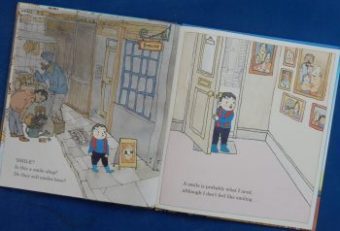
The boy narrator of The Smile Shop is thrilled to have saved sufficient pocket money to treat himself for the first time ever. What will he buy though?

All the market stalls and shops have exciting goods displayed so should he buy a tasty-looking apple pie,

the beautiful little boat, or perhaps the book that’s caught his eye; or maybe that hat that suits him so well?

He’s still undecided when disaster strikes and all but one of his coins disappears down through a drain cover.

The lad is devastated but then what’s that? A smile shop? Really? Do they actually sell smiles? He could definitely do with one right then, so in he goes …

With his quirky, scratchy drawing and watercolour illustrations Satoshi Kitamura’s latest story is essentially a parable that shows how powerful something as simple as a smile can be.

I think that’s something we’ve all learned since the start of the pandemic – more difficult now that masks have to be worn in various places. It’s also a wonderful demonstration of the fact that kindness is worth so much more than anything that money can buy – something else we’ve learned in the last few months.

A book to ponder upon and discuss across a wide age range.

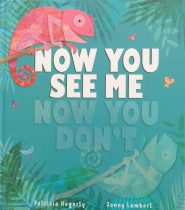
Now You See Me, Now You Don’t

Now You See Me, Now You Don’t
Patricia Hegarty and Jonny Lambert
Little Tiger

The chameleon narrator of this rhyming story is a trickster and proud so to be. There’s nothing the creature likes better than to use its ability to change colour to have fun at the expense of the other jungle dwelling animals  as it teases first elephant, then orang-utan, followed by a pair of toucans and a sloth.

Not only that, but playing the colour switch trick is also a great way to avoid chores, evade bedtime or help yourself to another creature’s tasty meal.

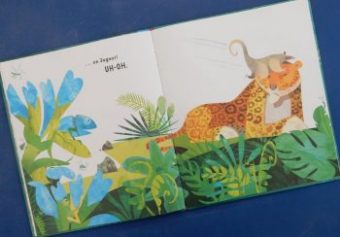
However, Chameleon’s tickling of Sloth triggers a chain reaction that has the potential to end unhappily for Anteater;

but hidden away watching events is Frog.

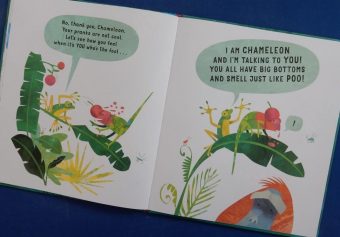
Instead of the praise Chameleon anticipates from the creature, Frog strikes back

and then hastily merges back into the surroundings leaving Chameleon to show contrition, fess up, apologise to all the other animals and promise to end his mischief.

Peace is restored to the jungle – well most of the time. Perhaps changing one’s colour is less easy than changing one’s ways …

Jonny’s vibrant collage style illustrations set against stark white backgrounds immediately grab the attention drawing the eye into the action and there are myriads of minibeasts to spot too.

Purists might baulk at the inhabitants of the fictional jungle, which hail from both the new and the old worlds. Nevertheless it’s a visual and verbal treat that provides an opportunity to talk about the kind of behaviour Chameleon exhibited.

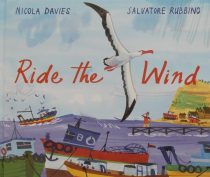
Ride the Wind

Ride the Wind
Nicola Davies and Salvatore Rubbino
Walker Books

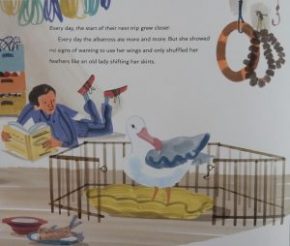
Out on a fishing trip with his father Tomas and Uncle Felipe, Javier sees that an albatross has been caught on one of the fishing hooks and is barely alive. He wraps the bird in a tarpaulin and hides it away.

Once they reach the shore, he stows it safely and starts nursing it back to health with the kind help of some of the village residents who give him healing ointments, a dog’s bed and fish at low cost.

As Javier and the bird get to know one another, the boy becomes sure it’s a female he’s caring for, but it’s impossible to keep its presence a secret.

His father agrees to allow it to stay until their next sea trip but the lad has his own very special reason for caring so much about the bird’s fate.

Little by little the albatross gets better but as the trip draws ever closer, she shows no sign of taking to the wing.

Then talk of an imminent ‘big wind’ gives Javier an idea. But when he goes to find the bird, he learns that his father has got rid of it.

Not caring for the consequences of his actions, Javier is determined to rescue the albatross and send her flying homewards.

Can he pull off his daring bird launch? And what will be his father’s reaction when he discovers what his son has done?

Salvatore Rubbino’s splendid watercolour illustrations capture both the emotions and the drama of Nicola Davies’ heartfelt telling that interweaves a father and son’s grieving, and the albatross and its fate. (Nicola also includes an introductory note about wandering albatrosses like the one in her story.)

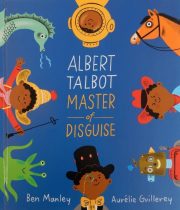
Albert Talbot Master of Disguise

Albert Talbot Master of Disguise
Ben Manley and Aurélie Guillerey
Two Hoots

From Ben Manley the author of The Misadventures of Frederick and the illustrator of Daddy Long Legs, Aurélie Guillerey, comes a book that celebrates the power of the imagination in children.

We spend a day in the company of young Albert and his various alter egos from the time his mother calls him to get up until she tucks him in to bed at night.

In between Albert is faced with a number of challenges each of which he rises to by assuming a new persona.

First as his mum wakes him, he’s notorious desperado Clate Stouderhoofen, ‘the incognito kid, the man with no name’. W-hay!

As he has to leave for school, Albert is ‘Rusti Buffels, Fearless Mountaineer and climber of Mount Chirrachit. Show and tell time sees him as Professor Octavius Pickleswick, mechanical engineer presenting his greatest robotic invention.

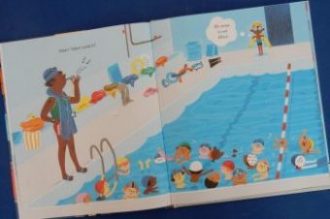
At the poolside before his swimming lesson,

he becomes Zandrian Delaclair, Antarctic Submariner – destroyer of the abominable Vampire Cuttlefish! – you bet!

Back home there’s one more change of identity and then, come bedtime, tired by his day of imaginings, Albert realises that at that particular moment as sleep calls, he’s very happy just to be himself.

Children and adults alike will delight in the weird and wonderful names Ben Manley has created for Albert in his far-out fusion of fantasy and reality, while Aurélie Guillerey’s illustrations, be they those of Albert’s imagination or reality, are full of quirky detail as they show the boy as hero or rule subverter.

Imagination is power – what a great message.

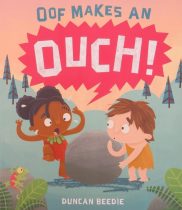
Oof Makes An Ouch!

Oof Makes An Ouch!
Duncan Beedie
Templar Publishing

Way, way back in the days of yore when people knew no words other than their own name there lived a little girl called Oof. In the same village lived her best friend, a boy named Pib. They were pretty much inseparable spending their time playing exploring and inventing.

One day while engaged in the latter, Oof comes up with a superb idea and communicates it to her friend pictorially in the sand.
Together they endeavour to lift the required rock – an exceedingly heavy one – but disaster strikes, it slips from their grasp and lands with a thud on Oof’s foot.

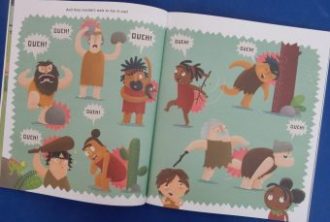
OUCH! She utters a brand new word to express just how much it hurts.

The grown-ups are astonished and all are eager to try it out …

In order to vent her anger at the rock, Oof adds “BASH!” to the linguistic repertoire of the villagers and then “Yummy”.

Oof receives great adulation as she and the rock are carried back to her hut, where later she begins work on the stone.
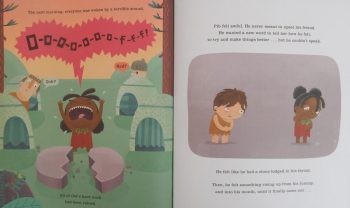
Pib meanwhile is feeling lonely and more than a tad jealous. Come nightfall he feels the need to express his own feelings – physically – and so he does.

Come morning Oof is devastated to discover the outcome of this fury.

Now at last, a remorseful Pib finds he is able to come up with a word that might just be the saving of their precious friendship …

What about that broken stone, you might be wondering, and the invention the two children were working on? To discover the answers you’ll have to grab yourself a copy of Duncan’s smashing story and see. The finale will definitely make you laugh.

Full of wry visual humour, the splendidly expressive digitally created illustrations are rendered in foresty hues and the telling is pitch perfect for sharing with a young audience.

Yet another winner for Duncan.

Albie’s 10 Anniversary Blog Tour: How to Catch a Dragon

It’s Red Reading Hub’s turn on the Albie 10th anniversary blog tour and today we have a ROAR of a book as our focus:
How to Catch a Dragon, Caryl Hart and Ed Eaves’ wonderful story that begins with Albie visiting the library to draw a dragon for his homework and takes him off on a fantastical adventure with a young knight.

To celebrate, Albie and his dragon adventure, author Caryl Hart shares five top facts about dragons:

Five Facts about Dragons

1. Dragons appear in stories from all over the world including India, China, Europe, Egypt and America.

2. Some scientists think that, long ago, people found dinosaur fossils and thought they belonged to dragons. Others think the idea of dragons is based on people’s fear of snakes or crocodiles or iguanas.

3. Chinese culture celebrates the Year of the Dragon every 12 years. If you were born between January 2012 and February 2013 then you are a Water Dragon. Chinese dragons are symbols of luck and good fortune and can fly, but don’t have any wings!

4. The How to Train Your Dragon films started out as a series of books written by Cressida Cowell, the first of which was published in 2003. There are now 12 books in the series!

5. Komodo dragons are real creatures that live in Indonesia. They can grow to 3 metres long and eat insects, birds and mammals.

Thanks to the lovely people at Simon & Schuster Children’s Books, Red Reading Hub has a copy of HOW TO CATCH A DRAGON to give away.

To enter, follow @jillbennett18  RT the giveaway tweet and tag a friend. A winner will be chosen at random and the publicist will send you your prize book (closing date 12th August UK entrants only please)

Look out next week for the rest of the blog tour; there are going to be lots more fun facts and giveaways.

Look out soon for Red Reading Hub’s review of Albie’s latest adventure How to Drive a Roman Chariot – that sees him whisked away to Ancient Rome where, along with a young girl, he finds himself driving a runaway chariot.

The Blue Giant

The Blue Giant
Katie Cottle
Pavilion Books

Picture book messages about helping to save the environment come in all shapes and forms.

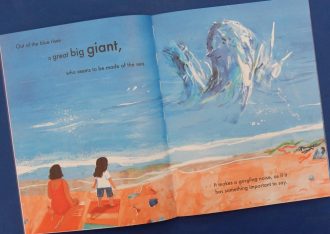
In Katie Cottle’s second eco-story the messenger takes the form of an enormous wave that suddenly rises up out of the sea just as Meera and her mother are settling down for a relaxing day on the beach.

This blue giant urgently wants to communicate with them and its message is a vital one asking for their help.
Donning their diving suits and following in their small boat, mother and daughter pursue the wave and discover that the ocean is awash with rubbish of all kinds and that many sea creatures are in great danger.

After a day of hard work a great deal remains to be done to clear up the pollution – way too much for just two people.

The following morning Meera is back on the beach and the next, but now she has enlisted the help of some of her friends.

They in turn enlist some of theirs and so it continues …

The narrative concludes with a list of half a dozen suggested ways in which we can all help by reducing our consumption of single-use plastics.

Katie’s powerful images convey the plastic pollution problem in a manner that young children will easily relate to, particularly those of the sea creatures caught up in the debris. Stories such as this one are a great way to galvanise youngsters into action.

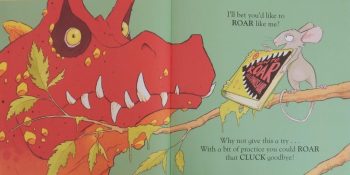
I Can Roar Like A Dinosaur

I Can Roar Like a Dinosaur
Karl Newson and Ross Collins
Macmillan Children’s Books

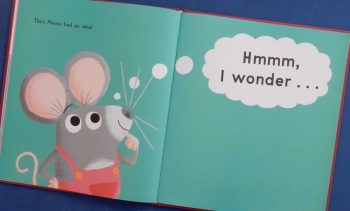
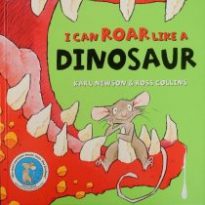
What is it about a certain Mouse that causes him to keep on making ridiculous claims? Last time we met him he told his fellow animals that he was a tiger and now, so he’d have them all believe, he’s a fearsome ROARing dinosaur – well briefly …

Never mind; one can always turn to the trusty ‘How to Roar Like a Dinosaur’ guide book with its step-by-step instructions and why not give your pals a lesson too?

Now having watched Mouse in action, I know that he’s got absolutely no clue about how to be an effective teacher; hurling insults at the learners is not a good way to go.

Time to teach the teacher a lesson or two … Perhaps a spot of Mouse-baiting might be effective in unleashing the diminutive rodent’s ROAR.

Success of a kind – but chicken or no chicken, no creature in its right mind would try to teach its grandmother to suck eggs, so to speak …

I’m going to leave our Mouse friend rather precariously balanced upon the branch of a tree; safe in the knowledge that he’ll manage to use his imagination and extricate himself from what looks to be a rather perilous perch.

Yet again team Karl and Ross have created a pricelessly absurd ace of a book that’s full of funny foolishness, brilliantly portrayed pupils and cover to cover entertainment of the first order.

Polly Profiterole’s Little Town Good Enough to Eat / My Grandma is 100

Here are two recent picture books from Little Steps Publishing

Polly Profiterole’s Little Town Good Enough to Eat
Maggie May Gordon and Margarita Levina

Imagine living somewhere where the only ‘shop’ is the front porch of your house. That’s how it is for Polly Profiterole, pancake maker par excellence who has mixed more pancakes than she cares to remember for way, way too long in a little town without a school, a bank, a pub or a church.

Then one night as she lies in bed Polly decides something must be done to change things. With her brain in over-drive she enlists the help of her husband and the following morning Polly bakes and Percy builds

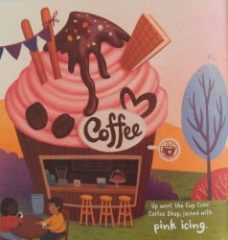
the most delicious town you could ever envisage, from the Choco-Chip Church at the very top of the hill, all the way down to the Pork Pie Pub at the bottom with some yummy establishments in between including the Cup Cake Coffee Shop

and the Honey Roll Hairdresser (shame there’s no bookshop)., Finally of course, they make ‘Polly Profiterole’s Proper Pancake Parlour’.

Thus Polly and Percy co- created a unique little town that must surely have become a go-to destination instead of a drive right through one.

If your taste buds aren’t in overdrive after sharing this fun book with youngsters, then I’d be very surprised. Poet, Maggie May Gordon and illustrator Margarita Levina serve up a tale of teamwork and enterprise, that all began because despite everything, Polly never lost the ability to imagine.

My Grandma is 100
Aimee Chan and Angela Perrini

What a wonderfully warm book is this one narrated by a small child whose Grandma Edna (great grandma) is celebrating her 100th birthday.

Plenty of thought goes into getting the day just right. What kind of food can 100 year-old teeth cope with? What should the birthday cake be like? Then there’s the consideration of a suitable present for somebody who now lives in a special home with lots of other people and doesn’t really need anything.

Next morning with mounting excitement at the prospect of having thought of the perfect present, it’s time for the narrator and family to drive to Grandma’s special party. And what a wonderful celebration it is, especially with so many relations,

as well as Grandma’s letters from The Prime Minister, the Governor General and the Queen of England. Grandma Edna is some lady with three children, four grandchildren and nine great grandchildren.

The author, Aimee Chan is the granddaughter in law of ‘Grandma Edna’ and wrote the book as a celebration of Edna Phillips’ life.

I love the way the narrator’s imaginings are given substance in some of Angela Perrini’s quirky illustrations.

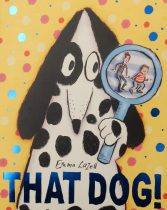
That Dog!

That Dog!
Emma Lazell
Pavilion Books

Author/illustrator Emma Lazell’s second picture book features Penny who has a particular penchant for purloining pooches, and her new accomplice Pat.

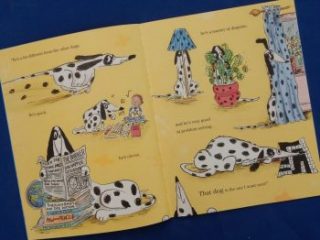
Penny has set her sights on ‘new dog in town’, a multi-talented dog and spotty all over; but it’s down to Pat to procure the creature.

It’s evident from the outset that the highly desirable, dappled dog is a whole lot more savvy than his would-be dog-nappers,

not least Penny who only ever gives Pat partial information about that which she desires.

As he sets out on his first mission. ‘Spotty all over’ is the description she gives her eager to please helper.

He’s surely spoilt for choice when he reaches his destination but which one will he take? Here’s a clue – it’s ‘a bit wiggly and a bit squiggly’.

Has he bitten off more than he can chew however, for the hound (something of a spare-time detective) is watching his every move

as we see in Emma’s caninely comical art when the dog-napper returns on several occasions, each time seizing the wrong animal until …

Altogether this is most definitely, a delightfully dotty and diverting tale.

One Button Benny and the Gigantic Catastrophe / Bad Cat!

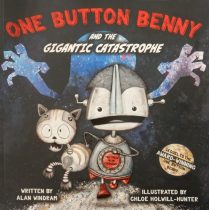
One Button Benny and the Gigantic Catastrophe
Alan Windram and Chloe Holwill-Hunter
Little Door Books

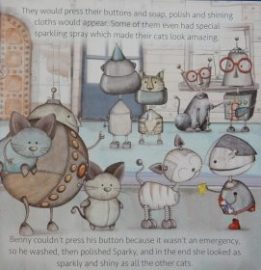
Young robot Benny returns for a new adventure (hurrah! I hear fans shout) and now the Cool Cat competition is fast approaching so, like all his friends, Benny has to get his moggy Sparky super shiny and sparkly for the big event – having done the wretched washing up, that is.

Disaster strikes though, for the next morning every single one of the cats has disappeared. An exhaustive search of the town reveals only a note on the ground: the cats have all been kidnapped.

This certainly warrants the pressing of Benny’s (only to be used in pukka emergencies) red button assures his mum.
Having duly done the deed, something unexpected happens: Benny’s button opens like a door, disgorging two rolled pieces of paper.

There’s only one thing to do if Benny and his friends are to get their pets back safely and that’s work together following the instructions on the paper

and Trojan Horse style, build an enormous scrap metal cat in which to hide and wait for the return of the alien kidnappers who will surely come and steal this massive cat once they hear about it.

And sure enough they do. Fortunately all this cat-napping has made the aliens sleepy and once back on their own planet they fall fast asleep leaving the rescuers to find their missing moggies.

Things don’t go exactly to plan thereafter but I’ll leave Benny and his friends being chased by the wobbly alien cat stealers and you to get hold of a copy of Alan (author) and Chloe – illustrator’s – wacky tale of teamwork, forgiveness and dish washing to discover what happens subsequently.

Bad Cat!
Nicola O’Byrne
Nosy Crow

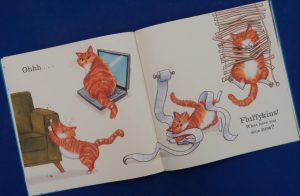
Nicola O’Byrne’s feline character Fluffykins may have a cute sounding name but this moggy is anything but cute. Indeed he creates a chain of havoc as he knocks down a vase of flowers, tangles up the knitting, unwinds the loo roll, plays havoc with the venetian blind, leaves a large puddle on the floor and that’s not all.

Now I’m not a cat lover, nor am I familiar with cats’ behaviour, but it appears from his expressions that in his boundary pushing actions, Fluffykins knows exactly what he’s doing despite his owner’s warnings and chiding. On the other hand it might just be playful oblivion. In this story Nicola O’Byrne leaves it open for readers to make up their own minds.

With a text addressed directly at the mischievous moggy and so much white space around the action, this latest offering is certainly something altogether different from her previous books.

Young listeners will probably relish Fluffykins sheer devilment; this ailurophobic reviewer certainly would steer clear of his abode.
The Sloth and the Dinglewot

The Sloth and the Dinglewot
Nicole Prust and Amanda Enright
New Frontier Publishing

Think how many wonderful things you might miss if you never step outside your comfort zone.

That’s exactly what Samuel the sloth does one drowsy summer’s morning. Bored with merely lazing around like his fellow sloths, he takes the opportunity provided by Dinglewot Jinglewot Dingledum Dee, the colourful bird with bells on its feet that offers him an adventure.

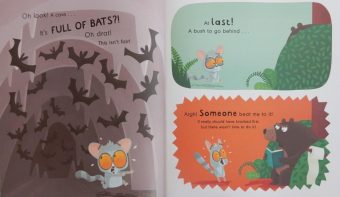
Samuel is forced to embrace his fears as he decides to follow the Dinglewot through the treetops, across the grasslands, past the mountains, down a ravine to a dark cave.

Then, after exciting encounters with baboons and later, bats, they finally reach Dinglewotville, the land of the bird’s birth.

There Samuel discovers an amazing carnival and dances the night away – his best night ever.

But eventually for our adventurer it’s time to leave.

He returns to his fellow sloths in the hope that some of them too might set aside their fears and join him and his new friend on another adventure. You never know …

The flowing rhyme of debut author, Nicole Prust’s narrative and Amanda Enright’s richly coloured illustrations make for a lovely storytime read aloud that shows the importance of risk taking and of seizing life’s opportunities.

Spaghetti Hunters

Spaghetti Hunters
Morag Hood
Two Hoots

Poor Duck is nonplussed; his spaghetti has gone missing. Enter right, atop the tea caddy, Tiny Horse, self-declared greatest ever spaghetti hunter, promising to ‘save the day.’

Rest assured Tiny Horse has all the necessary gear at the ready

and once it’s safely stowed in Duck’s backpack the hunt for this particularly problematic pasta is ready to begin.

Things don’t go as Duck expects but Tiny Horse is confident in her plan and soon has – to her friend’s consternation – amassed a fair bit of the missing spaghetti.

Or perhaps not!

Utterly infuriated Duck returns to the sanity of his teapot and a good book, but he soon has an uninvited visitor disturbing his peace

and criticising his culinary skills.

However, the proof of the spaghetti is in the sampling but Tiny Horse being Tiny Horse, just has to have the last word (or two, to be precise).

For me this is Morag Hood’s best yet – and that’s saying a lot. Splendidly silly, it was all I could do not to splutter my coffee all over my Mac as I was composing this review.

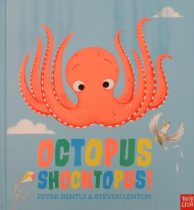
Octopus Shocktopus!

Octopus Shocktopus!
Peter Bently and Steven Lenton
Nosy Crow

‘One day, we found an octopus / had come to live on top of us.’

What a wonderfully wacky notion and one that instantly grabs the reader’s attention – well, with those eight day-glo orange limbs and body what else would you expect?

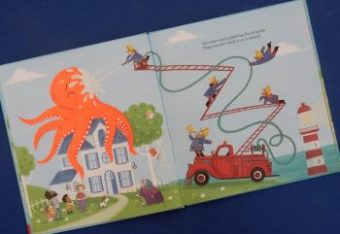
Said octopus has descended upon the narrator’s neat-looking house on the cliffs causing consternation with neighbour, Mrs Antrobus who calls the fire-brigade.
However they fail to shift the creature and so it remains, limbs a-dangle and looking decidedly bored with life until the children invite it to play.

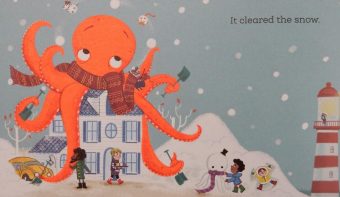
It’s great fun for all concerned and they quickly discover that there are lots of other advantages to having a gigantic octopus for a pal. (Pitch that one to a class of five year olds and see what  they can come up with.)

But then comes the fateful day when the roof is bare save for the tidy rows of blue tiles. Tears are shed all round but worry not; a splendiferous finale awaits …

With themes of acceptance and friendship Peter Bently’s rhyming narrative is sheer delight to read aloud and Steven Lenton’s wacky scenes are a visual treat: the octopus’s eyes are just wonderful

and there’s SO much to explore on every spread. Make sure you peruse the endpapers too.

A treat from team Peter and Steven that’s bound to be requested over and over …

In My Dreams / Boo Loves Books

It’s good to catch up with some recent titles from New Frontier Publishing

In My Dreams
Stef Gemmill and Tanja Stephani

The jewel-like cover of this book immediately conjures up a magical world of adventures.

‘When the world is quiet and I’m alone, I like to dream’ – the opening lines drifting across the bedroom of a sleeping child draw readers into his dreams; adventures he shares with his toys as he lets his imagination take him to a fantastical land of marshmallow clouds, jelly puddles and showers of strawberry rain.

Then it’s deep down to the ocean floor, and up in the air far away riding upon a dragon’s back …

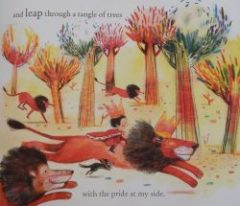
into jungles with monkeys to make mischief with, across plains to roar and leap with lions

and to frozen lands of snow and ice.
I love how the text gently meanders across the pages even towards the end when we’re suddenly told this: ‘In the darkness, the night shadows try to steal my sleep and things appear menacing …

but only momentarily for the page turn reveals the now frail-looking shadows retreating for ‘They have no power over me.’
We finish up in the light once more, a light that’s warm and shining calling the dreamer back safe and loved, to the haven of his bedroom.
What a gorgeous bedtime tale. Snuggle up and share: this will surely transport little ones into their own dream worlds secure in the knowledge that they too can let their imagination roam freely and safely, inspired by Stef Gamill’s warm, rhythmic text and Tanja Stephani’s spectacular, wonder-filled scenes of tenderness and enchantment.
Boo Loves Books
Kaye Baillie and Tracie Grimwood

Phoebe (like a fair number of young children) finds reading aloud rather stressful: what if I make a mistake, she worries when it’s her turn to read with her teacher.

But then her teacher announces, “No reading at school tomorrow” swiftly followed by “Instead, we’ll be reading somewhere special” and that makes Phoebe’s tummy all of a flip flop. So much so that she informs her mum, “I’ll be sick tomorrow.”

But of course she isn’t and off goes the school bus with Phoebe aboard. Their destination is the animal shelter where the children are to read to the resident dogs. Another stressful situation for Phoebe: her dog is really BIG.

Understanding her fear, Miss Spinelli stays close beside Phoebe, reassuring and encouraging her pupil.

Then secure in the knowledge that the dog too is feeling anxious, the little girl settles down with a book and Big Boo, and a transformation slowly starts to take place in both parties …

A beautifully illustrated, empathetic story that is both encouraging and enabling.

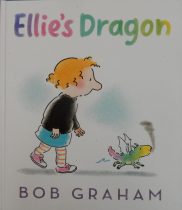
Ellie’s Dragon

Ellie’s Dragon
Bob Graham
Walker Books

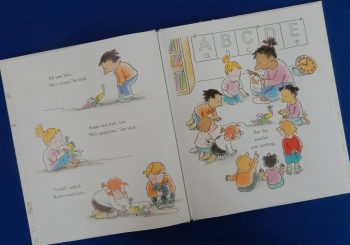
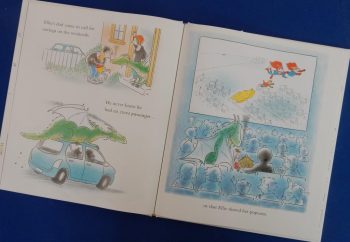
Bob Graham has created yet another gorgeous picture book, one that celebrates the imagination of young children.

It features Ellie who when quite young discovers a multi-hued, newly hatched baby dragon atop an egg box in the supermarket. She names him Scratch and takes him home with her.
There she accommodates the tiny creature in her doll’s house feeding him on such fare as nasturtiums, chillies and burnt toast. All the while her mother sees nothing unusual.

As she grows and changes, Ellie’s love for the dragon remains constant: she takes him to nursery

on outings and even to the cinema.

Like Ellie though, Scratch grows and changes. When Ellie turns eleven, her dragon begins to fade away until for the teenage girl, he finally disappears.

It’s time for Scratch to find a new child …

As always, Bob Graham’s illustrations are suffused with his own brand of gentle humour and full of wonderfully whimsical details, as he documents this poignant portrayal of growing up and losing that sense of awe and wonder, that boundless imagination that sadly, so many children have ‘educated’ out of them.

Freedom, We Sing

Freedom, We Sing
Amyra León and Molly Mendoza
Flying Eye Books

Here’s an enormously powerful and empowering picture book that will surely motivate children to think deeply about freedom and what it means to be free.

The author is an activist whose work focuses on Black liberation and communal healing – ‘the art of listening and honest conversation are the primary tools for lasting change’ says her biographical paragraph inside the book’s cover.
(To that end, I can’t help but recall the wonderful recent channel 4 programmes The School That Tried to End Racism.)

As well as hope, the author’s story, which takes the form of a dynamic conversation between a mother and her small child as they talk about life and the world around them, is an embodiment of determination, wonder …

and mindfulness.

The two look at family photos, reflecting on the love between those close to us making the world seem small and safe; then move outwards to encompass others living under the same sky whose lives might appear different on the surface, some of whose lives are difficult, perhaps due to war or oppression; but nonetheless whose hearts beat like their own and whose parents will do their upmost to keep their children safe from harm.

The child cogitates on the very nature of freedom

before the mother states “Breath is freedom/ A sweet release / The right to be / A universal sign / Of life and peace”.

Both reflecting and radiating the feelings and emotions of the text, so stunning are Molly Mendoza’s richly coloured illustrations that they really take your breath away.

With all that’s been happening in the world recently it’s more important than ever to start sharing, pondering upon and talking about books such as this one with young children. Where better to start than here? …

Wild

Wild
Sam Usher
Templar Publishing

Grandad and Boy are doing some cat minding for a friend. Boy (the narrator) has done his research and announces that it’s a simple task: they need to feed, cuddle and play with the moggy.

However, cats, like humans, don’t always conform to the norm and this visitor is one of those.

She definitely doesn’t want to play; she turns her back on the food they offer,

and neither a nap nor a cuddle proves any more agreeable.

Boy is convinced the creature doesn’t like him. Grandad is slightly more sanguine until, the cat makes a dash for it.

Through the window she goes with Boy and Grandad following the escapee as best they can,

out into the wilds, where the real and the imagined merge.

Eventually the chase leads them to a fabulously diverse feline gathering where Boy and Grandad join in with the frolics.

Then safely back home once more, Boy decides that perhaps Cat is now more favourably disposed towards him.

Using a repeat refrain as part of Boy’s simple narrative, Sam Usher lets his expressive, superbly detailed, scratchy pen-and-ink images do much of the talking in this splendid celebration of the power of the imagination, and the on-going loving intergenerational relationship.

Catch That Chicken!

Catch That Chicken!
Atinuke and Angela Brooksbank
Walker Books

Set in a West African village compound this is essentially Lami’s story. Lami has a special talent for catching chickens and everyone of the villagers knows she’s the best.

That’s not to say that her family and friends are without talents of their own – sister Sadia is a super speller,

brother Bilal is brave with bulls

and friend Fatima is a super-speedy plaiter of hair.

One day while chasing a chicken around the compound, Lami ignores the shouts of “Sannu! Sannu!”, “Slow down!” as she dashes madly towards and up the big baobab tree.

Suddenly as she makes a grab for the bird, Lami slips and comes hurtling to the ground where we see a painfully sprained and very puffy ankle and a very tearful little girl.

Some well-chosen words from her Nana Nadia result in a change in Lami’s chicken strategies but it’s one that proves that there’s more than one way to be an ace chicken catcher.

Once again team Atinuke and Angela Brooksbank have created a winning, enriching, gently humorous story, which shows the strong community spirit of Lami’s village wherein everyone is valued. Angela Brooksbank’s spirited scenes abound with colour, texture and pattern showing much about this particular way of life in West Africa.

A great book to add to the family shelves or foundation stage/KS1 classroom collections.

Be Kind

Be Kind
Pat Zietlow Miller and Jen Hill
Macmillan Children’s Books

Now, more than ever, it’s vitally important for everyone to act with kindness and thoughtfulness to others, no matter who they are.

Here’s a thoughtful and thought-provoking look at what it means to be kind and how kindness can spread.

It begins when a little girl, Tanisha, spills juice all over her new dress one lunchtime to the amusement of most of those in the room. The narrator tries instead words of kindness …

Tanisha however runs off leaving her friend in thoughtful mode and as she paints she muses on the nature of kindness.

It could be many things shown through actions such as giving, helping or paying attention; or perhaps by thanking someone or merely using their name – all relatively easy to do.

Sometimes however it’s more difficult …

but small acts of kindness can have a ripple effect, growing worldwide even

and … “All the way back to Tanisha and me. So we can be kind. Again.”

Throughout the author leaves space for readers/listeners to reflect on the narrator’s words, which never once become preachy.

Jen Hill’s illustrations are enormously appealing capturing so well the feelings of Tanisha, the narrator, their classmates and the wider community.

This is most certainly a book to share and discuss both at home and in primary classrooms.

Monsieur Roscoe On Holiday

Monsieur Roscoe On Holiday
Jim Field
Hodder Children’s Books

Jim Field has clearly been doing a fair bit of sitting on his own sit-upon, as he’s both author and illustrator of this picture book. The aim (as well as to entertain) is to set youngsters on a journey to becoming bi-lingual as they join the enormously endearing Monsieur Roscoe and his goldfish, Fry, for a holiday.

First comes the packing – always a bothersome task – and then with luggage loaded behind, it’s onto his bike and away through the big city to the railway station to catch the train.

It’s a close call, but fairly soon it’s time to meet up with Eva for a spot of camping. Learning to put up a tent courtesy of your rabbit friend, once you get to the campsite isn’t the best idea Monsieur R. even if you have come with all the gear.

Next morning Monsieur Roscoe and Fry bid ‘au revoir’ to Eva and board a bus bound for the ski slopes where there’s a rendezvous with another friend, Stan. Seemingly our canine holidaymaker has hidden talents …

The next destination appears a whole lot more peaceful. Caro is certainly happy to see her friends and even allows Monsieur Roscoe to take the wheel of her speedboat but it’s evident that a certain dog needs to hone his steering skills when it comes to watercraft.

The penultimate stop is the seaside where Jojo and Didi eagerly greet the new arrivals. After a splash dans la mer comes the last leg of the journey and a meet up with Dougal duck for a spot of indulgence at the busy village café.

However, even the most charming of travellers must go home eventually, and so it is with Monsieur Roscoe and Fry. Assuredly they’ll have lots to tell their friends back in their home city and who knows, perhaps after a good night’s sleep the two of them will start thinking about their next adventure …

Jim introduces youngsters to plenty of common French words and phrases in the course of this story of the delightful duo. Every double spread has a wealth of humorous detail to explore and giggle over; Fry is an absolute hoot

and there’s even a seek-and-find element to the whole thing, for on the final page are lists of items to spot at the six locations featured.

Bravo Monsieur Field – un livre divertissant et éducatif.

Found You

Found You
Devon Holzwarth
Alison Green Books

It’s difficult enough moving home, but having to flee your homeland leaving all your friends behind, to move to a new country as a refugee has challenges like nothing else.

That’s how it is for young Sami who, since his arrival with his family, has become a loner. Everything looks and feels totally different; people don’t speak your home language and it seems as though you just don’t fit.

One day Sami and his mum are visiting the park and watching from the trees is a little bird, all alone too. Suddenly she whizzes downwards smack into Sami. The little creature says she is lost and asks for his help in finding her friends.

Gradually during their search Sami finds that the people he’d previously thought of as standoffish are quite the opposite. The old lady from the bus no longer scowls; rather she smiles offering Sami grain to feed the birds.

Then the baker offers to share his lunch.

Suddenly Sami recalls where it was he’d seen birds just like Little Bird; off they go but in his anxiety and rush to help, Sami ignores the chance to play with a little girl from his nursery.

At the cherry tree Little Bird’s friends are waiting and seemingly it’s job done and time for a farewell. Little Bird thanks Sami, making him feel proud by adding “You’re a very good friend” and flies off with the others leaving the boy alone once more. Until something surprising happens …

It’s then revealed that Little Bird’s mission isn’t over just yet for in this wonderfully heart warming story there are others in situations similar to Sami’s that also need her help.

With its gorgeous colour palette and superbly expressive scenes which show much more than is said in her text, Devon Holzwarth’s debut picture book is one that’s certain to foster empathy and understanding, showing how important it is to offer a welcoming environment to newcomers. It can all begin with holding out a hand (or wing) in friendship.