Together

Together
Jane Chapman
Little Tiger

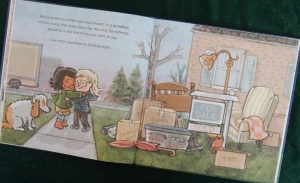
Deep within the forest, hidden among the shady leaves, a tiny face peers through the foliage. It belongs to a baby gorilla that feels totally alone in the world, a world that feels strange and a little threatening.

But then along with the downpour of refreshing rain and the smell of something to eat that wafts on the breeze, comes something different, something huge and very …

So thinks the little one. But it’s not so for despite appearances, the creature reaches out with unexpected tenderness, extending a soft paw of companionship and friendship in a hitherto scary world.

Now no matter what each day brings forth, be it beauty and magic,

or shadow and sadness, there’s always the joy and comfort of togetherness.

Jane Chapman’s illustrations are incredible, both in their lifelike portrayal of the two gorillas and in the sensitive way they convey the sense of connectedness between them.

That sense of connectedness is what all of us crave probably more than anything else in these pandemic times. This beautiful, heart-warming story is a wonderful portrayal of how reaching out – may be not physically but in what ever ways are possible – can make all the difference.

The Princess in Black and the Bathtime Battle / Stick & Fetch Investigate: Off the Leash

New additions to  two very popular Walker Books series for primary readers:

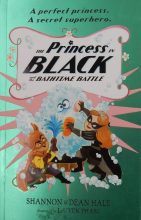
The Princess in Black and the Bathtime Battle
Shannon & Dean Hale, illustrated by LeUyen Pham
Walker Books

When a decidedly unsavoury stink starts wafting in from the goat pasture, Princess Magnolia has little choice but to leave her bridge-building in the kitchen, don her Princess in Black gear, mount her trusty steed and follow her nose to the source of the stench and deal with it.

So she does temporarily, but all she’s actually done is shift this particular stinky emanation elsewhere as it quickly becomes evident. For, one by one other masked princesses appear on the scene to try and overcome what they discover is a stinky monster.

This stinky monster however is truly powerful – ‘stinkier than a full litter tray … stinkier than a blocked toilet … stinkier than a pile of dirty nappies on a hot summer’s day. …more stink than monster.’ PHOAW!

It’s definitely time for all the princesses and the Goat Avenger to join forces and try a spot of teamwork.

This is book seven and the final pages indicate that there’s still more to come – something that will please the large numbers of newly independent reader fans of the series

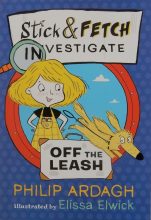
Stick & Fetch Investigate: Off the Leash
Philip Ardagh, illustrated by Elissa Elwick
Walker Books

Detective partners Sally Stick and Fetch are hot on the trail again in a third adventure.

Following an operation Granny Stick is holidaying for a week at the seaside, staying at The Roxbee Hotel and that means Sally and her dog are there too.

No sooner are they installed in their very own room than the detective duo start discovering clues and looking for evidence of criminal activity.

So who is the mysterious thief that’s breaking into rooms, stealing shampoo, towels and other things, loading them onto a getaway trolley and eating chocolate bars?

This is assuredly an unusual case – or is it even a case? That would be telling.

What can be told though is that this crazy story is enormous fun for new solo readers. The mix of Philip Ardagh’s bonkers humour and Elissa Elwick’s chucklesome illustrations makes for a splendid first full-length adventure for the Sally and Fetch team.

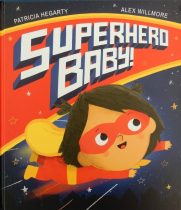
Superhero Baby!

Superhero Baby!
Patricia Hegarty and Alex Willmore
Little Tiger

Here’s a fun story that takes sibling rivalry to a whole new level.

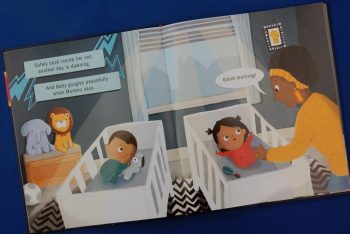
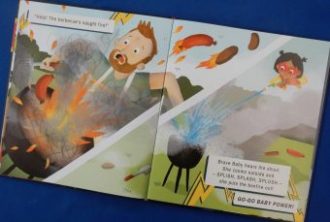
In the dead of night, long past bedtime for little ones, there’s one of their number who’s still wide awake and ready to launch herself into action; and so she does when there’s a burst pipe in town.

With job duly done she’s back in her cot alongside her twin brother’s long before mum wakes her next morning.

She then spends the day putting her ‘baby power’ to good use as she performs one heroic act after another never pausing to take a nap.

There’s somebody though, who is far from happy about all the attention this diminutive superhero is receiving as she whizzes around with her seemingly inexhaustible supply of energy, testing her powers to their limits.

Would-be superhero little ones will surely delight at watching the drama unfold through Patricia Hegarty’s rhyming romp that has an unexpected twist in its tail, and Alex Willmore’s instantly appealing, telling pictures where one pair of eyes in particular speak volumes.

Uncle Shawn and Bill and the Great Big Purple Underwater Underpants Adventure

Uncle Shawn and Bill and the Great Big Purple Underwater Underpants Adventure
A.L.Kennedy, illustrated by Gemma Correll
Walker Books

I can’t believe we’re already at number four in this utterly bonkers, somewhat surreal series starring Uncle Shawn, his llama pals, badger Bill et all.

What on earth is causing all those mysterious Purple Bottom explosions and creating great alarm with regard to underpants the world over?

There’s surely one person who knows how to deal with a crisis such as this Particularly Purple one: look no further than Uncle Shawn, plan or no plan.

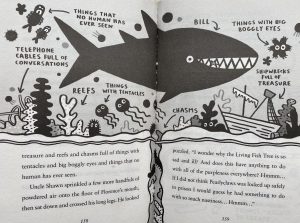
There is a plan though of sorts; it involves leaving the farm to the llamas and embarking on an adventure to find and save the Living Fish Tree. All it takes, surely, will be several pairs of Undersea Boots, a plentiful supply of powdered undersea air, buckets (to go over heads) and a bit of bravado.

There’s an encounter with Timothy the shark, one of the Great White variety (apparently Uncle Shawn has saved the creature’s life back in the day). Let me say here that sharks’ mouths can, when needed, be extremely useful means of rapid transportation particularly if you need to get from Scotland to the Pacific Ocean.

They’re also a pretty decent place to consume a lunchtime sandwich should you feel a tad peckish, oh and the tongue’s a suitable place for a game of snap and while so doing discussing the likelihood of the nefarious Sylvester Pearlyclaws being behind the massive, ever increasing, purple problem.

But is this a problem too large even for Uncle Shawn et al? I for one would hate to be a story spoiler so I’ll leave you on tenterhooks and a tad entangled in the hope you’ll get hold of a copy of this delicious daftness served up by A.L. Kennedy, garnished by Gemma Correll, and discover for yourself.

Sophie Johnson Sports Superstar

Sophie Johnson Sports Superstar
Morag Hood and Ella Okstad
Simon & Schuster Children’s Books

Young Sophie Johnson appears to have an ever-increasing number of strings to her bow – Unicorn Expert, Detective Genius and now Sports Superstar. Is there no limit to her talents, one wonders.

As the story opens, Sophie is engaged in her training regime and while so doing she tells readers about all her preparations for a ‘Big Race’ . She eschews assistance from her mum as she goes about her work-out. (Since when was raiding the sweet jar good for training miss Sophie?)

The girl has what she calls an ‘Excellent Plan’. This appears to involve consuming vast quantities of fast food and doing the occasional exhausting workout.

Come the big day she’s raring to go

but it would appear that in her enthusiasm there’s one very important skill she’s omitted to hone …

As always, spending time with young Sophie is sheer delight. Team Morag and Ella together have created another funny episode in the life of Sophie Johnson and once again it’s the clever way the quirky pictures and the dead pan words tell rather different stories that make the book such fun.

I love the fact that in this athletic endeavour Sophie is still sporting her tutu throughout and every spread has deliciously diverting details to chuckle over.

The splendidly spirited Sophie’s a winner in my book no matter what she does.

Poo in the Zoo: The Great Poo Mystery

Poo in the Zoo: The Great Poo Mystery
Steve Smallman and Ada Grey
Little Tiger

At the end of the first story, Poo in the Zoo, Zookeeper Bob’s enterprise had enabled him to buy a super-duper pooper scooper robot.

This technological wonder, Robbie by name, with his poop hoover, makes Bob’s job considerably easier and on this particular night as he and the animals bed down for the night, all is well at McGrew’s Zoo.

The next morning however, everything changes. There’s poo absolutely everywhere and Robbie has disappeared. Disaster!

Then suddenly a tweed-clad woman riding a ‘pooper scooter’ zooms up announcing she’s ‘here to save the day!” Her name is Arabella Slater and she claims to be the number one poo investigator when it comes to dealing with number twos.

Immediately she leaps into action locating all manner of poo piles and then she notices some stray bits of wire. The hunt is on as all the zoo residents follow a trail

that leads them through the woods and into a glade where they come upon …

Bob then realises what has happened. But is it all over for Robbie or can Arabella live up to her claim and “save the day”?

Steve’s funny rhyming text bounces whiffily along as he regales this dung-filled drama, which Ada Grey hilariously illustrates with zany scenes of the poo-filled zoo and its environs.

Share this with a group of early years listeners or just one, and I’m pretty sure the immediate response will be “read it again!”.

My Red Hat / Sometimes Cake

It’s an absolute joy to catch up with some recently published Walker Books picture book treats

My Red Hat
Rachel Stubbs
Walker Books

I’m sure every young child would absolutely love to have a hat such as that in Rachel Stubbs’ meditative story. Said hat is bestowed with love upon a little girl by her grandfather one day.

But this is no ordinary hat, quite the opposite; it has an enchantment all of its own for its possibilities are seemingly without limit.

It might for instance keep you warm and dry, or cool; it can serve as an artist’s subject or a drink container, you can wear it to stand out or blend in…

It’s a holder of dreams, a hider of secrets, a cover for fears; it will take its wearer to the most wonderful places far away

before bringing you right back to snuggle up on Grandfather’s lap.

In keeping with the harmony that exists between Grandfather and young child, there’s a sense of perfect harmony between Rachel Stubbs’ illustrations in her beautifully understated colour palette and her minimal text that leaves so much for readers and listeners to fill in.

Sometimes Cake
Edwina Wyatt and Tamsin Ainslie
Walker Books

Deliciously sweet but never sickly is this treat of a picture book.

It tells what happens when Audrey meets a lion carrying a purple balloon. She asks if it’s his birthday and he replies, “Sometimes, but not today.” Nonetheless, it must be someone’s birthday reasons Audrey and so they celebrate with a song and cheers.

There follow several further encounters between the two. In the next Lion brings a cake and they celebrate both Tuesdays and coconuts (for the icing). They go on to celebrate orange and yellow – Lion sporting a hat.

These celebrations appear to be a regular occurrence but then comes a change: Lion appears sans anything and announces it’s just an ordinary day.

Thereupon Audrey leaves him alone and goes off to set about preparing for a party to celebrate a perfectly ordinary day – only it isn’t for there’s Lion to celebrate and plenty more besides.

A tender reminder of the importance of being in the moment; and that being with a friend is always cause for celebration – something we’ll all endorse as we come out of lockdown. It’s full of warmth and the wonders that simple things can sometimes offer, beautifully expressed by Edwina Wyatt and equally beautifully illustrated in soft watercolours by Tamsin Ainslie.

Snuggle up with little ones and share with cake, especially on Tuesdays.

Visiting the Doctor / I’m a Vegan / Rubbish and Recycling

Here’s a look at titles from three non-fiction series kindly sent for review from Booklife Publishing

Visiting the Doctor
Joanna Brundle

This is a title in the First Experiences series that seeks to allay the fears youngsters might have about facing something new such as a visit to the doctor.

Through a sequence of questions and answers, together with clearly labelled photographs, little ones are introduced to what a doctor does, why visiting the surgery might be necessary and then goes through the process of a visit – checking-in, what happens inside the doctor’s room, what a doctor might check on, the role of a nurse, prescribing and visiting a pharmacy, taking medicine and finally, the possibility of the need to book another appointment.

Simple, straightforward and reassuring: this is one for sharing before a first visit to a GP or to add to an early years setting’s book collection.

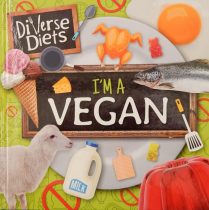
I’m a Vegan
Shalini Vallepur

Here’s a handy little book from the Diverse Diets series that starts by explaining what veganism is and then goes on to offer some suggestions for those who want to try swapping animal products with vegan alternatives.

To that end there are step-by-step instructions for making a vegan cheese from cashew nuts.

Some potential vegans worry about getting sufficient protein in their diet without meat and dairy, and reassuringly, there’s a page suggesting some protein-rich vegetable substitutes/ such as kidney beans, channa (chick peas) and tofu. The author includes a yummy-looking stir-fry recipe using tofu as its main protein source.

The final spread looks at a vegan life-style that eschews animal products in non-edible items, and is followed by a glossary of terms used and an index.

Succinctly written and illustrated with photographs, this is a useful starting point on the subject of veganism for young readers.

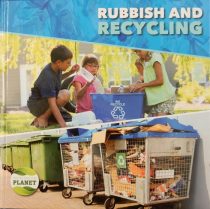
Rubbish and Recycling
Harriet Brundle

Rubbish and Recycling is part of the publisher’s Protecting Our Planet series, something that is crucial for all living things.

Having provided brief explanations as to what constitutes rubbish and what happens to our rubbish once it’s collected, the author explains what harm is caused by the items taken to landfill sites.

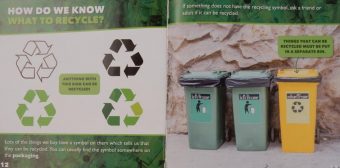
Much better than throwing things away though is recycling, and that’s the next topic in this book. Most of us nowadays, are much more likely to look carefully at materials we might once have thrown out without thinking, check to see if there’s a recycling symbol like the one shown herein,

and if so place it in the appropriate receptacle for collection. Then one hopes it can be made into something useful again.

With the world’s population growing ever larger, it’s increasingly important that we all play our part in preventing things ending up as landfill or causing harm to animals, as the author reminds readers; and she concludes by making some suggestions that if all readers followed, would make a great difference when it comes to protecting our precious planet.

With photographic illustrations on each of the ten spreads and a concise text with fact boxes, here’s a thought provoking book that one hopes will galvanise young readers into action.

A Trip to the Future

A Trip to the Future
Moira Butterfield and Fagostudio
Templar Publishing

The future is coming no matter what we do, and most of us are presently looking forward to the near future when things get closer to normal. But what role will science and technology play in tomorrow’s world?

Author Moira Butterfield takes readers on a virtual sci-fi odyssey to look at some of the future possibilities, as well as showing us some of the incredible things scientists and technologists have already achieved.

We start in the home – a smart home of course – where voice command technology will be pretty commonplace.

Each spread thereafter moves further afield and the next stop is the catwalk for a look at Powered Dressing. Imagine being able to charge your mobile with your trousers.

On a more serious note, the prospect of biodegradeable clothing is surely to be welcomed.

So too are the possibilities offered at this recycling centre

where bacteria-munching technology could be used to help break down much of what we presently call rubbish.

In spite of being vegetarian – vegan almost – I don’t think the notion of eating a meal made wholly from algae really appeals and a pondweed burger on an edible plate sounds gross!

A holiday of any kind away from home feels like a dream right now but did you know that already there are plans afoot for a space station hotel that will orbit Earth. I don’t think I’ll be reserving my ticket no matter how awesome the views might be.

And as for holidaying on Mars, I’m not an enthusiastic stargazer so I think I’d give that one a miss too, no matter how successful scientists might be at ‘terraforming’ the red planet.

I do find the notion of a space garden fascinating though. On the Space Garden spread I was interested to learn that already researchers from the University of London have altered the DNA of a lettuce to produce a drug that can treat bone weakening.
The book ends with a look at ethical considerations and the author puts forward 4 ‘future science rules’ for readers’ consideration.

Every one of the 27 Fagostudio designed spreads has its own allure, though it depends on a readers’ predilections which ones they find truly immersive, but the entire book is certainly fascinating, particularly for those with a scientific or technological bent.

The Astronaut’s Cat

The Astronaut’s Cat
Tohby Riddle
Allen & Unwin

‘The astronaut’s cat is an inside cat. And she likes it like that.’

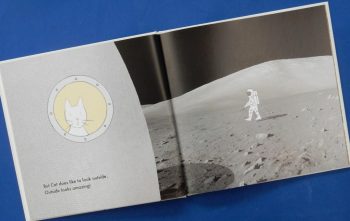
So begins this story of an indoor cat that watches through the window of a spacecraft as an astronaut explores the moon outside.

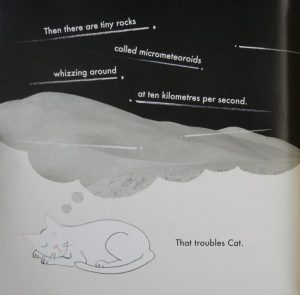
She is fascinated by this strange lunar environment but setting foot beyond the confines of the spacecraft is not something a cat should do: there’s no air and the outside temperatures range between hot enough to boil a bowl of water in the daytime to ten times colder than a fridge freezer by night. Moreover there are strange objects whizzing around which Cat finds troublesome.

Instead the moggy spends her time playing, eating, and sleeping and dreaming.

Her dreams take her outside where she’s able to leap, pounce and glide, across the dusty, rocky terrain.

She also dreams of another place, a big blue ball full of amazing shapes and forms – the natural sights, sounds and scents of nature where she can become an outside cat.

Through his fusion of photographs of the moon’s surface and the Earth, and his own art, the author/illustrator cleverly melds the real and the imagined, while at the same time weaving some basic scientific information into his lyrical narrative.

So it is for cat, and so has it been for many humans of late, cooped up inside their homes or unable to venture far beyond their own front doors – something I’m sure Tohby Riddle knew nothing about when he created this delightfully whimsical book.

Moomintroll Sets Sail

Moomintroll Sets Sail
Alex Haridi, Cecilia Davidsson & Filippa Widlund
Macmillan Children’s Books

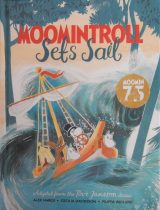
This adventure in the magical world of Moominvalley that so many of us loved to escape to as children, is an adaptation from the Tove Jansson classic by Alex Haridi and Celia Davidsson with illustrations by Filippa Widlund.

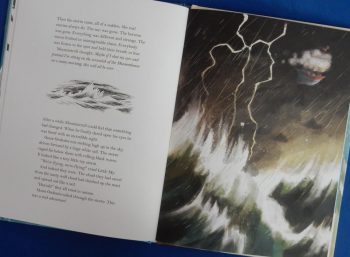
It all begins with Moominpappa leading Moomintroll, Little My and Sniff through the forest to reveal his latest enterprise, a sturdy boat he’s named Ocean Orchestra.

There’s a distinct snag though: the boat is on land and far too heavy to drag to the river. Instead the river must come to the boat. And so it does, courtesy of a creature called Edward the Booble. Then it’s all aboard (not the Booble) and away down the river and out to sea.

It’s not all plain sailing though for there’s a rescue (Hemulen’s aunt in a very bad mood – to start with but it improves after a night’s sleep),

a visitation from niblings, one of which gets left behind aboard the Ocean Orchestra; and as a second night falls, a huge storm blows up.

Can the Ocean Orchestra make it safely back to Moominvalley with all the Moomin family or might it be a case of lost in the storm?

As always this is full of the usual Moomin idealism, sensitivity, kindness and courage – sheer delight.

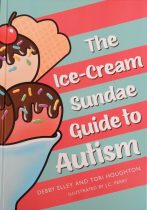
The Ice-Cream Sundae Guide to Autism

The Ice-Cream Sundae Guide to Autism
Debby Elley & Tori Houghton, illustrated by J.C. Perry
Jessica Kingsley Publishers

Everyone is an individual be they neuro-typical or neuro-diverse, so there are as many ways of experiencing autism as there are people on the autism spectrum. However there are three things that all those with autism have in common, albeit in different degrees – difficulties with speech and language, difficulties with social skills and rigidity of thought.

Here’s a handy little book to help youngsters, understand the complexities of the condition.

Its authors (both with a wealth of experience relating to neurodiversity) use the ice-cream sundae simile and its ingredients to explain autism in a non-threatening, non-judgemental way to young people, both those with autism and neuro-typicals.

They first did so as editors of AuKids magazine when they published an article called The Autism Sundae Dessert with an aim to show autism, not as a disability but a difference – a dynamically evolving condition.

Such was the response that their article evolved into posters, demonstrations and now, this book, The Ice-Cream Sundae Guide to Autism with its three different flavoured scoops (chocolate ice-cream for speech and language, vanilla for social skills, and strawberry for rigidity of thought; plus extras – chocolate sauce (sensory processing disorder) and a wafer (self-regulation).

Parents, teachers, and others working with youngsters can use the book with its clear, unambiguous illustrations and puzzles

to solve, either with an individual, or a class or group, depending on their personal circumstances. It might act as a starting point for a practical ice-cream sundae making session, or as something to refer to over and over, to help build understanding of the advantages and challenges of autism.

Kaia and the Bees

Kaia and the Bees
Maribeth Boelts and Angela Dominguez
Walker Books

Kaia is pretty fearless but there’s one notable exception: having been stung on the foot, she’s super scared about bees despite her dad being a bee-keeper with two hives on the roof of their apartment home.

Dad does his level best to enthuse his daughter about his favourite topic but it takes being found out about her aversion by the children who also live in her block for Kaia to overcome her melissophobia.

With protective suit on she follows her Dad up the stairs and out onto the roof. There her bee education continues apace and her fear of the little insects slowly diminishes

until she thoughtlessly removes one of her gloves and OUCH! Kaia is stung again. “I’m never EVER going near those bees again!” she cries and sticks to her word.

Soon comes the time for collecting the honey from the hives. The family work hard all day in the kitchen filling jars with sweet smelling golden honey.

Then Dad’s “It’s a mystery, isn’t it!’ awakens a feeling of wonder in the girl and later, after another bee encounter, Kaia understands something about the tiny creatures that she’d never considered before.

At last she appreciates just how incredible bees are and alongside that, she finally feels brave inside.

Maribeth Boelts’ story that gently educates about the importance of bees is written from the perspective of being part of a bee-keeping family and she fully appreciates both how awesome and vital to our ecosystem the creatures are, as well as understanding that some people might, like Kaia, feel scared unless helped to overcome their fear. This understanding can be applied to a fear of anything, making the book even more helpful.

I love that Kaia’s family live in an urban location; and Angela Dominguez’s mixed-media illustrations both provide detail about bee keeping and clearly show the characters’ feelings throughout.

Paris Cat

Paris Cat
Dianne Hofmeyer and Piet Grobler
Tiny Owl

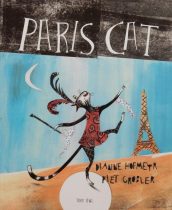
Unlike the rest of her large family and many friends, there’s one Parisian Cat that wants to see more of the world than her smelly back-alley home.

So, one wet night she enters a busy café where singer Edith Piaf, is entertaining the customers. Cat decides to do likewise

but is soon sent packing.

Back out in the rain she finds refuge in a dressmaking atelier.

Once again Cat decides “I can do that,” and as soon as the establishment has closed, she gathers up all the fabric offcuts and fashions herself a sparkly dress, dons her new attire and heads to a nightclub.

There she sees Josephine Baker dancing along with a cheetah. Yet again Cat decides, “Pffh! I can do that” and up onto the stage she springs to show her own moves.

Chiquita the cheetah is impressed, so much so that ‘Kitty’ is invited back to dance again the following evening alongside Josephine.

So it is that every night, clad in a new outfit, courtesy of the snippets from Madame Delphine’s atelier, she dances the night away, becoming a regular part of the billed act.

Eventually Cat starts to miss her family and friends. This prompts her to open her very own nightclub – Madame Kitty’s Catacombs Club so that she can see them all regularly again.

Now it’s not just one, but many cats that, if you happen to be in the vicinity after dark, you might see dancing the night away, clad thanks to Madame Kitty, in their snazzy outfits.

And Madame Kitty? She may be there too, or perhaps another new adventure has lured her away.

I absolutely love Piet Grobler’s scratchy scenes of 1920s Paris nightlife that really bring to life Dianne Hofmeyer’s deliciously quirky tale of searching for the new, pursuing your dreams, but not forgetting  where you came from. I love too, the way the author has woven into her narrative the two stars from that era both of whom had difficult early lives.

I Can Catch A Monster

I Can Catch a Monster
Bethan Woollvin
Two Hoots

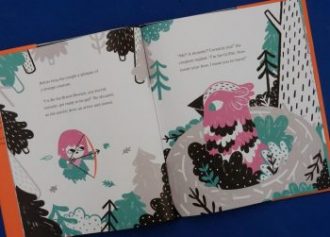
In a castle in a mountainous region in days of yore live Erik, Ivar and their little sister, Bo.

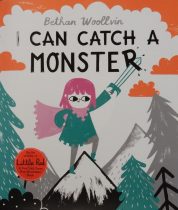
When her brothers announce that they’re off on a monster hunt Bo wants to accompany them. “You’re far too little,” comes the reply but what Bo lacks in stature she makes up for in determination. “I’m smart and brave and strong!” she thinks before sallying forth on a monster quest of her own.

Very soon she has her first ‘monster’ encounter: “… get ready to be got!” she warns the creature, only to learn it’s a griffin and far too polite to be a monster.

Indeed he offers to assist Bo in her quest.

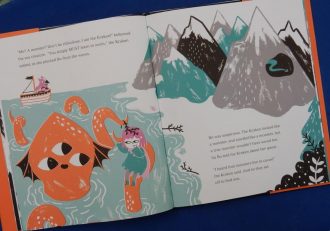
Her next encounter takes her (inadvertently) plunging beneath the ocean waves to face a kraken. She too seems at first, monstrous

but again Bo’s assumption is wrong, for the kraken also assists her.

Next destination is a cave from which issues an enormous roar.

Surely deep within must be the scary monster Bo has been seeking all along. However the roar turns out to be a dragon venting its parental anguish over missing baby, Smoky.

From then on the quest becomes not a monster hunt but a Smoky search, which eventually brings the story full circle, with Bo face to face with two human monsters.

Now she can prove well and truly, who really is in charge.

I love Bo’s rebellious attitude and applaud her open-mindedness and willingness to learn from her mistakes. There’s plenty of potential discussion sparkers in Bethan’s tale but it’s her wonderful illustrations that are the book’s real strength.

Executed in gouache with a more varied colour palette than in her fairy tale reworkings. Bethan’s idiosyncratic art uses teal, duck-egg, orange and pinks to create the mock-medieval scenes for this story. Love those end papers too.

The Walloos’ Big Adventure

The Walloos’ Big Adventure
Anuska Allepuz
Walker Books

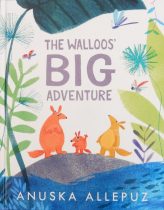
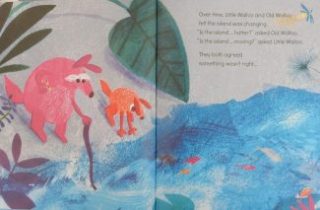
Allow me to introduce the Walloos. Living on a rocky island at the edge of a lake, there’s a big one, a spotty one, an old one and a little one.

Each Walloo has its own particular penchant. Little Walloo loved to grow plants, Spotty Walloo had a culinary bent especially with regard to soups and salads; boat building was Big Walloo’s love and Old Walloo’s favourite occupation was storytelling, particularly about the old days and his visits to tropical-exotic islands.

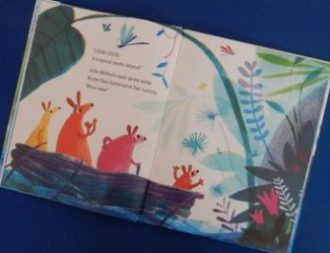
Fired up by his tales, Little Walloo longs for her own tropical island adventure and one day Big Walloo builds a boat and away they go, sailing through nights and days until they spy something exciting: – a ‘tropical-exotic island.”

It’s a truly beautiful place but there’s something slightly strange about it that only Little Walloo notices – at first anyway; this island seems to be moving. It’s not long before Old Walloo agrees with her.

When is an island not an island? To tell would be to spoil this enchanting story. But what can be said is that what happens involves an idea, problem-solving, seeing things from the perspective of others, teamwork, kindness, caring and the co-creation of more stories of ‘tropical exotic adventures.

There’s an abundance of warmth and gentle humour in this smashing story of the Walloos that reminded me just a little of the Moomins in the way the characters engage with and understand one another, their charm and their thirst for adventure.

Then there’s that gentle environmental message made more evident in Anuska Allepuz’s wonderfully whimsical illustrations.

I can’t wait to share this with young children – it’s an absolute delight.

Chick and Brain: Egg or Eyeball? / Olga and the Smelly Thing from Nowhere

Chick and Brain: Egg or Eyeball?
Cece Bell
Walker Books

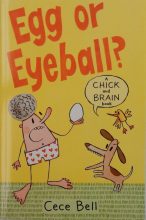
Presented in graphic novel format, a super-silly sequel to Smell My Foot and once again Chick and Brain go head to head in a dispute. This time it’s on account of the ovoid object that Brain has come upon. It’s an eyeball he insists, but Chick knows better: after all, the creature emerged from such a thing. A bout of bickering ensues though perhaps Chick has the upper ‘hand’ for he produces a book to back-up his argument.

In comes Spot the Dog to claim the item as his lunch and he too is on the ‘egg’ side. The ensuing noisy exchange between the three wakes up a rather large cat and then it’s Chick’s insistence on politeness that almost causes him to become the moggy’s lunch.

Brain however steps up to the mark to save the day and the daftness continues with the arrival of Something Else and then comes the great revelation, for this being happens to be sans something rather important …

Daft it is, but who cares; even the most book-averse will find themselves giggling their way through this wacky comedic offering.

Presented in a semi-graphic novel format and rather more challenging a read is:

Olga and the Smelly Thing from Nowhere
Elise Gravel
Walker Books

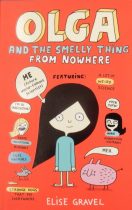
Inquisitive young Olga is an animal obsessive (barring mosquitos that is) who aspires to be a world-famous zoologist. (She’s less keen on humans however.) Olga loves everything about the world’s fauna – farts and all, writing all her observations in her notebook and it’s this that she gives readers access to.

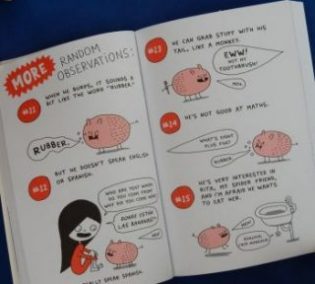
Imagine her delight when one day she discovers a trail of rainbow poo that leads her not to the unicorn she suspects it might be, but to what she describes as ‘a ‘cross between an inflated hamster and a potato drawn by a three-year old’, calling itself a ‘Meh’.

Some observations and introductions ensue and then Olga takes the erstwhile rubbish bin resident home for closer observation.

Finding out what the creature actually is (a new species perhaps?) and what it likes to eat proves pretty challenging, so much so that our scientist in training has to resort to accepting the assistance of other humans.

One day disaster strikes: Olgamus Ridiculus disappears. It’s then that some of the previously annoying people prove to be anything but, and all ends happily, albeit a tad unexpectedly.

Elise Gravel’s style of presentation is a zany mix of first person narrative, splendidly expressive comical style illustrations, lists, diagrams, jokes and more that will ensure laughs aplenty and a wide appeal.

The Wonder Tree

The Wonder Tree
Teresa Heapy and Izzy Burton
Egmont

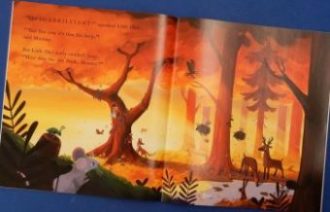
When I was a child we had a large oak tree with a resident owl in our garden; this lyrical story of Teresa’s with its wonderful illustrations by Izzy Burton, took me right back there to that tree, which I loved.

The particular oak tree in the story is home to Little Owl and his Mummy; and as it opens a leaf landing on his head disturbs Little Owl’s sleep. Despite his mother’s assurances, the little creature can’t get back to sleep. He’s concerned about the tree –surely it will be cold without its leaves, won’t it?

“Let me tell you a wonder,” comes the reply and Mummy Owl proceeds to explain first about leaf fall and seasonal change,

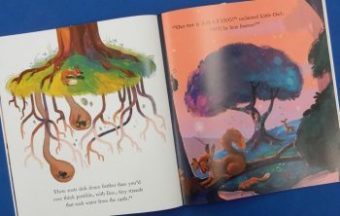
and then how the tree ‘drinks’.

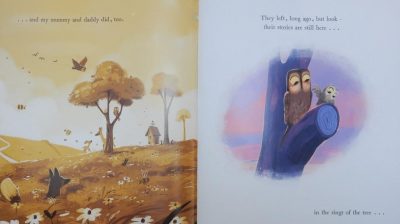
However neither explanation sends Little Owl back to sleep and he requests a story. Happy to oblige, Mummy Owl’s story is of the tree and the stories that reside therein – held in its annular rings,

in ‘the clasp of its roots, and the kiss of its leaves’.

Then, as the moon high above sends out its silvery light, bidding a temporary farewell to the huge, ancient tree that is their home, parent and child spread their wings and sail off into the night sky.

Along with Little Owl, little humans will love learning about the natural world and its wonders, especially at bedtime. Equally, they’ll love being immersed in nature through debut illustrator’s woodland scenes showing the rich hues of autumn as they gradually fade to sepia, and the resident fauna and flora of the setting.

Animal Scramble / Space Puzzles

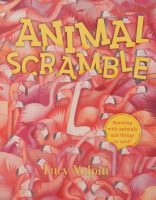
Animal Scramble
Lucy Volpin
Templar Publishing

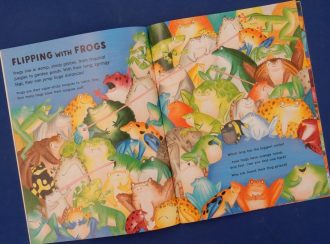
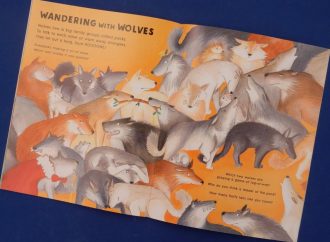
Whether it’s counting the curly haired among the crowd of camels in the camp, or searching for the five different fruits in the clutches of the acrobatic apes, youngsters will surely enjoy honing their observation skills as they peruse each and every one of Lucy Volpin’s, wonderfully droll, enormously engaging animal scenes created with coloured pencils.

Each of the spreads has an alliterative title and presents an immersive display of animals, (either large or small) that provides such fun possibilities as ‘Playing with Penguins’, ‘Building with Beetles’ ‘Flipping with Frogs’ – my favourite I think,

or, ‘Swimming with Sharks’ – perhaps not!

There’s an introductory factual paragraph and on the opposite page some thought-provoking questions that invite readers to search for objects – a square fish for instance, count, or perhaps ponder upon their own opinions in relation to say ‘which hairstyle would you like?’ on the ‘Acrobatics with Apes’ spread; or “Who do you think is leader of the pack?’ from this one …

Playfulness abounds throughout and the book concludes with a handful of additional questions to consider.

Assuredly a spotting book that merits revisiting over and over, and one that offers an absolute wealth of language potential if a small group of children look at it together.

Space Puzzles
Highlights for Children

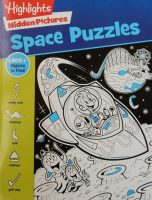
In this bumper book of more than 100 cosmological settings, children have to search for over 1800 objects hidden in scenes ranging from a space race to an alien encounter, and a trip on a space scooter to a classroom in orbit.

Each puzzle page contains all manner of likely and unlikely items hidden in plain sight for the eagle-eyed to find, each of which has a visual prompt in the surrounding border. (Answers supplied at the back of the book in case you’re stuck.)

In these black and white puzzles there are moonstruck bears, aliens visiting a drive-in restaurant, a host of animal star gazers and a stellar souvenir shop to stop off at in the space museum to name just a few.

Hours of immersive enjoyment, especially for space lovers (that’s an awful lot of children) who will have fun sharpening their observation skills as well as their concentration: just what’s needed during holidays when you can’t get outdoors.

Meet the … Ancient Greeks Meet the … Pirates / Building a Roman Fort

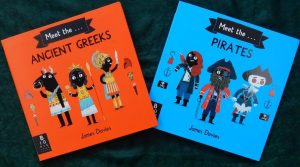
Meet the … Ancient Greeks
Meet the … Pirates

James Davies
Big Picture Press

Now with sturdy flexible covers, are James Davies’ most recent Meet the … books.

As with the first two titles, what characterises these is James’ exuberant writing style and the way he presents a considerable amount of information in a way that is highly engaging, gently irreverent, funny and sometimes surprising.

In Ancient Greeks, definitely one of the greatest civilisations, we find out about buildings, battles, politics, the gods, education, language, festivals, games, arts, science and more, each topic having its own spread; and the book ends with a quick look at Greece today and a timeline.

Who could fail to giggle at his cartoonish comic-strip presentations of The Twelve Labours of Heracles
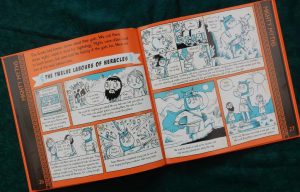
and Pandora’s Box, or chuckle over the depiction of Homer writing his epic blog? And all those speech bubbles are splendidly silly.

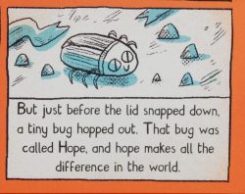
Which brings me to the illustrations in general: the Greek spreads are rendered in orange and black (with occasional use of blue) – let’s give the last words to the final panel of Pandora’s Box – highly pertinent today …
In Meet the … Pirates – equally bursting with facts and fun – we move forwards in time a fair bit (after a Viking encounter) and come face to face with some of the most famous and fearsome pirates, the likes of Blackbeard with his famously smouldering beard and hair. EEEK! You certainly wouldn’t want to come across him or his ship on the high seas.

I was unaware of Black Bart though – the most successful pirate of the Golden Age by all accounts. And we mustn’t forget the women: apparently they weren’t actually allowed to be pirates at all but some made a pretty successful job of it from the 1500s to the late 18th century.
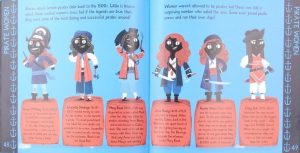
We also discover what life aboard ship was like, – certainly not a life for me, booty or no booty, with the likelihood of scurvy, gangrene, lost limbs and worse.

No thanks! However hard James tries in his hilarious presentation, I’ll restrict my piratical fun to reading this splutter-inducing offering from the safety of my sofa.

Again the book concludes with a look at modern day piracy and a time line.
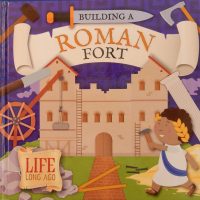
Building a Roman Fort
Robin Twiddy
BookLife Publishing

This is one of a history series Life Long Ago that uses a child narrator – in this instance Atticus, son of a Roman centurion in AD 46 – to help make the topic accessible to a young audience.

The boy describes the process of building a fort from the outside inwards; and in addition, readers will discover the answers to where and why. They’ll learn about the various materials used, the design and more.

The text comprises speech bubbles and fact boxes that present the information succinctly using the occasional Latin word. (I was surprised to discover that a centurion was in charge of 80 not 100 men.)

There are plans and diagrams, as well as illustrations of Atticus and his family, making for a clear and informative first guide to use in a primary school topic on the Romans.

I Can’t Sleep

I Can’t Sleep
Gracia Iglesias and Ximo Abadía
Templar Publishing

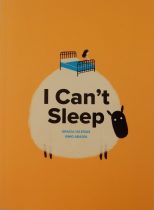
How many people at the moment go to bed with their heads buzzing with thoughts – “I’m missing school,” … “I want to see my friends” and so on, and the consequence is that, like the little girl narrator of this story, that all important restorative sleep just won’t come.

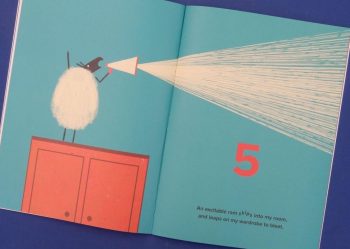
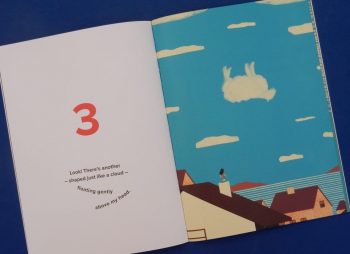
She starts counting sheep to help her drop off and as she starts to count slowly 1 … a sheep emerges from beneath the bed and begins to devour the rug. Then a second sheep drops down the chimney (no prizes for guessing what colour it is).

The counting continues and soon there are fluffy sheep doing all kinds of interesting, though not sleep inducing things, both inside her house

and out.

It’s not until she reaches 9 and a very tiny lamb comes that sleepiness descends upon the little girl and she’s fast asleep before she can count to 10. Zzzzzzz

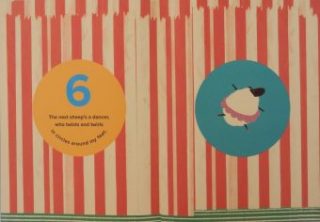
With Gracia Iglesias’ chucklesome counting text this is great fun for bedtime sharing with little ones, and Ximo Abadía’s illustrations are a delight. Created with graphite, wax and ink with digital colouring, they’re bold, quirky and playful: who can fail to smile at the sight of cuddle sheep number six cavorting across the bedcover

or the wisest old, guitar-playing sheep.

A New Green Day

A New Green Day
Antoinette Portis
Scallywag Press

Since the lockdown, most of us with time on our hands have been taking much more notice of the beauties of nature no matter where we live and in A New Green Day, Antoinette Portis invites readers to do just that, to see things anew and to discover the joy and wonders to be found outdoors.

Using a sequence of short poems spoken by natural things both large and small, the author/illustrator gently leads us through a summer’s day in the company of a little girl.
Said child is gently awoken by sunlight on her pillow inviting,
“… Come out and play!”

Then at the behest of that which has scribbled “on the path / in glistening ink …”
it’s time to move outdoors and there, the playful guessing game continues as we see a sequence of things in an entirely fresh, creative way.

For instance “I’m a map of my own / green home. Follow my roads and climb,” reveals when the page is turned …

How cleverly imagined are Antoinette Portis’s trees, one of which is markedly similar to the veined leaf the girl holds between her two fingers.

Some riddles are easier to anticipate than others; one such is “I’m a comma / in the long, long sentence / of the stream. / Someday soon, / you’ll hear my croak,” is uttered by …

Then come the voices – cloud, rain, lightning and thunder – of a gathering storm and what child could resist this invitation, “I am cool pudding / on a muggy day. / Let your toes / have a taste! …”

Finally as Earth is wrapped in the black cloak of night, comes the gently spoken sound from a tiny insect “I am the engine / of the summer dark. / Sleep, while I thrum / in your tomorrow … “ I will leave you to work out that which heralds “A new green day.”

There is SO much to love about this lyrically written book that gently calls us to appreciate our world afresh. Rich in texture, both verbal and visual, Antoinette Portis’ A New Green Day offers fresh lenses through which to see the natural world and its beauty each and every time we set foot outside.

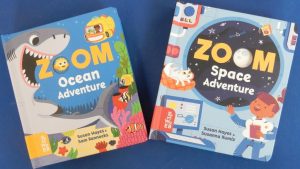
Zoom: Ocean Adventure & Zoom: Space Adventure / Where’s My Peacock?

Zoom: Ocean Adventure
Susan Hayes, illustrated by Sam Rennocks
Zoom: Space Adventure
Susan Hayes, illustrated by Susanna Rumiz
What on Earth Books

These are two titles in a new board-book non-fiction series for curious toddlers.

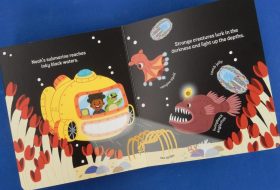
In the first we meet Noah and join him and his turtle on an ocean adventure as he takes his boat out to sea, dons his diving gear and plunges into the water.

His first location is a coral reef, a good place for a game of hide-and-seek with some fish. Next stop is a seagrass meadow with its seahorses, dugongs and a wealth of other creatures, some of which emerge from the kelp.

Danger suddenly looms in the shape of a hungry great white shark from which Noah must make a hasty escape by climbing into his submarine and diving down to the darkest depths.

There’s also a sunken pirate ship with treasure and more to discover as Noah heads for the Antarctic and an iceberg with penguins atop, made all the more dramatic by its large die-cut shape,

Indeed die-cuts are a feature of every spread and with their clever placing each one offers a different view depending on whether the page is turned forwards or back.

The Space Adventure is Ada’s and begins with her (and her cat) boarding her rocket ship and awaiting the countdown which is delivered through wordless die-cut illustrated pages shaped as the numbers 5 through to 1.

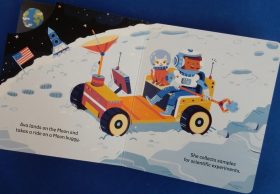
Then the rocket blasts off skywards towards the moon, docking at the International Space Station to make a delivery and for Ada to perform some urgent repairs before making a lunar landing to collect scientific samples.

Thereafter, the rocket explores the Solar System viewing all the different planets before heading home once more.

Characteristic of both, rather longer than average board books are: the surprise pop-up on the penultimate spread, the wealth of visual details in Sam Rennocks and Susanna Rumiz’s vibrant illustrations, the die-cut pages, the relatively short narrative and the fact that both Noah and Ada actually experience their journeys through their imagination.

Sturdily built, these are well worth putting into a nursery collection or adding to your toddler’s bookshelf.

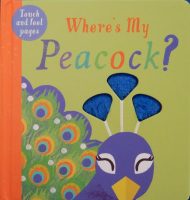
Where’s My Peacock?
Becky Davies and Kate McLelland
Little Tiger

In their latest touchy-feely, hide-and-seek board book, thanks to Becky Davies’ simple repeat patterned and Kate McLelland’s alluring patterned art, toddlers can follow the trail of footprints and discover a long tailed lemur, a feathery owl and a brightly hued toucan before locating the dazzling tailed peacock that has almost, but not entirely, hidden himself away.

Tactile fun for tinies and the possibility of learning some new vocabulary.

Mermaids Rock: The Floating Forest / The Time Travel Diaries: Adventure in Athens

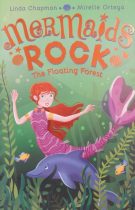
Mermaids Rock: The Floating Forest
Linda Chapman, illustrated by Mirelle Ortega
Little Tiger

This is the second title in Linda Chapman’s Mermaids Rock series featuring some animal-loving mer friends. They have formed their own special Save the Sea Creatures Club, their aim being to come to the aid of animals in trouble.

As the story starts Coralie and Dash enter a whirlpool and find themselves in a wonderful forest with sea lions. Therein Coralie discovers among the fronds a bottle containing what looks like a rolled up message.
On returning to her friends she learns from Marina (whose dad is a marine scientist) that the place she’s just visited is a kelp forest. The others are eager to see it too so they schedule a visit the following day.

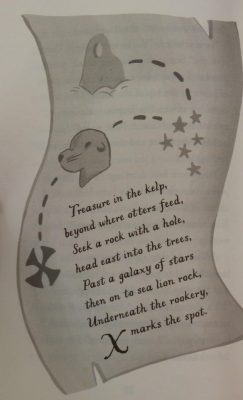
In the meantime Naya manages to open the bottle; inside is a map with a rhyming message.

Next day with 4 clues to solve, operation treasure hunt begins.
But one of their classmates, the sneaky Glenda is determined to find out what the others are up to and starts watching their every move.

The following week when the club members return to their search they discover that the kelp forest has been destroyed leaving the animals unprotected and in great danger.

Saving them becomes much more important than the treasure hunt but can they do it before it’s too late?

Mirelle Ortega’s expressive illustrations add further interest to the narrative and help break up the text for newly independent readers.

After the story are pages with information about the kelp forests and the animals living there, as well as some marine-related jokes.

A tale that’s ideal for young nature-lovers and environmentalists who like their adventures bubbling with mermaid magic.

For slightly older readers, also the second in a series:

The Time Travel Diaries: Adventure in Athens
Caroline Lawrence
Piccadilly Press

With her outstanding, expert knowledge of classical history and superb storytelling skill, Caroline Lawrence immerses readers in ancient Athens circa 400BCE when her heroes Alex and Dinu, on a luxury holiday in Athens, time travel – at the behest of Solomon Daisy – to the time of Socrates. Unbeknown to the boys, Dinu’s younger sister has followed them through the time-travel portal and is also swept up in the adventure.

It’s no time at all before having arrived at the Temple of Athena, Alex and Dinu are taken by the Scythian archers – the equivalent of the police in ancient Athens.
As with the previous book, the story is pacey, gripping and rich in historical detail.

Here’s what Daniel (nearly 11) thought:
‘This book was action-packed and a great read. The plot involves a group of characters who travel back in time in search of Socrates, the wisest man in the world. The main characters are really interesting because of their individual personalities.
Through their journey we learn about an ancient time and some historical dates. My favourite part is when the main characters go inside a public house and they play music through holes in a bone.
Overall I really enjoyed this book and would definitely recommend it to 9-11 year olds.

Say Goodbye … Say Hello / The Happy Lion Roars

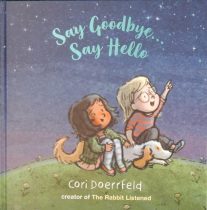
Say Goodbye … Say Hello
Cori Doerrfeld
Scallywag Press

Change is inevitable no matter what, and young children often find transitions tricky.

Through her gentle, lively illustrations and soft-spoken, simply expressed text, Cori Doerrfeld offers little ones a story exploring  the nature of change and the possibilities that embracing it can offer.

Stella, while reluctant to leave her mum and board the bus, soon discovers a new friend, Charlie, once she gets to school.

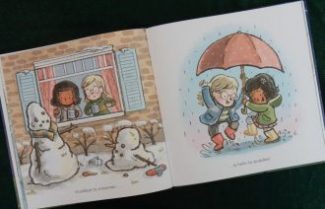
Before long the two are almost inseparable. We follow them through the seasons and goodbye summer means hello to autumn and goodbye to outside means hello to inside;
’Goodbye to snowmen … is hello to puddles!’;

and through the days when “goodbye to long walks, butterflies and the sun … is hello to long talks … fireflies and … the stars.’

But then, comes something much more difficult for Stella to cope with: the need to say goodbye to her special friend, when Charlie moves away and holding tight must be followed by letting go.

Physically yes, but not completely, for Stella is soon busy writing and posting a letter to her friend.

There’s also the possibility of someone else on the horizon, not a replacement for Charlie, but perhaps a new friendship for the making…

Splendidly expressive illustrations show both the ups and downs of change, as well as the passage of time. Ultimately however, however difficult some changes might be, as the story closes we’re given an indication of Stella’s resilience as she greets a newcomer …
A gorgeously warm portrayal of friendship, loss and the possibilities of new beginnings.

Completely different but also with a focus on friendship and new beginnings is this oldie but goodie:

The Happy Lion Roars
Louise Fatio and Roger Duvoisin
Scallywag Press

Nostalgia rules in this Happy Lion story I remember from my childhood. In this book the Happy Lion is most definitely not living up to his name, spending much of his time looking downright miserable, so much so that a doctor is called. He merely prescribes pills and departs; but the medication is totally ineffective in the face of loneliness for that is what is wrong with the Happy Lion.

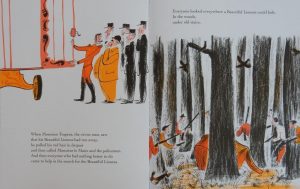
Then one day into town comes a small circus and he and his friend Francois go to watch the acts. However, the Happy Lion has eyes only for the Beautiful Lioness in her cage.

Suddenly his sadness is a thing of the past and one night he goes to the cage of the Beautiful Lioness, opens the door and together they walk through the park back to his home.
A search ensues,

followed by some subterfuge, the Happy Lion’s loudest ever roar, and finally, thanks to Francois, a deal leaving not one, but two felines exceedingly happy.

Superb art and a lovely story where friendship and freedom reign supreme, characterise this classic re-issue.

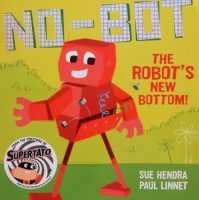
No-Bot the Robot’s New Bottom!

No-Bot the Robot’s New Bottom!
Sue Hendra and Paul Linnet
Simon & Schuster

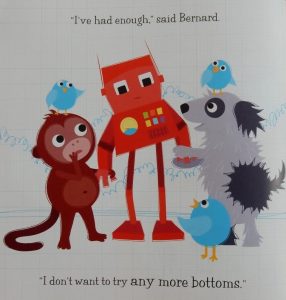
Bernard the robot, aka No-Bot, is back with a new botty but now again it seems to be giving him trouble. Not however by its absence; rather there are all manner of strange sounds apparently emanating from his rear as he plays on the park equipment with his pals.

Bernard is surprised until he turns his head to discover what looks like his very own, potentially explosive bum.

Bear decides it needs removing which leaves our robot pal in a bot-less state once more.

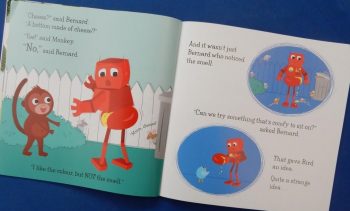
Reassuringly his friends are ready and willing to assist in finding a replacement but it’s not an easy task as they soon discover, for the bot needs to satisfy certain criteria – right colour, appealing smell, comfortable for sitting

and not too heavy. Will Monkey, Bear, Dog and the birds ever find a bot that it just right or is Bernard to remain in a permanent state of bottomlessness?

Finally, it appears Bernard isn’t the only one having bottom trouble …

Like the first No-bot story this one is delightfully daft and full of the kind of humour that definitely appeals to little ones. Yet again team Sue and Paul have a winner with this one; I certainly know a fair few fans who will be keen to get their hands on it.

Impossible! / I’m Sorry

Here are two recently published picture book from Little Tiger:

Impossible!
Tracey Corderoy and Tony Neal

Dog runs a laundry in a busy city but has a longing to see the ocean.

One day he comes upon Ocean Magic, a new kind of washing powder. The product promises ‘seaside freshness with every wash’ but apparently there’s something else within the box too.
Into the machine goes the powder and out later, along with the clean washing, emerges a crab suffering from a bad attack of nausea.

Dog and Crab discuss the situation over a cuppa

and eventually after declaring several times that driving Crab all the way back home is impossible, Dog lets himself be persuaded to undertake the trip.

Off they go together on a journey that takes several weeks during which they create a special memories map of their trip.

En route they encounter other travellers with seemingly impossible challenges of their own.

Now it’s Dog’s turn to utter the ‘nothing is impossible unless you say so’ maxim and with the assistance of their new friends, Dog and Crab finally reach their destination.

Both are delighted with the ocean paradise but then Dog declares he must return to his city job – or must he?

Follow your dreams and don’t allow obstacles to stand in your way, is the message Tracey’s tale imparts to youngsters. Equally the ‘it’s only impossible if you say so’ message is one we all need to remember especially in challenging times.

Tony Neal’s bright, lively, illustrations inject additional humour into the telling offering fun details to enjoy on every spread.

I’m Sorry!
Barry Timms and Sean Julian

In Walnut Wood live best friends, Scribble (squirrel) and Swoop (owl) and each morning they walk a considerable distance bringing their special things to their regular meeting spot.

Scribble has a special pencil that acts as word assistant in his play script writing, the finished dramas entertaining his friend. Swoop’s special thing is a toolbox that enables her to build anything and everything.

One day they decide to move in together; their place has ‘room for two and a little left over’.

It’s the left over bit – the veranda – that causes a rift, for each has designs on it.

A huge row ensues over the ownership of this: should it be a stage or a workshop?

Scribble decides to try and make amends with the aid of his trusty pencil but can a single word apology fix things or is something else needed?

There’s food for thought and discussion with little ones in this story that demonstrates that sometimes actions speak louder than words. Sean Julian’s beautifully expressive watercolour illustrations are for me the true show-stealers in this book.

Now Wash Your Hands!

Now Wash Your Hands!
Matt Carr
Scholastic

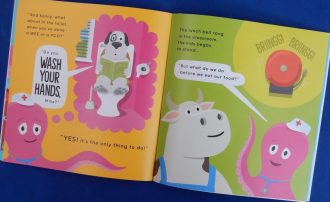
Hand washing was never more important than now during the current COVID-19 crisis and here’s a timely picture book from author/illustrator Matt Carr showing young children the vital importance of keeping their hands super-clean and hopefully free of those invisible nasties aka germs.

This crucial message is delivered in Mrs Moo’s class by a very important visitor, Doctorpus Doris, who talks to the pupils about the vast numbers of ‘TEENY WEENY germs’

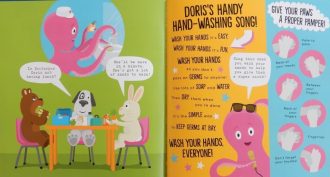
and what they can do to send those nasty beasties packing.

The good news is that the way to do it is something as simple as washing their hands thoroughly. Doris gives several examples of times when this is especially a must-do activity. For instance after visiting a farm, working in the garden, using the loo

and before having lunch as they all do after her talk. For Doc. Doris this germ-extermination is, of course, a rather protracted process.

With his light touch, bouncy rhyming narrative that includes a song and funky bright illustrations,

Matt delivers what all foundation stage teachers and early years staff will be constantly reminding youngsters to do, ‘NOW WASH YOUR HANDS!’.

To that end this book will be an absolute boon – a must have. (for every copy sold 50p will be donated to NHS charities Together COVID-19 Urgent Appeal). Perhaps our government could add to their list of things to do: buy a copy for every school/nursery to share. Maybe I should tweet the PM and await his response …

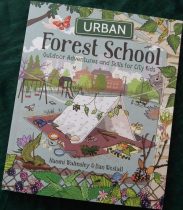
Urban Forest School

Urban Forest School
Naomi Walmsley and Dan Westall
GMC Publications

Wow! What an absolute treasure trove of ideas this is for anyone who wants to include forest school and all that this has to offer into an urban school or nursery setting. That, one hopes (unless it’s already embedded into their curriculum) includes all early years and primary teachers and other staff.

Equally during this time when many parents are faced with home schooling their children, this book by a husband and wife team totally dedicated to outdoor learning, offers a wealth of activities across the whole curriculum and most could be used with a very wide age range.

After an introduction explaining what urban forest school actually is and where to look for urban nature, why it’s important to do so, and giving instructions on how to tie some useful knots, the main body of the book is divided into four sections.

We start with In the park or garden (a quiet street or a porch would suffice) where one of my favourite activities is shadow painting. Strangely enough as I was walking with my partner the other day past a patch of stinging nettles I remarked that their shadows looked much more striking than the actual plants. Then two days later I found this idea in the book. I’ve had children draw around their own or a friend’s shadow many times but never thought of using plants – love it!

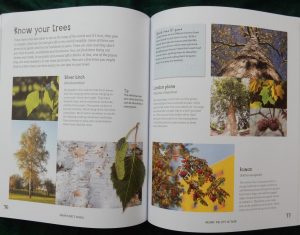
Moving further afield Around the city or town has a nature focus and includes such things as cloud spotting and I really like the idea of the city sit spot – an opportunity for mindfulness of whatever your surroundings might be. From that sit spot or walking around, children can begin to get to know about the trees and the flora and fauna close by.

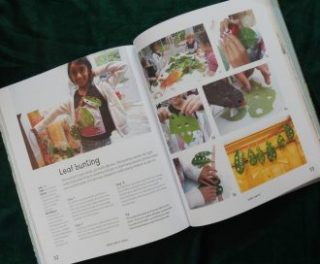
The third section – Home crafts – offers a wealth of creative activities: the leaf watercolour printing can be fun in its own right but also the starting point for other arty projects. I can’t wait to try the leaf bunting activity with children – I have to admit to having a go myself with some leaves and hole punches.

Recipes comprise the final section and there you’ll finding such diverse ideas as stinging nettle smoothie – this one might be an acquired taste, and spiced blackberry sorbet – more up my street I think, but the blackberry plants are still at the flowering stage just now.

Packed with enticing illustrations and photos, and covering so many areas of the curriculum, this bumper book includes something for all ages from the very young upwards, and is a fantastic encouragement to get children outdoors learning about and through nature.

Like the Ocean We Rise

Like the Ocean We Rise
Nicola Edwards and Sarah Wilkins
Little Tiger

Our planet is vast and it’s beautiful too,
But it needs our help; it needs me, it needs you.

Assuredly it does. I was absolutely astonished and horrified to read in the paper apropos World Oceans Day about the large percentage of microfibres in our oceans that are a result of washing synthetic clothing.

It’s never too early for young children to begin thinking about some of the ways they can help to reduce the negative impact we have on our planet and consider how everybody can help to prevent climate change.

A good place to start is with this smashing rhyming picture book.

Most of us know of the impact Greta Thunberg has had in galvanising what has become a global movement involving student protesters from over 120 countries; and Nicola Edwards’ narrative celebrates the contribution of young people; but there is a lot still to be done.

No matter where in the world we are,

we can all in our own way become eco-warriors

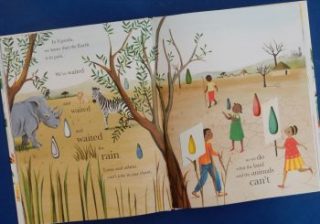
just like those children portrayed in Sarah Wilkins’ vibrant peek-through illustrations that use the ripple effect of a single raindrop to add to the impact of the text’s simile.

I love her final scene that shows this wave-making movement really is a global one in which we all can, indeed MUST, play our part.

The final spreadsheet provides  a brief explanation of  climate change and why it matters and some ‘What Can We Do?’ suggestions .

Monkey’s Tail

Monkey’s Tail
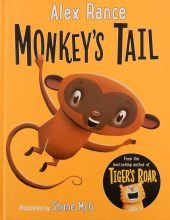
Alex Rance and Shane McG
Allen & Unwin

Since his retirement, due in no small part to a serious knee injury in an Australian Rules football game, Alex Rance has written another story in his series of children’s picture books.

This one, Monkey’s Tale, as the author says, is the story of how he got through the traumatic season of his injury in 2019.

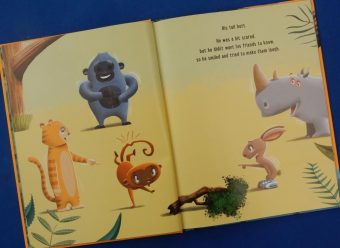
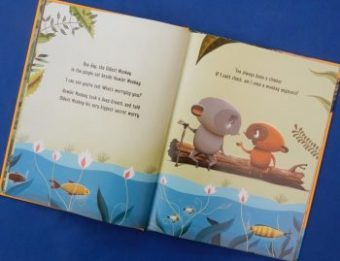
It tells of Howler Monkey, one of the jungle’s very best climbers until one day while out with his pals, the branch on which he was climbing snaps sending him flying out of the tree to crash with an enormous thump right on his tail. YEOCH!

How that tail hurts and scares Howler Monkey but instead of letting on to his friends, he clowns around trying to make them laugh.

He may have fooled them but the Howler Monkey can’t fool himself and unable to climb he sits around thinking and becoming increasingly sad.

Then one day the very wise Oldest Monkey sits down beside Howler and asks what’s troubling him. Who better to confide in than Oldest Monkey so, full of self-doubt Howler Monkey reveals his secret worry: am I still a monkey if I can no longer climb?

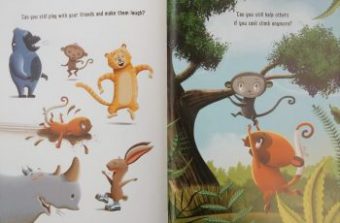
A discussion ensues with Oldest Monkey asking some key questions that help Howler Monkey realise that no matter what, he can still make his friends laugh; he can still help them;

he still has a loving family and he can still make them proud – just in a different way. In other words, his actions do not define who he is and motivation for those actions is a key factor. Is this enough for Howler Monkey to regain his confidence and self-respect?

Resilience is key in Alex Rance’s story, illustrated digitally by Shane McG and as Oldest Monkey concludes ‘keep on being the best (monkey) you can be.’ Sage advice indeed.

A Trio of Activity Books

Viking Adventure Activity Book
illustrated by Jen Alliston
Button Books

The latest in the series of Button Books unobtrusively educational, history activity books, illustrated by Jen Alliston, has a Viking theme.  If you have a child in the lower part of KS2 this may be part of their history curriculum. Whether or not this is so, books such as this are a particular boon in these days when many youngsters are not at school full time, if at all; and the activities and illustrations in this particular book are more appropriate for a younger (under 8) audience anyway.

It’s packed with a wide range of over 70 Viking related, fun things to do such as making a Viking helmet, beard and shield,

baking some cupcakes to decorate with Viking runes, and using maths to work out your Viking name. There are plenty of puzzles, mazes, counting, matching, anagrams, codes, jokes and more.

Also included are four pages of stickers.

All in all this will engage and entertain youngsters who, along with some Viking learning, will also hone their observational and fine motor skills.

Keep Calm!
Studio Press
Dr. Sharie Coombes, illustrated by Katie Abey & Ellie O’Shea

Aimed at primary age children, this is an activity book written by Sharie Coombes an educationalist and psychotherapy expert, that aims to help youngsters stay calm and cope with uncertainty during, and following, the Covid-19 pandemic.

There are a variety of creative ideas to help with the emotional roller-coaster we’re all sharing, including drawing, writing, and crafty activities.

There’s also mindfulness, calming breathing techniques and yoga (I know from experience they work).

The final few pages comprise tips for parents and carers on self-care and managing children’s emotions.
This little book could well be a boon during these tricky times.

For the same age range, to help combat boredom, especially if your child is stuck indoors, is:

Beano Puzzle Book
Studio Press

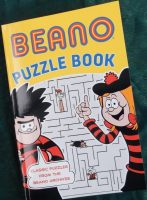
Dennis, Gnasher and Minnie the Minx have dug into the 1990-1994 Beano archives and unearthed a host of fun things such as word searches and other word games, mazes, drawing, comics and maths challenges that will help turn young users into word WHIZZ-ARDS and number GNASH-ERS.

Nothing required other than a pencil (or 2) and a switched on brain.

The Perfect Shelter

The Perfect Shelter
Clare Helen Welsh and Åsa Gilland
Little Tiger

Clare knows how to write about areas many people find difficult, her last book being the beautiful story The Tide, featuring a loved family member with dementia.

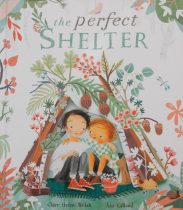
The new book, The Perfect Shelter is also based on personal experiences, this time of cancer. It’s equally beautifully told and illustrated and it’s evident immediately that a great deal of thought and loving care has gone into its creation.

As the story starts a family shares what the little girl narrator calls ‘the perfect day’, just right for her and her older sister to build a den in the woods – the perfect shelter.

Suddenly though as the evening draws in, it’s evident that something is not right with big sister.

Back home comes the news, her sister is ill.
A storm rages but the den repairs must continue as the narrator’s beloved sibling undergoes an operation.

But then come the questions, “How did it get there? … Why MY sister?”

Eventually although the den seems beyond fixing, the narrator’s internal storm begins to abate as big sister starts to regain her strength and with it her determination: there’s a new perfect time and perfect place to build a new shelter …

And with it come smiles, new plans and that wonderful feeling of togetherness.

Although we share in the gamut of emotions of this family, it’s optimism that is key in the poignant telling and Åsa Gilland’s slightly quirky illustrations capturing the family sharing a difficult time are superbly expressive of all the uncertainty inherent in Claire’s story. I love the way she adds gorgeous tiny detail and patterning to every scene.

That there is no mention of any specific illness makes this a book that will help untie the knot of emotions in many families when one of their number (Or indeed a close friend) is diagnosed with a serious illness.

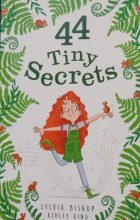
44 Tiny Secrets

44 Tiny Secrets
Sylvia Bishop, illustrated by Ashley King
Little Tiger

There are actually even more secrets than the 44 tiny ones in the title of this captivating book and some of them are pretty big ones.

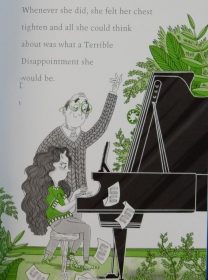
Betsy Bow-Linnet is the daughter of two internationally famous concert pianists who spend a fair bit of their time jetting off to play abroad leaving young Betsy in the care of her Grandad.

Betsy has set her heart on becoming famous like her parents but no matter how hard she practises, she lacks the natural talent of her mother Bella and father, Bertram and feels she’s a disappointment to them both.

One day she discovers a letter on the doormat bearing only her name. Inside she finds a letter written by one Gloria Sprightly. The woman claims she has a special method that will make Betsy’s next performance ‘completely, totally, stupendously stunning’ and it isn’t necessary that the two of them meet. The other requirements are that the Method is a secret, and plenty of pumpkin seeds.

Needless to say Betsy jumps at the opportunity and posts off her acceptance right away.

Another letter follows instructing her to look inside the parlour piano and to await a parcel.

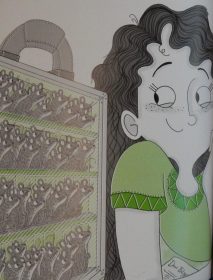
Sure enough, the following morning on the doorstep is a large parcel inside which is a box containing the titular tiny secrets in the form of 44 pygmy mice.

Betsy is baffled: how can the tiny reddish-brown creatures help her improve her piano playing and how can she possibly keep all those mice a secret?

Moreover, who is this Gloria Sprightly?

Woven into this quirky story are some wonderful verbal images: Betsy’s mother has a particular penchant for ferns and there are pots of the things everywhere in their home. She even looks and smells like a fern we’re told.

Before the end there are some unexpected revelations of more than one kind and the sharing of some rather yummy cream cakes but all ends happily. Not ever after however for there’s promise of a new story of Betsy and her 44 rodent friends coming soon. Hurrah!

A delight through and through, made all the more so by the splendid visuals provided by Ashley King whose offbeat illustrations underscore the humour of Sylvia’s telling.

Nervous Nigel

Nervous Nigel
Bethany Christou
Templar Publishing

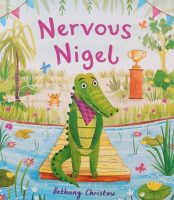
Bethany Christou’s follow-up to Slow Samson is another winner, even if her young crocodile protagonist is not.

Nigel comes from a long line of water-sport champions and like the rest of his family, Nigel loves to swim and his favourite spot for relaxing and thinking is in the water.

However once he has to start following a training regime, he gets butterflies in his tummy and his tail is all a-tremble, but he daren’t let on to the family.

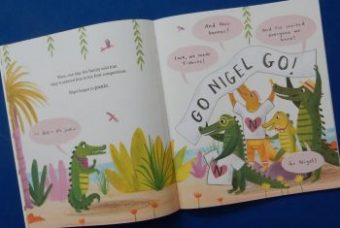
Then comes the news. Nigel is to take part in his very first competition:

no wonder he has a sleepless night and no matter what he does or says there’s no getting out of it.

When race day dawns Nigel is a complete nervous wreck.

There’s absolutely no way he can take that dive from the starting blocks, so what will he do?

Is there perhaps something else water-related that he can enjoy

and at the same time make his family proud without winning medals?

Suffering from anxiety is part and parcel of growing up so most little ones will appreciate Nigel’s plight; so too will adult sharers who, one hopes put children’s happiness and self-fulfilment above reflected glory.

Bethany Christou’s wonderfully expressive, warm illustrations have a gentle humour that underscores her message about allowing children to be themselves and follow their own paths.

This is Crab / The Bedtime Book

Here are two titles from the Little Tiger group that are just right to share with preschool children:

This is Crab
Harriet Evans and Jacqui Lee
Caterpillar Books

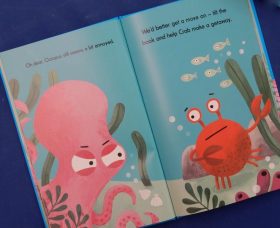
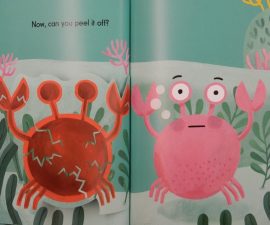
This is another interactive book from Harriet Evans and illustrator Jacqui Lee and this one has an ocean floor setting and a googly-eyed red crustacean as its central character.

We join and assist Crab as he wanders around the sea bed encountering in turn, bit part players in the form of an octopus,

some coral, sea turtles, fish of various kinds and hues as well as a Decorator Crab that our meanderer gets a tad cheeky with.

Bright alluring illustrations including several spreads with die-cut overlays will certainly engage visually, while eager fingers will enjoy responding to such instructions as ‘shake your finger at Crab, please’; ‘Try tickling Crab so he lets go’ and ‘Tap on Crab to make the crack larger’ and they’ll assuredly delight in the revelation of Crab’s new pink shell once they’ve helped peel off the cracked red one.

Words such as ‘drumroll’, ‘scuttle’ and ‘pincers’ are introduced as the action proceeds, so will likely be absorbed by youngsters as they react to the prompts to facilitate Crab’s perambulations through the story.

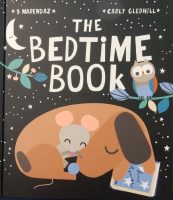
The Bedtime Book
S. Marendaz and Carly Gledhill
Little Tiger

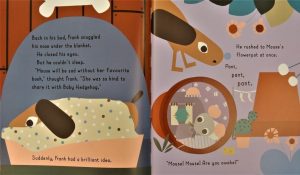
Like little humans, Mouse has a favourite bedtime book. Who better to help her find it when it goes missing than Frank the dachshund but he’s just snuggled down for a peaceful night’s sleep in his kennel.

Cosy as he might be though, Frank’s not one to leave his friend to search alone so off they go together ‘scurry, scurry, scurry … pant, pant, pant’ on a book hunt. They follow a trail that leads them to Bella the cat.

What Bella tells them has all three of them scurrying and panting off again but still there’s no sign of the missing book.

Owl overhears their conversation and reveals that he had it but it’s now set to be the next bedtime story for Baby Hedgehog.

Kind-hearted Mouse won’t hear of trying to retrieve it and instead goes sadly back to bed. So too does Frank although instead of falling asleep he has a wonderful idea that soon sees him back at Mouse’s residence

where in lieu of Mouse’s book, we’ll leave the two friends snuggled together under the stars having shared Frank’s bedtime favourite …

This sweet gentle story is likely to become a bedtime favourite for pre-schoolers who will love to snuggle down and make some animal friends thanks to Carly Gledhill’s delightful portrayal of the nocturnal happenings.

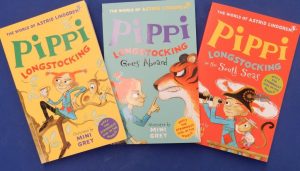
Pippi Longstocking, Pippi Longstocking Goes Aboard & Pippi Longstocking in the South Seas

Pippi Longstocking
Pippi Longstocking Goes Aboard
Pippi Longstocking in the South Seas

Astrid Lindgren, illustrated by Mini Grey
Oxford University Press

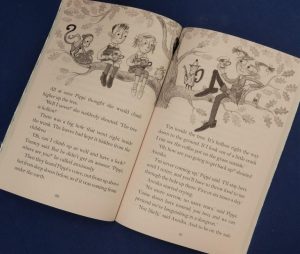
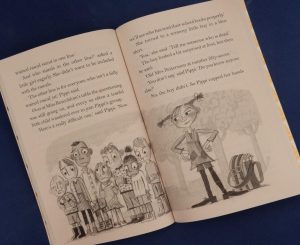
I absolutely loved these stories as a child more years ago than I care to remember, and thanks to these new editions splendidly illustrated by Mini Grey and translated by Susan Beard, I find that red-headed rule-breaking Pippi – the ‘strongest girl in the world’ –clad still in her odd (one black and one brown) stockings, has lost none of her wildness and charm.

Nine-year old Pippi lives sans parents in Villa Villekulla – mum is an angel and dad a South Sea Island king she proudly announces. With Pippi lives her monkey Mr Nilsson (a present from her dad), while on her veranda lives her very own horse.

In the first book Pippi meets and makes friends with neighbours Tommy and Annika, gets the better of some bully boys, outthinks some police who come a visiting, is persuaded to go to school (briefly) and gets a bit carried away with her drawing, does some entertaining up an oak tree,

rides bareback at the circus and more.

The second book sees Pippi joining school again – but only to provide the ‘jollification’ on an outing. Other adventures include a face-to-face encounter with a tiger and a surprise visit from Pippi’s dad. Finally Pippi has the chance to accompany her father on his travels. Will she bid farewell to Annika and Tommy and sail away or remain at Villa Villekulla? It’s a difficult choice to make …

The third title is the last of the original Pippi books. Herein Pippi organises a quiz

and then as autumn turns to winter, she invites Tommy and Annika, (both recovering from measles), to accompany her on a trip to the island where her father is king.

As always there are escapades galore including when Pippi seizes a shark, gives it a good telling off and then hurls it back into the ocean. She also manages to protect the island pearls from a pair of would-be thieves and generally have a wonderful time – until Tommy and Annika decide they want to go home for Christmas. They don’t actually make it in time but as always, Pippi finds a way and they don’t miss out altogether on the festivities.

(Happily the mention of cannibals from the original tales has gone but the anarchic Pippi – celebrating her 75th anniversary this year – will surely never lose her power to delight.)

Little Bear’s Picnic / Peek-through: Around Town & Peek-through: Jobs We Do

Here are some new Little Tiger board book treats for toddlers:

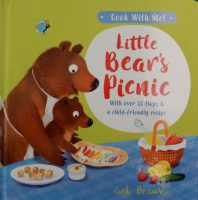
Little Bear’s Picnic
Sebastien Braun and Kathryn Smith
Little Tiger

Picnics are the best fun if you collect some of the components on the way and that’s what happens in the second in the Cook With Me! lift-the-flap series.

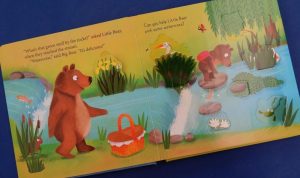
Little Bear’s pretend play gives Big Bear an idea. The adult bear puts some items into a basket and off they go through the vegetable garden, pausing there to harvest some delicious veggies for the picnic.

By the stream Little Bear asks about another green plant and learns that it’s watercress – another tasty item to add to the basket.

The buzzy bees in the woods lead them to discover a honeycomb in the trees and then it’s time to settle down to a lunch.

Suddenly down comes a shower of rain so they gather up their things and dash for cover. Soon, sheltered beneath the canopy of a large tree the two bears watch as a rainbow appears in the sky and they tuck into their yummy ‘Rainbow Wraps Picnic’.

There’s a recipe for these beneath the final flap inside the back cover of the book.

Seb. Braun’s attention to detail is as always superb, so there’s plenty to get involved with including flaps to explore and a question to respond to on every spread such as ‘Can you help Little Bear pick some watercress?’

Toddlers will enjoy the playful picnic game and have fun guessing what the book contains as well as trying out its recipe.

Peek-through: Around Town
Peek-through: Jobs We Do

Jonny Marx and Zoe Waring
Little Tiger

Dusty the dog is a bit of a snooper so tired of being cooped up inside (familiar?) off he goes to explore what the town has to offer. Starting with the café, he visits the bookshop – hurray!,

the clothing store, the music shop, the sweet shop, the greengrocer and at the end of the day, meets up with a friend in the restaurant.

Roxy Rat also likes exploring and meeting others. Her perambulations take her to the police station, the fire station, a restaurant kitchen, a clothes shop, a garage, the bank and the hospital. That’s her final destination for we discover on the final spread that Roxy is a nurse whose turn it is on the night shift.

Both titles have a question on each recto above which is a peek-through flap to open and find the answer.

There’s a wealth of vocabulary development potential if toddlers share these chunky board books with an adult or older sibling.

A Friend for Bear

A Friend for Bear
Steve Smallman and Caroline Pedler
Little Tiger

When Little Bear wakes from her long winter sleep she cannot wait to embrace spring with all its exciting possibilities for running, flower smelling, tadpole tickling and twirling.

It’s the twirling that causes her to trip and fall flat. What she fell over wasn’t in fact the stone she thought but a tortoise.

Tortoise is excited to hear about Little Bear’s plans for roly-polying, tree climbing and making new friends but knows his short legs are no match for Little Bear’s.

Bear offers Tortoise a piggyback and away they speed, with the former anything but aware of potential new pals and sweet smelling flowers they pass, right up to the top of a small hill.

After a downhill tumble the two narrowly miss hurtling into a tree. Tortoise just wants to sit and allow his head to stop spinning.

Unmindful of Tortoise’s predicament Little Bear hoists Tortoise on her shoulders again dashing up the hill only to zoom straight back down to the water’s edge. Once again Little Bear doesn’t stop long enough to allow Tortoise to finish speaking and in they leap.

Poor Tortoise can take no more. With a waterlogged shell and worse, he spells it out to Little Bear. “You never stop to listen, or think, or make friends.”

At last Little Bear pays attention to what’s being said; friendship wins through and both creatures eagerly anticipate another day in each other’s company.

Caroline Pedler shows the cuddly bear cub, with Tortoise holding on for dear life, dashing through verdant meadows and sunlit woods alive with spring flora and fauna. Like Little Bear, little humans (and big ones) can all benefit from slowing down and enjoying being in the moment as Steve’s protagonists finally demonstrate in his telling.

Little Turtle and the Sea

Little Turtle and the Sea
Becky Davies and Jennie Poh
Litte Tiger

In this story we follow Little Turtle as she emerges from a nest on the sandy shore and heads to the safety of the sea, right through to maturity.

The turtle grows to love the ocean as she herself grows larger and one day she reaches the other side of the world where she lives for many years foraging and feeding.

Then comes a time for her to make the long journey back to the beach from whence she came .

Now however, it’s different. Things are not right: the colours of the reef are fading and instead of familiar friends, all manner of weird-looking new creatures (plastic bags) float everywhere.

The strangeness increases and ‘The ocean no longer felt like a friend.’

Little Turtle is alone and entangled in a drifting net of detritus.
Fortunately just when she fears her journey is over forever, two divers appear and set her free, going on to clean up the rubbish.

Once more the bubbling ocean is a beautiful place to live.

Becky Davies keeps her narrative lyrical and gentle as she describes the changing sea shown in Jennie Poh’s beautiful mixed media illustrations, saving the starker factual information about the terrible effects of pollution on our oceans to the two final ‘note from the author’ double spreads after the story.

The Funny Life of Sharks

The Funny Life of Sharks
James Campbell and Rob Jones
Bloomsbury Children’s Books

Full of gill-slittingly silly stuff unrelated to the particular elasmobranchs of the title as well as plenty of real sharkish information too, this bonkers book is one to dip in and out of – unless that is, you are a total shark addict and then you might go for total immersion.

Or perhaps you’d rather make your own way through using the different options signposted on almost all the spreads. Trying to do that left this reviewer’s brain starting to feel like not-properly-set jelly.

Another consideration is one of how to classify the book: is it non-fiction or fiction. It’s really hard to decide and anyway, does it really matter? It’s hilarious either way and cleverly interactive to boot.

Moreover it includes pretty much everything you would ever need to know about sharks and a whole lot more you definitely wouldn’t;

but you may well end up so befuddled that you’re unable to tell which is which.

Take for instance, that there are three main kinds of shark attack:  the hit and run variety (I can’t quite work out who or what might be doing any running however); the bump and bite type during which the decision is made about whether or not you become a shark’s dinner and thirdly, there’s the deadly sneak attack.

Apparently great white sharks catch seals using that method, approaching them at 50kmph.

Of course no self-respecting shark book would omit what is frequently child readers’ favourite topic – poo; so James Campbell has obligingly included a poo spread. Thereon you’ll discover that shark poo is ejected ‘like a liquid bottom burp.

Moreover shark poo is an important part of the ecosystem. Really truly.

To finish, let me just say, this whole inventive compilation – liberally littered with Rob Jones drawings – is cartilageniously crazy and particularly perfect for selachimorphaphiles as well as bibliophobes who need their reads in easily digestible bite-sized chunks.

Beware! Ralfy Rabbit and the Secret Book Biter

Beware! Ralfy Rabbit and the Secret Book Biter
Emily MacKenzie
Bloomsbury Children’s Books

Bibliophile, young Ralfy Rabbit loves nothing better than to find a peaceful place to snuggle up with a good book (or several).

However things have changed in Ralfy’s home: there’s a new addition to the family, baby brother Rodney, whose presence means that the household is anything but quiet, and the bigger baby Rodney gets, the more noise he makes.

The impossibility of finding a quiet spot at home drives Ralfy to one of his favourite places – the library. Bliss. Peace at last.

But when Ralfy settles down with his book he gets the surprise of his life. A very large hole has been chomped right through it.

Fortunately the librarian is sympathetic but suggests Ralfy should try to track down the book biter.

Back home Ralfy dons his detective gear and starts his investigation. It can’t have been any of the grown-ups for they’ve all been too busy. It surely can’t be Nibbles – he belongs elsewhere.

Ralfy moves to the bookcase where, OH NO! the book biter has been at work on another of his books. In fact not just one, but all Ralfy’s favourities – disaster!

Then he hears some strange sounds coming from the direction of another large volume …

Finally it seems Ralfy has caught the culprit. But what does he do about it? That would be telling …

As with her previous Ralfy story, Emily’s illustrations are fabulous– witty and full of amusing details. She’s clearly had some punning fun playing with book titles. Ralfy’s collection includes Stick Bun and on the library shelves are Rabbitson Crusoe, Jane Hare, Pippi Longears and The Burrowers, which will be appreciated by older book enthusiasts sharing the story.

With Ralfy’s visits to both the library and a bookshop, this is sure to become another favourite with adults who want to encourage book loving in little humans, as well as the target audience of young listeners.

We’re Going on a Treasure Hunt

We’re Going on a Treasure Hunt
Martha Mumford and Laura Hughes
Bloomsbury Children’s Books

Martha and Laura’s four intrepid bunny hunters are ready for another expedition and now they’ve donned piratical gear ready to search for treasure. So it’s YO! HO! HO! all aboard and off they go to a desert island looking for gold coins.

As they sail they encounter some swooshing, swishing dolphins before landing on a sandy shore.

Then off they go again, carefully avoiding getting their toes nipped;

but they’ll need our help or they might miss some of what they seek, right beneath their feet.

The search continues, first at a rock pool, then beneath the coconut palms –

we know what might be hanging above their heads ready to strike – and across a rope bridge to another beach. There a somewhat scary encounter awaits.

So ‘Quick, quick, quick’, it’s time to head for their boat and sail back home.

Seemingly, once on dry land again, there’s one final thing to find: what could that be, I wonder.

With Martha’s rhythmic, rhyming, onomatopoeic, repeat pattern narrative, this is an ideal read-aloud to enjoy with pre-schoolers who will doubtlessly relish joining in as you share it, pausing on alternate spreads for individuals to lift the flaps and see what’s hidden beneath. Of course, they’ll need all their 10 fingers ready to keep a count of the coins too.

Equally with those 3Rs of reading – rhythm, rhyme and repetition – built into the text, this is an ideal book for children in the early stage of becoming readers to try for themselves.

Either way, bursting with summery sun and with plenty of flaps to lift, Laura Hughes’ lively scenes of the search provide plenty of gentle visual humour and opportunities to spot the wealth of flora and fauna on every spread.

The Boy Who Dreamed of Dragons

The Boy Who Dreamed of Dragons
Andy Shepherd, illustrated by Sara Ogilvie
Piccadilly Press

Dragon dreamer Tomas is back for a fourth tale. Now his special dragon Flicker has gone to live in his true dragon home in the frosty North and only comes on occasional short visits but the dragon-fruit tree in Grandad’s garden has just produced a bumper crop of fruits and that means more potential dragon adventures.

As this story starts Tomas and another of the superhero squad, Ted, discover an unhatched fruit on the ground that narrowly escapes being squashed to oblivion.

When it eventually hatches, a tiny sky blue and silver creature suddenly whizzes into action appearing to be super-charged as it zizzes about like there’s no tomorrow. There is of course, and one of the things Tomas must do is to nurture all those little dragon-fruit seedlings to keep alive the hope of another dragon-fruit tree that actually grows dragons.

Before long it’s evident that the recently hatched, havoc wreaking blue dragon has taken a liking to Tomas and is sticking with him.  Little sister Lolli, aptly names the creature Zing.

Not only has Tomas to contend with Zing, there’s also the question of his own dragon costume for the school dress up day and then a new girl shows up wearing an absolutely amazing one.

To further add to his troubles, two of the squad, twins Kat and Kai announce that they’re shortly moving to China and next day Aura claims to ‘know all there is to know about dragons.’
Her claim soon leads to an explosive outburst from Tomas.

This results in the revelation of a secret he’d intended to keep quiet about, the details of which I won’t divulge. Instead I’ll mention that streams of sweet-scented farts and a fair spattering of poo are part and parcel of subsequent events.

Like the previous adventures, this is a delightful mix of zany humour, warmth, mayhem, touches of magic and more. Once again Sara Ogilvie’s wonderful illustrations add to the book’s appeal and another good thing: by all accounts, the series isn’t over yet.

School for Dads

With Father’s Day in mind and because I missed this one when it was published:

School for Dads
Adam & Charlotte Guillain and Ada Grey
Egmont

Like a number of others, punctuality isn’t a strong point for Anna’s dad; indeed when he turns up late to collect her from school yet again, she strikes a bargain with him. “I’ll forgive you if you go to School for Dads,” she says.

Time for a spot of role reversal. Next morning it’s all the tardy dads who have to spend the day as pupils and their teachers aren’t going to make things easy for them. First of all some bad behaviour needs sorting out: “Don’t ignore us when we’re talking, and stop looking at your phone.”

That’s only the first of the list of misdemeanours, and they must definitely never answer “NO.”

The dads have to use the little chairs, and sitting on the floor proves pretty challenging too. On the plus side though, playtime is fun and the art session releases their inner creativity.

Come lunch time, the hall turns into a rowdy place where sweet treats are off the menu; and the afternoon’s PE lesson is let’s say interesting …

By home time, it isn’t only the pupils who have had a trying day; everyone – children and adults – have learnt a lot. On reflection, Anna decides that dads really deserve to be celebrated for all the great things …

This witty, reflective rhyming tale has a great read aloud rhythm and is just right to give dads a good giggle on Fathers Day especially. Assuredly they’ll enjoy too, Ada Grey’s lively illustrations that perfectly capture the humour of the Guillain’s telling.

Creature Features Oceans / I thought I saw a … crocodile!

Creature Features Oceans
Natasha Durley
Big Picture Press

For the third in her Creature Features series Natasha Durley plunges beneath the ocean to present some spectacular sea creatures. Organised onto eleven double spreads, all have an attention-capturing, alliterative heading.

Each spread has an explanatory introductory paragraph relating to the specific characteristic – for instance in Gorgeous glow, ‘In the darkest depths of the ocean, there is still light to be found. Some animals, like the toothy anglerfish, create their own light to lure in prey. Others, like the hawksbill turtle, soak up light and reflect it back as a different colour.’ There’s a also a question that leads neatly into the next double spread; here it’s ‘Which creature glows and has a shell?’

Among the gorgeously glowing, youngsters will love encountering the likes of the Atlantic footballfish and the Cookiecutter shark, along with the only one familiar to me among the array, krill.

Animals with Super shells – molluscs and crustacea – show themselves on the next spread, the only one where some of those included can be seen on the beach.

Other than at Bold black & white, no matter where you choose to open the book, super-bright colours as well as incredible shapes meet the eye.

So, be prepared for youngsters to be wowed and linger long to observe the Spectacularly spotty, those with Funny faces, perhaps made so by bulging foreheads or long snouts, an array of Amazing arms, a host of animals sporting Stylish stripes, Fantastic fins or Terrific Teeth. Did you know that those of a Great white shark are about 7cm long? Yikes!  Definitely a lot more alarming than the incredible four-eyed fish on the final spread that are able to see both above and below the surface of the water at the same time.

This sturdy, large-format board book isn’t just for the very young: it would be great for small groups of slightly older children to sit and discuss the weird and wonderful.

Imagine what a smashing jumping off point for some oceanic art it would make too.

I thought I saw a … crocodile!
Lydia Nichols
Templar Publishing

A playful crocodile inhabits this fun little book. Supposedly it’s part of a team of builders but the creature has abandoned the drill and gone AWOL.

Using the slider mechanism on every spread, little ones can engage in a game of hunt-the croc. as they listen to the repeat “I thought I saw a crocodile … Is it …?’ spoken by other members of the crew at the building site.

But does that mischievous creature ever get back to work? What do you think?

Clever, stylishly portrayed interactive fun for tinies who will likely learn some new location specific words and hone their fine motor skills too.

Kevin’s Great Escape

Kevin’s Great Escape
Philip Reeve and Sarah McIntyre
Oxford University Press

Roly-poly pony Kevin returns in a new adventure with Max and his family; he’s still as biscuit-obsessed as ever, his particular penchant remaining custard creams.

In this story Max’s sister is totally obsessed with pop idol Misty Twiglet, so much so that she persuades Kevin (guess how) to take her to see Misty’s new abode about thirty minutes flight time from Bumbleford.

Misty seems to be a charmer, but the consequence of this visit is that Kevin is pony-napped. That leaves Max and Daisy to devise a rescue operation – aided and abetted by some of Kevin’s magical creature friends perhaps.

There are some terrific new characters to meet, not least a cardigan-loving faun unsurprisingly called Cardigan Faun, a bespectacled mermaid named Iris,

Cedric the centaur, gorgon, Zola (groan) and a tiny dragon, Belling – all captive too.

But we mustn’t forget Misty’s manager, the dastardly, devious Baz Gumption

and her enormous butler Lumphammer; oh! and the character on page 10, Nobbly Nora is definitely not to be missed.

Philip Reeve’s story is just as magical and just as hilariously brilliant (read aloud or read alone) as The Legend of Kevin (another must read if you’ve not done so). Once again Sarah McIntyre’s two-colour illustrations are totally terrific and as yummy as all those biscuits that actually were not why Kevin Goes Pop in the final chapter.

Bloom

Bloom
Anne Booth and Robyn Wilson-Owen
Tiny Owl

Beneath the window of a large house grows a beautiful flower and every morning as they walk to school with their mum, a brother and sister stop briefly by the flower. The little girl would go up close to savour its beauty with her eyes and nose and address it thus, “Good morning, beautiful flower … I think you’re wonderful. Thank you for being here for us. I love you.” She’d then proceed happily into school.

This went on until one morning having woken earlier than usual the man living in the big house saw what was happening and shouted threateningly at the girl and her brother.

Consequently they decided to change their route to school.

Next morning although the sun came out, the flower didn’t. The poor gardener is blamed for improper watering and the man does the job instead – but still the flower stays closed.

Perhaps it’s shade the flower needs the angry man thinks but again it fails to make a difference. No matter what he does or says the flower remains firmly shut and increasingly droopy.

Totally exasperated and full of complaints, the man calls his gardener again. Despite not knowing what the matter is, the gardener is observant and tells the man exactly what the little girl had done every day.

Finally after consideration, the man goes to the school gate, waits for the girl and her brother and tells them tearfully what has happened.

The little girl offers him some advice and the man rushes home. Instead of self-centred, self-interested orders, can kind, heartfelt words succeed in making his flower bloom again?

With echoes of Oscar Wilde’s The Selfish Giant, Anne Booth’s ultimately uplifting fable demonstrates the power of words and the importance of considering carefully how what you say will impact upon others: positivity is key.

Robyn Wilson Owen’s finely textured, mixed media illustrations show the contrast between the children’s nurturing home environment and that of the man’s lonely existence as well as documenting the changes in the flower through the story.

My Nana’s Garden

My Nana’s Garden
Dawn Casey and Jessica Courtney-Tickle
Templar Books

This is one of the most beautiful picture books about love and loss I’ve seen in a long time.

The little girl narrator visits her beloved grandmother through the different seasons of the year. Together they savour the joys of the tangly weeds or ‘wild flowers’ as Nana insists; harvest the bounties of fruit trees and wonder at the wealth of minibeasts and small animals that find their way among the jungle of brightly coloured flora.

There’s a crooked tree that’s home for an owl and a multitude of other creatures.

Evening is a lovely time too with both starlight and light from their bonfire to illuminate them as the two snuggle up together and bask in the warmth.

In late summer there’s an abundance of fruits, vegetables and seeds to collect,

but with the onset of autumn Nana starts to look frail.

Come winter it’s clear that like her garden, Nana is fading, letting go her hold on life and by the time her garden is clad in snow, only a robin sits on her chair. (A nod to John Burningham by Jessica perhaps there.)

The wheel of life never stops turning and eventually a tiny snowdrop peeps through. The little girl realises, that along with that revolving circle, her precious memories go on and on. Grandma is still there in the blossom on the trees, the smiling faces of the flowers, the starlit bonfire and in the wild abundance of all that flourishes in her garden. A garden that is now a refuge too, and a place wherein we see evidence of other changes in the narrator’s family.

Tremendous sensitivity is inherent in both Dawn’s lyrical rhyming text and the rich tapestry of flora and fauna and the Nana/child relationship shown in Jessica’s illustrations, which together epitomise that ‘a garden is a lovesome thing’.

Meet the Grumblies

Meet the Grumblies
John Kelly and Carmen Saldaña
Little Tiger

The three Grumblies are an argumentative lot as their name suggests, and that’s despite having an easy life with food readily available courtesy of the bread bushes and fruit trees, and a constant supply of fizzy juice from the pond.

This primitive trio lead a low-tech existence and like nothing better than to bicker about the relative merits of the stick, the rope and mud.

These articles are put to the test when suddenly a huge and very hungry Gobblestomp breaks into their clearing and proceeds to devour their precious crops and slurp up their bubbly beverage.

Sticks bounce harmlessly off the hairy pachyderm;

the rope fails to slow it down and as for mud, it’s far too shallow to halt its progress.

Time for Grumble-Stick, Grumble-Rope and Grumble-Mud to cease squabbling, pool resources and come up with a plan perhaps; and so, overnight, they do.

The trio’s teamwork proves highly successful stopping Gobblestomp in its tracks

but there’s more than one change afoot in the village for it’s not only the Grumblies who see the error of their ways …

John Kelly’s daft neanderthal tale demonstrates the importance of teamwork and there’s plenty to giggle over in Carmen Saldaña’s animated artwork.