Fabulous Frankie

Fabulous Frankie
Simon James Green and Garry Parsons
Scholastic

What does it take to be deemed fabulous? That issue lies at the heart of this tale of flamingo Frankie who more than anything else longs to stand out from his equally fabulous, fellow flamingos. A plan is what’s needed so Frankie gets creative fashioning a new super sparkly, shimmery designer stole. But when he gets to the lagoon what does he see but …

However, a magazine ad. beside the water gives him another idea, but it seems he’s not alone in fashionista fan waving or indeed glitter cannoning.
In the throes of a massive tantrum Frankie finds himself at the feet of his friend Pinkie to whom he cannot help but pay a compliment before flouncing off.

Frankie trudges on his way but having stopped to offer help to Flo (inadvertently upsetting a mule with his comment in so doing)

he hears his friends whispering about him. Has he finally found the key to being fabulous? And if so, what is it?

This ultimately uplifting tale of the importance of being yourself demonstrates how each and every one of us is unique: self-esteem is not reliant on appearances alone – there’s SO much more to being fabulous than that.
Garry Parsons’ fantastically funky illustrations are full of fun and feeling be that upbeat or down.

Gloria’s Porridge

Gloria’s Porridge
Elizabeth Laird and Toby Newsome
Tiny Owl

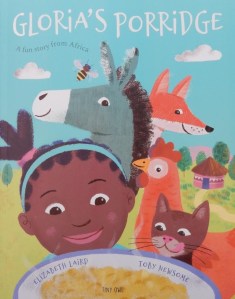
Elizabeth Laird’s story is a reimagining of an Ethiopian folk tale that begins with the making of some porridge. Gloria tells her cat she’s so hungry that rather than sharing with him as requested, she intends gobbling the whole lot herself. First though she needs to fetch some water to make it less gloopy so off she goes bucket in hand to the stream.

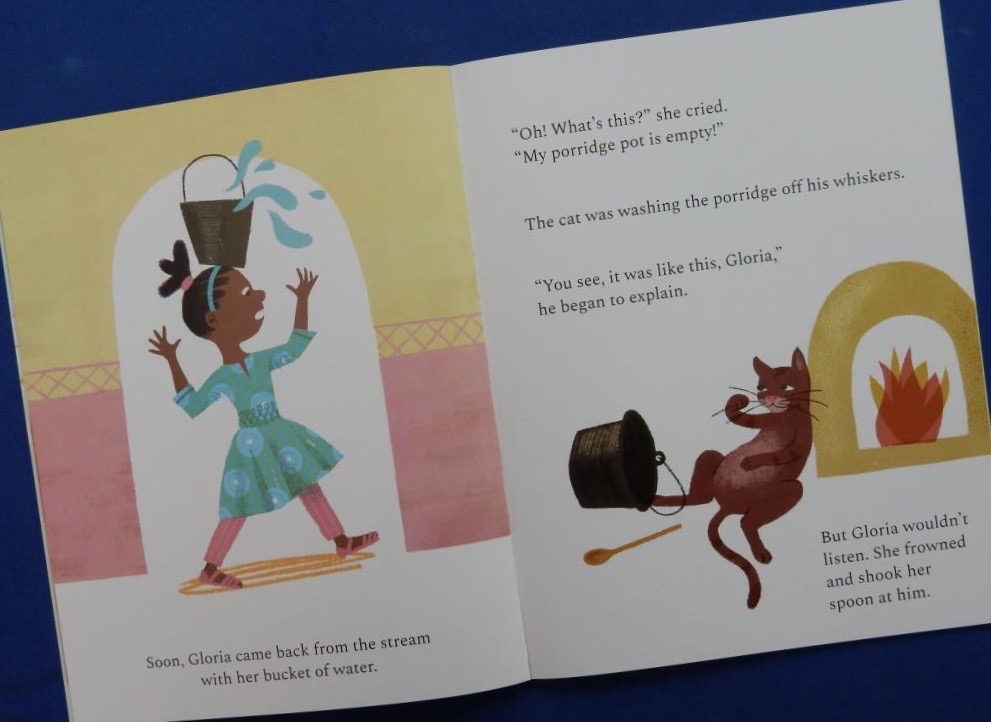
As you might expect the cat can’t resist sampling what appears to be delicious porridge – just a lick from the spoon, he thinks. But in no time the pot is empty. Back comes Gloria with the water and rather than listen to the cat’s explanation,

she grabs the spoon and shakes it at the creature scaring it, whiskers awry out of the house. 

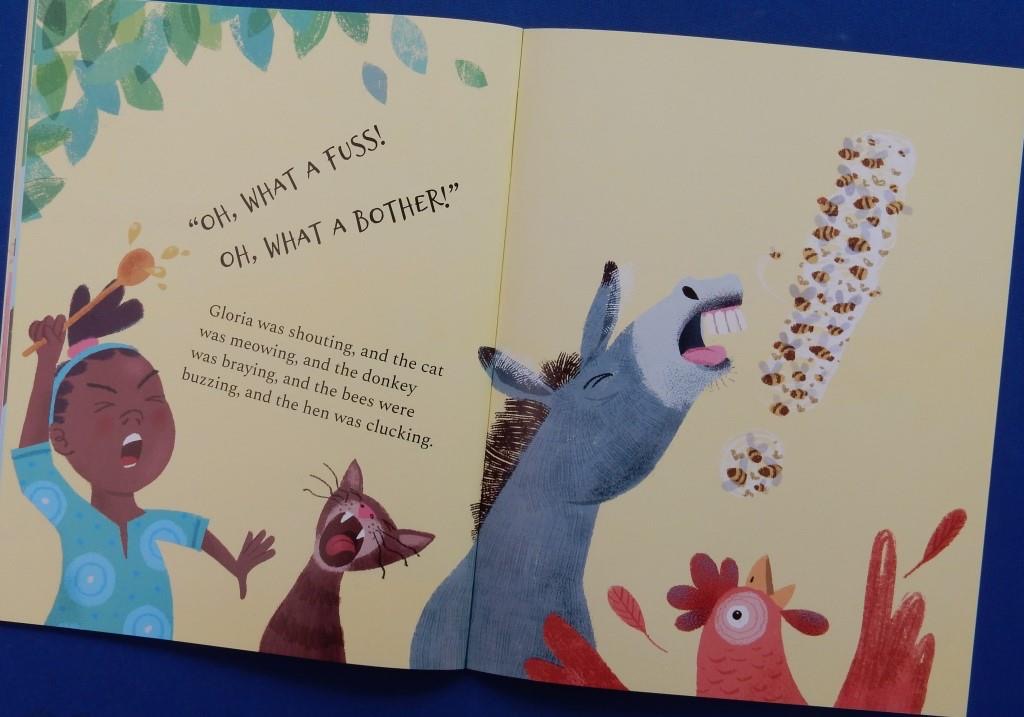
This action sets in motion a chaotic concatenation of events comprising shaking trees, angry bees, a frightened hen, scattered corn and a shouting, meowing, braying, buzzing, clucking, ear-splitting din.

A passing fox pauses to ask what on earth is happening and a protracted explanation ensues to which all involved add their bit. Having listened, the fox then asks a further question. 

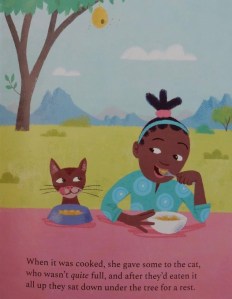
The end result is peace and harmony are restored, and apologies are offered and accepted; after which comes the sharing of a new pot of porridge …

Accompanying Elizabeth’s spirited telling, Toby Newsome’s illustrations, inspired by his South African home environment are full of fun and animation. Together, the result is a highly entertaining and enjoyable read aloud story.

Noah’s Seal / Captain Toby

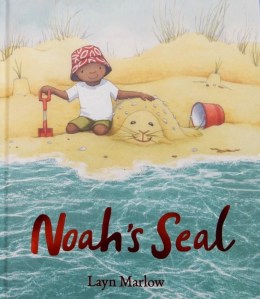
Noah’s Seal
Layn Marlow
Oxford Children’s Books

In one way or another, the natural world offers inspiration to so many of us, and so it is with Noah, the young child protagonist in this book. As the story opens he sits on the shore looking out to sea in the hope of seeing a seal, as he has done for several days already, while his Nana talks of still needing to make the boat seaworthy before they can set sail.

Taking up her suggestion to play while he waits, Noah starts digging and soon realises that the mound he’s made is shaped very like a seal. To the boy it seems it’s ‘Just waiting to be my friend.’ He continues sculpting the creature adding natural features and then lies down beside it to dream of the ‘wild wide sea’.

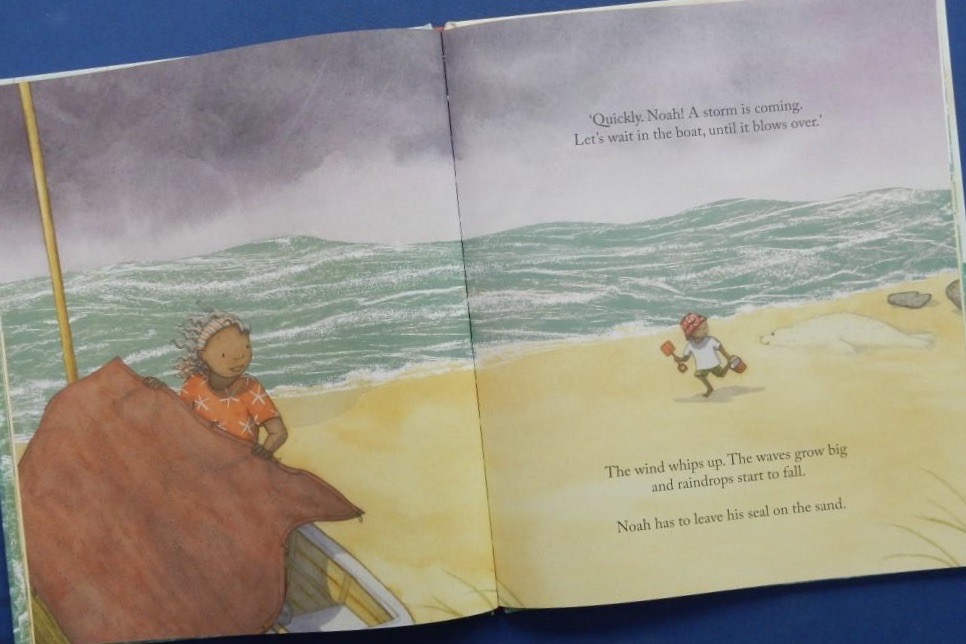
Suddenly Nana’s shout, warning of an approaching storm rouses the dreamer and Noah makes a dash for cover to wait for the storm to abate.

Once it has though, the boy’s seal is no longer there.

Nana promises a sea trip the following day and starts heading home leaving Noah standing looking at the water. All of a sudden he spots something that makes his heart leap

and Nana decides that perhaps with something apparently waiting for them, the promised trip could be brought forward …
Perfectly paced, this sweet story of how a less than promising day at the beach turns into something extraordinary, thanks in part, to the power of the imagination is a delight through and through. Layn Marlow’s textured art and colour palette are wonderful.

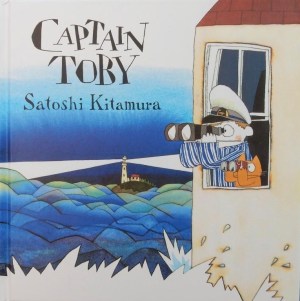
Captain Toby
Satoshi Kitamura
Scallywag Press

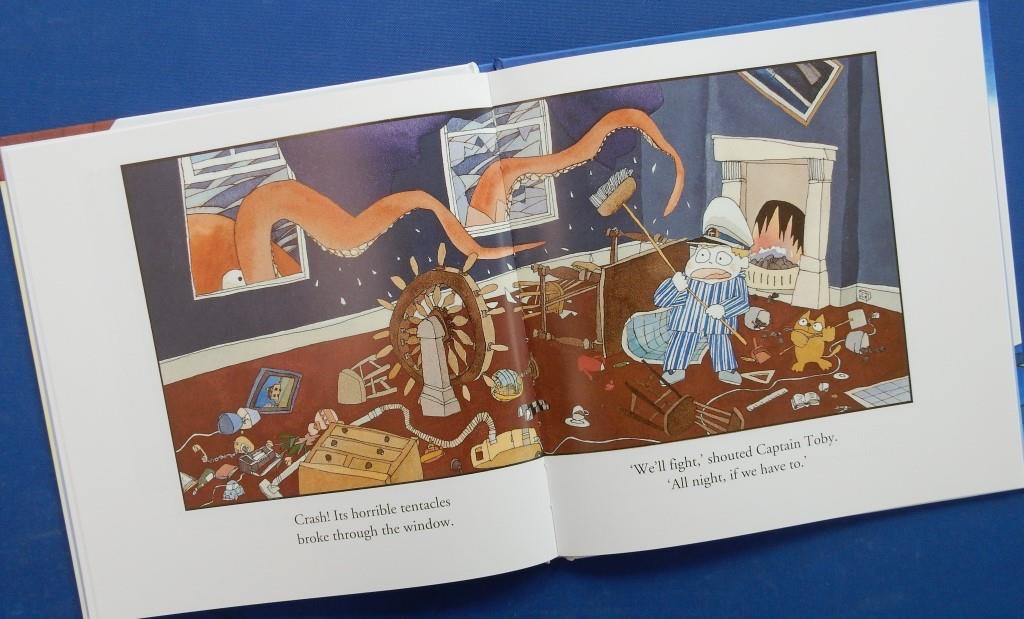
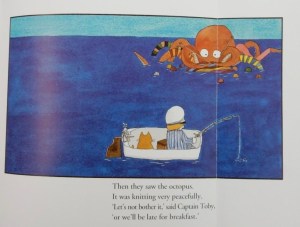
One stormy night Toby lies in bed with the wind roaring outside, the noise so loud he cannot get to sleep. Thunder crashes and suddenly he feels his house start to rise and fall, and before he knows what’s happening it’s rolling on the ocean waves. Bravely, with the aid of his cat, Captain Toby charts his course as lightning flashes in the sky above, till there comes an enormous crash. Grabbing his binoculars he sees it’s not a rock, nor a massive wave but an enormous octopus tentacles spread menacingly and it’s heading scarily close.

Then CRASH! One if its writhing tentacles smashes the window and reaches out towards him. Yikes!

Fortunately however, help is close at hand in the form of a house-submarine carrying Captain Grandpa and Chief Gunner Grandma, the latter being a brilliant shot with balls of yarn.

Eventually the seas calm, the sun rises and the captains head for the harbour leaving a now peacefully engaged octopus. And that’s where we’ll leave them all, with a wonderful finale awaiting readers.

With a mix of surreal humour and high adventure, Kitamura’s illustrations provide a visual treat. I particularly love the richly hued seascape with the two sailing houses heading landwards.

It’s good to see Scallywag Press has reissued this 1980’s charmer.

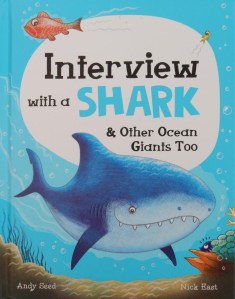
Interview with a Shark

Interview with a Shark
Andy Seed and Nick East
Welbeck Publishing

For those who like their information delivered with a degree of quirkiness then the results of Andy Seed’s latest expedition with his ‘tranimalator’ machine will definitely appeal.

In this book he dons his wet suit and dives into the ocean where, feeling more than a tiny bit nervous he faces his first interviewee, a massive bull shark. Like the author, this subject (and the others) seem to have a great sense of humour as they respond to his questions (just the sort of things a child might ask), with more than the occasional leg pull. The answers though are informative too, revealing such things as what they eat, what might eat them, where they live, (I wasn’t aware that bull sharks sometimes live in rivers as well as salty sea water.)

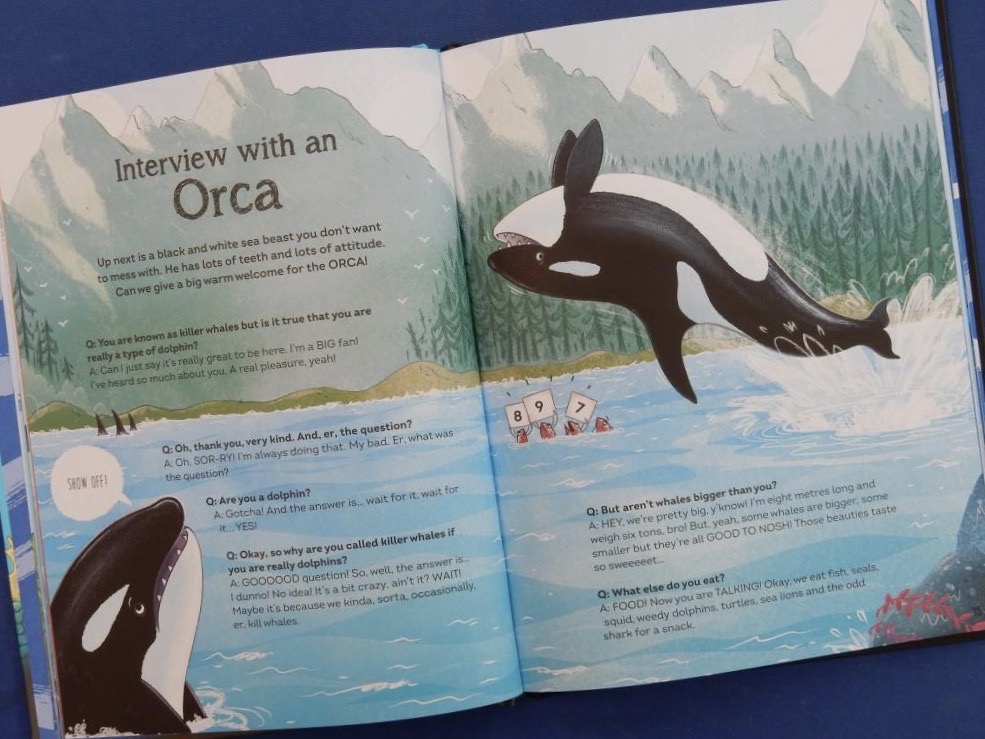
Andy has close encounters with nine marine giants – an awesome blue whale (the kind of whale with no teeth and the world’s biggest poos); a very toothy orca – actually a type of dolphin, 

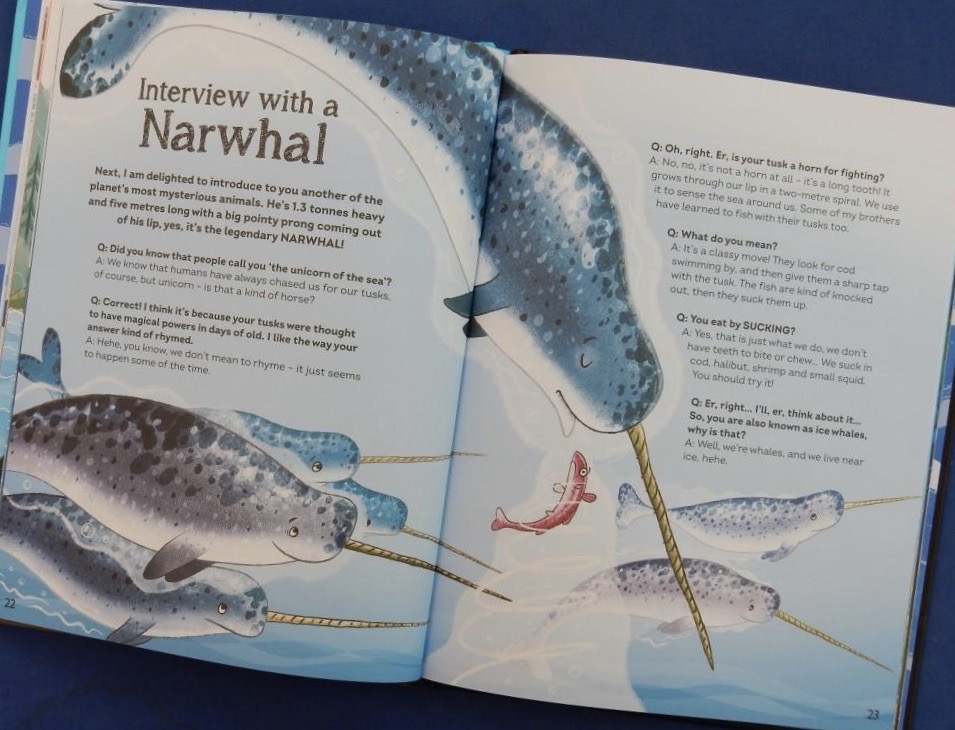
a giant squid, a narwhal (of the stamp collecting, yoga practising variety – told you they have a sense of humour); 

a manta ray – most unhappy about the rubbish we humans dump in the oceans, as are several of the other creatures; an ocean sunfish; an octopus, a conger eel (bites like a bulldog) and finally a creepy anglerfish. 

One of this creature’s claims to fame is its soft bendy bones and stretchy belly that enable it to gobble up BIG things. 

Along with the moans about plastic pollution, we also hear grumbles reminding us of the effects of global warming and fishing (nets and noise). Andy provides a “How you can help’ spread suggesting ways readers can help take better care of our planet and its wildlife; and, there’s a final fun quiz (no cheating).

Nick East provides the visuals – they’re hugely appealing and some almost leap off the page. Young readers (and some adults) can assuredly learn a considerable amount if they dive in with Andy and Nick.

When a Dragon Meets a Baby

When a Dragon Meets a Baby
Caryl Hart and Rosalind Beardshaw
Nosy Crow

In the third story of this series, the lovable little dragon protagonist has a new baby sibling. But what will her reactions be? She might act all huffily and puffily resorting to a lot of slumping and grumping to gain the attention of Mummy and Daddy dragon. On the other hand she might just share her snuggliest toy, fetch the changing mat and nappies when baby has a leaky bottom and help find clean clothes.

Then when others pay a visit will big sis. be a pest or will she show baby’s things to the guests? Poor exhausted Mummy dragon will sometimes be in need of a quick nap but what will happen then? Noisy stomping and a romping or quiet house-tidying and story-sharing with Dad?

Behaving like the perfect older sibling is going to be a challenge and nobody – not even little dragons, can keep their fire inside all the time, surely.

Told in Caryl’s read-aloud-able rhyme, this is a fun, reassuring book that presents the conflicting emotions arising when a new baby arrives in the family and is pitch perfect for little humans who have recently or are about to become big brothers or sisters. Never mentioning a right way but merely offering a little dragon’s way, really works again here and Rosalind Beardshaw’s captivating illustrations showing what happens in this particular family are an absolute delight.

Hike

Hike
Pete Oswald
Walker Books

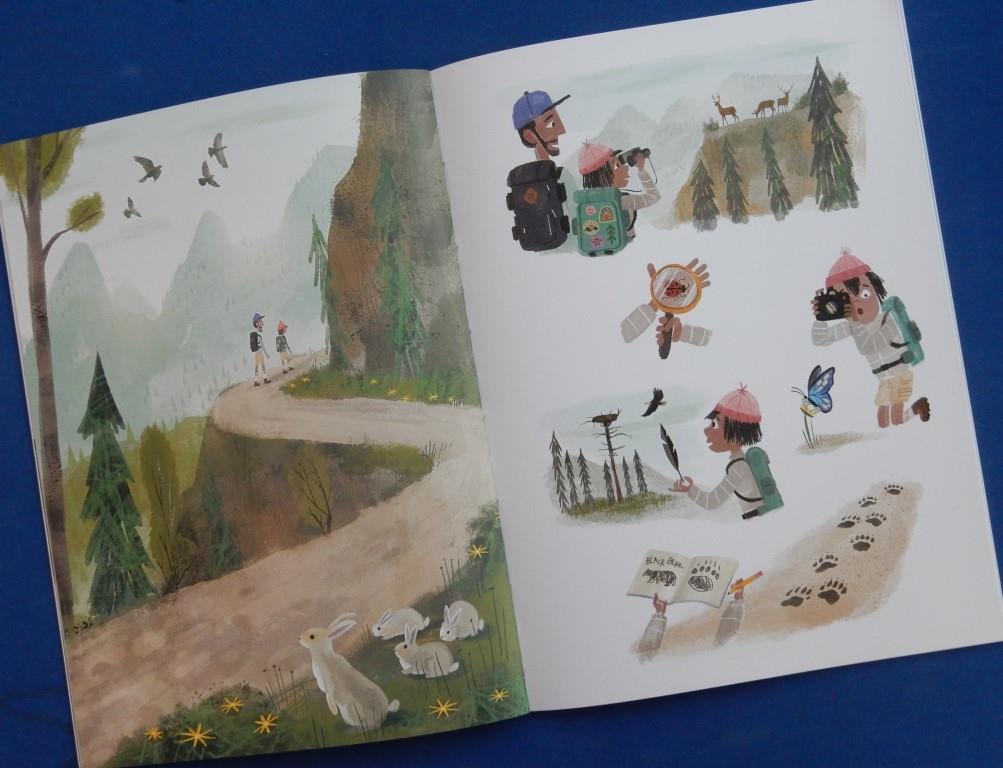
Wordless save for some environmental sounds and labels, this is a truly beautiful book. 

It begins one evening as a man bids goodnight to his child in a room littered with outdoor gear.

Next morning the father wakes the child who packs the gear into a rucksack, the two get into a jeep and head off from their city home into the countryside for the day.

We follow the two as they walk into the forest where they see wildlife aplenty, 

sharing in occasional small dramatic moments as the child copes with some scary challenges. 

The two stop to share snacks, take photos, enjoy the view and finally carry out the task they’ve come to perform – the planting of a sapling they’ve brought with them and the taking of a selfie beside it.

As dusk descends, they leave the woods and drive home. Once there, they don pyjamas, share some cookies and look through a photo album.

Totally immersive, this wonderfully heartwarming book, open to more than one interpretation, is one that needs slow and careful reading of every page: I love the variety of perspectives and the wealth of visual clues we’re given. I love too, how Oswald shows us the natural world through the lens of the close child/parent relationship. A special day and a special relationship. 

To sum it up, I’ll borrow the title of a very old song ‘Memories are made of this’.

The Tossy-Turny Princess and the Pesky Pea

The Tossy-Turny Princess and the Pesky Pea
Susan Verde and Jay Fleck
Abrams Books for Young Readers

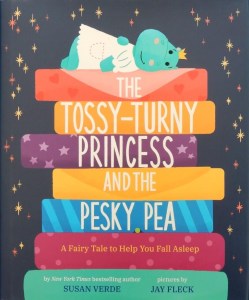
Rather than being a playful fractured fairytale version of the Hans Christian Andersen classic The Princess and the Pea, this is a deliberate reworking of the story using a hippo as the princess, by yoga and mindfulness teacher and writer of I am Yoga, to help young insomniacs get a good night’s sleep.

Usually good at falling asleep, said young royal – a busy creature by day – finds that one night after her usual daytime schedule, she just cannot fall asleep. What she doesn’t know is that earlier in the day a pea from her brother’s lunch accidentally ended up in-between the mattresses on his sibling’s bed and he’d been unable to retrieve it.

After two sleepless nights the princess is by day cranky, completely lacking in energy and generally out of sorts.

Fortunately however her friends – the royal gardener, the royal chef, the royal librarian and the royal astronomer in turn, are ready and willing to give her some good advice.

The gardener teaches her the lizard pose; the cook demonstrates a calming breathing technique; the librarian shows her a ‘feet and legs up the wall’ means of relaxing, and the astronomer shares his lie down, let the whole body relax … look at the sky … and place each … worry on a star “until with every sparkle, they disappear.”

That night, the princess, once again wide awake, but somewhat relieved to know that others too have trouble sleeping from time to time, brings to mind the sage advice of her friends and tries their yoga and meditation techniques … until at last, she falls fast asleep. The following morning she’s bursting with energy once again and willing to overlook her brother’s pea accident, sure in the knowledge that it had resulted in some valuable learning experiences on her part.

Jay Fleck’s droll scenes featuring the princess and the royal entourage are engaging (little humans will be amused at their attire) and a final author’s note explains each of the techniques mentioned in the story.

Intended primarily as a pre-bedtime book, this is a gentle, soothing tale about learning to let go of your worries and the importance of friendship.

Race Cars

Race Cars
Jenny Devenny ed. Charnaie Gordan
Frances Lincoln Children’s Books

This book, is the result of a collaboration between author/illustrator Jenny Devenny who uses the metaphor of a car race to introduce institutional and systemic racism to children, and diversity and inclusion expert, Charnaie Gordon who edited the story. (Both have written an introductory note).

Meet best friends Chase and Ace. Chase is a black race car; Ace a white race car and they both love racing. Chase is super speedy and in his first year of entering, becomes the very first black car ever to win the ‘world-famous, annual race-car race.’ To his Ace friend who finishes fourth , it matters not: place is unimportant. However the race committee (all except the youngest, pink-tyred Grace, being white male autos) are anything but happy and resolve to alter some of the rules in favour of the white cars, thus disadvantaging the other cars in future races.

The route change they introduce for non-white cars

enables Ace to win the next race the following year and in the subsequent one, an official stops Chase before he enters the magic forest, demanding to be shown his ID. These two demonstrations of blatant discrimination result in Chase failing to qualify for the next year’s race. Now Ace starts to think perhaps something isn’t right: but even worse, Chase now feels inferior.

At a further committee meeting, Grace quietly talks of making the race ‘fair and equal for all’, but only one or two others agree, while the rest, fearing change, keep quiet.

The following year Chase is there spectating and supporting his friend who starts off at super speed. But as Ace approaches the magic forest, he notices something he’d not previously been aware of

and decides to take the route intended for non-white cars. Consequently he gets lost.

Back at the track the committee are worried about their star race car Ace not having crossed the line. Now, Grace knows she must speak out and so she does, with the result that Chase agrees to search for his friend … and finally they finish the race together.

Designed to be accessible to a young audience, and intended as a starting point for opening up discussion, this book has been engineered to tackle a difficult and sensitive topic. To this end there are discussion notes after the story. Almost every time I turn on the news I hear something alarming and upsetting concerning the ill-treatment of a person or persons of colour, so it’s clear that opportunities such as this book offer to get children talking are much needed.

Dance With Oti: The Bird Jive

Dance With Oti: The Bird Jive
Oti Mabuse and Samara Hardy
Walker Books

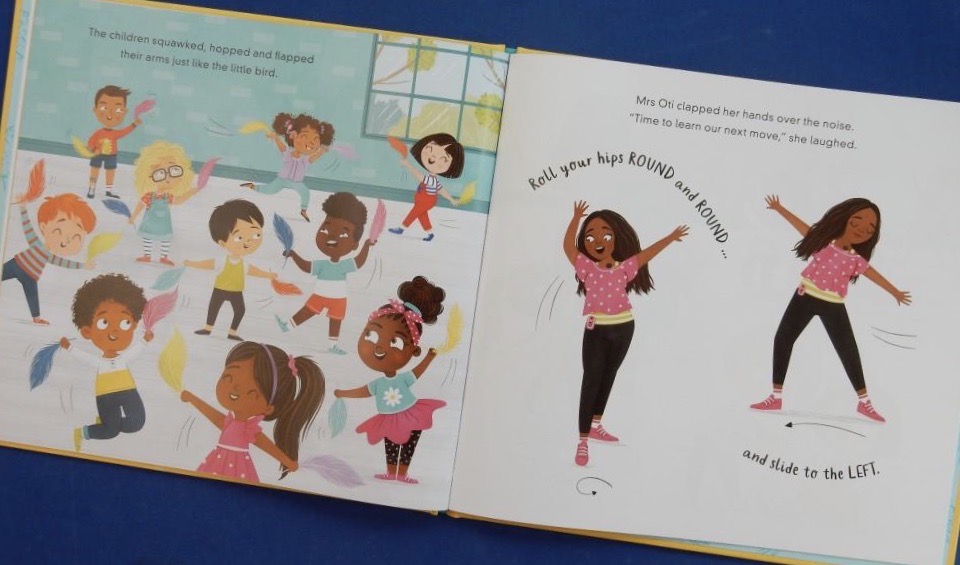
This is the debut picture book of Strictly Come Dancing star, Oti Mabuse, and as the book opens, Mrs Oti is welcoming a host of would-be dancers into her studio for their very first lesson.

Warm ups and stretches completed, everyone is ready to start learning the jive. There are the inevitable thrills and spills but under their teacher’s enthusiastic, watchful, caring eye, the children are quick learners

and in no time the lesson is halfway through. Then suddenly, an unexpected winged visitor makes an appearance.

Mrs Oti deals with the disruption in her characteristic creative way and soon everyone is back on task

and the lesson proceeds towards the final steps and a wonderful controlled POSE! Just in time to give the waiting families a first performance of The Bird Jive. And humans aren’t the only ones that show their enthusiasm as the dance draws to a close.

With some delightful characters including Poppy, Gan and Olivia, all illustrated with panache by Samara Hardy, and a step-by-step demonstration of the Bird Jive routine by Oti, this is a thoroughly enjoyable celebration of movement, dance and giving it your all. Share the book then, get on your feet and JIVE!

Mammoth

Mammoth
Anna Kemp and Adam Beer
Simon & Schuster Children’s Books

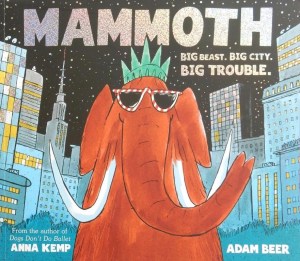
Waking from a sleep of indeterminate length an Ice Age mammoth is totally bothered, bewildered and bemused by the strange sights that meet his eyes when he heads to the meadow to join his herd for breakfast.
Having climbed to the top of a hill he sees an enormous ‘gleaming forest’ and makes his way towards it. Instead of his relations, said forest is full of weird smells and alarming sounds.

Nonetheless stuck in the big city, the visitor starts going about his daily business, despite being on the receiving end of some strange looks from those he encounters, not to mention a fair bit of shouty behaviour from the ‘cavemen’.

Deciding to make himself useful the mammoth does a spot of topiary but again his efforts are far from appreciated.

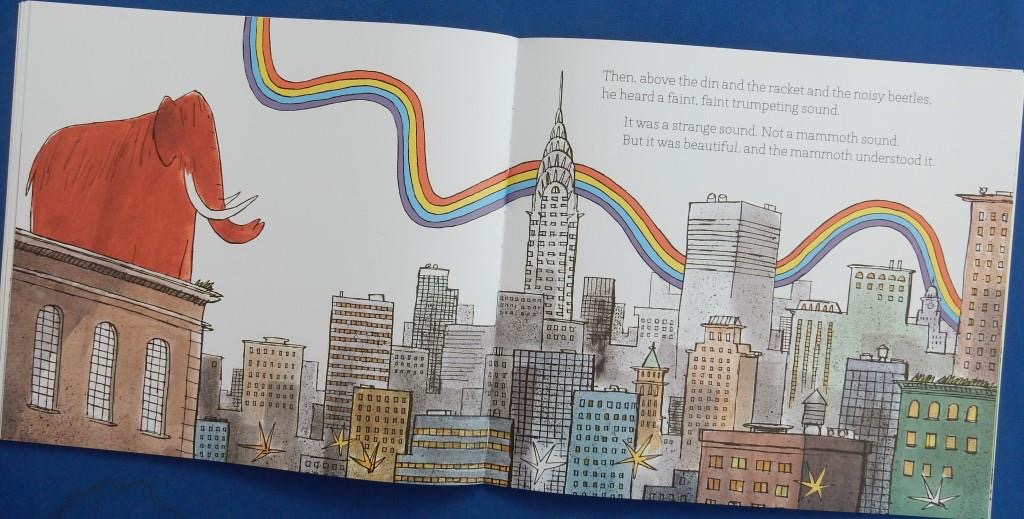
Then his hopes are raised when he finally enters the Ice Age exhibition and trumpets loudly at the mammoths before him. But these creatures he’d thought were from his herd prove not to be so and this disappointment triggers a rampage. Is he really now the only mammoth in the entire world.

In the distance he hears a faint trumpeting sound – strange and beautiful although not a mammoth sound – and it’s calling to him.

Perhaps at last he’s found his herd …

Anna Kemp tells a fun story about finding somewhere to be yourself with people who will accept you no matter what. Debut picture book illustrator, Adam Beer, brings out the humour of the mammoth’s situation, his interpretations of what he sees and some of the daft things he does (sporting a bow tie to visit the museum, for instance) while making readers feel sympathy at his plight.

The Pet

The Pet
Catherine Emmett and David Tazzyman
Macmillan Children’s Books

Young Digby David is a demanding sort of a boy, especially when it comes to wanting a pet, and happily for him, his dad is an obliging sort of guy, maybe somewhat over indulgent. So when the lad issues one of his urgent stipulations, what does Daddy do (after his hair has turned slightly grey that is) but pick up the phone to the pet shop. Before long there they stand in the shop with Digby insisting on having, contrary to the owner’s advice, the hairiest rodent there. Dad offers double the price and off they go. Digby is a loving guinea pig owner – but for a mere half day, after which the poor creature is left untended in her hutch.
Things continue in similar fashion. Digby wants to better Lily Jean’s cat,

Lola’s frog, and Dipak’s froggy threesome and each time it’s a case of Dad gaining a few more grey hairs, calling the pet shop and making an extravagant purchase.

But then what should catch young mister ‘I WANT’s eye but Gus the gorilla.
Mr David parts with all his cash (is he crazy?) and finally Digby is happy. For a while at least, but then as the novelty wears off, so does the attention Gus is paid.

What does a bored gorilla do? This one decides to make a break for it. And we’ll leave the large hairy creature there …

But what of Digby, you might be wondering. Sorry but I’m going to leave that matter hanging too …

Delivered in jaunty rhyme that reads aloud brilliantly (so long as you can resist the urge to dissolve into giggles), and David Tazzyman’s wonderfully droll, scribblesome illustrations, this is a corker of a cautionary tale showing how crucial it is to take proper care of your pets – whatever they are. Oh! and stop and think before you wish …

Destined to become a firm favourite with both adult sharers and their young audiences.

Be A Tree!

Be A Tree!
Maria Gianferrari and Felicita Sala
Abrams Books for Young Readers

‘Be a tree! // Stand tall. / Stretch your branches to the sun.’

So begins this gorgeous book. With its lyrical text and beautiful, vibrant watercolour, gouache and coloured pencil illustrations author and illustrator invite readers to look anew at ourselves and at trees, one of nature’s true treasures. By so doing we come to realise that humans and trees share similar physical characteristics: trunks and spines, branches and arms, a protective outer layer – bark and skin, a topmost crown and more.

Throughout, the trees – no matter their particular species, of which many are shown – take centre stage, standing tall and majestic, and viewed from a variety of perspectives, frequently dwarfing the humans who play, sit, walk beneath, or climb upon them.

In addition to basic anatomy, we’re asked to consider similarities such as the importance of sharing resources, alerting one another to danger, (by means of ‘a wood wide web of information’), to see the strength in diversity, while gently urging each and every one of us towards- a ‘family, a community, a country, a cosmos’ where ‘There is enough for all.’

What a wealth of wonder and learning potential is packed between the covers of this book,. It’s one to return to over and over, perhaps first being encouraged be we child or adult, to stretch and uncurl like the tree’s overground parts, then curl, coil and become rooted, as a prelude to considering the ways in which we can take our cue from the trees in how we live our lives. (The final pages suggest ways to help save trees, how to build community, there’s a spread on a tree’s anatomy and some suggested further reading and websites to visit.)

Grandpa’s Gift

Grandpa’s Gift
Fiona Lumbers
Simon & Schuster Children’s Books

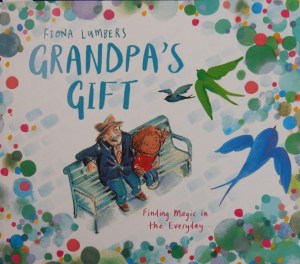
The little boy narrator of this story is finding his new life in the city a dull contrast to the open spaces he’d so enjoyed till he moved just over three weeks ago.

Feeling downcast he walks in the rain through the grey dreary streets with his grandpa who has a surprise in store. When they reach a dowdy-looking shop full of what looks like a lot of junk, Grandpa stops and in they go. The lad is totally disenchanted by what he finds inside, but why is Grandpa looking so excited?

Then he opens his hand to reveal …

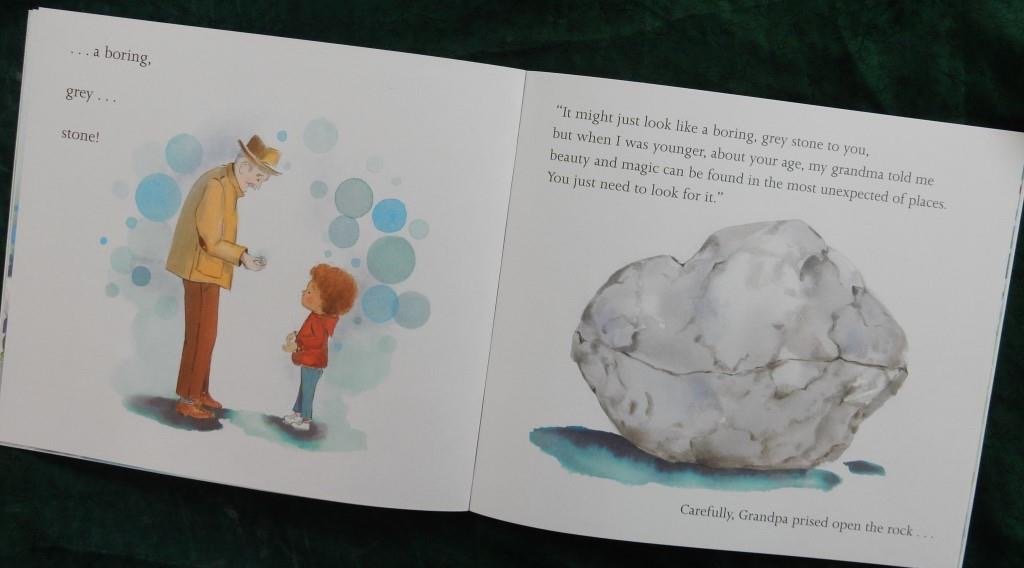
A geode stone. Underwhelmed, the boy just stares. Then Grandpa tells him something his own grandmother had said to him many years ago: “ … beauty and magic can be found in the most unexpected of places. You just need to look for it.” He then proceeds to prise open the stone. Amazingly a transformation occurs …

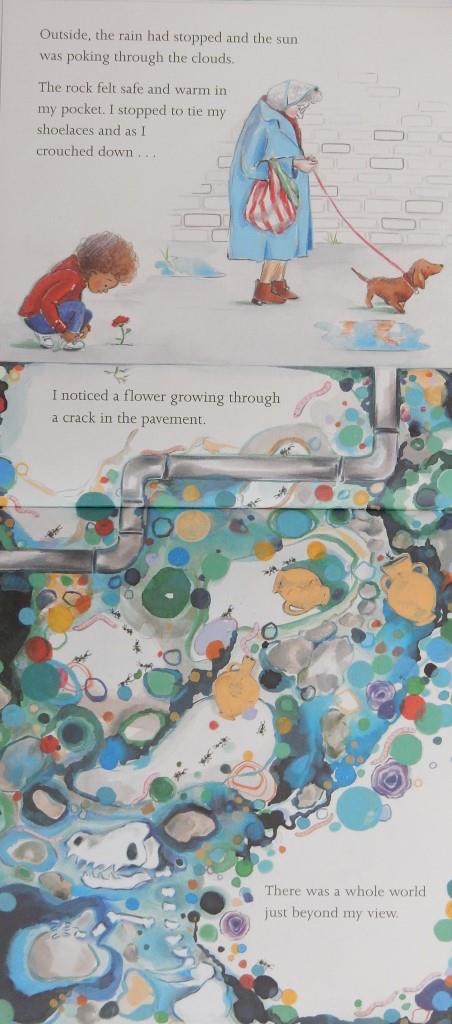
With the rain stopped, the two head outside and continue walking, the boy with the stone safe in his pocket. Now he begins to look at the world anew and before long discovers that indeed, there is beauty and magic all around.

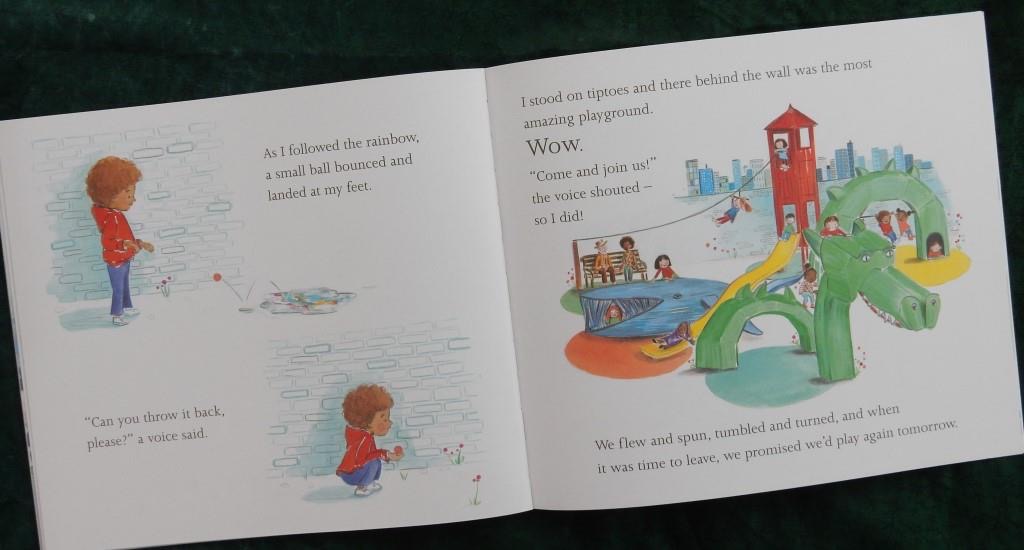
With hope in his heart and a rainbow overhead, the narrator takes his Grandpa’s hand and together they start to walk home,

Hugely uplifting is this, the second of Fiona Lumbers’ author/illustrated picture books. Her predominantly watercolour illustrations are an absolute delight – full of interesting details and small jewels of colour. I love the way she uses the geode stone as a metaphor for the city, showing how beauty can be discovered in the most unexpected places.

A Song of Gladness

A Song of Gladness
Michael Morpurgo and Emily Gravett
Two Hoots

We’ve all in one way or another been affected by the lockdowns over the past year or so. This gorgeous timely book was inspired by a blackbird in Michael Morpurgo’s garden during the first lockdown and truly it is as the front cover says, ‘a story of hope for us and our planet’.

It begins with the author standing having a ‘conversation’ with said blackbird wherein he tells it of the sadness everyone is feeling. This precipitates an idea in the blackbird’s mind and he sings it out to the still sleepy fox near the shed. And so begins a chain reaction with the song passing from one to another with creatures all over the world, each in its own way joining in, 

until the entire animal world is singing a song of forgiveness. 

Not yet though the author who asks and receives permission from the blackbird to sing with them.

One can truly hope that humans the world over will during this last year or so, have rediscovered their connection with the natural world, and as Michael Morpurgo reminds us, will now take responsibility to care, not only for our fellow humans but for all living things on our precious planet.

Beautifully told with the author’s characteristic empathy and gentleness, this very personal, moving story speaks to us all, children and adults, capturing both our shared experience and our hearts. Emily Gravett’s illustrations brilliantly express the vital interconnectedness inherent in the text, as they carry us along from page to page swept up in the musicality both of Michael’s words, and the animals’ voices united in a final glorious harmony.

The Rock From the Sky

The Rock From the Sky
Jon Klassen
Walker Books

Quintessential quirky Klassen is this sequence of five connected short comic episodes delivered with the author’s dead pan humour, not to mention that its main characters – a tortoise, an armadillo sport Klassen’s signature style hats.

The entire thing is delivered through (colour-coded) dialogue between Tortoise and Armadillo (plus those characteristic Klassen eye-movements).

The topic under discussion in The Rock is the best place to stand/sit. Tortoise favours one particular spot, “I don’t ever want to stand anywhere else.” But Armadillo is unfavourably disposed towards it, “Actually I have a bad feeling about it.’ And rightly so; he instead goes off to try another spot. A to-ing and fro-ing ensues but it’s not until Snake rocks up to join Armadillo that Tortoise decides to join them too – and only just in time … for something huge and mightily heavy falls on his erstwhile spot. Of course, we readers in on the joke, have been anticipating same all the while as we enjoy the mounting tension.

In The Fall, Armadillo attempts to act helpfully while Tortoise tries to save face zzzz. Episode three sees the two, eyes closed, contemplating the future

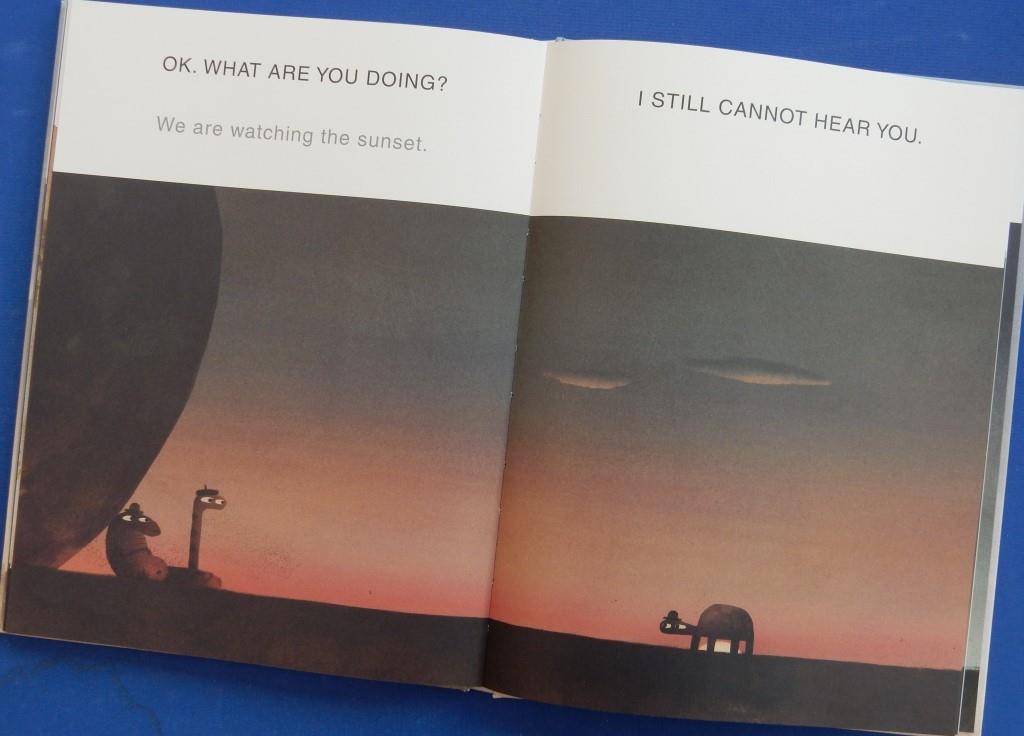
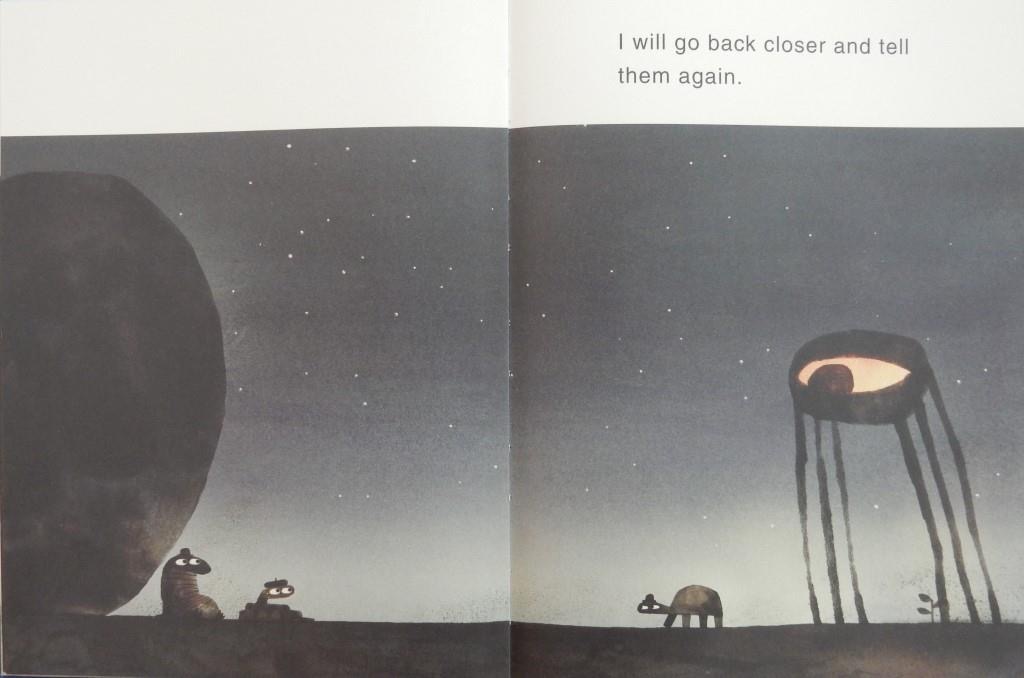
watched by a futuristic creature, while The Sunset is a contemplation of same – kind of;

and finally, in No More Room Tortoise takes umbrage “Maybe I will never come back” and is once more under the watchful Eye now no longer in the future,

but perhaps soon to be in the past. Thank goodness for asteroids!

Another weird and wonderful Klassen gem, albeit somewhat longer (90 pages) than usual, set in a minimalist landscape that offers much to ponder upon in a Waiting For Godot for primary school readers.

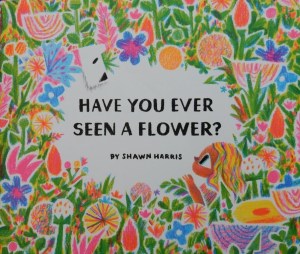
Have You Ever Seen A Flower?

Have You Ever Seen A Flower?
Shawn Harris
Chronicle Books

This a visual feast if ever there was one. It begins in an intricately constructed city in which the only thing of colour is a small girl with rainbow tresses dashing out through a door where a car awaits within which is a terrier.

As the car moves out of the city, the dreary greyness turns first white and then explodes into a riot of colour, till the car stops.

We next see the child, her joy palpable, surrounded by fields alive with fluorescent flowers. She stops, stoops and, breathing deeply, imbibes the beauty of a single bloom and in so doing has an existential experience of complete connectedness: it’s as though she and the flower become a unified life force.

All the while, the text invites readers to ponder such questions as ‘Have you ever seen a flower using nothing but your nose? Breathe deep … what do you see?’ … “Have you ever seen a flower so deep you had to shout HELLO and listen for an echo just to know how deep it goes?’

We share the child’s exhilaration as she clutches a plucked wildflower, before herself becoming transformed into a flower.

There’s much to contemplate and reflect upon in what is, for both child and reader, a wonder-filled transformational journey into consciousness itself.

An exciting debut for Shawn Harris as author/illustrator. With their changing perspective and focus, his colour pencil illustrations are mesmerising, the playful narrative rich in metaphor with occasional alliteration and assonance. Who can resist its urgent intensity?

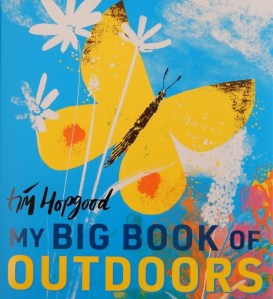
My Big Book of Outdoors

My Big Book of Outdoors
Tim Hopgood
Walker Books

When it comes to nature, ’The more you look, the more you see’. So says Tim Hopgood in the blurb to this stunningly beautiful bumper book.

To amplify this, starting with Spring, Tim takes us through the four seasons of the year celebrating the delights to be discovered in each one.

My favourite time, Spring, brings blossom, baby animals, bulbs busting into bloom, the birds greeting the day with their dawn chorus, nest building, egg laying and more.

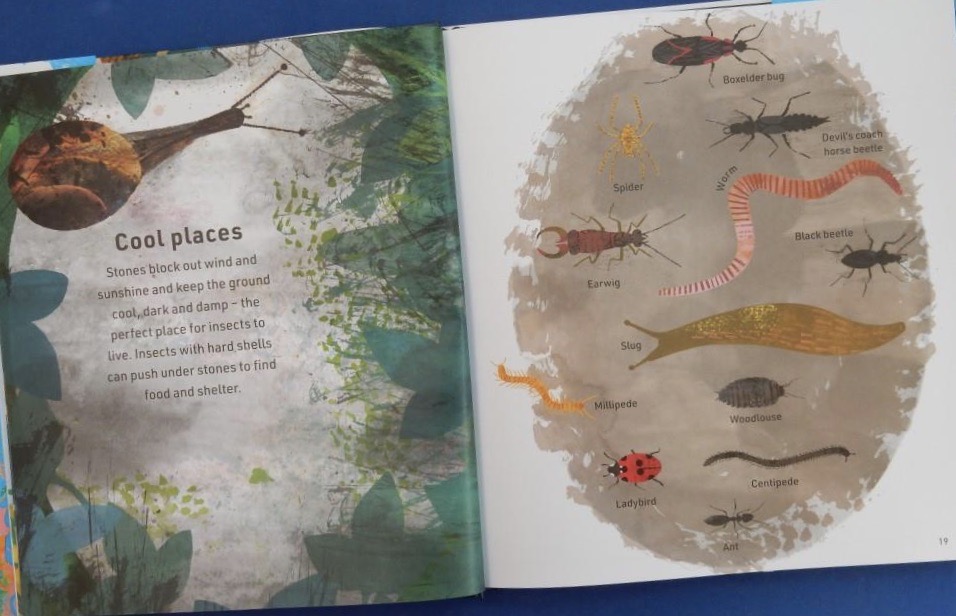
There are close-ups of eggs, feathers, minibeasts, 

frogs, soil and a rain shower and more; as well as the occasional poem and activities for indoors and out.

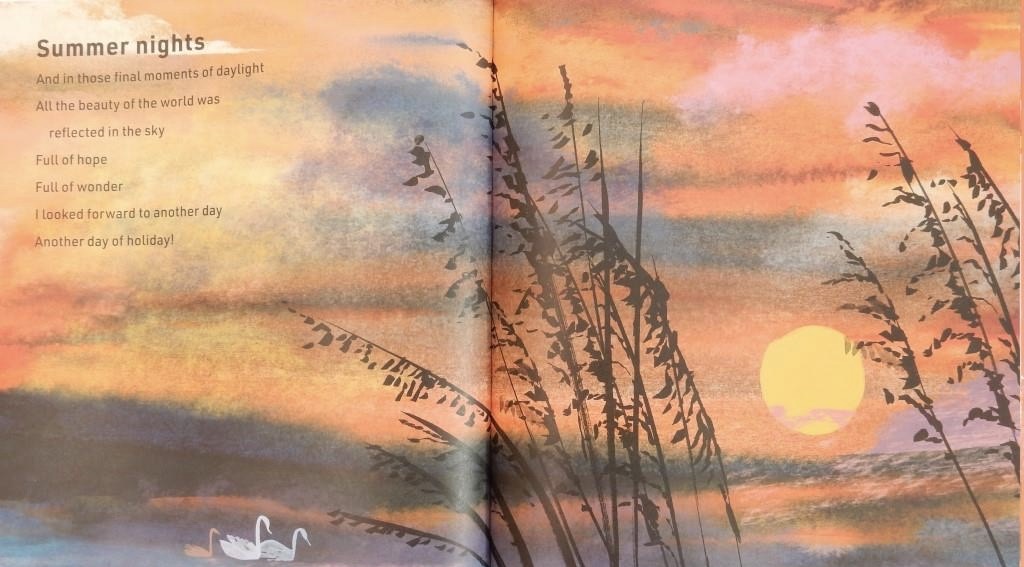
With its longer, warmer days, Summer offers insects aplenty, baby birds taking flight, a richness of colour and scents from flowers and for some plants, it’s time for seeds to be dispersed. More colour comes from amazing skies, 

ripening fruits and vegetables and there’s the promise of a holiday, perhaps by the sea.

Misty mornings, leaves changing colour and falling in blustery winds herald Autumn as birds take flight to warmer climes, seeds are dispersed far and wide, and creatures forage for supplies in readiness for winter as do humans who harvest the spoils from trees and hedgerows.

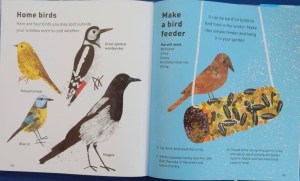
Quiet seems to descend along with Winter’s arrival with its chilly, sometimes frosty days and cold snuggle up nights when some creatures hibernate to survive. It’s a season to remember the resident birds and perhaps using Tim’s instructions, make a feeder for the garden or balcony. Assuredly they’ll need it should snow fall.


With every page turn bringing more of nature’s delights, this is for sure, a veritable treasure trove: Tim has done nature proud.

100 Endangered Species

100 Endangered Species
Rachel Hudson
Button Books

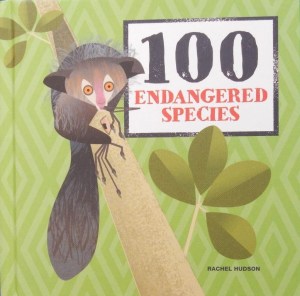
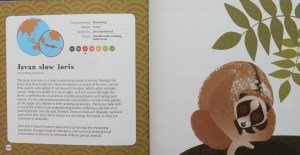
It’s alarming to think that there are so many creatures on the endangered or threatened list; the author/illustrator of this chunky book teamed up with the People’s Trust of Endangered Species to illustrate one such animal every day for 100 days.

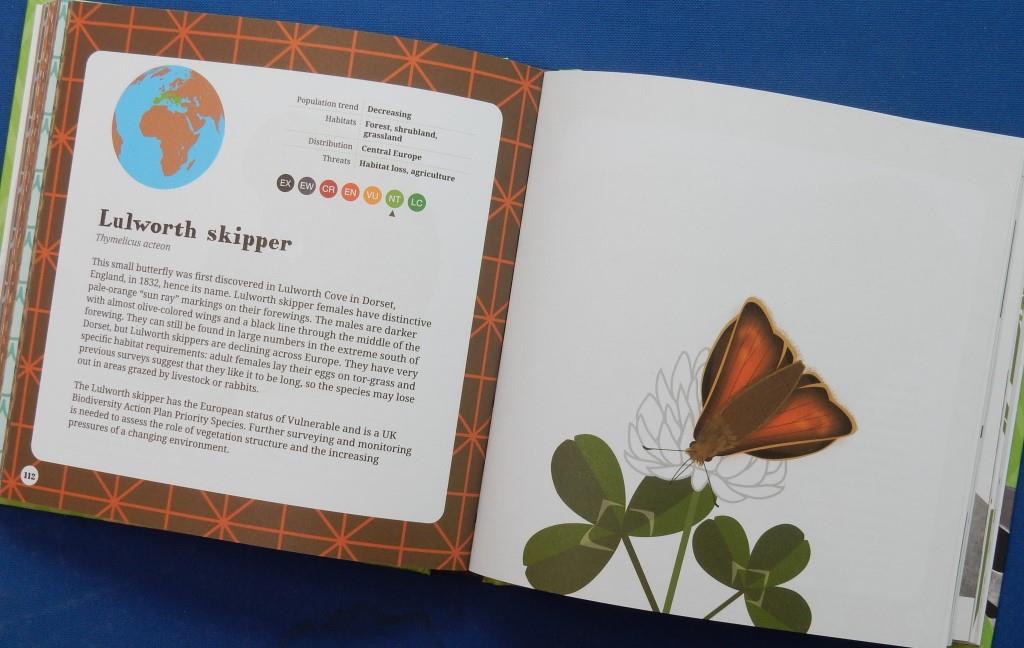
Those chosen come from all over the world and each has undergone evolutionary adaptations to suit its environment, be that the Red pandas found in China, Nepal and Bhutan; the Madagascan Aye-ayes, and the Indris that live in the northern and central rainforests of East Madagascar; the Sumatran tigers; the Little spotted kiwis of New Zealand; the Lulworth skipper butterfly first found in Dorset and now on the decline across Europe; 

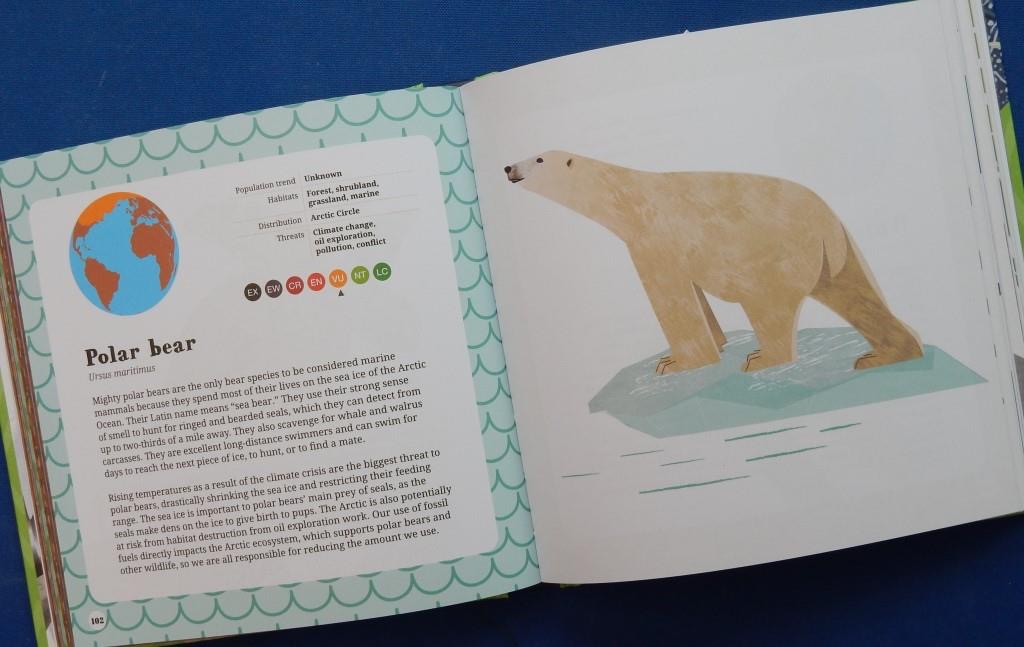
or those magnificent polar bears whose Arctic Circle habitats are at risk both from destruction due to oil exploration work, and rising temperatures resulting from climate change.

Each of the animals depicted is on the International Union for the Conservation of Nature’s Red List (explained at the beginning of the book) and is thus a conservation priority. Opposite each gently amusing illustration is a descriptive paragraph (or two) giving interesting facts, as well as saying why the species is currently at risk and often, what is being done, or needs to be done, to protect it. There’s also a world map showing distribution, and listing habits, threats and population trend which is given, with very few exceptions, as ‘decreasing’. 

However, it’s heartening to see that numbers of the African elephant, the little spotted kiwi, the whooping crane, the greater one-horned rhino and the giant panda are on the increase as are those of the Eurasian beaver.

Readers who feel inspired to become involved in conservation issues/initiatives – hopefully that is all of them – can find a list of organisations and projects at the back of the book, as well as a glossary; and there’s a foreword by broadcaster and naturalist Brent Westwood. Give this book to a child and who knows, you might inspire a life-long passion for conservation.

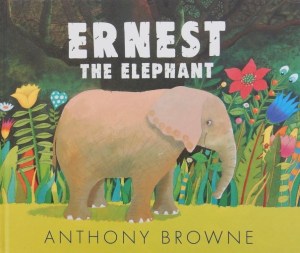
Ernest the Elephant

Ernest the Elephant
Anthony Browne
Walker Books

From the much loved and highly praised Anthony Browne comes a stunningly beautiful modern day fable.
Having had thus far a safe happy life with his Mum and the rest of the herd, little elephant Ernest has become curious about what more life has to offer than mere walking, eating, drinking and sleeping.

One day Ernest and his mum are strolling happily along with the other elephants when something catches Ernest’s eye. To him it looks exciting but Mum tells him it’s not a place for baby elephants.
Somewhat put out at being called a ‘baby’ and eager to explore this alluring place, Ernest drops behind and into the jungle he goes. It’s a strange, colourful place and Ernest is fascinated by the dazzling light and dark, mysterious shadows.

Soon though, his excitement begins to wane and he contemplates rejoining the other elephants, but realises that he’s completely lost.
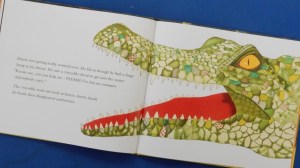
After some time he comes upon various other animals – a gorilla, a lion, a hippo, a gaping-mouthed crocodile –

but not a single one can be bothered to offer any assistance. Their apathy and condescension is evident in each of their faces, but then happily when Ernest is at the point of despair, one little creature stops and listens: it’s a tiny mouse.

Ernest explains his plight doubting that so small an animal could possibly help but so polite is Mouse that Ernest decides being lost with such a companion is preferable to being lost and alone.

Much to the little pachyderm’s surprise though, help is exactly what Mouse does and hurrah! Ernest and his Mum are eventually reunited and three happy animals are the outcome. After all, what better reward could there be for help so selflessly given?

While empathising with Ernest’s plight, children will love to lose themselves in Anthony Browne’s classic style surreal jungle, relishing the multitude of delicious cakes, lollipops, liquorice all sorts and other confectionary, as well as fruits, eggs both creme and fried, not forgetting the interesting variety of tree trunks one of which looks to me like a chocolate flake. There’s even a pair of socks and some underpants pegged out to dry. The illustrator clearly had huge fun with those scenes.

What a wealth of talking points this cracking book offers when adult and child(ren) share it, not to mention the visual literacy lessons aplenty.

Make Tracks: Building Site / Go Go Tin

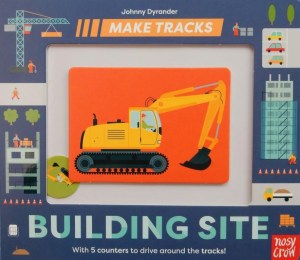
Make Tracks: Building Site
Johnny Dryander
Nosy Crow

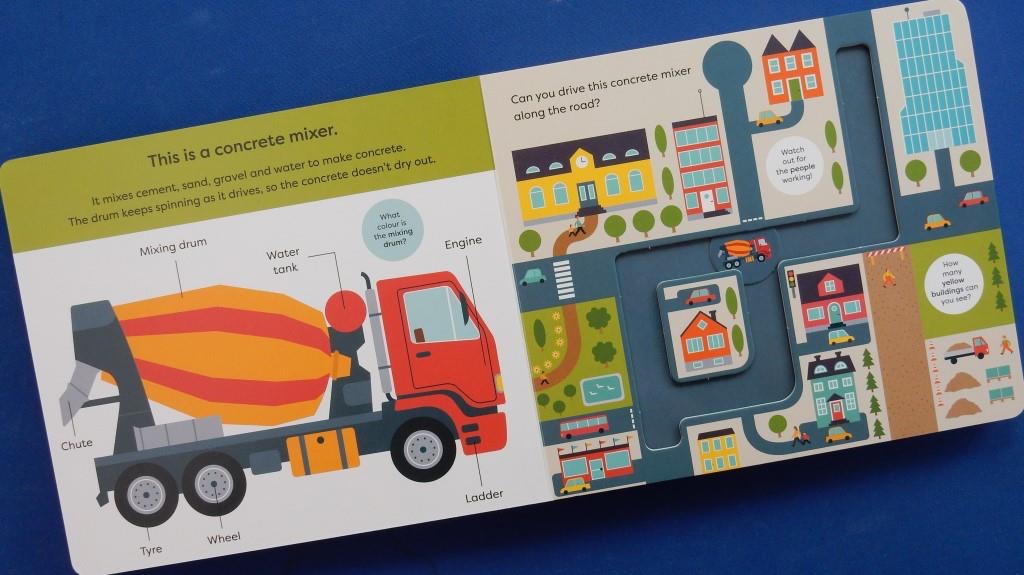
In one of a new interactive series, Johnny Dryander illustrates five vehicles often found on a building site – those that small children are fascinated by when they see them for real.

Each one – concrete mixer,

dump truck, excavator, bulldozer and front loader – is presented on the verso in a clearly labelled picture along with a brief introductory paragraph giving some information about its key features and what it is used for. There’s also a question for little ones to consider.

On the opposite page, with additional prompts for opening up discussion, is a scene showing people and machines at work on the site. This contains a track around which little fingers can manipulate a counter depicting the vehicle illustrated on the facing page in response to the ‘Can you drive this … “ challenge. (This feature is also part of the front cover.)

With lots of potential for fun learning be that of related language or fine motor skill development, this will be particularly popular with young enthusiasts of large building site machines.

Go Go Tin
Claire Philip and Steven Wood
Sunbird Books

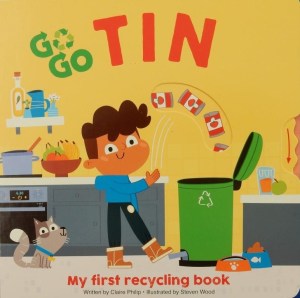
This sturdy board book explains in simple words and bright cheery pictures what happens to a tin can from the time it’s tossed into a kitchen recycling bin until it becomes part of one of the shiny new tins produced at a factory.

With its onomatopoeic sounds aplenty to join in with, little ones will enjoy following the sequence of events from lorry to recycling plant, through a crushing machine, into a furnace to melt and be formed into new blocks, ready for stamping, stretching and further shaping.

Beautiful Day! / Take Off Your Brave

Beautiful Day!
Rodoula Pappa and Seng Soun Ratanavanh
Cameron Kids

In the company of a small child we experience the seasons’ riches through a sequence of twenty haiku-like poems. Rodoula Pappa’s words are as if spoken by said child, whose activities we follow starting with Spring: ’Beautiful day! / Teach me, too, how to fly, / mother swallow.’ are illustrated in Seng Soun Ratanavanh’s richly patterned scenes beautifully crafted as if from Japanese washi paper. 

There’s much to enjoy no matter the season: Summer offers lush peaches, somnolent-sounding music and ‘Among the reeds, / a new galaxy – / fireflies.’ as well as days by the sea.

Come autumn there’s an abundance of busy chipmunks and dahlias bloom prolifically and its time for the wild geese to travel. 

With winter soft snow falls and there are preparations for Christmas, while ‘In the rock’s crack, / deep green, full of light – / winter blossom.’

There’s a feeling of serenity about the entire book; it’s as though the words are asking us to slow down, stand and stare, imbibing the beauty of the natural world so wonderfully depicted, no matter what time of year.

What a lovely starting point for children’s own seasonal reflections this book would make in a primary classroom.

Take Off Your Brave
Nadim, illustrated by Yasmeen Ismail
Walker Books

The Russian writer, storyteller and poet Kornei Chukovsky talked of young children as ‘linguistic geniuses’ playful and creative users of language and this book of poems by four year old, Nadim is a wonderful demonstration of this.

Responding to prompts from his mother, with the initial guidance of poetry teacher, Kate Clanchy (who has written an insightful foreword to this book) the little boy shared his thoughts about a variety of things from his feelings on returning home from nursery school, his best friend,

his mum, doing something scary, his wish. To read each of these is to share in something of how a four or five year old sees the world (something that I as a nursery and reception teacher for many years particularly enjoy); there’s no attempt at emulating adult poetry, rather, this is a child’s voice capturing those moments of happiness, joy, love, loneliness, peacefulness, togetherness, hopes, fears and dreams.

‘You always have sad moments / Happy moments / Nice moments / Angry moments // And when you smush those moments together / They make a great feeling / Called: / ABRACADABRADOCUOUS.’

And rest assured everyone has indestructible love to share for ‘Baddies love their baddie friends / Even very baddie ones. // Nothing can make love disappear / Not spells / Not magic / Not mermaids / Not anything. … ‘

Accompanied by Yasmeen Ismail’s illustrations – who better to capture young children being themselves – this is a lovely demonstration that poetry is for everybody.

Earth Friends: River Rescue / Unicorn Academy: Lyra and Misty

These are titles from two of Nosy Crow’s popular series – thanks to the publishers for sending them for review

Earth Friends: River Rescue
Holly Webb

This is book two in a series about four friends who are endeavouring to make the world a better place for everyone. As it opens Izzy is celebrating her fund-raising success with proceeds being send to a fair-trade clothing co-operative foundation in Bangladesh but she still lacks confidence when it comes to friendship issues.

So when Poppy invites her to stay the night, Izzy is thrilled. Poppy has a dog, Billy and it’s taking him for a walk beside the river that gives rise to Izzy’s next campaign. Both girls are horrified at the amount of rubbish that has been thrown into the water but it’s when Billy chases a water rat and ends up in the river almost drowning on account of a paw getting caught in the wheel of a submerged bike, that Izzy decides on a new project – operation River Rescue.

Now it’s just a matter of getting enough people on board to help raise money and do the actual clean-up.

A lovely story of a local environmental project, with a terrific ending, rather a lot of mud and some surprises along the way.

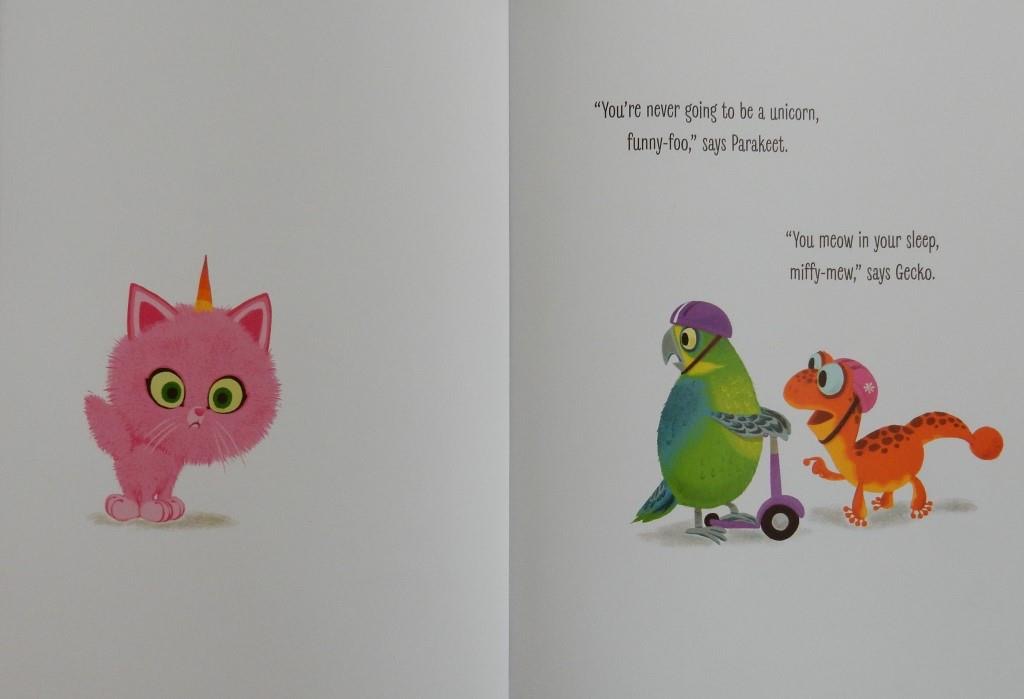
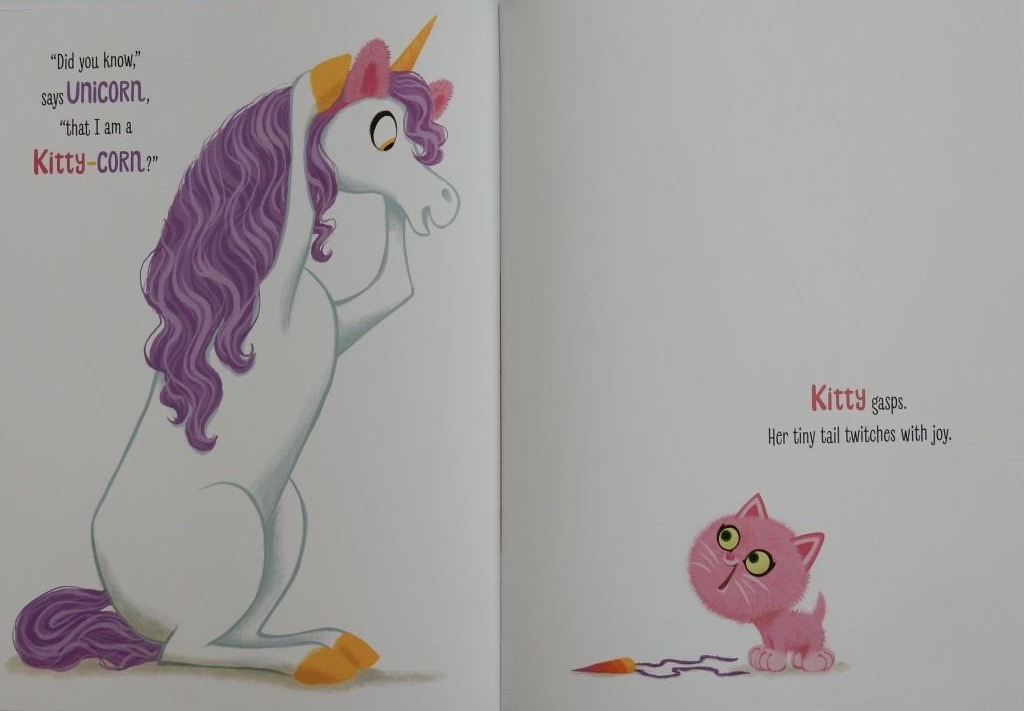
Unicorn Academy: Lyra and Misty
Julie Sykes, illustrated by Lucy Truman

At the start of a new term Lyra is mega-excited to have joined Unicorn Academy and thrilled to have been paired with Misty. She can’t wait for some amazing adventures like those her cousin has mentioned and it’s not long before she and some others in her dorm discover a mystery that needs to be solved, starting when Lyra finds a portion of what she suggests might be part of an old treasure map.

Why when shown the find does visiting speaker Dr Briar appear interested, then say it’s merely some random scribblings?

With her mind on the riddle on the back of the map, Lyra’s concentration during lessons next day is somewhat lacking, but later she tells her friends she’s solved the clue and that afternoon they head off towards Echo Caves hoping to find the rest of the map.

What though is making Misty reluctant to be part of their adventure? In that case will she ever find her special magic and will she and Lyra ever bond? And what of the rest of the map? …

As always friendship is at the heart of this 17th story in the magical school that young solo readers starting out on chapter books love to visit and in so doing realise that its pupils face many of the same issues as they do. As always Lucy Truman’s black and white illustrations add to the atmosphere.

How To Be Cooler Than Cool

How To Be Cooler Than Cool
Sean Taylor and Jean Jullien
Walker Books

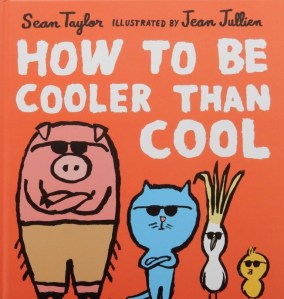
Coming upon a pair of sunglasses unexpectedly immediately transforms Cat from ordinary to real cool with the ability to glide effortlessly backwards down the slide – or does it? Err … 

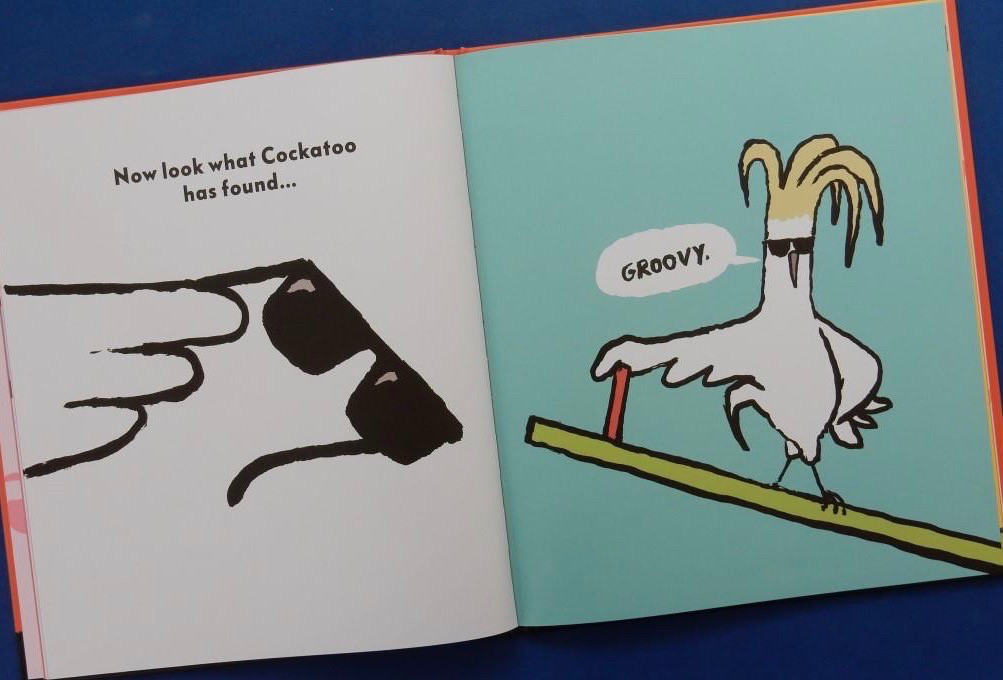
Cockatoo, next to come upon the sun-specs is instantly rendered supercool when he dons his find and dances along the see-saw – 

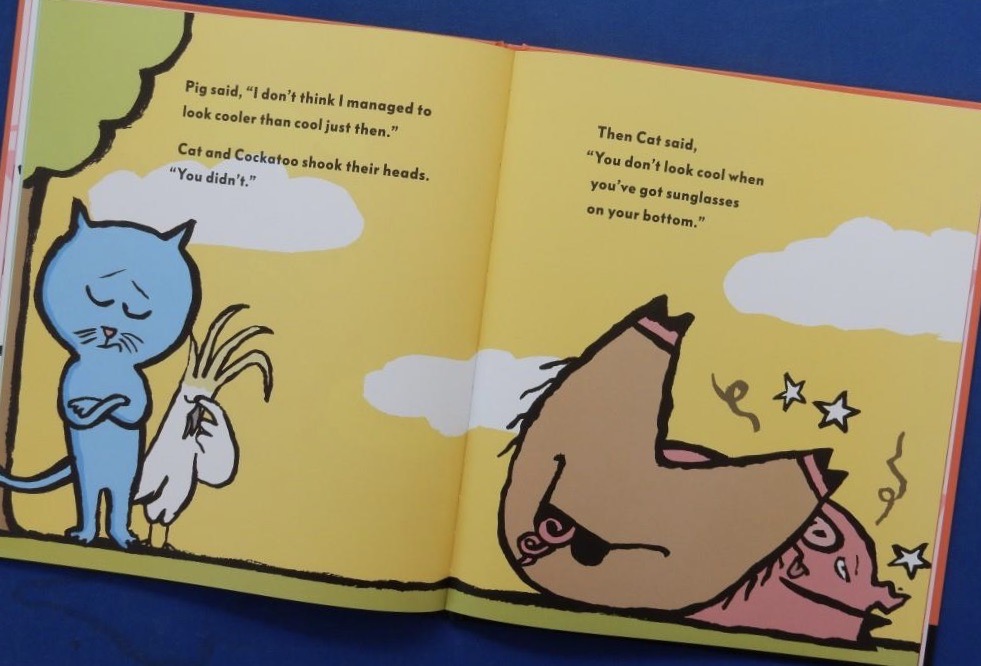
but not for long … and those shades are then caught by Pig.

‘Mr Totally Completely Cool’ is how he anticipates being seen as he stands posing nonchalantly on the swing until … 

and even he has to admit he doesn’t quite live up to his own expectation.

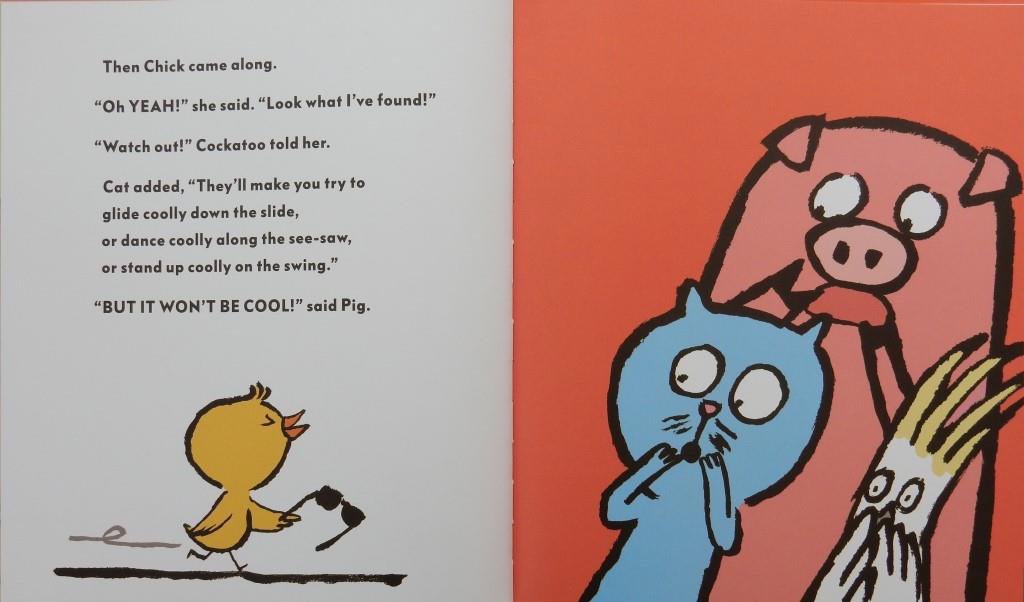
Disappointment, and realisation concerning the non-effect of the sunglasses reign; but then who should rock up but Chick clutching said article. 

The others warn him of their inability to make their feathered friend cool but is she bothered? No way, all she wants is some fun time with friends … And does it prove ‘cooler than cool’? What do you think? …

Assuredly this new story from the duo that gave us Hoot Owl, Master of Disguise is another splendidly silly slapstick offering that will surely have both children and adults laughing out loud. Be yourself is the message that emerges from this zany celebration of play and unconditional friendship.

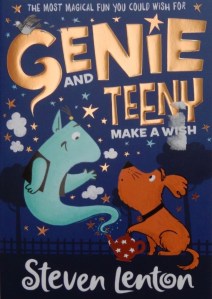
Genie and Teeny Make a Wish

Genie and Teeny Make a Wish
Steve Lenton
Harper Collins Children’s Books

Steve Lenton has already earned a great reputation as an illustrator and now makes his first foray into early chapter books.

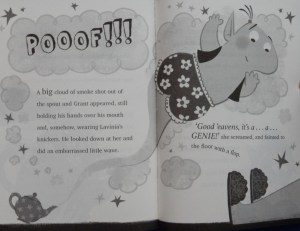
What a cracking little book he’s created in this first story of Grant a rather inept genie, and Teeny, a lost puppy. Teeny happens upon the teapot that’s become Grant’s place of residence since Queen Mizelda kicked him out of Genie World, lamp and all, on account of a birthday cake mishap.

Now on Earth, Grant wants to find a way to get back into the queen’s good books, but after his first night in his new terrestrial abode, he finds himself setting out on a ‘Teeny-owner finding mission’.

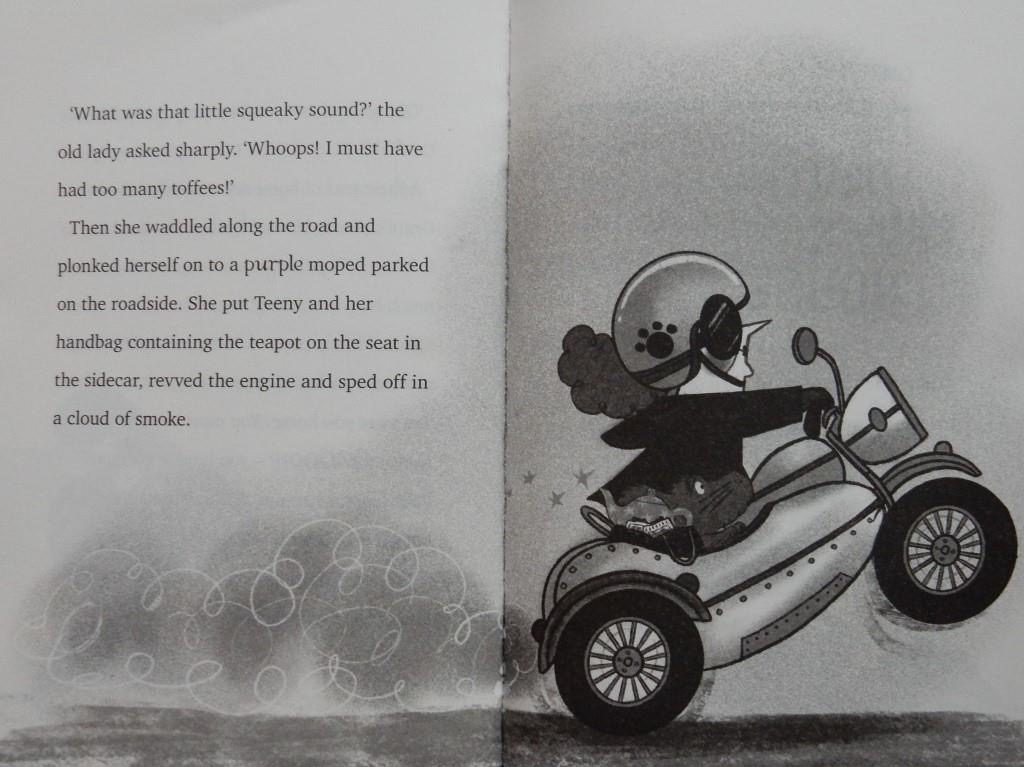
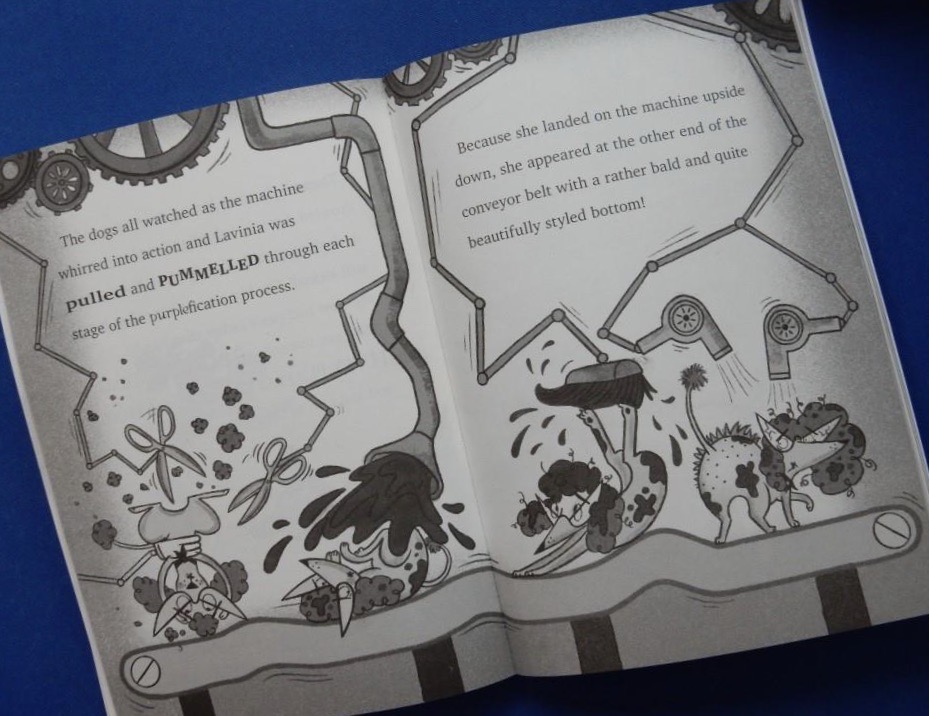
However as the two wander through the town, they are unexpectedly kidnapped (along with the teapot) by one Lavinia Lavender, a thoroughly nasty old woman with a penchant for purple and a cunning plan.

This female has her sights set on winning The Big Dancing Dog Show. Could this be a case of be careful what you wish for when Grant and his magic wishy-word are involved?

Perhaps the little genie can save the day one way or another …

With Steve’s smashing illustrations at every page turn

and his chatty narrative style with its reader-involving elements, what more can a young solo reader (or a class of eager listeners) ask? Maybe just the step-by-step ‘How to draw Grant the Genie’ tutorial at the back of the book.
Bring on the second instalment.

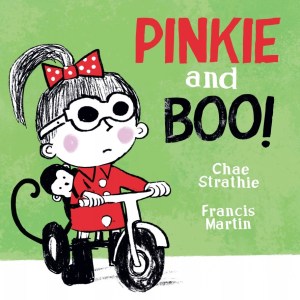
Pinkie and Boo!

I’m thrilled to be part of the blog tour for super Indie publisher Little Door Books’ latest picture book, about a new sibling in the family written by award-winning author of the So You Think You’ve Got it Bad series, Chae Strathie and illustrated by Francis Martin.

Pinkie and Boo!
Chae Strathie and Francis Martin
Little Door Books

When Pinkie learns that she’s soon to become a big sister, she’s far from happy, envisioning such disasters as getting carried off by evil seagulls or being turned into a stinky rat on account of – horror of horrors – a baby. And, on seeing the infant she’s even less impressed by such a strange looking, whiffy being.

Dad tries pacifying Pinkie with the present of a cuddly toy monkey. She names him Boo, noisily introduces him to the baby displeasing her parents who banish her to the garden.

There, Pinkie shares with Boo her concerns about her place as smallest in the family having been usurped by the new arrival, and her fears of being overlooked. Boo comes up with some ‘SUPER-BRILLIANT’ ideas but the results — plucked flowers for dad, a chaotic messy kitchen and misplaced crayon creativity, are anything but super- brilliant so far as the recipients are concerned.

Fortunately Pinkie has help clearing up what she deems ‘Boo’s fault’. But then while she’s having some thinking time in her room, Boo has another of his flashes of inspiration.

Can plan B work the wonders both Pinkie and Boo are hoping for?

Chae and Francis’ portrayal of Pinkie’s feelings of uncertainty about her place in the family, and the way she reacts, are spot on. Their spirited little girl with her wild imagination and don’t mess with me attitude is simply adorable.

Fantastically funny, full of chaos, mess and mayhem and most important, a whole lot of love, even if it does take some time to understand that sharing dad and mum isn’t as terrible as Pinkie anticipated.

I love everything about this book and I’m sure its target audience will too.

Panda At The Door / An Escape in Time

Panda At The Door
Sarah Horne
Chicken House

Pudding Panda is Edinburgh Zoo’s Star Attraction. She’s been happy with making the zoo visitors smile at her antics but now longs for a family of her own. Then she learns from keeper Gerald that she’s to be sent to China.
Maybe the answer is emulate her heroine Mary Poppins and become a nanny. Gerald thinks not, but then fails to lock Pudding’s cage …

Over on the other side of the city meanwhile, Callum is having a bad time: he’s being bullied; his parents are arguing – again – and performer Dad’s gone awol (something to do with bacon), plus, his little sister Tabby is intensely annoying. It’s Cal’s ninth birthday and all he receives is a measly certificate of adoption for a panda with instructions on how to email if there are any questions. Yes, he certainly has questions, the most pressing being, ‘when will I be happy again?’ Shortly after hitting SEND he falls asleep.

Next morning, DING DONG! who, or rather what, should be standing at the door? Not his missing father but a large panda offering to help. Mum’s reaction is to faint on the spot, but what better way to revive her than a timely spoonful of sugar?

Then the zoo puts out a message offering a huge reward for the safe return of a panda; everyone in the house, and even worse bully Mike Spiker, passing outside, hear the radio announcement. 

Now it’s not only Pudding in deep trouble, especially as Mike Spiker passes on the news to his dad. It’s up to Cal and his family to look after Pudding and keep her safe from the dastardly Spikers; but they also need to find Dad.

With mission ‘Going on a Dad Hunt’ successfully completed, can Pudding save the day? If she and Dad team up perhaps panda-monium can become a wonderfully clever panda-mime.

Dad’s punning predilection not withstanding, this is a thoroughly engaging story. Developed from an original idea from Vikki Anderson through the Big Idea Competition, the thought-provoking book was written and illustrated by Sarah Horne. The characterisation is great and the Mary Poppins quotes add to the fun.

An Escape in Time
Sally Nicholls, illustrated by Rachael Dean
Nosy Crow

By means of the mirror in their aunt’s hallway, brother and sister Alex and Ruby find themselves in a different historical period and in each story, have a task to perform before they can return to the present.

This their third time-slip adventure in this smashing series sees them plunged back to the Georgian era 1794/5, the time of the French Revolution and faced with having to help a far from happy French Countess escape the guillotine and find a safe home in Georgian England. 

But there’s a whole lot more that needs sorting out too in what proves to be a pretty chaotic situation that’s full of danger (not least for Ruby), romance (among the hymn books), heroics, the odd misunderstanding, not to mention some exceedingly uncomfortable Georgian underwear sans knickers though, if you’re female; oh! and plenty of stewed cucumbers!

As is characteristic of these Sally Nicholls stories, readers will enjoy plenty of humour, a pacy plot, a cast of highly colourful characters and a wealth of historical information along the way; not forgetting Rachael Dean’s smashing black and white illustrations.

Both books are great for KS2 either for solo reading or class read aloud.

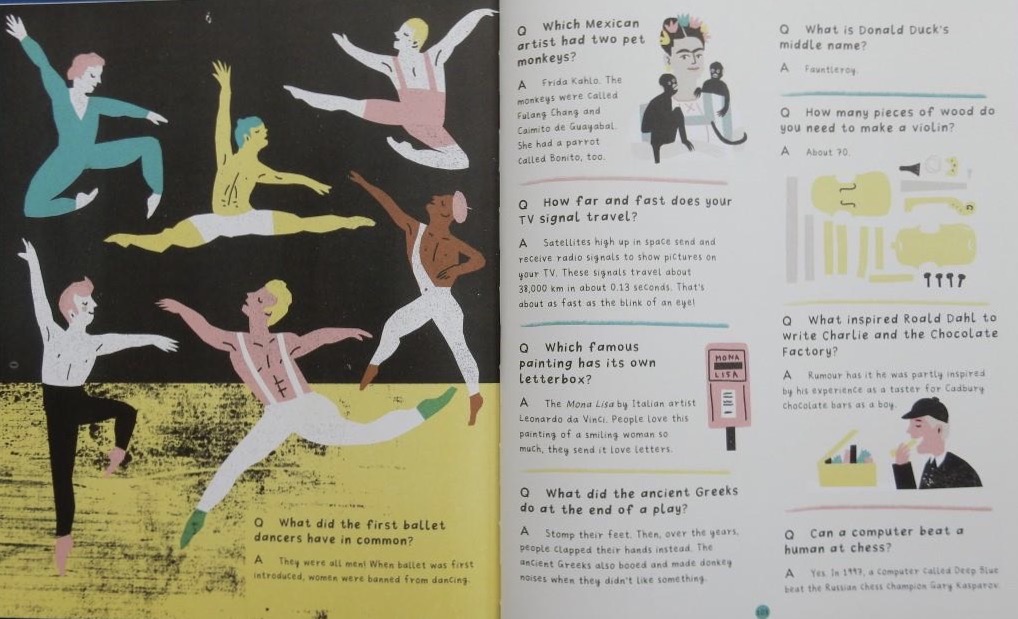
The Encyclopaedia of Unbelievable Facts

The Encyclopaedia of Unbelievable Facts
Jane Wilsher and Louise Lockhart
Frances Lincoln Children’s Books

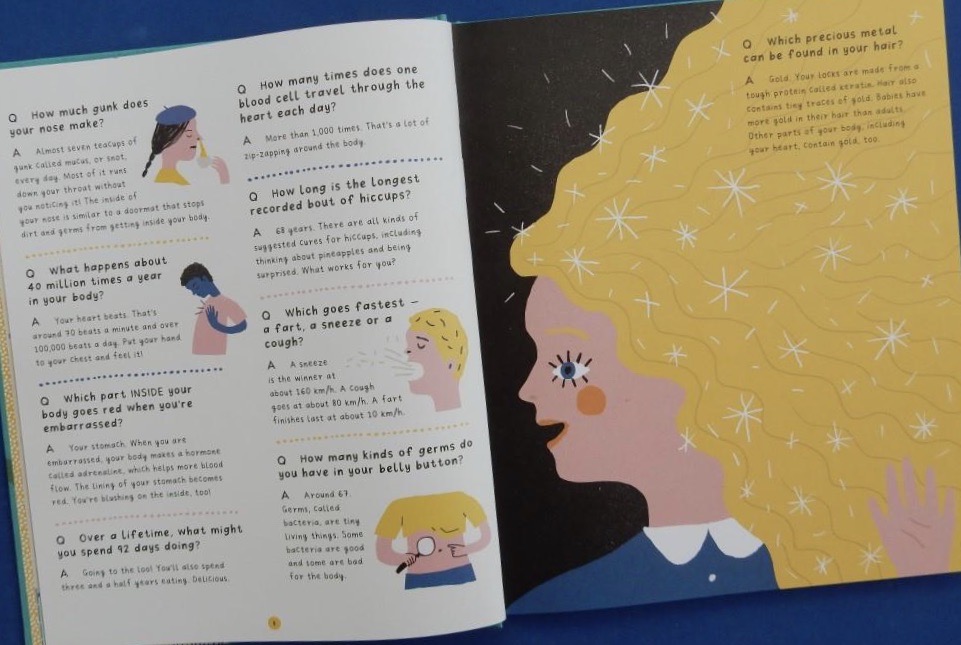
Many of us turn red in the face when feeling embarrassed but have you ever wondered about your insides? Embarrassment causes adrenaline to be produced and this helps increase blood flow, one consequence of which is that the stomach lining becomes red, so we blush both internally and externally.

Equally amazing is that our hair contains minute traces of gold, with babies having more than adults. Both are covered in the Human Body the opening part of this unusual encyclopaedia of trivia.

In case you’ve ever wondered what astronauts do with their dirty laundry, what happens to their wee, or what happens when an astronaut wants to scratch an itchy nose while wearing a space helmet, you’ll discover the answers along with those to over 45 more questions in the Space section of this book.

It’s not only STEM topics that are included herein though. There are sections entitled Customs & Culture, Our World and finally Arts & Entertainment. If you want to know Donald Duck’s middle name, you’ll find the answer there.

For each theme Louise Lockhart provides a wealth of offbeat, stylish illustrations, mostly small but some whole page ones too.

No matter whether you want to ask questions in a quiz with your friends or family, or just fancy dipping in to discover some new factual bits and pieces, then here’s a book for you; this reviewer certainly learned a fair bit.

Charlie Chooses / The Truth About Babies

Charlie Chooses
Lou Peacock and Nicola Slater
Nosy Crow

Charlie is an anxious, indecisive little boy unable to make decisions about such small things as light on or light off at bedtime, and what ice-cream to have, wearing spotty pants or stripy ones, which would often result in going without.

So when it comes to choosing what he wants for his birthday, he really is faced with a problem. Lou presents these difficulties uncritically even this biggie, merely allowing Nicola’s illustrations to do much of the talking to young audiences.

We see a downcast Charlie emerging from the library having consulted the ‘perfect present’ book, then suddenly and unexpectedly being offered that hitherto illusive idea – a rescue dog.

Off he goes but uh-oh! At the rescue centre he’s faced with yet another choice and a very difficult one

so Charlie leaves the centre sans pooch but then …

One determined little canine supplies the perfect ending to this story and Charlie ends up with just the right companion to help soothe those choosing-worries henceforward. But what about a name? Maybe …

Most certainly this delightful book is one I would choose to share with little ones, be that one-to-one or as a class.

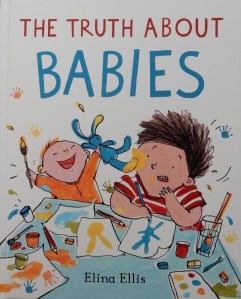
The Truth About Babies
Elina Ellis
Two Hoots

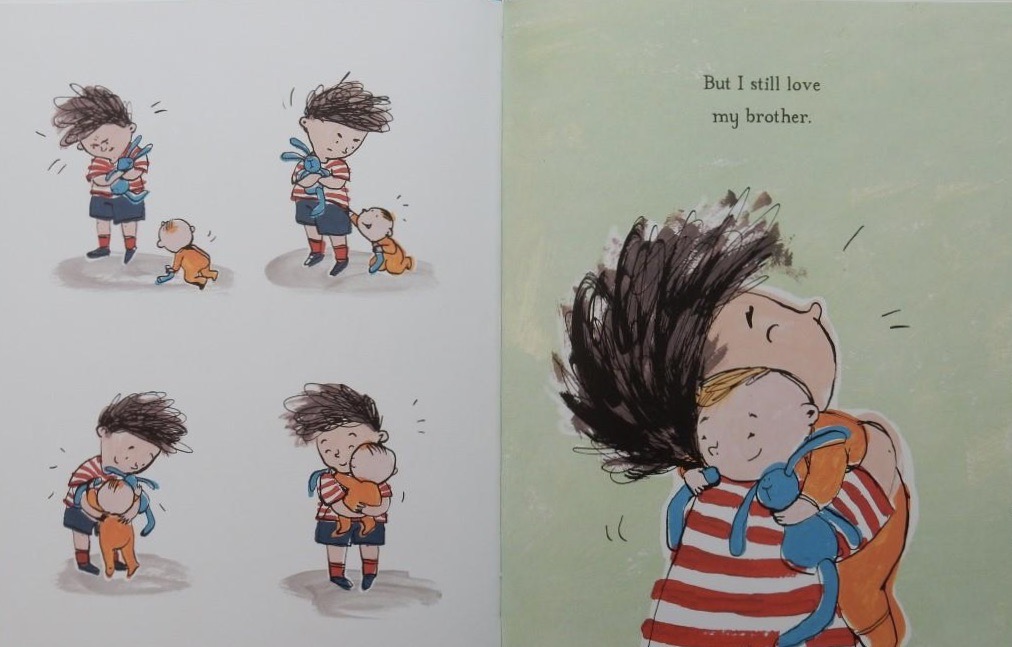
A small child narrator talks of the arrival of a new baby as his parents extol the virtues of babies in general.

These tiny beings are supposedly beautiful, fond of sleeping, they’re joyful little bundles, sweet smelling

gentle and delicate – perfect angels no less. Or are they?

Now comes the big reveal from our older sibling who nonetheless considers one particular newcomer to the family monstrously, irresistibly lovable …

There’s a touch of Tim Archbold about Elina Ellis’ comical illustrations of a family with a new baby and what that really means rather than what her text says.

Great fun to share and discuss whether or not listeners have experienced (or are about to) a new addition the family.

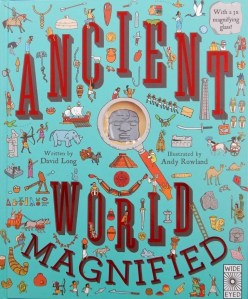
Ancient World Magnified

Ancient World Magnified
David Long and Andy Rowland
Wide Eyed Editions

New in the interactive ‘Magnified’ series, this is one of those books where you think, ‘I’ll just spend a few minutes reading this’ and hours later you’re still totally immersed, using the magnifying glass provided inside the front cover.

Starting with Mesopotamia in what is today parts of Iraq, Iran, Syria and Turkey, author, David Long and illustrator Andy Rowland take readers time travelling to visit sixteen ancient civilisations, providing a taster of what life was probably like in each one. I was pleasantly surprised to learn that here where civilisation is thought to have begun, men and woman were mostly treated as equals.

From there we move to (c. 4000-1500 BC), a large area now in India and Pakistan, the Indus Valley Civilisation, in which I have a particular interest having once visited not Harappa or Mohenjo-daro featured here, but another more southern site, Lothal.

I have to admit though I’d never heard of Olmec, central America’s first civilisation in what is Mexico today, nor the Kingdom of Aksum (120BC – 850 AD), one of Africa’s greatest empires much of which is in modern Ethiopia and we learn, among the first of the great civilisations to convert to Christianity. 

Also new to me is the Xiongnu Empire in what took up large parts of today’s northern China, Siberia and Mongolia, formed when several tribes of nomadic peoples came together under a ruler named Modu, controlling an area almost as big as Europe. 

Each of these fascinating civilisations is allocated a double spread most of which is taken up with a riveting, highly detailed illustration by Andy Rowland. There are also two or three paragraphs giving information about location, daily life, buildings, what made it prosper etc. and there are ’10 things to spot’ on every spread. Not easy in several cases but should you wish to look, the answers are supplied at the back of the book, along with a famous figures gallery, almost 60 more things to find in the busy scenes, a timeline and glossary.

Recommended especially for young history enthusiasts, as well as those who love search-and-find books.

Many Shapes of Clay

Many Shapes of Clay
Kenesha Sneed
Prestel

Kenesha Sneed the author and illustrator of this beautiful book is an award-winning multidisciplinary artist and creative director of Tactile Matter. Now she has created this story wherein we share in the work and daily lives of a girl named Eisha and her ceramic artist mother who works in a basement studio. Eisha too uses clay but unlike her mother, she doesn’t put her creations on a shelf and one day she forms a shape that makes her feel happy, reminding her of her Papa whom she has lost fairly recently.

As the heat of the day increases, Eisha’s Mama suggests some fresh air and they go out to do some errands. While her mother shops, Eisha sits playing with her yellow shape; now it reminds her of the ocean. Gradually though it hardens in the heat and eventually cracks, shattering into small pieces:

‘ Each piece reflects the sadness she feels.’

When her Mama sees the pieces and hears what her daughter has to say she knows instinctively of a way to help, and together they create something new and different.

With a focus on the process of healing through creativity, Kenesha Sneed’s powerful, poignant story shows a girl learning to live with her loss while at the same time using her inventiveness to fashion something new from what remains.

By using a straightforward text, Kenesha allows her striking images to convey much of the emotion and her story’s powerful message that within us all is the power to heal.

Not only will this book resonate with those who have lost someone dear to them, it also offers all youngsters an opening to talk about their feelings of loss in relation to the pandemic and what it has taken from them during the last twelve months or so, be that contact with friends, family, classmates, even normal life in general. It’s definitely one I’d advocate adding to primary class collections and family bookshelves.

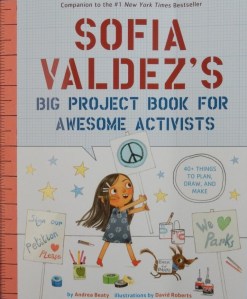
Sophia Valdez’s Big Project Book for Awesome Activists

Sophia Valdez’s Big Project Book for Awesome Activists
Andrea Beaty, illustrated by David Roberts
Abrams Books for Young Readers

As the author says on the title page, ‘It’s a big world with lots of problems to solve. Just remember: No one can do everything. Everyone can do something.’ That’s very much the spirit of this project book from Sophia Valdez, the newest member of The Questioneers.

It begins with an introductory story about Sophia and how she was the inspiring spark behind the creation of a new park for the people of Blue River Creek.

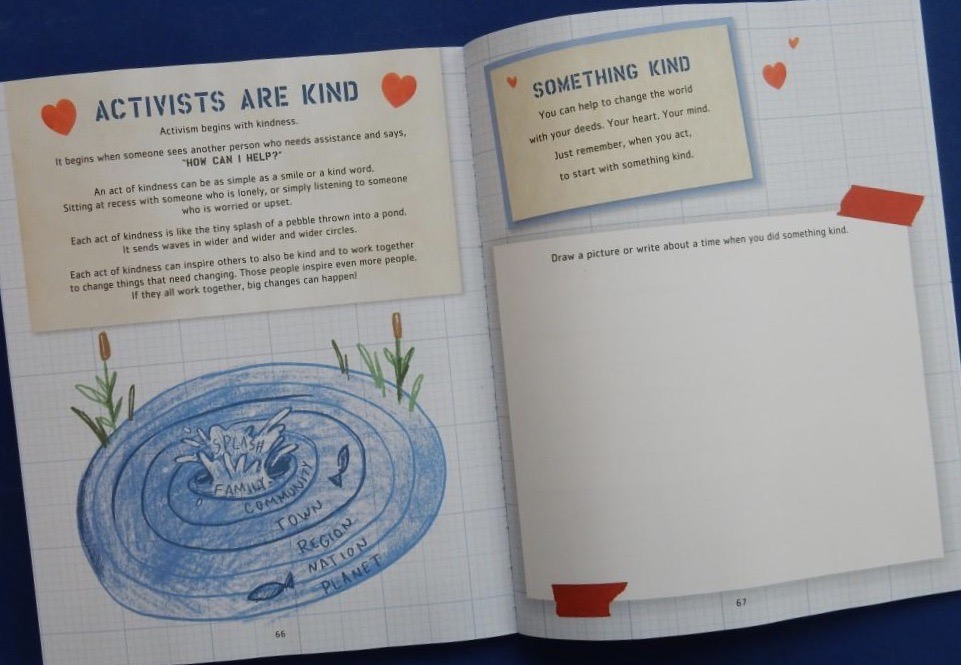
Thereafter are a series of over forty activities, some related to that, all aimed to inspire even quite young children, suggesting how they can make a difference in their own communities through supporting causes close to their hearts, writing to local officials, and finding out how democracy and government are supposed to work.

There are puzzles, word searches, drawing and a wealth of other ideas connected to activism, some related to an imagined new town on planet Glorg, others to real world problems.

‘Activism begins with kindness’. I like that: it’s the introduction to one of the activities herein.

Indeed all the attributes that an activist needs are elucidated in this empowering, highly practical look at campaigning and activism.

Whether their cause is education for all, plastic pollution, affordable homes in your locality, or something else, this book could be a starting point for one of tomorrow’s leaders.

Crown: An Ode to the Fresh Cut

Crown: An Ode to the Fresh Cut
Derrick Barnes and Gordon C. Jones
Walker Books

The barber’s shop is where transformation happens. Through tonsorial magic, boys who enter as ‘lumps of clay’ or ‘marble slabs’, are transformed. First comes a protective cape that makes you feel ‘like royalty’ allowing the wearer to contemplate the possibility of having a super-powered brain;

then with a dab of shaving cream on the forehead, a slow steady cut with the razor you become much more visible: girls take notice of your style; even your mother’s looks assures you that you’re ‘someone that matters’. And assuredly you are; as are the shop’s other clients – important and uber-stylish every one.

This is a super celebration of that boost in self esteem, that confidence amplification, that uber-cool swagger that comes upon you as you leave the safety of the barber’s shop and step forth in the knowledge that with that fresh cut you look a million dollars …

The combination of Derrick Barnes rhythmic prose and Gordon C. James’ mesmerising portraits of the splendid cast of characters is a book that needs to be in every classroom. It truly is a stunning demonstration and timely affirmation that there’s no doubt about it: ‘Black Lives Matter’.

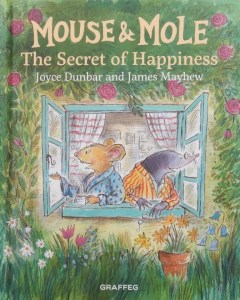
Mouse & Mole: The Secret of Happiness

Mouse and Mole: The Secret of Happiness
Joyce Dunbar and James Mayhew
Graffeg

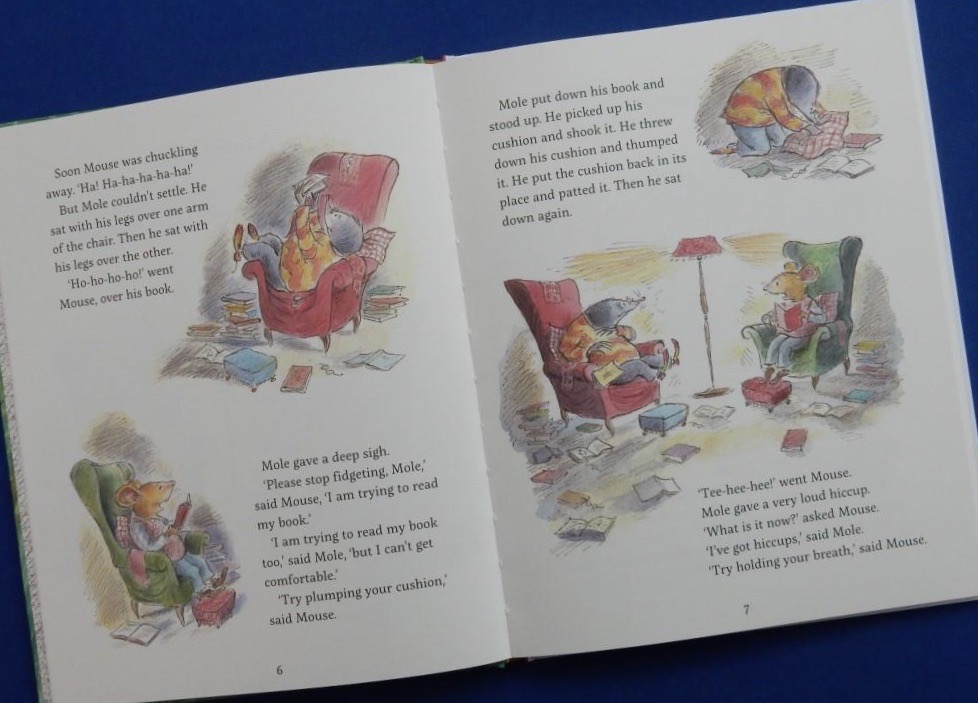
What better to start the latest in this charming series of stories about the friendship between two endearing woodland animals than with A Good Read. There’s a slight problem though, for Mouse’s constant giggles and Mole’s failure to get himself comfortable, not to mention having an attack of hiccups

followed by an itch is, let’s say, not conducive to getting lost in a book. Can the two find a solution and finally give their reading matter their undivided attention?

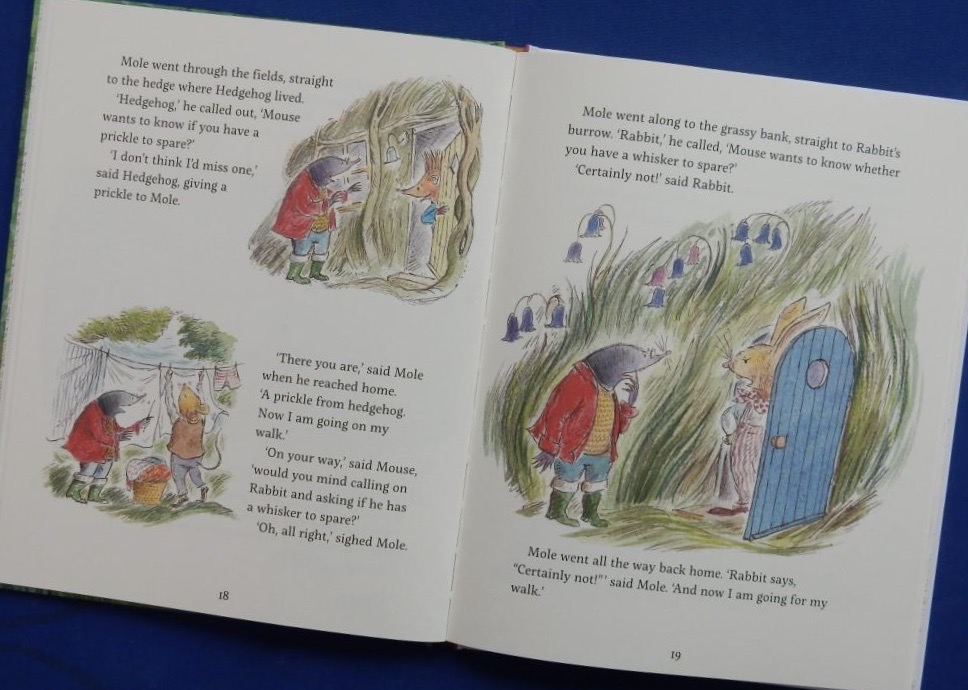
This Way and That sees Mole donning his walking boots and setting out for a walk. But what is intended as a happy-go-lucky stroll in the spring air turns into an exceedingly irritating series of errands for Mouse that send him hither and thither

until eventually, Mole has his very own point to make as he sallies forth YET AGAIN!

In the third and final tale, Mole tries desperately to remember the contents of his previous night’s dream wherein he knew The Secret of Happiness. This elusive thing that sort of ‘bubbled up, … sort of billowed, … sort of bloomed from somewhere deep inside me’ has Mole searching around all day until his friends arrive for tea. Can they perhaps assist him in finding the answer to the puzzle? …

As always, the gentle humour in Joyce Dunbar’s thought-provoking story telling is given a delightfully nostalgic feel thanks to James Mayhew’s charmingly elegant illustrations. Whether as bedtime reading for little ones or read solo by older children, these are small literary gems.

The Dinosaur Awards

The Dinosaur Awards
Barbara Taylor, illustrated by Stephen Collins
Frances Lincoln Children’s Books

Here’s a novel way of presenting dinosaurs to youngsters, not that a good many of them wouldn’t devour almost any dino. related book they can get their hands on, such is the seemingly never ending enthusiasm for these prehistoric creatures.

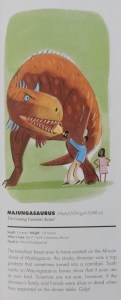
This one uses a combination of quirky, almost cartoonish digitally created illustrations and a wealth of intriguing facts about lots of different dino. species, some well known, others less so. I met a few for the first time herein, one being Majungasaurus that receives the ‘Cunning Cannibal Award and lived on Madagascar during the Cretaceous Period between 84 and 71 million years ago – assuredly a VERY scary predator.

Almost all the winners, be they famous or lesser known, are allocated three or four paragraphs, a captioned framed portrait of the award receiver along with its trophy or medal and one or more larger illustrations. There’s also a databank with name pronunciation and meaning, where it came from, diet, and size, plus in some instances a short humorous cartoon strip, in others some additional trivia.

So, if you’ve ever wondered what might make Ouranosaurus so special, not only did it have a ‘Super Sail’ along its back and tail, but also a duck-like beak and two bony bumps in front of its eyes.

Whereas Troodon’s claim to fame was its enormous eyes (about 5cm across), so it received the “What Big Eyes You Have’ award.

There’s even a ‘King of Rock ’N’ Roll medal and that goes to Cryolophosaurus (aka Elvisaurus’ on account of its funky head crest thought to resemble that 1950s quiff of the rock legend).

With plenty here to amuse and inform, this works either as a dip in and out book, or a longish read straight through, in which case you’ll encounter around fifty incredible prehistoric creatures from our planet’s past – worthy winners all.

A Sliver of Moon and A Shard of Truth / Skeleton Keys: The Night of the Nobody

A Sliver of Moon and A Shard of Truth
Chitra Soundar, illustrated by Uma Krishnaswamy
Walker Books

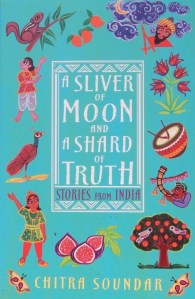
Four linked short stories with an Indian setting feature Prince Veera and his best friend Suku. The two are invited by Raja Apoorva to spend the summer at Peetalpur where in addition to attending the festival they might have some challenges to meet and problems to solve, particularly as their uncle enjoys puzzles. Who pulled the king’s beard and moustache as he was taking his morning stroll, for instance.

There’s a trip to the seaside, a dispute over the ownership of a fig tree, a mystery of a blind sadhu – or is he? – to get to the bottom of, and finally, the strange case of the travelling astronomer and a gardener who needs some help. All that in just two weeks …

Just right for newly independent readers, these tales with themes of problem solving and fairness, combine Indian culture, folklore and storytelling, and are seasoned throughout with traditional style illustrations that break up the narrative.

Skeleton Keys: The Night of the Nobody
Guy Bass, illustrated by Pete Williamson
Little Tiger

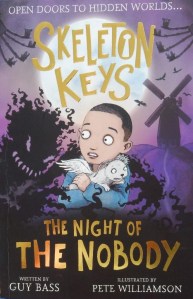
The comic Skeleton Keys adventure series has reached its fourth tall telling and sees wildly imaginative young Flynn Twist and his baby sister Nellie living with Gran in the village of Matching Trousers. As the story opens Flynn is expressing concern about a little boy he’s just seen standing opposite, looking decidedly ’unwell’.

Over dinner Flynn admits to telling his sister a pre-bedtime tale called ‘Sir Flynnian versus the Horrible Darkness’, intending to send her off to sleep but instead she’s making a to-do upstairs. When he goes to investigate he’s faced with a shadowy shape that whispers “No-body”. But that is just the start of freakish happenings.

Soon there’s a knock at the door and who should it be but Skeleton Keys. Flynn is surprised to find that he and Gran have met before. Suddenly a strange girl appears, whom Skeleton Keys introduces as Daisy, his ‘partner-in-problem solving’. When Flynn tells them of his terrifying encounter with ‘The Nobody’, Skeleton Keys thinks it could well be a shapeless Unimaginary searching for physical form, but Gran quickly sends him packing.

Next morning Gran sends Flynn to deliver a letter to Old Mr Nash at The Windmill and as he sets out Flynn notices the boy over the road entering Gran’s house. Why would that be? And what has happened to Mr Nash?
Could there be a connection between the Horrible Darkness in the story Flynn told Nellie and the Nobody? Can Flynn possibly become that brave hero of his imagination, save Skeleton Keys and free the village from the dire danger of the Nobody? Maybe, with the help of Fur …

Crumcrinkles! The whole thing just goes to show the power of a wild imagination, no matter if it belongs to a tiny infant.

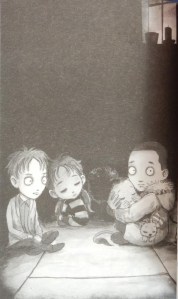
Oh my goodness – what a fun mix of terrific characters, wit and frissons of fear, as well as a large number of farts – freakish and otherwise – indeed there’s a throng of flatulent figures – an entire village population of 343 zombie-like nobodies, to be more precise, not forgetting Pete Williamson’s atmospheric black and white illustrations.

The Best Worst Day Ever

The Best Worst Day Ever
Sophy Henn
Simon & Schuster Children’s Books

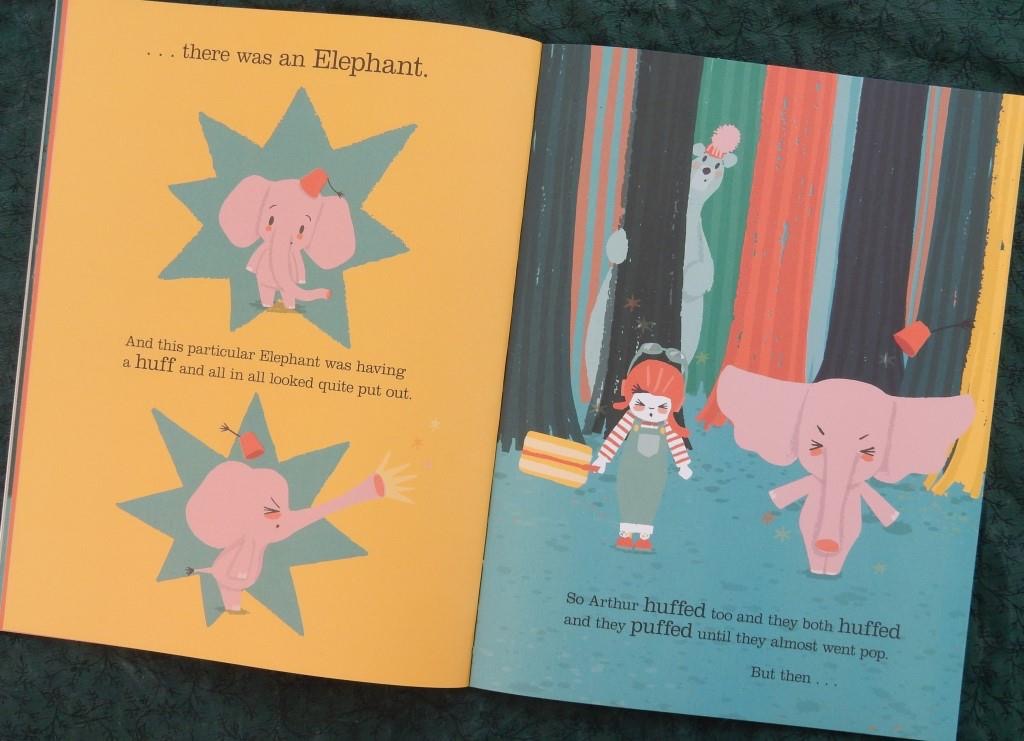
Poor Arthur: it seems as though he can’t do a single thing right – this truly IS a really bad day. So bad that the young lad decides the only option is to run away. And so he does, albeit with a few things packed neatly in a bag.

Having been running for what feels like ages, he runs out of steam, lies flat on his back and ponders on his situation, wondering if he should return home. However when he turns around, he’s confronted by a deep, dark forest. 

Considering the options he decides to go right through it, though he’s filled with apprehension on account of the dark and the strange noises he hears.

There follow encounters with first a stomping Bear, then a huffing Elephant … 

and finally a roaring Lion. 

Seemingly these animals know just what Arthur needs and eventually after a great deal of skipping, wiggling, tooting and hooting and finally, singing as they all continue through the forest, where do they find themselves but … 

Should Arthur cross the threshold and face the music for running away after sharing in what’s turned out to be the best worst day ever? Suppose big trouble awaits.

No matter what, it all goes to show just how much can happen in twenty minutes …

What anger, what energy, what drama, what exuberance, what delight is expressed by the characters, human and animal, in this romping, stomping story. Hugely enjoyable for both listeners and adult readers aloud who will, I suspect, find the opportunities to emulate Arthur and the animals irresistible. Sophy’s art is simply fabulous with every spread a visual treat – so full of emotion – and I love the colour palette; it’s quite perfect for this book.

Definitely one to share with preschool and foundation stage youngsters at home or school.

Pip & Egg

Pip & Egg
Alex Latimer and David Litchfield
Scholastic

This week for the first time in many months I’ve been able to spend time with some of my very close friends and I know just how important strong bonds of friendship are. This poignant story is a demonstration of what true friendship really means.

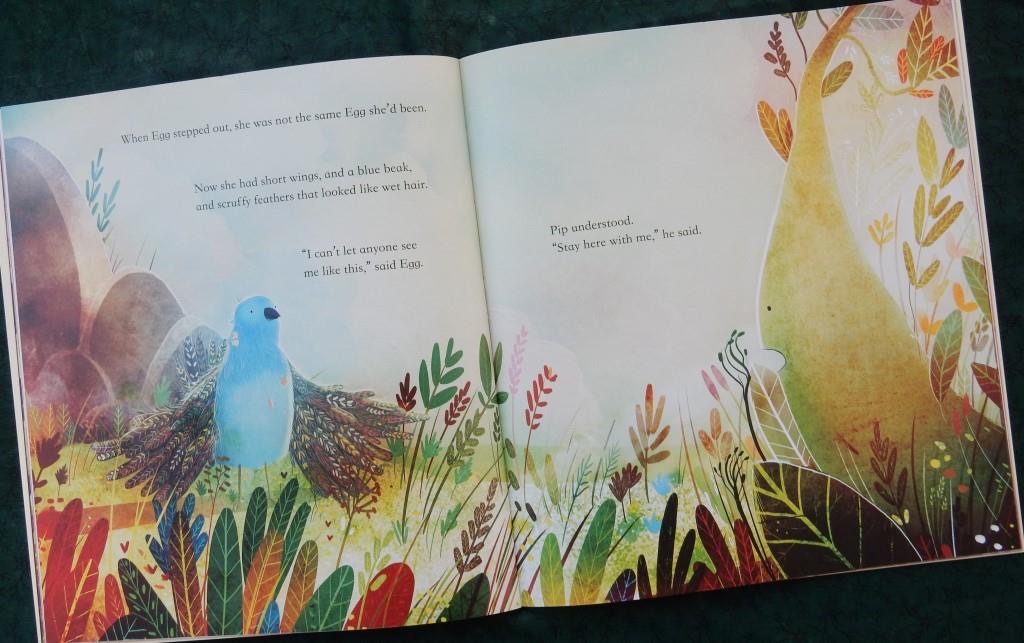
When Pip and Egg meet, there’s an instant attraction on account of the similarity in their shape and size. Their friendship grows but so too do they: Pip grows roots that hold him in one place, which means that for the friendship to continue, change is necessary: Egg makes daily visits to see sapling Pip. Over the weeks though Egg is transformed with a beak, feathers and wings –

wings that grow so strong she eventually takes to the air.

With Pip’s blessing, Egg decides that it’s time to explore the big wide world. Off she flies leaving a broken hearted Pip rooted to his spot, where he’ll always remain should she ever return.

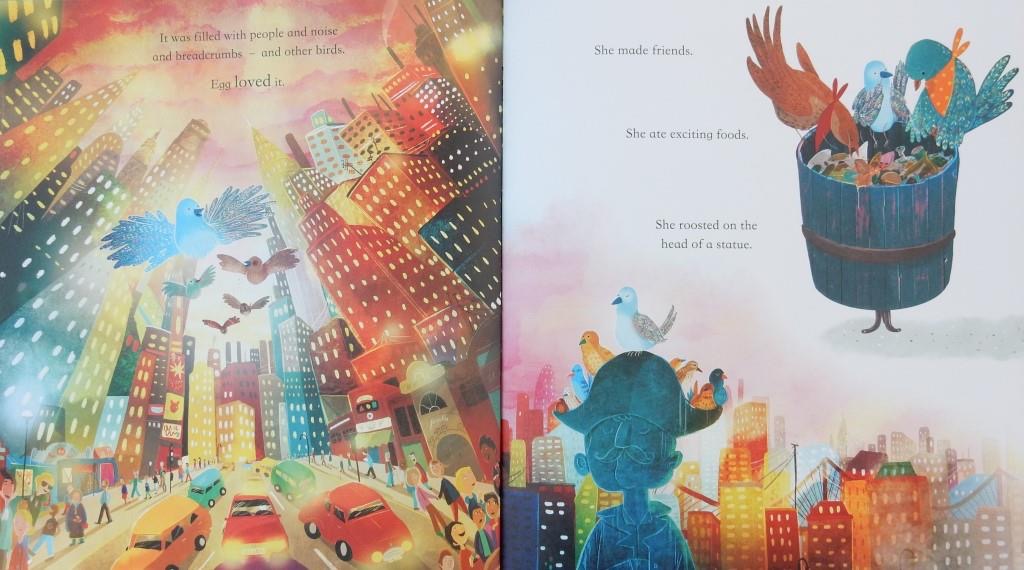
From the air Egg is amazed at the sights – the forests, lakes, mountains and most of all the city where she stops, forming new attachments.

Eventually though, she knows it’s time to return to the valley from whence she came …

Like everything he does, David Litchfield’s illustrations for this story are stunningly beautiful: rich in fine detail and texture, and the way he uses light and shade creating atmosphere and focus on Egg in the city especially, is truly magical.

The Boys

The Boys
Lauren Ace and Jenny Lovlie
Little Tiger

From the same team as The Girls, is this, a companion book that presents the story of an enduring friendship between Tam, Rey, Nattie and Bobby who we first meet as toddlers playing together and alongside one another on the beach. Their interests differ: Tam expresses himself through art, Rey makes music, Nattie is bookish and a storyteller while Bobby likes to find out how things work and share his discoveries with the other three. In short they make a great team.

Inevitably though things change as the boys grow and develop: their interests take them in different directions and there’s even an element of competitiveness between two of them. Now it’s individuality that matters most;

but as adults having gone through successes and some of life’s milestones, that need for one another reemerges: those early bonds have been stretched but have always remained strong and become even stronger than ever.

In her narrative Lauren presents friendship from infancy to adulthood as dynamic and respective of individuality while Jenny Lovlie’s illustrations are absolutely splendid – inclusive and full of warmth.
I’d strongly recommend sharing and discussing this in primary and early years classes as well as among family members and between friends.

The Plesiosaur’s Neck

The Plesiosaur’s Neck
Dr Adam S.Smith & Jonathan Emmett, illustrated by Adam Larkum
uclan publishing

I certainly wasn’t expecting a rhyming text when I received this book but wow! It really works and is a terrific read aloud.

Plesiosaur expert Dr Adam S.Smith teamed up with children’s author Jonathan Emmett to create a cracking narrative to investigate the evolutionary conundrum of the long neck of Albertonectes using Poppy the plesiosaur as their main character. Poppy, so we learn, was an ocean dwelling Albertonectes plesiosaur – a prehistoric reptile from the Cretaceous Period living around the same time as the land living dinosaurs. Said creature was around 12 metres long and had many features similar to those of other sea creatures, but that stupendous neck (apparently around two-thirds of its whole body length) – what ever could have been the purpose of that?

Various possibilities are posited: maybe it was a pterosaur grabber …

or, could it have been a parasite picker-offer.? Perhaps it was a tunnelling tool to procure crunchy-shelled nibbles,

or contained an electric zapping mechanism to stun unsuspecting prey swimming too close. Poppy would most definitely have required a huge amount to food to keep her going.

This prehistoric poser is still being puzzled over and I love that the authors end by asking young budding palaeontologist readers, ‘So, what do YOU think that immense neck was for?’

Along with the playful, punning rhyming narrative is a series of fact boxes containing a wealth of additional information and in a rather wacky role are a pair of molluscs, Alfie Ammonite and Bella Belemnite, that chip in with jokes, and cheeky comments and puns relating mainly to Poppy.

The final spread is devoted to a glossary and a spotter’s guide to the Cretaceous Period with fifteen creatures to send readers back to the beginning of the book on a search-and-find quest. Adam Larkum’s illustrations are full of fun, adding to the entertainment of what is a smashing exploration.

Is There Life on Your Nose?

Is There Life on Your Nose?
Christian Borstlap
Prestel

Dutch illustrator/designer Christian Borstlap presents a playful look at some of the vast number of microbes that occur everywhere you can imagine and places you probably can’t.

Despite his light-hearted style, there’s a lot of information contained between the covers of this book as readers are introduced to a host of these invisible organisms, starting with those living on our noses. Amazingly like all of us humans, these microorganisms are sensitive, able to move, eat and release things from within.

Contrast a single microbe with the largest living thing on our planet: I was surprised to discover that it’s a ginormous fungus that has grown to a size of 3.8 square miles and lives under the Blue Mountains in the USA. The author provides additional details about this and each of the other largely illustrative spreads presented in a ‘Find out more’ section at the end of the book.

The rate at which microbes reproduce is phenomenal as is the tolerance to extremes shown by some – those living in boiling water for instance, or barren deserts. And, did you know that some of these organisms even feed on metal,

and others on oil – both of which can be a good thing.

None of us would be able to digest our food without the action of the microbes living in various parts of our digestive system. So these are definitely vital to our well-being.

During the past year we’ve all become hyper-aware of the harmful kind of microbes, viruses, in particular COVID 19 (mentioned in the final notes) but only alluded to on the relevant spread.
With the ever growing problem of plastic waste, it’s great to read of the possibility of microbes offering an organic solution to this huge issue. Others are even able to generate clean energy through gas production.

Now you might think you’re pretty good when it comes to recycling but we learn here that microbes are actually the very best of all recyclers …

All in all, none of us would be here at all without microbes: those known as cyanobacteria produce almost 50 per cent of the oxygen we breathe.

This fascinating account has truly whetted my appetite and I can’t wait to visit Amsterdam (one of my very favourite places) again: this time I will definitely head for Microbia – the world’s only microbe museum – mentioned at the back of the book.

Thunder Down Under

Thunder Down Under
Timothy Knapman and Steve James
Little Tiger

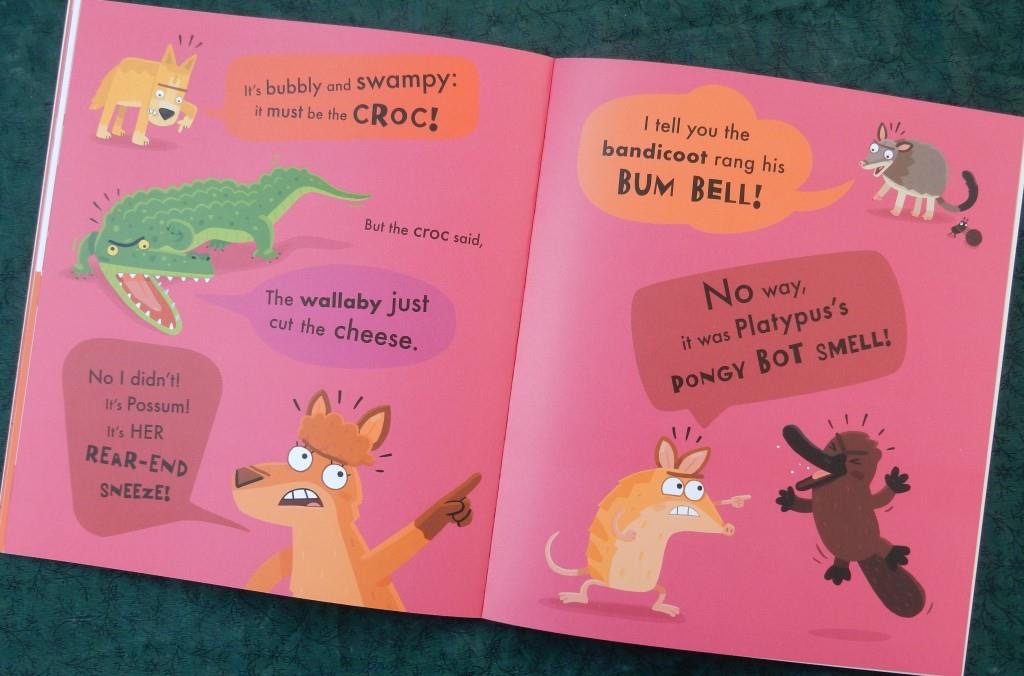
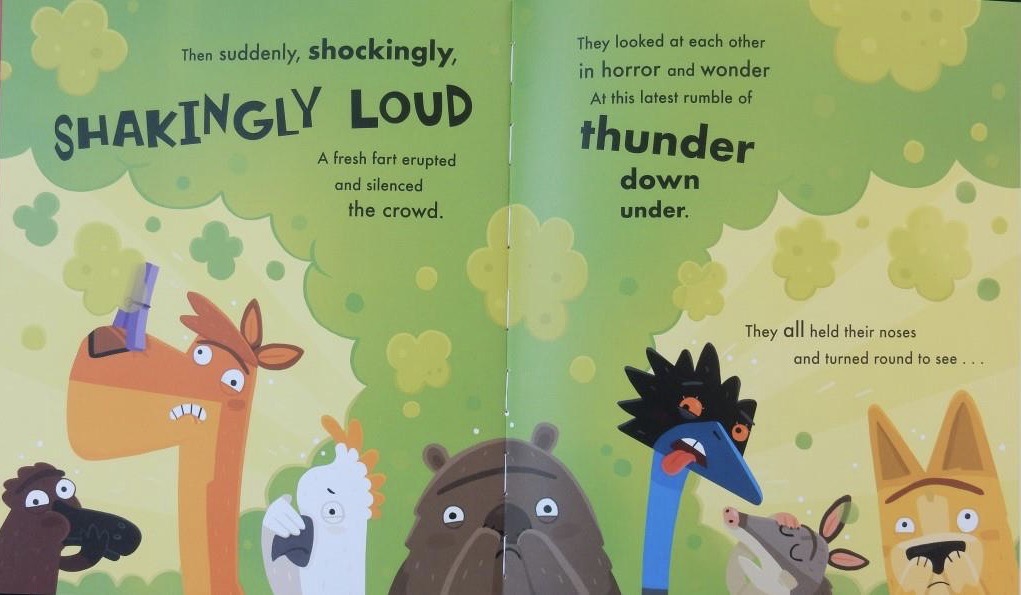
This is a terrific laugh-out-loud story about a rear end explosion that will be a sure fire winner with youngsters. It had my partner in fits of giggles too; and neither of us were certain whether the diminutive numbat, star of the show, is actually a real animal or not until we looked it up.

The sweet smell of the air heralding the arrival of summer brings the animals outdoors for some boisterous play. So intent on their games are they that they fail to notice one small Numbat looking for food. Then, quite suddenly into that sweet scented atmosphere there erupts an exceedingly obnoxious fart that turns the air green and causes consternation among the animals as to who is responsible.

Eager to make his presence felt, the numbat says, “Ask me!” but nobody listens and the discussions continue with various suggestions being put forward as to the culprit each of which is immediately denied by the accused.

And every so often comes that “Ask me,!” from a certain tiny creature, which of course goes unheeded: only an important, large animal could have created such a stink.

All of a sudden there comes a second ear-shattering flatulus

followed by the moment of revelation … The message is clear, so too is the moral …

Steve James’ wonderfully wacky, expressive scenes of creature consternation combined with Timothy Knapman’s hilarious rhyming text result in a picture book that can’t fail to delight. I suspect an initial read will lead to cries of “again” whether you share it with an individual, group or class. It’s certainly been my experience.

A Celebration of Board Books

Here’s a handful of recent Little Tiger Board Books – thanks to the publishers for sending them for review

First Nature: Ladybird
Harriet Evans and Bryony Clarkson

Following on from Caterpillar in this ‘first nature’ flap-book series is the equally playful Ladybird. Very young children will love Bryony Clarkson’s bright alluring, textured art and Harriet’s brief, sometimes alliterative rhyming text as Ladybird scuttles and scurries, hastens and hurries across the cleverly cut-away pages, slowing to feed, feel fear, fall and fly to the nest, finally ready to hibernate.

Elephant Elephant What Can You See?
Pintachan

Accompanied by a questioning chirpy bird friend, Elephant takes a wander in this lift-the-flap book, and the two play a kind of hide-and-seek game with the animals that are tucked away in turn, beneath the lily pad, in the tall grass, under water and behind a tree. Then, on the final spread, when the final flap is lifted, there’s a surprise mirror so tinies will come face to face with their own image.
With Pintachan’s simple, bright images and the repeat patterned rhyming narrative, this is likely to be a winner with little ones.

Beep Beep! Builders
Becky Davies and Gareth Lucas

Be ready for a noisy time when you share this with your little one. Set on a building site, we meet the boss Little B and his five co-workers. There’s Digger, Mixer, Crane, all of which are somewhat over-enthusiastic, as well as a roller and a tip-up truck. Having dug, mixed, built and lifted all day long, come sundown the boss praises their teamwork and suggests it’s time for play.
Tinies will love pressing the squishy bodies of the jolly diggers as they follow their actions and join in the rumbling, tooting, whirring and other sounds.

For a slightly older audience is

Your Body
Harriet Evans and Lirios Bou

Another of the cleverly designed ‘switch-a-picture’ books with Harriet’s rhyming presentation of in turn, the skeleton, breathing, eating, thinking and the circulatory system accompanied by Lirios Bou’s subtly coloured images of children’s bodies, first clad and then, when the central tab on each page edge is pulled, the related internal working are revealed along with additional relevant information.

A to Z: An Alphabet of Animals
illustrated by Linda Tordoff

Published under the Caterpillar Books imprint this lift-the-flap board book presents animals large and small; but where are they? They’re all hiding, just waiting to be discovered by eager fingers opening their respective initial letter flaps. Little ones can meet creatures feathered, furry, scaly and smooth all stylishly illustrated in subtle colours.

Pie for Breakfast

Pie for Breakfast
Cynthia Cliff
Prestel

This is an attractively illustrated cook book in which the author/illustrator uses the framing device of a little girl who decides to organise a bake sale at her school fair to raise funds for the school library – a cause young Hazel loves as much as she loves baking.

Having enlisted the help of her friends, each of whom is given a double spread, we see various families engaging in creating delicious sounding treats to sell. There are thirteen in all and each recipe is presented on the recto with a full page illustration of the baker(s) on the verso.

It’s great to see that both the characters and the recipes are diverse, so whether you feel tempted by the thought of Anna’s ‘zucchini oatmeal cookies with chocolate chips,

Erin’s ‘easy jam tarts’,

Aubrey and Avery’s ‘mini pineapple trifles’, Zahira and her grandfather’s ‘nankhatai cookies’,

Layla’s ‘basbousa cake’ or perhaps Jamie’s ‘gluten-free carrot cake’, you’ll find it here.

The last spread shows the cake sale in full swing with Hazel and her friends in attendance while the final page has a list of ‘before you begin baking’ instructions.

With my weakness for chocolate, I think I’ll start with Daniel and his family’s vegan chocolate cake.

Being Me

Being Me
Liz Brownlee, Matt Goodfellow and Laura Mucha, illustrated by Victoria Jane Wheeler
Otter-Barry Books

I’ve tended to use picture books to open up discussions about feelings in the classroom, especially with younger children but now this, subtitled “Poems about Thoughts, Worries and Feelings’ is a superb anthology of poems by three accomplished contemporary poets that would definitely work equally well with children from KS1 up.

Speaking directly to youngsters are almost fifty poems focussing on the topics that they care deeply about and unless they have opportunities to talk about how they feel about say, loss or sadness, feelings of isolation can be the result.

One way to counteract such feelings is to take a walk in nature as Matt suggests in Forest Song: ‘there is music in the forest / every leaf a different note / as the wind -conducted branches / play the tune the raindrops wrote // so, walk beneath the canopy / and know that you belong / to the purest ancient melody / as forest sings its song’. I’m sure those words will resonate with all of us after everything that’s happened during the past year when so many of us have found comfort in the natural world.

Another of Matt’s poems talks about those awful butterflies that are the result of first day nerves and how one understanding teacher, Mr Mawhinney made all the difference.


Books are one of my first go to comfort places and Liz’s In the Heart of a Book speaks to the power of story; Here’s part of it : ‘ I found myself a story / with a place in me to store it // I found myself a wide, new world / so set off to explore it //… I found a pool of sadness / and the strength to manage it // … I found place to rest my head // while my worries unplug / I found a curl of comfort / where each word was a hug // … I found a pair of magic wings / and flew into the light

Feeling alone in your sadness? What better place to visit than Laura’s The Land of the Blue to know that feeling sad is OK. The final verse says this: ‘Across the valley it waits for you,/ a place they call The Land of Blue / and going there will help you know / how others feel when they are low.

Sometimes there’s nothing better than the kindness of a Friend as Laura shows here:

Discovering your own kindness within and sharing it with others is equally powerful as the final words in Liz’s Kindness acknowledges ‘and where you give it grows and grows / until one day it overflows

Finally (although I could go on talking about every poem in this book) in Bottled Up Laura highlights how crucial it is to be able to open up about whatever it is that’s troubling you …

Very much in tune with the feelings the three poets have written of are the quirky black and white illustrations by new illustrator Victoria Jane Wheeler; and the book concludes with a note from developmental psychologist Dr Karen Goodall that includes some suggestions as to how an adult might open up a discussion.

A special book that I strongly recommend for both school and home collections.

Itty-Bitty Kitty Corn / The Three Happy Lions

Itty-Bitty Kitty Corn
Shannon Hale and Leuyen Pham
Abrams Books for Young Readers

Mere kitty cat, or is she a unicorn?

Kitty has an overwhelming desire to be a unicorn like the one on her poster. So much so that she fashions a paper horn for her head and what she sees in the mirror reflects her unicorn-ness – there’s no disputing that. Or is there? Certainly there is when it comes to Parakeet and Gecko, a pair of denigrating naysayers if ever.

Nonetheless Kitty continues undaunted until come sundown she’s certain the long shadow has convinced the killjoys. Not so though for this shadow belongs to … a unicorn.

Now Kitty feels totally dejected until this compassionate creature does something that completely changes things

allowing Kitty to see herself as the fabulous creature she truly is – not just a kitty but a Kitty-Corn, majestic, magnificent and quite perfect … just as she is.

From two of the creators of The Princess in Black series this is an enchanting tale of acceptance and true friendship: make sure you read from the front endpapers to the back to get the entire story though.

Also with a theme of finding your true self is

The Three Happy Lions
Louise Fatio and Roger Duvoisin
Scallywag Press

First published over sixty years ago and now reprinted for a new audience is this classic tale that tells what happens after Happy Lions One and Two produce an offspring that they name Francois.

Having pondered upon what their cub might do with his life, fate takes a hand in the form of a rich lady who visits the zoo and expresses a wish to have Francois as a pet. Somewhat reluctantly, his parents agree and so begins a pleasant life of pampering.

But like all lion cubs, Francois keeps on growing until the lady decides he’s become too big and she gives him to her friend Monsieur Tambour, a circus owner. However, the creature fails to become either sufficiently ferocious or a flaming hoop jumper and so back to the zoo he goes.

All the while though, Francois has harboured a yen. Perhaps now is the time to follow his true calling: he certainly has a good role model in his namesake…

With its occasional French phrases and its enchanting illustrations it’s good to see this book back in print again. I loved The Happy Lion as a child but was not familiar with this story of being true to yourself.

Uncle Pete and the Boy Who Couldn’t Sleep

Little Door Books is venturing into early-reader chapter books: this is the first. Thanks to the publisher for sending it for review.

Uncle Pete and the Boy Who Couldn’t Sleep
David C. Flanagan, illustrated by Will Hughes
Little Door Books

It’s almost impossible to imagine – a boy who has never ever slept a single wink in his entire life and that lack of sleep has no adverse consequences on his ability to embrace every day with energy and enthusiasm. Think what it must be like to be the parents of such a child.

It’s no wonder those of young Harry are at their wits end having tried every possible ploy and consulted countless doctors to get the boy to fall asleep – night after night after night for years and years and … Indeed the entire town is exhausted.

Thank goodness then for Uncle Pete who out of the blue arrives knocking at their front door, back from his exploring to replenish his supplies of baked beans and underpants. 

Having heard the family regale the tale of Harry’s insomnia, Uncle Pete offers to help. From among the contents of his rucksack he extricates a map and before you can say ‘yawn’, this eccentric uncle is off to his own home. There he heads for his shed wherein he keeps his now rusty, rickety old biplane.

What should he find has made a home in the pilot’s seat but a tiny mouse named TM. 

In a very short time, the plane has taken off bound for … Uncle Pete isn’t absolutely sure.

Their journey is, shall we say, highly eventful, both in the air and on the ground; but eventually they reach the mountain top and their destination.

I’ll say no more other than this wacky adventure with its wealth of fun details, is fuelled by large quantities of cheese, a plethora of beans, assorted underpants – rather a lot, and strawberry jam sandwiches, not forgetting stardust aplenty.

But is it a case of mission accomplished for Uncle Pete and TM?

The best way to find out is to get hold of a copy of David C. Flanagan’s comical tale with Will Hughes’ suitably quirky drawings and read it yourself. Alternatively you could try tuning in to their live event here https://www.eventbrite.co.uk/e/uncle-pete-and-the-boy-who-couldnt-sleep-book-launch-event-tickets-149531172763 on Friday May 14th

No matter what there are more adventures of Uncle Pete on the way.

I asked a few children their thoughts about never sleeping and here’s a selection of what they said:
I would love to be able to play Lego all through the nights, but the worst thing would be getting caught and told off. Samuel 6
It would be brilliant to be able to read books and my Kindle all night, but the downside would be my parents banning my favourite things for a whole week.” Emmanuelle 8
You could get out of bed in the middle of the night and get sweet snacks without anyone knowing. Also you could play games with your friends outside and never feel tired.” Leo 7
I could go out at night and do lots of different activities., play lots more sport and look at the stars more. But eventually it could get boring if you run out of things you want to do.” Spencer 8

Escape: One Day We Had To Run

Thank you so much to Lantana Publishing for inviting me to take part in the Escape: One day We Had To Run blog tour. 

Escape: One Day We Had To Run
Ming & Wah and Carmen Vela
Lantana Publishing

For centuries, people have left their homes for such reasons as famine, slavery, war, intolerance, political turmoil and more recently, climate change. They had two things in common, their determination to search for a better life elsewhere, and their bravery.

This hugely inspiring, timely book tells a dozen stories of some of these seemingly ordinary human beings, starting with sisters Yusra and Sara Martini who fled the war-torn Syrian city of Damascus to Turkey where they boarded an overloaded dinghy bound for Greece. When the boat’s engine failed and to prevent it from capsizing, the girls plunged into the sea. Desperately holding on, and freezing cold, they helped direct the dinghy until it’s engine restarted and it eventually reached the shore. The girls later made it to Germany and Yusra swam in the Refugee Olympic team at the 2016 Rio Olympics.

Also escaping by sea were Chan Hak-chi and his girlfriend Ly Kit-hing who roped themselves together and swam for six hours across a shark-infested bay to reach Hong Kong, thus escaping famine and persecution in mainland China.
Another twosome was Hans and Margret Rey who, carrying the manuscript for the very first Curious George picture book, fled Paris on bikes just hours before the Nazi invasion of the city, cycling for days to reach the Spanish border from where with the money from selling their bikes they bought train tickets to Lisbon from whence they made their way by boat eventually reaching New York where twelve months later their book was published.
Escaping underground were Joachim Neumann and his girlfriend, members of a group of 57 East german students who tunnelled under the Berlin Wall from East to West Germany and freedom, through what is now known as Tunnel 57.

Those featured on other spreads – each escapee has one – include fleer from Kiribati, Ioane Teitiota, who became the first legal climate change refugee when granted special status by New Zealand’s Prime Minister, Jacinda Ardern.

However the person I’ve chosen to highlight is Russom Keflezighi. He had supported Eritrean rebels in their protracted attempt to win independence from Ethiopia. Walking overland from war torn Eritrea at his wife’s insistence, Russom Keflezighi left his family, encountering many dangers before reaching Sudan, and then Italy. After five years he was reunited with his family and they settled in the USA where his son later became one of America’s greatest marathon runners.

Russom Keflezighi

I just can’t imagine the heartache and pain caused by the decision fleeing father Russom Keflezighi had to make in leaving all his loved ones behind, then walking vast distances every day under constant threat from enemy soldiers until he crossed the border into Sudan. The very thought of leaving behind my own family to do such a thing is just unbearable.
Dramatic, graphic style illustrations by Carmen Vela show escapers swimming, biking, walking, flying even, as they flee danger and this moving book fittingly concludes with two Articles from The Universal Declaration of Human Rights relating to movement and asylum.
ESCAPE: ONE DAY WE HAD TO RUN will be available in all good bookshops in the UK from May 6th and in the USA & CAN from May 4th! OR, buy your copy from Lantana’s online shop and donate a book to children who need books the most with your purchase: www.lantanapublishing.com

FACTopia!

FACTopia!
Kate Hale, illustrated by Andy Smith
Britannica Books

Surprising and sometimes humorous are the connections between the four hundred statements found within this cornucopia of facts collected by Kate Hale.

With my love of chocolate, and that large tower spanning the gutter of the book, how could I resist savouring first the information on that spread. I was surprised to read that ‘The world’s largest chocolate bar weighed 2,696 kg’ – about the same weight as four male polar bears.” Wow! Now that would take some eating. However with my vegan sensibilities I was horrified to learn that ‘the average chocolate bar contains some tiny insect fragments’. Where do they come from?

I hastily left the chocolate page and turned instead to the linked spread where I was met with a gaping mouth in the process of consuming birthday cakes and discovered that a world record was set by a man who consumed 6.6kg of birthday cake in eight minutes; I assume he didn’t eat the candles as well. That surely must have stopped him having ‘borborygmi’. I have to admit I had to check up the meaning of this word just to make sure it wasn’t a joke but sure enough it is ‘the rumbling sounds made by a body when hungry’.

As somebody who loves to travel I was fascinated to read about the Potato Hotel in Idaho where the rooms are contained within a gigantic replica of a potato, while in India, the country’s fisheries HQ building is fish-shaped.

There is actually some kind of linking thread running right through this entire book but there is more than one trail through the wealth of facts included so divergent thinkers can choose to follow their own path, or even just dip in and out enjoying the range of topics covered from babies to breakfast and popcorn to pets and pirates.
Andy Smith’s 300+ illustrations are huge fun and add to the enjoyment of this collection of facts for curious children (and the occasional adult I suspect).

The Little Things: A Story About Acts of Kindness

The Little Things: A Story About Acts of Kindness
Christian Trimmer and Kayla Juanita
Abrams

Here’s a sweet story showing how small acts of kindness can cumulatively create a large impact on an entire community.

It all begins with a spirited little girl (who prefers the look of three pigtails to two) walking onto the beach after a terrible storm has washed up thousands of starfish. She carefully picks them up one after another and puts them back in the sea. As she does so she’s approached by a man who asks, “What’s the point? You won’t be able to save them all.”

Acknowledging this, her next action triggers the old man to do likewise and this small act of kindness sets in motion a chain reaction.

The man takes his grandson along to the animal rescue centre where he adopts a dog; the boy later goes to help his neighbour clean up the mess the storm has created in her garden and so on. Each small act not only triggers another but its effect on each individual’s mood is transformational, and kindness spreads throughout the entire neighbourhood.

Not long after, another storm blows through that town: the little girl returns to the beach: can you guess what she discovers there…

Kaylani Juanita’s portrayal of the diverse cast of characters is superb: each person’s identity is celebrated through her attention to detail in every scene she’s created for this uplifting tale.

The Mystery of the Golden Pyramid / Wide Awake Wolf

The Mystery of the Golden Pyramid
Adela Norean and Aaron Cushley
Little Tiger

When Sophie moves into a new house, the last thing she expects to find sitting in her bedroom is a talking dog. The creature introduces himself as Ari and tells her that within the casket before her is the first piece of a puzzle that only she can solve. She also learns that she’s the descendant of one of the pharaohs.

That’s the start of a magical mystery adventure that takes Sophie and readers back in time on an exciting quest to search for stolen treasures belonging to King Nebra.

There are flaps to lift and die-cuts to peep through as Sophie, accompanied by Ari travel over land and sea and across the desert to an ancient temple,

a palace and thence, once they have three of the four missing items, to the golden pyramid.
Can they find the last amulet and bring peace to their true owner?

With Adela Norean’s exciting action-packed narrative, the wealth of interactive features and Aaron Cushley’s richly detailed illustrations, this is a highly engaging read; and, if Ancient Egypt happens to be on the curriculum for your early KS2 class, this is a fun book to share with them.

Wide Awake Wolf
Georgiana Deutsch and Megan Tadden
Little Tiger

Suffering from insomnia and having tried all the usual remedies, Wolf decides that sleep is hiding somewhere in the forest and sets out to find it. His loud cries arouse slumbering Badger who joins the search as does lullaby singing Hedgehog.

After having no success, they decide to seek out Owl. As they near her tree, Wolf makes a suggestion as to where sleep might be hiding, but the three only succeed in upsetting Rabbit with a sneeze-inducing tickle on the nose.

Having finally located the branch bearing the wise one, they learn that sleep is not something to be found; rather it finds you under the right circumstances.

Happily, Owl knows just the right way to provide those … zzzzzz

A gently humorous, comforting bedtime read to share with little ones who will enjoy pointing out the similarity between the book being read to them and that shown in Megan Tadden’s penultimate moonlit scene.