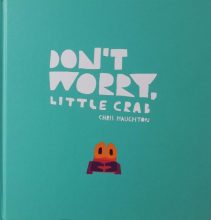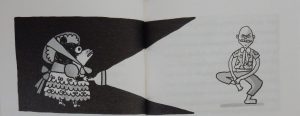
Don’t Worry, Little Crab

Don’t Worry, Little Crab
Chris Haughton
Walker Books

Chris Haughton takes the familiar topic of first time fears and finding the courage to overcome them and in his signature style arresting, minimalist graphics and a present tense narrative, conjures an original decapod spin.

Little Crab and Big Crab live together in a small rockpool and today’s the day Little Crab takes his very first swim in the big ocean. They set off together making their way over the rocks, tip-clawing across shallow pools and squelching through slimy seaweed, Little Crab full of eager anticipation until …

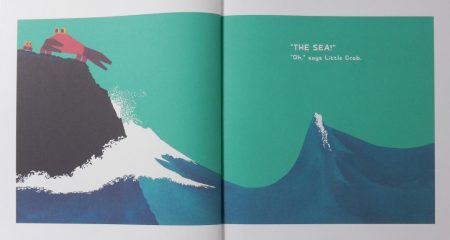
Perhaps this isn’t quite such a good idea after all, he thinks as despite Big Crab’s reassurance and encouragement, a rather large wave approaches. Then comes an even bigger one followed by a much, much bigger one.

Big Crab continues to cajole his companion and all the while ever more fierce-looking waves wash up.

Inching closer and closer the tiny creature eventually dips his claws beneath the sea

but still those waves come, one so gigantic it WHOOSHES the two of them right away from any land.

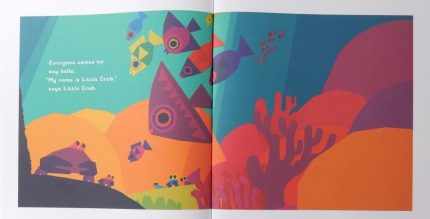
Down into the depths they go discovering together a truly wonderful new place and what’s more, it’s full of friendly creatures ready to introduce them to some exciting new experiences.

Chris’s vibrant, seemingly simple illustrations convey SO much about Little Crab’s feelings showing how in his case, less is most definitely more.

This is an ideal book for little ones taking their first steps towards independence be that starting nursery or school, learning to swim, joining a new club or whatever.

Red Red Red / Ravi’s Roar

Here are two picture books about young children and their anger

Red Red Red
Polly Dunbar
Walker Books

It’s tantrum time for the toddler in Polly Dunbar’s new picture book. A tantrum that’s precipitated when the infant attempts to extricate a biscuit from the jar up on the high shelf, bringing both jar and child hurtling to the floor.

A sympathetic mum is quickly on the scene but her attempts to placate her little one only make things worse until she suggests a calming, counting strategy that gradually transforms the toddler,

allowing all that fury to dissipate.

Polly’s scenes of anger and its management – of biscuits,

bumps and breathing – are sheer delight. The cathartic counting sequence in particular is absolutely brilliant.

Just the thing to share post-tantrum with little ones – make sure  they’ve completely calmed down first of course.

Ravi’s Roar
Tom Percival
Bloomsbury Children’s Books

Meet Ravi; he’s the youngest and smallest member of his family. This is perfectly fine most of the time but there are days when everything goes wrong.
The day of the family picnic was one of those.

First of all he’s squished into a train seat between a grown-up and a farty dog; then the game of hide-and-seek is a dismal disaster.

Ravi’s lack of stature puts paid to his enjoyment of the adventure playground but then his Dad steps in with a suggestion intended to help diffuse the lad’s rising anger.
That too goes badly wrong causing Ravi to lose it completely.

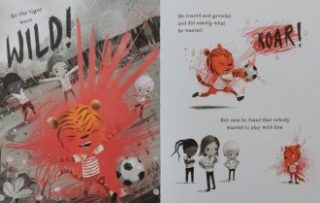
He’s suddenly transformed into a furious roaring tiger, which does seem to result in some short-term advantages.

But then the tiger overdoes his wildness, so much so that nobody else wants anything to do with him.

All alone, sadness starts to take the place of Ravi’s fury: what was it that had caused his anger anyway? The reason eludes him but he knows that an apology is called for.

After that the rest of his tigerishness seeps out leaving a calm child once again. PHEW!

In case you’re wondering, that was the last time Ravi ever became a tiger although he does still emit the occasional moderated growl …

Once again Tom Percival demonstrates his empathetic understanding of young children and his skill at exploring a subject that is very much part and parcel of their emotional make-up.

Add this enormously engaging book to your family collection or classroom shelves.

Mr Scruff

Mr Scruff
Simon James
Walker Books

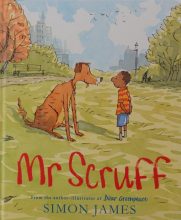
Crazy but totally adorable is this canine tale from Simon James.

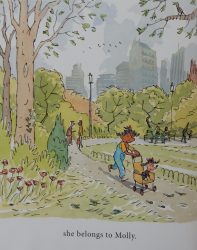
Most of the dogs herein bear a striking resemblance to their owners: there’s Polly and her owner Molly;

Erik belonging to Derek; Martha owned by Arthur and then there’s Mr Scruff, a large rather mangy-looking dog that nobody coming to the rescue centre seems at all interested in.

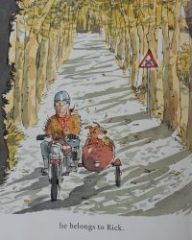
Also very much wanted are Mick – by Rick

as well as Lawrence with indulgent Florence.

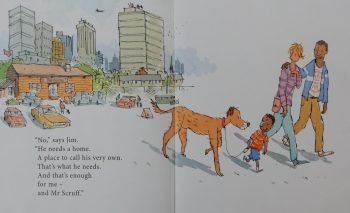
Meanwhile back at the centre, things are looking more hopeful for Mr Scruff. In comes Jim and right away boy and dog seem to take a shine to one another.

Jim’s parents take a bit of convincing: there’s the size difference and surely a pup might be more fun. Jim though has made up his mind: Mr Scruff is going home with them and that’s that.
And so he does.

Now into the centre comes someone else seeking a dog: he makes an unlikely choice too, but no matter because like Mr Scruff this one also needs a loving home. And that’s that.

Animals lovers especially will fall for this tale. The gentle humour of Simon James’ wonderful watercolours ensures that the inherent warmth of the story never becomes sentimental, while the rhyming nature of the narrative makes reading it aloud all the more enjoyable.

A definite winner for me despite my cynophobia.

Some Recent Young Fiction

Sophie’s Further Adventures
Dick King-Smith, illustrated by Hannah Shaw
Walker Books

This is a new edition containing three books in one, so it’s a bumper bundle of stories about the adorable, animal-mad little Sophie. I remember children in my early days of teaching avidly lapping up the stories when she first appeared on the scene back as an uncompromising four-year old who discovered a snail that led to her passion for all things animal.

In these three adventures she visits the farm, learns to ride, and pays a visit to great Aunt Al in the Scottish Highlands.

I asked the opinion of precocious reader, 6 year old Emmanuelle, who quickly became absorbed in the book. She commented that she particularly loved reading about Sophie riding Bumblebee the pony and later drew a picture of her doing so. She also said it made her want to try horse riding herself.

Seemingly the determined Sophie, still has the capacity to delight especially with Hannah Shaw’s illustrations that give the stories a fresh, present day feel.

Here Comes Lolo
Hooray for Lolo

Niki Daly
Otter-Barry Books

These books are part of a mini series for new solo readers starring young Lolo, a sparky young character who lives with her Mama and Gogo (gran) in South Africa.

Both titles have four stories each being just the right length to consume in a single sitting.

In the first book Lolo wins a longed-for gold star for reading, loses it, then gives it away; acquires a much-wanted, rather large hat; finds a lost engagement ring in the street;

and reports a lost dog and in so-doing assists in the arrest of a thief.

Along the way, helped by Niki’s delightful line drawings, we discover much about Lolo’s family life, her school life, her friendships and interests.

In Hooray for Lolo, the friendship with best pal Lulu is threatened when Lolo thinks she hasn’t been invited to her birthday party; she becomes a member of the library and chooses her first picture book which subsequently goes missing; wakes up one day with tummy ache and ends up having an operation, and finally, discovers that baby-sitting Bongi is exhausting work.

Sparkly stories all, with lots of gentle humour that will win Lolo lots of friends among young readers who are sure to enjoy making the acquaintance of this enormously engaging girl.

Princess of Pets: The Lost Puppy
Paula Harrison, illustrated by Olivia Chin Mueller
Nosy Crow

When Princess Bea discovers a puppy in the fountain of the palace grounds, she knows that she’ll have to find it somewhere else to live for it’s against her father’s rules to have pets in their home. But with frantic preparations for the evening’s banquet under way, not to mention the deportment lessons she’s supposed to be having, keeping a lively puppy hidden at Ruby Palace in the meantime is a huge challenge.

Then there’s the matter of the threat to the café belonging to her best friend Keira’s parents, that, so she discovers over dinner, her father’s guests, are planning to demolish to make way for the mansion they intend to build. Bea is determined to thwart that plan.

Can she achieve both goals? Possibly, with her kind heart and strong resolve, together with help from her best pal and perhaps some special spring rolls from the café.

Fans of the Princess series will likely devour this addition to the series at a single sitting.

The Pigeon HAS to Go to School!

The Pigeon HAS to Go to School!
Mo Willems
Walker Books

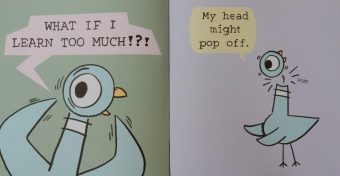
At last the time has come; our favourite picture book Pigeon is to start school, despite the fact that he’s adamant that he’s not going. “I already know EVERYTHING!” he insists immediately shooting himself in the foot by inviting readers to ‘… ask me a question. Any question!’

From there however he starts revealing his real anxieties: he’s not good first thing in the morning; supposing he doesn’t like it and worse – supposing the teacher doesn’t like pigeons. One by one these worries emerge from beneath that feathery bluster. There’s sooooooooooo much stuff to learn – too much and his head and body might part company.

We’re treated to an eight-part tirade of terrifying possibilities – ‘Will FINGER PAINT stick to my feathers? … What’s up with those heavy BACKPACKS? I’m a fragile bird.’ By now our little Pigeon is a jittering wreck.

But then, after a further rant …

comes a light bulb moment … followed by the very best of all Pigeon possibilities that answers his question, ‘Well, HOW am I supposed to get there, anyway!?!”

It’s a truly wonderful finale, perfectly delivered Mo Willems style; and I’m sure all the Pigeon fans out there will be on the edges of their seats as they anticipate what is about to show up next – whey hey! …

Presented almost entirely through speech bubbles, Pigeon’s monologue is simply brilliant and the way in which Willems zooms in and out on his protagonist both orchestrates the action and highlights the emotional turmoil.

I’ve totally loved all of the Pigeon books but perhaps this is my favourite so far.

Share with those about to start school as well as those already experienced in the mysteries of the classroom.

Mary Had a Little Lamb & This Little Piggy / Little White Fish, Little White Fish has a Party, Little White Fish is So Happy

Mary Had a Little Lamb
This Little Piggy

Jarvis
Walker Books

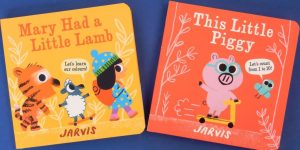
Jarvis has taken as his starting point for these board books the opening lines from two nursery rhymes and from them created one with colour connections, the other with a counting twist.

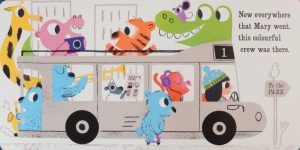
So yes, Mary did have a white-fleeced little lamb that decided to follow her. But then so too did an orange tiger, a pink dancing hippo, a cool red monkey, a tiny purple mouse, a snapping green crocodile and a yellow giraffe.
Where though are they all going in Pied Piper fashion, making a merry din before boarding a bus takes them all to their destination

and a treat…

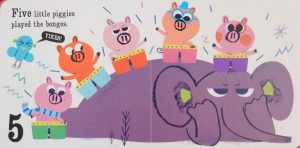
One little piggy went to market, so the rhyme says and Jarvis does too. Rather than staying home however, two more make a mess of parking their car; three get themselves in a terrible tangle when learning to knit; four get struck by the fitness craze. Block your ears when five make music.

Six scoff all the spuds, seven try their trotters as dancers, eight become super pigs but nine –phoah! pongy piggies all.
At least when ten get together they can all agree, somewhere muddy is the best place to be.

With Jarvis’ funky animals cavorting across the pages, lively little ones are going to love these neo nursery rhymes as they absorb the colour connections and join in counting the piggies. Above all though, they’re terrific fun.

Little White Fish
Little White Fish has a Party
Little White Fish is So Happy

Guido van Genechten
Catch a Star

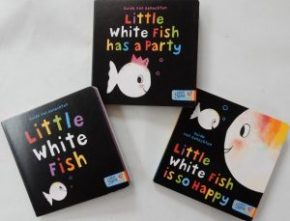
These board books featuring Little White Fish can be read just for fun, but each has an inherent educational element.

In the first, the little fish (not strictly speaking white for he has a rainbow stripe along his back), has lost his mummy and is feeling sad. In his search he encounters other differently coloured sea creatures – a red crab, an orange starfish a yellow snail, a green turtle, a large blue whale, a purple octopus. Clearly none of these fits the bill but what about a large fish that also sports a rainbow across her back …

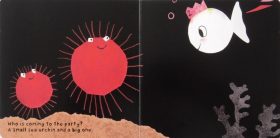
In the second book, the little fish celebrates his second birthday with a party to which he invites his friends that all arrive in pairs that show opposites; for example a small sea urchin and a big one,

a long sea snake and a short one, a sad dolphin and a happy one. (We discover why one is sad on the final spread that shows all twelve guests).

The third book introduces positional vocabulary (prepositions):  when his Mummy comes to get him, Little White Fish bids farewell to his playmates – snail in the shell, frog on the rock, crab behind the rock etc. then swims away in front of his mum assuring the others he’ll be back to play the next day.

With their simple narratives and vibrant sea creatures that stand out against the predominantly black backgrounds, all three are a delight to share with very young children either at home or in a nursery setting.

Hello Horse / How Far Can a Kangaroo Jump?

Hello Horse
Vivian French and Catherine Rayner
Walker Books

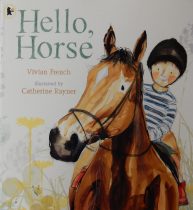
This is one of the Nature Storybooks series that provides a perfect amalgam of information in narrative form and superb illustration, in this instance with Vivian French as author and Catherine Rayner as illustrator.

Vivian’s text gives just the right amount of detail for a young child to absorb as she describes via her boy narrator what happens when he is introduced to her friend Catherine’s horse named Shannon.

The boy soon overcomes his initial apprehension about meeting the horse but under Catherine’s guidance his fears are soon allayed as he learns about how to approach, touch and feed a horse. He also learns about grooming and finally, how to ride Shannon.

Every one of Catherine’s watercolour illustrations is beautiful and she does bring to life beautifully the equine creature that we learn in an author’s note really does belong to the illustrator.

A gorgeous introduction to horses and riding.

How Far Can a Kangaroo Jump?
Alison Limentani
Boxer Books

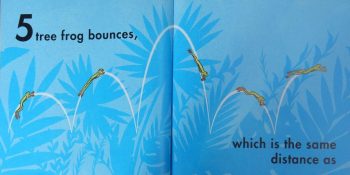
Ever wondered how far a kangaroo can jump; or perhaps four rabbits, or even eight coyotes? If so this book is definitely for you.

It’s beautifully illustrated by the author who showcases eleven different animals in total, each demonstrating its leaping, diving, hopping, bouncing,

skipping, bounding, vaulting, hurdling or springing skill.

Don’t be misled into thinking the titular marsupial is the longest jumper of all though; there’s a creature that well and truly outsprings it; now what might that be?

The book concludes by answering Alison’s own question: ‘How many kangaroo jumps would it take to get all the way around the earth?’ and posing another for young humans to answer.

Trainers on? Ready, steady, jump …

On landing, readers can compare their efforts with those of the other animals from the book, each of which is shown mid spring on the explanatory back endpapers.

The Dragon in the Library / The Day I Found a Wormhole at the Bottom of the Garden

The Dragon in the Library
Louie Stowell, illustrated by Davide Ortu
Nosy Crow

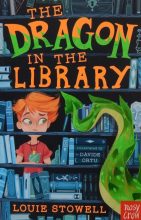
Kit is anything but enthusiastic about reading; she much prefers to be playing outdoors and the library is definitely not her choice of destination on the first day of the summer holidays. But when her friends manage to persuade her to accompany them she discovers that she’s a wizard. Not just any wizard though, possibly the youngest ever wizard. The librarian doubles up as a wizard too.

Before long Kit learns that she has to play a crucial role in protecting the dragon sleeping in the library. The existence of the library itself is at stake though (the villainous Salt is determined to destroy it and it seems as though he knows too much about that dragon).

There’s another snag however, over-enthusiastic Kit is, shall we say rather impetuous in the use of her new-found power and it might be that her action has put not only the library but the entire world in danger.

The plot moves at a rapid pace and with its plethora of wonderful one-liners, allusions to other children’s books, and excellent characterisation, Louise Stowell’s debut story is a cracking one. Throw Davide Ortu’s illustrations into the mix and the magic becomes even more potent. ‘True magic’ indeed as the final words of the story say.

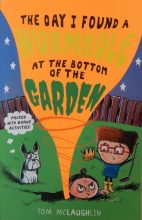
The Day I Found a Wormhole at the Bottom of the Garden
Tom McLaughlin
Walker Books

This book is totally crazy; it’ll likely have you giggling your way through in one gulp as you encounter its diverse cast of characters. There’s metal detecting enthusiast Billy and his trusty dog Shakespeare, Billy’s nan (who loves to snooze and in between bakes cakes (rocky ones) and watches television. Then come – thanks to the wormhole of the title – Queen Victoria, Roman warrior and wonky road builder Atticus, Einstein (self explanatory), Shakespeare – the real one this time and Professor Jones, scientist specialising in time travel and consumer of quantities of his favourite dunkable chocolate biscuity confection.

How on earth can all those co-exist you may be wondering; it’s on account of that time portal aka wormhole. When you toss into the mix a whoopee cushion, (it reminds Queen Vic. ‘of my Albert after a pork-pie session’),

a toaster – which according to HRH “has utterly blown one’s mind.”, a dinosaur and the frantic race to close that wormhole before the whole of history is forever altered, you’ll be sure Tom’s day cannot get any more complicated.

Splutter-inducing dialogue, a plot that moves so fast you almost have to run to keep up, and a liberal scattering of suitably silly drawings by none other than Tom himself, not to mention a quiz, a maze and instructions for making an olde quill pen, make for a terrific adventure to tickle the taste buds of independent readers.

It would make a super class read aloud too – as long as you don’t laugh so much you lose the plot.

Playing with Collage

Playing with Collage
Jeannie Baker
Walker Books

I still have a treasured copy of Jeannie Baker’s exemplary Where the Forest Meets the Sea as well as several more of her books, and so was excited to learn of this one.

Following introductory spreads on basic tools, some key tips and ‘playing with materials’, the author has divided her books into four main sections, Paper, Out in Nature,

On the Beach and In the Kitchen.

In each one she offers practical tips for assembling your chosen materials, advising readers to look closely, let the items themselves and their textures act as a guide be they scraps of torn or cut paper, leaves and lichens or shells and seaweed.

I like the way she guides rather than instructs and that her examples give the impression of being unfinished and totally unintimidating, albeit exciting and beautiful.

This is a perfect book to encourage playfulness with materials right from the early years (when children generally are that way inclined anyway) through to adulthood when that creativity may have got buried and need re-awakening.

The clear photographic illustrations, that leave plenty of space on the page, along with succinct captions, help make the entire topic approachable and fun. To add to the book’s playfulness, there’s a final collage quiz.

Highly recommended as a resource for home and school use.

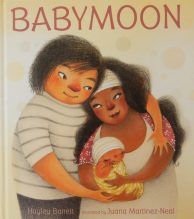
Babymoon

Babymoon
Hayley Barrett and Juana Martinez-Neal
Walker Books

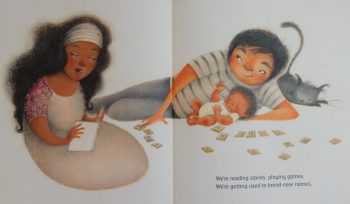
A new baby has just been born and the two new parents spend their first days after their baby’s arrival on their ‘babymoon’.

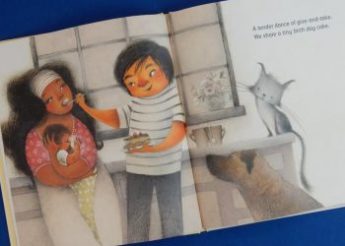
During this precious time they experience tender moments, ‘A sweet, secluded afternoon – / this restful time, our babymoon’; joyful ones, ‘ A tender dance of give-and-take. / We share a tiny birth day cake.’

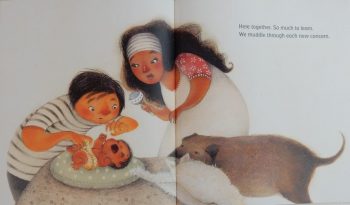
and occasionally, anxious ones – ‘Here together. So much to learn. / We muddle through each new concern.’

From the opening alliterative line, ‘The house is hushed. The lights are low.’, readers are enfolded in Hayley Barratt’s gentle rhyming narrative of moments to savour, moments shared not only with parents and child but the family dog and cat are also included in the building of that loving bond.

The sense of serenity is reflected in Juana Martinez-Neal’s breathtakingly beautiful illustrations, which show the warm loving involvement of both parents.

This is a gorgeous book to give to new parents especially perhaps, to encourage them to savour the precious ‘babymoon’ time (the word was coined by the late anthropologist Shelia Kitzinger to do just that.) I absolutely love that the parents are shown sharing stories right from the start of their baby’s life.

Ariki and the Island of Wonders / Magical Kingdom of Birds: The Silent Songbirds

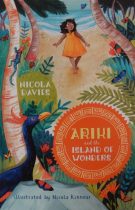
Ariki and the Island of Wonders
Nicola Davies, illustrated by Nicola Kinnear
Walker Books

Nicola Davies’s sequel to Ariki and the Giant Shark is equally rooted in island life, the natural world and the Pacific Ocean.

Strong-minded Ariki and her good friend Ipo, who live on Turtle Island, ignore the advice of Ariki’s guardian to learn about wave behaviour from a bowl of water and set sail on Sea Beauty. “We’ll be in trouble, ” says Ipo as they discover the wind is rather stronger than expected and Ariki has to agree.

It isn’t long though before there’s a storm brewing and it’s impossible to turn back: the only option, they realise, is to let the storm blow them where it will.

After several days without food and virtually nothing to drink, they encounter a wounded whale that has become separated from its family, which the children help. The whale then assists them by towing them towards an unfamiliar island that looks like paradise.

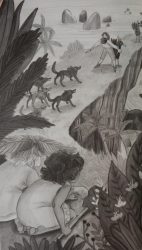
On the island they meet a strange man calling himself Crusoe McRobinson and learn of a dangerous creature the man calls “Dog”. There are in fact a number of these ‘dogs’ lurking and because of them the other island residents – humans and animal – as well as the two children, are in jeopardy.

Is there anything Ariki can do and if so will the two friends ever get back safely to Turtle Island?

Zoologlist story weaver, Nicola Davies cleverly entertains and educates at the same time in this gripping tale. Her affinity with the natural world shines through in her narrative with its vivid description of wildlife showing the interconnectness of human beings and the natural world.

To add to the magical mix, Nicola Kinner’s black and white illustrations perfectly capture the relationship between the human characters and nature.

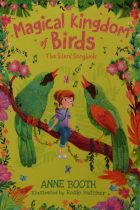
Magical Kingdom of Birds: The Silent Songbirds
Anne Booth, illustrated by Rosie Butcher
Oxford University Press

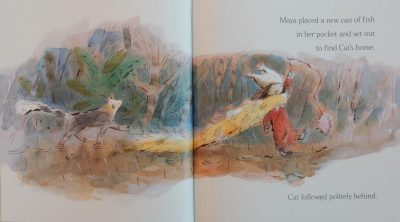
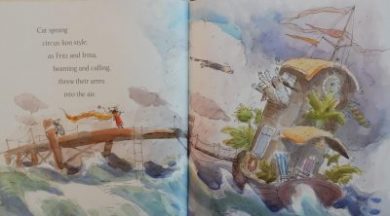
Combining magic and wonder with facts about birds is this latest story in Anne Booth’s series of chapter books for young readers that began when its main protagonist, Maya was made keeper of a very special colouring book that could draw her into the Magical Kingdom of Birds.

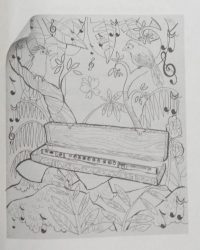
The picture that appears to draw her to the Kingdom (where in addition to being a schoolgirl she is the Keeper of the Book) in this adventure is this one.

Instead of the usual focus on one particular kind of bird, songbirds from many parts of the world are featured; the reason being there’s to be a special singing gala so her friend Willow tells Maya. But can they really trust Willow’s wicked Uncle, Lord Astor, who claims to have become a reformed character wanting only to bring everyone together in friendship?

Of course not: he has set his sights on stealing the songs of all the participants in the event and using them for his own nefarious purposes.

Maya certainly has a big problem on her hands and she also has to face up to singing in her school concert if she succeeds in saving the songbirds.

Another exciting episode, with Rosie Butcher’s enchanting black and white illustrations, this is certain to excite Maya’s established fans and capture some new enthusiasts for the series too.
(The final pages contain fascinating facts on the real birds that inspired the story, plus fun things to make and do as well as additional information about the plight of endangered Indonesian songbirds).

A Handful of Activity Books

My RSPB Sticker Activity Book: Seaside
Stephanie Fizer Coleman
Walker Books

If you pay a visit to the seaside, no matter where you look there are fascinating flora and fauna to discover, be that in rock pools, in the grassy dunes that are a-buzz with insects, down on the shore, beneath the ocean waves or on the cliffs where seabirds nest. If you look in the shallows you might spy a seahorse or perhaps you’ll be lucky enough to spot a seal resting on a rock or a dolphin leaping from the waves.

All these and more are part and parcel of this activity book that includes items to colour, dot-to-dots, things to spot, matching, drawing and several pages for adding stickers to. Stephanie Fizer Coleman has created ten inviting, textured scenes for little ones to adorn as well as the four central pages of colourful stickers.

Before heading for the coast with a young child, this would make a worthwhile, enjoyable book to introduce some of the things they might look out for.

My First Amazing Animal Mazes
Various illustrators
Highlights

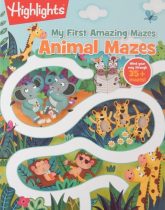
For the youngest of puzzlers, this book contains over 35 mazes with such diverse settings as a farm, a bamboo forest, an ocean and a safari waterhole. There are different kinds of mazes including one composed of letters called Jellyfish Jumble; another is a downhill slalom. There are also string mazes, pattern mazes and traditional mazes to keep your little ones engaged at odd moments or times when they can’t venture outside, or need something to quieten them down.

A greater variety of puzzles is to be found in

Jumbo Pad of Picture Puzzles
Various illustrators
Highlights

This one will keep young puzzlers busy for a fair few hours as they use their hands, eyes and mind to spot differences, locate objects hidden in scenes such as a gymnasium populated by cats and a park full of children playing, search for matching pairs, engage in word puzzles, try memory challenges, choose missing puzzle pieces, solve mazes and more.
The large variety of illustrative styles and things to do should guarantee boredom doesn’t set in; and just in case youngsters are unable to solve a puzzle, all the solutions are provided.
A boon on a dull day as is …

Ultimate Puzzle Challenge!
Highlights

This one is bursting with word searches, codes to solve, Sudoku, busy scenes with items hiding in plain sight to locate, a plethora of word puzzles such as rhyming pairs, spiral word puzzles, crisscrosses, logic puzzles, find the differences, tricky mazes and more.
If this large book of 125+ puzzles doesn’t engage and absorb young puzzlers, then they don’t deserve to call themselves such.

So, pencils ready, set, puzzle …

Joy / Harris Finds His Feet

Joy
Yasmeen Ismail and Jenni Desmond
Walker Books

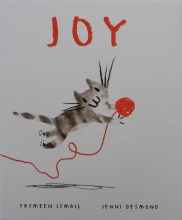
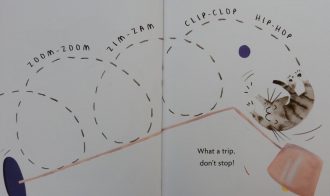
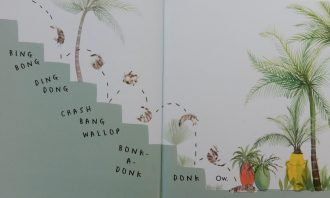
A little grey and black kitty is in effervescent mood as she goes ‘Bounce bounce, ding-a-ling, ring ring, let’s sing! And who can resist her invitation as the happy creature plays with her favourite toy

and then in her glee, narrowly avoiding a large canine in front of her, uh-oh, down she tumbles ‘trip, trip, slip, flop and …

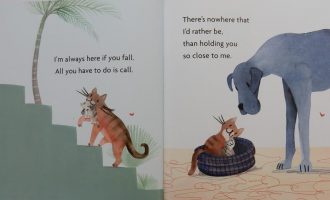
Happily however, there’s a parent not far away ready with a little hug, a kiss, a squeeze and a quick check the little kitty is okay after a bit of a tumble.

What a wonderfully upbeat, rhythmic text to read aloud is this one from Yasmeen and unusually, she hasn’t done the illustrations. Jenni Desmond did those and they’re equally joyful and brilliantly expressive; the two together have created a smashing book to share with your little ones.

And for those interested in developing young children’s sound/symbol awareness, this picture book is in an entirely different league from those specifically designed for that purpose.

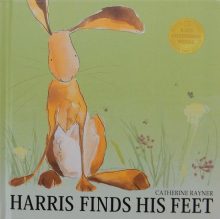
Harris Finds His Feet
Catherine Rayner
Little Tiger

I adored this book when it first came out over ten years ago so was thrilled to get this board book edition to share with even younger little ones.

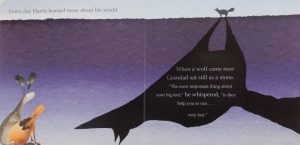
Meet Harris a small, very large footed hare. One day he asks his grandfather, “Why do I have such large feet, Grandad?”

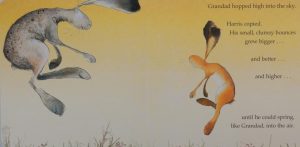
Smiling, Grandad explains he and all other hares have big feet and goes on to demonstrate the benefits of same.

Together they spend time hopping, springing and mountain climbing with Harris copying his expert grandparent until he has mastered each skill.

They explore the world creating resting places as well as being active with Harris learning more every day …

until Grandad decides Harris is ready.

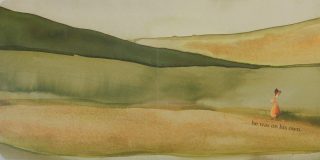
Then he explains gently that it’s time for Harris to discover more about the big wide world for himself and that is what the now stronger, bigger young hare does by using all the skills his Grandad has helped him to learn.

Every spread of this book is pure pleasure, as the little hare bounds gleefully across Kate Greenaway medal winning Catherine Rayner’s wonderful watercolour-washed spreads, pausing sometimes for discussions on his journey towards independence.

A must have addition to your board book collection.

Tooth Fairy in Training

Tooth Fairy in Training
Michelle Robinson and Briony May Smith
Walker Books

If you’ve ever wondered how tooth fairies hone their skills, then this magical tale will perhaps enlighten you.
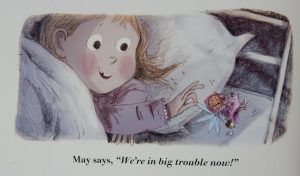
Let’s meet the trainee Tate and her trainer, sister May who has much to teach her younger sibling.

First task is to perfect the ‘switcheroo’ – a doddle of course … unless that is, you happen to be performing it on a baby hippo.

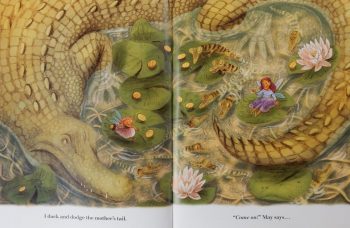
Visit two is also pretty demanding and perhaps a tad alarming, especially when you’re being watched by the infant’s mother whose tail you have to avoid with some nimble footwork.

And so it continues over ground and under sea, on the shore and then having traversed almost the whole planet, the penultimate stop is in the jungle with the possibility of being swallowed by an anaconda – yikes! But snake teeth are a rarity so it has to be done.
Surely the final stop will be simplicity itself – it’s to a mere human girl. How could anything go wrong, and even if on the off-chance, it does, you can always resort to a touch of the old magic …

Does our novice pass the test though? That is after all, the purpose of the whole exercise: I’m not telling …

Briony’s illustrations are spirited delight, every one of them. Tate is totally adorable and her expressions and body language say even more than the lively rhyming narrative she (and Michelle) provides during the learning journey throughout which her big sister looks on benevolently and comments encouragingly.

I fell in love with this utterly blissful book.

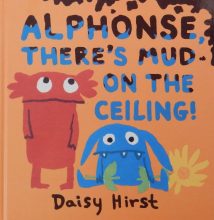
Alphonse, There’s Mud On The Ceiling

Alphonse, There’s Mud On The Ceiling!
Daisy Hurst
Walker Books

The cast from Alphonse, That Is Not OK To Do and I Do Not Like Books Any More! are back in another smashing story.

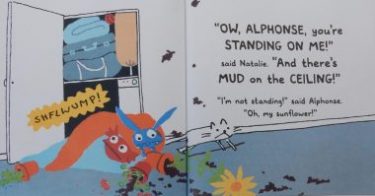
Natalie, Alphonse and family reside in a flat, on the seventh floor. The child monsters love driving their double-decker bed, playing around their large green chair, tending their sunflowers and performing somersaults down the hall and generally junglifying their surroundings until Natalie cries out “OW, ALPHONSE, you’re STANDING ON ME… and there’s MUD on the CEILING!

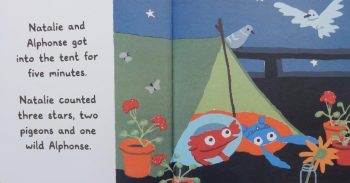
At this point Dad intervenes pointing out that their shenanigans are unsuitable indoor play. Natalie (who has an answer for everything) counters this with complaints about their lack of a wild jungle garden with a tent for sleeping in.

Eventually Natalie decides the park is where she want to be – alone.

Off she goes and there her explorations lead her to a bush with a hole wherein she finds …

Then, guess who arrives on the scene. A truce is called and a deal struck involving sausages and blackberries, and at Natalie’s insistence, a bundle of sticks.

Turns out there’s more than one place where you can be wild in the jungle, camping and tucking in to tea. Perhaps even sleeping too.

Another acutely observed, vibrantly illustrated tale from Daisy Hurst; these stories go from strength to strength. Everything about this book is quite simply brilliant.

I suspect adult sharers will adore it as much as the youngsters they read it with; this reviewer surely did.

Uncle Shawn and Bill and the Not One Tiny Bit Lovey-Dovey Moon Adventure

Uncle Shawn and Bill and the Not One Tiny Bit Lovey-Dovey Moon Adventure
A.L. Kennedy, illustrated by Gemma Correll
Walker Books

This is the third title in Costa award winning author A.L.Kennedy’s series starring Uncle Shawn, his best pal Bill Badger and a cast of other larger than life, lovable and not so lovable characters.

It’s as superbly bonkers as the title indicates and had me spluttering with laughter on pretty much every page, both at the story and Gemma Correll’s splendid, liberally scattered illustrations of villains and goodies.

Early on in the tale we learn that Sky (one of the twins) has wished herself invisible and no matter how hard she tries to unwish her invisibility – which has distinct disadvantages – her second wish never comes true.

We also discover that Bill has fallen head-over-heels in love with a lovely lady badger (‘possibly the most gorgeous badger in the world’) going by the name of Miranda (although he doesn’t yet know that) and she seems as perfect as any creature could be. Romance is most definitely in the air.

Could it be though that Bill is deluding himself about the desirability of Miranda Badger. Why is it for instance that she is liaising with a bald man with ill-fitting teeth, one Sylvester Pearlyclaws, a notorious criminal?

Is it possible that he is in fact the erstwhile toothless man who had recently emerged from the sea at Shoogeldy Bay swearing to get his revenge on Uncle Shawn et al.?

Meanwhile Sky is still struggling with her invisibility problem, so much so that Uncle Shawn suggests that the way to solve it is  to visit the moon, aka – so he says – the land of wishes; and the means to travelling to their lunar destination will be, wait for it, a giant-size iron soup dish.

The entire plot is fast moving and completely crazy. It totally snares the attention holding it throughout, brimming over as it does with exciting imagery – ‘Uncle Shawn reached down and just managed to catch the magnet, It was going faster than an oiled penguin sliding down an iceberg because it was very late for dinner.’ Or, ‘The monster rattled its fangs together so that they sounded like angry knitting needles and yelled …’. and ‘ Pearlyclaws ran away as fast as he could manage, his floppy feet sounding like old towels soaked in badness.’

Clearly the author has had as much fun writing this story as youngsters will have reading or listening to it; it’s perfect for solo readers or reading aloud. If it’s the latter your listeners will urge you to keep on … and on … to discover what happens next, but do make sure you stop frequently to share Gemma Correll’s wonderful visual images as well the author’s verbal ones.

In a word, priceless.

How To Be On The Moon

How To Be On The Moon
Viviane Schwarz
Walker Books

This sequel to How to Find Gold again stars intrepid Anna and careful Crocodile.

Anna is eager to visit the moon but Crocodile is less than enthusiastic telling her it’s “out in space … really very far away … almost impossible.”

This appeals to Anna but first they have to acquire some special skills, counters Crocodile; but Anna can count backwards from five.
In fact he raises a snag at every opportunity: a great deal of patience is necessary: Crocodile has sufficient for them both, he’s told eventually.

Crocodile is then allocated the task of sandwich making while Anna builds the rocket.
Tasks complete, they count down and … blast off …

While on board they play the only game gravity allows – it involves sandwich catching and consumption (once you’ve caught all the constituents) and then as it’s still some distance to go, take a patience-extending snooze.

Finally though they land on the moon, finish their sandwiches, don space helmets and go out exploring the deserted moonscape.

Before long, as they gaze up Anna decides that “Poor Earth” is missing them and they decide to head off back home.

Once more on Earth, they bask briefly in mission-accomplished glory before deciding the rest of the world needs checking on, and off they set …

A smashing story – one expects no less from Viviane – but it’s the wonderful, wondrous textured illustrations that steal the show – just!  The dialogue’s absolutely priceless too. And I absolutely love how the two contrasting yet complementary characters rub along together so beautifully.

Sheer delight through and through.

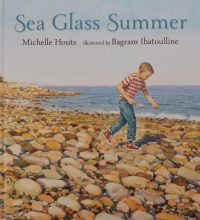
Sea Glass Summer

Sea Glass Summer
Michelle Houts and Bagram Ibatoulline
Walker Books

‘Some years ago a boy named Thomas spent the summer at his grandmother’s island cottage.’ So begins a beautiful story set in Maine some time in the last century.

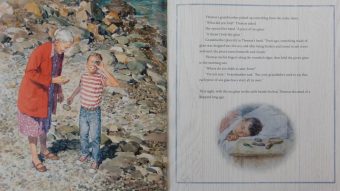
Early in his stay his grandmother gives the boy a magnifying glass that had belonged to his grandfather and Thomas uses this as he explores the rocky beach one morning.

When he shows Grandmother a piece of glass he’s discovered she tells him that “ … your grandfather used to say that each piece of sea glass has a story all of its own.”

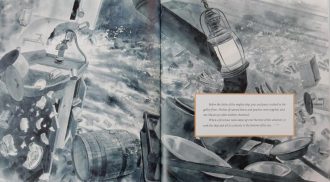
That night Thomas places the sea glass beside his bed and dreams of a shipyard long ago. The routine continues with the boy discovering bits and pieces of glass each morning and dreaming each night. (The dream stories are depicted in greyscale serving both to separate them from the present events and to bring history alive again).

In contrast, Bagram Ibatoulline’s superbly moving, equally realistic, watercolour scenes show the sometimes glowing, sometimes shadowy shore whereon Thomas, aided by the magnifying glass, makes his discoveries of mysterious magical ocean gifts and lets his imagination soar.

All too soon the holiday ends: Thomas gathers together his treasures and boards a boat back to the mainland. However, a sudden lurch causes him to drop his magnifying glass and some of the pieces fall overboard.

The story then moves to recent times: a girl named Annie walks on the beach collecting treasures and comes upon a piece of sea glass. She shows it to her Papa Tom; you can anticipate what she’s told … The tale concludes having come full circle …

Michelle Houts’ lovely story of journeys, connections, possibilities and the power of the imagination has much to appeal to older picture book readers and is full of possibilities for exploring in a KS2 classroom.

(A final author’s note explains why there is much less sea glass nowadays: a big plus for the environment but children will have to find other treasures on the seashore to fuel their imaginations.)

Stick & Fetch Investigate: The Wrong End of the Stick / The Naughtiest Unicorn

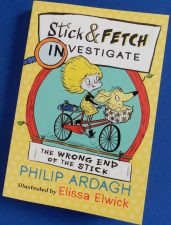
Stick & Fetch Investigate: The Wrong End of the Stick
Philip Ardagh, illustrated by Elissa Elwick
Walker Books

Top-notch undercover detective duo Sally Stick and her canine pal Fetch return in another set of gigglesome episodes.
In the first, Glass Half Full, we learn that the friends have had to shift their operation to a temporary HQ on account of their stay at artist Uncle Bob’s residence for the duration of Granny Stick’s hospital sojourn.

It’s not long before the detectives have a case: Uncle Bob has lost his glasses and there’s a tasty reward on offer for finding them. But there are glasses, and there are glasses. The particular ones in question have gold rims and although there are glasses aplenty in the house, none have gold rims – or do they.

This is a case of can’t see for looking; but can Sally and Fetch solve it ?

Hmmm! What’s that smell – could it be sausages? …

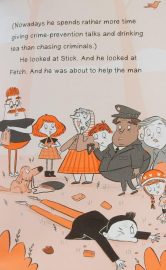
Bothersome beavers are at the heart of the next case, or so the detectives surmise when they come across a snapped-in-two lamppost on their way back from the library where they’d read about the tree chomping creatures. They find  clues in the form and aroma of baked beans; and see a sign indicating the location of a swimming pool. Sally puts two and one together and off they head to the pool.

Time to go undercover, but will they find a beaver on arrival and if so, can a damming crisis be averted?

Two further cases, equally zany are concerned first with, assisting the police when a spate of bag-snatching breaks out –

there’s a frog and a whiffy man involved here; and the second, a bit of bed-digging that might just happen to yield treasure, of a sort.

Delectably silly, enormously engaging and very importantly, celebrating the imagination, (or maybe just the wrong end of the stick), with its plenitude of comical illustrations by Eliissa Elwick, this smashing little book is perfect just flying solo reading.

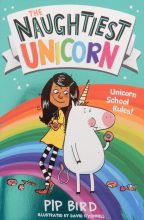
The Naughtiest Unicorn
Pip Bird, illustrated by David O’Connell
Egmont

The particular Unicorn School in this story runs during the holidays and young Mira is overjoyed when she receives an invitation to join, especially as her sister is also a pupil and her mum had been too.

Having successfully entered the portal with another newcomer Raheem, Mira meets her teacher and classmates, then enters the hall to learn of the principles on which the school prides itself. She can hardly wait to be paired with her unicorn and at last it’s her turn.

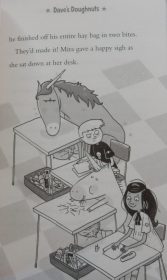
However, the squat, pot-bellied creature, Dave, that is eventually coaxed through the door is somewhat lacking in sparkles, although he does have a twinkle in his eye.

Once in the classroom, Mira hears that there are only two days before they must go out on their first magical quest.

Can she possibly get ready when the recalcitrant creature objects even to being groomed? Do they actually have a totally magic bond?

Things don’t look promising especially as Dave’s penchants seem to be for doughnuts and falling asleep in lessons. Will Mira’s ambitions to go on that quest ever be fulfilled? Perhaps her friends Darcy and Raheem can help …

Just right for newly independent readers, this is a sparky tale that focuses as much on friendship as the glittery world of unicorns, showing that magic comes both from the former and the latter. Humour runs throughout Pip Bird’s telling and is brought out further in David O’Connell’s zany illustrations clearly drawn with a twinkle in his eye. Add to all that a quiz to help readers identify their unicorn type, and some jokes; and those who enjoy the book will be excited to learn that there’s a promise of more to come.

The Anzac Billy

The Anzac Billy
Claire Saxby, Mark Jackson & Heather Potter
Walker Books

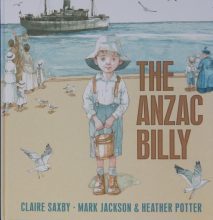
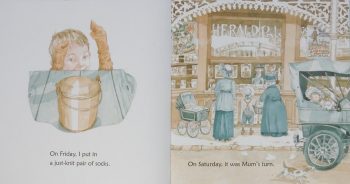
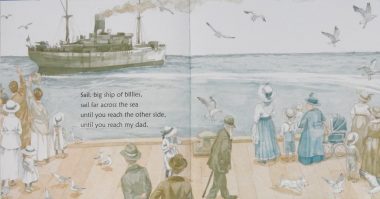
I totally fell for the little boy character in The Anzac Billywhen I saw him on the front cover. Based on true events, it’s set during World War 1 in a week when Christmas is approaching and the boy (and his family) are packing carefully chosen items into a billy in the hope it will reach his dad in time for Christmas. From Monday to Friday, one thing per day, the small boy puts in butterscotch (his own favourite), yucky fish (Dad’s favourite), walnuts from their tree, a bar of chocolate, and a pair of ‘just-knit’ socks.

On Saturday it’s Mum’s turn and she adds a razor, safety pins and soap (‘to wash his undies’) and Nan fills the remaining space on Sunday with a couple of handkerchiefs and paper and pencil for writing home.

Now all this so lovingly packed cannot be posted, nor sent by road or rail; it has to be shipped along with boxes of other billies; and naturally the boy is concerned that it might not reach his own dad for as his Mum tells him, ‘there’s a Christmas billy for every warfield soldier, filled by families, filled by friends’.

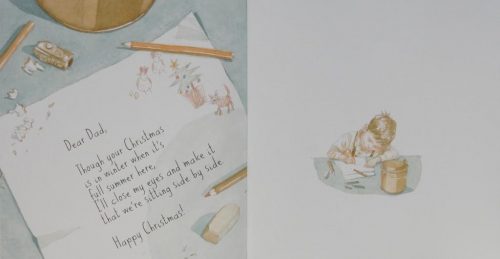
To make sure though, Billy puts in a note requesting that if another soldier receives his offering, then ‘please send my letter on.’ – this letter that he so carefully penned during that week from which we see how much he misses his Dad.

Claire Saxby’s telling feels authentic and is full of tenderness and poignant moments; all this is echoed in Mark Jackson and Heather Potter’s soft sepia scenes of Australia in a bygone era when light was not electric and life was much harder for everyone.

An ideal book for young readers, and KS1/ lower KS2 pupils studying the period; it would also make an unusual, but highly pertinent, Christmas time story.


Hummingbird

Hummingbird
Nicola Davies, illustrated by Jane Ray
Walker Books

Nicola Davies is a champion of wildlife; and the creature she has chosen here is a tiny one, smaller than a thumb and lighter than a penny, the ruby-throated hummingbird.

Using the framework of the loving relationship between a Mexican grandmother and her granddaughter, we experience the migration pattern of such birds that are soon to depart, bound for the north, perhaps as the grandmother tells the child, “they’ll visit you in New York City?”
Seated in her Grandmother’s lap, the girl is asked to “Keep still” as they proffer bowls of water to the birds; and come they do ‘Tz-unun! Tz-unun!’ flashing their feathers and beating their wings.

We then follow the birds’ migration route over several double spreads all the way from over the Gulf of Mexico,

through the USA and all the way to Canada. And there they set up home and later in the summer,

a little girl walking towards the park spies on the grassy verge, evidence of ‘a visitor from Granny’s garden’.

The days get shorter and it’s time once more for the hummingbirds to fly south though not all will make it safely to their destination. Granny however is anticipating their arrival as she sits in her garden reading a special letter from her granddaughter now far away, while in her lap is a tiny eggshell wrapped in cotton wool and a newspaper cutting telling of hummingbirds nesting in Central Park for the first time.

Jane Ray’s, stunning – as jewel-like as her subjects – detailed watercolour pictures almost vibrate with the Tz-unun! Tz-unun! of the hummingbirds’ wings, while tiny lines in her illustrations inject movement into the flight path of their long journey, 3000 kilometres northwards, and back.
Dropped into the spreads are such facts as what hummingbirds feed on; their nest size, and other details of their journey; and there’s a final page on which Nicola explains in detail how ornithologists have ringed and tracked hummingbirds over the years. I was intrigued to learn that they can live to be nine years old – incredible!

Altogether a fascinating book.

The Prince and the Witch and the Thief and the Bears

The Prince and the Witch and the Thief and the Bears
Alastair Chisholm and Jez Tuya
Walker Books

This is essentially a bedtime story treasure trove – a fairy story with a very clever twist or two, or even more.

It begins with Dad asking son Jamie what kind of bedtime story he’d like. Jamie requests “A made-up one!” to include the titular characters and so Dad does as he’s bid and begins to tell his tale within a tale and a right rambling yarn it is into which Jamie insists breaking with questions and interjections. Dad then weaves these into his telling, no matter how far off piste they might be or how irritating. “Why couldn’t the Princess rescue the Prince? … Mum says Princesses in stories are rubbish.” Dad eventually concedes only for Jamie to decide, “No actually I want the Prince.” …

The Princess has been incarcerated in a tower by “her wicked aunt, a Witch with an Evil Eye, ” Dad continues and so it goes on.

We discover that the castle is made (to Jamie’s disgust) entirely out of broccoli and the Witch is really a Ninja. Uh-ha! And if that’s not enough topsy-turvyness, then I’ll have you know that as they approach Castle Broccoli the Prince is actually carrying the horse

and the Princess isn’t all she seems.

Nonetheless all ends happily – twice over- in this splendid romp of a bedtime tale telling experience that will delight both receivers and deliverers. It well and truly flips the traditional fairy story right on its head and not only is it a smashing bedtime offering (albeit not a brief one); it’s absolutely bursting with classroom potential too; and not simply because Dad promises a continuation involving the Bears on the following night.

Yes, Alistair Chisholm’s telling is terrific, but Jez Tuya’s illustrations are pretty cool too – or should that be hot – certainly so here …

and full of hilarious, chortle worthy details.

Early Years Round-Up

Father’s Day
Shirley Hughes
Walker Books

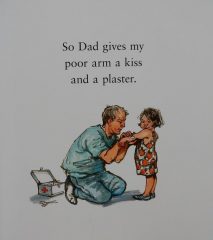
A gorgeously warm celebration of moments shared with a beloved dad are woven together to make a super little book for dads and their very little ones to share around Father’s Day, or on any other day. There’s a lively early morning awakening and musical rendition at breakfast time and a walk to playgroup. The highlight though is a day spent at the beach, playing, snoozing, sandcastle building and picnicking. Then it’s back home for bathtime, a spot of first aid,

a goodnight story and some moon spotting.

Bliss! And who better to show all that than the wonderful Shirley Hughes.
Maisy Goes to a Show
Lucy Cousins
Walker Books

Maisy and friends are off to the theatre to see a performance of Funny Feathers, starring Flora Fantastica. Maisy finds it hard to contain her excitement as they queue, browse a programme and eventually take their front-row seats just as the music starts and the curtain lifts for the drama to begin.

During the interval, there’s time for a loo visit and snacks before the bell rings for curtain up again and the cast, led by Flora, sing in the big city of their desires before heading back to their jungle home, and a curtain call farewell.

Maisy fans will love it, and she’ll likely win some new followers with this latest “First Experiences’ story.
More new experiences come in:

The Scooter
Judy Brown
Otter-Barry Books

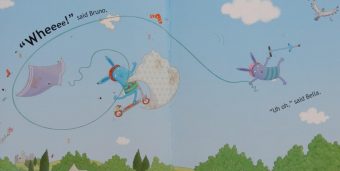
Twin rabbits Bruno and Bella and back in a second story. Bruno is thrilled to bits with his brand new scooter, practising eagerly using alternate legs and travelling at different speeds in different places. The only trouble is he forgets to perfect one crucial aspect of the entire process: how to use the brake. This precipitates some high drama as he whizzes downhill, through fields, a garden, the market and the park before Bella finally catches up with him – almost.

Anyone for a repeat performance?: Bruno certainly and I’m pretty sure very little humans will demand a re-run too; it’s smashing fun and who can resist Bruno’s enthusiasm?
And for slightly older listeners:

Sandy Sand Sandwiches!
Philip Ardagh and Elissa Elwick
Walker Books

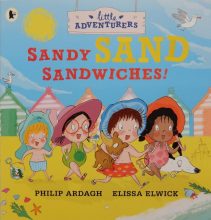
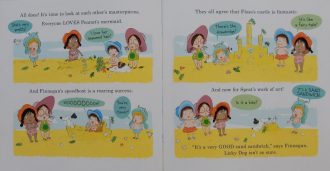
Philip Ardagh and Elissa Elwick’s ‘sticky stickers’ awarders, The Little Adventurers return with their zest for life and bonhomie. It’s a very hot day as they assemble in their HQ shed, collect the necessary items and await one of their number, Finnegan who eventually turns up already sporting his snazzy trunks.

Off they go to the beach in his daddy’s car, arriving full of enthusiasm but with a modicum of good sense as they share the safety rules before heading onto the sand for some sculpting.

Masterpieces complete, it’s time to stand back and admire each one in turn.

Then after ice-cream treats it’s off for some paired rock-pooling,

followed by shell collecting and an unplanned treasure hunt. Then it’s time for a quick dip before they all head home with a few grains of sand to remind them of their day and back at HQ, a final sticker awarding, including one to Snub for his very helpful ‘mouse-sitting’.

Brimming over with silliness, friendship, sandy treats and other adorable delights (including the occasional fact), this is a treat for littles around the age of the characters herein.

Finally, if you missed the original, there’s now a board book version of:

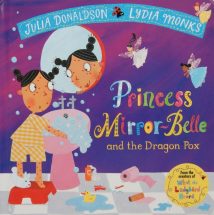
Princess Mirror-Belle and the Dragon Pox
Julia Donaldson and Lydia Monks
Macmillan Children’s Books

Now a tiny version of a favourite spotty tale for very littles.
Ellen has chicken pox; she’s covered from head to toe in horribly itchy spots; and what does she want to do to those spots? Scratch them, especially the one right on the tip of her nose. As she gazes in the bathroom mirror, about to do the deed, she hears a voice – no, not mum’s but Princess Mirror-Belle’s.

Thus begins a funny story, delivered for a change in prose rather than Donaldson’s more usual rhyme. Lydia Monks’ sparkle-spangled, collage constructed illustrations offer readers an abundance of opportunities for visual and tactile exploration.


Hedy Lamarr’s Double Life / Dreaming in Code


Hedy Lamarr’s Double Life
Laurie Wallmark and Katy Wu
Sterling

Elegant film star Hedy Lamarr’s first love wasn’t in fact for making movies – she wasn’t at all interested in glitz and glamour – rather her passion was science and technology. It’s this lesser known side of her that’s the focus of this book.

Her greatest invention was ‘frequency–hopping spread spectrum’ a wonderful technological idea developed in collaboration with musician George Antheil, that helped allow the communication devices of torpedoes to change frequency quickly cutting down the opportunities for radio signals to be altered, intercepted or blocked completely; sadly it wasn’t used by the US navy during WW2 though.

Still relevant today, their invention now helps to keep our mobile messages private and defends computers from hackers.

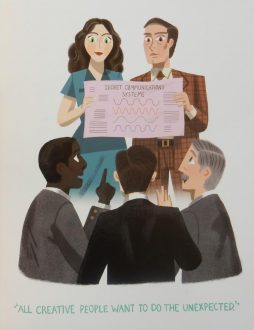
Hedy’s various inventions are described and each spread includes a quote from her: here’s one I particularly love.

We also learn of her childhood in Austria in the early 1920s and how her father, who also had a love of science and technology was such an encouragement to her curiosity and thirst for knowledge, and her creative ideas.

Laurie Wallmark’s engaging text is both inspiring and concise; and Katy Wu’s stylish, retro feel illustrations transport readers to the time when women’s achievements were under played and often undervalued (it took 50 years for her awesome brilliance to be fully recognised). However when Hedy and George finally received in 1997 the Pioneer Award from the Electronic Frontier Foundation for their contribution to computers, Hedy commented thus.’” It’s about time.” … “My life was full of colours, full of life … I don’t regret anything … I learned a lot.” Brilliance recognised at last.

So too will readers of this picture book, which also includes a timeline, bibliography, suggestions for further reading about women in STEM, a list of her films and an explanation of her secret communications system.

Equally inspiring, for older readers is:

Dreaming in Code
Emily Arnold McCully
Walker Books

This is a fascinating biography of Ada Lovelace, daughter of poet Lord Byron, who is celebrated for being the first computer programmer.

Ada’s childhood was anything but conventional; she never got to know her father and was brought up by her domineering mother who, despite showing little emotional warmth, provided for her daughter through private tutors, an intellectually stimulating education, a protection in part from any instincts towards developing her father’s poetic talent. Thus Ada developed a terrific thirst for mathematical and mental puzzles and scientific discovery.

At age seventeen, the young aristocrat Ada, was introduced at a party to widower and famous inventor and mathematician, Charles Babbage, who was to transform her life. We learn of their collaborative friendship and how Ada’s leap of imagination took her pioneering thinking beyond that of her friend and his ‘Analytical Engine’. This is what she wrote, ‘Many persons imagine that because the business of the engine is to give its results in numerical notation, the nature of its processes must consequently be arithmetical and numerical, rather than algebraical and analytical. This is an error. The engine can arrange and combine its numerical quantities exactly as if they were letters or any other general symbols.’

We read of her marriage to William King who admired Ada’s intellect as well as being rich and handsome; her motherhood years, her addictions and death at an early age from cancer.

Beautifully written by Caldecott-Medal winning author, Emily McCully this carefully researched, accessible portrait of Ada Lovelace is likely to inspire future groundbreakers to follow their dreams and not let anyone or anything stand in their way.

(There are also photographs from archives, illustrations, source notes, a glossary and a bibliography.)

Little Frida

Little Frida
Anthony Browne
Walker Books

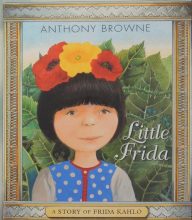
Who better than the inimitable, brilliant Anthony Browne to create a picture book about another brilliant artist, Frida Kahlo? And what a wonderful and surreal (it is Anthony Browne after all) story he tells. It was inspired by her ‘magic friendship’ and her “The Two Fridas’ self-portrait that she painted in 1939.

From the start our young narrator Frida says, her physical difference made her an outsider, often lonely but not unhappy at being ‘separate’, which she quite liked.
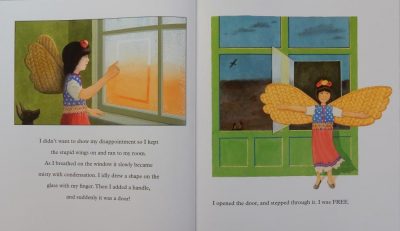
The wish to fly filled both her night-time dreams and her daydreams but her birthday dream of a toy plane is dashed when instead her parents give her a pair of wings. Rather than show her disappointment, alone in her room the young girl lets her imagination take flight.

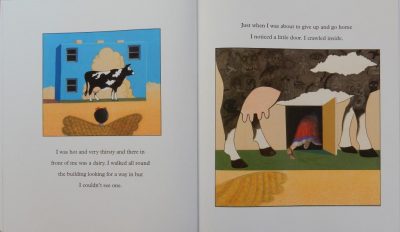
She runs and runs and when all her energy is spent she stops by a dairy. Finding no way in, she’s about to return home, another door opens,

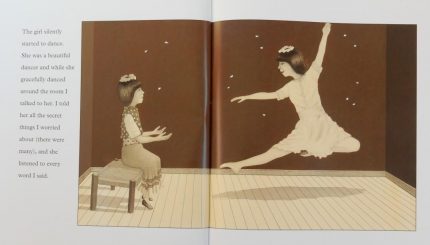
cascading her down, down to the earth’s depths and there she meets a strange but seemingly familiar girl.

This girl then begins a magnificent dance of life and while she does so, Frida shares with her, her own secret worries

and a close friendship is forged.

All too soon the time comes for Frida to bid farewell to her friend from the dairy and return to her own reality a much happier child than before, and ready to begin her artistry with a paintbrush.

Iconic Frida truly was, so too in his own way is, Anthony Browne. Allowing the imagination to take flight and soar so you become free is what Frida did and what Anthony has done here in his magnificent magical scenes, every one of which is packed with images that will inspire in readers further flights of their own fancy.

I’d love to show every single illustration but to see the rest, you will need to get your own copy of this stunning, out-of-this-world picture book.

B is for Baby

B is for Baby
Atinuke and Angela Brooksbank
Walker Books

Here’s an absolutely cracking circular story that’s simply bursting with love. Atinuke’s verbal narrative focuses entirely on things starting with the letter B as she takes us on a journey through a West African rural landscape.
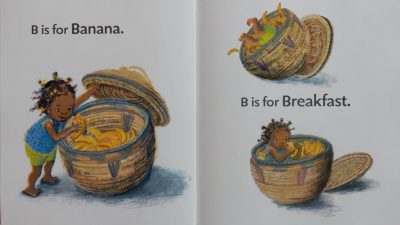
First though we meet the titular Baby; see her mother Beading her baby’s hair and Baby raiding the Banana basket, toppling in and partaking of some Breakfast.

Brother is next on the scene; in he bops and loads said basket complete with baby, on the back of his bicycle ready to go to visit Baba.

Oblivious to his stowaway passenger, he pedals along the Bumpy road towards Baba’s bungalow.

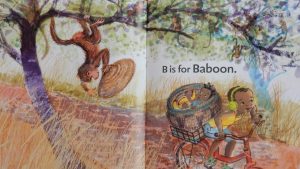
Passing beneath the Baobab – a Big one – they emerge into an area with fields either side; and a bird from the previous spread is now seen in full view with its gloriously coloured plumage – Beautiful – as is the blue butterfly that flies behind the bike, while ahead are trees filled with baboons.

As they pass under a tree a Baboon grabs the lid from the basket revealing the stowaway baby.

The journey continues with baby handing out a banana to a child leaning from the Bus window as they pause before crossing the Bridge (B is for Bridge) and before long they arrive as their destination: a Bougainvillea surrounded Bungalow outside which waits a happy-looking Baba … ‘B is for … Baba!’

That happiness increases enormously though when he opens the basket …

One shocked brother and an overjoyed Baba.

After all that there’s only one thing to do: sit down together and partake of some yummy snacks – ‘B is for Biscuit!’ as well as some bubbly bottled liquid refreshment; and I bet they polish off the whole lot.

A sensory delight if ever there was one, is this rural ride from one much loved family member to another. (The last two spreads show the return journey, which culminates back where the siblings started, and finally, a relieved-looking mama clutching tight her Baby.) Visually stunning, vibrant and infused with humour, the entire book is bursting with energy, warmth, rich colour and beauty.

A total treat to share and to pore over; an enriching must have for home, nursery or school collections and another terrific Atinuke/ Angela Brooksbank collaboration.

The Pawed Piper

The Pawed Piper
Michelle Robinson and Chinlun Lee
Walker Books

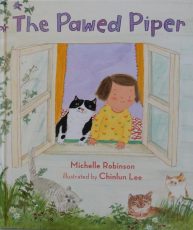
Michelle Robinson’s moggy twist on the Pied Piper legend was specially written for illustrator Chinlun Lee because her home in Taiwan has an over-abundance of cats. In addition Chinlun asked others to send pictures of their cats to her and as a consequence every feline featured herein is real.

The story begins with the small girl narrator telling us of her desire for a cat. She then relates how she goes about acquiring such a cuddlesome creature by means of kitty creature comforts along with some advice from her gran.

Preparations done, the child waits … and waits, but not even a kitten comes so she retires to bed, cuddles up with a book and falls asleep.
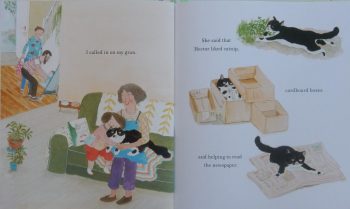
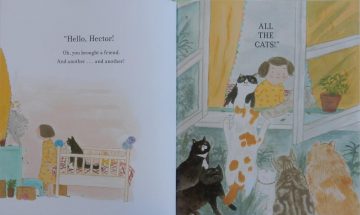
Suddenly though, something soft, warm and purry disturbs her slumbers: it’s her gran’s Hector but he’s brought some friends along with him, rather a lot of them.

Sixty seven moggies of all shapes, colours and sizes.

The next day our narrator enjoys the company of her new feline friends but on her way to return Hector to her gran, she makes a rather alarming discovery … She’s not the only one looking for a cat …

Gran’s instruction to return all her new acquisitions seems somewhat unfair but back at home the little girl makes an exciting discovery.

Even if like this reviewer, you’re not a feline fan, you’ll likely fall for Michelle’s furry tale that breaks into rhyme from time to time. Chinlun Lee’s cat characters are terrific – every one looks different and despite my allergy I almost felt myself reaching out to stroke some of the softest seeming, most cuddlesome-looking ones among them.

Snuggle up and share with your little ones, with or without an accompanying moggy and make sure you look at the endpapers.

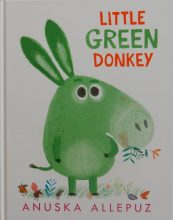
Little Green Donkey

Little Green Donkey
Anuska Allepuz
Walker Books

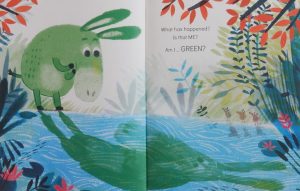
This is another absolutely delicious story from Anuska Allepuz. It’s narrated by Little Donkey who is, shall we say, a rather picky eater.

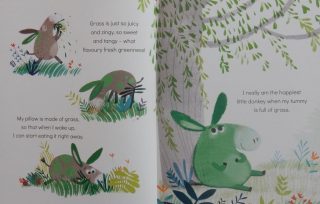
When we first meet him, his food obsession is grass: grass first thing in the morning, – he starts by eating his grassy pillow – grass all day, every day by all accounts.

On this particular day though our little grey ungulate friend hasn’t noticed the effects all this grass consumption is having upon him (observant readers doubtless will immediately do so) and as he heads off cheerfully for some refreshing water to quench his grass-induced thirst, he’s in for a shock.
What he beholds in the water certainly brings him up short and his immediate concern is what his mother’s reaction will be.

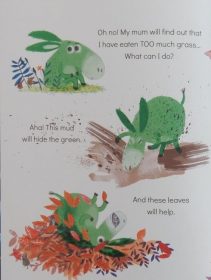
Some hasty disguise art takes place …

before Little Donkey heads home; but his Mum isn’t fooled at all. “It’s really time to try and eat some new food,” she urges.

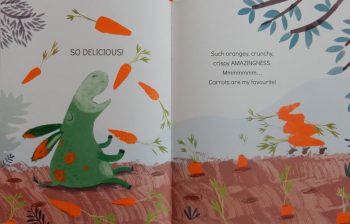
Her son’s response is to sample several different coloured items – oranges ‘too juicy’; watermelon- too seedy; broccoli too green – really? Apples are just too yucky; grapes are instantly ejected, but what about crunchy carrots? Now they are …

Uh oh! we know what’s coming …

Little ones, as well as this reviewer, will eagerly anticipate the finale as well as giggling helplessly at upbeat Little Donkey, his antics and his foodie fads as portrayed by Anuska. Adults will relish the opportunity to plead their case after sharing this tasty neo-cautionary tale with their own picky eaters.

A laugh-out-loud delight through and through – grey, green, orange or any other colour!

My First Book of Birds / Birds

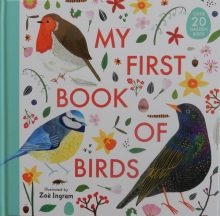
My First Book of Birds
Illustrated by Zoë Ingram
Walker Books

This is a smashing little book that introduces to youngsters twenty or so birds that commonly visit our UK gardens.
Such is the quality of Zoë Ingram’s illustrations that as well as taking delight in them, little ones can use them to help in avian identification.
After an opening spread explaining that the birds are presented in size order as well as talking about conservation status (this is given to each one in the ‘Bird Facts’ window) and feeding, each bird is showcased in a double spread.
The first is the tiny Goldcrest, Europe’s smallest bird, that over winters in Britain while the largest and final bird featured is the omnivorous Magpie that has a wingspan about four times larger than the Goldcrest.
In between are some real beauties including the mellifluous colourful Goldfinch;

the yellow-billed Blackbird and the glossy feathered, bold Starling,

As well as the facts window, each bird has a paragraph about such things as plumage, diet, song; plus there are egg facts and a ‘Did you know?’

Ideal for home use as well as to add to a primary school collection; it’s important that youngsters get acquainted with birds and this is a great starting point.

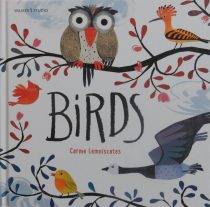
Birds
Carme Lemniscates
Walker Studio

Not a guide to birds, (although you will doubtless recognise most of those the artist includes but never names); rather, the words are at least in part, the thoughts of a little girl narrator as she moves around the countryside on foot, on her bike or even as a flight of fancy, on the back of a goose.
What starts out as straightforward observation, ‘Some birds are really big. // Others are tiny.’

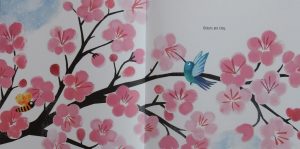
gives way about half way through to simile and metaphor: ’A bird’s song is like the loving words of a friend. // A happy song that greets us every morning. // And our hearts sing, too, because birds are like good news coming. // Or messages of peace.’

The digitally rendered illustrations are richly coloured, enticing and immediately attractive to little ones, though I do wonder if there’s a slight mismatch between the intended audience for the book and some of the latter part of the child’s narrative.

A book to use with one child or a few, rather than a class I suggest.

Builders & Breakers / A Bare Bear / In A Minute

Here are some picture books suggestions for your early years book collection:

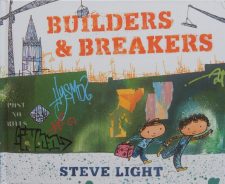
Builders & Breakers
Steve Light
Walker Books

Two small children, whose father has left behind his lunch box, are sent by their mum to give it to him. They run to his place of work, an urban construction site.

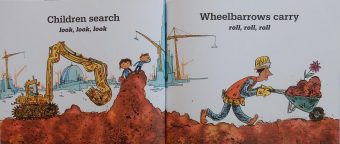
There they see the employees hard at work banging and jackhammering, digging

and welding, operating cranes and pushing wheelbarrows. – the entire structure creating process no less.

So noisy is the site and so intent on his work is their dad, that it takes a while for the children to attract his attention amid the bangs, rat-a-tat-tat-tats

and sparks, but eventually they do.

And then (sans hard hats), they’re hauled up to join him for a well-earned break perched precariously on a horizontal construction beam.

With its onomatopoeia, alliteration and other wordplay, Light’s minimal text is perfect for little ones to join in with during a storytime, and for beginning readers to try for themselves. No matter which, they’ll absolutely love Steve Light’s scribbly-seeming, intricately detailed scenes of the construction workers and the impressive machines they operate.

Don’t miss the endpapers or the author’s final note wherein he talks of his fascination with and love of, classical, Gothic and art deco architectural styles.

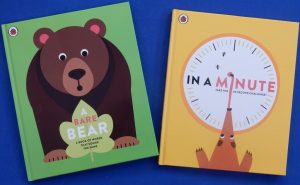
A Bare Bear
Caz Hildebrand and Ashlea O’Neill
In A Minute
Clare Lowther and Ashlea O’Neill
Ladybird Books

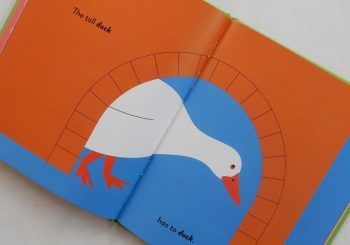
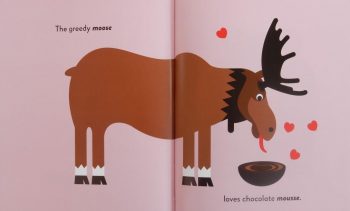
Subtitled ‘A book of words that sound the same’, A Bare Bear will certainly transmit the ‘language is fun’ message to little ones as well as demonstrating to adults the importance of word and language play in young children’s development.
It contains bright, attractive, humorous spreads depicting examples of homonyms

or homophones.

With the book’s contemporary feel and subtle language lessons, young children will have a good laugh at the same time as being gently educated into the delights and vagaries of the English language.

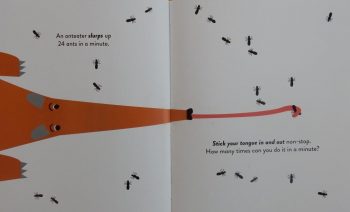
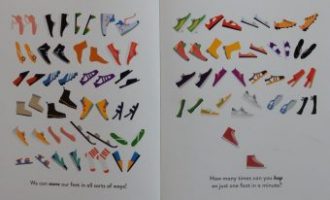
In a Minute invites readers/listeners to ‘Take the 60-second challenge!’ as it first makes a statement and then issues a related challenge on the opposite side of the spread.

Have lots of fun joining your early years children in such inviting activities as a minute’s competitive sticking your tongue out and in

or hopping on one foot.

Great attention has been paid to the design of each spread: I particularly like the one of two woodpeckers attacking opposite sides of a tree trunk, that of the star-jumping girl and … actually, they’re all immediately arresting and invite longer engagement.

Get counting, get active – what are you waiting for?

Everybunny Dream! / Hop Little Bunnies / This is Owl / Sleep, My Bunny

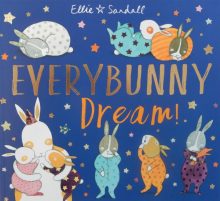
Everybunny Dream!
Ellie Sandall
Hodder Children’s Books

Ellie Sandall’s latest Everybunny tale is essentially a bedtime story.

Through a gentle rhyming narrative and a sequence of captivating scenes, some frolicsome, others more peaceful, we share in the bedtime ritual of the little bunnies as they respond to their mother’s instructions,

until they’re tucked up cosily under the covers.

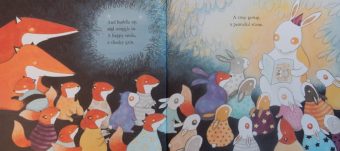
Who should appear suddenly though but another creature with a long orange bushy tail, also clad in night attire.

Before long there’s a host of baby fox cubs sitting with the little bunnies – who have now all hopped out of bed – avidly listening to a good night tale

and then it really is time to snuggle down altogether for some shut-eye and perhaps some pleasant dreams.

A lovely way to send your little ones off into the land of nod at the end of a busy day.

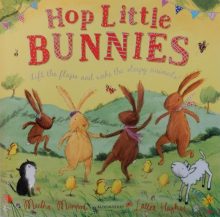
Hop Little Bunnies
Martha Mumford and Laura Hughes
Bloomsbury Children’s Books

Based on nursery favourite Sleeping Bunnies, Martha Mumford has written a jaunty text that includes not only the bunnies of the original song but also fluffy lambs, tiny chicks, kittens and ducklings

all of which sleep until noon and wake up and make lots of noise.

They then go on to play for the rest of the day before a bedtime song sends them all off to sleep once more.

With plenty of flaps to investigate and sounds to make, Laura Hughes charming rural illustrations add to the springtime bounce of Martha’s words.

This cheery charmer is likely to become a much requested book for young listeners be that at home or in an early years setting.

After an initial sharing I’d suggest an action packed story session with sleeping, hopping, leaping and swimming, not forgetting baa-ing, cheeping, mewing and quacking.

Another book that invites interaction is:

This is Owl
Libby Walden and Jacqui Lee
Caterpillar Books
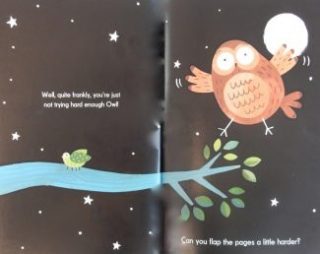
The sun is shining, Owl is fast asleep and doesn’t want to wake up but the book has to start so the reader’s help is needed to rouse our feathered friend.

Tummy tickling is only partially successful so the sun needs to be extinguished and replaced by a moon.

Hurrah Owl now has both eyes open but Beetle further along the branch is causing a distraction.

A considerable amount of page flapping is required to help Owl reach Beetle but then they both disappear. Oops! Where can Owl be?

With the help of several more birds Owl is eventually located and it seems one has become two for alongside is Other Owl.

Strangely the pair of them are doing a little uncharacteristic nest building so a bit of twig collecting from reader’s won’t come amiss.

Sometime later, once that threatening raincloud has gone, Owl has something in the nest to show off to readers.

By the time the sun starts to come up once again, two owls have become three and it’s time to bid them all farewell.

Feathery fun with a tad of scientific learning included, Libby Walden’s gently humorous, guiding words, in tandem with Jacqui Lee’s eye-catching, funny illustrations will certainly make for an active animal shared book experience.

Sleep, My Bunny
Rosemary Wells
Walker Books

Here’s a lovely way to wind down with your little one(s) at the end of the day.

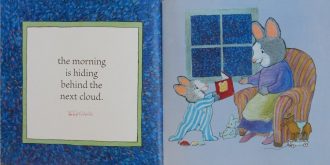
Rosemary Wells’ gently flowing text reads like a lullaby as it talks of the sounds of evening: the simultaneous song of owls and crickets; the night wind that has ‘taken the moon for a ride’, the first soft summer rain.

Alongside we see, in Van Gogh-like impressionist style, a sunlit tree outside and then as the sun goes down, a series of gradually darkening skies shown through the window, foregrounded by scenes of a little bunny going through his night-time routine with his mother and father.

On each spread the textual border mirrors the sky seen outside.

There’s obvious love and tenderness in this bunny family so adorably depicted in this lovely bedtime book.

What’s Next?

What’s Next?
Timothy Knapman and Jane McGuinness
Walker Books

Time and again Timothy creates wonderful picture book stories. Here’s another winner.

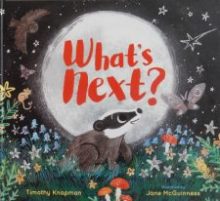
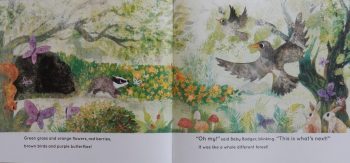
It tells of curious Baby Badger who loves nothing better than to go exploring; and having exhausted the possibilities in his underground home, he asks his father, “What’s Next?”

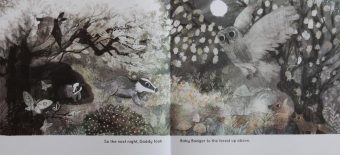
Daddy Badger’s response is to take his little one up and out to the forest the very next night.

It’s an exciting place with soft moss to roll in, and bluebell bulbs to snuffle for.

Under the starry sky, Baby Badger thanks his dad, inquiring again, “What’s next?” Daddy points out the sinking moon and announces that since day is coming soon, it’s time for bed.

Little Badger understands that next comes daytime and this too stimulates his curiosity, all the more so since his dad has only dim memories of the daylight world.

Unsurprisingly sleep eludes our ever-inquisitive little friend and he follows his nose out of the sett once more.

The daylight forest is certainly a bright, colourful, exciting place;

but it’s also rather lonely and proves an overwhelming experience for Baby Badger, who now wants nothing except his cosy home and his beloved Daddy.

You can easily imagine what comes next – a wonderfully satisfying finale …

Jane McGuinness has created the perfect pictures to illustrate this smashing story. Rich in detail and beautifully textured, her mixed media scenes of the natural world provide delight at every turn of the page.

A smashing book to share with little ones that will likely stimulate interest in the natural world.

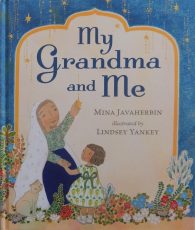
My Grandma and Me

My Grandma and Me
Mina Javaherbin and Lindsey Yankey
Walker Books

What an utterly gorgeous book is this tribute to a beloved Iranian grandmother from the young Mina with whom she lived.

The two do everything together be that cooking, cleaning, praying or visiting neighbours: grandma is the centre of Mina’s universe.

There are companionable times when two sets of best friends – young and old – play, or chat and knit together;

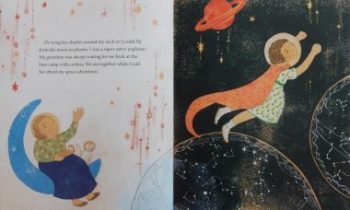
occasions that will make readers laugh, like Mina’s account of draping her grandma’s beautiful chadors to build a rocket ship or using one to transport her on her astro-explorations.

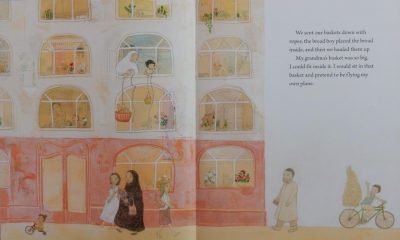
Be it during Ramadan, when the two would visit the mosque together for midnight prayers; or showing ingenuity over getting a fresh loaf daily without leaving their 3rd floor apartment,

this autobiographical celebration of a special intergenerational bond is truly special; in part because it’s a portrayal of a culture and country relatively few children will be familiar with.

With her lovely patterns, Lindsey Yankey’s beautiful, respectful visual portrayal is the perfect complement to Mina’s written memories in a book that transcends cultural boundaries and speaks to everyone.

The Princess in Black and the Mysterious Playdate / The Princess in Black and the Science Fair Scare

The Princess in Black and the Mysterious Playdate
The Princess in Black and the Science Fair Scare

Shannon & Dean Hale, illustrated by LeUyen Pham
Walker Books

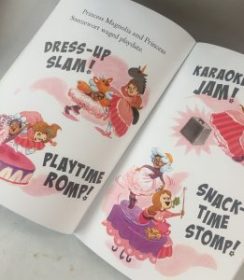
I know a fair number of newly independent readers who will be dancing in delight at these latest The Princess in Black stories.

In the Mysterious Playdate, Princess Magnolia, aka the monster-fighter, Princess in Black has an engagement with Princess Sneezewort.

Off she goes, accompanied by Blacky, to execute her ‘mysterious plan’ leaving Goat Avenger guarding the hole into Monster Land to prevent any monsters escaping. Or so she thinks, for a shape-shifting monster is following her and manages to hide away on her carriage as Frimblepants pulls it to her friend’s kingdom and her castle residence.

While the two princesses play

the monster’s hunger gets the better of him and he tries to eat someone’s kitten.

Soon both princess have made excuses to leave the castle, donned disguises and set out to rescue the little animal.

When kitten’s duly saved there’s still the matter of the elusive monster. With ninja moves aplenty, they might just succeed in capturing the monster as well as keeping their secret identities undiscovered.

Princess Sneezewort is a thoroughly delightful addition to the bum-wiggling superhero troop in this action-packed treat.

In the Science Fair Scare, Princess Magnolia’s destination is the Interkindgom Science Fair, an event she hopes to keep monster-free especially as she’s going to present her project poster on the growth of plants.

Once there though, having met her friends, she begins to feel her project is inferior to those of the other participants particularly that of Tommy Wigtower. His talking volcano soon has the princess’s alarm bells ringing.

Happily her new friend aka The Princess (Sneezewort) in Blankets just happens to be nearby and before long a fierce battle is under way and it’s not just those two princesses, but three more, who join the fray.

Can they succeed in their endeavours to prevent the goo monster from devouring everything in its path?  Perhaps it could find a new home through that hole to Monster Land so zealously guarded by The Goat Avenger.

Welcome three more princesses to the superhero brigade. It’s good to see an addition to the series of a STEM story with its teamwork and spot of problem-solving alongside the monster pounding.

Another satisfying tale from the Hales with as always, splendidly spirited illustrations from LeUyen Pham.

Toppsta have a new reading record that is particularly appropriate for school use: see the details on Toppsta

Circle

Circle
Mac Barnett and Jon Klassen
Walker Books

This is the final book in the Shape trilogy that featured first Triangle and then Square as main character; now it’s the turn of Circle.

One day at Circle’s suggestion, the three friends embark on a game of hide-and-seek. Circle stipulates one over arching rule: “No hiding behind the waterfall” because it’s dark there.

Circle completes her counting, only to learn from Square, who has remained static, that Triangle has gone behind the waterfall.

Off goes Circle to find him and as she goes deeper in, the double spreads gradually darken

until everything is black save Circle’s eyes.

Then out of the darkness another pair of eyes appears belonging, Circle assumes, to Triangle. She starts chastising her ‘friend’ but no answer is forthcoming.

There appears a third set of eyes and it’s these, it transpires, that belong to Triangle.

It turns out that the since Square is outside, the other eyes belong to they know not whom. Circle asks the shape before her once again, “Who are you?” and again receives no answer.

Circle and Triangle rush back in fright, back towards the light and the outside where Square is waiting.

Once safely back in the daylight, Circle ponders upon the identity of the shape; perhaps it wasn’t bad after all. “It might have been a good shape. We just could not see it,” she posits.

An important inherent message from Barnett in our xenophobic times no matter which side on the Atlantic we live on.

His story has an open ending, concluding with a question for readers. It does however suggest that we can perhaps overcome our fears by remaining calm and mindful, rather that letting them overwhelm us.

In his watercolour and pencil, digitally worked style illustrations, Klassen portrays the friends’ emotions with his characteristic minimalist, brilliance.

A book to ponder upon and discuss.

For All the Stars Across the Sky

For All the Stars Across the Sky
Karl Newson and Chiaki Okada
Walker Books

If you’re looking for a gorgeous bedtime story then Karl Newson’s new book will surely fit the bill.

It’s time for little Luna to get ready for bed. Mum’s there to bid her goodnight but first there’s time for a wish: “For all the stars across the sky, / Big and little and bright, / Here’s a wish from me to you, / Before we say goodnight.”

They close their eyes and wish as they take off on some amazing adventures. They fly like birds, soaring through the clouds on a trip around the world; they dive deep and swim together to the accompaniment of whale song;

they shrink to ladybird tinyness and gaze at the sky …

and then, normal size restored, stomp giant style all the way back home for lights out, a special goodnight kiss and … sweet dreams.

Mum bear’s love for her little one shines forth from Karl’s gentle telling which sounds like a softly spoken lullaby.

New to me, illustrator Chiaki Okada brings her own magic to every single page in gently glowing soft focus scenes of both the bedtime ritual and Luna’s flights of fancy, elegantly rendered in appropriately muted tones that draw you further into the story.

Everything about this book is special; words, pictures and the design too, all contribute to the sense of peacefulness and the warmth of the parent/child relationship.

Maya & Cat

Maya & Cat
Caroline Magerl
Walker Books

I’m not sure whether it’s the words or pictures of Caroline Magerl’s moggy story that I love better; both are absolute delight.

Through gorgeous poetic language and wonderfully whimsical watercolour and ink illustrations, the author/illustrator conveys the tale of Maya and what happens then she hears Cat ‘rumbling a rumbly purr’ out on the wet roof and decides it needs rescuing.

Having lured it down with a fishy treat, with Cat following behind her, she sets out to discover the whereabouts of its home.

She tries many places but Cat isn’t the right fit and then, with Cat leading the way, they eventually find … home.

It’s time for Maya to hand over her charge: is this story to have a sad ending for the determined little girl?

Maybe not …

With her trailing feather boa, fluffy hat and pompom on a stick, Maya is a delightfully quirky character that readers are sure to fall in love with; and Cat too is adorable, even to this cat-allergic reviewer.

Each spread of the book has a wealth of enchanting detail that’s well worth spending time poring over and when read aloud, the gently humorous tale is a treat for both adult and children.

Nibbles Numbers / Little Fish and Mummy / Where’s Mr Duck?

Nibbles Numbers
Emma Yarlett
Little Tiger Press

Emma Yarlett’s little yellow book-eating monster Nibbles is back and now he’s got his teeth into a board book. One might think that chomping through card would be a challenge too far but no. Once released the little fellow immediately starts sinking his gnashers into the pages and even has the audacity to nibble into the numerals leaving fairly sizeable holes.

Moreover he’s sabotaging our counting practice and just when we think we’ve cornered the little munching rascal, he makes a dive for it and disappears through the final spread, only to emerge on the back cover with a satisfied grin on his face.

Smashing fun and what a delight to be able to introduce my favourite little monster Nibbles to a younger audience.

Little Fish and Mummy
Lucy Cousins
Walker Books

The latest Little Fish book is narrated by none other than Little Fish who is particularly excited about sharing with listeners a ‘Mummy Fish and me’ day.

This special day is spent on lessons in swimming and bubble blowing, splishing and splashing with all the other fish, a game of hide-and-seek just with Mum and a look inside a deep down cave.

What better way to end such a great day than with a round of kissing – ‘Kiss, kiss, kiss!’

Irresistible if you know a little one who’s a fan of Lucy Cousins’ endearing spotty Little Fish, and I certainly know a lot of those.

Where’s Mr Duck?
Ingela P Arrhenius
Nosy Crow

The latest felt flap hide-and-seek board book in this deservedly popular series is set around the pond. In its environs little ones can discover Mrs Butterfly, Mr Frog,

Mrs Worm, Mr Duck and finally as the creatures look on, him or herself.

With its characteristic question and answer format, a wealth of opportunities for developing language, bold bright art and satisfying conclusion it’s no wonder the series is such a success; this one will be as popular as its predecessors.

Bear Moves

Bear Moves
Ben Bailey Smith and Sav Akyūz
Walker Books

The purple ursine character from I Am Bear returns and, sporting his sweatbands, he’s in groovy mood.

With Bunny on DJ duty it’s time to show off those funky moves. First off it’s Furry Breaking – wow this guy certainly has attitude!

Next we have Running Bear, quickly followed by the Robot and there’s even a spot of limbo.

Should this character be auditioning for the next Strictly Come Dancing series one wonders as he grabs himself a partner and switches to ballroom mode with a foxtrot

This he follows with a doughnut fuelled Belly Dance,

a quickstep – oh no that’s his pal squirrel attempting to beat a hasty retreat – and next, bums a-winding, everybody do the twist.

Even then, this dance enthusiast isn’t quite done but for his grand finale he requires an altogether sweeter partner …

It’s pretty exhausting all this dancing so you won’t be surprised that Bear’s last move is into sleep mode zzzzz …

You can really feel and hear the beat in rapper Ben Bailey Smith’s (aka Doc Brown) rhyming text, while Sav Akyūz shows the action both frenzied and smooth, in bold colours outlined in thick black lines

Great for child participation is this zany offering.

Kiss the Crocodile

Kiss the Crocodile
Sean Taylor and Ben Mantle
Walker Books

Down in the jungle, Anteater, Tortoise and Monkey are in playful mood when they’re spied by Little Crocodile. He’s eager for them to join him in a game of Kiss the Crocodile. The rules are pretty straightforward – the clue’s in the name – but the proviso is that the little croc. pretends to sleep and must not be woken up.

Are they brave enough?

Seemingly so, and first to make a move is Anteater.

Mission successfully accomplished, Tortoise is next

and what a smoocher!

Only Monkey remains and having summoned up all her courage, off she goes – uh oh! She’s in for a big snapping surprise.

The game is over, but will Little Crocodile abide by the rules or is it the end for Monkey?

It’s not only those jungle animals that are in playful mood, so too is Sean Taylor. His present tense telling has just the right amount of mischief, suspense, some delicious onomatopoeia and that frequently repeated imperative title – a perfect storytime recipe for entertaining your little ones.

Equally irresistible are Ben Mantle’s comical, wonderfully expressive scenes of the action – giggles guaranteed on every spread.

Duck!

Duck!
Meg McKinlay and Nathaniel Eckstrom
Walker Books

Not a lot happens in this book until right at the end but nonetheless it’s absolutely hilarious throughout.

So, without further ado, let’s head over to the farm where one afternoon, horse is swishing his tail; cow is chewing the cud; pig is wallowing in mud and sheep is sheeping on the grass (love that).

Into this tranquil setting charges Duck, yelling a single word, “DUCK!”

Needless to say the other animals don’t appreciate this intrusion into their peace and each in turn attempts to explain to the noisy creature that they are not ducks; he is.

However, Duck’s message merely grows more strident.

By the time accusations of rudeness and lack of understanding have been hurled at the little animal, Nathaniel Eckstrom’s deliciously droll illustrations are foreshadowing the impending catastrophe that the chastisers are oblivious to but savvy audiences will be eagerly anticipating. To divulge more about this would spoil the grand finale.

With a simple misunderstanding at its heart, Meg McKinlay’s telling is enormous fun and the self-descriptions of the disgruntled animals absolutely wonderful, while the repeated “DUCK!” exclamation cries out for loud audience participation.

In addition, expect a plethora of giggles when you read this cracking story aloud, and be prepared at the end, for cries of “again!” from listeners.

Non-Fiction Miscellany: Ambulance Ambulance / Weird Animals / Castle Adventure Activity Book

Ambulance Ambulance
Sally Sutton and Brian Lovelock
Walker Books

An ambulance crew responds to an emergency call out: a boy has come off his bike and ‘Nee nar nee nar nee nar nee nar …’ off goes the ambulance to the scene of the accident.

On arrival the paramedics make the necessary checks, put a splint on the child’s broken leg and carefully lift him onto a stretcher and into the ambulance.

Then with horn honking and lights flashing, off they go racing to the hospital, “Quick, quick quick. ‘Nee nar nee nar nee nar nee nar … ‘

Once the boy is safely inside and the hand-over complete, the crew are ready for a rest, but it’s not long before another emergency call comes and so off they go again …

Team Sally and Brian are already well known for their previous picture books such as Roadworks and Construction. Non-fiction loving little ones delight in these books and will doubtless relish this one with its bright illustrations, especially since its rhyming text comes with opportunities for joining in all those ‘Nee nar’ sounds. Share at home or in a nursery setting and watch the response …

Weird Animals
Mary Kay Carson
Sterling Children’s Books

The world of nature is full of strange and wonderful creatures, large and small, a dozen or so of which are featured in Mary May Carson’s Weird Animals. The author specialises in writing non-fiction for children and those with an insatiable appetite for the fantastically weird will enjoy her latest book.

It explains the whys and wherefores of some amazing adaptations, those odd characteristics that help these creatures survive and thrive.

Take for example the Pink Fairy armadillo with its oversized feet and fluffy underside that helps keep the creature warm through cold desert nights.

The frightening-looking fauna from different parts of the world include insects, reptiles, birds, fish, mammals, with explanations for their appearance. Weird and wonderful they surely are.

Castle Adventure Activity Book
Jen Alliston
Button Books

Children should find lots to explore in this engaging historical activity book. There are mazes, matching games, word searches, colouring pages that include things to spot of a medieval kind. Observation skills are also required for matching games, determining the winner of a joust, searching for rats in the castle kitchen and more.

There are medieval scenes to complete by drawing and adding stickers as well as a number of crafty projects. Some, such as making a sword or a conical hat for a princess, require additional items – paper, card, scissors etc. and may also need adult assistance.

Some simple maths, words to unscramble and a scattering of jokes are also part and parcel of this themed compilation that’s a fun alternative to constant screen use.

Tooth / Big Kid Bed, Bizzy Bear Knights’ Castle, Mix & Match Farm Animals

Tooth
Big Kid Bed

Leslie Patricelli
Walker Books

Baby, the star of several previous board books including Toot returns in two further amusing and appealing episodes.

Tooth begins with the star of the show exhibiting some distress about a strange feeling in the mouth. Before long we discover that Baby is getting a tooth, shiny, white, hard and sharp. Not just a single tooth though, there’s another and then two more follow.
Having shown those shiny gnashers, Baby demonstrates some things good and not so good that can be done with the teeth.

Very important too is taking care of teeth and we see how even one so small is conscientious about dental hygiene.

Brushing twice a day and flossing (with Daddy and Mummy’s help) are part of the little one’s daily routine.

Patricelli’s straightforward first person text combined with scenes of the adorable Baby is irresistible.

The same is true in Big Kid Bed. Here the toddler tells of bedtime preparations for a sleep on ‘my new big kid bed!’ How exciting; but the bed is so big and the toddler so small it’s as well that Mummy and Daddy are on hand to make things easier, piling up pillows around the bed in case of a fall and bringing in Baby’s stuffed animals to snuggle up with.

Comfortable as Baby might be, there’s the possibility of getting out of bed again to investigate what other members of the household are doing during the night, until finally, YAWN; sleepiness takes over and it’s time to return to the warmth and cosiness of that new bed for a good night’s sleep.

Who could ask for more from a bedtime book for the very youngest?

Bizzy Bear Knights’ Castle
Benji Davies
Nosy Crow

In this adventure Bizzy Bear finds out what life as a knight is like when (with a bit of help from small fingers that slide the helmet visor up and down) he dons a perfectly fitting suit of armour and visits a castle.
Once kitted out and inside, Bizzy tries his paw at brandishing a sword

and then on the next spread, at jousting before finally sitting down to participate in a delicious-looking banquet.

As with other titles in the series, the engaging simple rhyming text, brightly coloured illustrations with just the right amount of detail (look out for the dragon) and those interactive features – sliders and tabs that are easy to use, make this well-constructed book ideal for toddlers.,

Mix & Match Farm Animals
Rachael Saunders
Walker Books

With the same innovative design as previous titles in this mix & match series (a tiny board book within a small one) young children are invited to match the larger surrounding page with its ‘Who says …?’ question to the appropriate smaller inset animal spread showing the animal that makes the sound.

The animals featured in the smaller book are all adult while on the surrounding pages young animals are depicted, as well as other appropriate clues, for instance there’s a calf, a bull, a barn and a bucket of milk on the ‘cow’ spread.
On the final ‘sheep’ spread we meet a farmer and sheepdog in Rachel Saunders’ illustration.

A clever format, and a playful and enjoyable way to introduce or re-enforce farm animal sounds to the very youngest

Isle of You

Isle of You
David LaRochelle and Jaime Kim
Walker Books

The unseen narrator invites a sad-looking child to leave all worries behind and take a journey (a sailing boat awaits) to a very special place – the Isle of You. This fantastical land is one bathed in soft llght and on shore are a host of welcoming animals and small humans ready to indulge their visitor.

Choices abound: there’s a waterfall in which to swim, a stallion to ride, mountains to climb or perhaps a ride on the back of an eagle, or a restful stretch in a hammock is preferable.

‘Take your time. The choice is yours.’ That’s the assurance.

There’s entertainment laid on courtesy of dancing polar bears

and a delicious-looking feast to partake of before perhaps, a moonlit stroll on the beach before it’s time to depart, safe in the knowledge that ‘Someone loves you very, very, very much.’

This reads like a guided visualisation in picture book form – mindfulness for little ones after a bad day.

David LaRochelle’s gentle whimsical story is a sweet one (perhaps some will find it overly so) and Jaime Kim’s glowing pastel shades of yellow, pinks, blues and purples help bring feelings of comfort and an otherworldy atmosphere to a fantasy that will help youngster listeners, (safe in the knowledge that it’s sometimes okay to feel sad), to set aside the day’s trials and worries and undertake a mindful journey to a magical place, that’s closer than they think, the ISLE OF YOU.

Flat Cat

Flat Cat
Hiawyn Oram and Gwen Millward
Walker Books

Pampered puss Jimi-My-Jim, living a seemingly idyllic life with Sophie in a flat at the top of a tall block, does his very best to show his appreciation. As a result Sophie has no idea that her pet longs to be a part of the outside world.

When Sophie and her parents leave home each day why, you might wonder, does he merely sit at the window watching life go by? I certainly did.

Little by little his pampered, prison-like existence takes its toll: the creature begins to flatten out until he looks utterly two dimensional – he’s become, in the style of Jeff Brown’s human boy hero Stanley, a FLAT CAT.

Then one day, Sophie and her Mum leave him alone. Now here I anticipated Jimi sliding under the door, but no. In their haste, the two forget the keys giving him the perfect opportunity to take action. He dons his coat, grabs the keys, does a spot of climbing and exits onto the street, destination another feline he’s had his eye on.

Streetwise Blanche introduces herself and offers to show Jimi around. Together they explore the city;

Blanche takes Jimi to meet all her feline friends and a few canine ones as well; but  evening comes all too soon and Jimi doesn’t want to say farewell.

Instead he invites his new friends home and even thows a party for them.

What on earth will Sophie and her parents do when they return? Could it be the end for Jimi’s forays into the big wide world?
Let’s just say it’s a happy ending and not just for the main protagonist …

I’ve always been a rule-breaker so thoroughly enjoyed Hiawyn’s tale of freedom, adventure and friendship, feline style. Gwen Millward’s distinctive naive, flat cartoon illustrations are a purr-fect portrayal of Jimi’s jaunts and underscore the message that freedom, love and friendship not material things are what make people happy.

Pigsticks and Harold: Lost in Time / Pigsticks and Harold: Pirate Treasure

Pigsticks and Harold: Lost in Time
Pigsticks and Harold: Pirate Treasure

Alex Milway
Walker Books

With aspirations to become more like his brilliant inventor Great-aunt Ada Lovepig, Pigsticks is busy preparing for the Tuptown Science Fair – the ideal place to demonstrate his own inventive prowess. There’s a problem though; it’s the day of the competition and his entry for Best Invention is not going at all well, indeed it’s a mess.

But then Pigsticks comes upon a time machine left by said Great-aunt and he enlists a rather reluctant Harold, (fuelled by thoughts of yet to be invented cakes) to accompany him to the future where he’s certain they’ll discover how to build a real spaceship.

However, thanks to some hamfisted handling of the time lever at the start of their travels, the two find themselves not going forwards in time but hurtled way back for a scary encounter with dinopigs.

That though is only the start of their adventure: thereafter they slide straight into Cleopigtra, fall into a flaming London – ‘what’s so great about his fire?’ Harold asks; do a spot of dangling in New York City and bump into Julius Squealer before being captured by one Hamfrida, the Viking chief and her vicious minions.

It looks as though the end is nigh for our time travelling twosome; or, could cake perhaps be their salvation …

Fast paced and full of superbly silly moments, not to mention some very sticky ones, with its delicious wordplay this twisting, turning romp, the fourth of the hilarious Harold and Pigsticks series, is another winner for early chapter book readers especially.

Said readers will relish Alex Milway’s comical illustrations that are liberally scattered throughout the tale.

Another laugh out loud adventure of the two friends is:

Pigsticks and Harold: Pirate Treasure
In their third adventure, Tuptown is under threat from one Sir Percival Snout who claims their much-loved town belongs to him and what’s more, he has the paperwork to prove it. Or so he claims and he plans to destroy the entire town unless the pair can find a vast sum of money by the very next day.

Finding the three million pounds Pigsticks has so recklessly agreed to come up with is totally crazy since the pig is absolutely penniless.

Fortunately though Pigsticks then remembers that his great-great-grandpig was a pirate who’d left a legacy of treasure buried somewhere as yet to be discovered.

All the two friends need to do is to solve the riddle on the map his ancestor had left behind. With clues to follow, there’s little time to discover the whereabouts of that treasure and thus save Tuptown.

As always with these comic capers, there’s a wonderful final twist in the tale.

If your newly independent readers have yet to encounter Milway’s Pigsticks and Harold, I suggest starting at the beginning and binge reading the whole series from the start; those who already know the duo will delight in this cracking adventure.

Dreamland

Dreamland
Noah Klocek
Walker Books

Unlike most young children, Amelie puts up no resistance at bedtime; indeed she loves everything about it – snuggling into her favourite blanket and listening to bedtime stories,

but most of all, she loves to dream.

Her dreams however often prove elusive and she has to search for them.

At this point in the story, (with a nod to Sendak’s Where the Wild Things Are) we see a forest growing in her bedroom.
She finds herself in strange landscapes as various items from her room become part of the dreamscape:

is this journey all part of her dreams, is what listeners will wonder.

On Amelie marches taming whatever hides among the shadows,

dancing ‘past the tick and tock of the clock’ as she travels far and wide, through high clouds and deep dark waters until finally sleep embraces her; and a happy sleep it is for she’s ‘found herself in her favourite dreams’.

Dreamily enigmatic is Noah Klocek’s story while his ink and watercolour illustrations chronicle the mysteries of her night-time slumber.

A book for individuals to ponder over as part of their own bedtime routines.

A Year in Nature / My First Pop-Up Dinosaurs

A Year in Nature
Hazel Maskell and Eleanor Taylor
Laurence King Publishing

Subtitled ‘a carousel book of the seasons’, this opens out into a four-part carousel that is sure to engage and impress.
Detailed scenes of a woodland in spring, summer, autumn and winter leap out from finely cut out pages revealing the glories of each season.

These woods are home to a family of foxes and we share the growth of the tiny cubs over a year as they explore their surroundings.
In spring there are nesting birds in the branches of the trees and new life begins everywhere.
Come summer, visiting birds have arrived; there’s an abundance of butterflies recently emerged, as well as bees, dragonflies and grasshoppers to find.

By autumn the young foxes are almost full-grown; now they hunt for their own food among the fungi under the golden brown canopy while squirrels are busy overhead gathering nuts to store.

Winter sees many of the trees without any leaves but berries still add brightness to the forest-scape.

Eleanor Taylor’s lush artwork is absorbing, bringing a place of beauty to life – the next best thing to visiting a forest for real, and Hazel Maskell provides brief snippets of information that are set among the forest branches along with things to hunt for in each scene.

This book would look great as part of a display in schools, no matter the season and would also make a great gift for a young child, particularly an urban living one.

My First Pop-Up Dinosaurs
Owen Davey
Walker Books

Thanks to David Hawcock’s amazing paper-engineering, Owen Davey’s prehistoric creatures literally leap back into life as you open the pages of this sturdy little book. Showcasing fifteen popular and less well known beasts from Pachycephalosaurus to Pterodactylus, Ichthyosaurus to Iguanodon and Ankylosaurus to Tyrannosaurus,

Davey’s illustrations with their designs of spots, splodges and stripes are arresting in their greys, tans, browns, greens and blues.

A smashing introduction to the world of dinosaurs, with the name and pronunciation of each provided for each one. Doubtless adult sharers will delight in the book almost as much as the young target audience of aspiring palaeontologists.

Little Bear’s Big House / There’s a Dinosaur on the 13th Floor

Little Bear’s Big House
Benjamin Chaud
Chronicle Books

Tired of his uneventful life in the forest Little Bear leaves his Mama, Papa and Teeny Tiny bear to embark on a big adventure, “far from the forest” so he says.

His exploratory intent means that he turns down invitations from his forest dwelling friends, to keep moving
till eventually, as night falls he comes upon a huge, amazing-looking house in a clearing.
The door is ready to be opened so Little Bear, acting like a little boy, decides to enter.

Once inside the real adventure begins …

“Being on my own is so much fun!’’ comes the cry until there is an enormous BANG! Little Bear dives beneath the bedcovers and his imagination runs riot.

What ensues is something of a surprise but suffice it to say that when Little Bear finally reaches home after an adventure that proves a little too much for the young ursine character, he learns that he isn’t the only one with an exciting story to tell about a big house.

Hilarious scenes of Little Bear and his antics as he seeks a modicum of independence, offer plenty for little humans to pore over.

There’s a Dinosaur on the 13th Floor
Wade Bradford and Kevin Hawkes
Walker Books

Mr Snore, an extremely tired musician checks into the very grand-looking Sharemore Hotel hoping for a good night’s sleep. No sooner has his head hit the pillow however than he discovers that his bed is already occupied. He demands a new room and there are plenty of options starting on the second floor but he has no intention of sharing his slumber time with a pig so he calls the front desk again.

And so it goes on until despite the knowing porter’s unfinished warning, Mr Snore ends up at floor number thirteen. The bed is definitely gigantic and might at last prove satisfactory.

Now however, it isn’t Mr Snore who makes a call downstairs to the front desk …

With its crazy finale, nicely contrasting main characters and Kevin Hawkes’ zany illustrations, this romp of Wade Bradford’s truly is a bedtime tale with a difference.

Josie’s Lost Tooth

Josie’s Lost Tooth
Jennifer K. Mann
Walker Books

Josie shines at pretty much everything she turns her hand to at school, but when it comes to losing a tooth, she’s way behind all her classmates.

Her best friend Richard proudly tells of rewarding visits from the tooth fairy, which makes Josie determined to hasten the falling out of her slightly wobbly tooth. Despite her determined efforts – dangling upside down, chomping a particularly crunchy apple and chewy carrot sticks,

and the rather more drastic string pulling technique – the tooth remains lodged in her gum.

The prospect of having baby teeth for life makes Josie glum so Richard suggests a cheering-up game of sharks and squid chase.
The result is that Josie loses her tooth – literally – leaving her with nothing to hide under her pillow for the tooth fairy.

Richard kindly offers his shark tooth but it just won’t do. Instead Josie writes a note appealing to the Tooth Fairy, leaving it along with the shark tooth under her pillow.

Next morning what Josie discovers isn’t money but a very special surprise gift – a wonderful tribute to friendship, demonstrating the donor’s understanding of what is really important.

Jennifer Mann’s digitally worked pencil, pastel and collage illustrations have a delightful child-like quality and her dialogue is akin to that of children, making this an engaging tale of friendship run through with gentle humour. Those at the first tooth-losing stage in particular will love this.