Bloomsbury Young Readers

A Tiger for Breakfast
Narinder Dhami, illustrated by Christopher Corr
The Ugly Little Swan
James Riordan, illustrated by Brendan Kearney
Jack and the Jungle
Malachy Doyle, illustrated by Paddy Donnelly
Happy Birthday, Sausage!
Michaela Morgan, illustrated by Felicity Sheldon
Bloomsbury Education

These are four newly illustrated stories published in Bloomsbury Young Readers series for children who, as well as reading picture books, want to extend their range. These stories still have colour illustrations breaking up the text on every page but have short chapters.
Those who are familiar with my background will probably be aware that I am no fan of reading schemes, controlled vocabularies or book bands and these stories are ‘levelled’. They are however, the work of established children’s book authors and illustrators and I’d happily include them in a classroom collection as books worth reading in their own right.

A Tiger for Breakfast has a folk tale feel to it and tells how farmer Ram’s wife, Reeta, tricks the hungry tiger intent on making a meal of the entire family. Christopher Corr’s richly coloured folk art style illustrations are an ideal complement to Narinder’s punchy text.

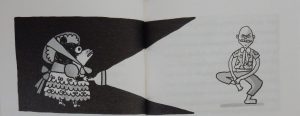
Turning the Hans Andersen classic tail up is James Riordan’s The Ugly Little Swan wherein one of a Mother swan’s hatchlings is ostracised by the others for being different. Herein, illustrator Brendan Kearney’s blend of humour and pathos speaks volumes.

Jack and the Jungle, tells what happens when young Jack kicks his ball over the wall of his new garden into Abbie’s next door. Could there really be snakes, a wolf and tigers living among all that vegetation, as she would have him believe?Young readers will enjoy the extended joke delivered through Malachy Doyle’s text and Paddy Donnelly’s equally lively pictures.

Happy Birthday, Sausage!, Michaela Morgan’s story extends over 48 rather than 32 pages. Herein poor dachshund, Sausage eagerly anticipates the ‘birthday’ party Elly, Jack and their gran are planning for him unaware that arrogant cats that share his home are intent on sabotaging it. Will their plot be discovered in time? This fun tale of subterfuge and assumptions will please readers, as will Felicity Sheldon’s scenes with their amusing details; her portrayal of the plotting felines and canine characters in particular is splendidly expressive.

Zanzibar

Zanzibar
Catharina Valckx
Gecko Press

Zanzibar the crow wants to be in the newspaper but can he impress special correspondent Achille LeBlab who comes knocking on his door? Seemingly not, for his talk of mushroom omelettes does nothing to inspire The Voice of the Forest lizard reporter, who leaves him his business card, just in case.

Dented though his ego might be, Zanzibar isn’t entirely deflated when he retires to bed that night. The lizard’s visit has set him thinking and the crow’s thoughts turn to a rather bizarre possibility. “I’m going to lift a camel in the air with just one wing!” he resolves.
Then comes the task of locating a camel but thanks to seagull mail deliverer, Zanzibar is soon on his way, heading south to find the desert and therein hopefully, a small skinny dromedary.
Further help comes courtesy of Sidi, a fennec fox that leads our traveller to a tent wherein resides the object of his desire.
When the task seems doomed, Zanzibar’s new friends come up trumps and then it’s back to the forest for the crow.

His mole pal, Paulette believes his astonishing story but what about Achille LeBlab?

Let’s just say that the power of friendship (not forgetting that of mushroom omelette) works wonders in this enormously engaging story that demonstrates that within us all lies something extraordinary. Also working wonders are Catharina Valckx’s charmingly droll, three colour drawings.

The Dragon in the Library / The Day I Found a Wormhole at the Bottom of the Garden

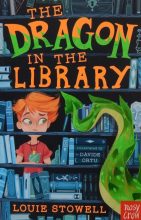
The Dragon in the Library
Louie Stowell, illustrated by Davide Ortu
Nosy Crow

Kit is anything but enthusiastic about reading; she much prefers to be playing outdoors and the library is definitely not her choice of destination on the first day of the summer holidays. But when her friends manage to persuade her to accompany them she discovers that she’s a wizard. Not just any wizard though, possibly the youngest ever wizard. The librarian doubles up as a wizard too.

Before long Kit learns that she has to play a crucial role in protecting the dragon sleeping in the library. The existence of the library itself is at stake though (the villainous Salt is determined to destroy it and it seems as though he knows too much about that dragon).

There’s another snag however, over-enthusiastic Kit is, shall we say rather impetuous in the use of her new-found power and it might be that her action has put not only the library but the entire world in danger.

The plot moves at a rapid pace and with its plethora of wonderful one-liners, allusions to other children’s books, and excellent characterisation, Louise Stowell’s debut story is a cracking one. Throw Davide Ortu’s illustrations into the mix and the magic becomes even more potent. ‘True magic’ indeed as the final words of the story say.

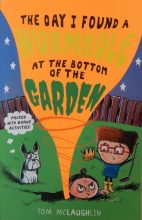
The Day I Found a Wormhole at the Bottom of the Garden
Tom McLaughlin
Walker Books

This book is totally crazy; it’ll likely have you giggling your way through in one gulp as you encounter its diverse cast of characters. There’s metal detecting enthusiast Billy and his trusty dog Shakespeare, Billy’s nan (who loves to snooze and in between bakes cakes (rocky ones) and watches television. Then come – thanks to the wormhole of the title – Queen Victoria, Roman warrior and wonky road builder Atticus, Einstein (self explanatory), Shakespeare – the real one this time and Professor Jones, scientist specialising in time travel and consumer of quantities of his favourite dunkable chocolate biscuity confection.

How on earth can all those co-exist you may be wondering; it’s on account of that time portal aka wormhole. When you toss into the mix a whoopee cushion, (it reminds Queen Vic. ‘of my Albert after a pork-pie session’),

a toaster – which according to HRH “has utterly blown one’s mind.”, a dinosaur and the frantic race to close that wormhole before the whole of history is forever altered, you’ll be sure Tom’s day cannot get any more complicated.

Splutter-inducing dialogue, a plot that moves so fast you almost have to run to keep up, and a liberal scattering of suitably silly drawings by none other than Tom himself, not to mention a quiz, a maze and instructions for making an olde quill pen, make for a terrific adventure to tickle the taste buds of independent readers.

It would make a super class read aloud too – as long as you don’t laugh so much you lose the plot.

Pink! / Alfred and the Blue Whale

It’s always good to discover new publishers so Red Reading Hub was excited to come across Wacky Bee Books to whom thanks for sending these for review.

Pink!
Lynne Rickards and Margaret Chamberlain
Wacky Bee

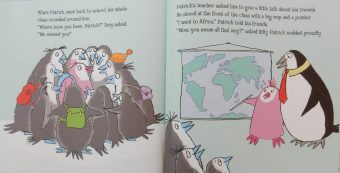
Patrick is a penguin, a pretty ordinary young penguin until one morning, shock horror; he wakes up and discovers he’s turned pink overnight.

Dr Black is no help suggesting that he tries getting used to his new hue. “But I’m a BOY! And BOYS CAN’T BE PINK!’ is his response.

At school, his fellow penguins tease Patrick until he’s had enough. Deciding he wants to fit in, he packs his rucksack and sets off to find the African flamingos his Dad had showed him in a bird book.

It’s a seven-day, seven-night swim but Patrick is a powerful swimmer and on day eight he reaches his destination.
The flamingos are friendly, inviting the newcomer to join them for lunch; but the visitor’s beak is all wrong, so things go very badly.

The same is true when Patrick tries out other things flamingo, like standing on one leg.

Patrick realises he doesn’t fit in here either.

Back home he swims. His parents welcome him; and then to his surprise, so too do his schoolmates. Indeed they’re mightily impressed by what their pink pal has to tell them about his travels; now being pink is cool.

Acceptance rules: not only Patrick but also his classmates have realised that real friends love you no matter how different you might appear on the outside.

With Margaret Chamberlain’s characterful illustrations, Lynne Rickards’ story of Patrick’s learning journey will help little ones both at home and in early years settings understand that diversity is something to be celebrated, as well as help challenge gender stereotypes.

Alfred and the Blue Whale
Mina Lystad, (trans. Sian Mackie) illustrated by Ashild Irgens
Wacky Bee

This is one of the publisher’s Buzzy Reads titles for those readers just starting to fly solo and has been translated from the author’s original Norwegian.

Young Alfred is scared of lots of things, but his worst nightmare is speaking in front of the class. Imagine how he feels then when he learns that everyone must take their turn to talk to the others about the animal named on the paper his teacher gives them.

Alfred’s animal is the Blue Whale and all he wants to do at the thought of the following Friday is to hide away.

Little by little though, he starts collecting information about the creature and the more he discovers, the more interested he becomes, so much so that he forgets about his nerves …

until Friday morning.

But then those scared feelings come flooding back. Can he summon up the courage to share all that Blue Whale information he has in his head with his classmates?

The author seamlessly includes a number of easily digested Blue Whale facts in her very readable story about facing your fears and self belief. (There’s also a final double spread fact file.)

Ashild Irgens’ plentiful illustrations convey so well Alfred’s fluctuating emotions over the five days from Monday till Friday.

Ariki and the Island of Wonders / Magical Kingdom of Birds: The Silent Songbirds

Ariki and the Island of Wonders
Nicola Davies, illustrated by Nicola Kinnear
Walker Books

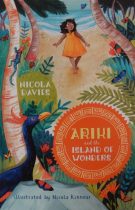
Nicola Davies’s sequel to Ariki and the Giant Shark is equally rooted in island life, the natural world and the Pacific Ocean.

Strong-minded Ariki and her good friend Ipo, who live on Turtle Island, ignore the advice of Ariki’s guardian to learn about wave behaviour from a bowl of water and set sail on Sea Beauty. “We’ll be in trouble, ” says Ipo as they discover the wind is rather stronger than expected and Ariki has to agree.
It isn’t long though before there’s a storm brewing and it’s impossible to turn back: the only option, they realise, is to let the storm blow them where it will.

After several days without food and virtually nothing to drink, they encounter a wounded whale that has become separated from its family, which the children help. The whale then assists them by towing them towards an unfamiliar island that looks like paradise.

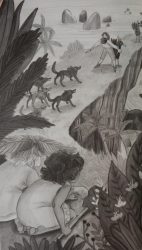
On the island they meet a strange man calling himself Crusoe McRobinson and learn of a dangerous creature the man calls “Dog”. There are in fact a number of these ‘dogs’ lurking and because of them the other island residents – humans and animal – as well as the two children, are in jeopardy.
Is there anything Ariki can do and if so will the two friends ever get back safely to Turtle Island?

Zoologlist story weaver, Nicola Davies cleverly entertains and educates at the same time in this gripping tale. Her affinity with the natural world shines through in her narrative with its vivid description of wildlife showing the interconnectness of human beings and the natural world.
To add to the magical mix, Nicola Kinner’s black and white illustrations perfectly capture the relationship between the human characters and nature.

Magical Kingdom of Birds: The Silent Songbirds
Anne Booth, illustrated by Rosie Butcher
Oxford University Press

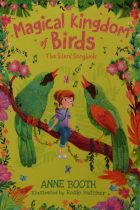
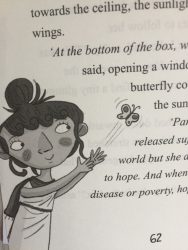
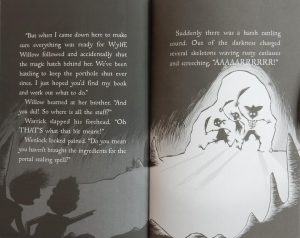
Combining magic and wonder with facts about birds is this latest story in Anne Booth’s series of chapter books for young readers that began when its main protagonist, Maya was made keeper of a very special colouring book that could draw her into the Magical Kingdom of Birds.

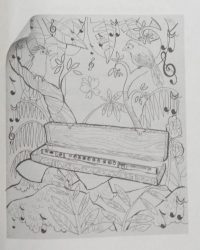
The picture that appears to draw her to the Kingdom (where in addition to being a schoolgirl she is the Keeper of the Book) in this adventure is this one.

Instead of the usual focus on one particular kind of bird, songbirds from many parts of the world are featured; the reason being there’s to be a special singing gala so her friend Willow tells Maya. But can they really trust Willow’s wicked Uncle, Lord Astor, who claims to have become a reformed character wanting only to bring everyone together in friendship?

Of course not: he has set his sights on stealing the songs of all the participants in the event and using them for his own nefarious purposes.

Maya certainly has a big problem on her hands and she also has to face up to singing in her school concert if she succeeds in saving the songbirds.

Another exciting episode, with Rosie Butcher’s enchanting black and white illustrations, this is certain to excite Maya’s established fans and capture some new enthusiasts for the series too.
(The final pages contain fascinating facts on the real birds that inspired the story, plus fun things to make and do as well as additional information about the plight of endangered Indonesian songbirds).

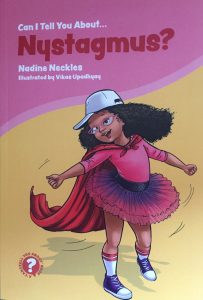
Can I Tell You About Nystagmus?

Can I Tell You About Nystagmus?
Nadine Neckles, illustrated by Vikas Upadhyay
Jessica Kingsley Publishers

I’ve only ever taught one child who had Nystagamus (due to his albinism). Now having read this excellent little book – the latest in the ‘Can I Tell You About series’, I feel ashamed about how little I really understood of the condition.

Herein a girl named Amber talks in a user-friendly manner about nystagamus -her ‘dancing eyes’, what this means for her in particular and about how she and other children with the condition will experience it differently, although they may share certain similarities such as taking longer to learn things. (This doesn’t mean they are any less clever than others however.)

We hear about Amber’s diagnosis (her eyes jiggle from side-to-side);

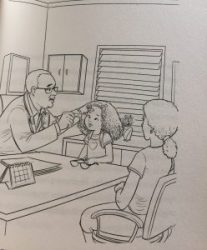
how she has to have regular eye check-ups; how she has to carefully adjust the way she sits to watch TV, preferably sitting right close to the screen; the need for her to wear glasses to prevent her ‘seeing double’ as she also has a mild squint.

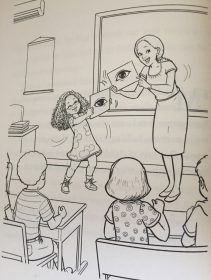
Starting school presented a challenge for Amber especially the frenetic-seeming playtimes. Amber’s school has made accommodations for her condition such as adding yellow tape to the stair edges, doorframes and potential places of danger; and her mum explained nystagmus to Amber’s classmates.

When in the classroom she has a special place to sit, is never asked to share a book or computer screen and has work printed on coloured paper.

Reading itself brings its own set of challenges but again there are aids to make things less tricky for her. Depth perception is a particular challenge, so ball games, (and other things requiring rapid hand-eye co-ordination), gymnastics and running are ‘tricky’.

Of course frustrations occur but Amber’s friends are understanding and Amber herself is bold, intelligent and resilient, refusing to let nystagamus define her.

The book concludes with some information for adults, an outline of associated conditions, an important checklist for professionals, a glossary and a list of recommended resources.

Easy to understand, this book, (written by a special needs life coach and mother of a child like Amber, with nystagmus and Chromosome 18q) encompasses all the important aspects of nystagmus making it an ideal introduction for anyone wanting to learn more about the condition be they children, parents, carers, teachers, and other professionals. Line drawings by Vikas Upadhyay show Amber as the sparky individual the author presented.

He’s Not Naughty!

He’s Not Naughty!
Deborah Brownson, illustrated by Ben Mason
Jessica Kingsley Publishers

Taryn and Jake are best friends, they’re almost inseparable, similar in lots of ways but also rather different for Jake has autism, and Taryn has taken it upon herself to explain for young readers (as well as teachers and other educators, carers, parents and family) what this means.

It most definitely does not mean, despite some of his behaviour, that he’s naughty. Far from it; rather his sensory processing disorder might result in him feeling explosive inside so that he flaps his hands and screams rather than participating in a supposedly fun activity.

Or, his tactile sensitivity might make him cast off his uncomfortable-feeling clothes or shoes and run around without the offending article(s).

Perhaps he might be so engrossed in his own world that it appears he’s ignoring another person; although there are ways to get around this, as there are ways of coping with other ‘mistakes’. After all, everyone– neuro diverse or not -, learns through their mistakes. For example, many grown-ups expect a child to look directly into their eyes when being spoken to; for children such as Jake, listening to and looking at a person at the same time, asks them to use one sense too many and as a consequence, to listen well he looks down at the floor. This is not being rude (a mistake many unknowing adults make); it’s merely coping with being different.

Taste and how food looks, reactions to strangers, taking things literally, feelings, speech (including communicating with sign language and by means of PECS);

making friends, choosing an appropriate school and routines, as well as famous people who have or may have autism are also covered.

This excellent little book is a real gem, written from first-hand knowledge and from the heart – its author is the mother of two children on the autism spectrum – and ought to be shared in all classrooms and by every family bringing up a child with autism.
Moreover, the artist Ben Mason has Asperger’s and his illustrations too are heart-felt and insightful.

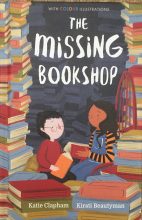
The Missing Bookshop

The Missing Bookshop
Katie Clapham and Kirsti Beautyman
Stripes Publishing
This smashing story from debut author, bookseller Katie Clapham took me back to my days working in a children’s bookshop on Saturdays and during school holidays, a job I loved and which always made me want to own a bookshop just like the one Katie has written about. It never happened though: I’ve stayed in education, albeit with a house full of as many books as some bookshops.

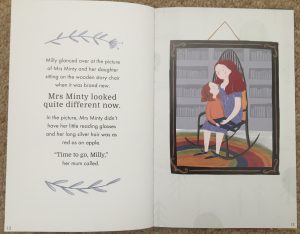
Mrs Minty is the owner of the one here, a place young Milly loved to visit especially for the weekly story time sessions when she’d sit transfixed on one of the cushions on the rainbow carpet listening to Mrs Minty read from a book, often in response to Milly’s ‘one with … in’. Times when Milly has saved sufficient pocket money to buy a book of her own were especially exciting.

On one such day Milly notices that both Mrs Minty and her shop have lost some of their sparkle, particularly whens she compares Mrs M. with the picture hanging on the wall behind the counter.

As she sits with her mum in a café after their bookshop visit, Milly expresses her concern, asking, “What do you do if something is old and creaky?”
Mum’s response about careful treatment and the possibility of replacing it with something new upsets the girl who considers Mrs Minty irreplaceable despite her “You’d make a wonderful bookseller,” words to Milly.

The next week, having watched the bookseller at work, Milly’s fears grow: the woman is a veritable encyclopaedia when it comes to knowledge about books – nobody could do better and after the session as she and her mum sit together they talk further about the bookshop’s future. So worried is Milly that she then runs back to tell Mrs Minty about her bookshop’s irreplaceability.

After the weekend the shop is closed when MIlly and her mum pay a visit. It remains so for the rest of the week until a sign appears in the window ‘CLOSED DUE TO UNFORSEEN CIRCUMSTANCES’ followed the next week ay the even more concerning ‘CLOSED UNTIL FURTHER NOTICE’. What on earth can have happened?

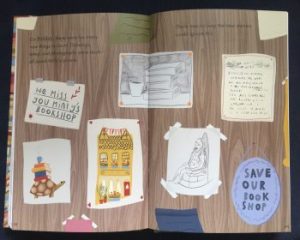
Another week passes and a van appears outside the bookshop full of items from inside; then a woman gets in and drives away before Milly has a chance to question her. Doom and gloom descend upon Mllly and deepen when a FOR SALE sign appears soon after.

It’s time to launch operation Save Minty’s Bookshop decides Milly and she gets busy right away.

A few days later her mum returns from a supermarket visit with exciting news …

As a lover of local independent bookshops, especially those specialising in children’s books, my heart went out to Milly and Mrs Minty in this smashing story that flies the flag for such establishments. I loved Milly’s resilience and determination as well of course, as the fact that she’s a bibliophile at such a young age.

Kirsti Beautyman’s expressive illustrations portray so well, young Milly’s changing emotions as the story progresses towards its thoroughly satisfying finale.

Another cracking addition to Stripes’ series of full-colour fiction for newly independent readers; it’s bound to be devoured by book and bookshop lovers especially.

When We Walked on the Moon

When We Walked on the Moon
David Long and Sam Kalda
Wide Eyed Editions

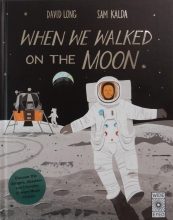
Another of the recent, 50th anniversary of mankind’s first moon-landing outpouring of space-related books, both fiction and non-fiction, is this compelling one from David Long.

Herein, using a narrative style, he focuses in the main on the astronauts who took part in the Apollo Missions.
Dividing the text into short chapters he provides both technical details and accounts of the important incidents for the Apollo astronauts, including  pre Apollo space travels such as Yuri Gagarin’s 1961 orbiting of the Earth, before focussing on the Space Race between the Soviet and American teams to be the first to land a human on the Moon’s surface.

The focus of the second chapter is the Apollo11 flight crewed by Neil Armstrong, Buzz Aldrin and Michael Collins. We read of such domestic details as how the crew ate cooked portions of beef hash, toast, biscuits and bacon that were freeze-dried in bags; how their drinking water was made and their sleeping arrangements.

The third chapter describes the actual moon landing, how the two who were to walk outside first had to rest for four hours before venturing outside in their space suits. I was fascinated to learn that eleven layers of ‘different fabrics’ were used in their space suits to protect the men from everything from space dust to pieces of flying rock and from spacecraft fire; and that said suits weighed 80kg each.

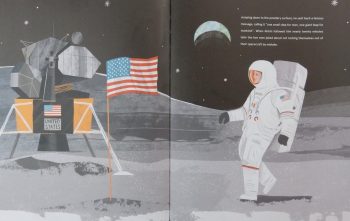
Then comes Armstrong’s famous first Moon walk,

followed shortly after by Aldrin.

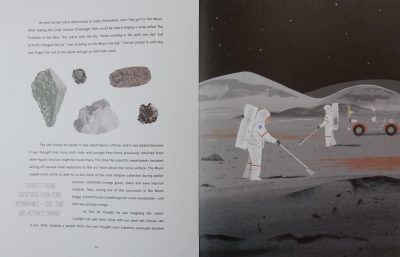
The Apollo 12 mission is described next; the crew, we’re told, had twice as much time as their predecessors on the Moon’s surface and were able to carry out tests and collect samples.

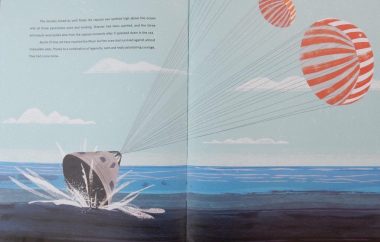
We then read of the almost disastrous Apollo 13 mission and what took place aboard the spaceship following the explosion of an oxygen tank that badly damaged the service module, causing a brief but complete loss of radio communication with Earth. Happily ground staff at NASA working non-stop, together with the awesome ingenuity and courage of the astronauts aboard Aquarius, succeeded in bringing the men back home.

The amazing and absorbing story concludes with the safe return of the final Moon mission team aboard Apollo 17

and a brief look at future space travel with such enormous challenges as reaching Mars; however, as we read, ‘if Apollo showed us anything it is that with a combination of courage, determination and ingenuity we can and will go far.’

The final pages include group portraits of the crews of each Apollo mission together with brief biographies of each astronaut, a glossary and timeline.

Sam Kalda incorporates his love of pattern and texture into double page, single page and smaller illustrations of men, machines, lunarscapes and the Earth from space.

With its plethora of small humanising details, this book is strongly recommended for KS2 classroom collections and for home reading.

Uncle Shawn and Bill and the Not One Tiny Bit Lovey-Dovey Moon Adventure

Uncle Shawn and Bill and the Not One Tiny Bit Lovey-Dovey Moon Adventure
A.L. Kennedy, illustrated by Gemma Correll
Walker Books

This is the third title in Costa award winning author A.L.Kennedy’s series starring Uncle Shawn, his best pal Bill Badger and a cast of other larger than life, lovable and not so lovable characters.

It’s as superbly bonkers as the title indicates and had me spluttering with laughter on pretty much every page, both at the story and Gemma Correll’s splendid, liberally scattered illustrations of villains and goodies.

Early on in the tale we learn that Sky (one of the twins) has wished herself invisible and no matter how hard she tries to unwish her invisibility – which has distinct disadvantages – her second wish never comes true.

We also discover that Bill has fallen head-over-heels in love with a lovely lady badger (‘possibly the most gorgeous badger in the world’) going by the name of Miranda (although he doesn’t yet know that) and she seems as perfect as any creature could be. Romance is most definitely in the air.

Could it be though that Bill is deluding himself about the desirability of Miranda Badger. Why is it for instance that she is liaising with a bald man with ill-fitting teeth, one Sylvester Pearlyclaws, a notorious criminal?

Is it possible that he is in fact the erstwhile toothless man who had recently emerged from the sea at Shoogeldy Bay swearing to get his revenge on Uncle Shawn et al.?

Meanwhile Sky is still struggling with her invisibility problem, so much so that Uncle Shawn suggests that the way to solve it is  to visit the moon, aka – so he says – the land of wishes; and the means to travelling to their lunar destination will be, wait for it, a giant-size iron soup dish.

The entire plot is fast moving and completely crazy. It totally snares the attention holding it throughout, brimming over as it does with exciting imagery – ‘Uncle Shawn reached down and just managed to catch the magnet, It was going faster than an oiled penguin sliding down an iceberg because it was very late for dinner.’ Or, ‘The monster rattled its fangs together so that they sounded like angry knitting needles and yelled …’. and ‘ Pearlyclaws ran away as fast as he could manage, his floppy feet sounding like old towels soaked in badness.’

Clearly the author has had as much fun writing this story as youngsters will have reading or listening to it; it’s perfect for solo readers or reading aloud. If it’s the latter your listeners will urge you to keep on … and on … to discover what happens next, but do make sure you stop frequently to share Gemma Correll’s wonderful visual images as well the author’s verbal ones.

In a word, priceless.

Flat Stanley / The Flat Stanley Collection

Flat Stanley
Jeff Brown and Rob Biddulph
Egmont

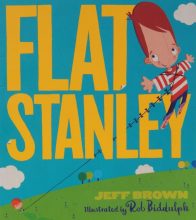
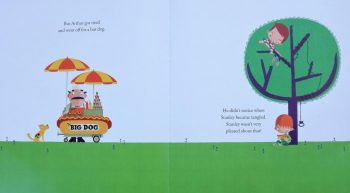
I was over the moon to learn that Flat Stanley was to appear in picture book form, especially with Rob Biddulph as illustrator. I could think of no better person for the task and Rob has most certainly pulled it off with aplomb.

Just in case you’ve never come across Stanley Lambchop and his family before, let me introduce them: there’s young Stanley, his younger brother Arthur and their parents Mr and Mrs Lambchop who can be a tad fussy when it comes to matters of politeness and talking properly.

So when a huge pin board hurtles from the wall totally flattening Stanley, they’re more concerned about Arthur’s manner of delivering the news about his brother than the contents of same. Indeed they defer a doctor’s visit until after breakfast.

Happily it’s good news: Dr Dan is reassuring and so the now half inch thick boy can start to take advantage of his lack of girth, though there are snags too.

Next day news of another art theft reaches the ears of Stanley and his dad as they’re out for a stroll.

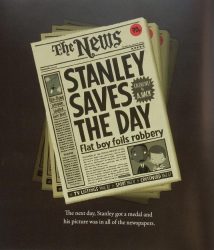
Stanley has a bright idea that just might help apprehend the thieves and that night it’s put into action: will he pull it off?

Yes Stanley does save the day – or rather the object of the thieves’ desire.

But perhaps being a hero of the extra-skinny kind isn’t all fun and flattery …

I can’t remember how many years ago I first shared the original Flat Stanley book with a class of children but it was certainly a long time back and it’s remained a favourite with me, and many more classes since. Now with this smashing picture book version of the first story, a younger audience can savour the delights of the flat but inflatable, Stanley in the new Rob Biddulph incarnation.

Rob has also illustrated a bumper collection of Stanley Stories:

The Flat Stanley Collection
Jeff Brown and Rob Biddulph
Egmont

This chunky volume contains six Stanley books – the first, together with Stanley and the Magic Lamp, Invisible Stanley, Stanley’s Christmas Adventure, Stanley in Space and Stanley, Flat Again!

Guaranteed hours of delicious Stanleyness with plenty of “Hay is for horses, not people” thrown in for extra enjoyment.

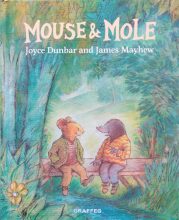
Mouse & Mole

Mouse & Mole
Joyce Dunbar and James Mayhew
Graffeg

First published over 25 years ago, it’s wonderful to see what was a favourite book among new solo readers in primary classes I was teaching at the time, brought back in print by Graffeg.

Mouse and Mole are great friends (somewhat similar to Arnold Lobel’s Frog and Toad to whom there’s a dedication of sorts before the five tales herein).

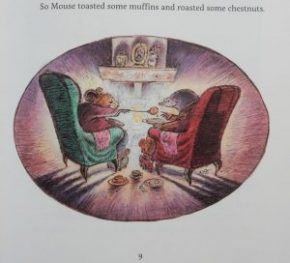
All five of the stories are adorable but I think my favourite remains Talk to Me. Here the two chat together about the possibilities of ‘tomorrow’ be it fine – then a picnic with cheese and cucumber sandwiches is the order of the day. If however the day isn’t fine, then an apple wood fire, cosy armchairs, roast chestnuts, toasted muffins and hot chocolate (mmm!) are on the agenda. Should it be ‘an in-between sort of day’, Mouse suggests ‘we will do something in-between’ … We will tidy up.’ I hope for their sake it isn’t the third option. I doubt we have in-between days in our house!

Salad is the title of story number two and the day is, so Mouse informs his still in bed pal, ‘wild and wintry’. Who can blame Mole for wanting to stay snuggled up in a cosy, warm bed, even with the offer from Mouse of huddling by the fire to consume toasted muffins and roast chestnuts.

Those particular items appear to be favourites with the two characters, one of which consumes large quantities of both.

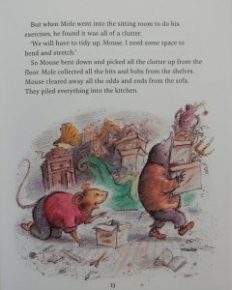
I won’t divulge what happens in the other three stories – Tidying Up

Stuff

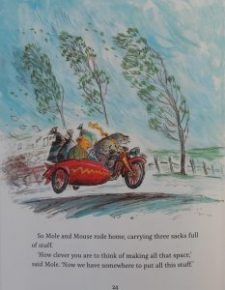
and The Picnic – yes they do finally go –

rather I’ll urge you to get yourself a copy of this new edition that still has as much charm – both Joyce’s deliciously comic tellings and James wonderful illustrations – as I remember from back in the day. Read alone or read aloud, it’s great either way.

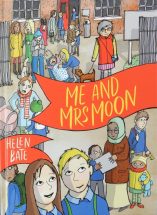
Me and Mrs Moon

Me and Mrs Moon
Helen Bate
Otter-Barry Books

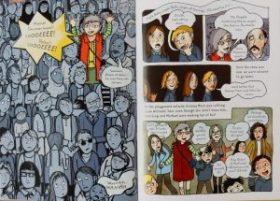
In her familiar graphic novel style, Helen Bate tells a powerful story of how two children, narrator Maisie and her friend Dylan, set about helping their beloved friend and neighbour Granny Moon as she shows signs that all is not well.
Granny Moon has looked after the children during holidays for years filling their days – rain or shine – with fun and adventure.

One day though, things start going wrong.
First Granny Moon is talking about a sister Julia she doesn’t have and later the film about aliens she takes the children to scares Dylan and they have to leave.

As Christmas approaches, things get worse. At the school concert Granny causes disruptions and other children start making fun of her.

Time passes but there are further problems. Granny Moon convinces herself that a little girl is trapped in her radiator and then Dylan’s dad notices her unusual behaviour and is doubtful about whether she should still be allowed to look after his son.

Eventually Maisie’s mum decides to phone Granny’s daughter, Angela in Australia.

Maisie and Dylan then worry about the fate of Granny Moon and her beloved dog, Jack; will Angela decide to put her in a care home? Worse, the friends return home late from school after a café visit with Granny Moon to find a fire engine outside and fire-fighters waiting for them. Thankfully though, there’s no serious damage.

Next day Angela arrives and is extremely troubled by what she finds. She decides there’s only one thing to do. Granny Moon’s house is put on the market and happily it’s not a care home that she’s going to but Australia to live with Angela and her family.

Three days later, fond farewells are exchanged and Angela and Granny depart. A certain animal isn’t accompanying them though, he has a new home – next door with Maisie who now has a companion to share memories about her erstwhile owner with whenever she needs.

The final page lists organisations that offer help for people with dementia, their families and carers.

Love and devotion radiate from the pages of this intensely moving story (based on actual events); but it doesn’t gloss over the enormous challenges those caring for someone with dementia are likely to face. Rather, it offers young readers an opportunity to better understand something of the condition and perhaps be better prepared should they encounter someone living with it.

This is a book that deserves to be in every school and should be read in all families. Particularly, as I was reminded by a charity worker from The Alzheimer’s Society who stopped me as I left Waitrose recently that while I might not know anybody with Alzheimer’s, over a quarter of the population knows someone who has this form of dementia alone.

Migrations Open Hearts Open Borders

Migrations Open Hearts Open Borders
Introduction by Shaun Tan
Otter-Barry Books

llustrators from all over the world responded to the request by The International Centre for the Picture Book in Society (based at the University of Worcester) to create an original postcard for the 2017 Migrations exhibition to be displayed at Bibiana, Bratislava. The exhibition’s creators felt that the installation should reach a wider audience and this wonderful book is the outcome, although the fifty or so images representing 32 countries reproduced in their actual size herein, are only a selection of the hundreds of postcards they received.

Each of the postcards in its unique way focuses on the positive impact of the migration of peoples the world over, showing how the flow of ideas and cultures transcends borders, barriers and even bans.

The book is divided into four themes: Departures, Long Journeys, Arrivals and Hope for the Future.

I would love to show every single one of the awesome, enormously moving postcards but can only make a very small selection for this review, so have included representatives for each of the themes, which spoke to me on my very first reading.

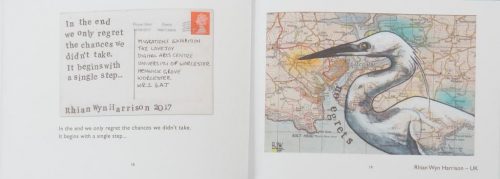
Departures: In the end we only regret the chances we didn’t take./ It begins with a single step …                 Rhian Wyn Harrison – UK.

Long Journeys: The skies have no borders.      Christopher Corr – UK

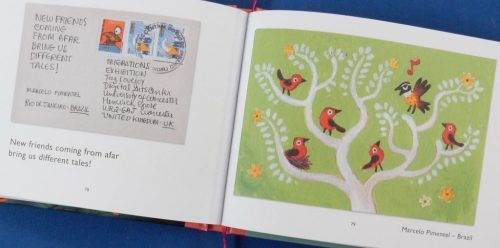
Arrivals: New friends coming from afar / bring us different tales!                        Marcelo Pimentel – Brazil

Hope for the Future: Share the world in peace and freedom. / The Earth and its people have no owners.           Isol – Argentina

On another day I may well have picked completely different ones, such is the power of each contribution, some of which use quotes from writers including John Clare, WB Yeats, Anita Desai and Robert Macfarlane.

If ever there was a time in our increasingly fractured world when we need this treasure of a book, it’s now. Let’s hope that those of us with open hearts who want open borders continue working to make a difference for, as Shaun Tan writes at the start of this book ‘All migration is an act of imagination, a flight of imagination. A hope that frequently exercises a previously unknown human potential. … What can be done? … That’s for us, the living, the thinking and feeling: descendants through millennia of successful migration – whose ancestors dreamed of something better … It’s left for us to imagine what to do, to pass on the dividends of hope that have been invested in us.’

Re-reading his message in its entirety in a week when our UK politicians continue wrangling about how – the universe forbid it happens – we should leave the European Union, brought tears to my eyes. Everyone needs a copy of Migrations; it reaches out to us all, offering another beacon on the uphill climb towards the creation of a better world for everyone, young, old and in-between.
(All royalties are donated to Amnesty International and IBBY)

Primary Fiction Shelf

The Umbrella Mouse
Anna Fargher, illustrated by Sam Usher
Macmillan Children’s Books

Here’s a war story that’s altogether different. It’s set in London in 1944 and begins in Bloomsbury’s James Smith & Sons Umbrella Shop wherein we meet Pip Hanway and her family of umbrella mice.

When disaster strikes in the form of a bomb on the building, killing her parents, Pip is forced to begin a hazardous hunt for a new home, a home in the Italian hills where her family had its origins.

She is fortunate to meet rescue dog, Dickin, and thus begins a highly unusual tale that draws on true stories of animals caught in the WW2 conflict, a story of resistance, of courage, determination, treachery, sacrifice and bravery.

Anna Fargher’s debut is a powerful, compelling telling that will have readers and listeners charged with emotion as they root for these animals fighting the evil Nazi regime; and with occasional illustrations by Sam Usher of Rain, Sun, Snow and Storm fame to add to the pleasures, the book is strongly recommended for individuals and will also make a great KS2 class read aloud, particularly for those studying WW2.

Turns Out I’m an Alien
Lou Treleaven
Maverick Arts Publishing

The narrator of this zany tale is eleven-year-old Jasper who stands 4ft 6in tall and has green hair and eyes. A highly imaginative child so his teacher tells him, Jason lives with his extremely nice foster parents Mary and Bill Clarkson.
One day in order to bring in some extra cash. Mary and Bill decide to rent out one of the now unused bedrooms.

Before their guest has even arrived, Jasper is beginning to doubt whether his foster parents really are as predictably normal as he’d heretofore thought, especially when he notices Mary cooking what appears to be a kind of glowing green rock and Bill constantly checking the night sky through his binoculars.

Then out of the dark descends a weirdly spherical being with an orange skin uttering greetings from planet Snood and introducing himself as Flarp Moonchaser, “Slayer of the Multi-Headed Muck Monster of Murg” as he stretches forth his hand for Jasper to shake. Moreover, the thing has a strange bag stuffed full of weird and wonderful objects.

I’ll say no more other than that Jasper discovers his alien origins, the children are cascaded into a madcap space adventure to save a planet from the terrible Emperor Iko Iko Iko; there are secret agents, secret, secret agents and things get pretty Gloopy.

Entirely crazy, but readers will be swept along by the unfolding drama, which perhaps doesn’t actually end at The End.

Dennis in Jurassic Bark
Nigel Auchterlounie
Studio Press

Fans of the traditional Beano comic will certainly recognise the characters Minnie the Minx and Walter although this book is a novel, not a comic, albeit with a fair sprinkling of black and white illustrations.

It’s another madcap adventure for Dennis who is plunged back in time 65 million years. First though we find the boy visiting his gran watching a TV news reporter talking about ‘what seems to be a huge mutant, ice-cream stealing seagull’ that Dennis immediately identifies as a Pterodactyl. Dennis however isn’t the only child watching the news item; so too, among others, are his worst enemy Walter and Minnie the Minx.

Before you can say Pterodactyl Dennis finds himself on Duck Island determined to save Beanotown from dinosaur disaster.

There’s no need to be a Dennis fan to be entertained by this madcap romp with its interactive puzzles to enjoy along the way.

Stick & Fetch Investigate: The Wrong End of the Stick / The Naughtiest Unicorn

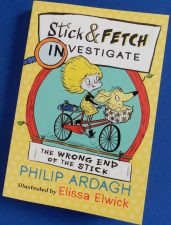
Stick & Fetch Investigate: The Wrong End of the Stick
Philip Ardagh, illustrated by Elissa Elwick
Walker Books

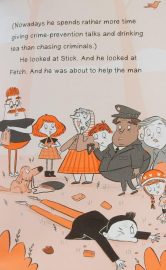
Top-notch undercover detective duo Sally Stick and her canine pal Fetch return in another set of gigglesome episodes.
In the first, Glass Half Full, we learn that the friends have had to shift their operation to a temporary HQ on account of their stay at artist Uncle Bob’s residence for the duration of Granny Stick’s hospital sojourn.

It’s not long before the detectives have a case: Uncle Bob has lost his glasses and there’s a tasty reward on offer for finding them. But there are glasses, and there are glasses. The particular ones in question have gold rims and although there are glasses aplenty in the house, none have gold rims – or do they.

This is a case of can’t see for looking; but can Sally and Fetch solve it ?

Hmmm! What’s that smell – could it be sausages? …

Bothersome beavers are at the heart of the next case, or so the detectives surmise when they come across a snapped-in-two lamppost on their way back from the library where they’d read about the tree chomping creatures. They find  clues in the form and aroma of baked beans; and see a sign indicating the location of a swimming pool. Sally puts two and one together and off they head to the pool.

Time to go undercover, but will they find a beaver on arrival and if so, can a damming crisis be averted?

Two further cases, equally zany are concerned first with, assisting the police when a spate of bag-snatching breaks out –

there’s a frog and a whiffy man involved here; and the second, a bit of bed-digging that might just happen to yield treasure, of a sort.

Delectably silly, enormously engaging and very importantly, celebrating the imagination, (or maybe just the wrong end of the stick), with its plenitude of comical illustrations by Eliissa Elwick, this smashing little book is perfect just flying solo reading.

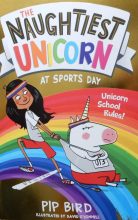
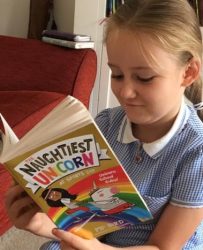
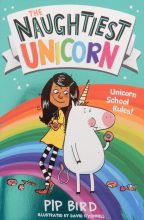
The Naughtiest Unicorn
Pip Bird, illustrated by David O’Connell
Egmont

The particular Unicorn School in this story runs during the holidays and young Mira is overjoyed when she receives an invitation to join, especially as her sister is also a pupil and her mum had been too.

Having successfully entered the portal with another newcomer Raheem, Mira meets her teacher and classmates, then enters the hall to learn of the principles on which the school prides itself. She can hardly wait to be paired with her unicorn and at last it’s her turn.

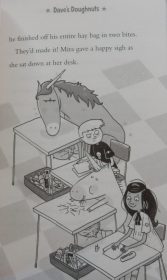
However, the squat, pot-bellied creature, Dave, that is eventually coaxed through the door is somewhat lacking in sparkles, although he does have a twinkle in his eye.

Once in the classroom, Mira hears that there are only two days before they must go out on their first magical quest.

Can she possibly get ready when the recalcitrant creature objects even to being groomed? Do they actually have a totally magic bond?

Things don’t look promising especially as Dave’s penchants seem to be for doughnuts and falling asleep in lessons. Will Mira’s ambitions to go on that quest ever be fulfilled? Perhaps her friends Darcy and Raheem can help …

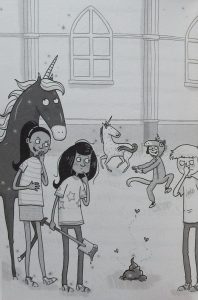
Just right for newly independent readers, this is a sparky tale that focuses as much on friendship as the glittery world of unicorns, showing that magic comes both from the former and the latter. Humour runs throughout Pip Bird’s telling and is brought out further in David O’Connell’s zany illustrations clearly drawn with a twinkle in his eye. Add to all that a quiz to help readers identify their unicorn type, and some jokes; and those who enjoy the book will be excited to learn that there’s a promise of more to come.

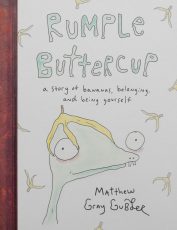
Rumple Buttercup

Rumple Buttercup
Matthew Gray Gubler
Puffin Books

Just a quick look at green-skinned Rumple Buttercup with his wonky teeth, odd sized feet and just three strands of hair might indicate that this creature is something out of the ordinary – weird – so the author tells us at the outset of his immediate interest snarer.

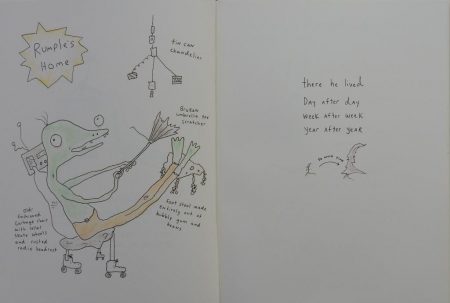
Convinced that his unusual appearance with scare people, his residence is a sewer  – albeit nicely decorated,

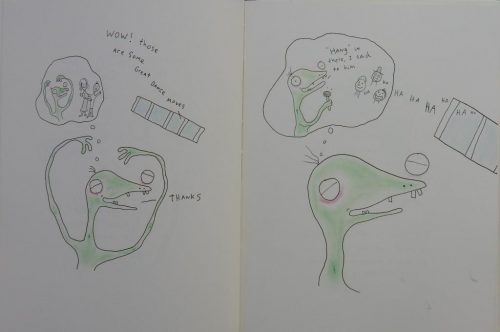
where he listens in to conversations of passers-by, longing to be a participant but making do with pretence.

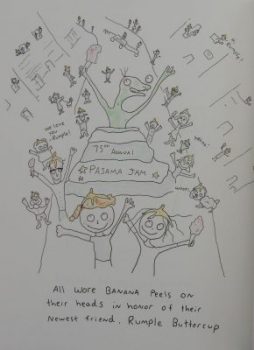
The one time Rumple feels safe to sally forth as part of the community, is his favourite event, the Annual Pajama Jam Cotton Candy Pancake Parade; a day nobody will, he thinks, notice him amid the carnival revels.

Having eagerly anticipated the day all year, his excitement rises but then on the morning of the event, there’s a distinct lack of banana peel in the bin beside his home.

Devastated and deciding he must stay below ground and miss all the fun, the creature suddenly hears a voice calling down the drain to him.

What he discovers is that he’s not quite as strange as he’s always thought – unique perhaps, but then we’re all strangely different in our own ways.

So let’s join him in a celebratory wave and an acknowledgement that self-acceptance, flaws and all, is the way to go and that there are others out there who will celebrate our individuality, no matter what.

This delectably quirky, slightly surreal offering – a blend of picture book and chapter book – is one that will appeal to a wide readership, young and not so young.

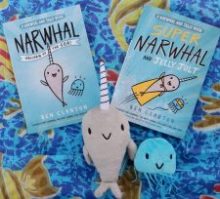
Narwhal Unicorn of the Sea / Super Narwhal and Jelly Jolt

Narwhal Unicorn of the Sea
Super Narwhal and Jelly Jolt

Ben Clanton
Egmont

In Unicorn of the Sea. Ben Clanton introduces readers to Narwhal, a self-aggrandising creature.

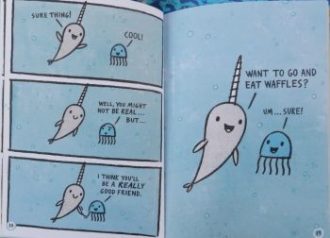
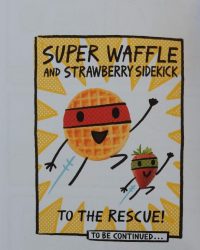
In the first of three sub-aquatic adventures, while cruising in ‘new waters’ Narwhal encounters a jellyfish and despite doubting each other’s realness, the two interrogate one another, forge a friendship and eat waffles together.

The second tale sees the two involved in forming their very own ‘podtastic’ pod of awesomeness that includes other ocean buddies – shark, turtle, blowfish, octopus and of course – though he’s very nearly left out – Jelly, each of which receives a tusk tooth in honour of the occasion.

My favourite of the three stories is the book’s final one wherein Narwhal introduces Jelly to his ‘favourite book in the whole wide water and probably the rest of the universe too!’ It’s a book without any words or pictures and Clanton provides two blank pages for maximum effect here. Narwhal tells his pal that ‘it’s an imagination book … you’ve got to pretend.’ Brilliant! And so thinks Jelly too for having tried it out, he wants to borrow it right away.

With its splendid dialogue, this is irresistible, sub-aquatic bonkersness of the first order delivered in graphic novel style for young readers. There’s even a silly narwhal song so sing and clap along to.
This twosome is up there with Arnold Lobel’s Frog and Toad, and Mo Willems’ Gerald and Piggy.

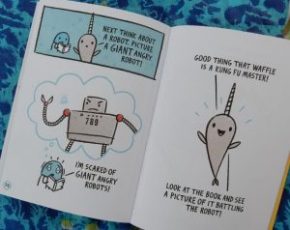
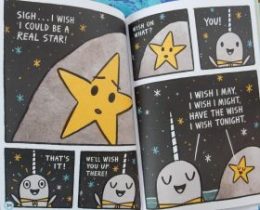
In Super Narwhal and Jelly Jolt, Narwhal swathes himself in superhero-ness assuming a secret identity and appointing a sidekick (Jelly Jolt) but despite this, he seems to lack the necessary superpowers, so he thinks. Nonetheless fuelled by waffles – the friends’ ‘super weakness’ – he sets about helping a star(fish) to become a cosmic being. This involves cannon blasting and wishing (I won’t say which, if either, works).

There’s also a comic – no prizes for guessing it’s a waffle-themed one, created by none other than Narwhal and Jelly themselves.

And then in the final tale here, Narwhal finally does discover his very own superpower; it’s a super-important one too, discovered by an act of altruism towards crab.

Once again the whole thing – super sea creature facts and all – is super-brilliant and full of heart. I just love how it effortlessly demonstrates the importance of friendship, of encouragement and that all of us – if we look hard enough –possess a world-improving superpower. With laughs aplenty and the most adorable illustrations, this book is an unmissable gem, not only for young readers, but adults too.

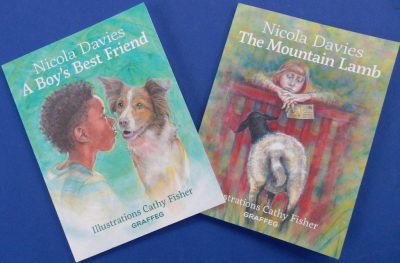
A Boy’s Best Friend / The Mountain Lamb

These are books five and six in Nicola and Cathy’s Country Tales short fiction series about young people growing up in a rural environment, published by Graffeg who kindly sent them for review.

A Boy’s Best Friend
The Mountain Lamb
Nicola Davies, illustrated by Cathy Fisher

A Boy’s Best Friend starts with young Clinton reluctant to leave his tropical island home, his gran and his fisherman Uncle Cecil to join his mother in London where she’s lived for five years. He feels anxious about meeting his step-father, eager to meet new little sister and very unhappy at the prospect of having to leave behind his much loved dog, Rufus.

But leave the island he does arriving in England as spring approaches. At first, despite the family’s best efforts, he feels lost and as though all the light has been leeched from him in this chill, drear place called London.

Then comes news of a school trip by minibus to a castle in Kent and despite there not being the intended farm visit, Clinton joins the party. But when the minibus meets with an accident and ends up partly in a ditch, Clinton takes the opportunity to help an old man, David with his stampeding cows, scared by the crash.

From then on, despite being in big trouble at school and at home for running off after the accident, things start to look brighter for young Clinton who readily takes up the farmer’s subsequent offer to visit his farm and lend a hand.

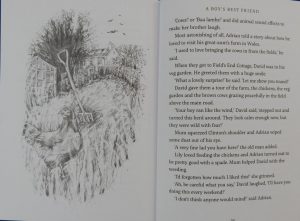
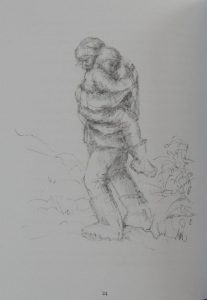
Beautifully told and full of warmth, Nicola’s short tale of love, change and adjusting to a new life, will speak to everyone, especially those who have had to leave much of what they love to start a new life elsewhere. Cathy Fisher’s delicately worked black, white and grey illustrations further add to the atmosphere of the telling.

Young Lolly in The Mountain Lamb is faced with tremendous challenges too. Her mother has died and now Lolly lives on a sheep farm with her grandparents. It’s lambing time and up on the moor, she finds an orphaned baby lamb so small it fits inside the woolly hat she uses to carry it home.

Fearing that it won’t live through the night, Lolly is surprised to hear its tiny bleat next morning at breakfast time: seemingly the lamb wants feeding. Lolly decides to call it Susan after her mother.

Grandpa encourages the girl to take responsibility for rearing the little creature. She rapidly forms at attachment to it, knowing though that it will eventually have to become part of the flock.

After months of not leaving the farm and its surroundings, it’s time for Lolly to return to school but fog causes Gran to abort the journey and they go back to the farm.

Time passes with Lolly staying back rearing the lamb and helping her grandparents indoors and out. One day Susan goes missing and despite a blizzard, Lolly embarks on a perilous search. Is she to meet a fate similar to her mother whom we learn had died in an accident on a Himalayan climb?

Happily not, for her Gran is experienced in Mountain Rescue.

The lost lamb makes its own way safely back and finally Lolly returns to school after a long, hard but rewarding few months.

This tale of courage and love is potent and moving throughout; I couldn’t put it down.

Fabio: Mystery of the Ostrich Express / Ariana and Whisper / Princess of Pets: The Naughty Kitten

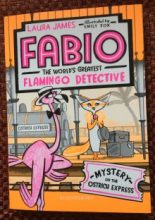
Fabio: Mystery of the Ostrich Express
Laura James, illustrated by Emily Fox
Bloomsbury Children’s Books

Fabio, flamingo detective and resident of a small town on the banks of Lake Laloozee, returns to solve his second case and it involves a stolen necklace.

Fabio and his trusty associate Gilbert giraffe are about to depart on the Ostrich Express for a much-needed holiday at Coconut Palm Resort when something, or rather someone, catches Fabio’s eye.

Once on the train, a desert fox who introduces herself as Zazie – appears in the dining car sporting a fur stole and enormous ruby pendant – the legendary, -very valuable so she tells Fabio and Gilbert – Lalooze Ruby.

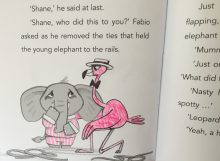
As the train speeds across the desert, unexpected happenings take place, the first being that Gilbert is knocked unconscious when he hits his head against the window as the train is suddenly brought to a full-stop. Leaving his friend in the care of Zazie, Fabio leaves the train and discovers a baby elephant lying beneath the stars tied to the tracks. Fabio unties him and learns that a gang of bandits – hyenas and a leopard – had tied him down.

That though is only the beginning. Soon a scream pierces the dark followed by hyena’s laugh and as Fabio climbs back aboard the train he spots a leopard silhouette and learns that the ruby has vanished from around Zazie’s neck – pulled off by a thief so she says.

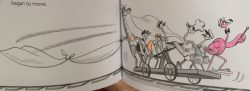
Never fear, Fabio is hot on the case; he merely needs to enlist the aid of the train crew to help power his refurbished handcar,

let loose the tied-together table cloths , … cavort across a few train carriages, execute a deft flick of Gilbert’s cane and … and … that would be telling way too much of this exciting, fast-paced, perfect for just flying solo readers tale.

And with Emily Fox’s dayglo bright, pink and orange powered illustrations and occasional text backgrounds, plus Fabio-patterned chapter breaks, what more can any young reader want?

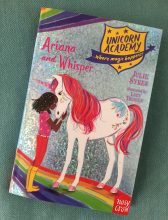
Ariana and Whisper
Julie Sykes, illustrated by Lucy Truman
Nosy Crow

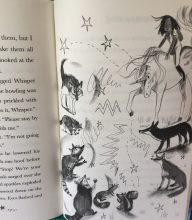
Unicorn Academy is ‘where magic happens’ and now in story number 8, arachnid-fearing  Ariana is finding it hard to make friends. She does however love her special unicorn Whisper and enjoys spending time in the stables bonding with him and helping him discover his magic power.

Things improve somewhat when she starts to bond with untidy Matilda and then Ms Nettles announces that the day’s lessons are to be replaced by a field trip to the edges of the woods to find out which animals are leaving and why. An adventure is set to begin: something is very wrong in the woods and Ariana can feel it.

Not long after, Whisper discovers his special power: perhaps with its help, together with the courage of Ariana, her unicorn and the other students, the mystery of what has been happening with the animals can be solved.

Fans of the sparkling series will lap this up with its short, bite-size chapters and Lucy Truman’s enchanting black and white drawings.

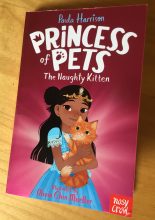
Princess of Pets: The Naughty Kitten
Paula Harrison, illustrated by Olivia Chin Mueller
Nosy Crow

Princess Bea is an animal lover but her father King George tells her time and again that Ruby Palace is ‘no place for a pet’. However, the nine-year-old princess isn’t one to be deterred by royal rules when it comes to taking care of animals needing help.

While she’s at the kite festival with her teacher Mr Wells, Bea climbs up a tree to free her kite and there comes upon a ginger kitten; and of course, she just has to rescue it.

Determined to keep it safe until they can find its owner she manages to sneak it in to the palace but discovers that Tiger as she calls it, is rather excitable. Moreover when her father discovers the creature, he’s far from pleased and gives Bea just 24 hours to get rid of it.

At night the kitten decides to go exploring and Bea needs to summon up all her courage to hunt around the palace in the pitch dark, especially when she hears a noise that doesn’t sound like Tiger …

Young animal lovers just flying solo as readers will enjoy this addition to the series illustrated by Olivia Chin Mueller.

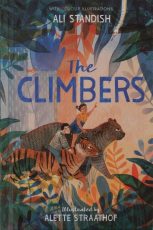
The Climbers

The Climbers
Ali Standish, illustrated by Alette Straathof
Stripes Publishing

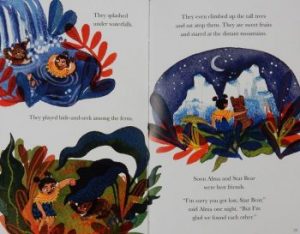
This new title in Stripes full-colour fiction books for new solo readers stars young Alma who lives with her overbearing uncle in a town bordering a forest, a forest in and beyond which young Alma longs to explore. “The forest is full of fearsome beasts. That’s why only hunters are allowed there,” her uncle insists when he discovers she’s climbed a tree. And as for the mountains beyond, they are populated by settlers as bad as the beasts.

Nevertheless Alma feels drawn to the world beyond her narrow hometown and that night she ventures out into the darkness determined to see the forest for herself.

As she walks deeper among the trees, the bird song seems to be welcoming her and suddenly, hearing a cry, she comes upon a frightened – looking bear cub. Unable to leave it alone but unable to take it home, she carries him gently to a disused shed on the edge of town; then she creeps back indoors and falls fast asleep.

Every night thereafter, Alma and the cub – she calls it Star Bear – slip out and explore the forest together.

The cub as bear cubs do, grows bigger and one day rumours of a bear sighting are spreading in the town’s market square. Fears escalate: a giant sharp-toothed beast brought by the mountain settlers, they decide. Anna keeps her knowledge to herself, while the mayor decides a wall round the town is to be erected to keep outsiders from entering and a search for the ‘beast’ begun.

She takes Star Bear back into the forest, fearing that what the townsfolk are doing will shortly prevent them from meeting.

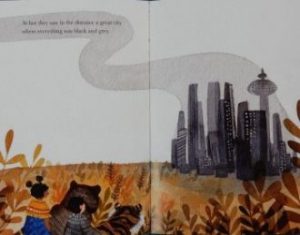
More and more trees are felled to build the stockade and lack of food in the dwindling forest results in empty-bellied townsfolk. Should Alma now reveal the truth? She does and soon finds herself on Star Bear’s back as they flee for safety into the deepest depths of the forest. Before them are the mountains. There’s only one way to go …

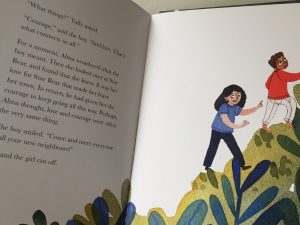
On the mountainside the two come upon a boy riding a tiger; the boy’s not scary or furry and introduces himself as Tully. The friendship that forms between them changes everything.

Without being a story spoiler I’ll say little more except that it’s a case of onwards and upwards, as the two children, and others they meet, (together with their animals) finally see the light: love and courage conquer and connect us all.

As in this powerful, moving story, so it is in our increasingly troubled times: it’s children who show the way when it comes to optimism, open minds and open hearts.

Beautifully told by Ali and dramatically illustrated by Alette Straathof, be it read alone or read aloud, this is a must read..

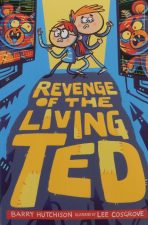
Revenge of the Living Ted

Revenge of the Living Ted
Barry Hutchinson, illustrated by Lee Cosgrove
Stripes Publishing

This is the sequel to Night of the Living Ted and it’s every bit as good a tale.

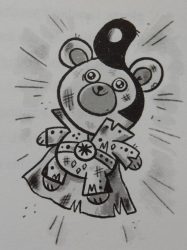
Early on in the story we meet  Bearvis, Dad’s birthday gift styled on his favourite singer who plays a significant role later on.

A little while after, Lisa Marie and Vernon are just leaving Drake’s house having discovered that he remembers nothing – so he says – of their previous teddy bear filled adventure, when two pairs of rough furry hands throw bags over their heads and bundle them into the back of a car.

The next thing they know is that they’re sitting chained up in what looks like from the clues they spot, the boardroom of a successful business establishment.

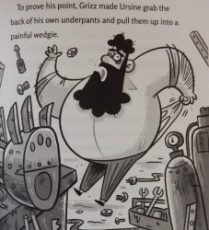
Suddenly in bursts a strangely shaped man who introduces himself as Ursine Kodiak. Said character boasts that he’s the genius responsible for building the machine that brought monstrous teddy bears to life and then was able to eradicate the events surrounding them from the memories of those involved.

Then he takes the two children into his bear-filled factory and starts blabbing on about Mummy Bear (from the Goldilocks story which he misremembers), artificial intelligence and other alarming things. Furthermore he wants to enlist Lisa Marie’s help with his future plans for saving the world and things really seem dangerous. Should she become his Executive Senior Assistant?

Let’s go no further with this smashing fast-moving, fur-filled farce, but just say that it’s sure to fire up enthusiasm with readers and listeners – it’s a terrific read aloud – and along the way might introduce youngsters to some exciting new vocabulary. To add to the enjoyment, the text is liberally sprinkled with dramatic illustrations by Lee Cosgrove.

Roll on the third adventure.

The Secret Lives of Unicorns

The Secret Lives of Unicorns
Dr Temisa Seraphini and Sophie Robin
Flying Eye Books

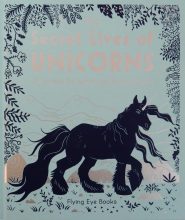
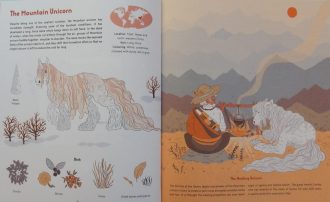
Most people consider those much loved unicorns, that are all the rage just now, are imaginary; Dr Temisa Seraphini, author of this book and ‘leading expert’ so she says, on unicornology, would like to persuade readers to think otherwise.

She divides her fanciful presentation into three parts: the first being “What is a Unicorn?; the second provides examples of unicorns from various parts of the world and the third looks at the relationship between humans and unicorns. Her over-arching aim in all this is to encourage those magical creatures of yore back into our technological world of today.

In her introduction to the first part we read that unicorns are herbivorous but unlike their horse cousins, have magical properties; the author places them in the order Artiodactyla that includes, giraffes and goats among other even-toed ungulate creatures, assigning them to a separate family: Unicornus.

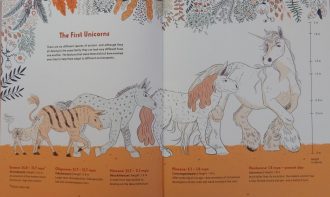
Then on the first spread we’re shown the six different species of the legendary creatures on a evolutionary timeline.

This is followed by a page detailing which parts of the unicorn’s anatomy have magical properties: Did you know that unicorn tears can apparently heal the sick and that the drinking of unicorn blood provides unimaginable strength. Hmmm!

The Horn is the next topic and there are supposedly three varieties – ridged, smooth and pearlescent; the latter so loved by some recent picture book creators; and if you believe it, in 1858 someone unearthed a skull that had once borne a unicorn’s horn. Uh-huh!

The second section takes us to six different habitats (with accompanying atlas), from the regions around Mount Everest

to the sandy African dunes and the moorlands of northern Europe. We learn  how different adaptations to climate have occurred over time  There’s an introduction to the winged variety and flight.

The final part talks of legendary unicorns; those who found their way into the annals of history or became subjects of artistic representation, as well as introducing some other unicornologists, giving guidance on tracking and communicating with the creatures.

Tongue in cheek though all this may be, it’s fun and rather enchanting. So too are Sophie Robin’s detailed illustrations that will definitely make readers smile as they peruse the pages and get lost in the spellbinding silliness.

Ada Twist and the Perilous Pantaloons

Ada Twist and the Perilous Pantaloons
Andrea Beaty, illustrated by David Roberts
Amulet Books

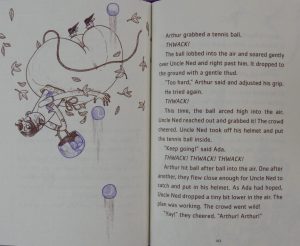
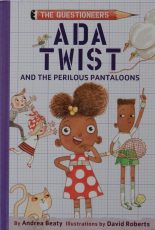
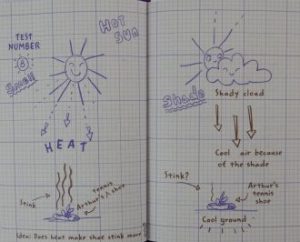
Ada Twist returns with a high-flier of STEM adventure in the second of her chapter books series. As always her head is full of questions: why does her mother’s coffee smell stronger than her father’s? Why do her brother’s tennis shoes stink so badly?

Each of her questions leads to further questions, hypotheses and experiments, one of which links her involvement in the Great Backyard Bird Count activity with working out how to rescue Rosie’s Uncle Ned who, thanks to his helium-filled pantaloons, is floating around in the sky unable to get down.

Ada combines her ‘what if’ curiosity, brainpower, and knowledge of molecules, air pressure, temperature and forces, with that of friends Rosie Revere and Iggy Peck to work out a plan to bring Uncle Ned back to earth.

Andrea Beaty’s amusing twisting, turning narrative is irresistible and sweeps readers along like the hot air that powers those pantaloons of Uncle Ned, while David Roberts’ detailed illustrations, be they full page or smaller, are full of humour and provide a great complement to the text.

With credible inspiring characters, believable relationships, information aplenty, including, after the story concludes, reasons for studying birds and the ‘think about this’ pages on the threat posed to rainforests by palm-oil plantations, a poem even, this book is a thoroughly engaging read, a super model of scientific questioning and thinking, and a demonstration that creative problem solvers and scientists don’t always get things right first time. Terrific!

The Rescue Princesses: The Amber Necklace / Arlo, Miss Pythia and the Forbidden Box

The Rescue Princesses: The Amber Necklace
Paula Harrison
Nosy Crow

In the 15th and final adventure in the series, it’s up to Zina and her friends to save the tamarind trees of their rainforest home. These trees are the only ones that provide year round food for the lemurs but they’re scheduled to be cut down to make way for the carnival that has been re-routed on account of the usual road being flooded.

Princess Zina is horrified at the prospect; but the princesses must use their intelligence, co-operative skills, kindness and courage to protect the animals and their precious tamarinds.

With their camouflage ninja gear and Zina’s special amber necklace, said by her grandma to hold the heart of the forest it might just be possible to persuade Ando and his workmates to find another path. If not, could the amber jewel works it magic? …

Another exciting tale with short chapters, plenty of line drawings and an exciting and intriguing plot to keep readers turning the pages, this is ideal for new solo readers.

For readers who like longer stories there are two new fiction titles from Maverick Publishing coming soon: one is

Arlo, Miss Pythia and the Forbidden Box
Alice Hemming, illustrated by Mike Garton
Maverick Publishing

4X have become 5P and they’re back with another highly unusual teacher, not from the stone age this time but nevertheless there’s something not quite normal about Miss Pythia.
For a start, she always seems to know exactly what is about to happen; she has a weird-looking symbol tattooed on the back of her neck; she never seems to change her clothes, and there’s that box she keeps on her desk. Mmmm! And could it be sheer co-incidence that she shares her name with a priestess of the Ancient Greek world?

When I taught nursery children we often did an activity called, ‘What’s in the box?’ Singing a little ditty based on those words served to arouse the children’s interest and enthusiasm before the lid was lifted and we investigated its contents. And that is just what Miss Arlo does when she instructs her class that opening the particular box she has in her safe-keeping, is strictly forbidden.

But then 5P are selected to participate in A Play a Day, electing to perform a version of Pandora’s Box and Arlo is chosen to act as director. Can his classmates resist the temptation to open Miss Pythia’s actual box as they rehearse?

What Arlo doesn’t immediately spot as he gets engrossed in his directing role is that the replica box made for the drama has been switched.

Then with the play in full swing a terrible realisation comes upon him …

Another winner from Alice Hemming; it’s full of suspense, gently humorous and splendidly complemented by Mike Garton’s lively, expressive drawings, which provide additional details and humour.

Now set fair to become a super series, this story is great for solo reading as well as highly appropriate as a class read aloud especially if the Ancient Greeks are on the agenda.

Where Dani Goes, Happy Follows / Snow Sisters: The Enchanted Waterfall / Unicorn Academy: Rosa and Crystal

Where Dani Goes, Happy Follows
Rose Lagerercrantz and Eva Eriksson
Gecko Press

This is my first encounter with the delightful Dani whose adventures began with My Happy Life.In this, her sixth instalment the girl is spending the winter break staying with her grandparents because her father has again become sad and is now spending time with his mother and brother in his home city, Rome to ‘think about his life’.

While out ski-ing, the normally cheerful Dani gets that gloomy feeling but then she suddenly thinks of her best friend Ella and remembers that it’s almost her birthday. What better birthday present than an experience – a surprise visit from Dani?

There’s a slight snag though: Ella lives miles away in Northbrook. Of course, being the positive child she is Dani’s sure one of her grandparents will drive her: maybe she doesn’t have a problem after all.

After consideration Grandma asks her if she dares go from Stockholm to Northbrook on the train by herself so long as Ella’s mum collects her at the station. Granpa needs a fair bit of convincing but eventually Dani is on the train bound for her destination.

When she arrives at Northbrook however things start to go wrong; the station is covered in snow and there’s nobody there to meet her. That however is only the first bad thing that happens …

With her near indomitable spirit, Dani is an adorable character. In this book, in a very short space of time she emerges with a lot more understanding of the adult world with its ramifications and frailties.

With its bitter-sweetness, Rose Lagererantz’s writing really rings true and her characterisation is superb.

Eva Eriksson’s splendidly empathetic black and white illustrations are a delight and add an extra touch of piquancy to the book.I will definitely seek out the earlier titles in this series.

Wholeheartedly recommended for solo reading and as a class read aloud for KS1 and early KS2.

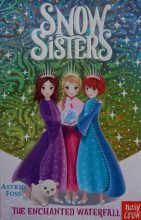
Snow Sisters: The Enchanted Waterfall
Astrid Foss, illustrated by Monique Dong
Nosy Crow

This is the 4th and final magical adventure of the three sisters, with special powers to enchant, who reside in a castle on the mystical island of Nordovia.

Now Magda, Hanna and Ida must draw on all their strength and bravery to undertake their final quest in this battle of good versus evil, for it’s the Day of the Midnight Sun and the nefarious Shadow Witch is absolutely determined to do whatever she must to obtain the power of the Everchanging Lights and make the skies forever dark.

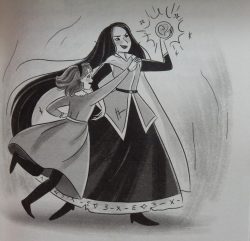
As always the combination of magical fantasy, highly engaging characters (some animal), a powerful plot with just the right amount of darkness, and plenty of Monique Dong’s lovely black and white illustrations will ensure that early chapter book readers will lose themselves in the adventure.

And do the sisters succeed in ensuring that the Everchanging Lights are in their rightful place by the time the clock strikes the midnight hour? Let’s just say that where’s there’s light and love, there is hope.

For roughly the same age group, there’s more magic in:

Unicorn Academy: Rosa and Crystal
Julie Sykes, illustrated by Lucy Truman
Nosy Crow

This series for the countless young unicorn lovers out there takes us yet again to Lakeside Unicorn Academy for another instalment of magical unicorn delight.

The pupil in question herein is Rose and her unicorn partner is Crystal and after just a month at the school the two are off on a rule-breaking adventure in search of the magical map. It’s not all down to the twosome however, teamwork is involved and they both have to learn what being a member of a team entails.

Engaging, undemanding fun.

Two Sides / Little Rabbit’s Big Surprise

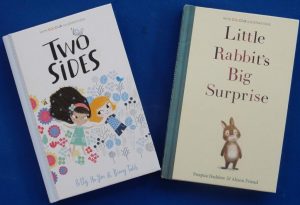
Two Sides
Polly Ho-Yen and Binny Talib
Stripes Publishing
Little Rabbit’s Big Surprise
Swapna Haddow and Alison Friend

To help bridge the gap between picture books and assured fluent reading of chapter books Stripes Publishing are creating a short fiction series with a colour illustration at every page turn; these are the first two titles. Both are beautifully designed and illustrated.

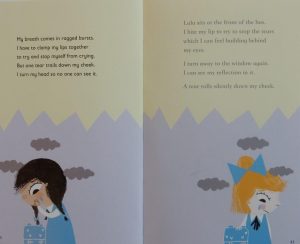
Two Sides explores a friendship between total opposites, Lenka and Lula. Born on the same day, the former is neat and tidy, a cat lover and enjoys drawing; her best friend is a dog enthusiast, messy and something of a chatterbox.
A perfect twosome it seems and so it is until the fateful morning when Lula oversleeps after which everything goes terribly wrong.

Lenka’s forgotten pencil case containing the coloured pencils she needs to complete a competition entry, but now lying on Lula’s bed and a rejected present made by Lulu for Lenka lead to a fierce row and by the time their bus reaches school, a special friendship has fractured.

School feels a totally different place; the two girls sit far apart in the classroom but then their teacher allows the class a play stop en route for the library.

An opportunity for the rift to be healed perhaps …

The author acknowledges that even the very best, closest of friendships can have their ups and downs; and words said in the heat of the moment can really hurt. This is something young readers will definitely acknowledge as they lap up Polly Ho-Yen’s story with Binny Talib’s expressive scenes of the girls.

Little Rabbit’s Big Surprise opens with a bored Little Rabbit whose Mama, siblings and friends are all too busy to play with her. But then her grandfather invites her to become his assistant for the day and the young rabbit is in for surprise.

Instead of merely spending all his time with his friends, Big Rabbit devotes himself to altruistic activities, the first of which concerns Mole’s dark tunnel and Little Mole’s imminent birthday party.

Next comes a visit to Granny Hedgehog who is suffering from a bad case of the snuffles.

Dormouse too is in need of help: his little ones are hungry and their nest isn’t big enough to accommodate them all.
And then there’s Squirrel. She’s injured her paw and so can’t forage for food for her children.

It’s all in a day’s work for Big Rabbit but by the next morning it seems that Little Rabbit’s been infected by her grandfather’s enthusiasm for helping others and her friends too are willing to lend a hand.

Celebrating kindness, Swapna’s gentle telling in combination with Alison’s adorable woodland watercolour illustrations make for a delightful read alone, or a read aloud to younger children.
Readers will close the covers of both books with a boost of confidence having enjoyed a longer story: thoroughly recommended for home reading and for classroom libraries in KS1 and early KS2.

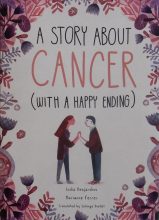
A Story about Cancer (with a Happy Ending)

A Story about Cancer (with a Happy Ending)
India Desjardins and Marianne Ferrer (trans. Solange Ouellet)
Frances Lincoln Children’s Books

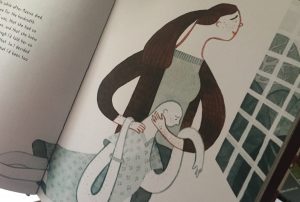
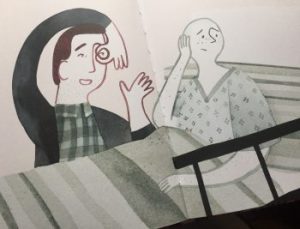
The story opens with the 15-year-old narrator telling us, as she and her parents walk down the hospital corridor, “In just a few minutes, they’re going to tell me how much time I have left to live.”

It’s five years since she was diagnosed with leukaemia and as she awaits her prognosis she shares with readers her years of treatment with the threat of death hanging over her. We hear of the sadness she feels over the death of her best friend Maxine which was “definitely not because she wasn’t strong enough or didn’t fight hard enough”; and are shown how her grief renders her temporarily limp limbed.

She talks of the hospital sounds, smells and colour scheme, how her parents react to her illness – her father’s jokes;

her mother’s insistence “that she had so much confidence in me, and she knew I’d get well …’ in contrast to her own it isn’t ‘ a battle…because there was nothing I could do to fight it. All I could do was let everything happen to me and try not to complain too much.”

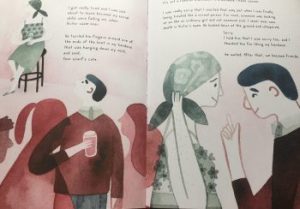
There are high points too: she goes to a party, meets Victor and experiences her first love.

And finally, as we know from the title, the news the doctor gives is good; the narrator is going to live.

This no-holds-barred story is a real emotional roller coaster but the first person telling serves to bring a sense of calm to the whole sequence of events, be they dark or bright. Ferrer’s almost dreamlike, at times, surreal visuals, highlight the intensity of feeling, moving from predominantly grey to plum and claret when ardour prevails.

The author was asked by a ten year old cancer patient she met on a hospital visit to write a cancer story that ends happily. This is the result and serves to remind readers that 8 out of 10 children diagnosed with cancer are cured, and to give hope to any child who has cancer.

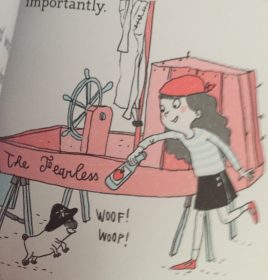
Pirate Pug

Pirate Pug
Laura James and Eglantine Ceulemans
Bloomsbury Children’s Books

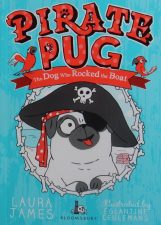
Their latest adventure sees Pug and Lady Miranda holidaying in Pebbly Bay.

They’re just preparing to indulge themselves in a hotel breakfast of some rather yummy jam tarts when in through the window flies a parrot. Showing a distinct lack of interest in the tasty fare on the tray, the bird takes off with a teaspoon.

Thus begins a seaside sojourn, which might be a bit of a challenge, for Pug is scared of water.

Things don’t go too well and before long, the dog is flat out in the vet’s operating theatre on account of an unlucky accident.
Lady Miranda’s comment on his being given an eye-patch to wear sparks one of her good ideas and soon Pug is also sporting a pirate’s hat.

Meanwhile in the town square crowds are gathering for a rehearsal of the Pebbly Bay Parade.
It’s in celebration so the mayor tells Lady Miranda and Pug, of the day the town was freed from pirate rule.

As she’s showing them her special gold chain of office, down swoops that pesky parrot Rio who seizes the chain and flies off with it.

Is Pug brave enough to sail the high seas and join the others on a boat trip across to Finders Keepers Island to rescue the treasured item?

Arch-enemy Finnian and his gang are already on the ocean in their own craft so it looks like trouble is in store.

With the usual brand of charm, humour, fun and frolics, Pug’s fourth book is ideal for new solo readers and a fun read aloud. Make sure you give your audience time to see Eglantine Ceulemans’ engaging illustrations if you share it.

Peter in Peril

Peter in Peril
Helen Bate
Otter-Barry Books

Let me introduce Peter, although as narrator of Helen Bate’s debut graphic novel, he introduces himself in this true story of a six year old Jewish boy living in Budapest during World War 2.

Peter always makes the best of things; he trims the sides off newly baked cakes and frees buttons from his mother’s coat to use in his play

but when his beloved Roza (who lives with the family and helps his mother) has to leave as she’s no longer allowed to work in a Jewish household, the lad is bereft.

That though is only the start of the upsetting things that happen but Peter’s story is not all dark and bleak. Despite the fact that under Nazi rule, Peter’s family were forced to leave their home, split up and had then to live in hiding in constant fear for their lives, there’s humour too; it’s rightly subtitled ‘Courage and Hope in World War Two’. Indeed with its fine balance between horror and humour, it’s pitched just right for 9+ children.

Thanks to enormous good fortune and the amazing kindness of individuals including a soldier,

Peter and his parents escaped a number of nightmarish situations and survived, although (as we learn in the afterword) his grandmother, aunts and uncles were killed in concentration camps.

Moving, accessible and offering a less well-known perspective on WW11 and the Holocaust, with its skilful balance of illustration and text, this is definitely a book to include in a primary school KS2 collection.

With Holocaust Memorial Day coming shortly, if you missed this poignant book when it was first published, it’s worth getting now. It could also open up discussion about other children, victims of more recent horrific events, who on account of their ethnicity or religious faith for instance, find themselves victims of persecution and perhaps forced to become refugees.

Particularly in the light of recent and on-going conflicts in various parts of the world and the current upsurge of nationalism, we would all do well to be reminded of Amnesty International’s endorsement statement on the back cover, ‘ it shows us why we all have the right to life and to live in freedom and safety.’

Pigsticks and Harold: Lost in Time / Pigsticks and Harold: Pirate Treasure

Pigsticks and Harold: Lost in Time
Pigsticks and Harold: Pirate Treasure

Alex Milway
Walker Books

With aspirations to become more like his brilliant inventor Great-aunt Ada Lovepig, Pigsticks is busy preparing for the Tuptown Science Fair – the ideal place to demonstrate his own inventive prowess. There’s a problem though; it’s the day of the competition and his entry for Best Invention is not going at all well, indeed it’s a mess.

But then Pigsticks comes upon a time machine left by said Great-aunt and he enlists a rather reluctant Harold, (fuelled by thoughts of yet to be invented cakes) to accompany him to the future where he’s certain they’ll discover how to build a real spaceship.

However, thanks to some hamfisted handling of the time lever at the start of their travels, the two find themselves not going forwards in time but hurtled way back for a scary encounter with dinopigs.

That though is only the start of their adventure: thereafter they slide straight into Cleopigtra, fall into a flaming London – ‘what’s so great about his fire?’ Harold asks; do a spot of dangling in New York City and bump into Julius Squealer before being captured by one Hamfrida, the Viking chief and her vicious minions.

It looks as though the end is nigh for our time travelling twosome; or, could cake perhaps be their salvation …

Fast paced and full of superbly silly moments, not to mention some very sticky ones, with its delicious wordplay this twisting, turning romp, the fourth of the hilarious Harold and Pigsticks series, is another winner for early chapter book readers especially.

Said readers will relish Alex Milway’s comical illustrations that are liberally scattered throughout the tale.

Another laugh out loud adventure of the two friends is:

Pigsticks and Harold: Pirate Treasure
In their third adventure, Tuptown is under threat from one Sir Percival Snout who claims their much-loved town belongs to him and what’s more, he has the paperwork to prove it. Or so he claims and he plans to destroy the entire town unless the pair can find a vast sum of money by the very next day.

Finding the three million pounds Pigsticks has so recklessly agreed to come up with is totally crazy since the pig is absolutely penniless.

Fortunately though Pigsticks then remembers that his great-great-grandpig was a pirate who’d left a legacy of treasure buried somewhere as yet to be discovered.

All the two friends need to do is to solve the riddle on the map his ancestor had left behind. With clues to follow, there’s little time to discover the whereabouts of that treasure and thus save Tuptown.

As always with these comic capers, there’s a wonderful final twist in the tale.

If your newly independent readers have yet to encounter Milway’s Pigsticks and Harold, I suggest starting at the beginning and binge reading the whole series from the start; those who already know the duo will delight in this cracking adventure.

Can I Tell You About … Auditory Processing Disorder / Forgiveness?

Can I Tell You About … Auditory Processing Disorder?
Alyson Mountjoy, illustrated by Kelly Davies
Can I Tell You About … Forgiveness?
Liz Gulliford, illustrated by Rosy Salaman
Jessica Kingsley Publishers

These are two recent additions to the excellent Can I Tell You About series aimed at primary school audiences, their families, teachers and others who work with them.

Each illustrated book has a child narrator, and in the Auditory Processing Disorder (APD) book it’s Amy who herself has the disorder. After an explanatory introduction for adults, she talks about how the condition affects her; how she got her diagnosis and how she is supported both in school and at home.

We also learn that APD isn’t the same for all those affected: one of her friends, Tom has the condition too but has different challenges to cope with. Amy’s dad also has APD but received his diagnosis after his daughter.

One of the most important things for teachers to know is the emotional strain that children like Amy are under and in addition to this being a helpful book for young readers, it’s one teachers should read too.

Amy herself ends on an upbeat note: having described both her own and Tom’s particular strengths she says, “Work hard, believe in yourself, and you can make your dreams come true too.” How adults can help a child make this so are listed in the final pages.

Forgiveness, as author Liz Gulliford states in her introduction, is a complex, frequently misunderstood concept. It’s one that she has researched for many years. Liz feels it’s important for children not to be made to apologise automatically after a dispute between classmates for instance, something that can happen in schools or between siblings at home

Here she uses Joseph as her narrator and together with his family offers a story designed to stimulate discussion on forgiveness at home and school.
Joseph talks about different scenarios – his best friend telling others something Joseph confided in him, thus breaking his trust in Billy.

He then goes on to talk of an instance when he took his sister’s ball without asking and lost it, which required not only Joelle’s forgiveness, but also self-forgiveness on his own part.

There’s also the important consideration of another of Joseph’s school friends, George who is being bullied. Perhaps forgiveness in this instance is not appropriate in case the perpetrator then goes on to bully another child. Could a degree of compassionate concern, at least from Joseph be better?

These are some of the ideas explored in this book that will certainly be a valuable resource in starting explorations of forgiveness in PSHE lessons at KS2. To this end the final pages are devoted to notes and key learning points.

Christmas Gifts That Last – Magical Myths and Legends / The Story Orchestra: The Sleeping Beauty


Magical Myths and Legends
chosen by Michael Morpurgo
Oxford University Press

Former Children’s Laureate and award-winning author, Michael Morpurgo has chosen his favourite magical tales from all over the world for this bumper gift book of ten stories.

Morpurgo retells Gawain and the Green Knight himself and the other storytellers are Michaela Morgan, (3 tales), there’s a retelling of Icarus from Susan Gates; Jeanne Willis has versions of the wonderful legend from County Durham, The Lambton Worm, (one of my favourites) and a King Arthur adventure – The Giant of Mont Saint-Michel.
Both Thor and the Hammer and a tale of the Roman Fire God entitled Vulcan and the Fabulous Throne come from Tony Bradman while Finn MacCool and the Giant’s Causeway is a John Dougherty retelling.

Each tale is beautifully and distinctively illustrated providing nine different illustrators an opportunity to showcase their work.

Whether you prefer interfering fairies, talking frogs, or giant worms,

you’ll surely find something to enjoy in this timeless treat.

The Story Orchestra: The Sleeping Beauty
Jessica Courtney-Tickle and Katy Flint
Lincoln Children’s Books

The Christmas season is a time when families visit the theatre perhaps to see a pantomime or performance of a ballet such as the Sleeping Beauty. Here’s a book (the third of The Story Orchestra series) providing a musical journey into the classic ballet story with words and pictures to add to that magical theatrical experience; or to enjoy in its own right.

Each spread includes a ‘press here’ button that when pushed, plays a brief well-known excerpt of Tchaikovsky’s music.

We start with the party thrown by the King and Queen Florestan in celebration of the birth of their baby daughter princess Aurora.
Then in comes the Lilac Fairy with her gift-bearing fairy godmother troupe each of whom performs and bestows a gift.
Suddenly through the window comes the evil fairy Carabosse who places a curse on the infant princess.
The Lilac Fairy is able to modify this death curse with a good spell so that the Princess will fall asleep for 100 years, unless her true love awakens her with a kiss..
Sixteen years later as the Princess is celebrating her 16th birthday Carabosse returns; this time with a disguised spindle on which Aurora pricks her finger and falls asleep. Thereafter the hunt is on for someone who is able to break that evil curse

and the rest is fairy tale history …

The book concludes with notes on the composer and the ten soundscapes.

Beautifully illustrated by Jessica Courtney-Tickle, this Story Orchestra presentation adds an additional sensory layer to the whole production.

The Afterwards

The Afterwards
A.F. Harrold and Emily Gravett
Bloomsbury Children’s Books

Let me say at the outset, this is a remarkable book; intensely moving and quite unlike anything else, even the author’s previous stories, The Imaginary and The Song From Somewhere Else.

The story starts with best friends Ember and Ness who are pretty much inseparable but then comes an announcement in school assembly. There’s been an accident in the park and one of the pupils has died; it’s Ness.

For Ember, the world is unimaginable without her bestest buddy. Then, through another grieving person, she becomes aware of a strange grey afterworld and there she finds Ness again. Can she bring her back? That is Ember’s plan but should she fail, it seems she too will have to remain in that eerie place, leaving behind her Dad and Penny, his partner.

The push and pull between the two worlds presents Ember with a dilemma that is unbearable, especially when she discovers that Ness is not the only one of those she loves in the netherworld.

I’ll say no more about the story itself except that I urge you to read it.

A.F. Harrold’s writing is totally gripping, dark, profound, occasionally scary, and suffused with grief; but it’s also full of love and tenderness, and there’s hope too. There’s also a cat that keeps putting in an appearance. Does that sound a little familiar?

Emily Gravett’s powerfully atmospheric illustrations provide the perfect complement to the text, making one’s reading experience of The Afterwards feel like a seamless whole.

Treasure of the Golden Skull

Treasure of the Golden Skull
Chris Priestley
Bloomsbury Children’s Books

When Mildew and Sponge learn of the possibility of their school’s closure, despite being less than enthusiastic about almost all aspects of Maudlin Towers, a thoroughly gloomy establishment, the two boys do regard it as home and resolve that something must be done. The money supposedly stowed safely away by Reverend Brimstone to cover much-needed repairs to the place has been stolen (along with the chair he stashed it in) and now the school coffers are empty and the governors totally unwilling to help – anything but in fact.

The two boys conclude they’ll be sent to separate places of education if the school is shut down and that’s unthinkable; a rescue mission must be put into action forthwith.

It’s a mission that begins with a surprising revelation concerning a pirate connection and continues with a hunt for buried treasure, the onset of green parrot sightings by Sponge and a new boy going under the name of err, Newboy who manages to bend the will of others to his own.

Add to this the fact that Sponge’s predilection for biscuits shows no sign of abating, as his pal points out in the staff graveyard, “Your head is full of biscuits. Buck up, Sponge. How are you ever going to detectivate? Finlay Feathering wouldn’t let a bit of biscuitlessness bother him”.

Oh and there’s also an entire new set of very strange replacement staff.

Throw in a floating eyeball and a werewolf (both feature in the plethora of delicious line drawings herein) to satisfy spooky-loving readers and the result is a sequel to Curse of the Werewolf Boy that is every bit as silly and entertaining.

And the treasure? Let’s say ‘busted’ about covers it.

Seems there’s to be a third biscuit-fuelled adventure somewhere on the horizon … eagerly anticipated by countless Maudlin Towers fans I have no doubt.

I Am Human: A Book of Empathy / Let’s Talk About When Someone Dies

I Am Human: A Book of Empathy
Susan Verde and Peter H.Reynolds
Abrams Books

The team who gave us I am Yoga and I am Peace now explore what it means to be human.

Humans have a playful side and find joy in relationships, we hear; but on the negative side sadness brings a heavy heart. This though, is countered by a reminder that part of being human is the ability to make choices.
Positive actions – such as compassion and helping others, being fair and treating all people equally, bring a feeling of connectedness with fellow humans.

In keeping with the child narrator’s mood, Reynolds changes his colour palette from bright to a dull bluish grey as the actions switch from positive to negative.

Yes, we’re all flawed human beings who make mistakes but Susan Verde and Peter Reynold’s little book of empathy is perfect for starting a discussion with young children about making good choices. To this end, there’s also a loving-kindness meditation to share.

Let’s Talk About When Someone Dies
Molly Potter and Sarah Jennings
Featherstone (Bloomsbury)

Most young children will bring up the subject of death either at home or in school, or both, and many adults are unsure of how to engage in a discussion about it. This book, written in child-friendly language by a teacher, will for those adults especially, prove extremely helpful.

Each double spread – there are a thirteen in all – takes a different aspect and almost all start with a question such as ‘Are there different words for death?’; ‘What might you feel when someone dies?’ …

‘What do people believe happens after death?’ and, the only one that isn’t prefaced by a question, “To remember a person who has died, you could …’.
There’s a brief ‘It’s important to know’ paragraph at the end of most sections and Sarah Jennings has provided bright, appealing illustrations (often including speech bubbles).

The tone of the entire book – both verbal and visual – is spot on for the primary audience and is suitable for those of all faiths or none.

All Except Winston / Good Rosie!

All Except Winston
Rochelle Brunton and Nicoletta Bertelle
Ragged Bears
Young giraffe Winston is left out no matter whether the other giraffes are eating, drinking, playing their favourite game or sleeping. Winston does all these things alone.

Then one day when all the other giraffes are so busy grazing on yummy fruits high in the treetops, he hears a sound. His fellow long-necks ignore the rustle and the snap but Winston lets out a very loud, shrill whistle just in time to warn the others that a lion is on the prowl, hungry for its next meal.

Off they all dash for safety – just in time
Now Winston is ignored no longer; instead he’s a hero.

This seemingly simple story with it’s themes of celebrating difference and finding where you fit into a group is ideal for young children who have just started school or nursery, especially those who like Winston at the start of the book have yet to find out where they fit in.

Nicoletta Bertelle’s richly coloured, textured scenes reflect the glow of the savannah setting adding further warmth to Rochelle Brunton’s gentle telling.

Good Rosie!
Kate DiCamillo and Harry Bliss
Walker Books

Rosie is a terrier who lives with her owner George. She loves her owner but is eager to find another friend of the canine kind: (her reflection in her empty food bowl never answers).

On their daily walks together George and Rosie look at the clouds and one day George points out a dog-shaped one; this saddens Rosie so George suggests something new.

That something is the dog park but Rosie is overwhelmed by their sheer number and doesn’t know how to make friends; she feels a little afraid. Then she meets first Maurice a large Saint Bernard, then bouncy Chihuahua, Fifi. Initially she doesn’t like either of them, but then something happens to change all that.

Then it’s down to little Fif (what happens results in a name change for the Chihuahua) to demonstrate how to make a friend and before the end of the day, the three dogs are best pals and Rosie has something to look forward to on future walks with her human.

This warm-hearted, thoughtful, gently funny story presented in nine parts, is a neat blend of picture book and graphic novel: Harry Bliss’s humorous illustrations contrast nicely with Kate DiCamillo’s understated text in what is an ideal book for those making the transition to independent reading.

A Scattering of Magic: The Magic Misfits: The Second Story / The Littlest Witch / Lavinia and the Magic Ring

The Magic Misfits: The Second Story
Neil Patrick Harris with Lissy Marlin and Kyle Hilton
Egmont

I hadn’t read the first The Magic Misfits book so in case you’re in the same situation, it tells how young street musician Carter having been taken in after the disappearance of his parents, by his Sly ‘uncle’ Mike, escapes and ends up becoming friends with other variously talented children who together form The Magic Misfits.

This second story continues right on from the first only the focus now turns to Leila Vernon who lives with her two fathers above Vernon’s Magic Shop.

One day out of the blue, a stranger from Dante’s past appears in the shop. The woman, Sandra Santos, aka Madame Esmerelda, was so she says, a friend of Carter’s father.
What though is she doing in Mineral Wells? Whatever it is, it might be that she knows why Leila was placed in an orphanage and by whom. Could it be that Sandra holds the key to these questions?

Scattered throughout this intriguing pacey tale are riddles and puzzles as well as some magic tricks to try and a liberal sprinkling of black and white illustrations by Lissy Marlin.

Carter, Leila and her friends are well worth getting to know, especially for readers who like their stories sprinkled with magic.

The Littlest Witch
Bianca Pitzorno, illustrated by Mark Beech
Catnip

The author of this crazy book is considered to be one of Italy’s best childrens’ writers. It’s a tale of a young man, Alfonso Terribile and what happens when his Great Uncle Sempronio dies.

Alfonso is left a fortune but there is a condition: he has to marry a witch and do so within a year and a month or else his fortune will go elsewhere.

There’s a zany cast of characters including the Zep’s seventh daughter, the infant Sibylla who seems to be behaving in a rather strange fashion. Could she perhaps be the one? Maybe, but there are a lot of other possible contenders too, not least being the spirited Wanda …
Greed quickly consumes Alfonso but will he manage to fulfil his uncle’s criteria? That would be telling; let’s just say that he receives his just deserts.

Mark Beech’s line drawings scattered throughout the book add to the delightful quirkiness.

Lavinia and the Magic Ring
Bianca Pitzorno, illustrated by Quentin Blake
Catnip

Imagine what might happen if you were a little girl and received a ring with a very special power. That is what happens one chilly Christmas Eve, to seven-year-old Lavinia, a modern-day match girl residing in Milan.

Lying in the cold just before midnight dreaming of good things to eat, she’s suddenly awoken by a beautiful lady dressed unsuitably for the cold, asking for a light and professing to be a fairy. Lavinia is nonplussed but agrees and by way of thanks, the witch slips a ring onto her finger, a magic ring that turns things into poo – yes poo!

The girl’s reaction is to try and pull the thing off right away, but the ring is stuck fast.

Now it’s up to Lavinia to use her weird powers judiciously.

There are a lot of decidedly stinky situations in this story so definitely don’t give it to a squeamish child; the rest however will doubtless revel in the ponginess of Lavinia’s mess-making escapades hilariously illustrated by none other than the inimitable Quentin Blake.

A Stage Full of Shakespeare Stories

A Stage Full of Shakespeare Stories
Angela McAllister, illustrated by Alice Lindstrom
Lincoln Children’s Books

I was one of those not turned off Shakespeare at school despite having to study several plays between the ages of 11 and 16 and my favourite, despite having to ‘do’ it for O-level, remains Twelfth Night. This is largely thanks to an amazing English teacher that I had throughout my time at grammar school, who managed to bring out the magic of the plays we read and now the beauty of the language completely enthrals me. So, I wasn’t sure what I’d make of A Stage Full of Shakespeare Stories wherein Angela McAllister retells a dozen of the bard’s most popular plays, both comedies and tragedies.

However, she does it in such a way that young readers will be engaged immediately . Each one is introduced with a quote and a pictorial cast of characters, and the tellings themselves are up to date so that youngsters will quickly find themselves immersed in the story, be that of A Midsummer Night’s Dream, Twelfth Night,

Much Ado About Nothing, King Lear, The Tempest

or any of the others included.

Alice Lindstrom’s artwork, whether a full page illustration, or a smaller one, is absolutely fabulous, really capturing the atmosphere of each tale, drawing in the audience and making them feel as though they’re watching a staged performance.

Also included is a wealth of information about the great man himself, a complete list of his plays and a taster paragraph about each of the twelve plays herein.

Yes, we have lost the Bard’s awesome language here, but instead, what Angela McAllister offers is access to that language for youngsters by way of stories that can be read aloud to an individual or class; or read alone, before the exam treadmill turns them off from the riches that are Shakespeare’s legacy.

Short Fiction Roundup: A Case for Buffy / Dear Professor Whale / Corey’s Rock

A Case for Buffy
Ulf Nilsson, illustrated by Gitte Spee
Gecko Press

Detective Gordon (a philosophical elderly toad) returns with a final case to solve. This, the most important one in his whole career, sees him and young detective, cake-loving mouse Buffy attempting to solve a mystery that takes them to the very edge of the forest as they endeavour to discover the whereabouts of Buffy’s missing mother. In their search, they’re aided by two very new recruits,

who accompany the detectives, as they follow clues across a mountain and over water, all the way to Cave Island.

There’s an encounter with Gordon’s arch-enemy, a wicked fox who might or might not make a meal of one of the detectives.
All ends satisfactorily and there’s a sharing of cake – hurrah!

I’ve not encountered this charming series before but this one is a gentle little gem made all the more so by Gitte Spee’s whimsical illustrations.

Read aloud or read alone, either way it’s a delight.

Dear Professor Whale
Megumi Iwasa, illustrated by Jun Takabatake
Gecko Press

Professor Whale is now the only whale remaining at Whale Point and thus feels more than a little bit lonely. He remembers the days when he was surrounded by friends and they participated in the Whale Point Olympics.
In an attempt to find some new friends the Prof. sends out letters to ‘Dear You, Whoever You Are, Who Lives on the Other Side of the Horizon’ His only reply comes from Wally, grandson of an old friend. After getting over his initial disappointment, Professor Whale is inspired, to organise, with Wally’s help another Whale Point Olympics. It’s full of exciting events such as The Seal Swimming Race and The Penguin Walking race and there’s also a Whale Spouting Contest.

Friendship and kindness abound in this gentle tale, a follow-up to Yours Sincerely, Giraffe, which I’m not familiar with. However after enjoying this warm-hearted story, I will seek it out. With it’s abundance of amusing black and white illustrations,

It’s just right for those just flying solo as readers.

Corey’s Rock
Sita Brahmachari and Jane Ray
Otter-Barry Books

After the death of her young brother Corey, ten year old Isla and her parents leave their Edinburgh home and start a new life in the Orkney islands.
So begins a heart-wrenching story narrated by Isla wherein she discovers an ancient Orcadian selkie legend.

This becomes significant in her coming to terms with her loss and adjusting to her new life.

It’s beautifully, at times poetically written, interweaving elements of Isla’s dual heritage, folklore, the Hindu belief in reincarnation, coming to terms with loss, making new friends, family love, rebuilding lives and more.

Equally beautiful are Jane Ray’s illustrations that eloquently capture the tenderness, beauty and the magic of the telling.

This is a treasure of a book that deserves a wide audience and at the right time, could help grieving families come to terms with their own loss.

Midnight Monsters / The Ultimate Spell-Caster

Midnight Monsters
Helen Friel
Lawrence King Publishing

Billed as a ‘Pop-up Shadow Search’, this is a really clever take on the search for hidden objects book. To make it work you need these two things:
a) a largish blank wall, and b) a torch (the powerful kind is best).

Now, turn off the lights, stow away any screens that might be lurking (unless you happen to be using your mobile as a light source), place the book on a flat surface, open up the book, power on your torch and prepare to journey to five pop-up scene locations starting with the wild woods’ Therein, lurking among the branches are a jabberwock, a bigfoot, a werewolf, a dingonek and a headless horseman. (Brief descriptions of each are supplied).

Other settings are creepy caves, mysterious mountains, a misty lagoon and a haunted castle, in each of which hides five creepy creatures whose whereabouts you should seek among the shadows cast on the wall.

What a great thing to produce at a Halloween party; it will keep your guests absorbed for ages as they hunt for all those mythical beasties – a grandylow, a krampus, a tikbalan and a grootslang to name just a few.

Perfect after dark reading of the spooky kind: Spellbinding indeed.

The Ultimate Spell-Caster
Mike Barfield
Lawrence King Publishing

Can you imagine a magical book that offers potential witches and wizards more than 60 million spooky spells of the silly kind? No: then you definitely need Mike Barfield’s splendidly interactive, spirally bound volume that provides the means of doing just that.
If incantations are your thing then the five interchangeable strips presented in a variety of fonts, providing spooky or daft phrases along with the occasional contemporary one for good measure will keep you entranced for hours.
Here’s one spellbinding possibility:

And another: ‘Flap of cat and gum of boot, turn your dad into a self-propelling snot bottler.’

Embellished with speckled strips, luminous green endpapers and the occasional splattering of potion, the book has the appearance of an ancient tome.

Why not gather together with a group of fellow spell-casters suitably clad and have some fun conjuring up some weird and wonderful spells this Halloween.

Cackles and giggles guaranteed.

Dino Wars: The Trials of Terror

Dino Wars: The Trials of Terror
Dan Metcalf, illustrated by Aaron Blecha
Maverick Arts Publishing

This, the second in a series of four, will be welcomed by those who relished The Rise of the Raptors but equally, new readers will quickly be sucked in to this new adventure of Adam Caine, sister Chloe and friends. They’re still on that quest to obtain all four Dilotron crystals and thus disarm the lab. producing the biological weapon that will wipe out all dinosaur life on their planet; the lab. with the computer that Adam had accidentally activated. Thus far the adventurers have two of those crucial catastrophe-preventing crystals and the hunt is on – urgently.

Their possible location is Pteratopolis, city of pterosaurs, unknown territory for Adam and his gang.There’s a slight snag though, these particular dinos. are flying creatures and Pteratopolis is a fortress with enormously high, wooden walls. Climbing skills are crucial if the friends are to enter. Or, alternatively what about Dag’s suggestion that he makes use of his heli-kit, albeit with some modifications to the metal blades. In other words, the proposal is that Dag turns himself into a living saw mill; it might just work.

adventure,

It does; now all they have to do is locate the next crystal. What could be easier?

A spot of tree-scaling is needed and inevitably, adventurous Adam is on his way up before his companions can utter, “… break his neck”. But then having reached his destination, he finds himself, courtesy of imprinting, the adopted mother of a newly hatched pterosaur. Oh dear! Consequences again Adam …

Co-existence, co-operation, kindness, diplomacy and daring are all part and parcel of this absorbing, fast-moving,  turning twisting tale; so too are Aaron Blecha’s super comic style illustrations that are scattered throughout the story.

As for securing the object of their quest? You’ll need to secure yourself a copy of the book to find out what happens when Adam and Chloe enter the labyrinth …

The Yark / The Island of Horses

The Yark
Bertrand Santini and Laurent Gapaillard
Gecko Press

Meet the Yark, a voracious child-guzzling monster that restricts his consumption to the flesh of ‘very good’ children on account of his delicate digestive system. Consequently it doesn’t do, if you’re a child, to be good or even compliant
The creature has a problem though, for in our modern times, the supply of such well-behaved, and thus gobblable youngsters, has become increasingly hard to come by. The present crop yields virtually no nutritional value so far as this particular monster is concerned and Yarks as a species are on the verge of extinction.

Yark is now wandering the forest in the dead of night, hungry, weary and seeking shelter when an idea pops into his head. Santa Claus has a list of all the well-behaved children in the entire world.

Donning a polar bear disguise, the creature pays Santa a visit:

Santa however sees through the disguise but still the dastardly Yark escapes the North Pole with the list in his clutches.

His first port of call thereafter is France where in Provence resides the altogether desirable little Charlotte. Surprisingly instead of being petrified of the marauding intruder, the child is positively thrilled to find this thing she’s read of staring down at her. Seemingly at this particular moment she no longer wants to be on that list of good children; rather she intends to be the complete opposite. And so she is; thus putting paid to the Yark’s anticipated meal.

Lewis is next on his list, a London dweller; will he too thwart the creature’s plan to make a meal of him? If so who, or what next? …

Suffice it to say that our Yark does finally redeem himself thanks to a doting little girl, Madeleine.

Laurent Gapaillard’s fine gothic style drawings of the shaggy, toothy Yark complete with his ridiculously diminutive wings set in richly detailed landscapes, against murky cityscapes or intricately rendered interiors are sometimes scary or shocking, at other times comical or endearing. Rich language, dark humour and equally rich art combine to make an enormously enjoyable read.

The Island of Horses
Eilís Dillon
NYRB Kids

This is a re-issue of a novel by respected Irish author Eilis Dillon that focuses on two teenage boys, Danny MacDonagh, 15, and Pat Conroy, a year older, residents of Inishrone, an island three miles off the coast of Connemara, near the mouth of Galway Bay and offers a view of village life in the first half of the 20th century.

The two boys take off in a boat on an adventure to the forbidden Island of Horses. Thereon they need to hone their survival skills and are thrilled to discover in a valley, a herd of beautiful wild horses.

What happens thereafter is an exciting tale, eloquently told, of colt-capture, kidnapping and more that may well still grip some readers as much as it did me when I first read a Puffin Books edition as a child many years back.

Good Knight, Bad Knight and the Big Game

Good Knight, Bad Knight and the Big Game
Tom Knight
Templar Publishing

The two young rival knights are back, not in picture book format but in what looks to be the first of a series and if this one is anything to go by the aptly named Tom Knight is on to a winner.
In case you didn’t meet the cousins in their previous incarnation, Berkeley Paggle is the bad one, Godwin the goody. A rhyming introduction sets the scene reminding us of how Berkeley saved the day by using a terrific stink bomb to send an evil-intentioned dragon skywards.
Now school is about to start again and Berk with his new hero status is eagerly anticipating the day for the first time ever.
Thus begins a delicious tale of derring-do, a dark magic dabble – the dabbler being Warrick Pitchkettle (Berk’s best pal), who has come across an ancient spell book.
The plot is frenetic and throughout, the dialogue is peppered with mock-medieval exclamations, some just plain crazy, others with a tinge of toilet; and there are diary entries, a weird game called bladderball – Berk’s current obsession,

dastardly deeds – of course, great danger in the form of a brush with the evil hordes

and a surprising admission (Berk again, but Godwin too).

The tale is spicily summed up in a few final verses sung by the cast and there’s a glossary should you struggle with some of the wonderful medieval words.

I’ll say no more other than it all adds up to a cracking read liberally littered with super illustrations by Tom himself.

Buttercup Sunshine and the Zombies of Dooooom / Uncle Gobb and the Plot Plot

Buttercup Sunshine and the Zombies of Dooooom
Colin Mulhern
Maverick Arts Publishing

Buttercup Sunshine is the ‘friendliest, most angelic little girl you could ever imagine.’ So thinks Granny Fondant. Why, then, when the woman looks out of her window one fine morning, does she see the child running down Honeysuckle Lane towards her little house wielding a chainsaw? And even more strange, why is she asking Granny for petrol ,of all things?

Buttercup has alarming information to impart: zombies are on the loose and they’re heading towards Buttercup and Granny intent on eating their brains.
Even more alarming is the news that the chainsaw belongs to lumberjack, Mr Blackberry, one of the undead advancing upon them at that very moment.

Time to close the curtain, put the kettle on, make a cuppa, flourish a tray of shortbreads and sit down to hear what Buttercup has to say. Apparently the whole affair had begun with a star.

Seemingly the young lady, aka Agent Sunshine, was investigating a crime one night. The crime being the theft – so she thinks – of a thimble and thus, aided and abetted by the torch, a micro walkie-talkie and fellow detective Barry, who just happens to be a computer-hacking toad , the hunt is on for the mystery thief.

Back to that star. It, we learn was a meteorite that had landed slap bang, in a cemetery right in the centre of the Wicked Woods of Woe. Being Agent Sunshine, she just had to sally forth into those woods and that’s where everything kicked off.

Buttercup encounters Mr Blackberry who suggests that the meteorite might be made of diamonds.
It turns out though, that said meteorite appears to have magical properties capable of rendering dead bodies into a state of undeadness – an undeadness that means being ‘Huuugrry …’.

The question is, will the shortbreads run out before Buttercup has finished telling Granny her tale and if not, how, if at all, does this crazy situation resolve itself?
I’ll merely say that with Buttercup adopting warrior pose, standing firmly beside Granny armed with a pair of her longest knitting needles,

a plan gets underway. A plan entailing a great deal of hammering and banging not to mention needle-clicking, oh, and a vacuum cleaner.

The story is bursting with zany humour to which the author has added a liberal sprinkling of laugh-inducing line drawings; it’s likely to satisfy those who enjoy their giggles mixed with occasional gruesome chills and that I suspect is a lot of young readers.

The same can be said of:

Uncle Gobb and the Plot Plot
Michael Rosen, illustrated by Neal Layton
Bloomsbury Children’s Books

This, the third in the series starring Malcolm and his awful uncle, has each of them with a plot; hence the crazy title and needless to say Uncle Gobb’s plot isn’t a good one, in fact it’s downright dastardly.

Uncle Gobb is intent on setting up a school right behind the one Malcolm attends; the difference being, this educational establishment, or should I say non-educational, alternative is Dread Shed School of Facts. Now what that has to do with being educational, the author and I both agree upon and I’ll leave you to work it out.

However there’s no need to work out that this is a crackingly bonkers read, equally zanily illustrated by Rosen’s plot partner, Neal Layton whose daft artwork adds further gigglesome moments to this wonderful tale of plot and counter plot.

As to who is the victor of the battle for young brains, I’ll let you work that one out too.
Better still head off down to your nearest bookshop, obtain your own copy and laugh your way through it.

Mike the Spike / Barkus Dog Dreams


Mike the Spike

Stella Tarakson and Benjamin Johnston
New Frontier Publishing

Small for his age, Mike has red hair; it’s his pride and joy, particularly because it makes him look taller when he’s gelled it into spikes. The trouble starts when his class is busy engaged in hat making for the great hat parade to be held in a couple of days. Everyone’s hat is well under way except Mike’s; he’s having trouble deciding what to make on account of his itchy head, which has been bothering him all day. Dandruff maybe, he wonders. But then as the lad gives his head yet another scratch, something becomes wedged under his fingernail. Oh no! Mike has head lice.

Determined to keep the matter a secret both from people at school and his mum, the boy takes matters in his own hands; but his lice-ridding attempts fail miserably.

Seizing the opportunity to go to the chemist when Mum needs some more contact lens cleaner, Mike asks the chemist for what he thinks he needs.

Eventually though he has the right shampoo for the task, a task he decides must be done in the school toilets. No easy task since the stuff needs to be left on for twenty minutes.

Will he ever rid himself of this pesky problem and can he manage to make himself a stylish hat in time for the parade?

The gigglesome moments as the lad tries to sort out one scratchful incident after another are likely to induce splutters of mirth from newly independent readers whether or not they’ve suffered from having those uninvited guests in their own hair. Watch out when you read this review (or better still, the book,) that you don’t suddenly get that urge to scratch.

A sprinkling of coloured louse-some, laugh-some illustrations from Benjamin Johnson have wriggled their way into the tale.

Barkus Dog Dreams
Patricia MacLachlan and Marc Boutavant
Chronicle Books

Five further episodes, one per chapter, in the life of the mischievous Barkus, his little girl owner Nicky, feline Baby, and their family.

Once again Nicky acts as narrator relating a visit to see Robin the vet on account of a problem with Barkus’ ear (it’s infected);

a birthday party for the town in which they all live when Barkus finds temporary fame as a singer as he comes to the aid of a soprano struggling to reach the high notes;

and a search and rescue for some missing farm animals. Barkus makes friends with the next door neighbour’s dog, Millie and an exchange of toys takes place. The final chapter has Millie and owner Miss Daley staying with Nicky’s family while a storm rages and there’s a power cut.

It’s all highly entertaining, generously illustrated with Marc Boutavant’s bright, funny pictures and there’s just the right amount of action and detail to keep those just starting to fly solo as readers interested and involved.

Mr Penguin and the Lost Treasure

Mr Penguin and the Lost Treasure
Alex T. Smith
Hodder Children’s Books

The creator of the wonderful Claude books does it again with this the first of another adventure series. It stars Mr Penguin of Cityville (think Indiana Jones crossed with Sherlock Holmes or even Wallace and Gromit) who has just set himself up as a professional adventurer. He has all the gear: a dashing hat, large magnifying glass, a somewhat battered satchel and a smart-looking office complete with revolving chair. Like others of his ilk, he also has a sidekick, Colin the kung-fu-kicking spider.

Mr P. sits in his office, with a decidedly reduced bank balance and a distinct lack of clients, despairing that he’ll ever be asked to solve a mystery.

Happily he gets a call from a frantic-sounding Boudicca Boones, owner of the Museum of Extraordinary Objects. She wants to hire him to find some lost treasure buried long ago by a relative.

An adventure at last; but can this oddly matched pair manage to follow a map and solve clues let alone locate the whereabouts of that missing treasure?

Their search, which ends up involving more than just Mr P. and Colin, sends them down into the depths to a subterranean jungle under the museum itself.

What a cracking, fast moving adventure it turns out to be with a host of cliff-hangers,

surprises and delicious characters, not to mention brushes with the criminal fraternity, the odd alligator and more, that will keep readers on the edge of their seats as well as chortling at the wonderful dialogue.

As one would expect of Alex Smith, the entire tale is imbued with the absurd, both verbal and visual; and be sure not to miss those press excerpts before and after the beginning and end of the book.

Readers will be thrilled to learn, as I was, that this is the first of a new wacky adventure series. Bring on the next one …

A Different Boy

A Different Boy
Paul Jennings
Old Barn Books

Following on from the wonderful A Very Different Dog, Paul Jennings has written a second very different, equally gripping book.

Orphan Anton has recently arrived as a resident at Wolfdog Hall, a terrible place where no-one even knows his first name, lessons are miserable affairs, the teachers thoroughly unpleasant.
Pretty soon, the boy makes a break for it, and surprisingly, despite threats to the contrary, he isn’t followed. He is however without money or friends.

Hearing the horn sounding from a ship down the hill in the harbour the boy makes his way to the pier. The ocean liner has yet to leave and Anton watches people making their way up the gangplank, bound for a new land of promise, peace and plenty.

One of the passengers is Max, a rather strange-looking boy with a face resembling a porcelain doll and wearing a jumper absolutely covered with ribbons, labels and badges looking like, so Anton thinks, nothing less than a noticeboard. He’s also wearing a black arm band.
A peculiar exchange takes place between the boys after which at Max’s instigation, they exchange name labels and Max leads him aboard. Unlike Anton, the lad is accompanied by his mother.

Thus begins Anton’s new life as a stowaway.

During the voyage he gradually comes to know more about the rather strange seeming Max who has identical bald-headed boy puppets, one wearing a green jumper, the other a red one.

In tandem readers discover through text printed in italics that he once had a brother, Christopher, who died in a fire while Max was rescued.

Later in the main text Max’s mother explains that this was a recent event, and that now her son needs someone to look out for him in his twin brother’s stead. She also posits the idea that when they arrive in the ‘New Land’ Anton could live with them. A deal is made.

Shortly after, disaster strikes, there’s a rescue, a startling revelation concerning the identity of who had really died in the fire, another startling revelation, about Anton this time. And, there’s a satisfying ending; what more can you ask? Oh yes, there are occasional slightly spooky line drawings too.

Like all books by Paul Jennings, this one (based very loosely on the author’s experience of emigrating to Australia from England as a boy) draws you in immediately and grips you throughout . Like the author’s previous titles too, it’s superbly written without a wasted word. Having said that, it’s also quite unlike any of his previous titles.

The Dodo Made Me Do It

The Dodo made Me Do It
Jo Simmons, illustrated by Sheena Dempsey
Bloomsbury Children’s Books

Instead of the usual deadly dull summer holidays, 10-year-old Danny yearns for adventure. As usual though, he’s sent off to spend six whole weeks with Granny Flora who lives in the wilds of Scotland in a farmhouse, in a village called Kinoussie. To make matters worse nothing ever happens in this outlandish environ, it receives an awful lot of rain, has a population of ‘weirdies, oldies and older weirdies’. Promising it is not, particularly as his gran is porridge obsessed and the place is over-run with midges.

There’s only one person of around Danny’s age anywhere in the vicinity and that’s science-mad Susie. ‘You can make this work, Danny!’ his mum tells him as they part. ‘There is fun to be had up here. You just have to make it happen!’
And make it happen is what Danny does.

Over breakfast – yes porridge – Danny learns of a shipwreck just off the coast a very long time ago.
Quickly the lad hatches a plan of action A & E: Adventure & Excitement, he calls it, that involves visiting the precise location of the shipwreck, finding enough treasure to make him sufficient money to buy a train ticket home and once there to spend his booty on a holiday in a sunny spot somewhere distant.

Instead what he discovers is something even more unlikely than ancient treasure, it’s can you believe, a dodo!

Thereafter, said dodo gets Danny (along with Susie who becomes a kind of sidekick) into all manner of tricky situations just trying to keep the creature safe, fed and quiet.

In addition though, he finds himself confronting a criminal who’s come to Kinoussie seeking a place to hide away. Hmmm!

Why did he ever wish for excitement?

With a liberal sprinkling of comical drawings from Sheena Dempsey, this cracking Jo Simmons’ tale is to say the least, hilarious. Perfect holiday reading.

If you need more suggestions for your children’s summer reading, you could try Toppsta’s Summer Reading Guide

Help! I’m a Detective

Help! I’m a Detective
Jo Franklin, illustrated by Aaron Blecha
Troika

This is the 3rd story to feature middle in the family, Daniel Kendal, and his pals who are polar opposites of one another.

It starts badly with Dan being blamed for the fact that little Timmy has been wielding a stapler, and then just as he’s on the point of leaving for school, the police come knocking on the door. No, the officer hasn’t come to arrest Dan despite what his big sister says to the contrary.

However when he learns about the burglary at Miss Duffy’s residence and then tells his two best friends geeky Gordon and Freddo at school, it seems there’s nothing for it but to assume the role of detective and help the police apprehend the thieves.

Being the near victim of fratricide, a second burglary involving a stolen x-box – surely big sister Jess and boy friend Dazzer couldn’t be the thieves, or could they? Plus an almost ‘friendicide ‘with Dan on the receiving end, as well as a plethora of poo, of the pooch variety I hasten to add, will the boy detectives ever succeed in their task? Can Dan possibly emerge as a hero for once?

With hilarious dialogue, an action-packed, fast moving narrative and suitably zany illustrations from Aaron Blecha, the whole unlikely story is exceedingly silly but enormous fun.