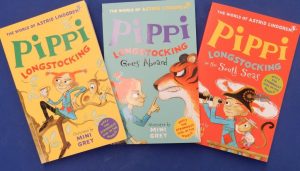
Pippi Longstocking, Pippi Longstocking Goes Aboard & Pippi Longstocking in the South Seas

Pippi Longstocking
Pippi Longstocking Goes Aboard
Pippi Longstocking in the South Seas

Astrid Lindgren, illustrated by Mini Grey
Oxford University Press

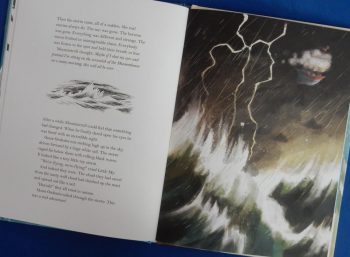
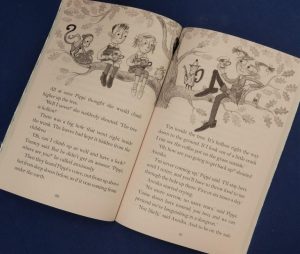
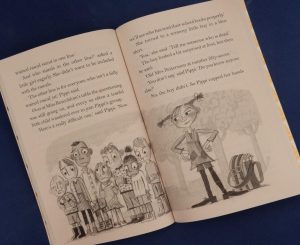
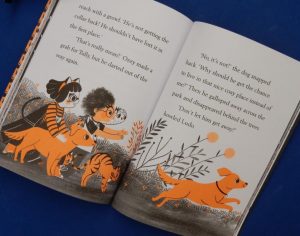
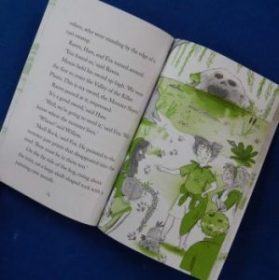
I absolutely loved these stories as a child more years ago than I care to remember, and thanks to these new editions splendidly illustrated by Mini Grey and translated by Susan Beard, I find that red-headed rule-breaking Pippi – the ‘strongest girl in the world’ –clad still in her odd (one black and one brown) stockings, has lost none of her wildness and charm.

Nine-year old Pippi lives sans parents in Villa Villekulla – mum is an angel and dad a South Sea Island king she proudly announces. With Pippi lives her monkey Mr Nilsson (a present from her dad), while on her veranda lives her very own horse.

In the first book Pippi meets and makes friends with neighbours Tommy and Annika, gets the better of some bully boys, outthinks some police who come a visiting, is persuaded to go to school (briefly) and gets a bit carried away with her drawing, does some entertaining up an oak tree,

rides bareback at the circus and more.

The second book sees Pippi joining school again – but only to provide the ‘jollification’ on an outing. Other adventures include a face-to-face encounter with a tiger and a surprise visit from Pippi’s dad. Finally Pippi has the chance to accompany her father on his travels. Will she bid farewell to Annika and Tommy and sail away or remain at Villa Villekulla? It’s a difficult choice to make …

The third title is the last of the original Pippi books. Herein Pippi organises a quiz

and then as autumn turns to winter, she invites Tommy and Annika, (both recovering from measles), to accompany her on a trip to the island where her father is king.

As always there are escapades galore including when Pippi seizes a shark, gives it a good telling off and then hurls it back into the ocean. She also manages to protect the island pearls from a pair of would-be thieves and generally have a wonderful time – until Tommy and Annika decide they want to go home for Christmas. They don’t actually make it in time but as always, Pippi finds a way and they don’t miss out altogether on the festivities.

(Happily the mention of cannibals from the original tales has gone but the anarchic Pippi – celebrating her 75th anniversary this year – will surely never lose her power to delight.)

The Funny Life of Sharks

The Funny Life of Sharks
James Campbell and Rob Jones
Bloomsbury Children’s Books

Full of gill-slittingly silly stuff unrelated to the particular elasmobranchs of the title as well as plenty of real sharkish information too, this bonkers book is one to dip in and out of – unless that is, you are a total shark addict and then you might go for total immersion.

Or perhaps you’d rather make your own way through using the different options signposted on almost all the spreads. Trying to do that left this reviewer’s brain starting to feel like not-properly-set jelly.

Another consideration is one of how to classify the book: is it non-fiction or fiction. It’s really hard to decide and anyway, does it really matter? It’s hilarious either way and cleverly interactive to boot.

Moreover it includes pretty much everything you would ever need to know about sharks and a whole lot more you definitely wouldn’t;

but you may well end up so befuddled that you’re unable to tell which is which.

Take for instance, that there are three main kinds of shark attack:  the hit and run variety (I can’t quite work out who or what might be doing any running however); the bump and bite type during which the decision is made about whether or not you become a shark’s dinner and thirdly, there’s the deadly sneak attack.

Apparently great white sharks catch seals using that method, approaching them at 50kmph.

Of course no self-respecting shark book would omit what is frequently child readers’ favourite topic – poo; so James Campbell has obligingly included a poo spread. Thereon you’ll discover that shark poo is ejected ‘like a liquid bottom burp.

Moreover shark poo is an important part of the ecosystem. Really truly.

To finish, let me just say, this whole inventive compilation – liberally littered with Rob Jones drawings – is cartilageniously crazy and particularly perfect for selachimorphaphiles as well as bibliophobes who need their reads in easily digestible bite-sized chunks.

The Boy Who Dreamed of Dragons

The Boy Who Dreamed of Dragons
Andy Shepherd, illustrated by Sara Ogilvie
Piccadilly Press

Dragon dreamer Tomas is back for a fourth tale. Now his special dragon Flicker has gone to live in his true dragon home in the frosty North and only comes on occasional short visits but the dragon-fruit tree in Grandad’s garden has just produced a bumper crop of fruits and that means more potential dragon adventures.

As this story starts Tomas and another of the superhero squad, Ted, discover an unhatched fruit on the ground that narrowly escapes being squashed to oblivion.

When it eventually hatches, a tiny sky blue and silver creature suddenly whizzes into action appearing to be super-charged as it zizzes about like there’s no tomorrow. There is of course, and one of the things Tomas must do is to nurture all those little dragon-fruit seedlings to keep alive the hope of another dragon-fruit tree that actually grows dragons.

Before long it’s evident that the recently hatched, havoc wreaking blue dragon has taken a liking to Tomas and is sticking with him.  Little sister Lolli, aptly names the creature Zing.

Not only has Tomas to contend with Zing, there’s also the question of his own dragon costume for the school dress up day and then a new girl shows up wearing an absolutely amazing one.

To further add to his troubles, two of the squad, twins Kat and Kai announce that they’re shortly moving to China and next day Aura claims to ‘know all there is to know about dragons.’
Her claim soon leads to an explosive outburst from Tomas.

This results in the revelation of a secret he’d intended to keep quiet about, the details of which I won’t divulge. Instead I’ll mention that streams of sweet-scented farts and a fair spattering of poo are part and parcel of subsequent events.

Like the previous adventures, this is a delightful mix of zany humour, warmth, mayhem, touches of magic and more. Once again Sara Ogilvie’s wonderful illustrations add to the book’s appeal and another good thing: by all accounts, the series isn’t over yet.

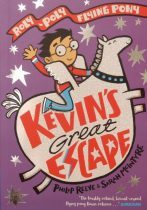
Kevin’s Great Escape

Kevin’s Great Escape
Philip Reeve and Sarah McIntyre
Oxford University Press

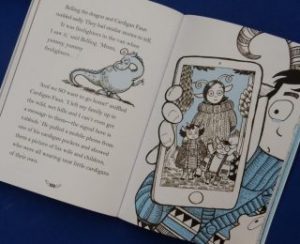
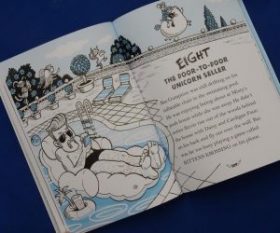
Roly-poly pony Kevin returns in a new adventure with Max and his family; he’s still as biscuit-obsessed as ever, his particular penchant remaining custard creams.

In this story Max’s sister is totally obsessed with pop idol Misty Twiglet, so much so that she persuades Kevin (guess how) to take her to see Misty’s new abode about thirty minutes flight time from Bumbleford.

Misty seems to be a charmer, but the consequence of this visit is that Kevin is pony-napped. That leaves Max and Daisy to devise a rescue operation – aided and abetted by some of Kevin’s magical creature friends perhaps.

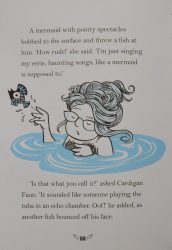
There are some terrific new characters to meet, not least a cardigan-loving faun unsurprisingly called Cardigan Faun, a bespectacled mermaid named Iris,

Cedric the centaur, gorgon, Zola (groan) and a tiny dragon, Belling – all captive too.

But we mustn’t forget Misty’s manager, the dastardly, devious Baz Gumption

and her enormous butler Lumphammer; oh! and the character on page 10, Nobbly Nora is definitely not to be missed.

Philip Reeve’s story is just as magical and just as hilariously brilliant (read aloud or read alone) as The Legend of Kevin (another must read if you’ve not done so). Once again Sarah McIntyre’s two-colour illustrations are totally terrific and as yummy as all those biscuits that actually were not why Kevin Goes Pop in the final chapter.

The Worst Class in the World

The Worst Class in the World
Joanna Nadin, illustrated by Rikin Parekh
Bloomsbury Children’s Books

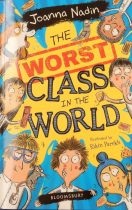
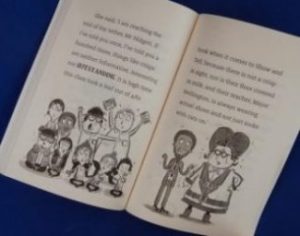
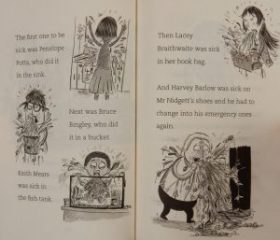
It’s official : class 4B belonging to Mr Nidgett is LITERALLY the Worst Class in the world . It must be so because that’s what rule-fanatic Mrs Bottomley-Blunt, headmistress of St. Regina’s Primary has declared and she ought to know.

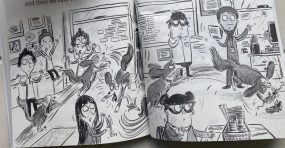
She has plenty of examples of their outrageous behaviour to quote such as when Marvey Barlow smuggled a penguin back on the bus after the class trip to Grimley Zoo; or the Show and Tell session when Manjit’s dog, Killer sated its hunger on gel pens, not to mention a pair of Mr Nidgett’s shoes (luckily not those on his feet at the time).

And there was that playground-tunnelling incident too.

One can hardly blame Mr Nidgett threatening on more than one occasion to leave teaching and become a lion tamer instead. Funnily enough it was a challenging Y4 class that brought me close to the edge too, but by the final term I ended up absolutely loving them despite everything and wouldn’t have swapped them for anything. A bit like pupil Stanley Bradshaw, who introduces us to 4B and acts as narrator of the two episodes The Biscuit King (with its FOOLPROOF PLAN) and the aforementioned Show and Tell in which those shoes and pens are not the only things that get eaten, but on that topic I’ll say no more.

Instead let me suggest you get hold of a copy of this splutter-inducing book with its crazy chaotic classroom atmosphere superbly portrayed through Joanna’s gigglesome narrative and Rikin Parekh’s illustrations that are equally entertaining. How long, one wonders did it take for Mrs B-B to compile her list of 50 rules.

That’s rule no. 9 duly broken

Not that long, I suspect, and I bet not a single one was on account of a transgression by a member of class 4A.

Finally, a FOOLPROOF PLAN, if you happen to be a primary teacher, buy several copies – one to keep for cheering you up when you feel down, or to share with your class, others as solo reads for youngsters around the age of Mr Nidgett’s pupils and thus likely to have similar preoccupations as Stanley, Manjit, Lacey Braithwaite, Bruce Bingley et al

and declare it OUTSTANDING.

The Crumbling Castle / Sage Cookson’s Sweet Escape & Sage Cookson’s Snow Day

The Crumbling Castle
Brenda Gurr
New Frontier Publishing

In these pandemic, physical distancing days lots of people have found a new delight in baking but how many would have this, or similar, said of their efforts:
‘Her cakes are out of this world! But please answer me this. Who is Zinnia Jakes?’

Daughter of globe-trotting food critic father, nine year old Zoe Jones has a special expertise inherited from famous pastry chef her mother (now dead). It’s she who uses the Zinnia Jakes alias to keep her identity hidden, for young Zoe has a real flair for cake creating, something she’d discovered when she baked her Aunt Jam a fabulous birthday cake a couple of years before the story begins. Hugely impressed, her aunt had suggested Zoe should start her own cake-making business. Only her best friend Addie is in on the secret, for orders are always delivered when nobody is watching.

Now Zoe has a new order: a medieval history professor is launching her new book at the medieval fair in two days time and wants ‘an authentic medieval castle’, a crumbling one, to display on her stall.

Zoe has just two days to create something truly impressive. Can she do it in time? Perhaps with the assistance of Coco her cat with special powers and STEM whiz, Addie. But then of course, she still has to deliver the order covertly.

This, the first book of the new The Fabulous Cakes of Zinnia Jakes series is aimed at newly-independent readers.  Mix together an action-packed narrative, lively characters and sprinkle with magic: the result? A fun offering; and the icing on the cake is that the author has allowed Zoe to share her secret recipe for medieval gingerbread with readers. It sounds yummy.

Also from New Frontier Publishing for youngsters hungry for more books with a cooking theme:

Sage Cookson’s Sweet Escape
Sage Cookson’s Snow Day

Sally Murphy

Sage Cookson is the daughter of popular TV chefs, who travel all over Australia tasting new foods, acquiring new techniques and serving them up to their adoring television audience. The good thing is that the Cooksons take Sage with them. That means she misses her friend Lucy, but now her parents have given Sage a mobile of her own so she can keep in touch. She also keeps up with her education by attending local schools or having a tutor.

In the first adventure Sage accompanies her parents to Western Australia where they’re to be guest judges at a cooking contest. Before that, they’re offered a tour of a chocolate factory belonging to chocolatier Marco. The chocolate they taste is absolutely divine but intuitively Sage feels something isn’t quite right, especially when Marco talks of his cocoa plantation. In the Australian bush? Really?

Things hot up when the Cooksons find themselves in an extremely sticky situation and without a phone signal. Will they be able to judge the 10th annual Newhaven Cooking Contest after all?

With its chocolately theme this is a tasty read for young solo readers who will be delighted to discover the Cheat’s Chocolate Fondant recipe after the story.

The second book sees Sage and her family off to Snowy Village in the Australian Alps. Now Page has promised to steer clear of danger. So what will a caring young miss do when she learns that her friend Kyle has gone missing with his snowboard?

Again there’s a recipe after the story – the rather more sophisticated ‘Easy Mille-Feuliie’. This one along with other recipes and activities can be found at Sage’s own website where I also found that Snow Day is actually story number 8 in the series.

Kitty and the Treetop Chase

Kitty and the Treetop Chase
Paula Harrison, illustrated by Jenny Lovlie
Oxford University Press

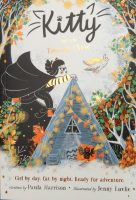
Kitty’s parents have invited their friends the Porters to visit. With them comes their son Ozzy who is Kitty’s age. “I sure you’ll find you have a lot in common,” Kitty’s mum assures her daughter.

That night the two children have a sleepover in Kitty’s tree house and during the night a tapping at the window wakes Kitty. It’s Katsumi asking for her help on account of the frenetic canine-caused chaos at the bakery. Now, even though Kitty’s somewhat unsure about Ozzy, she must share the secret of her cat-like superpowers with him. She’s more than a little surprised when he announces that he too is a superhero; a fact confirmed by Ozzy’s owl friend Olive.

Kitty, her cat Pumpkin, Ozzy and Olive, accompanied by Katsumi, venture forth across town to The Sticky Bun Bakery to find out exactly what’s been going on.

Little by little in the course of their investigations,

Kitty and Ozzy realise that two heads are better than one and they become a proper team. It’s pretty tricky though when both young superheroes find dogs claiming to belong to the bakery.

Like the previous ones, Paula’s fourth adventure of Kitty and her feline friends is pitch purr-fect for new solo readers; and now with the friendship forged between Kitty and Ozzy, not forgetting Kitty’s cat crew and Ozzy’s owl squad, the superheroes seem set fair for further adventures as a team.

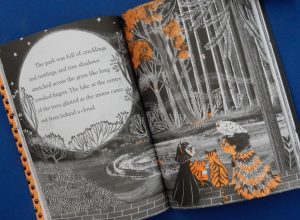
As always Jenny Lovlie’s adorable illustrations contribute to the overall magic of the book; and there’s a final Super Facts About Cats spread for readers with a particular penchant for moggies.

Flyntlock Bones: The Sceptre of the Pharaohs

Flyntlock Bones: The Sceptre of the Pharaohs
Derek Keilty and Mark Elvins
Scallywag Press

Here’s a piratical tale with a difference – the first of a proposed trilogy.

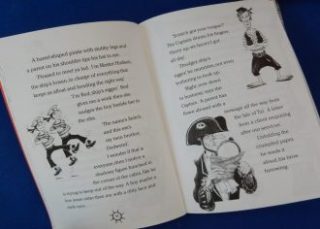
When young Flynn applies for the role of cabin boy having been kicked out of Baskervile orphanage by its matron, he discovers the crew of the Black Hound are pirates. Not your usual kind of pirates though; oh no me-‘arties, aboard this ship are, so he’s told by its captain ‘the cleverest pirate investigators ya ever set eyes upon’.

After securing a week’s trial aboard Black Hound the lad is taken under the wing of young Red. She has already served a year on the ship so knows the ropes pretty well. Flynn has a lot to learn including that the poop deck isn’t what he thinks.

Almost immediately Captain Watkins calls a meeting and informs the crew of the note he’s just received from a Miss Kristina Wrinkly, curator of the Gypshun Museum on the ancient Isle of Tut, requesting his help.

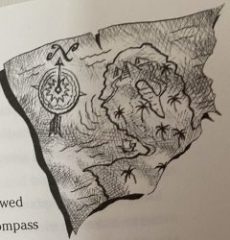
The museum has been broken into and priceless ancient artefacts including the Sceptre of the Pharaohs stolen.

Excitement starts to bubble within young Flynn but it’s quickly squashed by the bullying Drudger; but is he something much worse than a disgruntled bully?

The following morning Flynn is awoken by Red informing him that they’ve reached the Isle of Tut and are about to drop anchor.

Then, it’s a case of in at the deep end when some of the crew including both Flynn and Drudger are instructed to head to the museum.

The visit is brief but Flynn discovers a useful lead,

and the Black Hound is just heading off again searching for more clues when into view sails another ship. It belongs to ‘the cunningest, evilest pirate that ever sailed the seven seas – Captain Jim-Lad Morihearty’. Uh-oh!

Toss into Keilty’s brew an ancient prophecy, poisonous snakes, an amulet said to contain dark magic, wailing mummies and a traitor and what you have is an entertaining swashbuckling adventure, with some memorable characters, plenty of playful language, and at almost every turn of the page, a terrific, finely detailed, etching-like illustration by Mark Elvins

to add to the dramatic impact.

Good Knight, Bad Knight and the Flying Machine

Good Knight, Bad Knight and the Flying Machine
Tom Knight
Templar Publishing

As another term approaches for best friends Good Knight (Godwin) and Bad Knight (Berk), they are hard at work helping friends Warrick and his twin sister Willow fix up Pitchkettle Cottage when Warrick decides to speed things up with a touch of magic.

Suddenly things get just a tad out of hand and before you can say ‘daub’ there’s a gloopy mix of straw, clay and very pongy poo flying everywhere.

The next thing the siblings know is that they’re banned from spell making, hexed by their mum and they’re all made to spend the weekend clearing up the stinky, magic-induced mess.

Rather than achieve fame by being ‘the only wizard in the world who covers everything with poo’ as Willow teases, Warrick realises he needs another way to find fame.

Perhaps something he’s seen in Berk’s book with pictures of flying things might just do the trick (unfortunately written in Italian – a nod to Leonardo da Vinci there), something such as a flying machine for instance.

With the help of his friends and Willow (who seems to have focused much of her attention upon finding and taming the very large, very stinky dragon that harbours a rather large grudge), Warrick must to find a way to prevent any further disasters during his test flights.

All the more so when Godwin’s island is raided by Boog and his barbarians. Now a flying machine that actually stays airborne is vital.

Toss into all this the thoroughly unpleasant teacher Sir Dane, some tapestries that mysteriously go missing, a rather clever chicken and a couple of jars filled with fire beetles and what you have is a madcap Medieval romp to entertain young readers with a thirst for derring-do and riotous revenge. And it’s all brilliantly illustrated by Tom himself.

Moreover there’s a glossary at the end of the book explaining some delicious new words including ‘fopdoodle’, hoddypeak’, ‘fauntkins’ and I guarantee readers won’t be left ‘mubblefubbles’ having read this somewhat bonkers book.

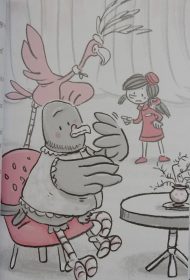
Hotel Flamingo: Fabulous Feast

Hotel Flamingo: Fabulous Feast
Alex Milway
Piccadilly Press

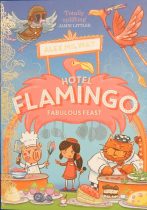
It’s always a huge treat to pay a visit to Animal Boulevard’s  Flamingo Hotel where now as winter recedes Anna and T. Bear are outside enjoying themselves while hoping that business will pick up after a slack period.

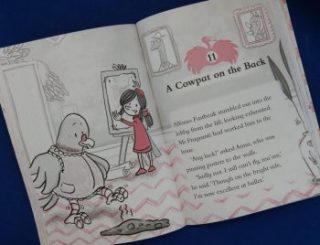
Suddenly into their midst from high above crashes their first new season guest in the form of a stunt pigeon named Alfonso Fastbeak.

Over a warming cocoa in the lobby Alfonso explains that he was working on his routine for a forthcoming record-breaking attempt when things went a little awry. Hence his unexpected mode of arrival.

Mightily impressed by the hotel, Alfonso decides to book a room for the duration of his recuperation and this prompts Anna to realise something needs to be done to improve business – something like a ‘Battle of the Chefs’ competition. Their very own chef Madame Le Pig is the greatest chef in town; they just need to prove her superiority over the chefs of rival establishments.

Ever the grumpy one, Madame Le Pig needs a bit of persuasion but having won her round, Anna and T.Bear set about the task of getting Peston Crumbletart and Laurence Toot-Toot on board too.

Meanwhile Ms Frangipani is enlisted to facilitate the recovery of Alfonso

and T. Bear finds a judge for the cooking competition.

As news of the event with its promised accompanying feast spreads, room bookings rise rapidly and pretty soon guests start showing up.

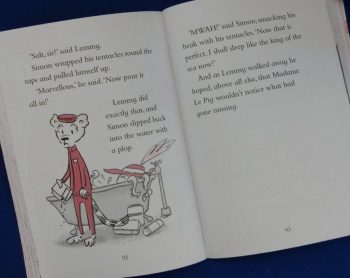
A pretty demanding lot they prove to be too. There’s Norman and Petal Horntop intent on sampling all the regional grasses, not to mention octopus Simon Suckerlot who insists on having a constant supply of brine. But even the most exacting guests must have their needs attended to, even if that means getting rid of any cowpats that appear on the carpets at the most inopportune moments

and procuring large amounts of precious sea salt from the kitchen.

When the competition eventually gets underway, things get pretty tense especially when Madame Le Pig gets an attack of stage-fright.

But who will be declared the final winner? And what of guest Alfonso: he too needs to summon up all his confidence for his big day.

Camaraderie, determination and self-belief are key in this deliciously offbeat drama. Add to the mix a generous garnishing of Alex’s brilliantly expressive two colour illustrations (20 with bees hiding in plain sight to find) and the result is a mouth-watering read that’s sure to satisfy young readers.

The Whispering Stones

The Whispering Stones
Saviour Pirotta, illustrated by Davide Ortu
Maverick Arts Publishing

Following on from The Stolen Spear, Wolf is back in his village and now knows that he wants to become a healer like Moon, the current village shaman.

It’s Moon he confides in and the healer is encouraging, offering to become his guide and teacher. Not so however Moon’s son, Rain, who considers it his right to assist and follow his father.

First Moon asks Wolf to accompany him to return the spear from the first story to its rightful owner, now a skeleton in the House of the Dead. Therein he receives a gift. It’s the bird-skull amulet that once hung around the dead healer’s neck.

This amulet gives Wolf seeing-dreams – visions that are not always what they first appear so Moon tells the lad, and if wrongly interpreted could have fatal consequences. A warning to heed if ever there was one.

Then Moon invites Wolf to go with him to a secret shaman ceremony in honour of the Time of Wolf Moon, further infuriating Rain.

During the ceremony Moon is poisoned after drinking from the bowl he’d given to Wolf and inevitably the boy is blamed.

In order to clear his name and save his mentor’s life, Wolf must take the shaman with him and search for a cure. It’s a journey that is long, hard and dangerous, taking them far from their island home

to the Whispering Stones.

Once again this is a gripping tale during which its young protagonist narrator learns much about himself, about the importance of choices and their consequences, about acceptance of past mistakes and the ability to learn from them, and about the power of friendship. And the good thing is that the story ends with Wolf, in the company of his trusted friend, Crow, about to embark on another adventure.

This is a historical series that is both exciting and with its Neolithic period setting, unobtrusively imparts some information about the ancient past.

Davide Ortu helps to bring Stone Age atmosphere to the book with his dramatic illustrations and amulet chapter headings.

Particularly recommended as a lower KS2 class read-aloud as well as for individual readers.

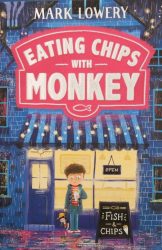
Eating Chips With Monkey / Super Stan

Eating Chips With Monkey
Mark Lowery
Piccadilly Press

Ten-year-old Daniel absolutely loves fish and chips, almost as much as he loves his soft toy Monkey; and when the two are part and parcel of the same experience – like his family’s annual Chip Shop Championships, then things really can’t get much better.
They can however get a whole lot worse for during a trip to find the winning chip shop one November day, the lives of Daniel and his family are shattered by a terrible accident when the boy rushes out of the shop straight into the road.

Following his accident Daniel becomes withdrawn while members of his family struggle to cope with the accident’s impact on their own lives.

Then Dad decides to stage a kidnap or as he put it ‘just borrow’ the entire family and redo the Chip Shop Championships mentioned in Daniel’s notebook and in an effort to stimulate the boy’s senses revisit the five contenders. That entails driving all over the country from Norfolk to Bedfordshire, to Yorkshire and thence to Camden Town and finally King’s Cross.

Mark Lowery has created a story that is highly affecting and also funny – think chip-guzzling giraffe, Grandma ‘seizing the day’ with a Major, and designer food. His characterisation of all family members is such that each one truly comes to life on the page, while the portrayal of Daniel (who has autism) is empathetic and might surprise readers who have little of no experience of what this might mean in terms of behaviours.

No matter which way you like your chips served, you cannot but be swept up in this highly unusual family drama.

Super Stan
Elaine Wickson, illustrated by Chris Judge
Oxford University Press

This is the third episode in the life of Stan. All the space enthusiast boy wants to do is to be left in peace so he can watch the total solar eclipse that’s coming up soon but his younger brother Fred has a much more important mission that threatens to eclipse any plans that big bro. might have for the near future.

Fred has donned an eco-warrior hat and is determined to solve the plastic pollution crisis. Moreover he wants everyone else to get involved too.

Add to that Gran’s big announcement regarding her and a certain salsa instructor as well as a certain umbraphile named Roberta Macklin who Stan is determined to meet.

And what’s all that about a certain King prawn vandalising the local supermarket?

Readers will be amazed at how all these threads are woven so neatly together by the author in such a highly entertaining manner; not only that, for Chris Judge’s inventive infographics

are an integral part of this SUPERb adventure that is once again much more than the SUM of all its parts.

Go Stan, go! and, go Fred go! The planet needs you both.

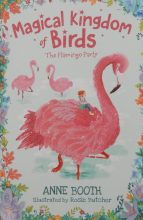
Magical Kingdom of Birds: The Flamingo Party / Little Owl Rescue

Magical Kingdom of Birds: The Flamingo Party
Anne Booth, illustrated by Rosie Butcher
Oxford University Press Children’s Books

In this sixth adventure Maya, inheritor of a magical colouring book is feeling a tad jealous. Her best friend Saffron is keen to include new girl, Alicia in their plans for a carnival in the town.

To uplift her spirits she turns to her colouring book and onto its cover start appearing flamingos.: a ‘flamboyance of flamingos’ Maya thinks and very soon she finds herself drawn back to the Kingdom of Birds where a new adventure awaits the Keeper of the Book.

Once there she learns that Lord Astor is up to no good again, luring all the flamingos to his palace lake. It’s on account of their magnificent pink feathers he needs to create the splendid headdress he is planning to wear as self-appointed Carnival King.

It’s up to Maya and Astor’s niece, Willow to make the Lord Astor see the error of his ways at last .

I say last for it appears that this is the final story in this enchanting series although I won’t divulge what happens.

If you work with or know young readers who would enjoy the mix of magic and bird facts characteristic of Anne Booth’s Magical Kingdom of Birds, then I thoroughly recommend they meet problem-solving, loyal friend, bird-loving Maya.

As with the other titles this one concludes with a bird fact file and there’s a recipe for ‘Flamingo-pink cakes’. Adding to the delights as usual are Rosie Butcher’s beautiful page borders and enchanting illustrations.

Another series for a similar readership that also mixes magical happening with saving wildlife is the Little Animal Rescue series, the latest of which is:

Little Owl Rescue
Rachel Delahaye, illustrated by Jo Anne Davies
Little Tiger

Animal loving Fliss is enjoying a trip to the fairground with her longstanding friend, Gabriel, when she is suddenly launched into another rescue mission. This time it’s in Aliceville, a sweetcorn growing area of Texas.

She is led by a white owl into a woodland area that is being chopped down to grow more maize crops. The mother owl has a family of baby owlets that she gathers up and off they fly, all except one little chick that hasn’t yet got the hang of becoming airborne.

Now with dangerous creatures all around and night fast drawing in, Fliss has an important task to save the owlet she names Cookie and to do so she needs to help it learn to fly and much more besides.

Indeed the whole rescue operation turns out to be a pretty dangerous undertaking for both Fliss and the owlet. The former discovers the importance of listening and she’s not one to give up until she’s achieved what she set out to do.

With plenty of black and white illustrations by Jo Anne Davies this is an exciting addition to the series for young readers that both entertains and gently educates.

The Train Mouse

The Train Mouse
Uwe Timm, illustrated by Axel Scheffler
Andersen Press

Translated by Rachel Ward, this is a new edition of Uwe Timm’s book first published in German in the 1980s that has now been given wonderful new witty illustrations by Axel Scheffler.

The story’s narrator is Stefan aka Nibbles aka The Train Mouse.

Nibbles had started life in the cellar of a house in Munich but redevelopment causes the mice to seek a new abode. As a result his family have to go out foraging for food in various parts of the city including the station.

For Nibbles, this accidentally leads to 18 months of journeying back and forth between Hamburg and Cologne in a train carriage.

One day though, the narrator hears the word Switzerland and he boards an Intercity train

bound to the country he considers mouse heaven. It’s at Basel his destination, that he meets another mouse named Wilhelm and has his dream about this new place well and truly shattered.

A new train takes them to their next stop, Paris, but the place is ridden with cats and Nibbles has no love of danger. Home and family beckon.

After more travelling and further fur-raising adventures both Nibbles and Wilhelm make it back to Hamburg

and thence to the Paradise Street home Nibbles had left so long back. But where is his family? Will they ever be re-united?

Perseverance, courage, resilience and friendship are at the heart of this charming and unusual reworking of the Town Mouse and the Country Mouse tale for primary age readers.

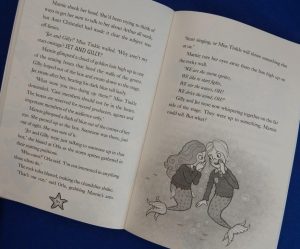
Mermaid School: The Clamshell Show

Mermaid School: The Clamshell Show
Lucy Courtenay, illustrated by Sheena Dempsey
Andersen Press

We’re back at Lady Sealia Foam’s Mermaid School where Marnie Blue is now well settled in and has two special friends Pearl and Orla (her enemy when Marnie started school).

Marnie is eagerly anticipating the forthcoming Clamshell Show particularly as it was there that her famous singer aunt, Christabel got her big break.

Now both Marnie and Orla are going to audition for the leading role of Queen Maretta.

Enter new pupil Gilly, she of the amazing voice. She too has set her sights on the star part and is prepared to resort to some tricky tactics to get what she wants. She also speaks fluent octopus and has a brother at a nearby educational establishment.

When Gilly learns that Christabel Blue is Marnie’s aunt things really start to hot up, so much so that it seems as though the long awaited Clamshell Show might not even take place at all.

Then who is the mysterious Arthur that Christabel is writing to when Marnie visits her recording studio?

There are plenty of twists and turns to keep young readers immersed in the undersea world of Mermaid Lagoon to the very last page of this second exciting adventure. Added to the fun are Sheena Dempsey’s drawings that bubble up on every spread.

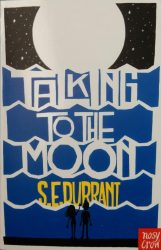
Talking to the Moon

Talking to the Moon
S.E.Durrant
Nosy Crow

What with Dad’s repairs to her bedroom and two year old twins to contend with, home life for Iris has become way too chaotic and stressful so she’s temporarily living with her highly unusual grandmother Mimi.

There though Iris soon discovers challenges and chaos of a different kind. Gran wants her to go swimming in the freezing cold sea and there’s no hot water to warm you up afterwards; and the place is full of bits and pieces Mimi has collected over the years, mostly boxes of old photos taken and developed by Mimi herself.

It’s not long before Iris begins to notice increasingly strange behaviour on Mimi’s part and it surely can’t all be down to her quirky nature. ‘It feels like Mimi’s getting holes in her memory. It’s scary,’ she tells readers.

Into the story steps the irritating, marble-obsessed boy Mason, who has observed some of Mimi’s behaviour from next door.

Despite all her intentions to wait until secondary school before forming a proper friendship, the two start spending time together. Mason’s granddad too has memory loss and the boy becomes increasingly involved in iris’s efforts to unravel the mystery of Coral, shown in one of Mimi’s photographs. Who is she and what happened to her?

Tenderly written, S.E. Durrant’s poignant story gently tackles the difficult subject of dementia and at the same time explores how the 11 year old narrator navigates her own tricky family circumstances.

We really feel we’re standing right beside Iris as she attempts to protect her beloved Mimi while dealing with the unsettling nature of her own life.

This utterly compelling book finishes with a beautiful and uplifting scene on Brighton’s seafront that brought a tear to the eye of this reviewer.

Audrey Orr and the Robot Rage

Audrey Orr and the Robot Rage
Jenny Moore
Maverick Arts Publishing

After a decade of competition entering, Audrey Orr’s mother has finally won a competition prize worth having – a luxury cruise to Norway.

Then Audrey discovers a huge problem: the trip is during term time and her aptly named headteacher, Mr Stickler, won’t countenance giving her time off. He even threatens expulsion: Audrey is devastated.

She’ll have to stay at home with her Grandad.

But then, Grandad notices an unlikely advert in his copy of ‘Men’s Knitting Weekly’ from a firm claiming to make robo-twins. It might just be that he’s found the answer to Audrey’s dilemma of how to be both in school and on the holiday at the same time: a robo-supply pupil created by Professor Droyde. Awesome!

Or is she?

Pretty soon, the twin is up to no good switching herself in an attempt to go on the cruise, not altogether a clever idea especially since the Orr parents are let’s say a trifle eccentric to say the least.

Luckily though Grandpa puts paid to Awesome’s plan and the real Audrey departs with Mum and Dad. Or maybe not.

Surely there can’t now be two Audreys aboard. Perhaps the  passenger who said she saw a girl climbing up the side of the ship is delusional. How Awful!

And Awful is how things get as the villainous robot and the real Audrey vie for control.

There are surprises aplenty in this madcap tale that is both funny – think fungal foot infections and balls of knitting wool – and a tad sinister. At the heart of it all though is a loving family and especially notable is the fond relationship between Audrey and Grandad.

High drama at sea for sure, and definitely not of the usual piratical kind, This reviewer’s now off in search of some of those Soft-Scoop 2000 flavours mentioned just a few times in the story.

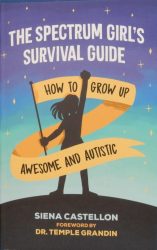
The Spectrum Girl’s Survival Guide

The Spectrum Girl’s Survival Guide
Siena Castellon, illustrated by Rebecca Burgess
Jessica Kingsley Publishers

Sienna Castellon, the seventeen-year-old author is an award winning anti-bullying campaigner and autism advocate; she is on the autism spectrum, and is also dyspraxic and dyslexic, and has ADHD. She is also gifted in physics and maths.

As we learn, her journey thus far has been anything but easy, so who better to write this book subtitled ‘How to grow up Awesome and Autistic’ than she, especially, as she writes in the first chapter, ‘I view my autism as a strength and as an advantage, a modern day superpower.”

Essentially Siena has compiled a comprehensive and detailed manual for readers of twelve plus about living the best life a young female with autism possibly can in a predominantly neurotypical world.

She covers such diverse topics as embracing who you are then deciding with whom to share your autism and how, to clothes and fashion ,

dating, sex and sexuality.

Other sections focus on bullying: face to face

and cyberbullying are covered in separate chapters and strategies for coping with both are discussed.

Self-esteem is key throughout: people with autism do not need pitying, they need understanding is another key message. The neurotypical brain is wired to socialise; in contrast most autistic brains need a fair amount of time alone for the mind to settle and the senses to be soothed.

On the topic of senses, Siena devotes a whole chapter to ‘Managing your sensory sensitivities and sensory overload.’  Siena mentions the relatively simple steps that some supermarkets, cinemas, airports and the like have taken to create a more inclusive environment for people with autism.

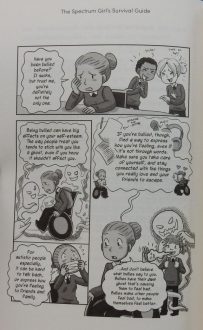
Throughout the authorial voice remains both earnest and compassionate; and in between her narrative are some comic style pages drawn by Rebecca Burgess that encapsulate what has been said in a particular section.

Yes, this book has a specific target audience in mind; however the insights it offers need to be shared with everyone. I’m a primary/foundation stage teacher and over the years have taught dozens of children with autism (mainly boys) and have some degree of understanding of neurodiversity. Nonetheless I welcomed the insights I gained from this guide and thoroughly recommend that all educators, parents, indeed anyone who hopes to ensure that all females on the autism spectrum have the very best possible chance to flourish, should read it and carefully consider this enormously wise young woman’s words. Surely that is every one of us, isn’t it?

The Garden of Inside-Outside

The Garden of Inside-Outside
Chiara Mezzalama and Régis Lejonc (trans. Sarah Ardizzone)
Book Island

Inspired by the author’s own childhood experience (in 1980 her father was appointed Italian ambassador to Tehran when Iran was at war with Iraq), this is an absolutely wonderful graphic novel style presentation with suberb illustrations by Régis Lejonc.

Chiara and her brother spent their days within a garden of an ambassadorial residence surrounded by high walls. Inside this garden with its fountains, pomegranate trees, a pond with an ancient carp, and a wealth of hiding places they were safe from the violent war that raged Outside.

One day while playing in their garden the children spy a young boy peering through the iron gate. He takes a risk and climbs over the wall. Chiara’s brother and their dog run away but despite having no language in common, Chiara and the boy whose name is Massoud, strike up a friendship.

Much alarmed, Chiara’s brother wants her to inform their parents but she keeps quiet and her new friend becomes ‘ the Persian prince of Outside-Inside’ while Chiara is a lion-taming princess; their garden his sanctuary.

But when Chiara tries to mix inside and outside the story suddenly turns and their friendship comes under a threat of her own making, her friendly gesture seemingly spurned; or is it?

Powerfully written and crafted with consummate skill, (this is a superb translation by Sarah Ardizzone), we readers really feel as though we’re standing behind Chiara’s head as she tells her enormously thought-provoking story. The illustrations truly do evoke the tranquilly of the inside sanctuary and the dark horrors and fears of the war as it rages in the city outside.

I’ve never seen anything quite like this before: what a wonderful demonstration that friendships truly can transcend boundaries and walls against all the odds.

Super Happy Magic Forest and the Humongous Fungus

Super Happy Magic Forest and the Humongous Fungus
Matty Long
Oxford University Press Children’s Books

Matty Long’s Super Happy Magic Forest series has grown from picture books into a spin-off young fiction fantasy of over 180 pages.

Once again it’s a splendidly silly frolic with a host of wacky characters not least of which are Blossom the unicorn, fairy Twinkle, a gnome named Herbert, a mushroom called Trevor and Hoofies the faun who considers himself leader of this group – the five Super Happy Heroes.

As the story starts the residents of Super Happy Magic Forest are in festival mood with its residents in frolicking mode.

Suddenly into their midst crashes the Rainbow Dragon and there’s clearly something very wrong with the creature.

Before you can say ‘quest’ the Super Happy Heroes find themselves charged with finding out what has made the dragon so poorly.

They soon come face-to-face with the dastardly red-eyed and highly toxic Fungellus a gigantic evil mushroom whose spores are poisoning the forest.

Seems as though there’s a crisis to avert for it’s those very spores that are responsible for the Rainbow Dragon’s condition.

In order to revive the comatose creature and indeed save the forest from total doom the S H Heroes will need to collect the five antidote ingredients on Dr Shroomsworth’s list …

But will Trevor give in to Fungellus’s dastardly temptation or will he remain true to his fellow Heroes and thus discover a better way to boost his self-worth?

With daftness in bucketloads including priceless illustrations bursting with speech bubbles, this book is a wonderful antidote to the present corona virus induced gloom. Can anyone apart from this reviewer see any parallels between the two scenarios?

Sea Keepers: The Mermaid’s Dolphin / Museum Kittens: The Midnight Visitor

Introducing two new younger fiction series:

Sea Keepers: The Mermaid’s Dolphin
Coral Ripley
Orchard Books

Meet Emily, Grace and Layla. Emily’s parents have just bought Mermaid Café; Layla lives just up the hill and Grace’s grandfather is a fisherman. The three team up to rescue a dolphin from a fishing net and find themselves plunging into a wondrously magical adventure with Marina the mermaid princess.

The three girls are unexpectedly chosen as the new Sea Keepers – guardians of the underwater world (a role not needed for hundreds of years). But human Sea Keepers? Humans have earned themselves a bad reputation with the Mer king and queen on account of their ocean polluting, whale killing and fishing, so the three girls will really have to prove themselves worthy of such a role.

They’ll need to confront Effluvia, the evil mermaid responsible for stirring up rubbish storms; she who has set her sights on finding the magical Golden Pearls; she with the power to mesmerise others.

Stop her they must, for the future of the underwater world is at stake; they simply have to find at least one of those magic pearls. Are they up to their task?

With talking sea creatures and much more, this magical story has at its heart the serious problem of ocean pollution. It’ll certainly immerse a certain section of young independent readers, and with still two pearls unfound at the end, this is just the first adventure of the Sea Keepers.

Museum Kittens: The Midnight Visitor
Holly Webb, illustrated by Sarah Lodge
Little Tiger

This is the first of a new series by cat-loving author Holly Webb who got her inspiration from stories of real-life museum cats from the British Museum and the Hermitage in Russia.

The appearance of a small black kitten on the museum steps one night has the majority of the feline residents of the museum all in a tither. The creature introduces himself as Peter and kitten Tasha at least, is eager to hear the story of this little scrap of a thing from ’Out There’.

Tasked with showing the incomer around the museum, the three resident kittens lead Peter through the various galleries but when they hear visitors the others hide leaving the newcomer alone.

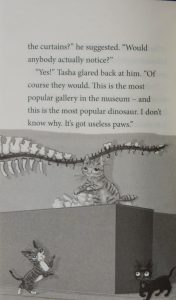
Tasha returns to find him, taking him on a rat hunt during which they hear strange sounds coming from the Dinosaur Gallery; marauding rats perhaps, or something else?

Disaster strikes as an incident results in the famous T-Rex losing a bone:

the search is on … Will it be found and will Peter ever feel as though he fits in?

Young moggy lovers especially will lap up this story. Holly Webb has created some interesting cat characters, young and not so young; and Sarah Lodge’s black and white illustrations add further atmosphere and humour to the telling.

Pests

Pests
Emer Stamp
Hodder Children’s Books

Having received a proof of this hilarious story from the publishers a little while ago, I was excited to see a finished copy of the book with its ‘glow in the dark’ cover drop through my letterbox.

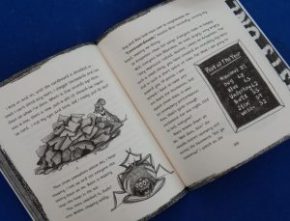
Star of the show, Stix is a tiny mouse that lives with his ancient Grandma behind the washing machine of Flat 3, Peewit Mansions. The ’mans’ family – Schnookums, My Love and tiny Boo-Boo also live there along with their dog Trevor, the only one that knows anything about their flat-sharing mice.

The mice have survived thus far by sticking firmly to Grandma’s strict rules – number 3 being ‘never poop in places mans will see’. Breaking this rule would result in a visit from Nuke-a-Pest.

One night into this peaceable place of co-existence comes Maximus a nasty rat with his two hangers on Plague One and Plague Two. His arrival soon results in disaster of the discovery kind, which is followed speedily by Sheila, Emergency Response Exterminator who flushes Grandma down the loo.

At least her ‘dead’ pose was a success but it leaves Stix alone, well not quite alone for back on the scene comes the previously encountered Batz, student at the Peewit Educatorium for Seriously Terrible Scoundrels (aka PESTS).

Stix joins the basement school and finds himself learning a whole new set of rules as well as competing in the Pest of the Year competition, determined to knock the dastardly Maximus off the top spot.

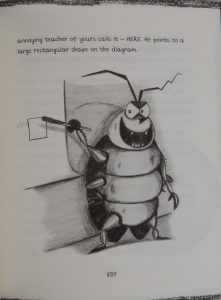
Step forward rule saboteur Professor Armageddon with a terrible plot of his own; but is Stix prepared to follow the directions of a cockroach and do what he knows to be wrong in order to gain extra points in a competition?

All’s well that ends well and this tale surely does. With an infusion of toilet humour, a great deal of suspense and some brilliant characterisation, this is a terrific adventure; there’s warmth and wisdom too; and the illustrations, generously scattered, are wonderful.  Giggles aplenty guaranteed throughout.

Lottie Luna and the Twilight Party

Lottie Luna and the Twilight Party
Vivian French, illustrated by Nathan Reed
Harper Collins Children’s Books

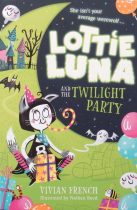
The little werewolf princess aka Lottie Luna has a special mission in this sparkling second story: she wants to give her friend Marjory a very special birthday surprise.

Lottie has only been at her school for a few weeks but already she’s loving it and managing to keep her powers under wraps except to her two real friends Wilf and Marjorie.

The problem is that another class member, the self-satisfied Agatha Claws, is always on the lookout for ways to cause trouble for Lottie and now Aggie’s cousin Kiki has just joined the class and is showing signs of being even more unpleasant than her relation.

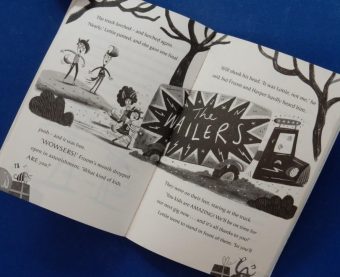
When Kiki manages to get her hands on a note Lottie has passed to Wilf concerning the birthday plan, things start to get pretty tricky; especially as the success of the plan rests partly on Lottie’s irritating brother Boris doing his bit.

Despite her reluctance to reveal her special powers to others, it seems that there is no other way than to use her super speed,  super sight, super hearing and super strength if Marjory is to have a birthday she’ll never forget.

On this occasion pushing a stuck truck out of a very muddy very deep puddle

and rummaging in rubbish bins are just two of the unlikely activities Lottie has to perform if operation party is to succeed.

There’s at least one surprise action and one welcome departure before the end of this fantastical fun story but I’ll keep those to myself and just say young readers will be gripped as they read of one little werewolf’s unstoppable energy and resolve.

They’ll also be utterly enchanted by Nathan Reed’s blissfully funny illustrations liberally scattered throughout the tale.

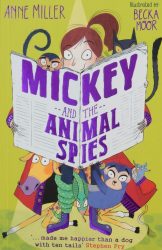
Mickey and the Animal Spies

Mickey and the Animal Spies
Anne Miller and Becka Moor
Oxford University Press

Code enthusiast Mickey is excited to discover on her way home from school one Friday afternoon, a coded message stuck onto the bus window.

It’s not long before she finds herself as a new recruit for COBRA, a secret animal spy organisation and the only human currently among the spies.

Each of the other members has a special talent – an eclectic crew indeed; but can the combined skills of this formidable team solve the intriguing crime of the diamond thief?

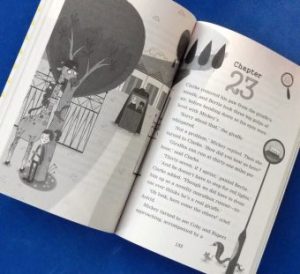
Operation Shiny Stones is on. Are all members of the team absolutely trustworthy though, and if not, which are the ones that might be double-dealing? Could it be Bertie the rather nervous giraffe,

Rupert the rat leader or perhaps Clarke the haughty cat?

With codes to crack along the way, dog-napping and terrific story-intensifying illustrations by Becka Moor, Anne Miller has created an intriguing whodunit story for solo readers as well as a smashing read aloud (have the codes available for listeners to crack along the way): the plot twists and turns this way and that until the final pages.

There’s clearly more to come for COBRA has a new post to fill – Human Liaison Officer. She of the opposable thumbs and love of adventure might just fit that bill.

Bring it on …

Alfie Fleet’s Guide to the Universe / Starfell: Willow Moss and the Lost Day

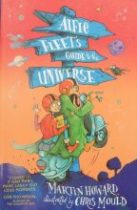
Alfie Fleet’s Guide to the Universe
Martin Howard, illustrated by Chris Mould
Oxford University Press

Holidays may seem like a distant dream at the present time but there’s no harm in looking forward and we all need something to keep us cheerful. This second Alfie Fleet story will certainly do just that and perhaps keep holiday dreams alive too.

If you’ve not encountered Alfie before, he has sandy coloured hair and awkward knees. In this adventure he and Professor Pewsley Bowell-Mouvemont are soon to open their enterprise the Unusual Travel Agency and are compiling the final few entries to the Guide to the Universe.

Pretty soon though, the two find themselves in trouble as they drop in on other planets that turn out to be anything but welcoming to the visitors.

In addition there’s that motley crew, members of the Unusual Cartography Club with their thoroughly nasty leader, Sir Willikin Nanbiter who is determined to sabotage the Unusual Travel Agency, to deal with.

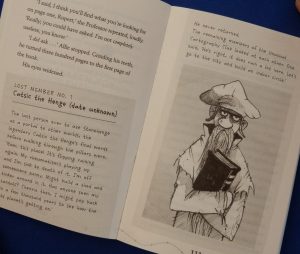
A brief review cannot do justice to this utterly crazy, twisting-turning story with its wealth of Chris Mould’s brilliant illustrations portraying the fantastical cast of characters;

let’s just say that with its weird words and toilet humour and more, this is a total hoot from beginning to end. Just give it to children who have a particular penchant for unlikely quests and stand well back.

Now I’m off to try that ‘Stuttering Ferret’ pose at Guru Wobbli Rubbalegs Bindobendi yoga retreat way off on Planet Baldy and leave readers to discover for themselves whether Alfie finally succeeds in finding all those whom he seeks and bringing love and peace – well maybe just peace, to the universe.

Also full of fantastic characters but of a rather different kind is:

Starfell: Willow Moss and the Lost Day
Dominique Valente, illustrated by Sarah Warburton
Harper Collins Children’s Books

With her second adventure just published it’s time to get acquainted with Willow Moss. Young Willow comes from a family with magical powers. She too has a special power but hers is less impressive-seeming than other family members. Willow, has the power to find lost things.

Then the scariest, most powerful witch in the whole of Starfell appears on the scene and changes things, for none other than Moreg Vaine has chosen Willow to help in a crucial search,

Apparently last Tuesday has disappeared– nobody remembers a thing about it – and almost unbelievably Moreg needs the talents of a finder like her. How on earth can she possibly manage such a thing, especially as failure to track down and return Tuesday to the place it belongs, could have catastrophic consequences for the entire world?

Really, Willow has little choice but to get on board (rather broomstick) and accept the mission. If truth be told though she’s long harboured a desire for a bit of excitement, so it’s bag packed and off they go (accompanied – in Willow’s bag – by lie-detecting cat-like kobold Oswin, Willow’s only friend).

Magical writing of a magical tale – Dominique Valente’s debut has everything younger fantasy lovers could want: humour, fabulous characters including a dragon with an empty egg and trolls, plus there’s a portal cloak (Moreg’s), a splendid compass-like device that can act as guide when tricky moments present themselves and much, much more.. In particular, the wonderful Willow herself – resourceful and determined and lacking in self-belief. And yes, she does finally discover what happened to that lost Tuesday.

The potency of all this textual magic is further strengthened thanks to Sarah Warburton’s cracking illustrations.

This reviewer can’t wait to read more of Willow, and I’m certain that will be the response from youngsters too.

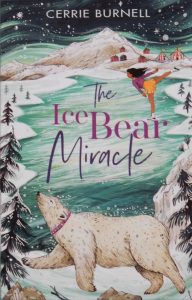
The Ice Bear Miracle

The Ice Bear Miracle
Cerrie Burnell
Oxford University Press

Cerrie Burnell has woven a wonderful wintry tale sparkling with magic and ice set in the far north of Canada.

It tells of Marv Jackson whose life is changed when he survives a bear attack on the eve of his fifth birthday when he was ‘drawn to the ice, like a ship to a star’ and found himself in the mouth of a polar bear.

Marv is left with a crescent moon scar on his forehead that serves as a constant reminder of that night when a baby’s cry drew him forth and he discovered a raging infant in a basket and protected her from a bear cub. It’s an event that his community don’t accept for no child was ever found but Marv is left with her memory etched in his memory.

Then eight years on the boy, now a keen ice-hockey player, has a chance encounter with the mysterious Tuesday and her huge, much loved ice-skating polar bear, Promise, both part of a travelling carnival. Something stirs deep in his memory. Is it possible that the girl who has been injured in a skating accident is the baby he saw on the ice all those years ago?

But no sooner has the travelling carnival arrived than it leaves again. What are they running from Tuesday wants to know; and where are they bound? Marv is determined to find out for he feels that he and Tuesday are meant to be together.

With her magical writing, Cerrie Burnell fills her story with folklore of her own making. She portrays the Island of Bears with its close-knit community, as a truly incredible place drawing the reader in from the outset, and her narrative grips one like the icy hold that Tuesday’s guardian Gretta has on her. Despite its icy setting though, there’s a great deal of warmth, love and a powerful sense of belonging and yes finally, joy, between the covers of this book. I couldn’t put it down.

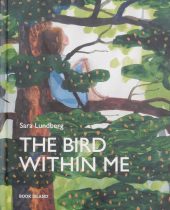
The Bird Within Me

The Bird Within Me
Sara Lundberg
Book Island

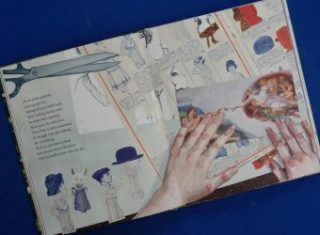
In this movingly told, inspirational book, based on the paintings, letters and diaries of Swedish artist Berta Hansson, we learn what it would have been like to grow up with her mother always sick in bed with TB and slowly dying, and an enormously hard-working father who calls your desire to express yourself imaginatively through art and beauty ‘ridiculous’.

That was life for Berta whose uncle (with whom she sometimes stayed when her mum was especially sick) managed to combine being a farmer with creating wonderful pictures, and occasionally allowed his niece to paint too.

Berta’s father wanted his daughter to follow his ideas – fit in, be a housewife – but she yearned to break free to live her own life, follow her desired creative path.’To fit in, you have to keep your desires secret. Be silent. And not really show who you are.’

‘When I grow up I’m going to be an artist. Like Michelangelo. But I don’t say that aloud. Because it isn’t a real job. Not something you can be. Especially not of you are a girl.’

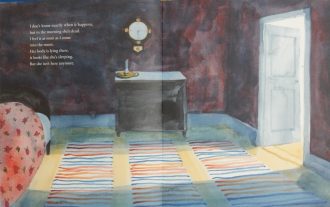
Just when it seems her mother is slightly better, she is taken very sick again and dies.

Then not long after, the doctor, an art lover who regularly examines the rest of the family, asks Berta what she plans to do after leaving school. She longs to tell him of her dream but doesn’t, keeping it bottled up inside.

Things get too much and after just a short while, something snaps inside Berta as she stands at the stove cooking pea soup on a wooden stove. She lets it burn

and that precipitates a change in her father and for Berta whose journey might well have gone in a completely dead-end direction.

So beautifully illustrated and affectingly told, this is a wonderful testament to the power of the imagination, Berta’s and that of all who have creative instincts.

Wigglesbottom Primary: Break Time Bunnies / Lottie Luna and the Bloom Garden

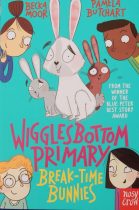
Wigglesbottom Primary: Break Time Bunnies
Becka Moor and Pamela Butchart
Nosy Crow

It’s always a delight to read of the exploits of Class 2R in their school where pretty much anything can happen.

Here we have three new fun, beautifully observed episodes wherein the children allow their imaginations to take flight. In the first story it’s a case of bunnies running riot in the playground: could they be ATTACK BUNNIES and why are they there?

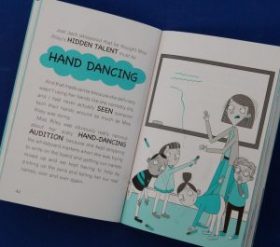
The second tale, has class teacher Miss Riley announcing the imminent arrival of a ‘special guest’. Is the man who sits at the back of the class a TV talent spotter or has he another purpose for watching the goings on of teacher and pupils?

In story number three the children all sign up for violin lessons but their music teacher, Miss Stein looks really spooky. Could she perhaps be a witch – a bewitching witch?

It’s so easy to get sucked into 2B’s zany premises in these enormously enjoyable stories and the final revelations are always delicious.

As ever Pamela Buchart has done a brilliant job illustrating these small sparkling stories. She catches the zaniness of Becka’s tellings SO well making every page turn not only a verbal but a visual treat.

Bring on the next one.

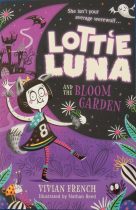
Lottie Luna and the Bloom Garden
Vivian French, illustrated by Nathan Reed
Harper Collins Children’s Books

Meet Lottie Luna, star of a super new series by Vivian French.
Lottie is a werewolf, but a very special one with extra powers on account of her being born during a full lunar eclipse. Hence she’s super speedy, super strong, has x-ray vision and has super hearing. Oh yes and she’s also a princess on account of her father inheriting a kingdom.

This however means that she’s had to move home to the crumbling Dracon Castle and consequently has to start at a new school mid year. Like many youngsters, Lottie is nervous about this and certainly doesn’t want it known at Shadow Academy that she’s special even if that means not revealing her real self.

Lottie’s class teacher announces a pupil project – to create a design to transform the wasteland behind the school into a beautiful garden and the winning design will be used for the purpose.

Before long Lottie finds she has two friends, and decides that the head of her new school is amazing – a kindred spirit too; perhaps things won’t be so bad after all.

As for the garden design, Lottie is the winner but once the garden creation begins,

more challenges arise – there’s a Bloom Garden saboteur at work.

Now Lottie must do all she can to save the enterprise from road developers; but can she do it? Perhaps it’s time to draw on those superpowers of hers …

Friendship, determination, being true to yourself, courage, resilience and forgiveness are at the heart of this smashing story Vivian has woven.

Nathan Reed has done a terrific job with his black and white illustrations; they’re offbeat and splendidly playful.

More please!

Bug Belly Babysitting Trouble / Kitty and the Sky Garden Adventure

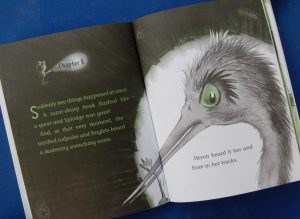
Bug Belly Babysitting Trouble
Paul Morton
Five Quills

Meet Bug Belly, he of ingenious plans, a clever kit bag and super cool gadgets; sounds a together kind of frog doesn’t he. There’s a snag though: Bug Belly has an almost insatiable appetite. Not a particular problem you might be thinking but how will he deal with that as well as the task of babysitting hundreds of taddies and froglets for a whole day while their parents attend a conference?

Seemingly not very well, for before long he’s faced with rescuing his charges from a rapidly draining pond and the reason for this is known only to the care-giver and his belly (readers of course are in on the secret).

Can he come up with a super-ingenious plan – probably his most clever ever – to evade the jaws of the ferocious pike Old Snapper and Heron of the razor-sharp beak

not to mention one Sneaky Snake that might just be snooping around?

Let’s just say DUCK POO and leave you to discover its significance.

Hilarious antics, splendidly portrayed and related in Paul Morton’s spluttersome storytelling prose: URGLE-GURGLE GLUMP! Froggy fun it surely is and perfect cheering-up fodder for new solo readers. It’s a great read aloud too – you can really give it some belly.

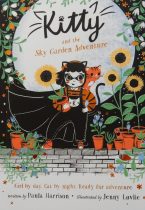
Kitty and the Sky Garden Adventure
Paula Harrison, illustrated by Jenny Lovlie
Oxford University Press

I can almost hear the cheers from young solo readers for girl during the day, cat at night, Kitty, as she returns in a third adventure with her feline side kick Pumpkin.

As the story opens Kitty is excited to discover that the sunflower seed she planted as part of the school garden design competition is sprouting leaves and is showing it to Pumpkin when Pixie appears talking of an established garden across the city that might provide some inspiration for Kitty’s own design.Kitty cannot resist the opportunity to see this garden and quickly dons her superhero suit.

Following the scent of flowers, the three adventurers venture forth and discover a wonderful rooftop garden alive with wonderful aromas, beautiful trees and gorgeous flowers including seven huge sunflowers.

Her companions are mightily impressed by the catnip bush and it’s this that results in their presence being discovered by an irate tortoiseshell cat whose peaceful evening they have disturbed. The friends’ enthusiasm for things botanical persuades the grumpy Diggory to allow them to explore and he shows them around Mrs Lovett’s amazing creation, even inviting them to return.

So excited is Pixie that she cannot keep the news of the wondrous place to herself and next evening they return to find the place overrun with cats behaving in a thoroughly undesirable fashion.
Before long, Kitty and her pals have a huge task on their hands – to repair the damage the unruly frolickers have done before sunrise.

Can they rise to the challenge when they have a whole gang of recalcitrant cats to deal with, Kitty’s going to need all her powers of persuasion to get that gang on side to help.

I love the way Paula Harrison almost unobtrusively weaves nature’s wonders into this urban adventure; there are subtle lessons for young readers about re-using and recycling planted in her tale too. From its gorgeous cover by illustrator Jenny Lovlie, this is a delight through and through. The illustrations within are fab too, especially those of the garden.

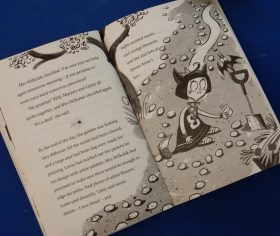
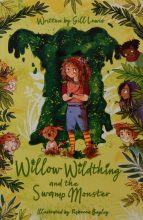
Willow Wildthing and the Swamp Monster

Willow Wildthing and the Swamp Monster
Gill Lewis, illustrated by Rebecca Bayley
Oxford University Press

This story introduces a super new character, Willow Wildthing in the first of a series to be.

Willow has just moved into a new home in a different town; everything feels strange, alien even. Left to her own devices, she decides to go exploring with just her dog Sniff for company. No sooner have they sallied forth than something startles Sniff and he vanishes.

Giving chase, Willow comes upon four grubby-looking children calling themselves the Wild Things who have seized Sniff saying they need him for a mission.

When Willow stands her ground the Wild Things (Fox, Raven, Mouse, Hare) agree (mostly) to let her accompany them.
But is she brave enough to enter the Wilderness? It’s a kind of wood but not just any wood, a secret place where anything can happen, a place wherein a wild monster dwells.

It means crossing some very murky water and going barefoot. Oh yes, it’s also a place where magic seeps into you regardless of whether or not you want it to; and you can only enter through the Holloway.

It’s said that a witch lives in the Wilderness too, though Mouse insists she’s the writer who came to talk at school; witch or writer, or both? The woman tells them in answer to Fox’s ’what do you do?’ – ‘I suppose you could say I conjure openings into other worlds.’

Eventually Willow decides that accompany them she must, Sniff’s help is needed in locating and rescuing another member of their group – Bear; but his is not the only rescue they undertake. They locate the source of the howling Willow heard on her first night in the new house.

All ends satisfactorily with Willow being accepted as a member of the Wild Things and there’s the promise of another mystery waiting to be solved.
And as for magic, let’s say yes to that, the best magic of all being, friendship.

Gill Lewis lyrical manner of telling this tale immediately engages the reader holding your interest throughout with its mixing of the enchantment of the natural world and that conjured up by the imagination. Rebecca Bagley’s two-colour illustrations are a delight too. The book is one likely to engender in children the urge to be curious, thirsty for adventure and resilient, as well as open-hearted and kind.

Hattie

Hattie
Frida Nilsson, illustrated by Stina Wirsén
Gecko Press

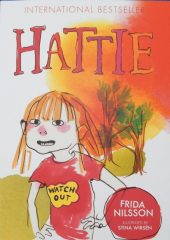
Six year old Hattie is shall we say, something of a mischief. She lives in a small country town in Sweden with her hard working parents and there’s little to keep her amused so she’s been eagerly anticipating starting school. That, she thinks, will surely bring plenty of adventures, and so it does.

Right on the very first day she makes a new friend, Linda who despite initial appearances is full of fun. She makes other friends too and manages to get herself into all kinds of trouble, sometimes solo, at other times along with her bestie, each escapade being related in a chapter. Every one however, results in new learning on Hattie’s part.

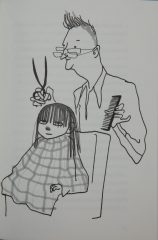
There’s the incident when on the eve of the school photographs, she gets her haircut

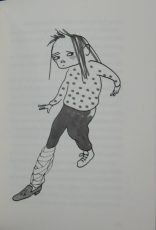
and ends up with a style that’s way too tufty, but guess who looks the most funky when the photo comes out.

Not everything goes wrong though: Hattie turns seven, becomes besotted with a hermit crab which results in Dad having to do some quick thinking; she gets her very first swimming badge – eventually – after some warty trouble;

and before you can possibly say, ‘where’s all that time gone,’ a whole school year has passed and it’s the summer holiday.

Youngsters around Hattie’s age will surely love reading about, or hearing of, her escapades; this is a girl with a thirst for fun, a total charmer who just doesn’t stop and think about the consequences of her actions before plunging straight in. She does though pause for thought, reflect and take on board the lessons learned.

The occasional line drawings by Stina Wirsén are a sheer delight too.

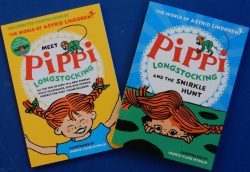
Meet Pippi Longstocking / Pippi Longstocking and the Snirkle Hunt

Meet Pippi Longstocking
Pippi Longstocking and the Snirkle Hunt
Astrid Lindgren, illustrated by Ingrid Vang Nyman
Oxford University Press

2020 sees the 75th anniversary of the publication of the first Pippi Longstocking book and as part of the celebrations OUP is releasing six new early reader, illustrated editions with Ingrid Vang Nymans’s illustrations rendered in two colours in each book, using adaptations of the original text by Astrid Lindgren.
The first two are Meet Pippi Longstocking, which introduces youngsters to the inimitable Pippi and her world and that in which Pippi invents the wonderful-sounding word “snirkle’ the meaning of which she tells her friends Tommy and Annika, she has no idea except that it’s not dustbin lid. Thus we have the second title, Pippi Longstocking and the Snirkle Hunt.

Clearly Pippi needs to discover what this brand new word of hers means and that’s exactly what, after a few moments of contemplation she sets out to do.

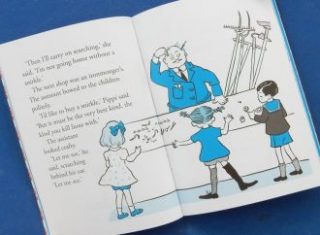
It proves not to be the sound made when you trample in mud making it come up between your toes: that she decides is SHBLURP and heads off, gold coin in hand, riding her horse Mr Nillson, to the shops with her friends, to see if it’s something that can be bought.
Several unsuccessful shop visits later,

she heads to the doctor’s but that yields nothing helpful.

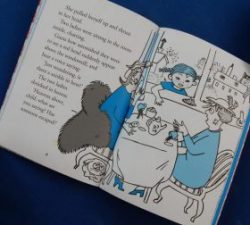
Nor does the intrusion she makes upon two ladies sitting chatting over a cuppa up in a flat.

Will the determined young miss ever solve her snirkle conundrum? Perhaps it’s closer to home than she thinks …

For the adult me, nine year old Pippi, with her mismatched stockings, carroty-coloured hair and freckles, has lost none of the allure she had in my childhood – an unstoppable self-belief, determination, resilience and kindness and lots of terrific adventures.

I can’t wait to introduce her, through these smashing little books to a new generation of young readers.  Long live Pippi!

Isadora Moon Goes on Holiday / Freddie’s Amazing Bakery: The Cookie Mystery

Welcome back to two terrific characters in new stories kindly sent, super speedily by Oxford University Press:

Isadora Moon Goes on Holiday
Harriet Muncaster

Isadora Moon enters a competition and is mega excited to learn that her picture has won a prize – a family holiday abroad.

Despite their initial reservations – the sticky heat, a plane flight the suitability of the hotel and more, her parents are finally packed and ready to embrace a new adventure.

Soon after their arrival Isadora, her mum and little Honeyblossom head for the beach, but during their first dip, Mum is concerned about the amount of rubbish people have thrown into the sea.

Next morning the whole family go on a boat trip and while demonstrating her underwater swimming skills Isadora encounters Marina, a friend she’d made when on a camping holiday. Now Marina too is holidaying with her family and she tells Isadora of the large amounts of rubbish they’ve discovered underwater.

The mermaid gives Isadora a conch shell to use as a communication device and later on she receives a call from Marina begging her to help in freeing a baby turtle that’s got stuck in a tangle of rubbish beneath the ocean.

Despite her parents’ warnings not to venture out again without telling them, Isadora, wand in hand creeps out into the moonlight and is soon diving beneath the waves on a rescue mission.

Even after successfully releasing the little creature, there’s a  huge task ahead of Isadora and for that she needs to enlist the help of her parents. Will they overlook this latest bit of disobedience in a far greater cause – saving our precious planet?

Telling and illustrating it with her usual sparkly magic and pizzazz Harriet Muncaster weaves into this latest story, important environmental messages about the horrors that we thoughtless humans cause the natural world.

Fans of the fangtastic fairy-vampire books will enthusiastically lap up this one, and will very likely espouse the cause of saving our planet too.

Freddie’s Amazing Bakery: The Cookie Mystery
Harriet Whitehorn, illustrated by Alex G. Griffiths

We’re back in Belville town where kind-hearted Freddie Bonbon has his bakery.

As the story opens it’s a lovely spring morning and Freddie is just about to leave on his delivery round leaving the bakery in the capable hands of Amira, his best friend and manager who is putting up a sign advertising for another baker. He’s heading for Van de Lune’s Hotel with a special delivery.

At the same time, the unscrupulous owner of Macaroon’s Patisserie, Bernard, is thinking super-bad thoughts about Freddie, intending to sample one of the  yummy confections he’s just stolen from Freddie and work out what it is therein that so delights everyone.

The following morning Freddie learns that Cookie, the superstar cat staying at Van de Lune’s has disappeared, presumed kidnapped. Can he, with the skills of his small dog, Flapjack succeed in solving the case of the vanishing feline?

The recipe of Harriet Whitehorn’s fun story with its highly satisfying ending, generous sprinkling of Alex’s superbly characterful black and white illustrations, posters, signs, and appropriate capitalisation of the text, plus a culinary glossary and instructions for baking delicious cookies, this is another yummy treat for junior fans of The Great British Bake Off.

Freddie is destined to win even more young book enthusiasts with this, his second mystery.

Agents of the Wild Operation Honeyhunt

Agents of the Wild: Operation Honeyhunt
Jennifer Bell, illustrated by Alice Lickens
Walker Books

Returning home one day, 8 year old Agnes Gamble, daughter of the sadly no longer alive, renowned botanists Ranulph and Azalea, discovers a creature clad in a safari uniform awaiting her in her bedroom. He informs Agnes that he’s an elephant shrew (species Rhynchocyon petersi) , a field agent for SPEARS (the Society for the Protection of Endangered and Awesomely Rare Species). He gives her a pair of knee pads covered in a sticky green goo (slug mucus) and says she’s to accompany him on a mission. He’s even brought a replacement chimp trained to mimic her so that her Uncle Douglas won’t notice her absence.

The recruiter who’s also known as Attenborough or Attie for short, says that not only did her erstwhile parents know of SPEARS but that they too were field agents for the society. This persuades Agnes to go along with Attie who leads the girl up inside a hidden passage to where eventually they board the SPEARS dragoncopter that takes them to HQ to meet the organisation’s Commander, a turkey.

He tells Agnes that she’s been scouted and if after training, she’s deemed ready, she’ll be sent on a mission with a view to becoming a permanent agent.

Needless to say the training is pretty rigorous

but Agnes scores well and along with Attie, is assigned to Operation Honeyhunt tasked with rescuing a young bee left behind during a hive relocation to a protected sanctuary the previous week. Said bee is at even greater risk due to the fact that the dastardly Axel Jabheart has been sighted in the Atlantic Forest, the place where the bee was left.

Eventually they locate the apis in the rainforest.

He then informs the agents that he’s called Elton and that he’s choreographer in chief of the hive colony. Agnes amasses a wealth of additional information about Elton but is she up to the difficult rescue task, after which she’ll become a full SPEARS agent?

With its exciting mix of adventure and wildlife conservation, Jennifer Bell has created a terrific story for those around Agnes’ own age. Alice Lickens’ wonderfully offbeat illustrations sprinkled throughout the book, break up the text; and at the end of the story are several pages providing facts about the endangered wildlife of the Atlantic Forest in which the mission is set, as well as information on how readers can get involved.

I look forward to reading more of young Agnes and her adventures.

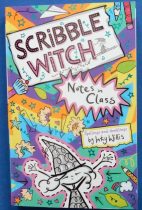
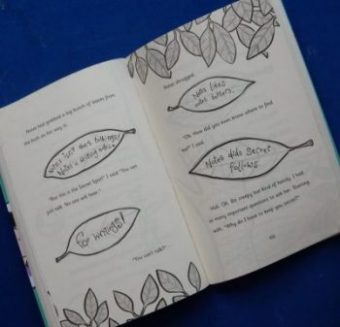
Scribble Witch: Notes in Class

Scribble Witch: Notes in Class
Inky Willis
Hodder Children’s Books

This sparky story is the first of a new series featuring Molly Mills (our narrator), her best friend Chloe, and a ‘scribbly doodly’ character named Veronica Noates aka Notes, a somewhat mischievous little paper witch.

As the story opens Molly learns that her very best friend is leaving Dungfields School. They’ve been pals since nursery and they’re now 9 years old. Consequently Molly is very upset and starts taking it out on Chloe. Into this sorry situation drops, quite literally, a piece of paper on which is drawn a smiley, friendly looking, titchy little witch.

Having liberated her from the paper with her rainbow scissors, Molly begins to get to know this rather odd character
that communicates, not by speaking (although she can) but through little notes written not only on paper, but other things such as leaves too.

The trouble is, despite her best intentions, Notes causes Molly even more problems, and she’s already got herself very much in her teacher, Mr Stilton’s bad books.

Is there any way that Molly, with the help of Notes, might manage to convince her best pal to stay at Dungfields rather than move to Lady Juniper’s School; or if not can Notes make sure that the two girls can be in close touch whenever they want?

With its wealth of quirky illustrations (including pencil toppers) and written communications (readers will quickly get used to Notes’ idiosyncratic writing style), this book is terrific fun as well as being bang-on with the feelings relating to losing a best friend ever from class.

Magnificent Mabel and the Rabbit Riot

Magnificent Mabel and the Rabbit Riot
Ruth Quayle, illustrated by Julia Christians
Nosy Crow

Mabel Chase is a spirited girl. She sees how things ought to be and knows what she wants – kind of. It’s pets that she wants in the first story finding it totally unfair that her parents deny her one. Even more unfair is that Mabel’s big sister is given a pet rabbit, Henry for her birthday and she doesn’t appear very interested in the creature; after just one morning she leaves him behind while she gallivants off to spend her birthday money. Of course, Mabel cannot resist stepping into the caring breech

and pretty soon the place is in chaos. Not only that but she decides to clean out the hutch; this involves using a green fluffy duster that doubles up rather well as a broomstick – uh oh!

The strange thing is Mabel comes out of the whole episode squeaky clean and being showered with praise.

Oh, and she seems to have replaced her penchant for rabbits with a different kind of animal …

There’s another crisis situation in the second story – it happens when Mabel discovers she has suddenly developed a wobbly tooth and she’s anything but keen on the tooth fairy. Time to put her ‘spare time’ dental skills into practice. Despite her best efforts the tooth does eventually fall out and then she has to work out how to deal with that tooth fairy. I’ll leave her pondering the dilemma and merely add that it’s not the only one Mabel faces in this episode.

The third story has Mabel complaining about the unfairness of life AGAIN. Now it’s on account of not having a sprinkler in the garden. However Elsa Kavinsky does have one so perhaps it’s time to work on cultivating their friendship.

Maybe then she’ll let Mabel have a play in hers … This episode has “Pixie Play Date’ in its title but if you want to know how pixies come in you’ll need your own copy of Magnificent Mabel and the Rabbit Riot.

I’d most definitely recommend getting a copy if you have a newly independent reader in your class or family; it would make a super fun book to share too. I love the way it’s presented from Mabel’s viewpoint; she’s a totally endearing narrator and SO good at keeping calm when faced with emergencies. I love too Julia Christians’ plentiful illustrations; she’s captured Mabel’s character splendidly, and those of her family and friends.

This is a series that could run and run.

Amelia Fang and the Naughty Caticorns

Amelia Fang and the Naughty Caticorns
Laura Ellen Anderson
Egmont

There’s a new baby on the way in Amelia’s household and inevitably her mother’s attention is focussed on that. Consequently Amelia and her best buddies Florence and Grimaldi take charge of the adorable caticorns.

It’s sure to be such wonderful fun caring for Gerrard, Butler and Mo, isn’t it? After all, Amelia’s Aunt Lavitoria has given her assurance that she’s only just collected them from the very best school, so they’re certain to be very well behaved. Moreover, experience in caticorn care will stand Amelia in good stead for being a FANGTASTIC big sister to her soon to be born sibling; and she’s eager to impress on that score.

However, looking after what prove to be three very excitable, mischievous caticorns, turns out to be rather more than Amelia has bargained for. Indeed after a mere five minutes babysitting, the little creatures have disappeared.

Having rounded them up once more, you might imagine they’d settle down, but oh dear me, no! They merely move on to chaos-creating in the kitchen.

Perhaps it’s time for Amelia to bring out some of the presents from the suitcase her aunt left for the caticorns, suggests Florence.

Or maybe not …

As with its predecessors, this story (that includes some great messages about Amelia’s potential role as responsible big sis), is wonderfully wicked fun and the illustrations are terrific.

Established fans will relish it and I’m certain any newcomers to the delights (and horrors) of the series will be hooked too.

Weird Little Robots / A Super Weird Mystery: Danger at Donut Diner

Weird Little Robots
Carolyn Crimi, illustrated by Corinna Luyken
Walker Books

Science lover, Penny Rose moves to a new neighbourhood and spends much of her time in the shed creating little robots – robots with character – using found bits and pieces. What she really wants as a newbie though, is a human friend.
When she meets bird watcher and birdhouse maker extraordinaire, Lark, who also lacks a friend, the two girls become kindred spirits.

At Lark’s suggestion they create an entire roboTown in the shed from discarded oddments and lava lamps. But their friendship is tested to its limits when Penny Rose (but not Lark) is invited to try out for the Secret Science Society. She breaks a promise made with Lark by showing some of the robots to the society members (who are popular pupils at school) in order to prove her worth. Can their friendship survive?

With its message that girls can do anything, this story of friendship, forgiveness and being true to yourself, is an absolute gem – compassionate and funny. There are sufficient twists and turns in the plot to ensure readers remain engrossed; and the language of Crimi’s telling is apposite: ‘Her cheeks burned hotter than a Bunsen burner’ for example. Both main characters are wonderfully divergent and their dialogue really reflects their personalities.

Corinna Luyken’s illustrations are great too – especially those robots.

A Super Weird Mystery: Danger at Donut Diner
Jim Smith
Egmont

This is the first of a new hilarious detective mystery series from the Lollies award-winning creator of the popular Barry Loser books. If you like your books SUPER WEIRD then this one is definitely for you.

Melvin has just moved from the city to Donut -a circular island with a hole in the middle – and he’s shall we say, underwhelmed.
However when he meets Rhubarb, creator of her own school newspaper and a total obsessive where mysteries are concerned, things become rather different.

To date Rhubarb hasn’t actually had anything mysterious to write about but Melvin notices that the children at school are acting very strangely indeed. This couldn’t by any chance be connected with the Donut Hole Monsters that everyone is so keen on collecting, or could it?

It’s not long before the two of them scent a mystery and are hot on its trail. The trouble is, this trail is going to plunge them slap bang into the centre of the donut hole.

If only the two can get back out safe and sound, then perhaps at last Rhubarb will have something to report on in her newspaper. That assumes that they solve the mystery before the entire population of the town is brainwashed. No easy task then …

Packed full of laugh-making moments and crazy pictures, Jim Smith has another winner here, methinks.

Little Bird Lands

Little Bird Lands
Karen McCombie
Nosy Crow

‘Fifteen years ago, my mother looked down upon me – cradled and broken in her arms – and made a wish. She wished that I might live, since it seemed likely that I would not.’ So begins Karen McCombie’s sequel to the superbly written Little Bird Flies. (If you’ve not read it you might want to start there.)

The brave, determined Bridie aka Little Bird, and her father and brother Lachlan have now been in the US for two years and are in a snowy copper mining settlement in Michigan. Here they face plenty of challenges: a fever lays Bridie low but happily there’s a woman doctor temporarily lodging with them at Hawk’s Point; the mine in which Lachlan has found work is said to have a Chippewa curse on it, and a ghost of a Chippewa maiden supposedly haunts the entire town.

When Dr Spicer suggests to Bridie that she gets involved in the setting up of a school for the local children and the newcomers, the girl’s initial reluctance at the idea of teaching quickly gives way to excitement and resolve.

The issues of taking land from the Native American peoples, of reservations and of the incomers’ selfishness rear their ugly heads. So too does that of who has the right to the education the doctor and Bridie are offering; as well as the question of whether or not ‘servant’ Easter – as she’s deemed by ‘cocky’ boy, Charlie – and Bridie can become true friends.

Then comes a disaster at the mine causing terrible injuries to many of the workers. Is this remote place ever to feel like home? Especially when Bridie discovers the secret that Easter has been keeping about her mistress for many months …

Later, when she finally understands what Lachlan has been trying to tell her about this ‘mistress’ and comes face to face with her, she realises that the young woman has the knowledge and the power to ruin her life and those of her father and brother all over again …

Totally engrossing throughout: McCombie’s carefully researched, compelling story chronicling Bridie’s experiences as an immigrant, is superbly woven and ultimately uplifting; all its characters really come to life; and there’s SO much to think about.

If you’re searching for a book to offer a confident upper KS2 reader, or want something of a historical nature to share with a class, this is a smasher.

Narwhal’s Otter Friend

Narwhal’s Otter Friend
Ben Clanton
Egmont

This is the fourth graphic novel style Narwhal and Jelly book and it’s as brilliant as ever.

It begins with an encounter between best pals Narwhal and Jelly, and newbie Otter. Narwhal declares self-professed ocean explorer, Otty, “Otterly awesome!” Ever-sceptical Jelly on the other hand, is less enthusiastic and disinclined to believe some of his stories.

His enthusiasm wanes further when Narwhal invites Otty to accompany him on an adventure. “Really? Does this mean we’re friends?” Otty asks. “Pretty much!” comes the response.

Guess who is jealous and feels left out. So much so that he decides to seek out a new friend; not very successfully
and eventually he befriends a rock, he names Rocky.
They play ‘oodles of awesome games’ that Rocky excels in ‘Go Fish . . . Marco Polo . . . Staring Contests’ as Jelly informs Narwhal and Otter when the latter finally hunt them down.

You’ve probably surmised that it was never Narwhal and Otter’s intention to sideline Jelly and he’s over the moon – or rather, the rainbow – to be invited to join them on the ‘awesomest adventure ever’. ‘Seas the day’ guys!’

As always Ben Clanton’s illustrations are terrific – whimsical, witty, wonderfully expressive. His text has its measure of splendidly groanworthy puns and there’s the usual sprinkling of animal facts as well as another Super Waffle and Strawberry Sidekick offering, from Jelly and Rocky on this occasion.

Plunge in and relish the three tales and more in this friendship tester; it’s a laugh-out-loud winner once again.

Flights of Fancy

Flights of Fancy
Quentin Blake, Anne Fine, Michael Morpurgo, Jacqueline Wilson, Michael Rosen, Julia Donaldson, Anthony Browne, Malorie Blackman, Chris Riddell, Lauren Child
Walker Books

Now in paperback, here’s a truly special gem of an anthology subtitled ‘Let your imagination soar with top tips from ten Children’s Laureates’. It brings together the ten awesome authors and illustrators who have held the title (given in celebration of their outstanding achievements) and first awarded to Quentin Blake in 1999.

To open, Michael Morpurgo explains how the original idea of the role (each person holds it for two years), was first thought up by himself and Ted Hughes, the then Poet Laureate.

You might be especially interested in poetry, rhyme and wordplay, if so head first to the sections from Michael Rosen and Julia Donaldson. Michael in Poetry Belongs to Everyone talks about playing around with a word to create a poem. Julia Donaldson’s Plays to Read and to Write discusses one of her own plays that she based on the Aesop’s fable, The Hare and the Tortoise, offering a fun, lively 6-parter

If you’d rather be playful in the visual sense then Anthony Browne’s The Shape Game could be your starting point: having talked about how to play it, he showcases some examples from 3 other famous illustrators to whom he gave the same shape to play as the one of his own shown in the book. The potential with this one is endless. Probably that is the case with most of the chapters however.

In The Only Way to Travel, Quentin Blake writes with reference to  Dahl’s stories, about how when illustrating someone else’s texts it’s important to ‘put yourself inside their story’ and capture the atmosphere before diving in and drawing those fabulous illustrations of his.

More about how other fabulous illustrators approach their drawing and what provides their inspiration comes from Chris Riddell –

make sure you check out his brilliant cartoons of all ten Children’s Laureates in the final section – and Lauren Child.

How fantastic and moving is Michael Morpurgo’s Find Your Own Voice that tells children how to do so in ‘I Believe in Unicorns’.
I thoroughly enjoyed too, Malorie Blackman’s Taking a Word for a Walk using SEA as her example,

before she moves on to discussing from whose viewpoint a story is being told when one writes.

If you want to inspire children to let their imaginations soar, then you really, really must have a copy of this cracker of a book in your home or classroom; not only will it do just that, but it will also ignite or add fuel to a passion for reading, writing and illustrating. (BookTrust, which manages the Children’s Laureate gets 50p from every sale.)

Runaway Robot

Runaway Robot
Frank Cottrell-Boyce, illustrated by Steven Lenton
Macmillan Children’s Books

After being in a road accident, twelve year old Alfie has been fitted with a prosthetic hand – this makes him ‘a bit bionic’ he tells us. Along with the loss of his hand though, the boy has lost his confidence.

He explains how he bunks school( aka Limb Lab) – ‘swerving school’ he calls it, and instead of joining in the “New Life’ lessons he goes to hang out at the arrivals lounge of the airport.

On one such swerving occasion Alfie accidentally loses his state-of-the-art hand. At lost property, instead of his hand, the lad finds Eric, a six-foot tall, metal robot with a propensity for singing the national anthem. “I AM YOUR OBEDIENT SERVANT” Eric announces and “I CAN ANSWER ANY QUESTION” (except the ones he doesn’t know the answer to, that is.)

Eric too is missing a limb, one if his legs. Despite this, unlike the other robots Alfie decides Eric is anything but ‘a disappointing robot’. Indeed, he declares him ‘the most-not-disappointing robot you could ever meet’.

It’s no surprise then that the boy will do everything he can to keep the illegal Eric from being crushed at the R-U-Recycling scrapyard.

No easy task as despite his fine manners, Eric takes instructions literally, which inevitably gives rise to a fair few problems.

But with reports of a rogue robot at large terrifying the estate, should Alfie even be bent on saving Eric?

Alfie’s world might be full of things robotic (he does make some new human friends too) though in essence this story is about what being human really means.

With a plot that makes you both laugh and cry, that’s what makes Frank Cottrell-Boyce’s highly original book so satisfying. Add to that a sprinkling of Steven Lenton’s smashing illustrations and what you have is an unmissable treat.


Mermaid School

Mermaid School
Lucy Courtenay, illustrated by Sheena Dempsey
Anderson Press

The first of a new Lucy Courtenay series sees young mermaid Marnie Blue determined to make a good impression on her very first day at Mermaid School.

She has the usual first day nerves about making friends, and is concerned at the prospect of perhaps having to ride a seahorse but she has something additional to be worried about.

Her aunt, the famous singer and DJ, Christabel Blue, is an ex pupil and her reputation as a student at the same educational establishment leaves a lot to be desired. Indeed she is on record as having been the naughtiest mermaid the school has ever had on role. In contrast Marnie’s mother was a model student.

Marnie really wants to impress both staff and fellow pupils but will her teachers give her a fair chance or have they already decided what kind of newbie they’re dealing with in the latest Blue family enrollee to Lady Sealia Foam’s Mermaid School?

Her first day is definitely not a success except that Marnie makes friends with Pearl Cockle. Surely the mayhem-causing snake in her school bag couldn’t possibly have been put there by her aunt, could it? If not then who was responsible?

What about Orla, who from the outset seems determined to be unkind to her and causes her to get into trouble? Something decidedly fishy appears to be going on.

Then Orla goes missing; who will come to her aid?

There’s SO much more to discover about life at Mermaid School and Marnie’s family in this story that bubbles with excitement; all the more so thanks to Sheena Dempsey’s illustrations.

I know one 7-year-old reader who is already eagerly anticipating Book 2, The Clamshell Show, coming in May.

Emmanuelle engrossed in the story

Some of Emmanuelle’s comments on this book:
“It was VERY, VERY, VERY good and very funny, especially Marnie’s aunt, Christabelle Blue. I really like that she said the Mermaid school was ‘terrible’ and also her love aspect with a human.”

She was also inspired to draw this picture of Marnie’s aunt.

The Monster in the Lake / Unicorn Academy: Isla and Buttercup

Here are the latest stories in two magical series from Nosy Crow

The Monster in the Lake
Louie Stowell, illustrated by Davide Ortu
Nosy Crow

We’re back in the magical world Louie Stowell took us to in Dragon in the Library with youngest magician in the world, Kit Spencer. Beneath that library in Book Wood, she’s having ‘spelling’problems. She hasn’t been distracted, her pronunciation was spot on as were her hand gestures; so why, oh why, are her spells going haywire?
Then Kit and her pals learn two things: one: they can understand what the animals they encounter in the park are saying and two: Dogon the delightful dragon dog is poorly, very poorly.

Definitely time for a spot of investigation …

Almost before you can say ‘weird’ the friends find themselves face to face with a strange creature calling itself Lizzie and saying it’s a Lesser Nessie from Scotland.

After a conversation with Lizzie, the friends return to the library and before long they’re embarking on a double rescue undertaking in Scotland, via one the library’s portal books.

Once there they discover a mobile library and its librarian Duncan. Then follows a terrific adventure full of mermaids, ancient curses and much more. It’s dangerous, nail-bitingly tense and absolutely perfectly paced.

Once again Louie Stowell’s telling with its mix of magic, friendship and bookish references works a treat, and with Davide Ortu’s stylish illustrations, the result is another spellbinding foray into the world of Kit, Faith, Josh and Alita.

An absolutely brilliant, unmissable story for primary readers: and what a superb final observation by Faith, “Whatever else changes, whatever threats we face … We will always have books.”

For slightly younger readers:

Unicorn Academy: Isla and Buttercup
Julie Sykes, illustrated by Lucy Truman
Nosy Crow

Can it really be the 12th visit to the magical Unicorn Academy? I know one girl, now seven, who has lapped up all the stories so far and has been eagerly awaiting this new one. I’m sure she will devour it in a single sitting.

The term is drawing to a close and Isla is eager to graduate along with all the other girls. When her unicorn Buttercup discovers that his magical power is ‘finding magic’ Isla hopes that he’s capable of using this special power to find the evil Ms Willow who has disappeared.

Does 2nd year student Valentina know anything about her whereabouts – she’s certainly acting strangely. Why is she receiving so many letters, and who is sending them?

Once again, teamwork is key in this adventure: Will the girls find the missing teacher; will Isla finally believe in herself and will everyone receive their graduation scroll at the end of term?

Max & the Midknights

Max & The Midknights
Lincoln Peirce
Macmillan Children’s Books

Author/cartoonist Lincoln Peirce mixes comic strip and conventional prose to plunge readers back to the Middle Ages in this enormously engaging, madcap tale of young Max who longs to become a knight.

Max, (who acts as narrator), lives with Uncle Budrick, a totally inept troubadour in whose footsteps, as tradition dictates, the youngster is supposed to follow.

When ‘Sir Budrick’, as the side of his wagon announces, is taken captive by the evil throne usurper King Ghastly, Max and some other kids form The Midknights with the intention of storming the enormous castle where Budrick is imprisoned, rescuing him and restoring kindness to the kingdom.

First though they have to do battle with wicked sorceress, Fendra,

and ghastly, grimy, winged rats; oh and there’s a dragon too.

Then of course, there’s the thorny issue of gender – only boys can be knights – and the fact that your uncle can by accident, become a duck.

The dialogue between the young characters is entirely child appropriate and funny, and there’s plenty of word play and jokes as well, along with lashings of kindness and bravery.

Cleverly woven into the mix too are thought-provoking ideas relating to gender and being able to determine your own future no matter what. I absolutely love the King’s final declaration and the children’s confirmation that “Any child, boy or girl, may become a writer … or a magician … or a knight”.

Finally, a new chapter begins in Byjovian history and Max’s armour certainly shines bright.

Waiting for Anya

Waiting for Anya
Michael Morpurgo
Egmont

This month Egmont publishes Michael Morpurgo’s superbly plotted, totally gripping story Waiting for Anya with a film tie-in cover.

It’s set in France, in the mountain village of Lescun during World War 11.

A twelve year old shepherd boy, Jo whose father is a prisoner of war, is alerted by Rouf, his dog, to the presence of a bear. Now wide-awake, Jo dashes to warn the other villagers and the creature is hunted down and killed.

In search of Rouf, Jo returns to where he saw the bear;he encounters a man whom he discovers is reclusive Widow Horcarda’s son-in-law, Benjamin and that he’s in hiding.

Watching him through the widow’s home window, Jo recalls that he’s seen the man the previous summer holding tightly to the hand of a little girl.

He then learns that Benjamin has become separated from his daughter, Anya and that he believes that eventually they will be reunited.

As a trust grows between the widow and her son-in-law, and Jo, it’s revealed that Benjamin is Jewish and while he waits for that hoped for re-union, he is involved in a dangerous mission – leading other Jewish children away from the Nazis over the mountains, across the border to safety in Spain.

Jo is determined to help and starts bringing supplies to Benjamin’s hideout.
But then war makes itself well and truly felt in Lescun with the arrival of Nazi soldiers in the village: their eyes and ears are everywhere, and it’s announced that anyone helping fugitives will be shot. A curfew is imposed.

Jo is surprised to learn that not all the German soldiers are totally evil when he develops an unlikely friendship with a German Corporal through their shared interest in bird-watching.

Then despite the dire warnings the villagers plan to help another group of twelve children hidden away in a cave.

Just one slight slip up and lives will be lost …

There certainly isn’t a happy ever after ending to this tale; it’s tense, not everything goes well and there is one poignant final surprise. What for me resonates especially though, is the way the author shows the French villagers living alongside the Germans, not all of whom are bad. In the final pages we’re told, Jo ‘had come at last to see him (the Corporal) as a man in the uniform of the enemy, a good and kindly man … but nonetheless an enemy too’ – a ‘confusion he did not wish to confront.’

Attack of the Smart Speakers

Attack of the Smart Speakers
Tom McLaughlin
Oxford University Press

Here’s another hoot of a story from Tom McLaughlin. It tells what happens when a new and crazy fad hits the town of Happyville in the form of smart speakers.

Seemingly everybody has one or is about to acquire same, for it appears as though these Nova devices – virtual assistants – are mega helpful. But are they?

It isn’t long before Tyler and her pals are starting to become just a tad suspicious. Are they the only ones concerned about who, or indeed what, is really doing the controlling. I wonder what the terms and conditions accompanying these things actually say – has anyone read them? That I doubt.

A big surprise awaits the children when they arrive at school. Their headteacher announces that he’s signed up to a new sponsorship deal with – guess what – Nova – and he at least is super-excited about it. Uh-huh!

When the ‘things’ start acquiring appendages we wonder how much worse things can get. Robot spiders intent on a take-over not just of the town but humanity itself? No thank you.
Come on geek guys Ashley, Dylan and Tyler – it’s up to you.

Following a communal dance session –Nova controlled,

a foresty foray, and a possible unlikely alliance, plans are finally afoot but …

Absolutely full of gigglesome moments, with plenty of zany pictures as well as the spidery speakers that provide visual chapter headings,

this book with its unexpected twist, will enthral junior audiences, especially those with a techy bent, whether its read alone or shared as a class read aloud.

(If you’ve not tried Tom’s earlier story set in Happyville, then you should try Happyville High: Geek Tragedy that also features Tyler et al.)

Supercats v Maximus Fang / Sam Wu is NOT Afraid of ZOMBIES

It’s great to see these two popular fiction series going from strength to strength:

Supercats v Maximus Fang
Gwyneth Rees, illustrated by Becka Moor
Bloomsbury Children’s Books

This is the second of Gwyneth Rees’ Supercats series that will delight animal lovers, especially those who enjoy tales with a bit of a zesty bite. They’ll certainly get that with Tagg, a recent recruit to a team of crime-fighting supercats. (think feline MI6). Tagg’s personal superpower is camouflage, a tremendously useful skill for any secret agent.

In this story Tagg and another member of the team, Sugarfoot have their first mission. They need to infiltrate the dastardly Killer Cats crew that includes just back in town, Gory Gus, and thwart his plans to break his partner in crime Maximus Fang out of prison.

The prison break has to be stopped but are the newbie supercats up to the task?

Assuredly they’ll need to employ both their superpowers and all their feline wits or else they’ll end being fish-sliced in the paws of the Hit Cats. Moreover, Gory’s superpower is telekinesis and Maximus’s power is weather control. ‘Think tsunamis! Think tornadoes and hurricanes!’ Hmm!

Can Tagg and Sugarfoot succeed in their mission? Perhaps with the help of ‘the Weapon’ …

There’s plenty of tension, especially when having persuaded the Killer Cats to let them join their crew, Tagg and Sugarfoot discover what that entails …

Add plenty of fun to the mix, with additional lashings thanks to Becka Moor’s illustrations, and what you have is a highly satisfying moggy adventure.

Sam Wu is NOT afraid of ZOMBIES
Katie and Kevin Tsang, illustrated by Nathan Reed
Egmont

Sam Wu is still trying to prove he’s not afraid of anything in this his fifth fear conquering challenge. He’s already succeeded in becoming unafraid where ghosts, sharks, the dark and spiders are concerned – well almost!

So what about zombies? Surely such thoughts won’t send frissons of fear running through the lad will they? Err, maybe not, except … supposing his arch nemesis Ralph Zinkerman the Third, lets it be known that there are zombie werewolves living in his basement.

Is this really something Sam wants to tackle, especially when Ralph has just told tales on him in class? But, Sam has loyalties to Ralph’s sister Regina so maybe he should summon up all his courage, accept the invitation to visit the Zinkerman residence and (along with some friends) see what is going on in that basement of theirs, despite strict orders from Mr and Mrs Z that said basement with its locked door was ‘strictly off limits’.

Could this perhaps be Sam’s scariest fear-confrontation yet?

Splendidly funny through and through with a great finale, and terrific Nathan Reed illustrations scattered throughout that highlight the hilarious situations, this series just keeps on getting better.

Little Bird Lost

Alesha enjoying reading the story    for herself

Little Bird Lost
Patricia Hegarty, illustrated by Sebastiaan Van Doninck
Stripes Books

Many possible interpretations spring to mind on reading Patricia Hegarty’s tale of Little Bird and the kind hearted Deer that comes to his aid when he hears a plaintive “Chick-kee!” coming from a pile of leaves and discovers a small injured bird that has crash landed on the forest floor.

Little Bird has become separated from his flock, and having consulted his forest friends, Deer undertakes to ‘follow the sun’ towards the warmer place they think the flock is heading to.

Thus begins an adventurous, sometimes hazardous journey

that takes them through the forest and through the seasons

to spring.

By then much has happened: Little Bird’s wing has healed, a strong friendship has been formed between the two travellers and with spring – a time of hope – other things too are evolving …

Now though, it’s time to bid farewell to a very special friend, safe in the knowledge that a friendship such as that is forever …

Poignant and immersive, this is the latest in Stripes Publishing’s full-colour fiction series– especially aptly with this story, for those readers just flying solo. How powerful it is to discover a book that you can almost read unaided and that’s what happened with one such reader, Alesha.
As much as the story, she loved Sebastiaan Van Doninck’s splendidly expressive illustrations and stopped several times to comment on how both they and the narrative made her feel. Spring was her favourite section: “I was excited when Little Bird found he could fly; it made me so happy.

All the Dear Little Animals

All the Dear Little Animals
Ulf Nilsson (trans. Julia Marshall) and Eva Eriksson
Gecko Press

Told without a vestige of sentimentality is All the Dear Little Animals, a story from Swedish author Ulf Nilsson and illustrator Eva Eriksson. The first person narrative voice is that of one of the participant founders of an unlikely and short-lived enterprise.

It all begins when Esther, another of the founders, discovers a dead bumblebee. Having nothing better to do, she decides to dig a grave for it. Her companion – the narrator – offers to compose an appropriate death poem and they bury the bee in a secret clearing in the woods.

The team of two becomes three when Puttie, Esther’s little brother gets involved. He finds the whole procedure of the next burial – that of a mouse – extremely sad, but soon overcomes his greatest concerns and thus Funerals Ltd. is up and running. Esther digs, the narrator pens poems and Puttie cries.

A suitcase containing a shovel, various sized boxes and other funeral accoutrements (including ‘’ice-cream sticks for small crosses/ Big sticks for big crosses) is packed and the three spend the day providing a service for the pets and domestic animals of family and friends.

By the time darkness falls, all manner of creatures including finally a blackbird

have been duly interred before he children decide to call it a day.

‘Another blackbird sang a beautiful song. I got a frog in my throat when I read. Esther cried. We all felt very reverent. Sadness lay like a black quilt over the clearing. And Puttie went to sleep.’

That’s not quite all though, for after the closing verse of the narrator’s poem comes an absolutely wonderful throw away finale: ‘The next day we found something else to do. Something completely different.’

Both playful and sad, with a touch of whimsy, the combination of text and illustration is just right for those starting out as solo readers, as well as for sharing. More importantly though, the book offers a way to talk about death with young children from any faith tradition or none, that should help them transcend feelings of sadness.

Although written from a child with a Christian world view’s perspective of death, if shared in an education setting, the book could open up a whole topic on religious rituals.