Zeki gets a Checkup / My First Day

Zeki Gets a Checkup
Anna McQuinn and Ruth Hearson
Alanna Books

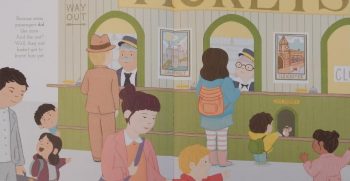
Lulu’s little brother is now a playful toddler drinking from his own cup and feeding himself. It’s the day he’s going for a health check and having helped pack his bag, Daddy and the infant are ready to visit the clinic.

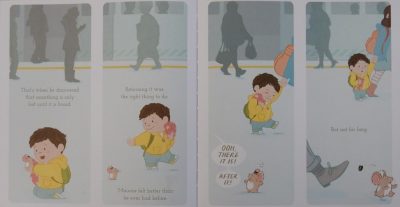
Once there they have to wait their turn so Zeki is glad he’s got his favourite Mister Seahorse to play with but it’s not too long before it’s their turn.

Zeki is happy to show what he can do; he’s weighed and measured, has his eyes, ears and heart checked

and is given a jab to help him stay healthy. He leaves with a well-deserved sticker, a new book and a cheery farewell wave from the health practitioner.

Full of warmth, reassuring, and as with all the books in this series, inclusive and beautifully portrayed.
Definitely one to add to the bookshelves of those with toddlers be that at home or in a nursery setting.

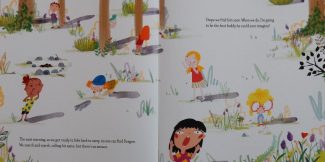
My First Day
Amber Stewart and Layn Marlow
Oxford University Press

This is one of the newly packaged My First Milestones series and features little duckling, Puddle who, along with his two friends is about to start nursery school. Having eagerly anticipated the big day since he was ‘barely more than an egg’, when it finally arrives the little duckling is more than a tad nervous.

His Mummy Duck however, has taken steps to ensure things go smoothly. She offers words of reassurance and packs into his school bag things that will remind him that she’s never far off: one of her soft feathers, his favourite nibbles, some biscuits to share with his friends

and his Cuddly for afternoon rest time.

Creative activities fill the rest of the day and before you can say, ‘going-home time’ there waiting is Puddle’s very own Mummy Duck with a warm hug.

It’s not nerves but excitement that causes the duckling’s heart to go pitter-patter that night as he anticipates his next day at duckling school.

A sweet story, told in a direct manner that expresses so well Puddle’s feelings, beautifully illustrated with scenes of the riverside in spring, this is just right for sharing with children about to have their own first day at nursery.

I’ve signed the charter  

The New Baby / Marigold & Daisy

The New Baby
Lisa Stickley
Pavilion Books
In her third book, big sister Edith – not very big but bigger than she was last year – gives readers a month-by-month account of the first year with her baby brother Albert.

He arrived, so she tells us, in a basket one January day, very tiny and making his presence felt with loud, I’m hungry ‘Waaaaaaa’ sounds followed sometime later by ‘teeny windy pops’.

As the year progresses Albert takes pleasure in watching the movement of a home-made mobile dangling above his cot; befriends the rattly Gerald Giraffe;

increases the volume of his bottom sounds and produces lots of very stinky nappies; and adds raspberry blowing and ‘slurpy sloppy’ to his repertoire.

By the summer he’s beginning to sit up and in August begins the messy process of eating baby food.

Big sis. gives him a very gentle go on the swings in September; then in October he becomes a fast crawler and in November an ever faster one especially when he’s set his sights on there’s a tower to demolish.

December sees Albert take his first tottering steps, wobbling his way around penguin style.
Then it’s time to celebrate his first birthday. Who wouldn’t love this special little brother with all his funny noises? Edith most certainly does.

I’m sure there were times when our young narrator felt jealous of the attention others were giving baby Albert but she doesn’t tell readers about it; rather Edith concentrates on the fun side of having a new sibling keeping her chronicle up-beat and accompanying it with a plethora of sound effects along the way.

As with previous Edith stories, Lisa Stickley’s collage style illustrations have a fresh child-like quality that makes them entirely appropriate to accompany her young narrator’s voice.

An enchanting book: it’s perfect for sharing with early years audiences and likely to spark off lots of my little brother/sister discussion.

That transition from only child in the family to big brother or sister can be a difficult time for young children so if you want something portraying that you might try:

Marigold & Daisy
Andrea Zuill
Sterling

Life is pretty good for Marigold until the birth of baby snail sister Daisy.

Daisy is a real pain, stealing the limelight and following her older sibling everywhere. Marigold feels left out and resentful,

particularly when Daisy ruins her favourite toy and goes off to be on her own.

However when she finds herself in a sticky situation, guess who comes to her rescue. Perhaps having a little sis. isn’t so bad after all.

Wonderfully expressive pen-and-ink and watercolour illustrations document this quirky story with a gentle humour. The plethora of speech bubbles add to the fun.

Night of the Moon / Crescent Moons and Pointed Minarets

With the month of Ramadan starting soon here are two lovely picture books to add to your early years or KS1 class collection:-

Night of the Moon
Hena Khan and Julie Paschkis
Chronicle Books
There’s a slither of a new moon in the sky and Yasmeen’s mother reminds her that it heralds the start of the month of Ramadan, the holiest month in the Islamic calendar.

We then follow 7 year-old Yasmeen and her family through the month as the moon waxes and wanes and the girl expands her understanding of what Ramadan and Eid-ul-Fitr mean.

All the while, the author skilfully integrates information about the celebrations with the warmth of Yasmeen’s love of family and friends as she talks to her mother about fasting, attends family parties, goes to the mosque

and learns about the importance of sharing during Ramadan.

Eventually there is no moon in the night sky and Yasmeen knows that the next night will be the Night of the Moon signifying the end of Ramadan and the much-anticipated Eid-ul-Fitr.

At sunset Yasmeen’s family go to the community centre for a special Night of the Moon celebration and from one of the stalls her mum buys new clothes for the family to wear on the day of Eid.

Back home Yasmeen has her hands decorated with beautiful Mehndi patterns …

and finally next morning it’s time to wish everyone “Eid Mubarak”.

What makes this book so arrestingly gorgeous is Julie Paschkis’ richly coloured gouache paintings bordered with motifs and designs borrowed from Islamic art.

Children of all faiths and none can enjoy sharing in the young girl’s joy in celebrating her faith and its traditions.

a Muslim family celebrates

Crescent Moons and Pointed Minarets
Hena Khan and Mehrdokht Amini
Chronicle Books

Following on from Golden Domes and Silver Lanterns, the author and illustrator explore both shapes and some cultural and religious aspects of the Muslim world.

Most shapes are two dimensional – the rectangle of the mosque’s wooden door; the octagonal pond surrounding a fountain; the triangular sides of the mimbar’s stairs.

There’s a beautiful square garden fragrant with sweet smelling oranges; the large drum used on festive occasions – a daff – is circular; a painted tile hexagonal; the table an oval and there’s a diamond design on the child narrator’s new Eid kaftan.

Others such as the cone shaped tip of the minaret are 3D and the Ka’aba stone is an enormous cube shape.

So much beauty / in the shapes that I see / adds to my faith / and the world around me.” So concludes the narrator at the end of the book after which comes a helpful glossary in which I discovered that ‘ayah’ used here is a verse from the Quran rather than the meaning ‘nursemaid’ that I’m familiar with.

Mehrdokht Amini’s illustrations, which accompany Hena Khan’s straightforward rhyming text portray Muslims from a number of countries, each spread representing a different country, thus encompassing the cultural diversity of Islam.

Crash! Boom! A Maths Tale

Crash! Boom! A Maths Tale
Robie H. Harris and Chris Chatterton
Walker Books

Block play elephant style is pretty much the same as that of young children particularly when little Elephant has such a wonderful resource to use.

Kneeling on a carpeted floor our pachyderm starts stacking; his aim to build a tower the same height as he is (intention). How many more do I need he wonders (estimating) .

‘1 2 3 4’, he counts the precariously balanced blocks, then hurrah! – arms stretched out wide in celebration (self-expression and self-esteem).

Elephant stands beside the stacked blocks (comparing/measuring), but almost inevitably given the unstableness of his stack CRASH! BOOM! Disaster …

Elephant though is not one to give up so easily. “It has to be as tall as ME!” he reaffirms. (resilience and determination).
He stops and thinks about the placement of that first block …

before starting to build another tower, self-questioning as he goes until, 8 blocks high it’s “WHOOPEE!” Success! This time Elephant gives the tower a celebratory bottom bash sending his stack crashing.
He still isn’t finished though; it’s time to experiment with that very long block and those others he’s yet to play with … “What if” – imagining. (love that one)

until …

(testing hypotheses, problem-solving, spatial awareness, balance, concentration)

Harris introduces a multitude of maths concepts along with a host of other learning possibilities of block play.  Chatterton’s simple, uncluttered, but oh so telling, illustrations show not only Elephant’s learning but also his sheer joy in his experience.

Those, like myself who champion the activity – especially with the kind of equipment in Chris Chatterton’s photographic collages, will celebrate this book and want to show it to anybody who ever thought block play was mere messing around: they need to read it right away. It’s such a brilliant example of learning through play, made even better because the publishers let the story speak for itself.

After you share it with young humans (and any elephants that happen to be around), make sure you have a large set of wooden blocks available; they’re sure to be inspired.

Where’s Home, Daddy Bear?

Where’s Home, Daddy Bear?
Nicola Byrne
Walker Books

Evie Bear and her Dad are moving home and Evie feels full of doubts – ‘heavy’ in fact. “How will I make new friends?” she wants to know. She doesn’t understand why they need to move at all but eventually everything is loaded and it’s time to say goodbye to their city life and set off into the unknown.

As they drive further from everything familiar Evie’s worries continue. “Dad, what if I don’t like my new home?” she asks.
Where am I from now?” Evie wonders aloud when they stop for blueberry pancakes.

All the way Dad does his best to reassure the little bear with carefully considered words of comfort and activities to distract her from her worries.

When they stop for the night, tucked up together in a hammock they continue their discussion about home

and Dad tells his little Bear that he considers home is more about feelings and not really things at all.

After what seems like a very long drive next day, father and daughter finally reach their new abode

and as they start to unpack Evie comes to her own conclusion about what home means for her: no matter where they live, so long as her dad is with her, she will always feel at home.

Rich in detail both domestic and of the natural world, Nicola Byrne’s illustrations have plenty to pore over and enjoy, not least being the two tiny mice that move house along with the bears and appear in several scenes along the way with their suitcase. On the penultimate picture attentive readers will see them moving into a hole in the skirting board, a scene that also shows The Great Dragon Bake Off among Evie’s books.

The expressions on the bears’ faces say much about the loving bond between father and Evie and also about the emotional upheaval involved in their move.

Why this is happening, especially as their new home appears to be in the middle of nowhere, is left for audiences to ponder upon and draw their own conclusions as is the question of what has happened to Mother Bear; but then, gaps for the reader to fill are part and parcel of a good picture book.

Frank the Seven-Legged Spider

Frank the Seven-Legged Spider
Michaele Razi
Little Bigfoot (Sasquatch)

Frank the spider enjoys spinning beautiful webs;

he also enjoys scaring humans; most of all though he likes his eight ‘beautiful, glorious legs.’

One day though, Frank wakes up minus one of his prized limbs: with only seven legs, is he still a spider?

Once he’s got the hang of being a tad lop-sided, Frank sets off in search of his missing leg. He tries several likely spots including a dark, warm cave

but no matter where he searches there isn’t any sign of his lost leg.

Fortunately just when everything seems totally dismal some ants come along and what they tell him makes Frank realise that all the things that make him spidery – web spinning, leg wiggling and scurrying – are still on his can do list.
Hurrah! Identity crisis averted; bring on self-acceptance; for sure, despite his physical disability, Frank’s lost none of his capacity for pranks.

That final spread doesn’t quite hold the last laugh though. After it come a credits page showing another spider holding something that might just belong to our protagonist …

Michaele Razi’s straightforward text and abundance of speech bubbles, in combination with her uncluttered illustrations executed in a carefully considered colour palette, present the physically challenged arachnid as a positive character ready to take on whatever life throws at him. Pretty cool!

Roxy the Raccoon / Carlos the Chameleon / Molly the Mole / Vincent the Vixen

Roxy the Racoon
Molly the Mole
Carlos the Chameleon
Vincent the Vixen

Alice Reeves and Phoebe Kirk
Jessica Kingsley Publishers

Roxy the Racoon introduces a physically challenged racoon living in the forest along with her three friends. Needing a wheelchair means that she can’t always do the same things as her pals. Visiting Brad Beaver in his dam is impossible as is playing football with Sammy and the other squirrels. Climbing the tree to call on Cherry Chipmunk is also too much of a challenge.
However after some thought each of Roxy’s friends manages to make adaptions that allow the racoon to be included in all their activities. Beaver builds a ramp, Squirrel changes the game and then the animals work together to make a hoist so that the four animals can view the sunset from the top of the tree.
The story ends with Roxy and her friends deciding to collaborate in making the whole forest an all-inclusive environment.
Part of the ‘Truth & Tails’ series this little book will help young children understand the importance of working together to remove barriers so that the differently abled can always be included. It’s a good starting point for discussion whether at home or in a classroom. To that end the author has included circle time suggestions at the end of the story.

Lack of self-confidence and feeling the need to be the same as the peer group is something that troubles many children and so it is with Carlos the Chameleon.
Herein we discover that Carlos is in the habit of changing his colour from his own bright green to that of which ever of his animal friends he wants to fit in with at any particular time. One day however when the animals discover what he’s been doing, they assure him that looking different isn’t a barrier to being friends: it’s what he is on the inside that matters. At last Carlos is free to be himself – kind, caring and a beautiful shade of green.
Molly the Mole too suffers from low self-esteem and despite being a very helpful friend she is constantly comparing herself with the other animals rather than being happy and celebrating what she has to offer. Thankfully though her friends help her to come to understand that everyone is unique and that she should believe in herself.

Vincent the Vixen introduces the tricky and complex topic of gender identity.
As is the case with Roxy the Racoon, after each story, author Alice Reeves includes helpful circle discussion points, and follow-up resources.

A useful set of books to have in a teachers’ library available to all primary school staff.

The Rhythm of the Rain

The Rhythm of the Rain
Grahame Baker-Smith
Templar Publishing

We first meet Isaac playing in a mountain-side pool under a brooding sky. Down comes the rain; water flows in little rivulets from the pool becoming first a stream and then a river. Isaac empties his jar of water into the flow pondering its journey seawards.

We see it passing through country and town eventually joining the vast ocean. However, the journey doesn’t end there (although some of it is swallowed by a whale);

currents deep in the ocean draw water towards a distant shore.

Next morning the warm sun pulls the seawater upwards to form a cloud – a raincloud whose water falls on a village where Cassi lives, filling its pool with much needed water.

Still the water flows, forming a life-giving river

that eventually flows again into the sea and finally right back to Isaac.

Baker-Smith’s narrative documents the water-cycle from raindrops to ocean depths, outlining the importance of the life-giving properties of the element while letting his artwork show its beauty.
The magical and transformative power of water permeates every one of his illustrations be it the luminosity of the mountainside rivulet,

the efflorescence slip-steaming from the ocean dwelling whale, the sparkling spangled surface of the sun-soaked sea or the foaming, steaming spray plunging over an African waterfall.

This breathtakingly beautiful book would make a superb addition to a topic on water or as an introduction to the water-cycle.

Being a Princess is Very Hard Work

Being a Princess is Very Hard Work
Sarah Kilbride and Ada Grey
Bloomsbury Children’s Books

If you ever thought being a princess was fun, or even easy, then this funny rhyming picture book will set you straight.
Imagine having to sit for ages on a throne, or smile benevolently and wave at your subjects when all you feel like doing is having a nap.

Think of having no time to play, of trying to keep all those body noises inside and definitely no nose-picking. Table manners have to be immaculate and fussy eating is not allowed.

Worse still are all the spinning wheels and dragons you might have to contend with and what about all those frogs just waiting for a kiss to be bestowed upon them.

You’d have to look neat and spotlessly clean at all times which makes pretty much anything fun strictly off limits.

Just being yourself- a real little girl – moody, energetic, noisy, messy yes of course, but also kind and generous is much better. That’s the opinion of one would-be princess’s mum and dad, and they want their daughter to know that they love her for who and what she is.

Read-aloud entertainment for would-be little princesses especially, but also for all who have imagined what taking on such a role might entail.
Ada Grey’s scenes of the trials and tribulations involved in so doing are full of amusing details – the frogs that invade almost every page are a real hoot – and the little royals, a delight.

I’ve signed the charter  

The Little Pioneer

The Little Pioneer
Adam Hancher
Lincoln Children’s Books

Adam Hancher’s story, set in 19th century US, tells of one small wagon train heading off into the West and is inspired by the accounts of real-life pioneers.

Its narrator is a fiery-haired young girl who, following the death of her father, must leave everything familiar and head west to make a new life in California.

The long journey on foot, horseback and wagon with her mother, younger brothers and three other families is gruelling and full of challenges, not the least of which for the narrator at the outset, is getting used to the wild ways of their guide, Mr Reed.

However it’s not long before a treacherous swirling river forces her to change her opinion of the man and a firm bond is formed, not only between the narrator and guide but also with their fellow travellers.
Mr Reed actually becomes the girl’s saviour not once but twice during their time on the trail.

By the time their journey ends the narrator has learned SO much, not only about the wild and her fellow pioneers, but having had to stand being left alone, about herself.

The tale is beautifully told using language of the time, ‘Weary and footsore, we stopped to rest.’ but it’s Hancher’s superb artistry that make this such a compellingly beautiful book.
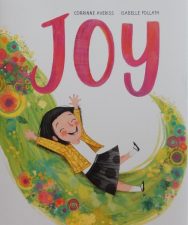
The girl speaks little about her loss but one senses it all around during their travels through the bleak landscapes of the journey. The dramatic, textured illustrations and Hancher’s switch of colour palette – that perilous Platte river crossing,

the family-like gathering around the camp fire …

and the bleak surrealism of the shady spot the narrator wakes in to discover her aloneness, speak for themselves.

Powerful, poignant and perfect for reading with young audiences many of whom will know little of those pioneering days, this is a book to share and savour.

Luna and the Moon Rabbit

Luna and the Moon Rabbit
Camille Whitcher
Scribblers

This is Camille Whitcher’s debut picture book: it’s the winner of the first Stratford-upon-Avon Literary Festival and Salaria Book Company competition to find ‘the next big children’s author-illustrator’.

Camille’s inspiration for her book was the Far Eastern folk legend of the Moon Rabbit that her Japanese grandmother told her around the time of the ‘Otsukimi (moon-viewing) festival,’ when, in honour of the autumn moon, people make offerings of food to the moon.

It’s a lovely story that starts with Luna’s Grandma telling her about the Moon Rabbit and how he comes to visit those who leave him an offering of rice cakes.
Despite her scepticism, Luna places a rice cake on her windowsill and is rewarded by a visit from the rabbit.

Together child and rabbit embark on a magical nocturnal adventure taking them into dark woods aglow with fireflies

and fields mysteriously lit by dandelion flowers

and down to a river alive with koi.
It’s there that sleep gets the better of Luna and the Moon Rabbit takes her back home to her bedroom.

Mesmeric, dream-like images grace every spread: the colours and textures employed give a somnolent softness to the whole book and I love the mix of full-page, double spread and vignette illustrations. There’s a magical glow emanating from each one that further heightens the otherworldly quality of the story, a story that is ideal for bedtime sharing or as a calming interlude in a busy nursery or pre-school session. Either way it is likely to become a much-requested favourite.

Along Came A Different

Along Came A Different
Tom McLaughlin
Bloomsbury Children’s Books

What is a ‘Different’? Well that all depends on your perspective. If you’re a Red then it could be a Yellow and vice-versa.

Suppose however, quite unexpectedly, a Blue happens along into ‘your’ territory sporting a blue bow tie, twanging a blue guitar and slurping a blueberry shake, supremely happy in its blueness, then what? It might well mean trouble and dare I say, separatism. BIG TROUBLE indeed, and by the look of things, a complete loss of joie de vivre.

Maybe it’s time to come together and draw up some rules …

The resulting isolation of each group appears to be working – temporarily at least but then a whole host of ‘different’ differents appear on the scene – friendly ones; could that be the start of a change of heart?

It might, but wait for it: how about a ‘really different different’ with an all-embracing attitude to life and living, maybe that could really make a difference …

Time to tear up that rule book guys!

Tom McLaughlin has surely created a fable of our divisive times. How much better we’d all be to take notice of the message of this wonderful picture book that blows the horn for inclusivity, difference and friendship everywhere.

It should be read, pondered upon and discussed and then trumpeted by all who value positive relationships across the world.

Blog Tour : You’re Safe With Me

Red Reading Hub is thrilled to be part of the blog tour for a truly stunning picture book; thank you Lantana Publishing for inviting me to participate.

You’re Safe With Me
Chitra Soundar and Poonam Mistry
Lantana Publishing

It’s night-time deep in the Indian forest: the moon is high and the stars a-twinkle. Suddenly though the skies turn deepest dark as a storm brews. All the baby animals are wakeful and scared.
Fortunately for them, Mama Elephant – huge and wise – arrives on the scene and with her softly spoken “Hush … You’re safe with me.” rocks the little ones to sleep.
The wind causes them to whimper and Mama Elephant offers an explanation, “Don’t worry … He’s an old friend of the forest. He brings us seeds from faraway lands.
Further explanations are provided concerning the clattering thunder, the zigzagging lightning and the rumbling river all of which are proffered in the manner of a lovely gentle lullaby that brings comfort and slumber to all the little animals.

Simply and memorably told with a repetitive structure, onomatopoeia and alliteration this tale is rich indeed.

I’ve been fortunate to visit India – the Keralan forests, coastal Kerala, Goa, Himachel Pradesh and Rajasthan – many times during the Indian monsoon season: it truly is an amazing multi-sensory experience, different in every location.
Both author, Chitra Soundar and artist, Poonam Mistry capture monsoon time so beautifully in their wonderful book.

I now hand over to Chitra to talk about her own monsoon memories that inspired her story …

You’re Safe With Me originates from the memories of the monsoon storms of my childhood. I grew up in the coastal city of Chennai, a port and a fishing hub. During the monsoon season, we got used to listening to the radio for news about the storm and we knew all the technical terms that define the ferocity of the storm.

Here is a sample of a video in Tamil that describes the storm that’s expected. We heard similar broadcasts, except on the radio. As kids of course we didn’t have TV until I was 15 (another long story).

My memories of rain are clearly etched with sound, the feeling of damp and wetness everywhere – clothes not drying, squishy doormat, wet clothes and the smell of damp clothes. As a 6-year old I remember climbing on to the top shelf of my cement cupboard because our flat was flooded. We waited the water out by sleeping on the top shelves.

As an 8-year old and later, I have sat by the radio listening to the news, waiting for my father to return from work. An hour’s journey would stretch into four as he waded through the streets, drenched in the rain. As a teenager, I have cycled in the rain to school, my book-bag wrapped in three sheets of plastic. I remember losing my expensive raincoat at school and having to cycle through the torrential downpour.

But all my memories of tropical thunderstorms are not scary or stressful. For a city that’s hot most of the year, rains are both a blessing and a curse. The first drops fall on the parched ground, evoking the fragrance of the earth. The rain is relentless, loud and full of promise. The good memories are always associated with the cool air, the sound of rain and a spicy Indian snack with a book by the window.

I’ve returned to the topic of the thunderstorm often and in various ways. Long ago when I was just starting out, I wrote a story that was inspired by a real life incident during the monsoon rains called Afraid of Dogs.

And of course my love for flood stories led me to the story of Pattan’s Pumpkin, which is again set during the torrential downpour of the monsoon season.

You’re Safe With Me is a storyteller’s take on the thunderstorm. Monsoon rains and thunderstorms are dramatic elements of this beautiful earth. Clouds gather over the ocean, they create low pressure and they bring rain and storm. I wanted children not to be afraid of its ferocity.

But this is also a book about perspectives. I wanted young readers to look at anything loud or bright or scary from a different viewpoint. Something unfamiliar might terrify us. Once we understand an unknown, it’s familiar, it can be fun or perhaps it needs to be respected.

I had no expectation of how the illustrations would turn out. I knew Poonam Mistry will and should interpret the story the way she sees it and she would bring her own experience of the storm to the story. And she has done it wonderfully, hasn’t she?

Her art inspired by India has brightened the pages and created a third dimension to the story.

Thunderstorms are a necessary part of living near the ocean. And we’re just a small part of how things work on this planet. And therefore, we should do our part to protect the nature around us, lest we should one day be deprived of its beauty and kindness.

Thank you Chitra.
For more guest posts and reviews, I hope readers will follow the rest of this blog tour.

Timeless Tales: I Really Want to See You, Grandma / I Wish I Was Sick, Too!

I Really Want to See You, Grandma
Taro Gomi
Chronicle Books

First published in Japan (the home of the book’s creator), in 1979, this story about a small girl and her grandmother and their efforts to see one another is now available in English for the first time.

Yumi and her Grandma live some distance apart, Yumi on a hill, her grandma on a mountain, and simultaneously each decides to visit the other – why they didn’t ring one another one can only assume is due to there being no mobile phones in those days.

They both leave home in upbeat mood, Yumi boarding a bus, her Gran taking a train.

Both arrive at the other’s home to discover the muddle and head back to their own homes …

missing each other again.

Will they ever get to meet or are they destined to spend the day passing each other on the way?

Gomi’s illustrations fill in much of the detail not mentioned in his simple text: ‘How come she was allowed to go on a bus without a grown-up?’ my listeners wanted to know after hearing this story of mix-ups and changing emotions.

Those in the early stages of becoming readers may well be able to try this one for themselves having heard the story read aloud first.

I Wish I Was Sick, Too!
Franz Brandenberg and Aliki
The New York Review Children’s Collection

I first came across this book as a young teacher in its Picture Puffin incarnation, I Don’t Feel Well.

It features sibling kittens, Elizabeth and Edward. Elizabeth is resentful of the attention her brother receives when he’s ill in bed. “It isn’t fair! … I wish I was sick, too!” she says.
When her wish comes true a few days later, she realises that, rather than all the attention received, it’s as her brother says, “The best part of being sick is getting well.

Aliki’s chalky illustrations capture the emotions of the infant cat characters superbly and the story’s as amusing now as it was over three decades ago.

Share and enjoy no matter the state of the listeners’ health; equally, with its clear print and inviting layout, it’s a good book for solo readers to try for themselves.

That Fruit Is Mine!

That Fruit Is Mine!
Anuska Allepuz
Walker Books

Deep in the jungle live five elephants, fruit lovers all, but content to stick to their own favourites until one day they come upon a new tree, a very tall one bearing the ‘MOST delicious-looking exotic fruit’ they’d ever set eyes on.

Inevitably each one wants that tasty-looking object for him or herself.
MINE!” calls Elephant One, huffing and puffing till her lungs were fit to burst.
Elephant Two launches herself at the tree but fails to dislodge the object of her desire.

The other three elephants are equally unsuccessful despite ingenious attempts, and all the while unbeknown to the pachyderms, but spotted by readers, a group of five tiny mice working together reach and seize the yellow fruit

and carry it away triumphantly. “OURS!

Their teamwork lesson so adeptly demonstrated, is then put into action by the elephants and a combination of their original individual ideas bears fruit of a truly yummy kind.

Even yummier is the tale’s final twist.

Anuska Allepuz’s debut as author is a delectable offering, with its wry humour, theme of the fruitfulness of cooperation and sharing and alliterative phrases to relish. The use of different typefaces for elephants and mice works in harmony with the splendidly expressive, comical illustrations.

Great fun for sharing with one child or many.

The Long Island

The Long Island
Drew Beckmeyer
Chronicle Books

This is an enigmatic debut picture book – a modern fable essentially – that will I suspect, have as many interpretations as there are readers.

We follow a group of five friends as they contemplate and then endeavour to visit the other side of the island they live on.

They set out in a canoe only to discover the far side is ‘too rocky to land on’; one of the crew is lost overboard. Four encounter vegetation ‘too dense to cut through’ where big cats stalk and the explorers’ number is reduced to three.

The trio construct a slide down which they eventually slither in so doing losing another one of their number

leaving the remaining two to discover they are unable to get back from whence they came.

The elaborate edifice they co-construct eventually attracts outsiders who start destroying the beauty of the place

and as the book concludes we see just a single one of the original five setting out alone …

This is a long book with a kind of circularity, richly illustrated in textured crayon, which raises many questions, leaving readers to ponder and to try and draw their own conclusions. It would be an interesting one for community of enquiry discussions, be that with primary or secondary age children, or with students in college.

Riding a Donkey Backwards

Riding a Donkey Backwards
Wise and Foolish Tales of Mulla Nasruddin
Retold by Sean Taylor and Khayaal Theatre, illustrated by Shirin Adl
Otter-Barry Books

I first came across stories of Nasruddin, a comic figure in Islamic folklore many years ago and often used them as assembly stories so was delighted to get this collection of tales so beautifully illustrated by Shirin Adl.

Sean Taylor is a superb storyteller and here he has collaborated with Khayaal, a theatre and drama education company to bring twenty-one of the tales to youngsters in the UK. The result is a cracking collection that is guaranteed to make you chuckle your way through from start to finish not to mention your audience.

First comes an introduction wherein we’re told Mulla Nasruddin is a trickster and a few other snippets of information about him, one being that he likes to ride his donkey backwards; Nasruddin provides the answer at the back of the book.
All the stories are very short, ‘Tell Me One Thing’ being only three lines long but there’s wisdom and humour in each one.

It’s difficult to choose a favourite today though the three that suited my mood best were:
‘What Are You Doing?’ wherein we discover why the Mulla was spooning yogurt into a lake …

Drawing a Blank’ a story telling how when Nasruddin was a schoolboy, he fell asleep in class having been asked to draw something and came up with a quick- witted response to his teacher’s expression of displeasure at the lad’s blank page.

The third, ‘A Cow up a Pole‘ shows Nasruddin’s foolish side: he’d managed to save some money and was concerned to find a safe place to hide it, eventually putting his purse full of money at the top of a very long pole in his garden.
However someone had seen what he was doing, stolen the purse and left a lump of cow dung in its place. Nasruddin’s reaction some weeks later on discovering the dung where his purse should have been was, “How on earth did a cow manage to climb up a pole?

Ask me again on another day and I may well choose different stories.

If you’ve never come across Mulla Nasruddin before, then this is the perfect collection to start with. They’re just right for classroom use across a wide age range as well as great to share as a family. The tellings are enormous fun and Shirin Ald’s humorous collage illustrations an absolute delight; don’t miss the splendid Islamic tessellation style endpapers

Out, Out, Away From Here

Out, Out, Away From Here
Rachel Woodworth and Sang Miao
Flying Eye Books

An exploration of emotions comes first hand from the red haired girl narrator of this picture book.

Sometimes she feels mad, sometimes she’s sad; on some days, ‘smiling-ear-to-ear GLAD’; on others ‘MAD SAD SMILING-EAR-TO-EAR GLAD.’ There are good and bad days, quiet ones and noisy ones. But on those ‘MAD SAD NOISY days’ she seeks solace in a place far off in the wild of her imagination.

That’s a place to watch the swishing, swooshing, rustling roaring trees with their whispery leaves, waving branches and grumbling trunks until both watched and watcher break into smiles and everything begins to change.

Finally it’s time to return, calm once more, to the everyday world of domestic reality.

Sang Miao’s superb illustrations show what is not said: there’s a baby sibling in the home that clearly puts the parents under strain at times. Here she uses dark silhouettes and dull hues …

in stark contrast to her richly coloured scenes of the narrator’s imaginary world, which are lush and fantastical with surreal images.

A fabulous book to start a primary classroom discussion on negative emotions – how they can affect us, and how we might respond to them.

When the Bees Buzzed Off!

When the Bees Buzzed Off!
Lula Bell and Stephen Bennett
Little Tiger Press

Bees play a vital role in the natural world and now the creators of this picture book are helping to put the message across to young children through a ‘play along’ story.
On a warm sunny day in the garden there’s consternation among the other minibeasts: the bees are nowhere to be seen; without them how will vital pollination take place?
A decision is made: three of the bravest and cleverest, Snail, Beetle and Worm, set off on a bee search. They stop at the vegetable patch, the woodpile and the pond but of bees there is no sign.

Suddenly, having gone through a gap in the fence into the woodland nearby they hear a familiar, much welcome sound. In a clearing full of flowers are the objects of their hunt ready to explain why they’ve had to move elsewhere.

With its plethora of speech bubbles, Lula Bell’s gently humorous story will help young children understand how important bees are. In fact the bees themselves do much of the talking but they’ve hidden themselves away under flaps in the illustrations for readers to find. Stephen Bell echoes the humour in his busy mixed media scenes of the natural world in and around the garden.

I hope that children will do what those bee-hunting bugs do at the end of the story and plant some bee friendly seeds in their gardens; or perhaps create a bee-friendly patch in their school grounds.

Molly’s Magic Wardrobe: Search for the Fairy Star / Sophie Johnson: Unicorn Expert

Molly’s Magic Wardrobe: Search for the Fairy Star
Adam & Charlotte Guillain and Garry Parsons
Egmont

I have to admit that with its pink sparkly cover I was tempted to put this book aside but decided that it was unfair not to bother reading it and I’m glad I did. The Guillain’s rhyming text reads aloud very well –that was no surprise though – telling of an adventure its young protagonist Molly has when she dons a fairy costume found in her granny’s wardrobe and then, in Lion, Witch and Wardrobe style, proceeds to step inside and through to a magical place – fairyland no less.

There she meets a distressed fairy, Flo, who has lost the star from her magic wand.

Molly offers to help and together they begin to search. Their quest takes them inside a castle, through an enchanted wood and into a garden and there are encounters with a giant, a wolf and a witch. These characters are anything but the normal fairytale stereotypes proving friendly (giant),

helpful (wolf) …

and far from wicked (witch) but none has seen the missing star.

The witch does have a wishing well in her garden though.

With the Guillains’ accomplished storytelling, Gary Parsons’ bold, bright scenes of the magical happenings and the added fun of wings and a wand inside the covers of the book for individual magic make-believe, the book’s creators look set to have the start of a winning new series here.

Sophie Johnson: Unicorn Expert
Morag Hood and Ella Okstad
Simon & Schuster Children’s Books

The narrator of this book clearly has a thing for unicorns and a wonderfully off-beat imagination. She introduces us to her charges, all seventeen of them and goes on to explain what hard work they are even to a unicorn expert such as herself.

The creatures need lessons in magic,

in hunting for food and in safety – especially where balloons are concerned.

Even when they shed their horns,

make mess all over the house …

or need protection, no matter what, young Sophie is always up to the job.

Ella Okstad’s quirky illustrative style is perfect for Morag Styles’ first person narrative. Her pictures show much more is going on than Sophie Johnson is aware of and that’s what delights listeners who relish being in the know– mine did at any rate.

Ruby in the Ruins

Ruby in the Ruins
Shirley Hughes
Walker Books

Shirley Hughes has set her latest picture book in 1945 London, shortly after the end of World War 11.

Ruby and her mother have come through the Blitz safely and now in the aftermath of the bombing there’s a lot of clearing up to be done and changes to embrace.

Young Ruby has become used to sharing a bed with her Mum but now her long absent Dad is just home from the war and making his very large presence felt in their home.

Ruby has a lot of accommodating to do and spends a fair bit of time out with her friends playing, despite warnings, on the bomb sites near their homes.

One day Ruby, playing rather dare devilishly among the ruins, takes a tumble and needs adult help.

What happens thereafter provides the ideal opportunity for the warm loving relationship between Ruby and her Dad to be renewed.

A thoroughly heartwarming, unsentimental story of post-war family love, illustrated in the author’s inimitable signature style; it will be enjoyed by all ages both at home and in school.

Secrets of the Mountain / Rock Explorer: Minerals & Rock Explorer: Fossils

Secrets of the Mountain
Libby Walden and Richard Jones
Caterpillar Books

The mountain referred to in the title of this breathtakingly beautiful book is I think, part of the Rocky Mountain Range.

Libby Walden’s narrative takes readers to spend a day on the mountain observing the plethora of animals that make it their home be that on the plains, the slopes or the mountaintop.

It begins as the sun rises and starting at the summit, day dawns. A breeze moves down the mountainside waking the furry pikas to look for their morning food.

At midday, the forest erupts with birdsong and sunlight glows among the trees.

Animals large and small are on the move.
Then come sundown, the air is cool: night is drawing in and the bears can sense it …

Then is the time to seek a place to sleep and let the nocturnal hunters take over in the shadows of the night-time forest while, watched by the patrolling wolf, the moon illuminates the rolling plains and the mountain lion stands waiting for yet another dawn to awaken the chorus of birdsong.

Everything has changed, yet everything is the same: evolving and ever constant, both.

From gorgeous front endpaper to back endpaper (the final one comprises 48 small named pictures of the mountain fauna), every one of Richard Jones’ spreads is simply stunning in its beauty.

Rock Explorer: Minerals
Rock Explorer: Fossils

Claudia Martin
QED

These are two titles of the four in a series of very visual books that introduce aspects of geology to younger readers. This is an under represented topic and yet once children are introduced to it, they are often fascinated.
Minerals looks at their formation, location and use. Did you know for instance, that fluorite is used in toothpaste and feldspar is used in making glass and pottery?

Fossils explains what a fossil is, outlines how they form, where to hunt for fossils and what we can learn from them. I was intrigued to discover that the Victorians first discovered fossilised Dinosaur poo – hmm.
Clearly and invitingly presented with good quality photographs, both are worthwhile additions to a primary classroom or school library.

Aquarium

Aquarium
Cynthia Alonso
Chronicle Books

Leaving her home a little girl follows the path towards a river jetty.

There she stops and gazes into the water completely at one with her surroundings. As she imagines herself swimming among fish of all shapes and sizes,

one fish leaps from the water and lands on the jetty.

The girl catches it in a jar and rushes home with it.

Using an assortment of containers and hose piping, she creates a complicated, multi-container aquatic environment and then, inflating a small pool …

and donning her bathing suit, she enjoys splashing around with the fish.

Suddenly, leaping from the pool, the fish makes a break for freedom and that’s when the girl realises that the creature isn’t happy in its new surroundings.

There is only one thing to do …

This thought-provoking wordless tale is beautifully told in Cynthia Alonso’s debut picture book. Using a gorgeous and unusual colour palette of blues, pinks, browns and oranges rendered in pencil, pens and by digital means she immerses the reader in her heroine’s world of water, fish and wonderment leaving plenty of room for her audience to story for themselves.
Dinosaur Juniors Happy Hatchday

Dinosaur Juniors Happy Hatchday
Rob Biddulph
Harper Collins Children’s Books

A new Rob Biddulph picture book is always cause for celebration at Red Reading Hub and so it is with this one which, by all accounts is the first of a cracking new series – no apologies for the pun as this clever rhyming tale begins with the hatching of Otto, Winnie, Hector, Sue, Nancy, Martin, Wilf and Boo.
Oops! I nearly forgot the last out, Greg (short for Gregosaurus); he appears on the scene a whole week after his fellow batchlings.
By that time all the other recent hatchlings have firmly established themselves; some appear to have an artistic bent,

others are chefs, musicians

and, wait for it, balloon inflaters.

Will poor, miserable looking Greg find his place anywhere among the dino-dudes? Can you see the tears?

Perhaps your young audience will by this stage be anticipating the possibility of a surprise finale, if so they won’t be disappointed.

The book is great fun to share with dino-littles at home or nursery: a read-aloud dino-delight splendidly illustrated with lots to explore on every spread including things to count; it’s funny and with its faultless rhyming narrative, oh so re-readable

Not My Hats! / The Great Big Book of Friends

Not My Hats!
Tracy Gunaratnam and Alea Marley
Maverick Arts Publishing

Polar Bear Hettie has an absolute passion for hats, no matter their shape or size Hettie loves to wear them.

Imagine her reaction then as she sits fishing one day when Puffin happens along desirous of a hat. “I’ll share my lollies, my dollies, my books and my brollies, my flippers and my slippers and I’ll even share my kippers … but I’ll never, ever share my HATS,” she tells him in no uncertain terms.

On account of sudden hunger pangs, Puffin settles for the kippers and disappears.

She repeats this litany again when Puffin reappears and this time fobs him off with slippers on account of his chilly tootsies.

Before long Hettie has dozed off dreaming of hat heaven when who should wake her but a certain black and white bird.

On this occasion Puffin suggests swapsies proffering items from his backpack, each of which is resoundingly refused until he suggests a scarf.

Now there’s a possibility: perhaps Hettie could spare the odd titfa after all.

With its plethora of outrageous headwear, this delightfully daft tale that moves in and out of rhyme, demonstrates that language is fun, sharing is best and friendship better than standoffishness.

Friendship is also explored in this non-fiction book:

The Great Big Book of Friends
Mary Hoffman and Ros Asquith
Frances Lincoln Children’s Books

Friendship is the theme of the fifth book in Hoffman and Asquith’s Great Big Book series. Herein the book’s creators explore many aspects of the topic starting by asking ‘What is a friend?’ They then go on to look at best friends, friendship groups, what might be shared, difference, pen friends, imaginary friends, objects that can act as friends such as a favourite toy or comforter,

More difficult ideas including falling out, and losing a friend, are also included, as is ‘How many friends?’
Each sub topic is given a double spread and is amusingly illustrated with Ros Asquith’s signature cartoon-style artwork.
With its chatty style and inclusive illustrations, this is a good book to explore with a class or group as part of a PSHE theme.

Grandmas from Mars

Grandmas from Mars
Michelle Robinson and Fred Blunt
Bloomsbury Children’s Books

When Fred and Nell’s mum and dad head off for a meeting leaving their offspring in the care of Grandma they issue strict instructions: ‘homework, a bath and in bed before eight.’ It’s a similar situation in most of the houses in Nell and Fred’s town: the grans have been left in temporary charge.

Little do those Grandmas know however that far off on the planet Mars, they’re under surveillance and there’s a plan being hatched for their capture.

Before you can say ‘Martian’, the grannies have been replaced by Martian carers resembling those they’ve kidnapped save for one thing, they look rather, well … green!

At first, despite having noticed their Gran’s sickly pallor, Fred and Nell relish the zany instructions she issues and the fun that ensues. But then they look at her a little more closely: something doesn’t appear quite as it should.
Nell shouts: the town’s children make a dash.

Chaos ensues with the Martian Grans rampaging all over the town wreaking havoc to left and right. Time for operation ‘treat them like real grans’ decide the children, but can they screw up all their courage, put Fred and Nell’s plan into action and save their kidnapped Grandmas?

Michelle Robinson’s zany rhyming narrative bounces along merrily and is given added craziness – not that it was lacking in same – by Fred Blunt’s scribblesome, exuberant scenes. Make sure to share this deliciously daft tale with your offspring before you next leave them in their Gran’s care.

I’ve signed the charter  

The Things That I Love about Trees

The Things That I Love about Trees
Chris Butterworth and Charlotte Voake
Walker Books

As I write this the trees all around are bursting forth with blossoms and new leaves; it’s just like the little girl in this arboreal tribute says as she leaves her house and sallies forth, ‘… changes begin. There are buds, like beads getting bigger on the branches…’. I’ve yet to see trees ‘buzzing with bees’ like the plum tree mentioned, ’but I know it will soon be so.

The child goes on to talk about the beauty of trees through the other seasons: in summer it’s the sheer enormity that impresses her, that and the shade they offer as well as the swishing sound that brings to mind the sea,

and the tiny green plums that are beginning to form.

Come autumn, the striking thing is the colour change to yellow, orange and red; the ripe fruits and seeds that feed the birds and animals.

As the leaves are tossed by the wind and fall you might even, like the girl catch one and make a wish.

Trees are lovely too in winter when they’re stripped of their leaves you can see all the way up to the topmost branches as everything is in its resting phase just waiting for the cycle to begin all over again, as we know it will.

The final spread has some suggestions for tree related things to do.

Walker Books do natural history for very young children beautifully and this book is no exception. Chris Butterworth’s main narrative is supplemented with small print that gives additional tree facts, which can be read alongside or after the child’s descriptions.
Rendered in watercolour and outlined in thick black ink lines, Charlotte Voake’s trees are absolutely superb; your fingers itch to touch the wonderful bark of the oak and make sure you check out the lovely leafy endpapers.

I’ve signed the charter  

Testing Friendships – Fox & Chick: The Party and other stories / Rabbit and Hedgehog Treasury

Fox & Chick: The Party
Sergio Ruzzier
Chronicle Books

Let me introduce Chick and Fox. Fox is an equable character who enjoys reading, cooking and painting; Chick, in contrast, is totally irrepressible – a bit of a pain to say the least. Surprisingly these two are friends. They star in three comic style episodes aimed at those just taking off as readers.

The first story (which gives the book its title) is I think the funniest. Chick calls on Fox, gains entry asking to use the bathroom and then proceeds to throw a party for his pals therein.

In the second story, Good Soup, Chick gives Fox a hard time about his vegetarian predilection wondering why he eschews frogs, small furry creatures, grasshoppers and er, little birds as ingredients for his soup.

Finally, Sit Still focuses on Chick’s total inability to do just that , leaping up every few minutes for a cushion, food and a drink while Fox endeavours to paint his portrait.

How long-suffering Fox puts up with Chick is anybody’s guess: – shades of Lobel’s Frog and Toad here – but their interactions are highly amusing, the text very readable and the illustrations rendered in pen, ink and watercolour are wonderfully expressive and enormously engaging.

Rabbit and Hedgehog Treasury
Paul Stewart & Chris Riddell
Andersen Press

I’ve been a huge admirer of Stewart and Riddell’s Rabbit and Hedgehog since A Little Bit of Winter (one of the four tales included here) was published about twenty years ago. If you’ve not met these two enchanting characters then this book of four stories is a great opportunity to get to know these two and the challenging nature of their friendship: one is awake all day and the other all night.

In the first neither of the best friends knows the date of his own birthday let alone each other’s. To be on the safe side they decide to celebrate the very next day and each goes about finding a very special gift to give the other.

Rabbit’s Wish is the second story but when he wishes that hedgehog will stay awake so they can spend a whole day together, the outcome is not quite what was anticipated.

In the third episode a remembering game tests the friendship between the two protagonists but an accident serves to remind them of the strength of their bond.

The final A Little Bit of Winter sees the friends facing another challenge. As Hedgehog prepares to hibernate he carves a message on the bark of an oak tree asking the somewhat forgetful Rabbit to save him a little bit of winter so he can find out what the season he’ll sleep through is really like.

Despite the chilly nature of the season, it’s a truly heart-warming story and like the others, beautifully and sensitively illustrated.

Rufus

Rufus
Simon Bartram
Templar Books

Meet Rufus, sharp toothed and super-stinky bottomed; an altogether splendid scary monster: not TIP-TOP scary though on account of having nobody to scare.

Off he goes in search of a Peopley Person to roar, rage and rant at, but all he can see in the desert is vampires and a witch. The forest is equally unpeopley as is the ocean and as for the sky, that’s full of spooky characters zooming through the clouds in various aeronautical machines.

Just when Rufus is on the point of giving up his search he hears music coming from a brightly lit barn: surely all that fun sounding noise must be coming from Peopley Persons within.

Seemingly not, for all that meets his eyes is this super spooky party scene …

Rufus is about to leave when a small ghost grabs his hand inviting him to have some fun.
Surprisingly, with the ghost’s help, fun is exactly what Rufus has and then comes a revelation …

Now Rufus has his chance to become that TIP-TOP SCARY MONSTER he’s always wanted to be. What will he do?

With its surprise finale, endearing protagonist and the unremarked clues scattered throughout Bartram’s bright acrylic scenes as to the possible reason for the seeming lack of Peopley Persons, this is a highly enjoyable teaser of a book.
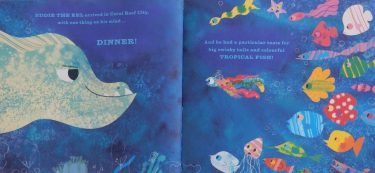
Is it a Mermaid?

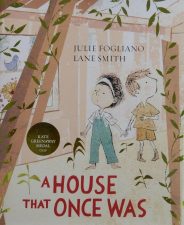
Is it a Mermaid?
Candy Gourlay and Francesca Chessa
Otter-Barry Books

When is a mermaid not a mermaid? That is the question explored in this enchanting picture book.
Bel and Benji are playing on the beach one morning when they spy something emerging from the sea: Bel wonders what it could be. Benji says it’s a Dugong, which the creature immediately denies, insisting she’s a ‘beautiful mermaid’ and pointing out her tail – a rather large one.

Benji is having none of it even when the Dugong bursts into song – not very tunefully.

Into the ocean plunges the ‘mermaid’ – not very elegantly – intent on demonstrating her graceful swimming, immediately followed by Bel and Benji,

the latter firmly pointing out the Dugongness of the creature’s anatomy and calling her a “SEA COW”.

This results in a tearful Dugong, an apology from Benji and the forging of a new friendship as children and sea creature spend a happy day frolicking in the ocean waves before bidding one another fond farewells.

Beautifully portrayed in richly coloured scenes and told with gentle humour, this slice of tropical life will delight and amuse young listeners – it’s a treat to read aloud.

There is however a serious side to the book: the final page gives factual information about Dugongs explaining how their seagrass habitat is being destroyed, thus placing the creatures on the list of vulnerable species.

Big Bunny

Big Bunny
Rowboat Watkins
Chronicle Books

Rowboat Watkins does off the wall humour brilliantly as demonstrated in Rude Cakes and Pete With No Pants. Now he’s come up with another quirky, no make that totally bonkers, offering.

‘Once upon a time there was a BIG BUNNY’ begins the storyteller. ‘A ginormously SCARY bunny?’ responds the listener – presumably a child.

From then on the tale becomes an increasingly tall one with BB gorging himself on truckloads of carrots,

until the adult finally hands over the narrative to the child whereupon things spiral out of control with said rabbit devouring not only the carrots but the delivery trucks, a bridge

and then an entire city – the buildings were very tasty after all.

As for Big Bunny surely all that consumption would have damaged his inner workings wouldn’t it, rendering the creature totally unscary?

Thus far, we’ve not seen the two story makers and so have assumed their humanness.

Then comes the penultimate spread where all is revealed – a terrific splutter inducer if ever there was one.

There is no narrative as such, merely the dialogue between the two story makers whose identity I won’t reveal, but let’s just say it’s a bit of a cruncher and the final spread, absolutely delicious.

Seemingly Watkins’ inventiveness knows no bounds: this telling in combination with his crazy scenes of carrots, trucks and that omnivorous Big Bunny are wonderfully weird; look for all the lesser jokes scattered throughout too.

All ages will relish this yummy book for sure.

Everybunny Count! / abc

Everybunny Count!
Ellie Sandall
Hodder Children’s Books

Since making friends in Everybunny Dance, ’Fox and bunnies like to play, / all together, every day.’ And their chosen game for this particular day is hide-and-seek.

The bunnies do their countdown and the hunt for fox commences. The first finding is a single badger soon followed by two bunnies spotting two birds: ‘Everybunny count to TWO!’

The search continues. Three bunnies spy three frisky squirrels; four find four ladybirds.

The pond is a fruitful place for fresh discoveries: five diving bunnies see five ducks while among the sticks, six bunnies find six frogs. ‘Everybunny count to SIX!’
Next stop is the carrot patch – just the place for a crunchy carrot nibble. It’s getting late and eight bunnies are anything but observant in their haste …

By now those bunnies are feeling sleepy as they form a line and count to NINE! (sheep) and then hurrah! There among the trees, close to his den is Fox.

There’s another surprise however for at the count of ten what should appear but ten little fox cubs and a proud mother.

It’s time to dance …

Ellie Sandall’s rhyming text with its infectious repetition ‘Everybunny count to …’ bounces along as beautifully as the bunnies. Add to that her deliciously playful pencil and watercolour illustrations (children will delight in occasional glimpses of Fox along the way) that lead to this …

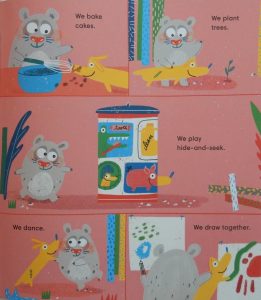
and we have a counting book story that’s full of fun and sure to result in echoes of the animals’ “Let’s play hide-and-seek again.”

abc
Aino-Maija Metsola
Wide Eyed Editions

Learning the alphabet is just a part of this new addition to the Learning Garden series. Young children can have fun not only naming the objects for each letter of the alphabet but also enjoying the various patterns, shapes and bright colours that are part and parcel of every page.

There are numerous opportunities for language learning, depending on the child’s interest and the skill of the adult sharer. You might for example, chose two or three of the letters and illustrated objects, and use them to make up a story together. The sturdy pages mean that this little board book should stand up well to the enthusiastic use it’s likely to get in a nursery or family.

Looking After William

Looking After William
Eve Coy
Andersen Press

Brilliantly observed and full of humour is Eve Coy’s debut picture book.
It’s narrated by the small child through whose eyes we see what happens when she takes it upon herself to ‘be mummy’ for a day to her dad, William.

How efficiently she adopts the parental role while of course, carrying on with all the other important jobs that mothers have – drawing and colouring, organising a tea party for the toys in her life, or block building.

She’s so matter of fact: ‘William is full of energy and needs lots of exercise. … He needs so much attention …

Sometimes he just needs a little rest.’

How perceptively and enchantingly portrayed is their entire day in those gorgeous inky scenes of love and affection, every one of which is sheer adorableness in every way.

Assuredly this is a book that will appeal to both children and their parents, the latter will particularly appreciate how the ‘mummy’ is able to see potential career opportunities for her beloved and ‘very clever’ William …

Young children love to play at being ‘mum’ either with their toys or siblings, but this is a whole different take on the subject.
I can’t wait to see what comes next from this wonderfully insightful artist; meanwhile I intend to share this one widely.

Out and About: Mama is it Summer yet? / What on Earth? Trees / Caterpillar to Butterfly

Mama, Is It Summer Yet?
Nikki McClure
Abrams Appleseed

In this board book, a small boy looking through the window asks “Mama, is it summer yet?

His mother’s response explains that it is imminent for the leaf buds are swelling, the animals building nests and the earth is soft and ready for planting, swallows are singing, baby animals have hatched

and trees are blossoming. Very soon, when the berries have ripened in the warm sun – then summer will be well and truly with them.

How fortunate is the infant to have a loving parent who take time to explain all this rather than merely giving a single word reply to her child’s repeated question.

Beautifully designed and with wonderful paper-cut illustrations, predominantly black and white set against a cream background, but with a single contrasting colour on each spread, both visuals and words capture the natural changes while also showing the close bond between mother and child.

What On Earth? Trees
Kevin Warwick and Pau Morgan
QED

Environmental scientist and tree expert Kevin Warwick joins forces with illustrator Pau Morgan in this new addition to the What on Earth? series and as with previous titles it successfully adopts a cross curricular approach with a mix of information spreads, poetry, a plethora of things to do both scientific and arty; there’s even a story about how the Douglas fir came to look the way it does.

In short, this is a great way to encourage children to go outside and connect with nature, invitingly illustrated by Pau Morgan.

Caterpillar to Butterfly
Francis Barry
Walker Books

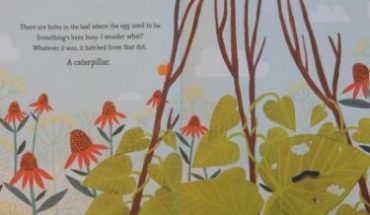
An attractive fold out, and find out about the life cycle of the swallowtail butterfly is told in a rhyming narrative and illustrated with brightly coloured, circular pages. These unfold to reveal each stage from tiny hatching caterpillar, through to ‘amazing butterfly’. We see the caterpillar munching, growing, shedding its skin, growing some more, then spinning a thread, forming a chrysalis and then after weeks of internal change, emerging as a stunningly beautiful adult.

The design, a big hit with small children, follows the same format as Barry’s Big Yellow Sunflower and Little Green Frogs.

Foundation stage teachers, this is one to add to your minibeast topic box.

The Knight Who Said “No!”

The Knight Who Said “No!”
Lucy Rowland and Kate Hindley
Nosy Crow

Ned had always been a biddable, obedient little knight complying with each and every one of his parents’ wishes,

and always come nightfall running indoors to hide from the dragon as she swept through the sky. One night as he watches the dragon from the safety of his bedroom window, Ned wonders if, like himself, the dragon is lonely.

Next morning – the day of the tournament – a change has come over the lad. A firm “No” is his response to every request from his parents and the townsfolk alike. When the dragon whooshes through the sky and lands at Ned’s feet, he accosts the creature, inquiring about her lack of roar.

The dragon’s response brings about a mood shift in Ned …

and thereafter, an unlikely new friendship is forged.

Lucy Rowlands’ rhyming text bounces merrily and faultlessly along, providing join-in ‘Yes’ and ‘No’ opportunities for listeners who will delight in Ned’s sudden attack of recalcitrance and its final outcome. Kate Hindley documents the whole saga with wonderful scenes of days of yore village life capturing not only Ned’s mood changes, but also the dragon’s and the bit part players’ characters, absolutely splendidly.

A potential storytime favourite, methinks.

The Story of Tantrum O’Furrily

The Story of Tantrum O’Furrily
Cressida Cowell and Mark Nicholas
Hodder Children’s Books

I’m anything but a lover of cats – they make me sneezy, wheezy and itchy-eyed but the ginger creature staring out from the cover of this book is totally irresistible and goes by the unlikely name of Tantrum O’Furrily.

What we have here is a story within a story and it all begins one wild and windy night with stray cat, Tantrum O’Furrily dancing across the rooftops with her three hungry little kittens and offering to tell them a story.

Slightly disappointed to learn that stories aren’t edible, they start to listen to their mother’s song. She tells of a small kitten; Smallpaw by name, a very pampered pet living with Mrs Worrykin who, when asked for a story responds that only stray cats – the robbers and fighters – are story cats.

One night Mrs Worrykin forgets to close the catflap and seeking adventure, Smallpaw pokes her head outside into the dark sniffing for a story of her own.

The fox she encounters is more than willing to oblige and begins his tale thus: “Once upon a time there was a delicious little kitten with fur as soft as butter, who was bored of being indoors…

Recognising the similarities with her own story, Smallpaw is intrigued and allows herself be lured outside, bounding right up close to the foxy gentleman who, as foxes do, has his eye on the main chance.

Fortunately for her, there happens to be a stray cat on hand with tiger-like claws and tenacious teeth; she sees off the wily predator …

and gives Smallpaw some timely advice.

Smallpaw does return to her keeper but from then on, Mrs Worrykin always leaves the catflap open. The best of both worlds becomes the order of the day – and night – for, as that wise stray once said, ‘A cat with courage makes her own story.’

Beautifully told by wonderful weaver of words, Cressida Cowell whose modern fable is complemented by Carmelite Prize winning illustrator Mark Nicholas. His superbly smudgy scenes, executed with a minimal colour palette, detail the action with panache.

Goat’s Coat

Goat’s Coat
Tom Percival and Christine Pym
Bloomsbury Children’s Books

Alfonzo is a goat with a brand new, dapper coat; wearing it makes him feel on top of the world. He also has a kind heart so when out strutting his stuff in his stylish garment and he comes upon a family of homeless frogs in need of help Alfonzo is faced with a dilemma.

Altruism wins: the frogs sail off in a new blue boat; Alfonzo walks on in a cuffless coat.

But then he discovers a trembly cat, her tail in a trap. A bandage is required to stem the blood …

Soon the cat’s tail is covered: the goat’s nether regions anything but.

Further encounters with a panic-stricken hen …

and shivering hedgehogs leave the benevolent Alfonso alone and entirely coatless. Snow falls as night approaches.

Will the goat freeze without his coat?

Tom Percival’s rhyming cuddle of a tale is the perfect antidote to the current political climate demonstrating so beautifully that happiness lies not in possessions or self-interest but in friendship and selflessness. Christine Pym’s illustrations for his heart-warming story capture the feelings of helper and helped perfectly, injecting appropriate touches of humour along the way.

Hello Hot Dog!

Hello Hot Dog!
Lily Murray and Jarvis
Lincoln Children’s Books

There’s been a fair sprinkling of food-centred picture books of late – pizza and sausages immediately spring to mind and now comes this tasty offering which takes the form of a conversation seemingly between a busy bee and an indolent hot dog.

We first encounter the latter as it languishes on some “comfy bread, with some corn and a couple of fries” apparently totally oblivious of the approaching ketchup bottle nozzle.

Suddenly as splodges of the red stuff splatter in his direction the lazybones realises what his fate is, at any second, to be. It’s time to ‘Run, Hot Dog, run!’.

Lack of limbs forces the fellow to come up with a somewhat complicated escape plan only to realise almost immediately that triple backflips are not his forte and that his demise is looming ever closer …

As a set of human gnashers close over the bun Hot Dog makes a desperate roll, extricating himself from the bread and flying through the air…

Freedom at last or dog’s dinner? Which is it to be?

Totally ridiculous but this will make you splutter with delight – it’s certainly been the case with every one of my readers, along with cries of AGAIN!

With its spare conversational text and hilarious Jarvis illustrations, in addition to being a terrific read aloud, this is a great book to share with those in the early stages of reading, with the adult acting as Hot Dog and the child as his aid to escape.

Meltdown!

Meltdown!
Jill Murphy
Walker Books

Once again, Jill Murphy humorously explores the relationship between an irrepressible infant and an exhausted parent, on this occasion it’s young Ruby Rabbit and her mum.

Ruby is at that stage of language development when she repeats phrases and she also loves to explore things by squishing, throwing, rolling and generally finding out what she can do with them.

Delighted at the thought of “HELPING MUMMY”, she does all of these when Mum takes her to the supermarket. Mum selects the items, hands them to Ruby to put in the trolley and the young rabbit proceeds to scrunch, toss, and roll, then charge off with the trolley.

Exasperated Mum plonks her in the trolley and continues down the aisles to the cake section. There they spy Ruby’s favourite piggy face cake, just perfect for tea. Into the trolley it goes. Thereupon a certain little rabbit asks, “HOLD the piggy cake?” Mum makes a big mistake as she hands over the item.

That “HOLD it” rapidly turns into “HAVE the piggy cake NOW!” which pretty quickly escalates into a monumental paddy not to mention a great deal of mess, and enormous embarrassment on Mum’s part.

We’ve all either seen it happen or experienced it first hand; Jill Murphy has done the latter: her wonderfully witty story – text and illustrations – is a delight and the finale utterly delicious.

I’m not sure how I missed this one first time around but it’s great to see it now in its paperback incarnation.

I’ve signed the charter  

Blog Tour – The Wardrobe Monster

A big thank you to Old Barn Books for inviting me to be part of the blog tour for an exciting debut picture book from Bryony Thomson

The Wardrobe Monster
Bryony Thomson
Old Barn Books

As a small child I can remember having a phase of being scared to go to bed. For me the cause of the terror wasn’t a wardrobe monster: I was convinced the resident owl from the oak tree in our garden had fallen down the chimney and was flapping around in there, ready to fly out into the bedroom at any moment. The fact that there was a chest of drawers in front of the fireplace made no difference.
We eventually discovered that a stray branch from a cherry tree in our neighbour’s garden tapping on the window when the wind blew was the cause of the trouble.
I wish I’d had something like Bryony Thomson’s debut picture book to reassure me.

Like many young children, Dora the child protagonist of her story suffers from fears about the dark.
Lack of sleep means that she, along with bedfellows Penguin, Lion and Bear are in a bad mood at breakfast time.
This bad mood lasts throughout the entire day and come bedtime, Dora employs delaying tactics.

What exactly is the cause of the problem?
There are sounds coming from inside the wardrobe – a wardrobe monster no less.
Can Dora and her toy friends face their fears and confront that monster? After all, they only need to open the cupboard door when the banging starts …

The smudgy nature of Bryony’s superbly expressive illustrations makes her characters all the more huggably adorable – even the one responsible for the scary noises.

Red Reading Hub is thrilled to be part of the blog tour for Bryony’s book: here she talks about her favourite childhood books:

Picture books weren’t a big part of my life as a child, I’ve checked with my parents and I just didn’t really have many. Stories and reading, however, were still hugely important and many of my earliest memories involve being read to by my Mum or Dad, snuggled up against them and cocooned in the magical world created by the story.

Winnie-the-Pooh by A. A. Milne

Winnie-the-Pooh was a favourite amongst my whole family and I am lucky enough to still have my full colour hardback copy complete with maps of “100 Aker Wood” as endpapers. I was particularly fond of the incident where Pooh goes to visit Rabbit, eats too much honey and condensed milk and gets stuck trying to leave the rabbit hole. The characters all had such distinctive voices and I can still hear them in my head (the way my Dad used to read them). Somehow because the locations in the story are so familiarly English you felt like you were a part of it and when out for a walk might at any moment bump into Eeyore or Pooh or come across a heffalump trap.

There’s No Such Thing As A Dragon by Jack Kent

There’s No Such Thing As A Dragon was one of the few picture books I owned, purchased when one of the travelling book fairs came to our school; I can remember picking it off the shelf! What I loved about the book then, and still do now, is the complicity between Billy Bixbee and the reader who both acknowledge the dragons existence, set against Mother’s complete refusal to see what is going on right under her nose. The illustrations are brilliant as well, there is so much life and character in them, especially the dragon with his obsession for Buttercup Bread.

George Mouse’s First Summer by Heather S. Buchanan

I must be honest I have very little recollection of the actual story of George Mouse’s First Summer. It was published the same year I was born and I think my parents must have started reading it to me when I was very small. I do remember the illustrations which were tiny and beautifully intricate, but what I remember most of all, and what made this one of my all time favourite books, was that one of the mice (George’s eldest sister) was called Bryony. As a child with an unusual name – in the 80s probably even less common than it is now – this was HUGE for me! I felt a sense of ownership over this book like no other before or since.

Ballet Shoes by Noel Streatfeild

Ballet Shoes was a book my Mum and I shared together. The book itself was the old hardback copy she had been read when she was a little girl. At the time I was obsessed with ballet myself and so the book had an innate attraction but what really sticks in my memory is the characters rather than the story. They felt like real people and in the differing personalities of the three sisters there was always someone you could identify with.

War Horse by Michael Morpurgo

War Horse is one of the first books I have a really clear memory of voluntarily reading myself. I’m sure there were others before it but it was the first book which I remember surreptitiously reading under the duvet when I was meant to be asleep. It was the first book that made me cry and the first book that I tried to illustrate; I still read it every couple of years. Again it was the characters that won me over, despite being a horse I felt as though I knew Joey like a friend and when Topthorn died I was devastated. The book gave me a completely new perspective on World War I, which we had touched on briefly in school and awoke an interest in history which has continued ever since.

Thank you Bryony and I hope readers will follow the tour on some of the other blogs; tomorrow is the turn of Playing By the Book.

I Do Not Like Books Any More!

I Do Not Like Books Any More!
Daisy Hurst
Walker Books

How insightful is Daisy Hurst: her account of young book loving monster Natalie’s disillusionment with the whole reading thing when she starts school is absolutely superb and a sad reflection of the sorry state of beginning reading teaching in pretty much every primary school I’ve spent any time in during the last few years.

That’s getting ahead of things though, so let’s go back to the start where we find Natalie and her younger brother Alphonse, thanks to their parents and relations, relishing every book encounter. Not only that, they remember stories they’ve heard and love to invent their own too.

Natalie eagerly anticipates being able to read for herself: “When I can read, I’ll have all the stories in the world, whenever I want them,” she says.

When she gets her first ‘reading book’ though it’s not quite as exciting as she’d hoped. Her teacher tells her to ‘sound out the words’.

Natalie’s frank response hits the nail firmly on the head:

and she goes on to add while trying to read at home … “I can’t … And nothing even happens to the cat!” Alphonse is marginally impressed …

but totally agrees about the nature of the reading material, politely requesting something more exciting …


Despite her best efforts the marks on the page of the interesting books continue to ‘look like scuttling insects with too many eyes and legs’: Natalie has had enough …

She storms off to tend her poorly toy elephant with the best medicine she can think of – a story from her own imagination (aided and abetted by Alphonse).

Impressed with their efforts, Alphonse suggests turning the story into a picture book. Out come the pens and when the illustrations are ready, Dad acts as scribe and they staple the pages to make a book and surprise, surprise, Natalie finds that she can pretty much read the entire thing – HURRAH!

As someone who has always advocated and for many years, taught using real books as the medium (alongside child made ones) for helping children learn to read, Daisy Hurst’s book made me both laugh and cry.

Yes, the monster children here have supportive parents who model, encourage and support, but sadly not all children are so fortunate: for many Natalie’s experience of reading at school is ALL they get.

This a brilliant cautionary tale that ought to be read by all those involved in the teaching of reading in the foundation stage and KS1 as well as teachers in training; and, dare I say it, policy makers in the government too.

Come into the Garden – A Big Garden / The Magic Garden

A Big Garden
Gillles Clément and Vincent Gravé
Prestel Publishing

As I write, our garden is really starting to burst forth: leaves are unfurling, flower buds are opening everywhere, birds are beginning to nest – spring has finally arrived.

Now is the time to celebrate and how better than with this unusual edition that originated in France. It’s a truly mind-blowing book with a wide age range appeal, and BIG it surely is to encompass that titular big garden.

Prepare yourself to get totally lost within each and every awesomely beautiful illustration as, starting with May, we are treated to a month by month close up look at the seasons alongside the gardener who tends it.

The text is a straightforward miscellany of horticultural musings with the occasional flight of fancy: September being given over to the gardener himself.

However, it’s those intricately detailed illustrations that will entrap you as you explore the intricately detailed pictorial pages,

June Fruit

each one comprising a plethora of fanciful mini-scenes, and search for the hidden objects mentioned on the prose pages.

And be sure to peruse the title pages and endpapers; they too are superb.

For younger readers is

The Magic Garden
Lemniscates
Walter Foster Jr.

Do you think of your garden as magic? Probably not, although you perhaps do notice and enjoy the seasonal changes, and the abundant wildlife that inhabits it.

Not so, young Chloe the protagonist of this book which begins one autumn afternoon with her walking without awareness until suddenly a sound causes her to pause beside the tree and take notice of its colourful leaves; it’s as if the wind is whispering to her.

Thereafter we’re taken on a journey of her garden where we can observe some of the wonderful creatures that live there – among the branches,

behind stones, in the pond – taking note of seasonal activity and change.

We see the garden by day but also by night when other insects make their presence known.

Some animals prefer to keep themselves hidden and readers are encouraged to look more closely for those as well as noticing the brightly coloured ones.

The seasons pass, the tree too changes: it’s bedecked with blossom, laden with fruits.

All this and more is part and parcel of this seemingly ordinary, yet ‘magical’ place. I prefer the use of magical rather than magic; for me nature is awesome and magical but not magic – a potential talking point when you share the book with children.

It’s beautifully designed and illustrated with much of the text taking the form of the wind’s words to the child.

AdoraBULL

AdoraBULL
Alison Donald and Alex Willmore
Maverick Arts Publishing

Alison Donald and Alex Willmore have created a lovely book based on a misunderstanding by one of the main characters.

Tom and Alfred are the best of friends sharing everything and totally inseparable until Tom starts school, leaving Alfred with little to do but remain at home and wait for his pal’s return.

One day though Tom comes home announcing to his parents that he needs a pet – a cute, snuggly one and it has to be totally adorable.

Poor Alfred is worried: what on earth does the word mean, he wonders, and determined not to lose his place in Tom’s affections, sets about finding out.

Having done so he gets to work to make himself fit the bill.
Action plan A is anything but a success so Alfred decides it’s time for plan B – a make-over …

His new look is met with amusement not only by the barn animals, but also by Tom.

Plan C only serves to infuriate Tom: it seems as though being adorable just isn’t a bull thing. Alfred is miserable and in need of some time alone.

But that evening Tom appears carrying a large box, and what a wonderfully heart-winning and unexpected surprise peeps out at its recipient.

The outcome is, no more lonely days for Alfred.

Alison Donald’s funny, warm-hearted tale of friendship is beautifully illustrated by Alex Willmore whose scenes of Alfred and his antics are superbly expressive and like the book’s title, absolutely A-DOR-A-BLE!

Forever or a Day

Forever or a Day
Sarah Jacoby
Chronicle Books

Sarah Jacoby explores the passage and power of time in a profoundly beautiful picture book meditation that takes the form of a conversational narrative.

The whole thing begins with a Times newspaper van moving through the streets as day begins to dawn watched perhaps by the child on the opposite page through whose eyes we then see a sequence of scenes of family life, some slow, others hurried …

or even frenetic seeming, but each one frozen in time in Jacoby’s watercolour spreads of commuters, a holiday train journey, a car ride to visit grandparents in the countryside.

All the while the accompanying text is gently nudging the reader to think deeply about the passage of time: ‘It can be precise, like pouring the first cup of tea’;

‘Sometimes it’s far, far away – like when you will be old, gazing out at the sea.’

Time can be illusive as here: ‘The more you try to hold it … the better it hides. Where does it go?’ accompanies this sand-castle building sequence .

By now day has given way to night: the family gathers for a sing-song around a campfire but after a fond farewell “You cannot hold it. … We’ve only got what we’ve got.” it’s a night train ride back to the city with its glowing lights

and a final benevolent ‘I love the time I have with you.’

The questions Jacoby poses are profound, though simply asked; and it’s her elegant watercolour spreads that do much of the talking, sometimes surprising and amusing as with the Tyrolean-looking hikers who appear in some of the scenes.

This is a book to share, to ponder over, to talk about, to speculate upon (it’s certainly one for a community of enquiry style discussion) and to savour, and unlike time, to hold on to.

Introducing Art to Children – Anna and Johanna & A Journey Through Art: A Global Journey

Anna and Johanna
Géraldine Elschner and Florence Kœnig
Prestel

It’s 12th October 1666 and we’re in the city of Delft where two girls are busy working. One is Anna, the daughter of the well-to-do master of the house; the other is Anna’s maid and co-incidentally they both share the same birthday. Each girl is creating something special for the other in celebration of the day.

For her friend, Johanna, Anna is fashioning a lace collar just like her own, which she knows her friend likes a lot.
In the kitchen Johanna is cooking a special birthday breakfast mousse as a treat for her friend Anna. It’s a breakfast fit for a queen.

But why are they such close friends and why do they share a birthday? Is it co-incidence or something much deeper?

When the girls meet and exchange their gifts, they discover something intended for both of them – a letter addressed simply ‘For your birthday’, which begins, ‘Dear children’ – a letter from Anna’s father telling of an incident that had occurred exactly twelve years earlier and disclosing a secret that he’s been keeping ever since.

Inspired by two of 17th century Dutch painter, Jan Vermeer’s greatest works of art, The Lacemaker and The Milkmaid Géraldine Elschner has crafted a story of friendship and more that reflect the painter’s impressions of domestic life.

Equally evocative of Vermeer’s style are Florence Koenig’s acrylic paintings executed predominantly in subtle blue, yellow, brown and orange hues of the Dutch city’s landscapes and scenes of domesticity.

There are many ways to interest children in art and artists: this lovely tale of friendship and devotion offers an unusual introduction for young readers to Vermeer’s art.

 Journey Through Art: A Global History
Aaron Rosen, illustrated by Lucy Dalzell
Thames & Hudson

Aaron Rosen takes readers on a journey through time and place to visit some thirty locations as he tells how the art and architecture of different cultures developed.
The tour, which travels to four continents, begins in northern Australia at Nawarla Gabarnmung in 35,000 BCE where we see prehistoric petroglyphs.

The next location is the city of Thebes 1250 BCE and then on to Nineveh 700 BCE, followed by more cities – almost all sites visited are cities – and thereafter to the site of a Buddhist monastery hidden in caves at Ajanta in Central India. Those caves contain some amazing sculptures and the oldest surviving paintings in India, done by the Buddhist monks who lived there around 500BCE.

All the locations thus far are included in the first of the three sections entitled Prehistoric and Ancient Art and next comes Medieval and Early Modern Art that encompasses Granada, Florence, the 16th century town of Timbuktu, 1650 Amsterdam where we find the first mention of a woman artist, Judith Leyster who was celebrated for her paintings of musicians.

The final Modern and Contemporary section includes a stop at 1825 Haida Gwaii to view the Northwest Pacific woodcarvings, one of the few non-urban destinations.

At every stop Rosen begins with a spread giving an overview of the site and a painting by Lucy Dazell; following this is another spread comprising information about the culture/customs together with small photos of significant artefacts, paintings and monuments together with printed notes.
The journey terminates at Rio de Janiero where the 2016 Olympic Games took place and thereafter are notes about visiting museums and art galleries and a glossary.

A whistle-stop tour indeed and one that might leave you feeling somewhat breathless but equally one hopes, hungry to find out more about the art of some of the places visited.

Creative Manipulations – Nature Origami & From Morning to Night

Nature Origami
Clover Robin
Nosy Crow

You’re in for hours of pleasure from this origami book published in collaboration with the National Trust. Containing thirteen nature inspired things to make from shells to squirrels and snails, and minnows to moths and mice, each one is allocated a double spread with a beautiful illustration by Clover Robinson on the verso while the recto has concise step-by-step instructions prefaced by a short poem by poets including Emily Dickinson, Christina Rosetta, Lilian McCrea, Kenneth Grahame

and William Wordsworth.
The back part of the book is a pad of 50 sheets patterned on one side, plain on the other, which are the ideal size and weight for the projects.
Each of the projects is graded, there being a mix of each of the three levels of difficulty, the third level requiring considerable dexterity, not to mention a degree of patience.
If you scan the QR code inside the book you will be able to link to ‘how to’ videos for each object.

From Morning to Night
Flavia Ruotolo
Princeton Architectural Press

Flavia Ruotolo has a design background which she uses to great effect in this little book that plays with line, colour and form, creating sixteen pairs of objects manipulating the elements of the ordinary one to fashion something new.
She uses just two complementary colours to play with so that for instance a morning meal becomes a magic mushroom …

an orange becomes a planet, a piano is transformed into a robot toy and an open book morphs into a pair of adjacent beds.

It’s easy to see the visual relationships between the pairs but imagination is required to link for example, an orange segment on a plate with a crescent moon in orbit around a planet.
I’m all for books that help in the development of the imagination: this one certainly does that in a playful way and at the same time offers plenty of opportunities for storying. It might also encourage readers to try their own creative manipulations.

Wild World, The Coral Kingdom and Who’s Hiding on the River? / Who’s Hiding on the Farm?

Wild World
Angela McAllister, Hvass & Hannibal
Wide Eyed Editions

The author has chosen thirteen natural habitats – Rainforest, Arctic, Prairie, Woodland, Coral reef, Desert, Rock pool, Mountain, The Outback, Moorland, Deep sea, Mangrove and Savannah – that are under threat due to human activity, and captures the essence of each one in a series of free verses.
Here’s the opening to Mountain:
‘I am the highest mountain, / Born in a collision of continents. / All is beneath me, except the sun, moon and stars. / I am rock, / Crag, cliff and ledge, draped in veils of white. / I am snow-maker, with glaciers in my arms, / Whose meltwater swells great rivers below.’

In stark contrast is the quieter sounding Savannah, which opens like this: ‘Savannah speaks in whispering grasses, / In the chatter of cicadas across an endless plain. / Spacious homeland of swift cheetah / And gazelle, with the horizon in her eye.’

Using matte colours, the illustrators Hvass and Hannibal showcase the flora and fauna of each location in a series of eye-catching paintings that incorporate the text within them.

Human use, climate change and pollution are responsible for the damage to the environment and after her introductory poem, it’s not until the final pages that the author enlarges upon her conservation message citing the specific damage within the thumbnail sketch of each of the places portrayed. Thereafter she implores readers to use less energy, to recycle and to buy with care.

We’d all do well to keep in mind her final words about our precious planet: ‘Explore it, protect it, love it. / Our Earth is a wonderful wild world. ‘

Also with an ecological message is:

The Coral Kingdom
Laura Knowles and Jennie Webber
Words & Pictures

Our coral reefs, with their gorgeous colours: crimson, red, rose, yellow,

turquoise, emerald, jade, purple, even black, that have taken 1000s of years to grow and give home to a myriad of creatures large and small are under threat.

When the coral is bleached white due to acidity caused by climate change, and stays white for too long, then the reef dies.

Laura Knowles has written a rhyming narrative that outlines the life cycle of a reef and includes a caution that unless we humans take action these amazing ecosystems will be lost forever.

Jennie Webber’s detailed watercolour illustrations show the beauty of the undersea habitat and a final fold-out page gives additional information about coral reef conservation.

A useful addition to a primary school conservation topic box, or, for a child interested in ocean life or ecosystems.

Who’s Hiding on the River? / Who’s Hiding on the Farm?
Katharine McEwen
Nosy Crow

It’s never too early to start learning about nature and here are two board books just right for introducing animals, some wild and some domesticated, to the very young.

Both are beautifully illustrated by Katharine McEwen and there are lots of animals to find in both locations.

Toddlers can spend a day by the river, from a busy morning through to night-time as they explore the pages, manipulate the sturdy flaps in response to the ‘Who’s hiding here?’ on every right hand page to discover tadpoles, cygnets, fish, dragonflies, a stoat, a beaver and more as they swim, wriggle, wade, leap, build and paddle.
The farm book also moves through the day in similar fashion and McEwen’s text is carefully worded to introduce new vocabulary including ‘pecking,’ ‘trotting’, ‘snoozing’ ‘prowling’, munching’ and ‘diving’ along the way.

Published in collaboration with the National Trust these are fun and at the same time, gently educational.

Not Just a Book / A Couch for Llama

Not Just a Book
Jeanne Willis and Tony Ross
Andersen Press

A book is for reading, yes certainly, but according to Jeanne Willis and Tony Ross’s latest offering, books can sometimes be so much more.
On occasion they might serve as hats, or make a tent for a cat, prevent a table from wobbling. A book makes a good tunnel for your toy train, can become an extra block for building with,

even perhaps a flower press.
This multi-purpose object is the perfect fly-swatter …

or protector of your drink from marauding wasps.

More important though than any of these additional uses, and that’s the real message herein, books have the power to affect how you feel;

to help you go to sleep, to educate; the best are never forgotten and best of all, a book is something to read and love …

Silly? Yes, Fun? Yes.

Jeanne Willis’s brief rhyming text and Tony Ross’s wonderful illustrations – look out for the mischievous cat on every page – make for an enjoyable and playful message about the importance of books.

A Couch for Llama
Leah Gilbert
Sterling

The Lago family absolutely love their old couch: it’s been the site of many good together times but now a new one is much needed. Off they go in the car to the furniture shop where they find the perfect replacement.

On the way home however, something happens that results in their new item of furniture ending up in Llama’s field. Llama is by nature a curious creature and so he starts to investigate this new arrival. He sniffs it, greets it and even tries sharing his lunch with it but none of these moves elicits any response. Llama tries lunching on the couch instead but it tastes awful and it’s too heavy to move.
The couch is useless, is his conclusion so Llama decides to ignore the object.
This unsurprisingly becomes exceedingly boring and so the exasperated animal leaps onto it and suddenly comes understanding …

By this time the owners of his new lounger have returned to claim their lost item but Llama refuses to budge. There’s only one option that will work for one and all: now what might that be? …
In her debut picture book Leah Gilbert mixes the realistic and the ridiculous with just the right degree of each for the story to work, but the real strength is in her visuals: in particular the scenes of Llama and his couch encounters are hilarious.

Stewart’s Tree

Stewart’s Tree
Cathy Campbell
Jessica Kingsley Publishers

Subtitled ‘A book for Brothers and Sisters When a Baby Dies Shortly after Birth’, this little picture book is intended to help explain sibling loss to young children.

Ellen has been waiting for a new baby – ‘something special’ but her new brother Stewart is very weak and never makes it back home. He’s been ‘lost’ is how her Granny puts it.

Ellen searches all over the house for Stewart even in the washing machine,

wondering perhaps, if he’s gone to the moon in his spaceship.

Her parents then help her to understand the new baby has died and isn’t going to come back.

Together they plant a cherry tree for Stewart, so they will always have a special place to remember him.

The book concludes with a guide to bereavement aimed at adults, written by qualified clinicians; this includes some suggested activities.

Sensitively told and illustrated, with gentle touches of humour, this is a book that one hopes few people will have need of, but it could prove invaluable to those families unfortunate enough to suffer such a bereavement. Schools, nurseries and children’s centres should certainly keep a copy on their shelves.

Picture Book Poetry: One Upon A Star and Nature’s Lullaby Fills the Night

Once Upon a Star
James Carter and Mar Hernández
Caterpillar Books

Here’s an opportunity to go on an amazing journey without moving from the comfort of your own sofa, courtesy of poet James Carter and illustrator Mar Hernández who take us on an awesome ‘poetry and art meet science’ trip through time and space with a focus on our Sun.
First we head back through history before this happened …

And after a long slow cooling period: ‘A sea of stars at last were born / gradually they fired and formed / out of clouds of dust and gas / each a mighty sparky mass / and one of these became our Sun / our solar system had begun!’
Thereafter Carter’s compelling narrative verse touches upon the growth of our planets, in particular the Earth with its oceans and amazing life forms that rely upon the sun for their continuing existence. His final focus is each one of us, unique individuals – stars and stardust every one.

James Carter’s lucid poetic account of these awesome events, when integrated with Mar Hernández’s dramatic artwork, makes an exciting and impactful book.

Much more down to earth is:

Nature’s Lullaby Fills the Night
Dee Leone and Bali Engel
Sterling
The sun is gone; the moon is out: bedtime is nigh.
The author draws listeners into a nocturnal world of fluttering moths, spinning spiders, chirping crickets, flowers closing their petals, floating seeds and swaying willow branches;

past moonlit lakes,

and down to the sea where dolphins cease their leaping and oysters shimmer from the depths, towards farmlands where the animals are beginning to slumber; through a forest and finally into a child’s bedroom with the repeated refrain, ‘Nature’s lullaby fills the night’ punctuating every sequence.

With her gentle, soporific verses Dee Leone transports little ones towards sleep. In tandem with Bali Engel’s tranquil scenes of the bedtime rituals of parent animals, large and small in their natural settings executed in a colour palette of dark blues, purples and greens creates, we have an engaging, calm-inducing bedtime book for little ones.