Raj and the Best Day Ever!

Raj and the Best Day Ever!
Sebastien Braun
Templar Publishing

Meet young and entirely lovable tiger, Raj and his cool Dad.

They’ve drawn up a plan of the adventure they’re about to embark upon and are super-excited about the whole enterprise. Then it’s a case of back-pack packed and they sally forth.

First stop the library and book chosen, it’s time to show your library card. Oh NO! Disaster! Dad hasn’t brought his wallet. Without that all the things on that list have just flown out of the window so to speak.

Raj is convinced that their perfect day is ruined before it even begins., especially as down comes the rain.
Time to get those imaginations powered up …

Off they go and before long, it looks as though the day might just be rescued,

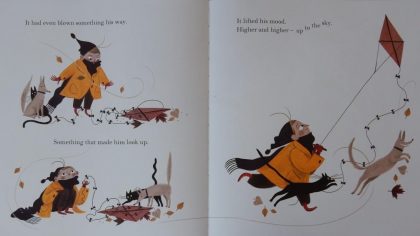
but then the wind whisks their list up and away and in Arnold Lobel’s Frog and Toad style, Raj fears that without their list, they won’t know what to do.

Good old Dad! Imagination rules again and off they go once more.

With a wonderful twist in its tale, Sebastien Braun’s story is an absolute winner. Sadly my copy arrived too late for Father’s Day but this is a perfect share on any day: a Dad who’s willing to pitch in and enjoy life no matter what; a book enthusiast offspring equally willing to look on the bright side – two colourful characters superbly portrayed by Seb Braun whose books just keep on getting better.

This one could be the perfect distraction from that seemingly wall to wall soccer and it’s a cracking demonstration that companionship and imagination are all that’s needed for the very best day ever: no money, no technology, just free-flowing fun.

Ta-Da!

Ta-Da!
Kathy Ellen Davis and Kaylani Juanita
Chronicle Books

Once upon a time a little girl was playing happily with her animal friends in a homemade castle until DUN DUN DUH! there appears at her door, a wizard accompanied by his ‘dragon’.

So begins an action and reaction concatenation with boy wizard attempting to subvert the girl’s peaceable play with his roistering, wrecking actions. She counters these with her wand ‘Ta-Dah!’ and magic spells.

This to and fro of ‘Dun Dun Duhs and Ta-Dahs continues apace until the dragon, having imbibed rather too much water, needs an urgent visit to the bathroom, and the boy exits stage right …

leaving girl and dragon to live happily ever after.

Well, perhaps not quite ever after, for after an uneventful interval, the two decide to pay the boy a visit to see how things are going. And going they certainly are: the boy has become a magician and is about to perform before a decidedly small audience.

Small that is, until girl and dragon pitch in providing more watchers and a co-performer.
Show over, it’s time for a snack providing more happily ever afters … whoops! Not EVER, after all: there’s still time for one final, sub-aquatic adventure together.

DUN DUN DUH! … Ta-Da!’

Conflict and resolution done with panache in this debut for both author, Davis and illustrator, Juanita. It’s a wonderful portrayal of children’s imaginative play with its give and take and boundless possibilities.

A House That Once Was

A House That Once Was
Julie Fogliano and Lane Smith
Two Hoots

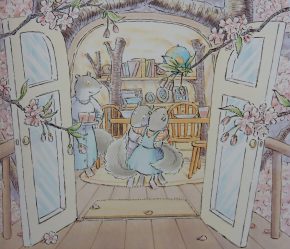
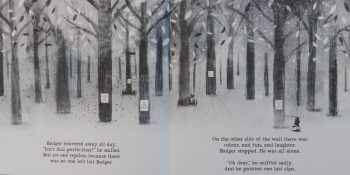
Quiet in its impact, this is one of those slow burn books that carry on working inside you long after you’ve closed it.
Immediately I started reading it, I was taken back to one of my childhood walks along a road close to where I lived, not in a wood atop a hill like the one Julie Fogliano describes, but a suburban one. There was surprisingly, a ramshackle-looking house overgrown with thick foliage, empty, but some said a witch woman lived within.

Unlike the two children in this contemplative lyrical story, neither I, nor any of my friends dared venture inside although, as the children here, we did speculate and make up stories about possible previous occupants, albeit from the safety of the rackety gate. That house has long gone, replaced by a new development, but its memory remains to this day.

‘Deep in the woods/ is a house/ just a house/ that once was / but now isn’t/ a home.’ In fact it’s derelict and totally uninhabited save for the intruding textured foliage Lane Smith has woven between its cracks and in and out of its broken doors, roof and windows.

It’s one of these windows through which the boy and girl climb to explore.

Within, they discover the ephemera of a life that once was: a shelf of books, old toys, art materials, old photographs.

‘Who was this someone who ate beans for dinner/ who sat by this fire/ who looked in this mirror?’ ask the narrators, ‘Who was this someone / whose books have been waiting / whose bed is still made / whose pictures are fading? … Who was this someone / who left without packing / someone who’s gone but is still everywhere?’

Ghostly echoes there, until the children begin to ponder upon who the residents might have been, becoming increasingly playful in their imaginings, Lane Smith’s scenes growing brighter as they do so.
(At the back of the book is a note explaining the two different techniques employed to create the ‘present day’ and ‘imagined scenes”’)

Still wondering, the two eventually return to their own home where warmth and dinner await.

Full of mystery, intensely beautiful, is this entrancing story of what is, what was, and what might have been, all seamlessly melded together through Folgiano’s telling and Smith’s showing.

Hansel and Gretel

Hansel & Gretel
Bethan Woollvin
Two Hoots

Most children are familiar with the story of Hansel and Gretel wherein the siblings are cast out from their home into the forest where they encounter a wicked witch; but in her latest fairytale reworking, Bethan Woollvin mischievously turns the tale completely on its head.
Here it’s Willow, a very good witch, who follows a trail of breadcrumbs dropped by the brother and sister.

She sees those breadcrumbs as messy and likely to lead vermin to her gingerbread home. Her request that they tidy up is ignored and she’s left to do the job herself, but- ‘Willow did not get angry, because Willow was a good witch.’

On returning home she finds Hansel and Gretel tucking into her house, literally, but despite their appalling behaviour, instead of being angry she invites them into her home for dinner; they must be very hungry she tells herself .

Rather than being grateful for her hospitality, the gluttonous children continue pushing Willow to the limits of her patience until finally, she does get angry.

The totally unexpected and wonderfully dark and humorous finale is spl-utterly delicious.

In her striking signature graphic style and limited colour palette, Bethan Woollvin has again produced a wonderfully witty visual narrative from simple shapes and textures. I love the scattering of birds and tiny animals watching the events from the vegetation that somehow make you pay attention to those stark shapes both large and small. Love the clever endpapers too.

Perhaps not for the most faint-hearted, but I can’t imagine many listeners not devouring this one and asking for more.

Stonkingly brilliant!

Albie Newton

Albie Newton
Josh Funk and Ester Garay
Sterling

Albie Newton is a thinker, a ‘child genius’ so we’re told, learning a new language almost every week and he also loves to tinker.
The lad starts school mid term and in the hope of making some friends, decides to build a special surprise gift for his new classmates.

It doesn’t take long for the newcomer to start rubbing the others up the wrong way. In addition to shining in all areas of the curriculum,

his behaviour is more than a little disruptive, particularly when he appropriates items from the classroom; and the noises he makes are nothing short of ear shattering.

Albie however, is completely oblivious to the effect of his actions; his social skills are clearly nothing like as developed as his intellectual and inventive ones.

Fortunately for Albie though, one of his classmates, Shirley by name, has been keeping an eye on his secret activities and seems willing to give him a chance. She thinks that perhaps Albie is well intentioned. Can she convince the others to give him the benefit of the doubt?

Perhaps, when they see that special gift he’s constructed …

It will be pretty obvious to adults, especially teacher readers of Funk’s seemingly light-hearted rhyming story, that Albie is wired differently from the other children.

With in-built messages about accepting difference and building empathy emerging, it offers plenty to discuss; and illustrator, Ester Garay ‘s bold bright illustrations have plenty of details to amuse, as well as effectively conveying Albie’s abundance of mental and physical energy.

Something Fishy

Something Fishy
Polly Dunbar
Two Hoots

There are undoubtedly fishy goings on in the moggy narrator’s house, however, not the kind of fishiness appreciated by the normally, extremely well fed cat.

Despite polite requests for fishy offerings the other family members merely look blissed out and produce such items as tiny suits and soft toys. Hmm!

By this time listeners will have figured out what’s imminent even if the ever- grouchier narrator hasn’t. Now this really isn’t funny; well, not if your desire for all things fishy isn’t being satisfied, however nicely you ask.

Then suddenly the cat is left alone in the house: of course they must have gone fishing: oh, the eager anticipation!

What comes back home though is certainly not fish but something that changes Cat’s expectant smile into first a look of bewilderment, and then extreme disappointment.
Altogether a charmer, Polly Dunbar’s new book is purrfect for families where the arrival of a new brother or sister sibling is fast approaching, especially as there seems to be enough love to go round for everyone …

Polly’s illustrations are so brilliantly expressive, funny, and occasional jealous cat countenance notwithstanding, full of her characteristic joie de vivre.
An absolute winner.

How to be a Lion

How to be a Lion
Ed Vere
Puffin Books

‘This book is for those who daydream, and those who think for themselves’.
I love that. It’s written in Ed Vere’s inspiring ‘letter’ that accompanied my review copy; it’s also printed on the final page of his eloquent story: I hope it applies to myself, make that, to everyone. I wish everybody could read the entire letter, but instead I urge you to get yourself a copy of the book and share it widely.

It starts philosophically: ‘The world is full of ideas. /Big ones,/ small ones. / Good ones,/ bad ones. / Some think this … / others think that.’ before bringing us back to earth and in particular, lion territory on the African plains where the norm is to be FIERCE! But is that the only way to be?
Enter Leonard: thoughtful, prone to daydreams, something of a poet and above all, gentle.

Enter shortly after, a duck, Marianne by name. Being Leonard, it isn’t a case of ‘Crunch, crunch, CHOMP!’ Instead our lion, polite introductions over, requests her assistance and as luck would have it, Marianne is able to assist in freeing Leonard’s stuck muse and before long a firm friendship has been forged; one that involves stargazing, philosophical musings and above all, contentment and happiness.

Into their peaceable existence comes a pack of ferocious lions demanding to know why the duck has not met its demise.
True to himself, Leonard explains about their friendship and resists their loud growly admonishments.

Their instructions about becoming fierce make him pause and question however, but Marianne suggests a trip to their thinking hill to mull things over. Lo and behold, serious hums and serious quacks together are turned into an idea, and then, poetry that is finally ready to be presented to those fierce lions.

What Leonard says to them is heartfelt, provocative – “Why don’t you be you … And I will be I.” – and one hopes, a game changer.

Ed Vere’s timely fable is profound and intensely moving in the gentle way it offers words as tools of bridge building and change, as well as showing a different male role model. Don’t be pressurised into conforming, be yourself is what shines through both his words and oh, so eloquent, humorous illustrations.

A perfect read aloud with oodles of food for thought, and talk.

Ready to Ride

Ready to Ride
Sébastien Pelon
Words & Pictures

What can you do on a dull, stay- indoors kind of a day that’s already become boring? You might perhaps, like the small child narrator of this story, venture outside and see what unfolds.

Into view comes a large furry shape riding a tiny bike and sporting a luminous pink hat. They make eye contact and the boy hops on his own bike and off they go.

It isn’t long before the human is wanting rid of his stabilisers, which his new friend helpfully consumes leaving the lad struggling to cope with trying to ride his ‘big boy’s’ bike.

The learning curve is steep with the usual frights, falls and rallying,

along with the odd spot of relaxation,

until finally come success, speed and some over-confidence.

All the while though, the silent, white lumpy creature is there ready to offer succour and the occasional bit of provocation: then suddenly he’s gone.

Perhaps he was never there at all except in the boy’s mind.

Back home goes one small child, proud of himself and eager to tell his mum and dad about his adventure but when a “What did you do?’ comes from Mum his answer is let’s say, understated.

You can succeed so long as you show resilience, is what comes through in Pelon’s picture book.

Its graphic format is such that it works best as a one-to-one share and with that blank ‘Super Cyclist’ certificate on the back endpapers, is certainly one to offer a child at that same stage of readiness to fly solo on two wheels. I love the colour palette and the plethora of humorous details.

The Day War Came

The Day War Came
Nicola Davies and Rebecca Cobb
Walker Books

I came back home after a few days away to find this book waiting; it was the day we heard about the egregious separation of children from their parents at the US border, so it was especially moving. It is also Refugee Week as I read/write this – even more timely and heartbreakingly pertinent, especially as I think of my Syrian friends who fled their home country from war a couple of years ago and are now happy and their two children loving their primary school in Stroud. No lack of chairs there.

Nicola Davies wrote the text, a poem, as a response to her anger at our government’s refusal to allow 3000 refugee children to enter the UK in 2016. A poem that began the 3000 chairs campaign for which artists contributed pictures of chairs, symbolic of a seat in a classroom, education, kindness and the hope of a future.

For those who didn’t read the poem when it was published in the Guardian, it’s a spare text narrated by a little girl from a country, perhaps Syria, blighted by war whose day starts normally – breakfast with her family and then school where in the morning, she learns about volcanoes, draws a picture of a bird and sings a song of tadpoles.

After lunch though comes war, destroying her school, her home, her town,

leaving her alone, bloody and tattered.

Somehow she makes it to a boat and thence to a beach and then to a camp. “But war had followed me. / it was underneath my skin, / behind my eyes, / and in my dreams. / It had taken possession of my heart,” she says.

Nicola Davies is a fine weaver of words; her text is heart-wrenchingly powerful and ultimately, redemptive – having initially been turned away from a school classroom because there was no chair for her, one is supplied by a little boy,

whose friends do likewise … as the children walk together, “Pushing / back the war / with every step.”

Rebecca Cobb has done an outstanding job with the illustrations. Her watercolour, crayon and pastel pictures – scenes of destruction, flight and desolation, all too familiar to us from TV news bulletins, have a heightened poignancy so rendered, and are all the more powerful viewed together with her images of normal life in home, street and classroom.
All her characters are incredibly expressive both facially and in their body language, and the little girl is the very embodiment of the poem’s narrator.

A must read book for anyone who values humanity.

£1 from every copy of the book sold will go to the HelpRefugees charity.

Grandad Mandela

Grandad Mandela
Zazi, Ziwelene & Zindzi Mandela and Sean Qualls
Lincoln Children’s Books

Nelson Mandela is my all time hero and I was thrilled to see this picture book published in honour of the 100th anniversary of his birth (July 18th 1918).

It takes the form of a dialogue between Mandela’s great grandchildren Zazi and Ziwelene and their Grandma Zindzi – his daughter, after the children discover a photograph of Grandad Mandela.
Can you tell us about him again?” they ask and a discussion ensues with Zindzi Mandela answering the children’s questions.
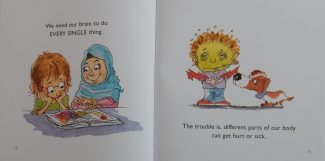
It’s an earnest discussion during which we, and the children, learn of South Africa’s recent history, about what it was like to be a child of apartheid (“But why did the white people start making everybody’s lives sad?” … “Did they make your lives sad too?”)

and about the role the family and in particular Mandela played in ending the apartheid regime. “Grandad was fighting for us all to be equal.” she says in response to Zazi’s “Why did Grandad go to jail?

The fight was one that continued throughout the 27 long years Mandela was a prisoner, both by himself and others who carried on the fight for the equality he believed in, and for freedom.

The penultimate question “Do you know what ubuntu means?” comes from Grandma Zindzi who goes on to explain “It means ‘I am because we all are’.
A powerful unifying thought that encapsulates Mandela’s legacy to us all wherever we are, a legacy that embodies service to his people and forgiveness.

Qualls’ illustrations rendered in acrylics, collage and pencil are absolutely superb embodying in turn, love,

hope, brutality (by the police), protest, joy,

family pride, diplomacy and more.

Powerful, inspiring, intensely moving and a wonderful tribute to an amazing man; (it brought tears to the eyes of this reviewer), this is a book for everyone who wants to pay tribute to the icon of equality and peace that is Nelson Mandela and surely that is all of us, young and not so young.

Magna Cow / A Campfire Tale

Magna Cow
Barry Hutchison and Cate James
Little Door Books

Brisket is a cow, an unusual one with especially curly horns, a particularly frizzy tail and, when it’s dark a faint glow emanates from her. Odd though these features might be, there is one that makes her even more extraordinary, she’s magnetic.

It’s this magnetism that causes Magna to create havoc at the cows’ camping trips,

bring about the dismantling of their treehouse and appropriate the cutlery at a party.

Consequently when the big day of the Moove to the Music dance competition comes around, Brisket is banished to the top of the hill while the other bovine beauties strut their stuff.

Suddenly disaster, in the form of a trundling tractor moving downhill, is about to strike. The dancing cows are too busy prancing and pirouetting to notice what’s happening. Only Brisket from her hilltop vantage point sees the danger: can she save the day?

Cate James daftly depicts this bonkers, but fun tale, about mooving metal, bovine bother and friendship from Barry Hutchison, with appropriately crazy-looking cattle and their shenanigans.

Specially written songs can be downloaded from the publisher’s website.

A Campfire Tale
Sarah Glenn Marsh and Ana Gómez
Sterling

The first night away from home, be it a sleep over or as in this story, a camping trip, can be a scary thought for some children and it appears so with Dragon too.

The child narrator though offers to act as his buddy. Assuming he’ll be a great companion, she takes him swimming, sailing and involves him in the whole gamut of camp-related activities,

even a puppet show; but all go pretty badly to say the least.

Perhaps it was a big mistake to take on the Dragon as her buddy especially as the other campers now seem to be avoiding them.

Come the evening, Dragon is a disaster when he attempts to help with the tent pitching and insists on listening to ghost stories, despite being scared stiff of same, but the last straw is his effort to get rid of a spider, which only serves to inflame the situation.

The narrator sends him packing and in the morning, there’s no sign of the scaly character.
The campers search for him in the woods but quickly get lost; what’s more they hear something growly in the distance.

Could this be an opportunity for Dragon to redeem himself perhaps?

The bold, bright illustrations by Ana Gómez are comical and engaging, showing the feelings of both Dragon and narrator.

Tropical Terry

Tropical Terry
Jarvis
Walker Books

Come with me to Coral Reef City, home to the most flashy, dashy array of fish you could imagine. It’s also home to Terry. Terry has no dazzling scales or funky fins to flaunt. He does however have two good friends, Cilla the crab and Steve the sea snail with whom he lives and plays.

The three and their games of Dodge-a-Dolphin, Shark Speed and Hide-a-Fish are shunned by the tropical fish on account of their drabness. Terry’s pals try to cheer him up but he still hankers after that dashing, flashing life.

A plan is needed and next day, with the help of his friends, operation transformation Terry is put into action.

Now he verily outshines everything else in Tropical City.
At last he’s one of the fishy dazzlers and much too busy with his new acquaintances to bother with Steve and Cilla.

One day however, Eddie the Eel arrives on the scene and Terry’s life in is great danger. What can he do to escape becoming an eel’s next meal?

There’s only one way to find out: get your fins on a copy of Jarvis’ tale of friendship and sea changes and read the rest of this piscine picture book.

Jarvis never fails to delight: his deep-sea adventure is certainly one to dive into.

Mixed

Mixed
Arree Chung
Macmillan Children’s Books

In the beginning there were three colours: Reds – the loud ones; Yellows – the bright ones and Blues – the laid-back ones, and they lived in harmony.
One afternoon though, the Reds took it upon themselves to declare that they were the best colour and that was the start of disharmony

resulting in the erection of fences, tall brick walls and separatism. Does that sound familiar?
However, one day a Yellow and a Blue notice one another and realise that their distinctive characteristics are of mutual benefit:

in short they become best buddies and more, to the alarm of the others of the three hues.
Love prevails, the two MIX and it’s not long before they’ve created a new colour they name Green. She has elements of both parents but is unique and, all the others love her.
So much so that they too begin to mix … and mix …

gradually transforming the entire neighbourhood into a harmonious, multi-coloured environment.
My immediate response to this straightforward story was ‘If only it were that simple.‘ That said the book contains powerful messages about the importance of diversity, acceptance and respect for others, as well as celebrating how  people’s differences can be tools for transformation.

Skyward: The Story of female Pilots in WW11

Skyward: The Story of Female Pilots in WW11
Sally Deng
Flying Eye Books

Here’s a beautifully produced, exciting book, based on real events, telling of three young women, Hazel, Marlene and Lilya, who pursue their dreams to become pilots and, countering gender stereotypes, go on to fly for their countries – the USA, England and Russia, in the Second World War.

First though they had to overcome, not only family ridicule but that of their governments and the armed forces.

“You’re taking all the jobs from our men!” Hazel was told by prejudiced people in powerful positions.

Even once they’d graduated it wasn’t all thrills; there were spills too …

and enormous risks.

But the three and the other female pilots did their utmost with little recognition and paltry pay, and in so doing paved the way for generations of young women.

Sally Deng, whose debut book this is, has, like her subjects herein, set the bar high for herself. Her carefully considered, inspiring telling coupled with her charismatic art style make for a powerful read.

A ‘must include’ for any World War Two topic in schools and a book I’d hope will be shared and celebrated, along with its subjects, by all who want to fly the flag for women’s achievements and for following your dreams.

Audrey the Amazing Inventor

Audrey the Amazing Inventor
Rachel Valentine and Katie Weymouth
Words & Pictures

Hot on the heels of Ada Twist, Scientist and Rosie Revere, Engineer comes another young girl character with a passion.
Meet Audrey, inquisitive and an inveterate fiddler with things, who, having declared to her teacher, her intention to be an inventor, sets about achieving her ambition.

She starts with items to make life better for her dad and Happy Cat but after a very rocky start

and even more disastrous next efforts, Audrey miserably declares herself “the world’s worst inventor!

Luckily for her, her dad, far from making disparaging remarks, encourages his daughter to learn from her mistakes and carry on trying. Wise advice.

It works too, for it isn’t long before Audrey is inventing again, but this time she’s extra careful at the planning stage, the constructing stage and the testing stage. Dad cannot wait to see the new invention.

Will it work to the satisfaction of all though? It’s certainly wildly inventive, and sophisticated; but will it deliver?
Crazy, but enormously enjoyable and an inspiration to young female would-be scientists, technologists and engineers: Audrey demonstrates just how much enjoyment the STEM curriculum offers and Rachel Valentine’s narrative reminds children of the importance of persevering, and of following your dreams.

There’s a slight touch of the Heath Robinsons about some of Katie Weymouth’s zany scenes of Audrey at work on her inventions, and she also adroitly captures the close and supportive relationship between father and daughter.

Don’t Feed the Bear

Don’t Feed the Bear
Kathleen Doherty and Chip Wass
Sterling Children’s Books

Teachers of young children know what appeals when it comes to story time; they certainly ought to or they shouldn’t be in the job. Not all of us though can use that knowledge to produce super book texts that make great read alouds like Kathleen Doherty has in this, her debut picture book.

There’s been a plethora of picture books featuring beary characters this year, in fact I’ve featured quite a few on this blog, but none with such wonderful endpapers as this one.

Now what about the story? First there’s that Bear, resident of a forest frequented by campers, a large creature that particularly relishes the tasty offerings left by same. There’s also a ranger, short of stature, seemingly a jobsworth kind of character, equally keen on the food left behind and partial to erecting signs such as the one that gives the book its title.

When she does just that, she triggers a veritable sign-writing skirmish …

lasting much of the day …

until a détente is reached and the signs are amended one last time.

Will those signs have the desired affect now? Here’s a clue …

However, if you want to know who has the final word, then get your paws on a copy of the book and find out for yourself. It’s brimming over with wonderfully join-in-able onomatopoeia – here’s a taster : ‘SMACKITY! SMACK! WHOMP! CLOMP … CLOMP … CLOMP’, there’s the occasional rhyme and a thoroughly satisfying finale, not to mention the understated message that two heads, or rather pens, are better than one.

Then of course there are Chip Wass’s funky, bold scenes of the arboreal antics that are guaranteed to delight.

This is a sure fire story time winner: Kathleen’s short sentences allow the reader aloud to create maximum impact with each one and the illustrations are delectably droll.
Having said all that, the nature of the text is such that after a couple of sharings, children may well feel they’d like to try the book themselves.

We’re Getting a Cat!

We’re Getting a Cat!
Vivian French and Salvatore Rubbino
Walker Books

Vivian French does narrative non-fiction beautifully and so it is in this book about a family that have recently moved into a flat in an old house. A flat that’s overrun with mice.

Dad is no cat enthusiast but he likes small furry rodents even less, so a decision is made. It’s off to the cat rescue centre and that’s where they meet big, strong Kevin. His skills as a mouse-catcher seem certain and so a week later, the girl narrator and her sister are thrilled by Kevin’s arrival at their home.

With the help of cat-owning neighbour, Mrs Harris, the family help Kevin settle into his new home. He learns how to use his litter tray

although he does use the family toilet for his own purposes.

He also discovers the best place for a good old scratch – certainly not Dad’s favourite chair – and gets used to the feeding time routine. In short he makes himself comfortable but as for mouse catching, it’s a great big No. It looks as though Dad might well decide to send him back to the Rescue Centre.

“Isn’t that what cats do” the narrator asks their neighbour on the mice-catching topic, the answer isn’t exactly what she’d hoped though.

But then Kevin takes himself off to explore the great outdoors and vanishes. Has he read Dad’s mind perhaps?

Up-beat in style, with additional captions that provide information on feeding, grooming and cat care throughout the book and a final ‘If you’re getting a cat’ page at the end, along with an index and some helpful websites, this is an ideal read for potential cat owners.

Even this cat-phobic reviewer was charmed by Rubbino’s scenes of the trials and tribulations Kevin puts his new family through, and the manner in which he establishes himself as an essential part of their household.

Ocean Meets Sky

Ocean Meets Sky
Eric & Terry Fan
Lincoln Children’s Books

Everything about this, the second Fan Brothers picture book, is absolutely superb: the jacket, the cover, the endpapers, the paper used and of course, the story and illustrations.

It’s a magical tale of young Finn who, inspired by memories of his grandfather’s sayings, his voice, and his stories – stories of a far distant place where ocean and sky meet – on what would have been his ninetieth birthday, builds a boat in his honour.

Then, imagination fuelled by those stories, the boy sets off on an amazing dream of a voyage. A voyage aided by a huge golden fish that tells him it knows of the place he seeks: “It’s high and low … It’s up and down and very far.” and offers to show the way.

The journey takes Finn through such wondrous places as the Library Islands populated by bibliophile birds; (love that there’s a copy of The Night Gardener tucked in one of the piles of books)

then, after landing to explore an island of giant shells, they travel onwards crossing a sea of dancing jellyfish until eventually they reach their destination, perhaps,

whereupon the boat lifts towards the sky (or had the water fallen away?) and the boy drifts through starry, steampunkish spreads whereon hot air balloons, zeppelins, submarines, a giant whale, float following the fish towards the full moon. There, a transformation takes place.
Smiling back at him benevolently, illuminating his farewell, is a face Finn knows so well.

Then comes a voice summoning him home from his dreaming. It’s his mother calling him (with echoes of Sendak’s Where the Wild Things Are) for dinner– Grandpa’s favourite dumplings.

The Finn Brothers vision of eternity is, in this affecting story, one that offers a bereft boy some healing from his sadness, leaving him able to face forwards, full of wonder. ‘It had been a good day for sailing.’

Elegant scenes grace every spread providing much to explore: observant readers/listeners will notice that an early picture of Grandpa’s room is filled with treasured objects that become part of the dream sequence.

Moth

Moth
Isabel Thomas and Daniel Egnéus
Bloomsbury Children’s Books

Interestingly this is the second picture book introducing adaptation and natural selection to children I’ve seen in the past few weeks – could a new trend be starting. I was first taught about these scientific ideas with reference to the Peppered Moth, the particular example used in this story, when doing A-level zoology donkeys ages ago, and now they’re part of the KS2 science curriculum – quite a thought.

‘This is a story of light and dark. Of change and adaptation, of survival and hope.’ So says science writer, Isabel Thomas in the opening lines of her narrative, a narrative that seamlessly interweaves both science and social history.

In the nineteenth century almost all Peppered Moths had light grey patterned wings that blended with the tree trunks and branches it frequented.

With the coming of the Industrial Revolution also came air pollution blackening buildings, monuments and trees alike.

In this new environment, the light-coloured moths became easy to spot and were gobbled up by birds.
Darker forms of the insect were less conspicuous and more likely to escape predation and to breed whilst the lighter form became extremely scarce.

With the advent of the Clean Air Acts in the mid-twentieth century air pollution from smoke and soot was greatly reduced, trees and buildings were no longer stained. Now the dark moths were more conspicuous and less likely to breed successfully, though both forms of the moth can still be found.
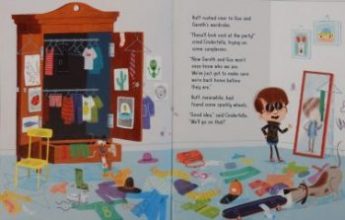
All this, Isabel Thomas recounts in her dramatic, sometimes lyrical text that ends with hope. A hope which, as we hear in the final explanatory pages, might lead to other living things being able to adapt to the changes, including climate change, that we humans inflict upon our planet.
Daniel Egnéus’ illustrations are as lyrical as the text, embodying at once arresting beauty and veritas, and instilling a sense of awe and wonder. It’s rare to see such an eloquent science-focused book that also embraces the arts side of the curriculum.

Baby’s First Bank Heist

Baby’s First Bank Heist
Jim Whalley and Stephen Collins
Bloomsbury Children’s Books

Utterly crazy, but equally hilarious, is this tale of an errant infant with an overwhelming desire for a pet.

Let me introduce baby Frank, ardent animal lover who decides to take the law into his own tiny hands in order to procure the necessary wherewithal to make his dream come true.

The trouble is, this tiny lad isn’t content with just one animal and before long the whole house resembles a menagerie;

but still he wants more and there’s cash aplenty to fund his passion so there’s nothing to stop him. Until, one afternoon, Mum makes a discovery …

Eventually Frank’s deceitful doings are uncovered and it’s time to make amends. Without any of his loot left what can they do to raise the money to repay the bank? And, what can they do with all the animals?

There’s only one way to put everything right. I won’t say what ensues but merely add that it entails Frank spending some time behind bars.

Tongue-in-cheek text from debut author, Jim Whalley coupled with Stephen Collins’s retro-style illustrations make for a corker of a book.

Pet-related preposterousness to make both children and adults splutter with glee; I’m sure this will quickly establish itself as a story time favourite.

The Little Green Hen

The Little Green Hen
Alison Murray
Orchard Books

Alison Murray has reworked the original Little Red Hen traditional story giving it an environmental slant. Herein her main character resides in the hollow trunk of a large apple tree growing atop a hill.

The Little Green Hen cares for the tree and sows the apple seeds to grow more trees. Before long an orchard has sprung up and she’s in need of some assistant cultivators.
Who would like to help me tend the apple trees?” she asks. Peacock is too busy preening himself but Dog offers his help as assistant pruner.

Requests for assistance with bug control and seed sowing are turned down by Fox and Cat respectively but she finds willing helpers in Sparrow and Squirrel. Throughout the year the new friends tend the orchard and all are rewarded by its bounties.

As autumn turns to winter, down comes the rain, day after day, week after week.

The industrious friends are safe, warm and dry in the old apple tree but Peacock and Fox are flooded out of their homes and seek refuge on Cat’s log.

Fortunately for the trio, The Little Green Hen is big-hearted enough to offer them a place of safety and together they wait for the flood waters to recede.

When the sun finally reappears, it’s time to clean up.

How will the Little Green Hen’s call for help in cleaning up the mess be received by her guests?

Fortunately for all the animals and of course, the orchard, the word is now teamwork.

Thanks to this and the thirsty roots of the new young trees, a new orchard grows up providing food and shelter for all to share.

Alison Murray’s crisp, clean-cut illustrations have a pleasing freshness and the body language and facial expressions of her characters capture their changing feelings eloquently.

Great for individual or story time sharing.

Brothers Forever

Brothers Forever
Claudia Boldt
Puffin Books

What do you do when your brother and best friend starts school leaving you to spend a long, gloomy day alone doing the things – cake baking, drawing and playing hide-and-seek – you’ve always done together?

That’s what happens to the small ursine narrator of Claudia Boldt’s new picture book. But that is only the beginning.

Big brother Barney, now calling himself Barnaby, has so many new and exciting ways to pass his time, and interesting new friends to play with, that his little brother is side-lined.

Life just isn’t fun any longer.

Enter new friend, Podgy. This cuddly creature participates in the activities previously shared with Barney,

but the new friendship makes boy narrator and Podgy the object of amusement to big bro. and his pals.

When Barney declines his favourite food one day, our narrator senses something is wrong

and that night he discovers what’s troubling his brother – it’s the thought of his first school trip away from home.

Brotherly love and understanding come to the rescue as both bears realise that no matter what changes life brings, one thing – or rather two – are forever.

Warm, realistic and imbued with gentle humour, this story will strike a chord with siblings especially.

If all the world were …

If all the world were …
Joseph Coelho and Allison Colpoys
Lincoln Children’s Books, First Editions

Be prepared to shed tears when you read this first person narration by a little girl who takes readers on a journey through four seasons and a whole life’s experiences shared with her beloved Grandad.
Starting with spring, she talks of long exploratory walks hand in hand and then takes a seasonal flight of fancy: ‘If all the world were springtime, / I would replant my grandad’s birthdays / so that he would never get old.

In summer Grandad buys a wooden racing track (second hand with bits missing) and together they play, sometimes zooming the cars up into space. This action triggers the narrator’s second imagined scenario to make her granddad happy.

I love the notebook with handmade paper, bound with Indian-leather string Grandpa makes for his granddaughter in autumn, wherein to write and draw her dreams with a special rainbow pencil.

That suggestion leads to her third loving musing:
If all the world were dreams, / I would mix my bright Grandad feelings / and paint them over sad places.

Come winter it’s time for cosying up by the fire and listening to Grandad’s tales of his boyhood of Indian sweets and homemade toys, and hear him tell of ships, snakes and tigers. Now though Grandad is ailing and the little girl supposes a world of stories and making her grandad better merely by listening to his every tale.

One day though his chair is empty; Grandad is no more. From the ephemera she finds in his room, the narrator creates a beautiful mandala of memories; memories she wishes could be rooms where she could visit her granddad.

On Grandad’s chair she finds a brand new notebook made by him with her name on the cover, the perfect thing in which to record all her precious memories.

I’m sure that like me, you’ll find yourself reaching for that box of tissues as you read this beautiful, lyrical book. Joseph’s Coelho’s poignant text in combination with Allison Colpoy’s tender illustrations infused with nostalgia and love, are a celebration of life as well as a perfect starting point for a conversation about loss and dying.

Soul music in a picture book, this.

My Stinky Dog

My Stinky Dog
Christine Roussey
Abrams

A boy narrator talks about his best friend and faithful dog, Alfred, always on hand to bring cheer to his owner and a great soccer player to boot.
If we take a closer look at this hero of a pet we discover that despite his wonderful character, there’s a problem with Alfred: foul odours emanate from every part of his body; in short, HE STINKS!

And he does so morning, noon and night and everywhere that Alfred takes him which is pretty embarrassing.
There’s an even bigger issue though as the boy’s family is soon to move to New York and a malodorous dog is not something they’ll be keen to take with them.
Time to pay the problem some attention. Aftershave (dad’s) perfume and air freshener only make matters worse so something more serious must be done. Into the bathtub goes Alfred. He’s thoroughly lathered and bubbled until hurrah!
No more stink! Alfred is positively sparkling

Uh-oh! All of a sudden the dog appears to have undergone a complete personality change. He starts cavorting around in welly boots and raincoat and is obsessive about his oral hygiene. Perhaps this destinkifying thing wasn’t such a good idea after all.
Out into the mud goes the boy who rolls around until Alfred follows suit. Soon his characteristic canine pong is well and truly restored and with odour issue resolved their whole stinky normality can resume.

But what about that New York move? Will both boy and dog make it to the new home?

A wonderful tale of love, acceptance and individuality is given a delightful carefree spin by Christine Roussey’s distinctive illustrative style, which will surely cause readers to smile at every turn of the page.

What Does an Anteater Eat?

What Does an Anteater Eat?
Ross Collins
Nosy Crow

Ross Collins will certainly have audiences spluttering with delight at the finale of what is essentially an extended joke of a book. That’s getting ahead of things though, so let’s go back to the beginning.

Surely any self-respecting anteater, even one that wakes up hungry, should not need to go around asking the various creatures he encounters one morning what he ought to be dining upon but that’s exactly what happens here.

The responses he gets range from an indolent “I’m very busy. Don’t bother me.” through some recommendations …

and helpful advice about thorough chewing (that’s from snake)to a lip-licking contemplation of the anteater’s own potential as a meal

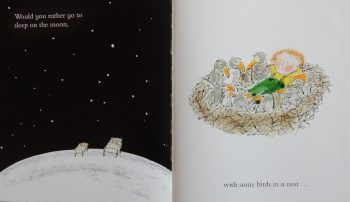
until Anteater arrives at a large nest. Now surely the penny will drop so to speak at the sight of this …

It does, but perhaps not in quite the way we might have been anticipating.

This tongue-in-cheek tale is delivered with panache: the expressions on the faces of the animals – anteater’s and all the others’ are wonderfully droll as is the dialogue throughout.

Be sure to watch out for the tiny insects crawling through almost every spread clearly intent on a spot of nest building.

Julian is a Mermaid

Julian is a Mermaid
Jessica Love
Walker Books

Here’s a picture book that transcends so many boundaries seemingly effortlessly delivering a powerful punch, or rather several, through a wonderfully empathetic affirming story and richly coloured, heart-stoppingly beautiful, watercolour and gouache illustrations.

On a ride home one day with his Nana, Julian sees three mermaids, or that’s what he considers them to be. When they enter his carriage, the boy is totally transfixed – he LOVES mermaids.
We then join him in a wordless 3-spread daydream that shows the boy becoming a mermaid swept along in a mass of sea creatures.

Once back home, while his Nana showers, Julian sets to work: he adorns his hair with palm fronds and flowers, applies some make-up and fashions a flowing tail, transforming himself into a fabulous mermaid.

What will his Nana’s reaction be though? His anxiety is palpable when she returns and we’re left momentarily, as unsure as Julian. Is he in trouble? Shamed perhaps?

Then comes her reaction and it’s truly what we’re longing for …

With the boy’s transformation complete, Nana leads him to a place filled with other people like him.
(I must add here that it’s not only the main characters that are so ‘real’: just look at the people they pass: their portrayal is genius).

An awesome unforgettable tale of non-conformity, understanding, acceptance and belonging; it speaks to the desire for love and understanding in us all, no matter who we are.

A book to be shared and celebrated by anyone and everyone, young or not so young and amazingly, this is Jessica Love’s debut picture book – wow!

Am I Yours?

Am I Yours?
Alex Latimer
Oxford University Press

Alex Latimer certainly keeps his audience guessing in this rhyming tale concerning an identity issue.
If you’ve never heard of an egg that speaks, you’re about to in this review.
Said egg, having been blown from a nest and spent a cold dark night at the foot of a hill emits a gentle ‘Excuse me, please, but am I yours? I’m sure I am a dinosaur’s.’
Yes it’s another dinosaur tale with lots of children’s favourites making an appearance.
First to come  along is Stegosaurus but the egg doesn’t fit its specifications, says so, but remains upbeat.
Nor does it fit those of Brachiosaurus, Triceratops, Corythosaurus

or Tyrannosaurus, by which time an entire day has passed and the egg, feeling lonely begins to cry out ‘… I can’t stay out in wind and storm! / I’ll freeze alone! I must stay warm!
The sun sinks and in so doing renders the eggshell translucent allowing the five concerned adult dinosaurs a view within.

Now they know what to do with the lost egg: back it’s rolled up the hill from whence it came, and there, to the sound of heavy feet, it makes a final plea:
One last time – I must be sure – / Are you the ones I’m looking for?’ …
In addition to the enjoyment of meeting some of their favourite prehistoric creatures in the story, with its invitation to join in the telling through the rhyming repeat refrain, ‘What do you look like inside that shell? / I can’t see in so I can’t tell.’ children will love becoming co-inquisitors of the egg,
(There’s lots of potential for small world play here once you’ve shared the story.)

For dinosaur enthusiasts who like to colour:

Fuzzy Dinosaurs & Prehistoric Creatures
illustrated by Papio Press

This is a touch-and-feel book with 7 spreads to add colour to, featuring animals of the prehistoric land, sea and sky, set out in chart-like form with brief snippets of information relating to each featured (numbered) animal one side of the spread, opposite which is the colouring page on a dramatic black background with the numbered creatures and other flora and fauna.
The book is written in association with, and fact-checked by, the National History Museum.

Mabel and Sam at Home

Mabel and Sam at Home
Linda Urban and Hadley Hooper
Chronicle Books

It’s moving day for Mabel and Sam and things look pretty chaotic from the viewpoint of the siblings.

To keep out of the way of the grown-ups they embark on a series of adventures related in three chapters. The first is ‘On the High Seas’ and here Captain Mabel and First Mate Sam set out in the good ship Handle With Care. Bossy sis. gives the orders as they go sailing on the high seas, a dangerous voyage full of pirates, whales and sea serpents

until they spy some friendly landlubbers, after which it’s “All ashore” for some tasty pizza.
‘At the Museum’ has curator Mabel showing Sam new ways of looking at old familiar things: the dialogue here is especially wonderful with Mabel “Behold“ing at every opportunity as she introduces the various artefacts to her brother.

Finally, after supper the two become astronauts blasting through space heading for Planet Perfecto and for this they need to be especially bold, “Space Bold” Astronaut Mabel declares, “Space Bold is bigger, because space is bigger.

Linda Urban’s entire text is a delight – funny, full of charm, reassuring and cleverly structured so as to embrace the kind of things that cause young children moving day anxieties; and before the end, the children are feeling upbeat about the move with Mabel concluding that their ‘new planet was surprisingly homey’.
Hadley Hooper’s illustrations (created with printmaking techniques and Photoshop) are, like the siblings’ adventures, wonderfully imagined, both in their rendering of the children’s adventures and the portrayal of the somewhat frazzled parents at the end of the book.
Just right for sharing with a child or children moving home.

Migration

Migration
Mike Unwin and Jenni Desmond
Bloomsbury Children’s Books

Mike Unwin documents the migratory journeys of twenty animals large and small, from the monarch butterfly to the great white shark

and the African elephant to the Southern pilchard, all of which travel incredible distances due to the seasonal changes to the environment in which they live. They move in pursuit of food, to escape bad weather or hostile environmental conditions, or in search of a suitable place to breed.
Each of the animals featured is allocated a double spread impressively illustrated by Jenni Desmond; and there’s a world map showing all the migrations at the back of the book.
Just imagine weighing less than a lump of sugar and having to fly 800km across the ocean like the ruby-throated hummingbird. Come spring, these iridescent birds leave their tropical winter home in Central America, fly across the Gulf of Mexico, north to North America, even as far north as Canada, where they breed, nesting somewhere in woods, a garden or park.

I was amazed to read the fascinating details about green marine sea turtles, which sometimes weigh as much as two humans and migrate across the Atlantic to breed on Ascension Island.

Unwin’s accounts are beautifully, at times poetically written, while Jenni Desmond’s illustrations make you want to linger long over each one enjoying the form, details and individual beauty of each animal portrayed.

Hero vs. Villain / Monty + Sylvester: A Tale of Everyday Super Heroes

Hero vs. Villain
T. Nat Fuller and Alex Eben Meyer
Abrams Appleseed

Using comic-book style images, the creators of this little board book manage to provide an engaging storyline while at the same time demonstrating opposites – hero/villain, smile/frown, up/down, build/destroy, truth/ lie

and enemies/friends – in just eight spreads.
Toddler super-hero enthusiasts will love the female sporting cloak and mask and laugh over the mock-scary, tooth-snapping, top-hat wearing crocodile villain and delight in the surprise finale. As a tool of conciliation, the cupcake rules!
Conflict resolution for tinies and a satisfying adventure is pretty good going in so brief a book.

For slightly older superhero fans:

Monty + Sylvester: A Tale of Everyday Super Heroes
Carly Gledhill
Orchard Books

Meet best pals Monty (mouse) and Sylvester (bear), new super heroes on the block. They’ve already got the gear, read the manual and followed the training regime and now they’re ready for operation ‘Save the World’.
RING! RING! It’s a call for help and off they go for their very first emergency.

Now this looks tricky but suddenly Mouse has a light-bulb moment and using their faithful vacuum cleaner, mission one is soon successfully completed.
Word of their skills spreads and everything is going swimmingly until …

This rascally rat mounts a counter-attack that really tests the abilities of the friends and makes them wonder if they’ll ever see the light of day again.
Rest assured though, thanks to a deft flick of this …

they do and gain a few extra helpers too.
With its delicious characters, (love the hatching on Sylvester) this is a book to appeal to young listeners especially would-be superheroes. Carly Geldhill’s illustrations are sprinkled with splendidly silly, giggle-inducing details both visual and verbal.

Between Tick and Tock

Between Tick and Tock
Louise Greig and Ashling Lindsay
Egmont Publishing

Most of us lead frenetic lives, dashing from here to there, mostly doing rather than being; but what would you want to do if you were able to stop time?

Liesel, the little girl in this story does just that. Liesel lives in a city, a city of hustle and bustle, a city of Grey, of loneliness, where almost everyone is far too busy to notice the details.

Not so watchful Liesel. She knows what is needed. She must pause the clock – just for a short time –bringing everything to a halt. Then she quietly springs into action working her way through the city beautifying the Grey with deft strokes of colour and creativity, showing kindliness to humans and creatures alike

and restoring calm and happiness.

She knows though that she cannot hold back time for longer than a very little while: that tick must be allowed to become a tock, that stop must once gain become go. Only now a transformation has taken place: things will never be quite the same again;

but just in case they ever should, Liesel knows exactly what to do …

Louise Greig and Ashling Lindsay’s enchanting day time story is every bit as beautiful as the nocturnal evocation they created in The Night Box, if not more so. Once again, lyrical words and pictures work in perfect accord to make a memorable, magical book.

Rosa Draws

Rosa Draws
Jordan Wray
Words & Pictures

Rosa is happiest when using her drawing pencils and letting her imagination run wild and that’s what this story is all about.

Seemingly her favourite subjects are animals, fairly ordinary ones, but what happens to them is anything but ordinary.

For when Rosa adorns her fuzzy black cat with a ‘RIDONKULOUS’ hat, it triggers an increasingly crazy concatenation of events involving a hat-eating bear with GLAM-U-LICIOUS long hair (yes the whole thing is recounted in rhyme with only the occasional slight creak).

Said bear has its hair sat upon by a moose that takes tea with a la-dee-dah goose and so on until the ants – a zillion of them – board a train and plunge Rose into darkness, cutting off her train of thought and completely stifling her imagination.

Only temporarily though, for the tugging on a light switch cord puts her back ‘on track’ and her ideas flow freely once more until suddenly who should arrive on the scene but Rosa’s mum.

Apologies are immediately forthcoming but it turns out that young Rosa isn’t the only one with an artistic bent …

Packed with zany details – look out for the peacock sporting jazzy socks – Wray’s illustrations will amuse both children and adults and the former will enjoy the invented words and the surprise finale.

The Little Mouse and the Red Wall

The Little Mouse and the Red Wall
Britta Teckentrup
Orchard Books

Little Mouse lives in a community surrounded by a big red wall. It’s always been there but why? And what lies beyond?
When she asks the other animals, each one comes up with a different reason – for protection, thinks Scaredy Cat; Old Bear cannot remember; Fox doesn’t care and Lion Who Had Lost His Roar says  ‘just a big black nothing’ is behind the wall.

None of these responses satisfy Little Mouse but then one day she meets a Bluebird. Thanks to the bird, she is able to discover the answers to her questions.

What she sees – a world of freedom and beauty – and an ensuing conversation with the Bluebird are life changing, altering completely her way of seeing and being in the world.
They were looking with fear… YOU are looking with wonder. You were brave enough to find out the truth for yourself.

Little Mouse goes back to her friends and tells them of the wonders she’s seen and one by one they walk through the wall, all except Lion, although one day he too is ready to join the others in the land beyond.

Despite the simplicity of her telling, Britta Teckentrup’s beautifully illustrated story is profound and would be an ideal starting point for a community of enquiry style philosophical discussion.

When we in the UK, and other countries, seem to be putting up boundaries, its timely themes of discovering freedom and embracing change, both personal and in the world, will resonate with both children and adults.

Bonkers About Beetles

Bonkers About Beetles
Owen Davey
Flying Eye Books

After focussing on monkeys, sharks and cats, Owen Davey turns his attention to beetles, a particularly successful insect group.

I knew that that were a great many different beetle species, some very tiny, others around the size of a human hand, but I had no idea that already 400,000 different kinds have been found, nor that beetles account for a quarter of all the animal species in the world being found on every continent other that Antarctica. Awesome!

There are basically four different ways of life; there are predators, herbivores, omnivores and decomposers each of which Davey explains giving examples of each of these kinds.

Clearly beetles come in many different shapes and sizes, although as we see here, all have a similar basic design.

As always in this series, Owen Davey’s playful sense of humour comes across in his choice of titles for some of the spreads as well as paragraph headings; for instance ‘Love You and Leaf You’ heads up some information about leaf-rolling weevils that construct special rounded homes for their eggs, taking around two hours to do the job.
And, dung beetles shaping dung balls to enclose their eggs, (one per egg) is under the heading ‘Let the Good Times Roll’.

What tickled my quirky nature particularly was discovering there’s a beetle that practises yoga: the head-stander beetle lives in the southern African Namib desert where the lack of water means it’s often difficult to find a drink. In the early morning, head-stander beetles climb to the top of the dunes when there’s a fog laden with moisture. They put their heads down and lift their rear ends to the sky so water collects on their backs and runs down into their mouths:
amazingly clever creatures.

I was also especially taken with the ‘Weird and Wonderful’ spread showcasing the likes of the giraffe weevil, the violin beetle and the harlequin beetle.

I’ve loved all Davey’s brilliantly illustrated books in the series but this one has to be my favourite.
What next I wonder?

But the Bear Came Back

But the Bear Came Back
Tammi Sauer and Dan Taylor
Sterling

‘You don’t know what you’ve got until you lose it’ is what the little boy protagonist in this story discovers when a large furry ursine character comes a-knocking.

It all starts quite politely on the boy narrator’s part; he’s disturbed from his reading and understandably a tad irritated but isn’t on this occasion rude. ‘And I said, “Go home, bear.” And that was that. ‘

However, this bear is persistent, returning over and over;

but time and again the boy sends him packing until things get just too much. He yells at the creature at the top of his voice, after which there are no further visits.

Peace ensues but the boy isn’t as happy as he’d expected; in fact, he really misses that hulking great irritating animal.

Can he ever find his friend again? The boy certainly goes to great lengths to do so …

but will he ever hear that longed for knock on his door?

There is much to discuss about the way the characters behave in Tammi Sauer’s gently humorous story – not the least being the lengths each goes to find a friend.

Day Taylor’s illustrations are captivating: the bear is adorable – decidedly huggable in fact; and there are lots of lovely details to spend time over.

Gary’s Banana Drama

Gary’s Banana Drama
Jane Massey
Simon & Schuster Children’s Books

Gary the huge gorilla is a banana-phile so you might imagine that his discovery one day that there are ‘NO MORE BANANAS’ would send him into a crisis. Not so! Gary isn’t one to panic; instead he dons his smart new titfa’, trims his toenails and sallies forth to carry out his plan: to search for his favourite food.

Pretty soon, it seems as though his plan is going to prove fruitful: there are bananas at almost every step.
The trouble is not one of the banana-looking items is the real thing. Some leap and lick his face, others burst into song

and then have the audacity to peck him; others come hurtling at him courtesy of one Billy.

He sees bananas wherever he looks; it’s enough to drive the creature absolutely err, bananas, especially when it starts to rain.

Then however, Gary’s luck changes. He bashes his bonce on a huge obstacle

and then despite not at first wanting anything to do with the object he’s bumped into, suddenly changes his mind and launches himself off towards the most wonderful place he could never have imagined …

Is it possible though to have too much of a good thing? …

Totally crazy – bananas you might say – but with some wonderful slap-stick moments Gary and his banana-filled drama will have your audience chortling with delight.

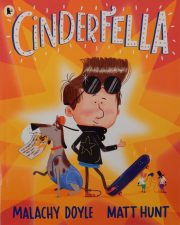
Cinderella of the Nile

Cinderella of the Nile
Beverley Naidoo and Marjan Vafaeian
Tiny Owl

Cinderella is one of the most often told and recognised stories all around the world with its themes and motifs appearing in the folklore of many cultures.
Rhodopsis is an ancient Greek/Egyptian tale said to be the earliest Cinderella story.

Now, Carnegie award-winning author Beverley Naidoo retells this little known tale, the first in the publisher’s ‘One Story, Many Voices’ series. I was particularly excited to see this book having become interested in how stories cross cultures and wrote an assignment on this theme in relation to the Cinderella story while studying at London University’s Institute of Education many years ago.

In this version, unlike the Cinderella most young children are familiar with, a young Greek girl, Rhodopisis is captured by pirates and sold into slavery.
Her master has a special slave, the storyteller, Aesop who becomes friendly with the beautiful red-haired girl and the only one able to make her smile.

After a while her master, unhappy at her unwillingness to smile for him, sells her to a merchant travelling to the Egyptian port of Naukratis.

There she is bought by a Greek merchant who, having heard her story, treats her kindly, rather like a daughter, angering his Egyptian servants, in particular, three sisters who do unkind things to the girl behind their master’s back.
One day her master sees her dancing barefoot down by the river and so he gives her a pair of beautiful rose-red slippers.

Not long after, the Pharaoh sends out an invitation to his subjects asking them to a feast at his palace. Hearing that he was looking for a bride, the three sisters lie to their master and set off to attend.

The kind-hearted Rhodopsis is left to do all the chores and while she does so, Horus, the falcon-god seizes one of her slippers and flies off with it, dropping it into the hand of the Pharaoh Amasis.

Taking it as a sign from the god, the Pharaoh orders messengers to seek out the slipper’s owner: it is she who will become his Queen …

The ancient origins of the story is evident through Marjan Vafaeian’s use of the side on figurative imagery found in the Greek art of the period as well as in Ancient Egyptian wall paintings. Her stylised patterned landscapes in opulent shades of red, brown and green are stunning and a perfect complement to Beverley Naidoo’s fine telling.

Oh me, oh my, a Pie!

Oh me, oh my, a Pie!
Jan Fearnley
Nosy Crow

Grandma bear – a nice old soul – has just baked a pie, a rather yummy-looking one at that.

She leaves it to cool and in a trice, a greedy fox has leapt in the window, seized the object and is making off to his lair for a feast. Fox however, forgets to look where he’s going and whoops! he takes a tumble, the pie flies out of his grasp and lands beside a hungry mouse.

Oh me, oh my,” says Mouse, intent on getting that yummy pie into his tummy as soon as possible and off he goes down the street professing same.

Who should be watching though but a greedy cat and you can guess what happens next.

Cat is the owner of the pie for barely a moment when  a nasty looking canine snatches it

and sets off homewards, only to lose it seconds later to Little Owl flying overhead.

The pie is big – too big for a small owl to manage to get back to her nest: down, down it falls, landing, perhaps you can guess where?

Right back at Grandma’s, just in time for tea, rapidly followed by a host of hungry animals all with their thoughts on the same thing.

Now, being as we were told at the outset, ‘a nice old grandma’, she invites them in to sample her pie, but only on one condition. They have to share.

I wonder if they can …

With a rhyming text that’s a treat to read aloud – especially with that oft repeated ‘oh me, oh my!’ refrain to join in with – and delectable illustrations full of wonderful details to linger over, Jan Fearnley has cooked up a delicious tale that’s destined to become a story time favourite.

How the Borks Became

How the Borks Became
Jonathan Emmett and Elys Dolan
Otter-Barry Books

Who better to introduce the concept of evolution and Darwin’s theory of natural selection to primary age children than author Jonathan Emmett and illustrator Elys Dolan?

So let’s take a journey to a distant planet, quite similar to earth, named Charleebob, home to a species going by the name of Borks.

When we arrive a group of llama-like Bork mothers has just given birth to a large brood of Borklings, long-necked, shaggy, yellow creatures, each one slightly different.

They didn’t always look that way though: long, long ago their appearance was altogether different: their fur was short, smooth and blue and their necks short and thick, at least that’s how most of them were. A few exceptional ones had shaggier fur – not ideal for hot weather but when the chilly time arrived later in the year, they were the ones that survived.

Over the next couple of generations, more changes took place; first instead of all the offspring having blue fur a few were bright yellow.

This meant that the latter blended in with their surroundings so that when a Ravenous Snarfle was on the lookout for its lunchtime feed, the blues were hastily consumed

leaving the yellow-furred few to thrive and breed the next Borkling batch – all yellow, the majority with short necks, a few with long skinny ones.
You can guess which ones survived the drought that year, saved by their ability to feed on the thick leaves high up in the Ju-Ju-Bong trees. And that’s it – evolution in just four generations of Borks.

Clearly changes don’t happen that fast, but artistic licence on behalf of the book’s creators demonstrates how three key environmental factors – climate, predation and food availability brought about evolutionary changes with only the fittest surviving by natural selection.

The combination of Emmett’s brilliant, quirky rhyming narrative and Elys Dolan’s wonderfully witty, whimsical illustrations is an enormously enjoyable amalgam of science and storytelling, which offers a perfect starting point for the KS2 evolution topic.

(At the end of the book it’s explained that the Borks’ evolution story is a hugely speeded up account of what really happens: evolution happens at a much, much slower rate and the changes are smaller and more gradual so that an earth animal could take millions of years to change.) While you’re looking at the back matter, do check out the quirky end papers.

Early Years Bookshelf: Maisy Goes to a Wedding / Bigger, Bigger!

Maisy Goes to a Wedding
Lucy Cousins
Walker Books

Oh my goodness! Ostrich and Penguin are getting married and we’re all invited to their wedding. Needless to say Maisy, decked out in her new outfit, is super-excited.

At the flower-bedecked venue, Maisy greets all her friends. Every one of them has brought something for the couple and soon it’s time for the celebration to start.

Music plays as Tallulah leads the way festooning the aisle with flowers and is closely followed by Penguin on the arm of Charley. They reach the waiting Ostrich.

Owl does the officiating, rings are exchanged, “I do” is said by both partners and then it’s the party. Hurrah!
Delicious food, toasting the couple, music and dancing and cutting the cake follow.

Then the bride throws her bouquet: who will catch it though?

After a wonderful party the happy couple leave for their honeymoon …

Maisy fans will love this latest episode in the ‘First Experiences series’, which now numbers over 15 titles.

Bigger! Bigger!
Leslie Patricelli
Walker Books

The story really starts before the title page with a little girl gleefully emptying out her box of coloured blocks onto the floor.
Build’ she says smiling, hard-hat balancing precariously on her head.

From then on her imagination appears to take over as the blue wall behind her is transformed into blue sky and her pets too have donned hard-hats and their buildings look real: first a dog kennel ‘Big’; then a wooden house ‘Bigger!’ and ‘Bigger! Bigger!’ is the cry …

as a block of flats, a large bridge, office blocks appear until we see the happy builders exuberantly celebrating the finish of their task.

They’re certainly an ambitious crew these three.

Suddenly there’s a ‘BOOM! BOOM!’ followed by at the turn of the page a huge nappy-clad baby (has it escaped from the author’s board books?) wreaking havoc.

Thereafter reality is restored with tears from big sis. and then a penitent babe attempting a silent apology.

Finally co-operation wins the day and ‘Stronger! Stronger!‘ comes the cry.

Share with a group of nursery children or an individual around the age of the girl builder – either way they’ll demand repeats. Equally, with its minimal text writ large, this is perfect for those just starting to read.

A Very Late Story

A Very Late Story
Mariana Coppo
Flying Eye Books

Imagine opening a book and discovering that the first spread is virtually blank, save for a single sentence. So it is in Mariana Coppo’s new picture book of which showing rather than telling is the essence.

Five creatures show up on the second spread and when one decides they’ve landed in a book, four are content to wait for the story to arrive.

Not so the little pink rabbit.

Having had its “Can we play?” suggestion turned down by the others who are willing to be patient and chat among themselves, the rabbit makes its way to the verso page of the book.
There, using the colour pencils from its backpack and a bit of imagination, the little pink animal populates the page with a tree, birds and much more besides.

The tree grows and with it and further colour pencil additions from rabbit, life on the verso becomes ever more exciting, spilling across the gutter

and attracting the attention of the passive quartet of story waiters.

Before long they are drawn into the action so that when the postman arrives with the mail, the story he delivers to them is surplus to requirements.

Cleverly conceived and SO brilliantly executed, this is a real joy of a book.

Plantopedia / Summer

Plantopedia
Adrienne Barman
Wide Eyed Editions

Barman follows up her Creaturepedia with a celebration of more than 600 plants that includes trees, fruits, flowers – wild and cultivated, vegetables, herbs, weeds, healing plants and more from all over the world.

Somewhat strangely for this reviewer at least, we start indoors with ‘The air fresheners’ – plants to grow indoors that clean the air. This section is followed by ‘The all-blacks’ and then ’The aquatics’ ‘The big eaters’ and another colour section – ‘The blues and purples’. I’m not sure whether the author had a plan in mind when she arranged the spreads but to me the section sequencing seems quirky and perhaps random which creates something of a surprise element.I particularly liked The Stars pages.

Having said that the whole book is packed with learning possibilities in various curriculum areas such as science, geography, history, art perhaps (although it’s better to use real plants I suggest) and almost every topic could be an inspiration for further investigation.

In contrast to the rest of the book, the appendix devoted to three aspects of leaves – shape, arrangement and edges/veins – is straightforward botany.

The illustrations are bright, engaging and gently humorous – look out for animals popping up on lots of spreads, and the odd human from time to time.

One for budding botanists, the family bookshelf or school library.

For younger readers, with plants also taking centre stage is:

Summer
David A. Carter
Abrams Appleseed

Just in time for summer comes David A. Carter’s fourth and final pop-up in his seasons series. Carter has created six plant pop-ups –one of which he places at the centre of each spread,

and in and around them are to be found various animals including birds, butterflies and other minibeasts, small mammals, a snake, a turtle and a fish.

A brief accompanying text invites children to get involved by asking such questions as ‘Who eats the flowers?’ or ‘Who swims in the creek?’

Fun and captivating, this is an American publication so some of the named items will be unfamiliar but that offers a good talking point for readers in parts of the world other than the USA.

The Case of the Red-Bottomed Robber!

The Case of the Red-Bottomed Robber!
Richard Byrne
Oxford University Press

The chalks are an artistic lot creating colourful drawings at every opportunity so imagine their feelings when something or someone starts ‘stealing’ their pictures, and not just once either.

Thus begins this daft tale wherein Sergeant Blue and of course, readers are hot on the trail of the miscreant although I expect young listeners will already have their own suspicions as to his identity.

It’s not long before the Sergeant has lined up an identity parade of possible candidates and there’s one particularly suspicious-looking character that fits the evidence and his behind is covered in tell-tale red dust.

Caught red-bottomed! But before the prison doors are closed on the culprit, he makes a dash for freedom.

Will the chalks ever catch up with that slippery customer and if so, what will happen?

This light-hearted romp embodies an important message about not being too hasty in making judgements.
Children will enjoy the chalk-board style illustrations: in the face of the near ubiquity of white boards and markers in schools, could this be the start of a chalk-board revival – you never know!

The Very Hungry Hedgehog

The Very Hungry Hedgehog
Rosie Wellesley
Pavilion Children’s Books

Isaac the hedgehog returns in a third story – a springtime adventure this time.

The spiky little creature is summarily awoken from his long winter sleep by Starling, but the greedy bird then refuses to share her breakfast worm. “Bad hair day for hedgehog!” laughs the bird before flying off leaving Isaac’s feelings somewhat dampened. Fine friend she is, he thinks to himself but a very hungry Isaac decides to search for his own food. Unknowingly he has a follower as he encounters other non-sharers – first it’s gluttonous Toad – a real tease of a creature.

Next comes a heron that snatches a fat, juicy slug right out of Isaac’s paws and flies off with it

leaving an even hungrier Isaac rueing the day he left that cosy winter bed of his, until he catches sight of some real signs that Spring has arrived, signalling to him a wealth of food for all to share.

He very nearly doesn’t get his share though for, were it not for his quick thinking and his prickles, Isaac himself would have become the next snack for the fox that’s been trailing him all the while.

Even after a very near miss, the kindly little animal is willing to adopt a benevolent attitude about the abundance of food that’s all around for all the creatures to share.

Enchantingly told and vividly portrayed, Rosie Wellesley’s latest story offers young listeners a gentle sharing message and some wonderful scenes of animals in the natural world.

Here are Nina and her parents sharing the story, mum reading the main text and dad supplying the voices


Little Mole is a Whirlwind

Little Mole is a Whirlwind
Anna Llenas
Templar Books

I’ve had a Little Mole in some of the classes I’ve taught over the years: ADHD, whether or not it’s so labelled, is challenging for all involved but underneath the child who is at times making you feel deskilled is usually a youngster who is desperately trying to reach out for reassurance and help. It’s certainly the case in this new story from Anna Llenas.

With his bounding, bouncing and bellowing, Little Mole exhausts his parents.

At school he finds it almost impossible to concentrate and is constantly distracted, fiddling, fidgeting and forgetting so it’s no surprise that his classmates shun him. Sadly the little creature has all sorts of labels assigned to him.

His teacher is at the end of her tether; try as she might, she just can’t help Little Mole to focus.

A note goes home asking for a parental conference but almost simultaneously a newspaper is delivered advertising the services of ‘Serena the Forest Bunny’ offering ‘creative learning for wonderful children’. Could this be the answer?

Little Mole’s parents take him to meet Serena who thinks she might be able to help.

The following day Little Mole tells her about his worries regarding his end-of-year project, about his inability to stay focussed and his lack of friends.

In response Serena takes him to a room filled with creative materials and gives Little Mole free rein. At first he’s over-excited and soon chaos reigns.

Serena remains calm and supportive both then and on subsequent visits as they play, cook …

and even stargaze. Most importantly though, they talk, and gradually over the course of several months his concentration span increases.
Serena helps her pupil discover what he really likes to do and with her reassurance that he’s wonderful just the way he is, Little Mole is ready to work on that end-of-year project.

Come the last day of term his teacher has a wonderful surprise when it comes to project showing time. Little Mole has finally found his passion and his outlook on the world is completely changed.

Anna Llenas understands all this so well and her story, with her trademark collage style illustrations, portrays Little Mole as a thoroughly likeable character deserving of the tolerance and understanding shown by Serena.

We Wear Pants

We Wear Pants
Katie Abey
Bloomsbury Children’s Books

No, this isn’t another story about pants, although that particular item of clothing is the subject of the first spread in this humorous offering. You’ll also see thereon a horse in pants watering plants , a giraffe wearing them – and not only on its rear end; and youngsters will delight in the invitation to search for ‘who is sitting on the toilet?’ Wouldn’t the octopus have pants with eight leg holes? one of my book sharers wanted to know.

Wellies come next and all manner of animals are sporting theirs, including a waterproof wombat and a funky frog that asks readers to ‘Count the rubber ducks’. Not so the cheeky monkey however; that particular creature pops up on every spread offering a sneak preview of which item of attire is coming next.

We Wear Hats invites children to choose a hat – a tricky operation but for me the crocodile won; and I think I’d go for the croc. as my favourite animal too, on account of the fact that he’s reading a book.

The weather is decidedly changeable on the coats spread so many different kinds are show-cased including blazers, anoraks, puffer jackets, macs and ponchos.

Snazzy shorts aplenty are shown off on the beach: “Shorts cover up your pants” announces the bird atop the palm tree, although those belonging to the tortoise close by appears to be serving an alternative purpose.

Glasses, scarves, socks, shoes, T-shirts – watch out for particularly groan-worthy puns here – and pyjamas are also featured and the book ends with a final free choice page asking “What will YOU wear today?” Now there’s a thought …
Entertaining, absorbing and most definitely giggle inducing (that’s adults as well as children); a great book for sharing and absolutely full of language development potential.

The Brilliant Deep

The Brilliant Deep
Kate Messner and Matthew Forsythe
Chronicle Books

‘It starts with one.’ So begins the inspiring true story of Ken Nedimeyer, who as a boy was fascinated by the underwater world of Florida Keys, in particular the coral reefs. He became troubled when he discovered that those reefs were fading and dying, seemingly there was nothing he could do to save them.

Then as an adult he had one of those ‘what if …?’ moments relating to the staghorn corals he’d grown on his rock farm. His brilliant idea was to transplant the staghorn coral colony he’d grown onto that reef he’d loved as a child: could that colony be brought back to life?

It was surely worth a try and so Ken went back to his beloved reef and glued six small coral colonies onto the limestone surface of the erstwhile reef.

Month by month these transplants grew and became the catalyst for the Coral Restoration Foundation, which now has international links.

Kate Messner pitches her telling of this inspiring story perfectly for primary school age audiences, telling of Ken’s passion, of staghorn corals grown on the rock farm, of his successful experiments and of the volunteers his inspirational work has recruited, finishing as she began with the upbeat, ‘It starts with one.’

A love of wildlife shines through Matthew Forsythe’s exhilarating illustrations. Using a rich colour palette to portray the undersea world and the divers he takes us right up close to the action making this a great book to share with a class or group and who knows, it might just inspire budding marine biologists.
To that end, the final spread provides details of further reading, websites to visit, ways to help and explanations of some of the terms used in the narrative.

I Want My Dad! / With My Daddy / I Love You Dino-Daddy

I Want My Dad!
Tony Ross
Andersen Press

Tony Ross’s latest slice of humour, Little Princess style, has the heroine considering her dad the King, making comparisons with other dads and finding him wanting in many respects. He’s much shorter that they are, is useless at baking, gets wheezy in the presence of any animal large or small, is totally inept in the water

and unlike the Gardener who takes his offspring on forest walks, gets lost in his own castle.

I wish my dad was as much fun as other dads!” she cries to the Maid. … He’s useless.

Her response is to teach the young complainer. First it’s pony riding, then baking, followed by swimming and walking in the woods, none of which are a resounding success. Our Little Princess is left feeling cold, decidedly damp, with hurting teeth and head, and exceedingly hungry.

In short, she feels absolutely useless.

As she heads for home who should happen along but his royal highness out walking and when he hears about her failures, just like all dads, he knows just what to say to put everything right.

With My Daddy
Jo Witek and Christine Roussey
Abrams Appleseed

In this sturdily built book, a little girl talks about how she feels when she’s with her dad.
He arouses the whole gamut of emotions: a hug makes her feel like ‘a little bird in a warm, comfy nest, … safe.’

He can also make her feel unafraid, ‘brave’ in fact, ‘daring’, ‘confident’ because he inspires self-belief,

being ‘adventurous’ particularly when it comes to swimming, ‘playful’ on the most ordinary of days, ‘calm’, and ‘excited’ especially when he plays at being a monster. Sometimes though he invokes anger but it’s a storm that quickly passes thanks to Dad’s gentle calming hands on the narrator’s back.
Interestingly we never see the complete dad, or even indeed his face. Rather it’s only huge hands, or feet and legs on the final page, that are ever visible. In this way, Christine Roussey emphasises the huge amount of love he bestows upon the small narrator and the scope of his influencing power upon her feelings and emotions.

I Love You Dino-Daddy
Mark Sperring and Sam Lloyd
Bloomsbury Children’s Books

According to his offspring, Dino-Dad is a pretty cool guy with all manner of useful attributes. He’s full of fun on trips to the park, , ace at building with blocks, great at playing monsters, pretend wrestling, giving pony rides and doing magic tricks (especially where cake is concerned) ; he’s even great to play with – albeit unknowingly – while taking a nap.

As described in Mark Sperring’s jolly rhyming text and portrayed, with his dapper blue shoes and striped scarf, in Sam Lloyd’s exuberant illustrations, this Dad is a doted-on dino. who is sure to charm your little ones; and this is a lovely fun-filled, love-filled book for dino-littles to give to a dad on his special day be that Father’s Day, a birthday or for that matter, any other day they want to bring a Daddy smile.

Dylan the Baker

Dylan the Baker
Guy Parker Rees
Alison Green Books

Dylan the exuberant stripy dog is back once again and this time we join him as he dons a chef’s hat and apron ready to bake a birthday cake – his favourite extra special Choccy-Banana one for his pal Jolly Otter.

The trouble is that right from when those wonderful baking smells start wafting from the oven, Dylan’s tum starts to rumble.

Trying not to eat the yummy cake becomes Dylan’s major preoccupation as he removes it from the oven, leaves it on the table and dashes outside to distract himself.

It’s there that his friends Purple Puss and Titchy Chick find him and they too join Dylan in the not-eating-cake activities. First it’s head-standing, then spinning around in the woods,

followed by swinging and a host of other games; the problem being that before long Dylan isn’t the only one suffering from tummy rumbles and super salivation.

Will Jolly Otter get even so much as a sniff of his birthday cake when three friends all have an irresistible urge to sink their teeth into the delicious confection?

Look out for Dotty Bug, another of Dylan’s pals who pops up on every spread encouraging listeners to join in with this fun story. And fun it certainly is especially as the anticipation builds with those ‘Rumbly-tumbly- grumbly GRUM tummies, not to mention Dylan’s song to sing along with; and the final twist in the baking bonanza is entirely satisfying.


Moreover, if you fancy trying some of Dylan’s cake, he’s been kind enough to include a recipe at the end of his story.

Square

Square
Mac Barnett and Jon Klassen
Walker Books

In a previous book we left Square obstructing the entrance to Triangle’s home and now he’s back moving in and out of his own secret abode hauling large rock cubes from his subterranean stash all the way up to the top of a hill. This he regards as his ‘work’.

One day while he’s thus engaged along comes Circle pronouncing him a “genius” and “sculptor”. Thinking his block sculpture to be a self-portrait, she commissions one of her, promising to return the following day. Now Square really does have a tricky undertaking: Circle is perfect.

Anxiously he sets to work but as the rain falls, Square’s far from perfect shape begins to disintegrate and come nightfall he’s surrounded by a circular pile of rubble into which the rain falls.

By now his anxiety is almost palpable and having determined to stay up all night, overwhelmed by despair, he falls fast asleep.

Morning comes and with it the realisation that he’s allowed himself to be beguiled by Circle’s talk of genius. There he stands in a large puddle surrounded by a circle of rubble.

Eager to set eyes on her portrait, Circle rolls along early and sees her reflection in the puddle.

Declaring it “perfect” she reaffirms Square’s genius and departs.

Barnett’s final throwaway ‘But was he really?’ leaves readers, and indeed Square, to ponder and make their own decisions, not the least of which are, what does it mean to be an artist? And, what is art?

With his characteristic minimalism Klassen imbues his art with humorous detail: the twig for instance that looks like a wilted aerial on Square’s head, and the way he just keels over in utter exhaustion, are superb.

Barnett’s brief, droll text, combined with Klassen’s illustrations make this a perfect offering for those who enjoy pondering upon and discussing philosophical questions. Community of Enquiry enthusiasts and artists in particular will love this, as indeed will anyone who enjoys the subtlety of this duo’s picture books.