Ice Boy / Stack the Cats

Ice Boy
David Ezra Stein
Walker Books
Meet Ice Boy, the hero of Stein’s latest book. Rather than being restrained by his freezer existence and frequent “Never go outside” parental warnings, the young ice-cube leaves the safe enclosed environment and ventures down to the ocean’s edge and thence discovers a whole new world of exciting adventures is to be had.
His first incarnation is ‘Water Boy …
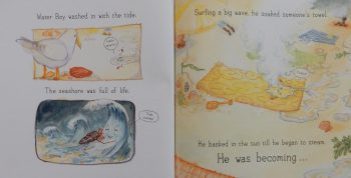
and thereafter Vapour Boy; after which, having tap-danced upon a thunderstorm and freezing …

a tiny pellet of summer hail.
In solid form once again, he hurtles off a roof-top and ‘BLOOP’ –is reunited with his parents who just happen to be chilling someone’s drink.

Suddenly it looks as though extermination is to be the outcome for all three cubes but fortunately, the thirsty human’s first taste is of the little lad who, after all his adventures has become a taste-bud disaster; and Ice Boy and parents are summarily tossed from the tumbler onto the grass.
Then, with an infusion of worldly knowledge, Ice Boy leads the trio off on a new water-cycle adventure …
This clever tale of risk-taking, transformation and re-incarnation is such a fun way to introduce a sclence lesson on the water-cycle. Stein’s mixed media, largely blue and grey illustrations are littered throughout with witty speech bubbles (‘Oh, Ice Boy! You’re a sight for sore ice.‘ Or, ‘Am I dense or did I just become a liquid again?‘and peppered with POPs, PUFFs, BLOOPs and other appropriate noises off.

Stack the Cats
Susie Ghahremani
Abrams Appleseed
Much more than a mere counting activity, this playful picture book offers opportunities for youngsters to expand their mathematical thinking to embrace simple division and multiplication; and a spot of height comparison. We start with ‘One cat sleeps.’ // Two cats play. // Three cats?/ STACK!’ Followed by …

After which the pattern alters thus:
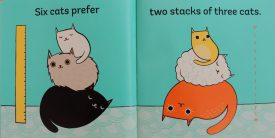
Clearly the six have found this process a little wearying so ‘Seven cats nap.’
Then, the revived felines plus another try their paws at a spot to towering , which rapidly turns to a tumble. It’s as well cat nine is there to even things out and for the first and only time, numerals make their appearance …
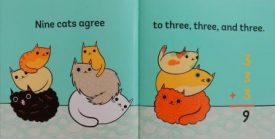
What happens thereafter is that Ghahremi decides that ten cats are ‘just too many’, dispersing the gathering to hide, sleep, climb and generally have a playful time (a subtraction discussion opportunity) and finishing with an open-ended, ‘How will you stack the cats?’
The eye-catching cats are given the opportunity to show their playful personalities while youngsters are offered a plethora of mathematical possibilities. A purrfect prelude to some mathematical activities: fun and educative and also, great for beginning readers.

I’ve signed the charter  

A Home for Gully / Through the Gate

A Home for Gully
Jo Clegg and Lalalimola
Oxford University Press
Gully is a long-suffering resident of the park; long-suffering because every morning his makeshift home is swept away by the keeper. This should no longer be tolerated, decides the scruffy dog that happens along one morning, introduces himself as Fetch and claims to be returning Gully’s stick. Fetch calls a meeting of his 412 resident fleas and thereupon they decide to assist the seagull in a search for a more satisfactory place of residence: one “that doesn’t get swept away, where my feet are warm and dry, and my tummy is full” is the bird’s desire.
They leave the relative peace and quiet of the park …

and head into the city where, after being shown the door of a smart hotel, they come upon the seemingly stuck-up Madison who offers her assistance as city guide. The three circumambulate the whole city before ending up at the library for some R and R. Make that R, R and R for therein they meet rat, Zachary.

On learning it’s a home rather than a book they’re seeking, Zachary leads them out and eventually, to a likely spot. Then with Gully safely installed, the other three head off into the darkness leaving their pal to his new warm, dry abode.
Next morning however, all is not quite hunky-dory with Gully. What good is a home if he doesn’t have others to share it with thinks our feathered friend …

There is a wonderful vintage look to Jo Clegg’s warm-hearted, funny story, thanks to Lalalimola’s delectably droll illustrations. These she packs with diverting visual (and verbal) asides that cause the reader to pause for a while and spend time exploring every spread. This is an artist I shall watch with interest, as I will the author.

Through the Gate
Sally Fawcett
EK
A little girl narrator, unhappy about a move to a new house, shares her step-by- step transformation from feelings of sadness and loss, to those of joy and satisfaction. The process is recounted as she travels with initially, downcast eyes, in a plodding manner to and from her new school; then after a week, the plod gives way to a mooch and the sighting of wild flowers growing through cracks in the pavement. Another week passes and she changes to an eyes-forward wander and hence, more awareness of the positives the environment offers …

The following week our narrator is ready to look all around her as she walks and thus, one becomes two walkers to school; and thereafter, things are altogether different.
Concurrent with the little girl’s changing feelings as new opportunities manifest, we see the new house gradually becoming a wonderful new home; but those aren’t the only changes: a lone bird on a bare tree builds a nest, finds a mate, eggs are laid, and life begins anew as three fledglings appear, just in time for blossom to burst forth on the tree.

Look closely at the spreads and you’ll notice a cat that plays a bit part in the whole transformation; delicate details of plants which, like the rest of the girl’s surroundings, change from shades of grey to full colour.
Sally Fawcett orchestrates this lovely story of change, hope and resilience superbly using a patterned text in tandem with subtly changing scenes of the girl’s actual and metaphorical journey.

I’ve signed the charter  

Three Pirate Tales

There appears to be a plethora of pirate picture books at present: these three arrived in a single postal delivery:

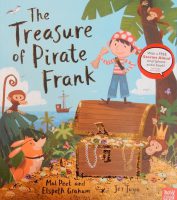
The Treasure of Pirate Frank
Mal Peet, Elspeth Graham and Jez Tuya
Nosy Crow
Taking the rhythmic pattern of the nursery rhyme The House that Jack Built, the authors have woven a lovely lilting tale of a young boy set on discovering the hiding place of Pirate Frank’s treasure.
He has a map so show him the way, a trusty ship in which to sail,
To the island with spices and gold and tall mountains all snowy and cold,
On which is a forest with monkeys bold, and a swamp with lilypads topped with frogs.

He must beware of the volcano, spitting out fire,
As he ascends the steps going higher and higher;
then crosses the bridge to the tall palm tree; there to behold – my goodness me!
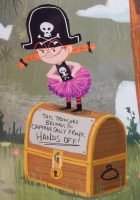
Who’s this standing atop that chest?

It seems there’s only one thing to do. What would that be if the boy was you?
Jez Tuya’s imaginative perspectives and creature crammed spreads are worth revisiting once the treasure has been found and the tale completed.

Pirates in the Supermarket
Timothy Knapman and Sarah Warburton
Scholastic Children’s Books
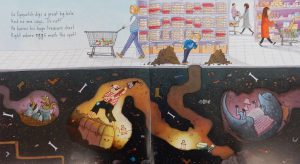
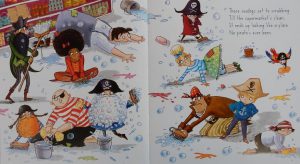
First there were Dinosaurs in the Supermarket; now the place is beset with pirates hell-bent on creating mischief and mayhem among the groceries as unsuspecting shoppers go about the task of filling their trolleys with goodies. They leave plenty of clues but nobody save one small boy is aware of the piles of rubble appearing in the aisles,

the cannon-wielding gang on the rampage, or the piratical accoutrements appearing around the store. Fortunately for all concerned just when it seems things might be getting somewhat out of hand, the aforementioned boy springs into action and before you can say, ‘shiver me timbers’ he has things under control – well and truly so methinks …

Which all goes to show that you need to keep your eyes wide open whenever you embark on a supermarket shop; you never know who might be lurking …
Fun, fast and full of crazy characters, oh and the odd observant one too.; and they’re all colourfully portrayed in Sarah Warburton’s comedic supermarket scenes. What more can a swashbuckling child ask?

Pete’s Magic Pants: Pirate Peril
Paddy Kempshall and Chris Chatterton
Egmont
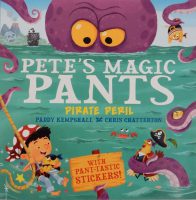
Another pair of Pete’s snazzy magic pants come out of the suitcase for a wearing – pirate’s stripy ones in this instance – and before you can say ‘Avast’, with a wiggle and a wobble, the lad is off on the high seas aboard the Flying Fowl with Cap’n Ted and his trusty, clucking crew. They’re on the trail of Long John Silverside the most feared buccaneer on the high seas; he who has seized the treasure rightfully belonging, so we’re told to Cap’n Ted and his pals.
Can they escape the jaws of the sharks and the clutches of the soggy-suckered octopus, find their way to where the treasure is stashed and then get past the loutish-looking Long John himself?

Perhaps – with the help of Pete’s brain and the odd touch of brawn thereafter.
Fans of Pete’s previous adventure will welcome this second tale, which is pacey, pant-revealing and full of high drama and I suspect it will capture some new pants followers too.

I’ve signed the charter  

Alfie and Dad

Alfie and Dad
Shirley Hughes
The Bodley Head
This book comprises three short stories wherein Alfie’s dad, Simon, so we’re told on the introductory page, plays a significant part.
In the first, a disturbed night, on account of relatively new friend Neal’s mention of a possible visit from the “Flying Loobies”, when he visits for a sleepover, calls for reassurance from Dad …

before Alfie can finally settle down for some shut-eye.
This is followed by the temporary loss of Alfie’s beloved soft toy, Flumbo when he, Mum and Annie Rose take a shopping trip by bus. Here again, Alfie’s Dad sorts out the problem. He takes Alfie, the following morning, to the main Lost Property Office

where they retrieve Flumbo

and end up taking home some other ‘unclaimed’ toys to add to Alfie’s collection.
Loss is the theme of the third story too: it’s a in the form of a little marmalade cat that despite misgivings from Dad, not to mention their own cat, Chessie, takes up temporary residence in Alfie’s home.

Dilys, as they call her, doesn’t overstay her welcome though; and after a few days, she disappears again. Not long after, while out walking with Dad, Alfie spies Dilys outside another house and discovers that she, or more accurately Tibbles, has, like many cats, a habit of going missing temporarily from her true place of residence.
As always, Shirley Hughes’ portrayal of Alfie and his family and friends is wonderfully affecting. The temporary setbacks and problems that beset young children, lead to outcomes that are, thanks here to Dad’s timely words of wisdom, satisfyingly resolved.
Alfie will always have a very special place in the affections of those who grew up with his early stories; but thanks to Shirley’s artistic genius with both words and pictures, he will continue to captivate new generations of readers and listeners, who will also take him into their homes and their hearts.

I’ve signed the charter  

Old Masters Rock: How to Look at Art with Children

Old Masters Rock: How to Look at Art with Children
Maria-Christina Sayn-Wittgenstein Nottebohm
Pimpernel Press
There are no rights or wrongs when it comes to looking at art. We all respond differently to paintings: our response depends on what we bring to a work of art; it’s not fixed and likely to change as we change.
Curiosity, the author tells us is the starting point; and everyone –child or adult has that. Whether or not one is able to visit galleries and museums in person, doesn’t stop anyone from experiencing and enjoying works of art through books or via the internet. An important point to remember, says the author, is not to try and see too much in a single visit. She suggests that choosing several focuses of attention will prove much more satisfying than dashing round endeavouring to see every single exhibit. That way lies frustration and, or, boredom. In fact the whole introduction is full of wise and helpful suggestions for any adult contemplating an art gallery visit with one or more children.
‘Puppa’ then goes on to introduce a variety of Old Masters, grouped together thematically. So we have Animals, the Natural World, Families, At Home, Fabulous Faces, Action and Heroes,

Science and Technology to name just some of the thirteen sections.

The Railway, 1873 (Édouard Manet) Oil on canvas, National Gallery of Art, Washington D.C.

In total there are some fifty paintings of a variety of styles from Early Renaissance to Impressionist; some of the works are from famous artists such as Constable, Degas and Leonardo da Vinci; others will be less familiar ( a few were new to me) but equally worthy of attention.
Each painting is given a whole page illustration opposite which is a page containing factual information about the artist, the background to the work, and pointers, including questions, to focus on when viewing the particular picture. The whole emphasis is on opening up, rather than closing down on, an individual’s response and there is plenty to satisfy those who enjoy stories.
In short, it’s an excellent resource for families or for primary school teachers.

I’ve signed the charter  

Spot the Mistake : Lands of Long Ago

Spot the Mistake: Lands of Long Ago
Amanda Wood, Mike Jolley and Frances Castle
Wide Eyed Editions
Many children love to point out the mistakes made by adults. This large book capitalises on this, giving them the opportunity to search Frances Castle’s ten historic scenes to identify the 20 impossible elements that have found their way into each one, as they accompany two young detectives who are on the hunt for those visual errors.
Their first visit is right back to the Stone Age or more precisely around 12,000 years back to the Late Stone Age when humans started living in communities, building permanent homes, growing crops and keeping animals.
From there the questers move forward to 5,000 years back and the Land of the Pharaohs.

The double page scene is followed by another about the same location and provides reasons for the 20 visual anomalies as well as facts about what the ancient Egyptians would have had instead. This pattern, spot the mistakes followed by information spread, is used for each stop throughout the entire time travelling adventure.
Other scenarios are ‘An Outing to the Acropolis’, ‘The Emperor’s Palace’ in ancient China; ‘Life in Ancient Rome’; ‘At the Temple of the Sun’ – the Mayan Empire;

Sailing with the Vikings’; ‘Jousting with the Knights’; ‘The (Mughal) Emperor’s Parade’; and finally, there’s a beach location for ‘Pirates Ahoy!’.
Frances Castle’s aptly bordered, alluring scenes have an ironical, lightheartedness about them that is just right for this time-travelling investigation. I envisage groups of children captivated as they play visual detective together.

I’ve signed the charter  

A Story Like the Wind

A Story Like the Wind
Gill Lewis and Jo Weaver
Oxford University Press
Gill Lewis has woven a wonderful novella with an up-to-the-minute feel to it. Stories of the refugee crisis continue to feature in the news with desperate people continuing to attempt seemingly impossible journeys in inflatable boats: this fable is such a one and this particular boat is filled with hopeful passengers young and old, ‘clutching the remains of their lives in small bags of belongings.’ The boat’s engine has failed and the boat is adrift on the Mediterranean; but the passengers, their resources dwindling minute by minute, are alive. Even so, they are willing to share what they have. Among them is fourteen year old Rami: he has no food to share so he refuses what the others offer him. What he does have though, is his precious violin: fragile; intricate; beautiful.

I took the only thing I could not leave behind,” he tells the others when asked why he refuses their offers.
Tell us a story to see us through the night,” requests mother of two young children, Nor.
What Rami performs for those beleaguered passengers is, so he tells them a story of Freedom, a story like the wind, a story that begins on the highest plains of the Mongolian desert, known as the ‘land of a million horses’. His story – essentially a Mongolian folktale about a young shepherd and a white stallion that he rescues as a foal, – is powerful, drawing in each and every listener (and readers) and as it progresses part by part, the passengers make connections with their own lives. Carpet seller, Mohammad tells of trying to sell a flying carpet to the woman who is now his wife. Others too have stories to tell but eventually, Rafi’s magical telling is done. It’s brought his audience together in a shared bond of happy memories, of sadness for those they’ve loved and lost, but most of all, of freedom and hope.

With what I fear is an increase in overt racism, in hate crimes and fascism, not only here in the UK, but also in many other parts of the world, this affecting book deserves, (I’d like to say needs), to be shared widely and discussed anywhere people come together in groups.
Music has the power to transform – that is clear from the story;

and it’s something many of us know from experience: so too do words. Let’s hope Gill Lewis’s poignant words here can work the same magic as those of Rami. They certainly moved me to tears several times as I read. But let’s not forget the power of pictures: they too can bring us together, sometimes in shared understanding, sometimes, shared appreciation or awe. Seamlessly integrated into the story, and adding to the sense of connectedness, Jo Weaver’s illustrations rendered in blue-grey shades are at once atmospheric, evocative and intensely moving, as befits the telling.

I’ve signed the charter  

The Tickle Test / Sky Private Eye and the Case of the Runaway Biscuit

The Tickle Test
Kathryn White and Adrian Reynolds
Andersen Press
Tickling has been the topic of picture books on previous occasions but there’s never been one wherein a tiny mouse is being tested for a job in the ‘Tickle Squad’. The little animal is charged with test tickling all kinds of creatures, great and small, while established members of the squad look on and comment on each and every ticklish encounter.

Did I say ‘creatures great and small?’ Maybe I should add here that each one is a pretty formidable proposition be it the jiggling, wriggling bear; the stinky gorilla, the parping pachyderm,

or even the sniggering snake.
I’d rather he than me when it comes to tackling the jaggy-toothed croc. and I’d beat a hasty retreat when it comes to the final challenge – that’s if you aren’t partial to a spot of tickling particularly from an enthusiastic mouse anyhow.
Kathryn White’s rhyming narrative in combination with Adrian Reynolds’ rib-tickling visuals make for a fun read aloud. Love the endpapers too!

Beware though of finger-fidgets on behalf of your listeners as they try hard to resist testing their own tickling skill on those around them during the story.

Sky Private Eye and the Case of the Runaway Biscuit
Jane Clarke and Loretta Schauer
Five Quills
Sky Private Eye has another case to solve when she answers the call of the Little Old Man who reports anxiously, “Our Gingerbread Boy is missing!” Before you can say ‘biscuit’, Sky and her trusty companion, Snuffle are off on the scooter to the source of the call. There they learn that gingerbread lover, Foxy Loxy is in the vicinity and are given permission to search the Boy’s bedroom. It’s there Snuffle discovers a crucial clue concerning new running shoes, which Sky immediately links to the forthcoming Fairytale Olympics.
The race is on: can they track down Gingerbread Boy before Foxy Loxy gets to him?

Furthermore will the sudden shower of rain reduce the runner in training to a soggy heap?
The recipe is akin to the previous case: cupcake baking, a deft move on Sky’s part …

and a thoroughly satisfying finale. Whether or not you met Sky in Sky Private Eye and the Case of the Missing Grandma, then do so now. The chief ingredients: Jane Clarke’s toothsome telling and Loretta Schauer’s appetising artwork, wield their magic again.

I’ve signed the charter  

Quality From The Start

Park
Lisa Jones and Edward Underwood
Nosy Crow
It’s never too soon to introduce babies to books: this ‘Tiny Little Story’ is a delight. We accompany Mum and Baby Boo on a walk in the park where they see a dog, a squirrel – squeeze the page and the leaves rustle – and a snail.

It rains, they feed the ducks and then the infant bids farewell to a bird and the park. That’s it; but with its squidgy fabric pages, simple, bright, attractive illustrations and brief text, it’s perfect for a first book. The whole thing comes in a presentation box and there’s a velcro strap to attach the book to a buggy.
With its soft pages, this would make a super present for a mum and new baby.

So Many Feet
Nichole Mara and Alexander Vidal
Abrams Appleseed
HIGH FEET, SLOW FEET; FAST FEET: SNOW FEET; DANCING FEET, HANGING FEET – these are just some of the many different kinds to be found in this largish board book that introduces toddlers to the diverse forms and functions of animal feet be they toed, clawed, webbed, sticky, hoofed, padded or other. Each animal’s feet are adapted for its life style whether it’s  mountain climbing, slow plodding, jumping, swimming, digging,

or perhaps, wall scaling.
Interesting, informative and alluringly illustrated, and with its final spread, which concludes with a parting question, ‘What can YOUR FEET do?’ an open invitation for youngsters to try some experimental movements with their own feet. In fact, nursery practitioners might make it the starting point for some playful group movement activities.

123
ABC

Nosy Crow
Nosy Crow has embarked on a new collaboration with The British Museum and these two board books are some of the first of a new joint non-fiction list.
Each one contains photographic images of objects found in the museum and thus give very young learners an opportunity to see and celebrate some of the wonderfully rich cultural collections while at the same time re-enforcing alphabetic and numerical concepts.
I randomly opened 123 at the first spread and was surprised to see a pair of what look like almost identical Indian shoes to a pair I have that I bought in Rajasthan, India a few years back, and where there are a fair number of makers/sellers of these jooties or mojaris as they are called. Those illustrated here are given in the index as ‘shoes: date unknown’ so I have no idea how old they might be, but it just shows how certain things remain almost unchanged over time.
In fact the whole book starting with 1 llama (a gold figure from Peru); and ending with 20 coins, is full of fascinating objects to look at and talk about.

There is a mix of photos of illustrations (paintings, etching, drawing) and 3D objects including drums, bowls, kites, beads, bags and spoons from the collection.
A similar mix of illustration and 3D items graces the pages of ABC. This spread shows a Japanese woodblock print of a snail, a porcelain teapot from the UK and an ivory figure from Sri Lanka.

Think of the rich vocabulary you might help your child develop by focussing on any of the objects shown: there’s certainly no talking down to toddlers here.
In addition to the index each book has, there is a QR code that if scanned on a smart phone supplies further information about the objects depicted. So, share these exciting little books and then if possible pay a visit to the British Museum and try to find the objects on display there.

I’ve signed the charter  

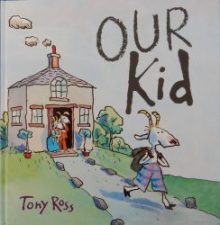
Our Kid

Our Kid
Tony Ross
Andersen Press
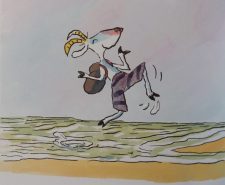
What an intolerant teacher ‘Our Kid’ has, responding to his lateness by sending him to the ‘Naughty Corner.’ (I have strong feelings about naughty corners/steps but won’t pursue the topic here). The Kid has an enormously fertile imagination and so, following his dad’s “Go straightly to school, Our Kid. Don’t be late again.” he tells how he took the shortcut along the beach, which led to hoof dunkling,

an encounter with a dinosaur pirate-chasing submarine driven by fish …

which resulted in the loss of his homework-containing schoolbag and trousers; followed by a rendezvous with an enormously helpful elephant who eventually dropped him at the school before he ‘kerlumped’ off: hence the kid’s tardy arrival.
However, just as the errant pupil has finished his tale and been admonished for his making up of “total and utter nonsense” the classroom tenor takes a sudden unexpected turn. The school, after a considerable degree of turbulence, is invaded by three creatures asking for “Our Kid” and proffering some objects …

To relate what ensues thereafter would spoil this fantastic story so let’s just say, the teacher has something of a change of heart, which leaves our protagonist bounding home joyfully after a thoroughly uneventful day at school. Did I say at the start Our Kid has an enormously fertile imagination? Actually, I may have been just a teensy bit wrong on that score.
This cracking tale put me in mind somewhat, of Cali and Chaud’s A Funny Thing Happened on the Way to School but its manner of telling is completely different. Ross’s off-beat use of language is both inspired and playful: I absolutely loved ‘shoffled’ ‘bumpeeded’ ‘felumpingly’, ‘boomdered’ and ‘glumbtious’ to mention just some of the wonderful words he sprinkles throughout the kid’s saga. Equally brilliant are each and every one of his watercolours. The expression of utter joie-de-vivre the narrator shows as he dunkles his hooves in the seawater; the way he clambers up the elephant’s trunk to reach the howdah on its back;

and the nonchalance of the teacher as he hands back Our Kid’s unread homework are beyond brilliant; which in fact, applies to the whole book.

I’ve signed the charter  

When We Go Camping/ Skyfishing


Who is the narrator of this lively celebration of family camping? Could it be one of the children? A parent? Or perhaps, the eponymous dog that gets into each and every scene? I doubt it’s one of the grandparents; all they seem to do is sit around or participate in some form of spectator sport, with the odd pause for a spot of insect swatting on occasion.
Meanwhile, other family members make friends, play, cook, fish, swim, shiver thereafter: beg your pardon Gramps: there you are boiling up the billy can for a warm-up drink for the chilly swimmers.

Naturally taking a pee involves a bit of inconvenience and perhaps it might be advisable to take a clothes peg along.

Perhaps the highlight of the day is a spot of ‘Hummetty strummetty squeak-io’ singing around the fire before finally repairing to the tent for some dream-filled slumbers.
Sally Sutton’s rhythmic, rhyming narrative is irresistible, especially so those playful refrains that accompany every scenario so beautifully portrayed in Cat Chapman’s watercolours: there’s a ‘Smacketty tappetty bopp-io‘; a ‘Zippetty zappetty flopp-io’ and a ‘Snuffletty wuffletty roar-io’ to name a few: I’ll leave readers to guess what actions they orchestrate.
My memories of camping are of endeavouring to bash pegs into sloping, rock-hard ground, lumpy porridge and noisy sleep-intruding voices in the night. This book in contrast makes the whole experience – well maybe not the loo visits or the odd trip-up – a pleasure, full of simple, fun-filled delight.

Skyfishing
Gideon Sterer and Poly Bernatene
Abrams Books for Young Readers
The young girl narrator’s grandfather loves to fish; so when he moves from his rural idyll to live in the big city with his family, he greatly misses his passion. The child is determined to find a way to engage him, but through autumn and winter, nothing catches his interest.
Come spring, the girl has an inspiration: she initiates a game of ‘let’s pretend’ fishing over the balcony edge and …

The possibilities escalate until they cast their lines deep into the rumbling tumbling ‘ocean’ below: an ocean full of wonderful adventures to last for months and months …

As the narrative unfolds, Bernatene’s vibrant, whimsical paintings show the chaotic city transformed into an ocean teeming with amazing sea creatures.
A warm-hearted story of the special relationship between the young and old, and the power of the imagination.

I’ve signed the charter  

Mouse’s Big Day / All Birds Have Anxiety / Mouse and the Storm

Mouse’s Big Day
Lydia Monks
Macmillan Children’s Books
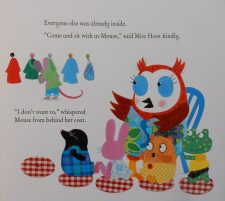
Mouse is going to school for the very first time and even before leaving home, she’s decided it’s not for her. Her dawdling tactics don’t work, nor does her “I don’t want to” response to all Mummy mouse’s encouraging remarks; finally she’s left at Twit Twoo School in the safe hands of teacher, Miss Hoot.

She has an exciting project for her class: “… go out and find something. Something special. Maybe something only you can find.
Mouse reluctantly joins her classmates all of whom thoroughly enjoy rummaging, upturning rocks, digging and pond peering, although she’s too shy to be anything but an onlooker. While the others are busy contemplating their findings …

Mouse vanishes. Miss Hoot knows just where to look for her though, and eventually a kindly paw proffered by Mole encourages Mouse to emerge from her hiding place and follow the others back indoors.
There she makes a series of discoveries that ultimately lead her to a very important realisation. School is an exciting place after all and she cannot wait for tomorrow.
Populated by adorable animal characters, Mouse’s school is an inviting place and Lydia Monks’ heart-warming story of her first day gets right to the heart of how the less outgoing among 4 year olds are likely to feel on their ‘Big Day’. This is just right to share with a nursery and preschool groups, or individuals, in the lead up to starting school.
Further reassurance about coping with tricky situations comes in:

All Birds Have Anxiety
Kathy Hoopman
Jessica Kingsley Publishers
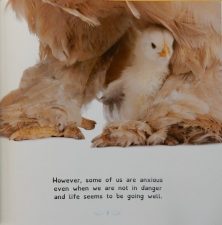
Statistics show that more and more children have anxiety problems, often starting at a young age. I’ve talked about educational issues that I feel are to a large degree responsible in other reviews so will just say that here is a photographic picture book that will help children of all ages better understand the condition.
By populating it with birds of all kinds with appealing faces,

and in amusing poses,

the author gives a serious topic just the right degree of lightness and gentle humour.
Anxiety in all its forms is discussed including how stress can effect everyday activities – ‘Everyday jobs, like combing hair, changing clothes or making decisions are too much to think about ’; its possible causes – ‘it often runs in families’; how to deal with it: ‘Being with those who listen to us and accept us makes a world of difference.’ and ‘Exercise, plenty of sunshine and a healthy diet are all a huge help.’ for instance.
Unthreatening, fun and enormously helpful for children of all ages, whether they suffer from anxiety or just want to understand it better in others.
For educators and those they have dealings with, be that in school, at home or in another setting.
Anxiety prone youngsters will benefit from some therapeutic reflexology as in:

Mouse and the Storm
Susan Quayle, illustrated by Melissa Muldoon
Singing Dragon
Reflexologist, complementary therapist and developer of The Children’s Reflexology Programme follows The Mouse’s House with a third story intended, this time for reflexology on a child’s hands.
Using Mouse and the five other animal characters to represent reflex areas of the hand, Quayle weaves a charming rhyming story to accompany the sessions of hand reflexology. It’s especially designed for use with young children, in particular those who have anxieties be they associated with ASD, new experiences, or another condition where calming treatments are required.
With hand instructions at the top of each left hand page and a charmingly quirky illustration on the right, adults can read the story of what happens when the animals awake to discover a storm scattered them far from the comfort of their own homes

while applying the gentle movements to the young recipient’s hands.
Since no prior reflexology experience is needed, this is a book for any parent of an anxious young child to add to the family bookshelf.

I’ve signed the charter  

A Walk in the Forest

A Walk in the Forest
Maria Dek
Princeton Architectural Press
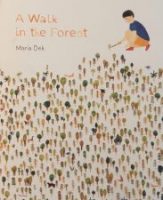
In the forest, wonders await’. Thus begins what feels like a truly heartfelt advocacy of the joys to be discovered by taking up the author’s invitation to leave behind the civilised world and join the child narrator in an exploration of a magical place. What actually happens is that readers, immediately engaged, find themselves standing behind the boy’s head, or even in his shoes, as he becomes ensphered by the greens and browns of a jungly canopy; drags a stick behind him, chases dragonflies and goes down on his knees to observe some things he’s found (vignettes show these); runs wild amid brightly coloured birds and tree-coiling snakes.

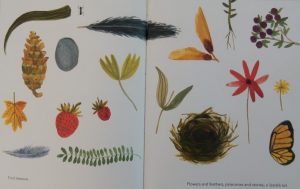
Then gives full throttle to his vocal chords: and who can ignore the pull to ‘Follow footprints. See where they lead you.’ and even more important, ‘Look! Find treasure.’ Here Dek focuses our attention on the textures and shapes of those treasures – flowers, feathers, fir cones, stones and the tail of a lizard.

The contrasts are stark: ‘All is small in the forest. All is big. And deep.’ Who can resist the unspoken invitation to shed footwear and ‘Wade in’ feeling the cool of the pond and the tickle of those water plants and fishes?
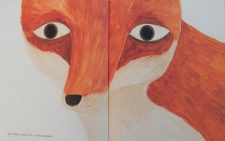
Secrets surround: birds have them; trees have them – if you listen; and patience might result in an encounter with a fox
and perhaps one of the many forest burrowing animals that tend to keep themselves out of sight.
A treasure of a book; and with its constantly shifting perspectives …

an eloquent, visual and verbal evocation of nature: especially, it’s one to visit whenever you’re feeling a bit down. It will surely help lift your spirits and after re-reading, send you out in search of a wooded place where further joys await.
Dek’s watercolours do the flora and fauna of the natural world proud with her lush scenes and surprise, sometimes stunningly stark, discoveries.

Like those of Frost, her ‘woods are lovely, dark and deep’. But I too have promises to keep and so reluctantly, must leave the meditational peace and tranquillity of this debut children’s book creator’s verdant world and just say, you need this picture book gem; everybody does.

I’e signed the charter 

Six Blind Mice and An Elephant

Six Blind Mice and an Elephant
Jude Daly
Otter-Barry Books
So often in my teaching career have I used Six Blind Men and an Elephant that despite having the book beside me, I instinctively mistyped the title of Jude Daly’s rendition of the Indian fable at the start of this review.
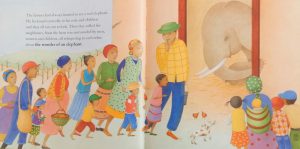
Daly sets her story somewhere in rural South Africa and begins with a somewhat sleepy elephant wandering from its forest habitat into a farmer’s barn and there falling fast asleep in the straw. On discovering it and excited by his find, the farmer rounds up his family and neighbours to view the creature and its wonders.

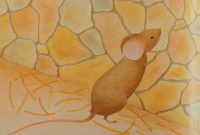
Meanwhile six blind mice nesting in a tree nearby are aroused from their slumbers by a strange aroma. Eager to discover the source of this new sensation, they follow their noses, encounter a cat and take refuge in a hole where they hear the humans chatting about the visitor asleep in the farmer’s barn. Search over they decide, and once the crowd has dispersed off they go to the barn.
Suddenly “Ouch!” that’s the oldest mouse coming up rather hard against the elephant’s side and declaring the beast to be “like a – wall”.

The second mouse disagrees likening the animal to a spear as she almost nose dives from the end of a tusk. And so it goes on with the other four mice giving their opinions based on partial evidence until as the youngest completes its simile, the somnolent pachyderm gives a flap of its enormous ears and expostulates so loudly that the rodents run for cover. The elephant then delivers a piece-by-piece description of himself (love those palm fan-like ears)

before finally, likening himself to … (readers aloud might want to pause at that point and give listeners an opportunity to complete the sentence) and crashing out once more exhausted by laughter.
Exit six fully satisfied mice …
Daly’s playful take on the fable still leaves plenty of food for thought and is perfect for a community of enquiry style discussion with early years or primary children.
Glowing African light radiates from every one of her illustrations; the golden straw-strewn barn floor is for me, reminiscent of some of the fractured swirls of Hockney’s pool painting.

I’ve signed the charter  

Rockabye Pirate / The Tooth Fairy’s Royal Visit

Rockabye Pirate
Timothy Knapman and Ada Grey
Bloomsbury Children’s Books
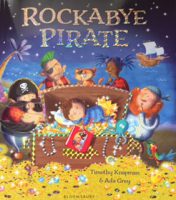
Don’t expect loud shouts of ‘Avast me ‘arties’ and similar in this pirate tale; far from it, for Knapman’s text is a lilting, under the covers-luring, lullaby for mummy pirates or daddies for that matter, to share with their pirate offspring at bedtime.
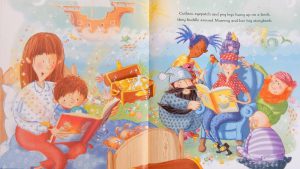
Yes, it’s full of freebooters, the likes of Black Bearded Brewster, Sea Dog McPhail and Freddy the Fright, but they’re not doing the wicked deeds upon the seas, rather they’re performing their ablutions

albeit with some maternal assistance in preparation for the most important part of their daily ritual …

After all, their day has been packed with mischief and mayhem, so now it’s time for some tucked-up-cosily-under-the-duvet dreams. I wonder what those might feature …

Ada Grey’s piratical characters, far from alarming, are portrayed as an endearing bunch of marauders as befits the inhabitants of a gentle bedtime story. Having said ‘bedtime’, this fun picture book could equally be shared with an early years group especially if they’re engaged in a pirate theme.

The Tooth Fairy’s Royal Visit
Peter Bently and Gerry Parsons
Hodder Children’s Books
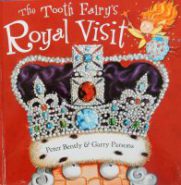
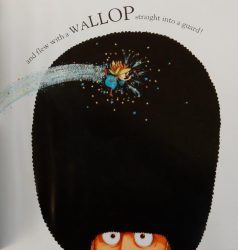
The Tooth Fairy returns for another adventure, this time responding to a missive from Her Majesty the Queen informing of the loss of her great grandson’s first tooth. Come nightfall, the little fairy is palace bound but has a few obstacles in her path

before she finds a way in.
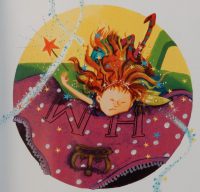
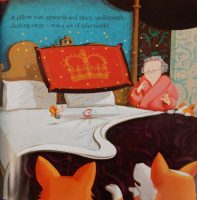
Once inside there are still further hazards – corgis, a cloth-wielding maid and some undies …

Finding the little prince’s bedroom is none too easy and the Tooth Fairy finds herself assisting in another ‘toothy’ search before receiving assistance for her troubles.

Will she ever make that all-important coin/tooth exchange and get home for some shut-eye?
Bently’s rhyming text is full of read-aloud fun with some unexpected encounters and, some expected ones: the corgis seem to find their way into every Royals’ picture book as do members of the Queen’s Guard. Garry Parsons’ exuberant illustrations provide gigglesome details at every turn of the page. All in all, a right royal chuckle.

I’ve signed the charter  

Ella Queen of Jazz / The School of Music

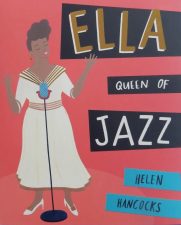
Ella Queen of Jazz
Helen Hancocks
Frances Lincoln Children’s Books
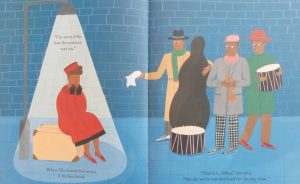
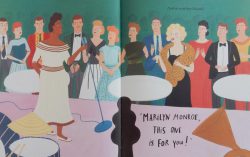
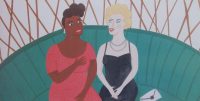
A super-stylish biographical story of the friendship between two iconic women: Ella Fitzgerald and Marilyn Monroe. It tells how rising star, Ella and her ‘Fellas’ experienced racial prejudice on the part of some club owners.

This treatment dented her confidence, but only temporarily, thanks to the magic of her music and the intervention of one very special woman who secretly used her powers of persuasion to get Ella an invitation to perform at the ‘biggest joint in town’, (The Mocambo,) the very same nightclub that had turned her away before.
And so it was that, just as her secret friend had predicted, Ella Fitzgerald became a huge hit with the audience

and subsequent shows drew in enormous, enthusiastic crowds for every performance, in part thanks to Marilyn Monroe’s presence. Like all good things though, this show had to come to an end; but Ella’s sadness was more than compensated for by the lasting friendship between herself and Marilyn .

Thanks to Marilyn too, Ella became a great film singer and even sang for the US president, eventually earning the name of ‘First Lady of Song – the Queen of Jazz’ and winning thirteen Grammys and many other awards.
Enormously empowering and pitch perfect for KS1 readers is this slice of 1950’s Hollywood razzle-dazzle.

Jazz is just one of the many music genres featured in another stylish presentation:

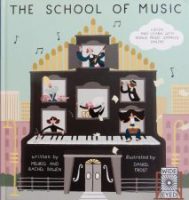
The School of Music
Meurig & Rachel Bowen and Daniel Frost
Wide Eyed Editions
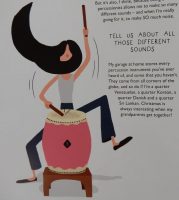
Readers are invited to enrol in the School of Music for a course of 40 lessons, presented over three terms. First we meet ‘The Boss’ aka Sergio Trunk aka, The Maestro, convincingly putting the case for having music in your life and explaining his role as Head of School. Next we meet other faculty members, six talented professors including the percussionist, Roxy Moto …

Now let lessons commence:
During the first term, there’s an introduction to a variety of musical instruments and a wide range of music.
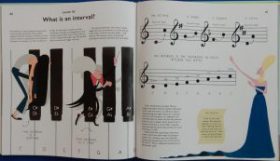
Term two comprises a look at the essentials of melody, harmony, pitch and rhythm; and musical notation is explained in terms understandable to anyone, even those without any musical knowledge.

Students who make it through to Term 3 – and one hopes that’s everyone (no exams here), the final nine lessons encompass ways to enjoy the practical aspects of music. There’s a lesson on making music at home, another on singing and its benefits, and a brief consideration of which instrument to learn. Then comes the nitty gritty ‘Why do we have to practise?, followed by helpful ideas for combatting nerves and more. Many of the lessons have a practical activity for additional enrichment and enjoyment. There is even a QR code at the back of the book with which to stream  samples  of music to your phone or tablet.
I learned more from reading this, than I did during all my music lessons at grammar school (albeit only taken for the first four years and during which I spent a lot of time mucking around as the teacher was so boring). Meuirig and Rachel Bowen are infinitely better teachers and their lessons are made more accessible and further enlivened through Daniel Frost’s witty, contemporary illustrations.
Thoroughly recommended for KS2 readers at home or school.

I’ve signed the charter 

My Hand to Hold / How Do I Love You?

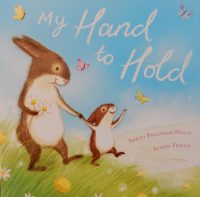
My Hand to Hold
Smriti Prasadam-Halls and Alison Friend
Hodder Children’s Books
Love shines through no matter what, is the message in this sweet rhyming book.
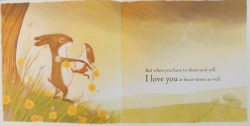
Through the seasons and through the highs and lows of everyday life, we follow an adult and infant as they interact with each other;

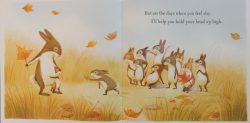
with the natural world they inhabit and occasionally, with others …

Smriti’s heartfelt verbal evocation of unconditional love is made all the more enchanting by Alison Friend’s pastel and watercolour illustrations.

I think this is their first picture book collaboration; it’s certainly a harmonious one.

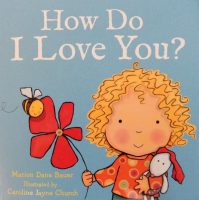
How Do I Love You?
Marion Dane Bauer and Caroline Jayne Church
Hodder Children’s Books
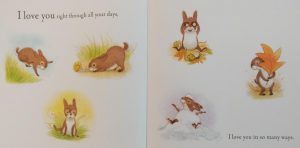
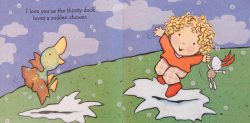
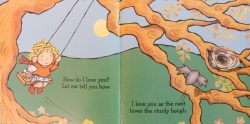
Using the well-known line from Elizabeth Barrett Browning as a starting point, Bauer uses comparisons with aspects of the natural world to show that parental love is ever present. ‘I love you as the thirsty duck loves a sudden shower.

Or, ‘I love you as the waking bear loves the smell of spring.
The small girl, the only human shown throughout, is clearly the centre of a parent’s world; this also suggests an ‘at oneness’ of child and nature no matter the landscape she happens to be in.

Caroline Church’s mixed media style collages have a pleasing texture: the duck’s wings bear a floral pattern, the bear’s fur has a hatched appearance not unlike parquet flooring; the cat’s fur is gently brushed with a darker shade contrasting beautifully with the child’s madly wavy tangled tresses.
The final spread fuses present and future with ‘And as our friendly Earth/ loves to spin around. / I love you as the moon / loves each shining star. // I love all that you will be / and everything you are.’ So be it.
An enchanting interplay of words and pictures for adult and child to savour together.

I’ve signed the charter  

Just Like Me! & A Handful of Playful Board Books

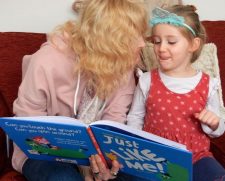
Just Like Me!
Joshua Seigal and Amélie Falière
Flying Eye Books
A joyful spin off from the favourite nursery game ‘Everybody Do This’ populated by adorably playful animals, a hairy, sluggy-looking quadruped, and one small girl, that simply cries out to be joined in with. There are instructions to ‘suck your thumbs’; ‘rub your tums’; ‘lick your lips’;

‘shake your hips’, ‘spin around’; ‘touch the ground’

and ‘stretch up high’.
I’m pretty sure your ‘littles’ still have plenty of oomph left to enjoy flapping their arms and trying to fly, tapping their toes, nose picking – not much energy required for that but the instruction will be greeted with relish; and then comes a final leap before snuggling down for a little nap zzzz …
If this book doesn’t fill your nursery group with exhilaration, then nothing will.
Perfect for letting off steam; but equally so for beginning readers.

Peek-a-Boo What?
Elliot Kreloff
Sterling Children’s Books
This title from the ‘Begin Smart’ series is just right for a game of peek-a-boo with a baby. Its rhyming text, bold, bright collage style, patterned artwork and die-cut peep holes, introduce in a playful manner some animals, a chain of rhyming words – boo, two, blue, shoe, moo, zoo and who’. Irresistible delight; and there’s even a ‘Dear Parents’ introduction explaining the rationale behind the game/book’s design.

What Do You Wear?
Taro Gomi
Chronicle Books
Taro Gomi takes a playful look at the outermost layer of various animals including penguin’s classic suit, snake’s snug stocking – striped in this instance, and goldfish’s patterned ‘skirt’ …

Although perhaps the metaphors will go over the heads of toddlers, they will delight in the sheer silliness of animals supposedly wearing clothes; and sight of the small boy in his nuddies. Slightly older, beginning reader siblings can enjoy sharing the book with their younger brothers or sisters too and share in the whole joke.

Welcome to Pat-a-Cake Books, a new Hachette Children’s Group imprint focusing on the years from babyhood to preschool. Here are two of its first titles, both board books:

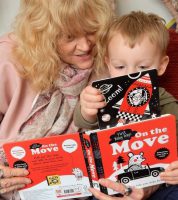
On the Move
illustrated by Mojca Dolinar
This is one of the ‘First Baby Days’ series and aims to stimulate a baby’s vision ‘with pull-tabs to help … focus’. With a carefully chosen, high contrast, colour palette, a sequence of animals – using different modes of transport – cars, a train, a space rocket, an air balloon, and a boat is illustrated. Every spread is beautifully patterned; the illustrations stand out clearly; there are transport sounds to encourage baby participation and of course, the sturdy pull-outs to enjoy.

Colours
illustrated by Villie Karabatzia
This title introduces the ‘Toddler’s World’ Talkative Toddler series with colour spreads for red, blue, orange, yellow, green, pink, brown, purple, grey, black and white; and then finally comes a multi-coloured fold-out spread with an invitation to name all the colours thereon. Each colour spread has at least nine labelled items and patterned side borders.
Each book is sturdily constructed to stand up to the enthusiastic handling it’s likely to get.

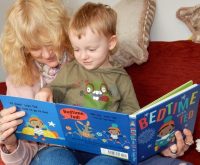
Bedtime with Ted
Sophy Henn
Bloomsbury Children’s Books
This is one of a pair of enchanting, lift-the-flap board books from the amazing Sophy Henn. Herein the utterly adorable toddler fends off shouts of “Bedtime, Ted!” with a chain of wonderful deferral tactics: sploshing in the bath with flappy penguins; brushing “teeth with a snappy crocodile”; slurping milk with a big, stripy tiger; jumping “out the fidgets like a bouncy kangaroo”. Then it seems, young Ted is finally ready to bed down – along with a few snuggly pals of course.
Perfect bedtime sharing; make sure your toddler is already in bed first though …
Ted himself is a tiny tour-de-force.
The companion book is:
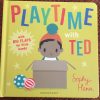
Playtime with Ted
Herein the little lad uses a cardboard box for all kinds of creative uses: racing car, digger, submarine, train; and space rocket bound for the moon – whoosh! And after all this imaginative play, he’ll make sure he’s back in time for his tea. Play is hard, appetite-stimulating work after all. Two must haves for your toddler’s collection.

I’ve signed the charter 

The Covers of My Book Are Too Far Apart / Harvey the Hero

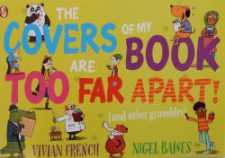
The Covers of My Book Are Too Far Apart
Vivian French and Nigel Baines
Picture Squirrels
Huh! Reading’s rubbish!” So says the angry-looking boy on the first page of this lively, enormously engaging, cartoon-style book. It tackles the ‘reluctant reader’ issues precisely and wittily; and the anti-reading comments will most likely be familiar to those of us who are teachers, as well as a fair number of parents.
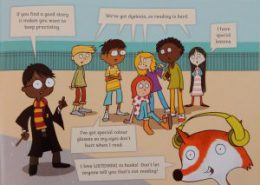
Each ‘grumble’ is allocated a spread with a host of pro-reading people countering the moan with their own positive idea. Thus, the ”I don’t have time to read. I’m too busy!” guy is offered: on the bus, just before sleep, in the bath, instead of tidying a room, as an accompaniment to doing something boring such as shopping, and while the dinner’s cooking as possibilities.
The most important thing that Vivian French and Nigel Baines do is to make this a truly inclusive book with an extremely wide range of characters being featured: there are those who want to read but don’t find it at all easy …

but possibly my favourite spread starts with the opener “Pictures are for little kids” …

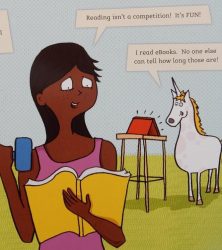
It’s great too that reading is interpreted broadly to include comics (love the superhero advocate who puts in an appearance at every possible opportunity); audio books, eBooks, picture books (at any age or stage) but most important of all is – and it’s the reason that every primary classroom should have at least one copy of this –

‘Reading isn’t a competition! It’s FUN!’

that and another fact many teachers tend to forget – that reading, at any stage, is a highly personal process: one size DOES NOT fit all. Inspired and inspiring both.

Harvey the Hero
Hrefna Bragadottir
Nosy Crow
Would-be superhero, Harvey is thrilled to be attending a book signing of Superhero Steve. But after the event, Steve drives off leaving his cape behind: Harvey resolves to follow him to the Big City and return the cape.
The Big City though is a bustling place and Harvey needs help – a map perhaps …
Seemingly he’s inadvertently helped in the apprehending of a thief …

In fact, during his search for Steve’s house, Harvey is responsible, unwittingly, for extinguishing a fire; and rescuing a little bunny.

Then, having returned the cape to his hero, Harvey returns home and gets the surprise of his life: could his dream of superherodom really be coming true?
Young superheroes and would-be superheroes of the human variety will delight in this tale of misadventure and applaud Harvey’s final rise to hero fame. Like Baxter’s Book, Hrefna Bragadottir populates her second story with a host of whimsical animal characters whose activities make both children and adults chuckle.

I’ve signed the charter  

Labyrinth / Amazed / Pierre the Maze Detective Sticker Book

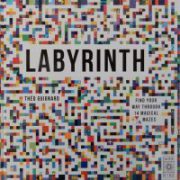
Labyrinth
Théo Guignard
Wide Eyed Editions
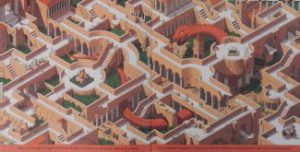
All manner of unlikely mazes – 14 in all – and each more challenging than the one before, are found in this vibrantly coloured book. Within each of the digitally designed spreads are things to search for, hiding in full sight, among the busy graphics. You can discover a smiling crocodile, a flying carpet, a bowler-hatted worm (not on the worm page), dark waters containing crabs in all the colours of the rainbow, cityscapes, a dragon’s lair,

mind-boggling geometry and a beach littered with sunbathers and much more as your fingers are drawn to follow the tracks across the spreads. This is just the thing to bridge the books and on-screen games divide.
as is:

Amazed
Aleksandra Artymowska
Laurence King Publishing
Herein the aim is to help a lost boy navigate ten mazes to reach his waiting friends.
He sets off through pouring rain, down into a strange cavern full of origami fish, stars, birds and other creatures, fossils, gemstones and ladders towards a door into a world of trees. The trees too are bedecked with origami birds and there are planks, ladders and bridges to negotiate.

The exit door leads into a labyrinth world of pipes and machinery and yet more origami birds. Mesa-like rock formations are his next playground and from there another door takes him to a sculptured rock world with paper darts and whizzing birds once more present.
Next comes a boat-filled lake; then a world of rocks and ladders from where he enters cliff-like terraces festooned with prickly cacti. The next challenge is to cross a stepping-stone strewn desert.
A precarious, sky-high wooden scaffolded structure seemingly supporting chunks of rock needs to be navigated next,

from which the only escape is via a long, long ladder on which to descend. Happily, there at the bottom his friends are waiting and we discover that they are, seemingly, the source of all those origami creations that have festooned the landscapes of his travels.

Aleksandra Artymowska’s colour palette of pale greens, blues, purples and greys give the whole thing an other-worldly feel. A magical experience for all ages.

Pierre The Maze Detective: The Sticker Book
Hiro Kamigaki & IC4 Design
Laurence King Publishing
This is based on The Search for the Stolen Maze Stone book. Herein Pierre has a picture wall and he needs help from his readers to fill it.
With more than 800 stickers, and five scenes there is plenty to keep maze lovers engaged for hours.

I’ve signed the charter  
Edgar and the Sausage Inspector

Edgar and the Sausage Inspector
Jan Fearnley
Nosy Crow
Edgar and Edith are brother and sister and there’s nothing Edward likes more than to make Edith happy. Determined to provide a tasty treat for his sibling, he sets out into town to buy something really tasty for dinner. Sure enough, very soon he spies the ideal treat: her very favourite food – sausages. Feeling extremely pleased with his purchase Edward heads home. Suddenly though, he’s apprehended by a hat-wearing rat blocking his path, claiming to be “The Inspector” and demanding a look in Edgar’s bag. Duped by the creature’s appearance, Edgar shows the inspector his purchase and immediately has it confiscated “for further inspection”. Consequently it’s a very dull dinner for the cat duo that evening as poor Edgar explains about the rat.
Next day however, Edgar’s off again determined to make up for his previous loss and this time his purchase is some delicious cakes from the patisserie.

Off he sets home clutching his basket when who should appear again but The Inspector –sporting not only a hat but also a large badge this time. Once more it’s the rat who enters his hole in the wall with his paws full and Edgar who heads home empty handed.

Day three dawns with both brother and sister’s tummies exceedingly rumbly. Off goes Edgar, loads up his shopper with yummy treats and …

Will Edith ever get that scrumptious repast her brother so longs to provide for her? And will that significantly more rotund, dastardly rat ‘Inspector’ get his just desserts?
Jan Fearnley exploits the inverted slang use of the word ‘bad’ (popular with teenagers) cleverly in her amusing story, which is based on a feline member of her own household. The text, with its rogue inspector and his repeated “Hold it right there!” refrain is enormous fun to read aloud and cries out for audience participation. The variety of perspective and depth of field in Jan’s illustrations draws the eye into the action, and helps focus attention on the wealth of detail in every one, be it double spread, single page or vignette.
Altogether a scrumptious feast for ear and eye.

I’ve signed the charter  

Mr Postmouse Goes on Holiday / Travel Activity Book

Mr Postmouse Goes on Holiday
Marianne Dubuc
Book Island
Mr Postmouse is back – or rather, he isn’t: he’s off on a holiday trip with his family and like many of us, is taking some work to finish. First stop is the forest where they set up camp, oh! and there just happens to be a parcel to drop off for forest resident, Aunt Maisy.

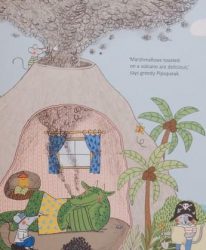
The mice then head to the seaside for some relaxation before boarding a cruise ship, which stops off at a volcanic island for another parcel delivery and for Pipsqueak, provides an opportunity to toast some marshmallows – yummy!

A camel ride in the desert, a jungle safari, a hasty, town stopover, a mountain sortie, a polar stop-off, an air-balloon flight all follow; and as you might expect, Mr P. has parcels to drop off at all the locations.

Eventually though, the globe trotting is over and the mouse family return home where unsurprisingly there’s a whole pile of letters needing to be delivered by Mr Postmouse.
This sequel is every bit as full of delicious details as Here Comes Mr Postmouse. It’s hard to show these on photos; but for instance, the forest scene has elements of a Hansel and Gretel type story being acted out by various characters. A mouse is picking up the pebbles that a small boy is using to leave a trail and hand-in-hand, two small children are heading towards a gingerbread house, there are boy scout bunnies and a whole host of minibeasts –

one toasting what looks like a sausage, over a bonfire.
If you share this with a group of youngsters – and I hope you will, as it offers so much to discuss, then ensure you build in lots of time to peruse each spread.

No matter where your holiday destination is, this might well be a worthwhile book to take along:

Travel Activity Book
illustrated by Charlie Brandon-King
Button Books
Starting with, on the inside front cover, a host of ideas for games to play on the journey, youngsters are offered a wealth of removable sheets of things to do from ‘Get Packed’ with its empty case, ticket and blank passport waiting to be filled; airport related activities, to a spot the clouds page, followed by a world map page. This just covers the first half dozen pages. There follow: all kinds of puzzles, problems to solve, drawing, writing and other creative activities and more.
No matter if you’re travelling to a jungly location or island far away, or somewhere much closer to home, there should be something to keep children from around 4 to 10 involved.

I’ve signed the charter 

Winnie-the-Pooh The Great Heffalump Hunt / Goldilocks and the Three Potties

Winnie-the-Pooh The Great Heffalump Hunt
Giles Andreae
Egmont
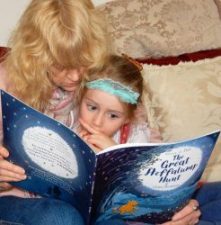
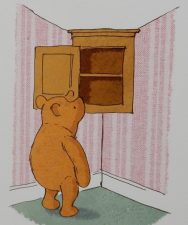
My initial thought on opening the parcel containing this book was ‘Oh no! Messing around with Pooh Bear!’ But then I read the rhyming story aloud all the way through and was utterly enchanted: it is Giles Andreae after all and he knows how to write a rhymer if anyone does.

The story simply trips off the tongue rather like that delicious honey that Pooh just cannot resist consuming; even when it’s his very last jar: and it’s supposed to be Heffalump-catching bait in the pit that Piglet has dug in the hope that it, rather than ‘Fresh Piglet(s)’ will become the creature’s next feast.
That jar of honey in our trap.” / groaned Pooh, “it was my last. Oh bother! Double bother! / And if no-one’s listening, / BLAST!

So saying, off goes Pooh, leaving Piglet all alone in bed, pondering on the “horrid, hairy Heffalump” and whether it will indeed, prefer the sweet sticky stuff or “juicy piglets in his tummy.” But then before you can say ‘Heffalump’ it’s time for Piglet to foray into the forest and see what, it anything is in that pit.

Delicious! It certainly left me, and my listeners, hungry for more …

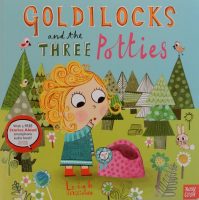
Goldilocks and the Three Potties
Leigh Hodgkinson
Nosy Crow
Even fairy tale characters have to learn about using a potty; young Goldilocks is no exception. Fed up with soggy nappies, she decides it’s about time she began wearing “Big girl pants’ instead. – so long as she has the perfect pair _

Of course, though, wearing pants means remembering to use a potty when you need a wee: that too has to be just right. Then there’s the question of timing: there are occasions when it seems you really need to go but it turns out to be a false alarm; other times you might leave it a little too late …

Sure enough though, Goldilocks soon gets the hang of things making her mum and dad very proud parents indeed.
Just the book to share at home or in a nursery setting, with toddlers embarking on potty training; and equally those just past that stage who will delight in Goldilocks’s toileting activities from their own slightly superior, ‘been there’ standpoint.
There is plenty to amuse in Leigh Hodgkinson’s scenes be they indoors or out in the woods. The infant Goldilocks is an adorable character and that final spread will surely make readers aloud chuckle as much as their young audiences.

I’ve signed the charter 
 

For Your Information Shelf: Books Books Books / Taking Flight

Books Books Books
Mick Manning and Brita Granström
Otter-Barry Books
Award-winning team, Mick Manning and Brita Grandström takes readers on an exploratory journey around London’s British Library, a library that holds over 150 million items in all, going right back to the earliest printed books and coming bang up to date with some printed this year.
First stop is the St Cuthbert Gospel, an ancient hand-made volume that was found in the saint’s coffin at Lindisfarne Priory some time after he died in the 7th century and which was sold to the British Library in 2011 for £9,000,000.
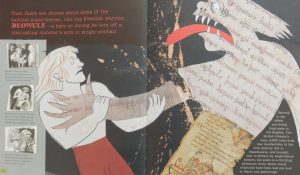
We’re also shown the Lindisfarne Gospels; a copy of Beowulf written in Old English …

and eighteen other landmark publications from the Hound of the Baskervilles to Alice in Wonderland, including the gigantic Klencke Atlas, dating back to the time of Charles 11, that needs six people to lift it …

handwritten sheet music and newspapers.
Mick makes the whole place sound absolutely fascinating and Brita’s visuals really bring each and every entry to life. I haven’t visited this enormous library for many years but reading their book sent me first to its website, http://www.bl.uk and from there to planning my next visit in the near future.

Taking Flight
Adam Hancher
Frances Lincoln Children’s Books
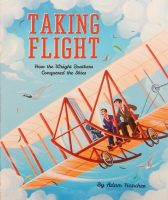
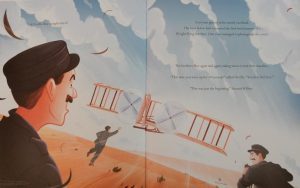
Adam Hancher tells in words and pictures , the amazing story of the Wright Brothers and how through determination and fearlessness, they brought their childhood dream to fruition.
From humble beginnings in Ohio, the boys, inspired by the gift of a toy helicopter from their father, worked tirelessly on project glider. Starting with observations of birds in flight, then working on designing and making, they built their first glider, which they then tested in one of the wildest parts of the US. The machine was a failure, so it was back to the drawing board to work on Mark 2.
Finally a powered machine was ready for testing and … yes, the first journey of a Wright flying machine took place.

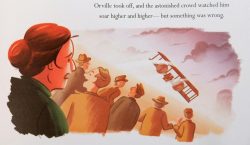
It still needed perfecting however and patience was needed until in 1908, everything was ready but …

‘ … something was wrong.’

Fortunately the brothers had kept the promise they’d made to their sister never to fly together, so although Orville was badly injured, he recovered and meanwhile Wilbur had been hard at work flying and breaking records. Fame at last for the Wright Brothers and thoroughly deserved it was.
A mix of superb double page spreads of key scenes, single pages and small scenarios, Hancher’s illustrations really do evoke a sense of their late 19th century settings.
An inspiring, beautiful book for KS1/2 readers at school or at home.

I’ve signed the charter  
Emma Jane’s Aeroplane / Ellie’s Magic Wellies

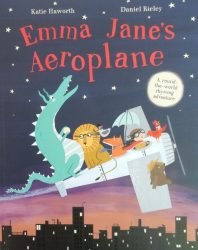
Emma Jane’s Aeroplane
Katie Howarth and Daniel Rieley
Templar Publisihng
We meet young aviator Emma Jane as she takes off into the night sky heading so it appears for a distant city with its shining lights. London is her first stop-off and approaching the London Eye in the rain, she spots a fox and takes it aboard.

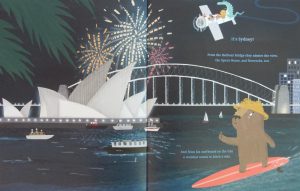
Before long. ‘Up ahead is something bright – it’s a city’s shining lights …’ Paris is the next stop where having looped around the Eiffel Tower, Emma Jane spies on Notre Dame, a rooster and …’So Emma Jane in her aeroplane, / a fox who doesn’t like the rain, / and a rooster who crows wherever he goes / fly on.’ … towards Venice and thence New York, Beijing and Sydney.

By now the plane looks pretty full and it’s heading straight into a storm; a storm that pitches them right into the churning sea. Are the plane and its passengers, not to mention Emma Jane, destined to be lost at sea or do all those animals possess skills that can be called upon in their hour of need?
Let’s just say that all ends happily, with fond farewells as our pilot drops each of her new friends off in their home city before whizzing off once again …
Katie Howarth’s peppy rhyming tale of travel, significant sights, and friendship without boundaries zips along nicely and is fun to share, all the more so if time is given to linger over Daniel Rieley’s delectably droll illustrations be they spread, single page, double spread or vignette.

Ellie’s Magic Wellies
Amy Sparkes and Nick East
Egmont Publishing
I’ve yet to meet a young child who doesn’t love to splosh around in puddles; it’s certainly so with Ellie Pengelly who has just been given a shiny new pair of wellies by her Auntie Flo who has come to do a spot of child-minding while Ellie’s mum visits the dentist. Having donned her polka-dot winged wonders, off heads Ellie in search of some lovely splash-about in puddles. Having located a particularly large one she leaps in and as she does, gets the surprise of her life. What should appear, courtesy of Ellie’s new ‘magical wellies, but a creature introducing itself as a “Flibberty-Gibberty” – a Flipperty Gibberty out of its puddle just waiting to play.
And play they do; the F.G. seemingly having boundless energy.

(Not sure the creature should be encouraging young Ellie to do headstands though, thinks the yoga teacher in me).
Play over, the two go indoors for a spot of something to eat, or rather, that’s the intention but what happens is something quite different and extremely chaos making.
Can they get the house back to its former tidy state before mum’s return? That is the crucial question…

Perhaps so with a little help from those magical wellies of Ellie’s.
Amy Sparkes’ sparkling rhyming text combines beautifully with Nick East’s equally sparky illustrations to produce a lively read aloud that is likely to induce a whole lot of puddle jumping – ready steady SPLOSH!

I’ve signed the charter  

Sprinkle with Kisses / I Love My Grandad

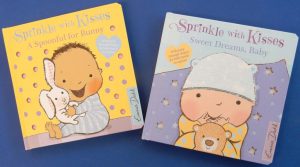
Sprinkle with Kisses: A Spoonful for Bunny
Sprinkle with Kisses: Sweet Dreams, Baby

Emma Dodd
Orchard Books
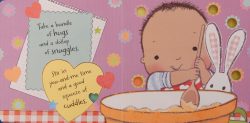
Two board book recipes, full of love: one for a tasty cookie mixture comprising tickles, giggles, smiles, cuddles, sighs,

snuggles, hugs and kisses; the other a formula for a peaceful, good night’s sleep. For this you need a cosy bed, a warm hug, a favourite teddy, a soothing lullaby, not forgetting that ‘sweet kiss goodnight.

With super-cute illustrations of adorable infants and gentle rhyming texts, what more can any baby ask, other than a loving adult to read these enchanting books?

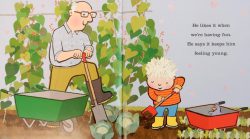
I Love My Grandad
Giles Andreae and Emma Dodd
Orchard Books
The toddler narrator of this celebration of the love between a grandfather and grandchild clearly demonstrates how much the youngster relishes the time he spends with his own special Grandad: an amazing assembler and supplier of explanations; full of wisdom; adventure loving; a fun-fan; up for anything, even when it’s exhausting. This grandad is ready to play whatever the weather; loves to reminisce and is the perfect person for a prolonged chat. Seemingly too, he is able to pack a great deal into a single day demonstrating his love in so many different ways.

Celebrating another special relationship, this new addition to the ‘I Love’ series exudes warmth and tenderness with every turn of the page and is just right for sharing with that very special grandad.

I’ve signed the charter  

Big Hid

Big Hid
Roisin Swales
Flying Eye Books
Do you have days when you feel unaccountably sad? I know I do from time to time. It’s the same for one of the characters in this, Roisin Swales’ sweetly beautiful debut picture book.
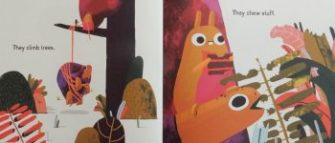
Little and Big together are a terrific team so what is Little to do when Big doesn’t want to do any of the usual friends-together things?  It’s no to climbing trees,

chewing stuff, dressing up, and having races.
In fact all Big wants to do is hide away: Little is at a loss to know how to help.
Perhaps a slice of Big’s favourite cake might do the trick: Little duly bakes and delivers a large piece but Big stays firmly tucked in.

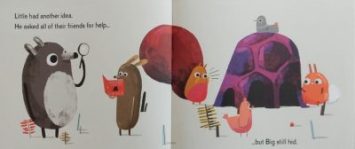
He consults his other friends but to no avail: Big remains hidden no matter what; and Little misses his pal SO much.

Suddenly out go his arms and around Big they go (as far as possible) into a great big hug and guess what …
So simple yet so utterly affecting: everybody needs a Little on hand to work some hugging magic at those hide-away times. If you’re not fortunate enough to have one such, then try giving someone in need a hug and see what happens.
The mostly warm earthy tones of Roisin Swales visuals are just perfect for this revivifying story; and those Testudinean eyes have just a touch of Klassen about them.
Perfect for sharing; and equally perfect for beginning readers: it knocks the rubbish they dish out in the name of teaching children in the early stages right out of the water.

I’ve signed the charter  

The Leaky Story / The Pirate Craft Book

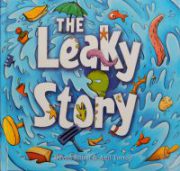
The Leaky Story
Devon Sillett and Anil Tortop
EK Books
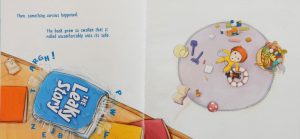
On a shelf sits a row of books; books waiting to be read, not left untouched gathering dust and feeling unloved. One particular book though has a mind of its own. So powerful is its longing to attract attention that it starts to swell,

and drip. The drips become a trickle, then a series of plops until it spills down into wonderfully sploshy puddles on J.J’s living room floor. And thus begins an amazing adventure populated by J.J., his sceptical parents,

sea creatures and a dastardly pirate crew. The battle, both verbal and physical, between the Blossoms and the pirates is wonderfully funny; and, when a kraken appears, woefully waterlogged and a tad uproarious.
Finally though, the whole crazy episode appears to have run its course: the creatures shrink and the water begins to recede.

As J.J.’s world becomes increasingly saturated with salty brine, Anil Tortop’s scenes offer all manner of highly colourful perspectives on Sillett’s surreal story.
What a wonderful way to engender an enthusiasm for books in young listeners, as well as to further the development of their imagination.

On the topic of pirates is:

The Pirate Craft Book
Laura Minter and Tia Williams
GMC Books
Subtitled ’15 things a pirate can’t do without’, this contains piratical projects aplenty for would-be sea dogs. There are clothes – the full gear including eye-patch and hat complete with monogram, buccaneer boots based on a pair of old wellies, a waistcoat, (best worn with stripy T-shirt) and a belt and cutlass to make.
All self-respecting pirates have a parrot on their shoulder, so there are step-by-step instructions to make a felt one, either stitching it together by hand or by machine. A chest in which to stash all the treasure is another requirement and the one herein is made using an old shoe-box; and to find the treasure, a map is most likely needed; so here we have instructions to make one from felt.
Once you’ve got all these things, a pirate party might be fun so there’s a page of ideas for that, and another giving a recipe for a yummy chocolate treasure chest cake. Basic templates for many of the items are provided on the final three pages. None of the projects is particularly difficult, though many would require supervision. Avast me’arties: what are you waiting for?

I’ve signed the charter  

Trees / We’re Going on a Bear Hunt My First Adventure Field Guide

Trees
Lemniscates
Walker Books
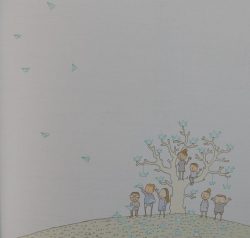
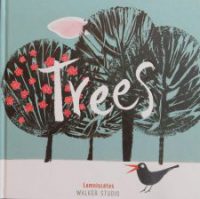
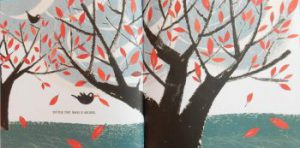
Published under the Walker Studio imprint, this is a gorgeously textured, digitally worked, tribute to trees. Through elegant illustrations and a succinctly worded text, homage is paid to trees. We see them in all their changing seasonal glory;

trees with ‘their heads in the clouds and their feet on the ground.

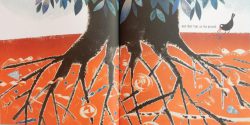
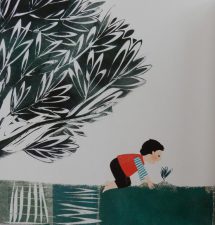
And we learn something of the functions of their roots; their various locations and something of the important environmental roles they play: homes for a plethora of birds and other creatures, providing shade for humans and other animals, cleansers of the air we breathe; and providers of a bounty of fruits. In the last few spreads we are in the company of a child in various tree interactions both rural and urban.

Share this lovely book with young children and then go outside and start to observe, enjoy and appreciate the wonderful trees around.

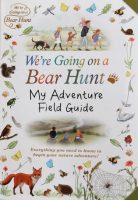
We’re Going on a Bear Hunt My Adventure Field Guide
text by Hannah Peng/Walker Books
Walker Entertainment
Somebody somewhere has had the clever idea of capitalising on the popularity of the original Rosen/Oxenbury We’re Going on a Bear Hunt picture book and the more recent success of the animation of the same and come up with this natural history adventure guide using some stills of scenes from the latter.
Like all good adventures, it takes a bit of planning and making sure one takes the appropriate things along in the way of clothing and protection, together with a handy notebook. Then it’s off into the big wide world of explorations, be they at home, school, countryside or seaside, by day or perhaps, night, always accompanied of course, by a responsible adult.
High in the Sky’, ‘Down in the Ground’ in that ‘thick oozy mud’; Further Afield to caves, through woodlands and forest (stumble trip) and onto the shore are other possible places for spotting a plethora of flora and fauna, large and small. Doing weather observations, making mud bricks, collecting fruits for scrumptious baked apples, creating a special plant habitat at home and measuring the heights of trees are just some of the numerous possibilities included; and I’m sure children will relish the idea of a poo hunt.
With its wipe-clean cover, this backpack-sized beauty concludes with some important words about the impact of certain kinds of human activity on the natural world, ways to help combat these and a final glossary.
For any child with a taste for adventure, either at home or in school.

I’ve signed the charter 

A Nest is Noisy / Secrets of Our Earth / Secrets of Animal Camouflage

A Nest is Noisy
Dianna Hutts Aston and Sylvia Long
Chronicle Books
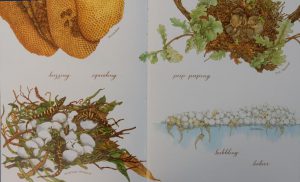
Full of fascinating information, poetically presented, (like its companion titles from this super-talented duo) is this rivetingly illustrated look at the irresistible world of nests. Who could resist Dianna Hutts Aston’s opening ‘ … it’s a nursery of chirp-chirping … (Ruby-throated Hummingbird) buzzing … (honeybees) squeaking … (American Alligator) peep-peeping … (Fox Squirrel) bubbling babies (Gourami)’ …

Did you know for instance that the world’s smallest nest – that of the bee hummingbird – is golf-ball sized and normally wrapped in spider’s silk, the stretchiness of which allows the nest to expand as the babies increase in size?
Or, that orang-utans braid beds of strong branches high up in the rainforest canopy and on rainy nights a woven umbrella of leaves keeps them dry? I certainly didn’t, nor was I aware that lampreys make underwater nests from pebbles varying in size from a pea to a base-ball; and that the temperature of an alligator’s nest determines the sex of the baby alligators.
A splendid introduction to a captivating topic, this is sure to inspire awe and wonder at nature’s creativity while at the same time prompting children to revisit its contents over and over.

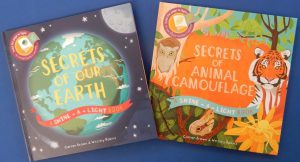
Secrets of Our Earth
Carron Brown and Wesley Robins
Ivy Kids
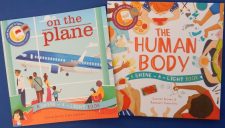
A recent addition to the cleverly conceived Shine-a-Light series of non-fiction titles that makes reading all the more exciting as you need a torch or flashlight, in this instance, to reveal the secrets of our earth from the outside in.
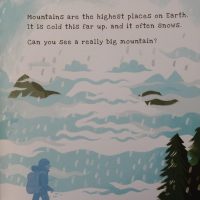
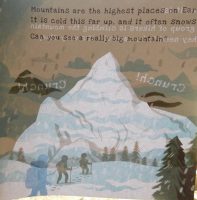
Readers are shown topographical features such as mountains …

and volcanoes, rivers and oceans, deserts and grasslands, rainforests and even cities: Holding the light behind the page gives a behind-the-scenes look at each destination.
Just the thing for Early Years and KS1 topic boxes and ideal for those youngsters who prefer to read information books. Build your topical role play area, then place the book strategically inside with a large torch and see what happens.
Other titles in the series include:
Secrets of Animal Camouflage
Carron Brown and Wesley Robins
Ivy Kids
This is another one of the series. Here you need your torch or flashlight to reveal the hidden world of arachnids, stick insects, Bengal tigers, tree-trunk hiding owls, amazingly camouflaged butterflies and more. Each of these creatures and others are hiding in plain sight in its natural habitat and by holding a light behind the page the camouflaged animal is revealed.

A clever and fascinating, interactive introduction to the vital topic of adaptation made all the more so by Robins’ alluring art work.

On the Plane
Carron Brown and Bee Johnson
This one features everything airport-related from the airline staff at the check-in desk to the pilots who, with the help of a computer, fly the planes.
This is one to read just before that first flight, or next trip.
The Human Body
Carron Brown and Rachael Saunders
This takes readers below the skin to see the skeleton and muscles, and then resurfaces to look at skin patterns, before going internal again to find out about the respiratory system, the nervous system, digestion, excretion, teeth, reproduction and more.
It’s almost a case of whatever topic happens to be your focus, there’s one of these books to illuminate it. Perfect for inquiring minds and show me a young child that doesn’t have one of those.

I’ve signed the charter 

Grandad’s Secret Giant

Grandad’s Secret Giant
David Litchfield
Frances Lincoln Children’s Books
Imagine having a giant in your town, one with “hands the size of tables, legs as long as drainpipes, and feet as big as rowing boats.” There is such a one residing where young Billy lives, or so his Grandad tells him: Billy however doesn’t believe it. Especially when Grandad claims he can fix anything such as mend the broken town clock; push the boat stranded in a storm to safety on the shore; and even help cars cross a bridge that’s partly fallen down.

Moreover, the reason Billy can’t see this wonderful being is, so Grandad says, that the giant keeps himself secret “because people are scared of things that are different”.
The trouble is that if nobody can reach to the top of the wall upon which the townsfolk are painting a mural, it will remain unfinished. So, Billy has a dilemma: should he get up at dawn, go to the mural, hope to see the giant and enlist his help, or continue in his disbelief and leave the wall as it is? The former wins out but only so the lad can prove Grandad wrong about the whole giant business. Off Billy goes accompanied by his dog, Murphy.
Who should be waiting right beside the mural but the …

real … HUMUNGOUS and … TERRIFYING!
Billy beats a hasty retreat but then, having put a considerable distance between himself and the giant, pauses for thought. Could Grandpa be right about people being scared of difference? Back he goes to tell Grandad about his experience. Was it a mistake to run away, he wonders?
Perhaps; but perhaps too, there is a way for Billy, with Grandad’s help, to show the giant he’s sorry. A plan is conceived and executed; then comes the waiting …

Will the giant accept the apologetic offering? Will he rescue Murphy for a second time, and … ?
I got home from a few days in London to find this book waiting for me. After the tragedy that had just happened there, its messages concerning reaching out, embracing difference and friendship resonated all the more.
Heart-wrenchingly beautiful and ultimately, uplifting, this stunning book for me, out- plays even The Bear and the Piano.

I’e signed the charter 

Sleep Well Siba & Saba / The Frog in the Well

Sleep Well, Siba & Saba
Nansubuga Nagadya Isdahl and Sandra van Doorn
Lantana Publishing
Sisters, Siba and Saba are inveterate losers of things, be it sweaters – seven of them; silver sandals ‘on sandy beaches at Ssese islands’ ; even their bedroom slippers go missing.
Strangely though, they never manage to lose one another; and when their papa had sung them to off sleep, “Sula bulungi, Siba and Saba,”, the sisters would find their lost possessions in their dreams.

One night though, their dreams are of things not lost – a silver shilling for Siba and a ‘stiffly starched school uniform’ for Saba.

Sisters as close as these two share everything, so when they wake from their slumbers, Siba and Saba share their dreamtime sorties. The following day two very unexpected things happen: I expect you can guess what they are: rather than be a story-spoiler though I’ll just say that from that day forward, those sisters always set their sights firmly on the future and what it might bring …

Such eloquence of words and pictures; this simply sparkles with brilliance.
Isdahl’s sibilant text combines with stunningly beautiful scenes of the sisters both inside and outdoors in the African landscapes.

The Frog in the Well
Alvin Tresselt and Roger Duvoisin
New York Review Books
An oldie but goodie: I think I may somewhere have a very old edition of this enchanting book from way back when I used to visit the USA fairly frequently. Now it’s been given a new lease of life by the New York Review. For those who are unfamiliar with the story, it centres on a well-residing frog who leads a contented life thinking his well is the whole world; “The world is nothing but moss-covered rocks … with a pool of water at the bottom.” is what he tells himself. But then the well-water dries up and the frog is forced to emerge into “the end of the world”

Deciding to take a look around, he discovers all kinds of ‘end-of-the-world’ creatures, learns a few things and eventually becomes a very wise, wide world-loving frog ready to take the longest leap he’s ever made …

For, “A foolish frog can be happy all alone at the bottom of a well, but a clever frog can be much happier out here.”
With its supremely brilliant visual perspectives and thought-provoking words, this still has much to offer 21st century readers and listeners, who will bring to the story an entirely different perspective from that of audiences when it was published in 1958.
More classic Duvoisin comes in:

The House of Four Seasons
Roger Duvoisin
New York Review Books
A wonderful celebration of colour, the seasons and endeavour: and built into this uplifting story are lessons on colour mixing, and a demonstration of how to create a colour wheel.
Both books offer a great opportunity to discover or re-discover some vintage gems from over 60 years ago.

I’ve signed the charter  
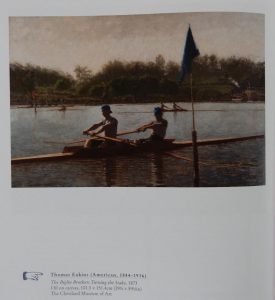
Hug Me, Please!

Hug me, Please!
Przemystaw Wechterowicz and Emilia Dziubak
Words & Pictures
Przemystaw Wechterowicz weaves a seemingly simple, enchanting, tale of two bears.
With the taste of sweet honey on their tongues, Daddy Bear and Little Bear, spend the day hugging each and every character whose path they cross on the woodland walk they take together.
First off is Mr Beaver, a somewhat reluctant recipient who nonetheless agrees, only to discover ‘It felt strange but nice.’ Heartened by the experience, Little Bear suggests finding others to hug and so they do. he bestows a calming hug upon the alarmed Miss Weasel, two hares, an elderly elk, a Red-Riding Hood-hungry wolf …

even an anaconda.

Full of the feel-good factor, with occasional touches of surrealism …

this story imparts a vital message concerning the importance of being able to show and receive affection openly, about empathy and not overlooking anyone. (Listeners will be quick to point out at the end of the story, who it is that’s yet to be a hug receiver.
Emilia Dziubak’s bears are real large creatures with very sharp claws to their paws but this is the only scary thing about them;

and she beautifully rings the emotional changes with the animals’ expressions. I also love the focus on small things – a rainbow hued caterpillar, the delights of dancing, for instance, that are sources of pleasure; and the way in which scenes are framed with things of the natural world – leaves, berries, carrots, and wild flowers.
Both author and illustrator are award winners in Poland; it’s easy to see why. this is sheer delight from cover to cover.

I’ve signed the charter 
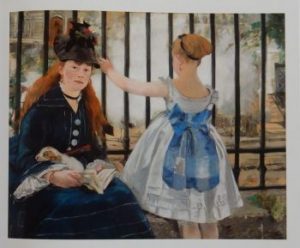
Trucks and Rock Pools

William Bee’s Wonderful World of Trucks
William Bee
Pavilion Books
This is truly a vehicular delight and who better to introduce it than Bee himself. First he shows off the fuel tanker which, we’re told, holds sufficient fuel to fill 2500 motorbikes, or if you prefer, 650 cars or 40 of the fanatic’s largest trucks. It’s fuel is pretty indispensable unless you happen to have one of these beauties: watch out for soot.

Mr Bee however, has a truck to take care of that eventuality too – his amphibious one.
As construction is a frequent activity at the William Bee’s Garage, there are all kinds of trucks to help with the various building-related tasks; there’s the one that carries supplies, a cement mixer, a café truck – building makes one hungry after all. William also has a rescue truck, which here, has been called out to aid a snow-scooper.

Racing cars, and a truck to carry them complete with spare wheels, tool boxes and more, are also kept at the garage, as is William’s amazing jet-powered truck; fire engines and more. Mr Bee though is off to the seaside in yet another of his amazing vehicles and there he goes … leaving readers with a few final spreads of truck facts and some adverts for all his trucks’ needs.
What more could a truck-crazy pre-schooler want that these wonderfully bright, detailed illustrations (eye candy for truck fanatics) and William Bee’s running commentary on same.

Rock Pool Secrets
Narelle Oliver
Walker Books
As a child on summer holidays in Devon, Cornwall or further afield in the Mediterranean, apart from swimming, my favourite activity was poking around in rock pools accompanied often by my sister and Dad. I’d catch various things in my net, pop them into a bucket, observe and attempt to identify them; and then put them back into the water. This ‘lift-the-flap’ book takes me right back to those days with a close look at many of the creatures and plants I most certainly found: sea anemones with their sticky tentacles – endlessly fascinating; hermit crabs residing in empty mollusc shells, other crustacea – crab species, shrimps shooting rocket-like into the tangled seaweed; and various fish including gobies.

Most starfish I found were dried up on the seashore; herein though we see one cleverly camouflaged on the surface of a rock.
Each creature is given a double spread and almost all have a large, appropriately shaped flap that open to reveal further details about the particular animal. The final spread with an invitation to discover its secrets, opens up on both sides revealing an entire rock pool.
With awe-inspiring lino print illustrations, a fairly short narrative text and a pictorial glossary at the back giving extra information, this is perfect for preschool children and KS1 audiences.

I’ve signed the pledge  

The Giant Jumperee

The Giant Jumperee
Julia Donaldson and Helen Oxenbury
Puffin Books
Donaldson and Oxenbury – a formidable team if ever there was one: together they’ve created a picture book that has all the hallmarks of a classic.
Who or what is occupying Rabbit’s burrow: some monster perhaps; it certainly has a loud voice as it claims “I’m the GIANT JUMPEREE and I’m scary as can be!” stopping Rabbit short as he’s about to enter his home.
Rabbit’s friends, starting with Cat, come to his aid:

she offers to “slink inside and pounce” only to be threatened with “I’ll squash you like a flea!” Cat then cries for help and Bear responds.
The Giant Jumperee however seems to have the measure of each of the would-be assailants: this time issuing the threat of a bee-like sting sending Bear into a tizz and calling for help. Help that comes in the form of Elephant but he too ends up in retreat, remaining, like the others though, in close proximity to Rabbit’s burrow.
Enter Mummy Frog, and paying scant heed to the frets of the other animals, she calmly approaches the burrow and employs what will surely be a technique familiar to early years audiences: she calls the Jumperee’s bluff as she slowly counts to three.
Out pops her gleeful offspring, totally unrepentant …

and more than happy to be led off home – for tea, with the other animals in tow, of course. This is sure to result in equally gleeful responses from young listeners who will have been totally captivated by the whole saga – I say saga, although this is a short story. It’s impact though, is far from small: it’s truly a case of less being much, much more. Take a look at this final wordless spread:

Everything about this is pitch perfect, from the wonderfully effective plot with its repetitions, occasional forays into rhyme, and tone of telling, to Helen’s glorious renderings of the animals whose demeanours are totally priceless, especially that of Mum Frog – an indomitable force if ever there was one- on discovering the culprit of all the hullabaloo.

I’ve signed the charter 
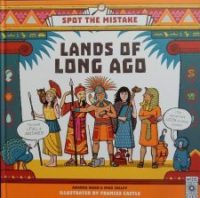
It’s My Pond / Looking for Lord Ganesh


It’s My Pond
Claire Garralon, translated by Sarah Ardizzone
Book Island
There is a pond and a duck – a yellow one that comes upon same. “Wow, nice pond – it’s my pond!” it declares and plunges in. Bliss. Enter stage right another duck, white this time. It too wants the pond. Its “Why don’t we split it in two?” suggestion seems ideal. Another duck appears, a red one …

but that’s no problem: divide the pond three ways. And so it goes on: more and more ducks of all colours of the rainbow appear one by one, and the pond is split into ‘tiny bits and pieces.’ Then … consternation on the part of the in-the-pond ducks … none of them, it transpires, is actually having any fun at all.
“We don’t swim” says green duck. “We just stay put.” “We’re bored, “ says pink duck “and we can’t move!
Leave it to black duck though: it has the perfect solution.

But then what should happen along but a huge hippo: uh-oh!
Wonderful wit on the part of the book’s creator is evident in both words and pictures. Young listeners will have a good laugh over the lovely lessons on negotiating and sharing; and they’ll delight in the notion of what look like the kind of ducks they’ve seen at the fair or school fete being characters in a picture book.

Looking for Lord Ganesh
Mahtab Narsimhan and Sonja Wimmer
Lantana Publishing
I have a fairly large collection of Ganesha images both 3D and 2D so was more than a little amused by the title of this book. A friend asked me the other day, ’Why do you collect them?’ My response that Ganesha is the remover of obstacles, was all that was needed. Herein it’s Anika’s grandmother who had always told her to ask ‘Lord Ganesh’ for help when the girl is anxious over something. Anika has recently emigrated with her family and now is missing her home city Mumbai greatly. However she has made a friend, Hadiya and now has a dilemma.

Anika has the opportunity to join a soccer team but without her new friend, so, she borrows her mum’s tablet and e-mails the god of wisdom asking for advice.
What happens thereafter involves a whole lot of soul searching on Anika’s part, a wise choice (without the help of a response to her mail) and ultimately, an outcome that works for all would-be players, every one of them.

Sonja Wimmer’s vibrant, richly patterned illustrations convey beautifully, both Anika’s and her friend’s thoughts and emotions in this touchingly different story about friendship, inclusiveness, finding your feet in a new environment and discovering your own inner strength to hold fast to what you believe to be right. It offers an excellent starting point for discussion and explorations of a cultural and/or, religious nature.

I’ve signed the charter  
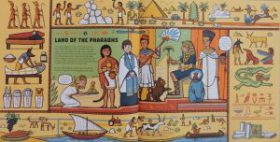
There’s a Walrus in My Bed!

There’s a Walrus in My Bed!
Ciara Flood
Andersen Press
Flynn is thrilled at the prospect of sleeping in his new bed, but come bedtime, it appears that his much-anticipated sleeping space has been invaded. Neither Mum, nor Dad believe his “there’s a walrus in my bed,” assertions so he’s forced to try and fit himself alongside an enormous intruder. Things aren’t straightforward even then: could the creature be hungry perhaps? Or suffering some malaise …

Blankets and a drink of soothing milk seem to exacerbate the problem, the latter sending the walrus to the bathroom for a wee.
Perhaps a lullaby might be sufficiently soothing to induce slumbers on the walrus’s part. It certainly doesn’t seem to please Flynn’s parents. What IS the lad to do?

There aren’t any monsters lurking and finally Flynn resorts to an embrace …

which appears to do the trick but there’s still the issue of fitting Flynn and the slumbering sea creature into the same space: it just isn’t big enough.
Flynn has one more trick up his pyjama sleeve: “Mum, Dad, can Walrus sleep in your bed tonight?” he requests. Their affirmative reply leaves their son able to snuggle into his soft warm bed at last; but he’s the only human likely to get a good night’s sleep thereafter …
Rich, warm hues make the invader and the place he invades, full of geniality; and Ciara Flood’s characterisation is superb. Mum’s and Dad’s expressions at Flynn’s increasingly demanding and disturbing activities speak volumes.
Another winner from rising star, Ciara Flood: I’d avoid sharing it just before bed though: you just never know – new bed or not …

I’ve signed the charter 
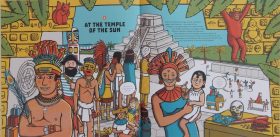
Parps and Splats

Old MacDonald Heard a Parp
Olaf Falafel
Harper Collins Children’s Books
I foresee a whole lot of tittering and mouth yoga from your audience when you share this noisy book.
Up bright and early, Old Macdonald is out and about on his farm: his aim, to identify the perpetrator of a loud parp. First he thinks it emanated from a cow – ‘With a Plrrb Plrrb here and a Plrrb Plrrb there … ‘ (instructions supplied to make the cow parp). But seemingly it wasn’t she. Perhaps instead it came from a duck …

Or could it have been a goat, a unicorn – surely not! – in your dreams Old MacDonald. No? Maybe then, a pig; or possibly a horse.
Apparently none of these lively creatures is the parper. Who could it possibly be?
That would be telling …

Suitably droll illustrations accompany the vocal gymnastics supplied by surreal comedian/illustrator Olaf Falafel. I see this becoming a resounding hit with early years listeners.
More crazy shenanigans – this time with the emphasis on the visual – in:

SPLAT!
Jon Burgerman
Oxford University Press
Many years ago, as an advisory teacher for language I used on occasion, to go on school visits with the advisory teacher for primary science; and we’d do a double act. One of the things we explored was “The Splat Factor” I recall.
This crazy book took me right back to those days when we had the children investigating all manner of splats.
Here, Burgerman confines his splatting to a slightly less messy amorphous green blobby thing, which undergoes various splat experiences when the reader turns the page. First it receives a pair of googly eyes and a mouth, followed by a pie, a pair of specs, a nose and lips; and a slice of bread spread with what looks like liberal coatings of sauces.
Thereafter comes a SQUISH SQUASH, an attack by some peckish birds, and worse … This though is followed by a truce.

Surely nothing can threaten those scrummy-looking ice-creams, can it?
Best shared with an individual; my testers to date have all deemed it a tasty, albeit rather squishy, treat, and thoroughly enjoyed being the splat perpetrators.

I’ve signed the charter  
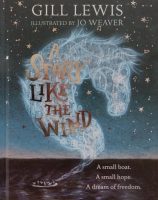
The Ladybird / Make and Move Minibeasts / Build a Butterfly

The Ladybird
Bernadette Gervais
Laurence King Publishing
I knew that the ladybird season was about to burst upon us when I noticed several that had emerged, and died on a window-sill of one of the spare bedrooms of my house a few days back. Before disposing of them I took a close look: I think they were a variant of the invasive Harlequin species from Asia. My first go-to was this little book waiting for me to write a review. It’s a wonderful introduction to the little insects, beautifully produced and illustrated, biologically accurate with parts properly labelled; and with judiciously used flaps that add to the effectiveness of the information given.

Topics covered include the insect’s anatomy, defence, nutrition, hibernation and reproduction. The latter takes readers through the entire life-cycle from mating, via the larval stage to the emergence of the new spotless ladybird; the spots and red colour develop fully after about an hour.

There are also spreads devoted to the variety of ladybirds; and a ‘spot the difference’ observation game. The whole thing is printed on thick matt paper, which further adds to the quality of the whole. Altogether a class act; add it to your early years topic box or KS1 collection.

Make and Move Minibeasts
Sato Hisao
Laurence King Publishing
I’m not generally a great fan of ‘pop-out, create a whatever’ kind of books; they generally require way more manual dexterity and know how than the target age group indicated, but this one is definitely worth a look.
It’s the most recent of a Make and Move series by this artist and contains nine pre-coloured creatures; and a butterfly, a stag beetle and a dragonfly to which users of the book can add their own designs and colours. The coloured images are textured, and although texturing the uncoloured ones, while not impossible, might be something of a challenge that’s no bad thing and certainly something a six or seven year old could do.

Bee

They might need a little help with putting the animals together though and the projects increase in difficulty from first to last.
When completed the minibeasts do move easily, partly due to their being printed on thin card. Now while I don’t suggest buying a whole lot of these books, I know that many schools have a focus on minibeasts at some time during the summer term and a copy of this in the classroom could well prove inspiring for children to perhaps use as a source book, with an adult creating an example or two from the book itself. There’s a whole lot of mathematical learning potential as well as biological (and technological) learning herein.
Alternatively, it’s an interesting way to spend a few hours at the weekend or during say, a half term holiday.

Build a Butterfly
illustrated by Kiki Ljung
Frances Lincoln Children’s Books
Published in collaboration with the Natural History Museum, this is a board book and activity book combined.
Young readers are invited to find out about the Painted Lady butterfly (Vanessa cardui) and to use the press-out pieces, following the step-by-step instructions to build a card model of the butterfly. Starting with its life-cycle, information is given about finding food including the role of the eyes in locating same, as well as finding a mate; the butterfly’s diet;

emergence from its chrysalis; habits; and how it migrates.
The names of the insect’s various body parts are supplied – these are crucial when constructing the butterfly model – as well as a simple explanation of the function of each part. Young fingers may require the assistance of an adult in fitting the eleven pieces together.
My knowledge of this butterfly species is that there’s a slight inaccuracy in the portrayal of the adult, which here has been given white markings to the upper surface of the hind-wings making it look like a Monarch butterfly. A curious slip considering the endorsement given by the Natural History Museum; ditto the use of a capital C in the specific name; the paragraph about the butterfly’s emergence from its chrysalis has inaccuracies too. These factors will not however detract from the enjoyment of creating the insect. This book, I suggest, is best seen as helping readers to understand the basic anatomy of the butterfly.

I’ve signed the charter  
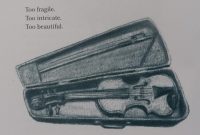
A Handful of Animal Board Books

The Safari Set
The Jungle Crew
The Polar Pack

Madeleine Rogers
Button Books
Here we have the first three board books to be added to the Mibo series and they’re some of the best board books I’ve seen in a long while. Each one features a different natural location and all have rhyming texts and some brief, attractively presented snippets of information inside the back cover.
The Safari Set takes us to the dusty, sun-scorched African plains where lions laze, giraffes graze

on high-up leaves, elephants roam, zebras flash past and hippos wallow for hours in the cool water.
In the dappled, leafy jungle we encounter members of The Jungle Crew: a troop of lively monkeys, screeching macaws with their dazzling plumage,

a fearsome-looking tiger stalks, toucans chomp on tasty fruits and tree frogs hop, and drop (when it’s time to lay eggs).
Members of The Polar Pack live in either the far north or far south; many are under threat and need protection. The South Pole is home to Emperor penguins: mighty-tusked walruses, polar bears,

huge-hooved reindeer and snowy owls reside in the North Pole.
Superb, beautifully patterned illustrations and rhyming texts that are a pleasure to read aloud make these top quality little books for the very youngest.

Really Feely Baby Animals
Really Feely Farm

Polly Appleton and Dawn Sirett
DK
A host of animals (5 per book) introduce themselves and invite toddlers to participate in a variety of sensory experiences such as ‘Rub my tufty fur. Then choose a shiny red apple for me to eat.’ or …

Feel my fuzzy feathers. And touch my smooth, pointy beak.

A kitten, a playful puppy and a baby rabbit also want to be similarly explored in Baby Animals.
In Farm Animals we meet first a chicken, and go on to encounter a sheep, a piglet, a duckling …

Feel my soft, fluffy tummy. And touch my smooth, shiny beak.

and a calf.
In both books the photographic images on each recto really seem to leap out from the page, heightening the whole visual experience. On the baby rabbit page for instance, its whiskers glisten as the light catches them. However it isn’t only the animals that are tactile; every item on the page provides a lovely feely experience and a whole lot of language learning possibilities.

Lots: the Diversity of Life on Earth

Lots
Nicola Davies and Emily Sutton
Walker Books
Subtitled ‘The Diversity of Life on Earth’ the enchanting large-sized book looks at biodiversity and interdependence on our planet.
The ‘LOTS’ herein encompasses over a hundred different animals as well as numerous plants and one enthusiastic little girl narrator.

By giving voice to the child, Nicola Davies cleverly explains what would otherwise be an abstruse topic in words that pre-school and KS1 age children can engage with and enjoy.
We visit a variety of locations from deserts to tropical islands; and zoom right in to such microbial habitats as beneath the feathers of birds, on the backs of lichen beetles

and even boiling volcanic pools. Counting all the different kinds of flora and fauna is far from easy on account of sheer numbers; but sometimes it’s a very difficult task due in part to the comparative inaccessibility of particular habitats – the tops of tall jungle trees or the bottom of the coldest seas for instance. But also there’s the fact that some young creatures – the Queen Angelfish – for one, look quite different from the adult; or alternatively things that look virtually identical are entirely different species such as here:

The Viceroy Butterfly and the Monarch look almost identical

All this is explained in a straightforward narrative that as well as providing youngsters with a wealth of information, is likely to engender awe and wonder in the ‘almost two million different kinds of living things’ already identified; and the millions that probably are yet to be found.
In the three final spreads, crucial ideas about extinction and the importance of preservation of living things are introduced, leaving readers much food for thought about the vital stewardship role humans have in the whole scheme of things.
This follow up to Tiny also has wonderful detailed, painterly illustrations by Emily Sutton. A must for primary school classroom collections and family bookshelves.

I’ve signed the charter 
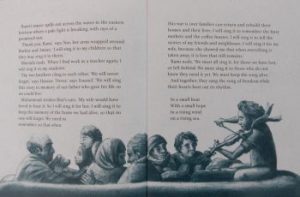
Can’t Catch Me!

Can’t Catch Me!
Timothy Knapman and Simona Ciraolo
Walker Books
Meet Jake, the fastest mouse in the world so we’re told, and Old Tom Cat – he looks pretty formidable, at least in Simona Ciraolo’s opening portrait of him. Tom has designs on Jake as his next tasty tidbit; but however many knots the old moggy ties himself into to that end, Jake manages to elude him. All poor Tom succeeds in geting is a rumbly tum and a thinner body, and a whole lot of taunting from a certain mouse as he runs off out of the garden and into the fields beyond.
Pretty soon Jake encounters a fox. That too has hunger pangs and a space in his tummy for a little mouse.

Can’t catch me!” brags Jake as he dashes through the cornfield and on into a wood leaving the pursuing fox far behind.
In the wood, lives a wolf and guess what? It too fancies a “juicy young mouse” to eat. Despite the fact it ‘sprinted and sprang’, that wolf just could not catch the boastful Jake.

Nor could the roaring bear he next comes across, even though it lunges and leaps at the rodent who manages to spring right across a chasm and end up (after going all around the world) right back where he started …

Now there’s an old saying, ‘everything comes to he who waits’ and so it is here; I’ll say no more.
There are echoes of the Gingerbread Man in this stonker of a story; but Timothy Knapman has taken the bones of the traditional tale and created a snappy spin-off that is certain to go down well with young listeners (if mine are anything to go by) who will relish its denouement. Simona Ciraolo’s scenes of showing off, sprinting and strutting speak even louder than all Knapman’s wonderful dialogue. This is another genius author/illustrator pairing.

I’ve signed the charter
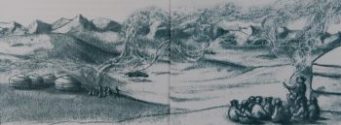
The Ammuchi Puchi

The Ammuchi Puchi
Sharanya Manivanna and Nerina Canzi
Lantana Publishing
To visit India, no matter which part, is an assault on the senses, especially that first time: the sights, sounds, smells, the sheer seeming chaos that surrounds you is almost, though not quite, overwhelming. But somehow, for me at least, there is something about it that gets right into your spirit and doesn’t want to let go; so, you keep on going back again and again and … then, you realise that you’ve fallen in love with the place. This picture book evokes some of the wonderful sights, sounds and smells of the country.
Now one of the most striking things about India, particularly the southern part is the dazzling, dancing array of butterflies and it’s something my partner and I both appreciate every time we go. I happen to have picked up a few words of Malayalam and thought I recognised Ammuchi as mother but then realised that word is ‘ummachi’ ; I know grandmother, or rather maternal grandmother as ‘ammacci’ in Tamil (having taught some Tamil speaking 5 year olds in my reception classes) and my Hindi, which is much better, tells me that ‘puchi’ means kiss. So, before even opening this gorgeous book, I was making lots of connections and deciding the title means ‘grandmother’s kiss’.
Let’s get to the story then: the setting, I think, is rural south India; and its narrator is Aditya who lives with his younger sister, Anjali, their parents (Amma and Appa) and grandmother, Ammuchi.

The two children adore their paan-chewing grandmother, despite being somewhat scared by her ghost stories – “Don’t you see it sitting there, with eyes big-big like two moons?” until that is, they grow out of being spooked and join in with her tales of ghost sightings, furnishing their own details to add to her descriptions of the mango-tree dwelling manifestation.

Just as Aditya’s tenth birthday approaches, Ammuchi gets ill, has to go into hospital and dies. The two youngsters, like their parents, grieve and the children in particular struggle to come to terms with their loss: that constant ray of sunshine no more illuminates their lives …

But then one evening a beautiful butterfly flies down and settles on Anjali’s head. It’s “Ammuchi Puchi,” she tells her brother. Next day at school, he tells his classmates of the event, saying, “Ammuchi Puchi is an insect who is our grandmother.” Despite their ambivalence, back home that evening, Aditya ponders further and becomes convinced that the butterfly is in fact his grandmother. His parents’ response and seeming lack of understanding, result in the Ammuchi Puchi becoming the children’s secret. It turns out though, that it’s not only the children who have a secret: the Ammuchi Puchi has one too: one that she reveals to the brother and sister one rainy night;

and so begins the healing and the understanding that Ammuchi’s love will always permeate their lives, no matter what.
Grandmothers have a very special place in Indian families in particular, but grief is a universal phenomenon. What Sharanya Manivannan’s moving, thought-provoking narrative offers for all readers is, ‘a place from which to become aware’. Yes, it’s deeply sad in part; but ultimately it’s about much more than heart-breaking loss and grief: this is a joyous celebration of love, of a very special person who relished life; of family; of the beauty of the natural world; and of the power of the imagination. No matter your feelings about, or understanding of, reincarnation, the author’s symbolising of the grandmother as a butterfly both comforts the child characters and allows for open-ended responses from readers everywhere.
Nerina Canzi’s illustrations complement the telling beautifully. The predominance of vibrant hues in the lush flora and fauna, the fabrics of the clothing, the kolam design on the school floor, the carpets and rugs, underscores the Indian setting while at the same time, reinforcing the message that the story is essentially, about abiding love and the way children have a propensity to transcend deeply upsetting events. In contrast, almost all colour is leeched from the spread dealing with Ammuchi’s dying, reflecting the palpable desolation her death brings to the whole family, and rendering it all the more affecting for readers, not least this reviewer.
A must have book for all family bookshelves and primary classroom collections.

I’ve signed the charter  
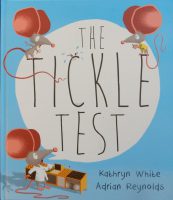
The Story of Space / 100 Steps for Science

The Story of Space
Catherine Barr, Steve Williams and Amy Husband
Frances Lincoln Children’s Books
Subtitled ‘A first book about our universe’ this follow-up to The Story of Life is an equally fascinating exploration of another ‘big’ topic: what is thought to have happened 13.8 billion yeas ago when the Big Bang created our universe; and what followed in space thereafter going right up to the present time …

even projecting future possibilities. We’re told how the sun came into being; how, over billions of years, stars ‘are born, grow old and die’; how the planets – and hence our solar system – were formed. As well as that, there is a spread on comets and asteroids; another on how/why the seasons vary in different parts of the Earth; and one looking at oxygen and how it supports life.

This awesome journey is taken in the company of two young space investigators who comment and ask questions alongside the authors’ main narrative. Both Barr and Williams have a science background and manage perfectly, to avoid talking down to primary school aged readers. Amy Husband’s vibrant illustrations have an exuberance about them, making the whole book all the more inviting for the target audience.
I’d most certainly add this to a home collection or primary class library.
The same is true of:

100 Steps for Science
Lisa Jane Gillespie and Yukai Du
Wide Eyed Editions
Ten STEM topics are explored in this fascinating book (written by a doctor of chemistry), that offers thoroughly digestible, bite-sized introductions to Space, Wheels, Numbers, Light, Sound, Particles, Medicine, Materials, Energy, and Life.
Each one is allocated several spreads wherein its evolutionary story is explored and the key scientists are introduced. In this way, what might for some, seem formidable topics, are given a human element making them more easily engaged with and intriguing. Add to that Yukai Du’s detailed visuals, which include some amazing perspectives …

and science becomes exciting for everyone.

I’ve signed the charter 
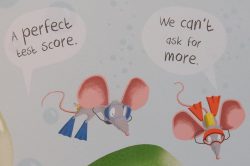
Mrs Mole, I’m Home!

Mrs Mole, I’m Home!
Jarvis
Walker Books
Walking along the canal path this morning near my home I noticed unusual mole activity and immediately thought to myself, that Mr Mole of Jarvis’s must have recently popped up along here. How does the guy do it? Jarvis I mean, not Mr Mole – coming up with one superbly funny picture book after another in rapid succession. Back to Mr Mole: the creature is exhausted after a hard day’s work at Gordon Ratzy’s and eager to get home to his wife and children; the problem however is that he’s unable to find his specs. – ANYWHERE!

No matter, he thinks to himself, “I ought to know my way back home by now!
Off he burrows and … Up he pops calling out to announce his presence to his family. It’s a wrong call however, with rabbits not moles greeting him. So off he burrows again and the same thing happens when first he lands up at the residence of the Owl family demanding a “kissy kissy” from his little ones;

then bumping into the penguins in the Antarctica; and next the crocs in their swampy commorancy. Oops! Better move out of there fast before you become crunching matter for Croc’s dinner, Mr Mole. Good job you can’t see those jagged teeth they’re brandishing at you.
After all that burrowing and popping up in the wrong places, Mr Mole is near despair but then ‘Sniff – sniff … Something familiar!’ causes his nostrils to tingle – worm noodles!
There’s only one place that aroma could be coming from; and so it’s ‘Up he popped!

Explanations as to the delay inevitably amuse his offspring and a promise is made never by lose those glasses again. But …
With its glorious throw-away final scene, this story is utterly hilarious from cover to cover – literally: there’s even a wonderful visual pun on the back cover and that eye-chart title page is priceless. In-built repetition of ‘Up he popped!‘ and ‘And off he burrowed …‘ cry out for audience participation; and this is an absolute gift for readers aloud: just make sure you give your audience plenty of time to enjoy the wit in every one of Jarvis’s scenes.

I’ve signed the charter 

The Dreaming Giant / 13 Art Materials Children Should Know

The Dreaming Giant
Véronique Massenot and Peggy Nille
Prestel
Imagine a giant dropping in on your neighbourhood: what on earth might he want? This is exactly what happens to the tiny world of Krobz, the inhabitants of which are less than one inch tall. Unsurprisingly everyone is alarmed at the new arrival with his harlequin trousers and shoes sized 612. Is he peaceful or hostile? A plan is formulated while the being naps.
There follows an internal investigation of the sleeper …

undertaken by a brave trio: Zig, Zag and Swirl. They visit various organs such as his heart, and his brain (the command room) wherein they discover how the visitor is feeling …

The Giant apparently liked the taste of his sandwich but his buttocks seemed to find the ground a little too hard.” Their search however, reveals nothing about the possible reason for the Giant’s visit; and having reported back to base from where they are informed that the subject of their observations is in a dream state, an amazing sight meets their eyes, and an extraordinary experience unfolds …

An experience which leads them to conclude ‘There is nothing to fear from someone who lives and thinks so beautifully and whose dreams are so GIGANTIC!
Kandinsky’s dreamlike abstract paintings were the inspiration for this unusual picture book and in an afterword, both author, Massenot and illustrator Nille talk about how his Sky Blue in particular gave them space within which to let their own imaginations get to work. We also learn something of Kandinsky’s interest in physics, in particular Einstein’s theory of relativity and its possible influence on the artist’s painting.
A splendid introduction to the work of a hugely important 20th century artist, and a delightfully fanciful story to boot.

13 Art Materials Children Should Know
Narcisa Marchioro
Prestel Publishing
With the disastrous scaling back and cutting of arts subjects in education, in both schools and colleges, books that educate children in respect of the arts are increasingly important.
This absorbing volume takes young readers on a tour around the world and back in time to find out about the evolution of materials artists and craftspeople have used, some of them such as bone, wood and ivory, right back as far as the Palaeolithic Era …

Part of a spear-throwing tool made from reindeer horn.

From objects discovered, we can learn a lot about how those ancient peoples lived and what occupied their thoughts. Now contemporary artists such as Vik Muniz use discarded materials in their work; and before him, Joseph Cornell made use of found objects as inspiration for complex assemblage creations …

Joseph Cornell’s ‘The Hotel Eden’ 1945

These too in their own way have much to teach us.
Each material considered has a time line across the top of the spread(s) which helps readers see how certain materials, gold for instance, were used at different points in time, often centuries apart.
A particularly fascinating section looks at the use of parchment right back to the time when monks painstakingly created illuminated manuscripts, and up to its 21stC use as a medium for collage and sculpture.
In addition to finding out about the materials, readers are introduced to particular artists some of whom, Henri Matisse for example, are well known, others less so. I was fascinated to learn that Chinese artist, Li Hongbo created these sculptures using only paper, scissors and glue.

‘Roman Youth’ Li Hongbo, 2013

Both educational and fun, this book is likely to inspire individual readers to turn to other sources to find out more about some of the topics that are of particular interest to them. A worthwhile addition to the family bookshelf or primary/ lower secondary school library.

I’ve signed the charter  
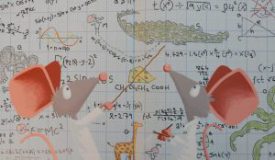
Sky Private Eye and the Case of the Missing Grandma / The Fairytale Hairdresser and Aladdin

Sky Private Eye and the Case of the Missing Grandma
Jane Clarke and Loretta Schauer
Five Quills
There’s a new independent publisher – Five Quills – on the block, with a new series introducing Sky, a young detective and resident of Fairytale Town. She has a cupcake making business that doubles up as a detective agency and a canine assistant called Snuffle.
In this tale we meet her as she’s busy with an order for her ‘Just-in-case Cupcakes’ when she receives an emergency call from Little Red Riding Hood reporting the absence of her gran. Before you can say cupcakes are us, Sky has gathered her necessary accoutrements, and is off on her scooter, on a rescue- grandma mission.
Aided and abetted by her Map Nav, she quickly locates Granny’s house and is greeted by a fraught-looking Red Riding Hood. Once inside though, it quickly becomes apparent that far from becoming the Big Bad Wolf’s breakfast, Granny has decided to take a vacation. Seemingly though, once the two set off in pursuit, it appears that she might have been followed: that’s certainly what the evidence attached to a bush suggests.
Lo and behold, when they arrive at Fairytale beach whom should they spy through Sky’s trioculars but …

And it looks as though that lupine character might have designs on Granny after all. Time to don some disguises, Sky decides. Can she get them all out of a very sticky situation with a spot of ‘Carrycake Kit, Bake it Better!’; not to mention a few deft moves with a wooden spoon …

and the odd Just-in-Time Cupcake?
The tale’s telling is terrific fun and with illustrations by rising star, Loretta Schauer, that are full of hilarious details, this series looks set to be a winner. There’s even a cupcake recipe at the back of the book.

The Fairytale Hairdresser and Aladdin
Abie Longstaff and Lauren Beard
Picture Corgi
When Kittie Lacey closes her shop and heads off for a vacation courtesy of Aladdin’s Magic Carpet Tours,

she’s hoping for a bit of rest and relaxation but almost immediately on arrival, she realises that is not to be.
First, she has to help Aladdin, with a very low budget, find a very special present for Princess Jamelia. The following day however, Aladdin is nowhere to be found. A search takes Kittie out into the desert where she discovers he’s been duped by the wicked Ibeneeza and is trapped underground. Worse still, the plan is to force Jamelia into marrying the trickster. It’s up to Kittie and Aladdin – once she’s rescued him – to use their wits and all their resources to put a stop to the evil intentions of Ibneeza. Can they do it? Perhaps with the help of the dusty old lamp that Aladdin has discovered in the cave where he was imprisoned.

Kittie is a determined character and likely to have one or two ideas up her sleeve – or in her bag …
Kittie Lacey has a band of enthusiastic young followers already; I’m sure this latest adventure will win her more, as well as delighting her established readership.

I’ve signed the charter  
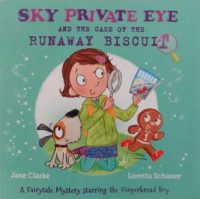
Message in a Bottle

Message in a Bottle
Matt Hunt
Scholastic Children’s Books
Town life doesn’t suit Lion: he dreams of clear sunny skies, wind in his mane, sand in his paws and, his guitar. Nothing more. So when he spies a ‘beach house for sale’ advert he cannot believe his luck. That very evening he packs the necessities – mostly strawberry smoothies – and heads off over land, air and sea until he reaches the island of his dreams. There, he takes up residence and thus, his perfect existence commences …

What joy to wake to the sounds of parrots and splashing waves, to breakfast on succulent coconuts and strum a guitar to your heart’s content. Soon though, unsurprisingly, Lion begins to feel lonely; but how can he communicate his need for a pal without a phone or mail service?

Sunlight moment! Lion decides to write a message, pop it in one of the many bottles he has (sans smoothie of course) and drop it into the sea. No response. Lion writes more messages, puts them into more empty bottles – many bottles, tosses them into the sea, watches them disappear, and sleeps …
What happens thereafter, is not exactly what Lion had hoped;

but suffice it to say without giving the whole thing away, all ends happily and … rather noisily. Which all goes to show that you don’t always know what will make you happy; and that stepping out of your comfort zone, embracing difference and welcoming new arrivals can work wonders.
A timely, important message for readers and, a tumultuous one for Lion. Matt Hunt delivers both with verve and humour.

I’ve signed the charter  
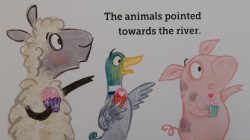
Gecko’s Echo / Monster Baby

Gecko’s Echo
Lucy Rowland and Natasha Rimmington
Bloomsbury Children’s Books
The lengths a soon-to-be mother goes to in order to protect her eggs is hilariously demonstrated in this delicious rhyming tale by debut author, Lucy Rowland. Meet brave Mummy Gecko who stands up to the threats of Snakey,
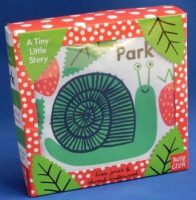
and Eagle (later in the day) with warnings about “a hundred angry geckos”.
Come the evening, a very nasty-looking, ravenous rat appears, also with designs on the eggs; he though is less easily convinced. His response to Gecko’s, “If you’re staying I can show you … I hope you’re feeling brave.

is met with a spot of lip licking and “Why, yes I’m staying Gecko, / and I’m having eggs for tea./ A hundred geckos living here?!/ I don’t believe it’s true. … /I’m quite sure it’s only you.
Whereupon the wily Mrs G. lets forth an enormous “RAAAAH!” and back come those hundred voices …
Guess who beats a rather hasty retreat, leaving one echoing gecko to have the last laugh. The last laugh maybe, but not the peaceful evening she’d anticipated for, with a wibble and a wobble, what should appear but …

A real winner of a book with plenty of opportunities for audience participation, laughs galore and superbly expressive illustrations by Natasha Rimmington. Her wily animal characters are absolutely wonderful.

Monster Baby
Sarah Dyer
Otter-Barry Books
A topic that has been the theme of numerous picture books already is given a cute narrator herein.
Little Monster is none too thrilled at the prospect of an even littler monster; neither is Scamp, the family pet. Even before the newcomer arrives though, it’s presence is being felt: rest and healthy food are on the agenda and not only for Mum. The expectant monster needs a great deal of rest, which may account in part for her increase in girth, and certainly gets in the way of carrying the young narrator. He’s far from impressed with the scan either:

a wiggly worm is how it appears to Little Monster, but probably because Mum has several months to go yet: even so it’s capable of hearing apparently.
When the big day finally comes around, Granny comes to stay and Dad takes Mum Monster to hospital; the baby is duly delivered and Little Monster becomes a ‘BIG’ one according to his dad.
Having Mum and baby back home gives rise to mixed feelings on the narrator’s part: it’s great to have Mum around; but that noise-making babe is going to take a fair bit of getting used to. The inevitable feelings of being left out soon give way to accommodation and thereafter, the beginnings of a bond of brotherly love starts to form …

Sarah Dyer’s Little Monster is adorable: his account of the weeks leading up to, and just after, the arrival of his new sibling will be enjoyed not only by those in a similar situation, but also general early years audiences, whether this is shared at home or pre-school.

I’ve signed the charter  
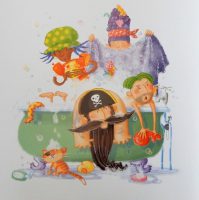
One Happy Tiger/ Colours: A Walk in the Countryside / My Little Cities: London

One Happy Tiger
Catherine Rayner
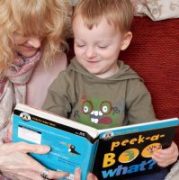
Little Tiger Press
What a delight to have Augustus back and between the sturdy covers of a wonderful board book. Everything about this is splendid from the look and feel of that cover through to Augustus’s sublime smile as he watches the movements of his ten friends on the final spread.
In between, he starts off sitting alone and then we see a sequence of encounters with 2 bugs (beetles I think); 3 birds with bright plumage; 4 ‘floating butterflies’;

5 dragonflies hover above his head. Augustus then bounds off leaving 6 large footprints and moves through a rain shower dancing with 7 ‘plump raindrops’ …

relaxes to watch 8 bees; splashes into the pool to tease 9 fish before clambering out to dry off in the sun and greet his friends all together.
This is a board book, (based Catherine Rayner’s Augustus and His Smile), that looks, apart from its sturdy card pages like a real picture book; and its shape is truly satisfying too. Adults will get as much pleasure as the toddlers they share this one with.

Colours: A walk in the countryside
Rosalind Beardshaw
Nosy Crow
Published in collaboration with the National Trust, this is another delightful countryside walk wherein readers accompany two toddlers on a joyful nature ramble; this time, it’s colour-related. We join the children as they exuberantly run down a slope surrounded by green – look closely and you’ll see a cricket and a butterfly on the plants. They stop to observe a ladybird on a grass stem in a poppyfield; then notice an orange-tip butterfly by a stone wall; a group of ants attracts the attention of the boy while the girl views a black bird through her binoculars. Their walk continues apace till picnic time, when they have a snack before moving on, all the while keeping their eyes open for interesting sightings such as …

A veritable paintbox of twelve colours and an entire rainbow are part and parcel of their rural ramblings. Awe and wonder for tinies: if this doesn’t inspire an adult to take their young infant out into the countryside on an observation walk, which may or may not mirror that of the children in this lovely little book, I’d be very surprised.

My Little Cities London
Jennifer Adams and Greg Pizzoli
Chronicle Books
Board the bus and take a tour of London. Ten of its famous landmarks are featured in this board book although none is named until the final spread whereon there is a ‘cast in order of appearance’ style briefing about each one depicted. The whole thing is beautifully presented, the text being in rhyming couplets; and the font changes on each spread.

Concepts such as new/old, many/few, soft/hard (rain) are introduced in relation to The Tower of London, the Shard, Trafalgar Square (many pigeons), the Natural History Museum (few dinosaur skeletons), and the two final spreads show wonderful illuminations – the London Eye

and Big Ben – against the night sky.
Altogether a class act, with so much to see and so much to talk about: that’s London. Author, Adams, and illustrator, Pizzoli, have, for toddlers, done it proud.

I’ve signed the charter