Get Christmassy

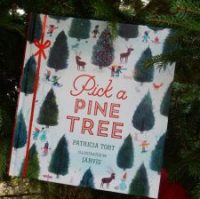
Pick a Pine Tree
Patricia Toht and Jarvis
Walker Books
There’s a real glow of seasonal joy to this rhyming journey of a pine tree from a tree lot to pride of place as a sparkling family Christmas tree.
A family visits the snowy tree lot, chooses a tree and takes it home on top of their car.
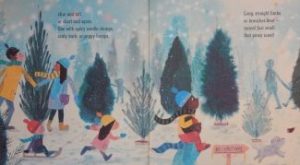
Once indoors, space is created, the tree trunk trimmed and when the tree is safely standing, out come the decorations ready for when their friends arrive to join in the fun of adding all the fairy lights, baubles, tinsel and finally to complete the transformation, right at the top, the star.
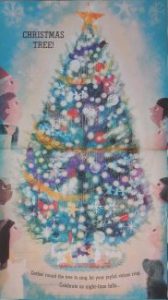
From its opening ‘Pick a pine tree / from the lot – // slim and tall / or short and squat. / One with spiky needle clumps, / scaly bark, or sappy bumps.’ Toht’s text bounces along beautifully – just right for a Christmas storytime session and a perfect antidote to the plastic ‘take apart’ trees that have become so popular in recent times.
Jarvis’ mixed media illustrations have a lovely vintage feel to them and there’s a wonderful magical final scene.
Let it Glow: A Winter’s Walk
Owen Gildersleeve
Wide Eyed Editions
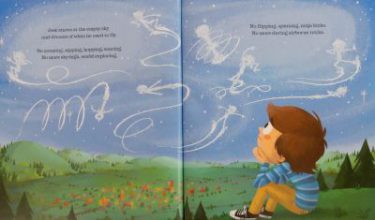
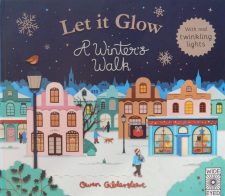
Cut paper collage scenes glow with 5 white lights  as a boy walks home on Christmas Eve clutching a parcel. At each page turn the lights softly shine illuminating a fair, carol singers, a snowy hillside with sledgers, a frozen lake on which skaters swirl and then the exterior and interiors of the boy’s home.
Told through rhyming couplets, and presumably intended to be shared in soft lighting, Gildersleeve’s spreads offer plenty of talking points in addition to the twinkling lights.
Red & Lulu
Matt Tavares
Walker Books
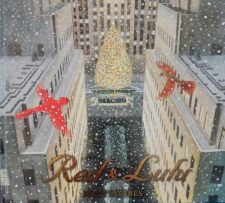
With a USA setting this dramatically illustrated, touching tale tells how a pair of cardinals becomes separated when their tree home is cut down and taken to New York City Rockefeller Centre to be its Christmas tree with Lulu, one of the pair trapped inside.
Red returns from his search for food to discover his home gone and with it his partner.
Superb spreads, some wordless or almost so, then follow his search for her, the birds’ reunion and eventual relocation in a park.
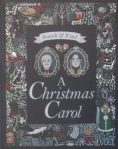
Search & Find: A Christmas Carol
retold by Sarah Powell, illustrated by Louise Pigott
Studio Press
Here’s a novel take on the ever-growing ‘spotting’ books: it’s the second in a series of classic tales to be given a search and find adaptation by Studio Press.
It’s not so much a retelling of the Dickens’ story, rather it’s an unusual way to encourage young readers into the world of Dickens and this tale in particular, especially around the festive season.
The characters are all there and waiting to be spotted in various scenes – fourteen in all.
There are four ghost spreads including The Ghost of Jacob Marley (with a spendidly spooky door knocker) the Ghost of Christmas Past and The Ghost of Christmas Present; two parties to visit – Mr Fezziwig’s and the one at Fred’s house; a rather grim graveyard scene and more.
Engaging and fun.
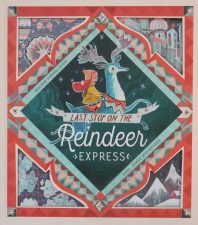
Last Stop on the Reindeer Express

Last Stop On the Reindeer Express
Maudie Powell-Tuck and Karl James Mountford
Little Tiger Press

Christmas is often said to be about wishes.
For most people what makes Christmas really special isn’t presents or festive food, it’s family. For Martha though, an important part of her family won’t be at home for Christmas: her dad is far away and can’t make it back.
For this little girl, the Christmas sparkle feeling suddenly plummets when she hears that the card she’s made him won’t get to him in time. If only he weren’t so far away, she wishes.
As she walks dejectedly home through the Christmas market she comes upon a strange-looking post box with a door but no posting slot.

Suddenly she finds herself embarking on a trip aboard the Reindeer Express being whisked away through forests; then over chilly seas, a city whose streets are lit by paper stars …

and snowy mountains, to a small snow-covered lodge.
What will she discover within?
Can she deliver that card in time for Christmas?

With mentions of cinnamon, sugar and smoky wood,  Maudie Powell-Tuck evokes traditional sensory seasonal delights while also showing the importance of family love, a love that transcends time and place and is always there.
Karl James Mountford’s mellow colour palette, his attention to detail, those fabulous scenes both indoors and out, cutaway peep-through pages and flaps, all contribute to the enchantment of this Christmas jewel of a book.
From cover to cover, a real winter-warmer: perfect for the chilly days in the lead up to Christmas at home or in school.

I’ve signed the charter

Canine Capers: A Dog with Nice Ears / My Secret Dog / Safari Pug

A Dog with Nice Ears
Lauren Child
Orchard Books

Another deliciously funny, wonderfully whimsical Charlie and Lola story from the current Children’s Laureate is sure to delight countless readers both young and not so young.
Herein Lola’s current obsession is dogs; she can talk of nothing else and would like one more than anything. “More than a squirrel or an actual fox.
In turn, she pretends to be one, pretends Charlie is one and pretends she has one.
There is a slight snag however: her Mum and Dad will agree to a rabbit – Dad will even take her to the pet shop to buy one – but they’ve stipulated, ‘ABSOLUTELY NO DOGS!’
Nevertheless, it will come as no surprise that Lola remains utterly convinced that she will leave the pet shop with the dog of her choice, and goes on detailing her specific requirements for same. Requirements that include “nice ears

a bushyish tail like a fox” and “It must absolutely do barking.

Lola-isms such as these are an absolute hoot for adult readers aloud.
I won’t spoil the ending but let’s just say that it concludes highly satisfactorily with the naming of Lola’s new pet.
With Lauren’s trademark mixed media, droll illustrations this is a canine caper par excellence.

My Secret Dog
Tom Alexander
Jessica Kinglsey Publishers

In a first person narrative account a little girl relates the trials and tribulations of having a pet dog and trying to keep it a secret from her mum who has decreed they don’t have room for a dog.
It begins when the cute-looking stray dog follows her home and she allows him in, initially just for something to eat.
Her mum is out and by the time she returns, the little girl has the dog safely hidden in the cupboard.
A sleepless night follows and then it’s time for school. Another challenge especially when the dog, after behaving well all morning, decides to demolish a scarf and pair of gloves, and then leaves a deposit in someone’s wellies.
Thereafter things decline rapidly until finally the narrator is forced to reveal her secret.
There follows a mother/child chat where keeping secrets is discussed and mum also explains why the dog cannot remain with them.

All does end happily though and there’s a wonderful final twist to the tale.
Simply told and illustrated, this engaging story will have readers smiling, perhaps even laughing, at the young narrator’s antics.
Discussions about keeping secrets and the consequences of one’s actions might well take place in a classroom setting after the book has been shared. Equally so at home where it can also be helpful for any parent whose child wants a dog in inappropriate circumstances.

Safari Pug
Laura James, illustrated by Églantine Ceulemans
Bloomsbury Children’s Books

In the third adventure starring Pug, the dog is awoken one night by screams from Lady Miranda who goes on to inform him that there’s a lion in the bedroom.
A search follows and housekeeper, Wendy, assures them there is no lion and offers to stand guard overnight just in case.
Next morning Lady Miranda decides Pug must prove to Wendy that he’s not scared of lions and declares a visit to the local safari park to confront one, is necessary.
On arrival the ticket seller refuses to allow their sedan chair inside the lion enclosure, deeming it totally unsafe, and diverts them to the Animal Adventure land.
Thus begins a crazy adventure involving meerkats, penguins, monkeys and yes, there’s even a rare white lion cub named Florence and a decidedly dodgy character by the name of Arlene von Bling who seems to be showing more than a little interest in the lion cub.

Humorously written, and illustrated throughout by Églantine Ceulemans whose art work is equally funny, this is a super book for readers just starting out on chapter books.

Seasonally Flavoured Fiction

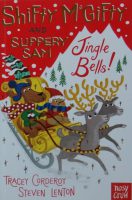
Shifty McGifty and Slippery Sam: Jingle Bells!
Tracey Corderoy and Steven Lenton
Nosy Crow

If you’ve yet to meet comedic twosome, the wonderful baker dogs Shifty McGifty and Slippery Sam I urge you to do so with this book of three stories. Shifty’s the more industrious, of the pair; Sam means well but tends to lack his pal’s organisational skills.
In the first story, the dogs have been commissioned to create Santa’s Christmas cake and deliver it to him the same afternoon. No easy task especially with next-door neighbour Red Rocket determined to create mischief at every opportunity.

The other two tales, Sea-Monster Ahoy! and The Lucky Cat aren’t Christmassy but they are equally good fun and all are perfect for those just taking off as independent readers, who will particularly relish Steve Lenton’s lively scenes of the canine mystery solvers at work.

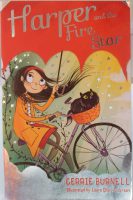
Harper and the Fire Star
Cerrie Burnell illustrated by Laura Ellen Anderson
Scholastic

Harper, the girl endowed with a rare musical gift, who resides in the City of Clouds and is able to play any instrument she picks up without learning a single note, returns in her 4th adventure and once again it’s full of music, magic, friendship and gentle humour.
In this story, the Circus of Dreams (Harper’s birthplace) is back in town and as well as seeing her parents, Harper has something important she wants to do and that is to help the Wild Conductor win back his place in the magical show. Why he wants to do so is a mystery to Harper and her friends, nevertheless they put on an amazing show but things don’t quite go according to plan.
Then they learn exactly why getting back into the circus is so important to the Wild Conductor: it’s on account of his love for a girl named Fire Star, so called because ‘whenever she heard music she began to shine like a star.’
Adding to the fun of the tale are Laura Ellen Andersen’s sparkly illustrations.
Always ready to help others, Harper is a delight.

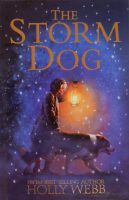
The Storm Dog
Holly Webb
Stripes Publishing

Young Tilly and her mum are going to stay with her Grandma and Great-Gran over Christmas but when work delays her mum, Tilly travels ahead alone on the train.
Great-Gran (almost ninety) has sent Tilly a parcel to open on the train and inside she discovers a Christmas tree decoration and a photo.
Soon, lulled by the motion of the train, Tilly starts to doze and finds herself back in the time when it was her Great-Gran taking the journey as an evacuee more than seventy years back. (Tilly is learning about World War Two for a school project.) She then re-lives some of Great-Gran’s evacuation experiences along with her two younger brothers who also stayed at Mr Thomas’ farm on the Welsh borders, attended the village school, tended the farm animals, had their first experience of snow and sledging, and prepared for the Christmas season..
Tilly forms a special friendship with Tarran, Mr Thomas’ sheepdog and it’s he that plays an important role on more than one occasion.
Gently told, the twisting, turning adventure draws you in right away and keeps you entranced right through to the end. It’s great for giving young readers an insight into life in WW2, especially those who, like Tilly, are learning about the period at school. Line drawings by Artful Doodlers, several per chapter, are scattered throughout the story, further adding to the reader’s enjoyment.

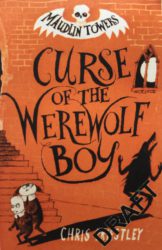
Curse of the Werewolf Boy
Chris Priestley
Bloomsbury Children’s Books

This had me gripped from the start. Essentially it’s a boarding school parody of the Gothic kind and its stars, or rather heroes – neither seems to quite fit the bill – Arthur Mildew and Algernon Spongely-Partwork aka Mildew and Sponge are pupils at Maudlin Towers School, by all accounts a pretty awful establishment for the ‘Not Particularly Bright Sons of the Not Especially Wealthy’.
Returning after a half-term holiday, the pupils are informed that a terrible crime has occurred: the School Spoon (once owned by the school’s founder) has been stolen and the headmaster threatens terrible consequences for the culprit(s).
Who better for a spot of detectivating than Mildew and Sponge who are about to learn that crime solving isn’t as easy as they might have thought. Particularly when there’s a ghost in the attic, not to mention a Viking wandering around, a history teacher, one Mr Luckless who has a ‘temporo-trans-navigational-vehicular-engine’ (a time machine to you and me); even a werewolf boy (but you’d expect that from the title), and more.
It’s not only the lead crime solvers who are splendid; every single character is wonderful be they pupil or teacher – you can meet the whole cast at once via the role of honour board at the start of the story. With staff names such as Mr Particle actually newly deceased when the story opens; you can guess what subject he taught, Mr Stupendo and the Latin speaking Miss Livia; and Enderpenny and Furthermore numbering among the pupils.
Then there’s the narrative itself which is peppered with such deliciousness as:
I know what a ha-ha is, you nose hair,” said Kenningworth … ; and
… Mildew’s upper lip began to lose some of its structural integrity…”;
a brilliantly controlled plot that twists and turns while keeping readers totally engrossed throughout its mock scary entirety; and if that’s not enough, the book is chortle-makingly illustrated by none other than Chris Priestly himself.
Why am I including this story in a Christmas review, you might be wondering: that’s for me to know and for you to discover when you get hold of a copy of this cracker of a book.

Santa Selfie / I Went to See Santa

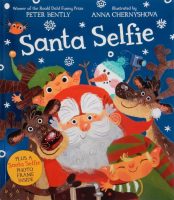
Santa Selfie
Peter Bently and Anna Chernyshova
Macmillan Children’s Books

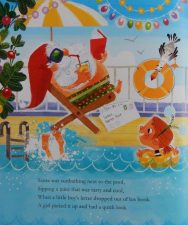
Santa decides to take a holiday far away from all things Christmas and takes off for the sun on a tropical cruise.
However, his hopes of a peaceful trip are soon thwarted when a little girl picks up a tell tale bookmark that falls from Santa’s pool-side reading material.

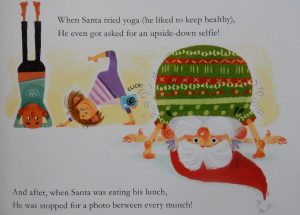
Before you can say ‘sunbathing’ everyone aboard the ship knows of the special passenger and he’s beleaguered with people wanting to take Santa selfies. There’s even one of his yoga session.

Eventually he takes desperate action and leaves the ship, but still he’s pursued by camera-clicking crowds. It’s the same no matter whether it be in Paris, Sydney, Cairo, Brazil, outside the Taj Mahal, or at the Grand Canyon, the snappers are there.
Enough is enough thinks Santa and with a quick call, courtesy of a small boy’s mobile, he summons his helper Elfie and off they go back to the North Pole.
Surely there he’ll be safe from selfie seekers …
I hate selfies but I found myself warming to Peter Bently’s festive frolic delivered with rhyming verve and illustrated by new to me artist, Anna Chernyshova, whose Santa-centric scenes are sure to bring smiles.
Selfie enthusiasts can take advantage of the cut-out back cover flap.


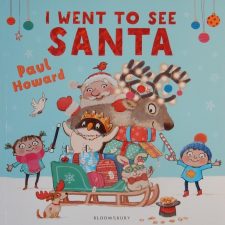
I Went to See Santa
Paul Howard
Bloomsbury Children’s Books

Prepare yourself for a seasonal take on the ‘I went to the shop and I bought …’ memory game. It’s started by a little girl (love her Christmas specs.) who is joined by a slightly littler boy as they take turns to add increasingly unlikely items to the list of items bestowed upon them by Santa in the run-up to the big day itself.
Packed with crazy scenes of sparkling treasure, skating penguins, soaring through space and more, this will surely fill a few minutes of festive story time and may well spark off a game of even wilder flights of fancy with a group of early years listeners.

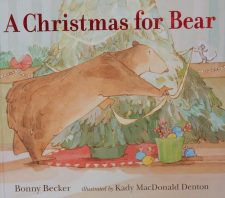
A Christmas for Bear

A Christmas for Bear
Bonny Becker and Kady MacDonald Denton
Walker Books

Can it really be the sixth story to star the unlikely best friends Bear and Mouse? This one really is a cracker despite the grumpiness of Bear – nothing unusual about that, but he seems even more so where the festive season is concerned.
Having agreed to host a Christmas party, his first ever, Bear goes on to declare presents “Most unseemly,” and appears to think Christmas pickles and the odd poem or two are all that’s needed for a successful party.
Mouse meanwhile is focussed on the possibility of presents and goes off in search of same.

Bear then pours further cold water on the notion calling them “Unnecessary hogwash” and announces his intention to read a poem.
This turns out to be A Visit from St. Nicholas –  something children will delight in .
It does of course, include a reference to a mouse and stockings; the latter seems to hold a particular significance that Mouse takes a while to grasp.

Eventually though he does finally fall in and discovers his stocking containing, no not a pickle, but a tiny, shiny silver telescope.
That’s Mouse’s present dealt with, but what about Bear? Surely his best friend can’t have forgotten him, can he?

Priceless dialogue – “Not even one present!” squeaked Mouse. “The pickles are from France!” declared Bear. “But surely – “ said Mouse. “And furthermore,” continued Bear, “I shall be reading a long and difficult poem.”, – and perfect pacing with a wonderful finale, combined with superbly expressive watercolour, ink and gouache illustrations make for an unforgettable seasonal story to share and relish.

With Giving in Mind

Little Hazelnut
Anne-Florence Lemasson and Dominique Ehrhard
Old Barn Books

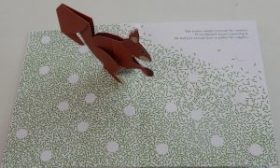
What a simply gorgeous presentation is this tale of a hazelnut dropped by squirrel …

and buried by a heavy snowfall.
Other woodland animals, furred and feathered, come and go but the nut remains undiscovered.
In the spring, a little tree shoot emerges – literally – and a sapling begins to develop: a little nut tree, no less.

Readers are taken on a journey through the changing seasons in this wonderfully crafted pop-up story. The limited colour palette and occasional patterned backgrounds are most effective and the paper-engineering superb.
A book to share, to treasure and to give.

Greatest Magical Stories
Chosen by Michael Morpurgo
Oxford University Press

Michael Morpurgo has selected a dozen magical tales from different parts of the world for this collection, the final one of which, Jack and the Beanstalk is his own retelling. This first person telling from Jack Spriggins aka ‘Poor Boy Jack’ is especially engaging for young listeners. Morpurgo also provides an introduction as well as an introductory paragraph to each story.
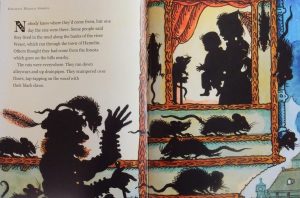
Ten illustrators have been used with Victoria Assanelli and Bee Willey having two tales each. Most arresting as far as I’m concerned are Ian Beck’s wonderful silhouettes for Adèle Geras’ rendition of The Pied Piper.

From Japan comes Yoshi the Stonecutter, retold by Becca Heddle and beautifully illustrated by Meg Hunt, the only non-European offering.
Cinderella, Sleeping Beauty and Jack and the Beanstalk are ‘almost part of our DNA’ says Morpurgo in his introduction: they are universal.
Perhaps not a first collection but this read aloud volume is certainly one worth adding to a family bookshelf or primary classroom collection.
Not included in the above but certainly magical is:

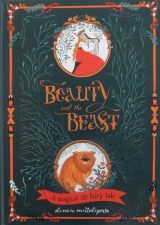
Beauty and the Beast
illustrated by Dinara Mirtalipova
Templar Publishing

To satisfy his youngest daughter’s wish, a merchant steals a rose from the garden of a hideous-looking beast and Beauty, to save her father’s life, goes in his place to the Beast’s palace, falls in love with him and well, you know the rest.
The classic fairy tale is retold in a truly beautiful rendition – a feat of paper-engineering and lavish, cut out illustrations by self-taught illustrator Dinara Mirtalipova.

She has created six multi-layered scenes by using three layers of paper cut to look 3D, so that each spread simply springs into life when the page is turned.
Magical!
I really had to exercise my powers of persuasion to get one listener to part with my copy after we’d shared it.

A Child’s Garden of Verses
Robert Louis Stevenson, illustrated by Michael Foreman
Otter-Barry Books

I clearly remember my father reading Robert Louis Stevenson poems from A Child’s Garden of Verses on many occasions; most notably Rain. The Swing, From a Railway Carriage, Autumn Fires, Where Go the Boats? and my very favourite, Windy Nights (which I still know by heart).
Here’s a beautiful book of those same poems that were first published in 1885, and a century later illustrated by Michael Foreman, beautifully packaged with a foreword by Alexander McCall Smith for a new generation of listeners and readers.
For me Foreman is the perfect illustrator for the poems, his watercolours imbuing them with a sense of timelessness and innocence. One for the family bookshelf.

Space Adventure Activity Book
illustrated by Jen Alliston
Button Books

There’s plenty to engage young children during the long winter evenings in this space-themed activity book. There are things to count, to colour and to make; plenty of puzzles, wordsearches and more, plus 4 pages of stickers. All you need are pens, pencils, scissors, a paper plate or so, a couple of sponges and 2 rubber bands (to convert your shoes to moon boots) and some basic ingredients for the Stellar Cakes (plus the help of an adult).
With 60 pages of spacey fun, this should help fill a fair few hours of darkness.

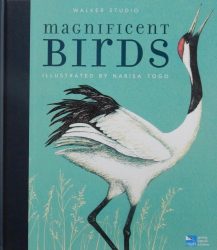
Magnificent Birds

Magnificent Birds
Illustrated by Narisa Togo
Walker Studio

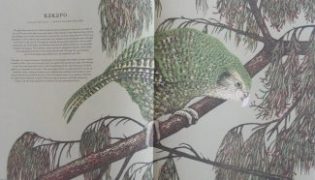
In this celebration of the avian world, Narisa Togo has chosen fourteen subjects for her intricate linocuts.
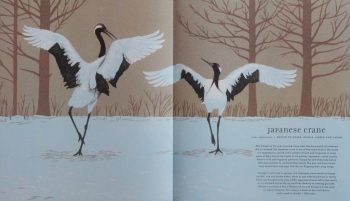
Each spread, devoted to one species, is a visual treat, and accompanied by two paragraphs of information in addition to the bird’s scientific name and geographic range.

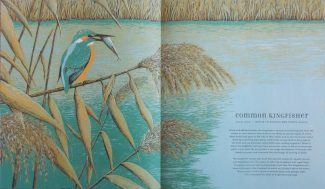
Some of the birds – the Barn Owl or Peregrine Falcon for instance, we in the UK may be lucky enough to see for ourselves. I am always thrilled to catch a glimpse, as I occasionally do, of the flash of iridescent blue and orange of a Kingfisher on my Sunday walk alongside the River Frome near my home.

On the other hand, the Kakapo, a large ground-dwelllng parrot, native to New Zealand almost, so we’re told went extinct in the 1970s with only eighteen males thought to be left in the world. These birds may live to 90 years old and thankfully, following intensive conservation work including relocation to islands free of predators, the population has increased to around one hundred.

Other ornithological wonders featured include the American Bald Eagle, Andean Flamingos, the wandering Albatross, Bar-Tailed Godwits, which fly non-stop over 11,000 kilometres across the Pacific Ocean from the Arctic to Australia or New Zealand in around eight days, and the Japanese Cranes, known for their elaborate courtship dance.

Narisa Togo’s stunning illustrations and the fascinating facts should instil a sense of awe and wonder at the avian world and draw readers into further exploring both artistic and scientific aspects of the subject.

Published in collaboration with the RSPB, 6% of sales income goes to the charity

Festive Fun for the Very Young

Listen to the Christmas Songs
Marion Billet
Nosy Crow

Half a dozen favourite seasonal songs are illustrated – one per spread – and each one can be brought to life by pressing the sound button on the respective spread.
(Adults can turn off the switch at the end of the book when they’ve had enough of the jollity.)
Interactive, sing along fun for the very young illustrated with bright animal scenes of festive fun and frolics.

Snow Dog
Puffin Books

To share with the very youngest, a dog-shaped board book with short rhyming text tells how the playful Snowdog runs and jumps, chases his ball and generally enjoys the company of his friends be they of the snowman or human kind.
Five snowy scenes show all the fun of the chilly outdoors.

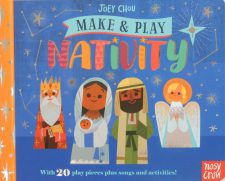
Make & Play Nativity
Joey Chou
Nosy Crow

Here’s a nice strong, easy-to-assemble Nativity scene for small fingers.
It comprises twenty characters, some human, others animal that are easy to slot together, and in so doing, youngsters can hone their manipulative skills as a lovely seasonal scene is constructed.
Joey Chou’s artwork has a delightful simplicity that may well inspire users to make some of their own figures to add to the completed scene.
I’d suggest sharing the Nativity story included in the latter part of the book before starting on the construction. Once this is complete, then there are other activities including making an adventure calendar, songs to sing and more.
A festive delight that can (the pieces are easy to take apart after Christmas) be used over and over, either in a nursery setting or a family.

All I Want for Christmas
Rachel Bright
Orchard Books

In this short rhyming tale we join penguins – one Big, one Little- as they count down the days to Christmas.
There is plenty to keep them busy: baking, wrapping presents, making cards and decorations and seemingly, the entire penguin population is eagerly anticipating what will be under the Christmas tree.

There’s one penguin however who has no need to join the queue to post a letter to Santa, for the one thing Big really wants above all else is right there all the time: it’s a 4-lettered word beginning with l: can you guess what that might be?

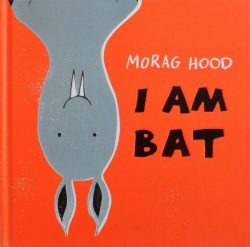
I Am Bat

I Am Bat
Morag Hood
Two Hoots

Morag Hood is a visual storyteller par excellence and in her usual fashion, she couples that with a minimal text of perfectly chosen words.

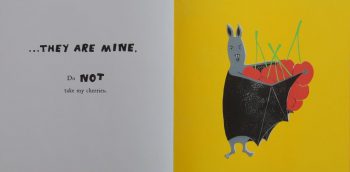
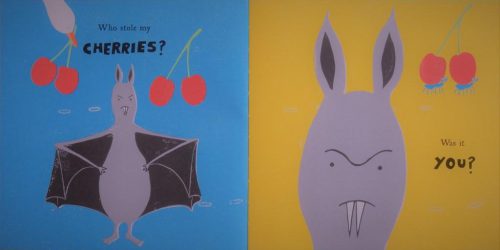
With his Dracula-style teeth, Bat is a somewhat irascible character and he most definitely does not like mornings. What he does like though are cherries, lovely juicy red ones and he guards them fiercely.

Woe betide any creature that so much as touches even one; that will cause bat to unleash leonine-like ferocity.

Surprisingly though, Bat leaves his precious cherries unguarded and they start to disappear.
Readers, although not Bat, will be quick to notice that the culprits are animals; he even has the cheek to accuse us having stolen his hoard.

I will never be happy again,” he declares; but then what should appear right before his eyes but a luscious alternative.

Fickle Bat now has a new favourite fruit to sink his fangs into.

Who could fail to have a good laugh at this small melodrama: an utterly batty book that will have a wide audience appeal.

My Lazy Cat

My Lazy Cat
Christine Roussey
Abrams Books for Young Readers

Boomer is a chubby cat, found ‘spread out like a pancake’ on the doorstep of the young narrator’s home. With his tiger-like purrs and wonderful hugs, he quickly becomes the girl’s best friend. There’s only one thing wrong: Boomer is a complete lazybones liking nothing better than drowsing and snoozing, in complete contrast to the narrator. She’s constantly on the go with her busy schedule of judo, swimming, yoga, painting, pottery, knitting, soccer, and cycling. On her way out however, a snoozing Boomer causes her to trip and go flying.

One the verge of tears, she catches sight of the cat and laughter takes over.
Boomer then leads the way out into the garden. Flat out on the grass, child and cat watch the ladybirds and listen to the wind blowing through the pine tree, then stroll to the pond where they watch fish and listen to the sounds of the water and the frogs.

Lunch is a feast of berries, tomatoes, and fruit from the trees, after which they lie back contentedly gazing at the clouds.

The girl’s response to her parents’ “What did you do today?” is “Nothing” and a huge smile, which speaks volumes about her frenetic existence and the over-scheduled lives led by so many children nowadays.
Well done Boomer (and Christine Roussey) for showing the importance of allowing children time for slowing down, relaxing, enjoying the natural world, and just being.
There’s a child-like simplicity in Roussey’s scratchy-style illustrations that make the story feel even more immediate.

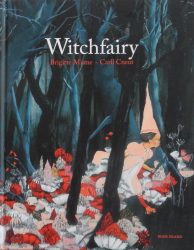
Witchfairy

Witchfairy
Brigitte Minne and Carll Cneut
Book Island

Another beauty from Island Books and it’s a picture book wherein the author upturns more than one story norm as you’ll come to know if you get your hands on this innovative tale.

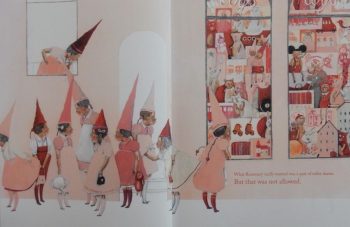
Rosemary is a young fairy, a deliciously divergent one who’d much prefer a pair of roller skates to the ‘stupid magic wand’ birthday present given to her by her mum.

In fact, tired of her clean, neat, sweet, and exceedingly dull life as a fairy, she’d far rather be a witch, Rosemary decides.

Her mother of course, is completely horrified, the other fairies try to dissuade her, but the girl is having none of it: she’s a child who knows her own mind and so she packs her bags and leaves.

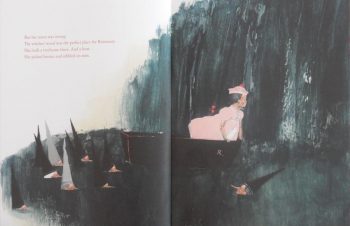
Life in the witches’ wood suits Rosemary perfectly; she constructs herself a treehouse and a boat,

and eats nuts and berries. She even gets to try out roller skating thanks to the kindness of one of the other witches.
Seemingly she can teach the other witches a few tricks too.
But exciting as this new life of hers might be, Rosemary eventually realises that she’s made her mother sad by sticking with her decision to leave home.

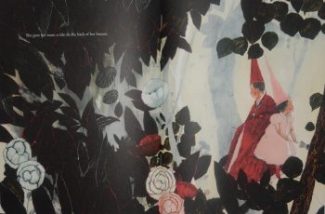
Could there perhaps be a way she can bridge both worlds; perhaps being a ‘witchfairy’ is the solution …

Delectably dark and with an underlying message about holding fast to what you want to be or do – says someone who has done just that, it warms your heart.  Let determination carry you through, however tough the odds.
Here’s a superb, exquisitely illustrated picture book, which demonstrates just that.

I’ve signed the charter  

Legendary Journeys: Space & Legendary Journeys: Trains

Legendary Journeys: Space
Mike Goldsmith and Sebastian Quigley
QED

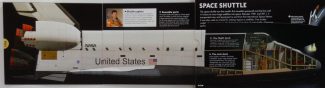
Written by astrophysicist and author, Mike Goldsmith, and illustrated by Sebastian Quigley, this amazingly constructed book documents mankind’s quest to learn ever more about space.
There are thirteen sections beginning with very early rockets, followed by a spread on the solar system and then moving on to the ‘Space Race’ that took place between the Soviet Union and the USA that culminated in the moon landing of Neil Armstrong and Buzz Aldrin.
Co-operation as well as competition was an important element in extending our understanding of space and its effect on humans, as described in ‘Living in Orbit’.
Other spreads look at the exploration of the other planets in our solar system and the search for life on Mars.
Every spread is absorbing with a lead paragraph, arresting illustrations and explanations, flaps to explore and pioneers to spot; and here are ten ingenious two-stage pull-out sliders.

Any child with a budding interest in space will love and treasure this book.
In the classroom however, there is a danger of it being read to destruction by over-enthusiastic handlers.
The same is true of companion volume:

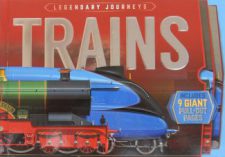
Legendary Journeys: Trains
Phillip Steele and Sebastian Quigley

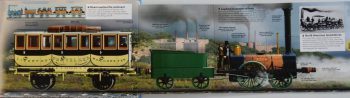
This tells of the historic development of trains and railways from the first steam locomotive to run on rails, right up to the technologically advanced, high-speed railways that have spread across Japan and a number of European countries.
Both passenger travel

and the movement of freight are covered and there’s a look at underground railways, mountain railways; the various forms of power used to drive the trains, and a final spread presents some of the most iconic railway stations in the world.
Railway enthusiasts especially will enjoy this one: its construction and layout are similar to the Space book and it has the same illustrator.

Perilous Play: Game of Stones / Rocket Shoes

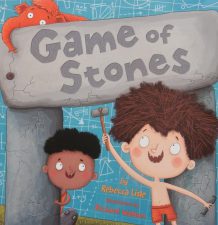
Game of Stones
Rebecca Lisle and Richard Watson
Maverick Arts Publishing

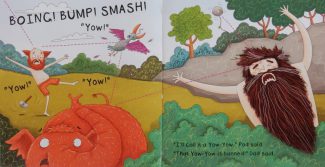
Young Pod of Stone Underpants fame is back and he’s in inventive mode once more.
Now he wants to make a ‘whizzy’ game to amuse his younger brother, Hinge.
His first creation is certainly that but there appears to be a design fault …

and the ‘Yow-Yow’ ends up being banned by their dad.
Back to the drawing board: more chiselling, sawing and hammering, and the result is ‘Crackit’.

That meets the same fate as Pod’s previous effort – a paternal ban.
His third attempt looks like a winner but the boys must find somewhere away from their parents to use it, and for this Pod calls on the assistance of their friends, both animal and human. What on earth could they be moving all those huge blocks of stone for?
A playful tale, some groan worthy puns, not least being the book’s title and suitably crazy scenes of Stone Age carry-ons make for another diverting drama from Pod’s creators.

Rocket Shoes
Sharon Skinner and Ward Jenkins
Sterling

When is it right to break the rules? Essentially it’s a philosophical question that might well be explored in a classroom community of enquiry session.
It’s the one young José must work out when his neighbour, who has been instrumental in getting his and the other children’s amazing rocket shoes banned, is in great danger.
The boy is sitting outside pondering on the aeronautical acrobatics he and his friends have enjoyed …

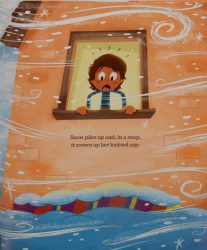
when a snow storm suddenly engulfs Mrs Greg who is outside searching for her missing cat.
Should he, or should he not get out his forbidden rocket shoes and whizz to her aid?

To reveal what happens would spoil the story, so I’ll just say, all ends highly satisfactorily for everyone in town …
Told through Sharon Skinner’s whizzy rhyme and Ward Jenkins zippy, cartoonish digital illustrations, this will appeal especially to those who like to break the rules from time to time.

I’ve signed the charter  

One House for All

One House for All
Inese Zandere and Juris Petraškevičs
Book Island

A parcel from Book Island publishers is always exciting; their books exude quality and originality. It’s certainly so in this unusual take on the extended family.

Three good friends, Raven, Crayfish and Horse meet together and hold a discussion. Each wants to get married and have a family, but their friendship is so strong that a way must be found to preserve it. What can they do to remain close?

The friends decide to build a wonderful new home where they can live together; but a home that encompasses all their needs is no easy matter.

Three sketches are drawn up in turn with the three animals each clearly outlining his perfect family home.

It will come as no surprise when I say that the three homes are totally different.

Surely this isn’t to be the end of a beautiful friendship or a calling off of the marriages …

The power of the story lies in the simplicity of its telling: that, and the absolutely superb, vibrant illustrations make for a strikingly beautiful book.

Let difference, respect and friendship thrive, no matter how, no matter what.
Here’s a book that could help all three flourish.

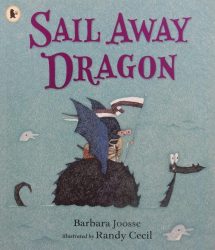
Sail Away Dragon


Sail Away Dragon
Barbara Joosse and Randy Cecil
Walker Books

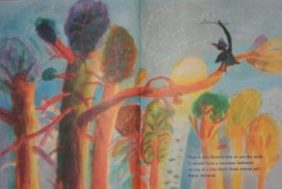
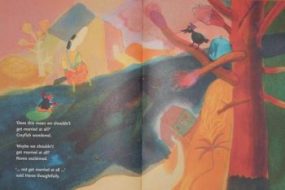
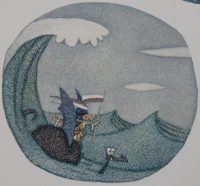
The twosome from Lovabye Dragon and Evermore Dragon return as the friends sally forth, with wicker basket, spyglass, banner, box of ‘goodie gumdrops’ and horn, for an adventure on the ocean.

As they sail towards the far-est Far Away they encounter dolphins, spouting whales, Bad Hats …

from whom they acquire a cat and thus sail on in ‘The Owl and the Pussycat’ style for a year and a day till they begin to despair they’ll ever reach their Far Away destination.

They do however; and thereon they consume the goodie gumdrops, dance, sound their horn and write a note which they place in a bottle and cast upon the ocean.

Thereafter they sleep and dream beneath the stars.

Like all magical adventures though, home calls through their dreams and so homewards they sail, passing wondrous sights

until each returns to separate slumbering quarters – Girl to her ‘pluffy little eiderdown bed’ and Dragon to lie curled above the castle door ‘guarding Girl, his friend forevermore.’

The combination of Joosse’s dreamy lilting text and Cecil’s beautiful, textured scenes is magical. The whole thing has the lingering, haunting quality of a dream one doesn’t want to end.

If you’ve yet to meet this enchanting pair, do try their latest adventure.

Mice Skating / Wow! It’s Night-Time

Mice Skating
Annie Silvestro and Teagan White
Sterling

There’s nothing better after a walk on a chilly day than an exhilarating tale of the great outdoors to snuggle up and share, as you sip mugs of hot chocolate in the warmth of your home; and this one really fits the bill.

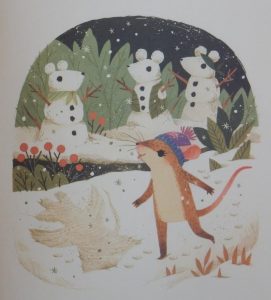
Lucy Mouse is something of an exception when it comes to winter: she loves it for the crunchy snow, frosty air and opportunities to wear her woolly hat. Not only does her hat warm her head, it warms her heart too.

Her friends in contrast, much prefer to stay huddled up in their burrow waiting for spring.

Venturing forth alone, Lucy has great fun …

but it’s lonely and she really wants to share the wintry pleasures with her pals. They however, are not interested.

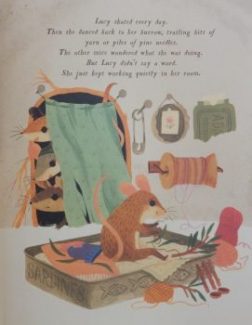
Then she accidentally discovers ice-skating, even making herself a pair of skates from pine needles (I love that); and is all the more determined to get her friends to try this magical experience.

If you can put up with some corny, or rather, cheesy punning in the text (courtesy of Marcello, one of the mice), this is a wintry wonder.

The glowing illustrations exude warmth despite the chilly nature of the world beyond the burrow, and are full of creative details such as the pine needle skates and the furnishings of the mouse abode.

For younger listeners:

Wow! It’s Night-Time
Tim Hopgood
Macmillan Children’s Books

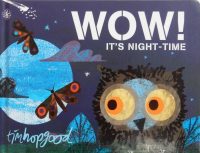
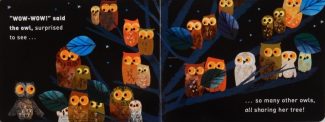
Tim Hopgood’s curious little owl that was enchanted by all the colours she encountered in nature returns to share the wonders of the night-time world with young listeners.
There’s the mole that peeps from his hole, the creeping foxes, the rabbits, bats and mice; and when the clouds part, a beautiful big bright moon surrounded by twinkling stars.
All this she sees but there’s a double “wow!” when she spies the other owls that share her tree.

Just before bedtime especially, little humans will delight in discovering what goes on while they’re fast asleep and enjoy the built-in counting opportunity on each spread.
An enchanting taster of the nocturnal natural world, stylishly presented by Hopgood.

Here We Are

Here We Are
Oliver Jeffers
Harper Collins Children’s Books

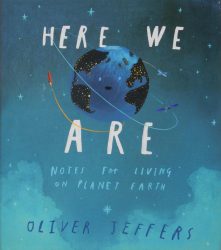
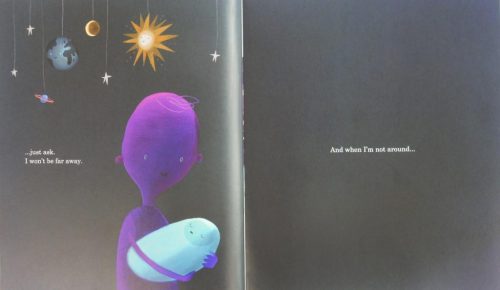
Oliver Jeffers is one of my favourite author/illustrators and Here We Are, his latest book, is simply exquisite.

Created for his new baby son and suffused with parental love and a gentle humour, Oliver speaks, seemingly directly, to the infant.

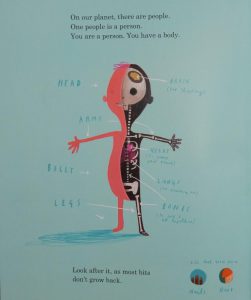
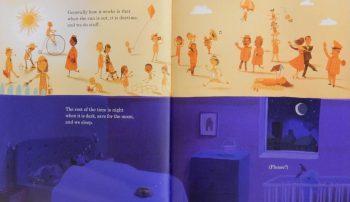
He talks of the intriguing, bewildering and fascinating wonders of Planet Earth and all that’s on it and above it – the land, the sea, the sky, space, humans, animals, day and night.

Much needed, perfectly timed, and pared back to the essentials, his message is one that resonates: kindness, tolerance and respect not only for our planet – ‘Make sure you look after it, as it’s all we’ve got.’; but for one another whoever we are, wherever we are, ‘People come in many shapes, sizes and colours. We may all look different, act different and sound different … but don’t be fooled, we are all people. … there are lots of us here so be kind. There is enough for everyone.

That’s what really matters. It matters for us here and it matters for people right across the globe especially now when so many countries are in turmoil of one or another kind.

This is a vital picture book, awesomely illustrated in Oliver’s inimitable witty way – a classic–to-be, for every family, early years setting, school collection and library. And it’s an absolutely perfect gift for any baby who has recently arrived on our bewilderingly marvellous planet.

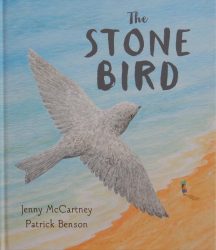
The Stone Bird

The Stone Bird
Jenny McCartney and Patrick Benson
Andersen Press

Here’s a magical tale full of wonder and the power of the imagination.
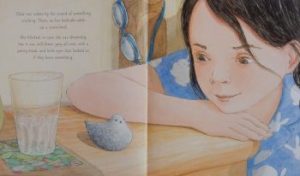
It begins one hot summer’s day when Eliza discovers a smooth, egg-shaped stone in the sand and knows it’s something special. “It’s a heavy egg,” she tells her sceptical mother.
At bedtime the child places her treasure beside her on the bedside table and later is woken by a cracking sound: a transformation has occurred.

Eliza takes her stone bird everywhere until autumn comes and with it school: Eliza’s bird remains on her bedside table.
Another object – a small grey oval stone appears beside it one morning.
Winter comes bringing frost. Eliza nestles her treasures in a pair of socks.

By spring she’s almost given up waiting but then something extraordinary happens: there are two stone birds in that nest, one big, one tiny.
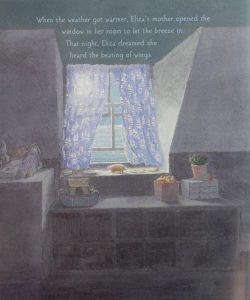
Then one day, Eliza’s mother opens the bedroom window and that night Eliza’s dream is the sound of beating wings …

Next morning the nest is empty: will Eliza ever see her precious birds again?
A book that celebrates a child’s imagination is one to cheer. I’d hate to think the little girl’s imagination is dampened as she goes through school: perhaps though, the soaring birds on the penultimate spread are symbolic of her imaginative spirit spreading its wings.

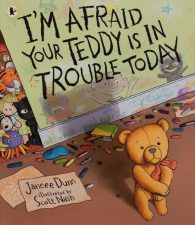
I’m Afraid Your Teddy is in Trouble / Kick! Jump! Chop!

I’m Afraid Your Teddy is in Trouble
Jancee Dunn and Scott Nash
Walker Books

What do your stuffed toys get up to when you go off to school? A whole lot of mischief, if this tale is anything to go by.
Teddy calls his friends over and they have a wild time. Seemingly, if the evidence is right, they make pancakes, use the bed as a trampoline with disastrous results – for the bed that is. The walls become daubed with murals, albeit pretty good ones and there’s been some dressing up too.

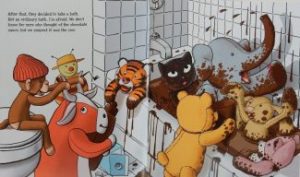
Then there was a sliding contest, a spot of sledging, folllowed by a rather sticky but extremely yummy bath.

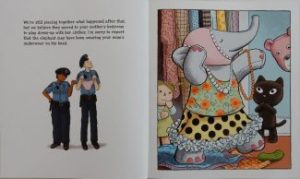
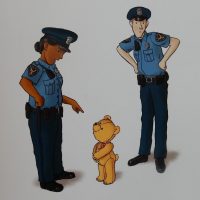
Unsurprisingly all these high-spirited antics attract the attention of the neighbours, for it’s they who call the cops.
It’s as well that the particular cops who attend the incident are of the sympathetic kind: the two of them know just how to deal with high-spirited, partying toys; but what about their ringleader? Will he too be let off with a warning from Officer Hardy?

Dunn’s narrative takes the form of a crime reconstruction directed to the bear’s owner and of course to readers, and Nash’s accompanying energetic digital illustrations are full of fun. Doubtless youngsters will relish the misdemeanours of the frolicsome toys. They surely have a much more exciting time than a house full of electronic devices, but then again, you never know …
Kick! Jump! Chop!
Heather Ayris Burnell and Bomboland
Sterling

I’m always been a bit of a sucker for fractured fairy tales and pounced on this one when it arrived.
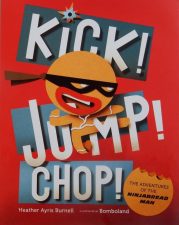
It’s the classic Gingerbread Man story given a ninja twist. Take a look at the cover and you’ll see the illustrations are of cut paper from a team called Bomboland (which is actually an Italy-based illustrations studio): the ninjabread man really means business with that kick move and flying star cookie.
The story begins in the dojo with the declaration “Sparring is getting stale. We need to spice things up.” Sensei then concocts a super-spicy dough and from the oven soon after, erupts a ginger ninja issuing the challenge of the title: KICK! JUMP! CHOP! followed by “As fast as you can. You can’t beat me, I’m the Ninjabread Man!” and off he goes.
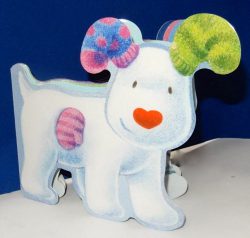
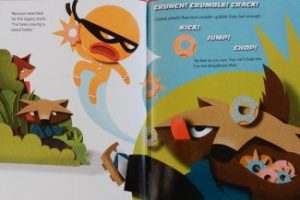
His challenge is taken up by, in turn Raccoon …

Cheetah and Monkey, none of whom is equal to the super-sparrer.
Then comes Fox, who appears to be getting the better of his challenger. Is the crafty cookie about to meet his demise in the snappy jaws of his vulpine assailant?

With its super-punchy paper collage-style scenes and spicy punning narrative, this toothsome tale will go down especially well with action-loving listeners, particularly those with a penchant for the martial arts.

Famously Phoebe / Goodnight, Little Bot

Famously Phoebe
Lori Alexander and Aurélie Blard-Quintard
Sterling

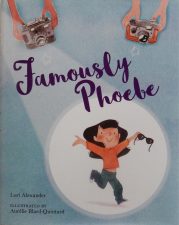
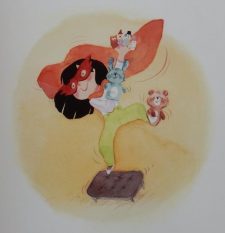
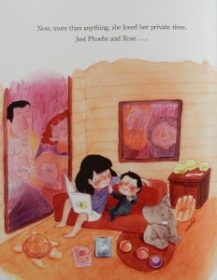
Young Phoebe is used to being in the limelight; no matter where she goes she gets special attention and so sees herself as a star.
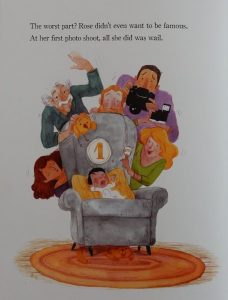
Then into her heretofore spectacular life comes a new and much tinier star, named Rose.
Suddenly nobody is interested in Phoebe; it’s Rose, Rose, Rose all the time and it’s not as though the new babe even wants to be famous. In fact she makes it pretty clear, it’s far from so.

Re-enter Phoebe stage right. Can she not only gain the spotlight, but manage to bring a smile to Rose’s face?

Maybe there are more important roles to play than star of the show, roles such as Big Sister for instance.

Lori Alexander’s playfully constructed narrative and Aurélie Blard-Quintard’s expressive watercolour and pencil illustrations artfully spotlight Phoebe’s changing emotions in this amusing addition to the new sibling shelf.

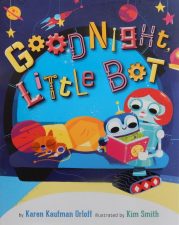
Goodnight,Little Bot
Karen Kaufman Orloff and Kim Smith
Sterling

Like the majority of little humans, Little Bot is still full of energy when his mother robot tells him it’s time for bed.
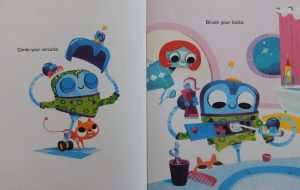
She then puts him through his usual bedtime routine: TV off, a scrub bath, pyjamas on, a snack and drink, comb, brush and storytime will all be familiar, especially the demand for ‘ten more books’. There are differences though and herein lies the fun: Little Bot snacks on batteries, drinks oil, combs his circuits and brushes his bolts …

before plugging in to a recharger (he barely needs that from the way he’s been whizzing around).
Orloff’s jaunty rhyming text and Smith’s bold, cartoonish, digital illustrations work well together in this pre-bedtime tale and yes, after hugs, kisses and a lullaby, Little Bot does finally wind down and drift off to dreamland.

Fox in the Night / Snow Penguin

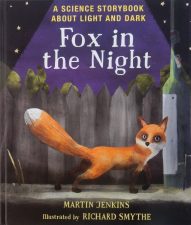
Fox in the Night
Martin Jenkins and Richard Smythe
Walker Books

Billed as ‘A science storybook about light and dark’, this is a narrative non-fiction picture book with a sprinkling of additional facts.
We join Fox as she wakes, sees it’s still daylight outside and so goes back to sleep for a while. Later, at sundown, she leaves the safety of her den and, guided by the moon and street lights, sallies forth across the park towards the town in search of food.

A mouse eludes her so she keeps looking; perhaps something static will be easier prey.
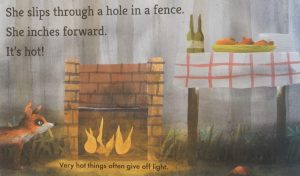
A bumped nose and a near miss from a car later, she’s still searching. Then, turning down an alley, her nose leads her towards something more promising – a barbecue in progress – and it’s here that she’s finally rewarded with a tasty treat to take back to her den.

Beautifully illustrated, this is a good starting point for a topic on light and dark with early years children. I’d suggest reading the story first and then returning to discuss the additional, smaller print, possibly using it as pointers to get youngsters thinking for themselves about why for instance, Fox bumps her nose on the shop window.

Snow Penguin
Tony Mitton and Alison Brown
Bloomsbury Children’s Books

Far away in the icy Antarctic, a curious little penguin is restless: he wants to find out more about the chilly sea and the snow. Off he goes alone to explore, unaware that the ice on which he’s standing as he gazes seawards has become detached from the mainland.
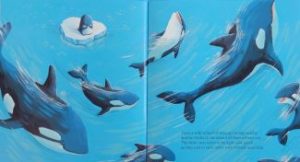
On his trip afloat on his little ice floe he sees blue whales, orcas,

an elephant seal and a sea lion with her cub. Suddenly he feels alone and scared adrift on the darkening waters. How will he find his way back to where he most wants to be, back with his family and friends?

Mitton’s assured rhyming couplets in combination with Alison Brown’s engaging depictions of the frozen Arctic seascapes and landscapes make for a gentle cuddle-up adventure for the very young.

On the Night of the Shooting Star

On the Night of the Shooting Star
Amy Hest and Jenni Desmond
Walker Books

Bunny and Dog are neighbours living on opposite sides of the fence in homes that match their owners. Bunny’s house is blue and is furnished in suitable bunny style (look for the bed’s rabbit-eared headboard and the chair’s fluffy white tail):

Dog has a red house with red furnishings. (I love the rug border and fireplace tiles.) Both have lake views and signs indicating they want to be left alone as they go about their solo activities.
However first thing every morning Bunny looks through the fence at Dog and Dog looks through the fence at Bunny: neither says so much as hello. They also take the odd peek at one another during the course of the day and at bedtime each checks the light in the window of the house opposite.
Time passes and one moonlit night, unable to sleep, both animals are drawn outside to watch the stars and each decides the other is in need of a friend.
The sudden appearance of a shooting star provides a shared experience:

could this be the catalyst for their friendship to develop at last?

Everyone needs a friend: sometimes we need the courage to reach out and be that friend. This timely message is at the heart of Amy Hest and Jenni Desmond’s softly spoken, captivatingly illustrated book.

How Monty Found His Magic / Starring Carmen!

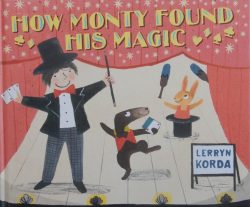
How Monty Found His Magic
Lerryn Korda
Walker Books

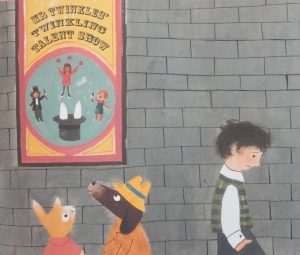
Meet the Magnificent Trio: Monty, his dog named Zephyr and his rabbit named Snuffles. They have ambitions to show their magic in front of a real audience and with Mr Twinkle’s Twinkling Talent Show coming up they’ve a chance to realise their dream.

First though, Monty must overcome his fear of public performance.
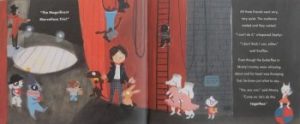
The day of the talent show dawns and Monty has a bad attack of butterflies in his tummy. His pals reassure him, “ … we’ll be fine … we’ll be together.
But will Monty be able to remember their words when they’re under the spotlight up on that stage in front of all those people.

This is a tale of finding your inner courage and working together as a team that will resonate with those children in particular who find doing anything in public a trial. Equally it demonstrates that behind every public performance lies a great deal of a gentle kind of magic that comes when friends support each other just because …
With its vibrant scenes of friendship and prestidigitation this should be a winner with young audiences.

Another performance tale is:

Starring Carmen!
Anika Denise and Lorena Alvarez Gómez
Abrams Books for Young Readers

Carmen is a drama queen of the first order: she acts, sings, dances and even makes costumes.
Her little brother, Eduardo is desperate for a part in her shows, so she gives him a silent role in her latest extravaganza.

Then when her parents ask for an intermission, the showgirl stages an enormous sulk. What good is a stage show when the audience are merely toys?
There’s one member of the family though who never seems to tire of performances and it turns out, he has much to offer when it comes to high drama too.

With its sprinkling of Spanish dialogue – I like the way the Spanish phrases are naturally dropped into the narrative – and brighter than bright illustrations, this story will appeal most to those who enjoy being in the limelight – one way or another.

I’ve signed the charter  

Curiosity The Story of a Mars Rover

Curiosity The Story of a Mars Rover
Markus Motum
Walker Studio

Wherever you are in the world right now, I’m a very long way away. I’m not even on the same planet as you. I’m a Mars rover.
So begins this story narrated by Curiosity, the robot vehicle landed on the surface of Mars in August 2012.
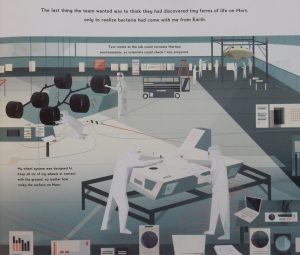
Readers are given a behind the scenes look at the lead up to, the planning behind and the building of, NASA’s 2011 mission

to land on, and explore, the surface of Mars. We learn how of the 39 previous missions to the red planet over half had ended in failure. Not so with Curiosity however. Launched from the Kennedy Space Centre in Florida on 26th November 2011,

the journey was successfully completed in 253 days.

So successful was Curiosity’s early work that what was originally to be a two- year mission was extended, and in August 2017 NASA celebrated the 5th anniversary of the landing and the work continues. More questions are asked; some answers are found; further questions are generated.
The information contained herein is detailed but never too wordy and the narrative style ensures that younger readers are not overwhelmed.
Motum’s graphics make it all the more accessible: geometric in form and richly coloured in blues, reds, grey, black and white, they have a clean sophistication that will appeal to adults as well as child readers.
There’s also a timeline and glossary at the back of the book.
All in all, this is superbly put together: it would make a great addition to a school library or family bookshelf, particularly for those who from time to time stand in the dark looking up into the night sky, wondering and questioning …

Snowboy and the Last Tree Standing

Snowboy and the Last Tree Standing
Hiawyn Oram and Birgitta Sif
Walker Books

Snowboy likes to spend his time playing imaginative games with his animal companions. Greenbackboy is riddled with greed. He persuades Snowboy to join him in a ‘better game’ he calls KA-CHING. The game entails cutting down all the forest trees in return for KA-CHING, which seemingly, can be used to get anything they want. With one tree left standing however, the enormity of what they’ve done strikes Snowboy and with the aid of his Cloak of Many Uses, he manages to hide the last tree.
Not satisfied with his ill-gotten gains, Greenbackboy drags his reluctant fellow player off to the oceans, their next target for exploitation.
With all the fish netted Snowboy again has second thoughts and manages to release two of their catch overboard, unnoticed by his companion.

But strongboxes filled with KA-CHING and mountains of tinned fish give no protection from the ravages of a storm that brews up, sweeping the tinned fish into the empty ocean to go to waste.
Snowboy has had enough.

Leaving Greenbackboy with his treasure, he, his Ice Troupers and Polar Bear King trek back across the wasted land, finally reaching that last tree.
Could it just be that with tender loving care, the tree can become their saviour?

Hiawyn Oram’s unusual story has a powerful ecological message: a fable about greed and exploitation of natural resources, it’s a timely reminder of what is happening to our planet.
Birgitta Sif’s beautiful illustrations have a muted luminescence and bring a touch of quirkiness to what is essentially a dark tale.

Gary

Gary
Leila Rudge
Walker Books

Gary is a racing pigeon. He eats, sleeps and dreams of adventure just like the others that share his loft; but, on race days, because he cannot fly, he’s left behind organising his scrapbook of travel mementos collected by his fellow pigeons. He listens avidly to the adventures of his friends as they talk of flight paths and wind directions on their return, noting down what they say in that precious scrapbook.
One night Gary and scrapbook accidentally fall from the loft into a travel basket and are taken, along with the others, to the city the next day.
He watches as the other pigeons take flight and race off into the sky, homeward bound,

leaving him all alone wondering if he’ll be forever lost in the city.
Unable to fly, he might be, but Gary does have a fully functioning brain and his scrapbook. It’s to these that he turns in his hour of need; and little by little with the aid of the book’s contents, he plots his way home, arriving with lots of exciting new mementos for the scrapbook

and a wonderful adventure story with which to regale his flighted friends.
Like Gary, Leila Rudge brings her text full circle, albeit with a slight twist, subtly showing how his differences are also sometimes, a gift. Good on you Gary for doing something amazing and doing it your way.

Beautifully illustrated, this is a wonderful story to share and talk about, and an inspiration for anyone who needs a little boost when it comes to self-belief.

Bonkers About Beetroot / Pony in the City

Bonkers About Beetroot
Cath Jones and Chris Jevons
Maverick Arts Publishing

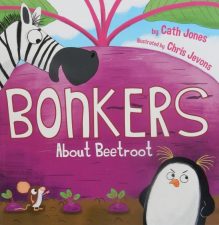
Sunset Safari Park is in danger of being closed down due to a distinct lack of visitors. Zebra calls a meeting of its inmates in the hope they might have suggestions as to how to save their home. Despite Penguin’s discouraging “Nobody comes because we’re boring” comment, Zebra remains determined to do something to attract the crowds. Beetroot is his plan: the biggest in the world and the animals are to grow it. “BONKERS!” is pessimistic Penguin’s response to this idea and to pretty much every stage in the growth of the vegetable from manure heap planting ground …

to the large beet that soon attracts the crowds.
So successful is the vegetable that it just goes on growing and growing until there’s no longer room for visitors.

Penguin’s solution is a pretty drastic one but will it have the effect he hopes? Can the safari park be saved after all?

Really, there’s no other way to describe this story that to borrow Penguin’s much used word, ‘BONKERS’.
The contrasting characters: optimistic Zebra and pessimist, Penguin complement one another well, making for a lively and quirky story time read aloud that invites audience participation.
Chris Jevons’ vivid illustrations of zoo residents, the zoo’s human visitors and of course, the beetroot itself, provide plenty to giggle over.

Pony in the City
Wendy Wahman
Sterling

Otis, a pony at the Pony Paddock gets on well with the children who visit his home; in fact he’s ‘saddled with questions’ about them. Do they gallop and kick? Do they ever walk on all fours? Do they graze on grass and daisies? The older ponies ignore his constant questioning so Otis sets out to find some answers for himself.
He visits the city park where hiding himself away, he observes and discovers their movements and sounds are not very different from his. Next stop is their homes; ‘such big barns’, he decides.
Otis discovers many more similarities …

but then suddenly comes the scary realisation that he’s far from home, alone in the big city and it’s way past time to sleep.

Next morning he hears a familiar clippity cloppity sound; could it be one of his fellow ponies coming to look for him?
No it isn’t; but his finders are equally surprised to see the little pony so far from his home and more than willing to take him back home where, inevitably, he has lots of questions to answer …
This gentle adventure with witty collage style illustrations of a children’s world interpreted through the limited experiences of a pony, offers food for thought about judgements and diversity.

Art, Artists and Some Science Too

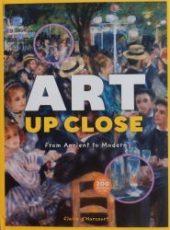
Art Up Close
Claire d’Harcount
Princeton Architectural Press

Art enthusiasts of all ages wlll enjoy this search and find game based on twenty three famous works of art from around the world.
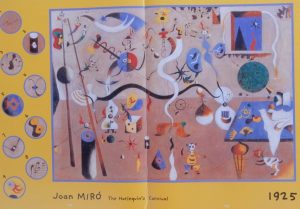
Each large spread is a high quality reproduction of one named artwork that is credited and dated, in the same border as ten to twelve floating bubbles each containing a small detail from the whole piece. It’s these tiny visual elements that readers are asked to search for, some being a whole lot easier to locate than others.
The arrangement of the selected works is chronological beginning with Egyptian papyrus paintings from the Book of the Dead (around 1300BC). This is followed by a 6th century Byzantine mosaic, an Arabic manuscript (1400s), the Limbourg brothers illumination (1416) and other 15th century European painters.
Then comes an early 16th century Aztec manuscript, a Flemish tapestry, a Bruegel (the elder) and a Veronese painting.
From the 17th century are the younger Teniers, and Jan Steen’s Village School. This chaotic classroom scene, which includes a child drawing on the wall and back end of a rat that is tucking into the contents of someone’s lunch basket certainly made the teacher part of me smile; and oh my goodness, the place is so dark, it’s hardly surprising that half the people therein look as though they’ve fallen sleep or are about to do so. All this and more while the two ‘teachers’ appear totally unaware of what’s happening around them.
There’s a Japanese woodblock print from the early 19th century; Impressionism is represented by a Renoir and an Ensor; and we then move into the 20th century with surrealist, Miró,

Picasso represents cubism and the final work is a 1952 Jackson Pollock, Convergence.
Then follow ten pages wherein D’Harcourt discusses each of her chosen examples individually; and the two final spreads have lift-the-flap mini paintings of each work that reveal the whereabouts of the details in the bubbles, and also provide short notes on the artists.
Of the 23 works, only five are non-western, but what disappointed me more was the lack of a single woman artist. Nonetheless, the whole enterprise is absorbing, educational, fun, attractively presented and well worth spending time over.

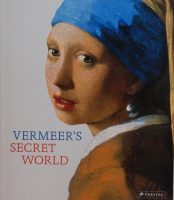
Vermeer’s Secret World
Vincent Etienne
Prestel

In what is an essentially introductory book, art historian and author, Etienne, traces the life and work of Dutch painter Johannes Vermeer, one of history’s most distinctive artists who lived in 17th century Delft for his entire life.
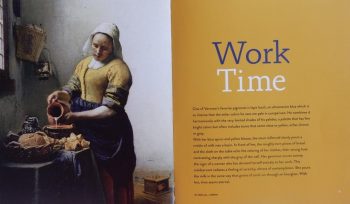
There are fifteen full-page reproductions of his works …

as well as eight smaller ones.
If you can’t manage to visit London’s National Gallery or one of the other galleries exhibiting Vermeer’s paintings, then this short book is a good starting point to begin to appreciate the Delft master, an artist whose focus was very much on people rather than places.

Trick of the Eye
Silke Vry
Prestel

Subtitled ‘How Artists Fool Your Brain’, this book offers a host of examples that demonstrate that deceptive imagery in art, far from being a new phenomenon, has been in use by famous and popular artists for centuries.
Vry uses paintings by, to name just some, Giuseppe Arcimboldo, van Gogh, Leonardo da Vinci, Hogarth, Turner, Vermeer, Paolo Veronese and Georges Seurat, as examples of optical illusions, as well as more modern artists including Salvador Dali, René Magritte,

M.C. Escher, Bridget Riley, and Banksy.
In addition to paintings, some objects such as the Athens Acropolis and the Scala Regia in Rome are used.
The end pages offer solutions to the questions posed during the discussions of the various works of art, as well as instructions for some creative projects for readers to try themselves that were previously flagged up in the those discussions.
Absorbing, illuminating and a novel way of looking at some works of art.

For those readers of a more scientific bent:

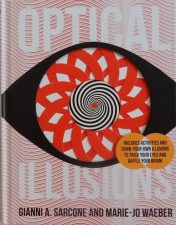
Optical Illusions
Gianni A. Sarcone and Marie-Jo Waeber
QED

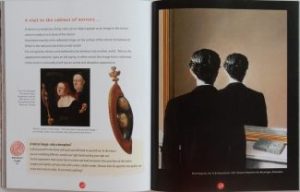
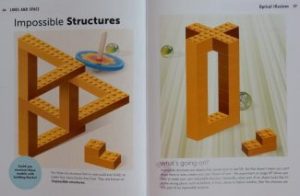
Both the creators of this fascinating book are experts in brain training and cognitive sciences, and herein they offer readers the opportunity to find out about the science behind the illusions that trick our brains.
After a brief ‘Is Seeing Believing’ introduction; the book is divided into five sections: Light, Lines and Space,

Motion, The Brain and finally, Experiments.
Each topic explores a variety of effects: for example Light demonstrates colour assimilation, complementary colours and after image, and colour contrast.
Since buying a book on MC Escher many years ago, I have been fascinated by the idea of optical illusions. This book has refreshed that fascination, but a word of warning: I spent ages poring over its hypnotic pages; don’t sit down with it unless you have plenty of time to spare – you’ll most likely be hooked, eyes and brain in sensory overdrive mode.

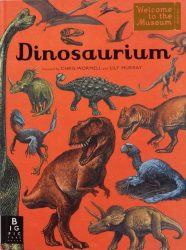
Dinosaurium

Dinosaurium
Chris Wormell and Lily Murray
Big Picture Press

Dinosaur books seem to be coming thick and fast at the moment. This one is the latest in the ‘Welcome to the Museum’ series that includes Botanicum and Animalium, and, illustrated by Chris Wormell, it’s truly awesome: serious stuff in fact.
Like others in the series, the whole thing is presented as a museum, the author and illustrator being billed as its curators and the chapters, after the ‘Entrance’ that houses an extremely useful dinosaur evolutionary tree, as a series of galleries, six in all with a final index, some information about the book’s curators and a list of further sources should readers want to learn more.
Gallery 1 is Sauropodomorpha. Don’t worry, the meaning of this is explained at the outset. Every spread has a large full-colour plate, which even has a numbered key in addition to the informative paragraphs relating to what is shown in the plate. I should mention here that these are splendid digital engravings, each illustration being in predominantly earthy tones.

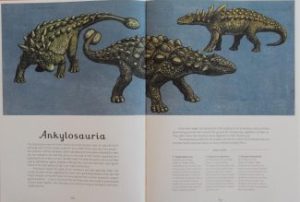
The galleries proceed through Theropoda, Ornithopoda, Thyreophora, (these include the well-known to children, Stegosauria and Ankylosauria);

then on to Marginocephalia and to the final ‘Non-Dinosaurs’, which includes petrosaurs, marine repliles, Mesozoic mammals and lastly, survivors; (those that escaped the catastrophe that wiped out the ‘non-bird dinosaurs’).
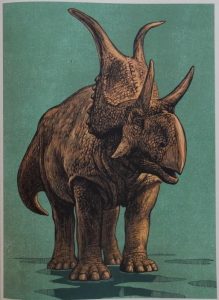
Going back to Maginocephalia, take a look at this stunning plate of Diabloceratops eatoni (yes the full scientific name is given).

This creature from the late cretaceous era is thought to have been a primitive ancestor of Triceratops and would, so we’re told, have used its beaked mouth to feed on low-growing plants in areas covered by lakes, floodplains and rivers.
In addition to the amazing exhibits of the galleries, each gallery is prefaced with a beautiful botanical plate featuring an original wood-cut of typical plants from the age of the dinosaurs featured.
A short review doesn’t really do justice to this outstanding book: it’s perhaps not, despite the ‘Admit All’ on the front cover ticket, for the very youngest dinosaur discoverers; although once any child has been inside, it’s likely to be a place that they’ll want to return to over and over, gradually taking in more of Lily Murray’s detailed text,  from each visit, perhaps early on, sharing their ticket with an adult who, I’m sure, will be more than willing to act as a guide.

Stupendous Science

Stupendous Science
Rob Beattie and Sam Peet
QED

A great title, bold graphics and inviting format make this a book that looks and feels instantly appealing.
It contains 70 experiments that can be done at home with few materials and for safety’s sake, has a traffic light system to show how much adult supervision/ assistance is needed.
Each project begins with a brief introductory paragraph, which is followed by a list of the items needed (relatively few in most instances). Then come clear, easy to follow, numbered and illustrated instructions.
A stand-out speech bubble explains the science behind the experiment and, in many instances, there’s also a ‘Take it further’ possibility.
What about making ‘Elephant’s Toothpaste’, for instance (you’ll need to wear goggles and have adult help here); or some ‘Seriously Slimy’ gunk? The latter has borax substitute as an ingredient so carries a ‘health and safety’ warning. The wonderfully gooey slime is great fun to mould with though.

Or, you could try writing an ‘impossible signature’. This requires only pencil, paper and somewhere to sit down and write. I tried this one several times and really struggled hard to get my hand and foot to work independently.
If you’re feeling really daring you can do the ‘Don’t get soaked’ experiment – outside of course, just in case; it demonstrates centripetal force at work. This involves swinging a half full bucket of water over your head;
Physics and chemistry aren’t the only branches of science herein though; there are also biology and engineering projects and so there certainly should be plenty for everyone, so long as they have an inquiring mind and some time to ‘play’.

The Boy From Mars

The Boy From Mars
Simon James
Walker Books

When Stanley’s mum has to go away overnight for work, Stanley too decides to leave the family home. From the back garden he blasts off in his spaceship – destination Mars.
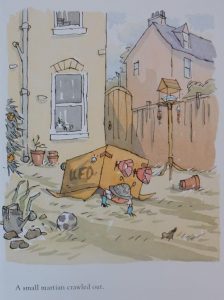
Not long after, the spaceship returns and out crawls a smallish martian …

come to explore “your sibilization” he tells Stanley’s brother, Will.
Their “leader” plays along with the martian thing and there follows a wonderful boundaries testing evening. Martians seemingly don’t wash their hands before meals, are unimpressed with earth food (other than ice cream) and definitely don’t have bedtimes. They don’t brush their teeth or wash before sleeping either and they always sleep in their helmets.

If there’s one thing that gets a martian’s temper flaring it’s being challenged about its identity and Stanley’s best pal, Josh is on the receiving end of a martian’s shove. This results in a morning spent sitting outside the head’s office contemplating his behaviour, something Dad learns of when he collects his offspring from school that afternoon.

When Mum returns in the evening, eager to hear how things have gone, a certain little martian decides there’s only one way to deal with the “Have you been a good little martian?” question … a return to base – of sorts.

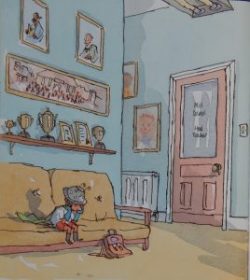
Simon James never fails to delight and this book is a cracker. The matter of fact, down-to-earth telling is pitch perfect when read aloud – the dialogue is simply superb. The illustrations reveal a space-obsessed little human with an inventive imagination and much else to contemplate and revel in.

I’ve signed the charter  

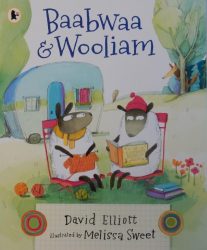
Baabwaa & Wooliam

Baabwaa & Wooliam
David Elliott and Melissa Sweet
Walker Books

Wooliam is a sheep – a sheep with a penchant for reading: how cool is that!
Baabwaa is also a sheep: she enjoys knitting – a more likely activity for a farm resident. These two are best friends. ‘Sounds kind of boring. But they like it.’ so we’re told.
One day the friends decide they should inject some adventure into their lives; so, it being perfect sunny weather with birds singing, off they set. However their field is surrounded by a wall; and circumambulating the field seems a rather dull kind of adventure. Nevertheless it’s what they do – three times. “Is this what adventures are like?” Baabwaaa asked. “All this walking, I mean.
It certainly leads to an appetite for grass and while they’re munching their lunch another sheep appears. Or is it? This particular one has a long tail, a whiskery snout, dirty wool coat and ‘horrid teeth’. A pathetic attempt at a sheep disguise methinks.
Suddenly the whole adventure gains pace.
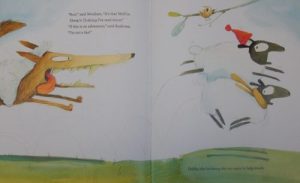
It’s that Wolf in Sheep’s Clothing I’ve read about,” says Wooliam knowingly,

producing a book he just happened to have in his rucksack, to prove it to the sheep/ wolf.
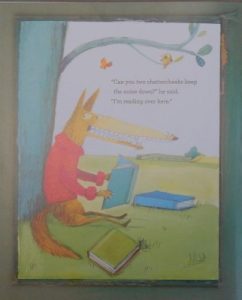
Woe is me! The lupine creature can’t read as he tearfully admits. “It’s not my fault, I’m just not the reading kind.” No matter: Wooliam can teach him and thus begins a highly unlikely friendship. Baabwaa meanwhile knits their new pal a replacement for his awfully dirty coat.
Learning to read is rather a protracted business, broken up as it is by bouts of wolf chasing sheep around the field.

He ‘s merely following his nature: “We can use the exercise,” is Baabwaa’s philosophical take on the interruptions. Eventually though, the wolf is sufficiently proficient to be horrified at the way he’s billed in books: ”It says here I’m cruel and sneaky!” he complains. “And your point?” said Wooliam. Deliciously droll humour such as that pervades Elliott’s entire comical narration, which is an absolute gift to readers aloud and an equal delight for those on the receiving end.
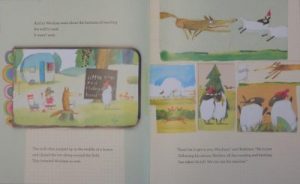
Equally brilliant are Melissa Sweet’s mixed media illustrations, which extend the telling and breathe additional vitality into the three players,

all of whom are a mix of opposing characteristics.
You can dine on this one over and over …

Alfie / Wakey, Wakey Elephant

Alfie
Thyra Heder
Abrams
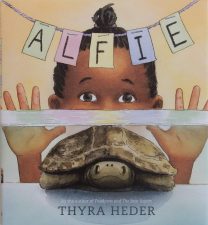
‘There are two sides to every story’ is an oft-used statement and so it is in this picture book. First we hear from six year old narrator Nia who receives a new pet, turtle Alfie on her birthday. She’s thrilled with the creature, introducing him to friends, making him presents, telling him stories and dancing and writing songs for him, all without anything by way of a response from Alfie. As time passes, Nia’s enthusiasm has waned considerably.
Come her seventh birthday; Alfie is conspicuous by his absence. Where has he gone?

Here the story turns and we hear from Alfie. He has after all appreciated her love and attention and wants to show Mia, by finding a present that will make her equally happy on their joint birthday.
Alfie’s quest for the perfect gift takes him outside for the first time in his life where he receives help first from dog, Toby, then from a snail and finally, after a long nap, from a fish.

It’s in the pond that Alfie eventually finds just the right thing and by the end of the book, there are two very happy celebrators of a birthday, albeit not the one Alfie thinks they’re celebrating.
Expressive watercolour scenes, punctuated by a single impactful, minimal black and white spread, combined with a spare, straightforward text, document this lovely story of appreciation and friendship.

Wakey, Wakey, Elephant!
Linda Ravin Lodding and Michael Robertson
Sterling

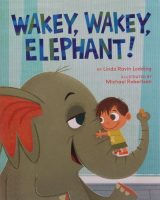
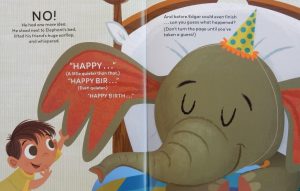
What do you do when your elephant friend simply refuses to wake from his slumbers no matter what you do? That’s the problem facing young Edgar.
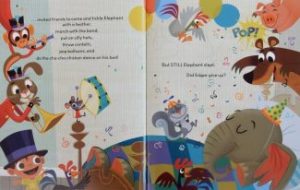
He’s tried the usual shouting and tickling neither of which caused so much as an eyelid twitch. A flock of roosters fails to rouse him, ditto a band marching right through his bedroom and a cha-cha chicken dance on the bed is similarly ineffective as are popping balloons and a particularly itchy party hat. (Young listeners will by now have guessed the reason Edgar is so eager to wake his pachyderm pal.) Even all these things done simultaneously  does not cause so much as a stirring from the slumberer.

Could a few softly spoken words in Elephant’s ear perhaps do the trick?

With its themes of friendship and perseverance, and its satisfying finale, this lively romp coupled with Robertson’s illustrations of exuberant activities taking place around the blissfully slumbering elephant, will illicit giggles from young listeners.

I Won’t Eat That

I Won’t Eat That
Christopher Silas Neal
Walker Books

There’s a delicious sting in the tail of this rather dark story of a cat’s search for an alternative to yucky, dry, dull cat food.
Tortoise, Fox, Chimp, Lion, Elephant

and Whale …

are all consulted on their diets but wiggly worms, bouncy rabbits,

bitey ants, stripy zebras and dry boring grass are decidedly uninviting for a fussy moggie, and Whale’s “bioluminescent phytoplankton” is simply weird, let alone unpronounceable.

Seemingly Mouse is similarly on the hunt for something tasty to eat and the innocent creature stops and consults Cat. Uh-oh! Finicky Cat suddenly turns eager predator.

Neal’s animals have a simple folktale look about them, which is perfectly in keeping with his cumulative textual style in this story that will be a winner with early years listeners; (mine demanded an immediate re-reading).
Equally the patterned nature of the text with its question and answer, built-in repetition format, is ideal for learner readers, once they’ve had the story read to them, of course. Here’s a taster: “Lion, please help. / I’m hungry and searching / for something yummy to eat that / doesn’t wiggle, / bounce, / or bite. // What does a lion eat?” “Zebras!” roared Lion, as he sprang after his striped prey. / “But I must warn you – “ …

A tasty tale indeed.

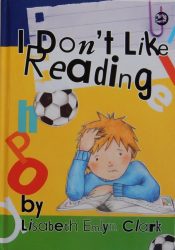
I Don’t Like Reading

I Don’t Like Reading
Lisabeth Emlyn Clark
Jessica Kingsley Publishers

Meet Harry: he likes lots of different things – drawing dinosaurs, playing football, climbing trees and playing with his friend, Tom; but if there’s one thing Harry doesn’t like, it’s reading. In fact he hates it. The words tend to make him feel dizzy; they might look so tiny he can barely see them, or huge and blurry.
Reading for Harry is total frustration and it’s worse because his little sister is always asking him to read to her.
Worst of all though, is having to read aloud at school. The mere thought of it gives him tummy ache so nervous is he.
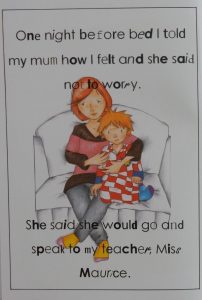
One night though, he tells his mum how he feels.

She speaks to his teacher and from then on, with a team of helpers including the special needs coordinator and an educational psychologist, together with some aids such as coloured acetate, and Harry’s own willingness to try hard, he realises that he can read and keep on improving.
‘Harry is a very clever young boy with a dyslexic profile,’ explains the letter his mum receives a few weeks later.
And then, gradually, read he does, especially to his sister.
Written by someone who was diagnosed with dyslexia in her late teens, this illustrated story, with its strategic use of different fonts gives a taster of what reading is like for Harry and perhaps for others with dyslexia. Harry however was lucky in that his issues were dealt with relatively quickly: not everyone is that fortunate. Children who have reading problems, whether or not they have a dyslexia diagnosis shouldn’t beat themselves up about it; rather they need to treat themselves kindly and not be afraid of asking for help; this little book will, I hope, help them do just that.
All our brains are different: we all need to follow different paths to become readers.

Explanatorium of Nature / Urban Jungle

Explanatorium of Nature
DK

This definitely isn’t a book to carry around in your school bag unless you want to do a bit of weight training; it’s an extremely heavy tome (more than 2Kg) with over 350 pages including contents, glossary and index.
Its conventional structure takes readers through ten sections starting with The Basics of Life, followed by a journey through living things from Microorganisms and Fungi right through to Mammals and taking in, by turn, Plants, Invertebrates, Fish, Amphibians, Reptiles, Birds, and finally, Habitats.
As you might expect, The Basics of Life covers the origins of life, reproduction, cells and how they work, DNA, evolution and classification, each being allocated a double spread.
Thereafter, each section is further broken down into one or two double page spreads per topic, ‘Algae’ for example or ‘How chemical defences work’, and includes a main photographic illustration and information surrounded by smaller pictures, labels and additional facts.
The photography is amazing and the book is packed with a great deal of fascinating information presented in a manner that makes the whole thing feel inviting without being overwhelming.

There’s even a superb die-cut cover.
It works well as a book to browse through or to seek specific information from, and would be great to give a budding young biologist.
One for the family bookshelf or school library.

Urban Jungle
Vicky Woodgate
Big Picture Press

My goodness, this is a large volume but it’s one animal lovers in particular will enjoy spending time exploring, along with author/illustrator, Vicky Woodgate, who is passionate about wildlife and travel. Herein she takes readers on a whistle-stop tour of 38 cities on six continents exploring the plethora of animals to be found there.
Each of the enticing city maps depicts fauna large and small, some commonly seen, others seldom sighted. Barcelona for instance has a wealth of birds – peregrine falcons in the bell tower of the Sagrada Familia for instance – something I’ve not appreciated in my numerous visits to the city and its environs.

I was however aware of the presence of leopards in Mumbai, another city I’ve visited on many occasions, although I’ve never seen a leopard roaming. I have though seen the three-striped palm squirrels whizzing around, and the beautiful purple-rumped sunbirds.

Most familiar to me is the rich variety of birds and animals in London and the suburbs that it’s all too easy to take for granted wandering through say, Richmond Park with its herds of deer and those pesky parakeets; or the red foxes that roam the streets looking for rodents, or rubbish bins to rummage. Then there are those majestic swans one frequently sees on the Thames; but I’ve never seen, or was even aware of there being a short-snouted seahorse living in its waters.
I found myself getting drawn into this stylish book, turning first to the 8 maps of the cities I’ve spend time in, and then going on to explore other urban jungles. I’m sure children will love browsing its expansive pages, enjoying the portraits of the animal residents of each city, as well as discovering the fascinating facts about them. An expert from each location has fact-checked the information to ensure that this walk on the wild side of the world’s busiest cities is accurate as well as exciting.

What Makes me a ME? / Words and Your Heart

What Makes me a ME?
Ben Faulks and David Tazzyman
Bloomsbury Children’s Books

Here’s a diverting book about identity: “What makes me a ME?” Who am I and where do I fit into this world? – these are questions that everyone ponders.
For the boy narrator it’s a mind-stretching poser as he acknowledges that at different times he’s like a whole range of things: sometimes he’s slow like a snail but he’s not slimy and his eyes don’t stand out on stalks.

He doesn’t have a tail so he can’t be exactly like his puppy Monty, despite being full of energy.
Is he perhaps like a sports car; he’s certainly lightning fast, but that’s thanks to his legs rather than wheels.

No matter what he likens himself to, essentially he’s just himself – special and unique.
Faulks’ funny rhyming stanzas documenting the five year old narrator’s search for an answer to his philosophical question provide Tazzyman plenty of space to conjure up some wonderfully comical scenes, and the boy himself with snub nose, specs and bobble hat is cheekily enchanting.

Words and Your Heart
Kate Jane Neal
Simon & Schuster Children’s Books

Words are powerful things: they can make your heart soar; they can make your heart sink; they can make your heart sing; they can make your heart hurt.
Words can be a force for good; or they can be a force for causing pain.
All this and more is demonstrated through characters Pip and Cat in author/illustrator Kate Jane Neal’s debut picture book.
‘This book is about your heart.
The little bit inside of you that makes you, you!’

So begins this unassuming book that goes on to say ‘the words that enter your ears can affect your heart.’
Her simple, but compelling message is a wonderful demonstration of how we can all contribute to making the world a better place by being mindful of the words we use to, and about, other people.

Executed with minimal colour, the illustrations, together with the empathetic and compassionate text that is orchestrated by means of changes of font, put forward a message too important to ignore.

A book to share and talk about at home, in playgroups and nursery settings, and in schools.

I’ve signed the charter  

The Real Boat

The Real Boat
Marina Aromshtam and Victoria Antolini
Templar Publishing

The little paper boat has ambitions – big ones. As he floats on the pond, he hears a duck talking of ‘real boats sailing on the ocean’ and decides that just like the other ‘real boats’, the ocean is the place to be. Prove himself he must by leaving the safety of his home surroundings and heading off into waters unknown.
Getting to his destination though, that is going to be tough. Many of the river boats whose help he seeks – the rowboat,

the motorboat, the riverboat and the barge – are singularly unhelpful.
The tugboat however is encouraging and assists him down to the harbour.
There the paper boat is mesmerised by the tall cranes,

the cars coming off the ferry and the lights of a huge passenger liner.
Further help and encouragement though, come from a fishing trawler in whose wake the tiny paper traveller follows as they venture further and further out on the ocean waves.
Then a fierce storm breaks battering the little paper boat and separating him from the friendly trawler. Is all lost for the intrepid journeyer?

Not quite: in fact all ends in a totally unexpected and highly satisfactory manner for the tenacious little adventurer.
From its brilliant cover you know you’re in for a real visual treat with this one: it’s wonderfully tactile and intricately detailed. Then there’s the number of pages: it’s twice as long as the usual picture book length, one of several I’ve seen of late; just the thing to snuggle up with and relish along with a hot chocolate on these long wintry evenings.
Lyrically told and with illustrations that are arresting and demand exploration for their artistry and technique, this modern fable is a thoroughly rewarding read.

The Bad Mood and The Stick

The Bad Mood and the Stick
Lemony Snicket and Matt Forsythe
Andersen Press

We all succumb to a bad mood from time to time and most of us know how contagious that can be.
So it is here with young Curly who chooses to take her storminess out on her younger brother, Napoleon, by poking him with a stick. That cheers her up but the bad mood is transferred to her mother and thence to carpenter Lou, who ends up in a dry cleaner’s shop.; but, Mrs Durham, the shop’s boss, confronted by the sight of Lou sans dungarees finds herself singularly unaffected by the bad mood

which in fact, sails right out the window and off around the world.
And the stick? It too has a contagious effect; but it is cheer that is slowly spread by the spiky object and, once colourfully clad, it takes pride of place for a while in the twisting narrative,

gaining ultimately, a life of its own and also, bringing into the tale, Bert, proprietor of the ice-cream parlour.
Snicket’s off-beat tale twists and turns in wonderful ways as it reveals a chain of surprises: there’s even a wedding attended by the entire cast of characters, human, animals and even – look carefully – a certain coloured blob …

Despite the prominent Bad Mood character, there’s a great sense of community about the whole thing, visually documented in Forsythe’s deliciously hued, retro-style illustrations of events large and not so large.
If you want a cure for a case of bad moodiness, this is absolutely perfect and even if you don’t, it’s a terrific read aloud for a wide range of audiences.

Stomp! Stomp! / Count on Goz / Night and Day

Stomp! Stomp!
Sebastien Braun
Nosy Crow
In this new addition to the ‘Can you say it too?’ board book series, a handful of dinosaurs have hidden, or rather attempted to hide themselves, in Sebastien Braun’s brightly illustrated spreads.
Very young children will get lots of pleasure manipulating the flaps (plants, a cloud and a rock) to discover what’s hiding beneath them, as well as getting their tongues around the names and noises.

Children beginning to read often find words such as ‘triceratops’, ‘diplodocus’, ‘stegosaurus’, ‘pterodactyl’ and ‘tyrannosaurus’ easy to recognise especially in a meaningful context, so why shouldn’t infants just starting to talk encounter them early on too, perhaps even with that older sibling reading the book with its short, predictable text, with them.

Count on Goz
Steve Weatherill
Steve Weatherill Books
Goz the baby goose has just taken his early morning swim but now he’s managed to lose the other geese. In his search he encounters in turn a cow and her calf, a sheep and 2 lambs, a mother cat and her 3 kittens and a dog with 4 lively puppies. To each he says, “Hello. Are the geese here?” but is greeted with “No, only me and my …” followed by a “Moo!”, “Baa, baa!” and so on …

until finally beside the big pond we spy …
Guess what is tucked in the nest beneath that large wing.
In addition to the baby animals revealed by opening the flap on each spread, the final page has 6 swallows, 7 sheep, 8 eggs, 9 newts and 10 tadpoles for those who want to continue their counting.
First published over 25 years ago, Goz has certainly stood the test of time. In addition to being a first counting book, this re-issue is, with its brief, predictable text, just right for beginning readers and far better than the rubbishy reading schemes offered to children starting to read in schools nowadays.
Equally it’s perfect to share with a small group of listeners in a nursery setting or an adult or older child to read to a younger sibling.

Night and Day
Julie Safirstein
Princeton Architectural Press
In ‘A Big Book of Opposites’, as the subtitle says, Safirstein uses simple shapes, clever design and bold colours together with flaps of various sizes, pop-ups, fold-outs and other interactive devices to help demonstrate opposing relationships such as tiny/ huge (and sizes in between); left/right – which has a secondary numerical element …

high/low; night/day – in this instance a large tree unfolds to illustrate both.
Circular sliders can be manipulated to demonstrate alone/together and next to/far (with ‘in the middle’ also included for good measure).
The whole thing is a handsome and inventive production …

and even the finale is ingenious; a gatefold is lifted to ‘open’ a bright red flower after which the book is ‘closed’ as printed on the back cover.
Once in their clutches, young users will I suspect spend a considerable amount of time with the book ‘open’, being reluctant to ‘close’ it, thoroughly enjoy playing with the various moveable parts so it’s as well the whole thing is sturdily constructed. It might even help them develop a few concepts while so doing.

The Elephant in the Room

The Elephant in the Room
James Thorp and Angus Mackinnon
Templar Publishing

‘It started with an “OOPS!” … and a “LOOK OUT!” and a CRASH!’

So begins this wonderfully eccentric mystery concerning the identity of the guilty party responsible for breaking Father Giant’s treasured china elephant.

The suspects are numerous: it could have been Olive or her brother, Grub – after all they are hiding in a cupboard when the elephant’s owner strides into the room issuing threats of the dire punishment he will dish out to the culprit.
Seemingly though they’re in the clear; but what about the naughty newt, the laughing lady with the golden boot,

the clipping clopping yucky yack? No? Surely it can’t have been Sophie Sofa, the sun or the storm; so who? It must have been someone; after all, the thing is lying in pieces on the floor, but will the case be solved?

The whole thing romps along in absolutely faultless rhyme – for me a cross between Spike Milligan and Edward Lear – to its splendidly satisfying, twisting finale that will cause listeners to wriggle in delight.

Those wacky illustrations of Mackinnon’s – wow! There’s a touch of Seuss about some of them …

and that innovative colour palette with its neon orange highlighting gives the whole thing a slightly hypnagogic feel.

I can’t wait to see what these two come up with next.

All the Way Home

All the Way Home
Debi Gliori
Bloomsbury Children’s Books

Little One, if you promise you’ll go to sleep, I’ll tell you a story. It’s so secret even your mama hasn’t heard it …
The tale this daddy penguin tells this is one: a kind of autobiographical snippet in a way. The Daddy Penguin is supposed to be looking after the egg while Mama Penguin is far away looking for fish but he wanders away from the Dad Huddle and together with the egg, is whisked up and away to the Arctic.
The creatures there are pretty scary-looking …

and decidedly unhelpful when it comes to giving directions back to the penguins’ home. Thank goodness then for one ‘hairy, sheltering thing’ that’s kind enough to carry penguin and egg to the northernmost place in the world,
Now as young children know, a very special person (here called the Special Air Navigation Transport Authority)  lives there, one who is more than willing to share the delicious feast he’s been rustling up with his visitors, the number of which suddenly increases during their stopover.

This same person is also willing to add a Daddy Penguin and his newly hatched chick to the load of parcels he has to deliver; and drop them off just in time for Mama Penguin’s return.

Gently told, full of tenderness and with enchanting illustrations: the perfect recipe for wintry seasonal sharing.

The Snowbear

The Snowbear
Sean Taylor and Claire Alexander
Words & Pictures

Two small children, a brother and sister wake to find that overnight their world has turned completely white. “Make a snowman if you want. But be careful because the hill is too steep and slippery,” is their mother’s warning as they sally forth into the great outdoors.
Slips and slides are inevitable and a snowman, of sorts is duly built, although they decide their creation looks more like a snowbear.
Having completed their chilly enterprise, the children take to their sledge and go hurtling downhill, faces a-tingle, towards the woods.

Eventually they come to a halt and decide home is where they now most want to be. But the climb is steep and there’s something watching them from between the trees.

Suddenly they hear a sound. Could it be that something or someone is coming to their rescue in that chilly white wood?
It is and it does.

Next morning though, the sun has melted their snowbear right away; at least that’s Martina’s suggestion. Iggy puts forward an alternative. “… he could have gone back in the woods and he’s alive down there.” I wonder …
A lovely wintry tale with just a frisson of fear, and an acknowledgement of the boundless imaginations of young children. This is, I think a new author/artist collaboration: in her eloquent, soft focus illustrations, Claire Alexander brings out the drama of Sean Taylor’s deliberately understated narrative, as well as showing young children’s ability to immerse themselves completely in the here and now.

Imagination Rules: The Magical Ice Palace & Daddy and I

The Magical Ice Palace
Suzanne Smith, Lindsay Taylor and Marnie Maurri
Simon & Schuster Children’s Books

A flight on a gigantic magical snowflake,

a hairy mammoth prince stranded atop a mountain, a dramatic rescue involving an enormous bunch of balloons,

a beautiful palace …

a birthday party and a snow globe: yes Doodle Girl, is back with her magic pencil, of course, and her friends, for another amazing adventure. And it all begins with Doodle Girl’s discovery of a ‘curly CURVY SHAPE’ as she’s skipping through the sketchbook.
Even when the rescue has finally been effected there’s still the problem of a distinct lack of one absolutely vital ingredient for a topping birthday party –the cake. Can Doodle Girl wield her magic pencil one more time and make the Mammoth Prince’s celebration a truly royal occasion complete with cake and candles?
If you’ve not yet made the acquaintance of the wonderfully imaginative heroine, Doodle Girl, I urge you to do so now: she resides in a big red sketchbook and as soon as she so much as whispers the words, “Draw, draw, draw …” amazing adventures start to happen.
Deliciously quirky illustrations, whimsical characters and a sparkling wintry tale add up to another winning flight of fancy for Doodle Girl’s three creators; and there’s a bonus giant doodling poster inside the back cover.

Daddy and I
Lou Treleaven and Sophie Burrows
Maverick Arts Publishing

Saturday is ‘Daddy day’ for the little girl narrator and here she tells of a walk they take together; and what a wonderfully memorable Saturday that particular one turns out to be.
As they set out down the lane, not only is our narrator full of excitement, but her imagination is in full flow too as the pair become first, jungle explorers;

then grass snakes slithering through a field, followed by mountain climbers and cloud watchers.
Next comes a game of ‘Pooh sticks’, (they manage to pack so much into their day),

followed by a foray into the woods; but then there’s a storm and it’s time to make a run for it … all the way back to the dry.

This rhyming celebration of a special bond between father and daughter is beautifully told.
Sophie Burrows has picked up Lou Treleaven’s tuneful text embellishing the everyday sights of their country walk with scenes drawn from the child narrator’s imagination depicting a world where fact and fantasy meet.

Cap’n Rex & His Clever Crew / Pirates in Classroom 3

Cap’n Rex & His Clever Crew
Harry L. Herz and Benjamin Schipper
Sterling

Shiver me timbers, I cannot imagine how many crews of piratical dinosaurs there be a’sailin’ the high seas, however here’s one more to add to their number. Meet Pat, Terry, Kyle and of course, their captain, Rex. A right troublesome journey it is they’ve embarked upon too.
First the ship’s rudder becomes fodder for a giant shark; then down comes a fog and having survived those mishaps thanks to some clever steering on Pat’s behalf …

and Terry’s navigation skills they find themselves on dry iand and faced with a volcano at the bottom of which, the treasure might just be buried.
And buried it is but having unearthed same, there follows the question of ownership of the booty. Cap’n Rex doesn’t want to share: his crew think otherwise and let him know in no uncertain terms …

Who is cleverer, Cap’n or crew: that’s the vital question?
With its pepperings of “Arrr“, “Aye” and “can’t ye?”, this is a fun read aloud with plenty of silliness, a bounty of comical illustrations and a final author’s note of piratical words just a few of which come up in the narrative.

Pirates in Classroom 3
Alison Donald and Ben Whitehouse
Maverick Arts Publishing

Still those pirate tales keep on coming; here’s one that starts off in a class of lively children.
When Ms Bitsy leaves her classroom unattended, the children are more than a little surprised by the sudden appearance of Captain Calamity who claims to be searching for treasure; treasure which according to his map is located ‘under the sea’ in their classroom.
The children are eager to help in the search …

but can they locate the booty before the dreaded Pirate Bloodloss gets his hands on it?
Perhaps the clue is in the alphabet frieze, there’s certainly a C there.
Before you can say, ‘Ms. Bitsy’, their teacher has returned and is ready to join them all in an underwater hunt.

A teacher who throws herself into a piratical adventure and is willing to stand up to a bullying pirate will surely win over early years listeners.

Dinosaurs and Other Prehistoric Creatures / Atlas of Dinosaur Adventures

Dinosaurs and Other Prehistoric Creatures
Matt Sewell
Pavilion Books

Of the 1,000 dinosaur species that have already been identified, (so we’re told in the introduction) some fifty grace the pages of this beautifully illustrated book by wildlife author and artist Matt Sewell.
In a note about his illustrations Sewell reminds readers that rather than imagining them as big lizards with muddy-brown or dull green scales, palaeontologists now think that many dinosaurs may have been colourful creatures, some even feathered,. This is reflected in his illustrations herein. Did you know for instance that Yutyrannus, a relation of Tyrannosaurus rex, discovered in 2012 had a complete covering of feathers?

Accompanying each one is a paragraph or two of factual information into which the author injects not only occasional surprises but gentle humour too.
I was fascinated to learn that the ‘teenage’ Pachycephalosaurus, termed ‘Stygimoloch’ aka ‘the horned devil from the river of death’ lost its horns in adulthood.

Splendid to look at – I love the large images set against a plain white background – and likely to have a wide age appeal.

Atlas of Dinosaur Adventures
Emily Hawkins and Lucy Letherland
Wide Eyed Editions

This enormous volume – a veritable prehistoric journey of discovery – comes from the team behind Atlas of Adventures.
Herein, through a series of maps

and large colourful dino-inhabited scenes, readers are taken, one continent after another, on a world tour of the various different land regions over different eras, up to the late Cretaceous period when the creatures died out. This was due, it’s thought, to a massive meteorite colliding with Earth resulting in mass extinction that effectively ‘wiped out most of life on Earth.’
Thirty-one dinosaurs (or prehistoric reptiles) are featured (frequently hunter and hunted) but many others are also named and given brief descriptions in the richly coloured scenes within which they’re shown.

Various aspects of dinosaur life, including birth, learning to fly (that’s baby Pteranodons – ‘cousins of the dinosaurs’), to being killed by predators are included and each spread, in addition to the large descriptive paragraph, and the mini info-bank for each creature featured, is littered with relevant, and often memorable, facts. What child is likely to forget that ‘the ‘massive droppings of T-Rex were as long as a human arm and weighed the same as a 6-month-old baby’?
I’m less keen though on some of the visual humour. For instance the Leaellynasaurus (Australian) sporting a striped scarf and bobble hat; or the Oviraptors in what is now Mongolia, wielding what looks like a butterfly net, while perhaps appealing to dinosaur-mad children, to me seemed a tad too frivolous.
Nonetheless, this is a bumper feast of dino-info. and a novel way of presenting same. It’s likely to appeal widely: I certainly learned a fair bit from it.

Daydreams and Night Dreams

When I Grow Up
Tim Minchin and Steve Antony
Scholastic

Inspired by Tim Minchin’s song of the same name from Matilda the Musical, this book takes a (mostly) light-hearted look from a child’s viewpoint, at what it’s like to be an adult.
Of course, you’ll need to know the answers to a great many questions and that means being smart.
But think of being able to ‘eat sweets every day’,

‘go to bed late every night’, get up with the sun and watch endless cartoons without a care.
Life isn’t all roses though; there are heavy things to ‘haul around’ and creatures that lurk beneath the bed to fight with.

But all that’s offset by daily treats, playful opportunities in abundance …

and days spent lying in the sun without damaging the skin – we wish!
Is that what we grown-ups really do? Hmm …
Steve Antony surely has made adulthood look like a ball, even the less desirable activities; and those young narrators of his are boundless energy personified.

One Moonlit Night
Zanna Davidson and Seo Kim
Templar Publishing

Through a prose poem and amazing pop-ups we share in a little girl’s magical dream of an amazing adventure wherein she flies through the star-filled sky aback a dragon, encountering three-headed giants, trolls and ogres …

before, swathed in clouds, invoking her very own dragon spell.
Magical pop-out scenes of a journey through swirling waters and inky skies make for a wondrous, just before bedtime book to share.

Horses: Wild & Tame / Home Sweet Home

Horses: Wild & Tame
Iris Volant and Jarom Vogel
Flying Eye Books

My experience of and with horses is decidedly limited, or so I’ve always thought. Certainly my only riding experience was when  aged about twelve, I had gone to find my best friend who lived round the corner in a suburban road like mine. She wasn’t in but suddenly appeared round the corner on horseback. She dismounted and insisted I took her place. Now, never having ridden before I was reluctant but let her persuade me with ‘It’ll be fine, he only goes slowly.’ Next thing I knew the creature had taken off and was, so it felt, bolting up the road while I slid ungracefully down its back and off into the road, landing on my rear.
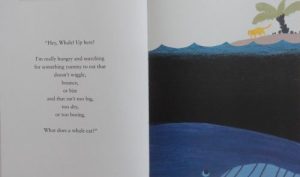
Having read the Horse Character page in this book however, I can look back and consider the character of that creature: was it a cold blood, a hot blood or a warmblood?
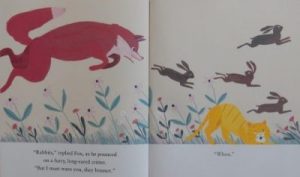
From Volant’s description it certainly wasn’t the first, and was most likely the last ‘strong and agile … perfect for riding’, despite thinking the best fit was ‘hotbloods … bold, spirited character’.
Flicking randomly through, I came across other spreads that particularly resonated. There’s one featuring Black Beauty, Anna Sewell’s classic novel; a book I loved as a voracious child reader. That story, as we’re reminded here, ‘encouraged people to be kinder towards horses, leading to many new laws in England and America’ concerned with the protection of horses.
However, it was the Royal Steed spread that came as an exciting surprise. It tells how in 1576 during the Battle of Haldighati, Rajput warriors made false trunks for their horses to wear, thus confusing the elephants ridden by their Mughal enemies so that they wouldn’t attack what looked to them like baby elephants. We also hear how Chetak, the badly injured horse belonging to the Rajput ruler carried his master to safety.

I’ve visited Haldighati on more than one occasion on trips to India and during my annual holidays in Udaipur am frequently reminded of the creature by an imposing statue of that particular horse in the centre of a roundabout in Udaipur city, aptly named Chetak Circle.
Author, Iris Volant, goes way back further than that though, right to horse evolution. Indeed there’s probably something for everyone in this fascinating book that has artistic references, literary ones, horses in legend, war horses, work horses, horses in sport and more. How fortunate that its illustrator, Jarom Vogel, decided to become an artist rather than pursuing his studies as a dentist; he’s certainly done these beasts proud.

Home Sweet Home
Mia Cassany and Paula Blumen
Frances Lincoln Children’s Books

Both author and illustrator of this book come from one of my favourite cities, Barcelona. We’re given a look at different homes from around the world from the viewpoint of the pets, mostly dogs and cats, with the occasional bird and even a tortoise, that live in them.
Readers can discover what it’s like to live in say, a waterside house in a Netherlands village;

a tiny apartment in Hong Kong, China; a cabin with a roof of grass in Iceland or a townhouse by the Thames in London.

Cleverly conceived with the animal narrators, in addition to what we’re told in the text, there’s a great deal of visual information about each of the homes and lifestyles packed into every one of the locations we visit. Every one is made to look exciting:

where would you choose to live?
A stylish and fascinating addition to a primary classroom library or topic box.

Rooster Wore Skinny jeans

Rooster Wore Skinny Jeans
Jessie Miller and Barbara Bakos
Maverick Arts Publishing

Be yourself and if that means wearing skinny jeans that make you the butt of jokes from your farmyard friends then so be it.

That’s the conclusion the resident rooster of Rosemary Mill farm comes to after strutting his stuff in his newly delivered denims with their gold stitching, and being on the receiving end of the other animals’ cutting comments.

Having run for cover and taken stock of himself in his skinnies,

the rooster decides to cock a snook at those micky takers – with surprising results.

Jessie Miller’s unfaltering rhyme rollicks along with a sparkle to match the stitching on Rooster’s jeans and if my audiences’ reactions are anything to go by, she has a winner here.

Exuberantly executed scenes of the rooster hero sporting his new purchase brought on fits of giggles from my listeners, young

and not so young; and I suspect adult readers aloud will be rushing to the nearest mirror in their skinnies to see how their rear view compares with fashionista, Rooster’s.