Forever or a Day

Forever or a Day
Sarah Jacoby
Chronicle Books

Sarah Jacoby explores the passage and power of time in a profoundly beautiful picture book meditation that takes the form of a conversational narrative.

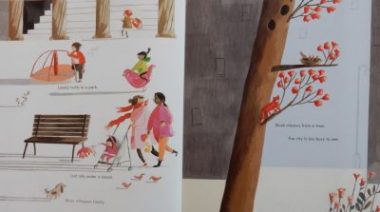
The whole thing begins with a Times newspaper van moving through the streets as day begins to dawn watched perhaps by the child on the opposite page through whose eyes we then see a sequence of scenes of family life, some slow, others hurried …

or even frenetic seeming, but each one frozen in time in Jacoby’s watercolour spreads of commuters, a holiday train journey, a car ride to visit grandparents in the countryside.

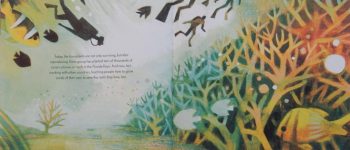
All the while the accompanying text is gently nudging the reader to think deeply about the passage of time: ‘It can be precise, like pouring the first cup of tea’;

‘Sometimes it’s far, far away – like when you will be old, gazing out at the sea.’

Time can be illusive as here: ‘The more you try to hold it … the better it hides. Where does it go?’ accompanies this sand-castle building sequence .

By now day has given way to night: the family gathers for a sing-song around a campfire but after a fond farewell “You cannot hold it. … We’ve only got what we’ve got.” it’s a night train ride back to the city with its glowing lights

and a final benevolent ‘I love the time I have with you.’

The questions Jacoby poses are profound, though simply asked; and it’s her elegant watercolour spreads that do much of the talking, sometimes surprising and amusing as with the Tyrolean-looking hikers who appear in some of the scenes.

This is a book to share, to ponder over, to talk about, to speculate upon (it’s certainly one for a community of enquiry style discussion) and to savour, and unlike time, to hold on to.

Introducing Art to Children – Anna and Johanna & A Journey Through Art: A Global Journey

Anna and Johanna
Géraldine Elschner and Florence Kœnig
Prestel

It’s 12th October 1666 and we’re in the city of Delft where two girls are busy working. One is Anna, the daughter of the well-to-do master of the house; the other is Anna’s maid and co-incidentally they both share the same birthday. Each girl is creating something special for the other in celebration of the day.

For her friend, Johanna, Anna is fashioning a lace collar just like her own, which she knows her friend likes a lot.
In the kitchen Johanna is cooking a special birthday breakfast mousse as a treat for her friend Anna. It’s a breakfast fit for a queen.

But why are they such close friends and why do they share a birthday? Is it co-incidence or something much deeper?

When the girls meet and exchange their gifts, they discover something intended for both of them – a letter addressed simply ‘For your birthday’, which begins, ‘Dear children’ – a letter from Anna’s father telling of an incident that had occurred exactly twelve years earlier and disclosing a secret that he’s been keeping ever since.

Inspired by two of 17th century Dutch painter, Jan Vermeer’s greatest works of art, The Lacemaker and The Milkmaid Géraldine Elschner has crafted a story of friendship and more that reflect the painter’s impressions of domestic life.

Equally evocative of Vermeer’s style are Florence Koenig’s acrylic paintings executed predominantly in subtle blue, yellow, brown and orange hues of the Dutch city’s landscapes and scenes of domesticity.

There are many ways to interest children in art and artists: this lovely tale of friendship and devotion offers an unusual introduction for young readers to Vermeer’s art.

 Journey Through Art: A Global History
Aaron Rosen, illustrated by Lucy Dalzell
Thames & Hudson

Aaron Rosen takes readers on a journey through time and place to visit some thirty locations as he tells how the art and architecture of different cultures developed.
The tour, which travels to four continents, begins in northern Australia at Nawarla Gabarnmung in 35,000 BCE where we see prehistoric petroglyphs.

The next location is the city of Thebes 1250 BCE and then on to Nineveh 700 BCE, followed by more cities – almost all sites visited are cities – and thereafter to the site of a Buddhist monastery hidden in caves at Ajanta in Central India. Those caves contain some amazing sculptures and the oldest surviving paintings in India, done by the Buddhist monks who lived there around 500BCE.

All the locations thus far are included in the first of the three sections entitled Prehistoric and Ancient Art and next comes Medieval and Early Modern Art that encompasses Granada, Florence, the 16th century town of Timbuktu, 1650 Amsterdam where we find the first mention of a woman artist, Judith Leyster who was celebrated for her paintings of musicians.

The final Modern and Contemporary section includes a stop at 1825 Haida Gwaii to view the Northwest Pacific woodcarvings, one of the few non-urban destinations.

At every stop Rosen begins with a spread giving an overview of the site and a painting by Lucy Dazell; following this is another spread comprising information about the culture/customs together with small photos of significant artefacts, paintings and monuments together with printed notes.
The journey terminates at Rio de Janiero where the 2016 Olympic Games took place and thereafter are notes about visiting museums and art galleries and a glossary.

A whistle-stop tour indeed and one that might leave you feeling somewhat breathless but equally one hopes, hungry to find out more about the art of some of the places visited.

Creative Manipulations – Nature Origami & From Morning to Night

Nature Origami
Clover Robin
Nosy Crow

You’re in for hours of pleasure from this origami book published in collaboration with the National Trust. Containing thirteen nature inspired things to make from shells to squirrels and snails, and minnows to moths and mice, each one is allocated a double spread with a beautiful illustration by Clover Robinson on the verso while the recto has concise step-by-step instructions prefaced by a short poem by poets including Emily Dickinson, Christina Rosetta, Lilian McCrea, Kenneth Grahame

and William Wordsworth.
The back part of the book is a pad of 50 sheets patterned on one side, plain on the other, which are the ideal size and weight for the projects.
Each of the projects is graded, there being a mix of each of the three levels of difficulty, the third level requiring considerable dexterity, not to mention a degree of patience.
If you scan the QR code inside the book you will be able to link to ‘how to’ videos for each object.

From Morning to Night
Flavia Ruotolo
Princeton Architectural Press

Flavia Ruotolo has a design background which she uses to great effect in this little book that plays with line, colour and form, creating sixteen pairs of objects manipulating the elements of the ordinary one to fashion something new.
She uses just two complementary colours to play with so that for instance a morning meal becomes a magic mushroom …

an orange becomes a planet, a piano is transformed into a robot toy and an open book morphs into a pair of adjacent beds.

It’s easy to see the visual relationships between the pairs but imagination is required to link for example, an orange segment on a plate with a crescent moon in orbit around a planet.
I’m all for books that help in the development of the imagination: this one certainly does that in a playful way and at the same time offers plenty of opportunities for storying. It might also encourage readers to try their own creative manipulations.

Wild World, The Coral Kingdom and Who’s Hiding on the River? / Who’s Hiding on the Farm?

Wild World
Angela McAllister, Hvass & Hannibal
Wide Eyed Editions

The author has chosen thirteen natural habitats – Rainforest, Arctic, Prairie, Woodland, Coral reef, Desert, Rock pool, Mountain, The Outback, Moorland, Deep sea, Mangrove and Savannah – that are under threat due to human activity, and captures the essence of each one in a series of free verses.
Here’s the opening to Mountain:
‘I am the highest mountain, / Born in a collision of continents. / All is beneath me, except the sun, moon and stars. / I am rock, / Crag, cliff and ledge, draped in veils of white. / I am snow-maker, with glaciers in my arms, / Whose meltwater swells great rivers below.’

In stark contrast is the quieter sounding Savannah, which opens like this: ‘Savannah speaks in whispering grasses, / In the chatter of cicadas across an endless plain. / Spacious homeland of swift cheetah / And gazelle, with the horizon in her eye.’

Using matte colours, the illustrators Hvass and Hannibal showcase the flora and fauna of each location in a series of eye-catching paintings that incorporate the text within them.

Human use, climate change and pollution are responsible for the damage to the environment and after her introductory poem, it’s not until the final pages that the author enlarges upon her conservation message citing the specific damage within the thumbnail sketch of each of the places portrayed. Thereafter she implores readers to use less energy, to recycle and to buy with care.

We’d all do well to keep in mind her final words about our precious planet: ‘Explore it, protect it, love it. / Our Earth is a wonderful wild world. ‘

Also with an ecological message is:

The Coral Kingdom
Laura Knowles and Jennie Webber
Words & Pictures

Our coral reefs, with their gorgeous colours: crimson, red, rose, yellow,

turquoise, emerald, jade, purple, even black, that have taken 1000s of years to grow and give home to a myriad of creatures large and small are under threat.

When the coral is bleached white due to acidity caused by climate change, and stays white for too long, then the reef dies.

Laura Knowles has written a rhyming narrative that outlines the life cycle of a reef and includes a caution that unless we humans take action these amazing ecosystems will be lost forever.

Jennie Webber’s detailed watercolour illustrations show the beauty of the undersea habitat and a final fold-out page gives additional information about coral reef conservation.

A useful addition to a primary school conservation topic box, or, for a child interested in ocean life or ecosystems.

Who’s Hiding on the River? / Who’s Hiding on the Farm?
Katharine McEwen
Nosy Crow

It’s never too early to start learning about nature and here are two board books just right for introducing animals, some wild and some domesticated, to the very young.

Both are beautifully illustrated by Katharine McEwen and there are lots of animals to find in both locations.

Toddlers can spend a day by the river, from a busy morning through to night-time as they explore the pages, manipulate the sturdy flaps in response to the ‘Who’s hiding here?’ on every right hand page to discover tadpoles, cygnets, fish, dragonflies, a stoat, a beaver and more as they swim, wriggle, wade, leap, build and paddle.
The farm book also moves through the day in similar fashion and McEwen’s text is carefully worded to introduce new vocabulary including ‘pecking,’ ‘trotting’, ‘snoozing’ ‘prowling’, munching’ and ‘diving’ along the way.

Published in collaboration with the National Trust these are fun and at the same time, gently educational.

Not Just a Book / A Couch for Llama

Not Just a Book
Jeanne Willis and Tony Ross
Andersen Press

A book is for reading, yes certainly, but according to Jeanne Willis and Tony Ross’s latest offering, books can sometimes be so much more.
On occasion they might serve as hats, or make a tent for a cat, prevent a table from wobbling. A book makes a good tunnel for your toy train, can become an extra block for building with,

even perhaps a flower press.
This multi-purpose object is the perfect fly-swatter …

or protector of your drink from marauding wasps.

More important though than any of these additional uses, and that’s the real message herein, books have the power to affect how you feel;

to help you go to sleep, to educate; the best are never forgotten and best of all, a book is something to read and love …

Silly? Yes, Fun? Yes.

Jeanne Willis’s brief rhyming text and Tony Ross’s wonderful illustrations – look out for the mischievous cat on every page – make for an enjoyable and playful message about the importance of books.

A Couch for Llama
Leah Gilbert
Sterling

The Lago family absolutely love their old couch: it’s been the site of many good together times but now a new one is much needed. Off they go in the car to the furniture shop where they find the perfect replacement.

On the way home however, something happens that results in their new item of furniture ending up in Llama’s field. Llama is by nature a curious creature and so he starts to investigate this new arrival. He sniffs it, greets it and even tries sharing his lunch with it but none of these moves elicits any response. Llama tries lunching on the couch instead but it tastes awful and it’s too heavy to move.
The couch is useless, is his conclusion so Llama decides to ignore the object.
This unsurprisingly becomes exceedingly boring and so the exasperated animal leaps onto it and suddenly comes understanding …

By this time the owners of his new lounger have returned to claim their lost item but Llama refuses to budge. There’s only one option that will work for one and all: now what might that be? …
In her debut picture book Leah Gilbert mixes the realistic and the ridiculous with just the right degree of each for the story to work, but the real strength is in her visuals: in particular the scenes of Llama and his couch encounters are hilarious.

Stewart’s Tree

Stewart’s Tree
Cathy Campbell
Jessica Kingsley Publishers

Subtitled ‘A book for Brothers and Sisters When a Baby Dies Shortly after Birth’, this little picture book is intended to help explain sibling loss to young children.

Ellen has been waiting for a new baby – ‘something special’ but her new brother Stewart is very weak and never makes it back home. He’s been ‘lost’ is how her Granny puts it.

Ellen searches all over the house for Stewart even in the washing machine,

wondering perhaps, if he’s gone to the moon in his spaceship.

Her parents then help her to understand the new baby has died and isn’t going to come back.

Together they plant a cherry tree for Stewart, so they will always have a special place to remember him.

The book concludes with a guide to bereavement aimed at adults, written by qualified clinicians; this includes some suggested activities.

Sensitively told and illustrated, with gentle touches of humour, this is a book that one hopes few people will have need of, but it could prove invaluable to those families unfortunate enough to suffer such a bereavement. Schools, nurseries and children’s centres should certainly keep a copy on their shelves.

Picture Book Poetry: One Upon A Star and Nature’s Lullaby Fills the Night

Once Upon a Star
James Carter and Mar Hernández
Caterpillar Books

Here’s an opportunity to go on an amazing journey without moving from the comfort of your own sofa, courtesy of poet James Carter and illustrator Mar Hernández who take us on an awesome ‘poetry and art meet science’ trip through time and space with a focus on our Sun.
First we head back through history before this happened …

And after a long slow cooling period: ‘A sea of stars at last were born / gradually they fired and formed / out of clouds of dust and gas / each a mighty sparky mass / and one of these became our Sun / our solar system had begun!’
Thereafter Carter’s compelling narrative verse touches upon the growth of our planets, in particular the Earth with its oceans and amazing life forms that rely upon the sun for their continuing existence. His final focus is each one of us, unique individuals – stars and stardust every one.

James Carter’s lucid poetic account of these awesome events, when integrated with Mar Hernández’s dramatic artwork, makes an exciting and impactful book.

Much more down to earth is:

Nature’s Lullaby Fills the Night
Dee Leone and Bali Engel
Sterling
The sun is gone; the moon is out: bedtime is nigh.
The author draws listeners into a nocturnal world of fluttering moths, spinning spiders, chirping crickets, flowers closing their petals, floating seeds and swaying willow branches;

past moonlit lakes,

and down to the sea where dolphins cease their leaping and oysters shimmer from the depths, towards farmlands where the animals are beginning to slumber; through a forest and finally into a child’s bedroom with the repeated refrain, ‘Nature’s lullaby fills the night’ punctuating every sequence.

With her gentle, soporific verses Dee Leone transports little ones towards sleep. In tandem with Bali Engel’s tranquil scenes of the bedtime rituals of parent animals, large and small in their natural settings executed in a colour palette of dark blues, purples and greens creates, we have an engaging, calm-inducing bedtime book for little ones.

Distinctly Different Chapter Books – Fabio: The Case of the Missing Hippo & Akissi: Tales of Mischief

Fabio: The Case of the Missing Hippo
Laura James, illustrated by Emily Fox
Bloomsbury Children’s Books

Resident of a small town on the banks of Lake Laloozee lives Fabio the world’s greatest flamingo detective: slender, pink and extremely clever.

When Fabio and his associate Gilbert the giraffe stop at the Hotel Royale for a cool glass of pink lemonade,

he allows himself to be persuaded to head judge the hotel’s talent competition, a competition intended to boost its business.

Disaster strikes however when Julia, the jazz-singing hippo and most promising of the contestants, takes to the stage and as she does so, the lights go out and Julia goes missing.

The police are called but it’s time for Fabio to put that thinking cap of his back on, hone his questioning skills and set about solving the mystery and one or two more that crop up along the way.

Delicious comic humour that will delight young readers and listeners, day-glo greens and pinks to dazzle in Emily Fox’s delicious illustrations and a layout that’s just right for newly confident readers, this comedy cum mystery looks – just like Julia – set fair to captivate its audience.

Akissi: Tales of Mischief
Marguerite Abouet and Mathieu Sapin
Flying Eye Books

This bumper graphic novel style edition contains 21 episodes featuring Akissi, a little girl who lives in a town on the Ivory Coast. This spirited miss is supremely self- confident and frequently finds herself getting into trouble for misdemeanours often involving her brother Fofana or her friends.

Her far from exemplary behaviour finds her engaging in such activities as ‘borrowing’ a neighbour’s baby for a game of “mums”; adopting as a pet a mouse that causes all manner of problems; barging her way into the boys’ football games and generally getting into fights and scraps.

During the course of all these mischievous scenarios and more, readers learn not only about the main protagonist, but also about her family and her life – in one story she gets tapeworm; another describes her being responsible for her nan getting knocked out by a falling coconut; there’s also a ‘head-lice’ episode and toilet humour too.

And if your stomach is feeling up to it, there are a couple of bonus recipes courtesy of Akissi, as well as instructions for hair braiding African style.

A comic book hero who could surely give Dennis the Menace a run for his money – memorable and for many I suspect, irresistible.

I’ve signed the charter  

Great Bunny Bakes

Great Bunny Bakes
Ellie Snowdon
Simon & Schuster Children’s Books

Always on the lookout for exciting debut picture books I was thrilled to receive this mouth-watering one by exciting new author/ illustrator, Ellie Snowdon whose illustrations are a real treat – every one of them full of hilarious detail.

Meet grey wolf Quentin with an unusual hobby: he loves to bake: buns, biscuits, fondant fancies and especially chocolate cake. Hmmm!
There’s a problem however; Quentin has nobody to share these yummy confections with.

Unexpectedly though, everything changes when he accidentally receives an invitation to participate in A Bunny Bake-Off.
Time for a spot of subterfuge thinks Quentin.…

Cleverly disguising his facial features he manages to get into the competitors’ tent where he sets about the five challenges.
With top marks in the first event, Quentin looks well set to secure the trophy although one of the other participants is determined to sabotage his chances.

Quentin continues gallantly but there are more dirty tricks, and as he makes his way to the judging table with his final offering, Quentin slips and …

Will all his efforts now be in vain? Fortunately not; in fact our lupine contestant ends up being on the receiving end of a double dose of good fortune.

Ellie Snowdon’s tasty tale of baking, bunnies, fairness and friendship will delight and amuse.

A Bear is a Bear

A Bear is a Bear (except when he’s not)
Karl Newson and Anuska Allepuz
Nosy Crow

The adorable looking bear in this book appears to be suffering from amnesia as to his true animal form, brought about by forgetting that come December he’s supposed to be snuggled down inside his cave for the long winter hibernation.

Instead the ursine creature is bumbling around pondering possibilities: might he perhaps be a bird …

Oops no! He can’t fly and as for fitting in the nest – forget it!

If not that, then maybe … a moose? Lack of antlers and an aversion to dry grass quickly put paid to that notion.
What about a dancing prancing fox or even a squirrel? Those don’t feel quite right either.
Stuck up in a tree, bear ponders: “I’m not a squirrel – /they climb too high. // I’m not a fox – / but I gave it a try. // I’m not a moose – / I don’t know why. // And I’m not a bird. / I cannot fly. // So what, oh what / on earth am I?

As snowflakes whirl around his head that Bear should really be in bed, especially as he is now suffering a bad attack of the grumps to go with his memory loss.

Suddenly realisation dawns … and off he goes to sleep till spring. Sweet dreams! Spring isn’t too far away.

Now, look who’s come a knocking to greet their friend …

BEAR!
Karl’s rhyming text takes the form of Bear’s internal monologue as he wanders hither and thither in his state of forgetfulness, and with its repeat refrain and cumulative structure, it’s a great ‘join in with’ read aloud.

To render her mixed media scenes of the increasingly wintry forest and its animal inhabitants, Anuska Alleppuz has used a carefully considered, beautifully textured palette that really makes readers feel they’re with Bear every step of his journey – the highs and the lows – both physical and mental.

Kaya’s Heart Song

Kaya’s Heart Song
Diwa Tharan Sanders and Nerina Canzi
Lantana Publishing

From the cover illustration it’s evident that the little girl – her name is Kaya and she lives in the Malaysian rainforest– is truly savouring the moment.

As the story begins Kaya observes her mother sitting yoga style and humming. “Mama, what are you singing?” Kaya wants to know.

Her mother explains that it’s her heart song and that having a heart song makes anything possible. Kaya’s response is that she doesn’t know hers: her Mama encourages her to learn to listen for it and sends her daughter off to play outdoors.

Maya follows a butterfly into the jungle and it leads her to an unfamiliar spot but there she discovers someone who is familiar – her friend Pak.

Pak is the guardian of a gate behind which, nestling among thick foliage, is a broken elephant carousel.

Intrigued, Kaya decides to investigate and as she untangles the vines from around one of the elephants her mind begins to quieten and become still. A soft rhythmic beat sounds in her ear as with a Boom taktak boom taktak boom / Shick shak shook / Boom taktak boom taktak boom / Shick shack shook’ the carousel begins to rotate and the elephants move in time with the music.

Suddenly Kaya understands that she has found her own heart song and then, just as her mama had told her, magic happens …

Grounded in the practice of mindfulness – being fully in the present moment – this is a truly mesmerising picture book.

With a lush colour palette Nerina Canzi depicts Kaya’s magical world, creating a truly immersive place both for the main protagonist and for the reader. Her spreads work in perfect harmony with the author’s words and to lose yourself between the covers of the book is to be, like Kaya, in the here and now throughout the experience.

The final page explains simply the practice of mindfulness, linking it with yoga and meditation, and also reminding the reader what brought Kaya to a mindful state.

From the time they start school children today live in an ever more pressurised and often stressful world and this beautiful book demonstrates to both children and adults the benefits of cultivating the mindfulness habit. It can help them change their own world and perhaps that of others. Just a few minutes a day: no distractions; just being fully present in the here and now.

It’s a state of being that young children absorbed in their play (especially with creative materials) reach when adults stand back and watch without interrupting or trying to guide what they’re doing: watch that total concentration, nothing else matters – that’s mindfulness. When I taught 4 and 5 year olds I saw it many times every day; it wan’t taught to them, it’s just how they were.

Try and Say Abracadabra! / How Billy Hippo Learned to Swim

Try and Say Abracadabra!
Maria Loretta Giraldo and Nicoletta Bertelle
Ragged Bears

It’s spring; all the little birds are learning how to fly and having a great time so doing. All that is except Little Owl who, despite support from teacher Mrs Pigeon, is left standing on his branch terrified.
Tortoise comes along and encourages him suggesting he use the super magical word ‘Abracadabra’

but when Owl tries, the word comes out wrong and he crashes to the ground.
Two attempts under Mouse’s direction fail to achieve more than a little flutter and then along comes Hedgehog with his suggestion that owl shout the magic word as loud as he can and …

Success!
Now the grateful little creature is ready to pass on the secret of his success to a baby frog that’s afraid to jump …

The power of Giraldo’s never give up message is artfully portrayed in Bertelle’s mixed media, digitally worked illustrations of the endearing characters.

How Billy Hippo Learned to Swim
Vivian French and Hannah Foley
Little Door Books

All hippos LOVE swimming!” So says Billy Hippo’s dad in response to his son’s declaration that he doesn’t like swimming. The water’s too cold and too wet; Billy is convinced of that.
Other members of his family try their hardest to encourage him to join them in the water but Billy stands firm on the river bank.

However Billy’s family aren’t the only ones aiming to get him swimming. Two frogs have, all the while, been watching the whole situation unfolding and scheming up their own plan. With the strategic placing of a well-chosen item or two, they cause Billy – as Hannah Foley shows in this splendid slapstick sequence –

to hurtle into the water and after a deal of glugging, not to mention swirling and wallowing, Billy announces, “I love swimming.”

Simply told in a direct manner that leaves Hannah Foley plenty of room to fill in the details in her fun-filled illustrations, this is a good bet for little ones who have a reluctance to take the plunge.
You can down load a free audiobook and songs from the publisher’s website.

Say Hi to Hedgehogs! / We’re Going on a Bear Hunt: Let’s Discover Bugs

Say Hi to Hedgehogs!
Jane McGuinness
Walker Books

Would that we could, is my immediate response to the title of this lovely addition to the Walker Nature Storybook series. I’ve not seen a hedgehog in the wild for a very long time and they used to be fairly commonplace little creatures foraging in suburban back gardens and I know they are now an endangered species.
All the more reason to get to know something about them; and here’s just the book from debut author and illustrator Jane McGuinness to help youngsters do just that.
The main text takes the form of a narrative ostensibly by a small girl pictured at the start of the book. She introduces readers to a particular hedgehog and her babies (hoglets)

and their everyday life, habits, diet …

and behaviour through the year.
This is presented in a large, easy to read font and includes some lovely playful language such as ‘sniffling and snuffling and snaffling … whirring and churring and purring’ making it a great read aloud. Additional, more detailed factual information is set out in a smaller script throughout the book.
The final spread has advice on how to make your home hedgehog friendly, an index, a short bibliography and a list of useful websites.
Hedgehogs are truly endearing creatures and Jane McGuinness’s illustrations, which look to be rendered in pastel, paint and crayon, do full justice to their charms; and her scenes of their nocturnal meanderings are absolutely beautiful.

Jane McGuinness is definitely an illustrator to watch.

We’re Going on a Bear Hunt: Let’s Discover Bugs
Walker Entertainment

Following on from the success of We’re Going on a Bear Hunt Adventure Field Guide, Walker have added new titles to the series of which this is one.
Before sallying forth on a bug hunt, it’s wise to make sure you’re prepared and the opening page is devoted to so doing,
Thereafter it’s bugs all the way, first in the garden and then further afield into the woods, to the pond and finally, out into the meadows.
Each location introduces several minibeasts and offers related activities and some basic factual information.
Everything is clearly and attractively presented and at the back are several pages of stickers to be used in some of the activities.
This clever and fun book is ideal for children who love to explore the outdoors. It’s just the size for popping into a rucksack and likely to make outdoor forays all the more interesting and rewarding.

Surprising Birds / Big Dog, Little Dog

Surprising Birds
Big Dog, Little Dog

Elodie Jarret (élo)
Walker Studio

Here’s a pair of super chic, lift-the-flap concept books created by designer and illustrator Elodie Jarret to share with the very young: they’re in a different league altogether from the usual toddler concept books.

Surprising Birds features a whole host of wonderfully shaped avians that the artist has, with deft touches of colour and distinctive black and white patterns managed to make into enchanting feathered characters.

Part and parcel of each one is a flap – a wing, a tail, a head, a beak –

which when lifted reveals a flash of bright colour and the colour name (eleven in all).

Each bird is set against a pastel coloured background making it stand out starkly, and every one has an element of delight be it the chick sheltering under its mother’s wing or the hide-and-seek owl on the final spread.

With striking images, sturdy flaps and cover, and a perfect size for small hands, this is a super little book to have fun with and perhaps learn some colour names along the way.

Equally enchanting and playful is the assortment of canine characters in Big Dog, Little Dog that features ‘opposites’ (and also introduces some positional vocabulary) including  above/below, long/short, awake/asleep and spots/no spots. Here again flaps and fold-outs are used to effect and every animal has a real personality.

Hello Hello

Hello Hello
Brendan Wenzel
Chronicle Books

An exchange of hellos between a black cat and a white one sets in motion a concatenation of greetings that celebrates the world’s amazing diversity of zoological life forms, as each turn of the page leads on to something different.

First it’s the varieties of ‘Black and White’ showcasing the black cat, a black bear, a panda, a zebra and a zebrafish.
This fish starts off the colour blast on the next spread where we find …

which completes the rhyming couplet.
The salamander greets the striped and spotted animals on the following page and so it continues with more and more animals and greetings as the creatures pose and posture, display their tongues,

avort, turn upside down or strut across the pages leading into a dance of interconnectedness over the final double spread.
Wenzel uses many different media – pastels, markers, coloured pencils, cut paper collage and oils to showcase his arresting animal and human compositions.

Each of the animals portrayed has a vital role in the ecosystem it inhabits and Wenzel reminds readers of this in the final pages of the book. There is also a double spread identification guide – a cast in order of appearance –that includes information on which ones are ‘vulnerable’, ‘near threatened’, ‘endangered’ or ‘critically endangered’ species. We should get to know more about these amazing creatures and the need to protect those under threat.
As Wenzel, himself an animal enthusiast, says in his author’s note, ‘It starts with saying hello.’

A clever and artful book that celebrates both difference and what unites us, and a message about acceptance of all.
Savour, share, and discuss.

William Bee’s Wonderful World of Tractors and Farm Machines

William Bee’s Wonderful World of Tractors and Farm Machines
William Bee
Pavilion Books

R-r-r-r-r-r-rrrrrrrr! Hope you’ve got your wellies on ‘cos we’re going down on the farm and that’s the sound coming from William Bee’s tractor barn.
Therein he keeps all kinds of awesome specialist machines and he and his traffic cone friends can’t wait to show them off and tell us something about the jobs they do.

Tractors come in different shapes depending on the tasks they perform: some are very thin so they can work in confined spaces.

Others are enormously wide; you need those if you have a lot of land; and yet others are super-long and fantastic for getting through mega-thick mud.
These super clever machines do lots of pulling and pushing, lifting …


scooping, and carrying.
Depending on the type of wheels they have, they’re able to go over pretty much any kind of terrain – hard and bumpy or wet and soggy.
Farming was a lot harder work before tractors were invented: ploughing and pulling heavy loads was done by large horses or even cows.
Then came steam tractors like this one powered by coal …

There’s one machine on William’s farm not powered by an engine at all; can you guess what that might be?
If you want to find out, and to know about the delicious-sounding breakfast cereals William sells, then you’ll need to get hold of this smashing book to add to your shelves alongside his other two’ Wonderful World of … ‘ titles.
Unfortunately both mine have long gone – seized by eager children and I suspect this one will soon go the same way.

She Persisted Around the World

She Persisted Around the World
Chelsea Clinton and Alexandra Boiger
Penguin Random House

There’s been a plethora of books about amazing women and their achievements this year – unsurprising since we’re celebrating the 100th anniversary of the 1918 suffrage act; now here’s another, this time written by Chelsea Clinton.
The author has selected just thirteen women from various parts of the world who have changed history. ‘It’s not easy being a girl – anywhere in the world. It’s especially challenging in some places,’ she says but goes on to tell girls, ‘Don’t listen to those voices.’

Persistence is the key and that’s what all the women herein did; ‘She persisted’ being the catch phrase that comes up in each of the short biographical descriptions of each of her subjects.

Clinton has arranged her book in birth order of those included, the first woman being Sor Juana Inés de la Cruz, a largely self-taught Mexican author and philosopher who lived in the latter half of the 17th century and the youngest being Malala Yousafzai. She too persisted in the cause of education, and for girls everywhere to have the right to go to school.

Education was not the only cause her subjects fought for however: there were significant contributions in the fields of astronomy (Caroline Herschel), women’s suffrage – new Zealander, Kate Sheppard;

chemistry – double Nobel Prize winner, Marie Curie; Viola Desmond, who refused to leave the ‘only white Canadians’ part of the cinema she was visiting; medicine is represented by Mary Verghese, a young Indian doctor who when injured in a car accident that made her unable to walk, began to focus on rehabilitation.

Unfamiliar to me are Aisha Rateb who worked in the field of law in Egypt and Wangari Maathai an environmentalist, political activist and university professor in Nairobi.

Familiar contemporary women in addition to Malala are author, J.K.Rowling, Brazilian soccer star, ‘Sissi’, Liberian peace activitist Leymah Gbowee and Chinese ballet dancer Yuan Yuan Tan.

There is a formula that Clinton uses for each of her subjects each one being allocated a double spread with a paragraph outlining the dream and the challenges faced, followed by the woman’s persistence and achievements.

Beautiful watercolour and ink portraits by Alexander Boiger, every one executed in a carefully chosen colour palette, grace each double spread, and there is also an inspirational quote from each woman.

The book ends with the author empowering her young audience thus: ‘So, speak up, rise up, dream big. These women did that and more. They persisted and so should you.’
Brief, yes, but also diverse, inspiring, and a good starting point to find out more about some of those included.

Professor Astro Cat’s Human Body Odyssey

Professor Astro Cat’s Human Body Odyssey
Dominic Walliman and Ben Newman
Flying Eye Books

It’s time to join Professor Astro Cat and his crew on another amazing journey, no not a blast into the depths of outer space, rather a dive into a much more confined space, our very own bodies. Pretty awesome machines they are too; and one body in particular, that of test subject Dr Dominic Walliman. We join him and of course, Professor Astro Cat and his pals in a close up look at human biology.

First off they remind us of the seven characteristics of living things and we discover why we’re not robots!

Thereafter comes a look at our cellular structure, our skeleton, our muscles – did you know we have more than 640 intricately arranged skeletal muscles. Further investigations require the gang to become microscopic to check out our skin, our sensory organs; (our teeth as well as our tongue are inspected within the mouth).

Of course, without our brains we’d be pretty much unable to function, so next we take a look at that complex supercomputer-like mass– its composition, its functioning and how it operates in conjunction with the nervous system.

Other vital organs we learn about are the lungs, blood – not an organ but vital nonetheless, the heart, and those dealing with digestion and excretion.

There’s a page each on the lymphatic system,

the endocrine system and the immune system, all of which are crucial for a fully functioning body.

Reproduction, human development and genetics have a double spread each and since it’s vital to keep healthy, the Prof provides info. on that topic too, as well as touching upon medicine and what to do if we’re poorly.

The concluding topics are ‘Impairments’, which shows how incredibly adaptable both our bodies and minds are, and we even get a glimpse into how future technologies might change humankind – wow!

All this is presented in a splendidly visual format similar to Walliman and Newman’s previous Astro Cat science offerings. It’s packed with information, enormous fun and with a final index, this is altogether a terrific book on a topic that fascinates almost every child I’ve ever come across.

They Say Blue

They Say Blue
Jillian Tamaki
Abrams Books for Young Readers

In her debut picture book, Jillian Tamaki explores colours, the seasons and aspects of the natural world through the eyes of a child narrator.

As the book opens the girl sits under a blue sky acknowledging that, as she’s been told, the sea from a distance looks blue, but goes on to observe as she plunges in, ‘But when I hold the water in my hands, it’s as clear as glass.

She also ponders upon things she hasn’t seen. ‘Is a blue whale blue?’ she asks, though she accepts that an egg yolk is orange without having to crack the shell, and that her blood is red.

Her contemplations take her away from the sea itself to a field: this she likens to a ‘golden ocean’ upon which she imagines sailing in a boat she herself has built.

Blown by the wind, storm clouds gather and reality again sets in: it’s cold and rain starts to fall; but within the grey is something new and beautiful – a small purple flower.

The whole thing then takes something of a surreal turn as the girl sheds her thick layers and morphs into a tree …

in which form she continues with a series of seasonal observations before falling fast asleep.

The book concludes with an affectionate parting of her hair by the child’s mother as, with the curtains open, together they view the soaring black crows ‘Tiny inkblots on a sea of sky’ that is very far from blue,

and wonder what the birds might be thinking.

Visually beautiful (Tamaki renders largely impressionistic acrylic and photoshop paintings), thought provoking and perfectly in tune with the way young children think, wonder, imagine and respond, this is a book likely to inspire further musings, discussion and creativity on the part of its audience.

Search-and-Find Alphabet of Alphabets

Search-and-Find Alphabet of Alphabets
Allan Sanders, Mike Jolley and Amanda Wood
Wide Eyed

There are countless alphabet books for children, mainly aimed at youngsters who are learning about letters and their order. This is altogether different: a search-and-find book where each of the 26 letters in the alphabet has a different theme.
Thus A is for Alphabet and introduces the remaining letters and their topic – B is for birds; C for Creepy-Crawlies; D is for Dinosaurs, E is for Earth and so on.
Within each topic is another A to Z, so for instance, readers need to find the bird that represents each letter from Albatross to Zebra finch.

In some spreads the items to find are captioned …

whereas in others such as the Forest spread there’s a key on the edge of each page showing and captioning the things to look for within the main illustration, adding an extra dimension of fun.

The vocabulary is at times fairly challenging: the Toyshop spread for example includes a Zoetrope while Neighbourhood has a Viaduct and an Underpass as well as a Duck pond and a Road.

Two of my favourite spreads are W whereon we’re welcomed to a ‘wacky wardrobe of things to wear’…

and School where it’s the pupils’ names that represent the letters of the alphabet and we have to name their associated objects.

The authors admit to the odd spot of rule bending when it comes to X: some of the words don’t begin with X but have it somewhere within them and as for Q well, there’s a crown wearing queenie who insists on popping up everywhere!

Allan Sanders has a superb eye when it comes to design: every spread looks totally different and enormously inviting.

All in all, 1 crackingly clever, original book; 26 awesome alphabets and 676 terrific things to find.

Who Was That?

Who Was That?
Olivier Tallec
Chronicle Books

That Olivier Tallec is a genius in seemingly effortless characterisation was evident in Who Done It? and Who What Where? Now he follows with another equally wonderful memory and observation testing offering, this time making clever use of occasional die-cut holes in the long, narrow pages.

If you ever thought looking and seeing were one and the same, think again.

We begin with a spread that introduces a mix of animal and human characters with a child inviting readers to ‘Blow out the candle and turn the page.’
Having plunged them into darkness we’re then asked ‘Who is wearing a yellow scarf?’

The answer to the question ‘What is Olive afraid of?’ on the next spread, is revealed by turning the die-cut page, but then another tester greets us concerning the colour of Oliver’s undies.

The questions are totally unpredictable as for example when we’re instructed to cover a character standing on a diving board and then asked how many teeth he has.

Sometimes there’s a tricky double poser as when the first question asks ‘Which of these friends likes sleeping on both ends of the bed? You think ‘no problem’ but when you turn over you’re faced with ‘But who wasn’t wearing pyjamas?’ Hmm.
The illustrative details are enormous fun in themselves, take this line up here: every one of the characters must surely have a myriad of stories to tell …

The final scenario is a knockout – literally –it’s as well the archers are using sucker-tipped arrows …

as we discover when the die-cut page is flipped to reveal …

Enormous fun and if you can’t solve the posers, there’s a final visual answer page.
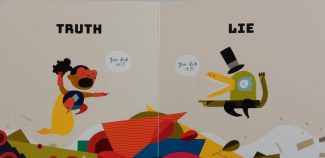
I envisage children inventing their own tricky questions once they’ve solved the posers herein; the potential is huge. Some slightly older readers might even try making their own books along similar lines.

I’ve signed the charter  

The Last Wolf

The Last Wolf
Mini Grey
Jonathan Cape

One of this blog’s very favourite stories – the fairy tale from which its name derives in fact – Little Red Riding Hood is wonderfully re-imagined by the fabulous Mini Grey who gives it an ecological twist.

When Little Red dons her hunting gear and armed with popgun and lunch box, sets off into the forest ‘to catch a wolf” her Mum is far from worried; after all it’s been over a century since the last wolf sighting.

Appearances are deceptive however and her initial stalking activities yield only a rubbish bag and a tree stump …

so deeper into the forest our little hunter determinedly goes until she comes upon a door in an enormous tree trunk.
Eventually the door is opened by none other than the Last Wolf in the land.

Within Red discovers a cosy cave that is home not only to the Last Wolf but also the Last Bear and the Last Lynx.

Intrigued by this “human child” the wolf invites Red in for some tea. Red is equally intrigued to learn that the wolf and his pals have acquired the tea drinking habit and over a nice cuppa, they reminisce about the good old days when the forest was extensive and full of delicious things to eat, in stark contrast to the present parlous state.

Seeing the hungry look in the eyes of her hosts, Red decides to share her lunch and as the animals set about devouring the offerings – a hard-boiled egg, a sausage roll and a chicken sandwich – she chomps on her apple and ponders upon their plight and how best she might help them.

Once home, and yes her new friends do see her safely through the Last Woods to her front door, Red and her mum set about project reforestation.

In this ecological fable Mini Grey chooses her words for maximum effect (‘whooling noises and grabby twigs’ and ‘’a thousand tasty grazing beasts to bite …’) though her illustrations to do much of the story telling. And what a powerful impact they have especially this one …

Altogether a terrific book and one that listeners will demand over and over as they are swept along by the drama and flow of Mini Grey’s pictorial sequences: the way she expands the story-telling potential of each spread is genius.
There are witty literary allusions for adults to enjoy too in the portraits displayed on the tree-cave walls.
Absolutely unmissable!

Books for Tiny Hands

A Tiny Little Story: Farm
Lisa Jones and Edward Underwood
Nosy Crow
In the third title of the series the adorable Baby Boo and his mum pay a visit to the farm. They meet the farmer in his tractor,

a mother hen and her baby chicks, the cow, the sheep, some pigs and a cockerel, each of which greets the visitors with its characteristic sound; and then it’s time to leave.
With its soft, squidgy pages, simple, bold, patterned images and a Velcro buggy strap, this boxed book, like its predecessors, is just perfect for giving to a new mum and her baby.

Animal ABC
Jannie Ho
Nosy Crow
Having explored Halloween and Christmas, Jannie Ho’s third ABC book for babies and toddlers features animals large and small, some familiar, others less so, from elephant to narwhal and iguana and owl. One fantasy animal – a unicorn – puts in an appearance too.
Boldly illustrated with just the single word and corresponding letter as text per page, there are talk opportunities aplenty in this sturdily designed little board book. Which ones have long tails? Which have horns? Can your infant think of what noise each animal might produce?
Full of animal fun for sure.

Little Truck
Taro Gomi
Chronicle Books
In this lovely little board book toddlers share a day in the life of a little pink truck. He’s a fast mover and determined hill climber and is accompanied on his travels by a larger (parent) truck.
The latter is available to give a gentle push up the steep slope …

and when Little Truck enters a dark tunnel, is right behind to ensure he’s not completely lost and is ready to carry the little one when he falls fast asleep.
With a simple text, some of which is addressed to the Little Truck by the larger one, Taro Gomi uses his wonderful minimalist style to imbue both trucks with distinct personalities as well as creating stylised background scenes in contrasting greys, browns and tans.
I love that Little Truck is pink and identified as male in the narrative.

Where’s Mrs Zebra?
Where’s Mr Dog?

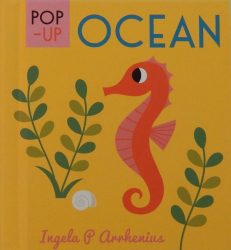
Ingela P.Arrhenuis
Nosy Crow
Just right for some playful book sharing time with your baby are these two hide-and-seek board books.
Each one contains five scenes with bold, bright images and an animal that has hidden itself behind an appropriately shaped, brightly coloured felt flap on the spread.
In the first title Mr Rhino, Mrs Gorilla,

Mr Flamingo, Mrs Zebra are hidden or almost so and the final spread has a hidden mirror and asks ‘And where are you?’
The same question concludes the second book wherein Mr Dog, along with Mrs Cat, Mr Mouse, and Mrs Rabbit have tucked themselves away behind various objects all waiting to be discovered by tiny hands.
Award winning Swedish illustrator Ingela P. Arrhenius has illustrated both with just the right amount of detail for the very youngest infant.

Guess Which Hand?
Hans Wilhelm and Ilaria Guarducci
Chronicle Books
Here’s a little board book based on the ever popular guessing game after which the book is titled.
On each of eight pages toddlers are invited to guess the location of the item be it a ladybird or frog, a bone or ball, flower or feather, pink fish or blue, banana or peanut, carrot or clover leaves, star or moth, hidden under one or other of the flaps on each animal’s page. Paws, ears, scallop shells,
hats, fluffy tails, wings and eggs are in turn used as hiding places. The objects are moved by turning the interactive wheel at the side of each page so you can play the game over and over with a toddler.
Each bold bright scene offers more to talk about than the guessing game though but that depends on the users.

Held in Love

Held in Love
Dawn Casey and Oamal Lu
Lincoln Children’s Books

If you’re looking for a book to give as a gift to a new mother and child, or at a naming ceremony, here’s one that fits the bill perfectly. Equally it could serve as a bedtime lullaby.

Billed as ‘A mother’s blessing’, Dawn Casey has penned a softly spoken, lilting entreaty that any parent (or grandparent) could share with an infant.

Herein we have a mother talking to her baby.

Beginning with the universe and thence the galaxy and the world, each double spread moves inwards to a home wherein a mother, child nestling in her arms is reading.
She asks for joyfulness in movement, generosity, gratefulness, musicality with ears that can hear both song and silence,

playfulness and the ability to forgive and forget.

Finally we’re taken full circle to the universal with these heartfelt words: ‘May your eyes look to the stars and know that you are held in the arms of the universe … and held in love.

Complementing the beautiful, soulful words are debut picture book illustrator Oamul Lu’s warm-hearted scenes of maternal love, of a growing child and of serene natural landscapes. I just wish he hadn’t used those googly eyes that seem to be used in so many picture books at present.

Grab That Rabbit!

Grab That Rabbit!
Polly Faber and Briony May Smith
Pavilion

Hodge is a large white rabbit with a single black splodge. On this particular day however he isn’t his usual happy self and that’s on account of having got himself stuck in the hedge due to his over-indulgence.

No amount of wriggling has managed to release him when into the garden comes Mrs Sprat intent on pulling up some tasty carrots for her dinner.

The trouble is that on account of a certain rabbit, there’s a distinct lack of carrots.

A furious Mrs Sprat grabs hold of Hodge’s rear end, out he comes and …

Happily Hodge makes a run for it but what he doesn’t notice is the large shadowy shape above him about to swoop …
And swoop it does, seizing Hodge in its talons. Fortunately for the rabbit but not so for the predator, all those carrots have made Hodge a heavy catch, so heavy that the buzzard drops him. Plop! He lands right on Mrs Hodge’s hat. Splat!

Is he destined for her cooking pot instead of those carrots?

With her clipped narrative style Polly Faber has seemingly taken reading scheme language and turned it into a playful parody of same which, unlike the former, is involving for listeners and reads aloud really well.

Appropriately executed in predominantly earthy hues, Briony May Smith’s illustrations are superb: wonderfully dramatic and full of absorbing details that make you want to linger over every spread.

The First Egg Hunt

The First Egg Hunt
Adam & Charlotte Guillain and Pippa Curnick
Egmont Publishing

Featuring a very fluffy chick, the Easter Bunny, a host of woodland animals and of course, yummy chocolate treats aplenty, Charlotte and Adam Guillain have together dreamed up a wonderful rhyming pourquoi tale that explains why The Easter Bunny hides eggs for people to find on Easter Day.

Bunny and his partner Chick work hard to ensure that everything is ready for the big delivery day but it’s the furry one alone who gets all the kudos.

Resentful of the fact that Bunny is the only one in the limelight, Chick plots to put things on an equal footing the following year when it comes to the delivery of those choccy treats.

However, when the time comes, her ruse doesn’t quite go according to plan. In fact it’s an utter disaster as Chick takes a tumble with the delivery vehicle …

scattering eggs every which way and to make things worse, she is forced to confess to her partner.

All ends happily though with a new annual tradition and two happy partners.

Just as yummy as those chocolate eggs are Pippa Curnick’s illustrations. Be they double spreads, single pages, or vignettes, each one is deliciously detailed.

I’ve signed the charter  

Colorama

Colorama
Cruschiform
Prestel

As a child I was fascinated by a large Reeves paint-box belonging to my mother; I think it had been passed down to her. There were several layers of smallish rectangular colour blocks embossed with a dog. Each of the various hues had an exciting name, though some looked almost identical until used. I loved to take it out and about and find things to paint. It was those names that I loved as much as the paints themselves.
Now this beautifully produced book has taken me right back to that paintbox and my memories of same.
Compiled by illustrator and graphic designer, Marie Laure Cruschi, head of the French creative studio Cruschiform, it too is based on colour memories, her memories.

The colour palette is vast – over 130 hues and it takes us on a circular journey starting and ending with white, but surely white is just white isn’t it? Not quite; for a start it all depends on who is looking at it and what they are looking at. White can be all manner of things. Herein we have white snow, milk, peace symbol, albinos, alabaster, polar white, cotton flower, birch bark, white moth

and white powder and having come full circle, Aphrodite’s tears, flour of salt and moonlight. Each of these whites (and indeed the other colours) conjures up memories of objects, or things be they animal, vegetable or mineral.

So subtle is the difference that there is then an almost imperceptible change to pink (white powder is more pink than white to me).
The author provides a brief story connected with each image; sometimes this is the exact name of the colour – canary yellow – for instance or ivory.
The musings may be historical such as the synthetic dye ‘mauveine’ invented in 1856

elemental, artistic, relate to specific animals, flowers, trees, plants, fruits or vegetables, cloth and clothing,

machinery, and even objects out of this world.
Altogether a fascinating book for children and adults alike, it’s one to pore over and ponder upon.

Earth Verse

Earth Verse
Sally M.Walker and William Grill
Walker Studio

The earth is a vast entity orbiting in space: haiku as a poetic form is by nature brief and spare. The combination of the two makes for a truly stunning picture book particularly when the artist is a recent Kate Greenaway medal winner William Grill and the author Sally Walker, a Sibert medal winner some years ago.

The book focuses on Earth’s geological and meteorological aspects beginning with its place in the solar system: ‘third one from the sun. / Earth’s blue and white majesty / dwarfs her lunar child.’

We then move inwards ‘fragile outer crust. / shell around mantle and core – / Earth: a hard-boiled egg.’ How cleverly and succinctly Walker introduces scientific vocabulary into her poetry and you’d find it hard to get more playful than her description of minerals and metals as ‘glittery Earth-bling’;

more beautiful than ‘sediment-filled waves / tumble in a frothy foam … / a gull wears sand socks

or more dramatic than ‘hot-headed mountain / loses its cool, spews ash cloud – / igneous tantrum’.

For each of these small poetic gems, and the others, Grill provides a wonderful atmospheric coloured pencil illustration in his trademark style that is frequently more impressionistic than realistic and never overwhelming the words.
Right in the bottom corner of each spread or sometimes page, is a symbol.: earth, minerals, rocks, fossils, earthquakes, volcanoes, atmospheric and surface water, glaciers and groundwater. Each of these links to the final section of the book where additional prose information on the nine topics is provided, and there’s also a list of suggested further reading.
This surely is a book to encourage children (and adults) to pause and to wonder at the awesomeness of the world and all its natural beauty.

Juniper Jupiter

Juniper Jupiter
Lizzy Stewart
Lincoln Books
Lizzy Stewart’s debut picture book There’s a Tiger in the Garden was a Waterstone’s Children’s Book Prize winner last year. Now she has created a super story with a friendship theme and a super-hero character..

A super-hero girl: that’s got to be a cause for celebration from the outset despite the fact that for Juniper Jupiter ‘It’s no big deal.’ This cool character has super powers in abundance: kindness, bravery, speed and guile, strength and she’s super-smart. She can fly too.

All in all it’s a pretty satisfying life but there are times when she feels lonely, so she decides to advertise for ‘side-kick’ and she’s pretty definite where her requirements are concerned …

There are plenty of people wanting the job but it doesn’t take too long for Juniper to rule them all out. Just when despair is setting in and a super sized sulk about to descend upon her, the final applicant makes her presence felt and guess what; she fits the bill perfectly.

Hooray! Now, with Peanut beside her, our young heroine is doubly super but that as you might expect, is ‘no big deal’.

The chatty matter of fact telling leaves the illustrations to do much of the talking and once again they’re absolutely splendid – vibrant, detailed, and beautifully observed, the feeling bored sequence in particular …


If superheroes are your thing then you might also enjoy:
Molly Mischief Saves the World
Adam Hargreaves
Pavilion
This young female is perhaps every parent’s worst nightmare and when she dons her super hero gear and assumes superpowers, well it’s anybody’s guess what she might get up to.
Find out more in this new adventure wherein the feisty miss discovers that being a superhero isn’t really all it’s cracked up to be.

How To Eat Pizza

How To Eat Pizza
Jon Burgerman
Oxford University Press

A book on how to eat pizza? When it comes to feasting on that favourite of foods surely everybody knows what to do; but just in case there’s any doubt, this latest offering from the creator of Splat! shows the way.

There’s a snag however: the particular pizza Burgerman is dishing up has no intention of being eaten at all. No way! Especially the largest slice.

Indeed he’s determined to convince us that there’s a range of infinitely more delicious options sharing his plate – a book worm for example, or this funky dude.

All the while though there’s the pull of the biggest slice but he’s not about to give up in his efforts to persuade us that any one of his fellows is the one to feast upon.

Alternatively, there are much more healthy, way less calorific possibilities that won’t damage your waistline. What about indulging in a few of these?

Burgerman’s zany humour goes down a treat in this colourful culinary extravaganza and if you’re still undecided about your cheesy choice, then maybe a sugary something might hit the spot …

Totally daft but enormous fun: Burgerman, with his off the wall sense of humour, has dished up another winner to tickle your taste buds.

The Tiptoeing Tiger

The Tiptoeing Tiger
Philippa Leathers
Walker Books

‘Sleek, silent and totally terrifying’; a creature to avoid when it prowls through the forest; that pretty much sums up a tiger.

Not so Little Tiger though. He’s completely ignored, scares no one with his roars and is laughed at by his big brother. “I don’t think you can scare a single animal in the forest.” declares big bro. but Little Tiger is determined to prove him wrong.

Employing a tiptoeing technique off he goes to sneak up on unsuspecting forest inhabitants, the first being Boar. “I could hear you coming a mile away” says the indolent Boar in response to Little Tiger’s “Roar!!!

He receives similar disappointing comments from Elephant and the monkeys in a tree.

It’s a sad Little Tiger that acknowledges his own shortcomings but remaining determined he heads to the pond. Surely that frog is an altogether better prospect?  Tiptoe, tiptoe, tiptoe …

But the only creature that is in the least bit frightened is the Little Tiger looking right back at him from the water.

Job done! Back he goes to report on his success to that big brother of his.

The whole narrative is beautifully understated and perfectly paced; and the pen and watercolour scenes with that gentle touch of whimsy, the tiptoeing sequences in particular, are absolute delight.

Little Tiger is likely to win almost anyone’s affection from the outset but any waverers will surely be won over by his bold final admission.

Search-and-Find Bonanza – The Walkabout Orchestra, Mice in the City London and Cycle City

The Walkabout Orchestra
Chloé Perarnau
Wide Eyed

What has happened to the members of the orchestra? They’ve all gone missing and there’s an important concert coming up in a few days. Seemingly they’ve dispersed to locations all over the world from where they’ve sent the maestro postcards telling of their various activities. These appear in the top left-hand corner of each locale spread.
In a desperate effort to locate the musicians, the maestro, together with his side- kick, sets off in search of them. Their journey takes them to such diverse places as a fishing village in Iceland, Tokyo, a campsite in France, the pyramids of Egypt, carnival in Brazil and a football field in Abidjan.
In addition to finding the missing musicians, almost every place has a little yellow bird whose speech bubble provides something additional to search for in the lively scenes of the musicians’ sojourns.
Each one is packed with amusing details so that finding the musicians is often no easy matter. However they do all appear within a large arena ready for the concert with their maestro ready to conduct, bird atop his head.
Don’t start reading this if you are short of time, unless you are happy to cheat and look at the answers on the two final spreads.

Mice in the City London
Ami Shin
Thames & Hudson

It’s a mouse takeover: London had been invaded by an army of tiny rodents; some – The Mouses of Parliament for instance, – have jobs to do, others are there to enjoy the sights and some are turning Tate Modern into complete disarray. One daring mouse has even installed herself as Queen Mouse in Buckingham Palace.
A verse introduces each location, opposite which is a detailed whole page pastel coloured illustration of the particular tourist attraction under mouse occupation: every one is full of things to delight and entertain.
The purpose of the book, in addition to enjoying what the mice are up to, is a game of ‘hide-and-squeak’ that entails finding eight things – Inspector Mouse, a stripy tailed cat, Bumble-mouse, a mouse in a bin, a teddy, a Union Jack top hat, a mouse hiding in a top hat and a balloon seller.
Happy Hunting! You’re in for some fun with Ami Shin’s mice.
In the same series is Mice in the City New York. Oh my goodness! Think of the chaos the little creatures might cause in The Strand Bookstore!

Cycle City
Alison Farrell
Chronicle Books

It’s the morning of the Starlight Parade in Cycle City but the parade committee has yet to send out the invitations so they decide to call on the assistance of Mayor Snail.
Can he get all those invites delivered in time for the evening? Perhaps, with the help of Little Ella Elephant who has come to visit one of the city’s residents, her Aunt Ellen. If so, who will play the important role of Grand Marshal at the big event?

A captivating search-and-find for slightly younger readers: this one has a clear storyline and a plethora of speech bubbles and is populated by a vast array of anthropomorphic animals. The spreads are less densely packed than some of its ilk, but have plenty of lovely details, and the endpapers are a visual glossary of all the different bicycles included.

I’ve signed the charter  

There Was An Old Lady / What Can Cats Do? and Who’s the Biggest? / How Many Kisses?

There Was An Old Lady
What Can Cats Do?

illustrated by Abner Graboff
Bodleian Children’s Books
Abner Graboff was an American artist and children’s book illustrator, popular especially in the USA in the 1950s, 60s and 70s who died in 1986 and whose work has since almost disappeared from the radar.
Now Bodleian Children’s Books brings some of this work to a new audience and decidedly quirky it is.
His arresting scenes of the animal guzzling old lady show a wicked sense of humour. The sight of her with a mouthful of bird, delicately holding a salt-cellar between thumb and forefinger and with a window through which we can see the contents of her stomach, is deliciously droll …

So too is this chasing scene …

Adults as much as children will enjoy this picture book version of the nonsense song and because of its cumulative nature, it’s a good one for learner readers.
What Can Cats Do? was inspired by Abner’s own cat called Tarzan and apparently his three sons collaborated with their father on the book, carefully observing the creature and reporting what they’d noticed to their dad.
The outcome is a hilarious, first person narrative look at some of the things cats can do that children can’t – using their tongues as combs, for instance,

as well as a few things cats are unable to do such as shave or laugh.

Great fun for beginning readers and of interest to children’s book collectors and students of illustration.

Who’s the Biggest?
How Many Kisses?

Delphine Chedru
Thames & Hudson
In the first title, award winning graphic designer Delphine Chedru takes a playful look at relative size in response to the title question.
The respondents claiming the size title in ways as different as a whisper to a boom, and a gurgle to a sigh, are as disparate as an elephant, a tree, a bear, a hammer, a mountain, a fishbowl, a leaf …

and the faceless human, ‘me’.
How Many Kisses? invites listeners to blow the appropriate number of kisses to who or whatever is indicated in the instruction facing the animal, human or other named objects.

The book follows the expected number sequence from 1 to 10 (with accompanying dots) and then takes seemingly random jumps to 17, 64, 823 and then to ‘millions’. I suspect it would take an exceedingly long time to give the ‘millions of kisses for all the children playing around the world’ on the final spread and the numbers beyond 10 may well be beyond the capability of young children but they’ll most probably enjoy the possibilities offered by such large numbers.
Both books are illustrated with bold bright images using dense flat blocks of contrasting colour and throughout each the text is white lettering on the black background giving an uncluttered, arresting overall appearance to every spread.

Car, Car, Truck, Jeep and Old MacDonald Had a Boat

Car, Car, Truck, Jeep
Katrina Charman and Nick Sharratt
Bloomsbury Children’s Books

Now here’s a cool idea: new author Katrina Charman has based her upbeat rhyming romp on the rhythm of ‘Baa baa black sheep’, and I’m guessing the playful notion of the strategically placed black sheep passenger on one of the trucks was Nick’s.

So let’s get going on our journey through this vehicular extravaganza, but first we need to make sure that those fuel tanks are full …

Now let the journey begin and see how many different things with wheels, not to mention rotors and sails, we can spy on our travels through the pages.
All that honking, beeping, zooming, chugga chugga choo-ing, flicka flacking, rumbling and scraping, vrooming, screeching and more is pretty tiring, especially when it’s kept up throughout the whole day.
So, come nightfall it’s more than time to head home for some shut-eye …

A terrific, rhythmic read aloud that’s packed full of wonderful sounds to let rip with, in combination with Nick Sharratt’s characteristic cartoon bright illustrations, (love that bus ad.)  this is surely any pre-schooler’s idea of picture book wonderland.

Old MacDonald Had a Boat
Steve Goetz and Eda Kaban
Chronicle Books

First we met the MacDonalds and all their animals with their truck and now they’re back in a new story, truck and all. As the story starts the truck has just drawn up near the barn and it’s pulling an old boat.
Then it’s time for Old Macdonald to set to work. Out come his tools. First it’s a buzz saw with a ‘BUZZ BUZZ here and a BUZZ BUZZ there.’
That’s followed by some hammering

though perhaps the pigs have a better aim that the farmer himself when they BANG BANG in those nails.

Gradually things take shape, then out come the blowtorches, the sanders and finally the paint rollers.

As evening falls their craft is launched and it’s time for a spot of water ski-ing.

Once you’ve had a couple of sing-alongs of Goetz’s text with the book, you’ll likely want to go back and take time over Eda Kaban’s expansive, brightly coloured spreads; of the farmyard crew enjoying themselves together and working together as a team. They’re full of detail and humorous touches.

Bird Builds a Nest

Bird Builds a Nest
Martin Jenkins and Richard Jones
Walker Books

Back in the day when I was studying physics at O-level I recall learning things about forces with no real understanding of the concepts as they were never demonstrated practically and I’m sure terms as straightforward as ‘push’ and ‘pull’ were ever used; how I passed the exam is anybody’s guess. It was only when I began teaching young children and everything was done through playful activities that I realised ‘oh so that’s what that statement I recall really means’.

Now here’s a cracking little book that introduces forces through a story about a bird building her nest.

Oh joy, it’s a sunny day and the little creature needs to find a juicy worm to feast on and here she is about to apply a pulling force …

No luck with that particular worm but eventually she finds a suitable smaller, less strong one and out it comes. Yum! Yum!
Breakfast over, she heads off in search of twigs to build her nest. Some inevitably are too heavy but Bird perseveres, pulling and lifting, to-ing and fro-ing, pulling and pushing the twigs into place, over and over until the outer construction is ready.
Then she collects softer, light things to make a cosy lining cup…

And finally the eggs are laid …

Already a big fan of this Science Storybook series of narrative science books for young children, I’m now an even bigger one. It’s so simple and yet so effectively explained both through the main narrative and in the smaller printed factual statements.
There’s an additional investigation on the forces topic using ping pong balls to try at the end.

Once again, Richard Jones has created a series of beautiful mixed media, textured illustrations in earthy tones to complement Jenkins’ text to perfection.


Little Leaders: Bold Women in Black History

Little Leaders: Bold Women in Black History
Vashti Harrison
Puffin Books

Here’s a terrific book that celebrates 40 amazing black women some from the past, some from the present and each a trailblazer.

Artist and film maker, Vashti Harrison has penned brief biographies of a splendidly diverse selection of dauntless, boundary breaking females who have contributed to making society what it is today.

In addition to the famous such as Mary Seacole, Harriet Tubman, Rosa Parks, Mahalia Jackson, Ella Fitzgerald, Bessie Coleman and Diane Abbott, there are some lesser known women including social psychologist and counsellor Mamie Phipps Clark, science fiction writer Octavia E. Butler, scientist and medical researcher Alice Ball and NASA mathematician Katherine Johnson who are in their own ways, equally inspiring.

Katherine Johnson

No book on women’s achievements would be complete without sport and representing athletics are sprinters Wilma Rudolph and Florence Joyner (who also developed a clothing brand, wrote children’s books and established a youth foundation), and heptathlete and javelin thrower, Tessa Sanderson.

Tessa Sanderson

All these and the other women herein are truly inspirational and Harrison has done them proud, both through her engaging text and her beautiful illustrations.

Seaman William Brown – the first black female to serve in the British Navy

Brave, bold, world changers they most certainly are.

A book to put into primary classrooms, secondary school libraries, to buy for families, and to share and discuss wherever and whenever you can – I certainly intend to.

I’ve signed the charter  

Splish, Splash, Ducky!

Splish, Splash, Ducky!
Lucy Cousins
Walker Books

Lucy Cousins has created a lively new addition to her array of cute characters to delight pre-schoolers.

Ducky Duckling is a pluviophile and on this particular rainy day is in high spirits as with a ‘Quack, quack, quack!’ the little creature sets off in search of some friends to play with.

This refrain is a demonstration of happiness and Ducky utters it when hopping with frog, squirming with wriggly worm,

bestowing hugs on bug and slug, playing with the swans, swimming with the fish,

joining the birds in a spot of feather shaking and generally revelling in the feel of all those drips and drops while joining mouse in a game of hide and seek.

Observant listeners will more than likely have noticed that at every turn of the page, the rain is easing off until … ‘No more drips. No more drops.’ Suddenly Ducky feels sad and heads off to find Dad.

Fortunately for his offspring, the mallard knows just the thing for some fair weather fun – a round or two of quack, quack quacks!

With a rhyming text that offers plenty of opportunities for audience participation and a host of absolutely adorable animal characters illustrated in Lucy Cousins’ spirited style, (with more naturalistic representations of the surrounding flora) this is perfect for sharing with the very young.

Not only that but with its simple rhyming text that’s full of word play, this is perfect for those just beginning to read for themselves. Which would you rather offer a child just starting out on their journey as a reader: a deadly dull phonic early reading scheme book or this super storybook? – It’s a no brainer!

The Drum

The Drum
Ken Wilson-Max and Catell Ronca
Tiny Owl

One of the highlights of the school year in three of the primary schools I taught in before moving out of London was the annual visit of multicultural music workshop providers, Earthsong.
Storm and fellow musicians would come with their van filled with exciting musical instruments from different parts of the world – in particular, an amazing collection of drums – and give first a whole school presentation and then individual class workshops of music and dance for the children, often based on a theme that we had flagged up beforehand.
Once those drums came out and the children got their hands on them, even the most challenging of individuals became totally engaged and remained so throughout the session.

It was evident that drum circles (such as those Earthsong provided) were an opportunity for the children to feel totally connected with themselves and with one another and equally, that playing a drum was a terrific mood booster for every individual, many of whom came from less than ideal home situations.

Author Ken Wilson-Max and illustrator Catell Ronca capture those feel good experiences in their splendid little book for young children that features African drummers captivating both the players themselves and their audience

who cannot resist the invitation to follow Ken’s instructions to ‘Clap your hands … Stomp your feet … Move your shoulders from side to side

… Feel the beat in your belly … Feel the drum in your heart’

and who can ignore the appeal to ‘Shake your body and dance’. I can almost feel the beat and rhythm of the drums in Catell Ronca’s vibrant illustrations and want to start moving in concert with the children portrayed therein.

Spencer feels the beat

I can’t wait to see further titles in this new Tiny Owl series ‘Children, Music, Life’.

After The Fall

After The Fall
Dan Santat
Andersen Press

Most young children and adults are familiar with the nursery rhyme Humpty Dumpty and now author/illustrator Dan Santat has created a story telling what happened after that great fall of Humpty’s.

No he didn’t remain a splatted mess unable to be repaired.
Instead, in this self-narrated tale, the famous egg relates how he undergoes a long process of healing and recovery that begins once those king’s men have done their best with glue and bandages.

Physical recovery is one thing, but Humpty is suffering from acute vertigo, so much so that he now sleeps on the floor beside his bunk bed and his favourite breakfast cereals stored on the top shelf of the supermarket are out of reach.

Worst of all though is that Humpty is an avid ornithologist and absolutely loved that erstwhile seat of his atop the wall from where he used to watch his feathered friends.

Eventually however he settles for a ground-level view and it’s while looking upwards one day that he spies in the sky something that gives him an idea.

After considerable trials and tribulations,

Humpty eventually fashions the perfect flier of a paper plane; not quite the same as being up in the sky with the birds but ‘close enough’ he tells us. But then the plane lands up on top of a wall. ‘Accidents happen. They always do.’ says our narrator.

Absolutely terrified but full of determination, slowly but surely Humpty climbs the wall.

As someone who is terrified of heights, I really felt for him as he faced his fear, finally making it to the very top of that ladder. Once there he says triumphantly ‘I was no longer afraid.

That though is not quite how the story ends for then comes a final twist. Now the narrator has undergone an inner change that enables him to release himself once and for all; after all’s said and done, an egg doesn’t remain trapped in a shell for ever more: a right of passage must occur for something even better awaits …
This is so much more than just a ‘what comes next’ episode of a Mother Goose favourite.
Santal presents themes of fearfulness, anxiety, determination and ultimately, transcendence and transformation through the combination of his spare first person narrative and his powerful scenes, made so affecting through the changing perspectives and use of shadow.

Almost Anything

Almost Anything
Sophy Henn
Puffin Books

Sophy Henn has already created some wonderful characters; Pom Pom, Bear and Edie immediately spring to mind and now there’s another; meet George.
On this particular day, his fellow forest dwellers are all busy enjoying themselves in one way or another; not so George who sits doing nothing.
The little rabbit seems to be completely lacking in self-belief. “I can’t …” is his response to offers from his friends to join them in their activities.

Along comes Bear, very old and very wise. She produces a newspaper from which she fashions a hat. Telling George that it has magical powers, she persuades him to give it a go and see what happens.

Slowly, slowly the ‘magic’ starts to take effect and it’s not too long before George is roller skating, which he follows by dancing to the beat, a bit of painting, some reading and much more besides. In short, George is a very busy bunny indeed, so busy that he fails to notice that his hat is no longer on his head. Suddenly …

Fortunately Bear is close at hand with an explanation of where the magic is really coming from …

As a teacher I’ve always told children that there’s no such word as ‘can’t’ when it comes to their learning and now here’s this wonderful new story from an author who really gets to the heart of how young children think .
Almost Anything is such an empowering book both for youngsters who lack self-belief and all those adults who do everything they can to offer encouragement and support to them when it comes to giving it a go.
Risk taking isn’t easy for everyone but this is a cracking book to help those who find it a challenge.

As always Sophy’s matt illustrations executed in a gorgeous muted colour palette, have just the right degree of gentle humour and the animals’ body language is quite brilliant. Look out for Badger, a truly stylish skittle player, and those hedgehog dancers sporting head bands and leg warmers are just adorable.

If this hasn’t convinced you that this is a must buy picture book then I’ll eat my ‘Almost Anything’ magic hat with its wrap-around instructions for making, kindly supplied by Puffin Books.

10 reasons to love a bear / 10 reasons to love a whale

10 reasons to love a bear
10 reasons to love a whale

Catherine Barr and Hanako Clulow
Lincoln Children’s Books

This engaging series of fun animal books for younger readers from Barr and Clulow, working in conjunction with the Natural History Museum, has two new titles.

The first features the eight bear species: the polar bear, the sun bear, the sloth bear, the American black bear, the brown bear, the Asian black bear, the spectacled bear and the giant panda.

Did you know that bears, with the exception of the bamboo only eating giant pandas, will consume pretty much whatever they can find be that fish, meat, berries or bark; and some honey loving bears will tear trees apart to access a bees’ nest and sometimes even lap up the bees. Ouch!

Have you ever seen a bear dance? I certainly haven’t but they rub their backs against tree trunks and do a kind of wiggle dance to leave a scent for other bears, either to attract a mate or scare off a rival.

Giant pandas so we’re told though will do a handstand to leave their mark.

Another way in which bears communicate is through sound: they might snort, growl, grunt or cough; and mother bears and their cubs hum if all is well. Panda bears on the other hand make a bleating sound.

All this ursine information and more, together with five ways humans can show they love bears, can be found in 10 reasons to love a bear.

The subject of 10 reasons to love a whale is the blue whale.
These enormous mammalian creatures are, when fully grown, around 30 times heavier than an elephant and have a heart the size of a small car. Amazing!

A blue whale’s mouth too, is gigantic, and its tongue alone weighs as much as an elephant.

Sadly these amazing animals are still a threatened species and their survival depends on we humans.

Most children, in my experience are fascinated by blue whales and so, I suspect, they’ll be eager to dive into this book.

Add these two to your primary school class collection or topic boxes.

Under the Canopy

Under the Canopy
Iris Volant and Cynthia Alonso
Flying Eye Books

Often called the lungs of the world, as the largest plants on our planet, trees are vitally important to us all. Essential for life, they are the longest living species on earth and so link past, present and future.
Many of them are also incredibly beautiful whether covered in new leaves or stripped bare of all foliage.
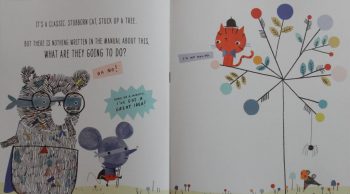
Herein, fact and fiction are woven together in a celebration of trees of various kinds from all over the world.

We learn how, according to the Greek myth, Athena, the goddess of wisdom’s gift of an olive tree was chosen by the people over Poseidon’s salt spring and Athens was named in her honour.

Another tree featured in the book that has an associated legend is the Willow.
In order to boost sales of the blue and white willow pattern chinaware once popular in England a number of stories were invented based on that pattern.

One such tells of young forbidden love and of the ultimate transformation of the ill-fated lovers into doves.

From tropical regions including Africa and Australia is the acacia. The famous whistling acacias of Zimbabwe were so called because their long pointed thorns make a whistling sound when the wind blows.
A popular food of giraffes, these trees, in response to grazing, pump their leaves with organic chemicals which force the animals to stop feeding and in addition the tree under attack can communicate to other nearby acacias to do likewise.

Legend has it that the English mathematician and phycisist, Isaac Newton conceived his theory of gravity when he saw an apple falling while thinking about the forces of nature.

Elegantly produced, this diverting collection, which features over twenty tree species is one to dip into, to enjoy and savour Cynthia Alonso’s stylish artwork with its textures, patterns and standout splashes of luminous green.

Just Like Mummy / Superhero Mum

Just Like Mummy
Lucy Freegard
Pavilion Books

Following on from last year’s Just Like Daddy, Lucy Freegard turns her attention to mums, especially the one featured here.

The young narrator introduces his/her special super-talented mum– full of fun, both creative and practical, ready to offer some words of wisdom at just the right time and provider of cuddles whenever they’re needed. Who wouldn’t want to have a mother like that, and perhaps, to have those qualities when they grow up? Certainly that is what the little leopard here is aiming for. (We don’t know the gender so the story works well for all.)

I suspect any youngster would wish for a mother who spends so much time with her child be that making music, gardening, exploring or whatever, and the cub really does appreciate this togetherness.

It’s important to acknowledge that things don’t always go exactly how we’d like them to; there are sad times, challenging times and inevitably, times when we make mistakes, and so it is here.

Lucy Freegard’s expressive illustrations do a great job of encompassing both the highs and lows of everyday life in a book that is perfect for sharing and discussing with pre-schoolers, and especially, it’s a lovely story for giving to a special mum on Mother’s Day.

Superhero Mum
Timothy Knapman and Joe Berger
Nosy Crow

We had Superhero Dad and now Knapman and Berger even things up with a companion title about mums.

The narrative is an upbeat rhyming celebration of all the things that make them so amazing. Mums, and in particular this little girl narrator’s mum, is on the go from morning till night, whizzing around, often multi-tasking.

Whether it’s making sure we catch the bus to school,

inventing and participating in energetic playground games, administering first aid,

joining in with bath time fun, seeking out a favourite lost toy, or sharing a bedtime story, she always delivers.

In short, she’s an inspiration to every would-be super hero girl (or boy come to that.)

It takes someone special to do all these things with a smile on her face and that’s how Joe Berger’s comic book coloured, action-packed scenes portray her in every one of these seemingly ordinary, everyday activities that could be easily taken for granted.

I’ve signed the charter  

Baby Bird

Baby Bird
Andrew Gibbs and Zosienka
First Editions
First Editions is a new ‘sub-imprint’ of Lincoln Children’s Books that is entirely devoted to debuts and this book is one of its first.

‘Birds are born to fly’, thinks Baby Bird but this little bird was born with one misshapen wing that fails to develop fully and so when the other hatchlings are ready to leave the nest Baby watches them take flight but, try as s/he might, Baby’s efforts to follow them end in disaster.

Determined to learn to swoop and soar like the others, the little creature keeps practising, refusing to give up until suddenly a monstrous face appears from the shadows and there is, not a monster but another bird calling itself Cooter.

Cooter offers to assist Baby by becoming a buddy and the two spend the afternoon endeavouring to get Baby airborne, all to no avail and although Cooter tells Baby that he’s having fun, the fledgling most definitely is not.

The friendship is further tested when Cooter tells Baby something exceedingly distressing that precipitates a fall, a rescue and a revelation.

What follows changes the entire mood; it’s something called Coot Scooting and from then on, Baby’s outlook on life and flying is altogether different.

Baby Bird embodies the spirit of determination against all the odds in this tale of friendship, self-acceptance and inclusivity.
Both author (who sadly did not live to see the book’s publication) and illustrator’s portrayal of the fledgling is uplifting and inspiring.

I’ve signed the charter  

The Itchy-saurus

The Itchy-saurus
Rosie Wellesley
Pavilion Children’s Books

I’ve taught a good many young children who suffered and I mean suffered with eczema. I can recall two in particular, one 4 year old who would sit on the carpet during story times and when he got up there’d be piles of skin where he’d been sitting; eventually his parents took him to India one holiday and they found some amazing herbal creams that worked wonders. The other, during flare-ups, had to go every midday to have his bandages removed and emollient cream re-applied by the member of staff employed to look after children’s medical welfare. Both must have been in an almost constant state of agony, yet both were amazingly stoical, never complaining and almost always smiling.
Created by GP author/illustrator Rosie Wellesley, this reassuring book would have been perfect to share with those children as well as their classmates.
In fact it should be in all early years settings and in families with a child or children who have eczema or other skin disorders.

Meet T Rex whose life is suddenly made a misery by an itchy rash that appears on his skin turning him into the grumpiest, most dangerous creature in the jungle. Until that is, Doc Bill hears of his plight and despite his lack of stature, resolves to help; so off he goes.

Having found a tearful ‘Itchy’ the Doc sets out some ground rules for his patient, makes a cooling bath and sets to work with his lotion-making machine.

The following morning after Itchy’s had a good night’s sleep, begins stage two of the healing process; learning some distracting actions while the cream has time to work its healing magic …

until finally when Itchy looks at his skin …

No redness, no itchiness, no need to scratch – hurrah! Time to thank the Doc.

When’s My Birthday?

When’s My Birthday?
Julia Fogliano and Christian Robinson
Walker Books

For young children, birthdays are possibly even more eagerly anticipated than any other day of the year and here we have a book that can be shared in the days running up to that special celebration.

Everything about this is sheer delight. First there’s the unusual, attention grabbing shape of the book. Then come the striking but simple candle endpapers, after which begins  Fogliano’s spare chant of a text wherein she captures perfectly the voice of the child.
‘ when’s my birthday? / where’s my birthday? how many days until / my birthday? ’ asks the repeat refrain that holds the whole narrative together as the excitement builds.

That artist Christian Robinson has a deliciously playful sense of humour is evident in the joyful collage style illustrations such as this one with its visual pun on ‘ice-skating’ …

No child’s birthday is complete without other vital ingredients including singing and dancing: ‘will we sing so happy happy? / will we dance around and round? / will we jump and jump and jump?’

Presents and cake too are contemplated: how wonderfully the artist plays with size as here …

and

and these children know precisely what must comprise the birthday tea, but when it comes to the party, everyone is invited both human and animal and any kind of dress is acceptable.

Spirited, inclusive and the ideal gift for a small child whose birthday is fast approaching; a ‘happy, happy day’ for sure.

I’ve signed the charter  

What’s Your Favourite Colour?

What‘s Your Favourite Colour?
Eric Carle and Friends
Walker Books

Herein, Eric Carle and fourteen other picture book artists, many of whom UK readers might be unfamiliar with, share and discuss their favourite colours.

Carle himself, who opens the book, favours yellow, in part because it presents him with an artistic challenge.
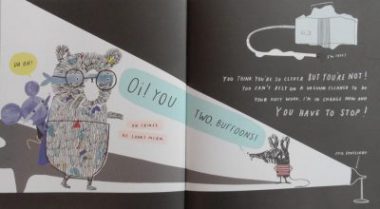
The reasons for the choices of others are varied and what they have to say, sometimes surprising.
Take say Jill McElmurry’s Black Garden, an imaginary place where she goes to ‘get lost in my thoughts, dance around, have a good cry, sing a song, paint a picture, or maybe eat a slice of dark chocolate cake. The Black Garden is unpredictable. The Black Garden is the garden of me.’
Some artists such as Philip C. Stead, Yuyi Morales and Melissa Sweet use poetry. Melissa Sweet’s Maine Morning Grey comes in many shades:

Others are more particular. Marc Martin specifies crimson red for the parrot, crimson rosella, which lives in his part of south eastern Australia.
Anna Dewdney’s choice is based on memory ‘When I was a little girl, my favourite outfit was my purple polyester trouser suit, and I wanted purple peacocks in the front garden. When I grew up, I got them.’

The final artist, Uri Shulevitz, doesn’t choose just one colour. ‘A single colour may feel lonely,’ he tells us and so paints a joyful ‘colourful party’ to include them all.
Every spread is worth lingering over and I find it well nigh impossible to choose a favourite but for its brief potency I particularly loved Etienne Delessert’s Indigo: ‘The Tuareg nomads wear long cotton indigo veils. They herd camels and goats and talk to the spirits of the Sahara Desert.’

Thumbnail pen portraits on the final spread provide additional information about each of the contributors.

Fascinating and inspiring, this visual and verbal feast offers an excellent starting point for an exploration of colour with a wide range of age groups from pre-schoolers to adults.

Swapsies / Say Sorry, Sidney!

Swapsies
Fiona Roberton
Hodder Children’s Books

There’s a delightful lesson in the importance of friendship and learning to share in this latest book from talented author/illustrator Fiona Roberton whose books have all been winners with me.
Fang has a favourite toy, an amazing yellow, stripey, squeezy, thing with an aroma of bananas; he loves Sock more than anything else.
Enter Philip with his magnificent shiny red train, which looks a whole lot more exciting than Sock. Being a good sharer, Philip agrees to a swap.

A similar thing happens with the bouncy toy belonging to Simon. But then disaster strikes …

and Fang is left toyless and missing his old favourite.
Is he to be without his beloved Sock forever more or is there perhaps a way they can be re-united.
Fiona’s characters are adorable; her dialogue superb: “What happened to Ball?” asked Simon. “Ball is no longer with us,” says Fang; and the finale (which I won’t divulge) leaves room for the children’s imaginations to take over and draw their own conclusions.

Say Sorry, Sidney!
Caryl Hart and Sarah Horne
Hodder Children’s Books

Resident of the zoo, rhino Sidney feels lonely so he decides to make a break for it and heads for the farm.
Once there, the creature starts helping himself to anything and everything that takes his fancy. First he scoffs Mr Potts lunch, then ruins all the washing on Aunt Ann’s clothes line. How wonderfully affronted she looks …

Not content with that he destroys young Emily’s den and smashes all her favourite toys. Even worse, despite their protests of innocence, everyone blames their loss on whichever farm animal happens to be on the scene at the time.
Rhino? What Rhino? / That cannot be true. / There’s only one rhino / and he’s in the zoo.” Is what the accusers all say to the accused.
Come the evening, those farm animals have had enough; time to confront that rhino and teach him a lesson they decide.

Will Sidney finally see the error of his ways, learn some manners and become a valued member of the farm community, or will it be back to the zoo for him?
With its join-in-able repeat refrain, the jaunty rhyme bounces along nicely and Sarah Horne’s wonderfully quirky characters, both animal and human, are quite splendid.

Ash Dresses Her Friends

Ash Dresses Her Friends
Fu Wenzheng
New Frontier Publishing

I’m always interested to discover new illustrators and authors and thanks to New Frontier Publishing I’m meeting Chinese author/illustrator Fu Wenzheng for the first time.
Having grown up in a temple in China she draws on her childhood experiences in her illustrative style employing an, Ink Wash Painting technique (known also as literati) using just three colours to create her multi-layered images.

Her story is simply told and features a shy, lonely, azure-winged magpie named Ash.

One day Ash finds herself face to face with a sad looking elephant. The reason for his sadness is that he wants a new shirt.

Ash decides to help and from a length of red material she fashions him a wonderfully patterned one.

Before long the news of her skill and generosity has spread and one by one, a whole host of other animals come calling hoping for something colourful from Ash’s material, and she’s happy to oblige.

She’s even willing to use her last tiny piece to create a cosy quilt for a baby snail.

Once the cloth has gone, so too seemingly, have all her friends and Ash is alone once more.
Surely that is no way to treat such a kind-hearted creature? Absolutely not; it’s now time for the animals to acknowledge her generosity …

Symbolising good luck, happiness and joy, red is an auspicious colour in Chinese culture and here the predominance of red in Fu Wenzheng’s illustrations emphasises Ash’s friendship and kindness in sharing what she has with others, as well as creating striking images throughout.

Anthology of Amazing Women / Amazing Women: 101 lives to inspire you

Anthology of Amazing Women
Sandra Lawrence, illustrated by Nathan Collins
20 Watt

The author has selected fifty amazing women from various walks of life and from all over the world, who have made significant contributions to society through their ground breaking achievements in art and design, history, politics, science, sport, entertainment, literature and business.
The choice must have been an incredibly difficult task, so as well as the fifty who are each allocated a full double spread, Lawrence manages to squeeze in almost another fifty by including thumbnail sketches of an additional half dozen woman at the start of each section. I’m somewhat ashamed to say that a few of the names are new to me so I am particularly indebted to Sandra Lawrence for drawing my attention to these wonderful women.

One such is the sculptor Edmonia Lewis who created a series of sculptures based on Longfellow’s The Song of Hiawatha, but of whose work very little has survived, although her The Marriage of Hiawatha and Minnehaha sculpture was discovered in 1991 and is now on display at the Kalmazoo Institute of Arts in Michigan.
Equally inspiring and previously unknown to me is Elena Cornaro Piscopia, who studied at the University of Padua in the seventeenth century and became the first ever woman to receive a Ph.D. So too is Stephanie Kwolek, the chemical researcher who invented Kevlar, the super-strong plastic material.

No book about the achievements of women would be complete without Emmeline Pankhurst, political activist and leader of the British suffragette movement whose 40 year campaign for women to have equal voting rights with men, finally achieved complete success shortly after her death in 1928.

Other women who have made their mark in politics featured herein include Eleanor of Aquitaine, the Rani of Jhansi, Lakshmi Bai, who dressed as a man, led her army in an attack against General Hugh Rose but was sadly killed in battle and even Rose himself was mightily impressed by her bravery and cleverness.
The politics section concludes with Malala Yousafzai, winner of the 2014 Nobel Peace Prize and now a UN Messenger of Peace, who in her struggle for the rights of girls to have an education was seriously wounded by the Taliban in 2012.

Another young woman who stood up against the oppressive rule of the Taliban, this time from Kabul, is the athlete Robina Muqimyar who twice represented Afghanistan in the Olympics.

Several of my favourite authors are featured in the Literature section including Chimamanda Ngozi Adichie who wrote Purple Hibiscus and Half a Yellow Sun; and the Finnish writer and illustrator Tove Jansson, creator of the wonderful Moomins books.

I could go on at length but must quickly mention Anita Roddick creator of the The Body Shop chain, champion of ‘natural ethically sourced products in reusable bottles’ and much more.

Striking illustrations by Nathan Collins of each of the featured women accompany the pen portraits and every spread has a coloured frame giving the whole book an inviting, stylish appearance. All schools, both primary and secondary should buy this.

Also celebrating great women is

Amazing Women: 101 lives to inspire you
Lucy Beevor and Sarah Green
Stripes Publishing

Of the one hundred and one women featured herein, the majority are British and the earliest such as political activist Constance Markievicz, author and illustrator Beatrix Potter, scientist Marie Curie, nurse Edith Cavell and women’s right activist Emmeline Pankhurst were born in the 1850 and 60s.

The youngest woman included is Kiara Nirghin, born in 2000, who as a 16 year old schoolgirl in South Africa, invented a polymer, SAP which is made from cheap recycled and biodegradable materials that is able to store water and, it is hoped, can be used to feed crops particularly in times of drought – truly amazing, and what an inspiration for the cause of girls in science.

Sarah Green’s portrait of Kiara Nirghin

Interestingly in their press release, the publisher  says this,  ‘… following recent political developments and resulting conversation, Stripes has taken the decision to replace Aung San Suu Kyi with Mithali Raj, captain of the Indian Women’s cricket team in the Leaders section in future reprints’.

Published in the year of the centenary of the Representation of the People Act, this beautifully illustrated collection of women’s achievements is another worthwhile addition to both primary and secondary school libraries and one I suspect will be much borrowed and discussed.