A Quiet Quiet House

A Quiet Quiet House
Georgiana Deutsch and Ekaterina Trukhan
Little Tiger

In a quiet little street is a quiet little house. To this house ‘speeding on her scooter’ comes a quiet little mouse. She however is only the first.

One by one a whole host of little mice, each with a different mode of travel turn up and gain admission to the house.

But what is hidden inside the parcel each little mouse carries and what is going on within, behind that red door?
Listeners’ curiosity is aroused right from the start and builds up as each page is turned and another mouse goes through the door.

In all kinds of weather these little mice turn up until the house is no longer a quiet little house, rather it’s bursting with the sounds created by all the tiny noisy mice within.

Delightfully detailed illustrations include on each spread, an animal be that cat, birds, a goldfish even, that offers a comment on the proceedings as they unfold as well as a remark from one of the mice.

At every page turn die-cuts provide small peeks within at the mice capers. Observant little ones will enjoy especially following the activity within the dustbin located just beside the front door;

and assuredly they’ll respond to the final invitation ‘to clap your hands and jiggle to the beat!’

Oops! I may have accidentally revealed the reason why all those little mice are gathered in the house. No it isn’t a party despite the wrapped packages.

The final spread comprises a visual glossary that names the vehicles, colours, the weather and contents of the packages that feature in this fun book. Best shared one-to-one or with a very small group, I suggest so that little ones have an opportunity to explore fully all the lovely details in Ekaterina Trukhan’s illustrations.

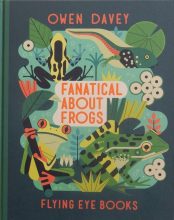
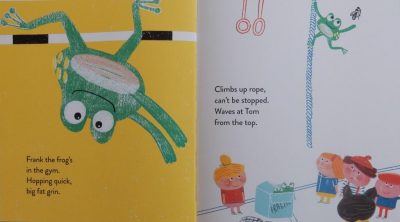
Fanatical About Frogs

Fanatical About Frogs
Owen Davey
Flying Eye Books

For this fifth book in the series Owen Davey has chosen to focus on our amphibian friends the frogs.

Frogs in all their glory (and here Owen includes toads) can be found on all continents except Antarctica. Thus far about 7000 species have been discovered but that number is not static especially since many are very small and well camouflaged. All this and more we learn on the first spread.

On the second spread, (Warts and All) focusing on the northern leopard frog, the author discusses the particular abilities and features of Anurans – their eyes and eyelids, the tympanum, legs, feet (sometimes with sticky pads) and where appropriate, their warty bumps.

Other topics each given a spread concern the skin; feeding;

colours, pattern camouflage and other means of self-protection; ectothermic regulation (the means by which frogs regulate their temperature).

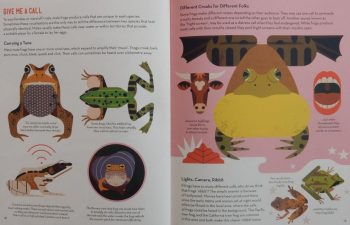
Communication,

metamorphosis; a focus on the Red-eyed tree frog, some of the ‘weird and wonderful’ varieties each occupy a spread. Next there’s a look at size – the biggest and smallest species – and a gallery showing the actual shape and size of 19 different frogs, each one having its own unique beauty.

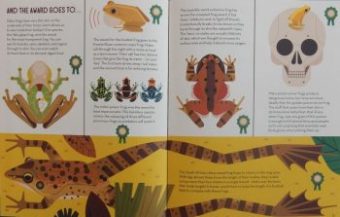
Then, as in all Owen’s titles in this series comes ‘And the award goes to …’ show-casing the most transparent frog, the loudest, the best impersonator, the creepiest, the best jumper and the most dangerous frog. Hmm, I wouldn’t like to encounter that golden poison arrow frog; it exudes a lethal poison 20 times more deadly than any other frog.

Also characteristic of the books, along with the playful topic and paragraph headings, is a spread of associated mythology that gives paragraphs on four folklore frogs. The vital topic of conservation is the final focus and there’s a concluding index.

Informative, fascinating, absorbing and as always, stupendously well illustrated and enormously enjoyable, is this excellent non-fiction book for home or school.

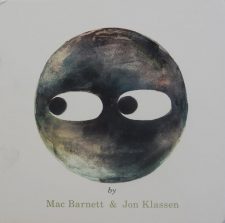
Circle

Circle
Mac Barnett and Jon Klassen
Walker Books

This is the final book in the Shape trilogy that featured first Triangle and then Square as main character; now it’s the turn of Circle.

One day at Circle’s suggestion, the three friends embark on a game of hide-and-seek. Circle stipulates one over arching rule: “No hiding behind the waterfall” because it’s dark there.

Circle completes her counting, only to learn from Square, who has remained static, that Triangle has gone behind the waterfall.

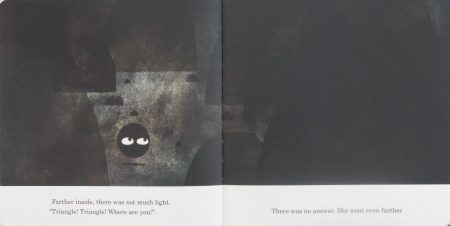
Off goes Circle to find him and as she goes deeper in, the double spreads gradually darken

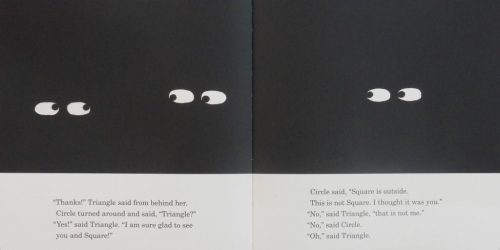
until everything is black save Circle’s eyes.

Then out of the darkness another pair of eyes appears belonging, Circle assumes, to Triangle. She starts chastising her ‘friend’ but no answer is forthcoming.

There appears a third set of eyes and it’s these, it transpires, that belong to Triangle.

It turns out that the since Square is outside, the other eyes belong to they know not whom. Circle asks the shape before her once again, “Who are you?” and again receives no answer.

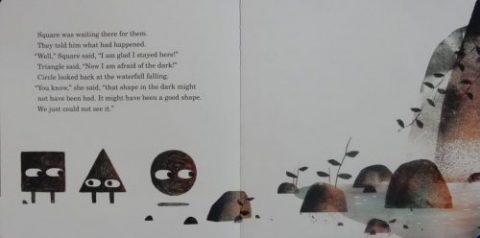
Circle and Triangle rush back in fright, back towards the light and the outside where Square is waiting.

Once safely back in the daylight, Circle ponders upon the identity of the shape; perhaps it wasn’t bad after all. “It might have been a good shape. We just could not see it,” she posits.

An important inherent message from Barnett in our xenophobic times no matter which side on the Atlantic we live on.

His story has an open ending, concluding with a question for readers. It does however suggest that we can perhaps overcome our fears by remaining calm and mindful, rather that letting them overwhelm us.

In his watercolour and pencil, digitally worked style illustrations, Klassen portrays the friends’ emotions with his characteristic minimalist, brilliance.

A book to ponder upon and discuss.

When the Crocodiles Came to Town / My Funny Bunny

When the Crocodiles Came to Town
Magda Brol
Orchard Books

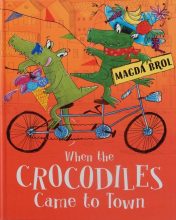
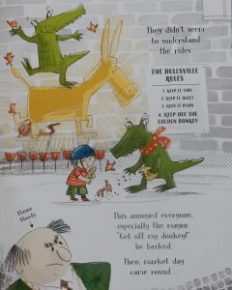
One day to everyone’s surprise two crocodiles turn up at Dullsville town and judging by their luggage, it seems they’re there to stay.

The problem, so our young narrator explains, is that they look different and behave differently and when it comes to the town’s rules, they show a complete lack of understanding which infuriates the inhabitants, and the mayor more than most, especially when they cavort on the precious golden donkey.

As for their ice-cream stall, that proves too messy and way too much fun for the killjoy Dullsvillites. In no uncertain terms, the crocs are given their marching orders.

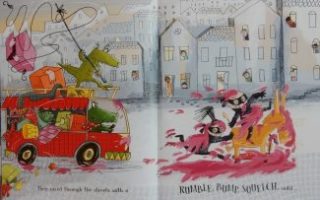
That night however, as they pack up their belongings, two other outsiders, Glen and Freda Grabbit creep into the sleeping town helping themselves to items from all the houses.

Their eyes though are on the main prize – that precious golden donkey – and as a result they hurtle straight into the leavers.

A chase ensues but unbeknown to the robbers, the crocs have their own special weapon and it’s a highly effective one when it comes to apprehending the thieves.

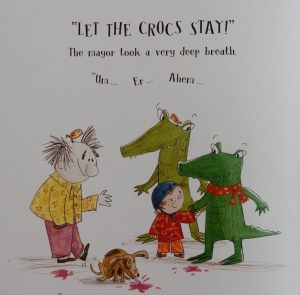
Could it be that at as a result of the narrator’s plea to the Dullsville mayor, two leavers are about to become remainers after all?

Debut picture book author/illustrator, Magda Brol has created a very funny story with a very serious message about rejecting prejudice, and accepting and celebrating difference. Her zany illustrative style is action-packed and each spread has a wealth of details to chortle over.

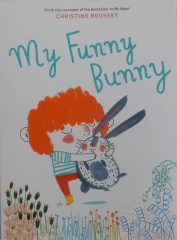
My Funny Bunny
Christine Roussey
Abrams Books for Young Readers

In her latest ‘pet’ book, Christine Roussey features a rabbit and a small boy.

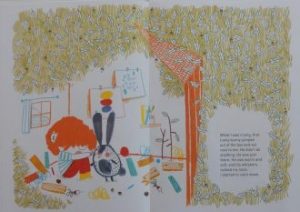
It’s the boy’s sixth birthday and he receives a large gift box from his favourite uncle. Eagerly anticipating the dwarf rabbit of his dreams the lad opens it to discover, yes a bunny, but this one resembles a large potato with yucky, clumpy fur and wire-like whiskers. Hmm!

Thoroughly disappointed, the boy lets off steam in his room before telling his new acquisition that he was unwanted and unlovable; and then going on to carry out a series of destructive acts before collapsing in a sobbing, snivelling heap.

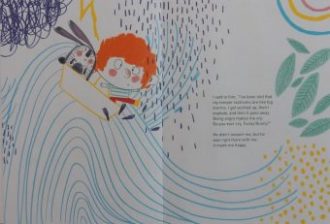
The bunny however, isn’t going anywhere in a hurry. He leaps from the box and makes soothing advances to his owner.

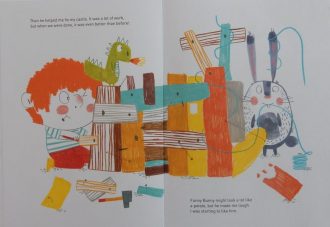
Before long, with damage repaired …

and temper tantrums assuaged, the two have become firm friends, celebrating a funny bunny birthday together and forging a lifelong attachment.

An adorable furry character and an emotional little boy narrator show young readers the importance of getting to know someone or something rather than making a snap judgement.

Roussey’s characteristically quirky illustrations and her outspoken narrative work beautifully in tandem making for a lovely story to share.

The Brontës / Along Came Coco

The Brontës
Anna Doherty
Wren & Rook

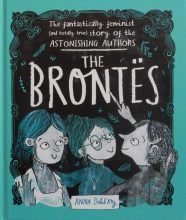
According to the cover claim this is the ‘fantastically feminist (and totally true) story of the Astonishing Authors’ of the title. It’s certainly a smashing short biography of three of the most gifted female writers ever.

We start with a pictorial spread that introduces the family and other members – human and animal of the Bronte household.

Thereafter, starting in 1822, the story looks at family life in Haworth, where father Patrick was a priest and the children loved to explore the moors, using them as inspiration for their own stories and poems.

Thrown back on their own company, the four youngsters become incredibly creative and when Branwell is given some toy soldiers, they use them to create their own imaginary world. This leads to dramatic productions, story and poetry writing, illustration and 3D maps all based on Glass Town.

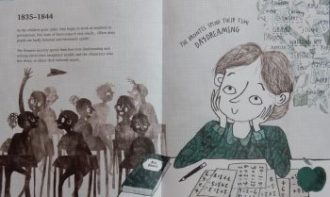
The young people work as teachers or governesses while daydreaming a lot of the time.
Then over the next three years, books of poetry and the three novels – one each – Jane Eyre, Wuthering Heights and Agnes Grey are published under the pseudonyms, Currer, Ellis and Acton Bell., followed by Anne’s The Tenant of Wildfell Hall.
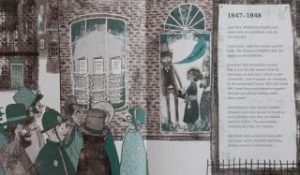
Sadly during the next two years Branwell, Emily and Anne fall sick and die leaving Charlotte who lives only another six years during which she publishes Shirley and Vilette.

The final spreads comprise annotated portraits of Charlotte, Branwell, Emily and Anne, followed by details of how wonderfully feminist were these Victorian sisters. Their legacy lives on and continues to inspire readers today: I can’t imagine being without their awesome novels.

Youngsters will be fascinated to learn of these strong-willed writers and their achievements against the odds, in Anna’s highly readable narrative style biographical account. Her illustrations are a quirky delight

Another truly creative spirit was that of Coco Chanel celebrated in this biography:

Along Came Coco
Eva Byrne
Abrams Books for Young Readers

Born in 1883, Coco’s early life was spent in a French orphanage where she found the rigid discipline of the nuns very hard to abide by

although she was fascinated by their dramatic, mysterious demeanour as they walked about the convent in their habits.

The young rule transgressor did however learn the sewing skills that later on led to her fame, while at the same time nurturing her dreams, her imagination and her sense of style and fashion.

As soon as she was old enough, Coco left the orphanage determined to follow her highly individual fashion sense and talent for sewing. Taking inspiration from everything she saw,

she soon opened two shops, one selling quirky hats, the other stylish yet comfortable clothes. Her designs though were not to everyone’s taste, but Coco with her understanding of what women wanted, was undaunted.

Her simple, rule-breaking designs became however, a huge trend-setting success.

Popular too were her new short hairstyle and her eschewing of restrictive corsets, both of which were practical and revolutionary, changing forever how women dressed and looked.

While this story is incomplete, it’s fascinating and inspiring, especially to divergent thinkers; and at the end of the book, the author gives additional background information, mentioning her subject’s wild imagination and difficulty in distinguishing fact from fiction, along with a select bibliography for those who want to dig deeper.

The author’s suitably stylish watercolour, pen and ink illustrations capture the spirit of her subject throughout and the inky endpapers are great fun.

Follow your dreams is the message herein.

Where Dani Goes, Happy Follows / Snow Sisters: The Enchanted Waterfall / Unicorn Academy: Rosa and Crystal

Where Dani Goes, Happy Follows
Rose Lagerercrantz and Eva Eriksson
Gecko Press

This is my first encounter with the delightful Dani whose adventures began with My Happy Life.In this, her sixth instalment the girl is spending the winter break staying with her grandparents because her father has again become sad and is now spending time with his mother and brother in his home city, Rome to ‘think about his life’.

While out ski-ing, the normally cheerful Dani gets that gloomy feeling but then she suddenly thinks of her best friend Ella and remembers that it’s almost her birthday. What better birthday present than an experience – a surprise visit from Dani?

There’s a slight snag though: Ella lives miles away in Northbrook. Of course, being the positive child she is Dani’s sure one of her grandparents will drive her: maybe she doesn’t have a problem after all.

After consideration Grandma asks her if she dares go from Stockholm to Northbrook on the train by herself so long as Ella’s mum collects her at the station. Granpa needs a fair bit of convincing but eventually Dani is on the train bound for her destination.

When she arrives at Northbrook however things start to go wrong; the station is covered in snow and there’s nobody there to meet her. That however is only the first bad thing that happens …

With her near indomitable spirit, Dani is an adorable character. In this book, in a very short space of time she emerges with a lot more understanding of the adult world with its ramifications and frailties.

With its bitter-sweetness, Rose Lagererantz’s writing really rings true and her characterisation is superb.

Eva Eriksson’s splendidly empathetic black and white illustrations are a delight and add an extra touch of piquancy to the book.I will definitely seek out the earlier titles in this series.

Wholeheartedly recommended for solo reading and as a class read aloud for KS1 and early KS2.

Snow Sisters: The Enchanted Waterfall
Astrid Foss, illustrated by Monique Dong
Nosy Crow

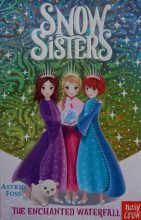
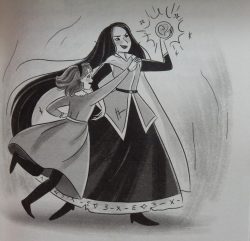
This is the 4th and final magical adventure of the three sisters, with special powers to enchant, who reside in a castle on the mystical island of Nordovia.

Now Magda, Hanna and Ida must draw on all their strength and bravery to undertake their final quest in this battle of good versus evil, for it’s the Day of the Midnight Sun and the nefarious Shadow Witch is absolutely determined to do whatever she must to obtain the power of the Everchanging Lights and make the skies forever dark.

As always the combination of magical fantasy, highly engaging characters (some animal), a powerful plot with just the right amount of darkness, and plenty of Monique Dong’s lovely black and white illustrations will ensure that early chapter book readers will lose themselves in the adventure.

And do the sisters succeed in ensuring that the Everchanging Lights are in their rightful place by the time the clock strikes the midnight hour? Let’s just say that where’s there’s light and love, there is hope.

For roughly the same age group, there’s more magic in:

Unicorn Academy: Rosa and Crystal
Julie Sykes, illustrated by Lucy Truman
Nosy Crow

This series for the countless young unicorn lovers out there takes us yet again to Lakeside Unicorn Academy for another instalment of magical unicorn delight.

The pupil in question herein is Rose and her unicorn partner is Crystal and after just a month at the school the two are off on a rule-breaking adventure in search of the magical map. It’s not all down to the twosome however, teamwork is involved and they both have to learn what being a member of a team entails.

Engaging, undemanding fun.

What’s Going On Inside My Head? / Step Into Your Power

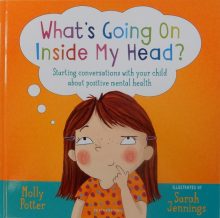
What’s Going On Inside My Head?
Molly Potter and Sarah Jennings
Bloomsbury Featherstone

Developing and supporting emotional literacy is, or should be, a crucial part of young children’s education in school and most teachers consider it so.

However, parents/carers can at times feel inadequate when it comes to talking to and supporting their children’s mental health, and at an increasingly younger age children come under enormous pressure be that through the education system (I could rant at length about that) or out of school in clubs and activities in which they participate, as well as through social media and advertising. What parents need to do is to love and support children not for what they can achieve but for who and what they are.

To this end Molly Potter, a teacher who specialises in PSHE has written a very helpful book to share with young children.

By means of twelve questions she explores a range of topics: how to think about oneself; the relationship between a healthy body and a healthy mind (how the former feeds into the latter);

the notion of happiness; dealing with emotions; coping with feelings of anger, sadness and fear; coping with negative thoughts that seem overwhelming (suggestions to prevent ‘ruminating’ and instead focusing on being in the moment); dealing with upsets triggered by another person (forgiving is important here).

There’s also a spread on meditation and its potential benefits;

another on who to ask for help when it’s needed; the role of family and friends as a supportive network; being a better friend and finally, improving one’s own thinking habits – being proactive when something is upsetting you.

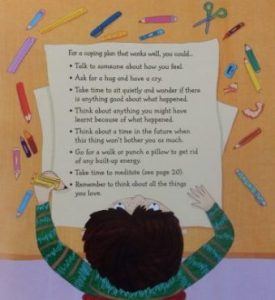
Many of the topics includes a ‘top tip’ or ‘It’s good (or important) to know that …’ paragraph and I particularly like the coping plan

and the invitation to hold up a mirror to oneself and think about which behaviours ‘you like’, ‘don’t mind’ and ‘really do not like’.
The book concludes with three pages of guidance for parents and carers.

Throughout Sarah Jennings’ inclusive illustrations both support and extend Molly’s straightforward, sensible, practical words.

For an older age group is:

Step Into Your Power
Jamia Wilson and Andrea Pippins
Wide Eyed Editions

Here’s a book I wish I’d had when I was growing up. Both author Jamia Wilson (executive director of the Feminist Press) and illustrator/designer Andrea Pippins act as mentors in this, their guide to helping girls to grow into confident young women, cognisant of their strengths (and the areas they need to work at), and sufficiently empowered to step out and follow their dreams.

Subtitled ‘23 lessons on how to live your best life’, the book offers exactly that and made me want to go immediately and seek out some young females to share it with.

After an inspiring introduction, said lessons are organised into five sections entitled: Power, Community, Choices, Act! and Self-Care and all sections comprise several key elements each of which is allocated a double spread (or two) illustrated in vibrant colour by Andrea.

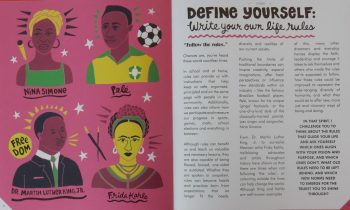
Thinking outside the box, abandoning old habits that are no longer appropriate in today’s richly diverse society, and not always following the rules, are explored and the author mentions as examples some visionary rule-challenging individuals.

Each topic has an encouraging and uplifting ‘Step into your power’ section.

Thoroughly recommended for upper primary readers and beyond.

Captain Sparklebeard

Captain Sparklebeard
Timothy Knapman and Sam Lloyd
Egmont

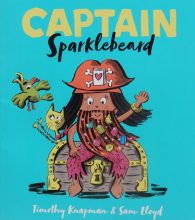
When first we meet young Peg she’s something of a Cinderella character residing with her nasty Step-Great-Grand Auntie who bosses the girl around constantly. So hard at work all day is she that her only spare time is at night. That’s when she reads pirate tales and dreams of escape and adventure. Good on you girl!

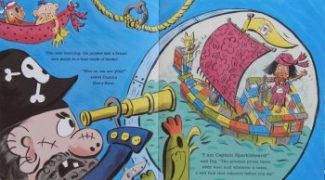
One day while out walking with her relation’s cat she discovers a pirate ship has arrived in the harbour. On board is Captain Hairy-Ears shouting about having a treasure map and announcing that anyone who ‘dreams of escape and adventure’ can join his crew.

Seemingly though there are exceptions for when Peg asks him politely she’s turned down on account of her nice manners, her smallness of stature and lack of a beard. Moreover, when the lass informs him that she’s read lots of pirate stories, this is met with derision.

Peg however is not giving up that easily. Back home that night she fashions herself a pirate outfit from curtains and a bushy – albeit rather itchy – beard from the floor brush. Then spying her Step Aunt’s jewels she’d been ordered to polish earlier, she has an idea.

The following morning there’s a brand new pirate boat on the ocean.

When challenged as to her identity, Peg informs Captain Hairy-Ears she’s Captain Sparklebeard, the greatest pirate ever and moreover, she will get to the treasure before he does.

Having cast aspersions about her boat Captain Hairy-Ears sails off leaving the lass to peruse her Big Book of Sea Perils. This volume proves worth its weight in gold for it warns her of the dangers lying in wait between her and the treasure island, hazards of which the other pirates know nothing.

Consequently when they finally arrive on the beach they’re jittering wrecks with nothing going for them save the treasure map.

But Peg still has the upper hand for she’s the only literate one among the treasure seekers.

Furthermore she has something else to reveal that will surprise her rivals.

I’d hate to be a story spoiler, especially of one as much fun as this so I won’t reveal what happens thereafter. That’s for you to discover when you lay your hands on this treasure of a book.

With Timothy Knapman’s wonderfully playful telling that’s full of alliteration and other word combinations that demonstrate to children that language is fun, the indomitable female character and Sam Lloyd’s rumbustious scenes of madness and mayhem on the high seas, this book is a winner.

Maisie’s Scrapbook


Maisie’s Scrapbook
Samuel Narh and Jo Loring-Fisher
Lantana Publishing

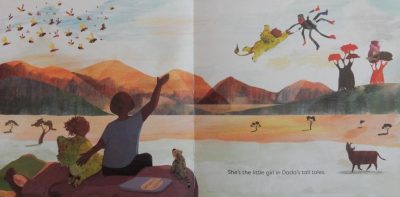
Five-year-old Maisie is the narrator of this celebration of unconditional parental love. In the end papers she shows us her scrapbook: her Dada shares tales of the spider she saves the world from (aka Ananse), while her Mama tells her ‘a bull is not a pet’.

In between, the main narrative compares and contrasts the differing parenting styles of her Dada and Mama.

Steeped in folklore, the former nurtures Maisie’s flights of fancy

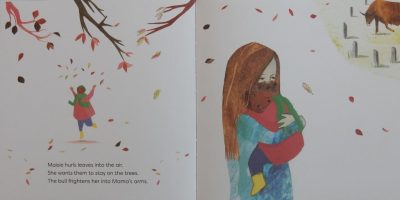
while her Mama endeavours to keep her grounded with games such as hide and seek, and protects her from the bull she imagines herself riding.

As the seasons pass we see examples of the all encompassing parental love this fortunate child receives – Mama’s arms surround her as she’s frightened by the bull;

Dada ‘shows her clouds painting pictures of the ancient worlds in the sky’.

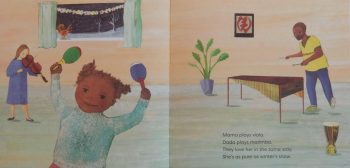
Mama cooks risotto whereas Dada’s speciality is jolof rice; Mama plays a viola, Dada the marimba, but they both nag her in the same way and love her in the same way;  The result of this parenting is a spirited child who appreciates what she has: two loving parents, a rich, mixed cultural heritage and a bundle of self-confidence.  Above all, love is what matters most in Samuel Narh’s beautifully expressed, moving tale.

Reflecting the different heritages of her parents, there’s a wealth of cultural references in Jo Loring-Fisher’s mixed-media illustrations of Maisie’s life both in the expansive outdoors and the more confining walls of her home: the Ghanian Sankofa bird on the window-sill, the framed Gye Nyame (supreme being) symbol; the ancient buildings painted in the sky.

Positive in every respect this is a book to share, share, share again and then to talk about within the family and in school or nursery.

In the Swamp by the Light of the Moon

In the Swamp by the Light of the Moon
Frann Preston-Gannon
Templar Books

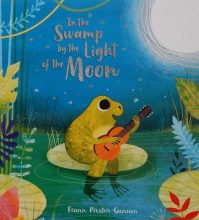
Shhh! Can you hear that sound? It’s little frog down in the swamp sitting alone quietly singing his little frog song ‘neath the light of the moon.

Coming to a sudden stop he lets out a sigh and deciding solo singing really isn’t fun, hops off to find someone to join in.
He first enlists a friendly humming, drumming crocodile …

but still the tune lacks something so he adds some mice with their ‘la’s some “OH OH OH!” –ing fish, three coo-ing birds (at their own request);

but still the song isn’t right.

Then Froggy happens on a tiny shy bug convinced that her song isn’t worth adding to theirs.

Froggy however speaks thus, “… your song’s unique and important like all the rest. Even small voices count … only you sing your song.”

And so the little bug sings and as she does so, she shines like a bright star .

The voices blend beautifully as the song rises to a brilliant crescendo, the tune permeating every part of the swamp until everything on earth has joined in the singing.

This book delivers such a vitally important message in its celebration of the softly spoken introverts (I remember being such a one as a child, rather than the outspoken woman I now have become.) It’s a book that needs to be shared widely in nurseries, schools and with individuals particularly those similar to the little bug. It also speaks to the socially confident extroverts who may need to be made aware of the importance of leaving space for everyone to have their say.

Told through Frann’s lyrical rhyming narrative and her splendid collage illustrations (I love the way she places images on the page), this inclusive tale is a huge winner in my book.

The Song of Spring

The Song of Spring
Hendrik Jonas
Prestel Publishing

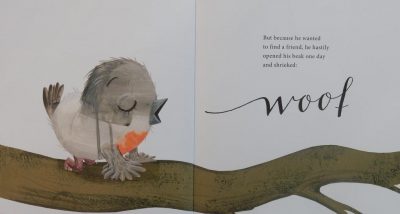
Spring is on its way and the birds are singing their springtime songs to ‘attract some friends’. Mr Blackbird sings for Mrs Blackbird and so it is with Mr Robin and all the other birds. Or rather, all but one little bird. He cannot remember his spring song but he really wants a friend so he has a go anyway …

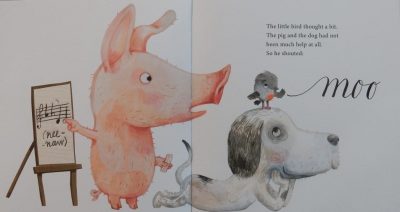
An enthusiastic dog responds but a dog isn’t what our feathered friend seeks so he has another go, and another and …

His oink, moo, meow, meh and hee-haw result in the arrival of the corresponding animals until the little bird is surrounded by new friends though there’s not a bird among them.

His friends are at a loss to know how to help. Silence ensues until the bird emits a sudden, unexpected …

The outcome is entirely satisfactory, not only for the little bird, but also for his farmyard friends and celebratory sounds are heard all around.

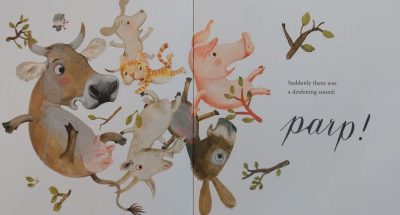
Both adorable and suddenly, funny, this book is sure to have your little ones giggling in delight and enthusiastically joining in by yelling the names of the farmyard animals that little bird emulates and making their sounds. Doubtless they’ll also enjoy attempting the ‘deafening’ parp!

Jonas’ watercolour and collage style illustrations are wonderfully expressive and totally alluring when it comes to generating audience participation.

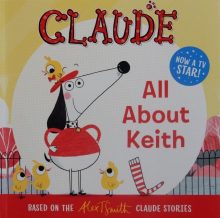
Claude: All About Kevin

Claude: All About Keith
Alex T. Smith
Hodder Children’s Books

One fine day Claude and Sir Bobblysock are perambulating in the warm sun, Claude taking the opportunity to practise his hooter playing, when they come upon a very distressed baby duck.

Benny Begonia, stops by. He suggests the creature has lost its mummy and offers to go and search for her. That’s how Claude and Sir B find themselves doing a spot of duckling sitting.

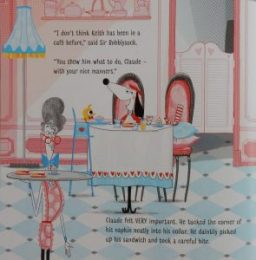
In order to pacify the little animal Claude suggests a visit to Mr Lovelybuns’ café.

Things are going swimmingly until Claude gets a tad over enthusiastic about his sandwich and SPLAT!

Keith is less than happy about his new pickle-spattered plumage and makes it known in no uncertain terms.

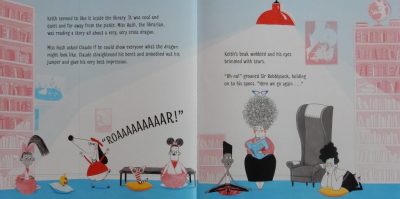
Off they go to the library and soon Keith is happily listening to Miss Hush’s story about an angry dragon. Until that is the librarian asks Claude to give a dragon impression.

You can imagine Keith’s reaction to the almighty roar.

Off they go again – to give Keith an opportunity to do what ducklings like to do. Thanks to Denzel the duckling appears to enjoy his swim but then Claude decides to join him in the water and … Here we go again.

Back comes Benny but without Keith’s mummy. “I should have just stuck with playing my hooter,” says Claude giving it a tiny toot.

Lo and behold that does the trick and before you can say ‘duck’ Keith is not the only one doing some enthusiastic moves to Claude’s tooting.

Back they all go to Pawhaven park: job done surely? Errr, maybe that’s not quite the end of the story. But we all love a happy ending and rest assured there is one though you’ll need to get hold of a copy of the book and discover how things are resolved – if indeed they are.

Alex’s Claude and Sir Bobblysock are totally irresistible and, based on the Disney Junior TV show, this latest adventure is as wittily ridiculous as ever.

Brilliant Ideas from Wonderful Women / Little Miss Inventor / Amazing Women Sticker Scenes

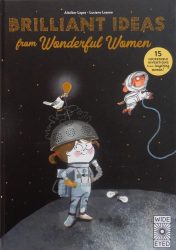
Brilliant Ideas from Wonderful Women
Aitziber Lopez and Luciano Lozano
Wide Eyed Editions

Let’s give three rousing cheers for the brilliantly inventive women behind the first car heater, the game Monopoly, disposable nappies, the dishwasher, the domestic surveillance system, Kevlar, maritime flares, non reflective glass, WIFI, one-hand operated syringes,

the submarine telescope, diagnostic tests in medicine, the life raft, windscreen wipers and the E-book.

All these ground- breaking inventions came about thanks to the work of the pioneering, creative spirit of the women featured in this book. Each one has made a significant contribution to science or technology in either the 19th or 20th century and they are each given a spread in this celebratory book.

For several of those included, the invention featured is not their only one. For instance Chicago-born Margaret A. Wilcox is credited with inventing the first washing machine in addition to the car heater discussed here; Hedy Lamarr, in addition to WIFI – surprisingly inspired by piano keys we’re told – invented Bluetooth and GPS. And, Marion O’Brien Donovan went on to invent a number of other things – dental floss, a soap dish that drained and a hanger that could hold up to 30 garments – being some of them.
It will come as no surprise to learn that these women inventors all had to overcome enormous odds to get their work patented and marketed, not least African-American Marie Van Brittan Brown the brains behind the 1966 domestic surveillance system; indeed she (and her husband) weren’t successful in marketing their system although many others made fortunes inspired by the original patent.

Maria Beasley inventor of the life raft did not have her invention taken seriously until the disastrous Titanic sinking. Maria’s life rafts were on the liner but not in sufficient numbers to save everyone.

All this fascinating information and more is included in scientist Aitziber Lopez’s inspiring book.

I love the way, illustrator Luciano Lozano has cleverly incorporated both the inspiration for, and use of each invention, into his amusing spreads.

This is a book I’d certainly want to have in my KS1/early KS2 classroom as well as recommending it for families who want to celebrate with the children, the achievements of women, and that should be every family.

Little Miss Inventor
Adam Hargreaves
Egmont

Adam Hargreaves (son of Roger) has created a new Little Miss and who wouldn’t love a book with a young female inventor?

Little Miss Inventor has a brain brimming over with good ideas; ideas that she transforms into inventions in her garden shed. Her self-imagined, self-built mobile house is chock-full of her awesome inventions and she loves to create useful things for her friends as well as herself.

One day however, her brain power is tested to the limit: she needs to make Mr Rude a birthday present; but what can one give to a person who hurls insults at everyone he meets. Can she think of something appropriate and if so what could it be?

Feminist power with a STEM theme and a laugh out loud finale for your little ones.

Amazing Women Sticker Scenes
illustrated by Isabel Muñoz
Red Shed

This book contains ten illustrated backdrops  by Isabel Muñoz that include basic key information about ten women who have made in their own fields, significant contributions to society through their achievements in aviation, girls’ rights to education, science, literature, sport, women’s rights and architecture.

In addition there are six pages of stickers to add to the relevant scenes. This could be a good way to introduce the numerous sticker-mad youngsters to these wonderful women.

Dance, Dolphin, Dance

Dance, Dolphin, Dance
Patricia MacCarthy
Otter-Barry Books

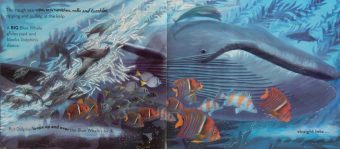
Out in the surging, swishing swooshing ocean, deep down in the kelp forest, is playful Dolphin. He dances with a shoal of sardines and the sea lion;

then as the sea becomes rougher, the tuna.

As he dances over a big Blue Whale …

he suddenly encounters a Great White Shark.

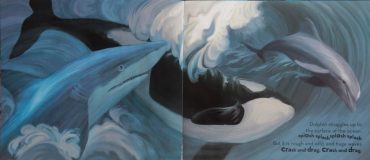
The shark attacks but moving faster, Dolphin evades its jaws but the chase is on.

Where can he hide: not in the deepest depths of the forest for there lurks a Killer Whale.

Now with two huge predators hunting him, Dolphin must dance for his life. Dance, Dolphin, dance.

Then, bang! A huge wave hits the hunters, ‘boom-boom boom-boom.’ Dolphin has a chance to make an escape …

Set in the Western Gulf of California, this dramatic deep sea chase involving a Bottlenose Dolphin, provides a wonderfully rich experience for both ears and eyes – try a telling with an ocean drum. Patricia MacCarthy’s poetic text is full of action and excitement, and her illustrations are amazing.

After an initial reading to savour those illustrations and another to search them for the 36 sea creatures and birds, shown in the final spread, this book, which blurs the boundaries between fiction and non-fiction, offers a superb dance/drama opportunity for a class or group.

Monty and the Poodles

Monty and the Poodles
Katie Harnett
Flying Eye Books

Whether or not you’re a dog lover, you’ll find it hard not to be enchanted by Monty and Ginger, stars of Katie Harnett’s new picture book.

Monty is a stray living on the north side of town, Ginger a pampered poodle residing at Poodle Mansions on the opposite side.

One day the two meet in an art gallery, and thus begins an unlikely friendship.

When Monty sees Ginger’s home he really wants to live there too.

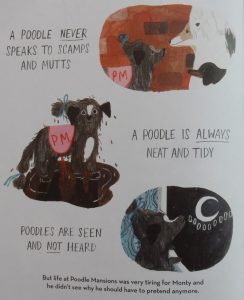
Ginger likes the idea but there’s a problem in the form of Miss Lillabet. This battle-axe enforces a strict ‘Poodles Only’ policy at the Mansions.

Ginger enlists her fellow poodles in operation transformation,

but will their crafty canine ruse have the desired effect?

Poodle Mansions certainly does gain a new resident …

but perhaps a rule governed life, albeit a peachy one, isn’t for everyone, or rather, every dog.

Is there maybe another way for the two friends to be together …

Told in a direct manner, celebrating difference and inclusiveness are at the heart of Katie Harnett’s humorous story.

Rich in pattern and with a flattened perspective, her playful pictures, which range from full double spread to vignette, give a cinematic feel to the book.

Katie has created another winner with this one.

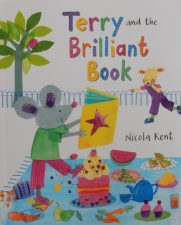
Terry and the Brilliant Book

Terry and the Brilliant Book
Nicola Kent
Macmillan Children’s Books

Meet best friends Sue and Terry. They absolutely love balls; balls to bat, bounce, bash and run and jump after.

Into their ball-filled life one day comes a book. It’s Sue’s surprising birthday present to Terry.

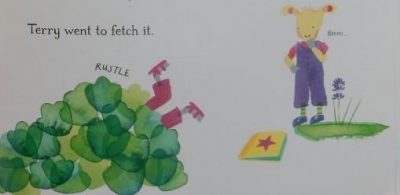
Initially neither knows what to do with it so Sue goes off to get yet another ball for Terry. When she returns however, Terry is lost in his book and just can’t put it down. (I know that feeling!)

The friendship is tested when things go wrong – first a cinema visit and then dinner.

That night Terry finishes his wonderful book and next morning the two resume their ball playing until …

Now it seems, Sue too has discovered the joys of reading

and it’s Terry’s turn to feel left out.

Can they get around this challenge to their friendship? Perhaps a visit into town might help …

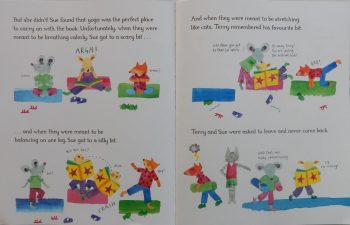
This enchanting story about the delights of reading demonstrates that perhaps it’s not wise to become totally obsessed with one activity, especially when it damages something as important as friendship.

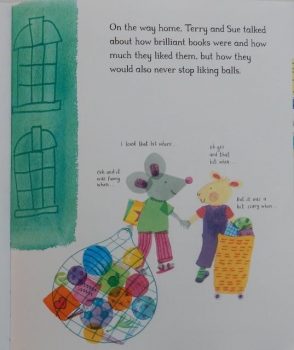
The splendid endpapers, indeed the entire book reminds me of a relation, his family and book-filled, ball-filled home. Herein the 3 year old boy is ball mad but now also loves books; and the 6 year old girl always seems to have her head in a book but finds time for lots of physical activities too.

A smashing book to open up discussion, at home or in school, about the story’s themes, which are highlighted in Nicola’s beautifully detailed illustrations; love her cheery colour palette too.

The Incredible Ecosystems of Planet Earth / The Story of Flight

Wren and Rook, an imprint of Hachette Children’s Books, prides itself on high quality non-fiction titles; here are a couple of recent examples:

The Incredible Ecosystems of Planet Earth
Rachel Ignotofsky
Wren & Rook

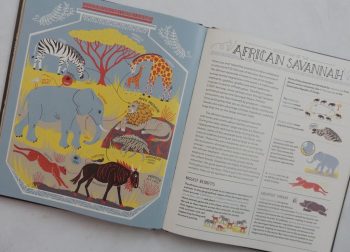
This is a super book that showcases the ecosystems of our planet organised under geographical regions – Europe, North America, South America, Asia, Africa, Australasia and The Polar Ice Caps, and then Aquatic Ecosystems.

The author packs a terrific amount of information into her text and her meticulous illustrations, maps and infographics

as she highlights our incredible ecosystems large and small with their huge varieties of flora and fauna, and different climatic conditions.

Did you know that an ecosystem can be as huge as a coral reef or as tiny as one drop of water? What an incredible thought.

A disturbing thought in contrast is that unless we take urgent steps to halt mankind’s destructive actions and strive to eliminate climate change the damage to our beautiful world will be beyond repair. We can all play our part as Rachel tells us in her ‘Protecting Our Planet’ spread, which is an optimistic way to end this splendid, beautifully designed opus.

One to add to your book collection at home or school, or indeed anywhere there are readers who love nature.

The Story of Flight
Jakob Whitfield and Us Now
Wren & Rook

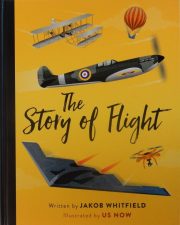
This book traces the history of flight from George Cayley’s glider, flown by his coachman, to the pilotless drones of the 21st century.
This fascinating story shows how each new breakthrough paved the way for the next development

as well as explaining how social developments, war, women’s equality and endeavours to combat climate change have influenced the directions of air transport.

The book concludes with a look to the future and how new technologies could help reduce the environmental impact of aviation, and a final time line showing the history of the aeroplane.

Inevitably in a book such as this, the information Whitfield provides is not comprehensive, but there’s sufficient to whet the appetites of young readers and the dramatic Us Now illustrations are alluring and exciting.

Voyage to Arghan / Ernest and I

Voyage to Arghan
Ernest and I

Joanna Grace and Helen Lanzrein
LDA

In her book Sensory Stories, Joanna Grace wrote of two key elements of sensory story sessions: – the importance of sensory stimulation, which is central to cognitive development and the power of narrative, and the storytelling space it can create for those who share a story.
Sensory stories (that include in the telling not only words but also pictures, tastes, smells, sights, sounds and touches) in general are inclusive and can be used for people of all ages.

These two titles are part of a new picture book series by Joanna.

Each begins with an explanatory preface that outlines the sensory story concept, explains how best to share the book with one or more children and provides a resource list of items that need to be to hand before you start.
The introductory notes suggest you share the story hearing first the words, then focusing on the pictures and finally, the sensory element. This pattern lends a natural rhythm to the whole process.

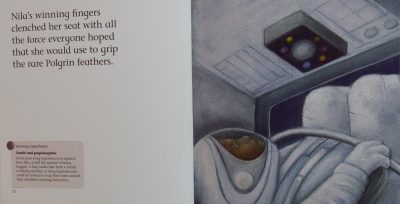
Voyage to Arghan , created particularly for ‘supporting children with their mental wellbeing’, tells of a little girl who as winner of the “First Child in Space” competition, blasts off into space,

destination the distant planet Arghan, in the hope of finding rare Polgrin feathers.

Both her story telling and the suggestions for the sensory elements are a reflection of the author’s creativity while her inclusion of technical terminology demonstrates her academic knowledge of her subject.

Some of the experiences suggested in this story need no extra resources. These include a hug, a lunge, a breathing techinque; and rolling back and raising the feet in the air (you might with their permission, tip backwards the chair of a wheelchair user) to simulate the rocket launching. Other elements need a little preparation but nothing more exacting than the adornment of a shoe-box to create an entire Arghanian world.

Beautiful textured pastel illustrations by Helen Lanzrein provide the visual element of the story and there’s a final ‘voyage log’ offering ideas for discussion.

Parents and educators alike will welcome this book, as they will Ernest and I, created particularly for ‘supporting children to identify with their attachments’.

Its rhyming narrative, essentially a soothing reflective story of childhood memories of a boy and his much loved soft toy penguin, is also beautifully illustrated by Helen Lanzrein.

With more multi-sensory storybooks to follow I as an educator, look forward to seeing them.

Your Mind is Like the Sky / The Go Yogi! Card Set


Your Mind is Like the Sky
Bronwen Ballard and Laura Carling
Frances Lincoln Children’s Books

Psychologist and mindfulness teacher, Bronwen Ballard has written a book to introduce children to mindfulness. She uses similes and metaphorical language to show that our difficult thoughts and feelings are an integral part of everyone’s life and demonstrating that we all have the power to deal with them.
Sometimes she says, the mind can be like a clear blue sky but at other times it might be ‘fizzy, stormy, black and crackly’; or perhaps a ‘bit grey’.
Thoughts come and go constantly; they’re likened to the clouds – sometimes positive, pleasant white ones but at other times they become dark and negative.

For example ‘raincloud’ thoughts may well make one feel sad, cross, irritated, confused perhaps.

However there are ways to deal with them, even those that seem at first to be overwhelming and this is what the second part of the narrative discusses. The important thing to do is to acknowledge the thought but realise it’s only one of many, many in the entire sky of your mind and that way you can let that dark thought slip gently away.

The more one practices being mindful, the easier it becomes to take control and choose which thoughts to attend to.

The main narrative ends on an upbeat note reminding the young reader that, like the sky, his/her mind is bursting with amazing thoughts each one different in shape, colour and size.

There are two final spreads aimed at adults explaining concisely what mindfulness is and offering some basic ideas to try together at home.

Award-wining illustrator Laura Carlin’s soft focus, smudgy, mixed media illustrations are the ideal complement to Bronwen’s gentle narrative. Together they offer parents and carers a really helpful book to help youngsters overcome their worries.

The Go Yogi! Card Set
Emma Hughes and John Smisson
Singing Dragon

Using little humans rather than animals this time, the author, very experienced yoga teacher, Emma Hughes and illustrator, John Smisson, of the Go Yogi! book have created a set of 50 cards of popular yoga poses; and Emma has written an accompanying explanatory booklet.

The latter briefly gives the benefits of yoga for children, sets some ground rules to use and talks about how to work with a group, the names of the poses, some words on pranayama and suggests ways the cards might be used in a session – in games or for storytelling being two ideas.

It’s concise and especially useful for those who aren’t practiced in teaching yoga to children. One proviso though, I was taught that young children (under 7) should not attempt headstands as the skull may not be fully hardened.

The ‘flash cards’ themselves have a child showing a yoga asana (pose), (or in the case of paired poses, two children) set against a brightly coloured background on one side, while the reverse side shows how to get into the pose. Each card has a coloured border that suggests a possible emotional or physical benefit doing the pose might bring. Orange signifies energising; green is for calming; red for strengthening and yellow for balancing.

All in all, and I speak from experience as a specialist early years teacher and teacher of yoga to children (and adults), this little box is a real treasure for those wanting to introduce yoga to young children. I thoroughly recommend it.

Stay, Benson!


Stay, Benson!
Thereza Rowe
Thames & Hudson

Benson is, so owner Flick believes, the ideal dog. When she leaves home and heads off to school, he stays minding the house and of course, he always obeys her “You stay … No chasing!” command. Flick is confident of that but should she be?

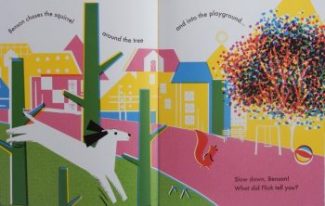
What about the day when no sooner has she bid him farewell, than he’s sneaking off through the back door and teasing a black and white moggy in the garden.

Furthermore, under the impression, so he’d have us believe, Flick’s instruction was “Play Benson!” he begins chasing the cat.

The feline creature leaps over the fence but Benson digs beneath it and then the chase is well and truly on.

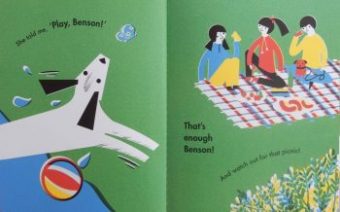
No matter what we tell him he insists he’s been told to “Play Benson!” and after scaring the cat out of its wits, he proceeds to chase a squirrel and then goes charging off into the playground after a ball.

Oh my goodness, now what? He certainly is in a playful mood. He’s soaked himself going after that ball

and it appears he’s a bit peckish too.

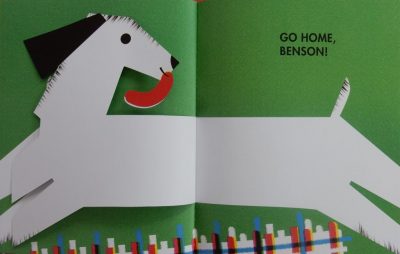
It’s as well he obeys the picnickers “GO HOME, BENSON!” command however. He makes it back just in the nick of time, for who should come through the door but Flick with a cheerful greeting and a couple of questions to which only we the readers (along with a few characters in the story) know the answers.

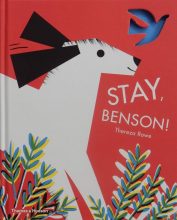
It’s impossible not to love this mischievous dog with his zest for life and playfulness portrayed in Thereza’s eye-catchingly bold, retro-style art with its occasional die-cuts and cutaway pages. Offering plenty of audience participation opportunities, her story is a fun read aloud and the built in repetition makes it ideal for those in the early stages of becoming a reader.

Leap Frog

Leap Frog
Jane Clarke and Britta Teckentrup
Nosy Crow

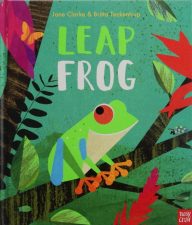
The latest in Jane and Britta’s series of stories that offer maximum audience participation features a little tree frog named Felix. Felix has got lost near the pond, far from his home in the jungle trees.

The tiny creature appears easily frightened by the strange noises, the first being the ‘Plip! Plop! Plip! Splosh!’ of the turtle. She though is nothing to be alarmed about; the friendly creature merely wants to watch the sunset and we’re ready to reassure him with our, “Don’t worry, little frog, / there’s nothing to be scared of.”

These words of encouragement are to be repeated each time Felix hears a scary sound and there are encounters with a beetle that’s just walking across the foliage;

a troupe of cheeky monkeys a-nibbling their ‘nutty night-time snacks’ and dropping the shells with a ‘Crack! Crunch! Clatter!’; and a slithery snake to be seen off with some clapping and shouting.

The branching tree beside that on which a woodpecker taps provides young listeners with some counting practice as the little frog, aided by his sticky toes, climbs up and up.

Having reached the top, Felix hears yet another sound, and it’s getting nearer. What could be making that ‘Hop! Hop!’ hopping noise … ?

The textured, jewel-like colours of Britta’s scenes with the leap-off-the-page fluorescent green of Felix’s back and lower limb parts are perfect for holding the attention of little ones as they enthusiastically respond to Jane’s irresistible instructions and questions on every spread of this noisy, fun-filled story.

The Light in the Night / The World Book Day Monster

The Light in the Night
Marie Voight
Simon & Schuster

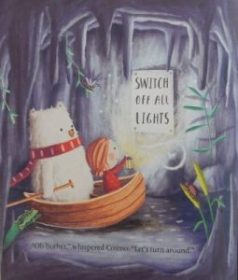
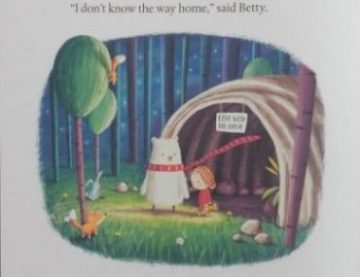
Young Betty absolutely loves the night time for it brings with it the most amazing stories, one of which features Cosmo.
Cosmo is a bear that is terrified of the dark and just when Betty is wishing that she could tell him that he has no need to fear it, POP! There he is.
Together they set off, hand in hand, on a journey of discovery. Led by a firefly they walk into the woods where they find a cave
Betty reassures her friend and they follow the firefly inside towards an inky lake whereon a rowing boat awaits to take them further.
The cave grows ever darker as they go deeper within until they come upon a sign.

Overcoming her own initial fear, Betty does as the sign says. An amazing sight meets their eyes and it’s anything but scary.
Once back outside, it’s Betty’s turn to feel anxious; she makes a confession …

With roles reversed, Cosmo now does the reassuring until the two reach Betty’s house safely once more.
Back indoors over hot chocolate (what else) the two talk of their journey until it’s time for Cosmo to leave.

Betty gives him her lantern and a special message.

In the morning she wonders if it had all been a dream: what do you think? You’ll need a copy of this magical book to find out.

Rising star, Marie Voight’s illustrations are adorable and her two characters totally endearing making this a thoroughly reassuring, warm-hearted bedtime story for you and your little ones as well as a lovely one to share in an early years setting.

The World Book Day Monster
Adam & Charlotte Guillain and Ada Grey
Egmont

World Book Day is fast approaching, her school is celebrating but Anna has a dilemma. What should she dress up as?

Dad’s suggestion that they pay a visit to the bookshop proves fruitful and thanks to a helpful suggestion from the bookseller, Anna goes home fired with enthusiasm, carrying a book.

After multiple reads she enlists parental help to make her costume and next day she excitedly rushes off to school to show her friends.

Their response however isn’t particularly positive; they all ask, Anna, what are you?” over and over throughout the day.

Happily her head teacher’s reaction is very different; it was a favourite of hers when she was a child and she’s eager to share the book Anna is clutching with the class.

A magical story time ensues that is much appreciated by all her classmates, which leaves Anna thoroughly satisfied, and so she should be as she demonstrates the power of story to thrill and enchant.

Adam and Charlotte’s rhyming text coupled with Ada’s spirited scenes make for a fun book to share around World Book Day or at any time one wants to attest to the power of a story and the importance of the imagination.

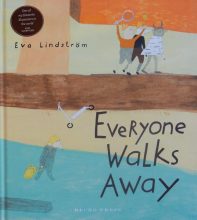
Everyone Walks Away

Everyone Walks Away
Eva Lindström
Gecko Press

There are four characters in this story; three of them walk away leaving Frank all alone.

The others, Tilly, Paul and Milan have lots of fun but as always, Frank is left alone.

He goes home and cries buckets, or rather pots, one to be precise.To his tears he adds sugar and boils the liquid.  He’s very tearful and works hard to get his special jam mixture just right – not too thick, not too runny.

When done he leaves it to cool in a breezy spot, then pours it into a jar.

Somewhat later the other three characters reappear and having made careful preparations, Frank invites them to a tea party.

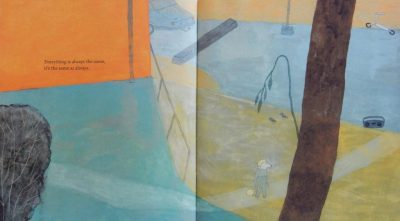
The softly spoken story ends with a gap for readers to fill. It’s a case of showing not telling; we decide or even perhaps, we don’t make up our minds.

Eva Lindström’s quirky gouache and fine pencil line illustrations have a flattened look that reminded me a little of some of Maira Kalman’s work.

Quiet though it may be, the book’s impact is considerable; one cannot help but feel sympathy for left out Frank and hope he finally gets what he wants.

Tiny T. Rex and the Impossible Hug / Dinosaur Farm!

Tiny T. Rex and the Impossible Hug
Jonathan Stutzman and Jay Fleck
Chronicle Books

Daft and sweet sums up this story of one very small T. Rex and his enormous challenge.

Tiny, as he tells us at the outset has tiny arms and a strong desire to cheer up his stegosaurus friend Pointy by giving him a hug.

Determined to overcome his design fault and bestow a comforting embrace upon his best pal, Tiny consults various members of his family. His father suggests the solution might be a mathematical one: ‘Rexes are thinkers, not huggers.’ he proffers.
Auntie Junip – a yoga buff – suggests balance (along with a healthy drink of cucumber juice), offers the best means of problem solving.

Thank goodness then for his mum, for now Tiny is both battered and lost until she discovers him and gives some words of reassurance about his being creative, kind, brave and big-hearted.

It’s siblings, Trixie and Rawie that have the most useful suggestion: ‘To do the impossible you must plan and practice.’

However well intentioned this advice – and Tiny is ready to embrace it – the practice doesn’t go so well for the little guy.

And his final hug is a huge error although he does make an important discovery while airborne.

All ends well, though to reveal what happens will spoil the compassionate finale.

Young listeners will doubtless be rooting for Tiny throughout Stutzman’s wryly humorous tale and enjoy Fleck’s minimally detailed stylised digital art; mine certainly did, requesting an immediate re-reading.

Who can fail to admire Tiny with his determination not to let his physical limitations get in the way of his big-hearted instincts?

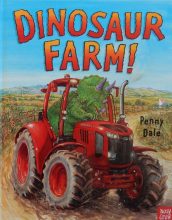
Dinosaur Farm!
Penny Dale
Nosy Crow

You might be surprised to learn of a gang of dinosaurs running a farm unless you happen to be familiar with Penny Dale’s dinosaur brigade. In which case you’ll already know that these prehistoric beasts can take on all manner of unlikely roles so farming is no challenge too far despite Dinosaur Farm being an extremely busy place.

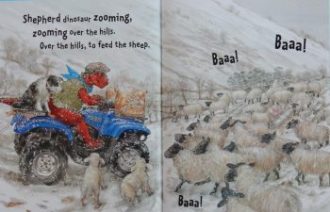
There are fields to plough – up and down, up and down as well as sheep that need feeding.

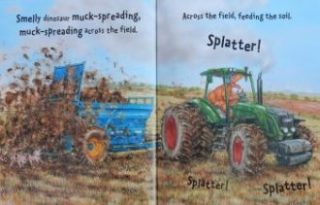
A group of noisy dinosaurs are building a fence, bang, bang banging in the wooden posts while a rather pongy Allosaurus is muck-spreading.

We see two of the team making the hay into bales and others digging up the muddy carrots.

When the sun comes out, it’s time to get out the combine harvester and cut the corn. Then there’s the apple harvest to pick – red, juicy fruits aplenty – yum, yum.

Finally all the produce needs cleaning and packing: it keeps the entire group of ten working late into the night but what is all this hard work for?

Where could they be going next morning with their trailer loaded? There’s certainly excitement in the air …

Told as usual in rhythmic language, the story is punctuated by contextually apt exclamations your little ones will love to join in with, while Penny Dale’s elaborately detailed pencil and watercolour scenes will absorb them visually. They’ll likely be amused at such humorous touches as the ‘Haymaking dinosaurs …’ scene that shows one of the two propped up against a bale, seemingly snoozing.

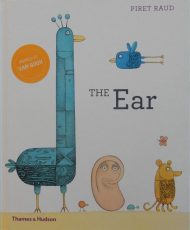
The Ear

The Ear
Piret Raud
Thames & Hudson

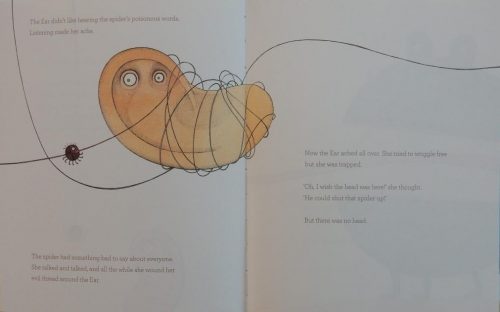
Suppose you are an ear and wake one morning to find you are no longer attached to a head. Then what? Do you any longer have purpose or meaning? “I am no one,” weeps the headless Ear contemplating possibilities – ear mushroom. fish. butterfly.

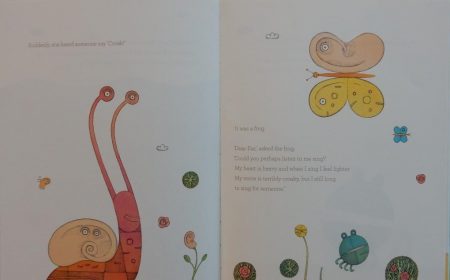
There follows an encounter with a gloomy frog that asks if he can sing for her and the result is a positive outcome for both parties.

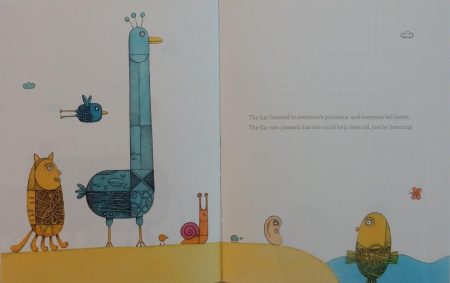
Thereafter the Ear listens to an elephant’s tale, followed by a confession from a hare that’s consumed a snowman’s nose. Gradually the Ear gains a reputation as the ‘best listener in the land’: A purpose at last.

Then along comes a spider, one with a honey-sweet voice and an evil intent that entraps the Ear in a web of unkindness.

With no head to come to the rescue how can the listening organ escape this entrapment? Could it be that those she’s helped can in turn help her?

This story is somewhat surreal to say the least. We never discover how the ear/head separation came about although at the outset we’re shown clues to it‘s identity. There’s a bearded man, then a wooden chair with cane seat and a vase of sunflowers which many adult readers and children will associate with van Gogh.

Raud’s soft colour illustrations of the characters are strange indeed: there’s Ear with her slightly unnerving eyes while those she encounters are, with their swirly interiors, weirdly complex creatures.

With the importance of listening and feeling empathy at its heart, this story is certainly one to get listeners pondering and would work particularly well as the starting point for a community of enquiry.

For All the Stars Across the Sky

For All the Stars Across the Sky
Karl Newson and Chiaki Okada
Walker Books

If you’re looking for a gorgeous bedtime story then Karl Newson’s new book will surely fit the bill.

It’s time for little Luna to get ready for bed. Mum’s there to bid her goodnight but first there’s time for a wish: “For all the stars across the sky, / Big and little and bright, / Here’s a wish from me to you, / Before we say goodnight.”

They close their eyes and wish as they take off on some amazing adventures. They fly like birds, soaring through the clouds on a trip around the world; they dive deep and swim together to the accompaniment of whale song;

they shrink to ladybird tinyness and gaze at the sky …

and then, normal size restored, stomp giant style all the way back home for lights out, a special goodnight kiss and … sweet dreams.

Mum bear’s love for her little one shines forth from Karl’s gentle telling which sounds like a softly spoken lullaby.

New to me, illustrator Chiaki Okada brings her own magic to every single page in gently glowing soft focus scenes of both the bedtime ritual and Luna’s flights of fancy, elegantly rendered in appropriately muted tones that draw you further into the story.

Everything about this book is special; words, pictures and the design too, all contribute to the sense of peacefulness and the warmth of the parent/child relationship.

I Want a Bunny!

I Want a Bunny!
Tony Ross
Andersen Press

The awesome Tony Ross’s series of stories about a certain young royal goes ever on.

The latest on the list of the Little Princess’s demands is a bunny. This is on account of her recent visit to her ‘awful’ friend Petronella who has a really cute one.

As usual everyone rallies round to see what can be done. The Gardener gives Little Princess a stick insect, nothing surely could be less trouble than Sticky; but the princess manages to lose it almost immediately.

She finds the Admiral’s goldfish boring and that too disappears.

The kitchen cat disappears rather than be pampered by the Princess and that leaves her young highness thoroughly fed up.

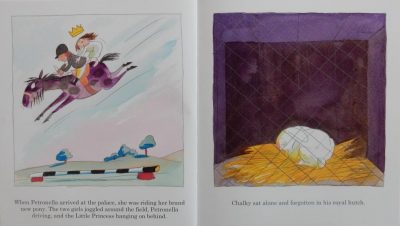
Finally the Queen agrees to her wish for a bunny  so long as the Little Princess cares for it properly, and they go and buy ‘Chalky’ from the pet shop.

Initially things go well but then the Little Princess decides to invite Petronella over to see her new acquisition. The outcome is a forgotten royal rabbit

and a new demand from you know who.

Fortunately as always, the King knows just how to deal with matters … well, almost!

Another winner for fans of the Little Princess and with her new tale she’ll likely win a host of new enthusiasts too.

Ollie’s Magic Bunny

Ollie’s Magic Bunny
Nicola Killen
Simon & Schuster Children’s Books

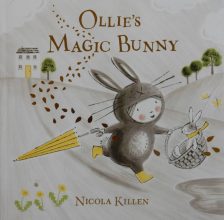
Ollie has been eagerly awaiting the day when the rain stops so she and her soft toy Bunny can venture outside to play and now that day has arrived. Attired in a bunny suit, suitably shod, and with Bunny in basket, Ollie dashes outside and heads straight to a puddle for a bit of splashing.

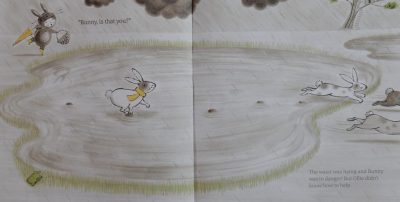
Suddenly a breeze blows past and in its wake a cloud of golden blossom. When a petal lands on Bunny’s nose it somehow magically transforms the toy into a real rabbit. He leaps from the basket and he dashes off in pursuit of other rabbits with Ollie in hot pursuit.

With dark clouds gathering and the water rapidly rising Bunny is heading straight into danger.

Ollie is at a loss as to what to do next until she remembers her umbrella and calling on the magical breeze, she makes a wish.

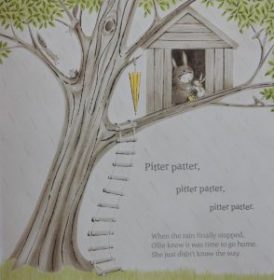
Rescue successfully carried out, she now needs to find somewhere to shelter. Conveniently there’s a tree house not too far off and therein they take refuge until the rain stops and it’s time to head home.

There’s another problem to overcome first though, but happily they finally return safe and sound where back indoors, Bunny reverts to toy mode once more.

One assumes the die-cuts at the start and end of the book signify the transition between reality and fantasy but I’m not convinced they’re needed. Nonetheless Nicola Killen’s limited colour palette illustrations, with those occasional golden glints of the petals, are enchanting. The story itself is gently whimsical and just right for a spring day nursery storytime or individual sharing.

Aalfred and Aalbert

Aalfred and Aalbert
Morag Hood
Two Hoots

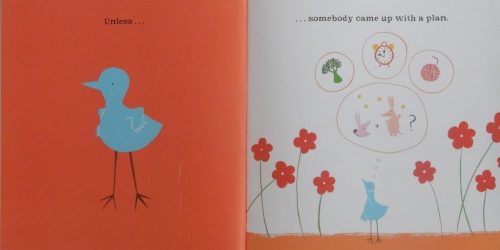
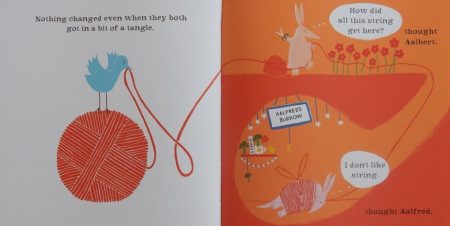
Aalfred and Aalbert are two aardvarks with adjacent burrows. Nevertheless their paths never cross on account of their totally different sleep cycles: Aalbert sleeps at night, Aalfred in the daytime.

Despite the occasional yearnings of each to be part of a twosome, this pattern is permanent. Or is it?

Perhaps a plan can fix things; a plan executed by a little blue bird involving strategically placed broccoli (Aalfred’s favourite) and a ball of string.

I’d hate to spoil this story of friendship against the odds, so I’ll say no more on the matter other than to urge you to get hold of a copy of Morag’s latest book. Once again it’s brilliant. Her narrative voice is like no other, wryly funny and absolutely to the point. She conveys so much in relatively few words and delicious bold artwork,

and every one of her characters is priceless.

In the aardvark tale though there’s a real tenderness: let it sit with you, let it simmer. I think it’s my favourite so far.

This treat is not to be missed; in fact you really shouldn’t miss any of Morag’s books.

Maya & Cat

Maya & Cat
Caroline Magerl
Walker Books

I’m not sure whether it’s the words or pictures of Caroline Magerl’s moggy story that I love better; both are absolute delight.

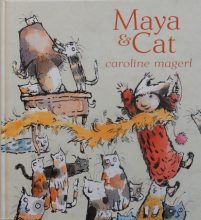
Through gorgeous poetic language and wonderfully whimsical watercolour and ink illustrations, the author/illustrator conveys the tale of Maya and what happens then she hears Cat ‘rumbling a rumbly purr’ out on the wet roof and decides it needs rescuing.

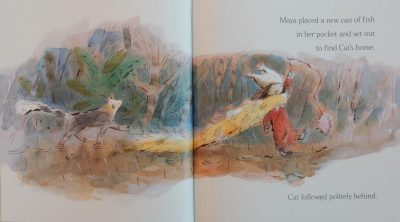
Having lured it down with a fishy treat, with Cat following behind her, she sets out to discover the whereabouts of its home.

She tries many places but Cat isn’t the right fit and then, with Cat leading the way, they eventually find … home.

It’s time for Maya to hand over her charge: is this story to have a sad ending for the determined little girl?

Maybe not …

With her trailing feather boa, fluffy hat and pompom on a stick, Maya is a delightfully quirky character that readers are sure to fall in love with; and Cat too is adorable, even to this cat-allergic reviewer.

Each spread of the book has a wealth of enchanting detail that’s well worth spending time poring over and when read aloud, the gently humorous tale is a treat for both adult and children.

The Wall in the Middle of the Book

The Wall in the Middle of the Book
Jon Agee
Scallywag Press

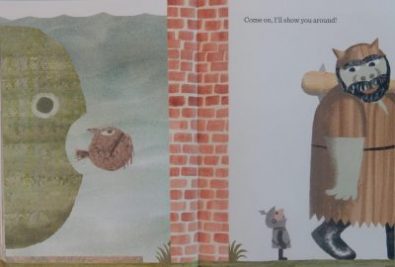
‘Something there is that doesn’t love a wall’. So begins Robert Frost’s famous poem Mending Wall, and so it is too, with Jon Agee who has cleverly constructed a fable with a high brick wall running along the book’s gutter, with the action unfolding on either side.

The story opens with, on the verso, a small knight carrying a ladder approaching the wall while on the recto stand menacingly, a rhino and a tiger. ‘It’s a good thing. The wall protects this side of the book from the other side of the book’ the knight tells us as he stoops to pick up the displaced brick to mend said wall. On the other side, the crew of angry animals has increased.

Up the ladder goes our knight oblivious to what is happening behind him and asserting, ‘This side of the book is safe. The other side is not.’

By this time, the bond with the author is firmly established and readers and listeners will be revelling in the superb interplay between words and pictures, asking themselves, are our narrator’s words altogether well- founded?

Next we learn of the most dangerous thing on the other side of the wall, an ogre.

This ogre however is not quite what the little knight is expecting. Indeed other things too are not at all as he’d anticipated.

Brilliantly expressive – look how the faces and body language of all the animal characters speak without uttering a single word while much of the feelings of knight and ogre are conveyed wordlessly, serving to emphasise the verbal/visual antagonism.

Agee’s pacing too is superb, but best of all is his inherent theme that preconceptions about people from elsewhere are often wrong. In our troubled times of erecting boundaries, walls in particular, rather than building bridges, this timely book will strike a chord with many readers and is a fantastic starting point for opening up discussion.

Boom! Bang! Royal Meringue!

Boom! Bang! Royal Meringue!
Sally Doran and Rachael Saunders
Andersen Press

So proud are they of their daughter Princess Hannah, on account of her impeccable manners, that King Monty and Queen Alice decide she should receive the very best birthday present ever. And what could be better than a huge pudding-making machine?

Come the evening and her birthday ball, the princess soon has delicious cakes and puddings issuing from her fantastic birthday gift. The machine however has a most unwelcome upshot where the birthday girl is concerned, for it exposes the fact that she’s never before been asked to share.

This is something the Queen is ready to acknowledge.

Fortunately though, her young guests are quick to deal with the issue and while the princess is throwing a tantrum, they start pressing the buttons. Then before you can say “blackbird pie” everyone is happily playing together, turning cogwheels and pressing knobs, concocting the most delectable sweetie treats, not least of which is a massive meringue nigh on 20 feet tall.

All is most definitely well that ends well on that particular night as the guests depart thoroughly impressed with young Hannah; and as for the meringue, well that certainly took some eating.

Told in delicious unfaltering rhyme – how debut author Sally Doran managed to sustain it so well throughout is amazing – this is a totally yummy confection. Perhaps it’s down to her penchant for meringues.

A right royal romp for sure made all the more scrumptious by Rachael Saunders’ effervescent scenes of partying and puddingy treats. I’m still drooling.

#Goldilocks

#Goldilocks
Jeanne Willis and Tony Ross
Andersen Press

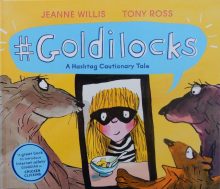
This series of Jeanne and Tony’s on Internet safety for children goes from strength to strength; #Goldilocks is number three and it’s absolutely brilliant.

Subtitled ‘A Hashtag Cautionary Tale’ it is exactly that with Jeanne delivering her vital message in the jaunty manner of a 21st century Belloc.

Like so many children these days, Goldilocks has a smartphone and is active on social media. Anxious to gain more likes for her posts, the young miss starts posting photos of her family and much more.

After a while though her followers’ enthusiasm wanes and she becomes desperate: something shocking is required to revive interest.

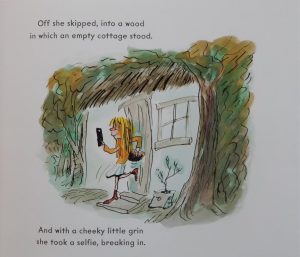
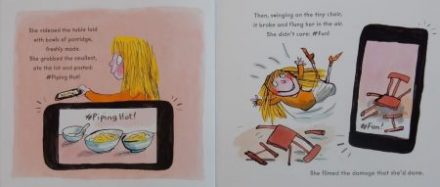
Off she skips to a certain cottage in the woods and takes a selfie as she breaks in;

another #PipingHot and a third breaking a chair #Fun!

And she doesn’t stop at that.

Inevitably it all ends in disaster for Goldilocks who receives a stint of community service at a certain bears’ residence; but worse than that, those photos she so recklessly posted of her thievery and destruction live on for all to see. And that takes us to the final moral words of caution: ‘ … think twice before you send!’

Absolutely hilarious both verbally and visually – the two work so superbly well together – this story is written from an understanding of the attraction for children of social media and is ideal for sharing and discussion at home or in school.

Above all though, it’s a smashing book.

Hello Lighthouse

Hello Lighthouse
Sophie Blackall
Orchard Books

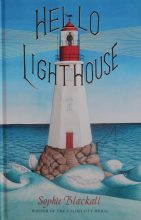
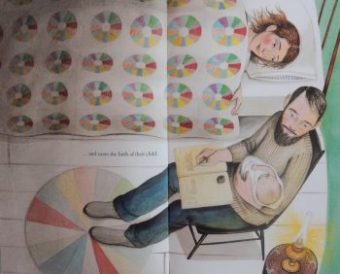
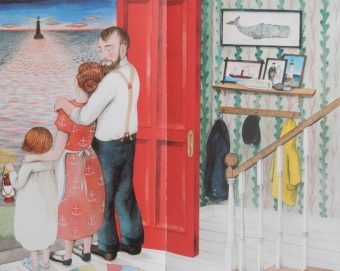
Standing on ‘the highest rock of a tiny island at the edge of the world’ is a lighthouse; it beams out a guiding light for ships at sea.

To this lighthouse comes a new keeper to tend the light, maintain the logbook, paint the round rooms.

He also finds time to fish for cod through the window, make tea, cook his meals and write letters to his wife, which, enclosed in bottles, he tosses into the waves.

It’s a lonely existence but one day a ship arrives bringing not only supplies but also his wife.

A fog descends covering everything; the keeper rings a warning bell, but one night a boat is wrecked and he has to rescue the sailors.

When the sea turns to ice the keeper is sick so then, in addition to acting as his nurse, it’s the wife who tends the light and keeps up the log.

Before long there’s an addition to the family – also logged.

Then one day. the coast guard arrives with a brand-new light that is run by machine: the lighthouse keeper’s job is no more. It’s time to pack and leave, ‘Good bye, Lighthouse! Good bye! … Good bye! … Good bye!’

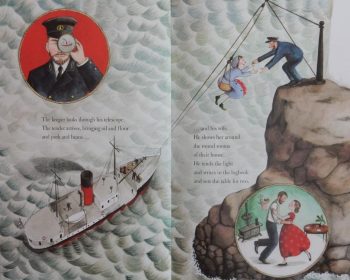
The dispassionate present tense chronicle reads like the keeper’s log and the vertical rectangular format of the book reflects the external form of the lighthouse itself. Opened out there’s space a-plenty for Sophie Blackall’s dramatic Chinese ink and watercolour seascapes, as well as scenes of life within the confines of the tall circular building. The perspectives she uses, many viewed from above, or seemingly seen through the lens of the keeper’s spyglass, echo the circularity of the rooms and some of the furnishings.

I found myself reading and re-reading these pictures, discovering ever more domestic details, and wondering at the power and majesty of the ocean and the amazing talent of this illustrator.

With its look at a bygone era, this book would be a wonderful addition to any topic about the sea: the author provides detailed notes contextualising many of the events in her story on the final pages.

Follow Me, Little Fox

Follow Me, Little Fox
Camila Correa and Sean Julian
Little Tiger

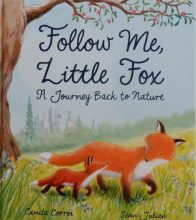
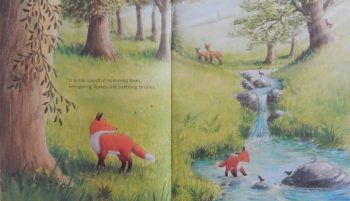
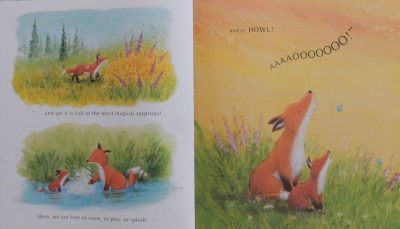
A city dweller, Little Fox loves his urban home but occasionally feels overwhelmed by its pace. His mother is eager for him to experience something different; the place where the city ends and the wild begins. “Let’s go back to nature,” she says.

Off they go on a journey away from their den to discover the sights, sounds and smells of the wonderful outdoors.

Yes, at times it can be scary but nature offers a wonderful place to play, to roam and to howl; a place that makes your heart sing.

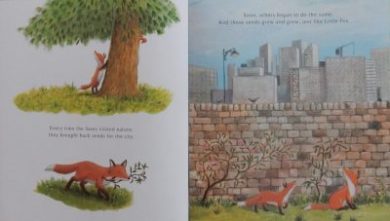
Unsurprisingly, come nightfall Little Fox is reluctant to leave. He asks to spend the night beneath the stars. Then, having informed him that what he sees are actually the city lights twinkling in the distance, his mother helps him formulate a plan to bring some of the amazing natural world much closer to their home …

… and together they put project transformation into action.

This book is a wonderful reminder of the importance of getting outside into green spaces for our mental and physical wellbeing.

Lyrically written, Camila Correa’s text evokes the wonders of the great outdoors and Sean Julian brings it to life with his beautiful cityscapes and scenes of the natural world.

Nibbles Numbers / Little Fish and Mummy / Where’s Mr Duck?

Nibbles Numbers
Emma Yarlett
Little Tiger Press

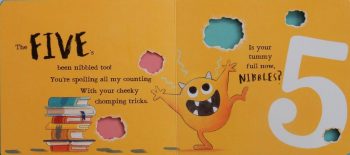
Emma Yarlett’s little yellow book-eating monster Nibbles is back and now he’s got his teeth into a board book. One might think that chomping through card would be a challenge too far but no. Once released the little fellow immediately starts sinking his gnashers into the pages and even has the audacity to nibble into the numerals leaving fairly sizeable holes.

Moreover he’s sabotaging our counting practice and just when we think we’ve cornered the little munching rascal, he makes a dive for it and disappears through the final spread, only to emerge on the back cover with a satisfied grin on his face.

Smashing fun and what a delight to be able to introduce my favourite little monster Nibbles to a younger audience.

Little Fish and Mummy
Lucy Cousins
Walker Books

The latest Little Fish book is narrated by none other than Little Fish who is particularly excited about sharing with listeners a ‘Mummy Fish and me’ day.

This special day is spent on lessons in swimming and bubble blowing, splishing and splashing with all the other fish, a game of hide-and-seek just with Mum and a look inside a deep down cave.

What better way to end such a great day than with a round of kissing – ‘Kiss, kiss, kiss!’

Irresistible if you know a little one who’s a fan of Lucy Cousins’ endearing spotty Little Fish, and I certainly know a lot of those.

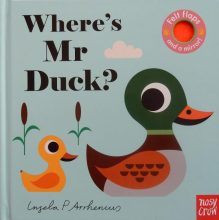
Where’s Mr Duck?
Ingela P Arrhenius
Nosy Crow

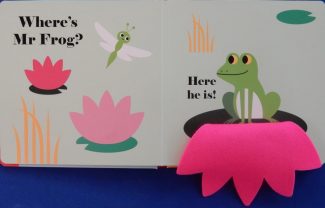
The latest felt flap hide-and-seek board book in this deservedly popular series is set around the pond. In its environs little ones can discover Mrs Butterfly, Mr Frog,

Mrs Worm, Mr Duck and finally as the creatures look on, him or herself.

With its characteristic question and answer format, a wealth of opportunities for developing language, bold bright art and satisfying conclusion it’s no wonder the series is such a success; this one will be as popular as its predecessors.

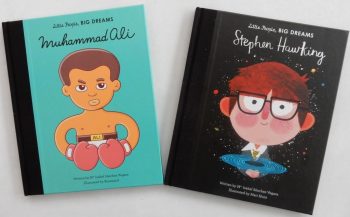
Little People, Big Dreams: Muhammad Ali & Little People, Big Dreams: Stephen Hawking

Little People, Big Dreams: Muhammad Ali
Isabel Sánchez Vegara, illustrated by Brosmind
Little People, Big Dreams: Stephen Hawking
Isabel Sánchez Vegara, illustrated by Matt Hunt
Frances Lincoln Children’s Books

Following the huge success of titles celebrating amazing and inspiring females, the publishers have decided to add positive male role models to their picture book biography series and these are the first two.

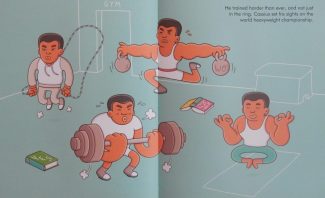
First on the list is Muhammad Ali who as a boy known as Cassius had his new bike stolen and was told by the police officer that if he wanted to face the thief as he’d said, he had better learn to fight. So begins his journey to becoming a champion boxer.

Having taken a gold medal in the 1960 Rome Olympics he was determined to turn professional and win the world heavyweight championship,

which he did, defeating Sonny Liston in 1964.

Cassius however was not just a boxer; he was fierce defender of African-American rights speaking out against racial discrimination. He converted to Islam and changed his name to Muhammad Ali.

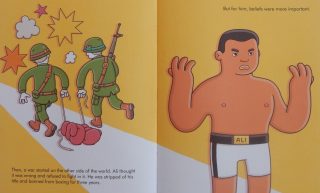
His refusal to fight in the Vietnam war, a war he considered unjust, resulted in him being stripped of his heavyweight title and banned from boxing for three years.

However he came back and won three more heavyweight titles; and after his retirement spent his time in the service of others.

With their illustrations, the Mingarro brothers, aka Brosmind, bring a gentle humour to the account of this legendary man.

Published in March is a second title, Stephen Hawking, about the scientific genius who overcame THE most enormous odds and went on to become the most brilliant scientist of our time.

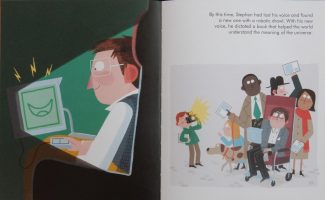
We read how while studying physics at Oxford University Stephen first began to be clumsy and then having moved to Cambridge University to do a PhD, he was diagnosed with motor neurone disease and told, aged 21, that he had just a few years left to live.

Rather than spending his time dwelling upon his lack of control over his body, he decided that in order to study the universe, he needed only his mind.

Black holes became the focus of his attention and Stephen proved that rather than being wholly black, there was a tiny light escaping from them; this was named ‘Hawking radiation’.

We’d all do well to remember Stephen’s words, “however difficult life may seem, there is always something that you can do and succeed at.” An inspiration he truly remains and this is what writer Isabel Sánchez Vegara and illustrator Matt Hunt convey so well herein.

Add these to your primary school collection.

Molly’s Moon Mission

Molly’s Moon Mission
Duncan Beedie
Templar Publishing

I have to admit to spluttering with giggles all through this story. From the outset, the idea of Molly the moth attempting to fly to the moon struck me as totally ridiculous but that’s what makes this such a fun book.

Young Molly has an indomitable spirit and despite residing in the back of an old wardrobe, her determination knows no bounds. Her mother’s discouraging words about the slightness of her wings notwithstanding, the little moth trains hard until she’s ready for the countdown to blast off.

After a couple of setbacks due to wrong destinations,

the tiny creature lands up at a lighthouse where at least she receives some words of encouragement for her venture.
Fuelled by same, she relaunches herself skywards until finally …

Success!

Moreover, there’s a role for Molly as assistant to the astronauts before they all set off earthwards with the little bug proudly sporting her newly awarded lunar mission patch.

When she finally reaches home once more, she’s greeted by her mum who on learning of her little one’s adventure, responds, “My Molly, the only moth ever to fly to the Moon!” Thus far maybe, but Molly has plans …

From his The Bear Who Stared debut I’ve loved all Duncan’s picture books but with this one he reaches new heights.

A Little Bit Brave

A Little Bit Brave
Nicola Kinnear
Alison Green Books

Luna and Logan are great friends but they’re very different. Luna loves outdoor adventures while Logan never sets a paw outside declaring it much too scary.

One day Luna tries her best to persuade her friend to join her in the great outdoors but her invitation is turned down and she goes off in a huff telling him that sometimes, he just has to be a bit brave.

The morning proceeds with Logan engaging in several of his usual activities but he feels upset about what has happened and decides to puts things right with Luna. The trouble is that means going outside.

Into his bag go a torch, a snorkel and a tin of freshly baked biscuits, and with scarf wrapped around him, off Logan sets on his very first adventure.

It’s scary in the woods and he needs to find his friend so he calls her name as loudly as he can. There’s no response from Luna but Logan’s cry summons a host of other woodland animals. From them he learns more about the brave things his friend enjoys.

If he wants to find her, it seems Logan has no choice but to follow the mouse’s advice …

Logan’s search opens up three new worlds to him; his snorkel, scarf and torch come in very useful

but of Luna he finds no sign. Nevertheless, astonished at what he’s done, he’s just about to reward himself with a biscuit when suddenly he hears a familiar voice shouting out.

Terrifying as the sight that meets his eyes might be, Logan knows he has to act fast or his friend will become the wolf’s next meal.

Could it perhaps be time to make use of that other item he has with him …

Nicola’s colour palette is gorgeous; there are woodland greens, oranges and browns with a plethora of eye-catching flora and fauna.

This is a great confidence-bolstering tale perfectly seasoned with frissons of fear and surprises; and who wouldn’t love a story where biscuits play a crucial role?

The Big Angry Roar

The Big Angry Roar
Jonny Lambert
Little Tiger

No matter how mindful we are I’m sure we all feel angry at times, but it’s how we respond to our angry feelings that is crucial.

As the result of a spat between siblings, Jonny Lambert’s Cub is feeling so angry he thinks he might pop.

All the other animals have their own ways to deal with their anger. Zebra and Gnu let theirs out by stamping and stomping; Rhino bashes and crashes; Hippo splatters and splashes but when Cub tries he ends up with an injured paw, an unpleasant aroma and even more anger.

His next encounter is with Elephant’s backside and a furious face off ensues.

Their tooting and roaring precipitates a massive …

Fortunately for all concerned Baboon is on hand ready to offer a lesson in anger management, which does the trick,

leaving Cub with just one more thing to do.

There’s a perfect balance of words and pictures giving the latter plenty of room for maximum impact in every one of Jonny’s eloquent scenes. Cub’s eye views of the animals – a forest of legs and looming bulk – are executed in his signature textured collage style.

The text, punctuated with plenty of onomatopoeia, exclamations, and variations in font size are a gift to readers aloud who enjoy putting on a performance – and who could resist with such a script.

Another must have for your collection from one of my favourite picture book creators.

Bear Moves

Bear Moves
Ben Bailey Smith and Sav Akyūz
Walker Books

The purple ursine character from I Am Bear returns and, sporting his sweatbands, he’s in groovy mood.

With Bunny on DJ duty it’s time to show off those funky moves. First off it’s Furry Breaking – wow this guy certainly has attitude!

Next we have Running Bear, quickly followed by the Robot and there’s even a spot of limbo.

Should this character be auditioning for the next Strictly Come Dancing series one wonders as he grabs himself a partner and switches to ballroom mode with a foxtrot

This he follows with a doughnut fuelled Belly Dance,

a quickstep – oh no that’s his pal squirrel attempting to beat a hasty retreat – and next, bums a-winding, everybody do the twist.

Even then, this dance enthusiast isn’t quite done but for his grand finale he requires an altogether sweeter partner …

It’s pretty exhausting all this dancing so you won’t be surprised that Bear’s last move is into sleep mode zzzzz …

You can really feel and hear the beat in rapper Ben Bailey Smith’s (aka Doc Brown) rhyming text, while Sav Akyūz shows the action both frenzied and smooth, in bold colours outlined in thick black lines

Great for child participation is this zany offering.

Wisp

Wisp
Zana Fraillon and Grahame Baker-Smith
Orchard Books

The only world Idris knows is a shadowy one of tents and fences; this is the world he was born into. Dirt, darkness and emptiness are everywhere surrounding the inhabitants of tent city and completely obliterating their memories of their former lives.

One day, into this desperate life a wisp of light appears unnoticed by all but Idris.

With the whisper of a single word, the Wisp brings a smile, a reawakened memory and a ‘hint of a hum’ to an ancient man, to a woman, a memory and a lessening of her sadness.

Days go by and more Wisps are borne in on the wind with their whisperings of ‘onces’ that release more and more memories.

One evening a Wisp lands at Idris’s feet but the boy has no memories save that surrounding black emptiness. Instead for him, it’s a Wisp of a promise that brings light and joy to his world as it flies up and up, infecting not just the boy but all the people in the camp until light, not dark prevails.

Told with such eloquence, this heartfelt story brought a lump to my throat as I read it first, but ultimately, it’s a tale of hope, of compassion and of new beginnings.

Eloquent too are Grahame Baker-Smith’s shadowy scenes, which as the story progresses, shift to areas of brightness and finally, to blazing light.

When all too many people are advocating walls and separatism, this book of our times needs to be read, pondered upon and discussed by everyone.

Kiss the Crocodile

Kiss the Crocodile
Sean Taylor and Ben Mantle
Walker Books

Down in the jungle, Anteater, Tortoise and Monkey are in playful mood when they’re spied by Little Crocodile. He’s eager for them to join him in a game of Kiss the Crocodile. The rules are pretty straightforward – the clue’s in the name – but the proviso is that the little croc. pretends to sleep and must not be woken up.

Are they brave enough?

Seemingly so, and first to make a move is Anteater.

Mission successfully accomplished, Tortoise is next

and what a smoocher!

Only Monkey remains and having summoned up all her courage, off she goes – uh oh! She’s in for a big snapping surprise.

The game is over, but will Little Crocodile abide by the rules or is it the end for Monkey?

It’s not only those jungle animals that are in playful mood, so too is Sean Taylor. His present tense telling has just the right amount of mischief, suspense, some delicious onomatopoeia and that frequently repeated imperative title – a perfect storytime recipe for entertaining your little ones.

Equally irresistible are Ben Mantle’s comical, wonderfully expressive scenes of the action – giggles guaranteed on every spread.

Two Sides / Little Rabbit’s Big Surprise

Two Sides
Polly Ho-Yen and Binny Talib
Stripes Publishing
Little Rabbit’s Big Surprise
Swapna Haddow and Alison Friend

To help bridge the gap between picture books and assured fluent reading of chapter books Stripes Publishing are creating a short fiction series with a colour illustration at every page turn; these are the first two titles. Both are beautifully designed and illustrated.

Two Sides explores a friendship between total opposites, Lenka and Lula. Born on the same day, the former is neat and tidy, a cat lover and enjoys drawing; her best friend is a dog enthusiast, messy and something of a chatterbox.
A perfect twosome it seems and so it is until the fateful morning when Lula oversleeps after which everything goes terribly wrong.

Lenka’s forgotten pencil case containing the coloured pencils she needs to complete a competition entry, but now lying on Lula’s bed and a rejected present made by Lulu for Lenka lead to a fierce row and by the time their bus reaches school, a special friendship has fractured.

School feels a totally different place; the two girls sit far apart in the classroom but then their teacher allows the class a play stop en route for the library.

An opportunity for the rift to be healed perhaps …

The author acknowledges that even the very best, closest of friendships can have their ups and downs; and words said in the heat of the moment can really hurt. This is something young readers will definitely acknowledge as they lap up Polly Ho-Yen’s story with Binny Talib’s expressive scenes of the girls.

Little Rabbit’s Big Surprise opens with a bored Little Rabbit whose Mama, siblings and friends are all too busy to play with her. But then her grandfather invites her to become his assistant for the day and the young rabbit is in for surprise.

Instead of merely spending all his time with his friends, Big Rabbit devotes himself to altruistic activities, the first of which concerns Mole’s dark tunnel and Little Mole’s imminent birthday party.

Next comes a visit to Granny Hedgehog who is suffering from a bad case of the snuffles.

Dormouse too is in need of help: his little ones are hungry and their nest isn’t big enough to accommodate them all.
And then there’s Squirrel. She’s injured her paw and so can’t forage for food for her children.

It’s all in a day’s work for Big Rabbit but by the next morning it seems that Little Rabbit’s been infected by her grandfather’s enthusiasm for helping others and her friends too are willing to lend a hand.

Celebrating kindness, Swapna’s gentle telling in combination with Alison’s adorable woodland watercolour illustrations make for a delightful read alone, or a read aloud to younger children.
Readers will close the covers of both books with a boost of confidence having enjoyed a longer story: thoroughly recommended for home reading and for classroom libraries in KS1 and early KS2.

Hat Tricks

Hat Tricks
Satoshi Kitamura
Scallywag Press

This isn’t the first book Satoshi Kitamura has created about an amazing hat; around ten years back there was Millie’s Marvellous Hat about an imaginative little girl and an invisible hat.

Now we have Hattie and she too has a hat – a magician’s hat; so take your seats everyone, the show is about to begin. And what’s a magician’s favourite way to start a spot of prestidigitation? With a wave of the wand and the magic word ‘Abracadabra’; in this case followed by ‘katakurico’ and the question ‘What’s in the hat?’

In the first instance it’s a cat; but there’s more to come. Hattie repeats the words and out leaps a squirrel.

And so it goes on with Hattie producing ever more unlikely and larger animals, none of which appears happy to see its fellow creatures.

Then one of the creatures being conjured gets stuck, unable to extricate itself entirely from the hat. It becomes the centre of a rather painful tug of war

until eventually … out it comes.

Surely there can be nothing left in that hat, now, can there? Well, the grand finale is yet to come … ta-dah!

I’m sure little ones will respond by calling for an immediate ‘encore’ after you’ve shared this book with them. My listeners certainly did.

This is a splendid piece of theatre. Satoshi’s animals are presented with panache: the gamut of eloquent expressions is sheer genius.

Dragons in Love / Bagel in Love

Dragons in Love
Alexandre Lacroix and Ronan Badel
Words & Pictures

Dragon, Drake, as some of you may know from Dragons: Father and Son is a troglodyte residing with his father at the bottom of a steep valley. He frequently leaves his cave and ventures forth into the town to play with the children and so it is on this particular day. But although he may know a bit about playing, kissing is entirely new to him. So when his friend Violet lands him a smacker on the snout he feels all hot and bothered.

On reflection however, he realises no personal harm has been done but avoiding Violet is the best plan henceforth. Not easy as it means avoiding all his favourite haunts.

Drake talks to his dad who explains that the fire is a dragon’s natural way of showing love and tells what happened when he and Drake’s mom were courting.

This is all very well for dragons but what about human Violet? Poor Drake feels at a loss to know where to go; but then he hears noises coming from the nearby park. Violet is being bullied, he discovers. It’s time to act, thinks Drake and so he does …

Friendship fully restored, what will be Drake’s next move … ?

Badel’s ink and watercolour illustrations are full of detail with a wealth of wonderfully humorous touches. I love the early spread with the football being kicked and ending up way out of reach in a tall tree.

Beautifully droll as before, Lacroix’s story is sure to strike a chord especially this season when love is in the air, though with its standing against bullying message it’s a good one to share with young listeners at any time.

Bagel in Love
Natasha Wing and Helen Dardik
Sterling

Bagel is a talented dancer: his spins and swirls, taps and twirls make him feel anything but plain. The trouble is however that he doesn’t have a partner and so can’t enter the Cherry Jubilee Dance Contest.
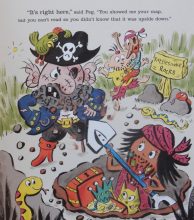
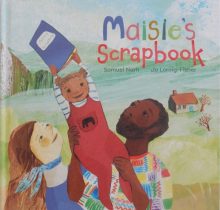
Poppy, the best dancer he knows tells him his steps are half-baked: Pretzel says his moves don’t cut the mustard and from Matzo he receives a flat refusal.

Not one to give up easily, Bagel heads to Sweet City where things aren’t actually much sweeter when it comes to the responses of Croissant, Doughnut, and Cake. But then outside the café, Bagel hears music coming from the contest venue and he breaks into a tap routine.

To his surprise a tapping echo comes right back. Has he finally found the perfect partner?

Natasha Wing has thrown plenty of puns into her narrative mix with its underlying message about determination and not giving up on your dream, while Helen Dardik treats readers to a plethora of sticky confections and some salty ones too in her digitally worked, richly patterned scenes.

A sugary romance for Valentine’s Day this surely is. Anyone want to dance?

With Your Paw in Mine

With Your Paw in Mine
Jane Chapman
Little Tiger

Otter pup Miki loves to float snuggled up on her Mama’s tummy but after a swimming lesson she goes off hunting leaving Miki alone safely rolled in seaweed.

As she waits, Miki notices another similar ‘furry parcel’ and paddles across to meet pup Amak who is also waiting for his mother. Acknowledging the loneliness of waiting, Miki suggests holding paws and waiting together.

That becomes a regular occurrence and the two cubs become inseparable.

But one morning a fierce storm blows up and the two friends become separated briefly, manage to re-link paws and even to join up with other otters to form, paw in paw, a raft to weather out the storm

until, joy of joys Miki hears her very favourite voice calling to her.

The author’s message is clear: we all need someone (or perhaps more than one someone) to hold on to in stormy times. Essentially an endearing story of friendship, the book also includes some information about mother otters and their young.

In her chilly acrylic scenes Jane Chapman really captures the vastness of the ocean but at the same time focuses in on the otters and their feelings making this a lovely book to share with individuals or a nursery group.

Duck!

Duck!
Meg McKinlay and Nathaniel Eckstrom
Walker Books

Not a lot happens in this book until right at the end but nonetheless it’s absolutely hilarious throughout.

So, without further ado, let’s head over to the farm where one afternoon, horse is swishing his tail; cow is chewing the cud; pig is wallowing in mud and sheep is sheeping on the grass (love that).

Into this tranquil setting charges Duck, yelling a single word, “DUCK!”

Needless to say the other animals don’t appreciate this intrusion into their peace and each in turn attempts to explain to the noisy creature that they are not ducks; he is.

However, Duck’s message merely grows more strident.

By the time accusations of rudeness and lack of understanding have been hurled at the little animal, Nathaniel Eckstrom’s deliciously droll illustrations are foreshadowing the impending catastrophe that the chastisers are oblivious to but savvy audiences will be eagerly anticipating. To divulge more about this would spoil the grand finale.

With a simple misunderstanding at its heart, Meg McKinlay’s telling is enormous fun and the self-descriptions of the disgruntled animals absolutely wonderful, while the repeated “DUCK!” exclamation cries out for loud audience participation.

In addition, expect a plethora of giggles when you read this cracking story aloud, and be prepared at the end, for cries of “again!” from listeners.

Lots of Frogs

Lots of Frogs
Howard Calvert and Claudia Boldt
Hodder Children’s Books

Tommy Fox has a box – a box full of frogs. The expression ‘mad as a box of frogs’ sprang instantly to mind on reading this and there’s more than a little madness in Howard Calvert’s story.

Back in the day, dare I admit it in these days of environmental awareness, children (including myself) liked to collect frogspawn and take it into school where we’d watch the jelly blobs become tadpoles and then frogs. This clearly isn’t Tommy’s intention since he has the fully formed frogs (and toads) in his box but he does take them into school for show and tell. A risky enterprise you might be thinking and it’s certainly so.

Before you can say ‘atishoo’ those little amphibians have escaped and are leaping about causing utter chaos in the classroom,

silliness in the staffroom …

and havoc in the hall.

Tommy has to get all those frolicsome frogs back into his box but there’s one of their number – Frank by name – that has headed to the gym and is certainly eager to give young Tommy a run for his money.

Debut author Howard Calvert’s zany rhyming story bounces along with gusto. His main protagonist Tommy is a delight and Claudia Boldt has captured his enthusiasm and energy superbly. Equally the havoc-causing frogs – every one different – are utterly hilarious.

Spring has surely sprung in one particular classroom and I loved it.

Shhh! I’m Reading

Shhh! I’m Reading!
John Kelly and Elina Ellis
Little Tiger

I cannot imagine how many times I’ve uttered the title words to people in my time. Now though it’s Bella spending a wet Sunday afternoon engrossed in her book who resents being disturbed.

First to show up is Captain Bluebottom the Flatulent wanting her to join him for a Windy Pirates adventure. He receives a firm refusal.

Next comes Maurice Penguin announcing ‘Showtime’ and tempting her with a sparkly outfit. He too and his entourage are told to sit quietly.

Emperor Flabulon’s challenge receives similar treatment

and finally peace reigns allowing Bella to finish her book. Having declared it the best ever, she then invites the intruders to join her and go adventuring.

Their instant response comes as something of a surprise; or does it? …
Game, set and match to Bella! And to the power of stories, books and the imagination.

John Kelly’s funny tale will resonate with all those who like nothing better than uninterrupted reading time. It’s a smashing read aloud that celebrates the delights of losing oneself in a good book.

Elina Ellis captures both the humour of the chaos caused by the intruders and Bella’s responses to same with terrific brio and  reminds us that, with all good picture books, reading isn’t just about the words.