I’ll Believe You When …

I’ll Believe You When …
Susan Schubert and Raquel Bonita
Lantana Publishing

Subtitled ‘Unbelievable idioms from around the world’ this is such a clever and fun book that begins on the title page with a child asking “Do you see the dragon?”

What follows is the response –, “ I’ll believe you … “ “… when pigs fly!” and it then goes on to show that nine other countries each has its own unique version of the idiom.

There are frogs growing hair from Spain, chickens with teeth in Nigeria,

herons turning black in the Philippines, summer snow in Germany.

The Netherlands offer cows dancing on ice and India, ‘when crows fly upside down!’

It’s impossible to choose a favourite but I wouldn’t mind betting that you or someone you share this book with will adopt some of these. And imagine what fun you might have if you challenge a class of six or seven year olds to come up with their own ideas and illustrate them.

It’s a terrific way to introduce the notion of idioms and the idea that they’ve been passed on from ages back as well as across the globe. There’s an explanation at the end of the book as well as a world map showing where each expression comes from and the language it’s spoken in.

Raquel Bonita’s illustrations are absolutely super: inclusive and funny at the same time.

Wonderful nonsense yes, but equally the classroom potential is huge, especially if you involve families. Emmanuelle (7) contributed “I’ll believe you when ponies grow scales” and her mum from Hungary told me that there they say, “I will believe you when it’s snowing red snowflakes.”

Little Fox / Little Polar Bear Rescue

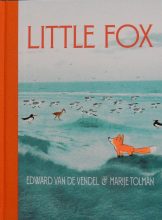
Little Fox
Edward Van De Vendel and Marije Tolman
Levine Querido

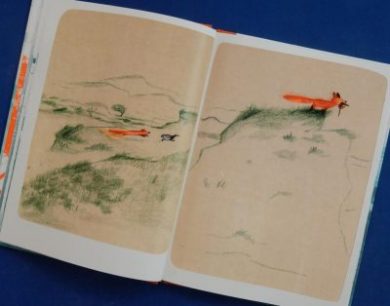
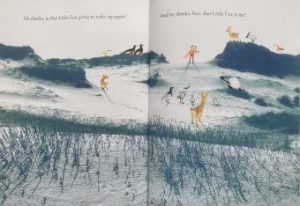
The story begins with a visual sequence of five stunning double spreads showing Little Fox is playing on the dunes among the water birds and animals when he spies two butterflies – purple ones.

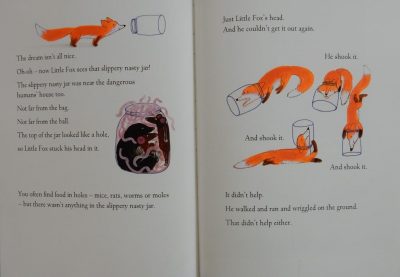
The text now begins, telling how he cannot resist chasing after them. His focus, solely on the airborne creatures, causes the fox to plunge over a hilly edge and fall heavily onto the ground. There he lies still, seemingly unconscious.

Then in a dream, his whole life hitherto passes before him as he recalls his earliest time with his mother;

slightly later, playing with his siblings; his adventures in the wider world; his encounters with humans in particular a child; his father warning him of over curiosity, ”Too nosy is dead nosy”, which on one occasion almost turns out to be true.

Suddenly the entire narration turns full circle as the child who came to his rescue previously comes upon Little Fox again. This small human picks the creature up and carries it in carefully, followed by a procession of other animals,

safely back to his fox family, where aroused by the familiar smell, Little Fox opens his eyes once more.

Superb illustrations by Marije Tolman (notes at the end explain how they were created) combined with Van De Vendel’s text (translated from its original Dutch by David Colmer) unfolding stream-of-consciousness style for the most part, make a touching triumph readers will want to return to over and over.

Little Polar Bear Rescue
Rachel Delahaye, illustrated by Jo Anne Davies
Little Tiger

This is the most recent in the author’s deservedly popular Little Animal Rescue series.

One minute young Fliss is playing hide and seek in the forest with her Forest Club group and the next seemingly, she’s in remotest Canada in a polar bear look out.

Outside, surveying her surroundings, she looks through her binoculars and spots a little cub that appears to have been separated from its mother and left behind. She names it Nanuk after the lookout.

By following a trail of footprints and using all her skills and knowledge, can she reunite the mischievous little creature with its mother?

There are encounters with caribou, a fox, a pack of wolves, some Arctic hares, walruses and a far from friendly polar bear family but will Nanuk’s elusive mother be found in time?

Problem-solving is key in this enchanting story for animal-loving new solo readers especially. Jo Anne Davies’ line drawings heighten the enjoyment of the drama.

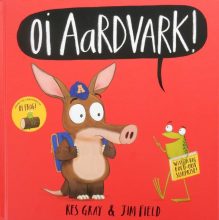
Oi Aardvark!

Oi Aardvark!
Kes Gray and Jim Field
Hodder Children’s Books

Frog seems to be mining a seemingly bottomless – or maybe it should be bottomful – pit in Kes and Jim’s new Oi offering.

At the outset he throws out an invitation to the titular animal to participate in his new book that’s to be entitled ‘My ALL-NEW ALPHABETTY BOTTY BOOK. Dog is all agog; not so the cat who is, as usual, a sourpuss and ready to pour cold water over the enterprise even before it gets underway.

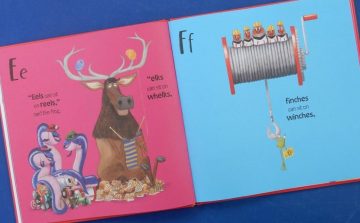
I have to hand it to Frog with his first chair substitute though, it’s pure genius: “Aardvarks will sit on cardsharks!” Nevertheless a certain feline is ready with a bit of negativity: “What’s a cardshark?” it demands. “It’s a shark who’s really good at playing snap!” comes Frog’s rapid response. That should shut Cat up, but let’s see.

We get through B and C without any interference, and only a minor bit of banter from Cat comes to herald in D. But then Dog’s tongue-twisting mix-up of a comment fuels another catty utterance. Eventually Frog announces his D and on we go safely (actually pretty precariously) through E and F.

For G, Frog has two clever inclusions – “giraffes can sit on baths and Gazelles can sit on bells!”

With horses comfortably seated and iguanas less so, clever claws Cat cheekily interjects again. (as if Frog doesn’t know his alphabetical order – well really!).

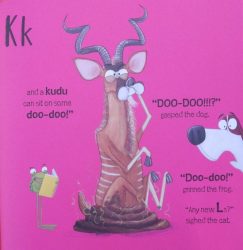
Anyway, or rather, Frog’s way, J. is duly dealt with and then as we’ve already been told, comes K. K is splendidly stinky …

Looks like the frog is the only one amused about this botty placement.

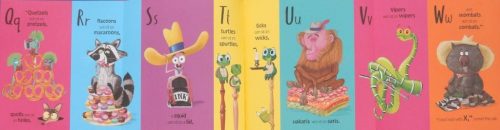
Off we go, with the dog heaping praise on our book compiler and guess who being its usual party pooping scorn pourer. Let’s skip to P and be pretty sure there’s a treat in store – ta da! Four animals happily installed on their bum bearers; but then comes another treat in the form of a double fold-out taking us through – with an inevitable purring pouring of cold water from the cat, to X.

Yet again Frog emerges triumphant, even giving himself a round of applause before zipping off through Y to the grand finale and completion of his book.

Or maybe not quite: we’ll leave it to the threesome to get to the bottom of their zany dispute.

So far beyond brilliant that it will never find the way back is this combination of Kes’ carefully and creatively concocted, rhyming, weaving of wordplay and Jim’s superbly silly seating solutions shown in his side-splitting visuals.

I’m hoping against hope that Frog doesn’t decide to rest on his laurels after this, his latest tour de force. I can’t wait to share it with anyone I can get to sit on their selected sit-upon.

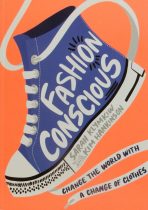
Fashion Conscious

Fashion Conscious
Sarah Klymkiw, illustrated by Kim Hankinson
Red Shed (Egmont)

This book is aimed primarily at teenagers and young adults but I too learned a fair bit from it. Indeed, families, educators, everyone really, needs to become more aware of all the factors surrounding clothing and its manufacture.

We’ve all been hearing recently of the horrors happening to people working in the garment industry, particularly those employed by suppliers to the fast fashion sellers.

One of the good things that’s come out of this pandemic is that we’ve had the opportunity to re-evaluate the relationship we  have with the natural world; and considering the impact our clothing choices have on the planet is a vital element of that rethink.

Many of us have been taking stock and looking at what we have stuffed into our wardrobes and drawers. I was shocked at how many items I discovered with labels still attached. Since shops re-opened I’ve bought nothing new to wear, nor did I order anything on line during the lockdown and having read Sarah Klymkiw’s book, do not intend to any time soon.

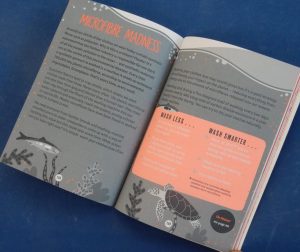
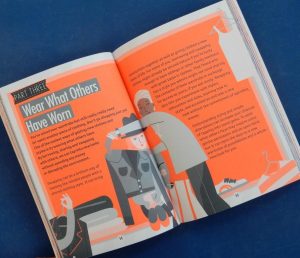
Hurrah for Sarah and Kim’s creative guide to sustainable fashion. It’s packed full of practical, positive (never preachy) advice on how to become a more sustainable consumer of fashion, as well as the facts and figures we need to know.

There’s never been a better time to change your wardrobe ways – to re-use and repair what you have (step-by-step instructions are provided) or to swap it;

and if you really need something new, then this book will help you make a wise choice.

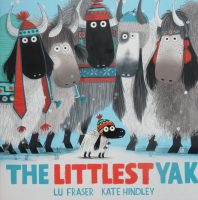
The Littlest Yak

The Littlest Yak
Lu Fraser and Kate Hindley
Simon & Schuster Children’s Books

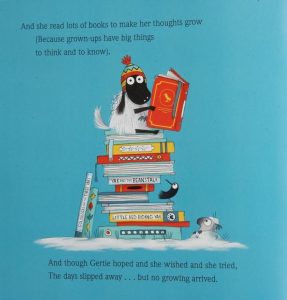
Despite her prowess at clip-clopping up slippery cliffs and her wonderfully curly, whirly woolly back, little Gertie yak is unhappy on account of her lack of “bigness’. She longs to grow up great and tall, when she assumes, her horns and hooves will be impressively huge.

Her mum assures her that ‘bigness’ can take a variety of guises but Gertie remains impatient to assume a larger form.

To that end she embarks on a ‘growing-up’ regime: a diet of healthy veggies and vigorous physical exercise as well as mental training, thanks to her extensive library.

None of which have the desired effect.

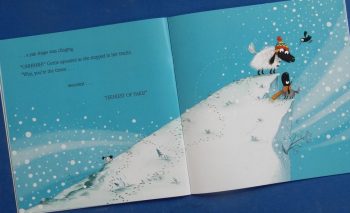
Then all of a sudden as Gertie is near to despair, there comes a cry for help from the yak herd. The teeniest, weeniest is stranded in a perilously precarious position on a cliff edge.

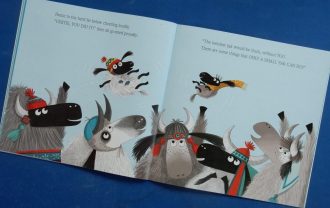
Now is the time for Gertie to make use of those super-grippy hooves of hers and so she does. Onto her back leaps the teeny weeny yak and down the mountainside they both go, to safety and a congratulatory crowd.

Later, wrapped up warmly under the stars, might just be the time for one little yak to realise that she’s just right as she is.

Debut picture book author, Lu Fraser’s rhyming text flows beautifully, making it a super read aloud; and she has the perfect illustrator in Kate Hindley whose funny details – look out for the bird characters – add gigglesome delight to many of the spreads. Love those bobble hats, blankets, scarves and other items of warm clothing worn by the yaks. Perfect for this heartwarming tale.

Season of the Witch

Season of the Witch
Matt Ralphs and Núria Tamarit
Flying Eye Books

If you only ever think of witches in relation to Halloween, folktales, Macbeth’s ‘weird sisters’ or perhaps the ducking stools used to supposedly identity those who practised witchcraft in the 16th and 17 centuries, then Matt Ralphs and illustrator Núria Tamarit will most definitely enlarge your witchy horizons considerably.

It will most definitely do so where children are concerned.
Right from its alluring cover you’ll be held in its power, but make no mistake, author Matt has definitely done his homework when concocting this splendid brew of fact and fiction.

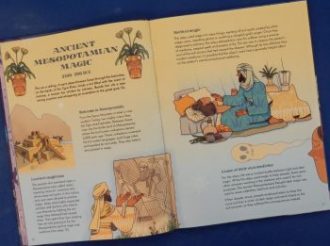
We start way, way back in 3100-500 BCE with Ancient Mesopotamian Magic as practised by the ‘ašipu’ as the scholars and doctors (male only) were called.

They tried to cure illness by fighting the evil magic they believed was the cause by a mixture of medicine, spells and prayers (to their god, Ea).

There’s also a look at the magic of Ancient Egypt, that of Ancient Greece, Slavic magic, Norse magic, the magic of the Middle Ages, of South Africa from prehistoric times until now, and Japanese magic.

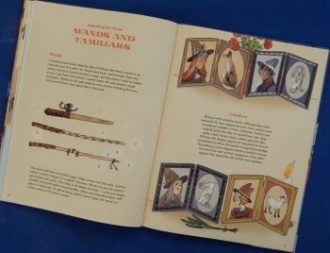
Magical accoutrements of various kinds from wands

to potion ingredients, grimoires (spell books to you and me), charms and more are covered.

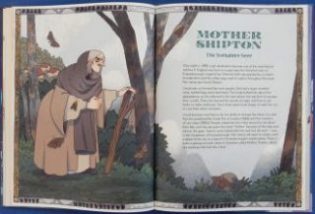
There is information about real people who used magic – the Russian monk Rasputin, Mother Shipton the seer from Yorkshire,

Marie Laveau, a healer and fortune teller from New Orleans and Gerald Gardner who developed Wicca in England are each given a double spread.

You can also find out about the Salem trials and the Witchfinder General and, read a brief version of the folktale about Baba Yaga who lived in a house that stood on chicken legs and supposedly ate children (cooked naturally).

All in all this is a veritable treasure trove of witchy enchantment, beautifully presented as one expects from Flying Eye, and you’ve plenty of time to get hold of a copy before Halloween.

The Grumpy Fairies

The Grumpy Fairies
Bethan Stevens
Frances Lincoln Children’s Books

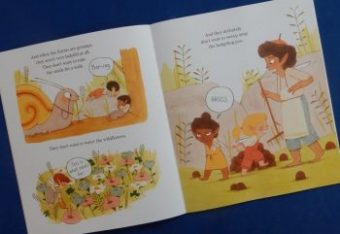
I suspect that most people, youngsters especially, are of the opinion that fairies are cute, kind little things, but that isn’t true of the entire fairy race. The smallest ones especially are grumpy, not just a little bit but grumpy in the extreme. They flatly refuse to do those helpful jobs expected of them by the adults of their kind

as well as being downright rude to the birds that request their assistance. And as for the goblin warning those same birds give them, they don’t even bother listening to it.

The grumpy fairies treat the bees and Mouse in similar fashion, ignoring their words about there being a hungry goblin on the wander looking for lunch; and they’re so busy with their grumps, that they fail to notice …

It’s fortunate that in addition to grumpiness, these particular fairies have cleverness as part of their constitution. Can they succeed in extricating themselves from a very tricky situation, or will they become a ‘sweet and sour’ midday repast for a certain goblin?

This is Bethan Stevens’ debut picture book. It’s full of visual humour; I love her portrayal of those Grumpy Fairies that are similar to grumpy little humans in so many ways, and her hirsute-limbed goblin is terrific fun.

Over and Under the Rainforest

Over and Under the Rainforest
Kate Messner and Christopher Silas Neal
Chronicle Books

This beautiful book immerses readers deep in the South American rainforest in the company of an adult (Tito) and a child narrator as they trek the entire day, from early morning to evening.

They observe with all their senses enjoying the ‘symphony of sounds! Chatters and chirps and a howling roar’ of monkeys, insects and birds in the treetops.

As they continue hiking along the trail we share the sights and sounds of particular animals, ‘Up in the trees’ and ‘Down in the forest’. There are toucans that ‘croak and bicker over breakfast’; a row of bats ‘sleeps away the daylight’;

… ‘A poison dart frog makes his way up a trunk with a tadpole on his back and they find themselves ‘eye to eye with capuchin monkeys as they cross a hanging bridge.

With the afternoon comes the rain, time to snack on dried fruits alongside snacking monkeys. The rain falls more heavily causing a blue morpho butterfly to fold her wings and tuck herself away close to a sleeping mother sloth and her baby.

When evening comes, the rain lets up and the darkness falls all around, there are lots of silent hunting animals such as a parrot snake and an eyelash palm pit viper, and some new sounds too, as up in the trees howler monkeys “Rrrowf! … Rroooooaaaahhhhhh!” in response to Tito’s roar.

Night is the time for jaguars to be on the prowl so perhaps the sudden scary snap is a sign one’s on the move.

It’s also the time for the two trekkers to cross that last bridge and, with thoughts of Abuelita’s supper awaiting, to head for home to the sounds of a choir of insects and raindrops.

Kate Messner’s poetic text really does capture the atmosphere of the rainforest and the changes that happen over a day, while Christopher Silas Neal’s mixed media, matt illustrations, with their alternating views of ground level, the sky and the treetops showing the rich variety of the flora and fauna, imbue this particular ecosystem with a magic of its own.

If you want to discover more about the fauna, Kate has included notes on twenty creatures at the back of the book, along with some paragraphs about her own Costa Rican rainforest forays.

Hello Friend! / Bunny Braves the Day

Hello Friend!
Rebecca Cobb
Macmillan Children’s Books

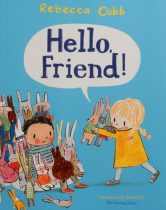
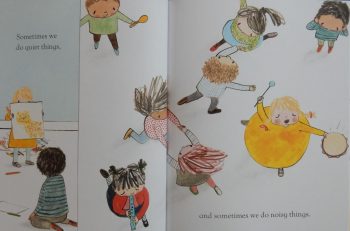
It’s the mismatch between what is said by the small girl narrator and what is shown in Rebecca Cobb’s enchanting, warm illustrations that make this book such a winner.

From the start the girl enthusiastically shares everything during playtime both indoors and out, at lunchtime, during quiet times and noisy ones.

What is evident though is that the boy on whom she focuses all this sharing attention is going to take much longer to feel ready to share in the well-intentioned advances of the little girl.
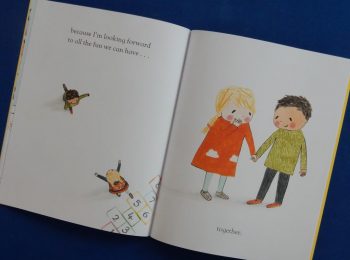
However, a friendship does develop …

and it’s one where both parties are equally enthusiastic about their togetherness.

This is a gorgeous story to share with youngsters especially those starting school; it offers plenty to reflect on and talk about, both at home and in the classroom.

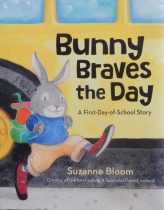
Bunny Braves the Day
Suzanne Bloom
Boyds Mills Press

It’s Bunny’s first day of school but he wants nothing of it: he doesn’t know anybody, supposes nobody likes him; his socks are too short, his shorts too long and he can’t tie his shoes. Oh woe!

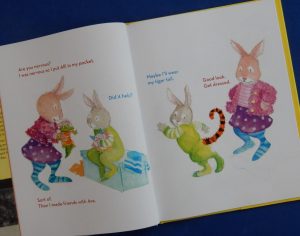
Big sister cajoles him with plenty of empathy and ideas,

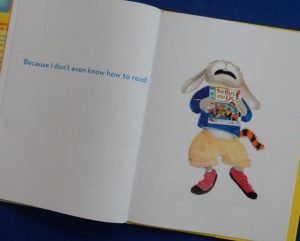
but with a hurting tummy, it’s decided … ‘I’d better not go … Because I don’t even know how to read!’

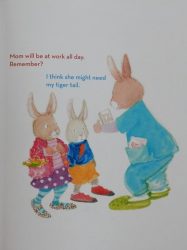
After more loving comments, ‘Sometimes you just feel like crying before you feel like trying. You’ll find a friend. Not all shoes use laces. And teachers love to teach reading…’ and listing things little bro. CAN do, he’s almost ready to surrender but not before one last try, ‘Mom will miss me.’ (Said parent has uttered not a word in all this, though she does take a photo).

Finally, it’s time to face up to the inevitable and once more it’s down to big sis. to deliver the final upbeat reassurance at the classroom entrance.

The entire text takes the form of the dialogue between the bunny siblings –blue for the new boy and red for older sister; while Suzanne Bloom’s watercolour and pencil illustrations highlight the feelings of the two characters beautifully.

Just right to share with little ones, especially in families where there’s likely to be starting school nerves; or with children in a nursery setting.

It’s Board Book Time!

Disney Block
Peskimo
Abrams Appleseed

Before they’re ready to watch Disney’s classic animated films, thanks to this chunky board book, babies and toddlers can meet the much-loved characters from way back in the 1930s and 40s with Snow White and the Seven Dwarves, Pinocchio, Dumbo and Bambi …

right through to Frozen 2 (2019), much adored by pretty much every little girl I know and countless others I don’t.

As always husband and wife illustration/design team, Peskimo, have done an absolutely brilliant job with this latest in the Block Book series that includes their characteristic die-cut pages and in this volume, a memorable quote from each film featured helps to lift the characters from the pages.

Every spread has a magic of its own be it through the waving of her wand by Cinderella’s fairy godmother, (1950); the superb togetherness shown in this Jungle Book scene …

or the loving encounter depicted between John and Pocahontas (1995).

As you share and re-share this you are certain to relive many of these unforgettable moments, making this an absolutely wonderful book for tinies and adults too.

Over the years there have been plenty of Disney board books but none of them can touch this beauty.

Clap Hands for Key Workers
illustrated by Kat Uno
Pat-A-Cake

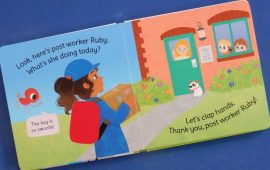
This touch-and-feel board book gives the very youngest toddlers an opportunity to say thank you to key workers.

There’s doctor Harriet applying a bandage to a small boy’s leg; shop worker Jay with those shiny apples strategically placed near the till to tempt shoppers; Ruby the post worker

and bus driver Logan, stopping to pick up passengers on his route.

Each of those has their two pages with a touchy-feely feature, but the final double spread shows seven other key workers, all of whom deserve our thanks, especially during the continuing pandemic.

Share with little ones and celebrate these workers together as you enjoy Kat Uno’s bright jolly scenes and give each worker a round of applause.

Touch Think Learn: Build!
Xavier Deneux
Chronicle Handprint Books

A host of learning possibilities are contained within the covers of this largish, sturdily built board book for toddlers, who do so much discovering about their world by looking and touching.

There are bright colours and a variety of shapes and patterns to explore as they follow the house-building process from the time two building site workers don their hard hats right through to the completion of their family home.

There’s a wealth of new vocabulary as various vehicles are introduced along with the work they carry out – a bulldozer for digging/shovelling; a flatbed truck for carrying supplies;

a crane for lifting such things as joists and roof parts. What fantastic conversation sparking opportunities here.

And by manipulating the removable parts and fitting them into die-cut openings, the small user becomes a participant in the entire narrative ensuring maximum engagement throughout.

Clearly, so much careful thought by Xavier Deneux has gone into the creation of this one.

Emil and the Great Escape, Emil and the Sneaky Rat and Emil’s Clever Pig

Emil and the Great Escape
Emil and the Sneaky Rat
Emil’s Clever Pig

Astrid Lindgren, illustrated by Mini Grey
Oxford University Press

Oxford University Press are gradually re-issuing Astrid Lindgren’s books for a new generation of children to enjoy and now it’s the turn of the high-spirited young Emil who lives with his family on Katthult farm in the Swedish village of Lönneberga.

In the first book of stories Emil gets up to all manner of mischief and derring-do – he manages to get his head well and truly stuck in a soup tureen; then he hoists his younger sister Ida up the flagpole,

and disobeys parental instructions by riding an old mare to the village fete.

In the second, Emil continues to drive his parents and others in the neighbourhood crazy with further scrapes. There’s the time he attempts to snare a rat in a trap and something else gets caught instead. Then having somehow managed to get through the whole of Christmas Day without misbehaving, Emil decides to hold a Boxing Day party, which turns out to be a party like no other.

There are six more Emil adventures in Emil’s Clever Pig including those on one fateful Sunday in June when he makes three disastrous attempts to pull the ‘maidservant’ Lina’s tooth out and decides to give Ida a dose of typhus by means of blue paint.

Then there’s that frog in the picnic basket episode one hardly dares to mention; followed by several days when the lad does some good things but can’t manage to sustain this goodness, for he gets carried away with locking doors and unthinkingly locks his father up in the Trisse hut (aka the old privy).

Finally, it’s almost Christmas again and Emil does something very brave and quite dangerous to save the life of farmworker, Alfred.

Mini Grey’s spirited illustrations are just right for bringing these stories to a new audience of young listeners and readers.

My Friends and Me

My Friends and Me
Stephanie Stansbie and Katy Halford
Little Tiger

Families come in many different forms; this book celebrates that diversity. It’s narrated by a cheerful child who introduces, matter-of-fact style, families belonging to several friends.

There’s Kate who has two dads, best friend Harry with just his multi-talented mum

and Olivia with two sisters, two mums and a little brother. Then comes Lily with two homes, one belonging to her dad, the other to her mum.

Some friends are especially good for sleepovers: one lives in an enormous mansion, another in a caravan and a third, on a boat.

Hannah on the other hand, lives with her foster mum (among others in the household) Then there’s Ned’s mum who turns out to be not the man people originally thought but a super-surfer all the same.

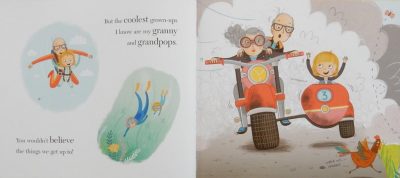
In fact each of the families is a happy one and love is the key, not least in the narrator’s own, for we discover that this young child lives with granny and grandpops who are the ‘coolest grown-ups’.

The up-beat tone of the narrator is reflected in Katy Halford’s bright, cheery illustrations that have lots of amusing details such as ‘Frank’ the goldfish and Harry’s toy bear Bon-Bon.

Presenting as it does both traditional and non-traditional family units, this book would be especially helpful for teachers exploring families as a theme ; and of course it’s worth pointing out that every family is in some ways, different from every other one.

If You See a Lion

If You See a Lion
Karl Newson and Andrea Stegmaier
Words & Pictures

First there was Emma Yarlett’s Nibbles, the book devouring little monster and now courtesy of Karl Newson, we have a lion on the loose – ‘orange, furry, handsome and tall’ by all accounts – that’s had the impudence to eat the story right out of his book; not to mention the corner of its cover. Well really!

Not content with the story though, this creature has also consumed a brass band, a penguin, a troll, a pirate, a wizard and a dinosaur; and don’t believe a word when you read that he’s ‘Dashing, charming, gentle, fun’. Far from it; for this beastie has also devoured an entire forest, a river, a mountain peak

plus a dragon and a sprite. And he doesn’t stop there. What does stop our errant lion right in his tracks however, is a cry

from the little rabbit that’s been on his trail throughout.

Does the little long eared fellow fall for the lion’s beguiling invitation? Far from it. Instead he gives the guzzler what for

and then makes him do what young listeners will have been hoping all along.

And how does this rhyming hide and seek story finish? Well, let’s merely say, satisfyingly, roaringly well and leave you to discover for yourself.

Karl and illustrator Andrea Stegmaier have created a corker of a book that little ones will relish as much as readers aloud who can have enormous fun sharing it with them. Rabbit’s actions throughout are especially entertaining.

Bibbit Jumps

Bibbit Jumps
Bei Lynn
Gecko Press

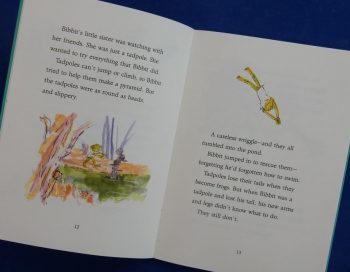
Meet energetic young frog Bibbit who loves to jump and does so at every opportunity, often with his friends; but when it comes to water that’s another matter altogether – he’s forgotten how to swim. Something that becomes evident in the first episode wherein he and his friends build a frog pyramid and then he tries to assist his little tadpole sister and her friends in making a pyramid too.

The second chapter sees Bibbit receiving swimming lessons from his froggy fellows after which it’s time to celebrate his younger sister becoming Little Frog with a special picnic. This ‘outing’ gives Bibbit the ideal opportunity to demonstrate his exceptional jumping talent as well as his determination in picking a banana.

A birthday is celebrated in the next chapter, not a froggy one but that of Little Rabbit and Bibbit manages to deliver the perfect present – just!

Bibbit’s perseverance comes to the fore in Not giving up, an episode about the consumption of a rather unpleasant tasting apple.

Jumping occupies most of the next two chapters; no, make that three, as in the third, Bibbit refrains from his favourite activity on account of an experiment he undertakes that concerns saving up energy for, guess what – jumping, and also making lots of mental leaps.

Finally, thanks to Little Frog, Bibbit is able to confront his fears about leaving home to explore the city. To do so though and find his sister, he has to cross a river and ascend to new heights.

A delightful first chapter book (translated by Helen Wang) with short episodes that are perfect for new solo readers.. Equally they read aloud beautifully too. The watercolour and ink illustrations embody the spirit of the narrative beautifully and they too are enchanting.

New in Town

New in Town
Marta Altés
Macmillan Children’s Books

Despite its shaggy dog narrator, Marta Altés latest book is anything but a shaggy-dog story.

After a long and tiring journey, said narrator, in search of a new home, arrives at a large town.

After asking around and looking in lots of places, and in spite of all the wonderful sights, sounds and smells, he still hasn’t found anywhere that feels just right.

The people are a delight despite their rather different ways of doing things

but everyone seems just too busy, and nobody can understand, or perhaps even see the home seeker

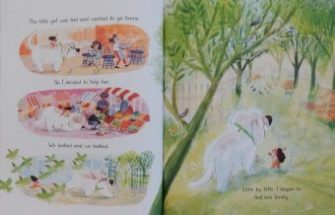
untll the dog has a chance encounter with a little girl who is lost and wants to go home.

As they look for the child’s home together, the feelings of loneliness (the dog’s) and of being lost (the child’s) grow less

but then it’s time to say goodbye – or is it?

Warm and funny – the illustrations especially – this tale of kindness, friendship and accommodating differences needs to be read several times to appreciate all that’s going on in Marta’s splendid scenes of bustling city life.

Snooze / The Whales on the Bus

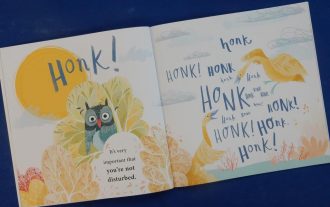
Here are two fun picture books that will ensure very noisy storytime sessions

Snooze
Eilidh Muldoon
Little Door Books

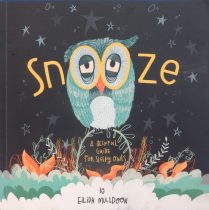
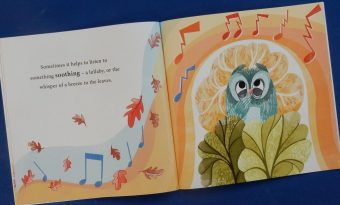
Courtesy of Eilidh Muldoon’s wide-eyed (mostly) owl, what is offered here is a splendidly soporific explanation of how to ensure the best sleep ever. Mmm!

It all begins well enough with our strigine narrator locating a comfortable, peaceful place for slumbering … errr?

– a place wherein you can snuggle and appreciate the surrounding silence – so long as other avians aren’t anywhere around, that is.

Darkness is highly desirable and some soft background music often works wonders

– so long as that’s all you can hear; so maybe it’s wise to check out the location in case of caterwauling felines and yapping pooches. And if your neighbours are not aware of your desire to sleep, a polite request to keep the volume down would be appropriate.

That should mean, that at last it really is slumber time; aaaah!. And once you’ve had that wonderful sleep why not do as our narrator suggests and let one of your pals try using the book too. Sweet dreams …

The clever combination of tongue-in-cheek text and wryly amusing, beautifully executed illustrations make for a splendid debut picture book from Eilidh Muldoon. Whether or not it works as a bedtime story, I’ll leave you to discover.

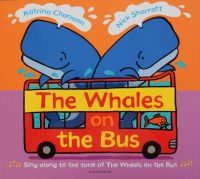
The Whales on the Bus
Katrina Charman and Nick Sharratt
Bloomsbury Children’s Books

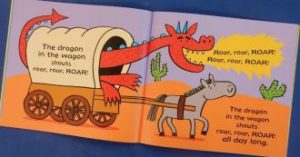
Expect a great deal of enthusiastic noise and lots of action when you share this with little ones. It’s an open invitation to choo, choo, zoom, zoom. dive, loop-the-loop, quack, quack, beep, roar,

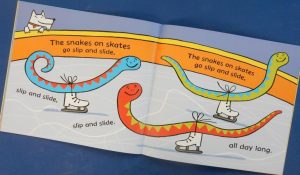
yo, ho ho, slip and slide, float and even perhaps whisper nighty night along with the bus riding whales, crane train passengers, skiing bees, jeep driving sheep, submarine diving seals, gliding piloting tiger, truckload of ducks, skating snakes

and the other adventurers in Katrina Charman’s joyful animal extravangaza.

Using the tune of the nursery favourite ‘The wheels on the bus’ and showing each in turn of Nick’s zany scenes of the (largely) cacophony-creating creatures you can have an absolute whale of a time with a class of pre-schoolers when you read this.

Slightly older children could have terrific fun creating their own verses to add to those composed by Katrina and then illustrating them. Bring it on, say I.

The Teeny Weeny Genie

The Teeny Weeny Genie
Julia Donaldson and Anna Currey
Macmillan Children’s Books

There are faint echoes of the traditional Aladdin and The Fisherman and his Wife in this wonderfully funny tale of wishing that gets totally out of hand.

It all begins down on the farm when Old Macdonald decides to do a spot of cupboard cleaning. Having given his dusty old teapot a good wash, he’s rubbing it dry when out through the spout wafts the resident teeny weeny blue genie. The genie offers the farmer a wish.

It’s not too long before not only does Old Macdonald have that bright red tractor he so wanted, but a wife, a wardrobe, a cradle with a bawling baby,

a host of noisy animals; he’s called the fire-brigade to rescue a cat,

the crew have joined in with the wishing, and then there are superheroes whizzing every which way. The poor long-suffering genie can stand no more.

Powerless to make a wish for himself, he sneaks back into the farmhouse and back to his teapot home. So delighted is he at the sight of it that he gives the teapot a stroke, after which something wonderful and surprising happens …

Now should any of you lovely readers come upon a red teapot with white spots somewhere totally unlikely and feel the need to make a wish, then please be very careful what you wish for.

As always, Julia Donaldson’s zany story is a delight to read aloud, offering as it does, plenty of noisy joining-in opportunities for enthusiastic listeners who equally, will delight in Anna Currey’s watercolour scenes of the mounting mayhem that all began with a single wish and The Teeny Weeny Genie. Like the characters in the story, youngsters will certainly wish for more.

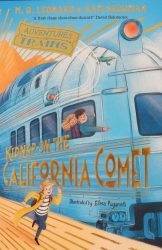
Adventures on Trains: Kidnap on the California Comet

Adventures on Trains: Kidnap on the California Comet
M.G. Leonard and Sam Sedgman, illustrated by Elise Pagnelli
Macmillan Children’s Books

In this sequel to The Highland Falcon Thief 12 year old Hal Beck is on another railway trip. Now he’s with his journalist Uncle Nat, embarking on a three day journey from Chicago to San Francisco.

Before they’ve even boarded the California Comet, Hal has his sketchbook out and has started recording what he sees. He’s also met up with Mason and his sister Hadley who tells him later on that she practises magic.

Shortly after, he meets Marianne, daughter of August Reza, the billionaire technology entrepreneur whose press conference Uncle Nat is to report on.

Hal encounters a host of other unusual characters, including Seymour Hart who always wants to stay close to his briefcase, and teenager Ryan whose speech is hampered by the dental braces he wears, but wants to communicate with Hal all the same.

As the train speeds on across the plains, Hal feels increasingly uneasy; something strange and possibly dangerous is going on.

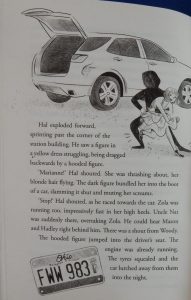
Around 7.30pm, Hal sees a girl in a yellow dress being dragged into the boot of a waiting car that drives away into the night. Seemingly, Marianne has been kidnapped.

Can he possibly discover exactly what is going on? Perhaps, with the help of his new friends, Hadley and Mason.

Full of mystery and intrigue, this cracking story is full of interesting details and dropped hints.

It’s not only Hal (aka Sherlock da Vinci) who has an extremely deft hand when it comes to sketching: Elisa Paganelli’s smashing, sometimes finely detailed illustrations add considerably to the atmosphere of the twisting, turning adventure.

Lovers of trains and detective stories especially, will devour this; so too will anyone who loves a gripping yarn.

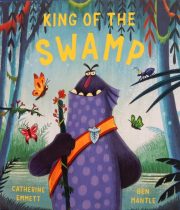
King of the Swamp

King of the Swamp
Catherine Emmett and Ben Mantle
Simon & Schuster

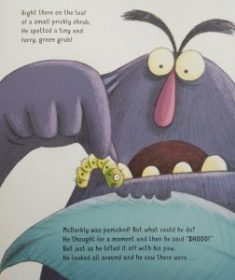
In a dark dank swamp living peacefully alone and growing orchids in his neat garden, is McDarkly.

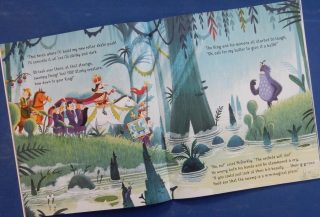
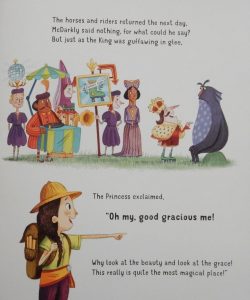
One day, this peaceful existence is shattered by a royal entourage led by a roller skating enthusiast King who wants to turn the swamp into a roller-skate park.

However at McDarkly’s mention of orchids the Princess’s ears prick up and an agreement is made that the royal party will give the orchid cultivator just ten days for his orchids to bloom so that the princess can learn from these wonderful plants.

Determined to save his swampy environment from the King’s destructive clutches, McDarkly labours night and day, and as his allocated time is about to end, he comes upon a small green grub on one of the leaves.

Disaster! But all the more so when the one proves to be a great many of the wrigglers and they devour his precious flowers overnight.

Back come the royals, with the King in high spirits when he discovers the lack of orchid flowers. Once again though, it’s down to the Princess to save the day …

Delectably silly, Catherine Emmett’s rhyming tale is an exceedingly clever and enormously enjoyable way of putting across an environmental message or two so that young audiences will be both greatly amused and one hopes, ready to get behind the conservation crusade that still needs lots more activists.

Ben Mantle’s comical scenes are rich in detail – daft and otherwise. Who can fail to giggle over the sight of McDarkly sitting atop a bush outside his home sipping tea from a china cup, or that of the creature singing to his plants.

Freddie’s Amazing Bakery: Dancing with Doughnuts / Willow Wildthing and the Dragon’s Egg

It’s great to see new stories in two fiction series for younger readers, both from Oxford University Press

Freddie’s Amazing Bakery: Dancing with Doughnuts
Harriet Whitethorn, illustrated by Alex G. Griffiths

It’s summer time in Belville the town of Freddie’s Amazing Bakery and the Summer Talent Show is imminent.

Freddie’s friend and bakery manager, Amira already has her show clothes: she’s going to dance with Samuel and the auditions are that very night; but the nefarious Bernard (of Macaroon’s Patisserie) is also intending to compete – as a magician.

Then disaster strikes in the form of an injury to Samuel’s leg that means he’ll have to pull out. (I wonder who was instrumental in that?)

Next day Freddie gallantly offers to step in, (so long as he can overcome his stage fright) but then, so too does Bernard, who is of course, rebuffed.

However Bernard is determined to get in on the act by fair means or foul.

Just how far will somebody go to sabotage things for the new partnership?

Is there any way Freddie and Amira can emerge triumphant in spite of everything?

Freddie’s third adventure is just as tasty as his previous ones. Harriet Whitehorn’s recipe, with its liberal sprinkling of Alex G. Griffiths’ humorous illustrations is just right for newly independent readers and for reading aloud to reception and Y1 audiences. Why not test out the recipe for Freddie’s doughnut muffins given at the back of the book too?

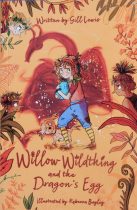
Willow Wildthing and the Dragon’s Egg
Gill Lewis, illustrated by Rebecca Bagley

As Willow and her family finish creating a safe indoor haven for the ‘baby dragon’ her little brother Freddie has found in the garden and head back indoors, Willow and her dog, Sniff, find a message from the Wild Things ( Fox, Bear, Hare, Mouse and Raven) telling of ‘Trouble in the Wilderness’ and asking for her help.

Off they go to the secret place, Willow taking a batch of Nana’s cookies with her, and she learns that River Camp, home to the Wild Things, has been invaded by strangers and some of their stuff taken.

Then the cookies are stolen from right under their noses and the thief runs away into the Forest of Forever Night

only to disappear completely, Moreover they discover that Mouse has also vanished and a note left in his place.

The other Wild Things decide they have to find him even if it means going deep into this forest, a place they’ve never been before. It’s in there, they see Mouse stuck up a tree and meet the no longer “Invisible Tribe’ who call themselves the Bark Skins, and demand to be given River Camp in exchange for Mouse.

Time to consult the ‘witch’ (actually a writer who lives in a cottage) – about dragons in particular. She gives the Wild Things wise words about dragons and dragons’ eggs and off they go to find a dragon’s egg.

Thus the battle of clans really gets under way, but what is really going on and can the dispute be resolved peaceably and in such a way that everybody is happy with the outcome?

And what will eventually be the fate of Freddie’s ‘dragon’? It can’t live in a tank forever …

Once again, Gill Lewis’ story of friendship and determination celebrates both the natural world and children’s imagination. Willow and her friends are terrific models of resilience and curiosity for young solo readers and listeners who will love this new adventure with Rebecca Bagley’s terrific illustrations and page borders.

Shy Ones

Shy Ones
Simona Ciraolo
Flying Eye Books

We first officially meet flapjack octopus Maurice, the story’s main character, on the front endpapers. Said creature is extremely shy, hiding behind his mum, under his desk at school and among the seaweed fronds in the playground. ‘Unless you were looking for him, you wouldn’t know he’s missing,’ says the narrator.

‘Right about now, you’re probably thinking “What a bore!” But I wouldn’t be so quick to jump to conclusions’ we read but then we see the little cephalopod on his way to Deep Blue Dance Hall where, surrounded by a host of glowing creatures and looking as though he’s blissfully happy, he performs a solo dance.

Then comes an invitation to a party, which Maurice somewhat reluctantly turns up to with a handy disguise; then the omniscient narrator steps in again with some revealing comments …

and a friendship is forged. Finally on the back endpapers we discover the narrator’s identity is Lucy the Box Fish another reclusive marine creature.

Observant readers/listeners may just have noticed that said fish has been lurking in the background in several of the early spreads and those who haven’t can enjoy looking back and discovering her whereabouts in Simona Ciraolo’s wryly humorous sub aquatic scenes full of charming, jewel bright sea creatures.

A gentle delight to share with many little humans – introverted or extroverted – or perhaps, just one little shy one.

Axel Scheffler’s Flip Flap Minibeasts / Flip Flap Snap! Pets

Axel Scheffler’s Flip Flap Minibeasts
Axel Scheffler
Nosy Crow

Award-winning illustrator Axel Scheffler has created another in the Flip Flap series and the possibilities just might be even more bonkers than ever with this one of minibeast muddle ups that can be created from the dozen real minibeasts – over 120 if my reckoning is correct.

So, what would you get if you cross a butterfly with a bluebottle? That would be none other than a buttottle – Flutter! Flutter! Bzzz! Bzzz!

And what about an earthworm with a grasshopper? That, naturally (or rather unnaturally), is an earthwopper.

Youngsters (and grown-ups) will delight in discovering all kinds of splendidly silly creatures and their weird and wonderful sounds in this playful book.

Giggles galore for sure thanks to Alex Scheffler..

You’ll have to wait till early September for this one:

Flip Flap Snap! Pets
Carmen Saldaña
Templar Books

Want to meet a rabbigar? Or maybe you’d like to see a gecky? By flipping the flaps little ones can create some petty permutations at the same time as learning a little from the pet narrators whose rhyming information is accessed by lifting the flaps on the left-hand side of each double spread.

The fun pop-up facial features that are part and parcel of Carmen Saldaña’s amusing illustrations will likely encourage toddlers to play for some time with this jolly mix-and-match book.

Colours of the World: Blue Planet / Sounds of the Skies

Colours of the World: Blue Planet
Moira Butterfield and Jonathan Woodward
Little Tiger

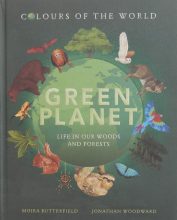
Author Moira Butterfield provides both an introductory look at the water cycle and then an exploration that takes young readers to a variety of watery environments, both fresh and salty, to look at some of the life forms therein.

We visit the planet’s five oceans and the marine biomes where can be found such creatures as great white sharks, blue whales, pygmy seahorses and ocean sunfish; and deeper down among the corals we view clownfish, lobsters and eels as well as scary-looking anglerfish and viperfish,

whilst much nearer the shore whelks, mussels and hermit crabs lurk among the various seaweeds.

Next comes a look at various water-craft from container ships to rescue boats. That and a later spread on different kinds of aquatic homes including houseboats in Kerala and houses built on stilts by the Bajau people of Malaysia; and another showing a reservoir, a water-treatment plant and a communal well recognise human usage of this precious ‘sparkling treasure’.

In between we visit rivers, including the world’s four biggest,

and then half a dozen lakes, surprisingly two of those included are in the UK.

Throughout the text, in simple language is presented in single or two-sentence blocks around which are Jonathan Woodward’s mostly close-up, collage style illustrations, appropriately patterned and textured.

This book would make a useful addition to a primary topic box with a watery theme or as an introduction to a class water topic.

From the same team comes:

Sounds of the Skies
Moira Butterfield and Jonathan Woodward
Little Tiger

32 amazing creatures from nine different locations around the world are presented in this book as well as 13 birds, the calls of 9 of which readers can hear at the press of a button on each double spread vibrantly illustrated by Jonathan Woodward.

From the Amazon rainforest comes the noisy call of a fast flying scarlet macaw, while in the eucalyptus forest of eastern Australia, sounding similar to a human laugh, comes the kookaburra’s call.

For each bird soloist, Moira Butterfield has written a short verse.
Here’s the one for the Chinese nightingale in the Black Mountains of Bhutan:
A Chinese nightingale / sings for his love, / and sweet notes / float up / between the trees. / Up and up into the sky.’ In addition there’s a short paragraph giving information about each of the animals featured.

Other locations include British Columbia where bobcats and bald eagles roam; the Sonoran Desert of North America where the Gila woodpecker that makes a drumming sound in the sizzling environment it shares with such creatures as coyotes and rattlesnakes.

The last stop is Serengeti in Tanzania where among the lions, zebras, giraffes and gazelles can be heard the booming sounds of ostriches.

There’s a final map of the world showing each of the locations, a list of the birds and other animals mentioned; and inside the back cover we discover which of the birds featured are under threat in our changing world.

My First Cook Book

My First Cook Book
David Atherton, illustrated by Rachel Stubbs
Walker Books

I’m far from an expert cook, nor have I really any aspirations so to be as my partner serves up delicious vegetarian dinners every evening. I wasn’t one of the many people who turned to baking during lockdown but nonetheless I was motivated to try some of the exciting recipes in 2019 The Great British Bake Off Winner, David Atherton’s book, aimed primarily at children. David has also been an International Health Advisor and is a fervent believer in the importance of teaching young children about healthy eating.

In My First Cook Book, he presents over forty nutritious recipes organised under four headings: ‘Starting the Day’, ‘Lunches and simple suppers’, ‘Delicious treats’ and ‘Teatime bakes’; and despite its title, this is very much a family book; adult supervision is required for each recipe. The author is an advocate of cooking together as a family and before the recipes, provides an illustrated list of basic kit for cooks, definitions of some terms used, notes on measurement and more.

I’m sure little ones will absolutely love the Banana bear pancakes (so long as they like bananas) – fantastic to see that young spinach leaves are included in the batter mix.

I was especially drawn to the Edible chia bowls that you can fill with whatever you so choose. I’m going to use a plant-based yogurt as the only slight deviation from the ‘live plain yogurt’ suggested in the ingredients.

If you’re thinking of lunch during a walk, why not try the Piggy buns as part of your picnic, filled with something of your family’s choosing. They look almost too cute to consume.

Among the ‘Delicious treats’ are goodies both savoury and sweet including Hummus lion and Energy stars – now they look truly tempting.

From ‘Teatime bakes’ I’m sure few people will be able to resist the Mega-chocolatey cake. I’ll say no more, other than that the recipe given makes 24 servings: what are you waiting for …

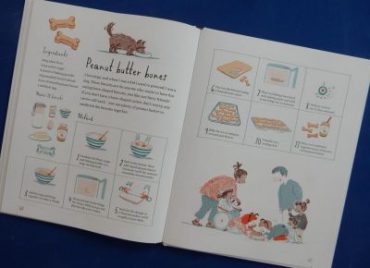
I had to laugh at David’s comment about pretending to be a dog as a kid in his Peanut butter bones introduction. It took me back to a reception class I once taught where for the first 2 weeks a little girl insisted she was a dog and crawled everywhere, even down the corridor to the hall for an assembly. The head was less than impressed with me: now these biscuits I’ll make for Farhannah, whom I’ll never forget.

I could go on raving about the recipes herein but I’ll merely say, get hold of his book and tuck in. It’s terrific! Made all the more so thanks to Rachel Stubbs’ fantastic illustrations of both the step-by-step food creation and the families having fun in the processes of cooking and consuming.

Too Many Bubbles

Too Many Bubbles
David Gibb and Dan Taylor
Simon & Schuster

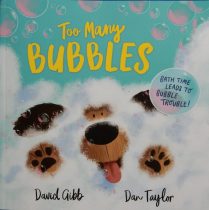
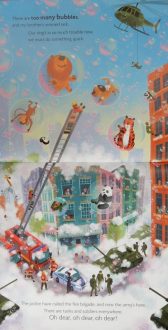
Dogs and exceedingly dirty water or mud seem to have a magnetic attraction and it’s certainly the case in musician/songwriter David Gibb’s madcap rhyming tale that begins with an extremely mucky pooch and instructions from Mum to ‘give the dog a bath’.

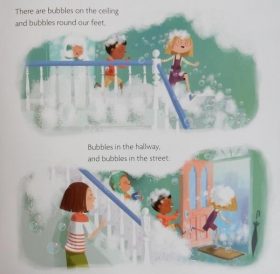
It’s not long though before this seemingly straightforward enterprise has descended into uncontrollable bubbly mayhem as the three children concerned set out in hot pursuit of their havoc-wreaking pet and the bubbling soapy trail.

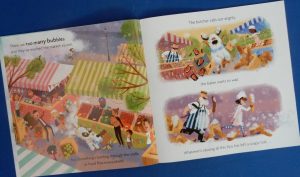
As we follow the foam it becomes clear that the cause of the chaos is grasped firmly between the pooch’s jaws as it dashes rather in the fashion of the traditional Magic Porridge Pot, through the market square

and the park to the zoo.

There bubbles soon enclose not just the perpetrator of the chaos but all the inhabitants of said zoo as well. Something has to be done and quickly.

And something is, but it’s not quite what the rescue services have in mind as they risk life and limb…

And the dog? Err – let’s just say he seems to have thoroughly enjoyed himself and is badly in need of another dip in the tub.

Dan Taylor’s effervescent illustrations are enormous fun too: I particularly love the scene of the fountain invasion.

Sleuth & Solve History

Sleuth & Solve History
Victor Escandell and Ana Gallo
Chronicle Books

This new assemblage of detective fun enigmas from Victor Escandell (illustrator) and Ana Gallo (author) all have a historical theme.

The brain-bewildering mysteries begin way back in prehistoric Stone Age times with a meal-stealing episode and end with a contemporary conundrum relating to an astronaut who locked herself out of her computer.

Before the sleuthing starts, there are spreads setting out such things as how to go about finding solutions; ways to play (solo, as a family or in teams) and a table of contents in timeline form.

Then the real puzzling begins with an introductory scene setting paragraph, cartoon style visuals, captions and speech bubbles for each mini mystery; and across the top left-hand page of each one is a rating for difficulty, a categorisation of how to solve it (by using logic or imagination), and the number of points for finding the answer (no cheating by peeping under the flap at the outset).

Puzzlers can test their skills in the Mesolithic era; the Babylonian Empire; in Ancient Egypt; among the Ancient Greeks, the Celts (two double spreads needed for this one); with a Syracuse king who called on Archimedes to assist him;

they can try catching a jewel thief during the French revolution; emulate young Thomas Edison, or Sherlock Holmes even.

Just right for youngsters aspiring to become the next Poirot or Precious Ramoswe. Hone up those ‘little grey cells’ and off you go.

Terrific screen-free fun aplenty guaranteed.

Arlo, the Lion Who Couldn’t Sleep

Arlo, the Lion Who Couldn’t Sleep
Catherine Rayner
Macmillan Children’s Books

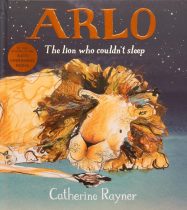
Catherine Rayner has created an absolute stunner of a bedtime book in this story of Arlo the insomnia-suffering lion. He’s tried everything without success and now he’s feeling fed up and thoroughly exhausted.

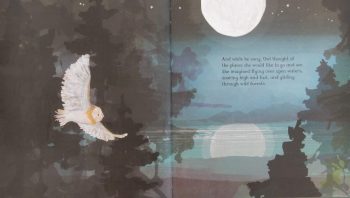
But then he has an encounter with Owl

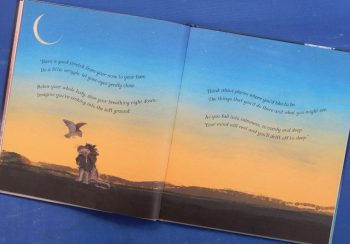
an expert at sleeping when it’s noisy and hot, and in her sing-song voice, she teaches Arlo how to wind down ready to fall fast asleep.

It works wonders and the lion feels rejuvenated after a long sleep. So much so that he bounds off to tell Owl, waking her up in so doing.

Arlo reciprocates with a sleep-inducing song for his feathered friend.

Both creatures are delighted. Their celebratory cheer in the evening however, doesn’t go unheard but perhaps the words ‘Have a good stretch from your nose to your toes. / Do a little wriggle, let your eyes gently close … As you fall into calmness, so comfy and deep / Your mind will rest and you’ll drift off to sleep’ sung as a duet will prove even more soporific where it’s needed.

Perfectly paced, the combination of a calming narrative with its in-built repetition of mindful meditative verses, and totally gorgeous, amazingly textured illustrations that take your breath away, this is sheer delight no matter how many times you read it.

I can think of no better book to share with little ones at bedtime; it’s brilliant through and through.

InvestiGators


InvestiGators

John Patrick Green
Macmillan Children’s Books

Here’s a zany graphic novel- the first of a series – that features alligator pals Mango and Brash and as the story opens they’ve just received an undercover assignment as agents for SUIT (Special Undercover Investigation Team).

World-famous Chef Mustachio has gone missing just as he’s about to reveal his latest culinary offering and Mango and Brash must go undercover at Batter Down bakery to discover what’s happened to him.

No problem then. Just a bit of diving down into toilets and moving through city sewers, an explosion at the Science Factory thanks to the delivery of a gigantic birthday cake from Batter Down,

disappearing ovens and a crocodile that has fallen into a vat of radioactive cracker dough and come back to life.

Green has conjured up a cast of assorted humans and reptiles, and weaves together a multitude of threads in his rapidly moving plot that’s full of groan-worthy jokes, puns and other word play.

Like this reviewer you might find your head spinning by the time you reach the end of this frenetic, fizzily funny  story. (It’s not though as we discover, the end of Mango and Brash, they are destined to return in at least two more mysteries.)

Green provides two final spreads showing how to draw the InvestiGators and a couple of others from the crazy cast.

Belonging Street / Dear Ugly Sisters and other poems

It’s always exciting to receive new poetry books and these two from Otter-Barry Books are smashers.
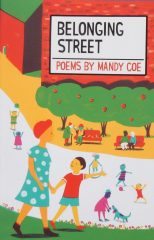
Belonging Street
Mandy Coe

In this collection Mandy Coe has written about urban life, wild life and family life, sometimes all of them in the same poem. There’s definitely something for every taste and every mood from story poems, puzzling ones, riddles and those that really touch the emotions.

What Mandy does so well is to help readers to see the beauty and the magic of the everyday world whether she’s writing about Helping Hands:
Grandad’s hands are brown / and rough with oil. / Grandma has a green thumb / potatoes pushing up the soil. // My aunt’s hands are pale, / inked with many colours. / My uncle’s hands are strong. / dusted with sugar and flour. // My stepdad’s hand uncurls / to reveal a coin’s bright shine. / My mother’s strong hands / sew each stitch in time. // And when any of us fall, / these hands will help us stand, / these mending, baking, making, / lending, helping hands.

Or talking of butterflies as in She Belongs to the World:
Drifting through Albania / from mountain tops to forest floor, / she is flutur.
In Norway, / among black pines, a brilliant jewel, / she is sommerfugl’ … ‘Tumbling from the sky, / summer has arrived. / She is Butterfly.’.

And how magical-sounding are these lines from Animals Name the Constellations:
What’s in the stars up above?
asked Tadpole of his father.
It’s Silver Spawn in the Black Pond,
the Lily, Carp and Beaver.
Have they been there long?
Forever my love, forever.

Love Mandy Coe’s illustrations for this poem

And I’m definitely going to try The Rhythm of Sleep if I find myself unable to drop off at night. It would also make a marvellous relaxation ending to a yoga class except that one doesn’t actually want the participants to ‘slip into sleep.’ Not until they get home anyhow.
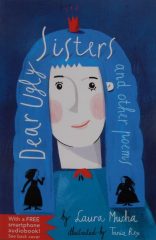
Dear Ugly Sisters and other poems
Laura Mucha, illustrated by Tania Rex

This is Laura Mucha’s debut collection although readers may have come across her poems through workshops, festivals, anthologies and other places where poetry is celebrated including the Caterpillar Poetry Prize that she was awarded in 2019 for the title poem. Now we have an entire book and that is most certainly something to be celebrated.

Her writing is wide-ranging and there are several other fairytale-related offerings such as Rapunzel, Did You Sleep Well? – a superbly playful take on The Princess and the Pea from the viewpoints of the pea, the prince and the princess; and Three Bears VS Goldilocks where Goldilocks puts her case concluding it thus: ‘ The Three Bears need to drop their charges, or they’’ll be / contested. / Their lodgings are so terrible, that THEY should be / arrested.

Each one fresh and accessible, there are shape poems, haiku, poems constructed for the sheer joy of hearing their words said aloud as in Words That Make Me Smile that starts like this:
Tog, toggle, goggle, wiggle / wriggle, giggle, gnu ‘ and Listening To – an onomatopoeic immersion in birdsong.

You might choose to celebrate Ash’s Birchday, or while reading Dear Key Workers pay tribute (along with the child collaborators) to all those who have contributed so much during the coronavirus pandemic ; or perhaps ponder upon the plight of those children who in 2018 were separated from their parents after so it was said, illegally entering the United States that Laura speaks so movingly of in How Long Until I Can See My Mum?

Whether your penchant is for science, space, nature or things literary you’ll find a poem here, many of them quirkily illustrated by Tania Rex.

Although a lover of Shakespeare I found myself spluttering with delight at Compliments of Shakespeare (inspired by the bard’s insults); and celebrating the joys of reading with the penultimate, rhyming Travel By Book, the final verse of which is: ‘I’ve met many people, I’ve made many friends, / and though I’ve felt sad when I came to the end / of the journey I’d made – I can make it again / with the words of a wonderful book.’

And, what we have here IS a wonderful book. (You can even use the QR code on the back cover on your smartphone for a free audiobook narrated by Laura herself – how fab is that?)
A Robot Ate My Grandma / Level Up! Last One Standing

A Robot Ate My Grandma
Dave Cousins, illustrated by Catalina Echeverri
Little Tiger

This is the third in the series about twins Jake and Jess and their babysitter robot, Robin.

Now in addition to minding the children, Robin has a new job – or rather two: he’s in charge of the lighting for the school play (a musical version of Little Red Riding Hood) and also acting as the narrator of same.

But then the robot starts mal-functioning time and again and the only person who can fix him is his creator, the twins’ STEM expert Grandma. The trouble is she’s gone AWOL and in her place is – can you believe – a robot, albeit an excellent Grandma look-alike.
Mum assures them Grandma has merely gone on holiday so it’s down to the twins to sort things out.

Then they discover someone in her garage workshop and having inadvertently shot the old person, it turns out that she’s none other than Granny Andersen, the twins’ great grandmother accompanied by her ferret, Wee Freddie.

Now there’s a semblance of a team,

but can they discover what’s really happened to Granny, and if necessary, pull off a rescue?

There’s plenty to keep newly independent readers turning the pages of this zany story, not least being the introduction of a new character, Granny Andersen. There are also lots of laughs, a fair few tense moments and terrific illustrations by Catalina Echeverri breaking up the text and adding additional humour and drama to the telling.
Level Up! Last One Standing
Tom Nicoll, illustrated by Anjan Sarkar
Little Tiger

Video-game obsessed best friends Flo (narrator) and Max are stuck inside a video game series. As this book opens, one minute they’re in a plane flying over Last to Leave terrain and the next they are parachuting (just) down to land in the middle of the village square. Game on.

Before long they find themselves face to face with an old adversary, Rhett Hodges, commonly known as Hodges claiming he wants to team up with them. But can he be trusted?

Time’s running out so should they take a chance on his offer?Seemingly it’s their one chance and Flo’s Mum needs saving. Determined to make it to the end and get back home, they get into a speedboat with Hodges and away they go.

Fast and furious is the action and with so much at stake in the toughest battle ever, readers will be on the edge of their seats right to the very end. There are plenty of Anjan Sarkar’s black and white illustrations to add to the dramatic atmosphere throughout.

The Monstrous Tale of Celery Crumble

The Monstrous Tale of Celery Crumble
Ben Joel Price
Oxford University Press

Meet Celery Crumble, a mischievous young miss if ever there was one. Whenever Celery commits one of her misdemeanours she doesn’t apologise in the proper way; instead she says, ‘Sorry! Not sorry!’ and shortly after goes on to do something equally outrageous.

There was the time she treated her father to a birthday breakfast in bed but omitted one very vital thing.

Then, when the boy next door comes to play at Celery’s invitation, her rainbow painting is NOT on paper (or even the wall).

On each occasion, the person on the receiving end of her bad behaviour responds thus: ‘If you act like a monster then a monster you’ll become. Then you’ll be sorry for all the naughty things you’ve done!’

On the school zoo trip, this recalcitrant child takes a large sealed glass jar into which she’s collected the most obnoxious smells she could find. Needless to say, said jar doesn’t stay sealed for long and the result is pandemonium …

You can guess how everyone responded.

Back home in bed that evening, Celery’s sleep is, let’s say monstrously uncomfortable, not to mention transformative …

Perhaps it’s now time to make apologies for real. Err …

Young children will absolutely relish this ‘do-as-you-would-be done-by’ cautionary tale with its spirited scenes of Celery’s preposterous actions and their outcomes and demand immediate re-readings.

Rocket Boy / You’re a Star, Lolo / Charlie & Mouse Even Better

Rocket Boy
Katie Jennings and Joe Lillington
Stripes Publishing

Young Callum has a dislike of broccoli, a fertile imagination, and is passionate about space, Mars especially.

One Saturday he decides it’s time he learned a bit more about his favourite topic, above all, what it would be like to witness a Martian sunset.

Having stocked up on some vital supplies and donned his space boots and helmet he’s ready to board Epic. Then, final checks carried out, comes the countdown …

Out in space he is surprised to discover he has a stowaway, his cat Oscar, and the creature now has the power of speech. In fact Oscar proves to be a valuable crew member when things get tricky on account of a meteor storm and again once they’ve safely landed on Mars, where Callum does finally set eyes on that which he has come to view.

However, as he heads back to the landing module a very strange sight meets his eyes. “What on Mars is that…?” he asks.

Will Callum succeed in returning safely to planet Earth?

Flying a flag for the power of the imagination, Katie Jennings’ story with Joe Lillington’s detailed full colour illustrations on every spread,

should go down well with young, just flying solo readers, particularly space enthusiasts like its main character.

You’re a Star, Lolo
NIki Daly
Otter-Barry Books

This, the third in the series about the adorable, Lolo who lives with her Mama and Granny Gogo contains four episodes for new solo readers to relish.

In the first, Lolo adds a secret ingredient to the soup she makes especially to warm up her Mama when she comes home on a chilly, rainy day.

Next we find Lolo kept awake by a scary sound convincing herself the ‘Ghorra-Ghorra! Hoooaaah! Bwoooooo!s’ she hears are those of a monster, till she and Mama discover what’s really creating such a terrible noise.

The third story starts in school when Lolo’s favourite teacher gives each pupil some seeds to plant. Lolo has tomato seeds from which she learns a lot. So too do the other members of her family; but when it comes to bringing in the results of their labours to show to their classmates, Lolo surprises everyone …
In the final episode Lolo is super-excited when she discovers that she and Gogo are to spend a week of the summer holiday in a seaside town near Cape Town.

The holiday is great but the journey home is more than a little eventful and Lolo wonders if she’ll make it back in time to start school again.

Like the previous books, with its combination of gentle humour and warm family relationships, and of course, Niki Daly’s own  black and white illustrations at every turn of the page, this one is sheer delight.

Charlie & Mouse Even Better
Laurel Snyder, illustrated by Emily Hughes
Chronicle Books

If you’ve yet to meet the rather mischievous brothers, Charlie and Mouse, now’s your chance in their four latest seemingly ordinary activities.

First of all it’s Pancake Day and Mum receives some rather unlikely requests for pancakes from the boys – baby pancakes, a pancake turtle and even a pancake dragon.

It’s as well that Mum knows just how to curtail all this pancake bingeing before the table is totally full, not to mention two little tummies.

Shopping sees Charlie and Mouse off with Dad on a secret expedition to buy a birthday present for Mum. She’s fond of sparkly things; but what will the boys eventually choose – something more practical perhaps?

In Helping, Dad is busy baking a cake so the boys decide to make some decorations. You are going to love Mouse’s final remark on their endeavours.

Eventually it’s birthday time. Before the celebration actually happens though, Dad and the boys need to do some hasty de-smoking of the house. Then once she comes home it’s down to Mouse to do some clever Mum distracting – four minutes worth to be precise – before the presentation of that special Surprise offering.

In these four short chapters, Lauren Snyder demonstrates the astuteness of her observations of very young children, and of course how parents respond. Equally well-observed are Emily Hughes’ illustrations of the family.

With its gentle humour, both verbal and visual, this delightful book is just right for emergent readers.

Lisette’s Green Sock

Lisette’s Green Sock
Catharina Valckx
Gecko Press

One bright sunny day while out for a walk, Lisette comes upon a single green sock, puts it on and continues walking happily along until a pair of cat brothers make fun of her for wearing just one sock.

Having searched unsuccessfully for its pair, she returns home where her mum is none too impressed at the one sock and its dirty state, but she washes it all the same.

As Lisette waits for it to dry, along comes her friend Bert

who mistaking it for a hat, asks to try it on.

Up come the bullying cat brothers with the matching sock but instead of giving it to Lisette they lead her and Bert a merry dance before throwing the sock into the water.

Disappointed Lisette and Bert return home to Lisette’s house and there, joy of joys, Lisette’s mother has knitted a new green sock and everyone is happy.

Not least the fish that discovers a sock in the pond and finds a wonderful use for it.

Which all goes to show how an odd sock, a pair of bullying cats, a good friend and a change of viewpoint can turn a dismal expression into one of delight (or several!). Long live individuality.

A charmer of a book with lively, expressive watercolour illustrations; it’s just right for sharing with a nursery or reception class, or with one child.

Playing and Learning with Board Books

Introducing some new interactive board books from Little Tiger

Bear & Mouse Start the Day
Bear & Mouse Time for Bed

Nicola Edwards and Maria Neradova

Best friends Bear and Mouse (narrator) live together. As they Start the Day, prompted by Nicola’s simple questioning text, toddlers can help the two get up, eat breakfast, prepare to go out, take a bus ride and have fun playing in the park.

When it’s Time for Bed, just like little humans, they enjoy a splashy bath, brush their teeth, don their night attire and snuggle up together for a pre bedtime story.

Maria Neradova’s bright cheery illustrations have just the right amount of detail to keep interest levels high and interactive features in the form of flaps and sliders add to the fun.

abc nature
Nicola Edwards and Thomas Elliott

Even before little ones are at the alphabet learning or letter forming stage you can share this book with its alphabetical arrangement of natural things from acorns to zebras for naming and talking about each item using the photographic style illustrations.

They certainly won’t give any idea of relative size though: ‘earth’ is shown on the same page as ‘flower’ and they’re depicted as being roughly the same size. Nonetheless from the outset even the very youngest can be developing their visual skills and an interest in the natural world; the ‘touch and trace’ element of the book can come later.

Hide and Seek in the Forest
Rachel Elliot and Gareth Lucas

As day gives way to night, it’s bedtime for the baby animals in the forest but it seems as though they’re not quite ready to sleep. Instead Fawn, Baby Squirrel, Little Frog, Baby Rabbit and a baby owl decide to play hide-and-seek; and it’s down to little humans to help their respective parents find them hidden behind the shaped felt flaps on the five spreads.

Wait till your little humans are safely tucked up in bed before you share this jolly little book that’s aglow with Gareth Lucas’ illustrations, just in case they decide to emulate the baby animals.

My Book of Feelings
Nicola Edwards and Thomas Elliott

A range of topics, photographically illustrated, including the weather, foods, free time activities, animals, new experiences and different places are used to help young children explore their feelings.

To the same end there’s a novel feature -a double-sided emoji spinner – as well as a final mirror; however the book opens with a paragraph that includes this reminder, ‘Remember, feelings don’t always show on the outside.’ That’s something we adults probably understand but not so young children, as will the fact that our feelings are not fixed but subject to change.

In addition to being helpful for using with pre-schoolers, it might also work with slightly older children on the autism spectrum.

Marie Curious Girl Genius Saves the World / Cookie and the Most Annoying Girl in the World

Marie Curious Girl Genius Saves the World
Chris Edison
Orchard Books

This is the first of a proposed new series featuring twelve-year-old inventor Marie Curious.

Marie is mega-excited when she receives an unexpected parcel containing a message from one Sterling Vance head of a high-tech corporation in California, inviting her to spend her summer holidays at Vance Camp in his high-tech headquarters. Marie can hardly believe that her robot project has won her a place among thirty other mega-bright young scientists and the theme of the camp is to be robotics. Perfect.

There she and the other campers get the opportunity to attend tutorials and workshops given by the world’s top scientists, test some incredible gadgets and to build robot entries for the competition, the winner being given a year’s apprenticeship and an all expenses paid trip to the world’s biggest tech fair.

Something’s not quite right though. First there’s Marie’s roommate who is very standoffish and then it appears that somebody is sabotaging the campers’ robots. Vance had told Marie when she arrived that there was a spy in the camp but who could it be?

Next comes talk of a computer virus that will create havoc the world over. Competition or no competition, Marie decides that teamwork is key if they are to outwit the culprit and prevent a catastrophic outcome. No pressure then …

A gripping story that will keep readers guessing almost to the big reveal.

Cookie and the Most Annoying Girl in the World
Konnie Huq
Piccadilly Press

Cookie returns and now, as she celebrates her tenth birthday, she finds herself having to cope with the world’s most annoying girl, Suzie Ashby.

Disappointed in discovering that Suzie is holding her birthday party on the day of Cookie’s actual double figures birthday, the day she intended to hold her own party, and even worse, that she is inviting everyone in the class, is only the start of Cookie’s problems.

Next she discovers that her own mum has already committed them to spend the day at Uncle Mehdi’s house for a family reunion making matters worse. Plus, instead of the bike she really, really wants from her mum and dad, all she gets is a token for £25 for the local bike shop.

But then she’s given two tickets to see popstar, Aliana Tiny: perhaps things will start looking up after all.

Or perhaps not: enter Mrs Edmonds, supply teacher, who seems intent on dishing out detentions to Cookie and her pals – except that they’re not really all her pals right then for she’s managed to fall out with both her besties Keziah and Jake.

Then said teacher starts a misleadingly titled club that isn’t at all what Cookie et al. are anticipating. Turns out though that, ex army Mrs E. isn’t quite as awful as they’d first thought, especially as she organises a weekend camping trip; and pretty eventful that proves to be.

But can Cookie manage to win back Jake and Keziah, save the planet and get that much longed-for bike? Now telling would be story-spoiling so I’ll say no more other than there are plenty of laugh-out-loud moments in this enormously appealing sequel throughout which Konnie Huq has liberally strewn hilarious drawings to accompany Cookie’s narrative.

Best Day Ever / Invent-a-Pet

Here are a couple of recent titles from Sterling Children’s Books

Best Day Ever
Michael J. Armstrong and Églantine Ceulemans

It’s the last day of summer and William has just one goal on his list left: have the most fun ever, and he has a handy fun-o-meter invention to help in his assessment of attempts.

What he hasn’t bargained for though is the non-stop interruptions by his neighbour Anna, she of the incredible imagination. As he pursues his fun-finding in trampolining, art

and scooting, she subverts his every effort by her messy, noisy creative play that scores high on William’s fun-o-meter, in contrast to his own activities.

Eventually however, the boy realises that perhaps a bit of silly, messy, possibly even dangerous play might be the way to go;

and thus with William way out of his comfort zone, a fantastic day ensues and an unlikely friendship between two contrasting characters is forged. Not to mention that a satisfying green light from a certain fun-o-meter also results.

Debut picture book author, Armstrong’s story is a great reminder of the importance of having permeable constructs, and of accepting and celebrating difference.

In her mixed media art Églantine Ceulemans adroitly shows how Anna’s zany, exuberant world gradually impinges upon the matter-of-fact notions of William. There’s a wealth of amusing details, not least the silent, bit-part playing animals to which William seems completely oblivious.

Invent-a-Pet
Vicky Fang and Tidawan Thaipinnarong

Katie wants a pet, but not anything ordinary like a goldfish: her pet must be something extraordinary.

One day she finds a strange-looking machine in her living room, put there by her mum with a note saying ‘Hope this helps in your quest to find an extraordinary pet!


Her first input of a football, a blade of grass and a carrot result in a fluffy green creature– cute, but not what she wants.

Several tries later, she still hasn’t got her desired result, although the house is rather inundated with pets. Time to go back to the drawing board and work out how the machine works, decides Katie.

She selects three new items and starts again. After some time she discovers the correlation between size, colour and the third variable. Is this her eureka moment? Not quite.

With persistence, will Katie succeed in her problem solving task and create the pet of her dreams? Perhaps, but first she has to think of a way to deal with the large number of pets she’s already created …

What a fun way to introduce the process of science problem solving – great for a primary classroom STEM collection. Youngsters will love the pets in Tidawan Thaipinnarong’s comical illustrations and her endpapers are a treat too.

The Smile Shop

The Smile Shop
Satoshi Kitamura
Scallywag Press

The boy narrator of The Smile Shop is thrilled to have saved sufficient pocket money to treat himself for the first time ever. What will he buy though?

All the market stalls and shops have exciting goods displayed so should he buy a tasty-looking apple pie,

the beautiful little boat, or perhaps the book that’s caught his eye; or maybe that hat that suits him so well?

He’s still undecided when disaster strikes and all but one of his coins disappears down through a drain cover.

The lad is devastated but then what’s that? A smile shop? Really? Do they actually sell smiles? He could definitely do with one right then, so in he goes …

With his quirky, scratchy drawing and watercolour illustrations Satoshi Kitamura’s latest story is essentially a parable that shows how powerful something as simple as a smile can be.

I think that’s something we’ve all learned since the start of the pandemic – more difficult now that masks have to be worn in various places. It’s also a wonderful demonstration of the fact that kindness is worth so much more than anything that money can buy – something else we’ve learned in the last few months.

A book to ponder upon and discuss across a wide age range.

Mirabelle Gets up to Mischief / Leo’s Map of Monsters: The Armoured Goretusk

Young solo readers will be excited to discover the first titles in two new series from Oxford University Press

Mirabelle Gets up to Mischief
Harriet Muncaster

Meet Isadora Moon’s older cousin, the half fairy, half witch and absolutely adorable, Mirabelle Starspell.

It’s the day of the Midsummer Dance, highlight of the fairy year, and Mirabelle is under strict instructions from her (fairy) dad to keep her witch side firmly under control: potions, pointy hats and cauldrons must remain at home.

As she gets ready for the event, Mirabelle comes upon a couple of necklaces from each of which dangles a tiny potion bottle. No harm in putting something special in them and tucking them out of sight under her dress surely? After all, she’s not intending to use them.

But when Mirabelle meets up with Isadora the temptation to sneak off and experiment with the contents of those bottles proves irresistible for big cousin M.

Thank goodness for Seraphina Starspell – Mirabelle’s mum – who comes to her aid to prevent the entire evening being wrecked; and It’s a very penitent young Mirabelle who eventually comes down to earth right in front of her Dad.

Luckily for her, he understands the importance of his daughter being herself and comes up with the perfect way for Mirabelle to become a responsible speller.

New solo readers, especially the rule-benders among them, will love Mirabelle and her exploits, as well as the fact that she acts as narrator of her own magic doings illustrated in those uber-cool, purple and black illustrations of Harriet’s.

More mischievous magic will certainly be the order of the day.

Leo’s Map of Monsters: The Armoured Goretusk
Kris Humphrey, illustrated by Pete Williamson

It’s Leo Wilder’s ninth birthday and he’s been eagerly anticipating the letter telling him of his assignment. What he receives is an envelope marked TOP SECRET followed shortly after by a knock at the door.

It’s none other than Gilda the village chief who announces to Leo’s mother that she needs to ‘borrow’ her son.

Ordering him to remain silent, Gilda leads the boy out of the village and into the forest to a cabin. There he meets the village Guardian Henrik who tells him of the dangerous monsters lurking outside the village walls. Telling Leo that he too has Guardian work to do, Gilda leaves them together.

Henrik shows the boy the Map of Monsters with its different colour lights for the habitats of various kinds of monster. He also shows him the wound on his own leg made by an Armoured Goretusk and tells Leo that it’s not only the villagers but the monsters that it’s their job to keep safe.

There’s a secret at stake and it’s down, to Leo, armed with a pouch of stones and a slingshot, to turn the angry monster around in its tracks.

Can he succeed in his task? Perhaps, with some unexpected help …

And what will he decide about his future?

In addition to being gripped by Kris Humphrey’s story young solo readers will love the monstrous ‘zoological’ and ‘geological’ information at the back of the book, and be excited to learn this is just the first of Leo’s adventures.

Pete Williamson’s illustrations add further tension and sinister shivers to the telling.

Now You See Me, Now You Don’t

Now You See Me, Now You Don’t
Patricia Hegarty and Jonny Lambert
Little Tiger

The chameleon narrator of this rhyming story is a trickster and proud so to be. There’s nothing the creature likes better than to use its ability to change colour to have fun at the expense of the other jungle dwelling animals  as it teases first elephant, then orang-utan, followed by a pair of toucans and a sloth.

Not only that, but playing the colour switch trick is also a great way to avoid chores, evade bedtime or help yourself to another creature’s tasty meal.

However, Chameleon’s tickling of Sloth triggers a chain reaction that has the potential to end unhappily for Anteater;

but hidden away watching events is Frog.

Instead of the praise Chameleon anticipates from the creature, Frog strikes back

and then hastily merges back into the surroundings leaving Chameleon to show contrition, fess up, apologise to all the other animals and promise to end his mischief.

Peace is restored to the jungle – well most of the time. Perhaps changing one’s colour is less easy than changing one’s ways …

Jonny’s vibrant collage style illustrations set against stark white backgrounds immediately grab the attention drawing the eye into the action and there are myriads of minibeasts to spot too.

Purists might baulk at the inhabitants of the fictional jungle, which hail from both the new and the old worlds. Nevertheless it’s a visual and verbal treat that provides an opportunity to talk about the kind of behaviour Chameleon exhibited.

Return to Roar / A Most Improper Magick

Return to Roar
Jenny McLachlan, illustrated by Ben Mantle
Egmont

It’s half term; Rose and narrator Arthur are excited to enter the folded-up camp bed portal in Grandad’s attic that takes them back to the Land of Roar.

Their first stop is to see Win, a wizard ninja whose wizarding skills leave something to be desired. Rose leaves the two boys together and aback a dragon, heads off to look for her merwitch friend Mitch.

She has no success and returns bringing Mitch’s spell book and tattoo kit.

During the night Arthur is woken by a rather sinister presence and hears a whisper asking, ‘Arthur, take me to Home’ that he persuades himself is a dream. But next morning, painted on the wall outside Win’s cave in letters, still wet, he sees WHAT’S IN THE BOX?

Arthur makes an immediate link to the villainous scarecrow, Crowky and convinces the others that he must be out to find The Box (an old cardboard one containing those things the twins most fear) and thus be able to travel back through the tunnel into Grandad’s house.

There’s only one thing to do: they must find the box before Crowky and so begins their next adventure.

What a thrilling, sometimes dangerous, one it is as they encounter a number of their old friends including the Lost Girls (lovers of loom bands and rather wild). There are dragons, unicorns – some more obliging than others – pirate baboons, honey badgers, orang-utans; and eventually Mitch; plus a fair few spells, wolves and a rather unpleasant character, Hatai Skoll.

Readers will certainly feel frissons of fear at times as they become swept up in the dramatic events as they root for the children and their real friends.

Can they find the Box or will it be Crowky? Will Rose and Arthur get back to Grandad’s before their parents arrive to collect them?

Like this reviewer, young readers will find it well nigh impossible to put down this superbly written book, before they’ve discovered the answers. What a testament to the power of the imagination in children it is. Superb too are Ben Mantle’s illustrations – sometimes scary, sometimes gently humorous; and the front cover is truly powerful.

Fear not, a thrilling finale to the Roar series is promised – coming soon.

A Most Improper Magick
Stephanie Burgis, illustrated by Hannah Peck
Piccadilly Press

This reissue of the first of the ‘Improper Adventures’ of twelve-year-old narrator, Kat Stephenson is set in Regency England. It’s a blend of Jane Austin and Georgette Heyer, together with magic and adventure.

Rather than doing what proper young ladies should, Kat eschews embroidery, chops off her hair and decides to go to London. But then Kat is not an ordinary young lady: although her father is a respected clergyman, her late mother was a witch whose magical powers, her youngest daughter seems to have inherited.

Then she discovers her mother’s magic books and mirror, which is not your everyday kind of item; this golden object has powers of its own. Now for sure Kat is determined to learn how to use her magical talents for the good of her own family, no matter what her Stepmama says.

How will she deal with the decidedly sinister Sir Neville, her elder sister’s intended fiancé, as well as her other sister Angeline with her own style of witchiness, not to mention a highwayman?

Can the indomitable Kat succeed in saving her entire family from ruin and win her sisters the true loves they so much desire?

Bursting with charm, mystery and humour, this tale of high drama will appeal most strongly to confident female readers around the age of its chief character.

Ride the Wind

Ride the Wind
Nicola Davies and Salvatore Rubbino
Walker Books

Out on a fishing trip with his father Tomas and Uncle Felipe, Javier sees that an albatross has been caught on one of the fishing hooks and is barely alive. He wraps the bird in a tarpaulin and hides it away.

Once they reach the shore, he stows it safely and starts nursing it back to health with the kind help of some of the village residents who give him healing ointments, a dog’s bed and fish at low cost.

As Javier and the bird get to know one another, the boy becomes sure it’s a female he’s caring for, but it’s impossible to keep its presence a secret.

His father agrees to allow it to stay until their next sea trip but the lad has his own very special reason for caring so much about the bird’s fate.

Little by little the albatross gets better but as the trip draws ever closer, she shows no sign of taking to the wing.

Then talk of an imminent ‘big wind’ gives Javier an idea. But when he goes to find the bird, he learns that his father has got rid of it.

Not caring for the consequences of his actions, Javier is determined to rescue the albatross and send her flying homewards.

Can he pull off his daring bird launch? And what will be his father’s reaction when he discovers what his son has done?

Salvatore Rubbino’s splendid watercolour illustrations capture both the emotions and the drama of Nicola Davies’ heartfelt telling that interweaves a father and son’s grieving, and the albatross and its fate. (Nicola also includes an introductory note about wandering albatrosses like the one in her story.)

A Bear Named Bjorn

A Bear Named Bjorn
Delphine Perret
Gecko Press

This delightfully whimsical book has six episodes telling the everyday adventures of cave dwelling bear Bjorn and his forest friends including Rabbit, Badger, Squirrel, Weasel, Fox and Chickadee.

In the first Bjorn wins a sofa, which his friends think is great but not so the bear; he considers it too soft and way too big. Then Rabbit comes up with an idea that turns out to be perfect for everybody.

The Carnival sees Bjorn and Fox perusing clothing catalogues – yes really – and one day the latter has a fantastic idea “What if we dress up as humans? What if we have a carnival!” And so they do. Great fun is had by all as they sing, dance and feast the night away before returning all the ‘borrowed’ items to the owners.

Nothing much happens in a certain bear’s life but he’s never bored. The thing is, he’s a contemplative soul and is perfectly happy sitting watching life, playing the odd game of cards with a pal, eating, napping, reading (of course) and doing an occasional drawing in the mud.

Further human intrusion occurs in The Present. It takes the form of a shiny fork sent as a gift to Bjorn by a little girl named Ramona. But what can he give her in return? Happily his friends are ready and willing to help him find the perfect present.

In Glasses, Owl’s latest idea is to hold medical check-ups and it’s discovered that Bjorn is very shortsighted. Fortunately Magpie has several pairs of specs stashed away but will the bear actually wear the pair he receives?

In the final episode, seasonal changes are evident; It’s Time for Bjorn to think about hibernating but first there are preparations to be made before he’s ready to bid his friends a pleasant winter and snuggle down in his cave.

Beautifully simple and imbued with a gentle whimsical humour, both visual and verbal, Delphine Perret’s book is ideal for readers just flying solo, as well as for sharing with small groups or individuals.

Albert Talbot Master of Disguise

Albert Talbot Master of Disguise
Ben Manley and Aurélie Guillerey
Two Hoots

From Ben Manley the author of The Misadventures of Frederick and the illustrator of Daddy Long Legs, Aurélie Guillerey, comes a book that celebrates the power of the imagination in children.

We spend a day in the company of young Albert and his various alter egos from the time his mother calls him to get up until she tucks him in to bed at night.

In between Albert is faced with a number of challenges each of which he rises to by assuming a new persona.

First as his mum wakes him, he’s notorious desperado Clate Stouderhoofen, ‘the incognito kid, the man with no name’. W-hay!

As he has to leave for school, Albert is ‘Rusti Buffels, Fearless Mountaineer and climber of Mount Chirrachit. Show and tell time sees him as Professor Octavius Pickleswick, mechanical engineer presenting his greatest robotic invention.

At the poolside before his swimming lesson,

he becomes Zandrian Delaclair, Antarctic Submariner – destroyer of the abominable Vampire Cuttlefish! – you bet!

Back home there’s one more change of identity and then, come bedtime, tired by his day of imaginings, Albert realises that at that particular moment as sleep calls, he’s very happy just to be himself.

Children and adults alike will delight in the weird and wonderful names Ben Manley has created for Albert in his far-out fusion of fantasy and reality, while Aurélie Guillerey’s illustrations, be they those of Albert’s imagination or reality, are full of quirky detail as they show the boy as hero or rule subverter.

Imagination is power – what a great message.

Oof Makes An Ouch!

Oof Makes An Ouch!
Duncan Beedie
Templar Publishing

Way, way back in the days of yore when people knew no words other than their own name there lived a little girl called Oof. In the same village lived her best friend, a boy named Pib. They were pretty much inseparable spending their time playing exploring and inventing.

One day while engaged in the latter, Oof comes up with a superb idea and communicates it to her friend pictorially in the sand.
Together they endeavour to lift the required rock – an exceedingly heavy one – but disaster strikes, it slips from their grasp and lands with a thud on Oof’s foot.

OUCH! She utters a brand new word to express just how much it hurts.

The grown-ups are astonished and all are eager to try it out …

In order to vent her anger at the rock, Oof adds “BASH!” to the linguistic repertoire of the villagers and then “Yummy”.

Oof receives great adulation as she and the rock are carried back to her hut, where later she begins work on the stone.
Pib meanwhile is feeling lonely and more than a tad jealous. Come nightfall he feels the need to express his own feelings – physically – and so he does.

Come morning Oof is devastated to discover the outcome of this fury.

Now at last, a remorseful Pib finds he is able to come up with a word that might just be the saving of their precious friendship …

What about that broken stone, you might be wondering, and the invention the two children were working on? To discover the answers you’ll have to grab yourself a copy of Duncan’s smashing story and see. The finale will definitely make you laugh.

Full of wry visual humour, the splendidly expressive digitally created illustrations are rendered in foresty hues and the telling is pitch perfect for sharing with a young audience.

Yet another winner for Duncan.

Albie’s 10 Anniversary Blog Tour: How to Catch a Dragon

It’s Red Reading Hub’s turn on the Albie 10th anniversary blog tour and today we have a ROAR of a book as our focus:
How to Catch a Dragon, Caryl Hart and Ed Eaves’ wonderful story that begins with Albie visiting the library to draw a dragon for his homework and takes him off on a fantastical adventure with a young knight.

To celebrate, Albie and his dragon adventure, author Caryl Hart shares five top facts about dragons:

Five Facts about Dragons

1. Dragons appear in stories from all over the world including India, China, Europe, Egypt and America.

2. Some scientists think that, long ago, people found dinosaur fossils and thought they belonged to dragons. Others think the idea of dragons is based on people’s fear of snakes or crocodiles or iguanas.

3. Chinese culture celebrates the Year of the Dragon every 12 years. If you were born between January 2012 and February 2013 then you are a Water Dragon. Chinese dragons are symbols of luck and good fortune and can fly, but don’t have any wings!

4. The How to Train Your Dragon films started out as a series of books written by Cressida Cowell, the first of which was published in 2003. There are now 12 books in the series!

5. Komodo dragons are real creatures that live in Indonesia. They can grow to 3 metres long and eat insects, birds and mammals.

Thanks to the lovely people at Simon & Schuster Children’s Books, Red Reading Hub has a copy of HOW TO CATCH A DRAGON to give away.

To enter, follow @jillbennett18  RT the giveaway tweet and tag a friend. A winner will be chosen at random and the publicist will send you your prize book (closing date 12th August UK entrants only please)

Look out next week for the rest of the blog tour; there are going to be lots more fun facts and giveaways.

Look out soon for Red Reading Hub’s review of Albie’s latest adventure How to Drive a Roman Chariot – that sees him whisked away to Ancient Rome where, along with a young girl, he finds himself driving a runaway chariot.

Challenge Everything

Challenge Everything
Blue Sandford
Pavilion Books

Central to this book written by Blue Sandford, seventeen year old activist/author and founding member of Extinction Rebellion Youth London is the all-important message ‘You are responsible for your own actions’.

“Don’t take things for granted – challenge everything. That means challenging big business and your governments and, most of all, challenging yourself to act now and save the planet,” says her inspiring introductory rallying cry.

She speaks of the disillusionment of young people with world leaders, angry at the seemingly insatiable greed of big businesses with their clever words that are largely forcing the world’s downward spiral. Not only the disillusionment of young people though, for during the pandemic many of us adults have taken stock, questioned our almost compulsive consumption and realised that we don’t for example, need to buy new clothes nearly every week. Nor will we.

‘When you start to really notice what you’re consuming, you’ll be able to tell what you need, what you’ll actually wear, and whether you really need anything new’ says the author as she shows her intention to empower readers to change their mind-sets and challenge, challenge, challenge.

Covering pretty much everything from the destructive effects of flying, the impact on the planet of what we choose to eat/drank,  to the importance of re-wilding and reconnecting with nature, Blue’s practical, persuasive book concludes thus: ‘Do everything you can for the survival of the planet. The future is in your hands. You can make a difference. Fight. Challenge everything.’

The potency of those words will one hopes, galvanise readers to think for themselves and to take action.

The Chocolate Unicorn / Crumbs!

Here are two recent releases in Bloomsbury Education’s series Bloomsbury Young Readers

The Chocolate Unicorn
Jenny McLachlan, illustrated by Sarah Lawrence

Olive Brown worries a lot, so much so that she misses out on all kinds of wonderful opportunities.

Then one day her Grandpa gives her a present containing chocolates of different shapes. Wanting to make them last as long as possible, she eats one each day until only her favourite is left. It’s the chocolate unicorn with fudge hooves and a glittery horn and it seems too magical even to nibble. The unicorn remains in the box and Olive looks at it every morning and evening until the day it’s no longer there.

Following a trail of footprints, she discovers its hiding place and so begins a series of learning experiences through which the unicorn shows Olive how to be, first a little bit brave and then more so,

until she’s no longer holding herself back at all.

A while later, Olive, her mum and the unicorn visit the seaside where she meets a little boy. Could it be that it’s time for the unicorn to start working his magic on somebody else who needs to find some courage?

With gently humorous illustrations by Sarah Lawrence, this is a charming story for children who are growing in confidence towards becoming independent readers,

Crumbs!
Ben Bailey Smith, illustrated by Sav Akyüz

Ben Bailey Smith, actor and rapper has written this story of Farmer Dan’s missing lunch in rhyme.

When the farmer discovers the sandwich he’s been so eagerly anticipating is no longer in his lunch box his wife – a much brighter character – suggests an animal is responsible. But which one? Is it Harry the horse, Bridget the chicken

or perhaps, Bill the pig?

Dan is absolutely determined to track down the culprit that’s gobbled up his favourite egg mayonnaise sandwich and left him with a few crumbs.

A funny tale with spirited illustrations by Sav Akyüz, that should go down well with young readers whether or not they share Farmer Dan’s penchant for egg mayonnaise sandwiches.

The Blue Giant

The Blue Giant
Katie Cottle
Pavilion Books

Picture book messages about helping to save the environment come in all shapes and forms.

In Katie Cottle’s second eco-story the messenger takes the form of an enormous wave that suddenly rises up out of the sea just as Meera and her mother are settling down for a relaxing day on the beach.

This blue giant urgently wants to communicate with them and its message is a vital one asking for their help.
Donning their diving suits and following in their small boat, mother and daughter pursue the wave and discover that the ocean is awash with rubbish of all kinds and that many sea creatures are in great danger.

After a day of hard work a great deal remains to be done to clear up the pollution – way too much for just two people.

The following morning Meera is back on the beach and the next, but now she has enlisted the help of some of her friends.

They in turn enlist some of theirs and so it continues …

The narrative concludes with a list of half a dozen suggested ways in which we can all help by reducing our consumption of single-use plastics.

Katie’s powerful images convey the plastic pollution problem in a manner that young children will easily relate to, particularly those of the sea creatures caught up in the debris. Stories such as this one are a great way to galvanise youngsters into action.

Outdoor Science Lab for Kids

Outdoor Science Lab for Kids
Liz Lee Heinecke
Quarry Books (Quarto Knows)

Just right for the summer break especially, but for any time you can get outside, is this resource book of 52 ‘family-friendly’ experiments you can do with children in the garden or yard, the playground and the park.

The dozen units (each with 3-5 ‘labs’) are wide ranging and include exciting-sounding activities such as making ‘driveway frescoes’ on cornstarch (cornflour in the UK) and water using food colourings and tiny paint brushes or toothpicks to create the designs; that’s in the Picnic Table Chemistry unit. There’s a list of materials needed, ideas for extending the activity and an explanation of the science involved, as there is for each of the other ‘labs’.

I’m sure children will relish the prospect of engaging in some ‘Garden Hose Science’, trying such fun things as the ‘siphon roller coaster’ that starts with a water balloon fight.

Author and mother Liz Lee Heinecke covers ecology, earth science, botany, physics and zoology in her inspiring book. One hopes that doing some of the activities will show children that real hands-on science is fun and well worth spending their time on, just like those in the photographs included for each of the projects. (As she hails from the US, some of the names the author used will be unfamiliar to UK readers, for instance in the ‘Invertebrate Inspection’ unit,‘ pill bugs’ and ‘sow bugs’ are what we commonly call ‘woodlice’, though I think only the former can curl themselves up into a ball).

I Can Roar Like A Dinosaur

I Can Roar Like a Dinosaur
Karl Newson and Ross Collins
Macmillan Children’s Books

What is it about a certain Mouse that causes him to keep on making ridiculous claims? Last time we met him he told his fellow animals that he was a tiger and now, so he’d have them all believe, he’s a fearsome ROARing dinosaur – well briefly …

Never mind; one can always turn to the trusty ‘How to Roar Like a Dinosaur’ guide book with its step-by-step instructions and why not give your pals a lesson too?

Now having watched Mouse in action, I know that he’s got absolutely no clue about how to be an effective teacher; hurling insults at the learners is not a good way to go.

Time to teach the teacher a lesson or two … Perhaps a spot of Mouse-baiting might be effective in unleashing the diminutive rodent’s ROAR.

Success of a kind – but chicken or no chicken, no creature in its right mind would try to teach its grandmother to suck eggs, so to speak …

I’m going to leave our Mouse friend rather precariously balanced upon the branch of a tree; safe in the knowledge that he’ll manage to use his imagination and extricate himself from what looks to be a rather perilous perch.

Yet again team Karl and Ross have created a pricelessly absurd ace of a book that’s full of funny foolishness, brilliantly portrayed pupils and cover to cover entertainment of the first order.