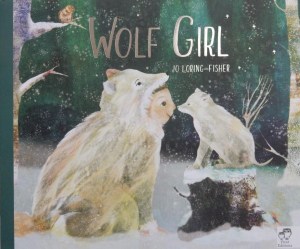
Wolf Girl

Wolf Girl
Jo Loring-Fisher
Frances Lincoln Children’s Books

Sophy tries her best to fit in at school, even wearing her wolf suit, that helps her to feel fierce and perhaps a bit brave, but no matter what she does, her shyness takes hold, she just cannot find her voice and the other children laugh at her.

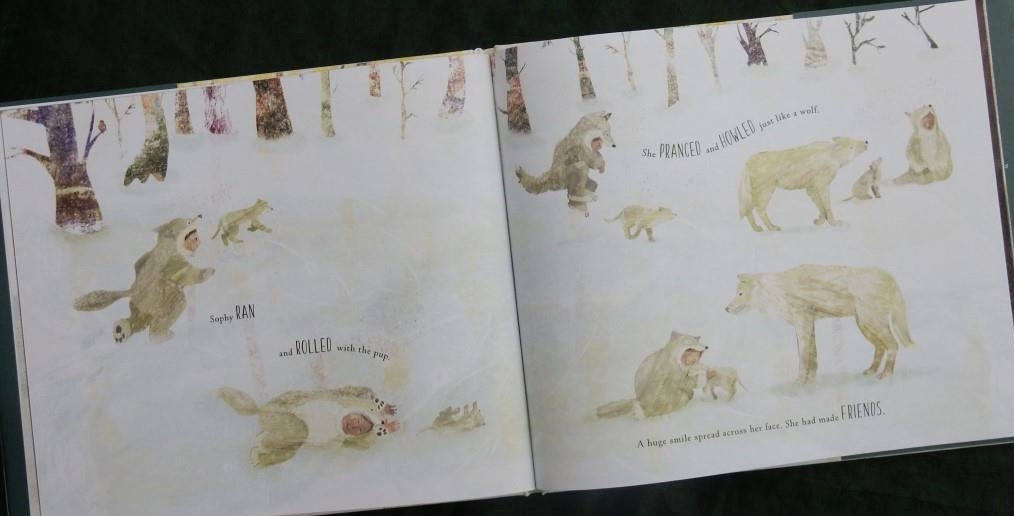
Safe at home once more, she lets her tears flow and then something amazing happens. Sophy is transported to a magical snowy woodland world and there she finds herself face to face with a wolf and her pup. The pup and girl romp together in the snow becoming friends

but as the snow falls faster the three seek shelter in a cave.

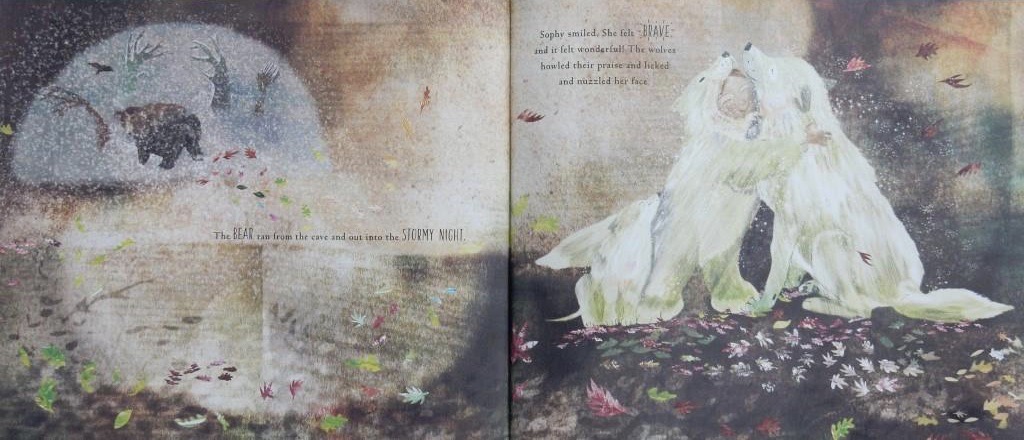
Once inside, the roaring Sophy suddenly hears is both without and within, and there before her is a huge bear. She’s terrified but somehow finds her inner wolf and sends the bear packing.

However, on reflection, she has a change of heart and realises that there’s another way to show her bravery, one that’s more important than any other …

Through both words and pictures, Jo has created a totally credible child in urban-residing Sophy; (indeed I’ve taught many Sophys in my time in the classroom) though she leaves her sensitive, lyrical illustrations to do much of the talking, speaking powerfully of the importance of drawing on your inner strength, finding your voice and friendship.

Definitely a book to share and discuss – with individuals, in the classroom or foundation stage settings especially.

Little People, Big Dreams: Pelé / If You’re Going to a March!

Little People, Big Dreams: Pelé
Maria Isabel Sánchez Vegara, illustrated by Camila Rosa
Frances Lincoln Children’s Books

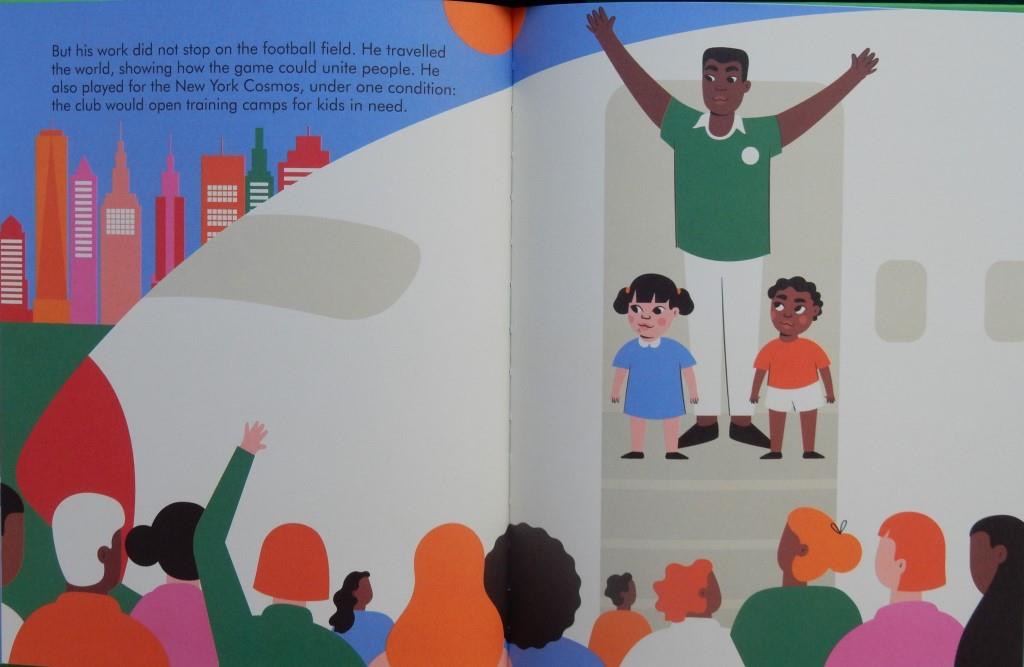
This new addition to the best-selling series stars one of the world’s greatest ever soccer players, telling of both his awesome skills on the field and his sterling work off the pitch in helping children in need, not only in his home country Brazil, but the world over.

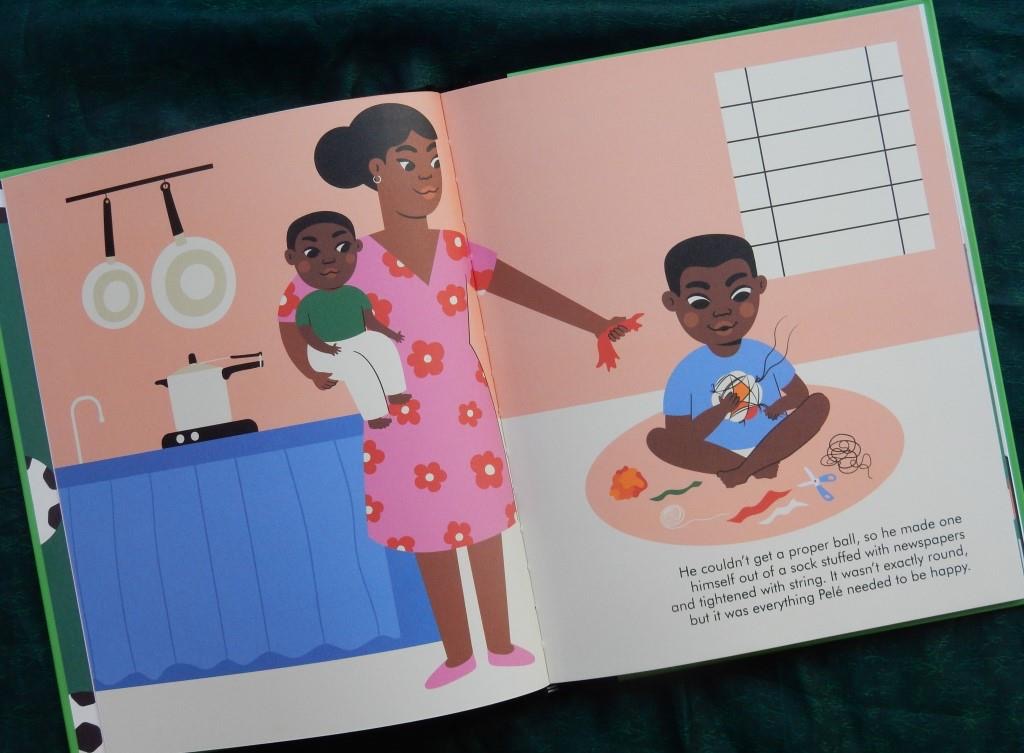
From modest beginnings in a poor neighbourhood in Brazil, young Edson aka, Pelé fashioned a ball from a sock stuffed with paper and tied with string and used it to work on his footie skills.

Fuelled with a determination to lead his country to a World Cup victory, he was selected at age sixteen to play for the national team in Sweden where he became known as the player of ‘Jogo Bonito’ (‘beautiful game’)

Pele went on to take his country to another two World Cup victories. He’s now recognised as the top footballer who ever lived as well as a voice for unity and for the most needy.

With additional facts at the back of the book, set out along a timeline, and Camila Rosa’s striking illustrations, this is a book to inform and inspire young sports enthusiasts especially.

If You’re Going to a March
Martha Freeman and Violet Kim
Sterling Children’s Books

Although this book originated in the USA, there are plenty of young activists and would-be activists in the UK and in many other countries too; this book with its reader-friendly advice and instructions, will speak to them all, whether their cause is civil rights, the environment, women’s rights, gay rights, peace or whatever. And, children start very young: during my participation in pro EU marches I encountered babes in slings accompanied by parents and young siblings.

There’s advice on such practicalities as making your own sign,

appropriate clothing (check the weather forecast), transport to starting point; plus warnings about such possibilities as getting a bit bored if lots of people want to make speeches; feeling free to let go and dance should the opportunity arise; how to interact with the media; even visiting the loo is covered; (perhaps the spread with the smiling police officers ‘their job is to keep people safe’ is probably more apt for the UK than that of the book’s origins).

The author and illustrator also present the ‘why’ behind marches, rallies and protesting – ‘they are showing they care about their country and want to make things better’, as well as pointing out the possibility of seeing people who disagree with your cause – ‘sometimes democracy looks like disagreement’ and advising politeness. With its focus on the practical and positive elements of activism, this book is a good starting point for adults wanting to introduce the possibilities of political involvement, peaceful protest and community action to youngsters.

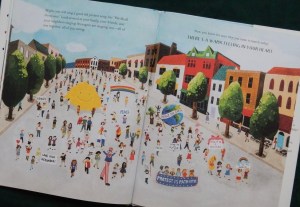
I love the way Violet Kim conveys a community feel to her scenes throughout.

A Clock of Stars: The Shadow Moth

A Clock of Stars: The Shadow Moth
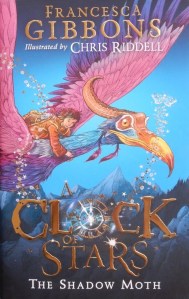
Francesca Gibbons, illustrated by Chris Riddell
Harper Collins Children’s Books

I read this book in a single sitting and am now eagerly awaiting the second part of what is to be a trilogy.
Imogen (eleven) and her younger sister Marie are a quarrelsome pair with a tendency (particularly on Imogen’s part) for being rude to their mum, their gran and others too.

As the story opens the girls’ mum is about to go out with ‘friend’ Mark, somebody Imogen has taken an instant dislike to, especially when out of nowhere a beautiful silvery moth appears that Mark seems intent on destroying. All this just before Gran arrives to take the girls out to tea.

Imogen follows the moth but it disappears only to reappear while they’re out with Gran and of course, Imogen follows the creature which leads her into a deserted, overgrown garden. There she comes upon a door in a tree and she finds herself in a magical world only to discover that her sister has followed her too.

It’s a world where anything might happen, and there they encounter a boy who insists on calling them peasants and saying he’s Miro, prince of the castle. He does however offer them refuge in his castle and so begins both a friendship crucial to the tale and a terrific, exciting adventure quest wherein the children race against time, pitched against a deadly threat, aided and abetted not only by Miro, but a dancing bear, a hunter of the grumpy kind, the stars in the sky even.

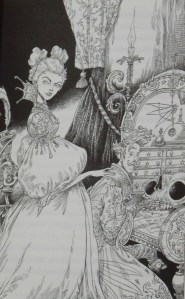
All these characters are superbly brought to life by the author in her richly imagined world, a world made even more wonderful by Chris Riddell’s amazing, detailed illustrations.

Perfectly paced, sometimes chilling, sometimes funny, and including fairy tale elements such as a villainous stepmother a foolish king and stolen treasure, and a magical clock, this is truly a snuggle up under a blanket and relish story by an exciting new writer, that’s ideal for dark evenings and chilly days. Don’t be daunted by the length: the chapters are short and I guarantee you’ll keep telling yourself ‘just one more’ …

Bring on the sequel say I.

The Tale of the Valiant Ninja Frog

The Tale of the Valiant Ninja Frog
Alastair Chisholm and Jez Tuya
Walker Books

Siblings Abby and Jamie certainly aren’t lacking in imagination and they love to hear a good story, so a night camping under the stars offers the perfect time and place for a tale from Dad. He’s more than willing so, as he toasts marshmallows over a fire, the children suggest the characters to include – the Prince, the Frog, (inspired by Abby’s soft toy) the Princess, the Witch and a MONSTER.

Dad begins his yarn: “It was a dark and stormy night and at the bottom of a horrible mountain … were the heroes.” Enter the cast – mounted on his steed comes the handsome Prince; then there’s the Princess (a closet jewel thief of the daring kind), witch Bogwort – (a Ninja when necessary)

and the gruesome Grubber.

Soon the interruptions start: first it’s Abby who seems set on ensuring that the Frog features large despite its diminutive stature. Thereafter the siblings’ interjections turn the plot this way and that as the three of them co-create a very funny, exciting fantasy with Dad accommodating the children’s ideas into the narrative. A narrative made all the more fun thanks to Jez Tuya’s comical – often slapstick – illustrations of larger-than-life story characters particularly that hirsute giant,

and Barry the frog – hurrah! Yes, despite Jamie’s dismissive scorning, the part he plays in making a happy ever after finale is far from small.

I love the close-up perspectives and the panel sequence

– actually I love everything about this book. So too will young listeners who will surely respond with relish to any adult sharer giving it the dynamic performance the tale deserves.

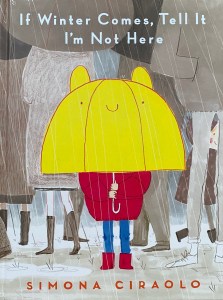
If Winter Comes, Tell It I’m Not Here

If Winter Comes, Tell It I’m Not Here
Simona Ciraolo
Walker Books

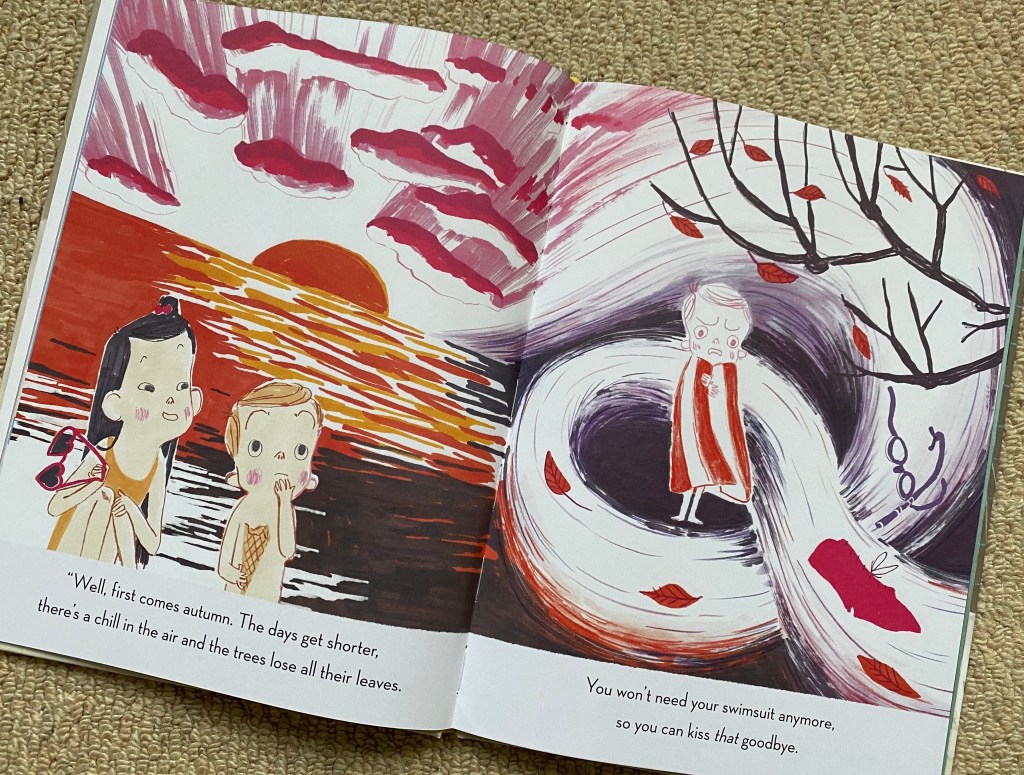
As the small boy narrator of this story revels in the last days of summer, swimming at every opportunity, his elder sister tells him of the approaching seasons.

First will be autumn with its chillier air and falling leaves,

followed by winter. That’s a time of constant rain, darkness and being stuck indoors, cold and dullness.

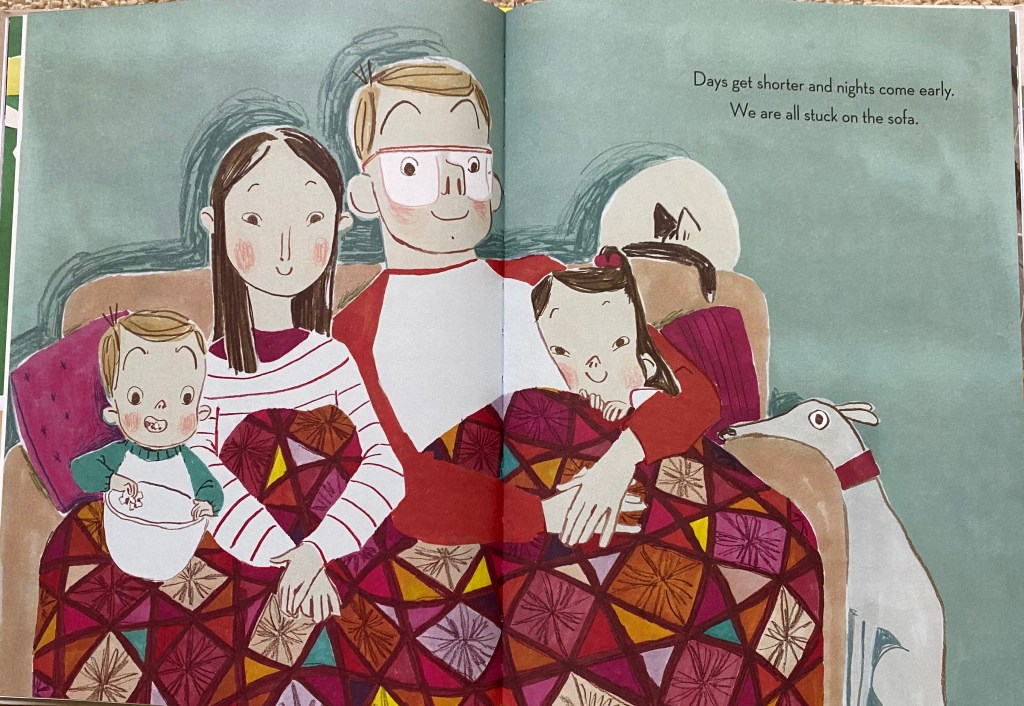
Time passes and inevitably autumn and winter come. There’s a distinct lack of yearning for ice-cream or a swim; however, each season brings delights of its own: there’s a parent’s long, long scarf to use as a wrap, and family snuggles on the sofa in autumn;

and yes lots of rain but also yummy warm soup.

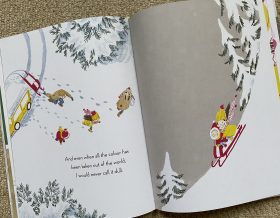
But it’s winter that’s most surprising and hurrah! Our narrator has lots of exhilarating fun in the snow

and determines to make the most of every opportunity. Big sisters aren’t always right after all, it would seem.
Simona Ciraolo certainly portrays the best of each season in her illustrations and the characters’ expressions speak volumes. This, her latest book is one that offers a good starting point for a discussion on seasonal changes and favourite times of the year with youngsters.

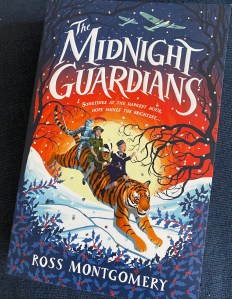
The Midnight Guardians

The Midnight Guardians
Ross Montgomery
Walker Books

I was totally gripped by this wintry tale set in WW2 right from the opening pages. Twelve-year-old Col who has recently lost his father, has been evacuated to his Aunt Claire’s. He feels totally alone, for his older sister has remained in blitz-ravaged London where she faces constant danger while helping with the war effort.

Col starts hearing voices calling to him – the same voices he heard as a younger child. They’re the voices of his imaginary (so he supposes) childhood friends – the Midnight Guardians. Step up gallant knight, King of the Rogues (small and fearless), Pendlebury, a tiger brave and noble, able to change size at will and, Mr Noakes, a gentle, scruffy old badger with a nose for finding food, who sports a waistcoat.

These three have come to help him in his quest to save his sister and telling him that he’s in mortal danger as darkness, in the form of The Midwinter King, is determined to take over the land. Thus begins a race to bomb-blitzed London, accompanied by Kindertransport refugee Ruth, a brave, strong-willed girl with her own reasons for going to the capital.

So, it’s a double battle: Col and his entourage on the side of The Green Man – against time and the forces of dark. Ross Montgomery has created a terrific cast of characters that, in addition to those already mentioned, includes bogeys, fairies and Gog and Magog(s) all of whom Col encounters in this compelling tale of hope and enchantment in a world where myth and legend, history and hardships are interwoven.

Ultimately, it’s a perfectly paced tale of strong friendship, courage and trust: hope and love versus hatred and fear.

ABCs of Kindness

ABCs of Kindness
Samantha Berger and Ekaterina Trukhan
Highlights

I suspect most people would agree that since the start of this current pandemic they’ve discovered that it’s not material things that are important, but acts of kindness. Now here’s a large format alphabet board book that presents different ways of being kind be that to one another, to animals, to the planet or to ourselves.

Thus we have, ‘F is for Finding a friend who sits alone and sitting with them’; ‘’D is for Donating your blanket to a dog who doesn’t have one’;

G is for Gratitude – remembering things to be grateful for every night’; ‘P is for Protecting and Preserving our planet’

and ‘Q is for Quiet moments to listen to the world around you.’

Each example is illustrated in bold bright, geometric style and Ekaterina Trukhan’s overall visual presentation is diverse and inclusive. If you work with young children and want to encourage them to be considerate and respectful towards others and the planet then this is a good starting point; it’s sufficiently large to be shared with a group rather than just an individual.

Avoiding Anxiety in Autistic Children

Avoiding Anxiety in Autistic Children
Dr Luke Beardon
Sheldon Press

Dr Luke Beardon is a passionate autism advocate, particularly, as is evident in this book, the well-being of autistic children. To that end he writes through the autism lens, something that is rarely done, so that readers feel as though they’re wearing the shoes of a child with autism, while directing his wise words to each and every one of us PNTs (Predominant neurotypes) – his term for what other writers might refer to as neurotypicals. I say this for although the book is aimed primarily at parents who have an autistic child, we all, especially those of us in education, need the best possible understanding of autism we can develop, if we aren’t unwittingly to contribute to a child’s distress. Teachers in particular, one hopes, understand that unless a child’s mental well-being is central to their educational experience, no learner, let alone an autistic child will thrive: all else depends upon it.

Who better to put the case for anxiety avoidance that the author, who has a deep and acute sense of understanding of autism acquired through many years of observation, and research (qualitative, I surmise) at Sheffield University’s Autism Centre. Using a ‘difference not deficit’ model, what Dr Luke has written is a distillation of that wisdom and those insights of his. For instance, he strongly makes the case that no two autistic children are exactly the same – why would one expect them so to be – consequently too much generalisation is to be avoided. To this end, he includes in his narrative, many first-person comments and excerpts from case studies.

Central to his approach is child empowerment – the better informed the child, the lower is the risk of anxiety- and he builds upon his foundational ‘autism + environment = outcome’ equation. I was particularly interested to see the comment in the ‘School’ chapter that ‘some children would actually be better suited to doctoral-style learning that secondary-age educational systems’ … ‘if a child is given access to uninterrupted learning … for extended periods of time – then he might be far more able to learn effectively.’ (As a teacher whose preferred age group is the foundation stage wherein even now for the most part, this is what happens, I’ve always wondered why as any child progresses through the education system s/he is subjected to an increasingly -often unnecessarily in my opinion – fragmented curriculum driven by testing and scores.)

Another issue explored is the child’s fear of getting it wrong and the way this can all too easily lead to the individual becoming so inhibited s/he won’t take those vital risks inherent in learning, or indeed try anything new.

Reading this highly accessible, optimistic book, not through the lens of a parent, but a teacher I have tended so far to focus on the school issues, however, every chapter is full of wise words be they related to behaviour, sensory issues (both hypo and hyper sensitivities are discussed), communication, social challenges and well-being, or meltdowns and shutdowns. In the latter chapter, it’s worth stressing these words from one individual relating to meltdowns, “I don’t know when it will happen. I don’t have any warning, and I can’t do anything about it. I live in constant fear because, despite not knowing when it might happen, I know all too well what happens when it does, and there’s nothing I can do about it.’ Just imagine being a child living in constant fear of such an event, which might happen if blame is the reaction of the adult parent/teacher or carer. Reassuringly though Dr Beardon states ‘Your child is not to be blamed for a meltdown: it cannot be helped.’

He also provides some personal stories about reducing anxiety in the same chapter wherein individuals mention meditation, deep breathing, a red card/green card system at school, certain physical activities including trampolining and strimming movements like flapping, rocking and twirling, and being out in nature as being personally helpful in avoidance of anxiety; but the importance of ‘being allowed to be me’ must never be overlooked for as one girl says, “it’s like I’m looked down on just for being myself … I don’t see what’s so bad about me. I like me, why can’t anyone else?” Heart breaking words indeed, but balanced by those of another boy, “Until you’ve been accepted for who you are, you won’t know what an absolute joy it can be!”

The author too ends on an upbeat note, ‘my perspective is that one can absolutely be autistic and in a state of genuine happiness.’ … ‘Never underestimate anxiety, Never underestimate the impact the pure joy of being able to live without it. Never underestimate the impact you can have on your child.’ Now if that doesn’t fly the flag for each and every one of us to increase our understanding of autism, then I don’t know what will.
So yes, this book’s for parents, but it’s also for every member of society, whoever, wherever they are.

Max Against Extinction / Warrior Monkeys and the Rescue Quest

It’s good to see new titles in two popular series from Oxford University Press – thanks for sending them for review.

Max Against Extinction
Tim Allman illustrated by Nick Shepherd

Max is back and he’s still determined one way or another, (like Greta, Aditya, Nina and Mari from various parts of the globe) to make the world a better place for everyone.

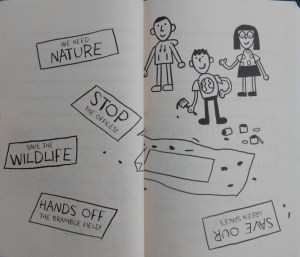
On the way home from school one day he notices a large new sign on a newly erected fence. There’s a plan afoot for a huge new office development and thus begins operation Save the Bramble Field. But then Max’s mum drops a bombshell: a family holiday abroad. It’s definitely a distraction as the boy starts dreaming of sunny climes, endless ice-cream treats and more; but the planned action must take priority and to that end Max ropes in Nisha and Tessa to help.

Max is ready to take whatever action he can to thwart this development proposal, even if that means getting into headteacher, Mr Costive’s bad books (again!) as well as upsetting his own teacher. But can he persuade his parents that a staycation is the way to go. He’ll certainly do his utmost – tropical curry, padlocks and all.

With a plethora of quirky cartoon-style drawings by Nick Shepherd to liven things up even more (they’re pretty lively anyhow but … ) Tim Allman and Nick are hugely entertaining and the cause is an important one, especially now with planning laws seemingly thrown out of the window. Max’s passion and willingness to own up to his mistakes are irresistible; he’s a great character likely to encourage readers to start and stick to their own plans for making positive changes in the world, whatever they are.

Warrior Monkeys and the Rescue Quest
M.C. Stevens, illustrated by Steve Brown

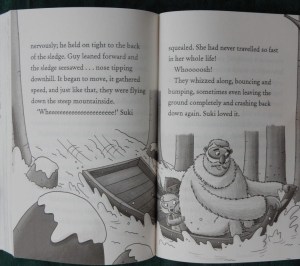
This is the third story by martial arts expert M.C. Stevens. Here young Suki and Bekko are mighty concerned when they discover that their much loved and respected teacher, Chan is missing after a strange wave hit one of Senshi Island’s beaches. They immediately report his disappearance to Sensei Rika (guardian of the castle) who seems undisturbed by the news, so the two, convinced there’s been a kidnapping, decide to investigate. Soon their suspicions are confirmed and Bekko and Suki are on a quest to rescue Chan from the clutches of Emperor Ming, ruler of seven mountain kingdoms who apparently needs Chan’s help. The quest involves a very dangerous sea voyage, pirates, battling over frozen wastes

and other hazards but so says, Bekko, “Warrior Monkeys know that facing a challenge is part of learning.” Are the two up to the mark though?

Reaching their destination is only part of the challenge, there are further hazards; but with unexpected assistance

together with their own bravery, resourcefulness and determination, along the way perhaps they can succeed in getting master Chan back where he belongs.

Full of drama and suspense, this story will excite readers especially those with an interest in martial arts, yoga and mindfulness; they’ll also be amused by Steve Brown’s illustrations scattered throughout the book.

The Three Wishes

The Three Wishes
Alan Snow
Pavilion Books

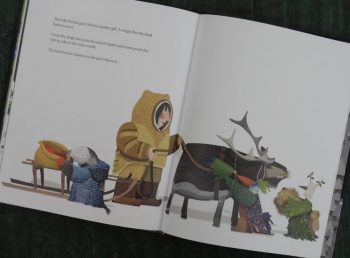
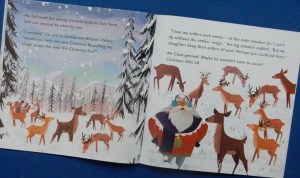
Rooted in a northern folk tale, this is a story of hope and kindness about the origins of Father Christmas. It tells of some nomadic people (Sami perhaps) living in the far north. The adults mostly forage and hunt while the children’s role (alongside playing) is to tend the deer.

One winter as the solstice approaches, in one particular family, the task of feeding the deer falls on the elder boy. A job he does reluctantly on account of his fear of the dark, until one day he discovers that all the deer are gone: without them how will his family survive?

Out into the silent forest runs the boy searching but it’s not long before as the snow falls ever faster, he realises that he’s lost. He struggles on until he’s near exhaustion but as he lays on the snow with sleep coming on him, he hears a sound. It’s a reindeer bell; the boy struggles to his feet and follows the sound until he finds the reindeer clustered around a cave entrance. The boy follows the deer inside the cave and suddenly finds himself in a timeless summer world where he’s confronted by three creatures.

They explain that he can never return to his home as this place must be kept secret. They grant him three wishes. He chooses freedom, happiness, and time. At the end of the year, they offer him a reward for his good work.

He’s then allowed to return to the outer world to visit his family, but only in the dead of winter each year, and on each visit, he leaves them a gift.
After three years, the bird, impressed by the boy’s love for his folks, offers him four feathers from its tail, tying them to the harness of the deer.

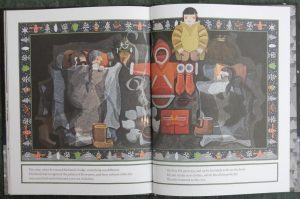
Their magic allows the deer to fly and one year, anticipating his visit, the family leaves a special set of new red clothes for their visitor …

The author has cleverly structured his story with the elements of gift giving, flying reindeer and a red suit being gradually interwoven into the enchanting narrative,

until we eventually realise where it’s all going. Snow’s illustrations are superb – beautifully designed and composed be they contained within intricate borders or not. I love the colour palette contrast between the eternal summer world and the chilly winter outside.

This is a delightful book to share over the festive season, perhaps sitting by a fire on a cold evening sipping a favourite hot drink.

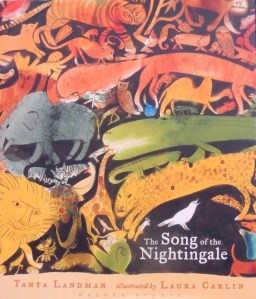
The Song of the Nightingale

The Song of the Nightingale
Tanya Landman and Laura Carlin
Walker Books

Based on a creation myth, this fabulous book is a neo pourquoi tale about how the animals got their colours and a feathered creature acquired something very special.

In powerful prose Tanya Landman presents a dramatic unfolding of a spectacular creative enterprise by one named as ‘the painter’.
With the young earth and its flora already rich in colour, she summons all members of the animal kingdom together in their dreary drabness, speedily organises them and then, in a determined manner (sleeves rolled up), she opens her paintbox. Starting with the fiddly wrigglers, sets about adding colour to each and every creature – small and great.

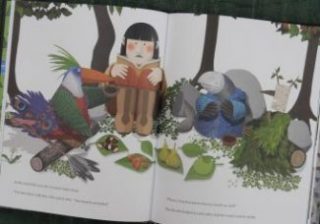
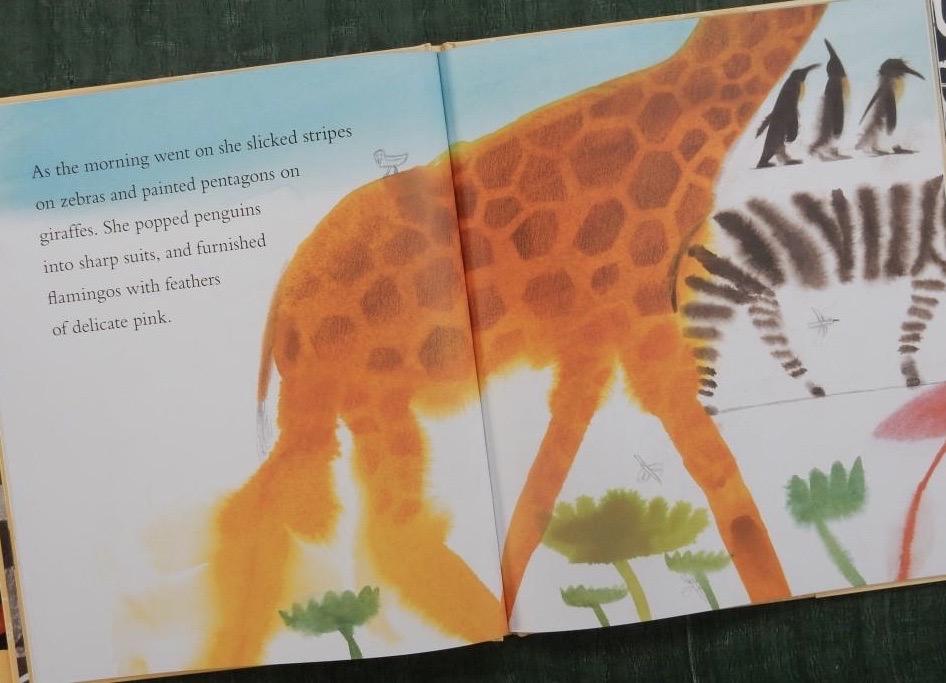
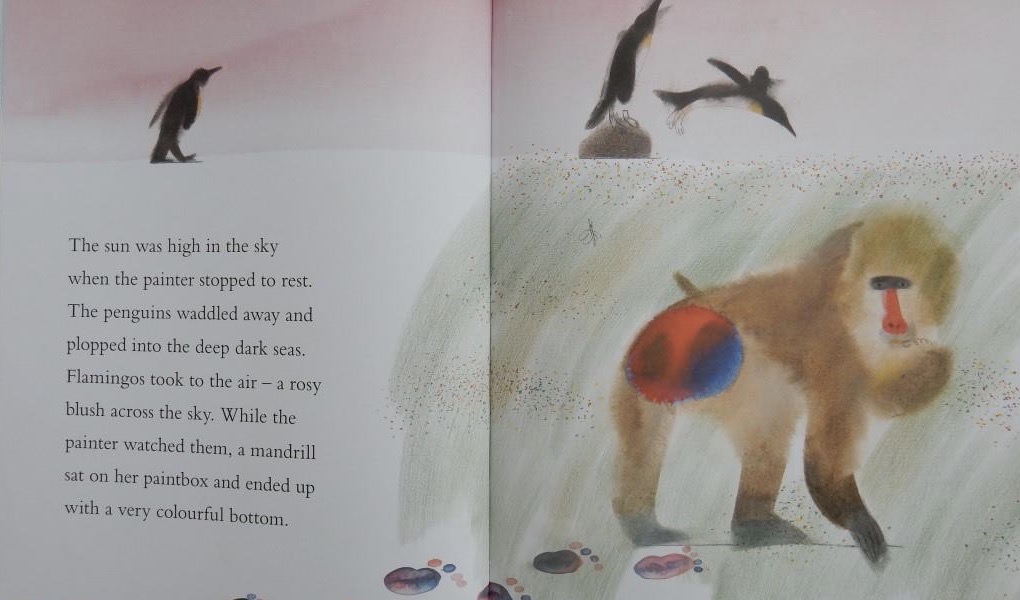
Enter illustrator Laura Carlin to wield her own paintbrush bestowing with sweeps, daubs, splashes and spatters upon the grey creatures their rich array of tints and tones until all earth’s fauna have undergone a remarkable transformation. Some such as the mandrill

and the parrots are instrumental in their own colour schemes.

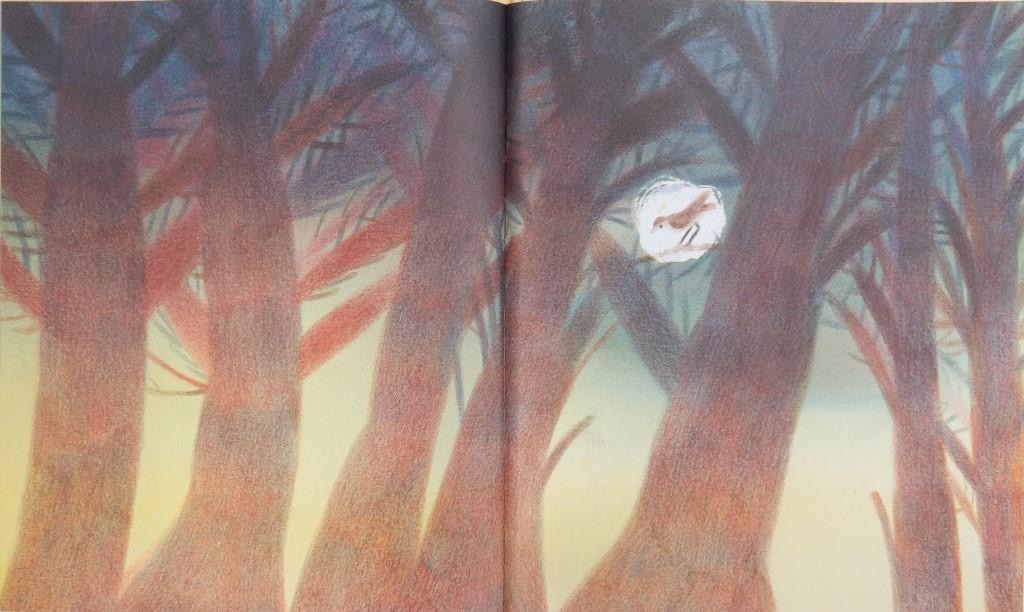
But what of the one that comes after the painter has closed her box for the day? That shy little creature too scared to leave the shadows until nightfall when the painter’s colours are, seemingly all used up – or are they?

With consummate skill Laura captures both the wit and the lyricism of Tanya’s telling; the combination of the two make the book itself such a wonderful work of art. It’s most definitely one to return to over and over wherever it’s read.

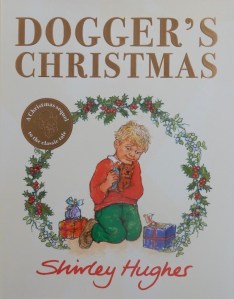
Dogger’s Christmas

Dogger’s Christmas
Shirley Hughes
Puffin Books

I think Shirley’s Dogger has been introduced to every foundation stage and KS1 class I’ve ever taught so I was enormously excited to see Dave’s beloved toy dog return in a seasonal sequel. Now considerably older, Dave still takes his favourite soft toy to bed with him every night, although his interest in toys has broadened to all kinds of vehicles.

As Christmas approaches, we share the family’s preparations – writing to Father Christmas, putting up decorations, shopping –

till, come Christmas Eve, the tree is a-glow and the children’s stockings are ready to hang up.

Next morning there’s huge excitement as Dave, Bella and Joe open their presents littering the floor with the wrappings. They also give their own specially chosen gifts to their Mum and Dad before Bella and Mum visit a neighbour, leaving Dad busy with the Christmas dinner ready for the arrival of Granny and Grandpa.

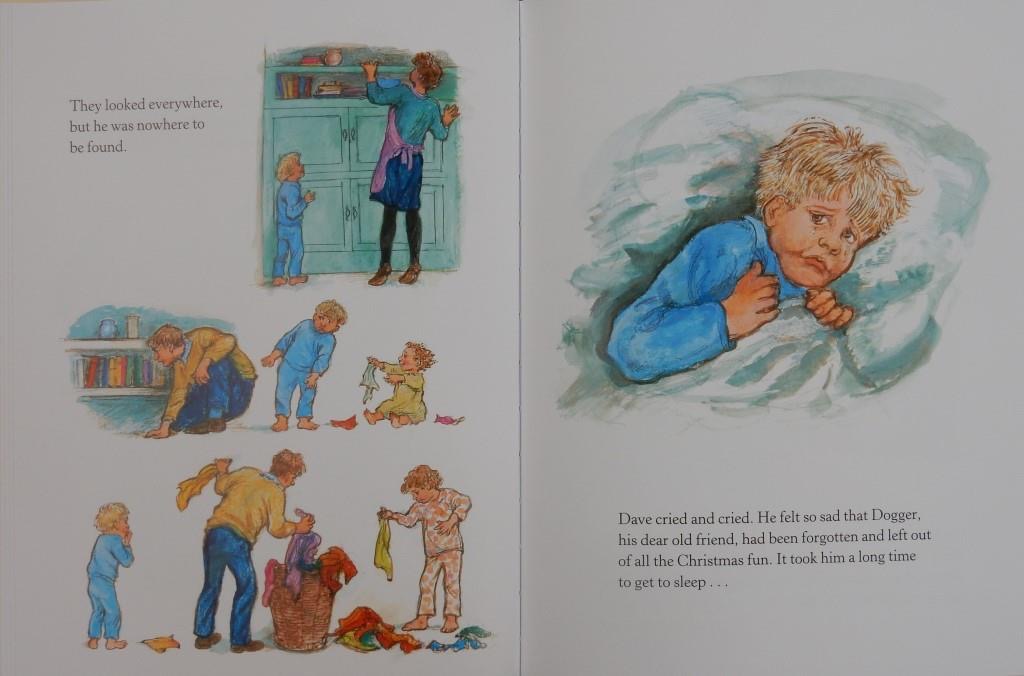
After a wonderful family day, when the visitors have gone and the children are in bed, disaster strikes. Dave wakes to discover that his beloved Dogger is missing. His parents and Bella help him search but of Dogger, there’s no sign.

Next morning and in the days following Dave is totally downcast; he’s sad that he’d neglected his old favourite and not interested in his new toys. Surely Dogger can’t be lost forever? No of course not, for this special toy has not lost his own knack of turning up in the most unlikely of places.

Shirley’s magic shows no sign of waning in this wonderful festive sequel to her original, now classic, picture book. Every spread exudes love and warmth – both in the account of the family, and in Shirley’s illustrations. It’s interesting to see how much Dave, Bella and little Joe appear to have grown.

A must for family sharing this Christmas, and for many to come.

I Love You more than Christmas / The Snowiest Christmas Ever / Can You Find Santa’s Pants

Here are 3 seasonal picture books from Little Tiger kindly sent for review

I Love You more than Christmas
Ellie Hattie and Tim Warnes

Little Bear love, love, loves pretty much everything about Christmas but what is it that he -and indeed his mother and father- love even more than Christmas? We’ll discover the answer – eventually – but adults will probably guess it from the outset. Every attempt one of them makes to reveal that one better thing is interrupted by something or someone that is part and parcel of the exciting build-up to the big day.

First it’s the mail delivery (Mrs Postman with a sackful of cards), then it’s Daddy Bear bursting through the door dragging an enormous tree to decorate, after which it’s Mummy who’s been hunting for the decorations in the loft; but that’s just the start.

It takes until bedtime before Little Bear is finally able to share that all important message.

Tim Warnes’ wonderfully warm illustrations are an ideal complement to Ellie Hattie’s homely tale of togetherness and celebration.

The Snowiest Christmas Ever
Jane Chapman

In the run up to Christmas things are pretty nearly perfect in the bear family’s cabin but there’s one thing lacking, so says young Button Bear cub, and that is snow. Her brother is equally eager for the fluffy stuff to be ready for Santa’s sleigh to land in. Then come bedtime, lo and behold what should the cubs spy as they peep through the curtains but swirling, whirling snowflakes. As the bears fall asleep snug inside, the snow continues falling all night getting ever deeper outside.

The following morning though, things on the snow front seem to have got rather excessive and it looks as though the entire family is stuck indoors. Was that wish of Button’s a mistake? Will Santa be able to make his delivery to the cabin?

Perhaps the cubs can turn the situation around so they all have a truly memorable Christmas …
This is definitely a cuddle up and share picture book that focuses on the anticipation and excitement of the days leading up to Christmas.

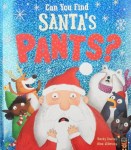
Can You Find Santa’s Pants?
Becky Davies and Alex Willmore

Here’s a new take on the ever-popular subject of pants and on Christmas, that I suspect many youngsters will find irresistible. Just imagine the sight of a bare-bottomed Santa sitting atop his sleigh; but that is a decided possibility when on Christmas Eve he discovers, horror of horrors, that his pants have gone awol. Hang on though; what about all the spare pairs hanging on the washing line? Oh dear me, now they too are playing hard to get as they detach themselves from the line and take flight.

The hunt is on but if Santa can’t locate any of the errant underwear, can he find a suitable alternative so he doesn’t have to expose his rear end to the elements on his chilly delivery round.

An emergency is declared and all his friends – elven and animal – rally round to join the hunt. Will they or won’t they avert a chuddie crisis: it’s a case of …

Told through Becky Davies’ jaunty rhyming text and absolutely hilarious illustrations presented by Alex Willmore (of pea fame), this will be one of the year’s festive favourite for sure.

Board Books for Christmas

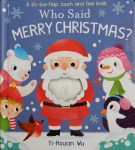
Who Said Merry Christmas?
Becky Davies and Yi-Hsuan Wu
Little Tiger

Ho Ho Ho! comes the mystery voice, but who spoke the words? Was it Penguin? Feel the tactile soft tummy (it gives a clue), lift the flap and discover the owner of the jolly utterance. Do similar for the “Tweet!”, the “Roar!”, the “Merry Christmas!” greeting and lastly, respond to the final question above the mirror.
Hide-and-seek fun for the very youngest, engagingly illustrated in Yi-Hsuan Wu’s jolly scenes of Penguin, Mrs Claus, Snowman and Reindeer and the characters hidden beneath the four flaps.

Can’t See Santa!
Mandy Archer and Chris Jevons
Little Tiger

It’s Christmas Eve and all is ready but where oh where is Santa? That’s what the little mouse asks as he searches everywhere both inside the house, and outdoors in the snowy garden where at least there should be signs of Santa’s sled. Then back indoors again the tiny creature’s so downhearted he can’t even face a nibble of his carrot let alone the seasonal fare spread out on the table. Worse still is the complete lack of a single present beside the sparkling tree. Has Santa forgotten our little rodent friend? So miserable does he feel that Mouse heads off to his attic bed. But there’s something he doesn’t know and that’s not revealed until the final flap in Chris Jevons’ festively detailed sequence of story-telling pictures is opened. Mandy Archer’s rhyming couplets tell the tale from Mouse’s viewpoint on the bottom stair, in snow-filled garden, on the table, beneath the Christmas tree or in his bed. With several flaps to explore and assist mouse in his search on every spread, little ones will delight in the hunt and the secret that they might or might not, already know about.

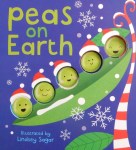
Peas on Earth
Jonny Marx and Lindsey Sagar
Little Tiger

The five little peas in their pod can barely contain themselves so full of festive cheer are they feeling. Indeed, one by one the small spherical objects pop out io their case so great is their excitement once that Christmas wreath is attached to the door. So, we have four left to help decorate the tree one of which needs to get the star bringing their number to three enjoying the view outdoors. Santa’s grotto isn’t too far so off goes another and so on till atop the tree sits just one. It’s she that will delight in the appearance of a pair of booted feet before a special delivery is made and there’s something for them all. HURRAH!
A fun-filled yuletide countdown to share with the very young who will love poking their fingers into the die-cut circles, as well as following the frolics of the peas described in Jonny Marx’s rhyming text and shown in Lindsey Sagar’s jolly seasonal scenes.

My Magical Snowman
illustrated by Yujin Shin
Campbell Books

Oh dear! Santa’s sleigh – so the elves say – is in need of a quick repair before he can start on his delivery round. So who can they call upon to help? Snowman seems willing once his door has been opened (move the slider) and off they all go whooshing over the frozen lake and whizzing down the slippery slope (2 more sliders). Then with a touch of the snowman’s magic, it’s up and away for Santa “Ho, Ho Ho-ing” on his sleigh as he bids all his helpers a “Merry Christmas”.
Simple, satisfying and lots of fun – both in the manipulating of the sliders and the rhyming text that accompanies the chilly wintry scenes of elvish frolics and willing assistance.

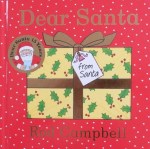
Dear Santa
Rod Campbell
Macmillan Children’s Books

This is a board book version of Rod Campbell’s Christmas classic which, almost unbelievably, is celebrating its 15th anniversary. Yes, it’s that enormously engaging sharing of a letter to Santa requesting something special for Christmas and what the old man does and thinks as he wraps up all manner of not quite right gifts before, on Christmas Eve, he decides upon the one that’s just right and much appreciated by the letter writer.
A Christmas must if you have a toddler.

A House for Christmas Mouse / The Lightbringers / Magnificent Mabel and the Christmas Elf

A House for Christmas Mouse
Rebecca Harry
Nosy Crow

On a snowy Christmas Eve an excited Mouse arrives at Treetop Forest in search of somewhere to call home – somewhere cosy and warm, with food and friends.

Coming upon a little rabbit outside his burrow she knows she must stop and help him light a fire within and so she does. She also stops to assist Fox in his cake making

and Bear with hanging up Christmas decorations, but having done so it’s almost sundown and Mouse still hasn’t found her new home.

Suddenly a gust of wind sends her tumbling into the deep snow and when she gets up, there before her is something that might just be the perfect place to make her home. On closer inspection it seems far from perfect though, so off she goes to search for leaves to make a bed. As she looks, who should come hurrying by but Bunny, followed soon after by Fox and then bear, each carrying something with them.

Where are they going and why?

With its wintry woodland setting and sparkly touches, Rebecca Harry’s lovely gentle tale of kindness repaid is just right for sharing with the very young this festive season.

The Lightbringers
Karin Celestine
Graffeg

This is the first of a new four book series, Tales of the Turning Year. With a combination of folklore and nature the author weaves an uplifting, hopeful story that retells an ancient renewal tale found in various parts of the world in honour of the winter solstice. Assuredly during this current covid lockdown we would all welcome a visit from The Lightbringers – small beings that gather embers and put them into their seed lanterns.

Karin explains how the seasons change as the earth breathes, with a particular focus on the increasing darkening with the approach of December 21st, the winter solstice – a turning point that heralds the spring and longer, lighter days.

Her words are simple but impactful, accompanying her atmospheric, beautifully composed photographic tableaux of the natural world populated by her felted animals, particularly the Lightbringers led by Hare – the caller. With its reassuring final, ‘The light will always return because it is guarded by small beings and they are steadfast in their dark’ this is a book to share and be cheered by in these dark days.

For new solo readers is

Magnificent Mabel and the Christmas Elf
Ruth Quayle, illustrated by Julia Christians
Nosy Crow

Mabel of Rabbit Riot fame returns to relate three further episodes in which she demonstrates her magnificence. In the first we find our young narrator in the sweetest of moods as she unearths her Christmas Elf from the box of decorations. She tries to get her classmate Edward into the Christmas spirit too but without much success; but she’s more successful in allowing her naughty little elf get her into big trouble over Christmas presents.

In the second story Mabel tries her very best to befriend a new boy and also finds out that once in a while school can be really interesting.

It’s toddler-minding that gets our young heroine into a tizzy in the final episode, and that’s after she’s declared that looking after toddlers is ‘easy and fun’. Really – Even cousin William?…

Huge entertainment from such a delightful character: Ruth Quayle really does appear to have the ability to see things from the viewpoint of six-year-olds, and Julia Christians’ black and white illustrations are a spirited delight.

The After Christmas Tree / Dinosaur Christmas!

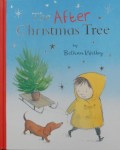
The After Christmas Tree
Bethan Welby
Scallywag Press

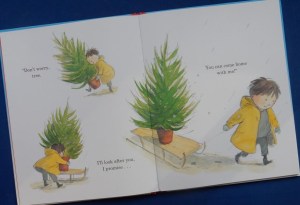
Here’s a debut picture book festive story with a difference: it features a little boy named Brian who comes upon a discarded Christmas tree by the roadside while out walking with an adult one grey January day. Feeling sorry for the abandoned tree he takes it home, promising to care for it.

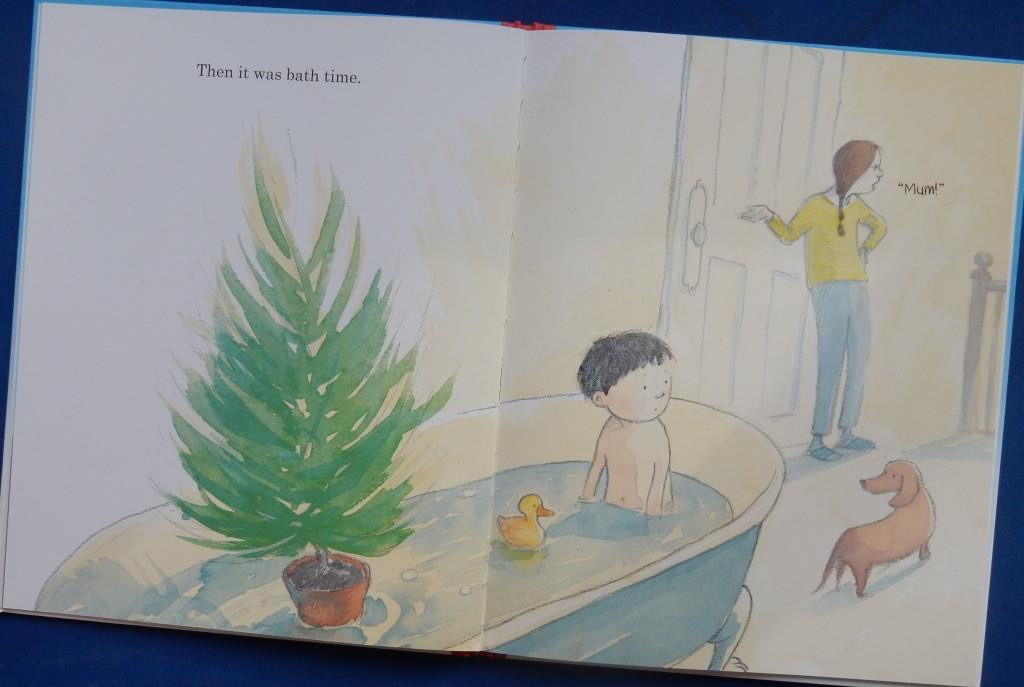
However, once back indoors he’s the only member of his family who is pleased about his find, particularly as he moves it around wherever he goes.

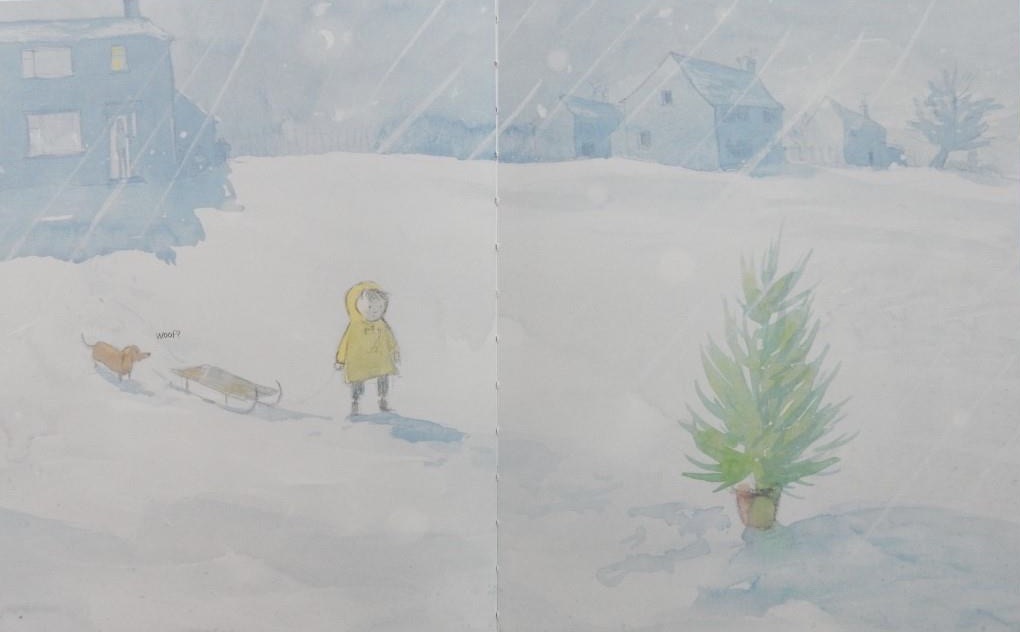
By bedtime even Brian is feeling unhappy and Mum offers to help him take it outside. However, the boy insists on doing the job himself and it’s left outside in the snow overnight.

Brian meanwhile has an anxious night but when sleep finally comes, he has a wonderful dream – or is it? …
Both words and pictures are presented with sensitivity: the telling is straightforward leaving plenty of room for Bethan’s expressive illustrations to do much of the talking and with a knowledge of the huge number of Christmas trees that are merely thrown out every year, the message about sustainability is clear and important.

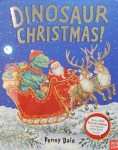
Dinosaur Christmas!
Penny Dale
Nosy Crow

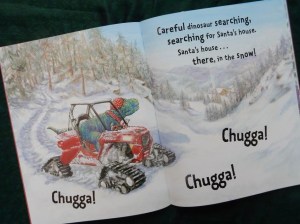
Penny Dale’s terrific dinosaur team are back and now it’s Christmas Eve and they’re called to the aid of Santa. In order to rescue him they have to make their way through a swirling, whirling snowstorm. Be they at the wheel of a snow plough crunching over the snowy road, whizzing along on snowmobiles, zooming Whoosh! Whoosh! over the water on a hovercraft or chugga chugging in search of Santa’s house,

the crew will be there in the nick of time to unearth (or un-snow) the old man’s sleigh and make sure he’s suitably fuelled with seasonal fare. Then with presents duly loaded (courtesy of the helicopter dinosaurs), it’s up and away with a Ho! Ho! Ho! leaving the dinosaurs time to make their own preparations for the big day. Will Santa be kind to them too?

Young dino. fans will thoroughly enjoy the return of the prehistoric brigade showing their manoeuvres in new forms of locomotion for the festive season.

How To Make A Bird

How To Make a Bird
Meg McKinlay and Matt Ottley
Walker Books

This stunner of a book has at its heart, the imagination. It shows through the eyes of a solitary young girl protagonist, the importance of hope and determination in the creative process as you embark on a journey, not entirely sure of where it will lead.

We follow the girl as she collects, designs and builds using hundreds of hollow, light bones (when they rest in your palm you will hardly feel them, she says.) So much the better if they are to become airborne, but that’s kind of getting ahead.

As she lays them out into a bird shape, she contemplates, ‘the proud arch of an eagle, the soft curve of a sparrow’. Maybe, but this is a slow process,

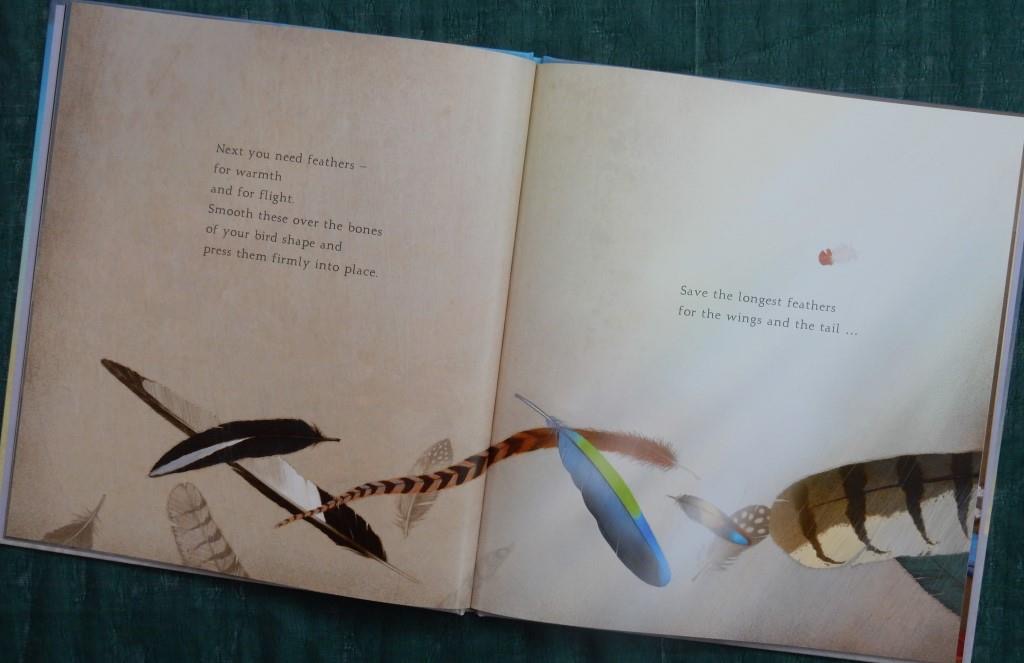
this fashioning into a finished form and it can’t be done without feathers for both warmth and flight

and of course, a fast-beating heart. Then come those finishing touches that make your creation entirely unique – so much more that the sum of its parts.

That’s the magic and eventually it’s time to set free your deeply personal entity, to let it soar up and away …

Truly special, this is a book for all ages, a book where words and pictures are in complete harmony, a book for anyone who loves nature and being creative. Such is the attention to detail throughout that readers will want to pause on each exquisite spread, fill with awe, and wondering at the precious nature of life itself. Matt Ottley’s art has a musicality that is simply perfect for this story, as he gently infuses his visuals with the intimacy of Meg McKinlay’s telling : a telling that has an ethereal haunting quality that will stay with you long after you’ve closed the book.

The Night the Reindeer Saved Christmas / Santa Jaws

The Night the Reindeer Saved Christmas
Raj Kaur Khaira and Kasia Nowowiejska
Studio Press

On the eve of Christmas Eve at the North Pole, Mr Claus is feeling chuffed: everything is ready, so he decides a short period of relaxation is in order.
Suddenly though there comes a message calling him to an emergency meeting: the rockets on the Christmas sleigh have exploded. At the prospect of Christmas being cancelled by their leader, the elfin team are at a loss.

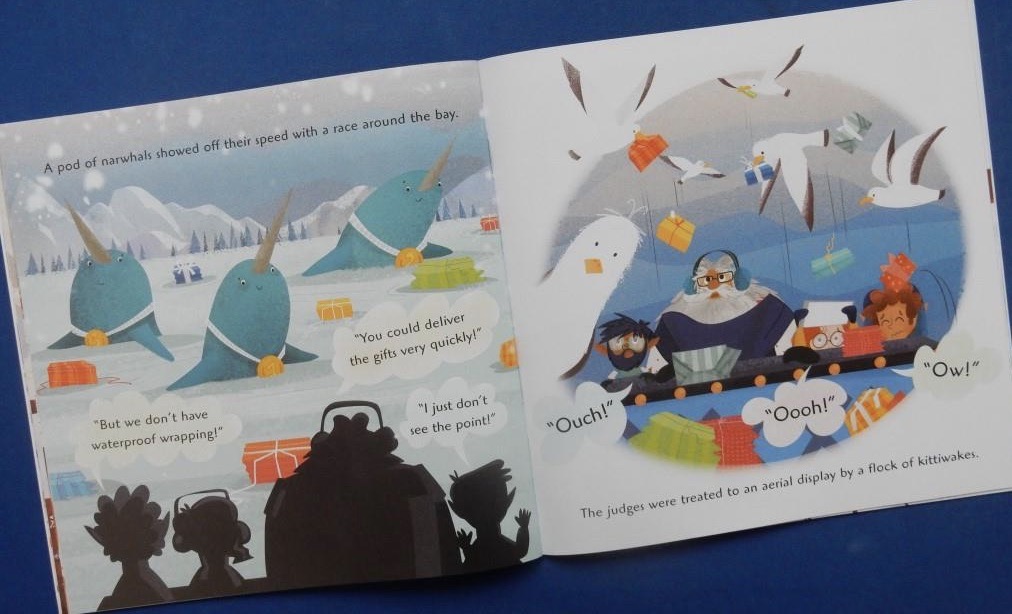
Not so though Mrs Claus. She suggests calling on the creatures whose homes are nearby to assist in the delivery of the gifts. It’s not long before all the animals are assembled and ready to demonstrate their suitability. The polar bears are certainly strong, the narwhals speedy, the kittiwakes willing but inept

and the arctic foxes just disappear. Sleepy bears, a lack of waterproof wrapping and vanishing foxes are enough to send poor Mr Claus crazy. Off he goes for a meditative wander and as he’s contemplating his plight, he spots two creatures flying past.
Then Mr C. gets the surprise of his life. There before his eyes are Comet and Blitzen and he follows them back to their herd and there discovers some creatures that just might save Christmas after all.

Let’s hear it for the women and of course, the female reindeer.
I loved this clever story (complete with a few final creature facts) and it’s especially good to see Kasia Nowowiejska’s portrayal of such a diverse cast of characters in her zany illustrations.

Santa Jaws
Mark Sperring and Sophie Corrigan
Bloomsbury Children’s Books

A snappily fun seasonal story is this one of Mark Sperring’s set beneath the sea as Christmas Eve approaches.
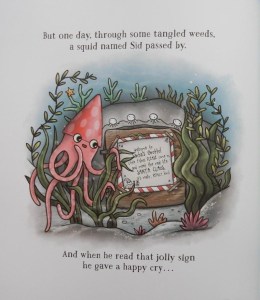
Meet Shelly who’s been shopping at the Deep Sea Christmas Store where she’s bought a special bobble hat.
Back home she makes a snazzy sign which she affixes to her front door.

It doesn’t fool the local undersea population; they beat a hasty retreat but Sid squid is a newbie to the location and is beguiled by the sign as he contemplates stars, candy cane and snowman building. His lucky day has surely come. Up to that front door he goes and what he encounters when it’s opened is certainly alluring

but then comes a BIG sharp-toothed surprise.
All is not what it first seems though, but faced with a dilemma, what will Sid do next?

Sophie Corrigan’s sub aquatic scenes of corals decorated with Christmas decorations as well as the sight of the hapless Sid and the sharky Shelly are sure to make your little ones giggle in delight.

The Twelve Days of Christmas

The Twelve Days of Christmas
Alex T. Smith
Macmillan Children’s Books

Creator of the wonderful Claude books, Alex T. Smith presents a comical sparkling new take on the seasonal classic song. Herein the narrator is a stylish young miss and ‘my true love’ has been replaced by a generous grandma. To call her merely generous might be somewhat inaccurate for despite starting off relatively sensibly – the partridge in a pear tree on day one, the two turtle doves along with the partridge in its tree on day two but by day five things have begun to get a tad out of hand,

and thereafter, particularly from day seven things are completely crazy …

And as for that final twelfth day gift, I’ll leave you that to discover what it is and how it’s received … I’m pretty sure it’ll make you splutter; I certainly did!

There’s some delicious alliteration, and

an abundance of visual hilarity – heaven help the post-person who has to deliver all that lot. Alternatively titled ‘Grandma is Overly Generous’ is most definitely no exaggeration (unless the grandma in question happens to be giving a copy of this book; in that case, she’s perfectly generous.)

The Night I Met Father Christmas

The Night I Met Father Christmas
Ben Miller, illustrated by Daniela Jaglenka Terrazzini.
Simon & Schuster Children’s Books

Jackson knows a fair bit about what happens on Christmas Eve night, as well as about that North Pole workshop, so he’s more than a little concerned when his friend suggests that the whole Father Christmas thing isn’t real. He stays up on 24th December hoping that he’ll meet the man himself and lo and behold, he does – in a rather noisy manner when a small elf-like figure clad in red tumbles into his fireplace injuring his ankle in so doing.

At first he denies his identity but Jackson eventually gets him to admit who he is. The boy asks the little character (who isn’t quite what he was expecting) a very important question: “How did you become Father Christmas?” The answer is not at all what he was anticipating. It’s the story of Torvil Christmas, an extremely rich but miserly toyshop owner that the elf recounts, 

as, having accepted the boy’s offer of help to complete his worldwide delivery round in time, the two board the sleigh and take to the air.
Cleverly weaving Jackson’s adventure into a reworking of Scrooge’s transformation in Dickens’ classic A Christmas Carol, and giving it a liberal sprinkling of magic, Ben Miller has created a sparkling seasonal, read – aloud or alone- that’s just right for the run up to the festive period. I love the additional “Christmassy fun’ pages too, as well as the wonderful black and white illustrations

by Daniela Jaglenka Terrazzini scattered throughout the telling.

Monster Christmas

Monster Christmas
Giles Andreae and Nikki Dyson
Orchard Books

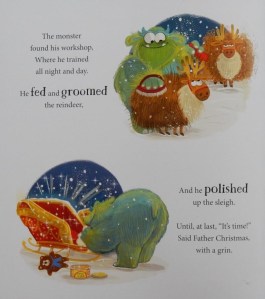
As Christmas approaches, Father Christmas, relaxing by the fire, is feeling somewhat jaded with his creaky knees; he seems to have lost the zest for that delivery job of his. Perhaps it’s finally time to recruit a replacement – someone special – young and different – to take on the role of spreading kindness and good cheer. He writes a wanted notice and duly dispatches it.

Meanwhile in distant Monster Land a family talks over tea. Little Monster informs his parents that it’s time for him to see more of the world.
Just as he’s uttered his intention, what should come wafting in but that note of FC’s.

Then having bid his parents a fond and hasty farewell, he’s up and off trudging through chilly weather, destination the North Pole and Father Christmas’s front door.

There he is eagerly recruited, and a training regime begins. It’s not too long before he’s declared ready for the task

and so off he sets, destination this time, a shopping mall, therein to erect a grotto wherein to welcome all the little children.
Things don’t go quite as planned however as it’s with terror not seasonal delight, that Monster Christmas is received. Sob sob – that’s the monster, not the children who scream and shout. Surely things will improve thinks our optimistic would-be gift bestower. Instead there’s not a single house in a single town prepared to welcome Monster Christmas and his sleigh that year.

Exhausted, the reindeer plummet earthwards to land right on the edge of the world and it’s there that a lonely young lass lies abed slumbering in her cosy igloo.

Will she too send little Monster Christmas packing? What do you think?

With its wonderfully heart-warming conclusion, Giles Andreae delivers a terrific rhyming narrative that will certainly remind readers and listeners of what Christmas is really all about. Nikki Dyson’s depictions of Monster Christmas will definitely win him countless admirers with his adorable demeanour and positive attitude against all the odds.

Monstrous fun: this one’s an instant winner in my book and so it will be with youngsters who will definitely demand frequent re-readings during the build-up to yuletide. Teachers, just think what a smashing school festive performance this would make.

The Night After Christmas

The Night After Christmas
Kes Gray and Claire Powell
Hodder Children’s Books

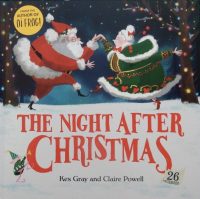
For many, Boxing Day is something of a come down after the big day itself. Not so for Santa and his wife, especially come evening time. That’s when things really start to hot up for them, as well as for his faithful band of elves who are eagerly awaiting that rallying cry to the eight giant owls aptly named Snowy, Ghost, Blizzard, Snowball, Milkshake, Whitefly, Misty and Noble. Their task on this special occasion is to safely deliver a ginormous cracker – XXL-plus size no less, filled to near bursting point and ready for the big bang.

Once the elves have pulled the thing and spilled out its super-tasty contents, it’s time for Mrs Claus to step up for the big switch-on. And what a magnificent sight she triggers: first the colours cascade forth and then the stars shift to create spectacular ‘Yule constellations’.

Thereafter comes the dancing with both elves and reindeer performing their ‘Strictly’ moves with panache – all except Vixen who has four left hooves, so we’re told.

But all good things must come to an end and as the northern lights begin to fade, Santa starts to feel the need for some shut-eye. Off go the revellers and you can guess what Mr and Mrs Claus do (after a quick stop under the mistletoe) – zzzzz.

Brilliantly told in Kes Grey’s unfaultable rhyming text that bounces joyfully along to that final throwaway finale, and equally exuberantly illustrated in Claire Powell’s fantastically funky scenes of festivity. How she managed to portray all those elves as the party erupts, is an astonishing feat in itself.

A Christmas cracker with a superabundance of ‘rooty-toot-toot’ magic that will surely become a seasonal classic.

Tinsel / Santa Gets A Second Job

Tinsel
Sibéal Pounder
Bloomsbury Children’s Books

Being given her first ever Christmas present – a red bauble – by a strange old woman as she walks the streets of London in 1895, is only the first unexpected thing that happens to Christmas-hating Blanche Claus. Moving on she comes upon a seemingly abandoned horse Rudy, that she strangely finds herself aback – riding – almost. For no sooner is she up than she’s cascading down onto the snowy pavement and almost immediately is hauled up by a girl of roughly her own age. 

This helpful female introduces herself as Rinki. She’s dressed in what Blanche terms a ‘spectacular’ outfit comprising largely, Christmassy bits and pieces she’s picked up on the London streets, and proceeds to invite Blanche to a mince-pie picnic.

Like Blanche, Rinki is an orphan but unlike her, she’s upbeat and optimistic about life and its possibilities. Fashioning two golden rings from thread she pulls from the red bauble, Blanche gives one to her new friend and then winds one around her own middle finger too, promising to return the following day. (and every day thereafter) And that’s how for the very first time in her life, she feels something of the magic of Christmas. Next day though, there’s no sign of Rinki.

Fast forward five years. Blanche disguised as a boy, has a job as a carter at the docks where she’s known as Flimp. She’s about to make a delivery and to make a wonderful discovery concerning her erstwhile friend, Rinki.

What ensues is a magical twisting turning story with terrific characters including an elf (or several) called Carol, a visit to the North Pole, a mix of warm friendship and chilly weather, a celebration of feminism, making a difference and much more.

Surely a seasonal classic to be; mince pies anybody? Read with hot chocolate and a snuggly blanket.

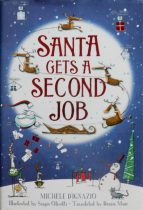
Santa Gets A Second Job
Michele D’Ignazio, illustrated by Sergio Olivotti, trans. Denise Muir
Macmillan Children’s Books

Poor Santa. Things have become more than a tad troubled for the seasonal worker extraordinaire, who has eleven months annual holiday Now however, the International Postal Service is broke and even Santa hasn’t received his pay for the last three years. Moreover, he’s in rebellious mood over their latest announcement. Then out of the blue comes a letter: Santa has been sacked! How on earth will the children receive their Christmas presents, he wonders.

Equally pressing, Santa needs to find a new job, so first of all a mini-makeover is required.

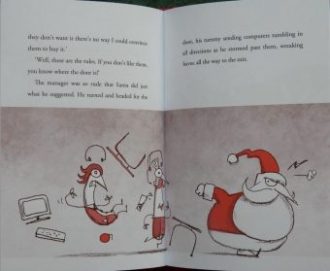
However, finding work is far from easy: it’s no go at the restaurant, ditto as children’s entertainer (ageism), so when the call centre offer him a job he can’t wait to get stuck in; but when he discovers it involves cold calling, Santa quickly walks out, deciding to have one last try. 

Then what should he spy but a public notice: the council requires binmen. Success at last! A community role and even better, he meets up with an old pal, Winnie, who’s also having to take a second job.

Now little does Santa know but he has a neighbour, Bea who only recently found out who he was, and she certainly has no idea he’s now her refuse disposal officer.

Meanwhile funnily enough, Santa sees several similarities between his old job and his new one; he also makes some interesting discoveries about what can be done with the things people put in the rubbish bins. A wonderfully enterprising idea strikes him and before long, he and Winnie take to the skies once more. At the International Postal Service though things are NOT going well …

There’s also the question of some lost letters from way back sent by someone very eager to meet Santa. Can he find the writer and grant their wish in time for Christmas Day?

Absolutely certain to induce giggles, this is a smashing seasonal read (aloud or alone); it’s full of heart, festive magic and contains a large sprinkling of wry humour, and superbly droll illustrations by Sergio Olivotti at every page turn.

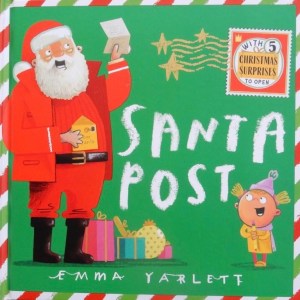
Santa Post

Santa Post
Emma Yarlett
Walker Books

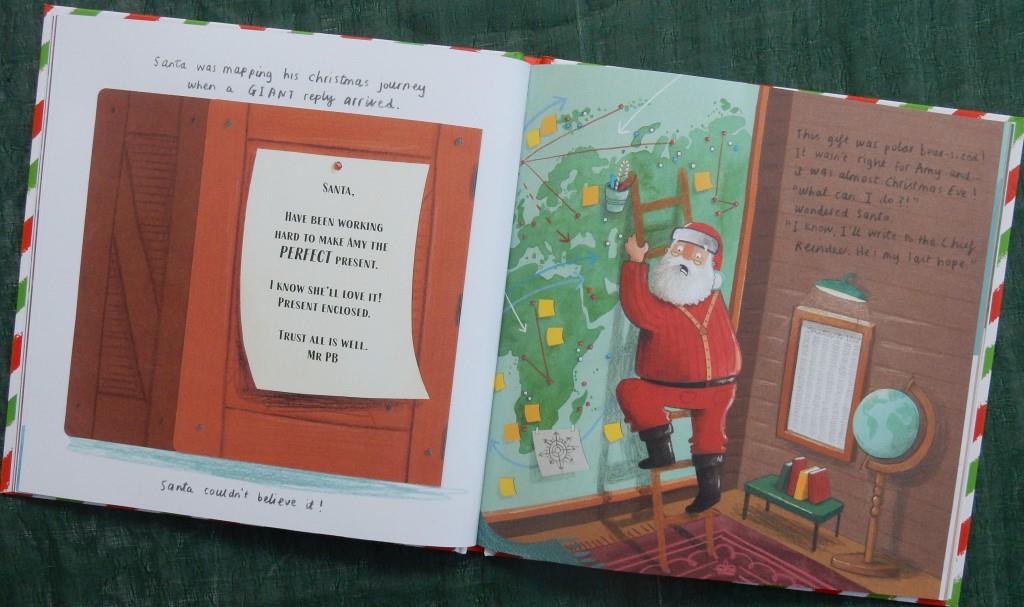
A few days before Christmas something comes whooshing down Santa’s chimney and into the fireplace. It’s a letter from someone signing herself Amy but the vital information about what she would really like for Christmas has been burnt away, leaving Santa puzzled but determined to discover what the missing words were.

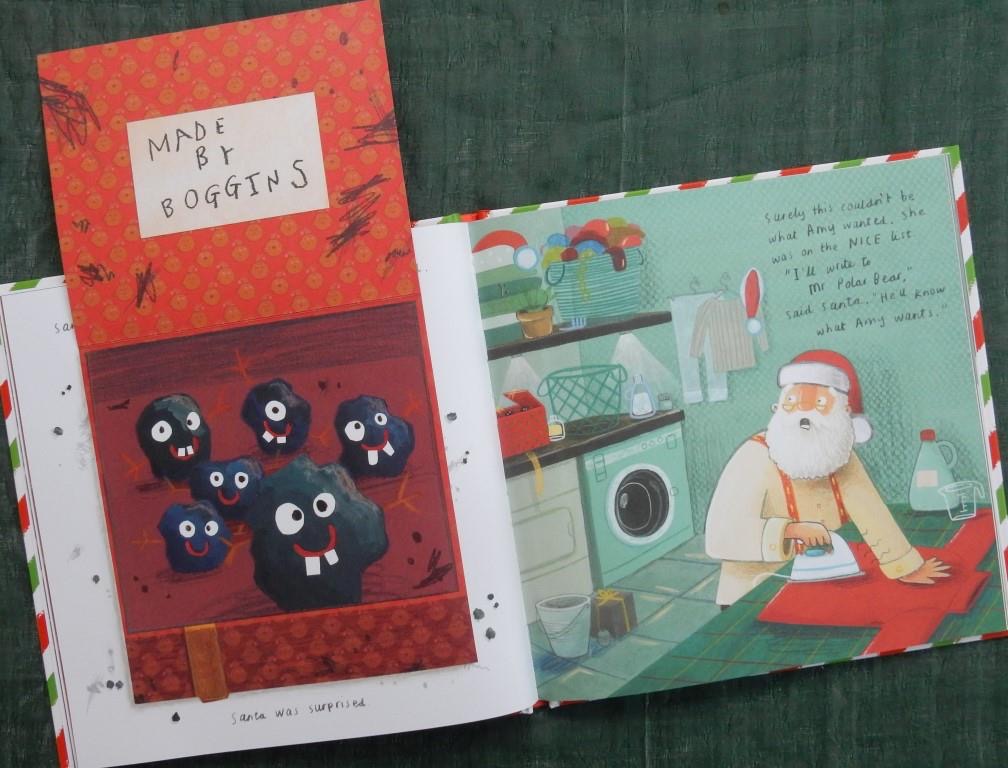
There’s certainly one person he can turn to for the help he so badly needs: Head elf Elfalfa at the North Pole. With a letter duly dispatched all he can do is wait. Meanwhile at the North Pole the elves are exceedingly busy but Alfalfa issues a toy-making request to the only one of her helpers free to assist – Elf Boggins. The little fellow does his best with what little resources are left in the almost bare cupboard and Amy’s present is back to Santa, special delivery with an attached note of explanation. Imagine Santa’s reaction when he opens the parcel and sees this …

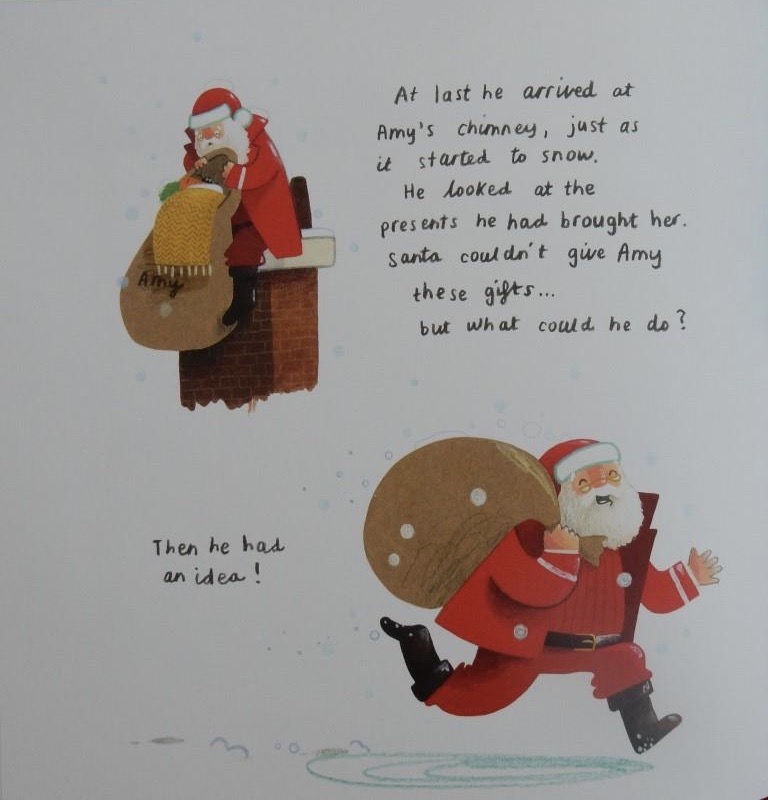
Still determined to find the perfect present, Santa decides to ask for further help from others of his North Pole pals.

Will he ever be able to deliver to Amy what she truly longs for?

With letters and parcels to open, this joyful festive offering from Emma is sure to delight. Her splendidly expressive illustrations combined with her deliciously quirky humour evident in both words and pictures, make this a seasonal treat that will be brought out and enjoyed year after year by teachers in classrooms, and families with young children.

Monster Clothes & Monster Food/ Twinkle, Twinkle, Little Star

Monster Clothes
Monster Food

Daisy Hirst
Walker Books

Here are two monstrously enjoyable board books from Daisy Hirst. The first introduces a host of delightful little monster characters to show little humans what they like to wear. There’s hat wearing Harriet, socks sporting Simon, pants parading Pauline, and Terrence with a tomato titfa’. That’s three out of four with their chosen garments upon their heads. 
Of the next four, three are relatively conformist in how they wear their gear but divergent Cassie chooses something completely unexpected … 

Then come Vera and Duncan, each conventionally clad, followed by leafy Lester, Beatrice with booted hands and feet, which leaves just Evie and she’s been unable to make up her mind and appears shall we say, somewhat over-dressed.
Love the alliterative descriptions of the endearing fashionistas as well as Daisy’s eye-catching, funky illustrations.

Monster Food sees nameless monsters devouring fruits, while others chew chairs – yes really – and some nosh on noodles or stew leaving one to chomp upon a shoe. 

Cereal is preferred by one, another breakfasts (unhealthily) on cake but I can’t see the allure of that rake, nor the mechanical items selected by some. Instead, they should take the advice of the child and her monster pal on the final spread and stick to putting food in their bellies. Nom, nomm exceedingly tasty fun – well mostly!

Twinkle, Twinkle, Little Star
illustrated by Yu-hsuan Huang
Nosy Crow

Yu-hsuan Huang populates her delightful version of the ever popular nursery song with small anthropomorphised animal, in particular a bear and a rabbit. These two cute-looking characters meet up and cycle off into the night. After parking their bikes, they walk until they find a suitable spot to make a camp and enjoy a sing-song under the stars,

before snuggling up for the night.

In addition to enjoying joining in the song, (there’s a QR code to scan for an audio version) little humans can have fun manipulating the sliders, talking about the details in the illustrations and following the story as it unfolds in Yu-hsuan’s beautifully coloured spreads.

Rashford Rules / Van Dijk Rules / Be Your Own Football Hero: Ronaldo

Rashford Rules
Van Dijk Rules

Simon Mugford and Dan Green
Welbeck Publishing

These two highly illustrated biographies are the first in a series of Football Superstarsand both author Simon and illustrator Dan are soccer fans themselves, supporting Ipswich Town.

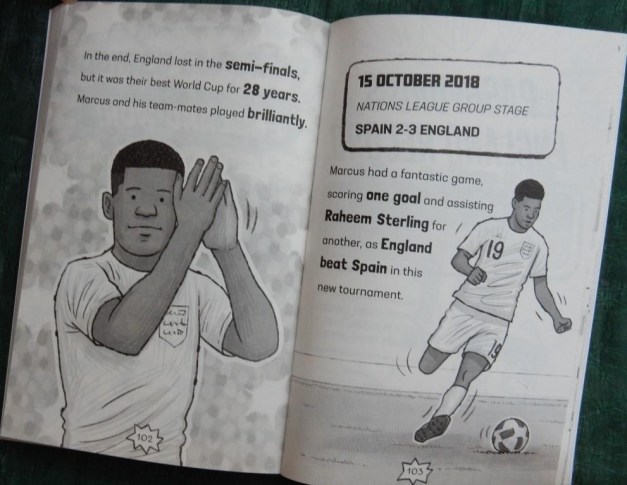
Marcus Rashford has recently hit the headlines again with his superb campaigning for free school meals over the half-term holidays which received tremendous community support and certainly put the government to shame. The opening pages of the book acknowledge his national hero status both as an awesome goal scorer and as a charity campaigner. Readers are then told what makes him the brilliant player that he is, and can also discover some statistical information.
Divided into short chapters, there’s information on his Manchester childhood, early achievements, his debuts including a comment by Rashford’s hero Ronaldo. Then come his path to national England player 

and the final chapter focuses on his activist charity work during the Coronavirus lockdown. All this and he’s still only in his early 20s.
The book ends with a quiz and some key soccer words as does the companion book Van Dijk Rules

This follows a similar pattern, giving facts about achievements, his early life in the city of Breda in the Netherlands as a child who always had a football at his feet, and how he progressed from over-grown, sometimes troubled teenager with a part-time job washing dishes in a local restaurant, through his successes with Celtic 

and Liverpool, and as captain of the Dutch team. Both this and the previous title are enormously engaging for young soccer enthusiasts especially. Dan Green’s black and white illustrations capture the essence of the individuals and add additional detail and humour to Simon Mugford’s accessible writing.

Be Your Own Football Hero: Ronaldo
Matt and Tom Oldfield
Studio Press

The Oldfield brothers invite youngsters to don football boots and participate in a decision-making activity as they select one or other of the options presented at intervals throughout the book. There are many choices to be made in the world of a soccer professional such as Cristiano Ronaldo, some of which take the reader along the path taken by the real Ronaldo, others are would-be alternative realities – what might have beens.
Readers are taken back to Ronaldo’s childhood when as son of encouraging, soccer-enthusiast, hard-up parents. the football mad boy has his chance to go and play with his cousin at a Andorinha training session. It turns out to be something of a disappointment so what is your response when your dad asks if you enjoyed it? Time for that first decision …
And so it continues.

I’m not a football fan, but to readers from around six or seven, I can perfectly understand the allure of these books, written by the authors of the Ultimate Football Heroes biography series.

The Couch Potato

The Couch Potato
Jory John and Pete Oswald
Harper360

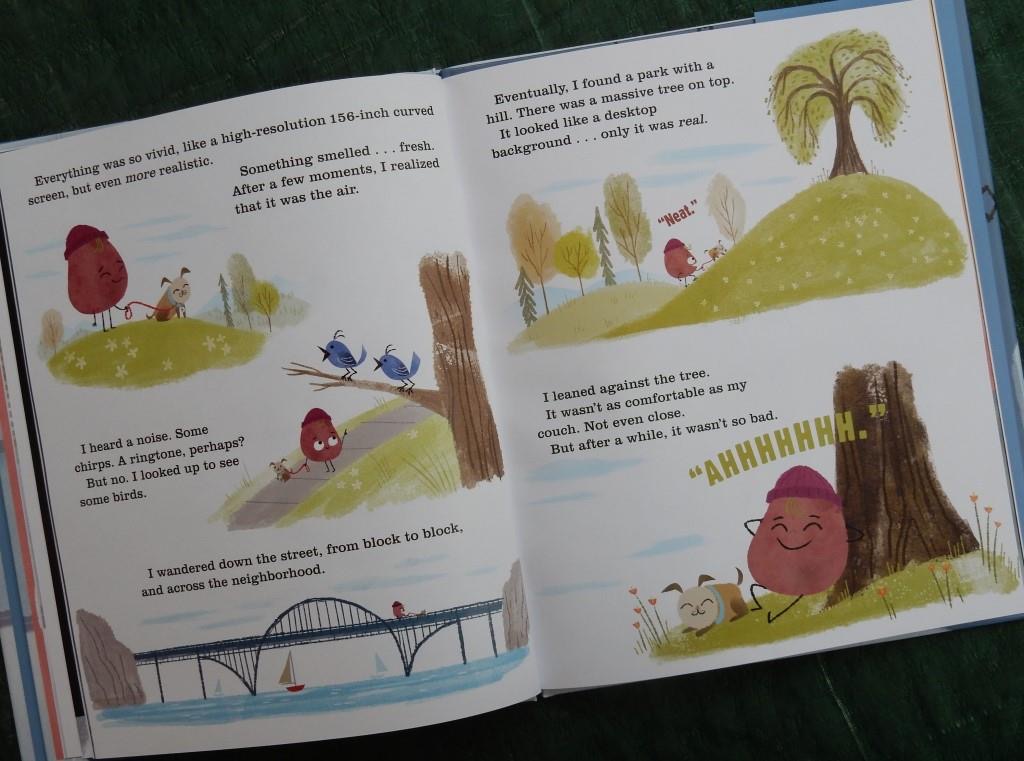
Here’s a spudalicious tale from popular duo Jory John and Pete Oswald who add a new veggie character to their entourage in the form of a potato, one wedded or should that be, welded to his sofa – almost – and by his own admission, the ap-peel of this comfy spot is irresistible. Especially when everything a spud needs is within easy reach.

Our dumpy narrator, like many humans during the on-going pandemic one suspects, has become well, a couch potato. Moreover this veggie has a huge number of screens for the purposes of watching favourite shows, playing video games, face to face conversations and more. He surely has everything under control, this spuddy guy.
But one day, disaster strikes; plugging in his latest device (mail order of course), causes the electricity to PEW-WWWWWWW resulting in darkness and, can you imagine, our potato leaving his favourite spot to look out the window. yes he can manage that!

With nothing else to do, he decides to go for a walk in the great outdoors, accompanied by his pooch Tater. This foray in the open air causes something of a cathartic release: there’s peace, nature and reality out there, liberating and sometimes exhilaratingly beautiful.

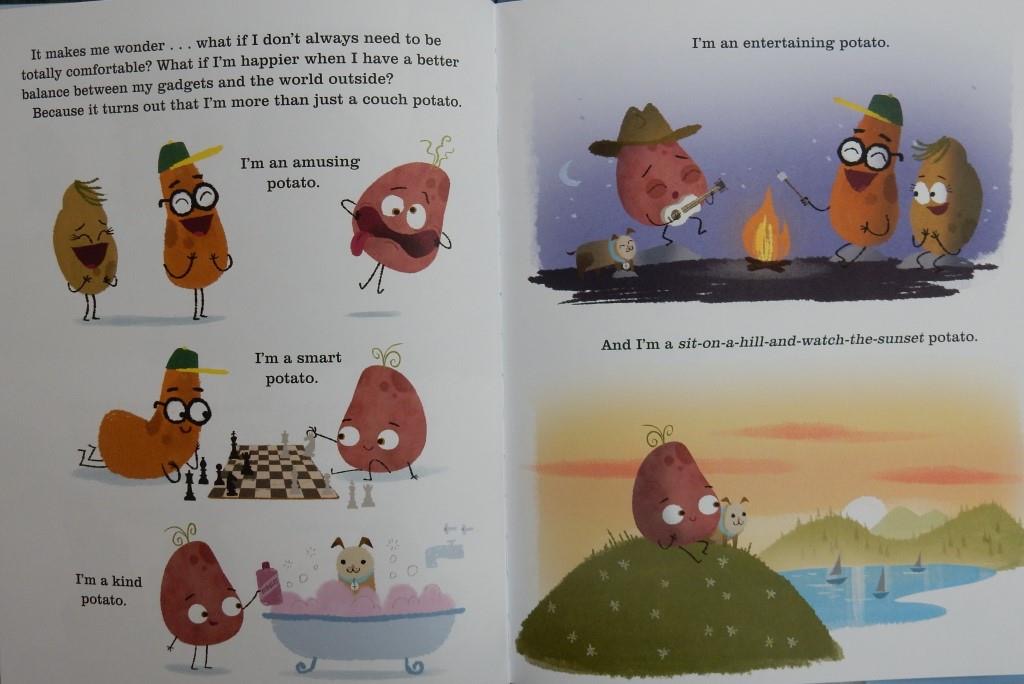
Time to make some permanent changes, thinks our starchy spud pal and yes, having found a happy medium, life is great …

Nature and the outdoors are things Covid hasn’t taken from us all; I certainly feel that in addition to books and reading, my well-being depends on getting outdoors and walking in the beautiful countryside around me, no matter the weather.

Love the humour inherent in both the punny writing and the illustrations of this book. There are intertextual winks, an abundance of genial spuds and the final spread with the hero enjoying a cuppa and reading The Catcher in the Fry is a delicious way to end a story that will appeal to both children and adults.

The Snowflake

The Snowflake
Benji Davies
Harper Collins Children’s Books

Benji Davies has created yet another heart-warming and absolutely beautiful picture book about on the one hand, a little snowflake and on the other, a little girl, named Noelle. The former, as the story opens, is in the process of falling, albeit rather reluctantly at first. Far below, the second is returning home through the city with her grandpa, Pappie, wondering as she walks about the possibility of snow that night.

As the snowflake falls, she wonders about where she will eventually land and where she truly belongs, but the choice isn’t hers to make as her fate is controlled by the wind that bears her drifting and swirling towards the bright lights as they get ever closer. Both child and snowflake are drawn by a wondrous sight – a large Christmas tree that glistens and sparkles in a window, the one wishing for such a tree for herself, the other wanting to be the star atop that tree.

Then close to home, Noelle finds the perfect little tree of her very own, while far above, the snowflake is still wondering where she might find to land.

Back home, Noelle’s mother gets out the decorations and together with Pappie, the child sets about adorning the little tree. 

Eventually Noelle puts it outside on her windowsill; but goes to bed feeling that the tree is lacking something special. But what? …

A magical, truly memorable, heart-warming Christmassy tale about finding your true purpose. It’s Benji’s art that really steals the show here: it’s full of glorious, festive details on the one hand and on the other, those wintry skyscapes are simply superb. When you share this, like the snowflake aglow on the final spread, everyone will be left with a wonderful glow within.

The Tooth Fairy and the Home of the Coin Makers / The Tooth Fairy and the Magical Journey / Dilwyn the Welsh Dragon

The Tooth Fairy and the Home of the Coin Makers
The Tooth Fairy and the Magical Journey

Samuel Langley-Swain and Davide Ortu
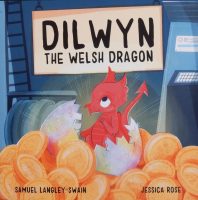
Dilwyn the Welsh Dragon
Samuel Langley-Swain and Jessica Rose
Owlet Press & The Royal Mint

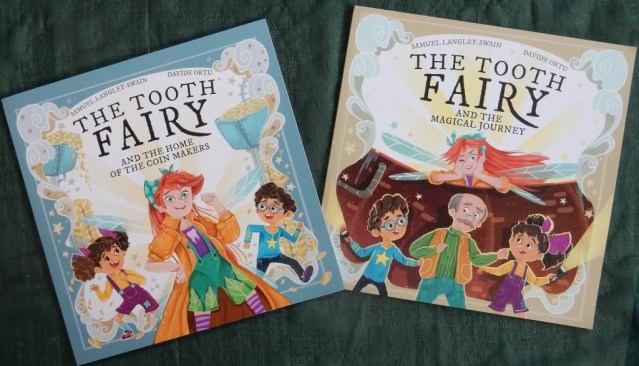
The Tooth Fairy titles are a contemporary take on the tooth fairy tradition that divulges the fairy’s time-honoured teamwork with the original maker of coins.
In the first story we meet twins Grace and Ollie and their Grandpa at whose home they spend every weekend. The twins are thrilled when they both manage to get their wobbly tooth to pop out and rush excitedly to reveal their gaps to Grandpa an erstwhile employee at The Royal Mint. 

He explains that the tooth fairy will pay them a visit that night, exchanging the teeth for a coin apiece; he also makes little pouches to facilitate the exchange.

Excitement rules when the following morning the pouches both contain a gold coin, and then Grandpa shows the twins his own coin collection. He tells them how the Mint acts as a training school for the fairies and how once situated in London it has relocated to a Welsh valley. At the end of the story the twins lose another tooth each and cannot wait to share the news with their Grandpa.

In the second story, summer has come and the twins are losing more teeth. A sleepover at Grandpa’s is arranged. During the evening he regales the children with tales of a fairy, gold coins and a fearsome dragon; and tells them about his time as a Coin Minter for Her Majesty. Eager to learn how to fly, that night the twins set a trap for the tooth fairy but instead they’re visited by the Wensleydale Watch-Mouse and he’d spotted their trap.

When Grandpa, disturbed by all the noise, finds out what they’ve been up to, he’s far from pleased but asks the mouse to take them to his favourite place. Something magical happens and off they all go on an exciting journey of discovery …

Told in Samuel Langley-Swain’s rhyming text accompanied by Davide Ortu’s lively, funky illustrations of gappy-mouthed children, Grandpa and an entourage of fairies and more, these stories will fascinate youngsters especially, when they lose that first tooth.

For a slightly younger audience is Dilwyn the Welsh Dragon, another rhyming tale, set in the relocated Royal Mint in Wales. Here, one night among the golden coins an egg appears from which emerges a tiny dragon.
Next morning the coin makers discover the hatchling naming it Dilwyn (truth) and caring for him. They bestow on him the task of guarding the coins and one night his powers are put to the test when a pair of robbers break in …

This clever interweaving of a fun story with real history will entertain little ones and the book will make an especially worthwhile purchase should they visit Llantrisant where the story is set.

Clifftoppers: The Frost Castle Adventure / A Christmas in Time

Here are two gripping wintry stories from Nosy Crow Publishers:

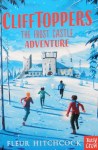
Clifftoppers: The Frost Castle Adventure
Fleur Hitchcock

This is the fourth of the adventure series featuring Aiden, Chloe, Ava and Josh, who spend holidays at their grandparents’place. It’s coming up to New Year and as the story opens the cousins are trudging through the snow towards Frost Castle when a passing car spins out of control crashing into a snow drift. The children manage to extricate the driver, a young woman wrapped in several scarves, wearing a gold pendant and claiming to be cursed. It turns out that she’s a well-known actress who’s to play the lead in Frost Castle’s winter play – a murder mystery – and she also mentions an attempted break-in at her flat before she’d set off for the Castle.

Before long the four children are asked to help with the play. Despite talk of ghosts, they think they should stay and very soon that pendant goes missing. There must be a villain lurking in their midst.
Can the cousins use their skills and courage to discover what is really going on?

With her terrific storytelling skill, Fleur Hitchcock snares readers’ attention from the outset and keeps them involved and intrigued throughout. Whether or not they’re familiar with the previous books, children will thoroughly enjoy this one.

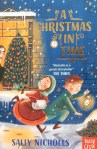
A Christmas in Time
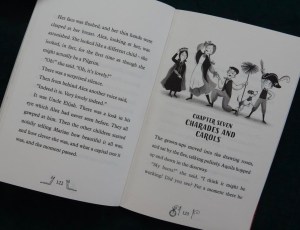
Sally Nicholls, illustrated by Rachael Dean

This is the latest in Sally Nicholls’ time-slip series wherein Ruby and Alex fall through the mirror in their aunt’s house to discover they’re in a different historical period and have to undertake a task before returning to the present.

Now Aunt Joanna has broken her leg and the siblings are anticipating a Christmas doing chores when suddenly having gone through the mirror, they’re back in 1872 about to experience a Victorian Christmas instead.

As a result they meet Edith (8) who with no mother and a father soon to return to India, is about to be sent off to a horrible-sounding boarding school. Then Alex and Ruby realise that she’s being sent to the very place where in February 1873 a terrible cholera epidemic killed off two thirds of the children. Can they persuade her father – the far from pleasant Uncle Elijah – to send her elsewhere.

By all accounts it’s not going to be easy, but can they work some seasonal magic and turn things around for Edith? Or maybe she’ll decide to take matters into her own hands …

With plenty of action, a very interesting cast of characters (some rather eccentric), and details of a Victorian Christmas with singing,

parlour games, ice-skating and candles this is a smashing read, be it in the run-up to Christmas or at any time. I love Rachael Dean’s illustrations and Isabelle Follath’s cover art too.

Will You Be My Friend? / The Purple Puffy Coat

Here are two enormously enjoyable but very different books, each of which has friendship at its heart. Thanks to Walker Books who sent them for review.

Will You Be My Friend?
Sam McBratney and Anita Jeram

This gorgeous sequel to Guess How Much I Love You (now celebrating its 25th anniversary) comes with a touch of sadness as author Sam McBratney died recently. The new story continues on from the first with Little Nutbrown Hare venturing out to look for a playmate. Initially he finds only replicas – a reflection and a shadow of himself.

But then up on Cloudy Mountain he comes face to face with the real thing. It’s Tipps, the Cloudy Mountain Hare and she too wants a friend and playmate.

They play chase and engage in other fun activities, followed by a game of hide and seek. Tipps goes off to hide but will Little Nutbrown Hare ever see her again?

Another timeless treasure and classic to be, to add to family bookshelves and to share with early years children.

The Purple Puffy Coat
Maribeth Boelts and Daniel Duncan

With Stick Insect’s birthday just a week away, his pal Beetle just can’t wait to give Stick Insect his present. It’s a purple puffy coat, wonderfully warm and ideal for wearing when the two go out for walks together. There’s a slight snag though for Stick Insect is rather an introvert and isn’t sure this rather ostentatious coat is quite his style. However, Beetle insists that he dons the new garment and off they both go to show off this ‘generous gift’ around town. And so they do: Beetle boasts and Stick Insect keeps well out of the way.

And even when the former notices what’s happening, he’s adamant that that a daily outing in the coat will get his friend used to being looked at.

On the eve of the birthday, Beetle decides that he’ll give his friend a second gift. And it’s while preparing it that he realises what Stick Insect’s recent glum expression signifies.

Time to reconsider the coat situation and to fix things once and for all …

This wry lesson about respecting and understanding one another’s differences is delivered through a text that’s largely dialogue between the two friends and Daniel Duncan’s delightfully droll illustrations of the rise and fall of the purple puffy coat and those that either wear it or encounter it being worn about town.

Music: A Fold-Out Graphic History

Music: A Fold-Out Graphic History
Nicholas O’Neill & Susan Hayes, illustrated by Ruby Taylor
What on Earth Books

This large format, concertina book is published in celebration of the 150th anniversary of the opening of the Royal Albert Hall in London.

Essentially it opens up the entire world of music to all whether or not they have a specific interest in music and is written by Nicholas O’Neill, himself an acclaimed musician and composer and author Susan Hayes. Together with illustrator Ruby Taylor, they present a superb illustrated timeline that unfolds to double-sided 2.5 metres beginning in prehistoric times with the use of bones, gourds, and hooves, and culminating in contemporary music of Björk, Adele, Beyonce and Grime artist Stormsy.

Pretty much everything one can imagine relating to music as well as more that you can’t, is included in the densely packed pages. Truly international in perspective, the presentation begins with a world map showing prehistoric sounds emanating not only from instruments from the aforementioned materials but also perhaps, from wood.

We meet music makers of all kinds – maestros and more – mainly in national or period dress. There are pithy paragraphs about such things as written music from 1000 CE, the first printed music (1501), styles of music, the use of technology in playing and recording

and various innovations including the Chinabot platform that showcases Asian music both modern and traditional, as well as MuseNet – an online tool that uses AI so create songs of different styles.

The book covers orchestral music, opera, rock -‘n’-roll, protest music and there are some lesser known mentions such as opera founder Wei Liangfu; and American composer Amy Beach and English composer Ethel Smyth whose March of the Women became the anthem of the women’s suffrage movement.

Some musicians have a paragraph,

while the Beatles have a whole page devoted to them, and there’s a double spread entitled the Royal Albert Hall of Fame.

There’s no way you can read, let alone digest, the entire contents of this inclusive and highly visual offering in a single sitting. It’s engrossing; and in addition to the index and glossary, the authors provide personal notes and even, a final playlist. All in all, a truly amazing collaboration and a book to add to primary and secondary collections, as well as family bookshelves.

A Polar Bear in the Snow / In the Half Room

Here are two recent picture books from Walker Books kindly sent for review:

A Polar Bear in the Snow
Mac Barnett and Shawn Harris

In dramatic fashion a sleeping polar bear stirs, sniffs the air and sets forth on a walk the destination of which is known only to himself. Readers join him as he’s observed by seals, arctic foxes,

a human even

until, having traversed the snowy, icy landscape, he arrives at the startlingly blue sea.

Plunging in, the creature’s feeling playful as he enjoys frolicking amidst the fishes and fronds,

before clambering back onto the snow and continuing on his way.
Wither is he bound now? That is left for readers to ponder upon …

Splendidly playful: who can resist accompanying the polar protagonist in Mac Barnett’s spare narrative and Shawn Harris’s arresting torn paper art that’s cleverly layered to give the illustrations a three-dimensional effect, as the creature sallies forth on his walk.

In the Half Room
Carson Ellis

This is a somewhat surreal, enigmatic, rhyming bedtime book wherein Carson Ellis presents a moonlit room in which everything is carefully cut in half. We don’t see the entire setting initially; rather we’re shown a series of partial items – ‘Half chair/ Half hat / Two shoes, / each half / Half table / Half cat’.

Then, once the room has all the half items mentioned, comes ‘Half a knock on half a door’ and there stands the woman’s other half.

Having come together, she’s wholly ready to dash out to embrace the world beneath a starry sky.

Meanwhile, in through the door left ajar, comes half a cat

to participate with its other half in a half-cat fight’ after which the two entwine un-united, on the mat and fall asleep.

With bold images, this is wholly entertaining and intriguing though perhaps some youngsters will be left feeling just a tad bemused by such an offbeat offering.

Zombierella: Fairy Tales Gone Bad / Theodora Hendrix and the Monstrous League of Monsters

Zombierella: Fairy Tales Gone Bad
Joseph Coelho, illustrated by Freya Hartas
Walker Books

As a massive fan of fractured fairy tales, I couldn’t wait to read this and wow! do I love it. Told in the form of a verse novel by performance poet Joseph Coelho, it’s quite simply utterly brilliant, dark, funny and splendidly subversive to boot.

The Grimm version is the one Joseph has chosen as his starting point and right from the start he hooks readers in, holding them enthralled throughout as the plot twists and turns in unexpected ways.

We learn that our heroine has got her name because she carries her biological mother’s ashes with her in a locket. Now she is forced to live with her foul FAKE mother and her equally FAKE beautiful sisters who are living off the inheritance that’s rightfully Cinderella’s. Her one true trusted friend is her horse, Lumpkin but early in the story, he ceases to be and the poor girl has to bury him. But not before she comes upon a piece of drifting paper. It’s a flyer informing the reader of three balls on consecutive nights, on the final of which the prince will choose his bride. She assumes that said prince is moving into the old abandoned mansion atop the hill on the edge of Grimmsville.

Needless to say those FAKE sisters of hers are eager to go to the ball

but can’t abide the thought of Cinderella doing so and as well as leaving her with instructions to clean the house in their absence, they leave a trap for her at the top of the stairs. A trap that causes her demise. Enter The Fairy of Death and Cinderella becomes Zombierella, able to go to the ball, but for three nights only …

I’ll say no more on the tale but merely urge you to get hold of the book and relish every detail, gory and otherwise. Equally relishable are Freya Hartas’ illustrations that add to both the gloomy atmosphere and the humour; her use of space on the page is superb too

and make sure you look under the cover flaps.

I’m eagerly anticipating any further fairy tales Joseph chooses to turn bad with his magic pen.
More shivers and giggles in:

Theodora Hendrix and the Monstrous League of Monsters
Jordan Kopy, illustrated by Chris Jevons
Walker Books

Here’s a terrific mix of monsters, mystery, horror and humour: it all begins ‘just shy of Halloween’ in an abandoned graveyard cemetery on the edge of Appleton. There in an unmarked grave, seemingly just waiting to be discovered lies a small squalling human. And discovered it is by one George Hendrix, a zombie (along with his vampire cat, Bandit). What do they do with said baby? They take it to a mansion – occupied by the Monstrous League of Monsters (MLM) where Georgie is assured the infant will be well cared for. The carers are a group comprising a mummy, ‘Mummy’ to the infant, a vampire, a werewolf and cubs, a witch, the skeleton butler, an operatic ghost, a crow and more – I wonder …

They name the babe Theodora and surprisingly, fall for her charms, but she must be kept secret.

Full speed forward a decade and there’s Theodora thriving and loving life along with her loyal arachnid associate, a dapper tarantula named Sherman.
But then mysterious anonymous threatening letters start to arrive. Seemingly somebody or something has found out about the group and is determined to expose them and their secret to HQ. Theodora is equally determined to discover the identity of the letter writer; so too are the others.

But Theodora decides to fly solo and hatches her own plan. Can she (along with her very first human friend), solve the mystery or are her monster family members doomed to rot imprisoned in Transylvania? And what of her own fate if she succeeds? …

Told by a mysterious narrator this is a smashing story, with some laugh-out loud moments, an abundance of family love and loyalty that shows how diverse family and friendships can be.

Great for reading aloud or solo reading and made all the more fun by Chris Jevons delicious black and white illustrations

Wild is the Wind

Wild is the Wind
Grahame Baker-Smith
Templar Books

This is a story of a journey or perhaps, several journeys – that of young Cassi in her hot air balloon, that of the little swift she has nursed until its wings are strong enough to take to the sky and join its fellows on their path across land and sea, a journey of eight thousand miles, that takes three months to complete; and of course, there’s the path of the wind.

As the morning sun rises in Southern Africa, the world is temporarily on hold until a breeze stirs the leaves and the seeds in the butterfly trees. Then with the strengthening of the wind, it’s time to let go of the tiny winged creature and allow it to join its fellow travellers on a prodigious migratory journey

as a cyclone swirls, spirals and howls, whipping the waves into wild white horses.

Then on over deserts and rocky terrain sculpted by windstorms until at last, the swifts are nearing their destination on the other side of the ocean. And there, without pausing once, Cassie’s little swift and the others are greeted in China by Kûn who has long awaited their appearance.

There too, will they build their nests and rear their young until, once again the wild wind calls them to make their return journey to that little girl so far, far away on distant shores.

With Grahame Baker-Smith’s spare lyrical prose in combination with his equally lyrical, breath taking, powerfully atmospheric, detailed illustrations, Wild is the Wind is narrative non-fiction at its memorable best.

A Poem for Every Winter Day

A Poem for Every Winter Day
edited by Allie Esiri
Macmillan Children’s Books

I’m still relishing my daily reading of A Poem for Every Autumn Day as I start writing this review of Allie Esiri’s latest selection, the first month of which is December. The riches herein take us through, with two offerings per day, to the end of February, by which time one hopes, we’ll have a spring selection.

As in the previous book, Allie prefaces each of her selected poems with a brief introductory, background paragraph linking it to the date on which it appears.

You’ll surely find some of your favourites and take delight in making some new discoveries too: I was excited to find a fair few that were new to me and lots of familiar ones both traditional and new, from Coleridge to Wendy Cope and Robert Louis Stevenson to Benjamin Zephaniah.

Ist December remembers and celebrates Rosa Parks and all she stood for, with a poem by Joseph Coelho, and another by Jan Dean, both superb; also on the theme of Black American experience is Maya Angelou’s very powerful Still I Rise that follows straight after.

Wearing my teacher hat, I was enormously moved especially to discover spoken word artist, George Mpanga’s (aka George the Poet) The Ends of the Earth. It begins ‘A child is not a portion of an adult. It’s not a partial being. /A child is an absolute person, / An entire life.’ And concludes ‘Go to the ends of the Earth, for children.’ Equally moving and as pertinent now as when W. H. Auden wrote it in 1939 is Refugee Blues chosen here for 10th December which is Human Rights Day.

Inevitably snow features several times: there’s Brian Patten’s Remembering Snow that talks of the transformative effect on a little residential street and Snow in the Suburbswherein Thomas Hardy highlights its effects on animals. Then as expected there are a number of poems celebrating aspects of Christmas both secular and religious.

Strangely, three consecutive early January choices, Sara Coleridge’s The Months, A.A. Milne’s Lines Written by a Bear of Very Little Brain and Stopping by Woods on a Snowy Evening (Robert Frost) are poems I’ve learned by heart and can still recite – the first at primary school, the second at around the same age, at home, and the third at the beginning of secondary school.

What more uplifting way than Edward Thomas’ Thaw to look forward to the coming of Spring: ‘ Over the land freckled with snow half-thawed / The speculating rooks at their nests cawed / And saw from elm-tops, delicate as flower of grass, / What we below could not see, Winter pass.’

This superb seasonal celebration is an ideal companion for dark chilly evenings and bright days too, to read alone and to share with the family.

Lotta Says ‘No!’ / Lotta Makes a Mess

Lotta Says ‘No!”
Lotta Makes a Mess

Astrid Lindgren, illustrated by Mini Grey
Oxford University Press

The Astrid Lindgren reissues continue with two books starring young Lotta who is four in the first book. The episodes in the first are told from the viewpoint of her elder sister, Mary-Lou and seemingly, Lotta is a spirited child with a large personality who’s never far from trouble.

Lotta Says, ‘No!’ has nine brief chapters and in the first we see that really what Lotta wants is to make sense of the world she’s growing up in – “What’s it raining for?” she asks one wet day and later, “What’s dung for?” and her response that afternoon is to stand out in the middle of a dung heap in the pouring rain getting soaked. When asked what on earth she’s doing, she replies, “So I’ll grown and be as big as Joe and Mary-Lou.”

Other adventures in this book include a visit to the dentist for a tooth extraction; a crinkly wool incident while visiting neighbour, Mrs Berg,

a kind of honorary grandmother to Lotta and her siblings; and the occasion when Lotta adorns the tree in which they’re picnicking with pancakes. The others too are full of charm and gentle humour: Mini Grey’s black and white illustrations are really fun and highlight Lotta’s endearing nature as they do in Lotta Makes a Mess.

Now, our young protagonist has turned five and appropriately there are five stories herein, each one as convincing as the previous escapades. In the first, Lotta (having woken in a bad mood) has a disagreement with her mother over what she should wear, cutting up her itchy, scratchy sweater and decides to move out.

The second chapter sees her installed in Mrs Berg’s junk-loft where she remains until she discovers just how dark it gets at night. That’s the end of her stay forever plans and she’s more than a tad relieved when she hears her Daddy’s voice saying how unhappy her Mummy is without her – the perfect excuse to reassess her situation, the consequence of which is that what’s been a truly terrible day ends on an upbeat note.

Both books are ideal read-aloud material for pre-schoolers and those in the foundation stage who will assuredly fall under Lotta’s charms and relish her misdemeanours.

The Boy and the Gorilla

The Boy and the Gorilla
Jackie Azúa Kramer and Cindy Derby
Walker Books

Profound in its impact, this is a story of loss, mourning and grief told entirely in dialogue and through a sequence of absolutely beautiful, understated illustrations.

We see a young boy, his grief palpable, on the day of his mother’s funeral as he envisions a companion – a gentle gorilla

– that accompanies him through those dark hours ready to answer all the questions that the little child is reluctant to put to his father. The creature’s wisdom is demonstrated through its responses to ‘Where did Mum Go?’ ‘No one knows for sure.’ Can’t my mum come back home?’ ‘No but she’s always with you.’ ‘I wish my Mum was here to read to me.’ ‘It’s a good story. Your father might like this book too.’ 

And little by little, through this unlikely friendship, the boy starts to open up and express his feelings: ‘Sometimes I want to be alone.’ … ‘Mum and I loved baseball.’ He also begins to find comfort in such activities as biscuit baking and tending to the garden flowers: ‘The seeds you planted together are like your mother’s love, a gift to keep forever.’

What this gentle gorilla shows is the importance of being able to talk about what you’re going through, particularly with those (like dad) who will be feeling equally sad and alone, as yet unable to open up.

Eventually, we see father and son beginning to feel their way forwards together through sharing a story and planting new flowers

and finally, walking off together, taking those first steps on the path to healing.

Queens

Queens
Victoria Crossman
Scholastic

From pirate queens to elephant hunters, and spanning thirty centuries, this book is a celebration of strong, fearless women from all around the world who ruled in one way or another. There are some, such as the Indian Queen Nur Jahan, said to have saved a whole village from a man-eating tiger by shooting it, and the third century ruler in Japan, Empress Himoko believed to have been a magic practising shaman, who are the subject of folklore. Then there’s the mysterious Queen of Sheba (Queen Makeda) who is mentioned in the Qu’ran and the Bible with both Ethopia and Yemen claiming to be her birth country.

There are alternating focuses on an individual – the Queen of Sheba, Lady K’Abe; Mayan warrior queen whose rule was from 672 to 692

and Yaa Asantewaa who led a rebellion against British colonists trying to expand into Ashanti country (1840-1921) – for instance.

In between are topical spreads that include information about queens depicted on money, their clothing and footwear,

make-up, pets, hobbies and more. I was fascinated to discover Rani Lakshmibai reportedly had a pre-breakfast regime of weightlifting and wrestling, while Queen Rania of Jordan has written a children’s book.

The author’s style of writing is chatty and full of interesting facts, while the illustrations are inviting, vibrant and detailed.

The last few spreads are devoted to a visual timeline of the rulers, a world map showing their homelands, a glossary, and a list of places to visit should readers be interested to discover more about the featured women.

Olga: We’re Out of Here! / Judy Moody Goes to College / Zara and Moonbeam

Olga: We’re Out of Here!
Elise Gravel
Walker Books

Olga and her ‘adorable’ albeit rather smelly creature Meh (found in her rubbish bin) return with Olga – fed up with annoying humans – considering leaving Earth and moving to another planet. Perhaps they could even find Meh’s home planet.

Actually, there are several humans that Olga’s not fed up with including her pal, the dog loving Chuck and librarian extraordinaire, Ms Swoop. The latter might just be able to help with Olga’s possible foray into space.
But then Meh starts having digestive problems and before long is so poorly that Olga is truly concerned especially when she notices some unpleasant pimples on the creature’s belly.

Time to visit the library for a bit of investigation, but when Olga gets there she finds not the friendly Ms Swoop but the grumpy Mr Gumstrap on duty. Maybe a trip to the vet’s is a better option. Or is it? …
All ends happily however, and with some exciting news about Meh’s mystery ‘illness’.
Wonderfully quirky and with such an unconventional, research-loving outspoken protagonist, this illustrated notebook style story is such a fun read for primary children.

Judy Moody Goes to College
Megan McDonald, illustrated by Peter H. Reynolds
Walker Books

The latest story of Judy Moody finds the girl struggling with maths according that is to her sweet obsessed supply teacher, Mrs Grossman. The reason for this is that being unimpressed with said new teacher, Judy’s concentration is on anything but the measurement topic that’s being taught. Home goes a note to Judy’s parents who decide that their daughter needs a tutor. Stink, her little brother teases her talking of ‘baby flashcards’. Unsurprisingly Judy is not impressed with this tutor idea either but then she discovers that her tutor is a college student and that she too is going to college – sort of!

Pretty soon, Judy declares that having a tutor like Chloe is ‘crucial’ – ‘maths is everywhere. Maths is life.’ However, less impressed with this new-found enthusiasm of Judy’s are her school friends and it’s not long before she’s playing alone and lunching solo. Moreover, she finds herself sent to the attitude tent by Miss Grossman who’s finding her lippiness just a tad too much. Can Chloe help Judy sort this out too? Perhaps, with a bit of calming, peace-inducing yoga …

Huge fun whether or not the reader is an established Judy fan. I love Peter H. Reynolds illustrations.
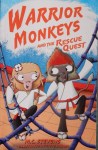
Zara and Moonbeam
Julie Sykes, illustrated by Lucy Truman
Nosy Crow

Is this really the 15th magical story set at Unicorn Academy, the school on Unicorn Island where you meet your very own unicorn and have awesome adventures together. Now it’s Zara who is eagerly waiting for her unicorn to reveal her magic power. But Moonbeam keeps seeing pictures in her head and saying strange things: surely that can’t be connected to her magical power, or can it?

Suddenly who should appear but school inspector, Mr Longnose: could he perhaps be connected with the awful heatwave they’re experiencing? Zara and her friends are determined to find out. When Moonbeam keeps seeing the same images over and over she starts to think she can see into the future.

Then a school field trip is announced and after a while, Zara climbs an enormous rock and finds herself in trouble. Can Moonbeam find her magic power in the nick of time and save the girl?

With Lucy Truman’s black and white illustrations adding to the drama, Unicorn School enthusiasts especially, will devour this adventure, probably in a single sitting.

Glassheart / Brand New Boy / Vampirates: Demons of the Ocean

Glassheart
Katharine Orton
Walker Books

Prepare to be both chilled and enchanted, bothered and bewitched as you read this, the second of Katherine Orton’s stories. It tells of Nona who has lost all her family in the war (WW2) and of her adopted Uncle Antoni. This though isn’t a tale of war itself, but of its aftermath, as together they travel through the wilds of Dartmoor, each caring and protecting the other as a magical adventure unfolds. With echoes of folktale and legend, the landscape that the author crafts is wild, unpredictable – sometimes sinisterly nightmarish.

Her tale is one of power, fragility and also strength as the two walk side by side, stopping to replace stained glass windows, Nona with a small piece of magical glass in the form of half a heart reminding her of what once was, Uncle Antoni with his skill and artistry in stained glass.

With the girl as his apprentice, they undertake a mysterious commission that sees Nona face to face with her nemesis. But though fragile, Nona has an inner strength, loyalty and determination which drives her on in her endeavour to protect those she loves.

Truly evident is Katherine Orton’s understanding of suffering and the assuagement of grief.

Brand New Boy
David Almond, illustrated by Marta Altés
Walker Books

George joins an ordinary class in an ordinary school somewhere in northern England. Daniel is fascinated and watchful, especially when George’s ear falls off. It’s clear that this newcomer is far from ordinary. But then Daniel is actually not so ordinary either. He’s capable of doing extraordinary things: he’s caring, perceptive, questioning, open-minded and ready to accept somebody just a little bit different.

So, while he and his friend Maxie in particular go about their football and other activities at school, his mind is full of thoughts about the mysterious newcomer. But then just as suddenly as he came, two days later, George is there no more. Will he ever come back?

If ever there was a story to encourage children to think about what they are and to consider the true meaning of being human, and of freewill, then this is it.

Deceptively simple in its telling David Almond’s story has a quiet power while Martha Altés illustrations bring out the humour inherent in the tale.
Never underestimate children; all too frequently I see both teachers and parents so doing. They too should read this book.

Vampirates: Demons of the Ocean
Justin Somper
UCLAN Publishing

This is a reissue of a book (the first of a series) originally published some fifteen years back. It’s a swashbuckling tale of pirates and vampires set in the future in an attractive-sounding location – Crescent Moon Bay on the Australian coast.

We meet twins Grace and Connor, who are left entirely alone in the world when their lighthouse keeper father to whom so many owe their lives, suddenly dies. The children cast themselves off in his boat out to sea and all too soon are hit by a storm but they’re not to meet their demise in the ocean. Grace is rescued by Lorcan Furey, one of the vampire crew of a strange boat, Connor by friendly pirates.

The action then switches between the two as their stories unfold alternately with secrets emerging until at last, the two are reunited. With its lively cast of characters (depicted before the title page) this is an entertaining start to a sequence of further adventures for older primary readers and beyond.

The True Story of Zippy Chippy: The Little Horse That Couldn’t

The True Story of Zippy Chippy: The Little Horse That Couldn’t
Artie Bennett and Dave Szalay
NorthSouth Books

You’ll find it hard not to fall for the racehorse that stars in this true picture book story; I say stars because despite expectations Zippy Chippy never won a single race. Thoroughbred from champion genes, Zippy loved to run but his behaviour on the track was totally unpredictable: sometimes he merely stood and never ran at all, on another occasion he stopped dead in the middle of the track to enjoy the wonderful smells in the air.

After nineteen losses his owner trades him for a truck and then – new trainer not withstanding – fuelled by sweet goodies – Zippy is relegated to the second-rate races breaking the record for the most consecutive losses. However, Felix (the new owner/ trainer) doesn’t give up easily and a year later, Zippy (apparently a lover of being a racehorse despite his ineptitude) is given yet another chance and another and …

Winner he might not be, but Zippy certainly caught people’s attention including his trainer’s young daughter and later on, press sportswriters and the crowds that came to cheer him on. Determined to make the horse a winner, Felix sets up a race against a baseball player and guess who wins …

Down but not entirely out, Zippy comes in second in race number ninety-eight but come race one hundred, he brings up the rear – again! But does Zippy go out quietly and unobtrusively? Absolutely not, for after the starting bell, before taking a single step in the race, he entertains the crowd with a final farewell, bowing out gracefully to tearful onlookers.

A legend indeed, but what he showed not only those involved in horse racing, but readers and listeners too, as author Artie Bennett writes, ‘you can lose and lose and lose and still be a winner.’ Zippy’s attitude is ultimately what counts: you don’t need to be a winner to be loved, being best isn’t THE most important thing, taking part is. In other words, be true to yourself and don’t be afraid to walk your own path: such a great message to give children.

With their changing perspectives, Dave Szalay’s zany illustrations will surely make readers chuckle, capturing both the spirit of the horse, and the heartfelt humour, love and perseverance inherent in Artie’s writing about Zippy.

Ella’s Night Lights

Ella’s Night Lights
Lucy Fleming
Walker Books

Ella is a tiny, moth-like girl who longs above all else to see the sunrise; but she has to avoid the sun, so delicate are her feathery wings. Consequently, Ella leads a nocturnal existence collecting light from all that glows and glimmers by moonlight and sleeping by day. 

This light she would share with anyone who needed some help in the dark, while repeating her heart-warming chant “Here’s some bright light, here’s a night light. / A little ray to calm your fright.”
One night she bestows this light upon a little fox named Sable 

and the two become friends, searching together nightly for ‘shimmering light’.

Another night – a snowy one – she shines a calming light on a lonely little owl in a tree; then Luna joins forces with the light-givers, and the animals always ensured that little Ella was safely back before sunrise.

One night her animal friends decide that it’s time that Ella’s kindness is returned: together they create a very special gift to show their appreciation of her thoughtfulness and altruism, a gift to make her dreams come true.

Through both words and pictures, this story positively exudes charm, and sweetness – of the magical not the cloying kind. It’s a lovely warm-hearted book to share with youngsters especially now when we all need some light and kindness to help us through these difficult times.

Chitty Chitty Bang Bang

Chitty Chitty Bang Bang
Ian Fleming, adapted by Peter Bently, illustrated by Steve Antony
Hodder Children’s Books

This is a retelling of Ian Fleming’s classic tale by the popular picture book author Peter Bently, illustrated by Steve Antony of Mr Panda fame..

The Potts family – mum, dad (a clever inventor) and their two children Jemima and Jeremy – are a poor but happy family. That is, until one of dad’s inventions makes a fortune and off they go to buy a car. 

Unimpressed by any of those on offer at the garage, they’re about to leave when Dad notices something under a cover. Beneath that cover is a large and very much the worse for wear, racing car, destined the next day for the scrapyard.

Young Jeremy has great faith in his father’s ability to restore it to its former glory and after spending weeks shut away in his workshop, Dad introduces them to a splendidly shiny vehicle.

In climbs Dad and when he starts the engine, they hear this ‘CHITTY! CHITTY! BANG! BANG!’ before the vehicle rumbles into life. There’s only one thing they can call this car and you know what that is … Off they go for a drive to the beach and when they get stuck in a traffic jam, a mere push of a knob causes it to WHOOSH skywards as they take flight, 

destination a beach on a deserted island.

Fortunately, the car is better at spotting danger than the humans, and just before the tide engulfs them, Mum presses the flashing button and Chitty is transformed into a speedboat that takes them whizzing through the foggy waters to the coast of France.

What follows is an even more exciting part of their adventure involving a chase (of a famous robber and his gang) 

through the streets towards Paris where a hot-air balloon awaits the gold thieves. But they’d reckoned without a certain amazingly adaptable car …

Peter’s telling sweeps you along in the mounting excitement and Steve’s terrific, detailed illustrations provide readers with varying perspectives from which to witness the action. Together they’ve created a wonderful way to introduce youngsters to the original story.

Molly and the Mathematical Mystery

Molly and the Mathematical Mystery
Eugenia Cheng and Aleksandra Artymowska
Big Picture Press

There are challenges aplenty in mathematician and maths advocate and demystifier Eugenia Chen’s picture book for older primary children. In collaboration with illustrator Aleksandra Artymowska she presents a plethora of mind-boggling mathematical ideas in a creative and enormously alluring mystery story that involves readers who join Molly in a series of challenges as she ventures forth into a weird world where everything is other than it appears.

If you are one of those people who when somebody says the word ‘maths’, thinks of times tables and numerical problems, then this interactive journey will surely show you that it’s about SO much more, most importantly about imagination.

With letters to read, clues to find, flaps to explore, wheels to manoeuvre, and an absolute wealth of mathematical information at the end of the story, this incredible book will have you confounded, bemused, astonished and absorbed.

Aleksandra Artymowska has packed so much into every double spread scene, be it the impossible staircase,

the garden of hidden shapes with its tessellations, that hall of endless doors with their intricate patterns, the steam room with its plethora of pipes, wheels and vents, the room adorned with carpets of awesome designs. Then come the mixed-up library where you’ll love to linger among the books of all sizes, the beautiful symmetry garden,

the high-walled fractal garden or the scene that shows Molly all the places she’s visited or even her very own bedroom at home wherein the adventure starts and concludes.

Highly recommended for school and home.

There’s A Mouse In My House

There’s a Mouse in my House
Ross Collins
Nosy Crow

A tiny mouse has had the temerity to move into our Bear narrator’s residence so he tells us. Outraged, Bear is determined to oust his unwanted interloper by telling him ‘he has to go.’ But what he doesn’t know it that the little rodent has been taking lessons in taekwondo – of all things – and you can see who comes off worse in that encounter. OUCH!

So what about suggesting alternative spots Mouse might prefer to be – Luxembourg or Borneo perhaps. But it’s no go on that score. Apparently, the intruder is staying put and is making it known in no uncertain terms by usurping Bear’s chair.

Yes, Mouse might be a dapper dresser as well as being a diminutive creature but he has a gargantuan appetite and is eating his host out of house and home – literally. Then there’s the nocturnal noise pollution habit: how on earth is our narrator supposed to sleep with all that row? But it’s the bathroom disaster that’s just about the last straw …

Uh-oh! Someone’s come a-knocking on this snowy night. Who on earth would venture out right now? And why? …

Delivered with Ross’s characteristic rollicking rhyming panache and brilliantly droll scenes showing how in this sequel Bear gets repaid (to begin with anyway) for his misdeeds in There’s a Bear on My Chair. But it’s the clever interplay between text, illustrations and design that is SO well done.

AGAIN! I hear the cries from young humans, who will relish this delectable drama (along with the adults who read it aloud).

Snow Ghost / Snow Woman

Here are two super snowy picture books – the first new, the second, a reissue:

Snow Ghost
Tony Mitton and Diana Mayo
Bloomsbury Children’s Books

In a lyrical tale of hoping and searching, Snow Ghost flies through the snow-filled sky seeking a place that she can call home.
She swoops first towards a town all a-twinkle with its lights in shops and houses; but it doesn’t feel right, so it’s on through the darkness and into the woods. There though she meets shadowy darkness and that too feels unwelcoming.

Windblown to a hilltop it’s impossible to rest with those hostile murmurs telling her to go, the Snow Ghost drifts towards a small moorland farm.

There in the fields are a boy and a girl playing snowballs and seeming full of joy. Now here’s a place which might just afford the welcome that can end the Snow Ghost’s long search …

– a place she can finally call home.

Tony Mitton’s rhyming narrative flows with the grace and beauty of his subject, gliding perfectly off the tongue as you read it aloud. Diana Mayo’s equally lyrical illustrations that almost float over the pages are mesmerising; the colour palette pervades every spread with an ethereal quality, and oh wow! those endpapers are exquisite.

A memorable magical wintry book from cover to cover that’s destined to become a seasonal treasure.

Snow Woman
David McKee
Andersen Press

David’s wry look at the question of gender, Snow Woman, has recently been reissued. It tells of Rupert who informs his dad that he’s building a snowman, only to have his terminology corrected to ‘snow person” by dad. And of Rupert’s sister Kate who before embarking on her snow construction, tells her mum, it’s to be a snow woman. Mum accepts this.

The completed snow people stand side by side duly dressed and are photographed along with their creators, by Mum.

The following morning the snow twosome have vanished, along with their clothes. Kate makes a thoughtful observation about a possible reason and the two decide a to build instead, a snow bear – not a man or a lady -merely a bear, Rupert suggests.

Playful and pertinent still, McKee’s deadpan humour shines out of his illustrations all the way through to that seeming throwaway final line of Rupert’s. Make sure you study all the household décor and other ephemera lying around indoors, particularly the art adorning the walls; it’s hilarious.
This book will surely appeal to both children and adults.

David Roberts’ Delightfully Different Fairy Tales / Pippi Longstocking Goes Aboard

These are two special gift editions with Christmas in mind

David Roberts’ Delightfully Different Fairy Tales
written by Lynn Roberts-Maloney
Pavilion Books

This sumptuous edition brings together three of the brother and sister team’s fairy tales previously published as separate books, Cinderella, Rapunzel and Sleeping Beauty. Lynn’s texts written with enormous verve and David’s magnificent illustrations that set each of the stories in a different era combine to re-energise tales from way back making readers experience them with fresh eyes, ears and hearts.

For Cinderella we’re transported to the art deco 1920s, age of flapper girls and glamour, where Greta’s (aka Cinderella) stepsisters, are Elvira (the wicked one) and Ermintrude (she’s exceedingly dim).

Her fairy godmother is a fashionista and her stepmother is a stone cold-hearted bullying female who immediately evicts Greta from her room giving it to her own offspring instead.

Rapunzel is set in the 1970s when platform shoes were all the rage. The beautiful miss in this version has a red-haired stunner as its star and she resides in a tower block flat, (or rather is imprisoned by her Aunt Edna who owns a ghastly pet crow).

Edna insists that safety is the reason for her niece’s current incarceration, and she uses occasional gifts of second-hand records and magazines to placate the girl, promising to show her the city sights once she’s older. Said aunt is employed as a school dinner lady, one who almost force feeds her charges with such ghastly fare as lumpy custard. Enter stage left, young Roger, lead singer of the school band. Could he be the one to rescue the red-haired damsel?

Sleeping Beauty has an entirely female cast, a 1950s vibe and a science fiction loving young lady Annabel who on her first birthday, falls under the evil spell of spiteful witch Morwenna, and wakes many more years later than the sixteen she’d first thought.

If you know somebody (or several people) who love fairy tales, then buy them this totally brilliant book: I’m going to have to invest in several copies this season. And, KS2 teachers just think of the potential this offers in the classroom.

Pippi Longstocking Goes Aboard
Astrid Lindgren, illustrated by Lauren Child
Oxford University Press

This bumper book with superbly spirited, full-colour illustrations by Lauren Child (who better to illustrate this Pippi 75th anniversary edition?) is an ideal present for a lively child with an inquiring mind, and a cracking way to bring Pippi, fellow residents of Villa Villekulla, monkey, Mr Nilsson and her horse – the one she can lift with her super strength – (strictly speaking he lives on the veranda), and her next-door friends, Annika and Tommy, alive to a new generation of readers and listeners.

The episodes herein include that where Pippi gets a trifle carried away when she goes on a shopping spree with a pocketful of golden coins. The consequences are pretty unlikely (unless you’re Pippi) with a bit of bother over a false arm and whether or not the particular shop is self-service. She also gets carried away in the sweet shop buying rather an excessive amount of sugary confectionery, and uses her common sense in the pharmacy.

Another time there’s an addition to the school role, though only briefly; Pippi also livens up the school outing;

has an encounter with a rather large ’kitty’, she gets shipwrecked and almost leaves her ‘more organised’ Villa Villekulla life and sails away with her father to live a thoroughly disorganised one.

Hours of pleasure visual and verbal, lie between the two covers of this gift edition.

The Puffin Keeper

The Puffin Keeper
Michael Morpurgo, illustrated by Benji Davies
Puffin Books

National treasure and author Michael Morpurgo has written this story about puffins with Puffin Books’ 80th birthday in mind. Michael is the son-in-law of Allen Lane the founder of Puffin Books whose metaphorical lighthouse lamp definitely illuminated my childhood. Here he has interwoven his own family history, the Scilly Isles, a threatened bird and his fascination with lighthouses, to create a truly memorable read for all ages.

The extraordinary tale begins one dark stormy night just off the coast of the Scilly Isles when bound for Liverpool from New York, a four-masted schooner with its masts broken and sails in tatters, starts to sink with thirty passengers and crew aboard. The event is watched from high up in his lighthouse by the keeper, Benjamin Postlethwaite who risks life and limb to rescue everyone including the story’s narrator, then five years old, and his widowed French mother.

Making several journeys in his tiny rowing boat this brave man rows back and forth five times until everyone is safely on the island. Then in his lighthouse, he silently brews pot after pot of tea, ensuring that all the rescued were kept warm. The boy, an observant lad, is amazed by the paintings of boats done on cardboard scraps and bits of wood each one signed merely BEN, that adorn the walls. The following day when those from the ship are taken from the island, Benjamin gives the boy a painting of a four-masted schooner similar to that from which he’d been rescued.

The boy and his mother then go to live on Dartmoor with his mother’s dour in-laws. Among the horrors the lad has to cope with are Miss Duval (or Devil) a cruel nanny cum governess; following his ultra-strict grandfather’s regime, and at age eight being sent to boarding school where cross country running meted out as punishment becomes a pleasure

and then a medal-winning success. The boy also discovers the joys of painting and reading storybooks but never does he forget Benjamin Postlethwaite.

Having come across an article about the rescue in an old magazine, the boy writes to Benjamin asking if he’d mind a visit from him one day. Around the address he paints a copy of the picture he’s been given. But no reply does he receive.

One day, informing his mother that he’s going on a journey of exploration, he leaves (with her approval) on his bike.

Where is he going? …
That’s nowhere near the end of this wonderful tale but if you want to discover what happens, then get yourself a copy.

In Michael’s prose no matter what his subject, there’s a simple eloquence and perceptive pitch-perfect beauty; and this story with its soft-spoken conservation message and themes of hope and fresh beginnings is, ultimately, uplifting. I can think of no better artist for the book than Benji Davies, whose illustrations with their subtle shades, somewhat reminiscent of Ravilious, truly bring to life the characters, the various settings and the feelings evoked in the text.

A book to have, to hold, to share and, to treasure.

A Thing Called Snow

A Thing Called Snow
Yuval Zommer
Oxford University Press

This wonderful book has classic written all over it. It’s absolutely gorgeous from cover to cover; but one has come to expect nothing less from Yuval who puts his heart and soul as well as that of the natural world into every book he creates.

The story tells of arctic creatures Fox and Hare; springtime born, they grew up during the summer, and come autumn were best friends. Expert at sniffing distant things, Fox finds joy in leaping and bouncing while Hare – also a lover of leaping and bouncing has superb hearing ability.

One day Fox’s nose twitches and Hare’s ears prick: ‘Winter’s on its way,’ Tern tells them, pausing on its journey southwards, going on to talk of ‘this thing called snow!’ wherein the friends can jump, leap and bounce. 

But what on earth is snow?

Off go Hare and Fox into the forest to try and find out. Bear’s answer to their question provides information as to it its colour, while Caribou adds that snow’s cold and Salmon tells them it’s fluffy like their tails. Having heard from Goose that it also sparkles, the friends still haven’t found the complete answer they seek, though they have had some misconceptions corrected. They’re also cold and tired, and as darkness starts to descend they stop beside a lake, too far from home to return. 

Snuggled up together they fall fast asleep. Next day they awake to a ‘cold, fluffy, sparkly’ surprise; but that’s not the only surprise they get that joyful sparkling morning. 

Despite the chilly season of this story’s setting, a feeling of warmth emanates from many of its pages on account of the kindness of the forest animal community. 

With a pleasing circularity and true harmony between words and pictures, it’s a real treasure. Yuval breathes life into his characters with those trademark eyes, yet every one of the animals shows his love of and respect for, nature. 

With its sparkling, tactile dust jacket, this book is a must have this season.