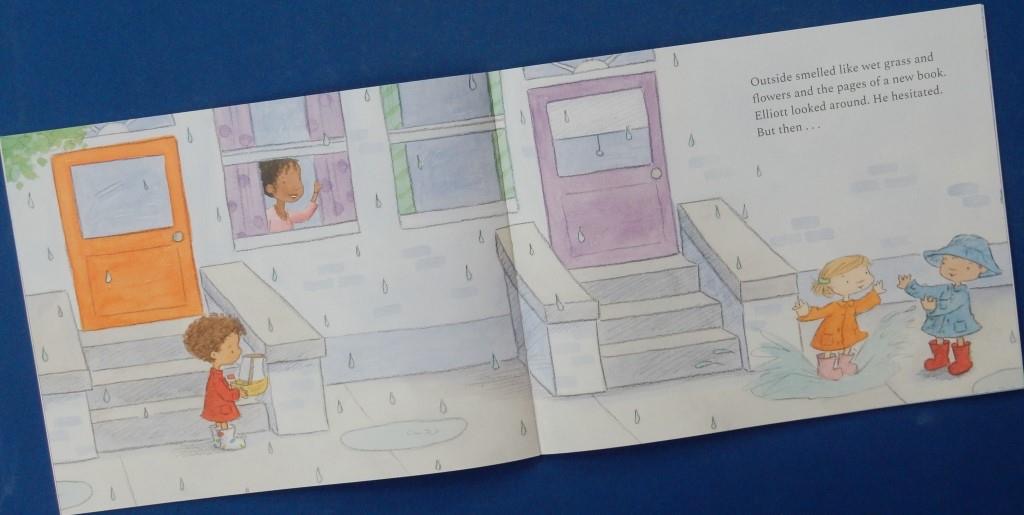
Turtle Rescue

Turtle Rescue
Jonny Marx and Xuan Le
Little Tiger

I suspect the burgeoning of picture books telling of the plastic pollution of the oceans is indicative that the problem is on many people’s minds. Sadly though, not those who continue to throw rubbish onto the beaches or in the sea. One can but hope that Jonny Marx and Xuan Le’s Turtle Rescue will help in this hugely important environmental cause.

Flora, marine biologist and ace underwater swimmer, Fauna, inventor and turtle lover, and their child, Baby Bud, are holidaying at the seaside intending to take it easy for a while. That isn’t what happens however.

Soon they find themselves helping with a rubbish collection during which they’re told it’s hoped it will help bring back the turtles to lay their eggs on the sandy beach once more. Before long the three of them have packed supplies, chartered a boat and are sailing off to investigate the lack of turtles.

As they sail towards the reef, Bud is excited to see all the different sea animals and plants and keeps pointing out what he calls ‘jellyfish’ – the floating plastic bags he insists on counting. Eventually Flora sights a turtle

and carefully follows it until she runs out of air. Back on board the boat again, it’s obvious a storm is looming but eventually it blows itself out and there ahead is an island. Just the place to stop and let Fauna’s queasiness subside. Imagine their delight when Bud notices tracks in the sand leading right across the dunes at the end of which are …

After an eventful and hugely exciting trip, with sail duly repaired, it’s time to head home.

There’s an amazing amount of information about turtles and other marine wildlife packed between the pages of this fascinating part fact, part fiction book.

Science and Me

Science and Me
Ali Winter and Mickaël El Fathi
Lantana Publishing

Following their Creators of Peace, author Ali Winter and illustrator Mickaël El Fathi present profiles of thirteen more Nobel Prize winners, this time for their work in medicine, physics and chemistry.

Coming from all over the world and starting with Marie Curie (1903) and concluding with Donna Strickland (2018 winner for laser technology), each of the laureates is given just one double spread so there’s only space for a brief biography that focuses as much on the dedication and challenges overcome as the individual’s discoveries / achievements and the social impacts thereof. For example, it took decades for the discovery of Subrahmanyan Chandrasekhar relating to ‘black holes’ to be recognised.

Michaël El Fathi takes a key moment or element from each featured life as the basis for each collage illustration: for Youyou Tu it was the ancient book mentioning ‘Qinghao’, the Chinese name for herbs in the Artemisia family. From these could be extracted Artemesinin, the drug that has subsequently prevented over two hundred million people worldwide dying from malaria.

I particularly like the way in which the author involves readers in considering what science contributes to making the world a better place for us all; she does so both through the title lead in to each of the scientists as well as through the summation on the final spread, the last line of which asks “What does science mean to you?

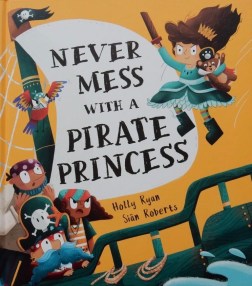
Never Mess with a Pirate Princess

Never Mess with a Pirate Princess
Holly Ryan and Siân Roberts
Little Tiger

Princess Prudence is a loving little miss who dotes on her royal bear, Little Ted, taking him absolutely everywhere with her – even the loo. Then comes the terrible day when, as she naps ‘neath a shady tree, up creeps a pirate and boldly steals her beloved Teddy right off her lap.

Distraught, Princess Prue hollers so loud that up charges a gallant knight offering to come to her aid. 

Eager to be part of the rescue effort, she pleads with Sir Frank to take her along but meets merely with scorn.

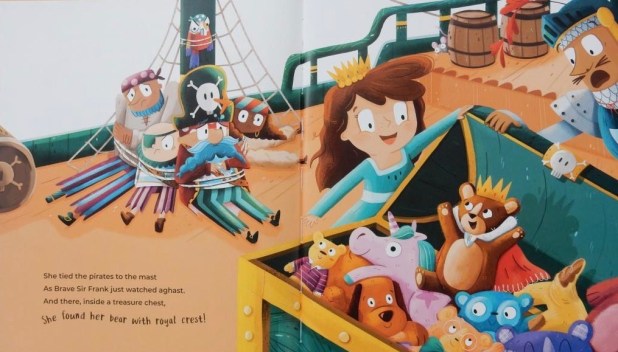
Undaunted plucky Princess Prudence decides to do things her way and off she goes upon a trusty, wait for it … goat! Having searched for most of the day to no avail, she reaches the seashore and what does she spy: somebody being forced to walk along the plank – somebody she recognises – a knight in shining armour no longer.

But our Prue isn’t one to let a gang of teddy robbing pirates get the better of her, or even Frank …

Debut picture book writer Holly Ryan’s rhyming text is a rollicking read aloud and in Princess Prudence she has created a gutsy gal to delight adventure-loving, teddy-hugging little ones. Siân Roberts’ portrayal of the princess and her adventure is terrific fun with every spread providing giggle-worthy incidents from this stirring romp.

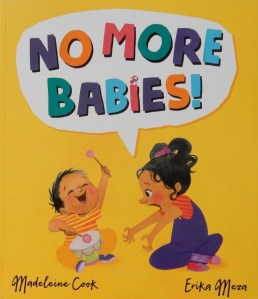
No More Babies!

No More Babies!
Madeleine Cook and Erika Meza
Oxford Children’s Books

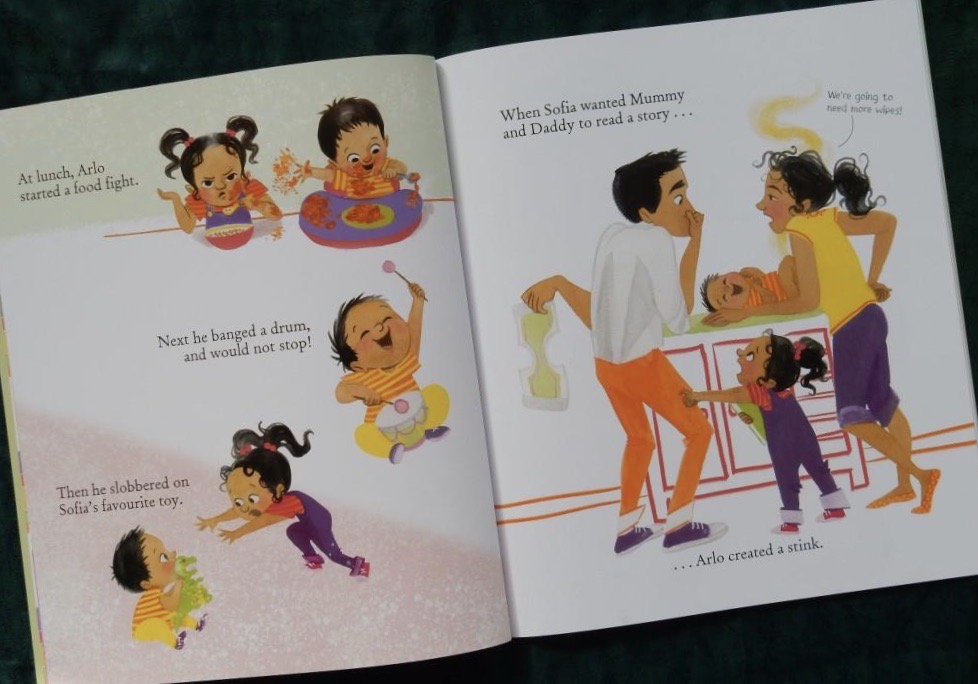
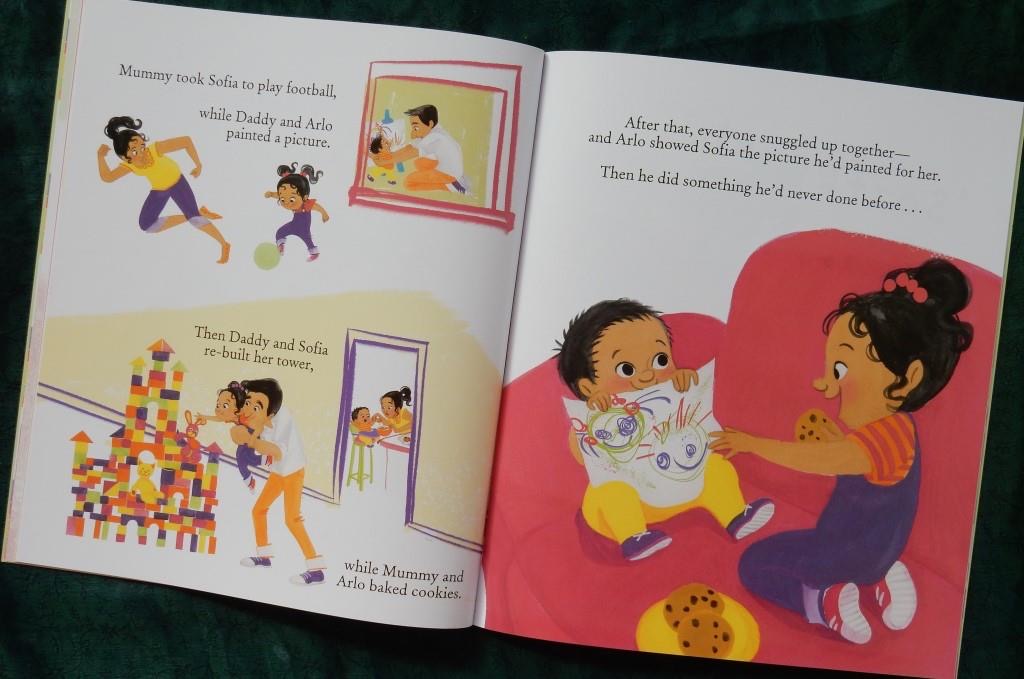
Sofia finds her baby brother exceedingly annoying. On this particular day he smashes down her amazing brick construction, starts a food fight, makes a terrible din on a drum and just when mum and dad are ready to read her a story, he diverts their attention by needing a nappy change.

After all this, her parents’ news that she’s going to be a big sister again, doesn’t go down at all well. “No more babies!” she yells at her bemused mum and dad who now offer a sympathetic ear. Sofia’s account of the morning follows and then cuddles and lots of special attention for the little girl.

Suddenly Arlo surprises his sister and after that she begins to feel much more positive about him. Despite his continuing messiness, smelliness and slobbering, Sofia decides she loves him very much, telling her parents at bedtime, “Okay, you can have one more baby,” …

There’s a throwaway line surprise finale that will surely make both adults and young listeners laugh when they read this funny book.

With Erika Mesa’s wonderfully expressive illustrations it’s one for families to share when a new sibling is on the way, as well as a good foundation stage storytime read aloud especially if somebody in the group is in a situation similar to Sofia’s; or as part of a family theme.

Old Mother Hubbard’s Dog Takes Up Sport / Old Mother Hubbard’s Dog Learns to Play

Old Mother Hubbard’s Dog Takes Up Sport
Old Mother Hubbard’s Dog Learns to Play

John Yeoman and Quentin Blake
Walker Books

The laugh-out-loud antics of Old Mother Hubbard’s Dog take the form of a variety of playful activities in these two paperbacks.

In the first, Old Mother Hubbard is unhappy at the sight of her canine companion merely lazing around all day and suggests he get up out of his chair, set aside his book and do something more active. And so he does. First it’s tennis (over her full washing line), followed by a spot of pole vaulting, then soccer – with very muddy results.
Having had a bath beside the fire the daft creature heads outside again and further athletic mayhem ensues including putting the shot using live projectiles.

Eventually, unable to stand any more, Old Mother Hubbard orders Dog inside and suggests a much more sober activity.

The second episode begins with Dog in his favourite chair reading once more. Old Mother Hubbard expresses a wish that he “learn how to play.” Before you can turn around she hears a raucous rendition on a flute, closely followed by various other musical instruments. 

Greatly regretting her ill-chosen words, Old Mother Hubbard is at a temporary loss to know what to do, but is ready to try anything including some drupe diversion tactics …

Brilliant nonsense both in John Yeoman’s rhyming narrative and Quentin Blake’s exuberant portrayal of the canine capers; adults and children will love this craziness. Don’t miss the back endpapers.

Beatrix and her Bunnies

Beatrix and her Bunnies
Rebecca Colby and Caroline Bonne-Müller
Nosy Crow

For many adults, myself included, Beatrix Potter’s animal stories and nursery rhyme books were part and parcel of childhood. Indeed I had the entire set. How many though, are aware that Benjamin Bunny and Peter Rabbit were real live creatures that the author befriended as she was growing up. That’s getting rather ahead though, for this pictorial biography of Beatrix starts with her childhood when she lived a rather lonely existence in a large London house. Even then she was an animal lover and had lots of small creatures as pets, but nonetheless she longed for a ‘special friend’ with whom she could play.

Rebecca Colby writes of how on family visits to the countryside, Beatrix would search for wild rabbits to play with but none would stay. None that is until Benjamin. A friend at last and one that would allow his carer make lots of sketches of him, honing her drawing skills in so doing. Inevitably though, Benjamin eventually dies and once more, Beatrix feels lonely. She uses drawing and painting to lift her spirits but, it’s only when she visits the countryside that Beatrix’s drawing really flourishes.

Some time later, another rabbit enters her life, it’s Peter, a truly playful and engaging creature, much loved by visiting children.

This gives Beatrix an idea. Perhaps she can write and illustrate a story about her much-loved bunnies so that children everywhere could read about them, and so she does.

Getting Peter’s adventures published is challenging but eventually she succeeds and the book becomes a huge success, allowing her to move to the countryside where she creates lots more stories.

A lovely book for young enthusiasts of her books and of the environment about which Beatrix cared so much. The elements of Beatrix’s life are beautifully interwoven by the author, who also provides an additional final note explaining Beatrix’s connection with the National Trust (who are collaborators in its publishing) – and equally beautifully illustrated by Caroline Bonne-Miller.

Frog vs Toad

Frog vs Toad
Ben Mantle
Walker Books
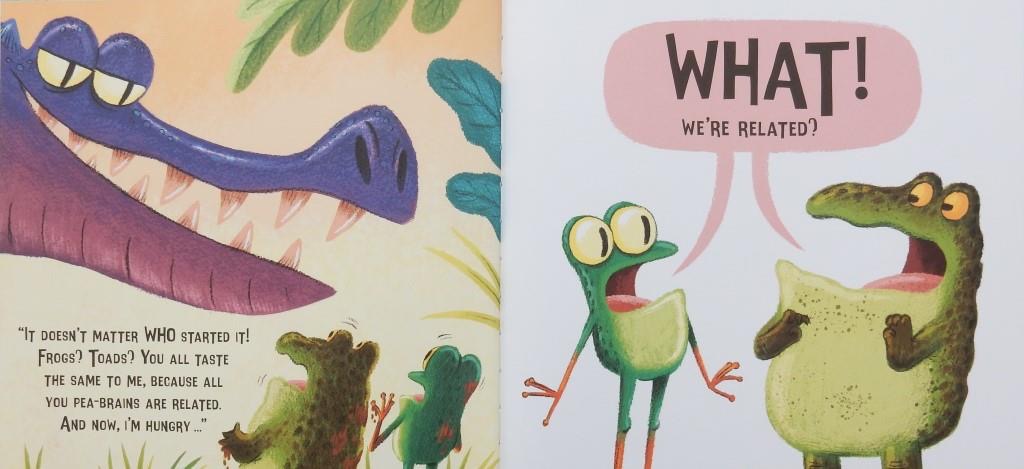
Seeing beyond our differences lies at the heart of Ben Mantle’s splendidly silly fable.

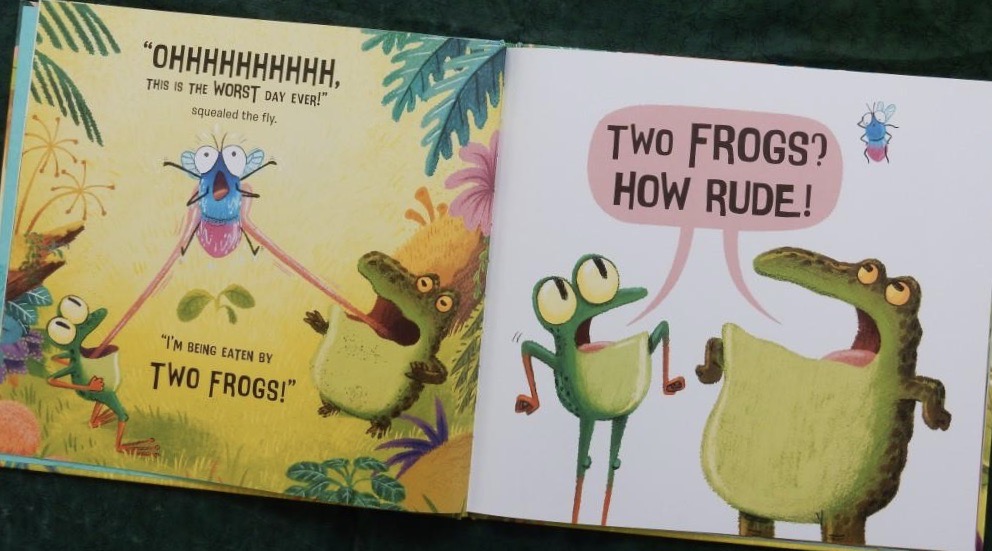
It begins when an unassuming fly is zapped by the tongue of Frog, followed shortly after by a second attack from the opposite side, this time by Toad. A nightmare situation for sure but what the fly says …

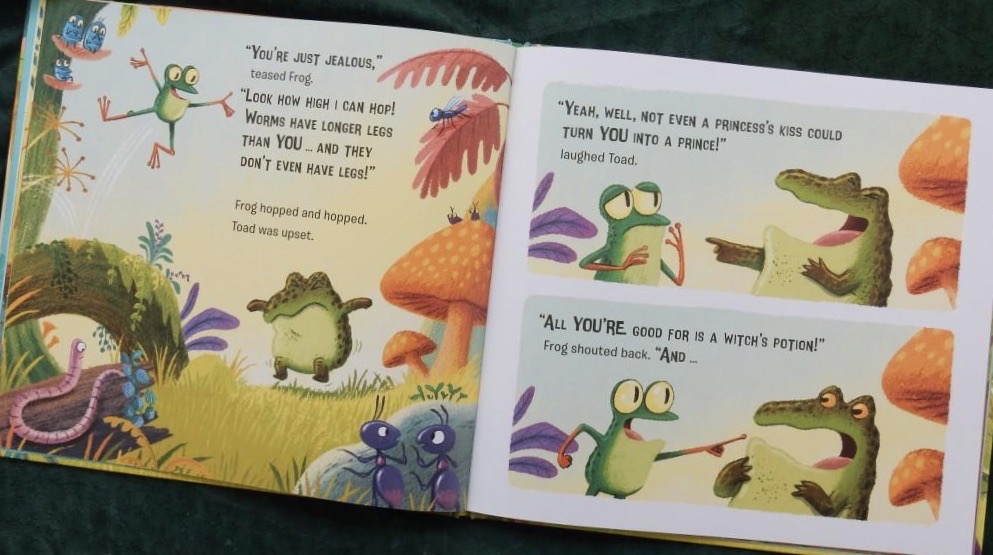
precipitates a set to between the two amphibians both of which feel grossly insulted by the fly’s remark. A tirade of verbal insults are hurled and the squabbling continues

until they reach the swamp where things get even more heated when Frog issues a final threat followed shortly after by some mud slinging of the physical kind, triggering a free for all with everybody joining in.

Both sides are so busy SLIP! SPLAT! SPLOTCHING and SQUELCHING that they fail to notice the approach of a large grumpy reptile displeased at being aroused from its slumbers. Quick to jump to their own defence Frogs and Toads blame one another but the jagged-toothed creature tells them something that comes as a huge surprise.

Both Frog and Toad are ready to accept one another as family members and apologies ensue, followed by some words of thanks to their informer. But that’s not quite the end of the story …

This is the first picture book for which Ben Mantle has written his own words. Being both a cracking storytime read aloud, and with an abundance of droll details – small and large – in every scene it’s a definite winner with me.

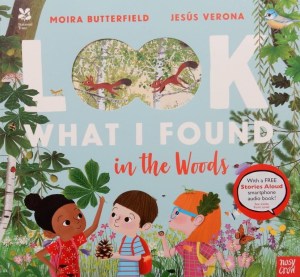
Look What I Found in the Woods

Look What I Found in the Woods
Moira Butterfield and Jesús Verona
Nosy Crow

‘Follow me. I know the way. / We’re walking in the woods today.’ So says the child narrator of this book.
The woods are my favourite place to walk and during the pandemic I’ve spent a lot of time so doing in woodlands close to my home, always returning home feeling considerably uplifted. Consequently I was more than happy to take up the invitation to participate in this woodland foray with the three child adventurers shown on the first spread.

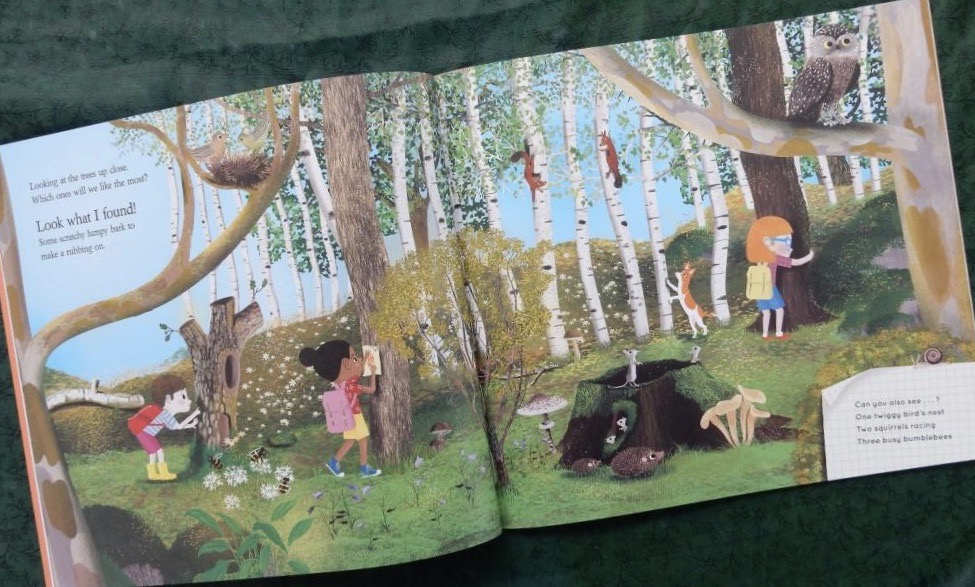
Readers are immediately engaged by means of an insert in the bottom right-hand corner that asks us to find one signpost, two butterflies and three bright yellow flowers.
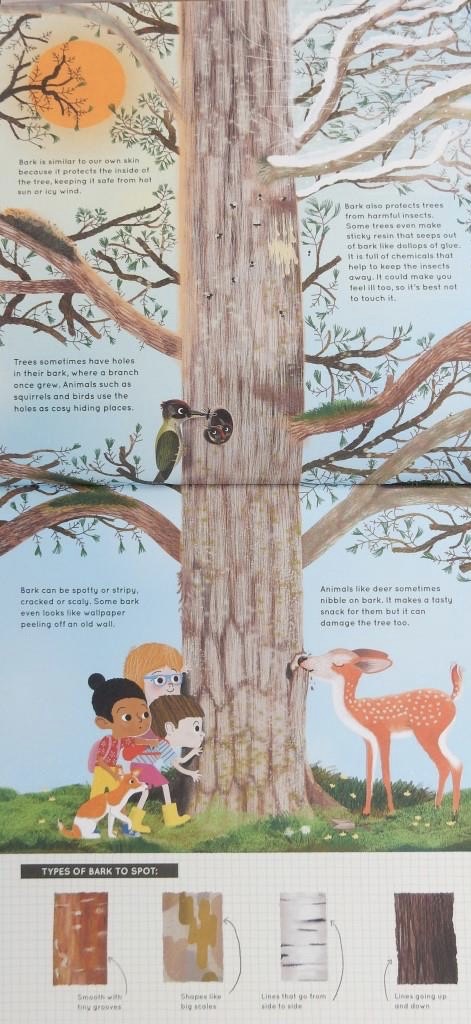
The second spread shows the children making observations while the text provides facts about the trees and a sidebar showing labelled tree shapes.

The subsequent spreads alternate between these two styles of layout

as readers learn about leaves, bark,

fruits and seeds, fir cones and shells while the children continue their exploration discovering exciting ‘treasure’ throughout their walk; treasure that they present on the final spread once back indoors.

This highly engaging nature book published in collaboration with the National Trust, successfully mixes story, non-fiction and search-and-find. Jesús Verona’s illustrations are an absolute delight. Each one offers an immersive scene to linger over and wonder at the fine detail included; and the final endpaper shows the children’s creative efforts with some of their findings.

Beyond the Burrow

Beyond the Burrow
Jessica Meserve
Macmillan Children’s Books

Rabbits prefer to stay close to their cosy burrows with other rabbits for company and juicy carrots for sustenance. When it comes to other creatures, particularly large hairy ones with claws, they’re considered terrifying, avoid at all costs, beasties.

When the Rabbit protagonist in this story discovers what looks like the most delectable breakfast carrot, little does she know that it’s about to change her life.

In attempting to reach said carrot, she takes a tumble and finds herself entering the wrong hole. Not only that but when she emerges it’s to feel herself plunging into the depths of a river. Happily she surfaces and is able to cling tight to a passing log but she’s far from her burrow. But then comes a face-to-face encounter with a not-rabbit that has all the alarming features Rabbit most fears.

Time to make a rabbity leap for safety and dig for all you’re worth.

Is this the end for our long-eared friend? She fears it might be so. Instead however, the not-rabbit pushes something towards her and such is Rabbit’s hunger that she risks a tiny bite.

Then follows an entirely new, brave idea that results in her climbing way up out of her comfort zone until she sees …

Despite claws and hairiness, the giant not-rabbit turns out to be ‘no so very scary’. Likewise the other not-rabbits that have gathered up in the treetops. Mutual acts of kindness ensue and Rabbit decides that falling can sometimes be fun.

That night though, she stays awake thinking about home and come morning, she spies a familiar sight far away. Time to try to reach it, but with friends in tow everything feels less scary

and eventually her burrow is in hopping distance …

Can things get any better? Perhaps, but to find out, you’ll need to get hold of a copy of Jessica’s book …

With plenty of dramatic moments, and full of warmth and humour, the story is huge fun to read aloud. Jessica’s depictions of ‘NOT very rabbity’ behaviour and indeed the antics of the treetop dwelling menagerie are highly entertaining. So too are the plethora of signs scattered strategically in various places throughout Rabbit’s adventure.

Toddler Bookshelf

The Great Big Egg Hunt
Ekaterina Trukhan
Nosy Crow
It’s a special egg hunting day with Rabbit and her friends. Having collected her basket, Rabbit and readers start the search. First Chick joins in and they search the bathroom where they discover Duck but no eggs. The search continues in the kitchen then moves out into the garden where eventually, after a few false starts, the five friends have an egg each. Hurrah!
With its simple, predictable text, plenty of flaps to explore and cute illustrations, little ones will enjoy participating in this seasonal search-and-find game.

Not quite a board book but sturdily made is:

Pip and Posy: The Friendly Snail
Axel Scheffler and Camilla Reid
Nosy Crow
Best friends Pip and Posy are spending time together outdoors in the garden. Pip is enjoying a spot of peaceful gardening but Posy is in a noisy mood banging and bouncing around. Suddenly Pip discovers a friendly snail while Posy continues with her noisy play, even frightening the snail back inside its shell. Enough is enough: Pip tells Posy to go away and upset, she disappears somewhere leaving Pip to continue with his work. So engaged is he that he fails to notice another creature getting ever closer to the snail. Happily Posy has been watching and now has the ideal reason to make a lot of noise …
An engaging tale illustrated in Alex’s trademark style, demonstrating an important life lesson: differences should be valued if friendships are to flourish.

Sleep, Cat, Sleep
Antje Damm
Prestel
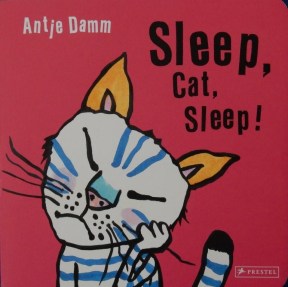
The cat in this little board book is not happy; he’s trying hard to sleep but the fact that somebody has opened the first page has roused him from his slumbers. He tries hiding and pleading, which seem to do the trick, but then the page is turned again and those delightful dreams disappear. However the sleepy creature perceives that the destroyer of his dreams is now also rather in need of some shut-eye – maybe it’s time to turn the tables …
Simple, playful, interactive fun for pre-bedtime sharing with sleepy little humans.

A Little Snail Book: Hide-and-Seek
Shasha Lv
Chronicle Books
Bear is playing hide-and-seek with his friends, Little Mouse, Little Turtle, Little Cat, Little Duck, Little Pig and Little Snail. Despite their best efforts he successfully finds all but Little Snail. The other animals are amused at the fact that the tiny creature is hiding in plain sight and little humans will have a good giggle at the fact that the smallest animal can outwit the seeker. It’s he that acts as narrator sharing his search in a simple first person narrative throughout the game.
Silly but lots of fun; Shasha Lv uses a limited colour palette effectively in her amusing scenes of the animals’ game.

Brookie and Her Lamb / Fish For Supper

Many years ago I was fortunate to meet M.B. Goffstein in The Children’s Bookstore in Brookline Village near Boston and she signed copies of two of her books – My Noah’s Ark and Natural History both of which I have treasured ever since.

So, I was excited to see that The New York Review Children’s Collection are bringing back into print two of her picture books first published over 45 years ago

Brookie and Her Lamb
Fish for Supper

M.B. Goffstein
The New York Review Children’s Collection

Brookie and her Lamb is a classic tale of a little girl’s unconditional love for her lamb. No matter what she tries to teach him – be that to sing or to read, even to sing songs from a music book, the only sound that emanates from the creature is ‘Baa, baa, baa.’ Nonetheless, despite being a little disheartened, she takes him for a walk to the park, which lifts her spirits. Back at home, she also goes to great lengths to show her appreciation of her friend, providing him a special spot with all the creature comforts a lamb might need,

and a great deal of tenderness too. Sweet and enchanting.

Subtle and utterly delightful in its quirkiness is the story of a grandmother’s daily routine, Fish for Supper. (A Caldecott Honor book 1977).
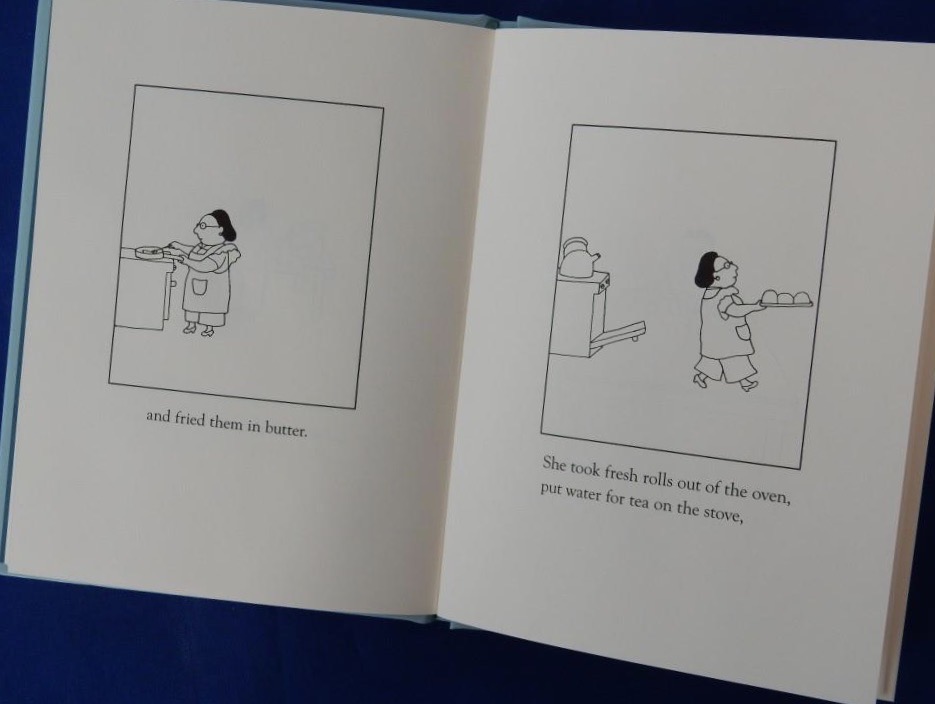
Of the narrator’s grandmother, we learn that she rises early, makes herself some breakfast, washes up, dons her sunhat and heads off to the water. There, with her simple fruit lunch and fishing gear, she gets into a rowing boat and spends the day fishing on the lake.
Come the evening she heads home carrying her catch in a can. She cleans the fishes then, fries them,

consumes them with care, washes up and goes to bed. Next morning she does the same … .
The characteristic spare line drawings herein are examples of perfect simplicity.

I suspect these little books will probably be of most interest to those studying children’s literature and or, art.

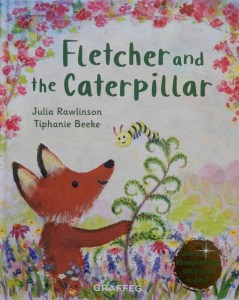
Fletcher and the Caterpillar

Fletcher and the Caterpillar
Julia Rawlinson and Tiphanie Beeke
Graffeg

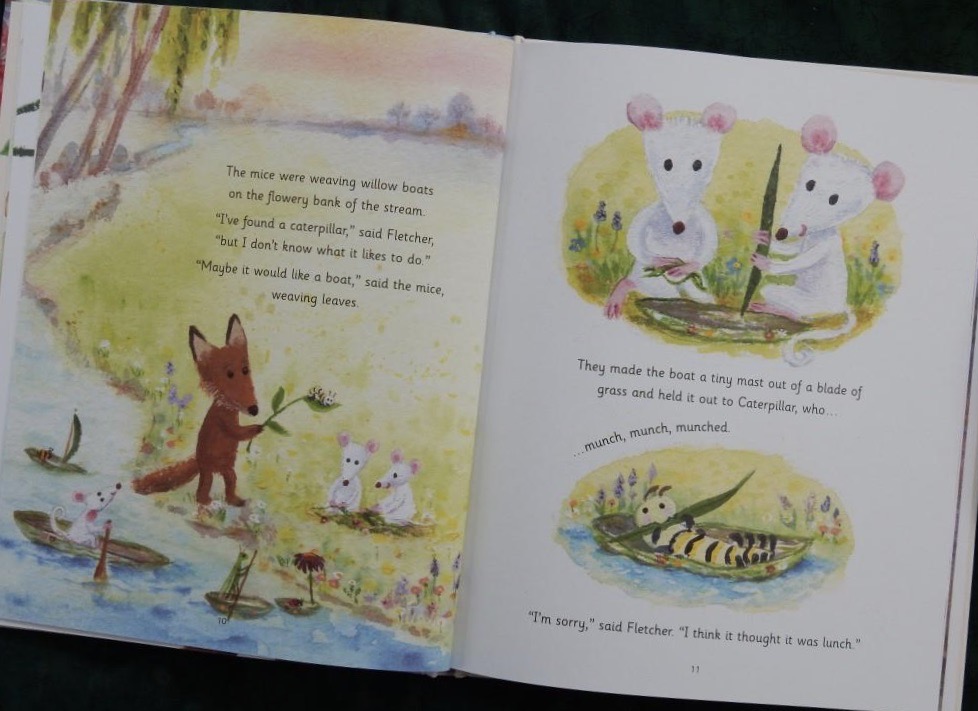
For those, like this reviewer, meeting the main protagonist for the first time, Fletcher is an inquisitive little fox, and a bit of a worrier. His new story starts in the spring with the observant vulpine noticing that while everything else in the wood is growing, there’s one green leaf that is actually getting smaller. On investigation, he discovers a tiny caterpillar having a nibble. Friendly as always Fletcher, with the aid of his other animal friends, tries to involve the caterpillar in such activities as racing, boating

and hide and seek, but all the caterpillar is interested in, is munching.

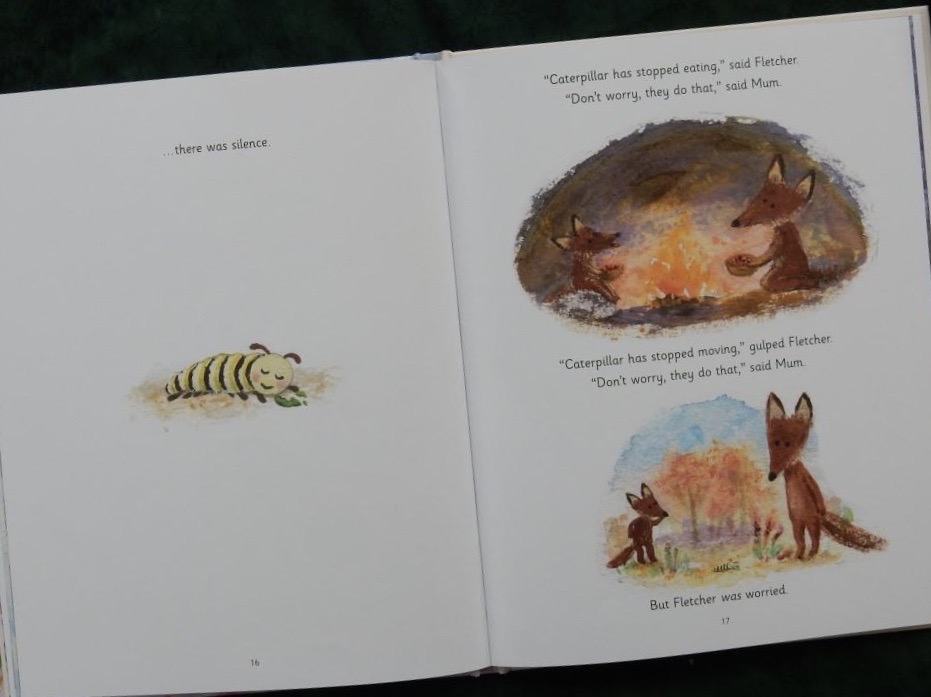
One day though, the munching stops; the little creature is still and silent. Fletcher’s Mum reassures him that it’s normal caterpillar behaviour

but the cub is still concerned for its well-being, watching over it until he falls fast asleep.

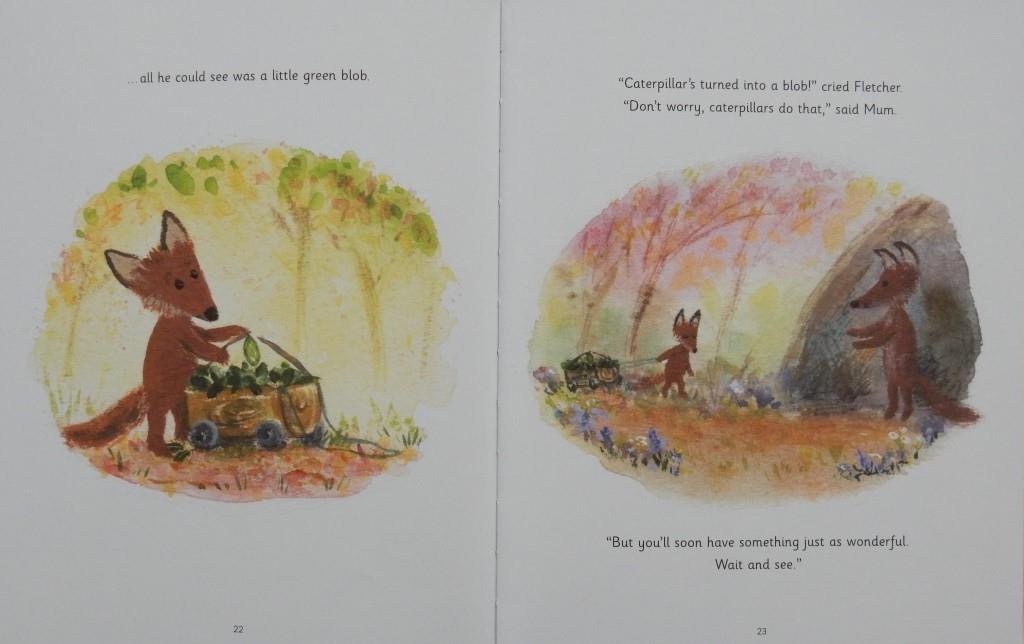
Overnight a change occurs mystifying Fletcher but again his Mum tells him it’s what caterpillars do and soon he’ll have a wonderful surprise.

After a long, long wait, sure enough he does.

With Julia Rawlinson’s sweet, gentle nature narrative she paints a picture of friendship and of spring; a picture that is echoed in Tiphanie Beeke’s soft, textured, sun-infused art, which shows so well the colours and joys of its seasonal setting and one of nature’s wonderful mysteries.

Not In That Dress, Princess!

Not In That Dress, Princess!
Wendy Meddour and Cindy Wume
Otter-Barry Books

Full of spirit and exuding energy from cover to cover, this is the story of how a strong-minded young Princess Bess tosses aside gender stereotyping norms – “There are things we DON’T DO in a dress!” …

“a princess must always impress” and does exactly what she wants to do, proving that dress notwithstanding, there is absolutely nothing, this determined female can’t do.

Her brothers, the princes More and Less, along with a host of animals large and small, watch in awe as she scales tall buildings, hikes, skis through a storm, goes on safari,

cavorts with a wizard and much more.

Eventually the queen, her highness Gloriana Stephaness, realises that it’s a case of no holds barred: her daughter’s behaviour IS truly impressive. She even decides to make a public announcement concerning dress code; moreover it’s not long before other, unlikely royals, are also sporting dresses.

Wendy Weddour’s jaunty rhyming narrative will have young listeners joining in with the oft repeated “in my dress” as they relish the sight of Bess (Cindy Wume shows her in a different dress for every activity) having the most incredibly exciting time beyond the confines of the palace.

I’ve always had a soft spot for children – real or in stories – who push the boundaries, challenge and subvert pointless rules and are ready to break out of their narrow confines: Bess joins their number

A Poem for Every Spring Day / The Best Ever Book of Funny Poems

Here are two recent poetry collections from Macmillan Children’s Books – thanks to the publishers for sending them for review

A Poem for Every Spring Day
ed. Allie Esiri

This is the third in the seasonal series – almost every one of which is taken from Allie Esiri’s A Poem for Every Day of the Year and A Poem for Every Night of the Year and once again it’s brimming over with poetry to lift your spirits.
Among the offerings herein you’ll certainly find many old favourites – lots took me right back to my days in primary school and even before that when my dad read A.A. Milne and Lewis Carroll aloud to me, as well as unearthing some new treasures.
As with the Autumn and Winter books, there are two poems for each day from 1st March through to the end of May and again Allie provides an introductory paragraph for each of her selections. Most of us associate spring with new life and yes, there are plenty of entries reflecting that aspect of the season but it’s more than just longer days, birdsong and buds opening and A Poem for Every Spring Day reflects this. There are poems commemorating specific occasions such as Rachel Rooney’s First Word (After Helen Keller) where she writes of Helen feeling water flowing from a pump with one hand while the letters for ‘water’ were spelt on her other palm. That moment took place on April 5th.
Another one that is hugely moving and also new to me is Duranka Perera’s Bitter State. The poet is also a doctor living in the UK and native of Sri Lanka where horrendous terrorist attacks took place on 30th March. It begins thus: ‘I was angry when it happened. / I was angry when the numbers continued to rise. / I was angry when bitter tongues lashed old wounds. / I was angry when a dying monument drew more /money than / The dying themselves.’
From John Agard to William Wordsworth, whatever your taste in poetry, there will be plenty to savour in this collection.

The Best Ever Book of Funny Poems
chosen by Brian Moses

Poet Brian Moses has chosen an assortment of splendidly silly poems for this compilation of over a hundred giggle inducers.
The selection has ten sections, each named with a line from or title of, one of the poems included. Thus for example we have ‘The red ear blows its nose’ from Robert Schechter’s What’s Mine for the first – Silly and Even Sillier Poems.
The teacher part of me wanted to turn next to the Headmaster’s Welcome where among the thirteen I totally loved Brian’s own The School Goalie’s Reasons …
The writer/reviewer part of me just had to turn next to the Fantasy and Fairy Tales offerings where there are some terrific four liners including Rachel Rooney’s Epitaph for Humpty Dumpty: ‘ Beneath this wall there lies the shell / Of someone who had talents. / But (as you can probably tell) / One of them wasn’t balance.’ What a great starting point for a bit of epitaph writing in the classroom using a nursery rhyme theme. On the subject of the classroom, in the Funny Poems About Poems section is Joshua Seigal’s terrific I Don’t Like Poetry that offers a smashing lesson on similes, metaphors, alliteration, onomatopoeia and repetition. An invitation to youngsters to play around with words for sure.
Should your taste be more for pets, dinosaurs, family, space or things spooky, never fear: you’ll find all these covered too.
We all need something to cheer us up at the moment so why not start with this collection: it will long outlast the current pandemic however.

The Tale of the Whale

The Tale of the Whale
Karen Swann and Padmacandra
Scallywag Press

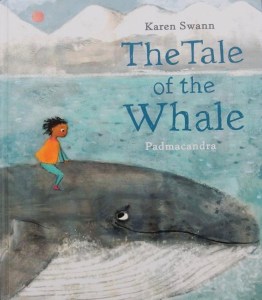
Karen Swann’s lyrical story begins with a child on a lighthouse spying a whale out at sea, a whale whose sweet-sounding song calls the child to climb aboard its back and join it on an amazing marine adventure.

An adventure through marine waters that turns from the utter heartfelt joy at seeing the incredible life under the ocean – the stunning colours, the octopus,

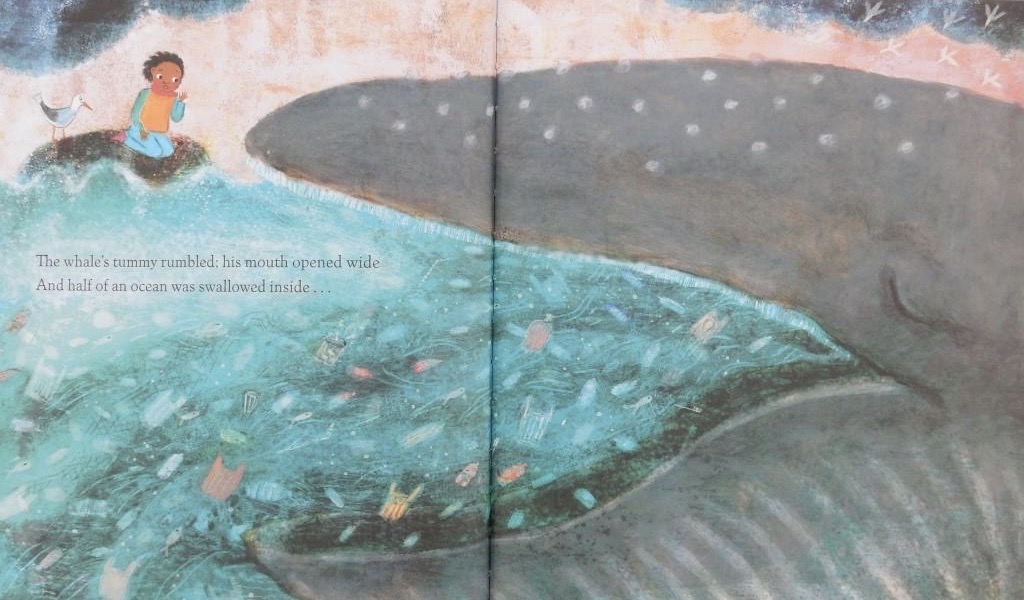
turtles, rays, dolphins and more to shock horror and understanding when the whale opens wide its mouth to eat.

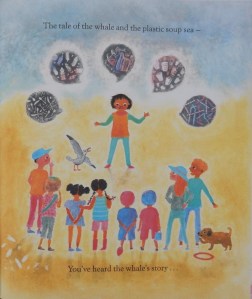
This is followed by sadness and, once back on land, a determination to tell others and an earnest plea from the young storyteller to be part of the change. It’s a plea that will surely galvanise youngsters and adults alike to work together on this crucial environmental problem caused by plastic pollution.

Padmacandra’s illustrations are truly gorgeous capturing both the friendship between child and majestic animal, and the richness and vibrancy of the oceans’ fauna. This is the debut picture book for both author and illustrator and it’s one where words and pictures work in perfect harmony. The observant among readers and listeners will spot the point in the story when plastic starts to be included in the subaquatic scenes.

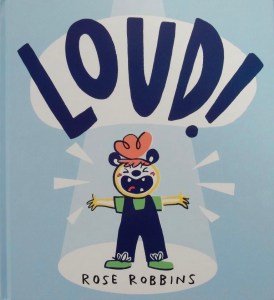
Loud!

Loud!
Rose Robbins
Scallywag Press

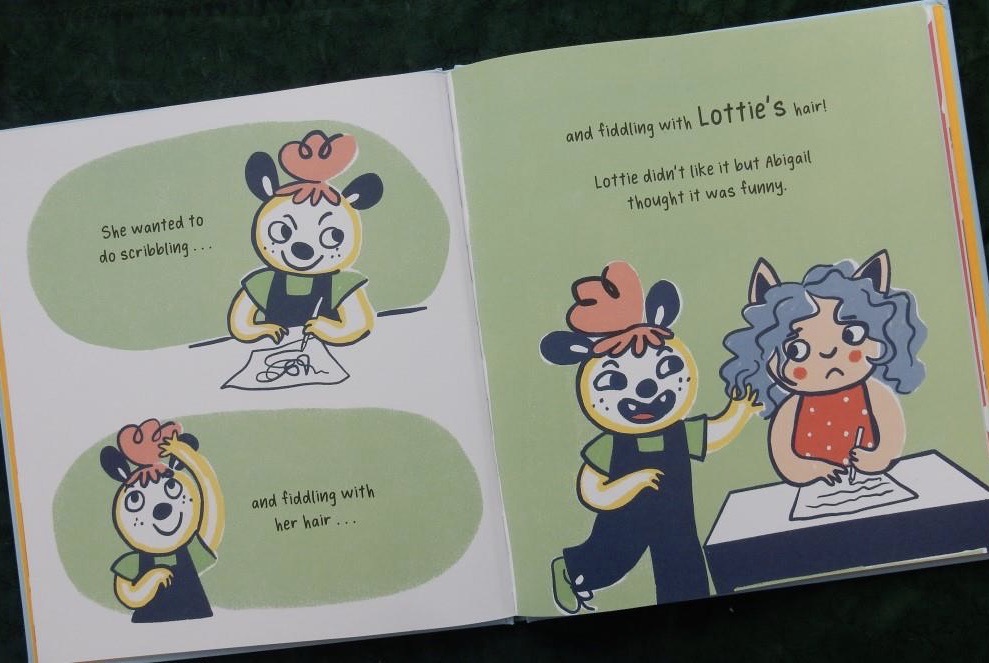
Rose Robbins’ latest picture book celebrates another cognitive difference that comes under the neurodiversity umbrella. Abigail has ADHD and she’s having one of those tricky days in class where her restless frustration leads her to do things that displease and disrupt others.

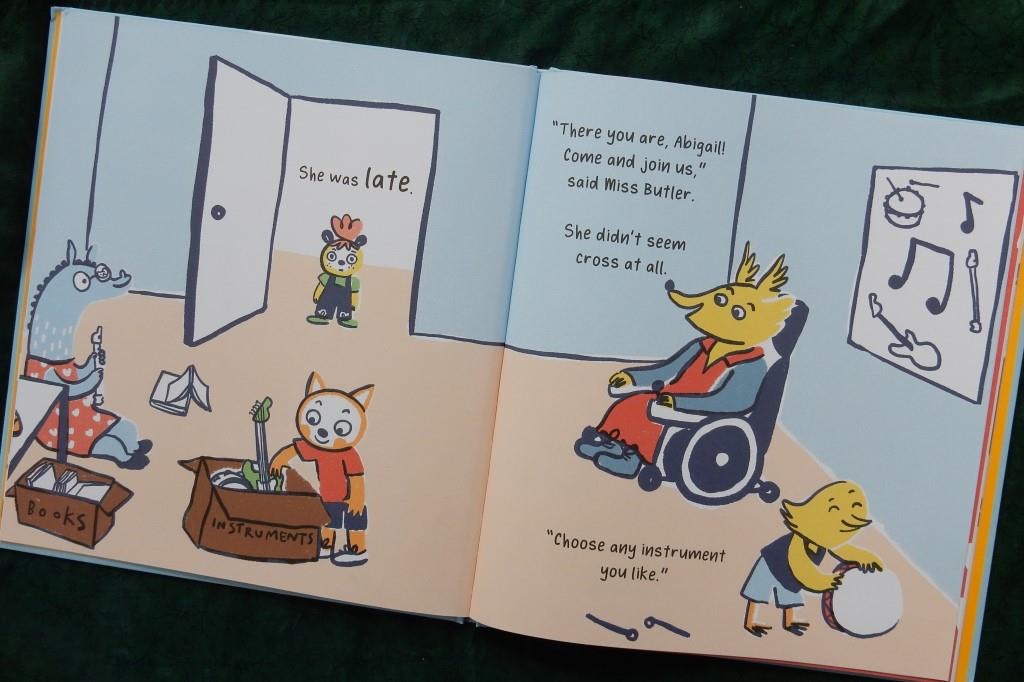
As a result she’s taken to the ‘calming down’ room for a while which makes her late for her next lesson. It’s music – a new activity for Abigail and despite her lateness, she receives a friendly welcome from the teacher, Miss Butler.

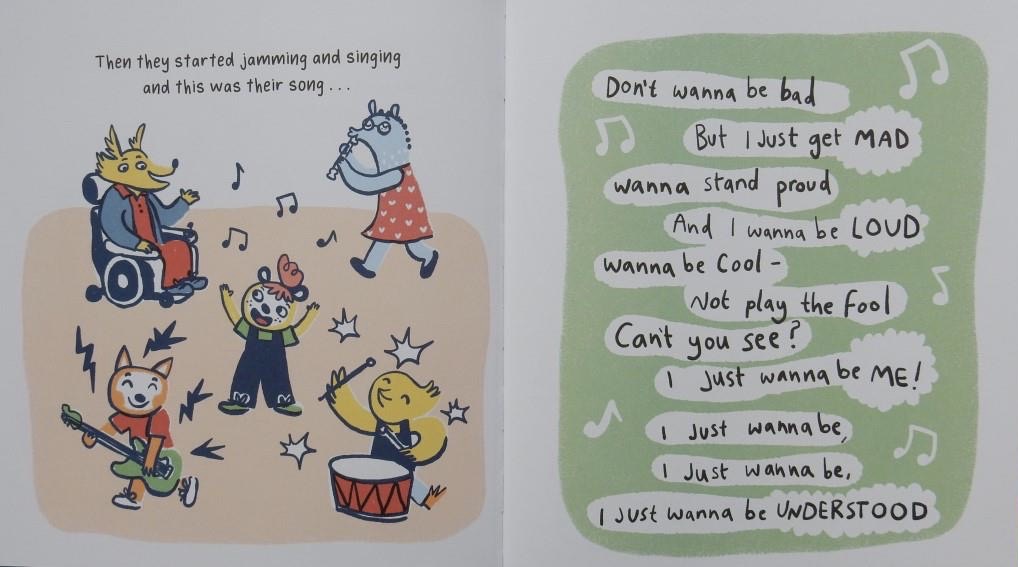
The other class members all seem to have a musical talent of one kind or another but Abigail struggles to find a way to join in successfully. Out of sheer frustration she lets out an enormous SCREAM! that causes cool, calm Miss Butler to approach her. Abigail expects to be sent back to the ‘calming down room’ but instead, her accepting teacher praises her voice, speaking of its singing potential. A transformation begins and with support Abigail finds a role, becoming the group’s totally cool singer-songwriter …

Sometimes a serious topic is best approached through humour: it’s certainly very successful here with Rose Robbins’ quirky illustrative style.

An important inclusive book for all youngsters and their teachers in early years and KS1 classes, as well as for sharing at home.

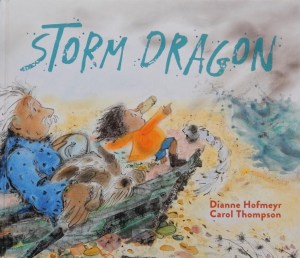
Storm Dragon

Storm Dragon
Dianne Hofmeyr and Carol Thompson
Otter-Barry Books

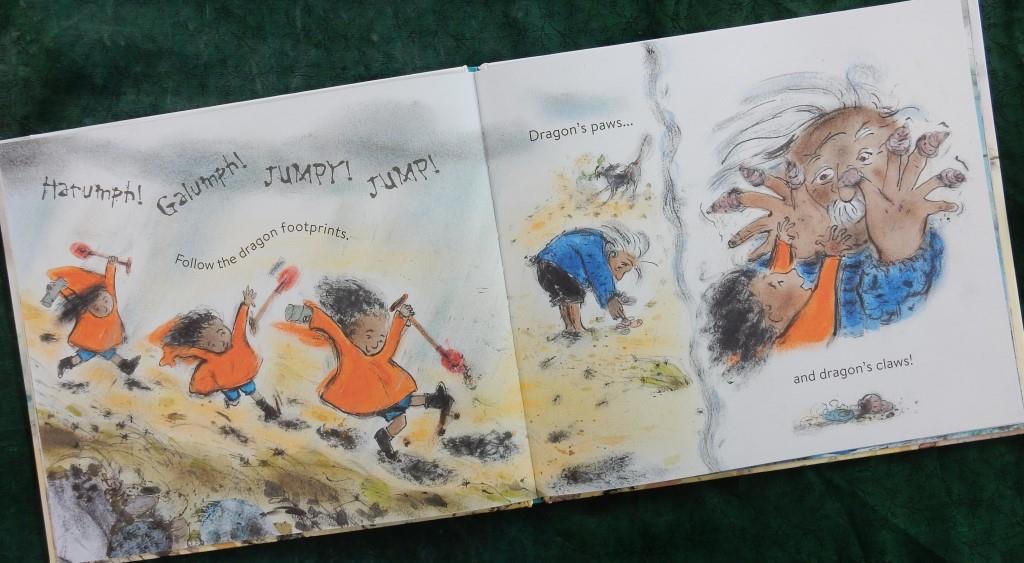
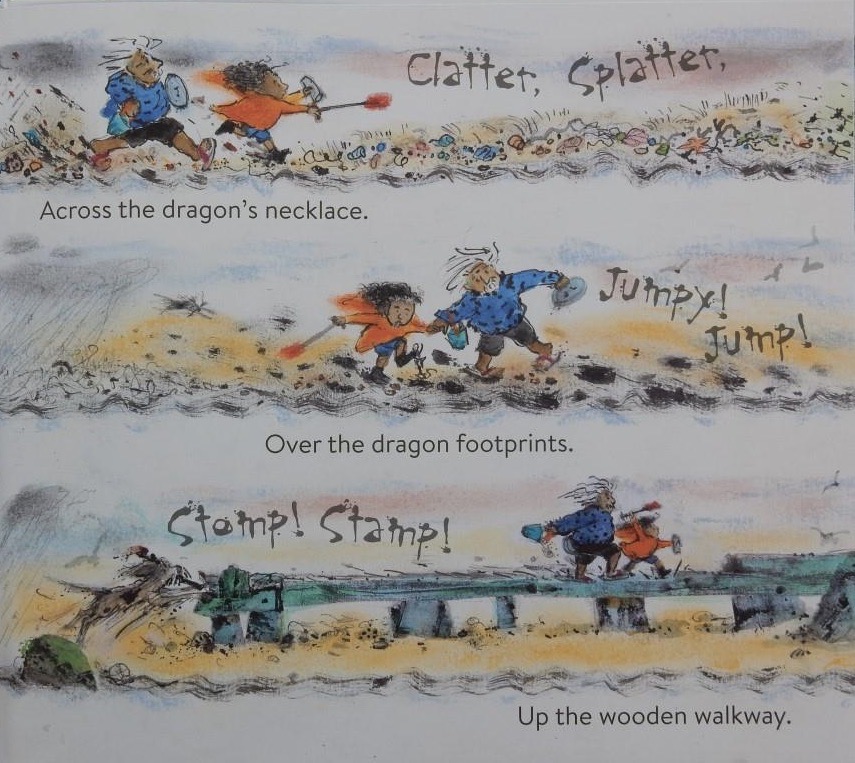
Faced with the furious wind and rain buffeting their tiny seaside cottage, Grandpa suggests it’s the ideal time to go on a storm dragon hunt. Armed with shield and spy glass off they go TRIP! TRAP! STOMP! STAMP! down the rickety walkway and onto the beach.

Following the dragon footprints, Grandpa is in playful mood as he stops to collect dragon’s paws and claws.

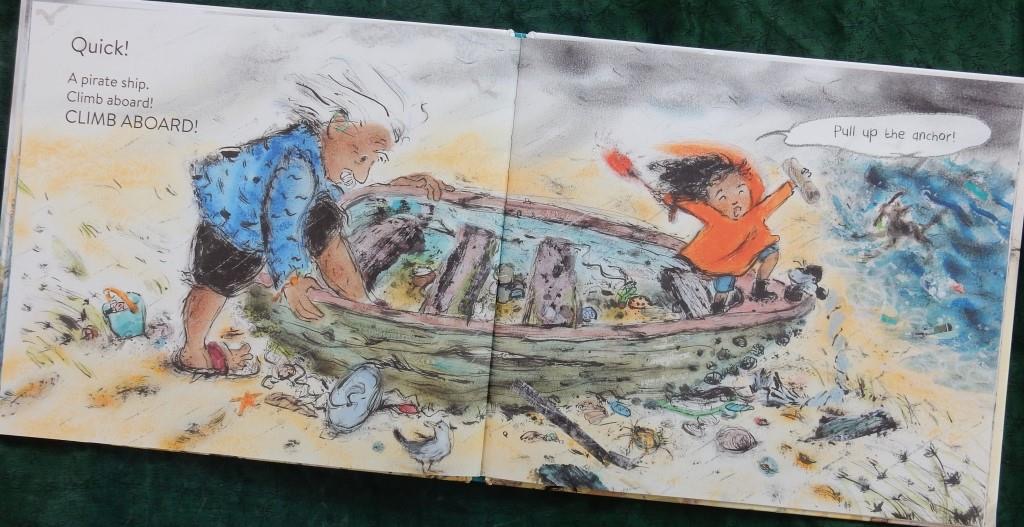
Then on they stamp through the ‘dragon’s jewels’ skittering, scattering, clattering and splattering until again Grandpa stops. Now he’s found a ‘dragon baby’, which can mean only one thing – the close proximity of its mother. They can both smell her as she puffs towards them. There’s only one thing to do: climb into that pirate ship and continue the dragon watch from on board.

She’s definitely there and coming ever closer … leaving the adventurers no choice but (with a nod to We’re Going on a Bear Hunt) to retrace their path …

all the way back home.

With Carol Thompson’s splendidly spirited illustrations accentuating the intergenerational relationship and the power of imaginative play, and a smashing read aloud text, this is a MUST to share with foundation stage listeners. They will delight in joining in, first with the wonderfully alliterative sounds and then, on a second or third reading acting out the trip-trapping, stomp stamping, harrumphing and galumphing, jumping, tramping, climbing into the boat, raising the spyglass and then finally clatter and splatter, running all the way back, pushing open the door and hiding from …

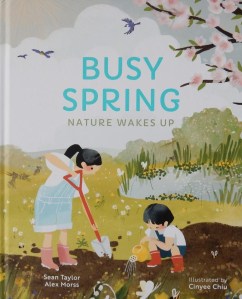
Busy Spring: Nature Wakes Up

Busy Spring: Nature Wakes Up
Sean Taylor , Alex Morss and Cinyee Chiu
Words & Pictures

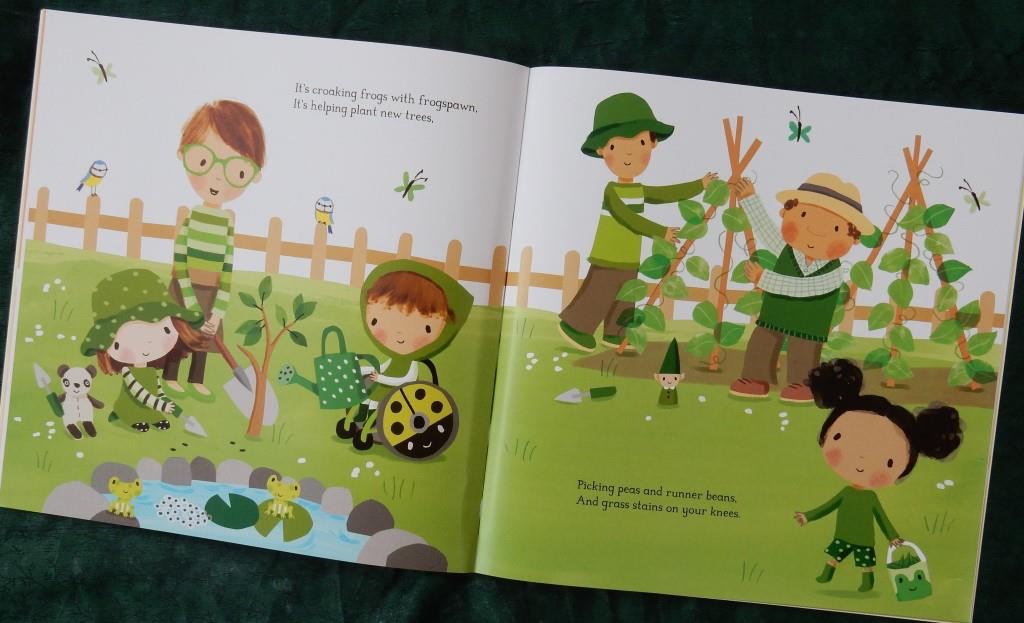
If you live in the northern hemisphere, like me you have probably been noticing beautiful wild flowers – snowdrops, daisies, celandines and primroses springing up, an abundance of catkins, blossom starting to open on trees, pussy willow buds bursting; as well as the occasional bee and butterfly. We even saw frogspawn a couple of times last week (the end of February). Definitely spring, with its promise of so much, is my favourite season and this year it seems even more important than ever to celebrate its arrival.

That is exactly what the two children in this beautiful book (written by children’s author Sean Taylor and ecologist Alex Morss) are doing. The older girl acting as narrator, tells us how what starts out as a hunt for Dad’s fork so he can plant some carrots turns into an exploration of the family’s garden. ’Everything smelled like wet earth and sunshine.”

“The spring sunlight is nature’s alarm clock,” Dad says, taking the opportunity to mention pollination.
Both girls are observant, asking lots of questions and noticing signs of new life all around – tadpoles,

a bird building its nest and a wealth of minibeasts – ants, woodlice, worms and beetles and several species of butterfly, as well as playfully emulating some of the creatures they discover.
Throughout, Dad subtly provides snippets of relevant information concerning life cycles, habitats

and what causes the seasons; and throughout the children’s sense of excitement is palpable.

Cinyee Chiu’s illustrations are absolutely gorgeous, beautifully composed and carefully observed.

At the back of the book are several pages of more detailed information about spring and how it affects the flora and fauna, as well as some suggestions for ways children can get involved in helping nature in its struggle against climate change.

A must have book for families with young children, as well as foundation stage settings and KS1 classrooms.

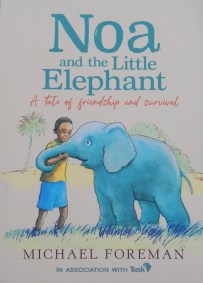
Noa and the Little Elephant

Noa and the Little Elephant
Michael Foreman
Harper Collins Children’s Books

Michael Foreman takes up the cause of wildlife protection in this lovely little book published in association with TUSK a charity that helps protect African wildlife, in support of which Ugandan ranger and wildlife authority, Julius Obwona, has written a forward.

Young Noa’s favourite animals are the elephants he watches every day after school as he returns home in the little boat built for him by his father. One day though, they aren’t in their favourite wallowing place in the river so a concerned Noa decides to follow their tracks into the jungle.

When he emerges on the far side he sees what he first thinks is a new game the little elephant is playing with his mother. On closer inspection though – horror of horrors – this is no game. The mother elephant is lying dead and her tusks have been removed.

After a while the baby elephant overcomes his fear and allows Noa to approach and comfort the creature. The boy makes a decision: he resolves to take the little tusker home and care for him in his village.

Back at home, his father tells Noa about the cruel poachers that shoot elephants for their valuable tusks and how the villages have grouped together to try and prevent such cruelty. Noa’s sister, Eva names the elephant Tembo and it’s not long before he’s part and parcel of village life. 

One night at the start of the rainy season a terrific storm arrives causing the river to overflow its banks so Noa rushes down to the water to secure his boat and in so doing is caught in the wild roaring current and is swept away. 

Fortunately however ‘something solid ‘is in the water that enables him to haul himself to safety.

Thereafter a beautiful rainbow appears over the village and a thankful Noa resolves that when he’s older, he’ll join his fellow villagers in protecting the elephants: “We are all one family living under the same sky and sharing the same world” he tells Tembo.

Superbly illustrated, and simply and movingly told, this tale of love and survival is most definitely a book for young animal lovers be they solo readers or listeners.

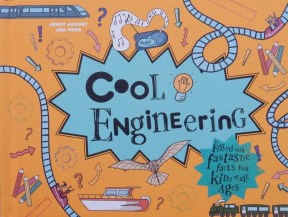
Cool Engineering

Cool Engineering
Jenny Jacoby and Jim Venn
Pavilion Books

This latest in the Cool series looks at the various branches of engineering, provides short pertinent biographies of key engineers through the centuries including Isambard Kingdom Brunel, Frank Whittle, Hedy Lamar and Tim Berners-Lee, as well as the history of engineering from the invention of the wheel right up to today’s technology as used in such things as clean energy. 

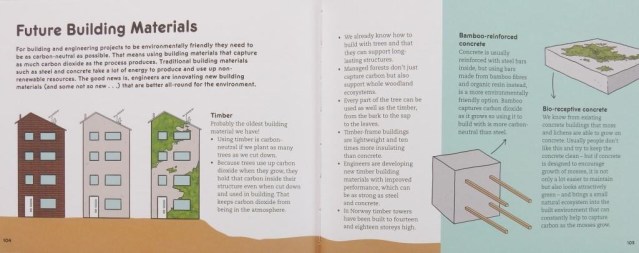
There’s even a look at some future projects including innovative new building materials – whoever would have thought that encouraging mosses to grow on concrete (bio-receptive concrete) would become a good thing to do.

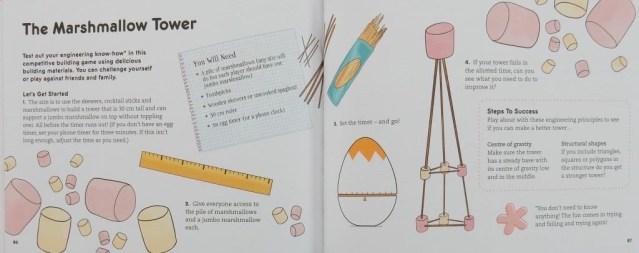
There are plenty of interesting experiments to try at home or school – the marshmallow tower is a fun example and can include an element of competition.

There’s so much to like about this engaging little book including the clear layout, ‘Cool facts’ boxes, quotes from the engineers featured, a timeline and alluring contents page, glossary and Jem Venn’s slightly quirky illustrations. It’s especially good in a STEM book such as this to see importance given to the sketching of ideas.

If you want children to think like engineers, then include this book in your classroom or family collection – it’s a good place to start.

Anita and the Dragons

Anita and the Dragons
Hannah Carmona and Anna Cunha
Lantana Publishing

As the story opens, young Anita watches the dragons high above the rooftop where she sits in a village in the Dominican Republic imagining she’s a ‘valiant princesa’. She’s done so for years and never lets the huge beasts scare her.

Today is different though: she must say goodbye to some special, much loved people including her Abuela

and actually meet one of these dragons. Indeed she must go inside the body of a massive beast for she and her immediate family are to be carried far, far away from their beautiful Caribbean homeland to a distant place where they’ll start a new life. Her Mama has talked of learning English, plenty of accessible hot water and electricity that’s reliable.

However such promises cannot stop the mounting anxiety she feels – “What if I’m lonely? What if I get scared?” – as she is confronted by the gigantic dragon; but she’s not alone in knowing that she will miss her island home, her parents and siblings are also filled with apprehension.

Now Anita must be that brave princesa again: with chin held high once more, she bids farewell to her home, promising to return one day, and then steps boldly forward into the unknown.

Anna Cunha’s captivating, soft focus illustrations work in perfect harmony with Hannah Carmona’s lyrical first person narrative in this sensitive exploration of emigration.

All Manner of Board Books

Hello You!
illustrated by Stephen Barker
Campbell Books
With its die-cut cover, this is a smashing book for adults to share with their babies. Herein they can meet familiar family faces : mummy (being funny), daddy doing a wiggly dance, a snoozing grandad and a snuggly grandma.
The final spread is a gatefold guessing game that’s just right for developing early language and there is also an additional peep hole to play peek-a-boo.
Stephen Barker’s alluring captioned images stand out from the brightly coloured backgrounds.

Lizzy the Lamb
Axel Scheffler
Campbell Books
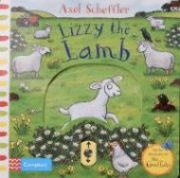
Lizzy the lamb is a lively creature. As she frolics and cavorts in the fields, she sometimes gets splashed by the geese so she shakes her fleece dry before moving on to chase the bunnies, but they’re too quick for her. It’s a tired but happy Lizzy that ends the day bleating her satisfaction, with a “Baa, baa!” to her farmyard pals.
Accompanying the rhyming narrative are Alex Scheffler’s droll illustrations – the full page ones capturing Lizzy’s joie de vivre perfectly and the vignettes that focus on some of the other animal characters. Little ones will enjoy working the sliders and wheel, joining in with the relevant animal sounds and perhaps, adding some leaping, shaking and hopping actions. In so doing they’ll be developing their fine and gross motor skills, and sound/symbol awareness.

Honeybee
illustrated by Teresa Bellon
Campbell Books
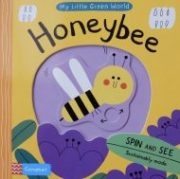
A honeybee acts as the narrator of this ‘eco-friendly’ natural history book, introducing little ones to her world through a rhyming text and labelled scenes.
The latter offer a look inside a beehive and a close up of a honeycomb while the bee describes simply, the processes of pollination, the collection and use of nectar in the making of honey, as well as how little humans can help the honeybees that live close to their homes.
Teresa Bellon’s illustrations of bees at work are engaging and playful; most have moving parts to add to the fun. Aimed at encouraging preschoolers to become nature lovers, this is one of a new “My Little Green World’ series that are sustainably made with FSC paper and printed with vegetable inks.

Goodnight Farm
Carmen Saldaña
Little Tiger
Peep-through pages enable little ones to discover a wealth of farm animals and bid them a “goodnight” as, accompanied by a collie dog, and guided by Becky Davies’ brief rhyming narrative, they visit a hillside, a grassy pasture, hen house, a pond, the stable, a flock of sheep in the field as the moon shines bright above.
In addition to the main rhyme, simple farm related facts are scattered throughout Carmen Saldaña’s starlight scenes offering simple snippets of information such as ‘Ducks can sleep right on the water.’ or ‘Pigs sleep a lot – up to 11 hours a day!’ (something even this adult reviewer didn’t know.)
Just right for sharing with sleepy humans just before bed.

Let’s Go! On a Plane
Let’s Go! On a Digger

Rosalyn Albert and Natalia Moore
Catch a Star
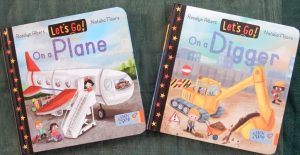
Whether they prefer the excitement of boarding an aeroplane and jetting off to a holiday destination in the tropics or keeping their feet firmly on the ground and watching the digger driver hard at work on a construction site, the very youngest children will find plenty to interest them in these new additions to the popular Let’s Go series.
In both books children act as narrators of Rosalyn Albert’s simple text which takes the form of rhyming couplets, while Natalia Moore’s strikingly coloured spreads fill in the detail.

When We Went Wild

When We Went Wild
Isabella Tree and Allira Tee
Ivy Kids

This is prize-winning author, conservationist and rewilder, Isabella Tree’s first book for children. Herein she describes what happens when farmers Nancy and Jake decide to convert their failing farm (the animals and even the trees look sad), and whereon they use chemicals for crop growing and machines for milking and harvesting, for something totally different – a haven for wildlife.

Nancy’s idea so to do means they can sell off all the machinery and pay off their debts. Then it’s a waiting game: soon the bare earth is covered in wild flowers, brambles and bushes,

and their animals now roaming free seem much happier.

Their neighbours though, are far from pleased and write to the local paper complaining about the messy vegetation spoiling their view.

Will Nancy and Jake have to abandon their plans and return to conventional technology-led, intensive farming? Happily not. When a storm and torrential rain hits the village everyone prepares for the worst as flash-flooding strikes across the country but that messy vegetation helps to slow and absorb the rainfall and the village is spared. A lesson learned thanks to a near disaster,

and soon everyone is going wild.

Allira Tee’s digital illustrations for this thought-provoking, important book are beautiful and from the alluring cover, every page full of engaging detail.

On the final spread, the author explains what rewilding actually is and talks a little about its importance and her own experience. (The book itself is sustainably produced).

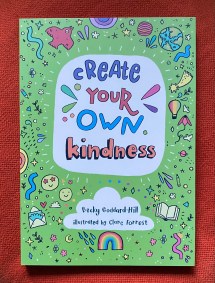
Create Your Own Kindness

Create Your Own Kindness
Becky Goddard-Hill, illustrated by Clare Forrest
Harper Collins Children’s Books

Kindness – especially towards other people, is something that we’ve all focussed on during this past pandemic year and I’m sure that with so much time spent away from school and friends it’s taken a toll on the mental health of many youngsters. Indeed, it’s likely that all children could benefit from knowing ways to be kind to themselves, in particular.

As well as being a well-being and lifestyle blogger and writer, the author of this book is a children’s therapist and mother, so she definitely knows the importance of children’s emotional well being.

This the third title in the Create Your Own series is absolutely bursting with practical ideas that will help youngsters to develop the life skills necessary to be kind to others, to the planet and crucially, to themselves.

The activities are wide-ranging and presented in an engaging style, the first section being devoted to self kindness. Herein readers can find out about such things as how to use the breath to calm the mind, how to make a kindness cake and I especially liked the idea of creating an emotional first aid box. Each of these would work equally well if used by children in the classroom or individuals at home. This is true of the ideas in the other sections and there’s even a great suggestion relating to World Kindness Day (13th November) and how it can be celebrated by schools as a whole.

If we want children to be resilient especially after all they’ve been through this last twelve months, then this book, invitingly illustrated by Clare Forrest, is well worth putting their way.

Chicken Come Home!

Chicken Come Home!
Polly Faber and Briony May Smith
Pavilion

Dolly is a free range chicken who likes to tease her owner and best friend by laying her egg somewhere different every day.

One morning she discovers a new place that seems very comfortable although rather dark and strange; but then all of a sudden she finds that her roosting spot is on the move.

However, she’s not keen to see the world from so great a height – it’s her boy she wants – so instead, she opens her wings and down she plummets, crashing through the trees and ending up in a fast flowing river – ideal for ducks but certainly not for Dolly.

Having managed to haul herself out onto dry land, she’s faced first with a snorting cow and then a noisy, dangerous road to get across.

Meanwhile on his way home from school, Dolly’s owner suddenly hears a lot of beeping as the bus he’s travelling home from school on is held up by something in the middle of the road … What could it be?

Readers share a bird’s eye view of Dolly’s unexpected journey in Briony’s superb visuals that are both wonderfully detailed and the ideal complement to Polly’s dramatic text with its ‘perfect’ ending.

Hard Times for Unicorn

Hard Times for Unicorn
Mickaël El Fathi and Charlotte Molas
Tate Publishing

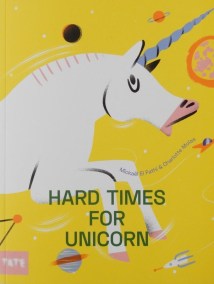
Unicorns are all the rage with young children nowadays but how many have wondered what happened to the very last of them. Here’s an absolutely absurd story that offers a possible explanation: it begins in a forest in Siberia. There a young explorer captures this one-horned rarity but rather than keeping her safe, the very next day the hunter loses her to a fisherman in a card game.

A failure at fishing, the fisherman sells her to a knight who quickly passes her on to an athlete. The partnership of pole vaulter and unicorn is highly successful and the two become world famous.

A robber sees how useful the creature might be and so his gain is the athlete’s loss but before many weeks have passed, the police catch the guy in action, seize the ‘safe-opener’ and leave her in the circus and she becomes a star act … until the circus closes and the creature changes hands again … and again …

until eventually the kind narrator of this story decides that the long-suffering unicorn deserves a happy ending …

To call this book quirky is probably an understatement; it’s decidedly different from the usual sparkly unicorn kind of tale. With its twists and turns this one sees the creature serving purposes ranging from curious to practical, but always innovative. It’s likely to appeal to divergent thinkers rather than lovers of fairytale magic.

The Forgettery

The Forgettery
Rachel Ip and Laura Hughes
Egmont Books

Memory loss and dementia are ever increasing and although adults are well aware of this challenging topic, it’s not easy to open up a discussion with young children about why a much loved grandparent for instance, is unable to remember things. Sharing this beautiful book is a wonderful place to start: it never once mentions the word dementia during the story of Amelia and her Granny and their adventure together.

From the outset we’re told that Granny is forgetful, sometimes being unable to recall where she’s put the marmalade or where she keeps her socks but sometimes forgetting important things like special moments. Amelia is a daydreamer and explorer and this means that she too is apt to be a bit forgetful.
One day while exploring in the forest together they stumble upon a strange place called The Forgettery and decide to investigate.

They receive a warm welcome and Amelia explains that they’ve forgotten their way home. The kindly Memory Keeper invites them aboard a hot air balloon and off they go

eventually arriving at a door labelled with Granny’s name. Inside it’s enormous on account of all the memories it’s storing: ‘Moments of delight, lost and forgotten, fluttering in the room like butterflies.’ Sensory experiences including the smell of fresh bread, the crunch of autumn leaves underfoot and the giddy joy of cartwheeling. Granny chooses her very favourites from among them all

and then they move on to Amelia’s Forgettery. This is a small room and while Amelia is delighting in its contents, they receive a message reminding them it time to head home to dinner.

Back indoors Amelia decides to make an illustrated book of all the memories Granny had collected at her Forgettery and henceforward Amelia would take a photo of each fun thing they did together, to add to the book as a special reminder; a book they could always share.

Granny then adds a final item to their list of special things but it’s one neither of them will need to be reminded of …

Both new memories and all the lost, old ones are stored in The Forgettery so the book can equally be shared as an unusual fantasy adventure showing the special relationship between Granny and Amelia. This is highlighted both in Rachel Ip’s warm-hearted telling and Laura Hughes’ gently humorous, equally warm illustrations reflected in her choice of colour palette and the wonderful details in each of the scenes.

The Good Germ Hotel

The Good Germ Hotel
Kim Sung-hwa and Kwon Soo-jin, illustrated by Kim Ryung-eon
What on Earth Books

What an unusual and entertaining way of presenting information is this dialogue between the main narrator – Colon Bacteroides – and the nine year old girl – the hotel within which it lives. This bacterium describes its role and those of its fellow bacteria explaining the various tasks they perform in the body. I wonder how many children realise that there are microbes all over the body, many good – the superheroes – and some bad too.

The narrator takes readers on a journey through the digestive system talking about what happens when food is eaten and how gut bacteria help provide energy by removing nutrients from the food consumed, and thus helping the body work and grow.
Protection from bad germs is another job for the ‘good’ bacteria but if those baddies do invade then the hotel’s army of immune cells are called into action.

At this point in the narrator’s explanation there comes, (along with the likes of stomach bugs, strep throat and cold, a brief, timely mention of the virus Covid-19.

Next is an explanation of the role of antibiotics and a discussion of how important it is that they are only prescribed when absolutely vital in case all those good bacteria are destroyed too, or the nasties learn how to become antibiotic resistant.

Alongside such examples of serious scientific topics, young readers will definitely enjoy the references to farts and poo, especially that farewell final spread from the narrator so graphically illustrated.

Indeed all the illustrations are comical and huge fun to peruse, helping to make the entire topic accessible to primary school age readers. Who ever would have thought that talking with a bacterium could be so enlightening. There’s a final glossary in case readers need to check the meaning of any of the terms used during the conversation.

The Little Pirate Queen

The Little Pirate Queen
Sally Anne Garland
New Frontier Publishing

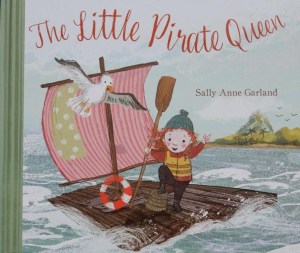
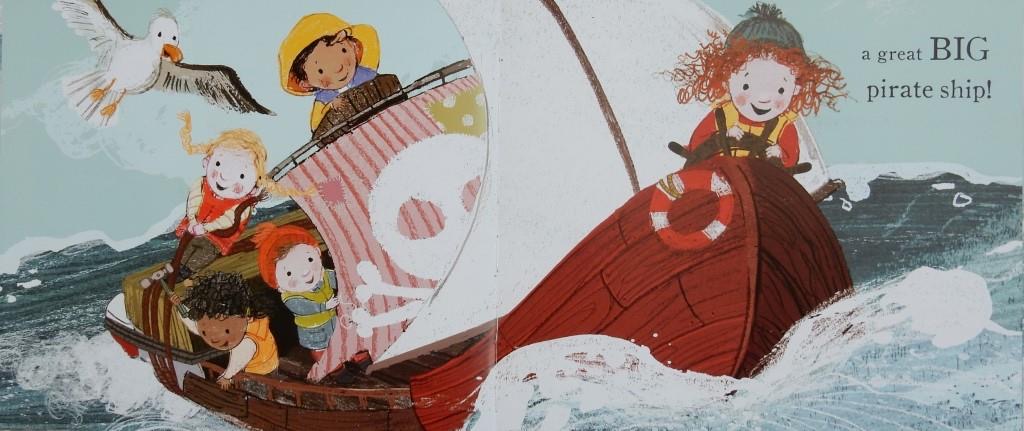
Meet young Lucy who makes a weekly voyage on her rickety raft in search of Far Away Land, a place where nobody before has ever set foot.

Over the weeks her raft has become increasingly dilapidated, despite her efforts at repairing the damage; but nonetheless, Lucy’s sailing skills have improved. Even so her craft is no match for the speed of the other children’s boats and that makes her a little downcast. To lift her spirits, she imagines herself a brave ‘Pirate Queen’ which helps, but only sometimes.

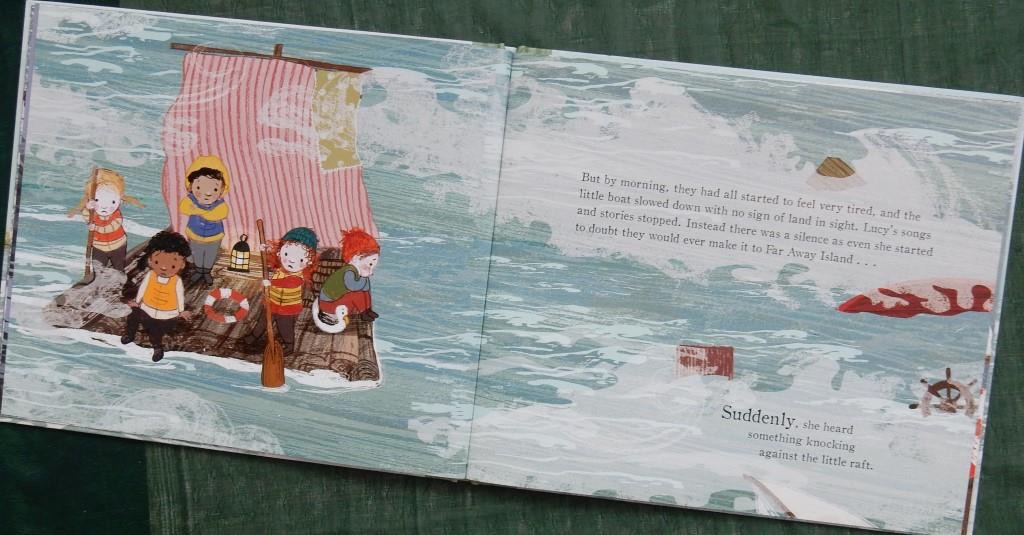
One morning a strong wind blows up and an enormous wave leaves Lucy lost and alone on stormy waters.

Alone that is until she spies four other children clutching pieces of wood and rope, desperately trying to keep afloat. Lucy succeeds in hauling them aboard her frail raft

and proceeds to give them lessons in rowing and sail repairs. Come nightfall they’re all able to enjoy Lucy’s tales and songs of lost treasure and pirates.

But will they ever reach that Far Away Island? …

An enjoyable tale of a resilient adventurer, with themes of resourcefulness, empowerment, friendship and more. Young would-be voyagers around the age of Lucy especially, will love this, particularly those wonderful dramatic seascapes.

The Great Paint

The Great Paint
Alex Willmore
Tate Publishing

Meet Frog, he’s an artist and hence tends to see things somewhat differently. He finds his own swamp dull and uninspiring, and so decides to seek some stimuli elsewhere. With materials amassed,

he sets out, first stop Bear’s cave.

Out come those brushes and colours and he sets to work. The trouble is, not everyone wants their place of residence adorned by a Banksy style work of art; certainly not Bear. Far from loving it, he’s horrified and sends Frog packing.

Next on the receiving end of Frog’s creativity is Snake – literally – and he is not impressed.

Undaunted, Frog continues his journey using his talent at every opportunity, his excitement mounting at each new piece of art.

However one animal’s ‘wonderful’ is the other animals’ ‘real mess’ as Moose informs him in no uncertain terms.

Feeling totally misunderstood Frog beats a grumpy retreat but then on pausing for a spot of thinking, he suddenly comes up with another terrific idea.

Could this be his most creative yet? Moreover will his friends appreciate his efforts this time? …

I absolutely love the playfulness in Alex Willmore’s illustrations: how she manages to get so much personality into that froggy character when he looks little more than a finger print, is amazing. The eyes say it all with every one of the cast in this hugely enjoyable tale of misplaced creativity.

The Princess Rules: It’s a Prince Thing

The Princess Rules: It’s a Prince Thing
Philippa Gregory, illustrated by Chris Chatterton
Harper Collins Children’s Books

A princess who subverts all the established fairytale conventions is definitely one for me. I’ve not read her first three adventures but am pleased to make her acquaintance in the three in this second book of the series.

The rule flouting Princess Florizella acquires a baby brother unexpectedly when a stork makes a delivery to her parents’ palace one night. Shock horror! This infant, who grows to the size of a four year old in a single day and is christened Courier, is now first in line to the throne and he, not the rebellious princess will inherit the kingdom one day. Apparently, in addition to not being intended for Florizella parents (they were only acting as the safe place for delivery) the baby was meant to be a Baby Belling (cooker).

Off goes Florizella to see her best friend, Prince Bennett. He agrees to help her teach the babe not to use his ‘prince permit’ and thus almost immediately, begins the adventuring of the three – on horseback of course.

During adventure number one that involves a run-in with some would-be kidnappers, Florizella learns of her brother’s particular expertise in peppermints.

The second story starts innocently enough as a day trip to the seaside to which Florizella invites pretty much everybody in the kingdom, and on arrival turns into a rip-roaring adventure on the high seas that includes an encounter with a Sea Serpent,

three pirate ships and the discovery of the meaning of the word ‘recoil’. Courier learns something important too.

In the third episode Courier turns inventor with some interesting results, a Mammoth makes an appearance and an agreement is reached.

Philippa Gregory’s terrific storytelling sweeps readers along and Chris Chatterton’s illustrations too, are a treat. It’s a Prince Thing does work on its own although I’d suggest youngsters who haven’t read the first book start with that and then move on to this one, which is just out in paperback.

Eugene the Architect

Eugene the Architect
Thibaut Rassat
Prestel

Eugene the architect is obsessive about order, liking only things that can be arranged in a neat and tidy fashion in his tall, dark home. he is especially proud of his latest creation – a tall building with not a single curve in sight. “All the buildings in the city should be like this,” he tells himself.

Fridays are his day for visiting the site to check on the progress of his new construction, but on one such Friday Eugene arrives to discover that a beautiful tree has been blown over during a gale and now lies across the centre of what is to be his third floor living room.

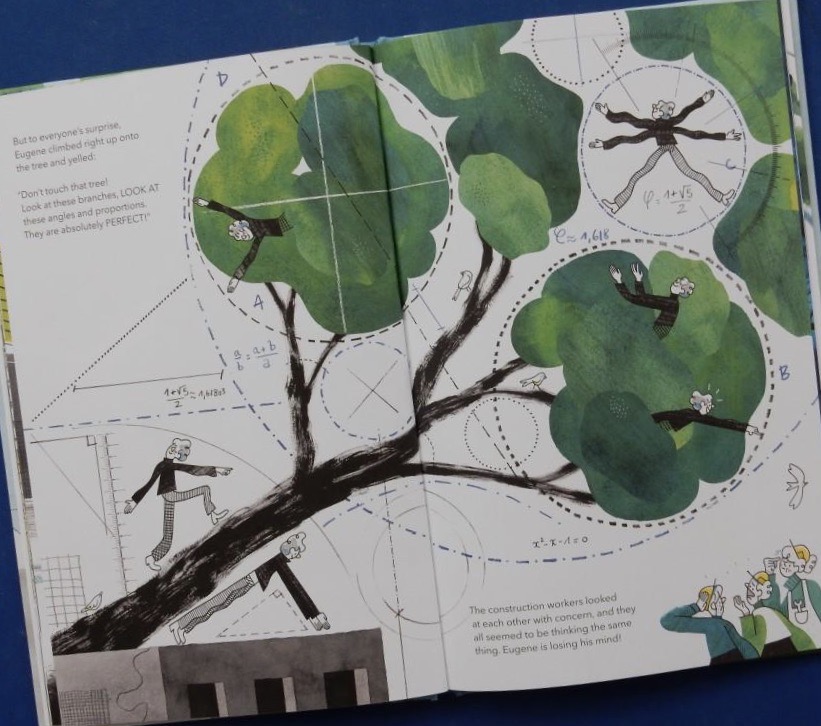
Despite everything he’s believed in for his entire life, to the astonishment of the workers, the man orders that the tree, with its wealth of curves, angles and elegant proportions, be left exactly where it is.

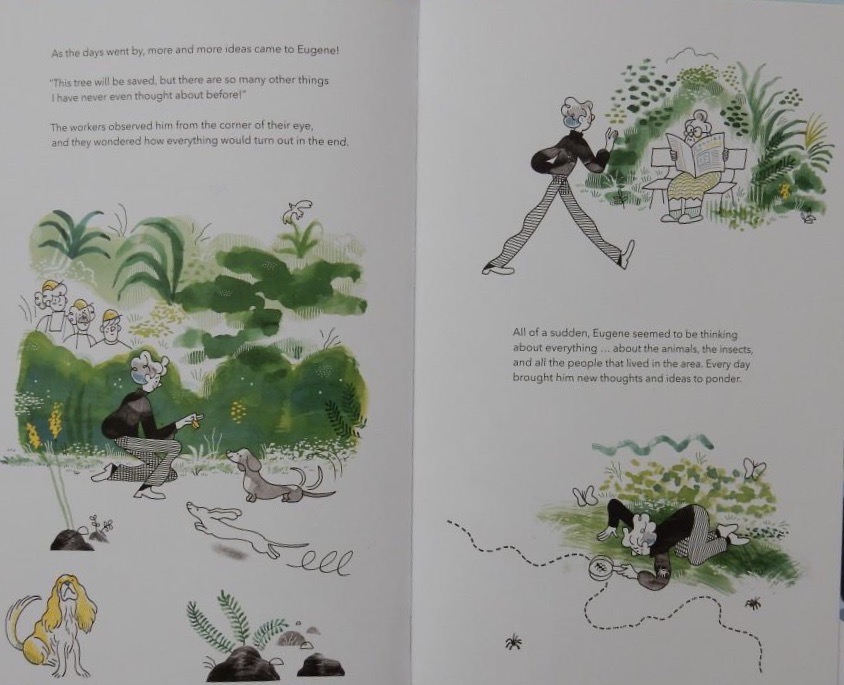
Not content with that, from that day on, Eugene begins to look differently at everything around him, especially the natural world which he discovers, has a perfection of its own kind.

Ideas flow thick and fast and even the building site workers start getting creative.

Before long there’s been a total transformation, not only of the building, but also of the architect himself. And even better, Eugene has considered the entire town in his magnificent masterpiece.

Superficially fairly simple as this story with its delightfully quirky illustrations, might be, it is an invitation to readers to think about aesthetics, the built environment, and its impact on everyone and everything.

First Nature: Caterpillar / Little Hen Little Hen What Can You See? / When Mummy Goes to Work

First Nature: Caterpillar
Harriet Evans and Bryony Clarkson
Caterpillar Books (Little Tiger)

By means of a lovely playful, descriptive rhyming text – ‘Caterpillar chomps and caterpillar crunches. // Caterpillar chews / and caterpillar munches.’ and clever cutaway pages with flaps, author Harriet and illustrator Bryony present the life cycle of an eponymous butterfly.
Additional information snippets are hidden beneath the flaps making this fun for little fingers to explore, as well as little ears to enjoy.

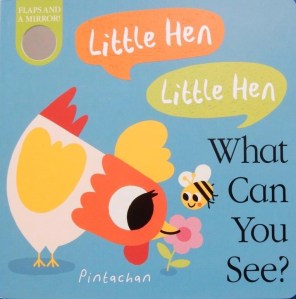
Little Hen Little Hen What Can You See?
Amelia Hepworth and Pintachan
Little Tiger

Little humans will love accompanying the little hen as it wanders around the farmyard and in response to the titular question posed on each spread by the friendly little bee, discovers the various creatures hiding in plain sight and named when the flap is lifted to reveal in turn Mouse, Cow, Horse, Sheep. Beneath the final flap is a mirror so tinies will come face to face with their own image.
The simple, repeat pattern text and Pintachan’s bold bright images of the animal characters offer a hide-and-seek game for toddlers and adults to enjoy together, probably over and over again.

When Mummy Goes to Work
Paul Schofield and Anna Terreros-Martin
Templar Publishing

This is a cleverly crafted little book, the first in a new series and it’s ideal for a parent just returning to work after the birth of a child, to share with a little one.

Having breakfasted together, Mum dons her paramedic’s uniform and bids farewell to her child, leaving Nan and Grandad in charge.

Events from her working day are then chronicled in a first person rhyming narrative illustrated with small images on each verso – driving the ambulance,

tending a patient in bed, pushing a wheel chair, examining someone’s ears.

These are mirrored in full page, detailed scenes on the recto, showing the child playing out similar scenarios.

As if speaking directly to the little one, author Paul Schofield uses the mother’s reassuring voice for the sequence of verses; illustrator Anna Terreros-Martin’s visual interpretations are an absolute delight and full of wonderful details to pore over.

The Stuff between the Stars / Get Up, Elizabeth!

The Stuff Between the Stars
Sandra Nickel and Aimée Sicuro
Abrams Books for Young Readers

This is an inspiring picture book biography of brilliant astrophysicist Vera Rubin, from the time when she was a star-gazing eleven year old who, despite opposition and ridicule

and being ignored during much of her lifetime, became, thanks to her dedication and an opportunity at the Carnegie Institution, a recognised and leading light in the field of astronomy. For it was while working at one of the Institution’s observatories that Rubin made her seminal discovery that “dark matter” explains the phenomenon that stars on the edges of the galaxy move as quickly as those at the centre—and that this dark matter makes up 80 per cent of the matter in the universe.

I love the Rubin quote at the end of the story,: ‘Each one of you can change the world, / for you are made of star stuff, / and you are connected to the universe.’

If the main body of this hugely engaging book hasn’t inspired youngsters, those words surely will. So too will Aimée Sicuro’s gorgeous watercolour, ink and charcoal illustrations that cleverly reflect Rubin’s spiralling ideas in this well researched, enormously engaging account.

An author’s note on Vera, a timeline of her life and a select bibliography conclude the book. It’s one I’d strongly recommend for primary age readers.
Get Up, Elizabeth!
Shirin Yim Bridges and Alea Marley
Cameron Books

The Elizabeth of this rhyming narrative is in fact, the child who later became Queen Elizabeth 1 of England.
It’s her morning routine we share as we hear her being roused from her slumbers. She’s then ordered by the rather impatient-sounding lady-in-waiting to submit to donning her smock, having her stockings laced, her face scrubbed and her teeth rubbed (with soot no less!). All this she tolerates with a degree of meekness but then having been laced into a petticoat,

and acquiesced to sleeve pinning, the young miss attempts to assert herself by stashing a mouse in her skirt. It’s no go though; and with her ruff duly stitched in place, there’s still that mop of unruly hair to be tackled.
Finally, she’s set to go and we watch as she stands, still seemingly meekly, before a throng of waiting subjects.

Shirin Yim Bridges’ rhyming narrative falters slightly on occasion during this chivvying regime and in this small slice of history, it’s Alea Marley’s visuals of the shock-headed miss with her radiant tresses that are the real show stoppers.

There’s a final page giving some extra details on Elizabethan fashion and routine ablutions, as well as a cheeky message from that mouse asking ‘Did you find me on all the pages?’ which adds a search-and-find element to the book. It certainly takes a bit of finding on one or two spreads.
Where is the Dragon?

Where is the Dragon?
Leo Timmers
Gecko Press

Oh dear me! The king is having dreadful dragon nightmares, so much so that he’s scared to got to bed. He dispatches his three trusty knights, One, Two and Three out into the dark night to save the realm, and more crucially, him.

The three have a slight problem however, they’ve never actually set eyes on a dragon, although the king has given them a few clues as to what such a creature might be like. As they venture forth Knight One and Knight Two take turns to share snippets of information, each of which seemingly appears in shadowy form. Then when Knight Three (the small one) illuminates the scene, something completely other is revealed. In the first instance it’s a harmless group of long-eared rabbits munching on carrots.

However Knight Two then drops in ‘Well the king alleged their teeth aren’t used for fruit and veg!”

but again Knight Three shines his trusty candle.

Knight One’s third comment talks of long necks and flaring nostrils as they approach another dark dragon-like form, and so it continues with each silhouette being a close fit for the king’s description and the revelation being something innocuous and wonderfully daft.

What about the last shape though? Following another tumble, all three knights are ready to return and inform his highness that there’s no such thing as dragons.

No cause for alarm at all. But are they correct? I wonder …

Translated from the original Dutch by James Brown, the rhyming text has an occasional blip, but for me it’s the illustrations with the superb characters, skillful use of dark and light, clever details (small and large), textures and rich colour palette, that are the real show stealers. Zimmers has a wacky sense of humour that is evident at every page turn, especially the final one.

Little ones will relish this as a storytime read aloud, delighting both in guessing and knowing. Ensure you give your audience time to look closely at the revelatory spreads so they can appreciate Zimmers’ transformations of the imagined into the real.

Museum Kittens: The Sleepover Mystery / Mort the Meek and the Ravens’ Revenge

These are 2 new fiction titles from the Stripes Publishing imprint: thanks to Little Tiger for sending them for review

Museum Kittens: The Sleepover Mystery
Holly Webb, illustrated by Sarah Lodge

The Museum Kittens, Peter, Tasha, Bianca and Boris are proud of their new guarding duties though they’re finding it pretty tiring work. Tired as they might be, they’re all eagerly anticipating the museum’s latest enterprise to bring in extra visitors. A group of sixty children are to visit and stay overnight in the Dinosaur Gallery. Bianca above all the others is mega excited, so much so that she does something which causes a furore in the Costume Gallery and then, following a spat with the other kittens, wants to spend all her time with the children, even keeping them company during the night – the time when the nasty rats are on the prowl. It’s during the night that her siblings realise that Bianca is missing.
The search is on. Come morning they still haven’t found her:

surely she can’t have been intending to run away and got on the coach with the children …

There’s plenty of furry fun, frolics and frights as those who are familiar with the series will know. However, Holly’s latest book is an enjoyable read even if this is your first encounter with these lovable felines; and there are plenty of Sarah Lodge’s black and white illustrations to break up the text for less confident readers.

Mort the Meek and the Ravens’ Revenge
Rachel Delahaye, illustrated by George Ermos

The only Rachel Delahaye stories I’d read before this were her Little Animal Rescue series so this came as something of a surprise. It couldn’t be more different.
For starters it’s set in the kingdom of Brutalia – an island community – where violence is the way of life. Ravens circle overhead, dreaming of eating eyeballs or brains. With its motto LIVE OR DIE, this certainly isn’t a place to book your next summer holiday.

Its chief protagonist is young Mort the Meek who inherits the role of Royal executioner when his uncle dies. Mort is the kingdom’s only pacifist so imagine his horror when he learns that his first victim is to be his good friend Weed.

Nobody has ever dared to stand up to the heinous queen of this realm and survived. Could Mort possibly do so and perhaps even find a way to save his friend’s life?

It all sounds pretty horrifying but Rachel Delahaye’s narrative is often very funny and the tale is full of unexpected twists and turns, so if you can cope with the violent punishment regime (I share Mort’s pacifist principles) you will laugh a fair bit, especially at the ravens. that open each chapter. And, the ending is hugely satisfying …

George Ermos has done a terrific job with the illustrations that are littered with small humorous details.

Veggie Power

Veggie Power
Olaf Hajek and Annette Roeder
Prestel

Award-winning illustrator, Olaf Hajek serves up a veritable feast of deliciously inventive visual stories to relish alongside author, Annette Roeder’s taste-bud tingling verbal platters of mind-boggling textual information. Just the thing to satisfy this vegan reviewer despite her aversion to several of the root vegetables that grace the pages of this large playful book. One of them being the parsnips that along with carrots, are the subject of the first spread. I was amazed to discover that members of the Vienna Vegetable Orchestra make use of these (as well as quite a few others featured herein) as musical instruments: imagine playing a carrot recorder or flute, for instance.
Over twenty vegetables are included in this culinary offering, but the author produces more than mere cooking related information: there are garnishings of historical and botanical tidbits, as well as sprinklings of health and healing- related facts.

One of my very favourite veggies is broccoli and I was vastly amused to read that it’s celebrated on not just one but two days: there’s St. Broccoli Day on March 18th and National We Love Broccoli Day just four days later on 22nd. 

I’m also extremely partial to both spinach and chard which share a spread, as well as a place in our garden. My mouth is watering at the prospect of those yummy leaves that take centre stage in Hajek’s energetic illustration of same. 

If being strictly accurate, there are a few interlopers at this veggie fest. for the tomato, as well as the peppers and chilli are botanically classified as fruit. However why exclude them when they’re usually served as vegetables?

A bountiful harvest is assuredly the result of this collaboration, albeit a lusciously quirky one. Food fun for everyone.

Gaspard’s Foxtrot

Gaspard’s Foxtrot
Zeb Soanes and James Mayhew
Graffeg

Gaspard the Fox returns for a third adventure and it’s a totally unexpected one.

While chatting to his friends Peter the cat and Flinty the dog he learns from the latter that his owner Honey is taking him to a concert ‘about London’s wildlife’ in Hyde Park that very evening and suggests that Gaspard should come along.
So when Honey and Flinty head for the number 38 bus-stop Gaspard tags along behind.

As Honey boards the bus she drops her scarf. Gaspard catches it and jumps aboard intending to return it when they get off.
Then follows a journey through London – we’re given the fox’s eye view in James Mayhew’s exquisite illustrations- that takes them through Islington with its iconic war memorial,

past China Town, into the heart of theatre land, passing Piccadilly with its famous statue, all the while the recorded voice announcing where they are. Suddenly he hears “Hyde Park Corner’ and off pile the passengers. In the crowd, Gaspard almost loses sight of Honey and Flinty but just in time he makes his exit and follows the masses to the centre of the park

where he finds a suitable spot to stop, wait, hope and listen to the music.

Onto the stage walks a man Gaspard recognises as living close to his den and he’s holding what looks like a white stick. He tells the audience that the next piece of music is so new it’s yet to have a title.

What happens thereafter is truly amazing, but I won’t spoil this eventful, gently humorous story at the heart of which is friendship.

It’s full of lovely details about nature, London (Peter talking of his peregrinations makes me miss it all the more at present) and of course, the music; the map endpapers are terrific too.

How exciting to learn that the story has been adapted by composer Jonathan Dove and is due to be performed with Zeb narrating and James as illustrator.

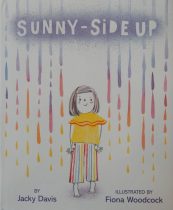
Sunny-Side Up

Sunny-Side Up
Jacky Davis and Fiona Woodcock
Harper Collins (Harper 360)

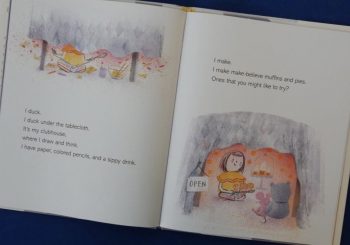
The little girl protagonist always looks on the bright side of life, but after breakfast (sunnyside-up eggs) when the blind is lifted to reveal a grey rainy day, her reaction is to throw a tantrum at the prospect of being stuck indoors all day – perish the thought.
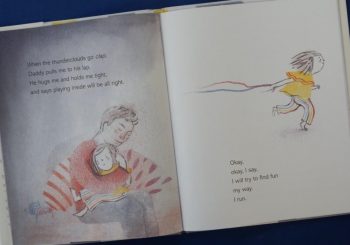
After a mollifying hug from dad

she decides to make the best of things with imaginative play, block building and some creative pursuits; she even opens a cafe for her soft toys serving muffins and pies.

And all the while the rain ‘drip, drip drops’. Lunch follows and then another paddy, again placated by dad following which the girl agrees to have a rest.

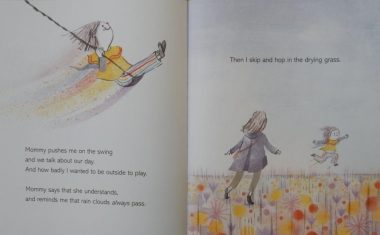
By the time Mum comes home, thanks to some painting and lots of calming reading, her daughter’s inner sunshine has returned just in time for the clouds to part and reveal something bright peeking through the clouds. At last, with the rain gone mother and child visit the park for some fresh air and a reminder ‘that rainclouds always pass.”

Jacky Davis’ first person rhyming narration conveys the little girl’s desire to be in control and find her own way through a difficult day ‘I found fun inside when it was grey’ she tells us as she snuggles down in bed after stories and warm milk.

Equally perfectly, Fiona Woodcock’s mixed media spattered illustrations executed in warm pastel shades portray to perfection the changes in the protagonist’s mood, as well as her irrepressible energy both indoors and out. 

Ideal for sharing with little ones and not just on rainy days.

Swim, Shark, Swim!

Swim, Shark, Swim!
Dom Conlon and Anastasia Izlesou
Graffeg

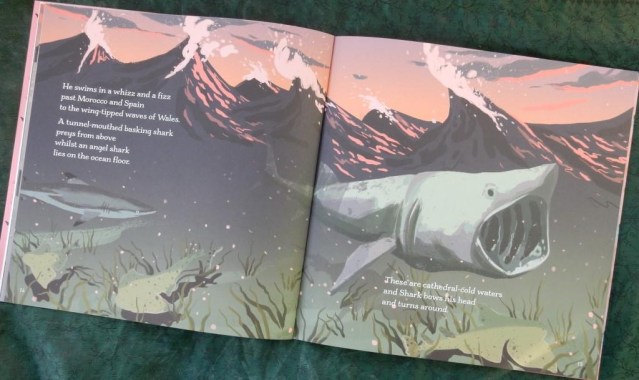
In the second of this Wild Wanderers series we join Shark – a blacktip reef shark – in an exploration that takes him on a long, long journey through the oceans of the world searching for a home. Seemingly it’s an almost circular swim that starts and finishes in the waters around Australia.

On his journey he encounters all manner of marine creatures including penguins and a tiger shark off the southern Cape of Africa,

and an angel shark in European waters.

There are blue sharks, octopus and squid in North American waters while off South America lurk Hammerheads. In the Pacific he sees dolphins, humans and in the kelp forest a Great White shark. Off the coast of Hawaii manta rays and green sea turtles dive and dance; 

then finally there is the Great Barrier Reef and a host of other blacktip sharks all of which help the reef in its struggle to survive.

Totally mesmeric is Dom Conlon’s poetry of motion, which cleverly weaves a sub-aquatic non-fiction story that is ideal for sharing with children either in KS1 or KS2. Anastasia Izlesou’s visual images too, transport readers and listeners to an underwater world of wondrous richness and beauty.

As well as the factual information contained in Shark’s odyssey there is a map tracing his path and a double spread of facts about sharks and the other marine animals.

The Long Way Home / Dirty Bertie: Bees!

These are 2 new Stripes Publishing books that are just right for newly independent readers: thanks to Little Tiger for sending them:

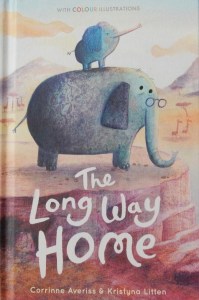
The Long Way Home
Corrinne Averiss and Kristyna Little

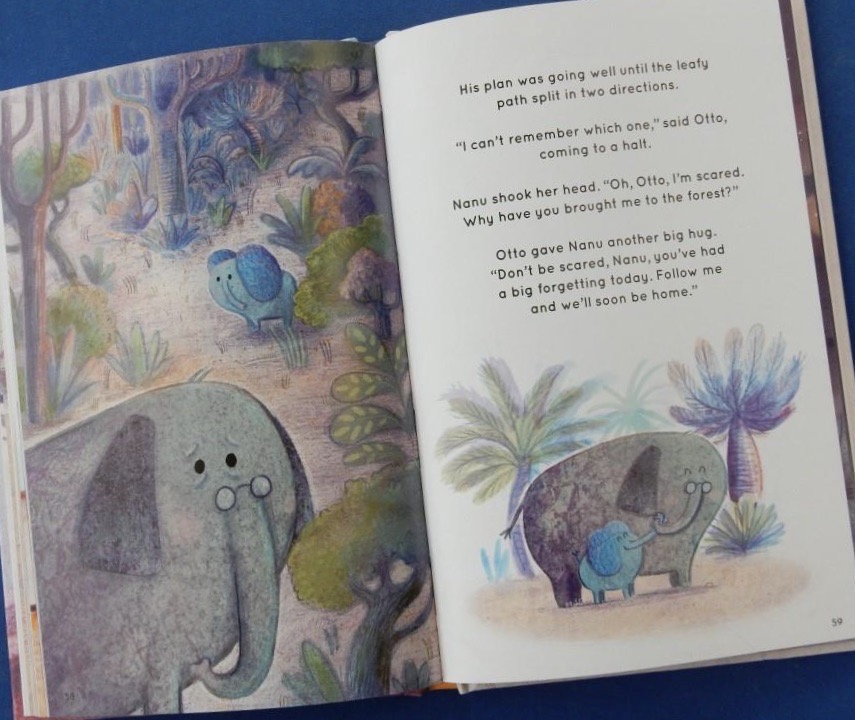
Baby elephant Otto likes nothing more than adventuring with Nanu and he’s thrilled when Nanu announces they are to spend a day climbing right to the top of Lion Mountain. Old she might be, but Nanu is extremely wise; she’s also brave and bold and shares Otto’s enthusiasm for exploration.

As they prepare to set out Nanu reminds the little elephant what an explorer needs to remember at all times but from the outset, Nanu seems to be having a forgetting kind of day. First she leaves the fruit out of the backpack and then she forgets the name of their destination and once they reach the top of the mountain it transpires that she’s actually left the backpack behind.

All those things are relatively easy to remedy but then as they start back down, it’s evident that Nanu has forgotten the way home and instead has been taking them into the depths of the forest.
Now it’s up to young Otto to remember everything his Nanu has taught him about being ‘a great elephant explorer’ and endeavour to get them safely back home.

Corrinne’s story is a wonderfully warm one that demonstrates pachyderm style, the importance of both family relationships and memories. A warmth that is brought out beautifully in Kristina Little’s gorgeous illustrations: who could resist falling for Otto and Nanu?

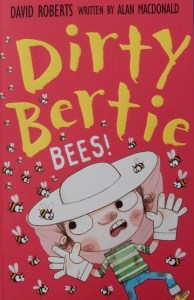
Dirty Bertie: Bees!
Alan MacDonald, illustrated by David Roberts

There’s never a dull moment when young Bertie is around and if you were to collect every one of the books regaling all his misdemeanours, they would fill an entire shelf.

This one presents three more. The first relates what happens when Bertie’s taste for the delicious honey he splurges onto his breakfast toast leads him to entertain ideas about becoming a bee keeper like his neighbour, Mr Monk with whom Bertie has previously had the odd run in. That sounds like trouble to me … and sure enough it is.

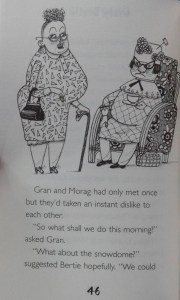
Story two sees Bertie and his Gran doing a spot of Great Aunt Morag sitting while his parents are otherwise engaged.

Surprises come thick and fast when the three of them head for the park where a nerve-wracking day unfolds.

In the third episode Bertie’s mum wins a journalism award with dinner and an overnight stay for two at a four-star hotel hotel as part of the prize. Just imagine the potential for trouble when Mum manages to bag another couple of tickets for Bertie and his sister Suzy to accompany them. But why does Bertie insist on taking his own duvet? A lively occasion really doesn’t describe it …

With its hilarious illustrations liberally scattered, new solo readers will devour this in a sitting; the episodes make fun short reads aloud too.

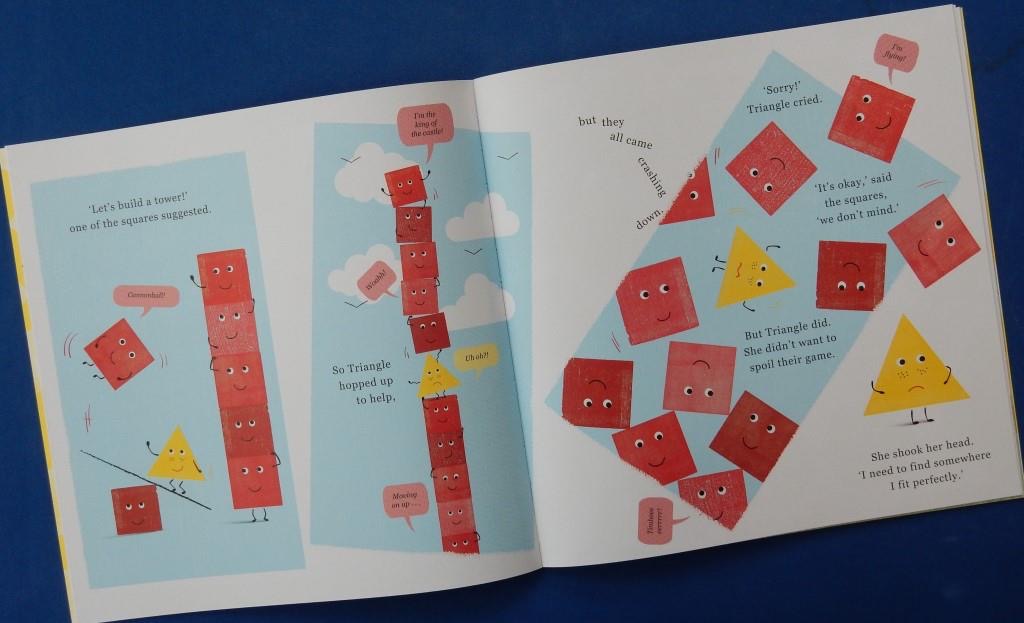
The Perfect Fit

The Perfect Fit
Naomi Jones and James Jones
Oxford Children’s Books

This is a story about what happens when a triangle that feels different among the circles decides to embark on a journey to find a community wherein she feels she belongs.

The squares are welcoming and invite the newcomer to play with them. With high hopes she joins in their building but then despite encouraging comments from her fellow builders, Triangle feels she must move on …

The hexagons are similarly accommodating though still Triangle worries about being different and continues her search. Increasingly despondent she begins to feel that perhaps she’s the only triangle there is, but then a star speaks and hope returns. On goes the search till finally there before her …

However there are limits to the games that triangles can play – no rolling for instance. Triangle remembers the fun she had with all those other shapes and …

A smashing celebration of difference and diversity showing that to fit in, doesn’t mean you have to be like everyone else: a variety of experience leads to a richer community. Life is much more enjoyable when people welcome those who are different, enabling everyone to feel comfortable about themselves. The key is to go beyond the confines of your perceived identity.

This seemingly simple story inspired by author Naomi and illustrator James son’s struggle to fit in when he started nursery, is a perfect foundation stage book for fostering personal, social and emotional development. It’s also rich in mathematical potential.

Planes

Planes
Jan Van Der Veken
Prestel

Whether or not you are an aviation enthusiast you can’t help being wowed by Jan Van Der Veken’s retro, futuristic style illustrations in this absorbing book that takes a look at the design (and much more) of planes from the tiny Wright Flyer of 1903 to the giant Airbus A-360-800 of 2005.

The first section – Aircraft Design, explores the principles of flight, the forces at work and the aircraft’s power and controls,

making reference to a number of specific planes as exemplars such as the Northrop YB35 Flying Wing.

Then follow, sections on Atmosphere and Weather, Communications and Navigation and The Future of Flight, which includes the prospect of the flying car.

If, like me you’ve ever sat in a plane and wondered about the flaps and ailerons on the wings that suddenly go down or up, there’s a whole spread on how each of these function complete with diagram.

I’ve been a lifelong flier, short and long haul, and have been a passenger in some small planes in weather such as dense fog, that caused me to be concerned we’d ever land safely anywhere when all we seemed to be doing was going round in circles using up precious fuel. I learned from this book that thanks to GPS, pilots can use global positioning equipment and/or radio beacons to find their way in difficult conditions.

With so much information packed between its covers, it’s pity there is no index. A great many pilots and designers are mentioned and it would have been good to have a roll call of them all; and perhaps the fact that the book’s creator is Belgian might explain the omission of such iconic planes as the Spitfire and the Harrier Jump Jet. Nonetheless this is a smashing book for older readers both at home and in school.

How Do You Make a Rainbow? / Finney’s Story

Positivity shines through in both these recent picture books:

How Do You Make a Rainbow?
Caroline Crowe and Cally Johnson-Isaacs
Macmillan Children’s Books

Rainbows have always been symbols of hope but during the last year have come to symbolise not only that hope of better things to come, but also our appreciation of NHS staff and other key workers with children everywhere creating their own rainbows to say thank you.

This book starts with a little girl and her grandad looking out on a grey rainy world and the child asking for his help to create a cheering up the sky rainbow. Rather than offering a scientific answer, Grandad explains that rainbows aren’t really painted; rather they’re created from kindness and hope, love and thinking of others.

Then, taking one colour at a time,

he goes on to give examples of small, everyday things that bring and give cheer both to others and ourselves.
Told in Caroline’s jaunty rhyme and through Cally’s playful, vibrant illustrations that exude positivity and kindness,

this is a hugely heartwarming book (with two final spreads of activities), for sharing both at home and in foundation stage settings. Definitely one to reach for if you’re feeling a bit down; it will surely act as a reminder of focusing on the positive things in life.

Finney’s Story
Alana Washington and Charlotte Caswell
UCLan Publishing

Finney the fox is an aspiring book author but he has a lot to learn about the whole process of authorship. Fortunately however, he has a moggy friend that is ready and willing to offer some helpful advice, or should that be, criticism. The trouble is, does Finney really have any ideas of the original kind,

let alone an understanding of what that word actually means.

Cat’s suggested visit to the library …

leaves him even more dispirited “All the original stories are gone,” he reports. Finney does notice something else however, something that might just be of assistance. But will this ‘ideas machine’ as he calls himself ever actually produce the goods?

Listeners will love being in the know with Cat as Finney puts forward his proposed storylines from traditional tales in this dialogue between the two friends. They’ll love too, Charlotte Caswell’s bold illustrations with their silhouettes depicting the fairytale characters Finney mentions in his story openers.

There’s a QR code inside the front cover which when scanned gives access to a free Sarah-Ann Kennedy audio reading of the book.

Eyes that Kiss in the Corners

Eyes that Kiss in the Corners
Joanna Ho and Dung Ho
Harper Collins

There’s a pleasing circularity about Joanna Ho’s lyrical tale of self awareness, family love and tradition that is narrated by an un-named schoolgirl.

At the start, having described the eyes of some of her schoolmates – ‘ like sapphire lagoons / with lashes like lace trim on ballgowns’ she says, ‘I have eyes that kiss in the corners and glow like warm tea. / My eyes are just like Mama’s.’
She then goes on to tell us that the other women in her family have similar eyes. Her Amah has eyes filled with stories; her younger sister Mei-Mei uses her eyes to watch at the window for the return of big sister from school when they can be together again.

We then share in the delights her own eyes discover. With Amah beside her she sees ‘Guanyin with the Money King / sitting on a lotus, serene, // baubles of lychee on trees, / and mountains that reach for the sea.’ … ‘I see kingdoms in  the clouds. ‘

Throughout, the vibrant digital illustrations of Dung Ho with their swirling patterns and beautiful flora, are strongly evocative of Chinese culture and stories; and there are some unmentioned additions such as the jade bangle worn by Amah.

(my mother had a similar one she bought in Hong Kong) and the upside-down Fu (happiness arriving) symbol on the front door.

A lovely celebration of being who and what you are, with an uplifting final statement ‘My eyes … are a revolution … They are me. And they are beautiful.’

Foundation stage classes often explore ‘myself’ and ‘family’ as part of the curriculum: this is a book to share as part of either topic.

Antarctica: A Continent of Wonder

Antarctica: A Continent of Wonder
Mario Cuesta Hernando and Raquel Martin
Prestel

If you’ve ever wondered about taking a trip to Antarctica, then now is your chance if you accept a once-in-a-lifetime invitation from the United States Antarctic Program to accompany a research team on an expedition to the continent of penguins and the world’s lowest temperatures. You’ll sail on an oceanographic research vessel – the Polar Star – bound for the McMurdo Research Station. The subject of this large format book truly is a continent of wonders and it’s exciting to spend time with the researchers and discover what happens during their six month stay.

Many children will have heard about work being done studying the penguins, 

seals and whales that are able to thrive in the harsh climatic conditions, but are less likely to be aware that scientists are also investigating the fossil record of the continent and the secrets of life locked in the ice of its glaciers. There’s also an observatory for astronomers and research continues into the impact of global warming.

Did you know that one of the few open lava lakes is to be found at the heart of this continent, in the crater of Mount Erebus, an active volcano some 12448 feet high? I certainly didn’t. 

There is mention of the first known individuals to make landfall on Antarctica as well as details of the explorers including Amundsen and Scott who tried to reach the South Pole. 

Who owns this incredible area, you might be wondering; the answer is that it belongs to nobody, or rather no country can claim it as theirs; it belongs to everyone, including readers of this book. Thanks to the Antarctic Treaty (1959), this should ensure that international teams of scientists can continue their research for the good of all.

The book’s author, Mario Cuesta Hernando, a journalist with a special interest in adventure and nature, has himself, visited Antarctica and his enthusiasm for his subject is evident in this narrative. Raquel Martin’s dramatic land- and seascapes as well as the animal portraits capture the awesome nature of the continent.

Ideal for budding scientists and school collections in particular.

Meet the Oceans

Meet the Oceans
Caryl Hart and Bethan Woollvin
Bloomsbury Children’s Books

Like Caryl and Bethan’s previous collaboration Meet the Planets, this one is both full of fun and informative. Speaking in rhyme, Caryl’s young narrator invites youngsters to participate in an underwater adventure to visit the seas and oceans of the world.

The first destination is the decidedly chilly Arctic Ocean that like the other marine locations tells us directly about itself, mentioning such things as giant jellyfish, narwhals, beluga whales and walruses, as well as polar bears that pad on the ice floes.

Next to introduce itself is the Atlantic – a huge ocean so we hear, full of undersea caves, subaquatic mountains and teeming with salmon and silver swordfish, while less easy to spot, swimming among the sea grass are occasional wild manatees.

If warm waters are more to your taste, then you might decide to have a longer float around the tropical islands of the Caribbean Sea. Beneath its surface you’ll encounter all kinds of wonderfully patterned fish, as well as myriads of starfish. We can’t spend too long counting them though, for six watery worlds remain to be seen.

There’s the Pacific with its plastic pollution problem, the South China Sea with its plethora of ships and seabirds, the wonderful coral sea around the Great Barrier Reef, the Indian Ocean alive with gloriously coloured creatures waiting should you have time to step ashore …

before heading down to the Southern Ocean of the Antarctic. BRRR! Watch out for biting gales if you plan stopping at one of the research stations.

Much more frequently visited is the final watery wonder, the Mediterranean Sea: a great place for a spot of snorkelling as I recall.

With pops of day-glo colour Bethan’s distinctive visual style successfully personifies each of the watery worlds that Caryl has given voice to on this splooooshing, whooshing foray aboard a submarine.

Great for pre-bathtime sharing with youngsters as well as for foundation stage storytime sessions.

Alone!

Alone!
Barry Falls
Pavilion

Living in a little house atop a hill, young Billy McGill is a reclusive individual. “This is my hill, … I live here alone! Always have, always will” he asserts and so it is.

Down below the town is a bustle with traffic and people but none ever venture near Billy’s abode.
Sheltered within he barely hears a sound until the fateful day when he detects an unwelcome, indeed unacceptable, intruder …

It’s an occasion that calls for a visit to town to purchase a moggy that will chase the creature away and peace will be restored.

That’s not quite what happens however and before long Billy’s residence is accommodating a host of creatures large and small including a stripy one that develops a cold – so the vet informs Billy. She offers to knit the sneezer a warm fluffy coat but for that yarn is required. Hmm.
But although things go from bad to worse, to downright terrible, through all the trials and tribulations,

the up and downs, Billy McGill continues repeating his “This is my hill … “ litany.

Just when it seems the situation might be about to improve a terrific storm blows up whisking away an all important pacifier and Billy is almost at breaking point; but he’ll do pretty much anything to find peace and quiet, even embarking on a journey across land and sea, and scaling another high hill.

It’s there that as young Billy ponders on the possibility of solo living once more, something drifts into sight.

Now he’s faced with a decision – should he or should he not stay?

In addition to the pleasing circularity – almost – of the rhyming tale, there’s much to enjoy about this book. Barry Falls’ quirky illustrations are a wry delight as they depict the catastrophic concatenation of crazy events involving the growing cast of characters both animal and human.
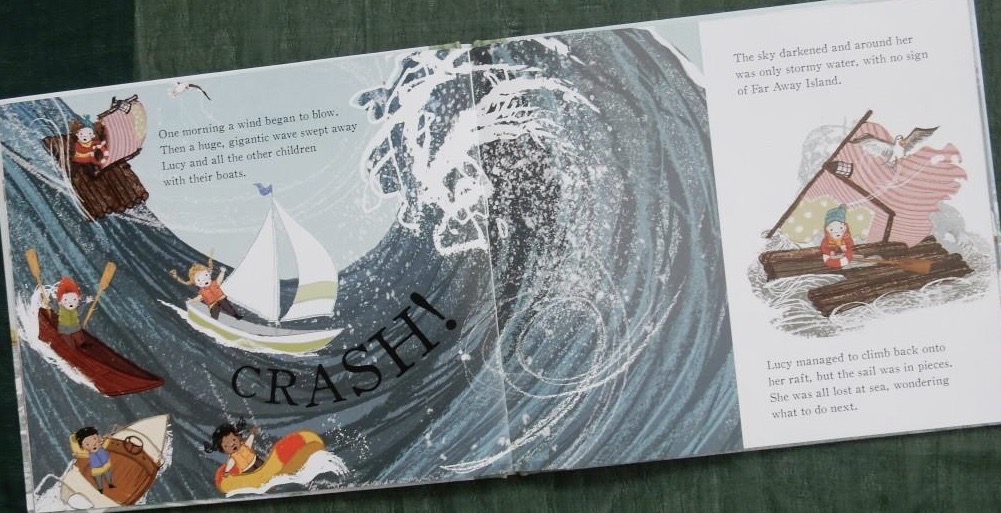
Funny Bums, Freaky Beaks

Funny Bums, Freaky Beaks
Alex Morss & Sean Taylor, illustrated by Sarah Edmonds
Welbeck Publishing

Here’s a clever idea for presenting animals to youngsters: the authors of this alluringly titled book have grouped them by their distinguishing features. In addition to bums and beaks however, there are plenty of other creatures with something special that makes them stand out from the crowd. Moreover those strange features all have a purpose and a story behind them. Those are recounted herein.

Facial features – noses – of the odd kind, extraordinary eyes, ears – weird ones, terrific teeth, so chosen for their size, shape or function, as well as tongues (the stranger the better) are explored. Sun bears, ( they’re the smallest of all bears), have dangly tongues the length of which is a quarter of the creatures’ height. Why? you might wonder. As well as it being essential for obtaining food, a sun bear uses its tongue for grooming purposes.

So what do a blue bird of paradise, a luna moth, a scorpion rattlesnake, a Willani sea slug and a young hoverfly have in common? They all have ‘stunning tails’ – I certainly would never have guessed that. Strictly speaking though, the baby hoverflies’ ‘tails’ are actually breathing tubes used during their early underwater lives.

Necks (perplexing) and toes (puzzling) are also presented. We probably all know about the very long neck a giraffe has but I was amazed to know that it has the same number of neck bones as a mouse; and imagine having toes that you can stretch wider and longer than your entire body like a jacana – very useful if you want to appear to be walking over water.

The authors have found at least ten creatures to include in each of their ten groups and every one has an explanatory paragraph and a gently humorous illustration – some of them are downright alarming-looking.

Compelling reading for wild animal enthusiasts, as well as for budding zoologists and celebrators of difference.

Sunday Rain

Sunday Rain
Rosie J. Pova and Amariah Rauscher
Lantana Publishing

Recently moved, little Elliott is in his bedroom reading as the story opens. Hearing noises outside he gets up looks through the window at the coming storm, returns to the bed and continues reading about a little princess and her adventure, ‘ … the sea kept swallowing the royal boat as the night pushed the day down the horizon.’

Once the rain has stopped he returns to his window and sees other children outside enjoying playing in the puddles. Encouraged by his Mama – “Sunday rain is the most fun” – to venture out and make some new friends, Elliott takes his toy boat and sallies forth.

Then, drawing on the story in his book, he play-acts a scenario involving a little boat, a dragon and a princess that sail on the high seas and land on a desert island, an adventure the other children are only too happy to participate in.

Beautifully written and illustrated in watercolour and charcoal, this sweet story immediately draws readers in, immersing them in the sights, sounds and smells of the events – imagined and real: ‘Outside smelled like wet grass and flowers and the pages of a new book.’

With its themes of stepping out of your comfort zone, overcoming shyness and making new friends, it’s perfect for sharing in a family setting or foundation stage story time. Equally important is its celebration of books, reading and the power of the imagination.