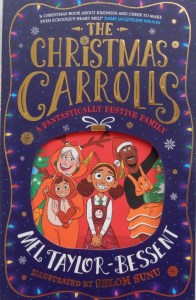
The Christmas Carrolls

The Christmas Carrolls
Mel Taylor-Bessent, illustrated by Selom Sunu
Farshore

Nine year old Holly, daughter of Christmas crazy parents Nick and Snow Carroll has been home schooled until a house suddenly becomes available on Sleigh Ride Avenue. Thrilled to bits her parents decide to move the family there and she is enrolled at the local primary school.

However, when Holly goes to Lockerton Primary with the Backpack of Cheer her dad’s given her and first day Christmas cards (in hot September!), for her year five classmates she realises not everyone shares her enthusiasm for spreading seasonal cheer; and, there are all those school rules and regulations to contend with too. She desperately wants a friend.
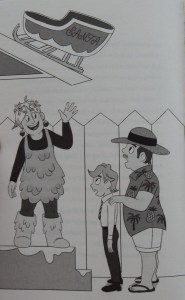

Then she hears some of the things that have been said about her: ‘from another planet’, ‘weird’, ‘eccentric’ or was it ‘electric’, ‘that I didn’t know how to dress myself’. How much worse can things get?

Seemingly Holly is on a downward spiral. However, the new unChristmassy approach she tries doesn’t feel right either: her cheerometer rating plummets to zero and she tells her parents, “Nobody wants us here … Nobody wants to celebrate Christmas all year round … And I don’t think I want to either.”

But, could her burgeoning friendship with Archer (which has also taken a turn for the worse) help her out and restore that feel good factor, and not only for herself? Perhaps – for when she learns of some children who really need help, Holly decides that nothing is impossible when it comes to spreading good cheer.

Now I’m somebody who is anything but filled with festive delight when I see the Christmas lights put up and turned on early in November, so initially I wasn’t sure about Holly and her family. However, Mel Taylor-Bessent’s debut story, for all its seasonal trappings, is about so much more that Christmas. For Holly it’s a steep learning journey and one whereon she discovers the importance of real friendship, that not everyone lives in the same way, as well as that her mum hasn’t always had it good.
What emerges loud and clear from this wonderfully warm, humorous tale is that the essentials of Christmas are hope, inclusion and community; and these should be for every day of the year rather than being restricted to just a short time. The author has created some smashing characters (illustrated by Selom Sunu) that certainly will linger in the minds of readers and listeners. This would make a terrific KS2 class read aloud.

An Odd Dog Christmas

An Odd Dog Christmas
Rob Biddulph
Harper Collins Children’s Books

What joy! – a festive foray into the world of the wonderful divergent dachshund Odd Dog.
It’s Christmas Eve and said mutt is on a mission to find the perfect present for a special friend but after a day of shopping, time has almost run out. What on earth can I do, thinks Odd Dog wandering through the silent streets, when there in front of her eyes is a sign that calls.

In she walks to a true winter wonderland complete with gingerbread, candy canes and jolly elves; but there’s one creature that looks far from festive. It’s a very poorly reindeer admitting reluctantly, “I’m far too ill to pull the sleigh.”
There’s just one thing Odd Dog can do and before you can say ‘presents’ there before her is Santa. Of course, there’s the perfect solution.


With the night flight duly done, Odd Dog is still left without a present for her friend: Santa offers some words of advice. and then light bulb moment …

On Christmas morning our favourite pooch offers her pal something that reveals the true meaning of Christmas …

Wonderfully illustrated in gloriously rich hues and oodles of gentle cosy seasonal humour, this is one of those Christmas books that sends a warm tingle all through you.

Rita Wants a Robot / The Toys’ Christmas

Rita Wants a Robot
Màire Zeph and Mr Ando
Graffeg

Rita is a small girl with a big imagination and a head full of ideas. Her latest is a ‘super-sorting’ robot: something that would tidy up the ginormous messes she creates in her bedroom thus putting paid to mum’s repeated chastisements. There is a stipulation however; said robot mustn’t spoil Rita’s fun by creating hyper tidiness, so he’d need to know when enough was enough or risk her wrath. Of course, said robot would need to be an appreciator of wildlife, as well as never overstepping the mark, for doing so would land Rita in big trouble.

Then there are special considerations at the approach of the festive season: who would want a Christmas saboteur robot, albeit a well-intentioned one? Definitely not Rita: maybe time to have another think about the whole robot-sorting idea …

This is another fun episode in the imagined life of Rita conjured by author Màire Zeph and illustrator Andrew Whitson (Mr Ando) that will be enjoyed by youngsters around the age of the protagonist. This adult reviewer wouldn’t mind a brief visit from Rita’s super-sorting robot to work on my partner’s super messes, although it would need to be kept a close eye on, I suspect.

The Toys’ Christmas
Claire Clément and Geneviève Godbout
Frances Lincoln Children’s Books

It’s Christmas Eve but rather than feeling excited, little Noah is very worried and upset: his favourite cuddlesome toy elephant Fanfan is nowhere to be found. Despite his mum’s reassurances that his absence is only temporary, Noah isn’t convinced.

Meanwhile, outside in the snow Fanfan is on his way to an important meeting when he hears a voice asking for help. It’s toy rabbit Mr Long Ears with a bad foot, upset at the possibility of not getting to the meeting on time and of course the kindly elephant offers him a lift and they reach the clearing where the other toys have gathered just in time for the long journey.

Why are they, along with toys from all over the world, out on this chilly night when they could be snuggled up with their children? 

They’re on a special mission to see Santa to tell him what their owners want for Christmas, but they also need to make sure they get back home in time for the big day.. What will Noah discover when he wakes on Christmas morning?

An unusual story illustrated in soft focus pastel by Geneviève Godbout whose art here has an olde-worlde charm.

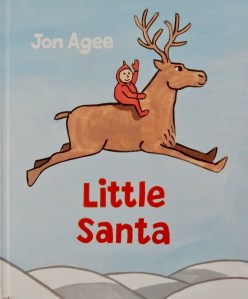
Little Santa

Little Santa
Jon Agee
Scallywag Press

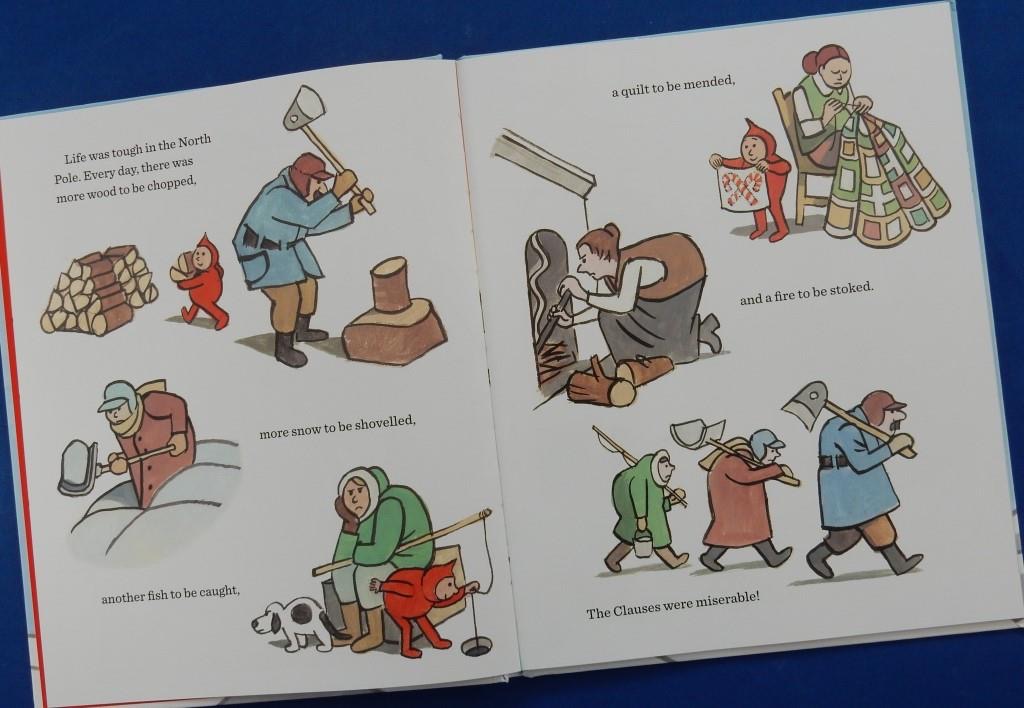
As the story opens Little Santa lives with his parents Mr and Mrs Claus and six siblings in the North Pole. Santa loves life there; not so the rest of the family. who eke out a miserable existence.

Their intention is to move to Florida., but their plan is thwarted. At first that is, by an overnight blizzard that traps their house and everyone inside, beneath an enormous snowdrift.

Up steps brave Santa who with some food in a sack and a pair of snow shoes, is sent out via the chimney to seek help.

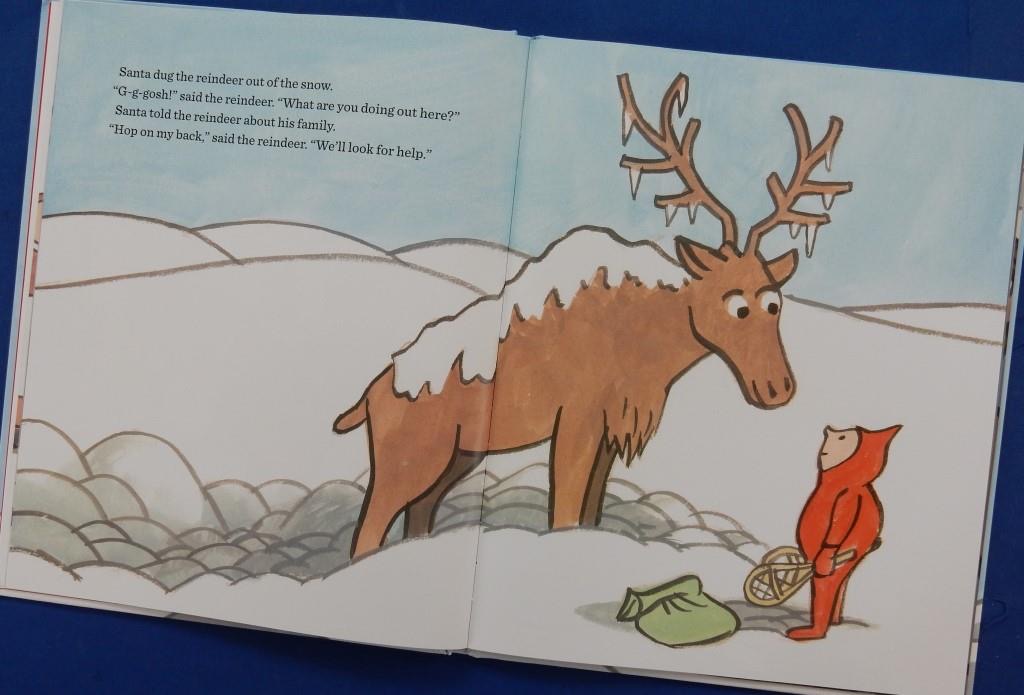
When he emerges he starts walking, and having trudged a considerable distance comes upon what he thinks at first is the top of a tree protruding through the snow.

What follows is an account of how the little fellow comes as tradition says, to acquire a flying reindeer and a troop of elves whose talents include shovel making and sledge building.

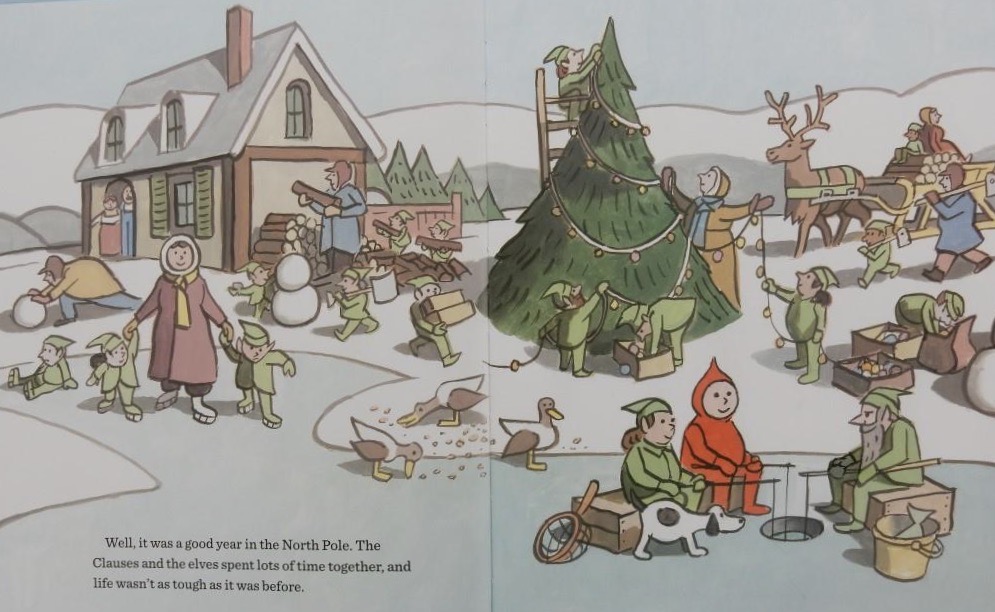
Yes he does of course enlist their help to look for the Claus’s North Pole house and they fly back to the relief and delight of his family. But has this whole episode put paid to their plans to move to Florida? Certainly not and even with the improvements made by the elves,

a year later off go the Clauses minus Santa to start their new life. And Santa: well we know what he does.…
Crisp like the snow, Jon Agee’s folkish narrative, and quirky, comical illustrations in which Santa stands out in his bright red attire offer a kind of seasonal pourquoi tale that’s fun to share during the Christmas season.

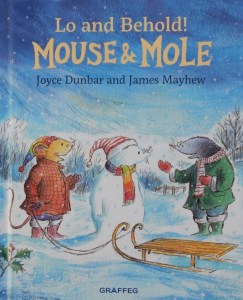
Lo and Behold! Mouse & Mole

Lo and Behold! Mouse & Mole
Joyce Dunbar and James Mayhew
Graffeg

Brimming over with seasonal warmth and the spirit of friendship is author Joyce and artist James ‘ visit to the wonderful world of Mouse, Mole and their other animal friends.

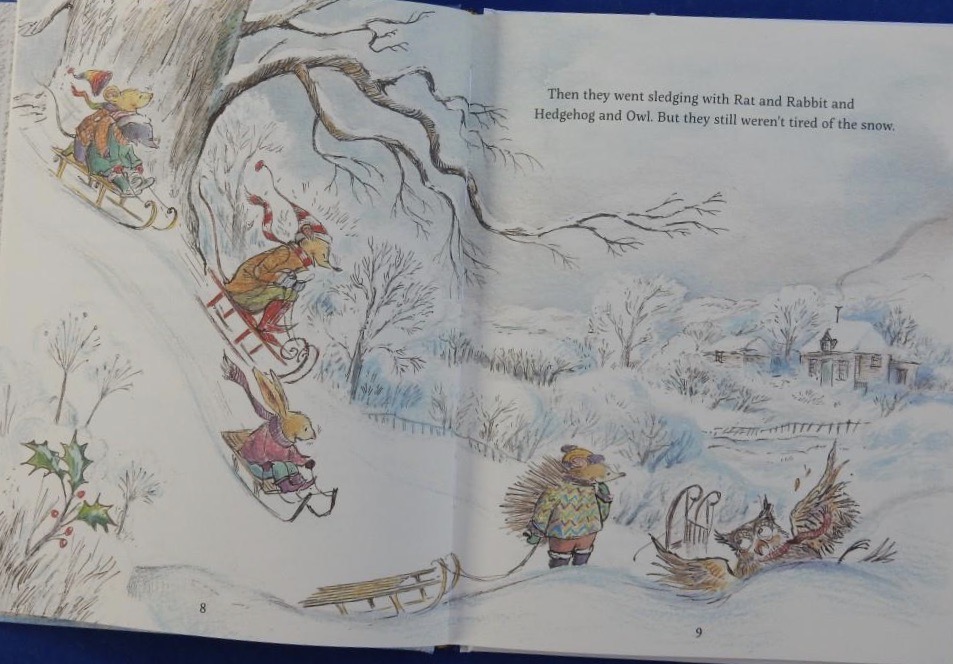
The first of the three stories finds the two opening the curtains to discover a blanket of snow covering the ground outside. The prefect day for making a ‘snowsomething’ and so eager to enjoy the outdoors are they, that they eat their breakfast porridge on the doorstep. Then it’s time for some games before meeting up with Rabbit, Rat, Hedgehog and Owl for a spot of sledging.

‘Snowsomething’ building is next and they have to wait until it’s dressed before deciding what sort of something it actually is. A Snowmole it turns out to be and then Mole decides to have his supper beside it to keep it company. He even beds down beside the Snowmole and eventually falls fast asleep. How come when he wakes up, Mole is in his own bed inside their cosy home? However Mole is still concerned about Snowmole being lonely but good old Mouse has done something to make sure that isn’t so.

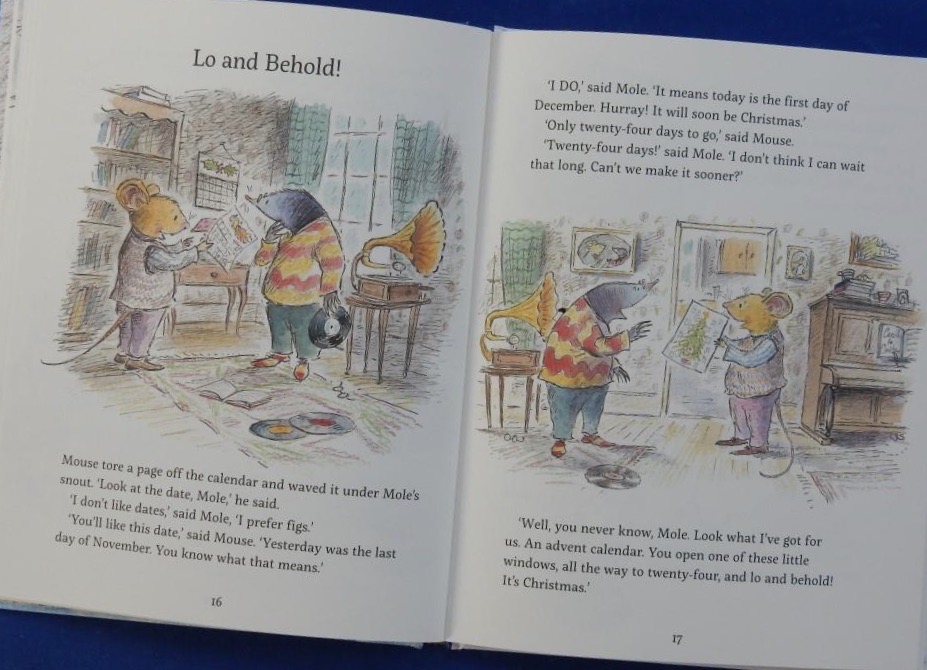
It’s not long before December comes around and Mouse announces that it’s time to start using the advent calendar

until, as the second episode is called, lo and behold, it’s Christmas. Despite having said that, Mole decides that the big day is a really long way away that year. Meanwhile, as they have lots of preparations to make, the friends are so busy that Christmas Eve soon arrives.

So, what is the very important thing that Mole thinks they’ve forgotten to do as they get ready for bed on 24th; or rather, several important things seemingly? Then what is the bump in the night referred to in the title of the final episode?

I suggest snuggling up with a hot chocolate and sharing this with your little ones in the run up to your own Christmas. What wonderful Christmas cards some of James’ watercolour illustrations would make.

Super Duper Penguin Slide

Super Duper Penguin Slide
Leonie Lord
Walker Books

There’s a pleasing kind of circularity about this tale of a penguin family’s epic journey, big ones at the front, small ones behind.

From the start it’s evident that this lot are well-organised and polite too, with their tickets at the ready to board the bus when it finally arrives at the stop, and the readiness to let those in great haste get past on the escalator. Such deeds still enable the penguin brigade – mum, dad and five little ones – to board their train in the nick of time as it begins to ‘Chugga chug, choo choo’ its way across the varying terrain until – disaster!. The train pulls to an untimely halt and an announcement is made.

Looks like it’s time to draw on another of those penguin propensities – persistence.

A phone call to a goat soon gets them out of trouble and finally they reach their destination. Now at last, it’s time for some fun and it’s downhill all the way … almost.

Full of fun characters – silent bit part players as well as the main cast and supporting nesting guinea pigs – Leonie Lord’s scenes both large and small contain a wealth of amusing details to giggle at as readers follow the flippered family on their journey with its highs and lows.

The Night Train / The Naughtiest Unicorn in a Winter Wonderland

The Night Train
Matilda Woods and Penny Neville-Lee
Little Tiger

This is a wintry addition to the Stripes series of stories for new solo readers that have beautiful full colour illustrations at every turn of the page.

Herein readers can take up the guard’s final call and board the non-stop express train to Sleepy Town Platform ZZZ. Charles is anxious to get his special passengers in on schedule so that they don’t lose the chance to shine in their dreams.

There’s Henri, about to perform in front of the Queen, Princess May on her way to meet the family of her dragon, then comes the yeti – a regular on the train – bound for the North Pole and now accompanying Lily who longs to be a great explorer.
Then one more passenger reveals itself – a huge green furry monster that hopes it has just the thing to stop its dreamer being scared any longer.

Suddenly the train comes to a halt and the driver announces that something is blocking the way. The princess leaves the train to investigate and discovers a tree has fallen across the line. But are any of the passengers willing to help her and the guard Charles to move the obstacle and allow the train to arrive on time? Perhaps if they draw on their yet to be discovered skills, together they can save the situation and enter their dreamer’s dreams.

It must be worth a try.

Despite it’s chilly setting, Matilda Woods tells a warm-hearted tale of teamwork and determination. Penny Neville-Lee’s snowy scenes capture beautifully, the sometimes tense atmosphere of the telling and her portrayal of the characters is charming – even the monster.

A smashing snuggle up in the warm book for youngsters just taking off as independent readers.

The Naughtiest Unicorn in a Winter Wonderland
Pip Bird, illustrated by David O’Connell
Farshore

Can it really be the ninth story featuring Mira and her exuberant unicorn Dave? As he tries his hoofs at some winter sports, it’s evident that the creature hasn’t lost his burping and farting habits or his tendency to gobble up ice-cream or pretty much anything edible he can get hold of.

Then comes the announcement: Unicorn School Winter Expedition. It’s to be Red Class’s very first time and in addition to the sporting activities there’s to be a special quest: The Unicorn School Art Project inspired by the Aurora Lights.

The excitement is high though there’s talk of Snow Beasts by pupils who have been on previous winter expeditions, and it’s even higher when they reach their destination. Armed with ‘snow tools’ just in case of any unwanted encounters, the pupils start to settle in and decide on their activities.

Then comes the real fun and for Mira and Dave that begins with sledging – watch out for a ginormous snow poo-ball.

Will they really meet a yeti though?

What about that art project: will everyone be having such a great time sledging that they miss those magical Aurora Lights? And could somebody discover a use for that Abominable Snow Poo? You’ll never know … unless of course you get hold of this hilarious episode in the life of Mira, Dave and their friends both old and new.

I know a fair number of young solo readers who will gobble it up – Dave fashion – all in one go, pausing to enjoy David O’Connell’s super black and white illustrations along the way.

Off Limits

Off Limits
Helen Yoon
Walker Books

A father leaves his home-office unattended and who should decide to explore within, despite the ‘OFF-LIMITS sign on the door (shown on the title page) but his small daughter.

Disregarding her own “Hello, I’m just looking’, the first thing she makes use of in this thoroughly neat and tidy room is the sticky tape convincing herself that nobody would miss just ‘one teeny-tiny piece’.

However, it’s not difficult, especially for adults, used to young children making creative use of anything and everything, to understand so well that before long our protagonist has adorned the angle-poise lamp, the stapler and herself, not merely with tape but also with paperclips, bulldog clips and sticky notes: joy oh joy!

Before you can say “La laaa lala da la” the child is totally engulfed in an eddying pastel coloured whirlwind.
Suddenly though a realisation dawns upon our playful young lady. “Uh-oh. I’m in so much trouble” she tells readers as she tiptoes back to the haven of her own bedroom wherein an unexpected surprise awaits …

Simply told with perfect pacing and illustrated with superbly droll mixed media scenes of the escalating chaos unfolding behind closed doors, this book pays tribute to the power of play and the endless possibilities it offers to us all. Young children will absolutely delight in the forbidden deed with its escalating chaos, as well as both the pleasure and the possibility of being caught as the mischief mounts. Most of all though, I suspect they’ll love the final grand reveal and it’s contrast between that and the first wordless spread.

How Winston Delivered Christmas / How Winston Came Home For Christmas

Thanks to Macmillan Children’s Books for sending these wonderful Alex T. Smith seasonal Winston books for review

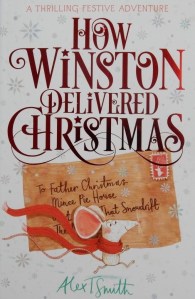
How Winston Delivered Christmas


If you missed this terrific tale in hardback two or three years back then mouse Winston’s first adventure told in 24½ chapters is now in paperback with black and white illustrations. It tells what happens when said mouse, rummaging around for food comes upon a letter, a letter to Father Christmas eight year old Oliver thought he’d posted in a post box.

Now being a literate mouse, Winston realises that in order for it to reach its destination, there’s just one thing to do: although he has absolutely no idea of the way, to the North Pole, he must take the letter to Santa. His journey is far from easy but he eventually makes it and receives an unexpected surprise as the story ends. It’s a surprise that will remind readers that that in real-life there are people who need understanding, shelter and food at Christmas.

Designed to be read throughout advent this seasonal tale is jam-packed with festive delights and leaves the door open for another Winston festive adventure …

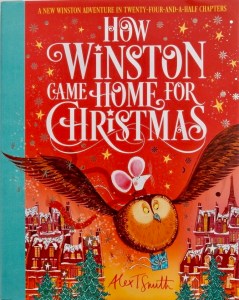
How Winston Came Home For Christmas

A year has passed since Winston’s first adventure and now the mouse and his human friend, Oliver, are back in a new seasonal story that begins five days before Christmas as Oliver is reading aloud to the little rodent, but having reached a cliffhanger the story is set aside and Oliver goes off to sleep. 

Not so Winston though. Beset by strange feelings and foggy memories he becomes certain that someone of great importance to him is lost. Now being a determined little creature, having left a note for Oliver promising to return for Christmas, Winston embarks on a mission – a Very Curious Mystery – to find the singing figure from his memories – a search that involves travelling first to Paris. Now how on earth (or in an appropriate sized envelope) can he do that?

There he is met with much kindness but doesn’t find the character he seeks so on he goes to Germany. There too he encounters helpful characters – human and animal – but the search must go on and now Winston takes to the air courtesy of kindly owl Hilda. 

By this stage of the story readers know the identity of the character Winston seeks but I won’t reveal that; merely bid them a safe journey and allow the travellers to continue towards nordic lands, Winston with the words of that lullaby running through his head; but what is it’s language? 

More importantly will he ever find its singer and be able to return to Oliver as promised?

Once again, readers and listeners will be swept away by the wonderfully warm tale Alex T. Smith has spun. It’s full of drama, friendship and that good-will spirit of the festive season. The full colour illustrations are suffused with humour and between each chapter is a seasonal activity, be that baking, crafting or otherwise creating, that all family members can share in.

With its star scattered cover, this is another 24½ chapters of sheer delight to make somebody’s Christmas special this year.

Frindleswylde

Frindleswylde
Natalia and Lauren O’Hara
Walker Books

This is the third book by the O’Hara sisters, Natalia who writes and Lauren who illustrates and what utter delight it is.

When Frindleswylde an eerie shapeshifter gains entry to the home of Cora and her Granny he steals the light and thus the house is plunged into darkness.

Cora sets off to try and get back the light so that her Granny is able to find her way home. She journeys beneath the pond to Frindleswylde’s frozen kingdom where she is at his mercy and is made Queen of Winter.

However he agrees to return the light so long as she can complete three Impossible Tasks, either that or remain forever captive in his realm.

Cora is determined to complete the three increasingly difficult tasks but can she succeed? Assuredly the thought of her Granny lost in the woods spurs her on try her utmost to outwit the deceitful captor.

This compelling, multi-layered tale has echoes of classic folk and fairy tales – Rumplestiltskin, The Snow Queen, The Six Servants for instance. Present too are those timeless fairytale themes of good versus evil, the all conquering power of love, a quest, and the loss of innocence.

Both the telling and the illustrations are magical: the former with its rich rhythmic flow of words and the latter, things of exquisite beauty in their own right: together they make for a wondrous read aloud fable that will utterly enchant younger listeners; and its themes will speak to older readers and adults showing that, among other things, we should continue to strive for what is right in today’s troubled world.

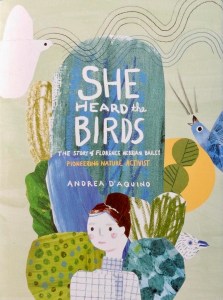
She Heard the Birds

She Heard the Birds: the story of Florence Merriam Bailey
Andrea D’Aquino
Princeton Architectural Press

In this inspiring picture book biography author/illustrator Andrea D’Aquino shines a light on key moments in the life of the pioneering American ornithologist and nature activist Florence Merriam Bailey who was born in 1863.

Daughter of a camping enthusiast father and astronomer mother, Florence grew up surrounded by nature in which she developed an early interest, especially when it came to birds. These she found the most fascinating and she spent time learning as much as she could about these feathered creatures.

As a young woman, while visiting the city, Florence was appalled by the sight of people – dedicated followers of fashion – wearing hats decorated with feathers and the bodies of birds. She was even more disgusted by the sounds of the gunshots in the woods of those ornithologists who thought it acceptable to shoot birds in order to study them.

Determined to make a difference, Florence, armed only with her tools for observing birds – knew she must answer the calls for help of the birds and to do so she must dream big.

She put the information she’d collected into print, writing field guides, and other bird books some giving suggestions about how readers too could learn about these precious creatures becoming peaceful observers of birds in nature too.

Thus guns could be replaced by binoculars and listeners to their songs taking heed of her ‘Shhhhhhh! Listen. What are they saying?’would be filled with delight and share her determination to push forward crucial changes.

Thus it was that one person’s mission gradually became that of many;

the end result being that ‘The world became safer for the birds, and more beautiful for us all.’ How this was actually achieved we aren’t told but it’s evident that the millinery trade and others got the message that began with a single woman nature lover.

In her hand-painted collage, oil pastel, and pencil illustrations, Andrea D’Aquino focuses the reader’s attention on her subject’s personal mission while using rich colours to emphasise the overwhelming importance of nature and its beauty, and giving the birds centre stage.

In addition to giving more detail about Bailey’s life, the final spread contains a reminder that the struggle to protect birds continues and there are some recommendations for readers who want to help.

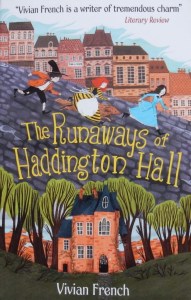
The Runaways of Haddington Hall

The Runaways of Haddington Hall
Vivian French
Walker Books

Poor Minnie O’Sullivan, she means well but seems to be beset by accidents and the result is at the behest of the Reverend Obadiah Marpike, that she is sent away to a supposedly charitable institution, Haddington Hall, a home for wayward girls. 

This in itself is terrible for it means she has to leave her poor hard-working washerwoman mother to cope with all the labours and her little brother Bobby all by herself. But she quickly discovers that it’s a truly ghastly place, founded and run by a stony-hearted woman, Mrs Haddington, aided and abetted by housekeeper Mrs Krick, and parlour maid Nellie, who immediately take a dislike to the girl for her attempts to stand up for herself.

Happily though she has two allies in Edith Lavingley, daughter of Lady Lavingley, and Ernst an errand boy; as well as Grobbler the dog. But can Minnie discover the truth about the person calling himself the Reverend Obadiah Marpike and most importantly, will she ever be able to return to her mother and brother?

With echoes of Dickensian England, Vivian French provides child readers with an insight into what it was like to be poor and live in Victorian times, when conditions for children were to say the least, precarious. Her characterisation is superb and her twisting turning plot serves up several surprises.

Whether read aloud to older primary classes, or enjoyed as a solo read, this is a gripping tale of friendship, loyalty and young people striving for what is right.

Books For Giving That Keep On Giving

William Bee’s Wonderful World of Things That Go!
Pavilion Books

This book brings together three of William Bee’s much-loved titles – Trucks, Trains and Boats and Planes, and Tractors and Farm Machines, in one bumper volume. I’ve already reviewed each of them on this blog so I won’t repeat myself; rather I’ll suggest that if you have a young child with an interest in things mechanical (or perhaps even yummy sounding breakfast cereals such as those sold down on William’s farm), then unless they already own the individual books, a copy of this totally immersive publication narrated in William Bee’s chatty style with his detailed, gently humorous illustrations, would make a smashing present.

Pippi Longstocking
Astrid Lindgren, illustrated by Lauren Child
Oxford Children’s Books

This large format, beautifully produced new edition of a classic has been brought up-to-date with terrific contemporary illustrations from Lauren Child and a new translation by Susan Beard.

We follow Pippi Longstocking on her amazing adventures as she moves, sans parents, into Villa Villekulla with a horse, a monkey, and a big suitcase of gold coins. Despite well-meaning adult villagers’ attempts to guide Pippi, she’d far rather be a wild spirit. She meets Tommy and Annika who very soon become her best friends. These new friends join her on her amusing escapades – leading the police a merry dance, going to school – briefly, joining the circus taking on a strong man and wowing the crowd, dancing a polka with thieves and celebrating her birthday.

Young readers and listeners will delight in their encounters with this intrepid, sometimes outrageous heroine while older ones and adults will rekindle their love of her with this bumper book that would make a super Christmas present.

Alice’s Adventures in Wonderland
Lewis Carroll & Grahame Baker-Smith
Templar Books

It’s always interesting to see new visual interpretations of Lewis Carroll’s classic tale and although for me none can outdo those of Tenniel, assuredly Grahame Baker-Smith’s distinctive illustrations, breathe a different kind of life into Carroll’s story.

Every chapter has full page, richly coloured detailed spreads as well as several smaller pictures executed either in blues or sepia. 

One I lingered long over was the double page colour spread of the Mad Tea-Party and an amazing spread it assuredly is. There’s a large iced cake, the upper surface of which is crammed full of liquorice all sorts and what look to be those flying saucer sweets that contain sherbet. I couldn’t help but laugh at the sight of an egg cup containing an egg and peeking through the crack in its shell is the face of a chick. It’s details such as those that the new generation of readers who go down the rabbit hole , as well as those familiar with the story taking the descent again, will remember.

With illustrations full of mystery and magic and a superb design, this is a terrific gift book.

The Provensen Book of Fairy Tales
edited & illustrated by Alice and Martin Provensen
NYR Children’s Collection

This anthology contains a dozen ‘literary’ fairytales selected by the husband and wife team to illustrate with their own whimsical touches.

Among those included are Hans Christian Andersen’s The Nightingale, Oscar Wilde’s literary The Happy Prince, The Three Wishes told by Barbara Leonie Picard, Arthur Rackham’s classic version of Beauty and the Beast, Elinor Mordaunt’s The Prince and the Goose Girl, a reworking of Grimm’s Goose Girl, Parker Fillmore’s retelling of the Finnish story The Forest Bride, and a tale new to me, A.A. Milne’s Prince Rabbit. With an unexpected final twist, this is an amusing story of a childless king who is urged to name an heir. To that end the king arranges a series of contests for would-be heirs who meet certain criteria; one of which is a rabbit.

I found it fascinating to have such a variety of storytellers side by side in one volume, with the Provensens’ humorous, sometimes dark illustrations and I suspect this is a book that will appeal more to book collectors and older readers with a particular interest in fairy tales, than to child readers.

The Worst Sleepover in the World

The Worst Sleepover in the World
Sophie Dahl and Luciano Lozano
Walker Books

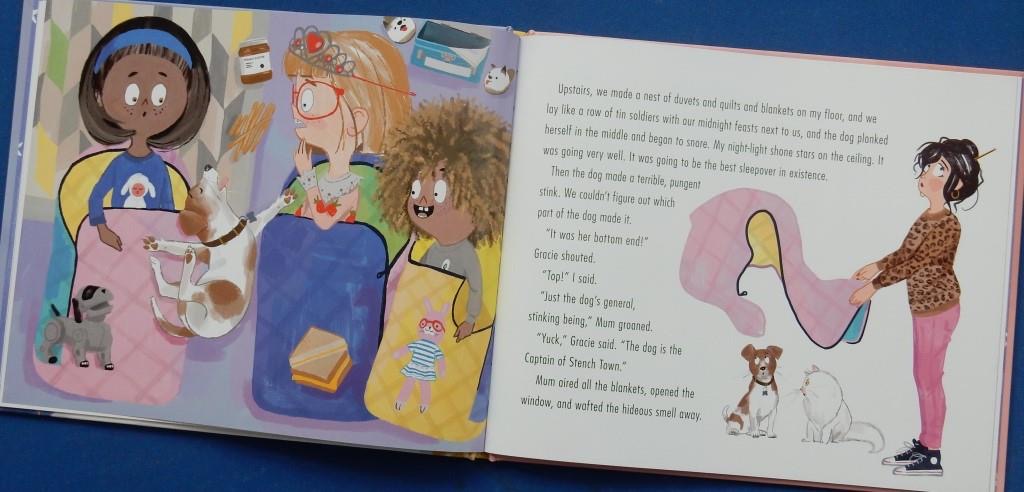
Seven year old Ramona eagerly anticipates her first ever sleepover when her friend Gracie is coming to stay the night. The plan is Ramona, Gracie and Ramona’s younger sister Ruby would all sleep in the one bedroom and they’d feast at midnight on such goodies as ice-cream sundaes, chocolate buttons, pizza, doughnuts and more. But when Mum gets to hear what the sisters intend, she steps in stipulating crisps, sandwiches and popcorn. Nonetheless the sisters are super-excited and sure they’re about to host ‘the best sleepover in history’.

However when Gracie arrives announcing that she’s ‘quite fussy’, it seems things are not going to go according to plan. Gracie hates all the food she’s offered at tea time, bath time is a damp squib and then when it’s time to pack the lunchboxes for that feast, Gracie again dislikes all the food and turns her nose up at the replacements.

The sleeping arrangements are not to her liking either, and nor is the family’s stinky dog. Is there any possibility that Ramona’s mum can step in, draw on her inner resources and save the day or rather night? Moreover can she do it without upsetting her own elder daughter? And will the girls still be friends in the morning?

Definitely this is a story – a longish one for a picture book – that youngsters can relate to. Sophie Dahl’s first person telling provides lots of details about Ramona and her life, all of which we see through the young narrator’s own eyes while Luciano Lozano’s vibrant illustrations speak volumes too as they show the different events of the evening, night and following morning and both the children’s and Mum’s reactions to them. Indeed there’s lots to explore at every turn of the page.

Vive la difference! is the message that emerges strongly from this fun book.

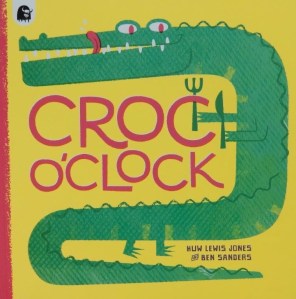
Croc O’Clock

Croc O’Clock
Huw Lewis Jones and Ben Sanders
Happy Yak

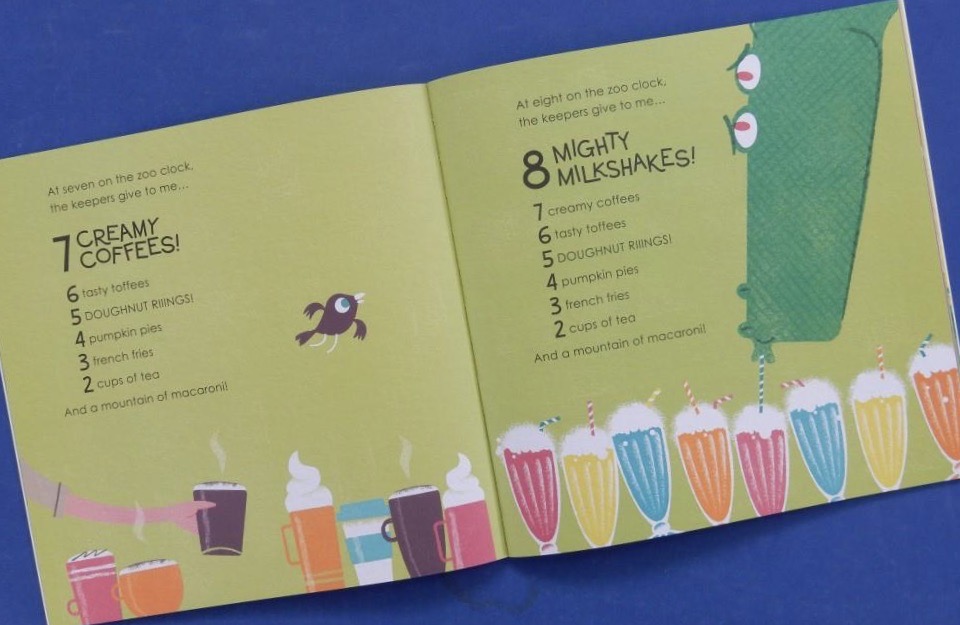
It’s feeding time for the crocodile with a seemingly insatiable appetite and goodness me does he love to boast about it as he keeps the zoo keepers busy all around the clock. “At one on the zoo clock, / the keepers give to me… / A MOUNTAIN OF MACARONI!” But that merely fills a small space in his tummy and the greedy beastie needs feeding on the dot of every hour. Moreover he has a cumulative song to tell readers what he eats.

At 2:00 there are two cups of tea and another mountain of macaroni; at 3:00 there are three french fries—and two cups of tea, and yet another mountain .…
And at 4:00? “4 pumpkin pies / 3 french fries / 2 cups of tea / And a mountain of macaroni!”
Five o’clock is time for some sweet stuff: 5 doughnut rings etc. More sweets at six in the form of 6 tasty toffees and as the clock strikes 7, 8, 9, 10, and 11 our every growing creature consumes 7 creamy coffees,

8 mighty milkshakes, 9 cherry cheesecakes, 10 jumbo jellies and 11 lemon lollies. Does he never get tummy ache one wonders?
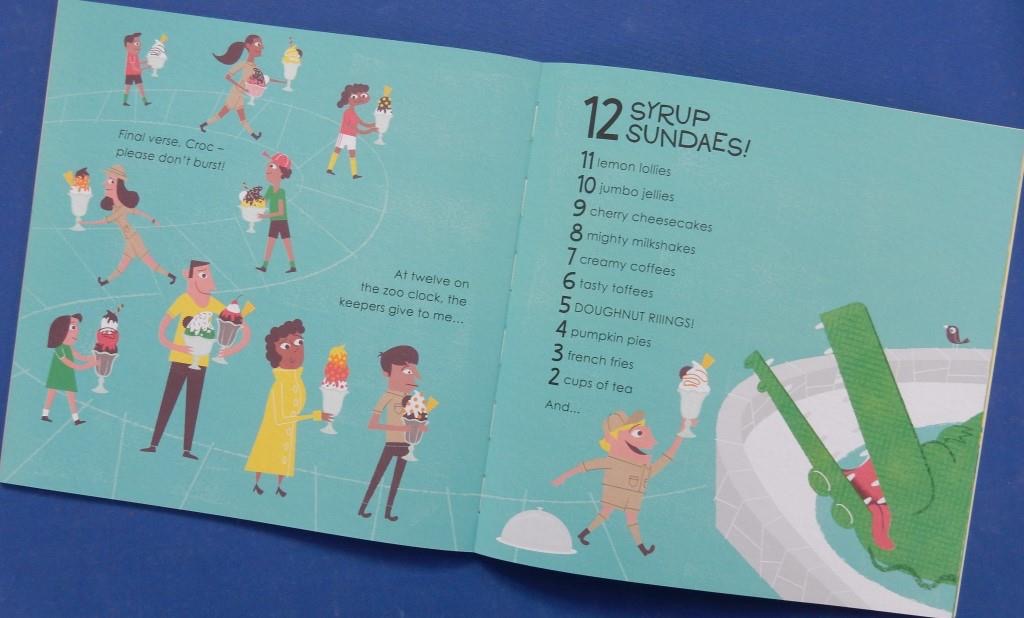
Twelve o’clock brings 12 syrup sundaes

but hello- no mountain of macaroni? Now those keepers have finally decided that the crocodile’s diet is sadly lacking in veggies. What will the narrator’s reaction be to the next offering? …

Youngsters will delight in singing to the tune of ‘The 12 Days of Christmas, Huw Lewis Jones’ satirical take on the popular seasonal song, as they watch the croc’s continuing overconsumption overseen by the zookeepers with the assistance of some visitors, shown in Ben Sanders bright, bold stylised illustrations.

The Chime Seekers

The Chime Seekers
Ross Montgomery
Walker Books

Eleven year old Yanni is anything but happy about his new life: he’s moved to Fallow Hall, into a home that he hates, largely on account of needing more space since the arrival of his baby sister, and the thought of joining a new school part way through term is awful too. In fact from the start he hates everything about it: the surroundings send frissons of fear right through him. Surely things can’t get any worse, or can they?

It’s All Hallows Eve and now despite all Dad said, he’s about to be left at home minding his year old baby sister, or not quite alone, for who should appear just when his parents are ready to leave for their night out, but his cousin Amy.

Once they’ve gone, Yanni goes into baby Ari’s room and makes a fateful wish: he wishes that she’d never been born. Suddenly something weird happens and he sees a man standing in the doorway, a man who makes him feel decidedly uncomfortable, but despite this Yanni invites him in.

Deciding that something is deeply wrong, even more so after the man has become aware of Ari, Yanni is overtaken by a strangeness that results in the man stealing his baby sister away and leaving in her place a changling: a changling who can do unlikely things such as acrobatics and throwing things around.

The cousins are briefly at a loss and then Amy reminds him that All Hallows Eve is a night when “faeries come roaming.’ When the borders twixt their world and the Land of Fae are at their thinnest. Thus anything is possible, even the stealing of babies by a wicked faerie.

Now the boy realises that he must do all in his power to get his sibling back from this creature who has a whole lot of powerful magic up his sleeve. He and Amy embark on a quest in another world and undertake a series of tasks in order to put everything right back as it was before he made that fateful wish. It’s a journey that throws up monstrous challenges and tests Yanni’s resources to their limits as the Faery tosses nigh on impossible challenges at him.

Nerve-wracking this story most definitely is, as readers with hearts in their mouths, follow the action. But ultimately, the power of love reigns, outweighing that of evil; and what about the power of a name? … 

Intensely powerful too is Ross Montgomery’s telling that, with his author’s magic, held this reviewer right through to the final page. I love David Dean’s cover illustration too and his occasional black and white ones during the narrative.

George the Wombat

George the Wombat
Eva Papoušková and Galina Miklínová
Graffeg

Did you know that like all his fellow wombats, George produces cube-shaped poos? That’s when he manages to poo at all, and even more importantly do so in his potty.

Pooing in his potty is what his mum has told the little creature he must do before he can go into the forest and dig a burrow. Being an obedient marsupial, George goes and sits on his potty but sitting on your lonesome upon your potty (or otherwise) is more than a little boring.

Fortunately though it’s not long before George’s pal Fred the kangaroo hops up and invites George to join him in some grass gobbling. George explains his problem and so Fred suggests something to help shift things along within. Still nothing happens, so Fred hops off leaving the wombat to keep trying.

Next to arrive is Annie goose and she too has a suggestion, but this doesn’t do the job either.

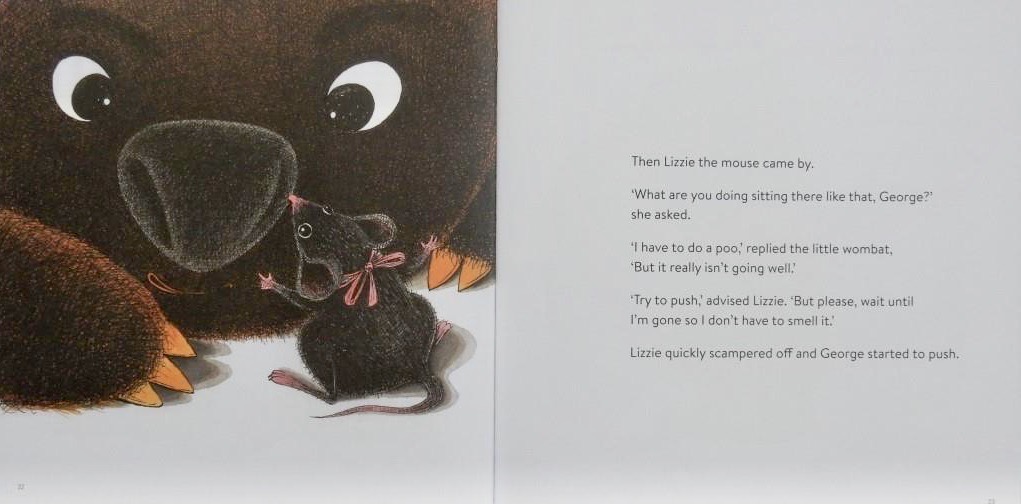
Lizzie mouse’s tip proves equally unsuccessful

only serving to make George’s eyes almost pop out, which puzzles Daddy Wombat as he walks by.

Now Daddy wombat knows a thing or two so maybe, just maybe he can solve the poo problem once and for all so that his offspring is free to remove his botty from his potty and embark on some tunnelling.
Translated by Alexandra Büchler, this tale of friendship, helpfulness and of course, poo, is great fun to share whether or not you have a little one at the potty training stage. With its repeat refrains and gentle humour throughout the telling, a humour that is superbly underscored in Galina Miklínová’s cross-hatched illustrations showing the cuddlesome creature endeavouring to follow instructions and produce the goods, this book will delight both youngsters and adults, all of whom will relish the potty-sitting sequences.

Genie and Teeny: Wishful Thinking

Genie and Teeny: Wishful Thinking
Steve Lenton
Harper Collins Children’s Books

Before this second story starts properly it’s necessary to get Grant and Teeny to wake from their slumbers. But where are they? Fortunately they’re discovered before it’s time for Tilly to set off for school which is handy because it’s Friday July 9th – and that means Bring Your Pet To School Day; so long as Grant can get Teeny back to his normal size in time, that and stop himself getting hyper-excited on the way to school.

En route though, they encounter Billy Krump the school bully and have a narrow escape. But then once inside school said bully looms large again when the headteacher asks if anybody has come without a pet and guess whose hand goes up.

That is when the trouble begins but the real trouble starts when Billy Krump grabs Tilly’s rucksack, takes out the teapot and makes a dash to the boys’ loos. Therein Grant (who is still endeavouring to improve his wish-granting skills) accidentally grants the boy three wishes.
Then, Alaka-blam-a-bumwhistle! chaos ensues …

Will it ever end and even better will Billy Krump find a new friend?

Full of jokes, puns and just plain daftness, this sequel is huge fun and possibly even better than Genie and Teeny Make a Wish. It will have youngsters in fits throughout not to mention any teachers who share it with a class. The illustrations are a hoot and Steve has even included a ‘How to draw Teeny the dog’ finale.

Roll on book three say I.

There’s a Dodo on the Wedding Cake

There’s a Dodo on the Wedding Cake
Wade Bradford and Kevin Hawkes
Walker Books

Hired to play his violin at a wedding, Mr Snore who starred in There’s a Dinosaur on the 13th Floor makes a return visit to the Sharemore Hotel.

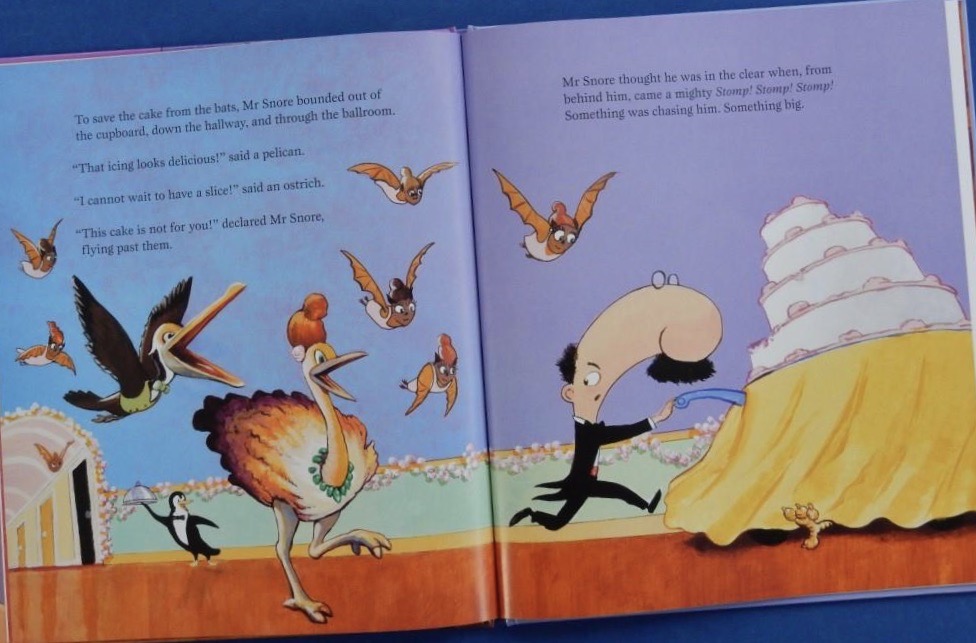
His early arrival allows him to take advantage of the wedding planner’s offer of some hot chocolate while he waits. Before he is given said hot drink sans marshmallows as he’s stipulated, the violinist spots a dessert trolley whereon stands a rose-decorated, iced cake close to which is a dodo with its eye on the main chance. But Mr Snore is not quick enough to prevent the creature from sampling a rose; it gobbles one and dashes off.

Having seen the dramatic incident, the wedding planner hastens away to find somebody to fix the icing, leaving Mr Snore standing guard using his violin bow to ward off a couple of beavers and a boa constrictor.

Then, deciding to move to safety – so he thinks, Mr S. pushes the cake into what he assumes is an empty cupboard only to discover it’s anything but …

However, it seems that there’s a never ending array of creatures all trying to get close to the confection.

Eventually the wedding planner has to intervene and it’s revealed that Mr Snore has misjudged all those whom he suspected of being marauders, all but one, that is.

With everything finally ready, the celebration gets under way and all is going beautifully until the bride and groom hand Mr Snore the very first slice of cake, but on account of the icing, there are explosive results …

Full of drama, this crazy romp with its messy finale has plenty to entertain young audiences – Mr Snore’s bow-wielding heroism, his continuing error-making and the denouement, to name just some of the daft constituents. All of which Kevin Hawkes captures brilliantly in his sequence of full page scenes, the occasional double page spread and zoomed -in views of bits of the action, presented in circles or ovals of various sizes. Weirdest of all though, is his portrayal of the protagonist.

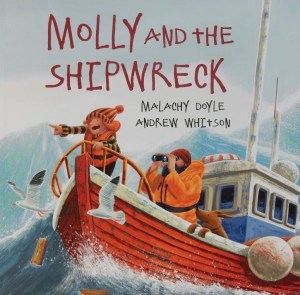
Molly and the Shipwreck

Molly and the Shipwreck
Malachy Doyle and Andrew Whitson
Graffeg

Young islander Molly and her family star in their fifth story and once again it’s full of caring and community spirit.

It begins with Molly’s mother receiving a letter from Molly’s teacher saying that the island school might be closed down unless more children can be found. Molly’s attempts to persuade some of the island’s visitors to move there and add to the pupil role meet with no success.

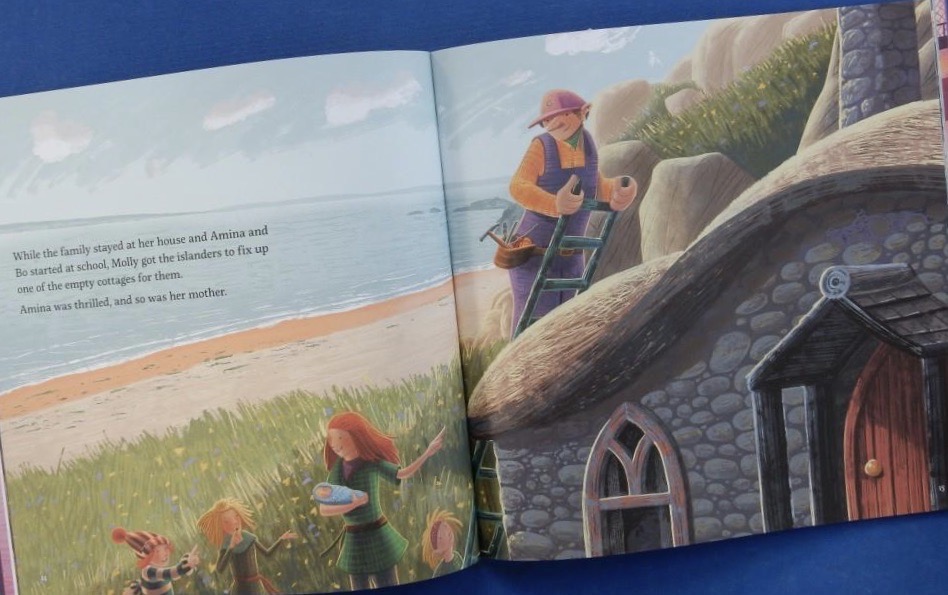
Then some weeks later Molly and her father are out fishing when they come across a rickety boat in trouble. They manage to rescue those on board – a mother and three children, one just a baby and Molly’s family and the other islanders do their best to make them all feel welcome, fixing up one of the empty cottages to house them. 

Molly is keen to enrol Amina, who is about her own age, and her little brother Bo, in the island school and hopes are raised about the increased numbers.

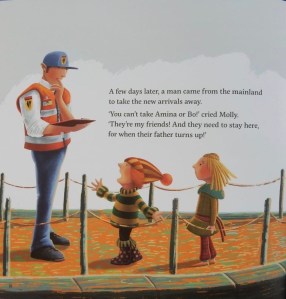
However, not long after an official from the mainland arrives saying he’s come to collect the new arrivals to take them to the camp but giving them some hope that after a while perhaps they could return to the island. So Amina and her family have to go.

Molly and Amina keep in touch over the summer and Molly tells her new friend that she’s watching out each day for Amina’s dad. also making that dangerous journey his family have made.

Will Amina ever be reunited with her father and will the authorities allow the family to return to the island?

With an emphasis on compassion, kindness and hope, in a way that will be understood by young children, author Malachy Doyle and illustrator Andrew Whitson present an important topic that seems to have moved to the back of many people’s consciousness. With Andrew’s dramatic scenes, and Malachy’s warm words, let’s hope that this book will help bring it to the forefront once again.

We All Celebrate

We All Celebrate
Chitra Soundar and Jenny Bloomfield
Tiny Owl

Probably somewhere in the world, no matter the month or the date, there will be people celebrating something or somebody, a birthday perhaps. This insightful book acknowledges that and introduces young readers to some of the less often mentioned festivals and celebrations from around the world, as well as presenting some that are well known such as Deepavali and Christmas.

Chitra Soundar uses both a global and a seasonal approach that starts with people wishing one another ‘Happy New Year’. and perhaps if they’re living in parts of Canada, jumping into the chilly sea doing the ‘Polar Bear Plunge’. However not all calendars begin on January 1st. Nowruz – the Persian New Year – celebrated in many countries including Iran, Tajikistan, Afghanistan and Turkmenistan is in March.

I think we all welcome the arrival of spring when we can begin to cast off our heavy winter clothes and blossoms start to burst forth. Blossoms – in particular those of the cherry trees or sakura – are a cause for celebration in Japan where people gather together for Hanami under the trees all pink with delicate sakura.

In contrast in India, the spring festival of Holi is anything but a quiet occasion to appreciate nature; it’s a time to join the throngs in the streets throwing coloured powder and water, and dancing to loud music. When in India at Holi, I hide away as I break out in a rash if I get the powder on my skin.

Summer, especially midsummer is another cause for celebration; I learned from this book that in Sweden families get together in the countryside and parks where they make garlands of flowers, adorn a maypole and dance around it, as well as feasting.
Sometimes the first day when Muslims celebrate the breaking of their Ramadan fast, Eid-al-Fitr, falls in the summer: Chitra devotes a double spread to fasting. giving brief details of some other fast days for other religious traditions.

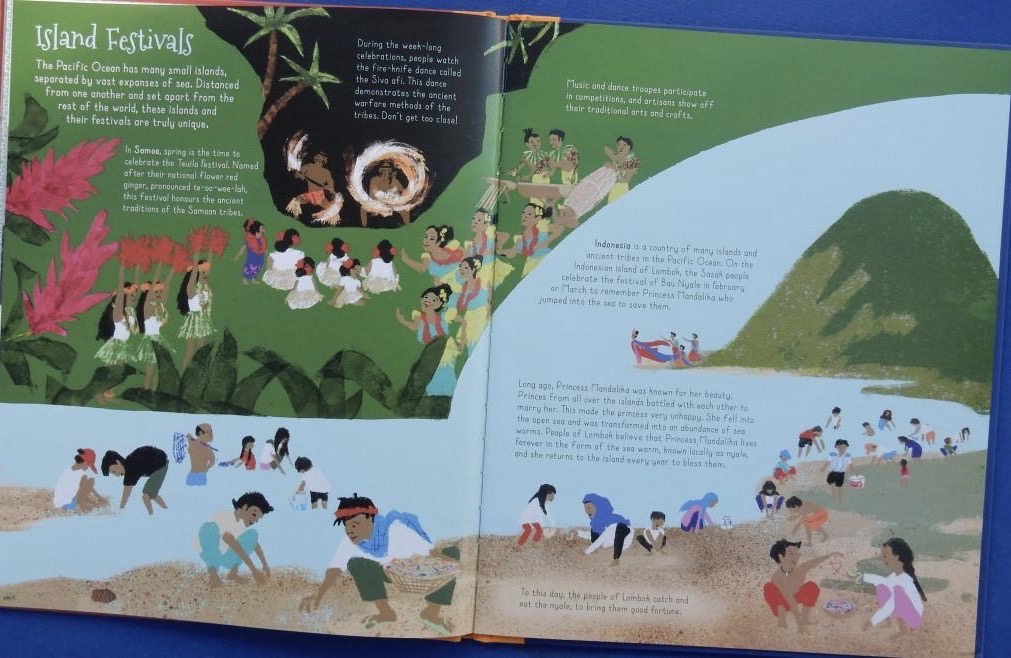
No matter the time of year, food, music and dancing often play a big part in celebrations. It’s certainly true for carnivals and for some Pacific Ocean island festivals.

Autumn seems to be a time for honouring dead ancestors; people do so in South East Asia and in Mexico.

Strangely for UK readers, people in Peru celebrate the winter solstice (Inti Raymi) in mid June. Much more associated with winter is the Jewish festival of Chanukah celebrated over eight days and nights.

It’s important to remember, as Chitra reminds readers on the final spread, that like humans, celebrations change and evolve over time, but despite our differences, everybody celebrates.

Debuting as a picture book illustrator, Jenny Bloomfield’s vibrant, detailed spreads really do evoke the spirit of the celebrations.

Definitely a book for school collections and topic boxes.

Peek-a-boo and Counting Fun Board Book Style

Monsters Play … Peekaboo!
Monsters Play … Counting

Flavia Z. Drago
Walker Books

Flavia Drago introduces a host of mock-scary monsters in the lift-the-flap Peekaboo treat.
In order to play a game of peek-a-boo seven ghoulish creatures – a werewolf skeleton (of the handsome happy kind), a vampire, a medusa looking very modish, a blobby beast, a banshee and finally a wee ghostie take turns to hide behind a sheet, their identity being revealed when each flap in turn is lifted. Little ones will delight in joining in with the repeat ‘Eek-a-peek-a … – – ! who’s hiding under the sheet? and relish the opportunity to make lots of ‘eeek!’, hiss!,

swishy swoosh!’, wah waaah!’, ‘peekaboo!’ sounds.

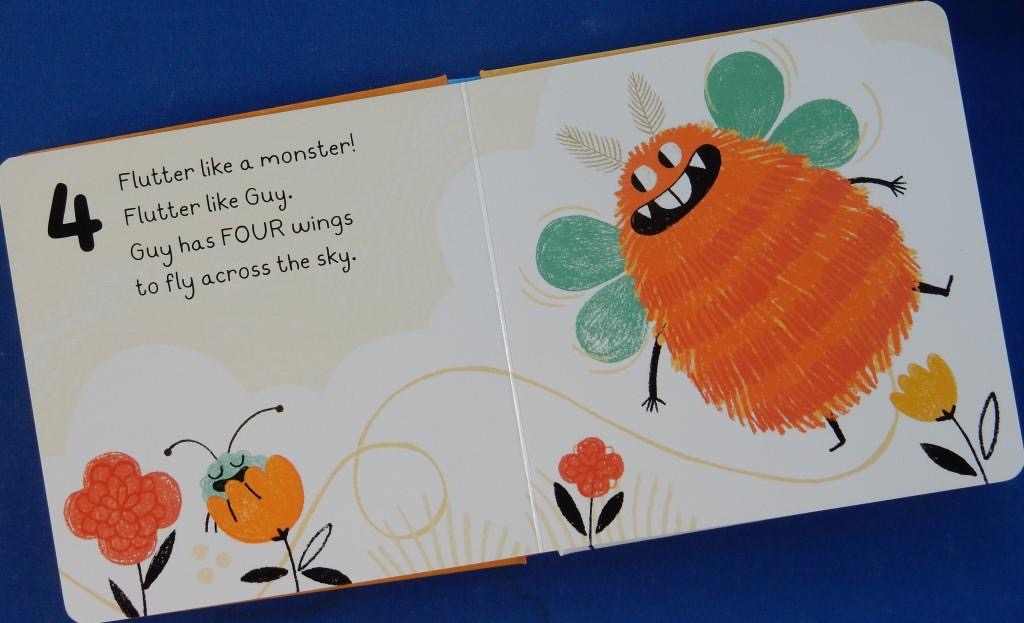
There are lots of playful beasties too in Counting as little humans encounter in turn, Simone with her hugely long tongue, Rosalind with her two ears ‘to hear the howling wind, Brooke who is endowed with three eyes so she can read her spooky book, four-winged Guy,

and so on till they reach ten- spiked Nicole with an invitation to drum along with her, (any suitable surface will do) which should of course, be monstrously loud.

I’m sure said humans will also take up the invitation to ‘count like a monster all over again’ too and that means lots more licking, swinging (maybe not of ears), fluttering, brushing of teeth, block building, running, spinning and a little bit of chilling as well.

Counting has never been such fun.

Hide-and-Seek Peekaboo
illustrated by Nicola Slater
Chronicle Books

This sweet interactive Beginning Baby board book combines two things babies and toddlers love – playing peekaboo and lift-the-flap books. Herein the jolly characters – Riley the narwhal, Elijah the elephant, giraffe Gabriel, octopus Paisley, Mia the monkey, Matteo the red panda and Layla the llama have all hidden themselves away in various parts of the house – under or behind items of furniture or furnishings – for little ones to find.

All the rooms are alive with vibrant coloured objects, most of which will be familiar to toddlers while others can become part of a ‘show me the …’ game once they’ve been told the names of say ‘the globe’ or ‘harp’ in the illustrations.

This I suspect is a book, little ones will want shared over and over again.

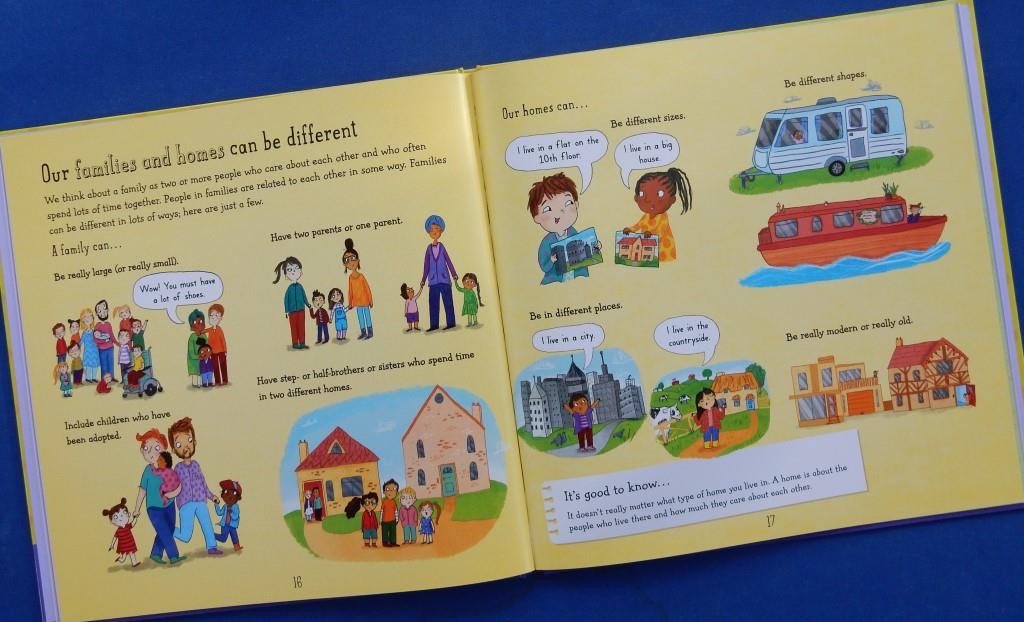
The Same but Different

The Same but Different
Molly Potter and Sarah Jennings
Featherstone

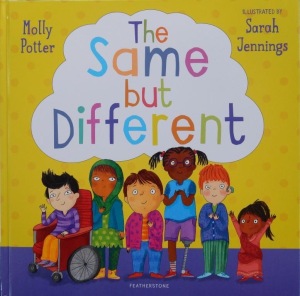
This is the latest in the excellent series written by Molly Potter and illustrated by Sarah Jennings that are used by so many teachers to stimulate thought and discussion.

Herein youngsters are invited to recognise, explore and celebrate both the things we have in common with other people and those that make us different. After all, every single one of us is a unique human being and our differences need to be acknowledged, respected and celebrated. Imagine a world wherein we are all identical in every way: how dull and boring life would be.

Sarah Jennings’ splendid illustrations portray a diverse mix of children (and some adults) and Molly’s narrative focuses largely on differences including how people look – skin colour, hair styles and colours, eye colour, whether or not we wear glasses, height and clothing styles.
There’s a page on talents and skills, another explores preferences such as foods, favoured times of day and another on personality.

That everyone is entitled to have his or her own opinions and beliefs is acknowledged and these should be respected (provided that nobody is harmed, that is.) The concept of family and that of a home are both presented and some of the ways families and homes can be different, mentioned.


However, in addition to the differences, there are spreads that look at some things that are likely to be same or nearly the same as other people –

things that are part of our shared humanity such as the need to eat, a desire to be loved, a felt discomfort at excessive cold or heat, a brain that enables decision making and an imagination.

The book concludes with some helpful tips for adults sharing it with children to help in their understanding of various forms of diversity and the celebration of difference. There’s also a final glossary. All in all a very useful starting point for discussions on inclusion both at home and in the classroom.

The Queen in the Cave

The Queen in the Cave
Júlia Sardà
Walker Studio

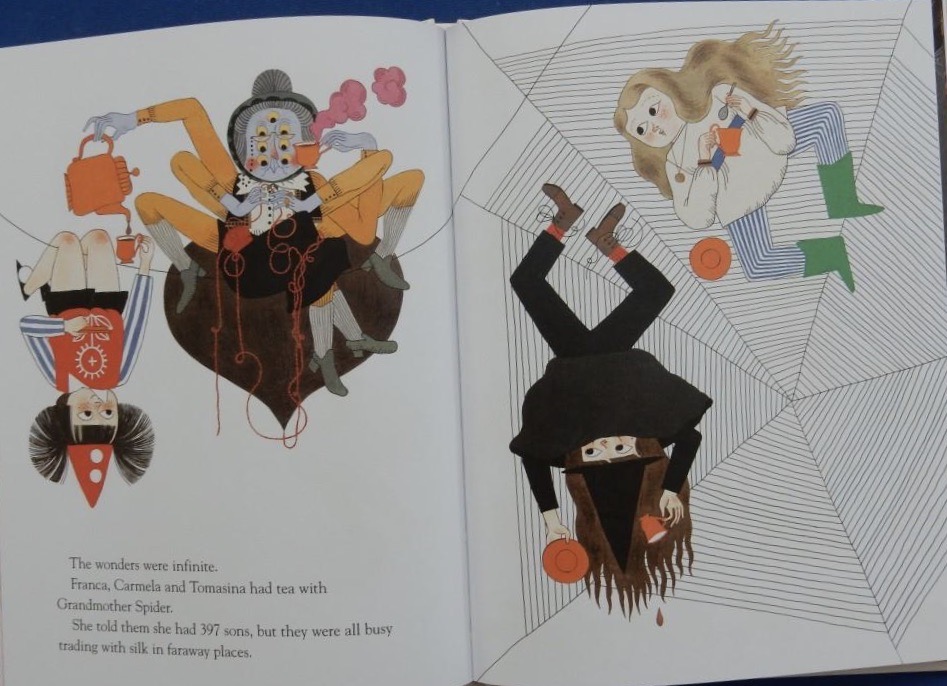
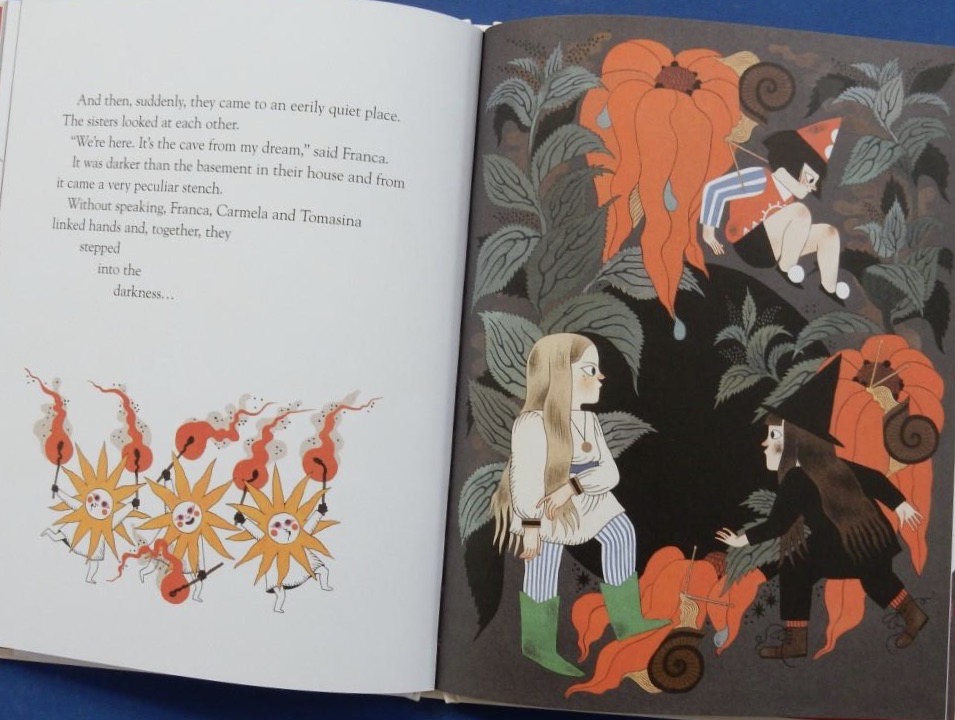
This story begins when Franca, one of three sisters gets a strange feeling. It’s on account of her previous night’s dream about a marvellous queen who lives in a dark, dark cave deep in the forest beyond the garden fence, so she tells her sisters Carmela and Tomasina.

Franca persuades her sisters to join her in an investigation whereby she hopes to discover the veracity of her dream and thus rid herself of the feeling that now besets her.

Thus begins an adventure that takes the three ‘where no-one has ever gone before’. As the three walk, the forest surroundings take on a troubling stillness but fearless Franca urges them onwards and suddenly the ground begins to shudder. Strange sights are revealed and even stranger encounters take place

some of which are very frightening. Gradually though Carmela and Tomasina’s fears turn to thrills and they press forwards as it grows darker and darker.

Then suddenly they find themselves all too close to a thoroughly nasty neighbour: time to run until they reach … the entrance of the cave from Franca’s dream.

But what of that queen? Is she within and will she reveal herself?

Prepare to be enthralled by this powerfully atmospheric book: readers will feel occasional frissons of fear along with the sisters, as the layers of meaning are gradually unearthed and the queen’s kingdom is revealed. Spellbinding indeed: the richly coloured illustrations have a quirkiness and are full of weird and wonderful details, patterns and textures.

Polka Dot Poems

Polka Dot Poems
Zaro Weil, illustrated by Lucy Wynne
Troika

Among Zaro Weil’s 100 nature haiku you’ll meet all manner of weird and wonderful beasties large and small from all over the world as well as flora of many sorts and other inanimate natural things too. I encountered several creatures that are new to me, one of which is the Fossa

another is Zebra duiker ( an antelope residing in the rainforests of the western coasts of Africa) ‘ black-striped / best mates / meander under /green canopy of /gold-striped / sun ‘.

Equally worthy of our attention though is this common or garden oh so bountiful Thistle ‘seeds for birds / leaves for bugs / fluff for nests / nectar-spiked / flowered // giving plant’.

Another is Spider – ‘smart / spinning your own paths / criss-crossing the cosmos / thin thread / by / thin thread’.

Among the inanimate yet brought to life through words is something we’ve all experienced countless times – the coming of a new day: Light ‘oh! / I remember you / morning sun-great / all a-whirl / through my window’.

In stark contrast using the same number of syllables is this contemplation of a Goblin shark, ‘ancient living fish/ your sword mouth/ parts water/ swims through/ millions of years’. Who would not be awed by this ferocious creature sometimes called a ‘living fossil’?

Again, using just seventeen syllables each time, Zaro draws attention to things ever present in our lives such as Pebble ‘so many pebbles / so many years / quietly crunching / underfoot’ and Moon – ‘palest puff / in / just-night sky / that you? // of course / I spy your / crescent wisp’.

No matter where they open this book young readers will find something to delight in; something of which Zaro in her wonderful words has captured its very essence, while Lucy Wynne brings out the gentle humour and playfulness of the writing in her gorgeous illustrations.

Don’t miss the extras – there’s a concluding section of ‘amazing facts about some of the weird and wonderful creatures’ including the Patagonian mara, the Venezuelan poodle moth and the star-nosed mole – wonderful creatures all.

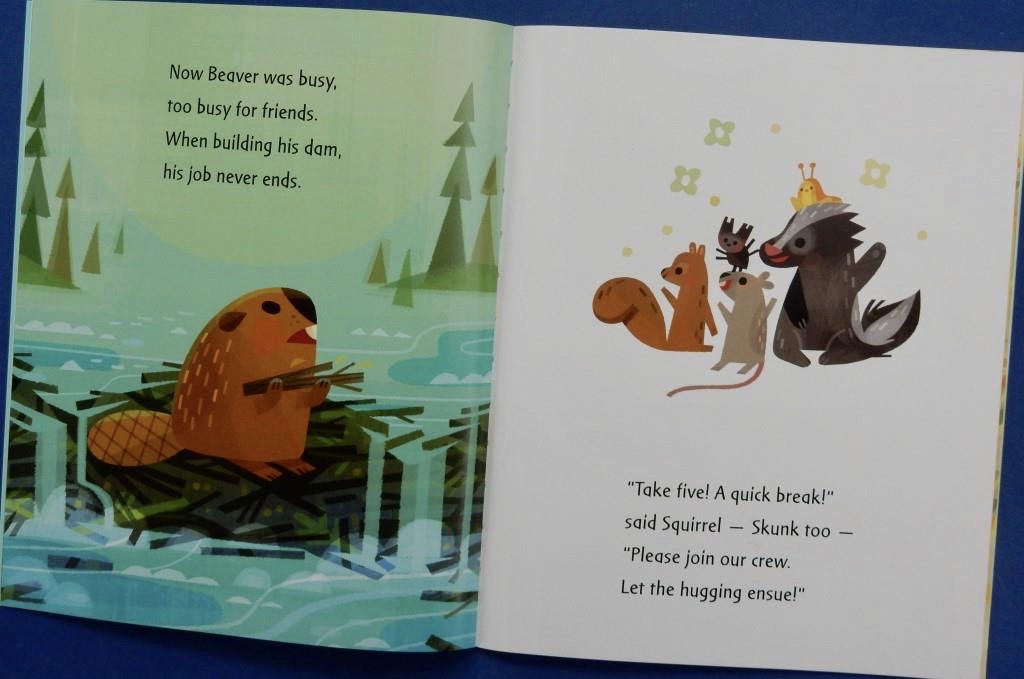
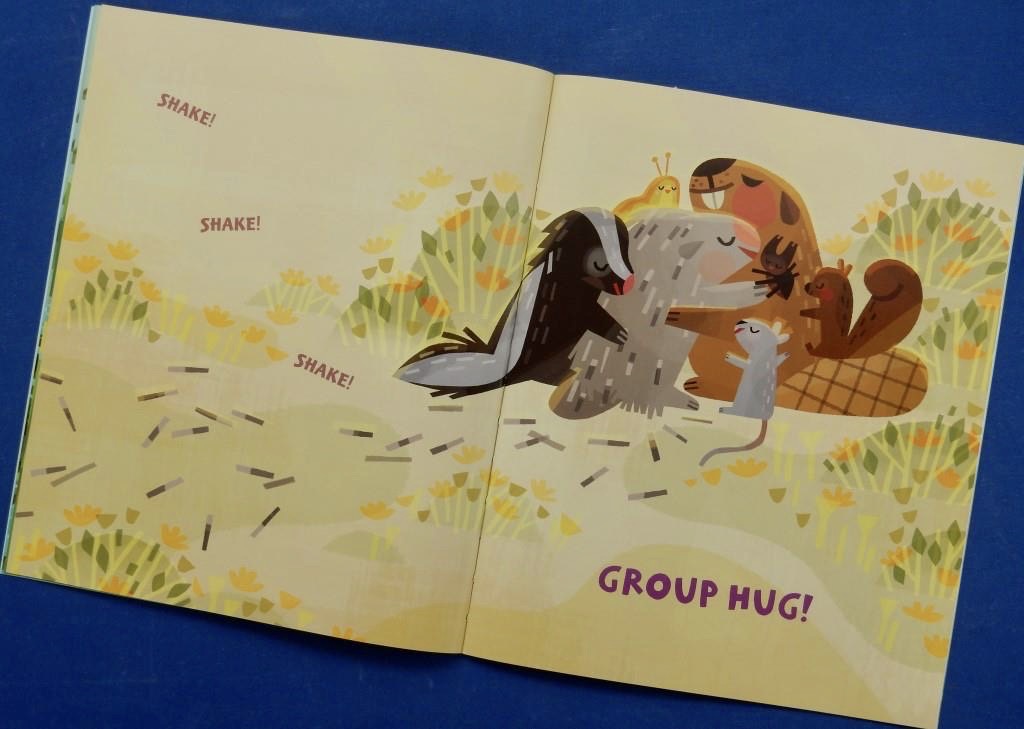
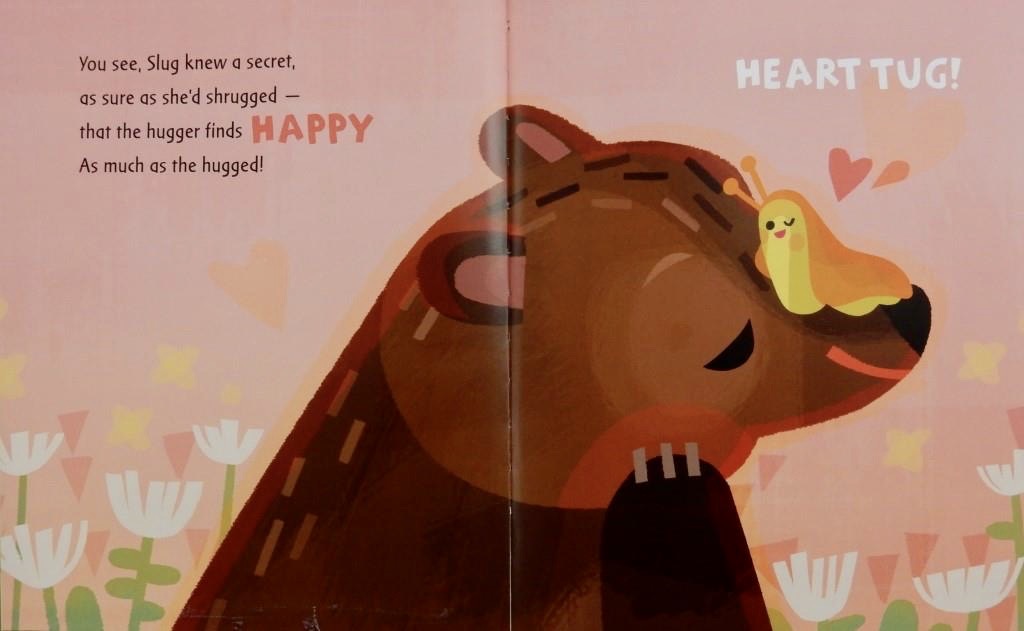
Group Hug

Group Hug
Jean Reedy and Joey Chou
Scallywag Press

We humans so longed to be able to hug our friends and relations during the worst of the pandemic when it was not allowed, and so it is with the slug at the start of this jaunty, rhyming story.

Said slug soon comes upon a lone beetle looking as though some physical contact would do it the world of good and a heart-warming hug is duly bestowed.

Then, one by one along come Mouse, Skunk (exceedingly stinky), Squirrel (upon which Skunk had deposited some if its long-lingering aroma), a busy Beaver,

Porcupine (willing to shake off some of its prickles),

a groundhog, a goose, a fox, a moose and finally Bear. Each animal is welcomed into the cumulative hugging embrace with the refrain ‘GROUP HUG’ except Bear. The appearance of the lumbering ursine creature causes the others to break away and scatter far and wide in fright.

Now only Slug (the brave one) and Bear remain. Good old, knowing Slug ,with an unfailing source of warm-hearted embraces, is ready and willing to spread the love

thus precipitating the return of the others from their hiding places for the hugest ever huggers’ huddle.

Jean Reidy’s telling comprises story elements both young listeners and beginning readers delight in: a repeat refrain (the title in this case), a spare rhythmic rhyming text, gentle humour, along with themes of kindness, acceptance and inclusivity. All this, together with Joey Chou’s digital scenes, each of which is imbued with a sense of community delight, make for a welcome heart-warming hug of a book for group sharing and individual reading.

My Pet Goldfish

My Pet Goldfish
Catherine Rayner
Walker Books

The young narrator of this gorgeous book is thrilled to receive when four years old, the gift of a goldfish. Naming it Richard, child and fish gaze at one another, one in its watery world the other without. Then Richard is put into a big tank along with lots of other fish so it has sufficient space to grow and after school our narrator talks to Richard about the day, convinced the fish recognises the speaker.

Little by little the child learns much about Richard, as do we readers. This information comes in part from the narrator’s observations, part from friend and fish expert Sandy, who lives next door and has a pond in his garden; and part from the factual information presented in a smaller font throughout the book. ‘Goldfish can remember things for up to five months’; seeing more colours than humans, they have very good eyesight that they use along with their sense of smell to find food; they breathe by means of gills; they lack eyelids

and the term for a group of goldfish is.a ‘troubling’ – I didn’t know that before.

Sandy shows the narrator his pond with its assortment of goldfishes

and offers the pond as a home for Richard, should he grow too large for his tank. Something that at age four-and-a-half Richard does, but there’s a long way to go for him to reach the age of the oldest ever goldfish – 43 years – wow! Sandy’s pond is then the perfect place for the narrator and Richard to continue their regular meetings.

Catherine Rayner’s narrative nonfiction account is based on her own real goldfish, Richard. Her delicately detailed, mixed-media illustrations are stunning, making every spread a place to linger and delight in the beautiful fishes, the often bubble-surrounded, aquatic plants in their watery world, and Sandy’s tranquil garden.
(There’s a final author’s note that includes some tips for fish care and an index.)

A splendid introduction to the joys of having a goldfish as a pet.

Where Three Oceans Meet

Where Three Oceans Meet
Rajani Larocca and Archana Sreenivasan
Abrams

This story was inspired by author Rajani Larocca’s memories of a similar trip taken when she was a child.

Here, Sejal, her mother both USA residents, and Pati ( I think Sejal’s maternal grandmother,) who lives in India plan a trip to the southernmost tip of India, the place where three oceans meet – the Indian Ocean, the Bay of Bengal, and the Arabian Sea.

With their preparations and packing completed, (saris for Pati – nine yards long – and mum – six yards, t-shirts and jeans, with langas and blouses for best – that’s Sejal), in the girl’s first person narrative we follow members of three generations from Bangalore all the way to Kanyakumari, which Sejal refers to as ‘the end of the earth’.

They travel by car first to Chennai, where they sample the dosas, and then by train across the countryside of Tamil Nadu to Coimbatore where they stop to visit friends, enjoy a slow peaceful boat ride down the river, sip the water of tender green coconuts,

and wander in the colourful bazaars before moving on to Madurai with its amazing temple.

Finally they reach Kanyakumari, the place where three oceans meets, just like the three generations: ‘Pati, Mommy and me. One who lives in India, one who moved to America, and one who belongs to both … ‘ Three entwined as one, stronger than any alone.’

As well as showing how love transcends cultures and distance, and endures across vast continents, the author truly captures in words the assault on the senses that one experiences when first visiting India – all those wonderful sights, the gamut of sounds and smells in this story; while Archana Sreenivasan’s vibrant digital illustrations help readers feel they are right there with the travellers in this wonderfully warm intergenerational tale. I certainly felt as though I was right back on those sands at Kanyakumari that I visited way back on one of my many trips to southern India that also took in Bangalore, Chennai, Coimbatore, Madurai. A memorable learning journey for one small girl, and for this reviewer, a journey down memory lane.

(There’s a map of the journey at the back of the book, as well as an author’s note and one from the illustrator.)

When Poems Fall from the Sky

When Poems Fall from the Sky
Zara Weil, Illustrated by Junli Song
ZaZa Kids

During the past year and a half a great many of us have found that walking in nature has both uplifted and calmed us: when we’ve so badly needed a boost, nature has been there for us inviting us to slow right down or stop and let the flora and fauna work their magic. As we read this treasure of a book, Zara Weil reminds us of those sights and sounds and introduces the joys of many others in this mix of poems, rhymes, haiku, raps, story poems and short plays, that were inspired by Kew Gardens where the poet spent time fairly recently; and having worked in the Kew herbarium on a gap year I can totally understand how Kew made her feel.

It’s clear that the poet observes with all her senses as she gently nudges and occasionally urges readers to see things differently, to discover new ways to look, feel and listen. She helps us to fine tune our ears to the various voices of nature that she has heard including that of a Butterfly’s Song, various birds such as a nightingale, and the Jay that acts its part along with Oak in That’s what friends are for – what delight this would give children taking on those roles in a read aloud, and a wonderful learning experience too.

The same is true of another ‘Mother Nature Production’ Oh Happy Day – a fig and wasp play that is a celebration of the amazing pollination partnership between wasps and fig trees.

It’s impossible to choose an utmost favourite in this collection but as a life-long lover of trees I was struck by the way Zaro captures their wonder and their ability to hold memories in Tree’s Story; ‘for who else still breathing / has been a part of long ago / who else / holds it written in / rings of memory / for anyone to read / in the far future ‘ – in those lines too (and throughout) is a reminder of our interconnectedness.

For its sheer exuberance and sheer delight in playful language, I absolutely relished Bug Parade with its ten quintillion minibeasts – ‘They whizzed by all zipping / glittering then flittering / diving and gliding / whoops sometimes colliding’. Brilliant!

Certainly a poem to make you laugh and perhaps, dance; but there are also poems to move you within, others to make you care and to think deeply.

Surely though, every one is a demonstration of the fact that in nature there is SO much to cherish and to wonder at; it’s as though nature itself has been given voice herein to give hope, to guide us ever to watch, to listen and to remember our role as guardians and stewards of our awesome planet.

Thoughtfully and beautifully illustrated by Junli Song, this is a must have book to cherish and return to over and over.

Great Britons

Great Britons
Imogen Russell Williams, illustrated by Sara Mulvanny
Nosy Crow

Who could fail to be moved by the stories of the fifty people featured in this selection of biographies of key figures who have made Great Britain their home, have made great contributions to society and had a significant impact upon the ways we live, think and feel in today’s world, of which Great Britain is but a small part.

Coming from many different walks of life and eras as far back as Boudicca, the warrior queen of early Britain who led the revolt against the Romans, to contemporary authors Malorie Blackman,

and Lemn Sissay, and Malala Yousafzai, who continually fights for every girl’s right to an education, each of the men and women has added to the rich diversity and talent that is Britain. Every person is allocated a bordered double spread wherein author Imogen Russell Williams highlights the key events of his/her life and their achievements, and is thoughtfully illustrated by Sara Mulvanny.

Herein readers can meet inspiring contributors to medicine, science, engineering, sport, the arts, activism, and the environment including Edith Cavell and Elsie Inglis, Alexander Fleming and Tim Berners-Lee,

Isambard Kingdom Brunel, Mo Farah and Tanni Grey-Thompson, Shirley Bassey and Freddy Mercury, Paul Stephenson and David Attenborough. One name is new to me so I must mention Olaudah Equiano once a slave, who as a writer and abolitionist made an enormous difference to the fight against slavery.

A book to add to primary school libraries and family collections.

George and His Nighttime Friends

George and His Nighttime Friends
Seng Soun Ratanavanh
Princeton Architectural Press

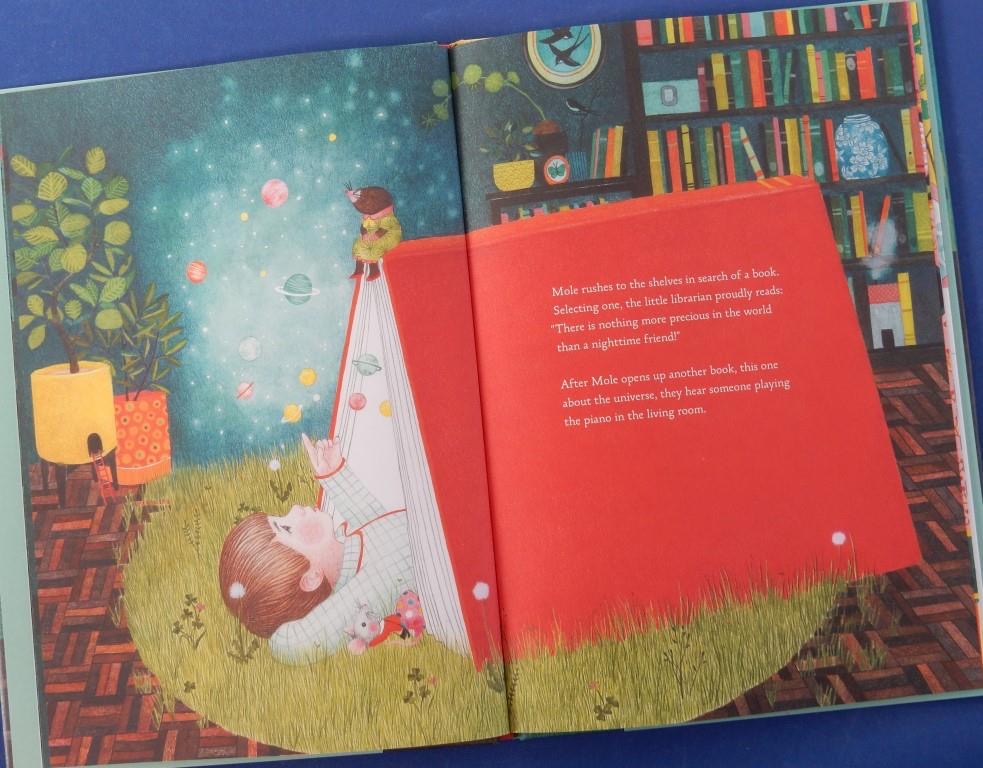
George, the lonely child protagonist in this nocturnal tale lies awake unable to sleep on account of his fear of the dark. “I wish I had a nighttime friend, even a small one,” he says one night. Surprised to hear a voice responding in the darkness, the boy sees beneath his bed a tiny mouse offering to help.

The mouse leads George downstairs and into a wonderful adventure in his very own house. The two explorers’ first encounter is with book guardian Mole,

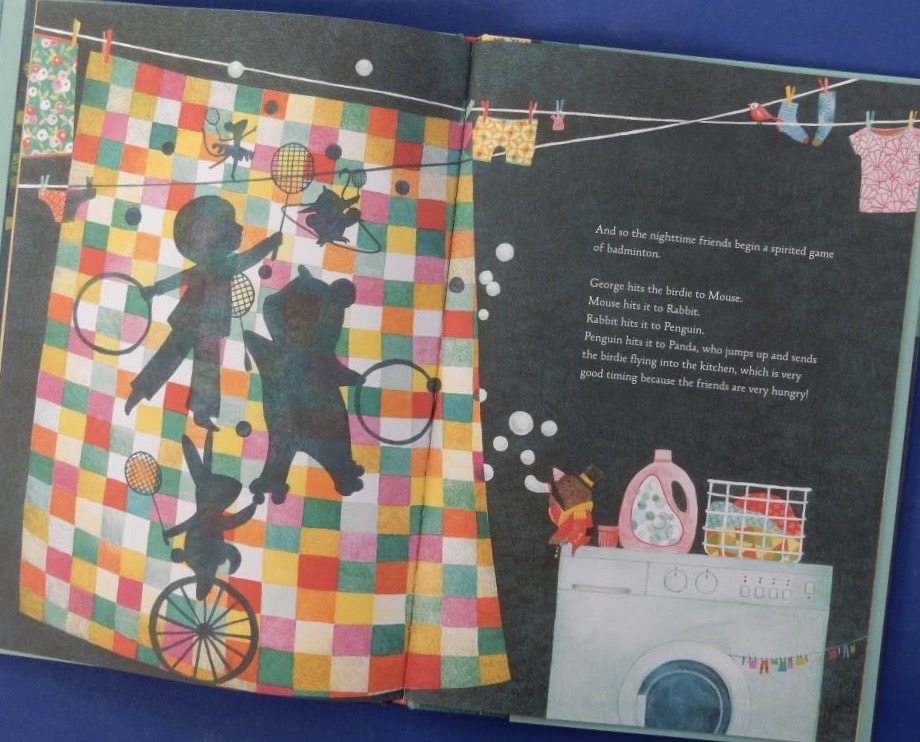
then an elegant, piano-playing rabbit with stage fright, followed in the bathroom by a little penguin with a fear of the water and lots of other things. The four friends plunge into a warm bath to help Penguin with his frights and then during their search for towels they discover in the dryer a panda.

Said Panda is in need of a badminton opponent to help fulfil an ambition. There follows a crazy badminton game which fuels their hunger

and results in a new encounter in the kitchen and the making of another nighttime friend.

At last, surrounded by the host of new friends, George realises that night isn’t so scary as he’d supposed. A cosy bed calls and now it’s time to bid farewell to his friends and …. zzzzz …

Wonderfully whimsical, and wondrously illustrated in Seng Soun Ratanavanh’s richly patterned trademark fashion, this book is a perfect bedtime treat for youngsters and adults to read together. Both will savour the magical scenes – sometimes comforting and reassuring, sometimes playful – with their unusual perspectives, wealth of detail and superb use of light and shadow, throughout. Be prepared for an extended bedtime experience as youngsters will want to spend ages poring over every spread.

Oceanarium

Oceanarium
Teagan White and Loveday Trinick
Big Picture Press

This outsize volume is part of the Welcome to the Museum series that uses the interactive gallery style of a museum, in this instance taking readers to meet the amazing life found in and around the seas. 

As always the presentation is superb: a large clear, well leaded font is used for the text, there are awesome full page illustrations by Teagan White opposite each page of text, and marine biologist Loveday Trinick’s explanations are fascinating, educative, and likely to encourage youngsters to wonder at ocean fauna and flora.

First we are given a general introduction to the historic oceanic divisions and the ocean zones before proceeding to the first gallery wherein the microscopic plankton – both phytoplankton and zooplankton – are to be found.

Gallery 2 exhibits fauna that inhabit coral reefs; there are examples of wandering jellyfish; the Portuguese Man o’War, (a venomous predator) actually a colony comprising four different kinds of polyps that all work together to act as one animal. and examples of some of the 1000 known anemone species. (I never knew before that there was a Venus flytrap anemone). The gallery also includes a full page illustration of a coral reef and some descriptive paragraphs, the last of which states that they ‘may also hold the key for the treatment of infections, heart disease and even cancer.’

Moving on, readers meet next inhabitants of the deep sea – molluscs and echinoderms, the outer shells of some of the bivalves shown may well be familiar to those who wander beaches at low tide.

No matter which of the nine galleries you wander through, the other habitats are: a rock pool, a mangrove forest, a kelp forest,

the Poles, the Galapagos islands you’ll encounter a wealth of stunning images of, and facts about the marvellous life inhabiting the deep. 

The final one draws attention to the human impact upon the ocean as a whole emphasising the vital importance of its contribution to many aspects of our lives, as well as highlighting the adverse impact we humans have already had on this watery world. However, with ever more people becoming aware of this damage, there is still time to make changes to our behaviour that can conserve, protect and restore this essential component of Earth’s ecosystem.

Marine biology isn’t just for specialists; this wonderful book can be enjoyed by anyone from primary school onwards (it might well encourage some observational drawing) and for those who want to learn even more, try the Ocean Conservation Trust and the other organisations listed on the final page.

Following Frankenstein

Following Frankenstein
Catherine Bruton
Nosy Crow

This is a terrific book inspired by Mary Shelley’s gothic story. It begins in Victorian England and is narrated by Maggie the daughter of a Frankenstein obsessive Captain Robert Walton who has dedicated his entire life to tracking down the iconic monster created by Victor Frankenstein. Already this obsession has cost Maggie and her family dear – and now her father is staking all on one final voyage to the Arctic in search of the elusive monster that he considers his destiny.

Unbeknown to her father however, Maggie, accompanied by her pet mouse Victor, boards the ship, a whaler named Moby Dick.

It’s not long however before the girl is discovered by the Captain Ishmael but instead of throwing her off, he makes a pact with Maggie: “Between you and me we will see Captain Walton through the storm and bring him back to safe harbour once more.”

The journey takes them to the icy Arctic Tundra where a horrific revelation is made, then to New York, which couldn’t be more different, and for Maggie, separated from her father, on through America towards Canada. It’s a journey of adventures, terrors, of monsters and heroes and Maggie is a strong character, caring, kind and prepared to take enormous risks for those she loves.

Once again Catherine Bruton has created a gripping story with superb descriptions of the various landscapes but fundamentally this tale is about love, family, loyalty and friendship, accepting difference and looking for what’s good. It will enthral readers and listeners keeping them on the edge of their seats until the final page: unable to put it down, I read the book in a single sitting.

In a word – brilliant!

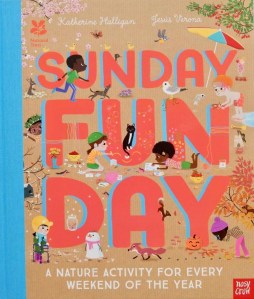
Sunday Funday

Sunday Funday
Katherine Halligan and Jesús Verona
Nosy Crow

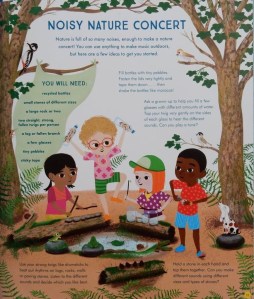
Subtitled A Nature Activity for Every Weekend of the Year and created in collaboration with the National Trust, this bumper book, written by Katherine Halligan and organised by season offers a smashing way (or rather fifty two ways) to encourage youngsters to make the most of what the natural world has to offer.

As a seasoned teacher of primary children, many of the activities are familiar but no matter, they probably won’t be to families using the book for whom in addition to the main part of the book, there are four ‘key kits’ lists (craft materials, kitchen equipment, adventure items and garden bits and pieces), as well as a list of safety tips; and, the yoga teacher part of me was delighted to find the ‘Be a Tree’ spread.

There are recipes, gardening projects for both indoors and out, and much more. In the spring section I particularly liked the ‘Noisy Nature Concert’

and the idea of a Mad Hatter’s Tea Party in summer sounds lots of fun, especially the suggestion of using old sun hats to create small hanging gardens.

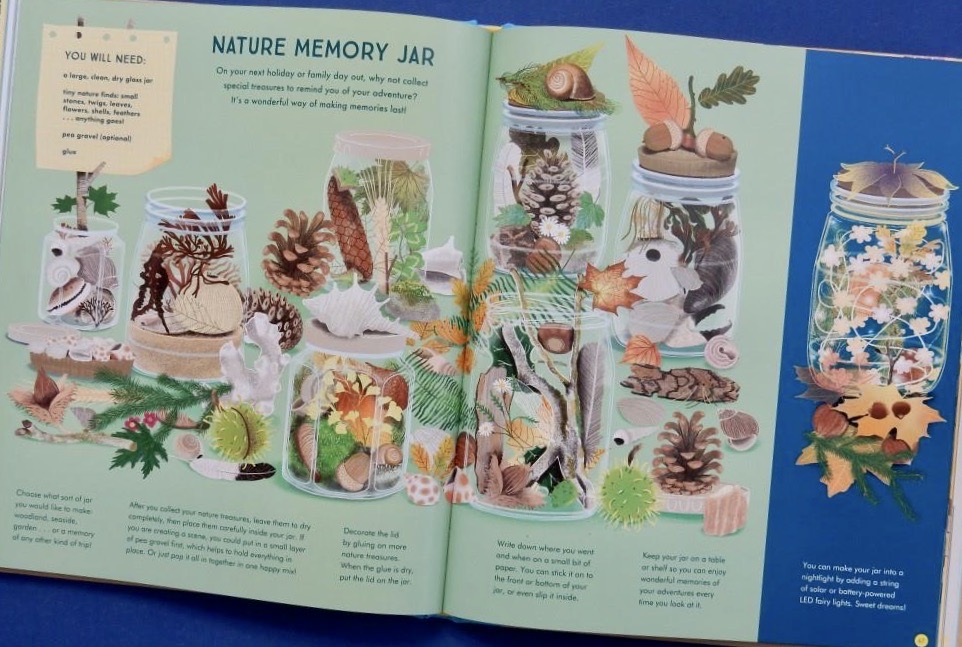
Lots of people take photos of walks they’ve enjoyed to act as reminders: the ‘Nature memory Jar’ suggestion in the Autumn section is a great way to make a different sort of memory of a enjoyable day out

and I’m definitely going to try making the ‘Gorgeous Granola’ using the recipe in the same section. It’s good to see the rangoli design idea for the festival of Diwali using such items as leaves as well as the more traditional materials.

Although I’m not really ready to think about winter just yet, I will start collecting fir cones when out walking in preparation for making some ‘Pine Cone Pals’ with youngsters when winter arrives.

Each activity is colourfully and alluringly illustrated by Jesús Verona. Be it rain or shine, you’ll find something to tempt you in this book that will last not just one but several years.

As Large As Life / Hide-and-Seek History: The Greeks

These are 2 non-fiction books from 360 Degrees an imprint of Little Tiger: thanks to the publishers for sending them for review

As Large As Life
Jonny Marx and Sandhya Prabhat

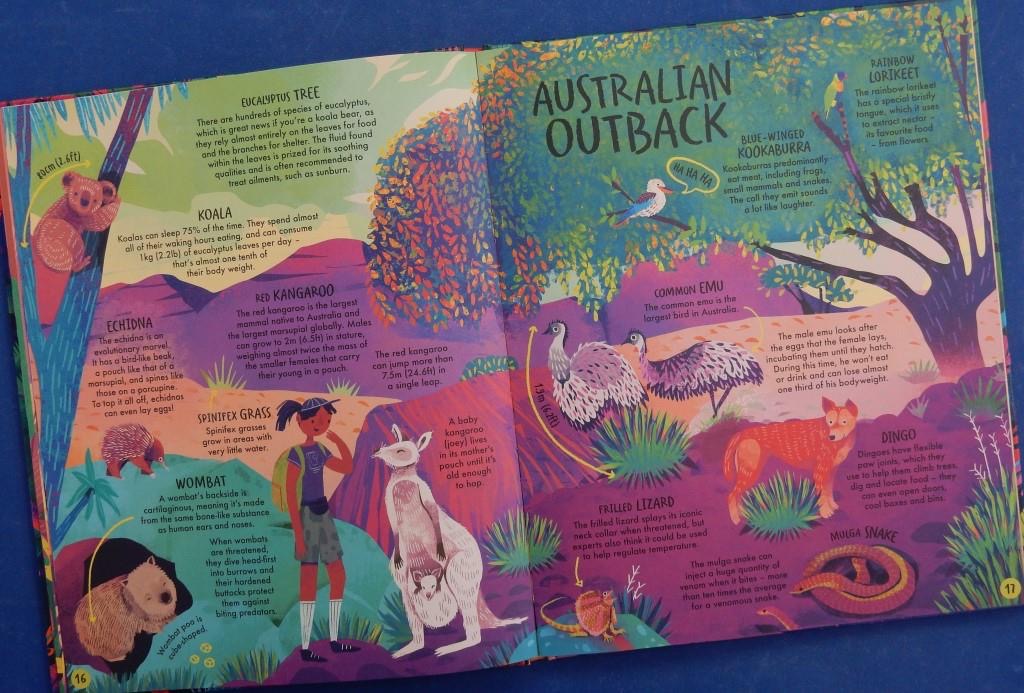
Author Jonny Marx takes readers on a somewhat capricious world journey from Peru to the north American Chiuahuan desert, the Australian outback to the Arctic and the Black Forest to the Galapagos Islands in the Pacific, visiting various habitats both aquatic and on land. We meet about 250 animals (and occasional plants) – between eight and a dozen large and small on each spread, all drawn to scale. Part and parcel of each spread too, for comparative purposes, is a human figure, part of one or a footprint.

Sandhya Prabhat’s richly coloured scenes of the creatures in their natural habitats contain recognisable images of an insect as tiny as the mosquito and as mighty as the blue whale for instance ;and scattered around the images – each of which is named – are succinct comments by Jonny Marx. Did you know for instance that an Atlas moth can have a wingspan as wide as a dinner plate; or that in the case of Australia’s largest bird, the common emu, it’s the male that looks after the eggs, incubating them until they hatch. While so doing the bird doesn’t eat for drink and might lose almost one third of its bodyweight – that’s dedication. 

Mentions of poison crop up fairly frequently and youngsters will doubtless delight in the also fairly frequent mentions of poo especially this: ‘Jackrabbits are coprophagic, which means they eat their own poo when hungry!’ (By the way the antelope jackrabbit mentioned is, we learn, actually a species of hare with ears around 20 cm. long.) This reviewer was amused to read that those wombats in the Australian outback have cartilaginous backsides and they take advantage of their ‘hardened buttocks’ when biting predators threaten, by diving into their burrows head-first. Then of course there’s the fact their wombat poo is cube shaped, which I actually did know.

Talking of being threatened, on another continent Short-horned lizards shoot jets of blood from their eyeballs when under threat from predators. 

In addition to having a better understanding of relative size, there’s certainly plenty for readers young and not so young to enjoy detail-wise; and youngsters will doubtless want to impress their peers with some of the information they’ve gleaned from this book which unfortunately lacks an index, although there is a contents page.

from the same author and illustrator is:

Hide-and-Seek History: The Greeks

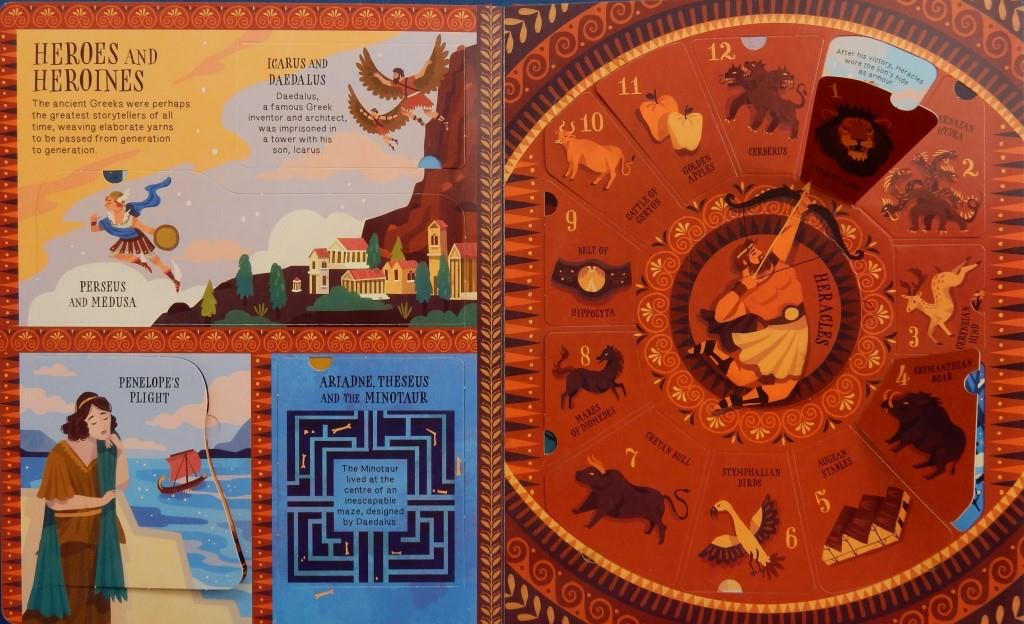
This is an addition to the Hide-and-Seek History series presented on large, thick card pages that have flaps (sometimes double ones) to explore on each of the half dozen spreads.

It starts with a visit to the Acropolis and environs to see a group of archaeologists busy at work; this acts as an introduction to Greek civilisation in general, saying that the ancient Greeks were the creators of democracy as well as great thinkers, artists and inventors.

Then come spreads on the Greek gods and goddesses; some of the heroes and heroines from their stories including Daedulus and Icarus, Ariadne and Heracles. 

we’re introduced to some of the trailblazing mathematicians, scientists, architectural pioneers and sporting greats; next is a look at war and combat, and finally, there’s a look at everyday life in ancient Greece

Vibrantly illustrated, interactive and written in an engaging style, this is a fun way to introduce fascinating facts to youngsters, one bite at a time.

Dulcinea in the Forbidden Forest

Dulcinea in the Forbidden Forest
Ole Könnecke (translated by Shelley Tanaka)
Gecko Press

Dulcinea lives happily with her father in a house on the edge of a large forest. They have a cow for milk, chickens for eggs, and grow much of their own food. Assuredly this is the stuff of fairytales;:all the more so when we read slightly further on that in the forest is a castle, wherein dwells a witch; a singing witch who sometimes roams in the forest. I guess she has no worries about being attacked by the monsters said to lurk in the moat surrounding her residence.

Now on the day of Dulcinea’s birthday, the girl’s chosen breakfast is blueberry pancakes; but oh woe! neither father nor daughter has remembered to buy blueberries at the market. Off goes her father but not as the girl thinks, to the market; rather he enters the forest where the desired berries grow in abundance.


Therein however, an encounter with the witch results in him being turned into a tree.

Now generally speaking, young Dulcinea is an obedient child, but fuelled by determination, the desire to celebrate her birthday with the specified pancakes (and one assumes, a love for her father), accompanied by her ever-present goose, she too enters the forest to look for her pa. There she (as will readers) instantly recognises him on account of his moustache, cap and basket.

Then it’s down to her wits to save her father,

herself and her birthday. Each of these she does with aplomb, in best fairy tale fashion.

Brilliantly comedic, both verbally (‘the witch always found young children exhausting’ … ‘besides nothing bad could happen to you on your birthday, could it?’) and visually -superb linework with minimal colour – and the contrast between the expressions of child and witch. In combination, these elements make this a neo-fairytale that will delight both solo readers and readers aloud.

When Fishes Flew

When Fishes Flew: the story of Elena’s war
Michael Morpurgo, illustrated by George Butler
Harper Collins Children’s Books

The first novel for a couple of years from storyteller extraordinaire Michael Morpurgo is well worth the wait. With three time settings and two locations, the stories of Ellie and Nandi weave together ancient history and myth, contemporary life and World War Two experiences.

As the story opens Nandi, who lives with her parents in Melbourne, Australia, thinks of herself as Greek. Her father’s family came from Ithaca, the Greek island that is still home to her beloved great aunt Ellie.

Until fairly recently Aunt Ellie was a regular visitor to Melbourne but now she’s become too old (and troubled by the impact of flying on global warming) to make the journey. Nandi misses her greatly, especially those wonderful tales from Greek history and mythology she’d tell whenever she visited. Now Nandi must do the visiting, she resolves.
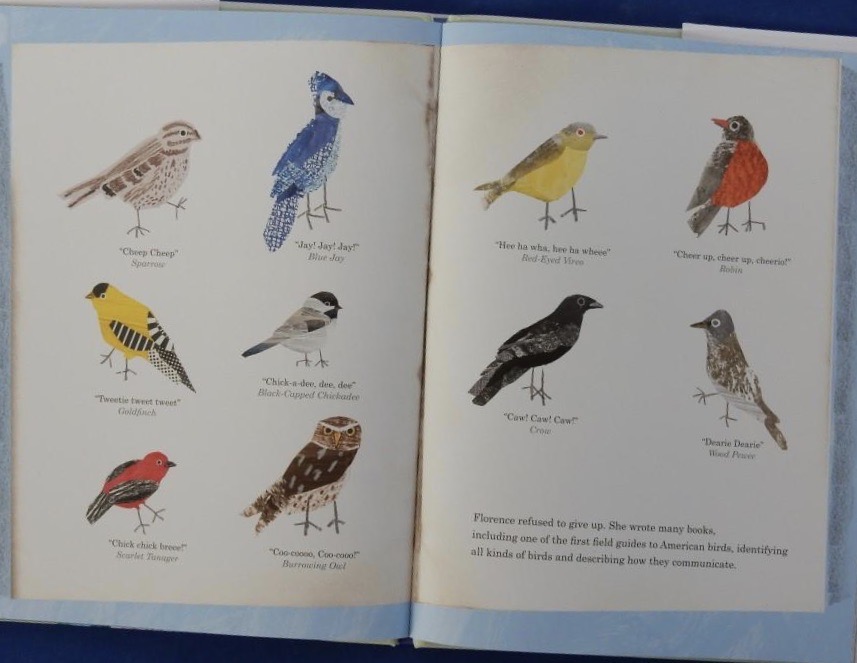
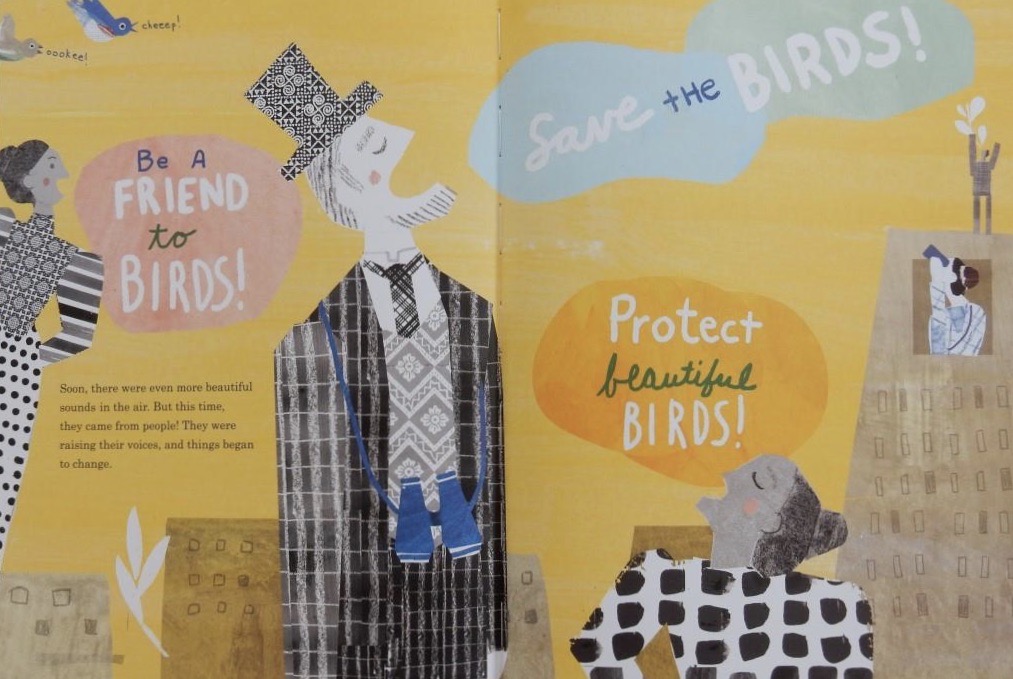
So, as soon as she’s left school and saved sufficient money, Nandi travels to Ithaca; (what happens is told in the form of her journal called ‘My Odyssey’).

However, when she finally reaches her aunt’s home, Ellie isn’t there, hasn’t been seen for a month and nobody, not even her special friend Maria, knows where she’s gone. We readers can’t help but share Nandi’s sadness but as she sits writing her diary one day she ‘hears’ a voice. A voice that seems to be calling her, beckoning her to take the plunge and dive into shoals of fish that spin around the end of the jetty. One fish though, isn’t like the others, this one is a silver flying fish and needs saving, so Nandi must take the plunge. Into the water she goes and rescues the fish.

It’s through this creature, (Proteus in another form) with which she forms a friendship, that she learns the amazing, unimaginable story of her great aunt: ‘a modern Greek hero, a hero of today and yesterday and tomorrow’ as the fish tells her.

Truly that fish was right: I felt tears welling up as I read the last entry in Nandi’s journal written ten years on from the main part.

Totally gripping (I read it a single sitting) is this tale of love, courage and rescue, of personal discovery and belonging, that will remain with readers long after they’ve put the book down.
George Butler’s black and white illustrations too will stay in your mind; it’s amazing how he imbues them with the spirit of myth, of mystery and of love.

Clock of Stars: Beyond the Mountains

Clock of Stars: Beyond the Mountains
Francesca Gibbons, illustrated by Chris Riddell
Harper Collins Children’s Books

Like the first story, sparkling with excitement is the second totally spellbinding adventure in the Clock of Stars series.

Herein Imogen and Marie, whose home life has changed due to their mum’s new man Mark, return through the door in the tree to the magical land of Yaroslav, where they find much has changed too. Miro has become king and hates it, while Anneshka is Queen no longer and is equally unhappy about it. So when she hears a prophecy that she will rule the Greatest Kingdom, she seizes Marie, believing her to be the key to its fulfilment, and heads off over the mountains pursued by Imogen who feels it’s her fault her sister is in this situation, and Miro. (Chris Ridell’s superb illustrations of the characters at the beginning of the book will remind readers of who’s who.)

As the story unfolds, unimaginable dangers are faced by both sisters and Imogen is beset by worry creatures that niggle at her feelings sometimes undermining her ability to function properly. Readers too feel frissons of fear at various points throughout (the very idea of those krootymosh be they real or not, is nightmarish as is the sight of that Yedleek) but the telling is funny too, as little by little, both sisters learn to navigate both the ups and downs of life in their own world and in Yaroslav.

Be prepared for an emotional roller-coaster as surprising events unfold and revelations are made both good and not so good, as inevitably both Imogen and Marie learn to look differently at things and in so doing undergo changes in themselves.

This particular adventure concludes satisfyingly but we know by what is said in the epilogue everything is not over quite yet. Bring on the third book say I.

It’s Up to Us

It’s Up to Us
Christopher Lloyd
What on Earth Books

Thirty three award-winning artists from around the world have each contributed a terrific illustration for this book, which is subtitled A Children’s Terra Carta for Nature, People and Planet. It’s based on the 13 point Terra Carta – a kind of roadmap created by HRH The Prince of Wales (who contributes a foreword) and his initiative Sustainable Markets, which aims to ‘put nature, people and planet at the heart of global value creation’ set out at the back of the book using the original language of the Terra Carta’s preface).

The main text comprises four parts. In Nature, the first, we’re reminded that we humans are living our lives surrounded not only by other people but also by an incredible wealth of flora and fauna; and it’s likely that no matter where one looks there is evidence of this, be it from the tiny wild plants poking out between the cracks in the pavement, or the birds singing in the trees we walk past on the way to school or the shops.
However not all life is visible to the naked eye: there are millions of tiny microbes living in every conceivable place on Earth – even in between our toes – but you’ll only see them with the aid of a microscope.
Did you realise that all life is dependent upon three things: the air, the soil and the oceans; from these come oxygen, food, water and the wind? Immediately recognisable, Poonam Mistry’s intricately patterned illustration surrounding this information pays tribute to her love of nature. Nature – Earth’s circle of life – has been around billions of years before human life first existed, and indeed Earth is the only planet on which we can be sure, life exists.

illustrations by Estelí Meza and Mehrdokht Amini

The Nature surrounding us is so amazing that from it we derive everything we humans need (and much more), of this we’re reminded at the start of the People section of the book.
There’s a downside to this though – the pollutants released into the air and the water, poisonous emissions that cause immense harm to myriads of tiny living things that keep our soil healthy.
But that’s not all: stop and consider the vast amounts of pollutants now found in our oceans and rivers due to our consumerist lifestyle. The result? The extinction of ever more plant and animal species. Catastrophic indeed. Due in part to the fact that we have forgotten that we too are Nature.

illustration by Rutu Modan

That is why our attention is drawn in Planet to global warming. something that is now impossible to deny. Its impact is chronicled in searing illustrations of forest fires, blackened landscapes due to CO2 emissions,

illustration by Black Douglas

melting ice-caps and disastrous floods, all of which have been so much in the news during this past year.

However it’s not too late quite yet; but we need to act quickly to bring Nature back into balance and the ways so to do are set out in the Terra Carta. Herein seven ‘WE WILL’ intentions are stated. It’s no good though if they stay as intentions; actions are crucial and as the banner held by one of the young people on the final spread says, IT’S UP TO US! Young people from all over the world have been at the forefront of the movement to put Nature first but it’s up to adult individuals, businesses, politicians and governments everywhere to recognise the urgency of the situation and take decisive action, NOW!

With its dedication to life-long activist and pacifist Satish Kumar, this is a timely, must have (sustainably printed) book for families, school classrooms and libraries as well as delegates to COP26.

The Super-secret Diary of Holly Hopkinson

The Super-secret Diary of Holly Hopkinson
Charlie P. Brooks, illustrated by Katy Riddell
Harper Collins Children’s Books

Having survived the move to the countryside following her Dad’s job loss, Holly (with volume 1 safely stashed in a time capsule) shares volume two of her memoirs with readers.

Four months have now passed. Mum is still commuting to her old PR job in London while Dad is busy with his Chequers bistro pub project that her Aunt Electra might or might not become general manager of, and her niece aka Holly is assisted by the magic pocket watch given to her as a 10th birthday present by said aunt. She’s just got to get the hang of how to use it properly and then all will be fine.

As the account opens the school Christmas holiday is a couple of days away and life for Holly promises to be hyper-hectic. First though she sneaks a preview look at the reports her class teacher has left in her desk drawer while she has a coffee break. Did I hear the word ‘tamper’ just then? Oops! magic pocket watch disaster number one.

Followed soon after by disaster number two and that one well and truly messes things up for her dad at Chequers. Maybe she can help Mum instead … sounds as though another disaster is imminent. Beware the cloud of doom.

Then there’s the formation of The Cool to deal with, followed shortly after by band management duties. Can she possibly cope with a stay-over visit from London bestie (ex?) Aleeshaa with all this, not to mention keeping an eye on what Grandpa is up to. Then there’s the arrival of a film director looking for a location for his next blockbuster. Talk about chaotic Christmas holiday.

Annoyingly, the chances of Holly getting that i-pad she so much wants seem to be diminishing.

Like this reviewer, readers will likely find themselves giggling at almost every turn of the page: try this for a taster: ‘My bum now looks like two raw steaks being marinated overnight and the way I’m walking you’d think I was auditioning for a cowboy film. I’ve even had to put the loo paper in the fridge.’ (entry following a fall from Declan as Holly prepares for the Chequers Xmas Pony race).

When countryside catastrophes are mixed with comical capers you can be sure Holly Hopkinson is involved one way or another in Charlie P. Brooks’ altogether different, fun family drama with highly appropriate visual jottings by Katy Riddell.

The Queen on Our Corner

Thank you to Katrina and Lantana Publishing for inviting me to be a part of the blog tour for this book

The Queen on Our Corner
Lucy Christopher and Nia Tudor
Lantana Publishing

This story told from the viewpoint of the child narrator was inspired by the author’s real life encounters with homeless and displaced people.

It appears, at the start that the only person aware of the lone woman who sits with her dog, is the narrator herself, although even she merely walked past at first. Conferring on the woman, the name Queen, the child envisages possible battles the woman has participated in, the journeys she might have taken, her countless adventures, 

perhaps even encounters with dragons; she eventually wins her mother around and the two of them offer simple acts of kindness to the woman. 

But that still leaves all the rest of the local people to convince of her worth and deservedness of their attention.

Attention is what the lone woman pays as she keeps a protective watch over the area looking out for any possible danger. Then, one windy night danger does indeed come in the form of a fire that grows and spreads; readers will suspect who is the person to shout the alarm call that galvanises the local people into action and brings the fire trucks to douse the flames.

Seizing her opportunity, next to shout is the girl narrator who informs everyone that because of ‘our Queen’ and her quick thinking, their homes and belongings were saved. At last, the woman receives, not only heartfelt thanks, blankets and water, but as the narrator suggests, they work together to create a home for their hero, a place from which she can regale them all with her stories.

Demonstrating the power of community, and the fact that everybody needs a place they can call home, this timely, thought-provoking tale coming in the wake of the terrible plight of the Afghanistan people, shows the importance of recognising the inherent worth of everyone – and homeless people especially, – no matter their circumstances or appearance.

Nia Tudor’s powerful scenes capture so well the changing feelings and emotions of the characters, particularly the narrator and the ‘Queen’. Her use of light and dark accentuates the unfolding drama and there are lots of interesting details to discover: look carefully for instance, at the final scene where the Queen is washing up.

Definitely a book to add to your home or classroom collection.

THE QUEEN ON OUR CORNER is now available in all good bookshops! OR, buy your copy from Lantana’s online shop and donate a book to children who need books the most with your purchase: www.lantanapublishing.com

Inside the Suitcase

Inside the Suitcase
Clotilde Perrin
Gecko Press

Right from the epigraph inside the front cover, we know we’re in for something special with this book: “A good traveller has no set plans and no destination.’ Lao-tzu and so it seems is the case with Clotilde Perrin’s young boy traveller.

We first encounter the boy inside a delightful little house tucked away behind the hills wherein he stands packing his red suitcase. We’re invited to open this case and view its contents – a seemingly random selection of items. But wait, read on and the importance of each one will be revealed as the journey progresses; a journey that takes the lad across the ocean in a small boat to land on an unknown beach whereon rests a large rock. Behind this stands a small house somewhat similar to the one the boy has left, but how will he gain entrance? How good is the reader’s memory, for this is now a game involving memory.

Once within, the boy makes a discovery; but what will he do with the tempting object? With a decision made and the item stowed safely in his case, the boy consumes one of the things he’d packed and continues his journey. Now he climbs tall, icy mountains – shiver shiver – is there anything in that suitcase to alleviate the cold he’s feeling? At the top of the mountain glowing in the ice is a hole wherein a host of luminous jellyfish swim. How lovely it would be to join them.

Time to check the contents of that suitcase again …

Strangely, having taken the plunge, there beneath the water stands something totally surprising; what could possibly be inside? … A rarity indeed! And definitely something to stow into that suitcase.

Jiggle, jiggle goes the object as the boy continues on his way until there before him is a dark forest wherein lurks – oh no!

Quick, the suitcase might just hold something useful …

Phew, a narrow escape for sure but so deep and black is the darkness that now the boy requires something to help him find his way: saved by a resource from the case again.

Once the night has gone the boy discovers yet another house but there’s nothing much within except a single seed; but a seed of what?

Best to pop it in the case and move on, and so he does, stopping briefly to remove the last item collected from his case before moving through a dense fog cloud behind which stands …

Yes, the boy’s journey has brought him full circle. Is there anything remaining in his suitcase.? I wonder … memories certainly.

Surprises aplenty await any reader in this cleverly designed book into which much has clearly been put, especially in the placing of images as well as the use of overlapping layers of large, shaped flaps and die-cuts. Features such as these make our discoveries as we follow the boy’s journey, all the more exciting. Then there are some touches of surrealism: that fish flying close to the boy’s home on the final spread for example; I’ll leave readers to discover others for themselves. The illustrations throughout are a delight, full of life and executed in a colour palette that enhances the mysterious fascination of the boy’s journey into the great unknown in this superb neo-fairytale.

Originally published in French, the story was translated by Daniel Hahn.

Roxy & Jones: The Curse of the Gingerbread witch

Roxy & Jones: The Curse of the Gingerbread Witch
Angela Woolfe
Walker Books

We’re back in that wonderful world where witches and magic are real, and fairy stories are part of modern history, for another fairytale potpourri featuring Roxy Humperdink and (Cinderella) Jones. I challenge readers to find out how many traditional fairytale elements are found between the covers of this one.

Now Roxy has seen a sign concerning the return for a record launch, of her older half-brother, musician and leader of the band H-Bomb and the Missiles; and she hasn’t set eyes on him for five years.
She also receives the strangest seemingly senseless letter from someone signing it PM but she knows nobody with those initials: a coded message perhaps? 

And so it is, from Jones of course, asking her to meet in a swanky department store wherein she’s currently residing. (It’s also the very same place where Hans Humperdinck’s record launch is to take place.) Thus begins another mission for the two, a search for the Missing, and Jones already has a clue.

Almost the next thing Roxy knows is that she (plus Mirror) is at a party in a nightclub, something at age thirteen she’s never done before; and then she discovers that Gretel is also there. Before you can say ‘awesome magic’ the two girls are whizzing up a giant beanstalk (we know which story that belongs in); but what in the world of fairy-tales is The Law of Sevens? And what is Magiscience?

It turns out that the children who followed the Pied Piper into the mountain some thirty years back are the Missing they seek, now trapped deep in a hidden mountain, completely forgotten thanks to enchantments. 

This madcap adventure also takes the girls into the evil Deadwoods with the possibility that the deadly Gingerbread Witch still lurks somewhere deep therein. Her cottage is certainly there.

With frissons of fear throughout, and humour too, Angela Woolfe’s gripping thriller of a tale will hold readers in its enchantment till the final page, and leave them asking for more.

Wulfie Saves the Planet

Wulfie Saves the Planet
Lindsay J Sedgwick, illustrated by Rosa Devine
Little Island

You can never be sure what might happen next when you have a best friend like Wulfie with those super powers of his. That’s how it is for Libby who in this third book has a rather challenging school project that requires thinking up some new fun ways to make people care about the environment. Moreover she has only three days to think of something amazing.

However what Libby lacks in ideas (she doesn’t have many but is desperate to make her stepmother Veronika proud and beat her annoying ‘sibling’ Rex) is in complete contrast to Wulfie. He is positively bursting with ways to save the planet – he could be a superhero no less and to that end the purple wulfen decides getting much bigger might be useful, along with adopting the name Wonderwulf, donning a red cape and wearing socks – on his ears – as well as adding one of Veronika’s sleep masks, or maybe not.

Later on, Libby is just settling down to tea, when something on the local news catches her eye, something that gets her heart all a-flutter. Surely it couldn’t be – or could it? Then come sightings of a purple bearded masked superhero …

Libby and her friend Nazim are hot on the trail.

Shall we say, the best laid plans of mice and men… or rather those of wulfen and girl – don’t work out exactly right. Time for Wulfie to employ that nose-tickling, sneeze-inducing feather he keeps behind his ear …

But is it too late for Libby to complete her winning school project and protect not only the planet but her very best purple eco-friend?

Let’s just cross our fingers and say, ‘WonderWulf: For All. For Ever’.

A madcap romp with Rosa Devine’s funny black and white illustrations that will make primary children giggle throughout, and at the same time remind them of the vital importance of doing all they can to protect our precious planet

The Light That Dance in the Night

The Lights That Dance in the Night
Yuval Zommer
Oxford Children’s

With a lyrical narrative and stunningly beautiful illustrations Yuval Zommer allows the dancing lights to tell their own glorious story of their journey from being ‘specks of dust blown to Earth from the Sun’, passing close together through clouds and snowstorms as they discover their purpose as the Northern night-dancing lights.

As they travel, the lights fill the land with happiness and joy, and the air is filled not only with their brightness but also with the singing of whales and ringing of bells.
Their dance also delights the ox and Arctic fox, 

wolves and wild cats, reindeer herds and forest birds.

Humans too are entranced and some of them weave the magical beauty of the lights into their tales. 

Eventually the entire Arctic is united in song and wonder, love and hope beneath the sky wherein those miraculous lights continue to perform their transformative dance.

Truly readers – certainly this one, are transported and uplifted as they turn the pages, reading, looking and feeling awe at the gorgeous scenes Yuval conjures before our eyes.

This is the perfect wintry book to share with children while drinking hot chocolate and snuggling together; or better still, wrap up warm and take it outside to enjoy under the stars : you never know, those magical lights might just appear, dancing across the sky above.

No One Is Angry Today

No One is Angry Today
Toon Tellegen and Marc Boutavant
Gecko Press

Herein (translated from the original Dutch by David Colmer) are ten philosophical short stories – kind of fables but without the morals – illustrated by Marc Boutavant, that explore anger using a cast of animal characters whose emotions are more than a little similar to those of humans, with anger taking various forms – fury, sadness, ridiculousness for instance.

There’s a firebelly toad whose anger is expressed through inflicting pain on other creatures by attacking them viciously, arousing the recipients’ extreme fury – so he hopes.

Then there’s a squirrel, sad that his ant friend has gone away almost definitely not to return; squirrel can’t be angry but waits patiently for his friend— strangely however his anger is displaced, showing itself by means of the walls of his home.

With his birthday imminent, Cricket sends Bear a strange invitation letter listing all the annoying things Bear does on such occasions, but concluding that he’d like it very much if the ursine creature came along. perhaps Bear will feel some anger too …

When Squirrel agrees to dance with Elephant one summer’s evening the former is already contemplating the possibility of having his toes trodden on, but agrees not to get angry if it happens, and almost inevitably, it does and Squirrel feels the pain, but keeps his word. After a series of toe treadings and even getting bashed against a tree, Squirrel’s anger remains quiet while Elephant is ecstatic.

Each of the brief tales is a small piece of drama however the anger is expressed, and interestingly it tends to be the male animals whose anger is aggressive while females show theirs in other ways.

Marc Boutavant’s illustrations are superb in the way he captures each animal’s expressions – facial and body language – as well as the detail of the woodland settings of the tales.

I’d suggest using these as starting points for community of inquiry discussions with primary children.

At the Height of the Moon

At the Height of the Moon
edited by Annette Roeder, Alison Baverstock and Matt Cunningham
Prestel

This book draws on artistic and literary traditions from all parts of the world, going back centuries to offer children a pre-bedtime experience that presents works of art alongside poems and short pieces of fiction including the occasional rather eerie folktale.
There are six thematic sections: Twilight, Dreamland, Moonlit Menagerie, Creepy Crawlies and Things that Go Bump in the Night, Minds Ablaze and, Midnight and Magic.

The editors have clearly cast their literary nets far and wide including recent poems from Simon Armitage whose To Do List is set opposite Henry Fuseli’s The Nightmare which I think if I looked at it for too long, would give me a nightmare, James Carter’s The ReallyReallyReallyTrulyTrueTruth About … Teddy Bears which faces The Bear Family, for me, a much more alluring painting by Alexej von Jowlensky,

Benjamin Zephaniah’s Nature Trail, about wildlife in his garden, and Wendy Cope’s Huff set opposite Paul Klee’s The Goldfish. Then there are others that go way, way back: Sappho’s Fragment V1 ’Nightingale, herald of spring / With a voice of longing …’ ; Shakespeare is represented by lines from The Tempest beginning ‘Be not afeard; the isle is full of noises, / Sounds, and sweet airs, that give delight and hurt not.’ It’s good to see Australian Judith Wright’s Rainforest sharing a page with that.

Two of my favourite poets that I first came across way back when I was at school, are here to my delight; there’s Robert Frost’s After Apple Picking, and Edward Thomas’ The Owl, beneath which is a well known anonymous owl poem.

(There are seven anon. pieces including a somewhat scary fairy tale from the early Mansi hunting people and another fairy tale from Siberia.)

Among the artists’ reproductions are works from Vincent van Gogh, Henri Rousseau’s Carnival Evening, Claude Monet’s Water Lilies, Georgia O’Keefe’s A White Camelia and in the same story, Ladder to the Moon. Not all the art will be to any one reader’s taste, though I’m sure everyone will come across images both verbal and visual that they will treasure (although the entire selection is rather Eurocentric and could have been rather more inclusive): I came across some delights new to me including Linda Wolfsgruber’s A Lullaby for Bruno juxtaposed with an extract from Alice in Wonderland wherein the White Rabbit speaks.

Microbe Wars

Microbe Wars
Gill Arbuthnott and Marianna Madriz
Templar Publishing

Despite this book not being a response to the COVID-19 pandemic, as well as changing our lives considerably, said pandemic seems to have spawned a number of books for children on the topic of microbes. But we humans have waged war on these micro organisms – only visible by means of an electron microscope – for thousands of years as they’re responsible for the spreading of the most deadly diseases in history. However it’s not only humans that fight microbes, sometimes it’s a case of microbes versus microbes, or humans fighting each other with microbes. Did you know that there are around a trillion microbe species in all, many of which are as yet unknown?

After a couple of introductory spreads mentioning some of the microbes from Protozoa to the bird flu virus, there’s a double page on the Black Death aka the plague, 

followed by another with information about several other diseases caused by microbes: Spanish flu, malaria and smallpox – it’s possible that Pharaoh Rameses V died of smallpox, a disease which happily, thanks to Edward Jenner’s vaccination, and the determination of the WHO, has since 1980, been exterminated.

As yet this isn’t so for COVID19 despite the vaccines now being rolled out, and perhaps never will be; but not all microbes are bad. Indeed there are many helpful ones: we wouldn’t be able to digest our food without those microbiomes in the gut. 

Other microbes help in the production of popular foods such as yogurt and cheeses, while still others are used in medicines for the treatment of diabetes and even some cancers. Indeed, the scientific innovations continue to bring hope and one never knows what the next amazing step on this life-changing journey will offer. That’s the message that emerges from this fascinating, sometimes funny book by one time science teacher, author Gill Arbuthnott, and illustrator Marianna Madriz whose lively, often gently humorous illustrations infuse the information with drama.

The World Book

The World Book
Joe Fullman and Rose Blake
Welbeck Publishing

This book arrived at a tantalising time when India, the country I most want to visit in the near future isn’t issuing tourist visas. So like most readers of this chunky book, for the time being, I’ll have to remain an armchair traveller and make a whistle-stop tour of the countries of the world (and some territories) finding out something about each one.

Having acknowledged in his introduction that the recognition of countries isn’t universally agreed, author Joe Fullman takes readers, one continent after another, starting with those in North America, to stop at 199 countries, plus Antarctica and the Overseas Territories.

Each country is allocated a double spread, single page, or occasionally, a half page whereon we have a key facts box showing the flag, a location map and 5 facts: capital, official language or languages, (surprisingly the USA doesn’t have one while Bolivia has 37), currency, population and area. There’s an introductory paragraph for each stop off and paragraphs of salient information and observations as well as a handful of Rose Blake’s stylised vignettes.

We read about culture, food – you get nigh on perfect hummus in Lebanon, and Germany has more than 300 varieties of bread,

natural wonders, festivals and celebrations and wildlife – India is one of the most biodiverse countries with animals including elephants, peacocks, flamingoes, king cobras, tigers, rhinos, sloth bears and snow leopards.

However, Fullman doesn’t hold back from mentioning civil wars or political tensions. Syria we read is sadly, ‘currently in the midst of a traumatic civil war which has resulted in many Syrians losing their lives or taking refuge in other countries.’

While of South Sudan, Fullman writes, ‘South Sudan is one of the world’s newest countries. It broke away to become independent from Sudan in 2011 following a war of independence. It then entered a period of civil war from which it has only recently emerged. The future looks more hopeful, as the people move towards peace.’ Apparently the popularity of wrestling is something that is helping bring the country together.

All in all, this volume, as well as being interesting in its own right, will perhaps prompt readers who have alighted in a country that particularly interests them, to widen their explorations. (Index and glossary are included.)

The Good, The Bad and the Spooky

The Good, The Bad and the Spooky
Jory John and Pete Oswald
Harper

With more than 150 spooky stickers for youngsters to have their own fun with, this is a Halloween themed continuation of Jory John and Pete Oswald’s popular series presented by a sunflower seed, aka The Bad Seed.

Now despite Halloween being the Seed’s favourite time of year he’s in an extremely bad mood on account of not being able to find a truly awesome costume for the big night. Nothing he’s tried seems to hit the spot or come anywhere near things he and his friends have dressed as on previous occasions and now everybody seems to want to be independent.

It appears that there’s only one thing to do and that’s to make everyone else think the big holiday event has been postponed. Seed looks as though he’s making a return to his baaad ways: an announcement is made.

Then, enter stage left a good neighbourly pumpkin seed proffering some words of wisdom for our narrator Seed to consider … What will he do – sabotage the whole event and spoil the fun for everyone or focus on what the evening is really all about?

With Jory John’s witty, pun-punctuated narrative that delivers some life lessons and Pete Oswald’s hilarious illustrations, this is a thought-provoking charmer that’s just right for pre Halloween sharing.